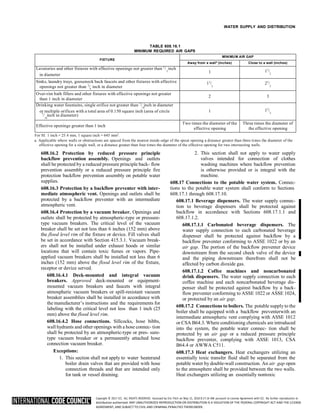
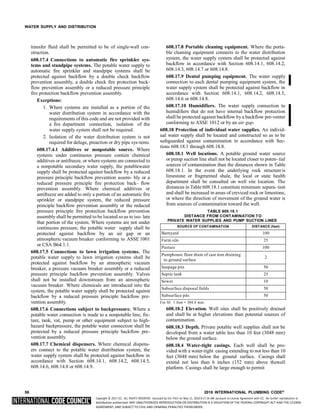
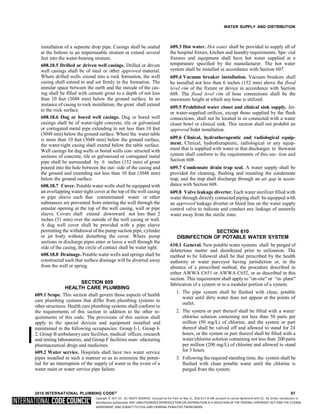
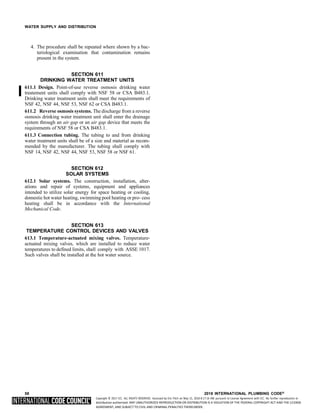
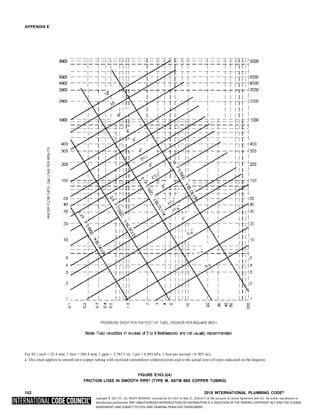
distribution authorized. ANY UNAUTHORIZED REPRODUCTION OR DISTRIBUTION IS A VIOLATION OF THE FEDERAL COPYRIGHT ACT AND THE LICENSE
AGREEMENT, AND SUBJECT TO CIVIL AND CRIMINAL PENALTIES THEREUNDER.
®
2 0 1 8
IPC
I N T E R N A T I O N A L C O D E S ®
A Member of the International Code Family®
INTERNATIONAL
PLUMBING CODE®
s
2018 I-CODE BONUS OFFER
distribution authorized. ANY UNAUTHORIZED REPRODUCTION OR DISTRIBUTION IS A VIOLATION OF THE FEDERAL COPYRIGHT ACT AND THE LICENSE
AGREEMENT, AND SUBJECT TO CIVIL AND CRIMINAL PENALTIES THEREUNDER.
Copyright © 2017 ICC. ALL RIGHTS RESERVED. Accessed by Eric Fitch on May 15, 2018 8:17:14 AM pursuant to License Agreement with ICC. No further reproduction or
distribution authorized. ANY UNAUTHORIZED REPRODUCTION OR DISTRIBUTION IS A VIOLATION OF THE FEDERAL COPYRIGHT ACT AND THE LICENSE
AGREEMENT, AND SUBJECT TO CIVIL AND CRIMINAL PENALTIES THEREUNDER.
2018 International Plumbing Code




First Printing: August 2017
ISBN: 978-1-60983-745-7 (soft-cover edition)
ISBN: 978-1-60983-744-0 (loose-leaf edition)
COPYRIGHT  2017
by
INTERNATIONAL CODE COUNCIL, INC.
Date of First Publication: August 31, 2017
ALL RIGHTS RESERVED. This 2018 International Plumbing Code
is a copyrighted work owned by the International Code
Council, Inc. Without advance written permission from the copyright owner, no part of this book may be reproduced, distributed
or transmitted in any form or by any means, including, without limitation, electronic, optical or mechanical means (by way of
example, and not limitation, photocopying or recording by or in an information storage retrieval system). For information on use
rights and permissions, please contact: Publications, 4051 Flossmoor Road, Country Club Hills, IL 60478. Phone 1-888-ICC- SAFE
(422-7233).
Trademarks: “International Code Council,” the “International Code Council” logo, “ICC,” the “ICC” logo, “International Plumbing
Code,” “IPC” and other names and trademarks appearing in this book are trademarks of the International Code Coun- cil, Inc.,
and/or its licensors (as applicable), and may not be used without permission.
PRINTED IN THE U.S.A.
Copyright © 2017 ICC. ALL RIGHTS RESERVED. Accessed by Eric Fitch on May 15, 2018 8:17:14 AM pursuant to License Agreement with ICC. No further reproduction or
distribution authorized. ANY UNAUTHORIZED REPRODUCTION OR DISTRIBUTION IS A VIOLATION OF THE FEDERAL COPYRIGHT ACT AND THE LICENSE
AGREEMENT, AND SUBJECT TO CIVIL AND CRIMINAL PENALTIES THEREUNDER.
PREFACE
Introduction
The International Plumbing Code
(IPC
) establishes minimum requirements for plumbing systems
using prescriptive and performance-related provisions. It is founded on broad-based principles that
make possible the use of new materials and new plumbing designs. This 2018 edition is fully com-
patible with all of the International Codes
(I-Codes
) published by the International Code Council
(ICC
), including the International Building Code
, International Energy Conservation Code
, Inter-
national Existing Building Code
, International Fire Code
, International Fuel Gas Code
, Interna- tional
Green Construction Code
, International Mechanical Code
, International Private Sewage Disposal
Code
, International Property Maintenance Code
, International Residential Code
, Inter- national
Swimming Pool and Spa Code
, International Wildland-Urban Interface Code
, Interna- tional Zoning
Code
and International Code Council Performance Code
.
The I-Codes, including this International Plumbing Code, are used in a variety of ways in both the
public and private sectors. Most industry professionals are familiar with the I-Codes as the basis of laws
and regulations in communities across the U.S. and in other countries. However, the impact of the
codes extends well beyond the regulatory arena, as they are used in a variety of nonregulatory settings,
including:
• Voluntary compliance programs such as those promoting sustainability, energy efficiency
and disaster resistance.
• The insurance industry, to estimate and manage risk, and as a tool in underwriting and rate
decisions.
• Certification and credentialing of individuals involved in the fields of building design, con-
struction and safety.
• Certification of building and construction-related products.
• U.S. federal agencies, to guide construction in an array of government-owned properties.
• Facilities management.
• “Best practices” benchmarks for designers and builders, including those who are engaged in
projects in jurisdictions that do not have a formal regulatory system or a governmental
enforcement mechanism.
• College, university and professional school textbooks and curricula.
• Reference works related to building design and construction.
In addition to the codes themselves, the code development process brings together building pro-
fessionals on a regular basis. It provides an international forum for discussion and deliberationabout
building design, construction methods, safety, performance requirements, technological advances and
innovative products.
Development
This 2018 edition presents the code as originally issued, with changes reflected in the 2003 through
2015 editions and with further changes approved by the ICC Code Development Process through 2017.
A new edition such as this is promulgated every 3 years.
This code is founded on principles intended to establish provisions consistent with the scope of a
plumbing code that adequately protects public health, safety and welfare; provisions that do not
unnecessarily increase construction costs; provisions that do not restrict the use of new materials,
products or methods of construction; and provisions that do not give preferential treatment to par-
ticular types or classes of materials, products or methods of construction.
2018 INTERNATIONAL PLUMBING CODE® iii
Copyright © 2017 ICC. ALL RIGHTS RESERVED. Accessed by Eric Fitch on May 15, 2018 8:17:14 AM pursuant to License Agreement with ICC. No further reproduction or
distribution authorized. ANY UNAUTHORIZED REPRODUCTION OR DISTRIBUTION IS A VIOLATION OF THE FEDERAL COPYRIGHT ACT AND THE LICENSE
AGREEMENT, AND SUBJECT TO CIVIL AND CRIMINAL PENALTIES THEREUNDER.
Maintenance
The International Plumbing Code is kept up to date through the review of proposed changes submit-
ted by code enforcement officials, industry representatives, design professionals and other inter- ested
parties. Proposed changes are carefully considered through an open code development process in
which all interested and affected parties may participate.
The ICC Code Development Process reflects principles of openness, transparency, balance, due
process and consensus, the principles embodied in OMB Circular A-119, which governs the federal
government’s use of private-sector standards. The ICC process is open to anyone; there is no cost to
participate, and people can participate without travel cost through the ICC’s cloud-based app, cdp-
Access
. A broad cross section of interests are represented in the ICC Code Development Process. The
codes, which are updated regularly, include safeguards that allow for emergency action when required
for health and safety reasons.
In order to ensure that organizations with a direct and material interest in the codes have a voice in
the process, the ICC has developed partnerships with key industry segments that support the
ICC’s important public safety mission. Some code development committee members were nomi- nated
by the following industry partners and approved by the ICC Board:
• American Institute of Architects (AIA)
• American Society of Plumbing Engineers (ASPE)
• National Association of Home Builders (NAHB)
• Plumbing Heating and Cooling Contractors (PHCC)
The Code Development Committees evaluate and make recommendations regarding proposed
changes to the codes. Their recommendations are then subject to public comment and council-wide
votes. The ICC’s governmental members—public safety officials who have no financial or business
interest in the outcome—cast the final votes on proposed changes.
The contents of this work are subject to change through the code development cycles and by any
governmental entity that enacts the code into law. For more information regarding the code devel-
opment process, contact the Codes and Standards Development Department of the International Code
Council.
While the I-Code development procedure is thorough and comprehensive, the ICC, its members and
those participating in the development of the codes disclaim any liability resulting from the publication
or use of the I-Codes, or from compliance or noncompliance with their provisions. The ICC does not
have the power or authority to police or enforce compliance with the contents of this code.
Code Development Committee Responsibilities
(Letter Designations in Front of Section Numbers)
In each code development cycle, proposed changes to the code are considered at the Committee
Action Hearings by the International Plumbing Code Development Committee, whose action consti-
tutes a recommendation to the voting membership for final action on the proposed change. Pro- posed
changes to a code section that has a number beginning with a letter in brackets are considered by a
different code development committee. For example, proposed changes to code sections that have
[BS] in front of them (e.g., [BS] 309.2) are considered by the IBC—Structural Code Development
Committee at the code development hearings.
The bracketed letter designations for committees responsible for portions of this code are as fol-
lows:
[A] = Administrative Code Development Committee;
[BE] = IBC—Egress Code Development Committee;
[BG] = IBC—General Code Development Committee;
iv 2018 INTERNATIONAL PLUMBING CODE®
Copyright © 2017 ICC. ALL RIGHTS RESERVED. Accessed by Eric Fitch on May 15, 2018 8:17:14 AM pursuant to License Agreement with ICC. No further reproduction or
distribution authorized. ANY UNAUTHORIZED REPRODUCTION OR DISTRIBUTION IS A VIOLATION OF THE FEDERAL COPYRIGHT ACT AND THE LICENSE
AGREEMENT, AND SUBJECT TO CIVIL AND CRIMINAL PENALTIES THEREUNDER.
[BS] = IBC—Structural Code Development Committee;
[E] = International Energy Conservation Code Development Committee;
[F] = International Fire Code Development Committee; and
[M] = International Mechanical Code Development Committee.
For the development of the 2021 edition of the I-Codes, there will be two groups of code devel-
opment committees and they will meet in separate years. Note that these are tentative groupings.
Group A Codes
(Heard in 2018, Code Change Proposals
Deadline: January 8, 2018)
Group B Codes
(Heard in 2019, Code Change Proposals
Deadline: January 7, 2019)
International Building Code
– Egress (Chapters 10, 11, Appendix E)
– Fire Safety (Chapters 7, 8, 9, 14, 26)
– General (Chapters 2–6, 12, 27–33,
Appendices A, B, C, D, K, N)
Administrative Provisions (Chapter 1 of allcodes
except IECC, IRC and IgCC, administra- tive
updates to currently referenced stan- dards,
and designated definitions)
International Fire Code International Building Code
– Structural (Chapters 15–25, Appendices F,
G, H, I, J, L, M)
International Fuel Gas Code International Existing Building Code
International Mechanical Code International Energy Conservation Code—
Commercial
International Plumbing Code International Energy Conservation Code—
Residential
– IECC—Residential
– IRC—Energy (Chapter 11)
International Property Maintenance Code International Green Construction Code
(Chapter 1)
International Private Sewage Disposal Code International Residential Code
– IRC—Building (Chapters 1–10,
Appendices E, F, H, J, K, L, M, O, Q, R, S, T)
International Residential Code
– IRC—Mechanical (Chapters 12–23)
– IRC—Plumbing (Chapters 25–33,
Appendices G, I, N, P)
International Swimming Pool and Spa Code
International Wildland-Urban Interface Code
International Zoning Code
Note: Proposed changes to the ICC Performance Code will be heard by the code development committee noted in brack-
ets [ ] in the text of the ICC Performance Code.
Code change proposals submitted for code sections that have a letter designation in front of them
will be heard by the respective committee responsible for such code sections. Because differ- ent
committees hold Committee Action Hearings in different years, proposals for the IPC will be heard by
committees in both the 2018 (Group A) and the 2019 (Group B) code development cycles.
For instance, every section of Chapter 1 of this code is designated as the responsibility of the
Administrative Code Development Committee, which is part of the Group B portion of the hearings.
This committee will hold its Committee Action Hearings in 2019 to consider code change proposals for
Chapter 1 of all I-Codes except the International Energy Conservation Code, International Resi- dential
Code and International Green Construction Code. Therefore, any proposals received for Chapter 1 of
this code will be assigned to the Administrative Code Development Committee for con- sideration in
2019.
It is very important that anyone submitting code change proposals understands which code
development committee is responsible for the section ofthe code that is the subject of the code change
proposal. For further information on the Code Development Committee responsibilities,please visit
the ICC website at www.iccsafe.org/scoping.
2018 INTERNATIONAL PLUMBING CODE® v
Copyright © 2017 ICC. ALL RIGHTS RESERVED. Accessed by Eric Fitch on May 15, 2018 8:17:14 AM pursuant to License Agreement with ICC. No further reproduction or
distribution authorized. ANY UNAUTHORIZED REPRODUCTION OR DISTRIBUTION IS A VIOLATION OF THE FEDERAL COPYRIGHT ACT AND THE LICENSE
AGREEMENT, AND SUBJECT TO CIVIL AND CRIMINAL PENALTIES THEREUNDER.
Marginal Markings
Solid vertical lines in the margins within the body of the code indicate a technical change from the
requirements of the 2015 edition. Deletion indicators in the form of an arrow (➡) are provided in
the margin where an entire section, paragraph, exception or table has been deleted or an item in a
list of items or a table has been deleted.
A single asterisk [*] placed in the margin indicates that text or a table has been relocated within the
code. A double asterisk [**] placed in the margin indicates that the text or table immediately following
it has been relocated there from elsewhere in the code. The following table indicates such relocations
in the 2018 edition of the International Plumbing Code.
2018 LOCATION 2015 LOCATION
802.2 804.1
Coordination of the International Codes
The coordination of technical provisions is one of the strengths of the ICC family of model codes. The
codes can be used as a complete set of complementary documents, which will provide users with full
integration and coordination of technical provisions. Individual codes can also be used in subsets or as
stand-alone documents. To make sure that each individual code is as complete as pos- sible, some
technical provisions that are relevant to more than one subject area are duplicated in some of the
model codes. This allows users maximum flexibility in their application of the I-Codes.
Italicized Terms
Words and terms defined in Chapter 2, Definitions, are italicized where they appear in code text and
the Chapter 2 definition applies. Where such words and terms are not italicized, common-use defi-
nitions apply. The words and terms selected have code-specific definitions that the user should read
carefully to facilitate better understanding of the code.
Adoption
The International Code Council maintains a copyright in all of its codes and standards. Maintaining
copyright allows the ICC to fund its mission through sales of books, in both print and electronic for-
mats. The ICC welcomes adoption of its codes by jurisdictions that recognize and acknowledge the ICC’s
copyright in the code, and further acknowledge the substantial shared value of the public/pri- vate
partnership for code development between jurisdictions and the ICC.
The ICC also recognizes the need for jurisdictions to make laws available to the public. All I-Codes
and I-Standards, along with the laws of many jurisdictions, are available for free in a nondownloadable
form on the ICC’s website. Jurisdictions should contact the ICC at adop- tions@iccsafe.org to learn how
to adopt and distribute laws based on the International Plumb- ing Code in a manner that
provides necessary access, while maintaining the ICC’s copyright.
vi 2018 INTERNATIONAL PLUMBING CODE®
Copyright © 2017 ICC. ALL RIGHTS RESERVED. Accessed by Eric Fitch on May 15, 2018 8:17:14 AM pursuant to License Agreement with ICC. No further reproduction or
distribution authorized. ANY UNAUTHORIZED REPRODUCTION OR DISTRIBUTION IS A VIOLATION OF THE FEDERAL COPYRIGHT ACT AND THE LICENSE
AGREEMENT, AND SUBJECT TO CIVIL AND CRIMINAL PENALTIES THEREUNDER.
To facilitate adoption, several sections of this code contain blanks for fill-in information that
needs to be supplied by the adopting jurisdiction as part of the adoption legislation. For this
code, please see:
Section 101.1. Insert: [NAME OF JURISDICTION]
Section 106.6.2. Insert: [APPROPRIATE SCHEDULE]
Section 106.6.3. Insert: [PERCENTAGES IN TWO LOCATIONS]
Section 108.4. Insert: [OFFENSE, DOLLAR AMOUNT, NUMBER OF DAYS]
Section 108.5. Insert: [DOLLAR AMOUNT IN TWO LOCATIONS]
Section 305.4.1. Insert: [NUMBER OF INCHES IN TWO LOCATIONS]
Section 903.1. Insert: [NUMBER OF INCHES]
2018 INTERNATIONAL PLUMBING CODE® vii
Copyright © 2017 ICC. ALL RIGHTS RESERVED. Accessed by Eric Fitch on May 15, 2018 8:17:14 AM pursuant to License Agreement with ICC. No further reproduction or
distribution authorized. ANY UNAUTHORIZED REPRODUCTION OR DISTRIBUTION IS A VIOLATION OF THE FEDERAL COPYRIGHT ACT AND THE LICENSE
AGREEMENT, AND SUBJECT TO CIVIL AND CRIMINAL PENALTIES THEREUNDER.
viii 2018 INTERNATIONAL PLUMBING CODE®
Copyright © 2017 ICC. ALL RIGHTS RESERVED. Accessed by Eric Fitch on May 15, 2018 8:17:14 AM pursuant to License Agreement with ICC. No further reproduction or
distribution authorized. ANY UNAUTHORIZED REPRODUCTION OR DISTRIBUTION IS A VIOLATION OF THE FEDERAL COPYRIGHT ACT AND THE LICENSE
AGREEMENT, AND SUBJECT TO CIVIL AND CRIMINAL PENALTIES THEREUNDER.
EFFECTIVE USE OF THE INTERNATIONAL PLUMBING CODE
The International Plumbing Code (IPC) is a model code that regulates the design and installation of
plumbing systems including the plumbing fixtures in all types of buildings except for detached one- and
two-family dwellings and townhouses that are not more than three stories above grade in height. The
regulations for plumbing systems in one- and two-family dwellings and townhouses are covered by
Chapters 25 through 33 of the International Residential Code (IRC). The IPC addresses general plumbing
regulations, fixture requirements, water heater installations and systems for water distribution,
sanitary drainage, special wastes, venting, storm drainage and medical gases. The IPC does not
address fuel gas piping systems as those systems are covered by the International Fuel Gas Code (IFGC).
The IPC also does not regulate swimming pool piping systems, process piping systems, or utility-owned
piping and systems. The purpose of the IPC is to the establish the mini- mum acceptable level of safety
to protect life and property from the potential dangers associated with supplying potable water to
plumbing fixtures and outlets and the conveyance of bacteria-laden wastewater from fixtures.
The IPC is primarily a specification-oriented (prescriptive) code with some performance-oriented
text. For example, Section 405.1 is a performance statement but Chapter 6 contains the prescriptive
requirements that will cause Section 405.1 to be satisfied.
Where a building contains plumbing fixtures, those fixtures requiring water must be provided
with an adequate supply of water for proper operation. The number of required plumbing fixtures
for a building is specified by this code and is based upon the anticipated maximum number of occu-
pants for the building and the type of building occupancy. This code provides prescriptive criteria for
sizing piping systems connected to those fixtures. Through the use of code-approved materialsand the
installation requirements specified in this code, plumbing systems will perform their intended function
over the life of the building. In summary, the IPC sets forth the minimum require- ments for providing
safe water to a building as well as a safe manner in which liquid-borne wastes are carried away from
a building.
Arrangement and Format of the 2018 IPC
The format of the IPC allows each chapter to be devoted to a particular subject with the exception
of Chapter 3 which contains general subject matters that are not extensive enough to warrant their
own independent chapter.
Chapters Subjects
1–2 Administration and Definitions
3 General Regulations
4 Fixtures, Faucets and Fixture Fittings
5 Water Heaters
6 Water Supply and Distribution
7 Sanitary Drainage
8 Indirect/Special Waste
9 Vents
10 Traps, Interceptors and Separators
11 Storm Drainage
12 Special Piping (Medical Gas)
13 Nonpotable Water Systems
14 Subsurface Landscape Irrigation Systems
15 Referenced Standards
Appendices A–E Appendices
2018 INTERNATIONAL PLUMBING CODE®
ix
Copyright © 2017 ICC. ALL RIGHTS RESERVED. Accessed by Eric Fitch on May 15, 2018 8:17:14 AM pursuant to License Agreement with ICC. No further reproduction or
distribution authorized. ANY UNAUTHORIZED REPRODUCTION OR DISTRIBUTION IS A VIOLATION OF THE FEDERAL COPYRIGHT ACT AND THE LICENSE
AGREEMENT, AND SUBJECT TO CIVIL AND CRIMINAL PENALTIES THEREUNDER.
The following is a chapter-by-chapter synopsis of the scope and intent of the provisions of the
International Plumbing Code:
Chapter 1 Scope and Administration. This chapter contains provisions for the application,
enforcement and administration of subsequent requirements of the code. In addition to establish-ing
the scope of the code, Chapter 1 identifies which buildings and structures come under its pur- view.
Chapter 1 is largely concerned with maintaining “due process of law” in enforcing the requirements
contained in the body of this code. Only through careful observation of the adminis- trative provisions
can the code official reasonably expect to demonstrate that “equal protectionunder the law” has
been provided.
Chapter 2 Definitions. Chapter 2 is the repository of the definitions of terms used in the body of
the code. Codes are technical documents and every word, term and punctuation mark can impact
the meaning of the code text and the intended results. The code often uses terms that have a
unique meaning in the code and the code meaning can differ substantially from the ordinarily
understood meaning of the term as used outside of the code.
The terms defined in Chapter 2 are deemed to be of prime importance in establishing the mean- ing
and intent of the code text that uses the terms. The user of the code should be familiar with and consult
this chapter because the definitions are essential to the correct interpretation of the code and because
the user may not be aware that a term is defined.
Where understanding of a term’s definition is especially key to or necessary for understanding of
a particular code provision, the term is shown in italics. This is true only for those terms that have a
meaning that is unique to the code. In other words, the generally understood meaning of a term or
phrase might not be sufficient or consistent with the meaning prescribed by the code; therefore, it
is essential that the code-defined meaning be known.
Guidance regarding tense, gender and plurality of defined terms as well as guidance regarding terms
not defined in this code is provided.
Chapter 3 General Regulations. The content of Chapter 3 is often referred to as “miscella-
neous,” rather than general regulations. This is the only chapter in the code whose requirements do
not interrelate. If a requirement cannot be located in another chapter, it should be located in this
chapter. Chapter 3 contains safety requirements for the installation of plumbing and nonplumbing
requirements for all types of fixtures. This chapter also has requirements for the identification of pipe,
pipe fittings, traps, fixtures, materials and devices used in plumbing systems.
The safety requirements of this chapter provide protection for the building’s structural mem- bers,
as well as prevent undue stress and strain on pipes. The building’s structural stability is pro- tected by
the regulations for cutting and notching of structural members. Additional protection for the building
occupants includes requirements to maintain the plumbing in a safe and sanitary condi- tion, as well
as privacy for those occupants.
Chapter 4 Fixtures, Faucets and Fixture Fittings. This chapter regulates the minimum num-
ber of plumbing fixtures that must be provided for every type of building. This chapter also regu- lates
the quality of fixtures and faucets by requiring those items to comply with nationally recognized
standards. Because fixtures must be properly installed so that they are usable by the occupants of the
building, this chapter contains the requirements for the installation of fixtures. Because the
requirements for the number of plumbing fixtures affects the design of a building, Chapter 29 of the
International Building Code (IBC) includes, verbatim, many of the requirements listed in Chapter 4 of
this code.
Chapter 5 Water Heaters. Chapter 5 regulates the design, approval and installation of water
heaters and related safety devices. The intent is to minimize the hazards associated with the instal-
lation and operation of water heaters. Although this code does not regulate the size of a water
heater, it does regulate all other aspects of the water heater installation such as temperature and
pressure relief valves, safety drip pans, installation and connections. Where a water heater also sup-
plies water for space heating, this chapter regulates the maximum water temperature supplied tothe
water distribution system.
x 2018 INTERNATIONAL PLUMBING CODE®
Copyright © 2017 ICC. ALL RIGHTS RESERVED. Accessed by Eric Fitch on May 15, 2018 8:17:14 AM pursuant to License Agreement with ICC. No further reproduction or
distribution authorized. ANY UNAUTHORIZED REPRODUCTION OR DISTRIBUTION IS A VIOLATION OF THE FEDERAL COPYRIGHT ACT AND THE LICENSE
AGREEMENT, AND SUBJECT TO CIVIL AND CRIMINAL PENALTIES THEREUNDER.
Chapter 6 Water Supply and Distribution. This chapter regulates the supply of potable water
from both public and individual sources to every fixture and outlet so that it remains potable and
uncontaminated. Chapter 6 also regulates the design of the water distribution system, which will allow
fixtures to function properly and also help prevent backflow conditions. The unique require- ments of
the water supply for health care facilities are addressed separately. It is critical that the potable water
supply system remain free of actual or potential sanitary hazards by providing protec- tion against
backflow.
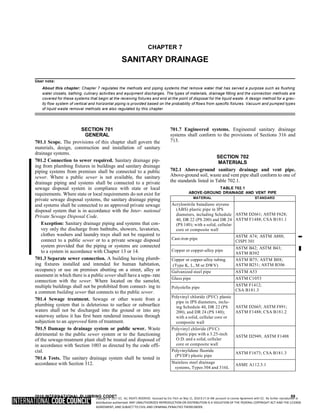
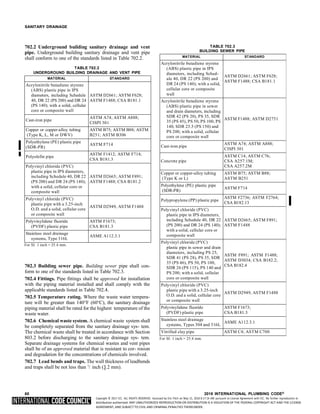
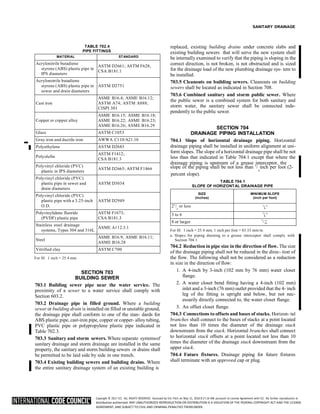
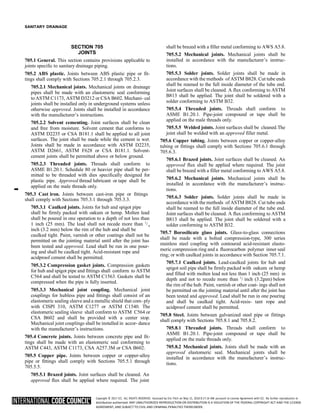
Chapter 7 Sanitary Drainage. The purpose of Chapter 7 is to regulate the materials, design and
installation of sanitary drainage piping systems as well as the connections made to the system. The
intent is to design and install sanitary drainage systems that will function reliably, that are neither
undersized nor oversized and that are constructed from materials, fittings and connections as pre-
scribed herein. This chapter addresses the proper use of fittings for directing the flow into and within
the sanitary drain piping system. Materials and provisions necessary forservicing the drain- age system
are also included in this chapter.
Chapter 8 Indirect/Special Waste. This chapter regulates drainage installations that require
an indirectconnection to the sanitary drainage system. Fixtures and plumbing appliances,such as those
associated with food preparation or handling, health care facilities and potable liquids, must be
protected from contamination that can result from connection to the drainage system. An indi- rect
connection prevents sewage from backing up into a fixture or appliance, thus providing protec- tion
against potential health hazards. The chapter also regulates special wastes containing hazardous
chemicals. Special waste must be treated to prevent any damage to the sanitary drainage piping and
to protect the sewage treatment processes.
Chapter 9 Vents. Chapter 9 covers the requirements for vents and venting. Knowing why venting
is required makes it easier to understand the intent of this chapter. Venting protects every trap against
the loss of its seal. Provisions set forth in this chapter are geared toward limiting the pres- sure
differentials in the drainage system to a maximum of 1 inch of water column (249 Pa) above or below
atmospheric pressure (i.e., positive or negative pressures).
Chapter 10 Traps, Interceptors and Separators. This chapter contains design requirements and
installation limitations for traps. Prohibited types of traps are specifically identified. Where fix- tures
do not frequently replenish the water in traps, a method is provided to ensure that the water seal of
the trap will be maintained. Requirements for the design and location of various types of interceptors
and separators are provided. Specific venting requirements are given for separators and interceptors
as those requirements are not addressed in Chapter 9.
Chapter 11 Storm Drainage. Chapter 11 regulates the removal of storm water typically associ-
ated with rainfall. The proper installation of a storm drainage system reduces the possibility of
structural collapse of a flat roof, prevents the leakage of water through the roof, prevents damage
to the footings and foundation of the building and prevents flooding of the lower levels of the build-
ing.
Chapter 12 Special Piping and Storage Systems. This chapter contains the requirements for the
design, installation, storage, handling and use of nonflammable medical gas systems, including
inhalation anesthetic and vacuum piping systems, bulk oxygen storage systems and oxygen-fuel gas
systems used for welding and cutting operations. The intent of these requirements is to minimizethe
potential fire and explosion hazards associated with the gases used in these systems.
Chapter 13 Nonpotable Water Systems. This chapter regulates the design and installation of
nonpotable water systems. The reduction of potable water use in buildings has led building design- ers
in some jurisdictions to use nonpotable water for irrigation and flushing of water closets and uri- nals.
This chapter provides the overall requirements for these systems.
Chapter 14 Subsurface Landscape Irrigation Systems. This chapter regulates the design
and installation of subsurface landscape irrigation systems for the disposal of on-site nonpotable water
such as graywater. The reduction of potable water use in buildings has led building designers in some
jurisdictions to use on-site nonpotable water for irrigation. This chapter provides the over- all
requirements for these systems.
2018 INTERNATIONAL PLUMBING CODE®
xi
Copyright © 2017 ICC. ALL RIGHTS RESERVED. Accessed by Eric Fitch on May 15, 2018 8:17:14 AM pursuant to License Agreement with ICC. No further reproduction or
distribution authorized. ANY UNAUTHORIZED REPRODUCTION OR DISTRIBUTION IS A VIOLATION OF THE FEDERAL COPYRIGHT ACT AND THE LICENSE
AGREEMENT, AND SUBJECT TO CIVIL AND CRIMINAL PENALTIES THEREUNDER.
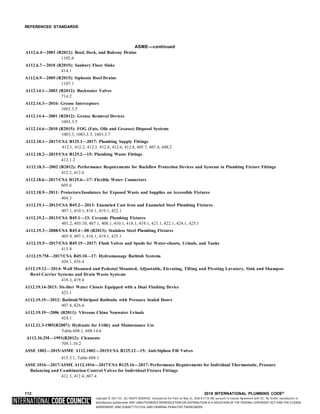
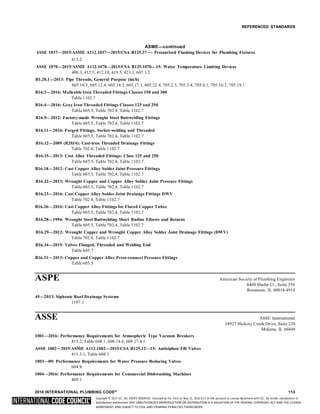
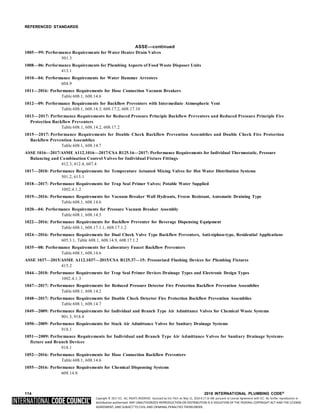
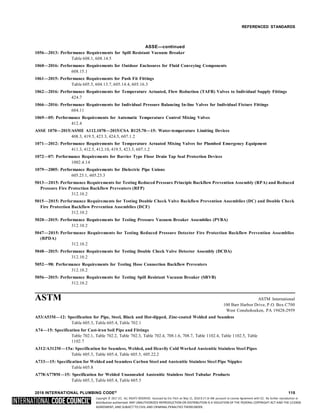
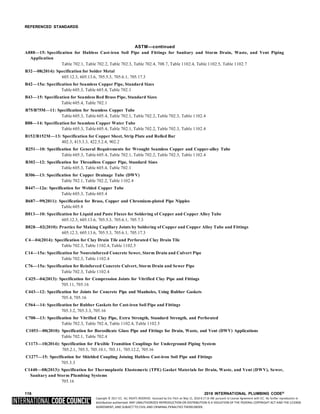
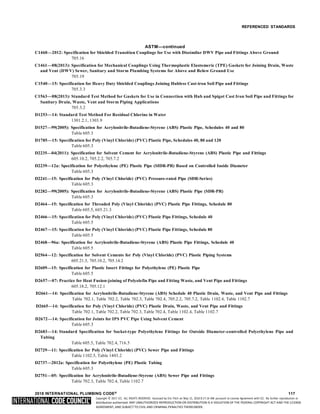
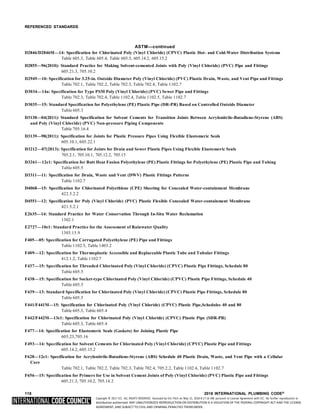
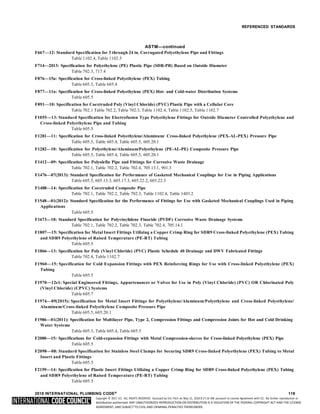
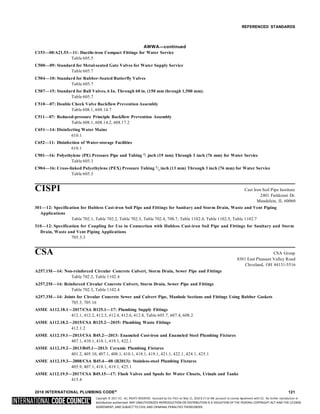
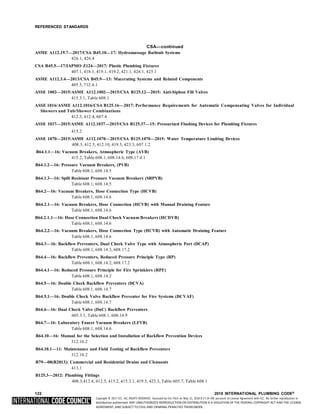
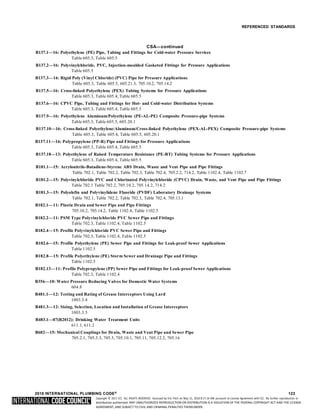
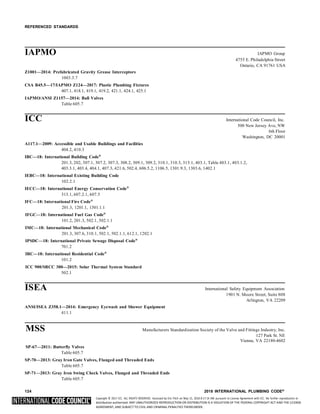
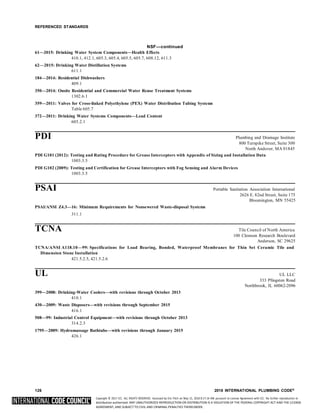
Chapter 15 Referenced Standards. Chapter 15 contains a comprehensive list of all standards
that are referenced in the code. The standards are part of the code to the extent of the reference to
the standard. Compliance with the referenced standard is necessary for compliance with this code.
By providing specifically adopted standards, the construction and installation requirements neces- sary
for compliance with the code can be readily determined. The basis for code compliance is, therefore,
established and available on an equal basis to the code official, contractor, designer and owner.
Chapter 15 is organized in a manner that makes it easy to locate specific standards. It lists all of the
referenced standards, alphabetically, by acronym of the promulgating agency of the standard. Each
agency’s standards are then listed in either alphabetical or numeric order based upon the stan- dard
identification. The list also contains the title of the standard; the edition (date) of the standard
referenced; any addenda included as part of the ICC adoption; and the section or sections of this code
that reference the standard.
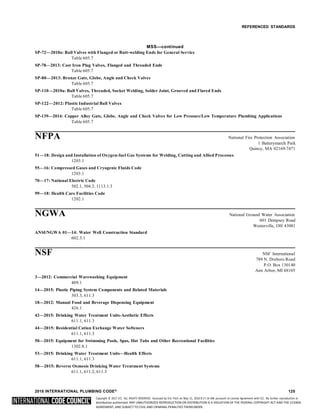
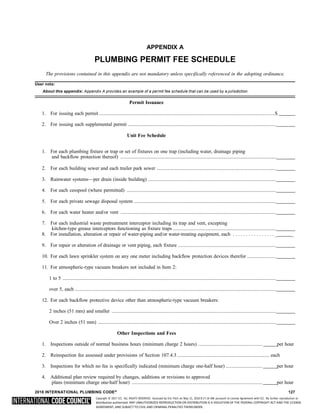
Appendix A Plumbing Permit Fee Schedule. Appendix A provides a format for a fee schedule.
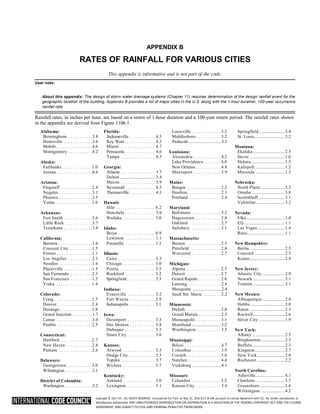
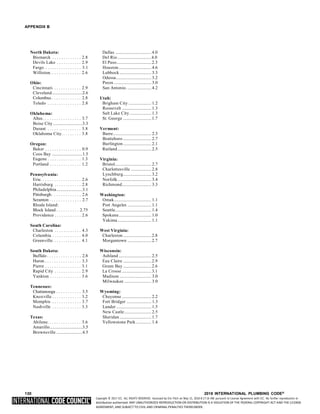
Appendix B Rates of Rainfall for Various Cities. Appendix B provides specific rainfall rates
for major cities in the United States.
Appendix C Structural Safety. Appendix C is provided so that the user does not have to refer to
another code book for limitations for cutting, notching and boring of sawn lumber and cold-formed
steel framing.
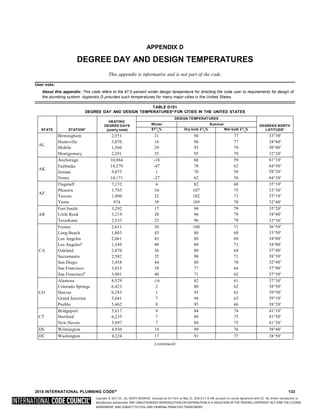
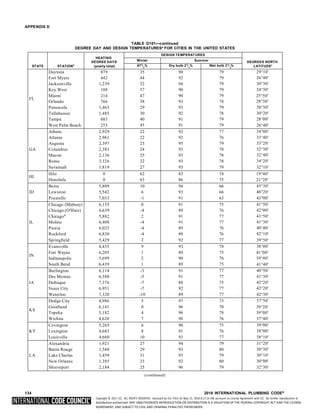
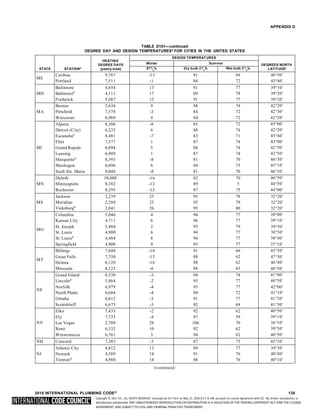
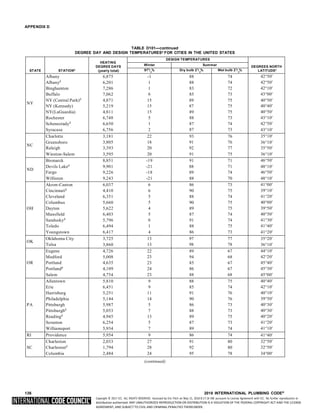
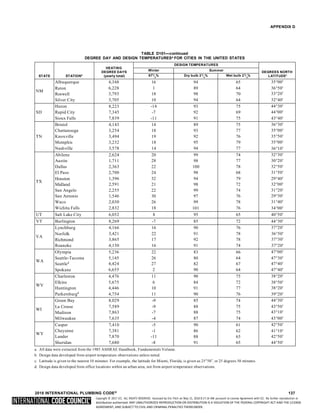
Appendix D Degree Day and Design Temperatures. This appendix provides valuable tem-
perature information for designers and installers of plumbing systems in areas where freezing tem-
peratures might exist.
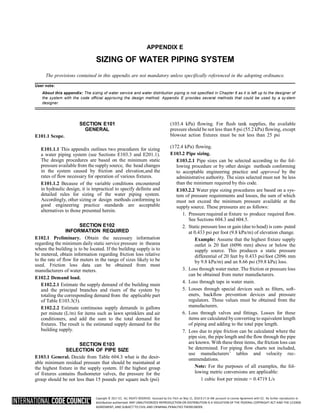
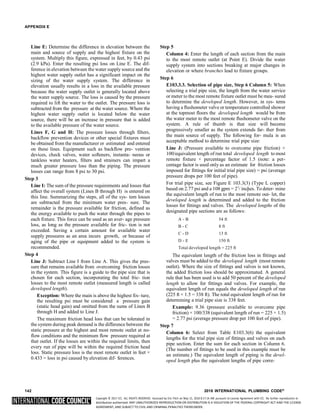
Appendix E Sizing of Water Piping System. Appendix E provides two recognized methods for
sizing the water service and water distributionpiping forany structure.The method under Section E103
provides friction loss diagrams which require the user to “plot” points and read values from the
diagrams in order to perform the required calculations and necessary checks. This method is the most
accurate of the two presented in this appendix. The method under Section E201 is known to be
conservative; however, very few calculations are necessary in order to determine a pipe size that
satisfies the flow requirements of any application.
xii 2018 INTERNATIONAL PLUMBING CODE®
Copyright © 2017 ICC. ALL RIGHTS RESERVED. Accessed by Eric Fitch on May 15, 2018 8:17:14 AM pursuant to License Agreement with ICC. No further reproduction or
distribution authorized. ANY UNAUTHORIZED REPRODUCTION OR DISTRIBUTION IS A VIOLATION OF THE FEDERAL COPYRIGHT ACT AND THE LICENSE
AGREEMENT, AND SUBJECT TO CIVIL AND CRIMINAL PENALTIES THEREUNDER.
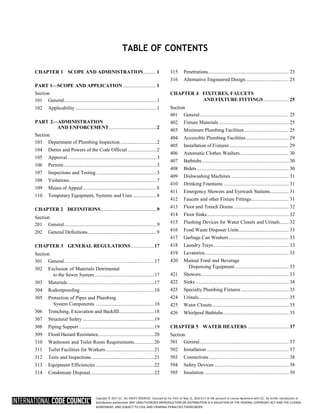
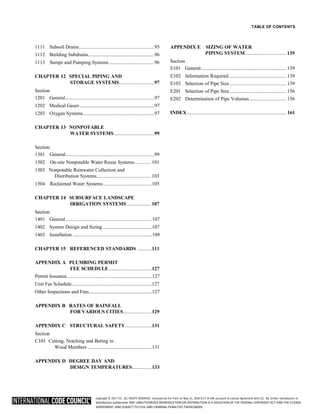
TABLE OF CONTENTS
CHAPTER 1 SCOPE AND ADMINISTRATION.......... 1
PART 1—SCOPE AND APPLICATION .......................... 1
Section
101 General..........................................................................1
102 Applicability .................................................................1
PART 2—ADMINISTRATION
AND ENFORCEMENT......................................2
Section
103 Department of Plumbing Inspection .............................2
104 Duties and Powers of the Code Official .......................2
105 Approval .......................................................................3
106 Permits..........................................................................3
107 Inspections and Testing ................................................5
108 Violations......................................................................7
109 Means of Appeal.......................................................... 8
110 Temporary Equipment, Systems and Uses ...................8
CHAPTER 2 DEFINITIONS.............................................9
Section
201 General..........................................................................9
202 General Definitions.......................................................9
CHAPTER 3 GENERAL REGULATIONS...................17
Section
301 General........................................................................17
302 Exclusion of Materials Detrimental
to the Sewer System................................................17
303 Materials .....................................................................17
304 Rodentproofing ...........................................................18
305 Protection of Pipes and Plumbing
System Components ...............................................18
306 Trenching, Excavation and Backfill............................18
307 Structural Safety .........................................................19
308 Piping Support ............................................................19
309 Flood Hazard Resistance.............................................20
310 Washroom and Toilet Room Requirements................20
311 Toilet Facilities for Workers.......................................21
312 Tests and Inspections..................................................21
313 Equipment Efficiencies...............................................22
314 Condensate Disposal...................................................22
315 Penetrations................................................................ 23
316 Alternative Engineered Design .................................. 23
CHAPTER 4 FIXTURES, FAUCETS
AND FIXTURE FITTINGS.................... 25
Section
401 General....................................................................... 25
402 Fixture Materials........................................................ 25
403 Minimum Plumbing Facilities.................................... 25
404 Accessible Plumbing Facilities.................................. 29
405 Installation of Fixtures ............................................... 29
406 Automatic Clothes Washers....................................... 30
407 Bathtubs..................................................................... 30
408 Bidets ......................................................................... 30
409 Dishwashing Machines .............................................. 31
410 Drinking Fountains .................................................... 31
411 Emergency Showers and Eyewash Stations............... 31
412 Faucets and other Fixture Fittings.............................. 31
413 Floor and Trench Drains............................................ 32
414 Floor Sinks................................................................. 32
415 Flushing Devices for Water Closets and Urinals....... 32
416 Food Waste Disposer Units........................................ 33
417 Garbage Can Washers................................................ 33
418 Laundry Trays............................................................ 33
419 Lavatories................................................................... 33
420 Manual Food and Beverage
Dispensing Equipment........................................... 33
421 Showers...................................................................... 33
422 Sinks .......................................................................... 34
423 Specialty Plumbing Fixtures ...................................... 35
424 Urinals........................................................................ 35
425 Water Closets............................................................. 35
426 Whirlpool Bathtubs.................................................... 35
CHAPTER 5 WATER HEATERS................................. 37
Section
501 General....................................................................... 37
502 Installation ................................................................. 37
503 Connections ............................................................... 38
504 Safety Devices ........................................................... 38
505 Insulation ................................................................... 39
Copyright © 2017 ICC. ALL RIGHTS RESERVED. Accessed by Eric Fitch on May 15, 2018 8:17:14 AM pursuant to License Agreement with ICC. No further reproduction or
distribution authorized. ANY UNAUTHORIZED REPRODUCTION OR DISTRIBUTION IS A VIOLATION OF THE FEDERAL COPYRIGHT ACT AND THE LICENSE
AGREEMENT, AND SUBJECT TO CIVIL AND CRIMINAL PENALTIES THEREUNDER.
2018 INTERNATIONAL PLUMBING CODE®
xiii
Copyright © 2017 ICC. ALL RIGHTS RESERVED. Accessed by Eric Fitch on May 15, 2018 8:17:14 AM pursuant to License Agreement with ICC. No further reproduction or
distribution authorized. ANY UNAUTHORIZED REPRODUCTION OR DISTRIBUTION IS A VIOLATION OF THE FEDERAL COPYRIGHT ACT AND THE LICENSE
AGREEMENT, AND SUBJECT TO CIVIL AND CRIMINAL PENALTIES THEREUNDER.
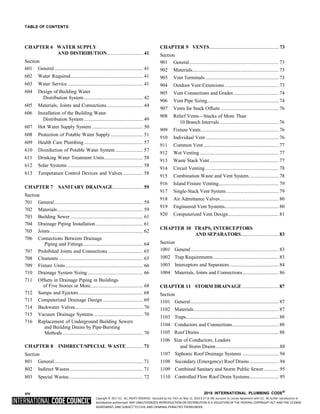
TABLE OF CONTENTS
CHAPTER 6 WATER SUPPLY
AND DISTRIBUTION............................. 41
Section
601 General....................................................................... 41
602 Water Required.......................................................... 41
603 Water Service ............................................................ 41
604 Design of Building Water
Distribution System ............................................... 42
605 Materials, Joints and Connections............................. 44
606 Installation of the Building Water
Distribution System ............................................... 49
607 Hot Water Supply System ......................................... 50
608 Protection of Potable Water Supply.......................... 51
609 Health Care Plumbing ............................................... 57
610 Disinfection of Potable Water System ...................... 57
611 Drinking Water Treatment Units............................... 58
612 Solar Systems ............................................................ 58
613 Temperature Control Devices and Valves ................ 58
CHAPTER 7 SANITARY DRAINAGE........................ 59
Section
701 General....................................................................... 59
702 Materials .................................................................... 59
703 Building Sewer.......................................................... 61
704 Drainage Piping Installation...................................... 61
705 Joints.......................................................................... 62
706 Connections Between Drainage
Piping and Fittings................................................ 64
707 Prohibited Joints and Connections ............................ 65
708 Cleanouts ................................................................... 65
709 Fixture Units.............................................................. 66
710 Drainage System Sizing ............................................ 66
711 Offsets in Drainage Piping in Buildings
of Five Stories or More.......................................... 68
712 Sumps and Ejectors ................................................... 68
713 Computerized Drainage Design ................................ 69
714 Backwater Valves...................................................... 70
715 Vacuum Drainage Systems ....................................... 70
716 Replacement of Underground Building Sewers
and Building Drains by Pipe-Bursting
Methods ................................................................ 70
CHAPTER 8 INDIRECT/SPECIAL WASTE.............. 71
Section
801 General....................................................................... 71
802 Indirect Wastes .......................................................... 71
803 Special Wastes........................................................... 72
xiv
CHAPTER 9 VENTS....................................................... 73
Section
901 General....................................................................... 73
902 Materials..................................................................... 73
903 Vent Terminals........................................................... 73
904 Outdoor Vent Extensions ........................................... 73
905 Vent Connections and Grades.................................... 74
906 Vent Pipe Sizing......................................................... 74
907 Vents for Stack Offsets .............................................. 76
908 Relief Vents—Stacks of More Than
10 Branch Intervals ............................................... 76
909 Fixture Vents.............................................................. 76
910 Individual Vent .......................................................... 76
911 Common Vent............................................................ 77
912 Wet Venting............................................................... 77
913 Waste Stack Vent....................................................... 77
914 Circuit Venting........................................................... 78
915 Combination Waste and Vent System........................ 78
916 Island Fixture Venting................................................ 79
917 Single-Stack Vent System.......................................... 79
918 Air Admittance Valves............................................... 80
919 Engineered Vent Systems........................................... 80
920 Computerized Vent Design........................................ 81
CHAPTER 10 TRAPS, INTERCEPTORS
AND SEPARATORS.............................. 83
Section
1001 General...................................................................... 83
1002 Trap Requirements.................................................... 83
1003 Interceptors and Separators....................................... 84
1004 Materials, Joints and Connections............................. 86
CHAPTER 11 STORM DRAINAGE ............................. 87
Section
1101 General...................................................................... 87
1102 Materials.................................................................... 87
1103 Traps.......................................................................... 88
1104 Conductors and Connections..................................... 88
1105 Roof Drains............................................................... 88
1106 Size of Conductors, Leaders
and Storm Drains...................................................88
1107 Siphonic Roof Drainage Systems ............................. 94
1108 Secondary (Emergency) Roof Drains ....................... 94
1109 Combined Sanitary and Storm Public Sewer............ 95
1110 Controlled Flow Roof Drain Systems....................... 95
2018 INTERNATIONAL PLUMBING CODE®
Copyright © 2017 ICC. ALL RIGHTS RESERVED. Accessed by Eric Fitch on May 15, 2018 8:17:14 AM pursuant to License Agreement with ICC. No further reproduction or
distribution authorized. ANY UNAUTHORIZED REPRODUCTION OR DISTRIBUTION IS A VIOLATION OF THE FEDERAL COPYRIGHT ACT AND THE LICENSE
AGREEMENT, AND SUBJECT TO CIVIL AND CRIMINAL PENALTIES THEREUNDER.
TABLE OF CONTENTS
1111 Subsoil Drains............................................................95
1112 Building Subdrains.....................................................96
1113 Sumps and Pumping Systems ....................................96
CHAPTER 12 SPECIAL PIPING AND
STORAGE SYSTEMS............................97
Section
1201 General.......................................................................97
1202 Medical Gases............................................................97
1203 Oxygen Systems.........................................................97
CHAPTER 13 NONPOTABLE
WATER SYSTEMS................................99
APPENDIX E SIZING OF WATER
PIPING SYSTEM................................. 139
Section
E101 General.................................................................... 139
E102 Information Required.............................................. 139
E103 Selection of Pipe Size............................................. 139
E201 Selection of Pipe Size............................................. 156
E202 Determination of Pipe Volumes ............................. 156
INDEX............................................................................... 161
Section
1301 General.......................................................................99
1302 On-site Nonpotable Water Reuse Systems............. 101
1303 Nonpotable Rainwater Collection and
Distribution Systems........................................... 103
1304 Reclaimed Water Systems.......................................105
CHAPTER 14 SUBSURFACE LANDSCAPE
IRRIGATION SYSTEMS................... 107
Section
1401 General.....................................................................107
1402 System Design and Sizing .......................................107
1403 Installation ...............................................................109
CHAPTER 15 REFERENCED STANDARDS ............111
APPENDIX A PLUMBING PERMIT
FEE SCHEDULE ..................................127
Permit Issuance....................................................................127
Unit Fee Schedule................................................................127
Other Inspections and Fees..................................................127
APPENDIX B RATES OF RAINFALL
FOR VARIOUS CITIES.......................129
APPENDIX C STRUCTURAL SAFETY.....................131
Section
C101 Cutting, Notching and Boring in
Wood Members ...................................................131
APPENDIX D DEGREE DAY AND
DESIGN TEMPERATURES................133
Copyright © 2017 ICC. ALL RIGHTS RESERVED. Accessed by Eric Fitch on May 15, 2018 8:17:14 AM pursuant to License Agreement with ICC. No further reproduction or
distribution authorized. ANY UNAUTHORIZED REPRODUCTION OR DISTRIBUTION IS A VIOLATION OF THE FEDERAL COPYRIGHT ACT AND THE LICENSE
AGREEMENT, AND SUBJECT TO CIVIL AND CRIMINAL PENALTIES THEREUNDER.
2018 INTERNATIONAL PLUMBING CODE®
xv
Copyright © 2017 ICC. ALL RIGHTS RESERVED. Accessed by Eric Fitch on May 15, 2018 8:17:14 AM pursuant to License Agreement with ICC. No further reproduction or
distribution authorized. ANY UNAUTHORIZED REPRODUCTION OR DISTRIBUTION IS A VIOLATION OF THE FEDERAL COPYRIGHT ACT AND THE LICENSE
AGREEMENT, AND SUBJECT TO CIVIL AND CRIMINAL PENALTIES THEREUNDER.
xvi 2018 INTERNATIONAL PLUMBING CODE®
Copyright © 2017 ICC. ALL RIGHTS RESERVED. Accessed by Eric Fitch on May 15, 2018 8:17:14 AM pursuant to License Agreement with ICC. No further reproduction or
distribution authorized. ANY UNAUTHORIZED REPRODUCTION OR DISTRIBUTION IS A VIOLATION OF THE FEDERAL COPYRIGHT ACT AND THE LICENSE
AGREEMENT, AND SUBJECT TO CIVIL AND CRIMINAL PENALTIES THEREUNDER.
CHAPTER 1
SCOPE AND ADMINISTRATION
User note:
About this chapter: Chapter 1 establishes the limits of applicability of this code and describes how the code is to be applied and enforced.
Chapter 1 is in two parts: Part 1—Scope and Application (Sections 101–102) and Part 2—Administration and Enforcement (Sections 103–
110). Section 101 identifies which buildings and structures come under its purview and references other I-Codes as applicable. Standards and
codes are scoped to the extent referenced (see Section 102.8).
This code is intended to be adopted as a legally enforceable document and it cannot be effective without adequate provisions for its adminis-
tration and enforcement. The provisions of Chapter 1 establish the authority and duties of the code official appointed by the authority having
jurisdiction and also establish the rights and privileges of the design professional, contractor and property owner.
PART 1—SCOPE AND APPLICATION
SECTION 101
GENERAL
[A] 101.1 Title. These regulations shall be known as the
Plumbing Code of [NAME OF JURISDICTION] hereinafter referred
to as “this code.”
[A] 101.2 Scope. The provisions of this code shall apply to
the erection, installation, alteration, repairs, relocation,
replacement, addition to, use or maintenance of plumbing
systems within this jurisdiction. This code shall regulate non-
flammable medical gas, inhalation anesthetic, vacuum piping,
nonmedical oxygen systems and sanitary and condensate vac-
uum collection systems. The installation of fuel gas distribu-
tion piping and equipment, fuel-gas-fired water heaters and
water heater venting systems shall be regulated by the Inter-
national Fuel Gas Code. Provisions in the appendices shall not
apply unless specifically adopted.
Exception: Detached one- and two-family dwellings and
multiple single-family dwellings (townhouses) not morethan
three stories high with separate means of egress and their
accessory structures shall comply with the Interna- tional
Residential Code.
[A] 101.3 Intent. The purpose of this code is to establish
minimum standards to provide a reasonable level of safety,
health, property protection and public welfare by regulating and
controlling the design, construction, installation, quality of
materials, location, operation and maintenance or use of
plumbing equipment and systems.
[A] 101.4 Severability. If any section, subsection, sentence,
clause or phrase of this code is for any reason held to be
unconstitutional, such decision shall not affect the validity of
the remaining portions of this code.
SECTION 102
APPLICABILITY
[A] 102.1 General. Where there is a conflict between a gen-
eral requirement and a specific requirement, the specific
requirement shall govern. Where, in any specific case, differ-
ent sections of this code specify different materials, methods
of construction or other requirements, the most restrictive shall
govern.
[A] 102.2 Existing installations. Plumbing systems lawfully in
existence at the time of the adoption of this code shall be
permitted to have their use and maintenance continued if the
use, maintenance or repair is in accordance with the original
design and hazard to life, health or property is not created by
such plumbing system.
[A] 102.2.1 Existing buildings. Additions, alterations,
renovations or repairs related to building or structural issues
shall be regulated by the International Existing Building
Code.
[A] 102.3 Maintenance. Plumbing systems, materials and
appurtenances, both existing and new, and parts thereof, shall
be maintained in proper operating condition in accordance with
the original design in a safe and sanitary condition. Devices or
safeguards required by this code shall be main- tained in
compliance with the edition of the code under which they were
installed.
The owner or the owner’s authorized agent shall be
responsible for maintenance of plumbing systems. To deter-
mine compliance with this provision, the code official shall
have the authority to require any plumbing system to be rein-
spected.
[A] 102.4 Additions, alterations or repairs. Additions,
alterations, renovations or repairs to any plumbing systemshall
conform to that required for a new plumbing system without
requiring the existing plumbing system to complywith all the
requirements of this code. Additions, alterationsor repairs
shall not cause an existing system to become unsafe, insanitary
or overloaded.
Minor additions, alterations, renovations and repairs to
existing plumbing systems shall meet the provisions for new
construction, unless such work is done in the same manner
and arrangement as was in the existing system, is not hazard-
ous and is approved.
[A] 102.5 Change in occupancy. It shall be unlawful to make
any change in the occupancy of any structure that will subject
the structure to any special provision of this codeapplicable to
the new occupancy without approval of the code official. The
code official shall certify that such structure
Copyright © 2017 ICC. ALL RIGHTS RESERVED. Accessed by Eric Fitch on May 15, 2018 8:17:14 AM pursuant to License Agreement with ICC. No further reproduction or
distribution authorized. ANY UNAUTHORIZED REPRODUCTION OR DISTRIBUTION IS A VIOLATION OF THE FEDERAL COPYRIGHT ACT AND THE LICENSE
AGREEMENT, AND SUBJECT TO CIVIL AND CRIMINAL PENALTIES THEREUNDER.
2018 INTERNATIONAL PLUMBING CODE® 1
Copyright © 2017 ICC. ALL RIGHTS RESERVED. Accessed by Eric Fitch on May 15, 2018 8:17:14 AM pursuant to License Agreement with ICC. No further reproduction or
distribution authorized. ANY UNAUTHORIZED REPRODUCTION OR DISTRIBUTION IS A VIOLATION OF THE FEDERAL COPYRIGHT ACT AND THE LICENSE
AGREEMENT, AND SUBJECT TO CIVIL AND CRIMINAL PENALTIES THEREUNDER.
SCOPE AND ADMINISTRATION
meets the intent of the provisions of law governing building
construction for the proposed new occupancy and that such
change of occupancy does not result in any hazard to the pub-
lic health, safety or welfare.
[A] 102.6 Historic buildings. The provisions of this code
relating to the construction, alteration, repair, enlargement,
restoration, relocation or moving of buildings or structures shall
not be mandatory for existing buildings or structures identified
and classified by the state or local jurisdiction as historic
buildings where such buildings or structures are judged by the
code official to be safe and in the public inter- est of health,
safety and welfare regarding any proposed con- struction,
alteration, repair, enlargement, restoration, relocation or
moving of buildings.
[A] 102.7 Moved buildings. Except as determined by Sec- tion
102.2, plumbing systems that are a part of buildings or
structures moved into or within the jurisdiction shall comply
with the provisions of this code for new installations.
[A] 102.8 Referenced codes and standards. The codes and
standards referenced in this code shall be those that are listed in
Chapter 15 and such codes and standards shall be consid- ered
as part of the requirements of this code to the prescribed extent
of each such reference and as further regulated in Sec- tions
102.8.1 and 102.8.2.
[A] 102.8.1 Conflicts. Where conflicts occur between pro-
visions of this code and the referenced standards, the pro-
visions of this code shall apply.
[A] 102.8.2 Provisions in referenced codes and stan-
dards. Where the extent of the reference to a referenced
code or standard includes subject matter that is within the
scope of this code, the provisions of this code, as applica-
ble, shall take precedence over the provisions in the refer-
enced code or standard.
[A] 102.9 Requirements not covered by code. Any require-
ments necessary for the strength, stability or proper operation
of an existing or proposed plumbing system, or for the public
safety, health and general welfare, not specifically covered by
this code shall be determined by the code official.
[A] 102.10 Other laws. The provisions of this code shall not be
deemed to nullify any provisions of local, state or federal law.
[A] 102.11 Application of references. Reference to chapter
section numbers, or to provisions not specifically identified
by number, shall be construed to refer to such chapter, section
or provision of this code.
PART 2—ADMINISTRATION AND ENFORCEMENT
SECTION 103
DEPARTMENT OF PLUMBING INSPECTION
[A] 103.1 General. The department of plumbing inspection
is hereby created and the executive official in charge thereof
shall be known as the code official.
[A] 103.2 Appointment. The code official shall be appointed
by the chief appointing authority of the jurisdiction.
[A] 103.3 Deputies. In accordance with the prescribed proce-
dures of this jurisdiction and with the concurrence of the
appointing authority, the code official shall have the authority
to appoint a deputy code official, other related technical offi-
cers, inspectors and other employees. Such employees shall
have powers as delegated by the code official.
[A] 103.4 Liability. The code official, member of the board
of appeals or employee charged with the enforcement of this
code, while acting for the jurisdiction in good faith and with-
out malice in the discharge of the duties required by this code
or other pertinent law or ordinance, shall not thereby be ren-
dered civilly or criminally liable personally, and is hereby
relieved from all personal liability for any damage accruing
to persons or property as a result of any act or by reason of an
act or omission in the discharge of official duties.
[A] 103.4.1 Legal defense. Any suit or criminal complaint
instituted against any officer or employee because of an
act performed by that officer or employee in the lawful
discharge of duties and under the provisions of this code
shall be defended by the legal representative of the juris-
diction until the final termination of the proceedings. The
code official or any subordinate shall not be liable for costs
in any action, suit or proceeding that is instituted in
pursuance of the provisions of this code.
SECTION 104
DUTIES AND POWERS OF THE CODE OFFICIAL
[A] 104.1 General. The code official is hereby authorized and
directed to enforce the provisions of this code. The code official
shall have the authority to render interpretations of this code
and to adopt policies and procedures in order to clarify the
application of its provisions. Such interpretations, policies and
procedures shall be in compliance with the intent and purpose
of this code. Such policies and procedures shall not have the
effect of waiving requirements specificallypro- vided for in this
code.
[A] 104.2 Applications and permits. The code official shall
receive applications, review construction documents and issue
permits for the installation and alteration of plumbing systems,
inspect the premises for which such permits have been issued,
and enforce compliance with the provisions of this code.
[A] 104.3 Inspections. The code official shall make all the
required inspections, or shall accept reports of inspection by
approved agencies or individuals. Reports of such inspections
shall be in writing and be certified by a responsible officer of
such approved agency or by the responsible individual. The
code official is authorized to engage such expert opinion as
deemed necessary to report on unusual technical issues that
arise, subject to the approval of the appointing authority.
[A] 104.4 Right of entry. Where it is necessary to make an
inspection to enforce the provisions of this code, or where the
code official has reasonable cause to believe that there exists
in any building or on any premises any conditions or viola-
2 2018 INTERNATIONAL PLUMBING CODE®
Copyright © 2017 ICC. ALL RIGHTS RESERVED. Accessed by Eric Fitch on May 15, 2018 8:17:14 AM pursuant to License Agreement with ICC. No further reproduction or
distribution authorized. ANY UNAUTHORIZED REPRODUCTION OR DISTRIBUTION IS A VIOLATION OF THE FEDERAL COPYRIGHT ACT AND THE LICENSE
AGREEMENT, AND SUBJECT TO CIVIL AND CRIMINAL PENALTIES THEREUNDER.
SCOPE AND ADMINISTRATION
tions of this code that make the building or premises unsafe,
insanitary, dangerous or hazardous, the code official shall have
the authority to enter the building or premises at all rea- sonable
times to inspect or to perform the duties imposed upon the
code official by this code. If such building or prem- ises is
occupied, the code official shall present credentials to the
occupant and request entry. If such building or premises is
unoccupied, the code official shall first make a reasonable effort
to locate the owner, the owner’s authorized agent or other
person having charge or control of the building or premises and
request entry. If entry is refused, the code offi- cial shall have
recourse to every remedy provided by law to secure entry.
Where the code official shall have first obtained a proper
inspection warrant or other remedy provided by law to secure
entry, the owner, owner’s authorized agent, occupant or per-
son having charge, care or control of any building or premises
shall not fail or neglect, after proper request is made as herein
provided, to promptly permit entry therein by the code offi- cial
for the purpose of inspection and examination pursuant to this
code.
[A] 104.5 Identification. The code official shall carry proper
identification when inspecting structures or premises in the
performance of duties under this code.
[A] 104.6 Notices and orders. The code official shall issue
all necessary notices or orders to ensure compliance with this
code.
[A] 104.7 Department records. The code official shall keep
official records of applications received, permits and certifi-
cates issued, fees collected, reports of inspections, and notices
and orders issued. Such records shall be retained in the official
records for the period required for the retention of public
records.
SECTION 105
APPROVAL
[A] 105.1 Modifications. Where there are practical difficul-
ties involved in carrying out the provisions of this code, the
code official shall have the authority to grant modifications
for individual cases, upon application of the owner or owner’s
authorized agent, provided that the code official shall first find
that special individual reason makes the strict letterof this code
impractical and the modification conforms to the intent and
purpose of this code and that such modificationdoes not lessen
health, life and fire safety requirements. The details of action
granting modifications shall be recorded and entered in the files
of the plumbing inspection department.
[A] 105.2 Alternative materials, design and methods of
construction and equipment. The provisions of this code are
not intended to prevent the installation of any material orto
prohibit any design or method of construction not specifi- cally
prescribed by this code, provided that any such alterna- tive has
been approved. An alternative material or method of
construction shall be approved where the code official finds that
the proposed design is satisfactory and complies with the intent
of the provisions of this code, and that the material, method or
work offered is, for the purpose intended, not less than the
equivalent of that prescribed in this code in quality,
strength, effectiveness, fire resistance, durability and safety.
Where the alternative material, design or method of construc-
tion is not approved, the code official shall respond in writ- ing,
stating the reasons why the alternative was not approved.
[A] 105.2.1 Research reports. Supporting data, where
necessary to assist in the approval of materials or assem-
blies not specifically provided for in this code, shall con- sist
of valid research reports from approved sources.
[A] 105.3 Required testing. Where there is insufficient evi-
dence of compliance with the provisions of this code, or evi-
dence that a material or method does not conform to the
requirements of this code, or in order to substantiate claims
for alternate materials or methods, the code official shall have
the authority to require tests as evidence of compliance to be
made at no expense to the jurisdiction.
[A] 105.3.1 Test methods. Test methods shall be as speci-
fied in this code or by other recognized test standards. In
the absence of recognized and accepted test methods, the
code official shall approve the testing procedures.
[A] 105.3.2 Testing agency. Tests shall be performed by an
approved agency.
[A] 105.3.3 Test reports. Reports of tests shall be retained
by the code official for the period required for retention of
public records.
[A] 105.4 Approved materials and equipment. Materials,
equipment and devices approved by the code official shall be
constructed and installed in accordance with such approval.
[A] 105.4.1 Material and equipment reuse. Materials,
equipment and devices shall not be reused unless such ele-
ments have been reconditioned, tested, placed in good and
proper working condition and approved.
SECTION 106
PERMITS
[A] 106.1 Where required. Any owner, owner’s authorized
agent or contractor who desires to construct, enlarge, alter,
repair, move, demolish or change the occupancy of a building
or structure, or to erect, install, enlarge, alter, repair, remove,
convert or replace any plumbing system, the installation of
which is regulated by this code, or to cause any such work to be
performed, shall first make application to the code official and
obtain the required permit for the work.
[A] 106.1.1 Annual permit. Instead of an individual con-
struction permit for each alteration to an already approved
system or equipment or appliance installation, the code
official is authorized to issue an annual permit upon appli-
cation therefor to any person, firm or corporation regularly
employing one or more qualified tradespersons in the
building, structure or on the premises owned or operatedby
the applicant for the permit.
[A] 106.1.2 Annual permit records. The person to whom
an annual permit is issued shall keep a detailed record of
alterations made under such annual permit. The code offi-
cial shall have access to such records at all times or such
records shall be filed with the code official as designated.
2018 INTERNATIONAL PLUMBING CODE® 3
Copyright © 2017 ICC. ALL RIGHTS RESERVED. Accessed by Eric Fitch on May 15, 2018 8:17:14 AM pursuant to License Agreement with ICC. No further reproduction or
distribution authorized. ANY UNAUTHORIZED REPRODUCTION OR DISTRIBUTION IS A VIOLATION OF THE FEDERAL COPYRIGHT ACT AND THE LICENSE
AGREEMENT, AND SUBJECT TO CIVIL AND CRIMINAL PENALTIES THEREUNDER.
SCOPE AND ADMINISTRATION
[A] 106.2 Exempt work. The following work shall be exempt
from the requirement for a permit:
1. The stopping of leaks in drains, water, soil, waste or
vent pipe provided, however, that if any concealed trap,
drainpipe, water, soil, waste or vent pipe becomes
defective and it becomes necessary to remove and replace
the same with new material, such work shall be
considered as new work and a permit shall be obtained
and inspection made as provided in this code.
2. The clearing of stoppages or the repairing of leaks in
pipes, valves or fixtures, and the removal and reinstal-
lation of water closets, provided that such repairs do
not involve or require the replacement or rearrange- ment
of valves, pipes or fixtures.
Exemption from the permit requirements of this code shall
not be deemed to grant authorization for any work to be done in
violation of the provisions of this code or any other laws or
ordinances of this jurisdiction.
[A] 106.3 Application for permit. Each application for a
permit, with the required fee, shall be filed with the code offi-
cial on a form furnished for that purpose and shall contain a
general description of the proposed work and its location. The
application shall be signed by the owner or owner’s autho- rized
agent. The permit application shall indicate the pro- posed
occupancy of all parts of the building and of that portion of the
site or lot, if any, not covered by the building or structure and
shall contain such other information required by the code
official.
[A] 106.3.1 Construction documents. Construction doc-
uments, engineering calculations, diagrams and other such
data shall be submitted in two or more sets with each
application for a permit. The code official shall require
construction documents, computations and specifications
to be prepared and designed by a registered design profes-
sional where required by state law. Construction docu-
ments shall be drawn to scale and shall be of sufficient
clarity to indicate the location, nature and extent of the work
proposed and show in detail that the work conformsto the
provisions of this code. Construction documents for
buildings more than two stories in height shall indicate
where penetrations will be made for pipes, fittings and
components and shall indicate the materials and methods
for maintaining required structural safety, fire-resistance
rating and fireblocking.
Exception: The code official shall have the authority to
waive the submission of construction documents, cal-
culations or other data if the nature of the work applied
for is such that reviewing of construction documents is
not necessary to determine compliance with this code.
[A] 106.3.2 Preliminary inspection. Before a permit is
issued, the code official shall be authorized to inspect and
evaluate the systems, equipment, buildings, devices, prem-
ises and spaces or areas to be used.
[A] 106.3.3 Time limitation of application. An applica-
tion for a permit for any proposed work shall be deemed to
have been abandoned 180 days after the date of filing,unless
such application has been pursued in good faith or a permit
has been issued; except that the code official shall
have the authority to grant one or more extensions of time
for additional periods not exceeding 180 days each. The
extension shall be requested in writing and justifiable cause
demonstrated.
[A] 106.4 By whom application is made. Application for a
permit shall be made by the person or agent to install all or part
of any plumbing system. The applicant shall meet all
qualifications established bystatute, or by rules promulgated by
this code, or by ordinance or by resolution. The full name and
address of the applicant shall be stated in the application.
[A] 106.5 Permit issuance. The application, construction
documents and other data filed by an applicant for permit shall
be reviewed by the code official. If the code officialfinds that
the proposed work conforms to the requirements of this code
and all laws and ordinances applicable thereto, and that the fees
specified in Section 106.6 have been paid, a per- mit shall be
issued to the applicant.
[A] 106.5.1 Approved construction documents. When
the code official issues the permit where construction doc-
uments are required, the construction documents shall be
endorsed in writing and stamped “APPROVED.” Such
approved construction documents shall not be changed,
modified or altered without authorization from the code
official. Work shall be done in accordance with the approved
construction documents.
The code official shall have the authority to issue a per-
mit for the construction of a part of a plumbing system
before the entire construction documents for the whole
system have been submitted or approved, provided that
adequate information and detailed statements have been
filed complying with all pertinent requirements of this code.
The holders of such permit shall proceed at their own risk
without assurance that the permit for the entire plumbing
system will be granted.
[A] 106.5.2 Validity. The issuance of a permit or approval
of construction documents shall not be construed to be a
permit for, or an approval of, any violation of any of the
provisions of this code or any other ordinance of the juris-
diction. A permit presuming to give authority to violate or
cancel the provisions of this code shall not be valid.
The issuance of a permit based on construction docu-
ments and other data shall not prevent the code official from
thereafter requiring the correction of errors in said
construction documents and other data or from preventing
building operations being carried on thereunder where in
violation of this code or of other ordinances of this juris-
diction.
[A] 106.5.3 Expiration. Every permit issued by the code
official under the provisions of this code shall expire by
limitation and become null and void if the work authorized
by such permit is not commenced within 180 days from
the date of such permit, or if the work authorized by such
permit is suspended or abandoned at any time after thework
is commenced for a period of 180 days. Before such work
can be recommenced, a new permit shall be firstobtained and
the fee therefor shall be one-half the amount required for a
new permit for such work, provided that changes have not
been made and will not be made in the
Copyright © 2017 ICC. ALL RIGHTS RESERVED. Accessed by Eric Fitch on May 15, 2018 8:17:14 AM pursuant to License Agreement with ICC. No further reproduction or
distribution authorized. ANY UNAUTHORIZED REPRODUCTION OR DISTRIBUTION IS A VIOLATION OF THE FEDERAL COPYRIGHT ACT AND THE LICENSE
AGREEMENT, AND SUBJECT TO CIVIL AND CRIMINAL PENALTIES THEREUNDER.
4 2018 INTERNATIONAL PLUMBING CODE®
Copyright © 2017 ICC. ALL RIGHTS RESERVED. Accessed by Eric Fitch on May 15, 2018 8:17:14 AM pursuant to License Agreement with ICC. No further reproduction or
distribution authorized. ANY UNAUTHORIZED REPRODUCTION OR DISTRIBUTION IS A VIOLATION OF THE FEDERAL COPYRIGHT ACT AND THE LICENSE
AGREEMENT, AND SUBJECT TO CIVIL AND CRIMINAL PENALTIES THEREUNDER.
SCOPE AND ADMINISTRATION
original construction documents for such work, and pro-
vided further that such suspension or abandonment has not
exceeded 1 year.
[A] 106.5.4 Extensions. Any permittee holding an unex-
pired permit shall have the right to apply for an extension
of the time within which the permittee will commence work
under that permit when work is unable to be com- menced
within the time required by this section for good and
satisfactory reasons. The code official shall extend the time
for action by the permittee for a period not exceeding 180
days if there is reasonable cause. A permit shall not be
extended more than once. The fee for an extension shall be
one-half the amount required for a new permit for such work.
[A] 106.5.5 Suspension or revocation of permit. The code
official shall have the authority to suspend or revokea
permit issued under the provisions of this code wherever the
permit is issued in error or on the basis of incorrect,
inaccurate or incomplete information, or in violation ofany
ordinance or regulation or any of the provisions of this code.
[A] 106.5.6 Retention of construction documents. Oneset
of approved construction documents shall be retained bythe
code official for a period of not less than 180 days from date
of completion of the permitted work, or as required by state
or local laws.
One set of approved construction documents shall be
returned to the applicant, and said set shall be kept on the
site of the building or work at all times during which the
work authorized thereby is in progress.
[A] 106.5.7 Previous approvals. This code shall not require
changes in the construction documents, construc- tion or
designated occupancy of a structure for which a lawful
permit has been heretofore issued or otherwise law- fully
authorized, and the construction of which has been pursued
in good faith within 180 days after the effective date of this
code and has not been abandoned.
[A] 106.5.8 Posting of permit. The permit or a copy shall
be kept on the site of the work until the completion of the
project.
[A] 106.6 Fees. A permit shall not be issued until the fees
prescribed in Section 106.6.2 have been paid, and an amend-
ment to a permit shall not be released until the additional fee,
if any, due to an increase of the plumbing systems, has been
paid.
[A] 106.6.1 Work commencing before permit issuance.
Any person who commences any work on a plumbing sys-
tem before obtaining the necessary permits shall be subject
to 100 percent of the usual permit fee in addition to the
required permit fees.
[A] 106.6.2 Fee schedule. The fees for all plumbing work
shall be as indicated in the following schedule:
[JURISDICTION TO INSERT APPROPRIATE SCHEDULE]
[A] 106.6.3 Fee refunds. The code official shall authorize
the refunding of fees as follows:
1. The full amount of any fee paid hereunder that was
erroneously paid or collected.
2. Not more than [SPECIFY PERCENTAGE] percent ofthe
permit fee paid where work has been done undera
permit issued in accordance with this code.
3. Not more than [SPECIFY PERCENTAGE] percent ofthe
plan review fee paid where an application for a permit
for which a plan review fee has been paid is withdrawn
or canceled before any plan review effort has been
expended.
The code official shall not authorize the refunding of any
fee paid except upon written application filed by the original
permittee not later than 180 days after the date of fee
payment.
SECTION 107
INSPECTIONS AND TESTING
[A] 107.1 General. The code official is authorized to conduct
such inspections as are deemed necessary to determine com-
pliance with the provisions of this code. Construction or work
for which a permit is required shall be subject to inspection by
the code official, and such construction or work shall remain
visible and able to be accessed for inspection pur- poses until
approved. Approval as a result of an inspection shall not be
construed to be an approval of a violation of the provisions of
this code or of other ordinances of the jurisdic- tion. Inspections
presuming to give authority to violate orcancel the provisions
of this code or of other ordinances ofthe jurisdiction shall not
be valid. It shall be the duty of the permit applicant to cause the
work to remain visible and able to be accessed for inspection
purposes. Neither the code offi- cial nor the jurisdiction shall be
liable for expense entailed in the removal or replacement of any
material required to allow inspection.
[A] 107.2 Required inspections and testing. The code offi-
cial, upon notification from the permit holder or the permit
holder’s agent, shall make the following inspections and such
other inspections as necessary, and shall either release that
portion of the construction or shall notify the permit holder or
an agent of any violations that must be corrected. The holder
of the permit shall be responsible for the scheduling of such
inspections.
1. Underground inspection shall be made after trenches or
ditches are excavated and bedded, piping installed, and
before any backfill is put in place.
2. Rough-in inspection shall be made after the roof, fram-
ing, fireblocking, firestopping, draftstopping and brac-
ing is in place and all sanitary, storm and water
distribution piping is roughed-in, and prior to the instal-
lation of wall or ceiling membranes.
3. Final inspection shall be made after the building is
complete, all plumbing fixtures are in place and prop-
erly connected, and the structure is ready for occu- pancy.
[A] 107.2.1 Other inspections. In addition to the inspec-
tions specified in Section 107.2, the code official shall be
authorized to make or require other inspections of any
construction work to ascertain compliance with the provi-
sions of this code and other laws that are enforced.
2018 INTERNATIONAL PLUMBING CODE® 5
Copyright © 2017 ICC. ALL RIGHTS RESERVED. Accessed by Eric Fitch on May 15, 2018 8:17:14 AM pursuant to License Agreement with ICC. No further reproduction or
distribution authorized. ANY UNAUTHORIZED REPRODUCTION OR DISTRIBUTION IS A VIOLATION OF THE FEDERAL COPYRIGHT ACT AND THE LICENSE
AGREEMENT, AND SUBJECT TO CIVIL AND CRIMINAL PENALTIES THEREUNDER.
SCOPE AND ADMINISTRATION
[A] 107.2.2 Inspection requests. It shall be the duty of the
holder of the permit or their duly authorized agent to notify
the code official when work is ready for inspection.It shall
be the duty of the permit holder to provide accessto and
means for inspections of such work that are required by
this code.
[A] 107.2.3 Approval required. Work shall not be done
beyond the point indicated in each successive inspection
without first obtaining the approval of the code official.
The code official, upon notification, shall make the
requested inspections and shall either indicate the portion of
the construction that is satisfactory as completed, ornotify
the permit holder or his or her agent wherein the same fails
to comply with this code. Any portions that do not comply
shall be corrected and such portion shall not be covered or
concealed until authorized by the code official.
[A] 107.2.4 Approved agencies. The code official is
authorized to accept reports of approved inspection agen-
cies, provided that such agencies satisfy the requirements as
to qualifications and reliability.
[A] 107.2.5 Evaluation and follow-up inspection ser-
vices. Prior to the approval of a closed, prefabricated
plumbing system and the issuance of a plumbing permit,
the code official shall require the submittal of an evalua- tion
report on each prefabricated plumbing system indicat- ing
the complete details of the plumbing system, includinga
description of the system and its components, the basison
which the plumbing system is being evaluated, test results
and similar information, and other data as neces- sary for the
code official to determine conformance to this code.
[A] 107.2.5.1 Evaluation service. The code official
shall designate the evaluation service of an approved
agency as the evaluation agency, and review such
agency’s evaluation report for adequacy and confor-
mance to this code.
[A] 107.2.5.2 Follow-up inspection. Except where ready
access is provided to all plumbing systems, ser- vice
equipment and accessories for complete inspection at the
site without disassembly or dismantling, the code official
shall conduct the frequency of in-plant inspec- tions
necessary to ensure conformance to the approved
evaluation report or shall designate an independent,
approved inspection agency to conduct such inspec-
tions. The inspection agency shall furnish the code offi-
cial with the follow-up inspection manual and a report
of inspections on request, and the plumbing system shall
have an identifying label permanently affixed to the
system indicating that factory inspections have been
performed.
[A] 107.2.5.3 Test and inspection records. Required test
and inspection records shall be available to the code
official at all times during the fabrication of the plumbing
system and the erection of the building, or such records
as the code official designates shall befiled.
[A] 107.3 Special inspections. Special inspections of alter-
native engineered design plumbing systems shall be con-
ducted in accordance with Sections 107.3.1 and 107.3.2.
[A] 107.3.1 Periodic inspection. The registered design
professional or designated inspector shall periodically
inspect and observe the alternative engineered design to
determine that the installation is in accordance with the
approved construction documents. Discrepancies shall be
brought to the immediate attention of the plumbing con-
tractor for correction. Records shall be kept of all inspec-
tions.
[A] 107.3.2 Written report. The registered design profes-
sional shall submit a final report in writing to the code
official upon completion of the installation, certifying that
the alternative engineered design conforms to the approved
construction documents. A notice of approval for the
plumbing system shall not be issued until a written
certification has been submitted.
[A] 107.4 Testing. Plumbing work and systems shall be tested
as required in Section 312 and in accordance with Sec- tions
107.4.1 through 107.4.3. Tests shall be made by the per- mit
holder and observed by the code official.
[A] 107.4.1 New, altered, extended or repaired systems.
New plumbing systems and parts of existing systems that
have been altered, extended or repaired shall be tested as
prescribed herein to disclose leaks and defects, except that
testing is not required in the following cases:
1 In any case that does not include addition to,
replacement, alteration or relocation of any water
supply, drainage or vent piping.
2. In any case where plumbing equipment is set up
temporarily for exhibition purposes.
[A] 107.4.2 Equipment, material and labor for tests.
Equipment, material and labor required for testing a
plumbing system or part thereof shall be furnished by the
permit holder.
[A] 107.4.3 Reinspection and testing. Where any work or
installation does not pass any initial test or inspection, the
necessary corrections shall be made to comply with this
code. The work or installation shall then be resubmitted to
the code official for inspection and testing.
[A] 107.5 Approval. After the prescribed tests and inspec-
tions indicate that the work complies in all respects with this
code, a notice of approval shall be issued by the code official.
[A] 107.5.1 Revocation. The code official is authorized
to, in writing, suspend or revoke a notice of approval issued
under the provisions of this code wherever the notice is
issued in error, or on the basis of incorrect infor- mation
supplied, or where it is determined that the build- ing or
structure, premise or portion thereof is in violationof any
ordinance or regulation or any of the provisions of this code.
[A] 107.6 Temporary connection. The code official shallhave
the authority to authorize the temporary connection of the
building or system to the utilitysource for the purpose of testing
plumbing systems or for use under a temporary certif- icate of
occupancy.
6 2018 INTERNATIONAL PLUMBING CODE®
Copyright © 2017 ICC. ALL RIGHTS RESERVED. Accessed by Eric Fitch on May 15, 2018 8:17:14 AM pursuant to License Agreement with ICC. No further reproduction or
distribution authorized. ANY UNAUTHORIZED REPRODUCTION OR DISTRIBUTION IS A VIOLATION OF THE FEDERAL COPYRIGHT ACT AND THE LICENSE
AGREEMENT, AND SUBJECT TO CIVIL AND CRIMINAL PENALTIES THEREUNDER.
SCOPE AND ADMINISTRATION
[A] 107.7 Connection of service utilities. A person shall not
make connections from a utility, source of energy, fuel, power,
water system or sewer system to any building or sys- tem that
is regulated by this code for which a permit is required until
authorized by the code official.
SECTION 108
VIOLATIONS
[A] 108.1 Unlawful acts. It shall be unlawful for any person,
firm or corporation to erect, construct, alter, repair, remove,
demolish or utilize any plumbing system, or cause same to be
done, in conflict with or in violation of any of the provisions
of this code.
[A] 108.2 Notice of violation. The code official shall serve a
notice of violation or order to the person responsible for the
erection, installation, alteration, extension, repair, removal or
demolition of plumbing work in violation of the provisions of
this code, or in violation of a detail statement or the approved
construction documents thereunder, or in violation of a per- mit
or certificate issued under the provisions of this code. Such
order shall direct the discontinuance of the illegal action or
condition and the abatement of the violation.
[A] 108.3 Prosecution of violation. If the notice of violation
is not complied with promptly, the code official shall request
the legal counsel of the jurisdiction to institute the appropri-ate
proceeding at law or in equity to restrain, correct or abate such
violation, or to require the removal or termination of the
unlawful occupancy of the structure in violation of the provi-
sions of this code or of the order or direction made pursuant
thereto.
[A] 108.4 Violation penalties. Any person who shall violate
a provision of this code or shall fail to comply with any of the
requirements thereof or who shall erect, install, alter or repair
plumbing work in violation of the approved construction doc-
uments or directive of the code official, or of a permit or cer-
tificate issued under the provisions of this code, shall be guilty
of a [SPECIFY OFFENSE], punishable by a fine of not more than
[AMOUNT] dollars or by imprisonment not exceed- ing [NUMBER
OF DAYS], or both such fine and imprisonment. Each day that a
violation continues after due notice has been served shall be
deemed a separate offense.
[A] 108.5 Stop work orders. Upon notice from the code offi-
cial, work on any plumbing system that is being performed
contrary to the provisions of this code or in a dangerous or
unsafe manner shall immediately cease. Such notice shall be
in writing and shall be given to the owner of the property, orto
the owner’s authorized agent, or to the person performing the
work. The notice shall state the conditions under which work is
authorized to resume. Where an emergency exists,the code
official shall not be required to give a written notice prior to
stopping the work. Any person who shall continueany work
in or about the structure after having been served with a stop
work order, except such work as that person is directed to
perform to remove a violation or unsafe condition, shall be
liable to a fine of not less than [AMOUNT] dollars or more than
[AMOUNT] dollars.
[A] 108.6 Abatement of violation. The imposition of the
penalties herein prescribed shall not preclude the legal officer
of the jurisdiction from instituting appropriate action to pre-
vent unlawful construction or to restrain, correct or abate a
violation, or to prevent illegal occupancy of a building, struc-
ture or premises, or to stop an illegal act, conduct, business or
utilization of the plumbing on or about any premises.
[A] 108.7 Unsafe plumbing. Any plumbing regulated by this
code that is unsafe or that constitutes a fire or health hazard,
insanitary condition, or is otherwise dangerous to human life
is hereby declared unsafe. Any use of plumbing regulated by
this code constituting a hazard to safety, health or public wel-
fare by reason of inadequate maintenance, dilapidation, obso-
lescence, fire hazard, disaster, damage or abandonment is
hereby declared an unsafe use. Any such unsafe equipment is
hereby declared to be a public nuisance and shall be abated
by repair, rehabilitation, demolition or removal.
[A] 108.7.1 Authority to condemn equipment. Wherethe
code official determines that any plumbing, or portion
thereof, regulated by this code has become hazardous to life,
health or property or has become insanitary, the code official
shall order in writing that such plumbing either be removed
or restored to a safe or sanitary condition. A time limit for
compliance with such order shall be specified in the written
notice. A person shall not use or maintain defective
plumbing after receiving such notice.
Where such plumbing is to be disconnected, written
notice as prescribed in Section 108.2 shall be given. In cases
of immediate danger to life or property, such discon- nection
shall be made immediately without such notice.
[A] 108.7.2 Authority to disconnect service utilities. The
code official shall have the authority to authorize dis-
connection of utility service to the building, structure or
system regulated by the technical codes in case of an
emergency, where necessary, to eliminate an immediate
danger to life or property. Where possible, the owner or
the owner’s authorized agent and occupant of the building,
structure or service system shall be notified of the decision
to disconnect utility service prior to taking such action. If not
notified prior to disconnecting, the owner, the owner’s
authorized agent or occupant of the building, structure or
service systems shall be notified in writing, as soon as
practical thereafter.
[A] 108.7.3 Connection after order to disconnect. A
person shall not make connections from any energy, fuel,
power supply or water distribution system or supply energy,
fuel or water to any equipment regulated by this code that
has been disconnected or ordered to be discon- nected by the
code official or the use of which has been ordered to be
discontinued by the code official until the code official
authorizes the reconnection and use of such equipment.
Where any plumbing is maintained in violation of this
code, and in violation of any notice issued pursuant to the
provisions of this section, the code official shall institute any
appropriate action to prevent, restrain, correct or abate the
violation.
Copyright © 2017 ICC. ALL RIGHTS RESERVED. Accessed by Eric Fitch on May 15, 2018 8:17:14 AM pursuant to License Agreement with ICC. No further reproduction or
distribution authorized. ANY UNAUTHORIZED REPRODUCTION OR DISTRIBUTION IS A VIOLATION OF THE FEDERAL COPYRIGHT ACT AND THE LICENSE
AGREEMENT, AND SUBJECT TO CIVIL AND CRIMINAL PENALTIES THEREUNDER.
2018 INTERNATIONAL PLUMBING CODE® 7
Copyright © 2017 ICC. ALL RIGHTS RESERVED. Accessed by Eric Fitch on May 15, 2018 8:17:14 AM pursuant to License Agreement with ICC. No further reproduction or
distribution authorized. ANY UNAUTHORIZED REPRODUCTION OR DISTRIBUTION IS A VIOLATION OF THE FEDERAL COPYRIGHT ACT AND THE LICENSE
AGREEMENT, AND SUBJECT TO CIVIL AND CRIMINAL PENALTIES THEREUNDER.
SCOPE AND ADMINISTRATION
SECTION 109
MEANS OF APPEAL
[A] 109.1 Application for appeal. Any person shall have the
right to appeal a decision of the code official to the board of
appeals. An application for appeal shall be based on a claim that
the true intent of this code or the rules legally adopted
thereunder have been incorrectly interpreted, the provisions
of this code do not fully apply, or an equally good or better form
of construction is proposed. The application shall befiled on a
form obtained from the code official within 20 days after the
notice was served.
[A] 109.2 Membership of board. The board of appeals shall
consist of five members appointed by the chief appointing
authority as follows: one for 5 years, one for 4 years, one for
3 years, one for 2 years and one for 1 year. Thereafter, each new
member shall serve for 5 years or until a successor has been
appointed.
[A] 109.2.1 Qualifications. The board of appeals shall
consist of five individuals, one from each of the following
professions or disciplines:
1. Registered design professional who is a registered
architect; or a builder or superintendent of building
construction with not less than 10 years’ experience,
5 years of which shall have been in responsible charge
of work.
2. Registered design professional with structural engi-
neering or architectural experience.
3. Registered design professional with mechanical and
plumbing engineering experience; or a mechanical
and plumbing contractor with not less than 10 years’
experience, 5 years of which shall have been in
responsible charge of work.
4. Registered design professional with electrical engi-
neering experience; or an electrical contractor with not
less than 10 years’ experience, 5 years of which shall
have been in responsible charge of work.
5. Registered design professional with fire protection
engineering experience; or a fire protection contrac-
tor with not less than 10 years’ experience, 5 years of
which shall have been in responsible charge of work.
[A] 109.2.2 Alternate members. The chief appointing
authority shall appoint two alternate members who shallbe
called by the board chairman to hear appeals during the
absence or disqualification of a member. Alternate mem-
bers shall possess the qualifications required for board
membership, and shall be appointed for 5 years or until a
successor has been appointed.
[A] 109.2.3 Chairman. The board shall annually select one
of its members to serve as chairman.
[A] 109.2.4 Disqualification of member. A member shall
not hear an appeal in which that member has any personal,
professional or financial interest.
[A] 109.2.5 Secretary. The chief administrative officer shall
designate a qualified clerk to serve as secretary to the board.
The secretary shall file a detailed record of all pro- ceedings
in the office of the chief administrative officer.
[A] 109.2.6 Compensation of members. Compensation
of members shall be determined by law.
[A] 109.3 Notice of meeting. The board shall meet uponnotice
from the chairman, within 10 days of the filing of an appeal or
at stated periodic meetings.
[A] 109.4 Open hearing. Hearings before the board shall be
open to the public. The appellant, the appellant’s representa-
tive, the code official and any person whose interests are
affected shall be given an opportunity to be heard.
[A] 109.4.1 Procedure. The board shall adopt and make
available to the public through the secretary procedures
under which a hearing will be conducted. The procedures
shall not require compliance with strict rules of evidence, but
shall mandate that only relevant information be received.
[A] 109.5 Postponed hearing. When five members are not
present to hear an appeal, either the appellant or the appel- lant’s
representative shall have the right to request a post- ponement
of the hearing.
[A] 109.6 Board decision. The board shall modify or reverse
the decision of the code official by a concurring vote of three
members.
[A] 109.6.1 Resolution. The decision of the board shall be
by resolution. Certified copies shall be furnished to the
appellant and to the code official.
[A] 109.6.2 Administration. The code official shall take
immediate action in accordance with the decision of the
board.
[A] 109.7 Court review. Any person, whether or not a previ-
ous party of the appeal, shall have the right to apply to the
appropriate court for a writ of certiorari to correct errors of law.
Application for review shall be made in the manner and time
required by law following the filing of the decision inthe
office of the chief administrative officer.
SECTION 110
TEMPORARY EQUIPMENT, SYSTEMS AND USES
[A] 110.1 General. The code official is authorized to issue a
permit for temporary equipment, systems and uses. Such per-
mits shall be limited as to time of service, but shall not be
permitted for more than 180 days. The code official is autho-
rized to grant extensions for demonstrated cause.
[A] 110.2 Conformance. Temporary equipment, systems and
uses shall conform to the structural strength, fire safety, means
of egress, accessibility, light, ventilation and sanitary
requirements of this code as necessary to ensure the public
health, safety and general welfare.
[A] 110.3 Temporary utilities. The code official is autho- rized
to give permission to temporarily supply utilities before an
installation has been fully completed and the final certifi- cate
of completion has been issued. The part covered by the
temporary certificate shall comply with the requirements
specified for temporary lighting, heat or power in the code.
[A] 110.4 Termination of approval. The code official is
authorized to terminate such permit for temporary equipment,
systems or uses and to order the temporary equipment, sys-
tems or uses to be discontinued.
8 2018 INTERNATIONAL PLUMBING CODE®
Copyright © 2017 ICC. ALL RIGHTS RESERVED. Accessed by Eric Fitch on May 15, 2018 8:17:14 AM pursuant to License Agreement with ICC. No further reproduction or
distribution authorized. ANY UNAUTHORIZED REPRODUCTION OR DISTRIBUTION IS A VIOLATION OF THE FEDERAL COPYRIGHT ACT AND THE LICENSE
AGREEMENT, AND SUBJECT TO CIVIL AND CRIMINAL PENALTIES THEREUNDER.
CHAPTER 2
DEFINITIONS
User note:
About this chapter: Codes, by their very nature, are technical documents. Every word, term and punctuation mark can add to or change the
meaning of a technical requirement. It is necessary to maintain a consensus on the specific meaning of each term contained in the code.
Chapter 2 performs this function by stating clearly what specific terms mean for the purpose of the code.
SECTION 201
GENERAL
201.1 Scope. Unless otherwise expressly stated, the follow- ing
words and terms shall, for the purposes of this code, have the
meanings shown in this chapter.
201.2 Interchangeability. Words stated in the present tense
include the future; words stated in the masculine gender include
the feminine and neuter; the singular number includes the plural
and the plural the singular.
201.3 Terms defined in other codes. Where terms are not
defined in this code and are defined in the International
Building Code, International Fire Code, International Fuel
Gas Code or the International Mechanical Code, such terms
shall have the meanings ascribed to them as in those codes.
201.4 Terms not defined. Where terms are not defined
through the methods authorized by this section, such terms shall
have ordinarily accepted meanings such as the context implies.
SECTION 202
GENERAL DEFINITIONS
ACCEPTED ENGINEERING PRACTICE. That which
conforms to accepted principles, tests or standards of nation-
ally recognized technical or scientific authorities.
[M] ACCESS (TO). That which enables a fixture, appliance or
equipment to be reached by ready access or by a means that
first requires the removal or movement of a panel, dooror
similar obstruction (see “Ready access”).
ACCESS COVER. A removable plate, usually secured by
bolts or screws, to permit access to a pipe or pipe fitting for
the purposes of inspection, repair or cleaning.
[BE] ACCESSIBLE. A site, building, facility or portion
thereof that complies with Chapter 11 of the International
Building Code.
ADAPTER FITTING. An approved connecting device that
suitably and properly joins or adjusts pipes and fittings that do
not otherwise fit together.
AIR ADMITTANCE VALVE. One-way valve designed to
allow air to enter the plumbing drainage system when nega- tive
pressures develop in the piping system. The device shall close
by gravity and seal the vent terminal at zero differential
pressure (no-flow conditions) and under positive internal
pressures. The purpose of an air admittance valve is to pro- vide
a method of allowing air to enter the plumbing drainage system
without the use of a vent extended to open air and to prevent
sewer gases from escaping into a building.
AIR BREAK (Drainage System). A piping arrangement in
which a drain from a fixture, appliance or device discharges
indirectly into another fixture, receptacle or interceptor at a
point below the flood level rim and above the trap seal.
AIR GAP (Drainage System). The unobstructed vertical
distance through the free atmosphere between the outlet of the
waste pipe and the flood level rim of the receptacle into which
the waste pipe is discharging.
AIR GAP (Water Distribution System). The unobstructed
vertical distance through the free atmosphere between the
lowest opening from any pipe or faucet supplying water to a
tank, plumbing fixture or other device and the flood level rim of
the receptacle.
ALTERNATE ON-SITE NONPOTABLE WATER. Non-
potable water from other than public utilities, on-site surface
sources and subsurface natural freshwater sources. Examples of
such water are graywater, on-site reclaimed water, col-lected
rainwater, captured condensate and rejected water from
reverse osmosis systems.
ALTERNATIVE ENGINEERED DESIGN. A plumbing
system that performs in accordance with the intent of Chap- ters
3 through 14 and provides an equivalent level of perfor- mance
for the protection of public health, safety and welfare. The
system design is not specifically regulated by Chapters 3
through 14.
ANCHORS. See “Supports.”
ANTISIPHON. A term applied to valves or mechanical
devices that eliminate siphonage.
[A] APPROVED. Acceptable to the code official.
[A] APPROVED AGENCY. An established and recognized
agency that is regularly engaged in conducting tests or fur-
nishing inspection services, or furnishing product certifica- tion
where such agency has been approved by the code official.
AREA DRAIN. A receptacle designed to collect surface or
storm water from an open area.
BACKFLOW. Pressure created by any means in the water
distribution system, which by being in excess of the pressure
2018 INTERNATIONAL PLUMBING CODE® 9
Copyright © 2017 ICC. ALL RIGHTS RESERVED. Accessed by Eric Fitch on May 15, 2018 8:17:14 AM pursuant to License Agreement with ICC. No further reproduction or
distribution authorized. ANY UNAUTHORIZED REPRODUCTION OR DISTRIBUTION IS A VIOLATION OF THE FEDERAL COPYRIGHT ACT AND THE LICENSE
AGREEMENT, AND SUBJECT TO CIVIL AND CRIMINAL PENALTIES THEREUNDER.
DEFINITIONS
in the water supply mains causes a potential backflow condi-
tion.
Backpressure, low head. A pressure less than or equal to
4.33 psi (29.88 kPa) or the pressure exerted by a 10-foot
(3048 mm) column of water.
Backsiphonage. The backflow of potentially contami- nated
water into the potable water system as a result of the pressure
in the potable water system falling below atmo- spheric
pressure of the plumbing fixtures, pools, tanks or vats
connected to the potable water distribution piping.
Water supply system. The flow of water or other liquids,
mixtures or substances into the distribution pipes of a
potable water supply from any source except the intended
source.
BACKFLOW CONNECTION. Any arrangement whereby
backflow is possible.
** BACKFLOW, DRAINAGE. A reversal of flow in the
drainage system.
BACKFLOW PREVENTER. A backflow prevention
assembly, a backflow prevention device or other means or
method to prevent backflow into the potable water supply.
BACKWATER VALVE. A device or valve installed in the
building drain or sewer pipe where a sewer is subject to back-
flow, and that prevents drainage or waste from backing up
into a lower level or fixtures and causing a flooding condi- tion.
[BS] BASE FLOOD ELEVATION. A reference point,
determined in accordance with the building code, based on
the depth or peak elevation of flooding, including wave height,
which has a 1 percent (100-year flood) or greater chance of
occurring in any given year.
BATHROOM GROUP. A group of fixtures consisting of a
water closet, lavatory, bathtub or shower, including or
excluding a bidet, an emergency floor drain or both. Such fix-
tures are located together on the same floor level.
BRANCH. Any part of the piping system except a riser, main
or stack.
BRANCH INTERVAL. A vertical measurement of dis- tance,
8 feet (2438 mm) or more in developed length, between the
connections of horizontal branches to a drainage stack.
Measurements are taken down the stack from the high- est
horizontal branch connection.
BRANCH VENT. A vent connecting one or more individual
vents with a vent stack or stack vent.
[A] BUILDING. Any structure utilized or intended for sup-
porting or sheltering any occupancy.
BUILDING DRAIN. That part of the lowest piping of a
drainage system that receives the discharge from soil, waste and
other drainage pipes inside and that extends 30 inches (762
mm) in developed length of pipe beyond the exterior walls of
the building and conveys the drainage to the building sewer.
Combined. A building drain that conveys both sewage and
storm water or other drainage.
Sanitary. A building drain that conveys sewage only.
Storm. A building drain that conveys storm water or other
drainage, but not sewage.
BUILDING SEWER. That part of the drainage system that
extends from the end of the building drain and conveys the
discharge to a public sewer, private sewer, individual sewage
disposal system or other point of disposal.
Combined. A building sewer that conveys both sewage
and storm water or other drainage.
Sanitary. A building sewer that conveys sewage only.
Storm. A building sewer that conveys storm water or
other drainage, but not sewage.
BUILDING SUBDRAIN. That portion of a drainage system
that does not drain by gravity into the building sewer.
BUILDING TRAP. A device, fitting or assembly of fittings
installed in the building drain to prevent circulation of air
between the drainage system of the building and the building
sewer.
CIRCUIT VENT. A vent that connects to a horizontal drain-
age branch and vents two traps to not more than eight traps or
trapped fixtures connected into a battery.
CIRCULATING HOT WATER SYSTEM. A specifically
designed water distribution system where one or more pumps
are operated in the service hot water piping to circulate heated
water from the water-heating equipment to fixture supply and
back to the water-heating equipment.
CISTERN. A small covered tank for storing water for a home
or farm. Generally, this tank stores rainwater to be uti- lized for
purposes other than in the potable water supply, and such tank
is placed underground in most cases.
CLEANOUT. An access opening in the drainage system uti-
lized for the removal of obstructions. Types of cleanouts
include a removable plug or cap, and a removable fixture or
fixture trap.
[A] CODE. These regulations, subsequent amendments
thereto or any emergency rule or regulation that the adminis-
trative authority having jurisdiction has lawfully adopted.
[A] CODE OFFICIAL. The officer or other designated
authority charged with the administration and enforcement of
this code, or a duly authorized representative.
COLLECTION PIPE. Unpressurized pipe used within the
collection system that drains on-site nonpotable water or rain-
water to a storage tank by gravity.
COMBINATION FIXTURE. A fixture combining one sink
and laundry tray or a two- or three-compartment sink or laun-
dry tray in one unit.
COMBINATION WASTE AND VENT SYSTEM. A spe-
cially designed system of waste piping embodying the hori-
zontal wet venting of one or more sinks, lavatories, drinking
fountains or floor drains by means of a common waste and vent
pipe adequatelysized to provide free movement of air above the
flow line of the drain.
COMBINED BUILDING DRAIN. See “Building drain,
combined.”
COMBINED BUILDING SEWER. See “Building sewer,
combined.”
10 2018 INTERNATIONAL PLUMBING CODE®
*
Copyright © 2017 ICC. ALL RIGHTS RESERVED. Accessed by Eric Fitch on May 15, 2018 8:17:14 AM pursuant to License Agreement with ICC. No further reproduction or
distribution authorized. ANY UNAUTHORIZED REPRODUCTION OR DISTRIBUTION IS A VIOLATION OF THE FEDERAL COPYRIGHT ACT AND THE LICENSE
AGREEMENT, AND SUBJECT TO CIVIL AND CRIMINAL PENALTIES THEREUNDER.
DEFINITIONS
COMMON VENT. A vent connecting at the junction of two
fixture drains or to a fixture branch and serving as a vent for
both fixtures.
CONCEALED FOULING SURFACE. Any surface of a
plumbing fixture that is not readily visible and is not scoured or
cleansed with each fixture operation.
CONDUCTOR. A pipe inside the building that conveys storm
water from the roof to a storm or combined building drain.
[A] CONSTRUCTION DOCUMENT. All of the written,
graphic and pictorial documents prepared or assembled for
describing the design, location and physical characteristics of
the elements of the project necessary for obtaining a building
permit. The construction drawings shall be drawn to an
appropriate scale.
CONTAMINATION. An impairment of the quality of the
potable water that creates an actual hazard to the public health
through poisoning or the spread of disease by sewage, industrial
fluids or waste.
CRITICAL LEVEL (C-L). An elevation (height) reference
point that determines the minimum height at which a back- flow
preventer or vacuum breaker is installed above the flood level
rim of the fixture or receptor served by the device. The critical
level is the elevation level below which there is a potential for
backflow to occur. If the critical level marking is not indicated
on the device, the bottom of the device shall constitute the
critical level.
CROSS CONNECTION. Any physical connection or
arrangement between two otherwise separate piping systems,
one of which contains potable water and the other either water
of unknown or questionable safety or steam, gas orchemical,
whereby there exists the possibility for flow from one system to
the other, with the direction of flow depending on the pressure
differential between the two systems (see “Backflow”).
DEMAND RECIRCULATION WATER SYSTEM. A
water distribution system where one or more pumps prime
the service hot water piping with heated water upon a demand
for hot water.
DEPTH OF TRAP SEAL. The depth of liquid that would have
to be removed from a full trap before air could pass through the
trap.
[BS] DESIGN FLOOD ELEVATION. The elevation of the
“design flood,” including wave height, relative to the datum
specified on the community’s legally designated flood hazard
map. In areas designated as Zone AO, the design flood eleva-
tion shall be the elevation of the highest existing grade of the
building’s perimeter plus the depth number (in feet) specified
on the flood hazard map. In areas designated as Zone AO where
a depth number is not specified on the map, the depth number
shall be taken as being equal to 2 feet (610 mm).
DEVELOPED LENGTH. The length of a pipeline mea- sured
along the centerline of the pipe and fittings.
DISCHARGE PIPE. A pipe that conveys the discharge from
plumbing fixtures or appliances.
DRAIN. Any pipe that carries waste water or waterbornewastes
in a building drainage system.
DRAINAGE FITTING. The type of fitting or fittings uti- lized
in the drainage system. Drainage fittings are similar to cast-iron
fittings, except that instead of having a bell and spigot, drainage
fittings are recessed and tapped to eliminate ridges on the inside
of the installed pipe.
DRAINAGE FIXTURE UNIT.
Drainage (dfu). A measure of the probable discharge into
the drainage system by various types of plumbing fixtures.
The drainage fixture-unit value for a particular fixture
depends on its volume rate of drainage discharge, on the time
duration of a single drainage operation and on the average
time between successive operations.
DRAINAGE SYSTEM. Piping within a public or private
premise that conveys sewage, rainwater or other liquid waste
to a point of disposal. A drainage system does not include the
mains of a public sewer system or a private or public sewage
treatment or disposal plant.
Building gravity. A drainage system that drains by grav-
ity into the building sewer.
Sanitary. A drainage system that carries sewage and
excludes storm, surface and ground water.
Storm. A drainage system that carries rainwater, surface
water, subsurface water and similar liquid waste.
DRINKING FOUNTAIN. A plumbing fixture that is con-
nected to the potable water distribution system and the drain-
age system. The fixture allows the user to obtain a drinkdirectly
from a stream of flowing water without the use of any
accessories.
EFFECTIVE OPENING. The minimum cross-sectionalarea
at the point of water supply discharge, measured or expressed
in terms of the diameter of a circle or, if the open- ing is not
circular, the diameter of a circle of equivalent cross- sectional
area. For faucets and similar fittings, the effective opening shall
be measured at the smallest orifice in the fitting body or in the
supply piping to the fitting.
EMERGENCY FLOOR DRAIN. A floor drain that does not
receive the discharge of any drain or indirect waste pipe, and
that protects against damage from accidental spills, fix- ture
overflows and leakage.
ESSENTIALLY NONTOXIC TRANSFER FLUID. Flu-
ids having a Gosselin rating of 1, including propylene glycol;
mineral oil; polydimethylsiloxane; hydrochlorofluorocarbon,
chlorofluorocarbon and carbon refrigerants; and FDA-
approved boiler water additives for steam boilers.
ESSENTIALLY TOXIC TRANSFER FLUID. Soil, waste
or gray water and fluids having a Gosselin rating of 2 or more,
including ethylene glycol, hydrocarbon oils, ammonia
refrigerants and hydrazine.
EXISTING INSTALLATION. Any plumbing system regu-
lated by this code that was legally installed prior to the effec-
tive date of this code, or for which a permit to install has been
issued.
FAUCET. A valve end of a water pipe through which water
is drawn from or held within the pipe.
FILL VALVE. A water supply valve, opened or closed by
means of a float or similar device, utilized to supply water to
2018 INTERNATIONAL PLUMBING CODE® 11
Copyright © 2017 ICC. ALL RIGHTS RESERVED. Accessed by Eric Fitch on May 15, 2018 8:17:14 AM pursuant to License Agreement with ICC. No further reproduction or
distribution authorized. ANY UNAUTHORIZED REPRODUCTION OR DISTRIBUTION IS A VIOLATION OF THE FEDERAL COPYRIGHT ACT AND THE LICENSE
AGREEMENT, AND SUBJECT TO CIVIL AND CRIMINAL PENALTIES THEREUNDER.
DEFINITIONS
a tank. An antisiphon fill valve contains an antisiphon device in
the form of an approved air gap or vacuum breaker that is an
integral part of the fill valve unit and that is positioned on the
discharge side of the water supply control valve.
FIXTURE. See “Plumbing fixture.”
FIXTURE BRANCH. A drain serving two or more fixtures
that discharges to another drain or to a stack.
FIXTURE DRAIN. The drain from the trap of a fixture to a
junction with any other drain pipe.
FIXTURE FITTING.
Supply fitting. A fitting that controls the volume, direc- tion
of flow or both of water and is either attached to or accessed
from a fixture, or is used with an open or atmo- spheric
discharge.
Waste fitting. A combination of components that conveys
the sanitary waste from the outlet of a fixture to the con-
nection to the sanitary drainage system.
FIXTURE SUPPLY. The water supply pipe connecting a
fixture to a branch water supply pipe or directly to a main water
supply pipe.
[BS] FLOOD HAZARD AREA. The greater of the follow- ing
two areas:
1. The area within a flood plain subject to a 1-percent or
greater chance of flooding in any given year.
2. The area designated as a flood hazard area on a com-
munity’s flood hazard map or as otherwise legally des-
ignated.
FLOOD LEVEL RIM. The edge of the receptacle from which
water overflows.
FLOW CONTROL (Vented). A device installed upstream
from the interceptor having an orifice that controls the rate of
flow through the interceptor and an air intake (vent) down-
stream from the orifice that allows air to be drawn into the
flow stream.
FLOW PRESSURE. The pressure in the water supply pipe
near the faucet or water outlet while the faucet or water outlet
is wide open and flowing.
FLUSH TANK. A tank designed with a fill valve and flush
valve to flush the contents of the bowl or usable portion of the
fixture.
FLUSHOMETER TANK. A device integrated within an air
accumulator vessel that is designed to discharge a predeter-
mined quantity of water to fixtures for flushing purposes.
FLUSHOMETER VALVE. A valve attached to a pressur-
ized water supply pipe and designed so that when activated,
the valve opens the line for direct flow into the fixture at a rate
and quantity to operate the fixture properly, and thengradually
closes to reseal fixture traps and avoid water ham- mer.
FULL-OPEN VALVE. A water control or shutoff component
in the water supply system piping that, where adjusted for maxi-
mum flow, the flow path through the component’s closure mem-
ber is not a restriction in the component’s through-flow area.
GRAYWATER. Waste discharged from lavatories, bathtubs,
showers, clothes washers and laundry trays.
GREASE INTERCEPTOR.
Fats, oils and greases (FOG) disposal system. A plumb-
ing appurtenance that reduces nonpetroleum fats, oils and
greases in effluent by separation or mass and volume
reduction.
Gravity. Plumbing appurtenances of not less than 500 gal-
lons (1893 L) capacity that are installed in the sanitary
drainage system to intercept free-floating fats, oils and
grease from waste water discharge. Separation is accom-
plished by gravity during a retention time of not less than
30 minutes.
Hydromechanical. Plumbing appurtenances that are
installed in the sanitary drainage system to intercept free-
floating fats, oils and grease from waste water discharge.
Continuous separation is accomplished by air entrainment,
buoyancy and interior baffling.
GREASE-LADEN WASTE. Effluent discharge that is pro-
duced from food processing, food preparation or other sources
where grease, fats and oils enter automatic dishwater prerinse
stations, sinks or other appurtenances.
GREASE REMOVAL DEVICE, AUTOMATIC (GRD).
A plumbing appurtenance that is installed in the sanitary
drainage system to intercept free-floating fats, oils and grease
from waste water discharge. Such a device operates on a time-
or event-controlled basis and has the ability to remove free-
floating fats, oils and grease automatically without inter-
vention from the user except for maintenance.
GRIDDED WATER DISTRIBUTION SYSTEM. A water
distribution system where every water distribution pipe is
interconnected so as to provide two or more paths to each fix-
ture supply pipe.
HANGERS. See “Supports.”
HORIZONTAL BRANCH DRAIN. A drainage branch pipe
extending laterally from a soil or waste stack or building drain,
with or without vertical sections or branches, that receives the
discharge from two or more fixture drains or branches and
conducts the discharge to the soil or waste stack or to the
building drain.
HORIZONTAL PIPE. Any pipe or fitting that makes an angle
of less than 45 degrees (0.79 rad) with a horizontal plane.
HOT WATER. Water at a temperature greater than or equal
to 110°F (43°C).
HOUSE TRAP. See “Building trap.”
INDIRECT WASTE PIPE. A waste pipe that does not con-
nect directly with the drainage system, but that discharges into
the drainage system through an air break or air gap intoa trap,
fixture, receptor or interceptor.
INDIVIDUAL SEWAGE DISPOSAL SYSTEM. A system
for disposal of domestic sewage by means of a septic tank,
cesspool or mechanical treatment, designed for utilization apart
from a public sewer to serve a single establishment or building.
INDIVIDUAL VENT. A pipe installed to vent a fixture trap
and that connects with the vent system above the fixture served
or terminates in the open air.
12 2018 INTERNATIONAL PLUMBING CODE®
Copyright © 2017 ICC. ALL RIGHTS RESERVED. Accessed by Eric Fitch on May 15, 2018 8:17:14 AM pursuant to License Agreement with ICC. No further reproduction or
distribution authorized. ANY UNAUTHORIZED REPRODUCTION OR DISTRIBUTION IS A VIOLATION OF THE FEDERAL COPYRIGHT ACT AND THE LICENSE
AGREEMENT, AND SUBJECT TO CIVIL AND CRIMINAL PENALTIES THEREUNDER.
DEFINITIONS
INDIVIDUAL WATER SUPPLY. A water supply that
serves one or more families, and that is not an approved pub-
lic water supply.
INTERCEPTOR. A device designed and installed to sepa- rate
and retain for removal, by automatic or manual means,
deleterious, hazardous or undesirable matter from normal
wastes, while permitting normal sewage or wastes to dis-
charge into the drainage system by gravity.
JOINT.
Expansion. A loop, return bend or return offset that pro-
vides for the expansion and contraction in a piping system
and is utilized in tall buildings or where there is a rapid
change of temperature, as in power plants, steam rooms and
similar occupancies.
Flexible. Any joint between two pipes that permits one pipe
to be deflected or moved without movement or deflection of
the other pipe.
Mechanical. See “Mechanical joint.”
Slip. A type of joint made by means of a washer or a spe-
cial type of packing compound in which one pipe is slipped
into the end of an adjacent pipe.
LEAD-FREE SOLDER AND FLUX. Containing not more
than 0.2-percent lead.
LEADER. An exterior drainage pipe for conveying stormwater
from roof or gutter drains to an approved means of dis- posal.
MACERATING TOILET SYSTEM. An assembly consist-
ing of a water closet and sump with a macerating pump that is
designed to collect, grind and pump wastes from the water
closet and up to two other fixtures connected to the sump.
MAIN. The principal pipe artery to which branches are con-
nected.
MANIFOLD. See “Plumbing appurtenance.”
[M] MECHANICAL JOINT. A connection between pipes,
fittings, or pipes and fittings that is not screwed, caulked,
threaded, soldered, solvent cemented, brazed, welded or heat
fused. A joint in which compression is applied along the cen-
terline of the pieces being joined. In some applications, the joint
is part of a coupling, fitting or adapter.
MEDICAL GAS SYSTEM. The complete system to convey
medical gases for direct patient application from central sup-
ply systems (bulk tanks, manifolds and medical air compres-
sors), with pressure and operating controls, alarm warning
systems, related components and piping networks extending
to station outlet valves at patient use points.
MEDICAL VACUUM SYSTEM. A system consisting of
central-vacuum-producing equipment with pressure and
operating controls, shutoff valves, alarm-warning systems,
gauges and a network of piping extending to and terminating
with suitable station inlets at locations where patient suction
may be required.
METER. A measuring device used to collect data and indi- cate
water usage.
NONPOTABLE WATER. Water not safe for drinking, per-
sonal or culinary utilization.
NUISANCE. Public nuisance as known in common law or in
equity jurisprudence; whatever is dangerous to human life or
detrimental to health; whatever structure or premises is not
sufficiently ventilated, sewered, drained, cleaned or lighted,
with respect to its intended occupancy; and whatever renders
the air, or human food, drink or water supply unwholesome.
[A] OCCUPANCY. The purpose for which a building or
portion thereof is utilized or occupied.
OFFSET. A combination of approved bends that makes two
changes in direction bringing one section of the pipe out of line
but into a line parallel with the other section.
ON-SITE NONPOTABLE WATER REUSE SYSTEM. A
water system for the collection, treatment, storage, distribu- tion
and reuse of nonpotable water generated on site, includ- ing but
not limited to a gray water system. This definition does not
include a rainwater harvesting system.
OPEN AIR. Outside the structure.
PLUMBING. The practice, materials and fixtures utilized in
the installation, maintenance, extension and alteration of all
piping, fixtures, plumbing appliances and plumbing appurte-
nances, within or adjacent to any structure, in connection with
sanitary drainage or storm drainage facilities; venting systems;
and public or private water supply systems.
PLUMBING APPLIANCE. Water or drain-connected
devices intended to perform a special function. These devices
have their operation or control dependent on one or more
energized components, such as motors, controls or heat- ing
elements. Such devices are manually adjusted or con- trolled by
the owner or operator, or are operated automatically through
one or more of the following actions: a time cycle, a
temperature range, a pressure range, a measured volume or
weight.
PLUMBING APPURTENANCE. A manufactured device,
prefabricated assembly or on-the-job assembly of component
parts that is an adjunct to the basic piping system and plumb-
ing fixtures. An appurtenance does not demand additional water
supply and does not add any discharge load to a fixture or to the
drainage system.
PLUMBING FIXTURE. A receptacle or device that is con-
nected to a water supply system or discharges to a drainage
system or both. Such receptacles or devices require a supply
of water; or discharge liquid waste or liquid-borne solid waste;
or require a supply of water and discharge waste to a drainage
system.
PLUMBING SYSTEM. A system that includes the water
distribution pipes; plumbing fixtures and traps; water-treating
or water-using equipment; soil, waste and vent pipes; and
building drains; in addition to their respective connections,
devices and appurtenances within a structure or premises; and
the water service, building sewer and building storm sewer
serving such structure or premises.
POLLUTION. An impairment of the quality of the potable
water to a degree that does not create a hazard to publichealth
but that does adversely and unreasonably affect the aesthetic
qualities of such potable water for domestic use.
POTABLE WATER. Water free from impurities present in
amounts sufficient to cause disease or harmful physiological
2018 INTERNATIONAL PLUMBING CODE® 13
100504245
Copyright © 2017 ICC. ALL RIGHTS RESERVED. Accessed by Eric Fitch on May 15, 2018 8:17:14 AM pursuant to License Agreement with ICC. No further reproduction or
distribution authorized. ANY UNAUTHORIZED REPRODUCTION OR DISTRIBUTION IS A VIOLATION OF THE FEDERAL COPYRIGHT ACT AND THE LICENSE
AGREEMENT, AND SUBJECT TO CIVIL AND CRIMINAL PENALTIES THEREUNDER.
DEFINITIONS
effects and conforming to the bacteriological and chemical
quality requirements of the Public Health Service Drinking
Water Standards or the regulations of the public health
authority having jurisdiction.
[M] PRESS-CONNECT JOINT. A permanent mechanical
joint incorporating an elastomeric seal or an elastomeric seal
and corrosion-resistant grip ring. The joint is made with a
pressing tool and jaw or ring approved by the fitting manu-
facturer.
PRIVATE. In the classification of plumbing fixtures, “pri-
vate” applies to fixtures in residences and apartments, and to
fixtures in nonpublic toilet rooms of hotels and motels and
similar installations in buildings where the plumbing fixtures
are intended for utilization by a family or an individual.
PUBLIC OR PUBLIC UTILIZATION. In the classifica- tion
of plumbing fixtures, “public” applies to fixtures in gen- eral
toilet rooms of schools, gymnasiums, hotels, airports, bus and
railroad stations, public buildings, bars, public comfort stations,
office buildings, stadiums, stores, restaurants and other
installations where a number of fixtures are installed so that
their utilization is similarly unrestricted.
PUBLIC SWIMMING POOL. A pool, other than a residen-
tial pool, that is intended to be used for swimming or bathing
and is operated by an owner, lessee, operator, licensee or con-
cessionaire, regardless of whether a fee is charged for use.
PUBLIC WATER MAIN. A water supply pipe for public
utilization controlled by public authority.
QUICK-CLOSING VALVE. A valve or faucet that closes
automatically when released manually or that is controlled by
a mechanical means for fast-action closing.
RAINWATER. Water from natural precipitation.
[M] READY ACCESS. That which enables a fixture, appli-
ance or equipment to be directly reached without requiring the
removal or movement of any panel, door or similar obstruction
and without the use of a portable ladder, stepstool or similar
device.
RECLAIMED WATER. Nonpotable water that has been
derived from the treatment of waste water by a facility or sys-
tem licensed or permitted to produce water meeting the juris-
diction’s water requirements for its intended uses. Also known
as “recycled water.”
REDUCED PRESSURE PRINCIPLE BACKFLOW
PREVENTION ASSEMBLY. A backflow prevention device
consisting of two independently acting check valves, internally
force-loaded to a normally closed position and sep- arated by
an intermediate chamber (or zone) in which there is an
automatic relief means of venting to the atmosphere, inter- nally
loaded to a normally open position between two tightly closing
shutoff valves and with a means for testing for tight- ness of the
checks and opening of the relief means.
[A] REGISTERED DESIGN PROFESSIONAL. An indi-
vidual who is registered or licensed to practice their respec- tive
design profession, as defined by the statutoryrequirements of
the professional registration laws of the state or jurisdiction in
which the project is to be constructed.
RELIEF VALVE.
Pressure relief valve. A pressure-actuated valve held closed
by a spring or other means and designed to relieve pressure
automatically at the pressure at which such valve is set.
Temperature and pressure relief (T&P) valve. A com-
bination relief valve designed to function as both a tem-
perature relief and a pressure relief valve.
Temperature relief valve. A temperature-actuated valve
designed to discharge automatically at the temperature at
which such valve is set.
RELIEF VENT. A vent whose primary function is to pro- vide
circulation of air between drainage and vent systems.
RIM. An unobstructed open edge of a fixture.
RISER. See “Water pipe, riser.”
ROOF DRAIN. A drain installed to receive water collecting
on the surface of a roof and to discharge such water into a leader
or a conductor.
ROUGH-IN. Parts of the plumbing system that are installed
prior to the installation of fixtures. This includes drainage,
water supply, vent piping and the necessary fixture supports and
any fixtures that are built into the structure.
SELF-CLOSING FAUCET. A faucet containing a valve that
automatically closes upon deactivation of the opening means.
SEPARATOR. See “Interceptor.”
SEWAGE. Any liquid waste containing animal or vegetable
matter in suspension or solution, including liquids containing
chemicals in solution.
SEWAGE EJECTOR. A device for lifting sewage by
entraining the sewage in a high-velocity jet of steam, air or
water.
SEWER.
Building sewer. See “Building sewer.”
Public sewer. That part of the drainage system of pipes,
installed and maintained by a city, township, county, pub-
lic utility company or other public entity, and located on
public property, in the street or in an approved dedicated
easement of public or community use.
Sanitary sewer. A sewer that carries sewage and excludes
storm, surface and ground water.
Storm sewer. A sewer that conveys rainwater, surface
water, subsurface water and similar liquid wastes.
SLOPE. The fall (pitch) of a line of pipe in reference to a
horizontal plane. In drainage, the slope is expressed as the fall
in units vertical per units horizontal (percent) for a length of
pipe.
SOIL PIPE. A pipe that conveys sewage containing fecal
matter to the building drain or building sewer.
SPILLPROOF VACUUM BREAKER. An assembly con-
sisting of one check valve force-loaded closed and an air-inlet
vent valve force-loaded open to atmosphere, positioned
Copyright © 2017 ICC. ALL RIGHTS RESERVED. Accessed by Eric Fitch on May 15, 2018 8:17:14 AM pursuant to License Agreement with ICC. No further reproduction or
distribution authorized. ANY UNAUTHORIZED REPRODUCTION OR DISTRIBUTION IS A VIOLATION OF THE FEDERAL COPYRIGHT ACT AND THE LICENSE
AGREEMENT, AND SUBJECT TO CIVIL AND CRIMINAL PENALTIES THEREUNDER.
14 2018 INTERNATIONAL PLUMBING CODE®
Copyright © 2017 ICC. ALL RIGHTS RESERVED. Accessed by Eric Fitch on May 15, 2018 8:17:14 AM pursuant to License Agreement with ICC. No further reproduction or
distribution authorized. ANY UNAUTHORIZED REPRODUCTION OR DISTRIBUTION IS A VIOLATION OF THE FEDERAL COPYRIGHT ACT AND THE LICENSE
AGREEMENT, AND SUBJECT TO CIVIL AND CRIMINAL PENALTIES THEREUNDER.
DEFINITIONS
downstream of the check valve, and located between and
including two tightly closing shutoff valves and a test cock.
STACK. A general term for any vertical line of soil, waste, vent
or inside conductor piping that extends through not fewer than
one story with or without offsets.
STACK VENT. The extension of a soil or waste stack above
the highest horizontal drain connected to the stack.
STORM WATER. Natural precipitation, including snow-
melt, that has contacted a surface at or below grade.
STACK VENTING. A method of venting a fixture or fix- tures
through the soil or waste stack.
STORM DRAIN. See “Drainage system, storm.”
[A] STRUCTURE. That which is built or constructed.
SUBSOIL DRAIN. A drain that collects subsurface water or
seepage water and conveys such water to a place of disposal.
SUMP. A tank or pit that receives sewage or liquid waste,
located below the normal grade of the gravity system and that
must be emptied by mechanical means.
SUMP PUMP. An automatic water pump powered by an
electric motor for the removal of drainage, except raw sew- age,
from a sump, pit or low point.
SUMP VENT. A vent from pneumatic sewage ejectors, or
similar equipment, that terminates separately to the open air.
SUPPORTS. Devices for supporting and securing pipe, fix-
tures and equipment.
SWIMMING POOL. A permanent or temporarystructure that
is intended to be used for swimming, bathing or wading and that
is designed and manufactured or built to be con- nected to a
circulation system. A swimming pool can be open to the public
regardless of whether a fee is charged for its use or can be
accessory to a residential setting where the pool is available
only to the household and guests of the household.
TEMPERED WATER. Water having a temperature range
between 85°F (29°C) and 110°F (43°C).
THIRD-PARTY CERTIFICATION AGENCY. An
approved agency operating a product or material certification
system that incorporates initial product testing, assessmentand
surveillance of a manufacturer’s quality control system.
THIRD-PARTY CERTIFIED. Certification obtained by the
manufacturer indicating that the function and perfor- mance
characteristics of a product or material have been determined
bytesting and ongoing surveillance by an approved third-party
certification agency. Assertion of certi- fication is in the form
of identification in accordance with the requirements of the
third-party certification agency.
TOILET FACILITY. A room or space that contains not less
than one water closet and one lavatory.
TRAP. A fitting or device that provides a liquid seal to pre-
vent the emission of sewer gases without materially affecting
the flow of sewage or waste water through the trap.
TRAP SEAL. The vertical distance between the weir and the
top of the dip of the trap.
UNSTABLE GROUND. Earth that does not provide a uni-
form bearing for the barrel of the sewer pipe between thejoints
at the bottom of the pipe trench.
VACUUM. Any pressure less than that exerted by the atmo-
sphere.
VACUUM BREAKER. A type of backflow preventerinstalled
on openings subject to normal atmospheric pressure that
prevents backflow by admitting atmospheric pressure through
ports to the discharge side of the device.
VENT PIPE. See “Vent system.”
VENT STACK. A vertical vent pipe installed primarily for the
purpose of providing circulation of air to and from anypart
of the drainage system.
VENT SYSTEM. A pipe or pipes installed to provide a flow
of air to or from a drainage system, or to provide a circulation
of air within such system to protect trap seals from siphonage
and backpressure.
VERTICAL PIPE. Any pipe or fitting that makes an angle
of 45 degrees (0.79 rad) or more with the horizontal.
WALL-HUNG WATER CLOSET. A wall-mounted water
closet installed in such a way that the fixture does not touch the
floor.
WASTE. The discharge from any fixture, appliance, area or
appurtenance that does not contain fecal matter.
WASTE PIPE. A pipe that conveys only waste.
WASTE RECEPTOR. A floor sink, standpipe, hub drain or
floor drain that receives the discharge of one or more indirect
waste pipes.
WATER COOLER. A drinking fountain that incorporates a
means of reducing the temperature of the water supplied to it
from the potable water distribution system.
WATER DISPENSER. A plumbing fixture that is manually
controlled by the user for the purpose of dispensing potable
drinking water into a receptacle such as a cup, glass or bottle.
Such fixture is connected to the potable water distribution
system of the premises. This definition includes a freestand- ing
apparatus for the same purpose that is not connected tothe
potable water distribution system and that is supplied with
potable water from a container, bottle or reservoir.
WATER-HAMMER ARRESTOR. A device utilized to
absorb the pressure surge (water hammer) that occurs when
water flow is suddenly stopped in a water supply system.
[M] WATER HEATER. Any heating appliance or equip-
ment that heats potable water and supplies such water to the
potable hot water distribution system.
WATER MAIN. A water supply pipe or system of pipes,
installed and maintained by a city, township, county, public
utilitycompany or other public entity, on public property, in the
street or in an approved dedicated easement of public or
community use.
WATER OUTLET. A discharge opening through which water
is supplied to a fixture, into the atmosphere (except into an open
tank that is part of the water supply system), to a boiler or
heating system, or to any devices or equipment that
Copyright © 2017 ICC. ALL RIGHTS RESERVED. Accessed by Eric Fitch on May 15, 2018 8:17:14 AM pursuant to License Agreement with ICC. No further reproduction or
distribution authorized. ANY UNAUTHORIZED REPRODUCTION OR DISTRIBUTION IS A VIOLATION OF THE FEDERAL COPYRIGHT ACT AND THE LICENSE
AGREEMENT, AND SUBJECT TO CIVIL AND CRIMINAL PENALTIES THEREUNDER.
2018 INTERNATIONAL PLUMBING CODE® 15
Copyright © 2017 ICC. ALL RIGHTS RESERVED. Accessed by Eric Fitch on May 15, 2018 8:17:14 AM pursuant to License Agreement with ICC. No further reproduction or
distribution authorized. ANY UNAUTHORIZED REPRODUCTION OR DISTRIBUTION IS A VIOLATION OF THE FEDERAL COPYRIGHT ACT AND THE LICENSE
AGREEMENT, AND SUBJECT TO CIVIL AND CRIMINAL PENALTIES THEREUNDER.
DEFINITIONS
require water to operate but are not part of the plumbing sys-
tem.
WATER PIPE.
Riser. A water supply pipe that extends one full story or
more to convey water to branches or to a group of fixtures.
Water distribution pipe. A pipe within the structure or
on the premises that conveys water from the water service
pipe, or from the meter when the meter is at the structure,
to the points of utilization.
Water service pipe. The pipe from the water main orother
source of potable water supply, or from the meter when the
meter is at the public right of way, to the water distribution
system of the building served.
WATER SUPPLY SYSTEM. The water service pipe, water
distribution pipes, and the necessary connecting pipes, fit-tings,
control valves and all appurtenances in or adjacent tothe
structure or premises.
WELL.
Bored. A well constructed by boring a hole in the ground
with an auger and installing a casing.
Drilled. A well constructed by making a hole in the ground
with a drilling machine of any type and installing a casing
and screen.
Driven. A well constructed by driving a pipe in the ground.
The drive pipe is usually fitted with a well point and screen.
Dug. A well constructed by excavating a large-diameter
shaft and installing a casing.
WHIRLPOOL BATHTUB. A plumbing appliance consist-
ing of a bathtub fixture that is equipped and fitted with a cir-
culating piping system designed to accept, circulate and
discharge bathtub water upon each use.
YOKE VENT. A pipe connecting upward from a soil orwaste
stack to a vent stack for the purpose of preventing pres- sure
changes in the stacks.
16 2018 INTERNATIONAL PLUMBING CODE®
Copyright © 2017 ICC. ALL RIGHTS RESERVED. Accessed by Eric Fitch on May 15, 2018 8:17:14 AM pursuant to License Agreement with ICC. No further reproduction or
distribution authorized. ANY UNAUTHORIZED REPRODUCTION OR DISTRIBUTION IS A VIOLATION OF THE FEDERAL COPYRIGHT ACT AND THE LICENSE
AGREEMENT, AND SUBJECT TO CIVIL AND CRIMINAL PENALTIES THEREUNDER.
CHAPTER 3
GENERAL REGULATIONS
User note:
About this chapter: Chapter 3 covers general regulations for plumbing installations. As many of these requirements would need to be
repeated in Chapters 3 through 14, placing such requirements in only one location eliminates code development coordination issues associ-
ated with the same requirement in multiple locations. These general requirements can be superseded by more specific requirements for cer-
tain applications in Chapters 3 through 14.
SECTION 301
GENERAL
301.1 Scope. The provisions of this chapter shall govern the
general regulations regarding the installation of plumbing not
specific to other chapters.
301.2 System installation. Plumbing shall be installed with
due regard to preservation of the strength of structural mem-
bers and prevention of damage to walls and other surfaces
through fixture usage.
301.3 Connections to drainage system. Plumbing fixtures,
drains, appurtenances and appliances used to receive or discharge
liquid waste or sewage shall be directly connected to the sanitary
drainage system of the building or premises, in accordance with
the requirements of this code. This section shall not be construed
to prevent indirect waste systems required by Chapter 8.
Exception: Bathtubs, showers, lavatories, clothes washers
and laundry trays shall not be required to discharge to the
sanitary drainage system where such fixtures discharge to an
approved system in accordance with Chapters 13 and 14.
301.4 Connections to water supply. Every plumbing fixture,
device or appliance requiring or using water for its proper
operation shall be directly or indirectly connected to the water
supply system in accordance with the provisions of this code.
301.5 Pipe, tube and fitting sizes. Unless otherwise indi-
cated, the pipe, tube and fitting sizes specified in this code are
expressed in nominal or standard sizes as designated in the
referenced material standards.
301.6 Prohibited locations. Plumbing systems shall not be
located in an elevator shaft or in an elevator equipment room.
Exception: Floor drains, sumps and sump pumps shall be
permitted at the base of the shaft, provided that they are
indirectly connected to the plumbing system and comply
with Section 1003.4.
301.7 Conflicts. In instances where conflicts occur between
this code and the manufacturer’s installation instructions, the
more restrictive provisions shall apply.
SECTION 302
EXCLUSION OF MATERIALS DETRIMENTAL
TO THE SEWER SYSTEM
302.1 Detrimental or dangerous materials. Ashes, cindersor
rags; flammable, poisonous or explosive liquids or gases; oil,
grease or any other insoluble material capable of obstruct- ing,
damaging or overloading the building drainage or sewer
system, or capable of interfering with the normal operation of
the sewage treatment processes, shall not be deposited, byany
means, into such systems.
302.2 Industrial wastes. Waste products from manufactur- ing
or industrial operations shall not be introduced into the public
sewer until it has been determined by the code official or other
authority having jurisdiction that the introduction thereof will
not damage the public sewer system or interfere with the
functioning of the sewage treatment plant.
SECTION 303
MATERIALS
303.1 Identification. Each length of pipe and each pipe fit-
ting, trap, fixture, material and device utilized in a plumbing
system shall bear the identification of the manufacturer and any
markings required by the applicable referenced stan- dards.
303.2 Installation of materials. Materials used shall be
installed in strict accordance with the standards under which the
materials are accepted and approved. In the absence of such
installation procedures, the manufacturer’s instructions shall be
followed. Where the requirements of referenced stan- dards or
manufacturer’s installation instructions do not con- form to
minimum provisions of this code, the provisions ofthis code
shall apply.
303.3 Plastic pipe, fittings and components. Plastic pipe,
fittings and components shall be third-party certified as con-
forming to NSF 14.
303.4 Third-party certification. Plumbing products and
materials required by the code to be in compliance with a ref-
erenced standard shall be listed by a third-party certification
agency as complying with the referenced standards. Products
and materials shall be identified in accordance with Section
303.1.
303.5 Cast-iron soil pipe, fittings and components. Cast-
iron soil pipes and fittings, and the couplings used to join
2018 INTERNATIONAL PLUMBING CODE® 17
Copyright © 2017 ICC. ALL RIGHTS RESERVED. Accessed by Eric Fitch on May 15, 2018 8:17:14 AM pursuant to License Agreement with ICC. No further reproduction or
distribution authorized. ANY UNAUTHORIZED REPRODUCTION OR DISTRIBUTION IS A VIOLATION OF THE FEDERAL COPYRIGHT ACT AND THE LICENSE
AGREEMENT, AND SUBJECT TO CIVIL AND CRIMINAL PENALTIES THEREUNDER.
2
GENERAL REGULATIONS
these products together, shall be third-party listed andlabeled.
Third-party certifiers or inspectors shall comply with the
minimum inspection requirements of Annex A or Annex A1 of
the ASTM and CISPI product standards indicated inthe code
for such products.
SECTION 304
RODENTPROOFING
304.1 General. Plumbing systems shall be designed and
installed in accordance with Sections 304.2 through 304.4 to
prevent rodents from entering structures.
304.2 Strainer plates. Strainer plates on drain inlets shall be
designed and installed so that all openings are not greaterthan
1
/ inch (12.7 mm) in least dimension.
than 6 inches (152 mm) below the frost line and not less than
12 inches (305 mm) below grade.
305.4.1 Sewer depth. Building sewers that connect to pri-
vate sewage disposal systems shall be installed not less than
[NUMBER] inches (mm) below finished grade at the point of
septic tank connection. Building sewers shall be installed not
less than [NUMBER] inches (mm) below grade.
305.5 Waterproofing of openings. Joints at the roof and
around vent pipes shall be made water tight by the use of
lead, copper, galvanized steel, aluminum, plastic or other
approved flashings or flashing material. Exterior wall open-
ings shall be made water tight.
305.6 Protection against physical damage. In concealed
locations where piping, other than cast-iron or galvanized
304.3 Meter boxes. Meter boxes shall be constructed in such steel, is installed through holes or notches in studs, joists, raf-
a manner that rodents are prevented from entering a structure ters or similar members less than 11
/ inches (32 mm) from
by way of the water service pipes connecting the meter box and
the structure.
304.4 Openings for pipes. In or on structures where open- ings
have been made in walls, floors or ceilings for the pas- sage of
pipes, the annular space between the pipe and thesides of the
opening shall be sealed with caulking materials or closed with
gasketing systems compatible with the piping materials and
locations.
SECTION 305
PROTECTION OF PIPES AND
PLUMBING SYSTEM COMPONENTS
305.1 Protection against contact. Metallic piping, except for
cast iron, ductile iron and galvanized steel, shall not be placed
in direct contact with steel framing members, concrete or cin-
der walls and floors or other masonry. Metallic piping shall not
be placed in direct contact with corrosive soil. Wheresheathing
is used to prevent direct contact, the sheathing shall have a
thickness of not less than 0.008 inch (8 mil) (0.203mm) and
the sheathing shall be made of plastic. Where sheathing protects
piping that penetrates concrete or masonry walls or floors, the
sheathing shall be installed in a mannerthat allows movement
of the piping within the sheathing.
305.2 Stress and strain. Piping in a plumbing system shall
be installed so as to prevent strains and stresses that exceed
the structural strength of the pipe. Where necessary, provi-
sions shall be made to protect piping from damage resulting
from expansion, contraction and structural settlement.
305.3 Pipes through foundation walls. Any pipe that passes
through a foundation wall shall be provided with a relieving
arch, or a pipe sleeve pipe shall be built into the foundation wall.
The sleeve shall be two pipe sizes greater than the pipe passing
through the wall.
305.4 Freezing. Water, soil and waste pipes shall not be
installed outside of a building, in attics or crawl spaces, con-
cealed in outside walls, or in any other place subjected to
freezing temperatures unless adequate provision is made to
protect such pipes from freezing by insulation or heat or both.
Exterior water supply system piping shall be installed not less
the nearest edge of the member, the pipe shall be protected by
steel shield plates. Such shield plates shall have a thickness of
not less than 0.0575 inch (1.463 mm) (No. 16 gage). Such plates
shall cover the area of the pipe where the member is notched or
bored, and shall extend not less than 2 inches (51 mm) above
sole plates and below top plates.
305.7 Protection of components of plumbing system. Com-
ponents of a plumbing system installed along alleyways,
driveways, parking garages or other locations exposed to
damage shall be recessed into the wall or otherwise protected in
an approved manner.
SECTION 306
TRENCHING, EXCAVATION AND BACKFILL
306.1 Support of piping. Buried piping shall be supported
throughout its entire length.
306.2 Trenching and bedding. Where trenches are exca-
vated such that the bottom of the trench forms the bed for the
pipe, solid and continuous load-bearing support shall be pro-
vided between joints. Bell holes, hub holes and coupling holes
shall be provided at points where the pipe is joined. Such pipe
shall not be supported on blocks to grade. In instances where
the materials manufacturer’s installation instructions are more
restrictive than those prescribed by the code, the material shall
be installed in accordance with the more restrictive
requirement.
306.2.1 Overexcavation. Where trenches are excavated
below the installation level of the pipe such that the bot- tom
of the trench does not form the bed for the pipe, the trench
shall be backfilled to the installation level of the bottom of
the pipe with sand or fine gravel placed in layers not greater
than 6 inches (152 mm) in depth and suchbackfill shall be
compacted after each placement.
306.2.2 Rock removal. Where rock is encountered in
trenching, the rock shall be removed to not less than 3 inches
(76 mm) below the installation level of the bottom of the
pipe, and the trench shall be backfilled to the instal- lation
level of the bottom of the pipe with sand tamped in place so
as to provide uniform load-bearing support for the
4
Copyright © 2017 ICC. ALL RIGHTS RESERVED. Accessed by Eric Fitch on May 15, 2018 8:17:14 AM pursuant to License Agreement with ICC. No further reproduction or
distribution authorized. ANY UNAUTHORIZED REPRODUCTION OR DISTRIBUTION IS A VIOLATION OF THE FEDERAL COPYRIGHT ACT AND THE LICENSE
AGREEMENT, AND SUBJECT TO CIVIL AND CRIMINAL PENALTIES THEREUNDER.
18 2018 INTERNATIONAL PLUMBING CODE®
Copyright © 2017 ICC. ALL RIGHTS RESERVED. Accessed by Eric Fitch on May 15, 2018 8:17:14 AM pursuant to License Agreement with ICC. No further reproduction or
distribution authorized. ANY UNAUTHORIZED REPRODUCTION OR DISTRIBUTION IS A VIOLATION OF THE FEDERAL COPYRIGHT ACT AND THE LICENSE
AGREEMENT, AND SUBJECT TO CIVIL AND CRIMINAL PENALTIES THEREUNDER.
GENERAL REGULATIONS
pipe between joints. The pipe, including the joints, shall not
rest on rock at any point.
306.2.3 Soft load-bearing materials. If soft materials of
poor load-bearing quality are found at the bottom of the
trench, stabilization shall be achieved by overexcavating not
less than two pipe diameters and backfilling to the
installation level of the bottom of the pipe with fine gravel,
crushed stone or a concrete foundation. The concrete foun-
dation shall be bedded with sand tamped into place so as
to provide uniform load-bearing support for the pipe
between joints.
306.3 Backfilling. Backfill shall be free from discarded con-
struction material and debris. Loose earth free from rocks,
broken concrete and frozen chunks shall be placed in the trench
in 6-inch (152 mm) layers and tamped in place untilthe crown
of the pipe is covered by 12 inches (305 mm) of tamped earth.
The backfill under and beside the pipe shall be compacted for
pipe support. Backfill shall be brought up evenly on both sides
of the pipe so that the pipe remains aligned. In instances where
the manufacturer’s instructions for materials are more
restrictive than those prescribed by the code, the material shall
be installed in accordance with the more restrictive
requirement.
306.4 Tunneling. Where pipe is to be installed by tunneling,
jacking or a combination of both, the pipe shall be protected
from damage during installation and from subsequent uneven
loading. Where earth tunnels are used, adequate supporting
structures shall be provided to prevent future settling or caving.
SECTION 307
STRUCTURAL SAFETY
307.1 General. In the process of installing or repairing any part
of a plumbing and drainage installation, the finished floors,
walls, ceilings, tile work or any other part of the build- ing or
premises that must be changed or replaced shall be left in a safe
structural condition in accordance with the require- ments of the
International Building Code.
307.2 Cutting, notching or bored holes. A framing member
shall not be cut, notched or bored in excess of limitations
specified in the International Building Code.
307.3 Penetrations of floor/ceiling assemblies and fire-
resistance-rated assemblies. Penetrations of floor/ceiling
assemblies and assemblies required to have a fire-resistance
rating shall be protected in accordance with the International
Building Code.
[BS] 307.4 Alterations to trusses. Truss members and com-
ponents shall not be cut, drilled, notched, spliced or otherwise
altered in any way without written concurrence and approval
of a registered design professional. Alterations resulting in the
addition of loads to any member (such as HVAC equip- ment
and water heaters) shall not be permitted without verifi- cation
that the truss is capable of supporting such additional loading.
307.5 Protection of footings. Trenching installed parallel to
footings and walls shall not extend into the bearing plane of a
footing or wall. The upper boundary of the bearing plane is a
line that extends downward, at an angle of 45 degrees (0.79 rad)
from horizontal, from the outside bottom edge of the footing or
wall.
307.6 Piping materials exposed within plenums. Piping
materials exposed within plenums shall comply with the pro-
visions of the International Mechanical Code.
SECTION 308
PIPING SUPPORT
308.1 General. Plumbing piping shall be supported in accor-
dance with this section.
308.2 Piping seismic supports. Where earthquake loads are
applicable in accordance with the building code, plumbing
piping supports shall be designed and installed for the seismic
forces in accordance with the International Building Code.
308.3 Materials. Hangers, anchors and supports shall support
the piping and the contents of the piping. Hangers and strap-
ping material shall be of approved material that will not pro-
mote galvanic action.
308.4 Structural attachment. Hangers and anchors shall be
attached to the building construction in an approved manner.
308.5 Interval of support. Pipe shall be supported in accor-
dance with Table 308.5.
Exception: The interval of support for piping systems
designed to provide for expansion/contraction shall con-
form to the engineered design in accordance with Section
316.1.
308.6 Sway bracing. Where horizontal pipes 4 inches (102
mm) and larger convey drainage or waste, and where a pipe
fitting in that piping changes the flow direction greater than 45
degrees (0.79 rad), rigid bracing or other rigid support
arrangements shall be installed to resist movement of the
upstream pipe in the direction of pipe flow. A change of flow
direction into a vertical pipe shall not require the upstream
pipe to be braced.
308.7 Anchorage. Anchorage shall be provided to restrain
drainage piping from axial movement.
308.7.1 Location. For pipe sizes greater than 4 inches (102
mm), restraints shall be provided for drain pipes at all
changes in direction and at all changes in diameter greater
than two pipe sizes. Braces, blocks, rodding and other suit-
able methods as specified bythe coupling manufacturer shall
be utilized.
308.8 Expansion joint fittings. Expansion joint fittings shall
be used only where necessary to provide for expansion and
contraction of the pipes. Expansion joint fittings shall be of the
typical material suitable for use with the type of piping in which
such fittings are installed.
308.9 Parallel water distribution systems. Piping bundlesfor
manifold systems shall be supported in accordance with Table
308.5. Support at changes in direction shall be in accor- dance
with the manufacturer’s instructions. Where hot water piping is
bundled with cold or hot water piping, each hot water pipe
shall be insulated.
308.10 Thermal expansion tanks. A thermal expansion tank
shall be supported in accordance with the manufacturer’s
2018 INTERNATIONAL PLUMBING CODE® 19
Copyright © 2017 ICC. ALL RIGHTS RESERVED. Accessed by Eric Fitch on May 15, 2018 8:17:14 AM pursuant to License Agreement with ICC. No further reproduction or
distribution authorized. ANY UNAUTHORIZED REPRODUCTION OR DISTRIBUTION IS A VIOLATION OF THE FEDERAL COPYRIGHT ACT AND THE LICENSE
AGREEMENT, AND SUBJECT TO CIVIL AND CRIMINAL PENALTIES THEREUNDER.
GENERAL REGULATIONS
instructions. Thermal expansion tanks shall not be supported by
the piping that connects to such tanks.
TABLE 308.5
HANGER SPACING
PIPING MATERIAL
MAXIMUM
HORIZONTAL
SPACING (feet)
MAXIMUM
VERTICAL
SPACING (feet)
Acrylonitrile butadiene
styrene (ABS) pipe
4 10b
Aluminum tubing 10 15
Brass pipe 10 10
Cast-iron pipe 5a
15
Chlorinated polyvinyl chloride
(CPVC) pipe and tubing, 1
inch and smaller
3 10b
Chlorinated polyvinyl chloride
(CPVC) pipe and tubing, 11
/
4
inches and larger
4 10b
Copper or copper-alloy pipe 12 10
Copper or copper-alloy tubing,
11
/ -inch diameter and
4
smaller
6 10
Copper or copper-alloy tubing,
11
/ -inch diameter and larger
2
10 10
Cross-linked polyethylene
(PEX) pipe 1 inch and
smaller
2.67
(32 inches)
10b
Cross-linked polyethylene
(PEX) pipe 11
/ inch and
4
larger
4 10b
Cross-linked polyethylene/
aluminum/cross-linked
polyethylene (PEX-AL-
PEX) pipe
2.67
(32 inches)
4
Lead pipe Continuous 4
Polyethylene/aluminum/
polyethylene (PE-AL-PE)
pipe
2.67
(32 inches)
4
Polyethylene of raised
temperature (PE-RT) pipe 1
inch and smaller
2.67
(32 inches)
10b
Polyethylene of raised
temperature (PE-RT) pipe
11
/ inch and larger
4
4 10b
Polypropylene (PP) pipe or
tubing 1 inch and smaller
2.67
(32 inches)
10b
Polypropylene (PP) pipe or
tubing, 11
/ inches and larger
4
4 10b
Polyvinyl chloride (PVC) pipe 4 10b
Stainless steel drainage
systems
10 10b
Steel pipe 12 15
For SI: 1 inch = 25.4 mm, 1 foot = 304.8 mm.
a. The maximum horizontal spacing of cast-iron pipe hangers shall be
increased to 10 feet where 10-foot lengths of pipe are installed.
b. For sizes 2 inches and smaller, a guide shall be installed midway between
required vertical supports. Such guides shall prevent pipe movement in a
direction perpendicular to the axis of the pipe.
SECTION 309
FLOOD HAZARD RESISTANCE
309.1 General. Plumbing systems and equipment in struc-
tures erected in flood hazard areas shall be constructed in
accordance with the requirements of this section and the
International Building Code.
[BS] 309.2 Flood hazard. For structures located in flood haz-
ard areas, the following systems and equipment shall be
located and installed as required by Section 1612 of the Inter-
national Building Code.
1. Water service pipes.
2. Pump seals in individual water supply systems where
the pump is located below the design flood elevation.
3. Covers on potable water wells shall be sealed, except
where the top of the casing well or pipe sleeve is ele-
vated to not less than 1 foot (305 mm) above the design
flood elevation.
4. Sanitary drainage piping.
5. Storm drainage piping.
6. Manhole covers shall be sealed, except where elevated
to or above the design flood elevation.
7. Other plumbing fixtures, faucets, fixture fittings, piping
systems and equipment.
8. Water heaters.
9. Vents and vent systems.
Exception: The systems listed in this section are permitted
to be located below the elevation required by Section 1612
of the International Building Code for utilities and atten-
dant equipment, provided that the systems are designed and
installed to prevent water from entering or accumulat- ing
within their components and the systems are con- structed to
resist hydrostatic and hydrodynamic loads and stresses,
including the effects of buoyancy, during the occurrence of
flooding up to such elevation.
[BS] 309.3 Coastal high-hazard areas and coastal A zones.
Structures located in coastal high-hazard areas and coastal A
zones shall meet the requirements of Section 309.2. The
plumbing systems, pipes and fixtures shall not be mounted on
or penetrate through walls intended to break away under flood
loads.
SECTION 310
WASHROOM AND TOILET ROOM REQUIREMENTS
310.1 Light and ventilation. Washrooms and toilet rooms
shall be illuminated and ventilated in accordance with the
International Building Code and International Mechanical
Code.
310.2 Location of fixtures and compartments. The location
of plumbing fixtures and the requirements for compartments
and partitions shall be in accordance with Section 405.3.
310.3 Interior finish. Interior finish surfaces of toilet rooms
shall comply with the International Building Code.
Copyright © 2017 ICC. ALL RIGHTS RESERVED. Accessed by Eric Fitch on May 15, 2018 8:17:14 AM pursuant to License Agreement with ICC. No further reproduction or
distribution authorized. ANY UNAUTHORIZED REPRODUCTION OR DISTRIBUTION IS A VIOLATION OF THE FEDERAL COPYRIGHT ACT AND THE LICENSE
AGREEMENT, AND SUBJECT TO CIVIL AND CRIMINAL PENALTIES THEREUNDER.
20 2018 INTERNATIONAL PLUMBING CODE®
Copyright © 2017 ICC. ALL RIGHTS RESERVED. Accessed by Eric Fitch on May 15, 2018 8:17:14 AM pursuant to License Agreement with ICC. No further reproduction or
distribution authorized. ANY UNAUTHORIZED REPRODUCTION OR DISTRIBUTION IS A VIOLATION OF THE FEDERAL COPYRIGHT ACT AND THE LICENSE
AGREEMENT, AND SUBJECT TO CIVIL AND CRIMINAL PENALTIES THEREUNDER.
GENERAL REGULATIONS
SECTION 311
TOILET FACILITIES FOR WORKERS
311.1 General. Toilet facilities shall be provided for con-
struction workers and such facilities shall be maintained in a
sanitary condition. Construction worker toilet facilities of the
nonsewer type shall conform to PSAI Z4.3.
SECTION 312
TESTS AND INSPECTIONS
312.1 Required tests. The permit holder shall make the
applicable tests prescribed in Sections 312.2 through 312.10
to determine compliance with the provisions of this code. The
permit holder shall give reasonable advance notice to the code
official when the plumbing work is ready for tests. The
equipment, material, power and labor necessary for the
inspection and test shall be furnished by the permit holder and
he or she shall be responsible for determining that thework will
withstand the test pressure prescribed in the follow- ing tests.
Plumbing system piping shall be tested with either water or, for
piping systems other than plastic, by air. Afterthe plumbing
fixtures have been set and their traps filled with water, the entire
drainage system shall be submitted to final tests. The code
official shall require the removal of any clea- nouts if necessary
to ascertain whether the pressure has reached all parts of the
system.
312.1.1 Test gauges. Gauges used for testing shall be as
follows:
1. Tests requiring a pressure of 10 pounds per square
inch (psi) (69 kPa) or less shall utilize a testing gauge
having increments of 0.10 psi (0.69 kPa) or less.
2. Tests requiring a pressure of greater than 10 psi (69
kPa) but less than or equal to 100 psi (689 kPa) shall
utilize a testing gauge having increments of 1 psi
(6.9 kPa) or less.
3. Tests requiring a pressure of greater than 100 psi
(689 kPa) shall utilize a testing gauge having incre-
ments of 2 psi (14 kPa) or less.
312.2 Drainage and vent water test. A water test shall be
applied to the drainage system either in its entirety or in sec-
tions. If applied to the entire system, all openings in the pip- ing
shall be tightly closed, except the highest opening, andthe
system shall be filled with water to the point of overflow. If
the system is tested in sections, each opening shall be tightly
plugged except the highest openings of the sectionunder test,
and each section shall be filled with water, but sec- tions shall
not be tested with less than a 10-foot (3048 mm) head of water.
In testing successive sections, not less than the upper 10 feet
(3048 mm) of the next preceding section shallbe tested so that
no joint or pipe in the building, except the uppermost 10 feet
(3048 mm) of the system, shall have been submitted to a test of
less than a 10-foot (3048 mm) head of water. This pressure shall
be held for not less than 15 min- utes. The system shall then be
tight at all points.
312.3 Drainage and vent air test. Plastic piping shall not be
tested using air. An air test shall be made by forcing air into
the system until there is a uniform gauge pressure of 5 psi (34.5
kPa) or sufficient to balance a 10-inch (254 mm) col- umn of
mercury. This pressure shall be held for a test period of not less
than 15 minutes. Any adjustments to the test pres- sure required
because of changes in ambient temperatures or the seating of
gaskets shall be made prior to the beginning of the test period.
312.4 Drainage and vent final test. The final test of the
completed drainage and vent systems shall be visual and in
sufficient detail to determine compliance with the provisions
of this code. Where a smoke test is utilized, it shall be made by
filling all traps with water and then introducing into the entire
system a pungent, thick smoke produced by one ormore smoke
machines. When the smoke appears at stack openings on the
roof, the stack openings shall be closed and a pressure
equivalent to a 1-inch water column (248.8 Pa) shall be held for
a test period of not less than 15 minutes.
312.5 Water supply system test. Upon completion of a sec-
tion of or the entire water supply system, the system, or por-
tion completed, shall be tested and proved tight under a water
pressure not less than the working pressure of the system; or,
for piping systems other than plastic, by an air test of not less
than 50 psi (344 kPa). This pressure shall be held for not less
than 15 minutes. The water utilized for tests shall be obtained
from a potable source of supply. The required tests shall be
performed in accordance with this section and Section 107.
312.6 Gravity sewer test. Gravity sewer tests shall consist of
plugging the end of the building sewer at the point of connec-
tion with the public sewer, filling the building sewer with water,
testing with not less than a 10-foot (3048 mm) head of water
and maintaining such pressure for 15 minutes.
312.7 Forced sewer test. Forced sewer tests shall consist of
plugging the end of the building sewer at the point of connec-
tion with the public sewer and applying a pressure of 5 psi (34.5
kPa) greater than the pump rating, and maintaining such
pressure for 15 minutes.
312.8 Storm drainage system test. Storm drain systems
within a building shall be tested by water or air in accordance
with Section 312.2 or 312.3.
312.9 Shower liner test. Where shower floors and receptors
are made water tight by the application of materials required
by Section 421.5.2, the completed liner installation shall be
tested. The pipe from the shower drain shall be plugged water
tight for the test. The floor and receptor area shall be filled with
potable water to a depth of not less than 2 inch (51 mm)
measured at the threshold. Where a threshold of 2 inches (51
mm) high or greater does not exist, a temporary threshold shall
be constructed to retain the test water in the lined flooror
receptor area to a level not less than 2 inches (51 mm) deep
measured at the threshold. The water shall be retained for a test
period of not less than 15 minutes, and there shall not be
evidence of leakage.
312.10 Inspection and testing of backflow prevention
assemblies. Inspection and testing shall comply with Sec-tions
312.10.1 and 312.10.2.
312.10.1 Inspections. Annual inspections shall be made
of all backflow prevention assemblies and air gaps to
2018 INTERNATIONAL PLUMBING CODE® 21
Copyright © 2017 ICC. ALL RIGHTS RESERVED. Accessed by Eric Fitch on May 15, 2018 8:17:14 AM pursuant to License Agreement with ICC. No further reproduction or
distribution authorized. ANY UNAUTHORIZED REPRODUCTION OR DISTRIBUTION IS A VIOLATION OF THE FEDERAL COPYRIGHT ACT AND THE LICENSE
AGREEMENT, AND SUBJECT TO CIVIL AND CRIMINAL PENALTIES THEREUNDER.
4
GENERAL REGULATIONS
determine whether the assemblies are operable and air gaps
exist.
312.10.2 Testing. Reduced pressure principle, double
check, pressure vacuum breaker, reduced pressure detector
fire protection, double check detector fire protection, and
spill-resistant vacuum breaker backflow preventer assem-
blies and hose connection backflow preventers shall betested
at the time of installation, immediately after repairs or
relocation and at least annually. The testing procedure shall
be performed in accordance with one of the follow- ing
standards: ASSE 5013, ASSE 5015, ASSE 5020, ASSE
5047, ASSE 5048, ASSE 5052, ASSE 5056, CSA B64.10 or
CSA B64.10.1.
SECTION 313
EQUIPMENT EFFICIENCIES
313.1 General. Equipment efficiencies shall be in accor- dance
with the International Energy Conservation Code.
SECTION 314
CONDENSATE DISPOSAL
[M] 314.1 Fuel-burning appliances. Liquid combustion by-
products of condensing appliances shall be collected and dis-
charged to an approved plumbing fixture or disposal area in
accordance with the manufacturer’s instructions. Condensate
one unit are manifolded together for condensate drainage,
the pipe or tubing shall be sized in accordance with Table
314.2.2.
[M] TABLE 314.2.2
CONDENSATE DRAIN SIZING
EQUIPMENT CAPACITY
MINIMUM CONDENSATE
PIPE DIAMETER
(inch)
Up to 20 tons of refrigeration
3
/ inch
4
Over 20 tons to 40 tons of refrigeration 1 inch
Over 40 tons to 90 tons of refrigeration 11
/ inch
4
Over 90 tons to 125 tons of refrigeration 11
/ inch
2
Over 125 tons to 250 tons of refrigeration 2 inch
For SI: 1 inch = 25.4 mm, 1 ton of capacity = 3.517 kW.
[M] 314.2.3 Auxiliary and secondary drain systems. In
addition to the requirements of Section 314.2.1, where
damage to any building components could occur as a result
of overflow from the equipment primary condensate
removal system, one of the following auxiliary protection
methods shall be provided for each cooling coil or fuel- fired
appliance that produces condensate:
1. An auxiliary drain pan with a separate drain shall be
provided under the coils on which condensation will
occur. The auxiliary pan drain shall discharge to a
conspicuous point of disposal to alert occupants in
the event of a stoppage of the primary drain. The pan
piping shall be of approved corrosion-resistant material and shall have a depth of not less than 11
/ inches (38
shall not be smaller than the drain connection on the appli- ance.
Such piping shall maintain a horizontal slope in thedirection of
discharge of not less than one-eighth unit vertical in 12 units
horizontal (1-percent slope).
[M] 314.2 Evaporators and cooling coils. Condensate drain
systems shall be provided for equipment and appliances con-
taining evaporators or cooling coils. Condensate drain sys- tems
shall be designed, constructed and installed in accordance with
Sections 314.2.1 through 314.2.5.
[M] 314.2.1 Condensate disposal. Condensate from all
cooling coils and evaporators shall be conveyed from the
drain pan outlet to an approved place of disposal. Such
piping shall maintain a horizontal slope in the direction of
discharge of not less than one-eighth unit vertical in 12 units
horizontal (1-percent slope). Condensate shall not discharge
into a street, alley or other areas so as to cause a nuisance.
[M] 314.2.2 Drain pipe materials and sizes. Components
of the condensate disposal system shall be cast iron, galva-
nized steel, copper and copper alloy, cross-linked polyeth-
ylene, polyethylene, ABS, CPVC, PVC or polypropylene
pipe or tubing. Components shall be selected for the pres-
sure and temperature rating of the installation. Joints and
connections shall be made in accordance with the applica-
ble provisions of Chapter 7 relative to the material type.
Condensate waste and drain line size shall be not less than
3
/ -inch (19.1 mm) internal diameter and shall not decrease
in size from the drain pan connection to the place of con-
densate disposal. Where the drain pipes from more than
mm), shall be not less than 3 inches (76 mm) larger
than the unit or the coil dimensions in width and length
and shall be constructed of corrosion-resistant
material. Galvanized sheet metal pans shall have a
thickness of not less than 0.0236-inch (0.6010 mm)
(No. 24 gage) galvanized sheet metal. Nonmetallic
pans shall have a thickness of not less than 0.0625 inch
(1.6 mm).
2. A separate overflow drain line shall be connected to
the drain pan provided with the equipment. Such
overflow drain shall discharge to a conspicuous point
of disposal to alert occupants in the event of a
stoppage of the primary drain. The overflow drain line
shall connect to the drain pan at a higher level than the
primary drain connection.
3. An auxiliary drain pan without a separate drain line
shall be provided under the coils on which conden-
sate will occur. Such pan shall be equipped with a
water-level detection device conforming to UL 508
that will shut off the equipment served prior to over-
flow of the pan. The auxiliary drain pan shall be
constructed in accordance with Item 1 of this sec- tion.
4. A water-level detection device conforming to UL 508
shall be provided that will shut off the equip- ment
served in the event that the primary drain is blocked.
The device shall be installed in the primary drain line,
the overflow drain line or in the equip- ment-supplied
drain pan, located at a point higher
2
Copyright © 2017 ICC. ALL RIGHTS RESERVED. Accessed by Eric Fitch on May 15, 2018 8:17:14 AM pursuant to License Agreement with ICC. No further reproduction or
distribution authorized. ANY UNAUTHORIZED REPRODUCTION OR DISTRIBUTION IS A VIOLATION OF THE FEDERAL COPYRIGHT ACT AND THE LICENSE
AGREEMENT, AND SUBJECT TO CIVIL AND CRIMINAL PENALTIES THEREUNDER.
22 2018 INTERNATIONAL PLUMBING CODE®
Copyright © 2017 ICC. ALL RIGHTS RESERVED. Accessed by Eric Fitch on May 15, 2018 8:17:14 AM pursuant to License Agreement with ICC. No further reproduction or
distribution authorized. ANY UNAUTHORIZED REPRODUCTION OR DISTRIBUTION IS A VIOLATION OF THE FEDERAL COPYRIGHT ACT AND THE LICENSE
AGREEMENT, AND SUBJECT TO CIVIL AND CRIMINAL PENALTIES THEREUNDER.
GENERAL REGULATIONS
than the primary drain line connection and below the
overflow rim of such pan.
Exception: Fuel-fired appliances that automati-
cally shut down operation in the event of a stop-
page in the condensate drainage system.
[M] 314.2.3.1 Water-level monitoring devices. On
down-flow units and all other coils that do not have a
secondary drain or provisions to install a secondary or
auxiliary drain pan, a water-level monitoring device shall
be installed inside the primary drain pan. Thisdevice shall
shut off the equipment served in the event that the
primary drain becomes restricted. Devices installed in the
drain line shall not be permitted.
[M] 314.2.3.2 Appliance, equipment and insulationin
pans. Where appliances, equipment or insulation are
subject to water damage when auxiliary drain pans fill
such portions of the appliances, equipment and insula-
tion shall be installed above the flood level rim of the pan.
Supports located inside of the pan to support the
appliance or equipment shall be water resistant and
approved.
[M] 314.2.4 Traps. Condensate drains shall be trapped as
required by the equipment or appliance manufacturer.
[M] 314.2.4.1 Ductless mini-split system traps. Duct-
less mini-split equipment that produces condensation
shall be provided with an in-line check valve located in
the drain line or a trap.
[M] 314.2.5 Drain line maintenance. Condensate drain
lines shall be configured to permit the clearing of block- ages
and performance of maintenance without requiring the
drain line to be cut.
SECTION 315
PENETRATIONS
315.1 Sealing of annular spaces. The annular space between
the outside of a pipe and the inside of a pipe sleeve or between
the outside of a pipe and an opening in a building envelope wall,
floor, or ceiling assembly penetrated by a pipe shall be sealed
in an approved manner with caulking material, foam sealant or
closed with a gasketing system. The caulking material, foam
sealant or gasketing system shall be designed for the conditions
at the penetration location and shall becompatible with the pipe,
sleeve and building materials in contact with the sealing
materials. Annular spaces created by pipes penetrating fire-
resistance-rated assemblies or mem- branes of such assemblies
shall be sealed or closed in accor- dance with Section 714 of
the International Building Code.
SECTION 316
ALTERNATIVE ENGINEERED DESIGN
316.1 Alternative engineered design. The design, documen-
tation, inspection, testing and approval of an alternative engi-
neered design plumbing system shall comply with Sections
316.1.1 through 316.1.6.
316.1.1 Design criteria. An alternative engineered design
shall conform to the intent of the provisions of this code
and shall provide an equivalent level of quality, strength,
effectiveness, fire resistance, durability and safety. Mate-
rial, equipment or components shall be designed and
installed in accordance with the manufacturer’s instruc-
tions.
316.1.2 Submittal. The registered design professional shall
indicate on the permit application that the plumbing system
is an alternative engineered design. The permit and
permanent permit records shall indicate that an alter- native
engineered design was part of the approved instal- lation.
316.1.3 Technical data. The registered design profes-
sional shall submit sufficient technical data to substantiate
the proposed alternative engineered design and to prove that
the performance meets the intent of this code.
316.1.4 Construction documents. The registered design
professional shall submit to the code official two complete
sets of signed and sealed construction documents for the
alternative engineering design. The construction docu-
ments shall include floor plans and a riser diagram of the
work. Where appropriate, the construction documents shall
indicate the direction of flow, all pipe sizes, grade of
horizontal piping, loading and location of fixtures and
appliances.
316.1.5 Design approval. Where the code official deter-
mines that the alternative engineered design conforms to the
intent of this code, the plumbing system shall be approved.
If the alternative engineered design is not approved, the
code official shall notify the registered design professional
in writing, stating the reasons thereof.
316.1.6 Inspection and testing. The alternative engi-
neered design shall be tested and inspected in accordance
with the requirements of Sections 107 and 312.
Copyright © 2017 ICC. ALL RIGHTS RESERVED. Accessed by Eric Fitch on May 15, 2018 8:17:14 AM pursuant to License Agreement with ICC. No further reproduction or
distribution authorized. ANY UNAUTHORIZED REPRODUCTION OR DISTRIBUTION IS A VIOLATION OF THE FEDERAL COPYRIGHT ACT AND THE LICENSE
AGREEMENT, AND SUBJECT TO CIVIL AND CRIMINAL PENALTIES THEREUNDER.
2018 INTERNATIONAL PLUMBING CODE® 23
Copyright © 2017 ICC. ALL RIGHTS RESERVED. Accessed by Eric Fitch on May 15, 2018 8:17:14 AM pursuant to License Agreement with ICC. No further reproduction or
distribution authorized. ANY UNAUTHORIZED REPRODUCTION OR DISTRIBUTION IS A VIOLATION OF THE FEDERAL COPYRIGHT ACT AND THE LICENSE
AGREEMENT, AND SUBJECT TO CIVIL AND CRIMINAL PENALTIES THEREUNDER.
24 2018 INTERNATIONAL PLUMBING CODE®
Copyright © 2017 ICC. ALL RIGHTS RESERVED. Accessed by Eric Fitch on May 15, 2018 8:17:14 AM pursuant to License Agreement with ICC. No further reproduction or
distribution authorized. ANY UNAUTHORIZED REPRODUCTION OR DISTRIBUTION IS A VIOLATION OF THE FEDERAL COPYRIGHT ACT AND THE LICENSE
AGREEMENT, AND SUBJECT TO CIVIL AND CRIMINAL PENALTIES THEREUNDER.
CHAPTER 4
FIXTURES, FAUCETS AND FIXTURE FITTINGS
User note:
About this chapter: Plumbing fixtures are required to be installed for nearly every building as toilet facilities (water closets and lavatories) are
needed by the occupants of a building. Additional fixtures for washing, bathing and culinary purposes are also necessary where occupants
dwell in buildings. Chapter 4 specifies the minimum number and type of plumbing fixtures for buildings based on the description of use of the
building. Because fixture design and quality are paramount to ensure that plumbing fixtures operate properly, this chapter also specifies
numerous product and material standards for plumbing fixtures.
SECTION 401
GENERAL
401.1 Scope. This chapter shall govern the materials, design
and installation of plumbing fixtures, faucets and fixture fit-
tings in accordance with the type of occupancy, and shall pro-
vide for the minimum number of fixtures for various types of
occupancies.
401.2 Prohibited fixtures and connections. Water closets
having a concealed trap seal or an unventilated space or hav-
ing walls that are not thoroughly washed at each discharge in
accordance with ASME A112.19.2/CSA B45.1 shall be pro-
hibited. Any water closet that permits siphonage of the con-
tents of the bowl back into the tank shall be prohibited. Trough
urinals shall be prohibited.
401.3 Water conservation. The maximum water flow rates
and flush volume for plumbing fixtures and fixture fittings shall
comply with Section 604.4.
SECTION 402
FIXTURE MATERIALS
402.1 Quality of fixtures. Plumbing fixtures shall be con-
structed of approved materials, with smooth, impervious sur-
faces, free from defects and concealed fouling surfaces, and
shall conform to standards cited in this code. Porcelain enam-
eled surfaces on plumbing fixtures shall be acid resistant.
402.2 Materials for specialty fixtures. Materials for spe-
cialty fixtures not otherwise covered in this code shall be of
stainless steel, soapstone, chemical stoneware or plastic, or
shall be lined with lead, copper-base alloy, nickel-copper alloy,
corrosion-resistant steel or other material especially suited to
the application for which the fixture is intended.
402.3 Sheet copper. Sheet copper for general applications
shall conform to ASTM B152 and shall not weigh less than
12 ounces per square foot (3.7 kg/m2
).
402.4 Sheet lead. Sheet lead for pans shall not weigh less than
4 pounds per square foot (19.5 kg/m2
) and shall be coated with
an asphalt paint or other approved coating.
SECTION 403
MINIMUM PLUMBING FACILITIES
403.1 Minimum number of fixtures. Plumbing fixtures shall
be provided in the minimum number as shown in Table 403.1,
based on the actual use of the building or space. Uses not shown
in Table 403.1 shall be considered individually by the code
official. The number of occupants shall be deter- mined by the
International Building Code.
TABLE 403.1
MINIMUM NUMBER OF REQUIRED PLUMBING FIXTURESa
(See Sections 403.1.1 and 403.2)
NO. CLASSIFICATION DESCRIPTION
WATER CLOSETS
(URINALS: SEE SECTION 424.2)
LAVATORIES
BATHTUBS/
SHOWERS
DRINKING
FOUNTAIN
(SEE
SECTION
410)
OTHER
MALE FEMALE MALE FEMALE
1 Assembly
Theaters and other buildings for
the performing arts and motion
picturesd
1 per 125 1 per 65 1 per 200 — 1 per 500
1 service
sink
Nightclubs, bars, taverns, dance
halls and buildings for similar
purposesd
1 per 40 1 per 40 1 per 75 — 1 per 500
1 service
sink
Restaurants, banquet halls and
food courtsd 1 per 75 1 per 75 1 per 200 — 1 per 500
1 service
sink
(continued)
Copyright © 2017 ICC. ALL RIGHTS RESERVED. Accessed by Eric Fitch on May 15, 2018 8:17:14 AM pursuant to License Agreement with ICC. No further reproduction or
distribution authorized. ANY UNAUTHORIZED REPRODUCTION OR DISTRIBUTION IS A VIOLATION OF THE FEDERAL COPYRIGHT ACT AND THE LICENSE
AGREEMENT, AND SUBJECT TO CIVIL AND CRIMINAL PENALTIES THEREUNDER.
2018 INTERNATIONAL PLUMBING CODE® 25
Copyright © 2017 ICC. ALL RIGHTS RESERVED. Accessed by Eric Fitch on May 15, 2018 8:17:14 AM pursuant to License Agreement with ICC. No further reproduction or
distribution authorized. ANY UNAUTHORIZED REPRODUCTION OR DISTRIBUTION IS A VIOLATION OF THE FEDERAL COPYRIGHT ACT AND THE LICENSE
AGREEMENT, AND SUBJECT TO CIVIL AND CRIMINAL PENALTIES THEREUNDER.
FIXTURES, FAUCETS AND FIXTURE FITTINGS
TABLE 403.1 —continued
MINIMUM NUMBER OF REQUIRED PLUMBING FIXTURESa
(See Sections 403.1.1 and 403.2)
NO. CLASSIFICATION DESCRIPTION
WATER CLOSETS
(URINALS: SEE SECTION 424.2)
LAVATORIES
BATHTUBS/
SHOWERS
DRINKING
FOUNTAIN
(SEE
SECTION
410)
OTHER
MALE FEMALE MALE FEMALE
1
(cont.)
Assembly
Gaming areas
1 per 100 for the
first 400 and 1 per
250 for the
remainder
exceeding 400
1 per 50 for the first
400 and 1 per 150
for the remainder
exceeding 400
1 per 250 for the
first 750 and 1
per 500 for the
remainder
exceeding 750
— 1 per 1,000
1
service
sink
Auditoriums without
permanent seating, art
galleries, exhibition halls,
museums, lecture halls,
libraries, arcades and
gymnasiumsd
1 per 125 1 per 65 1 per 200 — 1 per 500
1 service
sink
Passenger terminals and
transportation facilitiesd 1 per 500 1 per 500 1 per 750 — 1 per 1,000
1 service
sink
Places of worship and
other religious servicesd 1 per 150 1 per 75 1 per 200 — 1 per 1,000
1 service
sink
Coliseums, arenas, skating
rinks, pools and tennis
courts for indoor sporting
events and activities
1 per 75 for the first
1,500 and 1 per 120
for the remainder
exceeding 1,500
1 per 40 for the first
1,520 and 1 per 60
for the remainder
exceeding 1,520
1 per
200
1 per 150 — 1 per 1,000
1 service
sink
Stadiums, amusement
parks, bleachers and
grandstands for outdoor
sporting events and
activitiesf
1 per 75 for the first
1,500 and 1 per 120
for the remainder
exceeding 1,500
1 per 40 for the first
1,520 and 1 per 60
for the remainder
exceeding 1,520
1 per
200
1 per 150 — 1 per 1,000
1 service
sink
2 Business
Buildings for the
transaction of business,
professional services, other
services involving
merchandise, office
buildings, banks, light
industrial and similar uses
1 per 25 for the first 50 and 1 per 50 for
the remainder exceeding 50
1 per 40 for the
first 80 and 1 per
80 for the
remainder
exceeding 80
— 1 per 100
1 service
sinke
3 Educational Educational facilities 1 per 50 1 per 50 — 1 per 100
1 service
sink
4
Factory and
industrial
Structures in which
occupants are engaged in
work fabricating, assembly
or processing of products
or materials
1 per 100 1 per 100 — 1 per 400
1 service
sink
5 Institutional
Custodial care facilities 1 per 10 1 per 10 1 per 8 1 per 100
1 service
sink
Medical care recipients in
hospitals and nursing
homes
1 per roomc 1 per roomc 1 per 15 1 per 100
1 service
sink per
floor
Employees in hospitals and
nursing homesb 1 per 25 1 per 35 — 1 per 100 —
Visitors in hospitals and
nursing homes
1 per 75 1 per 100 — 1 per 500 —
Prisonsb 1 per cell 1 per cell 1 per 15 1 per 100
1 service
sink
Reformitories, detention
centers, and correctional
centersb
1 per 15 1 per 15 1 per 15 1 per 100
1 service
sink
Employees in
reformitories, detention
centers and correctional
centersb
1 per 25 1 per 35 — 1 per 100 —
Adult day care and child
day care
1 per 15 1 per 15 1 1 per 100
1 service
sink
(continued)
26 2018 INTERNATIONAL PLUMBING CODE®
Copyright © 2017 ICC. ALL RIGHTS RESERVED. Accessed by Eric Fitch on May 15, 2018 8:17:14 AM pursuant to License Agreement with ICC. No further reproduction or
distribution authorized. ANY UNAUTHORIZED REPRODUCTION OR DISTRIBUTION IS A VIOLATION OF THE FEDERAL COPYRIGHT ACT AND THE LICENSE
AGREEMENT, AND SUBJECT TO CIVIL AND CRIMINAL PENALTIES THEREUNDER.
FIXTURES, FAUCETS AND FIXTURE FITTINGS
TABLE 403.1 —continued
MINIMUM NUMBER OF REQUIRED PLUMBING FIXTURESa
(See Sections 403.1.1 and 403.2)
NO. CLASSIFICATION DESCRIPTION
WATER CLOSETS
(URINALS: SEE SECTION 424.2)
LAVATORIES
BATHTUBS/
SHOWERS
DRINKING
FOUNTAIN
(SEE
SECTION
410)
OTHER
MALE FEMALE MALE FEMALE
6 Mercantile
Retail stores,
service stations,
shops, salesrooms,
markets and shopping
centers
1 per 500 1 per 750 — 1 per 1,000 1 service sinke
Hotels, motels,
boarding houses
(transient)
1 per sleeping unit 1 per sleeping unit
1 per
sleeping unit
— 1 service sink
Dormitories,
fraternities, sororities
and boarding houses
(not transient)
1 per 10 1 per 10 1 per 8 1 per 100 1 service sink
7 Residential
Apartment house 1 per dwelling unit 1 per dwelling unit
1 per
dwelling unit
—
1 kitchen sink per
dwelling unit; 1
automatic clothes
washer
connection per 20
dwelling units
Congregate living
facilities with 16 or
fewer persons
1 per 10 1 per 10 1 per 8 1 per 100 1 service sink
One- and two-family
dwellings and lodging
houses with five or
fewer guestrooms
1 per dwelling unit 1 per dwelling unit
1 per
dwelling unit
—
1 kitchen sink per
dwelling unit; 1
automatic clothes
washer
connection per
dwelling unit
Congregate living
facilities with 16 or
fewer persons
1 per 10 1 per 10 1 per 8 1 per 100 1 service sink
8 Storage
Structures for the
storage of goods,
warehouses,
storehouse and freight
depots. Low and
Moderate Hazard.
1 per 100 1 per 100 — 1 per 1,000 1 service sink
a. The fixtures shown are based on one fixture being the minimum required for the number of persons indicated or any fraction of the number of persons
indicated. The number of occupants shall be determined by the International Building Code.
b. Toilet facilities for employees shall be separate from facilities for inmates or care recipients.
c. A single-occupant toilet room with one water closet and one lavatory serving not more than two adjacent patient sleeping units shall be permitted provided
that each patient sleeping unit has direct access to the toilet room and provision for privacy for the toilet room user is provided.
d. The occupant load for seasonal outdoor seating and entertainment areas shall be included when determining the minimum number of facilities required.
e. For business and mercantile classifications with an occupant load of 15 or fewer, service sinks shall not be required.
f. The required number and type of plumbing fixtures for outdoor public swimming pools shall be in accordance with Section 609 of the International
Swimming Pool and Spa Code.
2018 INTERNATIONAL PLUMBING CODE® 27
➡
Copyright © 2017 ICC. ALL RIGHTS RESERVED. Accessed by Eric Fitch on May 15, 2018 8:17:14 AM pursuant to License Agreement with ICC. No further reproduction or
distribution authorized. ANY UNAUTHORIZED REPRODUCTION OR DISTRIBUTION IS A VIOLATION OF THE FEDERAL COPYRIGHT ACT AND THE LICENSE
AGREEMENT, AND SUBJECT TO CIVIL AND CRIMINAL PENALTIES THEREUNDER.
FIXTURES, FAUCETS AND FIXTURE FITTINGS
403.1.1 Fixture calculations. To determine the occupant
load of each sex, the total occupant load shall be divided in
half. To determine the required number of fixtures, the fix-
ture ratio or ratios for each fixture type shall be applied to
the occupant load of each sex in accordance with Table
403.1. Fractional numbers resulting from applying the fix-
ture ratios of Table 403.1 shall be rounded up to the next
whole number. For calculations involving multiple occu-
pancies, such fractional numbers for each occupancy shall
first be summed and then rounded up to the next whole
number.
Exception: The total occupant load shall not berequired
to be divided in half where approved statistical data
indicates a distribution of the sexes of other than50
percent of each sex.
403.1.2 Single-user toilet facility and bathing room fix-
tures. The plumbing fixtures located in single-user toilet
facilities and bathing rooms, including family or assisted-
use toilet and bathing rooms that are required by Section
1109.2.1 of the International Building Code, shall contrib-
ute toward the total number of required plumbing fixtures
for a building or tenant space. Single-user toilet facilities and
bathing rooms, and family or assisted-use toilet rooms and
bathing rooms shall be identified for use by either sex.
403.1.3 Lavatory distribution. Where two or more toilet
rooms are provided for each sex, the required number of
lavatories shall be distributed proportionately to the required
number of water closets.
403.2 Separate facilities. Where plumbing fixtures are
required, separate facilities shall be provided for each sex.
Exceptions:
1. Separate facilities shall not be required for dwelling
units and sleeping units.
2. Separate facilities shall not be required in structures or
tenant spaces with a total occupant load, includ- ing
both employees and customers, of 15 or fewer.
3. Separate facilities shall not be required in mercantile
occupancies in which the maximum occupant load
is 100 or fewer.
4. Separate facilities shall not be required in business
occupancies in which the maximum occupant load is
25 or fewer.
403.2.1 Family or assisted-use toilet facilities serving as
separate facilities. Where a building or tenant space
requires a separate toilet facility for each sex and each toi-
let facility is required to have only one water closet, two
family or assisted-use toilet facilities shall be permitted to
serve as the required separate facilities. Family or assisted-
use toilet facilities shall not be required to be identified for
exclusive use by either sex as required by Section 403.4.
403.3 Employee and public toilet facilities. For structures and
tenant spaces intended for public utilization, customers, patrons
and visitors shall be provided with public toilet facili- ties.
Employees associated with structures and tenant spaces shall be
provided with toilet facilities. The number of plumb- ing
fixtures located within the required toilet facilities shallbe
provided in accordance with Section 403 for all users.
Employee toilet facilities shall be either separate or combined
employee and public toilet facilities.
Exception: Public toilet facilities shall not be required for:
1. Parking garages operated without parking atten- dants.
2. Structures and tenant spaces intended for quick
transactions, including takeout, pickup and drop-off,
having a public access area less than or equal to 300
square feet (28 m2
).
403.3.1 Access. The route to the public toilet facilities
required by Section 403.3 shall not pass through kitchens,
storage rooms or closets. Access to the required facilities
shall be from within the building or from the exterior of the
building. Routes shall comply with the accessibility
requirements of the International Building Code. The pub-
lic shall have access to the required toilet facilities at all
times that the building is occupied.
403.3.2 Prohibited toilet room location. Toilet rooms
shall not open directly into a room used for the preparation
of food for service to the public.
403.3.3 Location of toilet facilities in occupancies other
than malls. In occupancies other than covered and open
mall buildings, the required public and employee toilet
facilities shall be located not more than one story above or
below the space required to be provided with toilet facili-
ties, and the path of travel to such facilities shall not exceed
a distance of 500 feet (152 m).
Exception: The location and maximum distances of
travel to required employee facilities in factory and
industrial occupancies are permitted to exceed that
required by this section, provided that the location and
maximum distance of travel are approved.
403.3.4 Location of toilet facilities in malls. In covered
and open mall buildings, the required public and employee
toilet facilities shall be located not more than one story
above or below the space required to be provided with toi-
let facilities, and the path of travel to such facilities shall
not exceed a distance of 300 feet (91 m). In mall buildings,
the required facilities shall be based on total square foot- age
within a covered mall building or within the perimeter line
of an open mall building, and facilities shall be installed in
each individual store or in a central toilet area located in
accordance with this section. The maximum dis- tance of
travel to central toilet facilities in mall buildings shall be
measured from the main entrance of any store or tenant
space. In mall buildings, where employees’ toilet facilities
are not provided in the individual store, the max- imum
distance of travel shall be measured from the employees’
work area of the store or tenant space.
403.3.5 Pay facilities. Where pay facilities are installed,
such facilities shall be in excess of the required minimum
facilities. Required facilities shall be free of charge.
403.3.6 Door locking. Where a toilet room is provided
for the use of multiple occupants, the egress door for the
room shall not be lockable from the inside of the room.
This section does not apply to family or assisted-use toilet
rooms.
Copyright © 2017 ICC. ALL RIGHTS RESERVED. Accessed by Eric Fitch on May 15, 2018 8:17:14 AM pursuant to License Agreement with ICC. No further reproduction or
distribution authorized. ANY UNAUTHORIZED REPRODUCTION OR DISTRIBUTION IS A VIOLATION OF THE FEDERAL COPYRIGHT ACT AND THE LICENSE
AGREEMENT, AND SUBJECT TO CIVIL AND CRIMINAL PENALTIES THEREUNDER.
28 2018 INTERNATIONAL PLUMBING CODE®
Copyright © 2017 ICC. ALL RIGHTS RESERVED. Accessed by Eric Fitch on May 15, 2018 8:17:14 AM pursuant to License Agreement with ICC. No further reproduction or
distribution authorized. ANY UNAUTHORIZED REPRODUCTION OR DISTRIBUTION IS A VIOLATION OF THE FEDERAL COPYRIGHT ACT AND THE LICENSE
AGREEMENT, AND SUBJECT TO CIVIL AND CRIMINAL PENALTIES THEREUNDER.
FIXTURES, FAUCETS AND FIXTURE FITTINGS
403.4 Signage. Required public facilities shall be provided
with signs that designate the sex, as required by Section
403.2. Signs shall be readily visible and located near the
entrance to each toilet facility. Signs for accessible toilet
facilities shall comply with Section 1111 of the International
Building Code.
403.4.1 Directional signage. Directional signage indicat-
ing the route to the required public toilet facilities shall be
posted in a lobby, corridor, aisle or similar space, such that
the sign can be readily seen from the main entrance to the
building or tenant space.
403.5 Drinking fountain location. Drinking fountains shall
not be required to be located in individual tenant spaces pro-
vided that public drinking fountains are located within a dis-
tance of travel of 500 feet (152 m) of the most remote location
in the tenant space and not more than one story above or below
the tenant space. Where the tenant space is ina covered or open
mall, such distance shall not exceed 300 feet (91 m). Drinking
fountains shall be located on an accessi- ble route.
SECTION 404
ACCESSIBLE PLUMBING FACILITIES
404.1 Where required. Accessible plumbing facilities and
fixtures shall be provided in accordance with the Interna-tional
Building Code.
404.2 Accessible fixture requirements. Accessible plumb-
ing fixtures shall be installed with the clearances, heights,
spacings and arrangements in accordance with ICC A117.1.
404.3 Exposed pipes and surfaces. Water supply and drain
pipes under accessible lavatories and sinks shall be covered
or otherwise configured to protect against contact. Pipe cov-
erings shall comply with ASME A112.18.9.
SECTION 405
INSTALLATION OF FIXTURES
405.1 Water supply protection. The supply lines and fit- tings
for every plumbing fixture shall be installed so as to prevent
backflow.
405.2 Access for cleaning. Plumbing fixtures shall be
installed so as to afford easy access for cleaning both the fix-
ture and the area around the fixture.
405.3 Setting. Fixtures shall be set level and in proper align-
ment with reference to adjacent walls.
405.3.1 Water closets, urinals, lavatories and bidets. A
water closet, urinal, lavatory or bidet shall not be set closer
than 15 inches (381 mm) from its center to any side wall,
partition, vanity or other obstruction. Where partitions or
other obstructions do not separate adjacent fixtures, fix-
tures shall not be set closer than 30 inches (762 mm) cen- ter
to center between adjacent fixtures. There shall be not less
than a 21-inch (533 mm) clearance in front of a water closet,
urinal, lavatory or bidet to any wall, fixture or door. Water
closet compartments shall be not less than 30 inches (762
mm) in width and not less than 60 inches (1524 mm)
in depth for floor-mounted water closets and not less than 30
inches (762 mm) in width and 56 inches (1422 mm) in depth
for wall-hung water closets.
Exception: An accessible children’s water closet shall be
set not closer than 12 inches (305 mm) from its cen- ter
to the required partition or to the wall on one side.
405.3.2 Public lavatories. In employee and public toilet
rooms, the required lavatory shall be located in the same
room as the required water closet.
405.3.3 Location of fixtures and piping. Piping, fixtures or
equipment shall not be located in such a manner as to
interfere with the normal operation of windows, doors or
other means of egress openings.
405.3.4 Water closet compartment. Each water closet
utilized by the public or employees shall occupy a separate
compartment with walls or partitions and a door enclosing
the fixtures to ensure privacy.
Exceptions:
1. Water closet compartments shall not be required
in a single-occupant toilet room with a lockable
door.
2. Toilet rooms located in child day care facilities and
containing two or more water closets shall be
permitted to have one water closet without an
enclosing compartment.
3. This provision is not applicable to toilet areas
located within Group I-3 housing areas.
405.3.5 Urinal partitions. Each urinal utilized by the pub-
lic or employees shall occupy a separate area with walls or
partitions to provide privacy. The horizontal dimension
between walls or partitions at each urinal shall be not less
than 30 inches (762 mm). The walls or partitions shall begin
at a height not greater than 12 inches (305 mm) from and
extend not less than 60 inches (1524 mm) above the finished
floor surface. The walls or partitions shall extend from the
wall surface at each side of the urinal not lessthan 18
inches (457 mm) or to a point not less than 6 inches (152
mm) beyond the outermost front lip of the uri- nal measured
from the finished backwall surface, which- ever is greater.
Exceptions:
1. Urinal partitions shall not be required in a single-
occupant or family/assisted-use toilet room with
a lockable door.
2. Toilet rooms located in child day care facilities and
containing two or more urinals shall be per- mitted
to have one urinal without partitions.
405.4 Floor and wall drainage connections. Connections
between the drain and floor outlet plumbing fixtures shall be
made with a floor flange or a waste connector and sealing
gasket. The waste connector and sealing gasket joint shall
comply with the joint tightness test of ASME A112.4.3 and
shall be installed in accordance with the manufacturer’s
instructions. The flange shall be attached to the drain and
anchored to the structure. Connections between the drain and
2018 INTERNATIONAL PLUMBING CODE® 29
Copyright © 2017 ICC. ALL RIGHTS RESERVED. Accessed by Eric Fitch on May 15, 2018 8:17:14 AM pursuant to License Agreement with ICC. No further reproduction or
distribution authorized. ANY UNAUTHORIZED REPRODUCTION OR DISTRIBUTION IS A VIOLATION OF THE FEDERAL COPYRIGHT ACT AND THE LICENSE
AGREEMENT, AND SUBJECT TO CIVIL AND CRIMINAL PENALTIES THEREUNDER.
2
FIXTURES, FAUCETS AND FIXTURE FITTINGS
wall-hung water closets shall be made with an approved
extension nipple or horn adaptor. The water closet shall be
bolted to the hanger with corrosion-resistant bolts or screws.
Joints shall be sealed with an approved elastomeric gasket,
flange-to-fixture connection complying with ASME A112.4.3
or an approved setting compound.
405.4.1 Floor flanges. Floor flanges for water closets or
similar fixtures shall be not less than 0.125 inch (3.2 mm)
thick for copper alloy, 0.25 inch (6.4 mm) thick for plastic
and 0.25 inch (6.4 mm) thick and not less than a 2-inch (51
mm) caulking depth for cast iron or galvanized malleable
iron.
Floor flanges of hard lead shall weigh not less than 1
pound, 9 ounces (0.7 kg) and shall be composed of lead alloy
with not less than 7.75-percent antimony by weight. Closet
screws and bolts shall be of copper alloy. Flanges shall be
secured to the building structure with corrosion- resistant
screws or bolts.
405.4.2 Securing floor outlet fixtures. Floor outlet fix-
tures shall be secured to the floor or floor flanges by screws
or bolts of corrosion-resistant material.
405.4.3 Securing wall-hung water closet bowls. Wall-
hung water closet bowls shall be supported by a concealed
metal carrier that is attached to the building structural
members so that strain is not transmitted to the closet con-
nector or anyother part of the plumbing system. The car- rier
shall conform to ASME A112.6.2.
405.5 Plumbing fixtures with a pumped waste. Plumbing
fixtures with a pumped waste shall comply with ASME
A112.3.4/CSA B45.9. The plumbing fixture with a pumped
waste shall be installed in accordance with the manufac- turer’s
instructions.
405.6 Water-tight joints. Joints formed where fixtures come
in contact with walls or floors shall be sealed.
405.7 Plumbing in mental health centers. In mental health
centers, pipes or traps shall not be exposed, and fixtures shall
be bolted through walls.
405.8 Design of overflows. Where any fixture is provided with
an overflow, the waste shall be designed and installed so that
standing water in the fixture will not rise in the overflow when
the stopper is closed, and water will not remain in the overflow
when the fixture is empty.
405.8.1 Connection of overflows. The overflow from any
fixture shall discharge into the drainage system on the inlet
or fixture side of the trap.
Exception: The overflow from a flush tank serving a
water closet or urinal shall discharge into the fixture
served.
405.9 Slip joint connections. Slip joints shall be made withan
approved elastomeric gasket and shall only be installed on the
trap outlet, trap inlet and within the trap seal. Fixtureswith
concealed slip-joint connections shall be provided with an
access panel or utility space not less than 12 inches (305 mm)
in its smallest dimension or other approved arrangement so as
to provide access to the slip joint connections for inspection and
repair.
405.10 Design and installation of plumbing fixtures. Inte-
gral fixture fitting mounting surfaces on manufactured
plumbing fixtures or plumbing fixtures constructed on site shall
meet the design requirements of ASME A112.19.2/CSA B45.1
or ASME A112.19.3/CSA B45.4.
SECTION 406
AUTOMATIC CLOTHES WASHERS
406.1 Water connection. The water supply to an automatic
clothes washer shall be protected against backflow by an air
gap that is integral with the machine or a backflow preventer
shall be installed in accordance with Section 608. Air gaps shall
comply with ASME A112.1.2 or A112.1.3.
406.2 Waste connection. The waste from an automatic
clothes washer shall discharge through an air break into a
standpipe in accordance with Section 802.3.3 or into a laun- dry
sink. The trap and fixture drain for an automatic clothes washer
standpipe shall be not less than 2 inches (51 mm) in diameter.
The fixture drain for the standpipe serving an auto- matic
clothes washer shall connect to a 3-inch (76 mm) or larger
diameter fixture branch or stack. Automatic clotheswashers
that discharge by gravity shall be permitted to drain to a waste
receptor or an approved trench drain.
SECTION 407
BATHTUBS
407.1 Approval. Bathtubs shall conform to ASME A112.19.1/
CSA B45.2, ASME A112.19.2/CSA B45.1, ASME A112.19.3/
CSA B45.4 or CSA B45.5/IAPMO Z124.
407.2 Bathtub waste outlets and overflows. Bathtubs shall
be equipped with a waste outlet and an overflow outlet. The
outlets shall be connected to waste tubing or piping not less than
11
/ inches (38 mm) in diameter. The waste outlet shallbe
equipped with a water-tight stopper.
407.3 Glazing. Windows and doors within a bathtub enclo-
sure shall conform to the safety glazing requirements of the
International Building Code.
407.4 Bathtub enclosure. Doors in a bathtub enclosure shall
conform to ASME A112.19.15.
SECTION 408
BIDETS
408.1 Approval. Bidets shall conform to ASME A112.19.2/
CSA B45.1.
408.2 Water connection. The water supply to a bidet shall be
protected against backflow by an air gap or backflow pre-
venter in accordance with Section 608.13.1, 608.13.2, 608.13.3,
608.13.5, 608.13.6 or 608.13.8.
408.3 Bidet water temperature. The discharge water tem-
perature from a bidet fitting shall be limited to not greater than
110°F (43°C) by a water-temperature-limiting device
conforming to ASSE 1070/ASME A112.1070/CSA B125.70
or CSA B125.3.
Copyright © 2017 ICC. ALL RIGHTS RESERVED. Accessed by Eric Fitch on May 15, 2018 8:17:14 AM pursuant to License Agreement with ICC. No further reproduction or
distribution authorized. ANY UNAUTHORIZED REPRODUCTION OR DISTRIBUTION IS A VIOLATION OF THE FEDERAL COPYRIGHT ACT AND THE LICENSE
AGREEMENT, AND SUBJECT TO CIVIL AND CRIMINAL PENALTIES THEREUNDER.
30 2018 INTERNATIONAL PLUMBING CODE®
Copyright © 2017 ICC. ALL RIGHTS RESERVED. Accessed by Eric Fitch on May 15, 2018 8:17:14 AM pursuant to License Agreement with ICC. No further reproduction or
distribution authorized. ANY UNAUTHORIZED REPRODUCTION OR DISTRIBUTION IS A VIOLATION OF THE FEDERAL COPYRIGHT ACT AND THE LICENSE
AGREEMENT, AND SUBJECT TO CIVIL AND CRIMINAL PENALTIES THEREUNDER.
FIXTURES, FAUCETS AND FIXTURE FITTINGS
SECTION 409
DISHWASHING MACHINES
409.1 Approval. Commercial dishwashing machines shall
conform to ASSE 1004 and NSF 3. Residential dishwashers
shall conform to NSF 184.
409.2 Water connection. The water supply to a dishwashing
machine shall be protected against backflow by an air gapthat
is integral with the machine or a backflow preventer shall be
installed in accordance with Section 608. Air gaps shall comply
with ASME A112.1.2 or A112.1.3.
409.3 Waste connection. The waste connection of a com-
mercial dishwashing machine shall comply with Section
802.1.6.
409.4 Residential dishwasher waste connection. The waste
connection of a residential dishwasher shall connect directly
to a wye branch fitting on the tailpiece of the kitchen sink,
directly to the dishwasher connection of a food waste dis- poser,
or through an air break to a standpipe. The waste lineof a
residential dishwasher shall rise and be securely fastened to the
underside of the sink rim or counter top.
SECTION 410
DRINKING FOUNTAINS
410.1 Approval. Drinking fountains shall conform to ASME
A112.19.1/CSA B45.2 or ASME A112.19.2/CSA B45.1 and
water coolers shall conform to ASHRAE 18. Drinking foun-
tains, water coolers and water dispensers shall conform to
NSF 61, Section 9. Electrically operated, refrigerated drink- ing
water coolers and water dispensers shall be listed and labeled
in accordance with UL 399.
410.2 Small occupancies. Drinking fountains shall not be
required for an occupant load of 15 or fewer.
[BE] 410.3 High and low drinking fountains. Where drink-
ing fountains are required, not fewer than two drinking foun-
tains shall be provided. One drinking fountain shall comply
with the requirements for people who use a wheelchair and one
drinking fountain shall comply with the requirements for
standing persons.
Exceptions:
1. A single drinking fountain with two separate spouts
that complies with the requirements for people who
use a wheelchair and standing persons shall be per-
mitted to be substituted for two separate drinking
fountains.
2. Where drinking fountains are primarily for chil-
dren’s use, the drinking fountains for people using
wheelchairs shall be permitted to comply with the
children’s provisions in ICC A117.1 and drinking
fountains for standing children shall be permitted to
provide the spout at 30 inches (762 mm) minimum
above the floor.
410.4 Substitution. Where restaurants provide drinking
water in a container free of charge, drinking fountains shall
not be required in those restaurants. In other occupancies where
drinking fountains are required, water dispensers shall
be permitted to be substituted for not more than 50 percent of
the required number of drinking fountains.
410.5 Prohibited location. Drinking fountains, water coolers
and water dispensers shall not be installed in public restrooms.
SECTION 411
EMERGENCY SHOWERS
AND EYEWASH STATIONS
411.1 Approval. Emergency showers and eyewash stations
shall conform to ISEA Z358.1.
411.2 Waste connection. Waste connections shall not be
required for emergency showers and eyewash stations.
411.3 Water supply. Where hot and cold water is supplied to
an emergencyshower or eyewash station, the temperature of the
water supply shall only be controlled by a temperature actuated
mixing valve complying with ASSE 1071.
SECTION 412
FAUCETS AND OTHER FIXTURE FITTINGS
412.1 Approval. Faucets and fixture fittings shall conform to
ASME A112.18.1/CSA B125.1. Faucets and fixture fittings
that supply drinking water for human ingestion shall conform
to the requirements of NSF 61, Section 9. Flexible water con-
nectors exposed to continuous pressure shall conform to the
requirements of Section 605.6.
412.1.1 Faucets and supply fittings. Faucets and supply
fittings shall conform to the water consumption require-
ments of Section 604.4.
412.1.2 Waste fittings. Waste fittings shall conform to
ASME A112.18.2/CSA B125.2, ASTM F409 or to one of
the standards listed in Tables 702.1 and 702.4 for above-
ground drainage and vent pipe and fittings.
412.2 Hand showers. Hand-held showers shall conform to
ASME A112.18.1/CSA B125.1. Hand-held showers shall pro-
vide backflow protection in accordance with ASME
A112.18.1/CSA B125.1 or shall be protected against backflow
by a device complying with ASME A112.18.3.
412.3 Individual shower valves. Individual shower and tub-
shower combination valves shall be balanced-pressure, ther-
mostatic or combination balanced-pressure/thermostatic valves
that conform to the requirements of ASSE 1016/ ASME
A112.1016/CSA B125.16 or ASME A112.18.1/CSA B125.1
and shall be installed at the point of use. Shower and tub-shower
combination valves required by this section shall be equipped
with a means to limit the maximum setting of the valve to 120°F
(49°C), which shall be field adjusted in accor- dance with the
manufacturer’s instructions. In-line thermo- static valves shall
not be utilized for compliance with this section.
412.4 Multiple (gang) showers. Multiple (gang) showers
supplied with a single-tempered water supply pipe shall have
the water supply for such showers controlled by an approved
automatic temperature control mixing valve that conforms to
ASSE 1069 or CSA B125.3, or each shower head shall be
individually controlled by a balanced-pressure, thermostatic
Copyright © 2017 ICC. ALL RIGHTS RESERVED. Accessed by Eric Fitch on May 15, 2018 8:17:14 AM pursuant to License Agreement with ICC. No further reproduction or
distribution authorized. ANY UNAUTHORIZED REPRODUCTION OR DISTRIBUTION IS A VIOLATION OF THE FEDERAL COPYRIGHT ACT AND THE LICENSE
AGREEMENT, AND SUBJECT TO CIVIL AND CRIMINAL PENALTIES THEREUNDER.
2018 INTERNATIONAL PLUMBING CODE® 31
Copyright © 2017 ICC. ALL RIGHTS RESERVED. Accessed by Eric Fitch on May 15, 2018 8:17:14 AM pursuant to License Agreement with ICC. No further reproduction or
distribution authorized. ANY UNAUTHORIZED REPRODUCTION OR DISTRIBUTION IS A VIOLATION OF THE FEDERAL COPYRIGHT ACT AND THE LICENSE
AGREEMENT, AND SUBJECT TO CIVIL AND CRIMINAL PENALTIES THEREUNDER.
FIXTURES, FAUCETS AND FIXTURE FITTINGS
or combination balanced-pressure/thermostatic valve that
conforms to ASSE 1016/ASME A112.1016/CSA B125.16 or
ASME A112.18.1/CSA B125.1 and is installed at the point of
use. Such valves shall be equipped with a means to limit the
maximum setting of the valve to 120°F (49°C), which shallbe
field adjusted in accordance with the manufacturers’
instructions.
412.5 Bathtub and whirlpool bathtub valves. The hot water
supplied to bathtubs and whirlpool bathtubs shall be limited to
not greater than 120°F (49°C) by a water-tempera- ture limiting
device that conforms to ASSE 1070/ASME A112.1070/CSA
B125.70 or CSA B125.3, except where such protection is
otherwise provided by a combination tub/ shower valve in
accordance with Section 412.3.
412.6 Hose-connected outlets. Faucets and fixture fittings
with hose-connected outlets shall conform to ASME A112.18.3
or ASME A112.18.1/CSA B125.1.
412.7 Temperature-actuated, flow-reduction devices for
individual fixture fittings. Temperature-actuated, flow-
reduction devices, where installed for individual fixture fit-
tings, shall conform to ASSE 1062. A temperature-actuated,
flow-reduction device shall be an approved method for limit-
ing the water temperature to not greater than 120º F (49º C) at
the outlet of a faucet or fixture fitting. Such devices shall not be
used alone as a substitute for the balanced-pressure, ther-
mostatic or combination shower valves required in Section
412.3 or as a substitute for bathtub or whirlpool tub water-
temperature-limiting valves required in Section 412.5.
412.8 Transfer valves. Deck-mounted bath/shower transfer
valves containing an integral atmospheric vacuum breaker shall
conform to the requirements of ASME A112.18.1/CSA B125.1.
412.9 Water closet personal hygiene devices. Personal
hygiene devices integral to water closets or water closet seats
shall conform to the requirements of ASME A112.4.2/CSA
B45.16.
412.10 Head shampoo sink faucets. Head shampoo sink
faucets shall be supplied with hot water that is limited to not
more than 120°F (49°C) bya water-temperature-limiting device
that conforms to ASSE 1070/ASME A112.1070/CSA B125.70.
Each faucet shall have integral check valves to pre- vent
crossover flow between the hot and cold water supply
connections.
SECTION 413
FLOOR AND TRENCH DRAINS
413.1 Approval. Floor drains shall conform to ASME
A112.3.1, ASME A112.6.3 or CSA B79. Trench drains shall
comply with ASME A112.6.3.
413.2 Floor drains. Floor drains shall have removable strain-
ers. The floor drain shall be constructed so that the drain is
capable of being cleaned. Access shall be provided to thedrain
inlet. Ready access shall be provided to floor drains.
Exception: Floor drains serving refrigerated display cases
shall be provided with access.
413.3 Size of floor drains. Floor drains shall have a drain
outlet not less than 2 inches (51 mm) in diameter.
413.4 Public laundries and central washing facilities. In
public coin-operated laundries and in the central washing
facilities of multiple-family dwellings, the rooms containing
automatic clothes washers shall be provided with floor drains
located to readily drain the entire floor area. Such drains shall
have an outlet of not less than 3 inches (76 mm) in diameter.
SECTION 414
FLOOR SINKS
414.1 Approval. Sanitary floor sinks shall conform to the
requirements of ASME A112.6.7.
SECTION 415
FLUSHING DEVICES FOR
WATER CLOSETS AND URINALS
415.1 Flushing devices required. Each water closet, urinal,
clinical sink and any plumbing fixture that depends on trap
siphonage to discharge the fixture contents to the drainage
system shall be provided with a flushometer valve, flushome-
ter tank or a flush tank designed and installed to supply water
in quantity and rate of flow to flush the contents of the fix- ture,
cleanse the fixture and refill the fixture trap.
415.1.1 Separate for each fixture. A flushing device shall
not serve more than one fixture.
415.2 Flushometer valves and tanks. Flushometer valvesand
tanks shall comply with ASSE 1037/ASME A112.1037/ CSA
B125.37 or CSA B125.3. Vacuum breakers on flush- ometer
valves shall conform to the performance requirements of ASSE
1001 or CSA B64.1.1. Access shall be provided to vacuum
breakers. Flushometer valves shall be of the water conservation
type and shall not be used where the water pres- sure is lower
than the minimum required for normal opera- tion. When
operated, the valve shall automatically complete the cycle of
operation, opening fully and closing positively under the water
supply pressure. Each flushometer valve shall be provided with
a means for regulating the flow through the valve. The trap seal
to the fixture shall be automatically refilled after each flushing
cycle.
415.3 Flush tanks. Flush tanks equipped for manual flushing
shall be controlled by a device designed to refill the tank after
each discharge and to shut off completely the water flow to
the tank when the tank is filled to operational capacity. The trap
seal to the fixture shall be automatically refilled after each
flushing. The water supply to flush tanks equipped for
automatic flushing shall be controlled with a timing device or
sensor control devices.
415.3.1 Fill valves. Flush tanks shall be equipped with an
antisiphon fill valve conforming to ASSE 1002/ASME
A112.1002/CSA B125.12 or CSA B125.3. The fill valve
backflow preventer shall be located not less than 1 inch(25
mm) above the full opening of the overflow pipe.
415.3.2 Overflows in flush tanks. Flush tanks shall be
provided with overflows discharging to the water closet or
urinal connected thereto and shall be sized to prevent
flooding the tank at the maximum rate at which the tanks are
supplied with water according to the manufacturer’s
32 2018 INTERNATIONAL PLUMBING CODE®
Copyright © 2017 ICC. ALL RIGHTS RESERVED. Accessed by Eric Fitch on May 15, 2018 8:17:14 AM pursuant to License Agreement with ICC. No further reproduction or
distribution authorized. ANY UNAUTHORIZED REPRODUCTION OR DISTRIBUTION IS A VIOLATION OF THE FEDERAL COPYRIGHT ACT AND THE LICENSE
AGREEMENT, AND SUBJECT TO CIVIL AND CRIMINAL PENALTIES THEREUNDER.
4
2
4
2
FIXTURES, FAUCETS AND FIXTURE FITTINGS
design conditions. The opening of the overflow pipe shall be
located above the flood level rim of the water closet or urinal
or above a secondary overflow in the flush tank.
415.3.3 Sheet copper. Sheet copper utilized for flush tank
linings shall conform to ASTM B152 and shall not weigh
less than 10 ounces per square foot (0.03 kg/m2
).
415.3.4 Access required. All parts in a flush tank shall be
provided with access for repair and replacement.
415.4 Flush pipes and fittings. Flush pipes and fittings shall
be of nonferrous material and shall conform to ASME
A112.19.5/CSA B45.15.
SECTION 419
LAVATORIES
419.1 Approval. Lavatories shall conform to ASME
A112.19.1/CSA B45.2, ASME A112.19.2/CSA B45.1,ASME
A112.19.3/CSA B45.4 or CSA B45.5/IAPMO Z124. Group
wash-up equipment shall conform to the requirements of
Section 402. Every 20 inches (508 mm) of rim space shall be
considered as one lavatory.
419.2 Cultured marble lavatories. Cultured marble vanity
tops with an integral lavatory shall conform to CSA B45.5/
IAPMO Z124.
419.3 Lavatory waste outlets. Lavatories shall have waste
outlets not less than 11
/ inches (32 mm) in diameter. A
SECTION 416
FOOD WASTE DISPOSER UNITS
416.1 Approval. Domestic food waste disposers shall con-
form to ASSE 1008 and shall be listed and labeled in accor-
dance with UL 430. Food waste disposers shall not increase the
drainage fixture unit load on the sanitary drainage system.
416.2 Domestic food waste disposer waste outlets. Domes-
tic food waste disposers shall be connected to a drain of not
strainer, pop-up stopper, crossbar or other device shall be
provided to restrict the clear opening of the waste outlet.
419.4 Moveable lavatory systems. Moveable lavatory sys-
tems shall comply with ASME A112.19.12.
419.5 Tempered water for public hand-washing facilities.
Tempered water shall be delivered from lavatories and group
wash fixtures located in public toilet facilities provided for
customers, patrons and visitors. Tempered water shall be
less than 11
/ inches (38 mm) in diameter. delivered through an approved water-temperature limiting
416.3 Commercial food waste disposer waste outlets.
Commercial food waste disposers shall be connected to a
device that conforms to ASSE 1070/ASME A112.1070/CSA
B125.70 or CSA B125.3.
drain not less than 11
/ inches (38 mm) in diameter. Commer-
cial food waste disposers shall be connected and trapped sep-
arately from any other fixtures or sink compartments.
416.4 Water supply required. Food waste disposers shall be
provided with a supply of cold water. The water supply shall be
protected against backflow by an air gap or backflow pre-
venter in accordance with Section 608.
SECTION 417
GARBAGE CAN WASHERS
417.1 Water connection. The water supply to a garbage can
washer shall be protected against backflow by an air gap or a
backflow preventer in accordance with Section 608.13.1,
608.13.2, 608.13.3, 608.13.5, 608.13.6 or 608.13.8.
417.2 Waste connection. Garbage can washers shall be
trapped separately. The receptacle receiving the waste from the
washer shall have a removable basket or strainer to pre- vent
the discharge of large particles into the drainage system.
SECTION 418
SECTION 420
MANUAL FOOD AND BEVERAGE
DISPENSING EQUIPMENT
420.1 Approval. Manual food and beverage dispensing
equipment shall conform to the requirements of NSF 18.
SECTION 421
SHOWERS
421.1 Approval. Prefabricated showers and shower compart-
ments shall conform to ASME A112.19.2/CSA B45.1 or CSA
B45.5/IAPMO Z124. Shower valves for individual showers
shall conform to the requirements of Section 412.3.
421.2 Water supply riser. Water supply risers from the
shower valve to the shower head outlet, whether exposed or
concealed, shall be attached to the structure. The attachment
to the structure shall be made by the use of support devices
designed for use with the specific piping material or by fit- tings
anchored with screws.
421.3 Shower waste outlet. Waste outlets serving showers
LAUNDRY TRAYS shall be not less than 11
/ inches (38 mm) in diameter and, for
418.1 Approval. Laundry trays shall conform to ASME
A112.19.1/CSA B45.2, ASME A112.19.2/CSA B45.1, ASME
A112.19.3/CSA B45.4 or CSA B45.5/IAPMO Z124.
418.2 Waste outlet. Each compartment of a laundry tray shall
be provided with a waste outlet not less than 11
/ inches (38 mm)
in diameter and a strainer or crossbar to restrict the clear
opening of the waste outlet.
other than waste outlets in bathtubs, shall have removable
strainers not less than 3 inches (76 mm) in diameter with
strainer openings not less than 1
/ inch (6.4 mm) in least
dimension. Where each shower space is not provided with an
individual waste outlet, the waste outlet shall be located and the
floor pitched so that waste from one shower does not flow over
the floor area serving another shower. Waste outlets shall be
fastened to the waste pipe in an approved manner.
2
2
Copyright © 2017 ICC. ALL RIGHTS RESERVED. Accessed by Eric Fitch on May 15, 2018 8:17:14 AM pursuant to License Agreement with ICC. No further reproduction or
distribution authorized. ANY UNAUTHORIZED REPRODUCTION OR DISTRIBUTION IS A VIOLATION OF THE FEDERAL COPYRIGHT ACT AND THE LICENSE
AGREEMENT, AND SUBJECT TO CIVIL AND CRIMINAL PENALTIES THEREUNDER.
2018 INTERNATIONAL PLUMBING CODE® 33
Copyright © 2017 ICC. ALL RIGHTS RESERVED. Accessed by Eric Fitch on May 15, 2018 8:17:14 AM pursuant to License Agreement with ICC. No further reproduction or
distribution authorized. ANY UNAUTHORIZED REPRODUCTION OR DISTRIBUTION IS A VIOLATION OF THE FEDERAL COPYRIGHT ACT AND THE LICENSE
AGREEMENT, AND SUBJECT TO CIVIL AND CRIMINAL PENALTIES THEREUNDER.
FIXTURES, FAUCETS AND FIXTURE FITTINGS
421.4 Shower compartments. Shower compartments shallbe
not less than 900 square inches (0.58 m2
) in interior cross-
sectional area. Shower compartments shall be not less than 30
inches (762 mm) in least dimension as measured from the fin-
ished interior dimension of the compartment, exclusive of
fixture valves, showerheads, soap dishes and safety grab bars or
rails. Except as required in Section 404, the minimum required
area and dimension shall be measured from the fin- ished
interior dimension at a height equal to the top of the threshold
and at a point tangent to its centerline and shall be continued to
a height not less than 70 inches (1778 mm) above the shower
drain outlet.
Exception: Shower compartments having not less than 25
inches (635 mm) in minimum dimension measured from the
finished interior dimension of the compartment, pro- vided
that the shower compartment has not less than 1,300 square
inches (0.838 m2
) of cross-sectional area.
421.4.1 Floor and wall area. Bathtub floors, shower
floors, wall areas above built-in tubs that have installed
shower heads and walls in shower compartments shall be
constructed of smooth, corrosion-resistant and nonabsor-
bent waterproof materials. Wall materials shall extend to a
height of not less than 6 feet (1829 mm) above the room floor
level, and not less than 70 inches (1778 mm) abovethe
drain of the tub or shower. Such walls shall form a wa- ter-
tight joint with each other and with either the tub or shower
floor.
421.4.2 Access. The shower compartment access and
egress opening shall have a clear and unobstructed fin-ished
width of not less than 22 inches (559 mm). Shower
compartments required to be designed in conformance to
accessibility provisions shall comply with Section 404.1.
421.5 Shower floors or receptors. Floor surfaces shall be
constructed of impervious, noncorrosive, nonabsorbent and
waterproof materials.
421.5.1 Support. Floors or receptors under shower com-
partments shall be laid on, and supported by, a smooth and
structurally sound base.
421.5.2 Shower lining. Floors under shower compart-
ments, except where prefabricated receptors have been
provided, shall be lined and made water tight utilizing
material complying with Sections 421.5.2.1 through
421.5.2.6. Such liners shall turn up on all sides not less than
2 inches (51 mm) above the finished threshold level. Liners
shall be recessed and fastened to an approved back- ing so
as not to occupy the space required for wall cover- ing, and
shall not be nailed or perforated at any point less than 1 inch
(25 mm) above the finished threshold. Liners shall be
pitched one-fourth unit vertical in 12 units hori- zontal (2-
percent slope) and shall be sloped toward the fix- ture drains
and be securely fastened to the waste outlet at the seepage
entrance, making a water-tight joint between the liner and
the outlet. The completed liner shall be tested
2. Where a sheet-applied, load-bearing, bonded,
waterproof membrane is installed as the shower
lining, the membrane shall not be required to be
recessed.
421.5.2.1 PVC sheets. Plasticized polyvinyl chloride
(PVC) sheets shall meet the requirements of ASTM
D4551. Sheets shall be joined by solvent welding in
accordance with the manufacturer’s installation instruc-
tions.
421.5.2.2 Chlorinated polyethylene (CPE) sheets.
Nonplasticized chlorinated polyethylene sheet shallmeet
the requirements of ASTM D4068. The liner shall be
joined in accordance with the manufacturer’s instal-
lation instructions.
421.5.2.3 Sheet lead. Sheet lead shall weigh not less
than 4 pounds per square foot (19.5 kg/m2
) and shall be
coated with an asphalt paint or other approved coating.
The lead sheet shall be insulated from conducting sub-
stances other than the connecting drain by 15-pound(6.80
kg) asphalt felt or an equivalent. Sheet lead shallbe
joined by burning.
421.5.2.4 Sheet copper. Sheet copper shall conform to
ASTM B152 and shall weigh not less than 12 ounces
per square foot (3.7 kg/m2
). The copper sheet shall be
insulated from conducting substances other than the
connecting drain by 15-pound (6.80 kg) asphalt felt or an
equivalent. Sheet copper shall be joined by brazingor
soldering.
421.5.2.5 Sheet-applied, load-bearing, bonded,
waterproof membranes. Sheet-applied, load-bearing,
bonded, waterproof membranes shall meet require- ments
of TCNA A118.10 and shall be applied in accor- dance
with the manufacturer’s installation instructions.
421.5.2.6 Liquid-type, trowel-applied, load-bearing,
bonded waterproof materials. Liquid-type, trowel-
applied, load-bearing, bonded waterproof materials shall
meet the requirements of TCNA A118.10 and shall be
applied in accordance with the manufacturer’s
instructions.
421.6 Glazing. Windows and doors within a shower enclo-
sure shall conform to the safety glazing requirements of the
International Building Code.
SECTION 422
SINKS
422.1 Approval. Sinks shall conform to ASME A112.19.1/
CSA B45.2, ASME A112.19.2/CSA B45.1, ASME
A112.19.3/CSA B45.4 or CSA B45.5/IAPMO Z124.
422.2 Sink waste outlets. Sinks shall be provided with waste
in accordance with Section 312.9. outlets having a diameter not less than 11
/ inches (38 mm). A
Exceptions:
1. Floor surfaces under shower heads provided for
rinsing laid directly on the ground are notrequired
to comply with this section.
strainer or crossbar shall be provided to restrict the clear
opening of the waste outlet.
422.3 Moveable sink systems. Moveable sink systems shall
comply with ASME A112.19.12.
➡
2
Copyright © 2017 ICC. ALL RIGHTS RESERVED. Accessed by Eric Fitch on May 15, 2018 8:17:14 AM pursuant to License Agreement with ICC. No further reproduction or
distribution authorized. ANY UNAUTHORIZED REPRODUCTION OR DISTRIBUTION IS A VIOLATION OF THE FEDERAL COPYRIGHT ACT AND THE LICENSE
AGREEMENT, AND SUBJECT TO CIVIL AND CRIMINAL PENALTIES THEREUNDER.
34 2018 INTERNATIONAL PLUMBING CODE®
Copyright © 2017 ICC. ALL RIGHTS RESERVED. Accessed by Eric Fitch on May 15, 2018 8:17:14 AM pursuant to License Agreement with ICC. No further reproduction or
distribution authorized. ANY UNAUTHORIZED REPRODUCTION OR DISTRIBUTION IS A VIOLATION OF THE FEDERAL COPYRIGHT ACT AND THE LICENSE
AGREEMENT, AND SUBJECT TO CIVIL AND CRIMINAL PENALTIES THEREUNDER.
FIXTURES, FAUCETS AND FIXTURE FITTINGS
SECTION 423
SPECIALTY PLUMBING FIXTURES
423.1 Water connections. Baptisteries, ornamental and lily
pools, aquariums, ornamental fountain basins, swimming pools,
and similar constructions, where provided with water supplies,
shall be protected against backflow in accordance with Section
608.
423.2 Approval. Specialties requiring water and waste con-
nections shall be submitted for approval.
423.3 Footbaths and pedicure baths. The water supplied to
specialty plumbing fixtures, such as pedicure chairs havingan
integral foot bathtub and footbaths, shall be limited to not
greater than 120°F (49°C) by a water-temperature-limiting
device that conforms to ASSE 1070/ASME A112.1070/CSA
B125.70 or CSA B125.3.
SECTION 424
URINALS
424.1 Approval. Urinals shall conform to ASME A112.19.2/
CSA B45.1, ASME A112.19.19 or CSA B45.5/IAPMO Z124.
Urinals shall conform to the water consumption requirements
of Section 604.4. Water-supplied urinals shall conform to the
hydraulic performance requirements of ASME
A112.19.2/CSA B45.1 or CSA B45.5/IAPMO Z124.
424.2 Substitution for water closets. In each bathroom or
toilet room, urinals shall not be substituted for more than 67
percent of the required water closets in assembly and educa-
tional occupancies. Urinals shall not be substituted for more
than 50 percent of the required water closets in all other occu-
➡
pancies.
SECTION 425
WATER CLOSETS
425.1 Approval. Water closets shall conform to the water
consumption requirements of Section 604.4 and shall con- form
to ASME A112.19.2/CSA B45.1, ASME A112.19.3/ CSA
B45.4 or CSA B45.5/IAPMO Z124. Water closets shall
conform to the hydraulic performance requirements of ASME
A112.19.2/CSA B45.1. Water closet tanks shall con- form to
ASME A112.19.2/CSA B45.1, ASME A112.19.3/ CSA B45.4
or CSA B45.5/IAPMO Z124. Electro-hydraulic water closets
shall comply with ASME A112.19.2/CSA B45.1. Water
closets equipped with a dual flushing device shall comply with
ASME A112.19.14.
425.2 Water closets for public or employee toilet facilities.
Water closet bowls for public or employee toilet facilitiesshall
be of the elongated type.
425.3 Water closet seats. Water closets shall be equipped with
seats of smooth, nonabsorbent material. Seats of water closets
provided for public or employee toilet facilities shall be of the
hinged open-front type. Integral water closet seats shall be of
the same material as the fixture. Water closet seats shall be
sized for the water closet bowl type.
425.4 Water closet connections. A 4-inch by 3-inch (102
mm by 76 mm) closet bend shall be acceptable. Where a 3- inch
(76 mm) bend is utilized on water closets, a 4-inch by 3-
inch (102 mm by 76 mm) flange shall be installed to receive
the fixture horn.
SECTION 426
WHIRLPOOL BATHTUBS
426.1 Approval. Whirlpool bathtubs shall comply with
ASME A112.19.7/CSA B45.10 and shall be listed and labeled
in accordance with UL 1795.
426.2 Installation. Whirlpool bathtubs shall be installed and
tested in accordance with the manufacturer’s instructions. The
pump shall be located above the weir of the fixture trap.
426.3 Drain. The pump drain and circulation piping shall be
sloped to drain the water in the volute and the circulation pip-
ing when the whirlpool bathtub is empty.
426.4 Suction fittings. Suction fittings for whirlpool bath- tubs
shall comply with ASME A112.19.7/CSA B45.10.
426.5 Access to pump. Access shall be provided to circula-
tion pumps in accordance with the fixture or pump manufac-
turer’s installation instructions. Where the manufacturer’s
instructions do not specify the location and minimum size of
field-fabricated access openings, an opening not less than 12
inches by 12 inches (305 mm by 305 mm) shall be installed to
provide access to the circulation pump. Where pumps are
located more than 2 feet (609 mm) from the access opening,
an opening not less than 18 inches by 18 inches (457 mm by
457 mm) shall be installed. A door or panel shall be permitted
to close the opening. In all cases, the access opening shall be
unobstructed and of the size necessary to permit the removal
and replacement of the circulation pump.
426.6 Whirlpool enclosure. Doors within a whirlpool enclo-
sure shall conform to ASME A112.19.15.
Copyright © 2017 ICC. ALL RIGHTS RESERVED. Accessed by Eric Fitch on May 15, 2018 8:17:14 AM pursuant to License Agreement with ICC. No further reproduction or
distribution authorized. ANY UNAUTHORIZED REPRODUCTION OR DISTRIBUTION IS A VIOLATION OF THE FEDERAL COPYRIGHT ACT AND THE LICENSE
AGREEMENT, AND SUBJECT TO CIVIL AND CRIMINAL PENALTIES THEREUNDER.
2018 INTERNATIONAL PLUMBING CODE® 35
Copyright © 2017 ICC. ALL RIGHTS RESERVED. Accessed by Eric Fitch on May 15, 2018 8:17:14 AM pursuant to License Agreement with ICC. No further reproduction or
distribution authorized. ANY UNAUTHORIZED REPRODUCTION OR DISTRIBUTION IS A VIOLATION OF THE FEDERAL COPYRIGHT ACT AND THE LICENSE
AGREEMENT, AND SUBJECT TO CIVIL AND CRIMINAL PENALTIES THEREUNDER.
36 2018 INTERNATIONAL PLUMBING CODE®
Copyright © 2017 ICC. ALL RIGHTS RESERVED. Accessed by Eric Fitch on May 15, 2018 8:17:14 AM pursuant to License Agreement with ICC. No further reproduction or
distribution authorized. ANY UNAUTHORIZED REPRODUCTION OR DISTRIBUTION IS A VIOLATION OF THE FEDERAL COPYRIGHT ACT AND THE LICENSE
AGREEMENT, AND SUBJECT TO CIVIL AND CRIMINAL PENALTIES THEREUNDER.
CHAPTER 5
WATER HEATERS
User note:
About this chapter: Chapter 5 contains regulations concerning the safety of water heating units and hot water storage tanks. Heated (hot or
tempered) potable water is needed for plumbing fixtures that are associated with handwashing, bathing, culinary activities and building main-
tenance. Heated water is commonly stored in large pressurized storage tanks that must be protected against explosion by pressure and tem-
perature relief valves specified in this chapter. This chapter also covers the access requirements to water heaters and hot water storage tanks
to allow for the maintenance and replacement of that equipment.
SECTION 501
GENERAL
501.1 Scope. The provisions of this chapter shall govern the
materials, design and installation of water heaters and the
related safety devices and appurtenances.
501.2 Water heater as space heater. Where a combination
potable water heating and space heating system requires water
for space heating at temperatures greater than 140°F (60°C), a
master thermostatic mixing valve complying with ASSE 1017
shall be provided to limit the water supplied tothe potable
hot water distribution system to a temperature of 140°F (60°C)
or less. The potability of the water shall be maintained
throughout the system.
501.3 Drain valves. Drain valves for emptying shall be
installed at the bottom of each tank-type water heater and hot
water storage tank. The drain valve inlet shall be not less than
3
/-inch (19 mm) nominal iron pipe size and the outlet shall be
provided with male garden hose threads.
501.4 Location. Water heaters and storage tanks shall be
located and connected so as to provide access for observa- tion,
maintenance, servicing and replacement.
501.5 Water heater labeling. Water heaters shall be third-
party certified.
501.6 Water temperature control in piping from tankless
heaters. The temperature of water from tankless water heat- ers
shall be not greater than 140°F (60°C) where intended for
domestic uses. This provision shall not supersede the require-
ment for protective shower valves in accordance with Section
412.3.
501.7 Pressure marking of storage tanks. Storage tanks and
water heaters installed for domestic hot water shall have the
maximum allowable working pressure clearly and indelibly
stamped in the metal or marked on a plate welded thereto or
otherwise permanently attached. Such markings shall be in a
position with access on the outside of the tank so as to make
inspection or reinspection readily possible.
501.8 Temperature controls. Hot water supply systems shall
be equipped with automatic temperature controls capa- ble of
adjustments from the lowest to the highest acceptable
temperature settings for the intended temperature operating
range.
SECTION 502
INSTALLATION
502.1 General. Water heaters shall be installed in accordance
with the manufacturer’s instructions. Oil-fired water heaters
shall conform to the requirements of this code and the Inter-
national Mechanical Code. Electric water heaters shall con-
form to the requirements of this code and provisions of NFPA
70. Gas-fired water heaters shall conform to the requirements
of the International Fuel Gas Code. Solar thermal water heat-
ing systems shall conform to the requirements of the Interna-
tional Mechanical Code and ICC 900/SRCC 300.
502.1.1 Elevation and protection. Elevation of water
heater ignition sources and mechanical damage protection
requirements for water heaters shall be in accordance with
the International Mechanical Code and the International
Fuel Gas Code.
502.2 Rooms used as a plenum. Water heaters using solid,
liquid or gas fuel shall not be installed in a room containing air-
handling machinery where such room is used as a plenum.
502.3 Water heaters installed in attics. Attics containing a
water heater shall be provided with an opening and unob-
structed passagewaylarge enough to allow removal of the water
heater. The passageway shall be not less than 30 inches (762
mm) in height and 22 inches (559 mm) in width and not more
than 20 feet (6096 mm) in length when measured along the
centerline of the passageway from the opening to the water
heater. The passageway shall have continuous solid flooring not
less than 24 inches (610 mm) in width. A level service space
not less than 30 inches (762 mm) in length and 30 inches (762
mm) in width shall be present at the front or service side of the
water heater. The clear access openingdimensions shall be not
less than 20 inches by 30 inches (508 mm by 762 mm) where
such dimensions are large enough to allow removal of the water
heater.
502.4 Seismic supports. Where earthquake loads are appli-
cable in accordance with the International Building Code,water
heater supports shall be designed and installed for the seismic
forces in accordance with the International Building Code.
502.5 Clearances for maintenance and replacement.
Appliances shall be provided with access for inspection, ser-
vice, repair and replacement without disabling the function of
a fire-resistance-rated assembly or removing permanent con-
2018 INTERNATIONAL PLUMBING CODE® 37
Copyright © 2017 ICC. ALL RIGHTS RESERVED. Accessed by Eric Fitch on May 15, 2018 8:17:14 AM pursuant to License Agreement with ICC. No further reproduction or
distribution authorized. ANY UNAUTHORIZED REPRODUCTION OR DISTRIBUTION IS A VIOLATION OF THE FEDERAL COPYRIGHT ACT AND THE LICENSE
AGREEMENT, AND SUBJECT TO CIVIL AND CRIMINAL PENALTIES THEREUNDER.
WATER HEATERS
struction, other appliances or any other piping or ducts not
connected to the appliance being inspected, serviced, repaired
or replaced. A level working space not less than 30 inches in
length and 30 inches in width (762 mm by 762 mm) shall be
provided in front of the control side to service an appliance.
SECTION 503
CONNECTIONS
503.1 Cold water line valve. The cold water branch line from
the main water supply line to each hot water storagetank or
water heater shall be provided with a valve, located near the
equipment and serving only the hot water storagetank or water
heater. The valve shall not interfere or cause a disruption of the
cold water supply to the remainder of the cold water system.
The valve shall be provided with access on the same floor level
as the water heater served.
503.2 Water circulation. The method of connecting a circu-
lating water heater to the tank shall provide proper circulation
of water through the water heater. The pipe or tubes required
for the installation of appliances that will draw from the water
heater or storage tank shall comply with the provisions of this
code for material and installation.
SECTION 504
SAFETY DEVICES
504.1 Antisiphon devices. An approved means, such as a cold
water “dip” tube with a hole at the top or a vacuum relief valve
installed in the cold water supply line above the top of the heater
or tank, shall be provided to prevent siphoning of any storage
water heater or tank.
504.2 Vacuum relief valve. Bottom fed water heaters and
bottom fed tanks connected to water heaters shall have a vac-
uum relief valve installed. The vacuum relief valve shall
comply with ANSI Z21.22.
504.3 Shutdown. A means for disconnecting an electric hot
water supply system from its energy supply shall be provided
in accordance with NFPA 70. A separate valve shall be pro-
vided to shut off the energy fuel supply to all other types of hot
water supply systems.
504.4 Relief valve. Storage water heaters operating above
atmospheric pressure shall be provided with an approved, self-
closing (levered) pressure relief valve and temperaturerelief
valve or combination thereof. The relief valve shall conform to
ANSI Z21.22. The relief valve shall not be usedas a means
of controlling thermal expansion.
504.4.1 Installation. Such valves shall be installed in the
shell of the water heater tank. Temperature relief valves shall
be so located in the tank as to be actuated by the water in
the top 6 inches (152 mm) of the tank served. For
installations with separate storage tanks, the approved, self-
closing (levered) pressure relief valve and tempera-ture
relief valve or combination thereof conforming to ANSI
Z21.22 valves shall be installed on both the storage water
heater and storage tank. There shall not be a check valve or
shutoff valve between a relief valve and the heater or tank
served.
504.5 Relief valve approval. Temperature and pressure relief
valves, or combinations thereof, and energy cutoff devices shall
bear the label of an approved agency and shall have a
temperature setting of not more than 210°F (99°C) and a
pressure setting not exceeding the tank or water heater man-
ufacturer’s rated working pressure or 150 psi (1035 kPa),
whichever is less. The relieving capacity of each pressurerelief
valve and each temperature relief valve shall equal or exceed
the heat input to the water heater or storage tank.
504.6 Requirements for discharge piping. The discharge
piping serving a pressure relief valve, temperature relief valve
or combination thereof shall:
1. Not be directly connected to the drainage system.
2. Discharge through an air gap located in the same room
as the water heater.
3. Not be smaller than the diameter of the outlet of the
valve served and shall discharge full size to the airgap.
4 Serve a single relief device and shall not connect to piping
serving any other relief device or equipment.
5. Discharge to the floor, to the pan serving the water
heater or storage tank, to a waste receptor or to the
outdoors.
6. Discharge in a manner that does not cause personal
injury or structural damage.
7. Discharge to a termination point that is readily
observable by the building occupants.
8. Not be trapped.
9. Be installed so as to flow by gravity.
10. Terminate not more than 6 inches (152 mm) aboveand
not less than two times the discharge pipe diame- ter
above the floor or flood level rim of the waste receptor.
11. Not have a threaded connection at the end of such pip-
ing.
12. Not have valves or tee fittings.
13. Be constructed of those materials listed in Section
605.4 or materials tested, rated and approved for such
use in accordance with ASME A112.4.1.
14. Be one nominal size larger than the size of the relief
valve outlet, where the relief valve discharge piping is
installed with insert fittings. The outlet end of such
tubing shall be fastened in place.
504.7 Required pan. Where a storage tank-type water heater
or a hot water storage tank is installed in a location where water
leakage from the tank will cause damage, the tank shall be
installed in a pan constructed of one of the following:
1. Galvanized steel or aluminum of not less than 0.0236
inch (0.6010 mm) in thickness.
2. Plastic not less than 0.036 inch (0.9 mm) in thickness.
3. Other approved materials.
A plastic pan shall not be installed beneath a gas-fired
water heater.
Copyright © 2017 ICC. ALL RIGHTS RESERVED. Accessed by Eric Fitch on May 15, 2018 8:17:14 AM pursuant to License Agreement with ICC. No further reproduction or
distribution authorized. ANY UNAUTHORIZED REPRODUCTION OR DISTRIBUTION IS A VIOLATION OF THE FEDERAL COPYRIGHT ACT AND THE LICENSE
AGREEMENT, AND SUBJECT TO CIVIL AND CRIMINAL PENALTIES THEREUNDER.
38 2018 INTERNATIONAL PLUMBING CODE®
Copyright © 2017 ICC. ALL RIGHTS RESERVED. Accessed by Eric Fitch on May 15, 2018 8:17:14 AM pursuant to License Agreement with ICC. No further reproduction or
distribution authorized. ANY UNAUTHORIZED REPRODUCTION OR DISTRIBUTION IS A VIOLATION OF THE FEDERAL COPYRIGHT ACT AND THE LICENSE
AGREEMENT, AND SUBJECT TO CIVIL AND CRIMINAL PENALTIES THEREUNDER.
4
2
WATER HEATERS
504.7.1 Pan size and drain. The pan shall be not less than
11
/ inches (38 mm) in depth and shall be of sufficient size
and shape to receive all dripping or condensate from the
tank or water heater. The pan shall be drained by an indi-
rect waste pipe having a diameter of not less than 3
/ inch
(19 mm). Piping for safety pan drains shall be of those
materials listed in Table 605.4.
504.7.2 Pan drain termination. The pan drain shall extend
full size and terminate over a suitably located indi- rect waste
receptor or floor drain or extend to the exterior of the
building and terminate not less than 6 inches (152 mm) and
not more than 24 inches (610 mm) above the adjacent ground
surface. Where a pan drain was not previ- ously installed, a
pan drain shall not be required for areplacement water heater
installation.
SECTION 505
INSULATION
[E] 505.1 Unfired vessel insulation. Unfired hot water stor-
age tanks shall be insulated to R-12.5 (h • ft2
• ºF)/Btu (R-2.2
m2
• K/W).
2018 INTERNATIONAL PLUMBING CODE® 39
Copyright © 2017 ICC. ALL RIGHTS RESERVED. Accessed by Eric Fitch on May 15, 2018 8:17:14 AM pursuant to License Agreement with ICC. No further reproduction or
distribution authorized. ANY UNAUTHORIZED REPRODUCTION OR DISTRIBUTION IS A VIOLATION OF THE FEDERAL COPYRIGHT ACT AND THE LICENSE
AGREEMENT, AND SUBJECT TO CIVIL AND CRIMINAL PENALTIES THEREUNDER.
40 2018 INTERNATIONAL PLUMBING CODE®
Copyright © 2017 ICC. ALL RIGHTS RESERVED. Accessed by Eric Fitch on May 15, 2018 8:17:14 AM pursuant to License Agreement with ICC. No further reproduction or
distribution authorized. ANY UNAUTHORIZED REPRODUCTION OR DISTRIBUTION IS A VIOLATION OF THE FEDERAL COPYRIGHT ACT AND THE LICENSE
AGREEMENT, AND SUBJECT TO CIVIL AND CRIMINAL PENALTIES THEREUNDER.
4
CHAPTER 6
WATER SUPPLY AND DISTRIBUTION
User note:
About this chapter: Many plumbing fixtures require a supply of potable water. Other fixtures could be supplied with nonpotable water such
as reclaimed water. Chapter 6 covers the requirements for water distribution piping systems to and within buildings. The regulations include
the types of materials and the connection methods for such systems. The prevention of backflow of contaminated or polluted water into any
potable water system is critical for protection of users of potable water. This chapter regulates the assemblies, devices and methods that are
used for this purpose.
SECTION 601
GENERAL
601.1 Scope. This chapter shall govern the materials, design
and installation of water supply systems, both hot and cold,
for utilization in connection with human occupancy and habi-
tation and shall govern the installation of individual water
supply systems.
601.2 Solar energy utilization. Solar energy systems used
for heating potable water or using an independent medium for
heating potable water shall comply with the applicable
requirements of this code. The use of solar energy shall not
compromise the requirements for cross connection or protec-
tion of the potable water supply system required by this code.
601.3 Existing piping used for grounding. Existing metallic
water service piping used for electrical grounding shall not be
replaced with nonmetallic pipe or tubing until other approved
means of grounding is provided.
601.4 Tests. The potable water distribution system shall be
tested in accordance with Section 312.5.
601.5 Rehabilitation of piping systems. Where pressure
piping systems are rehabilitated using an epoxy lining sys- tem,
such lining system shall comply with ASTM F2831.
SECTION 602
WATER REQUIRED
602.1 General. Structures equipped with plumbing fixtures
and utilized for human occupancy or habitation shall be pro-
vided with a potable supply of water in the amounts and at the
pressures specified in this chapter.
602.2 Potable water required. Only potable water shall be
supplied to plumbing fixtures that provide water for drinking,
bathing or culinary purposes, or for the processing of food,
medical or pharmaceutical products.
602.3 Individual water supply. Where a potable public water
supply is not available, individual sources of potable water
supply shall be utilized. For single family water consumption
per day 50 gallons to 100 gallons for multifamily 40 to 80
gallons, office buildings 16 gallons and schools about 10
gallons
602.3.1 Sources. Dependent on geological and soil condi-
tions and the amount of rainfall, individual water supplies
are of the following types: drilled well, driven well, dug
well, bored well, spring, stream or cistern. Surface bodies
of water and land cisterns shall not be sources of individ-
ual water supply unless properly treated by approved means
to prevent contamination. Individual water supplies shall be
constructed and installed in accordance with the applicable
state and local laws. Where such laws do not address all of
the requirements set forth in NGWA-01,individual water
supplies shall comply with NGWA-01 for those
requirements not addressed by state and local laws.
602.3.2 Minimum quantity. The combined capacity ofthe
source and storage in an individual water supply sys- tem
shall supply the fixtures with water at rates and pres- sures
as required by this chapter.
602.3.3 Water quality. Water from an individual water
supplyshall be approved as potable bythe authorityhav- ing
jurisdiction prior to connection to the plumbing sys- tem.
602.3.4 Disinfection of system. After construction, the
individual water supply system shall be purged of deleteri-
ous matter and disinfected in accordance with Section 610.
602.3.5 Pumps. Pumps shall be rated for the transport of
potable water. Pumps in an individual water supply system
shall be constructed and installed so as to prevent contam-
ination from entering a potable water supply through the
pump units. Pumps shall be sealed to the well casing or
covered with a water-tight seal. Pumps shall be designed
to maintain a prime and installed such that ready access is
provided to the pump parts of the entire assembly for repairs.
602.3.5.1 Pump enclosure. The pump room or enclo-
sure around a well pump shall be drained and protected
from freezing by heating or other approved means.
Where pumps are installed in basements, such pumps
shall be mounted on a block or shelf not less than 18
inches (457 mm) above the basement floor. Well pits
shall be prohibited.
SECTION 603
WATER SERVICE
603.1 Size of water service pipe. The water service pipe shall
be sized to supply water to the structure in the quantities and at
the pressures required in this code. The water service pipe shall
be not less than 3
/ inch (19.1 mm) in diameter.
603.2 Separation of water service and building sewer.
Where water service piping is located in the same trench with
Copyright © 2017 ICC. ALL RIGHTS RESERVED. Accessed by Eric Fitch on May 15, 2018 8:17:14 AM pursuant to License Agreement with ICC. No further reproduction or
distribution authorized. ANY UNAUTHORIZED REPRODUCTION OR DISTRIBUTION IS A VIOLATION OF THE FEDERAL COPYRIGHT ACT AND THE LICENSE
AGREEMENT, AND SUBJECT TO CIVIL AND CRIMINAL PENALTIES THEREUNDER.
2018 INTERNATIONAL PLUMBING CODE® 41
Copyright © 2017 ICC. ALL RIGHTS RESERVED. Accessed by Eric Fitch on May 15, 2018 8:17:14 AM pursuant to License Agreement with ICC. No further reproduction or
distribution authorized. ANY UNAUTHORIZED REPRODUCTION OR DISTRIBUTION IS A VIOLATION OF THE FEDERAL COPYRIGHT ACT AND THE LICENSE
AGREEMENT, AND SUBJECT TO CIVIL AND CRIMINAL PENALTIES THEREUNDER.
2
2
WATER SUPPLY AND DISTRIBUTION
the building sewer, such sewer shall be constructed of materi-
als listed in Table 702.2. Where the building sewer piping is not
constructed of materials listed in Table 702.2, the water service
pipe and the building sewer shall be horizontally sep- arated by
not less than 5 feet (1524 mm) of undisturbed or compacted
earth. The required separation distance shall not apply where a
water service pipe crosses a sewer pipe, pro- vided that the
water service is sleeved to a point not less than5 feet (1524
mm) horizontally from the sewer pipe centerline on both sides
of such crossing. The sleeve shall be of pipe materials listed in
Table 605.3, 702.2 or 702.3. The required separation distance
shall not apply where the bottom of the water service pipe,
located within 5 feet (1524 mm) of the sewer, is not less than
12 inches (305 mm) above the highest point of the top of the
building sewer.
603.2.1 Water service near sources of pollution. Potable
water service pipes shall not be located in, under or above
cesspools, septic tanks, septic tank drainage fields or seep-
age pits. Where soil or ground water causes contaminated
conditions for piping, analysis shall be required in accor-
dance with Section 605.1.
SECTION 604
DESIGN OF BUILDING
WATER DISTRIBUTION SYSTEM
604.1 General. The design of the water distribution system
shall conform to accepted engineering practice. Methods uti-
lized to determine pipe sizes shall be approved.
604.2 System interconnection. At the points of interconnec-
tion between the hot and cold water supply piping systems
and the individual fixtures, appliances or devices, provisions
shall be made to prevent flow between such piping systems.
604.3 Water distribution system design criteria. The water
distribution system shall be designed, and pipe sizes shall be
selected such that under conditions of peak demand, the
capacities at the fixture supply pipe outlets shall be not less than
shown in Table 604.3. The minimum flow rate and flow
pressure provided to fixtures and appliances not listed in Table
604.3 shall be in accordance with the manufacturer’s
installation instructions.
604.4 Maximum flow and water consumption. The maxi-
mum water consumption flow rates and quantities for all
plumbing fixtures and fixture fittings shall be in accordance
with Table 604.4.
Exceptions:
1. Blowout design water closets having a water con-
TABLE 604.3
WATER DISTRIBUTION SYSTEM DESIGN CRITERIA REQUIRED
CAPACITY AT FIXTURE SUPPLY PIPE OUTLETS
FIXTURE SUPPLY
OUTLET SERVING
FLOW
RATEa
(gpm)
FLOW
PRESSURE
(psi)
Bathtub, balanced-pressure, thermostatic
or combination balanced-pressure/
thermostatic mixing valve
4 20
Bidet, thermostatic mixing valve 2 20
Combination fixture 4 8
Dishwasher, residential 2.75 8
Drinking fountain 0.75 8
Laundry tray 4 8
Lavatory, private 0.8 8
Lavatory, private, mixing valve 0.8 8
Lavatory, public 0.4 8
Shower 2.5 8
Shower, balanced-pressure, thermostatic
or combination balanced-pressure/
thermostatic mixing valve
2.5b
20
Sillcock, hose bibb 5 8
Sink, residential 1.75 8
Sink, service 3 8
Urinal, valve 12 25
Water closet, blow out, flushometer valve 25 45
Water closet, flushometer tank 1.6 20
Water closet, siphonic, flushometer valve 25 35
Water closet, tank, close coupled 3 20
Water closet, tank, one piece 6 20
For SI: 1 pound per square inch = 6.895 kPa,
1 gallon per minute = 3.785 L/m.
a. For additional requirements for flow rates and quantities, see Section
604.4.
b. Where the shower mixing valve manufacturer indicates a lower flow
rating for the mixing valve, the lower value shall be applied.
TABLE 604.4
MAXIMUM FLOW RATES AND CONSUMPTION FOR
PLUMBING FIXTURES AND FIXTURE FITTINGS
sumption not greater than 31
/ gallons (13 L) per
flushing cycle.
2. Vegetable sprays.
3. Clinical sinks having a water consumption not
greater than 41
/ gallons (17 L) per flushing cycle.
4. Service sinks.
5. Emergency showers.
For SI: 1 gallon = 3.785 L, 1 gallon per minute = 3.785 L/m,
1 pound per square inch = 6.895 kPa.
a. A hand-held shower spray is a shower head.
b. Consumption tolerances shall be determined from referenced standards.
PLUMBING FIXTURE
OR FIXTURE FITTING
MAXIMUM FLOW RATE
OR QUANTITYb
Lavatory, private 2.2 gpm at 60 psi
Lavatory, public (metering) 0.25 gallon per metering cycle
Lavatory, public
(other than metering)
0.5 gpm at 60 psi
Shower heada
2.5 gpm at 80 psi
Sink faucet 2.2 gpm at 60 psi
Urinal 1.0 gallon per flushing cycle
Water closet 1.6 gallons per flushing cycle
Copyright © 2017 ICC. ALL RIGHTS RESERVED. Accessed by Eric Fitch on May 15, 2018 8:17:14 AM pursuant to License Agreement with ICC. No further reproduction or
distribution authorized. ANY UNAUTHORIZED REPRODUCTION OR DISTRIBUTION IS A VIOLATION OF THE FEDERAL COPYRIGHT ACT AND THE LICENSE
AGREEMENT, AND SUBJECT TO CIVIL AND CRIMINAL PENALTIES THEREUNDER.
42 2018 INTERNATIONAL PLUMBING CODE®
Copyright © 2017 ICC. ALL RIGHTS RESERVED. Accessed by Eric Fitch on May 15, 2018 8:17:14 AM pursuant to License Agreement with ICC. No further reproduction or
distribution authorized. ANY UNAUTHORIZED REPRODUCTION OR DISTRIBUTION IS A VIOLATION OF THE FEDERAL COPYRIGHT ACT AND THE LICENSE
AGREEMENT, AND SUBJECT TO CIVIL AND CRIMINAL PENALTIES THEREUNDER.
WATER SUPPLY AND DISTRIBUTION
604.5 Size of fixture supply. The minimum size of a fixture
supplypipe shall be as shown in Table 604.5. The fixture supply
pipe shall terminate not more than 30 inches (762mm) from
the point of connection to the fixture. A reduced- size flexible
water connector installed between the supply pipe and the
fixture shall be of an approved type. The supply pipe shall
extend to the floor or wall adjacent to the fixture. The minimum
size of individual distribution lines utilized in gridded or
parallel water distribution systems shall be as shown in Table
604.5.
TABLE 604.5
MINIMUM SIZES OF FIXTURE WATER SUPPLY PIPES
static, an approved water pressure-reducing valve conforming
to ASSE 1003 or CSA B356 with strainer shall be installed to
reduce the pressure in the building water distribution piping to
not greater than 80 psi (552 kPa) static.
Exception: Service lines to sill cocks and outside hydrants,
and main supply risers where pressure from the mains is
reduced to 80 psi (552 kPa) or less at individual fixtures.
604.8.1 Valve design. The pressure-reducing valve shall be
designed to remain open to permit uninterrupted water flow
in case of valve failure.
604.8.2 Repair and removal. Water pressure-reducing
valves, regulators and strainers shall be so constructed and
installed as to permit repair or removal of parts without
breaking a pipeline or removing the valve and strainer from
the pipeline.
604.9 Water hammer. The flow velocity of the water distri-
bution system shall be controlled to reduce the possibility of
water hammer. A water-hammer arrestor shall be installed
where quick-closing valves are utilized. Water-hammer arres-
tors shall be installed in accordance with the manufacturer’s
instructions. Water-hammer arrestors shall conform to ASSE
1010.
604.10 Gridded and parallel water distribution system
manifolds. Hot water and cold water manifolds installed with
gridded or parallel connected individual distribution lines to
each fixture or fixture fitting shall be designed in accordance
with Sections 604.10.1 through 604.10.3.
604.10.1 Manifold sizing. Hot water and cold water man-
ifolds shall be sized in accordance with Table 604.10.1.The
total gallons per minute is the demand of all outlets supplied.
TABLE 604.10.1
MANIFOLD SIZING
For SI: 1 inch = 25.4 mm, 1 foot = 304.8 mm,
1 pound per square inch = 6.895 kPa.
a. Where the developed length of the distribution line is 50 feet or less, and
the available pressure at the meter is 35 psi or greater, the minimum size of
an individual distribution line supplied from a manifold and installed as
part of a parallel water distribution system shall be one nominal tube size
smaller than the sizes indicated.
604.6 Variable street pressures. Where street water main
pressures fluctuate, the building water distribution system shall
be designed for the minimum pressure available.
604.7 Inadequate water pressure. Wherever water pressure
from the street main or other source of supply is insufficient to
provide flow pressures at fixture outlets as required under Table
604.3, a water pressure booster system conforming to Section
606.5 shall be installed on the building water supply system.
604.8 Water pressure-reducing valve or regulator. Where
water pressure within a building exceeds 80 psi (552 kPa)
For SI: 1 inch = 25.4 mm, 1 gallon per minute = 3.785 L/m,
1 foot per second = 0.305 m/s.
604.10.2 Valves. Individual fixture shutoff valvesinstalled
at the manifold shall be identified as to the fixture being
supplied.
604.10.3 Access. Access shall be provided to manifolds
with integral factory- or field-installed valves.
604.11 Individual pressure balancing in-line valves for
individual fixture fittings. Where individual pressure bal-
ancing in-line valves for individual fixture fittings areinstalled,
such valves shall comply with ASSE 1066. Such valves shall
be installed in a location with access. The valves shall not be
utilized alone as a substitute for the balanced
2018 INTERNATIONAL PLUMBING CODE® 43
FIXTURE
MINIMUM PIPE SIZE
(inch)
Bathtubsa
(60 × 32 and smaller) 1
/2
Bathtubsa
(larger than 60 × 32) 1
/2
Bidet 3
/8
Combination sink and tray 1
/2
Dishwasher, domestica 1
/2
Drinking fountain 3
/8
Hose bibbs 1
/2
Kitchen sinka 1
/2
Laundry, 1, 2 or 3 compartmentsa 1
/2
Lavatory 3
/8
Shower, single heada 1
/2
Sinks, flushing rim 3
/4
Sinks, service 1
/2
Urinal, flush tank 1
/2
Urinal, flushometer valve 3
/4
Wall hydrant 1
/2
Water closet, flush tank 3
/8
Water closet, flushometer tank 3
/8
Water closet, flushometer valve 1
Water closet, one piecea 1
/2
NOMINAL SIZE
INTERNAL DIAMETER
(inches)
MAXIMUM DEMAND (gpm)
Velocity at 4 feet
per second
Velocity at 8 feet
per second
1
/2 2 5
3
/4 6 11
1 10 20
11
/
4
15 31
11
/
2
22 44
Copyright © 2017 ICC. ALL RIGHTS RESERVED. Accessed by Eric Fitch on May 15, 2018 8:17:14 AM pursuant to License Agreement with ICC. No further reproduction or
distribution authorized. ANY UNAUTHORIZED REPRODUCTION OR DISTRIBUTION IS A VIOLATION OF THE FEDERAL COPYRIGHT ACT AND THE LICENSE
AGREEMENT, AND SUBJECT TO CIVIL AND CRIMINAL PENALTIES THEREUNDER.
WATER SUPPLY AND DISTRIBUTION
pressure, thermostatic or combination shower valves required
in Section 412.3.
SECTION 605
MATERIALS, JOINTS AND CONNECTIONS
605.1 Soil and ground water. The installation of a water ser-
vice or water distribution pipe shall be prohibited in soil and
ground water contaminated with solvents, fuels, organic com-
pounds or other detrimental materials causing permeation,
corrosion, degradation or structural failure of the piping
material. Where detrimental conditions are suspected, a
chemical analysis of the soil and ground water conditionsshall
be required to ascertain the acceptability of the water service or
water distribution piping material for the specific installation.
Where detrimental conditions exist, approved alternative
materials or routing shall be required.
605.2 Lead content of water supply pipe and fittings. Pipe
and pipe fittings, including valves and faucets, utilized in the
water supply system shall have not more than 8-percent lead
content.
605.2.1 Lead content of drinking water pipe and fit-
tings. Pipe, pipe fittings, joints, valves, faucets and fixture
fittings utilized to supply water for drinking or cooking
purposes shall comply with NSF 372 and shall have a
weighted average lead content of 0.25 percent or less.
605.3 Water service pipe. Water service pipe shall conform
to NSF 61 and shall conform to one of the standards listed in
Table 605.3. Water service pipe or tubing, installed under-
ground and outside of the structure, shall have a working
pressure rating of not less than 160 psi (1100 kPa) at 73.4ºF
(23ºC). Where the water pressure exceeds 160 psi (1100 kPa),
piping material shall have a working pressure rating not less
than the highest available pressure. Water service piping
materials not third-party certified for water distribution shall
terminate at or before the full open valve located at the entrance
to the structure. Ductile iron water service piping shall be
cement mortar lined in accordance with AWWA C104/A21.4.
605.3.1 Dual check-valve-type backflow preventer.
Dual check-valve backflow preventers installed on the water
supply system shall comply with ASSE 1024 or CSA
B64.6.
605.4 Water distribution pipe. Water distribution pipe and
tubing shall conform to NSF 61 and shall conform to one of
the standards listed in Table 605.4. Hot water distributionpipe
and tubing shall have a pressure rating of not less than100
psi (690 kPa) at 180ºF (82ºC).
605.5 Fittings. Pipe fittings shall be approved for installation
with the piping material installed and shall comply with the
applicable standards listed in Table 605.5. Pipe fittings uti-
lized in water supply systems shall also comply with NSF 61.
Ductile and gray iron pipe and pipe fittings utilized in water
service piping systems shall be cement mortar lined in accor-
dance with AWWA C104/A21.4.
605.5.1 Mechanically formed tee fittings. Mechanically
extracted outlets shall have a height not less than three times
the thickness of the branch tube wall.
TABLE 605.3
WATER SERVICE PIPE
➡
MATERIAL STANDARD
Acrylonitrile butadiene styrene (ABS) plastic pipe ASTM D1527; ASTM D2282
Chlorinated polyvinyl chloride (CPVC) plastic pipe ASTM D2846; ASTM F441; ASTM F442; CSA B137.6
Chlorinated polyvinyl chloride/aluminum/chlorinated polyvinyl chloride
(CPVC/AL/CPVC)
ASTM F2855
Copper or copper-alloy pipe ASTM B42; ASTM B302
Copper or copper-alloy tubing (Type K, WK, L, WL, M or WM) ASTM B75; ASTM B88; ASTM B251; ASTM B447
Cross-linked polyethylene (PEX) plastic pipe and tubing ASTM F876; AWWA C904; CSA B137.5
Cross-linked polyethylene/aluminum/cross-linked polyethylene (PEX-AL-
PEX) pipe
ASTM F1281; ASTM F2262; CSA B137.10
Cross-linked polyethylene/aluminum/high-density polyethylene
(PEX-AL-HDPE)
ASTM F1986
Ductile iron water pipe AWWA C151/A21.51; AWWA C115/A21.15
Galvanized steel pipe ASTM A53
Polyethylene (PE) plastic pipe ASTM D2239; ASTM D3035; AWWA C901; CSA B137.11
Polyethylene (PE) plastic tubing ASTM D2737; AWWA C901; CSA B137.1
Polyethylene/aluminum/polethylene (PE-AL-PE) pipe ASTM F1282; CSA B137.9
Polyethylene of raised temperature (PE-RT) plastic tubing ASTM F2769; CSA B137.18
Polypropylene (PP) plastic pipe or tubing ASTM F2389; CSA B137.11
Polyvinyl chloride (PVC) plastic pipe ASTM D1785; ASTM D2241; ASTM D2672; CSA B137.3
Stainless steel pipe (Type 304/304L) ASTM A312; ASTM A778
Stainless steel pipe (Type 316/316L) ASTM A312; ASTM A778
Copyright © 2017 ICC. ALL RIGHTS RESERVED. Accessed by Eric Fitch on May 15, 2018 8:17:14 AM pursuant to License Agreement with ICC. No further reproduction or
distribution authorized. ANY UNAUTHORIZED REPRODUCTION OR DISTRIBUTION IS A VIOLATION OF THE FEDERAL COPYRIGHT ACT AND THE LICENSE
AGREEMENT, AND SUBJECT TO CIVIL AND CRIMINAL PENALTIES THEREUNDER.
44 2018 INTERNATIONAL PLUMBING CODE®
Copyright © 2017 ICC. ALL RIGHTS RESERVED. Accessed by Eric Fitch on May 15, 2018 8:17:14 AM pursuant to License Agreement with ICC. No further reproduction or
distribution authorized. ANY UNAUTHORIZED REPRODUCTION OR DISTRIBUTION IS A VIOLATION OF THE FEDERAL COPYRIGHT ACT AND THE LICENSE
AGREEMENT, AND SUBJECT TO CIVIL AND CRIMINAL PENALTIES THEREUNDER.
4
WATER SUPPLY AND DISTRIBUTION
TABLE 605.4
WATER DISTRIBUTION PIPE
MATERIAL STANDARD
Chlorinated polyvinyl chloride (CPVC) plastic pipe and tubing ASTM D2846; ASTM F441; ASTM F442; CSA B137.6
Chlorinated polyvinyl chloride/aluminum/chlorinated polyvinyl chloride
(CPVC/AL/CPVC)
ASTM F2855
Copper or copper-alloy pipe ASTM B42; ASTM B302; ASTM B43
Copper or copper-alloy tubing (Type K, WK, L, WL, M or WM) ASTM B75; ASTM B88; ASTM B251; ASTM B447
Cross-linked polyethylene (PEX) plastic tubing ASTM F876; CSA B137.5
Cross-linked polyethylene/aluminum/cross-linked polyethylene
(PEX-AL-PEX) pipe
ASTM F1281; ASTM F2262; CSA B137.10
Cross-linked polyethylene/aluminum/high-density polyethylene
(PEX-AL-HDPE)
ASTM F1986
Ductile iron pipe AWWA C151/A21.51; AWWA C115/A21.15
Galvanized steel pipe ASTM A53
Polyethylene/aluminum/polyethylene (PE-AL-PE) composite pipe ASTM F1282
Polyethylene of raised temperature (PE-RT) plastic tubing ASTM F2769; CSA B137.158
Polypropylene (PP) plastic pipe or tubing ASTM F2389; CSA B137.11
Stainless steel pipe (Type 304/304L) ASTM A312; ASTM A778
Stainless steel pipe (Type 316/316L) ASTM A312; ASTM A778
605.5.1.1 Full flow assurance. Branch tubes shall not
restrict the flow in the run tube. A dimple serving as a
depth stop shall be formed in the branch tube to ensure
that penetration into the collar is of the correct depth. For
inspection purposes, a second dimple shall be placed 1
/
inch (6.4 mm) above the first dimple. Dim-
2. Joints made with fittings not approved for the specific
installation.
3. Solvent-cement joints between different types of plastic
pipe.
4. Saddle-type fittings.
ples shall be aligned with the tube run.
605.5.1.2 Brazed joints. Mechanically formed tee fit-
tings shall be brazed in accordance with Section605.14.1.
605.6 Flexible water connectors. Flexible water connectors
exposed to continuous pressure shall conform to ASME
A112.18.6/CSA B125.6. Access shall be provided to all flexi-
ble water connectors.
605.7 Valves. Valves shall be compatible with the type of
piping material installed in the system. Valves shall conform
to one of the standards listed in Table 605.7 or shall be
approved. Valves intended to supply drinking water shall meet
the requirements of NSF 61.
605.8 Manufactured pipe nipples. Manufactured pipe nip-
ples shall conform to one of the standards listed in Table 605.8.
TABLE 605.8
MANUFACTURED PIPE NIPPLES
605.9 Prohibited joints and connections. The following
types of joints and connections shall be prohibited:
1. Cement or concrete joints.
605.10 ABS plastic. Joints between ABS plastic pipe and fit-
tings shall comply with Sections 605.10.1 through 605.10.3.
605.10.1 Mechanical joints. Mechanical joints on water
pipes shall be made with an elastomeric seal conforming
to ASTM D3139. Mechanical joints shall only be installed
in underground systems, unless otherwise approved. Joints
shall be installed only in accordance with the manufac-
turer’s instructions.
605.10.2 Solvent cementing. Joint surfaces shall be clean
and free from moisture. Solvent cement that conforms to
ASTM D2235 shall be applied to all joint surfaces. The joint
shall be made while the cement is wet. Joints shall be made
in accordance with ASTM D2235. Solvent-cement joints
shall be permitted above or below ground.
605.10.3 Threaded joints. Threads shall conform to
ASME B1.20.1. Where pipe is to be threaded, the pipe shall
have a wall thickness of not less than Schedule 80. Pipe
threads shall be made with dies specifically designed for
plastic pipe. Approved thread lubricant or tape shall be
applied on the male threads only.
605.11 Gray iron and ductile iron joints. Joints for gray and
ductile iron pipe and fittings shall comply with AWWA
C111/A21.11 and shall be installed in accordance with the
manufacturer’s instructions.
605.12 Copper pipe. Joints between copper or copper-alloy
pipe and fittings shall comply with Sections 605.12.1 through
605.12.5.
MATERIAL STANDARD
Copper, copper alloy, and
chromium-plated
ASTM B687
Steel ASTM A733 ➡
➡
Copyright © 2017 ICC. ALL RIGHTS RESERVED. Accessed by Eric Fitch on May 15, 2018 8:17:14 AM pursuant to License Agreement with ICC. No further reproduction or
distribution authorized. ANY UNAUTHORIZED REPRODUCTION OR DISTRIBUTION IS A VIOLATION OF THE FEDERAL COPYRIGHT ACT AND THE LICENSE
AGREEMENT, AND SUBJECT TO CIVIL AND CRIMINAL PENALTIES THEREUNDER.
2018 INTERNATIONAL PLUMBING CODE® 45
Copyright © 2017 ICC. ALL RIGHTS RESERVED. Accessed by Eric Fitch on May 15, 2018 8:17:14 AM pursuant to License Agreement with ICC. No further reproduction or
distribution authorized. ANY UNAUTHORIZED REPRODUCTION OR DISTRIBUTION IS A VIOLATION OF THE FEDERAL COPYRIGHT ACT AND THE LICENSE
AGREEMENT, AND SUBJECT TO CIVIL AND CRIMINAL PENALTIES THEREUNDER.
WATER SUPPLY AND DISTRIBUTION
TABLE 605.5
PIPE FITTINGS
MATERIAL STANDARD
Acrylonitrile butadiene styrene (ABS) plastic ASTM D2468
Cast iron ASME B16.4
Chlorinated polyvinyl chloride (CPVC) plastic
ASSE 1061; ASTM D2846; ASTM F437; ASTM F438;
ASTM F439; CSA B137.6
Copper or copper alloy
ASME B16.15; ASME B16.18; ASME B16.22; ASME B16.26;
ASME B16.51; ASSE 1061; ASTM F1476; ASTM F1548
Cross-linked polyethylene/aluminum/high-density polyethylene
(PEX-AL-HDPE)
ASTM F1986
Fittings for cross-linked polyethylene (PEX) plastic tubing
ASSE 1061, ASTM F877; ASTM F1807; ASTM F1960;
ASTM F2080; ASTM F2098, ASTM F2159; ASTM F2434;
ASTM F2735; CSA B137.5
Fittings for polyethylene of raised temperature (PE-RT) plastic tubing
ASSE 1061, ASTM D3261; ASTM F1807; ASTM F2098; ASTM
F2159; ASTM F2735; ASTM F2769; CSA B137.18
Gray iron and ductile iron
ASTM F1476; ASTM F1548; AWWA C110/A21.10; AWWA
C153/A21.53
Insert fittings for polyethylene/aluminum/polyethylene (PE-AL-PE) and
cross-linked polyethylene/aluminum/cross-linked polyethylene
(PEX-AL-PEX)
ASTM F1974; ASTM F1281; ASTM F1282; CSA B137.9;
CSA B137.10
Malleable iron ASME B16.3
Metal (brass) insert fittings for
polyethylene/aluminum/polyethylene (PE-AL-PE) and cross-linked
polyethylene/aluminum/cross-linked polyethylene (PEX-AL-PEX)
ASTM F1974
Polyethylene (PE) plastic pipe
ASTM D2609; ASTM D2683; ASTM D3261;
ASTM F1055; CSA B137.1
Polypropylene (PP) plastic pipe or tubing ASTM F2389; CSA B137.11
Polyvinyl chloride (PVC) plastic
ASTM D2464; ASTM D2466; ASTM D2467; CSA B137.2;
CSA B137.3
Stainless steel (Type 304/304L) ASTM A312; ASTM A778; ASTM F1476; ASTM F1548
Stainless steel (Type 316/316L) ASTM A312; ASTM A778; ASTM F1476; ASTM F1548
Steel
ASME B16.9; ASME B16.11; ASME B16.28; ASTM F1476;
ASTM F1548
TABLE 605.7
VALVES
MATERIAL STANDARD
Chlorinated polyvinyl chloride (CPVC) plastic
ASME A112.4.14; ASME A112.18.1/CSA B125.1; ASTM F1970; CSA B125.3;
IAPMO Z1157; MSS SP-122
Copper or copper alloy
ASME A112.4.14; ASME A112.18.1/CSA B125.1; ASME B16.34; CSA B125.3;
MSS SP-67; MSS SP-80; MSS SP-110; IAPMO Z1157; MSS SP-139
Cross-linked polyethylene (PEX) plastic
ASME A112.4.14; ASME A112.18.1/CSA B125.1; CSA B125.3; NSF 359;
IAPMO Z1157
Gray iron and ductile iron
AWWA C500; AWWA C504; AWWA C507; MSS SP-67; MSS SP-70; MSS SP-71;
MSS SP-72; MSS SP-78; IAPMO Z1157
Polypropylene (PP) plastic ASME A112.4.14; ASTM F2389; IAPMO Z1157
Polyvinyl chloride (PVC) plastic ASME A112.4.14; ASTM F1970; IAPMO Z1157; MSS SP-122
46 2018 INTERNATIONAL PLUMBING CODE®
Copyright © 2017 ICC. ALL RIGHTS RESERVED. Accessed by Eric Fitch on May 15, 2018 8:17:14 AM pursuant to License Agreement with ICC. No further reproduction or
distribution authorized. ANY UNAUTHORIZED REPRODUCTION OR DISTRIBUTION IS A VIOLATION OF THE FEDERAL COPYRIGHT ACT AND THE LICENSE
AGREEMENT, AND SUBJECT TO CIVIL AND CRIMINAL PENALTIES THEREUNDER.
2
WATER SUPPLY AND DISTRIBUTION
605.12.1 Brazed joints. Joint surfaces shall be cleaned. An
approved flux shall be applied where required. The joint
shall be brazed with a filler metal conforming to AWS
A5.8.
605.12.2 Mechanical joints. Mechanical joints shall be
installed in accordance with the manufacturer’s instruc-
tions.
605.12.3 Solder joints. Solder joints shall be made in
accordance with ASTM B828. Cut tube ends shall be reamed
to the full inside diameter of the tube end. Joint surfaces shall
be cleaned. A flux conforming to ASTM B813 shall be
applied. The joint shall be soldered with a solder conforming
to ASTM B32. The joining of water supply piping shall be
made with lead-free solder and fluxes. “Lead free” shall
mean a chemical composition equal to or less than 0.2-
percent lead.
605.12.4 Threaded joints. Threads shall conform to
ASME B1.20.1. Pipe-joint compound or tape shall be
applied on the male threads only.
605.12.5 Welded joints. Joint surfaces shall be cleaned.
The joint shall be welded with an approved filler metal.
605.13 Copper tubing. Joints between copper or copper- alloy
tubing and fittings shall comply with Sections 605.13.1 through
605.13.7.
605.13.1 Brazed joints. Joint surfaces shall be cleaned. An
approved flux shall be applied where required. The joint
shall be brazed with a filler metal conforming to AWS
A5.8.
605.13.2 Flared joints. Flared joints for water pipe shallbe
made by a tool designed for that operation.
605.13.3 Grooved and shouldered mechanical joints.
Grooved and shouldered mechanical joints shall comply
with ASTM F1476, shall be made with an approved elas-
tomeric seal and shall be installed in accordance with the
manufacturer’s instructions. Such joints shall be exposed
or concealed.
605.13.4 Mechanical joints. Mechanical joints shall be
installed in accordance with the manufacturer’s instruc-
tions.
605.13.5 Press-connect joints. Press-connect joints shall
conform to one of the standards indicated in Table 605.5,
and shall be installed in accordance with the manufac-
turer’s instructions. Cut tube ends shall be reamed to the full
inside diameter of the tube end. Joint surfaces shall be
cleaned. The tube shall be fully inserted into the press-
connect fitting. Press-connect joints shall be pressed with
a tool certified by the manufacturer.
605.13.6 Solder joints. Solder joints shall be made in
accordance with the methods of ASTM B828. Cut tube ends
shall be reamed to the full inside diameter of the tube end.
Joint surfaces shall be cleaned. A flux conforming to ASTM
B813 shall be applied. The joint shall be soldered with a
solder conforming to ASTM B32. The joining of water
supply piping shall be made with lead-free solder and flux.
“Lead free” shall mean a chemical composition equal to or
less than 0.2-percent lead.
605.13.7 Push-fit joints. Push-fit joints shall conform to
ASSE 1061 and shall be installed in accordance with the
manufacturer’s instructions.
605.14 CPVC plastic. Joints between CPVC plastic pipe and
fittings shall comply with Sections 605.14.1 through 605.14.4.
605.14.1 Mechanical joints. Mechanical joints shall be
installed in accordance with the manufacturer’s instruc-
tions.
605.14.2 Solvent cementing. Joint surfaces shall be clean
and free from moisture. Joints shall be made in accordance
with the pipe manufacturer’s installation instructions. Where
such instructions require that a primer be used, the primer
shall be applied to the joint surfaces and a solvent cement
orange in color and conforming to ASTM F493 shall be
applied to the joint surfaces. Where such instruc- tions allow
for a one-step solvent cement, yellow in color and
conforming to ASTM F493, to be used, the joint sur- faces
shall not require application of a primer before the solvent
cement is applied. The joint shall be made while the cement
is wet and in accordance with ASTM D2846 or ASTM F493.
Solvent cemented joints shall be permitted above or below
ground.
605.14.3 Threaded joints. Threads shall conform to
ASME B1.20.1. Where pipe is to be threaded, the pipe shall
have a wall thickness of not less than Schedule 80. Pipe
threads shall be made with dies specifically designed for
plastic pipe. The pressure rating of threaded pipe shall be
reduced by 50 percent. Thread-by-socket molded fit- tings
shall be permitted. Approved thread lubricant or tape shall
be applied on the male threads only.
605.14.4 Push-fit joints. Push-fit joints shall conform to
ASSE 1061 and shall be installed in accordance with the
manufacturer’s instructions.
605.15 Chlorinated polyvinyl chloride/aluminum/chlori-
nated polyvinyl chloride (CPVC/AL/CPVC) pipe and tub-
ing. Joints between CPVC/AL/CPVC plastic pipe or CPVC
fittings shall comply with Sections 605.15.1 and 605.15.2.
605.15.1 Mechanical joints. Mechanical joints shall be
installed in accordance with the manufacturer’s instruc-
tions.
605.15.2 Solvent cementing. Joint surfaces shall be
clean and free from moisture, and an approved primer
shall be applied. Solvent cement, orange in color and
conforming to ASTM F493, shall be applied to joint
surfaces. The joint shall be made while the cement is wet,
and in accordance with ASTM D2846 or ASTM F493.
Solvent cement joints shall be permitted above or below
ground.
Exception: A primer is not required where all of the
following conditions apply:
1. The solvent cement used is third-party certi-
fied as conforming to ASTM F493.
2. The solvent cement used is yellow in color.
3. The solvent cement is used only for joining 1
/ -
inch (12.7 mm) through 2-inch-diameter (51
Copyright © 2017 ICC. ALL RIGHTS RESERVED. Accessed by Eric Fitch on May 15, 2018 8:17:14 AM pursuant to License Agreement with ICC. No further reproduction or
distribution authorized. ANY UNAUTHORIZED REPRODUCTION OR DISTRIBUTION IS A VIOLATION OF THE FEDERAL COPYRIGHT ACT AND THE LICENSE
AGREEMENT, AND SUBJECT TO CIVIL AND CRIMINAL PENALTIES THEREUNDER.
2018 INTERNATIONAL PLUMBING CODE® 47
Copyright © 2017 ICC. ALL RIGHTS RESERVED. Accessed by Eric Fitch on May 15, 2018 8:17:14 AM pursuant to License Agreement with ICC. No further reproduction or
distribution authorized. ANY UNAUTHORIZED REPRODUCTION OR DISTRIBUTION IS A VIOLATION OF THE FEDERAL COPYRIGHT ACT AND THE LICENSE
AGREEMENT, AND SUBJECT TO CIVIL AND CRIMINAL PENALTIES THEREUNDER.
WATER SUPPLY AND DISTRIBUTION
mm) CPVC/AL/CPVC pipe and CPVC fit-
tings.
4. The CPVC fittings are manufactured in accor-
dance with ASTM D2846.
605.16 PEX plastic. Joints between cross-linked polyeth-
ylene plastic tubing and fittings shall comply with Sections
605.16.1 through 605.16.3.
605.16.1 Flared joints. Flared pipe ends shall be made by
a tool designed for that operation.
605.16.2 Mechanical joints. Mechanical joints shall be
installed in accordance with the manufacturer’s instruc-
tions. Fittings for cross-linked polyethylene (PEX) plastic
tubing shall comply with the applicable standards listed in
Table 605.5 and shall be installed in accordance with the
manufacturer’s instructions. PEX tubing shall be factory
marked with the appropriate standards for the fittings that
the PEX manufacturer specifies for use with the tubing.
605.16.3 Push-fit joints. Push-fit joints shall conform to
ASSE 1061 and shall be installed in accordance with the
manufacturer’s instructions.
605.17 Steel. Joints between galvanized steel pipe and fit-
tings shall comply with Sections 605.17.1 through 605.17.3.
605.17.1 Threaded joints. Threads shall conform to
ASME B1.20.1. Pipe-joint compound or tape shall be
applied on the male threads only.
605.17.2 Mechanical joints. Joints shall be made with an
approved elastomeric seal. Mechanical joints shall be
installed in accordance with the manufacturer’s instruc-
tions.
605.17.3 Grooved and shouldered mechanical joints.
Grooved and shouldered mechanical joints shall comply
with ASTM F1476, shall be made with an approved elas-
tomeric seal and shall be installed in accordance with the
manufacturer’s instructions. Such joints shall be exposed
or concealed.
605.18 PE plastic. Joints between polyethylene plastic pipe or
tubing and fittings shall comply with Sections 605.18.1 through
605.18.4.
605.18.1 Flared joints. Flared joints shall be permitted
where so indicated by the pipe manufacturer. Flared joints
shall be made by a tool designed for that operation.
605.18.2 Heat-fusion joints. Joint surfaces shall be clean
and free from moisture. Joint surfaces shall be heated to melt
temperature and joined. The joint shall be undis- turbed until
cool. Joints shall be made in accordance with ASTM D2657.
605.18.3 Mechanical joints. Mechanical joints shall be
installed in accordance with the manufacturer’s instruc-
tions.
605.18.4 Installation. Polyethylene pipe shall be cut
square, with a cutter designed for plastic pipe. Except where
joined by heat fusion, pipe ends shall be chamfered to
remove sharp edges. Kinked pipe shall not be installed. The
minimum pipe bending radius shall be not less than30
pipe diameters, or the minimum coil radius, whichever
is greater. Piping shall not be bent beyond straightening of
the curvature of the coil. Bends shall be prohibited within 10
pipe diameters of any fitting or valve. Stiffener inserts
installed with compression-type couplings and fittings shall
not extend beyond the clamp or nut of the couplingor
fitting.
605.19 Polypropylene (PP) plastic. Joints between PP plas-
tic pipe and fittings shall comply with Section 605.19.1 or
605.19.2.
605.19.1 Heat-fusion joints. Heat-fusion joints for poly-
propylene pipe and tubing joints shall be installed with
socket-type heat-fused polypropylene fittings, butt-fusion
polypropylene fittings or electrofusion polypropylene fit-
tings. Joint surfaces shall be clean and free from moisture.
The joint shall be undisturbed until cool. Joints shall be made
in accordance with ASTM F2389.
605.19.2 Mechanical and compression sleeve joints.
Mechanical and compression sleeve joints shall be installed
in accordance with the manufacturer’s instruc-tions.
605.20 Polyethylene/aluminum/polyethylene (PE-AL-PE)
and cross-linked polyethylene/aluminum/cross-linked
polyethylene (PEX-AL-PEX). Joints between PE-AL-PE or
PEX-AL-PEX pipe and fittings shall comply with Section
605.20.1.
605.20.1 Mechanical joints. Mechanical joints shall be
installed in accordance with the manufacturer’s instruc-
tions. Fittings for PE-AL-PE and PEX-AL-PEX as described
in ASTM F1974, ASTM F1281, ASTM F1282, CSA B137.9
and CSA B137.10 shall be installed in accor- dance with the
manufacturer’s instructions.
605.21 PVC plastic. Joints between PVC plastic pipe and fit-
tings shall comply with Sections 605.21.1 through 605.21.3.
605.21.1 Mechanical joints. Mechanical joints on water
pipe shall be made with an elastomeric seal conforming to
ASTM D3139. Mechanical joints shall not be installed in
above-ground systems unless otherwise approved. Joints
shall be installed in accordance with the manufacturer’s
instructions.
605.21.2 Grooved and shouldered mechanical joints.
Grooved and shouldered mechanical joints shall comply
with ASTM F1476, shall be made with an approved elas-
tomeric seal and shall be installed in accordance with the
manufacturer’s instructions. Such joints shall be exposed
or concealed.
605.21.3 Solvent cementing. Joint surfaces shall be clean
and free from moisture. A purple primer that conforms to
ASTM F656 shall be applied. Solvent cement not purple
in color and conforming to ASTM D2564 or CSA B137.3
shall be applied to all joint surfaces. The joint shall be made
while the cement is wet and shall be in accordance with
ASTM D2855. Solvent-cement joints shall be permit- ted
above or below ground.
605.21.4 Threaded joints. Threads shall conform to
ASME B1.20.1. Where pipe is to be threaded, the pipeshall
have a wall thickness of not less than Schedule 80.
48 2018 INTERNATIONAL PLUMBING CODE®
Copyright © 2017 ICC. ALL RIGHTS RESERVED. Accessed by Eric Fitch on May 15, 2018 8:17:14 AM pursuant to License Agreement with ICC. No further reproduction or
distribution authorized. ANY UNAUTHORIZED REPRODUCTION OR DISTRIBUTION IS A VIOLATION OF THE FEDERAL COPYRIGHT ACT AND THE LICENSE
AGREEMENT, AND SUBJECT TO CIVIL AND CRIMINAL PENALTIES THEREUNDER.
WATER SUPPLY AND DISTRIBUTION
Pipe threads shall be made with dies specifically designed
for plastic pipe. The pressure rating of threaded pipe shall be
reduced by 50 percent. Thread-by-socket molded fit- tings
shall be permitted. Approved thread lubricant or tape shall
be applied on the male threads only.
605.22 Stainless steel. Joints between stainless steel pipe and
fittings shall comply with Sections 605.22.1 through 605.22.3.
605.22.1 Mechanical joints. Mechanical joints shall be
installed in accordance with the manufacturer’s instruc-
tions.
605.22.2 Welded joints. Joint surfaces shall be cleaned.
The joint shall be welded autogenously or with an approved
filler metal as referenced in ASTM A312.
605.22.3 Grooved and shouldered mechanical joints.
Grooved and shouldered mechanical joints shall comply
with ASTM F1476, shall be made with an approved elas-
tomeric seal and shall be installed in accordance with the
manufacturer’s instructions. Such joints shall be exposed
or concealed.
605.23 Joints between different materials. Joints between
different piping materials shall be made with a mechanical joint
of the compression or mechanical-sealing type, or shall be
made in accordance with Section 605.23.1, 605.23.2 or
605.23.3. Connectors or adapters shall have an elastomeric seal
conforming to ASTM F477. Joints shall be installed in
accordance with the manufacturer’s instructions.
605.23.1 Copper or copper-alloy tubing to galvanized
steel pipe. Joints between copper pipe or tubing and gal-
vanized steel pipe shall be made with a copper-alloy or
dielectric fitting or a dielectric union conforming to ASSE
1079. The copper tubing shall be soldered to the fitting in
an approved manner, and the fitting shall be screwed to the
threaded pipe.
605.23.2 Plastic pipe or tubing to other piping material.
Joints between different types of plastic pipe or between
plastic pipe and other piping material shall be made with
approved adapters or transition fittings.
605.23.3 Stainless steel. Joints between stainless steel and
different piping materials shall be made with a mechanical
joint of the compression or mechanical sealing type or a
dielectric fitting or a dielectric union conforming to ASSE
1079.
605.24 PE-RT plastic. Joints between polyethylene of raised
temperature plastic tubing and fittings shall be in accordance
with Section 605.24.1.
605.24.1 Mechanical joints. Mechanical joints shall be
installed in accordance with the manufacturer’s instruc-
tions. Fittings for polyethylene of raised temperature plas-
tic tubing shall comply with the applicable standards
indicated in Table 605.5 and shall be installed in accor-
dance with the manufacturer’s instructions. Polyethylene
of raised temperature plastic tubing shall be factory marked
with the applicable standards for the fittings that the
manufacturer of the tubing specifies for use with the tubing.
SECTION 606
INSTALLATION OF THE BUILDING
WATER DISTRIBUTION SYSTEM
606.1 Location of full-open valves. Full-open valves shall
be installed in the following locations:
1. On the building water service pipe from the public
water supply near the curb.
2. On the water distribution supply pipe at the entrance
into the structure.
3. On the discharge side of every water meter.
4. On the base of every water riser pipe in occupancies other
than multiple-family residential occupancies that are two
stories or less in height and in one- and two- family
residential occupancies.
5. On the top of every water down-feed pipe in occupan-
cies other than one- and two-family residential occu-
pancies.
6. On the entrance to every water supply pipe to a dwell- ing
unit, except where supplying a single fixture equipped
with individual stops.
7. On the water supplypipe to a gravity or pressurized water
tank.
8. On the water supply pipe to every water heater.
606.2 Location of shutoff valves. Shutoff valves shall be
installed in the following locations:
1. On the fixture supply to each plumbing fixture other
than bathtubs and showers in one- and two-family resi-
dential occupancies, and other than in individual sleep-
ing units that are provided with unit shutoff valves in
hotels, motels, boarding houses and similar occupan-
cies.
2. On the water supply pipe to each sillcock.
3. On the water supply pipe to each appliance or mechani-
cal equipment.
606.3 Access to valves. Access shall be provided to all full-
open valves and shutoff valves.
606.4 Valve identification. Service and hose bibb valves shall
be identified. Other valves installed in locations that are not
adjacent to the fixture or appliance shall be identified,
indicating the fixture or appliance served.
606.5 Water pressure booster systems. Water pressure
booster systems shall be provided as required by Sections
606.5.1 through 606.5.10.
606.5.1 Water pressure booster systems required.
Where the water pressure in the public water main or indi-
vidual water supply system is insufficient to supply the
minimum pressures and quantities specified in this code, the
supply shall be supplemented by an elevated watertank, a
hydropneumatic pressure booster system or a water pressure
booster pump installed in accordance with Sec- tion 606.5.5.
606.5.2 Support. Water supply tanks shall be supported in
accordance with the International Building Code.
2018 INTERNATIONAL PLUMBING CODE® 49
Copyright © 2017 ICC. ALL RIGHTS RESERVED. Accessed by Eric Fitch on May 15, 2018 8:17:14 AM pursuant to License Agreement with ICC. No further reproduction or
distribution authorized. ANY UNAUTHORIZED REPRODUCTION OR DISTRIBUTION IS A VIOLATION OF THE FEDERAL COPYRIGHT ACT AND THE LICENSE
AGREEMENT, AND SUBJECT TO CIVIL AND CRIMINAL PENALTIES THEREUNDER.
4
2
WATER SUPPLY AND DISTRIBUTION
606.5.3 Covers. Water supply tanks shall be covered to
keep out unauthorized persons, dirt and vermin. The cov- ers
of gravity tanks shall be vented with a return bend vent pipe
with an area not less than the area of the down-feed riser
pipe, and the vent shall be screened with a corrosion-
resistant screen of not less than 16 by 20 mesh per inch(630
by 787 mesh per m).
606.5.4 Overflows for water supply tanks. A gravity or
suction water supply tank shall be provided with an over-
flow with a diameter not less than that shown in Table
606.5.4. The overflow outlet shall discharge at a point not
less than 6 inches (152 mm) above the roof or roof drain;
floor or floor drain; or over an open water-supplied fix- ture.
The overflow outlet shall be covered with a corro- sion-
resistant screen of not less than 16 by 20 mesh perinch
(630 by 787 mesh per m) and by 1
/ -inch (6.4 mm) hardware
cloth or shall terminate in a horizontal angle seat check
valve. Drainage from overflow pipes shall be directed so as
not to freeze on roof walks.
TABLE 606.5.4
SIZES FOR OVERFLOW PIPES FOR WATER SUPPLY TANKS
TABLE 606.5.7
SIZE OF DRAIN PIPES FOR WATER TANKS
TANK CAPACITY (gallons) DRAIN PIPE (inches)
Up to 750 1
751 to 1,500 11
/
2
1,501 to 3,000 2
3,001 to 5,000 21
/
2
5,000 to 7,500 3
Over 7,500 4
For SI: 1 inch = 25.4 mm, 1 gallon = 3.785 L.
606.5.8 Prohibited location of potable supply tanks.
Potable water gravity tanks or manholes of potable water
pressure tanks shall not be located directly under any soil
or waste piping or any source of contamination.
606.5.9 Pressure tanks, vacuum relief. Water pressure
tanks shall be provided with a vacuum relief valve at the top
of the tank that will operate up to a maximum water pressure
of 200 psi (1380 kPa) and up to a maximum tem- perature of
200ºF (93ºC). The size of such vacuum relief valve shall be
not less than 1
/ inch (12.7 mm).
For SI: 1 inch = 25.4 mm, 1 gallon per minute = 3.785 L/m.
606.5.5 Low-pressure cutoff required on booster
pumps. A low-pressure cutoff shall be installed on all
booster pumps in a water pressure booster system to pre-
vent creation of a vacuum or negative pressure on the
suction side of the pump when a positive pressure of 10
psi (68.94 kPa) or less occurs on the suction side of the
pump.
606.5.6 Potable water inlet control and location. Pota- ble
water inlets to gravity tanks shall be controlled by a fill valve
or other automatic supply valve installed so as to prevent the
tank from overflowing. The inlet shall be ter- minated so as
to provide an air gap not less than 4 inches (102 mm) above
the overflow.
606.5.7 Tank drain pipes. A drain pipe with a valve shall
be provided at the lowest point of each tank to permit
emptying of the tank. The tank drain pipe shall discharge
as required for overflow pipes and shall not be smaller in
size than specified in Table 606.5.7.
Exception: This section shall not apply to pressurized
captive air diaphragm/bladder tanks.
606.5.10 Pressure relief for tanks. Every pressure tank in
a hydropneumatic pressure booster system shall be pro-
tected with a pressure relief valve. The pressure relief valve
shall be set at a maximum pressure equal to the rat- ing of
the tank. The relief valve shall be installed on the supplypipe
to the tank or on the tank. The relief valve shall discharge
by gravity to a safe place of disposal.
606.6 Water supply system test. Upon completion of a sec-
tion of or the entire water supply system, the system, or por-
tion completed, shall be tested in accordance with Section 312.
606.7 Labeling of water distribution pipes in bundles.
Where water distribution piping is bundled at installation, each
pipe in the bundle shall be identified using stenciling or
commercially available pipe labels. The identification shall
indicate the pipe contents and the direction of flow in thepipe.
The interval of the identification markings on the pipe shall not
exceed 25 feet (7620 mm). There shall be not less than one
identification label on each pipe in each room, space or story.
SECTION 607
HOT WATER SUPPLY SYSTEM
607.1 Where required. In residential occupancies, hot water
shall be supplied to plumbing fixtures and equipment utilized
for bathing, washing, culinary purposes, cleansing, laundry or
MAXIMUM CAPACITY OF WATER
SUPPLY LINE TO TANK (gpm)
DIAMETER OF OVERFLOW PIPE
(inches)
0 – 50 2
50 – 150 21
/
2
150 – 200 3
200 – 400 4
400 – 700 5
700 – 1,000 6
Over 1,000 8
Copyright © 2017 ICC. ALL RIGHTS RESERVED. Accessed by Eric Fitch on May 15, 2018 8:17:14 AM pursuant to License Agreement with ICC. No further reproduction or
distribution authorized. ANY UNAUTHORIZED REPRODUCTION OR DISTRIBUTION IS A VIOLATION OF THE FEDERAL COPYRIGHT ACT AND THE LICENSE
AGREEMENT, AND SUBJECT TO CIVIL AND CRIMINAL PENALTIES THEREUNDER.
50 2018 INTERNATIONAL PLUMBING CODE®
Copyright © 2017 ICC. ALL RIGHTS RESERVED. Accessed by Eric Fitch on May 15, 2018 8:17:14 AM pursuant to License Agreement with ICC. No further reproduction or
distribution authorized. ANY UNAUTHORIZED REPRODUCTION OR DISTRIBUTION IS A VIOLATION OF THE FEDERAL COPYRIGHT ACT AND THE LICENSE
AGREEMENT, AND SUBJECT TO CIVIL AND CRIMINAL PENALTIES THEREUNDER.
WATER SUPPLY AND DISTRIBUTION
building maintenance. In nonresidential occupancies, hot
water shall be supplied for culinary purposes, cleansing,
laundry or building maintenance purposes. In nonresidential
occupancies, hot water or tempered water shall be supplied
for bathing and washing purposes.
607.1.1 Temperature limiting means. A thermostat con-
trol for a water heater shall not serve as the temperature
limiting means for the purposes of complying with the
requirements of this code for maximum allowable hot or
tempered water delivery temperature at fixtures.
607.1.2 Tempered water temperature control. Tem-
pered water shall be supplied through a water temperature
limiting device that conforms to ASSE 1070/ASME
A112.1070/CSA B125.70 and shall limit the tempered water
to not greater than 110ºF (43ºC). This provision shall not
supersede the requirement for protective shower valves in
accordance with Section 412.3.
607.2 Hot or tempered water supply to fixtures. The devel-
oped length of hot or tempered water piping, from the source of
hot water to the fixtures that require hot or tempered water, shall
not exceed 50 feet (15 240 mm). Recirculating system piping
and heat-traced piping shall be considered to be sources of hot
or tempered water.
607.2.1 Circulation systems and heat trace systems for
maintaining heated water temperature in distribution
systems. For Group R2, R3 and R4 occupancies that are
three stories or less in height above grade plane, the instal-
lation of heated water circulation and temperature mainte-
nance systems shall be in accordance with Section R403.5.1
of the International Energy Conservation Code. For other
than Group R2, R3 and R4 occupancies that are three stories
or less in height above grade plane, the instal- lation of
heated water circulation and heat trace systems shall be in
accordance with Section C404.6 of the Interna- tional
Energy Conservation Code.
607.2.1.1 Pump controls for hot water storage sys-
tems. The controls on pumps that circulate water between
a water heater and a storage tank for heated water shall
limit operation of the pump from heating cycle startup to
not greater than 5 minutes after the end of the cycle.
607.2.1.2 Demand recirculation controls for distri-
bution systems. A water distribution system having one
or more recirculation pumps that pump water froma
heated water supply pipe back to the heated water source
through a cold water supply pipe shall be a demand
recirculation water system. Pumps shall have controls
that comply with both of the following:
1. The control shall start the pump upon receiving a
signal from the action of a user of a fixture or
appliance, sensing the presence of a user of a fix-
ture, or sensing the flow of hot or tempered water
to a fixture fitting or appliance.
2. The control shall limit the temperature of the water
entering the cold water piping to 104°F (40°C).
607.2.2 Piping for recirculation systems having master
thermostatic valves. Where a thermostatic mixing valve
is used in a system with a hot water recirculating pump,
the hot water or tempered water return line shall be routed
to the cold water inlet pipe of the water heater and the cold
water inlet pipe or the hot water return connection of the
thermostatic mixing valve.
607.3 Thermal expansion control. Where a storage water
heater is supplied with cold water that passes through a check
valve, pressure reducing valve or backflow preventer, a ther-
mal expansion control device shall be connected to the water
heater cold water supply pipe at a point that is downstream of
all check valves, pressure reducing valves and backflow pre-
venters. Thermal expansion tanks shall be sized in accor- dance
with the tank manufacturer’s instructions and shall be sized
such that the pressure in the water distribution system shall not
exceed that required by Section 604.8.
607.4 Flow of hot water to fixtures. Fixture fittings, faucets
and diverters shall be installed and adjusted so that the flow
of hot water from the fittings corresponds to the left-hand
side of the fixture fitting.
Exception: Shower and tub/shower mixing valves con-
forming to ASSE 1016/ASME A112.1016/CSA B125.16
or ASME A112.18.1/CSA B125.1, where the flow of hot
water corresponds to the markings on the device.
[E] 607.5 Insulation of piping. For other than Group R2, R3
and R4 occupancies that are three stories or less in height above
grade plane, piping to the inlet of a water heater and piping
conveying water heated by a water heater shall beinsulated in
accordance with Section C404.4 of the Interna- tional Energy
Conservation Code. For Group R2, R3 and R4 occupancies that
are three stories or less in height above grade plane, piping to
the inlet of a water heater and piping conveying water heated
by a water heater shall be insulated in accordance with Section
R403.5.3 of the International Energy Conservation Code.
SECTION 608
PROTECTION OF POTABLE WATER SUPPLY
608.1 General. A potable water supply system shall be
designed, installed and maintained in such a manner so as to
prevent contamination from nonpotable liquids, solids or gases
being introduced into the potable water supply through cross
connections or any other piping connections to the sys- tem.
Backflow preventer applications shall conform to Table 608.1,
except as specifically stated in Sections 608.2 through
608.17.10.
608.2 Plumbing fixtures. The supply lines and fittings for
plumbing fixtures shall be installed so as to prevent backflow.
Plumbing fixture fittings shall provide backflow protection in
accordance with ASME A112.18.1/CSA B125.1.
608.3 Devices, appurtenances, appliances and apparatus.
Devices, appurtenances, appliances and apparatus intended to
serve some special function, such as sterilization, distillation,
processing, cooling, or storage of ice or foods, and that con-
nect to the water supply system, shall be provided with pro-
2018 INTERNATIONAL PLUMBING CODE® 51
Copyright © 2017 ICC. ALL RIGHTS RESERVED. Accessed by Eric Fitch on May 15, 2018 8:17:14 AM pursuant to License Agreement with ICC. No further reproduction or
distribution authorized. ANY UNAUTHORIZED REPRODUCTION OR DISTRIBUTION IS A VIOLATION OF THE FEDERAL COPYRIGHT ACT AND THE LICENSE
AGREEMENT, AND SUBJECT TO CIVIL AND CRIMINAL PENALTIES THEREUNDER.
WATER SUPPLY AND DISTRIBUTION
tection against backflow and contamination of the water supply
system.
608.3.1 Special equipment, water supply protection.
The water supply for hospital fixtures shall be protected
against backflow with a reduced pressure principle back-
flow prevention assembly, an atmospheric or spill-resis-tant
vacuum breaker assembly, or an air gap. Vacuum breakers
for bedpan washer hoses shall not be located less than 5 feet
(1524 mm) above the floor. Vacuum breakers for hose
connections in health care or laboratory areas shall be not
less than 6 feet (1829 mm) above the floor.
608.4 Potable water handling and treatment equipment.
Water pumps, filters, softeners, tanks and other appliances and
devices that handle or treat potable water to be suppliedto the
potable water distribution system shall be located to prevent
contamination from entering the appliances and devices.
Overflow, relief valve and waste discharge pipes from such
appliances and devices shall terminate through an air gap.
608.5 Water service piping. Water service piping shall be
protected in accordance with Sections 603.2 and 603.2.1.
608.6 Chemicals and other substances. Chemicals and other
substances that produce either toxic conditions, taste, odor or
discoloration in a potable water system shall not be introduced
into, or utilized in, such systems.
608.7 Cross connection control. Cross connections shall be
prohibited, except where approved backflow prevention
assemblies, backflow prevention devices or other means or
methods are installed to protect the potable water supply.
608.7.1 Private water supplies. Cross connections
between a private water supply and a potable public sup- ply
shall be prohibited.
608.8 Valves and outlets prohibited below grade. Potable
water outlets and combination stop-and-waste valves shall not
be installed underground or below grade. A freezeproof yard
hydrant hydrant that drains the riser into the ground shall be
considered as having a stop-and-waste valve below grade.
Exception: Freezeproof yard hydrants that drain the riser
into the ground shall be permitted to be installed, provided
that the potable water supply to such hydrants is protected in
accordance with Section 613.13.2 or 613.13.5, and the
hydrants and the piping from the backflow preventer to the
hydrant are identified in accordance with Section 608.9.
608.9 Identification of nonpotable water systems. Where
nonpotable water systems are installed, the piping conveying
the nonpotable water shall be identified either by color mark-
ing, metal tags or tape in accordance with Sections 608.9.1
through 608.9.2.3.
608.9.1 Signage required. Nonpotable water outlets, such
as hose connections, open ended pipes and faucets, shallbe
identified with signage that reads as follows: “Non-potable
water is utilized for [application name]. CAU- TION:
NONPOTABLE WATER – DO NOT DRINK.”The words
shall be legibly and indelibly printed on a tagor sign
constructed of corrosion-resistant waterproof mate- rial or
shall be indelibly printed on the fixture. The lettersof the
words shall be not less than 0.5 inch (12.7 mm) in
height and in colors in contrast to the background on which
they are applied. In addition to the required word- age, the
pictograph shown in Figure 608.9.1 shall appearon the
required signage.
FIGURE 608.9.1
PICTOGRAPH—DO NOT DRINK
608.9.2 Distribution pipe labeling and marking. Non-
potable distribution piping shall be purple in color andshall
be embossed, or integrally stamped or marked, with the
words: “CAUTION: NONPOTABLE WATER – DO NOT
DRINK” or the piping shall be installed with a pur- ple
identification tape or wrap. Pipe identification shallinclude
the contents of the piping system and an arrow indicating the
direction of flow. Hazardous piping systems shall also
contain information addressing the nature of the hazard. Pipe
identification shall be repeated at intervalsnot exceeding
25 feet (7620 mm) and at each point where the piping passes
through a wall, floor or roof. Lettering shall be readily
observable within the room or space where the piping is
located.
608.9.2.1 Color. The color of the pipe identificationshall
be discernable and consistent throughout the building.
The color purple shall be used to identify reclaimed, rain
and gray water distribution systems.
608.9.2.2 Lettering size. The size of the background
color field and lettering shall comply with Table
608.9.2.2.
TABLE 608.9.2.2
SIZE OF PIPE IDENTIFICATION
PIPE DIAMETER
(inches)
LENGTH BACKGROUND
COLOR FIELD
(inches)
SIZE OF LETTERS
(inches)
3
/ to 11
/
4 4 8 0.5
11
/ to 2
2
8 0.75
21
/ to 6
2 12 1.25
8 to 10 24 2.5
Over 10 32 3.5
For SI 1 inch = 25.4 mm.
52 2018 INTERNATIONAL PLUMBING CODE®
Copyright © 2017 ICC. ALL RIGHTS RESERVED. Accessed by Eric Fitch on May 15, 2018 8:17:14 AM pursuant to License Agreement with ICC. No further reproduction or
distribution authorized. ANY UNAUTHORIZED REPRODUCTION OR DISTRIBUTION IS A VIOLATION OF THE FEDERAL COPYRIGHT ACT AND THE LICENSE
AGREEMENT, AND SUBJECT TO CIVIL AND CRIMINAL PENALTIES THEREUNDER.
WATER SUPPLY AND DISTRIBUTION
TABLE 608.1
APPLICATION OF BACKFLOW PREVENTERS
DEVICE DEGREE OF HAZARDa
APPLICATIONb
APPLICABLE STANDARDS
Backflow prevention assemblies:
Double check backflow prevention
assembly and double check fire
protection backflow prevention assembly
Low hazard
Backpressure or backsiphonage
Sizes 3
/ –16
8
ASSE 1015, AWWA C510,
CSA B64.5, CSA B64.5.1
Double check detector fire protection
backflow prevention assemblies
Low hazard
Backpressure or backsiphonage
Sizes 2–16
ASSE 1048
Pressure vacuum breaker assembly High or low hazard Backsiphonage only Sizes 1
/ –2
2
ASSE 1020, CSA B64.1.2
Reduced pressure principle backflow
prevention assembly and reduced pressure
principle fire protection backflow assembly
High or low hazard
Backpressure or backsiphonage
Sizes 3
/ –16
8
ASSE 1013, AWWA C511,
CSA B64.4, CSA B64.4.1
Reduced pressure detector fire protection
backflow prevention assemblies
High or low hazard
Backsiphonage or backpressure
(Fire sprinkler systems)
ASSE 1047
Spill-resistant vacuum breaker assembly High or low hazard
Backsiphonage only
Sizes 1
/ –2
4
ASSE 1056; CSA B64.1.3
Backflow preventer plumbing devices:
Antisiphon-type fill valves for gravity
water closet flush tanks
High hazard Backsiphonage only
ASSE 1002/ASME A112.1002/
CSA B125.12, CSA B125.3
Backflow preventer for carbonated
beverage machines
Low hazard
Backpressure or backsiphonage
Sizes 1
/ –3
/ 
4 8
ASSE 1022
Backflow preventer with intermediate
atmospheric vents
Low hazard
Backpressure or backsiphonage
Sizes 1
/ –3
/ 
4 4
ASSE 1012, CSA B64.3
Dual-check-valve-type backflow preventer Low hazard
Backpressure or backsiphonage
Sizes 1
/ –1
4
ASSE 1024, CSA B64.6
Hose connection backflow preventer High or low hazard
Low head backpressure, rated
working pressure, backpressure
or backsiphonage Sizes 1
/ –1
2
ASME A112.21.3, ASSE 1052,
CSA B64.2.1.1
Hose connection vacuum breaker High or low hazard
Low head backpressure or
backsiphonage
Sizes 1
/ , 3
/ , 1
2 4
ASME A112.21.3, ASSE 1011,
CSA B64.2, CSA B64.2.1
Laboratory faucet backflow preventer High or low hazard
Low head backpressure and
backsiphonage
ASSE 1035, CSA B64.7
Pipe-applied atmospheric-type vacuum breaker High or low hazard
Backsiphonage only
Sizes 1
/ – 4
4
ASSE 1001, CSA B64.1.1
Vacuum breaker wall hydrants,
frost-resistant, automatic-draining type
High or low hazard
Low head backpressure or
backsiphonage
Sizes 3
/ , 1
4
ASME A112.21.3, ASSE 1019,
CSA B64.2.2
Other means or methods:
Air gap High or low hazard Backsiphonage or backpressure ASME A112.1.2
Air gap fittings for use with plumbing
fixtures, appliances and appurtenances
High or low hazard Backsiphonage or backpressure ASME A112.1.3
Barometric loop High or low hazard Backsiphonage only (See Section 608.14.4)
For SI: 1 inch = 25.4 mm.
a. Low hazard—See Pollution (Section 202).
High hazard—See Contamination (Section 202).
b. See Backpressure, low head (Section 202).
See Backsiphonage (Section 202).
2018 INTERNATIONAL PLUMBING CODE® 53
Copyright © 2017 ICC. ALL RIGHTS RESERVED. Accessed by Eric Fitch on May 15, 2018 8:17:14 AM pursuant to License Agreement with ICC. No further reproduction or
distribution authorized. ANY UNAUTHORIZED REPRODUCTION OR DISTRIBUTION IS A VIOLATION OF THE FEDERAL COPYRIGHT ACT AND THE LICENSE
AGREEMENT, AND SUBJECT TO CIVIL AND CRIMINAL PENALTIES THEREUNDER.
WATER SUPPLY AND DISTRIBUTION
608.9.2.3 Identification tape. Where used, identifica-
tion tape shall be not less than 3 inches (76 mm) wide and
have white or black lettering on a purple field stat- ing
“CAUTION: NONPOTABLE WATER – DO NOT
DRINK.” Identification tape shall be installed on top of
nonpotable rainwater distribution pipes, fastened not less
than every 10 feet (3048 mm) to each pipe length and run
continuously the entire length of the pipe.
608.10 Reutilization prohibited. Water utilized for the heat-
ing or cooling of equipment or other processes shall not be
returned to the potable water system. Such water shall be dis-
charged into a drainage system through an air gap or shall be
utilized for nonpotable purposes.
608.11 Reuse of piping. Piping that has been utilized for any
purpose other than conveying potable water shall not be uti-
lized for conveying potable water.
608.12 Potable water tanks. Where in contact with potable
water intended for drinking water, water tanks, coatings for
the inside of tanks and liners for water tanks shall conform to
NSF 61. The interior surface of a potable water tank shall not
be lined, painted or repaired with any material that changes
the taste, odor, color or potability of the water supply when
the tank is placed in, or returned to, service.
608.13 Pumps and other appliances. Water pumps, filters,
softeners, tanks and other devices that handle or treat potable
water shall be protected against contamination.
608.14 Backflow protection. Means of protection against
backflow shall be provided in accordance with Sections
609.14.1 through 608.14.9.
608.14.1 Air gap. The minimum required air gap shall be
measured vertically from the lowest end of a potable water
outlet to the flood level rim of the fixture or receptacle into
which such potable water outlet discharges. Air gaps shall
comply with ASME A112.1.2 and air gap fittings shall
comply with ASME A112.1.3. Products that are listed and
labeled to ASME A112.1.2 or ASME A112.1.3 shall be
considered to be in compliance with this section.
608.14.2 Reduced pressure principle backflow preven-
tion assemblies. Reduced pressure principle backflow
prevention assemblies shall conform to ASSE 1013,AWWA
C511, CSA B64.4 or CSA B64.4.1. Reduced pressure
detector assembly backflow preventers shall con- form to
ASSE 1047. These devices shall be permitted to be installed
where subject to continuous pressure condi- tions. The relief
opening shall discharge by air gap and shall be prevented
from being submerged.
608.14.3 Backflow preventer with intermediate atmo-
spheric vent. Backflow preventers with intermediate
atmospheric vents shall conform to ASSE 1012 or CSA
B64.3. These devices shall be permitted to be installedwhere
subject to continuous pressure conditions. The relief
opening shall discharge by air gap and shall be pre- vented
from being submerged.
608.14.4 Barometric loop. Barometric loops shall pre-
cede the point of connection and shall extend vertically to
a height of 35 feet (10 668 mm). A barometric loop shall
only be utilized as an atmospheric-type or pressure-type
vacuum breaker.
608.14.5 Pressure vacuum breaker assemblies. Pressure
vacuum breaker assemblies shall comply with ASSE 1020
or CSA B64.1.2. Spill-resistant vacuum breaker assem- blies
shall comply with ASSE 1056 or CSA B64.1.3. These
assemblies shall be installed with the critical levelof the
assembly located not less than 12 inches (305 mm) above all
downstream piping and outlets. Pressure vacuum breaker
assemblies shall not be installed in locations where spillage
could cause damage to the structure.
608.14.6 Atmospheric-type vacuum breakers. Pipe-
applied atmospheric-type vacuum breakers shall conform
to ASSE 1001 or CSA B64.1.1. Hose-connection vacuum
breakers shall conform to ASME A112.21.3, ASSE 1011,
ASSE 1019, ASSE 1035, ASSE 1052, CSA B64.2, CSA
B64.2.1, CSA B64.2.1.1, CSA B64.2.2 or CSA B64.7.
These devices shall operate under normal atmospheric
pressure when the critical level is installed at the required
height.
608.14.7 Double check backflow prevention assemblies.
Double check backflow prevention assemblies shall con-
form to ASSE 1015, CSA B64.5, CSA B64.5.1 or AWWA
C510. Double check detector fire protection backflow pre-
vention assemblies shall conform to ASSE 1048. These
assemblies shall be capable of operating under continuous
pressure conditions.
608.14.8 Chemical dispenser backflow devices. Back-
flow devices for chemical dispensers shall comply with
ASSE 1055 or shall be equipped with an air gap fitting.
608.14.9 Dual check backflow preventer. Dual check
backflow preventers shall conform to ASSE 1024 or CSA
B64.6.
608.15 Location of backflow preventers. Access shall be
provided to backflow preventers as specified by the manufac-
turer’s instructions.
608.15.1 Outdoor enclosures for backflow prevention
devices. Outdoor enclosures for backflow prevention
devices shall comply with ASSE 1060.
608.15.2 Protection of backflow preventers. Backflow
preventers shall not be located in areas subject to freezing
except where they can be removed bymeans of unions or are
protected from freezing by heat, insulation or both.
608.15.2.1 Relief port piping. The termination of the
piping from the relief port or air gap fitting of a back-
flow preventer shall discharge to an approved indirect
waste receptor or to the outdoors where it will not cause
damage or create a nuisance.
608.16 Protection of potable water outlets. Potable water
openings and outlets shall be protected against backflow in
accordance with Section 608.16.1, 608.16.2, 608.16.3,
608.16.4, 608.16.4.1 or 608.16.4.2.
608.16.1 Protection by air gap. Openings and outlets
shall be protected by an air gap between the opening and the
fixture flood level rim as specified in Table 608.16.1.
Openings and outlets equipped for hose connection shall be
protected by means other than an air gap.
54 2018 INTERNATIONAL PLUMBING CODE®
➡
Copyright © 2017 ICC. ALL RIGHTS RESERVED. Accessed by Eric Fitch on May 15, 2018 8:17:14 AM pursuant to License Agreement with ICC. No further reproduction or
distribution authorized. ANY UNAUTHORIZED REPRODUCTION OR DISTRIBUTION IS A VIOLATION OF THE FEDERAL COPYRIGHT ACT AND THE LICENSE
AGREEMENT, AND SUBJECT TO CIVIL AND CRIMINAL PENALTIES THEREUNDER.
WATER SUPPLY AND DISTRIBUTION
TABLE 608.16.1
MINIMUM REQUIRED AIR GAPS
FIXTURE
MINIMUM AIR GAP
Away from a walla
(inches) Close to a wall (inches)
Lavatories and other fixtures with effective openings not greater than 1
/ inch
2
in diameter
1 11
/
2
Sinks, laundry trays, gooseneck back faucets and other fixtures with effective
openings not greater than 3
/ inch in diameter
4
11
/
2
21
/
2
Over-rim bath fillers and other fixtures with effective openings not greater
than 1 inch in diameter
2 3
Drinking water fountains, single orifice not greater than 7
/ inch in diameter
16
or multiple orifices with a total area of 0.150 square inch (area of circle
7
/ inch in diameter)
16
1 11
/
2
Effective openings greater than 1 inch
Two times the diameter of the
effective opening
Three times the diameter of
the effective opening
For SI: 1 inch = 25.4 mm, 1 square inch = 645 mm2.
a. Applicable where walls or obstructions are spaced from the nearest inside-edge of the spout opening a distance greater than three times the diameter of the
effective opening for a single wall, or a distance greater than four times the diameter of the effective opening for two intersecting walls.
608.16.2 Protection by reduced pressure principle
backflow prevention assembly. Openings and outlets
shall be protected by a reduced pressure principle back- flow
prevention assembly or a reduced pressure principle fire
protection backflow prevention assembly on potable water
supplies.
608.16.3 Protection by a backflow preventer with inter-
mediate atmospheric vent. Openings and outlets shall be
protected by a backflow preventer with an intermediate
atmospheric vent.
608.16.4 Protection by a vacuum breaker. Openings and
outlets shall be protected by atmospheric-type or pressure-
type vacuum breakers. The critical level of the vacuum
breaker shall be set not less than 6 inches (152 mm) above
the flood level rim of the fixture or device. Fill valves shall
be set in accordance with Section 415.3.1. Vacuum break-
ers shall not be installed under exhaust hoods or similar
locations that will contain toxic fumes or vapors. Pipe-
applied vacuum breakers shall be installed not less than 6
inches (152 mm) above the flood level rim of the fixture,
receptor or device served.
608.16.4.1 Deck-mounted and integral vacuum
breakers. Approved deck-mounted or equipment-
mounted vacuum breakers and faucets with integral
atmospheric vacuum breakers or spill-resistant vacuum
breaker assemblies shall be installed in accordance with
the manufacturer’s instructions and the requirements for
labeling with the critical level not less than 1 inch (25
mm) above the flood level rim.
608.16.4.2 Hose connections. Sillcocks, hose bibbs,
wall hydrants and other openings with a hose connec- tion
shall be protected by an atmospheric-type or pres- sure-
type vacuum breaker or a permanently attached hose
connection vacuum breaker.
Exceptions:
1. This section shall not apply to water heaterand
boiler drain valves that are provided with hose
connection threads and that are intended only
for tank or vessel draining.
2. This section shall not apply to water supply
valves intended for connection of clothes
washing machines where backflow prevention
is otherwise provided or is integral with the
machine.
608.17 Connections to the potable water system. Connec-
tions to the potable water system shall conform to Sections
608.17.1 through 608.17.10.
608.17.1 Beverage dispensers. The water supply connec-
tion to beverage dispensers shall be protected against
backflow in accordance with Sections 608.17.1.1 and
608.17.1.2.
608.17.1.1 Carbonated beverage dispensers. The
water supply connection to each carbonated beverage
dispenser shall be protected against backflow by a
backflow preventer conforming to ASSE 1022 or by an
air gap. The portion of the backflow preventer device
downstream from the second check valve of the device
and the piping downstream therefrom shall not be
affected by carbon dioxide gas.
608.17.1.2 Coffee machines and noncarbonated
drink dispensers. The water supply connection to each
coffee machine and each noncarbonated beverage dis-
penser shall be protected against backflow by a back-
flow preventer conforming to ASSE 1022 or ASSE 1024,
or protected by an air gap.
608.17.2 Connections to boilers. The potable supplyto the
boiler shall be equipped with a backflow preventerwith an
intermediate atmospheric vent complying with ASSE 1012
or CSA B64.3. Where conditioning chemicals are introduced
into the system, the potable water connec- tion shall be
protected by an air gap or a reduced pressure principle
backflow preventer, complying with ASSE 1013, CSA
B64.4 or AWWA C511.
608.17.3 Heat exchangers. Heat exchangers utilizing an
essentially toxic transfer fluid shall be separated from the
potable water by double-wall construction. An air gap open
to the atmosphere shall be provided between the two walls.
Heat exchangers utilizing an essentially nontoxic
Copyright © 2017 ICC. ALL RIGHTS RESERVED. Accessed by Eric Fitch on May 15, 2018 8:17:14 AM pursuant to License Agreement with ICC. No further reproduction or
distribution authorized. ANY UNAUTHORIZED REPRODUCTION OR DISTRIBUTION IS A VIOLATION OF THE FEDERAL COPYRIGHT ACT AND THE LICENSE
AGREEMENT, AND SUBJECT TO CIVIL AND CRIMINAL PENALTIES THEREUNDER.
2018 INTERNATIONAL PLUMBING CODE® 55
Copyright © 2017 ICC. ALL RIGHTS RESERVED. Accessed by Eric Fitch on May 15, 2018 8:17:14 AM pursuant to License Agreement with ICC. No further reproduction or
distribution authorized. ANY UNAUTHORIZED REPRODUCTION OR DISTRIBUTION IS A VIOLATION OF THE FEDERAL COPYRIGHT ACT AND THE LICENSE
AGREEMENT, AND SUBJECT TO CIVIL AND CRIMINAL PENALTIES THEREUNDER.
WATER SUPPLY AND DISTRIBUTION
transfer fluid shall be permitted to be of single-wall con-
struction.
608.17.4 Connections to automatic fire sprinkler sys-
tems and standpipe systems. The potable water supply to
automatic fire sprinkler and standpipe systems shall be
protected against backflow by a double check backflow
prevention assembly, a double check fire protection back-
flow prevention assembly or a reduced pressure principle
fire protection backflow prevention assembly.
Exceptions:
1. Where systems are installed as a portion of the
water distribution system in accordance with the
requirements of this code and are not provided with
a fire department connection, isolation of the
water supply system shall not be required.
2. Isolation of the water distribution system is not
required for deluge, preaction or dry pipe sys-tems.
608.17.4.1 Additives or nonpotable source. Where
systems under continuous pressure contain chemical
additives or antifreeze, or where systems are connected to
a nonpotable secondary water supply, the potablewater
supply shall be protected against backflow by a reduced
pressure principle backflow prevention assem- bly or a
reduced pressure principle fire protection back- flow
prevention assembly. Where chemical additives or
antifreeze are added to only a portion of an automatic fire
sprinkler or standpipe system, the reduced pressure
principle backflow prevention assembly or the reduced
pressure principle fire protection backflow prevention
assembly shall be permitted to be located so as to iso- late
that portion of the system. Where systems are not under
continuous pressure, the potable water supply shall be
protected against backflow by an air gap or an
atmospheric vacuum breaker conforming to ASSE 1001
or CSA B64.1.1.
608.17.5 Connections to lawn irrigation systems. The
potable water supply to lawn irrigation systems shall be
protected against backflow by an atmospheric vacuum
breaker, a pressure vacuum breaker assembly or a reduced
pressure principle backflow prevention assembly. Valves
shall not be installed downstream from an atmospheric
vacuum breaker. Where chemicals are introduced into the
system, the potable water supply shall be protected against
backflow by a reduced pressure principle backflow pre-
vention assembly.
608.17.6 Connections subject to backpressure. Where a
potable water connection is made to a nonpotable line, fix-
ture, tank, vat, pump or other equipment subject to high-
hazard backpressure, the potable water connection shall be
protected by a reduced pressure principle backflow pre-
vention assembly.
608.17.7 Chemical dispensers. Where chemical dispens-
ers connect to the potable water distribution system, the
water supply system shall be protected against backflow in
accordance with Section 608.14.1, 608.14.2, 608.14.5,
608.14.6, 608.14.8 or 608.14.9.
608.17.8 Portable cleaning equipment. Where the porta-
ble cleaning equipment connects to the water distribution
system, the water supply system shall be protected against
backflow in accordance with Section 608.14.1, 608.14.2,
608.14.3, 608.14.7 or 608.14.8.
608.17.9 Dental pumping equipment. The water supply
connection to each dental pumping equipment system, the
water supply system shall be protected against backflow in
accordance with Section 608.14.1, 608.14.2, 608.14.5,
608.14.6 or 608.14.8.
608.17.10 Humidifiers. The water supply connection to
humidifiers that do not have internal backflow protection
shall be protected against backflow bya backflow pre-venter
conforming to ASSE 1012 or by an air gap.
608.18 Protection of individual water supplies. An individ-
ual water supply shall be located and constructed so as to be
safeguarded against contamination in accordance with Sec-
tions 608.18.1 through 608.18.8.
608.18.1 Well locations. A potable ground water source
or pump suction line shall not be located closer to poten- tial
sources of contamination than the distances shown in Table
608.18.1. In the event the underlying rock structureis
limestone or fragmented shale, the local or state health
department shall be consulted on well site location. The
distances in Table 608.18.1 constitute minimum separa- tion
and shall be increased in areas of creviced rock or limestone,
or where the direction of movement of the ground water is
from sources of contamination toward the well.
TABLE 608.18.1
DISTANCE FROM CONTAMINATION TO
PRIVATE WATER SUPPLIES AND PUMP SUCTION LINES
SOURCE OF CONTAMINATION DISTANCE (feet)
Barnyard 100
Farm silo 25
Pasture 100
Pumphouse floor drain of cast iron draining
to ground surface
2
Seepage pits 50
Septic tank 25
Sewer 10
Subsurface disposal fields 50
Subsurface pits 50
For SI: 1 foot = 304.8 mm.
608.18.2 Elevation. Well sites shall be positively drained
and shall be at higher elevations than potential sources of
contamination.
608.18.3 Depth. Private potable well supplies shall not be
developed from a water table less than 10 feet (3048 mm)
below the ground surface.
608.18.4 Water-tight casings. Each well shall be pro-
vided with a water-tight casing extending to not less than 10
feet (3048 mm) below the ground surface. Casings shall
extend not less than 6 inches (152 mm) above thewell
platform. Casings shall be large enough to permit
56 2018 INTERNATIONAL PLUMBING CODE®
Copyright © 2017 ICC. ALL RIGHTS RESERVED. Accessed by Eric Fitch on May 15, 2018 8:17:14 AM pursuant to License Agreement with ICC. No further reproduction or
distribution authorized. ANY UNAUTHORIZED REPRODUCTION OR DISTRIBUTION IS A VIOLATION OF THE FEDERAL COPYRIGHT ACT AND THE LICENSE
AGREEMENT, AND SUBJECT TO CIVIL AND CRIMINAL PENALTIES THEREUNDER.
WATER SUPPLY AND DISTRIBUTION
installation of a separate drop pipe. Casings shall be sealed
at the bottom in an impermeable stratum or extend several
feet into the water-bearing stratum.
608.18.5 Drilled or driven well casings. Drilled or driven
well casings shall be of steel or other approved material.
Where drilled wells extend into a rock formation, the well
casing shall extend to and set firmly in the formation. The
annular space between the earth and the outside of the cas-
ing shall be filled with cement grout to a depth of not less
than 10 feet (3048 mm) below the ground surface. In an
instance of casing to rock installation, the grout shall extend
to the rock surface.
608.18.6 Dug or bored well casings. Dug or bored well
casings shall be of water-tight concrete, tile or galvanized
or corrugated metal pipe extending to not less than 10 feet
(3048 mm) below the ground surface. Where the water table
is more than 10 feet (3048 mm) below the ground surface,
the water-tight casing shall extend below the table surface.
Well casings for dug wells or bored wells con- structed with
sections of concrete, tile or galvanized or corrugated metal
pipe shall be surrounded by 6 inches (152 mm) of grout
poured into the hole between the out- side of the casing and
the ground and extending not less than 10 feet (3048 mm)
below the ground surface.
608.18.7 Cover. Potable water wells shall be equipped with
an overlapping water-tight cover at the top of the well casing
or pipe sleeve such that contaminated water or other
substances are prevented from entering the well through the
annular opening at the top of the well casing, wall or pipe
sleeve. Covers shall extend downward not less than 2
inches (51 mm) over the outside of the well casing or wall.
A dug well cover shall be provided with a pipe sleeve
permitting the withdrawal of the pump suction pipe, cylinder
or jet body without disturbing the cover. Where pump
sections or discharge pipes enter or leave a well through the
side of the casing, the circle of contact shall be water tight.
608.18.8 Drainage. Potable water wells and springs shall be
constructed such that surface drainage will be diverted away
from the well or spring.
SECTION 609
HEALTH CARE PLUMBING
609.1 Scope. This section shall govern those aspects of health
care plumbing systems that differ from plumbing systems in
other structures. Health care plumbing systems shall conform to
the requirements of this section in addition to the other re-
quirements of this code. The provisions of this section shall
apply to the special devices and equipment installed and
maintained in the following occupancies: Group I-1, Group I-
2, Group B ambulatory care facilities, medical offices, research
and testing laboratories, and Group F facilities man- ufacturing
pharmaceutical drugs and medicines.
609.2 Water service. Hospitals shall have two water service
pipes installed in such a manner so as to minimize the poten-
tial for an interruption of the supply of water in the event of a
water main or water service pipe failure.
609.3 Hot water. Hot water shall be provided to supply all of
the hospital fixture, kitchen and laundry requirements. Spe- cial
fixtures and equipment shall have hot water supplied at a
temperature specified by the manufacturer. The hot water
system shall be installed in accordance with Section 607.
609.4 Vacuum breaker installation. Vacuum breakers shall
be installed not less than 6 inches (152 mm) above the flood
level rim of the fixture or device in accordance with Section
608. The flood level rim of hose connections shall be the
maximum height at which any hose is utilized.
609.5 Prohibited water closet and clinical sink supply. Jet-
or water-supplied orifices, except those supplied by the flush
connections, shall not be located in or connected with a water
closet bowl or clinical sink. This section shall not prohibit an
approved bidet installation.
609.6 Clinical, hydrotherapeutic and radiological equip-
ment. Clinical, hydrotherapeutic, radiological or any equip-
ment that is supplied with water or that discharges to thewaste
system shall conform to the requirements of this sec- tion and
Section 608.
609.7 Condensate drain trap seal. A water supply shall be
provided for cleaning, flushing and resealing the condensate
trap, and the trap shall discharge through an air gap in accor-
dance with Section 608.
609.8 Valve leakage diverter. Each water sterilizer filled with
water through directly connected piping shall be equipped with
an approved leakage diverter or bleed line on the water supply
control valve to indicate and conduct any leakage of unsterile
water away from the sterile zone.
SECTION 610
DISINFECTION OF POTABLE WATER SYSTEM
610.1 General. New potable water systems shall be purged of
deleterious matter and disinfected prior to utilization. The
method to be followed shall be that prescribed by the health
authority or water purveyor having jurisdiction or, in the
absence of a prescribed method, the procedure described in
either AWWA C651 or AWWA C652, or as described in this
section. This requirement shall apply to “on-site” or “in- plant”
fabrication of a system or to a modular portion of a system.
1. The pipe system shall be flushed with clean, potable
water until dirty water does not appear at the points of
outlet.
2. The system or part thereof shall be filled with a water/
chlorine solution containing not less than 50 parts per
million (50 mg/L) of chlorine, and the system or part
thereof shall be valved off and allowed to stand for 24
hours; or the system or part thereof shall be filled with a
water/chlorine solution containing not less than 200 parts
per million (200 mg/L) of chlorine and allowed to stand
for 3 hours.
3. Following the required standing time, the system shall be
flushed with clean potable water until the chlorine is
purged from the system.
2018 INTERNATIONAL PLUMBING CODE® 57
Copyright © 2017 ICC. ALL RIGHTS RESERVED. Accessed by Eric Fitch on May 15, 2018 8:17:14 AM pursuant to License Agreement with ICC. No further reproduction or
distribution authorized. ANY UNAUTHORIZED REPRODUCTION OR DISTRIBUTION IS A VIOLATION OF THE FEDERAL COPYRIGHT ACT AND THE LICENSE
AGREEMENT, AND SUBJECT TO CIVIL AND CRIMINAL PENALTIES THEREUNDER.
WATER SUPPLY AND DISTRIBUTION
4. The procedure shall be repeated where shown by a bac-
teriological examination that contamination remains
present in the system.
SECTION 611
DRINKING WATER TREATMENT UNITS
611.1 Design. Point-of-use reverse osmosis drinking water
treatement units shall comply with NSF 58 or CSA B483.1.
Drinking water treatment units shall meet the requirements of
NSF 42, NSF 44, NSF 53, NSF 62 or CSA B483.1.
611.2 Reverse osmosis systems. The discharge from a reverse
osmosis drinking water treatment unit shall enter the drainage
system through an air gap or an air gap device that meets the
requirements of NSF 58 or CSA B483.1.
611.3 Connection tubing. The tubing to and from drinking
water treatment units shall be of a size and material as recom-
mended by the manufacturer. The tubing shall comply with
NSF 14, NSF 42, NSF 44, NSF 53, NSF 58 or NSF 61.
SECTION 612
SOLAR SYSTEMS
612.1 Solar systems. The construction, installation, alter-
ations and repair of systems, equipment and appliances
intended to utilize solar energy for space heating or cooling,
domestic hot water heating, swimming pool heating or pro- cess
heating shall be in accordance with the International
Mechanical Code.
SECTION 613
TEMPERATURE CONTROL DEVICES AND VALVES
613.1 Temperature-actuated mixing valves. Temperature-
actuated mixing valves, which are installed to reduce water
temperatures to defined limits, shall comply with ASSE 1017.
Such valves shall be installed at the hot water source.
58 2018 INTERNATIONAL PLUMBING CODE®
Copyright © 2017 ICC. ALL RIGHTS RESERVED. Accessed by Eric Fitch on May 15, 2018 8:17:14 AM pursuant to License Agreement with ICC. No further reproduction or
distribution authorized. ANY UNAUTHORIZED REPRODUCTION OR DISTRIBUTION IS A VIOLATION OF THE FEDERAL COPYRIGHT ACT AND THE LICENSE
AGREEMENT, AND SUBJECT TO CIVIL AND CRIMINAL PENALTIES THEREUNDER.
CHAPTER 7
SANITARY DRAINAGE
User note:
About this chapter: Chapter 7 regulates the methods and piping systems that remove water that has served a purpose such as flushing
water closets, bathing, culinary activities and equipment discharges. The types of materials, drainage fitting and the connection methods are
covered for these systems that begin at the receiving fixtures and end at the point of disposal for the liquid waste. A design method for a grav-
ity flow system of vertical and horizontal piping is provided based on the probability of flows from specific fixtures. Vacuum and pumped types
of liquid waste removal methods are also regulated by this chapter.
SECTION 701
GENERAL
701.1 Scope. The provisions of this chapter shall govern the
materials, design, construction and installation of sanitary
drainage systems.
701.2 Connection to sewer required. Sanitary drainage pip-
ing from plumbing fixtures in buildings and sanitary drainage
piping systems from premises shall be connected to a public
sewer. Where a public sewer is not available, the sanitary
drainage piping and systems shall be connected to a private
sewage disposal system in compliance with state or local
requirements. Where state or local requirements do not exist for
private sewage disposal systems, the sanitary drainage piping
and systems shall be connected to an approved private sewage
disposal system that is in accordance with the Inter- national
Private Sewage Disposal Code.
Exception: Sanitary drainage piping and systems that con-
vey only the discharge from bathtubs, showers, lavatories,
clothes washers and laundry trays shall not be required to
connect to a public sewer or to a private sewage disposal
system provided that the piping or systems are connected
to a system in accordance with Chapter 13 or 14.
701.3 Separate sewer connection. A building having plumb-
ing fixtures installed and intended for human habitation,
occupancy or use on premises abutting on a street, alley or
easement in which there is a public sewer shall have a sepa- rate
connection with the sewer. Where located on the samelot,
multiple buildings shall not be prohibited from connect- ing to
a common building sewer that connects to the public sewer.
701.4 Sewage treatment. Sewage or other waste from a
plumbing system that is deleterious to surface or subsurface
waters shall not be discharged into the ground or into any
waterway unless it has first been rendered innocuous through
subjection to an approved form of treatment.
701.5 Damage to drainage system or public sewer. Waste
detrimental to the public sewer system or to the functioning
of the sewage-treatment plant shall be treated and disposed of
in accordance with Section 1003 as directed by the code offi-
cial.
701.6 Tests. The sanitary drainage system shall be tested in
accordance with Section 312.
701.7 Engineered systems. Engineered sanitary drainage
systems shall conform to the provisions of Sections 316 and
713.
SECTION 702
MATERIALS
702.1 Above-ground sanitary drainage and vent pipe.
Above-ground soil, waste and vent pipe shall conform to one of
the standards listed in Table 702.1.
TABLE 702.1
ABOVE-GROUND DRAINAGE AND VENT PIPE
MATERIAL STANDARD
Acrylonitrile butadiene styrene
(ABS) plastic pipe in IPS
diameters, including Schedule
40, DR 22 (PS 200) and DR 24
(PS 140); with a solid, cellular
core or composite wall
ASTM D2661; ASTM F628;
ASTM F1488; CSA B181.1
Cast-iron pipe
ASTM A74; ASTM A888;
CISPI 301
Copper or copper-alloy pipe
ASTM B42; ASTM B43;
ASTM B302
Copper or copper-alloy tubing
(Type K, L, M or DWV)
ASTM B75; ASTM B88;
ASTM B251; ASTM B306
Galvanized steel pipe ASTM A53
Glass pipe ASTM C1053
Polyolefin pipe
ASTM F1412;
CSA B181.3
Polyvinyl chloride (PVC) plastic
pipe in IPS diameters, inclu-
ing Schedule 40, DR 22 (PS
200), and DR 24 (PS 140);
with a solid, cellular core or
composite wall
ASTM D2665; ASTM F891;
ASTM F1488; CSA B181.2
Polyvinyl chloride (PVC)
plastic pipe with a 3.25-inch
O.D. and a solid, cellular
core or composite wall
ASTM D2949, ASTM F1488
Polyvinylidene fluoride
(PVDF) plastic pipe
ASTM F1673; CSA B181.3
Stainless steel drainage
systems, Types 304 and 316L
ASME A112.3.1
2018 INTERNATIONAL PLUMBING CODE® 59
➡
Copyright © 2017 ICC. ALL RIGHTS RESERVED. Accessed by Eric Fitch on May 15, 2018 8:17:14 AM pursuant to License Agreement with ICC. No further reproduction or
distribution authorized. ANY UNAUTHORIZED REPRODUCTION OR DISTRIBUTION IS A VIOLATION OF THE FEDERAL COPYRIGHT ACT AND THE LICENSE
AGREEMENT, AND SUBJECT TO CIVIL AND CRIMINAL PENALTIES THEREUNDER.
8
SANITARY DRAINAGE
702.2 Underground building sanitary drainage and vent
pipe. Underground building sanitary drainage and vent pipe
shall conform to one of the standards listed in Table 702.2.
TABLE 702.2
UNDERGROUND BUILDING DRAINAGE AND VENT PIPE
For SI: 1 inch = 25.4 mm.
702.3 Building sewer pipe. Building sewer pipe shall con-
form to one of the standards listed in Table 702.3.
702.4 Fittings. Pipe fittings shall be approved for installation
with the piping material installed and shall comply with the
applicable standards listed in Table 702.4.
702.5 Temperature rating. Where the waste water tempera-
ture will be greater than 140°F (60°C), the sanitary drainage
piping material shall be rated for the highest temperature of the
waste water.
702.6 Chemical waste system. A chemical waste system shall
be completely separated from the sanitary drainage sys- tem.
The chemical waste shall be treated in accordance with Section
803.2 before discharging to the sanitary drainage sys- tem.
Separate drainage systems for chemical wastes and vent pipes
shall be of an approved material that is resistant to cor- rosion
and degradation for the concentrations of chemicals involved.
702.7 Lead bends and traps. The wall thickness of leadbends
and traps shall be not less than 1
/ inch (3.2 mm).
TABLE 702.3
BUILDING SEWER PIPE
For SI: 1 inch = 25.4 mm.
60 2018 INTERNATIONAL PLUMBING CODE®
MATERIAL STANDARD
Acrylonitrile butadiene styrene
(ABS) plastic pipe in IPS
diameters, including Sched-
ule 40, DR 22 (PS 200) and
DR 24 (PS 140); with a solid,
cellular core or composite
wall
ASTM D2661; ASTM F628;
ASTM F1488; CSA B181.1
Acrylonitrile butadiene styrene
(ABS) plastic pipe in sewer
and drain diameters, including
SDR 42 (PS 20), PS 35, SDR
35 (PS 45), PS 50, PS 100, PS
140, SDR 23.5 (PS 150) and
PS 200; with a solid, cellular
core or composite wall
ASTM F1488; ASTM D2751
Cast-iron pipe
ASTM A74; ASTM A888;
CISPI 301
Concrete pipe
ASTM C14; ASTM C76;
CSA A257.1M;
CSA A257.2M
Copper or copper-alloy tubing
(Type K or L)
ASTM B75; ASTM B88;
ASTM B251
Polyethylene (PE) plastic pipe
(SDR-PR)
ASTM F714
Polypropylene (PP) plastic pipe
ASTM F2736; ASTM F2764;
CSA B182.13
Polyvinyl chloride (PVC)
plastic pipe in IPS diameters,
including Schedule 40, DR 22
(PS 200) and DR 24 (PS 140);
with a solid, cellular core or
composite wall
ASTM D2665; ASTM F891;
ASTM F1488
Polyvinyl chloride (PVC)
plastic pipe in sewer and drain
diameters, including PS 25,
SDR 41 (PS 28), PS 35, SDR
35 (PS 46), PS 50, PS 100,
SDR 26 (PS 115), PS 140 and
PS 200; with a solid, cellular
core or composite wall
ASTM F891; ASTM F1488;
ASTM D3034; CSA B182.2;
CSA B182.4
Polyvinyl chloride (PVC)
plastic pipe with a 3.25-inch
O.D. and a solid, cellular core
or composite wall
ASTM D2949, ASTM F1488
Polyvinylidene fluoride
(PVDF) plastic pipe
ASTM F1673;
CSA B181.3
Stainless steel drainage
systems, Types 304 and 316L
ASME A112.3.1
Vitrified clay pipe ASTM C4; ASTM C700
MATERIAL STANDARD
Acrylonitrile butadiene styrene
(ABS) plastic pipe in IPS
diameters, including Schedule
40, DR 22 (PS 200) and DR 24
(PS 140); with a solid, cellular
core or composite wall
ASTM D2661; ASTM F628;
ASTM F1488; CSA B181.1
Cast-iron pipe
ASTM A74; ASTM A888;
CISPI 301
Copper or copper-alloy tubing
(Type K, L, M or DWV)
ASTM B75; ASTM B88; ASTM
B251; ASTM B306
Polyethylene (PE) plastic pipe
(SDR-PR)
ASTM F714
Polyolefin pipe
ASTM F1412; ASTM F714;
CSA B181.3
Polyvinyl chloride (PVC)
plastic pipe in IPS diameters,
including Schedule 40, DR 22
(PS 200) and DR 24 (PS 140);
with a solid, cellular core or
composite wall
ASTM D2665; ASTM F891;
ASTM F1488; CSA B181.2
Polyvinyl chloride (PVC)
plastic pipe with a 3.25-inch
O.D. and a solid, cellular core
or composite wall
ASTM D2949, ASTM F1488
Polyvinylidene fluoride
(PVDF) plastic pipe
ASTM F1673;
CSA B181.3
Stainless steel drainage
systems, Type 316L
ASME A112.3.1
Copyright © 2017 ICC. ALL RIGHTS RESERVED. Accessed by Eric Fitch on May 15, 2018 8:17:14 AM pursuant to License Agreement with ICC. No further reproduction or
distribution authorized. ANY UNAUTHORIZED REPRODUCTION OR DISTRIBUTION IS A VIOLATION OF THE FEDERAL COPYRIGHT ACT AND THE LICENSE
AGREEMENT, AND SUBJECT TO CIVIL AND CRIMINAL PENALTIES THEREUNDER.
SANITARY DRAINAGE
TABLE 702.4
PIPE FITTINGS
➡
replaced, existing building drains under concrete slabs and
existing building sewers that will serve the new system shall
be internally examined to verify that the piping is sloping in the
correct direction, is not broken, is not obstructed and is sized
for the drainage load of the new plumbing drainage sys- tem to
be installed.
703.5 Cleanouts on building sewers. Cleanouts on building
sewers shall be located as indicated in Section 708.
703.6 Combined sanitary and storm public sewer. Where
the public sewer is a combined system for both sanitary and
storm water, the sanitary sewer shall be connected inde-
pendently to the public sewer.
SECTION 704
DRAINAGE PIPING INSTALLATION
704.1 Slope of horizontal drainage piping. Horizontal
drainage piping shall be installed in uniform alignment at uni-
form slopes. The slope of a horizontal drainage pipe shall be not
less than that indicated in Table 704.1 except that where the
drainage piping is upstream of a grease interceptor, the
slope of the piping shall be not less than 1
/ inch per foot (2-
percent slope).
4
TABLE 704.1
SLOPE OF HORIZONTAL DRAINAGE PIPE
SIZE
(inches)
MINIMUM SLOPE
(inch per foot)
21
/ or less
2
1
/ a
4
3 to 6 1
/ a
8
8 or larger 1
/ a
16
For SI: 1 inch = 25.4 mm.
SECTION 703
BUILDING SEWER
703.1 Building sewer pipe near the water service. The
proximity of a sewer to a water service shall comply with
Section 603.2.
703.2 Drainage pipe in filled ground. Where a building
sewer or building drain is installed on filled or unstable ground,
the drainage pipe shall conform to one of the stan- dards for
ABS plastic pipe, cast-iron pipe, copper or copper- alloy tubing,
PVC plastic pipe or polypropylene plastic pipe indicated in
Table 702.3.
703.3 Sanitary and storm sewers. Where separate systemsof
sanitary drainage and storm drainage are installed in the same
property, the sanitary and storm building sewers or drains shall
be permitted to be laid side by side in one trench.
703.4 Existing building sewers and building drains. Where
the entire sanitary drainage system of an existing building is
For SI: 1 inch = 25.4 mm, 1 inch per foot = 83.33 mm/m.
a. Slopes for piping draining to a grease interceptor shall comply with
Section 704.1.
704.2 Reduction in pipe size in the direction of flow. The size
of the drainage piping shall not be reduced in the direc- tion of
the flow. The following shall not be considered as a reduction
in size in the direction of flow:
1. A 4-inch by 3-inch (102 mm by 76 mm) water closet
flange.
2. A water closet bend fitting having a 4-inch (102 mm)
inlet and a 3-inch (76 mm) outlet provided that the 4- inch
leg of the fitting is upright and below, but not nec-
essarily directly connected to, the water closet flange.
3. An offset closet flange.
704.3 Connections to offsets and bases of stacks. Horizon- tal
branches shall connect to the bases of stacks at a point located
not less than 10 times the diameter of the drainage stack
downstream from the stack. Horizontal branches shall connect
to horizontal stack offsets at a point located not less than 10
times the diameter of the drainage stack downstream from the
upper stack.
704.4 Future fixtures. Drainage piping for future fixtures
shall terminate with an approved cap or plug.
MATERIAL STANDARD
Acrylonitrile butadiene
styrene (ABS) plastic pipe in
IPS diameters
ASTM D2661; ASTM F628;
CSA B181.1
Acrylonotrile butadiene
styrene (ABS) plastic pipe in
sewer and drain diameters
ASTM D2751
Cast iron
ASME B16.4; ASME B16.12;
ASTM A74; ASTM A888;
CISPI 301
Copper or copper alloy
ASME B16.15; ASME B16.18;
ASME B16.22; ASME B16.23;
ASME B16.26; ASME B16.29
Glass ASTM C1053
Gray iron and ductile iron AWWA C110/A21.10
Polyethylene ASTM D2683
Polyolefin
ASTM F1412;
CSA B181.3
Polyvinyl chloride (PVC)
plastic in IPS diameters
ASTM D2665; ASTM F1866
Polyvinyl chloride (PVC)
plastic pipe in sewer and
drain diameters
ASTM D3034
Polyvinyl chloride (PVC)
plastic pipe with a 3.25-inch
O.D.
ASTM D2949
Polyvinylidene fluoride
(PVDF) plastic pipe
ASTM F1673;
CSA B181.3
Stainless steel drainage
systems, Types 304 and 316L
ASME A112.3.1
Steel
ASME B16.9; ASME B16.11;
ASME B16.28
Vitrified clay ASTM C700
Copyright © 2017 ICC. ALL RIGHTS RESERVED. Accessed by Eric Fitch on May 15, 2018 8:17:14 AM pursuant to License Agreement with ICC. No further reproduction or
distribution authorized. ANY UNAUTHORIZED REPRODUCTION OR DISTRIBUTION IS A VIOLATION OF THE FEDERAL COPYRIGHT ACT AND THE LICENSE
AGREEMENT, AND SUBJECT TO CIVIL AND CRIMINAL PENALTIES THEREUNDER.
2018 INTERNATIONAL PLUMBING CODE® 61
Copyright © 2017 ICC. ALL RIGHTS RESERVED. Accessed by Eric Fitch on May 15, 2018 8:17:14 AM pursuant to License Agreement with ICC. No further reproduction or
distribution authorized. ANY UNAUTHORIZED REPRODUCTION OR DISTRIBUTION IS A VIOLATION OF THE FEDERAL COPYRIGHT ACT AND THE LICENSE
AGREEMENT, AND SUBJECT TO CIVIL AND CRIMINAL PENALTIES THEREUNDER.
8
8
SANITARY DRAINAGE
SECTION 705
JOINTS
705.1 General. This section contains provisions applicable to
joints specific to sanitary drainage piping.
705.2 ABS plastic. Joints between ABS plastic pipe or fit-
tings shall comply with Sections 705.2.1 through 705.2.3.
705.2.1 Mechanical joints. Mechanical joints on drainage
pipes shall be made with an elastomeric seal conforming
to ASTM C1173, ASTM D3212 or CSA B602. Mechani- cal
joints shall be installed only in underground systems unless
otherwise approved. Joints shall be installed in accordance
with the manufacturer’s instructions.
705.2.2 Solvent cementing. Joint surfaces shall be clean
and free from moisture. Solvent cement that conforms to
ASTM D2235 or CSA B181.1 shall be applied to all joint
surfaces. The joint shall be made while the cement is wet.
Joints shall be made in accordance with ASTM D2235,
ASTM D2661, ASTM F628 or CSA B181.1. Solvent-
cement joints shall be permitted above or below ground.
705.2.3 Threaded joints. Threads shall conform to
ASME B1.20.1. Schedule 80 or heavier pipe shall be per-
mitted to be threaded with dies specifically designed for
plastic pipe. Approved thread lubricant or tape shall be
➡
applied on the male threads only.
705.3 Cast iron. Joints between cast-iron pipe or fittings
shall comply with Sections 705.3.1 through 705.3.3.
705.3.1 Caulked joints. Joints for hub and spigot pipe
shall be firmly packed with oakum or hemp. Molten lead
shall be poured in one operation to a depth of not less than
1 inch (25 mm). The lead shall not recede more than 1
/
inch (3.2 mm) below the rim of the hub and shall be
caulked tight. Paint, varnish or other coatings shall not be
permitted on the jointing material until after the joint has
been tested and approved. Lead shall be run in one pour-
ing and shall be caulked tight. Acid-resistant rope and
acidproof cement shall be permitted.
705.3.2 Compression gasket joints. Compression gaskets
for hub and spigot pipe and fittings shall conform to ASTM
C564 and shall be tested to ASTM C1563. Gaskets shall be
compressed when the pipe is fully inserted.
705.3.3 Mechanical joint coupling. Mechanical joint
couplings for hubless pipe and fittings shall consist of an
elastomeric sealing sleeve and a metallic shield that com- ply
with CISPI 310, ASTM C1277 or ASTM C1540. The
elastomeric sealing sleeve shall conform to ASTM C564 or
CSA B602 and shall be provided with a center stop.
Mechanical joint couplings shall be installed in accor- dance
with the manufacturer’s instructions.
705.4 Concrete joints. Joints between concrete pipe and fit-
tings shall be made with an elastomeric seal conforming to
ASTM C443, ASTM C1173, CSA A257.3M or CSA B602.
705.5 Copper pipe. Joints between copper or copper-alloy
pipe or fittings shall comply with Sections 705.5.1 through
705.5.5.
705.5.1 Brazed joints. Joint surfaces shall be cleaned. An
approved flux shall be applied where required. The joint
shall be brazed with a filler metal conforming to AWS A5.8.
705.5.2 Mechanical joints. Mechanical joints shall be
installed in accordance with the manufacturer’s instruc-
tions.
705.5.3 Solder joints. Solder joints shall be made in
accordance with the methods of ASTM B828. Cut tube ends
shall be reamed to the full inside diameter of the tube end.
Joint surfaces shall be cleaned. A flux conforming to ASTM
B813 shall be applied. The joint shall be soldered with a
solder conforming to ASTM B32.
705.5.4 Threaded joints. Threads shall conform to
ASME B1.20.1. Pipe-joint compound or tape shall be
applied on the male threads only.
705.5.5 Welded joints. Joint surfaces shall be cleaned.The
joint shall be welded with an approved filler metal.
705.6 Copper tubing. Joints between copper or copper-alloy
tubing or fittings shall comply with Sections 705.6.1 through
705.6.3.
705.6.1 Brazed joints. Joint surfaces shall be cleaned. An
approved flux shall be applied where required. The joint
shall be brazed with a filler metal conforming to AWS A5.8.
705.6.2 Mechanical joints. Mechanical joints shall be
installed in accordance with the manufacturer’s instruc-
tions.
705.6.3 Solder joints. Solder joints shall be made in
accordance with the methods of ASTM B828. Cut tube ends
shall be reamed to the full inside diameter of the tube end.
Joint surfaces shall be cleaned. A flux conforming to ASTM
B813 shall be applied. The joint shall be soldered with a
solder conforming to ASTM B32.
705.7 Borosilicate glass joints. Glass-to-glass connections
shall be made with a bolted compression-type, 300 series
stainless steel coupling with contoured acid-resistant elasto-
meric compression ring and a fluorocarbon polymer inner seal
ring; or with caulked joints in accordance with Section 705.7.1.
705.7.1 Caulked joints. Lead-caulked joints for hub and
spigot soil pipe shall be firmly packed with oakum or hemp
and filled with molten lead not less than 1 inch (25 mm) in
depth and not to recede more than 1
/ inch (3.2mm) below
the rim of the hub. Paint, varnish or other coat- ings shall not
be permitted on the jointing material until after the joint has
been tested and approved. Lead shall be run in one pouring
and shall be caulked tight. Acid-resis- tant rope and
acidproof cement shall be permitted.
705.8 Steel. Joints between galvanized steel pipe or fittings
shall comply with Sections 705.8.1 and 705.8.2.
705.8.1 Threaded joints. Threads shall conform to
ASME B1.20.1. Pipe-joint compound or tape shall be
applied on the male threads only.
705.8.2 Mechanical joints. Joints shall be made with an
approved elastomeric seal. Mechanical joints shall be
installed in accordance with the manufacturer’s instruc-
tions.
Copyright © 2017 ICC. ALL RIGHTS RESERVED. Accessed by Eric Fitch on May 15, 2018 8:17:14 AM pursuant to License Agreement with ICC. No further reproduction or
distribution authorized. ANY UNAUTHORIZED REPRODUCTION OR DISTRIBUTION IS A VIOLATION OF THE FEDERAL COPYRIGHT ACT AND THE LICENSE
AGREEMENT, AND SUBJECT TO CIVIL AND CRIMINAL PENALTIES THEREUNDER.
62 2018 INTERNATIONAL PLUMBING CODE®
Copyright © 2017 ICC. ALL RIGHTS RESERVED. Accessed by Eric Fitch on May 15, 2018 8:17:14 AM pursuant to License Agreement with ICC. No further reproduction or
distribution authorized. ANY UNAUTHORIZED REPRODUCTION OR DISTRIBUTION IS A VIOLATION OF THE FEDERAL COPYRIGHT ACT AND THE LICENSE
AGREEMENT, AND SUBJECT TO CIVIL AND CRIMINAL PENALTIES THEREUNDER.
4
SANITARY DRAINAGE
705.9 Lead. Joints between lead pipe or fittings shall comply
with Sections 705.9.1 and 705.9.2.
705.9.1 Burned. Burned joints shall be uniformly fused
together into one continuous piece. The thickness of the joint
shall be not less than the thickness of the lead being joined.
The filler metal shall be of the same material as the pipe.
705.9.2 Wiped. Joints shall be fully wiped, with an
exposed surface on each side of the joint not less than 3
/
705.12.2 Mechanical joints. Mechanical joints in drain- age
piping shall be made with an elastomeric seal con- forming
to ASTM C1173, ASTM D3212 or CSA B602. Mechanical
joints shall be installed in accordance with the
manufacturer’s instructions.
705.13 Polyolefin plastic. Joints between polyolefin plastic
pipe and fittings shall comply with Sections 705.13.1 and
705.13.2.
705.13.1 Heat-fusion joints. Heat-fusion joints for poly-
inch (19.1 mm). The joint shall be not less than 3
/
(9.5 mm) thick at the thickest point.
inch olefin pipe and tubing joints shall be installed with socket-
type heat-fused polyolefin fittings or electrofusion poly-
705.10 PVC plastic. Joints between PVC plastic pipe or fit-
tings shall comply with Sections 705.10.1 through 705.10.3.
705.10.1 Mechanical joints. Mechanical joints on drain-
age pipe shall be made with an elastomeric seal conform- ing
to ASTM C1173, ASTM D3212 or CSA B602. Mechanical
joints shall not be installed in above-ground systems, unless
otherwise approved. Joints shall be installed in accordance
with the manufacturer’s instruc-tions.
705.10.2 Solvent cementing. Joint surfaces shall be clean
and free from moisture. A purple primer that conforms to
ASTM F656 shall be applied. Solvent cement not purplein
color and conforming to ASTM D2564, CSA B137.3, CSA
B181.2 or CSA B182.1 shall be applied to all joint surfaces.
The joint shall be made while the cement is wet and shall be
in accordance with ASTM D2855. Solvent- cement joints
shall be permitted above or below ground.
Exception: A primer is not required where both of the
following conditions apply:
1. The solvent cement used is third-party certified
as conforming to ASTM D2564.
2. The solvent cement is used only for joining PVC
drain, waste and vent pipe and fittings in non-
pressure applications in sizes up to and including
4 inches (102 mm) in diameter.
705.10.3 Threaded joints. Threads shall conform to
ASME B1.20.1. Where pipe is to be threaded, the pipe
shall have a wall thickness of not less than Schedule 80. Pipe
threads shall be made with dies specifically designed for
plastic pipe. Approved thread lubricant or tape shall be
applied on the male threads only.
705.11 Vitrified clay. Joints between vitrified clay pipe or
fittings shall be made with an elastomeric seal conforming to
ASTM C425, ASTM C1173 or CSA B602.
705.12 Polyethylene plastic pipe. Joints between polyeth-
ylene plastic pipe and fittings shall be underground and shall
comply with Section 705.12.1 or 705.12.2.
705.12.1 Heat-fusion joints. Joint surfaces shall be clean
and free from moisture. Joint surfaces shall be cut, heated
to melting temperature and joined using tools specifically
designed for the operation. Joints shall be undisturbed until
cool. Joints shall be made in accordance with ASTM D2657
and the manufacturer’s instructions.
olefin fittings. Joint surfaces shall be clean and free from
moisture. The joint shall be undisturbed until cool. Joints
shall be made in accordance with ASTM F1412 or CSA
B181.3.
705.13.2 Mechanical and compression sleeve joints.
Mechanical and compression sleeve joints shall be installed
in accordance with the manufacturer’s instruc-tions.
705.14 Polyvinylidene fluoride plastic. Joints between poly-
vinylidene plastic pipe and fittings shall comply with Sec- tions
705.14.1 and 705.14.2.
705.14.1 Heat-fusion joints. Heat-fusion joints for poly-
vinylidene fluoride pipe and tubing joints shall be installed
with socket-type heat-fused polyvinylidene fluoride fit-
tings or electrofusion polyvinylidene fittings and cou-
plings. Joint surfaces shall be clean and free frommoisture.
The joint shall be undisturbed until cool. Joints shall be
made in accordance with ASTM F1673.
705.14.2 Mechanical and compression sleeve joints.
Mechanical and compression sleeve joints shall be installed
in accordance with the manufacturer’s instruc-tions.
705.15 Polypropylene plastic. The joint between polypro-
pylene plastic pipe and fittings shall incorporate an elasto-
meric seal. The joint shall conform to ASTM D3212.
Mechanical joints shall not be installed above ground.
705.16 Joints between different materials. Joints between
different piping materials shall be made with a mechanical joint
of the compression or mechanical-sealing type conform- ing to
ASTM C1173, ASTM C1460 or ASTM C1461. Con- nectors
and adapters shall be approved for the application and such
joints shall have an elastomeric seal conforming to ASTM
C425, ASTM C443, ASTM C564, ASTM C1440, ASTM F477,
CSA A257.3M or CSA B602, or as required in Sections
705.16.1 through 705.16.7. Joints between glass pipe and
other types of materials shall be made with adapters having a
TFE seal. Joints shall be installed in accordance with the
manufacturer’s instructions.
705.16.1 Copper pipe or tubing to cast-iron hub pipe.
Joints between copper pipe or tubing and cast-iron hub pipe
shall be made with a copper or copper alloy ferrule or
compression joint. The copper pipe or tubing shall be sol-
dered to the ferrule in an approved manner, and the ferrule
shall be joined to the cast-iron hub by a caulked joint or a
mechanical compression joint.
2018 INTERNATIONAL PLUMBING CODE® 63
8
Copyright © 2017 ICC. ALL RIGHTS RESERVED. Accessed by Eric Fitch on May 15, 2018 8:17:14 AM pursuant to License Agreement with ICC. No further reproduction or
distribution authorized. ANY UNAUTHORIZED REPRODUCTION OR DISTRIBUTION IS A VIOLATION OF THE FEDERAL COPYRIGHT ACT AND THE LICENSE
AGREEMENT, AND SUBJECT TO CIVIL AND CRIMINAL PENALTIES THEREUNDER.
SANITARY DRAINAGE
705.16.2 Copper or copper-alloy pipe or tubing to gal-
vanized steel pipe. Joints between copper or copper-alloy
pipe or tubing and galvanized steel pipe shall be made with
a copper-alloy fitting or dielectric fitting. The copper tubing
shall be soldered to the fitting in an approved man- ner, and
the fitting shall be screwed to the threaded pipe.
705.16.3 Cast-iron pipe to galvanized steel pipe. Joints
between cast-iron and galvanized steel shall be made by
either caulked or threaded joints or with an approved adapter
fitting.
705.16.4 Plastic pipe or tubing to other piping material.
Joints between different types of plastic pipe shall be made
with an approved adapter fitting, or by a solvent cement joint
only where a single joint is made between ABS and PVC
pipes at the end of a building drainage pipe and the
beginning of a building sewer pipe using a solvent cement
complying with ASTM D3138. Joints between plastic pipe
and other piping material shall be made with an approved
adapter fitting. Joints between plastic pipe and cast-iron hub
pipe shall be made by a caulked joint or a mechanical
compression joint.
705.16.5 Lead pipe to other piping material. Joints
between lead pipe and other piping material shall be made
by a wiped joint to a caulking ferrule, soldering nipple or
bushing or shall be made with an approved adapter fitting.
705.16.6 Borosilicate glass to other materials. Joints
between glass pipe and other types of materials shall be
made with adapters having a TFE seal and shall be installed
in accordance with the manufacturer’s instruc-tions.
705.16.7 Stainless steel drainage systems to other mate-
rials. Joints between stainless steel drainage systems and
other piping materials shall be made with approved
mechanical couplings.
705.17 Drainage slip joints. Slip joints shall comply with
Section 405.9.
705.18 Caulking ferrules. Caulking ferrules shall be of cop-
per alloy and shall be in accordance with Table 705.18.
TABLE 705.18
CAULKING FERRULE SPECIFICATIONS
PIPE SIZES
(inches)
INSIDE
DIAMETER
(inches)
LENGTH
(inches)
MINIMUM WEIGHT
EACH
2 21
/ 41
/ 1 pound
3 31
/ 41
/ 1 pound 12 ounces
4 41
/ 41
/ 2 pounds 8 ounces
For SI: 1 inch = 25.4 mm, 1 ounce = 28.35 g, 1 pound = 0.454 kg.
705.19 Soldering bushings. Soldering bushings shall be of
copper or copper alloy and shall be in accordance with Table
705.19.
TABLE 705.19
SOLDERING BUSHING SPECIFICATIONS
PIPE SIZES
(inches)
MINIMUM WEIGHT
EACH
11
/
4
6 ounces
11
/
2
8 ounces
2 14 ounces
21
/
2
1 pound 6 ounces
3 2 pounds
4 3 pounds 8 ounces
For SI: 1 inch = 25.4 mm, 1 ounce = 28.35 g, 1 pound = 0.454 kg.
705.20 Stainless steel drainage systems. O-ring joints for
stainless steel drainage systems shall be made with an approved
elastomeric seal.
SECTION 706
CONNECTIONS BETWEEN DRAINAGE
PIPING AND FITTINGS
706.1 Connections and changes in direction. Connections
and changes in direction of the sanitary drainage system shall
be made with approved drainage fittings. Connections between
drainage piping and fixtures shall conform to Sec- tion 405.
706.2 Obstructions. The fittings shall not have ledges, shoul-
ders or reductions capable of retarding or obstructing flow in
the piping. Threaded drainage pipe fittings shall be of the
recessed drainage type. This section shall not be applicable to
tubular waste fittings used to convey vertical flow upstreamof
the trap seal liquid level of a fixture trap.
706.3 Installation of fittings. Fittings shall be installed to
guide sewage and waste in the direction of flow. Change in
direction shall be made by fittings installed in accordancewith
Table 706.3. Change in direction by combination fit- tings, side
inlets or increasers shall be installed in accordance with Table
706.3 based on the pattern of flow created by the fitting. Double
sanitary tee patterns shall not receive the dis- charge of back-
to-back water closets and fixtures or appli- ances with pumping
action discharge.
Exception: Back-to-back water closet connections to dou-
ble sanitary tees shall be permitted where the horizontal
developed length between the outlet of the water closet
and the connection to the double sanitary tee pattern is 18
inches (457 mm) or greater.
706.4 Heel- or side-inlet quarter bends. Heel-inlet quarter
bends shall be an acceptable means of connection, except where
the quarter bend serves a water closet. A low-heel inlet shall not
be used as a wet-vented connection. Side-inlet quar- ter bends
shall be an acceptable means of connection for drainage, wet
venting and stack venting arrangements.
64 2018 INTERNATIONAL PLUMBING CODE®
Copyright © 2017 ICC. ALL RIGHTS RESERVED. Accessed by Eric Fitch on May 15, 2018 8:17:14 AM pursuant to License Agreement with ICC. No further reproduction or
distribution authorized. ANY UNAUTHORIZED REPRODUCTION OR DISTRIBUTION IS A VIOLATION OF THE FEDERAL COPYRIGHT ACT AND THE LICENSE
AGREEMENT, AND SUBJECT TO CIVIL AND CRIMINAL PENALTIES THEREUNDER.
SANITARY DRAINAGE
TABLE 706.3
FITTINGS FOR CHANGE IN DIRECTION
TYPE OF FITTING
PATTERN
CHANGE IN DIRECTION
Horizontal to
vertical
Vertical to
horizontal
Horizontal to
horizontal
Sixteenth bend X X X
Eighth bend X X X
Sixth bend X X X
Quarter bend X Xa
Xa
Short sweep X Xa,b
Xa
Long sweep X X X
Sanitary tee Xc
— —
Wye X X X
Combination wye
and eighth bend
X X X
For SI: 1 inch = 25.4 mm.
a. The fittings shall only be permitted for a 2-inch or smaller fixture drain.
b. Three inches or larger.
c. For a limitation on double sanitary tees, see Section 706.3.
SECTION 707
PROHIBITED JOINTS AND CONNECTIONS
707.1 Prohibited joints. The following types of joints and
connections shall be prohibited:
1. Cement or concrete joints.
2. Mastic or hot-pour bituminous joints.
3. Joints made with fittings not approved for the specific
installation.
4. Joints between different diameter pipes made with elas-
tomeric rolling O-rings.
5. Solvent-cement joints between different types of plastic
pipe except where provided for in Section 705.16.4.
6. Saddle-type fittings.
SECTION 708
CLEANOUTS
708.1 Cleanouts required. Cleanouts shall be provided for
drainage piping in accordance with Sections 708.1.1 through
708.1.11.
708.1.1 Horizontal drains and building drains. Hori-
zontal drainage pipes in buildings shall have cleanouts
located at intervals of not more than 100 feet (30 480 mm).
Building drains shall have cleanouts located at intervals of
not more than 100 feet (30 480 mm) except where man-
holes are used instead of cleanouts, the manholes shall be
located at intervals of not more than 400 feet (122 m). The
interval length shall be measured from the cleanout or
manhole opening, along the developed length of the piping
to the next drainage fitting providing access for cleaning, the
end of the horizontal drain or the end of the building drain.
Exception: Horizontal fixture drain piping serving a non-
removable trap shall not be required to have a cleanout for
the section of piping between the trap and the vent connec-
tion for such trap.
708.1.2 Building sewers. Building sewers smaller than 8
inches (203 mm) shall have cleanouts located at intervals
of not more than 100 feet (30 480 mm). Building sewers 8
inches (203 mm) and larger shall have a manhole located not
more than 200 feet (60 960 mm) from the junction of the
building drain and building sewer and at intervals ofnot
more than 400 feet (122 m). The interval length shallbe
measured from the cleanout or manhole opening, along the
developed length of the piping to the next drainage fit- ting
providing access for cleaning, a manhole or the end of the
building sewer.
708.1.3 Building drain and building sewer junction. The
junction of the building drain and the building sewer shall
be served by a cleanout that is located at the junction or
within 10 feet (3048 mm) of the developed length of piping
upstream of the junction. For the requirements ofthis
section, the removal of the water closet shall not be required
to provide cleanout access.
708.1.4 Changes of direction. Where a horizontal drainage
pipe, a building drain or a building sewer has a change of
horizontal direction greater than 45 degrees (0.79 rad), a
cleanout shall be installed at the change of direction. Where
more than one change of horizontal direction greater than 45
degrees (0.79 rad) occurs within 40 feet (12 192 mm) of
developed length of piping, the cleanout installed for the first
change of direction shall serve as the cleanout for all changes
in direction within that 40 feet (12 192 mm) of developed
length of piping.
708.1.5 Cleanout size. Cleanouts shall be the same size as
the piping served by the cleanout, except that cleanouts for
piping larger than 4 inches (102 mm) need not be larger than
4 inches (102 mm).
Exceptions:
1. A removable P-trap with slip or ground joint con-
nections can serve as a cleanout for drain piping
that is one size larger than the P-trap size.
2. Cleanouts located on stacks can be one size smaller
than the stack size.
3. The size of cleanouts for cast-iron piping can bein
accordance with the referenced standards for cast-
iron fittings as indicated in Table 702.4.
708.1.6 Cleanout plugs. Cleanout plugs shall be of cop-
per-alloy, plastic or other approved materials. Cleanout
plugs for borosilicate glass piping systems shall be of
borosilicate glass. Copper-alloy cleanout plugs shall con-
form to ASTM A74 and shall be limited for use only on
metallic piping systems. Plastic cleanout plugs shall con-
form to the referenced standards for plastic pipe fittings, as
indicated in Table 702.4. Cleanout plugs shall have a raised
square head, a countersunk square head or a coun- tersunk
slot head. Where a cleanout plug will have a trim cover
screw installed into the plug, the plug shall be manu-
factured with a blind end threaded hole for such purpose.
708.1.7 Manholes. Manholes and manhole covers shall be
of an approved type. Manholes located inside of a building
shall have gas-tight covers that require tools for removal.
2018 INTERNATIONAL PLUMBING CODE® 65
Copyright © 2017 ICC. ALL RIGHTS RESERVED. Accessed by Eric Fitch on May 15, 2018 8:17:14 AM pursuant to License Agreement with ICC. No further reproduction or
distribution authorized. ANY UNAUTHORIZED REPRODUCTION OR DISTRIBUTION IS A VIOLATION OF THE FEDERAL COPYRIGHT ACT AND THE LICENSE
AGREEMENT, AND SUBJECT TO CIVIL AND CRIMINAL PENALTIES THEREUNDER.
2
SANITARY DRAINAGE
708.1.8 Installation arrangement. The installation
arrangement of a cleanout shall enable cleaning of drain- age
piping only in the direction of drainage flow.
Exceptions:
1. Test tees serving as cleanouts.
2. A two-way cleanout installation that is approved
for meeting the requirements of Section 708.1.3.
708.1.9 Required clearance. Cleanouts for 6-inch (153
ferent kinds of fixtures that shall be employed in estimatingthe
total load carried by a soil or waste pipe, and shall be used in
connection with Tables 710.1(1) and 710.1(2) of sizes for soil,
waste and vent pipes for which the permissible load is given in
terms of fixture units.
709.2 Fixtures not listed in Table 709.1. Fixtures not listed
in Table 709.1 shall have a drainage fixture unit load based on
the outlet size of the fixture in accordance with Table
709.2. The minimum trap size for unlisted fixtures shall be
mm) and smaller piping shall be provided with a clearance
of not less than 18 inches (457 mm) from, and perpendicu-
lar to, the face of the opening to any obstruction. Clea-
the size of the drainage outlet but not less than 11
/
mm).
TABLE 709.2
inches (32
nouts for 8-inch (203 mm) and larger piping shall be
provided with a clearance of not less than 36 inches (914
mm) from, and perpendicular to, the face of the opening to
any obstruction.
708.1.10 Cleanout access. Required cleanouts shall not be
installed in concealed locations. For the purposes of this
section, concealed locations include, but are not limited to,
the inside of plenums, within walls, within floor/ceiling
assemblies, below grade and in crawl spaces where the
height from the crawl space floor to the nearest obstruction
along the path from the crawl space opening to the clean- out
location is less than 24 inches (610 mm). Cleanoutswith
openings at a finished wall shall have the face of the opening
located within 11
/ inches (38 mm) of the finished wall
surface. Cleanouts located below grade shall be extended to
grade level so that the top of the cleanout plug is at or above
grade. A cleanout installed in a floor or walkway that will
not have a trim cover installed shall have a countersunk
plug installed so the top surface of the plug is flush with the
finished surface of the floor or walk- way.
708.1.10.1 Cleanout plug trim covers. Trim coversand
access doors for cleanout plugs shall be designedfor
such purposes and shall be approved. Trim cover
fasteners that thread into cleanout plugs shall be corro-
sion resistant. Cleanout plugs shall not be covered with
mortar, plaster or any other permanent material.
708.1.10.2 Floor cleanout assemblies. Where it is nec-
essary to protect a cleanout plug from the loads of
vehicular traffic, cleanout assemblies in accordance with
ASME A112.36.2M shall be installed.
708.1.11 Prohibited use. The use of a threaded cleanout
opening to add a fixture or to extend piping shall be pro-
hibited except where another cleanout of equal size is
installed with the required access and clearance.
SECTION 709
FIXTURE UNITS
709.1 Values for fixtures. Drainage fixture unit values as
given in Table 709.1 designate the relative load weight of dif-
DRAINAGE FIXTURE UNITS FOR FIXTURE DRAINS OR TRAPS
FIXTURE DRAIN OR TRAP SIZE
(inches)
DRAINAGE FIXTURE UNIT
VALUE
11
/
4
1
11
/
2
2
2 3
21
/
2
4
3 5
4 6
For SI: 1 inch = 25.4 mm.
709.3 Conversion of gpm flow to dfu values. Where dis-
charges to a waste receptor or to a drainage system are only
known in gallons per minute (liters per second) values, the
drainage fixture unit values for those flows shall be com- puted
on the basis that 1 gpm (0.06 L/s) of flow is equivalentto two
drainage fixture units.
709.4 Values for indirect waste receptor. The drainage fix-
ture unit load of an indirect waste receptor receiving the dis-
charge of indirectly connected fixtures shall be the sum of the
drainage fixture unit values of the fixtures that discharge to the
receptor, but not less than the drainage fixture unit value given
for the indirect waste receptor in Table 709.1 or 709.2.
709.4.1 Clear-water waste receptors. Where waste
receptors such as floor drains, floor sinks and hub drains
receive only clear-water waste from display cases, refrig-
erated display cases, ice bins, coolers and freezers, such
receptors shall have a drainage fixture unit value of one-
half.
SECTION 710
DRAINAGE SYSTEM SIZING
710.1 Maximum fixture unit load. The maximum number of
drainage fixture units connected to a given size of building
sewer, building drain or horizontal branch of the building drain
shall be determined using Table 710.1(1). The maxi- mum
number of drainage fixture units connected to a given size of
horizontal branch or vertical soil or waste stack shallbe
determined using Table 710.1(2).
4
Copyright © 2017 ICC. ALL RIGHTS RESERVED. Accessed by Eric Fitch on May 15, 2018 8:17:14 AM pursuant to License Agreement with ICC. No further reproduction or
distribution authorized. ANY UNAUTHORIZED REPRODUCTION OR DISTRIBUTION IS A VIOLATION OF THE FEDERAL COPYRIGHT ACT AND THE LICENSE
AGREEMENT, AND SUBJECT TO CIVIL AND CRIMINAL PENALTIES THEREUNDER.
66 2018 INTERNATIONAL PLUMBING CODE®
Copyright © 2017 ICC. ALL RIGHTS RESERVED. Accessed by Eric Fitch on May 15, 2018 8:17:14 AM pursuant to License Agreement with ICC. No further reproduction or
distribution authorized. ANY UNAUTHORIZED REPRODUCTION OR DISTRIBUTION IS A VIOLATION OF THE FEDERAL COPYRIGHT ACT AND THE LICENSE
AGREEMENT, AND SUBJECT TO CIVIL AND CRIMINAL PENALTIES THEREUNDER.
SANITARY DRAINAGE
TABLE 709.1
DRAINAGE FIXTURE UNITS FOR FIXTURES AND GROUPS
FIXTURE TYPE
DRAINAGE FIXTURE UNIT
VALUE AS LOAD FACTORS
MINIMUM SIZE OF TRAP
(inches)
Automatic clothes washers, commerciala,g
3 2
Automatic clothes washers, residentialg
2 2
Bathroom group as defined in Section 202
(1.6 gpf water closet)f 5 —
Bathroom group as defined in Section 202
(water closet flushing greater than 1.6 gpf)f 6 —
Bathtubb
(with or without overhead shower or whirlpool attachments) 2 11
/
2
Bidet 1 11
/
4
Combination sink and tray 2 11
/
2
Dental lavatory 1 11
/
4
Dental unit or cuspidor 1 11
/
4
Dishwashing machinec
, domestic 2 11
/
2
Drinking fountain 1
/2
11
/
4
Emergency floor drain 0 2
Floor drainsh
2h
2
Floor sinks Note h 2
Kitchen sink, domestic 2 11
/
2
Kitchen sink, domestic with food waste disposer, dishwasher or both 2 11
/
2
Laundry tray (1 or 2 compartments) 2 11
/
2
Lavatory 1 11
/
4
Shower (based on the total flow rate through showerheads and body sprays)
Flow rate:
5.7 gpm or less 2 11
/
2
Greater than 5.7 gpm to 12.3 gpm 3 2
Greater than 12.3 gpm to 25.8 gpm 5 3
Greater than 25.8 gpm to 55.6 gpm 6 4
Service sink 2 11
/
2
Sink 2 11
/
2
Urinal 4 Note d
Urinal, 1 gallon per flush or less 2e
Note d
Urinal, nonwater supplied 1
/2 Note d
Wash sink (circular or multiple) each set of faucets 2 11
/
2
Water closet, flushometer tank, public or private 4e
Note d
Water closet, private (1.6 gpf) 3e
Note d
Water closet, private (flushing greater than 1.6 gpf) 4e
Note d
Water closet, public (1.6 gpf) 4e
Note d
Water closet, public (flushing greater than 1.6 gpf) 6e
Note d
For SI: 1 inch = 25.4 mm, 1 gallon = 3.785 L, gpf = gallon per flushing cycle, gpm = gallon per minute.
a. For traps larger than 3 inches, use Table 709.2.
b. A showerhead over a bathtub or whirlpool bathtub attachment does not increase the drainage fixture unit value.
c. See Sections 709.2 through 709.4.1 for methods of computing unit value of fixtures not listed in this table or for rating of devices with intermittent flows.
d. Trap size shall be consistent with the fixture outlet size.
e. For the purpose of computing loads on building drains and sewers, water closets and urinals shall not be rated at a lower drainage fixture unit unless the lower
values are confirmed by testing.
f. For fixtures added to a bathroom group, add the dfu value of those additional fixtures to the bathroom group fixture count.
g. See Section 406.2 for sizing requirements for fixture drain, branch drain and drainage stack for an automatic clothes washer standpipe.
h. See Sections 709.4 and 709.4.1.
2018 INTERNATIONAL PLUMBING CODE® 67
Copyright © 2017 ICC. ALL RIGHTS RESERVED. Accessed by Eric Fitch on May 15, 2018 8:17:14 AM pursuant to License Agreement with ICC. No further reproduction or
distribution authorized. ANY UNAUTHORIZED REPRODUCTION OR DISTRIBUTION IS A VIOLATION OF THE FEDERAL COPYRIGHT ACT AND THE LICENSE
AGREEMENT, AND SUBJECT TO CIVIL AND CRIMINAL PENALTIES THEREUNDER.
SANITARY DRAINAGE
TABLE 710.1(1)
BUILDING DRAINS AND SEWERS
DIAMETER OF
PIPE (inches)
MAXIMUM NUMBER OF DRAINAGE FIXTURE UNITS
CONNECTED TO ANY PORTION OF THE BUILDING
DRAIN OR THE BUILDING SEWER, INCLUDING
BRANCHES OF THE BUILDING DRAINa
Slope per foot
1
/ inch
16
1
/ inch
8
1
/ inch
4
1
/ inch
2
11
/
4 — — 1 1
11
/
2 — — 3 3
2 — — 21 26
21
/
2 — — 24 31
3 — 36 42 50
4 — 180 216 250
5 — 390 480 575
6 — 700 840 1,000
8 1,400 1,600 1,920 2,300
10 2,500 2,900 3,500 4,200
12 3,900 4,600 5,600 6,700
15 7,000 8,300 10,000 12,000
For SI: 1 inch = 25.4 mm, 1 inch per foot = 83.3 mm/m.
a. The minimum size of any building drain serving a water closet shall be 3
inches.
TABLE 710.1(2)
HORIZONTAL FIXTURE BRANCHES AND STACKSa
DIAMETER OF
PIPE (inches)
MAXIMUM NUMBER OF DRAINAGE FIXTURE UNITS (dfu)
Total for
horizontal
branch
Stacksb
Total
discharge
into one
branch
interval
Total for stack
of three
branch
Intervals or
less
Total for stack
greater than
three branch
intervals
11
/2 3 2 4 8
2 6 6 10 24
21
/2 12 9 20 42
3 20 20 48 72
4 160 90 240 500
5 360 200 540 1,100
6 620 350 960 1,900
8 1,400 600 2,200 3,600
10 2,500 1,000 3,800 5,600
12 3,900 1,500 6,000 8,400
15 7,000 Note c Note c Note c
For SI: 1 inch = 25.4 mm.
a. Does not include branches of the building drain. Refer to Table 710.1(1).
b. Stacks shall be sized based on the total accumulated connected load at
each story or branch interval. As the total accumulated connected load
decreases, stacks are permitted to be reduced in size. Stack diameters shall
not be reduced to less than one-half of the diameter of the largest stack
size required.
c. Sizing load based on design criteria.
710.1.1 Horizontal stack offsets. Horizontal stack offsets
shall be sized as required for building drains in accordance
with Table 710.1(1), except as required by Section 711.3.
710.1.2 Vertical stack offsets. Vertical stack offsets shall
be sized as required for straight stacks in accordance with
Table 710.1(2), except where required to be sized as a
building drain in accordance with Section 711.1.1.
710.2 Future fixtures. Where provision is made for the future
installation of fixtures, those provided for shall be con- sidered
in determining the required sizes of drain pipes.
SECTION 711
OFFSETS IN DRAINAGE PIPING IN
BUILDINGS OF FIVE STORIES OR MORE
711.1 Horizontal branch connections above or below ver-
tical stack offsets. If a horizontal branch connects to thestack
within 2 feet (610 mm) above or below a vertical stack offset,
and the offset is located more than four branch inter- vals below
the top of the stack, the offset shall be vented in accordance with
Section 907.
711.1.1 Omission of vents for vertical stack offsets.
Vents for vertical offsets required by Section 711.1 shall not
be required where the stack and its offset are sized as a
building drain [see Table 710.1(1)].
711.2 Horizontal stack offsets. A stack with a horizontal
offset located more than four branch intervals below the top
of the stack shall be vented in accordance with Section 907and
sized as follows:
1. The portion of the stack above the offset shall be sized
as for a vertical stack based on the total number of
drainage fixture units above the offset.
2. The offset shall be sized in accordance with Section
710.1.1.
3. The portion of the stack below the offset shall be sized
as for the offset or based on the total number of drain-
age fixture units on the entire stack, whichever is larger
[see Table 710.1(2), Column 5].
711.2.1 Omission of vents for horizontal stack offsets.
Vents for horizontal stack offsets required by Section
711.2 shall not be required where the stack and its offsetare
one pipe size larger than required for a building drain [see
Table 710.1(1)] and the entire stack and offset are not less in
cross-sectional area than that required for a straight stack
plus the area of an offset vent as provided for in Sec- tion
907.
711.3 Offsets below lowest branch. Where a vertical offset
occurs in a soil or waste stack below the lowest horizontal
branch, a change in diameter of the stack because of the off- set
shall not be required. If a horizontal offset occurs in a soil or
waste stack below the lowest horizontal branch, the required
diameter of the offset and the stack below it shall be determined
as for a building drain in accordance with Table 710.1(1).
SECTION 712
SUMPS AND EJECTORS
712.1 Building subdrains. Building subdrains that cannot be
discharged to the sewer by gravity flow shall be discharged into
a tightly covered and vented sump from which the liquid shall
be lifted and discharged into the building gravity drain- age
system by automatic pumping equipment or otherapproved
method. In other than existing structures, the sump
Copyright © 2017 ICC. ALL RIGHTS RESERVED. Accessed by Eric Fitch on May 15, 2018 8:17:14 AM pursuant to License Agreement with ICC. No further reproduction or
distribution authorized. ANY UNAUTHORIZED REPRODUCTION OR DISTRIBUTION IS A VIOLATION OF THE FEDERAL COPYRIGHT ACT AND THE LICENSE
AGREEMENT, AND SUBJECT TO CIVIL AND CRIMINAL PENALTIES THEREUNDER.
68 2018 INTERNATIONAL PLUMBING CODE®
Copyright © 2017 ICC. ALL RIGHTS RESERVED. Accessed by Eric Fitch on May 15, 2018 8:17:14 AM pursuant to License Agreement with ICC. No further reproduction or
distribution authorized. ANY UNAUTHORIZED REPRODUCTION OR DISTRIBUTION IS A VIOLATION OF THE FEDERAL COPYRIGHT ACT AND THE LICENSE
AGREEMENT, AND SUBJECT TO CIVIL AND CRIMINAL PENALTIES THEREUNDER.
4
4
SANITARY DRAINAGE
shall not receive drainage from any piping within the building
capable of being discharged by gravity to the building sewer.
712.2 Valves required. A check valve and a full open valve
located on the discharge side of the check valve shall be
installed in the pump or ejector discharge piping between the
pump or ejector and the gravity drainage system. Access shall
be provided to such valves. Such valves shall be located above
the sump cover required by Section 712.1 or, where the
discharge pipe from the ejector is below grade, the valves shall
be accessibly located outside the sump below grade in
712.4.1 Macerating toilet systems. Macerating toilet sys-
tems shall comply with ASME A112.3.4/CSA B45.9 and
shall be installed in accordance with the manufacturer’s
instructions.
712.4.2 Capacity. A sewage pump or sewage ejector shall
have the capacity and head for the application require-ments.
Pumps or ejectors that receive the discharge of water closets
shall be capable of handling spherical solids with a diameter
of up to and including 2 inches (51 mm). Other pumps or
ejectors shall be capable of handling spher-
an access pit with a removable access cover. ical solids with a diameter of up to and including 1
/ inch
712.3 Sump design. The sump pump, pit and discharge pip-
ing shall conform to the requirements of Sections 712.3.1
through 712.3.5.
712.3.1 Sump pump. The sump pump capacity and head
shall be appropriate to anticipated use requirements.
712.3.2 Sump pit. The sump pit shall be not less than 18
inches (457 mm) in diameter and not less than 24 inches (610
mm) in depth, unless otherwise approved. The pit shall be
provided with access and shall be located such that all
drainage flows into the pit by gravity. The sump pit shall be
constructed of tile, concrete, steel, plastic or other approved
materials. The pit bottom shall be solid and pro- vide
permanent support for the pump. The sump pit shallbe
fitted with a gastight removable cover that is installed not
more than 2 inches (51 mm) below grade or floorlevel. The
cover shall be adequate to support anticipated loads in the
area of use. The sump pit shall be vented in accordance with
Chapter 9.
712.3.3 Discharge pipe and fittings. Discharge pipe and
fittings serving sump pumps and ejectors shall be con-
structed of materials in accordance with Sections
712.3.3.1 and 712.3.3.2.
712.3.3.1 Materials. Pipe and fitting materials shall be
constructed of copper or copper-alloy, CPVC, ductile
iron, PE, or PVC.
712.3.3.2 Ratings. Pipe and fittings shall be rated for the
maximum system operating pressure and tempera- ture.
Pipe fitting materials shall be compatible with the pipe
material. Where pipe and fittings are buried in the earth,
they shall be suitable for burial.
712.3.4 Maximum effluent level. The effluent level con-
trol shall be adjusted and maintained to at all times prevent
the effluent in the sump from rising to within 2 inches (51
mm) of the invert of the gravity drain inlet into the sump.
712.3.5 Pump connection to the drainage system.Pumps
connected to the drainage system shall connect to a building
sewer, building drain, soil stack, waste stack or horizontal
branch drain. Where the discharge line con- nects into
horizontal drainage piping, the connection shall be made
through a wye fitting into the top of the drainage piping and
such wye fitting shall be located not less than10 pipe
diameters from the base of any soil stack, waste stack or
fixture drain.
712.4 Sewage pumps and sewage ejectors. A sewage pump
or sewage ejector shall automatically discharge the contents of
the sump to the building drainage system.
(13 mm). The capacity of a pump or ejector based on the
diameter of the discharge pipe shall be not less than that
indicated in Table 712.4.2.
Exceptions:
1. Grinder pumps or grinder ejectors that receive the
discharge of water closets shall have a discharge
opening of not less than 11
/ inches (32 mm).
2. Macerating toilet assemblies that serve single
water closets shall have a discharge opening of not
less than 3
/ inch (19.1 mm).
TABLE 712.4.2
MINIMUM CAPACITY OF SEWAGE PUMP OR SEWAGE EJECTOR
DIAMETER OF THE DISCHARGE
PIPE (inches)
CAPACITY OF PUMP OR EJECTOR
(gpm)
2 21
21
/
2
30
3 46
For SI: 1 inch = 25.4 mm, 1 gallon per minute = 3.785 L/m.
SECTION 713
COMPUTERIZED DRAINAGE DESIGN
713.1 Design of drainage system. The sizing, design and
layout of the drainage system shall be permitted to be designed
by approved computer design methods.
713.2 Load on drainage system. The load shall be computed
from the simultaneous or sequential discharge conditions from
fixtures, appurtenances and appliances or the peak usage
design condition.
713.2.1 Fixture discharge profiles. The discharge pro-files
for flow rates versus time from fixtures and appli- ances shall
be in accordance with the manufacturer’s specifications.
713.3 Selections of drainage pipe sizes. Pipe shall be sizedto
prevent full-bore flow.
713.3.1 Selecting pipe wall roughness. Pipe size calcula-
tions shall be conducted with the pipe wall roughness fac-
tor (ks), in accordance with the manufacturer’s
specifications and as modified for aging roughness factors
with deposits and corrosion.
713.3.2 Slope of horizontal drainage piping. Horizontal
drainage piping shall be designed and installed at slopes in
accordance with Table 704.1.
➡
2
Copyright © 2017 ICC. ALL RIGHTS RESERVED. Accessed by Eric Fitch on May 15, 2018 8:17:14 AM pursuant to License Agreement with ICC. No further reproduction or
distribution authorized. ANY UNAUTHORIZED REPRODUCTION OR DISTRIBUTION IS A VIOLATION OF THE FEDERAL COPYRIGHT ACT AND THE LICENSE
AGREEMENT, AND SUBJECT TO CIVIL AND CRIMINAL PENALTIES THEREUNDER.
2018 INTERNATIONAL PLUMBING CODE® 69
Copyright © 2017 ICC. ALL RIGHTS RESERVED. Accessed by Eric Fitch on May 15, 2018 8:17:14 AM pursuant to License Agreement with ICC. No further reproduction or
distribution authorized. ANY UNAUTHORIZED REPRODUCTION OR DISTRIBUTION IS A VIOLATION OF THE FEDERAL COPYRIGHT ACT AND THE LICENSE
AGREEMENT, AND SUBJECT TO CIVIL AND CRIMINAL PENALTIES THEREUNDER.
SANITARY DRAINAGE
SECTION 714
BACKWATER VALVES
714.1 Sewage backflow. Where plumbing fixtures are
installed on a floor with a finished floor elevation below the
elevation of the manhole cover of the next upstream manhole in
the public sewer, such fixtures shall be protected by abackwater
valve installed in the building drain, or horizontal branch
serving such fixtures. Plumbing fixtures installed on a floor
with a finished floor elevation above the elevation of the
manhole cover of the next upstream manhole in the public
sewer shall not discharge through a backwater valve.
Exception: In existing buildings, fixtures above the eleva-
tion of the manhole cover of the next upstream manhole in
the public sewer shall not be prohibited from discharging
through a backwater valve.
714.2 Material. Backwater valves shall comply with ASME
➡
A112.14.1, CSA B181.1 or CSA B181.2.
714.3 Location. Backwater valves shall be installed so that
access is provided to the working parts.
SECTION 715
VACUUM DRAINAGE SYSTEMS
715.1 Scope. Vacuum drainage systems shall be in accor-
dance with Sections 715.2 through 715.4.
715.2 System design. Vacuum drainage systems shall be
designed in accordance with the vacuum drainage system
manufacturer’s instructions. The system layout, including
piping layout, tank assemblies, vacuum pump assembly and
other components necessary for proper function of the system
shall be in accordance with the manufacturer’s instructions.
Plans, specifications and other data for such systems shall be
submitted to the code official for review and approval prior to
installation.
715.2.1 Fixtures. Gravity-type fixtures installed in vac-
uum drainage systems shall comply with Chapter 4.
715.2.2 Drainage fixture units. Drainage fixture units for
gravity drainage systems that discharge into, or receive
discharge from, vacuum drainage systems shall be based on
the values in this chapter.
715.2.3 Water supply fixture units. Water supply fixture
units shall be based on the values in Chapter 6 of this code,
except that the water supply fixture unit for a vacuum-type
water closet shall be 1.
715.2.4 Traps and cleanouts. Gravity drainage fixtures
shall be provided with traps and cleanouts in accordance
with this chapter and Chapter 10.
715.2.5 Materials. Vacuum drainage pipe, fitting and
valve materials shall be in accordance with the vacuum
drainage system manufacturer’s instructions and the
requirements of this chapter.
715.3 Testing and demonstrations. After completion of the
entire system installation, the system shall be subjected to a
vacuum test of 19 inches (483 mm) of mercury and shall be
operated to function as required by the code official and the
manufacturer of the vacuum drainage system. Recorded proof
of all tests shall be submitted to the code official.
715.4 Written instructions. Written instructions for the
operation, maintenance, safety and emergency procedures shall
be provided to the building owner. The code official shall
verify that the building owner is in receipt of such instructions.
SECTION 716
REPLACEMENT OF UNDERGROUND
BUILDING SEWERS AND BUILDING DRAINS BY
PIPE-BURSTING METHODS
716.1 General. This section shall govern the replacement of
existing building sewer and building drain piping by pipe-
bursting methods.
716.2 Applicability. The replacement of building sewer and
building drain piping by pipe-bursting methods shall be lim-
ited to gravity drainage piping of sizes 6 inches (152 mm) and
smaller. The replacement piping shall be of the same nominal
size as the existing piping.
716.3 Pre-installation inspection. The existing piping sec-
tions to be replaced shall be inspected internally by a recorded
video camera survey. The survey shall include nota- tions of the
position of cleanouts and the depth of connections to the
existing piping.
716.4 Pipe. The replacement pipe shall be made of high-den-
sitypolyethylene (HDPE) and shall have a standard dimen- sion
ratio (SDR) of 17. The pipe shall be in compliance with ASTM
F714.
716.5 Pipe fittings. Pipe fittings to be connected to the
replacement pipe shall be made of high-density polyethylene
(HDPE) and shall be in compliance with ASTM D2683.
716.6 Cleanouts. Where the existing building sewer or build-
ing drain did not have cleanouts meeting the requirements of
this code, cleanout fittings shall be installed as required by
this code.
716.7 Post-installation inspection. The completed replace-
ment piping section shall be inspected internally by a recorded
video camera survey. The video survey shall be reviewed and
approved by the code official prior to pressure testing of the
replacement piping system.
716.8 Pressure testing. The replacement piping system as well
as the connections to the replacement piping shall be tested in
accordance with Section 312.
Copyright © 2017 ICC. ALL RIGHTS RESERVED. Accessed by Eric Fitch on May 15, 2018 8:17:14 AM pursuant to License Agreement with ICC. No further reproduction or
distribution authorized. ANY UNAUTHORIZED REPRODUCTION OR DISTRIBUTION IS A VIOLATION OF THE FEDERAL COPYRIGHT ACT AND THE LICENSE
AGREEMENT, AND SUBJECT TO CIVIL AND CRIMINAL PENALTIES THEREUNDER.
70 2018 INTERNATIONAL PLUMBING CODE®
Copyright © 2017 ICC. ALL RIGHTS RESERVED. Accessed by Eric Fitch on May 15, 2018 8:17:14 AM pursuant to License Agreement with ICC. No further reproduction or
distribution authorized. ANY UNAUTHORIZED REPRODUCTION OR DISTRIBUTION IS A VIOLATION OF THE FEDERAL COPYRIGHT ACT AND THE LICENSE
AGREEMENT, AND SUBJECT TO CIVIL AND CRIMINAL PENALTIES THEREUNDER.
CHAPTER 8
INDIRECT/SPECIAL WASTE
User note:
About this chapter: There are drainage applications in buildings where a backup of liquid waste in a drainage system could contaminate
equipment and appliances. Chapter 8 covers the applications that require an indirect discharge connection to the building’s drainage system.
The chapter has provisions for the types of indirect connections and waste receptor configurations.
SECTION 801
GENERAL
801.1 Scope. This chapter shall govern matters concerning
indirect waste piping and special wastes. This chapter shall
further control matters concerning food-handling establish-
ments, sterilizers, humidifiers, clear-water waste, swimming
pools, methods of providing air breaks or air gaps, and neu-
tralizing devices for corrosive wastes.
801.2 Protection. Devices, appurtenances, appliances and
apparatus intended to serve some special function, such as
sterilization, humidification, distillation, processing, cooling, or
storage of ice or foods, and that discharge to the drainage
system, shall be provided with protection against backflow,
flooding, fouling, contamination and stoppage of the drain.
SECTION 802
INDIRECT WASTES
802.1 Where required. Food-handling equipment, in other
than dwelling units, clear-water waste, humidifiers, dish-
washing machines and utensils, pots, pans and dishwashing
sinks shall discharge through an indirect waste pipe as speci-
fied in Sections 802.1.1 through 802.1.8. Fixtures not required
to be indirectly connected by this section and the exception to
Section 301.6 shall be directly connected to the plumbing
system in accordance with Chapter 7.
802.1.1 Food handling. Equipment and fixtures utilized
for the storage, preparation and handling of food shall dis-
charge through an indirect waste pipe by means of an air
gap. Each well of a multiple-compartment sink shall dis-
charge independently to a waste receptor.
802.1.2 Floor drains in food storage areas. Floor drains
located within walk-in refrigerators or freezers in food ser-
vice and food establishments shall be indirectly connected to
the sanitary drainage system by means of an air gap. Where
a floor drain is located within an area subject to freezing, the
waste line serving the floor drain shall not be trapped and
shall indirectly discharge into a waste receptor located
outside of the area subject to freezing.
Exception: Where protected against backflow by a
backwater valve, such floor drains shall be indirectly
connected to the sanitary drainage system by means of an
air break or an air gap.
802.1.3 Potable clear-water waste. Where devices and
equipment, such as sterilizers and relief valves, discharge
potable water to the building drainage system, the dis-
charge shall be through an indirect waste pipe by means of
an air gap.
802.1.4 Swimming pools. Where waste water from swim-
ming pools, backwash from filters and water from pool deck
drains discharge to the building drainage system, the
discharge shall be through an indirect waste pipe by means
of an air gap.
802.1.5 Nonpotable clear-water waste. Where devices
and equipment such as process tanks, filters, drips and
boilers discharge nonpotable water to the building drain- age
system, the discharge shall be through an indirect waste
pipe by means of an air break or an air gap.
802.1.6 Commercial dishwashing machines. The dis-
charge from a commercial dishwashing machine shall be
through an air gap or air break into a waste receptor in
accordance with Section 802.3.
802.1.7 Food utensils, dishes, pots and pans sinks. Sinks,
in other than dwelling units, used for the washing, rinsing or
sanitizing of utensils, dishes, pots, pans or ser- vice ware
used in the preparation, serving or eating of food shall
discharge indirectly through an air gap or an air break to
the drainage system.
802.2 Material, joints and connections. The materials, **
joints, connections and methods utilized for the construction
and installation of indirect waste piping systems shall comply
with the applicable provisions of Chapter 7.
802.3 Installation. Indirect waste piping shall discharge
through an air gap or air break into a waste receptor. Waste
receptors shall be trapped and vented and shall connect to the
building drainage system. Indirect waste piping that exceeds30
inches (762 mm) in developed length measured horizon- tally,
or 54 inches (1372 mm) in total developed length, shall be
trapped.
Exception: Where a waste receptor receives only clear-
water waste and does not directly connect to a sanitary
drainage system, the receptor shall not require a trap.
802.3.1 Air gap. The air gap between the indirect waste
pipe and the flood level rim of the waste receptor shall be not
less than twice the effective opening of the indirect waste
pipe.
802.3.2 Air break. An air break shall be provided between
the indirect waste pipe and the trap seal of the waste
receptor.
➡
Copyright © 2017 ICC. ALL RIGHTS RESERVED. Accessed by Eric Fitch on May 15, 2018 8:17:14 AM pursuant to License Agreement with ICC. No further reproduction or
distribution authorized. ANY UNAUTHORIZED REPRODUCTION OR DISTRIBUTION IS A VIOLATION OF THE FEDERAL COPYRIGHT ACT AND THE LICENSE
AGREEMENT, AND SUBJECT TO CIVIL AND CRIMINAL PENALTIES THEREUNDER.
2018 INTERNATIONAL PLUMBING CODE® 71
Copyright © 2017 ICC. ALL RIGHTS RESERVED. Accessed by Eric Fitch on May 15, 2018 8:17:14 AM pursuant to License Agreement with ICC. No further reproduction or
distribution authorized. ANY UNAUTHORIZED REPRODUCTION OR DISTRIBUTION IS A VIOLATION OF THE FEDERAL COPYRIGHT ACT AND THE LICENSE
AGREEMENT, AND SUBJECT TO CIVIL AND CRIMINAL PENALTIES THEREUNDER.
INDIRECT/SPECIAL WASTE
802.4 Waste receptors. For other than hub drains that receive
only clear-water waste and standpipes, a removable strainer or
basket shall cover the outlet of waste receptors. Waste receptors
shall not be installed in concealed spaces. Waste receptors shall
not be installed in plenums, crawl spaces, attics, interstitial
spaces above ceilings and below floors. Ready access shall be
provided to waste receptors.
802.4.1 Size of receptors. A waste receptor shall be sized
for the maximum discharge of all indirect waste pipes served
by the receptor. Receptors shall be installed to pre- vent
splashing or flooding.
802.4.2 Hub drains. A hub drain shall be in the form of a
hub or a pipe extending not less than 1 inch (25 mm)above
a water-impervious floor.
802.4.3 Standpipes. Standpipes shall be individually
trapped. Standpipes shall extend not less than 18 inches (457
mm) but not greater than 42 inches (1066 mm) above the
trap weir. Access shall be provided to standpipes and drains
for rodding.
802.4.3.1 Connection of laundry tray to standpipe. As
an alternative for a laundry tray fixture connecting
directly to a drainage system, a laundry tray waste line
without a fixture trap shall connect to a standpipe for an
automatic clothes washer drain. The standpipe shall
extend not less than 30 inches (732 mm) above the weir
of the standpipe trap and shall extend above the flood
level rim of the laundry tray. The outlet of the laundry
tray shall not be greater than 30 inches (762 mm) hori-
zontal distance from the side of the standpipe.
SECTION 803
SPECIAL WASTES
803.1 Neutralizing device required for corrosive wastes.
Corrosive liquids, spent acids or other harmful chemicals that
destroy or injure a drain, sewer, soil or waste pipe, or create
noxious or toxic fumes or interfere with sewage treatment
processes shall not be discharged into the plumbing system
without being thoroughly diluted, neutralized or treated by
passing through an approved dilution or neutralizing device.
Such devices shall be automatically provided with a suffi- cient
supply of diluting water or neutralizing medium so as to make
the contents noninjurious before discharge into the drainage
system. The nature of the corrosive or harmful waste and the
method of its treatment or dilution shall be approved prior to
installation.
803.2 System design. A chemical drainage and vent system
shall be designed and installed in accordance with this code.
Chemical drainage and vent systems shall be completely sep-
arated from the sanitary systems. Chemical waste shall not
discharge to a sanitary drainage system until such waste has
*
been treated in accordance with Section 803.1.
72 2018 INTERNATIONAL PLUMBING CODE®
Copyright © 2017 ICC. ALL RIGHTS RESERVED. Accessed by Eric Fitch on May 15, 2018 8:17:14 AM pursuant to License Agreement with ICC. No further reproduction or
distribution authorized. ANY UNAUTHORIZED REPRODUCTION OR DISTRIBUTION IS A VIOLATION OF THE FEDERAL COPYRIGHT ACT AND THE LICENSE
AGREEMENT, AND SUBJECT TO CIVIL AND CRIMINAL PENALTIES THEREUNDER.
CHAPTER 9
VENTS
User note:
About this chapter: Chapter 9 regulates connection locations, various venting system arrangements and the sizing of piping for vent sys -
tems. The proper operation of a gravity flow drainage system (Chapter 7) depends on maintaining an air path throughout the system to pre-
vent waste and odor “blow back” into fixtures and siphoning of the trap seal in fixture traps (Chapter 10).
SECTION 901
GENERAL
901.1 Scope. The provisions of this chapter shall govern the
materials, design, construction and installation of vent sys-
tems.
901.2 Trap seal protection. The plumbing system shall be
provided with a system of vent piping that will permit the
admission or emission of air so that the seal of any fixture trap
shall not be subjected to a pressure differential of more than 1
inch of water column (249 Pa).
901.2.1 Venting required. Traps and trapped fixtures
shall be vented in accordance with one of the venting
methods specified in this chapter.
901.3 Chemical waste vent systems. The vent system for a
chemical waste system shall be independent of the sanitary vent
system and shall terminate separately through the roof to the
outdoors or to an air admittance valve that complies with ASSE
1049. Air admittance valves for chemical waste sys- tems shall
be constructed of materials approved in accor- dance with
Section 702.5 and shall be tested for chemical resistance in
accordance with ASTM F1412.
901.4 Use limitations. The plumbing vent system shall notbe
utilized for purposes other than the venting of the plumb- ing
system.
901.5 Tests. The vent system shall be tested in accordance with
Section 312.
901.6 Engineered systems. Engineered venting systemsshall
conform to the provisions of Section 919.
SECTION 902
MATERIALS
902.1 Vents. The materials and methods utilized for the con-
struction and installation of venting systems shall comply with
the applicable provisions of Section 702.
902.2 Sheet copper. Sheet copper for vent pipe flashings shall
conform to ASTM B152 and shall weigh not less than 8 ounces
per square foot (2.5 kg/m2
).
902.3 Sheet lead. Sheet lead for vent pipe flashings shallweigh
not less than 3 pounds per square foot (15 kg/m2
) for
field-constructed flashings and not less than 21
/ pounds per
SECTION 903
VENT TERMINALS
903.1 Roof extension. Open vent pipes that extend through a
roof shall be terminated not less than [NUMBER] inches (mm)
above the roof. Where a roof is to be used for assembly or as
a promenade, observation deck, sunbathing deck or similar
purposes, open vent pipes shall terminate not less than 7 feet
(2134 mm) above the roof.
903.2 Frost closure. Where the 97.5-percent value for out-
door design temperature is 0°F (-18°C) or less, vent exten- sions
through a roof or wall shall be not less than 3 inches (76 mm)
in diameter. Any increase in the size of the vent shall be made
not less than 1 foot (305 mm) inside the thermal enve- lope of
the building.
903.3 Flashings. The juncture of each vent pipe with the roof
line shall be made water tight by an approved flashing.
903.4 Prohibited use. A vent terminal shall not be used for any
purpose other than a vent terminal.
903.5 Location of vent terminal. An open vent terminal from
a drainage system shall not be located directly beneath any
door, openable window, or other air intake opening of the
building or of an adjacent building, and anysuch vent termi- nal
shall not be within 10 feet (3048 mm) horizontally of such an
opening unless it is 3 feet (914 mm) or more above the top of
such opening.
903.6 Extension through the wall. Vent terminals extending
through the wall shall terminate at a point not less than 10 feet
(3048 mm) from a lot line and not less than 10 feet (3048 mm)
above average ground level. Vent terminals shall not terminate
under the overhang of a structure with soffit vents. Side wall
vent terminals shall be protected to prevent birds or rodents
from entering or blocking the vent opening.
903.7 Extension outside a structure. In climates where the
97.5-percent value for outside design temperature is less than
0°F (-18°C), vent pipes installed on the exterior of the struc-
ture shall be protected against freezing by insulation, heat or
both.
SECTION 904
OUTDOOR VENT EXTENSIONS
2
2 904.1 Required vent extension. The vent system serving
square foot (12 kg/m ) for prefabricated flashings. each building drain shall have not less than one vent pipe that
extends to the outdoors.
Copyright © 2017 ICC. ALL RIGHTS RESERVED. Accessed by Eric Fitch on May 15, 2018 8:17:14 AM pursuant to License Agreement with ICC. No further reproduction or
distribution authorized. ANY UNAUTHORIZED REPRODUCTION OR DISTRIBUTION IS A VIOLATION OF THE FEDERAL COPYRIGHT ACT AND THE LICENSE
AGREEMENT, AND SUBJECT TO CIVIL AND CRIMINAL PENALTIES THEREUNDER.
2018 INTERNATIONAL PLUMBING CODE® 73
Copyright © 2017 ICC. ALL RIGHTS RESERVED. Accessed by Eric Fitch on May 15, 2018 8:17:14 AM pursuant to License Agreement with ICC. No further reproduction or
distribution authorized. ANY UNAUTHORIZED REPRODUCTION OR DISTRIBUTION IS A VIOLATION OF THE FEDERAL COPYRIGHT ACT AND THE LICENSE
AGREEMENT, AND SUBJECT TO CIVIL AND CRIMINAL PENALTIES THEREUNDER.
4
4
4
VENTS
904.1.1 Installation. The required vent shall be a dry vent
that connects to the building drain or an extension of a drain
that connects to the building drain. Such vent shall not be
an island fixture vent as allowed by Section 916.
904.1.2 Size. The required vent shall be sized in accor-
dance with Section 906.2 based on the required size of the
building drain.
904.2 Vent stack required. A vent stack shall be required for
every drainage stack that has five branch intervals or more.
Exception: Drainage stacks installed in accordance with
Section 913.
904.3 Vent termination. Vent stacks or stack vents shall ter-
minate outdoors to the open air or to a stack-type air admit-
tance valve in accordance with Section 918.
904.4 Vent connection at base. Vent stacks shall connect to
the base of the drainage stack. The vent stack shall connect at
or below the lowest horizontal branch. Where the vent stack
connects to the building drain, the connection shall be located
downstream of the drainage stack and within a distance of 10
times the diameter of the drainage stack.
904.5 Vent headers. Stack vents and vent stacks connected
into a common vent header at the top of the stacks and
extending to the open air at one point shall be sized in accor-
dance with the requirements of Section 906.1. The number of
fixture units shall be the sum of all fixture units on all stacks
connected thereto, and the developed length shall be the lon-
gest vent length from the intersection at the base of the most
distant stack to the vent terminal in the open air, as a direct
extension of one stack.
SECTION 905
VENT CONNECTIONS AND GRADES
905.1 Connection. Individual, branch and circuit vents shall
connect to a vent stack, stack vent, air admittance valve or
extend to the open air.
905.2 Grade. Vent and branch vent pipes shall be so graded
and connected as to drain back to the drainage pipe by gravity.
905.3 Vent connection to drainage system. Every dry vent
connecting to a horizontal drain shall connect above the cen-
terline of the horizontal drain pipe.
905.4 Vertical rise of vent. Every dry vent shall rise verti-
cally to a point not less than 6 inches (152 mm) above the flood
level rim of the highest trap or trapped fixture being vented.
Exception: Vents for interceptors located outdoors.
905.5 Height above fixtures. A connection between a vent
pipe and a vent stack or stack vent shall be made at not less than
6 inches (152 mm) above the flood level rim of the high- est
fixture served by the vent. Horizontal vent pipes forming
branch vents, relief vents or loop vents shall be located not less
than 6 inches (152 mm) above the flood level rim of the
905.6 Vent for future fixtures. Where the drainage piping
has been roughed-in for future fixtures, a rough-in connection
for a vent shall be installed. The vent size shall be not less than
one-half the diameter of the rough-in drain to be served. The
vent rough-in shall connect to the vent system, or shall be
vented by other means as provided for in this chapter. The
connection shall be identified to indicate that it is a vent.
SECTION 906
VENT PIPE SIZING
906.1 Size of stack vents and vent stacks. The minimum
required diameter of stack vents and vent stacks shall be
determined from the developed length and the total of drain-
age fixture units connected thereto in accordance with Table
906.1, but in no case shall the diameter be less than one-half the
diameter of the drain served or less than 11
/ inches (32 mm).
906.2 Vents other than stack vents or vent stacks. The
diameter of individual vents, branch vents, circuit vents and
relief vents shall be not less than one-half the required diame-
ter of the drain served. The required size of the drain shall be
determined in accordance with Table 710.1(2). Vent pipesshall
be not less than 11
/ inches (32 mm) in diameter. Vents
exceeding 40 feet (12 192 mm) in developed length shall be
increased by one nominal pipe size for the entire developed
length of the vent pipe. Relief vents for soil and waste stacks
in buildings having more than 10 branch intervals shall be sized
in accordance with Section 908.2.
906.3 Developed length. The developed length of individual,
branch, circuit and relief vents shall be measured from the
farthest point of vent connection to the drainage system to the
point of connection to the vent stack, stack vent or termina- tion
outside of the building.
906.4 Multiple branch vents. Where multiple branch vents
are connected to a common branch vent, the common branch
vent shall be sized in accordance with this section based on
the size of the common horizontal drainage branch that is or
would be required to serve the total drainage fixture unit load
being vented.
906.5 Sump vents. Sump vent sizes shall be determined in
accordance with Sections 906.5.1 and 906.5.2.
906.5.1 Sewage pumps and sewage ejectors other than
pneumatic. Drainage piping below sewer level shall be
vented in the same manner as that of a gravity system.
Building sump vent sizes for sumps with sewage pumps or
sewage ejectors, other than pneumatic, shall be determined
in accordance with Table 906.5.1.
906.5.2 Pneumatic sewage ejectors. The air pressure relief
pipe from a pneumatic sewage ejector shall be con- nected
to an independent vent stack terminating as required for
vent extensions through the roof. The relief pipe shall be
sized to relieve air pressure inside the ejector to atmospheric
pressure, but shall be not less than 11
/
highest fixture served. inches (32 mm) in size.
74 2018 INTERNATIONAL PLUMBING CODE®
Copyright © 2017 ICC. ALL RIGHTS RESERVED. Accessed by Eric Fitch on May 15, 2018 8:17:14 AM pursuant to License Agreement with ICC. No further reproduction or
distribution authorized. ANY UNAUTHORIZED REPRODUCTION OR DISTRIBUTION IS A VIOLATION OF THE FEDERAL COPYRIGHT ACT AND THE LICENSE
AGREEMENT, AND SUBJECT TO CIVIL AND CRIMINAL PENALTIES THEREUNDER.
VENTS
TABLE 906.1
SIZE AND DEVELOPED LENGTH OF STACK VENTS AND VENT STACKS
DIAMETER OF SOIL
OR WASTE STACK
(inches)
TOTAL FIXTURE UNITS
BEING VENTED (dfu)
MAXIMUM DEVELOPED LENGTH OF VENT (feet)a
DIAMETER OF VENT (inches)
11
/
4
11
/
2
2 21
/
2
3 4 5 6 8 10 12
11
/4
11
/2
11
/2
2 30 —
8 50 150 — — — — — — — — —
10 30 100
2 12 — 75 200 —
2 20 30 50 150 — — — — — — — —
21
/2 42 26 30 100 300
3 10 42 150 360 1,040
3 21 — 32 110 270 810 — — — — — —
3 53 27 94 230 680
3 102 25 86 210 620 —
4 43 — — 35 85 250 980 — — — — —
4 140 — 27 65 200 750
4 320 23 55 170 640 —
4 540 — — 21 50 150 580 — — — — —
5 190 — 28 82 320 990
5 490 21 63 250 760
5 940 — — — 18 53 210 670 — — — —
5 1,400 16 49 190 590
6 500 33 130 400 1,000
6 1,100 — — — — 26 100 310 780 — — —
6 2,000 22 84 260 660
6 2,900 20 77 240 600 —
8 1,800 — — — — — 31 95 240 940 — —
8 3,400 — 24 73 190 729
8 5,600 20 62 160 610 —
8 7,600 — — — — — 18 56 140 560 — —
10 4,000 — 31 78 310 960
10 7,200 24 60 240 740
10 11,000 — — — — — — 20 51 200 630 —
10 15,000 18 46 180 571
12 7,300 31 120 380 940
12 13,000 — — — — — — — 24 94 300 720
12 20,000 20 79 250 610
12 26,000 18 72 230 500
15 15,000 — — — — — — — — 40 130 310
15 25,000 — 31 96 240
15 38,000
— — — — — — — —
26 81 200
15 50,000 24 74 180
For SI: 1 inch = 25.4 mm, 1 foot = 304.8 mm.
a. The developed length shall be measured from the vent connection to the open air.
2018 INTERNATIONAL PLUMBING CODE® 75
Copyright © 2017 ICC. ALL RIGHTS RESERVED. Accessed by Eric Fitch on May 15, 2018 8:17:14 AM pursuant to License Agreement with ICC. No further reproduction or
distribution authorized. ANY UNAUTHORIZED REPRODUCTION OR DISTRIBUTION IS A VIOLATION OF THE FEDERAL COPYRIGHT ACT AND THE LICENSE
AGREEMENT, AND SUBJECT TO CIVIL AND CRIMINAL PENALTIES THEREUNDER.
VENTS
TABLE 906.5.1
SIZE AND LENGTH OF SUMP VENTS
DISCHARGE CAPACITY OF
PUMP
(gpm)
MAXIMUM DEVELOPED LENGTH OF VENT (feet)a
Diameter of vent (inches)
11
/4
11
/2 2 21
/2 3 4
10 No limitb
No limit No limit No limit No limit No limit
20 270 No limit No limit No limit No limit No limit
40 72 160 No limit No limit No limit No limit
60 31 75 270 No limit No limit No limit
80 16 41 150 380 No limit No limit
100 10c
25 97 250 No limit No limit
150 Not permitted 10c
44 110 370 No limit
200 Not permitted Not permitted 20 60 210 No limit
250 Not permitted Not permitted 10 36 132 No limit
300 Not permitted Not permitted 10c
22 88 380
400 Not permitted Not permitted Not permitted 10c
44 210
500 Not permitted Not permitted Not permitted Not permitted 24 130
For SI: 1 inch = 25.4 mm, 1 foot = 304.8 mm, 1 gallon per minute = 3.785 L/m.
a. Developed length plus an appropriate allowance for entrance losses and friction due to fittings, changes in direction and diameter. Suggested allowances shall
be obtained from NBS Monograph 31 or other approved sources. An allowance of 50 percent of the developed length shall be assumed if a more precise value
is not available.
b. Actual values greater than 500 feet.
c. Less than 10 feet.
SECTION 907
VENTS FOR STACK OFFSETS
907.1 Vent for horizontal offset of drainage stack. Hori-
zontal offsets of drainage stacks shall be vented where five or
more branch intervals are located above the offset. The offset
shall be vented by venting the upper section of the drainage
stack and the lower section of the drainage stack.
907.2 Upper section. The upper section of the drainage stack
shall be vented as a separate stack with a vent stack connec- tion
installed in accordance with Section 904.4. The offset shall be
considered to be the base of the stack.
907.3 Lower section. The lower section of the drainage stack
shall be vented by a yoke vent connecting between the offset
and the next lower horizontal branch. The yoke vent connec-
tion shall be permitted to be a vertical extension of the drain-
age stack. The size of the yoke vent and connection shall be not
less than the size required for the vent stack of the drain- age
stack.
SECTION 908
RELIEF VENTS—STACKS OF
MORE THAN 10 BRANCH INTERVALS
908.1 Where required. Soil and waste stacks in buildings
having more than 10 branch intervals shall be provided with
a relief vent at each tenth interval installed, beginning with
the top floor.
908.2 Size and connection. The size of the relief vent shall
be equal to the size of the vent stack to which it connects. The
lower end of each relief vent shall connect to the soil or waste
stack through a wye below the horizontal branch serving the
floor, and the upper end shall connect to the vent stack through
a wye not less than 3 feet (914 mm) above the floor.
SECTION 909
FIXTURE VENTS
909.1 Distance of trap from vent. Each fixture trap shall have
a protecting vent located so that the slope and the devel- oped
length in the fixture drain from the trap weir to the vent fitting
are within the requirements set forth in Table 909.1.
Exception: The developed length of the fixture drain from
the trap weir to the vent fitting for self-siphoning fixtures,
such as water closets, shall not be limited.
TABLE 909.1
MAXIMUM DISTANCE OF FIXTURE TRAP FROM VENT
SIZE OF TRAP
(inches)
SLOPE
(inch per foot)
DISTANCE FROM TRAP
(feet)
11
/
4
1
/4 5
11
/
2
1
/4 6
2 1
/4 8
3 1
/8 12
4 1
/8 16
For SI: 1 inch = 25.4 mm, 1 foot = 304.8 mm, 1 inch per foot = 83.3 mm/m.
909.2 Venting of fixture drains. The total fall in a fixture
drain due to pipe slope shall not exceed the diameter of the
fixture drain, nor shall the vent connection to a fixture drain,
except for water closets, be below the weir of the trap.
909.3 Crown vent. A vent shall not be installed within two
pipe diameters of the trap weir.
SECTION 910
INDIVIDUAL VENT
910.1 Individual vent permitted. Each trap and trapped fix-
ture is permitted to be provided with an individual vent. The
Copyright © 2017 ICC. ALL RIGHTS RESERVED. Accessed by Eric Fitch on May 15, 2018 8:17:14 AM pursuant to License Agreement with ICC. No further reproduction or
distribution authorized. ANY UNAUTHORIZED REPRODUCTION OR DISTRIBUTION IS A VIOLATION OF THE FEDERAL COPYRIGHT ACT AND THE LICENSE
AGREEMENT, AND SUBJECT TO CIVIL AND CRIMINAL PENALTIES THEREUNDER.
76 2018 INTERNATIONAL PLUMBING CODE®
Copyright © 2017 ICC. ALL RIGHTS RESERVED. Accessed by Eric Fitch on May 15, 2018 8:17:14 AM pursuant to License Agreement with ICC. No further reproduction or
distribution authorized. ANY UNAUTHORIZED REPRODUCTION OR DISTRIBUTION IS A VIOLATION OF THE FEDERAL COPYRIGHT ACT AND THE LICENSE
AGREEMENT, AND SUBJECT TO CIVIL AND CRIMINAL PENALTIES THEREUNDER.
VENTS
individual vent shall connect to the fixture drain of the trap or
trapped fixture being vented.
SECTION 911
COMMON VENT
911.1 Individual vent as common vent. An individual vent is
permitted to vent two traps or trapped fixtures as a common
vent. The traps or trapped fixtures being common vented shall
be located on the same floor level.
911.2 Connection at the same level. Where the fixture drains
being common vented connect at the same level, the vent
connection shall be at the interconnection of the fixture drains
or downstream of the interconnection.
911.3 Connection at different levels. Where the fixture
drains connect at different levels, the vent shall connect as a
vertical extension of the vertical drain. The vertical drain pipe
connecting the two fixture drains shall be considered to be the
vent for the lower fixture drain, and shall be sized in accordance
with Table 911.3. The upper fixture shall not be a water closet.
TABLE 911.3
COMMON VENT SIZES
The dry-vent connection to the vertical wet vent shall be an
individual or common vent serving one or two fixtures.
912.2 Dry vent connection. The required dry-vent connec-
tion for wet-vented systems shall comply with Sections
912.2.1 and 912.2.2.
912.2.1 Horizontal wet vent. The dry-vent connection for
a horizontal wet-vent system shall be an individual vent or
a common vent for any bathroom group fixture, except an
emergency floor drain. Where the dry-vent connects to a
water closet fixture drain, the drain shall connect horizon-
tally to the horizontal wet-vent system. Not more than one
wet-vented fixture drain shall discharge upstream of the dry-
vented fixture drain connection.
912.2.2 Vertical wet vent. The dry-vent connection for a
vertical wet-vent system shall be an individual vent or
common vent for the most upstream fixture drain.
912.3 Size. The dry vent serving the wet vent shall be sized
based on the largest required diameter of pipe within the wet-
vent system served by the dry vent. The wet vent shall be of a
size not less than that specified in Table 912.3, based on the
fixture unit discharge to the wet vent.
TABLE 912.3
WET VENT SIZE
For SI: 1 inch = 25.4 mm.
SECTION 912
WET VENTING
For SI: 1 inch = 25.4 mm.
SECTION 913
912.1 Horizontal wet vent permitted. Any combination of
fixtures within two bathroom groups located on the same floor
level is permitted to be vented by a horizontal wet vent. The wet
vent shall be considered to be the vent for the fix- tures and shall
extend from the connection of the dry vent along the direction
of the flow in the drain pipe to the most downstream fixture
drain connection to the horizontal branch drain. Each wet-
vented fixture drain shall connect inde- pendently to the
horizontal wet vent. Only the fixtures within the bathroom
groups shall connect to the wet-vented horizon- tal branch
drain. Any additional fixtures shall discharge downstream of
the horizontal wet vent.
912.1.1 Vertical wet vent permitted. Any combination of
fixtures within two bathroom groups located on the same
floor level is permitted to be vented by a vertical wet vent.
The vertical wet vent shall be considered to be the vent for
the fixtures and shall extend from the connection of thedry
vent down to the lowest fixture drain connection. Each wet-
vented fixture shall connect independently to the ver- tical
wet vent. Water closet drains shall connect at thesame
elevation. Other fixture drains shall connect aboveor at
the same elevation as the water closet fixture drains.
WASTE STACK VENT
913.1 Waste stack vent permitted. A waste stack shall be
considered to be a vent for all of the fixtures discharging to
the stack where installed in accordance with the requirements
of this section.
913.2 Stack installation. The waste stack shall be vertical, and
both horizontal and vertical offsets shall be prohibited between
the lowest fixture drain connection and the highest fixture drain
connection. Fixture drains shall connect sepa- rately to the
waste stack. The stack shall not receive the dis- charge of water
closets or urinals.
913.3 Stack vent. A stack vent shall be provided for thewaste
stack. The size of the stack vent shall be not less than the size
of the waste stack. Offsets shall be permitted in the stack vent,
shall be located not less than 6 inches (152 mm) above the flood
level of the highest fixture and shall be in accordance with
Section 905.2. The stack vent shall be per- mitted to connect
with other stack vents and vent stacks in accordance with
Section 904.5.
913.4 Waste stack size. The waste stack shall be sized based
on the total discharge to the stack and the discharge within a
branch interval in accordance with Table 913.4. The waste
stack shall be the same size throughout its length.
PIPE SIZE
(inches)
MAXIMUM DISCHARGE FROM UPPER
FIXTURE DRAIN (dfu)
11
/2 1
2 4
21
/ to 3
2 6
WET VENT PIPE SIZE
(inches)
DRAINAGE FIXTURE
UNIT LOAD (dfu)
11
/2 1
2 4
21
/2 6
3 12
Copyright © 2017 ICC. ALL RIGHTS RESERVED. Accessed by Eric Fitch on May 15, 2018 8:17:14 AM pursuant to License Agreement with ICC. No further reproduction or
distribution authorized. ANY UNAUTHORIZED REPRODUCTION OR DISTRIBUTION IS A VIOLATION OF THE FEDERAL COPYRIGHT ACT AND THE LICENSE
AGREEMENT, AND SUBJECT TO CIVIL AND CRIMINAL PENALTIES THEREUNDER.
2018 INTERNATIONAL PLUMBING CODE® 77
Copyright © 2017 ICC. ALL RIGHTS RESERVED. Accessed by Eric Fitch on May 15, 2018 8:17:14 AM pursuant to License Agreement with ICC. No further reproduction or
distribution authorized. ANY UNAUTHORIZED REPRODUCTION OR DISTRIBUTION IS A VIOLATION OF THE FEDERAL COPYRIGHT ACT AND THE LICENSE
AGREEMENT, AND SUBJECT TO CIVIL AND CRIMINAL PENALTIES THEREUNDER.
VENTS
TABLE 913.4
WASTE STACK VENT SIZE
STACK SIZE
(inches)
MAXIMUM NUMBER OF DRAINAGE FIXTURE UNITS
(dfu)
Total discharge into one
branch interval Total discharge for stack
11
/2 1 2
2 2 4
21
/2 No limit 8
3 No limit 24
4 No limit 50
5 No limit 75
6 No limit 100
For SI: 1 inch = 25.4 mm.
SECTION 914
CIRCUIT VENTING
914.1 Circuit vent permitted. Not more than eight fixtures
connected to a horizontal branch drain shall be permitted to
be circuit vented. Each fixture drain shall connect horizon- tally
to the horizontal branch being circuit vented. The hori- zontal
branch drain shall be classified as a vent from the most
downstream fixture drain connection to the most upstream
fixture drain connection to the horizontal branch.
914.1.1 Multiple circuit-vented branches. Circuit-
vented horizontal branch drains are permitted to be con-
nected together. Each group of not more than eight fix- tures
shall be considered to be a separate circuit vent and shall
conform to the requirements of this section.
914.2 Vent connection. The circuit vent connection shall be
located between the two most upstream fixture drains. The vent
shall connect to the horizontal branch and shall be installed in
accordance with Section 905. The circuit ventpipe shall not
receive the discharge of any soil or waste.
914.3 Slope and size of horizontal branch. The slope of the
vent section of the horizontal branch drain shall be not greater
than one unit vertical in 12 units horizontal (8.3-per- cent
slope). The entire length of the vent section of the hori- zontal
branch drain shall be sized for the total drainage discharge to
the branch.
914.3.1 Size of multiple circuit vent. Each separate cir-
cuit-vented horizontal branch that is interconnected shallbe
sized independently in accordance with Section 914.3. The
downstream circuit-vented horizontal branch shall be sized
for the total discharge into the branch, including the
upstream branches and the fixtures within the branch.
914.4 Relief vent. A relief vent shall be provided for circuit-
vented horizontal branches receiving the discharge of four or
more water closets and connecting to a drainage stack that
receives the discharge of soil or waste from upper horizontal
branches.
914.4.1 Connection and installation. The relief vent shall
connect to the horizontal branch drain between the stack and
the most downstream fixture drain of the circuit vent.
The relief vent shall be installed in accordance with Sec- tion
905.
914.4.2 Fixture drain or branch. The relief vent is per-
mitted to be a fixture drain or fixture branch for fixtures
located within the same branch interval as the circuit-
vented horizontal branch. The maximum discharge to a
relief vent shall be four fixture units.
914.5 Additional fixtures. Fixtures, other than the circuit-
vented fixtures, are permitted to discharge to the horizontal
branch drain. Such fixtures shall be located on the same floor
as the circuit-vented fixtures and shall be either individually
or common vented.
SECTION 915
COMBINATION WASTE AND VENT SYSTEM
915.1 Type of fixtures. A combination waste and vent sys- tem
shall not serve fixtures other than floor drains, sinks, lav- atories
and drinking fountains. Combination waste and vent systems
shall not receive the discharge from a food waste dis- poser or
clinical sink.
915.2 Installation. The only vertical pipe of a combination
waste and vent system shall be the connection between the
fixture drain and the horizontal combination waste and vent
pipe. The vertical distance shall not exceed 8 feet (2438 mm).
915.2.1 Slope. The slope of a horizontal combination waste
and vent pipe shall not exceed one-half unit vertical in 12
units horizontal (4-percent slope) and shall be notless than
that indicated in Table 704.1.
915.2.2 Size and length. The size of a combination waste
and vent pipe shall be not less than that indicated in Table
915.2.2. The horizontal length of a combination waste and
vent system shall be unlimited.
TABLE 915.2.2
SIZE OF COMBINATION WASTE AND VENT PIPE
DIAMETER
PIPE (inches)
MAXIMUM NUMBER OF DRAINAGE
FIXTURE UNITS (dfu)
Connecting to a horizontal
branch or stack
Connecting to a building
drain or building subdrain
2 3 4
21
/2 6 26
3 12 31
4 20 50
5 160 250
6 360 575
For SI: 1 inch = 25.4 mm.
915.2.3 Connection. The combination waste and vent sys-
tem shall be provided with a dry vent connected at any
point within the system or the system shall connect to a
horizontal drain that serves vented fixtures located on the
same floor. Combination waste and vent systems connect-
ing to building drains receiving only the discharge from
one or more stacks shall be provided with a dry vent. The
vent connection to the combination waste and vent pipe shall
extend vertically to a point not less than 6 inches
Copyright © 2017 ICC. ALL RIGHTS RESERVED. Accessed by Eric Fitch on May 15, 2018 8:17:14 AM pursuant to License Agreement with ICC. No further reproduction or
distribution authorized. ANY UNAUTHORIZED REPRODUCTION OR DISTRIBUTION IS A VIOLATION OF THE FEDERAL COPYRIGHT ACT AND THE LICENSE
AGREEMENT, AND SUBJECT TO CIVIL AND CRIMINAL PENALTIES THEREUNDER.
78 2018 INTERNATIONAL PLUMBING CODE®
Copyright © 2017 ICC. ALL RIGHTS RESERVED. Accessed by Eric Fitch on May 15, 2018 8:17:14 AM pursuant to License Agreement with ICC. No further reproduction or
distribution authorized. ANY UNAUTHORIZED REPRODUCTION OR DISTRIBUTION IS A VIOLATION OF THE FEDERAL COPYRIGHT ACT AND THE LICENSE
AGREEMENT, AND SUBJECT TO CIVIL AND CRIMINAL PENALTIES THEREUNDER.
VENTS
(152 mm) above the flood level rim of the highest fixture
being vented before offsetting horizontally.
915.2.4 Vent size. The vent shall be sized for the total
drainage fixture unit load in accordance with Section 906.2.
915.2.5 Fixture branch or drain. The fixture branch or
fixture drain shall connect to the combination waste and vent
within a distance specified in Table 909.1. The com-
bination waste and vent pipe shall be considered to be the
vent for the fixture.
SECTION 916
ISLAND FIXTURE VENTING
916.1 Limitation. Island fixture venting shall not be permit-
ted for fixtures other than sinks and lavatories. Residential
kitchen sinks with a dishwasher waste connection, a food waste
disposer, or both, in combination with the kitchen sink waste,
shall be permitted to be vented in accordance with this section.
916.2 Vent connection. The island fixture vent shall connect
to the fixture drain as required for an individual or common
vent. The vent shall rise vertically to above the drainage out- let
of the fixture being vented before offsetting horizontallyor
vertically downward. The vent or branch vent for multiple
TABLE 917.2
SINGLE STACK SIZE
STACK SIZE
(inches)
MAXIMUM CONNECTED DRAINAGE FIXTURE UNITS
Stacks less than
75 feet in height
Stacks 75 feet to
less than 160 feet
in height
Stacks 160 feet
and greater in
height
3 24 NP NP
4 225 24 NP
5 480 225 24
6 1,015 480 225
8 2,320 1,015 480
10 4,500 2,320 1,015
12 8,100 4,500 2,320
15 13,600 8,100 4,500
For SI: 1 inch = 25.4 mm, 1 foot = 304.8 mm.
917.3 Branch size. Horizontal branches connecting to a sin-
gle-stack vent system shall be sized in accordance with Table
710.1(2). Not more than one water closet shall discharge into
a 3-inch (76 mm) horizontal branch at a point within a devel-
oped length of 18 inches (457 mm) measured horizontallyfrom
the stack.
Where a water closet is within 18 inches (457 mm) mea-
sured horizontally from the stack and not more than one fix-
island fixture vents shall extend to a point not less than 6 ture with a drain size of not more than 11
/ inches (38 mm)
inches (152 mm) above the highest island fixture being vented
before connecting to the outside vent terminal.
916.3 Vent installation below the fixture flood level rim. The
vent located below the flood level rim of the fixture being
vented shall be installed as required for drainage piping in
accordance with Chapter 7, except for sizing. The vent shall be
sized in accordance with Section 906.2. The lowest pointof
the island fixture vent shall connect full size to the drainage
system. The connection shall be to a vertical drain pipe or to the
top half of a horizontal drain pipe. Cleanouts shall be provided
in the island fixture vent to permit roddingof all vent piping
located below the flood level rim of the fixtures. Rodding in
both directions shall be permitted through a cleanout.
SECTION 917
SINGLE-STACK VENT SYSTEM
917.1 Single-stack vent system permitted. A drainage stack
shall serve as a single-stack vent system where sized and
installed in accordance with Sections 917.2 through 917.9. The
drainage stack and branch piping shall be the vents forthe
drainage system. The drainage stack shall have a stack vent.
917.2 Stack size. Drainage stacks shall be sized in accor-
dance with Table 917.2. Stacks shall be uniformly sized based
on the total connected drainage fixture unit load. The stack vent
shall be the same size as the drainage stack. A 3- inch (76 mm)
stack shall serve not more than two water clos- ets.
connects to a 3-inch (76 mm) horizontal branch, the branch
drain connection to the stack shall be made with a sanitary
tee.
917.4 Length of horizontal branches. The length of hori-
zontal branches shall conform to the requirements of Sec- tions
917.4.1 through 917.4.3.
917.4.1 Water closet connection. Water closet connec-
tions shall be not greater than 4 feet (1219 mm) in devel-
oped length measured horizontally from the stack.
Exception: Where the connection is made with a sani-
tary tee, the maximum developed length shall be 8 feet
(2438 mm).
917.4.2 Fixture connections. Fixtures other than water
closets shall be located not greater than 12 feet (3657 mm)
in developed length, measured horizontally from the stack.
917.4.3 Vertical piping in branch. The length of vertical
piping in a fixture drain connecting to a horizontal branch
shall not be considered in computing the fixture’s distance
in developed length measured horizontally from the stack.
917.5 Minimum vertical piping size from fixture. The ver-
tical portion of piping in a fixture drain to a horizontal branch
shall be 2 inches (51 mm). The minimum size of the vertical
portion of piping for a water-supplied urinal or standpipe shall
be 3 inches (76 mm). The maximum vertical drop shall be 4
feet (1219 mm). Fixture drains that are not increased in size, or
have a vertical drop in excess of 4 feet (1219 mm), shall be
individually vented.
917.6 Additional venting required. Additional venting shall
be provided where more than one water closet discharges to a
2
Copyright © 2017 ICC. ALL RIGHTS RESERVED. Accessed by Eric Fitch on May 15, 2018 8:17:14 AM pursuant to License Agreement with ICC. No further reproduction or
distribution authorized. ANY UNAUTHORIZED REPRODUCTION OR DISTRIBUTION IS A VIOLATION OF THE FEDERAL COPYRIGHT ACT AND THE LICENSE
AGREEMENT, AND SUBJECT TO CIVIL AND CRIMINAL PENALTIES THEREUNDER.
2018 INTERNATIONAL PLUMBING CODE® 79
Copyright © 2017 ICC. ALL RIGHTS RESERVED. Accessed by Eric Fitch on May 15, 2018 8:17:14 AM pursuant to License Agreement with ICC. No further reproduction or
distribution authorized. ANY UNAUTHORIZED REPRODUCTION OR DISTRIBUTION IS A VIOLATION OF THE FEDERAL COPYRIGHT ACT AND THE LICENSE
AGREEMENT, AND SUBJECT TO CIVIL AND CRIMINAL PENALTIES THEREUNDER.
VENTS
horizontal branch and where the distance from a fixture trap
to the stack exceeds the limits in Section 917.4. Where addi-
tional venting is required, the fixture(s) shall be vented by
individual vents, common vents, wet vents, circuit vents, or a
combination waste and vent pipe. The dry vent extensions for
the additional venting shall connect to a branch vent, vent stack,
stack vent, air admittance valve, or shall terminate out- doors.
917.7 Stack offsets. Where fixture drains are not connected
below a horizontal offset in a stack, a horizontal offset shall
not be required to be vented. Where horizontal branches or
fixture drains are connected below a horizontal offset in a stack,
the offset shall be vented in accordance with Section 907.
Fixture connections shall not be made to a stack within 2 feet
(610 mm) above or below a horizontal offset.
917.8 Prohibited lower connections. Stacks greater than 2
branch intervals in height shall not receive the discharge of
horizontal branches on the lower two floors. There shall not be
connections to the stack between the lower two floors and a
distance of not less than 10 pipe diameters downstreamfrom
the base of the single stack vented system.
917.9 Sizing building drains and sewers. The building drain
and building sewer receiving the discharge of a single stack
vent system shall be sized in accordance with Table 710.1(1).
SECTION 918
AIR ADMITTANCE VALVES
918.1 General. Vent systems utilizing air admittance valves
shall comply with this section. Stack-type air admittance valves
shall conform to ASSE 1050. Individual and branch- type air
admittance valves shall conform to ASSE 1051.
918.2 Installation. The valves shall be installed in accor-dance
with the requirements of this section and the manufac- turer’s
instructions. Air admittance valves shall be installed after the
DWV testing required by Section 312.2 or 312.3 has been
performed.
918.3 Where permitted. Individual, branch and circuit vents
shall be permitted to terminate with a connection to an indi-
vidual or branch-type air admittance valve in accordance with
Section 918.3.1. Stack vents and vent stacks shall be permit- ted
to terminate to stack-type air admittance valves in accor- dance
with Section 918.3.2.
918.3.1 Horizontal branches. Individual and branch-type
air admittance valves shall vent only fixtures that are on
the same floor level and connect to a horizontal branch
drain. Where the horizontal branch is located more than four
branch intervals from the top of the stack, the hori- zontal
branch shall be provided with a relief vent that shall connect
to a vent stack or stack vent, or extend outdoors to the open
air. The relief vent shall connect to the horizon- tal branch
drain between the stack and the most down- stream fixture
drain connected to the horizontal branch drain. The relief
vent shall be sized in accordance with Section 906.2 and
installed in accordance with Section 905. The relief vent
shall be permitted to serve as the vent for other fixtures.
918.3.2 Stack. Stack-type air admittance valves shall be
prohibited from serving as the vent terminal for vent stacks
or stack vents that serve drainage stacks having more than
six branch intervals.
918.4 Location. Individual and branch-type air admittance
valves shall be located not less than 4 inches (102 mm) above
the horizontal branch drain or fixture drain being vented.
Stack-type air admittance valves shall be located not less than
6 inches (152 mm) above the flood level rim of the highest
fixture being vented. The air admittance valve shall be located
within the maximum developed length permitted for the vent.
The air admittance valve shall be installed not less than 6 inches
(152 mm) above insulation materials.
918.5 Access and ventilation. Access shall be provided to all
air admittance valves. Such valves shall be installed in a loca-
tion that allows air to enter the valve.
918.6 Size. The air admittance valve shall be rated in accor-
dance with the standard for the size of the vent to which the
valve is connected.
918.7 Vent required. Within each plumbing system, not less
than one stack vent or vent stack shall extend outdoors to the
open air.
918.8 Prohibited installations. Air admittance valves shall
not be installed in nonneutralized special waste systems as
described in Chapter 8 except where such valves are in com-
pliance with ASSE 1049, are constructed of materials approved
in accordance with Section 702.5 and are tested for chemical
resistance in accordance with ASTM F1412. Airadmittance
valves shall not be located in spaces utilized as supply or return
air plenums. Air admittance valves shall not be used to vent
sumps or tanks except where the vent system for the sump or
tank has been designed by an engineer. Air admittance valves
shall not be installed on outdoor vent ter- minals for the sole
purpose of reducing clearances to gravity air intakes or
mechanical air intakes.
SECTION 919
ENGINEERED VENT SYSTEMS
919.1 General. Engineered vent systems shall comply with
this section and the design, submittal, approval, inspectionand
testing requirements of Section 105.3.
919.2 Individual branch fixture and individual fixture
header vents. The maximum developed length of individual
fixture vents to vent branches and vent headers shall be deter-
mined in accordance with Table 919.2 for the minimum pipe
diameters at the indicated vent airflow rates.
The individual vent airflow rate shall be determined in
accordance with the following:
Qh,b = Nn,b Q (Equation 9-1)
For SI: Qh,b = Nn,b Q (0.4719 L/s)
where:
Nn,b= Number of fixtures per header (or vent branch) ÷ total
number of fixtures connected to vent stack.
Qh,b= Vent branch or vent header airflow rate (cfm).
Q = Total vent stack airflow rate (cfm).
80 2018 INTERNATIONAL PLUMBING CODE®
Copyright © 2017 ICC. ALL RIGHTS RESERVED. Accessed by Eric Fitch on May 15, 2018 8:17:14 AM pursuant to License Agreement with ICC. No further reproduction or
distribution authorized. ANY UNAUTHORIZED REPRODUCTION OR DISTRIBUTION IS A VIOLATION OF THE FEDERAL COPYRIGHT ACT AND THE LICENSE
AGREEMENT, AND SUBJECT TO CIVIL AND CRIMINAL PENALTIES THEREUNDER.
s s
VENTS
Q (gpm)= 27.8 r 2/3
(1 – r ) D 8/3
Q (cfm)= 0.134 Q (gpm)
where:
D = Drainage stack diameter (inches).
Qw = Design discharge load (gpm).
rs = Waste water flow area to total area.
=
Qw
27.8 D
8  3
Individual vent airflow rates are obtained by equally dis-
tributing Qh,b into one-half the total number of fixtures on the
branch or header for more than two fixtures; for an odd num-
ber of total fixtures, decrease by one; for one fixture, apply
the full value of Qh,b.
Individual vent developed length shall be increased by 20
percent of the distance from the vent stack to the fixture vent
connection on the vent branch or header.
SECTION 920
COMPUTERIZED VENT DESIGN
920.1 Design of vent system. The sizing, design and layout
of the vent system shall be permitted to be determined by
approved computer program design methods.
920.2 System capacity. The vent system shall be based on
the air capacity requirements of the drainage system under a
peak load condition.
TABLE 919.2
MINIMUM DIAMETER AND MAXIMUM LENGTH OF INDIVIDUAL BRANCH FIXTURE VENTS AND
INDIVIDUAL FIXTURE HEADER VENTS FOR SMOOTH PIPES
DIAMETER OF
VENT PIPE
(inches)
INDIVIDUAL VENT AIRFLOW RATE (cubic feet per minute)
Maximum developed length of vent (feet)
1 2 3 4 5 6 7 8 9 10 11 12 13 14 15 16 17 18 19 20
1
/2 95 25 13 8 5 4 3 2 1 1 1 1 1 1 1 1 1 1 1 1
3
/4 100 88 47 30 20 15 10 9 7 6 5 4 3 3 3 2 2 2 2 1
1 — — 100 94 65 48 37 29 24 20 17 14 12 11 9 8 7 7 6 6
11
/
4
— — — — — — — 100 87 73 62 53 46 40 36 32 29 26 23 21
11
/
2
— — — — — — — — — — — 100 96 84 75 65 60 54 49 45
2 — — — — — — — — — — — — — — — — — — — 100
For SI: 1 inch = 25.4 mm, 1 cubic foot per minute = 0.4719 L/s, 1 foot = 304.8 mm.
2018 INTERNATIONAL PLUMBING CODE® 81
Copyright © 2017 ICC. ALL RIGHTS RESERVED. Accessed by Eric Fitch on May 15, 2018 8:17:14 AM pursuant to License Agreement with ICC. No further reproduction or
distribution authorized. ANY UNAUTHORIZED REPRODUCTION OR DISTRIBUTION IS A VIOLATION OF THE FEDERAL COPYRIGHT ACT AND THE LICENSE
AGREEMENT, AND SUBJECT TO CIVIL AND CRIMINAL PENALTIES THEREUNDER.
82 2018 INTERNATIONAL PLUMBING CODE®
Copyright © 2017 ICC. ALL RIGHTS RESERVED. Accessed by Eric Fitch on May 15, 2018 8:17:14 AM pursuant to License Agreement with ICC. No further reproduction or
distribution authorized. ANY UNAUTHORIZED REPRODUCTION OR DISTRIBUTION IS A VIOLATION OF THE FEDERAL COPYRIGHT ACT AND THE LICENSE
AGREEMENT, AND SUBJECT TO CIVIL AND CRIMINAL PENALTIES THEREUNDER.
CHAPTER 10
TRAPS, INTERCEPTORS AND SEPARATORS
User note:
About this chapter: Chapter 10 regulates the design of fixture traps, methods for preventing evaporation of trap seals in traps and the
required locations for interceptors and separators. The trap seal of a trap is an essential feature of a drainage system to prevent odors from
the drainage piping from entering the building. The discharge of various processes, such as cooking and laundry, creates the need for equip-
ment to retain detrimental greases and solids from entering the drainage systems.
SECTION 1001
GENERAL
1001.1 Scope. This chapter shall govern the material and
installation of traps, interceptors and separators.
SECTION 1002
TRAP REQUIREMENTS
1002.1 Fixture traps. Each plumbing fixture shall be sepa-
rately trapped by a liquid-seal trap, except as otherwise per-
mitted by this code. The vertical distance from the fixture outlet
to the trap weir shall not exceed 24 inches (610 mm), and the
horizontal distance shall not exceed 30 inches (610 mm)
measured from the centerline of the fixture outlet to the
centerline of the inlet of the trap. The height of a clothes washer
standpipe above a trap shall conform to Section
802.3.3. A fixture shall not be double trapped.
Exceptions:
1. This section shall not apply to fixtures with integral
traps.
2. A combination plumbing fixture is permitted to be
installed on one trap, provided that one compartment
is not more than 6 inches (152 mm) deeper than the
other compartment and the waste outlets are not more
than 30 inches (762 mm) apart.
3. A grease interceptor intended to serve as a fixture trap
in accordance with the manufacturer’s installa- tion
instructions shall be permitted to serve as the trap for
a single fixture or a combination sink of not more than
three compartments where the vertical distance from
the fixture outlet to the inlet of the interceptor does not
exceed 30 inches (762 mm) and the developed length
of the waste pipe from the most upstream fixture outlet
to the inlet of the interceptor does not exceed 60 inches
(1524 mm).
4. Floor drains in multilevel parking structures that dis-
charge to a building storm sewer shall not be required
to be individually trapped. Where floor drains in
multilevel parking structures are requiredto discharge
to a combined building sewer system, the floor drains
shall not be required to be individu- ally trapped
provided that they are connected to a main trap in
accordance with Section 1103.1.
1002.2 Design of traps. Fixture traps shall be self-scouring.
Fixture traps shall not have interior partitions, except where
such traps are integral with the fixture or where such traps are
constructed of an approved material that is resistant to corro-
sion and degradation. Slip joints shall be made with an
approved elastomeric gasket and shall be installed only onthe
trap inlet, trap outlet and within the trap seal.
1002.3 Prohibited traps. The following types of traps are
prohibited:
1. Traps that depend on moving parts to maintain the seal.
2. Bell traps.
3. Crown-vented traps.
4. Traps not integral with a fixture and that depend on
interior partitions for the seal, except those traps con-
structed of an approved material that is resistant to cor-
rosion and degradation.
5. “S” traps.
6. Drum traps.
Exception: Drum traps used as solids interceptors and
drum traps serving chemical waste systems shall not
be prohibited.
1002.4 Trap seals. Each fixture trap shall have a liquid seal
of not less than 2 inches (51 mm) and not more than 4 inches
(102 mm), or deeper for special designs relating to accessible
fixtures.
1002.4.1 Trap seal protection. Trap seals of emergency
floor drain traps and trap seals subject to evaporation shall
be protected by one of the methods in Sections 1002.4.1.1
through 1002.4.1.4.
1002.4.1.1 Potable water-supplied trap seal primer
valve. A potable water-supplied trap seal primer valve
shall supply water to the trap. Water-supplied trap seal
primer valves shall conform to ASSE 1018. The dis-
charge pipe from the trap seal primer valve shall con- nect
to the trap above the trap seal on the inlet side ofthe trap.
1002.4.1.2 Reclaimed or gray water-supplied trap
seal primer valve. A reclaimed or gray water-supplied
trap seal primer valve shall supply water to the trap.
Water-supplied trap seal primer valves shall conform to
ASSE 1018. The quality of reclaimed or gray water
supplied to trap seal primer valves shall be in accor-
Copyright © 2017 ICC. ALL RIGHTS RESERVED. Accessed by Eric Fitch on May 15, 2018 8:17:14 AM pursuant to License Agreement with ICC. No further reproduction or
distribution authorized. ANY UNAUTHORIZED REPRODUCTION OR DISTRIBUTION IS A VIOLATION OF THE FEDERAL COPYRIGHT ACT AND THE LICENSE
AGREEMENT, AND SUBJECT TO CIVIL AND CRIMINAL PENALTIES THEREUNDER.
2018 INTERNATIONAL PLUMBING CODE® 83
Copyright © 2017 ICC. ALL RIGHTS RESERVED. Accessed by Eric Fitch on May 15, 2018 8:17:14 AM pursuant to License Agreement with ICC. No further reproduction or
distribution authorized. ANY UNAUTHORIZED REPRODUCTION OR DISTRIBUTION IS A VIOLATION OF THE FEDERAL COPYRIGHT ACT AND THE LICENSE
AGREEMENT, AND SUBJECT TO CIVIL AND CRIMINAL PENALTIES THEREUNDER.
TRAPS, INTERCEPTORS AND SEPARATORS
dance with the requirements of the manufacturer of the
trap seal primer valve. The discharge pipe from the trap
seal primer valve shall connect to the trap above the
trap seal, on the inlet side of the trap.
1002.4.1.3 Waste water-supplied trap primer device.
A waste water-supplied trap primer device shall supply
water to the trap. Waste water-supplied trap primer
devices shall conform to ASSE 1044. The dischargepipe
from the trap seal primer device shall connect to the trap
above the trap seal on the inlet side of the trap.
1002.4.1.4 Barrier-type trap seal protection device.A
barrier-type trap seal protection device shall protect the
floor drain trap seal from evaporation. Barrier-type floor
drain trap seal protection devices shall conform to ASSE
1072. The devices shall be installed in accor- dance with
the manufacturer’s instructions.
1002.5 Size of fixture traps. Fixture trap size shall be suffi-
cient to drain the fixture rapidly and not less than the size
indicated in Table 709.1. A trap shall not be larger than the
drainage pipe into which the trap discharges.
1002.6 Building traps. Building (house) traps shall be pro-
hibited.
1002.7 Trap setting and protection. Traps shall be set level
with respect to the trap seal and, where necessary, shall be
protected from freezing.
1002.8 Recess for trap connection. A recess provided for
connection of the underground trap, such as one serving a
bathtub in slab-type construction, shall have sides and a bot-
tom of corrosion-resistant, insect- and verminproof construc-
tion.
1002.9 Acid-resisting traps. Where a vitrified clay or other
brittleware, acid-resisting trap is installed underground, such
trap shall be embedded in concrete extending 6 inches (152
mm) beyond the bottom and sides of the trap.
1002.10 Plumbing in mental health centers. In mental health
centers, pipes and traps shall not be exposed.
SECTION 1003
INTERCEPTORS AND SEPARATORS
1003.1 Where required. Interceptors and separators shall be
provided to prevent the discharge of oil, grease, sand andother
substances harmful or hazardous to the public sewer, the
private sewage system or the sewage treatment plant or
processes.
1003.2 Approval. The size, type and location of each inter-
ceptor and of each separator shall be designed and installed in
accordance with the manufacturer’s instructions and the
requirements of this section based on the anticipated condi-
tions of use. Wastes that do not require treatment or separa- tion
shall not be discharged into any interceptor or separator.
1003.3 Grease interceptors. Grease interceptors shall com- ply
with the requirements of Sections 1003.3.1 through 1003.3.8.
1003.3.1 Grease interceptors and automatic grease
removal devices required. A grease interceptor or auto-
matic grease removal device shall be required to receivethe
drainage from fixtures and equipment with grease- laden
waste located in food preparation areas, such as in
restaurants, hotel kitchens, hospitals, school kitchens, bars,
factory cafeterias and clubs. Fixtures and equipment shall
include pot sinks, prerinse sinks; soup kettles or sim- ilar
devices; wok stations; floor drains or sinks into which kettles
are drained; automatic hood wash units and dish- washers
without prerinse sinks. Grease interceptors and automatic
grease removal devices shall receive waste only from
fixtures and equipment that allow fats, oils or grease to be
discharged. Where lack of space or other constraints prevent
the installation or replacement of a grease inter- ceptor, one
or more grease interceptors shall be permittedto be installed
on or above the floor and upstream of an existing grease
interceptor.
1003.3.2 Food waste disposers restriction. A food waste
disposer shall not discharge to a grease interceptor.
1003.3.3 Additives to grease interceptors. Dispensing
systems that dispense interceptor performance additives to
grease interceptors shall not be installed except where such
systems dispense microbes for the enhancement of aerobic
bioremediation of grease and other organic material, or for
inhibiting growth of pathogenic organisms by anaerobic
methods. Such microbial dispensing systems shall be
installed only where the grease interceptor manufacturer’s
instructions allow such systems and the systems conform to
ASME A112.14.6. Systems that discharge emulsifiers,
chemicals or enzymes to grease interceptors shall be pro-
hibited.
1003.3.4 Grease interceptors and automatic grease
removal devices not required. A grease interceptor or an
automatic grease removal device shall not be required for
individual dwelling units or any private living quarters.
1003.3.5 Hydromechanical grease interceptors, fats, oils
and greases disposal systems and automatic grease
removal devices. Hydromechanical grease interceptors;
fats, oils, and greases disposal systems and automatic grease
removal devices shall be sized in accordance with ASME
A112.14.3, ASME A112.14.4, ASME A112.14.6,
CSA B481.3 or PDI G101. Hydromechanical grease inter-
ceptors; fats, oils, and greases disposal systems and auto-
matic grease removal devices shall be designed and tested
in accordance with ASME A112.14.3, ASME A112.14.4,
CSA B481.1, PDI G101 or PDI G102. Hydromechanical
grease interceptors; fats, oils, and greases disposal systems
and automatic grease removal devices shall be installed in
accordance with the manufacturer’s instructions. Where
manufacturer’s instructions are not provided, hydrome-
chanical grease interceptors; fats, oils, and greases dis- posal
systems and automatic grease removal devices shall be
installed in compliance with ASME A112.14.3, ASME
A112.14.4, ASME A112.14.6, CSA B481.3 or PDI G101.
1003.3.5.1 Grease interceptor capacity. Grease inter-
ceptors shall have the grease retention capacity indi-
cated in Table 1003.3.5.1 for the flow-through rates
indicated.
84 2018 INTERNATIONAL PLUMBING CODE®
Copyright © 2017 ICC. ALL RIGHTS RESERVED. Accessed by Eric Fitch on May 15, 2018 8:17:14 AM pursuant to License Agreement with ICC. No further reproduction or
distribution authorized. ANY UNAUTHORIZED REPRODUCTION OR DISTRIBUTION IS A VIOLATION OF THE FEDERAL COPYRIGHT ACT AND THE LICENSE
AGREEMENT, AND SUBJECT TO CIVIL AND CRIMINAL PENALTIES THEREUNDER.
TRAPS, INTERCEPTORS AND SEPARATORS
TABLE 1003.3.5.1
CAPACITY OF GREASE INTERCEPTORSa
TOTAL FLOW-THROUGH
RATING (gpm)
GREASE RETENTION
CAPACITY (pounds)
4 8
6 12
7 14
9 18
10 20
12 24
14 28
15 30
18 36
20 40
25 50
35 70
50 100
75 150
100 200
For SI: 1 gallon per minute = 3.785 L/m, 1 pound = 0.454 kg.
a. For total flow-through ratings greater than 100 (gpm), double the flow-
through rating to determine the grease retention capacity (pounds).
1003.3.5.2 Rate of flow controls. Grease interceptors
shall be equipped with devices to control the rate of water
flow so that the water flow does not exceed the rated flow.
The flow-control device shall be vented and terminate not
less than 6 inches (152 mm) above the flood rim level or
be installed in accordance with the manufacturer’s
instructions.
1003.3.6 Automatic grease removal devices. Where
automatic grease removal devices are installed, such
devices shall be located downstream of each fixture or
multiple fixtures in accordance with the manufacturer’s
instructions. The automatic grease removal device shall be
sized to pretreat the measured or calculated flows for all
connected fixtures or equipment. Ready access shall be
provided for inspection and maintenance.
1003.3.7 Gravity grease interceptors and gravity grease
interceptors with fats, oils, and greases disposal systems.
The required capacity of gravity grease intercep- tors and
gravity grease interceptors with fats, oils, and greases
disposal systems shall be determined by multiply- ing the
peak drain flow into the interceptor in gallons per minute by
a retention time of 30 minutes. Gravity grease interceptors
shall be designed and tested in accordance with
IAPMO/ANSI Z1001. Gravity grease interceptors with fats,
oils, and greases disposal systems shall be designed and
tested in accordance with ASME A112.14.6
grease interceptors with fats, oils, and greases disposal
systems shall be installed in compliance with ASME
A112.14.6 and IAPMO/ANSI Z1001.
1003.3.8 Direct connection. The discharge piping from a
grease interceptor shall be directly connected to the sani-
tary drainage system.
1003.4 Oil separators required. At repair garages where floor
or trench drains are provided, car washing facilities, fac- tories
where oily and flammable liquid wastes are produced and
hydraulic elevator pits, oil separators shall be installed into
which oil-bearing, grease-bearing or flammable wastes shall be
discharged before emptying into the building drain- age system
or other point of disposal.
Exception: An oil separator is not required in hydraulic
elevator pits where an approved alarm system is installed.
Such alarm systems shall not terminate the operation of
pumps utilized to maintain emergency operation of the
elevator by fire fighters.
1003.4.1 Separation of liquids. A mixture of treated or
untreated light and heavy liquids with various specific
gravities shall be separated in an approved receptacle.
1003.4.2 Oil separator design. Oil separators shall be listed
and labeled, or designed in accordance with Sections
1003.4.2.1 and 1003.4.2.2.
1003.4.2.1 General design requirements. Oil separa-
tors shall have a depth of not less than 2 feet (610 mm)
below the invert of the discharge drain. The outlet
opening of the separator shall have not less than an 18-
inch (457 mm) water seal.
1003.4.2.2 Garages and service stations. Where auto-
mobiles are serviced, greased, repaired or washed or
where gasoline is dispensed, oil separators shall have a
capacity of not less than 6 cubic feet (0.168 m3
) for the
first 100 square feet (9.3 m2
) of area to be drained, plus
1 cubic foot (0.028 m3
) for each additional 100 square
feet (9.3 m2
) of area to be drained into the separator.
Parking garages in which servicing, repairing or wash-
ing is not conducted, and in which gasoline is not dis-
pensed, shall not require a separator. Areas of
commercial garages utilized only for storage of auto-
mobiles are not required to be drained through a separa-
tor.
1003.5 Sand interceptors in commercial establishments.
Sand and similar interceptors for heavy solids shall be designed
and located so as to be provided with ready access for cleaning,
and shall have a water seal of not less than 6 inches (152 mm).
1003.6 Clothes washer discharge interceptor. Clothes
washers shall discharge through an interceptor that is pro- vided
with a wire basket or similar device, removable forcleaning,
that prevents passage into the drainage system of
and IAPMO/ANSI Z1001. Gravity grease interceptors and solids 1
/ inch (12.7 mm) or larger in size, string, rags, buttons
gravity grease interceptors with fats, oils, and greases dis-
posal systems shall be installed in accordance with manu-
facturer’s instructions. Where manufacturer’s instructions
are not provided, gravity grease interceptors and gravity
or other materials detrimental to the public sewage system.
Exceptions:
1. Clothes washers in individual dwelling units shall
not be required to discharge through an interceptor.
2
Copyright © 2017 ICC. ALL RIGHTS RESERVED. Accessed by Eric Fitch on May 15, 2018 8:17:14 AM pursuant to License Agreement with ICC. No further reproduction or
distribution authorized. ANY UNAUTHORIZED REPRODUCTION OR DISTRIBUTION IS A VIOLATION OF THE FEDERAL COPYRIGHT ACT AND THE LICENSE
AGREEMENT, AND SUBJECT TO CIVIL AND CRIMINAL PENALTIES THEREUNDER.
2018 INTERNATIONAL PLUMBING CODE® 85
Copyright © 2017 ICC. ALL RIGHTS RESERVED. Accessed by Eric Fitch on May 15, 2018 8:17:14 AM pursuant to License Agreement with ICC. No further reproduction or
distribution authorized. ANY UNAUTHORIZED REPRODUCTION OR DISTRIBUTION IS A VIOLATION OF THE FEDERAL COPYRIGHT ACT AND THE LICENSE
AGREEMENT, AND SUBJECT TO CIVIL AND CRIMINAL PENALTIES THEREUNDER.
TRAPS, INTERCEPTORS AND SEPARATORS
2. A single clothes washer designed for use in individ-
ual dwelling units and installed in a location other than
an individual dwelling unit shall not be required to
discharge through an interceptor.
1003.7 Bottling establishments. Bottling plants shall dis-
charge process wastes into an interceptor that will provide for
the separation of broken glass or other solids before discharg-
ing waste into the drainage system.
1003.8 Slaughterhouses. Slaughtering room and dressing
room drains shall be equipped with approved separators. The
separator shall prevent the discharge into the drainage system
of feathers, entrails and other materials that cause clogging.
1003.9 Venting of interceptors and separators. Intercep- tors
and separators shall be designed so as not to become air bound.
Interceptors and separators shall be vented in accor- dance with
one of the methods in Chapter 9.
1003.10 Access and maintenance of interceptors and sepa-
rators. Access shall be provided to each interceptor and sep-
arator for service and maintenance. Interceptors and separators
shall be maintained by periodic removal of accu- mulated
grease, scum, oil, or other floating substances and solids
deposited in the interceptor or separator.
SECTION 1004
MATERIALS, JOINTS AND CONNECTIONS
1004.1 General. The materials and methods utilized for the
construction and installation of traps, interceptors and separa-
tors shall comply with this chapter and the applicable provi-
sions of Chapters 4 and 7. The fittings shall not have ledges,
shoulders or reductions capable of retarding or obstructing flow
of the piping.
86 2018 INTERNATIONAL PLUMBING CODE®
Copyright © 2017 ICC. ALL RIGHTS RESERVED. Accessed by Eric Fitch on May 15, 2018 8:17:14 AM pursuant to License Agreement with ICC. No further reproduction or
distribution authorized. ANY UNAUTHORIZED REPRODUCTION OR DISTRIBUTION IS A VIOLATION OF THE FEDERAL COPYRIGHT ACT AND THE LICENSE
AGREEMENT, AND SUBJECT TO CIVIL AND CRIMINAL PENALTIES THEREUNDER.
CHAPTER 11
STORM DRAINAGE
User note:
About this chapter: Rainfall onto buildings must be removed and directed to a location that can accommodate storm water. Chapter 11 spec- ifies
the design rainfall event for the geographic area and provides sizing methods for piping and gutter systems to convey the storm water away
from the building. Included in this chapter are regulations for piping materials and subsoil drainage systems.
SECTION 1101
GENERAL
1101.1 Scope. The provisions of this chapter shall govern the
materials, design, construction and installation of storm
drainage.
1101.2 Disposal. Rainwater from roofs and storm water from
paved areas, yards, courts and courtyards shall drain to an
approved place of disposal. For one- and two-family dwell-
ings, and where approved, storm water is permitted to dis-
charge onto flat areas, such as streets or lawns, provided that
the storm water flows away from the building.
1101.3 Prohibited drainage. Storm water shall not be drained
into sewers intended for sewage only.
1101.4 Tests. The conductors and the building storm drain
shall be tested in accordance with Section 312.
1101.5 Change in size. The size of a drainage pipe shall not be
reduced in the direction of flow.
1101.6 Fittings and connections. Connections and changes
in direction of the storm drainage system shall be made with
approved drainage-type fittings in accordance with Table
706.3. The fittings shall not obstruct or retard flow in the sys-
tem.
[BS] 1101.7 Roof design. Roofs shall be designed for the
maximum possible depth of water that will pond thereon as
determined by the relative levels of roof deck and overflow
weirs, scuppers, edges or serviceable drains in combination
with the deflected structural elements. In determining the
maximum possible depth of water, all primary roof drainage
means shall be assumed to be blocked. The maximum possi- ble
depth of water on the roof shall include the height of the water
required above the inlet of the secondary roof drainage means
to achieve the required flow rate of the secondary drainage
means to accommodate the design rainfall rate as required by
Section 1106.
1101.8 Cleanouts required. Cleanouts shall be installed in the
storm drainage system and shall comply with the provi- sions
of this code for sanitary drainage pipe cleanouts.
Exception: Subsurface drainage system.
1101.9 Backwater valves. Storm drainage systems shall be
provided with backwater valves as required for sanitary
drainage systems in accordance with Section 715.
SECTION 1102
MATERIALS
1102.1 General. The materials and methods utilized for the
construction and installation of storm drainage systems shall
comply with this section and the applicable provisions of
Chapter 7.
1102.2 Inside storm drainage conductors. Inside storm
drainage conductors installed above ground shall conform to
one of the standards listed in Table 702.1.
1102.3 Underground building storm drain pipe. Under-
ground building storm drain pipe shall conform to one of the
standards listed in Table 702.2.
1102.4 Building storm sewer pipe. Building storm sewer pipe
shall conform to one of the standards listed in Table 1102.4.
TABLE 1102.4
BUILDING STORM SEWER PIPE
MATERIAL STANDARD
Acrylonitrile butadiene styrene
(ABS) plastic pipe in IPS
diameters, including Schedule 40,
DR 22 (PS 200) and DR 24 (PS
140); with a solid, cellular core or
composite wall.
ASTM D2661; ASTM F628;
ASTM F1488; CSA B181.1;
CSA B182.1
Cast-iron pipe
ASTM A74; ASTM A888;
CISPI 301
Concrete pipe
ASTM C14; ASTM C76;
CSA A257.1M; CSA A257.2M
Copper or copper-alloy tubing
(Type K, L, M or DWV)
ASTM B75; ASTM B88;
ASTM B251; ASTM B306
Polyethylene (PE) plastic pipe
ASTM F667;
ASTM F2306/F2306M;
ASTM F2648/F2648M
Polypropylene (PP) pipe ASTM F2881; CSA B182.13
Polyvinyl chloride (PVC) plastic
pipe (Type DWV, SDR26,
SDR35, SDR41, PS50 or PS100)
in IPS diameters, including
Schedule 40, DR 22 (PS 200) and
DR 24 (PS 140); with a solid,
cellular core or composite wall.
ASTM D2665; ASTM D3034;
ASTM F891; ASTM F1488;
CSA B182.4;
CSA B181.2; CSA B182.2
Vitrified clay pipe ASTM C4; ASTM C700
Stainless steel drainage systems,
Type 316L
ASME A112.3.1
Copyright © 2017 ICC. ALL RIGHTS RESERVED. Accessed by Eric Fitch on May 15, 2018 8:17:14 AM pursuant to License Agreement with ICC. No further reproduction or
distribution authorized. ANY UNAUTHORIZED REPRODUCTION OR DISTRIBUTION IS A VIOLATION OF THE FEDERAL COPYRIGHT ACT AND THE LICENSE
AGREEMENT, AND SUBJECT TO CIVIL AND CRIMINAL PENALTIES THEREUNDER.
2018 INTERNATIONAL PLUMBING CODE® 87
Copyright © 2017 ICC. ALL RIGHTS RESERVED. Accessed by Eric Fitch on May 15, 2018 8:17:14 AM pursuant to License Agreement with ICC. No further reproduction or
distribution authorized. ANY UNAUTHORIZED REPRODUCTION OR DISTRIBUTION IS A VIOLATION OF THE FEDERAL COPYRIGHT ACT AND THE LICENSE
AGREEMENT, AND SUBJECT TO CIVIL AND CRIMINAL PENALTIES THEREUNDER.
STORM DRAINAGE
1102.5 Subsoil drain pipe. Subsoil drains shall be open-
jointed, horizontally split or perforated pipe conforming to one
of the standards listed in Table 1102.5.
1102.6 Roof Drains. Roof drains shall conform to ASME
A112.6.4 or ASME A112.3.1.
TABLE 1102.5
SUBSOIL DRAIN PIPE
1102.7 Fittings. Pipe fittings shall be approved for installa- tion
with the piping material installed, and shall conform to the
respective pipe standards or one of the standards listed in Table
1102.7. The fittings shall not have ledges, shoulders or
TABLE 1102.7
PIPE FITTINGS
reductions capable of retarding or obstructing flow in the pip-
ing. Threaded drainage pipe fittings shall be of the recessed
drainage type.
SECTION
1103 TRAPS
1103.1 Main trap. Leaders and storm drains connected to a
combined sewer shall be trapped. Individual storm water traps
shall be installed on the storm water drain branch serv- ing each
conductor, or a single trap shall be installed in the main storm
drain just before its connection with the com- bined building
sewer or the public sewer. Leaders and storm drains connected
to a building storm sewer shall not be required to be trapped.
1103.2 Material. Storm water traps shall be of the same
material as the piping system to which they are attached.
1103.3 Size. Traps for individual conductors shall be the same
size as the horizontal drain to which they are connected.
1103.4 Cleanout. A cleanout shall be installed on the build- ing
side of the trap and shall be provided with access.
SECTION 1104
CONDUCTORS AND CONNECTIONS
1104.1 Prohibited use. Conductor pipes shall not be used as
soil, waste or vent pipes, and soil, waste or vent pipes shall not
be used as conductors.
1104.2 Floor drains. Floor drains shall not be connected to a
storm drain.
SECTION 1105
ROOF DRAINS
1105.1 General. Roof drains shall be installed in accordance
with the manufacturer’s instructions. The inside opening for the
roof drain shall not be obstructed by the roofing mem- brane
material.
1105.2 Roof drain flow rate. The published roof drain flow
rate, based on the head of water above the roof drain, shall be
used to size the storm drainage system in accordance with
Section 1106. The flow rate used for sizing the storm drain- age
piping shall be based on the maximum anticipated pond- ing at
the roof drain.
SECTION 1106
SIZE OF CONDUCTORS, LEADERS
AND STORM DRAINS
1106.1 General. The size of the vertical conductors and lead-
ers, building storm drains, building storm sewers and any
horizontal branches of such drains or sewers shall be based on
the 100-year hourly rainfall rate indicated in Figure 1106.1 or
on other rainfall rates determined from approved local weather
data.
88 2018 INTERNATIONAL PLUMBING CODE®
MATERIAL STANDARD
Cast-iron pipe
ASTM A74; ASTM A888;
CISPI 301
Polyethylene (PE) plastic pipe
ASTM F405; ASTM F667;
CSA B182.1;
CSA B182.6; CSA B182.8
Polyvinyl chloride (PVC)
Plastic pipe (type sewer pipe,
SDR35, PS25, PS50 or
PS100)
ASTM D2729; ASTM D3034,
ASTM F891; CSA B182.2; CSA
B182.4
Stainless steel drainage systems,
Type 316L
ASME A112.3.1
Vitrified clay pipe ASTM C4; ASTM C700
MATERIAL STANDARD
Acrylonitrile butadiene styrene
(ABS) plastic
ASTM D2661; ASTM D3311;
CSA B181.1
Cast-iron
ASME B16.4; ASME B16.12;
ASTM A888; CISPI 301;
ASTM A74
Coextruded composite ABS and
drain DR-PS in PS35, PS50,
PS100, PS140, PS200
ASTM D2751
Coextruded composite ABS
DWV Schedule 40 IPS pipe
(solid or cellular core)
ASTM D2661; ASTM D3311;
ASTM F628
Coextruded composite PVC
DWV Schedule 40 IPS-DR,
PS140, PS200 (solid or
cellular core)
ASTM D2665; ASTM D3311;
ASTM F891
Coextruded composite PVC
sewer and drain DR-PS in
PS35, PS50, PS100, PS140,
PS200
ASTM D3034
Copper or copper alloy
ASME B16.15; ASME B16.18;
ASME B16.22; ASME B16.23;
ASME B16.26; ASME B16.29
Gray iron and ductile iron AWWA C110/A21.10
Malleable iron ASME B16.3
Plastic, general ASTM F409
Polyethylene (PE) plastic pipe ASTM F2306/F2306M
Polyvinyl chloride (PVC) plastic
ASTM D2665; ASTM D3311;
ASTM F1866
Steel
ASME B16.9; ASME B16.11;
ASME B16.28
Stainless steel drainage systems,
Type 316L
ASME A112.3.1
Copyright © 2017 ICC. ALL RIGHTS RESERVED. Accessed by Eric Fitch on May 15, 2018 8:17:14 AM pursuant to License Agreement with ICC. No further reproduction or
distribution authorized. ANY UNAUTHORIZED REPRODUCTION OR DISTRIBUTION IS A VIOLATION OF THE FEDERAL COPYRIGHT ACT AND THE LICENSE
AGREEMENT, AND SUBJECT TO CIVIL AND CRIMINAL PENALTIES THEREUNDER.
STORM DRAINAGE
For SI: 1 inch = 25.4 mm.
Source: National Weather Service, National Oceanic and Atmospheric Administration, Washington D.C.
FIGURE 1106.1
100-YEAR, 1-HOUR RAINFALL (INCHES) EASTERN UNITED STATES
2018 INTERNATIONAL PLUMBING CODE® 89
Copyright © 2017 ICC. ALL RIGHTS RESERVED. Accessed by Eric Fitch on May 15, 2018 8:17:14 AM pursuant to License Agreement with ICC. No further reproduction or
distribution authorized. ANY UNAUTHORIZED REPRODUCTION OR DISTRIBUTION IS A VIOLATION OF THE FEDERAL COPYRIGHT ACT AND THE LICENSE
AGREEMENT, AND SUBJECT TO CIVIL AND CRIMINAL PENALTIES THEREUNDER.
STORM DRAINAGE
For SI: 1 inch = 25.4 mm.
Source: National Weather Service, National Oceanic and Atmospheric Administration, Washington D.C.
FIGURE 1106.1—continued
100-YEAR, 1-HOUR RAINFALL (INCHES) CENTRAL UNITED STATES
90 2018 INTERNATIONAL PLUMBING CODE®
Copyright © 2017 ICC. ALL RIGHTS RESERVED. Accessed by Eric Fitch on May 15, 2018 8:17:14 AM pursuant to License Agreement with ICC. No further reproduction or
distribution authorized. ANY UNAUTHORIZED REPRODUCTION OR DISTRIBUTION IS A VIOLATION OF THE FEDERAL COPYRIGHT ACT AND THE LICENSE
AGREEMENT, AND SUBJECT TO CIVIL AND CRIMINAL PENALTIES THEREUNDER.
STORM DRAINAGE
For SI: 1 inch = 25.4 mm.
Source: National Weather Service, National Oceanic and Atmospheric Administration, Washington D.C.
FIGURE 1106.1—continued
100-YEAR, 1-HOUR RAINFALL (INCHES) WESTERN UNITED STATES
2018 INTERNATIONAL PLUMBING CODE® 91
Copyright © 2017 ICC. ALL RIGHTS RESERVED. Accessed by Eric Fitch on May 15, 2018 8:17:14 AM pursuant to License Agreement with ICC. No further reproduction or
distribution authorized. ANY UNAUTHORIZED REPRODUCTION OR DISTRIBUTION IS A VIOLATION OF THE FEDERAL COPYRIGHT ACT AND THE LICENSE
AGREEMENT, AND SUBJECT TO CIVIL AND CRIMINAL PENALTIES THEREUNDER.
STORM DRAINAGE
For SI: 1 inch = 25.4 mm.
Source: National Weather Service, National Oceanic and Atmospheric Administration, Washington D.C.
FIGURE 1106.1—continued
100-YEAR, 1-HOUR RAINFALL (INCHES) ALASKA
92 2018 INTERNATIONAL PLUMBING CODE®
Copyright © 2017 ICC. ALL RIGHTS RESERVED. Accessed by Eric Fitch on May 15, 2018 8:17:14 AM pursuant to License Agreement with ICC. No further reproduction or
distribution authorized. ANY UNAUTHORIZED REPRODUCTION OR DISTRIBUTION IS A VIOLATION OF THE FEDERAL COPYRIGHT ACT AND THE LICENSE
AGREEMENT, AND SUBJECT TO CIVIL AND CRIMINAL PENALTIES THEREUNDER.
STORM DRAINAGE
2018 INTERNATIONAL PLUMBING CODE® 93
For
SI:
1
inch
=
25.4
mm.
Source:
National
Weather
Service,
National
Oceanic
and
Atmospheric
Administration,
Washington
D.C.
FIGURE
1106.1—continued
100-YEAR,
1-HOUR
RAINFALL
(INCHES)
HAWAII
Copyright © 2017 ICC. ALL RIGHTS RESERVED. Accessed by Eric Fitch on May 15, 2018 8:17:14 AM pursuant to License Agreement with ICC. No further reproduction or
distribution authorized. ANY UNAUTHORIZED REPRODUCTION OR DISTRIBUTION IS A VIOLATION OF THE FEDERAL COPYRIGHT ACT AND THE LICENSE
AGREEMENT, AND SUBJECT TO CIVIL AND CRIMINAL PENALTIES THEREUNDER.
STORM DRAINAGE
1106.2 Size of storm drain piping. Vertical and horizontal
storm drain piping shall be sized based on the flow rate through
the roof drain. The flow rate in storm drain piping shall not
exceed that specified in Table 1106.2.
1106.3 Vertical leader sizing. Vertical leaders shall be sized
based on the flow rate from horizontal gutters or the maxi- mum
flow rate through roof drains. The flow rate through vertical
leaders shall not exceed that specified in Table 1106.3.
1106.4 Vertical walls. In sizing roof drains and storm drain-
age piping, one-half of the area of any vertical wall that diverts
rainwater to the roof shall be added to the projected roof area
for inclusion in calculating the required size of ver- tical
conductors, leaders and horizontal storm drainage pip- ing.
1106.5 Parapet wall scuppers. Where scuppers are used for
primary roof drainage or for secondary (emergency overflow)
roof drainage or both, the quantity, size, location and inlet
elevation of the scuppers shall be chosen to prevent the depth
of ponding water on the roof from exceeding the maximum
water depth that the roof was designed for as determined by
Section 1611.1 of the International Building Code. Scupper
openings shall be not less than 4 inches (102 mm) in height
and have a width that is equal to or greater than the circum-
ference of a roof drain sized for the same roof area. The flow
through the primary system shall not be considered when
locating and sizing secondary scuppers.
1106.6 Size of roof gutters. Horizontal gutters shall be sized
based on the flow rate from the roof surface. The flow rate in
horizontal gutters shall not exceed that specified in Table
1106.6.
SECTION 1107
SIPHONIC ROOF DRAINAGE SYSTEMS
1107.1 General. Siphonic roof drains and drainage systems
shall be designed in accordance with ASME A112.6.9 and
ASPE 45.
SECTION 1108
SECONDARY (EMERGENCY) ROOF DRAINS
1108.1 Secondary (emergency overflow) drains or scup-
pers. Where roof drains are required, secondary (emergency
overflow) roof drains or scuppers shall be provided where the
roof perimeter construction extends above the roof in such a
manner that water will be entrapped if the primary drainsallow
buildup for any reason. Where primary and secondary roof
drains are manufactured as a single assembly, the inletand
outlet for each drain shall be independent.
TABLE 1106.3
VERTICAL LEADER SIZING
SIZE OF LEADER
(inches)
CAPACITY
(gpm)
2 30
2 × 2 30
11
/ × 21
/
2 2
30
21
/
2
54
21
/ × 21
/
2 2 54
3 92
2 × 4 92
21
/ × 3
2 92
4 192
3 × 41
/
4
192
31
/ × 4
2 192
5 360
4 × 5 360
41
/ × 41
/
2 2 360
6 563
5 × 6 563
51
/ × 51
/
2 2 563
8 1208
6 × 8 1208
For SI: 1 inch = 25.4 mm, 1 gallon per minute = 3.785 L/m.
TABLE 1106.2
STORM DRAIN PIPE SIZING
PIPE SIZE
(inches)
CAPACITY (gpm)
VERTICAL DRAIN
SLOPE OF HORIZONTAL DRAIN
1
/ inch per foot
16
1
/ inch per foot
8
1
/ inch per foot
4
1
/ inch per foot
2
2 34 15 22 31 44
3 87 39 55 79 111
4 180 81 115 163 231
5 311 117 165 234 331
6 538 243 344 487 689
8 1,117 505 714 1,010 1,429
10 2,050 927 1,311 1,855 2,623
12 3,272 1,480 2,093 2,960 4,187
15 5,543 2,508 3,546 5,016 7,093
For SI: 1 inch = 25.4 mm, 1 foot = 304.8 mm, 1 gallon per minute = 3.785 L/m.
94 2018 INTERNATIONAL PLUMBING CODE®
Copyright © 2017 ICC. ALL RIGHTS RESERVED. Accessed by Eric Fitch on May 15, 2018 8:17:14 AM pursuant to License Agreement with ICC. No further reproduction or
distribution authorized. ANY UNAUTHORIZED REPRODUCTION OR DISTRIBUTION IS A VIOLATION OF THE FEDERAL COPYRIGHT ACT AND THE LICENSE
AGREEMENT, AND SUBJECT TO CIVIL AND CRIMINAL PENALTIES THEREUNDER.
STORM DRAINAGE
1108.2 Separate systems required. Secondary roof drain
systems shall have the end point of discharge separate from the
primary system. Discharge shall be above grade, in a location
that would normally be observed by the building occupants or
maintenance personnel.
1108.3 Sizing of secondary drains. Secondary (emergency)
roof drain systems shall be sized in accordance with Section
1106 based on the rainfall rate for which the primary system
is sized. Scuppers shall be sized to prevent the depth of pond-
ing water from exceeding that for which the roof was designed
as determined by Section 1101.7. Scuppers shall have an
opening dimension of not less than 4 inches (102 mm). The
flow through the primary system shall not be con- sidered when
sizing the secondary roof drain system.
SECTION 1109
COMBINED SANITARY AND
STORM PUBLIC SEWER
1109.1 General. Where the public sewer is a combined sys-
tem for both sanitary and storm water, the storm sewer shall be
connected independently to the public sewer.
SECTION 1110
CONTROLLED FLOW ROOF DRAIN SYSTEMS
1110.1 General. The roof of a structure shall be designed for
the storage of water where the storm drainage system is engi-
neered for controlled flow. The controlled flow roof drain
system shall be an engineered system in accordance with this
section and the design, submittal, approval, inspection and
testing requirements of Section 316.1. The controlled flow
system shall be designed based on the required rainfall rate in
accordance with Section 1106.1.
1110.2 Control devices. The control devices shall be installed
so that the rate of discharge of water per minute shall not
exceed the values for continuous flow as indicatedin Section
1110.1.
1110.3 Installation. Runoff control shall be by control devices.
Control devices shall be protected by strainers.
1110.4 Minimum number of roof drains. Not less than two
roof drains shall be installed in roof areas 10,000 square feet
(929 m2
) or less and not less than four roof drains shall be
installed in roofs over 10,000 square feet (929 m2
) in area.
SECTION 1111
SUBSOIL DRAINS
1111.1 Subsoil drains. Subsoil drains shall be open-jointed,
horizontally split or perforated pipe conforming to one of the
standards listed in Table 1102.5. Such drains shall be not less
than 4 inches (102 mm) in diameter. Where the building is
subject to backwater, the subsoil drain shall be protected by
an accessibly located backwater valve. Subsoil drains shall
discharge to a trapped area drain, sump, dry well or approved
location above ground. The subsoil sump shall not be required
to have either a gas-tight cover or a vent. The sump and
pumping system shall comply with Section 1113.1.
TABLE 1106.6
HORIZONTAL GUTTER SIZING
GUTTER DIMENSIONSa
(inches)
SLOPE
(inch per foot)
CAPACITY
(gpm)
11
/ × 21
/
2 2
1
/4 26
11
/ × 21
/
2 2
1
/2 40
4 1
/8 39
21
/ × 3
4
1
/4 55
21
/ × 3
4
1
/2 87
5 1
/8 74
4 × 21
/
2
1
/4 106
3 × 31
/
2
1
/2 156
6 1
/8 110
3 × 5 1
/4 157
3 × 5 1
/2 225
8 1
/16 172
8 1
/8 247
41
/ × 6
2
1
/4 348
41
/ × 6
2
1
/2 494
10 1
/16 331
10 1
/8 472
5 × 8 1
/4 651
4 × 10 1
/2 1055
For SI: 1 inch = 25.4 mm, 1 foot = 304.8 mm, 1 gallon per minute = 3.785 L/m, 1 inch per foot = 83.3 mm/m.
a. Dimensions are width by depth for rectangular shapes. Single dimensions are diameters of a semicircle.
Copyright © 2017 ICC. ALL RIGHTS RESERVED. Accessed by Eric Fitch on May 15, 2018 8:17:14 AM pursuant to License Agreement with ICC. No further reproduction or
distribution authorized. ANY UNAUTHORIZED REPRODUCTION OR DISTRIBUTION IS A VIOLATION OF THE FEDERAL COPYRIGHT ACT AND THE LICENSE
AGREEMENT, AND SUBJECT TO CIVIL AND CRIMINAL PENALTIES THEREUNDER.
2018 INTERNATIONAL PLUMBING CODE® 95
Copyright © 2017 ICC. ALL RIGHTS RESERVED. Accessed by Eric Fitch on May 15, 2018 8:17:14 AM pursuant to License Agreement with ICC. No further reproduction or
distribution authorized. ANY UNAUTHORIZED REPRODUCTION OR DISTRIBUTION IS A VIOLATION OF THE FEDERAL COPYRIGHT ACT AND THE LICENSE
AGREEMENT, AND SUBJECT TO CIVIL AND CRIMINAL PENALTIES THEREUNDER.
STORM DRAINAGE
SECTION 1112
BUILDING SUBDRAINS
1112.1 Building subdrains. Building subdrains located below
the public sewer level shall discharge into a sump or receiving
tank, the contents of which shall be automatically lifted and
discharged into the drainage system as required for building
sumps. The sump and pumping equipment shall comply with
Section 1113.1.
SECTION 1113
SUMPS AND PUMPING SYSTEMS
1113.1 Pumping system. The sump pump, pit and discharge
piping shall conform to Sections 1113.1.1 through 1113.1.4.
1113.1.1 Pump capacity and head. The sump pump shall
be of a capacity and head appropriate to anticipated use
requirements.
1113.1.2 Sump pit. The sump pit shall be not less than 18
inches (457 mm) in diameter and not less than 24 inches (610
mm) in depth, unless otherwise approved. The pit shall be
provided with access and shall be located suchthat all
drainage flows into the pit by gravity. The sump pit shall be
constructed of tile, steel, plastic, cast iron, con- crete or other
approved material, with a removable cover adequate to
support anticipated loads in the area of use.The pit floor
shall be solid and provide permanent support for the pump.
1113.1.3 Electrical. Electrical service outlets, where
required, shall meet the requirements of NFPA 70.
1113.1.4 Piping. Discharge piping shall meet the require-
ments of Section 1102.2, 1102.3 or 1102.4 and shall include
a gate valve and a full flow check valve. Pipe and fittings
shall be the same size as, or larger than, the pump discharge
tapping.
Exception: In one- and two-family dwellings, only a
check valve shall be required, located on the discharge
piping from the pump or ejector.
96 2018 INTERNATIONAL PLUMBING CODE®
Copyright © 2017 ICC. ALL RIGHTS RESERVED. Accessed by Eric Fitch on May 15, 2018 8:17:14 AM pursuant to License Agreement with ICC. No further reproduction or
distribution authorized. ANY UNAUTHORIZED REPRODUCTION OR DISTRIBUTION IS A VIOLATION OF THE FEDERAL COPYRIGHT ACT AND THE LICENSE
AGREEMENT, AND SUBJECT TO CIVIL AND CRIMINAL PENALTIES THEREUNDER.
CHAPTER 12
SPECIAL PIPING AND STORAGE SYSTEMS
User note:
About this chapter: Chapter 12 specifies the standards covering the installation of nonflammable medical gas piping systems and nonmedi-
cal oxygen piping systems.
SECTION 1201
GENERAL
1201.1 Scope. The provisions of this chapter shall govern the
design and installation of piping and storage systems for non-
flammable medical gas systems and nonmedical oxygen sys-
tems. All maintenance and operations of such systems shall
be in accordance with the International Fire Code.
SECTION 1202
MEDICAL GASES
[F] 1202.1 Nonflammable medical gases. Nonflammable
medical gas systems, inhalation anesthetic systems and vac-
uum piping systems shall be designed and installed in accor-
dance with NFPA 99.
Exceptions:
1. This section shall not apply to portable systems or
cylinder storage.
2. Vacuum system exhaust terminations shall comply
with the International Mechanical Code.
SECTION 1203
OXYGEN SYSTEMS
[F] 1203.1 Design and installation. Nonmedical oxygen sys-
tems shall be designed and installed in accordance with NFPA
55 and NFPA 51.
2018 INTERNATIONAL PLUMBING CODE® 97
Copyright © 2017 ICC. ALL RIGHTS RESERVED. Accessed by Eric Fitch on May 15, 2018 8:17:14 AM pursuant to License Agreement with ICC. No further reproduction or
distribution authorized. ANY UNAUTHORIZED REPRODUCTION OR DISTRIBUTION IS A VIOLATION OF THE FEDERAL COPYRIGHT ACT AND THE LICENSE
AGREEMENT, AND SUBJECT TO CIVIL AND CRIMINAL PENALTIES THEREUNDER.
98 2018 INTERNATIONAL PLUMBING CODE®
Copyright © 2017 ICC. ALL RIGHTS RESERVED. Accessed by Eric Fitch on May 15, 2018 8:17:14 AM pursuant to License Agreement with ICC. No further reproduction or
distribution authorized. ANY UNAUTHORIZED REPRODUCTION OR DISTRIBUTION IS A VIOLATION OF THE FEDERAL COPYRIGHT ACT AND THE LICENSE
AGREEMENT, AND SUBJECT TO CIVIL AND CRIMINAL PENALTIES THEREUNDER.
CHAPTER 13
NONPOTABLE WATER SYSTEMS
User note:
About this chapter: Storm water and some liquid waste from a building can be a source of nonpotable water that can be used to reduce the
volume of potable water supplied to the building. Chapter 13 provides the requirements for storage, treatment and distribution of this resource. This
chapter also regulates the piping systems for reclaimed water supplied by a wastewater treatment facility.
SECTION 1301
GENERAL
1301.1 Scope. The provisions of Chapter 13 shall govern the
materials, design, construction and installation of systems for
the collection, storage, treatment and distribution of nonpota-
ble water. The use and application of nonpotable water shall
comply with laws, rules and ordinances applicable in the
jurisdiction.
1301.2 Water quality. Nonpotable water for each end use
application shall meet the minimum water quality require-
ments as established for the intended application by the laws,
rules and ordinances applicable in the jurisdiction. Where
nonpotable water from different sources is combined in a sys-
tem, the system shall comply with the most stringent of the
requirements of this code that are applicable to such sources.
1301.2.1 Residual disinfectants. Where chlorine is used for
disinfection, the nonpotable water shall contain not more
than 4 ppm (4mg/L) of chloramines or free chlorine when
tested in accordance with ASTM D1253. Where ozone is
used for disinfection, the nonpotable water shall not contain
gas bubbles having elevated levels of ozone at the point of
use.
Exception: Reclaimed water sources shall not berequired
to comply with these requirements.
1301.2.2 Filtration required. Nonpotable water utilizedfor
water closet and urinal flushing applications shall be filtered
by a 100-micron or finer filter.
Exception: Reclaimed water sources shall not berequired
to comply with these requirements.
1301.3 Signage required. Nonpotable water outlets such as
hose connections, open ended pipes and faucets shall be iden-
tified at the point of use for each outlet with signage that
reads as follows: “Nonpotable water is utilized for [applica- tion
name]. CAUTION: NONPOTABLE WATER – DO
NOT DRINK.” The words shall be legibly and indelibly printed
on a tag or sign constructed of corrosion-resistant waterproof
material or shall be indelibly printed on the fix- ture. The letters
of the words shall be not less than 0.5 inch (12.7 mm) in height
and in colors in contrast to the back- ground on which they are
applied. In addition to the required wordage, the pictograph
shown in Figure 1301.3 shall appear on the signage required by
this section.
1301.4 Permits. Permits shall be required for the construc- tion,
installation, alteration and repair of nonpotable watersystems.
Construction documents, engineering calculations,
diagrams and other such data pertaining to the nonpotable water
system shall be submitted with each permit application.
1301.5 Potable water connections. Where a potable system
is connected to a nonpotable water system, the potable water
supply shall be protected against backflow in accordance with
Section 608.
1301.6 Components and materials. Piping, plumbing com-
ponents and materials used in collection and conveyance sys-
tems shall be of material approved by the manufacturer forthe
intended application.
1301.7 Insect and vermin control. The system shall be pro-
tected to prevent the entrance of insects and vermin into stor-
age tanks and piping systems. Screen materials shall be
compatible with contacting system components and shall not
accelerate the corrosion of system components.
1301.8 Freeze protection. Where sustained freezing tem-
peratures occur, provisions shall be made to keep storage tanks
and the related piping from freezing.
1301.9 Nonpotable water storage tanks. Nonpotable water
storage tanks shall comply with Sections 1301.9.1 through
1301.9.10.
FIGURE 1301.3
PICTOGRAPH—DO NOT DRINK
➡
Copyright © 2017 ICC. ALL RIGHTS RESERVED. Accessed by Eric Fitch on May 15, 2018 8:17:14 AM pursuant to License Agreement with ICC. No further reproduction or
distribution authorized. ANY UNAUTHORIZED REPRODUCTION OR DISTRIBUTION IS A VIOLATION OF THE FEDERAL COPYRIGHT ACT AND THE LICENSE
AGREEMENT, AND SUBJECT TO CIVIL AND CRIMINAL PENALTIES THEREUNDER.
2018 INTERNATIONAL PLUMBING CODE® 99
Copyright © 2017 ICC. ALL RIGHTS RESERVED. Accessed by Eric Fitch on May 15, 2018 8:17:14 AM pursuant to License Agreement with ICC. No further reproduction or
distribution authorized. ANY UNAUTHORIZED REPRODUCTION OR DISTRIBUTION IS A VIOLATION OF THE FEDERAL COPYRIGHT ACT AND THE LICENSE
AGREEMENT, AND SUBJECT TO CIVIL AND CRIMINAL PENALTIES THEREUNDER.
NONPOTABLE WATER SYSTEMS
1301.9.1 Location. Any storage tank or portion thereof that
is above grade shall be protected from direct exposure to
sunlight by one of the following methods:
1. Tank construction using opaque, UV-resistant materi-
als such as heavily tinted plastic, fiberglass, lined
metal, concrete, wood, or painted to prevent algae
growth.
2. Specially constructed sun barriers.
3. Installation in garages, crawl spaces or sheds.
1301.9.2 Materials. Where collected on site, water shall
be collected in an approved tank constructed of durable,
nonabsorbent and corrosion-resistant materials. The stor-
age tank shall be constructed of materials compatible with
any disinfection systems used to treat water upstream of
the tank and with any systems used to maintain water quality
in the tank. Wooden storage tanks that are not equipped with
a makeup water source shall be provided with a flexible
liner.
1301.9.3 Foundation and supports. Storage tanks shall be
supported on a firm base capable of withstanding the weight
of the storage tank when filled to capacity. Storage tanks
shall be supported in accordance with the Interna- tional
Building Code.
1301.9.3.1 Ballast. Where the soil can become satu-
rated, an underground storage tank shall be ballasted, or
otherwise secured, to prevent the tank from floating out
of the ground when empty. The combined weight of the
tank and hold down ballast shall meet or exceed the
buoyancy force of the tank. Where the installation
requires a foundation, the foundation shall be flat and
shall be designed to support the weight of the storage tank
when full, consistent with the bearing capability of
adjacent soil.
1301.9.3.2 Structural support. Where installed below
grade, storage tank installations shall be designed to
withstand earth and surface structural loads without
damage and with minimal deformation when empty or
filled with water.
1301.9.4 Makeup water. Where an uninterrupted supply
is required for the intended application, potable or reclaimed
water shall be provided as a source of makeup water for the
storage tank. The makeup water supply shall be protected
against backflow in accordance with Section 608. A full-
open valve located on the makeup water supply line to the
storage tank shall be provided. Inlets to the stor- age tank
shall be controlled by fill valves or other auto- matic supply
valves installed to prevent the tank from overflowing and to
prevent the water level from dropping below a
predetermined point. Where makeup water is pro- vided, the
water level shall not be permitted to drop below the source
water inlet or the intake of any attached pump.
1301.9.5 Overflow. The storage tank shall be equipped with
an overflow pipe having a diameter not less than that shown
in Table 606.5.4. The overflow pipe shall be pro- tected from
insects or vermin and shall discharge in a manner consistent
with storm water runoff requirements of the jurisdiction. The
overflow pipe shall discharge at a suf-
ficient distance from the tank to avoid damaging the tank
foundation or the adjacent property. Drainage from over-
flow pipes shall be directed to prevent freezing on roof
walkways. The overflow drain shall not be equipped with
a shutoff valve. A cleanout shall be provided on each over-
flow pipe in accordance with Section 708.
1301.9.6 Access. Not less than one access opening shall be
provided to allow inspection and cleaning of the tank inte-
rior. Access openings shall have an approved locking device
or other approved method of securing access. Below-grade
storage tanks, located outside of the building, shall be
provided with a manhole either not less than 24 inches (610
mm) square or with an inside diameter not less than 24
inches (610 mm). Manholes shall extend not less than 4
inches (102 mm) above ground or shall be designed to
prevent water infiltration. Finished grade shall be sloped
away from the manhole to divert surface water.Manhole
covers shall be secured to prevent unauthorized access.
Service ports in manhole covers shall be not less than 8
inches (203 mm) in diameter and shall be not less than 4
inches (102 mm) above the finished grade level.The service
port shall be secured to prevent unauthorized access.
Exception: Treated-water storage tanks that are less than
800 gallons (3028 L) in volume and installed below
grade shall not be required to be equipped with a manhole
provided that the tank has a service port of not less than
8 inches (203 mm) in diameter.
1301.9.7 Venting. Storage tanks shall be provided with a
vent sized in accordance with Chapter 9 and based on the
aggregate diameter of all tank influent pipes. The reservoir
vent shall not be connected to sanitary drainage system
vents. Vents shall be protected from contamination by
means of an approved cap or U-bend installed with the
opening directed downward. Vent outlets shall extend not
less than 4 inches (102 mm) above grade or as necessary
to prevent surface water from entering the storage tank. Vent
openings shall be protected against the entrance of vermin
and insects in accordance with the requirements of Section
1301.7.
1301.9.8 Draining of tanks. Tanks shall be provided with
a means of emptying the contents for the purpose of ser- vice
or cleaning. Tanks shall be drained by using a pumpor by
a drain located at the lowest point in the tank. The tank drain
pipe shall discharge as required for overflow pipes and shall
not be smaller in size than specified in Table 606.5.7. Not
less than one cleanout shall be pro- vided on each drain pipe
in accordance with Section 708.
1301.9.9 Marking and signage. Each nonpotable water
storage tank shall be labeled with its rated capacity. The
contents of storage tanks shall be identified with the words
“CAUTION: NONPOTABLE WATER – DO NOT
DRINK.” Where an opening is provided that could allow the
entry of personnel, the opening shall be marked withthe
words, “DANGER – CONFINED SPACE.” Markings shall
be indelibly printed on the tank or on a tag or sign
constructed of corrosion-resistant waterproof material that
is mounted on the tank. The letters of the words shall be
Copyright © 2017 ICC. ALL RIGHTS RESERVED. Accessed by Eric Fitch on May 15, 2018 8:17:14 AM pursuant to License Agreement with ICC. No further reproduction or
distribution authorized. ANY UNAUTHORIZED REPRODUCTION OR DISTRIBUTION IS A VIOLATION OF THE FEDERAL COPYRIGHT ACT AND THE LICENSE
AGREEMENT, AND SUBJECT TO CIVIL AND CRIMINAL PENALTIES THEREUNDER.
100 2018 INTERNATIONAL PLUMBING CODE®
Copyright © 2017 ICC. ALL RIGHTS RESERVED. Accessed by Eric Fitch on May 15, 2018 8:17:14 AM pursuant to License Agreement with ICC. No further reproduction or
distribution authorized. ANY UNAUTHORIZED REPRODUCTION OR DISTRIBUTION IS A VIOLATION OF THE FEDERAL COPYRIGHT ACT AND THE LICENSE
AGREEMENT, AND SUBJECT TO CIVIL AND CRIMINAL PENALTIES THEREUNDER.
NONPOTABLE WATER SYSTEMS
not less than 0.5 inch (12.7 mm) in height and shall be of a
color in contrast with the background on which they are
applied.
1301.9.10 Storage tank tests. Storage tanks shall be tested
in accordance with the following:
Storage tanks shall be filled with water to the overflow
line prior to and during inspection. Seams and joints shall
be left exposed and the tank shall remain water tight
without leakage for a period of 24 hours.
1. After 24 hours, supplemental water shall be intro-
duced for a period of 15 minutes to verify proper
drainage of the overflow system and that there
are no leaks.
2. The tank drain shall be observed for proper oper-
ation.
3. The makeup water system shall be observed for
proper operation and successful automatic shut- off
of the system at the refill threshold shall be
verified.
1301.10 System abandonment. If the owner of an on-site
nonpotable water reuse system or rainwater collection and
conveyance system elects to cease use of, or fails to properly
maintain such system, the system shall be abandoned andshall
comply with the following:
1. All system piping connecting to a utility-provided water
system shall be removed or disabled.
2. The distribution piping system shall be replaced withan
approved potable water supply piping system.Where an
existing potable pipe system is already in place, the
fixtures shall be connected to the existingsystem.
3. The storage tank shall be secured from accidental access
by sealing or locking tank inlets and access points, or
filling with sand or equivalent.
1301.11 Trenching requirements for nonpotable water
piping. Nonpotable water collection and distribution piping and
reclaimed water piping shall be separated from the build- ing
sewer and potable water piping underground by 5 feet (1524
mm) of undisturbed or compacted earth. Nonpotable water
collection and distribution piping shall not be locatedin, under
or above cesspools, septic tanks, septic tank drain- age fields
or seepage pits. Buried nonpotable water pipingshall comply
with the requirements of Section 306.
Exceptions:
1. The required separation distance shall not apply where
the bottom of the nonpotable water pipe within 5 feet
(1524 mm) of the sewer is not less than 12 inches
(305 mm) above the top of the highestpoint of the
sewer and the pipe materials conform to Table 702.3.
2. The required separation distance shall not apply where
the bottom of the potable water service pipe within 5
feet (1524 mm) of the nonpotable water pipe is not
less than 12 inches (305 mm) above the top of the
highest point of the nonpotable water pipe and the pipe
materials comply with the requirements of Table
605.4.
3. Nonpotable water pipe is permitted to be located in the
same trench with a building sewer, provided that such
sewer is constructed of materials that comply with the
requirements of Table 702.2.
4. The required separation distance shall not apply where
a nonpotable water pipe crosses a sewer pipe, provided
that the pipe is sleeved to not less than 5 feet (1524
mm) horizontally from the sewer pipecenterline on
both sides of such crossing, with pipe materials that
comply with Table 702.2.
5. The required separation distance shall not apply where
a potable water service pipe crosses a nonpo- table
water pipe, provided that the potable water ser- vice
pipe is sleeved for a distance of not less than 5 feet
(1524 mm) horizontally from the centerline ofthe
nonpotable pipe on both sides of such crossing, with
pipe materials that comply with Table 702.2.
6. Irrigation piping located outside of a building and
downstream of the backflow preventer is not required
to meet the trenching requirements where nonpotable
water is used for outdoor applications.
1301.12 Outdoor outlet access. Sillcocks, hose bibbs, wall
hydrants, yard hydrants and other outdoor outlets supplied by
nonpotable water shall be located in a locked vault or shall be
operable only by means of a removable key.
SECTION 1302
ON-SITE NONPOTABLE WATER REUSE SYSTEMS
1302.1 General. The provisions of ASTM E2635 and Sec- tion
1302 shall govern the construction, installation, alter- ation and
repair of on-site nonpotable water reuse systems for the
collection, storage, treatment and distribution of on-site sources
of nonpotable water as permitted by the jurisdiction.
1302.2 Sources. On-site nonpotable water reuse systems shall
collect waste discharge from only the following sources:
bathtubs, showers, lavatories, clothes washers and laundry
trays. Where approved and as appropriate for the intended
application, water from other nonpotable sources shall be col-
lected for reuse by on-site nonpotable water reuse systems,
1302.2.1 Prohibited sources. Waste water containing
urine or fecal matter shall not be diverted to on-site nonpo-
table water reuse systems and shall discharge to the sani-
tary drainage system of the building or premises in
accordance with Chapter 7. Reverse osmosis system reject
water, water softener discharge water, kitchen sink waste
water, dishwasher waste water and waste water discharged
from wet-hood scrubbers shall not be collected for reuse in
an on-site nonpotable water reuse system.
1302.3 Traps. Traps serving fixtures and devices discharging
waste water to on-site nonpotable water reuse systems shall
comply with Section 1002.4.
1302.4 Collection pipe. On-site nonpotable water reuse sys-
tems shall utilize drainage piping approved for use in plumb-
ing drainage systems to collect and convey untreated water
for reuse. Vent piping approved for use in plumbing venting
systems shall be utilized for vents in the gray water system.
2018 INTERNATIONAL PLUMBING CODE® 101
Copyright © 2017 ICC. ALL RIGHTS RESERVED. Accessed by Eric Fitch on May 15, 2018 8:17:14 AM pursuant to License Agreement with ICC. No further reproduction or
distribution authorized. ANY UNAUTHORIZED REPRODUCTION OR DISTRIBUTION IS A VIOLATION OF THE FEDERAL COPYRIGHT ACT AND THE LICENSE
AGREEMENT, AND SUBJECT TO CIVIL AND CRIMINAL PENALTIES THEREUNDER.
NONPOTABLE WATER SYSTEMS
Collection and vent piping materials shall comply with Sec-
tion 702.
1302.4.1 Installation. Collection piping conveying
untreated water for reuse shall be installed in accordance
with Section 704.
1302.4.2 Joints. Collection piping conveying untreated
water for reuse shall utilize joints approved for use with the
distribution piping and appropriate for the intended
applications as specified in Section 705.
1302.4.3 Size. Collection piping conveying untreated water
for reuse shall be sized in accordance with drainage sizing
requirements specified in Section 710.
1302.4.4 Labeling and marking. Additional marking of
collection piping conveying untreated water for reuse shall
not be required beyond that required for sanitary drainage,
waste and vent piping by Chapter 7.
1302.5 Filtration. Untreated water collected for reuse shall
be filtered as required for the intended end use. Filters shall be
provided with access for inspection and maintenance. Fil- ters
shall utilize a pressure gauge or other approved methodto
provide indication when a filter requires servicing or
replacement. Filters shall be installed with shutoff valves
immediately upstream and downstream to allow for isolation
during maintenance.
1302.6 Disinfection and treatment. Where the intended
application for nonpotable water collected on site for reuse
requires disinfection or other treatment or both, it shall be dis-
infected as needed to ensure that the required water quality is
delivered at the point of use. Nonpotable water collected on site
containing untreated gray water shall be retained in col- lection
reservoirs for not longer than 24 hours.
1302.6.1 Gray water used for fixture flushing. Gray water
used for flushing water closets and urinals shall be
disinfected and treated by an on-site water reuse treatment
system complying with NSF 350.
1302.7 Storage tanks. Storage tanks utilized in on-site non-
potable water reuse systems shall comply with Sections 1301.9,
1302.7.1 and 1302.7.2.
1302.7.1 Location. Storage tanks shall be located with a
minimum horizontal distance between various elements as
➡
indicated in Table 1302.7.1.
1302.7.2 Outlets. Outlets shall be located not less than 4
inches (102 mm) above the bottom of the storage tank and
shall not skim water from the surface.
1302.8 Valves. Valves shall be supplied on on-site nonpota- ble
water reuse systems in accordance with Sections 1302.8.1 and
1302.8.2.
1302.8.1 Bypass valve. One three-way diverter valve listed
and labeled to NSF 50 or other approved device shall be
installed on collection piping upstream of each storage tank,
or drainfield, as applicable, to divert untreated on-site reuse
sources to the sanitary sewer to allow servicing and
inspection of the system. Bypass valves shall be installed
downstream of fixture traps and vent connections. Bypass
valves shall be marked to indi- cate the direction of flow,
connection and storage tank or drainfield connection.
Bypass valves shall be provided with access that allows for
removal. Two shutoff valves shall not be installed to serve
as a bypass valve.
1302.8.2 Backwater valve. One or more backwater valves
shall be installed on each overflow and tank drain pipe.
Backwater valves shall be in accordance with Section 714.
1302.9 Pumping and control system. Mechanical equip- ment
including pumps, valves and filters shall be easily accessible
and removable in order to perform repair, mainte- nance and
cleaning. The minimum flow rate and flow pres- sure delivered
by the pumping system shall be appropriate for the application
and in accordance with Section 604.
1302.10 Water pressure-reducing valve or regulator. Where
the water pressure supplied by the pumping system exceeds 80
psi (552 kPa) static, a pressure-reducing valveshall be installed
to reduce the pressure in the nonpotable water distribution
system piping to 80 psi (552 kPa) static or less. Pressure-
reducing valves shall be specified and installed in accordance
with Section 604.8.
1302.11 Distribution pipe. Distribution piping utilized in on-
site nonpotable water reuse systems shall comply with Sections
1302.11.1 through 1302.11.3.
Exception: Irrigation piping located outside of the build- ing
and downstream of a backflow preventer.
1302.11.1 Materials, joints and connections. Distribu- tion
piping shall conform to the standards and require-ments
specified in Section 605.
TABLE 1302.7.1
LOCATION OF NONPOTABLE WATER REUSE STORAGE TANKS
ELEMENT MINIMUM HORIZONTAL DISTANCE FROM STORAGE TANK (feet)
Critical root zone (CRZ) of protected trees 2
Lot line adjoining private lots 5
Seepage pits 5
Septic tanks 5
Water wells 50
Streams and lakes 50
Water service 5
Public water main 10
For SI: 1 foot = 304.8 mm.
Copyright © 2017 ICC. ALL RIGHTS RESERVED. Accessed by Eric Fitch on May 15, 2018 8:17:14 AM pursuant to License Agreement with ICC. No further reproduction or
distribution authorized. ANY UNAUTHORIZED REPRODUCTION OR DISTRIBUTION IS A VIOLATION OF THE FEDERAL COPYRIGHT ACT AND THE LICENSE
AGREEMENT, AND SUBJECT TO CIVIL AND CRIMINAL PENALTIES THEREUNDER.
102 2018 INTERNATIONAL PLUMBING CODE®
Copyright © 2017 ICC. ALL RIGHTS RESERVED. Accessed by Eric Fitch on May 15, 2018 8:17:14 AM pursuant to License Agreement with ICC. No further reproduction or
distribution authorized. ANY UNAUTHORIZED REPRODUCTION OR DISTRIBUTION IS A VIOLATION OF THE FEDERAL COPYRIGHT ACT AND THE LICENSE
AGREEMENT, AND SUBJECT TO CIVIL AND CRIMINAL PENALTIES THEREUNDER.
8
NONPOTABLE WATER SYSTEMS
1302.11.2 Design. On-site nonpotable water reuse distri-
bution piping systems shall be designed and sized in ac-
cordance with Section 604 for the intended application.
1302.11.3 Marking. On-site nonpotable water distribution
piping labeling and marking shall comply with Section
608.9.
1302.12 Tests and inspections. Tests and inspections shall
be performed in accordance with Sections 1302.12.1 through
1302.12.6.
1302.12.1 Collection pipe and vent test. Drain, waste and
vent piping used for on-site water reuse systems shall be
tested in accordance with Section 312.
1302.12.2 Storage tank test. Storage tanks shall be tested in
accordance with Section 1301.9.10.
1302.12.3 Water supply system test. The testing of makeup
water supply piping and distribution piping shall be
conducted in accordance with Section 312.5.
1302.12.4 Inspection and testing of backflow preven- tion
assemblies. The testing of backflow preventers and
backwater valves shall be conducted in accordance with
Section 312.10.
1302.12.5 Inspection of vermin and insect protection.
Inlets and vents to the system shall be inspected to verify that
each is protected to prevent the entrance of insects and
vermin into the storage tank and piping systems in accor-
dance with Section 1301.7.
1302.12.6 Water quality test. The quality of the water for
the intended application shall be verified at the point of use
in accordance with the requirements of the jurisdic- tion.
1302.13 Operation and maintenance manuals. Operationand
maintenance materials shall be supplied with nonpotable on-site
water reuse systems in accordance with Sections 1302.13.1
through 1302.13.4.
1302.13.1 Manual. A detailed operations and mainte- nance
manual shall be supplied in hardcopy form with all systems.
1302.13.2 Schematics. The manual shall include a detailed
system schematic, and the locations and a list ofall system
components, including manufacturer and model number.
1302.13.3 Maintenance procedures. The manual shall
provide a schedule and procedures for all system compo-
nents requiring periodic maintenance. Consumable parts,
including filters, shall be noted along with part numbers.
1302.13.4 Operations procedures. The manual shall
include system startup and shutdown procedures. The
manual shall include detailed operating procedures for the
system.
SECTION 1303
NONPOTABLE RAINWATER COLLECTION
AND DISTRIBUTION SYSTEMS
1303.1 General. The provisions of Section 1303 shall govern
the construction, installation, alteration and repair of rainwa-
ter collection and conveyance systems for the collection, stor-
age, treatment and distribution of rainwater for nonpotable
applications, as permitted by the jurisdiction.
1303.1.1 Fire protection systems. The storage, treatment
and distribution of nonpotable water to be used for fire
protection systems shall be in accordance with the Interna-
tional Fire Code.
1303.2 Collection surface. Rainwater shall be collected only
from above-ground impervious roofing surfaces constructed
from approved materials and where approved, vehicular
parking or pedestrian walking surfaces.
1303.3 Debris excluders. Downspouts and leaders shall be
connected to a debris excluder or equivalent device that is
designed to remove leaves, sticks, pine needles and similar
debris to prevent such from entering the storage tank.
1303.4 First-flush diverter. First-flush diverters shall oper- ate
automatically and shall not rely on manually operated valves or
devices. Diverted rainwater shall not be drained to the roof
surface, and shall be discharged in a manner consis- tent with
the storm water runoff requirements of the jurisdic- tion. First-
flush diverters shall be provided with access for maintenance
and service.
1303.5 Roof gutters and downspouts. Gutters and down-
spouts shall be constructed of materials that are compatible with
the collection surface and the rainwater quality for the desired
end use. Joints shall be water tight.
1303.5.1 Slope. Roof gutters, leaders and rainwater collec-
tion piping shall slope continuously toward collection inlets.
Gutters and downspouts shall have a slope of notless than
1
/ inch per foot (10.4 mm/m) along their entire length, and
shall not permit the collection or pooling of water at any
point.
Exception: Siphonic drainage systems installed in
accordance with the manufacturer’s instructions shallnot
be required to have a slope.
1303.5.2 Size. Gutters and downspouts shall be installed and
sized in accordance with Section 1106.6 and local rainfall
rates.
1303.5.3 Cleanouts. Cleanouts shall be provided in the
water conveyance system to allow access to all filters,
flushes, pipes and downspouts.
1303.6 Drainage. Water drained from the roof washer or debris
excluder shall not be drained to the sanitary sewer. Such water
shall be diverted from the storage tank and dis- charge in a
location that will not cause erosion or damage to property in
accordance with the International Building Code. Roof washers
and debris excluders shall be provided with an automatic means
of self-draining between rain events, andshall not drain onto
roof surfaces.
1303.7 Collection pipe. Rainwater collection and convey- ance
systems shall utilize drainage piping approved for use within
plumbing drainage systems to collect and convey cap- tured
rainwater. Vent piping approved for use within plumb- ing
venting systems shall be utilized for vents within the rainwater
system. Collection and vent piping materials shall comply with
Section 702.
2018 INTERNATIONAL PLUMBING CODE® 103
Copyright © 2017 ICC. ALL RIGHTS RESERVED. Accessed by Eric Fitch on May 15, 2018 8:17:14 AM pursuant to License Agreement with ICC. No further reproduction or
distribution authorized. ANY UNAUTHORIZED REPRODUCTION OR DISTRIBUTION IS A VIOLATION OF THE FEDERAL COPYRIGHT ACT AND THE LICENSE
AGREEMENT, AND SUBJECT TO CIVIL AND CRIMINAL PENALTIES THEREUNDER.
NONPOTABLE WATER SYSTEMS
1303.7.1 Installation. Collection piping conveying cap-
tured rainwater shall be installed in accordance with Sec-
tion 704.
1303.7.2 Joints. Collection piping conveying captured
rainwater shall utilize joints approved for use with the dis-
tribution piping and appropriate for the intended applica-
tions as specified in Section 705.
1303.7.3 Size. Collection piping conveying captured rain-
water shall be sized in accordance with drainage sizing
requirements specified in Section 710.
1303.7.4 Marking. Additional marking of collection pip-
ing conveying captured rainwater for reuse shall not be
required beyond that required for sanitary drainage, waste
and vent piping by Chapter 7.
1303.8 Filtration. Collected rainwater shall be filtered as
required for the intended end use. Filters shall be providedwith
access for inspection and maintenance. Filters shall uti- lize a
pressure gauge or other approved method to provide indication
when a filter requires servicing or replacement. Filters shall be
installed with shutoff valves installed immedi- ately upstream
and downstream to allow for isolation during maintenance.
1303.9 Disinfection. Where the intended application for rain-
water requires disinfection or other treatment or both, it shall be
disinfected as needed to ensure that the required waterquality is
delivered at the point of use. Where chlorine is used for
disinfection or treatment, water shall be tested for residual
chlorine in accordance with ASTM D1253. The levels of
residual chlorine shall not exceed that allowed for the intended
use in accordance with the requirements of the juris- diction.
1303.10 Storage tanks. Storage tanks utilized in nonpotable
rainwater collection and conveyance systems shall comply with
Sections 1301.9 and 1303.10.1 through 1303.10.3.
1303.10.1 Location. Storage tanks shall be located with a
minimum horizontal distance between various elements as
indicated in Table 1303.10.1.
1303.10.2 Inlets. Storage tank inlets shall be designed to
introduce collected rainwater into the tank with minimum
turbulence, and shall be located and designed to avoid agi-
tating the contents of the storage tank.
1303.10.3 Outlets. Outlets shall be located not less than 4
inches (102 mm) above the bottom of the storage tank and
shall not skim water from the surface.
1303.11 Valves. Valves shall be supplied on rainwater col-
lection and conveyance systems in accordance with Section
1303.11.1.
1303.11.1 Backwater valve. Backwater valves shall be
installed on each overflow and tank drain pipe. Backwater
valves shall be in accordance with Section 714.
1303.12 Pumping and control system. Mechanical equip-
ment including pumps, valves and filters shall be provided
with access that allows for removal in order to perform repair,
maintenance and cleaning. The minimum flow rateand flow
pressure delivered by the pumping system shall be appropriate
for the application and in accordance with Sec- tion 604.
1303.13 Water pressure-reducing valve or regulator. Where
the water pressure supplied by the pumping system exceeds 80
psi (552 kPa) static, a pressure-reducing valveshall be installed
to reduce the pressure in the rainwater dis- tribution system
piping to 80 psi (552 kPa) static or less.Pressure-reducing
valves shall be specified and installed in accordance with
Section 604.8.
1303.14 Distribution pipe. Distribution piping utilized in
rainwater collection and conveyance systems shall comply with
Sections 1303.14.1 through 1303.14.3.
Exception: Irrigation piping located outside of the build- ing
and downstream of a backflow preventer.
1303.14.1 Materials, joints and connections. Distribu- tion
piping shall conform to the standards and require-ments
specified in Section 605 for nonpotable water.
1303.14.2 Design. Distribution piping systems shall be
designed and sized in accordance with Section 604 for the
intended application.
1303.14.3 Marking. Nonpotable rainwater distribution
piping labeling and marking shall comply with Section
608.9.
1303.15 Tests and inspections. Tests and inspections shallbe
performed in accordance with Sections 1303.15.1 through
1303.15.9.
1303.15.1 Roof gutter inspection and test. Roof gutters
shall be inspected to verify that the installation and slope
is in accordance with Section 1303.5.1. Gutters shall be
tested by pouring not less than 1 gallon (3.8 l) of water
into the end of the gutter opposite the collection point. The
gutter being tested shall not leak and shall not retain stand-
ing water.
1303.15.2 First-flush diverter test. First-flush diverters
shall be tested by introducing water into the collection sys-
tem upstream of the diverter. Proper diversion of the first
amount of water shall be in accordance with the require-
ments of Section 1303.4.
TABLE 1303.10.1
LOCATION OF RAINWATER STORAGE TANKS
ELEMENT MINIMUM HORIZONTAL DISTANCE FROM STORAGE TANK (feet)
Critical root zone (CRZ) of protected trees 2
Lot line adjoining private lots 5
Seepage pits 5
Septic tanks 5
For SI: 1 foot = 304.8 mm.
104 2018 INTERNATIONAL PLUMBING CODE®
Copyright © 2017 ICC. ALL RIGHTS RESERVED. Accessed by Eric Fitch on May 15, 2018 8:17:14 AM pursuant to License Agreement with ICC. No further reproduction or
distribution authorized. ANY UNAUTHORIZED REPRODUCTION OR DISTRIBUTION IS A VIOLATION OF THE FEDERAL COPYRIGHT ACT AND THE LICENSE
AGREEMENT, AND SUBJECT TO CIVIL AND CRIMINAL PENALTIES THEREUNDER.
NONPOTABLE WATER SYSTEMS
1303.15.3 Collection pipe and vent test. Drain, waste and
vent piping used for rainwater collection and conveyance
systems shall be tested in accordance with Section 312.
1303.15.4 Storage tank test. Storage tanks shall be tested in
accordance with Section 1301.9.10.
1303.15.5 Water supply system test. The testing of makeup
water supply piping and distribution piping shall be
conducted in accordance with Section 312.5.
1303.15.6 Inspection and testing of backflow preven- tion
assemblies. The testing of backflow preventers and
backwater valves shall be conducted in accordance with
Section 312.10.
1303.15.7 Inspection of vermin and insect protection.
Inlets and vents to the system shall be inspected to verify that
each is protected to prevent the entrance of insects and
vermin into the storage tank and piping systems in accor-
dance with Section 1301.7.
1303.15.8 Water quality test. The quality of the water for
the intended application shall be verified at the point of use
in accordance with the requirements of the jurisdic-
➡
tion.
1303.15.9 Collected raw rainwater quality. ASTM
E2727 shall be used to determine what, if any, site condi-
tions impact the quality of collected raw rainwater and
whether those site conditions require treatment of the raw
water for the intended end use or make the water unsuit- able
for specific end uses.
1303.16 Operation and maintenance manuals. Operationand
maintenance manuals shall be supplied with rainwater
collection and conveyance systems in accordance with Sec-
tions 1303.16.1 through 1303.16.4.
1303.16.1 Manual. A detailed operations and mainte- nance
manual shall be supplied in hardcopy form with all systems.
1303.16.2 Schematics. The manual shall include a detailed
system schematic, and locations and a list of all system
components, including manufacturer and model number.
1303.16.3 Maintenance procedures. The manual shall
provide a maintenance schedule and procedures for all
system components requiring periodic maintenance. Con-
sumable parts, including filters, shall be noted along with
part numbers.
1303.16.4 Operations procedures. The manual shall
include system startup and shutdown procedures, as well
as detailed operating procedures.
SECTION 1304
RECLAIMED WATER SYSTEMS
1304.1 General. The provisions of this section shall govern the
construction, installation, alteration and repair of systems
supplying nonpotable reclaimed water.
1304.2 Water pressure-reducing valve or regulator. Where
the reclaimed water pressure supplied to the building exceeds
80 psi (552 kPa) static, a pressure-reducing valveshall be
installed to reduce the pressure in the reclaimed water
distribution system piping to 80 psi (552 kPa) static or less.
Pressure-reducing valves shall be specified and installed in
accordance with Section 604.8.
1304.3 Reclaimed water systems. The design of the reclaimed
water systems shall conform to accepted engineer- ing practice.
1304.3.1 Distribution pipe. Distribution piping shall
comply with Sections 1304.3.1.1 through 1304.3.1.3.
Exception: Irrigation piping located outside of the
building and downstream of a backflow preventer.
1304.3.1.1 Materials, joints and connections. Distri-
bution piping conveying reclaimed water shall conform
to standards and requirements specified in Section 605
for nonpotable water.
1304.3.1.2 Design. Distribution piping systems shall be
designed and sized in accordance with Section 604 for the
intended application.
1304.3.1.3 Labeling and marking. Nonpotable distri-
bution piping labeling and marking shall comply with
Section 608.9.
1304.4 Tests and inspections. Tests and inspections shall be
performed in accordance with Sections 1304.4.1 and 1304.4.2.
1304.4.1 Water supply system test. The testing of makeup
water supply piping and reclaimed water distribu- tion
piping shall be conducted in accordance with Section 312.5.
1304.4.2 Inspection and testing of backflow prevention
assemblies. The testing of backflow preventers shall be
conducted in accordance with Section 312.10.
2018 INTERNATIONAL PLUMBING CODE® 105
Copyright © 2017 ICC. ALL RIGHTS RESERVED. Accessed by Eric Fitch on May 15, 2018 8:17:14 AM pursuant to License Agreement with ICC. No further reproduction or
distribution authorized. ANY UNAUTHORIZED REPRODUCTION OR DISTRIBUTION IS A VIOLATION OF THE FEDERAL COPYRIGHT ACT AND THE LICENSE
AGREEMENT, AND SUBJECT TO CIVIL AND CRIMINAL PENALTIES THEREUNDER.
106 2018 INTERNATIONAL PLUMBING CODE®
Copyright © 2017 ICC. ALL RIGHTS RESERVED. Accessed by Eric Fitch on May 15, 2018 8:17:14 AM pursuant to License Agreement with ICC. No further reproduction or
distribution authorized. ANY UNAUTHORIZED REPRODUCTION OR DISTRIBUTION IS A VIOLATION OF THE FEDERAL COPYRIGHT ACT AND THE LICENSE
AGREEMENT, AND SUBJECT TO CIVIL AND CRIMINAL PENALTIES THEREUNDER.
CHAPTER 14
SUBSURFACE LANDSCAPE IRRIGATION SYSTEMS
User note:
About this chapter: Chapter 14 provides regulations for disposing of nonpotable water to underground landscape irrigation piping. Testing pro-
cedures are provided to assess the capability of the soil to accept the volume of flow. This chapter covers the regulations, types and material
standards for the piping of these systems.
SECTION 1401
GENERAL
1401.1 Scope. The provisions of this chapter shall govern the
materials, design, construction and installation of subsurface
landscape irrigation systems connected to nonpotable water
from on-site water reuse systems.
1401.2 Materials. Above-ground drain, waste and vent pip- ing
for subsurface landscape irrigation systems shall conform to
one of the standards listed in Table 702.1. Subsurface land-
scape irrigation, underground building drainage and vent pipe
shall conform to one of the standards listed in Table 702.2.
1401.3 Tests. Drain, waste and vent piping for subsurface
landscape irrigation systems shall be tested in accordance with
Section 312.
1401.4 Inspections. Subsurface landscape irrigation systems
shall be inspected in accordance with Section 107.
1401.5 Disinfection. Disinfection shall not be required for on-
site nonpotable water reuse for subsurface landscape irri- gation
systems.
1401.6 Coloring. On-site nonpotable water reuse for subsur-
face landscape irrigation systems shall not be required to be
dyed.
SECTION 1402
SYSTEM DESIGN AND SIZING
1402.1 Sizing. The system shall be sized in accordance with the
sum of the output of all water sources connected to the
subsurface irrigation system. Where gray water collection
piping is connected to subsurface landscape irrigation sys-tems,
gray water output shall be calculated according to the gallons-
per-day-per-occupant number based on the type of fixtures
connected. The gray water discharge shall be calcu- lated by the
following equation:
C = A × B (Equation 14-1)
where:
A = Number of occupants:
Residential—Number of occupants shall be determined by the
actual number of occupants, but not less than two occu- pants
for one bedroom and one occupant for each additional bedroom.
Commercial—Number of occupants shall be determined bythe
International Building Code.
B = Estimated flow demands for each occupant:
Residential—25 gallons per day (94.6 lpd) per occupant for
showers, bathtubs and lavatories and 15 gallons per day (56.7
lpd) per occupant for clothes washers or laundry trays.
Commercial—Based on type of fixture or water use records
minus the discharge of fixtures other than those discharging
gray water.
C = Estimated gray water discharge based on the total
number of occupants.
1402.2 Percolation tests. The permeability of the soil in the
proposed absorption system shall be determined by percola-
tion tests or permeability evaluation.
1402.2.1 Percolation tests and procedures. Not fewer than
three percolation tests in each system area shall be
conducted. The holes shall be spaced uniformly in relation
to the bottom depth of the proposed absorption system. More
percolation tests shall be made where necessary, depending
on system design.
1402.2.1.1 Percolation test hole. The test hole shall be
dug or bored. The test hole shall have vertical sides and
a horizontal dimension of 4 inches to 8 inches (102 mm
to 203 mm). The bottom and sides of the hole shall be
scratched with a sharp-pointed instrument to expose the
natural soil. Loose material shall be removed from the
hole and the bottom shall be covered with 2 inches (51
mm) of gravel or coarse sand.
1402.2.1.2 Test procedure, sandy soils. The hole shall
be filled with clear water to not less than 12 inches (305
mm) above the bottom of the hole for tests in sandy soils.
The time for this amount of water to seep away shall be
determined, and this procedure shall berepeated if the
water from the second filling of the hole seeps awayin 10
minutes or less. The test shall proceed as follows: Water
shall be added to a point not morethan 6 inches (152
mm) above the gravel or coarse sand. Thereupon, from
a fixed reference point, water levels shall be measured at
10-minute intervals for a period of 1 hour. Where 6 inches
(152 mm) of water seeps away in less than 10 minutes, a
shorter interval between measurements shall be used, but
in no case shall the water depth exceed 6 inches (152
mm). Where
2018 INTERNATIONAL PLUMBING CODE® 107
Copyright © 2017 ICC. ALL RIGHTS RESERVED. Accessed by Eric Fitch on May 15, 2018 8:17:14 AM pursuant to License Agreement with ICC. No further reproduction or
distribution authorized. ANY UNAUTHORIZED REPRODUCTION OR DISTRIBUTION IS A VIOLATION OF THE FEDERAL COPYRIGHT ACT AND THE LICENSE
AGREEMENT, AND SUBJECT TO CIVIL AND CRIMINAL PENALTIES THEREUNDER.
16
SUBSURFACE LANDSCAPE IRRIGATION SYSTEMS
6 inches (152 mm) of water seeps away in less than 2
minutes, the test shall be stopped and a rate of less than
3 minutes per inch (7.2 s/mm) shall be reported. The final
water level drop shall be used to calculate the per-
colation rate. Soils not meeting the requirements of this
section shall be tested in accordance with Section
1402.2.1.3.
1402.2.1.3 Test procedure, other soils. The hole shall be
filled with clear water, and a minimum water depthof
12 inches (305 mm) shall be maintained above the bottom
of the hole for a 4-hour period by refilling whenever
necessary or by use of an automatic siphon. Water
remaining in the hole after 4 hours shall not be removed.
Thereafter, the soil shall be allowed to swell not less than
16 hours or more than 30 hours. Immedi- ately after the
soil swelling period, the measurementsfor determining
the percolation rate shall be made as follows: any soil
sloughed into the hole shall be removed and the water
level shall be adjusted to 6 inches (152 mm) above the
gravel or coarse sand. Thereupon, from a fixed reference
point, the water level shall be measured at 30-minute
intervals for a period of 4 hours, unless two successive
water level drops do not vary by more than 1
/ inch (1.59
mm). Not fewer than three water level drops shall be
observed and recorded. The hole shall be filled with
clear waterto a point not more than 6 inches (152 mm)
above the gravel or coarse sand whenever it becomes
nearly empty. Adjustments of the water level shall not
be made during the three measurement periods except
to
the limits of the last measured water level drop. Where
the first 6 inches (152 mm) of water seeps away in less
than 30 minutes, the time interval between measure-
ments shall be 10 minutes and the test run for 1 hour. The
water depth shall not exceed 5 inches (127 mm) at any
time during the measurement period. The drop that occurs
during the final measurement period shall be used in
calculating the percolation rate.
1402.2.1.4 Mechanical test equipment. Mechanical
percolation test equipment shall be of an approved type.
1402.2.2 Permeability evaluation. Soil shall be evaluated
for estimated percolation based on structure and texture in
accordance with accepted soil evaluation practices. Bor-
ings shall be made in accordance with Section 1402.2.1.1 for
evaluating the soil.
1402.3 Subsurface landscape irrigation site location. The
surface grade of all soil absorption systems shall be located at
a point lower than the surface grade of any water well or res-
ervoir on the same or adjoining lot. Where this is not possi- ble,
the site shall be located so surface water drainage from the site
is not directed toward a well or reservoir. The soil absorption
system shall be located with a minimum horizon- tal distance
between various elements as indicated in Table 1402.3. Private
sewage disposal systems in compacted areas, such as parking
lots and driveways, are prohibited. Surface water shall be
diverted away from any soil absorption site on the same or
neighboring lots.
TABLE 1402.3
LOCATION OF SUBSURFACE IRRIGATION SYSTEM
ELEMENT
MINIMUM HORIZONTAL DISTANCE
Storage tank (feet) Irrigation disposal field (feet)
Buildings 5 2
Lot line adjoining private property 5 5
Water wells 50 100
Streams and lakes 50 50
Seepage pits 5 5
Septic tanks 0 5
Water service 5 5
Public water main 10 10
For SI: 1 foot = 304.8 mm.
TABLE 1403.1.1
DESIGN LOADING RATE
PERCOLATION RATE
(minutes per inch)
DESIGN LOADING FACTOR
(gallons per square foot per day)
0 to less than 10 1.2
10 to less than 30 0.8
30 to less than 45 0.72
45 to 60 0.4
For SI: 1 minute per inch = min/25.4 mm, 1 gallon per square foot = 40.7 L/m2.
Copyright © 2017 ICC. ALL RIGHTS RESERVED. Accessed by Eric Fitch on May 15, 2018 8:17:14 AM pursuant to License Agreement with ICC. No further reproduction or
distribution authorized. ANY UNAUTHORIZED REPRODUCTION OR DISTRIBUTION IS A VIOLATION OF THE FEDERAL COPYRIGHT ACT AND THE LICENSE
AGREEMENT, AND SUBJECT TO CIVIL AND CRIMINAL PENALTIES THEREUNDER.
108 2018 INTERNATIONAL PLUMBING CODE®
Copyright © 2017 ICC. ALL RIGHTS RESERVED. Accessed by Eric Fitch on May 15, 2018 8:17:14 AM pursuant to License Agreement with ICC. No further reproduction or
distribution authorized. ANY UNAUTHORIZED REPRODUCTION OR DISTRIBUTION IS A VIOLATION OF THE FEDERAL COPYRIGHT ACT AND THE LICENSE
AGREEMENT, AND SUBJECT TO CIVIL AND CRIMINAL PENALTIES THEREUNDER.
SUBSURFACE LANDSCAPE IRRIGATION SYSTEMS
SECTION 1403 1403.1.5 Aggregate and backfill. Not less than 6 inches
INSTALLATION in depth of aggregate, ranging in size from 1
/ to 21
/ inches
1403.1 Installation. Absorption systems shall be installed in
accordance with Sections 1403.1.1 through 1403.1.5 to pro-
vide landscape irrigation without surfacing of water.
1403.1.1 Absorption area. The total absorption area
required shall be computed from the estimated daily gray
water discharge and the design-loading rate based on the
percolation rate for the site. The required absorption area
equals the estimated gray water discharge divided by the
design-loading rate from Table 1403.1.1.
1403.1.2 Seepage trench excavations. Seepage trench
excavations shall be not less than 1 foot (304 mm) in width
and not greater than 5 feet (1524 mm) in width. Trench
excavations shall be spaced not less than 2 feet (610 mm)
apart. The soil absorption area of a seepagetrench shall be
computed by using the bottom of the trench area (width)
multiplied by the length of pipe. Individual seepage trenches
shall be not greater than 100 feet (30 480 mm) in developed
length.
1403.1.3 Seepage bed excavations. Seepage bed excava-
tions shall be not less than 5 feet (1524 mm) in width and
have more than one distribution pipe. The absorption area
of a seepage bed shall be computed by using the bottom of
the trench area. Distribution piping in a seepage bed shall
be uniformly spaced not greater than 5 feet (1524 mm) and
not less than 3 feet (914 mm) apart, and greater than 3 feet
(914 mm) and not less than 1 foot (305 mm) from the side-
wall or headwall.
1403.1.4 Excavation and construction. The bottom of a
trench or bed excavation shall be level. Seepage trenches
or beds shall not be excavated where the soil is so wet that
such material rolled between the hands forms a soil wire.
Smeared or compacted soil surfaces in the sidewalls or
bottom of seepage trench or bed excavations shall be scar-
ified to the depth of smearing or compaction and the loose
material removed. Where rain falls on an open excavation,
the soil shall be left until sufficiently dry so a soil wire will
not form when soil from the excavation bottom is rolled
between the hands. The bottom area shall then be scarified
and loose material removed.
(12.7 mm to 64 mm), shall be laid into the trench below
the distribution piping elevation. The aggregate shall be
evenly distributed not less than 2 inches (51 mm) in depth
over the top of the distribution pipe. The aggregate shall
be covered with approved synthetic materials or 9 inches
(229 mm) of uncompacted marsh hay or straw. Building
paper shall not be used to cover the aggregate. Not less
than 9 inches (229 mm) of soil backfill shall be provided
above the covering.
1403.2 Distribution piping. Distribution piping shall be not
less than 3 inches (76 mm) in diameter. Materials shall com-
ply with Table 1403.2. The top of the distribution pipe shall
be not less than 8 inches (203 mm) below the original surface.
The slope of the distribution pipes shall be not less than 2 inches
(51 mm) and not greater than 4 inches (102 mm) per 100 feet
(30 480 mm).
1403.2.1 Joints. Joints in distribution pipe shall be madein
accordance with Section 705 of this code.
TABLE 1403.2
DISTRIBUTION PIPE
MATERIAL STANDARD
Polyethylene (PE) plastic pipe ASTM F405
Polyvinyl chloride (PVC) plastic pipe ASTM D2729
Polyvinyl chloride (PVC) plastic pipe with a 3.5-inch O.D. and solid cellular core or composite wall ASTM F1488
For SI: 1 inch=25.4 mm.
2 2
Copyright © 2017 ICC. ALL RIGHTS RESERVED. Accessed by Eric Fitch on May 15, 2018 8:17:14 AM pursuant to License Agreement with ICC. No further reproduction or
distribution authorized. ANY UNAUTHORIZED REPRODUCTION OR DISTRIBUTION IS A VIOLATION OF THE FEDERAL COPYRIGHT ACT AND THE LICENSE
AGREEMENT, AND SUBJECT TO CIVIL AND CRIMINAL PENALTIES THEREUNDER.
2018 INTERNATIONAL PLUMBING CODE® 109
Copyright © 2017 ICC. ALL RIGHTS RESERVED. Accessed by Eric Fitch on May 15, 2018 8:17:14 AM pursuant to License Agreement with ICC. No further reproduction or
distribution authorized. ANY UNAUTHORIZED REPRODUCTION OR DISTRIBUTION IS A VIOLATION OF THE FEDERAL COPYRIGHT ACT AND THE LICENSE
AGREEMENT, AND SUBJECT TO CIVIL AND CRIMINAL PENALTIES THEREUNDER.
110 2018 INTERNATIONAL PLUMBING CODE®
Copyright © 2017 ICC. ALL RIGHTS RESERVED. Accessed by Eric Fitch on May 15, 2018 8:17:14 AM pursuant to License Agreement with ICC. No further reproduction or
distribution authorized. ANY UNAUTHORIZED REPRODUCTION OR DISTRIBUTION IS A VIOLATION OF THE FEDERAL COPYRIGHT ACT AND THE LICENSE
AGREEMENT, AND SUBJECT TO CIVIL AND CRIMINAL PENALTIES THEREUNDER.
CHAPTER 15
REFERENCED STANDARDS
User note:
About this chapter: This code contains numerous references to standards that are used to provide requirements for materials and methods
of construction. Chapter 15 contains a comprehensive list of all standards that are referenced in this code. These standards, in essence, are
part of this code to the extent of the reference to the standard.
This chapter lists the standards that are referenced in various sections of this document. The standards are listed herein by the promulgating
agency of the standard, the standard identification, the effective date and title, and the section or sections of this document that reference the
standard. The application of the referenced standards shall be as specified in Section 102.8.
ANSI American National Standards Institute
25 West 43rd Street, 4th Floor
New York, NY 10036
Z21.22—99 (R2003): Relief Valves for Hot Water Supply Systems with Addenda Z21.22a—2000 (R2003) and Z21.22b—2001 (R2003)
504.2, 504.4, 504.4.1
ASHRAE ASHRAE
1791 Tullie Circle NE
Atlanta, GA 30329
ASHRAE 18—2008 (RA13): Method of Testing for Rating Drinking-Water Coolers with Self-contained Mechanical Refrigeration
(ANSI/ASHRAE Approved)
410.1
ASME American Society of Mechanical Engineers
Two Park Avenue
New York, NY 10016-5990
A112.1.2—2012: Air Gaps in Plumbing Systems (For Plumbing Fixtures and Water Connection Receptors)
406.1, 409.2, Table 608.1, 608.14.1
A112.1.3—2000 (R2015): Air Gap Fittings for Use with Plumbing Fixtures, Appliances and Appurtenances
406.1, 409.2, Table 608.1, 608.14.1, 1102.6
A112.3.1—2007 (R2012): Stainless Steel Drainage Systems for Sanitary, DWV, Storm and Vacuum Applications Above and Below
Ground
413.1, Table 702.1, Table 702.2, Table 702.3, Table 702.4, Table 1102.4, Table 1102.5, 1102.6, Table
1102.7
ASME A112.3.4—2013/CSA B45.9—2013: Macerating Toilet Systems and Related Components
405.5, 712.4.1
A112.4.1—2009: Water Heater Relief Valve Drain Tubes
504.6
A112.4.2—2015/CSA B45.16—15: Water Closet Personal Hygiene Devices
412.9
A112.4.3—1999 (R2010): Plastic Fittings for Connecting Water Closets to the Sanitary Drainage System
405.4
A112.4.14—2004 (R2016): Manually Operated, Quarter-turn Shutoff Valves for Use in Plumbing Systems
Table 605.7
A112.6.2—2000 (R2016): Framing-affixed Supports for Off-the-floor Water Closets with Concealed Tanks
405.4.3
A112.6.3—2001 (R2016): Floor and Trench Drains
413.1
2018 INTERNATIONAL PLUMBING CODE® 111
Copyright © 2017 ICC. ALL RIGHTS RESERVED. Accessed by Eric Fitch on May 15, 2018 8:17:14 AM pursuant to License Agreement with ICC. No further reproduction or
distribution authorized. ANY UNAUTHORIZED REPRODUCTION OR DISTRIBUTION IS A VIOLATION OF THE FEDERAL COPYRIGHT ACT AND THE LICENSE
AGREEMENT, AND SUBJECT TO CIVIL AND CRIMINAL PENALTIES THEREUNDER.
REFERENCED STANDARDS
ASME—continued
A112.6.4—2003 (R2012): Roof, Deck, and Balcony Drains
1102.6
A112.6.7—2010 (R2015): Sanitary Floor Sinks
414.1
A112.6.9—2005 (R2015): Siphonic Roof Drains
1107.1
A112.14.1—2003 (R2012): Backwater Valves
714.2
A112.14.3—2016: Grease Interceptors
1003.3.5
A112.14.4—2001 (R2012): Grease Removal Devices
1003.3.5
A112.14.6—2010 (R2015): FOG (Fats, Oils and Greases) Disposal Systems
1003.3, 1003.3.5, 1003.3.7
A112.18.1—2017/CSA B125.1—2017: Plumbing Supply Fittings
412.1, 412.2, 412.3, 412.4, 412.6, 412.8, 605.7, 607.4, 608.2
A112.18.2—2015/CSA B125.2—15: Plumbing Waste Fittings
412.1.2
A112.18.3—2002 (R2012): Performance Requirements for Backflow Protection Devices and Systems in Plumbing Fixture Fittings
412.2, 412.6
A112.18.6—2017/CSA B125.6—17: Flexible Water Connectors
605.6
A112.18.9—2011: Protectors/Insulators for Exposed Waste and Supplies on Accessible Fixtures
404.3
A112.19.1—2013/CSA B45.2—2013: Enameled Cast Iron and Enameled Steel Plumbing Fixtures
407.1, 410.1, 418.1, 419.1, 422.1
A112.19.2—2013/CSA B45.1—13: Ceramic Plumbing Fixtures
401.2, 405.10, 407.1, 408.1, 410.1, 418.1, 419.1, 421.1, 422.1, 424.1, 425.1
A112.19.3—2008/CSA B45.4—08 (R2013): Stainless Steel Plumbing Fixtures
405.9, 407.1, 418.1, 419.1, 425.1
A112.19.5—2017/CSA B45.15—2017: Flush Valves and Spuds for Water-closets, Urinals, and Tanks
415.4
A112.19.7M—2017/CSA B45.10—17: Hydromassage Bathtub Systems
426.1, 426.4
A112.19.12—2014: Wall Mounted and Pedestal Mounted, Adjustable, Elevating, Tilting and Pivoting Lavatory, Sink and Shampoo
Bowl Carrier Systems and Drain Waste Systems
418.3, 419.4
A112.19.14-2013: Six-liter Water Closets Equipped with a Dual Flushing Device
425.1
A112.19.15—2012: Bathtub/Whirlpool Bathtubs with Pressure Sealed Doors
407.4, 426.6
A112.19.19—2006 (R2011): Vitreous China Nonwater Urinals
424.1
A112.21.3-1985(R2007): Hydrants for Utility and Maintenance Use
Table 608.1, 608.14.6
A112.36.2M—1991(R2012): Cleanouts
708.1.10.2
ASSE 1002—2015/ASME A112.1002—2015/CSA B125.12—15: Anti-Siphon Fill Valves
415.3.1, Table 608.1
ASSE 1016—2017/ASME A112.1016—2017/CSA B125.16—2017: Performance Requirements for Individual Thermostatic, Pressure
Balancing and Combination Control Valves for Individual Fixture Fittings
412.3, 412.4, 607.4
112 2018 INTERNATIONAL PLUMBING CODE®
Copyright © 2017 ICC. ALL RIGHTS RESERVED. Accessed by Eric Fitch on May 15, 2018 8:17:14 AM pursuant to License Agreement with ICC. No further reproduction or
distribution authorized. ANY UNAUTHORIZED REPRODUCTION OR DISTRIBUTION IS A VIOLATION OF THE FEDERAL COPYRIGHT ACT AND THE LICENSE
AGREEMENT, AND SUBJECT TO CIVIL AND CRIMINAL PENALTIES THEREUNDER.
REFERENCED STANDARDS
ASME—continued
ASSE 1037—2015/ASME A112.1037—2015/CSA B125.37—: Pressurized Flushing Devices for Plumbing Fixtures
415.2
ASSE 1070—2015/ASME A112.1070—2015/CSA B125.1070—15: Water Temperature Limiting Devices
408.3, 412.5, 412.10, 419.5, 423.3, 607.1.2
B1.20.1—2013: Pipe Threads, General Purpose (inch)
605.10.3, 605.12.4, 605.14.3, 605.17.1, 605.22.4, 705.2.3, 705.5.4, 705.8.1, 705.10.3, 705.19.1
B16.3—2016: Malleable Iron Threaded Fittings Classes 150 and 300
Table 1102.7
B16.4—2016: Gray Iron Threaded Fittings Classes 125 and 250
Table 605.5, Table 702.4, Table 1102.7
B16.9—2012: Factory-made Wrought Steel Buttwelding Fittings
Table 605.5, Table 702.4, Table 1102.7
B16.11—2016: Forged Fittings, Socket-welding and Threaded
Table 605.5, Table 702.4, Table 1102.7
B16.12—2009 (R2014): Cast-iron Threaded Drainage Fittings
Table 702.4, Table 1102.7
B16.15—2013: Cast Alloy Threaded Fittings: Class 125 and 250
Table 605.5, Table 702.4, Table 1102.7
B16.18—2012: Cast Copper Alloy Solder Joint Pressure Fittings
Table 605.5, Table 702.4, Table 1102.7
B16.22—2013: Wrought Copper and Copper Alloy Solder Joint Pressure Fittings
Table 605.5, Table 702.4, Table 1102.7
B16.23—2016: Cast Copper Alloy Solder Joint Drainage Fittings DWV
Table 702.4, Table 1102.7
B16.26—2016: Cast Copper Alloy Fittings for Flared Copper Tubes
Table 605.5, Table 702.4, Table 1102.7
B16.28—1994: Wrought Steel Buttwelding Short Radius Elbows and Returns
Table 605.5, Table 702.4, Table 1102.7
B16.29—2012: Wrought Copper and Wrought Copper Alloy Solder Joint Drainage Fittings (DWV)
Table 702.4, Table 1102.7
B16.34—2015: Valves Flanged, Threaded and Welding End
Table 605.7
B16.51—2013: Copper and Copper Alloy Press-connect Pressure Fittings
Table 605.5
ASPE American Society of Plumbing Engineers
6400 Shafer Ct., Suite 350
Rosemont, IL 60018-4914
45—2013: Siphonic Roof Drainage Systems
1107.1
ASSE ASSE International
18927 Hickory Creek Drive, Suite 220
Mokena, IL 60448
1001—2016: Performance Requirements for Atmospheric Type Vacuum Breakers
415.2, Table 608.1, 608.14.6, 608.17.4.1
ASSE 1002—2015/ASME A112.1002—2015/CSA B125.12—15: Antisiphon Fill Valves
415.3.1, Table 608.1
1003—09: Performance Requirements for Water Pressure Reducing Valves
604.8
1004—2016: Performance Requirements for Commercial Dishwashing Machines
409.1
2018 INTERNATIONAL PLUMBING CODE® 113
Copyright © 2017 ICC. ALL RIGHTS RESERVED. Accessed by Eric Fitch on May 15, 2018 8:17:14 AM pursuant to License Agreement with ICC. No further reproduction or
distribution authorized. ANY UNAUTHORIZED REPRODUCTION OR DISTRIBUTION IS A VIOLATION OF THE FEDERAL COPYRIGHT ACT AND THE LICENSE
AGREEMENT, AND SUBJECT TO CIVIL AND CRIMINAL PENALTIES THEREUNDER.
REFERENCED STANDARDS
ASSE—continued
1005—99: Performance Requirements for Water Heater Drain Valves
501.3
1008—06: Performance Requirements for Plumbing Aspects of Food Waste Disposer Units
413.1
1010—04: Performance Requirements for Water Hammer Arresters
604.9
1011—2016: Performance Requirements for Hose Connection Vacuum Breakers
Table 608.1, 608.14.6
1012—09: Performance Requirements for Backflow Preventers with Intermediate Atmospheric Vent
Table 608.1, 608.14.3, 608.17.2, 608.17.10
1013—2017: Performance Requirements for Reduced Pressure Principle Backflow Preventers and Reduced Pressure Principle Fire
Protection Backflow Preventers
Table 608.1, 608.14.2, 608.17.2
1015—2017: Performance Requirements for Double Check Backflow Prevention Assemblies and Double Check Fire Protection
Backflow Prevention Assemblies
Table 608.1, 608.14.7
ASSE 1016—2017/ASME A112.1016—2017/CSA B125.16—2017: Performance Requirements for Individual Thermostatic, Pressure
Balancing and Combination Control Valves for Individual Fixture Fittings
412.3, 412.4, 607.4
1017—2010: Performance Requirements for Temperature Actuated Mixing Valves for Hot Water Distribution Systems
501.2, 613.1
1018—2017: Performance Requirements for Trap Seal Primer Valves; Potable Water Supplied
1002.4.1.2
1019—2016: Performance Requirements for Vacuum Breaker Wall Hydrants, Freeze Resistant, Automatic Draining Type
Table 608.1, 608.14.6
1020—04: Performance Requirements for Pressure Vacuum Breaker Assembly
Table 608.1, 608.14.5
1022—2016: Performance Requirements for Backflow Preventer for Beverage Dispensing Equipment
Table 608.1, 608.17.1.1, 608.17.1.2
1024—2016: Performance Requirements for Dual Check Valve Type Backflow Preventers, Anti-siphon-type, Residential Applications
605.3.1, Table 608.1, 608.14.9, 608.17.1.2
1035—08: Performance Requirements for Laboratory Faucet Backflow Preventers
Table 608.1, 608.14.6
ASSE 1037—2015/ASME A112.1037—2015/CSA B125.37—15: Pressurized Flushing Devices for Plumbing Fixtures
415.2
1044—2010: Performance Requirements for Trap Seal Primer Devices Drainage Types and Electronic Design Types
1002.4.1.3
1047—2017: Performance Requirements for Reduced Pressure Detector Fire Protection Backflow Prevention Assemblies
Table 608.1, 608.14.2
1048—2017: Performance Requirements for Double Check Detector Fire Protection Backflow Prevention Assemblies
Table 608.1, 608.14.7
1049—2009: Performance Requirements for Individual and Branch Type Air Admittance Valves for Chemical Waste Systems
901.3, 918.8
1050—2009: Performance Requirements for Stack Air Admittance Valves for Sanitary Drainage Systems
918.1
1051—2009: Performance Requirements for Individual and Branch Type Air Admittance Valves for Sanitary Drainage Systems-
fixture and Branch Devices
918.1
1052—2016: Performance Requirements for Hose Connection Backflow Preventers
Table 608.1, 608.14.6
1055—2016: Performance Requirements for Chemical Dispensing Systems
608.14.8
114 2018 INTERNATIONAL PLUMBING CODE®
Copyright © 2017 ICC. ALL RIGHTS RESERVED. Accessed by Eric Fitch on May 15, 2018 8:17:14 AM pursuant to License Agreement with ICC. No further reproduction or
distribution authorized. ANY UNAUTHORIZED REPRODUCTION OR DISTRIBUTION IS A VIOLATION OF THE FEDERAL COPYRIGHT ACT AND THE LICENSE
AGREEMENT, AND SUBJECT TO CIVIL AND CRIMINAL PENALTIES THEREUNDER.
REFERENCED STANDARDS
ASSE—continued
1056—2013: Performance Requirements for Spill Resistant Vacuum Breaker
Table 608.1, 608.14.5
1060—2016: Performance Requirements for Outdoor Enclosures for Fluid Conveying Components
608.15.1
1061—2015: Performance Requirements for Push Fit Fittings
Table 605.5, 604.13.7, 605.14.4, 605.16.3
1062—2016: Performance Requirements for Temperature Actuated, Flow Reduction (TAFR) Valves to Individual Supply Fittings
424.7
1066—2016: Performance Requirements for Individual Pressure Balancing In-line Valves for Individual Fixture Fittings
604.11
1069—05: Performance Requirements for Automatic Temperature Control Mixing Valves
412.4
ASSE 1070—2015/ASME A112.1070—2015/CSA B125.70—15: Water-temperature Limiting Devices
408.3, 419.5, 423.3, 424.5, 607.1.2
1071—2012: Performance Requirements for Temperature Actuated Mixing Valves for Plumbed Emergency Equipment
411.3, 412.5, 412.10, 419.5, 423.3, 607.1.2
1072—07: Performance Requirements for Barrier Type Floor Drain Tap Seal Protection Devices
1002.4.14
1079—2005: Performance Requirements for Dielectric Pipe Unions
605.23.1, 605.23.3
5013—2015: Performance Requirements for Testing Reduced Pressure Principle Backflow Prevention Assembly (RPA) and Reduced
Pressure Fire Protection Backflow Preventers (RFP)
312.10.2
5015—2015: Performance Requirements for Testing Double Check Valve Backflow Prevention Assemblies (DC) and Double Check
Fire Protection Backflow Prevention Assemblies (DCF)
312.10.2
5020—2015: Performance Requirements for Testing Pressure Vacuum Breaker Assemblies (PVBA)
312.10.2
5047—2015: Performance Requirements for Testing Reduced Pressure Detector Fire Protection Backflow Prevention Assemblies
(RPDA)
312.10.2
5048—2015: Performance Requirements for Testing Double Check Valve Detector Assembly (DCDA)
312.10.2
5052—98: Performance Requirements for Testing Hose Connection Backflow Preventers
312.10.2
5056—2015: Performance Requirements for Testing Spill Resistant Vacuum Breaker (SRVB)
312.10.2
ASTM ASTM International
100 Barr Harbor Drive, P.O. Box C700
West Conshohocken, PA 19428-2959
A53/A53M—12: Specification for Pipe, Steel, Black and Hot-dipped, Zinc-coated Welded and Seamless
Table 605.3, Table 605.4, Table 702.1
A74—15: Specification for Cast-iron Soil Pipe and Fittings
Table 702.1, Table 702.2, Table 702.3, Table 702.4, 708.1.6, 708.7, Table 1102.4, Table 1102.5, Table
1102.7
A312/A312M—15a: Specification for Seamless, Welded, and Heavily Cold Worked Austenitic Stainless Steel Pipes
Table 605.3, Table 605.4, Table 605.5, 605.22.2
A733—15: Specification for Welded and Seamless Carbon Steel and Austenitic Stainless Steel Pipe Nipples
Table 605.8
A778/A778M—15: Specification for Welded Unannealed Austenitic Stainless Steel Tubular Products
Table 605.3, Table 605.4, Table 605.5
2018 INTERNATIONAL PLUMBING CODE® 115
Copyright © 2017 ICC. ALL RIGHTS RESERVED. Accessed by Eric Fitch on May 15, 2018 8:17:14 AM pursuant to License Agreement with ICC. No further reproduction or
distribution authorized. ANY UNAUTHORIZED REPRODUCTION OR DISTRIBUTION IS A VIOLATION OF THE FEDERAL COPYRIGHT ACT AND THE LICENSE
AGREEMENT, AND SUBJECT TO CIVIL AND CRIMINAL PENALTIES THEREUNDER.
REFERENCED STANDARDS
ASTM—continued
A888—15: Specification for Hubless Cast-iron Soil Pipe and Fittings for Sanitary and Storm Drain, Waste, and Vent Piping
Application
Table 702.1, Table 702.2, Table 702.3, Table 702.4, 708.7, Table 1102.4, Table 1102.5, Table 1102.7
B32—08(2014): Specification for Solder Metal
605.12.3, 605.13.6, 705.5.3, 705.6.1, 705.17.3
B42—15a: Specification for Seamless Copper Pipe, Standard Sizes
Table 605.3, Table 605.4, Table 702.1
B43—15: Specification for Seamless Red Brass Pipe, Standard Sizes
Table 605.4, Table 702.1
B75/B75M—11: Specification for Seamless Copper Tube
Table 605.3, Table 605.4, Table 702.1, Table 702.2, Table 702.3, Table 1102.4
B88—14: Specification for Seamless Copper Water Tube
Table 605.3, Table 605.4, Table 702.1, Table 702.2, Table 702.3, Table 1102.4
B152/B152M—13: Specification for Copper Sheet, Strip Plate and Rolled Bar
402.3, 415.3.3, 422.5.2.4, 902.2
B251—10: Specification for General Requirements for Wrought Seamless Copper and Copper-alloy Tube
Table 605.3, Table 605.4, Table 702.1, Table 702.2, Table 702.3, Table 1102.4
B302—12: Specification for Threadless Copper Pipe, Standard Sizes
Table 605.3, Table 605.4, Table 702.1
B306—13: Specification for Copper Drainage Tube (DWV)
Table 702.1, Table 702.2, Table 1102.4
B447—12a: Specification for Welded Copper Tube
Table 605.3, Table 605.4
B687—99(2011): Specification for Brass, Copper and Chromium-plated Pipe Nipples
Table 605.8
B813—10: Specification for Liquid and Paste Fluxes for Soldering of Copper and Copper Alloy Tube
605.12.3, 605.13.6, 705.5.3, 705.6.1, 705.7.3
B828—02(2010): Practice for Making Capillary Joints by Soldering of Copper and Copper Alloy Tube and Fittings
605.12.3, 605.13.6, 705.5.3, 705.6.1, 705.17.3
C4—04(2014): Specification for Clay Drain Tile and Perforated Clay Drain Tile
Table 702.3, Table 1102.4, Table 1102.5
C14—15a: Specification for Nonreinforced Concrete Sewer, Storm Drain and Culvert Pipe
Table 702.3, Table 1102.4
C76—15a: Specification for Reinforced Concrete Culvert, Storm Drain and Sewer Pipe
Table 702.3, Table 1102.4
C425—04(2013): Specification for Compression Joints for Vitrified Clay Pipe and Fittings
705.11, 705.16
C443—12: Specification for Joints for Concrete Pipe and Manholes, Using Rubber Gaskets
705.4, 705.16
C564—14: Specification for Rubber Gaskets for Cast-iron Soil Pipe and Fittings
705.3.2, 705.3.3, 705.16
C700—13: Specification for Vitrified Clay Pipe, Extra Strength, Standard Strength, and Perforated
Table 702.3, Table 702.4, Table 1102.4, Table 1102.5
C1053—00(2010): Specification for Borosilicate Glass Pipe and Fittings for Drain, Waste, and Vent (DWV) Applications
Table 702.1, Table 702.4
C1173—10(2014): Specification for Flexible Transition Couplings for Underground Piping System
705.2.1, 705.5, 705.10.1, 705.11, 705.12.2, 705.16
C1277—15: Specification for Shielded Coupling Joining Hubless Cast-iron Soil Pipe and Fittings
705.3.3
C1440—08(2013): Specification for Thermoplastic Elastomeric (TPE) Gasket Materials for Drain, Waste, and Vent (DWV), Sewer,
Sanitary and Storm Plumbing Systems
705.16
116 2018 INTERNATIONAL PLUMBING CODE®
Copyright © 2017 ICC. ALL RIGHTS RESERVED. Accessed by Eric Fitch on May 15, 2018 8:17:14 AM pursuant to License Agreement with ICC. No further reproduction or
distribution authorized. ANY UNAUTHORIZED REPRODUCTION OR DISTRIBUTION IS A VIOLATION OF THE FEDERAL COPYRIGHT ACT AND THE LICENSE
AGREEMENT, AND SUBJECT TO CIVIL AND CRIMINAL PENALTIES THEREUNDER.
REFERENCED STANDARDS
ASTM—continued
C1460—2012: Specification for Shielded Transition Couplings for Use with Dissimilar DWV Pipe and Fittings Above Ground
705.16
C1461—08(2013): Specification for Mechanical Couplings Using Thermoplastic Elastomeric (TPE) Gaskets for Joining Drain, Waste
and Vent (DWV) Sewer, Sanitary and Storm Plumbing Systems for Above and Below Ground Use
705.19
C1540—15: Specification for Heavy Duty Shielded Couplings Joining Hubless Cast-iron Soil Pipe and Fittings
705.3.3
C1563—08(2013): Standard Test Method for Gaskets for Use in Connection with Hub and Spigot Cast Iron Soil Pipe and Fittings for
Sanitary Drain, Waste, Vent and Storm Piping Applications
705.3.2
D1253—14: Standard Test Method For Residual Chlorine in Water
1301.2.1, 1303.9
D1527—99(2005): Specification for Acrylonitrile-Butadiene-Styrene (ABS) Plastic Pipe, Schedules 40 and 80
Table 605.3
D1785—15: Specification for Poly (Vinyl Chloride) (PVC) Plastic Pipe, Schedules 40, 80 and 120
Table 605.3
D2235—04(2011): Specification for Solvent Cement for Acrylonitrile-Butadiene-Styrene (ABS) Plastic Pipe and Fittings
605.10.2, 705.2.2, 705.7.2
D2239—12a: Specification for Polyethylene (PE) Plastic Pipe (SIDR-PR) Based on Controlled Inside Diameter
Table 605.3
D2241—15: Specification for Poly (Vinyl Chloride) (PVC) Pressure-rated Pipe (SDR-Series)
Table 605.3
D2282—99(2005): Specification for Acrylonitrile-Butadiene-Styrene (ABS) Plastic Pipe (SDR-PR)
Table 605.3
D2464—15: Specification for Threaded Poly (Vinyl Chloride) (PVC) Plastic Pipe Fittings, Schedule 80
Table 605.5, 605.21.3
D2466—15: Specification for Poly (Vinyl Chloride) (PVC) Plastic Pipe Fittings, Schedule 40
Table 605.5
D2467—15: Specification for Poly (Vinyl Chloride) (PVC) Plastic Pipe Fittings, Schedule 80
Table 605.5
D2468—96a: Specification for Acrylonitrile-Butadiene-Styrene (ABS) Plastic Pipe Fittings, Schedule 40
Table 605.5
D2564—12: Specification for Solvent Cements for Poly (Vinyl Chloride) (PVC) Plastic Piping Systems
605.21.3, 705.10.2, 705.14.2
D2609—15: Specification for Plastic Insert Fittings for Polyethylene (PE) Plastic Pipe
Table 605.5
D2657—07: Practice for Heat Fusion-joining of Polyolefin Pipe and Fitting Waste, and Vent Pipe and Fittings
605.18.2, 705.12.1
D2661—14: Specification for Acrylonitrile-Butadiene-Styrene (ABS) Schedule 40 Plastic Drain, Waste, and Vent Pipe and Fittings
Table 702.1, Table 702.2, Table 702.3, Table 702.4, 705.2.2, 705.7.2, Table 1102.4, Table 1102.7
D2665—14: Specification for Poly (Vinyl Chloride) (PVC) Plastic Drain, Waste, and Vent Pipe and Fittings
Table 702.1, Table 702.2, Table 702.3, Table 702.4, Table 1102.4, Table 1102.7
D2672—14: Specification for Joints for IPS PVC Pipe Using Solvent Cement
Table 605.3
D2683—14: Standard Specification for Socket-type Polyethylene Fittings for Outside Diameter-controlled Polyethylene Pipe and
Tubing
Table 605.5, Table 702.4, 716.5
D2729—11: Specification for Poly (Vinyl Chloride) (PVC) Sewer Pipe and Fittings
Table 1102.5, Table 1403.2
D2737—2012a: Specification for Polyethylene (PE) Plastic Tubing
Table 605.3
D2751—05: Specification for Acrylonitrile-Butadiene-Styrene (ABS) Sewer Pipe and Fittings
Table 702.3, Table 702.4, Table 1102.7
2018 INTERNATIONAL PLUMBING CODE® 117
Copyright © 2017 ICC. ALL RIGHTS RESERVED. Accessed by Eric Fitch on May 15, 2018 8:17:14 AM pursuant to License Agreement with ICC. No further reproduction or
distribution authorized. ANY UNAUTHORIZED REPRODUCTION OR DISTRIBUTION IS A VIOLATION OF THE FEDERAL COPYRIGHT ACT AND THE LICENSE
AGREEMENT, AND SUBJECT TO CIVIL AND CRIMINAL PENALTIES THEREUNDER.
REFERENCED STANDARDS
ASTM—continued
D2846/D2846M—14: Specification for Chlorinated Poly (Vinyl Chloride) (CPVC) Plastic Hot- and Cold-Water Distribution Systems
Table 605.3, Table 605.4, Table 605.5, 605.14.2, 605.15.2
D2855—96(2010): Standard Practice for Making Solvent-cemented Joints with Poly (Vinyl Chloride) (PVC) Pipe and Fittings
605.21.3, 705.10.2
D2949—10: Specification for 3.25-in. Outside Diameter Poly (Vinyl Chloride) (PVC) Plastic Drain, Waste, and Vent Pipe and Fittings
Table 702.1, Table 702.2, Table 702.3, Table 702.4, Table 1102.7
D3034—14a: Specification for Type PSM Poly (Vinyl Chloride) (PVC) Sewer Pipe and Fittings
Table 702.3, Table 702.4, Table 1102.4, Table 1102.5, Table 1102.7
D3035—15: Standard Specification for Polyethylene (PE) Plastic Pipe (DR-PR) Based on Controlled Outside Diameter
Table 605.3
D3138—04(2011): Standard Specification for Solvent Cements for Transition Joints Between Acrylonitrile-Butadiene-Styrene (ABS)
and Poly (Vinyl Chloride) (PVC) Non-pressure Piping Components
Table 705.16.4
D3139—98(2011): Specification for Joints for Plastic Pressure Pipes Using Flexible Elastomeric Seals
605.10.1, 605.22.1
D3212—07(2013): Specification for Joints for Drain and Sewer Plastic Pipes Using Flexible Elastomeric Seals
705.2.1, 705.10.1, 705.12.2, 705.15
D3261—12e1: Specification for Butt Heat Fusion Polyethylene (PE) Plastic Fittings for Polyethylene (PE) Plastic Pipe and Tubing
Table 605.5
D3311—11: Specification for Drain, Waste and Vent (DWV) Plastic Fittings Patterns
Table 1102.7
D4068—15: Specification for Chlorinated Polyethlene (CPE) Sheeting for Concealed Water-containment Membrane
422.5.2.2
D4551—12: Specification for Poly (Vinyl Chloride) (PVC) Plastic Flexible Concealed Water-containment Membrane
421.5.2.1
E2635—14: Standard Practice for Water Conservation Through In-Situ Water Reclamation
1302.1
E2727—10e1: Standard Practice for the Assessment of Rainwater Quality
1303.15.9
F405—05: Specification for Corrugated Polyethylene (PE) Pipe and Fittings
Table 1102.5, Table 1403.2
F409—12: Specification for Thermoplastic Accessible and Replaceable Plastic Tube and Tubular Fittings
412.1.2, Table 1102.7
F437—15: Specification for Threaded Chlorinated Poly (Vinyl Chloride) (CPVC) Plastic Pipe Fittings, Schedule 80
Table 605.5
F438—15: Specification for Socket-type Chlorinated Poly (Vinyl Chloride) (CPVC) Plastic Pipe Fittings, Schedule 40
Table 605.5
F439—13: Standard Specification for Chlorinated Poly (Vinyl Chloride) (CPVC) Plastic Pipe Fittings, Schedule 80
Table 605.5
F441/F441M—15: Specification for Chlorinated Poly (Vinyl Chloride) (CPVC) Plastic Pipe,Schedules 40 and 80
Table 605.3, Table 605.4
F442/F442M—13e1: Specification for Chlorinated Poly (Vinyl Chloride) (CPVC) Plastic Pipe (SDR-PR)
Table 605.3, Table 605.4
F477—14: Specification for Elastomeric Seals (Gaskets) for Joining Plastic Pipe
605.23,705.16
F493—14: Specification for Solvent Cements for Chlorinated Poly (Vinyl Chloride) (CPVC) Plastic Pipe and Fittings
605.14.2, 605.15.2
F628—12e1: Specification for Acrylonitrile-Butadiene-Styrene (ABS) Schedule 40 Plastic Drain, Waste, and Vent Pipe with a Cellular
Core
Table 702.1, Table 702.2, Table 702.3, Table 702.4, 705.2.2, Table 1102.4, Table 1102.7
F656—15: Specification for Primers for Use in Solvent Cement Joints of Poly (Vinyl Chloride) (PVC) Plastic Pipe and Fittings
605.21.3, 705.10.2, 705.14.2
118 2018 INTERNATIONAL PLUMBING CODE®
Copyright © 2017 ICC. ALL RIGHTS RESERVED. Accessed by Eric Fitch on May 15, 2018 8:17:14 AM pursuant to License Agreement with ICC. No further reproduction or
distribution authorized. ANY UNAUTHORIZED REPRODUCTION OR DISTRIBUTION IS A VIOLATION OF THE FEDERAL COPYRIGHT ACT AND THE LICENSE
AGREEMENT, AND SUBJECT TO CIVIL AND CRIMINAL PENALTIES THEREUNDER.
REFERENCED STANDARDS
ASTM—continued
F667—12: Standard Specification for 3 through 24 in. Corrugated Polyethylene Pipe and Fittings
Table 1102.4, Table 1102.5
F714—2013: Specification for Polyethylene (PE) Plastic Pipe (SDR-PR) Based on Outside Diameter
Table 702.3, 717.4
F876—15a: Specification for Cross-linked Polyethylene (PEX) Tubing
Table 605.3, Table 605.4
F877—11a: Specification for Cross-linked Polyethylene (PEX) Hot- and Cold-water Distribution Systems
Table 605.5
F891—10: Specification for Coextruded Poly (Vinyl Chloride) (PVC) Plastic Pipe with a Cellular Core
Table 702.1 Table 702.2, Table 702.3, Table 1102.4, Table 1102.5, Table 1102.7
F1055—13: Standard Specification for Electrofusion Type Polyethylene Fittings for Outside Diameter Controlled Polyethylene and
Cross-linked Polyethylene Pipe and Tubing
Table 605.5
F1281—11: Specification for Cross-linked Polyethylene/Aluminum/ Cross-linked Polyethylene (PEX-AL-PEX) Pressure Pipe
Table 605.3, Table 605.4, Table 605.5, 605.20.1
F1282—10: Specification for Polyethylene/Aluminum/Polyethylene (PE-AL-PE) Composite Pressure Pipe
Table 605.3, Table 605.4, Table 605.5, 605.20.1
F1412—09: Specification for Polyolefin Pipe and Fittings for Corrosive Waste Drainage
Table 702.1, Table 702.2, Table 702.4, 705.13.1, 901.3
F1476—07(2013): Standard Specification for Performance of Gasketed Mechanical Couplings for Use in Piping Applications
Table 605.5, 605.13.3, 605.17.3, 605.22.2, 605.22.3
F1488—14: Specification for Coextruded Composite Pipe
Table 702.1, Table 702.2, Table 702.3, Table 1102.4, Table 1403.2
F1548—01(2012): Standard Specification for the Performance of Fittings for Use with Gasketed Mechanical Couplings Used in Piping
Applications
Table 605.5
F1673—10: Standard Specification for Polyvinylidene Fluoride (PVDF) Corrosive Waste Drainage Systems
Table 702.1, Table 702.2, Table 702.3, Table 702.4, 705.14.1
F1807—15: Specification for Metal Insert Fittings Utilizing a Copper Crimp Ring for SDR9 Cross-linked Polyethylene (PEX) Tubing
and SDR9 Polyethylene of Raised Temperature (PE-RT) Tubing
Table 605.5
F1866—13: Specification for Poly (Vinyl Chloride) (PVC) Plastic Schedule 40 Drainage and DWV Fabricated Fittings
Table 702.4, Table 1102.7
F1960—15: Specification for Cold Expansion Fittings with PEX Reinforcing Rings for Use with Cross-linked Polyethylene (PEX)
Tubing
Table 605.5
F1970—12e1: Special Engineered Fittings, Appurtenances or Valves for Use in Poly (Vinyl Chloride) (PVC) OR Chlorinated Poly
(Vinyl Chloride) (CPVC) Systems
Table 605.7
F1974—09(2015): Specification for Metal Insert Fittings for Polyethylene/Aluminum/Polyethylene and Cross-linked Polyethylene/
Aluminum/Cross-linked Polyethylene Composite Pressure Pipe
Table 605.5, 605.20.1
F1986—01(2011): Specification for Multilayer Pipe, Type 2, Compression Fittings and Compression Joints for Hot and Cold Drinking
Water Systems
Table 605.3, Table 605.4, Table 605.5
F2080—15: Specifications for Cold-expansion Fittings with Metal Compression-sleeves for Cross-linked Polyethylene (PEX) Pipe
Table 605.5
F2098—08: Standard Specification for Stainless Steel Clamps for Securing SDR9 Cross-linked Polyethylene (PEX) Tubing to Metal
Insert and Plastic Fittings
Table 605.5
F2159—14: Specification for Plastic Insert Fittings Utilizing a Copper Crimp Ring for SDR9 Cross-linked Polyethylene (PEX) Tubing
and SDR9 Polyethylene of Raised Temperature (PE-RT) Tubing
Table 605.5
2018 INTERNATIONAL PLUMBING CODE® 119
Copyright © 2017 ICC. ALL RIGHTS RESERVED. Accessed by Eric Fitch on May 15, 2018 8:17:14 AM pursuant to License Agreement with ICC. No further reproduction or
distribution authorized. ANY UNAUTHORIZED REPRODUCTION OR DISTRIBUTION IS A VIOLATION OF THE FEDERAL COPYRIGHT ACT AND THE LICENSE
AGREEMENT, AND SUBJECT TO CIVIL AND CRIMINAL PENALTIES THEREUNDER.
REFERENCED STANDARDS
ASTM—continued
F2262—09: Specification for Cross-linked Polyethylene/Aluminum/Cross-linked Polyethylene Tubing OD Controlled SDR9
Table 605.3, Table 605.4
F2306/F2306M—14e1: 12'' to 60'' Annular Corrugated Profile-wall Polyethylene (PE) Pipe and Fittings for Gravity Flow Storm
Sewer and Subsurface Drainage Applications
Table 1102.4, Table 1102.7
F2389—15: Specification for Pressure-rated Polypropylene (PP) Piping Systems
Table 605.3, Table 605.4, Table 605.5, Table 605.7, 605.19.1
F2434—14: Standard Specification for Plastic Insert Fittings Utilizing a Copper Crimp Ring for SDR9 Cross-linked Polyethylene
(PEX) Tubing and SDR9 Cross-linked Polyethylene/Aluminum/ Cross-linked Polyethylene (PEX AL-PEX) Tubing
Table 605.5
F2648/F2648M—13: Standard Specification for 2 to 60 inch [50 to 1500 mm] Annular Corrugated Profile Wall Polyethylene (PE) Pipe
and Fittings for Land Drainage Applications
Table 1102.4
F2735—09: Standard Specification for Plastic Insert Fittings for SDR9 Cross-linked Polyethylene (PEX) and Polyethylene of Raised
Temperature (PE-RT) Tubing
Table 605.5
F2736—13e1: Standard Specification for 6 to 30 in. [152 to 762 mm] Polypropylene (PP) Corrugated Single Wall Pipe and Double
Wall Pipe
Table 702.3
F2764/F2764M—11ae2: Standard Specification for 30 to 60 in. [750 to 1500 mm] Polypropylene (PP) Triple Wall Pipe and Fittings for
Non-pressure Sanitary Sewer Applications
Table 702.3
F2769—14: Polyethylene or Raised Temperature (PE-RT) Plastic Hot- and Cold-water Tubing and Distribution Systems
Table 605.3, Table 605.4, Table 605.5
F2831—12: Standard Practice for Internal Non Structural Epoxy Barrier Coating Material Used in Rehabilitation of Metallic
Pressurized Piping Systems
601.5
F2855—12: Standard Specification for Chlorinated Poly (Vinyl Chloride)/Aluminum/Chlorinated Poly (Vinyl Chloride) (CPVC/AL/
CPVC) Composite Pressure Tubing
Table 605.3, Table 605.4
F2881—11: Standard Specification for 12 to 60 in. [300 to 1500 mm] Polypropylene (PP) Dual Wall Pipe and Fittings for Non-pressure
Storm Sewer Applications
Table 1102.4
AWS American Welding Society
8669 NW 36 Street, #130
Miami, FL 33166
A5.8M/A5.8—2011: Specifications for Filler Metals for Brazing and Braze Welding
605.12.1, 605.13.1, 705.5.1, 705.6.1
AWWA American Water Works Association
6666 West Quincy Avenue
Denver, CO 80235
C104/A21.4—13: Cement-mortar Lining for Ductile-iron Pipe and Fittings
605.3, 605.5
C110/A21.10—12: Ductile-iron and Gray-iron Fittings
Table 605.5, Table 702.4, Table 1102.7
C111/A21.11—12: Rubber-gasket Joints for Ductile-iron Pressure Pipe and Fittings
605.11
C115/A21.15—11: Flanged Ductile-iron Pipe with Ductile-iron or Gray-iron Threaded Flanges
Table 605.3, Table 605.4
C151/A21.51—09: Ductile-iron Pipe, Centrifugally Cast for Water
Table 605.3, Table 605.4
120 2018 INTERNATIONAL PLUMBING CODE®
Copyright © 2017 ICC. ALL RIGHTS RESERVED. Accessed by Eric Fitch on May 15, 2018 8:17:14 AM pursuant to License Agreement with ICC. No further reproduction or
distribution authorized. ANY UNAUTHORIZED REPRODUCTION OR DISTRIBUTION IS A VIOLATION OF THE FEDERAL COPYRIGHT ACT AND THE LICENSE
AGREEMENT, AND SUBJECT TO CIVIL AND CRIMINAL PENALTIES THEREUNDER.
4
2
REFERENCED STANDARDS
AWWA—continued
C153—00/A21.53—11: Ductile-iron Compact Fittings for Water Service
Table 605.5
C500—09: Standard for Metal-seated Gate Valves for Water Supply Service
Table 605.7
C504—10: Standard for Rubber-Seated Butterfly Valves
Table 605.7
C507—15: Standard for Ball Valves, 6 In. Through 60 in. (150 mm through 1,500 mm).
Table 605.7
C510—07: Double Check Valve Backflow Prevention Assembly
Table 608.1, 608.14.7
C511—07: Reduced-pressure Principle Backflow Prevention Assembly
Table 608.1, 608.14.2, 608.17.2
C651—14: Disinfecting Water Mains
610.1
C652—11: Disinfection of Water-storage Facilities
610.1
C901—16: Polyethylene (PE) Pressure Pipe and Tubing 3
/ inch (19 mm) Through 3 inch (76 mm) for Water Service
Table 605.3
C904—16: Cross-linked Polyethylene (PEX) Pressure Tubing 1
/ inch (13 mm) Through 3 inch (76 mm) for Water Service
Table 605.3
CISPI Cast Iron Soil Pipe Institute
2401 Fieldcrest Dr.
Mundelein, IL 60060
301—12: Specification for Hubless Cast-iron Soil Pipe and Fittings for Sanitary and Storm Drain, Waste and Vent Piping
Applications
Table 702.1, Table 702.2, Table 702.3, Table 702.4, 708.7, Table 1102.4, Table 1102.5, Table 1102.7
310—12: Specification for Coupling for Use in Connection with Hubless Cast-iron Soil Pipe and Fittings for Sanitary and Storm
Drain, Waste and Vent Piping Applications
705.3.3
CSA CSA Group
8501 East Pleasant Valley Road
Cleveland, OH 44131-5516
A257.1M—14: Non-reinforced Circular Concrete Culvert, Storm Drain, Sewer Pipe and Fittings
Table 702.3, Table 1102.4
A257.2M—14: Reinforced Circular Concrete Culvert, Storm Drain, Sewer Pipe and Fittings
Table 702.3, Table 1102.4
A257.3M—14: Joints for Circular Concrete Sewer and Culvert Pipe, Manhole Sections and Fittings Using Rubber Gaskets
705.5, 705.16
ASME A112.18.1—2017/CSA B125.1—17: Plumbing Supply Fittings
412.1, 412.2, 412.3, 412.4, 412.6, 412.8, Table 605.7, 607.4, 608.2
ASME A112.18.2—2015/CSA B125.2—2015: Plumbing Waste Fittings
412.1.2
ASME A112.19.1—2013/CSA B45.2—2013: Enameled Cast-iron and Enameled Steel Plumbing Fixtures
407.1, 410.1, 418.1, 419.1, 422.1
ASME A112.19.2—2013/B45.1—2013: Ceramic Plumbing Fixtures
401.2, 405.10, 407.1, 408.1, 410.1, 418.1, 419.1, 421.1, 422.1, 424.1, 425.1
ASME A112.19.3—2008/CSA B45.4—08 (R2013): Stainless-steel Plumbing Fixtures
405.9, 407.1, 418.1, 419.1, 425.1
ASME A112.19.5—2017/CSA B45.15—17: Flush Valves and Spuds for Water Closets, Urinals and Tanks
415.4
2018 INTERNATIONAL PLUMBING CODE® 121
Copyright © 2017 ICC. ALL RIGHTS RESERVED. Accessed by Eric Fitch on May 15, 2018 8:17:14 AM pursuant to License Agreement with ICC. No further reproduction or
distribution authorized. ANY UNAUTHORIZED REPRODUCTION OR DISTRIBUTION IS A VIOLATION OF THE FEDERAL COPYRIGHT ACT AND THE LICENSE
AGREEMENT, AND SUBJECT TO CIVIL AND CRIMINAL PENALTIES THEREUNDER.
REFERENCED STANDARDS
CSA—continued
ASME A112.19.7—2017/CSA B45.10—17: Hydromassage Bathtub Systems
426.1, 426.4
CSA B45.5—17/IAPMO Z124—2017: Plastic Plumbing Fixtures
407.1, 418.1, 419.1, 419.2, 421.1, 424.1, 425.1
ASME A112.3.4—2013/CSA B45.9—13: Macerating Systems and Related Components
405.5, 712.4.1
ASSE 1002—2015/ASME A112.1002—2015/CSA B125.12—2015: Anti-Siphon Fill Valves
415.3.1, Table 608.1
ASSE 1016/ASME A112.1016/CSA B125.16—2017: Performance Requirements for Automatic Compensating Valves for Individual
Showers and Tub/Shower Combinations
412.3, 412.4, 607.4
ASSE 1037—2015/ASME A112.1037—2015/CSA B125.37—15: Pressurized Flushing Devices for Plumbing Fixtures
415.2
ASSE 1070—2015/ASME A112.1070—2015/CSA B125.1070—2015: Water Temperature Limiting Devices
408.3, 412.5, 412.10, 419.5, 423.3, 607.1.2
B64.1.1—16: Vacuum Breakers, Atmospheric Type (AVB)
415.2, Table 608.1, 608.14.6, 608.17.4.1
B64.1.2—16: Pressure Vacuum Breakers, (PVB)
Table 608.1, 608.14.5
B64.1.3—16: Spill Resistant Pressure Vacuum Breakers (SRPVB)
Table 608.1, 608.14.5
B64.2—16: Vacuum Breakers, Hose Connection Type (HCVB)
Table 608.1, 608.14.6
B64.2.1—16: Vacuum Breakers, Hose Connection (HCVB) with Manual Draining Feature
Table 608.1, 608.14.6
B64.2.1.1—16: Hose Connection Dual Check Vacuum Breakers (HCDVB)
Table 608.1, 608.14.6
B64.2.2—16: Vacuum Breakers, Hose Connection Type (HCVB) with Automatic Draining Feature
Table 608.1, 608.14.6
B64.3—16: Backflow Preventers, Dual Check Valve Type with Atmospheric Port (DCAP)
Table 608.1, 608.14.3, 608.17.2
B64.4—16: Backflow Preventers, Reduced Pressure Principle Type (RP)
Table 608.1, 608.14.2, 608.17.2
B64.4.1—16: Reduced Pressure Principle for Fire Sprinklers (RPF)
Table 608.1, 608.14.2
B64.5—16: Double Check Backflow Preventers (DCVA)
Table 608.1, 608.14.7
B64.5.1—16: Double Check Valve Backflow Preventer for Fire Systems (DCVAF)
Table 608.1, 608.14.7
B64.6—16: Dual Check Valve (DuC) Backflow Preventers
605.3.1, Table 608.1, 608.14.9
B64.7—16: Laboratory Faucet Vacuum Breakers (LFVB)
Table 608.1, 608.14.6
B64.10—16: Manual for the Selection and Installation of Backflow Prevention Devices
312.10.2
B64.10.1—11: Maintenance and Field Testing of Backflow Preventers
312.10.2
B79—08(R2013): Commercial and Residential Drains and Cleanouts
413.1
B125.3—2012: Plumbing Fittings
408.3,412.4, 412.5, 415.2, 415.3.1, 419.5, 423.3, Table 605.7, Table 608.1
122 2018 INTERNATIONAL PLUMBING CODE®
Copyright © 2017 ICC. ALL RIGHTS RESERVED. Accessed by Eric Fitch on May 15, 2018 8:17:14 AM pursuant to License Agreement with ICC. No further reproduction or
distribution authorized. ANY UNAUTHORIZED REPRODUCTION OR DISTRIBUTION IS A VIOLATION OF THE FEDERAL COPYRIGHT ACT AND THE LICENSE
AGREEMENT, AND SUBJECT TO CIVIL AND CRIMINAL PENALTIES THEREUNDER.
REFERENCED STANDARDS
CSA—continued
B137.1—16: Polyethylene (PE) Pipe, Tubing and Fittings for Cold-water Pressure Services
Table 605.3, Table 605.5
B137.2—16: Polyvinylchloride, PVC, Injection-moulded Gasketed Fittings for Pressure Applications
Table 605.5
B137.3—16: Rigid Poly (Vinyl Chloride) (PVC) Pipe for Pressure Applications
Table 605.3, Table 605.5, 605.21.3, 705.10.2, 705.14.2
B137.5—16: Cross-linked Polyethylene (PEX) Tubing Systems for Pressure Applications
Table 605.3, Table 605.4, Table 605.5
B137.6—16: CPVC Pipe, Tubing and Fittings for Hot- and Cold-water Distribution Systems
Table 605.3, Table 605.4, Table 605.5
B137.9—16: Polyethylene Aluminum/Polyethylene (PE-AL-PE) Composite Pressure-pipe Systems
Table 605.3, Table 605.5, 605.20.1
B137.10—16: Cross-linked Polyethylene/Aluminum/Cross-linked Polyethylene (PEX-AL-PEX) Composite Pressure-pipe Systems
Table 605.3, Table 605.4, Table 605.5, 605.20.1
B137.11—16: Polypropylene (PP-R) Pipe and Fittings for Pressure Applications
Table 605.3, Table 605.4, Table 605.5
B137.18—13: Polyethylene of Raised Temperature Resistance (PE-RT) Tubing Systems for Pressure Applications
Table 605.3, Table 605.4, Table 605.5
B181.1—15: Acrylonitrile-Butadiene-Styrene ABS Drain, Waste and Vent Pipe and Pipe Fittings
Table 702.1, Table 702.2, Table 702.3, Table 702.4, 705.2.2, 714.2, Table 1102.4, Table 1102.7
B181.2—15: Polyvinylchloride PVC and Chlorinated Polyvinylchloride (CPVC) Drain, Waste, and Vent Pipe and Pipe Fittings
Table 702.1 Table 702.2, 705.10.2, 705.14.2, 714.2
B181.3—15: Polyolefin and Polyvinylidene Fluoride (PVDF) Laboratory Drainage Systems
Table 702.1, Table 702.2, Table 702.3, Table 702.4, 705.13.1
B182.1—11: Plastic Drain and Sewer Pipe and Pipe Fittings
705.10.2, 705.14.2, Table 1102.4, Table 1102.5
B182.2—11: PSM Type Polyvinylchloride PVC Sewer Pipe and Fittings
Table 702.3, Table 1102.4, Table 1102.5
B182.4—15: Profile Polyvinylchloride PVC Sewer Pipe and Fittings
Table 702.3, Table 1102.4, Table 1102.5
B182.6—15: Profile Polyethylene (PE) Sewer Pipe and Fittings for Leak-proof Sewer Applications
Table 1102.5
B182.8—15: Profile Polyethylene (PE) Storm Sewer and Drainage Pipe and Fittings
Table 1102.5
B182.13—11: Profile Polypropylene (PP) Sewer Pipe and Fittings for Leak-proof Sewer Applications
Table 702.3, Table 1102.4
B356—10: Water Pressure Reducing Valves for Domestic Water Systems
604.8
B481.1—12: Testing and Rating of Grease Interceptors Using Lard
1003.3.4
B481.3—12: Sizing, Selection, Location and Installation of Grease Interceptors
1003.3.5
B483.1—07(R2012): Drinking Water Treatment Units
611.1, 611.2
B602—15: Mechanical Couplings for Drain, Waste and Vent Pipe and Sewer Pipe
705.2.1, 705.3.3, 705.5, 705.10.1, 705.11, 705.12.2, 705.16
2018 INTERNATIONAL PLUMBING CODE® 123
Copyright © 2017 ICC. ALL RIGHTS RESERVED. Accessed by Eric Fitch on May 15, 2018 8:17:14 AM pursuant to License Agreement with ICC. No further reproduction or
distribution authorized. ANY UNAUTHORIZED REPRODUCTION OR DISTRIBUTION IS A VIOLATION OF THE FEDERAL COPYRIGHT ACT AND THE LICENSE
AGREEMENT, AND SUBJECT TO CIVIL AND CRIMINAL PENALTIES THEREUNDER.
REFERENCED STANDARDS
IAPMO IAPMO Group
4755 E. Philadelphia Street
Ontario, CA 91761 USA
Z1001—2014: Prefabricated Gravity Grease Interceptors
1003.3.7
CSA B45.5—17/IAPMO Z124—2017: Plastic Plumbing Fixtures
407.1, 418.1, 419.1, 419.2, 421.1, 424.1, 425.1
IAPMO/ANSI Z1157—2014: Ball Valves
Table 605.7
ICC International Code Council, Inc.
500 New Jersey Ave, NW
6th Floor
Washington, DC 20001
A117.1—2009: Accessible and Usable Buildings and Facilities
404.2, 410.3
IBC—18: International Building Code®
201.3, 202, 307.1, 307.2, 307.3, 308.2, 309.1, 309.2, 310.1, 310.3, 315.1, 403.1, Table 403.1, 403.1.2,
403.3.1, 403.4, 404.1, 407.3, 421.6, 502.4, 606.5.2, 1106.5, 1301.9.3, 1303.6, 1402.1
IEBC—18: International Existing Building Code
102.2.1
IECC—18: International Energy Conservation Code®
313.1, 607.2.1, 607.5
IFC—18: International Fire Code®
201.3, 1201.1, 1301.1.1
IFGC—18: International Fuel Gas Code®
101.2, 201.3, 502.1, 502.1.1
IMC—18: International Mechanical Code®
201.3, 307.6, 310.1, 502.1, 502.1.1, 612.1, 1202.1
IPSDC—18: International Private Sewage Disposal Code®
701.2
IRC—18: International Residential Code®
101.2
ICC 900/SRCC 300—2015: Solar Thermal System Standard
502.1
ISEA International Safety Equipment Association
1901 N. Moore Street, Suite 808
Arlington, VA 22209
ANSI/ISEA Z358.1—2014: Emergency Eyewash and Shower Equipment
411.1
MSS Manufacturers Standardization Society of the Valve and Fittings Industry, Inc.
127 Park St. NE
Vienna, VA 22180-4602
SP-67—2011: Butterfly Valves
Table 605.7
SP-70—2013: Gray Iron Gate Valves, Flanged and Threaded Ends
Table 605.7
SP-71—2013: Gray Iron Swing Check Valves, Flanged and Threaded Ends
Table 605.7
124 2018 INTERNATIONAL PLUMBING CODE®
Copyright © 2017 ICC. ALL RIGHTS RESERVED. Accessed by Eric Fitch on May 15, 2018 8:17:14 AM pursuant to License Agreement with ICC. No further reproduction or
distribution authorized. ANY UNAUTHORIZED REPRODUCTION OR DISTRIBUTION IS A VIOLATION OF THE FEDERAL COPYRIGHT ACT AND THE LICENSE
AGREEMENT, AND SUBJECT TO CIVIL AND CRIMINAL PENALTIES THEREUNDER.
REFERENCED STANDARDS
MSS—continued
SP-72—2010a: Ball Valves with Flanged or Butt-welding Ends for General Service
Table 605.7
SP-78—2013: Cast Iron Plug Valves, Flanged and Threaded Ends
Table 605.7
SP-80—2013: Bronze Gate, Globe, Angle and Check Valves
Table 605.7
SP-110—2010a: Ball Valves, Threaded, Socket Welding, Solder Joint, Grooved and Flared Ends
Table 605.7
SP-122—2012: Plastic Industrial Ball Valves
Table 605.7
SP-139—2014: Copper Alloy Gate, Globe, Angle and Check Valves for Low Pressure/Low Temperature Plumbing Applications
Table 605.7
NFPA National Fire Protection Association
1 Batterymarch Park
Quincy, MA 02169-7471
51—18: Design and Installation of Oxygen-fuel Gas Systems for Welding, Cutting and Allied Processes
1203.1
55—16: Compressed Gases and Cryogenic Fluids Code
1203.1
70—17: National Electric Code
502.1, 504.3, 1113.1.3
99—18: Health Care Facilities Code
1202.1
NGWA National Ground Water Association
601 Dempsey Road
Westerville, OH 43081
ANSI/NGWA 01—14: Water Well Construction Standard
602.3.1
NSF NSF International
789 N. Dixboro Road
P.O. Box 130140
Ann Arbor, MI 48105
3—2012: Commercial Warewashing Equipment
409.1
14—2015: Plastic Piping System Components and Related Materials
303.3, 611.3
18—2012: Manual Food and Beverage Dispensing Equipment
426.1
42—2015: Drinking Water Treatment Units-Aesthetic Effects
611.1, 611.3
44—2015: Residential Cation Exchange Water Softeners
611.1, 611.3
50—2015: Equipment for Swimming Pools, Spas, Hot Tubs and Other Recreational Facilities
1302.8.1
53—2015: Drinking Water Treatment Units—Health Effects
611.1, 611.3
58—2015: Reverse Osmosis Drinking Water Treatment Systems
611.1, 611.2, 611.3
2018 INTERNATIONAL PLUMBING CODE® 125
Copyright © 2017 ICC. ALL RIGHTS RESERVED. Accessed by Eric Fitch on May 15, 2018 8:17:14 AM pursuant to License Agreement with ICC. No further reproduction or
distribution authorized. ANY UNAUTHORIZED REPRODUCTION OR DISTRIBUTION IS A VIOLATION OF THE FEDERAL COPYRIGHT ACT AND THE LICENSE
AGREEMENT, AND SUBJECT TO CIVIL AND CRIMINAL PENALTIES THEREUNDER.
REFERENCED STANDARDS
NSF—continued
61—2015: Drinking Water System Components—Health Effects
410.1, 412.1, 605.3, 605.4, 605.5, 605.7, 608.12, 611.3
62—2015: Drinking Water Distillation Systems
611.1
184—2014: Residential Dishwashers
409.1
350—2014: Onsite Residential and Commercial Water Reuse Treatment Systems
1302.6.1
359—2011: Valves for Cross-linked Polyethylene (PEX) Water Distribution Tubing Systems
Table 605.7
372—2011: Drinking Water Systems Components—Lead Content
605.2.1
PDI Plumbing and Drainage Institute
800 Turnpike Street, Suite 300
North Andover, MA 01845
PDI G101 (2012): Testing and Rating Procedure for Grease Interceptors with Appendix of Sizing and Installation Data
1003.3.5
PDI G102 (2009): Testing and Certification for Grease Interceptors with Fog Sensing and Alarm Devices
1003.3.5
PSAI Portable Sanitation Association International
2626 E. 82nd Street, Suite 175
Bloomington, MN 55425
PSAI/ANSI Z4.3—16: Minimum Requirements for Nonsewered Waste-disposal Systems
311.1
TCNA Tile Council of North America
100 Clemson Research Boulevard
Anderson, SC 29625
TCNA/ANSI A118.10—99: Specifications for Load Bearing, Bonded, Waterproof Membranes for Thin Set Ceramic Tile and
Dimension Stone Installation
421.5.2.5, 421.5.2.6
UL UL LLC
333 Pfingsten Road
Northbrook, IL 60062-2096
399—2008: Drinking-Water Coolers—with revisions through October 2013
410.1
430—2009: Waste Disposers—with revisions through September 2015
416.1
508—99: Industrial Control Equipment—with revisions through October 2013
314.2.3
1795—2009: Hydromassage Bathtubs—with revisions through January 2015
426.1
126 2018 INTERNATIONAL PLUMBING CODE®
Copyright © 2017 ICC. ALL RIGHTS RESERVED. Accessed by Eric Fitch on May 15, 2018 8:17:14 AM pursuant to License Agreement with ICC. No further reproduction or
distribution authorized. ANY UNAUTHORIZED REPRODUCTION OR DISTRIBUTION IS A VIOLATION OF THE FEDERAL COPYRIGHT ACT AND THE LICENSE
AGREEMENT, AND SUBJECT TO CIVIL AND CRIMINAL PENALTIES THEREUNDER.
APPENDIX A
PLUMBING PERMIT FEE SCHEDULE
The provisions contained in this appendix are not mandatory unless specifically referenced in the adopting ordinance.
User note:
About this appendix: Appendix A provides an example of a permit fee schedule that can be used by a jurisdiction.
Permit Issuance
1. For issuing each permit ............................................................................................................................................$
2. For issuing each supplemental permit ......................................................................................................................
Unit Fee Schedule
1. For each plumbing fixture or trap or set of fixtures on one trap (including water, drainage piping
and backflow protection thereof) ............................................................................................................................
2. For each building sewer and each trailer park sewer ...............................................................................................
3. Rainwater systems—per drain (inside building) ......................................................................................................
4. For each cesspool (where permitted) .......................................................................................................................
5. For each private sewage disposal system .................................................................................................................
6. For each water heater and/or vent ............................................................................................................................
7. For each industrial waste pretreatment interceptor including its trap and vent, excepting
kitchen-type grease interceptors functioning as fixture traps ..................................................................................
8. For installation, alteration or repair of water-piping and/or water-treating equipment, each . . . . . . . . . . . . . . . . _ _
9. For repair or alteration of drainage or vent piping, each fixture ..............................................................................
10. For each lawn sprinkler system on any one meter including backflow protection devices therefor .......................
11. For atmospheric-type vacuum breakers not included in Item 2:
1 to 5 ..........................................................................................................................................................................
over 5, each ................................................................................................................................................................
12. For each backflow protective device other than atmospheric-type vacuum breakers:
2 inches (51 mm) and smaller ...................................................................................................................................
Over 2 inches (51 mm) ..............................................................................................................................................
Other Inspections and Fees
1. Inspections outside of normal business hours (minimum charge 2 hours) ................................................... per hour
2. Reinspection fee assessed under provisions of Section 107.4.3.......................................................................... each
3. Inspections for which no fee is specifically indicated (minimum charge one-half hour) ............................. per hour
4. Additional plan review required by changes, additions or revisions to approved
plans (minimum charge one-half hour) ........................................................................................................ per hour
2018 INTERNATIONAL PLUMBING CODE® 127
Copyright © 2017 ICC. ALL RIGHTS RESERVED. Accessed by Eric Fitch on May 15, 2018 8:17:14 AM pursuant to License Agreement with ICC. No further reproduction or
distribution authorized. ANY UNAUTHORIZED REPRODUCTION OR DISTRIBUTION IS A VIOLATION OF THE FEDERAL COPYRIGHT ACT AND THE LICENSE
AGREEMENT, AND SUBJECT TO CIVIL AND CRIMINAL PENALTIES THEREUNDER.
128 2018 INTERNATIONAL PLUMBING CODE®
Copyright © 2017 ICC. ALL RIGHTS RESERVED. Accessed by Eric Fitch on May 15, 2018 8:17:14 AM pursuant to License Agreement with ICC. No further reproduction or
distribution authorized. ANY UNAUTHORIZED REPRODUCTION OR DISTRIBUTION IS A VIOLATION OF THE FEDERAL COPYRIGHT ACT AND THE LICENSE
AGREEMENT, AND SUBJECT TO CIVIL AND CRIMINAL PENALTIES THEREUNDER.
APPENDIX B
RATES OF RAINFALL FOR VARIOUS CITIES
User note:
This appendix is informative and is not part of the code.
About this appendix: The design of storm water drainage systems (Chapter 11) requires determination of the design rainfall event for the
geographic location of the building. Appendix B provides a list of major cities in the U.S. along with the 1-hour duration, 100-year occurrence
rainfall rate.
Rainfall rates, in inches per hour, are based on a storm of 1-hour duration and a 100-year return period. The rainfall rates shown
in the appendix are derived from Figure 1106.1.
Alabama: Florida: Louisville . . . . . . . . . . . . . 3.2 Springfield.......................3.4
Birmingham . . . . . . . . . . .3.8 Jacksonville . . . . . . . . . . . 4.3 Middlesboro . . . . . . . . . . . 3.2 St. Louis...........................3.2
Huntsville . . . . . . . . . . . . .3.6 Key West . . . . . . . . . . . . . 4.3 Paducah .............................3.3
Mobile. . . . . . . . . . . . . . . .4.6 Miami . . . . . . . . . . . . . . . 4.7 Montana:
Montgomery . . . . . . . . . . .4.2 Pensacola . . . . . . . . . . . . . 4.6 Louisiana: Ekalaka ............................2.5
Tampa . . . . . . . . . . . . . . . 4.5 Alexandria . . . . . . . . . . . . 4.2 Havre ...............................1.6
Alaska: Lake Providence. . . . . . . . 4.0 Helena..............................1.5
Fairbanks. . . . . . . . . . . . . .1.0 Georgia: New Orleans. . . . . . . . . . . 4.8 Kalispell ..........................1.2
Juneau . . . . . . . . . . . . . . . .0.6 Atlanta . . . . . . . . . . . . . . . 3.7 Shreveport . . . . . . . . . . . . 3.9 Missoula ..........................1.3
Dalton ................................3.4
Arizona: Macon . . . . . . . . . . . . . . . 3.9 Maine: Nebraska:
Flagstaff . . . . . . . . . . . . . .2.4 Savannah . . . . . . . . . . . . . 4.3 Bangor . . . . . . . . . . . . . . . 2.2 North Platte .....................3.3
Nogales . . . . . . . . . . . . . . .3.1 Thomasville . . . . . . . . . . . 4.3 Houlton. . . . . . . . . . . . . . . 2.1 Omaha .............................3.8
Phoenix . . . . . . . . . . . . . . .2.5 Portland . . . . . . . . . . . . . . 2.4 Scottsbluff .......................3.1
Yuma. . . . . . . . . . . . . . . . .1.6 Hawaii: Valentine .........................3.2
Hilo . . . . . . . . . . . . . . . . . 6.2 Maryland:
Arkansas: Honolulu . . . . . . . . . . . . . 3.0 Baltimore . . . . . . . . . . . . . 3.2 Nevada:
Fort Smith . . . . . . . . . . . . .3.6 Wailuku . . . . . . . . . . . . . . 3.0 Hagerstown . . . . . . . . . . . 2.8 Elko..................................1.0
Little Rock . . . . . . . . . . . .3.7 Oakland . . . . . . . . . . . . . . 2.7 Ely....................................1.1
Texarkana . . . . . . . . . . . . .3.8 Idaho: Salisbury. . . . . . . . . . . . . . 3.1 Las Vegas ........................1.4
Boise . . . . . . . . . . . . . . . . 0.9 Reno.................................1.1
California: Lewiston . . . . . . . . . . . . . 1.1 Massachusetts:
Barstow . . . . . . . . . . . . . . .1.4 Pocatello . . . . . . . . . . . . . 1.2 Boston . . . . . . . . . . . . . . . 2.5 New Hampshire:
Crescent City. . . . . . . . . . .1.5 Pittsfield . . . . . . . . . . . . . . 2.8 Berlin ...............................2.5
Fresno . . . . . . . . . . . . . . . .1.1 Illinois: Worcester . . . . . . . . . . . . . 2.7 Concord ...........................2.5
Los Angeles . . . . . . . . . . .2.1 Cairo . . . . . . . . . . . . . . . . 3.3 Keene...............................2.4
Needles . . . . . . . . . . . . . . .1.6 Chicago . . . . . . . . . . . . . . 3.0 Michigan:
Placerville . . . . . . . . . . . . .1.5 Peoria. . . . . . . . . . . . . . . . 3.3 Alpena . . . . . . . . . . . . . . . 2.5 New Jersey:
San Fernando . . . . . . . . . .2.3 Rockford . . . . . . . . . . . . . 3.2 Detroit . . . . . . . . . . . . . . . 2.7 Atlantic City ....................2.9
San Francisco . . . . . . . . . .1.5 Springfield . . . . . . . . . . . . 3.3 Grand Rapids . . . . . . . . . . 2.6 Newark ............................3.1
Yreka. . . . . . . . . . . . . . . . .1.4 Lansing. . . . . . . . . . . . . . . 2.8 Trenton ............................3.1
Indiana: Marquette ..........................2.4
Colorado: Evansville . . . . . . . . . . . . 3.2 Sault Ste. Marie . . . . . . . . 2.2 New Mexico:
Craig . . . . . . . . . . . . . . . . .1.5 Fort Wayne . . . . . . . . . . . 2.9 Albuquerque.................... 2.0
Denver. . . . . . . . . . . . . . . .2.4 Indianapolis . . . . . . . . . . . 3.1 Minnesota: Hobbs...............................3.0
Durango. . . . . . . . . . . . . . .1.8 Duluth. . . . . . . . . . . . . . . . 2.8 Raton ...............................2.5
Grand Junction . . . . . . . . .1.7 Iowa: Grand Marais . . . . . . . . . . 2.3 Roswell............................2.6
Lamar . . . . . . . . . . . . . . . .3.0 Davenport . . . . . . . . . . . . 3.3 Minneapolis . . . . . . . . . . . 3.1 Silver City. ......................1.9
Pueblo . . . . . . . . . . . . . . . .2.5 Des Moines . . . . . . . . . . . 3.4 Moorhead ......................... 3.2
Dubuque . . . . . . . . . . . . . 3.3 Worthington . . . . . . . . . . . 3.5 New York:
Connecticut: Sioux City . . . . . . . . . . . . 3.6 Albany .............................2.5
Hartford. . . . . . . . . . . . . . .2.7 Mississippi: Binghamton .....................2.3
New Haven . . . . . . . . . . . .2.8 Kansas: Biloxi . . . . . . . . . . . . . . . . 4.7 Buffalo.............................2.3
Putnam . . . . . . . . . . . . . . .2.6 Atwood . . . . . . . . . . . . . . 3.3 Columbus . . . . . . . . . . . . . 3.9 Kingston ..........................2.7
Dodge City. . . . . . . . . . . . 3.3 Corinth . . . . . . . . . . . . . . . 3.6 New York ........................3.0
Delaware: Topeka . . . . . . . . . . . . . . . 3.7 Natchez. . . . . . . . . . . . . . . 4.4 Rochester.........................2.2
Georgetown. . . . . . . . . . . .3.0 Wichita . . . . . . . . . . . . . . 3.7 Vicksburg ..........................4.1
Wilmington . . . . . . . . . . . .3.1 North Carolina:
Kentucky: Missouri: Asheville..........................4.1
District of Columbia: Ashland . . . . . . . . . . . . . . 3.0 Columbia . . . . . . . . . . . . . 3.2 Charlotte ..........................3.7
Washington . . . . . . . . . . . .3.2 Lexington. . . . . . . . . . . . . 3.1 Kansas City . . . . . . . . . . . 3.6 Greensboro......................3.4
Wilmington .....................4.2
Copyright © 2017 ICC. ALL RIGHTS RESERVED. Accessed by Eric Fitch on May 15, 2018 8:17:14 AM pursuant to License Agreement with ICC. No further reproduction or
distribution authorized. ANY UNAUTHORIZED REPRODUCTION OR DISTRIBUTION IS A VIOLATION OF THE FEDERAL COPYRIGHT ACT AND THE LICENSE
AGREEMENT, AND SUBJECT TO CIVIL AND CRIMINAL PENALTIES THEREUNDER.
2018 INTERNATIONAL PLUMBING CODE® 129
Copyright © 2017 ICC. ALL RIGHTS RESERVED. Accessed by Eric Fitch on May 15, 2018 8:17:14 AM pursuant to License Agreement with ICC. No further reproduction or
distribution authorized. ANY UNAUTHORIZED REPRODUCTION OR DISTRIBUTION IS A VIOLATION OF THE FEDERAL COPYRIGHT ACT AND THE LICENSE
AGREEMENT, AND SUBJECT TO CIVIL AND CRIMINAL PENALTIES THEREUNDER.
APPENDIX B
North Dakota: Dallas ................................4.0
Bismarck . . . . . . . . . . . . . 2.8 Del Rio ..............................4.0
Devils Lake . . . . . . . . . . . 2.9 El Paso...............................2.3
Fargo . . . . . . . . . . . . . . . . 3.1 Houston............................. 4.6
Williston. . . . . . . . . . . . . . 2.6 Lubbock ............................ 3.3
Odessa............................... 3.2
Ohio: Pecos ................................. 3.0
Cincinnati. . . . . . . . . . . . . 2.9 San Antonio. ..................... 4.2
Cleveland...........................2.6
Columbus . . . . . . . . . . . . . 2.8 Utah:
Toledo . . . . . . . . . . . . . . . 2.8 Brigham City .................... 1.2
Roosevelt .......................... 1.3
Oklahoma: Salt Lake City ................... 1.3
Altus. . . . . . . . . . . . . . . . . 3.7 St. George .........................1.7
Boise City ..........................3.3
Durant . . . . . . . . . . . . . . . 3.8 Vermont:
Oklahoma City. . . . . . . . . 3.8 Barre.................................. 2.3
Bratteboro ......................... 2.7
Oregon: Burlington......................... 2.1
Baker . . . . . . . . . . . . . . . . 0.9 Rutland.............................. 2.5
Coos Bay ...........................1.5
Eugene . . . . . . . . . . . . . . . 1.3 Virginia:
Portland . . . . . . . . . . . . . . 1.2 Bristol................................ 2.7
Charlottesville .................. 2.8
Pennsylvania: Lynchburg......................... 3.2
Erie. . . . . . . . . . . . . . . . . . 2.6 Norfolk.............................. 3.4
Harrisburg . . . . . . . . . . . . 2.8 Richmond.......................... 3.3
Philadelphia.......................3.1
Pittsburgh . . . . . . . . . . . . . 2.6 Washington:
Scranton . . . . . . . . . . . . . . 2.7 Omak................................. 1.1
Rhode Island: Port Angeles ..................... 1.1
Block Island . . . . . . . . . . 2.75 Seattle................................ 1.4
Providence . . . . . . . . . . . . 2.6 Spokane............................. 1.0
Yakima.............................. 1.1
South Carolina:
Charleston . . . . . . . . . . . . 4.3 West Virginia:
Columbia . . . . . . . . . . . . . 4.0 Charleston .........................2.8
Greenville. . . . . . . . . . . . . 4.1 Morgantown .....................2.7
South Dakota: Wisconsin:
Buffalo . . . . . . . . . . . . . . . 2.8 Ashland ............................. 2.5
Huron . . . . . . . . . . . . . . . . 3.3 Eau Claire .........................2.9
Pierre . . . . . . . . . . . . . . . . 3.1 Green Bay .........................2.6
Rapid City . . . . . . . . . . . . 2.9 La Crosse ..........................3.1
Yankton . . . . . . . . . . . . . . 3.6 Madison ............................ 3.0
Milwaukee ........................ 3.0
Tennessee:
Chattanooga . . . . . . . . . . . 3.5 Wyoming:
Knoxville . . . . . . . . . . . . . 3.2 Cheyenne .......................... 2.2
Memphis . . . . . . . . . . . . . 3.7 Fort Bridger ...................... 1.3
Nashville . . . . . . . . . . . . . 3.3 Lander ............................... 1.5
New Castle........................ 2.5
Texas: Sheridan ............................ 1.7
Abilene. . . . . . . . . . . . . . . 3.6 Yellowstone Park.............. 1.4
Amarillo.............................3.5
Brownsville .......................4.5
130 2018 INTERNATIONAL PLUMBING CODE®
Copyright © 2017 ICC. ALL RIGHTS RESERVED. Accessed by Eric Fitch on May 15, 2018 8:17:14 AM pursuant to License Agreement with ICC. No further reproduction or
distribution authorized. ANY UNAUTHORIZED REPRODUCTION OR DISTRIBUTION IS A VIOLATION OF THE FEDERAL COPYRIGHT ACT AND THE LICENSE
AGREEMENT, AND SUBJECT TO CIVIL AND CRIMINAL PENALTIES THEREUNDER.
APPENDIX C
STRUCTURAL SAFETY
The provisions contained in this appendix are not mandatory unless specifically referenced in the adopting ordinance.
User note:
About this appendix: The installation of plumbing systems frequently requires piping to pass through building framing members. Appendix C
provides the regulations for limits on the sizes and locations of holes that can be drilled or punched in various types of framing members.
SECTION C101
CUTTING, NOTCHING AND
or notched. Holes in webs of nonstructural cold-formed steel
wall studs shall be permitted along the centerline of the web
BORING IN WOOD MEMBERS of the framing member, shall not exceed 11
/ inches (38 mm)
[BS] C101.1 Joist notching. Notches on the ends of joists shall
not exceed one-fourth the joist depth. Holes bored in joists shall
not be within 2 inches (51 mm) of the top or bot- tom of the
joist, and the diameter of any such hole shall not exceed one-
third the depth of the joist. Notches in the top or bottom of joists
shall not exceed one-sixth the depth and shall not be located in
the middle third of the span.
[BS] C101.2 Stud cutting and notching. In exterior wallsand
bearing partitions, any wood stud is permitted to be cut or
notched to a depth not exceeding 25 percent of its width. Cut-
ting or notching of studs to a depth not greater than 40 per- cent
of the width of the stud is permitted in nonbearing partitions
supporting no loads other than the weight of the partition.
[BS] C101.3 Bored holes. The diameter of bored holes in wood
studs shall not exceed 40 percent of the stud depth. The
diameter of bored holes in wood studs shall not exceed 60
percent of the stud depth in nonbearing partitions. The diame-
ter of bored holes in wood studs shall not exceed 60 percent
of the stud depth in any wall where each stud is doubled, pro-
vided that not more than two such successive doubled studsare
so bored. The edge of the bored hole shall not be closer
in width or 4 inches (102 mm) in length, and the holes shall
not be spaced less than 24 inches (610 mm) center to center
from another hole or less than 10 inches (254 mm) from the
bearing end.
than 5
/ inch (15.9 mm) to the edge of the stud. Bored holes
shall be not located at the same section of stud as a cut or notch.
[BS] C101.4 Cutting, notching and boring holes in struc-
tural steel framing. The cutting, notching and boring of holes
in structural steel framing members shall be as pre-scribed by
the registered design professional.
[BS] C101.5 Cutting, notching and boring holes in cold-
formed steel framing. Flanges and lips of load-bearing cold-
formed steel framing members shall not be cut or notched.
Holes in webs of load-bearing cold-formed steel framing
members shall be permitted along the centerline of the web of
the framing member and shall not exceed the dimensional
limitations, penetration spacing or minimum hole edge dis-
tance as prescribed by the registered design professional. Cut-
ting, notching and boring holes of steel floor/roof decking shall
be as prescribed by the registered design professional.
[BS] C101.6 Cutting, notching and boring holes in non-
structural cold-formed steel wall framing. Flanges and lips
of nonstructural cold-formed steel wall studs shall not be cut
2
8
Copyright © 2017 ICC. ALL RIGHTS RESERVED. Accessed by Eric Fitch on May 15, 2018 8:17:14 AM pursuant to License Agreement with ICC. No further reproduction or
distribution authorized. ANY UNAUTHORIZED REPRODUCTION OR DISTRIBUTION IS A VIOLATION OF THE FEDERAL COPYRIGHT ACT AND THE LICENSE
AGREEMENT, AND SUBJECT TO CIVIL AND CRIMINAL PENALTIES THEREUNDER.
2018 INTERNATIONAL PLUMBING CODE® 131
Copyright © 2017 ICC. ALL RIGHTS RESERVED. Accessed by Eric Fitch on May 15, 2018 8:17:14 AM pursuant to License Agreement with ICC. No further reproduction or
distribution authorized. ANY UNAUTHORIZED REPRODUCTION OR DISTRIBUTION IS A VIOLATION OF THE FEDERAL COPYRIGHT ACT AND THE LICENSE
AGREEMENT, AND SUBJECT TO CIVIL AND CRIMINAL PENALTIES THEREUNDER.
132 2018 INTERNATIONAL PLUMBING CODE®
Copyright © 2017 ICC. ALL RIGHTS RESERVED. Accessed by Eric Fitch on May 15, 2018 8:17:14 AM pursuant to License Agreement with ICC. No further reproduction or
distribution authorized. ANY UNAUTHORIZED REPRODUCTION OR DISTRIBUTION IS A VIOLATION OF THE FEDERAL COPYRIGHT ACT AND THE LICENSE
AGREEMENT, AND SUBJECT TO CIVIL AND CRIMINAL PENALTIES THEREUNDER.
APPENDIX D
DEGREE DAY AND DESIGN TEMPERATURES
This appendix is informative and is not part of the code.
User note:
About this appendix: This code refers to the 97.5 percent winter design temperature for directing the code user to requirements for design of
the plumbing system. Appendix D provides such temperatures for many major cities in the United States.
TABLE D101
DEGREE DAY AND DESIGN TEMPERATURESa FOR CITIES IN THE UNITED STATES
STATE STATIONb
HEATING
DEGREE DAYS
(yearly total)
DESIGN TEMPERATURES
DEGREES NORTH
LATITUDEc
Winter Summer
971
/ %
2
Dry bulb 21
/ %
2
Wet bulb 21
/ %
2
Birmingham 2,551 21 94 77 33°30
AL
Huntsville
Mobile
3,070
1,560
16
29
96
93
77
79
34°40
30°40
Montgomery 2,291 25 95 79 32°20
Anchorage 10,864 -18 68 59 61°10
AK
Fairbanks
Juneau
14,279
9,075
-47
1
78
70
62
59
64°50
58°20
Nome 14,171 -27 62 56 64°30
Flagstaff 7,152 4 82 60 35°10
AZ
Phoenix
Tuscon
1,765
1,800
34
32
107
102
75
71
33°30
33°10
Yuma 974 39 109 78 32°40
Fort Smith 3,292 17 98 79 35°20
AR Little Rock 3,219 20 96 79 34°40
Texarkana 2,533 23 96 79 33°30
Fresno 2,611 30 100 71 36°50
Long Beach 1,803 43 80 69 33°50
Los Angeles 2,061 43 80 69 34°00
Los Angelesd
1,349 40 89 71 34°00
CA Oakland 2,870 36 80 64 37°40
Sacramento 2,502 32 98 71 38°30
San Diego 1,458 44 80 70 32°40
San Francisco 3,015 38 77 64 37°40
San Franciscod
3,001 40 71 62 37°50
Alamosa 8,529 -16 82 61 37°30
Colorado Springs 6,423 2 88 62 38°50
CO Denver 6,283 1 91 63 39°50
Grand Junction 5,641 7 94 63 39°10
Pueblo 5,462 0 95 66 38°20
Bridgeport 5,617 9 84 74 41°10
CT Hartford 6,235 7 88 75 41°50
New Haven 5,897 7 84 75 41°20
DE Wilmington 4,930 14 89 76 39°40
DC Washington 4,224 17 91 77 38°50
(continued)
2018 INTERNATIONAL PLUMBING CODE® 133
Copyright © 2017 ICC. ALL RIGHTS RESERVED. Accessed by Eric Fitch on May 15, 2018 8:17:14 AM pursuant to License Agreement with ICC. No further reproduction or
distribution authorized. ANY UNAUTHORIZED REPRODUCTION OR DISTRIBUTION IS A VIOLATION OF THE FEDERAL COPYRIGHT ACT AND THE LICENSE
AGREEMENT, AND SUBJECT TO CIVIL AND CRIMINAL PENALTIES THEREUNDER.
APPENDIX D
TABLE D101—continued
DEGREE DAY AND DESIGN TEMPERATURESa FOR CITIES IN THE UNITED STATES
STATE STATIONb
HEATING
DEGREE DAYS
(yearly total)
DESIGN TEMPERATURES
DEGREES NORTH
LATITUDEc
Winter Summer
971
/ %
2
Dry bulb 21
/ %
2
Wet bulb 21
/ %
2
Daytona 879 35 90 79 29°10
Fort Myers 442 44 92 79 26°40
Jacksonville 1,239 32 94 79 30°30
Key West 108 57 90 79 24°30
FL
Miami
Orlando
214
766
47
38
90
93
79
78
25°50
28°30
Pensacola 1,463 29 93 79 30°30
Tallahassee 1,485 30 92 78 30°20
Tampa 683 40 91 79 28°00
West Palm Beach 253 45 91 79 26°40
Athens 2,929 22 92 77 34°00
Atlanta 2,961 22 92 76 33°40
Augusta 2,397 23 95 79 33°20
GA Columbus 2,383 24 93 78 32°30
Macon 2,136 25 93 78 32°40
Rome 3,326 22 93 78 34°20
Savannah 1,819 27 93 79 32°10
HI
Hilo
Honolulu
0
0
62
63
83
86
74
75
19°40
21°20
Boise 5,809 10 94 66 43°30
ID Lewiston 5,542 6 93 66 46°20
Pocatello 7,033 -1 91 63 43°00
Chicago (Midway) 6,155 0 91 75 41°50
Chicago (O'Hare) 6,639 -4 89 76 42°00
Chicagod
5,882 2 91 77 41°50
IL Moline 6,408 -4 91 77 41°30
Peoria 6,025 -4 89 76 40°40
Rockford 6,830 -4 89 76 42°10
Springfield 5,429 2 92 77 39°50
Evansville 4,435 9 93 78 38°00
IN
Fort Wayne
Indianapolis
6,205
5,699
1
2
89
90
75
76
41°00
39°40
South Bend 6,439 1 89 75 41°40
Burlington 6,114 -3 91 77 40°50
Des Moines 6,588 -5 91 77 41°30
IA Dubuque 7,376 -7 88 75 42°20
Sioux City 6,951 -7 92 77 42°20
Waterloo 7,320 -10 89 77 42°30
Dodge City 4,986 5 97 73 37°50
KS
Goodland
Topeka
6,141
5,182
0
4
96
96
70
78
39°20
39°00
Wichita 4,620 7 98 76 37°40
Covington 5,265 6 90 75 39°00
KY Lexington 4,683 8 91 76 38°00
Louisville 4,660 10 93 77 38°10
Alexandria 1,921 27 94 79 31°20
Baton Rouge 1,560 29 93 80 30°30
LA Lake Charles 1,459 31 93 79 30°10
New Orleans 1,385 33 92 80 30°00
Shreveport 2,184 25 96 79 32°30
(continued)
134 2018 INTERNATIONAL PLUMBING CODE®
Copyright © 2017 ICC. ALL RIGHTS RESERVED. Accessed by Eric Fitch on May 15, 2018 8:17:14 AM pursuant to License Agreement with ICC. No further reproduction or
distribution authorized. ANY UNAUTHORIZED REPRODUCTION OR DISTRIBUTION IS A VIOLATION OF THE FEDERAL COPYRIGHT ACT AND THE LICENSE
AGREEMENT, AND SUBJECT TO CIVIL AND CRIMINAL PENALTIES THEREUNDER.
APPENDIX D
TABLE D101—continued
DEGREE DAY AND DESIGN TEMPERATURESa FOR CITIES IN THE UNITED STATES
STATE STATIONb
HEATING
DEGREE DAYS
(yearly total)
DESIGN TEMPERATURES
DEGREES NORTH
LATITUDEc
Winter Summer
971
/ %
2
Dry bulb 21
/ %
2
Wet bulb 21
/ %
2
ME
Caribou
Portland
9,767
7,511
-13
-1
81
84
69
72
46°50
43°40
MD
Baltimore
Baltimored
Frederick
4,654
4,111
5,087
13
17
12
91
89
91
77
78
77
39°10
39°20
39°20
Boston 5,634 9 88 74 42°20
MA Pittsfield 7,578 -3 84 72 42°30
Worcester 6,969 4 84 72 42°20
Alpena 8,506 -6 85 72 45°00
Detroit (City) 6,232 6 88 74 42°20
Escanabad
8,481 -7 83 71 45°40
Flint 7,377 1 87 74 43°00
MI Grand Rapids 6,894 5 88 74 42°50
Lansing 6,909 1 87 74 42°50
Marquetted
8,393 -8 81 70 46°30
Muskegon 6,696 6 84 73 43°10
Sault Ste. Marie 9,048 -8 81 70 46°30
Duluth 10,000 -16 82 70 46°50
MN Minneapolis 8,382 -12 89 5 44°50
Rochester 8,295 -12 87 75 44°00
MS
Jackson
Meridian
Vicksburgd
2,239
2,289
2,041
25
23
26
95
95
95
78
79
80
32°20
32°20
32°20
Columbia 5,046 4 94 77 39°00
Kansas City 4,711 6 96 77 39°10
MO
St. Joseph
St. Louis
5,484
4,900
2
6
93
94
79
77
39°50
38°50
St. Louisd
4,484 8 94 77 38°40
Springfield 4,900 9 93 77 37°10
Billings 7,049 -10 91 66 45°50
MT
Great Falls
Helena
7,750
8,129
-15
-16
88
88
62
62
47°30
46°40
Missoula 8,125 -6 88 63 46°50
Grand Island 6,530 -3 94 74 41°00
Lincolnd
5,864 -2 95 77 40°50
NE
Norfolk
North Platte
6,979
6,684
-4
-4
93
94
77
72
42°00
41°10
Omaha 6,612 -3 91 77 41°20
Scottsbluff 6,673 -3 92 68 41°50
Elko 7,433 -2 92 62 40°50
Ely 7,733 -4 87 59 39°10
NV Las Vegas 2,709 28 106 70 36°10
Reno 6,332 10 92 62 39°30
Winnemucca 6,761 3 94 62 40°50
NH Concord 7,383 -3 87 73 43°10
NJ
Atlantic City
Newark
Trentond
4,812
4,589
4,980
13
14
14
89
91
88
77
76
76
39°30
40°40
40°10
(continued)
2018 INTERNATIONAL PLUMBING CODE® 135
Copyright © 2017 ICC. ALL RIGHTS RESERVED. Accessed by Eric Fitch on May 15, 2018 8:17:14 AM pursuant to License Agreement with ICC. No further reproduction or
distribution authorized. ANY UNAUTHORIZED REPRODUCTION OR DISTRIBUTION IS A VIOLATION OF THE FEDERAL COPYRIGHT ACT AND THE LICENSE
AGREEMENT, AND SUBJECT TO CIVIL AND CRIMINAL PENALTIES THEREUNDER.
APPENDIX D
TABLE D101—continued
DEGREE DAY AND DESIGN TEMPERATURESa FOR CITIES IN THE UNITED STATES
STATE STATIONb
HEATING
DEGREE DAYS
(yearly total)
DESIGN TEMPERATURES
DEGREES NORTH
LATITUDEc
Winter Summer
971
/ %
2
Dry bulb 21
/ %
2
Wet bulb 21
/ %
2
Albany 6,875 -1 88 74 42°50
Albanyd
6,201 1 88 74 42°50
Binghamton 7,286 1 83 72 42°10
Buffalo 7,062 6 85 73 43°00
NY
NY (Central Park)d
NY (Kennedy)
4,871
5,219
15
15
89
87
75
75
40°50
40°40
NY(LaGuardia) 4,811 15 89 75 40°50
Rochester 6,748 5 88 73 43°10
Schenectadyd
6,650 1 87 74 42°50
Syracuse 6,756 2 87 73 43°10
Charlotte 3,181 22 93 76 35°10
NC
Greensboro
Raleigh
3,805
3,393
18
20
91
92
76
77
36°10
35°50
Winston-Salem 3,595 20 91 75 36°10
Bismarck 8,851 -19 91 71 46°50
ND
Devils Laked
Fargo
9,901
9,226
-21
-18
88
89
71
74
48°10
46°50
Williston 9,243 -21 88 70 48°10
Akron-Canton 6,037 6 86 73 41°00
Cincinnatid
4,410 6 90 75 39°10
Cleveland 6,351 5 88 74 41°20
Columbus 5,660 5 90 75 40°00
OH Dayton 5,622 4 89 75 39°50
Mansfield 6,403 5 87 74 40°50
Sanduskyd
5,796 6 91 74 41°30
Toledo 6,494 1 88 75 41°40
Youngstown 6,417 4 86 73 41°20
OK
Oklahoma City
Tulsa
3,725
3,860
13
13
97
98
77
78
35°20
36°10
Eugene 4,726 22 89 67 44°10
Medford 5,008 23 94 68 42°20
OR Portland 4,635 23 85 67 45°40
Portlandd
4,109 24 86 67 45°30
Salem 4,754 23 88 68 45°00
Allentown 5,810 9 88 75 40°40
Erie 6,451 9 85 74 42°10
Harrisburg 5,251 11 91 76 40°10
Philadelphia 5,144 14 90 76 39°50
PA Pittsburgh 5,987 5 86 73 40°30
Pittsburghd
5,053 7 88 73 40°30
Readingd
4,945 13 89 75 40°20
Scranton 6,254 5 87 73 41°20
Williamsport 5,934 7 89 74 41°10
RI Providence 5,954 9 86 74 41°40
Charleston 2,033 27 91 80 32°50
SC Charlestond
1,794 28 92 80 32°50
Columbia 2,484 24 95 78 34°00
(continued)
136 2018 INTERNATIONAL PLUMBING CODE®
Copyright © 2017 ICC. ALL RIGHTS RESERVED. Accessed by Eric Fitch on May 15, 2018 8:17:14 AM pursuant to License Agreement with ICC. No further reproduction or
distribution authorized. ANY UNAUTHORIZED REPRODUCTION OR DISTRIBUTION IS A VIOLATION OF THE FEDERAL COPYRIGHT ACT AND THE LICENSE
AGREEMENT, AND SUBJECT TO CIVIL AND CRIMINAL PENALTIES THEREUNDER.
APPENDIX D
TABLE D101—continued
DEGREE DAY AND DESIGN TEMPERATURESa FOR CITIES IN THE UNITED STATES
STATE STATIONb
HEATING
DEGREE DAYS
(yearly total)
DESIGN TEMPERATURES
DEGREES NORTH
LATITUDEc
Winter Summer
971
/ %
2
Dry bulb 21
/ %
2
Wet bulb 21
/ %
2
Albuquerque 4,348 16 94 65 35°00
NM
Raton
Roswell
6,228
3,793
1
18
89
98
64
70
36°50
33°20
Silver City 3,705 10 94 64 32°40
Huron 8,223 -14 93 75 44°30
SD Rapid City 7,345 -7 92 69 44°00
Sioux Falls 7,839 -11 91 75 43°40
Bristol 4,143 14 89 75 36°30
Chattanooga 3,254 18 93 77 35°00
TN Knoxville 3,494 19 92 76 35°50
Memphis 3,232 18 95 79 35°00
Nashville 3,578 14 94 77 36°10
Abilene 2,624 20 99 74 32°30
Austin 1,711 28 98 77 30°20
Dallas 2,363 22 100 78 32°50
El Paso 2,700 24 98 68 31°50
TX
Houston
Midland
1,396
2,591
32
21
94
98
79
72
29°40
32°00
San Angelo 2,255 22 99 74 31°20
San Antonio 1,546 30 97 76 29°30
Waco 2,030 26 99 78 31°40
Wichita Falls 2,832 18 101 76 34°00
UT Salt Lake City 6,052 8 95 65 40°50
VT Burlington 8,269 -7 85 72 44°30
Lynchburg 4,166 16 90 76 37°20
VA
Norfolk
Richmond
3,421
3,865
22
17
91
92
78
78
36°50
37°30
Roanoke 4,150 16 91 74 37°20
Olympia 5,236 22 83 66 47°00
WA
Seattle-Tacoma
Seattled
5,145
4,424
26
27
80
82
64
67
47°30
47°40
Spokane 6,655 2 90 64 47°40
Charleston 4,476 11 90 75 38°20
WV
Elkins
Huntington
5,675
4,446
6
10
84
91
72
77
38°50
38°20
Parkersburgd
4,754 11 90 76 39°20
Green Bay 8,029 -9 85 74 44°30
WI
La Crosse
Madison
7,589
7,863
-9
-7
88
88
75
75
43°50
43°10
Milwaukee 7,635 -4 87 74 43°00
Casper 7,410 -5 90 61 42°50
WY
Cheyenne
Lander
7,381
7,870
-1
-11
86
88
62
63
41°10
42°50
Sheridan 7,680 -8 91 65 44°50
a. All data were extracted from the 1985 ASHRAE Handbook, Fundamentals Volume.
b. Design data developed from airport temperature observations unless noted.
c. Latitude is given to the nearest 10 minutes. For example, the latitude for Miami, Florida, is given as 25°50, or 25 degrees 50 minutes.
d. Design data developed from office locations within an urban area, not from airport temperature observations.
2018 INTERNATIONAL PLUMBING CODE® 137
Copyright © 2017 ICC. ALL RIGHTS RESERVED. Accessed by Eric Fitch on May 15, 2018 8:17:14 AM pursuant to License Agreement with ICC. No further reproduction or
distribution authorized. ANY UNAUTHORIZED REPRODUCTION OR DISTRIBUTION IS A VIOLATION OF THE FEDERAL COPYRIGHT ACT AND THE LICENSE
AGREEMENT, AND SUBJECT TO CIVIL AND CRIMINAL PENALTIES THEREUNDER.
138 2018 INTERNATIONAL PLUMBING CODE®
Copyright © 2017 ICC. ALL RIGHTS RESERVED. Accessed by Eric Fitch on May 15, 2018 8:17:14 AM pursuant to License Agreement with ICC. No further reproduction or
distribution authorized. ANY UNAUTHORIZED REPRODUCTION OR DISTRIBUTION IS A VIOLATION OF THE FEDERAL COPYRIGHT ACT AND THE LICENSE
AGREEMENT, AND SUBJECT TO CIVIL AND CRIMINAL PENALTIES THEREUNDER.
APPENDIX E
SIZING OF WATER PIPING SYSTEM
The provisions contained in this appendix are not mandatory unless specifically referenced in the adopting ordinance.
User note:
About this appendix: The sizing of water service and water distribution piping is not specified in Chapter 6 as it is left up to the designer of
the system with the code official approving the design method. Appendix E provides several methods that could be used by a sy stem
designer.
E101.1 Scope.
SECTION E101
GENERAL
(103.4 kPa) flowing. For flush tank supplies, the available
pressure should be not less than 8 psi (55.2 kPa) flowing, except
blowout action fixtures must be not less than 25 psi
E101.1.1 This appendix outlines two procedures for sizing
a water piping system (see Sections E103.3 and E201.1).
The design procedures are based on the minimum static
pressure available from the supply source, the head changes
in the system caused by friction and elevation,and the
rates of flow necessary for operation of various fixtures.
E101.1.2 Because of the variable conditions encountered
in hydraulic design, it is impractical to specify definite and
detailed rules for sizing of the water piping system.
Accordingly, other sizing or design methods conforming to
good engineering practice standards are acceptable
alternatives to those presented herein.
SECTION E102
INFORMATION REQUIRED
E102.1 Preliminary. Obtain the necessary information
regarding the minimum daily static service pressure in thearea
where the building is to be located. If the building supply is to
be metered, obtain information regarding friction loss relative
to the rate of flow for meters in the range of sizes likely to be
used. Friction loss data can be obtained from most
manufacturers of water meters.
E102.2 Demand load.
E102.2.1 Estimate the supply demand of the building main
and the principal branches and risers of the system by
totaling the corresponding demand from the applicable part
of Table E103.3(3).
E102.2.2 Estimate continuous supply demands in gallons
per minute (L/m) for items such as lawn sprinklers and air
conditioners, and add the sum to the total demand for
fixtures. The result is the estimated supply demand for the
building supply.
SECTION E103
SELECTION OF PIPE SIZE
E103.1 General. Decide from Table 604.3 what is the desir-
able minimum residual pressure that should be maintained at
the highest fixture in the supply system. If the highest group
of fixtures contains flushometer valves, the pressure for the
group should be not less than 15 pounds per square inch (psi)
(172.4 kPa) flowing.
E103.2 Pipe sizing.
E103.2.1 Pipe sizes can be selected according to the fol-
lowing procedure or by other design methods conforming
to acceptable engineering practice and approved by the
administrative authority. The sizes selected must not be less
than the minimum required by this code.
E103.2.2 Water pipe sizing procedures are based on a sys-
tem of pressure requirements and losses, the sum of which
must not exceed the minimum pressure available at the
supply source. These pressures are as follows:
1. Pressure required at fixture to produce required flow.
See Sections 604.3 and 604.5.
2. Static pressure loss or gain (due to head) is com- puted
at 0.433 psi per foot (9.8 kPa/m) of elevation change.
Example: Assume that the highest fixture supply
outlet is 20 feet (6096 mm) above or below the
supply source. This produces a static pressure
differential of 20 feet by 0.433 psi/foot (2096 mm
by 9.8 kPa/m) and an 8.66 psi (59.8 kPa) loss.
3. Loss through water meter. The friction or pressure loss
can be obtained from meter manufacturers.
4. Loss through taps in water main.
5. Losses through special devices such as filters, soft-
eners, backflow prevention devices and pressure
regulators. These values must be obtained from the
manufacturers.
6. Loss through valves and fittings. Losses for these
items are calculated byconverting to equivalent length
of piping and adding to the total pipe length.
7. Loss due to pipe friction can be calculated where the
pipe size, the pipe length and the flow through the pipe
are known. With these three items, the friction loss can
be determined. For piping flow charts not included,
use manufacturers’ tables and velocity rec-
ommendations.
Note: For the purposes of all examples, the fol-
lowing metric conversions are applicable:
1 cubic foot per minute = 0.4719 L/s
Copyright © 2017 ICC. ALL RIGHTS RESERVED. Accessed by Eric Fitch on May 15, 2018 8:17:14 AM pursuant to License Agreement with ICC. No further reproduction or
distribution authorized. ANY UNAUTHORIZED REPRODUCTION OR DISTRIBUTION IS A VIOLATION OF THE FEDERAL COPYRIGHT ACT AND THE LICENSE
AGREEMENT, AND SUBJECT TO CIVIL AND CRIMINAL PENALTIES THEREUNDER.
2018 INTERNATIONAL PLUMBING CODE® 139
Copyright © 2017 ICC. ALL RIGHTS RESERVED. Accessed by Eric Fitch on May 15, 2018 8:17:14 AM pursuant to License Agreement with ICC. No further reproduction or
distribution authorized. ANY UNAUTHORIZED REPRODUCTION OR DISTRIBUTION IS A VIOLATION OF THE FEDERAL COPYRIGHT ACT AND THE LICENSE
AGREEMENT, AND SUBJECT TO CIVIL AND CRIMINAL PENALTIES THEREUNDER.
APPENDIX E
1 square foot = 0.0929 m2
1 degree = 0.0175 rad
1 pound per square inch = 6.895 kPa
1 inch = 25.4 mm
1 foot = 304.8 mm
1 gallon per minute = 3.785 L/m
E103.3 Segmented loss method. The size of water service
mains, branch mains and risers by the segmented loss method
must be determined according to water supply demand [gpm
(L/m)], available water pressure [psi (kPa)] and friction loss
caused by the water meter and developed length of pipe [feet
(m)], including equivalent length of fittings. This design pro-
cedure is based on the following parameters:
• Calculates the friction loss through each length of the pipe.
• Based on a system of pressure losses, the sum of which
must not exceed the minimum pressure available at the
street main or other source of supply.
• Pipe sizing based on estimated peak demand, total pressure
losses caused by difference in elevation, equipment,
developed length and pressure required at most remote
fixture, loss through taps in water main,losses through
fittings, filters, backflow prevention devices, valves and
pipe friction.
Because of the variable conditions encountered in hydrau-
lic design, it is impractical to specify definite and detailed rules
for sizing of the water piping system. Current sizing methods
do not address the differences in the probability ofuse and
flow characteristics of fixtures between types of occupancies.
Creating an exact model of predicting the demand for a
building is impossible and final studies assess- ing the impact
of water conservation on demand are not yet complete. The
following steps are necessary for the seg- mented loss method.
1. Preliminary. Obtain the necessary information regard-
ing the minimum daily static service pressure in thearea
where the building is to be located. If the building supply
is to be metered, obtain information regarding friction
loss relative to the rate of flow for meters in the range of
sizes to be used. Friction loss data can beobtained from
manufacturers of water meters. It is essential that enough
pressure be available to overcome all system losses
caused by friction and elevation sothat plumbing
fixtures operate properly. Section 604.6 requires the
water distribution system to be designed for the
minimum pressure available taking into consid- eration
pressure fluctuations. The lowest pressure must be
selected to guarantee a continuous, adequate supplyof
water. The lowest pressure in the public main usu- ally
occurs in the summer because of lawn sprinkling and
supplying water for air-conditioning cooling tow- ers.
Future demands placed on the public main as a result of
large growth or expansion should be consid- ered. The
available pressure will decrease as additional loads are
placed on the public system.
2. Demand load. Estimate the supply demand of the
building main and the principal branches and risers of
the system by totaling the corresponding demand from
the applicable part of Table E103.3(3). When estimat- ing
peak demand sizing methods typically use water supply
fixture units (w.s.f.u.) [see Table E103.3(2)]. This
numerical factor measures the load-producing effect of a
single plumbing fixture of a given kind. The use of such
fixture units can be applied to a single basic probability
curve (or table), found in the various sizing methods
[Table E103.3(3)]. The fixture units are then converted
into gallons per minute (L/m) flow rate for estimating
demand.
2.1. Estimate continuous supply demand in gallons
per minute (L/m) for items such as lawn sprin-
klers and air conditioners, and add the sum to
the total demand for fixtures. The result is the
estimated supply demand for the building sup-
ply. Fixture units cannot be applied to constant
use fixtures such as hose bibbs, lawn sprinklers
and air conditioners. These types of fixtures must
be assigned the gallon per minute (L/m) value.
3. Selection of pipe size. This water pipe sizing procedure
is based on a system of pressure requirements and losses,
the sum of which must not exceed the minimum pressure
available at the supply source. These pressures are as
follows:
3.1. Pressure required at the fixture to produce
required flow. See Sections 604.3 and 604.5.
3.2. Static pressure loss or gain (because of head) is
computed at 0.433 psi per foot (9.8 kPa/m) of
elevation change.
3.3. Loss through a water meter. The friction or
pressure loss can be obtained from the manufac-
turer.
3.4. Loss through taps in water main [see Table
E103.3(4)].
3.5. Losses through special devices such as filters,
softeners, backflow prevention devices and
pressure regulators. These values must be
obtained from the manufacturers.
3.6. Loss through valves and fittings [see Tables
E103.3(5) and E103.3(6)]. Losses for these items
are calculated by converting to equivalent length
of piping and adding to the total pipelength.
3.7. Loss caused by pipe friction can be calculated
where the pipe size, the pipe length and the flow
through the pipe are known. With these three
items, the friction loss can be determined using
Figures E103.3(2) through E103.3(7). When
using charts, use pipe inside diameters. For pip-
ing flow charts not included, use manufacturers’
tables and velocity recommendations. Before
attempting to size any water supply system, it is
necessary to gather preliminary information that
includes available pressure, piping material,select
design velocity, elevation differences and
140 2018 INTERNATIONAL PLUMBING CODE®
Copyright © 2017 ICC. ALL RIGHTS RESERVED. Accessed by Eric Fitch on May 15, 2018 8:17:14 AM pursuant to License Agreement with ICC. No further reproduction or
distribution authorized. ANY UNAUTHORIZED REPRODUCTION OR DISTRIBUTION IS A VIOLATION OF THE FEDERAL COPYRIGHT ACT AND THE LICENSE
AGREEMENT, AND SUBJECT TO CIVIL AND CRIMINAL PENALTIES THEREUNDER.
APPENDIX E
developed length to most remote fixture. The
water supply system is divided into sections at
major changes in elevation or where branches
lead to fixture groups. The peak demand must be
determined in each part of the hot and cold water
supply system that includes the corre- sponding
water supply fixture unit and conver- sion to
gallons per minute (L/m) flow rate to be expected
through each section. Sizing methods require the
determination of the “most hydrauli- cally
remote” fixture to compute the pressure loss
caused by pipe and fittings. The hydrauli- cally
remote fixture represents the most down- stream
fixture along the circuit of piping requiring the
most available pressure to operate properly.
Consideration must be given to all pressure
demands and losses, such as frictioncaused by
pipe, fittings and equipment, eleva- tion and the
residual pressure required by Table
604.3. The two most common and frequent
complaints about the water supply system oper-
ation are lack of adequate pressure and noise.
Problem: What size Type L copper water pipe, service and
distribution will be required to serve a two-story factory
building having on each floor, back-to-back, two toilet rooms
each equipped with hot and cold water? The highest fixture is
21 feet (6401 mm) above the street main, which is tapped
with a 2-inch (51 mm) corporation cock at which point the
minimum pressure is 55 psi (379.2 kPa). In the building base-
ment, a 2-inch (51 mm) meter with a maximum pressure drop
of 11 psi (75.8 kPa) and 3-inch (76 mm) reduced pressure
principle backflow preventer with a maximum pressure drop
of 9 psi (621 kPa) are to be installed. The system is shown by
Figure E103.3(1). To be determined are the pipe sizes for the
service main and the cold and hot water distribution pipes.
Solution: A tabular arrangement such as shown in Table
E103.3(1) should first be constructed. The steps to be fol-
lowed are indicated by the tabular arrangement itself as they
are in sequence, Columns 1 through 10 and Lines A through
L.
Step 1
Columns 1 and 2: Divide the system into sections break-
ing at major changes in elevation or where branches lead
to fixture groups. After point B [see Figure E103.3(1)],
separate consideration will be given to the hot and cold water
piping. Enter the sections to be considered in the service and
cold water piping in Column 1 of the tabular arrangement.
Column 1 of Table E103.3(1) provides a line-by-line
recommended tabular arrangement for use in solving pipe
sizing.
The objective in designing the water supply system is
to ensure an adequate water supply and pressure to all fix-
tures and equipment. Column 2 provides the pounds per
square inch (psi) to be considered separately from the min-
imum pressure available at the main. Losses to take into
consideration are the following: the differences in eleva- tion
between the water supply source and the highest water
supply outlet, meter pressure losses, the tap in main loss,
special fixture devices such as water softeners and back-
flow prevention devices and the pressure required at the
most remote fixture outlet. The difference in elevation can
result in an increase or decrease in available pressure at the
main. Where the water supply outlet is located above the
source, this results in a loss in the available pressure and is
subtracted from the pressure at the water source. Where the
highest water supplyoutlet is located below the water supply
source, there will be an increase in pressure that is added to
the available pressure of the water source.
Column 3: According to Table E103.3(3), determine the
gpm (L/m) of flow to be expected in each section of the
system. These flows range from 28.6 to 108 gpm. Load
values for fixtures must be determined as water supply fix-
ture units and then converted to a gallon-per-minute (gpm)
rating to determine peak demand. When calculating peak
demands, the water supply fixture units are added and then
converted to the gallon-per-minute rating. For continuous
flow fixtures such as hose bibbs and lawn sprinkler sys-
tems, add the gallon-per-minute demand to the intermit-
tent demand of fixtures. For example, a total of 120 water
supply fixture units is converted to a demand of 48 gallons
per minute. Two hose bibbs × 5 gpm demand = 10 gpm.
Total gpm rating = 48.0 gpm + 10 gpm = 58.0 gpm demand.
Step 2
Line A: Enter the minimum pressure available at the main
source of supply in Column 2. This is 55 psi (379.2 kPa).
The local water authorities generally keep records of pres-
sures at different times of day and year. The available
pressure can be checked from nearby buildings or from
fire department hydrant checks.
Line B: Determine from Table 604.3 the highest pressure
required for the fixtures on the system, which is 15 psi (103.4
kPa), to operate a flushometer valve. The most remote
fixture outlet is necessary to compute the pressure loss
caused by pipe and fittings, and represents the most
downstream fixture along the circuit of piping requiring
the available pressure to operate properly as indicated by
Table 604.3.
Line C: Determine the pressure loss for the meter size given
or assumed. The total water flow from the mainthrough the
service as determined in Step 1 will serve toaid in the
meter selected. There are three common types of water
meters; the pressure losses are determined by the American
Water Works Association Standards for dis- placement type,
compound type and turbine type. The maximum pressure
loss of such devices takes into consid- eration the meter size,
safe operating capacity (gpm) and maximum rates for
continuous operations (gpm). Typi- cally, equipment
imparts greater pressure losses than pip- ing.
Line D: Select from Table E103.3(4) and enter the pres- sure
loss for the tap size given or assumed. The loss of pressure
through taps and tees in pounds per square inch (psi) is based
on the total gallon-per-minute flow rate and size of the tap.
Copyright © 2017 ICC. ALL RIGHTS RESERVED. Accessed by Eric Fitch on May 15, 2018 8:17:14 AM pursuant to License Agreement with ICC. No further reproduction or
distribution authorized. ANY UNAUTHORIZED REPRODUCTION OR DISTRIBUTION IS A VIOLATION OF THE FEDERAL COPYRIGHT ACT AND THE LICENSE
AGREEMENT, AND SUBJECT TO CIVIL AND CRIMINAL PENALTIES THEREUNDER.
2018 INTERNATIONAL PLUMBING CODE® 141
Copyright © 2017 ICC. ALL RIGHTS RESERVED. Accessed by Eric Fitch on May 15, 2018 8:17:14 AM pursuant to License Agreement with ICC. No further reproduction or
distribution authorized. ANY UNAUTHORIZED REPRODUCTION OR DISTRIBUTION IS A VIOLATION OF THE FEDERAL COPYRIGHT ACT AND THE LICENSE
AGREEMENT, AND SUBJECT TO CIVIL AND CRIMINAL PENALTIES THEREUNDER.
2
APPENDIX E
Line E: Determine the difference in elevation between the
main and source of supply and the highest fixture on the
system. Multiply this figure, expressed in feet, by 0.43 psi
(2.9 kPa). Enter the resulting psi loss on Line E. The dif-
ference in elevation between the water supply source and the
highest water supply outlet has a significant impact on the
sizing of the water supply system. The difference in
elevation usually results in a loss in the available pressure
because the water supply outlet is generally located above
the water supply source. The loss is caused by the pressure
required to lift the water to the outlet. The pressure loss is
subtracted from the pressure at the water source. Where the
highest water supply outlet is located below the water
source, there will be an increase in pressure that is added
to the available pressure of the water source.
Lines F, G and H: The pressure losses through filters,
backflow prevention devices or other special fixtures must
be obtained from the manufacturer or estimated and entered
on these lines. Equipment such as backflow pre- vention
devices, check valves, water softeners, instanta- neous or
tankless water heaters, filters and strainers can impart a
much greater pressure loss than the piping. The pressure
losses can range from 8 psi to 30 psi.
Step 3
Line I: The sum of the pressure requirements and losses that
affect the overall system (Lines B through H) is entered on
this line. Summarizing the steps, all of the sys- tem losses
are subtracted from the minimum water pres- sure. The
remainder is the pressure available for friction, defined as
the energy available to push the water through the pipes to
each fixture. This force can be used as an aver- age pressure
loss, as long as the pressure available for fric- tion is not
exceeded. Saving a certain amount for available water
supply pressures as an area incurs growth, or because of
aging of the pipe or equipment added to the system is
recommended.
Step 4
Line J: Subtract Line I from Line A. This gives the pres-
sure that remains available from overcoming friction losses
in the system. This figure is a guide to the pipe size that is
chosen for each section, incorporating the total fric- tion
losses to the most remote outlet (measured length is called
developed length).
Exception: Where the main is above the highest fix- ture,
the resulting psi must be considered a pressure gain
(static head gain) and omitted from the sums of Lines B
through H and added to Line J.
The maximum friction head loss that can be tolerated in
the system during peak demand is the difference between the
static pressure at the highest and most remote outlet at no-
flow conditions and the minimum flow pressure required at
that outlet. If the losses are within the required limits, then
every run of pipe will be within the required friction head
loss. Static pressure loss is the most remote outlet in feet ×
0.433 = loss in psi caused by elevation dif- ferences.
Step 5
Column 4: Enter the length of each section from the main
to the most remote outlet (at Point E). Divide the water
supply system into sections breaking at major changes in
elevation or where branches lead to fixture groups.
Step 6
E103.3.3. Selection of pipe size, Step 6 Column 5: When
selecting a trial pipe size, the length from the water service
or meter to the most remote fixture outlet must be mea- sured
to determine the developed length. However, in sys- tems
having a flushometer valve or temperature controlled shower
at the topmost floors the developed length would be from
the water meter to the most remote flushometer valve on the
system. A rule of thumb is that size will become
progressively smaller as the system extends far- ther from
the main source of supply. The following for- mula is an
acceptable method to determine trial pipe size:
Line J: (Pressure available to overcome pipe friction) ×
100/equivalent length of run total developed length to most
remote fixture × percentage factor of 1.5 (note: a per-
centage factor is used only as an estimate for friction losses
imposed for fittings for initial trial pipe size) = psi (average
pressure drops per 100 feet of pipe).
For trial pipe size, see Figure E 103.3(3) (Type L copper)
based on 2.77 psi and a 108 gpm = 21
/ inches. To deter- mine
the equivalent length of run to the most remote out- let, the
developed length is determined and added to the friction
losses for fittings and valves. The developed lengths of the
designated pipe sections are as follows:
A - B 54 ft
B - C 8 ft
C - D 13 ft
D - E 150 ft
Total developed length = 225 ft
The equivalent length of the friction loss in fittings and
valves must be added to the developed length (most remote
outlet). Where the size of fittings and valves is not known,
the added friction loss should be approximated. A general
rule that has been used is to add 50 percent of the developed
length to allow for fittings and valves. For example, the
equivalent length of run equals the developed length of run
(225 ft × 1.5 = 338 ft). The total equivalent length of run for
determining a trial pipe size is 338 feet.
Example: 9.36 (pressure available to overcome pipe
friction) × 100/338 (equivalent length of run = 225 × 1.5)
= 2.77 psi (average pressure drop per 100 feet of pipe).
Step 7
Column 6: Select from Table E103.3(6) the equivalent
lengths for the trial pipe size of fittings and valves on each
pipe section. Enter the sum for each section in Column 6.
(The number of fittings to be used in this example must be
an estimate.) The equivalent length of piping is the devel-
oped length plus the equivalent lengths of pipe corre-
142 2018 INTERNATIONAL PLUMBING CODE®
Copyright © 2017 ICC. ALL RIGHTS RESERVED. Accessed by Eric Fitch on May 15, 2018 8:17:14 AM pursuant to License Agreement with ICC. No further reproduction or
distribution authorized. ANY UNAUTHORIZED REPRODUCTION OR DISTRIBUTION IS A VIOLATION OF THE FEDERAL COPYRIGHT ACT AND THE LICENSE
AGREEMENT, AND SUBJECT TO CIVIL AND CRIMINAL PENALTIES THEREUNDER.
APPENDIX E
TABLE E.1
COLD WATER
PIPE SECTION
FITTINGS/VALVES
PRESSURE LOSS
EXPRESSED AS
EQUIVALENT LENGTH
OF TUBE (feet)
HOT WATER
PIPE SECTION
FITTINGS/
VALVES
PRESSURE LOSS
EXPRESSED AS
EQUIVALENT OF TUBE
(feet)
A-B
3-21
/  Gate valves
2
3 A-B 3-21
/  Gate valves
2
3
1-21
/  Side branch tee
2
12 1-21
/  Side branch tee
2
12
B-C
1-21
/  Straight run tee
2
0.5 B-C 1-2 Straight run tee 7
1-2 90-degree ell 0.5
C-F 1-21
/  Side branch tee
2
12 C-F 1-11
/  Side branch tee
2
7
C-D 1-21
/  90-degree ell
2
7 C-D 1-1
/  90-degree ell
2
4
D-E 1-21
/  Side branch tee
2
12 D-E 1-11
/  Side branch tee
2
7
For SI: 1 foot = 304.8 mm, i inch = 25.4 mm.
sponding to friction head losses for fittings and valves.
Where the size of fittings and valves is not known, the added
friction head losses must be approximated. An esti- mate for
this example is found in Table E.1.
Step 8
Column 7: Add the figures from Column 4 and Column 6,
and enter in Column 7. Express the sum in hundreds of
feet.
Step 9
Column 8: Select from Figure E103.3(3) the friction loss
per 100 feet (30 480 mm) of pipe for the gallon-per-min- ute
flow in a section (Column 3) and trial pipe size (Col- umn
5). Maximum friction head loss per 100 feet is determined
on the basis of total pressure available for fric- tion head loss
and the longest equivalent length of run. The selection is
based on the gallon-per-minute demand, the uniform
friction head loss and the maximum design velocity. Where
the size indicated by hydraulic table indi- cates a velocity in
excess of the selected velocity, a size must be selected that
produces the required velocity.
Step 10
Column 9: Multiply the figures in Columns 7 and 8 for each
section and enter in Column 9.
Total friction loss is determined by multiplying the fric-
tion loss per 100 feet (30 480 mm) for each pipe section in
the total developed length by the pressure loss in fittings
expressed as equivalent length in feet. Note: Section C-F
should be considered in the total pipe friction losses only
if greater loss occurs in Section C-F than in pipe section D-
E. Section C-F is not considered in the total developed
length. Total friction loss in equivalent length is deter-mined
in Table E.2.
Step 11
Line K: Enter the sum of the values in Column 9. Thevalue
is the total friction loss in equivalent length for each
designated pipe section.
Step 12
Line L: Subtract Line J from Line K and enter in Column
10.
The result should always be a positive or plus figure. If
it is not, repeat the operation using Columns 5, 6, 8 and 9
until a balance or near balance is obtained. If the differ- ence
between Lines J and K is a high positive number, it is an
indication that the pipe sizes are too large and should be
reduced, thus saving materials. In such a case, the opera-
tions using Columns 5, 6, 8 and 9 should again be repeated.
The total friction losses are determined and subtracted
from the pressure available to overcome pipe friction for trial
pipe size. This number is critical as it provides a guide to
whether the pipe size selected is too large and the pro- cess
should be repeated to obtain an economically designed
system.
Answer: The final figures entered in Column 5 becomethe
design pipe size for the respective sections. Repeating this
operation a second time using the same sketch but
considering the demand for hot water, it is possible to size
the hot water distribution piping. This has been worked up
as a part of the overall problem in the tabular arrangement
used for sizing the service and water distribution piping.
Note that consideration must be given to the pressure losses
from the street main to the water heater (Section A- B) in
determining the hot water pipe sizes.
TABLE E.2
PIPE SECTIONS
FRICTION LOSS EQUIVALENT LENGTH (feet)
Cold Water Hot Water
A-B 0.69 × 3.2 = 2.21 0.69 × 3.2 = 2.21
B-C 0.085 × 3.1 = 0.26 0.16 × 1.4 = 0.22
C-D 0.20 × 1.9 = 0.38 0.17 × 3.2 = 0.54
D-E 1.62 × 1.9 = 3.08 1.57 × 3.2 = 5.02
Total pipe friction losses (Line K) 5.93 7.99
For SI: 1 foot = 304.8 mm, 1 gpm = 3.785 L/m.
Copyright © 2017 ICC. ALL RIGHTS RESERVED. Accessed by Eric Fitch on May 15, 2018 8:17:14 AM pursuant to License Agreement with ICC. No further reproduction or
distribution authorized. ANY UNAUTHORIZED REPRODUCTION OR DISTRIBUTION IS A VIOLATION OF THE FEDERAL COPYRIGHT ACT AND THE LICENSE
AGREEMENT, AND SUBJECT TO CIVIL AND CRIMINAL PENALTIES THEREUNDER.
2018 INTERNATIONAL PLUMBING CODE® 143
Copyright © 2017 ICC. ALL RIGHTS RESERVED. Accessed by Eric Fitch on May 15, 2018 8:17:14 AM pursuant to License Agreement with ICC. No further reproduction or
distribution authorized. ANY UNAUTHORIZED REPRODUCTION OR DISTRIBUTION IS A VIOLATION OF THE FEDERAL COPYRIGHT ACT AND THE LICENSE
AGREEMENT, AND SUBJECT TO CIVIL AND CRIMINAL PENALTIES THEREUNDER.
APPENDIX E
For SI: 1 foot = 304.8 mm, 1 gpm = 3.785 L/m.
FIGURE E103.3(1)
EXAMPLE-SIZING
144 2018 INTERNATIONAL PLUMBING CODE®
Copyright © 2017 ICC. ALL RIGHTS RESERVED. Accessed by Eric Fitch on May 15, 2018 8:17:14 AM pursuant to License Agreement with ICC. No further reproduction or
distribution authorized. ANY UNAUTHORIZED REPRODUCTION OR DISTRIBUTION IS A VIOLATION OF THE FEDERAL COPYRIGHT ACT AND THE LICENSE
AGREEMENT, AND SUBJECT TO CIVIL AND CRIMINAL PENALTIES THEREUNDER.
APPENDIX E
TABLE E103.3(1)
RECOMMENDED TABULAR ARRANGEMENT FOR USE IN SOLVING PIPE SIZING PROBLEMS
COLUMN 1 2 3 4 5 6 7 8 9 10
Line Description
Lb per
square
inch
(psi)
Gal. per
min
through
section
Length
of
section
(feet)
Trial
pipe
size
(inches)
Equivalent
length of
fittings
and valves
(feet)
Total
equivalent
length col.
4 and col.
6
(100 feet)
Friction
loss per
100 feet
of trial
size pipe
(psi)
Friction
loss in
equivalent
length col.
8 x col. 7
(psi)
Excess
pressure
over
friction
losses
(psi)
A
B
C
D
E
F
G
H
I
J
Service and
Minimum pressure available at main.............. 55.00
Highest pressure required at a fixture
(Table 604.3).................................................. 15.00
Meter loss 2 meter ......................................... 11.00
Tap in main loss 2 tap
[Table E103.3(4)].......................................... 1.61
Static head loss 21 × 43 psi .............................. 9.03
Special fixture loss backflow
preventer........................................................... 9.00
Special fixture loss—Filter ............................... 0.00
Special fixture loss—Other............................... 0.00
Total overall losses and requirements
(Sum of Lines B through H) ..........................45.64
Pressure available to overcome
pipe friction
(Line A minus Lines B to H) ........................... 9.36
cold water
distribution
pipinga
FU ....................................... 264
DESIGNATION
Pipe section (from diagram)
Cold water
Distribution piping
AB....................................... 288
BC ....................................... 264
CD....................................... 132
CFb .......................................132
108.0
104.5
77.0
77.0
54
8
13
150
21/2
21/2
21/2
21/2
15.00
0.5
7.00
12.00
0.69
0.85
0.20
1.62
3.2
3.1
1.9
1.9
2.21
0.26
0.38
3.08
—
—
—
—
DEb .......................................132 77.0 150 21/
2 12.00 1.62 1.9 3.08 —
K Total pipe friction losses (cold) — — — — — — 5.93 —
L Difference (Line J minus Line K) — — — — — — — 3.43
Pipe section (from diagram) AB..................................... 288 108.0 54 21/2
2
11/2
11/2
11/
2
12.00 0.69 3.3 2.21 —
Diagram BC ....................................... 24 38.0 8 7.5 0.16 1.4 0.22 —
Hot water CD....................................... 12 28.6 13 4.0 0.17 3.2 0.54 —
Distribution CFb........................................12 28.6 150 7.00 1.57 3.2 5.02 —
Piping DEb .......................................12 28.6 150 7.00 1.57 3.2 5.02 —
K Total pipe friction losses (hot) — — — — — — 7.99 —
L Difference (Line J minus Line K) — — — — — — — 1.37
For SI: 1 inch = 25.4 mm, 1 foot = 304.8 mm, 1 psi = 6.895 kPa, 1 gpm = 3.785 L/m.
a. To be considered as pressure gain for fixtures below main (to consider separately, omit from “I” and add to “J”).
b. To consider separately, in K use C-F only if greater loss than above.
2018 INTERNATIONAL PLUMBING CODE® 145
Copyright © 2017 ICC. ALL RIGHTS RESERVED. Accessed by Eric Fitch on May 15, 2018 8:17:14 AM pursuant to License Agreement with ICC. No further reproduction or
distribution authorized. ANY UNAUTHORIZED REPRODUCTION OR DISTRIBUTION IS A VIOLATION OF THE FEDERAL COPYRIGHT ACT AND THE LICENSE
AGREEMENT, AND SUBJECT TO CIVIL AND CRIMINAL PENALTIES THEREUNDER.
APPENDIX E
TABLE E103.3(2)
LOAD VALUES ASSIGNED TO FIXTURESa
FIXTURE OCCUPANCY
TYPE OF SUPPLY
CONTROL
LOAD VALUES, IN WATER SUPPLY FIXTURE UNITS (wsfu)
Cold Hot Total
Bathroom group Private Flush tank 2.7 1.5 3.6
Bathroom group Private Flushometer valve 6.0 3.0 8.0
Bathtub Private Faucet 1.0 1.0 1.4
Bathtub Public Faucet 3.0 3.0 4.0
Bidet Private Faucet 1.5 1.5 2.0
Combination fixture Private Faucet 2.25 2.25 3.0
Dishwashing machine Private Automatic — 1.4 1.4
Drinking fountain Offices, etc.
3
/  valve
8
0.25 — 0.25
Kitchen sink Private Faucet 1.0 1.0 1.4
Kitchen sink Hotel, restaurant Faucet 3.0 3.0 4.0
Laundry trays (1 to 3) Private Faucet 1.0 1.0 1.4
Lavatory Private Faucet 0.5 0.5 0.7
Lavatory Public Faucet 1.5 1.5 2.0
Service sink Offices, etc. Faucet 2.25 2.25 3.0
Shower head Public Mixing valve 3.0 3.0 4.0
Shower head Private Mixing valve 1.0 1.0 1.4
Urinal Public
1 flushometer
valve
10.0 — 10.0
Urinal Public
3
/  flushometer
4
valve
5.0 — 5.0
Urinal Public Flush tank 3.0 — 3.0
Washing machine (8 lb) Private Automatic 1.0 1.0 1.4
Washing machine (8 lb) Public Automatic 2.25 2.25 3.0
Washing machine (15 lb) Public Automatic 3.0 3.0 4.0
Water closet Private Flushometer valve 6.0 — 6.0
Water closet Private Flush tank 2.2 — 2.2
Water closet Public Flushometer valve 10.0 — 10.0
Water closet Public Flush tank 5.0 — 5.0
Water closet Public or private Flushometer tank 2.0 — 2.0
For SI: 1 inch = 25.4 mm, 1 pound = 0.454 kg.
a. For fixtures not listed, loads should be assumed by comparing the fixture to one listed using water in similar quantities and at similar rates. The assigned loads
for fixtures with both hot and cold water supplies are given for separate hot and cold water loads and for total load. The separate hot and cold water loads
being three-fourths of the total load for the fixture in each case.
146 2018 INTERNATIONAL PLUMBING CODE®
Copyright © 2017 ICC. ALL RIGHTS RESERVED. Accessed by Eric Fitch on May 15, 2018 8:17:14 AM pursuant to License Agreement with ICC. No further reproduction or
distribution authorized. ANY UNAUTHORIZED REPRODUCTION OR DISTRIBUTION IS A VIOLATION OF THE FEDERAL COPYRIGHT ACT AND THE LICENSE
AGREEMENT, AND SUBJECT TO CIVIL AND CRIMINAL PENALTIES THEREUNDER.
APPENDIX E
TABLE E103.3(3)
TABLE FOR ESTIMATING DEMAND
SUPPLY SYSTEMS PREDOMINANTLY FOR FLUSH TANKS SUPPLY SYSTEMS PREDOMINANTLY FOR FLUSHOMETER VALVES
Load Demand Load Demand
(Water supply fixture
units)
(Gallons per minute)
(Cubic feet per
minute)
(Water supply fixture units) (Gallons per minute) (Cubic feet per minute)
1 3.0 0.04104 — — —
2 5.0 0.0684 — — —
3 6.5 0.86892 — — —
4 8.0 1.06944 — — —
5 9.4 1.256592 5 15.0 2.0052
6 10.7 1.430376 6 17.4 2.326032
7 11.8 1.577424 7 19.8 2.646364
8 12.8 1.711104 8 22.2 2.967696
9 13.7 1.831416 9 24.6 3.288528
10 14.6 1.951728 10 27.0 3.60936
11 15.4 2.058672 11 27.8 3.716304
12 16.0 2.13888 12 28.6 3.823248
13 16.5 2.20572 13 29.4 3.930192
14 17.0 2.27256 14 30.2 4.037136
15 17.5 2.3394 15 31.0 4.14408
16 18.0 2.90624 16 31.8 4.241024
17 18.4 2.459712 17 32.6 4.357968
18 18.8 2.513184 18 33.4 4.464912
19 19.2 2.566656 19 34.2 4.571856
20 19.6 2.620128 20 35.0 4.6788
25 21.5 2.87412 25 38.0 5.07984
30 23.3 3.114744 30 42.0 5.61356
35 24.9 3.328632 35 44.0 5.88192
40 26.3 3.515784 40 46.0 6.14928
45 27.7 3.702936 45 48.0 6.41664
50 29.1 3.890088 50 50.0 6.684
60 32.0 4.27776 60 54.0 7.21872
70 35.0 4.6788 70 58.0 7.75344
80 38.0 5.07984 80 61.2 8.181216
90 41.0 5.48088 90 64.3 8.595624
100 43.5 5.81508 100 67.5 9.0234
120 48.0 6.41664 120 73.0 9.75864
140 52.5 7.0182 140 77.0 10.29336
160 57.0 7.61976 160 81.0 10.82808
180 61.0 8.15448 180 85.5 11.42964
200 65.0 8.6892 200 90.0 12.0312
225 70.0 9.3576 225 95.5 12.76644
250 75.0 10.026 250 101.0 13.50168
(continued)
2018 INTERNATIONAL PLUMBING CODE® 147
Copyright © 2017 ICC. ALL RIGHTS RESERVED. Accessed by Eric Fitch on May 15, 2018 8:17:14 AM pursuant to License Agreement with ICC. No further reproduction or
distribution authorized. ANY UNAUTHORIZED REPRODUCTION OR DISTRIBUTION IS A VIOLATION OF THE FEDERAL COPYRIGHT ACT AND THE LICENSE
AGREEMENT, AND SUBJECT TO CIVIL AND CRIMINAL PENALTIES THEREUNDER.
APPENDIX E
TABLE E103.3(3)-continued
TABLE FOR ESTIMATING DEMAND
SUPPLY SYSTEMS PREDOMINANTLY FOR FLUSH TANKS SUPPLY SYSTEMS PREDOMINANTLY FOR FLUSHOMETER VALVES
Load Demand Load Demand
(Water supply fixture
units)
(Gallons per minute) (Cubic feet per minute)
(Water supply fixture
units)
(Gallons per minute) (Cubic feet per minute)
275 80.0 10.6944 275 104.5 13.96956
300 85.0 11.3628 300 108.0 14.43744
400 105.0 14.0364 400 127.0 16.97736
500 124.0 16.57632 500 143.0 19.11624
750 170.0 22.7256 750 177.0 23.66136
1,000 208.0 27.80544 1,000 208.0 27.80544
1,250 239.0 31.94952 1,250 239.0 31.94952
1,500 269.0 35.95992 1,500 269.0 35.95992
1,750 297.0 39.70296 1,750 297.0 39.70296
2,000 325.0 43.446 2,000 325.0 43.446
2,500 380.0 50.7984 2,500 380.0 50.7984
3,000 433.0 57.88344 3,000 433.0 57.88344
4,000 525.0 70.182 4,000 525.0 70.182
5,000 593.0 79.27224 5,000 593.0 79.27224
For SI: 1 inch = 25.4 mm, 1 gallon per minute = 3.785 L/m, 1 cubic foot per minute = 0.28 m3 per minute.
TABLE E103.3(4)
LOSS OF PRESSURE THROUGH TAPS AND TEES IN POUNDS PER SQUARE INCH (psi)
GALLONS PER MINUTE
SIZE OF TAP OR TEE (inches)
5/8
3/4
1 11
/
4
11
/
2
2 3
10 1.35 0.64 0.18 0.08 — — —
20 5.38 2.54 0.77 0.31 0.14 — —
30 12.10 5.72 1.62 0.69 0.33 0.10 —
40 — 10.20 3.07 1.23 0.58 0.18 —
50 — 15.90 4.49 1.92 0.91 0.28 —
60 — — 6.46 2.76 1.31 0.40 —
70 — — 8.79 3.76 1.78 0.55 0.10
80 — — 11.50 4.90 2.32 0.72 0.13
90 — — 14.50 6.21 2.94 0.91 0.16
100 — — 17.94 7.67 3.63 1.12 0.21
120 — — 25.80 11.00 5.23 1.61 0.30
140 — — 35.20 15.00 7.12 2.20 0.41
150 — — — 17.20 8.16 2.52 0.47
160 — — — 19.60 9.30 2.92 0.54
180 — — — 24.80 11.80 3.62 0.68
200 — — — 30.70 14.50 4.48 0.84
225 — — — 38.80 18.40 5.60 1.06
250 — — — 47.90 22.70 7.00 1.31
275 — — — — 27.40 7.70 1.59
300 — — — — 32.60 10.10 1.88
For SI: 1 inch = 25.4 mm, 1 pound per square inch = 6.895 kpa, 1 gallon per minute = 3.785 L/m.
148 2018 INTERNATIONAL PLUMBING CODE®
Copyright © 2017 ICC. ALL RIGHTS RESERVED. Accessed by Eric Fitch on May 15, 2018 8:17:14 AM pursuant to License Agreement with ICC. No further reproduction or
distribution authorized. ANY UNAUTHORIZED REPRODUCTION OR DISTRIBUTION IS A VIOLATION OF THE FEDERAL COPYRIGHT ACT AND THE LICENSE
AGREEMENT, AND SUBJECT TO CIVIL AND CRIMINAL PENALTIES THEREUNDER.
APPENDIX E
TABLE E103.3(5)
ALLOWANCE IN EQUIVALENT LENGTHS OF PIPE FOR FRICTION LOSS IN VALVES AND THREADED FITTINGS (feet)
FITTING OR VALVE
PIPE SIZE (inches)
1
/2
3
/4 1 11
/
4
11
/
2
2 21
/
2
3
45-degree elbow 1.2 1.5 1.8 2.4 3.0 4.0 5.0 6.0
90-degree elbow 2.0 2.5 3.0 4.0 5.0 7.0 8.0 10.0
Tee, run 0.6 0.8 0.9 1.2 1.5 2.0 2.5 3.0
Tee, branch 3.0 4.0 5.0 6.0 7.0 10.0 12.0 15.0
Gate valve 0.4 0.5 0.6 0.8 1.0 1.3 1.6 2.0
Balancing valve 0.8 1.1 1.5 1.9 2.2 3.0 3.7 4.5
Plug-type cock 0.8 1.1 1.5 1.9 2.2 3.0 3.7 4.5
Check valve, swing 5.6 8.4 11.2 14.0 16.8 22.4 28.0 33.6
Globe valve 15.0 20.0 25.0 35.0 45.0 55.0 65.0 80.0
Angle valve 8.0 12.0 15.0 18.0 22.0 28.0 34.0 40.0
For SI: 1 inch = 25.4 mm, 1 foot = 304.8 mm, 1 degree = 0.0175 rad.
TABLE E103.3(6)
PRESSURE LOSS IN FITTINGS AND VALVES EXPRESSED AS EQUIVALENT LENGTH OF TUBEa (feet)
NOMINAL OR
STANDARD SIZE
(inches)
FITTINGS
Coupling
VALVES
Standard EII 90-Degree Tee
Ball Gate Butterfly Check
90 Degree 45 Degree Side Branch Straight Run
3
/8 0.5 — 1.5 — — — — — 1.5
1
/2 1 0.5 2 — — — — — 2
5
/8 1.5 0.5 2 — — — — — 2.5
3
/4 2 0.5 3 — — — — — 3
1 2.5 1 4.5 — — 0.5 — — 4.5
11
/
4
3 1 5.5 0.5 0.5 0.5 — — 5.5
11
/
2
4 1.5 7 0.5 0.5 0.5 — — 6.5
2 5.5 2 9 0.5 0.5 0.5 0.5 7.5 9
21
/
2
7 2.5 12 0.5 0.5 — 1 10 11.5
3 9 3.5 15 1 1 — 1.5 15.5 14.5
31
/
2
9 3.5 14 1 1 — 2 — 12.5
4 12.5 5 21 1 1 — 2 16 18.5
5 16 6 27 1.5 1.5 — 3 11.5 23.5
6 19 7 34 2 2 — 3.5 13.5 26.5
8 29 11 50 3 3 — 5 12.5 39
For SI: 1 inch = 25.4 mm, 1 foot = 304.8 mm, 1 degree = 0.01745 rad.
a. Allowances are for streamlined soldered fittings and recessed threaded fittings. For threaded fittings, double the allowances shown in the table. The equivalent
lengths presented above are based on a C factor of 150 in the Hazen-Williams friction loss formula. The lengths shown are rounded to the nearest half-foot.
2018 INTERNATIONAL PLUMBING CODE® 149
Copyright © 2017 ICC. ALL RIGHTS RESERVED. Accessed by Eric Fitch on May 15, 2018 8:17:14 AM pursuant to License Agreement with ICC. No further reproduction or
distribution authorized. ANY UNAUTHORIZED REPRODUCTION OR DISTRIBUTION IS A VIOLATION OF THE FEDERAL COPYRIGHT ACT AND THE LICENSE
AGREEMENT, AND SUBJECT TO CIVIL AND CRIMINAL PENALTIES THEREUNDER.
APPENDIX E
For SI:1 inch = 25.4 mm, 1 foot = 304.8 mm, 1 gpm = 3.785 L/m, 1 psi = 6.895 kPa, 1 foot per second = 0.305 m/s.
a. This chart applies to smooth new copper tubing with recessed (streamline) soldered joints and to the actual sizes of types indicated on the diagram.
FIGURE E103.3(2)
FRICTION LOSS IN SMOOTH PIPEa (TYPE K, ASTM B88 COPPER TUBING)
150 2018 INTERNATIONAL PLUMBING CODE®
Copyright © 2017 ICC. ALL RIGHTS RESERVED. Accessed by Eric Fitch on May 15, 2018 8:17:14 AM pursuant to License Agreement with ICC. No further reproduction or
distribution authorized. ANY UNAUTHORIZED REPRODUCTION OR DISTRIBUTION IS A VIOLATION OF THE FEDERAL COPYRIGHT ACT AND THE LICENSE
AGREEMENT, AND SUBJECT TO CIVIL AND CRIMINAL PENALTIES THEREUNDER.
APPENDIX E
For SI:1 inch = 25.4 mm, 1 foot = 304.8 mm, 1 gpm = 3.785 L/m, 1 psi = 6.895 kPa, 1 foot per second = 0.305 m/s.
a. This chart applies to smooth new copper tubing with recessed (streamline) soldered joints and to the actual sizes of types indicated on the diagram.
FIGURE E103.3(3)
FRICTION LOSS IN SMOOTH PIPEa (TYPE L, ASTM B88 COPPER TUBING)
2018 INTERNATIONAL PLUMBING CODE® 151
Copyright © 2017 ICC. ALL RIGHTS RESERVED. Accessed by Eric Fitch on May 15, 2018 8:17:14 AM pursuant to License Agreement with ICC. No further reproduction or
distribution authorized. ANY UNAUTHORIZED REPRODUCTION OR DISTRIBUTION IS A VIOLATION OF THE FEDERAL COPYRIGHT ACT AND THE LICENSE
AGREEMENT, AND SUBJECT TO CIVIL AND CRIMINAL PENALTIES THEREUNDER.
APPENDIX E
For SI:1 inch = 25.4 mm, 1 foot = 304.8 mm, 1 gpm = 3.785 L/m, 1 psi = 6.895 kPa, 1 foot per second = 0.305 m/s.
a. This chart applies to smooth new copper tubing with recessed (streamline) soldered joints and to the actual sizes of types indicated on the diagram.
FIGURE E103.3(4)
FRICTION LOSS IN SMOOTH PIPEa (TYPE M, ASTM B88 COPPER TUBING)
152 2018 INTERNATIONAL PLUMBING CODE®
Copyright © 2017 ICC. ALL RIGHTS RESERVED. Accessed by Eric Fitch on May 15, 2018 8:17:14 AM pursuant to License Agreement with ICC. No further reproduction or
distribution authorized. ANY UNAUTHORIZED REPRODUCTION OR DISTRIBUTION IS A VIOLATION OF THE FEDERAL COPYRIGHT ACT AND THE LICENSE
AGREEMENT, AND SUBJECT TO CIVIL AND CRIMINAL PENALTIES THEREUNDER.
APPENDIX E
For SI:1 inch = 25.4 mm, 1 foot = 304.8 mm, 1 gpm = 3.785 L/m, 1 psi = 6.895 kPa, 1 foot per second = 0.305 m/s.
a. This chart applies to smooth new steel (fairly smooth) pipe and to actual diameters of standard-weight pipe.
FIGURE E103.3(5)
FRICTION LOSS IN FAIRLY SMOOTH PIPEa
2018 INTERNATIONAL PLUMBING CODE® 153
Copyright © 2017 ICC. ALL RIGHTS RESERVED. Accessed by Eric Fitch on May 15, 2018 8:17:14 AM pursuant to License Agreement with ICC. No further reproduction or
distribution authorized. ANY UNAUTHORIZED REPRODUCTION OR DISTRIBUTION IS A VIOLATION OF THE FEDERAL COPYRIGHT ACT AND THE LICENSE
AGREEMENT, AND SUBJECT TO CIVIL AND CRIMINAL PENALTIES THEREUNDER.
APPENDIX E
For SI:1 inch = 25.4 mm, 1 foot = 304.8 mm, 1 gpm = 3.785 L/m, 1 psi = 6.895 kPa, 1 foot per second = 0.305 m/s.
a. This chart applies to fairly rough pipe and to actual diameters, which in general will be less than the actual diameters of the new pipe of the same kind.
FIGURE E103.3(6)
FRICTION LOSS IN FAIRLY ROUGH PIPEa
154 2018 INTERNATIONAL PLUMBING CODE®
Copyright © 2017 ICC. ALL RIGHTS RESERVED. Accessed by Eric Fitch on May 15, 2018 8:17:14 AM pursuant to License Agreement with ICC. No further reproduction or
distribution authorized. ANY UNAUTHORIZED REPRODUCTION OR DISTRIBUTION IS A VIOLATION OF THE FEDERAL COPYRIGHT ACT AND THE LICENSE
AGREEMENT, AND SUBJECT TO CIVIL AND CRIMINAL PENALTIES THEREUNDER.
APPENDIX E
For SI: 1 inch = 25.4 mm, 1 foot = 304.8 mm, 1 gpm = 3.785 L/m, 1 psi = 6.895 kPa, 1 foot per second = 0.305 m/s.
a. This chart applies to very rough pipe and existing pipe and to their actual diameters.
FIGURE E103.3(7)
FRICTION LOSS IN ROUGH PIPEa
2018 INTERNATIONAL PLUMBING CODE® 155
Copyright © 2017 ICC. ALL RIGHTS RESERVED. Accessed by Eric Fitch on May 15, 2018 8:17:14 AM pursuant to License Agreement with ICC. No further reproduction or
distribution authorized. ANY UNAUTHORIZED REPRODUCTION OR DISTRIBUTION IS A VIOLATION OF THE FEDERAL COPYRIGHT ACT AND THE LICENSE
AGREEMENT, AND SUBJECT TO CIVIL AND CRIMINAL PENALTIES THEREUNDER.
APPENDIX E
SECTION E201
SELECTION OF PIPE SIZE
E201.1 Size of water service mains, branch mains and ris-
equal to or greater than the calculated maximum devel-
oped length.
4. To determine the size of water service pipe, meter and
ers. The minimum size water service pipe shall be 3
/ inch main distribution pipe to the building using the appro-
(19.1 mm). The size of water service mains, branch mainsand
risers shall be determined according to water supply demand
[gpm (L/m)], available water pressure [psi (kPa)] and friction
loss due to the water meter and developed length of pipe [feet
(m)], including equivalent length of fittings. The size of each
water distribution system shall be determined according to the
procedure outlined in this section or by other design methods
conforming to acceptable engineering prac- tice and approved
by the code official:
1. Supply load in the building water distribution system
shall be determined by total load on the pipe being sized,
in terms of water-supply fixture units (w.s.f.u.), as
shown in Table E103.3(2). For fixtures not listed, choose
a w.s.f.u. value of a fixture with similar flow
characteristics.
2. Obtain the minimum daily static service pressure [psi
(kPa)] available (as determined by the local water
authority) at the water meter or other source of supply
at the installation location. Adjust this minimum daily
static pressure [psi (kPa)] for the following conditions:
2.1. Determine the difference in elevation between the
source of supply and the highest water sup- ply
outlet. Where the highest water supply out- let is
located above the source of supply, deduct
0.5 psi (3.4 kPa) for each foot (0.3 m) of differ-
ence in elevation. Where the highest water sup-
ply outlet is located below the source of supply,
add 0.5 psi (3.4 kPa) for each foot (0.3 m) of
difference in elevation.
2.2. Where a water pressure-reducing valve is
installed in the water distribution system, the
minimum daily static water pressure available is
80 percent of the minimum daily static water
pressure at the source of supply or the set pres-
sure downstream of the pressure-reducing valve,
whichever is smaller.
2.3. Deduct all pressure losses due to special equip-
ment such as a backflow preventer, water filter
and water softener. Pressure loss data for each
piece of equipment shall be obtained throughthe
manufacturer of such devices.
2.4. Deduct the pressure in excess of 8 psi (55 kPa)
due to installation of the special plumbing fix-
ture, such as temperature controlled shower and
flushometer tank water closet. Using the result-
ing minimum available pressure, find the corre-
sponding pressure range in Table E201.1.
3. The maximum developed length for water piping is the
actual length of pipe between the source of supplyand the
most remote fixture, including either hot (through the
water heater) or cold water branches multiplied by a
factor of 1.2 to compensate for pressure loss through
fittings. Select the appropriate column in Table E201.1
priate table, follow down the selected “maximum
developed length” column to a fixture unit equal to, or
greater than the total installation demand calculated by
using the “combined” water supply fixture unit column
of Table E103.3(2). Read the water service pipe and
meter sizes in the first left-hand column and the main
distribution pipe to the building in the second left-hand
column on the same row.
5. To determine the size of each water distribution pipe,
start at the most remote outlet on each branch (either hot
or cold branch) and, working back toward the main
distribution pipe to the building, add up the water sup- ply
fixture unit demand passing through each segmentof the
distribution system using the related hot or cold column
of Table E103.3(2). Knowing demand, the size of each
segment shall be read from the second left-hand column
of the same table and maximum developed length column
selected in Steps 1 and 2, under the same or next smaller
size meter row. The size of any branchor main does not
need to be larger than the size of the main distribution
pipe to the building established in Step 4.
SECTION E202
DETERMINATION OF PIPE VOLUMES
E202.1 Determining volume of piping systems. Where
required for engineering design purposes, Table E202.1 shall be
used to determine the approximate internal volume of water
distribution piping.
4
Copyright © 2017 ICC. ALL RIGHTS RESERVED. Accessed by Eric Fitch on May 15, 2018 8:17:14 AM pursuant to License Agreement with ICC. No further reproduction or
distribution authorized. ANY UNAUTHORIZED REPRODUCTION OR DISTRIBUTION IS A VIOLATION OF THE FEDERAL COPYRIGHT ACT AND THE LICENSE
AGREEMENT, AND SUBJECT TO CIVIL AND CRIMINAL PENALTIES THEREUNDER.
156 2018 INTERNATIONAL PLUMBING CODE®
Copyright © 2017 ICC. ALL RIGHTS RESERVED. Accessed by Eric Fitch on May 15, 2018 8:17:14 AM pursuant to License Agreement with ICC. No further reproduction or
distribution authorized. ANY UNAUTHORIZED REPRODUCTION OR DISTRIBUTION IS A VIOLATION OF THE FEDERAL COPYRIGHT ACT AND THE LICENSE
AGREEMENT, AND SUBJECT TO CIVIL AND CRIMINAL PENALTIES THEREUNDER.
APPENDIX E
TABLE E201.1
MINIMUM SIZE OF WATER METERS, MAINS AND DISTRIBUTION PIPING
BASED ON WATER SUPPLY FIXTURE UNIT VALUES (w.s.f.u.)
METER AND SERVICE
PIPE
(inches)
DISTRIBUTION PIPE
(inches)
MAXIMUM DEVELOPMENT LENGTH (feet)
Pressure Range 30 to 39 psi 40 60 80 100 150 200 250 300 400 500
3
/4
1
/ a
2 2.5 2 1.5 1.5 1 1 0.5 0.5 0 0
3
/4
3
/4 9.5 7.5 6 5.5 4 3.5 3 2.5 2 1.5
3
/4 1 32 25 20 16.5 11 9 7.8 6.5 5.5 4.5
1 1 32 32 27 21 13.5 10 8 7 5.5 5
3
/4
11
/
4
32 32 32 32 30 24 20 17 13 10.5
1 11
/
4
80 80 70 61 45 34 27 22 16 12
11
/
2
11
/
4
80 80 80 75 54 40 31 25 17.5 13
1 11
/
2
87 87 87 87 84 73 64 56 45 36
11
/
2
11
/
2
151 151 151 151 117 92 79 69 54 43
2 11
/
2
151 151 151 151 128 99 83 72 56 45
1 2 87 87 87 87 87 87 87 87 87 86
11
/
2
2 275 275 275 275 258 223 196 174 144 122
2 2 365 365 365 365 318 266 229 201 160 134
2 21
/
2
533 533 533 533 533 495 448 409 353 311
METER AND SERVICE
PIPE (inches)
DISTRIBUTION PIPE
(inches)
MAXIMUM DEVELOPMENT LENGTH (feet)
Pressure Range 40 to 49 psi 40 60 80 100 150 200 250 300 400 500
3
/4
1
/ a
2 3 2.5 2 1.5 1.5 1 1 0.5 0.5 0.5
3
/4
3
/4 9.5 9.5 8.5 7 5.5 4.5 3.5 3 2.5 2
3
/4 1 32 32 32 26 18 13.5 10.5 9 7.5 6
1 1 32 32 32 32 21 15 11.5 9.5 7.5 6.5
3
/4
11
/
4
32 32 32 32 32 32 32 27 21 16.5
1 11
/
4
80 80 80 80 65 52 42 35 26 20
11
/
2
11
/
4
80 80 80 80 75 59 48 39 28 21
1 11
/
2
87 87 87 87 87 87 87 78 65 55
11
/
2
11
/
2
151 151 151 151 151 130 109 93 75 63
2 11
/
2
151 151 151 151 151 139 115 98 77 64
1 2 87 87 87 87 87 87 87 87 87 87
11
/
2
2 275 275 275 275 275 275 264 238 198 169
2 2 365 365 365 365 365 349 304 270 220 185
2 21
/
2
533 533 533 533 533 533 533 528 456 403
(continued)
2018 INTERNATIONAL PLUMBING CODE® 157
Copyright © 2017 ICC. ALL RIGHTS RESERVED. Accessed by Eric Fitch on May 15, 2018 8:17:14 AM pursuant to License Agreement with ICC. No further reproduction or
distribution authorized. ANY UNAUTHORIZED REPRODUCTION OR DISTRIBUTION IS A VIOLATION OF THE FEDERAL COPYRIGHT ACT AND THE LICENSE
AGREEMENT, AND SUBJECT TO CIVIL AND CRIMINAL PENALTIES THEREUNDER.
4
APPENDIX E
TABLE E201.1—continued
MINIMUM SIZE OF WATER METERS, MAINS AND DISTRIBUTION PIPING
BASED ON WATER SUPPLY FIXTURE UNIT VALUES (w.s.f.u.)
METER AND SERVICE
PIPE (inches)
DISTRIBUTION PIPE
(inches)
MAXIMUM DEVELOPMENT LENGTH (feet)
Pressure Range 50 to 60 psi 40 60 80 100 150 200 250 300 400 500
3
/4
1
/ a
2 3 3 2.5 2 1.5 1 1 1 0.5 0.5
3
/4
3
/4 9.5 9.5 9.5 8.5 6.5 5 4.5 4 3 2.5
3
/4 1 32 32 32 32 25 18.5 14.5 12 9.5 8
1 1 32 32 32 32 30 22 16.5 13 10 8
3
/4
11
/
4
32 32 32 32 32 32 32 32 29 24
1 11
/
4
80 80 80 80 80 68 57 48 35 28
11
/2
11
/4 80 80 80 80 80 75 63 53 39 29
1 11
/
2
87 87 87 87 87 87 87 87 82 70
11
/
2
11
/
2
151 151 151 151 151 151 139 120 94 79
2 11
/2 151 151 151 151 151 151 146 126 97 81
1 2 87 87 87 87 87 87 87 87 87 87
11
/
2
2 275 275 275 275 275 275 275 275 247 213
2 2 365 365 365 365 365 365 365 329 272 232
2 21
/
2
533 533 533 533 533 533 533 533 533 486
METER AND SERVICE
PIPE (inches)
DISTRIBUTION PIPE
(inches)
MAXIMUM DEVELOPMENT LENGTH (feet)
Pressure Range Over 60 40 60 80 100 150 200 250 300 400 500
3
/4
1
/ a
2 3 3 3 2.5 2 1.5 1.5 1 1 0.5
3
/4
3
/4 9.5 9.5 9.5 9.5 7.5 6 5 4.5 3.5 3
3
/4 1 32 32 32 32 32 24 19.5 15.5 11.5 9.5
1 1 32 32 32 32 32 28 28 17 12 9.5
3
/4
11
/
4
32 32 32 32 32 32 32 32 32 30
1 11
/
4
80 80 80 80 80 80 69 60 46 36
11
/
2
11
/
4
80 80 80 80 80 80 76 65 50 38
1 11
/
2
87 87 87 87 87 87 87 87 87 84
11
/
2
11
/
2
151 151 151 151 151 151 151 144 114 94
2 11
/
2
151 151 151 151 151 151 151 151 118 97
1 2 87 87 87 87 87 87 87 87 87 87
11
/
2
2 275 275 275 275 275 275 275 275 275 252
2 2 365 368 368 368 368 368 368 368 318 273
2 21
/
2
533 533 533 533 533 533 533 533 533 533
For SI: 1 inch = 25.4, 1 foot = 304.8 mm.
a. Minimum size for building supply is 3/ -inch pipe.
158 2018 INTERNATIONAL PLUMBING CODE®
Copyright © 2017 ICC. ALL RIGHTS RESERVED. Accessed by Eric Fitch on May 15, 2018 8:17:14 AM pursuant to License Agreement with ICC. No further reproduction or
distribution authorized. ANY UNAUTHORIZED REPRODUCTION OR DISTRIBUTION IS A VIOLATION OF THE FEDERAL COPYRIGHT ACT AND THE LICENSE
AGREEMENT, AND SUBJECT TO CIVIL AND CRIMINAL PENALTIES THEREUNDER.
APPENDIX E
TABLE E202.1
INTERNAL VOLUME OF VARIOUS WATER DISTRIBUTION TUBING
OUNCES OF WATER PER FOOT OF TUBE
Size Nominal,
Inch
Copper
Type M
Copper
Type L
Copper
Type K
CPVC CTS
SDR 11
CPVC
SCH 40
CPVC
SCH 80
PE-RT
SDR 9
Composite
ASTM F 1281
PEX CTS
SDR 9
3
/8 1.06 0.97 0.84 N/A 1.17 — 0.64 0.63 0.64
1
/2 1.69 1.55 1.45 1.25 1.89 1.46 1.18 1.31 1.18
3
/4 3.43 3.22 2.90 2.67 3.38 2.74 2.35 3.39 2.35
1 5.81 5.49 5.17 4.43 5.53 4.57 3.91 5.56 3.91
11
/
4
8.70 8.36 8.09 6.61 9.66 8.24 5.81 8.49 5.81
11
/
2 12.18 11.83 11.45 9.22 13.20 11.38 8.09 13.88 8.09
2 21.08 20.58 20.04 15.79 21.88 19.11 13.86 21.48 13.86
For SI: 1 ounce = 0.030 liter.
2018 INTERNATIONAL PLUMBING CODE® 159
Copyright © 2017 ICC. ALL RIGHTS RESERVED. Accessed by Eric Fitch on May 15, 2018 8:17:14 AM pursuant to License Agreement with ICC. No further reproduction or
distribution authorized. ANY UNAUTHORIZED REPRODUCTION OR DISTRIBUTION IS A VIOLATION OF THE FEDERAL COPYRIGHT ACT AND THE LICENSE
AGREEMENT, AND SUBJECT TO CIVIL AND CRIMINAL PENALTIES THEREUNDER.
160 2018 INTERNATIONAL PLUMBING CODE®
Copyright © 2017 ICC. ALL RIGHTS RESERVED. Accessed by Eric Fitch on May 15, 2018 8:17:14 AM pursuant to License Agreement with ICC. No further reproduction or
distribution authorized. ANY UNAUTHORIZED REPRODUCTION OR DISTRIBUTION IS A VIOLATION OF THE FEDERAL COPYRIGHT ACT AND THE LICENSE
AGREEMENT, AND SUBJECT TO CIVIL AND CRIMINAL PENALTIES THEREUNDER.
INDEX
A
ABS PIPE
Approved standards......................................Table 605.3,
Table 605.5, Table 702.1, Table 702.2,
Table 702.3, Table 702.4,
Table 1102.4, Table 1102.7
Support ............................................................Table 308.5
ACCESS TO
Air admittance valve ................................................. 918.5
Appliances..................................................................502.5
Backflow preventers................................................608.14
Backwater valve ........................................................714.3
Cleanouts . . . . . . . . . . . . . . . . . . . . .708.1.10, 1103.4
Filters . . . . . . . . . . ..1302.5, 1302.9, 1303.8, 1303.12
First-flush diverter ...................................................1303.4
Fixtures.......................................................................405.2
Flexible water connectors ........................................ 605.6
Floor drain .................................................................. 413.2
Flush tank components .........................................415.3.4
Grease removal devices .....................................1003.3.6
Interceptors and separators .................1003.5, 1003.10
Manifolds ...............................................................604.10.3
Pumps . . . . . . . . . . . . . . . . . . . . . . . .602 3.5, 1302.9
Reservoir or interior .............................................1301.9.6
Shower compartment ............................................421.4.2
Slip joints ....................................................................405.9
Standpipes ..............................................................802.4.3
Sump........................................................................712.3.2
Vacuum breakers ......................................................415.2
Vacuum station..........................................................713.4
Valves ................................ 503.1, 604.11, 606.3, 712.2,
715.5, 918.5, 1302.8.1, 1302.9, 1303.12
Waste receptors ........................................................802.4
Water heaters................................................502.3, 502.5
Whirlpool pump.......................................................... 426.5
ACCESSIBLE .................................................................. 202
ACCESSIBLE PLUMBING FACILITIES
Clearances .................................................404.2, 405.3.1
Protection required....................................................404.3
Route...........................................................................403.5
Signs ...........................................................................403.4
Where required.......................................................... 404.1
ADMINISTRATION
Applicability ................................................................... 102
Approval . . . . . . . . . . . . . . . . . . . .105, 106.5.7, 107.5
Inspections .................................................................... 107
Intent .............................................................. 101.3, 109.1
Maintenance...............................................................102.3
Means of appeal........................................................... 109
Scope..........................................................................101.2
Validity..................................................................... 106.5.2
Violations .......................................................................108
AIR ADMITTANCE VALVE
Chemical waste .........................................................901.3
Definition........................................................................ 202
Where permitted . . . . . . . . . . . . . . . 905.1, 917.6, 918
AIR BREAK
Definition........................................................................ 202
Method of providing . . . . . . . . . . . . 802.1.5, 802.1.6,
802.1.7
Where required . . . . 406.2, 802.1.2, 802 1.5, 802.3.2
AIR GAP
Annual inspection of ...........................................312.10.1
Application of ................................................. Table 608.1
Bidet ............................................................................408.2
Clothes washer..........................................................406.1
Definition........................................................................202
Dishwasher.................................................................409.2
Method of providing . . . . . . . . . . . . 608 16.1, 802.3.1
Required . . . . . 416.4, 417.1, 504.6, 606.5.6, 608.3.1,
608.4, 608.10, 608.14.1, 608.14.2, 608.14.2.1,
608.14.3, 608.14.8, 608.15.2.1, 608.17.1.1,
608.17.1.2, 608.17.2, 608.17.3,
608.17.4.1, 608.17.10, 609.7, 611.2, 802.1.1,
802.1.2, 802.1.3, 802.1.4, 802.1.5,
802.1.6, 802.1.7, 802.3, 802.3.1
AIR TEST. . . . . . . . . . . . . . . . . . . . 312.3, 312.5, 312.8
ALTERATIONS AND REPAIRS . . . . . . . . . . . 102.2.1,
102.4, 307.4, 612.1
ALTERNATE ON-SITE NONPOTABLE WATER
Definition........................................................................202
Systems.......................................................................1302
ALTERNATIVE ENGINEERED DESIGN
Definition........................................................................202
Requirements for..........................................................316
Special inspections of...............................................107.3
ALTERNATIVE MATERIALS AND
EQUIPMENT................................................. 105.2, 605.1
APPROVED
Definition........................................................................202
ATMOSPHERIC VACUUM BREAKER...................412.8,
Table 608.1, 608.3.1, 608.14.4,
608.14.6, 608.16.4, 608.16.4.1,
608.16.4.2, 608.17.4.1, 608.17.5
2018 INTERNATIONAL PLUMBING CODE®
161
Copyright © 2017 ICC. ALL RIGHTS RESERVED. Accessed by Eric Fitch on May 15, 2018 8:17:14 AM pursuant to License Agreement with ICC. No further reproduction or
distribution authorized. ANY UNAUTHORIZED REPRODUCTION OR DISTRIBUTION IS A VIOLATION OF THE FEDERAL COPYRIGHT ACT AND THE LICENSE
AGREEMENT, AND SUBJECT TO CIVIL AND CRIMINAL PENALTIES THEREUNDER.
INDEX
AREA DRAIN (See STORM DRAIN)
AUTOMATIC CLOTHES WASHER.........................301.3,
Table 403.1, 406, 413.4,
608.16.4.2, Table 709.1,
802.4.3.1, 1003.6, 1302.2, 1402
B
BACKFILLING...................................107.2, 306, 1403.1.5
BACKFLOW PREVENTER
Access to................................................................. 608.15
Boiler .....................................................................608.17.2
Carbonated beverage dispenser ...................608.17.1.1
Coffee and noncarbonated
beverage dispenser .....................................608.17.1.2
Definition........................................................................ 202
Effect of installation...................................................607.3
Fire sprinkler system .......................................... 608.17.4
Humidifier ...........................................................608.17.10
Lawn irrigation . . . . . . . . . . . . . . . 608.17.5, 1301.11,
1302.11, 1303.14. 1304.3.1
Location of............................................................... 608.15
Relief port piping from.....................................608.15.2.1
Required……406.1, 408.2, 409.2, 416.4, 417.1, 608.1
Standards . . . . . . . . . . . . . . . Table 608.1, 608.14.2,
608.14.3. 608.14.9
Testing . . . 312.10.2, 1302 12.4, 1303.15.6. 1304.4.2
BACKFLOW PROTECTION ......................................608.1
BACKWATER VALVE
Where required . . . . . . . . . . . . 714, 802.1.2, 1101.8,
1101.9, 1111.1, 1302.8.1,
1302.8.2, 1303.11.1
BAROMETRIC LOOP. . . . . . . . . Table 608.1, 608.14.4
BATHING ROOM..................................................... 403.1.2
BATHTUB
Discharge from ........................................... 301.3, 1302.2
Doors in ......................................................................407.4
Drainage fixture unit..................................................709.1
Faucet for ...................................................................... 412
Foot (pedicure bathtub)............................................423.3
Glazing nearby ..........................................................407.3
Outlet and overflow for.............................................407.2
Recessed area for trap below slab ......................1002.8
Required ..........................................................Table 403.1
Standards ...................................................................407.1
Walls around built-in type .................................... 421.4.1
Water temperature supplied to ................... 412.5, 412.7
Whirlpool............................................................... 202, 426
BEVERAGE DISPENSER ....................................608.17.1
BIDET
Backflow protection...................................................408.2
Standards ...................................................................408.1
Water temperature supplied to................................408.3
BOOSTER SYSTEM......................................604.7, 606.5,
606.5.1. 606.5.5
BOTTLING ESTABLISHMENT................................1003.7
BRACING, SWAY ........................................................308.6
BRASS PIPE
(See COPPER OR COPPER ALLOY PIPE)
BUILDING DRAIN
Branches of ............................................... Table 710.1(2)
Cleanouts for . . . . . . . . . . . 708.1.1, 708.1.3, 708.1.4
Connection to building sewer ............................ 705.16.4
Definition........................................................................ 202
Existing........................................................................703.4
Material, above-ground ................................ Table 702.1
Material, below ground................................. Table 702.2
Sizing.......................................................... Table 710.1(1)
BUILDING DRAINAGE SYSTEM
Below sewer level......................................................712.1
Definition (See DRAINAGE SYSTEM)...................... 202
Excluding detrimental materials from .....................302.1
Oil Separators for ....................................................1003.4
BUILDING SEWER
Cleanouts. . . . . . . . . . . . . . . . . . . . . 708.1.2, 708.1.4
Definition........................................................................ 202
In same trench as nonpotable
water piping................................................ 1301.11
In same trench as storm sewer...............................703.3
Connection to building drain.................................708.1.3
Material........................................................... Table 702.3
Reuse of existing.......................................................703.4
Separation from water service ................................603.2
Sizing ......................................................... Table 710.1(1)
Testing ........................................................................... 312
BUILDING TRAP
Definition........................................................................ 202
Prohibition of ............................................................1002.6
BUNDLED WATER PIPING........................................606.7
C
CAST-IRON PIPE
Approved standards..............Table 702.1, Table 702.2,
Table 702.3, Table 702.4,
Table 1102.4, Table 1102.5,
Table 1102.7
Joints.......................................705.3. 705.16.1. 705.16.3
Support of....................................................... Table 308.5
CAULKING FERRULES............................................705.18
CHANGE IN DIRECTION OF DRAINAGE
Anchorage for.............................................................308.7
Cleanouts for...........................................................708.1.4
Support against sway................................................308.6
Copyright © 2017 ICC. ALL RIGHTS RESERVED. Accessed by Eric Fitch on May 15, 2018 8:17:14 AM pursuant to License Agreement with ICC. No further reproduction or
distribution authorized. ANY UNAUTHORIZED REPRODUCTION OR DISTRIBUTION IS A VIOLATION OF THE FEDERAL COPYRIGHT ACT AND THE LICENSE
AGREEMENT, AND SUBJECT TO CIVIL AND CRIMINAL PENALTIES THEREUNDER.
162 2018 INTERNATIONAL PLUMBING CODE®
Copyright © 2017 ICC. ALL RIGHTS RESERVED. Accessed by Eric Fitch on May 15, 2018 8:17:14 AM pursuant to License Agreement with ICC. No further reproduction or
distribution authorized. ANY UNAUTHORIZED REPRODUCTION OR DISTRIBUTION IS A VIOLATION OF THE FEDERAL COPYRIGHT ACT AND THE LICENSE
AGREEMENT, AND SUBJECT TO CIVIL AND CRIMINAL PENALTIES THEREUNDER.
INDEX
CHEMICAL WASTE
Exclusion from the sewer ........................................803.1
Neutralizing ................................................................803.1
Requirements.............................................................702.6
System venting..........................................................901.3
CIRCUIT VENT
Connection of.............................................................905.1
Definition........................................................................ 202
Requirements for system ............................................ 914
Sizing ..........................................................................906.2
CIRCULATING HOT WATER SYSTEM
Definition........................................................................ 202
Required.....................................................................607.2
CLAY PIPE
Approved standards......................................Table 702.3,
Table 1102.4, Table 1102.5
Joints.........................................................................705.11
CLEANOUT
Building drain......................................................... 708.1.1
Change of direction................................................708.1.4
Clearances ............................................................. 708.1.9
Condensate drain.................................................. 314.2.5
Definition........................................................................ 202
Direction of flow..................................................... 708.1.8
Floor accessed .................................................708.1.10.2
Horizontal drains ................................................... 708.1.1
Location of............................................................ 708.1.10
Manholes . . . . . . . . . . . . . . 708.1.1, 708.1.2, 708.1.7
On stacks ............................................................... 708.1.5
Plugs, materials for................................................708.1.6
Prohibited use of ................................................. 708.1.11
Sewers.................................................................... 708.1.2
Size ......................................................................... 708.1.5
Trim covers for plugs.......................................708.1.10.1
Where required. . . . . . . . . 708.1, 708.2, 708.3, 708.4
CLEARANCES . . . . . . . . .404.2, 405.3.1, 502.5, 918.8
CLEAR WATER WASTE . . . 802.1.5, 803 1.3, 803.1.4
CLOTHES WASHER
(See AUTOMATIC CLOTHES WASHER)
CODE OFFICIAL
Application for permit................................................106.3
Appointment...............................................................103.2
Approval of modifications............................................ 105
Definition........................................................................ 202
Department records..................................................104.7
Duties and powers....................................................... 104
General.......................................................................104.1
Identification...............................................................104.5
Inspections ........................................................104.3, 107
COFFEE MACHINE............................................608.16.1.2
COLLECTION PIPE
Definition........................................................................ 202
On-site nonpotable water reuse system..............1302.4
Testing of . . . . . . . . . . . . . . . . . 1302.12.1, 1303.15.3
COMBINATION WASTE AND VENT SYSTEM
Definition........................................................................ 202
Requirements................................................................ 915
COMBINED BUILDING DRAIN .................................... 202
COMMON VENT.....................................................202, 911
COMPARTMENT,
WATER CLOSET. . . . . . . . . . . . . . 405.3.1, 405.3.4
CONCRETE PIPE
Approved standards . . . . . Table 702.3, Table 1102.4
CONDENSATE DRAIN
Configured for clearing blockages .......................314.2.5
Piping material ........................................................314.2.2
Mini-split systems ............................................... 314.2.4.1
Traps ........................................................................314.2.4
CONDUCTOR
Definition........................................................................ 202
CONFLICTS ..................................................................301.7
CONNECTION TO PUBLIC SEWER........................701.2
CONNECTIONS TO SUMPS AND EJECTORS
Below sewer level......................................................712.1
CONSERVATION, WATER AND ENERGY
Fixtures .......................................................................604.4
Flow rates....................................................... Table 604.3
Insulation. . . . . . . . . . . . . . . . . . . 505, 607 2.1, 607.5
CONSTRUCTION DOCUMENTS ...........................106.3.1
CONTROLLED FLOW STORM DRAINAGE............1110
COPPER OR COPPER-ALLOY
PIPE OR TUBING
Approved standards..............Table 605.3, Table 605.4,
Table 702.1, Table 702.2, Table 702.3
COPPER SHEET (See SHEET COPPER)
CORROSION
PROTECTION OF PIPING......................... 305.1, 605.1
CPVC PIPE OR TUBING
Approved standards . . . . . . Table 605.3, Table 605.4
CROSS CONNECTIONS ............................................... 608
CUTTING OR NOTCHING,
STRUCTURAL MEMBERS.......................307.2, 307.4,
Appendix C
D
DEMAND RECIRCULATION WATER SYSTEM
Controls................................................................ 607.2.1.2
Definition........................................................................ 202
DESIGN PROFESSIONAL . . . . . . . . 107.3.2, 109.2.1,
307.4, 316.1
Copyright © 2017 ICC. ALL RIGHTS RESERVED. Accessed by Eric Fitch on May 15, 2018 8:17:14 AM pursuant to License Agreement with ICC. No further reproduction or
distribution authorized. ANY UNAUTHORIZED REPRODUCTION OR DISTRIBUTION IS A VIOLATION OF THE FEDERAL COPYRIGHT ACT AND THE LICENSE
AGREEMENT, AND SUBJECT TO CIVIL AND CRIMINAL PENALTIES THEREUNDER.
2018 INTERNATIONAL PLUMBING CODE®
163
Copyright © 2017 ICC. ALL RIGHTS RESERVED. Accessed by Eric Fitch on May 15, 2018 8:17:14 AM pursuant to License Agreement with ICC. No further reproduction or
distribution authorized. ANY UNAUTHORIZED REPRODUCTION OR DISTRIBUTION IS A VIOLATION OF THE FEDERAL COPYRIGHT ACT AND THE LICENSE
AGREEMENT, AND SUBJECT TO CIVIL AND CRIMINAL PENALTIES THEREUNDER.
INDEX
DETRIMENTAL WASTES...............................302, 1003.1
DISHWASHING MACHINE ........................... 409, 802.1.6
DISINFECTION OF POTABLE
WATER SYSTEM........................................................ 610
DISTANCE OF TRAP FROM VENT..............Table 909.1
DISTRIBUTION SYSTEM (See WATER)
DRAIN
Roof..............................................................................1105
Storm............................................................................1106
DRAINAGE FIXTURE UNITS
Definition........................................................................ 202
Values for continuous flow.......................................709.3
Values for fixtures ......................................... Table 709.1
DRAINAGE SYSTEM
Connection to sewer or private
disposal system.....................................................701.2
Determining size........................................................710.1
Fixture units . . . . . . . . . . . . . . . . . Table 709.1, 709.3
Obstructions...............................................................706.2
Offset sizing .................................................................. 711
Provisions for future fixtures....................................710.2
Sizing .............................Table 710.1(1), Table 710.1(2)
Slope of piping............................................... Table 704.1
Sumps and ejectors..................................................... 712
Testing ........................................................................... 312
DRINKING FOUNTAIN
Accessibility requirements .......................................410.3
Approvals....................................................................410.1
Definition........................................................................ 202
Location ......................................................................403.5
Number required . . . . . . . . . . . . . Table 403.1, 410.1
Prohibited location.....................................................410.5
Small occupancies....................................................410.2
Substitution for...........................................................410.4
DRINKING WATER TREATMENT UNIT.................... 611
E
EJECTOR, SEWAGE..................................................... 712
EJECTOR CONNECTION...................................... 712.3.5
ELEVATOR SHAFT.....................................................301.6
EMERGENCY SHOWER............................................... 411
EMPLOYEE TOILET FACILITIES.............................403.3
ENGINEERED DESIGN, ALTERNATIVE................... 316
EXCAVATION.................................................................. 306
EXISTING BUILDING.............................................. 102.2.1
EXISTING BUILDING
PLUMBING SYSTEMS............................102.2, 102.2.1
EYEWASH STATION ..................................................... 411
F
FACILITIES, TOILET......................................................403
FAMILY AND ASSISTED USE. . . . . . 403.1.2, 403.2.1
FAUCETS .........................................................................412
FEES...............................................................................106.6
FERRULES (See CAULKING FERRULES)
FILL VALVE .............................................................. 415.3.1
FITTINGS
Approved standards. . . . . . Table 605.5, Table 702.4
Drainage system...........................................................706
FIXTURE CALCULATIONS.................................... 403.1.1
FIXTURE FITTINGS........................................................412
FIXTURE LOCATION .............................................. 405.3.1
FIXTURE TRAPS ..........................................................1002
Acid-resisting........................................................... 1002.9
Building .................................................................... 1002.6
Design of.................................................................. 1002.2
For each fixture....................................................... 1002.1
Prohibited................................................................. 1002.3
Seals......................................................................... 1002.4
Seal protection.....................................................1002.4.1
Setting and protection............................................ 1002.7
Size........................................................................... 1002.5
FIXTURE UNITS, DRAINAGE
Definition........................................................................202
Values for continuous flow.......................................709.3
Values for fixtures .............................709.1, Table 709.1
FIXTURES (See PLUMBING FIXTURES)
FLOOD LEVEL RIM........................................................202
FLOOD-RESISTANT CONSTRUCTION
Design flood elevation.................................................202
Flood hazard area........................................................202
Flood hazard resistance..............................................309
FLOOR DRAINS...................................... 412, Table 709.1
FLOOR DRAINS, EMERGENCY.......... 202, Table 709.1
FLOOR FLANGES . . . . . . . . . . . . . . . 405.4.1, 405.4.2
FLOW RATES......................................604.3, Table 604.3,
Table 604.4, 604.10
FLUSHING DEVICES
Dual .............................................................................425.1
Flush tanks. . . . . . . . 415.2, Table 604.3, Table 604.5
Flushometer tanks . . . . . . . . . . . . 415.2, 604.3, 604.5
Flushometer valves..........................415.2, Table 604.3,
Table 604.5
Required ........................................................................415
FOOD HANDLING DRAINAGE . . . . . 802 1.1, 802.1.7
FOOD WASTE DISPOSER ...........................................416
FOOTBATHS (PEDICURE BATHS).........................423.3
FOOTINGS, PROTECTION OF.................................307.5
FREEZING, PROTECTION OF
BACKFLOW DEVICES......................................608.15.2
Indirect waste. . . . . . . . . . . . . . . . . . . . . . . . . . . . 802
Joints . . . . . . . . . . . . . . . . . . . . . . . . . . . . . . . . . . 705
Material detrimental to . . . . . . . . . . . . . . . . . . . . . 302
Materials . . . . . . . . . . . . . . . . . . . . . . . . . . . . . . . 702
Copyright © 2017 ICC. ALL RIGHTS RESERVED. Accessed by Eric Fitch on May 15, 2018 8:17:14 AM pursuant to License Agreement with ICC. No further reproduction or
distribution authorized. ANY UNAUTHORIZED REPRODUCTION OR DISTRIBUTION IS A VIOLATION OF THE FEDERAL COPYRIGHT ACT AND THE LICENSE
AGREEMENT, AND SUBJECT TO CIVIL AND CRIMINAL PENALTIES THEREUNDER.
164 2018 INTERNATIONAL PLUMBING CODE®
Copyright © 2017 ICC. ALL RIGHTS RESERVED. Accessed by Eric Fitch on May 15, 2018 8:17:14 AM pursuant to License Agreement with ICC. No further reproduction or
distribution authorized. ANY UNAUTHORIZED REPRODUCTION OR DISTRIBUTION IS A VIOLATION OF THE FEDERAL COPYRIGHT ACT AND THE LICENSE
AGREEMENT, AND SUBJECT TO CIVIL AND CRIMINAL PENALTIES THEREUNDER.
INDEX
FREEZING, PROTECTION OF PIPES.....................305.4
FROST CLOSURE.......................................................903.2
FULL OPEN VALVE
Definition........................................................................ 202
Required.....................................................................605.3
FUTURE FIXTURES....................................................704.4
G
GALVANIZED STEEL PIPE.......................... Table 605.3,
Table 605.4, 605.17
GARBAGE CAN WASHERS ........................................ 417
GARBAGE DISPOSALS
(See FOOD WASTE DISPOSER)
GENERAL REGULATIONS .......................................... 301
Conflicts......................................................................301.7
Connection to plumbing system.............................. 301.3
Connection to public water and sewer ..... 301.3, 301.4
Elevator machinery rooms.......................................301.6
Health and safety . . .108.7, 108.7.1, 108.7.2, 108.7.3
Materials detrimental . . . . . . . . . . . 302, 302.1, 302.2
Piping sizes indicated............................................... 301.5
Protection of pipes ....................................................... 305
Rodentproofing . . . . . 304, 304.1, 304.2, 304.3, 304.4
Sleeves.......................................................................305.3
Strains and stresses in pipe ....................................305.2
Toilet facilities for workers .......................................... 311
Trenching, excavation and backfill ............................ 306
Washroom requirements............................................. 310
GRAY WATER (See also ALTERNATE
ON-SITE NONPOTABLE WATER)
Color of distribution piping .................................608.9.2.1
Definition........................................................................ 202
Flushing .................................................................1302.6.1
Subsurface irrigation...............................................1402.1
Trap priming...................................................... 1002.2.4.1
GREASE INTERCEPTORS................................202, 1003
Additives to............................................................1003.3.3
Approved standards . . . . . . . . . . . 1003.3.5, 1003.3.7
Capacity . . . . . . . . . . . . . . . . . . . . . Table 1003.3.5.1,
1003.4.2.1, 1003.4.2.2
Discharge ..............................................................1003.3.8
Food waste disposers to.....................................1003.3.2
Gravity-type...........................................................1003.3.7
Hydromechanical-type.........................................1003.3.5
Not required ..........................................................1003.3.4
Piping leading to........................................................ 704.1
Required................................................................1003.3.1
GUTTERS..........................................1106.6, Table 1106.6
H
HANGERS AND SUPPORTS
Attachment to buildings............................................308.4
Definitions......................................................................202
Material .......................................................................308.3
Seismic .......................................................................308.2
Spacing........................................................... Table 308.5
HEALTH AND SAFETY..............................................101.3
HEALTH CARE PLUMBING.........................................609
HEAT EXCHANGERS...........................................608.17.3
HORIZONTAL PIPE
Definition........................................................................202
Slope for drainage.....................................................704.1
HOT WATER
Circulating system........................................ 202, 607.2.1
Definition........................................................................202
Demand recirculation water system................607.2.1.2
Flow of hot water from fixtures................................607.4
Heaters and tanks.............................................Chapter 5
Pipe insulation ...........................................................607.5
Pumps for water heaters...................................... 607.2.1
Recirculating systems with
thermostatic mixing valves............................... 607.2.2
Supply system ..............................................................607
Temperature maintenance (Heat trace) ............ 607.2.1
HOUSE TRAP (See BUILDING TRAP)
HUMIDIFIER..........................................................608.17.10
I
IDENTIFICATION OF
BUNDLED WATER PIPING ...................................606.7
INDIRECT WASTE..........................................................802
Air gap or break . . . . . . . . . . . . . . . . 802 3.1, 802.3.2
Food handling establishment .............................. 802.1.1
Receptors ...................................................................802.4
Special wastes..............................................................803
Waste water temperature ........................................702.5
Where required..........................................................802.1
INDIVIDUAL VENT .........................................................910
INSPECTION.................................................................107.1
Final.............................................................................107.2
Reinspection .......................................................... 107.4.3
Required .....................................................................107.2
Rough-in .....................................................................107.2
Scheduling of .............................................................107.2
Testing ........................................................................107.4
INSPECTOR (See CODE OFFICIAL)
INSULATION........................................................505, 607.5
Copyright © 2017 ICC. ALL RIGHTS RESERVED. Accessed by Eric Fitch on May 15, 2018 8:17:14 AM pursuant to License Agreement with ICC. No further reproduction or
distribution authorized. ANY UNAUTHORIZED REPRODUCTION OR DISTRIBUTION IS A VIOLATION OF THE FEDERAL COPYRIGHT ACT AND THE LICENSE
AGREEMENT, AND SUBJECT TO CIVIL AND CRIMINAL PENALTIES THEREUNDER.
2018 INTERNATIONAL PLUMBING CODE®
165
Copyright © 2017 ICC. ALL RIGHTS RESERVED. Accessed by Eric Fitch on May 15, 2018 8:17:14 AM pursuant to License Agreement with ICC. No further reproduction or
distribution authorized. ANY UNAUTHORIZED REPRODUCTION OR DISTRIBUTION IS A VIOLATION OF THE FEDERAL COPYRIGHT ACT AND THE LICENSE
AGREEMENT, AND SUBJECT TO CIVIL AND CRIMINAL PENALTIES THEREUNDER.
INDEX
INTERCEPTORS AND SEPARATORS ....................1003
Access to................................................................1003.10
Additives to........................................................... 1003.3.3
Approved standards. . . . . . . . . . . 1003 3.5, 1003.3.7
Bottling establishments...........................................1003.7
Capacity of grease interceptors......... Table 1003.3.4.1
Clothes washers......................................................1003.6
Connection of discharge .................................... 1003.3.8
Definitions...................................................................... 202
Fats, oils and greases systems..........................1003.3.7
Not required ..........................................................1003.3.4
Oil and flammable liquids separators...................1003.4
Rate of flow control for
grease interceptors ......................................1003.3.5.2
Required ...................................................................1003.1
Slaughterhouses......................................................1003.8
Venting......................................................... 905.4, 1003.9
IRRIGATION, LAWN ..............................................608.17.5
ISLAND FIXTURE VENT ............................................... 916
J
JOINTS AND CONNECTIONS............................ 605, 705
ABS plastic pipe ......................................... 605.10, 705.2
Between different materials....................605.23, 705.16
Brazed joints . . . . . . . . . . . . . . . . 605.12.1, 605.13.1,
705.5.1, 705.6.1
Building drain to building sewer
(ABS/PVC).......................................................705.16.4
Cast-iron pipe.............................................................705.3
Caulked joint . . . . . . . . . . . . . . . . . . 705 3.1, 705.7.1
Concrete pipe.............................................................705.4
Copper or copper-alloy pipe..................... 605.12, 705.5
Copper or copper-alloy tubing.................. 605.13, 705.6
CPVC plastic pipe....................................605.14, 605.15
Expansion joints ........................................................308.8
Flared. . . . . . . . . . . . . . 605.13.2, 605 16.1, 605.18.1
Galvanized steel pipe .............................................605.17
Grooved and shouldered . . . . . . . 605.13.3, 605.17.3,
605.21.2, 605.22.3
Heat fusion. . . . . . . . . . . . . . . . . . 605.18.2, 605.19.1,
705.12.1, 705.13.1, 705.14.1
Mechanical joints.................................................605, 705
Polyethylene of
raised temperature (PE-RT)..............................605.24
Polyethylene plastic pipe or tubing (PE) .............605.18
Polypropylene plastic pipe or tubing (PP)...........605.19
Press-connect............................................. 202, 605.13.5
Prohibited ..........................................................605.9, 707
Push-fit. . . . . . . . . . . . . 605.13.7, 605 14.4, 605.16.3
PVC plastic pipe.......................................605.21, 705.10
Screwed together. . . . . . . . . . . . . 605 23.1, 705.16.2
Slip joints .....................................................405.9, 1002.2
Soldered joints . . . . . . . . . . . . . . . 605.12.3, 605.13.6,
705.5.3, 705.6.3
Solvent cemented . . . . . . . . . . . . 605.10.2, 605.14.2,
605.15.2, 605.21.2,
705.2.2, 705.10.2, 705.16.4
Stainless steel......................................................... 605.22
Threaded . . . . . . . . . . . . . . . . . . . 605.10.3, 605.12.4,
605.14.3, 605.17.1, 605.21.4,
705.2.3, 705.5.4, 705.8.1,
705.10.3, 705.16.2, 705.16.3
Vitrified clay pipe .................................................... 705.11
Welded. . . . . . . . . . . . . . 605.12.5, 605 22.2, 705.5.5
K
KITCHEN
Grease interceptor ..............................................1003.3.1
Hot water for...............................................................609.3
Island sink...................................................................916.1
Passage through ................................................... 403.3.1
Sink drainage fixture unit ............................. Table 709.1
Sink requirement ........................................... Table 403.1
Sink standards..............................................................422
L
LABELS FOR BUNDLED WATER PIPING............606.7
LAUNDRIES (See CLOTHES WASHERS)
LAUNDRY TRAY.............................................................418
LAUNDRY TUB (See LAUNDRY TRAY)
LAVATORY. . . . . . . . . . . . . . . . . . . . . . . . 403.1.3, 419
LEADER
Connecting to combined sewer ...............................1103
Definition........................................................................202
For rainwater collection systems ......................... 1303.3
Sizing . . . . . . . . . . . . . . 1106.1, 1106.3, Table 1106.3
Slope .....................................................................1303.5.1
LIGHT AND VENTILATION REQUIREMENT.........310.1
LOADING, SANITARY
DRAINAGE SYSTEM..................................................709
LOCATION
Anchorage for drain piping .................................. 308.7.1
Drinking fountain .......................................... 403.5, 410.5
Fixture .........................................................................405.3
Fixtures, obstruction ............................................. 405.3.3
Potable water supply tank ...................................606.5.8
Prohibited, drinking fountain....................................410.5
Secondary roof drain discharge........................... 1108.2
Storage tank. . . . . . . . . . . . . . . . . . . . . . . . . 1302.7.1,
1303.10.1, Table 1303.10.1
Subsoil irrigation site.............................................. 1402.3
Toilet facilities, malls............................................. 403.3.4
Copyright © 2017 ICC. ALL RIGHTS RESERVED. Accessed by Eric Fitch on May 15, 2018 8:17:14 AM pursuant to License Agreement with ICC. No further reproduction or
distribution authorized. ANY UNAUTHORIZED REPRODUCTION OR DISTRIBUTION IS A VIOLATION OF THE FEDERAL COPYRIGHT ACT AND THE LICENSE
AGREEMENT, AND SUBJECT TO CIVIL AND CRIMINAL PENALTIES THEREUNDER.
166 2018 INTERNATIONAL PLUMBING CODE®
Copyright © 2017 ICC. ALL RIGHTS RESERVED. Accessed by Eric Fitch on May 15, 2018 8:17:14 AM pursuant to License Agreement with ICC. No further reproduction or
distribution authorized. ANY UNAUTHORIZED REPRODUCTION OR DISTRIBUTION IS A VIOLATION OF THE FEDERAL COPYRIGHT ACT AND THE LICENSE
AGREEMENT, AND SUBJECT TO CIVIL AND CRIMINAL PENALTIES THEREUNDER.
INDEX
Toilet facilities, other than in malls.......................403.3.3
Toilet room and kitchen.........................................403.3.2
Trench......................................................................... 307.5
Valve .............................................................. 606.1, 606.2
Vent terminal..............................................................903.5
Water heater ..............................................................501.4
Wells. . . . . . . . . . . . . . . . . . 608.18.8, Table 1302.7.1
M
MANHOLE. . . . . . . . . . . . . . .708.1.1, 708.1.2, 708.1.7,
714.1, 1301.9.6
MANIFOLD . . . . . . . . . . . . . . . . . . Table 604.5, 604.10
MATERIAL
Above-ground drainage and
vent pipe......................................................Table 702.1
Alternative ..................................................................105.2
Approved . . . . . . . . . . . . .105.4, 107.2.3, 308.3, 316,
402.1, 504.7, 608.18.5,
702.6. 708.1.6, 712.3.2,
1002.2, 1002.3, 1113.1.2, 1303.2
Building sewer pipe...................................................702.3
Building storm sewer pipe......................................1102.4
Chemical waste system ...........................................702.6
Fittings ....................................Table 605.5, Table 702.4,
Table 1102.7
Identification...............................................................303.1
Joint....................................................................... 605, 705
Roof drain.................................................................1102.6
Sewer pipe .................................................................702.3
Standards for ...................................................Chapter 15
Storm sewer pipe........................................ Table 1102.4
Subsoil drain pipe....................................................1102.5
Underground building
drainage and vent pipe.........................................702.2
Vent pipe ....................................................... 702.1, 702.2
Water distribution pipe ..................................Table 605.4
Water service pipe.........................................Table 605.3
MATERIAL, FIXTURE
Quality.........................................................................402.1
Special use.................................................................402.2
MATERIAL, SPECIAL
Caulking ferrules .....................................................705.18
Cleanout plugs........................................................708.1.6
Sheet copper..............................................................402.3
Sheet lead ..................................................................402.4
Soldering bushings .................................................705.19
MECHANICAL JOINTS......................................... 605, 705
MEDICAL GAS, NONFLAMMABLE.......................1202.1
N
NONPOTABLE WATER
REUSE SYSTEMS ....................................................1302
NONPOTABLE WATER SYSTEMS
Identification...............................................................608.9
Disinfection...........................................................1301.2.1
Distribution piping color.....................................608.9.2.1
Filtration . . . . . . . . . . . . . . . 1301.2.2, 1302.5, 1303.8
Protection of potable water from..............608.1, 1301.5
Requirements for.............................................Chapter 13
Signage.................................................................... 1301.3
Tanks ....................................................................... 1301.9
O
OFFSET
Closet flange..............................................................704.2
Definition, piping........................................................... 202
Drainage . . . . . . . . . . . . 704.3, 710.1.1, 710.1.2, 711
Venting...............................................................907, 917.7
OPENINGS
Through walls or roofs . . . . . . . . . . 304.4, 305.5, 315
OVERFLOW . . . . . . . . . . . . . . . 405.8, 407.2, 415.3.1,
415.3.2, 606.5.4, 1101.7, 1108.1
OXYGEN SYSTEMS................................................. 1203.1
P
PARKING GARAGE...................................... 305.7, 403.3,
1002.1, 1003.4.2.2
PAN
Auxiliary (condensate).......................................... 314.2.3
Water heater ..............................................................504.7
PARTITION
Fixture. . . . . . . . . . . . . . . . . 405.3.1, 405.3.4, 405.3.5
Trap............................................................1002.2, 1002.3
PEDICURE BATHS......................................................423.3
PERMIT
Application for............................................................106.3
Conditions of..............................................................106.5
Fees ............................................................................106.6
Posting of................................................................ 106.5.8
Suspension of........................................................ 106.5.5
PENETRATIONS.................................................307.3, 315
PIPE BURSTING............................................................. 716
PIPING
Construction documents ..........................104.2, 106.3.1
Drainage, horizontal slope.......................................704.1
Drainage piping installation ........................................ 704
Drainage piping offset, size. . . . . . . . . . . . . . 710.1.1,
710.1.2, 711.2
2018 INTERNATIONAL PLUMBING CODE®
167
Copyright © 2017 ICC. ALL RIGHTS RESERVED. Accessed by Eric Fitch on May 15, 2018 8:17:14 AM pursuant to License Agreement with ICC. No further reproduction or
distribution authorized. ANY UNAUTHORIZED REPRODUCTION OR DISTRIBUTION IS A VIOLATION OF THE FEDERAL COPYRIGHT ACT AND THE LICENSE
AGREEMENT, AND SUBJECT TO CIVIL AND CRIMINAL PENALTIES THEREUNDER.
INDEX
Joints.....................................................................605, 705
Rehabilitation of the inside of ..................................601.5
PIPING PROTECTION
Backfilling ...................................................................306.3
Bedding.......................................................... 306.1, 306.2
Corrosion....................................................................305.1
Expansion and contraction.......................................305.2
Exposed locations.....................................................305.6
Foundation wall..........................................................305.3
Freezing......................................................................305.4
Impact by vehicles.....................................................305.7
Installation ..................................................................305.2
Penetration by fasteners ..........................................305.6
Slabs ...........................................................................305.1
Structural settlement.................................................305.2
Tunneling....................................................................306.4
PLUMBING FACILITIES................................................ 403
PLUMBING FIXTURES
Accessible ..................................................................... 404
Automatic clothes washers......................................... 406
Bidet ............................................................................... 408
Clearances. . . . . . . . . . . . . . . 404.2, 405 3.1, 405.3.5
Definition........................................................................ 202
Dishwashing machine.................................................. 409
Drainage fixture unit values..........................Table 709.1
Drinking fountain........................................................... 410
Emergency showers .................................................... 411
Eyewash stations ......................................................... 411
Floor and trench drains ............................................... 413
Floor sinks..................................................................... 414
Food waste disposer.................................................... 416
Future fixtures............................................................704.4
Garbage can washer ................................................414.7
Installation of................................................................. 405
Joints at wall or floor.................................................405.6
Kitchen sink................................................................... 422
Laundry tray .................................................................. 418
Laundry tub (See Laundry tray)
Lavatories...................................................................... 419
Materials .....................................................................402.1
Minimum number of ..................................................403.1
Ornamental pools......................................................423.1
Quality of.....................................................................402.1
Separate facilities for ................................................403.2
Setting.........................................................................405.3
Showers......................................................................... 421
Sinks............................................................................... 422
Urinals............................................................................ 424
Water closets ................................................................ 425
Water coolers....................................................... 202, 410
Water supply protection............................................608.2
PLUMBING INSPECTOR (See CODE OFFICIAL)
PNEUMATIC (SEWAGE) EJECTORS........................712
POLYETHYLENE PIPE OR TUBING
PE approved standards............................... Table 702.2,
Table 1102.4, Table 1102.5
PE-AL-PE approved standards.................. Table 605.3,
Table 605.4
PEX approved standards............................ Table 605.3,
Table 605.4
PEX-AL-PEX approved standards............. Table 605.3,
Table 605.4
(PE-RT) approved standards ..................... Table 605.3,
Table 605.4
POLYPROPYLENE (PP) PIPE OR TUBING
Approved standards..............Table 605.3, Table 605.4,
Table 702.3
POTABLE WATER, PROTECTION OF......................608
POTABLE WATER
HANDLING EQUIPMENT........................................608.4
PRESSURE OF WATER
DISTRIBUTION SYSTEM . . . . . . 604.6, 604.7, 604.8
PROHIBITED
Air admittance valve use . . . . . . . . . . . 918 3.2, 918.8
Bends in tubing....................................................605.18.4
Building traps .......................................................... 1002.6
Cleanout opening use.........................................708.1.11
Conductor use.............................................................1104
Cross connections.....................................................608.7
Discharge to water reuse system .....................1302.2.1
Drinking fountain location.........................................410.5
Fixture design ............................................................401.2
Joints and connections....................................605.9, 707
Offset in waste stack.................................................913.2
Piping reutilization .................................................. 608.10
Plumbing systems location......................................301.6
Stack connections .....................................................917.8
Storm water into sanitary sewer .......................... 1101.3
Tank location.......................................................... 606.5.8
Toilet facility location............................................. 403.3.2
Trap design ............................................................. 1002.3
Valve location.............................................................608.8
Vent terminal use ......................................................903.4
Water cooler location................................................410.5
Water dispenser locations........................................410.5
Well pits ...............................................................602.3.5.1
Yard hydrant...............................................................608.8
PROTECTION OF POTABLE WATER...........603.2, 608
PUBLIC SWIMMIMG POOL.................. 202, Table 403.1
PUMPED WASTE FIXTURE......................................405.5
PUMPING EQUIPMENT . . . . . . . . . . . . . 608.17.9, 712,
1113, 1303.12
Copyright © 2017 ICC. ALL RIGHTS RESERVED. Accessed by Eric Fitch on May 15, 2018 8:17:14 AM pursuant to License Agreement with ICC. No further reproduction or
distribution authorized. ANY UNAUTHORIZED REPRODUCTION OR DISTRIBUTION IS A VIOLATION OF THE FEDERAL COPYRIGHT ACT AND THE LICENSE
AGREEMENT, AND SUBJECT TO CIVIL AND CRIMINAL PENALTIES THEREUNDER.
168 2018 INTERNATIONAL PLUMBING CODE®
Copyright © 2017 ICC. ALL RIGHTS RESERVED. Accessed by Eric Fitch on May 15, 2018 8:17:14 AM pursuant to License Agreement with ICC. No further reproduction or
distribution authorized. ANY UNAUTHORIZED REPRODUCTION OR DISTRIBUTION IS A VIOLATION OF THE FEDERAL COPYRIGHT ACT AND THE LICENSE
AGREEMENT, AND SUBJECT TO CIVIL AND CRIMINAL PENALTIES THEREUNDER.
INDEX
PUSH-FIT JOINT (See CONNECTIONS AND JOINTS)
PVC PIPE ..................314.2.2, Table 605.3, Table 605.4,
Table 702.1, Table 702.2, Table 702.3,
703.2, 712.3.3.1, Table 1102.4,
Table 1102.5, Table 1102.7,Table 1403.2
Q
QUALITY OF WATER
General. . . . . . . . . . . . . . .602.3.3, 608.1, 1002.4.1.2,
1301.2, 1301.9.2, 1302.6, 1302.12.6,
1303.5, 1303.9, 1303.15.8, 1303.15.9
QUICK CLOSING VALVE
Causing water hammer............................................ 604.9
Definition........................................................................ 202
R
RAINWATER COLLECTION AND
DISTRIBUTION SYSTEMS...................................... 1303
RAINWATER
(STORM WATER) DRAINAGE....................Chapter 11
RAINWATER QUAILITY..................................... 1303.15.9
RECLAIMED WATER SYSTEMS............................... 1304
REDUCED PRESSURE PRINCIPLE
BACKFLOW PREVENTER
Boiler potable water supply ................................608.17.2
Definition........................................................................ 202
Freeze protection of.............................................608.15.2
Installation of.........................................................608.14.2
Outdoor enclosures for........................................606.15.1
Periodic inspections................................................312.10
Relief port piping from ..................................... 608.15.2.1
Standards ........................................................Table 608.1
Where required. . . . . . . . . . . . . . .608.17.2, 608.17.4,
608.17.4.1, 608.17.5, 608.17.6
REGISTERED DESIGN PROFESSIONAL
(See DESIGN PROFESSIONAL)
REFERENCED STANDARDS .........................Chapter 15
RELIEF VALVE, PRESSURE....................... 504.4, 504.5
Definition........................................................................ 202
RELIEF VALVE DISCHARGE PIPING.....................504.6
RELIEF VALVE, VACUUM (See VACUUM)
RELIEF VENT................905.5, 906.2, 906.3, 908, 914.4,
914.4.2, 918.3.1
Definition........................................................................ 202
ROOF DRAIN
Definition........................................................................ 202
Flow rating for water height above........1101.7, 1105.2
Installation of........................................................... 1105.1
Standards for .......................................................... 1106.2
ROUGH-IN INSPECTION ...........................................107.2
S
SANITARY SEWER (See BUILDING SEWER)
SANITARY TEE. . . . . . . . . . 706.3, Table 706.3, 917.3
SCREWED JOINTS
(See JOINTS AND CONNECTIONS)
SCUPPERS..................................................1106.5, 1108.1
SEPARATE (TOILET) FACILITIES ..........................403.2
SERVICE SINKS.................................... Table 403.1, 422,
604.4, Table 709.1
SEWER (See BUILDING SEWER)
SHEET COPPER................................305.5, 402.3, 415.3,
421.5.2.4, 902.2
SHEET LEAD . . . . . . . . . . . . . 402.4, 421.5 2.3, 902.3
SHAMPOO SINKS.................................................... 412.10
SHOWER LINER
Material ................................................................... 421.5.2
Testing ........................................................................312.9
SHOWERS
Approvals for prefabricated types...........................421.1
Compartment size.....................................................421.4
Emergency ....................................................................411
Required number.......................................................403.1
Wall protection for ................................................. 421.4.1
Water supply riser for ...............................................421.2
SILL COCK ............................. 412.6, Table 604.3, 604.8,
606.2, 608.16.4.2, 1301.12
SINGLE-STACK VENT SYSTEM.................................917
SINKS . . . . . . . . . . . . . . . . . . . . Table 403.1, 414, 422
SIPHONIC ROOF DRAINAGE SYSTEMS ...............1107
SIZING
Drainage system ..........................................................710
Fixture drain ..................................................................709
Fixture water supply..................................................604.5
Vent system ..................................................................906
Water distribution system............................................604
Water service.............................................................603.1
SLAUGHTERHOUSES............................................. 1003.8
SLEEVES IN FOUNDATION WALLS ......................305.3
SLIP JOINTS (See JOINTS AND CONNECTIONS)
SLOPE, PIPING................................................ Table 709.1
SOLAR HEATING SYSTEM ......................................502.1
SOLDERING BUSHINGS........................................ 705.19
Copyright © 2017 ICC. ALL RIGHTS RESERVED. Accessed by Eric Fitch on May 15, 2018 8:17:14 AM pursuant to License Agreement with ICC. No further reproduction or
distribution authorized. ANY UNAUTHORIZED REPRODUCTION OR DISTRIBUTION IS A VIOLATION OF THE FEDERAL COPYRIGHT ACT AND THE LICENSE
AGREEMENT, AND SUBJECT TO CIVIL AND CRIMINAL PENALTIES THEREUNDER.
2018 INTERNATIONAL PLUMBING CODE®
169
Copyright © 2017 ICC. ALL RIGHTS RESERVED. Accessed by Eric Fitch on May 15, 2018 8:17:14 AM pursuant to License Agreement with ICC. No further reproduction or
distribution authorized. ANY UNAUTHORIZED REPRODUCTION OR DISTRIBUTION IS A VIOLATION OF THE FEDERAL COPYRIGHT ACT AND THE LICENSE
AGREEMENT, AND SUBJECT TO CIVIL AND CRIMINAL PENALTIES THEREUNDER.
INDEX
SOLVENT CEMENTING
(See JOINTS AND CONNECTIONS)
SPECIALTY PLUMBING FIXTURES.......................... 423
SPECIAL WASTES ........................................................ 803
STAINLESS STEEL DRAINAGE SYSTEMS
Approved standards for
drainage systems..................................... Table 702.1,
Table 702.2, Table 702.3,
Table 702.4, Table 1102.4,
Table 1102.5, Table 1102.7
Joints for drainage systems . . . . . . . 705 16.7, 705.20
STAINLESS STEEL PIPE
Approved standards for
water systems . . . . . . . . Table 605.3, Table 605.4
Joints for....................................................605.22, 605.23
STANDARDS (See REFERENCED STANDARDS)
STANDPIPE (FIXTURE) .............................................802.4
STEEL PIPE (See also MATERIAL)
Galvanized, approved standards.................Table 605.4
Stainless, approved standards................... Table 605.3,
Table 605.4
STORM DRAIN
Area drain definition..................................................... 202
Building size............................................................ 1106.1
Building subdrains.................................................. 1112.1
Building subsoil drains ...........................................1111.1
Conductors and connections....................................1104
Definition........................................................................ 202
General ........................................................................1101
Inspection of...............................................................107.2
Prohibited drainage.................................................1101.3
Roof drains................................................... 1102.6, 1105
Secondary roof drains...............................................1108
Sizing of conductors, leaders
and storm drains.....................................................1106
Sizing of roof gutters.............................................. 1106.6
Sizing of vertical conductors and leaders .......... 1106.2
Traps ............................................................................1103
Where required........................................................1101.2
STRAPS (See HANGERS AND SUPPORTS)
STRUCTURAL SAFETY.........................307, Appendix C
SUBDRAIN BUILDING..............................................1112.1
SUBSOIL DRAIN PIPE.............................................1111.1
SUBSOIL LANDSCAPE
IRRIGATION SYSTEMS................................Chapter 14
SUMP VENT..................................................................906.5
SUMP PUMP DISCHARGE PIPE .............301.6, 712.3.3
SUMPS............................................................................1113
SUPPORTS (See also PIPING PROTECTION)........ 308
SWIMMING POOL
Definition........................................................................ 202
Public ..................................................... 202, Table 403.1
Solar heating of..........................................................612.1
Waste connections....................................................... 801
Water connections to................................................423.1
SWIMMING POOL DRAINAGE............................. 802.1.4
T
TEMPERATURE-ACTUATED
FLOW REDUCTION VALVE ..................................412.7
TEMPERATURE AND
PRESSURE RELIEF VALVE.....................................504
TEMPERATURE CONTROL
Mixing valves....................... 411.3, 412.3, 412.4, 412.5,
Table 604.3, 607.2.2, 607.4, 613.1
TEMPERATURE OF WASTE WATER ....................702.5
TEMPERED WATER . . . . 202, 419.5, 607 1.1, 607.1.2
TEST
Drainage and vent air test........................................312.3
Drainage and vent final test.....................................312.4
Drainage and vent water test ..................................312.2
Forced sewer test......................................................312.7
Gravity sewer test .....................................................312.6
Percolation test....................................................... 1402.2
Required tests............................................................312.1
Shower liner ...............................................................312.9
Test gauges............................................................ 312.1.1
Test of backflow prevention devices................... 312.10
Test of conductors.....................................................312.8
THERMAL EXPANSION CONTROL........................607.3
THERMAL EXPANSION TANK, SUPPORT........ 308.10
THIRD-PARTY CERTIFICATION ................... 202, 303.3,
303.4, 303.5, 501.5,
605.3, 605.15.2, 705.10.2
THREADED JOINTS
(See JOINTS AND CONNECTIONS)
TOILET FACILITIES
Definition........................................................................202
Required ........................................................................403
Signs............................................................................403.4
Single-user ............................................................. 403.1.2
Travel distance. . . . . . . . . . . . . . . . . 403.3.3, 403.3.4
Workers’.........................................................................311
TOILET ROOM DOOR LOCKING ........................ 403.3.6
TOILETS (See WATER CLOSETS)
TRAP SEAL PROTECTION.................................1002.4.1
TRAPS
Acid-resisting........................................................... 1002.9
Building .................................................................... 1002.6
Design...................................................................... 1002.2
Prohibited types...................................................... 1002.3
Seal........................................................................... 1002.4
Separate for each fixture....................................... 1002.1
Size . . . . . . . . . . . . . . . . . . Table 709.1, Table 709.2
Copyright © 2017 ICC. ALL RIGHTS RESERVED. Accessed by Eric Fitch on May 15, 2018 8:17:14 AM pursuant to License Agreement with ICC. No further reproduction or
distribution authorized. ANY UNAUTHORIZED REPRODUCTION OR DISTRIBUTION IS A VIOLATION OF THE FEDERAL COPYRIGHT ACT AND THE LICENSE
AGREEMENT, AND SUBJECT TO CIVIL AND CRIMINAL PENALTIES THEREUNDER.
170 2018 INTERNATIONAL PLUMBING CODE®
Copyright © 2017 ICC. ALL RIGHTS RESERVED. Accessed by Eric Fitch on May 15, 2018 8:17:14 AM pursuant to License Agreement with ICC. No further reproduction or
distribution authorized. ANY UNAUTHORIZED REPRODUCTION OR DISTRIBUTION IS A VIOLATION OF THE FEDERAL COPYRIGHT ACT AND THE LICENSE
AGREEMENT, AND SUBJECT TO CIVIL AND CRIMINAL PENALTIES THEREUNDER.
INDEX
TRENCH DRAINS........................................................... 413
TRENCHING, EXCAVATION AND BACKFILL......... 306
TUNNELING..................................................................306.4
U
UNDERGROUND DRAINAGE
AND VENT PIPE.......................................................702.2
URINAL PARTITIONS..............................................405.3.5
URINALS. . . . . . . . . . . . . . . . . . . . . . .Table 403.1, 424
V
VACUUM BREAKER . . . . . . . . . 202, 312.10.2, 412.8,
415.2, Table 608.1, 608.3.1,
608.14.5, 608.14.6, 608.16.4,
608.16.4.1, 608.16.4.2, 609.4
VACUUM RELIEF VALVE ............................ 504.1, 504.2
VACUUM DRAINAGE SYSTEMS................................ 715
VACUUM SYSTEM, MEDICAL................................1202.1
VALVE
Air admittance...................................................... 202, 918
Approved standards . . . . . . . . . . . Table 605.7, 714.2
Backwater............................................................. 202, 714
Full-open............................................................202, 605.3
Pressure reducing.....................................................604.8
Relief..................................................................202, 504.4
Stop and waste..........................................................608.8
Temperature-actuated flow
reduction................................................................. 412.7
Transfer valves.......................................................... 412.8
VENT
Individual ....................................................................... 910
Sizing ............................................................................. 906
VENT, RELIEF................................................................. 908
VENT STACK
Definition........................................................................ 202
Required.....................................................................904.2
VENTS AND VENTING
Branch vents..............................................................906.4
Circuit............................................................................. 914
Combination waste ...................................................... 915
Common........................................................................ 911
Definition........................................................................ 202
Distance from trap . . . . . . . . . . . . Table 909.1, 909.2
Engineered systems .................................................... 919
Island fixture.................................................................. 916
Required vent ............................................................904.1
Single stack................................................................... 917
Vent stack...................................................................904.2
Vent terminal................................................................. 903
Waste stack................................................................... 913
Wet vent......................................................................... 912
W
WALL-HUNG WATER CLOSET..................................425
WASHING MACHINE
(See AUTOMATIC CLOTHES WASHER
and DISHWASHER)
WASTE
Indirect ...........................................................................802
Special ...........................................................................803
WASTE RECEPTORS
Definition........................................................................202
WASTE STACK...............................................................913
WASTE WATER TEMPERATURE ...........................702.5
WATER
Cross connection.......................................................608.7
Distribution system design..........................................604
Distribution piping material .......................... Table 605.4
Excessive pressure...................................................604.8
Hammer......................................................................604.9
Pressure booster.......................................................606.5
Rain ................................................................................202
Reclaimed......................................................................202
Service ...........................................................................603
Service piping material................................. Table 605.3
Storm..............................................................................202
WATER CLOSETS .........................................................425
WATER CLOSET COMPARTMENTS.................. 405.3.4
WATER CLOSET PERSONAL
HYGIENE DEVICE....................................................412.9
WATER CONSERVATION
Fixtures .......................................................................604.4
Flow rates....................................................... Table 604.4
WATER COOLER
Approvals....................................................................410.1
Definition........................................................................202
Prohibited location.....................................................410.5
WATER DISPENSER
Definition........................................................................202
Prohibited location.....................................................410.5
Substitution for drinking fountain............................410.4
WATER HAMMER .......................................................604.9
WATER HEATER
Definition........................................................................202
Requirements for...............................................Chapter 5
WATER HEATER PAN ...............................................504.7
WATER TREATMENT
Drinking water systems...............................................611
Softeners ....................................................................608.4
WELL WATER.......................................................... 602.3.1
WET VENT .......................................................................912
WIPED JOINTS ........................................................ 705.9.2
WORKERS’ TOILET FACILITIES................................311
Copyright © 2017 ICC. ALL RIGHTS RESERVED. Accessed by Eric Fitch on May 15, 2018 8:17:14 AM pursuant to License Agreement with ICC. No further reproduction or
distribution authorized. ANY UNAUTHORIZED REPRODUCTION OR DISTRIBUTION IS A VIOLATION OF THE FEDERAL COPYRIGHT ACT AND THE LICENSE
AGREEMENT, AND SUBJECT TO CIVIL AND CRIMINAL PENALTIES THEREUNDER.
2018 INTERNATIONAL PLUMBING CODE®
171
Copyright © 2017 ICC. ALL RIGHTS RESERVED. Accessed by Eric Fitch on May 15, 2018 8:17:14 AM pursuant to License Agreement with ICC. No further reproduction or
distribution authorized. ANY UNAUTHORIZED REPRODUCTION OR DISTRIBUTION IS A VIOLATION OF THE FEDERAL COPYRIGHT ACT AND THE LICENSE
AGREEMENT, AND SUBJECT TO CIVIL AND CRIMINAL PENALTIES THEREUNDER.
172 2018 INTERNATIONAL PLUMBING CODE®
Copyright © 2017 ICC. ALL RIGHTS RESERVED. Accessed by Eric Fitch on May 15, 2018 8:17:14 AM pursuant to License Agreement with ICC. No further reproduction or
distribution authorized. ANY UNAUTHORIZED REPRODUCTION OR DISTRIBUTION IS A VIOLATION OF THE FEDERAL COPYRIGHT ACT AND THE LICENSE
AGREEMENT, AND SUBJECT TO CIVIL AND CRIMINAL PENALTIES THEREUNDER.
BENEFITS THAT WORK FOR YOU
No matter where you are in your building career, put the
benefits of ICC Membership to work for you!
Membership in ICC connects you to exclusive I-Codes resources, continuing education opportunities
and Members-Only benefits that include:
· Free code opinions from I-Codes experts
· Free I-Code book(s) or download to new Members*
· Discounts on I-Code resources, training and certification renewal
· Posting resumes and job search openings through the ICC Career Center
· Mentoring programs and valuable networking opportunities at ICC events
· Free benefits — Corporate and Governmental Members: Your staff can receive free ICC
benefits too*
· Savings of up to 25% on code books and training materials and more
Put the benefits of ICC Membership to work for you and your career. Visit www.iccsafe.org/mem3
to join now or to renew your Membership. Or call 1-888-ICC-SAFE (422-7233), ext. 33804 to learn
more today!
People Helping People Build a Safer World
®
* Some restrictions apply. Speak with an ICC Member Services Representative for details.
16-12897
Copyright © 2017 ICC. ALL RIGHTS RESERVED. Accessed by Eric Fitch on May 15, 2018 8:17:14 AM pursuant to License Agreement with ICC. No further reproduction or
distribution authorized. ANY UNAUTHORIZED REPRODUCTION OR DISTRIBUTION IS A VIOLATION OF THE FEDERAL COPYRIGHT ACT AND THE LICENSE
AGREEMENT, AND SUBJECT TO CIVIL AND CRIMINAL PENALTIES THEREUNDER.
Benefits of having an ICC-ES PMG Listing
· ICC-ES PMG offers a lower cost for
certification than competitors
· Expedited certification for all client
listings
· ICC-ES PMG does not conduct
warehouse inspections
· ICC-ES PMG does not charge for
additional company listings
· ICC-ES will accept test reports from
other entities
· No fee for EPA WaterSense listings and
lead law listings
· No separate file for NSF 61 listings
· ANSI and SCC Accredited
www.icc-es-pmg.org
800-423-6587 x7643
ICC
provider of product evaluations in plumbing,
mechanical and fuel gas, with excellent customer
at the price you’re looking for.
Copyright © 2017 ICC. ALL RIGHTS RESERVED. Accessed by Eric Fitch on May 15, 2018 8:17:14 AM pursuant to License Agreement with ICC. No further reproduction or
distribution authorized. ANY UNAUTHORIZED REPRODUCTION OR DISTRIBUTION IS A VIOLATION OF THE FEDERAL COPYRIGHT ACT AND THE LICENSE
AGREEMENT, AND SUBJECT TO CIVIL AND CRIMINAL PENALTIES THEREUNDER.
17-14094
Copyright © 2017 ICC. ALL RIGHTS RESERVED. Accessed by Eric Fitch on May 15, 2018 8:17:14 AM pursuant to License Agreement with ICC. No further reproduction or
distribution authorized. ANY UNAUTHORIZED REPRODUCTION OR DISTRIBUTION IS A VIOLATION OF THE FEDERAL COPYRIGHT ACT AND THE LICENSE
AGREEMENT, AND SUBJECT TO CIVIL AND CRIMINAL PENALTIES THEREUNDER.
k
al
ng and
Plan for your
ment from one,
Looking for the missing piece?
Solve the puzzle and
advance your career
with ICC University
ICC University has been built from the
ground up with you in mind.
Take advantage of tools to help you better trac
and manage your career growth and profession
development, including automatic CEU tracki
simplified search options to find code training.
future and manage your professional develop
easy-to-use location.
ICC University provides you with:
• Simplified access to over 300 training options
• Automatic CEU tracking to keep you on track for recertification
• Robust curriculums that identify supporting courses, publications and exam study materials
to assist you in preparing for certification exams and achieving your next professional
milestone
• The ability to purchase all courses, related publications and exam preparation materials – as
well as register for certification exams – from a single screen
• And more!
www.iccsafe.org/ExploreICCU
17-14099
People Helping People Build a Safer World
®
Copyright © 2017 ICC. ALL RIGHTS RESERVED. Accessed by Eric Fitch on May 15, 2018 8:17:14 AM pursuant to License Agreement with
ICC. No further reproduction or distribution authorized. ANY UNAUTHORIZED REPRODUCTION OR DISTRIBUTION IS A VIOLATION
OF THE FEDERAL COPYRIGHT ACT AND THE LICENSE AGREEMENT, AND SUBJECT TO CIVIL AND CRIMINAL PENALTIES

2018-IPC-International-Plumbing-Code.pdf

  • 1.
    distribution authorized. ANYUNAUTHORIZED REPRODUCTION OR DISTRIBUTION IS A VIOLATION OF THE FEDERAL COPYRIGHT ACT AND THE LICENSE AGREEMENT, AND SUBJECT TO CIVIL AND CRIMINAL PENALTIES THEREUNDER. ® 2 0 1 8 IPC I N T E R N A T I O N A L C O D E S ® A Member of the International Code Family® INTERNATIONAL PLUMBING CODE® s 2018 I-CODE BONUS OFFER
  • 2.
    distribution authorized. ANYUNAUTHORIZED REPRODUCTION OR DISTRIBUTION IS A VIOLATION OF THE FEDERAL COPYRIGHT ACT AND THE LICENSE AGREEMENT, AND SUBJECT TO CIVIL AND CRIMINAL PENALTIES THEREUNDER. Copyright © 2017 ICC. ALL RIGHTS RESERVED. Accessed by Eric Fitch on May 15, 2018 8:17:14 AM pursuant to License Agreement with ICC. No further reproduction or
  • 3.
    Copyright © 2017ICC. ALL RIGHTS RESERVED. Accessed by Eric Fitch on May 15, 2018 8:17:14 AM pursuant to License Agreement with ICC. No further reproduction or distribution authorized. ANY UNAUTHORIZED REPRODUCTION OR DISTRIBUTION IS A VIOLATION OF THE FEDERAL COPYRIGHT ACT AND THE LICENSE AGREEMENT, AND SUBJECT TO CIVIL AND CRIMINAL PENALTIES THEREUNDER. 2018 International Plumbing Code     First Printing: August 2017 ISBN: 978-1-60983-745-7 (soft-cover edition) ISBN: 978-1-60983-744-0 (loose-leaf edition) COPYRIGHT  2017 by INTERNATIONAL CODE COUNCIL, INC. Date of First Publication: August 31, 2017 ALL RIGHTS RESERVED. This 2018 International Plumbing Code is a copyrighted work owned by the International Code Council, Inc. Without advance written permission from the copyright owner, no part of this book may be reproduced, distributed or transmitted in any form or by any means, including, without limitation, electronic, optical or mechanical means (by way of example, and not limitation, photocopying or recording by or in an information storage retrieval system). For information on use rights and permissions, please contact: Publications, 4051 Flossmoor Road, Country Club Hills, IL 60478. Phone 1-888-ICC- SAFE (422-7233). Trademarks: “International Code Council,” the “International Code Council” logo, “ICC,” the “ICC” logo, “International Plumbing Code,” “IPC” and other names and trademarks appearing in this book are trademarks of the International Code Coun- cil, Inc., and/or its licensors (as applicable), and may not be used without permission. PRINTED IN THE U.S.A.
  • 4.
    Copyright © 2017ICC. ALL RIGHTS RESERVED. Accessed by Eric Fitch on May 15, 2018 8:17:14 AM pursuant to License Agreement with ICC. No further reproduction or distribution authorized. ANY UNAUTHORIZED REPRODUCTION OR DISTRIBUTION IS A VIOLATION OF THE FEDERAL COPYRIGHT ACT AND THE LICENSE AGREEMENT, AND SUBJECT TO CIVIL AND CRIMINAL PENALTIES THEREUNDER. PREFACE Introduction The International Plumbing Code (IPC ) establishes minimum requirements for plumbing systems using prescriptive and performance-related provisions. It is founded on broad-based principles that make possible the use of new materials and new plumbing designs. This 2018 edition is fully com- patible with all of the International Codes (I-Codes ) published by the International Code Council (ICC ), including the International Building Code , International Energy Conservation Code , Inter- national Existing Building Code , International Fire Code , International Fuel Gas Code , Interna- tional Green Construction Code , International Mechanical Code , International Private Sewage Disposal Code , International Property Maintenance Code , International Residential Code , Inter- national Swimming Pool and Spa Code , International Wildland-Urban Interface Code , Interna- tional Zoning Code and International Code Council Performance Code . The I-Codes, including this International Plumbing Code, are used in a variety of ways in both the public and private sectors. Most industry professionals are familiar with the I-Codes as the basis of laws and regulations in communities across the U.S. and in other countries. However, the impact of the codes extends well beyond the regulatory arena, as they are used in a variety of nonregulatory settings, including: • Voluntary compliance programs such as those promoting sustainability, energy efficiency and disaster resistance. • The insurance industry, to estimate and manage risk, and as a tool in underwriting and rate decisions. • Certification and credentialing of individuals involved in the fields of building design, con- struction and safety. • Certification of building and construction-related products. • U.S. federal agencies, to guide construction in an array of government-owned properties. • Facilities management. • “Best practices” benchmarks for designers and builders, including those who are engaged in projects in jurisdictions that do not have a formal regulatory system or a governmental enforcement mechanism. • College, university and professional school textbooks and curricula. • Reference works related to building design and construction. In addition to the codes themselves, the code development process brings together building pro- fessionals on a regular basis. It provides an international forum for discussion and deliberationabout building design, construction methods, safety, performance requirements, technological advances and innovative products. Development This 2018 edition presents the code as originally issued, with changes reflected in the 2003 through 2015 editions and with further changes approved by the ICC Code Development Process through 2017. A new edition such as this is promulgated every 3 years. This code is founded on principles intended to establish provisions consistent with the scope of a plumbing code that adequately protects public health, safety and welfare; provisions that do not unnecessarily increase construction costs; provisions that do not restrict the use of new materials, products or methods of construction; and provisions that do not give preferential treatment to par- ticular types or classes of materials, products or methods of construction. 2018 INTERNATIONAL PLUMBING CODE® iii
  • 5.
    Copyright © 2017ICC. ALL RIGHTS RESERVED. Accessed by Eric Fitch on May 15, 2018 8:17:14 AM pursuant to License Agreement with ICC. No further reproduction or distribution authorized. ANY UNAUTHORIZED REPRODUCTION OR DISTRIBUTION IS A VIOLATION OF THE FEDERAL COPYRIGHT ACT AND THE LICENSE AGREEMENT, AND SUBJECT TO CIVIL AND CRIMINAL PENALTIES THEREUNDER. Maintenance The International Plumbing Code is kept up to date through the review of proposed changes submit- ted by code enforcement officials, industry representatives, design professionals and other inter- ested parties. Proposed changes are carefully considered through an open code development process in which all interested and affected parties may participate. The ICC Code Development Process reflects principles of openness, transparency, balance, due process and consensus, the principles embodied in OMB Circular A-119, which governs the federal government’s use of private-sector standards. The ICC process is open to anyone; there is no cost to participate, and people can participate without travel cost through the ICC’s cloud-based app, cdp- Access . A broad cross section of interests are represented in the ICC Code Development Process. The codes, which are updated regularly, include safeguards that allow for emergency action when required for health and safety reasons. In order to ensure that organizations with a direct and material interest in the codes have a voice in the process, the ICC has developed partnerships with key industry segments that support the ICC’s important public safety mission. Some code development committee members were nomi- nated by the following industry partners and approved by the ICC Board: • American Institute of Architects (AIA) • American Society of Plumbing Engineers (ASPE) • National Association of Home Builders (NAHB) • Plumbing Heating and Cooling Contractors (PHCC) The Code Development Committees evaluate and make recommendations regarding proposed changes to the codes. Their recommendations are then subject to public comment and council-wide votes. The ICC’s governmental members—public safety officials who have no financial or business interest in the outcome—cast the final votes on proposed changes. The contents of this work are subject to change through the code development cycles and by any governmental entity that enacts the code into law. For more information regarding the code devel- opment process, contact the Codes and Standards Development Department of the International Code Council. While the I-Code development procedure is thorough and comprehensive, the ICC, its members and those participating in the development of the codes disclaim any liability resulting from the publication or use of the I-Codes, or from compliance or noncompliance with their provisions. The ICC does not have the power or authority to police or enforce compliance with the contents of this code. Code Development Committee Responsibilities (Letter Designations in Front of Section Numbers) In each code development cycle, proposed changes to the code are considered at the Committee Action Hearings by the International Plumbing Code Development Committee, whose action consti- tutes a recommendation to the voting membership for final action on the proposed change. Pro- posed changes to a code section that has a number beginning with a letter in brackets are considered by a different code development committee. For example, proposed changes to code sections that have [BS] in front of them (e.g., [BS] 309.2) are considered by the IBC—Structural Code Development Committee at the code development hearings. The bracketed letter designations for committees responsible for portions of this code are as fol- lows: [A] = Administrative Code Development Committee; [BE] = IBC—Egress Code Development Committee; [BG] = IBC—General Code Development Committee; iv 2018 INTERNATIONAL PLUMBING CODE®
  • 6.
    Copyright © 2017ICC. ALL RIGHTS RESERVED. Accessed by Eric Fitch on May 15, 2018 8:17:14 AM pursuant to License Agreement with ICC. No further reproduction or distribution authorized. ANY UNAUTHORIZED REPRODUCTION OR DISTRIBUTION IS A VIOLATION OF THE FEDERAL COPYRIGHT ACT AND THE LICENSE AGREEMENT, AND SUBJECT TO CIVIL AND CRIMINAL PENALTIES THEREUNDER. [BS] = IBC—Structural Code Development Committee; [E] = International Energy Conservation Code Development Committee; [F] = International Fire Code Development Committee; and [M] = International Mechanical Code Development Committee. For the development of the 2021 edition of the I-Codes, there will be two groups of code devel- opment committees and they will meet in separate years. Note that these are tentative groupings. Group A Codes (Heard in 2018, Code Change Proposals Deadline: January 8, 2018) Group B Codes (Heard in 2019, Code Change Proposals Deadline: January 7, 2019) International Building Code – Egress (Chapters 10, 11, Appendix E) – Fire Safety (Chapters 7, 8, 9, 14, 26) – General (Chapters 2–6, 12, 27–33, Appendices A, B, C, D, K, N) Administrative Provisions (Chapter 1 of allcodes except IECC, IRC and IgCC, administra- tive updates to currently referenced stan- dards, and designated definitions) International Fire Code International Building Code – Structural (Chapters 15–25, Appendices F, G, H, I, J, L, M) International Fuel Gas Code International Existing Building Code International Mechanical Code International Energy Conservation Code— Commercial International Plumbing Code International Energy Conservation Code— Residential – IECC—Residential – IRC—Energy (Chapter 11) International Property Maintenance Code International Green Construction Code (Chapter 1) International Private Sewage Disposal Code International Residential Code – IRC—Building (Chapters 1–10, Appendices E, F, H, J, K, L, M, O, Q, R, S, T) International Residential Code – IRC—Mechanical (Chapters 12–23) – IRC—Plumbing (Chapters 25–33, Appendices G, I, N, P) International Swimming Pool and Spa Code International Wildland-Urban Interface Code International Zoning Code Note: Proposed changes to the ICC Performance Code will be heard by the code development committee noted in brack- ets [ ] in the text of the ICC Performance Code. Code change proposals submitted for code sections that have a letter designation in front of them will be heard by the respective committee responsible for such code sections. Because differ- ent committees hold Committee Action Hearings in different years, proposals for the IPC will be heard by committees in both the 2018 (Group A) and the 2019 (Group B) code development cycles. For instance, every section of Chapter 1 of this code is designated as the responsibility of the Administrative Code Development Committee, which is part of the Group B portion of the hearings. This committee will hold its Committee Action Hearings in 2019 to consider code change proposals for Chapter 1 of all I-Codes except the International Energy Conservation Code, International Resi- dential Code and International Green Construction Code. Therefore, any proposals received for Chapter 1 of this code will be assigned to the Administrative Code Development Committee for con- sideration in 2019. It is very important that anyone submitting code change proposals understands which code development committee is responsible for the section ofthe code that is the subject of the code change proposal. For further information on the Code Development Committee responsibilities,please visit the ICC website at www.iccsafe.org/scoping. 2018 INTERNATIONAL PLUMBING CODE® v
  • 7.
    Copyright © 2017ICC. ALL RIGHTS RESERVED. Accessed by Eric Fitch on May 15, 2018 8:17:14 AM pursuant to License Agreement with ICC. No further reproduction or distribution authorized. ANY UNAUTHORIZED REPRODUCTION OR DISTRIBUTION IS A VIOLATION OF THE FEDERAL COPYRIGHT ACT AND THE LICENSE AGREEMENT, AND SUBJECT TO CIVIL AND CRIMINAL PENALTIES THEREUNDER. Marginal Markings Solid vertical lines in the margins within the body of the code indicate a technical change from the requirements of the 2015 edition. Deletion indicators in the form of an arrow (➡) are provided in the margin where an entire section, paragraph, exception or table has been deleted or an item in a list of items or a table has been deleted. A single asterisk [*] placed in the margin indicates that text or a table has been relocated within the code. A double asterisk [**] placed in the margin indicates that the text or table immediately following it has been relocated there from elsewhere in the code. The following table indicates such relocations in the 2018 edition of the International Plumbing Code. 2018 LOCATION 2015 LOCATION 802.2 804.1 Coordination of the International Codes The coordination of technical provisions is one of the strengths of the ICC family of model codes. The codes can be used as a complete set of complementary documents, which will provide users with full integration and coordination of technical provisions. Individual codes can also be used in subsets or as stand-alone documents. To make sure that each individual code is as complete as pos- sible, some technical provisions that are relevant to more than one subject area are duplicated in some of the model codes. This allows users maximum flexibility in their application of the I-Codes. Italicized Terms Words and terms defined in Chapter 2, Definitions, are italicized where they appear in code text and the Chapter 2 definition applies. Where such words and terms are not italicized, common-use defi- nitions apply. The words and terms selected have code-specific definitions that the user should read carefully to facilitate better understanding of the code. Adoption The International Code Council maintains a copyright in all of its codes and standards. Maintaining copyright allows the ICC to fund its mission through sales of books, in both print and electronic for- mats. The ICC welcomes adoption of its codes by jurisdictions that recognize and acknowledge the ICC’s copyright in the code, and further acknowledge the substantial shared value of the public/pri- vate partnership for code development between jurisdictions and the ICC. The ICC also recognizes the need for jurisdictions to make laws available to the public. All I-Codes and I-Standards, along with the laws of many jurisdictions, are available for free in a nondownloadable form on the ICC’s website. Jurisdictions should contact the ICC at adop- tions@iccsafe.org to learn how to adopt and distribute laws based on the International Plumb- ing Code in a manner that provides necessary access, while maintaining the ICC’s copyright. vi 2018 INTERNATIONAL PLUMBING CODE®
  • 8.
    Copyright © 2017ICC. ALL RIGHTS RESERVED. Accessed by Eric Fitch on May 15, 2018 8:17:14 AM pursuant to License Agreement with ICC. No further reproduction or distribution authorized. ANY UNAUTHORIZED REPRODUCTION OR DISTRIBUTION IS A VIOLATION OF THE FEDERAL COPYRIGHT ACT AND THE LICENSE AGREEMENT, AND SUBJECT TO CIVIL AND CRIMINAL PENALTIES THEREUNDER. To facilitate adoption, several sections of this code contain blanks for fill-in information that needs to be supplied by the adopting jurisdiction as part of the adoption legislation. For this code, please see: Section 101.1. Insert: [NAME OF JURISDICTION] Section 106.6.2. Insert: [APPROPRIATE SCHEDULE] Section 106.6.3. Insert: [PERCENTAGES IN TWO LOCATIONS] Section 108.4. Insert: [OFFENSE, DOLLAR AMOUNT, NUMBER OF DAYS] Section 108.5. Insert: [DOLLAR AMOUNT IN TWO LOCATIONS] Section 305.4.1. Insert: [NUMBER OF INCHES IN TWO LOCATIONS] Section 903.1. Insert: [NUMBER OF INCHES] 2018 INTERNATIONAL PLUMBING CODE® vii
  • 9.
    Copyright © 2017ICC. ALL RIGHTS RESERVED. Accessed by Eric Fitch on May 15, 2018 8:17:14 AM pursuant to License Agreement with ICC. No further reproduction or distribution authorized. ANY UNAUTHORIZED REPRODUCTION OR DISTRIBUTION IS A VIOLATION OF THE FEDERAL COPYRIGHT ACT AND THE LICENSE AGREEMENT, AND SUBJECT TO CIVIL AND CRIMINAL PENALTIES THEREUNDER. viii 2018 INTERNATIONAL PLUMBING CODE®
  • 10.
    Copyright © 2017ICC. ALL RIGHTS RESERVED. Accessed by Eric Fitch on May 15, 2018 8:17:14 AM pursuant to License Agreement with ICC. No further reproduction or distribution authorized. ANY UNAUTHORIZED REPRODUCTION OR DISTRIBUTION IS A VIOLATION OF THE FEDERAL COPYRIGHT ACT AND THE LICENSE AGREEMENT, AND SUBJECT TO CIVIL AND CRIMINAL PENALTIES THEREUNDER. EFFECTIVE USE OF THE INTERNATIONAL PLUMBING CODE The International Plumbing Code (IPC) is a model code that regulates the design and installation of plumbing systems including the plumbing fixtures in all types of buildings except for detached one- and two-family dwellings and townhouses that are not more than three stories above grade in height. The regulations for plumbing systems in one- and two-family dwellings and townhouses are covered by Chapters 25 through 33 of the International Residential Code (IRC). The IPC addresses general plumbing regulations, fixture requirements, water heater installations and systems for water distribution, sanitary drainage, special wastes, venting, storm drainage and medical gases. The IPC does not address fuel gas piping systems as those systems are covered by the International Fuel Gas Code (IFGC). The IPC also does not regulate swimming pool piping systems, process piping systems, or utility-owned piping and systems. The purpose of the IPC is to the establish the mini- mum acceptable level of safety to protect life and property from the potential dangers associated with supplying potable water to plumbing fixtures and outlets and the conveyance of bacteria-laden wastewater from fixtures. The IPC is primarily a specification-oriented (prescriptive) code with some performance-oriented text. For example, Section 405.1 is a performance statement but Chapter 6 contains the prescriptive requirements that will cause Section 405.1 to be satisfied. Where a building contains plumbing fixtures, those fixtures requiring water must be provided with an adequate supply of water for proper operation. The number of required plumbing fixtures for a building is specified by this code and is based upon the anticipated maximum number of occu- pants for the building and the type of building occupancy. This code provides prescriptive criteria for sizing piping systems connected to those fixtures. Through the use of code-approved materialsand the installation requirements specified in this code, plumbing systems will perform their intended function over the life of the building. In summary, the IPC sets forth the minimum require- ments for providing safe water to a building as well as a safe manner in which liquid-borne wastes are carried away from a building. Arrangement and Format of the 2018 IPC The format of the IPC allows each chapter to be devoted to a particular subject with the exception of Chapter 3 which contains general subject matters that are not extensive enough to warrant their own independent chapter. Chapters Subjects 1–2 Administration and Definitions 3 General Regulations 4 Fixtures, Faucets and Fixture Fittings 5 Water Heaters 6 Water Supply and Distribution 7 Sanitary Drainage 8 Indirect/Special Waste 9 Vents 10 Traps, Interceptors and Separators 11 Storm Drainage 12 Special Piping (Medical Gas) 13 Nonpotable Water Systems 14 Subsurface Landscape Irrigation Systems 15 Referenced Standards Appendices A–E Appendices 2018 INTERNATIONAL PLUMBING CODE® ix
  • 11.
    Copyright © 2017ICC. ALL RIGHTS RESERVED. Accessed by Eric Fitch on May 15, 2018 8:17:14 AM pursuant to License Agreement with ICC. No further reproduction or distribution authorized. ANY UNAUTHORIZED REPRODUCTION OR DISTRIBUTION IS A VIOLATION OF THE FEDERAL COPYRIGHT ACT AND THE LICENSE AGREEMENT, AND SUBJECT TO CIVIL AND CRIMINAL PENALTIES THEREUNDER. The following is a chapter-by-chapter synopsis of the scope and intent of the provisions of the International Plumbing Code: Chapter 1 Scope and Administration. This chapter contains provisions for the application, enforcement and administration of subsequent requirements of the code. In addition to establish-ing the scope of the code, Chapter 1 identifies which buildings and structures come under its pur- view. Chapter 1 is largely concerned with maintaining “due process of law” in enforcing the requirements contained in the body of this code. Only through careful observation of the adminis- trative provisions can the code official reasonably expect to demonstrate that “equal protectionunder the law” has been provided. Chapter 2 Definitions. Chapter 2 is the repository of the definitions of terms used in the body of the code. Codes are technical documents and every word, term and punctuation mark can impact the meaning of the code text and the intended results. The code often uses terms that have a unique meaning in the code and the code meaning can differ substantially from the ordinarily understood meaning of the term as used outside of the code. The terms defined in Chapter 2 are deemed to be of prime importance in establishing the mean- ing and intent of the code text that uses the terms. The user of the code should be familiar with and consult this chapter because the definitions are essential to the correct interpretation of the code and because the user may not be aware that a term is defined. Where understanding of a term’s definition is especially key to or necessary for understanding of a particular code provision, the term is shown in italics. This is true only for those terms that have a meaning that is unique to the code. In other words, the generally understood meaning of a term or phrase might not be sufficient or consistent with the meaning prescribed by the code; therefore, it is essential that the code-defined meaning be known. Guidance regarding tense, gender and plurality of defined terms as well as guidance regarding terms not defined in this code is provided. Chapter 3 General Regulations. The content of Chapter 3 is often referred to as “miscella- neous,” rather than general regulations. This is the only chapter in the code whose requirements do not interrelate. If a requirement cannot be located in another chapter, it should be located in this chapter. Chapter 3 contains safety requirements for the installation of plumbing and nonplumbing requirements for all types of fixtures. This chapter also has requirements for the identification of pipe, pipe fittings, traps, fixtures, materials and devices used in plumbing systems. The safety requirements of this chapter provide protection for the building’s structural mem- bers, as well as prevent undue stress and strain on pipes. The building’s structural stability is pro- tected by the regulations for cutting and notching of structural members. Additional protection for the building occupants includes requirements to maintain the plumbing in a safe and sanitary condi- tion, as well as privacy for those occupants. Chapter 4 Fixtures, Faucets and Fixture Fittings. This chapter regulates the minimum num- ber of plumbing fixtures that must be provided for every type of building. This chapter also regu- lates the quality of fixtures and faucets by requiring those items to comply with nationally recognized standards. Because fixtures must be properly installed so that they are usable by the occupants of the building, this chapter contains the requirements for the installation of fixtures. Because the requirements for the number of plumbing fixtures affects the design of a building, Chapter 29 of the International Building Code (IBC) includes, verbatim, many of the requirements listed in Chapter 4 of this code. Chapter 5 Water Heaters. Chapter 5 regulates the design, approval and installation of water heaters and related safety devices. The intent is to minimize the hazards associated with the instal- lation and operation of water heaters. Although this code does not regulate the size of a water heater, it does regulate all other aspects of the water heater installation such as temperature and pressure relief valves, safety drip pans, installation and connections. Where a water heater also sup- plies water for space heating, this chapter regulates the maximum water temperature supplied tothe water distribution system. x 2018 INTERNATIONAL PLUMBING CODE®
  • 12.
    Copyright © 2017ICC. ALL RIGHTS RESERVED. Accessed by Eric Fitch on May 15, 2018 8:17:14 AM pursuant to License Agreement with ICC. No further reproduction or distribution authorized. ANY UNAUTHORIZED REPRODUCTION OR DISTRIBUTION IS A VIOLATION OF THE FEDERAL COPYRIGHT ACT AND THE LICENSE AGREEMENT, AND SUBJECT TO CIVIL AND CRIMINAL PENALTIES THEREUNDER. Chapter 6 Water Supply and Distribution. This chapter regulates the supply of potable water from both public and individual sources to every fixture and outlet so that it remains potable and uncontaminated. Chapter 6 also regulates the design of the water distribution system, which will allow fixtures to function properly and also help prevent backflow conditions. The unique require- ments of the water supply for health care facilities are addressed separately. It is critical that the potable water supply system remain free of actual or potential sanitary hazards by providing protec- tion against backflow. Chapter 7 Sanitary Drainage. The purpose of Chapter 7 is to regulate the materials, design and installation of sanitary drainage piping systems as well as the connections made to the system. The intent is to design and install sanitary drainage systems that will function reliably, that are neither undersized nor oversized and that are constructed from materials, fittings and connections as pre- scribed herein. This chapter addresses the proper use of fittings for directing the flow into and within the sanitary drain piping system. Materials and provisions necessary forservicing the drain- age system are also included in this chapter. Chapter 8 Indirect/Special Waste. This chapter regulates drainage installations that require an indirectconnection to the sanitary drainage system. Fixtures and plumbing appliances,such as those associated with food preparation or handling, health care facilities and potable liquids, must be protected from contamination that can result from connection to the drainage system. An indi- rect connection prevents sewage from backing up into a fixture or appliance, thus providing protec- tion against potential health hazards. The chapter also regulates special wastes containing hazardous chemicals. Special waste must be treated to prevent any damage to the sanitary drainage piping and to protect the sewage treatment processes. Chapter 9 Vents. Chapter 9 covers the requirements for vents and venting. Knowing why venting is required makes it easier to understand the intent of this chapter. Venting protects every trap against the loss of its seal. Provisions set forth in this chapter are geared toward limiting the pres- sure differentials in the drainage system to a maximum of 1 inch of water column (249 Pa) above or below atmospheric pressure (i.e., positive or negative pressures). Chapter 10 Traps, Interceptors and Separators. This chapter contains design requirements and installation limitations for traps. Prohibited types of traps are specifically identified. Where fix- tures do not frequently replenish the water in traps, a method is provided to ensure that the water seal of the trap will be maintained. Requirements for the design and location of various types of interceptors and separators are provided. Specific venting requirements are given for separators and interceptors as those requirements are not addressed in Chapter 9. Chapter 11 Storm Drainage. Chapter 11 regulates the removal of storm water typically associ- ated with rainfall. The proper installation of a storm drainage system reduces the possibility of structural collapse of a flat roof, prevents the leakage of water through the roof, prevents damage to the footings and foundation of the building and prevents flooding of the lower levels of the build- ing. Chapter 12 Special Piping and Storage Systems. This chapter contains the requirements for the design, installation, storage, handling and use of nonflammable medical gas systems, including inhalation anesthetic and vacuum piping systems, bulk oxygen storage systems and oxygen-fuel gas systems used for welding and cutting operations. The intent of these requirements is to minimizethe potential fire and explosion hazards associated with the gases used in these systems. Chapter 13 Nonpotable Water Systems. This chapter regulates the design and installation of nonpotable water systems. The reduction of potable water use in buildings has led building design- ers in some jurisdictions to use nonpotable water for irrigation and flushing of water closets and uri- nals. This chapter provides the overall requirements for these systems. Chapter 14 Subsurface Landscape Irrigation Systems. This chapter regulates the design and installation of subsurface landscape irrigation systems for the disposal of on-site nonpotable water such as graywater. The reduction of potable water use in buildings has led building designers in some jurisdictions to use on-site nonpotable water for irrigation. This chapter provides the over- all requirements for these systems. 2018 INTERNATIONAL PLUMBING CODE® xi
  • 13.
    Copyright © 2017ICC. ALL RIGHTS RESERVED. Accessed by Eric Fitch on May 15, 2018 8:17:14 AM pursuant to License Agreement with ICC. No further reproduction or distribution authorized. ANY UNAUTHORIZED REPRODUCTION OR DISTRIBUTION IS A VIOLATION OF THE FEDERAL COPYRIGHT ACT AND THE LICENSE AGREEMENT, AND SUBJECT TO CIVIL AND CRIMINAL PENALTIES THEREUNDER. Chapter 15 Referenced Standards. Chapter 15 contains a comprehensive list of all standards that are referenced in the code. The standards are part of the code to the extent of the reference to the standard. Compliance with the referenced standard is necessary for compliance with this code. By providing specifically adopted standards, the construction and installation requirements neces- sary for compliance with the code can be readily determined. The basis for code compliance is, therefore, established and available on an equal basis to the code official, contractor, designer and owner. Chapter 15 is organized in a manner that makes it easy to locate specific standards. It lists all of the referenced standards, alphabetically, by acronym of the promulgating agency of the standard. Each agency’s standards are then listed in either alphabetical or numeric order based upon the stan- dard identification. The list also contains the title of the standard; the edition (date) of the standard referenced; any addenda included as part of the ICC adoption; and the section or sections of this code that reference the standard. Appendix A Plumbing Permit Fee Schedule. Appendix A provides a format for a fee schedule. Appendix B Rates of Rainfall for Various Cities. Appendix B provides specific rainfall rates for major cities in the United States. Appendix C Structural Safety. Appendix C is provided so that the user does not have to refer to another code book for limitations for cutting, notching and boring of sawn lumber and cold-formed steel framing. Appendix D Degree Day and Design Temperatures. This appendix provides valuable tem- perature information for designers and installers of plumbing systems in areas where freezing tem- peratures might exist. Appendix E Sizing of Water Piping System. Appendix E provides two recognized methods for sizing the water service and water distributionpiping forany structure.The method under Section E103 provides friction loss diagrams which require the user to “plot” points and read values from the diagrams in order to perform the required calculations and necessary checks. This method is the most accurate of the two presented in this appendix. The method under Section E201 is known to be conservative; however, very few calculations are necessary in order to determine a pipe size that satisfies the flow requirements of any application. xii 2018 INTERNATIONAL PLUMBING CODE®
  • 14.
    Copyright © 2017ICC. ALL RIGHTS RESERVED. Accessed by Eric Fitch on May 15, 2018 8:17:14 AM pursuant to License Agreement with ICC. No further reproduction or distribution authorized. ANY UNAUTHORIZED REPRODUCTION OR DISTRIBUTION IS A VIOLATION OF THE FEDERAL COPYRIGHT ACT AND THE LICENSE AGREEMENT, AND SUBJECT TO CIVIL AND CRIMINAL PENALTIES THEREUNDER. TABLE OF CONTENTS CHAPTER 1 SCOPE AND ADMINISTRATION.......... 1 PART 1—SCOPE AND APPLICATION .......................... 1 Section 101 General..........................................................................1 102 Applicability .................................................................1 PART 2—ADMINISTRATION AND ENFORCEMENT......................................2 Section 103 Department of Plumbing Inspection .............................2 104 Duties and Powers of the Code Official .......................2 105 Approval .......................................................................3 106 Permits..........................................................................3 107 Inspections and Testing ................................................5 108 Violations......................................................................7 109 Means of Appeal.......................................................... 8 110 Temporary Equipment, Systems and Uses ...................8 CHAPTER 2 DEFINITIONS.............................................9 Section 201 General..........................................................................9 202 General Definitions.......................................................9 CHAPTER 3 GENERAL REGULATIONS...................17 Section 301 General........................................................................17 302 Exclusion of Materials Detrimental to the Sewer System................................................17 303 Materials .....................................................................17 304 Rodentproofing ...........................................................18 305 Protection of Pipes and Plumbing System Components ...............................................18 306 Trenching, Excavation and Backfill............................18 307 Structural Safety .........................................................19 308 Piping Support ............................................................19 309 Flood Hazard Resistance.............................................20 310 Washroom and Toilet Room Requirements................20 311 Toilet Facilities for Workers.......................................21 312 Tests and Inspections..................................................21 313 Equipment Efficiencies...............................................22 314 Condensate Disposal...................................................22 315 Penetrations................................................................ 23 316 Alternative Engineered Design .................................. 23 CHAPTER 4 FIXTURES, FAUCETS AND FIXTURE FITTINGS.................... 25 Section 401 General....................................................................... 25 402 Fixture Materials........................................................ 25 403 Minimum Plumbing Facilities.................................... 25 404 Accessible Plumbing Facilities.................................. 29 405 Installation of Fixtures ............................................... 29 406 Automatic Clothes Washers....................................... 30 407 Bathtubs..................................................................... 30 408 Bidets ......................................................................... 30 409 Dishwashing Machines .............................................. 31 410 Drinking Fountains .................................................... 31 411 Emergency Showers and Eyewash Stations............... 31 412 Faucets and other Fixture Fittings.............................. 31 413 Floor and Trench Drains............................................ 32 414 Floor Sinks................................................................. 32 415 Flushing Devices for Water Closets and Urinals....... 32 416 Food Waste Disposer Units........................................ 33 417 Garbage Can Washers................................................ 33 418 Laundry Trays............................................................ 33 419 Lavatories................................................................... 33 420 Manual Food and Beverage Dispensing Equipment........................................... 33 421 Showers...................................................................... 33 422 Sinks .......................................................................... 34 423 Specialty Plumbing Fixtures ...................................... 35 424 Urinals........................................................................ 35 425 Water Closets............................................................. 35 426 Whirlpool Bathtubs.................................................... 35 CHAPTER 5 WATER HEATERS................................. 37 Section 501 General....................................................................... 37 502 Installation ................................................................. 37 503 Connections ............................................................... 38 504 Safety Devices ........................................................... 38 505 Insulation ................................................................... 39
  • 15.
    Copyright © 2017ICC. ALL RIGHTS RESERVED. Accessed by Eric Fitch on May 15, 2018 8:17:14 AM pursuant to License Agreement with ICC. No further reproduction or distribution authorized. ANY UNAUTHORIZED REPRODUCTION OR DISTRIBUTION IS A VIOLATION OF THE FEDERAL COPYRIGHT ACT AND THE LICENSE AGREEMENT, AND SUBJECT TO CIVIL AND CRIMINAL PENALTIES THEREUNDER. 2018 INTERNATIONAL PLUMBING CODE® xiii
  • 16.
    Copyright © 2017ICC. ALL RIGHTS RESERVED. Accessed by Eric Fitch on May 15, 2018 8:17:14 AM pursuant to License Agreement with ICC. No further reproduction or distribution authorized. ANY UNAUTHORIZED REPRODUCTION OR DISTRIBUTION IS A VIOLATION OF THE FEDERAL COPYRIGHT ACT AND THE LICENSE AGREEMENT, AND SUBJECT TO CIVIL AND CRIMINAL PENALTIES THEREUNDER. TABLE OF CONTENTS CHAPTER 6 WATER SUPPLY AND DISTRIBUTION............................. 41 Section 601 General....................................................................... 41 602 Water Required.......................................................... 41 603 Water Service ............................................................ 41 604 Design of Building Water Distribution System ............................................... 42 605 Materials, Joints and Connections............................. 44 606 Installation of the Building Water Distribution System ............................................... 49 607 Hot Water Supply System ......................................... 50 608 Protection of Potable Water Supply.......................... 51 609 Health Care Plumbing ............................................... 57 610 Disinfection of Potable Water System ...................... 57 611 Drinking Water Treatment Units............................... 58 612 Solar Systems ............................................................ 58 613 Temperature Control Devices and Valves ................ 58 CHAPTER 7 SANITARY DRAINAGE........................ 59 Section 701 General....................................................................... 59 702 Materials .................................................................... 59 703 Building Sewer.......................................................... 61 704 Drainage Piping Installation...................................... 61 705 Joints.......................................................................... 62 706 Connections Between Drainage Piping and Fittings................................................ 64 707 Prohibited Joints and Connections ............................ 65 708 Cleanouts ................................................................... 65 709 Fixture Units.............................................................. 66 710 Drainage System Sizing ............................................ 66 711 Offsets in Drainage Piping in Buildings of Five Stories or More.......................................... 68 712 Sumps and Ejectors ................................................... 68 713 Computerized Drainage Design ................................ 69 714 Backwater Valves...................................................... 70 715 Vacuum Drainage Systems ....................................... 70 716 Replacement of Underground Building Sewers and Building Drains by Pipe-Bursting Methods ................................................................ 70 CHAPTER 8 INDIRECT/SPECIAL WASTE.............. 71 Section 801 General....................................................................... 71 802 Indirect Wastes .......................................................... 71 803 Special Wastes........................................................... 72 xiv CHAPTER 9 VENTS....................................................... 73 Section 901 General....................................................................... 73 902 Materials..................................................................... 73 903 Vent Terminals........................................................... 73 904 Outdoor Vent Extensions ........................................... 73 905 Vent Connections and Grades.................................... 74 906 Vent Pipe Sizing......................................................... 74 907 Vents for Stack Offsets .............................................. 76 908 Relief Vents—Stacks of More Than 10 Branch Intervals ............................................... 76 909 Fixture Vents.............................................................. 76 910 Individual Vent .......................................................... 76 911 Common Vent............................................................ 77 912 Wet Venting............................................................... 77 913 Waste Stack Vent....................................................... 77 914 Circuit Venting........................................................... 78 915 Combination Waste and Vent System........................ 78 916 Island Fixture Venting................................................ 79 917 Single-Stack Vent System.......................................... 79 918 Air Admittance Valves............................................... 80 919 Engineered Vent Systems........................................... 80 920 Computerized Vent Design........................................ 81 CHAPTER 10 TRAPS, INTERCEPTORS AND SEPARATORS.............................. 83 Section 1001 General...................................................................... 83 1002 Trap Requirements.................................................... 83 1003 Interceptors and Separators....................................... 84 1004 Materials, Joints and Connections............................. 86 CHAPTER 11 STORM DRAINAGE ............................. 87 Section 1101 General...................................................................... 87 1102 Materials.................................................................... 87 1103 Traps.......................................................................... 88 1104 Conductors and Connections..................................... 88 1105 Roof Drains............................................................... 88 1106 Size of Conductors, Leaders and Storm Drains...................................................88 1107 Siphonic Roof Drainage Systems ............................. 94 1108 Secondary (Emergency) Roof Drains ....................... 94 1109 Combined Sanitary and Storm Public Sewer............ 95 1110 Controlled Flow Roof Drain Systems....................... 95 2018 INTERNATIONAL PLUMBING CODE®
  • 17.
    Copyright © 2017ICC. ALL RIGHTS RESERVED. Accessed by Eric Fitch on May 15, 2018 8:17:14 AM pursuant to License Agreement with ICC. No further reproduction or distribution authorized. ANY UNAUTHORIZED REPRODUCTION OR DISTRIBUTION IS A VIOLATION OF THE FEDERAL COPYRIGHT ACT AND THE LICENSE AGREEMENT, AND SUBJECT TO CIVIL AND CRIMINAL PENALTIES THEREUNDER. TABLE OF CONTENTS 1111 Subsoil Drains............................................................95 1112 Building Subdrains.....................................................96 1113 Sumps and Pumping Systems ....................................96 CHAPTER 12 SPECIAL PIPING AND STORAGE SYSTEMS............................97 Section 1201 General.......................................................................97 1202 Medical Gases............................................................97 1203 Oxygen Systems.........................................................97 CHAPTER 13 NONPOTABLE WATER SYSTEMS................................99 APPENDIX E SIZING OF WATER PIPING SYSTEM................................. 139 Section E101 General.................................................................... 139 E102 Information Required.............................................. 139 E103 Selection of Pipe Size............................................. 139 E201 Selection of Pipe Size............................................. 156 E202 Determination of Pipe Volumes ............................. 156 INDEX............................................................................... 161 Section 1301 General.......................................................................99 1302 On-site Nonpotable Water Reuse Systems............. 101 1303 Nonpotable Rainwater Collection and Distribution Systems........................................... 103 1304 Reclaimed Water Systems.......................................105 CHAPTER 14 SUBSURFACE LANDSCAPE IRRIGATION SYSTEMS................... 107 Section 1401 General.....................................................................107 1402 System Design and Sizing .......................................107 1403 Installation ...............................................................109 CHAPTER 15 REFERENCED STANDARDS ............111 APPENDIX A PLUMBING PERMIT FEE SCHEDULE ..................................127 Permit Issuance....................................................................127 Unit Fee Schedule................................................................127 Other Inspections and Fees..................................................127 APPENDIX B RATES OF RAINFALL FOR VARIOUS CITIES.......................129 APPENDIX C STRUCTURAL SAFETY.....................131 Section C101 Cutting, Notching and Boring in Wood Members ...................................................131 APPENDIX D DEGREE DAY AND DESIGN TEMPERATURES................133
  • 18.
    Copyright © 2017ICC. ALL RIGHTS RESERVED. Accessed by Eric Fitch on May 15, 2018 8:17:14 AM pursuant to License Agreement with ICC. No further reproduction or distribution authorized. ANY UNAUTHORIZED REPRODUCTION OR DISTRIBUTION IS A VIOLATION OF THE FEDERAL COPYRIGHT ACT AND THE LICENSE AGREEMENT, AND SUBJECT TO CIVIL AND CRIMINAL PENALTIES THEREUNDER. 2018 INTERNATIONAL PLUMBING CODE® xv
  • 19.
    Copyright © 2017ICC. ALL RIGHTS RESERVED. Accessed by Eric Fitch on May 15, 2018 8:17:14 AM pursuant to License Agreement with ICC. No further reproduction or distribution authorized. ANY UNAUTHORIZED REPRODUCTION OR DISTRIBUTION IS A VIOLATION OF THE FEDERAL COPYRIGHT ACT AND THE LICENSE AGREEMENT, AND SUBJECT TO CIVIL AND CRIMINAL PENALTIES THEREUNDER. xvi 2018 INTERNATIONAL PLUMBING CODE®
  • 20.
    Copyright © 2017ICC. ALL RIGHTS RESERVED. Accessed by Eric Fitch on May 15, 2018 8:17:14 AM pursuant to License Agreement with ICC. No further reproduction or distribution authorized. ANY UNAUTHORIZED REPRODUCTION OR DISTRIBUTION IS A VIOLATION OF THE FEDERAL COPYRIGHT ACT AND THE LICENSE AGREEMENT, AND SUBJECT TO CIVIL AND CRIMINAL PENALTIES THEREUNDER. CHAPTER 1 SCOPE AND ADMINISTRATION User note: About this chapter: Chapter 1 establishes the limits of applicability of this code and describes how the code is to be applied and enforced. Chapter 1 is in two parts: Part 1—Scope and Application (Sections 101–102) and Part 2—Administration and Enforcement (Sections 103– 110). Section 101 identifies which buildings and structures come under its purview and references other I-Codes as applicable. Standards and codes are scoped to the extent referenced (see Section 102.8). This code is intended to be adopted as a legally enforceable document and it cannot be effective without adequate provisions for its adminis- tration and enforcement. The provisions of Chapter 1 establish the authority and duties of the code official appointed by the authority having jurisdiction and also establish the rights and privileges of the design professional, contractor and property owner. PART 1—SCOPE AND APPLICATION SECTION 101 GENERAL [A] 101.1 Title. These regulations shall be known as the Plumbing Code of [NAME OF JURISDICTION] hereinafter referred to as “this code.” [A] 101.2 Scope. The provisions of this code shall apply to the erection, installation, alteration, repairs, relocation, replacement, addition to, use or maintenance of plumbing systems within this jurisdiction. This code shall regulate non- flammable medical gas, inhalation anesthetic, vacuum piping, nonmedical oxygen systems and sanitary and condensate vac- uum collection systems. The installation of fuel gas distribu- tion piping and equipment, fuel-gas-fired water heaters and water heater venting systems shall be regulated by the Inter- national Fuel Gas Code. Provisions in the appendices shall not apply unless specifically adopted. Exception: Detached one- and two-family dwellings and multiple single-family dwellings (townhouses) not morethan three stories high with separate means of egress and their accessory structures shall comply with the Interna- tional Residential Code. [A] 101.3 Intent. The purpose of this code is to establish minimum standards to provide a reasonable level of safety, health, property protection and public welfare by regulating and controlling the design, construction, installation, quality of materials, location, operation and maintenance or use of plumbing equipment and systems. [A] 101.4 Severability. If any section, subsection, sentence, clause or phrase of this code is for any reason held to be unconstitutional, such decision shall not affect the validity of the remaining portions of this code. SECTION 102 APPLICABILITY [A] 102.1 General. Where there is a conflict between a gen- eral requirement and a specific requirement, the specific requirement shall govern. Where, in any specific case, differ- ent sections of this code specify different materials, methods of construction or other requirements, the most restrictive shall govern. [A] 102.2 Existing installations. Plumbing systems lawfully in existence at the time of the adoption of this code shall be permitted to have their use and maintenance continued if the use, maintenance or repair is in accordance with the original design and hazard to life, health or property is not created by such plumbing system. [A] 102.2.1 Existing buildings. Additions, alterations, renovations or repairs related to building or structural issues shall be regulated by the International Existing Building Code. [A] 102.3 Maintenance. Plumbing systems, materials and appurtenances, both existing and new, and parts thereof, shall be maintained in proper operating condition in accordance with the original design in a safe and sanitary condition. Devices or safeguards required by this code shall be main- tained in compliance with the edition of the code under which they were installed. The owner or the owner’s authorized agent shall be responsible for maintenance of plumbing systems. To deter- mine compliance with this provision, the code official shall have the authority to require any plumbing system to be rein- spected. [A] 102.4 Additions, alterations or repairs. Additions, alterations, renovations or repairs to any plumbing systemshall conform to that required for a new plumbing system without requiring the existing plumbing system to complywith all the requirements of this code. Additions, alterationsor repairs shall not cause an existing system to become unsafe, insanitary or overloaded. Minor additions, alterations, renovations and repairs to existing plumbing systems shall meet the provisions for new construction, unless such work is done in the same manner and arrangement as was in the existing system, is not hazard- ous and is approved. [A] 102.5 Change in occupancy. It shall be unlawful to make any change in the occupancy of any structure that will subject the structure to any special provision of this codeapplicable to the new occupancy without approval of the code official. The code official shall certify that such structure
  • 21.
    Copyright © 2017ICC. ALL RIGHTS RESERVED. Accessed by Eric Fitch on May 15, 2018 8:17:14 AM pursuant to License Agreement with ICC. No further reproduction or distribution authorized. ANY UNAUTHORIZED REPRODUCTION OR DISTRIBUTION IS A VIOLATION OF THE FEDERAL COPYRIGHT ACT AND THE LICENSE AGREEMENT, AND SUBJECT TO CIVIL AND CRIMINAL PENALTIES THEREUNDER. 2018 INTERNATIONAL PLUMBING CODE® 1
  • 22.
    Copyright © 2017ICC. ALL RIGHTS RESERVED. Accessed by Eric Fitch on May 15, 2018 8:17:14 AM pursuant to License Agreement with ICC. No further reproduction or distribution authorized. ANY UNAUTHORIZED REPRODUCTION OR DISTRIBUTION IS A VIOLATION OF THE FEDERAL COPYRIGHT ACT AND THE LICENSE AGREEMENT, AND SUBJECT TO CIVIL AND CRIMINAL PENALTIES THEREUNDER. SCOPE AND ADMINISTRATION meets the intent of the provisions of law governing building construction for the proposed new occupancy and that such change of occupancy does not result in any hazard to the pub- lic health, safety or welfare. [A] 102.6 Historic buildings. The provisions of this code relating to the construction, alteration, repair, enlargement, restoration, relocation or moving of buildings or structures shall not be mandatory for existing buildings or structures identified and classified by the state or local jurisdiction as historic buildings where such buildings or structures are judged by the code official to be safe and in the public inter- est of health, safety and welfare regarding any proposed con- struction, alteration, repair, enlargement, restoration, relocation or moving of buildings. [A] 102.7 Moved buildings. Except as determined by Sec- tion 102.2, plumbing systems that are a part of buildings or structures moved into or within the jurisdiction shall comply with the provisions of this code for new installations. [A] 102.8 Referenced codes and standards. The codes and standards referenced in this code shall be those that are listed in Chapter 15 and such codes and standards shall be consid- ered as part of the requirements of this code to the prescribed extent of each such reference and as further regulated in Sec- tions 102.8.1 and 102.8.2. [A] 102.8.1 Conflicts. Where conflicts occur between pro- visions of this code and the referenced standards, the pro- visions of this code shall apply. [A] 102.8.2 Provisions in referenced codes and stan- dards. Where the extent of the reference to a referenced code or standard includes subject matter that is within the scope of this code, the provisions of this code, as applica- ble, shall take precedence over the provisions in the refer- enced code or standard. [A] 102.9 Requirements not covered by code. Any require- ments necessary for the strength, stability or proper operation of an existing or proposed plumbing system, or for the public safety, health and general welfare, not specifically covered by this code shall be determined by the code official. [A] 102.10 Other laws. The provisions of this code shall not be deemed to nullify any provisions of local, state or federal law. [A] 102.11 Application of references. Reference to chapter section numbers, or to provisions not specifically identified by number, shall be construed to refer to such chapter, section or provision of this code. PART 2—ADMINISTRATION AND ENFORCEMENT SECTION 103 DEPARTMENT OF PLUMBING INSPECTION [A] 103.1 General. The department of plumbing inspection is hereby created and the executive official in charge thereof shall be known as the code official. [A] 103.2 Appointment. The code official shall be appointed by the chief appointing authority of the jurisdiction. [A] 103.3 Deputies. In accordance with the prescribed proce- dures of this jurisdiction and with the concurrence of the appointing authority, the code official shall have the authority to appoint a deputy code official, other related technical offi- cers, inspectors and other employees. Such employees shall have powers as delegated by the code official. [A] 103.4 Liability. The code official, member of the board of appeals or employee charged with the enforcement of this code, while acting for the jurisdiction in good faith and with- out malice in the discharge of the duties required by this code or other pertinent law or ordinance, shall not thereby be ren- dered civilly or criminally liable personally, and is hereby relieved from all personal liability for any damage accruing to persons or property as a result of any act or by reason of an act or omission in the discharge of official duties. [A] 103.4.1 Legal defense. Any suit or criminal complaint instituted against any officer or employee because of an act performed by that officer or employee in the lawful discharge of duties and under the provisions of this code shall be defended by the legal representative of the juris- diction until the final termination of the proceedings. The code official or any subordinate shall not be liable for costs in any action, suit or proceeding that is instituted in pursuance of the provisions of this code. SECTION 104 DUTIES AND POWERS OF THE CODE OFFICIAL [A] 104.1 General. The code official is hereby authorized and directed to enforce the provisions of this code. The code official shall have the authority to render interpretations of this code and to adopt policies and procedures in order to clarify the application of its provisions. Such interpretations, policies and procedures shall be in compliance with the intent and purpose of this code. Such policies and procedures shall not have the effect of waiving requirements specificallypro- vided for in this code. [A] 104.2 Applications and permits. The code official shall receive applications, review construction documents and issue permits for the installation and alteration of plumbing systems, inspect the premises for which such permits have been issued, and enforce compliance with the provisions of this code. [A] 104.3 Inspections. The code official shall make all the required inspections, or shall accept reports of inspection by approved agencies or individuals. Reports of such inspections shall be in writing and be certified by a responsible officer of such approved agency or by the responsible individual. The code official is authorized to engage such expert opinion as deemed necessary to report on unusual technical issues that arise, subject to the approval of the appointing authority. [A] 104.4 Right of entry. Where it is necessary to make an inspection to enforce the provisions of this code, or where the code official has reasonable cause to believe that there exists in any building or on any premises any conditions or viola- 2 2018 INTERNATIONAL PLUMBING CODE®
  • 23.
    Copyright © 2017ICC. ALL RIGHTS RESERVED. Accessed by Eric Fitch on May 15, 2018 8:17:14 AM pursuant to License Agreement with ICC. No further reproduction or distribution authorized. ANY UNAUTHORIZED REPRODUCTION OR DISTRIBUTION IS A VIOLATION OF THE FEDERAL COPYRIGHT ACT AND THE LICENSE AGREEMENT, AND SUBJECT TO CIVIL AND CRIMINAL PENALTIES THEREUNDER. SCOPE AND ADMINISTRATION tions of this code that make the building or premises unsafe, insanitary, dangerous or hazardous, the code official shall have the authority to enter the building or premises at all rea- sonable times to inspect or to perform the duties imposed upon the code official by this code. If such building or prem- ises is occupied, the code official shall present credentials to the occupant and request entry. If such building or premises is unoccupied, the code official shall first make a reasonable effort to locate the owner, the owner’s authorized agent or other person having charge or control of the building or premises and request entry. If entry is refused, the code offi- cial shall have recourse to every remedy provided by law to secure entry. Where the code official shall have first obtained a proper inspection warrant or other remedy provided by law to secure entry, the owner, owner’s authorized agent, occupant or per- son having charge, care or control of any building or premises shall not fail or neglect, after proper request is made as herein provided, to promptly permit entry therein by the code offi- cial for the purpose of inspection and examination pursuant to this code. [A] 104.5 Identification. The code official shall carry proper identification when inspecting structures or premises in the performance of duties under this code. [A] 104.6 Notices and orders. The code official shall issue all necessary notices or orders to ensure compliance with this code. [A] 104.7 Department records. The code official shall keep official records of applications received, permits and certifi- cates issued, fees collected, reports of inspections, and notices and orders issued. Such records shall be retained in the official records for the period required for the retention of public records. SECTION 105 APPROVAL [A] 105.1 Modifications. Where there are practical difficul- ties involved in carrying out the provisions of this code, the code official shall have the authority to grant modifications for individual cases, upon application of the owner or owner’s authorized agent, provided that the code official shall first find that special individual reason makes the strict letterof this code impractical and the modification conforms to the intent and purpose of this code and that such modificationdoes not lessen health, life and fire safety requirements. The details of action granting modifications shall be recorded and entered in the files of the plumbing inspection department. [A] 105.2 Alternative materials, design and methods of construction and equipment. The provisions of this code are not intended to prevent the installation of any material orto prohibit any design or method of construction not specifi- cally prescribed by this code, provided that any such alterna- tive has been approved. An alternative material or method of construction shall be approved where the code official finds that the proposed design is satisfactory and complies with the intent of the provisions of this code, and that the material, method or work offered is, for the purpose intended, not less than the equivalent of that prescribed in this code in quality, strength, effectiveness, fire resistance, durability and safety. Where the alternative material, design or method of construc- tion is not approved, the code official shall respond in writ- ing, stating the reasons why the alternative was not approved. [A] 105.2.1 Research reports. Supporting data, where necessary to assist in the approval of materials or assem- blies not specifically provided for in this code, shall con- sist of valid research reports from approved sources. [A] 105.3 Required testing. Where there is insufficient evi- dence of compliance with the provisions of this code, or evi- dence that a material or method does not conform to the requirements of this code, or in order to substantiate claims for alternate materials or methods, the code official shall have the authority to require tests as evidence of compliance to be made at no expense to the jurisdiction. [A] 105.3.1 Test methods. Test methods shall be as speci- fied in this code or by other recognized test standards. In the absence of recognized and accepted test methods, the code official shall approve the testing procedures. [A] 105.3.2 Testing agency. Tests shall be performed by an approved agency. [A] 105.3.3 Test reports. Reports of tests shall be retained by the code official for the period required for retention of public records. [A] 105.4 Approved materials and equipment. Materials, equipment and devices approved by the code official shall be constructed and installed in accordance with such approval. [A] 105.4.1 Material and equipment reuse. Materials, equipment and devices shall not be reused unless such ele- ments have been reconditioned, tested, placed in good and proper working condition and approved. SECTION 106 PERMITS [A] 106.1 Where required. Any owner, owner’s authorized agent or contractor who desires to construct, enlarge, alter, repair, move, demolish or change the occupancy of a building or structure, or to erect, install, enlarge, alter, repair, remove, convert or replace any plumbing system, the installation of which is regulated by this code, or to cause any such work to be performed, shall first make application to the code official and obtain the required permit for the work. [A] 106.1.1 Annual permit. Instead of an individual con- struction permit for each alteration to an already approved system or equipment or appliance installation, the code official is authorized to issue an annual permit upon appli- cation therefor to any person, firm or corporation regularly employing one or more qualified tradespersons in the building, structure or on the premises owned or operatedby the applicant for the permit. [A] 106.1.2 Annual permit records. The person to whom an annual permit is issued shall keep a detailed record of alterations made under such annual permit. The code offi- cial shall have access to such records at all times or such records shall be filed with the code official as designated. 2018 INTERNATIONAL PLUMBING CODE® 3
  • 24.
    Copyright © 2017ICC. ALL RIGHTS RESERVED. Accessed by Eric Fitch on May 15, 2018 8:17:14 AM pursuant to License Agreement with ICC. No further reproduction or distribution authorized. ANY UNAUTHORIZED REPRODUCTION OR DISTRIBUTION IS A VIOLATION OF THE FEDERAL COPYRIGHT ACT AND THE LICENSE AGREEMENT, AND SUBJECT TO CIVIL AND CRIMINAL PENALTIES THEREUNDER. SCOPE AND ADMINISTRATION [A] 106.2 Exempt work. The following work shall be exempt from the requirement for a permit: 1. The stopping of leaks in drains, water, soil, waste or vent pipe provided, however, that if any concealed trap, drainpipe, water, soil, waste or vent pipe becomes defective and it becomes necessary to remove and replace the same with new material, such work shall be considered as new work and a permit shall be obtained and inspection made as provided in this code. 2. The clearing of stoppages or the repairing of leaks in pipes, valves or fixtures, and the removal and reinstal- lation of water closets, provided that such repairs do not involve or require the replacement or rearrange- ment of valves, pipes or fixtures. Exemption from the permit requirements of this code shall not be deemed to grant authorization for any work to be done in violation of the provisions of this code or any other laws or ordinances of this jurisdiction. [A] 106.3 Application for permit. Each application for a permit, with the required fee, shall be filed with the code offi- cial on a form furnished for that purpose and shall contain a general description of the proposed work and its location. The application shall be signed by the owner or owner’s autho- rized agent. The permit application shall indicate the pro- posed occupancy of all parts of the building and of that portion of the site or lot, if any, not covered by the building or structure and shall contain such other information required by the code official. [A] 106.3.1 Construction documents. Construction doc- uments, engineering calculations, diagrams and other such data shall be submitted in two or more sets with each application for a permit. The code official shall require construction documents, computations and specifications to be prepared and designed by a registered design profes- sional where required by state law. Construction docu- ments shall be drawn to scale and shall be of sufficient clarity to indicate the location, nature and extent of the work proposed and show in detail that the work conformsto the provisions of this code. Construction documents for buildings more than two stories in height shall indicate where penetrations will be made for pipes, fittings and components and shall indicate the materials and methods for maintaining required structural safety, fire-resistance rating and fireblocking. Exception: The code official shall have the authority to waive the submission of construction documents, cal- culations or other data if the nature of the work applied for is such that reviewing of construction documents is not necessary to determine compliance with this code. [A] 106.3.2 Preliminary inspection. Before a permit is issued, the code official shall be authorized to inspect and evaluate the systems, equipment, buildings, devices, prem- ises and spaces or areas to be used. [A] 106.3.3 Time limitation of application. An applica- tion for a permit for any proposed work shall be deemed to have been abandoned 180 days after the date of filing,unless such application has been pursued in good faith or a permit has been issued; except that the code official shall have the authority to grant one or more extensions of time for additional periods not exceeding 180 days each. The extension shall be requested in writing and justifiable cause demonstrated. [A] 106.4 By whom application is made. Application for a permit shall be made by the person or agent to install all or part of any plumbing system. The applicant shall meet all qualifications established bystatute, or by rules promulgated by this code, or by ordinance or by resolution. The full name and address of the applicant shall be stated in the application. [A] 106.5 Permit issuance. The application, construction documents and other data filed by an applicant for permit shall be reviewed by the code official. If the code officialfinds that the proposed work conforms to the requirements of this code and all laws and ordinances applicable thereto, and that the fees specified in Section 106.6 have been paid, a per- mit shall be issued to the applicant. [A] 106.5.1 Approved construction documents. When the code official issues the permit where construction doc- uments are required, the construction documents shall be endorsed in writing and stamped “APPROVED.” Such approved construction documents shall not be changed, modified or altered without authorization from the code official. Work shall be done in accordance with the approved construction documents. The code official shall have the authority to issue a per- mit for the construction of a part of a plumbing system before the entire construction documents for the whole system have been submitted or approved, provided that adequate information and detailed statements have been filed complying with all pertinent requirements of this code. The holders of such permit shall proceed at their own risk without assurance that the permit for the entire plumbing system will be granted. [A] 106.5.2 Validity. The issuance of a permit or approval of construction documents shall not be construed to be a permit for, or an approval of, any violation of any of the provisions of this code or any other ordinance of the juris- diction. A permit presuming to give authority to violate or cancel the provisions of this code shall not be valid. The issuance of a permit based on construction docu- ments and other data shall not prevent the code official from thereafter requiring the correction of errors in said construction documents and other data or from preventing building operations being carried on thereunder where in violation of this code or of other ordinances of this juris- diction. [A] 106.5.3 Expiration. Every permit issued by the code official under the provisions of this code shall expire by limitation and become null and void if the work authorized by such permit is not commenced within 180 days from the date of such permit, or if the work authorized by such permit is suspended or abandoned at any time after thework is commenced for a period of 180 days. Before such work can be recommenced, a new permit shall be firstobtained and the fee therefor shall be one-half the amount required for a new permit for such work, provided that changes have not been made and will not be made in the
  • 25.
    Copyright © 2017ICC. ALL RIGHTS RESERVED. Accessed by Eric Fitch on May 15, 2018 8:17:14 AM pursuant to License Agreement with ICC. No further reproduction or distribution authorized. ANY UNAUTHORIZED REPRODUCTION OR DISTRIBUTION IS A VIOLATION OF THE FEDERAL COPYRIGHT ACT AND THE LICENSE AGREEMENT, AND SUBJECT TO CIVIL AND CRIMINAL PENALTIES THEREUNDER. 4 2018 INTERNATIONAL PLUMBING CODE®
  • 26.
    Copyright © 2017ICC. ALL RIGHTS RESERVED. Accessed by Eric Fitch on May 15, 2018 8:17:14 AM pursuant to License Agreement with ICC. No further reproduction or distribution authorized. ANY UNAUTHORIZED REPRODUCTION OR DISTRIBUTION IS A VIOLATION OF THE FEDERAL COPYRIGHT ACT AND THE LICENSE AGREEMENT, AND SUBJECT TO CIVIL AND CRIMINAL PENALTIES THEREUNDER. SCOPE AND ADMINISTRATION original construction documents for such work, and pro- vided further that such suspension or abandonment has not exceeded 1 year. [A] 106.5.4 Extensions. Any permittee holding an unex- pired permit shall have the right to apply for an extension of the time within which the permittee will commence work under that permit when work is unable to be com- menced within the time required by this section for good and satisfactory reasons. The code official shall extend the time for action by the permittee for a period not exceeding 180 days if there is reasonable cause. A permit shall not be extended more than once. The fee for an extension shall be one-half the amount required for a new permit for such work. [A] 106.5.5 Suspension or revocation of permit. The code official shall have the authority to suspend or revokea permit issued under the provisions of this code wherever the permit is issued in error or on the basis of incorrect, inaccurate or incomplete information, or in violation ofany ordinance or regulation or any of the provisions of this code. [A] 106.5.6 Retention of construction documents. Oneset of approved construction documents shall be retained bythe code official for a period of not less than 180 days from date of completion of the permitted work, or as required by state or local laws. One set of approved construction documents shall be returned to the applicant, and said set shall be kept on the site of the building or work at all times during which the work authorized thereby is in progress. [A] 106.5.7 Previous approvals. This code shall not require changes in the construction documents, construc- tion or designated occupancy of a structure for which a lawful permit has been heretofore issued or otherwise law- fully authorized, and the construction of which has been pursued in good faith within 180 days after the effective date of this code and has not been abandoned. [A] 106.5.8 Posting of permit. The permit or a copy shall be kept on the site of the work until the completion of the project. [A] 106.6 Fees. A permit shall not be issued until the fees prescribed in Section 106.6.2 have been paid, and an amend- ment to a permit shall not be released until the additional fee, if any, due to an increase of the plumbing systems, has been paid. [A] 106.6.1 Work commencing before permit issuance. Any person who commences any work on a plumbing sys- tem before obtaining the necessary permits shall be subject to 100 percent of the usual permit fee in addition to the required permit fees. [A] 106.6.2 Fee schedule. The fees for all plumbing work shall be as indicated in the following schedule: [JURISDICTION TO INSERT APPROPRIATE SCHEDULE] [A] 106.6.3 Fee refunds. The code official shall authorize the refunding of fees as follows: 1. The full amount of any fee paid hereunder that was erroneously paid or collected. 2. Not more than [SPECIFY PERCENTAGE] percent ofthe permit fee paid where work has been done undera permit issued in accordance with this code. 3. Not more than [SPECIFY PERCENTAGE] percent ofthe plan review fee paid where an application for a permit for which a plan review fee has been paid is withdrawn or canceled before any plan review effort has been expended. The code official shall not authorize the refunding of any fee paid except upon written application filed by the original permittee not later than 180 days after the date of fee payment. SECTION 107 INSPECTIONS AND TESTING [A] 107.1 General. The code official is authorized to conduct such inspections as are deemed necessary to determine com- pliance with the provisions of this code. Construction or work for which a permit is required shall be subject to inspection by the code official, and such construction or work shall remain visible and able to be accessed for inspection pur- poses until approved. Approval as a result of an inspection shall not be construed to be an approval of a violation of the provisions of this code or of other ordinances of the jurisdic- tion. Inspections presuming to give authority to violate orcancel the provisions of this code or of other ordinances ofthe jurisdiction shall not be valid. It shall be the duty of the permit applicant to cause the work to remain visible and able to be accessed for inspection purposes. Neither the code offi- cial nor the jurisdiction shall be liable for expense entailed in the removal or replacement of any material required to allow inspection. [A] 107.2 Required inspections and testing. The code offi- cial, upon notification from the permit holder or the permit holder’s agent, shall make the following inspections and such other inspections as necessary, and shall either release that portion of the construction or shall notify the permit holder or an agent of any violations that must be corrected. The holder of the permit shall be responsible for the scheduling of such inspections. 1. Underground inspection shall be made after trenches or ditches are excavated and bedded, piping installed, and before any backfill is put in place. 2. Rough-in inspection shall be made after the roof, fram- ing, fireblocking, firestopping, draftstopping and brac- ing is in place and all sanitary, storm and water distribution piping is roughed-in, and prior to the instal- lation of wall or ceiling membranes. 3. Final inspection shall be made after the building is complete, all plumbing fixtures are in place and prop- erly connected, and the structure is ready for occu- pancy. [A] 107.2.1 Other inspections. In addition to the inspec- tions specified in Section 107.2, the code official shall be authorized to make or require other inspections of any construction work to ascertain compliance with the provi- sions of this code and other laws that are enforced. 2018 INTERNATIONAL PLUMBING CODE® 5
  • 27.
    Copyright © 2017ICC. ALL RIGHTS RESERVED. Accessed by Eric Fitch on May 15, 2018 8:17:14 AM pursuant to License Agreement with ICC. No further reproduction or distribution authorized. ANY UNAUTHORIZED REPRODUCTION OR DISTRIBUTION IS A VIOLATION OF THE FEDERAL COPYRIGHT ACT AND THE LICENSE AGREEMENT, AND SUBJECT TO CIVIL AND CRIMINAL PENALTIES THEREUNDER. SCOPE AND ADMINISTRATION [A] 107.2.2 Inspection requests. It shall be the duty of the holder of the permit or their duly authorized agent to notify the code official when work is ready for inspection.It shall be the duty of the permit holder to provide accessto and means for inspections of such work that are required by this code. [A] 107.2.3 Approval required. Work shall not be done beyond the point indicated in each successive inspection without first obtaining the approval of the code official. The code official, upon notification, shall make the requested inspections and shall either indicate the portion of the construction that is satisfactory as completed, ornotify the permit holder or his or her agent wherein the same fails to comply with this code. Any portions that do not comply shall be corrected and such portion shall not be covered or concealed until authorized by the code official. [A] 107.2.4 Approved agencies. The code official is authorized to accept reports of approved inspection agen- cies, provided that such agencies satisfy the requirements as to qualifications and reliability. [A] 107.2.5 Evaluation and follow-up inspection ser- vices. Prior to the approval of a closed, prefabricated plumbing system and the issuance of a plumbing permit, the code official shall require the submittal of an evalua- tion report on each prefabricated plumbing system indicat- ing the complete details of the plumbing system, includinga description of the system and its components, the basison which the plumbing system is being evaluated, test results and similar information, and other data as neces- sary for the code official to determine conformance to this code. [A] 107.2.5.1 Evaluation service. The code official shall designate the evaluation service of an approved agency as the evaluation agency, and review such agency’s evaluation report for adequacy and confor- mance to this code. [A] 107.2.5.2 Follow-up inspection. Except where ready access is provided to all plumbing systems, ser- vice equipment and accessories for complete inspection at the site without disassembly or dismantling, the code official shall conduct the frequency of in-plant inspec- tions necessary to ensure conformance to the approved evaluation report or shall designate an independent, approved inspection agency to conduct such inspec- tions. The inspection agency shall furnish the code offi- cial with the follow-up inspection manual and a report of inspections on request, and the plumbing system shall have an identifying label permanently affixed to the system indicating that factory inspections have been performed. [A] 107.2.5.3 Test and inspection records. Required test and inspection records shall be available to the code official at all times during the fabrication of the plumbing system and the erection of the building, or such records as the code official designates shall befiled. [A] 107.3 Special inspections. Special inspections of alter- native engineered design plumbing systems shall be con- ducted in accordance with Sections 107.3.1 and 107.3.2. [A] 107.3.1 Periodic inspection. The registered design professional or designated inspector shall periodically inspect and observe the alternative engineered design to determine that the installation is in accordance with the approved construction documents. Discrepancies shall be brought to the immediate attention of the plumbing con- tractor for correction. Records shall be kept of all inspec- tions. [A] 107.3.2 Written report. The registered design profes- sional shall submit a final report in writing to the code official upon completion of the installation, certifying that the alternative engineered design conforms to the approved construction documents. A notice of approval for the plumbing system shall not be issued until a written certification has been submitted. [A] 107.4 Testing. Plumbing work and systems shall be tested as required in Section 312 and in accordance with Sec- tions 107.4.1 through 107.4.3. Tests shall be made by the per- mit holder and observed by the code official. [A] 107.4.1 New, altered, extended or repaired systems. New plumbing systems and parts of existing systems that have been altered, extended or repaired shall be tested as prescribed herein to disclose leaks and defects, except that testing is not required in the following cases: 1 In any case that does not include addition to, replacement, alteration or relocation of any water supply, drainage or vent piping. 2. In any case where plumbing equipment is set up temporarily for exhibition purposes. [A] 107.4.2 Equipment, material and labor for tests. Equipment, material and labor required for testing a plumbing system or part thereof shall be furnished by the permit holder. [A] 107.4.3 Reinspection and testing. Where any work or installation does not pass any initial test or inspection, the necessary corrections shall be made to comply with this code. The work or installation shall then be resubmitted to the code official for inspection and testing. [A] 107.5 Approval. After the prescribed tests and inspec- tions indicate that the work complies in all respects with this code, a notice of approval shall be issued by the code official. [A] 107.5.1 Revocation. The code official is authorized to, in writing, suspend or revoke a notice of approval issued under the provisions of this code wherever the notice is issued in error, or on the basis of incorrect infor- mation supplied, or where it is determined that the build- ing or structure, premise or portion thereof is in violationof any ordinance or regulation or any of the provisions of this code. [A] 107.6 Temporary connection. The code official shallhave the authority to authorize the temporary connection of the building or system to the utilitysource for the purpose of testing plumbing systems or for use under a temporary certif- icate of occupancy. 6 2018 INTERNATIONAL PLUMBING CODE®
  • 28.
    Copyright © 2017ICC. ALL RIGHTS RESERVED. Accessed by Eric Fitch on May 15, 2018 8:17:14 AM pursuant to License Agreement with ICC. No further reproduction or distribution authorized. ANY UNAUTHORIZED REPRODUCTION OR DISTRIBUTION IS A VIOLATION OF THE FEDERAL COPYRIGHT ACT AND THE LICENSE AGREEMENT, AND SUBJECT TO CIVIL AND CRIMINAL PENALTIES THEREUNDER. SCOPE AND ADMINISTRATION [A] 107.7 Connection of service utilities. A person shall not make connections from a utility, source of energy, fuel, power, water system or sewer system to any building or sys- tem that is regulated by this code for which a permit is required until authorized by the code official. SECTION 108 VIOLATIONS [A] 108.1 Unlawful acts. It shall be unlawful for any person, firm or corporation to erect, construct, alter, repair, remove, demolish or utilize any plumbing system, or cause same to be done, in conflict with or in violation of any of the provisions of this code. [A] 108.2 Notice of violation. The code official shall serve a notice of violation or order to the person responsible for the erection, installation, alteration, extension, repair, removal or demolition of plumbing work in violation of the provisions of this code, or in violation of a detail statement or the approved construction documents thereunder, or in violation of a per- mit or certificate issued under the provisions of this code. Such order shall direct the discontinuance of the illegal action or condition and the abatement of the violation. [A] 108.3 Prosecution of violation. If the notice of violation is not complied with promptly, the code official shall request the legal counsel of the jurisdiction to institute the appropri-ate proceeding at law or in equity to restrain, correct or abate such violation, or to require the removal or termination of the unlawful occupancy of the structure in violation of the provi- sions of this code or of the order or direction made pursuant thereto. [A] 108.4 Violation penalties. Any person who shall violate a provision of this code or shall fail to comply with any of the requirements thereof or who shall erect, install, alter or repair plumbing work in violation of the approved construction doc- uments or directive of the code official, or of a permit or cer- tificate issued under the provisions of this code, shall be guilty of a [SPECIFY OFFENSE], punishable by a fine of not more than [AMOUNT] dollars or by imprisonment not exceed- ing [NUMBER OF DAYS], or both such fine and imprisonment. Each day that a violation continues after due notice has been served shall be deemed a separate offense. [A] 108.5 Stop work orders. Upon notice from the code offi- cial, work on any plumbing system that is being performed contrary to the provisions of this code or in a dangerous or unsafe manner shall immediately cease. Such notice shall be in writing and shall be given to the owner of the property, orto the owner’s authorized agent, or to the person performing the work. The notice shall state the conditions under which work is authorized to resume. Where an emergency exists,the code official shall not be required to give a written notice prior to stopping the work. Any person who shall continueany work in or about the structure after having been served with a stop work order, except such work as that person is directed to perform to remove a violation or unsafe condition, shall be liable to a fine of not less than [AMOUNT] dollars or more than [AMOUNT] dollars. [A] 108.6 Abatement of violation. The imposition of the penalties herein prescribed shall not preclude the legal officer of the jurisdiction from instituting appropriate action to pre- vent unlawful construction or to restrain, correct or abate a violation, or to prevent illegal occupancy of a building, struc- ture or premises, or to stop an illegal act, conduct, business or utilization of the plumbing on or about any premises. [A] 108.7 Unsafe plumbing. Any plumbing regulated by this code that is unsafe or that constitutes a fire or health hazard, insanitary condition, or is otherwise dangerous to human life is hereby declared unsafe. Any use of plumbing regulated by this code constituting a hazard to safety, health or public wel- fare by reason of inadequate maintenance, dilapidation, obso- lescence, fire hazard, disaster, damage or abandonment is hereby declared an unsafe use. Any such unsafe equipment is hereby declared to be a public nuisance and shall be abated by repair, rehabilitation, demolition or removal. [A] 108.7.1 Authority to condemn equipment. Wherethe code official determines that any plumbing, or portion thereof, regulated by this code has become hazardous to life, health or property or has become insanitary, the code official shall order in writing that such plumbing either be removed or restored to a safe or sanitary condition. A time limit for compliance with such order shall be specified in the written notice. A person shall not use or maintain defective plumbing after receiving such notice. Where such plumbing is to be disconnected, written notice as prescribed in Section 108.2 shall be given. In cases of immediate danger to life or property, such discon- nection shall be made immediately without such notice. [A] 108.7.2 Authority to disconnect service utilities. The code official shall have the authority to authorize dis- connection of utility service to the building, structure or system regulated by the technical codes in case of an emergency, where necessary, to eliminate an immediate danger to life or property. Where possible, the owner or the owner’s authorized agent and occupant of the building, structure or service system shall be notified of the decision to disconnect utility service prior to taking such action. If not notified prior to disconnecting, the owner, the owner’s authorized agent or occupant of the building, structure or service systems shall be notified in writing, as soon as practical thereafter. [A] 108.7.3 Connection after order to disconnect. A person shall not make connections from any energy, fuel, power supply or water distribution system or supply energy, fuel or water to any equipment regulated by this code that has been disconnected or ordered to be discon- nected by the code official or the use of which has been ordered to be discontinued by the code official until the code official authorizes the reconnection and use of such equipment. Where any plumbing is maintained in violation of this code, and in violation of any notice issued pursuant to the provisions of this section, the code official shall institute any appropriate action to prevent, restrain, correct or abate the violation.
  • 29.
    Copyright © 2017ICC. ALL RIGHTS RESERVED. Accessed by Eric Fitch on May 15, 2018 8:17:14 AM pursuant to License Agreement with ICC. No further reproduction or distribution authorized. ANY UNAUTHORIZED REPRODUCTION OR DISTRIBUTION IS A VIOLATION OF THE FEDERAL COPYRIGHT ACT AND THE LICENSE AGREEMENT, AND SUBJECT TO CIVIL AND CRIMINAL PENALTIES THEREUNDER. 2018 INTERNATIONAL PLUMBING CODE® 7
  • 30.
    Copyright © 2017ICC. ALL RIGHTS RESERVED. Accessed by Eric Fitch on May 15, 2018 8:17:14 AM pursuant to License Agreement with ICC. No further reproduction or distribution authorized. ANY UNAUTHORIZED REPRODUCTION OR DISTRIBUTION IS A VIOLATION OF THE FEDERAL COPYRIGHT ACT AND THE LICENSE AGREEMENT, AND SUBJECT TO CIVIL AND CRIMINAL PENALTIES THEREUNDER. SCOPE AND ADMINISTRATION SECTION 109 MEANS OF APPEAL [A] 109.1 Application for appeal. Any person shall have the right to appeal a decision of the code official to the board of appeals. An application for appeal shall be based on a claim that the true intent of this code or the rules legally adopted thereunder have been incorrectly interpreted, the provisions of this code do not fully apply, or an equally good or better form of construction is proposed. The application shall befiled on a form obtained from the code official within 20 days after the notice was served. [A] 109.2 Membership of board. The board of appeals shall consist of five members appointed by the chief appointing authority as follows: one for 5 years, one for 4 years, one for 3 years, one for 2 years and one for 1 year. Thereafter, each new member shall serve for 5 years or until a successor has been appointed. [A] 109.2.1 Qualifications. The board of appeals shall consist of five individuals, one from each of the following professions or disciplines: 1. Registered design professional who is a registered architect; or a builder or superintendent of building construction with not less than 10 years’ experience, 5 years of which shall have been in responsible charge of work. 2. Registered design professional with structural engi- neering or architectural experience. 3. Registered design professional with mechanical and plumbing engineering experience; or a mechanical and plumbing contractor with not less than 10 years’ experience, 5 years of which shall have been in responsible charge of work. 4. Registered design professional with electrical engi- neering experience; or an electrical contractor with not less than 10 years’ experience, 5 years of which shall have been in responsible charge of work. 5. Registered design professional with fire protection engineering experience; or a fire protection contrac- tor with not less than 10 years’ experience, 5 years of which shall have been in responsible charge of work. [A] 109.2.2 Alternate members. The chief appointing authority shall appoint two alternate members who shallbe called by the board chairman to hear appeals during the absence or disqualification of a member. Alternate mem- bers shall possess the qualifications required for board membership, and shall be appointed for 5 years or until a successor has been appointed. [A] 109.2.3 Chairman. The board shall annually select one of its members to serve as chairman. [A] 109.2.4 Disqualification of member. A member shall not hear an appeal in which that member has any personal, professional or financial interest. [A] 109.2.5 Secretary. The chief administrative officer shall designate a qualified clerk to serve as secretary to the board. The secretary shall file a detailed record of all pro- ceedings in the office of the chief administrative officer. [A] 109.2.6 Compensation of members. Compensation of members shall be determined by law. [A] 109.3 Notice of meeting. The board shall meet uponnotice from the chairman, within 10 days of the filing of an appeal or at stated periodic meetings. [A] 109.4 Open hearing. Hearings before the board shall be open to the public. The appellant, the appellant’s representa- tive, the code official and any person whose interests are affected shall be given an opportunity to be heard. [A] 109.4.1 Procedure. The board shall adopt and make available to the public through the secretary procedures under which a hearing will be conducted. The procedures shall not require compliance with strict rules of evidence, but shall mandate that only relevant information be received. [A] 109.5 Postponed hearing. When five members are not present to hear an appeal, either the appellant or the appel- lant’s representative shall have the right to request a post- ponement of the hearing. [A] 109.6 Board decision. The board shall modify or reverse the decision of the code official by a concurring vote of three members. [A] 109.6.1 Resolution. The decision of the board shall be by resolution. Certified copies shall be furnished to the appellant and to the code official. [A] 109.6.2 Administration. The code official shall take immediate action in accordance with the decision of the board. [A] 109.7 Court review. Any person, whether or not a previ- ous party of the appeal, shall have the right to apply to the appropriate court for a writ of certiorari to correct errors of law. Application for review shall be made in the manner and time required by law following the filing of the decision inthe office of the chief administrative officer. SECTION 110 TEMPORARY EQUIPMENT, SYSTEMS AND USES [A] 110.1 General. The code official is authorized to issue a permit for temporary equipment, systems and uses. Such per- mits shall be limited as to time of service, but shall not be permitted for more than 180 days. The code official is autho- rized to grant extensions for demonstrated cause. [A] 110.2 Conformance. Temporary equipment, systems and uses shall conform to the structural strength, fire safety, means of egress, accessibility, light, ventilation and sanitary requirements of this code as necessary to ensure the public health, safety and general welfare. [A] 110.3 Temporary utilities. The code official is autho- rized to give permission to temporarily supply utilities before an installation has been fully completed and the final certifi- cate of completion has been issued. The part covered by the temporary certificate shall comply with the requirements specified for temporary lighting, heat or power in the code. [A] 110.4 Termination of approval. The code official is authorized to terminate such permit for temporary equipment, systems or uses and to order the temporary equipment, sys- tems or uses to be discontinued. 8 2018 INTERNATIONAL PLUMBING CODE®
  • 31.
    Copyright © 2017ICC. ALL RIGHTS RESERVED. Accessed by Eric Fitch on May 15, 2018 8:17:14 AM pursuant to License Agreement with ICC. No further reproduction or distribution authorized. ANY UNAUTHORIZED REPRODUCTION OR DISTRIBUTION IS A VIOLATION OF THE FEDERAL COPYRIGHT ACT AND THE LICENSE AGREEMENT, AND SUBJECT TO CIVIL AND CRIMINAL PENALTIES THEREUNDER. CHAPTER 2 DEFINITIONS User note: About this chapter: Codes, by their very nature, are technical documents. Every word, term and punctuation mark can add to or change the meaning of a technical requirement. It is necessary to maintain a consensus on the specific meaning of each term contained in the code. Chapter 2 performs this function by stating clearly what specific terms mean for the purpose of the code. SECTION 201 GENERAL 201.1 Scope. Unless otherwise expressly stated, the follow- ing words and terms shall, for the purposes of this code, have the meanings shown in this chapter. 201.2 Interchangeability. Words stated in the present tense include the future; words stated in the masculine gender include the feminine and neuter; the singular number includes the plural and the plural the singular. 201.3 Terms defined in other codes. Where terms are not defined in this code and are defined in the International Building Code, International Fire Code, International Fuel Gas Code or the International Mechanical Code, such terms shall have the meanings ascribed to them as in those codes. 201.4 Terms not defined. Where terms are not defined through the methods authorized by this section, such terms shall have ordinarily accepted meanings such as the context implies. SECTION 202 GENERAL DEFINITIONS ACCEPTED ENGINEERING PRACTICE. That which conforms to accepted principles, tests or standards of nation- ally recognized technical or scientific authorities. [M] ACCESS (TO). That which enables a fixture, appliance or equipment to be reached by ready access or by a means that first requires the removal or movement of a panel, dooror similar obstruction (see “Ready access”). ACCESS COVER. A removable plate, usually secured by bolts or screws, to permit access to a pipe or pipe fitting for the purposes of inspection, repair or cleaning. [BE] ACCESSIBLE. A site, building, facility or portion thereof that complies with Chapter 11 of the International Building Code. ADAPTER FITTING. An approved connecting device that suitably and properly joins or adjusts pipes and fittings that do not otherwise fit together. AIR ADMITTANCE VALVE. One-way valve designed to allow air to enter the plumbing drainage system when nega- tive pressures develop in the piping system. The device shall close by gravity and seal the vent terminal at zero differential pressure (no-flow conditions) and under positive internal pressures. The purpose of an air admittance valve is to pro- vide a method of allowing air to enter the plumbing drainage system without the use of a vent extended to open air and to prevent sewer gases from escaping into a building. AIR BREAK (Drainage System). A piping arrangement in which a drain from a fixture, appliance or device discharges indirectly into another fixture, receptacle or interceptor at a point below the flood level rim and above the trap seal. AIR GAP (Drainage System). The unobstructed vertical distance through the free atmosphere between the outlet of the waste pipe and the flood level rim of the receptacle into which the waste pipe is discharging. AIR GAP (Water Distribution System). The unobstructed vertical distance through the free atmosphere between the lowest opening from any pipe or faucet supplying water to a tank, plumbing fixture or other device and the flood level rim of the receptacle. ALTERNATE ON-SITE NONPOTABLE WATER. Non- potable water from other than public utilities, on-site surface sources and subsurface natural freshwater sources. Examples of such water are graywater, on-site reclaimed water, col-lected rainwater, captured condensate and rejected water from reverse osmosis systems. ALTERNATIVE ENGINEERED DESIGN. A plumbing system that performs in accordance with the intent of Chap- ters 3 through 14 and provides an equivalent level of perfor- mance for the protection of public health, safety and welfare. The system design is not specifically regulated by Chapters 3 through 14. ANCHORS. See “Supports.” ANTISIPHON. A term applied to valves or mechanical devices that eliminate siphonage. [A] APPROVED. Acceptable to the code official. [A] APPROVED AGENCY. An established and recognized agency that is regularly engaged in conducting tests or fur- nishing inspection services, or furnishing product certifica- tion where such agency has been approved by the code official. AREA DRAIN. A receptacle designed to collect surface or storm water from an open area. BACKFLOW. Pressure created by any means in the water distribution system, which by being in excess of the pressure 2018 INTERNATIONAL PLUMBING CODE® 9
  • 32.
    Copyright © 2017ICC. ALL RIGHTS RESERVED. Accessed by Eric Fitch on May 15, 2018 8:17:14 AM pursuant to License Agreement with ICC. No further reproduction or distribution authorized. ANY UNAUTHORIZED REPRODUCTION OR DISTRIBUTION IS A VIOLATION OF THE FEDERAL COPYRIGHT ACT AND THE LICENSE AGREEMENT, AND SUBJECT TO CIVIL AND CRIMINAL PENALTIES THEREUNDER. DEFINITIONS in the water supply mains causes a potential backflow condi- tion. Backpressure, low head. A pressure less than or equal to 4.33 psi (29.88 kPa) or the pressure exerted by a 10-foot (3048 mm) column of water. Backsiphonage. The backflow of potentially contami- nated water into the potable water system as a result of the pressure in the potable water system falling below atmo- spheric pressure of the plumbing fixtures, pools, tanks or vats connected to the potable water distribution piping. Water supply system. The flow of water or other liquids, mixtures or substances into the distribution pipes of a potable water supply from any source except the intended source. BACKFLOW CONNECTION. Any arrangement whereby backflow is possible. ** BACKFLOW, DRAINAGE. A reversal of flow in the drainage system. BACKFLOW PREVENTER. A backflow prevention assembly, a backflow prevention device or other means or method to prevent backflow into the potable water supply. BACKWATER VALVE. A device or valve installed in the building drain or sewer pipe where a sewer is subject to back- flow, and that prevents drainage or waste from backing up into a lower level or fixtures and causing a flooding condi- tion. [BS] BASE FLOOD ELEVATION. A reference point, determined in accordance with the building code, based on the depth or peak elevation of flooding, including wave height, which has a 1 percent (100-year flood) or greater chance of occurring in any given year. BATHROOM GROUP. A group of fixtures consisting of a water closet, lavatory, bathtub or shower, including or excluding a bidet, an emergency floor drain or both. Such fix- tures are located together on the same floor level. BRANCH. Any part of the piping system except a riser, main or stack. BRANCH INTERVAL. A vertical measurement of dis- tance, 8 feet (2438 mm) or more in developed length, between the connections of horizontal branches to a drainage stack. Measurements are taken down the stack from the high- est horizontal branch connection. BRANCH VENT. A vent connecting one or more individual vents with a vent stack or stack vent. [A] BUILDING. Any structure utilized or intended for sup- porting or sheltering any occupancy. BUILDING DRAIN. That part of the lowest piping of a drainage system that receives the discharge from soil, waste and other drainage pipes inside and that extends 30 inches (762 mm) in developed length of pipe beyond the exterior walls of the building and conveys the drainage to the building sewer. Combined. A building drain that conveys both sewage and storm water or other drainage. Sanitary. A building drain that conveys sewage only. Storm. A building drain that conveys storm water or other drainage, but not sewage. BUILDING SEWER. That part of the drainage system that extends from the end of the building drain and conveys the discharge to a public sewer, private sewer, individual sewage disposal system or other point of disposal. Combined. A building sewer that conveys both sewage and storm water or other drainage. Sanitary. A building sewer that conveys sewage only. Storm. A building sewer that conveys storm water or other drainage, but not sewage. BUILDING SUBDRAIN. That portion of a drainage system that does not drain by gravity into the building sewer. BUILDING TRAP. A device, fitting or assembly of fittings installed in the building drain to prevent circulation of air between the drainage system of the building and the building sewer. CIRCUIT VENT. A vent that connects to a horizontal drain- age branch and vents two traps to not more than eight traps or trapped fixtures connected into a battery. CIRCULATING HOT WATER SYSTEM. A specifically designed water distribution system where one or more pumps are operated in the service hot water piping to circulate heated water from the water-heating equipment to fixture supply and back to the water-heating equipment. CISTERN. A small covered tank for storing water for a home or farm. Generally, this tank stores rainwater to be uti- lized for purposes other than in the potable water supply, and such tank is placed underground in most cases. CLEANOUT. An access opening in the drainage system uti- lized for the removal of obstructions. Types of cleanouts include a removable plug or cap, and a removable fixture or fixture trap. [A] CODE. These regulations, subsequent amendments thereto or any emergency rule or regulation that the adminis- trative authority having jurisdiction has lawfully adopted. [A] CODE OFFICIAL. The officer or other designated authority charged with the administration and enforcement of this code, or a duly authorized representative. COLLECTION PIPE. Unpressurized pipe used within the collection system that drains on-site nonpotable water or rain- water to a storage tank by gravity. COMBINATION FIXTURE. A fixture combining one sink and laundry tray or a two- or three-compartment sink or laun- dry tray in one unit. COMBINATION WASTE AND VENT SYSTEM. A spe- cially designed system of waste piping embodying the hori- zontal wet venting of one or more sinks, lavatories, drinking fountains or floor drains by means of a common waste and vent pipe adequatelysized to provide free movement of air above the flow line of the drain. COMBINED BUILDING DRAIN. See “Building drain, combined.” COMBINED BUILDING SEWER. See “Building sewer, combined.” 10 2018 INTERNATIONAL PLUMBING CODE® *
  • 33.
    Copyright © 2017ICC. ALL RIGHTS RESERVED. Accessed by Eric Fitch on May 15, 2018 8:17:14 AM pursuant to License Agreement with ICC. No further reproduction or distribution authorized. ANY UNAUTHORIZED REPRODUCTION OR DISTRIBUTION IS A VIOLATION OF THE FEDERAL COPYRIGHT ACT AND THE LICENSE AGREEMENT, AND SUBJECT TO CIVIL AND CRIMINAL PENALTIES THEREUNDER. DEFINITIONS COMMON VENT. A vent connecting at the junction of two fixture drains or to a fixture branch and serving as a vent for both fixtures. CONCEALED FOULING SURFACE. Any surface of a plumbing fixture that is not readily visible and is not scoured or cleansed with each fixture operation. CONDUCTOR. A pipe inside the building that conveys storm water from the roof to a storm or combined building drain. [A] CONSTRUCTION DOCUMENT. All of the written, graphic and pictorial documents prepared or assembled for describing the design, location and physical characteristics of the elements of the project necessary for obtaining a building permit. The construction drawings shall be drawn to an appropriate scale. CONTAMINATION. An impairment of the quality of the potable water that creates an actual hazard to the public health through poisoning or the spread of disease by sewage, industrial fluids or waste. CRITICAL LEVEL (C-L). An elevation (height) reference point that determines the minimum height at which a back- flow preventer or vacuum breaker is installed above the flood level rim of the fixture or receptor served by the device. The critical level is the elevation level below which there is a potential for backflow to occur. If the critical level marking is not indicated on the device, the bottom of the device shall constitute the critical level. CROSS CONNECTION. Any physical connection or arrangement between two otherwise separate piping systems, one of which contains potable water and the other either water of unknown or questionable safety or steam, gas orchemical, whereby there exists the possibility for flow from one system to the other, with the direction of flow depending on the pressure differential between the two systems (see “Backflow”). DEMAND RECIRCULATION WATER SYSTEM. A water distribution system where one or more pumps prime the service hot water piping with heated water upon a demand for hot water. DEPTH OF TRAP SEAL. The depth of liquid that would have to be removed from a full trap before air could pass through the trap. [BS] DESIGN FLOOD ELEVATION. The elevation of the “design flood,” including wave height, relative to the datum specified on the community’s legally designated flood hazard map. In areas designated as Zone AO, the design flood eleva- tion shall be the elevation of the highest existing grade of the building’s perimeter plus the depth number (in feet) specified on the flood hazard map. In areas designated as Zone AO where a depth number is not specified on the map, the depth number shall be taken as being equal to 2 feet (610 mm). DEVELOPED LENGTH. The length of a pipeline mea- sured along the centerline of the pipe and fittings. DISCHARGE PIPE. A pipe that conveys the discharge from plumbing fixtures or appliances. DRAIN. Any pipe that carries waste water or waterbornewastes in a building drainage system. DRAINAGE FITTING. The type of fitting or fittings uti- lized in the drainage system. Drainage fittings are similar to cast-iron fittings, except that instead of having a bell and spigot, drainage fittings are recessed and tapped to eliminate ridges on the inside of the installed pipe. DRAINAGE FIXTURE UNIT. Drainage (dfu). A measure of the probable discharge into the drainage system by various types of plumbing fixtures. The drainage fixture-unit value for a particular fixture depends on its volume rate of drainage discharge, on the time duration of a single drainage operation and on the average time between successive operations. DRAINAGE SYSTEM. Piping within a public or private premise that conveys sewage, rainwater or other liquid waste to a point of disposal. A drainage system does not include the mains of a public sewer system or a private or public sewage treatment or disposal plant. Building gravity. A drainage system that drains by grav- ity into the building sewer. Sanitary. A drainage system that carries sewage and excludes storm, surface and ground water. Storm. A drainage system that carries rainwater, surface water, subsurface water and similar liquid waste. DRINKING FOUNTAIN. A plumbing fixture that is con- nected to the potable water distribution system and the drain- age system. The fixture allows the user to obtain a drinkdirectly from a stream of flowing water without the use of any accessories. EFFECTIVE OPENING. The minimum cross-sectionalarea at the point of water supply discharge, measured or expressed in terms of the diameter of a circle or, if the open- ing is not circular, the diameter of a circle of equivalent cross- sectional area. For faucets and similar fittings, the effective opening shall be measured at the smallest orifice in the fitting body or in the supply piping to the fitting. EMERGENCY FLOOR DRAIN. A floor drain that does not receive the discharge of any drain or indirect waste pipe, and that protects against damage from accidental spills, fix- ture overflows and leakage. ESSENTIALLY NONTOXIC TRANSFER FLUID. Flu- ids having a Gosselin rating of 1, including propylene glycol; mineral oil; polydimethylsiloxane; hydrochlorofluorocarbon, chlorofluorocarbon and carbon refrigerants; and FDA- approved boiler water additives for steam boilers. ESSENTIALLY TOXIC TRANSFER FLUID. Soil, waste or gray water and fluids having a Gosselin rating of 2 or more, including ethylene glycol, hydrocarbon oils, ammonia refrigerants and hydrazine. EXISTING INSTALLATION. Any plumbing system regu- lated by this code that was legally installed prior to the effec- tive date of this code, or for which a permit to install has been issued. FAUCET. A valve end of a water pipe through which water is drawn from or held within the pipe. FILL VALVE. A water supply valve, opened or closed by means of a float or similar device, utilized to supply water to 2018 INTERNATIONAL PLUMBING CODE® 11
  • 34.
    Copyright © 2017ICC. ALL RIGHTS RESERVED. Accessed by Eric Fitch on May 15, 2018 8:17:14 AM pursuant to License Agreement with ICC. No further reproduction or distribution authorized. ANY UNAUTHORIZED REPRODUCTION OR DISTRIBUTION IS A VIOLATION OF THE FEDERAL COPYRIGHT ACT AND THE LICENSE AGREEMENT, AND SUBJECT TO CIVIL AND CRIMINAL PENALTIES THEREUNDER. DEFINITIONS a tank. An antisiphon fill valve contains an antisiphon device in the form of an approved air gap or vacuum breaker that is an integral part of the fill valve unit and that is positioned on the discharge side of the water supply control valve. FIXTURE. See “Plumbing fixture.” FIXTURE BRANCH. A drain serving two or more fixtures that discharges to another drain or to a stack. FIXTURE DRAIN. The drain from the trap of a fixture to a junction with any other drain pipe. FIXTURE FITTING. Supply fitting. A fitting that controls the volume, direc- tion of flow or both of water and is either attached to or accessed from a fixture, or is used with an open or atmo- spheric discharge. Waste fitting. A combination of components that conveys the sanitary waste from the outlet of a fixture to the con- nection to the sanitary drainage system. FIXTURE SUPPLY. The water supply pipe connecting a fixture to a branch water supply pipe or directly to a main water supply pipe. [BS] FLOOD HAZARD AREA. The greater of the follow- ing two areas: 1. The area within a flood plain subject to a 1-percent or greater chance of flooding in any given year. 2. The area designated as a flood hazard area on a com- munity’s flood hazard map or as otherwise legally des- ignated. FLOOD LEVEL RIM. The edge of the receptacle from which water overflows. FLOW CONTROL (Vented). A device installed upstream from the interceptor having an orifice that controls the rate of flow through the interceptor and an air intake (vent) down- stream from the orifice that allows air to be drawn into the flow stream. FLOW PRESSURE. The pressure in the water supply pipe near the faucet or water outlet while the faucet or water outlet is wide open and flowing. FLUSH TANK. A tank designed with a fill valve and flush valve to flush the contents of the bowl or usable portion of the fixture. FLUSHOMETER TANK. A device integrated within an air accumulator vessel that is designed to discharge a predeter- mined quantity of water to fixtures for flushing purposes. FLUSHOMETER VALVE. A valve attached to a pressur- ized water supply pipe and designed so that when activated, the valve opens the line for direct flow into the fixture at a rate and quantity to operate the fixture properly, and thengradually closes to reseal fixture traps and avoid water ham- mer. FULL-OPEN VALVE. A water control or shutoff component in the water supply system piping that, where adjusted for maxi- mum flow, the flow path through the component’s closure mem- ber is not a restriction in the component’s through-flow area. GRAYWATER. Waste discharged from lavatories, bathtubs, showers, clothes washers and laundry trays. GREASE INTERCEPTOR. Fats, oils and greases (FOG) disposal system. A plumb- ing appurtenance that reduces nonpetroleum fats, oils and greases in effluent by separation or mass and volume reduction. Gravity. Plumbing appurtenances of not less than 500 gal- lons (1893 L) capacity that are installed in the sanitary drainage system to intercept free-floating fats, oils and grease from waste water discharge. Separation is accom- plished by gravity during a retention time of not less than 30 minutes. Hydromechanical. Plumbing appurtenances that are installed in the sanitary drainage system to intercept free- floating fats, oils and grease from waste water discharge. Continuous separation is accomplished by air entrainment, buoyancy and interior baffling. GREASE-LADEN WASTE. Effluent discharge that is pro- duced from food processing, food preparation or other sources where grease, fats and oils enter automatic dishwater prerinse stations, sinks or other appurtenances. GREASE REMOVAL DEVICE, AUTOMATIC (GRD). A plumbing appurtenance that is installed in the sanitary drainage system to intercept free-floating fats, oils and grease from waste water discharge. Such a device operates on a time- or event-controlled basis and has the ability to remove free- floating fats, oils and grease automatically without inter- vention from the user except for maintenance. GRIDDED WATER DISTRIBUTION SYSTEM. A water distribution system where every water distribution pipe is interconnected so as to provide two or more paths to each fix- ture supply pipe. HANGERS. See “Supports.” HORIZONTAL BRANCH DRAIN. A drainage branch pipe extending laterally from a soil or waste stack or building drain, with or without vertical sections or branches, that receives the discharge from two or more fixture drains or branches and conducts the discharge to the soil or waste stack or to the building drain. HORIZONTAL PIPE. Any pipe or fitting that makes an angle of less than 45 degrees (0.79 rad) with a horizontal plane. HOT WATER. Water at a temperature greater than or equal to 110°F (43°C). HOUSE TRAP. See “Building trap.” INDIRECT WASTE PIPE. A waste pipe that does not con- nect directly with the drainage system, but that discharges into the drainage system through an air break or air gap intoa trap, fixture, receptor or interceptor. INDIVIDUAL SEWAGE DISPOSAL SYSTEM. A system for disposal of domestic sewage by means of a septic tank, cesspool or mechanical treatment, designed for utilization apart from a public sewer to serve a single establishment or building. INDIVIDUAL VENT. A pipe installed to vent a fixture trap and that connects with the vent system above the fixture served or terminates in the open air. 12 2018 INTERNATIONAL PLUMBING CODE®
  • 35.
    Copyright © 2017ICC. ALL RIGHTS RESERVED. Accessed by Eric Fitch on May 15, 2018 8:17:14 AM pursuant to License Agreement with ICC. No further reproduction or distribution authorized. ANY UNAUTHORIZED REPRODUCTION OR DISTRIBUTION IS A VIOLATION OF THE FEDERAL COPYRIGHT ACT AND THE LICENSE AGREEMENT, AND SUBJECT TO CIVIL AND CRIMINAL PENALTIES THEREUNDER. DEFINITIONS INDIVIDUAL WATER SUPPLY. A water supply that serves one or more families, and that is not an approved pub- lic water supply. INTERCEPTOR. A device designed and installed to sepa- rate and retain for removal, by automatic or manual means, deleterious, hazardous or undesirable matter from normal wastes, while permitting normal sewage or wastes to dis- charge into the drainage system by gravity. JOINT. Expansion. A loop, return bend or return offset that pro- vides for the expansion and contraction in a piping system and is utilized in tall buildings or where there is a rapid change of temperature, as in power plants, steam rooms and similar occupancies. Flexible. Any joint between two pipes that permits one pipe to be deflected or moved without movement or deflection of the other pipe. Mechanical. See “Mechanical joint.” Slip. A type of joint made by means of a washer or a spe- cial type of packing compound in which one pipe is slipped into the end of an adjacent pipe. LEAD-FREE SOLDER AND FLUX. Containing not more than 0.2-percent lead. LEADER. An exterior drainage pipe for conveying stormwater from roof or gutter drains to an approved means of dis- posal. MACERATING TOILET SYSTEM. An assembly consist- ing of a water closet and sump with a macerating pump that is designed to collect, grind and pump wastes from the water closet and up to two other fixtures connected to the sump. MAIN. The principal pipe artery to which branches are con- nected. MANIFOLD. See “Plumbing appurtenance.” [M] MECHANICAL JOINT. A connection between pipes, fittings, or pipes and fittings that is not screwed, caulked, threaded, soldered, solvent cemented, brazed, welded or heat fused. A joint in which compression is applied along the cen- terline of the pieces being joined. In some applications, the joint is part of a coupling, fitting or adapter. MEDICAL GAS SYSTEM. The complete system to convey medical gases for direct patient application from central sup- ply systems (bulk tanks, manifolds and medical air compres- sors), with pressure and operating controls, alarm warning systems, related components and piping networks extending to station outlet valves at patient use points. MEDICAL VACUUM SYSTEM. A system consisting of central-vacuum-producing equipment with pressure and operating controls, shutoff valves, alarm-warning systems, gauges and a network of piping extending to and terminating with suitable station inlets at locations where patient suction may be required. METER. A measuring device used to collect data and indi- cate water usage. NONPOTABLE WATER. Water not safe for drinking, per- sonal or culinary utilization. NUISANCE. Public nuisance as known in common law or in equity jurisprudence; whatever is dangerous to human life or detrimental to health; whatever structure or premises is not sufficiently ventilated, sewered, drained, cleaned or lighted, with respect to its intended occupancy; and whatever renders the air, or human food, drink or water supply unwholesome. [A] OCCUPANCY. The purpose for which a building or portion thereof is utilized or occupied. OFFSET. A combination of approved bends that makes two changes in direction bringing one section of the pipe out of line but into a line parallel with the other section. ON-SITE NONPOTABLE WATER REUSE SYSTEM. A water system for the collection, treatment, storage, distribu- tion and reuse of nonpotable water generated on site, includ- ing but not limited to a gray water system. This definition does not include a rainwater harvesting system. OPEN AIR. Outside the structure. PLUMBING. The practice, materials and fixtures utilized in the installation, maintenance, extension and alteration of all piping, fixtures, plumbing appliances and plumbing appurte- nances, within or adjacent to any structure, in connection with sanitary drainage or storm drainage facilities; venting systems; and public or private water supply systems. PLUMBING APPLIANCE. Water or drain-connected devices intended to perform a special function. These devices have their operation or control dependent on one or more energized components, such as motors, controls or heat- ing elements. Such devices are manually adjusted or con- trolled by the owner or operator, or are operated automatically through one or more of the following actions: a time cycle, a temperature range, a pressure range, a measured volume or weight. PLUMBING APPURTENANCE. A manufactured device, prefabricated assembly or on-the-job assembly of component parts that is an adjunct to the basic piping system and plumb- ing fixtures. An appurtenance does not demand additional water supply and does not add any discharge load to a fixture or to the drainage system. PLUMBING FIXTURE. A receptacle or device that is con- nected to a water supply system or discharges to a drainage system or both. Such receptacles or devices require a supply of water; or discharge liquid waste or liquid-borne solid waste; or require a supply of water and discharge waste to a drainage system. PLUMBING SYSTEM. A system that includes the water distribution pipes; plumbing fixtures and traps; water-treating or water-using equipment; soil, waste and vent pipes; and building drains; in addition to their respective connections, devices and appurtenances within a structure or premises; and the water service, building sewer and building storm sewer serving such structure or premises. POLLUTION. An impairment of the quality of the potable water to a degree that does not create a hazard to publichealth but that does adversely and unreasonably affect the aesthetic qualities of such potable water for domestic use. POTABLE WATER. Water free from impurities present in amounts sufficient to cause disease or harmful physiological 2018 INTERNATIONAL PLUMBING CODE® 13 100504245
  • 36.
    Copyright © 2017ICC. ALL RIGHTS RESERVED. Accessed by Eric Fitch on May 15, 2018 8:17:14 AM pursuant to License Agreement with ICC. No further reproduction or distribution authorized. ANY UNAUTHORIZED REPRODUCTION OR DISTRIBUTION IS A VIOLATION OF THE FEDERAL COPYRIGHT ACT AND THE LICENSE AGREEMENT, AND SUBJECT TO CIVIL AND CRIMINAL PENALTIES THEREUNDER. DEFINITIONS effects and conforming to the bacteriological and chemical quality requirements of the Public Health Service Drinking Water Standards or the regulations of the public health authority having jurisdiction. [M] PRESS-CONNECT JOINT. A permanent mechanical joint incorporating an elastomeric seal or an elastomeric seal and corrosion-resistant grip ring. The joint is made with a pressing tool and jaw or ring approved by the fitting manu- facturer. PRIVATE. In the classification of plumbing fixtures, “pri- vate” applies to fixtures in residences and apartments, and to fixtures in nonpublic toilet rooms of hotels and motels and similar installations in buildings where the plumbing fixtures are intended for utilization by a family or an individual. PUBLIC OR PUBLIC UTILIZATION. In the classifica- tion of plumbing fixtures, “public” applies to fixtures in gen- eral toilet rooms of schools, gymnasiums, hotels, airports, bus and railroad stations, public buildings, bars, public comfort stations, office buildings, stadiums, stores, restaurants and other installations where a number of fixtures are installed so that their utilization is similarly unrestricted. PUBLIC SWIMMING POOL. A pool, other than a residen- tial pool, that is intended to be used for swimming or bathing and is operated by an owner, lessee, operator, licensee or con- cessionaire, regardless of whether a fee is charged for use. PUBLIC WATER MAIN. A water supply pipe for public utilization controlled by public authority. QUICK-CLOSING VALVE. A valve or faucet that closes automatically when released manually or that is controlled by a mechanical means for fast-action closing. RAINWATER. Water from natural precipitation. [M] READY ACCESS. That which enables a fixture, appli- ance or equipment to be directly reached without requiring the removal or movement of any panel, door or similar obstruction and without the use of a portable ladder, stepstool or similar device. RECLAIMED WATER. Nonpotable water that has been derived from the treatment of waste water by a facility or sys- tem licensed or permitted to produce water meeting the juris- diction’s water requirements for its intended uses. Also known as “recycled water.” REDUCED PRESSURE PRINCIPLE BACKFLOW PREVENTION ASSEMBLY. A backflow prevention device consisting of two independently acting check valves, internally force-loaded to a normally closed position and sep- arated by an intermediate chamber (or zone) in which there is an automatic relief means of venting to the atmosphere, inter- nally loaded to a normally open position between two tightly closing shutoff valves and with a means for testing for tight- ness of the checks and opening of the relief means. [A] REGISTERED DESIGN PROFESSIONAL. An indi- vidual who is registered or licensed to practice their respec- tive design profession, as defined by the statutoryrequirements of the professional registration laws of the state or jurisdiction in which the project is to be constructed. RELIEF VALVE. Pressure relief valve. A pressure-actuated valve held closed by a spring or other means and designed to relieve pressure automatically at the pressure at which such valve is set. Temperature and pressure relief (T&P) valve. A com- bination relief valve designed to function as both a tem- perature relief and a pressure relief valve. Temperature relief valve. A temperature-actuated valve designed to discharge automatically at the temperature at which such valve is set. RELIEF VENT. A vent whose primary function is to pro- vide circulation of air between drainage and vent systems. RIM. An unobstructed open edge of a fixture. RISER. See “Water pipe, riser.” ROOF DRAIN. A drain installed to receive water collecting on the surface of a roof and to discharge such water into a leader or a conductor. ROUGH-IN. Parts of the plumbing system that are installed prior to the installation of fixtures. This includes drainage, water supply, vent piping and the necessary fixture supports and any fixtures that are built into the structure. SELF-CLOSING FAUCET. A faucet containing a valve that automatically closes upon deactivation of the opening means. SEPARATOR. See “Interceptor.” SEWAGE. Any liquid waste containing animal or vegetable matter in suspension or solution, including liquids containing chemicals in solution. SEWAGE EJECTOR. A device for lifting sewage by entraining the sewage in a high-velocity jet of steam, air or water. SEWER. Building sewer. See “Building sewer.” Public sewer. That part of the drainage system of pipes, installed and maintained by a city, township, county, pub- lic utility company or other public entity, and located on public property, in the street or in an approved dedicated easement of public or community use. Sanitary sewer. A sewer that carries sewage and excludes storm, surface and ground water. Storm sewer. A sewer that conveys rainwater, surface water, subsurface water and similar liquid wastes. SLOPE. The fall (pitch) of a line of pipe in reference to a horizontal plane. In drainage, the slope is expressed as the fall in units vertical per units horizontal (percent) for a length of pipe. SOIL PIPE. A pipe that conveys sewage containing fecal matter to the building drain or building sewer. SPILLPROOF VACUUM BREAKER. An assembly con- sisting of one check valve force-loaded closed and an air-inlet vent valve force-loaded open to atmosphere, positioned
  • 37.
    Copyright © 2017ICC. ALL RIGHTS RESERVED. Accessed by Eric Fitch on May 15, 2018 8:17:14 AM pursuant to License Agreement with ICC. No further reproduction or distribution authorized. ANY UNAUTHORIZED REPRODUCTION OR DISTRIBUTION IS A VIOLATION OF THE FEDERAL COPYRIGHT ACT AND THE LICENSE AGREEMENT, AND SUBJECT TO CIVIL AND CRIMINAL PENALTIES THEREUNDER. 14 2018 INTERNATIONAL PLUMBING CODE®
  • 38.
    Copyright © 2017ICC. ALL RIGHTS RESERVED. Accessed by Eric Fitch on May 15, 2018 8:17:14 AM pursuant to License Agreement with ICC. No further reproduction or distribution authorized. ANY UNAUTHORIZED REPRODUCTION OR DISTRIBUTION IS A VIOLATION OF THE FEDERAL COPYRIGHT ACT AND THE LICENSE AGREEMENT, AND SUBJECT TO CIVIL AND CRIMINAL PENALTIES THEREUNDER. DEFINITIONS downstream of the check valve, and located between and including two tightly closing shutoff valves and a test cock. STACK. A general term for any vertical line of soil, waste, vent or inside conductor piping that extends through not fewer than one story with or without offsets. STACK VENT. The extension of a soil or waste stack above the highest horizontal drain connected to the stack. STORM WATER. Natural precipitation, including snow- melt, that has contacted a surface at or below grade. STACK VENTING. A method of venting a fixture or fix- tures through the soil or waste stack. STORM DRAIN. See “Drainage system, storm.” [A] STRUCTURE. That which is built or constructed. SUBSOIL DRAIN. A drain that collects subsurface water or seepage water and conveys such water to a place of disposal. SUMP. A tank or pit that receives sewage or liquid waste, located below the normal grade of the gravity system and that must be emptied by mechanical means. SUMP PUMP. An automatic water pump powered by an electric motor for the removal of drainage, except raw sew- age, from a sump, pit or low point. SUMP VENT. A vent from pneumatic sewage ejectors, or similar equipment, that terminates separately to the open air. SUPPORTS. Devices for supporting and securing pipe, fix- tures and equipment. SWIMMING POOL. A permanent or temporarystructure that is intended to be used for swimming, bathing or wading and that is designed and manufactured or built to be con- nected to a circulation system. A swimming pool can be open to the public regardless of whether a fee is charged for its use or can be accessory to a residential setting where the pool is available only to the household and guests of the household. TEMPERED WATER. Water having a temperature range between 85°F (29°C) and 110°F (43°C). THIRD-PARTY CERTIFICATION AGENCY. An approved agency operating a product or material certification system that incorporates initial product testing, assessmentand surveillance of a manufacturer’s quality control system. THIRD-PARTY CERTIFIED. Certification obtained by the manufacturer indicating that the function and perfor- mance characteristics of a product or material have been determined bytesting and ongoing surveillance by an approved third-party certification agency. Assertion of certi- fication is in the form of identification in accordance with the requirements of the third-party certification agency. TOILET FACILITY. A room or space that contains not less than one water closet and one lavatory. TRAP. A fitting or device that provides a liquid seal to pre- vent the emission of sewer gases without materially affecting the flow of sewage or waste water through the trap. TRAP SEAL. The vertical distance between the weir and the top of the dip of the trap. UNSTABLE GROUND. Earth that does not provide a uni- form bearing for the barrel of the sewer pipe between thejoints at the bottom of the pipe trench. VACUUM. Any pressure less than that exerted by the atmo- sphere. VACUUM BREAKER. A type of backflow preventerinstalled on openings subject to normal atmospheric pressure that prevents backflow by admitting atmospheric pressure through ports to the discharge side of the device. VENT PIPE. See “Vent system.” VENT STACK. A vertical vent pipe installed primarily for the purpose of providing circulation of air to and from anypart of the drainage system. VENT SYSTEM. A pipe or pipes installed to provide a flow of air to or from a drainage system, or to provide a circulation of air within such system to protect trap seals from siphonage and backpressure. VERTICAL PIPE. Any pipe or fitting that makes an angle of 45 degrees (0.79 rad) or more with the horizontal. WALL-HUNG WATER CLOSET. A wall-mounted water closet installed in such a way that the fixture does not touch the floor. WASTE. The discharge from any fixture, appliance, area or appurtenance that does not contain fecal matter. WASTE PIPE. A pipe that conveys only waste. WASTE RECEPTOR. A floor sink, standpipe, hub drain or floor drain that receives the discharge of one or more indirect waste pipes. WATER COOLER. A drinking fountain that incorporates a means of reducing the temperature of the water supplied to it from the potable water distribution system. WATER DISPENSER. A plumbing fixture that is manually controlled by the user for the purpose of dispensing potable drinking water into a receptacle such as a cup, glass or bottle. Such fixture is connected to the potable water distribution system of the premises. This definition includes a freestand- ing apparatus for the same purpose that is not connected tothe potable water distribution system and that is supplied with potable water from a container, bottle or reservoir. WATER-HAMMER ARRESTOR. A device utilized to absorb the pressure surge (water hammer) that occurs when water flow is suddenly stopped in a water supply system. [M] WATER HEATER. Any heating appliance or equip- ment that heats potable water and supplies such water to the potable hot water distribution system. WATER MAIN. A water supply pipe or system of pipes, installed and maintained by a city, township, county, public utilitycompany or other public entity, on public property, in the street or in an approved dedicated easement of public or community use. WATER OUTLET. A discharge opening through which water is supplied to a fixture, into the atmosphere (except into an open tank that is part of the water supply system), to a boiler or heating system, or to any devices or equipment that
  • 39.
    Copyright © 2017ICC. ALL RIGHTS RESERVED. Accessed by Eric Fitch on May 15, 2018 8:17:14 AM pursuant to License Agreement with ICC. No further reproduction or distribution authorized. ANY UNAUTHORIZED REPRODUCTION OR DISTRIBUTION IS A VIOLATION OF THE FEDERAL COPYRIGHT ACT AND THE LICENSE AGREEMENT, AND SUBJECT TO CIVIL AND CRIMINAL PENALTIES THEREUNDER. 2018 INTERNATIONAL PLUMBING CODE® 15
  • 40.
    Copyright © 2017ICC. ALL RIGHTS RESERVED. Accessed by Eric Fitch on May 15, 2018 8:17:14 AM pursuant to License Agreement with ICC. No further reproduction or distribution authorized. ANY UNAUTHORIZED REPRODUCTION OR DISTRIBUTION IS A VIOLATION OF THE FEDERAL COPYRIGHT ACT AND THE LICENSE AGREEMENT, AND SUBJECT TO CIVIL AND CRIMINAL PENALTIES THEREUNDER. DEFINITIONS require water to operate but are not part of the plumbing sys- tem. WATER PIPE. Riser. A water supply pipe that extends one full story or more to convey water to branches or to a group of fixtures. Water distribution pipe. A pipe within the structure or on the premises that conveys water from the water service pipe, or from the meter when the meter is at the structure, to the points of utilization. Water service pipe. The pipe from the water main orother source of potable water supply, or from the meter when the meter is at the public right of way, to the water distribution system of the building served. WATER SUPPLY SYSTEM. The water service pipe, water distribution pipes, and the necessary connecting pipes, fit-tings, control valves and all appurtenances in or adjacent tothe structure or premises. WELL. Bored. A well constructed by boring a hole in the ground with an auger and installing a casing. Drilled. A well constructed by making a hole in the ground with a drilling machine of any type and installing a casing and screen. Driven. A well constructed by driving a pipe in the ground. The drive pipe is usually fitted with a well point and screen. Dug. A well constructed by excavating a large-diameter shaft and installing a casing. WHIRLPOOL BATHTUB. A plumbing appliance consist- ing of a bathtub fixture that is equipped and fitted with a cir- culating piping system designed to accept, circulate and discharge bathtub water upon each use. YOKE VENT. A pipe connecting upward from a soil orwaste stack to a vent stack for the purpose of preventing pres- sure changes in the stacks. 16 2018 INTERNATIONAL PLUMBING CODE®
  • 41.
    Copyright © 2017ICC. ALL RIGHTS RESERVED. Accessed by Eric Fitch on May 15, 2018 8:17:14 AM pursuant to License Agreement with ICC. No further reproduction or distribution authorized. ANY UNAUTHORIZED REPRODUCTION OR DISTRIBUTION IS A VIOLATION OF THE FEDERAL COPYRIGHT ACT AND THE LICENSE AGREEMENT, AND SUBJECT TO CIVIL AND CRIMINAL PENALTIES THEREUNDER. CHAPTER 3 GENERAL REGULATIONS User note: About this chapter: Chapter 3 covers general regulations for plumbing installations. As many of these requirements would need to be repeated in Chapters 3 through 14, placing such requirements in only one location eliminates code development coordination issues associ- ated with the same requirement in multiple locations. These general requirements can be superseded by more specific requirements for cer- tain applications in Chapters 3 through 14. SECTION 301 GENERAL 301.1 Scope. The provisions of this chapter shall govern the general regulations regarding the installation of plumbing not specific to other chapters. 301.2 System installation. Plumbing shall be installed with due regard to preservation of the strength of structural mem- bers and prevention of damage to walls and other surfaces through fixture usage. 301.3 Connections to drainage system. Plumbing fixtures, drains, appurtenances and appliances used to receive or discharge liquid waste or sewage shall be directly connected to the sanitary drainage system of the building or premises, in accordance with the requirements of this code. This section shall not be construed to prevent indirect waste systems required by Chapter 8. Exception: Bathtubs, showers, lavatories, clothes washers and laundry trays shall not be required to discharge to the sanitary drainage system where such fixtures discharge to an approved system in accordance with Chapters 13 and 14. 301.4 Connections to water supply. Every plumbing fixture, device or appliance requiring or using water for its proper operation shall be directly or indirectly connected to the water supply system in accordance with the provisions of this code. 301.5 Pipe, tube and fitting sizes. Unless otherwise indi- cated, the pipe, tube and fitting sizes specified in this code are expressed in nominal or standard sizes as designated in the referenced material standards. 301.6 Prohibited locations. Plumbing systems shall not be located in an elevator shaft or in an elevator equipment room. Exception: Floor drains, sumps and sump pumps shall be permitted at the base of the shaft, provided that they are indirectly connected to the plumbing system and comply with Section 1003.4. 301.7 Conflicts. In instances where conflicts occur between this code and the manufacturer’s installation instructions, the more restrictive provisions shall apply. SECTION 302 EXCLUSION OF MATERIALS DETRIMENTAL TO THE SEWER SYSTEM 302.1 Detrimental or dangerous materials. Ashes, cindersor rags; flammable, poisonous or explosive liquids or gases; oil, grease or any other insoluble material capable of obstruct- ing, damaging or overloading the building drainage or sewer system, or capable of interfering with the normal operation of the sewage treatment processes, shall not be deposited, byany means, into such systems. 302.2 Industrial wastes. Waste products from manufactur- ing or industrial operations shall not be introduced into the public sewer until it has been determined by the code official or other authority having jurisdiction that the introduction thereof will not damage the public sewer system or interfere with the functioning of the sewage treatment plant. SECTION 303 MATERIALS 303.1 Identification. Each length of pipe and each pipe fit- ting, trap, fixture, material and device utilized in a plumbing system shall bear the identification of the manufacturer and any markings required by the applicable referenced stan- dards. 303.2 Installation of materials. Materials used shall be installed in strict accordance with the standards under which the materials are accepted and approved. In the absence of such installation procedures, the manufacturer’s instructions shall be followed. Where the requirements of referenced stan- dards or manufacturer’s installation instructions do not con- form to minimum provisions of this code, the provisions ofthis code shall apply. 303.3 Plastic pipe, fittings and components. Plastic pipe, fittings and components shall be third-party certified as con- forming to NSF 14. 303.4 Third-party certification. Plumbing products and materials required by the code to be in compliance with a ref- erenced standard shall be listed by a third-party certification agency as complying with the referenced standards. Products and materials shall be identified in accordance with Section 303.1. 303.5 Cast-iron soil pipe, fittings and components. Cast- iron soil pipes and fittings, and the couplings used to join 2018 INTERNATIONAL PLUMBING CODE® 17
  • 42.
    Copyright © 2017ICC. ALL RIGHTS RESERVED. Accessed by Eric Fitch on May 15, 2018 8:17:14 AM pursuant to License Agreement with ICC. No further reproduction or distribution authorized. ANY UNAUTHORIZED REPRODUCTION OR DISTRIBUTION IS A VIOLATION OF THE FEDERAL COPYRIGHT ACT AND THE LICENSE AGREEMENT, AND SUBJECT TO CIVIL AND CRIMINAL PENALTIES THEREUNDER. 2 GENERAL REGULATIONS these products together, shall be third-party listed andlabeled. Third-party certifiers or inspectors shall comply with the minimum inspection requirements of Annex A or Annex A1 of the ASTM and CISPI product standards indicated inthe code for such products. SECTION 304 RODENTPROOFING 304.1 General. Plumbing systems shall be designed and installed in accordance with Sections 304.2 through 304.4 to prevent rodents from entering structures. 304.2 Strainer plates. Strainer plates on drain inlets shall be designed and installed so that all openings are not greaterthan 1 / inch (12.7 mm) in least dimension. than 6 inches (152 mm) below the frost line and not less than 12 inches (305 mm) below grade. 305.4.1 Sewer depth. Building sewers that connect to pri- vate sewage disposal systems shall be installed not less than [NUMBER] inches (mm) below finished grade at the point of septic tank connection. Building sewers shall be installed not less than [NUMBER] inches (mm) below grade. 305.5 Waterproofing of openings. Joints at the roof and around vent pipes shall be made water tight by the use of lead, copper, galvanized steel, aluminum, plastic or other approved flashings or flashing material. Exterior wall open- ings shall be made water tight. 305.6 Protection against physical damage. In concealed locations where piping, other than cast-iron or galvanized 304.3 Meter boxes. Meter boxes shall be constructed in such steel, is installed through holes or notches in studs, joists, raf- a manner that rodents are prevented from entering a structure ters or similar members less than 11 / inches (32 mm) from by way of the water service pipes connecting the meter box and the structure. 304.4 Openings for pipes. In or on structures where open- ings have been made in walls, floors or ceilings for the pas- sage of pipes, the annular space between the pipe and thesides of the opening shall be sealed with caulking materials or closed with gasketing systems compatible with the piping materials and locations. SECTION 305 PROTECTION OF PIPES AND PLUMBING SYSTEM COMPONENTS 305.1 Protection against contact. Metallic piping, except for cast iron, ductile iron and galvanized steel, shall not be placed in direct contact with steel framing members, concrete or cin- der walls and floors or other masonry. Metallic piping shall not be placed in direct contact with corrosive soil. Wheresheathing is used to prevent direct contact, the sheathing shall have a thickness of not less than 0.008 inch (8 mil) (0.203mm) and the sheathing shall be made of plastic. Where sheathing protects piping that penetrates concrete or masonry walls or floors, the sheathing shall be installed in a mannerthat allows movement of the piping within the sheathing. 305.2 Stress and strain. Piping in a plumbing system shall be installed so as to prevent strains and stresses that exceed the structural strength of the pipe. Where necessary, provi- sions shall be made to protect piping from damage resulting from expansion, contraction and structural settlement. 305.3 Pipes through foundation walls. Any pipe that passes through a foundation wall shall be provided with a relieving arch, or a pipe sleeve pipe shall be built into the foundation wall. The sleeve shall be two pipe sizes greater than the pipe passing through the wall. 305.4 Freezing. Water, soil and waste pipes shall not be installed outside of a building, in attics or crawl spaces, con- cealed in outside walls, or in any other place subjected to freezing temperatures unless adequate provision is made to protect such pipes from freezing by insulation or heat or both. Exterior water supply system piping shall be installed not less the nearest edge of the member, the pipe shall be protected by steel shield plates. Such shield plates shall have a thickness of not less than 0.0575 inch (1.463 mm) (No. 16 gage). Such plates shall cover the area of the pipe where the member is notched or bored, and shall extend not less than 2 inches (51 mm) above sole plates and below top plates. 305.7 Protection of components of plumbing system. Com- ponents of a plumbing system installed along alleyways, driveways, parking garages or other locations exposed to damage shall be recessed into the wall or otherwise protected in an approved manner. SECTION 306 TRENCHING, EXCAVATION AND BACKFILL 306.1 Support of piping. Buried piping shall be supported throughout its entire length. 306.2 Trenching and bedding. Where trenches are exca- vated such that the bottom of the trench forms the bed for the pipe, solid and continuous load-bearing support shall be pro- vided between joints. Bell holes, hub holes and coupling holes shall be provided at points where the pipe is joined. Such pipe shall not be supported on blocks to grade. In instances where the materials manufacturer’s installation instructions are more restrictive than those prescribed by the code, the material shall be installed in accordance with the more restrictive requirement. 306.2.1 Overexcavation. Where trenches are excavated below the installation level of the pipe such that the bot- tom of the trench does not form the bed for the pipe, the trench shall be backfilled to the installation level of the bottom of the pipe with sand or fine gravel placed in layers not greater than 6 inches (152 mm) in depth and suchbackfill shall be compacted after each placement. 306.2.2 Rock removal. Where rock is encountered in trenching, the rock shall be removed to not less than 3 inches (76 mm) below the installation level of the bottom of the pipe, and the trench shall be backfilled to the instal- lation level of the bottom of the pipe with sand tamped in place so as to provide uniform load-bearing support for the 4
  • 43.
    Copyright © 2017ICC. ALL RIGHTS RESERVED. Accessed by Eric Fitch on May 15, 2018 8:17:14 AM pursuant to License Agreement with ICC. No further reproduction or distribution authorized. ANY UNAUTHORIZED REPRODUCTION OR DISTRIBUTION IS A VIOLATION OF THE FEDERAL COPYRIGHT ACT AND THE LICENSE AGREEMENT, AND SUBJECT TO CIVIL AND CRIMINAL PENALTIES THEREUNDER. 18 2018 INTERNATIONAL PLUMBING CODE®
  • 44.
    Copyright © 2017ICC. ALL RIGHTS RESERVED. Accessed by Eric Fitch on May 15, 2018 8:17:14 AM pursuant to License Agreement with ICC. No further reproduction or distribution authorized. ANY UNAUTHORIZED REPRODUCTION OR DISTRIBUTION IS A VIOLATION OF THE FEDERAL COPYRIGHT ACT AND THE LICENSE AGREEMENT, AND SUBJECT TO CIVIL AND CRIMINAL PENALTIES THEREUNDER. GENERAL REGULATIONS pipe between joints. The pipe, including the joints, shall not rest on rock at any point. 306.2.3 Soft load-bearing materials. If soft materials of poor load-bearing quality are found at the bottom of the trench, stabilization shall be achieved by overexcavating not less than two pipe diameters and backfilling to the installation level of the bottom of the pipe with fine gravel, crushed stone or a concrete foundation. The concrete foun- dation shall be bedded with sand tamped into place so as to provide uniform load-bearing support for the pipe between joints. 306.3 Backfilling. Backfill shall be free from discarded con- struction material and debris. Loose earth free from rocks, broken concrete and frozen chunks shall be placed in the trench in 6-inch (152 mm) layers and tamped in place untilthe crown of the pipe is covered by 12 inches (305 mm) of tamped earth. The backfill under and beside the pipe shall be compacted for pipe support. Backfill shall be brought up evenly on both sides of the pipe so that the pipe remains aligned. In instances where the manufacturer’s instructions for materials are more restrictive than those prescribed by the code, the material shall be installed in accordance with the more restrictive requirement. 306.4 Tunneling. Where pipe is to be installed by tunneling, jacking or a combination of both, the pipe shall be protected from damage during installation and from subsequent uneven loading. Where earth tunnels are used, adequate supporting structures shall be provided to prevent future settling or caving. SECTION 307 STRUCTURAL SAFETY 307.1 General. In the process of installing or repairing any part of a plumbing and drainage installation, the finished floors, walls, ceilings, tile work or any other part of the build- ing or premises that must be changed or replaced shall be left in a safe structural condition in accordance with the require- ments of the International Building Code. 307.2 Cutting, notching or bored holes. A framing member shall not be cut, notched or bored in excess of limitations specified in the International Building Code. 307.3 Penetrations of floor/ceiling assemblies and fire- resistance-rated assemblies. Penetrations of floor/ceiling assemblies and assemblies required to have a fire-resistance rating shall be protected in accordance with the International Building Code. [BS] 307.4 Alterations to trusses. Truss members and com- ponents shall not be cut, drilled, notched, spliced or otherwise altered in any way without written concurrence and approval of a registered design professional. Alterations resulting in the addition of loads to any member (such as HVAC equip- ment and water heaters) shall not be permitted without verifi- cation that the truss is capable of supporting such additional loading. 307.5 Protection of footings. Trenching installed parallel to footings and walls shall not extend into the bearing plane of a footing or wall. The upper boundary of the bearing plane is a line that extends downward, at an angle of 45 degrees (0.79 rad) from horizontal, from the outside bottom edge of the footing or wall. 307.6 Piping materials exposed within plenums. Piping materials exposed within plenums shall comply with the pro- visions of the International Mechanical Code. SECTION 308 PIPING SUPPORT 308.1 General. Plumbing piping shall be supported in accor- dance with this section. 308.2 Piping seismic supports. Where earthquake loads are applicable in accordance with the building code, plumbing piping supports shall be designed and installed for the seismic forces in accordance with the International Building Code. 308.3 Materials. Hangers, anchors and supports shall support the piping and the contents of the piping. Hangers and strap- ping material shall be of approved material that will not pro- mote galvanic action. 308.4 Structural attachment. Hangers and anchors shall be attached to the building construction in an approved manner. 308.5 Interval of support. Pipe shall be supported in accor- dance with Table 308.5. Exception: The interval of support for piping systems designed to provide for expansion/contraction shall con- form to the engineered design in accordance with Section 316.1. 308.6 Sway bracing. Where horizontal pipes 4 inches (102 mm) and larger convey drainage or waste, and where a pipe fitting in that piping changes the flow direction greater than 45 degrees (0.79 rad), rigid bracing or other rigid support arrangements shall be installed to resist movement of the upstream pipe in the direction of pipe flow. A change of flow direction into a vertical pipe shall not require the upstream pipe to be braced. 308.7 Anchorage. Anchorage shall be provided to restrain drainage piping from axial movement. 308.7.1 Location. For pipe sizes greater than 4 inches (102 mm), restraints shall be provided for drain pipes at all changes in direction and at all changes in diameter greater than two pipe sizes. Braces, blocks, rodding and other suit- able methods as specified bythe coupling manufacturer shall be utilized. 308.8 Expansion joint fittings. Expansion joint fittings shall be used only where necessary to provide for expansion and contraction of the pipes. Expansion joint fittings shall be of the typical material suitable for use with the type of piping in which such fittings are installed. 308.9 Parallel water distribution systems. Piping bundlesfor manifold systems shall be supported in accordance with Table 308.5. Support at changes in direction shall be in accor- dance with the manufacturer’s instructions. Where hot water piping is bundled with cold or hot water piping, each hot water pipe shall be insulated. 308.10 Thermal expansion tanks. A thermal expansion tank shall be supported in accordance with the manufacturer’s 2018 INTERNATIONAL PLUMBING CODE® 19
  • 45.
    Copyright © 2017ICC. ALL RIGHTS RESERVED. Accessed by Eric Fitch on May 15, 2018 8:17:14 AM pursuant to License Agreement with ICC. No further reproduction or distribution authorized. ANY UNAUTHORIZED REPRODUCTION OR DISTRIBUTION IS A VIOLATION OF THE FEDERAL COPYRIGHT ACT AND THE LICENSE AGREEMENT, AND SUBJECT TO CIVIL AND CRIMINAL PENALTIES THEREUNDER. GENERAL REGULATIONS instructions. Thermal expansion tanks shall not be supported by the piping that connects to such tanks. TABLE 308.5 HANGER SPACING PIPING MATERIAL MAXIMUM HORIZONTAL SPACING (feet) MAXIMUM VERTICAL SPACING (feet) Acrylonitrile butadiene styrene (ABS) pipe 4 10b Aluminum tubing 10 15 Brass pipe 10 10 Cast-iron pipe 5a 15 Chlorinated polyvinyl chloride (CPVC) pipe and tubing, 1 inch and smaller 3 10b Chlorinated polyvinyl chloride (CPVC) pipe and tubing, 11 / 4 inches and larger 4 10b Copper or copper-alloy pipe 12 10 Copper or copper-alloy tubing, 11 / -inch diameter and 4 smaller 6 10 Copper or copper-alloy tubing, 11 / -inch diameter and larger 2 10 10 Cross-linked polyethylene (PEX) pipe 1 inch and smaller 2.67 (32 inches) 10b Cross-linked polyethylene (PEX) pipe 11 / inch and 4 larger 4 10b Cross-linked polyethylene/ aluminum/cross-linked polyethylene (PEX-AL- PEX) pipe 2.67 (32 inches) 4 Lead pipe Continuous 4 Polyethylene/aluminum/ polyethylene (PE-AL-PE) pipe 2.67 (32 inches) 4 Polyethylene of raised temperature (PE-RT) pipe 1 inch and smaller 2.67 (32 inches) 10b Polyethylene of raised temperature (PE-RT) pipe 11 / inch and larger 4 4 10b Polypropylene (PP) pipe or tubing 1 inch and smaller 2.67 (32 inches) 10b Polypropylene (PP) pipe or tubing, 11 / inches and larger 4 4 10b Polyvinyl chloride (PVC) pipe 4 10b Stainless steel drainage systems 10 10b Steel pipe 12 15 For SI: 1 inch = 25.4 mm, 1 foot = 304.8 mm. a. The maximum horizontal spacing of cast-iron pipe hangers shall be increased to 10 feet where 10-foot lengths of pipe are installed. b. For sizes 2 inches and smaller, a guide shall be installed midway between required vertical supports. Such guides shall prevent pipe movement in a direction perpendicular to the axis of the pipe. SECTION 309 FLOOD HAZARD RESISTANCE 309.1 General. Plumbing systems and equipment in struc- tures erected in flood hazard areas shall be constructed in accordance with the requirements of this section and the International Building Code. [BS] 309.2 Flood hazard. For structures located in flood haz- ard areas, the following systems and equipment shall be located and installed as required by Section 1612 of the Inter- national Building Code. 1. Water service pipes. 2. Pump seals in individual water supply systems where the pump is located below the design flood elevation. 3. Covers on potable water wells shall be sealed, except where the top of the casing well or pipe sleeve is ele- vated to not less than 1 foot (305 mm) above the design flood elevation. 4. Sanitary drainage piping. 5. Storm drainage piping. 6. Manhole covers shall be sealed, except where elevated to or above the design flood elevation. 7. Other plumbing fixtures, faucets, fixture fittings, piping systems and equipment. 8. Water heaters. 9. Vents and vent systems. Exception: The systems listed in this section are permitted to be located below the elevation required by Section 1612 of the International Building Code for utilities and atten- dant equipment, provided that the systems are designed and installed to prevent water from entering or accumulat- ing within their components and the systems are con- structed to resist hydrostatic and hydrodynamic loads and stresses, including the effects of buoyancy, during the occurrence of flooding up to such elevation. [BS] 309.3 Coastal high-hazard areas and coastal A zones. Structures located in coastal high-hazard areas and coastal A zones shall meet the requirements of Section 309.2. The plumbing systems, pipes and fixtures shall not be mounted on or penetrate through walls intended to break away under flood loads. SECTION 310 WASHROOM AND TOILET ROOM REQUIREMENTS 310.1 Light and ventilation. Washrooms and toilet rooms shall be illuminated and ventilated in accordance with the International Building Code and International Mechanical Code. 310.2 Location of fixtures and compartments. The location of plumbing fixtures and the requirements for compartments and partitions shall be in accordance with Section 405.3. 310.3 Interior finish. Interior finish surfaces of toilet rooms shall comply with the International Building Code.
  • 46.
    Copyright © 2017ICC. ALL RIGHTS RESERVED. Accessed by Eric Fitch on May 15, 2018 8:17:14 AM pursuant to License Agreement with ICC. No further reproduction or distribution authorized. ANY UNAUTHORIZED REPRODUCTION OR DISTRIBUTION IS A VIOLATION OF THE FEDERAL COPYRIGHT ACT AND THE LICENSE AGREEMENT, AND SUBJECT TO CIVIL AND CRIMINAL PENALTIES THEREUNDER. 20 2018 INTERNATIONAL PLUMBING CODE®
  • 47.
    Copyright © 2017ICC. ALL RIGHTS RESERVED. Accessed by Eric Fitch on May 15, 2018 8:17:14 AM pursuant to License Agreement with ICC. No further reproduction or distribution authorized. ANY UNAUTHORIZED REPRODUCTION OR DISTRIBUTION IS A VIOLATION OF THE FEDERAL COPYRIGHT ACT AND THE LICENSE AGREEMENT, AND SUBJECT TO CIVIL AND CRIMINAL PENALTIES THEREUNDER. GENERAL REGULATIONS SECTION 311 TOILET FACILITIES FOR WORKERS 311.1 General. Toilet facilities shall be provided for con- struction workers and such facilities shall be maintained in a sanitary condition. Construction worker toilet facilities of the nonsewer type shall conform to PSAI Z4.3. SECTION 312 TESTS AND INSPECTIONS 312.1 Required tests. The permit holder shall make the applicable tests prescribed in Sections 312.2 through 312.10 to determine compliance with the provisions of this code. The permit holder shall give reasonable advance notice to the code official when the plumbing work is ready for tests. The equipment, material, power and labor necessary for the inspection and test shall be furnished by the permit holder and he or she shall be responsible for determining that thework will withstand the test pressure prescribed in the follow- ing tests. Plumbing system piping shall be tested with either water or, for piping systems other than plastic, by air. Afterthe plumbing fixtures have been set and their traps filled with water, the entire drainage system shall be submitted to final tests. The code official shall require the removal of any clea- nouts if necessary to ascertain whether the pressure has reached all parts of the system. 312.1.1 Test gauges. Gauges used for testing shall be as follows: 1. Tests requiring a pressure of 10 pounds per square inch (psi) (69 kPa) or less shall utilize a testing gauge having increments of 0.10 psi (0.69 kPa) or less. 2. Tests requiring a pressure of greater than 10 psi (69 kPa) but less than or equal to 100 psi (689 kPa) shall utilize a testing gauge having increments of 1 psi (6.9 kPa) or less. 3. Tests requiring a pressure of greater than 100 psi (689 kPa) shall utilize a testing gauge having incre- ments of 2 psi (14 kPa) or less. 312.2 Drainage and vent water test. A water test shall be applied to the drainage system either in its entirety or in sec- tions. If applied to the entire system, all openings in the pip- ing shall be tightly closed, except the highest opening, andthe system shall be filled with water to the point of overflow. If the system is tested in sections, each opening shall be tightly plugged except the highest openings of the sectionunder test, and each section shall be filled with water, but sec- tions shall not be tested with less than a 10-foot (3048 mm) head of water. In testing successive sections, not less than the upper 10 feet (3048 mm) of the next preceding section shallbe tested so that no joint or pipe in the building, except the uppermost 10 feet (3048 mm) of the system, shall have been submitted to a test of less than a 10-foot (3048 mm) head of water. This pressure shall be held for not less than 15 min- utes. The system shall then be tight at all points. 312.3 Drainage and vent air test. Plastic piping shall not be tested using air. An air test shall be made by forcing air into the system until there is a uniform gauge pressure of 5 psi (34.5 kPa) or sufficient to balance a 10-inch (254 mm) col- umn of mercury. This pressure shall be held for a test period of not less than 15 minutes. Any adjustments to the test pres- sure required because of changes in ambient temperatures or the seating of gaskets shall be made prior to the beginning of the test period. 312.4 Drainage and vent final test. The final test of the completed drainage and vent systems shall be visual and in sufficient detail to determine compliance with the provisions of this code. Where a smoke test is utilized, it shall be made by filling all traps with water and then introducing into the entire system a pungent, thick smoke produced by one ormore smoke machines. When the smoke appears at stack openings on the roof, the stack openings shall be closed and a pressure equivalent to a 1-inch water column (248.8 Pa) shall be held for a test period of not less than 15 minutes. 312.5 Water supply system test. Upon completion of a sec- tion of or the entire water supply system, the system, or por- tion completed, shall be tested and proved tight under a water pressure not less than the working pressure of the system; or, for piping systems other than plastic, by an air test of not less than 50 psi (344 kPa). This pressure shall be held for not less than 15 minutes. The water utilized for tests shall be obtained from a potable source of supply. The required tests shall be performed in accordance with this section and Section 107. 312.6 Gravity sewer test. Gravity sewer tests shall consist of plugging the end of the building sewer at the point of connec- tion with the public sewer, filling the building sewer with water, testing with not less than a 10-foot (3048 mm) head of water and maintaining such pressure for 15 minutes. 312.7 Forced sewer test. Forced sewer tests shall consist of plugging the end of the building sewer at the point of connec- tion with the public sewer and applying a pressure of 5 psi (34.5 kPa) greater than the pump rating, and maintaining such pressure for 15 minutes. 312.8 Storm drainage system test. Storm drain systems within a building shall be tested by water or air in accordance with Section 312.2 or 312.3. 312.9 Shower liner test. Where shower floors and receptors are made water tight by the application of materials required by Section 421.5.2, the completed liner installation shall be tested. The pipe from the shower drain shall be plugged water tight for the test. The floor and receptor area shall be filled with potable water to a depth of not less than 2 inch (51 mm) measured at the threshold. Where a threshold of 2 inches (51 mm) high or greater does not exist, a temporary threshold shall be constructed to retain the test water in the lined flooror receptor area to a level not less than 2 inches (51 mm) deep measured at the threshold. The water shall be retained for a test period of not less than 15 minutes, and there shall not be evidence of leakage. 312.10 Inspection and testing of backflow prevention assemblies. Inspection and testing shall comply with Sec-tions 312.10.1 and 312.10.2. 312.10.1 Inspections. Annual inspections shall be made of all backflow prevention assemblies and air gaps to 2018 INTERNATIONAL PLUMBING CODE® 21
  • 48.
    Copyright © 2017ICC. ALL RIGHTS RESERVED. Accessed by Eric Fitch on May 15, 2018 8:17:14 AM pursuant to License Agreement with ICC. No further reproduction or distribution authorized. ANY UNAUTHORIZED REPRODUCTION OR DISTRIBUTION IS A VIOLATION OF THE FEDERAL COPYRIGHT ACT AND THE LICENSE AGREEMENT, AND SUBJECT TO CIVIL AND CRIMINAL PENALTIES THEREUNDER. 4 GENERAL REGULATIONS determine whether the assemblies are operable and air gaps exist. 312.10.2 Testing. Reduced pressure principle, double check, pressure vacuum breaker, reduced pressure detector fire protection, double check detector fire protection, and spill-resistant vacuum breaker backflow preventer assem- blies and hose connection backflow preventers shall betested at the time of installation, immediately after repairs or relocation and at least annually. The testing procedure shall be performed in accordance with one of the follow- ing standards: ASSE 5013, ASSE 5015, ASSE 5020, ASSE 5047, ASSE 5048, ASSE 5052, ASSE 5056, CSA B64.10 or CSA B64.10.1. SECTION 313 EQUIPMENT EFFICIENCIES 313.1 General. Equipment efficiencies shall be in accor- dance with the International Energy Conservation Code. SECTION 314 CONDENSATE DISPOSAL [M] 314.1 Fuel-burning appliances. Liquid combustion by- products of condensing appliances shall be collected and dis- charged to an approved plumbing fixture or disposal area in accordance with the manufacturer’s instructions. Condensate one unit are manifolded together for condensate drainage, the pipe or tubing shall be sized in accordance with Table 314.2.2. [M] TABLE 314.2.2 CONDENSATE DRAIN SIZING EQUIPMENT CAPACITY MINIMUM CONDENSATE PIPE DIAMETER (inch) Up to 20 tons of refrigeration 3 / inch 4 Over 20 tons to 40 tons of refrigeration 1 inch Over 40 tons to 90 tons of refrigeration 11 / inch 4 Over 90 tons to 125 tons of refrigeration 11 / inch 2 Over 125 tons to 250 tons of refrigeration 2 inch For SI: 1 inch = 25.4 mm, 1 ton of capacity = 3.517 kW. [M] 314.2.3 Auxiliary and secondary drain systems. In addition to the requirements of Section 314.2.1, where damage to any building components could occur as a result of overflow from the equipment primary condensate removal system, one of the following auxiliary protection methods shall be provided for each cooling coil or fuel- fired appliance that produces condensate: 1. An auxiliary drain pan with a separate drain shall be provided under the coils on which condensation will occur. The auxiliary pan drain shall discharge to a conspicuous point of disposal to alert occupants in the event of a stoppage of the primary drain. The pan piping shall be of approved corrosion-resistant material and shall have a depth of not less than 11 / inches (38 shall not be smaller than the drain connection on the appli- ance. Such piping shall maintain a horizontal slope in thedirection of discharge of not less than one-eighth unit vertical in 12 units horizontal (1-percent slope). [M] 314.2 Evaporators and cooling coils. Condensate drain systems shall be provided for equipment and appliances con- taining evaporators or cooling coils. Condensate drain sys- tems shall be designed, constructed and installed in accordance with Sections 314.2.1 through 314.2.5. [M] 314.2.1 Condensate disposal. Condensate from all cooling coils and evaporators shall be conveyed from the drain pan outlet to an approved place of disposal. Such piping shall maintain a horizontal slope in the direction of discharge of not less than one-eighth unit vertical in 12 units horizontal (1-percent slope). Condensate shall not discharge into a street, alley or other areas so as to cause a nuisance. [M] 314.2.2 Drain pipe materials and sizes. Components of the condensate disposal system shall be cast iron, galva- nized steel, copper and copper alloy, cross-linked polyeth- ylene, polyethylene, ABS, CPVC, PVC or polypropylene pipe or tubing. Components shall be selected for the pres- sure and temperature rating of the installation. Joints and connections shall be made in accordance with the applica- ble provisions of Chapter 7 relative to the material type. Condensate waste and drain line size shall be not less than 3 / -inch (19.1 mm) internal diameter and shall not decrease in size from the drain pan connection to the place of con- densate disposal. Where the drain pipes from more than mm), shall be not less than 3 inches (76 mm) larger than the unit or the coil dimensions in width and length and shall be constructed of corrosion-resistant material. Galvanized sheet metal pans shall have a thickness of not less than 0.0236-inch (0.6010 mm) (No. 24 gage) galvanized sheet metal. Nonmetallic pans shall have a thickness of not less than 0.0625 inch (1.6 mm). 2. A separate overflow drain line shall be connected to the drain pan provided with the equipment. Such overflow drain shall discharge to a conspicuous point of disposal to alert occupants in the event of a stoppage of the primary drain. The overflow drain line shall connect to the drain pan at a higher level than the primary drain connection. 3. An auxiliary drain pan without a separate drain line shall be provided under the coils on which conden- sate will occur. Such pan shall be equipped with a water-level detection device conforming to UL 508 that will shut off the equipment served prior to over- flow of the pan. The auxiliary drain pan shall be constructed in accordance with Item 1 of this sec- tion. 4. A water-level detection device conforming to UL 508 shall be provided that will shut off the equip- ment served in the event that the primary drain is blocked. The device shall be installed in the primary drain line, the overflow drain line or in the equip- ment-supplied drain pan, located at a point higher 2
  • 49.
    Copyright © 2017ICC. ALL RIGHTS RESERVED. Accessed by Eric Fitch on May 15, 2018 8:17:14 AM pursuant to License Agreement with ICC. No further reproduction or distribution authorized. ANY UNAUTHORIZED REPRODUCTION OR DISTRIBUTION IS A VIOLATION OF THE FEDERAL COPYRIGHT ACT AND THE LICENSE AGREEMENT, AND SUBJECT TO CIVIL AND CRIMINAL PENALTIES THEREUNDER. 22 2018 INTERNATIONAL PLUMBING CODE®
  • 50.
    Copyright © 2017ICC. ALL RIGHTS RESERVED. Accessed by Eric Fitch on May 15, 2018 8:17:14 AM pursuant to License Agreement with ICC. No further reproduction or distribution authorized. ANY UNAUTHORIZED REPRODUCTION OR DISTRIBUTION IS A VIOLATION OF THE FEDERAL COPYRIGHT ACT AND THE LICENSE AGREEMENT, AND SUBJECT TO CIVIL AND CRIMINAL PENALTIES THEREUNDER. GENERAL REGULATIONS than the primary drain line connection and below the overflow rim of such pan. Exception: Fuel-fired appliances that automati- cally shut down operation in the event of a stop- page in the condensate drainage system. [M] 314.2.3.1 Water-level monitoring devices. On down-flow units and all other coils that do not have a secondary drain or provisions to install a secondary or auxiliary drain pan, a water-level monitoring device shall be installed inside the primary drain pan. Thisdevice shall shut off the equipment served in the event that the primary drain becomes restricted. Devices installed in the drain line shall not be permitted. [M] 314.2.3.2 Appliance, equipment and insulationin pans. Where appliances, equipment or insulation are subject to water damage when auxiliary drain pans fill such portions of the appliances, equipment and insula- tion shall be installed above the flood level rim of the pan. Supports located inside of the pan to support the appliance or equipment shall be water resistant and approved. [M] 314.2.4 Traps. Condensate drains shall be trapped as required by the equipment or appliance manufacturer. [M] 314.2.4.1 Ductless mini-split system traps. Duct- less mini-split equipment that produces condensation shall be provided with an in-line check valve located in the drain line or a trap. [M] 314.2.5 Drain line maintenance. Condensate drain lines shall be configured to permit the clearing of block- ages and performance of maintenance without requiring the drain line to be cut. SECTION 315 PENETRATIONS 315.1 Sealing of annular spaces. The annular space between the outside of a pipe and the inside of a pipe sleeve or between the outside of a pipe and an opening in a building envelope wall, floor, or ceiling assembly penetrated by a pipe shall be sealed in an approved manner with caulking material, foam sealant or closed with a gasketing system. The caulking material, foam sealant or gasketing system shall be designed for the conditions at the penetration location and shall becompatible with the pipe, sleeve and building materials in contact with the sealing materials. Annular spaces created by pipes penetrating fire- resistance-rated assemblies or mem- branes of such assemblies shall be sealed or closed in accor- dance with Section 714 of the International Building Code. SECTION 316 ALTERNATIVE ENGINEERED DESIGN 316.1 Alternative engineered design. The design, documen- tation, inspection, testing and approval of an alternative engi- neered design plumbing system shall comply with Sections 316.1.1 through 316.1.6. 316.1.1 Design criteria. An alternative engineered design shall conform to the intent of the provisions of this code and shall provide an equivalent level of quality, strength, effectiveness, fire resistance, durability and safety. Mate- rial, equipment or components shall be designed and installed in accordance with the manufacturer’s instruc- tions. 316.1.2 Submittal. The registered design professional shall indicate on the permit application that the plumbing system is an alternative engineered design. The permit and permanent permit records shall indicate that an alter- native engineered design was part of the approved instal- lation. 316.1.3 Technical data. The registered design profes- sional shall submit sufficient technical data to substantiate the proposed alternative engineered design and to prove that the performance meets the intent of this code. 316.1.4 Construction documents. The registered design professional shall submit to the code official two complete sets of signed and sealed construction documents for the alternative engineering design. The construction docu- ments shall include floor plans and a riser diagram of the work. Where appropriate, the construction documents shall indicate the direction of flow, all pipe sizes, grade of horizontal piping, loading and location of fixtures and appliances. 316.1.5 Design approval. Where the code official deter- mines that the alternative engineered design conforms to the intent of this code, the plumbing system shall be approved. If the alternative engineered design is not approved, the code official shall notify the registered design professional in writing, stating the reasons thereof. 316.1.6 Inspection and testing. The alternative engi- neered design shall be tested and inspected in accordance with the requirements of Sections 107 and 312.
  • 51.
    Copyright © 2017ICC. ALL RIGHTS RESERVED. Accessed by Eric Fitch on May 15, 2018 8:17:14 AM pursuant to License Agreement with ICC. No further reproduction or distribution authorized. ANY UNAUTHORIZED REPRODUCTION OR DISTRIBUTION IS A VIOLATION OF THE FEDERAL COPYRIGHT ACT AND THE LICENSE AGREEMENT, AND SUBJECT TO CIVIL AND CRIMINAL PENALTIES THEREUNDER. 2018 INTERNATIONAL PLUMBING CODE® 23
  • 52.
    Copyright © 2017ICC. ALL RIGHTS RESERVED. Accessed by Eric Fitch on May 15, 2018 8:17:14 AM pursuant to License Agreement with ICC. No further reproduction or distribution authorized. ANY UNAUTHORIZED REPRODUCTION OR DISTRIBUTION IS A VIOLATION OF THE FEDERAL COPYRIGHT ACT AND THE LICENSE AGREEMENT, AND SUBJECT TO CIVIL AND CRIMINAL PENALTIES THEREUNDER. 24 2018 INTERNATIONAL PLUMBING CODE®
  • 53.
    Copyright © 2017ICC. ALL RIGHTS RESERVED. Accessed by Eric Fitch on May 15, 2018 8:17:14 AM pursuant to License Agreement with ICC. No further reproduction or distribution authorized. ANY UNAUTHORIZED REPRODUCTION OR DISTRIBUTION IS A VIOLATION OF THE FEDERAL COPYRIGHT ACT AND THE LICENSE AGREEMENT, AND SUBJECT TO CIVIL AND CRIMINAL PENALTIES THEREUNDER. CHAPTER 4 FIXTURES, FAUCETS AND FIXTURE FITTINGS User note: About this chapter: Plumbing fixtures are required to be installed for nearly every building as toilet facilities (water closets and lavatories) are needed by the occupants of a building. Additional fixtures for washing, bathing and culinary purposes are also necessary where occupants dwell in buildings. Chapter 4 specifies the minimum number and type of plumbing fixtures for buildings based on the description of use of the building. Because fixture design and quality are paramount to ensure that plumbing fixtures operate properly, this chapter also specifies numerous product and material standards for plumbing fixtures. SECTION 401 GENERAL 401.1 Scope. This chapter shall govern the materials, design and installation of plumbing fixtures, faucets and fixture fit- tings in accordance with the type of occupancy, and shall pro- vide for the minimum number of fixtures for various types of occupancies. 401.2 Prohibited fixtures and connections. Water closets having a concealed trap seal or an unventilated space or hav- ing walls that are not thoroughly washed at each discharge in accordance with ASME A112.19.2/CSA B45.1 shall be pro- hibited. Any water closet that permits siphonage of the con- tents of the bowl back into the tank shall be prohibited. Trough urinals shall be prohibited. 401.3 Water conservation. The maximum water flow rates and flush volume for plumbing fixtures and fixture fittings shall comply with Section 604.4. SECTION 402 FIXTURE MATERIALS 402.1 Quality of fixtures. Plumbing fixtures shall be con- structed of approved materials, with smooth, impervious sur- faces, free from defects and concealed fouling surfaces, and shall conform to standards cited in this code. Porcelain enam- eled surfaces on plumbing fixtures shall be acid resistant. 402.2 Materials for specialty fixtures. Materials for spe- cialty fixtures not otherwise covered in this code shall be of stainless steel, soapstone, chemical stoneware or plastic, or shall be lined with lead, copper-base alloy, nickel-copper alloy, corrosion-resistant steel or other material especially suited to the application for which the fixture is intended. 402.3 Sheet copper. Sheet copper for general applications shall conform to ASTM B152 and shall not weigh less than 12 ounces per square foot (3.7 kg/m2 ). 402.4 Sheet lead. Sheet lead for pans shall not weigh less than 4 pounds per square foot (19.5 kg/m2 ) and shall be coated with an asphalt paint or other approved coating. SECTION 403 MINIMUM PLUMBING FACILITIES 403.1 Minimum number of fixtures. Plumbing fixtures shall be provided in the minimum number as shown in Table 403.1, based on the actual use of the building or space. Uses not shown in Table 403.1 shall be considered individually by the code official. The number of occupants shall be deter- mined by the International Building Code. TABLE 403.1 MINIMUM NUMBER OF REQUIRED PLUMBING FIXTURESa (See Sections 403.1.1 and 403.2) NO. CLASSIFICATION DESCRIPTION WATER CLOSETS (URINALS: SEE SECTION 424.2) LAVATORIES BATHTUBS/ SHOWERS DRINKING FOUNTAIN (SEE SECTION 410) OTHER MALE FEMALE MALE FEMALE 1 Assembly Theaters and other buildings for the performing arts and motion picturesd 1 per 125 1 per 65 1 per 200 — 1 per 500 1 service sink Nightclubs, bars, taverns, dance halls and buildings for similar purposesd 1 per 40 1 per 40 1 per 75 — 1 per 500 1 service sink Restaurants, banquet halls and food courtsd 1 per 75 1 per 75 1 per 200 — 1 per 500 1 service sink (continued)
  • 54.
    Copyright © 2017ICC. ALL RIGHTS RESERVED. Accessed by Eric Fitch on May 15, 2018 8:17:14 AM pursuant to License Agreement with ICC. No further reproduction or distribution authorized. ANY UNAUTHORIZED REPRODUCTION OR DISTRIBUTION IS A VIOLATION OF THE FEDERAL COPYRIGHT ACT AND THE LICENSE AGREEMENT, AND SUBJECT TO CIVIL AND CRIMINAL PENALTIES THEREUNDER. 2018 INTERNATIONAL PLUMBING CODE® 25
  • 55.
    Copyright © 2017ICC. ALL RIGHTS RESERVED. Accessed by Eric Fitch on May 15, 2018 8:17:14 AM pursuant to License Agreement with ICC. No further reproduction or distribution authorized. ANY UNAUTHORIZED REPRODUCTION OR DISTRIBUTION IS A VIOLATION OF THE FEDERAL COPYRIGHT ACT AND THE LICENSE AGREEMENT, AND SUBJECT TO CIVIL AND CRIMINAL PENALTIES THEREUNDER. FIXTURES, FAUCETS AND FIXTURE FITTINGS TABLE 403.1 —continued MINIMUM NUMBER OF REQUIRED PLUMBING FIXTURESa (See Sections 403.1.1 and 403.2) NO. CLASSIFICATION DESCRIPTION WATER CLOSETS (URINALS: SEE SECTION 424.2) LAVATORIES BATHTUBS/ SHOWERS DRINKING FOUNTAIN (SEE SECTION 410) OTHER MALE FEMALE MALE FEMALE 1 (cont.) Assembly Gaming areas 1 per 100 for the first 400 and 1 per 250 for the remainder exceeding 400 1 per 50 for the first 400 and 1 per 150 for the remainder exceeding 400 1 per 250 for the first 750 and 1 per 500 for the remainder exceeding 750 — 1 per 1,000 1 service sink Auditoriums without permanent seating, art galleries, exhibition halls, museums, lecture halls, libraries, arcades and gymnasiumsd 1 per 125 1 per 65 1 per 200 — 1 per 500 1 service sink Passenger terminals and transportation facilitiesd 1 per 500 1 per 500 1 per 750 — 1 per 1,000 1 service sink Places of worship and other religious servicesd 1 per 150 1 per 75 1 per 200 — 1 per 1,000 1 service sink Coliseums, arenas, skating rinks, pools and tennis courts for indoor sporting events and activities 1 per 75 for the first 1,500 and 1 per 120 for the remainder exceeding 1,500 1 per 40 for the first 1,520 and 1 per 60 for the remainder exceeding 1,520 1 per 200 1 per 150 — 1 per 1,000 1 service sink Stadiums, amusement parks, bleachers and grandstands for outdoor sporting events and activitiesf 1 per 75 for the first 1,500 and 1 per 120 for the remainder exceeding 1,500 1 per 40 for the first 1,520 and 1 per 60 for the remainder exceeding 1,520 1 per 200 1 per 150 — 1 per 1,000 1 service sink 2 Business Buildings for the transaction of business, professional services, other services involving merchandise, office buildings, banks, light industrial and similar uses 1 per 25 for the first 50 and 1 per 50 for the remainder exceeding 50 1 per 40 for the first 80 and 1 per 80 for the remainder exceeding 80 — 1 per 100 1 service sinke 3 Educational Educational facilities 1 per 50 1 per 50 — 1 per 100 1 service sink 4 Factory and industrial Structures in which occupants are engaged in work fabricating, assembly or processing of products or materials 1 per 100 1 per 100 — 1 per 400 1 service sink 5 Institutional Custodial care facilities 1 per 10 1 per 10 1 per 8 1 per 100 1 service sink Medical care recipients in hospitals and nursing homes 1 per roomc 1 per roomc 1 per 15 1 per 100 1 service sink per floor Employees in hospitals and nursing homesb 1 per 25 1 per 35 — 1 per 100 — Visitors in hospitals and nursing homes 1 per 75 1 per 100 — 1 per 500 — Prisonsb 1 per cell 1 per cell 1 per 15 1 per 100 1 service sink Reformitories, detention centers, and correctional centersb 1 per 15 1 per 15 1 per 15 1 per 100 1 service sink Employees in reformitories, detention centers and correctional centersb 1 per 25 1 per 35 — 1 per 100 — Adult day care and child day care 1 per 15 1 per 15 1 1 per 100 1 service sink (continued) 26 2018 INTERNATIONAL PLUMBING CODE®
  • 56.
    Copyright © 2017ICC. ALL RIGHTS RESERVED. Accessed by Eric Fitch on May 15, 2018 8:17:14 AM pursuant to License Agreement with ICC. No further reproduction or distribution authorized. ANY UNAUTHORIZED REPRODUCTION OR DISTRIBUTION IS A VIOLATION OF THE FEDERAL COPYRIGHT ACT AND THE LICENSE AGREEMENT, AND SUBJECT TO CIVIL AND CRIMINAL PENALTIES THEREUNDER. FIXTURES, FAUCETS AND FIXTURE FITTINGS TABLE 403.1 —continued MINIMUM NUMBER OF REQUIRED PLUMBING FIXTURESa (See Sections 403.1.1 and 403.2) NO. CLASSIFICATION DESCRIPTION WATER CLOSETS (URINALS: SEE SECTION 424.2) LAVATORIES BATHTUBS/ SHOWERS DRINKING FOUNTAIN (SEE SECTION 410) OTHER MALE FEMALE MALE FEMALE 6 Mercantile Retail stores, service stations, shops, salesrooms, markets and shopping centers 1 per 500 1 per 750 — 1 per 1,000 1 service sinke Hotels, motels, boarding houses (transient) 1 per sleeping unit 1 per sleeping unit 1 per sleeping unit — 1 service sink Dormitories, fraternities, sororities and boarding houses (not transient) 1 per 10 1 per 10 1 per 8 1 per 100 1 service sink 7 Residential Apartment house 1 per dwelling unit 1 per dwelling unit 1 per dwelling unit — 1 kitchen sink per dwelling unit; 1 automatic clothes washer connection per 20 dwelling units Congregate living facilities with 16 or fewer persons 1 per 10 1 per 10 1 per 8 1 per 100 1 service sink One- and two-family dwellings and lodging houses with five or fewer guestrooms 1 per dwelling unit 1 per dwelling unit 1 per dwelling unit — 1 kitchen sink per dwelling unit; 1 automatic clothes washer connection per dwelling unit Congregate living facilities with 16 or fewer persons 1 per 10 1 per 10 1 per 8 1 per 100 1 service sink 8 Storage Structures for the storage of goods, warehouses, storehouse and freight depots. Low and Moderate Hazard. 1 per 100 1 per 100 — 1 per 1,000 1 service sink a. The fixtures shown are based on one fixture being the minimum required for the number of persons indicated or any fraction of the number of persons indicated. The number of occupants shall be determined by the International Building Code. b. Toilet facilities for employees shall be separate from facilities for inmates or care recipients. c. A single-occupant toilet room with one water closet and one lavatory serving not more than two adjacent patient sleeping units shall be permitted provided that each patient sleeping unit has direct access to the toilet room and provision for privacy for the toilet room user is provided. d. The occupant load for seasonal outdoor seating and entertainment areas shall be included when determining the minimum number of facilities required. e. For business and mercantile classifications with an occupant load of 15 or fewer, service sinks shall not be required. f. The required number and type of plumbing fixtures for outdoor public swimming pools shall be in accordance with Section 609 of the International Swimming Pool and Spa Code. 2018 INTERNATIONAL PLUMBING CODE® 27 ➡
  • 57.
    Copyright © 2017ICC. ALL RIGHTS RESERVED. Accessed by Eric Fitch on May 15, 2018 8:17:14 AM pursuant to License Agreement with ICC. No further reproduction or distribution authorized. ANY UNAUTHORIZED REPRODUCTION OR DISTRIBUTION IS A VIOLATION OF THE FEDERAL COPYRIGHT ACT AND THE LICENSE AGREEMENT, AND SUBJECT TO CIVIL AND CRIMINAL PENALTIES THEREUNDER. FIXTURES, FAUCETS AND FIXTURE FITTINGS 403.1.1 Fixture calculations. To determine the occupant load of each sex, the total occupant load shall be divided in half. To determine the required number of fixtures, the fix- ture ratio or ratios for each fixture type shall be applied to the occupant load of each sex in accordance with Table 403.1. Fractional numbers resulting from applying the fix- ture ratios of Table 403.1 shall be rounded up to the next whole number. For calculations involving multiple occu- pancies, such fractional numbers for each occupancy shall first be summed and then rounded up to the next whole number. Exception: The total occupant load shall not berequired to be divided in half where approved statistical data indicates a distribution of the sexes of other than50 percent of each sex. 403.1.2 Single-user toilet facility and bathing room fix- tures. The plumbing fixtures located in single-user toilet facilities and bathing rooms, including family or assisted- use toilet and bathing rooms that are required by Section 1109.2.1 of the International Building Code, shall contrib- ute toward the total number of required plumbing fixtures for a building or tenant space. Single-user toilet facilities and bathing rooms, and family or assisted-use toilet rooms and bathing rooms shall be identified for use by either sex. 403.1.3 Lavatory distribution. Where two or more toilet rooms are provided for each sex, the required number of lavatories shall be distributed proportionately to the required number of water closets. 403.2 Separate facilities. Where plumbing fixtures are required, separate facilities shall be provided for each sex. Exceptions: 1. Separate facilities shall not be required for dwelling units and sleeping units. 2. Separate facilities shall not be required in structures or tenant spaces with a total occupant load, includ- ing both employees and customers, of 15 or fewer. 3. Separate facilities shall not be required in mercantile occupancies in which the maximum occupant load is 100 or fewer. 4. Separate facilities shall not be required in business occupancies in which the maximum occupant load is 25 or fewer. 403.2.1 Family or assisted-use toilet facilities serving as separate facilities. Where a building or tenant space requires a separate toilet facility for each sex and each toi- let facility is required to have only one water closet, two family or assisted-use toilet facilities shall be permitted to serve as the required separate facilities. Family or assisted- use toilet facilities shall not be required to be identified for exclusive use by either sex as required by Section 403.4. 403.3 Employee and public toilet facilities. For structures and tenant spaces intended for public utilization, customers, patrons and visitors shall be provided with public toilet facili- ties. Employees associated with structures and tenant spaces shall be provided with toilet facilities. The number of plumb- ing fixtures located within the required toilet facilities shallbe provided in accordance with Section 403 for all users. Employee toilet facilities shall be either separate or combined employee and public toilet facilities. Exception: Public toilet facilities shall not be required for: 1. Parking garages operated without parking atten- dants. 2. Structures and tenant spaces intended for quick transactions, including takeout, pickup and drop-off, having a public access area less than or equal to 300 square feet (28 m2 ). 403.3.1 Access. The route to the public toilet facilities required by Section 403.3 shall not pass through kitchens, storage rooms or closets. Access to the required facilities shall be from within the building or from the exterior of the building. Routes shall comply with the accessibility requirements of the International Building Code. The pub- lic shall have access to the required toilet facilities at all times that the building is occupied. 403.3.2 Prohibited toilet room location. Toilet rooms shall not open directly into a room used for the preparation of food for service to the public. 403.3.3 Location of toilet facilities in occupancies other than malls. In occupancies other than covered and open mall buildings, the required public and employee toilet facilities shall be located not more than one story above or below the space required to be provided with toilet facili- ties, and the path of travel to such facilities shall not exceed a distance of 500 feet (152 m). Exception: The location and maximum distances of travel to required employee facilities in factory and industrial occupancies are permitted to exceed that required by this section, provided that the location and maximum distance of travel are approved. 403.3.4 Location of toilet facilities in malls. In covered and open mall buildings, the required public and employee toilet facilities shall be located not more than one story above or below the space required to be provided with toi- let facilities, and the path of travel to such facilities shall not exceed a distance of 300 feet (91 m). In mall buildings, the required facilities shall be based on total square foot- age within a covered mall building or within the perimeter line of an open mall building, and facilities shall be installed in each individual store or in a central toilet area located in accordance with this section. The maximum dis- tance of travel to central toilet facilities in mall buildings shall be measured from the main entrance of any store or tenant space. In mall buildings, where employees’ toilet facilities are not provided in the individual store, the max- imum distance of travel shall be measured from the employees’ work area of the store or tenant space. 403.3.5 Pay facilities. Where pay facilities are installed, such facilities shall be in excess of the required minimum facilities. Required facilities shall be free of charge. 403.3.6 Door locking. Where a toilet room is provided for the use of multiple occupants, the egress door for the room shall not be lockable from the inside of the room. This section does not apply to family or assisted-use toilet rooms.
  • 58.
    Copyright © 2017ICC. ALL RIGHTS RESERVED. Accessed by Eric Fitch on May 15, 2018 8:17:14 AM pursuant to License Agreement with ICC. No further reproduction or distribution authorized. ANY UNAUTHORIZED REPRODUCTION OR DISTRIBUTION IS A VIOLATION OF THE FEDERAL COPYRIGHT ACT AND THE LICENSE AGREEMENT, AND SUBJECT TO CIVIL AND CRIMINAL PENALTIES THEREUNDER. 28 2018 INTERNATIONAL PLUMBING CODE®
  • 59.
    Copyright © 2017ICC. ALL RIGHTS RESERVED. Accessed by Eric Fitch on May 15, 2018 8:17:14 AM pursuant to License Agreement with ICC. No further reproduction or distribution authorized. ANY UNAUTHORIZED REPRODUCTION OR DISTRIBUTION IS A VIOLATION OF THE FEDERAL COPYRIGHT ACT AND THE LICENSE AGREEMENT, AND SUBJECT TO CIVIL AND CRIMINAL PENALTIES THEREUNDER. FIXTURES, FAUCETS AND FIXTURE FITTINGS 403.4 Signage. Required public facilities shall be provided with signs that designate the sex, as required by Section 403.2. Signs shall be readily visible and located near the entrance to each toilet facility. Signs for accessible toilet facilities shall comply with Section 1111 of the International Building Code. 403.4.1 Directional signage. Directional signage indicat- ing the route to the required public toilet facilities shall be posted in a lobby, corridor, aisle or similar space, such that the sign can be readily seen from the main entrance to the building or tenant space. 403.5 Drinking fountain location. Drinking fountains shall not be required to be located in individual tenant spaces pro- vided that public drinking fountains are located within a dis- tance of travel of 500 feet (152 m) of the most remote location in the tenant space and not more than one story above or below the tenant space. Where the tenant space is ina covered or open mall, such distance shall not exceed 300 feet (91 m). Drinking fountains shall be located on an accessi- ble route. SECTION 404 ACCESSIBLE PLUMBING FACILITIES 404.1 Where required. Accessible plumbing facilities and fixtures shall be provided in accordance with the Interna-tional Building Code. 404.2 Accessible fixture requirements. Accessible plumb- ing fixtures shall be installed with the clearances, heights, spacings and arrangements in accordance with ICC A117.1. 404.3 Exposed pipes and surfaces. Water supply and drain pipes under accessible lavatories and sinks shall be covered or otherwise configured to protect against contact. Pipe cov- erings shall comply with ASME A112.18.9. SECTION 405 INSTALLATION OF FIXTURES 405.1 Water supply protection. The supply lines and fit- tings for every plumbing fixture shall be installed so as to prevent backflow. 405.2 Access for cleaning. Plumbing fixtures shall be installed so as to afford easy access for cleaning both the fix- ture and the area around the fixture. 405.3 Setting. Fixtures shall be set level and in proper align- ment with reference to adjacent walls. 405.3.1 Water closets, urinals, lavatories and bidets. A water closet, urinal, lavatory or bidet shall not be set closer than 15 inches (381 mm) from its center to any side wall, partition, vanity or other obstruction. Where partitions or other obstructions do not separate adjacent fixtures, fix- tures shall not be set closer than 30 inches (762 mm) cen- ter to center between adjacent fixtures. There shall be not less than a 21-inch (533 mm) clearance in front of a water closet, urinal, lavatory or bidet to any wall, fixture or door. Water closet compartments shall be not less than 30 inches (762 mm) in width and not less than 60 inches (1524 mm) in depth for floor-mounted water closets and not less than 30 inches (762 mm) in width and 56 inches (1422 mm) in depth for wall-hung water closets. Exception: An accessible children’s water closet shall be set not closer than 12 inches (305 mm) from its cen- ter to the required partition or to the wall on one side. 405.3.2 Public lavatories. In employee and public toilet rooms, the required lavatory shall be located in the same room as the required water closet. 405.3.3 Location of fixtures and piping. Piping, fixtures or equipment shall not be located in such a manner as to interfere with the normal operation of windows, doors or other means of egress openings. 405.3.4 Water closet compartment. Each water closet utilized by the public or employees shall occupy a separate compartment with walls or partitions and a door enclosing the fixtures to ensure privacy. Exceptions: 1. Water closet compartments shall not be required in a single-occupant toilet room with a lockable door. 2. Toilet rooms located in child day care facilities and containing two or more water closets shall be permitted to have one water closet without an enclosing compartment. 3. This provision is not applicable to toilet areas located within Group I-3 housing areas. 405.3.5 Urinal partitions. Each urinal utilized by the pub- lic or employees shall occupy a separate area with walls or partitions to provide privacy. The horizontal dimension between walls or partitions at each urinal shall be not less than 30 inches (762 mm). The walls or partitions shall begin at a height not greater than 12 inches (305 mm) from and extend not less than 60 inches (1524 mm) above the finished floor surface. The walls or partitions shall extend from the wall surface at each side of the urinal not lessthan 18 inches (457 mm) or to a point not less than 6 inches (152 mm) beyond the outermost front lip of the uri- nal measured from the finished backwall surface, which- ever is greater. Exceptions: 1. Urinal partitions shall not be required in a single- occupant or family/assisted-use toilet room with a lockable door. 2. Toilet rooms located in child day care facilities and containing two or more urinals shall be per- mitted to have one urinal without partitions. 405.4 Floor and wall drainage connections. Connections between the drain and floor outlet plumbing fixtures shall be made with a floor flange or a waste connector and sealing gasket. The waste connector and sealing gasket joint shall comply with the joint tightness test of ASME A112.4.3 and shall be installed in accordance with the manufacturer’s instructions. The flange shall be attached to the drain and anchored to the structure. Connections between the drain and 2018 INTERNATIONAL PLUMBING CODE® 29
  • 60.
    Copyright © 2017ICC. ALL RIGHTS RESERVED. Accessed by Eric Fitch on May 15, 2018 8:17:14 AM pursuant to License Agreement with ICC. No further reproduction or distribution authorized. ANY UNAUTHORIZED REPRODUCTION OR DISTRIBUTION IS A VIOLATION OF THE FEDERAL COPYRIGHT ACT AND THE LICENSE AGREEMENT, AND SUBJECT TO CIVIL AND CRIMINAL PENALTIES THEREUNDER. 2 FIXTURES, FAUCETS AND FIXTURE FITTINGS wall-hung water closets shall be made with an approved extension nipple or horn adaptor. The water closet shall be bolted to the hanger with corrosion-resistant bolts or screws. Joints shall be sealed with an approved elastomeric gasket, flange-to-fixture connection complying with ASME A112.4.3 or an approved setting compound. 405.4.1 Floor flanges. Floor flanges for water closets or similar fixtures shall be not less than 0.125 inch (3.2 mm) thick for copper alloy, 0.25 inch (6.4 mm) thick for plastic and 0.25 inch (6.4 mm) thick and not less than a 2-inch (51 mm) caulking depth for cast iron or galvanized malleable iron. Floor flanges of hard lead shall weigh not less than 1 pound, 9 ounces (0.7 kg) and shall be composed of lead alloy with not less than 7.75-percent antimony by weight. Closet screws and bolts shall be of copper alloy. Flanges shall be secured to the building structure with corrosion- resistant screws or bolts. 405.4.2 Securing floor outlet fixtures. Floor outlet fix- tures shall be secured to the floor or floor flanges by screws or bolts of corrosion-resistant material. 405.4.3 Securing wall-hung water closet bowls. Wall- hung water closet bowls shall be supported by a concealed metal carrier that is attached to the building structural members so that strain is not transmitted to the closet con- nector or anyother part of the plumbing system. The car- rier shall conform to ASME A112.6.2. 405.5 Plumbing fixtures with a pumped waste. Plumbing fixtures with a pumped waste shall comply with ASME A112.3.4/CSA B45.9. The plumbing fixture with a pumped waste shall be installed in accordance with the manufac- turer’s instructions. 405.6 Water-tight joints. Joints formed where fixtures come in contact with walls or floors shall be sealed. 405.7 Plumbing in mental health centers. In mental health centers, pipes or traps shall not be exposed, and fixtures shall be bolted through walls. 405.8 Design of overflows. Where any fixture is provided with an overflow, the waste shall be designed and installed so that standing water in the fixture will not rise in the overflow when the stopper is closed, and water will not remain in the overflow when the fixture is empty. 405.8.1 Connection of overflows. The overflow from any fixture shall discharge into the drainage system on the inlet or fixture side of the trap. Exception: The overflow from a flush tank serving a water closet or urinal shall discharge into the fixture served. 405.9 Slip joint connections. Slip joints shall be made withan approved elastomeric gasket and shall only be installed on the trap outlet, trap inlet and within the trap seal. Fixtureswith concealed slip-joint connections shall be provided with an access panel or utility space not less than 12 inches (305 mm) in its smallest dimension or other approved arrangement so as to provide access to the slip joint connections for inspection and repair. 405.10 Design and installation of plumbing fixtures. Inte- gral fixture fitting mounting surfaces on manufactured plumbing fixtures or plumbing fixtures constructed on site shall meet the design requirements of ASME A112.19.2/CSA B45.1 or ASME A112.19.3/CSA B45.4. SECTION 406 AUTOMATIC CLOTHES WASHERS 406.1 Water connection. The water supply to an automatic clothes washer shall be protected against backflow by an air gap that is integral with the machine or a backflow preventer shall be installed in accordance with Section 608. Air gaps shall comply with ASME A112.1.2 or A112.1.3. 406.2 Waste connection. The waste from an automatic clothes washer shall discharge through an air break into a standpipe in accordance with Section 802.3.3 or into a laun- dry sink. The trap and fixture drain for an automatic clothes washer standpipe shall be not less than 2 inches (51 mm) in diameter. The fixture drain for the standpipe serving an auto- matic clothes washer shall connect to a 3-inch (76 mm) or larger diameter fixture branch or stack. Automatic clotheswashers that discharge by gravity shall be permitted to drain to a waste receptor or an approved trench drain. SECTION 407 BATHTUBS 407.1 Approval. Bathtubs shall conform to ASME A112.19.1/ CSA B45.2, ASME A112.19.2/CSA B45.1, ASME A112.19.3/ CSA B45.4 or CSA B45.5/IAPMO Z124. 407.2 Bathtub waste outlets and overflows. Bathtubs shall be equipped with a waste outlet and an overflow outlet. The outlets shall be connected to waste tubing or piping not less than 11 / inches (38 mm) in diameter. The waste outlet shallbe equipped with a water-tight stopper. 407.3 Glazing. Windows and doors within a bathtub enclo- sure shall conform to the safety glazing requirements of the International Building Code. 407.4 Bathtub enclosure. Doors in a bathtub enclosure shall conform to ASME A112.19.15. SECTION 408 BIDETS 408.1 Approval. Bidets shall conform to ASME A112.19.2/ CSA B45.1. 408.2 Water connection. The water supply to a bidet shall be protected against backflow by an air gap or backflow pre- venter in accordance with Section 608.13.1, 608.13.2, 608.13.3, 608.13.5, 608.13.6 or 608.13.8. 408.3 Bidet water temperature. The discharge water tem- perature from a bidet fitting shall be limited to not greater than 110°F (43°C) by a water-temperature-limiting device conforming to ASSE 1070/ASME A112.1070/CSA B125.70 or CSA B125.3.
  • 61.
    Copyright © 2017ICC. ALL RIGHTS RESERVED. Accessed by Eric Fitch on May 15, 2018 8:17:14 AM pursuant to License Agreement with ICC. No further reproduction or distribution authorized. ANY UNAUTHORIZED REPRODUCTION OR DISTRIBUTION IS A VIOLATION OF THE FEDERAL COPYRIGHT ACT AND THE LICENSE AGREEMENT, AND SUBJECT TO CIVIL AND CRIMINAL PENALTIES THEREUNDER. 30 2018 INTERNATIONAL PLUMBING CODE®
  • 62.
    Copyright © 2017ICC. ALL RIGHTS RESERVED. Accessed by Eric Fitch on May 15, 2018 8:17:14 AM pursuant to License Agreement with ICC. No further reproduction or distribution authorized. ANY UNAUTHORIZED REPRODUCTION OR DISTRIBUTION IS A VIOLATION OF THE FEDERAL COPYRIGHT ACT AND THE LICENSE AGREEMENT, AND SUBJECT TO CIVIL AND CRIMINAL PENALTIES THEREUNDER. FIXTURES, FAUCETS AND FIXTURE FITTINGS SECTION 409 DISHWASHING MACHINES 409.1 Approval. Commercial dishwashing machines shall conform to ASSE 1004 and NSF 3. Residential dishwashers shall conform to NSF 184. 409.2 Water connection. The water supply to a dishwashing machine shall be protected against backflow by an air gapthat is integral with the machine or a backflow preventer shall be installed in accordance with Section 608. Air gaps shall comply with ASME A112.1.2 or A112.1.3. 409.3 Waste connection. The waste connection of a com- mercial dishwashing machine shall comply with Section 802.1.6. 409.4 Residential dishwasher waste connection. The waste connection of a residential dishwasher shall connect directly to a wye branch fitting on the tailpiece of the kitchen sink, directly to the dishwasher connection of a food waste dis- poser, or through an air break to a standpipe. The waste lineof a residential dishwasher shall rise and be securely fastened to the underside of the sink rim or counter top. SECTION 410 DRINKING FOUNTAINS 410.1 Approval. Drinking fountains shall conform to ASME A112.19.1/CSA B45.2 or ASME A112.19.2/CSA B45.1 and water coolers shall conform to ASHRAE 18. Drinking foun- tains, water coolers and water dispensers shall conform to NSF 61, Section 9. Electrically operated, refrigerated drink- ing water coolers and water dispensers shall be listed and labeled in accordance with UL 399. 410.2 Small occupancies. Drinking fountains shall not be required for an occupant load of 15 or fewer. [BE] 410.3 High and low drinking fountains. Where drink- ing fountains are required, not fewer than two drinking foun- tains shall be provided. One drinking fountain shall comply with the requirements for people who use a wheelchair and one drinking fountain shall comply with the requirements for standing persons. Exceptions: 1. A single drinking fountain with two separate spouts that complies with the requirements for people who use a wheelchair and standing persons shall be per- mitted to be substituted for two separate drinking fountains. 2. Where drinking fountains are primarily for chil- dren’s use, the drinking fountains for people using wheelchairs shall be permitted to comply with the children’s provisions in ICC A117.1 and drinking fountains for standing children shall be permitted to provide the spout at 30 inches (762 mm) minimum above the floor. 410.4 Substitution. Where restaurants provide drinking water in a container free of charge, drinking fountains shall not be required in those restaurants. In other occupancies where drinking fountains are required, water dispensers shall be permitted to be substituted for not more than 50 percent of the required number of drinking fountains. 410.5 Prohibited location. Drinking fountains, water coolers and water dispensers shall not be installed in public restrooms. SECTION 411 EMERGENCY SHOWERS AND EYEWASH STATIONS 411.1 Approval. Emergency showers and eyewash stations shall conform to ISEA Z358.1. 411.2 Waste connection. Waste connections shall not be required for emergency showers and eyewash stations. 411.3 Water supply. Where hot and cold water is supplied to an emergencyshower or eyewash station, the temperature of the water supply shall only be controlled by a temperature actuated mixing valve complying with ASSE 1071. SECTION 412 FAUCETS AND OTHER FIXTURE FITTINGS 412.1 Approval. Faucets and fixture fittings shall conform to ASME A112.18.1/CSA B125.1. Faucets and fixture fittings that supply drinking water for human ingestion shall conform to the requirements of NSF 61, Section 9. Flexible water con- nectors exposed to continuous pressure shall conform to the requirements of Section 605.6. 412.1.1 Faucets and supply fittings. Faucets and supply fittings shall conform to the water consumption require- ments of Section 604.4. 412.1.2 Waste fittings. Waste fittings shall conform to ASME A112.18.2/CSA B125.2, ASTM F409 or to one of the standards listed in Tables 702.1 and 702.4 for above- ground drainage and vent pipe and fittings. 412.2 Hand showers. Hand-held showers shall conform to ASME A112.18.1/CSA B125.1. Hand-held showers shall pro- vide backflow protection in accordance with ASME A112.18.1/CSA B125.1 or shall be protected against backflow by a device complying with ASME A112.18.3. 412.3 Individual shower valves. Individual shower and tub- shower combination valves shall be balanced-pressure, ther- mostatic or combination balanced-pressure/thermostatic valves that conform to the requirements of ASSE 1016/ ASME A112.1016/CSA B125.16 or ASME A112.18.1/CSA B125.1 and shall be installed at the point of use. Shower and tub-shower combination valves required by this section shall be equipped with a means to limit the maximum setting of the valve to 120°F (49°C), which shall be field adjusted in accor- dance with the manufacturer’s instructions. In-line thermo- static valves shall not be utilized for compliance with this section. 412.4 Multiple (gang) showers. Multiple (gang) showers supplied with a single-tempered water supply pipe shall have the water supply for such showers controlled by an approved automatic temperature control mixing valve that conforms to ASSE 1069 or CSA B125.3, or each shower head shall be individually controlled by a balanced-pressure, thermostatic
  • 63.
    Copyright © 2017ICC. ALL RIGHTS RESERVED. Accessed by Eric Fitch on May 15, 2018 8:17:14 AM pursuant to License Agreement with ICC. No further reproduction or distribution authorized. ANY UNAUTHORIZED REPRODUCTION OR DISTRIBUTION IS A VIOLATION OF THE FEDERAL COPYRIGHT ACT AND THE LICENSE AGREEMENT, AND SUBJECT TO CIVIL AND CRIMINAL PENALTIES THEREUNDER. 2018 INTERNATIONAL PLUMBING CODE® 31
  • 64.
    Copyright © 2017ICC. ALL RIGHTS RESERVED. Accessed by Eric Fitch on May 15, 2018 8:17:14 AM pursuant to License Agreement with ICC. No further reproduction or distribution authorized. ANY UNAUTHORIZED REPRODUCTION OR DISTRIBUTION IS A VIOLATION OF THE FEDERAL COPYRIGHT ACT AND THE LICENSE AGREEMENT, AND SUBJECT TO CIVIL AND CRIMINAL PENALTIES THEREUNDER. FIXTURES, FAUCETS AND FIXTURE FITTINGS or combination balanced-pressure/thermostatic valve that conforms to ASSE 1016/ASME A112.1016/CSA B125.16 or ASME A112.18.1/CSA B125.1 and is installed at the point of use. Such valves shall be equipped with a means to limit the maximum setting of the valve to 120°F (49°C), which shallbe field adjusted in accordance with the manufacturers’ instructions. 412.5 Bathtub and whirlpool bathtub valves. The hot water supplied to bathtubs and whirlpool bathtubs shall be limited to not greater than 120°F (49°C) by a water-tempera- ture limiting device that conforms to ASSE 1070/ASME A112.1070/CSA B125.70 or CSA B125.3, except where such protection is otherwise provided by a combination tub/ shower valve in accordance with Section 412.3. 412.6 Hose-connected outlets. Faucets and fixture fittings with hose-connected outlets shall conform to ASME A112.18.3 or ASME A112.18.1/CSA B125.1. 412.7 Temperature-actuated, flow-reduction devices for individual fixture fittings. Temperature-actuated, flow- reduction devices, where installed for individual fixture fit- tings, shall conform to ASSE 1062. A temperature-actuated, flow-reduction device shall be an approved method for limit- ing the water temperature to not greater than 120º F (49º C) at the outlet of a faucet or fixture fitting. Such devices shall not be used alone as a substitute for the balanced-pressure, ther- mostatic or combination shower valves required in Section 412.3 or as a substitute for bathtub or whirlpool tub water- temperature-limiting valves required in Section 412.5. 412.8 Transfer valves. Deck-mounted bath/shower transfer valves containing an integral atmospheric vacuum breaker shall conform to the requirements of ASME A112.18.1/CSA B125.1. 412.9 Water closet personal hygiene devices. Personal hygiene devices integral to water closets or water closet seats shall conform to the requirements of ASME A112.4.2/CSA B45.16. 412.10 Head shampoo sink faucets. Head shampoo sink faucets shall be supplied with hot water that is limited to not more than 120°F (49°C) bya water-temperature-limiting device that conforms to ASSE 1070/ASME A112.1070/CSA B125.70. Each faucet shall have integral check valves to pre- vent crossover flow between the hot and cold water supply connections. SECTION 413 FLOOR AND TRENCH DRAINS 413.1 Approval. Floor drains shall conform to ASME A112.3.1, ASME A112.6.3 or CSA B79. Trench drains shall comply with ASME A112.6.3. 413.2 Floor drains. Floor drains shall have removable strain- ers. The floor drain shall be constructed so that the drain is capable of being cleaned. Access shall be provided to thedrain inlet. Ready access shall be provided to floor drains. Exception: Floor drains serving refrigerated display cases shall be provided with access. 413.3 Size of floor drains. Floor drains shall have a drain outlet not less than 2 inches (51 mm) in diameter. 413.4 Public laundries and central washing facilities. In public coin-operated laundries and in the central washing facilities of multiple-family dwellings, the rooms containing automatic clothes washers shall be provided with floor drains located to readily drain the entire floor area. Such drains shall have an outlet of not less than 3 inches (76 mm) in diameter. SECTION 414 FLOOR SINKS 414.1 Approval. Sanitary floor sinks shall conform to the requirements of ASME A112.6.7. SECTION 415 FLUSHING DEVICES FOR WATER CLOSETS AND URINALS 415.1 Flushing devices required. Each water closet, urinal, clinical sink and any plumbing fixture that depends on trap siphonage to discharge the fixture contents to the drainage system shall be provided with a flushometer valve, flushome- ter tank or a flush tank designed and installed to supply water in quantity and rate of flow to flush the contents of the fix- ture, cleanse the fixture and refill the fixture trap. 415.1.1 Separate for each fixture. A flushing device shall not serve more than one fixture. 415.2 Flushometer valves and tanks. Flushometer valvesand tanks shall comply with ASSE 1037/ASME A112.1037/ CSA B125.37 or CSA B125.3. Vacuum breakers on flush- ometer valves shall conform to the performance requirements of ASSE 1001 or CSA B64.1.1. Access shall be provided to vacuum breakers. Flushometer valves shall be of the water conservation type and shall not be used where the water pres- sure is lower than the minimum required for normal opera- tion. When operated, the valve shall automatically complete the cycle of operation, opening fully and closing positively under the water supply pressure. Each flushometer valve shall be provided with a means for regulating the flow through the valve. The trap seal to the fixture shall be automatically refilled after each flushing cycle. 415.3 Flush tanks. Flush tanks equipped for manual flushing shall be controlled by a device designed to refill the tank after each discharge and to shut off completely the water flow to the tank when the tank is filled to operational capacity. The trap seal to the fixture shall be automatically refilled after each flushing. The water supply to flush tanks equipped for automatic flushing shall be controlled with a timing device or sensor control devices. 415.3.1 Fill valves. Flush tanks shall be equipped with an antisiphon fill valve conforming to ASSE 1002/ASME A112.1002/CSA B125.12 or CSA B125.3. The fill valve backflow preventer shall be located not less than 1 inch(25 mm) above the full opening of the overflow pipe. 415.3.2 Overflows in flush tanks. Flush tanks shall be provided with overflows discharging to the water closet or urinal connected thereto and shall be sized to prevent flooding the tank at the maximum rate at which the tanks are supplied with water according to the manufacturer’s 32 2018 INTERNATIONAL PLUMBING CODE®
  • 65.
    Copyright © 2017ICC. ALL RIGHTS RESERVED. Accessed by Eric Fitch on May 15, 2018 8:17:14 AM pursuant to License Agreement with ICC. No further reproduction or distribution authorized. ANY UNAUTHORIZED REPRODUCTION OR DISTRIBUTION IS A VIOLATION OF THE FEDERAL COPYRIGHT ACT AND THE LICENSE AGREEMENT, AND SUBJECT TO CIVIL AND CRIMINAL PENALTIES THEREUNDER. 4 2 4 2 FIXTURES, FAUCETS AND FIXTURE FITTINGS design conditions. The opening of the overflow pipe shall be located above the flood level rim of the water closet or urinal or above a secondary overflow in the flush tank. 415.3.3 Sheet copper. Sheet copper utilized for flush tank linings shall conform to ASTM B152 and shall not weigh less than 10 ounces per square foot (0.03 kg/m2 ). 415.3.4 Access required. All parts in a flush tank shall be provided with access for repair and replacement. 415.4 Flush pipes and fittings. Flush pipes and fittings shall be of nonferrous material and shall conform to ASME A112.19.5/CSA B45.15. SECTION 419 LAVATORIES 419.1 Approval. Lavatories shall conform to ASME A112.19.1/CSA B45.2, ASME A112.19.2/CSA B45.1,ASME A112.19.3/CSA B45.4 or CSA B45.5/IAPMO Z124. Group wash-up equipment shall conform to the requirements of Section 402. Every 20 inches (508 mm) of rim space shall be considered as one lavatory. 419.2 Cultured marble lavatories. Cultured marble vanity tops with an integral lavatory shall conform to CSA B45.5/ IAPMO Z124. 419.3 Lavatory waste outlets. Lavatories shall have waste outlets not less than 11 / inches (32 mm) in diameter. A SECTION 416 FOOD WASTE DISPOSER UNITS 416.1 Approval. Domestic food waste disposers shall con- form to ASSE 1008 and shall be listed and labeled in accor- dance with UL 430. Food waste disposers shall not increase the drainage fixture unit load on the sanitary drainage system. 416.2 Domestic food waste disposer waste outlets. Domes- tic food waste disposers shall be connected to a drain of not strainer, pop-up stopper, crossbar or other device shall be provided to restrict the clear opening of the waste outlet. 419.4 Moveable lavatory systems. Moveable lavatory sys- tems shall comply with ASME A112.19.12. 419.5 Tempered water for public hand-washing facilities. Tempered water shall be delivered from lavatories and group wash fixtures located in public toilet facilities provided for customers, patrons and visitors. Tempered water shall be less than 11 / inches (38 mm) in diameter. delivered through an approved water-temperature limiting 416.3 Commercial food waste disposer waste outlets. Commercial food waste disposers shall be connected to a device that conforms to ASSE 1070/ASME A112.1070/CSA B125.70 or CSA B125.3. drain not less than 11 / inches (38 mm) in diameter. Commer- cial food waste disposers shall be connected and trapped sep- arately from any other fixtures or sink compartments. 416.4 Water supply required. Food waste disposers shall be provided with a supply of cold water. The water supply shall be protected against backflow by an air gap or backflow pre- venter in accordance with Section 608. SECTION 417 GARBAGE CAN WASHERS 417.1 Water connection. The water supply to a garbage can washer shall be protected against backflow by an air gap or a backflow preventer in accordance with Section 608.13.1, 608.13.2, 608.13.3, 608.13.5, 608.13.6 or 608.13.8. 417.2 Waste connection. Garbage can washers shall be trapped separately. The receptacle receiving the waste from the washer shall have a removable basket or strainer to pre- vent the discharge of large particles into the drainage system. SECTION 418 SECTION 420 MANUAL FOOD AND BEVERAGE DISPENSING EQUIPMENT 420.1 Approval. Manual food and beverage dispensing equipment shall conform to the requirements of NSF 18. SECTION 421 SHOWERS 421.1 Approval. Prefabricated showers and shower compart- ments shall conform to ASME A112.19.2/CSA B45.1 or CSA B45.5/IAPMO Z124. Shower valves for individual showers shall conform to the requirements of Section 412.3. 421.2 Water supply riser. Water supply risers from the shower valve to the shower head outlet, whether exposed or concealed, shall be attached to the structure. The attachment to the structure shall be made by the use of support devices designed for use with the specific piping material or by fit- tings anchored with screws. 421.3 Shower waste outlet. Waste outlets serving showers LAUNDRY TRAYS shall be not less than 11 / inches (38 mm) in diameter and, for 418.1 Approval. Laundry trays shall conform to ASME A112.19.1/CSA B45.2, ASME A112.19.2/CSA B45.1, ASME A112.19.3/CSA B45.4 or CSA B45.5/IAPMO Z124. 418.2 Waste outlet. Each compartment of a laundry tray shall be provided with a waste outlet not less than 11 / inches (38 mm) in diameter and a strainer or crossbar to restrict the clear opening of the waste outlet. other than waste outlets in bathtubs, shall have removable strainers not less than 3 inches (76 mm) in diameter with strainer openings not less than 1 / inch (6.4 mm) in least dimension. Where each shower space is not provided with an individual waste outlet, the waste outlet shall be located and the floor pitched so that waste from one shower does not flow over the floor area serving another shower. Waste outlets shall be fastened to the waste pipe in an approved manner. 2 2
  • 66.
    Copyright © 2017ICC. ALL RIGHTS RESERVED. Accessed by Eric Fitch on May 15, 2018 8:17:14 AM pursuant to License Agreement with ICC. No further reproduction or distribution authorized. ANY UNAUTHORIZED REPRODUCTION OR DISTRIBUTION IS A VIOLATION OF THE FEDERAL COPYRIGHT ACT AND THE LICENSE AGREEMENT, AND SUBJECT TO CIVIL AND CRIMINAL PENALTIES THEREUNDER. 2018 INTERNATIONAL PLUMBING CODE® 33
  • 67.
    Copyright © 2017ICC. ALL RIGHTS RESERVED. Accessed by Eric Fitch on May 15, 2018 8:17:14 AM pursuant to License Agreement with ICC. No further reproduction or distribution authorized. ANY UNAUTHORIZED REPRODUCTION OR DISTRIBUTION IS A VIOLATION OF THE FEDERAL COPYRIGHT ACT AND THE LICENSE AGREEMENT, AND SUBJECT TO CIVIL AND CRIMINAL PENALTIES THEREUNDER. FIXTURES, FAUCETS AND FIXTURE FITTINGS 421.4 Shower compartments. Shower compartments shallbe not less than 900 square inches (0.58 m2 ) in interior cross- sectional area. Shower compartments shall be not less than 30 inches (762 mm) in least dimension as measured from the fin- ished interior dimension of the compartment, exclusive of fixture valves, showerheads, soap dishes and safety grab bars or rails. Except as required in Section 404, the minimum required area and dimension shall be measured from the fin- ished interior dimension at a height equal to the top of the threshold and at a point tangent to its centerline and shall be continued to a height not less than 70 inches (1778 mm) above the shower drain outlet. Exception: Shower compartments having not less than 25 inches (635 mm) in minimum dimension measured from the finished interior dimension of the compartment, pro- vided that the shower compartment has not less than 1,300 square inches (0.838 m2 ) of cross-sectional area. 421.4.1 Floor and wall area. Bathtub floors, shower floors, wall areas above built-in tubs that have installed shower heads and walls in shower compartments shall be constructed of smooth, corrosion-resistant and nonabsor- bent waterproof materials. Wall materials shall extend to a height of not less than 6 feet (1829 mm) above the room floor level, and not less than 70 inches (1778 mm) abovethe drain of the tub or shower. Such walls shall form a wa- ter- tight joint with each other and with either the tub or shower floor. 421.4.2 Access. The shower compartment access and egress opening shall have a clear and unobstructed fin-ished width of not less than 22 inches (559 mm). Shower compartments required to be designed in conformance to accessibility provisions shall comply with Section 404.1. 421.5 Shower floors or receptors. Floor surfaces shall be constructed of impervious, noncorrosive, nonabsorbent and waterproof materials. 421.5.1 Support. Floors or receptors under shower com- partments shall be laid on, and supported by, a smooth and structurally sound base. 421.5.2 Shower lining. Floors under shower compart- ments, except where prefabricated receptors have been provided, shall be lined and made water tight utilizing material complying with Sections 421.5.2.1 through 421.5.2.6. Such liners shall turn up on all sides not less than 2 inches (51 mm) above the finished threshold level. Liners shall be recessed and fastened to an approved back- ing so as not to occupy the space required for wall cover- ing, and shall not be nailed or perforated at any point less than 1 inch (25 mm) above the finished threshold. Liners shall be pitched one-fourth unit vertical in 12 units hori- zontal (2- percent slope) and shall be sloped toward the fix- ture drains and be securely fastened to the waste outlet at the seepage entrance, making a water-tight joint between the liner and the outlet. The completed liner shall be tested 2. Where a sheet-applied, load-bearing, bonded, waterproof membrane is installed as the shower lining, the membrane shall not be required to be recessed. 421.5.2.1 PVC sheets. Plasticized polyvinyl chloride (PVC) sheets shall meet the requirements of ASTM D4551. Sheets shall be joined by solvent welding in accordance with the manufacturer’s installation instruc- tions. 421.5.2.2 Chlorinated polyethylene (CPE) sheets. Nonplasticized chlorinated polyethylene sheet shallmeet the requirements of ASTM D4068. The liner shall be joined in accordance with the manufacturer’s instal- lation instructions. 421.5.2.3 Sheet lead. Sheet lead shall weigh not less than 4 pounds per square foot (19.5 kg/m2 ) and shall be coated with an asphalt paint or other approved coating. The lead sheet shall be insulated from conducting sub- stances other than the connecting drain by 15-pound(6.80 kg) asphalt felt or an equivalent. Sheet lead shallbe joined by burning. 421.5.2.4 Sheet copper. Sheet copper shall conform to ASTM B152 and shall weigh not less than 12 ounces per square foot (3.7 kg/m2 ). The copper sheet shall be insulated from conducting substances other than the connecting drain by 15-pound (6.80 kg) asphalt felt or an equivalent. Sheet copper shall be joined by brazingor soldering. 421.5.2.5 Sheet-applied, load-bearing, bonded, waterproof membranes. Sheet-applied, load-bearing, bonded, waterproof membranes shall meet require- ments of TCNA A118.10 and shall be applied in accor- dance with the manufacturer’s installation instructions. 421.5.2.6 Liquid-type, trowel-applied, load-bearing, bonded waterproof materials. Liquid-type, trowel- applied, load-bearing, bonded waterproof materials shall meet the requirements of TCNA A118.10 and shall be applied in accordance with the manufacturer’s instructions. 421.6 Glazing. Windows and doors within a shower enclo- sure shall conform to the safety glazing requirements of the International Building Code. SECTION 422 SINKS 422.1 Approval. Sinks shall conform to ASME A112.19.1/ CSA B45.2, ASME A112.19.2/CSA B45.1, ASME A112.19.3/CSA B45.4 or CSA B45.5/IAPMO Z124. 422.2 Sink waste outlets. Sinks shall be provided with waste in accordance with Section 312.9. outlets having a diameter not less than 11 / inches (38 mm). A Exceptions: 1. Floor surfaces under shower heads provided for rinsing laid directly on the ground are notrequired to comply with this section. strainer or crossbar shall be provided to restrict the clear opening of the waste outlet. 422.3 Moveable sink systems. Moveable sink systems shall comply with ASME A112.19.12. ➡ 2
  • 68.
    Copyright © 2017ICC. ALL RIGHTS RESERVED. Accessed by Eric Fitch on May 15, 2018 8:17:14 AM pursuant to License Agreement with ICC. No further reproduction or distribution authorized. ANY UNAUTHORIZED REPRODUCTION OR DISTRIBUTION IS A VIOLATION OF THE FEDERAL COPYRIGHT ACT AND THE LICENSE AGREEMENT, AND SUBJECT TO CIVIL AND CRIMINAL PENALTIES THEREUNDER. 34 2018 INTERNATIONAL PLUMBING CODE®
  • 69.
    Copyright © 2017ICC. ALL RIGHTS RESERVED. Accessed by Eric Fitch on May 15, 2018 8:17:14 AM pursuant to License Agreement with ICC. No further reproduction or distribution authorized. ANY UNAUTHORIZED REPRODUCTION OR DISTRIBUTION IS A VIOLATION OF THE FEDERAL COPYRIGHT ACT AND THE LICENSE AGREEMENT, AND SUBJECT TO CIVIL AND CRIMINAL PENALTIES THEREUNDER. FIXTURES, FAUCETS AND FIXTURE FITTINGS SECTION 423 SPECIALTY PLUMBING FIXTURES 423.1 Water connections. Baptisteries, ornamental and lily pools, aquariums, ornamental fountain basins, swimming pools, and similar constructions, where provided with water supplies, shall be protected against backflow in accordance with Section 608. 423.2 Approval. Specialties requiring water and waste con- nections shall be submitted for approval. 423.3 Footbaths and pedicure baths. The water supplied to specialty plumbing fixtures, such as pedicure chairs havingan integral foot bathtub and footbaths, shall be limited to not greater than 120°F (49°C) by a water-temperature-limiting device that conforms to ASSE 1070/ASME A112.1070/CSA B125.70 or CSA B125.3. SECTION 424 URINALS 424.1 Approval. Urinals shall conform to ASME A112.19.2/ CSA B45.1, ASME A112.19.19 or CSA B45.5/IAPMO Z124. Urinals shall conform to the water consumption requirements of Section 604.4. Water-supplied urinals shall conform to the hydraulic performance requirements of ASME A112.19.2/CSA B45.1 or CSA B45.5/IAPMO Z124. 424.2 Substitution for water closets. In each bathroom or toilet room, urinals shall not be substituted for more than 67 percent of the required water closets in assembly and educa- tional occupancies. Urinals shall not be substituted for more than 50 percent of the required water closets in all other occu- ➡ pancies. SECTION 425 WATER CLOSETS 425.1 Approval. Water closets shall conform to the water consumption requirements of Section 604.4 and shall con- form to ASME A112.19.2/CSA B45.1, ASME A112.19.3/ CSA B45.4 or CSA B45.5/IAPMO Z124. Water closets shall conform to the hydraulic performance requirements of ASME A112.19.2/CSA B45.1. Water closet tanks shall con- form to ASME A112.19.2/CSA B45.1, ASME A112.19.3/ CSA B45.4 or CSA B45.5/IAPMO Z124. Electro-hydraulic water closets shall comply with ASME A112.19.2/CSA B45.1. Water closets equipped with a dual flushing device shall comply with ASME A112.19.14. 425.2 Water closets for public or employee toilet facilities. Water closet bowls for public or employee toilet facilitiesshall be of the elongated type. 425.3 Water closet seats. Water closets shall be equipped with seats of smooth, nonabsorbent material. Seats of water closets provided for public or employee toilet facilities shall be of the hinged open-front type. Integral water closet seats shall be of the same material as the fixture. Water closet seats shall be sized for the water closet bowl type. 425.4 Water closet connections. A 4-inch by 3-inch (102 mm by 76 mm) closet bend shall be acceptable. Where a 3- inch (76 mm) bend is utilized on water closets, a 4-inch by 3- inch (102 mm by 76 mm) flange shall be installed to receive the fixture horn. SECTION 426 WHIRLPOOL BATHTUBS 426.1 Approval. Whirlpool bathtubs shall comply with ASME A112.19.7/CSA B45.10 and shall be listed and labeled in accordance with UL 1795. 426.2 Installation. Whirlpool bathtubs shall be installed and tested in accordance with the manufacturer’s instructions. The pump shall be located above the weir of the fixture trap. 426.3 Drain. The pump drain and circulation piping shall be sloped to drain the water in the volute and the circulation pip- ing when the whirlpool bathtub is empty. 426.4 Suction fittings. Suction fittings for whirlpool bath- tubs shall comply with ASME A112.19.7/CSA B45.10. 426.5 Access to pump. Access shall be provided to circula- tion pumps in accordance with the fixture or pump manufac- turer’s installation instructions. Where the manufacturer’s instructions do not specify the location and minimum size of field-fabricated access openings, an opening not less than 12 inches by 12 inches (305 mm by 305 mm) shall be installed to provide access to the circulation pump. Where pumps are located more than 2 feet (609 mm) from the access opening, an opening not less than 18 inches by 18 inches (457 mm by 457 mm) shall be installed. A door or panel shall be permitted to close the opening. In all cases, the access opening shall be unobstructed and of the size necessary to permit the removal and replacement of the circulation pump. 426.6 Whirlpool enclosure. Doors within a whirlpool enclo- sure shall conform to ASME A112.19.15.
  • 70.
    Copyright © 2017ICC. ALL RIGHTS RESERVED. Accessed by Eric Fitch on May 15, 2018 8:17:14 AM pursuant to License Agreement with ICC. No further reproduction or distribution authorized. ANY UNAUTHORIZED REPRODUCTION OR DISTRIBUTION IS A VIOLATION OF THE FEDERAL COPYRIGHT ACT AND THE LICENSE AGREEMENT, AND SUBJECT TO CIVIL AND CRIMINAL PENALTIES THEREUNDER. 2018 INTERNATIONAL PLUMBING CODE® 35
  • 71.
    Copyright © 2017ICC. ALL RIGHTS RESERVED. Accessed by Eric Fitch on May 15, 2018 8:17:14 AM pursuant to License Agreement with ICC. No further reproduction or distribution authorized. ANY UNAUTHORIZED REPRODUCTION OR DISTRIBUTION IS A VIOLATION OF THE FEDERAL COPYRIGHT ACT AND THE LICENSE AGREEMENT, AND SUBJECT TO CIVIL AND CRIMINAL PENALTIES THEREUNDER. 36 2018 INTERNATIONAL PLUMBING CODE®
  • 72.
    Copyright © 2017ICC. ALL RIGHTS RESERVED. Accessed by Eric Fitch on May 15, 2018 8:17:14 AM pursuant to License Agreement with ICC. No further reproduction or distribution authorized. ANY UNAUTHORIZED REPRODUCTION OR DISTRIBUTION IS A VIOLATION OF THE FEDERAL COPYRIGHT ACT AND THE LICENSE AGREEMENT, AND SUBJECT TO CIVIL AND CRIMINAL PENALTIES THEREUNDER. CHAPTER 5 WATER HEATERS User note: About this chapter: Chapter 5 contains regulations concerning the safety of water heating units and hot water storage tanks. Heated (hot or tempered) potable water is needed for plumbing fixtures that are associated with handwashing, bathing, culinary activities and building main- tenance. Heated water is commonly stored in large pressurized storage tanks that must be protected against explosion by pressure and tem- perature relief valves specified in this chapter. This chapter also covers the access requirements to water heaters and hot water storage tanks to allow for the maintenance and replacement of that equipment. SECTION 501 GENERAL 501.1 Scope. The provisions of this chapter shall govern the materials, design and installation of water heaters and the related safety devices and appurtenances. 501.2 Water heater as space heater. Where a combination potable water heating and space heating system requires water for space heating at temperatures greater than 140°F (60°C), a master thermostatic mixing valve complying with ASSE 1017 shall be provided to limit the water supplied tothe potable hot water distribution system to a temperature of 140°F (60°C) or less. The potability of the water shall be maintained throughout the system. 501.3 Drain valves. Drain valves for emptying shall be installed at the bottom of each tank-type water heater and hot water storage tank. The drain valve inlet shall be not less than 3 /-inch (19 mm) nominal iron pipe size and the outlet shall be provided with male garden hose threads. 501.4 Location. Water heaters and storage tanks shall be located and connected so as to provide access for observa- tion, maintenance, servicing and replacement. 501.5 Water heater labeling. Water heaters shall be third- party certified. 501.6 Water temperature control in piping from tankless heaters. The temperature of water from tankless water heat- ers shall be not greater than 140°F (60°C) where intended for domestic uses. This provision shall not supersede the require- ment for protective shower valves in accordance with Section 412.3. 501.7 Pressure marking of storage tanks. Storage tanks and water heaters installed for domestic hot water shall have the maximum allowable working pressure clearly and indelibly stamped in the metal or marked on a plate welded thereto or otherwise permanently attached. Such markings shall be in a position with access on the outside of the tank so as to make inspection or reinspection readily possible. 501.8 Temperature controls. Hot water supply systems shall be equipped with automatic temperature controls capa- ble of adjustments from the lowest to the highest acceptable temperature settings for the intended temperature operating range. SECTION 502 INSTALLATION 502.1 General. Water heaters shall be installed in accordance with the manufacturer’s instructions. Oil-fired water heaters shall conform to the requirements of this code and the Inter- national Mechanical Code. Electric water heaters shall con- form to the requirements of this code and provisions of NFPA 70. Gas-fired water heaters shall conform to the requirements of the International Fuel Gas Code. Solar thermal water heat- ing systems shall conform to the requirements of the Interna- tional Mechanical Code and ICC 900/SRCC 300. 502.1.1 Elevation and protection. Elevation of water heater ignition sources and mechanical damage protection requirements for water heaters shall be in accordance with the International Mechanical Code and the International Fuel Gas Code. 502.2 Rooms used as a plenum. Water heaters using solid, liquid or gas fuel shall not be installed in a room containing air- handling machinery where such room is used as a plenum. 502.3 Water heaters installed in attics. Attics containing a water heater shall be provided with an opening and unob- structed passagewaylarge enough to allow removal of the water heater. The passageway shall be not less than 30 inches (762 mm) in height and 22 inches (559 mm) in width and not more than 20 feet (6096 mm) in length when measured along the centerline of the passageway from the opening to the water heater. The passageway shall have continuous solid flooring not less than 24 inches (610 mm) in width. A level service space not less than 30 inches (762 mm) in length and 30 inches (762 mm) in width shall be present at the front or service side of the water heater. The clear access openingdimensions shall be not less than 20 inches by 30 inches (508 mm by 762 mm) where such dimensions are large enough to allow removal of the water heater. 502.4 Seismic supports. Where earthquake loads are appli- cable in accordance with the International Building Code,water heater supports shall be designed and installed for the seismic forces in accordance with the International Building Code. 502.5 Clearances for maintenance and replacement. Appliances shall be provided with access for inspection, ser- vice, repair and replacement without disabling the function of a fire-resistance-rated assembly or removing permanent con- 2018 INTERNATIONAL PLUMBING CODE® 37
  • 73.
    Copyright © 2017ICC. ALL RIGHTS RESERVED. Accessed by Eric Fitch on May 15, 2018 8:17:14 AM pursuant to License Agreement with ICC. No further reproduction or distribution authorized. ANY UNAUTHORIZED REPRODUCTION OR DISTRIBUTION IS A VIOLATION OF THE FEDERAL COPYRIGHT ACT AND THE LICENSE AGREEMENT, AND SUBJECT TO CIVIL AND CRIMINAL PENALTIES THEREUNDER. WATER HEATERS struction, other appliances or any other piping or ducts not connected to the appliance being inspected, serviced, repaired or replaced. A level working space not less than 30 inches in length and 30 inches in width (762 mm by 762 mm) shall be provided in front of the control side to service an appliance. SECTION 503 CONNECTIONS 503.1 Cold water line valve. The cold water branch line from the main water supply line to each hot water storagetank or water heater shall be provided with a valve, located near the equipment and serving only the hot water storagetank or water heater. The valve shall not interfere or cause a disruption of the cold water supply to the remainder of the cold water system. The valve shall be provided with access on the same floor level as the water heater served. 503.2 Water circulation. The method of connecting a circu- lating water heater to the tank shall provide proper circulation of water through the water heater. The pipe or tubes required for the installation of appliances that will draw from the water heater or storage tank shall comply with the provisions of this code for material and installation. SECTION 504 SAFETY DEVICES 504.1 Antisiphon devices. An approved means, such as a cold water “dip” tube with a hole at the top or a vacuum relief valve installed in the cold water supply line above the top of the heater or tank, shall be provided to prevent siphoning of any storage water heater or tank. 504.2 Vacuum relief valve. Bottom fed water heaters and bottom fed tanks connected to water heaters shall have a vac- uum relief valve installed. The vacuum relief valve shall comply with ANSI Z21.22. 504.3 Shutdown. A means for disconnecting an electric hot water supply system from its energy supply shall be provided in accordance with NFPA 70. A separate valve shall be pro- vided to shut off the energy fuel supply to all other types of hot water supply systems. 504.4 Relief valve. Storage water heaters operating above atmospheric pressure shall be provided with an approved, self- closing (levered) pressure relief valve and temperaturerelief valve or combination thereof. The relief valve shall conform to ANSI Z21.22. The relief valve shall not be usedas a means of controlling thermal expansion. 504.4.1 Installation. Such valves shall be installed in the shell of the water heater tank. Temperature relief valves shall be so located in the tank as to be actuated by the water in the top 6 inches (152 mm) of the tank served. For installations with separate storage tanks, the approved, self- closing (levered) pressure relief valve and tempera-ture relief valve or combination thereof conforming to ANSI Z21.22 valves shall be installed on both the storage water heater and storage tank. There shall not be a check valve or shutoff valve between a relief valve and the heater or tank served. 504.5 Relief valve approval. Temperature and pressure relief valves, or combinations thereof, and energy cutoff devices shall bear the label of an approved agency and shall have a temperature setting of not more than 210°F (99°C) and a pressure setting not exceeding the tank or water heater man- ufacturer’s rated working pressure or 150 psi (1035 kPa), whichever is less. The relieving capacity of each pressurerelief valve and each temperature relief valve shall equal or exceed the heat input to the water heater or storage tank. 504.6 Requirements for discharge piping. The discharge piping serving a pressure relief valve, temperature relief valve or combination thereof shall: 1. Not be directly connected to the drainage system. 2. Discharge through an air gap located in the same room as the water heater. 3. Not be smaller than the diameter of the outlet of the valve served and shall discharge full size to the airgap. 4 Serve a single relief device and shall not connect to piping serving any other relief device or equipment. 5. Discharge to the floor, to the pan serving the water heater or storage tank, to a waste receptor or to the outdoors. 6. Discharge in a manner that does not cause personal injury or structural damage. 7. Discharge to a termination point that is readily observable by the building occupants. 8. Not be trapped. 9. Be installed so as to flow by gravity. 10. Terminate not more than 6 inches (152 mm) aboveand not less than two times the discharge pipe diame- ter above the floor or flood level rim of the waste receptor. 11. Not have a threaded connection at the end of such pip- ing. 12. Not have valves or tee fittings. 13. Be constructed of those materials listed in Section 605.4 or materials tested, rated and approved for such use in accordance with ASME A112.4.1. 14. Be one nominal size larger than the size of the relief valve outlet, where the relief valve discharge piping is installed with insert fittings. The outlet end of such tubing shall be fastened in place. 504.7 Required pan. Where a storage tank-type water heater or a hot water storage tank is installed in a location where water leakage from the tank will cause damage, the tank shall be installed in a pan constructed of one of the following: 1. Galvanized steel or aluminum of not less than 0.0236 inch (0.6010 mm) in thickness. 2. Plastic not less than 0.036 inch (0.9 mm) in thickness. 3. Other approved materials. A plastic pan shall not be installed beneath a gas-fired water heater.
  • 74.
    Copyright © 2017ICC. ALL RIGHTS RESERVED. Accessed by Eric Fitch on May 15, 2018 8:17:14 AM pursuant to License Agreement with ICC. No further reproduction or distribution authorized. ANY UNAUTHORIZED REPRODUCTION OR DISTRIBUTION IS A VIOLATION OF THE FEDERAL COPYRIGHT ACT AND THE LICENSE AGREEMENT, AND SUBJECT TO CIVIL AND CRIMINAL PENALTIES THEREUNDER. 38 2018 INTERNATIONAL PLUMBING CODE®
  • 75.
    Copyright © 2017ICC. ALL RIGHTS RESERVED. Accessed by Eric Fitch on May 15, 2018 8:17:14 AM pursuant to License Agreement with ICC. No further reproduction or distribution authorized. ANY UNAUTHORIZED REPRODUCTION OR DISTRIBUTION IS A VIOLATION OF THE FEDERAL COPYRIGHT ACT AND THE LICENSE AGREEMENT, AND SUBJECT TO CIVIL AND CRIMINAL PENALTIES THEREUNDER. 4 2 WATER HEATERS 504.7.1 Pan size and drain. The pan shall be not less than 11 / inches (38 mm) in depth and shall be of sufficient size and shape to receive all dripping or condensate from the tank or water heater. The pan shall be drained by an indi- rect waste pipe having a diameter of not less than 3 / inch (19 mm). Piping for safety pan drains shall be of those materials listed in Table 605.4. 504.7.2 Pan drain termination. The pan drain shall extend full size and terminate over a suitably located indi- rect waste receptor or floor drain or extend to the exterior of the building and terminate not less than 6 inches (152 mm) and not more than 24 inches (610 mm) above the adjacent ground surface. Where a pan drain was not previ- ously installed, a pan drain shall not be required for areplacement water heater installation. SECTION 505 INSULATION [E] 505.1 Unfired vessel insulation. Unfired hot water stor- age tanks shall be insulated to R-12.5 (h • ft2 • ºF)/Btu (R-2.2 m2 • K/W). 2018 INTERNATIONAL PLUMBING CODE® 39
  • 76.
    Copyright © 2017ICC. ALL RIGHTS RESERVED. Accessed by Eric Fitch on May 15, 2018 8:17:14 AM pursuant to License Agreement with ICC. No further reproduction or distribution authorized. ANY UNAUTHORIZED REPRODUCTION OR DISTRIBUTION IS A VIOLATION OF THE FEDERAL COPYRIGHT ACT AND THE LICENSE AGREEMENT, AND SUBJECT TO CIVIL AND CRIMINAL PENALTIES THEREUNDER. 40 2018 INTERNATIONAL PLUMBING CODE®
  • 77.
    Copyright © 2017ICC. ALL RIGHTS RESERVED. Accessed by Eric Fitch on May 15, 2018 8:17:14 AM pursuant to License Agreement with ICC. No further reproduction or distribution authorized. ANY UNAUTHORIZED REPRODUCTION OR DISTRIBUTION IS A VIOLATION OF THE FEDERAL COPYRIGHT ACT AND THE LICENSE AGREEMENT, AND SUBJECT TO CIVIL AND CRIMINAL PENALTIES THEREUNDER. 4 CHAPTER 6 WATER SUPPLY AND DISTRIBUTION User note: About this chapter: Many plumbing fixtures require a supply of potable water. Other fixtures could be supplied with nonpotable water such as reclaimed water. Chapter 6 covers the requirements for water distribution piping systems to and within buildings. The regulations include the types of materials and the connection methods for such systems. The prevention of backflow of contaminated or polluted water into any potable water system is critical for protection of users of potable water. This chapter regulates the assemblies, devices and methods that are used for this purpose. SECTION 601 GENERAL 601.1 Scope. This chapter shall govern the materials, design and installation of water supply systems, both hot and cold, for utilization in connection with human occupancy and habi- tation and shall govern the installation of individual water supply systems. 601.2 Solar energy utilization. Solar energy systems used for heating potable water or using an independent medium for heating potable water shall comply with the applicable requirements of this code. The use of solar energy shall not compromise the requirements for cross connection or protec- tion of the potable water supply system required by this code. 601.3 Existing piping used for grounding. Existing metallic water service piping used for electrical grounding shall not be replaced with nonmetallic pipe or tubing until other approved means of grounding is provided. 601.4 Tests. The potable water distribution system shall be tested in accordance with Section 312.5. 601.5 Rehabilitation of piping systems. Where pressure piping systems are rehabilitated using an epoxy lining sys- tem, such lining system shall comply with ASTM F2831. SECTION 602 WATER REQUIRED 602.1 General. Structures equipped with plumbing fixtures and utilized for human occupancy or habitation shall be pro- vided with a potable supply of water in the amounts and at the pressures specified in this chapter. 602.2 Potable water required. Only potable water shall be supplied to plumbing fixtures that provide water for drinking, bathing or culinary purposes, or for the processing of food, medical or pharmaceutical products. 602.3 Individual water supply. Where a potable public water supply is not available, individual sources of potable water supply shall be utilized. For single family water consumption per day 50 gallons to 100 gallons for multifamily 40 to 80 gallons, office buildings 16 gallons and schools about 10 gallons 602.3.1 Sources. Dependent on geological and soil condi- tions and the amount of rainfall, individual water supplies are of the following types: drilled well, driven well, dug well, bored well, spring, stream or cistern. Surface bodies of water and land cisterns shall not be sources of individ- ual water supply unless properly treated by approved means to prevent contamination. Individual water supplies shall be constructed and installed in accordance with the applicable state and local laws. Where such laws do not address all of the requirements set forth in NGWA-01,individual water supplies shall comply with NGWA-01 for those requirements not addressed by state and local laws. 602.3.2 Minimum quantity. The combined capacity ofthe source and storage in an individual water supply sys- tem shall supply the fixtures with water at rates and pres- sures as required by this chapter. 602.3.3 Water quality. Water from an individual water supplyshall be approved as potable bythe authorityhav- ing jurisdiction prior to connection to the plumbing sys- tem. 602.3.4 Disinfection of system. After construction, the individual water supply system shall be purged of deleteri- ous matter and disinfected in accordance with Section 610. 602.3.5 Pumps. Pumps shall be rated for the transport of potable water. Pumps in an individual water supply system shall be constructed and installed so as to prevent contam- ination from entering a potable water supply through the pump units. Pumps shall be sealed to the well casing or covered with a water-tight seal. Pumps shall be designed to maintain a prime and installed such that ready access is provided to the pump parts of the entire assembly for repairs. 602.3.5.1 Pump enclosure. The pump room or enclo- sure around a well pump shall be drained and protected from freezing by heating or other approved means. Where pumps are installed in basements, such pumps shall be mounted on a block or shelf not less than 18 inches (457 mm) above the basement floor. Well pits shall be prohibited. SECTION 603 WATER SERVICE 603.1 Size of water service pipe. The water service pipe shall be sized to supply water to the structure in the quantities and at the pressures required in this code. The water service pipe shall be not less than 3 / inch (19.1 mm) in diameter. 603.2 Separation of water service and building sewer. Where water service piping is located in the same trench with
  • 78.
    Copyright © 2017ICC. ALL RIGHTS RESERVED. Accessed by Eric Fitch on May 15, 2018 8:17:14 AM pursuant to License Agreement with ICC. No further reproduction or distribution authorized. ANY UNAUTHORIZED REPRODUCTION OR DISTRIBUTION IS A VIOLATION OF THE FEDERAL COPYRIGHT ACT AND THE LICENSE AGREEMENT, AND SUBJECT TO CIVIL AND CRIMINAL PENALTIES THEREUNDER. 2018 INTERNATIONAL PLUMBING CODE® 41
  • 79.
    Copyright © 2017ICC. ALL RIGHTS RESERVED. Accessed by Eric Fitch on May 15, 2018 8:17:14 AM pursuant to License Agreement with ICC. No further reproduction or distribution authorized. ANY UNAUTHORIZED REPRODUCTION OR DISTRIBUTION IS A VIOLATION OF THE FEDERAL COPYRIGHT ACT AND THE LICENSE AGREEMENT, AND SUBJECT TO CIVIL AND CRIMINAL PENALTIES THEREUNDER. 2 2 WATER SUPPLY AND DISTRIBUTION the building sewer, such sewer shall be constructed of materi- als listed in Table 702.2. Where the building sewer piping is not constructed of materials listed in Table 702.2, the water service pipe and the building sewer shall be horizontally sep- arated by not less than 5 feet (1524 mm) of undisturbed or compacted earth. The required separation distance shall not apply where a water service pipe crosses a sewer pipe, pro- vided that the water service is sleeved to a point not less than5 feet (1524 mm) horizontally from the sewer pipe centerline on both sides of such crossing. The sleeve shall be of pipe materials listed in Table 605.3, 702.2 or 702.3. The required separation distance shall not apply where the bottom of the water service pipe, located within 5 feet (1524 mm) of the sewer, is not less than 12 inches (305 mm) above the highest point of the top of the building sewer. 603.2.1 Water service near sources of pollution. Potable water service pipes shall not be located in, under or above cesspools, septic tanks, septic tank drainage fields or seep- age pits. Where soil or ground water causes contaminated conditions for piping, analysis shall be required in accor- dance with Section 605.1. SECTION 604 DESIGN OF BUILDING WATER DISTRIBUTION SYSTEM 604.1 General. The design of the water distribution system shall conform to accepted engineering practice. Methods uti- lized to determine pipe sizes shall be approved. 604.2 System interconnection. At the points of interconnec- tion between the hot and cold water supply piping systems and the individual fixtures, appliances or devices, provisions shall be made to prevent flow between such piping systems. 604.3 Water distribution system design criteria. The water distribution system shall be designed, and pipe sizes shall be selected such that under conditions of peak demand, the capacities at the fixture supply pipe outlets shall be not less than shown in Table 604.3. The minimum flow rate and flow pressure provided to fixtures and appliances not listed in Table 604.3 shall be in accordance with the manufacturer’s installation instructions. 604.4 Maximum flow and water consumption. The maxi- mum water consumption flow rates and quantities for all plumbing fixtures and fixture fittings shall be in accordance with Table 604.4. Exceptions: 1. Blowout design water closets having a water con- TABLE 604.3 WATER DISTRIBUTION SYSTEM DESIGN CRITERIA REQUIRED CAPACITY AT FIXTURE SUPPLY PIPE OUTLETS FIXTURE SUPPLY OUTLET SERVING FLOW RATEa (gpm) FLOW PRESSURE (psi) Bathtub, balanced-pressure, thermostatic or combination balanced-pressure/ thermostatic mixing valve 4 20 Bidet, thermostatic mixing valve 2 20 Combination fixture 4 8 Dishwasher, residential 2.75 8 Drinking fountain 0.75 8 Laundry tray 4 8 Lavatory, private 0.8 8 Lavatory, private, mixing valve 0.8 8 Lavatory, public 0.4 8 Shower 2.5 8 Shower, balanced-pressure, thermostatic or combination balanced-pressure/ thermostatic mixing valve 2.5b 20 Sillcock, hose bibb 5 8 Sink, residential 1.75 8 Sink, service 3 8 Urinal, valve 12 25 Water closet, blow out, flushometer valve 25 45 Water closet, flushometer tank 1.6 20 Water closet, siphonic, flushometer valve 25 35 Water closet, tank, close coupled 3 20 Water closet, tank, one piece 6 20 For SI: 1 pound per square inch = 6.895 kPa, 1 gallon per minute = 3.785 L/m. a. For additional requirements for flow rates and quantities, see Section 604.4. b. Where the shower mixing valve manufacturer indicates a lower flow rating for the mixing valve, the lower value shall be applied. TABLE 604.4 MAXIMUM FLOW RATES AND CONSUMPTION FOR PLUMBING FIXTURES AND FIXTURE FITTINGS sumption not greater than 31 / gallons (13 L) per flushing cycle. 2. Vegetable sprays. 3. Clinical sinks having a water consumption not greater than 41 / gallons (17 L) per flushing cycle. 4. Service sinks. 5. Emergency showers. For SI: 1 gallon = 3.785 L, 1 gallon per minute = 3.785 L/m, 1 pound per square inch = 6.895 kPa. a. A hand-held shower spray is a shower head. b. Consumption tolerances shall be determined from referenced standards. PLUMBING FIXTURE OR FIXTURE FITTING MAXIMUM FLOW RATE OR QUANTITYb Lavatory, private 2.2 gpm at 60 psi Lavatory, public (metering) 0.25 gallon per metering cycle Lavatory, public (other than metering) 0.5 gpm at 60 psi Shower heada 2.5 gpm at 80 psi Sink faucet 2.2 gpm at 60 psi Urinal 1.0 gallon per flushing cycle Water closet 1.6 gallons per flushing cycle
  • 80.
    Copyright © 2017ICC. ALL RIGHTS RESERVED. Accessed by Eric Fitch on May 15, 2018 8:17:14 AM pursuant to License Agreement with ICC. No further reproduction or distribution authorized. ANY UNAUTHORIZED REPRODUCTION OR DISTRIBUTION IS A VIOLATION OF THE FEDERAL COPYRIGHT ACT AND THE LICENSE AGREEMENT, AND SUBJECT TO CIVIL AND CRIMINAL PENALTIES THEREUNDER. 42 2018 INTERNATIONAL PLUMBING CODE®
  • 81.
    Copyright © 2017ICC. ALL RIGHTS RESERVED. Accessed by Eric Fitch on May 15, 2018 8:17:14 AM pursuant to License Agreement with ICC. No further reproduction or distribution authorized. ANY UNAUTHORIZED REPRODUCTION OR DISTRIBUTION IS A VIOLATION OF THE FEDERAL COPYRIGHT ACT AND THE LICENSE AGREEMENT, AND SUBJECT TO CIVIL AND CRIMINAL PENALTIES THEREUNDER. WATER SUPPLY AND DISTRIBUTION 604.5 Size of fixture supply. The minimum size of a fixture supplypipe shall be as shown in Table 604.5. The fixture supply pipe shall terminate not more than 30 inches (762mm) from the point of connection to the fixture. A reduced- size flexible water connector installed between the supply pipe and the fixture shall be of an approved type. The supply pipe shall extend to the floor or wall adjacent to the fixture. The minimum size of individual distribution lines utilized in gridded or parallel water distribution systems shall be as shown in Table 604.5. TABLE 604.5 MINIMUM SIZES OF FIXTURE WATER SUPPLY PIPES static, an approved water pressure-reducing valve conforming to ASSE 1003 or CSA B356 with strainer shall be installed to reduce the pressure in the building water distribution piping to not greater than 80 psi (552 kPa) static. Exception: Service lines to sill cocks and outside hydrants, and main supply risers where pressure from the mains is reduced to 80 psi (552 kPa) or less at individual fixtures. 604.8.1 Valve design. The pressure-reducing valve shall be designed to remain open to permit uninterrupted water flow in case of valve failure. 604.8.2 Repair and removal. Water pressure-reducing valves, regulators and strainers shall be so constructed and installed as to permit repair or removal of parts without breaking a pipeline or removing the valve and strainer from the pipeline. 604.9 Water hammer. The flow velocity of the water distri- bution system shall be controlled to reduce the possibility of water hammer. A water-hammer arrestor shall be installed where quick-closing valves are utilized. Water-hammer arres- tors shall be installed in accordance with the manufacturer’s instructions. Water-hammer arrestors shall conform to ASSE 1010. 604.10 Gridded and parallel water distribution system manifolds. Hot water and cold water manifolds installed with gridded or parallel connected individual distribution lines to each fixture or fixture fitting shall be designed in accordance with Sections 604.10.1 through 604.10.3. 604.10.1 Manifold sizing. Hot water and cold water man- ifolds shall be sized in accordance with Table 604.10.1.The total gallons per minute is the demand of all outlets supplied. TABLE 604.10.1 MANIFOLD SIZING For SI: 1 inch = 25.4 mm, 1 foot = 304.8 mm, 1 pound per square inch = 6.895 kPa. a. Where the developed length of the distribution line is 50 feet or less, and the available pressure at the meter is 35 psi or greater, the minimum size of an individual distribution line supplied from a manifold and installed as part of a parallel water distribution system shall be one nominal tube size smaller than the sizes indicated. 604.6 Variable street pressures. Where street water main pressures fluctuate, the building water distribution system shall be designed for the minimum pressure available. 604.7 Inadequate water pressure. Wherever water pressure from the street main or other source of supply is insufficient to provide flow pressures at fixture outlets as required under Table 604.3, a water pressure booster system conforming to Section 606.5 shall be installed on the building water supply system. 604.8 Water pressure-reducing valve or regulator. Where water pressure within a building exceeds 80 psi (552 kPa) For SI: 1 inch = 25.4 mm, 1 gallon per minute = 3.785 L/m, 1 foot per second = 0.305 m/s. 604.10.2 Valves. Individual fixture shutoff valvesinstalled at the manifold shall be identified as to the fixture being supplied. 604.10.3 Access. Access shall be provided to manifolds with integral factory- or field-installed valves. 604.11 Individual pressure balancing in-line valves for individual fixture fittings. Where individual pressure bal- ancing in-line valves for individual fixture fittings areinstalled, such valves shall comply with ASSE 1066. Such valves shall be installed in a location with access. The valves shall not be utilized alone as a substitute for the balanced 2018 INTERNATIONAL PLUMBING CODE® 43 FIXTURE MINIMUM PIPE SIZE (inch) Bathtubsa (60 × 32 and smaller) 1 /2 Bathtubsa (larger than 60 × 32) 1 /2 Bidet 3 /8 Combination sink and tray 1 /2 Dishwasher, domestica 1 /2 Drinking fountain 3 /8 Hose bibbs 1 /2 Kitchen sinka 1 /2 Laundry, 1, 2 or 3 compartmentsa 1 /2 Lavatory 3 /8 Shower, single heada 1 /2 Sinks, flushing rim 3 /4 Sinks, service 1 /2 Urinal, flush tank 1 /2 Urinal, flushometer valve 3 /4 Wall hydrant 1 /2 Water closet, flush tank 3 /8 Water closet, flushometer tank 3 /8 Water closet, flushometer valve 1 Water closet, one piecea 1 /2 NOMINAL SIZE INTERNAL DIAMETER (inches) MAXIMUM DEMAND (gpm) Velocity at 4 feet per second Velocity at 8 feet per second 1 /2 2 5 3 /4 6 11 1 10 20 11 / 4 15 31 11 / 2 22 44
  • 82.
    Copyright © 2017ICC. ALL RIGHTS RESERVED. Accessed by Eric Fitch on May 15, 2018 8:17:14 AM pursuant to License Agreement with ICC. No further reproduction or distribution authorized. ANY UNAUTHORIZED REPRODUCTION OR DISTRIBUTION IS A VIOLATION OF THE FEDERAL COPYRIGHT ACT AND THE LICENSE AGREEMENT, AND SUBJECT TO CIVIL AND CRIMINAL PENALTIES THEREUNDER. WATER SUPPLY AND DISTRIBUTION pressure, thermostatic or combination shower valves required in Section 412.3. SECTION 605 MATERIALS, JOINTS AND CONNECTIONS 605.1 Soil and ground water. The installation of a water ser- vice or water distribution pipe shall be prohibited in soil and ground water contaminated with solvents, fuels, organic com- pounds or other detrimental materials causing permeation, corrosion, degradation or structural failure of the piping material. Where detrimental conditions are suspected, a chemical analysis of the soil and ground water conditionsshall be required to ascertain the acceptability of the water service or water distribution piping material for the specific installation. Where detrimental conditions exist, approved alternative materials or routing shall be required. 605.2 Lead content of water supply pipe and fittings. Pipe and pipe fittings, including valves and faucets, utilized in the water supply system shall have not more than 8-percent lead content. 605.2.1 Lead content of drinking water pipe and fit- tings. Pipe, pipe fittings, joints, valves, faucets and fixture fittings utilized to supply water for drinking or cooking purposes shall comply with NSF 372 and shall have a weighted average lead content of 0.25 percent or less. 605.3 Water service pipe. Water service pipe shall conform to NSF 61 and shall conform to one of the standards listed in Table 605.3. Water service pipe or tubing, installed under- ground and outside of the structure, shall have a working pressure rating of not less than 160 psi (1100 kPa) at 73.4ºF (23ºC). Where the water pressure exceeds 160 psi (1100 kPa), piping material shall have a working pressure rating not less than the highest available pressure. Water service piping materials not third-party certified for water distribution shall terminate at or before the full open valve located at the entrance to the structure. Ductile iron water service piping shall be cement mortar lined in accordance with AWWA C104/A21.4. 605.3.1 Dual check-valve-type backflow preventer. Dual check-valve backflow preventers installed on the water supply system shall comply with ASSE 1024 or CSA B64.6. 605.4 Water distribution pipe. Water distribution pipe and tubing shall conform to NSF 61 and shall conform to one of the standards listed in Table 605.4. Hot water distributionpipe and tubing shall have a pressure rating of not less than100 psi (690 kPa) at 180ºF (82ºC). 605.5 Fittings. Pipe fittings shall be approved for installation with the piping material installed and shall comply with the applicable standards listed in Table 605.5. Pipe fittings uti- lized in water supply systems shall also comply with NSF 61. Ductile and gray iron pipe and pipe fittings utilized in water service piping systems shall be cement mortar lined in accor- dance with AWWA C104/A21.4. 605.5.1 Mechanically formed tee fittings. Mechanically extracted outlets shall have a height not less than three times the thickness of the branch tube wall. TABLE 605.3 WATER SERVICE PIPE ➡ MATERIAL STANDARD Acrylonitrile butadiene styrene (ABS) plastic pipe ASTM D1527; ASTM D2282 Chlorinated polyvinyl chloride (CPVC) plastic pipe ASTM D2846; ASTM F441; ASTM F442; CSA B137.6 Chlorinated polyvinyl chloride/aluminum/chlorinated polyvinyl chloride (CPVC/AL/CPVC) ASTM F2855 Copper or copper-alloy pipe ASTM B42; ASTM B302 Copper or copper-alloy tubing (Type K, WK, L, WL, M or WM) ASTM B75; ASTM B88; ASTM B251; ASTM B447 Cross-linked polyethylene (PEX) plastic pipe and tubing ASTM F876; AWWA C904; CSA B137.5 Cross-linked polyethylene/aluminum/cross-linked polyethylene (PEX-AL- PEX) pipe ASTM F1281; ASTM F2262; CSA B137.10 Cross-linked polyethylene/aluminum/high-density polyethylene (PEX-AL-HDPE) ASTM F1986 Ductile iron water pipe AWWA C151/A21.51; AWWA C115/A21.15 Galvanized steel pipe ASTM A53 Polyethylene (PE) plastic pipe ASTM D2239; ASTM D3035; AWWA C901; CSA B137.11 Polyethylene (PE) plastic tubing ASTM D2737; AWWA C901; CSA B137.1 Polyethylene/aluminum/polethylene (PE-AL-PE) pipe ASTM F1282; CSA B137.9 Polyethylene of raised temperature (PE-RT) plastic tubing ASTM F2769; CSA B137.18 Polypropylene (PP) plastic pipe or tubing ASTM F2389; CSA B137.11 Polyvinyl chloride (PVC) plastic pipe ASTM D1785; ASTM D2241; ASTM D2672; CSA B137.3 Stainless steel pipe (Type 304/304L) ASTM A312; ASTM A778 Stainless steel pipe (Type 316/316L) ASTM A312; ASTM A778
  • 83.
    Copyright © 2017ICC. ALL RIGHTS RESERVED. Accessed by Eric Fitch on May 15, 2018 8:17:14 AM pursuant to License Agreement with ICC. No further reproduction or distribution authorized. ANY UNAUTHORIZED REPRODUCTION OR DISTRIBUTION IS A VIOLATION OF THE FEDERAL COPYRIGHT ACT AND THE LICENSE AGREEMENT, AND SUBJECT TO CIVIL AND CRIMINAL PENALTIES THEREUNDER. 44 2018 INTERNATIONAL PLUMBING CODE®
  • 84.
    Copyright © 2017ICC. ALL RIGHTS RESERVED. Accessed by Eric Fitch on May 15, 2018 8:17:14 AM pursuant to License Agreement with ICC. No further reproduction or distribution authorized. ANY UNAUTHORIZED REPRODUCTION OR DISTRIBUTION IS A VIOLATION OF THE FEDERAL COPYRIGHT ACT AND THE LICENSE AGREEMENT, AND SUBJECT TO CIVIL AND CRIMINAL PENALTIES THEREUNDER. 4 WATER SUPPLY AND DISTRIBUTION TABLE 605.4 WATER DISTRIBUTION PIPE MATERIAL STANDARD Chlorinated polyvinyl chloride (CPVC) plastic pipe and tubing ASTM D2846; ASTM F441; ASTM F442; CSA B137.6 Chlorinated polyvinyl chloride/aluminum/chlorinated polyvinyl chloride (CPVC/AL/CPVC) ASTM F2855 Copper or copper-alloy pipe ASTM B42; ASTM B302; ASTM B43 Copper or copper-alloy tubing (Type K, WK, L, WL, M or WM) ASTM B75; ASTM B88; ASTM B251; ASTM B447 Cross-linked polyethylene (PEX) plastic tubing ASTM F876; CSA B137.5 Cross-linked polyethylene/aluminum/cross-linked polyethylene (PEX-AL-PEX) pipe ASTM F1281; ASTM F2262; CSA B137.10 Cross-linked polyethylene/aluminum/high-density polyethylene (PEX-AL-HDPE) ASTM F1986 Ductile iron pipe AWWA C151/A21.51; AWWA C115/A21.15 Galvanized steel pipe ASTM A53 Polyethylene/aluminum/polyethylene (PE-AL-PE) composite pipe ASTM F1282 Polyethylene of raised temperature (PE-RT) plastic tubing ASTM F2769; CSA B137.158 Polypropylene (PP) plastic pipe or tubing ASTM F2389; CSA B137.11 Stainless steel pipe (Type 304/304L) ASTM A312; ASTM A778 Stainless steel pipe (Type 316/316L) ASTM A312; ASTM A778 605.5.1.1 Full flow assurance. Branch tubes shall not restrict the flow in the run tube. A dimple serving as a depth stop shall be formed in the branch tube to ensure that penetration into the collar is of the correct depth. For inspection purposes, a second dimple shall be placed 1 / inch (6.4 mm) above the first dimple. Dim- 2. Joints made with fittings not approved for the specific installation. 3. Solvent-cement joints between different types of plastic pipe. 4. Saddle-type fittings. ples shall be aligned with the tube run. 605.5.1.2 Brazed joints. Mechanically formed tee fit- tings shall be brazed in accordance with Section605.14.1. 605.6 Flexible water connectors. Flexible water connectors exposed to continuous pressure shall conform to ASME A112.18.6/CSA B125.6. Access shall be provided to all flexi- ble water connectors. 605.7 Valves. Valves shall be compatible with the type of piping material installed in the system. Valves shall conform to one of the standards listed in Table 605.7 or shall be approved. Valves intended to supply drinking water shall meet the requirements of NSF 61. 605.8 Manufactured pipe nipples. Manufactured pipe nip- ples shall conform to one of the standards listed in Table 605.8. TABLE 605.8 MANUFACTURED PIPE NIPPLES 605.9 Prohibited joints and connections. The following types of joints and connections shall be prohibited: 1. Cement or concrete joints. 605.10 ABS plastic. Joints between ABS plastic pipe and fit- tings shall comply with Sections 605.10.1 through 605.10.3. 605.10.1 Mechanical joints. Mechanical joints on water pipes shall be made with an elastomeric seal conforming to ASTM D3139. Mechanical joints shall only be installed in underground systems, unless otherwise approved. Joints shall be installed only in accordance with the manufac- turer’s instructions. 605.10.2 Solvent cementing. Joint surfaces shall be clean and free from moisture. Solvent cement that conforms to ASTM D2235 shall be applied to all joint surfaces. The joint shall be made while the cement is wet. Joints shall be made in accordance with ASTM D2235. Solvent-cement joints shall be permitted above or below ground. 605.10.3 Threaded joints. Threads shall conform to ASME B1.20.1. Where pipe is to be threaded, the pipe shall have a wall thickness of not less than Schedule 80. Pipe threads shall be made with dies specifically designed for plastic pipe. Approved thread lubricant or tape shall be applied on the male threads only. 605.11 Gray iron and ductile iron joints. Joints for gray and ductile iron pipe and fittings shall comply with AWWA C111/A21.11 and shall be installed in accordance with the manufacturer’s instructions. 605.12 Copper pipe. Joints between copper or copper-alloy pipe and fittings shall comply with Sections 605.12.1 through 605.12.5. MATERIAL STANDARD Copper, copper alloy, and chromium-plated ASTM B687 Steel ASTM A733 ➡ ➡
  • 85.
    Copyright © 2017ICC. ALL RIGHTS RESERVED. Accessed by Eric Fitch on May 15, 2018 8:17:14 AM pursuant to License Agreement with ICC. No further reproduction or distribution authorized. ANY UNAUTHORIZED REPRODUCTION OR DISTRIBUTION IS A VIOLATION OF THE FEDERAL COPYRIGHT ACT AND THE LICENSE AGREEMENT, AND SUBJECT TO CIVIL AND CRIMINAL PENALTIES THEREUNDER. 2018 INTERNATIONAL PLUMBING CODE® 45
  • 86.
    Copyright © 2017ICC. ALL RIGHTS RESERVED. Accessed by Eric Fitch on May 15, 2018 8:17:14 AM pursuant to License Agreement with ICC. No further reproduction or distribution authorized. ANY UNAUTHORIZED REPRODUCTION OR DISTRIBUTION IS A VIOLATION OF THE FEDERAL COPYRIGHT ACT AND THE LICENSE AGREEMENT, AND SUBJECT TO CIVIL AND CRIMINAL PENALTIES THEREUNDER. WATER SUPPLY AND DISTRIBUTION TABLE 605.5 PIPE FITTINGS MATERIAL STANDARD Acrylonitrile butadiene styrene (ABS) plastic ASTM D2468 Cast iron ASME B16.4 Chlorinated polyvinyl chloride (CPVC) plastic ASSE 1061; ASTM D2846; ASTM F437; ASTM F438; ASTM F439; CSA B137.6 Copper or copper alloy ASME B16.15; ASME B16.18; ASME B16.22; ASME B16.26; ASME B16.51; ASSE 1061; ASTM F1476; ASTM F1548 Cross-linked polyethylene/aluminum/high-density polyethylene (PEX-AL-HDPE) ASTM F1986 Fittings for cross-linked polyethylene (PEX) plastic tubing ASSE 1061, ASTM F877; ASTM F1807; ASTM F1960; ASTM F2080; ASTM F2098, ASTM F2159; ASTM F2434; ASTM F2735; CSA B137.5 Fittings for polyethylene of raised temperature (PE-RT) plastic tubing ASSE 1061, ASTM D3261; ASTM F1807; ASTM F2098; ASTM F2159; ASTM F2735; ASTM F2769; CSA B137.18 Gray iron and ductile iron ASTM F1476; ASTM F1548; AWWA C110/A21.10; AWWA C153/A21.53 Insert fittings for polyethylene/aluminum/polyethylene (PE-AL-PE) and cross-linked polyethylene/aluminum/cross-linked polyethylene (PEX-AL-PEX) ASTM F1974; ASTM F1281; ASTM F1282; CSA B137.9; CSA B137.10 Malleable iron ASME B16.3 Metal (brass) insert fittings for polyethylene/aluminum/polyethylene (PE-AL-PE) and cross-linked polyethylene/aluminum/cross-linked polyethylene (PEX-AL-PEX) ASTM F1974 Polyethylene (PE) plastic pipe ASTM D2609; ASTM D2683; ASTM D3261; ASTM F1055; CSA B137.1 Polypropylene (PP) plastic pipe or tubing ASTM F2389; CSA B137.11 Polyvinyl chloride (PVC) plastic ASTM D2464; ASTM D2466; ASTM D2467; CSA B137.2; CSA B137.3 Stainless steel (Type 304/304L) ASTM A312; ASTM A778; ASTM F1476; ASTM F1548 Stainless steel (Type 316/316L) ASTM A312; ASTM A778; ASTM F1476; ASTM F1548 Steel ASME B16.9; ASME B16.11; ASME B16.28; ASTM F1476; ASTM F1548 TABLE 605.7 VALVES MATERIAL STANDARD Chlorinated polyvinyl chloride (CPVC) plastic ASME A112.4.14; ASME A112.18.1/CSA B125.1; ASTM F1970; CSA B125.3; IAPMO Z1157; MSS SP-122 Copper or copper alloy ASME A112.4.14; ASME A112.18.1/CSA B125.1; ASME B16.34; CSA B125.3; MSS SP-67; MSS SP-80; MSS SP-110; IAPMO Z1157; MSS SP-139 Cross-linked polyethylene (PEX) plastic ASME A112.4.14; ASME A112.18.1/CSA B125.1; CSA B125.3; NSF 359; IAPMO Z1157 Gray iron and ductile iron AWWA C500; AWWA C504; AWWA C507; MSS SP-67; MSS SP-70; MSS SP-71; MSS SP-72; MSS SP-78; IAPMO Z1157 Polypropylene (PP) plastic ASME A112.4.14; ASTM F2389; IAPMO Z1157 Polyvinyl chloride (PVC) plastic ASME A112.4.14; ASTM F1970; IAPMO Z1157; MSS SP-122 46 2018 INTERNATIONAL PLUMBING CODE®
  • 87.
    Copyright © 2017ICC. ALL RIGHTS RESERVED. Accessed by Eric Fitch on May 15, 2018 8:17:14 AM pursuant to License Agreement with ICC. No further reproduction or distribution authorized. ANY UNAUTHORIZED REPRODUCTION OR DISTRIBUTION IS A VIOLATION OF THE FEDERAL COPYRIGHT ACT AND THE LICENSE AGREEMENT, AND SUBJECT TO CIVIL AND CRIMINAL PENALTIES THEREUNDER. 2 WATER SUPPLY AND DISTRIBUTION 605.12.1 Brazed joints. Joint surfaces shall be cleaned. An approved flux shall be applied where required. The joint shall be brazed with a filler metal conforming to AWS A5.8. 605.12.2 Mechanical joints. Mechanical joints shall be installed in accordance with the manufacturer’s instruc- tions. 605.12.3 Solder joints. Solder joints shall be made in accordance with ASTM B828. Cut tube ends shall be reamed to the full inside diameter of the tube end. Joint surfaces shall be cleaned. A flux conforming to ASTM B813 shall be applied. The joint shall be soldered with a solder conforming to ASTM B32. The joining of water supply piping shall be made with lead-free solder and fluxes. “Lead free” shall mean a chemical composition equal to or less than 0.2- percent lead. 605.12.4 Threaded joints. Threads shall conform to ASME B1.20.1. Pipe-joint compound or tape shall be applied on the male threads only. 605.12.5 Welded joints. Joint surfaces shall be cleaned. The joint shall be welded with an approved filler metal. 605.13 Copper tubing. Joints between copper or copper- alloy tubing and fittings shall comply with Sections 605.13.1 through 605.13.7. 605.13.1 Brazed joints. Joint surfaces shall be cleaned. An approved flux shall be applied where required. The joint shall be brazed with a filler metal conforming to AWS A5.8. 605.13.2 Flared joints. Flared joints for water pipe shallbe made by a tool designed for that operation. 605.13.3 Grooved and shouldered mechanical joints. Grooved and shouldered mechanical joints shall comply with ASTM F1476, shall be made with an approved elas- tomeric seal and shall be installed in accordance with the manufacturer’s instructions. Such joints shall be exposed or concealed. 605.13.4 Mechanical joints. Mechanical joints shall be installed in accordance with the manufacturer’s instruc- tions. 605.13.5 Press-connect joints. Press-connect joints shall conform to one of the standards indicated in Table 605.5, and shall be installed in accordance with the manufac- turer’s instructions. Cut tube ends shall be reamed to the full inside diameter of the tube end. Joint surfaces shall be cleaned. The tube shall be fully inserted into the press- connect fitting. Press-connect joints shall be pressed with a tool certified by the manufacturer. 605.13.6 Solder joints. Solder joints shall be made in accordance with the methods of ASTM B828. Cut tube ends shall be reamed to the full inside diameter of the tube end. Joint surfaces shall be cleaned. A flux conforming to ASTM B813 shall be applied. The joint shall be soldered with a solder conforming to ASTM B32. The joining of water supply piping shall be made with lead-free solder and flux. “Lead free” shall mean a chemical composition equal to or less than 0.2-percent lead. 605.13.7 Push-fit joints. Push-fit joints shall conform to ASSE 1061 and shall be installed in accordance with the manufacturer’s instructions. 605.14 CPVC plastic. Joints between CPVC plastic pipe and fittings shall comply with Sections 605.14.1 through 605.14.4. 605.14.1 Mechanical joints. Mechanical joints shall be installed in accordance with the manufacturer’s instruc- tions. 605.14.2 Solvent cementing. Joint surfaces shall be clean and free from moisture. Joints shall be made in accordance with the pipe manufacturer’s installation instructions. Where such instructions require that a primer be used, the primer shall be applied to the joint surfaces and a solvent cement orange in color and conforming to ASTM F493 shall be applied to the joint surfaces. Where such instruc- tions allow for a one-step solvent cement, yellow in color and conforming to ASTM F493, to be used, the joint sur- faces shall not require application of a primer before the solvent cement is applied. The joint shall be made while the cement is wet and in accordance with ASTM D2846 or ASTM F493. Solvent cemented joints shall be permitted above or below ground. 605.14.3 Threaded joints. Threads shall conform to ASME B1.20.1. Where pipe is to be threaded, the pipe shall have a wall thickness of not less than Schedule 80. Pipe threads shall be made with dies specifically designed for plastic pipe. The pressure rating of threaded pipe shall be reduced by 50 percent. Thread-by-socket molded fit- tings shall be permitted. Approved thread lubricant or tape shall be applied on the male threads only. 605.14.4 Push-fit joints. Push-fit joints shall conform to ASSE 1061 and shall be installed in accordance with the manufacturer’s instructions. 605.15 Chlorinated polyvinyl chloride/aluminum/chlori- nated polyvinyl chloride (CPVC/AL/CPVC) pipe and tub- ing. Joints between CPVC/AL/CPVC plastic pipe or CPVC fittings shall comply with Sections 605.15.1 and 605.15.2. 605.15.1 Mechanical joints. Mechanical joints shall be installed in accordance with the manufacturer’s instruc- tions. 605.15.2 Solvent cementing. Joint surfaces shall be clean and free from moisture, and an approved primer shall be applied. Solvent cement, orange in color and conforming to ASTM F493, shall be applied to joint surfaces. The joint shall be made while the cement is wet, and in accordance with ASTM D2846 or ASTM F493. Solvent cement joints shall be permitted above or below ground. Exception: A primer is not required where all of the following conditions apply: 1. The solvent cement used is third-party certi- fied as conforming to ASTM F493. 2. The solvent cement used is yellow in color. 3. The solvent cement is used only for joining 1 / - inch (12.7 mm) through 2-inch-diameter (51
  • 88.
    Copyright © 2017ICC. ALL RIGHTS RESERVED. Accessed by Eric Fitch on May 15, 2018 8:17:14 AM pursuant to License Agreement with ICC. No further reproduction or distribution authorized. ANY UNAUTHORIZED REPRODUCTION OR DISTRIBUTION IS A VIOLATION OF THE FEDERAL COPYRIGHT ACT AND THE LICENSE AGREEMENT, AND SUBJECT TO CIVIL AND CRIMINAL PENALTIES THEREUNDER. 2018 INTERNATIONAL PLUMBING CODE® 47
  • 89.
    Copyright © 2017ICC. ALL RIGHTS RESERVED. Accessed by Eric Fitch on May 15, 2018 8:17:14 AM pursuant to License Agreement with ICC. No further reproduction or distribution authorized. ANY UNAUTHORIZED REPRODUCTION OR DISTRIBUTION IS A VIOLATION OF THE FEDERAL COPYRIGHT ACT AND THE LICENSE AGREEMENT, AND SUBJECT TO CIVIL AND CRIMINAL PENALTIES THEREUNDER. WATER SUPPLY AND DISTRIBUTION mm) CPVC/AL/CPVC pipe and CPVC fit- tings. 4. The CPVC fittings are manufactured in accor- dance with ASTM D2846. 605.16 PEX plastic. Joints between cross-linked polyeth- ylene plastic tubing and fittings shall comply with Sections 605.16.1 through 605.16.3. 605.16.1 Flared joints. Flared pipe ends shall be made by a tool designed for that operation. 605.16.2 Mechanical joints. Mechanical joints shall be installed in accordance with the manufacturer’s instruc- tions. Fittings for cross-linked polyethylene (PEX) plastic tubing shall comply with the applicable standards listed in Table 605.5 and shall be installed in accordance with the manufacturer’s instructions. PEX tubing shall be factory marked with the appropriate standards for the fittings that the PEX manufacturer specifies for use with the tubing. 605.16.3 Push-fit joints. Push-fit joints shall conform to ASSE 1061 and shall be installed in accordance with the manufacturer’s instructions. 605.17 Steel. Joints between galvanized steel pipe and fit- tings shall comply with Sections 605.17.1 through 605.17.3. 605.17.1 Threaded joints. Threads shall conform to ASME B1.20.1. Pipe-joint compound or tape shall be applied on the male threads only. 605.17.2 Mechanical joints. Joints shall be made with an approved elastomeric seal. Mechanical joints shall be installed in accordance with the manufacturer’s instruc- tions. 605.17.3 Grooved and shouldered mechanical joints. Grooved and shouldered mechanical joints shall comply with ASTM F1476, shall be made with an approved elas- tomeric seal and shall be installed in accordance with the manufacturer’s instructions. Such joints shall be exposed or concealed. 605.18 PE plastic. Joints between polyethylene plastic pipe or tubing and fittings shall comply with Sections 605.18.1 through 605.18.4. 605.18.1 Flared joints. Flared joints shall be permitted where so indicated by the pipe manufacturer. Flared joints shall be made by a tool designed for that operation. 605.18.2 Heat-fusion joints. Joint surfaces shall be clean and free from moisture. Joint surfaces shall be heated to melt temperature and joined. The joint shall be undis- turbed until cool. Joints shall be made in accordance with ASTM D2657. 605.18.3 Mechanical joints. Mechanical joints shall be installed in accordance with the manufacturer’s instruc- tions. 605.18.4 Installation. Polyethylene pipe shall be cut square, with a cutter designed for plastic pipe. Except where joined by heat fusion, pipe ends shall be chamfered to remove sharp edges. Kinked pipe shall not be installed. The minimum pipe bending radius shall be not less than30 pipe diameters, or the minimum coil radius, whichever is greater. Piping shall not be bent beyond straightening of the curvature of the coil. Bends shall be prohibited within 10 pipe diameters of any fitting or valve. Stiffener inserts installed with compression-type couplings and fittings shall not extend beyond the clamp or nut of the couplingor fitting. 605.19 Polypropylene (PP) plastic. Joints between PP plas- tic pipe and fittings shall comply with Section 605.19.1 or 605.19.2. 605.19.1 Heat-fusion joints. Heat-fusion joints for poly- propylene pipe and tubing joints shall be installed with socket-type heat-fused polypropylene fittings, butt-fusion polypropylene fittings or electrofusion polypropylene fit- tings. Joint surfaces shall be clean and free from moisture. The joint shall be undisturbed until cool. Joints shall be made in accordance with ASTM F2389. 605.19.2 Mechanical and compression sleeve joints. Mechanical and compression sleeve joints shall be installed in accordance with the manufacturer’s instruc-tions. 605.20 Polyethylene/aluminum/polyethylene (PE-AL-PE) and cross-linked polyethylene/aluminum/cross-linked polyethylene (PEX-AL-PEX). Joints between PE-AL-PE or PEX-AL-PEX pipe and fittings shall comply with Section 605.20.1. 605.20.1 Mechanical joints. Mechanical joints shall be installed in accordance with the manufacturer’s instruc- tions. Fittings for PE-AL-PE and PEX-AL-PEX as described in ASTM F1974, ASTM F1281, ASTM F1282, CSA B137.9 and CSA B137.10 shall be installed in accor- dance with the manufacturer’s instructions. 605.21 PVC plastic. Joints between PVC plastic pipe and fit- tings shall comply with Sections 605.21.1 through 605.21.3. 605.21.1 Mechanical joints. Mechanical joints on water pipe shall be made with an elastomeric seal conforming to ASTM D3139. Mechanical joints shall not be installed in above-ground systems unless otherwise approved. Joints shall be installed in accordance with the manufacturer’s instructions. 605.21.2 Grooved and shouldered mechanical joints. Grooved and shouldered mechanical joints shall comply with ASTM F1476, shall be made with an approved elas- tomeric seal and shall be installed in accordance with the manufacturer’s instructions. Such joints shall be exposed or concealed. 605.21.3 Solvent cementing. Joint surfaces shall be clean and free from moisture. A purple primer that conforms to ASTM F656 shall be applied. Solvent cement not purple in color and conforming to ASTM D2564 or CSA B137.3 shall be applied to all joint surfaces. The joint shall be made while the cement is wet and shall be in accordance with ASTM D2855. Solvent-cement joints shall be permit- ted above or below ground. 605.21.4 Threaded joints. Threads shall conform to ASME B1.20.1. Where pipe is to be threaded, the pipeshall have a wall thickness of not less than Schedule 80. 48 2018 INTERNATIONAL PLUMBING CODE®
  • 90.
    Copyright © 2017ICC. ALL RIGHTS RESERVED. Accessed by Eric Fitch on May 15, 2018 8:17:14 AM pursuant to License Agreement with ICC. No further reproduction or distribution authorized. ANY UNAUTHORIZED REPRODUCTION OR DISTRIBUTION IS A VIOLATION OF THE FEDERAL COPYRIGHT ACT AND THE LICENSE AGREEMENT, AND SUBJECT TO CIVIL AND CRIMINAL PENALTIES THEREUNDER. WATER SUPPLY AND DISTRIBUTION Pipe threads shall be made with dies specifically designed for plastic pipe. The pressure rating of threaded pipe shall be reduced by 50 percent. Thread-by-socket molded fit- tings shall be permitted. Approved thread lubricant or tape shall be applied on the male threads only. 605.22 Stainless steel. Joints between stainless steel pipe and fittings shall comply with Sections 605.22.1 through 605.22.3. 605.22.1 Mechanical joints. Mechanical joints shall be installed in accordance with the manufacturer’s instruc- tions. 605.22.2 Welded joints. Joint surfaces shall be cleaned. The joint shall be welded autogenously or with an approved filler metal as referenced in ASTM A312. 605.22.3 Grooved and shouldered mechanical joints. Grooved and shouldered mechanical joints shall comply with ASTM F1476, shall be made with an approved elas- tomeric seal and shall be installed in accordance with the manufacturer’s instructions. Such joints shall be exposed or concealed. 605.23 Joints between different materials. Joints between different piping materials shall be made with a mechanical joint of the compression or mechanical-sealing type, or shall be made in accordance with Section 605.23.1, 605.23.2 or 605.23.3. Connectors or adapters shall have an elastomeric seal conforming to ASTM F477. Joints shall be installed in accordance with the manufacturer’s instructions. 605.23.1 Copper or copper-alloy tubing to galvanized steel pipe. Joints between copper pipe or tubing and gal- vanized steel pipe shall be made with a copper-alloy or dielectric fitting or a dielectric union conforming to ASSE 1079. The copper tubing shall be soldered to the fitting in an approved manner, and the fitting shall be screwed to the threaded pipe. 605.23.2 Plastic pipe or tubing to other piping material. Joints between different types of plastic pipe or between plastic pipe and other piping material shall be made with approved adapters or transition fittings. 605.23.3 Stainless steel. Joints between stainless steel and different piping materials shall be made with a mechanical joint of the compression or mechanical sealing type or a dielectric fitting or a dielectric union conforming to ASSE 1079. 605.24 PE-RT plastic. Joints between polyethylene of raised temperature plastic tubing and fittings shall be in accordance with Section 605.24.1. 605.24.1 Mechanical joints. Mechanical joints shall be installed in accordance with the manufacturer’s instruc- tions. Fittings for polyethylene of raised temperature plas- tic tubing shall comply with the applicable standards indicated in Table 605.5 and shall be installed in accor- dance with the manufacturer’s instructions. Polyethylene of raised temperature plastic tubing shall be factory marked with the applicable standards for the fittings that the manufacturer of the tubing specifies for use with the tubing. SECTION 606 INSTALLATION OF THE BUILDING WATER DISTRIBUTION SYSTEM 606.1 Location of full-open valves. Full-open valves shall be installed in the following locations: 1. On the building water service pipe from the public water supply near the curb. 2. On the water distribution supply pipe at the entrance into the structure. 3. On the discharge side of every water meter. 4. On the base of every water riser pipe in occupancies other than multiple-family residential occupancies that are two stories or less in height and in one- and two- family residential occupancies. 5. On the top of every water down-feed pipe in occupan- cies other than one- and two-family residential occu- pancies. 6. On the entrance to every water supply pipe to a dwell- ing unit, except where supplying a single fixture equipped with individual stops. 7. On the water supplypipe to a gravity or pressurized water tank. 8. On the water supply pipe to every water heater. 606.2 Location of shutoff valves. Shutoff valves shall be installed in the following locations: 1. On the fixture supply to each plumbing fixture other than bathtubs and showers in one- and two-family resi- dential occupancies, and other than in individual sleep- ing units that are provided with unit shutoff valves in hotels, motels, boarding houses and similar occupan- cies. 2. On the water supply pipe to each sillcock. 3. On the water supply pipe to each appliance or mechani- cal equipment. 606.3 Access to valves. Access shall be provided to all full- open valves and shutoff valves. 606.4 Valve identification. Service and hose bibb valves shall be identified. Other valves installed in locations that are not adjacent to the fixture or appliance shall be identified, indicating the fixture or appliance served. 606.5 Water pressure booster systems. Water pressure booster systems shall be provided as required by Sections 606.5.1 through 606.5.10. 606.5.1 Water pressure booster systems required. Where the water pressure in the public water main or indi- vidual water supply system is insufficient to supply the minimum pressures and quantities specified in this code, the supply shall be supplemented by an elevated watertank, a hydropneumatic pressure booster system or a water pressure booster pump installed in accordance with Sec- tion 606.5.5. 606.5.2 Support. Water supply tanks shall be supported in accordance with the International Building Code. 2018 INTERNATIONAL PLUMBING CODE® 49
  • 91.
    Copyright © 2017ICC. ALL RIGHTS RESERVED. Accessed by Eric Fitch on May 15, 2018 8:17:14 AM pursuant to License Agreement with ICC. No further reproduction or distribution authorized. ANY UNAUTHORIZED REPRODUCTION OR DISTRIBUTION IS A VIOLATION OF THE FEDERAL COPYRIGHT ACT AND THE LICENSE AGREEMENT, AND SUBJECT TO CIVIL AND CRIMINAL PENALTIES THEREUNDER. 4 2 WATER SUPPLY AND DISTRIBUTION 606.5.3 Covers. Water supply tanks shall be covered to keep out unauthorized persons, dirt and vermin. The cov- ers of gravity tanks shall be vented with a return bend vent pipe with an area not less than the area of the down-feed riser pipe, and the vent shall be screened with a corrosion- resistant screen of not less than 16 by 20 mesh per inch(630 by 787 mesh per m). 606.5.4 Overflows for water supply tanks. A gravity or suction water supply tank shall be provided with an over- flow with a diameter not less than that shown in Table 606.5.4. The overflow outlet shall discharge at a point not less than 6 inches (152 mm) above the roof or roof drain; floor or floor drain; or over an open water-supplied fix- ture. The overflow outlet shall be covered with a corro- sion- resistant screen of not less than 16 by 20 mesh perinch (630 by 787 mesh per m) and by 1 / -inch (6.4 mm) hardware cloth or shall terminate in a horizontal angle seat check valve. Drainage from overflow pipes shall be directed so as not to freeze on roof walks. TABLE 606.5.4 SIZES FOR OVERFLOW PIPES FOR WATER SUPPLY TANKS TABLE 606.5.7 SIZE OF DRAIN PIPES FOR WATER TANKS TANK CAPACITY (gallons) DRAIN PIPE (inches) Up to 750 1 751 to 1,500 11 / 2 1,501 to 3,000 2 3,001 to 5,000 21 / 2 5,000 to 7,500 3 Over 7,500 4 For SI: 1 inch = 25.4 mm, 1 gallon = 3.785 L. 606.5.8 Prohibited location of potable supply tanks. Potable water gravity tanks or manholes of potable water pressure tanks shall not be located directly under any soil or waste piping or any source of contamination. 606.5.9 Pressure tanks, vacuum relief. Water pressure tanks shall be provided with a vacuum relief valve at the top of the tank that will operate up to a maximum water pressure of 200 psi (1380 kPa) and up to a maximum tem- perature of 200ºF (93ºC). The size of such vacuum relief valve shall be not less than 1 / inch (12.7 mm). For SI: 1 inch = 25.4 mm, 1 gallon per minute = 3.785 L/m. 606.5.5 Low-pressure cutoff required on booster pumps. A low-pressure cutoff shall be installed on all booster pumps in a water pressure booster system to pre- vent creation of a vacuum or negative pressure on the suction side of the pump when a positive pressure of 10 psi (68.94 kPa) or less occurs on the suction side of the pump. 606.5.6 Potable water inlet control and location. Pota- ble water inlets to gravity tanks shall be controlled by a fill valve or other automatic supply valve installed so as to prevent the tank from overflowing. The inlet shall be ter- minated so as to provide an air gap not less than 4 inches (102 mm) above the overflow. 606.5.7 Tank drain pipes. A drain pipe with a valve shall be provided at the lowest point of each tank to permit emptying of the tank. The tank drain pipe shall discharge as required for overflow pipes and shall not be smaller in size than specified in Table 606.5.7. Exception: This section shall not apply to pressurized captive air diaphragm/bladder tanks. 606.5.10 Pressure relief for tanks. Every pressure tank in a hydropneumatic pressure booster system shall be pro- tected with a pressure relief valve. The pressure relief valve shall be set at a maximum pressure equal to the rat- ing of the tank. The relief valve shall be installed on the supplypipe to the tank or on the tank. The relief valve shall discharge by gravity to a safe place of disposal. 606.6 Water supply system test. Upon completion of a sec- tion of or the entire water supply system, the system, or por- tion completed, shall be tested in accordance with Section 312. 606.7 Labeling of water distribution pipes in bundles. Where water distribution piping is bundled at installation, each pipe in the bundle shall be identified using stenciling or commercially available pipe labels. The identification shall indicate the pipe contents and the direction of flow in thepipe. The interval of the identification markings on the pipe shall not exceed 25 feet (7620 mm). There shall be not less than one identification label on each pipe in each room, space or story. SECTION 607 HOT WATER SUPPLY SYSTEM 607.1 Where required. In residential occupancies, hot water shall be supplied to plumbing fixtures and equipment utilized for bathing, washing, culinary purposes, cleansing, laundry or MAXIMUM CAPACITY OF WATER SUPPLY LINE TO TANK (gpm) DIAMETER OF OVERFLOW PIPE (inches) 0 – 50 2 50 – 150 21 / 2 150 – 200 3 200 – 400 4 400 – 700 5 700 – 1,000 6 Over 1,000 8
  • 92.
    Copyright © 2017ICC. ALL RIGHTS RESERVED. Accessed by Eric Fitch on May 15, 2018 8:17:14 AM pursuant to License Agreement with ICC. No further reproduction or distribution authorized. ANY UNAUTHORIZED REPRODUCTION OR DISTRIBUTION IS A VIOLATION OF THE FEDERAL COPYRIGHT ACT AND THE LICENSE AGREEMENT, AND SUBJECT TO CIVIL AND CRIMINAL PENALTIES THEREUNDER. 50 2018 INTERNATIONAL PLUMBING CODE®
  • 93.
    Copyright © 2017ICC. ALL RIGHTS RESERVED. Accessed by Eric Fitch on May 15, 2018 8:17:14 AM pursuant to License Agreement with ICC. No further reproduction or distribution authorized. ANY UNAUTHORIZED REPRODUCTION OR DISTRIBUTION IS A VIOLATION OF THE FEDERAL COPYRIGHT ACT AND THE LICENSE AGREEMENT, AND SUBJECT TO CIVIL AND CRIMINAL PENALTIES THEREUNDER. WATER SUPPLY AND DISTRIBUTION building maintenance. In nonresidential occupancies, hot water shall be supplied for culinary purposes, cleansing, laundry or building maintenance purposes. In nonresidential occupancies, hot water or tempered water shall be supplied for bathing and washing purposes. 607.1.1 Temperature limiting means. A thermostat con- trol for a water heater shall not serve as the temperature limiting means for the purposes of complying with the requirements of this code for maximum allowable hot or tempered water delivery temperature at fixtures. 607.1.2 Tempered water temperature control. Tem- pered water shall be supplied through a water temperature limiting device that conforms to ASSE 1070/ASME A112.1070/CSA B125.70 and shall limit the tempered water to not greater than 110ºF (43ºC). This provision shall not supersede the requirement for protective shower valves in accordance with Section 412.3. 607.2 Hot or tempered water supply to fixtures. The devel- oped length of hot or tempered water piping, from the source of hot water to the fixtures that require hot or tempered water, shall not exceed 50 feet (15 240 mm). Recirculating system piping and heat-traced piping shall be considered to be sources of hot or tempered water. 607.2.1 Circulation systems and heat trace systems for maintaining heated water temperature in distribution systems. For Group R2, R3 and R4 occupancies that are three stories or less in height above grade plane, the instal- lation of heated water circulation and temperature mainte- nance systems shall be in accordance with Section R403.5.1 of the International Energy Conservation Code. For other than Group R2, R3 and R4 occupancies that are three stories or less in height above grade plane, the instal- lation of heated water circulation and heat trace systems shall be in accordance with Section C404.6 of the Interna- tional Energy Conservation Code. 607.2.1.1 Pump controls for hot water storage sys- tems. The controls on pumps that circulate water between a water heater and a storage tank for heated water shall limit operation of the pump from heating cycle startup to not greater than 5 minutes after the end of the cycle. 607.2.1.2 Demand recirculation controls for distri- bution systems. A water distribution system having one or more recirculation pumps that pump water froma heated water supply pipe back to the heated water source through a cold water supply pipe shall be a demand recirculation water system. Pumps shall have controls that comply with both of the following: 1. The control shall start the pump upon receiving a signal from the action of a user of a fixture or appliance, sensing the presence of a user of a fix- ture, or sensing the flow of hot or tempered water to a fixture fitting or appliance. 2. The control shall limit the temperature of the water entering the cold water piping to 104°F (40°C). 607.2.2 Piping for recirculation systems having master thermostatic valves. Where a thermostatic mixing valve is used in a system with a hot water recirculating pump, the hot water or tempered water return line shall be routed to the cold water inlet pipe of the water heater and the cold water inlet pipe or the hot water return connection of the thermostatic mixing valve. 607.3 Thermal expansion control. Where a storage water heater is supplied with cold water that passes through a check valve, pressure reducing valve or backflow preventer, a ther- mal expansion control device shall be connected to the water heater cold water supply pipe at a point that is downstream of all check valves, pressure reducing valves and backflow pre- venters. Thermal expansion tanks shall be sized in accor- dance with the tank manufacturer’s instructions and shall be sized such that the pressure in the water distribution system shall not exceed that required by Section 604.8. 607.4 Flow of hot water to fixtures. Fixture fittings, faucets and diverters shall be installed and adjusted so that the flow of hot water from the fittings corresponds to the left-hand side of the fixture fitting. Exception: Shower and tub/shower mixing valves con- forming to ASSE 1016/ASME A112.1016/CSA B125.16 or ASME A112.18.1/CSA B125.1, where the flow of hot water corresponds to the markings on the device. [E] 607.5 Insulation of piping. For other than Group R2, R3 and R4 occupancies that are three stories or less in height above grade plane, piping to the inlet of a water heater and piping conveying water heated by a water heater shall beinsulated in accordance with Section C404.4 of the Interna- tional Energy Conservation Code. For Group R2, R3 and R4 occupancies that are three stories or less in height above grade plane, piping to the inlet of a water heater and piping conveying water heated by a water heater shall be insulated in accordance with Section R403.5.3 of the International Energy Conservation Code. SECTION 608 PROTECTION OF POTABLE WATER SUPPLY 608.1 General. A potable water supply system shall be designed, installed and maintained in such a manner so as to prevent contamination from nonpotable liquids, solids or gases being introduced into the potable water supply through cross connections or any other piping connections to the sys- tem. Backflow preventer applications shall conform to Table 608.1, except as specifically stated in Sections 608.2 through 608.17.10. 608.2 Plumbing fixtures. The supply lines and fittings for plumbing fixtures shall be installed so as to prevent backflow. Plumbing fixture fittings shall provide backflow protection in accordance with ASME A112.18.1/CSA B125.1. 608.3 Devices, appurtenances, appliances and apparatus. Devices, appurtenances, appliances and apparatus intended to serve some special function, such as sterilization, distillation, processing, cooling, or storage of ice or foods, and that con- nect to the water supply system, shall be provided with pro- 2018 INTERNATIONAL PLUMBING CODE® 51
  • 94.
    Copyright © 2017ICC. ALL RIGHTS RESERVED. Accessed by Eric Fitch on May 15, 2018 8:17:14 AM pursuant to License Agreement with ICC. No further reproduction or distribution authorized. ANY UNAUTHORIZED REPRODUCTION OR DISTRIBUTION IS A VIOLATION OF THE FEDERAL COPYRIGHT ACT AND THE LICENSE AGREEMENT, AND SUBJECT TO CIVIL AND CRIMINAL PENALTIES THEREUNDER. WATER SUPPLY AND DISTRIBUTION tection against backflow and contamination of the water supply system. 608.3.1 Special equipment, water supply protection. The water supply for hospital fixtures shall be protected against backflow with a reduced pressure principle back- flow prevention assembly, an atmospheric or spill-resis-tant vacuum breaker assembly, or an air gap. Vacuum breakers for bedpan washer hoses shall not be located less than 5 feet (1524 mm) above the floor. Vacuum breakers for hose connections in health care or laboratory areas shall be not less than 6 feet (1829 mm) above the floor. 608.4 Potable water handling and treatment equipment. Water pumps, filters, softeners, tanks and other appliances and devices that handle or treat potable water to be suppliedto the potable water distribution system shall be located to prevent contamination from entering the appliances and devices. Overflow, relief valve and waste discharge pipes from such appliances and devices shall terminate through an air gap. 608.5 Water service piping. Water service piping shall be protected in accordance with Sections 603.2 and 603.2.1. 608.6 Chemicals and other substances. Chemicals and other substances that produce either toxic conditions, taste, odor or discoloration in a potable water system shall not be introduced into, or utilized in, such systems. 608.7 Cross connection control. Cross connections shall be prohibited, except where approved backflow prevention assemblies, backflow prevention devices or other means or methods are installed to protect the potable water supply. 608.7.1 Private water supplies. Cross connections between a private water supply and a potable public sup- ply shall be prohibited. 608.8 Valves and outlets prohibited below grade. Potable water outlets and combination stop-and-waste valves shall not be installed underground or below grade. A freezeproof yard hydrant hydrant that drains the riser into the ground shall be considered as having a stop-and-waste valve below grade. Exception: Freezeproof yard hydrants that drain the riser into the ground shall be permitted to be installed, provided that the potable water supply to such hydrants is protected in accordance with Section 613.13.2 or 613.13.5, and the hydrants and the piping from the backflow preventer to the hydrant are identified in accordance with Section 608.9. 608.9 Identification of nonpotable water systems. Where nonpotable water systems are installed, the piping conveying the nonpotable water shall be identified either by color mark- ing, metal tags or tape in accordance with Sections 608.9.1 through 608.9.2.3. 608.9.1 Signage required. Nonpotable water outlets, such as hose connections, open ended pipes and faucets, shallbe identified with signage that reads as follows: “Non-potable water is utilized for [application name]. CAU- TION: NONPOTABLE WATER – DO NOT DRINK.”The words shall be legibly and indelibly printed on a tagor sign constructed of corrosion-resistant waterproof mate- rial or shall be indelibly printed on the fixture. The lettersof the words shall be not less than 0.5 inch (12.7 mm) in height and in colors in contrast to the background on which they are applied. In addition to the required word- age, the pictograph shown in Figure 608.9.1 shall appearon the required signage. FIGURE 608.9.1 PICTOGRAPH—DO NOT DRINK 608.9.2 Distribution pipe labeling and marking. Non- potable distribution piping shall be purple in color andshall be embossed, or integrally stamped or marked, with the words: “CAUTION: NONPOTABLE WATER – DO NOT DRINK” or the piping shall be installed with a pur- ple identification tape or wrap. Pipe identification shallinclude the contents of the piping system and an arrow indicating the direction of flow. Hazardous piping systems shall also contain information addressing the nature of the hazard. Pipe identification shall be repeated at intervalsnot exceeding 25 feet (7620 mm) and at each point where the piping passes through a wall, floor or roof. Lettering shall be readily observable within the room or space where the piping is located. 608.9.2.1 Color. The color of the pipe identificationshall be discernable and consistent throughout the building. The color purple shall be used to identify reclaimed, rain and gray water distribution systems. 608.9.2.2 Lettering size. The size of the background color field and lettering shall comply with Table 608.9.2.2. TABLE 608.9.2.2 SIZE OF PIPE IDENTIFICATION PIPE DIAMETER (inches) LENGTH BACKGROUND COLOR FIELD (inches) SIZE OF LETTERS (inches) 3 / to 11 / 4 4 8 0.5 11 / to 2 2 8 0.75 21 / to 6 2 12 1.25 8 to 10 24 2.5 Over 10 32 3.5 For SI 1 inch = 25.4 mm. 52 2018 INTERNATIONAL PLUMBING CODE®
  • 95.
    Copyright © 2017ICC. ALL RIGHTS RESERVED. Accessed by Eric Fitch on May 15, 2018 8:17:14 AM pursuant to License Agreement with ICC. No further reproduction or distribution authorized. ANY UNAUTHORIZED REPRODUCTION OR DISTRIBUTION IS A VIOLATION OF THE FEDERAL COPYRIGHT ACT AND THE LICENSE AGREEMENT, AND SUBJECT TO CIVIL AND CRIMINAL PENALTIES THEREUNDER. WATER SUPPLY AND DISTRIBUTION TABLE 608.1 APPLICATION OF BACKFLOW PREVENTERS DEVICE DEGREE OF HAZARDa APPLICATIONb APPLICABLE STANDARDS Backflow prevention assemblies: Double check backflow prevention assembly and double check fire protection backflow prevention assembly Low hazard Backpressure or backsiphonage Sizes 3 / –16 8 ASSE 1015, AWWA C510, CSA B64.5, CSA B64.5.1 Double check detector fire protection backflow prevention assemblies Low hazard Backpressure or backsiphonage Sizes 2–16 ASSE 1048 Pressure vacuum breaker assembly High or low hazard Backsiphonage only Sizes 1 / –2 2 ASSE 1020, CSA B64.1.2 Reduced pressure principle backflow prevention assembly and reduced pressure principle fire protection backflow assembly High or low hazard Backpressure or backsiphonage Sizes 3 / –16 8 ASSE 1013, AWWA C511, CSA B64.4, CSA B64.4.1 Reduced pressure detector fire protection backflow prevention assemblies High or low hazard Backsiphonage or backpressure (Fire sprinkler systems) ASSE 1047 Spill-resistant vacuum breaker assembly High or low hazard Backsiphonage only Sizes 1 / –2 4 ASSE 1056; CSA B64.1.3 Backflow preventer plumbing devices: Antisiphon-type fill valves for gravity water closet flush tanks High hazard Backsiphonage only ASSE 1002/ASME A112.1002/ CSA B125.12, CSA B125.3 Backflow preventer for carbonated beverage machines Low hazard Backpressure or backsiphonage Sizes 1 / –3 /  4 8 ASSE 1022 Backflow preventer with intermediate atmospheric vents Low hazard Backpressure or backsiphonage Sizes 1 / –3 /  4 4 ASSE 1012, CSA B64.3 Dual-check-valve-type backflow preventer Low hazard Backpressure or backsiphonage Sizes 1 / –1 4 ASSE 1024, CSA B64.6 Hose connection backflow preventer High or low hazard Low head backpressure, rated working pressure, backpressure or backsiphonage Sizes 1 / –1 2 ASME A112.21.3, ASSE 1052, CSA B64.2.1.1 Hose connection vacuum breaker High or low hazard Low head backpressure or backsiphonage Sizes 1 / , 3 / , 1 2 4 ASME A112.21.3, ASSE 1011, CSA B64.2, CSA B64.2.1 Laboratory faucet backflow preventer High or low hazard Low head backpressure and backsiphonage ASSE 1035, CSA B64.7 Pipe-applied atmospheric-type vacuum breaker High or low hazard Backsiphonage only Sizes 1 / – 4 4 ASSE 1001, CSA B64.1.1 Vacuum breaker wall hydrants, frost-resistant, automatic-draining type High or low hazard Low head backpressure or backsiphonage Sizes 3 / , 1 4 ASME A112.21.3, ASSE 1019, CSA B64.2.2 Other means or methods: Air gap High or low hazard Backsiphonage or backpressure ASME A112.1.2 Air gap fittings for use with plumbing fixtures, appliances and appurtenances High or low hazard Backsiphonage or backpressure ASME A112.1.3 Barometric loop High or low hazard Backsiphonage only (See Section 608.14.4) For SI: 1 inch = 25.4 mm. a. Low hazard—See Pollution (Section 202). High hazard—See Contamination (Section 202). b. See Backpressure, low head (Section 202). See Backsiphonage (Section 202). 2018 INTERNATIONAL PLUMBING CODE® 53
  • 96.
    Copyright © 2017ICC. ALL RIGHTS RESERVED. Accessed by Eric Fitch on May 15, 2018 8:17:14 AM pursuant to License Agreement with ICC. No further reproduction or distribution authorized. ANY UNAUTHORIZED REPRODUCTION OR DISTRIBUTION IS A VIOLATION OF THE FEDERAL COPYRIGHT ACT AND THE LICENSE AGREEMENT, AND SUBJECT TO CIVIL AND CRIMINAL PENALTIES THEREUNDER. WATER SUPPLY AND DISTRIBUTION 608.9.2.3 Identification tape. Where used, identifica- tion tape shall be not less than 3 inches (76 mm) wide and have white or black lettering on a purple field stat- ing “CAUTION: NONPOTABLE WATER – DO NOT DRINK.” Identification tape shall be installed on top of nonpotable rainwater distribution pipes, fastened not less than every 10 feet (3048 mm) to each pipe length and run continuously the entire length of the pipe. 608.10 Reutilization prohibited. Water utilized for the heat- ing or cooling of equipment or other processes shall not be returned to the potable water system. Such water shall be dis- charged into a drainage system through an air gap or shall be utilized for nonpotable purposes. 608.11 Reuse of piping. Piping that has been utilized for any purpose other than conveying potable water shall not be uti- lized for conveying potable water. 608.12 Potable water tanks. Where in contact with potable water intended for drinking water, water tanks, coatings for the inside of tanks and liners for water tanks shall conform to NSF 61. The interior surface of a potable water tank shall not be lined, painted or repaired with any material that changes the taste, odor, color or potability of the water supply when the tank is placed in, or returned to, service. 608.13 Pumps and other appliances. Water pumps, filters, softeners, tanks and other devices that handle or treat potable water shall be protected against contamination. 608.14 Backflow protection. Means of protection against backflow shall be provided in accordance with Sections 609.14.1 through 608.14.9. 608.14.1 Air gap. The minimum required air gap shall be measured vertically from the lowest end of a potable water outlet to the flood level rim of the fixture or receptacle into which such potable water outlet discharges. Air gaps shall comply with ASME A112.1.2 and air gap fittings shall comply with ASME A112.1.3. Products that are listed and labeled to ASME A112.1.2 or ASME A112.1.3 shall be considered to be in compliance with this section. 608.14.2 Reduced pressure principle backflow preven- tion assemblies. Reduced pressure principle backflow prevention assemblies shall conform to ASSE 1013,AWWA C511, CSA B64.4 or CSA B64.4.1. Reduced pressure detector assembly backflow preventers shall con- form to ASSE 1047. These devices shall be permitted to be installed where subject to continuous pressure condi- tions. The relief opening shall discharge by air gap and shall be prevented from being submerged. 608.14.3 Backflow preventer with intermediate atmo- spheric vent. Backflow preventers with intermediate atmospheric vents shall conform to ASSE 1012 or CSA B64.3. These devices shall be permitted to be installedwhere subject to continuous pressure conditions. The relief opening shall discharge by air gap and shall be pre- vented from being submerged. 608.14.4 Barometric loop. Barometric loops shall pre- cede the point of connection and shall extend vertically to a height of 35 feet (10 668 mm). A barometric loop shall only be utilized as an atmospheric-type or pressure-type vacuum breaker. 608.14.5 Pressure vacuum breaker assemblies. Pressure vacuum breaker assemblies shall comply with ASSE 1020 or CSA B64.1.2. Spill-resistant vacuum breaker assem- blies shall comply with ASSE 1056 or CSA B64.1.3. These assemblies shall be installed with the critical levelof the assembly located not less than 12 inches (305 mm) above all downstream piping and outlets. Pressure vacuum breaker assemblies shall not be installed in locations where spillage could cause damage to the structure. 608.14.6 Atmospheric-type vacuum breakers. Pipe- applied atmospheric-type vacuum breakers shall conform to ASSE 1001 or CSA B64.1.1. Hose-connection vacuum breakers shall conform to ASME A112.21.3, ASSE 1011, ASSE 1019, ASSE 1035, ASSE 1052, CSA B64.2, CSA B64.2.1, CSA B64.2.1.1, CSA B64.2.2 or CSA B64.7. These devices shall operate under normal atmospheric pressure when the critical level is installed at the required height. 608.14.7 Double check backflow prevention assemblies. Double check backflow prevention assemblies shall con- form to ASSE 1015, CSA B64.5, CSA B64.5.1 or AWWA C510. Double check detector fire protection backflow pre- vention assemblies shall conform to ASSE 1048. These assemblies shall be capable of operating under continuous pressure conditions. 608.14.8 Chemical dispenser backflow devices. Back- flow devices for chemical dispensers shall comply with ASSE 1055 or shall be equipped with an air gap fitting. 608.14.9 Dual check backflow preventer. Dual check backflow preventers shall conform to ASSE 1024 or CSA B64.6. 608.15 Location of backflow preventers. Access shall be provided to backflow preventers as specified by the manufac- turer’s instructions. 608.15.1 Outdoor enclosures for backflow prevention devices. Outdoor enclosures for backflow prevention devices shall comply with ASSE 1060. 608.15.2 Protection of backflow preventers. Backflow preventers shall not be located in areas subject to freezing except where they can be removed bymeans of unions or are protected from freezing by heat, insulation or both. 608.15.2.1 Relief port piping. The termination of the piping from the relief port or air gap fitting of a back- flow preventer shall discharge to an approved indirect waste receptor or to the outdoors where it will not cause damage or create a nuisance. 608.16 Protection of potable water outlets. Potable water openings and outlets shall be protected against backflow in accordance with Section 608.16.1, 608.16.2, 608.16.3, 608.16.4, 608.16.4.1 or 608.16.4.2. 608.16.1 Protection by air gap. Openings and outlets shall be protected by an air gap between the opening and the fixture flood level rim as specified in Table 608.16.1. Openings and outlets equipped for hose connection shall be protected by means other than an air gap. 54 2018 INTERNATIONAL PLUMBING CODE® ➡
  • 97.
    Copyright © 2017ICC. ALL RIGHTS RESERVED. Accessed by Eric Fitch on May 15, 2018 8:17:14 AM pursuant to License Agreement with ICC. No further reproduction or distribution authorized. ANY UNAUTHORIZED REPRODUCTION OR DISTRIBUTION IS A VIOLATION OF THE FEDERAL COPYRIGHT ACT AND THE LICENSE AGREEMENT, AND SUBJECT TO CIVIL AND CRIMINAL PENALTIES THEREUNDER. WATER SUPPLY AND DISTRIBUTION TABLE 608.16.1 MINIMUM REQUIRED AIR GAPS FIXTURE MINIMUM AIR GAP Away from a walla (inches) Close to a wall (inches) Lavatories and other fixtures with effective openings not greater than 1 / inch 2 in diameter 1 11 / 2 Sinks, laundry trays, gooseneck back faucets and other fixtures with effective openings not greater than 3 / inch in diameter 4 11 / 2 21 / 2 Over-rim bath fillers and other fixtures with effective openings not greater than 1 inch in diameter 2 3 Drinking water fountains, single orifice not greater than 7 / inch in diameter 16 or multiple orifices with a total area of 0.150 square inch (area of circle 7 / inch in diameter) 16 1 11 / 2 Effective openings greater than 1 inch Two times the diameter of the effective opening Three times the diameter of the effective opening For SI: 1 inch = 25.4 mm, 1 square inch = 645 mm2. a. Applicable where walls or obstructions are spaced from the nearest inside-edge of the spout opening a distance greater than three times the diameter of the effective opening for a single wall, or a distance greater than four times the diameter of the effective opening for two intersecting walls. 608.16.2 Protection by reduced pressure principle backflow prevention assembly. Openings and outlets shall be protected by a reduced pressure principle back- flow prevention assembly or a reduced pressure principle fire protection backflow prevention assembly on potable water supplies. 608.16.3 Protection by a backflow preventer with inter- mediate atmospheric vent. Openings and outlets shall be protected by a backflow preventer with an intermediate atmospheric vent. 608.16.4 Protection by a vacuum breaker. Openings and outlets shall be protected by atmospheric-type or pressure- type vacuum breakers. The critical level of the vacuum breaker shall be set not less than 6 inches (152 mm) above the flood level rim of the fixture or device. Fill valves shall be set in accordance with Section 415.3.1. Vacuum break- ers shall not be installed under exhaust hoods or similar locations that will contain toxic fumes or vapors. Pipe- applied vacuum breakers shall be installed not less than 6 inches (152 mm) above the flood level rim of the fixture, receptor or device served. 608.16.4.1 Deck-mounted and integral vacuum breakers. Approved deck-mounted or equipment- mounted vacuum breakers and faucets with integral atmospheric vacuum breakers or spill-resistant vacuum breaker assemblies shall be installed in accordance with the manufacturer’s instructions and the requirements for labeling with the critical level not less than 1 inch (25 mm) above the flood level rim. 608.16.4.2 Hose connections. Sillcocks, hose bibbs, wall hydrants and other openings with a hose connec- tion shall be protected by an atmospheric-type or pres- sure- type vacuum breaker or a permanently attached hose connection vacuum breaker. Exceptions: 1. This section shall not apply to water heaterand boiler drain valves that are provided with hose connection threads and that are intended only for tank or vessel draining. 2. This section shall not apply to water supply valves intended for connection of clothes washing machines where backflow prevention is otherwise provided or is integral with the machine. 608.17 Connections to the potable water system. Connec- tions to the potable water system shall conform to Sections 608.17.1 through 608.17.10. 608.17.1 Beverage dispensers. The water supply connec- tion to beverage dispensers shall be protected against backflow in accordance with Sections 608.17.1.1 and 608.17.1.2. 608.17.1.1 Carbonated beverage dispensers. The water supply connection to each carbonated beverage dispenser shall be protected against backflow by a backflow preventer conforming to ASSE 1022 or by an air gap. The portion of the backflow preventer device downstream from the second check valve of the device and the piping downstream therefrom shall not be affected by carbon dioxide gas. 608.17.1.2 Coffee machines and noncarbonated drink dispensers. The water supply connection to each coffee machine and each noncarbonated beverage dis- penser shall be protected against backflow by a back- flow preventer conforming to ASSE 1022 or ASSE 1024, or protected by an air gap. 608.17.2 Connections to boilers. The potable supplyto the boiler shall be equipped with a backflow preventerwith an intermediate atmospheric vent complying with ASSE 1012 or CSA B64.3. Where conditioning chemicals are introduced into the system, the potable water connec- tion shall be protected by an air gap or a reduced pressure principle backflow preventer, complying with ASSE 1013, CSA B64.4 or AWWA C511. 608.17.3 Heat exchangers. Heat exchangers utilizing an essentially toxic transfer fluid shall be separated from the potable water by double-wall construction. An air gap open to the atmosphere shall be provided between the two walls. Heat exchangers utilizing an essentially nontoxic
  • 98.
    Copyright © 2017ICC. ALL RIGHTS RESERVED. Accessed by Eric Fitch on May 15, 2018 8:17:14 AM pursuant to License Agreement with ICC. No further reproduction or distribution authorized. ANY UNAUTHORIZED REPRODUCTION OR DISTRIBUTION IS A VIOLATION OF THE FEDERAL COPYRIGHT ACT AND THE LICENSE AGREEMENT, AND SUBJECT TO CIVIL AND CRIMINAL PENALTIES THEREUNDER. 2018 INTERNATIONAL PLUMBING CODE® 55
  • 99.
    Copyright © 2017ICC. ALL RIGHTS RESERVED. Accessed by Eric Fitch on May 15, 2018 8:17:14 AM pursuant to License Agreement with ICC. No further reproduction or distribution authorized. ANY UNAUTHORIZED REPRODUCTION OR DISTRIBUTION IS A VIOLATION OF THE FEDERAL COPYRIGHT ACT AND THE LICENSE AGREEMENT, AND SUBJECT TO CIVIL AND CRIMINAL PENALTIES THEREUNDER. WATER SUPPLY AND DISTRIBUTION transfer fluid shall be permitted to be of single-wall con- struction. 608.17.4 Connections to automatic fire sprinkler sys- tems and standpipe systems. The potable water supply to automatic fire sprinkler and standpipe systems shall be protected against backflow by a double check backflow prevention assembly, a double check fire protection back- flow prevention assembly or a reduced pressure principle fire protection backflow prevention assembly. Exceptions: 1. Where systems are installed as a portion of the water distribution system in accordance with the requirements of this code and are not provided with a fire department connection, isolation of the water supply system shall not be required. 2. Isolation of the water distribution system is not required for deluge, preaction or dry pipe sys-tems. 608.17.4.1 Additives or nonpotable source. Where systems under continuous pressure contain chemical additives or antifreeze, or where systems are connected to a nonpotable secondary water supply, the potablewater supply shall be protected against backflow by a reduced pressure principle backflow prevention assem- bly or a reduced pressure principle fire protection back- flow prevention assembly. Where chemical additives or antifreeze are added to only a portion of an automatic fire sprinkler or standpipe system, the reduced pressure principle backflow prevention assembly or the reduced pressure principle fire protection backflow prevention assembly shall be permitted to be located so as to iso- late that portion of the system. Where systems are not under continuous pressure, the potable water supply shall be protected against backflow by an air gap or an atmospheric vacuum breaker conforming to ASSE 1001 or CSA B64.1.1. 608.17.5 Connections to lawn irrigation systems. The potable water supply to lawn irrigation systems shall be protected against backflow by an atmospheric vacuum breaker, a pressure vacuum breaker assembly or a reduced pressure principle backflow prevention assembly. Valves shall not be installed downstream from an atmospheric vacuum breaker. Where chemicals are introduced into the system, the potable water supply shall be protected against backflow by a reduced pressure principle backflow pre- vention assembly. 608.17.6 Connections subject to backpressure. Where a potable water connection is made to a nonpotable line, fix- ture, tank, vat, pump or other equipment subject to high- hazard backpressure, the potable water connection shall be protected by a reduced pressure principle backflow pre- vention assembly. 608.17.7 Chemical dispensers. Where chemical dispens- ers connect to the potable water distribution system, the water supply system shall be protected against backflow in accordance with Section 608.14.1, 608.14.2, 608.14.5, 608.14.6, 608.14.8 or 608.14.9. 608.17.8 Portable cleaning equipment. Where the porta- ble cleaning equipment connects to the water distribution system, the water supply system shall be protected against backflow in accordance with Section 608.14.1, 608.14.2, 608.14.3, 608.14.7 or 608.14.8. 608.17.9 Dental pumping equipment. The water supply connection to each dental pumping equipment system, the water supply system shall be protected against backflow in accordance with Section 608.14.1, 608.14.2, 608.14.5, 608.14.6 or 608.14.8. 608.17.10 Humidifiers. The water supply connection to humidifiers that do not have internal backflow protection shall be protected against backflow bya backflow pre-venter conforming to ASSE 1012 or by an air gap. 608.18 Protection of individual water supplies. An individ- ual water supply shall be located and constructed so as to be safeguarded against contamination in accordance with Sec- tions 608.18.1 through 608.18.8. 608.18.1 Well locations. A potable ground water source or pump suction line shall not be located closer to poten- tial sources of contamination than the distances shown in Table 608.18.1. In the event the underlying rock structureis limestone or fragmented shale, the local or state health department shall be consulted on well site location. The distances in Table 608.18.1 constitute minimum separa- tion and shall be increased in areas of creviced rock or limestone, or where the direction of movement of the ground water is from sources of contamination toward the well. TABLE 608.18.1 DISTANCE FROM CONTAMINATION TO PRIVATE WATER SUPPLIES AND PUMP SUCTION LINES SOURCE OF CONTAMINATION DISTANCE (feet) Barnyard 100 Farm silo 25 Pasture 100 Pumphouse floor drain of cast iron draining to ground surface 2 Seepage pits 50 Septic tank 25 Sewer 10 Subsurface disposal fields 50 Subsurface pits 50 For SI: 1 foot = 304.8 mm. 608.18.2 Elevation. Well sites shall be positively drained and shall be at higher elevations than potential sources of contamination. 608.18.3 Depth. Private potable well supplies shall not be developed from a water table less than 10 feet (3048 mm) below the ground surface. 608.18.4 Water-tight casings. Each well shall be pro- vided with a water-tight casing extending to not less than 10 feet (3048 mm) below the ground surface. Casings shall extend not less than 6 inches (152 mm) above thewell platform. Casings shall be large enough to permit 56 2018 INTERNATIONAL PLUMBING CODE®
  • 100.
    Copyright © 2017ICC. ALL RIGHTS RESERVED. Accessed by Eric Fitch on May 15, 2018 8:17:14 AM pursuant to License Agreement with ICC. No further reproduction or distribution authorized. ANY UNAUTHORIZED REPRODUCTION OR DISTRIBUTION IS A VIOLATION OF THE FEDERAL COPYRIGHT ACT AND THE LICENSE AGREEMENT, AND SUBJECT TO CIVIL AND CRIMINAL PENALTIES THEREUNDER. WATER SUPPLY AND DISTRIBUTION installation of a separate drop pipe. Casings shall be sealed at the bottom in an impermeable stratum or extend several feet into the water-bearing stratum. 608.18.5 Drilled or driven well casings. Drilled or driven well casings shall be of steel or other approved material. Where drilled wells extend into a rock formation, the well casing shall extend to and set firmly in the formation. The annular space between the earth and the outside of the cas- ing shall be filled with cement grout to a depth of not less than 10 feet (3048 mm) below the ground surface. In an instance of casing to rock installation, the grout shall extend to the rock surface. 608.18.6 Dug or bored well casings. Dug or bored well casings shall be of water-tight concrete, tile or galvanized or corrugated metal pipe extending to not less than 10 feet (3048 mm) below the ground surface. Where the water table is more than 10 feet (3048 mm) below the ground surface, the water-tight casing shall extend below the table surface. Well casings for dug wells or bored wells con- structed with sections of concrete, tile or galvanized or corrugated metal pipe shall be surrounded by 6 inches (152 mm) of grout poured into the hole between the out- side of the casing and the ground and extending not less than 10 feet (3048 mm) below the ground surface. 608.18.7 Cover. Potable water wells shall be equipped with an overlapping water-tight cover at the top of the well casing or pipe sleeve such that contaminated water or other substances are prevented from entering the well through the annular opening at the top of the well casing, wall or pipe sleeve. Covers shall extend downward not less than 2 inches (51 mm) over the outside of the well casing or wall. A dug well cover shall be provided with a pipe sleeve permitting the withdrawal of the pump suction pipe, cylinder or jet body without disturbing the cover. Where pump sections or discharge pipes enter or leave a well through the side of the casing, the circle of contact shall be water tight. 608.18.8 Drainage. Potable water wells and springs shall be constructed such that surface drainage will be diverted away from the well or spring. SECTION 609 HEALTH CARE PLUMBING 609.1 Scope. This section shall govern those aspects of health care plumbing systems that differ from plumbing systems in other structures. Health care plumbing systems shall conform to the requirements of this section in addition to the other re- quirements of this code. The provisions of this section shall apply to the special devices and equipment installed and maintained in the following occupancies: Group I-1, Group I- 2, Group B ambulatory care facilities, medical offices, research and testing laboratories, and Group F facilities man- ufacturing pharmaceutical drugs and medicines. 609.2 Water service. Hospitals shall have two water service pipes installed in such a manner so as to minimize the poten- tial for an interruption of the supply of water in the event of a water main or water service pipe failure. 609.3 Hot water. Hot water shall be provided to supply all of the hospital fixture, kitchen and laundry requirements. Spe- cial fixtures and equipment shall have hot water supplied at a temperature specified by the manufacturer. The hot water system shall be installed in accordance with Section 607. 609.4 Vacuum breaker installation. Vacuum breakers shall be installed not less than 6 inches (152 mm) above the flood level rim of the fixture or device in accordance with Section 608. The flood level rim of hose connections shall be the maximum height at which any hose is utilized. 609.5 Prohibited water closet and clinical sink supply. Jet- or water-supplied orifices, except those supplied by the flush connections, shall not be located in or connected with a water closet bowl or clinical sink. This section shall not prohibit an approved bidet installation. 609.6 Clinical, hydrotherapeutic and radiological equip- ment. Clinical, hydrotherapeutic, radiological or any equip- ment that is supplied with water or that discharges to thewaste system shall conform to the requirements of this sec- tion and Section 608. 609.7 Condensate drain trap seal. A water supply shall be provided for cleaning, flushing and resealing the condensate trap, and the trap shall discharge through an air gap in accor- dance with Section 608. 609.8 Valve leakage diverter. Each water sterilizer filled with water through directly connected piping shall be equipped with an approved leakage diverter or bleed line on the water supply control valve to indicate and conduct any leakage of unsterile water away from the sterile zone. SECTION 610 DISINFECTION OF POTABLE WATER SYSTEM 610.1 General. New potable water systems shall be purged of deleterious matter and disinfected prior to utilization. The method to be followed shall be that prescribed by the health authority or water purveyor having jurisdiction or, in the absence of a prescribed method, the procedure described in either AWWA C651 or AWWA C652, or as described in this section. This requirement shall apply to “on-site” or “in- plant” fabrication of a system or to a modular portion of a system. 1. The pipe system shall be flushed with clean, potable water until dirty water does not appear at the points of outlet. 2. The system or part thereof shall be filled with a water/ chlorine solution containing not less than 50 parts per million (50 mg/L) of chlorine, and the system or part thereof shall be valved off and allowed to stand for 24 hours; or the system or part thereof shall be filled with a water/chlorine solution containing not less than 200 parts per million (200 mg/L) of chlorine and allowed to stand for 3 hours. 3. Following the required standing time, the system shall be flushed with clean potable water until the chlorine is purged from the system. 2018 INTERNATIONAL PLUMBING CODE® 57
  • 101.
    Copyright © 2017ICC. ALL RIGHTS RESERVED. Accessed by Eric Fitch on May 15, 2018 8:17:14 AM pursuant to License Agreement with ICC. No further reproduction or distribution authorized. ANY UNAUTHORIZED REPRODUCTION OR DISTRIBUTION IS A VIOLATION OF THE FEDERAL COPYRIGHT ACT AND THE LICENSE AGREEMENT, AND SUBJECT TO CIVIL AND CRIMINAL PENALTIES THEREUNDER. WATER SUPPLY AND DISTRIBUTION 4. The procedure shall be repeated where shown by a bac- teriological examination that contamination remains present in the system. SECTION 611 DRINKING WATER TREATMENT UNITS 611.1 Design. Point-of-use reverse osmosis drinking water treatement units shall comply with NSF 58 or CSA B483.1. Drinking water treatment units shall meet the requirements of NSF 42, NSF 44, NSF 53, NSF 62 or CSA B483.1. 611.2 Reverse osmosis systems. The discharge from a reverse osmosis drinking water treatment unit shall enter the drainage system through an air gap or an air gap device that meets the requirements of NSF 58 or CSA B483.1. 611.3 Connection tubing. The tubing to and from drinking water treatment units shall be of a size and material as recom- mended by the manufacturer. The tubing shall comply with NSF 14, NSF 42, NSF 44, NSF 53, NSF 58 or NSF 61. SECTION 612 SOLAR SYSTEMS 612.1 Solar systems. The construction, installation, alter- ations and repair of systems, equipment and appliances intended to utilize solar energy for space heating or cooling, domestic hot water heating, swimming pool heating or pro- cess heating shall be in accordance with the International Mechanical Code. SECTION 613 TEMPERATURE CONTROL DEVICES AND VALVES 613.1 Temperature-actuated mixing valves. Temperature- actuated mixing valves, which are installed to reduce water temperatures to defined limits, shall comply with ASSE 1017. Such valves shall be installed at the hot water source. 58 2018 INTERNATIONAL PLUMBING CODE®
  • 102.
    Copyright © 2017ICC. ALL RIGHTS RESERVED. Accessed by Eric Fitch on May 15, 2018 8:17:14 AM pursuant to License Agreement with ICC. No further reproduction or distribution authorized. ANY UNAUTHORIZED REPRODUCTION OR DISTRIBUTION IS A VIOLATION OF THE FEDERAL COPYRIGHT ACT AND THE LICENSE AGREEMENT, AND SUBJECT TO CIVIL AND CRIMINAL PENALTIES THEREUNDER. CHAPTER 7 SANITARY DRAINAGE User note: About this chapter: Chapter 7 regulates the methods and piping systems that remove water that has served a purpose such as flushing water closets, bathing, culinary activities and equipment discharges. The types of materials, drainage fitting and the connection methods are covered for these systems that begin at the receiving fixtures and end at the point of disposal for the liquid waste. A design method for a grav- ity flow system of vertical and horizontal piping is provided based on the probability of flows from specific fixtures. Vacuum and pumped types of liquid waste removal methods are also regulated by this chapter. SECTION 701 GENERAL 701.1 Scope. The provisions of this chapter shall govern the materials, design, construction and installation of sanitary drainage systems. 701.2 Connection to sewer required. Sanitary drainage pip- ing from plumbing fixtures in buildings and sanitary drainage piping systems from premises shall be connected to a public sewer. Where a public sewer is not available, the sanitary drainage piping and systems shall be connected to a private sewage disposal system in compliance with state or local requirements. Where state or local requirements do not exist for private sewage disposal systems, the sanitary drainage piping and systems shall be connected to an approved private sewage disposal system that is in accordance with the Inter- national Private Sewage Disposal Code. Exception: Sanitary drainage piping and systems that con- vey only the discharge from bathtubs, showers, lavatories, clothes washers and laundry trays shall not be required to connect to a public sewer or to a private sewage disposal system provided that the piping or systems are connected to a system in accordance with Chapter 13 or 14. 701.3 Separate sewer connection. A building having plumb- ing fixtures installed and intended for human habitation, occupancy or use on premises abutting on a street, alley or easement in which there is a public sewer shall have a sepa- rate connection with the sewer. Where located on the samelot, multiple buildings shall not be prohibited from connect- ing to a common building sewer that connects to the public sewer. 701.4 Sewage treatment. Sewage or other waste from a plumbing system that is deleterious to surface or subsurface waters shall not be discharged into the ground or into any waterway unless it has first been rendered innocuous through subjection to an approved form of treatment. 701.5 Damage to drainage system or public sewer. Waste detrimental to the public sewer system or to the functioning of the sewage-treatment plant shall be treated and disposed of in accordance with Section 1003 as directed by the code offi- cial. 701.6 Tests. The sanitary drainage system shall be tested in accordance with Section 312. 701.7 Engineered systems. Engineered sanitary drainage systems shall conform to the provisions of Sections 316 and 713. SECTION 702 MATERIALS 702.1 Above-ground sanitary drainage and vent pipe. Above-ground soil, waste and vent pipe shall conform to one of the standards listed in Table 702.1. TABLE 702.1 ABOVE-GROUND DRAINAGE AND VENT PIPE MATERIAL STANDARD Acrylonitrile butadiene styrene (ABS) plastic pipe in IPS diameters, including Schedule 40, DR 22 (PS 200) and DR 24 (PS 140); with a solid, cellular core or composite wall ASTM D2661; ASTM F628; ASTM F1488; CSA B181.1 Cast-iron pipe ASTM A74; ASTM A888; CISPI 301 Copper or copper-alloy pipe ASTM B42; ASTM B43; ASTM B302 Copper or copper-alloy tubing (Type K, L, M or DWV) ASTM B75; ASTM B88; ASTM B251; ASTM B306 Galvanized steel pipe ASTM A53 Glass pipe ASTM C1053 Polyolefin pipe ASTM F1412; CSA B181.3 Polyvinyl chloride (PVC) plastic pipe in IPS diameters, inclu- ing Schedule 40, DR 22 (PS 200), and DR 24 (PS 140); with a solid, cellular core or composite wall ASTM D2665; ASTM F891; ASTM F1488; CSA B181.2 Polyvinyl chloride (PVC) plastic pipe with a 3.25-inch O.D. and a solid, cellular core or composite wall ASTM D2949, ASTM F1488 Polyvinylidene fluoride (PVDF) plastic pipe ASTM F1673; CSA B181.3 Stainless steel drainage systems, Types 304 and 316L ASME A112.3.1 2018 INTERNATIONAL PLUMBING CODE® 59 ➡
  • 103.
    Copyright © 2017ICC. ALL RIGHTS RESERVED. Accessed by Eric Fitch on May 15, 2018 8:17:14 AM pursuant to License Agreement with ICC. No further reproduction or distribution authorized. ANY UNAUTHORIZED REPRODUCTION OR DISTRIBUTION IS A VIOLATION OF THE FEDERAL COPYRIGHT ACT AND THE LICENSE AGREEMENT, AND SUBJECT TO CIVIL AND CRIMINAL PENALTIES THEREUNDER. 8 SANITARY DRAINAGE 702.2 Underground building sanitary drainage and vent pipe. Underground building sanitary drainage and vent pipe shall conform to one of the standards listed in Table 702.2. TABLE 702.2 UNDERGROUND BUILDING DRAINAGE AND VENT PIPE For SI: 1 inch = 25.4 mm. 702.3 Building sewer pipe. Building sewer pipe shall con- form to one of the standards listed in Table 702.3. 702.4 Fittings. Pipe fittings shall be approved for installation with the piping material installed and shall comply with the applicable standards listed in Table 702.4. 702.5 Temperature rating. Where the waste water tempera- ture will be greater than 140°F (60°C), the sanitary drainage piping material shall be rated for the highest temperature of the waste water. 702.6 Chemical waste system. A chemical waste system shall be completely separated from the sanitary drainage sys- tem. The chemical waste shall be treated in accordance with Section 803.2 before discharging to the sanitary drainage sys- tem. Separate drainage systems for chemical wastes and vent pipes shall be of an approved material that is resistant to cor- rosion and degradation for the concentrations of chemicals involved. 702.7 Lead bends and traps. The wall thickness of leadbends and traps shall be not less than 1 / inch (3.2 mm). TABLE 702.3 BUILDING SEWER PIPE For SI: 1 inch = 25.4 mm. 60 2018 INTERNATIONAL PLUMBING CODE® MATERIAL STANDARD Acrylonitrile butadiene styrene (ABS) plastic pipe in IPS diameters, including Sched- ule 40, DR 22 (PS 200) and DR 24 (PS 140); with a solid, cellular core or composite wall ASTM D2661; ASTM F628; ASTM F1488; CSA B181.1 Acrylonitrile butadiene styrene (ABS) plastic pipe in sewer and drain diameters, including SDR 42 (PS 20), PS 35, SDR 35 (PS 45), PS 50, PS 100, PS 140, SDR 23.5 (PS 150) and PS 200; with a solid, cellular core or composite wall ASTM F1488; ASTM D2751 Cast-iron pipe ASTM A74; ASTM A888; CISPI 301 Concrete pipe ASTM C14; ASTM C76; CSA A257.1M; CSA A257.2M Copper or copper-alloy tubing (Type K or L) ASTM B75; ASTM B88; ASTM B251 Polyethylene (PE) plastic pipe (SDR-PR) ASTM F714 Polypropylene (PP) plastic pipe ASTM F2736; ASTM F2764; CSA B182.13 Polyvinyl chloride (PVC) plastic pipe in IPS diameters, including Schedule 40, DR 22 (PS 200) and DR 24 (PS 140); with a solid, cellular core or composite wall ASTM D2665; ASTM F891; ASTM F1488 Polyvinyl chloride (PVC) plastic pipe in sewer and drain diameters, including PS 25, SDR 41 (PS 28), PS 35, SDR 35 (PS 46), PS 50, PS 100, SDR 26 (PS 115), PS 140 and PS 200; with a solid, cellular core or composite wall ASTM F891; ASTM F1488; ASTM D3034; CSA B182.2; CSA B182.4 Polyvinyl chloride (PVC) plastic pipe with a 3.25-inch O.D. and a solid, cellular core or composite wall ASTM D2949, ASTM F1488 Polyvinylidene fluoride (PVDF) plastic pipe ASTM F1673; CSA B181.3 Stainless steel drainage systems, Types 304 and 316L ASME A112.3.1 Vitrified clay pipe ASTM C4; ASTM C700 MATERIAL STANDARD Acrylonitrile butadiene styrene (ABS) plastic pipe in IPS diameters, including Schedule 40, DR 22 (PS 200) and DR 24 (PS 140); with a solid, cellular core or composite wall ASTM D2661; ASTM F628; ASTM F1488; CSA B181.1 Cast-iron pipe ASTM A74; ASTM A888; CISPI 301 Copper or copper-alloy tubing (Type K, L, M or DWV) ASTM B75; ASTM B88; ASTM B251; ASTM B306 Polyethylene (PE) plastic pipe (SDR-PR) ASTM F714 Polyolefin pipe ASTM F1412; ASTM F714; CSA B181.3 Polyvinyl chloride (PVC) plastic pipe in IPS diameters, including Schedule 40, DR 22 (PS 200) and DR 24 (PS 140); with a solid, cellular core or composite wall ASTM D2665; ASTM F891; ASTM F1488; CSA B181.2 Polyvinyl chloride (PVC) plastic pipe with a 3.25-inch O.D. and a solid, cellular core or composite wall ASTM D2949, ASTM F1488 Polyvinylidene fluoride (PVDF) plastic pipe ASTM F1673; CSA B181.3 Stainless steel drainage systems, Type 316L ASME A112.3.1
  • 104.
    Copyright © 2017ICC. ALL RIGHTS RESERVED. Accessed by Eric Fitch on May 15, 2018 8:17:14 AM pursuant to License Agreement with ICC. No further reproduction or distribution authorized. ANY UNAUTHORIZED REPRODUCTION OR DISTRIBUTION IS A VIOLATION OF THE FEDERAL COPYRIGHT ACT AND THE LICENSE AGREEMENT, AND SUBJECT TO CIVIL AND CRIMINAL PENALTIES THEREUNDER. SANITARY DRAINAGE TABLE 702.4 PIPE FITTINGS ➡ replaced, existing building drains under concrete slabs and existing building sewers that will serve the new system shall be internally examined to verify that the piping is sloping in the correct direction, is not broken, is not obstructed and is sized for the drainage load of the new plumbing drainage sys- tem to be installed. 703.5 Cleanouts on building sewers. Cleanouts on building sewers shall be located as indicated in Section 708. 703.6 Combined sanitary and storm public sewer. Where the public sewer is a combined system for both sanitary and storm water, the sanitary sewer shall be connected inde- pendently to the public sewer. SECTION 704 DRAINAGE PIPING INSTALLATION 704.1 Slope of horizontal drainage piping. Horizontal drainage piping shall be installed in uniform alignment at uni- form slopes. The slope of a horizontal drainage pipe shall be not less than that indicated in Table 704.1 except that where the drainage piping is upstream of a grease interceptor, the slope of the piping shall be not less than 1 / inch per foot (2- percent slope). 4 TABLE 704.1 SLOPE OF HORIZONTAL DRAINAGE PIPE SIZE (inches) MINIMUM SLOPE (inch per foot) 21 / or less 2 1 / a 4 3 to 6 1 / a 8 8 or larger 1 / a 16 For SI: 1 inch = 25.4 mm. SECTION 703 BUILDING SEWER 703.1 Building sewer pipe near the water service. The proximity of a sewer to a water service shall comply with Section 603.2. 703.2 Drainage pipe in filled ground. Where a building sewer or building drain is installed on filled or unstable ground, the drainage pipe shall conform to one of the stan- dards for ABS plastic pipe, cast-iron pipe, copper or copper- alloy tubing, PVC plastic pipe or polypropylene plastic pipe indicated in Table 702.3. 703.3 Sanitary and storm sewers. Where separate systemsof sanitary drainage and storm drainage are installed in the same property, the sanitary and storm building sewers or drains shall be permitted to be laid side by side in one trench. 703.4 Existing building sewers and building drains. Where the entire sanitary drainage system of an existing building is For SI: 1 inch = 25.4 mm, 1 inch per foot = 83.33 mm/m. a. Slopes for piping draining to a grease interceptor shall comply with Section 704.1. 704.2 Reduction in pipe size in the direction of flow. The size of the drainage piping shall not be reduced in the direc- tion of the flow. The following shall not be considered as a reduction in size in the direction of flow: 1. A 4-inch by 3-inch (102 mm by 76 mm) water closet flange. 2. A water closet bend fitting having a 4-inch (102 mm) inlet and a 3-inch (76 mm) outlet provided that the 4- inch leg of the fitting is upright and below, but not nec- essarily directly connected to, the water closet flange. 3. An offset closet flange. 704.3 Connections to offsets and bases of stacks. Horizon- tal branches shall connect to the bases of stacks at a point located not less than 10 times the diameter of the drainage stack downstream from the stack. Horizontal branches shall connect to horizontal stack offsets at a point located not less than 10 times the diameter of the drainage stack downstream from the upper stack. 704.4 Future fixtures. Drainage piping for future fixtures shall terminate with an approved cap or plug. MATERIAL STANDARD Acrylonitrile butadiene styrene (ABS) plastic pipe in IPS diameters ASTM D2661; ASTM F628; CSA B181.1 Acrylonotrile butadiene styrene (ABS) plastic pipe in sewer and drain diameters ASTM D2751 Cast iron ASME B16.4; ASME B16.12; ASTM A74; ASTM A888; CISPI 301 Copper or copper alloy ASME B16.15; ASME B16.18; ASME B16.22; ASME B16.23; ASME B16.26; ASME B16.29 Glass ASTM C1053 Gray iron and ductile iron AWWA C110/A21.10 Polyethylene ASTM D2683 Polyolefin ASTM F1412; CSA B181.3 Polyvinyl chloride (PVC) plastic in IPS diameters ASTM D2665; ASTM F1866 Polyvinyl chloride (PVC) plastic pipe in sewer and drain diameters ASTM D3034 Polyvinyl chloride (PVC) plastic pipe with a 3.25-inch O.D. ASTM D2949 Polyvinylidene fluoride (PVDF) plastic pipe ASTM F1673; CSA B181.3 Stainless steel drainage systems, Types 304 and 316L ASME A112.3.1 Steel ASME B16.9; ASME B16.11; ASME B16.28 Vitrified clay ASTM C700
  • 105.
    Copyright © 2017ICC. ALL RIGHTS RESERVED. Accessed by Eric Fitch on May 15, 2018 8:17:14 AM pursuant to License Agreement with ICC. No further reproduction or distribution authorized. ANY UNAUTHORIZED REPRODUCTION OR DISTRIBUTION IS A VIOLATION OF THE FEDERAL COPYRIGHT ACT AND THE LICENSE AGREEMENT, AND SUBJECT TO CIVIL AND CRIMINAL PENALTIES THEREUNDER. 2018 INTERNATIONAL PLUMBING CODE® 61
  • 106.
    Copyright © 2017ICC. ALL RIGHTS RESERVED. Accessed by Eric Fitch on May 15, 2018 8:17:14 AM pursuant to License Agreement with ICC. No further reproduction or distribution authorized. ANY UNAUTHORIZED REPRODUCTION OR DISTRIBUTION IS A VIOLATION OF THE FEDERAL COPYRIGHT ACT AND THE LICENSE AGREEMENT, AND SUBJECT TO CIVIL AND CRIMINAL PENALTIES THEREUNDER. 8 8 SANITARY DRAINAGE SECTION 705 JOINTS 705.1 General. This section contains provisions applicable to joints specific to sanitary drainage piping. 705.2 ABS plastic. Joints between ABS plastic pipe or fit- tings shall comply with Sections 705.2.1 through 705.2.3. 705.2.1 Mechanical joints. Mechanical joints on drainage pipes shall be made with an elastomeric seal conforming to ASTM C1173, ASTM D3212 or CSA B602. Mechani- cal joints shall be installed only in underground systems unless otherwise approved. Joints shall be installed in accordance with the manufacturer’s instructions. 705.2.2 Solvent cementing. Joint surfaces shall be clean and free from moisture. Solvent cement that conforms to ASTM D2235 or CSA B181.1 shall be applied to all joint surfaces. The joint shall be made while the cement is wet. Joints shall be made in accordance with ASTM D2235, ASTM D2661, ASTM F628 or CSA B181.1. Solvent- cement joints shall be permitted above or below ground. 705.2.3 Threaded joints. Threads shall conform to ASME B1.20.1. Schedule 80 or heavier pipe shall be per- mitted to be threaded with dies specifically designed for plastic pipe. Approved thread lubricant or tape shall be ➡ applied on the male threads only. 705.3 Cast iron. Joints between cast-iron pipe or fittings shall comply with Sections 705.3.1 through 705.3.3. 705.3.1 Caulked joints. Joints for hub and spigot pipe shall be firmly packed with oakum or hemp. Molten lead shall be poured in one operation to a depth of not less than 1 inch (25 mm). The lead shall not recede more than 1 / inch (3.2 mm) below the rim of the hub and shall be caulked tight. Paint, varnish or other coatings shall not be permitted on the jointing material until after the joint has been tested and approved. Lead shall be run in one pour- ing and shall be caulked tight. Acid-resistant rope and acidproof cement shall be permitted. 705.3.2 Compression gasket joints. Compression gaskets for hub and spigot pipe and fittings shall conform to ASTM C564 and shall be tested to ASTM C1563. Gaskets shall be compressed when the pipe is fully inserted. 705.3.3 Mechanical joint coupling. Mechanical joint couplings for hubless pipe and fittings shall consist of an elastomeric sealing sleeve and a metallic shield that com- ply with CISPI 310, ASTM C1277 or ASTM C1540. The elastomeric sealing sleeve shall conform to ASTM C564 or CSA B602 and shall be provided with a center stop. Mechanical joint couplings shall be installed in accor- dance with the manufacturer’s instructions. 705.4 Concrete joints. Joints between concrete pipe and fit- tings shall be made with an elastomeric seal conforming to ASTM C443, ASTM C1173, CSA A257.3M or CSA B602. 705.5 Copper pipe. Joints between copper or copper-alloy pipe or fittings shall comply with Sections 705.5.1 through 705.5.5. 705.5.1 Brazed joints. Joint surfaces shall be cleaned. An approved flux shall be applied where required. The joint shall be brazed with a filler metal conforming to AWS A5.8. 705.5.2 Mechanical joints. Mechanical joints shall be installed in accordance with the manufacturer’s instruc- tions. 705.5.3 Solder joints. Solder joints shall be made in accordance with the methods of ASTM B828. Cut tube ends shall be reamed to the full inside diameter of the tube end. Joint surfaces shall be cleaned. A flux conforming to ASTM B813 shall be applied. The joint shall be soldered with a solder conforming to ASTM B32. 705.5.4 Threaded joints. Threads shall conform to ASME B1.20.1. Pipe-joint compound or tape shall be applied on the male threads only. 705.5.5 Welded joints. Joint surfaces shall be cleaned.The joint shall be welded with an approved filler metal. 705.6 Copper tubing. Joints between copper or copper-alloy tubing or fittings shall comply with Sections 705.6.1 through 705.6.3. 705.6.1 Brazed joints. Joint surfaces shall be cleaned. An approved flux shall be applied where required. The joint shall be brazed with a filler metal conforming to AWS A5.8. 705.6.2 Mechanical joints. Mechanical joints shall be installed in accordance with the manufacturer’s instruc- tions. 705.6.3 Solder joints. Solder joints shall be made in accordance with the methods of ASTM B828. Cut tube ends shall be reamed to the full inside diameter of the tube end. Joint surfaces shall be cleaned. A flux conforming to ASTM B813 shall be applied. The joint shall be soldered with a solder conforming to ASTM B32. 705.7 Borosilicate glass joints. Glass-to-glass connections shall be made with a bolted compression-type, 300 series stainless steel coupling with contoured acid-resistant elasto- meric compression ring and a fluorocarbon polymer inner seal ring; or with caulked joints in accordance with Section 705.7.1. 705.7.1 Caulked joints. Lead-caulked joints for hub and spigot soil pipe shall be firmly packed with oakum or hemp and filled with molten lead not less than 1 inch (25 mm) in depth and not to recede more than 1 / inch (3.2mm) below the rim of the hub. Paint, varnish or other coat- ings shall not be permitted on the jointing material until after the joint has been tested and approved. Lead shall be run in one pouring and shall be caulked tight. Acid-resis- tant rope and acidproof cement shall be permitted. 705.8 Steel. Joints between galvanized steel pipe or fittings shall comply with Sections 705.8.1 and 705.8.2. 705.8.1 Threaded joints. Threads shall conform to ASME B1.20.1. Pipe-joint compound or tape shall be applied on the male threads only. 705.8.2 Mechanical joints. Joints shall be made with an approved elastomeric seal. Mechanical joints shall be installed in accordance with the manufacturer’s instruc- tions.
  • 107.
    Copyright © 2017ICC. ALL RIGHTS RESERVED. Accessed by Eric Fitch on May 15, 2018 8:17:14 AM pursuant to License Agreement with ICC. No further reproduction or distribution authorized. ANY UNAUTHORIZED REPRODUCTION OR DISTRIBUTION IS A VIOLATION OF THE FEDERAL COPYRIGHT ACT AND THE LICENSE AGREEMENT, AND SUBJECT TO CIVIL AND CRIMINAL PENALTIES THEREUNDER. 62 2018 INTERNATIONAL PLUMBING CODE®
  • 108.
    Copyright © 2017ICC. ALL RIGHTS RESERVED. Accessed by Eric Fitch on May 15, 2018 8:17:14 AM pursuant to License Agreement with ICC. No further reproduction or distribution authorized. ANY UNAUTHORIZED REPRODUCTION OR DISTRIBUTION IS A VIOLATION OF THE FEDERAL COPYRIGHT ACT AND THE LICENSE AGREEMENT, AND SUBJECT TO CIVIL AND CRIMINAL PENALTIES THEREUNDER. 4 SANITARY DRAINAGE 705.9 Lead. Joints between lead pipe or fittings shall comply with Sections 705.9.1 and 705.9.2. 705.9.1 Burned. Burned joints shall be uniformly fused together into one continuous piece. The thickness of the joint shall be not less than the thickness of the lead being joined. The filler metal shall be of the same material as the pipe. 705.9.2 Wiped. Joints shall be fully wiped, with an exposed surface on each side of the joint not less than 3 / 705.12.2 Mechanical joints. Mechanical joints in drain- age piping shall be made with an elastomeric seal con- forming to ASTM C1173, ASTM D3212 or CSA B602. Mechanical joints shall be installed in accordance with the manufacturer’s instructions. 705.13 Polyolefin plastic. Joints between polyolefin plastic pipe and fittings shall comply with Sections 705.13.1 and 705.13.2. 705.13.1 Heat-fusion joints. Heat-fusion joints for poly- inch (19.1 mm). The joint shall be not less than 3 / (9.5 mm) thick at the thickest point. inch olefin pipe and tubing joints shall be installed with socket- type heat-fused polyolefin fittings or electrofusion poly- 705.10 PVC plastic. Joints between PVC plastic pipe or fit- tings shall comply with Sections 705.10.1 through 705.10.3. 705.10.1 Mechanical joints. Mechanical joints on drain- age pipe shall be made with an elastomeric seal conform- ing to ASTM C1173, ASTM D3212 or CSA B602. Mechanical joints shall not be installed in above-ground systems, unless otherwise approved. Joints shall be installed in accordance with the manufacturer’s instruc-tions. 705.10.2 Solvent cementing. Joint surfaces shall be clean and free from moisture. A purple primer that conforms to ASTM F656 shall be applied. Solvent cement not purplein color and conforming to ASTM D2564, CSA B137.3, CSA B181.2 or CSA B182.1 shall be applied to all joint surfaces. The joint shall be made while the cement is wet and shall be in accordance with ASTM D2855. Solvent- cement joints shall be permitted above or below ground. Exception: A primer is not required where both of the following conditions apply: 1. The solvent cement used is third-party certified as conforming to ASTM D2564. 2. The solvent cement is used only for joining PVC drain, waste and vent pipe and fittings in non- pressure applications in sizes up to and including 4 inches (102 mm) in diameter. 705.10.3 Threaded joints. Threads shall conform to ASME B1.20.1. Where pipe is to be threaded, the pipe shall have a wall thickness of not less than Schedule 80. Pipe threads shall be made with dies specifically designed for plastic pipe. Approved thread lubricant or tape shall be applied on the male threads only. 705.11 Vitrified clay. Joints between vitrified clay pipe or fittings shall be made with an elastomeric seal conforming to ASTM C425, ASTM C1173 or CSA B602. 705.12 Polyethylene plastic pipe. Joints between polyeth- ylene plastic pipe and fittings shall be underground and shall comply with Section 705.12.1 or 705.12.2. 705.12.1 Heat-fusion joints. Joint surfaces shall be clean and free from moisture. Joint surfaces shall be cut, heated to melting temperature and joined using tools specifically designed for the operation. Joints shall be undisturbed until cool. Joints shall be made in accordance with ASTM D2657 and the manufacturer’s instructions. olefin fittings. Joint surfaces shall be clean and free from moisture. The joint shall be undisturbed until cool. Joints shall be made in accordance with ASTM F1412 or CSA B181.3. 705.13.2 Mechanical and compression sleeve joints. Mechanical and compression sleeve joints shall be installed in accordance with the manufacturer’s instruc-tions. 705.14 Polyvinylidene fluoride plastic. Joints between poly- vinylidene plastic pipe and fittings shall comply with Sec- tions 705.14.1 and 705.14.2. 705.14.1 Heat-fusion joints. Heat-fusion joints for poly- vinylidene fluoride pipe and tubing joints shall be installed with socket-type heat-fused polyvinylidene fluoride fit- tings or electrofusion polyvinylidene fittings and cou- plings. Joint surfaces shall be clean and free frommoisture. The joint shall be undisturbed until cool. Joints shall be made in accordance with ASTM F1673. 705.14.2 Mechanical and compression sleeve joints. Mechanical and compression sleeve joints shall be installed in accordance with the manufacturer’s instruc-tions. 705.15 Polypropylene plastic. The joint between polypro- pylene plastic pipe and fittings shall incorporate an elasto- meric seal. The joint shall conform to ASTM D3212. Mechanical joints shall not be installed above ground. 705.16 Joints between different materials. Joints between different piping materials shall be made with a mechanical joint of the compression or mechanical-sealing type conform- ing to ASTM C1173, ASTM C1460 or ASTM C1461. Con- nectors and adapters shall be approved for the application and such joints shall have an elastomeric seal conforming to ASTM C425, ASTM C443, ASTM C564, ASTM C1440, ASTM F477, CSA A257.3M or CSA B602, or as required in Sections 705.16.1 through 705.16.7. Joints between glass pipe and other types of materials shall be made with adapters having a TFE seal. Joints shall be installed in accordance with the manufacturer’s instructions. 705.16.1 Copper pipe or tubing to cast-iron hub pipe. Joints between copper pipe or tubing and cast-iron hub pipe shall be made with a copper or copper alloy ferrule or compression joint. The copper pipe or tubing shall be sol- dered to the ferrule in an approved manner, and the ferrule shall be joined to the cast-iron hub by a caulked joint or a mechanical compression joint. 2018 INTERNATIONAL PLUMBING CODE® 63 8
  • 109.
    Copyright © 2017ICC. ALL RIGHTS RESERVED. Accessed by Eric Fitch on May 15, 2018 8:17:14 AM pursuant to License Agreement with ICC. No further reproduction or distribution authorized. ANY UNAUTHORIZED REPRODUCTION OR DISTRIBUTION IS A VIOLATION OF THE FEDERAL COPYRIGHT ACT AND THE LICENSE AGREEMENT, AND SUBJECT TO CIVIL AND CRIMINAL PENALTIES THEREUNDER. SANITARY DRAINAGE 705.16.2 Copper or copper-alloy pipe or tubing to gal- vanized steel pipe. Joints between copper or copper-alloy pipe or tubing and galvanized steel pipe shall be made with a copper-alloy fitting or dielectric fitting. The copper tubing shall be soldered to the fitting in an approved man- ner, and the fitting shall be screwed to the threaded pipe. 705.16.3 Cast-iron pipe to galvanized steel pipe. Joints between cast-iron and galvanized steel shall be made by either caulked or threaded joints or with an approved adapter fitting. 705.16.4 Plastic pipe or tubing to other piping material. Joints between different types of plastic pipe shall be made with an approved adapter fitting, or by a solvent cement joint only where a single joint is made between ABS and PVC pipes at the end of a building drainage pipe and the beginning of a building sewer pipe using a solvent cement complying with ASTM D3138. Joints between plastic pipe and other piping material shall be made with an approved adapter fitting. Joints between plastic pipe and cast-iron hub pipe shall be made by a caulked joint or a mechanical compression joint. 705.16.5 Lead pipe to other piping material. Joints between lead pipe and other piping material shall be made by a wiped joint to a caulking ferrule, soldering nipple or bushing or shall be made with an approved adapter fitting. 705.16.6 Borosilicate glass to other materials. Joints between glass pipe and other types of materials shall be made with adapters having a TFE seal and shall be installed in accordance with the manufacturer’s instruc-tions. 705.16.7 Stainless steel drainage systems to other mate- rials. Joints between stainless steel drainage systems and other piping materials shall be made with approved mechanical couplings. 705.17 Drainage slip joints. Slip joints shall comply with Section 405.9. 705.18 Caulking ferrules. Caulking ferrules shall be of cop- per alloy and shall be in accordance with Table 705.18. TABLE 705.18 CAULKING FERRULE SPECIFICATIONS PIPE SIZES (inches) INSIDE DIAMETER (inches) LENGTH (inches) MINIMUM WEIGHT EACH 2 21 / 41 / 1 pound 3 31 / 41 / 1 pound 12 ounces 4 41 / 41 / 2 pounds 8 ounces For SI: 1 inch = 25.4 mm, 1 ounce = 28.35 g, 1 pound = 0.454 kg. 705.19 Soldering bushings. Soldering bushings shall be of copper or copper alloy and shall be in accordance with Table 705.19. TABLE 705.19 SOLDERING BUSHING SPECIFICATIONS PIPE SIZES (inches) MINIMUM WEIGHT EACH 11 / 4 6 ounces 11 / 2 8 ounces 2 14 ounces 21 / 2 1 pound 6 ounces 3 2 pounds 4 3 pounds 8 ounces For SI: 1 inch = 25.4 mm, 1 ounce = 28.35 g, 1 pound = 0.454 kg. 705.20 Stainless steel drainage systems. O-ring joints for stainless steel drainage systems shall be made with an approved elastomeric seal. SECTION 706 CONNECTIONS BETWEEN DRAINAGE PIPING AND FITTINGS 706.1 Connections and changes in direction. Connections and changes in direction of the sanitary drainage system shall be made with approved drainage fittings. Connections between drainage piping and fixtures shall conform to Sec- tion 405. 706.2 Obstructions. The fittings shall not have ledges, shoul- ders or reductions capable of retarding or obstructing flow in the piping. Threaded drainage pipe fittings shall be of the recessed drainage type. This section shall not be applicable to tubular waste fittings used to convey vertical flow upstreamof the trap seal liquid level of a fixture trap. 706.3 Installation of fittings. Fittings shall be installed to guide sewage and waste in the direction of flow. Change in direction shall be made by fittings installed in accordancewith Table 706.3. Change in direction by combination fit- tings, side inlets or increasers shall be installed in accordance with Table 706.3 based on the pattern of flow created by the fitting. Double sanitary tee patterns shall not receive the dis- charge of back- to-back water closets and fixtures or appli- ances with pumping action discharge. Exception: Back-to-back water closet connections to dou- ble sanitary tees shall be permitted where the horizontal developed length between the outlet of the water closet and the connection to the double sanitary tee pattern is 18 inches (457 mm) or greater. 706.4 Heel- or side-inlet quarter bends. Heel-inlet quarter bends shall be an acceptable means of connection, except where the quarter bend serves a water closet. A low-heel inlet shall not be used as a wet-vented connection. Side-inlet quar- ter bends shall be an acceptable means of connection for drainage, wet venting and stack venting arrangements. 64 2018 INTERNATIONAL PLUMBING CODE®
  • 110.
    Copyright © 2017ICC. ALL RIGHTS RESERVED. Accessed by Eric Fitch on May 15, 2018 8:17:14 AM pursuant to License Agreement with ICC. No further reproduction or distribution authorized. ANY UNAUTHORIZED REPRODUCTION OR DISTRIBUTION IS A VIOLATION OF THE FEDERAL COPYRIGHT ACT AND THE LICENSE AGREEMENT, AND SUBJECT TO CIVIL AND CRIMINAL PENALTIES THEREUNDER. SANITARY DRAINAGE TABLE 706.3 FITTINGS FOR CHANGE IN DIRECTION TYPE OF FITTING PATTERN CHANGE IN DIRECTION Horizontal to vertical Vertical to horizontal Horizontal to horizontal Sixteenth bend X X X Eighth bend X X X Sixth bend X X X Quarter bend X Xa Xa Short sweep X Xa,b Xa Long sweep X X X Sanitary tee Xc — — Wye X X X Combination wye and eighth bend X X X For SI: 1 inch = 25.4 mm. a. The fittings shall only be permitted for a 2-inch or smaller fixture drain. b. Three inches or larger. c. For a limitation on double sanitary tees, see Section 706.3. SECTION 707 PROHIBITED JOINTS AND CONNECTIONS 707.1 Prohibited joints. The following types of joints and connections shall be prohibited: 1. Cement or concrete joints. 2. Mastic or hot-pour bituminous joints. 3. Joints made with fittings not approved for the specific installation. 4. Joints between different diameter pipes made with elas- tomeric rolling O-rings. 5. Solvent-cement joints between different types of plastic pipe except where provided for in Section 705.16.4. 6. Saddle-type fittings. SECTION 708 CLEANOUTS 708.1 Cleanouts required. Cleanouts shall be provided for drainage piping in accordance with Sections 708.1.1 through 708.1.11. 708.1.1 Horizontal drains and building drains. Hori- zontal drainage pipes in buildings shall have cleanouts located at intervals of not more than 100 feet (30 480 mm). Building drains shall have cleanouts located at intervals of not more than 100 feet (30 480 mm) except where man- holes are used instead of cleanouts, the manholes shall be located at intervals of not more than 400 feet (122 m). The interval length shall be measured from the cleanout or manhole opening, along the developed length of the piping to the next drainage fitting providing access for cleaning, the end of the horizontal drain or the end of the building drain. Exception: Horizontal fixture drain piping serving a non- removable trap shall not be required to have a cleanout for the section of piping between the trap and the vent connec- tion for such trap. 708.1.2 Building sewers. Building sewers smaller than 8 inches (203 mm) shall have cleanouts located at intervals of not more than 100 feet (30 480 mm). Building sewers 8 inches (203 mm) and larger shall have a manhole located not more than 200 feet (60 960 mm) from the junction of the building drain and building sewer and at intervals ofnot more than 400 feet (122 m). The interval length shallbe measured from the cleanout or manhole opening, along the developed length of the piping to the next drainage fit- ting providing access for cleaning, a manhole or the end of the building sewer. 708.1.3 Building drain and building sewer junction. The junction of the building drain and the building sewer shall be served by a cleanout that is located at the junction or within 10 feet (3048 mm) of the developed length of piping upstream of the junction. For the requirements ofthis section, the removal of the water closet shall not be required to provide cleanout access. 708.1.4 Changes of direction. Where a horizontal drainage pipe, a building drain or a building sewer has a change of horizontal direction greater than 45 degrees (0.79 rad), a cleanout shall be installed at the change of direction. Where more than one change of horizontal direction greater than 45 degrees (0.79 rad) occurs within 40 feet (12 192 mm) of developed length of piping, the cleanout installed for the first change of direction shall serve as the cleanout for all changes in direction within that 40 feet (12 192 mm) of developed length of piping. 708.1.5 Cleanout size. Cleanouts shall be the same size as the piping served by the cleanout, except that cleanouts for piping larger than 4 inches (102 mm) need not be larger than 4 inches (102 mm). Exceptions: 1. A removable P-trap with slip or ground joint con- nections can serve as a cleanout for drain piping that is one size larger than the P-trap size. 2. Cleanouts located on stacks can be one size smaller than the stack size. 3. The size of cleanouts for cast-iron piping can bein accordance with the referenced standards for cast- iron fittings as indicated in Table 702.4. 708.1.6 Cleanout plugs. Cleanout plugs shall be of cop- per-alloy, plastic or other approved materials. Cleanout plugs for borosilicate glass piping systems shall be of borosilicate glass. Copper-alloy cleanout plugs shall con- form to ASTM A74 and shall be limited for use only on metallic piping systems. Plastic cleanout plugs shall con- form to the referenced standards for plastic pipe fittings, as indicated in Table 702.4. Cleanout plugs shall have a raised square head, a countersunk square head or a coun- tersunk slot head. Where a cleanout plug will have a trim cover screw installed into the plug, the plug shall be manu- factured with a blind end threaded hole for such purpose. 708.1.7 Manholes. Manholes and manhole covers shall be of an approved type. Manholes located inside of a building shall have gas-tight covers that require tools for removal. 2018 INTERNATIONAL PLUMBING CODE® 65
  • 111.
    Copyright © 2017ICC. ALL RIGHTS RESERVED. Accessed by Eric Fitch on May 15, 2018 8:17:14 AM pursuant to License Agreement with ICC. No further reproduction or distribution authorized. ANY UNAUTHORIZED REPRODUCTION OR DISTRIBUTION IS A VIOLATION OF THE FEDERAL COPYRIGHT ACT AND THE LICENSE AGREEMENT, AND SUBJECT TO CIVIL AND CRIMINAL PENALTIES THEREUNDER. 2 SANITARY DRAINAGE 708.1.8 Installation arrangement. The installation arrangement of a cleanout shall enable cleaning of drain- age piping only in the direction of drainage flow. Exceptions: 1. Test tees serving as cleanouts. 2. A two-way cleanout installation that is approved for meeting the requirements of Section 708.1.3. 708.1.9 Required clearance. Cleanouts for 6-inch (153 ferent kinds of fixtures that shall be employed in estimatingthe total load carried by a soil or waste pipe, and shall be used in connection with Tables 710.1(1) and 710.1(2) of sizes for soil, waste and vent pipes for which the permissible load is given in terms of fixture units. 709.2 Fixtures not listed in Table 709.1. Fixtures not listed in Table 709.1 shall have a drainage fixture unit load based on the outlet size of the fixture in accordance with Table 709.2. The minimum trap size for unlisted fixtures shall be mm) and smaller piping shall be provided with a clearance of not less than 18 inches (457 mm) from, and perpendicu- lar to, the face of the opening to any obstruction. Clea- the size of the drainage outlet but not less than 11 / mm). TABLE 709.2 inches (32 nouts for 8-inch (203 mm) and larger piping shall be provided with a clearance of not less than 36 inches (914 mm) from, and perpendicular to, the face of the opening to any obstruction. 708.1.10 Cleanout access. Required cleanouts shall not be installed in concealed locations. For the purposes of this section, concealed locations include, but are not limited to, the inside of plenums, within walls, within floor/ceiling assemblies, below grade and in crawl spaces where the height from the crawl space floor to the nearest obstruction along the path from the crawl space opening to the clean- out location is less than 24 inches (610 mm). Cleanoutswith openings at a finished wall shall have the face of the opening located within 11 / inches (38 mm) of the finished wall surface. Cleanouts located below grade shall be extended to grade level so that the top of the cleanout plug is at or above grade. A cleanout installed in a floor or walkway that will not have a trim cover installed shall have a countersunk plug installed so the top surface of the plug is flush with the finished surface of the floor or walk- way. 708.1.10.1 Cleanout plug trim covers. Trim coversand access doors for cleanout plugs shall be designedfor such purposes and shall be approved. Trim cover fasteners that thread into cleanout plugs shall be corro- sion resistant. Cleanout plugs shall not be covered with mortar, plaster or any other permanent material. 708.1.10.2 Floor cleanout assemblies. Where it is nec- essary to protect a cleanout plug from the loads of vehicular traffic, cleanout assemblies in accordance with ASME A112.36.2M shall be installed. 708.1.11 Prohibited use. The use of a threaded cleanout opening to add a fixture or to extend piping shall be pro- hibited except where another cleanout of equal size is installed with the required access and clearance. SECTION 709 FIXTURE UNITS 709.1 Values for fixtures. Drainage fixture unit values as given in Table 709.1 designate the relative load weight of dif- DRAINAGE FIXTURE UNITS FOR FIXTURE DRAINS OR TRAPS FIXTURE DRAIN OR TRAP SIZE (inches) DRAINAGE FIXTURE UNIT VALUE 11 / 4 1 11 / 2 2 2 3 21 / 2 4 3 5 4 6 For SI: 1 inch = 25.4 mm. 709.3 Conversion of gpm flow to dfu values. Where dis- charges to a waste receptor or to a drainage system are only known in gallons per minute (liters per second) values, the drainage fixture unit values for those flows shall be com- puted on the basis that 1 gpm (0.06 L/s) of flow is equivalentto two drainage fixture units. 709.4 Values for indirect waste receptor. The drainage fix- ture unit load of an indirect waste receptor receiving the dis- charge of indirectly connected fixtures shall be the sum of the drainage fixture unit values of the fixtures that discharge to the receptor, but not less than the drainage fixture unit value given for the indirect waste receptor in Table 709.1 or 709.2. 709.4.1 Clear-water waste receptors. Where waste receptors such as floor drains, floor sinks and hub drains receive only clear-water waste from display cases, refrig- erated display cases, ice bins, coolers and freezers, such receptors shall have a drainage fixture unit value of one- half. SECTION 710 DRAINAGE SYSTEM SIZING 710.1 Maximum fixture unit load. The maximum number of drainage fixture units connected to a given size of building sewer, building drain or horizontal branch of the building drain shall be determined using Table 710.1(1). The maxi- mum number of drainage fixture units connected to a given size of horizontal branch or vertical soil or waste stack shallbe determined using Table 710.1(2). 4
  • 112.
    Copyright © 2017ICC. ALL RIGHTS RESERVED. Accessed by Eric Fitch on May 15, 2018 8:17:14 AM pursuant to License Agreement with ICC. No further reproduction or distribution authorized. ANY UNAUTHORIZED REPRODUCTION OR DISTRIBUTION IS A VIOLATION OF THE FEDERAL COPYRIGHT ACT AND THE LICENSE AGREEMENT, AND SUBJECT TO CIVIL AND CRIMINAL PENALTIES THEREUNDER. 66 2018 INTERNATIONAL PLUMBING CODE®
  • 113.
    Copyright © 2017ICC. ALL RIGHTS RESERVED. Accessed by Eric Fitch on May 15, 2018 8:17:14 AM pursuant to License Agreement with ICC. No further reproduction or distribution authorized. ANY UNAUTHORIZED REPRODUCTION OR DISTRIBUTION IS A VIOLATION OF THE FEDERAL COPYRIGHT ACT AND THE LICENSE AGREEMENT, AND SUBJECT TO CIVIL AND CRIMINAL PENALTIES THEREUNDER. SANITARY DRAINAGE TABLE 709.1 DRAINAGE FIXTURE UNITS FOR FIXTURES AND GROUPS FIXTURE TYPE DRAINAGE FIXTURE UNIT VALUE AS LOAD FACTORS MINIMUM SIZE OF TRAP (inches) Automatic clothes washers, commerciala,g 3 2 Automatic clothes washers, residentialg 2 2 Bathroom group as defined in Section 202 (1.6 gpf water closet)f 5 — Bathroom group as defined in Section 202 (water closet flushing greater than 1.6 gpf)f 6 — Bathtubb (with or without overhead shower or whirlpool attachments) 2 11 / 2 Bidet 1 11 / 4 Combination sink and tray 2 11 / 2 Dental lavatory 1 11 / 4 Dental unit or cuspidor 1 11 / 4 Dishwashing machinec , domestic 2 11 / 2 Drinking fountain 1 /2 11 / 4 Emergency floor drain 0 2 Floor drainsh 2h 2 Floor sinks Note h 2 Kitchen sink, domestic 2 11 / 2 Kitchen sink, domestic with food waste disposer, dishwasher or both 2 11 / 2 Laundry tray (1 or 2 compartments) 2 11 / 2 Lavatory 1 11 / 4 Shower (based on the total flow rate through showerheads and body sprays) Flow rate: 5.7 gpm or less 2 11 / 2 Greater than 5.7 gpm to 12.3 gpm 3 2 Greater than 12.3 gpm to 25.8 gpm 5 3 Greater than 25.8 gpm to 55.6 gpm 6 4 Service sink 2 11 / 2 Sink 2 11 / 2 Urinal 4 Note d Urinal, 1 gallon per flush or less 2e Note d Urinal, nonwater supplied 1 /2 Note d Wash sink (circular or multiple) each set of faucets 2 11 / 2 Water closet, flushometer tank, public or private 4e Note d Water closet, private (1.6 gpf) 3e Note d Water closet, private (flushing greater than 1.6 gpf) 4e Note d Water closet, public (1.6 gpf) 4e Note d Water closet, public (flushing greater than 1.6 gpf) 6e Note d For SI: 1 inch = 25.4 mm, 1 gallon = 3.785 L, gpf = gallon per flushing cycle, gpm = gallon per minute. a. For traps larger than 3 inches, use Table 709.2. b. A showerhead over a bathtub or whirlpool bathtub attachment does not increase the drainage fixture unit value. c. See Sections 709.2 through 709.4.1 for methods of computing unit value of fixtures not listed in this table or for rating of devices with intermittent flows. d. Trap size shall be consistent with the fixture outlet size. e. For the purpose of computing loads on building drains and sewers, water closets and urinals shall not be rated at a lower drainage fixture unit unless the lower values are confirmed by testing. f. For fixtures added to a bathroom group, add the dfu value of those additional fixtures to the bathroom group fixture count. g. See Section 406.2 for sizing requirements for fixture drain, branch drain and drainage stack for an automatic clothes washer standpipe. h. See Sections 709.4 and 709.4.1. 2018 INTERNATIONAL PLUMBING CODE® 67
  • 114.
    Copyright © 2017ICC. ALL RIGHTS RESERVED. Accessed by Eric Fitch on May 15, 2018 8:17:14 AM pursuant to License Agreement with ICC. No further reproduction or distribution authorized. ANY UNAUTHORIZED REPRODUCTION OR DISTRIBUTION IS A VIOLATION OF THE FEDERAL COPYRIGHT ACT AND THE LICENSE AGREEMENT, AND SUBJECT TO CIVIL AND CRIMINAL PENALTIES THEREUNDER. SANITARY DRAINAGE TABLE 710.1(1) BUILDING DRAINS AND SEWERS DIAMETER OF PIPE (inches) MAXIMUM NUMBER OF DRAINAGE FIXTURE UNITS CONNECTED TO ANY PORTION OF THE BUILDING DRAIN OR THE BUILDING SEWER, INCLUDING BRANCHES OF THE BUILDING DRAINa Slope per foot 1 / inch 16 1 / inch 8 1 / inch 4 1 / inch 2 11 / 4 — — 1 1 11 / 2 — — 3 3 2 — — 21 26 21 / 2 — — 24 31 3 — 36 42 50 4 — 180 216 250 5 — 390 480 575 6 — 700 840 1,000 8 1,400 1,600 1,920 2,300 10 2,500 2,900 3,500 4,200 12 3,900 4,600 5,600 6,700 15 7,000 8,300 10,000 12,000 For SI: 1 inch = 25.4 mm, 1 inch per foot = 83.3 mm/m. a. The minimum size of any building drain serving a water closet shall be 3 inches. TABLE 710.1(2) HORIZONTAL FIXTURE BRANCHES AND STACKSa DIAMETER OF PIPE (inches) MAXIMUM NUMBER OF DRAINAGE FIXTURE UNITS (dfu) Total for horizontal branch Stacksb Total discharge into one branch interval Total for stack of three branch Intervals or less Total for stack greater than three branch intervals 11 /2 3 2 4 8 2 6 6 10 24 21 /2 12 9 20 42 3 20 20 48 72 4 160 90 240 500 5 360 200 540 1,100 6 620 350 960 1,900 8 1,400 600 2,200 3,600 10 2,500 1,000 3,800 5,600 12 3,900 1,500 6,000 8,400 15 7,000 Note c Note c Note c For SI: 1 inch = 25.4 mm. a. Does not include branches of the building drain. Refer to Table 710.1(1). b. Stacks shall be sized based on the total accumulated connected load at each story or branch interval. As the total accumulated connected load decreases, stacks are permitted to be reduced in size. Stack diameters shall not be reduced to less than one-half of the diameter of the largest stack size required. c. Sizing load based on design criteria. 710.1.1 Horizontal stack offsets. Horizontal stack offsets shall be sized as required for building drains in accordance with Table 710.1(1), except as required by Section 711.3. 710.1.2 Vertical stack offsets. Vertical stack offsets shall be sized as required for straight stacks in accordance with Table 710.1(2), except where required to be sized as a building drain in accordance with Section 711.1.1. 710.2 Future fixtures. Where provision is made for the future installation of fixtures, those provided for shall be con- sidered in determining the required sizes of drain pipes. SECTION 711 OFFSETS IN DRAINAGE PIPING IN BUILDINGS OF FIVE STORIES OR MORE 711.1 Horizontal branch connections above or below ver- tical stack offsets. If a horizontal branch connects to thestack within 2 feet (610 mm) above or below a vertical stack offset, and the offset is located more than four branch inter- vals below the top of the stack, the offset shall be vented in accordance with Section 907. 711.1.1 Omission of vents for vertical stack offsets. Vents for vertical offsets required by Section 711.1 shall not be required where the stack and its offset are sized as a building drain [see Table 710.1(1)]. 711.2 Horizontal stack offsets. A stack with a horizontal offset located more than four branch intervals below the top of the stack shall be vented in accordance with Section 907and sized as follows: 1. The portion of the stack above the offset shall be sized as for a vertical stack based on the total number of drainage fixture units above the offset. 2. The offset shall be sized in accordance with Section 710.1.1. 3. The portion of the stack below the offset shall be sized as for the offset or based on the total number of drain- age fixture units on the entire stack, whichever is larger [see Table 710.1(2), Column 5]. 711.2.1 Omission of vents for horizontal stack offsets. Vents for horizontal stack offsets required by Section 711.2 shall not be required where the stack and its offsetare one pipe size larger than required for a building drain [see Table 710.1(1)] and the entire stack and offset are not less in cross-sectional area than that required for a straight stack plus the area of an offset vent as provided for in Sec- tion 907. 711.3 Offsets below lowest branch. Where a vertical offset occurs in a soil or waste stack below the lowest horizontal branch, a change in diameter of the stack because of the off- set shall not be required. If a horizontal offset occurs in a soil or waste stack below the lowest horizontal branch, the required diameter of the offset and the stack below it shall be determined as for a building drain in accordance with Table 710.1(1). SECTION 712 SUMPS AND EJECTORS 712.1 Building subdrains. Building subdrains that cannot be discharged to the sewer by gravity flow shall be discharged into a tightly covered and vented sump from which the liquid shall be lifted and discharged into the building gravity drain- age system by automatic pumping equipment or otherapproved method. In other than existing structures, the sump
  • 115.
    Copyright © 2017ICC. ALL RIGHTS RESERVED. Accessed by Eric Fitch on May 15, 2018 8:17:14 AM pursuant to License Agreement with ICC. No further reproduction or distribution authorized. ANY UNAUTHORIZED REPRODUCTION OR DISTRIBUTION IS A VIOLATION OF THE FEDERAL COPYRIGHT ACT AND THE LICENSE AGREEMENT, AND SUBJECT TO CIVIL AND CRIMINAL PENALTIES THEREUNDER. 68 2018 INTERNATIONAL PLUMBING CODE®
  • 116.
    Copyright © 2017ICC. ALL RIGHTS RESERVED. Accessed by Eric Fitch on May 15, 2018 8:17:14 AM pursuant to License Agreement with ICC. No further reproduction or distribution authorized. ANY UNAUTHORIZED REPRODUCTION OR DISTRIBUTION IS A VIOLATION OF THE FEDERAL COPYRIGHT ACT AND THE LICENSE AGREEMENT, AND SUBJECT TO CIVIL AND CRIMINAL PENALTIES THEREUNDER. 4 4 SANITARY DRAINAGE shall not receive drainage from any piping within the building capable of being discharged by gravity to the building sewer. 712.2 Valves required. A check valve and a full open valve located on the discharge side of the check valve shall be installed in the pump or ejector discharge piping between the pump or ejector and the gravity drainage system. Access shall be provided to such valves. Such valves shall be located above the sump cover required by Section 712.1 or, where the discharge pipe from the ejector is below grade, the valves shall be accessibly located outside the sump below grade in 712.4.1 Macerating toilet systems. Macerating toilet sys- tems shall comply with ASME A112.3.4/CSA B45.9 and shall be installed in accordance with the manufacturer’s instructions. 712.4.2 Capacity. A sewage pump or sewage ejector shall have the capacity and head for the application require-ments. Pumps or ejectors that receive the discharge of water closets shall be capable of handling spherical solids with a diameter of up to and including 2 inches (51 mm). Other pumps or ejectors shall be capable of handling spher- an access pit with a removable access cover. ical solids with a diameter of up to and including 1 / inch 712.3 Sump design. The sump pump, pit and discharge pip- ing shall conform to the requirements of Sections 712.3.1 through 712.3.5. 712.3.1 Sump pump. The sump pump capacity and head shall be appropriate to anticipated use requirements. 712.3.2 Sump pit. The sump pit shall be not less than 18 inches (457 mm) in diameter and not less than 24 inches (610 mm) in depth, unless otherwise approved. The pit shall be provided with access and shall be located such that all drainage flows into the pit by gravity. The sump pit shall be constructed of tile, concrete, steel, plastic or other approved materials. The pit bottom shall be solid and pro- vide permanent support for the pump. The sump pit shallbe fitted with a gastight removable cover that is installed not more than 2 inches (51 mm) below grade or floorlevel. The cover shall be adequate to support anticipated loads in the area of use. The sump pit shall be vented in accordance with Chapter 9. 712.3.3 Discharge pipe and fittings. Discharge pipe and fittings serving sump pumps and ejectors shall be con- structed of materials in accordance with Sections 712.3.3.1 and 712.3.3.2. 712.3.3.1 Materials. Pipe and fitting materials shall be constructed of copper or copper-alloy, CPVC, ductile iron, PE, or PVC. 712.3.3.2 Ratings. Pipe and fittings shall be rated for the maximum system operating pressure and tempera- ture. Pipe fitting materials shall be compatible with the pipe material. Where pipe and fittings are buried in the earth, they shall be suitable for burial. 712.3.4 Maximum effluent level. The effluent level con- trol shall be adjusted and maintained to at all times prevent the effluent in the sump from rising to within 2 inches (51 mm) of the invert of the gravity drain inlet into the sump. 712.3.5 Pump connection to the drainage system.Pumps connected to the drainage system shall connect to a building sewer, building drain, soil stack, waste stack or horizontal branch drain. Where the discharge line con- nects into horizontal drainage piping, the connection shall be made through a wye fitting into the top of the drainage piping and such wye fitting shall be located not less than10 pipe diameters from the base of any soil stack, waste stack or fixture drain. 712.4 Sewage pumps and sewage ejectors. A sewage pump or sewage ejector shall automatically discharge the contents of the sump to the building drainage system. (13 mm). The capacity of a pump or ejector based on the diameter of the discharge pipe shall be not less than that indicated in Table 712.4.2. Exceptions: 1. Grinder pumps or grinder ejectors that receive the discharge of water closets shall have a discharge opening of not less than 11 / inches (32 mm). 2. Macerating toilet assemblies that serve single water closets shall have a discharge opening of not less than 3 / inch (19.1 mm). TABLE 712.4.2 MINIMUM CAPACITY OF SEWAGE PUMP OR SEWAGE EJECTOR DIAMETER OF THE DISCHARGE PIPE (inches) CAPACITY OF PUMP OR EJECTOR (gpm) 2 21 21 / 2 30 3 46 For SI: 1 inch = 25.4 mm, 1 gallon per minute = 3.785 L/m. SECTION 713 COMPUTERIZED DRAINAGE DESIGN 713.1 Design of drainage system. The sizing, design and layout of the drainage system shall be permitted to be designed by approved computer design methods. 713.2 Load on drainage system. The load shall be computed from the simultaneous or sequential discharge conditions from fixtures, appurtenances and appliances or the peak usage design condition. 713.2.1 Fixture discharge profiles. The discharge pro-files for flow rates versus time from fixtures and appli- ances shall be in accordance with the manufacturer’s specifications. 713.3 Selections of drainage pipe sizes. Pipe shall be sizedto prevent full-bore flow. 713.3.1 Selecting pipe wall roughness. Pipe size calcula- tions shall be conducted with the pipe wall roughness fac- tor (ks), in accordance with the manufacturer’s specifications and as modified for aging roughness factors with deposits and corrosion. 713.3.2 Slope of horizontal drainage piping. Horizontal drainage piping shall be designed and installed at slopes in accordance with Table 704.1. ➡ 2
  • 117.
    Copyright © 2017ICC. ALL RIGHTS RESERVED. Accessed by Eric Fitch on May 15, 2018 8:17:14 AM pursuant to License Agreement with ICC. No further reproduction or distribution authorized. ANY UNAUTHORIZED REPRODUCTION OR DISTRIBUTION IS A VIOLATION OF THE FEDERAL COPYRIGHT ACT AND THE LICENSE AGREEMENT, AND SUBJECT TO CIVIL AND CRIMINAL PENALTIES THEREUNDER. 2018 INTERNATIONAL PLUMBING CODE® 69
  • 118.
    Copyright © 2017ICC. ALL RIGHTS RESERVED. Accessed by Eric Fitch on May 15, 2018 8:17:14 AM pursuant to License Agreement with ICC. No further reproduction or distribution authorized. ANY UNAUTHORIZED REPRODUCTION OR DISTRIBUTION IS A VIOLATION OF THE FEDERAL COPYRIGHT ACT AND THE LICENSE AGREEMENT, AND SUBJECT TO CIVIL AND CRIMINAL PENALTIES THEREUNDER. SANITARY DRAINAGE SECTION 714 BACKWATER VALVES 714.1 Sewage backflow. Where plumbing fixtures are installed on a floor with a finished floor elevation below the elevation of the manhole cover of the next upstream manhole in the public sewer, such fixtures shall be protected by abackwater valve installed in the building drain, or horizontal branch serving such fixtures. Plumbing fixtures installed on a floor with a finished floor elevation above the elevation of the manhole cover of the next upstream manhole in the public sewer shall not discharge through a backwater valve. Exception: In existing buildings, fixtures above the eleva- tion of the manhole cover of the next upstream manhole in the public sewer shall not be prohibited from discharging through a backwater valve. 714.2 Material. Backwater valves shall comply with ASME ➡ A112.14.1, CSA B181.1 or CSA B181.2. 714.3 Location. Backwater valves shall be installed so that access is provided to the working parts. SECTION 715 VACUUM DRAINAGE SYSTEMS 715.1 Scope. Vacuum drainage systems shall be in accor- dance with Sections 715.2 through 715.4. 715.2 System design. Vacuum drainage systems shall be designed in accordance with the vacuum drainage system manufacturer’s instructions. The system layout, including piping layout, tank assemblies, vacuum pump assembly and other components necessary for proper function of the system shall be in accordance with the manufacturer’s instructions. Plans, specifications and other data for such systems shall be submitted to the code official for review and approval prior to installation. 715.2.1 Fixtures. Gravity-type fixtures installed in vac- uum drainage systems shall comply with Chapter 4. 715.2.2 Drainage fixture units. Drainage fixture units for gravity drainage systems that discharge into, or receive discharge from, vacuum drainage systems shall be based on the values in this chapter. 715.2.3 Water supply fixture units. Water supply fixture units shall be based on the values in Chapter 6 of this code, except that the water supply fixture unit for a vacuum-type water closet shall be 1. 715.2.4 Traps and cleanouts. Gravity drainage fixtures shall be provided with traps and cleanouts in accordance with this chapter and Chapter 10. 715.2.5 Materials. Vacuum drainage pipe, fitting and valve materials shall be in accordance with the vacuum drainage system manufacturer’s instructions and the requirements of this chapter. 715.3 Testing and demonstrations. After completion of the entire system installation, the system shall be subjected to a vacuum test of 19 inches (483 mm) of mercury and shall be operated to function as required by the code official and the manufacturer of the vacuum drainage system. Recorded proof of all tests shall be submitted to the code official. 715.4 Written instructions. Written instructions for the operation, maintenance, safety and emergency procedures shall be provided to the building owner. The code official shall verify that the building owner is in receipt of such instructions. SECTION 716 REPLACEMENT OF UNDERGROUND BUILDING SEWERS AND BUILDING DRAINS BY PIPE-BURSTING METHODS 716.1 General. This section shall govern the replacement of existing building sewer and building drain piping by pipe- bursting methods. 716.2 Applicability. The replacement of building sewer and building drain piping by pipe-bursting methods shall be lim- ited to gravity drainage piping of sizes 6 inches (152 mm) and smaller. The replacement piping shall be of the same nominal size as the existing piping. 716.3 Pre-installation inspection. The existing piping sec- tions to be replaced shall be inspected internally by a recorded video camera survey. The survey shall include nota- tions of the position of cleanouts and the depth of connections to the existing piping. 716.4 Pipe. The replacement pipe shall be made of high-den- sitypolyethylene (HDPE) and shall have a standard dimen- sion ratio (SDR) of 17. The pipe shall be in compliance with ASTM F714. 716.5 Pipe fittings. Pipe fittings to be connected to the replacement pipe shall be made of high-density polyethylene (HDPE) and shall be in compliance with ASTM D2683. 716.6 Cleanouts. Where the existing building sewer or build- ing drain did not have cleanouts meeting the requirements of this code, cleanout fittings shall be installed as required by this code. 716.7 Post-installation inspection. The completed replace- ment piping section shall be inspected internally by a recorded video camera survey. The video survey shall be reviewed and approved by the code official prior to pressure testing of the replacement piping system. 716.8 Pressure testing. The replacement piping system as well as the connections to the replacement piping shall be tested in accordance with Section 312.
  • 119.
    Copyright © 2017ICC. ALL RIGHTS RESERVED. Accessed by Eric Fitch on May 15, 2018 8:17:14 AM pursuant to License Agreement with ICC. No further reproduction or distribution authorized. ANY UNAUTHORIZED REPRODUCTION OR DISTRIBUTION IS A VIOLATION OF THE FEDERAL COPYRIGHT ACT AND THE LICENSE AGREEMENT, AND SUBJECT TO CIVIL AND CRIMINAL PENALTIES THEREUNDER. 70 2018 INTERNATIONAL PLUMBING CODE®
  • 120.
    Copyright © 2017ICC. ALL RIGHTS RESERVED. Accessed by Eric Fitch on May 15, 2018 8:17:14 AM pursuant to License Agreement with ICC. No further reproduction or distribution authorized. ANY UNAUTHORIZED REPRODUCTION OR DISTRIBUTION IS A VIOLATION OF THE FEDERAL COPYRIGHT ACT AND THE LICENSE AGREEMENT, AND SUBJECT TO CIVIL AND CRIMINAL PENALTIES THEREUNDER. CHAPTER 8 INDIRECT/SPECIAL WASTE User note: About this chapter: There are drainage applications in buildings where a backup of liquid waste in a drainage system could contaminate equipment and appliances. Chapter 8 covers the applications that require an indirect discharge connection to the building’s drainage system. The chapter has provisions for the types of indirect connections and waste receptor configurations. SECTION 801 GENERAL 801.1 Scope. This chapter shall govern matters concerning indirect waste piping and special wastes. This chapter shall further control matters concerning food-handling establish- ments, sterilizers, humidifiers, clear-water waste, swimming pools, methods of providing air breaks or air gaps, and neu- tralizing devices for corrosive wastes. 801.2 Protection. Devices, appurtenances, appliances and apparatus intended to serve some special function, such as sterilization, humidification, distillation, processing, cooling, or storage of ice or foods, and that discharge to the drainage system, shall be provided with protection against backflow, flooding, fouling, contamination and stoppage of the drain. SECTION 802 INDIRECT WASTES 802.1 Where required. Food-handling equipment, in other than dwelling units, clear-water waste, humidifiers, dish- washing machines and utensils, pots, pans and dishwashing sinks shall discharge through an indirect waste pipe as speci- fied in Sections 802.1.1 through 802.1.8. Fixtures not required to be indirectly connected by this section and the exception to Section 301.6 shall be directly connected to the plumbing system in accordance with Chapter 7. 802.1.1 Food handling. Equipment and fixtures utilized for the storage, preparation and handling of food shall dis- charge through an indirect waste pipe by means of an air gap. Each well of a multiple-compartment sink shall dis- charge independently to a waste receptor. 802.1.2 Floor drains in food storage areas. Floor drains located within walk-in refrigerators or freezers in food ser- vice and food establishments shall be indirectly connected to the sanitary drainage system by means of an air gap. Where a floor drain is located within an area subject to freezing, the waste line serving the floor drain shall not be trapped and shall indirectly discharge into a waste receptor located outside of the area subject to freezing. Exception: Where protected against backflow by a backwater valve, such floor drains shall be indirectly connected to the sanitary drainage system by means of an air break or an air gap. 802.1.3 Potable clear-water waste. Where devices and equipment, such as sterilizers and relief valves, discharge potable water to the building drainage system, the dis- charge shall be through an indirect waste pipe by means of an air gap. 802.1.4 Swimming pools. Where waste water from swim- ming pools, backwash from filters and water from pool deck drains discharge to the building drainage system, the discharge shall be through an indirect waste pipe by means of an air gap. 802.1.5 Nonpotable clear-water waste. Where devices and equipment such as process tanks, filters, drips and boilers discharge nonpotable water to the building drain- age system, the discharge shall be through an indirect waste pipe by means of an air break or an air gap. 802.1.6 Commercial dishwashing machines. The dis- charge from a commercial dishwashing machine shall be through an air gap or air break into a waste receptor in accordance with Section 802.3. 802.1.7 Food utensils, dishes, pots and pans sinks. Sinks, in other than dwelling units, used for the washing, rinsing or sanitizing of utensils, dishes, pots, pans or ser- vice ware used in the preparation, serving or eating of food shall discharge indirectly through an air gap or an air break to the drainage system. 802.2 Material, joints and connections. The materials, ** joints, connections and methods utilized for the construction and installation of indirect waste piping systems shall comply with the applicable provisions of Chapter 7. 802.3 Installation. Indirect waste piping shall discharge through an air gap or air break into a waste receptor. Waste receptors shall be trapped and vented and shall connect to the building drainage system. Indirect waste piping that exceeds30 inches (762 mm) in developed length measured horizon- tally, or 54 inches (1372 mm) in total developed length, shall be trapped. Exception: Where a waste receptor receives only clear- water waste and does not directly connect to a sanitary drainage system, the receptor shall not require a trap. 802.3.1 Air gap. The air gap between the indirect waste pipe and the flood level rim of the waste receptor shall be not less than twice the effective opening of the indirect waste pipe. 802.3.2 Air break. An air break shall be provided between the indirect waste pipe and the trap seal of the waste receptor. ➡
  • 121.
    Copyright © 2017ICC. ALL RIGHTS RESERVED. Accessed by Eric Fitch on May 15, 2018 8:17:14 AM pursuant to License Agreement with ICC. No further reproduction or distribution authorized. ANY UNAUTHORIZED REPRODUCTION OR DISTRIBUTION IS A VIOLATION OF THE FEDERAL COPYRIGHT ACT AND THE LICENSE AGREEMENT, AND SUBJECT TO CIVIL AND CRIMINAL PENALTIES THEREUNDER. 2018 INTERNATIONAL PLUMBING CODE® 71
  • 122.
    Copyright © 2017ICC. ALL RIGHTS RESERVED. Accessed by Eric Fitch on May 15, 2018 8:17:14 AM pursuant to License Agreement with ICC. No further reproduction or distribution authorized. ANY UNAUTHORIZED REPRODUCTION OR DISTRIBUTION IS A VIOLATION OF THE FEDERAL COPYRIGHT ACT AND THE LICENSE AGREEMENT, AND SUBJECT TO CIVIL AND CRIMINAL PENALTIES THEREUNDER. INDIRECT/SPECIAL WASTE 802.4 Waste receptors. For other than hub drains that receive only clear-water waste and standpipes, a removable strainer or basket shall cover the outlet of waste receptors. Waste receptors shall not be installed in concealed spaces. Waste receptors shall not be installed in plenums, crawl spaces, attics, interstitial spaces above ceilings and below floors. Ready access shall be provided to waste receptors. 802.4.1 Size of receptors. A waste receptor shall be sized for the maximum discharge of all indirect waste pipes served by the receptor. Receptors shall be installed to pre- vent splashing or flooding. 802.4.2 Hub drains. A hub drain shall be in the form of a hub or a pipe extending not less than 1 inch (25 mm)above a water-impervious floor. 802.4.3 Standpipes. Standpipes shall be individually trapped. Standpipes shall extend not less than 18 inches (457 mm) but not greater than 42 inches (1066 mm) above the trap weir. Access shall be provided to standpipes and drains for rodding. 802.4.3.1 Connection of laundry tray to standpipe. As an alternative for a laundry tray fixture connecting directly to a drainage system, a laundry tray waste line without a fixture trap shall connect to a standpipe for an automatic clothes washer drain. The standpipe shall extend not less than 30 inches (732 mm) above the weir of the standpipe trap and shall extend above the flood level rim of the laundry tray. The outlet of the laundry tray shall not be greater than 30 inches (762 mm) hori- zontal distance from the side of the standpipe. SECTION 803 SPECIAL WASTES 803.1 Neutralizing device required for corrosive wastes. Corrosive liquids, spent acids or other harmful chemicals that destroy or injure a drain, sewer, soil or waste pipe, or create noxious or toxic fumes or interfere with sewage treatment processes shall not be discharged into the plumbing system without being thoroughly diluted, neutralized or treated by passing through an approved dilution or neutralizing device. Such devices shall be automatically provided with a suffi- cient supply of diluting water or neutralizing medium so as to make the contents noninjurious before discharge into the drainage system. The nature of the corrosive or harmful waste and the method of its treatment or dilution shall be approved prior to installation. 803.2 System design. A chemical drainage and vent system shall be designed and installed in accordance with this code. Chemical drainage and vent systems shall be completely sep- arated from the sanitary systems. Chemical waste shall not discharge to a sanitary drainage system until such waste has * been treated in accordance with Section 803.1. 72 2018 INTERNATIONAL PLUMBING CODE®
  • 123.
    Copyright © 2017ICC. ALL RIGHTS RESERVED. Accessed by Eric Fitch on May 15, 2018 8:17:14 AM pursuant to License Agreement with ICC. No further reproduction or distribution authorized. ANY UNAUTHORIZED REPRODUCTION OR DISTRIBUTION IS A VIOLATION OF THE FEDERAL COPYRIGHT ACT AND THE LICENSE AGREEMENT, AND SUBJECT TO CIVIL AND CRIMINAL PENALTIES THEREUNDER. CHAPTER 9 VENTS User note: About this chapter: Chapter 9 regulates connection locations, various venting system arrangements and the sizing of piping for vent sys - tems. The proper operation of a gravity flow drainage system (Chapter 7) depends on maintaining an air path throughout the system to pre- vent waste and odor “blow back” into fixtures and siphoning of the trap seal in fixture traps (Chapter 10). SECTION 901 GENERAL 901.1 Scope. The provisions of this chapter shall govern the materials, design, construction and installation of vent sys- tems. 901.2 Trap seal protection. The plumbing system shall be provided with a system of vent piping that will permit the admission or emission of air so that the seal of any fixture trap shall not be subjected to a pressure differential of more than 1 inch of water column (249 Pa). 901.2.1 Venting required. Traps and trapped fixtures shall be vented in accordance with one of the venting methods specified in this chapter. 901.3 Chemical waste vent systems. The vent system for a chemical waste system shall be independent of the sanitary vent system and shall terminate separately through the roof to the outdoors or to an air admittance valve that complies with ASSE 1049. Air admittance valves for chemical waste sys- tems shall be constructed of materials approved in accor- dance with Section 702.5 and shall be tested for chemical resistance in accordance with ASTM F1412. 901.4 Use limitations. The plumbing vent system shall notbe utilized for purposes other than the venting of the plumb- ing system. 901.5 Tests. The vent system shall be tested in accordance with Section 312. 901.6 Engineered systems. Engineered venting systemsshall conform to the provisions of Section 919. SECTION 902 MATERIALS 902.1 Vents. The materials and methods utilized for the con- struction and installation of venting systems shall comply with the applicable provisions of Section 702. 902.2 Sheet copper. Sheet copper for vent pipe flashings shall conform to ASTM B152 and shall weigh not less than 8 ounces per square foot (2.5 kg/m2 ). 902.3 Sheet lead. Sheet lead for vent pipe flashings shallweigh not less than 3 pounds per square foot (15 kg/m2 ) for field-constructed flashings and not less than 21 / pounds per SECTION 903 VENT TERMINALS 903.1 Roof extension. Open vent pipes that extend through a roof shall be terminated not less than [NUMBER] inches (mm) above the roof. Where a roof is to be used for assembly or as a promenade, observation deck, sunbathing deck or similar purposes, open vent pipes shall terminate not less than 7 feet (2134 mm) above the roof. 903.2 Frost closure. Where the 97.5-percent value for out- door design temperature is 0°F (-18°C) or less, vent exten- sions through a roof or wall shall be not less than 3 inches (76 mm) in diameter. Any increase in the size of the vent shall be made not less than 1 foot (305 mm) inside the thermal enve- lope of the building. 903.3 Flashings. The juncture of each vent pipe with the roof line shall be made water tight by an approved flashing. 903.4 Prohibited use. A vent terminal shall not be used for any purpose other than a vent terminal. 903.5 Location of vent terminal. An open vent terminal from a drainage system shall not be located directly beneath any door, openable window, or other air intake opening of the building or of an adjacent building, and anysuch vent termi- nal shall not be within 10 feet (3048 mm) horizontally of such an opening unless it is 3 feet (914 mm) or more above the top of such opening. 903.6 Extension through the wall. Vent terminals extending through the wall shall terminate at a point not less than 10 feet (3048 mm) from a lot line and not less than 10 feet (3048 mm) above average ground level. Vent terminals shall not terminate under the overhang of a structure with soffit vents. Side wall vent terminals shall be protected to prevent birds or rodents from entering or blocking the vent opening. 903.7 Extension outside a structure. In climates where the 97.5-percent value for outside design temperature is less than 0°F (-18°C), vent pipes installed on the exterior of the struc- ture shall be protected against freezing by insulation, heat or both. SECTION 904 OUTDOOR VENT EXTENSIONS 2 2 904.1 Required vent extension. The vent system serving square foot (12 kg/m ) for prefabricated flashings. each building drain shall have not less than one vent pipe that extends to the outdoors.
  • 124.
    Copyright © 2017ICC. ALL RIGHTS RESERVED. Accessed by Eric Fitch on May 15, 2018 8:17:14 AM pursuant to License Agreement with ICC. No further reproduction or distribution authorized. ANY UNAUTHORIZED REPRODUCTION OR DISTRIBUTION IS A VIOLATION OF THE FEDERAL COPYRIGHT ACT AND THE LICENSE AGREEMENT, AND SUBJECT TO CIVIL AND CRIMINAL PENALTIES THEREUNDER. 2018 INTERNATIONAL PLUMBING CODE® 73
  • 125.
    Copyright © 2017ICC. ALL RIGHTS RESERVED. Accessed by Eric Fitch on May 15, 2018 8:17:14 AM pursuant to License Agreement with ICC. No further reproduction or distribution authorized. ANY UNAUTHORIZED REPRODUCTION OR DISTRIBUTION IS A VIOLATION OF THE FEDERAL COPYRIGHT ACT AND THE LICENSE AGREEMENT, AND SUBJECT TO CIVIL AND CRIMINAL PENALTIES THEREUNDER. 4 4 4 VENTS 904.1.1 Installation. The required vent shall be a dry vent that connects to the building drain or an extension of a drain that connects to the building drain. Such vent shall not be an island fixture vent as allowed by Section 916. 904.1.2 Size. The required vent shall be sized in accor- dance with Section 906.2 based on the required size of the building drain. 904.2 Vent stack required. A vent stack shall be required for every drainage stack that has five branch intervals or more. Exception: Drainage stacks installed in accordance with Section 913. 904.3 Vent termination. Vent stacks or stack vents shall ter- minate outdoors to the open air or to a stack-type air admit- tance valve in accordance with Section 918. 904.4 Vent connection at base. Vent stacks shall connect to the base of the drainage stack. The vent stack shall connect at or below the lowest horizontal branch. Where the vent stack connects to the building drain, the connection shall be located downstream of the drainage stack and within a distance of 10 times the diameter of the drainage stack. 904.5 Vent headers. Stack vents and vent stacks connected into a common vent header at the top of the stacks and extending to the open air at one point shall be sized in accor- dance with the requirements of Section 906.1. The number of fixture units shall be the sum of all fixture units on all stacks connected thereto, and the developed length shall be the lon- gest vent length from the intersection at the base of the most distant stack to the vent terminal in the open air, as a direct extension of one stack. SECTION 905 VENT CONNECTIONS AND GRADES 905.1 Connection. Individual, branch and circuit vents shall connect to a vent stack, stack vent, air admittance valve or extend to the open air. 905.2 Grade. Vent and branch vent pipes shall be so graded and connected as to drain back to the drainage pipe by gravity. 905.3 Vent connection to drainage system. Every dry vent connecting to a horizontal drain shall connect above the cen- terline of the horizontal drain pipe. 905.4 Vertical rise of vent. Every dry vent shall rise verti- cally to a point not less than 6 inches (152 mm) above the flood level rim of the highest trap or trapped fixture being vented. Exception: Vents for interceptors located outdoors. 905.5 Height above fixtures. A connection between a vent pipe and a vent stack or stack vent shall be made at not less than 6 inches (152 mm) above the flood level rim of the high- est fixture served by the vent. Horizontal vent pipes forming branch vents, relief vents or loop vents shall be located not less than 6 inches (152 mm) above the flood level rim of the 905.6 Vent for future fixtures. Where the drainage piping has been roughed-in for future fixtures, a rough-in connection for a vent shall be installed. The vent size shall be not less than one-half the diameter of the rough-in drain to be served. The vent rough-in shall connect to the vent system, or shall be vented by other means as provided for in this chapter. The connection shall be identified to indicate that it is a vent. SECTION 906 VENT PIPE SIZING 906.1 Size of stack vents and vent stacks. The minimum required diameter of stack vents and vent stacks shall be determined from the developed length and the total of drain- age fixture units connected thereto in accordance with Table 906.1, but in no case shall the diameter be less than one-half the diameter of the drain served or less than 11 / inches (32 mm). 906.2 Vents other than stack vents or vent stacks. The diameter of individual vents, branch vents, circuit vents and relief vents shall be not less than one-half the required diame- ter of the drain served. The required size of the drain shall be determined in accordance with Table 710.1(2). Vent pipesshall be not less than 11 / inches (32 mm) in diameter. Vents exceeding 40 feet (12 192 mm) in developed length shall be increased by one nominal pipe size for the entire developed length of the vent pipe. Relief vents for soil and waste stacks in buildings having more than 10 branch intervals shall be sized in accordance with Section 908.2. 906.3 Developed length. The developed length of individual, branch, circuit and relief vents shall be measured from the farthest point of vent connection to the drainage system to the point of connection to the vent stack, stack vent or termina- tion outside of the building. 906.4 Multiple branch vents. Where multiple branch vents are connected to a common branch vent, the common branch vent shall be sized in accordance with this section based on the size of the common horizontal drainage branch that is or would be required to serve the total drainage fixture unit load being vented. 906.5 Sump vents. Sump vent sizes shall be determined in accordance with Sections 906.5.1 and 906.5.2. 906.5.1 Sewage pumps and sewage ejectors other than pneumatic. Drainage piping below sewer level shall be vented in the same manner as that of a gravity system. Building sump vent sizes for sumps with sewage pumps or sewage ejectors, other than pneumatic, shall be determined in accordance with Table 906.5.1. 906.5.2 Pneumatic sewage ejectors. The air pressure relief pipe from a pneumatic sewage ejector shall be con- nected to an independent vent stack terminating as required for vent extensions through the roof. The relief pipe shall be sized to relieve air pressure inside the ejector to atmospheric pressure, but shall be not less than 11 / highest fixture served. inches (32 mm) in size. 74 2018 INTERNATIONAL PLUMBING CODE®
  • 126.
    Copyright © 2017ICC. ALL RIGHTS RESERVED. Accessed by Eric Fitch on May 15, 2018 8:17:14 AM pursuant to License Agreement with ICC. No further reproduction or distribution authorized. ANY UNAUTHORIZED REPRODUCTION OR DISTRIBUTION IS A VIOLATION OF THE FEDERAL COPYRIGHT ACT AND THE LICENSE AGREEMENT, AND SUBJECT TO CIVIL AND CRIMINAL PENALTIES THEREUNDER. VENTS TABLE 906.1 SIZE AND DEVELOPED LENGTH OF STACK VENTS AND VENT STACKS DIAMETER OF SOIL OR WASTE STACK (inches) TOTAL FIXTURE UNITS BEING VENTED (dfu) MAXIMUM DEVELOPED LENGTH OF VENT (feet)a DIAMETER OF VENT (inches) 11 / 4 11 / 2 2 21 / 2 3 4 5 6 8 10 12 11 /4 11 /2 11 /2 2 30 — 8 50 150 — — — — — — — — — 10 30 100 2 12 — 75 200 — 2 20 30 50 150 — — — — — — — — 21 /2 42 26 30 100 300 3 10 42 150 360 1,040 3 21 — 32 110 270 810 — — — — — — 3 53 27 94 230 680 3 102 25 86 210 620 — 4 43 — — 35 85 250 980 — — — — — 4 140 — 27 65 200 750 4 320 23 55 170 640 — 4 540 — — 21 50 150 580 — — — — — 5 190 — 28 82 320 990 5 490 21 63 250 760 5 940 — — — 18 53 210 670 — — — — 5 1,400 16 49 190 590 6 500 33 130 400 1,000 6 1,100 — — — — 26 100 310 780 — — — 6 2,000 22 84 260 660 6 2,900 20 77 240 600 — 8 1,800 — — — — — 31 95 240 940 — — 8 3,400 — 24 73 190 729 8 5,600 20 62 160 610 — 8 7,600 — — — — — 18 56 140 560 — — 10 4,000 — 31 78 310 960 10 7,200 24 60 240 740 10 11,000 — — — — — — 20 51 200 630 — 10 15,000 18 46 180 571 12 7,300 31 120 380 940 12 13,000 — — — — — — — 24 94 300 720 12 20,000 20 79 250 610 12 26,000 18 72 230 500 15 15,000 — — — — — — — — 40 130 310 15 25,000 — 31 96 240 15 38,000 — — — — — — — — 26 81 200 15 50,000 24 74 180 For SI: 1 inch = 25.4 mm, 1 foot = 304.8 mm. a. The developed length shall be measured from the vent connection to the open air. 2018 INTERNATIONAL PLUMBING CODE® 75
  • 127.
    Copyright © 2017ICC. ALL RIGHTS RESERVED. Accessed by Eric Fitch on May 15, 2018 8:17:14 AM pursuant to License Agreement with ICC. No further reproduction or distribution authorized. ANY UNAUTHORIZED REPRODUCTION OR DISTRIBUTION IS A VIOLATION OF THE FEDERAL COPYRIGHT ACT AND THE LICENSE AGREEMENT, AND SUBJECT TO CIVIL AND CRIMINAL PENALTIES THEREUNDER. VENTS TABLE 906.5.1 SIZE AND LENGTH OF SUMP VENTS DISCHARGE CAPACITY OF PUMP (gpm) MAXIMUM DEVELOPED LENGTH OF VENT (feet)a Diameter of vent (inches) 11 /4 11 /2 2 21 /2 3 4 10 No limitb No limit No limit No limit No limit No limit 20 270 No limit No limit No limit No limit No limit 40 72 160 No limit No limit No limit No limit 60 31 75 270 No limit No limit No limit 80 16 41 150 380 No limit No limit 100 10c 25 97 250 No limit No limit 150 Not permitted 10c 44 110 370 No limit 200 Not permitted Not permitted 20 60 210 No limit 250 Not permitted Not permitted 10 36 132 No limit 300 Not permitted Not permitted 10c 22 88 380 400 Not permitted Not permitted Not permitted 10c 44 210 500 Not permitted Not permitted Not permitted Not permitted 24 130 For SI: 1 inch = 25.4 mm, 1 foot = 304.8 mm, 1 gallon per minute = 3.785 L/m. a. Developed length plus an appropriate allowance for entrance losses and friction due to fittings, changes in direction and diameter. Suggested allowances shall be obtained from NBS Monograph 31 or other approved sources. An allowance of 50 percent of the developed length shall be assumed if a more precise value is not available. b. Actual values greater than 500 feet. c. Less than 10 feet. SECTION 907 VENTS FOR STACK OFFSETS 907.1 Vent for horizontal offset of drainage stack. Hori- zontal offsets of drainage stacks shall be vented where five or more branch intervals are located above the offset. The offset shall be vented by venting the upper section of the drainage stack and the lower section of the drainage stack. 907.2 Upper section. The upper section of the drainage stack shall be vented as a separate stack with a vent stack connec- tion installed in accordance with Section 904.4. The offset shall be considered to be the base of the stack. 907.3 Lower section. The lower section of the drainage stack shall be vented by a yoke vent connecting between the offset and the next lower horizontal branch. The yoke vent connec- tion shall be permitted to be a vertical extension of the drain- age stack. The size of the yoke vent and connection shall be not less than the size required for the vent stack of the drain- age stack. SECTION 908 RELIEF VENTS—STACKS OF MORE THAN 10 BRANCH INTERVALS 908.1 Where required. Soil and waste stacks in buildings having more than 10 branch intervals shall be provided with a relief vent at each tenth interval installed, beginning with the top floor. 908.2 Size and connection. The size of the relief vent shall be equal to the size of the vent stack to which it connects. The lower end of each relief vent shall connect to the soil or waste stack through a wye below the horizontal branch serving the floor, and the upper end shall connect to the vent stack through a wye not less than 3 feet (914 mm) above the floor. SECTION 909 FIXTURE VENTS 909.1 Distance of trap from vent. Each fixture trap shall have a protecting vent located so that the slope and the devel- oped length in the fixture drain from the trap weir to the vent fitting are within the requirements set forth in Table 909.1. Exception: The developed length of the fixture drain from the trap weir to the vent fitting for self-siphoning fixtures, such as water closets, shall not be limited. TABLE 909.1 MAXIMUM DISTANCE OF FIXTURE TRAP FROM VENT SIZE OF TRAP (inches) SLOPE (inch per foot) DISTANCE FROM TRAP (feet) 11 / 4 1 /4 5 11 / 2 1 /4 6 2 1 /4 8 3 1 /8 12 4 1 /8 16 For SI: 1 inch = 25.4 mm, 1 foot = 304.8 mm, 1 inch per foot = 83.3 mm/m. 909.2 Venting of fixture drains. The total fall in a fixture drain due to pipe slope shall not exceed the diameter of the fixture drain, nor shall the vent connection to a fixture drain, except for water closets, be below the weir of the trap. 909.3 Crown vent. A vent shall not be installed within two pipe diameters of the trap weir. SECTION 910 INDIVIDUAL VENT 910.1 Individual vent permitted. Each trap and trapped fix- ture is permitted to be provided with an individual vent. The
  • 128.
    Copyright © 2017ICC. ALL RIGHTS RESERVED. Accessed by Eric Fitch on May 15, 2018 8:17:14 AM pursuant to License Agreement with ICC. No further reproduction or distribution authorized. ANY UNAUTHORIZED REPRODUCTION OR DISTRIBUTION IS A VIOLATION OF THE FEDERAL COPYRIGHT ACT AND THE LICENSE AGREEMENT, AND SUBJECT TO CIVIL AND CRIMINAL PENALTIES THEREUNDER. 76 2018 INTERNATIONAL PLUMBING CODE®
  • 129.
    Copyright © 2017ICC. ALL RIGHTS RESERVED. Accessed by Eric Fitch on May 15, 2018 8:17:14 AM pursuant to License Agreement with ICC. No further reproduction or distribution authorized. ANY UNAUTHORIZED REPRODUCTION OR DISTRIBUTION IS A VIOLATION OF THE FEDERAL COPYRIGHT ACT AND THE LICENSE AGREEMENT, AND SUBJECT TO CIVIL AND CRIMINAL PENALTIES THEREUNDER. VENTS individual vent shall connect to the fixture drain of the trap or trapped fixture being vented. SECTION 911 COMMON VENT 911.1 Individual vent as common vent. An individual vent is permitted to vent two traps or trapped fixtures as a common vent. The traps or trapped fixtures being common vented shall be located on the same floor level. 911.2 Connection at the same level. Where the fixture drains being common vented connect at the same level, the vent connection shall be at the interconnection of the fixture drains or downstream of the interconnection. 911.3 Connection at different levels. Where the fixture drains connect at different levels, the vent shall connect as a vertical extension of the vertical drain. The vertical drain pipe connecting the two fixture drains shall be considered to be the vent for the lower fixture drain, and shall be sized in accordance with Table 911.3. The upper fixture shall not be a water closet. TABLE 911.3 COMMON VENT SIZES The dry-vent connection to the vertical wet vent shall be an individual or common vent serving one or two fixtures. 912.2 Dry vent connection. The required dry-vent connec- tion for wet-vented systems shall comply with Sections 912.2.1 and 912.2.2. 912.2.1 Horizontal wet vent. The dry-vent connection for a horizontal wet-vent system shall be an individual vent or a common vent for any bathroom group fixture, except an emergency floor drain. Where the dry-vent connects to a water closet fixture drain, the drain shall connect horizon- tally to the horizontal wet-vent system. Not more than one wet-vented fixture drain shall discharge upstream of the dry- vented fixture drain connection. 912.2.2 Vertical wet vent. The dry-vent connection for a vertical wet-vent system shall be an individual vent or common vent for the most upstream fixture drain. 912.3 Size. The dry vent serving the wet vent shall be sized based on the largest required diameter of pipe within the wet- vent system served by the dry vent. The wet vent shall be of a size not less than that specified in Table 912.3, based on the fixture unit discharge to the wet vent. TABLE 912.3 WET VENT SIZE For SI: 1 inch = 25.4 mm. SECTION 912 WET VENTING For SI: 1 inch = 25.4 mm. SECTION 913 912.1 Horizontal wet vent permitted. Any combination of fixtures within two bathroom groups located on the same floor level is permitted to be vented by a horizontal wet vent. The wet vent shall be considered to be the vent for the fix- tures and shall extend from the connection of the dry vent along the direction of the flow in the drain pipe to the most downstream fixture drain connection to the horizontal branch drain. Each wet- vented fixture drain shall connect inde- pendently to the horizontal wet vent. Only the fixtures within the bathroom groups shall connect to the wet-vented horizon- tal branch drain. Any additional fixtures shall discharge downstream of the horizontal wet vent. 912.1.1 Vertical wet vent permitted. Any combination of fixtures within two bathroom groups located on the same floor level is permitted to be vented by a vertical wet vent. The vertical wet vent shall be considered to be the vent for the fixtures and shall extend from the connection of thedry vent down to the lowest fixture drain connection. Each wet- vented fixture shall connect independently to the ver- tical wet vent. Water closet drains shall connect at thesame elevation. Other fixture drains shall connect aboveor at the same elevation as the water closet fixture drains. WASTE STACK VENT 913.1 Waste stack vent permitted. A waste stack shall be considered to be a vent for all of the fixtures discharging to the stack where installed in accordance with the requirements of this section. 913.2 Stack installation. The waste stack shall be vertical, and both horizontal and vertical offsets shall be prohibited between the lowest fixture drain connection and the highest fixture drain connection. Fixture drains shall connect sepa- rately to the waste stack. The stack shall not receive the dis- charge of water closets or urinals. 913.3 Stack vent. A stack vent shall be provided for thewaste stack. The size of the stack vent shall be not less than the size of the waste stack. Offsets shall be permitted in the stack vent, shall be located not less than 6 inches (152 mm) above the flood level of the highest fixture and shall be in accordance with Section 905.2. The stack vent shall be per- mitted to connect with other stack vents and vent stacks in accordance with Section 904.5. 913.4 Waste stack size. The waste stack shall be sized based on the total discharge to the stack and the discharge within a branch interval in accordance with Table 913.4. The waste stack shall be the same size throughout its length. PIPE SIZE (inches) MAXIMUM DISCHARGE FROM UPPER FIXTURE DRAIN (dfu) 11 /2 1 2 4 21 / to 3 2 6 WET VENT PIPE SIZE (inches) DRAINAGE FIXTURE UNIT LOAD (dfu) 11 /2 1 2 4 21 /2 6 3 12
  • 130.
    Copyright © 2017ICC. ALL RIGHTS RESERVED. Accessed by Eric Fitch on May 15, 2018 8:17:14 AM pursuant to License Agreement with ICC. No further reproduction or distribution authorized. ANY UNAUTHORIZED REPRODUCTION OR DISTRIBUTION IS A VIOLATION OF THE FEDERAL COPYRIGHT ACT AND THE LICENSE AGREEMENT, AND SUBJECT TO CIVIL AND CRIMINAL PENALTIES THEREUNDER. 2018 INTERNATIONAL PLUMBING CODE® 77
  • 131.
    Copyright © 2017ICC. ALL RIGHTS RESERVED. Accessed by Eric Fitch on May 15, 2018 8:17:14 AM pursuant to License Agreement with ICC. No further reproduction or distribution authorized. ANY UNAUTHORIZED REPRODUCTION OR DISTRIBUTION IS A VIOLATION OF THE FEDERAL COPYRIGHT ACT AND THE LICENSE AGREEMENT, AND SUBJECT TO CIVIL AND CRIMINAL PENALTIES THEREUNDER. VENTS TABLE 913.4 WASTE STACK VENT SIZE STACK SIZE (inches) MAXIMUM NUMBER OF DRAINAGE FIXTURE UNITS (dfu) Total discharge into one branch interval Total discharge for stack 11 /2 1 2 2 2 4 21 /2 No limit 8 3 No limit 24 4 No limit 50 5 No limit 75 6 No limit 100 For SI: 1 inch = 25.4 mm. SECTION 914 CIRCUIT VENTING 914.1 Circuit vent permitted. Not more than eight fixtures connected to a horizontal branch drain shall be permitted to be circuit vented. Each fixture drain shall connect horizon- tally to the horizontal branch being circuit vented. The hori- zontal branch drain shall be classified as a vent from the most downstream fixture drain connection to the most upstream fixture drain connection to the horizontal branch. 914.1.1 Multiple circuit-vented branches. Circuit- vented horizontal branch drains are permitted to be con- nected together. Each group of not more than eight fix- tures shall be considered to be a separate circuit vent and shall conform to the requirements of this section. 914.2 Vent connection. The circuit vent connection shall be located between the two most upstream fixture drains. The vent shall connect to the horizontal branch and shall be installed in accordance with Section 905. The circuit ventpipe shall not receive the discharge of any soil or waste. 914.3 Slope and size of horizontal branch. The slope of the vent section of the horizontal branch drain shall be not greater than one unit vertical in 12 units horizontal (8.3-per- cent slope). The entire length of the vent section of the hori- zontal branch drain shall be sized for the total drainage discharge to the branch. 914.3.1 Size of multiple circuit vent. Each separate cir- cuit-vented horizontal branch that is interconnected shallbe sized independently in accordance with Section 914.3. The downstream circuit-vented horizontal branch shall be sized for the total discharge into the branch, including the upstream branches and the fixtures within the branch. 914.4 Relief vent. A relief vent shall be provided for circuit- vented horizontal branches receiving the discharge of four or more water closets and connecting to a drainage stack that receives the discharge of soil or waste from upper horizontal branches. 914.4.1 Connection and installation. The relief vent shall connect to the horizontal branch drain between the stack and the most downstream fixture drain of the circuit vent. The relief vent shall be installed in accordance with Sec- tion 905. 914.4.2 Fixture drain or branch. The relief vent is per- mitted to be a fixture drain or fixture branch for fixtures located within the same branch interval as the circuit- vented horizontal branch. The maximum discharge to a relief vent shall be four fixture units. 914.5 Additional fixtures. Fixtures, other than the circuit- vented fixtures, are permitted to discharge to the horizontal branch drain. Such fixtures shall be located on the same floor as the circuit-vented fixtures and shall be either individually or common vented. SECTION 915 COMBINATION WASTE AND VENT SYSTEM 915.1 Type of fixtures. A combination waste and vent sys- tem shall not serve fixtures other than floor drains, sinks, lav- atories and drinking fountains. Combination waste and vent systems shall not receive the discharge from a food waste dis- poser or clinical sink. 915.2 Installation. The only vertical pipe of a combination waste and vent system shall be the connection between the fixture drain and the horizontal combination waste and vent pipe. The vertical distance shall not exceed 8 feet (2438 mm). 915.2.1 Slope. The slope of a horizontal combination waste and vent pipe shall not exceed one-half unit vertical in 12 units horizontal (4-percent slope) and shall be notless than that indicated in Table 704.1. 915.2.2 Size and length. The size of a combination waste and vent pipe shall be not less than that indicated in Table 915.2.2. The horizontal length of a combination waste and vent system shall be unlimited. TABLE 915.2.2 SIZE OF COMBINATION WASTE AND VENT PIPE DIAMETER PIPE (inches) MAXIMUM NUMBER OF DRAINAGE FIXTURE UNITS (dfu) Connecting to a horizontal branch or stack Connecting to a building drain or building subdrain 2 3 4 21 /2 6 26 3 12 31 4 20 50 5 160 250 6 360 575 For SI: 1 inch = 25.4 mm. 915.2.3 Connection. The combination waste and vent sys- tem shall be provided with a dry vent connected at any point within the system or the system shall connect to a horizontal drain that serves vented fixtures located on the same floor. Combination waste and vent systems connect- ing to building drains receiving only the discharge from one or more stacks shall be provided with a dry vent. The vent connection to the combination waste and vent pipe shall extend vertically to a point not less than 6 inches
  • 132.
    Copyright © 2017ICC. ALL RIGHTS RESERVED. Accessed by Eric Fitch on May 15, 2018 8:17:14 AM pursuant to License Agreement with ICC. No further reproduction or distribution authorized. ANY UNAUTHORIZED REPRODUCTION OR DISTRIBUTION IS A VIOLATION OF THE FEDERAL COPYRIGHT ACT AND THE LICENSE AGREEMENT, AND SUBJECT TO CIVIL AND CRIMINAL PENALTIES THEREUNDER. 78 2018 INTERNATIONAL PLUMBING CODE®
  • 133.
    Copyright © 2017ICC. ALL RIGHTS RESERVED. Accessed by Eric Fitch on May 15, 2018 8:17:14 AM pursuant to License Agreement with ICC. No further reproduction or distribution authorized. ANY UNAUTHORIZED REPRODUCTION OR DISTRIBUTION IS A VIOLATION OF THE FEDERAL COPYRIGHT ACT AND THE LICENSE AGREEMENT, AND SUBJECT TO CIVIL AND CRIMINAL PENALTIES THEREUNDER. VENTS (152 mm) above the flood level rim of the highest fixture being vented before offsetting horizontally. 915.2.4 Vent size. The vent shall be sized for the total drainage fixture unit load in accordance with Section 906.2. 915.2.5 Fixture branch or drain. The fixture branch or fixture drain shall connect to the combination waste and vent within a distance specified in Table 909.1. The com- bination waste and vent pipe shall be considered to be the vent for the fixture. SECTION 916 ISLAND FIXTURE VENTING 916.1 Limitation. Island fixture venting shall not be permit- ted for fixtures other than sinks and lavatories. Residential kitchen sinks with a dishwasher waste connection, a food waste disposer, or both, in combination with the kitchen sink waste, shall be permitted to be vented in accordance with this section. 916.2 Vent connection. The island fixture vent shall connect to the fixture drain as required for an individual or common vent. The vent shall rise vertically to above the drainage out- let of the fixture being vented before offsetting horizontallyor vertically downward. The vent or branch vent for multiple TABLE 917.2 SINGLE STACK SIZE STACK SIZE (inches) MAXIMUM CONNECTED DRAINAGE FIXTURE UNITS Stacks less than 75 feet in height Stacks 75 feet to less than 160 feet in height Stacks 160 feet and greater in height 3 24 NP NP 4 225 24 NP 5 480 225 24 6 1,015 480 225 8 2,320 1,015 480 10 4,500 2,320 1,015 12 8,100 4,500 2,320 15 13,600 8,100 4,500 For SI: 1 inch = 25.4 mm, 1 foot = 304.8 mm. 917.3 Branch size. Horizontal branches connecting to a sin- gle-stack vent system shall be sized in accordance with Table 710.1(2). Not more than one water closet shall discharge into a 3-inch (76 mm) horizontal branch at a point within a devel- oped length of 18 inches (457 mm) measured horizontallyfrom the stack. Where a water closet is within 18 inches (457 mm) mea- sured horizontally from the stack and not more than one fix- island fixture vents shall extend to a point not less than 6 ture with a drain size of not more than 11 / inches (38 mm) inches (152 mm) above the highest island fixture being vented before connecting to the outside vent terminal. 916.3 Vent installation below the fixture flood level rim. The vent located below the flood level rim of the fixture being vented shall be installed as required for drainage piping in accordance with Chapter 7, except for sizing. The vent shall be sized in accordance with Section 906.2. The lowest pointof the island fixture vent shall connect full size to the drainage system. The connection shall be to a vertical drain pipe or to the top half of a horizontal drain pipe. Cleanouts shall be provided in the island fixture vent to permit roddingof all vent piping located below the flood level rim of the fixtures. Rodding in both directions shall be permitted through a cleanout. SECTION 917 SINGLE-STACK VENT SYSTEM 917.1 Single-stack vent system permitted. A drainage stack shall serve as a single-stack vent system where sized and installed in accordance with Sections 917.2 through 917.9. The drainage stack and branch piping shall be the vents forthe drainage system. The drainage stack shall have a stack vent. 917.2 Stack size. Drainage stacks shall be sized in accor- dance with Table 917.2. Stacks shall be uniformly sized based on the total connected drainage fixture unit load. The stack vent shall be the same size as the drainage stack. A 3- inch (76 mm) stack shall serve not more than two water clos- ets. connects to a 3-inch (76 mm) horizontal branch, the branch drain connection to the stack shall be made with a sanitary tee. 917.4 Length of horizontal branches. The length of hori- zontal branches shall conform to the requirements of Sec- tions 917.4.1 through 917.4.3. 917.4.1 Water closet connection. Water closet connec- tions shall be not greater than 4 feet (1219 mm) in devel- oped length measured horizontally from the stack. Exception: Where the connection is made with a sani- tary tee, the maximum developed length shall be 8 feet (2438 mm). 917.4.2 Fixture connections. Fixtures other than water closets shall be located not greater than 12 feet (3657 mm) in developed length, measured horizontally from the stack. 917.4.3 Vertical piping in branch. The length of vertical piping in a fixture drain connecting to a horizontal branch shall not be considered in computing the fixture’s distance in developed length measured horizontally from the stack. 917.5 Minimum vertical piping size from fixture. The ver- tical portion of piping in a fixture drain to a horizontal branch shall be 2 inches (51 mm). The minimum size of the vertical portion of piping for a water-supplied urinal or standpipe shall be 3 inches (76 mm). The maximum vertical drop shall be 4 feet (1219 mm). Fixture drains that are not increased in size, or have a vertical drop in excess of 4 feet (1219 mm), shall be individually vented. 917.6 Additional venting required. Additional venting shall be provided where more than one water closet discharges to a 2
  • 134.
    Copyright © 2017ICC. ALL RIGHTS RESERVED. Accessed by Eric Fitch on May 15, 2018 8:17:14 AM pursuant to License Agreement with ICC. No further reproduction or distribution authorized. ANY UNAUTHORIZED REPRODUCTION OR DISTRIBUTION IS A VIOLATION OF THE FEDERAL COPYRIGHT ACT AND THE LICENSE AGREEMENT, AND SUBJECT TO CIVIL AND CRIMINAL PENALTIES THEREUNDER. 2018 INTERNATIONAL PLUMBING CODE® 79
  • 135.
    Copyright © 2017ICC. ALL RIGHTS RESERVED. Accessed by Eric Fitch on May 15, 2018 8:17:14 AM pursuant to License Agreement with ICC. No further reproduction or distribution authorized. ANY UNAUTHORIZED REPRODUCTION OR DISTRIBUTION IS A VIOLATION OF THE FEDERAL COPYRIGHT ACT AND THE LICENSE AGREEMENT, AND SUBJECT TO CIVIL AND CRIMINAL PENALTIES THEREUNDER. VENTS horizontal branch and where the distance from a fixture trap to the stack exceeds the limits in Section 917.4. Where addi- tional venting is required, the fixture(s) shall be vented by individual vents, common vents, wet vents, circuit vents, or a combination waste and vent pipe. The dry vent extensions for the additional venting shall connect to a branch vent, vent stack, stack vent, air admittance valve, or shall terminate out- doors. 917.7 Stack offsets. Where fixture drains are not connected below a horizontal offset in a stack, a horizontal offset shall not be required to be vented. Where horizontal branches or fixture drains are connected below a horizontal offset in a stack, the offset shall be vented in accordance with Section 907. Fixture connections shall not be made to a stack within 2 feet (610 mm) above or below a horizontal offset. 917.8 Prohibited lower connections. Stacks greater than 2 branch intervals in height shall not receive the discharge of horizontal branches on the lower two floors. There shall not be connections to the stack between the lower two floors and a distance of not less than 10 pipe diameters downstreamfrom the base of the single stack vented system. 917.9 Sizing building drains and sewers. The building drain and building sewer receiving the discharge of a single stack vent system shall be sized in accordance with Table 710.1(1). SECTION 918 AIR ADMITTANCE VALVES 918.1 General. Vent systems utilizing air admittance valves shall comply with this section. Stack-type air admittance valves shall conform to ASSE 1050. Individual and branch- type air admittance valves shall conform to ASSE 1051. 918.2 Installation. The valves shall be installed in accor-dance with the requirements of this section and the manufac- turer’s instructions. Air admittance valves shall be installed after the DWV testing required by Section 312.2 or 312.3 has been performed. 918.3 Where permitted. Individual, branch and circuit vents shall be permitted to terminate with a connection to an indi- vidual or branch-type air admittance valve in accordance with Section 918.3.1. Stack vents and vent stacks shall be permit- ted to terminate to stack-type air admittance valves in accor- dance with Section 918.3.2. 918.3.1 Horizontal branches. Individual and branch-type air admittance valves shall vent only fixtures that are on the same floor level and connect to a horizontal branch drain. Where the horizontal branch is located more than four branch intervals from the top of the stack, the hori- zontal branch shall be provided with a relief vent that shall connect to a vent stack or stack vent, or extend outdoors to the open air. The relief vent shall connect to the horizon- tal branch drain between the stack and the most down- stream fixture drain connected to the horizontal branch drain. The relief vent shall be sized in accordance with Section 906.2 and installed in accordance with Section 905. The relief vent shall be permitted to serve as the vent for other fixtures. 918.3.2 Stack. Stack-type air admittance valves shall be prohibited from serving as the vent terminal for vent stacks or stack vents that serve drainage stacks having more than six branch intervals. 918.4 Location. Individual and branch-type air admittance valves shall be located not less than 4 inches (102 mm) above the horizontal branch drain or fixture drain being vented. Stack-type air admittance valves shall be located not less than 6 inches (152 mm) above the flood level rim of the highest fixture being vented. The air admittance valve shall be located within the maximum developed length permitted for the vent. The air admittance valve shall be installed not less than 6 inches (152 mm) above insulation materials. 918.5 Access and ventilation. Access shall be provided to all air admittance valves. Such valves shall be installed in a loca- tion that allows air to enter the valve. 918.6 Size. The air admittance valve shall be rated in accor- dance with the standard for the size of the vent to which the valve is connected. 918.7 Vent required. Within each plumbing system, not less than one stack vent or vent stack shall extend outdoors to the open air. 918.8 Prohibited installations. Air admittance valves shall not be installed in nonneutralized special waste systems as described in Chapter 8 except where such valves are in com- pliance with ASSE 1049, are constructed of materials approved in accordance with Section 702.5 and are tested for chemical resistance in accordance with ASTM F1412. Airadmittance valves shall not be located in spaces utilized as supply or return air plenums. Air admittance valves shall not be used to vent sumps or tanks except where the vent system for the sump or tank has been designed by an engineer. Air admittance valves shall not be installed on outdoor vent ter- minals for the sole purpose of reducing clearances to gravity air intakes or mechanical air intakes. SECTION 919 ENGINEERED VENT SYSTEMS 919.1 General. Engineered vent systems shall comply with this section and the design, submittal, approval, inspectionand testing requirements of Section 105.3. 919.2 Individual branch fixture and individual fixture header vents. The maximum developed length of individual fixture vents to vent branches and vent headers shall be deter- mined in accordance with Table 919.2 for the minimum pipe diameters at the indicated vent airflow rates. The individual vent airflow rate shall be determined in accordance with the following: Qh,b = Nn,b Q (Equation 9-1) For SI: Qh,b = Nn,b Q (0.4719 L/s) where: Nn,b= Number of fixtures per header (or vent branch) ÷ total number of fixtures connected to vent stack. Qh,b= Vent branch or vent header airflow rate (cfm). Q = Total vent stack airflow rate (cfm). 80 2018 INTERNATIONAL PLUMBING CODE®
  • 136.
    Copyright © 2017ICC. ALL RIGHTS RESERVED. Accessed by Eric Fitch on May 15, 2018 8:17:14 AM pursuant to License Agreement with ICC. No further reproduction or distribution authorized. ANY UNAUTHORIZED REPRODUCTION OR DISTRIBUTION IS A VIOLATION OF THE FEDERAL COPYRIGHT ACT AND THE LICENSE AGREEMENT, AND SUBJECT TO CIVIL AND CRIMINAL PENALTIES THEREUNDER. s s VENTS Q (gpm)= 27.8 r 2/3 (1 – r ) D 8/3 Q (cfm)= 0.134 Q (gpm) where: D = Drainage stack diameter (inches). Qw = Design discharge load (gpm). rs = Waste water flow area to total area. = Qw 27.8 D 8  3 Individual vent airflow rates are obtained by equally dis- tributing Qh,b into one-half the total number of fixtures on the branch or header for more than two fixtures; for an odd num- ber of total fixtures, decrease by one; for one fixture, apply the full value of Qh,b. Individual vent developed length shall be increased by 20 percent of the distance from the vent stack to the fixture vent connection on the vent branch or header. SECTION 920 COMPUTERIZED VENT DESIGN 920.1 Design of vent system. The sizing, design and layout of the vent system shall be permitted to be determined by approved computer program design methods. 920.2 System capacity. The vent system shall be based on the air capacity requirements of the drainage system under a peak load condition. TABLE 919.2 MINIMUM DIAMETER AND MAXIMUM LENGTH OF INDIVIDUAL BRANCH FIXTURE VENTS AND INDIVIDUAL FIXTURE HEADER VENTS FOR SMOOTH PIPES DIAMETER OF VENT PIPE (inches) INDIVIDUAL VENT AIRFLOW RATE (cubic feet per minute) Maximum developed length of vent (feet) 1 2 3 4 5 6 7 8 9 10 11 12 13 14 15 16 17 18 19 20 1 /2 95 25 13 8 5 4 3 2 1 1 1 1 1 1 1 1 1 1 1 1 3 /4 100 88 47 30 20 15 10 9 7 6 5 4 3 3 3 2 2 2 2 1 1 — — 100 94 65 48 37 29 24 20 17 14 12 11 9 8 7 7 6 6 11 / 4 — — — — — — — 100 87 73 62 53 46 40 36 32 29 26 23 21 11 / 2 — — — — — — — — — — — 100 96 84 75 65 60 54 49 45 2 — — — — — — — — — — — — — — — — — — — 100 For SI: 1 inch = 25.4 mm, 1 cubic foot per minute = 0.4719 L/s, 1 foot = 304.8 mm. 2018 INTERNATIONAL PLUMBING CODE® 81
  • 137.
    Copyright © 2017ICC. ALL RIGHTS RESERVED. Accessed by Eric Fitch on May 15, 2018 8:17:14 AM pursuant to License Agreement with ICC. No further reproduction or distribution authorized. ANY UNAUTHORIZED REPRODUCTION OR DISTRIBUTION IS A VIOLATION OF THE FEDERAL COPYRIGHT ACT AND THE LICENSE AGREEMENT, AND SUBJECT TO CIVIL AND CRIMINAL PENALTIES THEREUNDER. 82 2018 INTERNATIONAL PLUMBING CODE®
  • 138.
    Copyright © 2017ICC. ALL RIGHTS RESERVED. Accessed by Eric Fitch on May 15, 2018 8:17:14 AM pursuant to License Agreement with ICC. No further reproduction or distribution authorized. ANY UNAUTHORIZED REPRODUCTION OR DISTRIBUTION IS A VIOLATION OF THE FEDERAL COPYRIGHT ACT AND THE LICENSE AGREEMENT, AND SUBJECT TO CIVIL AND CRIMINAL PENALTIES THEREUNDER. CHAPTER 10 TRAPS, INTERCEPTORS AND SEPARATORS User note: About this chapter: Chapter 10 regulates the design of fixture traps, methods for preventing evaporation of trap seals in traps and the required locations for interceptors and separators. The trap seal of a trap is an essential feature of a drainage system to prevent odors from the drainage piping from entering the building. The discharge of various processes, such as cooking and laundry, creates the need for equip- ment to retain detrimental greases and solids from entering the drainage systems. SECTION 1001 GENERAL 1001.1 Scope. This chapter shall govern the material and installation of traps, interceptors and separators. SECTION 1002 TRAP REQUIREMENTS 1002.1 Fixture traps. Each plumbing fixture shall be sepa- rately trapped by a liquid-seal trap, except as otherwise per- mitted by this code. The vertical distance from the fixture outlet to the trap weir shall not exceed 24 inches (610 mm), and the horizontal distance shall not exceed 30 inches (610 mm) measured from the centerline of the fixture outlet to the centerline of the inlet of the trap. The height of a clothes washer standpipe above a trap shall conform to Section 802.3.3. A fixture shall not be double trapped. Exceptions: 1. This section shall not apply to fixtures with integral traps. 2. A combination plumbing fixture is permitted to be installed on one trap, provided that one compartment is not more than 6 inches (152 mm) deeper than the other compartment and the waste outlets are not more than 30 inches (762 mm) apart. 3. A grease interceptor intended to serve as a fixture trap in accordance with the manufacturer’s installa- tion instructions shall be permitted to serve as the trap for a single fixture or a combination sink of not more than three compartments where the vertical distance from the fixture outlet to the inlet of the interceptor does not exceed 30 inches (762 mm) and the developed length of the waste pipe from the most upstream fixture outlet to the inlet of the interceptor does not exceed 60 inches (1524 mm). 4. Floor drains in multilevel parking structures that dis- charge to a building storm sewer shall not be required to be individually trapped. Where floor drains in multilevel parking structures are requiredto discharge to a combined building sewer system, the floor drains shall not be required to be individu- ally trapped provided that they are connected to a main trap in accordance with Section 1103.1. 1002.2 Design of traps. Fixture traps shall be self-scouring. Fixture traps shall not have interior partitions, except where such traps are integral with the fixture or where such traps are constructed of an approved material that is resistant to corro- sion and degradation. Slip joints shall be made with an approved elastomeric gasket and shall be installed only onthe trap inlet, trap outlet and within the trap seal. 1002.3 Prohibited traps. The following types of traps are prohibited: 1. Traps that depend on moving parts to maintain the seal. 2. Bell traps. 3. Crown-vented traps. 4. Traps not integral with a fixture and that depend on interior partitions for the seal, except those traps con- structed of an approved material that is resistant to cor- rosion and degradation. 5. “S” traps. 6. Drum traps. Exception: Drum traps used as solids interceptors and drum traps serving chemical waste systems shall not be prohibited. 1002.4 Trap seals. Each fixture trap shall have a liquid seal of not less than 2 inches (51 mm) and not more than 4 inches (102 mm), or deeper for special designs relating to accessible fixtures. 1002.4.1 Trap seal protection. Trap seals of emergency floor drain traps and trap seals subject to evaporation shall be protected by one of the methods in Sections 1002.4.1.1 through 1002.4.1.4. 1002.4.1.1 Potable water-supplied trap seal primer valve. A potable water-supplied trap seal primer valve shall supply water to the trap. Water-supplied trap seal primer valves shall conform to ASSE 1018. The dis- charge pipe from the trap seal primer valve shall con- nect to the trap above the trap seal on the inlet side ofthe trap. 1002.4.1.2 Reclaimed or gray water-supplied trap seal primer valve. A reclaimed or gray water-supplied trap seal primer valve shall supply water to the trap. Water-supplied trap seal primer valves shall conform to ASSE 1018. The quality of reclaimed or gray water supplied to trap seal primer valves shall be in accor-
  • 139.
    Copyright © 2017ICC. ALL RIGHTS RESERVED. Accessed by Eric Fitch on May 15, 2018 8:17:14 AM pursuant to License Agreement with ICC. No further reproduction or distribution authorized. ANY UNAUTHORIZED REPRODUCTION OR DISTRIBUTION IS A VIOLATION OF THE FEDERAL COPYRIGHT ACT AND THE LICENSE AGREEMENT, AND SUBJECT TO CIVIL AND CRIMINAL PENALTIES THEREUNDER. 2018 INTERNATIONAL PLUMBING CODE® 83
  • 140.
    Copyright © 2017ICC. ALL RIGHTS RESERVED. Accessed by Eric Fitch on May 15, 2018 8:17:14 AM pursuant to License Agreement with ICC. No further reproduction or distribution authorized. ANY UNAUTHORIZED REPRODUCTION OR DISTRIBUTION IS A VIOLATION OF THE FEDERAL COPYRIGHT ACT AND THE LICENSE AGREEMENT, AND SUBJECT TO CIVIL AND CRIMINAL PENALTIES THEREUNDER. TRAPS, INTERCEPTORS AND SEPARATORS dance with the requirements of the manufacturer of the trap seal primer valve. The discharge pipe from the trap seal primer valve shall connect to the trap above the trap seal, on the inlet side of the trap. 1002.4.1.3 Waste water-supplied trap primer device. A waste water-supplied trap primer device shall supply water to the trap. Waste water-supplied trap primer devices shall conform to ASSE 1044. The dischargepipe from the trap seal primer device shall connect to the trap above the trap seal on the inlet side of the trap. 1002.4.1.4 Barrier-type trap seal protection device.A barrier-type trap seal protection device shall protect the floor drain trap seal from evaporation. Barrier-type floor drain trap seal protection devices shall conform to ASSE 1072. The devices shall be installed in accor- dance with the manufacturer’s instructions. 1002.5 Size of fixture traps. Fixture trap size shall be suffi- cient to drain the fixture rapidly and not less than the size indicated in Table 709.1. A trap shall not be larger than the drainage pipe into which the trap discharges. 1002.6 Building traps. Building (house) traps shall be pro- hibited. 1002.7 Trap setting and protection. Traps shall be set level with respect to the trap seal and, where necessary, shall be protected from freezing. 1002.8 Recess for trap connection. A recess provided for connection of the underground trap, such as one serving a bathtub in slab-type construction, shall have sides and a bot- tom of corrosion-resistant, insect- and verminproof construc- tion. 1002.9 Acid-resisting traps. Where a vitrified clay or other brittleware, acid-resisting trap is installed underground, such trap shall be embedded in concrete extending 6 inches (152 mm) beyond the bottom and sides of the trap. 1002.10 Plumbing in mental health centers. In mental health centers, pipes and traps shall not be exposed. SECTION 1003 INTERCEPTORS AND SEPARATORS 1003.1 Where required. Interceptors and separators shall be provided to prevent the discharge of oil, grease, sand andother substances harmful or hazardous to the public sewer, the private sewage system or the sewage treatment plant or processes. 1003.2 Approval. The size, type and location of each inter- ceptor and of each separator shall be designed and installed in accordance with the manufacturer’s instructions and the requirements of this section based on the anticipated condi- tions of use. Wastes that do not require treatment or separa- tion shall not be discharged into any interceptor or separator. 1003.3 Grease interceptors. Grease interceptors shall com- ply with the requirements of Sections 1003.3.1 through 1003.3.8. 1003.3.1 Grease interceptors and automatic grease removal devices required. A grease interceptor or auto- matic grease removal device shall be required to receivethe drainage from fixtures and equipment with grease- laden waste located in food preparation areas, such as in restaurants, hotel kitchens, hospitals, school kitchens, bars, factory cafeterias and clubs. Fixtures and equipment shall include pot sinks, prerinse sinks; soup kettles or sim- ilar devices; wok stations; floor drains or sinks into which kettles are drained; automatic hood wash units and dish- washers without prerinse sinks. Grease interceptors and automatic grease removal devices shall receive waste only from fixtures and equipment that allow fats, oils or grease to be discharged. Where lack of space or other constraints prevent the installation or replacement of a grease inter- ceptor, one or more grease interceptors shall be permittedto be installed on or above the floor and upstream of an existing grease interceptor. 1003.3.2 Food waste disposers restriction. A food waste disposer shall not discharge to a grease interceptor. 1003.3.3 Additives to grease interceptors. Dispensing systems that dispense interceptor performance additives to grease interceptors shall not be installed except where such systems dispense microbes for the enhancement of aerobic bioremediation of grease and other organic material, or for inhibiting growth of pathogenic organisms by anaerobic methods. Such microbial dispensing systems shall be installed only where the grease interceptor manufacturer’s instructions allow such systems and the systems conform to ASME A112.14.6. Systems that discharge emulsifiers, chemicals or enzymes to grease interceptors shall be pro- hibited. 1003.3.4 Grease interceptors and automatic grease removal devices not required. A grease interceptor or an automatic grease removal device shall not be required for individual dwelling units or any private living quarters. 1003.3.5 Hydromechanical grease interceptors, fats, oils and greases disposal systems and automatic grease removal devices. Hydromechanical grease interceptors; fats, oils, and greases disposal systems and automatic grease removal devices shall be sized in accordance with ASME A112.14.3, ASME A112.14.4, ASME A112.14.6, CSA B481.3 or PDI G101. Hydromechanical grease inter- ceptors; fats, oils, and greases disposal systems and auto- matic grease removal devices shall be designed and tested in accordance with ASME A112.14.3, ASME A112.14.4, CSA B481.1, PDI G101 or PDI G102. Hydromechanical grease interceptors; fats, oils, and greases disposal systems and automatic grease removal devices shall be installed in accordance with the manufacturer’s instructions. Where manufacturer’s instructions are not provided, hydrome- chanical grease interceptors; fats, oils, and greases dis- posal systems and automatic grease removal devices shall be installed in compliance with ASME A112.14.3, ASME A112.14.4, ASME A112.14.6, CSA B481.3 or PDI G101. 1003.3.5.1 Grease interceptor capacity. Grease inter- ceptors shall have the grease retention capacity indi- cated in Table 1003.3.5.1 for the flow-through rates indicated. 84 2018 INTERNATIONAL PLUMBING CODE®
  • 141.
    Copyright © 2017ICC. ALL RIGHTS RESERVED. Accessed by Eric Fitch on May 15, 2018 8:17:14 AM pursuant to License Agreement with ICC. No further reproduction or distribution authorized. ANY UNAUTHORIZED REPRODUCTION OR DISTRIBUTION IS A VIOLATION OF THE FEDERAL COPYRIGHT ACT AND THE LICENSE AGREEMENT, AND SUBJECT TO CIVIL AND CRIMINAL PENALTIES THEREUNDER. TRAPS, INTERCEPTORS AND SEPARATORS TABLE 1003.3.5.1 CAPACITY OF GREASE INTERCEPTORSa TOTAL FLOW-THROUGH RATING (gpm) GREASE RETENTION CAPACITY (pounds) 4 8 6 12 7 14 9 18 10 20 12 24 14 28 15 30 18 36 20 40 25 50 35 70 50 100 75 150 100 200 For SI: 1 gallon per minute = 3.785 L/m, 1 pound = 0.454 kg. a. For total flow-through ratings greater than 100 (gpm), double the flow- through rating to determine the grease retention capacity (pounds). 1003.3.5.2 Rate of flow controls. Grease interceptors shall be equipped with devices to control the rate of water flow so that the water flow does not exceed the rated flow. The flow-control device shall be vented and terminate not less than 6 inches (152 mm) above the flood rim level or be installed in accordance with the manufacturer’s instructions. 1003.3.6 Automatic grease removal devices. Where automatic grease removal devices are installed, such devices shall be located downstream of each fixture or multiple fixtures in accordance with the manufacturer’s instructions. The automatic grease removal device shall be sized to pretreat the measured or calculated flows for all connected fixtures or equipment. Ready access shall be provided for inspection and maintenance. 1003.3.7 Gravity grease interceptors and gravity grease interceptors with fats, oils, and greases disposal systems. The required capacity of gravity grease intercep- tors and gravity grease interceptors with fats, oils, and greases disposal systems shall be determined by multiply- ing the peak drain flow into the interceptor in gallons per minute by a retention time of 30 minutes. Gravity grease interceptors shall be designed and tested in accordance with IAPMO/ANSI Z1001. Gravity grease interceptors with fats, oils, and greases disposal systems shall be designed and tested in accordance with ASME A112.14.6 grease interceptors with fats, oils, and greases disposal systems shall be installed in compliance with ASME A112.14.6 and IAPMO/ANSI Z1001. 1003.3.8 Direct connection. The discharge piping from a grease interceptor shall be directly connected to the sani- tary drainage system. 1003.4 Oil separators required. At repair garages where floor or trench drains are provided, car washing facilities, fac- tories where oily and flammable liquid wastes are produced and hydraulic elevator pits, oil separators shall be installed into which oil-bearing, grease-bearing or flammable wastes shall be discharged before emptying into the building drain- age system or other point of disposal. Exception: An oil separator is not required in hydraulic elevator pits where an approved alarm system is installed. Such alarm systems shall not terminate the operation of pumps utilized to maintain emergency operation of the elevator by fire fighters. 1003.4.1 Separation of liquids. A mixture of treated or untreated light and heavy liquids with various specific gravities shall be separated in an approved receptacle. 1003.4.2 Oil separator design. Oil separators shall be listed and labeled, or designed in accordance with Sections 1003.4.2.1 and 1003.4.2.2. 1003.4.2.1 General design requirements. Oil separa- tors shall have a depth of not less than 2 feet (610 mm) below the invert of the discharge drain. The outlet opening of the separator shall have not less than an 18- inch (457 mm) water seal. 1003.4.2.2 Garages and service stations. Where auto- mobiles are serviced, greased, repaired or washed or where gasoline is dispensed, oil separators shall have a capacity of not less than 6 cubic feet (0.168 m3 ) for the first 100 square feet (9.3 m2 ) of area to be drained, plus 1 cubic foot (0.028 m3 ) for each additional 100 square feet (9.3 m2 ) of area to be drained into the separator. Parking garages in which servicing, repairing or wash- ing is not conducted, and in which gasoline is not dis- pensed, shall not require a separator. Areas of commercial garages utilized only for storage of auto- mobiles are not required to be drained through a separa- tor. 1003.5 Sand interceptors in commercial establishments. Sand and similar interceptors for heavy solids shall be designed and located so as to be provided with ready access for cleaning, and shall have a water seal of not less than 6 inches (152 mm). 1003.6 Clothes washer discharge interceptor. Clothes washers shall discharge through an interceptor that is pro- vided with a wire basket or similar device, removable forcleaning, that prevents passage into the drainage system of and IAPMO/ANSI Z1001. Gravity grease interceptors and solids 1 / inch (12.7 mm) or larger in size, string, rags, buttons gravity grease interceptors with fats, oils, and greases dis- posal systems shall be installed in accordance with manu- facturer’s instructions. Where manufacturer’s instructions are not provided, gravity grease interceptors and gravity or other materials detrimental to the public sewage system. Exceptions: 1. Clothes washers in individual dwelling units shall not be required to discharge through an interceptor. 2
  • 142.
    Copyright © 2017ICC. ALL RIGHTS RESERVED. Accessed by Eric Fitch on May 15, 2018 8:17:14 AM pursuant to License Agreement with ICC. No further reproduction or distribution authorized. ANY UNAUTHORIZED REPRODUCTION OR DISTRIBUTION IS A VIOLATION OF THE FEDERAL COPYRIGHT ACT AND THE LICENSE AGREEMENT, AND SUBJECT TO CIVIL AND CRIMINAL PENALTIES THEREUNDER. 2018 INTERNATIONAL PLUMBING CODE® 85
  • 143.
    Copyright © 2017ICC. ALL RIGHTS RESERVED. Accessed by Eric Fitch on May 15, 2018 8:17:14 AM pursuant to License Agreement with ICC. No further reproduction or distribution authorized. ANY UNAUTHORIZED REPRODUCTION OR DISTRIBUTION IS A VIOLATION OF THE FEDERAL COPYRIGHT ACT AND THE LICENSE AGREEMENT, AND SUBJECT TO CIVIL AND CRIMINAL PENALTIES THEREUNDER. TRAPS, INTERCEPTORS AND SEPARATORS 2. A single clothes washer designed for use in individ- ual dwelling units and installed in a location other than an individual dwelling unit shall not be required to discharge through an interceptor. 1003.7 Bottling establishments. Bottling plants shall dis- charge process wastes into an interceptor that will provide for the separation of broken glass or other solids before discharg- ing waste into the drainage system. 1003.8 Slaughterhouses. Slaughtering room and dressing room drains shall be equipped with approved separators. The separator shall prevent the discharge into the drainage system of feathers, entrails and other materials that cause clogging. 1003.9 Venting of interceptors and separators. Intercep- tors and separators shall be designed so as not to become air bound. Interceptors and separators shall be vented in accor- dance with one of the methods in Chapter 9. 1003.10 Access and maintenance of interceptors and sepa- rators. Access shall be provided to each interceptor and sep- arator for service and maintenance. Interceptors and separators shall be maintained by periodic removal of accu- mulated grease, scum, oil, or other floating substances and solids deposited in the interceptor or separator. SECTION 1004 MATERIALS, JOINTS AND CONNECTIONS 1004.1 General. The materials and methods utilized for the construction and installation of traps, interceptors and separa- tors shall comply with this chapter and the applicable provi- sions of Chapters 4 and 7. The fittings shall not have ledges, shoulders or reductions capable of retarding or obstructing flow of the piping. 86 2018 INTERNATIONAL PLUMBING CODE®
  • 144.
    Copyright © 2017ICC. ALL RIGHTS RESERVED. Accessed by Eric Fitch on May 15, 2018 8:17:14 AM pursuant to License Agreement with ICC. No further reproduction or distribution authorized. ANY UNAUTHORIZED REPRODUCTION OR DISTRIBUTION IS A VIOLATION OF THE FEDERAL COPYRIGHT ACT AND THE LICENSE AGREEMENT, AND SUBJECT TO CIVIL AND CRIMINAL PENALTIES THEREUNDER. CHAPTER 11 STORM DRAINAGE User note: About this chapter: Rainfall onto buildings must be removed and directed to a location that can accommodate storm water. Chapter 11 spec- ifies the design rainfall event for the geographic area and provides sizing methods for piping and gutter systems to convey the storm water away from the building. Included in this chapter are regulations for piping materials and subsoil drainage systems. SECTION 1101 GENERAL 1101.1 Scope. The provisions of this chapter shall govern the materials, design, construction and installation of storm drainage. 1101.2 Disposal. Rainwater from roofs and storm water from paved areas, yards, courts and courtyards shall drain to an approved place of disposal. For one- and two-family dwell- ings, and where approved, storm water is permitted to dis- charge onto flat areas, such as streets or lawns, provided that the storm water flows away from the building. 1101.3 Prohibited drainage. Storm water shall not be drained into sewers intended for sewage only. 1101.4 Tests. The conductors and the building storm drain shall be tested in accordance with Section 312. 1101.5 Change in size. The size of a drainage pipe shall not be reduced in the direction of flow. 1101.6 Fittings and connections. Connections and changes in direction of the storm drainage system shall be made with approved drainage-type fittings in accordance with Table 706.3. The fittings shall not obstruct or retard flow in the sys- tem. [BS] 1101.7 Roof design. Roofs shall be designed for the maximum possible depth of water that will pond thereon as determined by the relative levels of roof deck and overflow weirs, scuppers, edges or serviceable drains in combination with the deflected structural elements. In determining the maximum possible depth of water, all primary roof drainage means shall be assumed to be blocked. The maximum possi- ble depth of water on the roof shall include the height of the water required above the inlet of the secondary roof drainage means to achieve the required flow rate of the secondary drainage means to accommodate the design rainfall rate as required by Section 1106. 1101.8 Cleanouts required. Cleanouts shall be installed in the storm drainage system and shall comply with the provi- sions of this code for sanitary drainage pipe cleanouts. Exception: Subsurface drainage system. 1101.9 Backwater valves. Storm drainage systems shall be provided with backwater valves as required for sanitary drainage systems in accordance with Section 715. SECTION 1102 MATERIALS 1102.1 General. The materials and methods utilized for the construction and installation of storm drainage systems shall comply with this section and the applicable provisions of Chapter 7. 1102.2 Inside storm drainage conductors. Inside storm drainage conductors installed above ground shall conform to one of the standards listed in Table 702.1. 1102.3 Underground building storm drain pipe. Under- ground building storm drain pipe shall conform to one of the standards listed in Table 702.2. 1102.4 Building storm sewer pipe. Building storm sewer pipe shall conform to one of the standards listed in Table 1102.4. TABLE 1102.4 BUILDING STORM SEWER PIPE MATERIAL STANDARD Acrylonitrile butadiene styrene (ABS) plastic pipe in IPS diameters, including Schedule 40, DR 22 (PS 200) and DR 24 (PS 140); with a solid, cellular core or composite wall. ASTM D2661; ASTM F628; ASTM F1488; CSA B181.1; CSA B182.1 Cast-iron pipe ASTM A74; ASTM A888; CISPI 301 Concrete pipe ASTM C14; ASTM C76; CSA A257.1M; CSA A257.2M Copper or copper-alloy tubing (Type K, L, M or DWV) ASTM B75; ASTM B88; ASTM B251; ASTM B306 Polyethylene (PE) plastic pipe ASTM F667; ASTM F2306/F2306M; ASTM F2648/F2648M Polypropylene (PP) pipe ASTM F2881; CSA B182.13 Polyvinyl chloride (PVC) plastic pipe (Type DWV, SDR26, SDR35, SDR41, PS50 or PS100) in IPS diameters, including Schedule 40, DR 22 (PS 200) and DR 24 (PS 140); with a solid, cellular core or composite wall. ASTM D2665; ASTM D3034; ASTM F891; ASTM F1488; CSA B182.4; CSA B181.2; CSA B182.2 Vitrified clay pipe ASTM C4; ASTM C700 Stainless steel drainage systems, Type 316L ASME A112.3.1
  • 145.
    Copyright © 2017ICC. ALL RIGHTS RESERVED. Accessed by Eric Fitch on May 15, 2018 8:17:14 AM pursuant to License Agreement with ICC. No further reproduction or distribution authorized. ANY UNAUTHORIZED REPRODUCTION OR DISTRIBUTION IS A VIOLATION OF THE FEDERAL COPYRIGHT ACT AND THE LICENSE AGREEMENT, AND SUBJECT TO CIVIL AND CRIMINAL PENALTIES THEREUNDER. 2018 INTERNATIONAL PLUMBING CODE® 87
  • 146.
    Copyright © 2017ICC. ALL RIGHTS RESERVED. Accessed by Eric Fitch on May 15, 2018 8:17:14 AM pursuant to License Agreement with ICC. No further reproduction or distribution authorized. ANY UNAUTHORIZED REPRODUCTION OR DISTRIBUTION IS A VIOLATION OF THE FEDERAL COPYRIGHT ACT AND THE LICENSE AGREEMENT, AND SUBJECT TO CIVIL AND CRIMINAL PENALTIES THEREUNDER. STORM DRAINAGE 1102.5 Subsoil drain pipe. Subsoil drains shall be open- jointed, horizontally split or perforated pipe conforming to one of the standards listed in Table 1102.5. 1102.6 Roof Drains. Roof drains shall conform to ASME A112.6.4 or ASME A112.3.1. TABLE 1102.5 SUBSOIL DRAIN PIPE 1102.7 Fittings. Pipe fittings shall be approved for installa- tion with the piping material installed, and shall conform to the respective pipe standards or one of the standards listed in Table 1102.7. The fittings shall not have ledges, shoulders or TABLE 1102.7 PIPE FITTINGS reductions capable of retarding or obstructing flow in the pip- ing. Threaded drainage pipe fittings shall be of the recessed drainage type. SECTION 1103 TRAPS 1103.1 Main trap. Leaders and storm drains connected to a combined sewer shall be trapped. Individual storm water traps shall be installed on the storm water drain branch serv- ing each conductor, or a single trap shall be installed in the main storm drain just before its connection with the com- bined building sewer or the public sewer. Leaders and storm drains connected to a building storm sewer shall not be required to be trapped. 1103.2 Material. Storm water traps shall be of the same material as the piping system to which they are attached. 1103.3 Size. Traps for individual conductors shall be the same size as the horizontal drain to which they are connected. 1103.4 Cleanout. A cleanout shall be installed on the build- ing side of the trap and shall be provided with access. SECTION 1104 CONDUCTORS AND CONNECTIONS 1104.1 Prohibited use. Conductor pipes shall not be used as soil, waste or vent pipes, and soil, waste or vent pipes shall not be used as conductors. 1104.2 Floor drains. Floor drains shall not be connected to a storm drain. SECTION 1105 ROOF DRAINS 1105.1 General. Roof drains shall be installed in accordance with the manufacturer’s instructions. The inside opening for the roof drain shall not be obstructed by the roofing mem- brane material. 1105.2 Roof drain flow rate. The published roof drain flow rate, based on the head of water above the roof drain, shall be used to size the storm drainage system in accordance with Section 1106. The flow rate used for sizing the storm drain- age piping shall be based on the maximum anticipated pond- ing at the roof drain. SECTION 1106 SIZE OF CONDUCTORS, LEADERS AND STORM DRAINS 1106.1 General. The size of the vertical conductors and lead- ers, building storm drains, building storm sewers and any horizontal branches of such drains or sewers shall be based on the 100-year hourly rainfall rate indicated in Figure 1106.1 or on other rainfall rates determined from approved local weather data. 88 2018 INTERNATIONAL PLUMBING CODE® MATERIAL STANDARD Cast-iron pipe ASTM A74; ASTM A888; CISPI 301 Polyethylene (PE) plastic pipe ASTM F405; ASTM F667; CSA B182.1; CSA B182.6; CSA B182.8 Polyvinyl chloride (PVC) Plastic pipe (type sewer pipe, SDR35, PS25, PS50 or PS100) ASTM D2729; ASTM D3034, ASTM F891; CSA B182.2; CSA B182.4 Stainless steel drainage systems, Type 316L ASME A112.3.1 Vitrified clay pipe ASTM C4; ASTM C700 MATERIAL STANDARD Acrylonitrile butadiene styrene (ABS) plastic ASTM D2661; ASTM D3311; CSA B181.1 Cast-iron ASME B16.4; ASME B16.12; ASTM A888; CISPI 301; ASTM A74 Coextruded composite ABS and drain DR-PS in PS35, PS50, PS100, PS140, PS200 ASTM D2751 Coextruded composite ABS DWV Schedule 40 IPS pipe (solid or cellular core) ASTM D2661; ASTM D3311; ASTM F628 Coextruded composite PVC DWV Schedule 40 IPS-DR, PS140, PS200 (solid or cellular core) ASTM D2665; ASTM D3311; ASTM F891 Coextruded composite PVC sewer and drain DR-PS in PS35, PS50, PS100, PS140, PS200 ASTM D3034 Copper or copper alloy ASME B16.15; ASME B16.18; ASME B16.22; ASME B16.23; ASME B16.26; ASME B16.29 Gray iron and ductile iron AWWA C110/A21.10 Malleable iron ASME B16.3 Plastic, general ASTM F409 Polyethylene (PE) plastic pipe ASTM F2306/F2306M Polyvinyl chloride (PVC) plastic ASTM D2665; ASTM D3311; ASTM F1866 Steel ASME B16.9; ASME B16.11; ASME B16.28 Stainless steel drainage systems, Type 316L ASME A112.3.1
  • 147.
    Copyright © 2017ICC. ALL RIGHTS RESERVED. Accessed by Eric Fitch on May 15, 2018 8:17:14 AM pursuant to License Agreement with ICC. No further reproduction or distribution authorized. ANY UNAUTHORIZED REPRODUCTION OR DISTRIBUTION IS A VIOLATION OF THE FEDERAL COPYRIGHT ACT AND THE LICENSE AGREEMENT, AND SUBJECT TO CIVIL AND CRIMINAL PENALTIES THEREUNDER. STORM DRAINAGE For SI: 1 inch = 25.4 mm. Source: National Weather Service, National Oceanic and Atmospheric Administration, Washington D.C. FIGURE 1106.1 100-YEAR, 1-HOUR RAINFALL (INCHES) EASTERN UNITED STATES 2018 INTERNATIONAL PLUMBING CODE® 89
  • 148.
    Copyright © 2017ICC. ALL RIGHTS RESERVED. Accessed by Eric Fitch on May 15, 2018 8:17:14 AM pursuant to License Agreement with ICC. No further reproduction or distribution authorized. ANY UNAUTHORIZED REPRODUCTION OR DISTRIBUTION IS A VIOLATION OF THE FEDERAL COPYRIGHT ACT AND THE LICENSE AGREEMENT, AND SUBJECT TO CIVIL AND CRIMINAL PENALTIES THEREUNDER. STORM DRAINAGE For SI: 1 inch = 25.4 mm. Source: National Weather Service, National Oceanic and Atmospheric Administration, Washington D.C. FIGURE 1106.1—continued 100-YEAR, 1-HOUR RAINFALL (INCHES) CENTRAL UNITED STATES 90 2018 INTERNATIONAL PLUMBING CODE®
  • 149.
    Copyright © 2017ICC. ALL RIGHTS RESERVED. Accessed by Eric Fitch on May 15, 2018 8:17:14 AM pursuant to License Agreement with ICC. No further reproduction or distribution authorized. ANY UNAUTHORIZED REPRODUCTION OR DISTRIBUTION IS A VIOLATION OF THE FEDERAL COPYRIGHT ACT AND THE LICENSE AGREEMENT, AND SUBJECT TO CIVIL AND CRIMINAL PENALTIES THEREUNDER. STORM DRAINAGE For SI: 1 inch = 25.4 mm. Source: National Weather Service, National Oceanic and Atmospheric Administration, Washington D.C. FIGURE 1106.1—continued 100-YEAR, 1-HOUR RAINFALL (INCHES) WESTERN UNITED STATES 2018 INTERNATIONAL PLUMBING CODE® 91
  • 150.
    Copyright © 2017ICC. ALL RIGHTS RESERVED. Accessed by Eric Fitch on May 15, 2018 8:17:14 AM pursuant to License Agreement with ICC. No further reproduction or distribution authorized. ANY UNAUTHORIZED REPRODUCTION OR DISTRIBUTION IS A VIOLATION OF THE FEDERAL COPYRIGHT ACT AND THE LICENSE AGREEMENT, AND SUBJECT TO CIVIL AND CRIMINAL PENALTIES THEREUNDER. STORM DRAINAGE For SI: 1 inch = 25.4 mm. Source: National Weather Service, National Oceanic and Atmospheric Administration, Washington D.C. FIGURE 1106.1—continued 100-YEAR, 1-HOUR RAINFALL (INCHES) ALASKA 92 2018 INTERNATIONAL PLUMBING CODE®
  • 151.
    Copyright © 2017ICC. ALL RIGHTS RESERVED. Accessed by Eric Fitch on May 15, 2018 8:17:14 AM pursuant to License Agreement with ICC. No further reproduction or distribution authorized. ANY UNAUTHORIZED REPRODUCTION OR DISTRIBUTION IS A VIOLATION OF THE FEDERAL COPYRIGHT ACT AND THE LICENSE AGREEMENT, AND SUBJECT TO CIVIL AND CRIMINAL PENALTIES THEREUNDER. STORM DRAINAGE 2018 INTERNATIONAL PLUMBING CODE® 93 For SI: 1 inch = 25.4 mm. Source: National Weather Service, National Oceanic and Atmospheric Administration, Washington D.C. FIGURE 1106.1—continued 100-YEAR, 1-HOUR RAINFALL (INCHES) HAWAII
  • 152.
    Copyright © 2017ICC. ALL RIGHTS RESERVED. Accessed by Eric Fitch on May 15, 2018 8:17:14 AM pursuant to License Agreement with ICC. No further reproduction or distribution authorized. ANY UNAUTHORIZED REPRODUCTION OR DISTRIBUTION IS A VIOLATION OF THE FEDERAL COPYRIGHT ACT AND THE LICENSE AGREEMENT, AND SUBJECT TO CIVIL AND CRIMINAL PENALTIES THEREUNDER. STORM DRAINAGE 1106.2 Size of storm drain piping. Vertical and horizontal storm drain piping shall be sized based on the flow rate through the roof drain. The flow rate in storm drain piping shall not exceed that specified in Table 1106.2. 1106.3 Vertical leader sizing. Vertical leaders shall be sized based on the flow rate from horizontal gutters or the maxi- mum flow rate through roof drains. The flow rate through vertical leaders shall not exceed that specified in Table 1106.3. 1106.4 Vertical walls. In sizing roof drains and storm drain- age piping, one-half of the area of any vertical wall that diverts rainwater to the roof shall be added to the projected roof area for inclusion in calculating the required size of ver- tical conductors, leaders and horizontal storm drainage pip- ing. 1106.5 Parapet wall scuppers. Where scuppers are used for primary roof drainage or for secondary (emergency overflow) roof drainage or both, the quantity, size, location and inlet elevation of the scuppers shall be chosen to prevent the depth of ponding water on the roof from exceeding the maximum water depth that the roof was designed for as determined by Section 1611.1 of the International Building Code. Scupper openings shall be not less than 4 inches (102 mm) in height and have a width that is equal to or greater than the circum- ference of a roof drain sized for the same roof area. The flow through the primary system shall not be considered when locating and sizing secondary scuppers. 1106.6 Size of roof gutters. Horizontal gutters shall be sized based on the flow rate from the roof surface. The flow rate in horizontal gutters shall not exceed that specified in Table 1106.6. SECTION 1107 SIPHONIC ROOF DRAINAGE SYSTEMS 1107.1 General. Siphonic roof drains and drainage systems shall be designed in accordance with ASME A112.6.9 and ASPE 45. SECTION 1108 SECONDARY (EMERGENCY) ROOF DRAINS 1108.1 Secondary (emergency overflow) drains or scup- pers. Where roof drains are required, secondary (emergency overflow) roof drains or scuppers shall be provided where the roof perimeter construction extends above the roof in such a manner that water will be entrapped if the primary drainsallow buildup for any reason. Where primary and secondary roof drains are manufactured as a single assembly, the inletand outlet for each drain shall be independent. TABLE 1106.3 VERTICAL LEADER SIZING SIZE OF LEADER (inches) CAPACITY (gpm) 2 30 2 × 2 30 11 / × 21 / 2 2 30 21 / 2 54 21 / × 21 / 2 2 54 3 92 2 × 4 92 21 / × 3 2 92 4 192 3 × 41 / 4 192 31 / × 4 2 192 5 360 4 × 5 360 41 / × 41 / 2 2 360 6 563 5 × 6 563 51 / × 51 / 2 2 563 8 1208 6 × 8 1208 For SI: 1 inch = 25.4 mm, 1 gallon per minute = 3.785 L/m. TABLE 1106.2 STORM DRAIN PIPE SIZING PIPE SIZE (inches) CAPACITY (gpm) VERTICAL DRAIN SLOPE OF HORIZONTAL DRAIN 1 / inch per foot 16 1 / inch per foot 8 1 / inch per foot 4 1 / inch per foot 2 2 34 15 22 31 44 3 87 39 55 79 111 4 180 81 115 163 231 5 311 117 165 234 331 6 538 243 344 487 689 8 1,117 505 714 1,010 1,429 10 2,050 927 1,311 1,855 2,623 12 3,272 1,480 2,093 2,960 4,187 15 5,543 2,508 3,546 5,016 7,093 For SI: 1 inch = 25.4 mm, 1 foot = 304.8 mm, 1 gallon per minute = 3.785 L/m. 94 2018 INTERNATIONAL PLUMBING CODE®
  • 153.
    Copyright © 2017ICC. ALL RIGHTS RESERVED. Accessed by Eric Fitch on May 15, 2018 8:17:14 AM pursuant to License Agreement with ICC. No further reproduction or distribution authorized. ANY UNAUTHORIZED REPRODUCTION OR DISTRIBUTION IS A VIOLATION OF THE FEDERAL COPYRIGHT ACT AND THE LICENSE AGREEMENT, AND SUBJECT TO CIVIL AND CRIMINAL PENALTIES THEREUNDER. STORM DRAINAGE 1108.2 Separate systems required. Secondary roof drain systems shall have the end point of discharge separate from the primary system. Discharge shall be above grade, in a location that would normally be observed by the building occupants or maintenance personnel. 1108.3 Sizing of secondary drains. Secondary (emergency) roof drain systems shall be sized in accordance with Section 1106 based on the rainfall rate for which the primary system is sized. Scuppers shall be sized to prevent the depth of pond- ing water from exceeding that for which the roof was designed as determined by Section 1101.7. Scuppers shall have an opening dimension of not less than 4 inches (102 mm). The flow through the primary system shall not be con- sidered when sizing the secondary roof drain system. SECTION 1109 COMBINED SANITARY AND STORM PUBLIC SEWER 1109.1 General. Where the public sewer is a combined sys- tem for both sanitary and storm water, the storm sewer shall be connected independently to the public sewer. SECTION 1110 CONTROLLED FLOW ROOF DRAIN SYSTEMS 1110.1 General. The roof of a structure shall be designed for the storage of water where the storm drainage system is engi- neered for controlled flow. The controlled flow roof drain system shall be an engineered system in accordance with this section and the design, submittal, approval, inspection and testing requirements of Section 316.1. The controlled flow system shall be designed based on the required rainfall rate in accordance with Section 1106.1. 1110.2 Control devices. The control devices shall be installed so that the rate of discharge of water per minute shall not exceed the values for continuous flow as indicatedin Section 1110.1. 1110.3 Installation. Runoff control shall be by control devices. Control devices shall be protected by strainers. 1110.4 Minimum number of roof drains. Not less than two roof drains shall be installed in roof areas 10,000 square feet (929 m2 ) or less and not less than four roof drains shall be installed in roofs over 10,000 square feet (929 m2 ) in area. SECTION 1111 SUBSOIL DRAINS 1111.1 Subsoil drains. Subsoil drains shall be open-jointed, horizontally split or perforated pipe conforming to one of the standards listed in Table 1102.5. Such drains shall be not less than 4 inches (102 mm) in diameter. Where the building is subject to backwater, the subsoil drain shall be protected by an accessibly located backwater valve. Subsoil drains shall discharge to a trapped area drain, sump, dry well or approved location above ground. The subsoil sump shall not be required to have either a gas-tight cover or a vent. The sump and pumping system shall comply with Section 1113.1. TABLE 1106.6 HORIZONTAL GUTTER SIZING GUTTER DIMENSIONSa (inches) SLOPE (inch per foot) CAPACITY (gpm) 11 / × 21 / 2 2 1 /4 26 11 / × 21 / 2 2 1 /2 40 4 1 /8 39 21 / × 3 4 1 /4 55 21 / × 3 4 1 /2 87 5 1 /8 74 4 × 21 / 2 1 /4 106 3 × 31 / 2 1 /2 156 6 1 /8 110 3 × 5 1 /4 157 3 × 5 1 /2 225 8 1 /16 172 8 1 /8 247 41 / × 6 2 1 /4 348 41 / × 6 2 1 /2 494 10 1 /16 331 10 1 /8 472 5 × 8 1 /4 651 4 × 10 1 /2 1055 For SI: 1 inch = 25.4 mm, 1 foot = 304.8 mm, 1 gallon per minute = 3.785 L/m, 1 inch per foot = 83.3 mm/m. a. Dimensions are width by depth for rectangular shapes. Single dimensions are diameters of a semicircle.
  • 154.
    Copyright © 2017ICC. ALL RIGHTS RESERVED. Accessed by Eric Fitch on May 15, 2018 8:17:14 AM pursuant to License Agreement with ICC. No further reproduction or distribution authorized. ANY UNAUTHORIZED REPRODUCTION OR DISTRIBUTION IS A VIOLATION OF THE FEDERAL COPYRIGHT ACT AND THE LICENSE AGREEMENT, AND SUBJECT TO CIVIL AND CRIMINAL PENALTIES THEREUNDER. 2018 INTERNATIONAL PLUMBING CODE® 95
  • 155.
    Copyright © 2017ICC. ALL RIGHTS RESERVED. Accessed by Eric Fitch on May 15, 2018 8:17:14 AM pursuant to License Agreement with ICC. No further reproduction or distribution authorized. ANY UNAUTHORIZED REPRODUCTION OR DISTRIBUTION IS A VIOLATION OF THE FEDERAL COPYRIGHT ACT AND THE LICENSE AGREEMENT, AND SUBJECT TO CIVIL AND CRIMINAL PENALTIES THEREUNDER. STORM DRAINAGE SECTION 1112 BUILDING SUBDRAINS 1112.1 Building subdrains. Building subdrains located below the public sewer level shall discharge into a sump or receiving tank, the contents of which shall be automatically lifted and discharged into the drainage system as required for building sumps. The sump and pumping equipment shall comply with Section 1113.1. SECTION 1113 SUMPS AND PUMPING SYSTEMS 1113.1 Pumping system. The sump pump, pit and discharge piping shall conform to Sections 1113.1.1 through 1113.1.4. 1113.1.1 Pump capacity and head. The sump pump shall be of a capacity and head appropriate to anticipated use requirements. 1113.1.2 Sump pit. The sump pit shall be not less than 18 inches (457 mm) in diameter and not less than 24 inches (610 mm) in depth, unless otherwise approved. The pit shall be provided with access and shall be located suchthat all drainage flows into the pit by gravity. The sump pit shall be constructed of tile, steel, plastic, cast iron, con- crete or other approved material, with a removable cover adequate to support anticipated loads in the area of use.The pit floor shall be solid and provide permanent support for the pump. 1113.1.3 Electrical. Electrical service outlets, where required, shall meet the requirements of NFPA 70. 1113.1.4 Piping. Discharge piping shall meet the require- ments of Section 1102.2, 1102.3 or 1102.4 and shall include a gate valve and a full flow check valve. Pipe and fittings shall be the same size as, or larger than, the pump discharge tapping. Exception: In one- and two-family dwellings, only a check valve shall be required, located on the discharge piping from the pump or ejector. 96 2018 INTERNATIONAL PLUMBING CODE®
  • 156.
    Copyright © 2017ICC. ALL RIGHTS RESERVED. Accessed by Eric Fitch on May 15, 2018 8:17:14 AM pursuant to License Agreement with ICC. No further reproduction or distribution authorized. ANY UNAUTHORIZED REPRODUCTION OR DISTRIBUTION IS A VIOLATION OF THE FEDERAL COPYRIGHT ACT AND THE LICENSE AGREEMENT, AND SUBJECT TO CIVIL AND CRIMINAL PENALTIES THEREUNDER. CHAPTER 12 SPECIAL PIPING AND STORAGE SYSTEMS User note: About this chapter: Chapter 12 specifies the standards covering the installation of nonflammable medical gas piping systems and nonmedi- cal oxygen piping systems. SECTION 1201 GENERAL 1201.1 Scope. The provisions of this chapter shall govern the design and installation of piping and storage systems for non- flammable medical gas systems and nonmedical oxygen sys- tems. All maintenance and operations of such systems shall be in accordance with the International Fire Code. SECTION 1202 MEDICAL GASES [F] 1202.1 Nonflammable medical gases. Nonflammable medical gas systems, inhalation anesthetic systems and vac- uum piping systems shall be designed and installed in accor- dance with NFPA 99. Exceptions: 1. This section shall not apply to portable systems or cylinder storage. 2. Vacuum system exhaust terminations shall comply with the International Mechanical Code. SECTION 1203 OXYGEN SYSTEMS [F] 1203.1 Design and installation. Nonmedical oxygen sys- tems shall be designed and installed in accordance with NFPA 55 and NFPA 51. 2018 INTERNATIONAL PLUMBING CODE® 97
  • 157.
    Copyright © 2017ICC. ALL RIGHTS RESERVED. Accessed by Eric Fitch on May 15, 2018 8:17:14 AM pursuant to License Agreement with ICC. No further reproduction or distribution authorized. ANY UNAUTHORIZED REPRODUCTION OR DISTRIBUTION IS A VIOLATION OF THE FEDERAL COPYRIGHT ACT AND THE LICENSE AGREEMENT, AND SUBJECT TO CIVIL AND CRIMINAL PENALTIES THEREUNDER. 98 2018 INTERNATIONAL PLUMBING CODE®
  • 158.
    Copyright © 2017ICC. ALL RIGHTS RESERVED. Accessed by Eric Fitch on May 15, 2018 8:17:14 AM pursuant to License Agreement with ICC. No further reproduction or distribution authorized. ANY UNAUTHORIZED REPRODUCTION OR DISTRIBUTION IS A VIOLATION OF THE FEDERAL COPYRIGHT ACT AND THE LICENSE AGREEMENT, AND SUBJECT TO CIVIL AND CRIMINAL PENALTIES THEREUNDER. CHAPTER 13 NONPOTABLE WATER SYSTEMS User note: About this chapter: Storm water and some liquid waste from a building can be a source of nonpotable water that can be used to reduce the volume of potable water supplied to the building. Chapter 13 provides the requirements for storage, treatment and distribution of this resource. This chapter also regulates the piping systems for reclaimed water supplied by a wastewater treatment facility. SECTION 1301 GENERAL 1301.1 Scope. The provisions of Chapter 13 shall govern the materials, design, construction and installation of systems for the collection, storage, treatment and distribution of nonpota- ble water. The use and application of nonpotable water shall comply with laws, rules and ordinances applicable in the jurisdiction. 1301.2 Water quality. Nonpotable water for each end use application shall meet the minimum water quality require- ments as established for the intended application by the laws, rules and ordinances applicable in the jurisdiction. Where nonpotable water from different sources is combined in a sys- tem, the system shall comply with the most stringent of the requirements of this code that are applicable to such sources. 1301.2.1 Residual disinfectants. Where chlorine is used for disinfection, the nonpotable water shall contain not more than 4 ppm (4mg/L) of chloramines or free chlorine when tested in accordance with ASTM D1253. Where ozone is used for disinfection, the nonpotable water shall not contain gas bubbles having elevated levels of ozone at the point of use. Exception: Reclaimed water sources shall not berequired to comply with these requirements. 1301.2.2 Filtration required. Nonpotable water utilizedfor water closet and urinal flushing applications shall be filtered by a 100-micron or finer filter. Exception: Reclaimed water sources shall not berequired to comply with these requirements. 1301.3 Signage required. Nonpotable water outlets such as hose connections, open ended pipes and faucets shall be iden- tified at the point of use for each outlet with signage that reads as follows: “Nonpotable water is utilized for [applica- tion name]. CAUTION: NONPOTABLE WATER – DO NOT DRINK.” The words shall be legibly and indelibly printed on a tag or sign constructed of corrosion-resistant waterproof material or shall be indelibly printed on the fix- ture. The letters of the words shall be not less than 0.5 inch (12.7 mm) in height and in colors in contrast to the back- ground on which they are applied. In addition to the required wordage, the pictograph shown in Figure 1301.3 shall appear on the signage required by this section. 1301.4 Permits. Permits shall be required for the construc- tion, installation, alteration and repair of nonpotable watersystems. Construction documents, engineering calculations, diagrams and other such data pertaining to the nonpotable water system shall be submitted with each permit application. 1301.5 Potable water connections. Where a potable system is connected to a nonpotable water system, the potable water supply shall be protected against backflow in accordance with Section 608. 1301.6 Components and materials. Piping, plumbing com- ponents and materials used in collection and conveyance sys- tems shall be of material approved by the manufacturer forthe intended application. 1301.7 Insect and vermin control. The system shall be pro- tected to prevent the entrance of insects and vermin into stor- age tanks and piping systems. Screen materials shall be compatible with contacting system components and shall not accelerate the corrosion of system components. 1301.8 Freeze protection. Where sustained freezing tem- peratures occur, provisions shall be made to keep storage tanks and the related piping from freezing. 1301.9 Nonpotable water storage tanks. Nonpotable water storage tanks shall comply with Sections 1301.9.1 through 1301.9.10. FIGURE 1301.3 PICTOGRAPH—DO NOT DRINK ➡
  • 159.
    Copyright © 2017ICC. ALL RIGHTS RESERVED. Accessed by Eric Fitch on May 15, 2018 8:17:14 AM pursuant to License Agreement with ICC. No further reproduction or distribution authorized. ANY UNAUTHORIZED REPRODUCTION OR DISTRIBUTION IS A VIOLATION OF THE FEDERAL COPYRIGHT ACT AND THE LICENSE AGREEMENT, AND SUBJECT TO CIVIL AND CRIMINAL PENALTIES THEREUNDER. 2018 INTERNATIONAL PLUMBING CODE® 99
  • 160.
    Copyright © 2017ICC. ALL RIGHTS RESERVED. Accessed by Eric Fitch on May 15, 2018 8:17:14 AM pursuant to License Agreement with ICC. No further reproduction or distribution authorized. ANY UNAUTHORIZED REPRODUCTION OR DISTRIBUTION IS A VIOLATION OF THE FEDERAL COPYRIGHT ACT AND THE LICENSE AGREEMENT, AND SUBJECT TO CIVIL AND CRIMINAL PENALTIES THEREUNDER. NONPOTABLE WATER SYSTEMS 1301.9.1 Location. Any storage tank or portion thereof that is above grade shall be protected from direct exposure to sunlight by one of the following methods: 1. Tank construction using opaque, UV-resistant materi- als such as heavily tinted plastic, fiberglass, lined metal, concrete, wood, or painted to prevent algae growth. 2. Specially constructed sun barriers. 3. Installation in garages, crawl spaces or sheds. 1301.9.2 Materials. Where collected on site, water shall be collected in an approved tank constructed of durable, nonabsorbent and corrosion-resistant materials. The stor- age tank shall be constructed of materials compatible with any disinfection systems used to treat water upstream of the tank and with any systems used to maintain water quality in the tank. Wooden storage tanks that are not equipped with a makeup water source shall be provided with a flexible liner. 1301.9.3 Foundation and supports. Storage tanks shall be supported on a firm base capable of withstanding the weight of the storage tank when filled to capacity. Storage tanks shall be supported in accordance with the Interna- tional Building Code. 1301.9.3.1 Ballast. Where the soil can become satu- rated, an underground storage tank shall be ballasted, or otherwise secured, to prevent the tank from floating out of the ground when empty. The combined weight of the tank and hold down ballast shall meet or exceed the buoyancy force of the tank. Where the installation requires a foundation, the foundation shall be flat and shall be designed to support the weight of the storage tank when full, consistent with the bearing capability of adjacent soil. 1301.9.3.2 Structural support. Where installed below grade, storage tank installations shall be designed to withstand earth and surface structural loads without damage and with minimal deformation when empty or filled with water. 1301.9.4 Makeup water. Where an uninterrupted supply is required for the intended application, potable or reclaimed water shall be provided as a source of makeup water for the storage tank. The makeup water supply shall be protected against backflow in accordance with Section 608. A full- open valve located on the makeup water supply line to the storage tank shall be provided. Inlets to the stor- age tank shall be controlled by fill valves or other auto- matic supply valves installed to prevent the tank from overflowing and to prevent the water level from dropping below a predetermined point. Where makeup water is pro- vided, the water level shall not be permitted to drop below the source water inlet or the intake of any attached pump. 1301.9.5 Overflow. The storage tank shall be equipped with an overflow pipe having a diameter not less than that shown in Table 606.5.4. The overflow pipe shall be pro- tected from insects or vermin and shall discharge in a manner consistent with storm water runoff requirements of the jurisdiction. The overflow pipe shall discharge at a suf- ficient distance from the tank to avoid damaging the tank foundation or the adjacent property. Drainage from over- flow pipes shall be directed to prevent freezing on roof walkways. The overflow drain shall not be equipped with a shutoff valve. A cleanout shall be provided on each over- flow pipe in accordance with Section 708. 1301.9.6 Access. Not less than one access opening shall be provided to allow inspection and cleaning of the tank inte- rior. Access openings shall have an approved locking device or other approved method of securing access. Below-grade storage tanks, located outside of the building, shall be provided with a manhole either not less than 24 inches (610 mm) square or with an inside diameter not less than 24 inches (610 mm). Manholes shall extend not less than 4 inches (102 mm) above ground or shall be designed to prevent water infiltration. Finished grade shall be sloped away from the manhole to divert surface water.Manhole covers shall be secured to prevent unauthorized access. Service ports in manhole covers shall be not less than 8 inches (203 mm) in diameter and shall be not less than 4 inches (102 mm) above the finished grade level.The service port shall be secured to prevent unauthorized access. Exception: Treated-water storage tanks that are less than 800 gallons (3028 L) in volume and installed below grade shall not be required to be equipped with a manhole provided that the tank has a service port of not less than 8 inches (203 mm) in diameter. 1301.9.7 Venting. Storage tanks shall be provided with a vent sized in accordance with Chapter 9 and based on the aggregate diameter of all tank influent pipes. The reservoir vent shall not be connected to sanitary drainage system vents. Vents shall be protected from contamination by means of an approved cap or U-bend installed with the opening directed downward. Vent outlets shall extend not less than 4 inches (102 mm) above grade or as necessary to prevent surface water from entering the storage tank. Vent openings shall be protected against the entrance of vermin and insects in accordance with the requirements of Section 1301.7. 1301.9.8 Draining of tanks. Tanks shall be provided with a means of emptying the contents for the purpose of ser- vice or cleaning. Tanks shall be drained by using a pumpor by a drain located at the lowest point in the tank. The tank drain pipe shall discharge as required for overflow pipes and shall not be smaller in size than specified in Table 606.5.7. Not less than one cleanout shall be pro- vided on each drain pipe in accordance with Section 708. 1301.9.9 Marking and signage. Each nonpotable water storage tank shall be labeled with its rated capacity. The contents of storage tanks shall be identified with the words “CAUTION: NONPOTABLE WATER – DO NOT DRINK.” Where an opening is provided that could allow the entry of personnel, the opening shall be marked withthe words, “DANGER – CONFINED SPACE.” Markings shall be indelibly printed on the tank or on a tag or sign constructed of corrosion-resistant waterproof material that is mounted on the tank. The letters of the words shall be
  • 161.
    Copyright © 2017ICC. ALL RIGHTS RESERVED. Accessed by Eric Fitch on May 15, 2018 8:17:14 AM pursuant to License Agreement with ICC. No further reproduction or distribution authorized. ANY UNAUTHORIZED REPRODUCTION OR DISTRIBUTION IS A VIOLATION OF THE FEDERAL COPYRIGHT ACT AND THE LICENSE AGREEMENT, AND SUBJECT TO CIVIL AND CRIMINAL PENALTIES THEREUNDER. 100 2018 INTERNATIONAL PLUMBING CODE®
  • 162.
    Copyright © 2017ICC. ALL RIGHTS RESERVED. Accessed by Eric Fitch on May 15, 2018 8:17:14 AM pursuant to License Agreement with ICC. No further reproduction or distribution authorized. ANY UNAUTHORIZED REPRODUCTION OR DISTRIBUTION IS A VIOLATION OF THE FEDERAL COPYRIGHT ACT AND THE LICENSE AGREEMENT, AND SUBJECT TO CIVIL AND CRIMINAL PENALTIES THEREUNDER. NONPOTABLE WATER SYSTEMS not less than 0.5 inch (12.7 mm) in height and shall be of a color in contrast with the background on which they are applied. 1301.9.10 Storage tank tests. Storage tanks shall be tested in accordance with the following: Storage tanks shall be filled with water to the overflow line prior to and during inspection. Seams and joints shall be left exposed and the tank shall remain water tight without leakage for a period of 24 hours. 1. After 24 hours, supplemental water shall be intro- duced for a period of 15 minutes to verify proper drainage of the overflow system and that there are no leaks. 2. The tank drain shall be observed for proper oper- ation. 3. The makeup water system shall be observed for proper operation and successful automatic shut- off of the system at the refill threshold shall be verified. 1301.10 System abandonment. If the owner of an on-site nonpotable water reuse system or rainwater collection and conveyance system elects to cease use of, or fails to properly maintain such system, the system shall be abandoned andshall comply with the following: 1. All system piping connecting to a utility-provided water system shall be removed or disabled. 2. The distribution piping system shall be replaced withan approved potable water supply piping system.Where an existing potable pipe system is already in place, the fixtures shall be connected to the existingsystem. 3. The storage tank shall be secured from accidental access by sealing or locking tank inlets and access points, or filling with sand or equivalent. 1301.11 Trenching requirements for nonpotable water piping. Nonpotable water collection and distribution piping and reclaimed water piping shall be separated from the build- ing sewer and potable water piping underground by 5 feet (1524 mm) of undisturbed or compacted earth. Nonpotable water collection and distribution piping shall not be locatedin, under or above cesspools, septic tanks, septic tank drain- age fields or seepage pits. Buried nonpotable water pipingshall comply with the requirements of Section 306. Exceptions: 1. The required separation distance shall not apply where the bottom of the nonpotable water pipe within 5 feet (1524 mm) of the sewer is not less than 12 inches (305 mm) above the top of the highestpoint of the sewer and the pipe materials conform to Table 702.3. 2. The required separation distance shall not apply where the bottom of the potable water service pipe within 5 feet (1524 mm) of the nonpotable water pipe is not less than 12 inches (305 mm) above the top of the highest point of the nonpotable water pipe and the pipe materials comply with the requirements of Table 605.4. 3. Nonpotable water pipe is permitted to be located in the same trench with a building sewer, provided that such sewer is constructed of materials that comply with the requirements of Table 702.2. 4. The required separation distance shall not apply where a nonpotable water pipe crosses a sewer pipe, provided that the pipe is sleeved to not less than 5 feet (1524 mm) horizontally from the sewer pipecenterline on both sides of such crossing, with pipe materials that comply with Table 702.2. 5. The required separation distance shall not apply where a potable water service pipe crosses a nonpo- table water pipe, provided that the potable water ser- vice pipe is sleeved for a distance of not less than 5 feet (1524 mm) horizontally from the centerline ofthe nonpotable pipe on both sides of such crossing, with pipe materials that comply with Table 702.2. 6. Irrigation piping located outside of a building and downstream of the backflow preventer is not required to meet the trenching requirements where nonpotable water is used for outdoor applications. 1301.12 Outdoor outlet access. Sillcocks, hose bibbs, wall hydrants, yard hydrants and other outdoor outlets supplied by nonpotable water shall be located in a locked vault or shall be operable only by means of a removable key. SECTION 1302 ON-SITE NONPOTABLE WATER REUSE SYSTEMS 1302.1 General. The provisions of ASTM E2635 and Sec- tion 1302 shall govern the construction, installation, alter- ation and repair of on-site nonpotable water reuse systems for the collection, storage, treatment and distribution of on-site sources of nonpotable water as permitted by the jurisdiction. 1302.2 Sources. On-site nonpotable water reuse systems shall collect waste discharge from only the following sources: bathtubs, showers, lavatories, clothes washers and laundry trays. Where approved and as appropriate for the intended application, water from other nonpotable sources shall be col- lected for reuse by on-site nonpotable water reuse systems, 1302.2.1 Prohibited sources. Waste water containing urine or fecal matter shall not be diverted to on-site nonpo- table water reuse systems and shall discharge to the sani- tary drainage system of the building or premises in accordance with Chapter 7. Reverse osmosis system reject water, water softener discharge water, kitchen sink waste water, dishwasher waste water and waste water discharged from wet-hood scrubbers shall not be collected for reuse in an on-site nonpotable water reuse system. 1302.3 Traps. Traps serving fixtures and devices discharging waste water to on-site nonpotable water reuse systems shall comply with Section 1002.4. 1302.4 Collection pipe. On-site nonpotable water reuse sys- tems shall utilize drainage piping approved for use in plumb- ing drainage systems to collect and convey untreated water for reuse. Vent piping approved for use in plumbing venting systems shall be utilized for vents in the gray water system. 2018 INTERNATIONAL PLUMBING CODE® 101
  • 163.
    Copyright © 2017ICC. ALL RIGHTS RESERVED. Accessed by Eric Fitch on May 15, 2018 8:17:14 AM pursuant to License Agreement with ICC. No further reproduction or distribution authorized. ANY UNAUTHORIZED REPRODUCTION OR DISTRIBUTION IS A VIOLATION OF THE FEDERAL COPYRIGHT ACT AND THE LICENSE AGREEMENT, AND SUBJECT TO CIVIL AND CRIMINAL PENALTIES THEREUNDER. NONPOTABLE WATER SYSTEMS Collection and vent piping materials shall comply with Sec- tion 702. 1302.4.1 Installation. Collection piping conveying untreated water for reuse shall be installed in accordance with Section 704. 1302.4.2 Joints. Collection piping conveying untreated water for reuse shall utilize joints approved for use with the distribution piping and appropriate for the intended applications as specified in Section 705. 1302.4.3 Size. Collection piping conveying untreated water for reuse shall be sized in accordance with drainage sizing requirements specified in Section 710. 1302.4.4 Labeling and marking. Additional marking of collection piping conveying untreated water for reuse shall not be required beyond that required for sanitary drainage, waste and vent piping by Chapter 7. 1302.5 Filtration. Untreated water collected for reuse shall be filtered as required for the intended end use. Filters shall be provided with access for inspection and maintenance. Fil- ters shall utilize a pressure gauge or other approved methodto provide indication when a filter requires servicing or replacement. Filters shall be installed with shutoff valves immediately upstream and downstream to allow for isolation during maintenance. 1302.6 Disinfection and treatment. Where the intended application for nonpotable water collected on site for reuse requires disinfection or other treatment or both, it shall be dis- infected as needed to ensure that the required water quality is delivered at the point of use. Nonpotable water collected on site containing untreated gray water shall be retained in col- lection reservoirs for not longer than 24 hours. 1302.6.1 Gray water used for fixture flushing. Gray water used for flushing water closets and urinals shall be disinfected and treated by an on-site water reuse treatment system complying with NSF 350. 1302.7 Storage tanks. Storage tanks utilized in on-site non- potable water reuse systems shall comply with Sections 1301.9, 1302.7.1 and 1302.7.2. 1302.7.1 Location. Storage tanks shall be located with a minimum horizontal distance between various elements as ➡ indicated in Table 1302.7.1. 1302.7.2 Outlets. Outlets shall be located not less than 4 inches (102 mm) above the bottom of the storage tank and shall not skim water from the surface. 1302.8 Valves. Valves shall be supplied on on-site nonpota- ble water reuse systems in accordance with Sections 1302.8.1 and 1302.8.2. 1302.8.1 Bypass valve. One three-way diverter valve listed and labeled to NSF 50 or other approved device shall be installed on collection piping upstream of each storage tank, or drainfield, as applicable, to divert untreated on-site reuse sources to the sanitary sewer to allow servicing and inspection of the system. Bypass valves shall be installed downstream of fixture traps and vent connections. Bypass valves shall be marked to indi- cate the direction of flow, connection and storage tank or drainfield connection. Bypass valves shall be provided with access that allows for removal. Two shutoff valves shall not be installed to serve as a bypass valve. 1302.8.2 Backwater valve. One or more backwater valves shall be installed on each overflow and tank drain pipe. Backwater valves shall be in accordance with Section 714. 1302.9 Pumping and control system. Mechanical equip- ment including pumps, valves and filters shall be easily accessible and removable in order to perform repair, mainte- nance and cleaning. The minimum flow rate and flow pres- sure delivered by the pumping system shall be appropriate for the application and in accordance with Section 604. 1302.10 Water pressure-reducing valve or regulator. Where the water pressure supplied by the pumping system exceeds 80 psi (552 kPa) static, a pressure-reducing valveshall be installed to reduce the pressure in the nonpotable water distribution system piping to 80 psi (552 kPa) static or less. Pressure- reducing valves shall be specified and installed in accordance with Section 604.8. 1302.11 Distribution pipe. Distribution piping utilized in on- site nonpotable water reuse systems shall comply with Sections 1302.11.1 through 1302.11.3. Exception: Irrigation piping located outside of the build- ing and downstream of a backflow preventer. 1302.11.1 Materials, joints and connections. Distribu- tion piping shall conform to the standards and require-ments specified in Section 605. TABLE 1302.7.1 LOCATION OF NONPOTABLE WATER REUSE STORAGE TANKS ELEMENT MINIMUM HORIZONTAL DISTANCE FROM STORAGE TANK (feet) Critical root zone (CRZ) of protected trees 2 Lot line adjoining private lots 5 Seepage pits 5 Septic tanks 5 Water wells 50 Streams and lakes 50 Water service 5 Public water main 10 For SI: 1 foot = 304.8 mm.
  • 164.
    Copyright © 2017ICC. ALL RIGHTS RESERVED. Accessed by Eric Fitch on May 15, 2018 8:17:14 AM pursuant to License Agreement with ICC. No further reproduction or distribution authorized. ANY UNAUTHORIZED REPRODUCTION OR DISTRIBUTION IS A VIOLATION OF THE FEDERAL COPYRIGHT ACT AND THE LICENSE AGREEMENT, AND SUBJECT TO CIVIL AND CRIMINAL PENALTIES THEREUNDER. 102 2018 INTERNATIONAL PLUMBING CODE®
  • 165.
    Copyright © 2017ICC. ALL RIGHTS RESERVED. Accessed by Eric Fitch on May 15, 2018 8:17:14 AM pursuant to License Agreement with ICC. No further reproduction or distribution authorized. ANY UNAUTHORIZED REPRODUCTION OR DISTRIBUTION IS A VIOLATION OF THE FEDERAL COPYRIGHT ACT AND THE LICENSE AGREEMENT, AND SUBJECT TO CIVIL AND CRIMINAL PENALTIES THEREUNDER. 8 NONPOTABLE WATER SYSTEMS 1302.11.2 Design. On-site nonpotable water reuse distri- bution piping systems shall be designed and sized in ac- cordance with Section 604 for the intended application. 1302.11.3 Marking. On-site nonpotable water distribution piping labeling and marking shall comply with Section 608.9. 1302.12 Tests and inspections. Tests and inspections shall be performed in accordance with Sections 1302.12.1 through 1302.12.6. 1302.12.1 Collection pipe and vent test. Drain, waste and vent piping used for on-site water reuse systems shall be tested in accordance with Section 312. 1302.12.2 Storage tank test. Storage tanks shall be tested in accordance with Section 1301.9.10. 1302.12.3 Water supply system test. The testing of makeup water supply piping and distribution piping shall be conducted in accordance with Section 312.5. 1302.12.4 Inspection and testing of backflow preven- tion assemblies. The testing of backflow preventers and backwater valves shall be conducted in accordance with Section 312.10. 1302.12.5 Inspection of vermin and insect protection. Inlets and vents to the system shall be inspected to verify that each is protected to prevent the entrance of insects and vermin into the storage tank and piping systems in accor- dance with Section 1301.7. 1302.12.6 Water quality test. The quality of the water for the intended application shall be verified at the point of use in accordance with the requirements of the jurisdic- tion. 1302.13 Operation and maintenance manuals. Operationand maintenance materials shall be supplied with nonpotable on-site water reuse systems in accordance with Sections 1302.13.1 through 1302.13.4. 1302.13.1 Manual. A detailed operations and mainte- nance manual shall be supplied in hardcopy form with all systems. 1302.13.2 Schematics. The manual shall include a detailed system schematic, and the locations and a list ofall system components, including manufacturer and model number. 1302.13.3 Maintenance procedures. The manual shall provide a schedule and procedures for all system compo- nents requiring periodic maintenance. Consumable parts, including filters, shall be noted along with part numbers. 1302.13.4 Operations procedures. The manual shall include system startup and shutdown procedures. The manual shall include detailed operating procedures for the system. SECTION 1303 NONPOTABLE RAINWATER COLLECTION AND DISTRIBUTION SYSTEMS 1303.1 General. The provisions of Section 1303 shall govern the construction, installation, alteration and repair of rainwa- ter collection and conveyance systems for the collection, stor- age, treatment and distribution of rainwater for nonpotable applications, as permitted by the jurisdiction. 1303.1.1 Fire protection systems. The storage, treatment and distribution of nonpotable water to be used for fire protection systems shall be in accordance with the Interna- tional Fire Code. 1303.2 Collection surface. Rainwater shall be collected only from above-ground impervious roofing surfaces constructed from approved materials and where approved, vehicular parking or pedestrian walking surfaces. 1303.3 Debris excluders. Downspouts and leaders shall be connected to a debris excluder or equivalent device that is designed to remove leaves, sticks, pine needles and similar debris to prevent such from entering the storage tank. 1303.4 First-flush diverter. First-flush diverters shall oper- ate automatically and shall not rely on manually operated valves or devices. Diverted rainwater shall not be drained to the roof surface, and shall be discharged in a manner consis- tent with the storm water runoff requirements of the jurisdic- tion. First- flush diverters shall be provided with access for maintenance and service. 1303.5 Roof gutters and downspouts. Gutters and down- spouts shall be constructed of materials that are compatible with the collection surface and the rainwater quality for the desired end use. Joints shall be water tight. 1303.5.1 Slope. Roof gutters, leaders and rainwater collec- tion piping shall slope continuously toward collection inlets. Gutters and downspouts shall have a slope of notless than 1 / inch per foot (10.4 mm/m) along their entire length, and shall not permit the collection or pooling of water at any point. Exception: Siphonic drainage systems installed in accordance with the manufacturer’s instructions shallnot be required to have a slope. 1303.5.2 Size. Gutters and downspouts shall be installed and sized in accordance with Section 1106.6 and local rainfall rates. 1303.5.3 Cleanouts. Cleanouts shall be provided in the water conveyance system to allow access to all filters, flushes, pipes and downspouts. 1303.6 Drainage. Water drained from the roof washer or debris excluder shall not be drained to the sanitary sewer. Such water shall be diverted from the storage tank and dis- charge in a location that will not cause erosion or damage to property in accordance with the International Building Code. Roof washers and debris excluders shall be provided with an automatic means of self-draining between rain events, andshall not drain onto roof surfaces. 1303.7 Collection pipe. Rainwater collection and convey- ance systems shall utilize drainage piping approved for use within plumbing drainage systems to collect and convey cap- tured rainwater. Vent piping approved for use within plumb- ing venting systems shall be utilized for vents within the rainwater system. Collection and vent piping materials shall comply with Section 702. 2018 INTERNATIONAL PLUMBING CODE® 103
  • 166.
    Copyright © 2017ICC. ALL RIGHTS RESERVED. Accessed by Eric Fitch on May 15, 2018 8:17:14 AM pursuant to License Agreement with ICC. No further reproduction or distribution authorized. ANY UNAUTHORIZED REPRODUCTION OR DISTRIBUTION IS A VIOLATION OF THE FEDERAL COPYRIGHT ACT AND THE LICENSE AGREEMENT, AND SUBJECT TO CIVIL AND CRIMINAL PENALTIES THEREUNDER. NONPOTABLE WATER SYSTEMS 1303.7.1 Installation. Collection piping conveying cap- tured rainwater shall be installed in accordance with Sec- tion 704. 1303.7.2 Joints. Collection piping conveying captured rainwater shall utilize joints approved for use with the dis- tribution piping and appropriate for the intended applica- tions as specified in Section 705. 1303.7.3 Size. Collection piping conveying captured rain- water shall be sized in accordance with drainage sizing requirements specified in Section 710. 1303.7.4 Marking. Additional marking of collection pip- ing conveying captured rainwater for reuse shall not be required beyond that required for sanitary drainage, waste and vent piping by Chapter 7. 1303.8 Filtration. Collected rainwater shall be filtered as required for the intended end use. Filters shall be providedwith access for inspection and maintenance. Filters shall uti- lize a pressure gauge or other approved method to provide indication when a filter requires servicing or replacement. Filters shall be installed with shutoff valves installed immedi- ately upstream and downstream to allow for isolation during maintenance. 1303.9 Disinfection. Where the intended application for rain- water requires disinfection or other treatment or both, it shall be disinfected as needed to ensure that the required waterquality is delivered at the point of use. Where chlorine is used for disinfection or treatment, water shall be tested for residual chlorine in accordance with ASTM D1253. The levels of residual chlorine shall not exceed that allowed for the intended use in accordance with the requirements of the juris- diction. 1303.10 Storage tanks. Storage tanks utilized in nonpotable rainwater collection and conveyance systems shall comply with Sections 1301.9 and 1303.10.1 through 1303.10.3. 1303.10.1 Location. Storage tanks shall be located with a minimum horizontal distance between various elements as indicated in Table 1303.10.1. 1303.10.2 Inlets. Storage tank inlets shall be designed to introduce collected rainwater into the tank with minimum turbulence, and shall be located and designed to avoid agi- tating the contents of the storage tank. 1303.10.3 Outlets. Outlets shall be located not less than 4 inches (102 mm) above the bottom of the storage tank and shall not skim water from the surface. 1303.11 Valves. Valves shall be supplied on rainwater col- lection and conveyance systems in accordance with Section 1303.11.1. 1303.11.1 Backwater valve. Backwater valves shall be installed on each overflow and tank drain pipe. Backwater valves shall be in accordance with Section 714. 1303.12 Pumping and control system. Mechanical equip- ment including pumps, valves and filters shall be provided with access that allows for removal in order to perform repair, maintenance and cleaning. The minimum flow rateand flow pressure delivered by the pumping system shall be appropriate for the application and in accordance with Sec- tion 604. 1303.13 Water pressure-reducing valve or regulator. Where the water pressure supplied by the pumping system exceeds 80 psi (552 kPa) static, a pressure-reducing valveshall be installed to reduce the pressure in the rainwater dis- tribution system piping to 80 psi (552 kPa) static or less.Pressure-reducing valves shall be specified and installed in accordance with Section 604.8. 1303.14 Distribution pipe. Distribution piping utilized in rainwater collection and conveyance systems shall comply with Sections 1303.14.1 through 1303.14.3. Exception: Irrigation piping located outside of the build- ing and downstream of a backflow preventer. 1303.14.1 Materials, joints and connections. Distribu- tion piping shall conform to the standards and require-ments specified in Section 605 for nonpotable water. 1303.14.2 Design. Distribution piping systems shall be designed and sized in accordance with Section 604 for the intended application. 1303.14.3 Marking. Nonpotable rainwater distribution piping labeling and marking shall comply with Section 608.9. 1303.15 Tests and inspections. Tests and inspections shallbe performed in accordance with Sections 1303.15.1 through 1303.15.9. 1303.15.1 Roof gutter inspection and test. Roof gutters shall be inspected to verify that the installation and slope is in accordance with Section 1303.5.1. Gutters shall be tested by pouring not less than 1 gallon (3.8 l) of water into the end of the gutter opposite the collection point. The gutter being tested shall not leak and shall not retain stand- ing water. 1303.15.2 First-flush diverter test. First-flush diverters shall be tested by introducing water into the collection sys- tem upstream of the diverter. Proper diversion of the first amount of water shall be in accordance with the require- ments of Section 1303.4. TABLE 1303.10.1 LOCATION OF RAINWATER STORAGE TANKS ELEMENT MINIMUM HORIZONTAL DISTANCE FROM STORAGE TANK (feet) Critical root zone (CRZ) of protected trees 2 Lot line adjoining private lots 5 Seepage pits 5 Septic tanks 5 For SI: 1 foot = 304.8 mm. 104 2018 INTERNATIONAL PLUMBING CODE®
  • 167.
    Copyright © 2017ICC. ALL RIGHTS RESERVED. Accessed by Eric Fitch on May 15, 2018 8:17:14 AM pursuant to License Agreement with ICC. No further reproduction or distribution authorized. ANY UNAUTHORIZED REPRODUCTION OR DISTRIBUTION IS A VIOLATION OF THE FEDERAL COPYRIGHT ACT AND THE LICENSE AGREEMENT, AND SUBJECT TO CIVIL AND CRIMINAL PENALTIES THEREUNDER. NONPOTABLE WATER SYSTEMS 1303.15.3 Collection pipe and vent test. Drain, waste and vent piping used for rainwater collection and conveyance systems shall be tested in accordance with Section 312. 1303.15.4 Storage tank test. Storage tanks shall be tested in accordance with Section 1301.9.10. 1303.15.5 Water supply system test. The testing of makeup water supply piping and distribution piping shall be conducted in accordance with Section 312.5. 1303.15.6 Inspection and testing of backflow preven- tion assemblies. The testing of backflow preventers and backwater valves shall be conducted in accordance with Section 312.10. 1303.15.7 Inspection of vermin and insect protection. Inlets and vents to the system shall be inspected to verify that each is protected to prevent the entrance of insects and vermin into the storage tank and piping systems in accor- dance with Section 1301.7. 1303.15.8 Water quality test. The quality of the water for the intended application shall be verified at the point of use in accordance with the requirements of the jurisdic- ➡ tion. 1303.15.9 Collected raw rainwater quality. ASTM E2727 shall be used to determine what, if any, site condi- tions impact the quality of collected raw rainwater and whether those site conditions require treatment of the raw water for the intended end use or make the water unsuit- able for specific end uses. 1303.16 Operation and maintenance manuals. Operationand maintenance manuals shall be supplied with rainwater collection and conveyance systems in accordance with Sec- tions 1303.16.1 through 1303.16.4. 1303.16.1 Manual. A detailed operations and mainte- nance manual shall be supplied in hardcopy form with all systems. 1303.16.2 Schematics. The manual shall include a detailed system schematic, and locations and a list of all system components, including manufacturer and model number. 1303.16.3 Maintenance procedures. The manual shall provide a maintenance schedule and procedures for all system components requiring periodic maintenance. Con- sumable parts, including filters, shall be noted along with part numbers. 1303.16.4 Operations procedures. The manual shall include system startup and shutdown procedures, as well as detailed operating procedures. SECTION 1304 RECLAIMED WATER SYSTEMS 1304.1 General. The provisions of this section shall govern the construction, installation, alteration and repair of systems supplying nonpotable reclaimed water. 1304.2 Water pressure-reducing valve or regulator. Where the reclaimed water pressure supplied to the building exceeds 80 psi (552 kPa) static, a pressure-reducing valveshall be installed to reduce the pressure in the reclaimed water distribution system piping to 80 psi (552 kPa) static or less. Pressure-reducing valves shall be specified and installed in accordance with Section 604.8. 1304.3 Reclaimed water systems. The design of the reclaimed water systems shall conform to accepted engineer- ing practice. 1304.3.1 Distribution pipe. Distribution piping shall comply with Sections 1304.3.1.1 through 1304.3.1.3. Exception: Irrigation piping located outside of the building and downstream of a backflow preventer. 1304.3.1.1 Materials, joints and connections. Distri- bution piping conveying reclaimed water shall conform to standards and requirements specified in Section 605 for nonpotable water. 1304.3.1.2 Design. Distribution piping systems shall be designed and sized in accordance with Section 604 for the intended application. 1304.3.1.3 Labeling and marking. Nonpotable distri- bution piping labeling and marking shall comply with Section 608.9. 1304.4 Tests and inspections. Tests and inspections shall be performed in accordance with Sections 1304.4.1 and 1304.4.2. 1304.4.1 Water supply system test. The testing of makeup water supply piping and reclaimed water distribu- tion piping shall be conducted in accordance with Section 312.5. 1304.4.2 Inspection and testing of backflow prevention assemblies. The testing of backflow preventers shall be conducted in accordance with Section 312.10. 2018 INTERNATIONAL PLUMBING CODE® 105
  • 168.
    Copyright © 2017ICC. ALL RIGHTS RESERVED. Accessed by Eric Fitch on May 15, 2018 8:17:14 AM pursuant to License Agreement with ICC. No further reproduction or distribution authorized. ANY UNAUTHORIZED REPRODUCTION OR DISTRIBUTION IS A VIOLATION OF THE FEDERAL COPYRIGHT ACT AND THE LICENSE AGREEMENT, AND SUBJECT TO CIVIL AND CRIMINAL PENALTIES THEREUNDER. 106 2018 INTERNATIONAL PLUMBING CODE®
  • 169.
    Copyright © 2017ICC. ALL RIGHTS RESERVED. Accessed by Eric Fitch on May 15, 2018 8:17:14 AM pursuant to License Agreement with ICC. No further reproduction or distribution authorized. ANY UNAUTHORIZED REPRODUCTION OR DISTRIBUTION IS A VIOLATION OF THE FEDERAL COPYRIGHT ACT AND THE LICENSE AGREEMENT, AND SUBJECT TO CIVIL AND CRIMINAL PENALTIES THEREUNDER. CHAPTER 14 SUBSURFACE LANDSCAPE IRRIGATION SYSTEMS User note: About this chapter: Chapter 14 provides regulations for disposing of nonpotable water to underground landscape irrigation piping. Testing pro- cedures are provided to assess the capability of the soil to accept the volume of flow. This chapter covers the regulations, types and material standards for the piping of these systems. SECTION 1401 GENERAL 1401.1 Scope. The provisions of this chapter shall govern the materials, design, construction and installation of subsurface landscape irrigation systems connected to nonpotable water from on-site water reuse systems. 1401.2 Materials. Above-ground drain, waste and vent pip- ing for subsurface landscape irrigation systems shall conform to one of the standards listed in Table 702.1. Subsurface land- scape irrigation, underground building drainage and vent pipe shall conform to one of the standards listed in Table 702.2. 1401.3 Tests. Drain, waste and vent piping for subsurface landscape irrigation systems shall be tested in accordance with Section 312. 1401.4 Inspections. Subsurface landscape irrigation systems shall be inspected in accordance with Section 107. 1401.5 Disinfection. Disinfection shall not be required for on- site nonpotable water reuse for subsurface landscape irri- gation systems. 1401.6 Coloring. On-site nonpotable water reuse for subsur- face landscape irrigation systems shall not be required to be dyed. SECTION 1402 SYSTEM DESIGN AND SIZING 1402.1 Sizing. The system shall be sized in accordance with the sum of the output of all water sources connected to the subsurface irrigation system. Where gray water collection piping is connected to subsurface landscape irrigation sys-tems, gray water output shall be calculated according to the gallons- per-day-per-occupant number based on the type of fixtures connected. The gray water discharge shall be calcu- lated by the following equation: C = A × B (Equation 14-1) where: A = Number of occupants: Residential—Number of occupants shall be determined by the actual number of occupants, but not less than two occu- pants for one bedroom and one occupant for each additional bedroom. Commercial—Number of occupants shall be determined bythe International Building Code. B = Estimated flow demands for each occupant: Residential—25 gallons per day (94.6 lpd) per occupant for showers, bathtubs and lavatories and 15 gallons per day (56.7 lpd) per occupant for clothes washers or laundry trays. Commercial—Based on type of fixture or water use records minus the discharge of fixtures other than those discharging gray water. C = Estimated gray water discharge based on the total number of occupants. 1402.2 Percolation tests. The permeability of the soil in the proposed absorption system shall be determined by percola- tion tests or permeability evaluation. 1402.2.1 Percolation tests and procedures. Not fewer than three percolation tests in each system area shall be conducted. The holes shall be spaced uniformly in relation to the bottom depth of the proposed absorption system. More percolation tests shall be made where necessary, depending on system design. 1402.2.1.1 Percolation test hole. The test hole shall be dug or bored. The test hole shall have vertical sides and a horizontal dimension of 4 inches to 8 inches (102 mm to 203 mm). The bottom and sides of the hole shall be scratched with a sharp-pointed instrument to expose the natural soil. Loose material shall be removed from the hole and the bottom shall be covered with 2 inches (51 mm) of gravel or coarse sand. 1402.2.1.2 Test procedure, sandy soils. The hole shall be filled with clear water to not less than 12 inches (305 mm) above the bottom of the hole for tests in sandy soils. The time for this amount of water to seep away shall be determined, and this procedure shall berepeated if the water from the second filling of the hole seeps awayin 10 minutes or less. The test shall proceed as follows: Water shall be added to a point not morethan 6 inches (152 mm) above the gravel or coarse sand. Thereupon, from a fixed reference point, water levels shall be measured at 10-minute intervals for a period of 1 hour. Where 6 inches (152 mm) of water seeps away in less than 10 minutes, a shorter interval between measurements shall be used, but in no case shall the water depth exceed 6 inches (152 mm). Where 2018 INTERNATIONAL PLUMBING CODE® 107
  • 170.
    Copyright © 2017ICC. ALL RIGHTS RESERVED. Accessed by Eric Fitch on May 15, 2018 8:17:14 AM pursuant to License Agreement with ICC. No further reproduction or distribution authorized. ANY UNAUTHORIZED REPRODUCTION OR DISTRIBUTION IS A VIOLATION OF THE FEDERAL COPYRIGHT ACT AND THE LICENSE AGREEMENT, AND SUBJECT TO CIVIL AND CRIMINAL PENALTIES THEREUNDER. 16 SUBSURFACE LANDSCAPE IRRIGATION SYSTEMS 6 inches (152 mm) of water seeps away in less than 2 minutes, the test shall be stopped and a rate of less than 3 minutes per inch (7.2 s/mm) shall be reported. The final water level drop shall be used to calculate the per- colation rate. Soils not meeting the requirements of this section shall be tested in accordance with Section 1402.2.1.3. 1402.2.1.3 Test procedure, other soils. The hole shall be filled with clear water, and a minimum water depthof 12 inches (305 mm) shall be maintained above the bottom of the hole for a 4-hour period by refilling whenever necessary or by use of an automatic siphon. Water remaining in the hole after 4 hours shall not be removed. Thereafter, the soil shall be allowed to swell not less than 16 hours or more than 30 hours. Immedi- ately after the soil swelling period, the measurementsfor determining the percolation rate shall be made as follows: any soil sloughed into the hole shall be removed and the water level shall be adjusted to 6 inches (152 mm) above the gravel or coarse sand. Thereupon, from a fixed reference point, the water level shall be measured at 30-minute intervals for a period of 4 hours, unless two successive water level drops do not vary by more than 1 / inch (1.59 mm). Not fewer than three water level drops shall be observed and recorded. The hole shall be filled with clear waterto a point not more than 6 inches (152 mm) above the gravel or coarse sand whenever it becomes nearly empty. Adjustments of the water level shall not be made during the three measurement periods except to the limits of the last measured water level drop. Where the first 6 inches (152 mm) of water seeps away in less than 30 minutes, the time interval between measure- ments shall be 10 minutes and the test run for 1 hour. The water depth shall not exceed 5 inches (127 mm) at any time during the measurement period. The drop that occurs during the final measurement period shall be used in calculating the percolation rate. 1402.2.1.4 Mechanical test equipment. Mechanical percolation test equipment shall be of an approved type. 1402.2.2 Permeability evaluation. Soil shall be evaluated for estimated percolation based on structure and texture in accordance with accepted soil evaluation practices. Bor- ings shall be made in accordance with Section 1402.2.1.1 for evaluating the soil. 1402.3 Subsurface landscape irrigation site location. The surface grade of all soil absorption systems shall be located at a point lower than the surface grade of any water well or res- ervoir on the same or adjoining lot. Where this is not possi- ble, the site shall be located so surface water drainage from the site is not directed toward a well or reservoir. The soil absorption system shall be located with a minimum horizon- tal distance between various elements as indicated in Table 1402.3. Private sewage disposal systems in compacted areas, such as parking lots and driveways, are prohibited. Surface water shall be diverted away from any soil absorption site on the same or neighboring lots. TABLE 1402.3 LOCATION OF SUBSURFACE IRRIGATION SYSTEM ELEMENT MINIMUM HORIZONTAL DISTANCE Storage tank (feet) Irrigation disposal field (feet) Buildings 5 2 Lot line adjoining private property 5 5 Water wells 50 100 Streams and lakes 50 50 Seepage pits 5 5 Septic tanks 0 5 Water service 5 5 Public water main 10 10 For SI: 1 foot = 304.8 mm. TABLE 1403.1.1 DESIGN LOADING RATE PERCOLATION RATE (minutes per inch) DESIGN LOADING FACTOR (gallons per square foot per day) 0 to less than 10 1.2 10 to less than 30 0.8 30 to less than 45 0.72 45 to 60 0.4 For SI: 1 minute per inch = min/25.4 mm, 1 gallon per square foot = 40.7 L/m2.
  • 171.
    Copyright © 2017ICC. ALL RIGHTS RESERVED. Accessed by Eric Fitch on May 15, 2018 8:17:14 AM pursuant to License Agreement with ICC. No further reproduction or distribution authorized. ANY UNAUTHORIZED REPRODUCTION OR DISTRIBUTION IS A VIOLATION OF THE FEDERAL COPYRIGHT ACT AND THE LICENSE AGREEMENT, AND SUBJECT TO CIVIL AND CRIMINAL PENALTIES THEREUNDER. 108 2018 INTERNATIONAL PLUMBING CODE®
  • 172.
    Copyright © 2017ICC. ALL RIGHTS RESERVED. Accessed by Eric Fitch on May 15, 2018 8:17:14 AM pursuant to License Agreement with ICC. No further reproduction or distribution authorized. ANY UNAUTHORIZED REPRODUCTION OR DISTRIBUTION IS A VIOLATION OF THE FEDERAL COPYRIGHT ACT AND THE LICENSE AGREEMENT, AND SUBJECT TO CIVIL AND CRIMINAL PENALTIES THEREUNDER. SUBSURFACE LANDSCAPE IRRIGATION SYSTEMS SECTION 1403 1403.1.5 Aggregate and backfill. Not less than 6 inches INSTALLATION in depth of aggregate, ranging in size from 1 / to 21 / inches 1403.1 Installation. Absorption systems shall be installed in accordance with Sections 1403.1.1 through 1403.1.5 to pro- vide landscape irrigation without surfacing of water. 1403.1.1 Absorption area. The total absorption area required shall be computed from the estimated daily gray water discharge and the design-loading rate based on the percolation rate for the site. The required absorption area equals the estimated gray water discharge divided by the design-loading rate from Table 1403.1.1. 1403.1.2 Seepage trench excavations. Seepage trench excavations shall be not less than 1 foot (304 mm) in width and not greater than 5 feet (1524 mm) in width. Trench excavations shall be spaced not less than 2 feet (610 mm) apart. The soil absorption area of a seepagetrench shall be computed by using the bottom of the trench area (width) multiplied by the length of pipe. Individual seepage trenches shall be not greater than 100 feet (30 480 mm) in developed length. 1403.1.3 Seepage bed excavations. Seepage bed excava- tions shall be not less than 5 feet (1524 mm) in width and have more than one distribution pipe. The absorption area of a seepage bed shall be computed by using the bottom of the trench area. Distribution piping in a seepage bed shall be uniformly spaced not greater than 5 feet (1524 mm) and not less than 3 feet (914 mm) apart, and greater than 3 feet (914 mm) and not less than 1 foot (305 mm) from the side- wall or headwall. 1403.1.4 Excavation and construction. The bottom of a trench or bed excavation shall be level. Seepage trenches or beds shall not be excavated where the soil is so wet that such material rolled between the hands forms a soil wire. Smeared or compacted soil surfaces in the sidewalls or bottom of seepage trench or bed excavations shall be scar- ified to the depth of smearing or compaction and the loose material removed. Where rain falls on an open excavation, the soil shall be left until sufficiently dry so a soil wire will not form when soil from the excavation bottom is rolled between the hands. The bottom area shall then be scarified and loose material removed. (12.7 mm to 64 mm), shall be laid into the trench below the distribution piping elevation. The aggregate shall be evenly distributed not less than 2 inches (51 mm) in depth over the top of the distribution pipe. The aggregate shall be covered with approved synthetic materials or 9 inches (229 mm) of uncompacted marsh hay or straw. Building paper shall not be used to cover the aggregate. Not less than 9 inches (229 mm) of soil backfill shall be provided above the covering. 1403.2 Distribution piping. Distribution piping shall be not less than 3 inches (76 mm) in diameter. Materials shall com- ply with Table 1403.2. The top of the distribution pipe shall be not less than 8 inches (203 mm) below the original surface. The slope of the distribution pipes shall be not less than 2 inches (51 mm) and not greater than 4 inches (102 mm) per 100 feet (30 480 mm). 1403.2.1 Joints. Joints in distribution pipe shall be madein accordance with Section 705 of this code. TABLE 1403.2 DISTRIBUTION PIPE MATERIAL STANDARD Polyethylene (PE) plastic pipe ASTM F405 Polyvinyl chloride (PVC) plastic pipe ASTM D2729 Polyvinyl chloride (PVC) plastic pipe with a 3.5-inch O.D. and solid cellular core or composite wall ASTM F1488 For SI: 1 inch=25.4 mm. 2 2
  • 173.
    Copyright © 2017ICC. ALL RIGHTS RESERVED. Accessed by Eric Fitch on May 15, 2018 8:17:14 AM pursuant to License Agreement with ICC. No further reproduction or distribution authorized. ANY UNAUTHORIZED REPRODUCTION OR DISTRIBUTION IS A VIOLATION OF THE FEDERAL COPYRIGHT ACT AND THE LICENSE AGREEMENT, AND SUBJECT TO CIVIL AND CRIMINAL PENALTIES THEREUNDER. 2018 INTERNATIONAL PLUMBING CODE® 109
  • 174.
    Copyright © 2017ICC. ALL RIGHTS RESERVED. Accessed by Eric Fitch on May 15, 2018 8:17:14 AM pursuant to License Agreement with ICC. No further reproduction or distribution authorized. ANY UNAUTHORIZED REPRODUCTION OR DISTRIBUTION IS A VIOLATION OF THE FEDERAL COPYRIGHT ACT AND THE LICENSE AGREEMENT, AND SUBJECT TO CIVIL AND CRIMINAL PENALTIES THEREUNDER. 110 2018 INTERNATIONAL PLUMBING CODE®
  • 175.
    Copyright © 2017ICC. ALL RIGHTS RESERVED. Accessed by Eric Fitch on May 15, 2018 8:17:14 AM pursuant to License Agreement with ICC. No further reproduction or distribution authorized. ANY UNAUTHORIZED REPRODUCTION OR DISTRIBUTION IS A VIOLATION OF THE FEDERAL COPYRIGHT ACT AND THE LICENSE AGREEMENT, AND SUBJECT TO CIVIL AND CRIMINAL PENALTIES THEREUNDER. CHAPTER 15 REFERENCED STANDARDS User note: About this chapter: This code contains numerous references to standards that are used to provide requirements for materials and methods of construction. Chapter 15 contains a comprehensive list of all standards that are referenced in this code. These standards, in essence, are part of this code to the extent of the reference to the standard. This chapter lists the standards that are referenced in various sections of this document. The standards are listed herein by the promulgating agency of the standard, the standard identification, the effective date and title, and the section or sections of this document that reference the standard. The application of the referenced standards shall be as specified in Section 102.8. ANSI American National Standards Institute 25 West 43rd Street, 4th Floor New York, NY 10036 Z21.22—99 (R2003): Relief Valves for Hot Water Supply Systems with Addenda Z21.22a—2000 (R2003) and Z21.22b—2001 (R2003) 504.2, 504.4, 504.4.1 ASHRAE ASHRAE 1791 Tullie Circle NE Atlanta, GA 30329 ASHRAE 18—2008 (RA13): Method of Testing for Rating Drinking-Water Coolers with Self-contained Mechanical Refrigeration (ANSI/ASHRAE Approved) 410.1 ASME American Society of Mechanical Engineers Two Park Avenue New York, NY 10016-5990 A112.1.2—2012: Air Gaps in Plumbing Systems (For Plumbing Fixtures and Water Connection Receptors) 406.1, 409.2, Table 608.1, 608.14.1 A112.1.3—2000 (R2015): Air Gap Fittings for Use with Plumbing Fixtures, Appliances and Appurtenances 406.1, 409.2, Table 608.1, 608.14.1, 1102.6 A112.3.1—2007 (R2012): Stainless Steel Drainage Systems for Sanitary, DWV, Storm and Vacuum Applications Above and Below Ground 413.1, Table 702.1, Table 702.2, Table 702.3, Table 702.4, Table 1102.4, Table 1102.5, 1102.6, Table 1102.7 ASME A112.3.4—2013/CSA B45.9—2013: Macerating Toilet Systems and Related Components 405.5, 712.4.1 A112.4.1—2009: Water Heater Relief Valve Drain Tubes 504.6 A112.4.2—2015/CSA B45.16—15: Water Closet Personal Hygiene Devices 412.9 A112.4.3—1999 (R2010): Plastic Fittings for Connecting Water Closets to the Sanitary Drainage System 405.4 A112.4.14—2004 (R2016): Manually Operated, Quarter-turn Shutoff Valves for Use in Plumbing Systems Table 605.7 A112.6.2—2000 (R2016): Framing-affixed Supports for Off-the-floor Water Closets with Concealed Tanks 405.4.3 A112.6.3—2001 (R2016): Floor and Trench Drains 413.1 2018 INTERNATIONAL PLUMBING CODE® 111
  • 176.
    Copyright © 2017ICC. ALL RIGHTS RESERVED. Accessed by Eric Fitch on May 15, 2018 8:17:14 AM pursuant to License Agreement with ICC. No further reproduction or distribution authorized. ANY UNAUTHORIZED REPRODUCTION OR DISTRIBUTION IS A VIOLATION OF THE FEDERAL COPYRIGHT ACT AND THE LICENSE AGREEMENT, AND SUBJECT TO CIVIL AND CRIMINAL PENALTIES THEREUNDER. REFERENCED STANDARDS ASME—continued A112.6.4—2003 (R2012): Roof, Deck, and Balcony Drains 1102.6 A112.6.7—2010 (R2015): Sanitary Floor Sinks 414.1 A112.6.9—2005 (R2015): Siphonic Roof Drains 1107.1 A112.14.1—2003 (R2012): Backwater Valves 714.2 A112.14.3—2016: Grease Interceptors 1003.3.5 A112.14.4—2001 (R2012): Grease Removal Devices 1003.3.5 A112.14.6—2010 (R2015): FOG (Fats, Oils and Greases) Disposal Systems 1003.3, 1003.3.5, 1003.3.7 A112.18.1—2017/CSA B125.1—2017: Plumbing Supply Fittings 412.1, 412.2, 412.3, 412.4, 412.6, 412.8, 605.7, 607.4, 608.2 A112.18.2—2015/CSA B125.2—15: Plumbing Waste Fittings 412.1.2 A112.18.3—2002 (R2012): Performance Requirements for Backflow Protection Devices and Systems in Plumbing Fixture Fittings 412.2, 412.6 A112.18.6—2017/CSA B125.6—17: Flexible Water Connectors 605.6 A112.18.9—2011: Protectors/Insulators for Exposed Waste and Supplies on Accessible Fixtures 404.3 A112.19.1—2013/CSA B45.2—2013: Enameled Cast Iron and Enameled Steel Plumbing Fixtures 407.1, 410.1, 418.1, 419.1, 422.1 A112.19.2—2013/CSA B45.1—13: Ceramic Plumbing Fixtures 401.2, 405.10, 407.1, 408.1, 410.1, 418.1, 419.1, 421.1, 422.1, 424.1, 425.1 A112.19.3—2008/CSA B45.4—08 (R2013): Stainless Steel Plumbing Fixtures 405.9, 407.1, 418.1, 419.1, 425.1 A112.19.5—2017/CSA B45.15—2017: Flush Valves and Spuds for Water-closets, Urinals, and Tanks 415.4 A112.19.7M—2017/CSA B45.10—17: Hydromassage Bathtub Systems 426.1, 426.4 A112.19.12—2014: Wall Mounted and Pedestal Mounted, Adjustable, Elevating, Tilting and Pivoting Lavatory, Sink and Shampoo Bowl Carrier Systems and Drain Waste Systems 418.3, 419.4 A112.19.14-2013: Six-liter Water Closets Equipped with a Dual Flushing Device 425.1 A112.19.15—2012: Bathtub/Whirlpool Bathtubs with Pressure Sealed Doors 407.4, 426.6 A112.19.19—2006 (R2011): Vitreous China Nonwater Urinals 424.1 A112.21.3-1985(R2007): Hydrants for Utility and Maintenance Use Table 608.1, 608.14.6 A112.36.2M—1991(R2012): Cleanouts 708.1.10.2 ASSE 1002—2015/ASME A112.1002—2015/CSA B125.12—15: Anti-Siphon Fill Valves 415.3.1, Table 608.1 ASSE 1016—2017/ASME A112.1016—2017/CSA B125.16—2017: Performance Requirements for Individual Thermostatic, Pressure Balancing and Combination Control Valves for Individual Fixture Fittings 412.3, 412.4, 607.4 112 2018 INTERNATIONAL PLUMBING CODE®
  • 177.
    Copyright © 2017ICC. ALL RIGHTS RESERVED. Accessed by Eric Fitch on May 15, 2018 8:17:14 AM pursuant to License Agreement with ICC. No further reproduction or distribution authorized. ANY UNAUTHORIZED REPRODUCTION OR DISTRIBUTION IS A VIOLATION OF THE FEDERAL COPYRIGHT ACT AND THE LICENSE AGREEMENT, AND SUBJECT TO CIVIL AND CRIMINAL PENALTIES THEREUNDER. REFERENCED STANDARDS ASME—continued ASSE 1037—2015/ASME A112.1037—2015/CSA B125.37—: Pressurized Flushing Devices for Plumbing Fixtures 415.2 ASSE 1070—2015/ASME A112.1070—2015/CSA B125.1070—15: Water Temperature Limiting Devices 408.3, 412.5, 412.10, 419.5, 423.3, 607.1.2 B1.20.1—2013: Pipe Threads, General Purpose (inch) 605.10.3, 605.12.4, 605.14.3, 605.17.1, 605.22.4, 705.2.3, 705.5.4, 705.8.1, 705.10.3, 705.19.1 B16.3—2016: Malleable Iron Threaded Fittings Classes 150 and 300 Table 1102.7 B16.4—2016: Gray Iron Threaded Fittings Classes 125 and 250 Table 605.5, Table 702.4, Table 1102.7 B16.9—2012: Factory-made Wrought Steel Buttwelding Fittings Table 605.5, Table 702.4, Table 1102.7 B16.11—2016: Forged Fittings, Socket-welding and Threaded Table 605.5, Table 702.4, Table 1102.7 B16.12—2009 (R2014): Cast-iron Threaded Drainage Fittings Table 702.4, Table 1102.7 B16.15—2013: Cast Alloy Threaded Fittings: Class 125 and 250 Table 605.5, Table 702.4, Table 1102.7 B16.18—2012: Cast Copper Alloy Solder Joint Pressure Fittings Table 605.5, Table 702.4, Table 1102.7 B16.22—2013: Wrought Copper and Copper Alloy Solder Joint Pressure Fittings Table 605.5, Table 702.4, Table 1102.7 B16.23—2016: Cast Copper Alloy Solder Joint Drainage Fittings DWV Table 702.4, Table 1102.7 B16.26—2016: Cast Copper Alloy Fittings for Flared Copper Tubes Table 605.5, Table 702.4, Table 1102.7 B16.28—1994: Wrought Steel Buttwelding Short Radius Elbows and Returns Table 605.5, Table 702.4, Table 1102.7 B16.29—2012: Wrought Copper and Wrought Copper Alloy Solder Joint Drainage Fittings (DWV) Table 702.4, Table 1102.7 B16.34—2015: Valves Flanged, Threaded and Welding End Table 605.7 B16.51—2013: Copper and Copper Alloy Press-connect Pressure Fittings Table 605.5 ASPE American Society of Plumbing Engineers 6400 Shafer Ct., Suite 350 Rosemont, IL 60018-4914 45—2013: Siphonic Roof Drainage Systems 1107.1 ASSE ASSE International 18927 Hickory Creek Drive, Suite 220 Mokena, IL 60448 1001—2016: Performance Requirements for Atmospheric Type Vacuum Breakers 415.2, Table 608.1, 608.14.6, 608.17.4.1 ASSE 1002—2015/ASME A112.1002—2015/CSA B125.12—15: Antisiphon Fill Valves 415.3.1, Table 608.1 1003—09: Performance Requirements for Water Pressure Reducing Valves 604.8 1004—2016: Performance Requirements for Commercial Dishwashing Machines 409.1 2018 INTERNATIONAL PLUMBING CODE® 113
  • 178.
    Copyright © 2017ICC. ALL RIGHTS RESERVED. Accessed by Eric Fitch on May 15, 2018 8:17:14 AM pursuant to License Agreement with ICC. No further reproduction or distribution authorized. ANY UNAUTHORIZED REPRODUCTION OR DISTRIBUTION IS A VIOLATION OF THE FEDERAL COPYRIGHT ACT AND THE LICENSE AGREEMENT, AND SUBJECT TO CIVIL AND CRIMINAL PENALTIES THEREUNDER. REFERENCED STANDARDS ASSE—continued 1005—99: Performance Requirements for Water Heater Drain Valves 501.3 1008—06: Performance Requirements for Plumbing Aspects of Food Waste Disposer Units 413.1 1010—04: Performance Requirements for Water Hammer Arresters 604.9 1011—2016: Performance Requirements for Hose Connection Vacuum Breakers Table 608.1, 608.14.6 1012—09: Performance Requirements for Backflow Preventers with Intermediate Atmospheric Vent Table 608.1, 608.14.3, 608.17.2, 608.17.10 1013—2017: Performance Requirements for Reduced Pressure Principle Backflow Preventers and Reduced Pressure Principle Fire Protection Backflow Preventers Table 608.1, 608.14.2, 608.17.2 1015—2017: Performance Requirements for Double Check Backflow Prevention Assemblies and Double Check Fire Protection Backflow Prevention Assemblies Table 608.1, 608.14.7 ASSE 1016—2017/ASME A112.1016—2017/CSA B125.16—2017: Performance Requirements for Individual Thermostatic, Pressure Balancing and Combination Control Valves for Individual Fixture Fittings 412.3, 412.4, 607.4 1017—2010: Performance Requirements for Temperature Actuated Mixing Valves for Hot Water Distribution Systems 501.2, 613.1 1018—2017: Performance Requirements for Trap Seal Primer Valves; Potable Water Supplied 1002.4.1.2 1019—2016: Performance Requirements for Vacuum Breaker Wall Hydrants, Freeze Resistant, Automatic Draining Type Table 608.1, 608.14.6 1020—04: Performance Requirements for Pressure Vacuum Breaker Assembly Table 608.1, 608.14.5 1022—2016: Performance Requirements for Backflow Preventer for Beverage Dispensing Equipment Table 608.1, 608.17.1.1, 608.17.1.2 1024—2016: Performance Requirements for Dual Check Valve Type Backflow Preventers, Anti-siphon-type, Residential Applications 605.3.1, Table 608.1, 608.14.9, 608.17.1.2 1035—08: Performance Requirements for Laboratory Faucet Backflow Preventers Table 608.1, 608.14.6 ASSE 1037—2015/ASME A112.1037—2015/CSA B125.37—15: Pressurized Flushing Devices for Plumbing Fixtures 415.2 1044—2010: Performance Requirements for Trap Seal Primer Devices Drainage Types and Electronic Design Types 1002.4.1.3 1047—2017: Performance Requirements for Reduced Pressure Detector Fire Protection Backflow Prevention Assemblies Table 608.1, 608.14.2 1048—2017: Performance Requirements for Double Check Detector Fire Protection Backflow Prevention Assemblies Table 608.1, 608.14.7 1049—2009: Performance Requirements for Individual and Branch Type Air Admittance Valves for Chemical Waste Systems 901.3, 918.8 1050—2009: Performance Requirements for Stack Air Admittance Valves for Sanitary Drainage Systems 918.1 1051—2009: Performance Requirements for Individual and Branch Type Air Admittance Valves for Sanitary Drainage Systems- fixture and Branch Devices 918.1 1052—2016: Performance Requirements for Hose Connection Backflow Preventers Table 608.1, 608.14.6 1055—2016: Performance Requirements for Chemical Dispensing Systems 608.14.8 114 2018 INTERNATIONAL PLUMBING CODE®
  • 179.
    Copyright © 2017ICC. ALL RIGHTS RESERVED. Accessed by Eric Fitch on May 15, 2018 8:17:14 AM pursuant to License Agreement with ICC. No further reproduction or distribution authorized. ANY UNAUTHORIZED REPRODUCTION OR DISTRIBUTION IS A VIOLATION OF THE FEDERAL COPYRIGHT ACT AND THE LICENSE AGREEMENT, AND SUBJECT TO CIVIL AND CRIMINAL PENALTIES THEREUNDER. REFERENCED STANDARDS ASSE—continued 1056—2013: Performance Requirements for Spill Resistant Vacuum Breaker Table 608.1, 608.14.5 1060—2016: Performance Requirements for Outdoor Enclosures for Fluid Conveying Components 608.15.1 1061—2015: Performance Requirements for Push Fit Fittings Table 605.5, 604.13.7, 605.14.4, 605.16.3 1062—2016: Performance Requirements for Temperature Actuated, Flow Reduction (TAFR) Valves to Individual Supply Fittings 424.7 1066—2016: Performance Requirements for Individual Pressure Balancing In-line Valves for Individual Fixture Fittings 604.11 1069—05: Performance Requirements for Automatic Temperature Control Mixing Valves 412.4 ASSE 1070—2015/ASME A112.1070—2015/CSA B125.70—15: Water-temperature Limiting Devices 408.3, 419.5, 423.3, 424.5, 607.1.2 1071—2012: Performance Requirements for Temperature Actuated Mixing Valves for Plumbed Emergency Equipment 411.3, 412.5, 412.10, 419.5, 423.3, 607.1.2 1072—07: Performance Requirements for Barrier Type Floor Drain Tap Seal Protection Devices 1002.4.14 1079—2005: Performance Requirements for Dielectric Pipe Unions 605.23.1, 605.23.3 5013—2015: Performance Requirements for Testing Reduced Pressure Principle Backflow Prevention Assembly (RPA) and Reduced Pressure Fire Protection Backflow Preventers (RFP) 312.10.2 5015—2015: Performance Requirements for Testing Double Check Valve Backflow Prevention Assemblies (DC) and Double Check Fire Protection Backflow Prevention Assemblies (DCF) 312.10.2 5020—2015: Performance Requirements for Testing Pressure Vacuum Breaker Assemblies (PVBA) 312.10.2 5047—2015: Performance Requirements for Testing Reduced Pressure Detector Fire Protection Backflow Prevention Assemblies (RPDA) 312.10.2 5048—2015: Performance Requirements for Testing Double Check Valve Detector Assembly (DCDA) 312.10.2 5052—98: Performance Requirements for Testing Hose Connection Backflow Preventers 312.10.2 5056—2015: Performance Requirements for Testing Spill Resistant Vacuum Breaker (SRVB) 312.10.2 ASTM ASTM International 100 Barr Harbor Drive, P.O. Box C700 West Conshohocken, PA 19428-2959 A53/A53M—12: Specification for Pipe, Steel, Black and Hot-dipped, Zinc-coated Welded and Seamless Table 605.3, Table 605.4, Table 702.1 A74—15: Specification for Cast-iron Soil Pipe and Fittings Table 702.1, Table 702.2, Table 702.3, Table 702.4, 708.1.6, 708.7, Table 1102.4, Table 1102.5, Table 1102.7 A312/A312M—15a: Specification for Seamless, Welded, and Heavily Cold Worked Austenitic Stainless Steel Pipes Table 605.3, Table 605.4, Table 605.5, 605.22.2 A733—15: Specification for Welded and Seamless Carbon Steel and Austenitic Stainless Steel Pipe Nipples Table 605.8 A778/A778M—15: Specification for Welded Unannealed Austenitic Stainless Steel Tubular Products Table 605.3, Table 605.4, Table 605.5 2018 INTERNATIONAL PLUMBING CODE® 115
  • 180.
    Copyright © 2017ICC. ALL RIGHTS RESERVED. Accessed by Eric Fitch on May 15, 2018 8:17:14 AM pursuant to License Agreement with ICC. No further reproduction or distribution authorized. ANY UNAUTHORIZED REPRODUCTION OR DISTRIBUTION IS A VIOLATION OF THE FEDERAL COPYRIGHT ACT AND THE LICENSE AGREEMENT, AND SUBJECT TO CIVIL AND CRIMINAL PENALTIES THEREUNDER. REFERENCED STANDARDS ASTM—continued A888—15: Specification for Hubless Cast-iron Soil Pipe and Fittings for Sanitary and Storm Drain, Waste, and Vent Piping Application Table 702.1, Table 702.2, Table 702.3, Table 702.4, 708.7, Table 1102.4, Table 1102.5, Table 1102.7 B32—08(2014): Specification for Solder Metal 605.12.3, 605.13.6, 705.5.3, 705.6.1, 705.17.3 B42—15a: Specification for Seamless Copper Pipe, Standard Sizes Table 605.3, Table 605.4, Table 702.1 B43—15: Specification for Seamless Red Brass Pipe, Standard Sizes Table 605.4, Table 702.1 B75/B75M—11: Specification for Seamless Copper Tube Table 605.3, Table 605.4, Table 702.1, Table 702.2, Table 702.3, Table 1102.4 B88—14: Specification for Seamless Copper Water Tube Table 605.3, Table 605.4, Table 702.1, Table 702.2, Table 702.3, Table 1102.4 B152/B152M—13: Specification for Copper Sheet, Strip Plate and Rolled Bar 402.3, 415.3.3, 422.5.2.4, 902.2 B251—10: Specification for General Requirements for Wrought Seamless Copper and Copper-alloy Tube Table 605.3, Table 605.4, Table 702.1, Table 702.2, Table 702.3, Table 1102.4 B302—12: Specification for Threadless Copper Pipe, Standard Sizes Table 605.3, Table 605.4, Table 702.1 B306—13: Specification for Copper Drainage Tube (DWV) Table 702.1, Table 702.2, Table 1102.4 B447—12a: Specification for Welded Copper Tube Table 605.3, Table 605.4 B687—99(2011): Specification for Brass, Copper and Chromium-plated Pipe Nipples Table 605.8 B813—10: Specification for Liquid and Paste Fluxes for Soldering of Copper and Copper Alloy Tube 605.12.3, 605.13.6, 705.5.3, 705.6.1, 705.7.3 B828—02(2010): Practice for Making Capillary Joints by Soldering of Copper and Copper Alloy Tube and Fittings 605.12.3, 605.13.6, 705.5.3, 705.6.1, 705.17.3 C4—04(2014): Specification for Clay Drain Tile and Perforated Clay Drain Tile Table 702.3, Table 1102.4, Table 1102.5 C14—15a: Specification for Nonreinforced Concrete Sewer, Storm Drain and Culvert Pipe Table 702.3, Table 1102.4 C76—15a: Specification for Reinforced Concrete Culvert, Storm Drain and Sewer Pipe Table 702.3, Table 1102.4 C425—04(2013): Specification for Compression Joints for Vitrified Clay Pipe and Fittings 705.11, 705.16 C443—12: Specification for Joints for Concrete Pipe and Manholes, Using Rubber Gaskets 705.4, 705.16 C564—14: Specification for Rubber Gaskets for Cast-iron Soil Pipe and Fittings 705.3.2, 705.3.3, 705.16 C700—13: Specification for Vitrified Clay Pipe, Extra Strength, Standard Strength, and Perforated Table 702.3, Table 702.4, Table 1102.4, Table 1102.5 C1053—00(2010): Specification for Borosilicate Glass Pipe and Fittings for Drain, Waste, and Vent (DWV) Applications Table 702.1, Table 702.4 C1173—10(2014): Specification for Flexible Transition Couplings for Underground Piping System 705.2.1, 705.5, 705.10.1, 705.11, 705.12.2, 705.16 C1277—15: Specification for Shielded Coupling Joining Hubless Cast-iron Soil Pipe and Fittings 705.3.3 C1440—08(2013): Specification for Thermoplastic Elastomeric (TPE) Gasket Materials for Drain, Waste, and Vent (DWV), Sewer, Sanitary and Storm Plumbing Systems 705.16 116 2018 INTERNATIONAL PLUMBING CODE®
  • 181.
    Copyright © 2017ICC. ALL RIGHTS RESERVED. Accessed by Eric Fitch on May 15, 2018 8:17:14 AM pursuant to License Agreement with ICC. No further reproduction or distribution authorized. ANY UNAUTHORIZED REPRODUCTION OR DISTRIBUTION IS A VIOLATION OF THE FEDERAL COPYRIGHT ACT AND THE LICENSE AGREEMENT, AND SUBJECT TO CIVIL AND CRIMINAL PENALTIES THEREUNDER. REFERENCED STANDARDS ASTM—continued C1460—2012: Specification for Shielded Transition Couplings for Use with Dissimilar DWV Pipe and Fittings Above Ground 705.16 C1461—08(2013): Specification for Mechanical Couplings Using Thermoplastic Elastomeric (TPE) Gaskets for Joining Drain, Waste and Vent (DWV) Sewer, Sanitary and Storm Plumbing Systems for Above and Below Ground Use 705.19 C1540—15: Specification for Heavy Duty Shielded Couplings Joining Hubless Cast-iron Soil Pipe and Fittings 705.3.3 C1563—08(2013): Standard Test Method for Gaskets for Use in Connection with Hub and Spigot Cast Iron Soil Pipe and Fittings for Sanitary Drain, Waste, Vent and Storm Piping Applications 705.3.2 D1253—14: Standard Test Method For Residual Chlorine in Water 1301.2.1, 1303.9 D1527—99(2005): Specification for Acrylonitrile-Butadiene-Styrene (ABS) Plastic Pipe, Schedules 40 and 80 Table 605.3 D1785—15: Specification for Poly (Vinyl Chloride) (PVC) Plastic Pipe, Schedules 40, 80 and 120 Table 605.3 D2235—04(2011): Specification for Solvent Cement for Acrylonitrile-Butadiene-Styrene (ABS) Plastic Pipe and Fittings 605.10.2, 705.2.2, 705.7.2 D2239—12a: Specification for Polyethylene (PE) Plastic Pipe (SIDR-PR) Based on Controlled Inside Diameter Table 605.3 D2241—15: Specification for Poly (Vinyl Chloride) (PVC) Pressure-rated Pipe (SDR-Series) Table 605.3 D2282—99(2005): Specification for Acrylonitrile-Butadiene-Styrene (ABS) Plastic Pipe (SDR-PR) Table 605.3 D2464—15: Specification for Threaded Poly (Vinyl Chloride) (PVC) Plastic Pipe Fittings, Schedule 80 Table 605.5, 605.21.3 D2466—15: Specification for Poly (Vinyl Chloride) (PVC) Plastic Pipe Fittings, Schedule 40 Table 605.5 D2467—15: Specification for Poly (Vinyl Chloride) (PVC) Plastic Pipe Fittings, Schedule 80 Table 605.5 D2468—96a: Specification for Acrylonitrile-Butadiene-Styrene (ABS) Plastic Pipe Fittings, Schedule 40 Table 605.5 D2564—12: Specification for Solvent Cements for Poly (Vinyl Chloride) (PVC) Plastic Piping Systems 605.21.3, 705.10.2, 705.14.2 D2609—15: Specification for Plastic Insert Fittings for Polyethylene (PE) Plastic Pipe Table 605.5 D2657—07: Practice for Heat Fusion-joining of Polyolefin Pipe and Fitting Waste, and Vent Pipe and Fittings 605.18.2, 705.12.1 D2661—14: Specification for Acrylonitrile-Butadiene-Styrene (ABS) Schedule 40 Plastic Drain, Waste, and Vent Pipe and Fittings Table 702.1, Table 702.2, Table 702.3, Table 702.4, 705.2.2, 705.7.2, Table 1102.4, Table 1102.7 D2665—14: Specification for Poly (Vinyl Chloride) (PVC) Plastic Drain, Waste, and Vent Pipe and Fittings Table 702.1, Table 702.2, Table 702.3, Table 702.4, Table 1102.4, Table 1102.7 D2672—14: Specification for Joints for IPS PVC Pipe Using Solvent Cement Table 605.3 D2683—14: Standard Specification for Socket-type Polyethylene Fittings for Outside Diameter-controlled Polyethylene Pipe and Tubing Table 605.5, Table 702.4, 716.5 D2729—11: Specification for Poly (Vinyl Chloride) (PVC) Sewer Pipe and Fittings Table 1102.5, Table 1403.2 D2737—2012a: Specification for Polyethylene (PE) Plastic Tubing Table 605.3 D2751—05: Specification for Acrylonitrile-Butadiene-Styrene (ABS) Sewer Pipe and Fittings Table 702.3, Table 702.4, Table 1102.7 2018 INTERNATIONAL PLUMBING CODE® 117
  • 182.
    Copyright © 2017ICC. ALL RIGHTS RESERVED. Accessed by Eric Fitch on May 15, 2018 8:17:14 AM pursuant to License Agreement with ICC. No further reproduction or distribution authorized. ANY UNAUTHORIZED REPRODUCTION OR DISTRIBUTION IS A VIOLATION OF THE FEDERAL COPYRIGHT ACT AND THE LICENSE AGREEMENT, AND SUBJECT TO CIVIL AND CRIMINAL PENALTIES THEREUNDER. REFERENCED STANDARDS ASTM—continued D2846/D2846M—14: Specification for Chlorinated Poly (Vinyl Chloride) (CPVC) Plastic Hot- and Cold-Water Distribution Systems Table 605.3, Table 605.4, Table 605.5, 605.14.2, 605.15.2 D2855—96(2010): Standard Practice for Making Solvent-cemented Joints with Poly (Vinyl Chloride) (PVC) Pipe and Fittings 605.21.3, 705.10.2 D2949—10: Specification for 3.25-in. Outside Diameter Poly (Vinyl Chloride) (PVC) Plastic Drain, Waste, and Vent Pipe and Fittings Table 702.1, Table 702.2, Table 702.3, Table 702.4, Table 1102.7 D3034—14a: Specification for Type PSM Poly (Vinyl Chloride) (PVC) Sewer Pipe and Fittings Table 702.3, Table 702.4, Table 1102.4, Table 1102.5, Table 1102.7 D3035—15: Standard Specification for Polyethylene (PE) Plastic Pipe (DR-PR) Based on Controlled Outside Diameter Table 605.3 D3138—04(2011): Standard Specification for Solvent Cements for Transition Joints Between Acrylonitrile-Butadiene-Styrene (ABS) and Poly (Vinyl Chloride) (PVC) Non-pressure Piping Components Table 705.16.4 D3139—98(2011): Specification for Joints for Plastic Pressure Pipes Using Flexible Elastomeric Seals 605.10.1, 605.22.1 D3212—07(2013): Specification for Joints for Drain and Sewer Plastic Pipes Using Flexible Elastomeric Seals 705.2.1, 705.10.1, 705.12.2, 705.15 D3261—12e1: Specification for Butt Heat Fusion Polyethylene (PE) Plastic Fittings for Polyethylene (PE) Plastic Pipe and Tubing Table 605.5 D3311—11: Specification for Drain, Waste and Vent (DWV) Plastic Fittings Patterns Table 1102.7 D4068—15: Specification for Chlorinated Polyethlene (CPE) Sheeting for Concealed Water-containment Membrane 422.5.2.2 D4551—12: Specification for Poly (Vinyl Chloride) (PVC) Plastic Flexible Concealed Water-containment Membrane 421.5.2.1 E2635—14: Standard Practice for Water Conservation Through In-Situ Water Reclamation 1302.1 E2727—10e1: Standard Practice for the Assessment of Rainwater Quality 1303.15.9 F405—05: Specification for Corrugated Polyethylene (PE) Pipe and Fittings Table 1102.5, Table 1403.2 F409—12: Specification for Thermoplastic Accessible and Replaceable Plastic Tube and Tubular Fittings 412.1.2, Table 1102.7 F437—15: Specification for Threaded Chlorinated Poly (Vinyl Chloride) (CPVC) Plastic Pipe Fittings, Schedule 80 Table 605.5 F438—15: Specification for Socket-type Chlorinated Poly (Vinyl Chloride) (CPVC) Plastic Pipe Fittings, Schedule 40 Table 605.5 F439—13: Standard Specification for Chlorinated Poly (Vinyl Chloride) (CPVC) Plastic Pipe Fittings, Schedule 80 Table 605.5 F441/F441M—15: Specification for Chlorinated Poly (Vinyl Chloride) (CPVC) Plastic Pipe,Schedules 40 and 80 Table 605.3, Table 605.4 F442/F442M—13e1: Specification for Chlorinated Poly (Vinyl Chloride) (CPVC) Plastic Pipe (SDR-PR) Table 605.3, Table 605.4 F477—14: Specification for Elastomeric Seals (Gaskets) for Joining Plastic Pipe 605.23,705.16 F493—14: Specification for Solvent Cements for Chlorinated Poly (Vinyl Chloride) (CPVC) Plastic Pipe and Fittings 605.14.2, 605.15.2 F628—12e1: Specification for Acrylonitrile-Butadiene-Styrene (ABS) Schedule 40 Plastic Drain, Waste, and Vent Pipe with a Cellular Core Table 702.1, Table 702.2, Table 702.3, Table 702.4, 705.2.2, Table 1102.4, Table 1102.7 F656—15: Specification for Primers for Use in Solvent Cement Joints of Poly (Vinyl Chloride) (PVC) Plastic Pipe and Fittings 605.21.3, 705.10.2, 705.14.2 118 2018 INTERNATIONAL PLUMBING CODE®
  • 183.
    Copyright © 2017ICC. ALL RIGHTS RESERVED. Accessed by Eric Fitch on May 15, 2018 8:17:14 AM pursuant to License Agreement with ICC. No further reproduction or distribution authorized. ANY UNAUTHORIZED REPRODUCTION OR DISTRIBUTION IS A VIOLATION OF THE FEDERAL COPYRIGHT ACT AND THE LICENSE AGREEMENT, AND SUBJECT TO CIVIL AND CRIMINAL PENALTIES THEREUNDER. REFERENCED STANDARDS ASTM—continued F667—12: Standard Specification for 3 through 24 in. Corrugated Polyethylene Pipe and Fittings Table 1102.4, Table 1102.5 F714—2013: Specification for Polyethylene (PE) Plastic Pipe (SDR-PR) Based on Outside Diameter Table 702.3, 717.4 F876—15a: Specification for Cross-linked Polyethylene (PEX) Tubing Table 605.3, Table 605.4 F877—11a: Specification for Cross-linked Polyethylene (PEX) Hot- and Cold-water Distribution Systems Table 605.5 F891—10: Specification for Coextruded Poly (Vinyl Chloride) (PVC) Plastic Pipe with a Cellular Core Table 702.1 Table 702.2, Table 702.3, Table 1102.4, Table 1102.5, Table 1102.7 F1055—13: Standard Specification for Electrofusion Type Polyethylene Fittings for Outside Diameter Controlled Polyethylene and Cross-linked Polyethylene Pipe and Tubing Table 605.5 F1281—11: Specification for Cross-linked Polyethylene/Aluminum/ Cross-linked Polyethylene (PEX-AL-PEX) Pressure Pipe Table 605.3, Table 605.4, Table 605.5, 605.20.1 F1282—10: Specification for Polyethylene/Aluminum/Polyethylene (PE-AL-PE) Composite Pressure Pipe Table 605.3, Table 605.4, Table 605.5, 605.20.1 F1412—09: Specification for Polyolefin Pipe and Fittings for Corrosive Waste Drainage Table 702.1, Table 702.2, Table 702.4, 705.13.1, 901.3 F1476—07(2013): Standard Specification for Performance of Gasketed Mechanical Couplings for Use in Piping Applications Table 605.5, 605.13.3, 605.17.3, 605.22.2, 605.22.3 F1488—14: Specification for Coextruded Composite Pipe Table 702.1, Table 702.2, Table 702.3, Table 1102.4, Table 1403.2 F1548—01(2012): Standard Specification for the Performance of Fittings for Use with Gasketed Mechanical Couplings Used in Piping Applications Table 605.5 F1673—10: Standard Specification for Polyvinylidene Fluoride (PVDF) Corrosive Waste Drainage Systems Table 702.1, Table 702.2, Table 702.3, Table 702.4, 705.14.1 F1807—15: Specification for Metal Insert Fittings Utilizing a Copper Crimp Ring for SDR9 Cross-linked Polyethylene (PEX) Tubing and SDR9 Polyethylene of Raised Temperature (PE-RT) Tubing Table 605.5 F1866—13: Specification for Poly (Vinyl Chloride) (PVC) Plastic Schedule 40 Drainage and DWV Fabricated Fittings Table 702.4, Table 1102.7 F1960—15: Specification for Cold Expansion Fittings with PEX Reinforcing Rings for Use with Cross-linked Polyethylene (PEX) Tubing Table 605.5 F1970—12e1: Special Engineered Fittings, Appurtenances or Valves for Use in Poly (Vinyl Chloride) (PVC) OR Chlorinated Poly (Vinyl Chloride) (CPVC) Systems Table 605.7 F1974—09(2015): Specification for Metal Insert Fittings for Polyethylene/Aluminum/Polyethylene and Cross-linked Polyethylene/ Aluminum/Cross-linked Polyethylene Composite Pressure Pipe Table 605.5, 605.20.1 F1986—01(2011): Specification for Multilayer Pipe, Type 2, Compression Fittings and Compression Joints for Hot and Cold Drinking Water Systems Table 605.3, Table 605.4, Table 605.5 F2080—15: Specifications for Cold-expansion Fittings with Metal Compression-sleeves for Cross-linked Polyethylene (PEX) Pipe Table 605.5 F2098—08: Standard Specification for Stainless Steel Clamps for Securing SDR9 Cross-linked Polyethylene (PEX) Tubing to Metal Insert and Plastic Fittings Table 605.5 F2159—14: Specification for Plastic Insert Fittings Utilizing a Copper Crimp Ring for SDR9 Cross-linked Polyethylene (PEX) Tubing and SDR9 Polyethylene of Raised Temperature (PE-RT) Tubing Table 605.5 2018 INTERNATIONAL PLUMBING CODE® 119
  • 184.
    Copyright © 2017ICC. ALL RIGHTS RESERVED. Accessed by Eric Fitch on May 15, 2018 8:17:14 AM pursuant to License Agreement with ICC. No further reproduction or distribution authorized. ANY UNAUTHORIZED REPRODUCTION OR DISTRIBUTION IS A VIOLATION OF THE FEDERAL COPYRIGHT ACT AND THE LICENSE AGREEMENT, AND SUBJECT TO CIVIL AND CRIMINAL PENALTIES THEREUNDER. REFERENCED STANDARDS ASTM—continued F2262—09: Specification for Cross-linked Polyethylene/Aluminum/Cross-linked Polyethylene Tubing OD Controlled SDR9 Table 605.3, Table 605.4 F2306/F2306M—14e1: 12'' to 60'' Annular Corrugated Profile-wall Polyethylene (PE) Pipe and Fittings for Gravity Flow Storm Sewer and Subsurface Drainage Applications Table 1102.4, Table 1102.7 F2389—15: Specification for Pressure-rated Polypropylene (PP) Piping Systems Table 605.3, Table 605.4, Table 605.5, Table 605.7, 605.19.1 F2434—14: Standard Specification for Plastic Insert Fittings Utilizing a Copper Crimp Ring for SDR9 Cross-linked Polyethylene (PEX) Tubing and SDR9 Cross-linked Polyethylene/Aluminum/ Cross-linked Polyethylene (PEX AL-PEX) Tubing Table 605.5 F2648/F2648M—13: Standard Specification for 2 to 60 inch [50 to 1500 mm] Annular Corrugated Profile Wall Polyethylene (PE) Pipe and Fittings for Land Drainage Applications Table 1102.4 F2735—09: Standard Specification for Plastic Insert Fittings for SDR9 Cross-linked Polyethylene (PEX) and Polyethylene of Raised Temperature (PE-RT) Tubing Table 605.5 F2736—13e1: Standard Specification for 6 to 30 in. [152 to 762 mm] Polypropylene (PP) Corrugated Single Wall Pipe and Double Wall Pipe Table 702.3 F2764/F2764M—11ae2: Standard Specification for 30 to 60 in. [750 to 1500 mm] Polypropylene (PP) Triple Wall Pipe and Fittings for Non-pressure Sanitary Sewer Applications Table 702.3 F2769—14: Polyethylene or Raised Temperature (PE-RT) Plastic Hot- and Cold-water Tubing and Distribution Systems Table 605.3, Table 605.4, Table 605.5 F2831—12: Standard Practice for Internal Non Structural Epoxy Barrier Coating Material Used in Rehabilitation of Metallic Pressurized Piping Systems 601.5 F2855—12: Standard Specification for Chlorinated Poly (Vinyl Chloride)/Aluminum/Chlorinated Poly (Vinyl Chloride) (CPVC/AL/ CPVC) Composite Pressure Tubing Table 605.3, Table 605.4 F2881—11: Standard Specification for 12 to 60 in. [300 to 1500 mm] Polypropylene (PP) Dual Wall Pipe and Fittings for Non-pressure Storm Sewer Applications Table 1102.4 AWS American Welding Society 8669 NW 36 Street, #130 Miami, FL 33166 A5.8M/A5.8—2011: Specifications for Filler Metals for Brazing and Braze Welding 605.12.1, 605.13.1, 705.5.1, 705.6.1 AWWA American Water Works Association 6666 West Quincy Avenue Denver, CO 80235 C104/A21.4—13: Cement-mortar Lining for Ductile-iron Pipe and Fittings 605.3, 605.5 C110/A21.10—12: Ductile-iron and Gray-iron Fittings Table 605.5, Table 702.4, Table 1102.7 C111/A21.11—12: Rubber-gasket Joints for Ductile-iron Pressure Pipe and Fittings 605.11 C115/A21.15—11: Flanged Ductile-iron Pipe with Ductile-iron or Gray-iron Threaded Flanges Table 605.3, Table 605.4 C151/A21.51—09: Ductile-iron Pipe, Centrifugally Cast for Water Table 605.3, Table 605.4 120 2018 INTERNATIONAL PLUMBING CODE®
  • 185.
    Copyright © 2017ICC. ALL RIGHTS RESERVED. Accessed by Eric Fitch on May 15, 2018 8:17:14 AM pursuant to License Agreement with ICC. No further reproduction or distribution authorized. ANY UNAUTHORIZED REPRODUCTION OR DISTRIBUTION IS A VIOLATION OF THE FEDERAL COPYRIGHT ACT AND THE LICENSE AGREEMENT, AND SUBJECT TO CIVIL AND CRIMINAL PENALTIES THEREUNDER. 4 2 REFERENCED STANDARDS AWWA—continued C153—00/A21.53—11: Ductile-iron Compact Fittings for Water Service Table 605.5 C500—09: Standard for Metal-seated Gate Valves for Water Supply Service Table 605.7 C504—10: Standard for Rubber-Seated Butterfly Valves Table 605.7 C507—15: Standard for Ball Valves, 6 In. Through 60 in. (150 mm through 1,500 mm). Table 605.7 C510—07: Double Check Valve Backflow Prevention Assembly Table 608.1, 608.14.7 C511—07: Reduced-pressure Principle Backflow Prevention Assembly Table 608.1, 608.14.2, 608.17.2 C651—14: Disinfecting Water Mains 610.1 C652—11: Disinfection of Water-storage Facilities 610.1 C901—16: Polyethylene (PE) Pressure Pipe and Tubing 3 / inch (19 mm) Through 3 inch (76 mm) for Water Service Table 605.3 C904—16: Cross-linked Polyethylene (PEX) Pressure Tubing 1 / inch (13 mm) Through 3 inch (76 mm) for Water Service Table 605.3 CISPI Cast Iron Soil Pipe Institute 2401 Fieldcrest Dr. Mundelein, IL 60060 301—12: Specification for Hubless Cast-iron Soil Pipe and Fittings for Sanitary and Storm Drain, Waste and Vent Piping Applications Table 702.1, Table 702.2, Table 702.3, Table 702.4, 708.7, Table 1102.4, Table 1102.5, Table 1102.7 310—12: Specification for Coupling for Use in Connection with Hubless Cast-iron Soil Pipe and Fittings for Sanitary and Storm Drain, Waste and Vent Piping Applications 705.3.3 CSA CSA Group 8501 East Pleasant Valley Road Cleveland, OH 44131-5516 A257.1M—14: Non-reinforced Circular Concrete Culvert, Storm Drain, Sewer Pipe and Fittings Table 702.3, Table 1102.4 A257.2M—14: Reinforced Circular Concrete Culvert, Storm Drain, Sewer Pipe and Fittings Table 702.3, Table 1102.4 A257.3M—14: Joints for Circular Concrete Sewer and Culvert Pipe, Manhole Sections and Fittings Using Rubber Gaskets 705.5, 705.16 ASME A112.18.1—2017/CSA B125.1—17: Plumbing Supply Fittings 412.1, 412.2, 412.3, 412.4, 412.6, 412.8, Table 605.7, 607.4, 608.2 ASME A112.18.2—2015/CSA B125.2—2015: Plumbing Waste Fittings 412.1.2 ASME A112.19.1—2013/CSA B45.2—2013: Enameled Cast-iron and Enameled Steel Plumbing Fixtures 407.1, 410.1, 418.1, 419.1, 422.1 ASME A112.19.2—2013/B45.1—2013: Ceramic Plumbing Fixtures 401.2, 405.10, 407.1, 408.1, 410.1, 418.1, 419.1, 421.1, 422.1, 424.1, 425.1 ASME A112.19.3—2008/CSA B45.4—08 (R2013): Stainless-steel Plumbing Fixtures 405.9, 407.1, 418.1, 419.1, 425.1 ASME A112.19.5—2017/CSA B45.15—17: Flush Valves and Spuds for Water Closets, Urinals and Tanks 415.4 2018 INTERNATIONAL PLUMBING CODE® 121
  • 186.
    Copyright © 2017ICC. ALL RIGHTS RESERVED. Accessed by Eric Fitch on May 15, 2018 8:17:14 AM pursuant to License Agreement with ICC. No further reproduction or distribution authorized. ANY UNAUTHORIZED REPRODUCTION OR DISTRIBUTION IS A VIOLATION OF THE FEDERAL COPYRIGHT ACT AND THE LICENSE AGREEMENT, AND SUBJECT TO CIVIL AND CRIMINAL PENALTIES THEREUNDER. REFERENCED STANDARDS CSA—continued ASME A112.19.7—2017/CSA B45.10—17: Hydromassage Bathtub Systems 426.1, 426.4 CSA B45.5—17/IAPMO Z124—2017: Plastic Plumbing Fixtures 407.1, 418.1, 419.1, 419.2, 421.1, 424.1, 425.1 ASME A112.3.4—2013/CSA B45.9—13: Macerating Systems and Related Components 405.5, 712.4.1 ASSE 1002—2015/ASME A112.1002—2015/CSA B125.12—2015: Anti-Siphon Fill Valves 415.3.1, Table 608.1 ASSE 1016/ASME A112.1016/CSA B125.16—2017: Performance Requirements for Automatic Compensating Valves for Individual Showers and Tub/Shower Combinations 412.3, 412.4, 607.4 ASSE 1037—2015/ASME A112.1037—2015/CSA B125.37—15: Pressurized Flushing Devices for Plumbing Fixtures 415.2 ASSE 1070—2015/ASME A112.1070—2015/CSA B125.1070—2015: Water Temperature Limiting Devices 408.3, 412.5, 412.10, 419.5, 423.3, 607.1.2 B64.1.1—16: Vacuum Breakers, Atmospheric Type (AVB) 415.2, Table 608.1, 608.14.6, 608.17.4.1 B64.1.2—16: Pressure Vacuum Breakers, (PVB) Table 608.1, 608.14.5 B64.1.3—16: Spill Resistant Pressure Vacuum Breakers (SRPVB) Table 608.1, 608.14.5 B64.2—16: Vacuum Breakers, Hose Connection Type (HCVB) Table 608.1, 608.14.6 B64.2.1—16: Vacuum Breakers, Hose Connection (HCVB) with Manual Draining Feature Table 608.1, 608.14.6 B64.2.1.1—16: Hose Connection Dual Check Vacuum Breakers (HCDVB) Table 608.1, 608.14.6 B64.2.2—16: Vacuum Breakers, Hose Connection Type (HCVB) with Automatic Draining Feature Table 608.1, 608.14.6 B64.3—16: Backflow Preventers, Dual Check Valve Type with Atmospheric Port (DCAP) Table 608.1, 608.14.3, 608.17.2 B64.4—16: Backflow Preventers, Reduced Pressure Principle Type (RP) Table 608.1, 608.14.2, 608.17.2 B64.4.1—16: Reduced Pressure Principle for Fire Sprinklers (RPF) Table 608.1, 608.14.2 B64.5—16: Double Check Backflow Preventers (DCVA) Table 608.1, 608.14.7 B64.5.1—16: Double Check Valve Backflow Preventer for Fire Systems (DCVAF) Table 608.1, 608.14.7 B64.6—16: Dual Check Valve (DuC) Backflow Preventers 605.3.1, Table 608.1, 608.14.9 B64.7—16: Laboratory Faucet Vacuum Breakers (LFVB) Table 608.1, 608.14.6 B64.10—16: Manual for the Selection and Installation of Backflow Prevention Devices 312.10.2 B64.10.1—11: Maintenance and Field Testing of Backflow Preventers 312.10.2 B79—08(R2013): Commercial and Residential Drains and Cleanouts 413.1 B125.3—2012: Plumbing Fittings 408.3,412.4, 412.5, 415.2, 415.3.1, 419.5, 423.3, Table 605.7, Table 608.1 122 2018 INTERNATIONAL PLUMBING CODE®
  • 187.
    Copyright © 2017ICC. ALL RIGHTS RESERVED. Accessed by Eric Fitch on May 15, 2018 8:17:14 AM pursuant to License Agreement with ICC. No further reproduction or distribution authorized. ANY UNAUTHORIZED REPRODUCTION OR DISTRIBUTION IS A VIOLATION OF THE FEDERAL COPYRIGHT ACT AND THE LICENSE AGREEMENT, AND SUBJECT TO CIVIL AND CRIMINAL PENALTIES THEREUNDER. REFERENCED STANDARDS CSA—continued B137.1—16: Polyethylene (PE) Pipe, Tubing and Fittings for Cold-water Pressure Services Table 605.3, Table 605.5 B137.2—16: Polyvinylchloride, PVC, Injection-moulded Gasketed Fittings for Pressure Applications Table 605.5 B137.3—16: Rigid Poly (Vinyl Chloride) (PVC) Pipe for Pressure Applications Table 605.3, Table 605.5, 605.21.3, 705.10.2, 705.14.2 B137.5—16: Cross-linked Polyethylene (PEX) Tubing Systems for Pressure Applications Table 605.3, Table 605.4, Table 605.5 B137.6—16: CPVC Pipe, Tubing and Fittings for Hot- and Cold-water Distribution Systems Table 605.3, Table 605.4, Table 605.5 B137.9—16: Polyethylene Aluminum/Polyethylene (PE-AL-PE) Composite Pressure-pipe Systems Table 605.3, Table 605.5, 605.20.1 B137.10—16: Cross-linked Polyethylene/Aluminum/Cross-linked Polyethylene (PEX-AL-PEX) Composite Pressure-pipe Systems Table 605.3, Table 605.4, Table 605.5, 605.20.1 B137.11—16: Polypropylene (PP-R) Pipe and Fittings for Pressure Applications Table 605.3, Table 605.4, Table 605.5 B137.18—13: Polyethylene of Raised Temperature Resistance (PE-RT) Tubing Systems for Pressure Applications Table 605.3, Table 605.4, Table 605.5 B181.1—15: Acrylonitrile-Butadiene-Styrene ABS Drain, Waste and Vent Pipe and Pipe Fittings Table 702.1, Table 702.2, Table 702.3, Table 702.4, 705.2.2, 714.2, Table 1102.4, Table 1102.7 B181.2—15: Polyvinylchloride PVC and Chlorinated Polyvinylchloride (CPVC) Drain, Waste, and Vent Pipe and Pipe Fittings Table 702.1 Table 702.2, 705.10.2, 705.14.2, 714.2 B181.3—15: Polyolefin and Polyvinylidene Fluoride (PVDF) Laboratory Drainage Systems Table 702.1, Table 702.2, Table 702.3, Table 702.4, 705.13.1 B182.1—11: Plastic Drain and Sewer Pipe and Pipe Fittings 705.10.2, 705.14.2, Table 1102.4, Table 1102.5 B182.2—11: PSM Type Polyvinylchloride PVC Sewer Pipe and Fittings Table 702.3, Table 1102.4, Table 1102.5 B182.4—15: Profile Polyvinylchloride PVC Sewer Pipe and Fittings Table 702.3, Table 1102.4, Table 1102.5 B182.6—15: Profile Polyethylene (PE) Sewer Pipe and Fittings for Leak-proof Sewer Applications Table 1102.5 B182.8—15: Profile Polyethylene (PE) Storm Sewer and Drainage Pipe and Fittings Table 1102.5 B182.13—11: Profile Polypropylene (PP) Sewer Pipe and Fittings for Leak-proof Sewer Applications Table 702.3, Table 1102.4 B356—10: Water Pressure Reducing Valves for Domestic Water Systems 604.8 B481.1—12: Testing and Rating of Grease Interceptors Using Lard 1003.3.4 B481.3—12: Sizing, Selection, Location and Installation of Grease Interceptors 1003.3.5 B483.1—07(R2012): Drinking Water Treatment Units 611.1, 611.2 B602—15: Mechanical Couplings for Drain, Waste and Vent Pipe and Sewer Pipe 705.2.1, 705.3.3, 705.5, 705.10.1, 705.11, 705.12.2, 705.16 2018 INTERNATIONAL PLUMBING CODE® 123
  • 188.
    Copyright © 2017ICC. ALL RIGHTS RESERVED. Accessed by Eric Fitch on May 15, 2018 8:17:14 AM pursuant to License Agreement with ICC. No further reproduction or distribution authorized. ANY UNAUTHORIZED REPRODUCTION OR DISTRIBUTION IS A VIOLATION OF THE FEDERAL COPYRIGHT ACT AND THE LICENSE AGREEMENT, AND SUBJECT TO CIVIL AND CRIMINAL PENALTIES THEREUNDER. REFERENCED STANDARDS IAPMO IAPMO Group 4755 E. Philadelphia Street Ontario, CA 91761 USA Z1001—2014: Prefabricated Gravity Grease Interceptors 1003.3.7 CSA B45.5—17/IAPMO Z124—2017: Plastic Plumbing Fixtures 407.1, 418.1, 419.1, 419.2, 421.1, 424.1, 425.1 IAPMO/ANSI Z1157—2014: Ball Valves Table 605.7 ICC International Code Council, Inc. 500 New Jersey Ave, NW 6th Floor Washington, DC 20001 A117.1—2009: Accessible and Usable Buildings and Facilities 404.2, 410.3 IBC—18: International Building Code® 201.3, 202, 307.1, 307.2, 307.3, 308.2, 309.1, 309.2, 310.1, 310.3, 315.1, 403.1, Table 403.1, 403.1.2, 403.3.1, 403.4, 404.1, 407.3, 421.6, 502.4, 606.5.2, 1106.5, 1301.9.3, 1303.6, 1402.1 IEBC—18: International Existing Building Code 102.2.1 IECC—18: International Energy Conservation Code® 313.1, 607.2.1, 607.5 IFC—18: International Fire Code® 201.3, 1201.1, 1301.1.1 IFGC—18: International Fuel Gas Code® 101.2, 201.3, 502.1, 502.1.1 IMC—18: International Mechanical Code® 201.3, 307.6, 310.1, 502.1, 502.1.1, 612.1, 1202.1 IPSDC—18: International Private Sewage Disposal Code® 701.2 IRC—18: International Residential Code® 101.2 ICC 900/SRCC 300—2015: Solar Thermal System Standard 502.1 ISEA International Safety Equipment Association 1901 N. Moore Street, Suite 808 Arlington, VA 22209 ANSI/ISEA Z358.1—2014: Emergency Eyewash and Shower Equipment 411.1 MSS Manufacturers Standardization Society of the Valve and Fittings Industry, Inc. 127 Park St. NE Vienna, VA 22180-4602 SP-67—2011: Butterfly Valves Table 605.7 SP-70—2013: Gray Iron Gate Valves, Flanged and Threaded Ends Table 605.7 SP-71—2013: Gray Iron Swing Check Valves, Flanged and Threaded Ends Table 605.7 124 2018 INTERNATIONAL PLUMBING CODE®
  • 189.
    Copyright © 2017ICC. ALL RIGHTS RESERVED. Accessed by Eric Fitch on May 15, 2018 8:17:14 AM pursuant to License Agreement with ICC. No further reproduction or distribution authorized. ANY UNAUTHORIZED REPRODUCTION OR DISTRIBUTION IS A VIOLATION OF THE FEDERAL COPYRIGHT ACT AND THE LICENSE AGREEMENT, AND SUBJECT TO CIVIL AND CRIMINAL PENALTIES THEREUNDER. REFERENCED STANDARDS MSS—continued SP-72—2010a: Ball Valves with Flanged or Butt-welding Ends for General Service Table 605.7 SP-78—2013: Cast Iron Plug Valves, Flanged and Threaded Ends Table 605.7 SP-80—2013: Bronze Gate, Globe, Angle and Check Valves Table 605.7 SP-110—2010a: Ball Valves, Threaded, Socket Welding, Solder Joint, Grooved and Flared Ends Table 605.7 SP-122—2012: Plastic Industrial Ball Valves Table 605.7 SP-139—2014: Copper Alloy Gate, Globe, Angle and Check Valves for Low Pressure/Low Temperature Plumbing Applications Table 605.7 NFPA National Fire Protection Association 1 Batterymarch Park Quincy, MA 02169-7471 51—18: Design and Installation of Oxygen-fuel Gas Systems for Welding, Cutting and Allied Processes 1203.1 55—16: Compressed Gases and Cryogenic Fluids Code 1203.1 70—17: National Electric Code 502.1, 504.3, 1113.1.3 99—18: Health Care Facilities Code 1202.1 NGWA National Ground Water Association 601 Dempsey Road Westerville, OH 43081 ANSI/NGWA 01—14: Water Well Construction Standard 602.3.1 NSF NSF International 789 N. Dixboro Road P.O. Box 130140 Ann Arbor, MI 48105 3—2012: Commercial Warewashing Equipment 409.1 14—2015: Plastic Piping System Components and Related Materials 303.3, 611.3 18—2012: Manual Food and Beverage Dispensing Equipment 426.1 42—2015: Drinking Water Treatment Units-Aesthetic Effects 611.1, 611.3 44—2015: Residential Cation Exchange Water Softeners 611.1, 611.3 50—2015: Equipment for Swimming Pools, Spas, Hot Tubs and Other Recreational Facilities 1302.8.1 53—2015: Drinking Water Treatment Units—Health Effects 611.1, 611.3 58—2015: Reverse Osmosis Drinking Water Treatment Systems 611.1, 611.2, 611.3 2018 INTERNATIONAL PLUMBING CODE® 125
  • 190.
    Copyright © 2017ICC. ALL RIGHTS RESERVED. Accessed by Eric Fitch on May 15, 2018 8:17:14 AM pursuant to License Agreement with ICC. No further reproduction or distribution authorized. ANY UNAUTHORIZED REPRODUCTION OR DISTRIBUTION IS A VIOLATION OF THE FEDERAL COPYRIGHT ACT AND THE LICENSE AGREEMENT, AND SUBJECT TO CIVIL AND CRIMINAL PENALTIES THEREUNDER. REFERENCED STANDARDS NSF—continued 61—2015: Drinking Water System Components—Health Effects 410.1, 412.1, 605.3, 605.4, 605.5, 605.7, 608.12, 611.3 62—2015: Drinking Water Distillation Systems 611.1 184—2014: Residential Dishwashers 409.1 350—2014: Onsite Residential and Commercial Water Reuse Treatment Systems 1302.6.1 359—2011: Valves for Cross-linked Polyethylene (PEX) Water Distribution Tubing Systems Table 605.7 372—2011: Drinking Water Systems Components—Lead Content 605.2.1 PDI Plumbing and Drainage Institute 800 Turnpike Street, Suite 300 North Andover, MA 01845 PDI G101 (2012): Testing and Rating Procedure for Grease Interceptors with Appendix of Sizing and Installation Data 1003.3.5 PDI G102 (2009): Testing and Certification for Grease Interceptors with Fog Sensing and Alarm Devices 1003.3.5 PSAI Portable Sanitation Association International 2626 E. 82nd Street, Suite 175 Bloomington, MN 55425 PSAI/ANSI Z4.3—16: Minimum Requirements for Nonsewered Waste-disposal Systems 311.1 TCNA Tile Council of North America 100 Clemson Research Boulevard Anderson, SC 29625 TCNA/ANSI A118.10—99: Specifications for Load Bearing, Bonded, Waterproof Membranes for Thin Set Ceramic Tile and Dimension Stone Installation 421.5.2.5, 421.5.2.6 UL UL LLC 333 Pfingsten Road Northbrook, IL 60062-2096 399—2008: Drinking-Water Coolers—with revisions through October 2013 410.1 430—2009: Waste Disposers—with revisions through September 2015 416.1 508—99: Industrial Control Equipment—with revisions through October 2013 314.2.3 1795—2009: Hydromassage Bathtubs—with revisions through January 2015 426.1 126 2018 INTERNATIONAL PLUMBING CODE®
  • 191.
    Copyright © 2017ICC. ALL RIGHTS RESERVED. Accessed by Eric Fitch on May 15, 2018 8:17:14 AM pursuant to License Agreement with ICC. No further reproduction or distribution authorized. ANY UNAUTHORIZED REPRODUCTION OR DISTRIBUTION IS A VIOLATION OF THE FEDERAL COPYRIGHT ACT AND THE LICENSE AGREEMENT, AND SUBJECT TO CIVIL AND CRIMINAL PENALTIES THEREUNDER. APPENDIX A PLUMBING PERMIT FEE SCHEDULE The provisions contained in this appendix are not mandatory unless specifically referenced in the adopting ordinance. User note: About this appendix: Appendix A provides an example of a permit fee schedule that can be used by a jurisdiction. Permit Issuance 1. For issuing each permit ............................................................................................................................................$ 2. For issuing each supplemental permit ...................................................................................................................... Unit Fee Schedule 1. For each plumbing fixture or trap or set of fixtures on one trap (including water, drainage piping and backflow protection thereof) ............................................................................................................................ 2. For each building sewer and each trailer park sewer ............................................................................................... 3. Rainwater systems—per drain (inside building) ...................................................................................................... 4. For each cesspool (where permitted) ....................................................................................................................... 5. For each private sewage disposal system ................................................................................................................. 6. For each water heater and/or vent ............................................................................................................................ 7. For each industrial waste pretreatment interceptor including its trap and vent, excepting kitchen-type grease interceptors functioning as fixture traps .................................................................................. 8. For installation, alteration or repair of water-piping and/or water-treating equipment, each . . . . . . . . . . . . . . . . _ _ 9. For repair or alteration of drainage or vent piping, each fixture .............................................................................. 10. For each lawn sprinkler system on any one meter including backflow protection devices therefor ....................... 11. For atmospheric-type vacuum breakers not included in Item 2: 1 to 5 .......................................................................................................................................................................... over 5, each ................................................................................................................................................................ 12. For each backflow protective device other than atmospheric-type vacuum breakers: 2 inches (51 mm) and smaller ................................................................................................................................... Over 2 inches (51 mm) .............................................................................................................................................. Other Inspections and Fees 1. Inspections outside of normal business hours (minimum charge 2 hours) ................................................... per hour 2. Reinspection fee assessed under provisions of Section 107.4.3.......................................................................... each 3. Inspections for which no fee is specifically indicated (minimum charge one-half hour) ............................. per hour 4. Additional plan review required by changes, additions or revisions to approved plans (minimum charge one-half hour) ........................................................................................................ per hour 2018 INTERNATIONAL PLUMBING CODE® 127
  • 192.
    Copyright © 2017ICC. ALL RIGHTS RESERVED. Accessed by Eric Fitch on May 15, 2018 8:17:14 AM pursuant to License Agreement with ICC. No further reproduction or distribution authorized. ANY UNAUTHORIZED REPRODUCTION OR DISTRIBUTION IS A VIOLATION OF THE FEDERAL COPYRIGHT ACT AND THE LICENSE AGREEMENT, AND SUBJECT TO CIVIL AND CRIMINAL PENALTIES THEREUNDER. 128 2018 INTERNATIONAL PLUMBING CODE®
  • 193.
    Copyright © 2017ICC. ALL RIGHTS RESERVED. Accessed by Eric Fitch on May 15, 2018 8:17:14 AM pursuant to License Agreement with ICC. No further reproduction or distribution authorized. ANY UNAUTHORIZED REPRODUCTION OR DISTRIBUTION IS A VIOLATION OF THE FEDERAL COPYRIGHT ACT AND THE LICENSE AGREEMENT, AND SUBJECT TO CIVIL AND CRIMINAL PENALTIES THEREUNDER. APPENDIX B RATES OF RAINFALL FOR VARIOUS CITIES User note: This appendix is informative and is not part of the code. About this appendix: The design of storm water drainage systems (Chapter 11) requires determination of the design rainfall event for the geographic location of the building. Appendix B provides a list of major cities in the U.S. along with the 1-hour duration, 100-year occurrence rainfall rate. Rainfall rates, in inches per hour, are based on a storm of 1-hour duration and a 100-year return period. The rainfall rates shown in the appendix are derived from Figure 1106.1. Alabama: Florida: Louisville . . . . . . . . . . . . . 3.2 Springfield.......................3.4 Birmingham . . . . . . . . . . .3.8 Jacksonville . . . . . . . . . . . 4.3 Middlesboro . . . . . . . . . . . 3.2 St. Louis...........................3.2 Huntsville . . . . . . . . . . . . .3.6 Key West . . . . . . . . . . . . . 4.3 Paducah .............................3.3 Mobile. . . . . . . . . . . . . . . .4.6 Miami . . . . . . . . . . . . . . . 4.7 Montana: Montgomery . . . . . . . . . . .4.2 Pensacola . . . . . . . . . . . . . 4.6 Louisiana: Ekalaka ............................2.5 Tampa . . . . . . . . . . . . . . . 4.5 Alexandria . . . . . . . . . . . . 4.2 Havre ...............................1.6 Alaska: Lake Providence. . . . . . . . 4.0 Helena..............................1.5 Fairbanks. . . . . . . . . . . . . .1.0 Georgia: New Orleans. . . . . . . . . . . 4.8 Kalispell ..........................1.2 Juneau . . . . . . . . . . . . . . . .0.6 Atlanta . . . . . . . . . . . . . . . 3.7 Shreveport . . . . . . . . . . . . 3.9 Missoula ..........................1.3 Dalton ................................3.4 Arizona: Macon . . . . . . . . . . . . . . . 3.9 Maine: Nebraska: Flagstaff . . . . . . . . . . . . . .2.4 Savannah . . . . . . . . . . . . . 4.3 Bangor . . . . . . . . . . . . . . . 2.2 North Platte .....................3.3 Nogales . . . . . . . . . . . . . . .3.1 Thomasville . . . . . . . . . . . 4.3 Houlton. . . . . . . . . . . . . . . 2.1 Omaha .............................3.8 Phoenix . . . . . . . . . . . . . . .2.5 Portland . . . . . . . . . . . . . . 2.4 Scottsbluff .......................3.1 Yuma. . . . . . . . . . . . . . . . .1.6 Hawaii: Valentine .........................3.2 Hilo . . . . . . . . . . . . . . . . . 6.2 Maryland: Arkansas: Honolulu . . . . . . . . . . . . . 3.0 Baltimore . . . . . . . . . . . . . 3.2 Nevada: Fort Smith . . . . . . . . . . . . .3.6 Wailuku . . . . . . . . . . . . . . 3.0 Hagerstown . . . . . . . . . . . 2.8 Elko..................................1.0 Little Rock . . . . . . . . . . . .3.7 Oakland . . . . . . . . . . . . . . 2.7 Ely....................................1.1 Texarkana . . . . . . . . . . . . .3.8 Idaho: Salisbury. . . . . . . . . . . . . . 3.1 Las Vegas ........................1.4 Boise . . . . . . . . . . . . . . . . 0.9 Reno.................................1.1 California: Lewiston . . . . . . . . . . . . . 1.1 Massachusetts: Barstow . . . . . . . . . . . . . . .1.4 Pocatello . . . . . . . . . . . . . 1.2 Boston . . . . . . . . . . . . . . . 2.5 New Hampshire: Crescent City. . . . . . . . . . .1.5 Pittsfield . . . . . . . . . . . . . . 2.8 Berlin ...............................2.5 Fresno . . . . . . . . . . . . . . . .1.1 Illinois: Worcester . . . . . . . . . . . . . 2.7 Concord ...........................2.5 Los Angeles . . . . . . . . . . .2.1 Cairo . . . . . . . . . . . . . . . . 3.3 Keene...............................2.4 Needles . . . . . . . . . . . . . . .1.6 Chicago . . . . . . . . . . . . . . 3.0 Michigan: Placerville . . . . . . . . . . . . .1.5 Peoria. . . . . . . . . . . . . . . . 3.3 Alpena . . . . . . . . . . . . . . . 2.5 New Jersey: San Fernando . . . . . . . . . .2.3 Rockford . . . . . . . . . . . . . 3.2 Detroit . . . . . . . . . . . . . . . 2.7 Atlantic City ....................2.9 San Francisco . . . . . . . . . .1.5 Springfield . . . . . . . . . . . . 3.3 Grand Rapids . . . . . . . . . . 2.6 Newark ............................3.1 Yreka. . . . . . . . . . . . . . . . .1.4 Lansing. . . . . . . . . . . . . . . 2.8 Trenton ............................3.1 Indiana: Marquette ..........................2.4 Colorado: Evansville . . . . . . . . . . . . 3.2 Sault Ste. Marie . . . . . . . . 2.2 New Mexico: Craig . . . . . . . . . . . . . . . . .1.5 Fort Wayne . . . . . . . . . . . 2.9 Albuquerque.................... 2.0 Denver. . . . . . . . . . . . . . . .2.4 Indianapolis . . . . . . . . . . . 3.1 Minnesota: Hobbs...............................3.0 Durango. . . . . . . . . . . . . . .1.8 Duluth. . . . . . . . . . . . . . . . 2.8 Raton ...............................2.5 Grand Junction . . . . . . . . .1.7 Iowa: Grand Marais . . . . . . . . . . 2.3 Roswell............................2.6 Lamar . . . . . . . . . . . . . . . .3.0 Davenport . . . . . . . . . . . . 3.3 Minneapolis . . . . . . . . . . . 3.1 Silver City. ......................1.9 Pueblo . . . . . . . . . . . . . . . .2.5 Des Moines . . . . . . . . . . . 3.4 Moorhead ......................... 3.2 Dubuque . . . . . . . . . . . . . 3.3 Worthington . . . . . . . . . . . 3.5 New York: Connecticut: Sioux City . . . . . . . . . . . . 3.6 Albany .............................2.5 Hartford. . . . . . . . . . . . . . .2.7 Mississippi: Binghamton .....................2.3 New Haven . . . . . . . . . . . .2.8 Kansas: Biloxi . . . . . . . . . . . . . . . . 4.7 Buffalo.............................2.3 Putnam . . . . . . . . . . . . . . .2.6 Atwood . . . . . . . . . . . . . . 3.3 Columbus . . . . . . . . . . . . . 3.9 Kingston ..........................2.7 Dodge City. . . . . . . . . . . . 3.3 Corinth . . . . . . . . . . . . . . . 3.6 New York ........................3.0 Delaware: Topeka . . . . . . . . . . . . . . . 3.7 Natchez. . . . . . . . . . . . . . . 4.4 Rochester.........................2.2 Georgetown. . . . . . . . . . . .3.0 Wichita . . . . . . . . . . . . . . 3.7 Vicksburg ..........................4.1 Wilmington . . . . . . . . . . . .3.1 North Carolina: Kentucky: Missouri: Asheville..........................4.1 District of Columbia: Ashland . . . . . . . . . . . . . . 3.0 Columbia . . . . . . . . . . . . . 3.2 Charlotte ..........................3.7 Washington . . . . . . . . . . . .3.2 Lexington. . . . . . . . . . . . . 3.1 Kansas City . . . . . . . . . . . 3.6 Greensboro......................3.4 Wilmington .....................4.2
  • 194.
    Copyright © 2017ICC. ALL RIGHTS RESERVED. Accessed by Eric Fitch on May 15, 2018 8:17:14 AM pursuant to License Agreement with ICC. No further reproduction or distribution authorized. ANY UNAUTHORIZED REPRODUCTION OR DISTRIBUTION IS A VIOLATION OF THE FEDERAL COPYRIGHT ACT AND THE LICENSE AGREEMENT, AND SUBJECT TO CIVIL AND CRIMINAL PENALTIES THEREUNDER. 2018 INTERNATIONAL PLUMBING CODE® 129
  • 195.
    Copyright © 2017ICC. ALL RIGHTS RESERVED. Accessed by Eric Fitch on May 15, 2018 8:17:14 AM pursuant to License Agreement with ICC. No further reproduction or distribution authorized. ANY UNAUTHORIZED REPRODUCTION OR DISTRIBUTION IS A VIOLATION OF THE FEDERAL COPYRIGHT ACT AND THE LICENSE AGREEMENT, AND SUBJECT TO CIVIL AND CRIMINAL PENALTIES THEREUNDER. APPENDIX B North Dakota: Dallas ................................4.0 Bismarck . . . . . . . . . . . . . 2.8 Del Rio ..............................4.0 Devils Lake . . . . . . . . . . . 2.9 El Paso...............................2.3 Fargo . . . . . . . . . . . . . . . . 3.1 Houston............................. 4.6 Williston. . . . . . . . . . . . . . 2.6 Lubbock ............................ 3.3 Odessa............................... 3.2 Ohio: Pecos ................................. 3.0 Cincinnati. . . . . . . . . . . . . 2.9 San Antonio. ..................... 4.2 Cleveland...........................2.6 Columbus . . . . . . . . . . . . . 2.8 Utah: Toledo . . . . . . . . . . . . . . . 2.8 Brigham City .................... 1.2 Roosevelt .......................... 1.3 Oklahoma: Salt Lake City ................... 1.3 Altus. . . . . . . . . . . . . . . . . 3.7 St. George .........................1.7 Boise City ..........................3.3 Durant . . . . . . . . . . . . . . . 3.8 Vermont: Oklahoma City. . . . . . . . . 3.8 Barre.................................. 2.3 Bratteboro ......................... 2.7 Oregon: Burlington......................... 2.1 Baker . . . . . . . . . . . . . . . . 0.9 Rutland.............................. 2.5 Coos Bay ...........................1.5 Eugene . . . . . . . . . . . . . . . 1.3 Virginia: Portland . . . . . . . . . . . . . . 1.2 Bristol................................ 2.7 Charlottesville .................. 2.8 Pennsylvania: Lynchburg......................... 3.2 Erie. . . . . . . . . . . . . . . . . . 2.6 Norfolk.............................. 3.4 Harrisburg . . . . . . . . . . . . 2.8 Richmond.......................... 3.3 Philadelphia.......................3.1 Pittsburgh . . . . . . . . . . . . . 2.6 Washington: Scranton . . . . . . . . . . . . . . 2.7 Omak................................. 1.1 Rhode Island: Port Angeles ..................... 1.1 Block Island . . . . . . . . . . 2.75 Seattle................................ 1.4 Providence . . . . . . . . . . . . 2.6 Spokane............................. 1.0 Yakima.............................. 1.1 South Carolina: Charleston . . . . . . . . . . . . 4.3 West Virginia: Columbia . . . . . . . . . . . . . 4.0 Charleston .........................2.8 Greenville. . . . . . . . . . . . . 4.1 Morgantown .....................2.7 South Dakota: Wisconsin: Buffalo . . . . . . . . . . . . . . . 2.8 Ashland ............................. 2.5 Huron . . . . . . . . . . . . . . . . 3.3 Eau Claire .........................2.9 Pierre . . . . . . . . . . . . . . . . 3.1 Green Bay .........................2.6 Rapid City . . . . . . . . . . . . 2.9 La Crosse ..........................3.1 Yankton . . . . . . . . . . . . . . 3.6 Madison ............................ 3.0 Milwaukee ........................ 3.0 Tennessee: Chattanooga . . . . . . . . . . . 3.5 Wyoming: Knoxville . . . . . . . . . . . . . 3.2 Cheyenne .......................... 2.2 Memphis . . . . . . . . . . . . . 3.7 Fort Bridger ...................... 1.3 Nashville . . . . . . . . . . . . . 3.3 Lander ............................... 1.5 New Castle........................ 2.5 Texas: Sheridan ............................ 1.7 Abilene. . . . . . . . . . . . . . . 3.6 Yellowstone Park.............. 1.4 Amarillo.............................3.5 Brownsville .......................4.5 130 2018 INTERNATIONAL PLUMBING CODE®
  • 196.
    Copyright © 2017ICC. ALL RIGHTS RESERVED. Accessed by Eric Fitch on May 15, 2018 8:17:14 AM pursuant to License Agreement with ICC. No further reproduction or distribution authorized. ANY UNAUTHORIZED REPRODUCTION OR DISTRIBUTION IS A VIOLATION OF THE FEDERAL COPYRIGHT ACT AND THE LICENSE AGREEMENT, AND SUBJECT TO CIVIL AND CRIMINAL PENALTIES THEREUNDER. APPENDIX C STRUCTURAL SAFETY The provisions contained in this appendix are not mandatory unless specifically referenced in the adopting ordinance. User note: About this appendix: The installation of plumbing systems frequently requires piping to pass through building framing members. Appendix C provides the regulations for limits on the sizes and locations of holes that can be drilled or punched in various types of framing members. SECTION C101 CUTTING, NOTCHING AND or notched. Holes in webs of nonstructural cold-formed steel wall studs shall be permitted along the centerline of the web BORING IN WOOD MEMBERS of the framing member, shall not exceed 11 / inches (38 mm) [BS] C101.1 Joist notching. Notches on the ends of joists shall not exceed one-fourth the joist depth. Holes bored in joists shall not be within 2 inches (51 mm) of the top or bot- tom of the joist, and the diameter of any such hole shall not exceed one- third the depth of the joist. Notches in the top or bottom of joists shall not exceed one-sixth the depth and shall not be located in the middle third of the span. [BS] C101.2 Stud cutting and notching. In exterior wallsand bearing partitions, any wood stud is permitted to be cut or notched to a depth not exceeding 25 percent of its width. Cut- ting or notching of studs to a depth not greater than 40 per- cent of the width of the stud is permitted in nonbearing partitions supporting no loads other than the weight of the partition. [BS] C101.3 Bored holes. The diameter of bored holes in wood studs shall not exceed 40 percent of the stud depth. The diameter of bored holes in wood studs shall not exceed 60 percent of the stud depth in nonbearing partitions. The diame- ter of bored holes in wood studs shall not exceed 60 percent of the stud depth in any wall where each stud is doubled, pro- vided that not more than two such successive doubled studsare so bored. The edge of the bored hole shall not be closer in width or 4 inches (102 mm) in length, and the holes shall not be spaced less than 24 inches (610 mm) center to center from another hole or less than 10 inches (254 mm) from the bearing end. than 5 / inch (15.9 mm) to the edge of the stud. Bored holes shall be not located at the same section of stud as a cut or notch. [BS] C101.4 Cutting, notching and boring holes in struc- tural steel framing. The cutting, notching and boring of holes in structural steel framing members shall be as pre-scribed by the registered design professional. [BS] C101.5 Cutting, notching and boring holes in cold- formed steel framing. Flanges and lips of load-bearing cold- formed steel framing members shall not be cut or notched. Holes in webs of load-bearing cold-formed steel framing members shall be permitted along the centerline of the web of the framing member and shall not exceed the dimensional limitations, penetration spacing or minimum hole edge dis- tance as prescribed by the registered design professional. Cut- ting, notching and boring holes of steel floor/roof decking shall be as prescribed by the registered design professional. [BS] C101.6 Cutting, notching and boring holes in non- structural cold-formed steel wall framing. Flanges and lips of nonstructural cold-formed steel wall studs shall not be cut 2 8
  • 197.
    Copyright © 2017ICC. ALL RIGHTS RESERVED. Accessed by Eric Fitch on May 15, 2018 8:17:14 AM pursuant to License Agreement with ICC. No further reproduction or distribution authorized. ANY UNAUTHORIZED REPRODUCTION OR DISTRIBUTION IS A VIOLATION OF THE FEDERAL COPYRIGHT ACT AND THE LICENSE AGREEMENT, AND SUBJECT TO CIVIL AND CRIMINAL PENALTIES THEREUNDER. 2018 INTERNATIONAL PLUMBING CODE® 131
  • 198.
    Copyright © 2017ICC. ALL RIGHTS RESERVED. Accessed by Eric Fitch on May 15, 2018 8:17:14 AM pursuant to License Agreement with ICC. No further reproduction or distribution authorized. ANY UNAUTHORIZED REPRODUCTION OR DISTRIBUTION IS A VIOLATION OF THE FEDERAL COPYRIGHT ACT AND THE LICENSE AGREEMENT, AND SUBJECT TO CIVIL AND CRIMINAL PENALTIES THEREUNDER. 132 2018 INTERNATIONAL PLUMBING CODE®
  • 199.
    Copyright © 2017ICC. ALL RIGHTS RESERVED. Accessed by Eric Fitch on May 15, 2018 8:17:14 AM pursuant to License Agreement with ICC. No further reproduction or distribution authorized. ANY UNAUTHORIZED REPRODUCTION OR DISTRIBUTION IS A VIOLATION OF THE FEDERAL COPYRIGHT ACT AND THE LICENSE AGREEMENT, AND SUBJECT TO CIVIL AND CRIMINAL PENALTIES THEREUNDER. APPENDIX D DEGREE DAY AND DESIGN TEMPERATURES This appendix is informative and is not part of the code. User note: About this appendix: This code refers to the 97.5 percent winter design temperature for directing the code user to requirements for design of the plumbing system. Appendix D provides such temperatures for many major cities in the United States. TABLE D101 DEGREE DAY AND DESIGN TEMPERATURESa FOR CITIES IN THE UNITED STATES STATE STATIONb HEATING DEGREE DAYS (yearly total) DESIGN TEMPERATURES DEGREES NORTH LATITUDEc Winter Summer 971 / % 2 Dry bulb 21 / % 2 Wet bulb 21 / % 2 Birmingham 2,551 21 94 77 33°30 AL Huntsville Mobile 3,070 1,560 16 29 96 93 77 79 34°40 30°40 Montgomery 2,291 25 95 79 32°20 Anchorage 10,864 -18 68 59 61°10 AK Fairbanks Juneau 14,279 9,075 -47 1 78 70 62 59 64°50 58°20 Nome 14,171 -27 62 56 64°30 Flagstaff 7,152 4 82 60 35°10 AZ Phoenix Tuscon 1,765 1,800 34 32 107 102 75 71 33°30 33°10 Yuma 974 39 109 78 32°40 Fort Smith 3,292 17 98 79 35°20 AR Little Rock 3,219 20 96 79 34°40 Texarkana 2,533 23 96 79 33°30 Fresno 2,611 30 100 71 36°50 Long Beach 1,803 43 80 69 33°50 Los Angeles 2,061 43 80 69 34°00 Los Angelesd 1,349 40 89 71 34°00 CA Oakland 2,870 36 80 64 37°40 Sacramento 2,502 32 98 71 38°30 San Diego 1,458 44 80 70 32°40 San Francisco 3,015 38 77 64 37°40 San Franciscod 3,001 40 71 62 37°50 Alamosa 8,529 -16 82 61 37°30 Colorado Springs 6,423 2 88 62 38°50 CO Denver 6,283 1 91 63 39°50 Grand Junction 5,641 7 94 63 39°10 Pueblo 5,462 0 95 66 38°20 Bridgeport 5,617 9 84 74 41°10 CT Hartford 6,235 7 88 75 41°50 New Haven 5,897 7 84 75 41°20 DE Wilmington 4,930 14 89 76 39°40 DC Washington 4,224 17 91 77 38°50 (continued) 2018 INTERNATIONAL PLUMBING CODE® 133
  • 200.
    Copyright © 2017ICC. ALL RIGHTS RESERVED. Accessed by Eric Fitch on May 15, 2018 8:17:14 AM pursuant to License Agreement with ICC. No further reproduction or distribution authorized. ANY UNAUTHORIZED REPRODUCTION OR DISTRIBUTION IS A VIOLATION OF THE FEDERAL COPYRIGHT ACT AND THE LICENSE AGREEMENT, AND SUBJECT TO CIVIL AND CRIMINAL PENALTIES THEREUNDER. APPENDIX D TABLE D101—continued DEGREE DAY AND DESIGN TEMPERATURESa FOR CITIES IN THE UNITED STATES STATE STATIONb HEATING DEGREE DAYS (yearly total) DESIGN TEMPERATURES DEGREES NORTH LATITUDEc Winter Summer 971 / % 2 Dry bulb 21 / % 2 Wet bulb 21 / % 2 Daytona 879 35 90 79 29°10 Fort Myers 442 44 92 79 26°40 Jacksonville 1,239 32 94 79 30°30 Key West 108 57 90 79 24°30 FL Miami Orlando 214 766 47 38 90 93 79 78 25°50 28°30 Pensacola 1,463 29 93 79 30°30 Tallahassee 1,485 30 92 78 30°20 Tampa 683 40 91 79 28°00 West Palm Beach 253 45 91 79 26°40 Athens 2,929 22 92 77 34°00 Atlanta 2,961 22 92 76 33°40 Augusta 2,397 23 95 79 33°20 GA Columbus 2,383 24 93 78 32°30 Macon 2,136 25 93 78 32°40 Rome 3,326 22 93 78 34°20 Savannah 1,819 27 93 79 32°10 HI Hilo Honolulu 0 0 62 63 83 86 74 75 19°40 21°20 Boise 5,809 10 94 66 43°30 ID Lewiston 5,542 6 93 66 46°20 Pocatello 7,033 -1 91 63 43°00 Chicago (Midway) 6,155 0 91 75 41°50 Chicago (O'Hare) 6,639 -4 89 76 42°00 Chicagod 5,882 2 91 77 41°50 IL Moline 6,408 -4 91 77 41°30 Peoria 6,025 -4 89 76 40°40 Rockford 6,830 -4 89 76 42°10 Springfield 5,429 2 92 77 39°50 Evansville 4,435 9 93 78 38°00 IN Fort Wayne Indianapolis 6,205 5,699 1 2 89 90 75 76 41°00 39°40 South Bend 6,439 1 89 75 41°40 Burlington 6,114 -3 91 77 40°50 Des Moines 6,588 -5 91 77 41°30 IA Dubuque 7,376 -7 88 75 42°20 Sioux City 6,951 -7 92 77 42°20 Waterloo 7,320 -10 89 77 42°30 Dodge City 4,986 5 97 73 37°50 KS Goodland Topeka 6,141 5,182 0 4 96 96 70 78 39°20 39°00 Wichita 4,620 7 98 76 37°40 Covington 5,265 6 90 75 39°00 KY Lexington 4,683 8 91 76 38°00 Louisville 4,660 10 93 77 38°10 Alexandria 1,921 27 94 79 31°20 Baton Rouge 1,560 29 93 80 30°30 LA Lake Charles 1,459 31 93 79 30°10 New Orleans 1,385 33 92 80 30°00 Shreveport 2,184 25 96 79 32°30 (continued) 134 2018 INTERNATIONAL PLUMBING CODE®
  • 201.
    Copyright © 2017ICC. ALL RIGHTS RESERVED. Accessed by Eric Fitch on May 15, 2018 8:17:14 AM pursuant to License Agreement with ICC. No further reproduction or distribution authorized. ANY UNAUTHORIZED REPRODUCTION OR DISTRIBUTION IS A VIOLATION OF THE FEDERAL COPYRIGHT ACT AND THE LICENSE AGREEMENT, AND SUBJECT TO CIVIL AND CRIMINAL PENALTIES THEREUNDER. APPENDIX D TABLE D101—continued DEGREE DAY AND DESIGN TEMPERATURESa FOR CITIES IN THE UNITED STATES STATE STATIONb HEATING DEGREE DAYS (yearly total) DESIGN TEMPERATURES DEGREES NORTH LATITUDEc Winter Summer 971 / % 2 Dry bulb 21 / % 2 Wet bulb 21 / % 2 ME Caribou Portland 9,767 7,511 -13 -1 81 84 69 72 46°50 43°40 MD Baltimore Baltimored Frederick 4,654 4,111 5,087 13 17 12 91 89 91 77 78 77 39°10 39°20 39°20 Boston 5,634 9 88 74 42°20 MA Pittsfield 7,578 -3 84 72 42°30 Worcester 6,969 4 84 72 42°20 Alpena 8,506 -6 85 72 45°00 Detroit (City) 6,232 6 88 74 42°20 Escanabad 8,481 -7 83 71 45°40 Flint 7,377 1 87 74 43°00 MI Grand Rapids 6,894 5 88 74 42°50 Lansing 6,909 1 87 74 42°50 Marquetted 8,393 -8 81 70 46°30 Muskegon 6,696 6 84 73 43°10 Sault Ste. Marie 9,048 -8 81 70 46°30 Duluth 10,000 -16 82 70 46°50 MN Minneapolis 8,382 -12 89 5 44°50 Rochester 8,295 -12 87 75 44°00 MS Jackson Meridian Vicksburgd 2,239 2,289 2,041 25 23 26 95 95 95 78 79 80 32°20 32°20 32°20 Columbia 5,046 4 94 77 39°00 Kansas City 4,711 6 96 77 39°10 MO St. Joseph St. Louis 5,484 4,900 2 6 93 94 79 77 39°50 38°50 St. Louisd 4,484 8 94 77 38°40 Springfield 4,900 9 93 77 37°10 Billings 7,049 -10 91 66 45°50 MT Great Falls Helena 7,750 8,129 -15 -16 88 88 62 62 47°30 46°40 Missoula 8,125 -6 88 63 46°50 Grand Island 6,530 -3 94 74 41°00 Lincolnd 5,864 -2 95 77 40°50 NE Norfolk North Platte 6,979 6,684 -4 -4 93 94 77 72 42°00 41°10 Omaha 6,612 -3 91 77 41°20 Scottsbluff 6,673 -3 92 68 41°50 Elko 7,433 -2 92 62 40°50 Ely 7,733 -4 87 59 39°10 NV Las Vegas 2,709 28 106 70 36°10 Reno 6,332 10 92 62 39°30 Winnemucca 6,761 3 94 62 40°50 NH Concord 7,383 -3 87 73 43°10 NJ Atlantic City Newark Trentond 4,812 4,589 4,980 13 14 14 89 91 88 77 76 76 39°30 40°40 40°10 (continued) 2018 INTERNATIONAL PLUMBING CODE® 135
  • 202.
    Copyright © 2017ICC. ALL RIGHTS RESERVED. Accessed by Eric Fitch on May 15, 2018 8:17:14 AM pursuant to License Agreement with ICC. No further reproduction or distribution authorized. ANY UNAUTHORIZED REPRODUCTION OR DISTRIBUTION IS A VIOLATION OF THE FEDERAL COPYRIGHT ACT AND THE LICENSE AGREEMENT, AND SUBJECT TO CIVIL AND CRIMINAL PENALTIES THEREUNDER. APPENDIX D TABLE D101—continued DEGREE DAY AND DESIGN TEMPERATURESa FOR CITIES IN THE UNITED STATES STATE STATIONb HEATING DEGREE DAYS (yearly total) DESIGN TEMPERATURES DEGREES NORTH LATITUDEc Winter Summer 971 / % 2 Dry bulb 21 / % 2 Wet bulb 21 / % 2 Albany 6,875 -1 88 74 42°50 Albanyd 6,201 1 88 74 42°50 Binghamton 7,286 1 83 72 42°10 Buffalo 7,062 6 85 73 43°00 NY NY (Central Park)d NY (Kennedy) 4,871 5,219 15 15 89 87 75 75 40°50 40°40 NY(LaGuardia) 4,811 15 89 75 40°50 Rochester 6,748 5 88 73 43°10 Schenectadyd 6,650 1 87 74 42°50 Syracuse 6,756 2 87 73 43°10 Charlotte 3,181 22 93 76 35°10 NC Greensboro Raleigh 3,805 3,393 18 20 91 92 76 77 36°10 35°50 Winston-Salem 3,595 20 91 75 36°10 Bismarck 8,851 -19 91 71 46°50 ND Devils Laked Fargo 9,901 9,226 -21 -18 88 89 71 74 48°10 46°50 Williston 9,243 -21 88 70 48°10 Akron-Canton 6,037 6 86 73 41°00 Cincinnatid 4,410 6 90 75 39°10 Cleveland 6,351 5 88 74 41°20 Columbus 5,660 5 90 75 40°00 OH Dayton 5,622 4 89 75 39°50 Mansfield 6,403 5 87 74 40°50 Sanduskyd 5,796 6 91 74 41°30 Toledo 6,494 1 88 75 41°40 Youngstown 6,417 4 86 73 41°20 OK Oklahoma City Tulsa 3,725 3,860 13 13 97 98 77 78 35°20 36°10 Eugene 4,726 22 89 67 44°10 Medford 5,008 23 94 68 42°20 OR Portland 4,635 23 85 67 45°40 Portlandd 4,109 24 86 67 45°30 Salem 4,754 23 88 68 45°00 Allentown 5,810 9 88 75 40°40 Erie 6,451 9 85 74 42°10 Harrisburg 5,251 11 91 76 40°10 Philadelphia 5,144 14 90 76 39°50 PA Pittsburgh 5,987 5 86 73 40°30 Pittsburghd 5,053 7 88 73 40°30 Readingd 4,945 13 89 75 40°20 Scranton 6,254 5 87 73 41°20 Williamsport 5,934 7 89 74 41°10 RI Providence 5,954 9 86 74 41°40 Charleston 2,033 27 91 80 32°50 SC Charlestond 1,794 28 92 80 32°50 Columbia 2,484 24 95 78 34°00 (continued) 136 2018 INTERNATIONAL PLUMBING CODE®
  • 203.
    Copyright © 2017ICC. ALL RIGHTS RESERVED. Accessed by Eric Fitch on May 15, 2018 8:17:14 AM pursuant to License Agreement with ICC. No further reproduction or distribution authorized. ANY UNAUTHORIZED REPRODUCTION OR DISTRIBUTION IS A VIOLATION OF THE FEDERAL COPYRIGHT ACT AND THE LICENSE AGREEMENT, AND SUBJECT TO CIVIL AND CRIMINAL PENALTIES THEREUNDER. APPENDIX D TABLE D101—continued DEGREE DAY AND DESIGN TEMPERATURESa FOR CITIES IN THE UNITED STATES STATE STATIONb HEATING DEGREE DAYS (yearly total) DESIGN TEMPERATURES DEGREES NORTH LATITUDEc Winter Summer 971 / % 2 Dry bulb 21 / % 2 Wet bulb 21 / % 2 Albuquerque 4,348 16 94 65 35°00 NM Raton Roswell 6,228 3,793 1 18 89 98 64 70 36°50 33°20 Silver City 3,705 10 94 64 32°40 Huron 8,223 -14 93 75 44°30 SD Rapid City 7,345 -7 92 69 44°00 Sioux Falls 7,839 -11 91 75 43°40 Bristol 4,143 14 89 75 36°30 Chattanooga 3,254 18 93 77 35°00 TN Knoxville 3,494 19 92 76 35°50 Memphis 3,232 18 95 79 35°00 Nashville 3,578 14 94 77 36°10 Abilene 2,624 20 99 74 32°30 Austin 1,711 28 98 77 30°20 Dallas 2,363 22 100 78 32°50 El Paso 2,700 24 98 68 31°50 TX Houston Midland 1,396 2,591 32 21 94 98 79 72 29°40 32°00 San Angelo 2,255 22 99 74 31°20 San Antonio 1,546 30 97 76 29°30 Waco 2,030 26 99 78 31°40 Wichita Falls 2,832 18 101 76 34°00 UT Salt Lake City 6,052 8 95 65 40°50 VT Burlington 8,269 -7 85 72 44°30 Lynchburg 4,166 16 90 76 37°20 VA Norfolk Richmond 3,421 3,865 22 17 91 92 78 78 36°50 37°30 Roanoke 4,150 16 91 74 37°20 Olympia 5,236 22 83 66 47°00 WA Seattle-Tacoma Seattled 5,145 4,424 26 27 80 82 64 67 47°30 47°40 Spokane 6,655 2 90 64 47°40 Charleston 4,476 11 90 75 38°20 WV Elkins Huntington 5,675 4,446 6 10 84 91 72 77 38°50 38°20 Parkersburgd 4,754 11 90 76 39°20 Green Bay 8,029 -9 85 74 44°30 WI La Crosse Madison 7,589 7,863 -9 -7 88 88 75 75 43°50 43°10 Milwaukee 7,635 -4 87 74 43°00 Casper 7,410 -5 90 61 42°50 WY Cheyenne Lander 7,381 7,870 -1 -11 86 88 62 63 41°10 42°50 Sheridan 7,680 -8 91 65 44°50 a. All data were extracted from the 1985 ASHRAE Handbook, Fundamentals Volume. b. Design data developed from airport temperature observations unless noted. c. Latitude is given to the nearest 10 minutes. For example, the latitude for Miami, Florida, is given as 25°50, or 25 degrees 50 minutes. d. Design data developed from office locations within an urban area, not from airport temperature observations. 2018 INTERNATIONAL PLUMBING CODE® 137
  • 204.
    Copyright © 2017ICC. ALL RIGHTS RESERVED. Accessed by Eric Fitch on May 15, 2018 8:17:14 AM pursuant to License Agreement with ICC. No further reproduction or distribution authorized. ANY UNAUTHORIZED REPRODUCTION OR DISTRIBUTION IS A VIOLATION OF THE FEDERAL COPYRIGHT ACT AND THE LICENSE AGREEMENT, AND SUBJECT TO CIVIL AND CRIMINAL PENALTIES THEREUNDER. 138 2018 INTERNATIONAL PLUMBING CODE®
  • 205.
    Copyright © 2017ICC. ALL RIGHTS RESERVED. Accessed by Eric Fitch on May 15, 2018 8:17:14 AM pursuant to License Agreement with ICC. No further reproduction or distribution authorized. ANY UNAUTHORIZED REPRODUCTION OR DISTRIBUTION IS A VIOLATION OF THE FEDERAL COPYRIGHT ACT AND THE LICENSE AGREEMENT, AND SUBJECT TO CIVIL AND CRIMINAL PENALTIES THEREUNDER. APPENDIX E SIZING OF WATER PIPING SYSTEM The provisions contained in this appendix are not mandatory unless specifically referenced in the adopting ordinance. User note: About this appendix: The sizing of water service and water distribution piping is not specified in Chapter 6 as it is left up to the designer of the system with the code official approving the design method. Appendix E provides several methods that could be used by a sy stem designer. E101.1 Scope. SECTION E101 GENERAL (103.4 kPa) flowing. For flush tank supplies, the available pressure should be not less than 8 psi (55.2 kPa) flowing, except blowout action fixtures must be not less than 25 psi E101.1.1 This appendix outlines two procedures for sizing a water piping system (see Sections E103.3 and E201.1). The design procedures are based on the minimum static pressure available from the supply source, the head changes in the system caused by friction and elevation,and the rates of flow necessary for operation of various fixtures. E101.1.2 Because of the variable conditions encountered in hydraulic design, it is impractical to specify definite and detailed rules for sizing of the water piping system. Accordingly, other sizing or design methods conforming to good engineering practice standards are acceptable alternatives to those presented herein. SECTION E102 INFORMATION REQUIRED E102.1 Preliminary. Obtain the necessary information regarding the minimum daily static service pressure in thearea where the building is to be located. If the building supply is to be metered, obtain information regarding friction loss relative to the rate of flow for meters in the range of sizes likely to be used. Friction loss data can be obtained from most manufacturers of water meters. E102.2 Demand load. E102.2.1 Estimate the supply demand of the building main and the principal branches and risers of the system by totaling the corresponding demand from the applicable part of Table E103.3(3). E102.2.2 Estimate continuous supply demands in gallons per minute (L/m) for items such as lawn sprinklers and air conditioners, and add the sum to the total demand for fixtures. The result is the estimated supply demand for the building supply. SECTION E103 SELECTION OF PIPE SIZE E103.1 General. Decide from Table 604.3 what is the desir- able minimum residual pressure that should be maintained at the highest fixture in the supply system. If the highest group of fixtures contains flushometer valves, the pressure for the group should be not less than 15 pounds per square inch (psi) (172.4 kPa) flowing. E103.2 Pipe sizing. E103.2.1 Pipe sizes can be selected according to the fol- lowing procedure or by other design methods conforming to acceptable engineering practice and approved by the administrative authority. The sizes selected must not be less than the minimum required by this code. E103.2.2 Water pipe sizing procedures are based on a sys- tem of pressure requirements and losses, the sum of which must not exceed the minimum pressure available at the supply source. These pressures are as follows: 1. Pressure required at fixture to produce required flow. See Sections 604.3 and 604.5. 2. Static pressure loss or gain (due to head) is com- puted at 0.433 psi per foot (9.8 kPa/m) of elevation change. Example: Assume that the highest fixture supply outlet is 20 feet (6096 mm) above or below the supply source. This produces a static pressure differential of 20 feet by 0.433 psi/foot (2096 mm by 9.8 kPa/m) and an 8.66 psi (59.8 kPa) loss. 3. Loss through water meter. The friction or pressure loss can be obtained from meter manufacturers. 4. Loss through taps in water main. 5. Losses through special devices such as filters, soft- eners, backflow prevention devices and pressure regulators. These values must be obtained from the manufacturers. 6. Loss through valves and fittings. Losses for these items are calculated byconverting to equivalent length of piping and adding to the total pipe length. 7. Loss due to pipe friction can be calculated where the pipe size, the pipe length and the flow through the pipe are known. With these three items, the friction loss can be determined. For piping flow charts not included, use manufacturers’ tables and velocity rec- ommendations. Note: For the purposes of all examples, the fol- lowing metric conversions are applicable: 1 cubic foot per minute = 0.4719 L/s
  • 206.
    Copyright © 2017ICC. ALL RIGHTS RESERVED. Accessed by Eric Fitch on May 15, 2018 8:17:14 AM pursuant to License Agreement with ICC. No further reproduction or distribution authorized. ANY UNAUTHORIZED REPRODUCTION OR DISTRIBUTION IS A VIOLATION OF THE FEDERAL COPYRIGHT ACT AND THE LICENSE AGREEMENT, AND SUBJECT TO CIVIL AND CRIMINAL PENALTIES THEREUNDER. 2018 INTERNATIONAL PLUMBING CODE® 139
  • 207.
    Copyright © 2017ICC. ALL RIGHTS RESERVED. Accessed by Eric Fitch on May 15, 2018 8:17:14 AM pursuant to License Agreement with ICC. No further reproduction or distribution authorized. ANY UNAUTHORIZED REPRODUCTION OR DISTRIBUTION IS A VIOLATION OF THE FEDERAL COPYRIGHT ACT AND THE LICENSE AGREEMENT, AND SUBJECT TO CIVIL AND CRIMINAL PENALTIES THEREUNDER. APPENDIX E 1 square foot = 0.0929 m2 1 degree = 0.0175 rad 1 pound per square inch = 6.895 kPa 1 inch = 25.4 mm 1 foot = 304.8 mm 1 gallon per minute = 3.785 L/m E103.3 Segmented loss method. The size of water service mains, branch mains and risers by the segmented loss method must be determined according to water supply demand [gpm (L/m)], available water pressure [psi (kPa)] and friction loss caused by the water meter and developed length of pipe [feet (m)], including equivalent length of fittings. This design pro- cedure is based on the following parameters: • Calculates the friction loss through each length of the pipe. • Based on a system of pressure losses, the sum of which must not exceed the minimum pressure available at the street main or other source of supply. • Pipe sizing based on estimated peak demand, total pressure losses caused by difference in elevation, equipment, developed length and pressure required at most remote fixture, loss through taps in water main,losses through fittings, filters, backflow prevention devices, valves and pipe friction. Because of the variable conditions encountered in hydrau- lic design, it is impractical to specify definite and detailed rules for sizing of the water piping system. Current sizing methods do not address the differences in the probability ofuse and flow characteristics of fixtures between types of occupancies. Creating an exact model of predicting the demand for a building is impossible and final studies assess- ing the impact of water conservation on demand are not yet complete. The following steps are necessary for the seg- mented loss method. 1. Preliminary. Obtain the necessary information regard- ing the minimum daily static service pressure in thearea where the building is to be located. If the building supply is to be metered, obtain information regarding friction loss relative to the rate of flow for meters in the range of sizes to be used. Friction loss data can beobtained from manufacturers of water meters. It is essential that enough pressure be available to overcome all system losses caused by friction and elevation sothat plumbing fixtures operate properly. Section 604.6 requires the water distribution system to be designed for the minimum pressure available taking into consid- eration pressure fluctuations. The lowest pressure must be selected to guarantee a continuous, adequate supplyof water. The lowest pressure in the public main usu- ally occurs in the summer because of lawn sprinkling and supplying water for air-conditioning cooling tow- ers. Future demands placed on the public main as a result of large growth or expansion should be consid- ered. The available pressure will decrease as additional loads are placed on the public system. 2. Demand load. Estimate the supply demand of the building main and the principal branches and risers of the system by totaling the corresponding demand from the applicable part of Table E103.3(3). When estimat- ing peak demand sizing methods typically use water supply fixture units (w.s.f.u.) [see Table E103.3(2)]. This numerical factor measures the load-producing effect of a single plumbing fixture of a given kind. The use of such fixture units can be applied to a single basic probability curve (or table), found in the various sizing methods [Table E103.3(3)]. The fixture units are then converted into gallons per minute (L/m) flow rate for estimating demand. 2.1. Estimate continuous supply demand in gallons per minute (L/m) for items such as lawn sprin- klers and air conditioners, and add the sum to the total demand for fixtures. The result is the estimated supply demand for the building sup- ply. Fixture units cannot be applied to constant use fixtures such as hose bibbs, lawn sprinklers and air conditioners. These types of fixtures must be assigned the gallon per minute (L/m) value. 3. Selection of pipe size. This water pipe sizing procedure is based on a system of pressure requirements and losses, the sum of which must not exceed the minimum pressure available at the supply source. These pressures are as follows: 3.1. Pressure required at the fixture to produce required flow. See Sections 604.3 and 604.5. 3.2. Static pressure loss or gain (because of head) is computed at 0.433 psi per foot (9.8 kPa/m) of elevation change. 3.3. Loss through a water meter. The friction or pressure loss can be obtained from the manufac- turer. 3.4. Loss through taps in water main [see Table E103.3(4)]. 3.5. Losses through special devices such as filters, softeners, backflow prevention devices and pressure regulators. These values must be obtained from the manufacturers. 3.6. Loss through valves and fittings [see Tables E103.3(5) and E103.3(6)]. Losses for these items are calculated by converting to equivalent length of piping and adding to the total pipelength. 3.7. Loss caused by pipe friction can be calculated where the pipe size, the pipe length and the flow through the pipe are known. With these three items, the friction loss can be determined using Figures E103.3(2) through E103.3(7). When using charts, use pipe inside diameters. For pip- ing flow charts not included, use manufacturers’ tables and velocity recommendations. Before attempting to size any water supply system, it is necessary to gather preliminary information that includes available pressure, piping material,select design velocity, elevation differences and 140 2018 INTERNATIONAL PLUMBING CODE®
  • 208.
    Copyright © 2017ICC. ALL RIGHTS RESERVED. Accessed by Eric Fitch on May 15, 2018 8:17:14 AM pursuant to License Agreement with ICC. No further reproduction or distribution authorized. ANY UNAUTHORIZED REPRODUCTION OR DISTRIBUTION IS A VIOLATION OF THE FEDERAL COPYRIGHT ACT AND THE LICENSE AGREEMENT, AND SUBJECT TO CIVIL AND CRIMINAL PENALTIES THEREUNDER. APPENDIX E developed length to most remote fixture. The water supply system is divided into sections at major changes in elevation or where branches lead to fixture groups. The peak demand must be determined in each part of the hot and cold water supply system that includes the corre- sponding water supply fixture unit and conver- sion to gallons per minute (L/m) flow rate to be expected through each section. Sizing methods require the determination of the “most hydrauli- cally remote” fixture to compute the pressure loss caused by pipe and fittings. The hydrauli- cally remote fixture represents the most down- stream fixture along the circuit of piping requiring the most available pressure to operate properly. Consideration must be given to all pressure demands and losses, such as frictioncaused by pipe, fittings and equipment, eleva- tion and the residual pressure required by Table 604.3. The two most common and frequent complaints about the water supply system oper- ation are lack of adequate pressure and noise. Problem: What size Type L copper water pipe, service and distribution will be required to serve a two-story factory building having on each floor, back-to-back, two toilet rooms each equipped with hot and cold water? The highest fixture is 21 feet (6401 mm) above the street main, which is tapped with a 2-inch (51 mm) corporation cock at which point the minimum pressure is 55 psi (379.2 kPa). In the building base- ment, a 2-inch (51 mm) meter with a maximum pressure drop of 11 psi (75.8 kPa) and 3-inch (76 mm) reduced pressure principle backflow preventer with a maximum pressure drop of 9 psi (621 kPa) are to be installed. The system is shown by Figure E103.3(1). To be determined are the pipe sizes for the service main and the cold and hot water distribution pipes. Solution: A tabular arrangement such as shown in Table E103.3(1) should first be constructed. The steps to be fol- lowed are indicated by the tabular arrangement itself as they are in sequence, Columns 1 through 10 and Lines A through L. Step 1 Columns 1 and 2: Divide the system into sections break- ing at major changes in elevation or where branches lead to fixture groups. After point B [see Figure E103.3(1)], separate consideration will be given to the hot and cold water piping. Enter the sections to be considered in the service and cold water piping in Column 1 of the tabular arrangement. Column 1 of Table E103.3(1) provides a line-by-line recommended tabular arrangement for use in solving pipe sizing. The objective in designing the water supply system is to ensure an adequate water supply and pressure to all fix- tures and equipment. Column 2 provides the pounds per square inch (psi) to be considered separately from the min- imum pressure available at the main. Losses to take into consideration are the following: the differences in eleva- tion between the water supply source and the highest water supply outlet, meter pressure losses, the tap in main loss, special fixture devices such as water softeners and back- flow prevention devices and the pressure required at the most remote fixture outlet. The difference in elevation can result in an increase or decrease in available pressure at the main. Where the water supply outlet is located above the source, this results in a loss in the available pressure and is subtracted from the pressure at the water source. Where the highest water supplyoutlet is located below the water supply source, there will be an increase in pressure that is added to the available pressure of the water source. Column 3: According to Table E103.3(3), determine the gpm (L/m) of flow to be expected in each section of the system. These flows range from 28.6 to 108 gpm. Load values for fixtures must be determined as water supply fix- ture units and then converted to a gallon-per-minute (gpm) rating to determine peak demand. When calculating peak demands, the water supply fixture units are added and then converted to the gallon-per-minute rating. For continuous flow fixtures such as hose bibbs and lawn sprinkler sys- tems, add the gallon-per-minute demand to the intermit- tent demand of fixtures. For example, a total of 120 water supply fixture units is converted to a demand of 48 gallons per minute. Two hose bibbs × 5 gpm demand = 10 gpm. Total gpm rating = 48.0 gpm + 10 gpm = 58.0 gpm demand. Step 2 Line A: Enter the minimum pressure available at the main source of supply in Column 2. This is 55 psi (379.2 kPa). The local water authorities generally keep records of pres- sures at different times of day and year. The available pressure can be checked from nearby buildings or from fire department hydrant checks. Line B: Determine from Table 604.3 the highest pressure required for the fixtures on the system, which is 15 psi (103.4 kPa), to operate a flushometer valve. The most remote fixture outlet is necessary to compute the pressure loss caused by pipe and fittings, and represents the most downstream fixture along the circuit of piping requiring the available pressure to operate properly as indicated by Table 604.3. Line C: Determine the pressure loss for the meter size given or assumed. The total water flow from the mainthrough the service as determined in Step 1 will serve toaid in the meter selected. There are three common types of water meters; the pressure losses are determined by the American Water Works Association Standards for dis- placement type, compound type and turbine type. The maximum pressure loss of such devices takes into consid- eration the meter size, safe operating capacity (gpm) and maximum rates for continuous operations (gpm). Typi- cally, equipment imparts greater pressure losses than pip- ing. Line D: Select from Table E103.3(4) and enter the pres- sure loss for the tap size given or assumed. The loss of pressure through taps and tees in pounds per square inch (psi) is based on the total gallon-per-minute flow rate and size of the tap.
  • 209.
    Copyright © 2017ICC. ALL RIGHTS RESERVED. Accessed by Eric Fitch on May 15, 2018 8:17:14 AM pursuant to License Agreement with ICC. No further reproduction or distribution authorized. ANY UNAUTHORIZED REPRODUCTION OR DISTRIBUTION IS A VIOLATION OF THE FEDERAL COPYRIGHT ACT AND THE LICENSE AGREEMENT, AND SUBJECT TO CIVIL AND CRIMINAL PENALTIES THEREUNDER. 2018 INTERNATIONAL PLUMBING CODE® 141
  • 210.
    Copyright © 2017ICC. ALL RIGHTS RESERVED. Accessed by Eric Fitch on May 15, 2018 8:17:14 AM pursuant to License Agreement with ICC. No further reproduction or distribution authorized. ANY UNAUTHORIZED REPRODUCTION OR DISTRIBUTION IS A VIOLATION OF THE FEDERAL COPYRIGHT ACT AND THE LICENSE AGREEMENT, AND SUBJECT TO CIVIL AND CRIMINAL PENALTIES THEREUNDER. 2 APPENDIX E Line E: Determine the difference in elevation between the main and source of supply and the highest fixture on the system. Multiply this figure, expressed in feet, by 0.43 psi (2.9 kPa). Enter the resulting psi loss on Line E. The dif- ference in elevation between the water supply source and the highest water supply outlet has a significant impact on the sizing of the water supply system. The difference in elevation usually results in a loss in the available pressure because the water supply outlet is generally located above the water supply source. The loss is caused by the pressure required to lift the water to the outlet. The pressure loss is subtracted from the pressure at the water source. Where the highest water supply outlet is located below the water source, there will be an increase in pressure that is added to the available pressure of the water source. Lines F, G and H: The pressure losses through filters, backflow prevention devices or other special fixtures must be obtained from the manufacturer or estimated and entered on these lines. Equipment such as backflow pre- vention devices, check valves, water softeners, instanta- neous or tankless water heaters, filters and strainers can impart a much greater pressure loss than the piping. The pressure losses can range from 8 psi to 30 psi. Step 3 Line I: The sum of the pressure requirements and losses that affect the overall system (Lines B through H) is entered on this line. Summarizing the steps, all of the sys- tem losses are subtracted from the minimum water pres- sure. The remainder is the pressure available for friction, defined as the energy available to push the water through the pipes to each fixture. This force can be used as an aver- age pressure loss, as long as the pressure available for fric- tion is not exceeded. Saving a certain amount for available water supply pressures as an area incurs growth, or because of aging of the pipe or equipment added to the system is recommended. Step 4 Line J: Subtract Line I from Line A. This gives the pres- sure that remains available from overcoming friction losses in the system. This figure is a guide to the pipe size that is chosen for each section, incorporating the total fric- tion losses to the most remote outlet (measured length is called developed length). Exception: Where the main is above the highest fix- ture, the resulting psi must be considered a pressure gain (static head gain) and omitted from the sums of Lines B through H and added to Line J. The maximum friction head loss that can be tolerated in the system during peak demand is the difference between the static pressure at the highest and most remote outlet at no- flow conditions and the minimum flow pressure required at that outlet. If the losses are within the required limits, then every run of pipe will be within the required friction head loss. Static pressure loss is the most remote outlet in feet × 0.433 = loss in psi caused by elevation dif- ferences. Step 5 Column 4: Enter the length of each section from the main to the most remote outlet (at Point E). Divide the water supply system into sections breaking at major changes in elevation or where branches lead to fixture groups. Step 6 E103.3.3. Selection of pipe size, Step 6 Column 5: When selecting a trial pipe size, the length from the water service or meter to the most remote fixture outlet must be mea- sured to determine the developed length. However, in sys- tems having a flushometer valve or temperature controlled shower at the topmost floors the developed length would be from the water meter to the most remote flushometer valve on the system. A rule of thumb is that size will become progressively smaller as the system extends far- ther from the main source of supply. The following for- mula is an acceptable method to determine trial pipe size: Line J: (Pressure available to overcome pipe friction) × 100/equivalent length of run total developed length to most remote fixture × percentage factor of 1.5 (note: a per- centage factor is used only as an estimate for friction losses imposed for fittings for initial trial pipe size) = psi (average pressure drops per 100 feet of pipe). For trial pipe size, see Figure E 103.3(3) (Type L copper) based on 2.77 psi and a 108 gpm = 21 / inches. To deter- mine the equivalent length of run to the most remote out- let, the developed length is determined and added to the friction losses for fittings and valves. The developed lengths of the designated pipe sections are as follows: A - B 54 ft B - C 8 ft C - D 13 ft D - E 150 ft Total developed length = 225 ft The equivalent length of the friction loss in fittings and valves must be added to the developed length (most remote outlet). Where the size of fittings and valves is not known, the added friction loss should be approximated. A general rule that has been used is to add 50 percent of the developed length to allow for fittings and valves. For example, the equivalent length of run equals the developed length of run (225 ft × 1.5 = 338 ft). The total equivalent length of run for determining a trial pipe size is 338 feet. Example: 9.36 (pressure available to overcome pipe friction) × 100/338 (equivalent length of run = 225 × 1.5) = 2.77 psi (average pressure drop per 100 feet of pipe). Step 7 Column 6: Select from Table E103.3(6) the equivalent lengths for the trial pipe size of fittings and valves on each pipe section. Enter the sum for each section in Column 6. (The number of fittings to be used in this example must be an estimate.) The equivalent length of piping is the devel- oped length plus the equivalent lengths of pipe corre- 142 2018 INTERNATIONAL PLUMBING CODE®
  • 211.
    Copyright © 2017ICC. ALL RIGHTS RESERVED. Accessed by Eric Fitch on May 15, 2018 8:17:14 AM pursuant to License Agreement with ICC. No further reproduction or distribution authorized. ANY UNAUTHORIZED REPRODUCTION OR DISTRIBUTION IS A VIOLATION OF THE FEDERAL COPYRIGHT ACT AND THE LICENSE AGREEMENT, AND SUBJECT TO CIVIL AND CRIMINAL PENALTIES THEREUNDER. APPENDIX E TABLE E.1 COLD WATER PIPE SECTION FITTINGS/VALVES PRESSURE LOSS EXPRESSED AS EQUIVALENT LENGTH OF TUBE (feet) HOT WATER PIPE SECTION FITTINGS/ VALVES PRESSURE LOSS EXPRESSED AS EQUIVALENT OF TUBE (feet) A-B 3-21 /  Gate valves 2 3 A-B 3-21 /  Gate valves 2 3 1-21 /  Side branch tee 2 12 1-21 /  Side branch tee 2 12 B-C 1-21 /  Straight run tee 2 0.5 B-C 1-2 Straight run tee 7 1-2 90-degree ell 0.5 C-F 1-21 /  Side branch tee 2 12 C-F 1-11 /  Side branch tee 2 7 C-D 1-21 /  90-degree ell 2 7 C-D 1-1 /  90-degree ell 2 4 D-E 1-21 /  Side branch tee 2 12 D-E 1-11 /  Side branch tee 2 7 For SI: 1 foot = 304.8 mm, i inch = 25.4 mm. sponding to friction head losses for fittings and valves. Where the size of fittings and valves is not known, the added friction head losses must be approximated. An esti- mate for this example is found in Table E.1. Step 8 Column 7: Add the figures from Column 4 and Column 6, and enter in Column 7. Express the sum in hundreds of feet. Step 9 Column 8: Select from Figure E103.3(3) the friction loss per 100 feet (30 480 mm) of pipe for the gallon-per-min- ute flow in a section (Column 3) and trial pipe size (Col- umn 5). Maximum friction head loss per 100 feet is determined on the basis of total pressure available for fric- tion head loss and the longest equivalent length of run. The selection is based on the gallon-per-minute demand, the uniform friction head loss and the maximum design velocity. Where the size indicated by hydraulic table indi- cates a velocity in excess of the selected velocity, a size must be selected that produces the required velocity. Step 10 Column 9: Multiply the figures in Columns 7 and 8 for each section and enter in Column 9. Total friction loss is determined by multiplying the fric- tion loss per 100 feet (30 480 mm) for each pipe section in the total developed length by the pressure loss in fittings expressed as equivalent length in feet. Note: Section C-F should be considered in the total pipe friction losses only if greater loss occurs in Section C-F than in pipe section D- E. Section C-F is not considered in the total developed length. Total friction loss in equivalent length is deter-mined in Table E.2. Step 11 Line K: Enter the sum of the values in Column 9. Thevalue is the total friction loss in equivalent length for each designated pipe section. Step 12 Line L: Subtract Line J from Line K and enter in Column 10. The result should always be a positive or plus figure. If it is not, repeat the operation using Columns 5, 6, 8 and 9 until a balance or near balance is obtained. If the differ- ence between Lines J and K is a high positive number, it is an indication that the pipe sizes are too large and should be reduced, thus saving materials. In such a case, the opera- tions using Columns 5, 6, 8 and 9 should again be repeated. The total friction losses are determined and subtracted from the pressure available to overcome pipe friction for trial pipe size. This number is critical as it provides a guide to whether the pipe size selected is too large and the pro- cess should be repeated to obtain an economically designed system. Answer: The final figures entered in Column 5 becomethe design pipe size for the respective sections. Repeating this operation a second time using the same sketch but considering the demand for hot water, it is possible to size the hot water distribution piping. This has been worked up as a part of the overall problem in the tabular arrangement used for sizing the service and water distribution piping. Note that consideration must be given to the pressure losses from the street main to the water heater (Section A- B) in determining the hot water pipe sizes. TABLE E.2 PIPE SECTIONS FRICTION LOSS EQUIVALENT LENGTH (feet) Cold Water Hot Water A-B 0.69 × 3.2 = 2.21 0.69 × 3.2 = 2.21 B-C 0.085 × 3.1 = 0.26 0.16 × 1.4 = 0.22 C-D 0.20 × 1.9 = 0.38 0.17 × 3.2 = 0.54 D-E 1.62 × 1.9 = 3.08 1.57 × 3.2 = 5.02 Total pipe friction losses (Line K) 5.93 7.99 For SI: 1 foot = 304.8 mm, 1 gpm = 3.785 L/m.
  • 212.
    Copyright © 2017ICC. ALL RIGHTS RESERVED. Accessed by Eric Fitch on May 15, 2018 8:17:14 AM pursuant to License Agreement with ICC. No further reproduction or distribution authorized. ANY UNAUTHORIZED REPRODUCTION OR DISTRIBUTION IS A VIOLATION OF THE FEDERAL COPYRIGHT ACT AND THE LICENSE AGREEMENT, AND SUBJECT TO CIVIL AND CRIMINAL PENALTIES THEREUNDER. 2018 INTERNATIONAL PLUMBING CODE® 143
  • 213.
    Copyright © 2017ICC. ALL RIGHTS RESERVED. Accessed by Eric Fitch on May 15, 2018 8:17:14 AM pursuant to License Agreement with ICC. No further reproduction or distribution authorized. ANY UNAUTHORIZED REPRODUCTION OR DISTRIBUTION IS A VIOLATION OF THE FEDERAL COPYRIGHT ACT AND THE LICENSE AGREEMENT, AND SUBJECT TO CIVIL AND CRIMINAL PENALTIES THEREUNDER. APPENDIX E For SI: 1 foot = 304.8 mm, 1 gpm = 3.785 L/m. FIGURE E103.3(1) EXAMPLE-SIZING 144 2018 INTERNATIONAL PLUMBING CODE®
  • 214.
    Copyright © 2017ICC. ALL RIGHTS RESERVED. Accessed by Eric Fitch on May 15, 2018 8:17:14 AM pursuant to License Agreement with ICC. No further reproduction or distribution authorized. ANY UNAUTHORIZED REPRODUCTION OR DISTRIBUTION IS A VIOLATION OF THE FEDERAL COPYRIGHT ACT AND THE LICENSE AGREEMENT, AND SUBJECT TO CIVIL AND CRIMINAL PENALTIES THEREUNDER. APPENDIX E TABLE E103.3(1) RECOMMENDED TABULAR ARRANGEMENT FOR USE IN SOLVING PIPE SIZING PROBLEMS COLUMN 1 2 3 4 5 6 7 8 9 10 Line Description Lb per square inch (psi) Gal. per min through section Length of section (feet) Trial pipe size (inches) Equivalent length of fittings and valves (feet) Total equivalent length col. 4 and col. 6 (100 feet) Friction loss per 100 feet of trial size pipe (psi) Friction loss in equivalent length col. 8 x col. 7 (psi) Excess pressure over friction losses (psi) A B C D E F G H I J Service and Minimum pressure available at main.............. 55.00 Highest pressure required at a fixture (Table 604.3).................................................. 15.00 Meter loss 2 meter ......................................... 11.00 Tap in main loss 2 tap [Table E103.3(4)].......................................... 1.61 Static head loss 21 × 43 psi .............................. 9.03 Special fixture loss backflow preventer........................................................... 9.00 Special fixture loss—Filter ............................... 0.00 Special fixture loss—Other............................... 0.00 Total overall losses and requirements (Sum of Lines B through H) ..........................45.64 Pressure available to overcome pipe friction (Line A minus Lines B to H) ........................... 9.36 cold water distribution pipinga FU ....................................... 264 DESIGNATION Pipe section (from diagram) Cold water Distribution piping AB....................................... 288 BC ....................................... 264 CD....................................... 132 CFb .......................................132 108.0 104.5 77.0 77.0 54 8 13 150 21/2 21/2 21/2 21/2 15.00 0.5 7.00 12.00 0.69 0.85 0.20 1.62 3.2 3.1 1.9 1.9 2.21 0.26 0.38 3.08 — — — — DEb .......................................132 77.0 150 21/ 2 12.00 1.62 1.9 3.08 — K Total pipe friction losses (cold) — — — — — — 5.93 — L Difference (Line J minus Line K) — — — — — — — 3.43 Pipe section (from diagram) AB..................................... 288 108.0 54 21/2 2 11/2 11/2 11/ 2 12.00 0.69 3.3 2.21 — Diagram BC ....................................... 24 38.0 8 7.5 0.16 1.4 0.22 — Hot water CD....................................... 12 28.6 13 4.0 0.17 3.2 0.54 — Distribution CFb........................................12 28.6 150 7.00 1.57 3.2 5.02 — Piping DEb .......................................12 28.6 150 7.00 1.57 3.2 5.02 — K Total pipe friction losses (hot) — — — — — — 7.99 — L Difference (Line J minus Line K) — — — — — — — 1.37 For SI: 1 inch = 25.4 mm, 1 foot = 304.8 mm, 1 psi = 6.895 kPa, 1 gpm = 3.785 L/m. a. To be considered as pressure gain for fixtures below main (to consider separately, omit from “I” and add to “J”). b. To consider separately, in K use C-F only if greater loss than above. 2018 INTERNATIONAL PLUMBING CODE® 145
  • 215.
    Copyright © 2017ICC. ALL RIGHTS RESERVED. Accessed by Eric Fitch on May 15, 2018 8:17:14 AM pursuant to License Agreement with ICC. No further reproduction or distribution authorized. ANY UNAUTHORIZED REPRODUCTION OR DISTRIBUTION IS A VIOLATION OF THE FEDERAL COPYRIGHT ACT AND THE LICENSE AGREEMENT, AND SUBJECT TO CIVIL AND CRIMINAL PENALTIES THEREUNDER. APPENDIX E TABLE E103.3(2) LOAD VALUES ASSIGNED TO FIXTURESa FIXTURE OCCUPANCY TYPE OF SUPPLY CONTROL LOAD VALUES, IN WATER SUPPLY FIXTURE UNITS (wsfu) Cold Hot Total Bathroom group Private Flush tank 2.7 1.5 3.6 Bathroom group Private Flushometer valve 6.0 3.0 8.0 Bathtub Private Faucet 1.0 1.0 1.4 Bathtub Public Faucet 3.0 3.0 4.0 Bidet Private Faucet 1.5 1.5 2.0 Combination fixture Private Faucet 2.25 2.25 3.0 Dishwashing machine Private Automatic — 1.4 1.4 Drinking fountain Offices, etc. 3 /  valve 8 0.25 — 0.25 Kitchen sink Private Faucet 1.0 1.0 1.4 Kitchen sink Hotel, restaurant Faucet 3.0 3.0 4.0 Laundry trays (1 to 3) Private Faucet 1.0 1.0 1.4 Lavatory Private Faucet 0.5 0.5 0.7 Lavatory Public Faucet 1.5 1.5 2.0 Service sink Offices, etc. Faucet 2.25 2.25 3.0 Shower head Public Mixing valve 3.0 3.0 4.0 Shower head Private Mixing valve 1.0 1.0 1.4 Urinal Public 1 flushometer valve 10.0 — 10.0 Urinal Public 3 /  flushometer 4 valve 5.0 — 5.0 Urinal Public Flush tank 3.0 — 3.0 Washing machine (8 lb) Private Automatic 1.0 1.0 1.4 Washing machine (8 lb) Public Automatic 2.25 2.25 3.0 Washing machine (15 lb) Public Automatic 3.0 3.0 4.0 Water closet Private Flushometer valve 6.0 — 6.0 Water closet Private Flush tank 2.2 — 2.2 Water closet Public Flushometer valve 10.0 — 10.0 Water closet Public Flush tank 5.0 — 5.0 Water closet Public or private Flushometer tank 2.0 — 2.0 For SI: 1 inch = 25.4 mm, 1 pound = 0.454 kg. a. For fixtures not listed, loads should be assumed by comparing the fixture to one listed using water in similar quantities and at similar rates. The assigned loads for fixtures with both hot and cold water supplies are given for separate hot and cold water loads and for total load. The separate hot and cold water loads being three-fourths of the total load for the fixture in each case. 146 2018 INTERNATIONAL PLUMBING CODE®
  • 216.
    Copyright © 2017ICC. ALL RIGHTS RESERVED. Accessed by Eric Fitch on May 15, 2018 8:17:14 AM pursuant to License Agreement with ICC. No further reproduction or distribution authorized. ANY UNAUTHORIZED REPRODUCTION OR DISTRIBUTION IS A VIOLATION OF THE FEDERAL COPYRIGHT ACT AND THE LICENSE AGREEMENT, AND SUBJECT TO CIVIL AND CRIMINAL PENALTIES THEREUNDER. APPENDIX E TABLE E103.3(3) TABLE FOR ESTIMATING DEMAND SUPPLY SYSTEMS PREDOMINANTLY FOR FLUSH TANKS SUPPLY SYSTEMS PREDOMINANTLY FOR FLUSHOMETER VALVES Load Demand Load Demand (Water supply fixture units) (Gallons per minute) (Cubic feet per minute) (Water supply fixture units) (Gallons per minute) (Cubic feet per minute) 1 3.0 0.04104 — — — 2 5.0 0.0684 — — — 3 6.5 0.86892 — — — 4 8.0 1.06944 — — — 5 9.4 1.256592 5 15.0 2.0052 6 10.7 1.430376 6 17.4 2.326032 7 11.8 1.577424 7 19.8 2.646364 8 12.8 1.711104 8 22.2 2.967696 9 13.7 1.831416 9 24.6 3.288528 10 14.6 1.951728 10 27.0 3.60936 11 15.4 2.058672 11 27.8 3.716304 12 16.0 2.13888 12 28.6 3.823248 13 16.5 2.20572 13 29.4 3.930192 14 17.0 2.27256 14 30.2 4.037136 15 17.5 2.3394 15 31.0 4.14408 16 18.0 2.90624 16 31.8 4.241024 17 18.4 2.459712 17 32.6 4.357968 18 18.8 2.513184 18 33.4 4.464912 19 19.2 2.566656 19 34.2 4.571856 20 19.6 2.620128 20 35.0 4.6788 25 21.5 2.87412 25 38.0 5.07984 30 23.3 3.114744 30 42.0 5.61356 35 24.9 3.328632 35 44.0 5.88192 40 26.3 3.515784 40 46.0 6.14928 45 27.7 3.702936 45 48.0 6.41664 50 29.1 3.890088 50 50.0 6.684 60 32.0 4.27776 60 54.0 7.21872 70 35.0 4.6788 70 58.0 7.75344 80 38.0 5.07984 80 61.2 8.181216 90 41.0 5.48088 90 64.3 8.595624 100 43.5 5.81508 100 67.5 9.0234 120 48.0 6.41664 120 73.0 9.75864 140 52.5 7.0182 140 77.0 10.29336 160 57.0 7.61976 160 81.0 10.82808 180 61.0 8.15448 180 85.5 11.42964 200 65.0 8.6892 200 90.0 12.0312 225 70.0 9.3576 225 95.5 12.76644 250 75.0 10.026 250 101.0 13.50168 (continued) 2018 INTERNATIONAL PLUMBING CODE® 147
  • 217.
    Copyright © 2017ICC. ALL RIGHTS RESERVED. Accessed by Eric Fitch on May 15, 2018 8:17:14 AM pursuant to License Agreement with ICC. No further reproduction or distribution authorized. ANY UNAUTHORIZED REPRODUCTION OR DISTRIBUTION IS A VIOLATION OF THE FEDERAL COPYRIGHT ACT AND THE LICENSE AGREEMENT, AND SUBJECT TO CIVIL AND CRIMINAL PENALTIES THEREUNDER. APPENDIX E TABLE E103.3(3)-continued TABLE FOR ESTIMATING DEMAND SUPPLY SYSTEMS PREDOMINANTLY FOR FLUSH TANKS SUPPLY SYSTEMS PREDOMINANTLY FOR FLUSHOMETER VALVES Load Demand Load Demand (Water supply fixture units) (Gallons per minute) (Cubic feet per minute) (Water supply fixture units) (Gallons per minute) (Cubic feet per minute) 275 80.0 10.6944 275 104.5 13.96956 300 85.0 11.3628 300 108.0 14.43744 400 105.0 14.0364 400 127.0 16.97736 500 124.0 16.57632 500 143.0 19.11624 750 170.0 22.7256 750 177.0 23.66136 1,000 208.0 27.80544 1,000 208.0 27.80544 1,250 239.0 31.94952 1,250 239.0 31.94952 1,500 269.0 35.95992 1,500 269.0 35.95992 1,750 297.0 39.70296 1,750 297.0 39.70296 2,000 325.0 43.446 2,000 325.0 43.446 2,500 380.0 50.7984 2,500 380.0 50.7984 3,000 433.0 57.88344 3,000 433.0 57.88344 4,000 525.0 70.182 4,000 525.0 70.182 5,000 593.0 79.27224 5,000 593.0 79.27224 For SI: 1 inch = 25.4 mm, 1 gallon per minute = 3.785 L/m, 1 cubic foot per minute = 0.28 m3 per minute. TABLE E103.3(4) LOSS OF PRESSURE THROUGH TAPS AND TEES IN POUNDS PER SQUARE INCH (psi) GALLONS PER MINUTE SIZE OF TAP OR TEE (inches) 5/8 3/4 1 11 / 4 11 / 2 2 3 10 1.35 0.64 0.18 0.08 — — — 20 5.38 2.54 0.77 0.31 0.14 — — 30 12.10 5.72 1.62 0.69 0.33 0.10 — 40 — 10.20 3.07 1.23 0.58 0.18 — 50 — 15.90 4.49 1.92 0.91 0.28 — 60 — — 6.46 2.76 1.31 0.40 — 70 — — 8.79 3.76 1.78 0.55 0.10 80 — — 11.50 4.90 2.32 0.72 0.13 90 — — 14.50 6.21 2.94 0.91 0.16 100 — — 17.94 7.67 3.63 1.12 0.21 120 — — 25.80 11.00 5.23 1.61 0.30 140 — — 35.20 15.00 7.12 2.20 0.41 150 — — — 17.20 8.16 2.52 0.47 160 — — — 19.60 9.30 2.92 0.54 180 — — — 24.80 11.80 3.62 0.68 200 — — — 30.70 14.50 4.48 0.84 225 — — — 38.80 18.40 5.60 1.06 250 — — — 47.90 22.70 7.00 1.31 275 — — — — 27.40 7.70 1.59 300 — — — — 32.60 10.10 1.88 For SI: 1 inch = 25.4 mm, 1 pound per square inch = 6.895 kpa, 1 gallon per minute = 3.785 L/m. 148 2018 INTERNATIONAL PLUMBING CODE®
  • 218.
    Copyright © 2017ICC. ALL RIGHTS RESERVED. Accessed by Eric Fitch on May 15, 2018 8:17:14 AM pursuant to License Agreement with ICC. No further reproduction or distribution authorized. ANY UNAUTHORIZED REPRODUCTION OR DISTRIBUTION IS A VIOLATION OF THE FEDERAL COPYRIGHT ACT AND THE LICENSE AGREEMENT, AND SUBJECT TO CIVIL AND CRIMINAL PENALTIES THEREUNDER. APPENDIX E TABLE E103.3(5) ALLOWANCE IN EQUIVALENT LENGTHS OF PIPE FOR FRICTION LOSS IN VALVES AND THREADED FITTINGS (feet) FITTING OR VALVE PIPE SIZE (inches) 1 /2 3 /4 1 11 / 4 11 / 2 2 21 / 2 3 45-degree elbow 1.2 1.5 1.8 2.4 3.0 4.0 5.0 6.0 90-degree elbow 2.0 2.5 3.0 4.0 5.0 7.0 8.0 10.0 Tee, run 0.6 0.8 0.9 1.2 1.5 2.0 2.5 3.0 Tee, branch 3.0 4.0 5.0 6.0 7.0 10.0 12.0 15.0 Gate valve 0.4 0.5 0.6 0.8 1.0 1.3 1.6 2.0 Balancing valve 0.8 1.1 1.5 1.9 2.2 3.0 3.7 4.5 Plug-type cock 0.8 1.1 1.5 1.9 2.2 3.0 3.7 4.5 Check valve, swing 5.6 8.4 11.2 14.0 16.8 22.4 28.0 33.6 Globe valve 15.0 20.0 25.0 35.0 45.0 55.0 65.0 80.0 Angle valve 8.0 12.0 15.0 18.0 22.0 28.0 34.0 40.0 For SI: 1 inch = 25.4 mm, 1 foot = 304.8 mm, 1 degree = 0.0175 rad. TABLE E103.3(6) PRESSURE LOSS IN FITTINGS AND VALVES EXPRESSED AS EQUIVALENT LENGTH OF TUBEa (feet) NOMINAL OR STANDARD SIZE (inches) FITTINGS Coupling VALVES Standard EII 90-Degree Tee Ball Gate Butterfly Check 90 Degree 45 Degree Side Branch Straight Run 3 /8 0.5 — 1.5 — — — — — 1.5 1 /2 1 0.5 2 — — — — — 2 5 /8 1.5 0.5 2 — — — — — 2.5 3 /4 2 0.5 3 — — — — — 3 1 2.5 1 4.5 — — 0.5 — — 4.5 11 / 4 3 1 5.5 0.5 0.5 0.5 — — 5.5 11 / 2 4 1.5 7 0.5 0.5 0.5 — — 6.5 2 5.5 2 9 0.5 0.5 0.5 0.5 7.5 9 21 / 2 7 2.5 12 0.5 0.5 — 1 10 11.5 3 9 3.5 15 1 1 — 1.5 15.5 14.5 31 / 2 9 3.5 14 1 1 — 2 — 12.5 4 12.5 5 21 1 1 — 2 16 18.5 5 16 6 27 1.5 1.5 — 3 11.5 23.5 6 19 7 34 2 2 — 3.5 13.5 26.5 8 29 11 50 3 3 — 5 12.5 39 For SI: 1 inch = 25.4 mm, 1 foot = 304.8 mm, 1 degree = 0.01745 rad. a. Allowances are for streamlined soldered fittings and recessed threaded fittings. For threaded fittings, double the allowances shown in the table. The equivalent lengths presented above are based on a C factor of 150 in the Hazen-Williams friction loss formula. The lengths shown are rounded to the nearest half-foot. 2018 INTERNATIONAL PLUMBING CODE® 149
  • 219.
    Copyright © 2017ICC. ALL RIGHTS RESERVED. Accessed by Eric Fitch on May 15, 2018 8:17:14 AM pursuant to License Agreement with ICC. No further reproduction or distribution authorized. ANY UNAUTHORIZED REPRODUCTION OR DISTRIBUTION IS A VIOLATION OF THE FEDERAL COPYRIGHT ACT AND THE LICENSE AGREEMENT, AND SUBJECT TO CIVIL AND CRIMINAL PENALTIES THEREUNDER. APPENDIX E For SI:1 inch = 25.4 mm, 1 foot = 304.8 mm, 1 gpm = 3.785 L/m, 1 psi = 6.895 kPa, 1 foot per second = 0.305 m/s. a. This chart applies to smooth new copper tubing with recessed (streamline) soldered joints and to the actual sizes of types indicated on the diagram. FIGURE E103.3(2) FRICTION LOSS IN SMOOTH PIPEa (TYPE K, ASTM B88 COPPER TUBING) 150 2018 INTERNATIONAL PLUMBING CODE®
  • 220.
    Copyright © 2017ICC. ALL RIGHTS RESERVED. Accessed by Eric Fitch on May 15, 2018 8:17:14 AM pursuant to License Agreement with ICC. No further reproduction or distribution authorized. ANY UNAUTHORIZED REPRODUCTION OR DISTRIBUTION IS A VIOLATION OF THE FEDERAL COPYRIGHT ACT AND THE LICENSE AGREEMENT, AND SUBJECT TO CIVIL AND CRIMINAL PENALTIES THEREUNDER. APPENDIX E For SI:1 inch = 25.4 mm, 1 foot = 304.8 mm, 1 gpm = 3.785 L/m, 1 psi = 6.895 kPa, 1 foot per second = 0.305 m/s. a. This chart applies to smooth new copper tubing with recessed (streamline) soldered joints and to the actual sizes of types indicated on the diagram. FIGURE E103.3(3) FRICTION LOSS IN SMOOTH PIPEa (TYPE L, ASTM B88 COPPER TUBING) 2018 INTERNATIONAL PLUMBING CODE® 151
  • 221.
    Copyright © 2017ICC. ALL RIGHTS RESERVED. Accessed by Eric Fitch on May 15, 2018 8:17:14 AM pursuant to License Agreement with ICC. No further reproduction or distribution authorized. ANY UNAUTHORIZED REPRODUCTION OR DISTRIBUTION IS A VIOLATION OF THE FEDERAL COPYRIGHT ACT AND THE LICENSE AGREEMENT, AND SUBJECT TO CIVIL AND CRIMINAL PENALTIES THEREUNDER. APPENDIX E For SI:1 inch = 25.4 mm, 1 foot = 304.8 mm, 1 gpm = 3.785 L/m, 1 psi = 6.895 kPa, 1 foot per second = 0.305 m/s. a. This chart applies to smooth new copper tubing with recessed (streamline) soldered joints and to the actual sizes of types indicated on the diagram. FIGURE E103.3(4) FRICTION LOSS IN SMOOTH PIPEa (TYPE M, ASTM B88 COPPER TUBING) 152 2018 INTERNATIONAL PLUMBING CODE®
  • 222.
    Copyright © 2017ICC. ALL RIGHTS RESERVED. Accessed by Eric Fitch on May 15, 2018 8:17:14 AM pursuant to License Agreement with ICC. No further reproduction or distribution authorized. ANY UNAUTHORIZED REPRODUCTION OR DISTRIBUTION IS A VIOLATION OF THE FEDERAL COPYRIGHT ACT AND THE LICENSE AGREEMENT, AND SUBJECT TO CIVIL AND CRIMINAL PENALTIES THEREUNDER. APPENDIX E For SI:1 inch = 25.4 mm, 1 foot = 304.8 mm, 1 gpm = 3.785 L/m, 1 psi = 6.895 kPa, 1 foot per second = 0.305 m/s. a. This chart applies to smooth new steel (fairly smooth) pipe and to actual diameters of standard-weight pipe. FIGURE E103.3(5) FRICTION LOSS IN FAIRLY SMOOTH PIPEa 2018 INTERNATIONAL PLUMBING CODE® 153
  • 223.
    Copyright © 2017ICC. ALL RIGHTS RESERVED. Accessed by Eric Fitch on May 15, 2018 8:17:14 AM pursuant to License Agreement with ICC. No further reproduction or distribution authorized. ANY UNAUTHORIZED REPRODUCTION OR DISTRIBUTION IS A VIOLATION OF THE FEDERAL COPYRIGHT ACT AND THE LICENSE AGREEMENT, AND SUBJECT TO CIVIL AND CRIMINAL PENALTIES THEREUNDER. APPENDIX E For SI:1 inch = 25.4 mm, 1 foot = 304.8 mm, 1 gpm = 3.785 L/m, 1 psi = 6.895 kPa, 1 foot per second = 0.305 m/s. a. This chart applies to fairly rough pipe and to actual diameters, which in general will be less than the actual diameters of the new pipe of the same kind. FIGURE E103.3(6) FRICTION LOSS IN FAIRLY ROUGH PIPEa 154 2018 INTERNATIONAL PLUMBING CODE®
  • 224.
    Copyright © 2017ICC. ALL RIGHTS RESERVED. Accessed by Eric Fitch on May 15, 2018 8:17:14 AM pursuant to License Agreement with ICC. No further reproduction or distribution authorized. ANY UNAUTHORIZED REPRODUCTION OR DISTRIBUTION IS A VIOLATION OF THE FEDERAL COPYRIGHT ACT AND THE LICENSE AGREEMENT, AND SUBJECT TO CIVIL AND CRIMINAL PENALTIES THEREUNDER. APPENDIX E For SI: 1 inch = 25.4 mm, 1 foot = 304.8 mm, 1 gpm = 3.785 L/m, 1 psi = 6.895 kPa, 1 foot per second = 0.305 m/s. a. This chart applies to very rough pipe and existing pipe and to their actual diameters. FIGURE E103.3(7) FRICTION LOSS IN ROUGH PIPEa 2018 INTERNATIONAL PLUMBING CODE® 155
  • 225.
    Copyright © 2017ICC. ALL RIGHTS RESERVED. Accessed by Eric Fitch on May 15, 2018 8:17:14 AM pursuant to License Agreement with ICC. No further reproduction or distribution authorized. ANY UNAUTHORIZED REPRODUCTION OR DISTRIBUTION IS A VIOLATION OF THE FEDERAL COPYRIGHT ACT AND THE LICENSE AGREEMENT, AND SUBJECT TO CIVIL AND CRIMINAL PENALTIES THEREUNDER. APPENDIX E SECTION E201 SELECTION OF PIPE SIZE E201.1 Size of water service mains, branch mains and ris- equal to or greater than the calculated maximum devel- oped length. 4. To determine the size of water service pipe, meter and ers. The minimum size water service pipe shall be 3 / inch main distribution pipe to the building using the appro- (19.1 mm). The size of water service mains, branch mainsand risers shall be determined according to water supply demand [gpm (L/m)], available water pressure [psi (kPa)] and friction loss due to the water meter and developed length of pipe [feet (m)], including equivalent length of fittings. The size of each water distribution system shall be determined according to the procedure outlined in this section or by other design methods conforming to acceptable engineering prac- tice and approved by the code official: 1. Supply load in the building water distribution system shall be determined by total load on the pipe being sized, in terms of water-supply fixture units (w.s.f.u.), as shown in Table E103.3(2). For fixtures not listed, choose a w.s.f.u. value of a fixture with similar flow characteristics. 2. Obtain the minimum daily static service pressure [psi (kPa)] available (as determined by the local water authority) at the water meter or other source of supply at the installation location. Adjust this minimum daily static pressure [psi (kPa)] for the following conditions: 2.1. Determine the difference in elevation between the source of supply and the highest water sup- ply outlet. Where the highest water supply out- let is located above the source of supply, deduct 0.5 psi (3.4 kPa) for each foot (0.3 m) of differ- ence in elevation. Where the highest water sup- ply outlet is located below the source of supply, add 0.5 psi (3.4 kPa) for each foot (0.3 m) of difference in elevation. 2.2. Where a water pressure-reducing valve is installed in the water distribution system, the minimum daily static water pressure available is 80 percent of the minimum daily static water pressure at the source of supply or the set pres- sure downstream of the pressure-reducing valve, whichever is smaller. 2.3. Deduct all pressure losses due to special equip- ment such as a backflow preventer, water filter and water softener. Pressure loss data for each piece of equipment shall be obtained throughthe manufacturer of such devices. 2.4. Deduct the pressure in excess of 8 psi (55 kPa) due to installation of the special plumbing fix- ture, such as temperature controlled shower and flushometer tank water closet. Using the result- ing minimum available pressure, find the corre- sponding pressure range in Table E201.1. 3. The maximum developed length for water piping is the actual length of pipe between the source of supplyand the most remote fixture, including either hot (through the water heater) or cold water branches multiplied by a factor of 1.2 to compensate for pressure loss through fittings. Select the appropriate column in Table E201.1 priate table, follow down the selected “maximum developed length” column to a fixture unit equal to, or greater than the total installation demand calculated by using the “combined” water supply fixture unit column of Table E103.3(2). Read the water service pipe and meter sizes in the first left-hand column and the main distribution pipe to the building in the second left-hand column on the same row. 5. To determine the size of each water distribution pipe, start at the most remote outlet on each branch (either hot or cold branch) and, working back toward the main distribution pipe to the building, add up the water sup- ply fixture unit demand passing through each segmentof the distribution system using the related hot or cold column of Table E103.3(2). Knowing demand, the size of each segment shall be read from the second left-hand column of the same table and maximum developed length column selected in Steps 1 and 2, under the same or next smaller size meter row. The size of any branchor main does not need to be larger than the size of the main distribution pipe to the building established in Step 4. SECTION E202 DETERMINATION OF PIPE VOLUMES E202.1 Determining volume of piping systems. Where required for engineering design purposes, Table E202.1 shall be used to determine the approximate internal volume of water distribution piping. 4
  • 226.
    Copyright © 2017ICC. ALL RIGHTS RESERVED. Accessed by Eric Fitch on May 15, 2018 8:17:14 AM pursuant to License Agreement with ICC. No further reproduction or distribution authorized. ANY UNAUTHORIZED REPRODUCTION OR DISTRIBUTION IS A VIOLATION OF THE FEDERAL COPYRIGHT ACT AND THE LICENSE AGREEMENT, AND SUBJECT TO CIVIL AND CRIMINAL PENALTIES THEREUNDER. 156 2018 INTERNATIONAL PLUMBING CODE®
  • 227.
    Copyright © 2017ICC. ALL RIGHTS RESERVED. Accessed by Eric Fitch on May 15, 2018 8:17:14 AM pursuant to License Agreement with ICC. No further reproduction or distribution authorized. ANY UNAUTHORIZED REPRODUCTION OR DISTRIBUTION IS A VIOLATION OF THE FEDERAL COPYRIGHT ACT AND THE LICENSE AGREEMENT, AND SUBJECT TO CIVIL AND CRIMINAL PENALTIES THEREUNDER. APPENDIX E TABLE E201.1 MINIMUM SIZE OF WATER METERS, MAINS AND DISTRIBUTION PIPING BASED ON WATER SUPPLY FIXTURE UNIT VALUES (w.s.f.u.) METER AND SERVICE PIPE (inches) DISTRIBUTION PIPE (inches) MAXIMUM DEVELOPMENT LENGTH (feet) Pressure Range 30 to 39 psi 40 60 80 100 150 200 250 300 400 500 3 /4 1 / a 2 2.5 2 1.5 1.5 1 1 0.5 0.5 0 0 3 /4 3 /4 9.5 7.5 6 5.5 4 3.5 3 2.5 2 1.5 3 /4 1 32 25 20 16.5 11 9 7.8 6.5 5.5 4.5 1 1 32 32 27 21 13.5 10 8 7 5.5 5 3 /4 11 / 4 32 32 32 32 30 24 20 17 13 10.5 1 11 / 4 80 80 70 61 45 34 27 22 16 12 11 / 2 11 / 4 80 80 80 75 54 40 31 25 17.5 13 1 11 / 2 87 87 87 87 84 73 64 56 45 36 11 / 2 11 / 2 151 151 151 151 117 92 79 69 54 43 2 11 / 2 151 151 151 151 128 99 83 72 56 45 1 2 87 87 87 87 87 87 87 87 87 86 11 / 2 2 275 275 275 275 258 223 196 174 144 122 2 2 365 365 365 365 318 266 229 201 160 134 2 21 / 2 533 533 533 533 533 495 448 409 353 311 METER AND SERVICE PIPE (inches) DISTRIBUTION PIPE (inches) MAXIMUM DEVELOPMENT LENGTH (feet) Pressure Range 40 to 49 psi 40 60 80 100 150 200 250 300 400 500 3 /4 1 / a 2 3 2.5 2 1.5 1.5 1 1 0.5 0.5 0.5 3 /4 3 /4 9.5 9.5 8.5 7 5.5 4.5 3.5 3 2.5 2 3 /4 1 32 32 32 26 18 13.5 10.5 9 7.5 6 1 1 32 32 32 32 21 15 11.5 9.5 7.5 6.5 3 /4 11 / 4 32 32 32 32 32 32 32 27 21 16.5 1 11 / 4 80 80 80 80 65 52 42 35 26 20 11 / 2 11 / 4 80 80 80 80 75 59 48 39 28 21 1 11 / 2 87 87 87 87 87 87 87 78 65 55 11 / 2 11 / 2 151 151 151 151 151 130 109 93 75 63 2 11 / 2 151 151 151 151 151 139 115 98 77 64 1 2 87 87 87 87 87 87 87 87 87 87 11 / 2 2 275 275 275 275 275 275 264 238 198 169 2 2 365 365 365 365 365 349 304 270 220 185 2 21 / 2 533 533 533 533 533 533 533 528 456 403 (continued) 2018 INTERNATIONAL PLUMBING CODE® 157
  • 228.
    Copyright © 2017ICC. ALL RIGHTS RESERVED. Accessed by Eric Fitch on May 15, 2018 8:17:14 AM pursuant to License Agreement with ICC. No further reproduction or distribution authorized. ANY UNAUTHORIZED REPRODUCTION OR DISTRIBUTION IS A VIOLATION OF THE FEDERAL COPYRIGHT ACT AND THE LICENSE AGREEMENT, AND SUBJECT TO CIVIL AND CRIMINAL PENALTIES THEREUNDER. 4 APPENDIX E TABLE E201.1—continued MINIMUM SIZE OF WATER METERS, MAINS AND DISTRIBUTION PIPING BASED ON WATER SUPPLY FIXTURE UNIT VALUES (w.s.f.u.) METER AND SERVICE PIPE (inches) DISTRIBUTION PIPE (inches) MAXIMUM DEVELOPMENT LENGTH (feet) Pressure Range 50 to 60 psi 40 60 80 100 150 200 250 300 400 500 3 /4 1 / a 2 3 3 2.5 2 1.5 1 1 1 0.5 0.5 3 /4 3 /4 9.5 9.5 9.5 8.5 6.5 5 4.5 4 3 2.5 3 /4 1 32 32 32 32 25 18.5 14.5 12 9.5 8 1 1 32 32 32 32 30 22 16.5 13 10 8 3 /4 11 / 4 32 32 32 32 32 32 32 32 29 24 1 11 / 4 80 80 80 80 80 68 57 48 35 28 11 /2 11 /4 80 80 80 80 80 75 63 53 39 29 1 11 / 2 87 87 87 87 87 87 87 87 82 70 11 / 2 11 / 2 151 151 151 151 151 151 139 120 94 79 2 11 /2 151 151 151 151 151 151 146 126 97 81 1 2 87 87 87 87 87 87 87 87 87 87 11 / 2 2 275 275 275 275 275 275 275 275 247 213 2 2 365 365 365 365 365 365 365 329 272 232 2 21 / 2 533 533 533 533 533 533 533 533 533 486 METER AND SERVICE PIPE (inches) DISTRIBUTION PIPE (inches) MAXIMUM DEVELOPMENT LENGTH (feet) Pressure Range Over 60 40 60 80 100 150 200 250 300 400 500 3 /4 1 / a 2 3 3 3 2.5 2 1.5 1.5 1 1 0.5 3 /4 3 /4 9.5 9.5 9.5 9.5 7.5 6 5 4.5 3.5 3 3 /4 1 32 32 32 32 32 24 19.5 15.5 11.5 9.5 1 1 32 32 32 32 32 28 28 17 12 9.5 3 /4 11 / 4 32 32 32 32 32 32 32 32 32 30 1 11 / 4 80 80 80 80 80 80 69 60 46 36 11 / 2 11 / 4 80 80 80 80 80 80 76 65 50 38 1 11 / 2 87 87 87 87 87 87 87 87 87 84 11 / 2 11 / 2 151 151 151 151 151 151 151 144 114 94 2 11 / 2 151 151 151 151 151 151 151 151 118 97 1 2 87 87 87 87 87 87 87 87 87 87 11 / 2 2 275 275 275 275 275 275 275 275 275 252 2 2 365 368 368 368 368 368 368 368 318 273 2 21 / 2 533 533 533 533 533 533 533 533 533 533 For SI: 1 inch = 25.4, 1 foot = 304.8 mm. a. Minimum size for building supply is 3/ -inch pipe. 158 2018 INTERNATIONAL PLUMBING CODE®
  • 229.
    Copyright © 2017ICC. ALL RIGHTS RESERVED. Accessed by Eric Fitch on May 15, 2018 8:17:14 AM pursuant to License Agreement with ICC. No further reproduction or distribution authorized. ANY UNAUTHORIZED REPRODUCTION OR DISTRIBUTION IS A VIOLATION OF THE FEDERAL COPYRIGHT ACT AND THE LICENSE AGREEMENT, AND SUBJECT TO CIVIL AND CRIMINAL PENALTIES THEREUNDER. APPENDIX E TABLE E202.1 INTERNAL VOLUME OF VARIOUS WATER DISTRIBUTION TUBING OUNCES OF WATER PER FOOT OF TUBE Size Nominal, Inch Copper Type M Copper Type L Copper Type K CPVC CTS SDR 11 CPVC SCH 40 CPVC SCH 80 PE-RT SDR 9 Composite ASTM F 1281 PEX CTS SDR 9 3 /8 1.06 0.97 0.84 N/A 1.17 — 0.64 0.63 0.64 1 /2 1.69 1.55 1.45 1.25 1.89 1.46 1.18 1.31 1.18 3 /4 3.43 3.22 2.90 2.67 3.38 2.74 2.35 3.39 2.35 1 5.81 5.49 5.17 4.43 5.53 4.57 3.91 5.56 3.91 11 / 4 8.70 8.36 8.09 6.61 9.66 8.24 5.81 8.49 5.81 11 / 2 12.18 11.83 11.45 9.22 13.20 11.38 8.09 13.88 8.09 2 21.08 20.58 20.04 15.79 21.88 19.11 13.86 21.48 13.86 For SI: 1 ounce = 0.030 liter. 2018 INTERNATIONAL PLUMBING CODE® 159
  • 230.
    Copyright © 2017ICC. ALL RIGHTS RESERVED. Accessed by Eric Fitch on May 15, 2018 8:17:14 AM pursuant to License Agreement with ICC. No further reproduction or distribution authorized. ANY UNAUTHORIZED REPRODUCTION OR DISTRIBUTION IS A VIOLATION OF THE FEDERAL COPYRIGHT ACT AND THE LICENSE AGREEMENT, AND SUBJECT TO CIVIL AND CRIMINAL PENALTIES THEREUNDER. 160 2018 INTERNATIONAL PLUMBING CODE®
  • 231.
    Copyright © 2017ICC. ALL RIGHTS RESERVED. Accessed by Eric Fitch on May 15, 2018 8:17:14 AM pursuant to License Agreement with ICC. No further reproduction or distribution authorized. ANY UNAUTHORIZED REPRODUCTION OR DISTRIBUTION IS A VIOLATION OF THE FEDERAL COPYRIGHT ACT AND THE LICENSE AGREEMENT, AND SUBJECT TO CIVIL AND CRIMINAL PENALTIES THEREUNDER. INDEX A ABS PIPE Approved standards......................................Table 605.3, Table 605.5, Table 702.1, Table 702.2, Table 702.3, Table 702.4, Table 1102.4, Table 1102.7 Support ............................................................Table 308.5 ACCESS TO Air admittance valve ................................................. 918.5 Appliances..................................................................502.5 Backflow preventers................................................608.14 Backwater valve ........................................................714.3 Cleanouts . . . . . . . . . . . . . . . . . . . . .708.1.10, 1103.4 Filters . . . . . . . . . . ..1302.5, 1302.9, 1303.8, 1303.12 First-flush diverter ...................................................1303.4 Fixtures.......................................................................405.2 Flexible water connectors ........................................ 605.6 Floor drain .................................................................. 413.2 Flush tank components .........................................415.3.4 Grease removal devices .....................................1003.3.6 Interceptors and separators .................1003.5, 1003.10 Manifolds ...............................................................604.10.3 Pumps . . . . . . . . . . . . . . . . . . . . . . . .602 3.5, 1302.9 Reservoir or interior .............................................1301.9.6 Shower compartment ............................................421.4.2 Slip joints ....................................................................405.9 Standpipes ..............................................................802.4.3 Sump........................................................................712.3.2 Vacuum breakers ......................................................415.2 Vacuum station..........................................................713.4 Valves ................................ 503.1, 604.11, 606.3, 712.2, 715.5, 918.5, 1302.8.1, 1302.9, 1303.12 Waste receptors ........................................................802.4 Water heaters................................................502.3, 502.5 Whirlpool pump.......................................................... 426.5 ACCESSIBLE .................................................................. 202 ACCESSIBLE PLUMBING FACILITIES Clearances .................................................404.2, 405.3.1 Protection required....................................................404.3 Route...........................................................................403.5 Signs ...........................................................................403.4 Where required.......................................................... 404.1 ADMINISTRATION Applicability ................................................................... 102 Approval . . . . . . . . . . . . . . . . . . . .105, 106.5.7, 107.5 Inspections .................................................................... 107 Intent .............................................................. 101.3, 109.1 Maintenance...............................................................102.3 Means of appeal........................................................... 109 Scope..........................................................................101.2 Validity..................................................................... 106.5.2 Violations .......................................................................108 AIR ADMITTANCE VALVE Chemical waste .........................................................901.3 Definition........................................................................ 202 Where permitted . . . . . . . . . . . . . . . 905.1, 917.6, 918 AIR BREAK Definition........................................................................ 202 Method of providing . . . . . . . . . . . . 802.1.5, 802.1.6, 802.1.7 Where required . . . . 406.2, 802.1.2, 802 1.5, 802.3.2 AIR GAP Annual inspection of ...........................................312.10.1 Application of ................................................. Table 608.1 Bidet ............................................................................408.2 Clothes washer..........................................................406.1 Definition........................................................................202 Dishwasher.................................................................409.2 Method of providing . . . . . . . . . . . . 608 16.1, 802.3.1 Required . . . . . 416.4, 417.1, 504.6, 606.5.6, 608.3.1, 608.4, 608.10, 608.14.1, 608.14.2, 608.14.2.1, 608.14.3, 608.14.8, 608.15.2.1, 608.17.1.1, 608.17.1.2, 608.17.2, 608.17.3, 608.17.4.1, 608.17.10, 609.7, 611.2, 802.1.1, 802.1.2, 802.1.3, 802.1.4, 802.1.5, 802.1.6, 802.1.7, 802.3, 802.3.1 AIR TEST. . . . . . . . . . . . . . . . . . . . 312.3, 312.5, 312.8 ALTERATIONS AND REPAIRS . . . . . . . . . . . 102.2.1, 102.4, 307.4, 612.1 ALTERNATE ON-SITE NONPOTABLE WATER Definition........................................................................202 Systems.......................................................................1302 ALTERNATIVE ENGINEERED DESIGN Definition........................................................................202 Requirements for..........................................................316 Special inspections of...............................................107.3 ALTERNATIVE MATERIALS AND EQUIPMENT................................................. 105.2, 605.1 APPROVED Definition........................................................................202 ATMOSPHERIC VACUUM BREAKER...................412.8, Table 608.1, 608.3.1, 608.14.4, 608.14.6, 608.16.4, 608.16.4.1, 608.16.4.2, 608.17.4.1, 608.17.5 2018 INTERNATIONAL PLUMBING CODE® 161
  • 232.
    Copyright © 2017ICC. ALL RIGHTS RESERVED. Accessed by Eric Fitch on May 15, 2018 8:17:14 AM pursuant to License Agreement with ICC. No further reproduction or distribution authorized. ANY UNAUTHORIZED REPRODUCTION OR DISTRIBUTION IS A VIOLATION OF THE FEDERAL COPYRIGHT ACT AND THE LICENSE AGREEMENT, AND SUBJECT TO CIVIL AND CRIMINAL PENALTIES THEREUNDER. INDEX AREA DRAIN (See STORM DRAIN) AUTOMATIC CLOTHES WASHER.........................301.3, Table 403.1, 406, 413.4, 608.16.4.2, Table 709.1, 802.4.3.1, 1003.6, 1302.2, 1402 B BACKFILLING...................................107.2, 306, 1403.1.5 BACKFLOW PREVENTER Access to................................................................. 608.15 Boiler .....................................................................608.17.2 Carbonated beverage dispenser ...................608.17.1.1 Coffee and noncarbonated beverage dispenser .....................................608.17.1.2 Definition........................................................................ 202 Effect of installation...................................................607.3 Fire sprinkler system .......................................... 608.17.4 Humidifier ...........................................................608.17.10 Lawn irrigation . . . . . . . . . . . . . . . 608.17.5, 1301.11, 1302.11, 1303.14. 1304.3.1 Location of............................................................... 608.15 Relief port piping from.....................................608.15.2.1 Required……406.1, 408.2, 409.2, 416.4, 417.1, 608.1 Standards . . . . . . . . . . . . . . . Table 608.1, 608.14.2, 608.14.3. 608.14.9 Testing . . . 312.10.2, 1302 12.4, 1303.15.6. 1304.4.2 BACKFLOW PROTECTION ......................................608.1 BACKWATER VALVE Where required . . . . . . . . . . . . 714, 802.1.2, 1101.8, 1101.9, 1111.1, 1302.8.1, 1302.8.2, 1303.11.1 BAROMETRIC LOOP. . . . . . . . . Table 608.1, 608.14.4 BATHING ROOM..................................................... 403.1.2 BATHTUB Discharge from ........................................... 301.3, 1302.2 Doors in ......................................................................407.4 Drainage fixture unit..................................................709.1 Faucet for ...................................................................... 412 Foot (pedicure bathtub)............................................423.3 Glazing nearby ..........................................................407.3 Outlet and overflow for.............................................407.2 Recessed area for trap below slab ......................1002.8 Required ..........................................................Table 403.1 Standards ...................................................................407.1 Walls around built-in type .................................... 421.4.1 Water temperature supplied to ................... 412.5, 412.7 Whirlpool............................................................... 202, 426 BEVERAGE DISPENSER ....................................608.17.1 BIDET Backflow protection...................................................408.2 Standards ...................................................................408.1 Water temperature supplied to................................408.3 BOOSTER SYSTEM......................................604.7, 606.5, 606.5.1. 606.5.5 BOTTLING ESTABLISHMENT................................1003.7 BRACING, SWAY ........................................................308.6 BRASS PIPE (See COPPER OR COPPER ALLOY PIPE) BUILDING DRAIN Branches of ............................................... Table 710.1(2) Cleanouts for . . . . . . . . . . . 708.1.1, 708.1.3, 708.1.4 Connection to building sewer ............................ 705.16.4 Definition........................................................................ 202 Existing........................................................................703.4 Material, above-ground ................................ Table 702.1 Material, below ground................................. Table 702.2 Sizing.......................................................... Table 710.1(1) BUILDING DRAINAGE SYSTEM Below sewer level......................................................712.1 Definition (See DRAINAGE SYSTEM)...................... 202 Excluding detrimental materials from .....................302.1 Oil Separators for ....................................................1003.4 BUILDING SEWER Cleanouts. . . . . . . . . . . . . . . . . . . . . 708.1.2, 708.1.4 Definition........................................................................ 202 In same trench as nonpotable water piping................................................ 1301.11 In same trench as storm sewer...............................703.3 Connection to building drain.................................708.1.3 Material........................................................... Table 702.3 Reuse of existing.......................................................703.4 Separation from water service ................................603.2 Sizing ......................................................... Table 710.1(1) Testing ........................................................................... 312 BUILDING TRAP Definition........................................................................ 202 Prohibition of ............................................................1002.6 BUNDLED WATER PIPING........................................606.7 C CAST-IRON PIPE Approved standards..............Table 702.1, Table 702.2, Table 702.3, Table 702.4, Table 1102.4, Table 1102.5, Table 1102.7 Joints.......................................705.3. 705.16.1. 705.16.3 Support of....................................................... Table 308.5 CAULKING FERRULES............................................705.18 CHANGE IN DIRECTION OF DRAINAGE Anchorage for.............................................................308.7 Cleanouts for...........................................................708.1.4 Support against sway................................................308.6
  • 233.
    Copyright © 2017ICC. ALL RIGHTS RESERVED. Accessed by Eric Fitch on May 15, 2018 8:17:14 AM pursuant to License Agreement with ICC. No further reproduction or distribution authorized. ANY UNAUTHORIZED REPRODUCTION OR DISTRIBUTION IS A VIOLATION OF THE FEDERAL COPYRIGHT ACT AND THE LICENSE AGREEMENT, AND SUBJECT TO CIVIL AND CRIMINAL PENALTIES THEREUNDER. 162 2018 INTERNATIONAL PLUMBING CODE®
  • 234.
    Copyright © 2017ICC. ALL RIGHTS RESERVED. Accessed by Eric Fitch on May 15, 2018 8:17:14 AM pursuant to License Agreement with ICC. No further reproduction or distribution authorized. ANY UNAUTHORIZED REPRODUCTION OR DISTRIBUTION IS A VIOLATION OF THE FEDERAL COPYRIGHT ACT AND THE LICENSE AGREEMENT, AND SUBJECT TO CIVIL AND CRIMINAL PENALTIES THEREUNDER. INDEX CHEMICAL WASTE Exclusion from the sewer ........................................803.1 Neutralizing ................................................................803.1 Requirements.............................................................702.6 System venting..........................................................901.3 CIRCUIT VENT Connection of.............................................................905.1 Definition........................................................................ 202 Requirements for system ............................................ 914 Sizing ..........................................................................906.2 CIRCULATING HOT WATER SYSTEM Definition........................................................................ 202 Required.....................................................................607.2 CLAY PIPE Approved standards......................................Table 702.3, Table 1102.4, Table 1102.5 Joints.........................................................................705.11 CLEANOUT Building drain......................................................... 708.1.1 Change of direction................................................708.1.4 Clearances ............................................................. 708.1.9 Condensate drain.................................................. 314.2.5 Definition........................................................................ 202 Direction of flow..................................................... 708.1.8 Floor accessed .................................................708.1.10.2 Horizontal drains ................................................... 708.1.1 Location of............................................................ 708.1.10 Manholes . . . . . . . . . . . . . . 708.1.1, 708.1.2, 708.1.7 On stacks ............................................................... 708.1.5 Plugs, materials for................................................708.1.6 Prohibited use of ................................................. 708.1.11 Sewers.................................................................... 708.1.2 Size ......................................................................... 708.1.5 Trim covers for plugs.......................................708.1.10.1 Where required. . . . . . . . . 708.1, 708.2, 708.3, 708.4 CLEARANCES . . . . . . . . .404.2, 405.3.1, 502.5, 918.8 CLEAR WATER WASTE . . . 802.1.5, 803 1.3, 803.1.4 CLOTHES WASHER (See AUTOMATIC CLOTHES WASHER) CODE OFFICIAL Application for permit................................................106.3 Appointment...............................................................103.2 Approval of modifications............................................ 105 Definition........................................................................ 202 Department records..................................................104.7 Duties and powers....................................................... 104 General.......................................................................104.1 Identification...............................................................104.5 Inspections ........................................................104.3, 107 COFFEE MACHINE............................................608.16.1.2 COLLECTION PIPE Definition........................................................................ 202 On-site nonpotable water reuse system..............1302.4 Testing of . . . . . . . . . . . . . . . . . 1302.12.1, 1303.15.3 COMBINATION WASTE AND VENT SYSTEM Definition........................................................................ 202 Requirements................................................................ 915 COMBINED BUILDING DRAIN .................................... 202 COMMON VENT.....................................................202, 911 COMPARTMENT, WATER CLOSET. . . . . . . . . . . . . . 405.3.1, 405.3.4 CONCRETE PIPE Approved standards . . . . . Table 702.3, Table 1102.4 CONDENSATE DRAIN Configured for clearing blockages .......................314.2.5 Piping material ........................................................314.2.2 Mini-split systems ............................................... 314.2.4.1 Traps ........................................................................314.2.4 CONDUCTOR Definition........................................................................ 202 CONFLICTS ..................................................................301.7 CONNECTION TO PUBLIC SEWER........................701.2 CONNECTIONS TO SUMPS AND EJECTORS Below sewer level......................................................712.1 CONSERVATION, WATER AND ENERGY Fixtures .......................................................................604.4 Flow rates....................................................... Table 604.3 Insulation. . . . . . . . . . . . . . . . . . . 505, 607 2.1, 607.5 CONSTRUCTION DOCUMENTS ...........................106.3.1 CONTROLLED FLOW STORM DRAINAGE............1110 COPPER OR COPPER-ALLOY PIPE OR TUBING Approved standards..............Table 605.3, Table 605.4, Table 702.1, Table 702.2, Table 702.3 COPPER SHEET (See SHEET COPPER) CORROSION PROTECTION OF PIPING......................... 305.1, 605.1 CPVC PIPE OR TUBING Approved standards . . . . . . Table 605.3, Table 605.4 CROSS CONNECTIONS ............................................... 608 CUTTING OR NOTCHING, STRUCTURAL MEMBERS.......................307.2, 307.4, Appendix C D DEMAND RECIRCULATION WATER SYSTEM Controls................................................................ 607.2.1.2 Definition........................................................................ 202 DESIGN PROFESSIONAL . . . . . . . . 107.3.2, 109.2.1, 307.4, 316.1
  • 235.
    Copyright © 2017ICC. ALL RIGHTS RESERVED. Accessed by Eric Fitch on May 15, 2018 8:17:14 AM pursuant to License Agreement with ICC. No further reproduction or distribution authorized. ANY UNAUTHORIZED REPRODUCTION OR DISTRIBUTION IS A VIOLATION OF THE FEDERAL COPYRIGHT ACT AND THE LICENSE AGREEMENT, AND SUBJECT TO CIVIL AND CRIMINAL PENALTIES THEREUNDER. 2018 INTERNATIONAL PLUMBING CODE® 163
  • 236.
    Copyright © 2017ICC. ALL RIGHTS RESERVED. Accessed by Eric Fitch on May 15, 2018 8:17:14 AM pursuant to License Agreement with ICC. No further reproduction or distribution authorized. ANY UNAUTHORIZED REPRODUCTION OR DISTRIBUTION IS A VIOLATION OF THE FEDERAL COPYRIGHT ACT AND THE LICENSE AGREEMENT, AND SUBJECT TO CIVIL AND CRIMINAL PENALTIES THEREUNDER. INDEX DETRIMENTAL WASTES...............................302, 1003.1 DISHWASHING MACHINE ........................... 409, 802.1.6 DISINFECTION OF POTABLE WATER SYSTEM........................................................ 610 DISTANCE OF TRAP FROM VENT..............Table 909.1 DISTRIBUTION SYSTEM (See WATER) DRAIN Roof..............................................................................1105 Storm............................................................................1106 DRAINAGE FIXTURE UNITS Definition........................................................................ 202 Values for continuous flow.......................................709.3 Values for fixtures ......................................... Table 709.1 DRAINAGE SYSTEM Connection to sewer or private disposal system.....................................................701.2 Determining size........................................................710.1 Fixture units . . . . . . . . . . . . . . . . . Table 709.1, 709.3 Obstructions...............................................................706.2 Offset sizing .................................................................. 711 Provisions for future fixtures....................................710.2 Sizing .............................Table 710.1(1), Table 710.1(2) Slope of piping............................................... Table 704.1 Sumps and ejectors..................................................... 712 Testing ........................................................................... 312 DRINKING FOUNTAIN Accessibility requirements .......................................410.3 Approvals....................................................................410.1 Definition........................................................................ 202 Location ......................................................................403.5 Number required . . . . . . . . . . . . . Table 403.1, 410.1 Prohibited location.....................................................410.5 Small occupancies....................................................410.2 Substitution for...........................................................410.4 DRINKING WATER TREATMENT UNIT.................... 611 E EJECTOR, SEWAGE..................................................... 712 EJECTOR CONNECTION...................................... 712.3.5 ELEVATOR SHAFT.....................................................301.6 EMERGENCY SHOWER............................................... 411 EMPLOYEE TOILET FACILITIES.............................403.3 ENGINEERED DESIGN, ALTERNATIVE................... 316 EXCAVATION.................................................................. 306 EXISTING BUILDING.............................................. 102.2.1 EXISTING BUILDING PLUMBING SYSTEMS............................102.2, 102.2.1 EYEWASH STATION ..................................................... 411 F FACILITIES, TOILET......................................................403 FAMILY AND ASSISTED USE. . . . . . 403.1.2, 403.2.1 FAUCETS .........................................................................412 FEES...............................................................................106.6 FERRULES (See CAULKING FERRULES) FILL VALVE .............................................................. 415.3.1 FITTINGS Approved standards. . . . . . Table 605.5, Table 702.4 Drainage system...........................................................706 FIXTURE CALCULATIONS.................................... 403.1.1 FIXTURE FITTINGS........................................................412 FIXTURE LOCATION .............................................. 405.3.1 FIXTURE TRAPS ..........................................................1002 Acid-resisting........................................................... 1002.9 Building .................................................................... 1002.6 Design of.................................................................. 1002.2 For each fixture....................................................... 1002.1 Prohibited................................................................. 1002.3 Seals......................................................................... 1002.4 Seal protection.....................................................1002.4.1 Setting and protection............................................ 1002.7 Size........................................................................... 1002.5 FIXTURE UNITS, DRAINAGE Definition........................................................................202 Values for continuous flow.......................................709.3 Values for fixtures .............................709.1, Table 709.1 FIXTURES (See PLUMBING FIXTURES) FLOOD LEVEL RIM........................................................202 FLOOD-RESISTANT CONSTRUCTION Design flood elevation.................................................202 Flood hazard area........................................................202 Flood hazard resistance..............................................309 FLOOR DRAINS...................................... 412, Table 709.1 FLOOR DRAINS, EMERGENCY.......... 202, Table 709.1 FLOOR FLANGES . . . . . . . . . . . . . . . 405.4.1, 405.4.2 FLOW RATES......................................604.3, Table 604.3, Table 604.4, 604.10 FLUSHING DEVICES Dual .............................................................................425.1 Flush tanks. . . . . . . . 415.2, Table 604.3, Table 604.5 Flushometer tanks . . . . . . . . . . . . 415.2, 604.3, 604.5 Flushometer valves..........................415.2, Table 604.3, Table 604.5 Required ........................................................................415 FOOD HANDLING DRAINAGE . . . . . 802 1.1, 802.1.7 FOOD WASTE DISPOSER ...........................................416 FOOTBATHS (PEDICURE BATHS).........................423.3 FOOTINGS, PROTECTION OF.................................307.5 FREEZING, PROTECTION OF BACKFLOW DEVICES......................................608.15.2 Indirect waste. . . . . . . . . . . . . . . . . . . . . . . . . . . . 802 Joints . . . . . . . . . . . . . . . . . . . . . . . . . . . . . . . . . . 705 Material detrimental to . . . . . . . . . . . . . . . . . . . . . 302 Materials . . . . . . . . . . . . . . . . . . . . . . . . . . . . . . . 702
  • 237.
    Copyright © 2017ICC. ALL RIGHTS RESERVED. Accessed by Eric Fitch on May 15, 2018 8:17:14 AM pursuant to License Agreement with ICC. No further reproduction or distribution authorized. ANY UNAUTHORIZED REPRODUCTION OR DISTRIBUTION IS A VIOLATION OF THE FEDERAL COPYRIGHT ACT AND THE LICENSE AGREEMENT, AND SUBJECT TO CIVIL AND CRIMINAL PENALTIES THEREUNDER. 164 2018 INTERNATIONAL PLUMBING CODE®
  • 238.
    Copyright © 2017ICC. ALL RIGHTS RESERVED. Accessed by Eric Fitch on May 15, 2018 8:17:14 AM pursuant to License Agreement with ICC. No further reproduction or distribution authorized. ANY UNAUTHORIZED REPRODUCTION OR DISTRIBUTION IS A VIOLATION OF THE FEDERAL COPYRIGHT ACT AND THE LICENSE AGREEMENT, AND SUBJECT TO CIVIL AND CRIMINAL PENALTIES THEREUNDER. INDEX FREEZING, PROTECTION OF PIPES.....................305.4 FROST CLOSURE.......................................................903.2 FULL OPEN VALVE Definition........................................................................ 202 Required.....................................................................605.3 FUTURE FIXTURES....................................................704.4 G GALVANIZED STEEL PIPE.......................... Table 605.3, Table 605.4, 605.17 GARBAGE CAN WASHERS ........................................ 417 GARBAGE DISPOSALS (See FOOD WASTE DISPOSER) GENERAL REGULATIONS .......................................... 301 Conflicts......................................................................301.7 Connection to plumbing system.............................. 301.3 Connection to public water and sewer ..... 301.3, 301.4 Elevator machinery rooms.......................................301.6 Health and safety . . .108.7, 108.7.1, 108.7.2, 108.7.3 Materials detrimental . . . . . . . . . . . 302, 302.1, 302.2 Piping sizes indicated............................................... 301.5 Protection of pipes ....................................................... 305 Rodentproofing . . . . . 304, 304.1, 304.2, 304.3, 304.4 Sleeves.......................................................................305.3 Strains and stresses in pipe ....................................305.2 Toilet facilities for workers .......................................... 311 Trenching, excavation and backfill ............................ 306 Washroom requirements............................................. 310 GRAY WATER (See also ALTERNATE ON-SITE NONPOTABLE WATER) Color of distribution piping .................................608.9.2.1 Definition........................................................................ 202 Flushing .................................................................1302.6.1 Subsurface irrigation...............................................1402.1 Trap priming...................................................... 1002.2.4.1 GREASE INTERCEPTORS................................202, 1003 Additives to............................................................1003.3.3 Approved standards . . . . . . . . . . . 1003.3.5, 1003.3.7 Capacity . . . . . . . . . . . . . . . . . . . . . Table 1003.3.5.1, 1003.4.2.1, 1003.4.2.2 Discharge ..............................................................1003.3.8 Food waste disposers to.....................................1003.3.2 Gravity-type...........................................................1003.3.7 Hydromechanical-type.........................................1003.3.5 Not required ..........................................................1003.3.4 Piping leading to........................................................ 704.1 Required................................................................1003.3.1 GUTTERS..........................................1106.6, Table 1106.6 H HANGERS AND SUPPORTS Attachment to buildings............................................308.4 Definitions......................................................................202 Material .......................................................................308.3 Seismic .......................................................................308.2 Spacing........................................................... Table 308.5 HEALTH AND SAFETY..............................................101.3 HEALTH CARE PLUMBING.........................................609 HEAT EXCHANGERS...........................................608.17.3 HORIZONTAL PIPE Definition........................................................................202 Slope for drainage.....................................................704.1 HOT WATER Circulating system........................................ 202, 607.2.1 Definition........................................................................202 Demand recirculation water system................607.2.1.2 Flow of hot water from fixtures................................607.4 Heaters and tanks.............................................Chapter 5 Pipe insulation ...........................................................607.5 Pumps for water heaters...................................... 607.2.1 Recirculating systems with thermostatic mixing valves............................... 607.2.2 Supply system ..............................................................607 Temperature maintenance (Heat trace) ............ 607.2.1 HOUSE TRAP (See BUILDING TRAP) HUMIDIFIER..........................................................608.17.10 I IDENTIFICATION OF BUNDLED WATER PIPING ...................................606.7 INDIRECT WASTE..........................................................802 Air gap or break . . . . . . . . . . . . . . . . 802 3.1, 802.3.2 Food handling establishment .............................. 802.1.1 Receptors ...................................................................802.4 Special wastes..............................................................803 Waste water temperature ........................................702.5 Where required..........................................................802.1 INDIVIDUAL VENT .........................................................910 INSPECTION.................................................................107.1 Final.............................................................................107.2 Reinspection .......................................................... 107.4.3 Required .....................................................................107.2 Rough-in .....................................................................107.2 Scheduling of .............................................................107.2 Testing ........................................................................107.4 INSPECTOR (See CODE OFFICIAL) INSULATION........................................................505, 607.5
  • 239.
    Copyright © 2017ICC. ALL RIGHTS RESERVED. Accessed by Eric Fitch on May 15, 2018 8:17:14 AM pursuant to License Agreement with ICC. No further reproduction or distribution authorized. ANY UNAUTHORIZED REPRODUCTION OR DISTRIBUTION IS A VIOLATION OF THE FEDERAL COPYRIGHT ACT AND THE LICENSE AGREEMENT, AND SUBJECT TO CIVIL AND CRIMINAL PENALTIES THEREUNDER. 2018 INTERNATIONAL PLUMBING CODE® 165
  • 240.
    Copyright © 2017ICC. ALL RIGHTS RESERVED. Accessed by Eric Fitch on May 15, 2018 8:17:14 AM pursuant to License Agreement with ICC. No further reproduction or distribution authorized. ANY UNAUTHORIZED REPRODUCTION OR DISTRIBUTION IS A VIOLATION OF THE FEDERAL COPYRIGHT ACT AND THE LICENSE AGREEMENT, AND SUBJECT TO CIVIL AND CRIMINAL PENALTIES THEREUNDER. INDEX INTERCEPTORS AND SEPARATORS ....................1003 Access to................................................................1003.10 Additives to........................................................... 1003.3.3 Approved standards. . . . . . . . . . . 1003 3.5, 1003.3.7 Bottling establishments...........................................1003.7 Capacity of grease interceptors......... Table 1003.3.4.1 Clothes washers......................................................1003.6 Connection of discharge .................................... 1003.3.8 Definitions...................................................................... 202 Fats, oils and greases systems..........................1003.3.7 Not required ..........................................................1003.3.4 Oil and flammable liquids separators...................1003.4 Rate of flow control for grease interceptors ......................................1003.3.5.2 Required ...................................................................1003.1 Slaughterhouses......................................................1003.8 Venting......................................................... 905.4, 1003.9 IRRIGATION, LAWN ..............................................608.17.5 ISLAND FIXTURE VENT ............................................... 916 J JOINTS AND CONNECTIONS............................ 605, 705 ABS plastic pipe ......................................... 605.10, 705.2 Between different materials....................605.23, 705.16 Brazed joints . . . . . . . . . . . . . . . . 605.12.1, 605.13.1, 705.5.1, 705.6.1 Building drain to building sewer (ABS/PVC).......................................................705.16.4 Cast-iron pipe.............................................................705.3 Caulked joint . . . . . . . . . . . . . . . . . . 705 3.1, 705.7.1 Concrete pipe.............................................................705.4 Copper or copper-alloy pipe..................... 605.12, 705.5 Copper or copper-alloy tubing.................. 605.13, 705.6 CPVC plastic pipe....................................605.14, 605.15 Expansion joints ........................................................308.8 Flared. . . . . . . . . . . . . . 605.13.2, 605 16.1, 605.18.1 Galvanized steel pipe .............................................605.17 Grooved and shouldered . . . . . . . 605.13.3, 605.17.3, 605.21.2, 605.22.3 Heat fusion. . . . . . . . . . . . . . . . . . 605.18.2, 605.19.1, 705.12.1, 705.13.1, 705.14.1 Mechanical joints.................................................605, 705 Polyethylene of raised temperature (PE-RT)..............................605.24 Polyethylene plastic pipe or tubing (PE) .............605.18 Polypropylene plastic pipe or tubing (PP)...........605.19 Press-connect............................................. 202, 605.13.5 Prohibited ..........................................................605.9, 707 Push-fit. . . . . . . . . . . . . 605.13.7, 605 14.4, 605.16.3 PVC plastic pipe.......................................605.21, 705.10 Screwed together. . . . . . . . . . . . . 605 23.1, 705.16.2 Slip joints .....................................................405.9, 1002.2 Soldered joints . . . . . . . . . . . . . . . 605.12.3, 605.13.6, 705.5.3, 705.6.3 Solvent cemented . . . . . . . . . . . . 605.10.2, 605.14.2, 605.15.2, 605.21.2, 705.2.2, 705.10.2, 705.16.4 Stainless steel......................................................... 605.22 Threaded . . . . . . . . . . . . . . . . . . . 605.10.3, 605.12.4, 605.14.3, 605.17.1, 605.21.4, 705.2.3, 705.5.4, 705.8.1, 705.10.3, 705.16.2, 705.16.3 Vitrified clay pipe .................................................... 705.11 Welded. . . . . . . . . . . . . . 605.12.5, 605 22.2, 705.5.5 K KITCHEN Grease interceptor ..............................................1003.3.1 Hot water for...............................................................609.3 Island sink...................................................................916.1 Passage through ................................................... 403.3.1 Sink drainage fixture unit ............................. Table 709.1 Sink requirement ........................................... Table 403.1 Sink standards..............................................................422 L LABELS FOR BUNDLED WATER PIPING............606.7 LAUNDRIES (See CLOTHES WASHERS) LAUNDRY TRAY.............................................................418 LAUNDRY TUB (See LAUNDRY TRAY) LAVATORY. . . . . . . . . . . . . . . . . . . . . . . . 403.1.3, 419 LEADER Connecting to combined sewer ...............................1103 Definition........................................................................202 For rainwater collection systems ......................... 1303.3 Sizing . . . . . . . . . . . . . . 1106.1, 1106.3, Table 1106.3 Slope .....................................................................1303.5.1 LIGHT AND VENTILATION REQUIREMENT.........310.1 LOADING, SANITARY DRAINAGE SYSTEM..................................................709 LOCATION Anchorage for drain piping .................................. 308.7.1 Drinking fountain .......................................... 403.5, 410.5 Fixture .........................................................................405.3 Fixtures, obstruction ............................................. 405.3.3 Potable water supply tank ...................................606.5.8 Prohibited, drinking fountain....................................410.5 Secondary roof drain discharge........................... 1108.2 Storage tank. . . . . . . . . . . . . . . . . . . . . . . . . 1302.7.1, 1303.10.1, Table 1303.10.1 Subsoil irrigation site.............................................. 1402.3 Toilet facilities, malls............................................. 403.3.4
  • 241.
    Copyright © 2017ICC. ALL RIGHTS RESERVED. Accessed by Eric Fitch on May 15, 2018 8:17:14 AM pursuant to License Agreement with ICC. No further reproduction or distribution authorized. ANY UNAUTHORIZED REPRODUCTION OR DISTRIBUTION IS A VIOLATION OF THE FEDERAL COPYRIGHT ACT AND THE LICENSE AGREEMENT, AND SUBJECT TO CIVIL AND CRIMINAL PENALTIES THEREUNDER. 166 2018 INTERNATIONAL PLUMBING CODE®
  • 242.
    Copyright © 2017ICC. ALL RIGHTS RESERVED. Accessed by Eric Fitch on May 15, 2018 8:17:14 AM pursuant to License Agreement with ICC. No further reproduction or distribution authorized. ANY UNAUTHORIZED REPRODUCTION OR DISTRIBUTION IS A VIOLATION OF THE FEDERAL COPYRIGHT ACT AND THE LICENSE AGREEMENT, AND SUBJECT TO CIVIL AND CRIMINAL PENALTIES THEREUNDER. INDEX Toilet facilities, other than in malls.......................403.3.3 Toilet room and kitchen.........................................403.3.2 Trench......................................................................... 307.5 Valve .............................................................. 606.1, 606.2 Vent terminal..............................................................903.5 Water heater ..............................................................501.4 Wells. . . . . . . . . . . . . . . . . . 608.18.8, Table 1302.7.1 M MANHOLE. . . . . . . . . . . . . . .708.1.1, 708.1.2, 708.1.7, 714.1, 1301.9.6 MANIFOLD . . . . . . . . . . . . . . . . . . Table 604.5, 604.10 MATERIAL Above-ground drainage and vent pipe......................................................Table 702.1 Alternative ..................................................................105.2 Approved . . . . . . . . . . . . .105.4, 107.2.3, 308.3, 316, 402.1, 504.7, 608.18.5, 702.6. 708.1.6, 712.3.2, 1002.2, 1002.3, 1113.1.2, 1303.2 Building sewer pipe...................................................702.3 Building storm sewer pipe......................................1102.4 Chemical waste system ...........................................702.6 Fittings ....................................Table 605.5, Table 702.4, Table 1102.7 Identification...............................................................303.1 Joint....................................................................... 605, 705 Roof drain.................................................................1102.6 Sewer pipe .................................................................702.3 Standards for ...................................................Chapter 15 Storm sewer pipe........................................ Table 1102.4 Subsoil drain pipe....................................................1102.5 Underground building drainage and vent pipe.........................................702.2 Vent pipe ....................................................... 702.1, 702.2 Water distribution pipe ..................................Table 605.4 Water service pipe.........................................Table 605.3 MATERIAL, FIXTURE Quality.........................................................................402.1 Special use.................................................................402.2 MATERIAL, SPECIAL Caulking ferrules .....................................................705.18 Cleanout plugs........................................................708.1.6 Sheet copper..............................................................402.3 Sheet lead ..................................................................402.4 Soldering bushings .................................................705.19 MECHANICAL JOINTS......................................... 605, 705 MEDICAL GAS, NONFLAMMABLE.......................1202.1 N NONPOTABLE WATER REUSE SYSTEMS ....................................................1302 NONPOTABLE WATER SYSTEMS Identification...............................................................608.9 Disinfection...........................................................1301.2.1 Distribution piping color.....................................608.9.2.1 Filtration . . . . . . . . . . . . . . . 1301.2.2, 1302.5, 1303.8 Protection of potable water from..............608.1, 1301.5 Requirements for.............................................Chapter 13 Signage.................................................................... 1301.3 Tanks ....................................................................... 1301.9 O OFFSET Closet flange..............................................................704.2 Definition, piping........................................................... 202 Drainage . . . . . . . . . . . . 704.3, 710.1.1, 710.1.2, 711 Venting...............................................................907, 917.7 OPENINGS Through walls or roofs . . . . . . . . . . 304.4, 305.5, 315 OVERFLOW . . . . . . . . . . . . . . . 405.8, 407.2, 415.3.1, 415.3.2, 606.5.4, 1101.7, 1108.1 OXYGEN SYSTEMS................................................. 1203.1 P PARKING GARAGE...................................... 305.7, 403.3, 1002.1, 1003.4.2.2 PAN Auxiliary (condensate).......................................... 314.2.3 Water heater ..............................................................504.7 PARTITION Fixture. . . . . . . . . . . . . . . . . 405.3.1, 405.3.4, 405.3.5 Trap............................................................1002.2, 1002.3 PEDICURE BATHS......................................................423.3 PERMIT Application for............................................................106.3 Conditions of..............................................................106.5 Fees ............................................................................106.6 Posting of................................................................ 106.5.8 Suspension of........................................................ 106.5.5 PENETRATIONS.................................................307.3, 315 PIPE BURSTING............................................................. 716 PIPING Construction documents ..........................104.2, 106.3.1 Drainage, horizontal slope.......................................704.1 Drainage piping installation ........................................ 704 Drainage piping offset, size. . . . . . . . . . . . . . 710.1.1, 710.1.2, 711.2 2018 INTERNATIONAL PLUMBING CODE® 167
  • 243.
    Copyright © 2017ICC. ALL RIGHTS RESERVED. Accessed by Eric Fitch on May 15, 2018 8:17:14 AM pursuant to License Agreement with ICC. No further reproduction or distribution authorized. ANY UNAUTHORIZED REPRODUCTION OR DISTRIBUTION IS A VIOLATION OF THE FEDERAL COPYRIGHT ACT AND THE LICENSE AGREEMENT, AND SUBJECT TO CIVIL AND CRIMINAL PENALTIES THEREUNDER. INDEX Joints.....................................................................605, 705 Rehabilitation of the inside of ..................................601.5 PIPING PROTECTION Backfilling ...................................................................306.3 Bedding.......................................................... 306.1, 306.2 Corrosion....................................................................305.1 Expansion and contraction.......................................305.2 Exposed locations.....................................................305.6 Foundation wall..........................................................305.3 Freezing......................................................................305.4 Impact by vehicles.....................................................305.7 Installation ..................................................................305.2 Penetration by fasteners ..........................................305.6 Slabs ...........................................................................305.1 Structural settlement.................................................305.2 Tunneling....................................................................306.4 PLUMBING FACILITIES................................................ 403 PLUMBING FIXTURES Accessible ..................................................................... 404 Automatic clothes washers......................................... 406 Bidet ............................................................................... 408 Clearances. . . . . . . . . . . . . . . 404.2, 405 3.1, 405.3.5 Definition........................................................................ 202 Dishwashing machine.................................................. 409 Drainage fixture unit values..........................Table 709.1 Drinking fountain........................................................... 410 Emergency showers .................................................... 411 Eyewash stations ......................................................... 411 Floor and trench drains ............................................... 413 Floor sinks..................................................................... 414 Food waste disposer.................................................... 416 Future fixtures............................................................704.4 Garbage can washer ................................................414.7 Installation of................................................................. 405 Joints at wall or floor.................................................405.6 Kitchen sink................................................................... 422 Laundry tray .................................................................. 418 Laundry tub (See Laundry tray) Lavatories...................................................................... 419 Materials .....................................................................402.1 Minimum number of ..................................................403.1 Ornamental pools......................................................423.1 Quality of.....................................................................402.1 Separate facilities for ................................................403.2 Setting.........................................................................405.3 Showers......................................................................... 421 Sinks............................................................................... 422 Urinals............................................................................ 424 Water closets ................................................................ 425 Water coolers....................................................... 202, 410 Water supply protection............................................608.2 PLUMBING INSPECTOR (See CODE OFFICIAL) PNEUMATIC (SEWAGE) EJECTORS........................712 POLYETHYLENE PIPE OR TUBING PE approved standards............................... Table 702.2, Table 1102.4, Table 1102.5 PE-AL-PE approved standards.................. Table 605.3, Table 605.4 PEX approved standards............................ Table 605.3, Table 605.4 PEX-AL-PEX approved standards............. Table 605.3, Table 605.4 (PE-RT) approved standards ..................... Table 605.3, Table 605.4 POLYPROPYLENE (PP) PIPE OR TUBING Approved standards..............Table 605.3, Table 605.4, Table 702.3 POTABLE WATER, PROTECTION OF......................608 POTABLE WATER HANDLING EQUIPMENT........................................608.4 PRESSURE OF WATER DISTRIBUTION SYSTEM . . . . . . 604.6, 604.7, 604.8 PROHIBITED Air admittance valve use . . . . . . . . . . . 918 3.2, 918.8 Bends in tubing....................................................605.18.4 Building traps .......................................................... 1002.6 Cleanout opening use.........................................708.1.11 Conductor use.............................................................1104 Cross connections.....................................................608.7 Discharge to water reuse system .....................1302.2.1 Drinking fountain location.........................................410.5 Fixture design ............................................................401.2 Joints and connections....................................605.9, 707 Offset in waste stack.................................................913.2 Piping reutilization .................................................. 608.10 Plumbing systems location......................................301.6 Stack connections .....................................................917.8 Storm water into sanitary sewer .......................... 1101.3 Tank location.......................................................... 606.5.8 Toilet facility location............................................. 403.3.2 Trap design ............................................................. 1002.3 Valve location.............................................................608.8 Vent terminal use ......................................................903.4 Water cooler location................................................410.5 Water dispenser locations........................................410.5 Well pits ...............................................................602.3.5.1 Yard hydrant...............................................................608.8 PROTECTION OF POTABLE WATER...........603.2, 608 PUBLIC SWIMMIMG POOL.................. 202, Table 403.1 PUMPED WASTE FIXTURE......................................405.5 PUMPING EQUIPMENT . . . . . . . . . . . . . 608.17.9, 712, 1113, 1303.12
  • 244.
    Copyright © 2017ICC. ALL RIGHTS RESERVED. Accessed by Eric Fitch on May 15, 2018 8:17:14 AM pursuant to License Agreement with ICC. No further reproduction or distribution authorized. ANY UNAUTHORIZED REPRODUCTION OR DISTRIBUTION IS A VIOLATION OF THE FEDERAL COPYRIGHT ACT AND THE LICENSE AGREEMENT, AND SUBJECT TO CIVIL AND CRIMINAL PENALTIES THEREUNDER. 168 2018 INTERNATIONAL PLUMBING CODE®
  • 245.
    Copyright © 2017ICC. ALL RIGHTS RESERVED. Accessed by Eric Fitch on May 15, 2018 8:17:14 AM pursuant to License Agreement with ICC. No further reproduction or distribution authorized. ANY UNAUTHORIZED REPRODUCTION OR DISTRIBUTION IS A VIOLATION OF THE FEDERAL COPYRIGHT ACT AND THE LICENSE AGREEMENT, AND SUBJECT TO CIVIL AND CRIMINAL PENALTIES THEREUNDER. INDEX PUSH-FIT JOINT (See CONNECTIONS AND JOINTS) PVC PIPE ..................314.2.2, Table 605.3, Table 605.4, Table 702.1, Table 702.2, Table 702.3, 703.2, 712.3.3.1, Table 1102.4, Table 1102.5, Table 1102.7,Table 1403.2 Q QUALITY OF WATER General. . . . . . . . . . . . . . .602.3.3, 608.1, 1002.4.1.2, 1301.2, 1301.9.2, 1302.6, 1302.12.6, 1303.5, 1303.9, 1303.15.8, 1303.15.9 QUICK CLOSING VALVE Causing water hammer............................................ 604.9 Definition........................................................................ 202 R RAINWATER COLLECTION AND DISTRIBUTION SYSTEMS...................................... 1303 RAINWATER (STORM WATER) DRAINAGE....................Chapter 11 RAINWATER QUAILITY..................................... 1303.15.9 RECLAIMED WATER SYSTEMS............................... 1304 REDUCED PRESSURE PRINCIPLE BACKFLOW PREVENTER Boiler potable water supply ................................608.17.2 Definition........................................................................ 202 Freeze protection of.............................................608.15.2 Installation of.........................................................608.14.2 Outdoor enclosures for........................................606.15.1 Periodic inspections................................................312.10 Relief port piping from ..................................... 608.15.2.1 Standards ........................................................Table 608.1 Where required. . . . . . . . . . . . . . .608.17.2, 608.17.4, 608.17.4.1, 608.17.5, 608.17.6 REGISTERED DESIGN PROFESSIONAL (See DESIGN PROFESSIONAL) REFERENCED STANDARDS .........................Chapter 15 RELIEF VALVE, PRESSURE....................... 504.4, 504.5 Definition........................................................................ 202 RELIEF VALVE DISCHARGE PIPING.....................504.6 RELIEF VALVE, VACUUM (See VACUUM) RELIEF VENT................905.5, 906.2, 906.3, 908, 914.4, 914.4.2, 918.3.1 Definition........................................................................ 202 ROOF DRAIN Definition........................................................................ 202 Flow rating for water height above........1101.7, 1105.2 Installation of........................................................... 1105.1 Standards for .......................................................... 1106.2 ROUGH-IN INSPECTION ...........................................107.2 S SANITARY SEWER (See BUILDING SEWER) SANITARY TEE. . . . . . . . . . 706.3, Table 706.3, 917.3 SCREWED JOINTS (See JOINTS AND CONNECTIONS) SCUPPERS..................................................1106.5, 1108.1 SEPARATE (TOILET) FACILITIES ..........................403.2 SERVICE SINKS.................................... Table 403.1, 422, 604.4, Table 709.1 SEWER (See BUILDING SEWER) SHEET COPPER................................305.5, 402.3, 415.3, 421.5.2.4, 902.2 SHEET LEAD . . . . . . . . . . . . . 402.4, 421.5 2.3, 902.3 SHAMPOO SINKS.................................................... 412.10 SHOWER LINER Material ................................................................... 421.5.2 Testing ........................................................................312.9 SHOWERS Approvals for prefabricated types...........................421.1 Compartment size.....................................................421.4 Emergency ....................................................................411 Required number.......................................................403.1 Wall protection for ................................................. 421.4.1 Water supply riser for ...............................................421.2 SILL COCK ............................. 412.6, Table 604.3, 604.8, 606.2, 608.16.4.2, 1301.12 SINGLE-STACK VENT SYSTEM.................................917 SINKS . . . . . . . . . . . . . . . . . . . . Table 403.1, 414, 422 SIPHONIC ROOF DRAINAGE SYSTEMS ...............1107 SIZING Drainage system ..........................................................710 Fixture drain ..................................................................709 Fixture water supply..................................................604.5 Vent system ..................................................................906 Water distribution system............................................604 Water service.............................................................603.1 SLAUGHTERHOUSES............................................. 1003.8 SLEEVES IN FOUNDATION WALLS ......................305.3 SLIP JOINTS (See JOINTS AND CONNECTIONS) SLOPE, PIPING................................................ Table 709.1 SOLAR HEATING SYSTEM ......................................502.1 SOLDERING BUSHINGS........................................ 705.19
  • 246.
    Copyright © 2017ICC. ALL RIGHTS RESERVED. Accessed by Eric Fitch on May 15, 2018 8:17:14 AM pursuant to License Agreement with ICC. No further reproduction or distribution authorized. ANY UNAUTHORIZED REPRODUCTION OR DISTRIBUTION IS A VIOLATION OF THE FEDERAL COPYRIGHT ACT AND THE LICENSE AGREEMENT, AND SUBJECT TO CIVIL AND CRIMINAL PENALTIES THEREUNDER. 2018 INTERNATIONAL PLUMBING CODE® 169
  • 247.
    Copyright © 2017ICC. ALL RIGHTS RESERVED. Accessed by Eric Fitch on May 15, 2018 8:17:14 AM pursuant to License Agreement with ICC. No further reproduction or distribution authorized. ANY UNAUTHORIZED REPRODUCTION OR DISTRIBUTION IS A VIOLATION OF THE FEDERAL COPYRIGHT ACT AND THE LICENSE AGREEMENT, AND SUBJECT TO CIVIL AND CRIMINAL PENALTIES THEREUNDER. INDEX SOLVENT CEMENTING (See JOINTS AND CONNECTIONS) SPECIALTY PLUMBING FIXTURES.......................... 423 SPECIAL WASTES ........................................................ 803 STAINLESS STEEL DRAINAGE SYSTEMS Approved standards for drainage systems..................................... Table 702.1, Table 702.2, Table 702.3, Table 702.4, Table 1102.4, Table 1102.5, Table 1102.7 Joints for drainage systems . . . . . . . 705 16.7, 705.20 STAINLESS STEEL PIPE Approved standards for water systems . . . . . . . . Table 605.3, Table 605.4 Joints for....................................................605.22, 605.23 STANDARDS (See REFERENCED STANDARDS) STANDPIPE (FIXTURE) .............................................802.4 STEEL PIPE (See also MATERIAL) Galvanized, approved standards.................Table 605.4 Stainless, approved standards................... Table 605.3, Table 605.4 STORM DRAIN Area drain definition..................................................... 202 Building size............................................................ 1106.1 Building subdrains.................................................. 1112.1 Building subsoil drains ...........................................1111.1 Conductors and connections....................................1104 Definition........................................................................ 202 General ........................................................................1101 Inspection of...............................................................107.2 Prohibited drainage.................................................1101.3 Roof drains................................................... 1102.6, 1105 Secondary roof drains...............................................1108 Sizing of conductors, leaders and storm drains.....................................................1106 Sizing of roof gutters.............................................. 1106.6 Sizing of vertical conductors and leaders .......... 1106.2 Traps ............................................................................1103 Where required........................................................1101.2 STRAPS (See HANGERS AND SUPPORTS) STRUCTURAL SAFETY.........................307, Appendix C SUBDRAIN BUILDING..............................................1112.1 SUBSOIL DRAIN PIPE.............................................1111.1 SUBSOIL LANDSCAPE IRRIGATION SYSTEMS................................Chapter 14 SUMP VENT..................................................................906.5 SUMP PUMP DISCHARGE PIPE .............301.6, 712.3.3 SUMPS............................................................................1113 SUPPORTS (See also PIPING PROTECTION)........ 308 SWIMMING POOL Definition........................................................................ 202 Public ..................................................... 202, Table 403.1 Solar heating of..........................................................612.1 Waste connections....................................................... 801 Water connections to................................................423.1 SWIMMING POOL DRAINAGE............................. 802.1.4 T TEMPERATURE-ACTUATED FLOW REDUCTION VALVE ..................................412.7 TEMPERATURE AND PRESSURE RELIEF VALVE.....................................504 TEMPERATURE CONTROL Mixing valves....................... 411.3, 412.3, 412.4, 412.5, Table 604.3, 607.2.2, 607.4, 613.1 TEMPERATURE OF WASTE WATER ....................702.5 TEMPERED WATER . . . . 202, 419.5, 607 1.1, 607.1.2 TEST Drainage and vent air test........................................312.3 Drainage and vent final test.....................................312.4 Drainage and vent water test ..................................312.2 Forced sewer test......................................................312.7 Gravity sewer test .....................................................312.6 Percolation test....................................................... 1402.2 Required tests............................................................312.1 Shower liner ...............................................................312.9 Test gauges............................................................ 312.1.1 Test of backflow prevention devices................... 312.10 Test of conductors.....................................................312.8 THERMAL EXPANSION CONTROL........................607.3 THERMAL EXPANSION TANK, SUPPORT........ 308.10 THIRD-PARTY CERTIFICATION ................... 202, 303.3, 303.4, 303.5, 501.5, 605.3, 605.15.2, 705.10.2 THREADED JOINTS (See JOINTS AND CONNECTIONS) TOILET FACILITIES Definition........................................................................202 Required ........................................................................403 Signs............................................................................403.4 Single-user ............................................................. 403.1.2 Travel distance. . . . . . . . . . . . . . . . . 403.3.3, 403.3.4 Workers’.........................................................................311 TOILET ROOM DOOR LOCKING ........................ 403.3.6 TOILETS (See WATER CLOSETS) TRAP SEAL PROTECTION.................................1002.4.1 TRAPS Acid-resisting........................................................... 1002.9 Building .................................................................... 1002.6 Design...................................................................... 1002.2 Prohibited types...................................................... 1002.3 Seal........................................................................... 1002.4 Separate for each fixture....................................... 1002.1 Size . . . . . . . . . . . . . . . . . . Table 709.1, Table 709.2
  • 248.
    Copyright © 2017ICC. ALL RIGHTS RESERVED. Accessed by Eric Fitch on May 15, 2018 8:17:14 AM pursuant to License Agreement with ICC. No further reproduction or distribution authorized. ANY UNAUTHORIZED REPRODUCTION OR DISTRIBUTION IS A VIOLATION OF THE FEDERAL COPYRIGHT ACT AND THE LICENSE AGREEMENT, AND SUBJECT TO CIVIL AND CRIMINAL PENALTIES THEREUNDER. 170 2018 INTERNATIONAL PLUMBING CODE®
  • 249.
    Copyright © 2017ICC. ALL RIGHTS RESERVED. Accessed by Eric Fitch on May 15, 2018 8:17:14 AM pursuant to License Agreement with ICC. No further reproduction or distribution authorized. ANY UNAUTHORIZED REPRODUCTION OR DISTRIBUTION IS A VIOLATION OF THE FEDERAL COPYRIGHT ACT AND THE LICENSE AGREEMENT, AND SUBJECT TO CIVIL AND CRIMINAL PENALTIES THEREUNDER. INDEX TRENCH DRAINS........................................................... 413 TRENCHING, EXCAVATION AND BACKFILL......... 306 TUNNELING..................................................................306.4 U UNDERGROUND DRAINAGE AND VENT PIPE.......................................................702.2 URINAL PARTITIONS..............................................405.3.5 URINALS. . . . . . . . . . . . . . . . . . . . . . .Table 403.1, 424 V VACUUM BREAKER . . . . . . . . . 202, 312.10.2, 412.8, 415.2, Table 608.1, 608.3.1, 608.14.5, 608.14.6, 608.16.4, 608.16.4.1, 608.16.4.2, 609.4 VACUUM RELIEF VALVE ............................ 504.1, 504.2 VACUUM DRAINAGE SYSTEMS................................ 715 VACUUM SYSTEM, MEDICAL................................1202.1 VALVE Air admittance...................................................... 202, 918 Approved standards . . . . . . . . . . . Table 605.7, 714.2 Backwater............................................................. 202, 714 Full-open............................................................202, 605.3 Pressure reducing.....................................................604.8 Relief..................................................................202, 504.4 Stop and waste..........................................................608.8 Temperature-actuated flow reduction................................................................. 412.7 Transfer valves.......................................................... 412.8 VENT Individual ....................................................................... 910 Sizing ............................................................................. 906 VENT, RELIEF................................................................. 908 VENT STACK Definition........................................................................ 202 Required.....................................................................904.2 VENTS AND VENTING Branch vents..............................................................906.4 Circuit............................................................................. 914 Combination waste ...................................................... 915 Common........................................................................ 911 Definition........................................................................ 202 Distance from trap . . . . . . . . . . . . Table 909.1, 909.2 Engineered systems .................................................... 919 Island fixture.................................................................. 916 Required vent ............................................................904.1 Single stack................................................................... 917 Vent stack...................................................................904.2 Vent terminal................................................................. 903 Waste stack................................................................... 913 Wet vent......................................................................... 912 W WALL-HUNG WATER CLOSET..................................425 WASHING MACHINE (See AUTOMATIC CLOTHES WASHER and DISHWASHER) WASTE Indirect ...........................................................................802 Special ...........................................................................803 WASTE RECEPTORS Definition........................................................................202 WASTE STACK...............................................................913 WASTE WATER TEMPERATURE ...........................702.5 WATER Cross connection.......................................................608.7 Distribution system design..........................................604 Distribution piping material .......................... Table 605.4 Excessive pressure...................................................604.8 Hammer......................................................................604.9 Pressure booster.......................................................606.5 Rain ................................................................................202 Reclaimed......................................................................202 Service ...........................................................................603 Service piping material................................. Table 605.3 Storm..............................................................................202 WATER CLOSETS .........................................................425 WATER CLOSET COMPARTMENTS.................. 405.3.4 WATER CLOSET PERSONAL HYGIENE DEVICE....................................................412.9 WATER CONSERVATION Fixtures .......................................................................604.4 Flow rates....................................................... Table 604.4 WATER COOLER Approvals....................................................................410.1 Definition........................................................................202 Prohibited location.....................................................410.5 WATER DISPENSER Definition........................................................................202 Prohibited location.....................................................410.5 Substitution for drinking fountain............................410.4 WATER HAMMER .......................................................604.9 WATER HEATER Definition........................................................................202 Requirements for...............................................Chapter 5 WATER HEATER PAN ...............................................504.7 WATER TREATMENT Drinking water systems...............................................611 Softeners ....................................................................608.4 WELL WATER.......................................................... 602.3.1 WET VENT .......................................................................912 WIPED JOINTS ........................................................ 705.9.2 WORKERS’ TOILET FACILITIES................................311
  • 250.
    Copyright © 2017ICC. ALL RIGHTS RESERVED. Accessed by Eric Fitch on May 15, 2018 8:17:14 AM pursuant to License Agreement with ICC. No further reproduction or distribution authorized. ANY UNAUTHORIZED REPRODUCTION OR DISTRIBUTION IS A VIOLATION OF THE FEDERAL COPYRIGHT ACT AND THE LICENSE AGREEMENT, AND SUBJECT TO CIVIL AND CRIMINAL PENALTIES THEREUNDER. 2018 INTERNATIONAL PLUMBING CODE® 171
  • 251.
    Copyright © 2017ICC. ALL RIGHTS RESERVED. Accessed by Eric Fitch on May 15, 2018 8:17:14 AM pursuant to License Agreement with ICC. No further reproduction or distribution authorized. ANY UNAUTHORIZED REPRODUCTION OR DISTRIBUTION IS A VIOLATION OF THE FEDERAL COPYRIGHT ACT AND THE LICENSE AGREEMENT, AND SUBJECT TO CIVIL AND CRIMINAL PENALTIES THEREUNDER. 172 2018 INTERNATIONAL PLUMBING CODE®
  • 252.
    Copyright © 2017ICC. ALL RIGHTS RESERVED. Accessed by Eric Fitch on May 15, 2018 8:17:14 AM pursuant to License Agreement with ICC. No further reproduction or distribution authorized. ANY UNAUTHORIZED REPRODUCTION OR DISTRIBUTION IS A VIOLATION OF THE FEDERAL COPYRIGHT ACT AND THE LICENSE AGREEMENT, AND SUBJECT TO CIVIL AND CRIMINAL PENALTIES THEREUNDER. BENEFITS THAT WORK FOR YOU No matter where you are in your building career, put the benefits of ICC Membership to work for you! Membership in ICC connects you to exclusive I-Codes resources, continuing education opportunities and Members-Only benefits that include: · Free code opinions from I-Codes experts · Free I-Code book(s) or download to new Members* · Discounts on I-Code resources, training and certification renewal · Posting resumes and job search openings through the ICC Career Center · Mentoring programs and valuable networking opportunities at ICC events · Free benefits — Corporate and Governmental Members: Your staff can receive free ICC benefits too* · Savings of up to 25% on code books and training materials and more Put the benefits of ICC Membership to work for you and your career. Visit www.iccsafe.org/mem3 to join now or to renew your Membership. Or call 1-888-ICC-SAFE (422-7233), ext. 33804 to learn more today! People Helping People Build a Safer World ® * Some restrictions apply. Speak with an ICC Member Services Representative for details. 16-12897
  • 253.
    Copyright © 2017ICC. ALL RIGHTS RESERVED. Accessed by Eric Fitch on May 15, 2018 8:17:14 AM pursuant to License Agreement with ICC. No further reproduction or distribution authorized. ANY UNAUTHORIZED REPRODUCTION OR DISTRIBUTION IS A VIOLATION OF THE FEDERAL COPYRIGHT ACT AND THE LICENSE AGREEMENT, AND SUBJECT TO CIVIL AND CRIMINAL PENALTIES THEREUNDER. Benefits of having an ICC-ES PMG Listing · ICC-ES PMG offers a lower cost for certification than competitors · Expedited certification for all client listings · ICC-ES PMG does not conduct warehouse inspections · ICC-ES PMG does not charge for additional company listings · ICC-ES will accept test reports from other entities · No fee for EPA WaterSense listings and lead law listings · No separate file for NSF 61 listings · ANSI and SCC Accredited www.icc-es-pmg.org 800-423-6587 x7643 ICC provider of product evaluations in plumbing, mechanical and fuel gas, with excellent customer at the price you’re looking for.
  • 254.
    Copyright © 2017ICC. ALL RIGHTS RESERVED. Accessed by Eric Fitch on May 15, 2018 8:17:14 AM pursuant to License Agreement with ICC. No further reproduction or distribution authorized. ANY UNAUTHORIZED REPRODUCTION OR DISTRIBUTION IS A VIOLATION OF THE FEDERAL COPYRIGHT ACT AND THE LICENSE AGREEMENT, AND SUBJECT TO CIVIL AND CRIMINAL PENALTIES THEREUNDER. 17-14094
  • 255.
    Copyright © 2017ICC. ALL RIGHTS RESERVED. Accessed by Eric Fitch on May 15, 2018 8:17:14 AM pursuant to License Agreement with ICC. No further reproduction or distribution authorized. ANY UNAUTHORIZED REPRODUCTION OR DISTRIBUTION IS A VIOLATION OF THE FEDERAL COPYRIGHT ACT AND THE LICENSE AGREEMENT, AND SUBJECT TO CIVIL AND CRIMINAL PENALTIES THEREUNDER. k al ng and Plan for your ment from one, Looking for the missing piece? Solve the puzzle and advance your career with ICC University ICC University has been built from the ground up with you in mind. Take advantage of tools to help you better trac and manage your career growth and profession development, including automatic CEU tracki simplified search options to find code training. future and manage your professional develop easy-to-use location. ICC University provides you with: • Simplified access to over 300 training options • Automatic CEU tracking to keep you on track for recertification • Robust curriculums that identify supporting courses, publications and exam study materials to assist you in preparing for certification exams and achieving your next professional milestone • The ability to purchase all courses, related publications and exam preparation materials – as well as register for certification exams – from a single screen • And more! www.iccsafe.org/ExploreICCU 17-14099 People Helping People Build a Safer World ®
  • 256.
    Copyright © 2017ICC. ALL RIGHTS RESERVED. Accessed by Eric Fitch on May 15, 2018 8:17:14 AM pursuant to License Agreement with ICC. No further reproduction or distribution authorized. ANY UNAUTHORIZED REPRODUCTION OR DISTRIBUTION IS A VIOLATION OF THE FEDERAL COPYRIGHT ACT AND THE LICENSE AGREEMENT, AND SUBJECT TO CIVIL AND CRIMINAL PENALTIES