Interior Design
professional practice
management
TOPIC: SPECIFICATION AND CODES
Group Members
 Maryam Mujtaba
 Shajeeah Daarain
Table of contents
 Introduction
 Standards
 Codes
Standards
Standards
 Definitions:
set of detailed rules, processes, procedures and guideline developed tested and
determined as good practices for the delivery of referenced particular product, service,
result in strict conformity with requirements established by codes.
it is a national or international document which sets out how a particular item is to
be designed, fabricated and tested so that it meets certain minimum requirements for
safety and operation and allows…….
 a standard is a set of technical definitions, specifications and guidelines.
 It tells how to do something. They serve as a common language, defining quality
and establishing safety criteria.
Functions
 Instruction for:
Designers
Manufactures
Operators
Users of equipment
 If you are building something, a standard tells you about the:
Materials
Process
Designs
Structure
Creators
Standards are usually created by:
 Individual companies
 Organizations
 Countries
Why is Standard Required?
 Standards are documents that establish engineering or technical requirements for
products, practices, methods or operations.
 Build confidence about quality in users.
 Lower the cost of production as requirements are standardized.
Specifications
TECHNICAL STANDARDS
Technical standards
 Define the technical requirements of a piece of equipment, often requiring
adherence to a particular national or international standards.
 Often custom written for a particular purpose it allows the costumer to specify
particular additions, changes or deletion to any specified standard for his particular
use .
 A specific description of the design and materials used to make something
 They are set of instructions or requirments given in code and standards.
 Must meet requirements. Example (company provided specification, product
specification)
Why specification is required?
 It provide specific or additional requirements for material, components or services
above and beyond code or standard requirements.
 Often generated by private companies to address additional requirements
applicable to a specific product or application.
 These are often listed in procurement agreements or contract documents as
additional requirements above and beyond code or standard requiremnts.
Types of specifications
 Requirement Specification:
set of documented requirements to be satisfied by a material, design, product or
service.
 Functional Specifications
it is closely related to the requirement specification and may show functional
block diagram
 Design or Product Specifications
describes the features of the solutions for the requirement specification, referring
to the design solution or final produced solution
Use
Codes
INTRODUCTION TO CODES
 A code is a set of rules that experts in the field recommend people to follow; it is a
model.
 Although it is not a law, but it can be adopted into a law.
 A code is basically a top-tier document, providing as set of rules that specify the
minimum acceptable level of safety for manufactured, fabricated or constructed
objects.
 A code is a standard that has been adopted by one or more governmental bodies
and has force of law, or when it has been incorporated into a business contract.
WHY ARE CODES REQUIRED?
 Providing a set of rules that specify the minimum acceptable level of safety for
manufactured, fabricated or constructed objects.
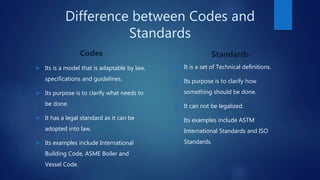
Difference between Codes and
Standards
Codes
 Its is a model that is adaptable by law,
specifications and guidelines.
 Its purpose is to clarify what needs to
be done.
 It has a legal standard as it can be
adopted into law.
 Its examples include International
Building Code, ASME Boiler and
Vessel Code.
Standards
 It is a set of Technical definitions.
 Its purpose is to clarify how
something should be done.
 It can not be legalized.
 Its examples include ASTM
International Standards and ISO
Standards.
Building Codes
BUILDING CONTROL
INTRODUCTION TO Building CODES
 A building code (also known as Building Control or Building Regulations) is a set of
rules that specify the standards for constructed objects such as buildings and non-
building structures.
 They are generally intended to be applied by Architects, Engineers, Constructors
and Regulators but are also used for various purposes by Safety Inspectors,
Environmental Scientists, Real Estate Developers, Subcontrators, Manufacturers of
building products and materials, Insurance Companies, Facility Managers, Tenants
and others.
Types of Building Codes
 National Building Codes:
The practice of developing, approving, and enforcing building codes varies considerably among
nations. In some countries building codes are developed by the government agencies or quasi-
governmental standards organizations and then enforced across the country by the central
government. Such codes are known as the national building codes.
 International Building Codes:
The International Building Code (IBC) is the foundation of the complete Family of International Codes.
It is an essential tool to preserve public health and safety that provides safeguards from hazards
associated with the built environment. It addresses design and installation of innovative materials that
meet or exceed public health and safety goals.
National Building Codes
 The National Building Code is a national instrument providing guidelines for regulating the
building construction activities across the country.
 It serves as a Model Code for adoption by all agencies involved in building construction works be
they Public Works Departments, other government construction departments, local bodies or
private construction agencies.
Building Codes in Pakistan
 NESPAK (National Engineering Services Pakistan) Developed a Building Code for Pakistan in 1986.
This document was however not enforced.
 There is no general building code applicable in all parts of the country.
 There are efforts to introduce a wider building Code, but these are at a very early stage.
 Some measures are being taken in the Federal Capital and earth-quake affected areas. Some
Building Codes exist, but none has been made part of a Federal law.
Building Codes in Pakistan (Cont.)
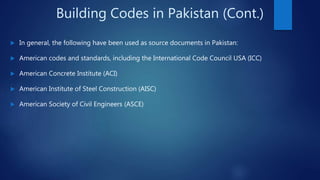
 In general, the following have been used as source documents in Pakistan:
 American codes and standards, including the International Code Council USA (ICC)
 American Concrete Institute (ACI)
 American Institute of Steel Construction (AISC)
 American Society of Civil Engineers (ASCE)
Scope of Building Codes
 The purpose of building codes is to provide minimum standards for safety, health, and general welfare including structural integrity, mechanical
integrity (including sanitation, water supply, light, and ventilation), means of egress, fire prevention and control, and energy
conservation.[17][18] Building codes generally include:
 Standards for structure, placement, size, usage, wall assemblies, fenestration size/locations, egress rules, size/location of rooms, foundations,
floor assemblies, roof structures/assemblies, energy efficiency, stairs and halls, mechanical, electrical, plumbing, site drainage & storage,
appliance, lighting, fixtures standards, occupancy rules, and swimming pool regulations
 Rules regarding parking and traffic impact
 Fire code rules to minimize the risk of a fire and to ensure safe evacuation in the event of such an emergency[citation needed]
 Requirements for earthquake (seismic code), hurricane, flood, and tsunami resistance, especially in disaster prone areas or for very large
buildings where a failure would be catastrophic[citation needed]
 Requirements for specific building uses (for example, storage of flammable substances, or housing a large number of people)
 Energy provisions and consumption
 Grandfather clauses: Unless the building is being renovated, the building code usually does not apply to existing buildings.
Scope of Building Codes
 Specifications on components
 Allowable installation methodologies
 Minimum and maximum room ceiling heights, exit sizes and location
 Qualification of individuals or corporations doing the work
 For high structures, anti-collision markers for the benefit of aircraft
 Building codes are generally separate from zoning ordinances, but exterior restrictions (such as setbacks) may fall into either category.
 Designers use building code standards out of substantial reference books during design. Building departments review plans submitted to them
before construction, issue permits [or not] and inspectors verify compliance to these standards at the site during construction.
 There are often additional codes or sections of the same building code that have more specific requirements that apply to dwellings or places
of business and special construction objects such as canopies, signs, pedestrian walkways, parking lots, and radio and television antennas.
Specification, Codes and Standards (IDPPM)

Specification, Codes and Standards (IDPPM)

  • 1.
  • 2.
    Group Members  MaryamMujtaba  Shajeeah Daarain
  • 3.
    Table of contents Introduction  Standards  Codes
  • 4.
  • 5.
    Standards  Definitions: set ofdetailed rules, processes, procedures and guideline developed tested and determined as good practices for the delivery of referenced particular product, service, result in strict conformity with requirements established by codes. it is a national or international document which sets out how a particular item is to be designed, fabricated and tested so that it meets certain minimum requirements for safety and operation and allows…….  a standard is a set of technical definitions, specifications and guidelines.  It tells how to do something. They serve as a common language, defining quality and establishing safety criteria.
  • 6.
    Functions  Instruction for: Designers Manufactures Operators Usersof equipment  If you are building something, a standard tells you about the: Materials Process Designs Structure
  • 7.
    Creators Standards are usuallycreated by:  Individual companies  Organizations  Countries
  • 8.
    Why is StandardRequired?  Standards are documents that establish engineering or technical requirements for products, practices, methods or operations.  Build confidence about quality in users.  Lower the cost of production as requirements are standardized.
  • 9.
  • 10.
    Technical standards  Definethe technical requirements of a piece of equipment, often requiring adherence to a particular national or international standards.  Often custom written for a particular purpose it allows the costumer to specify particular additions, changes or deletion to any specified standard for his particular use .  A specific description of the design and materials used to make something  They are set of instructions or requirments given in code and standards.  Must meet requirements. Example (company provided specification, product specification)
  • 11.
    Why specification isrequired?  It provide specific or additional requirements for material, components or services above and beyond code or standard requirements.  Often generated by private companies to address additional requirements applicable to a specific product or application.  These are often listed in procurement agreements or contract documents as additional requirements above and beyond code or standard requiremnts.
  • 12.
    Types of specifications Requirement Specification: set of documented requirements to be satisfied by a material, design, product or service.  Functional Specifications it is closely related to the requirement specification and may show functional block diagram  Design or Product Specifications describes the features of the solutions for the requirement specification, referring to the design solution or final produced solution
  • 13.
  • 14.
  • 15.
    INTRODUCTION TO CODES A code is a set of rules that experts in the field recommend people to follow; it is a model.  Although it is not a law, but it can be adopted into a law.  A code is basically a top-tier document, providing as set of rules that specify the minimum acceptable level of safety for manufactured, fabricated or constructed objects.  A code is a standard that has been adopted by one or more governmental bodies and has force of law, or when it has been incorporated into a business contract.
  • 16.
    WHY ARE CODESREQUIRED?  Providing a set of rules that specify the minimum acceptable level of safety for manufactured, fabricated or constructed objects.
  • 17.
    Difference between Codesand Standards Codes  Its is a model that is adaptable by law, specifications and guidelines.  Its purpose is to clarify what needs to be done.  It has a legal standard as it can be adopted into law.  Its examples include International Building Code, ASME Boiler and Vessel Code. Standards  It is a set of Technical definitions.  Its purpose is to clarify how something should be done.  It can not be legalized.  Its examples include ASTM International Standards and ISO Standards.
  • 18.
  • 19.
    INTRODUCTION TO BuildingCODES  A building code (also known as Building Control or Building Regulations) is a set of rules that specify the standards for constructed objects such as buildings and non- building structures.  They are generally intended to be applied by Architects, Engineers, Constructors and Regulators but are also used for various purposes by Safety Inspectors, Environmental Scientists, Real Estate Developers, Subcontrators, Manufacturers of building products and materials, Insurance Companies, Facility Managers, Tenants and others.
  • 20.
    Types of BuildingCodes  National Building Codes: The practice of developing, approving, and enforcing building codes varies considerably among nations. In some countries building codes are developed by the government agencies or quasi- governmental standards organizations and then enforced across the country by the central government. Such codes are known as the national building codes.  International Building Codes: The International Building Code (IBC) is the foundation of the complete Family of International Codes. It is an essential tool to preserve public health and safety that provides safeguards from hazards associated with the built environment. It addresses design and installation of innovative materials that meet or exceed public health and safety goals.
  • 21.
    National Building Codes The National Building Code is a national instrument providing guidelines for regulating the building construction activities across the country.  It serves as a Model Code for adoption by all agencies involved in building construction works be they Public Works Departments, other government construction departments, local bodies or private construction agencies.
  • 22.
    Building Codes inPakistan  NESPAK (National Engineering Services Pakistan) Developed a Building Code for Pakistan in 1986. This document was however not enforced.  There is no general building code applicable in all parts of the country.  There are efforts to introduce a wider building Code, but these are at a very early stage.  Some measures are being taken in the Federal Capital and earth-quake affected areas. Some Building Codes exist, but none has been made part of a Federal law.
  • 23.
    Building Codes inPakistan (Cont.)  In general, the following have been used as source documents in Pakistan:  American codes and standards, including the International Code Council USA (ICC)  American Concrete Institute (ACI)  American Institute of Steel Construction (AISC)  American Society of Civil Engineers (ASCE)
  • 24.
    Scope of BuildingCodes  The purpose of building codes is to provide minimum standards for safety, health, and general welfare including structural integrity, mechanical integrity (including sanitation, water supply, light, and ventilation), means of egress, fire prevention and control, and energy conservation.[17][18] Building codes generally include:  Standards for structure, placement, size, usage, wall assemblies, fenestration size/locations, egress rules, size/location of rooms, foundations, floor assemblies, roof structures/assemblies, energy efficiency, stairs and halls, mechanical, electrical, plumbing, site drainage & storage, appliance, lighting, fixtures standards, occupancy rules, and swimming pool regulations  Rules regarding parking and traffic impact  Fire code rules to minimize the risk of a fire and to ensure safe evacuation in the event of such an emergency[citation needed]  Requirements for earthquake (seismic code), hurricane, flood, and tsunami resistance, especially in disaster prone areas or for very large buildings where a failure would be catastrophic[citation needed]  Requirements for specific building uses (for example, storage of flammable substances, or housing a large number of people)  Energy provisions and consumption  Grandfather clauses: Unless the building is being renovated, the building code usually does not apply to existing buildings.
  • 25.
    Scope of BuildingCodes  Specifications on components  Allowable installation methodologies  Minimum and maximum room ceiling heights, exit sizes and location  Qualification of individuals or corporations doing the work  For high structures, anti-collision markers for the benefit of aircraft  Building codes are generally separate from zoning ordinances, but exterior restrictions (such as setbacks) may fall into either category.  Designers use building code standards out of substantial reference books during design. Building departments review plans submitted to them before construction, issue permits [or not] and inspectors verify compliance to these standards at the site during construction.  There are often additional codes or sections of the same building code that have more specific requirements that apply to dwellings or places of business and special construction objects such as canopies, signs, pedestrian walkways, parking lots, and radio and television antennas.