Research and Academic
Software Projects
at the Institute for
Quantitative Social Science
Mercè Crosas, Ph.D.
Chief Data Science andTechnology Officer
IQSS, Harvard University
twitter: @mercecrosas web: mercecrosas.com
The Big Picture
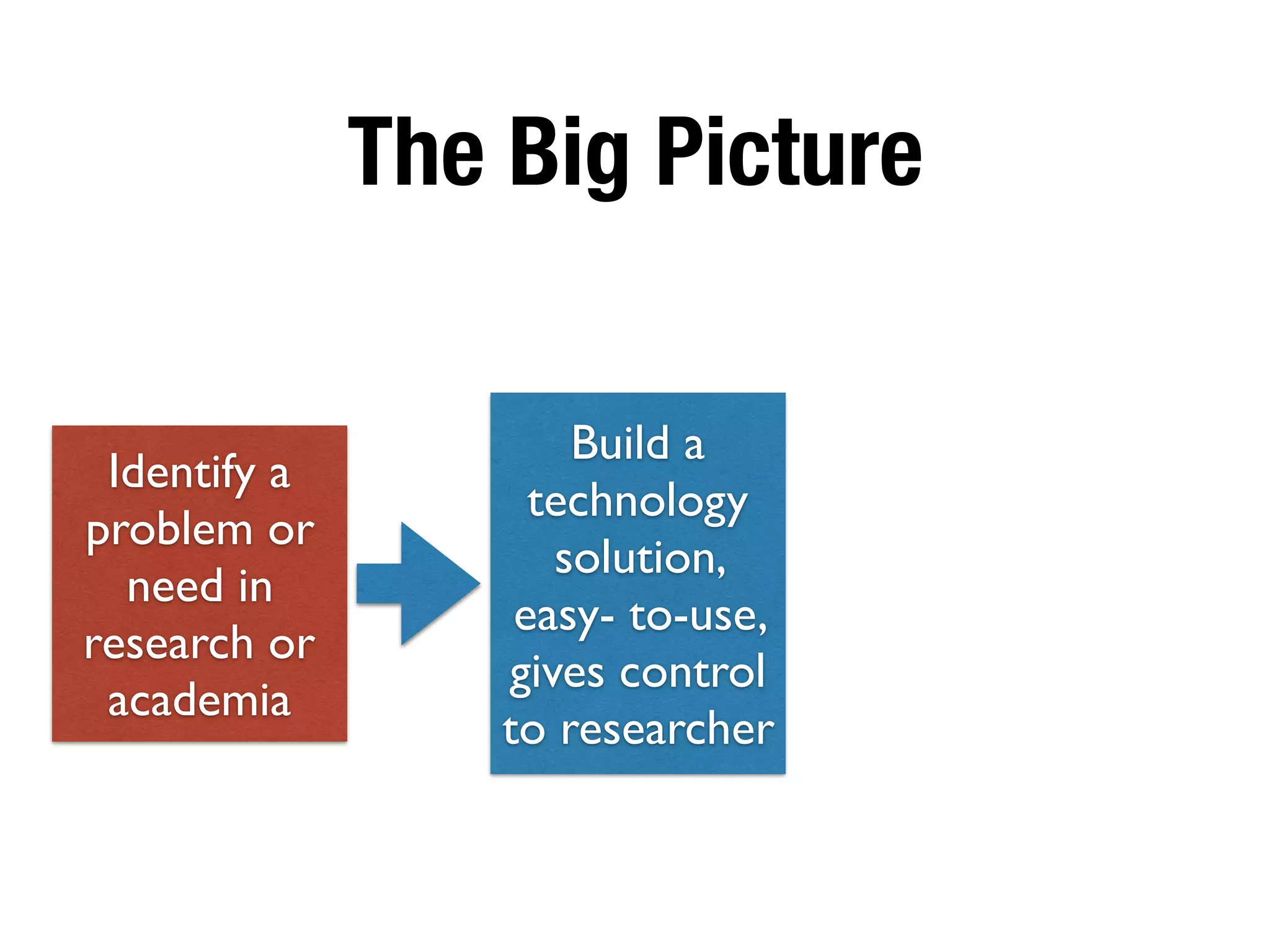
Identify a
problem or
need in
research or
academia
The Big Picture
Identify a
problem or
need in
research or
academia
Build a
technology
solution,
easy- to-use,
gives control
to researcher
The Big Picture
Identify a
problem or
need in
research or
academia
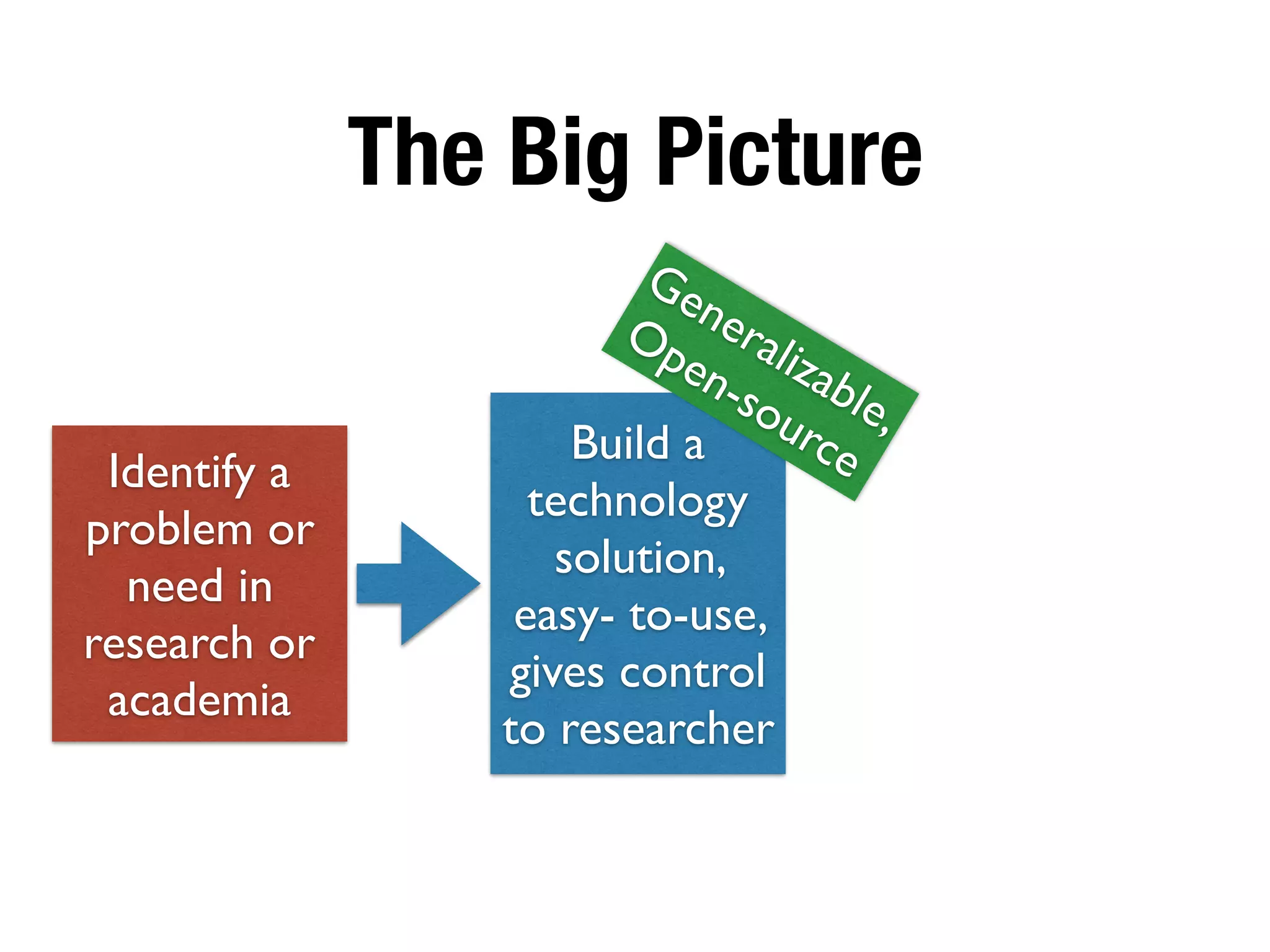
Build a
technology
solution,
easy- to-use,
gives control
to researcher
Generalizable,
Open-source
The Big Picture
Identify a
problem or
need in
research or
academia
Build a
technology
solution,
easy- to-use,
gives control
to researcher
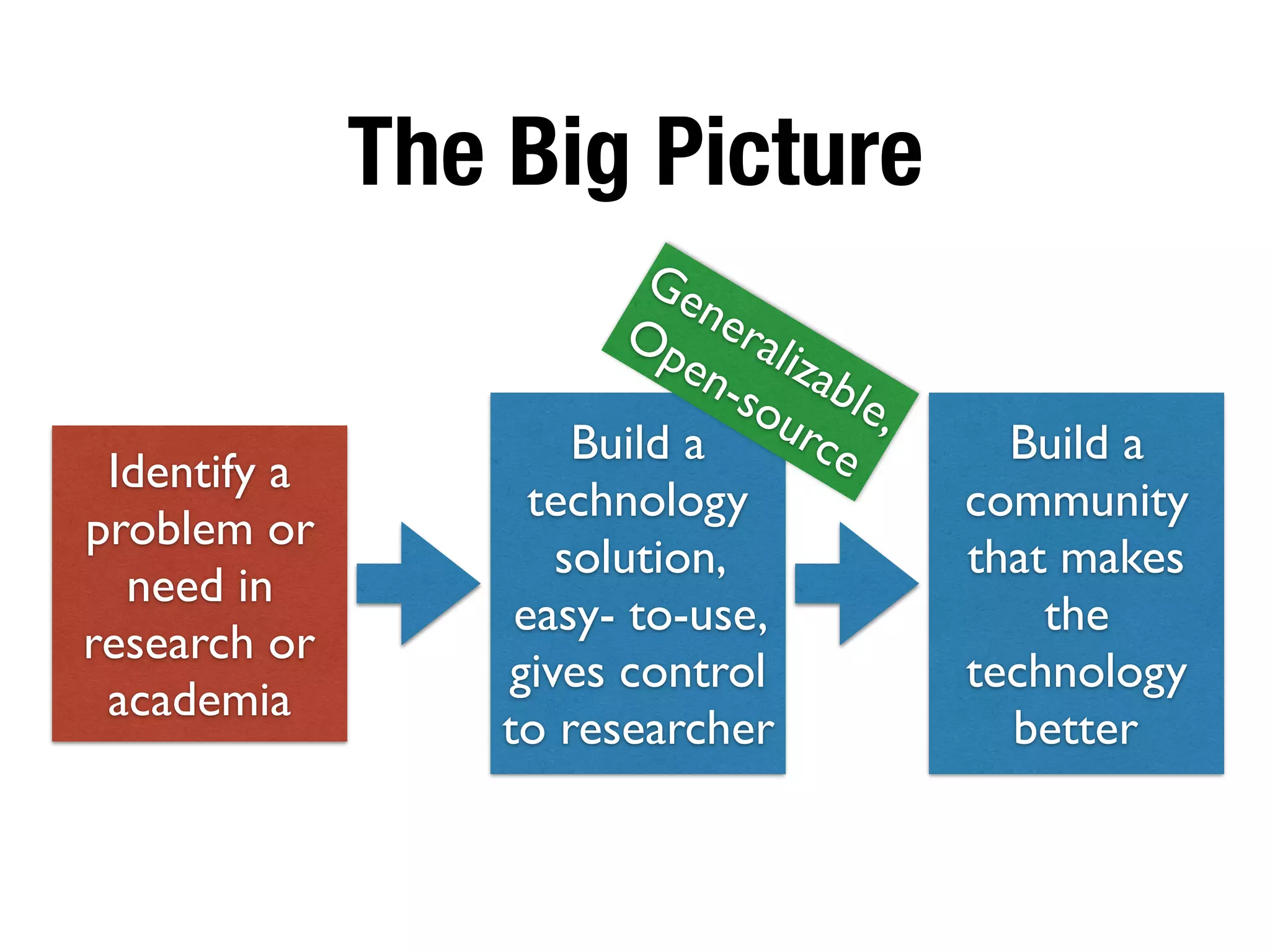
Build a
community
that makes
the
technology
better
Generalizable,
Open-source
Example: Dataverse
Example: Dataverse
๏ How do we increase data sharing to
improve research transparency and
replication with incentives to
researchers?
Example: Dataverse
๏ How do we increase data sharing to
improve research transparency and
replication with incentives to
researchers?
๏ Provide a repository solution, where
researchers have control of branding
and access of their data, and get credit
through data citation.
Example: OpenScholar
๏ How do we enable scholars to build
their academic web sites in a cost
effective way?
Example: OpenScholar
๏ How do we enable scholars to build
their academic web sites in a cost
effective way?
๏ Provide a web site builder with pre-set
features for academics, where a single
hosting serves thousands of sites.
Example: Zelig
Example: Zelig
๏ How do we simplify using thousands of
R statistical methods built by different
authors?
Example: Zelig
๏ How do we simplify using thousands of
R statistical methods built by different
authors?
๏ Provide a statistical package that uses
the same three commands for all
methods, with consistent
documentation.
Example: Consilience
๏ How do we make sense of thousands
(or millions!) of texts?
Example: Consilience
๏ How do we make sense of thousands
(or millions!) of texts?
๏ Provide an application that helps
researchers explore many possible
ways of categorizing documents.
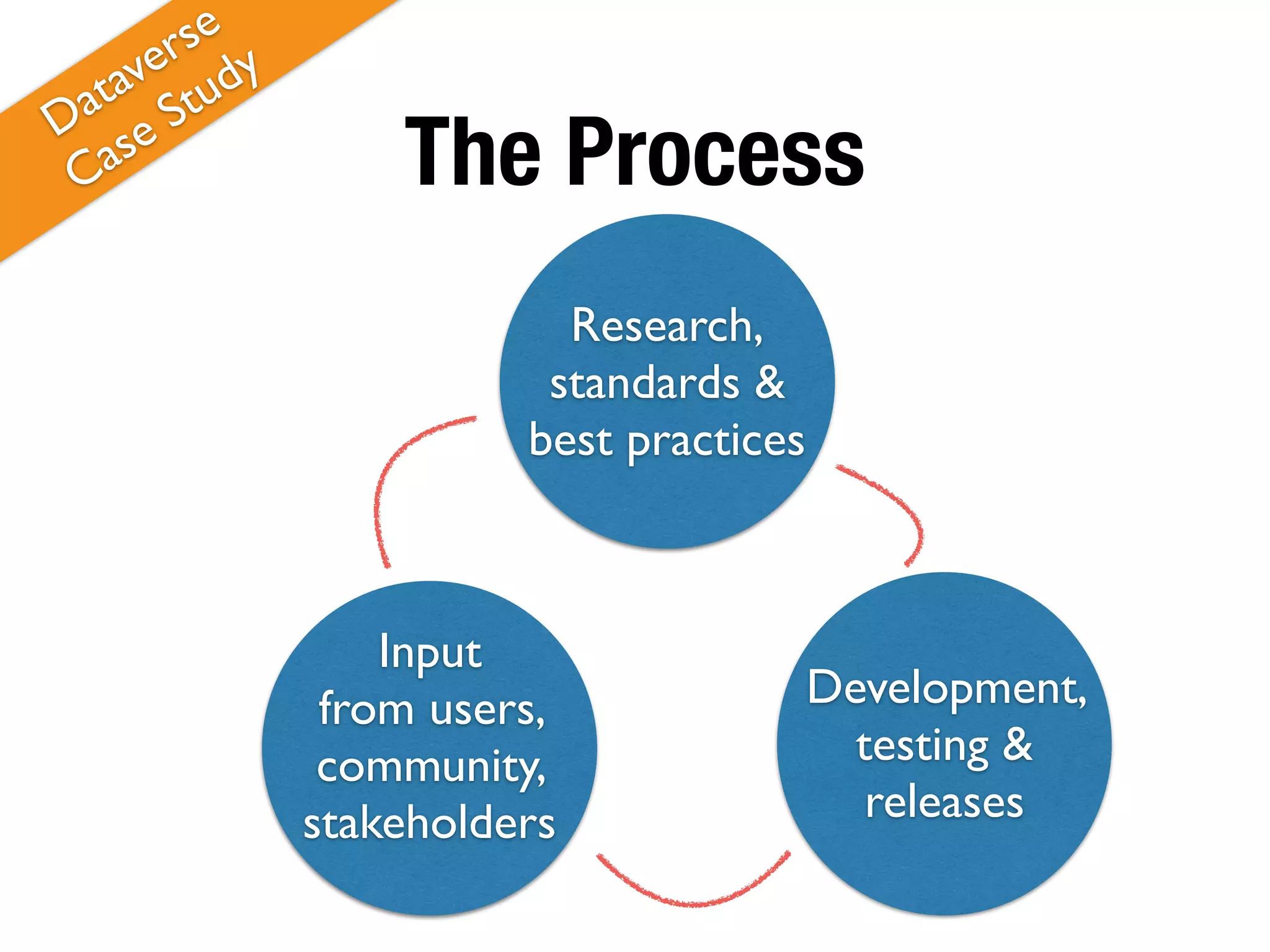
The Process
Research,
standards &
best practices
Development,
testing &
releases
Input
from users,
community,
stakeholders
Dataverse
Case Study
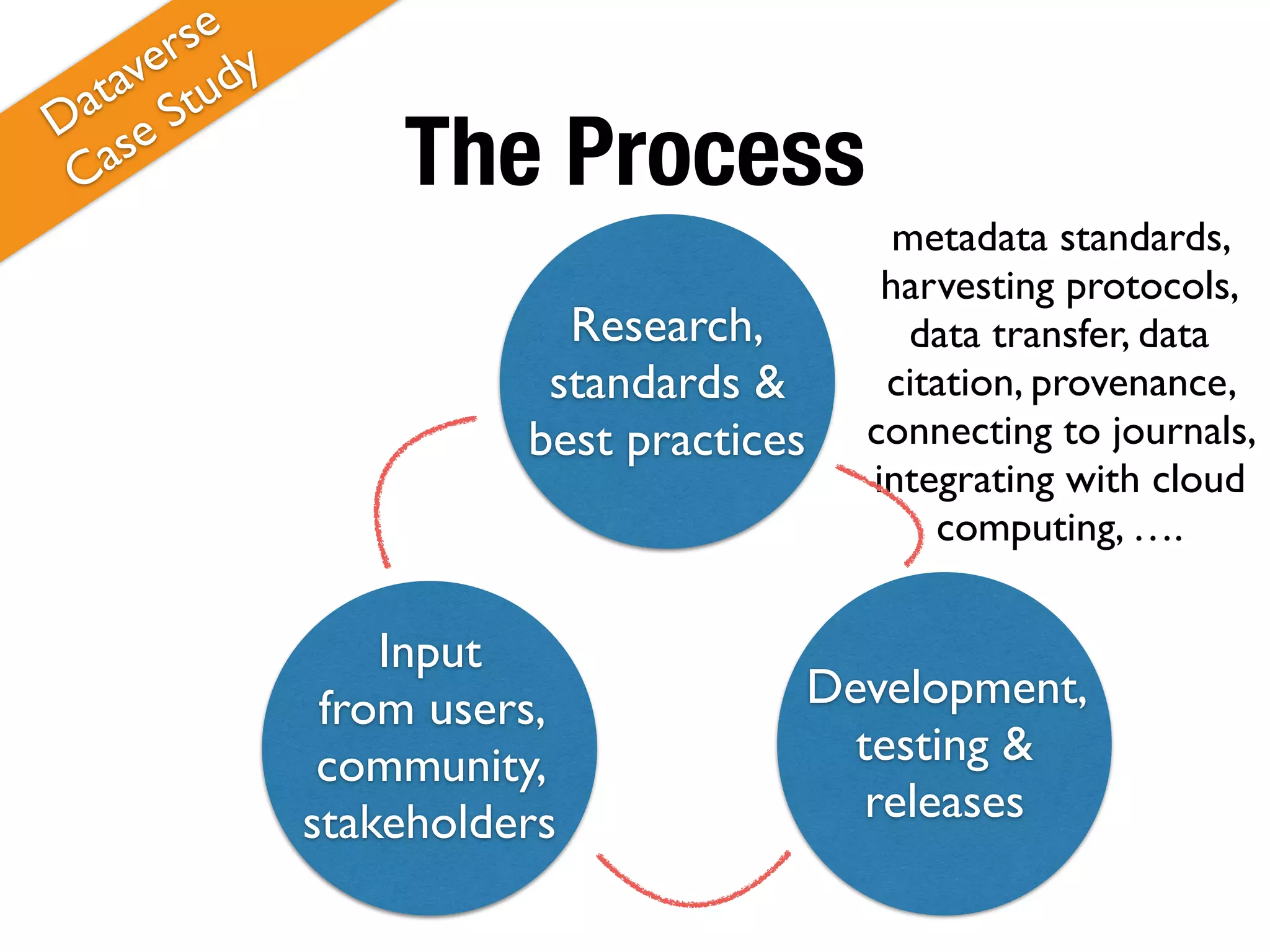
metadata standards,
harvesting protocols,
data transfer, data
citation, provenance,
connecting to journals,
integrating with cloud
computing, ….
The Process
Research,
standards &
best practices
Development,
testing &
releases
Input
from users,
community,
stakeholders
Dataverse
Case Study
metadata standards,
harvesting protocols,
data transfer, data
citation, provenance,
connecting to journals,
integrating with cloud
computing, ….
The Process
Research,
standards &
best practices
Development,
testing &
releases
Input
from users,
community,
stakeholders
Dataverse
Case Study
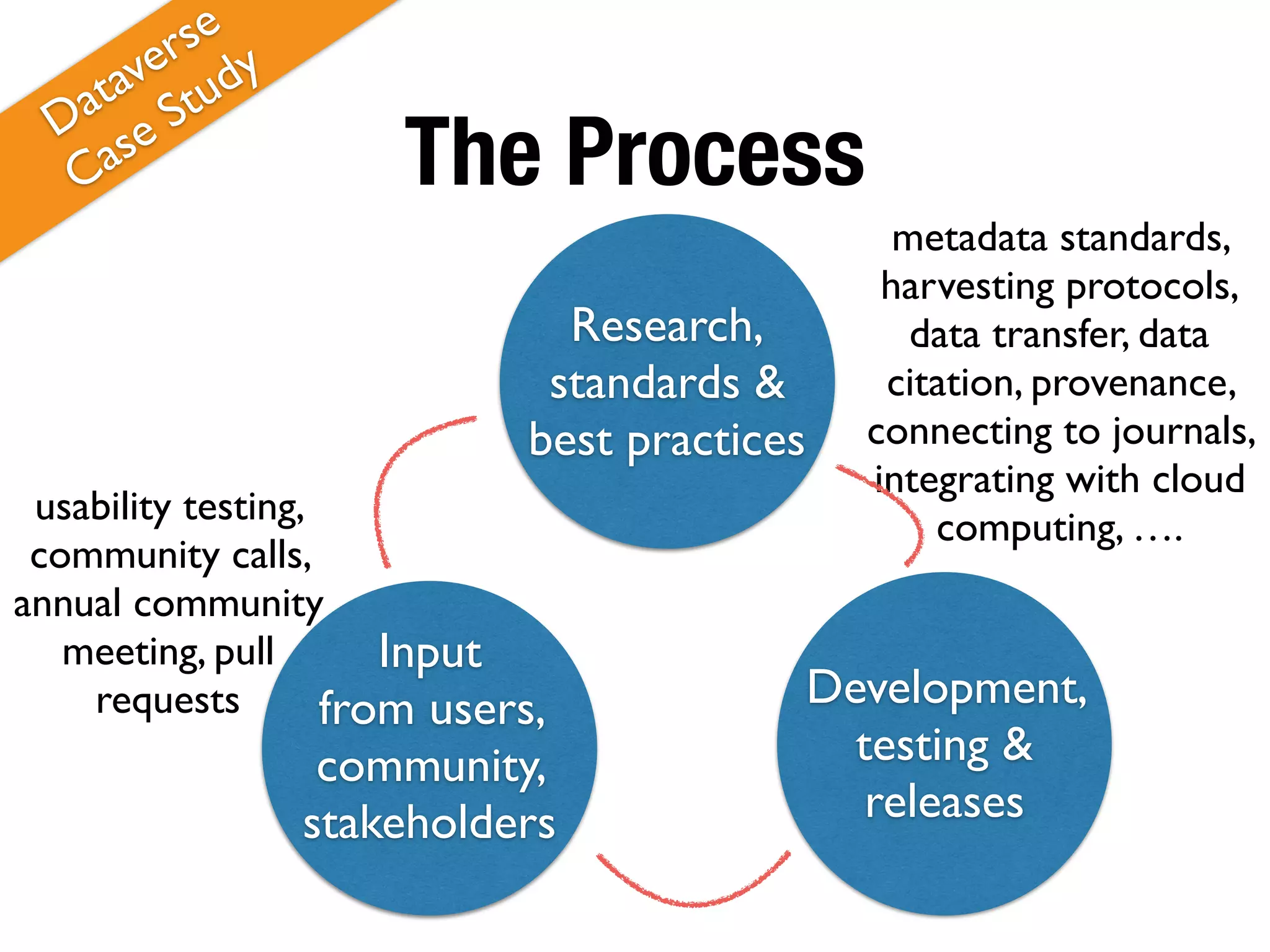
usability testing,
community calls,
annual community
meeting, pull
requests
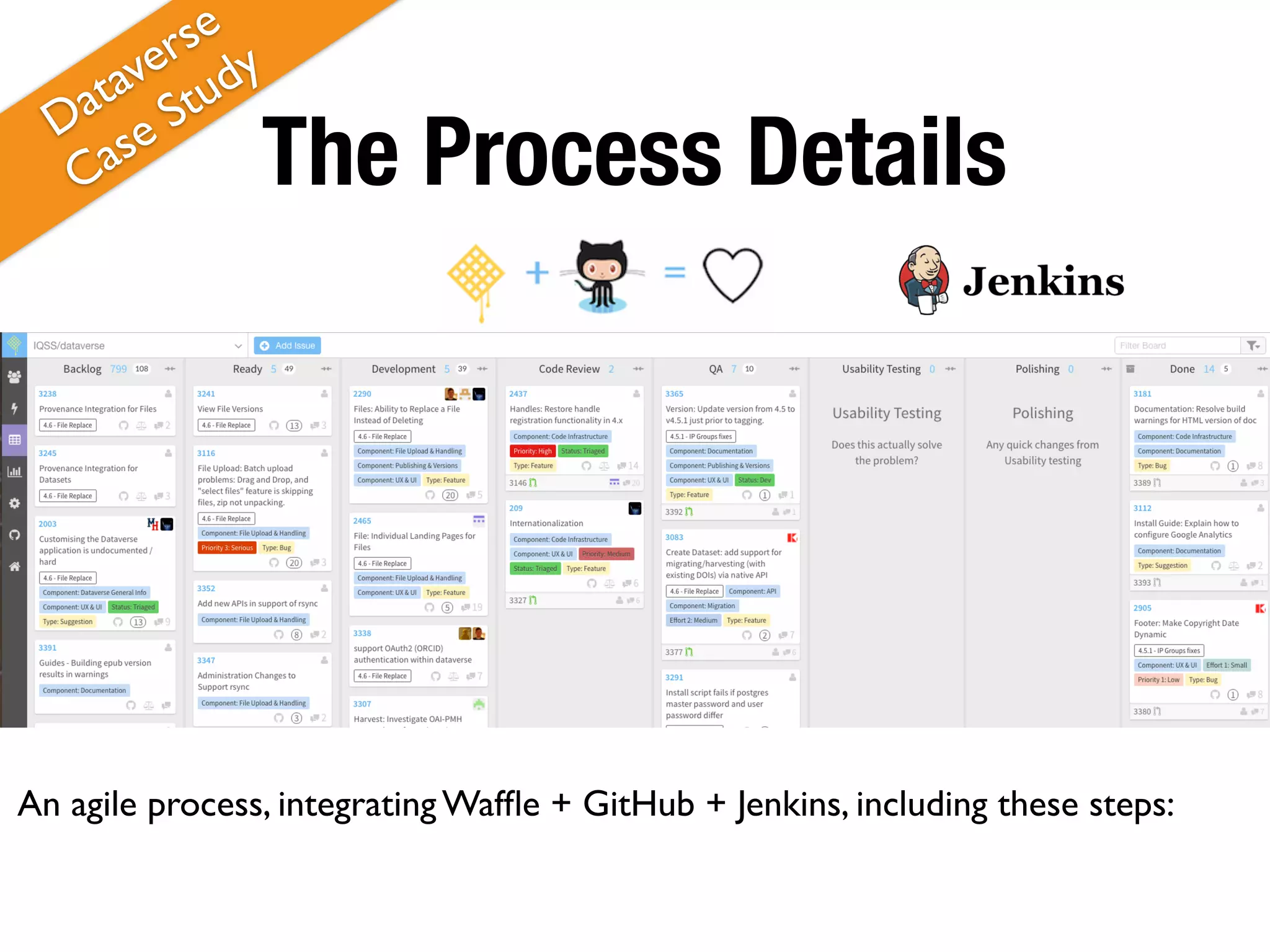
The Process DetailsDataverse
Case Study
The Process DetailsDataverse
Case Study
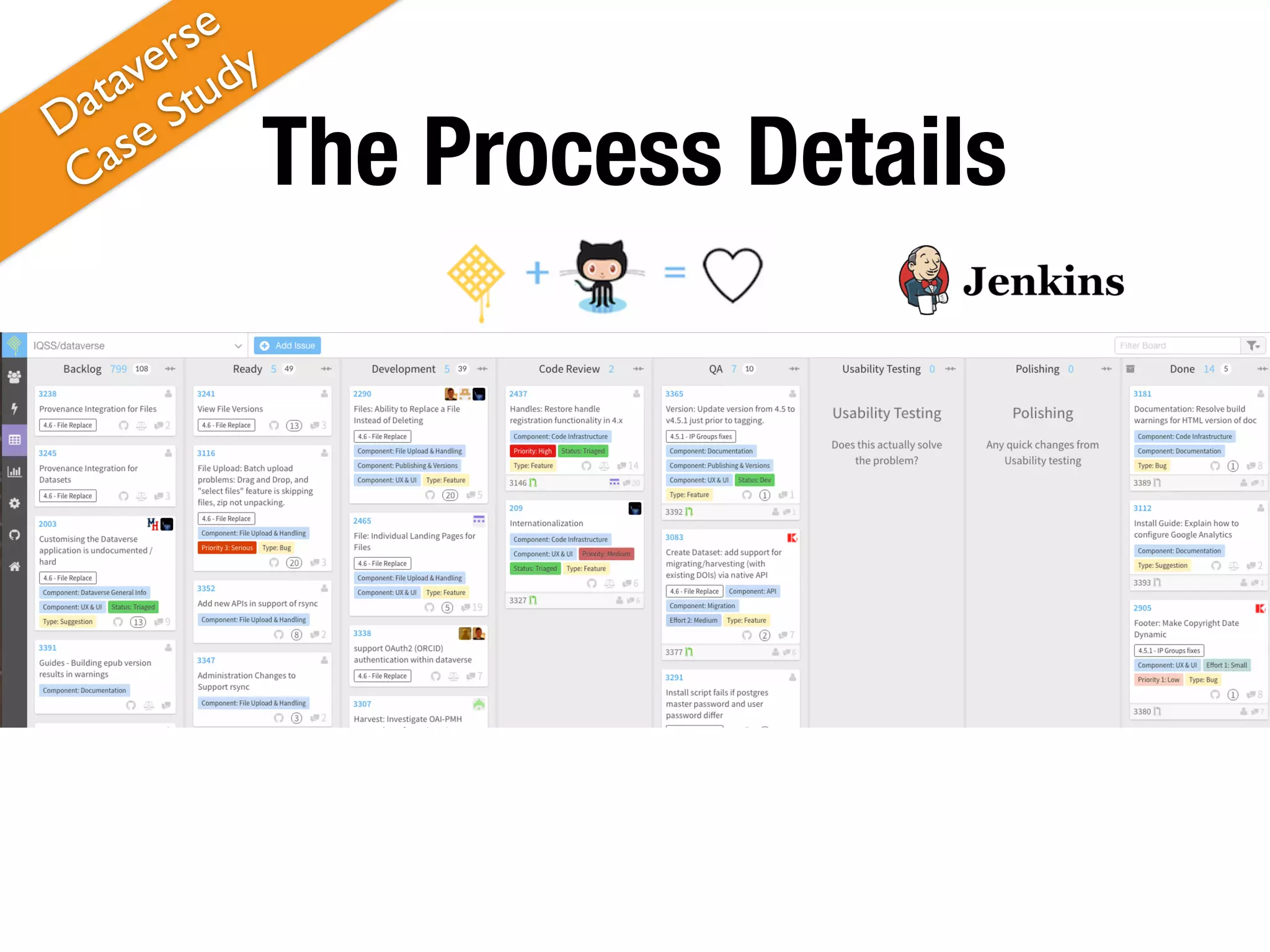
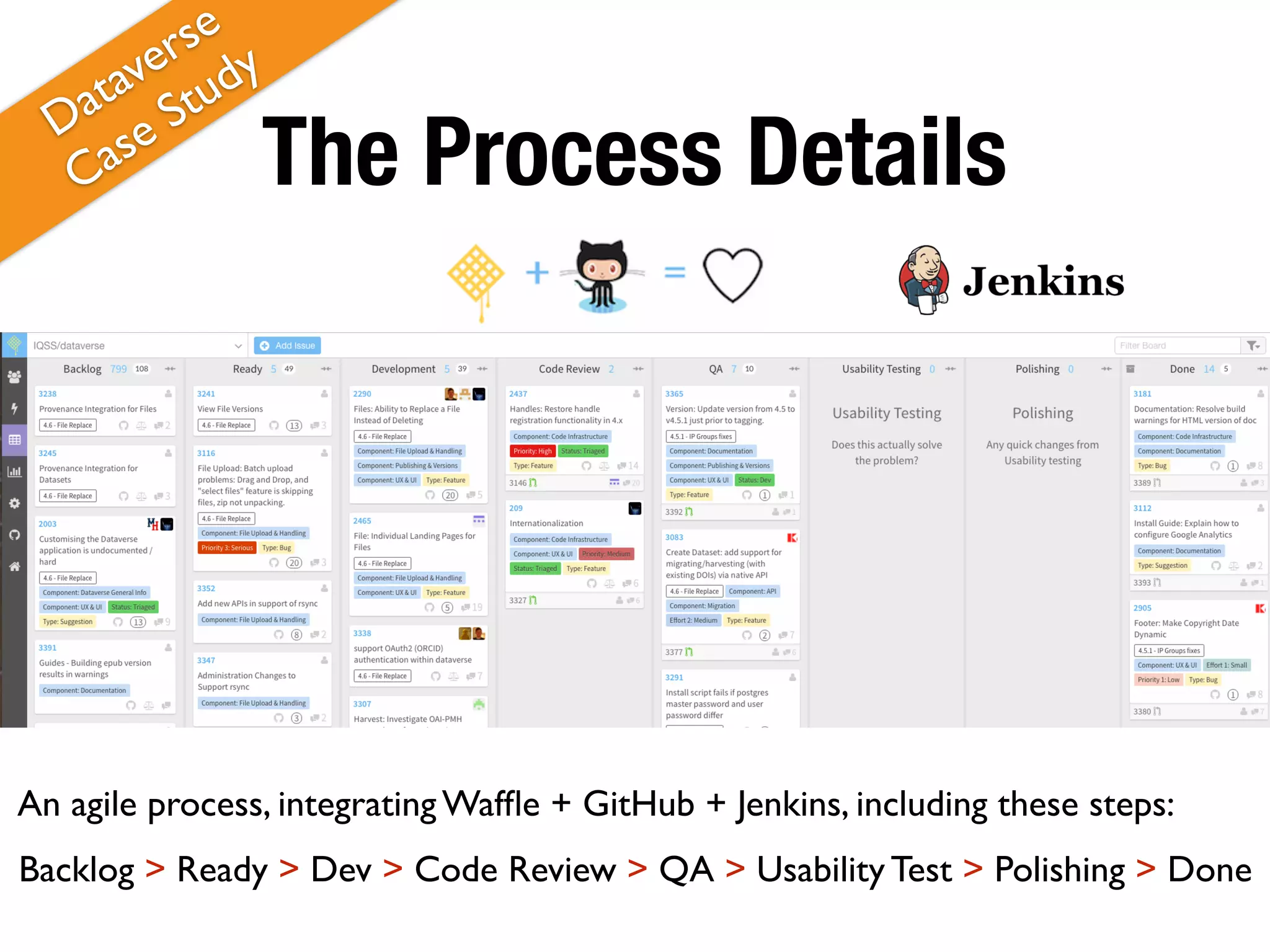
An agile process, integrating Waffle + GitHub + Jenkins, including these steps:
The Process DetailsDataverse
Case Study
An agile process, integrating Waffle + GitHub + Jenkins, including these steps:
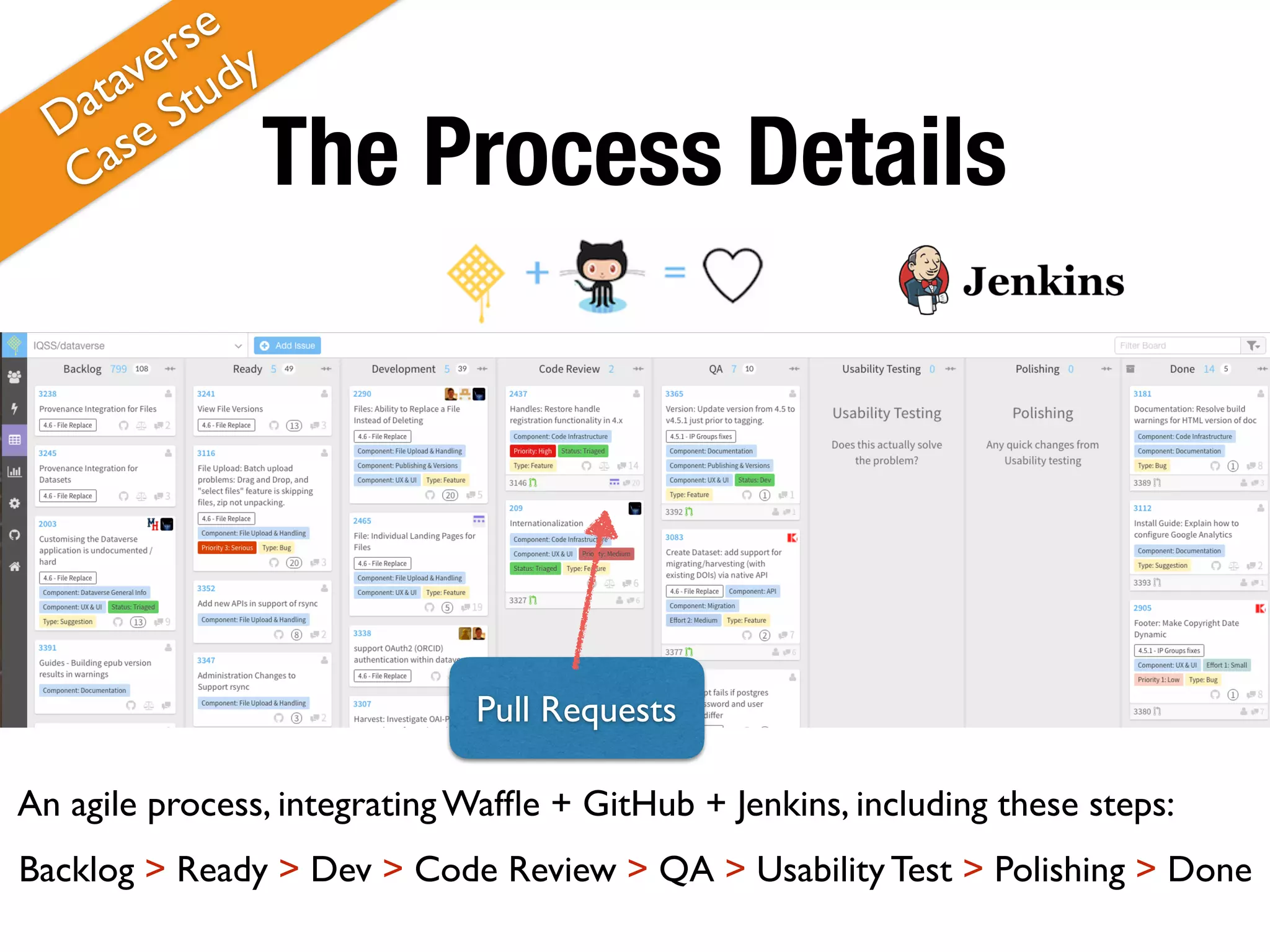
Backlog > Ready > Dev > Code Review > QA > Usability Test > Polishing > Done
The Process DetailsDataverse
Case Study
An agile process, integrating Waffle + GitHub + Jenkins, including these steps:
Backlog > Ready > Dev > Code Review > QA > Usability Test > Polishing > Done
Pull Requests
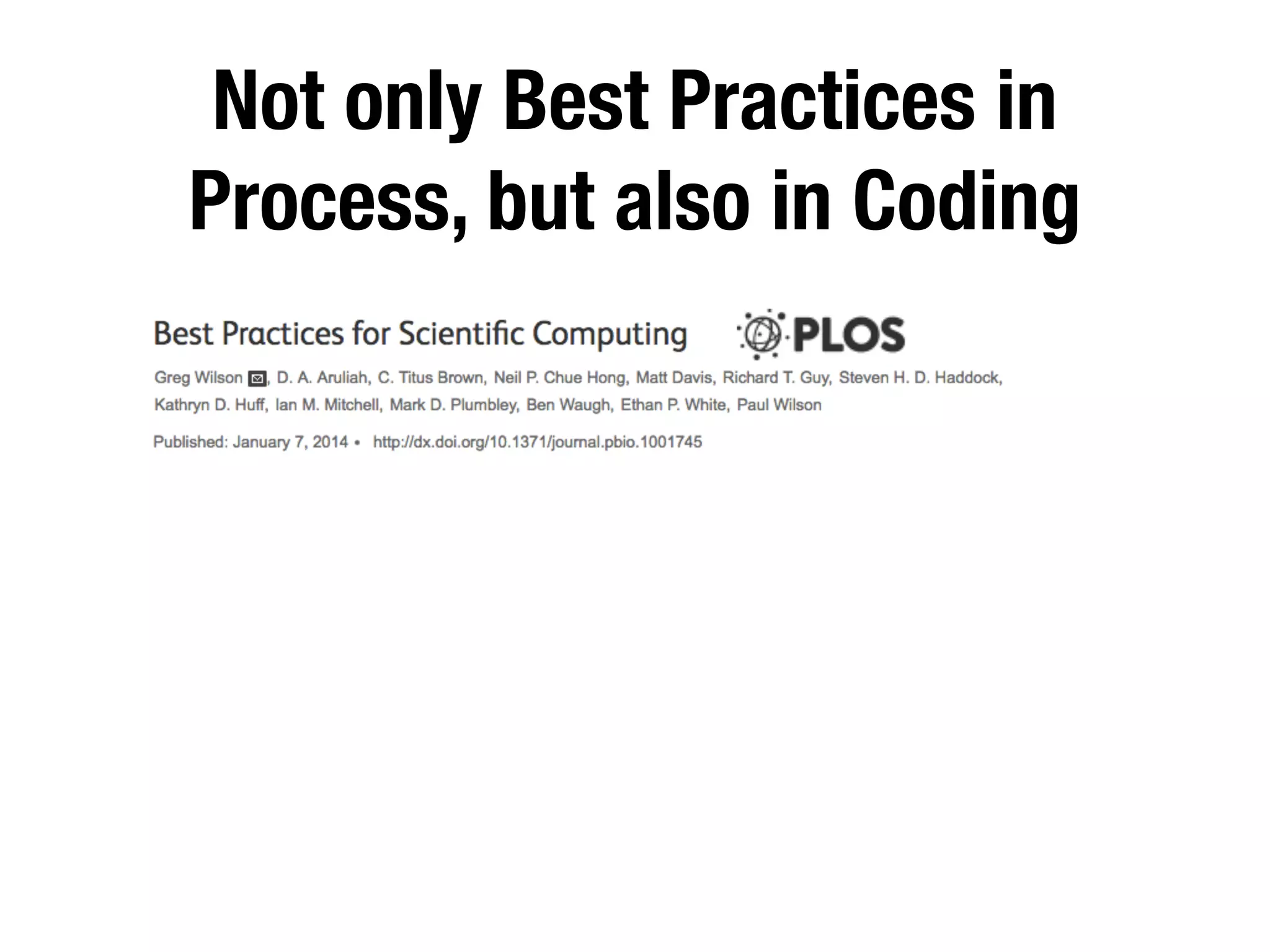
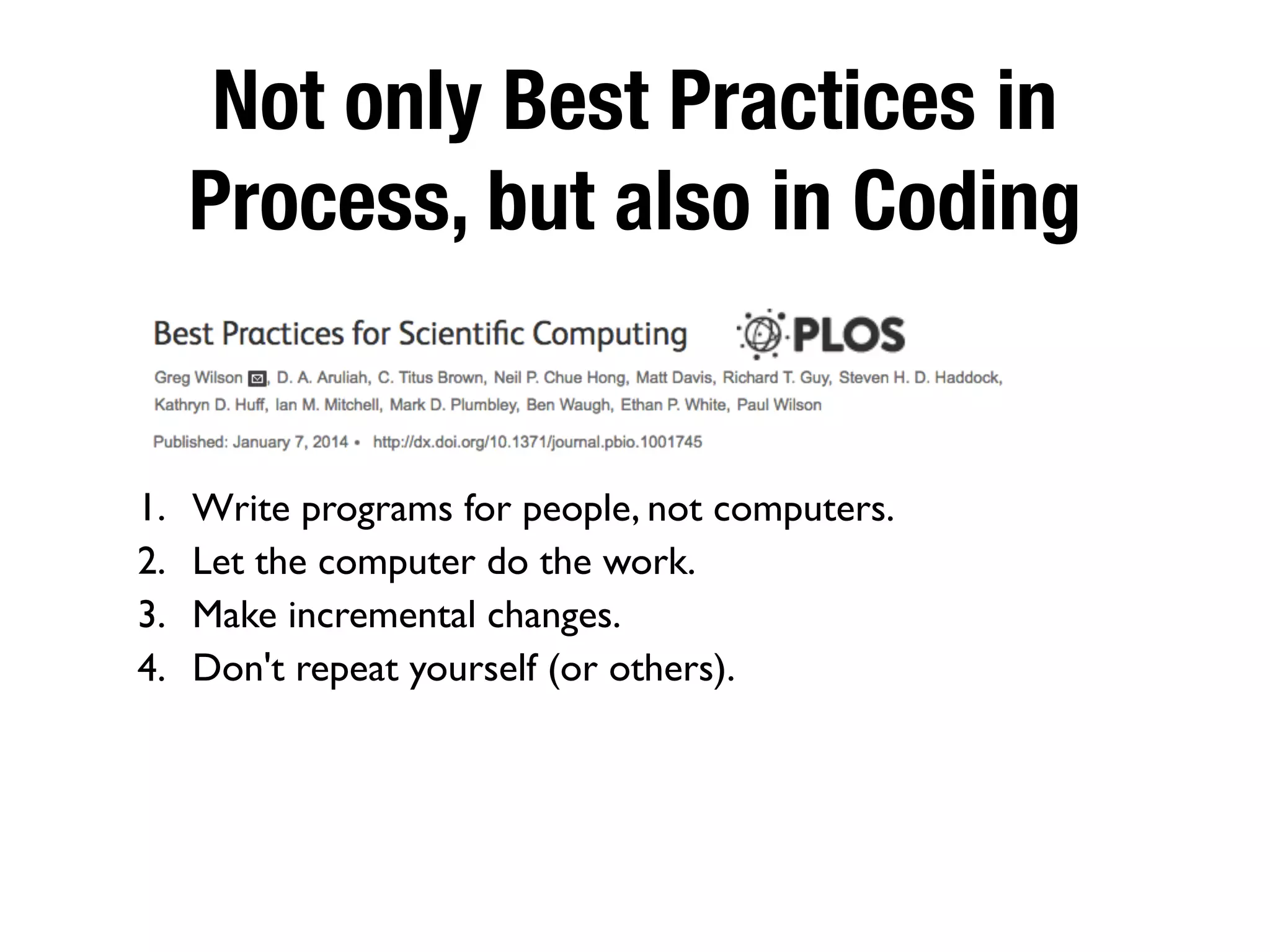
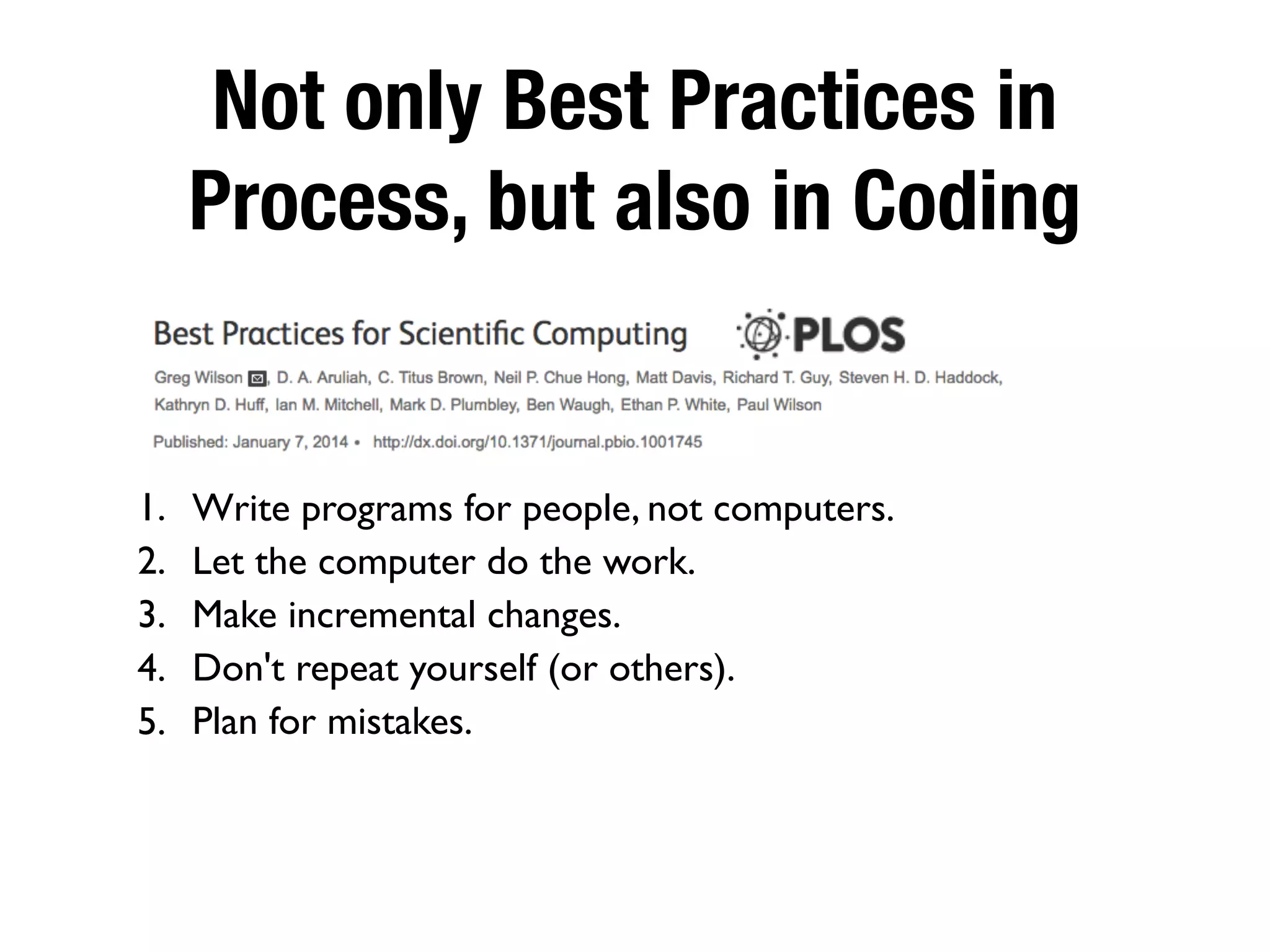
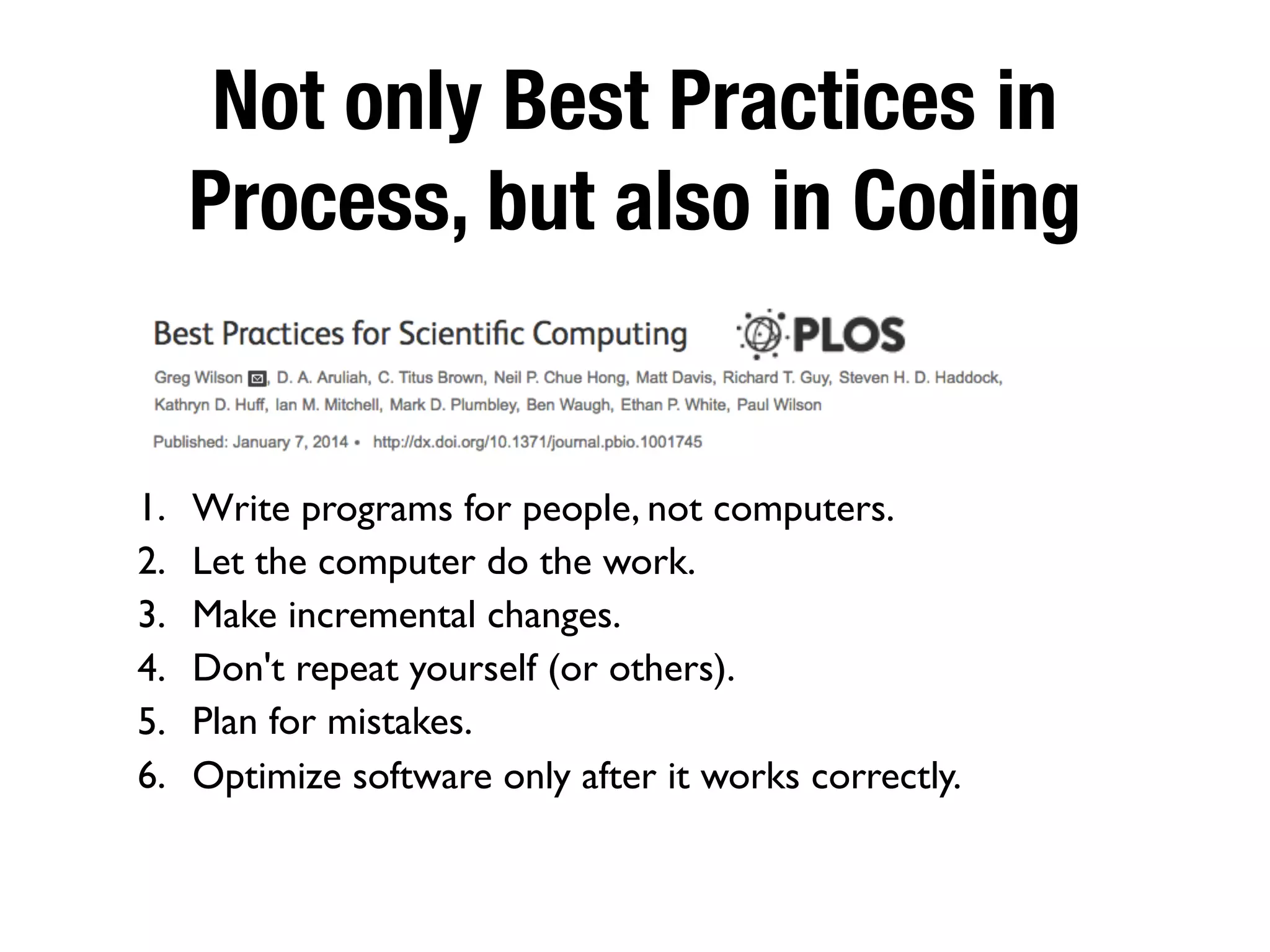
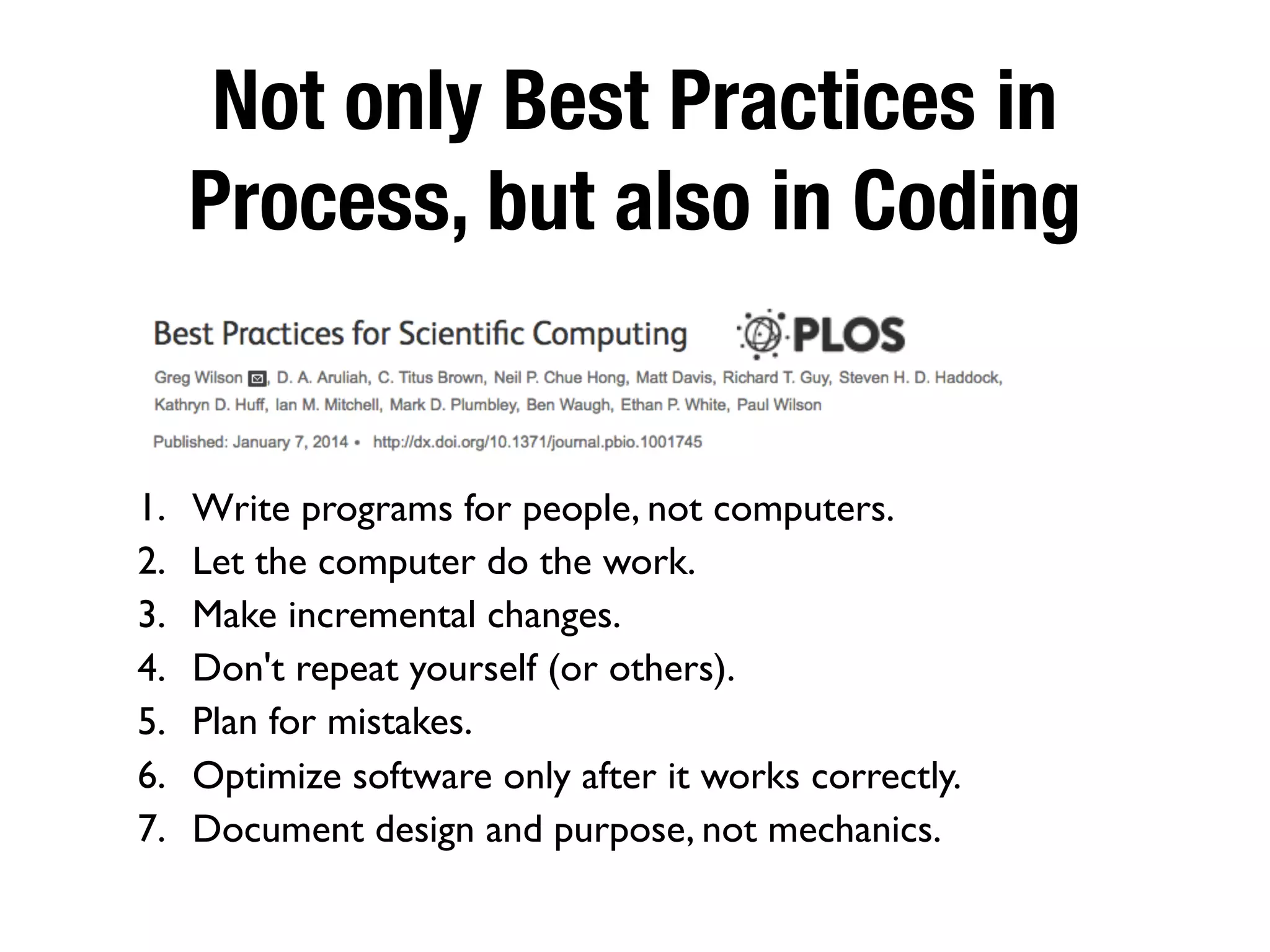
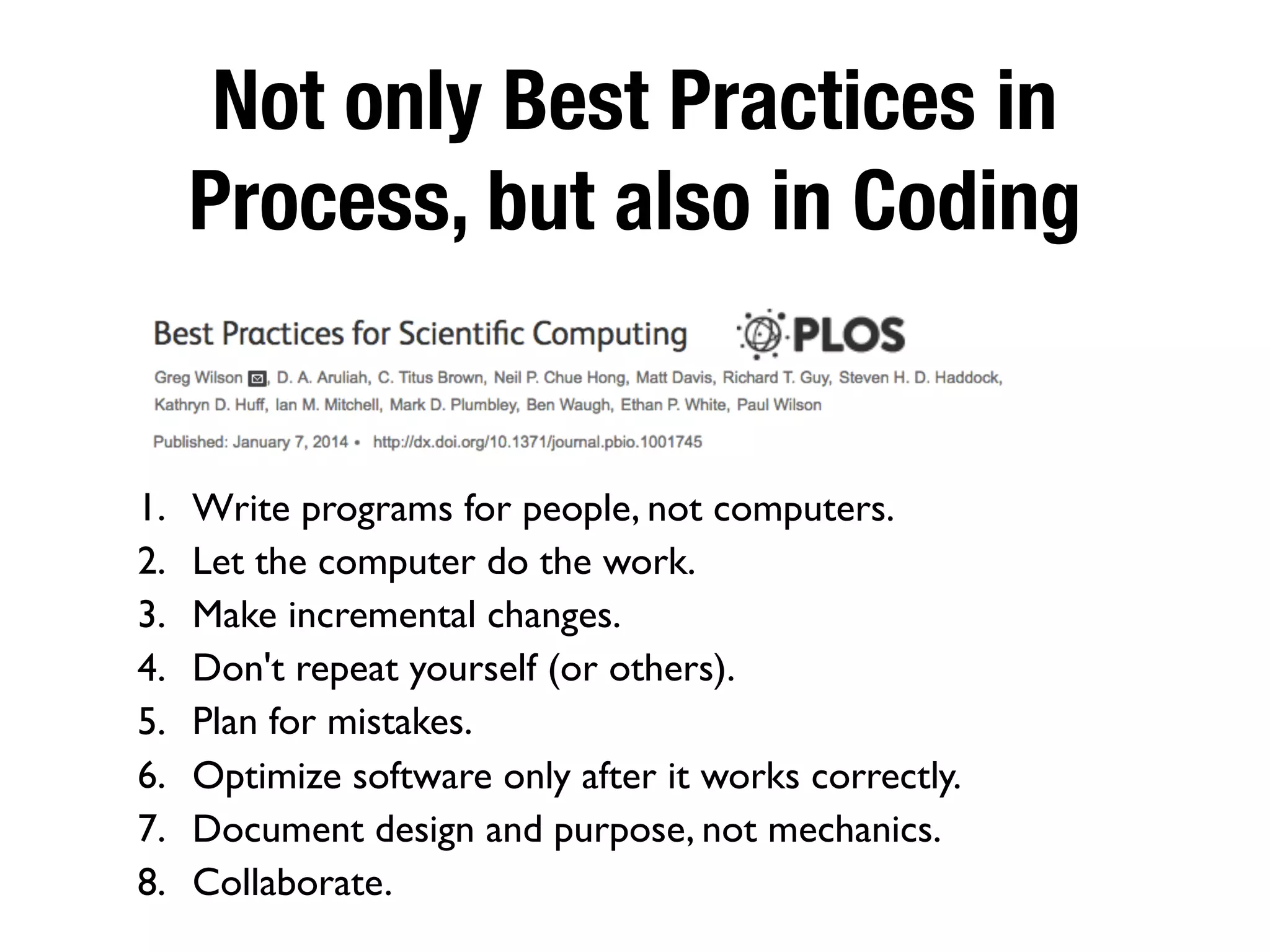
Not only Best Practices in
Process, but also in Coding
Not only Best Practices in
Process, but also in Coding
Not only Best Practices in
Process, but also in Coding
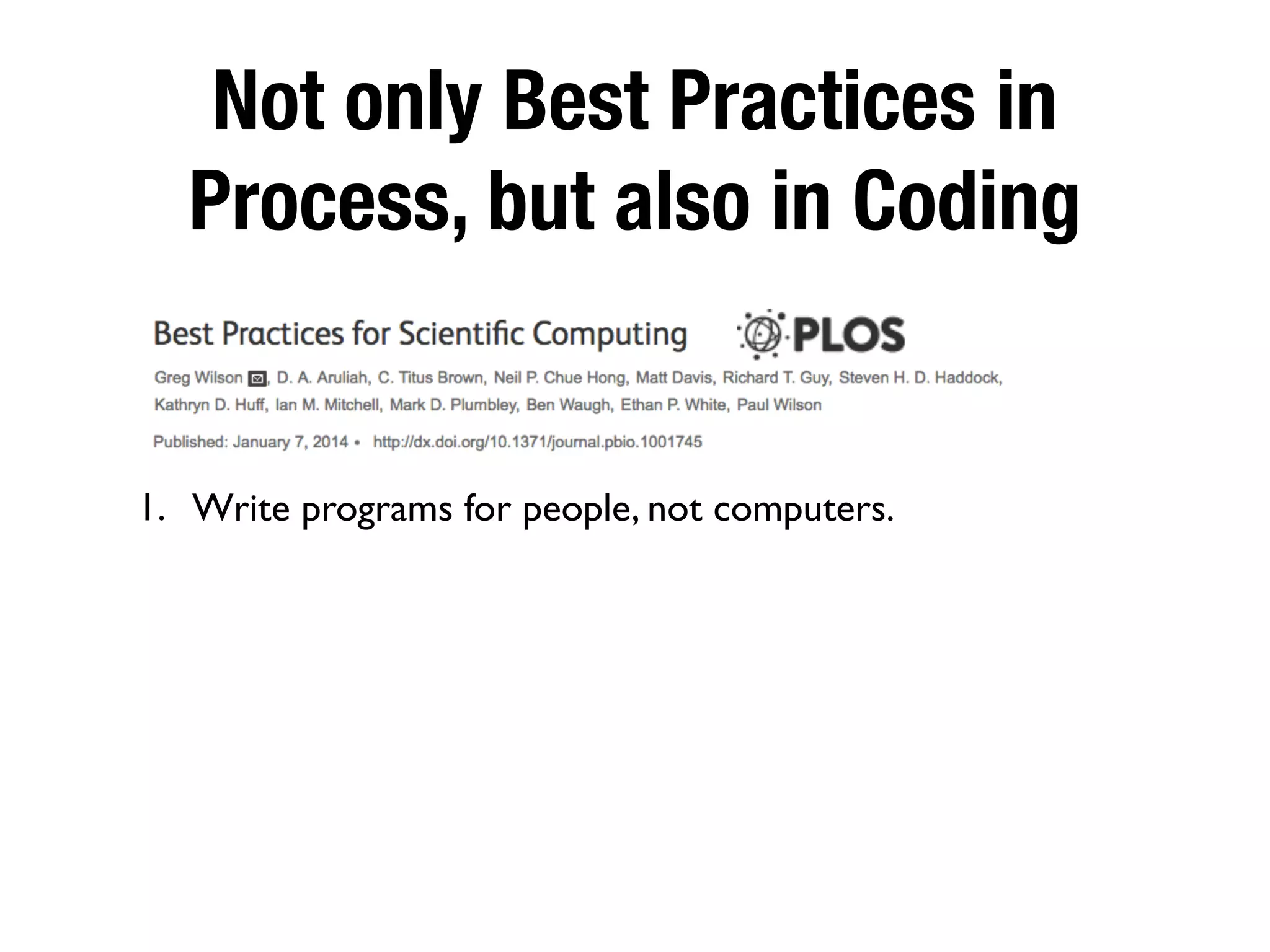
1. Write programs for people, not computers.
Not only Best Practices in
Process, but also in Coding
1. Write programs for people, not computers.
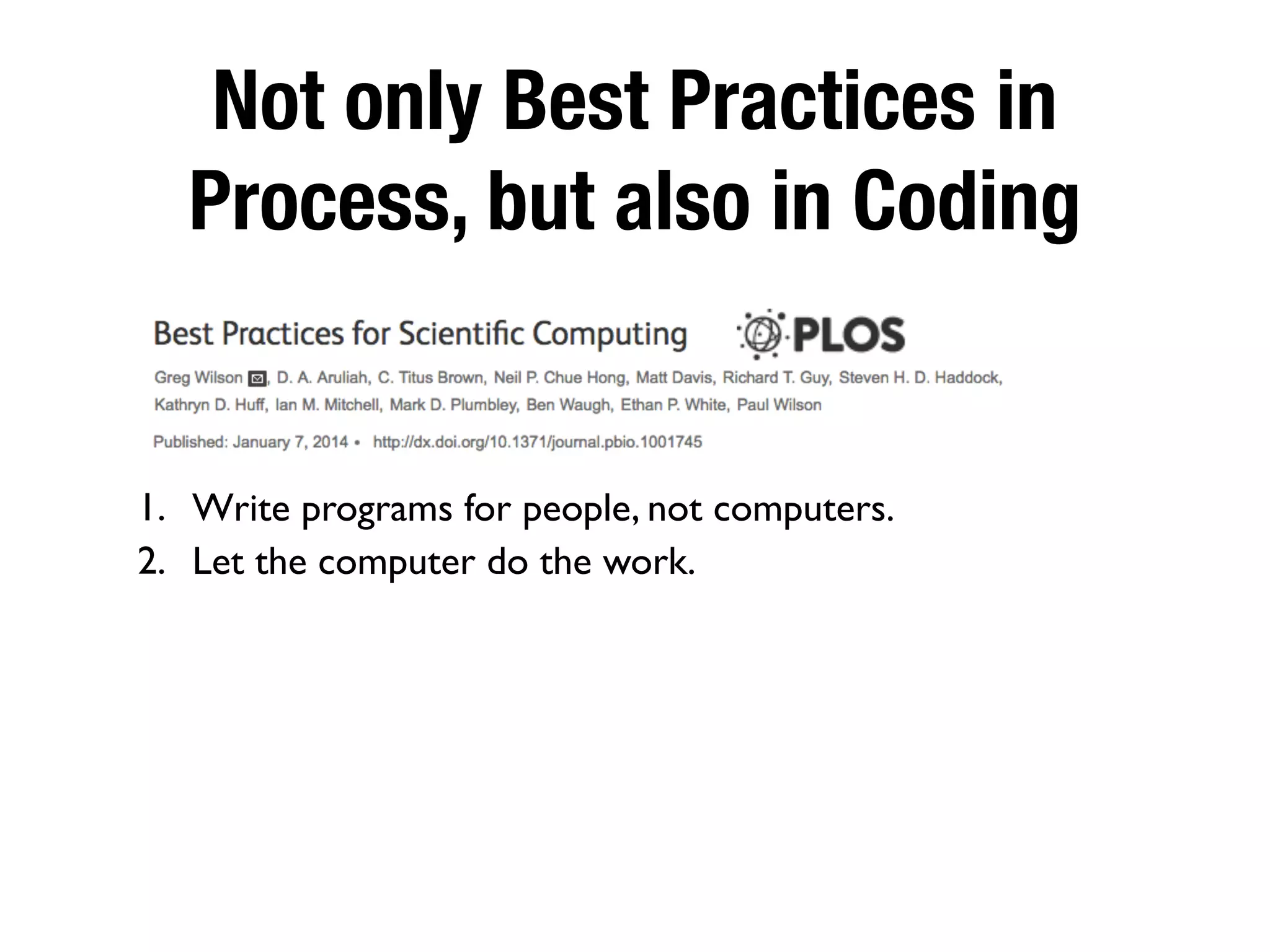
2. Let the computer do the work.
Not only Best Practices in
Process, but also in Coding
1. Write programs for people, not computers.
2. Let the computer do the work.
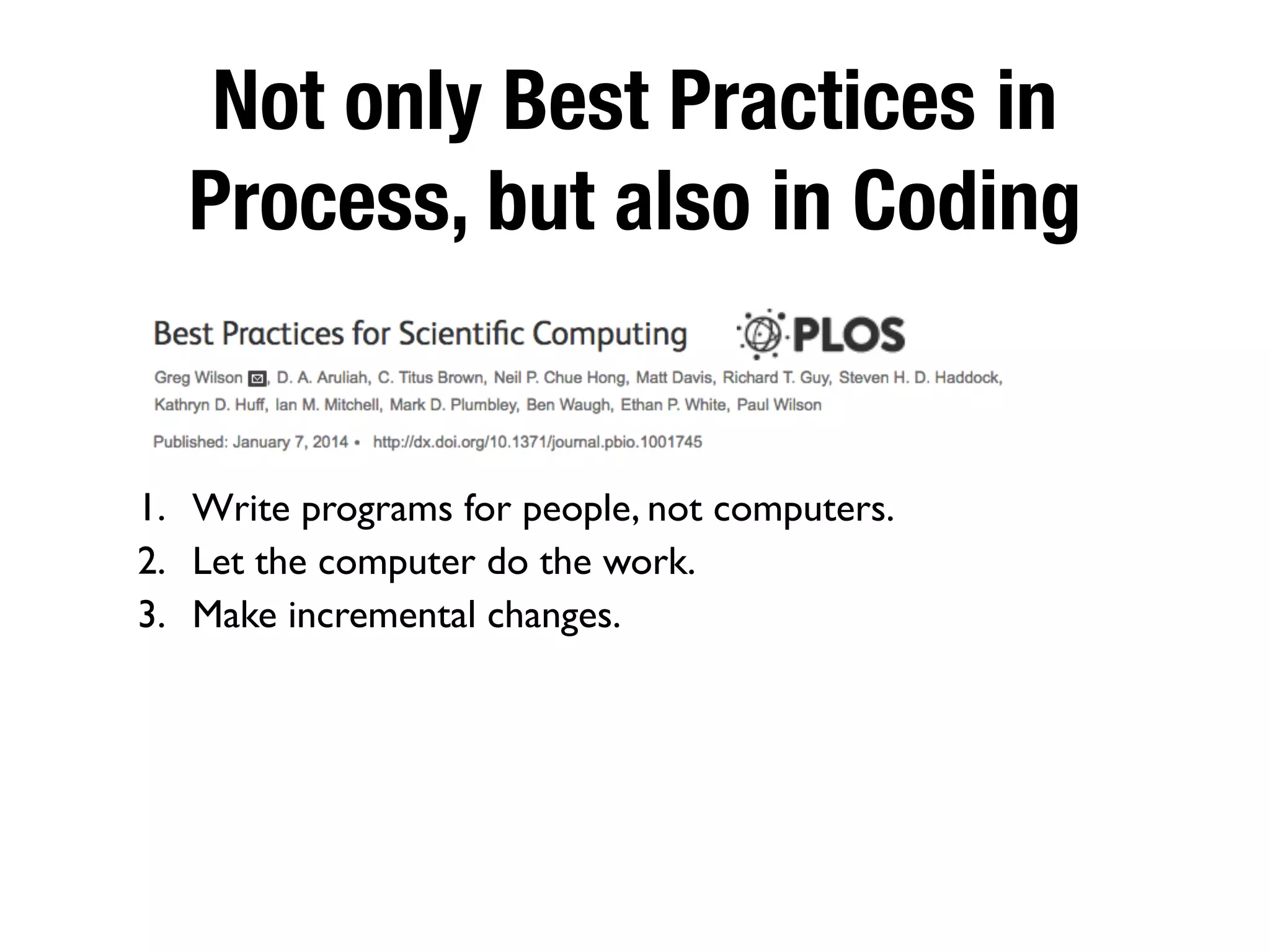
3. Make incremental changes.
Not only Best Practices in
Process, but also in Coding
1. Write programs for people, not computers.
2. Let the computer do the work.
3. Make incremental changes.
4. Don't repeat yourself (or others).
Not only Best Practices in
Process, but also in Coding
1. Write programs for people, not computers.
2. Let the computer do the work.
3. Make incremental changes.
4. Don't repeat yourself (or others).
5. Plan for mistakes.
Not only Best Practices in
Process, but also in Coding
1. Write programs for people, not computers.
2. Let the computer do the work.
3. Make incremental changes.
4. Don't repeat yourself (or others).
5. Plan for mistakes.
6. Optimize software only after it works correctly.
Not only Best Practices in
Process, but also in Coding
1. Write programs for people, not computers.
2. Let the computer do the work.
3. Make incremental changes.
4. Don't repeat yourself (or others).
5. Plan for mistakes.
6. Optimize software only after it works correctly.
7. Document design and purpose, not mechanics.
Not only Best Practices in
Process, but also in Coding
1. Write programs for people, not computers.
2. Let the computer do the work.
3. Make incremental changes.
4. Don't repeat yourself (or others).
5. Plan for mistakes.
6. Optimize software only after it works correctly.
7. Document design and purpose, not mechanics.
8. Collaborate.
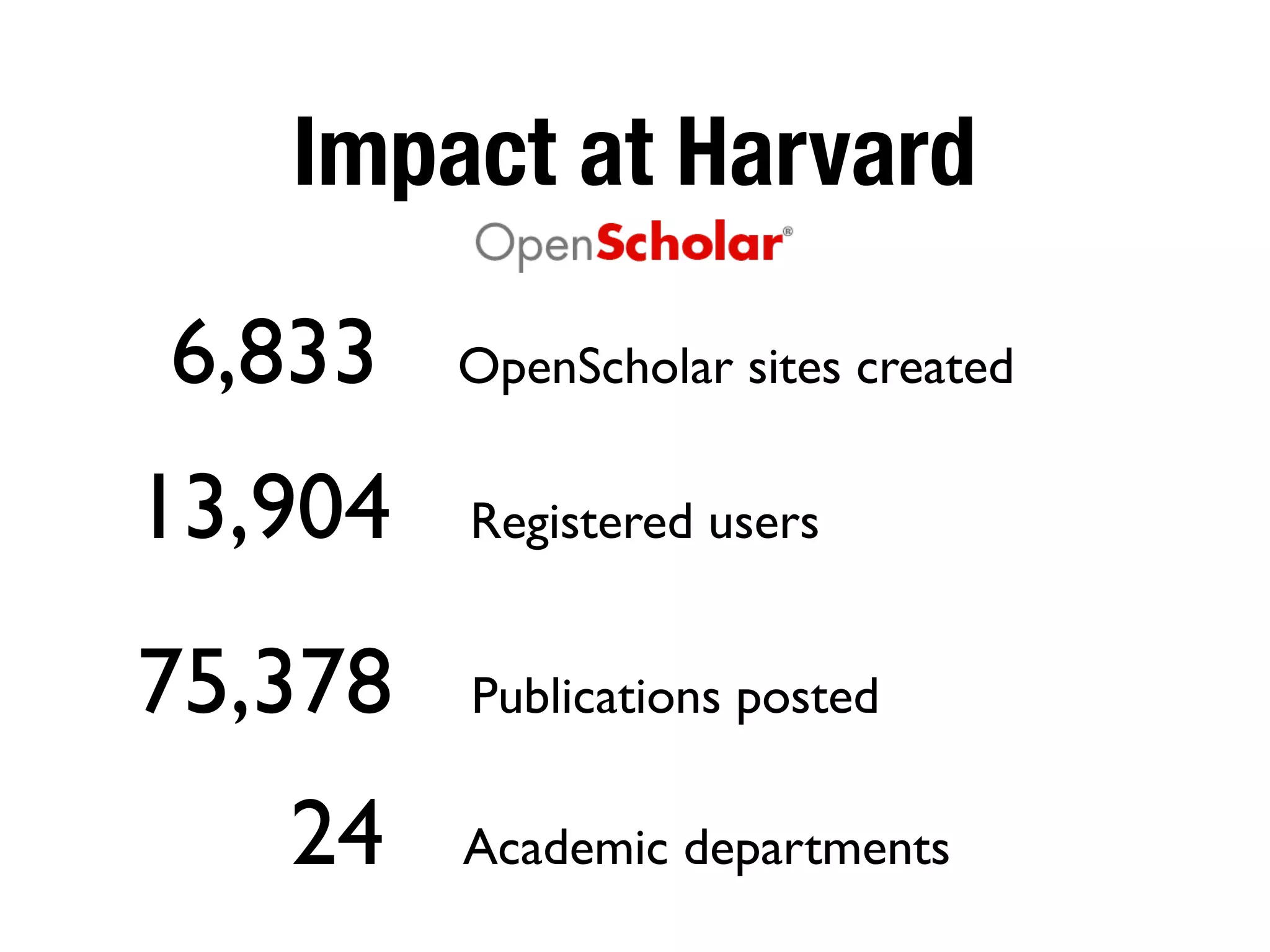
Impact at Harvard
6,833 OpenScholar sites created
13,904 Registered users
75,378 Publications posted
24 Academic departments
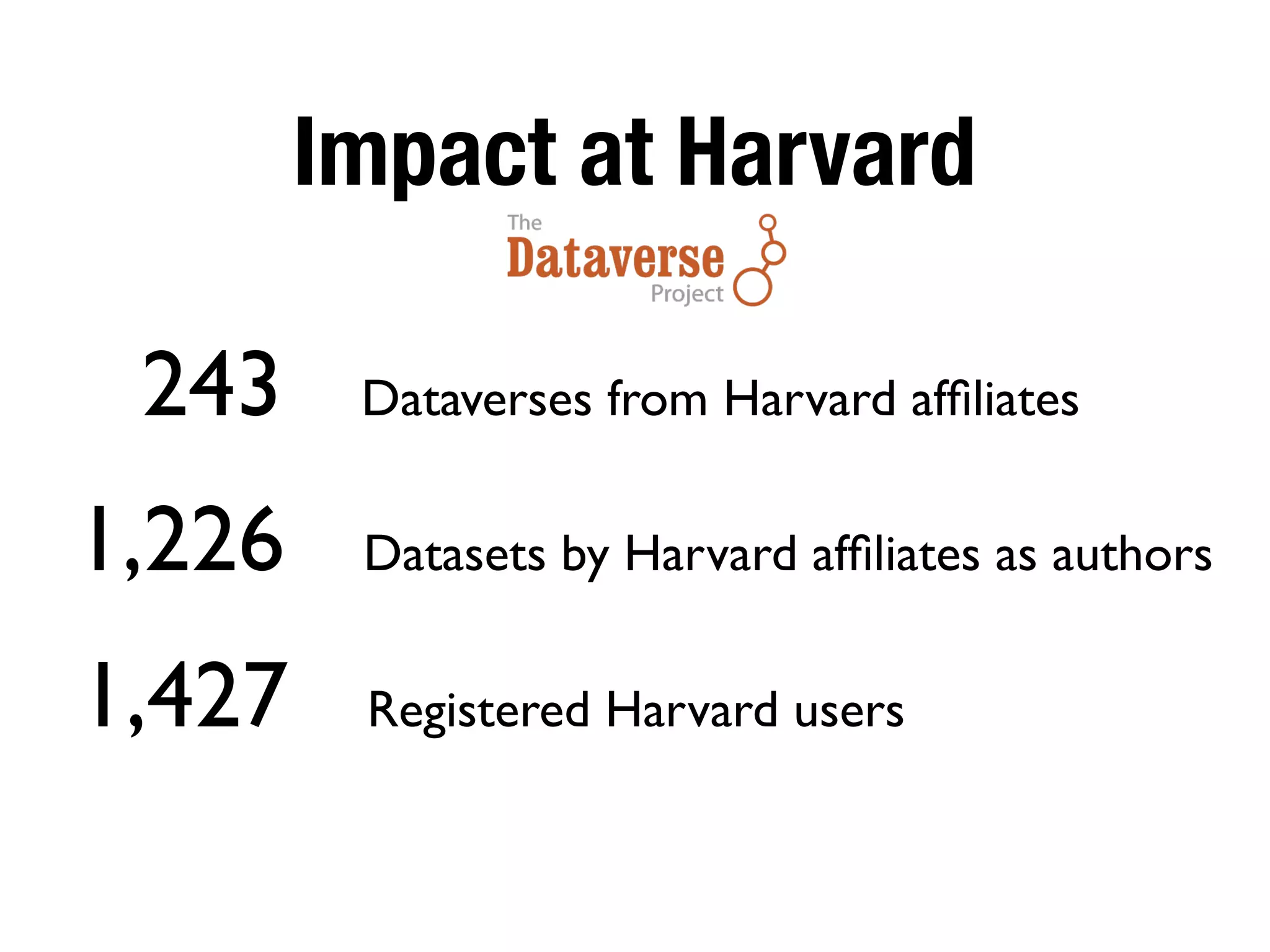
Impact at Harvard
243 Dataverses from Harvard affiliates
1,226 Datasets by Harvard affiliates as authors
1,427 Registered Harvard users
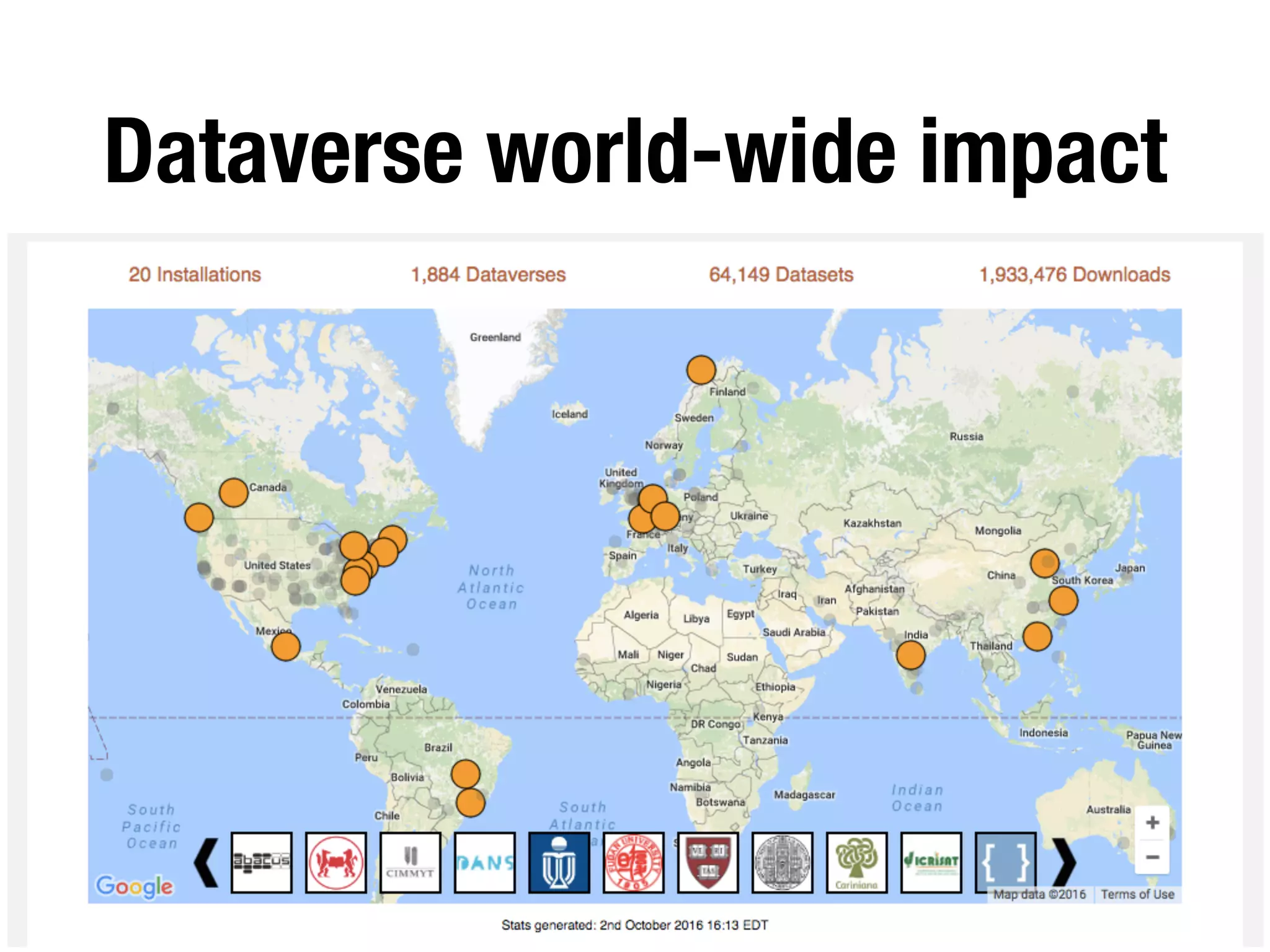
Broader Impact
Dataverse world-wide impact
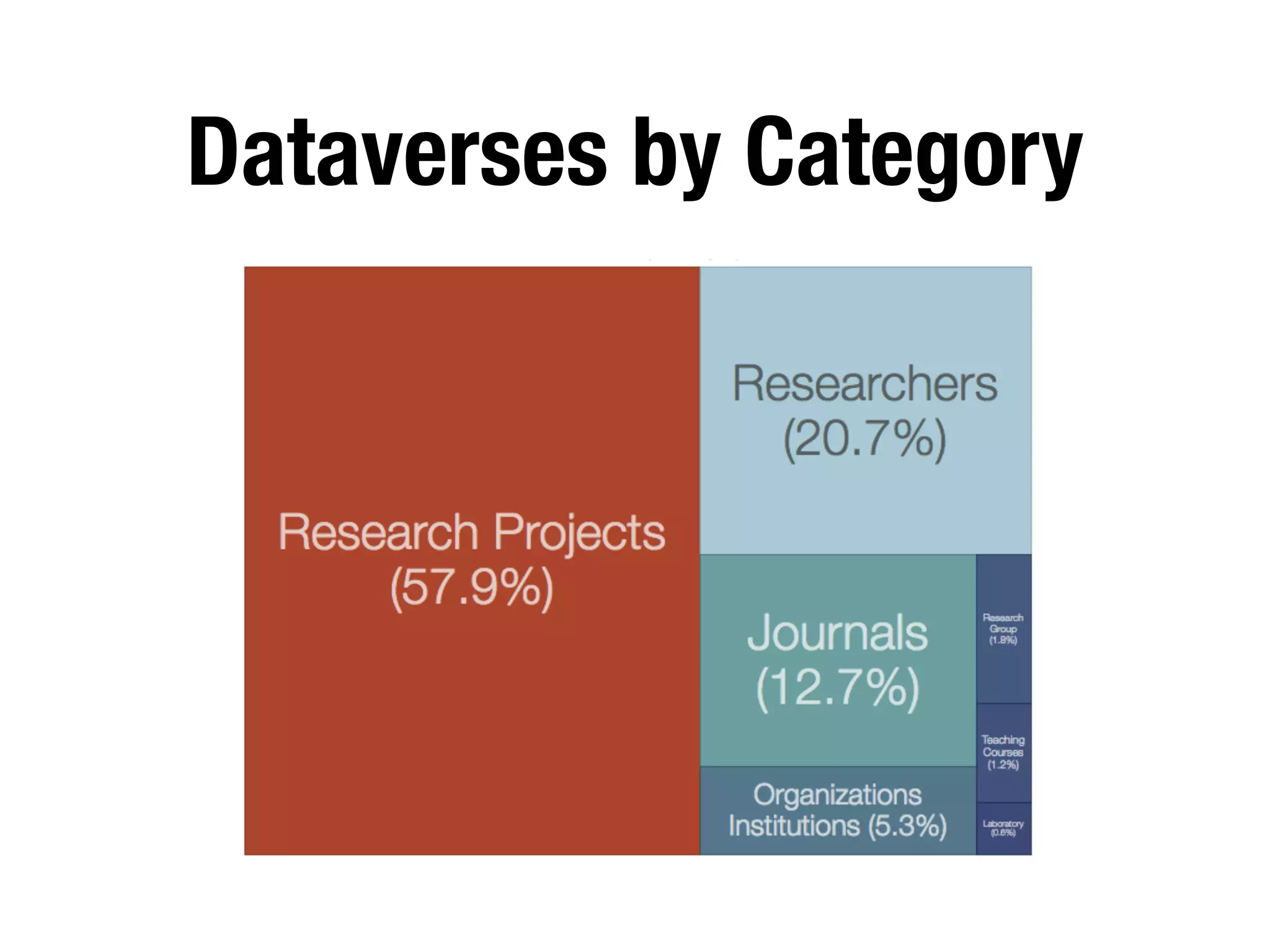
Dataverses by Category
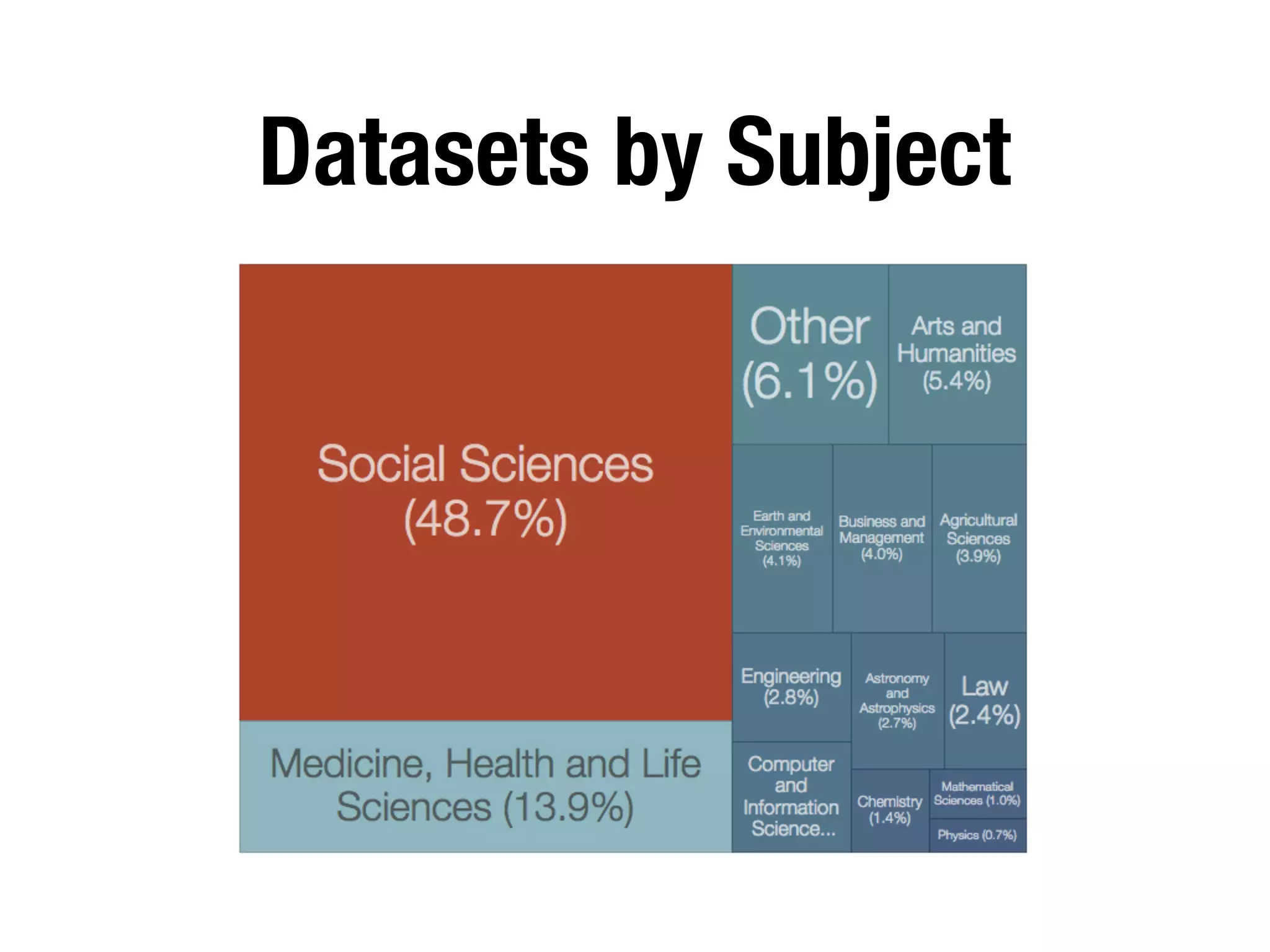
Datasets by Subject
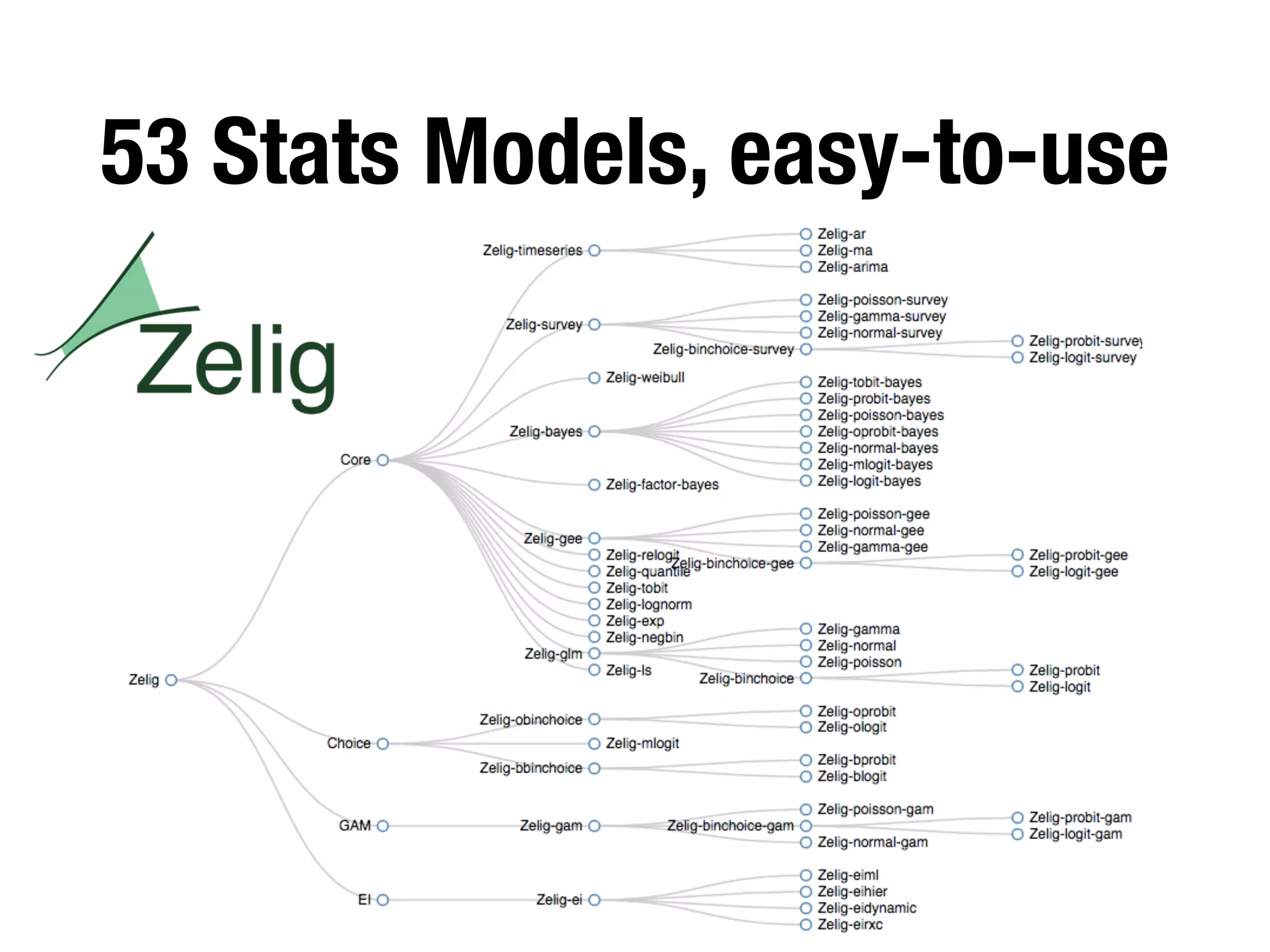
53 Stats Models, easy-to-use
Thank you!
Presented by @mercecrosas mercecrosas.com
dataverse.org
dataverse.harvard.edu
openscholar.org
projects.iq.harvard.edu
scholar.harvard.edu
zeligproject.org
Coming soon!
iq.harvard.edu

Abcd iqs ssoftware-projects-mercecrosas

  • 1.
    Research and Academic SoftwareProjects at the Institute for Quantitative Social Science Mercè Crosas, Ph.D. Chief Data Science andTechnology Officer IQSS, Harvard University twitter: @mercecrosas web: mercecrosas.com
  • 2.
    The Big Picture Identifya problem or need in research or academia
  • 3.
    The Big Picture Identifya problem or need in research or academia Build a technology solution, easy- to-use, gives control to researcher
  • 4.
    The Big Picture Identifya problem or need in research or academia Build a technology solution, easy- to-use, gives control to researcher Generalizable, Open-source
  • 5.
    The Big Picture Identifya problem or need in research or academia Build a technology solution, easy- to-use, gives control to researcher Build a community that makes the technology better Generalizable, Open-source
  • 6.
  • 7.
    Example: Dataverse ๏ Howdo we increase data sharing to improve research transparency and replication with incentives to researchers?
  • 8.
    Example: Dataverse ๏ Howdo we increase data sharing to improve research transparency and replication with incentives to researchers? ๏ Provide a repository solution, where researchers have control of branding and access of their data, and get credit through data citation.
  • 9.
  • 10.
    Example: OpenScholar ๏ Howdo we enable scholars to build their academic web sites in a cost effective way?
  • 11.
    Example: OpenScholar ๏ Howdo we enable scholars to build their academic web sites in a cost effective way? ๏ Provide a web site builder with pre-set features for academics, where a single hosting serves thousands of sites.
  • 12.
  • 13.
    Example: Zelig ๏ Howdo we simplify using thousands of R statistical methods built by different authors?
  • 14.
    Example: Zelig ๏ Howdo we simplify using thousands of R statistical methods built by different authors? ๏ Provide a statistical package that uses the same three commands for all methods, with consistent documentation.
  • 15.
  • 16.
    Example: Consilience ๏ Howdo we make sense of thousands (or millions!) of texts?
  • 17.
    Example: Consilience ๏ Howdo we make sense of thousands (or millions!) of texts? ๏ Provide an application that helps researchers explore many possible ways of categorizing documents.
  • 18.
    The Process Research, standards & bestpractices Development, testing & releases Input from users, community, stakeholders Dataverse Case Study
  • 19.
    metadata standards, harvesting protocols, datatransfer, data citation, provenance, connecting to journals, integrating with cloud computing, …. The Process Research, standards & best practices Development, testing & releases Input from users, community, stakeholders Dataverse Case Study
  • 20.
    metadata standards, harvesting protocols, datatransfer, data citation, provenance, connecting to journals, integrating with cloud computing, …. The Process Research, standards & best practices Development, testing & releases Input from users, community, stakeholders Dataverse Case Study usability testing, community calls, annual community meeting, pull requests
  • 21.
  • 22.
    The Process DetailsDataverse CaseStudy An agile process, integrating Waffle + GitHub + Jenkins, including these steps:
  • 23.
    The Process DetailsDataverse CaseStudy An agile process, integrating Waffle + GitHub + Jenkins, including these steps: Backlog > Ready > Dev > Code Review > QA > Usability Test > Polishing > Done
  • 24.
    The Process DetailsDataverse CaseStudy An agile process, integrating Waffle + GitHub + Jenkins, including these steps: Backlog > Ready > Dev > Code Review > QA > Usability Test > Polishing > Done Pull Requests
  • 25.
    Not only BestPractices in Process, but also in Coding
  • 26.
    Not only BestPractices in Process, but also in Coding
  • 27.
    Not only BestPractices in Process, but also in Coding 1. Write programs for people, not computers.
  • 28.
    Not only BestPractices in Process, but also in Coding 1. Write programs for people, not computers. 2. Let the computer do the work.
  • 29.
    Not only BestPractices in Process, but also in Coding 1. Write programs for people, not computers. 2. Let the computer do the work. 3. Make incremental changes.
  • 30.
    Not only BestPractices in Process, but also in Coding 1. Write programs for people, not computers. 2. Let the computer do the work. 3. Make incremental changes. 4. Don't repeat yourself (or others).
  • 31.
    Not only BestPractices in Process, but also in Coding 1. Write programs for people, not computers. 2. Let the computer do the work. 3. Make incremental changes. 4. Don't repeat yourself (or others). 5. Plan for mistakes.
  • 32.
    Not only BestPractices in Process, but also in Coding 1. Write programs for people, not computers. 2. Let the computer do the work. 3. Make incremental changes. 4. Don't repeat yourself (or others). 5. Plan for mistakes. 6. Optimize software only after it works correctly.
  • 33.
    Not only BestPractices in Process, but also in Coding 1. Write programs for people, not computers. 2. Let the computer do the work. 3. Make incremental changes. 4. Don't repeat yourself (or others). 5. Plan for mistakes. 6. Optimize software only after it works correctly. 7. Document design and purpose, not mechanics.
  • 34.
    Not only BestPractices in Process, but also in Coding 1. Write programs for people, not computers. 2. Let the computer do the work. 3. Make incremental changes. 4. Don't repeat yourself (or others). 5. Plan for mistakes. 6. Optimize software only after it works correctly. 7. Document design and purpose, not mechanics. 8. Collaborate.
  • 35.
    Impact at Harvard 6,833OpenScholar sites created 13,904 Registered users 75,378 Publications posted 24 Academic departments
  • 36.
    Impact at Harvard 243Dataverses from Harvard affiliates 1,226 Datasets by Harvard affiliates as authors 1,427 Registered Harvard users
  • 37.
  • 38.
  • 39.
  • 40.
  • 41.
    53 Stats Models,easy-to-use
  • 42.
    Thank you! Presented by@mercecrosas mercecrosas.com dataverse.org dataverse.harvard.edu openscholar.org projects.iq.harvard.edu scholar.harvard.edu zeligproject.org Coming soon! iq.harvard.edu