

A PRACTICAL GUIDETO
PRACTICING OPEN SCIENCE
Chris Gorgolewski
@ChrisFiloG
What is Open Science?
•Transparency
•Reproducibility
•Reusability
•Collaborations
WHO IS A PHD STUDENT?
WHO IS A POSTDOC?
WHO IS ATENURETRACK
PROFESSOR?
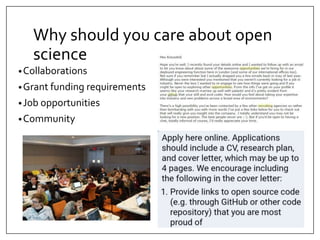
Why should you care about open
science
•Collaborations
•Grant funding requirements
•Job opportunities
•Community
Roadmap
1. How to deal with data
2. How to deal with code
3. How to deal with papers
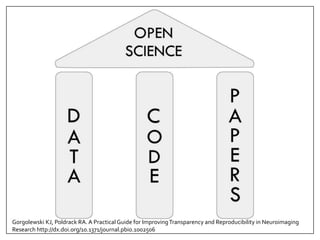
Gorgolewski KJ, Poldrack RA.A Practical Guide for ImprovingTransparency and Reproducibility in Neuroimaging
Research http://dx.doi.org/10.1371/journal.pbio.1002506
DATA
Consent forms
•General Data Protection Regulation
•25 May 2018
•Open Brain Consent
•http://open-brain-consent.readthedocs.io
•Now in German!
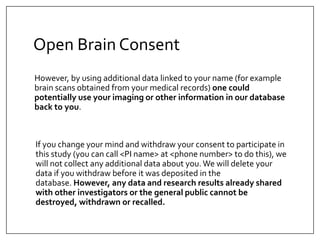
Open Brain Consent
However, by using additional data linked to your name (for example
brain scans obtained from your medical records) one could
potentially use your imaging or other information in our database
back to you.
If you change your mind and withdraw your consent to participate in
this study (you can call <PI name> at <phone number> to do this), we
will not collect any additional data about you.We will delete your
data if you withdraw before it was deposited in the
database. However, any data and research results already shared
with other investigators or the general public cannot be
destroyed, withdrawn or recalled.
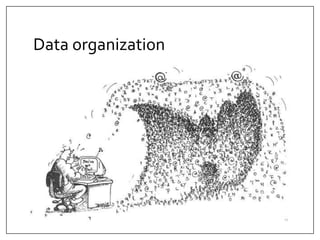
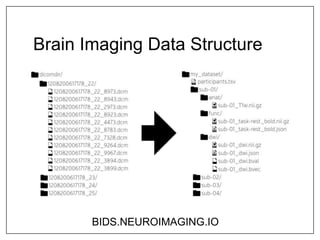
Data organization
• Brain Imaging Data Structure
• http://bids.neuroimaging.io
Data organization
Data sharing with yourself from the future is
also a form of data sharing.
A very important one.
Brain Imaging Data Structure
POSTER NUMBER:
1854
BIDS.NEUROIMAGING.IO
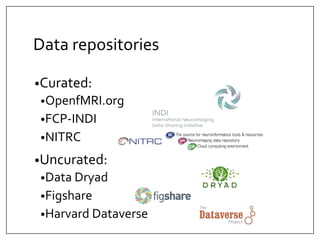
Data repositories
•Curated:
•OpenfMRI.org
•FCP-INDI
•NITRC
•Uncurated:
•Data Dryad
•Figshare
•Harvard Dataverse
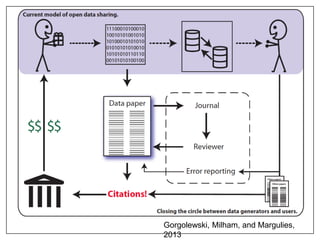
Gorgolewski, Milham, and Margulies,
2013
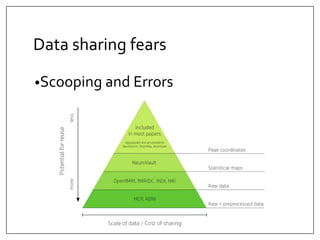
Data sharing fears
•Scooping and Errors
CODE
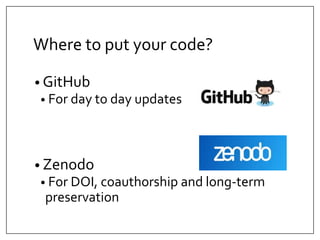
Where to put your code?
• GitHub
• For day to day updates
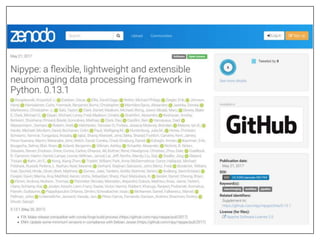
• Zenodo
• For DOI, coauthorship and long-term
preservation
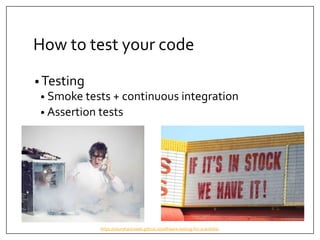
How to test your code
• Testing
• Smoke tests + continuous integration
• Assertion tests
https://neurohackweek.github.io/software-testing-for-scientists/
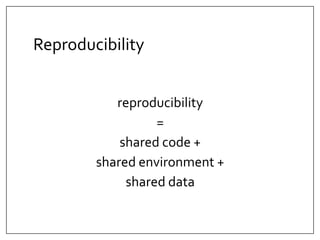
Reproducibility
reproducibility
=
shared code +
shared environment +
shared data
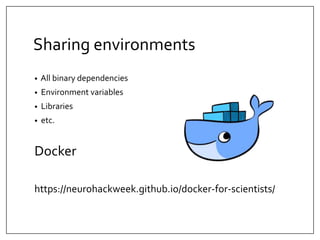
Sharing environments
• All binary dependencies
• Environment variables
• Libraries
• etc.
Docker
https://neurohackweek.github.io/docker-for-scientists/
Reproducibility of neuroimaging
analyses
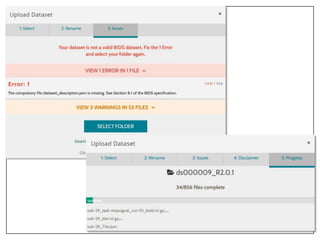
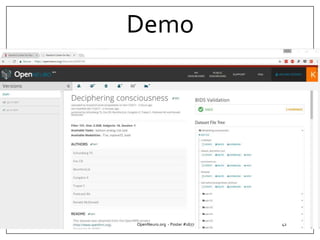
a free online platform for sharing and
analysis of neuroimaging data
OpenNeuro.org - Poster #1677 25
Misconception 1: Quality of code
Lack of documentation and
portability should not stop you from
sharing your code.
Misconception 2: User support
1. You are not obliged to provide
user support for your code if you
share it.
2. Direct users to GitHub Issues or
NeuroStars to avoid direct
messages.
PAPERS
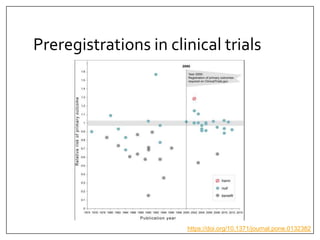
Preregistrations in clinical trials
https://doi.org/10.1371/journal.pone.0132382
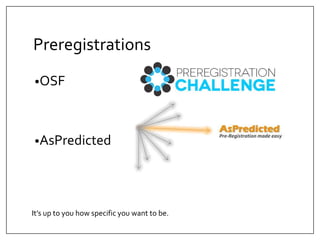
Preregistrations
•OSF
•AsPredicted
It’s up to you how specific you want to be.
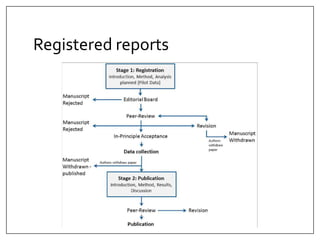
Registered reports
Preprints
• Way around non-open access
journals
• A way to get feedback from the
community
• And use it to get your paper published
• Ability to share preliminary ideas
Preprints
• What makes a good preprint sever?
• Exposure
• Comments
• DOIs
• Versions
Preprint misconceptions
The journal will not accept a paper that
already appeared as a preprint.
95% wrong
http://www.sherpa.ac.uk/romeoinfo.html
Reviews
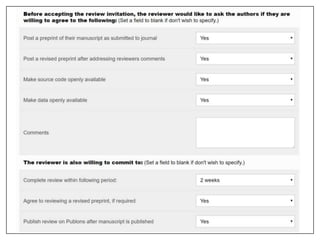
• Academic Karma allows you to publish your
reviews
• Signed or not
• Negotiating an agreement with authors when a
review is solicited by the editor
FINALLY…
The world is not black and white
It’s many shades of grey
The world is not black and white
Not this kind of grey…
The world is not black and white
You don’t need to go all in – pick
one thing
and start practicing it
Questions?
Demo
OpenNeuro.org - Poster #1677 42

A practical guide to practicing open science