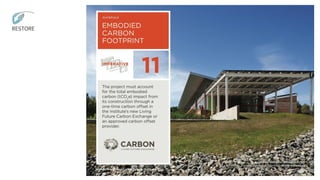
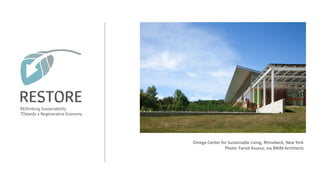
Omega Center for Sustainable Living, Rhinebeck, New York
Photo: Farsid Assassi, via BNIM Architects
WORKSHOP
Carbon Footprint and LCA
25 July 2017
EURAC research, Bolzano, Italy
Carlo Battisti
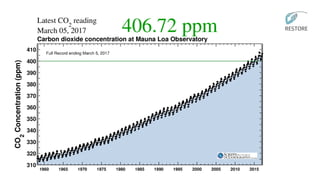
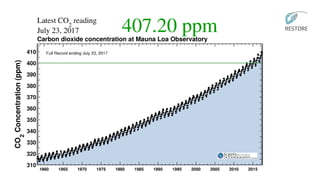
The urgency
CO2 emissions: thousands tons / year / nation using fossil fuels (blue = higher) [source: Wikipedia]
Kiribati Islands
Oceania
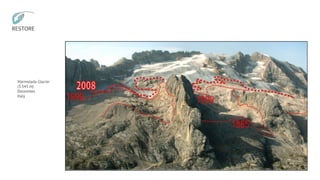
Marmolada Glacier
(3.343 m)
Dolomites
Italy
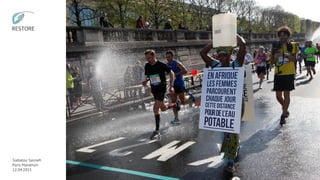
Siabatou Sanneh
Paris Marathon
12.04.2015
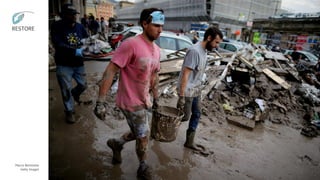
Marco Bertorello
Getty Images
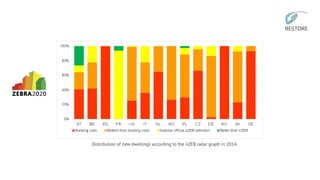
Distribution of new dwellings according to the nZEB radar graph in 2014.
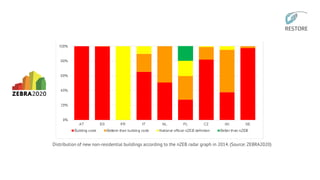
Distribution of new non-residential buildings according to the nZEB radar graph in 2014. (Source: ZEBRA2020)
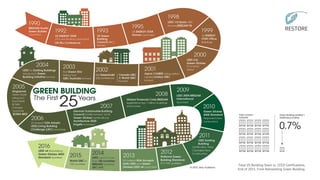
Total US Building Stock vs. LEED Certifications,
End of 2015. From Reinventing Green Building.
Why RESTORE?
Rethinking Sustainability Towards a Regenerative Economy
Sustainable buildings and facilities are critical to a future that is socially just, ecologically restorative,
culturally rich and economically viable within the climate change context
Despite over a decade of strategies and programmes, progress on built environment sustainability fails to
address these key issues. Consequently the built environment sector no longer has the luxury of being
incrementally less bad, but, with urgency, needs to adopt net-positive, restorative sustainability thinking to
incrementally do ‘more good’.
Within the built environment sustainability agenda a shift is occurring, from a narrow focus on building energy
performance, mitigation strategies, and minimisation of environmental impacts to a broader framework that
enriches places, people, ecology, culture, and climate at the core of the design task, with particular emphasis
on the benefits towards health.
Sustainability in buildings, as understood today, is an inadequate measure for current and future architectural
design, for it aims no higher than trying to make buildings ‘less bad’. Building on current European Standards
restorative sustainability approaches will raise aspirations and deliver restorative outcomes.
The vision
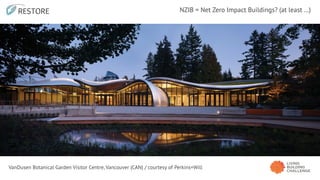
NZIB = Net Zero Impact Buildings? (at least …)
VanDusen Botanical Garden Visitor Centre, Vancouver (CAN) / courtesy of Perkins+Will
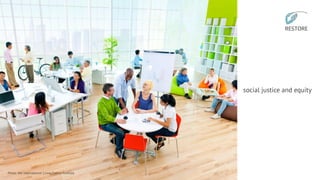
social justice and equity
Photo: the International Living Future Institute
The mission
How To Save The World: Eric Campbell
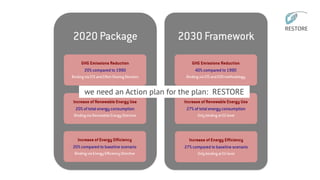
we need an Action plan for the plan: RESTORE
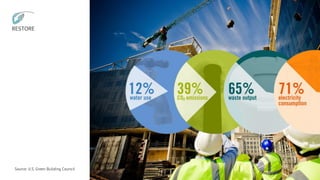
Source: U.S. Green Building Council
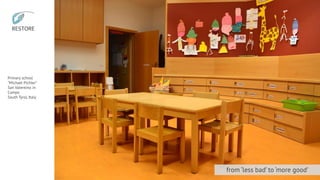
from ‘less bad’ to ‘more good’
Primary school
“Michael Pichler”
San Valentino in
Campo
South Tyrol, Italy
policy makers
professionals
people
products
policy makers
RESTORE
The Challenge
The RESTORE COST Action will affect a paradigm shift towards restorative sustainability for new and existing
buildings and space design across Europe.
Within the built environment sustainability agenda, the RESTORE action proposes to expand on a narrow focus
on building energy performance, mitigation strategies and limiting of environmental impacts, moving towards
a broader framework that regenerates places and enriches people, ecology, culture, and climate at the core of
design, construction and operation activities, with a particular emphasis on concepts such as health, biophilia,
and links to the natural ecosystem.
The RESTORE Action will specifically address the complexity of a broader range of quantitative and qualitative
thinking throughout its actions, seeking opportunities and innovations that will enable multiscale (‘scale
jumping’) thinking from the human microscale to the building/space mesoscale of city and ecosystem
dimensions.
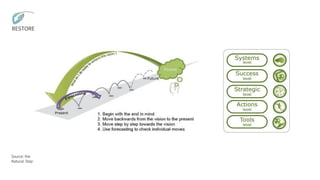
A methodological approach
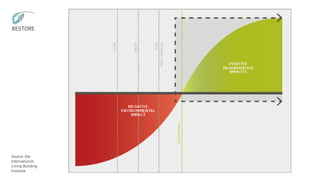
Source: the
International
Living Building
Institute
Source: the
Natural Step
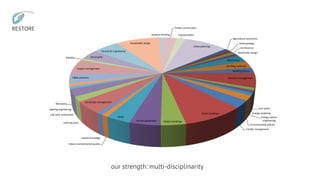
our strength: multi-disciplinarity
Agricultural economics
Anthropology
Architecture
Bioclimatic design
Biomimicry
Building materials
Building physics
Business management
Civil works
Energy modeling
Energy system
engineering
Environmental policies
Facility management
Green buildings
Historic buildingsHuman geography
HVAC
Indoor environmental quality
Industrial ecology
Landscape management
Learning tools
Life cycle assessment
Lighting engineering
Mechanics
NZEB solutions
Project management
Robotics Smart grids
Structural engineering
Sustainable design
Systems thinking
Timber construction
Transportation
Urban planning
we are 120 … and counting
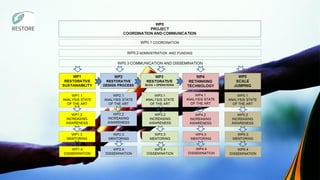
The project’s structure
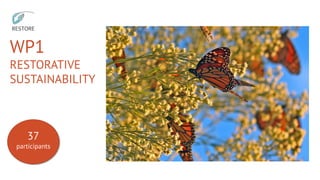
WP1
RESTORATIVE
SUSTAINABILITY
37
participants
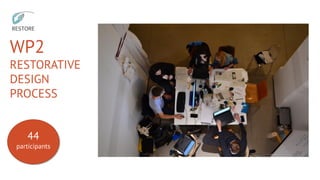
WP2
RESTORATIVE
DESIGN
PROCESS
44
participants
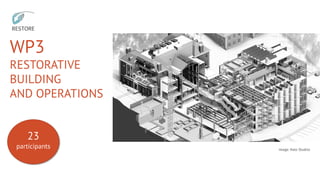
WP3
RESTORATIVE
BUILDING
AND OPERATIONS
23
participants image: Axes Studios
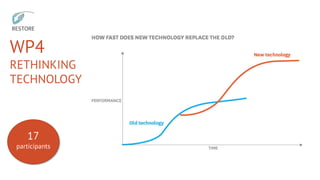
WP4
RETHINKING
TECHNOLOGY
17
participants
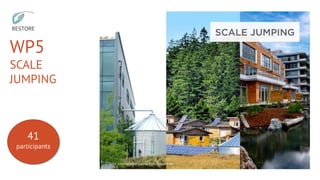
WP5
SCALE
JUMPING
41
participants
Tools
different approaches for different WPs
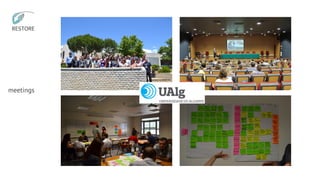
meetings
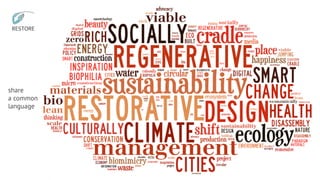
share
a common
language
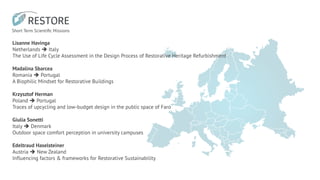
Lisanne Havinga
Netherlands  Italy
The Use of Life Cycle Assessment in the Design Process of Restorative Heritage Refurbishment
Madalina Sbarcea
Romania  Portugal
A Biophilic Mindset for Restorative Buildings
Krzysztof Herman
Poland  Portugal
Traces of upcycling and low-budget design in the public space of Faro
Giulia Sonetti
Italy  Denmark
Outdoor space comfort perception in university campuses
Edeltraud Haselsteiner
Austria  New Zealand
Influencing factors & frameworks for Restorative Sustainability
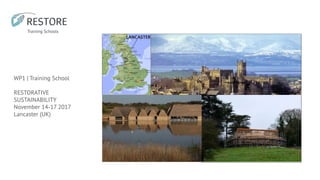
WP1 | Training School
RESTORATIVE
SUSTAINABILITY
November 14-17 2017
Lancaster (UK)
RESTORE & Carbon Footprint
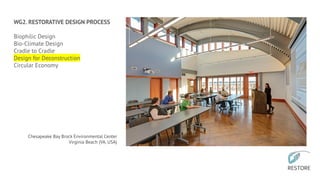
WG2. RESTORATIVE DESIGN PROCESS
Biophilic Design
Bio-Climate Design
Cradle to Cradle
Design for Deconstruction
Circular Economy
Chesapeake Bay Brock Environmental Center
Virginia Beach (VA, USA)
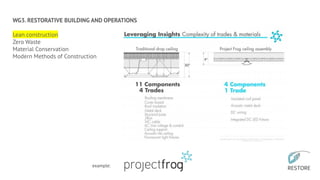
WG3. RESTORATIVE BUILDING AND OPERATIONS
Lean construction
Zero Waste
Material Conservation
Modern Methods of Construction
example:
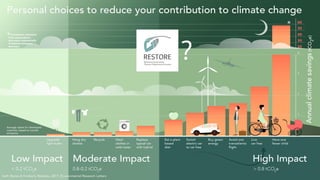
?
http://www.eurestore.eu/ @CostRestore
https://www.facebook.com/COSTRestore/ http://www.cost.eu/COST_Actions/ca/CA16114
Thank you very much !
Walden Pond, Concord (MA, USA)

2017_07_25 Carlo Battisti