F"U"T"U"R"E"S"T"O"R"A"T"I"V"E"
MARTIN'BROWN''@fairsnape''
Mar4n'draws'on'experience'from'a'career'
in' the' built' environment,' a' life4me' of'
outdoor' ac4vity,' surfacing' concepts' from'
ecology'and'wildness'writers'and'thinkers'
alongside' today’s' leading' advocates' and'
innovators.'''
'
There' are' many' examples,' concepts' and'
arguments' presented' here' that' you' will'
love,' like' and' agree' with,' others' you' will'
not'and'will'want'to'challenge'–'and'that's'
fine.'''
'
W e' n e e d' m o r e' t h i n k i n g' l i k e'
FUTURESTORATIVE'that'challenges'current'
and' entrenched' thinking,' and,' in'
encouraging'debate'move'us'forward.''
'
FOREWORD"
Amanda&Sturgeon&&
CEO&Interna2onal&Living&&Futures&Ins2tute&
"
Design'brief'for' built&environment industry:'
'
'
'
'
'
'
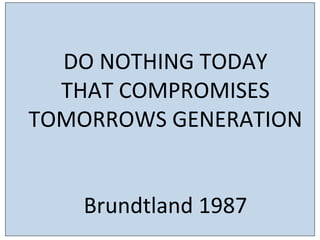
DO'NOTHING'TODAY''
THAT'COMPROMISES'
TOMORROWS'GENERATION'
'
'
Brundtland'1987'
Design'brief'for' built&environment industry:'
'
'
'
'
'
'
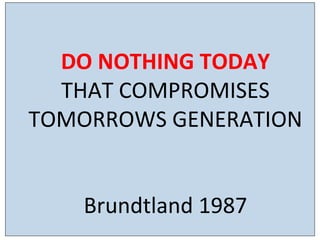
DO"NOTHING"TODAY""
THAT'COMPROMISES'
TOMORROWS'GENERATION'
'
'
Brundtland'1987'
CHAPTER ONE
THE CHALLENGE
The"Past"
"
Every"Project"
Ma?ers""
"
COST"–"a"
sustainability"
barrier?"
"
From"GREY"to"
GREEN"
"
BREXIT"
"
"
'
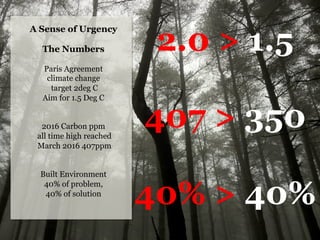
A Sense of Urgency
The Numbers
Paris Agreement
climate change
target 2deg C
Aim for 1.5 Deg C
2016 Carbon ppm
all time high reached
March 2016 407ppm
Built Environment
40% of problem,
40% of solution
'
2.0 > 1.5
407  > 350
40% > 40%
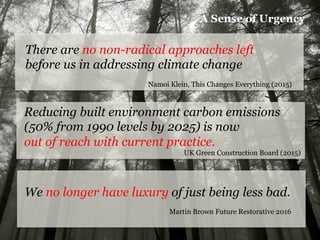
There are no non-radical approaches left
before us in addressing climate change
Namoi Klein, This Changes Everything (2015)
Reducing built environment carbon emissions
(50% from 1990 levels by 2025) is now
out of reach with current practice.
UK Green Construction Board (2015)
We no longer have luxury of just being less bad.
Martin Brown Future Restorative 2016
A Sense of Urgency
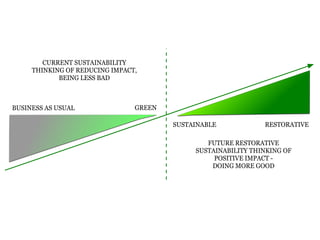
BUSINESS AS USUAL
RESTORATIVE
CURRENT SUSTAINABILITY
THINKING OF REDUCING IMPACT,
BEING LESS BAD
FUTURE RESTORATIVE
SUSTAINABILITY THINKING OF
POSITIVE IMPACT -
DOING MORE GOOD
GREEN
SUSTAINABLE
CHAPTER TWO
FUTURESTORATIVE
KEY CONCEPTS
Tipping"Point"
"
We"Are"Nature"
"
RegeneraMve"
Health"
"
Planetary"
Boundaries"
"
Responsible"
Influence"
"
Rethinking"
"
CollaboraMon"
"
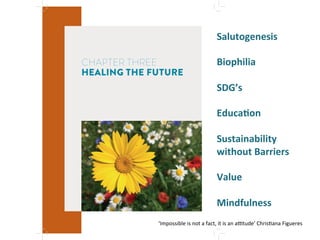
CHAPTER THREE
HEALING THE FUTURE
Salutogenesis"
"
Biophilia"
"
SDG’s"
"
EducaMon"
"
Sustainability"
without"Barriers"
"
Value"
"
Mindfulness'
'
‘Impossible'is'not'a'fact,'it'is'an'a[tude’
'
Chris4ana'Figueres'
CHAPTER FOUR
RESTORATIVE
APPROACHES
NATURE, EARTH, LIGHT AND AIR
"
Rewilding"Nature,"
Buildings"and"
People"
"
Soil"
"
Circadian"LighMng"
"
Buildings"as"air"
cleansers"
'
'
‘Light'is'Medicine’''Paul'Scialla''
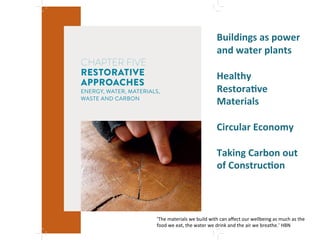
CHAPTER FIVE
RESTORATIVE
APPROACHES
ENERGY, WATER, MATERIALS,
WASTE AND CARBON
"
Buildings"as"power"
and"water"plants"
"
Healthy"
RestoraMve"
Materials"
"
Circular"Economy"
"
Taking"Carbon"out"
of"ConstrucMon"
"
"
'
'
'
‘The'materials'we'build'with'can'affect'our'wellbeing'as'much'as'the'
food'we'eat,'the'water'we'drink'and'the'air'we'breathe.’'HBN'
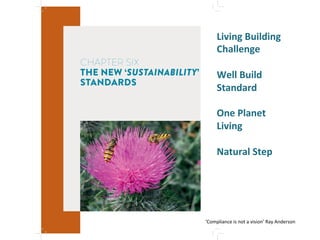
CHAPTER SIX
THE NEW ‘SUSTAINABILITY’
STANDARDS
Living"Building"
Challenge"
"
Well"Build"
Standard"
"
One"Planet"
Living"
"
Natural"Step"
'
'
'
‘Compliance'is'not'a'vision’'Ray'Anderson'
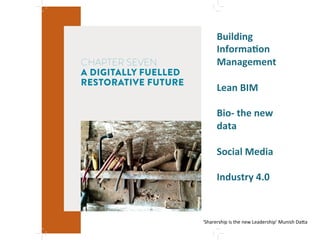
CHAPTER SEVEN
A DIGITALLY FUELLED
RESTORATIVE FUTURE
Building"
InformaMon"
Management"
"
Lean"BIM"
"
BioV"the"new"
data"
"
Social"Media"
"
Industry"4.0"
'
'
'
‘Sharership'is'the'new'Leadership’'Munish'Da^a'
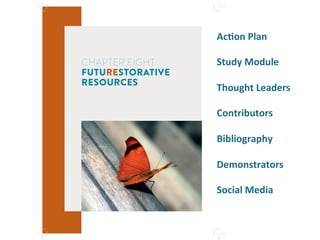
CHAPTER EIGHT
FUTURESTORATIVE
RESOURCES
AcMon"Plan""
"
Study"Module"
"
Thought"Leaders"
"
Contributors"
"
Bibliography"
"
Demonstrators"
"
Social"Media"
'
'
'
CHAPTER EIGHT: FUTURESTORATIVE RESOURCES 157
THE FUTURESTORATIVE STUDY PROGRAMME
A module-based programme, based on FutuREstorative has been developed, for use
online, in workshops, classrooms, lecture halls and forest glades. The programme
takes students through a greater understanding of the concepts and thinking
explored and developed throughout this book.
MODULE AREA OF STUDY
CULTURE AND CHALLENGES
1
Understanding of the tradition, history and culture along
with the challenges that the built environment faces in
making the transition to a restorative, sustainable sector.
CONCEPTS
2
Exploring and understanding the key concepts for a
restorative sustainability. Exploring the teachings and
insights of thought leaders, books and publications.
NEW THINKING
3A
Exploring and understanding the potential net-positive
impact of the built environment on human and ecological
health.
3B
Exploring and understanding the impact and influence of
Nature, Earth, Light and Air on health and wellbeing
3C
Exploring and understanding the impact and influence of
Energy, Water, Materials, Waste and Carbon
CERTIFICATIONS
4
Exploring and understanding the philosophies, ecological
background and rise in interest and application of new,
restorative sustainability standards
DIGITAL
5
Exploring and understanding the impact and influence of the
digital age on restorative sustainability potential.
"
Study"Module"
"
On"Line"
"
Workshops"
"
Classrooms"
"
Lecture"Halls"
"
Forest"Glades"
"
'
'
'
172 FUTURESTORATIVE
EPILOGUE:
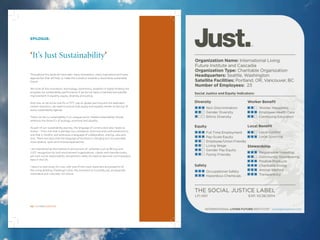
‘It’s Just Sustainability’
Throughout this book we have seen many innovations, many inspirations and many
approaches that will help us make the transition towards a restorative sustainable
future.
Yet none of this innovation, technology, biomimicry, biophilia or digital thinking will
progress our sustainability performance if we do not have a matched and parallel
improvement in equality, equity, diversity and justice.
And now, as we strive now for a 1.5°C cap on global warming and the attendant
carbon reduction, we need to ensure that equity and equality remain at the top of
every sustainability agenda.
There can be no sustainability in an unequal world. Indeed sustainability should
embrace the three E’s of ecology, economy and equality.
As part of our sustainability journey, the language of construction also needs to
evolve – from one that is perhaps too combative, technical and confrontational to
one that is mindful, and embraces a language of collaboration, sharing, care and
love. There are signs that the language of business is changing as it incorporates
more diverse, open and inclusive approaches.
I am heartened by the interest in and pursuit of schemes such as BCorp and
JUST recognition by built environment organisations, clients and manufacturers,
yet such social responsibility recognitions really do need to become commonplace
here in the UK.
I return to and close, for now, with one of the most important and powerful of
the Living Building Challenge’s aims: the transition to a socially just, ecologically
restorative and culturally rich future.
Why"a"Monarch"Bu?erfly?"
h^p://bit.ly/futuREstora4ve'
F"U"T"U"R"E"S"T"O"R"A"T"I"V"E"
MARTIN'BROWN''@fairsnape''

FutuREstorative for UCLAN Centre Sustainability Development

  • 1.
  • 2.
    Mar4n'draws'on'experience'from'a'career' in' the' built'environment,' a' life4me' of' outdoor' ac4vity,' surfacing' concepts' from' ecology'and'wildness'writers'and'thinkers' alongside' today’s' leading' advocates' and' innovators.''' ' There' are' many' examples,' concepts' and' arguments' presented' here' that' you' will' love,' like' and' agree' with,' others' you' will' not'and'will'want'to'challenge'–'and'that's' fine.''' ' W e' n e e d' m o r e' t h i n k i n g' l i k e' FUTURESTORATIVE'that'challenges'current' and' entrenched' thinking,' and,' in' encouraging'debate'move'us'forward.'' ' FOREWORD" Amanda&Sturgeon&& CEO&Interna2onal&Living&&Futures&Ins2tute& "
  • 3.
  • 4.
  • 5.
  • 6.
    A Sense ofUrgency The Numbers Paris Agreement climate change target 2deg C Aim for 1.5 Deg C 2016 Carbon ppm all time high reached March 2016 407ppm Built Environment 40% of problem, 40% of solution ' 2.0 > 1.5 407  > 350 40% > 40%
  • 7.
    There are nonon-radical approaches left before us in addressing climate change Namoi Klein, This Changes Everything (2015) Reducing built environment carbon emissions (50% from 1990 levels by 2025) is now out of reach with current practice. UK Green Construction Board (2015) We no longer have luxury of just being less bad. Martin Brown Future Restorative 2016 A Sense of Urgency
  • 8.
    BUSINESS AS USUAL RESTORATIVE CURRENTSUSTAINABILITY THINKING OF REDUCING IMPACT, BEING LESS BAD FUTURE RESTORATIVE SUSTAINABILITY THINKING OF POSITIVE IMPACT - DOING MORE GOOD GREEN SUSTAINABLE
  • 9.
  • 10.
    CHAPTER THREE HEALING THEFUTURE Salutogenesis" " Biophilia" " SDG’s" " EducaMon" " Sustainability" without"Barriers" " Value" " Mindfulness' ' ‘Impossible'is'not'a'fact,'it'is'an'a[tude’ ' Chris4ana'Figueres'
  • 11.
    CHAPTER FOUR RESTORATIVE APPROACHES NATURE, EARTH,LIGHT AND AIR " Rewilding"Nature," Buildings"and" People" " Soil" " Circadian"LighMng" " Buildings"as"air" cleansers" ' ' ‘Light'is'Medicine’''Paul'Scialla''
  • 12.
    CHAPTER FIVE RESTORATIVE APPROACHES ENERGY, WATER,MATERIALS, WASTE AND CARBON " Buildings"as"power" and"water"plants" " Healthy" RestoraMve" Materials" " Circular"Economy" " Taking"Carbon"out" of"ConstrucMon" " " ' ' ' ‘The'materials'we'build'with'can'affect'our'wellbeing'as'much'as'the' food'we'eat,'the'water'we'drink'and'the'air'we'breathe.’'HBN'
  • 13.
    CHAPTER SIX THE NEW‘SUSTAINABILITY’ STANDARDS Living"Building" Challenge" " Well"Build" Standard" " One"Planet" Living" " Natural"Step" ' ' ' ‘Compliance'is'not'a'vision’'Ray'Anderson'
  • 14.
    CHAPTER SEVEN A DIGITALLYFUELLED RESTORATIVE FUTURE Building" InformaMon" Management" " Lean"BIM" " BioV"the"new" data" " Social"Media" " Industry"4.0" ' ' ' ‘Sharership'is'the'new'Leadership’'Munish'Da^a'
  • 15.
  • 16.
    CHAPTER EIGHT: FUTURESTORATIVERESOURCES 157 THE FUTURESTORATIVE STUDY PROGRAMME A module-based programme, based on FutuREstorative has been developed, for use online, in workshops, classrooms, lecture halls and forest glades. The programme takes students through a greater understanding of the concepts and thinking explored and developed throughout this book. MODULE AREA OF STUDY CULTURE AND CHALLENGES 1 Understanding of the tradition, history and culture along with the challenges that the built environment faces in making the transition to a restorative, sustainable sector. CONCEPTS 2 Exploring and understanding the key concepts for a restorative sustainability. Exploring the teachings and insights of thought leaders, books and publications. NEW THINKING 3A Exploring and understanding the potential net-positive impact of the built environment on human and ecological health. 3B Exploring and understanding the impact and influence of Nature, Earth, Light and Air on health and wellbeing 3C Exploring and understanding the impact and influence of Energy, Water, Materials, Waste and Carbon CERTIFICATIONS 4 Exploring and understanding the philosophies, ecological background and rise in interest and application of new, restorative sustainability standards DIGITAL 5 Exploring and understanding the impact and influence of the digital age on restorative sustainability potential. " Study"Module" " On"Line" " Workshops" " Classrooms" " Lecture"Halls" " Forest"Glades" " ' ' '
  • 17.
    172 FUTURESTORATIVE EPILOGUE: ‘It’s JustSustainability’ Throughout this book we have seen many innovations, many inspirations and many approaches that will help us make the transition towards a restorative sustainable future. Yet none of this innovation, technology, biomimicry, biophilia or digital thinking will progress our sustainability performance if we do not have a matched and parallel improvement in equality, equity, diversity and justice. And now, as we strive now for a 1.5°C cap on global warming and the attendant carbon reduction, we need to ensure that equity and equality remain at the top of every sustainability agenda. There can be no sustainability in an unequal world. Indeed sustainability should embrace the three E’s of ecology, economy and equality. As part of our sustainability journey, the language of construction also needs to evolve – from one that is perhaps too combative, technical and confrontational to one that is mindful, and embraces a language of collaboration, sharing, care and love. There are signs that the language of business is changing as it incorporates more diverse, open and inclusive approaches. I am heartened by the interest in and pursuit of schemes such as BCorp and JUST recognition by built environment organisations, clients and manufacturers, yet such social responsibility recognitions really do need to become commonplace here in the UK. I return to and close, for now, with one of the most important and powerful of the Living Building Challenge’s aims: the transition to a socially just, ecologically restorative and culturally rich future.
  • 18.
  • 19.
  • 20.