Presented by
MD FAIZ ALI
13U61A0104
contents Introduction.
 Concept and Technology.
 Average Rainfall of States in India.
 Runoff Coefficients for Various Catchments Surfaces.
 Rainwater Harvesting System.
 Treatment Techniques.
 Materials for Rainwater Tanks.
 Components of Rainwater harvesting.
 Conclusion.
WHAT IS water harvesting ?
It is the activity of direct collection of
rain water .
Water harvesting means capturing rain
water, where it falls and capture the
runoff from, catchment and streams etc.
Generally, water harvesting is direct
rainwater collection. This collected
water could be stored for later use and
recharged into the ground water again.
Rain Water in India
Total annual rainfall in India:
(area x height)
India’s area:329 million
hectares
If evenly spread, average
height: 1.28m
329 X 1.28 = 421.12millimiters
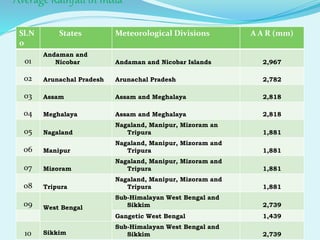
Average Rainfall in India
Sl.N
o
States Meteorological Divisions A A R (mm)
01
Andaman and
Nicobar Andaman and Nicobar Islands 2,967
02 Arunachal Pradesh Arunachal Pradesh 2,782
03 Assam Assam and Meghalaya 2,818
04 Meghalaya Assam and Meghalaya 2,818
05 Nagaland
Nagaland, Manipur, Mizoram an
Tripura 1,881
06 Manipur
Nagaland, Manipur, Mizoram and
Tripura 1,881
07 Mizoram
Nagaland, Manipur, Mizoram and
Tripura 1,881
08 Tripura
Nagaland, Manipur, Mizoram and
Tripura 1,881
09 West Bengal
Sub-Himalayan West Bengal and
Sikkim 2,739
Gangetic West Bengal 1,439
10 Sikkim
Sub-Himalayan West Bengal and
Sikkim 2,739
WHY WATER HARVESTING IS IMPORTANT
?
To conserve & augment the storage of
ground water
To reduce water table depletion
To improve the quality of ground water
 To arrest sea water intrusion in coastal
areas
To avoid flood & water stagnation in
urban areas
Techniques of rain water harvestings.
There are two main techniques
of rain water harvestings.
Storage of rainwater on surface for future use.
Recharge to ground water.
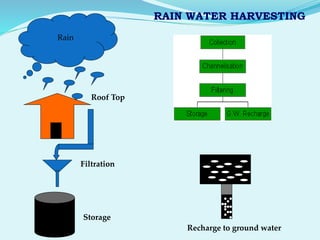
Rain
RAIN WATER HARVESTING
Roof Top
Filtration
Storage
Recharge to ground water
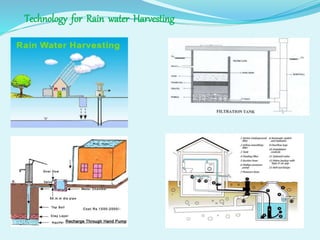
Technology for Rain water Harvesting
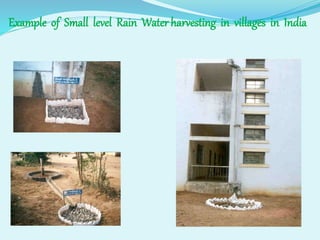
Example of Small level Rain Water harvesting in villages in India
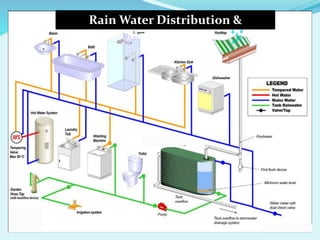
Rain Water Distribution &
Management
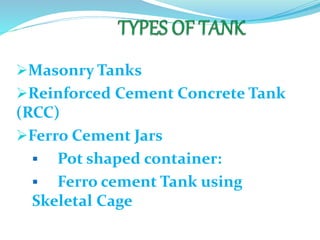
Masonry Tanks
Reinforced Cement Concrete Tank
(RCC)
Ferro Cement Jars
 Pot shaped container:
 Ferro cement Tank using
Skeletal Cage
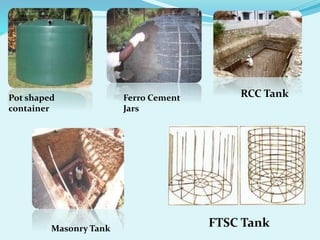
Pot shaped
container
Ferro Cement
Jars
RCC Tank
Masonry Tank
FTSC Tank
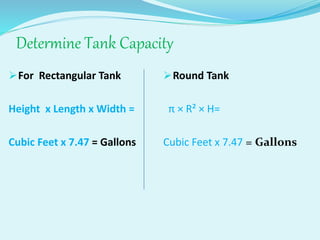
Determine Tank Capacity
For Rectangular Tank
Height x Length x Width =
Cubic Feet x 7.47 = Gallons
Round Tank
π × R² × H=
Cubic Feet x 7.47 = Gallons
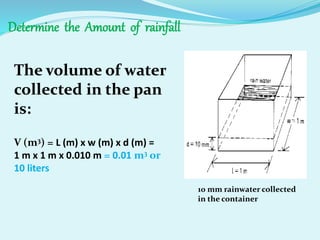
Determine the Amount of rainfall
The volume of water
collected in the pan
is:
V (m3) = L (m) x w (m) x d (m) =
1 m x 1 m x 0.010 m = 0.01 m3 or
10 liters
10 mm rainwater collected
in the container
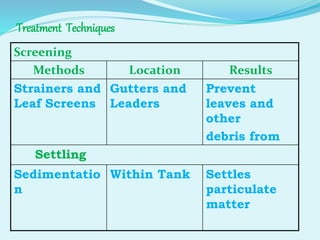
Treatment Techniques
Screening
Methods Location Results
Strainers and
Leaf Screens
Gutters and
Leaders
Prevent
leaves and
other
debris from
Settling
Sedimentatio
n
Within Tank Settles
particulate
matter
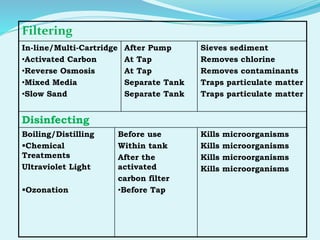
Filtering
In-line/Multi-Cartridge
•Activated Carbon
•Reverse Osmosis
•Mixed Media
•Slow Sand
After Pump
At Tap
At Tap
Separate Tank
Separate Tank
Sieves sediment
Removes chlorine
Removes contaminants
Traps particulate matter
Disinfecting
Boiling/Distilling
Chemical
Treatments
Ultraviolet Light
Ozonation
Before use
Within tank
After the
activated
carbon filter
•Before Tap
Kills microorganisms
Components of a Rainwater Harvesting System
 The Roof
 Gutters
 Gutter Guard
 Downspouts
 Debris Traps
 Final Sediment Filtration
 First Flush Diverter
 Surge/Pump Tank
 Water Storage
 Water Disinfection
 Design & Maintenance
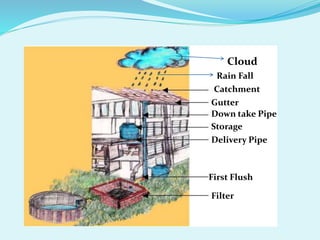
Catchment
Gutter
Down take Pipe
Storage
Delivery Pipe
First Flush
Filter
Cloud
Rain Fall
Materials for Rainwater Tanks
Plastic:
Plastic Liner:
Polyethylene:
Metal:
The earth has an abundance of water, but unfortunately only
a small percentage (about 2.5%) is even usable by humans.
The other 97.5% is in the oceans, soils, icecaps, and floating in
the atmosphere.
Earth contains as
Sea+Oceans = 96.5%
Ground water = 1.7%
Glaciers = 1.7%
Vapor+Air = 0.001%
Only 2.5% of this water is freshwater.
Finally its very important to serve everything on
this planet
THANK YOU

Water harvesting

  • 1.
    Presented by MD FAIZALI 13U61A0104
  • 2.
    contents Introduction.  Conceptand Technology.  Average Rainfall of States in India.  Runoff Coefficients for Various Catchments Surfaces.  Rainwater Harvesting System.  Treatment Techniques.  Materials for Rainwater Tanks.  Components of Rainwater harvesting.  Conclusion.
  • 3.
    WHAT IS waterharvesting ? It is the activity of direct collection of rain water . Water harvesting means capturing rain water, where it falls and capture the runoff from, catchment and streams etc. Generally, water harvesting is direct rainwater collection. This collected water could be stored for later use and recharged into the ground water again.
  • 4.
    Rain Water inIndia Total annual rainfall in India: (area x height) India’s area:329 million hectares If evenly spread, average height: 1.28m 329 X 1.28 = 421.12millimiters
  • 5.
    Average Rainfall inIndia Sl.N o States Meteorological Divisions A A R (mm) 01 Andaman and Nicobar Andaman and Nicobar Islands 2,967 02 Arunachal Pradesh Arunachal Pradesh 2,782 03 Assam Assam and Meghalaya 2,818 04 Meghalaya Assam and Meghalaya 2,818 05 Nagaland Nagaland, Manipur, Mizoram an Tripura 1,881 06 Manipur Nagaland, Manipur, Mizoram and Tripura 1,881 07 Mizoram Nagaland, Manipur, Mizoram and Tripura 1,881 08 Tripura Nagaland, Manipur, Mizoram and Tripura 1,881 09 West Bengal Sub-Himalayan West Bengal and Sikkim 2,739 Gangetic West Bengal 1,439 10 Sikkim Sub-Himalayan West Bengal and Sikkim 2,739
  • 6.
    WHY WATER HARVESTINGIS IMPORTANT ? To conserve & augment the storage of ground water To reduce water table depletion To improve the quality of ground water  To arrest sea water intrusion in coastal areas To avoid flood & water stagnation in urban areas
  • 7.
    Techniques of rainwater harvestings. There are two main techniques of rain water harvestings. Storage of rainwater on surface for future use. Recharge to ground water.
  • 8.
    Rain RAIN WATER HARVESTING RoofTop Filtration Storage Recharge to ground water
  • 9.
    Technology for Rainwater Harvesting
  • 10.
    Example of Smalllevel Rain Water harvesting in villages in India
  • 11.
  • 12.
    Masonry Tanks Reinforced CementConcrete Tank (RCC) Ferro Cement Jars  Pot shaped container:  Ferro cement Tank using Skeletal Cage
  • 13.
    Pot shaped container Ferro Cement Jars RCCTank Masonry Tank FTSC Tank
  • 14.
    Determine Tank Capacity ForRectangular Tank Height x Length x Width = Cubic Feet x 7.47 = Gallons Round Tank π × R² × H= Cubic Feet x 7.47 = Gallons
  • 15.
    Determine the Amountof rainfall The volume of water collected in the pan is: V (m3) = L (m) x w (m) x d (m) = 1 m x 1 m x 0.010 m = 0.01 m3 or 10 liters 10 mm rainwater collected in the container
  • 16.
    Treatment Techniques Screening Methods LocationResults Strainers and Leaf Screens Gutters and Leaders Prevent leaves and other debris from Settling Sedimentatio n Within Tank Settles particulate matter
  • 17.
    Filtering In-line/Multi-Cartridge •Activated Carbon •Reverse Osmosis •MixedMedia •Slow Sand After Pump At Tap At Tap Separate Tank Separate Tank Sieves sediment Removes chlorine Removes contaminants Traps particulate matter Traps particulate matter Disinfecting Boiling/Distilling Chemical Treatments Ultraviolet Light Ozonation Before use Within tank After the activated carbon filter •Before Tap Kills microorganisms Kills microorganisms Kills microorganisms Kills microorganisms
  • 18.
    Components of aRainwater Harvesting System  The Roof  Gutters  Gutter Guard  Downspouts  Debris Traps  Final Sediment Filtration  First Flush Diverter  Surge/Pump Tank  Water Storage  Water Disinfection  Design & Maintenance
  • 19.
    Catchment Gutter Down take Pipe Storage DeliveryPipe First Flush Filter Cloud Rain Fall
  • 20.
    Materials for RainwaterTanks Plastic: Plastic Liner: Polyethylene: Metal:
  • 21.
    The earth hasan abundance of water, but unfortunately only a small percentage (about 2.5%) is even usable by humans. The other 97.5% is in the oceans, soils, icecaps, and floating in the atmosphere. Earth contains as Sea+Oceans = 96.5% Ground water = 1.7% Glaciers = 1.7% Vapor+Air = 0.001% Only 2.5% of this water is freshwater. Finally its very important to serve everything on this planet
  • 22.

Editor's Notes

  • #2 This is to present in front of my senior executive as a PPT.