Illinois Apprenticeship Plus
YOUTH Program
Notice of Funding Opportunity
Information Session
February 21, 2017
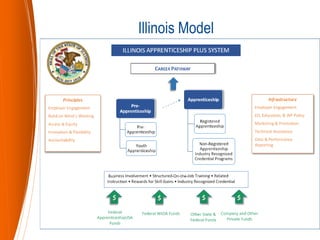
Illinois Model
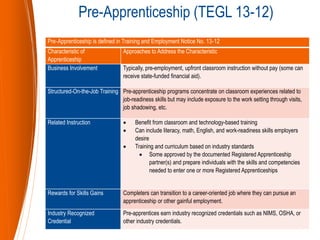
Pre-Apprenticeship (TEGL 13-12)
Pre‐Apprenticeship is defined in Training and Employment Notice No. 13‐12
Characteristic of
Apprenticeship
Approaches to Address the Characteristic
Business Involvement Typically, pre-employment, upfront classroom instruction without pay (some can
receive state-funded financial aid).
Structured-On-the-Job Training Pre-apprenticeship programs concentrate on classroom experiences related to
job-readiness skills but may include exposure to the work setting through visits,
job shadowing, etc.
Related Instruction  Benefit from classroom and technology-based training
 Can include literacy, math, English, and work-readiness skills employers
desire
 Training and curriculum based on industry standards
 Some approved by the documented Registered Apprenticeship
partner(s) and prepare individuals with the skills and competencies
needed to enter one or more Registered Apprenticeships
Rewards for Skills Gains Completers can transition to a career-oriented job where they can pursue an
apprenticeship or other gainful employment.
Industry Recognized
Credential
Pre-apprentices earn industry recognized credentials such as NIMS, OSHA, or
other industry credentials.
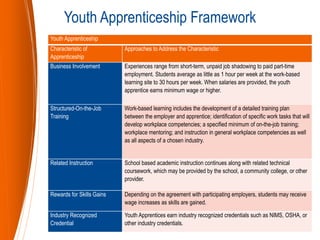
Youth Apprenticeship
Characteristic of
Apprenticeship
Approaches to Address the Characteristic
Business Involvement Experiences range from short-term, unpaid job shadowing to paid part-time
employment. Students average as little as 1 hour per week at the work-based
learning site to 30 hours per week. When salaries are provided, the youth
apprentice earns minimum wage or higher.
Structured-On-the-Job
Training
Work-based learning includes the development of a detailed training plan
between the employer and apprentice; identification of specific work tasks that will
develop workplace competencies; a specified minimum of on-the-job training;
workplace mentoring; and instruction in general workplace competencies as well
as all aspects of a chosen industry.
Related Instruction School based academic instruction continues along with related technical
coursework, which may be provided by the school, a community college, or other
provider.
Rewards for Skills Gains Depending on the agreement with participating employers, students may receive
wage increases as skills are gained.
Industry Recognized
Credential
Youth Apprentices earn industry recognized credentials such as NIMS, OSHA, or
other industry credentials.
Youth Apprenticeship Framework
Career Pathway is defined by the Workforce Innovation and Opportunity Act
(WIOA) as a combination of rigorous and high-quality education, training, and
other services that:
• Aligns with the skill needs of industries in the economy of the State or regional
economy involved;
• Prepares an individual to be successful in any of a full range of secondary or
postsecondary education options, including registered apprenticeships
• Includes counseling to support an individual in achieving the individual’s
education and career goals;
• Includes, as appropriate, education offered concurrently with and in the same
context as workforce preparation activities and training for a specific occupation
or occupational cluster;
• Organizes education, training, and other services to meet the particular needs of
an individual in a manner that accelerates the educational and career
advancement of the individual to the extent practicable;
• Enables an individual to attain a secondary school diploma or its recognized
equivalent, and at least 1 recognized postsecondary credential; and
• Helps an individual enter or advance within a specific occupation or occupational
cluster.
Career Pathways
• Increase number of youth earning industry-recognized credentials
and post-secondary certificates in high-growth, high-demand
occupations.
• Support and develop at least 10 new apprentice pilots in three
Economic Development Regions of the state.
• Develop apprenticeship pilot programs that serve disadvantaged
youth, such as youth with disabilities; teen parents; youth
transitioning from the juvenile justice system; youth aging out of the
child and family services system; and youth with other evidence-
based risk factors, who are between the ages of 16 and 24.
Program Goals
• Projects that are funded under this NOFO must be focused
on pre‐apprenticeship and youth apprenticeships with
industry recognized credentialing.
• WIOA funds can be used in a variety of ways to help job
seekers and workers prepare for, enter, and complete
apprenticeship programs. WIOA programs can support the
on‐the‐job training component of training.
• Apprenticeship programs. WIOA funds can also pay for the
cost of related classroom instruction for the apprentice,
including tuition, books, supplies, fees, uniforms, tools and
other required items.
Allowable Activities & Costs
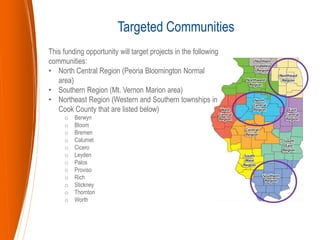
Targeted Communities
This funding opportunity will target projects in the following
communities:
• North Central Region (Peoria Bloomington Normal
area)
• Southern Region (Mt. Vernon Marion area)
• Northeast Region (Western and Southern townships in
Cook County that are listed below)
o Berwyn
o Bloom
o Bremen
o Calumet
o Cicero
o Leyden
o Palos
o Proviso
o Rich
o Stickney
o Thornton
o Worth
Additional points will be awarded for projects that target
apprenticeships to youth with barriers to employment including
(but not limited to) the following:
– Low-income youth;
– Individuals with disabilities;
– Ex‐offenders;
– Homeless children and youths;
– Youth who are in or have aged out of the foster care system;
– Individuals who are English language learners, individuals who have
low levels of literacy, and individuals facing substantial cultural
barriers;
– Eligible migrant and seasonal farmworkers;
– Single parents (including single pregnant women);
– Long‐term unemployed individuals.
Target Populations
Review teams will award additional points for projects
that target apprenticeships in the following industries:
– Healthcare
– Manufacturing
– Information Technology
– Construction Trades
– Transportation, Distribution, and Logistics
Targeted Industries and Occupations
• Applicants other than Local Workforce Areas (LWAs)
and their active WIOA operators and providers must
work with their designated LWA(s) to create a viable
approach for complying with WIOA client eligibility,
reporting, and performance requirements.
• Negotiated performance measures unique to each local
area are applicable to all youth served under this NOFO.
In instances where the Grantee is not an LWA, WIOA
performance measures and targets for the grant will be
determined at the State level.
WIOA Eligibility & Performance
• The Department of Commerce will consider
projects from LWAs and regions throughout
the state. Applicants must identify the
workforce/economic development region and
administer the pilot programs within the
context of the State, Regional, and Local
workforce development plans. The WIOA
Regional and Local Plans may be viewed at:
www.illinoisworknet.com/WIOA/RegPlanning
/Pages/Plans_MOUs_Dashboard.aspx.
• Applicants must work with the State,
Regional and Local WIOA partners to
implement the project in coordination with
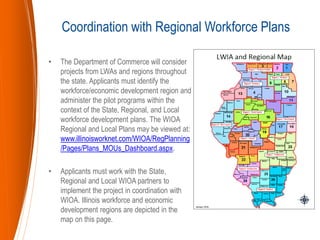
WIOA. Illinois workforce and economic
development regions are depicted in the
map on this page.
Coordination with Regional Workforce Plans
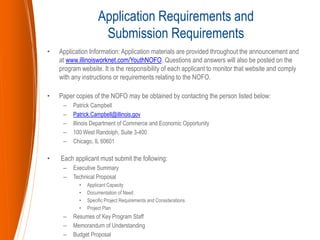
• Application Information: Application materials are provided throughout the announcement and
at www.illinoisworknet.com/YouthNOFO. Questions and answers will also be posted on the
program website. It is the responsibility of each applicant to monitor that website and comply
with any instructions or requirements relating to the NOFO.
• Paper copies of the NOFO may be obtained by contacting the person listed below:
– Patrick Campbell
– Patrick.Campbell@illinois.gov
– Illinois Department of Commerce and Economic Opportunity
– 100 West Randolph, Suite 3-400
– Chicago, IL 60601
• Each applicant must submit the following:
– Executive Summary
– Technical Proposal
• Applicant Capacity
• Documentation of Need
• Specific Project Requirements and Considerations
• Project Plan
– Resumes of Key Program Staff
– Memorandum of Understanding
– Budget Proposal
Application Requirements and
Submission Requirements
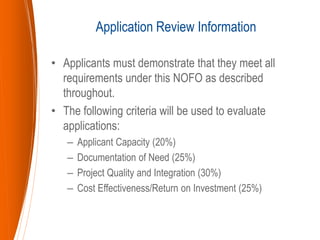
• Applicants must demonstrate that they meet all
requirements under this NOFO as described
throughout.
• The following criteria will be used to evaluate
applications:
– Applicant Capacity (20%)
– Documentation of Need (25%)
– Project Quality and Integration (30%)
– Cost Effectiveness/Return on Investment (25%)
Application Review Information
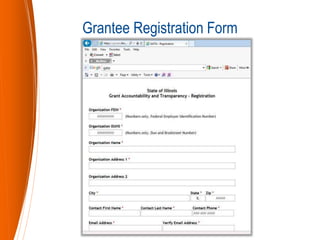
• Grantee Registration
• Grantee Pre-Qualification
• Financial and Administrative Risk Assessment (ICQ
– Internal Control Questionnaire)
• Programmatic Risk Assessment
Grantee Registration & Pre-Award Review
• All Grantees must be registered with the
State of Illinois
• Done by completing and submitting a Grantee
Registration Form
• A link to the form is provided from Grantee
Links Tab
• State receipt of the form triggers Grantee pre-
qualification verifications
Grantee Registration
Grantee Registration Form
• FY17 Pre-Qualification includes verification of:
– Current DUNS number
– Current SAM CAGE Code
– Good Standing with Secretary of State
– Not on Federal Excluded Parties List
Grantee Pre-Qualification
• If there are no issues, State sends email to
communicate “Qualified” status.
• If there are issues, State emails qualification
issue(s) and asks entity to notify State when
remediation completed.
– DUNS number is not current
– SAM CAGE Code is not current
– Not in Good Standing with Secretary of State
– On the Federal Excluded Parties List (cannot be
remediated)
Pre-Qualification Notification
• Fiscal Risk Assessment (ICQ) is automated.
– Grantee receives automated email with ICQ URL link (Triggered by
Grantee Registration).
– Grantee completes and submits automated ICQ.
– When the ICQ has been accepted, the grantee will receive an email
with the confirmation number.
• Programmatic Risk Assessment will be conducted by the
awarding agency in the application process. It is unique to
the award.
• Risk profiles will be determined based on the two risk
assessments. Risk profile will determine grant specific
conditions and monitoring.
GATA Framework for Risk Assessment
• Office of Management and Budget GATA Website:
http://grants.illinois.gov
– Grantee Links Tab is the entry point for the grantee pre-award
process (registration, pre-qualification, risk assessments).
– Centralized Indirect Cost System can be accessed from the
dropdown menu in the Grantee Links Tab.
• FAQs
• Training Modules
• Forms and Indirect Cost Rate Templates
• Department of Labor Indirect Cost Rate Guide
• Crowe Activity Review System (CARS) will be used to elect
the indirect cost rate option and, if necessary, complete the
indirect cost rate negotiation process. Grantee will receive
invitation when the ICQ (and pre-qualification) have been
approved.
GATA and CARS Websites
• All grantees must select an Indirect Cost Rate option in a centralized
indirect cost rate system called the Crowe Activity Review System.
• An indirect cost rate is simply a device used for determining the
appropriate amount of indirect costs each program should bear. An
Indirect Cost Rate is the ratio between the total indirect expenses and
some direct cost base.
• Options available for a Grantee to receive an Indirect Cost Rate:
– Current Federally Approved Indirect Cost Rate as a result of being a direct
“recipient” from a Federal awarding agency
– Negotiate a rate with the State of Illinois by first submitting an Indirect Cost Rate
Proposal (ICRP) to the Crowe Activity Review System
– Elect to use the Federal 10% “de minimis” rate of Modified Total Direct Cost
(MTDC)
– Use a “restricted’ or “special” rate that is statutorily required within program rules
– Elect not to be reimbursed for indirect costs
Indirect Cost Rate Selection
Crowe Activity Review System (CARS)
• Grantees will not be invited to CARS until the pre-
qualification and ICQ (Internal Controls Questionnaire) are
accepted.
• CARS will allow the grantee to elect/document the indirect
cost rate option and, if necessary, start the indirect cost rate
negotiation process.
• Indirect cost rate proposals or elections of other rate options
must be received within 90 days of the start date of receiving
the State award. There is an exemption for LWIAs for WIOA
and Trade grants for State Fiscal Year 2017 formula grants.
Centralized Indirect Cost System:
Crowe Activity Review System (CARS)
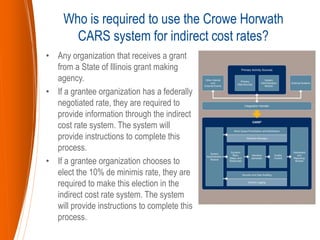
• Any organization that receives a grant
from a State of Illinois grant making
agency.
• If a grantee organization has a federally
negotiated rate, they are required to
provide information through the indirect
cost rate system. The system will
provide instructions to complete this
process.
• If a grantee organization chooses to
elect the 10% de minimis rate, they are
required to make this election in the
indirect cost rate system. The system
will provide instructions to complete this
process.
Who is required to use the Crowe Horwath
CARS system for indirect cost rates?
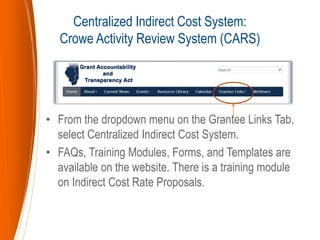
• From the dropdown menu on the Grantee Links Tab,
select Centralized Indirect Cost System.
• FAQs, Training Modules, Forms, and Templates are
available on the website. There is a training module
on Indirect Cost Rate Proposals.
Centralized Indirect Cost System:
Crowe Activity Review System (CARS)
• Agency Information
– Funding Opportunity Information
– Instructions on How to Submit an Application
– Required Grant Information
• Applicant Completed Section
– Applicant Information
– Contact Information
– Key Project Information (Location, Term, Amount)
– Fiscal Information
• Certification
Uniform Application for State Grant Assistance
• Uniform Budget Template for most State of Illinois
Grants (modeled after the SF-524 Federal Budget
template).
• Basic Budget Line Item Definitions based on the
Uniform Administrative Guidelines [Develop Budget
Line Items Sheet].
• General Requirements
– Allowable
– Reasonable
– Allocable
Uniform Budget Template - Overview
Factors affecting allowability of costs:
• Be necessary and reasonable for the performance of the Federal award and be
allocable under the Federal Cost Principles.
• Conform to any limitations or exclusions set forth in these principles or in the
Federal award as to types or amount of cost items.
• Be consistent with policies and procedures that apply uniformly to both federally-
financed and other activities of the non-Federal entity.
• Be accorded consistent treatment. A cost may not be assigned to a Federal
award as a direct cost if any other cost incurred for the same purpose in like
circumstances has been allocated to the Federal award as an indirect cost.
• Be determined in accordance with generally accepted accounting principles
(GAAP), except, for state and local governments and Indian tribes only, as
otherwise provided for in this Part.
• Not be included as a cost or used to meet cost sharing or matching requirements
of any other federally financed program in either the current or a prior period.
• Be adequately documented.
Allowable Costs § 200.403
A cost is reasonable if, in its nature and amount, it does not exceed that which would be
incurred by a prudent person under the circumstances prevailing at the time the decision
was made to incur the cost. The question of reasonableness is particularly important
when the non-Federal entity is predominantly federally-funded. In determining
reasonableness of a given cost, consideration must be given to:
• Whether the cost is of a type generally recognized as ordinary and necessary for the
operation of the non- Federal entity or the proper and efficient performance of the
Federal award.
• The restraints or requirements imposed by such factors as: sound business
practices; arm’s-length bargaining; Federal, state and other laws and regulations;
and terms and conditions of the Federal award.
• Market prices for comparable goods or services for the geographic area.
• Whether the individuals concerned acted with prudence in the circumstances
considering their responsibilities to the non-Federal entity, its employees, where
applicable its students or membership, the public at large, and the Federal
government.
• Whether the non-Federal entity significantly deviates from its established practices
and policies regarding the incurrence of costs, which may unjustifiably increase the
Federal award’s cost.
Reasonable Costs § 200.404
• A cost is allocable to a particular Federal award or other cost objective if the goods
or services involved are chargeable or assignable to that Federal award or cost
objective in accordance with relative benefits received. This standard is met if the
cost:
– Is incurred specifically for the Federal award;
– Benefits both the Federal award and other work of the non-Federal entity and
can be distributed in proportions that may be approximated using reasonable
methods; and
– Is necessary to the overall operation of the non-Federal entity and is assignable
in part to the Federal award in accordance with the principles in this subpart.
• All activities which benefit from the non-Federal entity’s indirect (F&A) cost, including
unallowable activities and donated services by the non-Federal entity or third
parties, will receive an appropriate allocation of indirect costs.
Allocable Costs § 200.405
• Direct costs: Costs that can be identified specifically with a
particular final cost objective, such as a Federal award, or
other internally or externally funded activity, or that can be
directly assigned to such activities relatively easily with a
high degree of accuracy. § 200.413
• Indirect Costs (Facilities and Administration): Costs
incurred for a common or joint purpose benefitting more
than one cost objective, and not readily assignable to the
cost objectives specifically benefitted, without effort
disproportionate to the results achieved. § 200.456
Types of Costs
• Instructions
• Section A – Grant Funds
– Summary
– Indirect Cost Rate Information
• Section B – Match
– Cash
– In-Kind
– Leverage
• Certification
• FFATA Data Collection
• Section C – Budget Worksheet & Narrative
Uniform Budget Template Outline
• Includes funding that is provided by the state awarding
agency regardless if the grant is State or Federally
funded (federal pass-through funds).
• The standard budget line item definitions are consistent
with the Uniform Administrative Guidance.
• The line items that are not applicable to the grant
program are “grayed out”.
• The Uniform Budget Template provides a space for
Program-Specific line items.
Uniform Budget Template Section A:
State of Illinois Funds
All grantees must complete the Indirect Cost Rate Form
and select one of the following options:
 Use the current Federally approved indirect cost rate as a result of
being a direct grant recipient from a Federal awarding agency;
 Negotiate a rate with the State of Illinois by first submitting an Indirect
Cost Rate Proposal to the State of Illinois’ Centralized Indirect Cost
Unit;
 Use the Federal “de minimis” rate of 10% of modified total direct costs
(MTDC);
 Use a Restricted Rate designated by programmatic or statutory policy;
 Choose not to request reimbursement of indirect costs.
Section A: Indirect Cost Selection
For all Federal awards, any shared costs or matching funds and all contributions,
including cash and third party in-kind contributions, must be accepted as part of the non-
Federal entity’s cost sharing or matching when such contributions meet all of the
following criteria:
• Are verifiable from the non-Federal entity’s records;
• Are not included as contributions for any other Federal award;
• Are necessary and reasonable for accomplishment of project or program objectives;
• Are allowable under Subpart E— Cost Principles of this Part;
• Are not paid by the Federal government under another Federal award, except where
the Federal statute authorizing a program specifically provides that Federal funds
made available for such program can be applied to matching or cost sharing
requirements of other Federal programs;
• Are provided for in the approved budget when required by the Federal awarding
agency; and
• Conform to other provisions of this Part, as applicable.
Section B: Non-State of Illinois Funds:
Matching Funds
• Leveraged Funds are paid by the Federal
government under another Federal award.
• Leveraged Funds must meet the matching funds
requirement (except that they come from another
Federal award).
Section C: Non-State of Illinois Funds:
Leveraged Funds
• Article I Award and Grantee Specific Information
• Article II Required Representations
• Article III Definitions
• Article IV Payment
• Article V Scope of Grant Activities/Purpose of Grant
• Article VI Budget
• Article VII Allowable Costs
• Article VIII Required Certifications
• Article IX Criminal Disclosure
• Article X Unlawful Discrimination
• Article XI Lobbying
Uniform Grant Agreement - Part I
• Article XII Maintenance and Accessibility of Records; Monitoring
• Article XIII Financial Reporting Requirements
• Article XIV Performance Reporting Requirements
• Article XV Audit Requirement
• Article XVI Termination; Suspension
• Article XVII Subcontracts/Sub-Grants
• Article XVIII Notice of Change
• Article XIX Reorganization and Board Membership
• Article XX Agreements with other State Agencies
• Article XXI Conflict of Interest
• Article XXII Equipment or Property
• Article XXIII Promotional Materials; Prior Notification
• Article XXIV Insurance
• Article XXV Lawsuits and Indemnification
• Article XXVI Miscellaneous
Uniform Grant Agreement – Part I
• Exhibit A – Project Description
• Exhibit B – Deliverables or Milestones
• Exhibit C – Payment
• Exhibit D – Contact Information
• Exhibit E – Performance Measures
• Exhibit F – Performance Standard
• Exhibit G – State Agency Contracts
• Exhibit H – Specific Conditions
Uniform Grant Agreement – Part I
PART 2
• Grantor Specific Terms
PART 3
• Project Specific Terms
Uniform Grant Agreement
• https://www.illinoisworknet.com/youthnofo
• http://www.illinoisworknet.com/GATA
• https://www.doleta.gov/grants/UniformGuidance.cfm
• https://www.dol.gov/featured/apprenticeship
Internet Resources
• It is expected that 6-10 pilot projects of $250,000 to
$350,000 will be funded through this NOFO.
• The funding amounts for proposals will be
commensurate with the project anticipated
outcomes and deliverables.
• The grant term/performance period will be
determined on a project specific basis, targeted at
12‐18 months.
Funding Information & Award Term
• Applications must be received via email no later
than 5:00 p.m. on April 17, 2017 to
grantapplication@illinoisworknet.com including:
– Executive Summary
– Technical Proposal
– Resumes of Program Staff
– Partnership Agreement and/or MOUs
– Budget Proposal
• Applications must be formatted on 8 1/2 x 11‐inch paper
using 11‐point type and at 100% magnification. Tables
may be used to present information with a 10‐point type.
• The Technical Proposal is limited to12 pages.
Grant Submission Details
• Applications are subject to disclosure in response to
requests received under provisions of the Freedom of
Information Act (5 ILCS 140/1 et seq.). Information that
could reasonably be considered to be proprietary,
privileged, or confidential commercial or financial
information should be identified as such in the
application.
• Questions regarding the grant opportunity can be sent
to: Patrick.Campbell@Illinois.gov.
• The program webpage includes a question and answer
area for all applicants to view.
http://www.illinoisworknet.com/youthnofo
Freedom of Information / NOFO Questions
Thank you

2017 Apprenticeship Plus Youth Program Grant Application Information Session

  • 1.
    Illinois Apprenticeship Plus YOUTHProgram Notice of Funding Opportunity Information Session February 21, 2017
  • 2.
  • 3.
    Pre-Apprenticeship (TEGL 13-12) Pre‐Apprenticeshipis defined in Training and Employment Notice No. 13‐12 Characteristic of Apprenticeship Approaches to Address the Characteristic Business Involvement Typically, pre-employment, upfront classroom instruction without pay (some can receive state-funded financial aid). Structured-On-the-Job Training Pre-apprenticeship programs concentrate on classroom experiences related to job-readiness skills but may include exposure to the work setting through visits, job shadowing, etc. Related Instruction  Benefit from classroom and technology-based training  Can include literacy, math, English, and work-readiness skills employers desire  Training and curriculum based on industry standards  Some approved by the documented Registered Apprenticeship partner(s) and prepare individuals with the skills and competencies needed to enter one or more Registered Apprenticeships Rewards for Skills Gains Completers can transition to a career-oriented job where they can pursue an apprenticeship or other gainful employment. Industry Recognized Credential Pre-apprentices earn industry recognized credentials such as NIMS, OSHA, or other industry credentials.
  • 4.
    Youth Apprenticeship Characteristic of Apprenticeship Approachesto Address the Characteristic Business Involvement Experiences range from short-term, unpaid job shadowing to paid part-time employment. Students average as little as 1 hour per week at the work-based learning site to 30 hours per week. When salaries are provided, the youth apprentice earns minimum wage or higher. Structured-On-the-Job Training Work-based learning includes the development of a detailed training plan between the employer and apprentice; identification of specific work tasks that will develop workplace competencies; a specified minimum of on-the-job training; workplace mentoring; and instruction in general workplace competencies as well as all aspects of a chosen industry. Related Instruction School based academic instruction continues along with related technical coursework, which may be provided by the school, a community college, or other provider. Rewards for Skills Gains Depending on the agreement with participating employers, students may receive wage increases as skills are gained. Industry Recognized Credential Youth Apprentices earn industry recognized credentials such as NIMS, OSHA, or other industry credentials. Youth Apprenticeship Framework
  • 5.
    Career Pathway isdefined by the Workforce Innovation and Opportunity Act (WIOA) as a combination of rigorous and high-quality education, training, and other services that: • Aligns with the skill needs of industries in the economy of the State or regional economy involved; • Prepares an individual to be successful in any of a full range of secondary or postsecondary education options, including registered apprenticeships • Includes counseling to support an individual in achieving the individual’s education and career goals; • Includes, as appropriate, education offered concurrently with and in the same context as workforce preparation activities and training for a specific occupation or occupational cluster; • Organizes education, training, and other services to meet the particular needs of an individual in a manner that accelerates the educational and career advancement of the individual to the extent practicable; • Enables an individual to attain a secondary school diploma or its recognized equivalent, and at least 1 recognized postsecondary credential; and • Helps an individual enter or advance within a specific occupation or occupational cluster. Career Pathways
  • 6.
    • Increase numberof youth earning industry-recognized credentials and post-secondary certificates in high-growth, high-demand occupations. • Support and develop at least 10 new apprentice pilots in three Economic Development Regions of the state. • Develop apprenticeship pilot programs that serve disadvantaged youth, such as youth with disabilities; teen parents; youth transitioning from the juvenile justice system; youth aging out of the child and family services system; and youth with other evidence- based risk factors, who are between the ages of 16 and 24. Program Goals
  • 7.
    • Projects thatare funded under this NOFO must be focused on pre‐apprenticeship and youth apprenticeships with industry recognized credentialing. • WIOA funds can be used in a variety of ways to help job seekers and workers prepare for, enter, and complete apprenticeship programs. WIOA programs can support the on‐the‐job training component of training. • Apprenticeship programs. WIOA funds can also pay for the cost of related classroom instruction for the apprentice, including tuition, books, supplies, fees, uniforms, tools and other required items. Allowable Activities & Costs
  • 8.
    Targeted Communities This fundingopportunity will target projects in the following communities: • North Central Region (Peoria Bloomington Normal area) • Southern Region (Mt. Vernon Marion area) • Northeast Region (Western and Southern townships in Cook County that are listed below) o Berwyn o Bloom o Bremen o Calumet o Cicero o Leyden o Palos o Proviso o Rich o Stickney o Thornton o Worth
  • 9.
    Additional points willbe awarded for projects that target apprenticeships to youth with barriers to employment including (but not limited to) the following: – Low-income youth; – Individuals with disabilities; – Ex‐offenders; – Homeless children and youths; – Youth who are in or have aged out of the foster care system; – Individuals who are English language learners, individuals who have low levels of literacy, and individuals facing substantial cultural barriers; – Eligible migrant and seasonal farmworkers; – Single parents (including single pregnant women); – Long‐term unemployed individuals. Target Populations
  • 10.
    Review teams willaward additional points for projects that target apprenticeships in the following industries: – Healthcare – Manufacturing – Information Technology – Construction Trades – Transportation, Distribution, and Logistics Targeted Industries and Occupations
  • 11.
    • Applicants otherthan Local Workforce Areas (LWAs) and their active WIOA operators and providers must work with their designated LWA(s) to create a viable approach for complying with WIOA client eligibility, reporting, and performance requirements. • Negotiated performance measures unique to each local area are applicable to all youth served under this NOFO. In instances where the Grantee is not an LWA, WIOA performance measures and targets for the grant will be determined at the State level. WIOA Eligibility & Performance
  • 12.
    • The Departmentof Commerce will consider projects from LWAs and regions throughout the state. Applicants must identify the workforce/economic development region and administer the pilot programs within the context of the State, Regional, and Local workforce development plans. The WIOA Regional and Local Plans may be viewed at: www.illinoisworknet.com/WIOA/RegPlanning /Pages/Plans_MOUs_Dashboard.aspx. • Applicants must work with the State, Regional and Local WIOA partners to implement the project in coordination with WIOA. Illinois workforce and economic development regions are depicted in the map on this page. Coordination with Regional Workforce Plans
  • 13.
    • Application Information:Application materials are provided throughout the announcement and at www.illinoisworknet.com/YouthNOFO. Questions and answers will also be posted on the program website. It is the responsibility of each applicant to monitor that website and comply with any instructions or requirements relating to the NOFO. • Paper copies of the NOFO may be obtained by contacting the person listed below: – Patrick Campbell – Patrick.Campbell@illinois.gov – Illinois Department of Commerce and Economic Opportunity – 100 West Randolph, Suite 3-400 – Chicago, IL 60601 • Each applicant must submit the following: – Executive Summary – Technical Proposal • Applicant Capacity • Documentation of Need • Specific Project Requirements and Considerations • Project Plan – Resumes of Key Program Staff – Memorandum of Understanding – Budget Proposal Application Requirements and Submission Requirements
  • 14.
    • Applicants mustdemonstrate that they meet all requirements under this NOFO as described throughout. • The following criteria will be used to evaluate applications: – Applicant Capacity (20%) – Documentation of Need (25%) – Project Quality and Integration (30%) – Cost Effectiveness/Return on Investment (25%) Application Review Information
  • 15.
    • Grantee Registration •Grantee Pre-Qualification • Financial and Administrative Risk Assessment (ICQ – Internal Control Questionnaire) • Programmatic Risk Assessment Grantee Registration & Pre-Award Review
  • 16.
    • All Granteesmust be registered with the State of Illinois • Done by completing and submitting a Grantee Registration Form • A link to the form is provided from Grantee Links Tab • State receipt of the form triggers Grantee pre- qualification verifications Grantee Registration
  • 17.
  • 18.
    • FY17 Pre-Qualificationincludes verification of: – Current DUNS number – Current SAM CAGE Code – Good Standing with Secretary of State – Not on Federal Excluded Parties List Grantee Pre-Qualification
  • 19.
    • If thereare no issues, State sends email to communicate “Qualified” status. • If there are issues, State emails qualification issue(s) and asks entity to notify State when remediation completed. – DUNS number is not current – SAM CAGE Code is not current – Not in Good Standing with Secretary of State – On the Federal Excluded Parties List (cannot be remediated) Pre-Qualification Notification
  • 20.
    • Fiscal RiskAssessment (ICQ) is automated. – Grantee receives automated email with ICQ URL link (Triggered by Grantee Registration). – Grantee completes and submits automated ICQ. – When the ICQ has been accepted, the grantee will receive an email with the confirmation number. • Programmatic Risk Assessment will be conducted by the awarding agency in the application process. It is unique to the award. • Risk profiles will be determined based on the two risk assessments. Risk profile will determine grant specific conditions and monitoring. GATA Framework for Risk Assessment
  • 21.
    • Office ofManagement and Budget GATA Website: http://grants.illinois.gov – Grantee Links Tab is the entry point for the grantee pre-award process (registration, pre-qualification, risk assessments). – Centralized Indirect Cost System can be accessed from the dropdown menu in the Grantee Links Tab. • FAQs • Training Modules • Forms and Indirect Cost Rate Templates • Department of Labor Indirect Cost Rate Guide • Crowe Activity Review System (CARS) will be used to elect the indirect cost rate option and, if necessary, complete the indirect cost rate negotiation process. Grantee will receive invitation when the ICQ (and pre-qualification) have been approved. GATA and CARS Websites
  • 22.
    • All granteesmust select an Indirect Cost Rate option in a centralized indirect cost rate system called the Crowe Activity Review System. • An indirect cost rate is simply a device used for determining the appropriate amount of indirect costs each program should bear. An Indirect Cost Rate is the ratio between the total indirect expenses and some direct cost base. • Options available for a Grantee to receive an Indirect Cost Rate: – Current Federally Approved Indirect Cost Rate as a result of being a direct “recipient” from a Federal awarding agency – Negotiate a rate with the State of Illinois by first submitting an Indirect Cost Rate Proposal (ICRP) to the Crowe Activity Review System – Elect to use the Federal 10% “de minimis” rate of Modified Total Direct Cost (MTDC) – Use a “restricted’ or “special” rate that is statutorily required within program rules – Elect not to be reimbursed for indirect costs Indirect Cost Rate Selection Crowe Activity Review System (CARS)
  • 23.
    • Grantees willnot be invited to CARS until the pre- qualification and ICQ (Internal Controls Questionnaire) are accepted. • CARS will allow the grantee to elect/document the indirect cost rate option and, if necessary, start the indirect cost rate negotiation process. • Indirect cost rate proposals or elections of other rate options must be received within 90 days of the start date of receiving the State award. There is an exemption for LWIAs for WIOA and Trade grants for State Fiscal Year 2017 formula grants. Centralized Indirect Cost System: Crowe Activity Review System (CARS)
  • 24.
    • Any organizationthat receives a grant from a State of Illinois grant making agency. • If a grantee organization has a federally negotiated rate, they are required to provide information through the indirect cost rate system. The system will provide instructions to complete this process. • If a grantee organization chooses to elect the 10% de minimis rate, they are required to make this election in the indirect cost rate system. The system will provide instructions to complete this process. Who is required to use the Crowe Horwath CARS system for indirect cost rates?
  • 25.
    • From thedropdown menu on the Grantee Links Tab, select Centralized Indirect Cost System. • FAQs, Training Modules, Forms, and Templates are available on the website. There is a training module on Indirect Cost Rate Proposals. Centralized Indirect Cost System: Crowe Activity Review System (CARS)
  • 26.
    • Agency Information –Funding Opportunity Information – Instructions on How to Submit an Application – Required Grant Information • Applicant Completed Section – Applicant Information – Contact Information – Key Project Information (Location, Term, Amount) – Fiscal Information • Certification Uniform Application for State Grant Assistance
  • 27.
    • Uniform BudgetTemplate for most State of Illinois Grants (modeled after the SF-524 Federal Budget template). • Basic Budget Line Item Definitions based on the Uniform Administrative Guidelines [Develop Budget Line Items Sheet]. • General Requirements – Allowable – Reasonable – Allocable Uniform Budget Template - Overview
  • 28.
    Factors affecting allowabilityof costs: • Be necessary and reasonable for the performance of the Federal award and be allocable under the Federal Cost Principles. • Conform to any limitations or exclusions set forth in these principles or in the Federal award as to types or amount of cost items. • Be consistent with policies and procedures that apply uniformly to both federally- financed and other activities of the non-Federal entity. • Be accorded consistent treatment. A cost may not be assigned to a Federal award as a direct cost if any other cost incurred for the same purpose in like circumstances has been allocated to the Federal award as an indirect cost. • Be determined in accordance with generally accepted accounting principles (GAAP), except, for state and local governments and Indian tribes only, as otherwise provided for in this Part. • Not be included as a cost or used to meet cost sharing or matching requirements of any other federally financed program in either the current or a prior period. • Be adequately documented. Allowable Costs § 200.403
  • 29.
    A cost isreasonable if, in its nature and amount, it does not exceed that which would be incurred by a prudent person under the circumstances prevailing at the time the decision was made to incur the cost. The question of reasonableness is particularly important when the non-Federal entity is predominantly federally-funded. In determining reasonableness of a given cost, consideration must be given to: • Whether the cost is of a type generally recognized as ordinary and necessary for the operation of the non- Federal entity or the proper and efficient performance of the Federal award. • The restraints or requirements imposed by such factors as: sound business practices; arm’s-length bargaining; Federal, state and other laws and regulations; and terms and conditions of the Federal award. • Market prices for comparable goods or services for the geographic area. • Whether the individuals concerned acted with prudence in the circumstances considering their responsibilities to the non-Federal entity, its employees, where applicable its students or membership, the public at large, and the Federal government. • Whether the non-Federal entity significantly deviates from its established practices and policies regarding the incurrence of costs, which may unjustifiably increase the Federal award’s cost. Reasonable Costs § 200.404
  • 30.
    • A costis allocable to a particular Federal award or other cost objective if the goods or services involved are chargeable or assignable to that Federal award or cost objective in accordance with relative benefits received. This standard is met if the cost: – Is incurred specifically for the Federal award; – Benefits both the Federal award and other work of the non-Federal entity and can be distributed in proportions that may be approximated using reasonable methods; and – Is necessary to the overall operation of the non-Federal entity and is assignable in part to the Federal award in accordance with the principles in this subpart. • All activities which benefit from the non-Federal entity’s indirect (F&A) cost, including unallowable activities and donated services by the non-Federal entity or third parties, will receive an appropriate allocation of indirect costs. Allocable Costs § 200.405
  • 31.
    • Direct costs:Costs that can be identified specifically with a particular final cost objective, such as a Federal award, or other internally or externally funded activity, or that can be directly assigned to such activities relatively easily with a high degree of accuracy. § 200.413 • Indirect Costs (Facilities and Administration): Costs incurred for a common or joint purpose benefitting more than one cost objective, and not readily assignable to the cost objectives specifically benefitted, without effort disproportionate to the results achieved. § 200.456 Types of Costs
  • 32.
    • Instructions • SectionA – Grant Funds – Summary – Indirect Cost Rate Information • Section B – Match – Cash – In-Kind – Leverage • Certification • FFATA Data Collection • Section C – Budget Worksheet & Narrative Uniform Budget Template Outline
  • 33.
    • Includes fundingthat is provided by the state awarding agency regardless if the grant is State or Federally funded (federal pass-through funds). • The standard budget line item definitions are consistent with the Uniform Administrative Guidance. • The line items that are not applicable to the grant program are “grayed out”. • The Uniform Budget Template provides a space for Program-Specific line items. Uniform Budget Template Section A: State of Illinois Funds
  • 34.
    All grantees mustcomplete the Indirect Cost Rate Form and select one of the following options:  Use the current Federally approved indirect cost rate as a result of being a direct grant recipient from a Federal awarding agency;  Negotiate a rate with the State of Illinois by first submitting an Indirect Cost Rate Proposal to the State of Illinois’ Centralized Indirect Cost Unit;  Use the Federal “de minimis” rate of 10% of modified total direct costs (MTDC);  Use a Restricted Rate designated by programmatic or statutory policy;  Choose not to request reimbursement of indirect costs. Section A: Indirect Cost Selection
  • 35.
    For all Federalawards, any shared costs or matching funds and all contributions, including cash and third party in-kind contributions, must be accepted as part of the non- Federal entity’s cost sharing or matching when such contributions meet all of the following criteria: • Are verifiable from the non-Federal entity’s records; • Are not included as contributions for any other Federal award; • Are necessary and reasonable for accomplishment of project or program objectives; • Are allowable under Subpart E— Cost Principles of this Part; • Are not paid by the Federal government under another Federal award, except where the Federal statute authorizing a program specifically provides that Federal funds made available for such program can be applied to matching or cost sharing requirements of other Federal programs; • Are provided for in the approved budget when required by the Federal awarding agency; and • Conform to other provisions of this Part, as applicable. Section B: Non-State of Illinois Funds: Matching Funds
  • 36.
    • Leveraged Fundsare paid by the Federal government under another Federal award. • Leveraged Funds must meet the matching funds requirement (except that they come from another Federal award). Section C: Non-State of Illinois Funds: Leveraged Funds
  • 37.
    • Article IAward and Grantee Specific Information • Article II Required Representations • Article III Definitions • Article IV Payment • Article V Scope of Grant Activities/Purpose of Grant • Article VI Budget • Article VII Allowable Costs • Article VIII Required Certifications • Article IX Criminal Disclosure • Article X Unlawful Discrimination • Article XI Lobbying Uniform Grant Agreement - Part I
  • 38.
    • Article XIIMaintenance and Accessibility of Records; Monitoring • Article XIII Financial Reporting Requirements • Article XIV Performance Reporting Requirements • Article XV Audit Requirement • Article XVI Termination; Suspension • Article XVII Subcontracts/Sub-Grants • Article XVIII Notice of Change • Article XIX Reorganization and Board Membership • Article XX Agreements with other State Agencies • Article XXI Conflict of Interest • Article XXII Equipment or Property • Article XXIII Promotional Materials; Prior Notification • Article XXIV Insurance • Article XXV Lawsuits and Indemnification • Article XXVI Miscellaneous Uniform Grant Agreement – Part I
  • 39.
    • Exhibit A– Project Description • Exhibit B – Deliverables or Milestones • Exhibit C – Payment • Exhibit D – Contact Information • Exhibit E – Performance Measures • Exhibit F – Performance Standard • Exhibit G – State Agency Contracts • Exhibit H – Specific Conditions Uniform Grant Agreement – Part I
  • 40.
    PART 2 • GrantorSpecific Terms PART 3 • Project Specific Terms Uniform Grant Agreement
  • 41.
    • https://www.illinoisworknet.com/youthnofo • http://www.illinoisworknet.com/GATA •https://www.doleta.gov/grants/UniformGuidance.cfm • https://www.dol.gov/featured/apprenticeship Internet Resources
  • 42.
    • It isexpected that 6-10 pilot projects of $250,000 to $350,000 will be funded through this NOFO. • The funding amounts for proposals will be commensurate with the project anticipated outcomes and deliverables. • The grant term/performance period will be determined on a project specific basis, targeted at 12‐18 months. Funding Information & Award Term
  • 43.
    • Applications mustbe received via email no later than 5:00 p.m. on April 17, 2017 to grantapplication@illinoisworknet.com including: – Executive Summary – Technical Proposal – Resumes of Program Staff – Partnership Agreement and/or MOUs – Budget Proposal • Applications must be formatted on 8 1/2 x 11‐inch paper using 11‐point type and at 100% magnification. Tables may be used to present information with a 10‐point type. • The Technical Proposal is limited to12 pages. Grant Submission Details
  • 44.
    • Applications aresubject to disclosure in response to requests received under provisions of the Freedom of Information Act (5 ILCS 140/1 et seq.). Information that could reasonably be considered to be proprietary, privileged, or confidential commercial or financial information should be identified as such in the application. • Questions regarding the grant opportunity can be sent to: Patrick.Campbell@Illinois.gov. • The program webpage includes a question and answer area for all applicants to view. http://www.illinoisworknet.com/youthnofo Freedom of Information / NOFO Questions
  • 45.