

How Big Data evolved?
Deep Learning
Frameworks
Deep Learning frameworks
CNTK
How Big Data evolved?
Microsoft CNTKTensorFlow
TensorFlow
Developed by
Google Brain Team
TensorFlow
Developed by
Google Brain Team
Supports languages
TensorFlow
Developed by
Google Brain Team
Supports languages Uses dataflow graphs to
process data
TensorFlow
Developed by
Google Brain Team
Supports languages Uses dataflow graphs to
process data
Easy to build Machine
Learning models
TensorFlow
Developed by
Google Brain Team
Supports languages Uses dataflow graphs to
process data
Easy to build Machine
Learning models
Robust Machine Learning
production
TensorFlow
Developed by
Google Brain Team
Supports languages Uses dataflow graphs to
process data
Easy to build Machine
Learning models
Powerful experimentation for
research
Robust Machine Learning
production
TensorFlow
Developed by
Google Brain Team
Supports languages Uses dataflow graphs to
process data
TensorBoard for data
visualization
Easy to build Machine
Learning models
Powerful experimentation for
research
Robust Machine Learning
production
How Big Data evolved?
Microsoft CNTKKeras
Keras
Francois Chollet is the author of
keras, with over 350,000 users
and 700+ open-source
contributors
Keras
High-level neural network API,
written in Python
Francois Chollet is the author of
keras, with over 350,000 users
and 700+ open-source
contributors
Keras
Runs on top of TF,
Theano, CNTK
CNTK
Francois Chollet is the author of
keras, with over 350,000 users
and 700+ open-source
contributors
High-level neural network API,
written in Python
Keras
CNTK
Used in several startups,
research labs, and companies
High-level neural network API,
written in Python
Runs on top of TF,
Theano, CNTK
Francois Chollet is the author of
keras, with over 350,000 users
and 700+ open-source
contributors
Keras
CNTK
Used in several startups,
research labs, and companies
User-friendly as it offers simple APIs and provides clear
and actionable feedback upon user error
Provides modularity as a sequence or a graph of standalone,
fully configurable modules that can be plugged together with
as few restrictions as possible
Easily extensible as new modules are simple to add. This feature
makes Keras suitable for advanced research
1
2
3
Runs on top of TF,
Theano, CNTK
Francois Chollet is the author of
keras, with over 350,000 users
and 700+ open-source
contributors
High-level neural network API,
written in Python
How Big Data evolved?
Microsoft CNTKPyTorch
PyTorch
Authored by Adam Paszke, Sam Gross, Soumith
Chintala and Gregory Chanan
PyTorch
Authored by Adam Paszke, Sam Gross, Soumith
Chintala and Gregory Chanan
Lua based scientific computing framework for Machine
Learning and Deep Learning algorithms
PyTorch
Authored by Adam Paszke, Sam Gross, Soumith
Chintala and Gregory Chanan
Lua based scientific computing framework for Machine
Learning and Deep Learning algorithms
It employed CUDA along with C/C++ libraries for
processing and was designed to scale the
production of building models and overall flexibility
PyTorch
Authored by Adam Paszke, Sam Gross, Soumith
Chintala and Gregory Chanan
Lua based scientific computing framework for Machine
Learning and Deep Learning algorithms
Widely used in companies like
It employed CUDA along with C/C++ libraries for
processing and was designed to scale the
production of building models and overall flexibility
PyTorch
Authored by Adam Paszke, Sam Gross, Soumith
Chintala and Gregory Chanan
Lua based scientific computing framework for Machine
Learning and Deep Learning algorithms
Widely used in companies like
Provides flexibility and speed due to its hybrid front-end
Enables scalable distributed training and performance
optimization in research and production using
torch.distributed backend
Deep integration into Python allows popular libraries and
packages to be used for quickly writing neural network
layers in Python.
1
2
3
It employed CUDA along with C/C++ libraries for
processing and was designed to scale the
production of building models and overall flexibility
How Big Data evolved?
Microsoft CNTKTheano
Theano
Developed by
Theano
Developed by Written in
Theano
Python library that allows to define, optimize, and
evaluate mathematical expressions involving multi-
dimensional arrays efficiently
Developed by Written in
Theano
Python library that allows to define, optimize, and
evaluate mathematical expressions involving multi-
dimensional arrays efficiently
• Theano has tight integration with NumPy for data computations
• Uses GPU’s to perform data-intensive computations which are much
faster than on a CPU
• Has extensive unit-testing and self-verification that can detect and
diagnose many types of errors
Developed by Written in
How Big Data evolved?
Microsoft CNTKDeep Learning 4 Java
Deep Learning 4 Java
Developed by a Machine Learning
group led by Adam Gibson
Deep Learning 4 Java
Written in Java and Scala, DL4J supports different neural
networks like CNN, RNN, and LSTM
Developed by a Machine Learning
group led by Adam Gibson
Deep Learning 4 Java
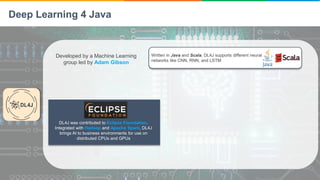
DL4J was contributed to Eclipse Foundation.
Integrated with Hadoop and Apache Spark, DL4J
brings AI to business environments for use on
distributed CPUs and GPUs
Written in Java and Scala, DL4J supports different neural
networks like CNN, RNN, and LSTM
Developed by a Machine Learning
group led by Adam Gibson
Deep Learning 4 Java
DL4J was contributed to Eclipse Foundation.
Integrated with Hadoop and Apache Spark, DL4J
brings AI to business environments for use on
distributed CPUs and GPUs
• Provides a distributed computing framework as training
with DL4J occurs in a cluster
• Includes an n-dimensional array class using ND4J that
allows scientific computing in Java and Scala
• Offers a vector space modeling and topic modeling
toolkit that is designed to handle large text sets and
perform NLP
Written in Java and Scala, DL4J supports different neural
networks like CNN, RNN, and LSTM
Developed by a Machine Learning
group led by Adam Gibson
How Big Data evolved?
Microsoft CNTKCaffe
Caffe
Developed at
Caffe
Caffe stands for Convolutional Architecture for Fast Feature EmbeddingDeveloped at
Caffe
Caffe stands for Convolutional Architecture for Fast Feature Embedding
Written in C++, with a Python interface
Developed at
Caffe
Caffe stands for Convolutional Architecture for Fast Feature Embedding
Written in C++, with a Python interface
Generally used for image detection and
classification
Developed at
Caffe
Caffe stands for Convolutional Architecture for Fast Feature Embedding
Written in C++, with a Python interface
Generally used for image detection and
classification
• Used in academic research projects, startup
prototypes, and large-scale industrial applications in
vision, speech, and multimedia
• Caffe supports GPU and CPU-based acceleration
computational kernel libraries such as NVIDIA, cuDNN
and, IntelMLK
• Offers high speed can process over 60M images per
day with a single NVIDIA K40 GPU
Developed at
How Big Data evolved?
Microsoft CNTKChainer
Chainer
Preferred Networks in collaboration with
IBM, Intel, Microsoft, and Nvidia
Developed by
Chainer
Preferred Networks in collaboration with
IBM, Intel, Microsoft, and Nvidia
Written purely in Python, it runs on top of
Numpy and CuPy Python libraries
Developed by
Chainer
Preferred Networks in collaboration with
IBM, Intel, Microsoft, and Nvidia
Written purely in Python, it runs on top of
Numpy and CuPy Python libraries
Provides a number of extended libraries
Developed by
Chainer
Developed by
Preferred Networks in collaboration with
IBM, Intel, Microsoft, and Nvidia
Written purely in Python, it runs on top of
Numpy and CuPy Python libraries
Provides a number of extended libraries • Supports CUDA computation. It only requires a few
lines of code to leverage a GPU. It also runs on
multiple GPUs with little effort
• Provides various network architectures, including
feed-forward nets, convnets, recurrent nets, and
recursive nets
How Big Data evolved?
Microsoft CNTKMicrosoft CNTK
Microsoft Cognitive Toolkit
CNTK
Developed by
Microsoft Cognitive Toolkit
CNTK
CNTK is a Deep Learning framework that builds a neural network as a
series of computational steps via a directed graph
Developed by
Microsoft Cognitive Toolkit
CNTK
Supports interfaces such as Python, C++
CNTK is a Deep Learning framework that builds a neural network as a
series of computational steps via a directed graph
Developed by
Microsoft Cognitive Toolkit
CNTK
Supports interfaces such as Python, C++
CNTK is a Deep Learning framework that builds a neural network as a
series of computational steps via a directed graph
Used mainly for
Developed by
Microsoft Cognitive Toolkit
CNTK
Developed by
Supports interfaces such as Python, C++
CNTK is a Deep Learning framework that builds a neural network as a
series of computational steps via a directed graph
Used mainly for
• Designed for speed and efficiency, CNTK scales well in
production using GPUs but has limited support from the
community
• Supports both RNN and CNN type of neural models
capable of handling image, handwriting and speech
recognition problems
Deep Learning Frameworks 2019 | Which Deep Learning Framework To Use | Deep Learning | Simplilearn

Deep Learning Frameworks 2019 | Which Deep Learning Framework To Use | Deep Learning | Simplilearn

  • 1.
    How Big Dataevolved? Deep Learning Frameworks
  • 2.
  • 3.
    How Big Dataevolved? Microsoft CNTKTensorFlow
  • 4.
  • 5.
    TensorFlow Developed by Google BrainTeam Supports languages
  • 6.
    TensorFlow Developed by Google BrainTeam Supports languages Uses dataflow graphs to process data
  • 7.
    TensorFlow Developed by Google BrainTeam Supports languages Uses dataflow graphs to process data Easy to build Machine Learning models
  • 8.
    TensorFlow Developed by Google BrainTeam Supports languages Uses dataflow graphs to process data Easy to build Machine Learning models Robust Machine Learning production
  • 9.
    TensorFlow Developed by Google BrainTeam Supports languages Uses dataflow graphs to process data Easy to build Machine Learning models Powerful experimentation for research Robust Machine Learning production
  • 10.
    TensorFlow Developed by Google BrainTeam Supports languages Uses dataflow graphs to process data TensorBoard for data visualization Easy to build Machine Learning models Powerful experimentation for research Robust Machine Learning production
  • 11.
    How Big Dataevolved? Microsoft CNTKKeras
  • 12.
    Keras Francois Chollet isthe author of keras, with over 350,000 users and 700+ open-source contributors
  • 13.
    Keras High-level neural networkAPI, written in Python Francois Chollet is the author of keras, with over 350,000 users and 700+ open-source contributors
  • 14.
    Keras Runs on topof TF, Theano, CNTK CNTK Francois Chollet is the author of keras, with over 350,000 users and 700+ open-source contributors High-level neural network API, written in Python
  • 15.
    Keras CNTK Used in severalstartups, research labs, and companies High-level neural network API, written in Python Runs on top of TF, Theano, CNTK Francois Chollet is the author of keras, with over 350,000 users and 700+ open-source contributors
  • 16.
    Keras CNTK Used in severalstartups, research labs, and companies User-friendly as it offers simple APIs and provides clear and actionable feedback upon user error Provides modularity as a sequence or a graph of standalone, fully configurable modules that can be plugged together with as few restrictions as possible Easily extensible as new modules are simple to add. This feature makes Keras suitable for advanced research 1 2 3 Runs on top of TF, Theano, CNTK Francois Chollet is the author of keras, with over 350,000 users and 700+ open-source contributors High-level neural network API, written in Python
  • 17.
    How Big Dataevolved? Microsoft CNTKPyTorch
  • 18.
    PyTorch Authored by AdamPaszke, Sam Gross, Soumith Chintala and Gregory Chanan
  • 19.
    PyTorch Authored by AdamPaszke, Sam Gross, Soumith Chintala and Gregory Chanan Lua based scientific computing framework for Machine Learning and Deep Learning algorithms
  • 20.
    PyTorch Authored by AdamPaszke, Sam Gross, Soumith Chintala and Gregory Chanan Lua based scientific computing framework for Machine Learning and Deep Learning algorithms It employed CUDA along with C/C++ libraries for processing and was designed to scale the production of building models and overall flexibility
  • 21.
    PyTorch Authored by AdamPaszke, Sam Gross, Soumith Chintala and Gregory Chanan Lua based scientific computing framework for Machine Learning and Deep Learning algorithms Widely used in companies like It employed CUDA along with C/C++ libraries for processing and was designed to scale the production of building models and overall flexibility
  • 22.
    PyTorch Authored by AdamPaszke, Sam Gross, Soumith Chintala and Gregory Chanan Lua based scientific computing framework for Machine Learning and Deep Learning algorithms Widely used in companies like Provides flexibility and speed due to its hybrid front-end Enables scalable distributed training and performance optimization in research and production using torch.distributed backend Deep integration into Python allows popular libraries and packages to be used for quickly writing neural network layers in Python. 1 2 3 It employed CUDA along with C/C++ libraries for processing and was designed to scale the production of building models and overall flexibility
  • 23.
    How Big Dataevolved? Microsoft CNTKTheano
  • 24.
  • 25.
  • 26.
    Theano Python library thatallows to define, optimize, and evaluate mathematical expressions involving multi- dimensional arrays efficiently Developed by Written in
  • 27.
    Theano Python library thatallows to define, optimize, and evaluate mathematical expressions involving multi- dimensional arrays efficiently • Theano has tight integration with NumPy for data computations • Uses GPU’s to perform data-intensive computations which are much faster than on a CPU • Has extensive unit-testing and self-verification that can detect and diagnose many types of errors Developed by Written in
  • 28.
    How Big Dataevolved? Microsoft CNTKDeep Learning 4 Java
  • 29.
    Deep Learning 4Java Developed by a Machine Learning group led by Adam Gibson
  • 30.
    Deep Learning 4Java Written in Java and Scala, DL4J supports different neural networks like CNN, RNN, and LSTM Developed by a Machine Learning group led by Adam Gibson
  • 31.
    Deep Learning 4Java DL4J was contributed to Eclipse Foundation. Integrated with Hadoop and Apache Spark, DL4J brings AI to business environments for use on distributed CPUs and GPUs Written in Java and Scala, DL4J supports different neural networks like CNN, RNN, and LSTM Developed by a Machine Learning group led by Adam Gibson
  • 32.
    Deep Learning 4Java DL4J was contributed to Eclipse Foundation. Integrated with Hadoop and Apache Spark, DL4J brings AI to business environments for use on distributed CPUs and GPUs • Provides a distributed computing framework as training with DL4J occurs in a cluster • Includes an n-dimensional array class using ND4J that allows scientific computing in Java and Scala • Offers a vector space modeling and topic modeling toolkit that is designed to handle large text sets and perform NLP Written in Java and Scala, DL4J supports different neural networks like CNN, RNN, and LSTM Developed by a Machine Learning group led by Adam Gibson
  • 33.
    How Big Dataevolved? Microsoft CNTKCaffe
  • 34.
  • 35.
    Caffe Caffe stands forConvolutional Architecture for Fast Feature EmbeddingDeveloped at
  • 36.
    Caffe Caffe stands forConvolutional Architecture for Fast Feature Embedding Written in C++, with a Python interface Developed at
  • 37.
    Caffe Caffe stands forConvolutional Architecture for Fast Feature Embedding Written in C++, with a Python interface Generally used for image detection and classification Developed at
  • 38.
    Caffe Caffe stands forConvolutional Architecture for Fast Feature Embedding Written in C++, with a Python interface Generally used for image detection and classification • Used in academic research projects, startup prototypes, and large-scale industrial applications in vision, speech, and multimedia • Caffe supports GPU and CPU-based acceleration computational kernel libraries such as NVIDIA, cuDNN and, IntelMLK • Offers high speed can process over 60M images per day with a single NVIDIA K40 GPU Developed at
  • 39.
    How Big Dataevolved? Microsoft CNTKChainer
  • 40.
    Chainer Preferred Networks incollaboration with IBM, Intel, Microsoft, and Nvidia Developed by
  • 41.
    Chainer Preferred Networks incollaboration with IBM, Intel, Microsoft, and Nvidia Written purely in Python, it runs on top of Numpy and CuPy Python libraries Developed by
  • 42.
    Chainer Preferred Networks incollaboration with IBM, Intel, Microsoft, and Nvidia Written purely in Python, it runs on top of Numpy and CuPy Python libraries Provides a number of extended libraries Developed by
  • 43.
    Chainer Developed by Preferred Networksin collaboration with IBM, Intel, Microsoft, and Nvidia Written purely in Python, it runs on top of Numpy and CuPy Python libraries Provides a number of extended libraries • Supports CUDA computation. It only requires a few lines of code to leverage a GPU. It also runs on multiple GPUs with little effort • Provides various network architectures, including feed-forward nets, convnets, recurrent nets, and recursive nets
  • 44.
    How Big Dataevolved? Microsoft CNTKMicrosoft CNTK
  • 45.
  • 46.
    Microsoft Cognitive Toolkit CNTK CNTKis a Deep Learning framework that builds a neural network as a series of computational steps via a directed graph Developed by
  • 47.
    Microsoft Cognitive Toolkit CNTK Supportsinterfaces such as Python, C++ CNTK is a Deep Learning framework that builds a neural network as a series of computational steps via a directed graph Developed by
  • 48.
    Microsoft Cognitive Toolkit CNTK Supportsinterfaces such as Python, C++ CNTK is a Deep Learning framework that builds a neural network as a series of computational steps via a directed graph Used mainly for Developed by
  • 49.
    Microsoft Cognitive Toolkit CNTK Developedby Supports interfaces such as Python, C++ CNTK is a Deep Learning framework that builds a neural network as a series of computational steps via a directed graph Used mainly for • Designed for speed and efficiency, CNTK scales well in production using GPUs but has limited support from the community • Supports both RNN and CNN type of neural models capable of handling image, handwriting and speech recognition problems