Thrive. Grow. Achieve.
Self-Insurance
Under the ACA
Matthew Roberts – Senior Account Executive
February 3, 2015
AGENDA
 Overview
 Stop Loss Insurance
 ACA Impact on Self-Insured Plans
 Advantages and Disadvantages
 ACA Update
Self-Insurance Under the ACA 2
ABOUT THE PRESENTER
3
Matthew Roberts, Senior Account Executive
 Worked throughout the country – Chicago, Upstate NY and Albuquerque.
 Educates companies on Health Care Reform and other compliance
obligations.
 Empowers organizations to find knowledge-based solutions to problems
ingrained in their employee benefits programs by maximizing human
potential.
 Improves the overall health of an organization through strategic planning
and reducing both direct and indirect costs.
Self-Insurance Under the ACA
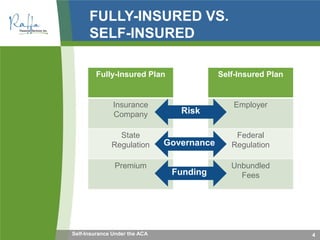
FULLY-INSURED VS.
SELF-INSURED
4
Fully-Insured Plan
Insurance
Company
State
Regulation
Premium
Self-Insured Plan
Employer
Federal
Regulation
Unbundled
Fees
Risk
Governance
Funding
Self-Insurance Under the ACA
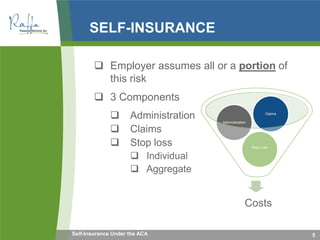
SELF-INSURANCE
 Employer assumes all or a portion of
this risk
 3 Components
 Administration
 Claims
 Stop loss
 Individual
 Aggregate
5
Costs
Stop Loss
Administration
Claims
Self-Insurance Under the ACA
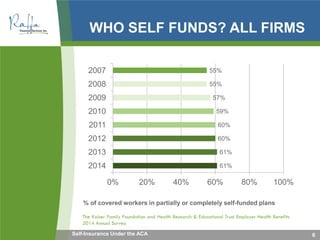
WHO SELF FUNDS? ALL FIRMS
6
61%
61%
60%
60%
59%
57%
55%
55%
0% 20% 40% 60% 80% 100%
2014
2013
2012
2011
2010
2009
2008
2007
% of covered workers in partially or completely self-funded plans
The Kaiser Family Foundation and Health Research & Educational Trust Employer Health Benefits
2014 Annual Survey.
Self-Insurance Under the ACA
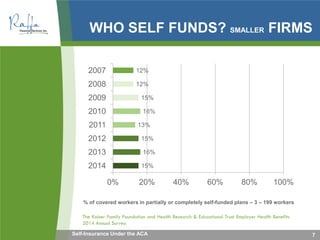
WHO SELF FUNDS? SMALLER FIRMS
7
15%
16%
15%
13%
16%
15%
12%
12%
0% 20% 40% 60% 80% 100%
2014
2013
2012
2011
2010
2009
2008
2007
% of covered workers in partially or completely self-funded plans – 3 – 199 workers
The Kaiser Family Foundation and Health Research & Educational Trust Employer Health Benefits
2014 Annual Survey.
Self-Insurance Under the ACA
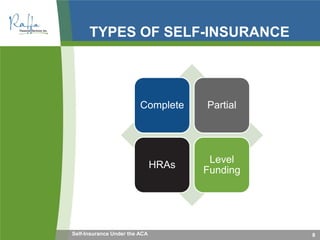
TYPES OF SELF-INSURANCE
8
Complete Partial
HRAs
Level
Funding
Self-Insurance Under the ACA
TERMINOLOGY
 Administration - claims adjudication, billing, eligibility, customer
service, plan document maintenance, network access, etc.
 Expected claims – actuarial calculation based on past claims
experience, demographics and risk profile (known ongoing claims).
 Stop loss insurance – reduces the risk associated with large individual
claims or high claims from the entire plan.
 Maximum claims liability – worst case scenario – most employer will
pay out in a plan year.
9Self-Insurance Under the ACA
10
Stop Loss Insurance
Self-Insurance Under the ACA
STOP LOSS – WHY?
 Limits risk/exposure
 Reduces claims fluctuation
 Peace of mind
11Self-Insurance Under the ACA
TYPES OF STOP LOSS
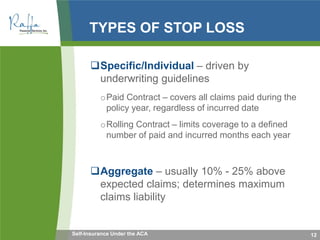
Specific/Individual – driven by
underwriting guidelines
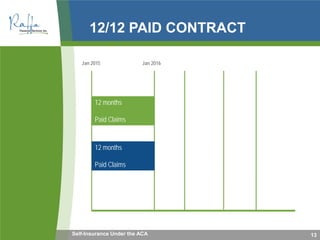
oPaid Contract – covers all claims paid during the
policy year, regardless of incurred date
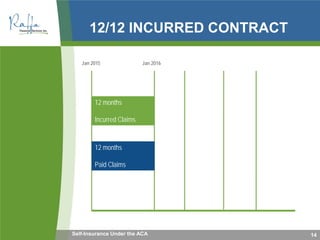
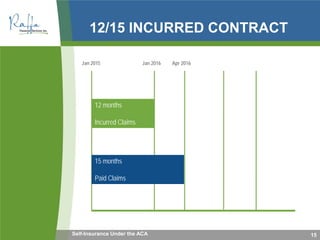
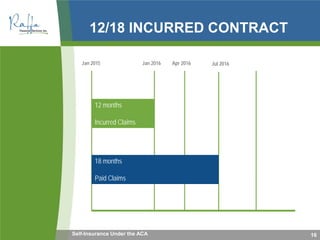
oRolling Contract – limits coverage to a defined
number of paid and incurred months each year
Aggregate – usually 10% - 25% above
expected claims; determines maximum
claims liability
12Self-Insurance Under the ACA
12/12 PAID CONTRACT
13
Jan 2015 Jan 2016
12 months
Paid Claims
12 months
Paid Claims
Self-Insurance Under the ACA
12/12 INCURRED CONTRACT
14
Jan 2015 Jan 2016
12 months
Incurred Claims
12 months
Paid Claims
Self-Insurance Under the ACA
12/15 INCURRED CONTRACT
15
Jan 2015 Jan 2016 Apr 2016
12 months
Incurred Claims
15 months
Paid Claims
Self-Insurance Under the ACA
12/18 INCURRED CONTRACT
16
Jan 2015 Jan 2016 Apr 2016
12 months
Incurred Claims
18 months
Paid Claims
Jul 2016
Self-Insurance Under the ACA
17
ACA Impact on Self-
Insured Plans
Self-Insurance Under the ACA
ACA REFORMS THAT APPLY
 Dependent coverage for children to age 26
 Preventive health services without cost-sharing
 No rescissions of coverage
 No lifetime or annual dollar limits on essential
health benefits
 No waiting periods exceeding 90 days
 No pre-existing condition exclusions
 No discrimination against participants who
participate in clinical trials
18Self-Insurance Under the ACA
ACA REFORMS THAT APPLY
 Distribution of Summaries of Benefits and
Coverage (SBCs)
 Patient-Centered Outcomes Research Institute
(PCORI) fee
 Reinsurance fees
 Cost-sharing limits ($6600/$13,200 out-of-pocket
maximums for 2015)
19Self-Insurance Under the ACA
ACA REFORMS THAT
DO NOT APPLY
 Essential health benefits package
 Medical loss ratio rules
 Review of premium increases
 Health insurance industry fee
 Insurance market reforms
o Guaranteed issue and renewability
o Insurance premium restrictions
20Self-Insurance Under the ACA
DC STOP LOSS BILL – B20-0797
 City council passed legislation that would ban stop loss in the
small group market (2-50).
 Would set an individual attachment point at $40K and an
aggregate attachment point at 120% for larger groups.
 This new law would not impact any 2015 renewals, however, if
signed by the mayor would take effect sometime in 2015.
 The Insurance Department (DISB) Commissioner McPherson
and Exchange Director Kofman were most prominent in
support of this bill.
 Advocacy efforts around the negative impacts of this law on
employers are ongoing with the new Mayor and administration.
21Self-Insurance Under the ACA
ADVANTAGES/
DISADVANTAGES
22
Advantages Disadvantages
Flexibility in plan design – not bound
by state mandates and carrier filings
Increased risk
Transparency – renewal workup Additional reporting requirements
Reduced state taxes – 2%
Reduced federal taxes –
approximately 3%
Reporting – data is king
Improved cash flow – pay as you
go; run-in
Increased competition
Self-Insurance Under the ACA
23Self-Insurance Under the ACA
GRANDFATHERED PLANS
 If you have one, determine whether it will
maintain status for next plan year
 If your plan will lose its status, confirm required
patient rights and benefits are in order
 If keeping its status, continue to provide Notice
of Grandfathered Status
24Self-Insurance Under the ACA
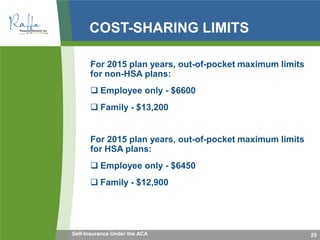
COST-SHARING LIMITS
For 2015 plan years, out-of-pocket maximum limits
for non-HSA plans:
 Employee only - $6600
 Family - $13,200
For 2015 plan years, out-of-pocket maximum limits
for HSA plans:
 Employee only - $6450
 Family - $12,900
25Self-Insurance Under the ACA
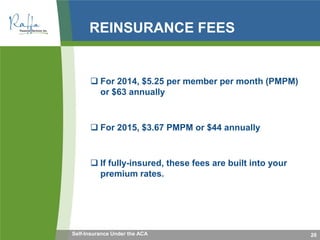
REINSURANCE FEES
 For 2014, $5.25 per member per month (PMPM)
or $63 annually
 For 2015, $3.67 PMPM or $44 annually
 If fully-insured, these fees are built into your
premium rates.
26Self-Insurance Under the ACA
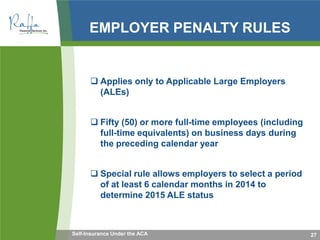
EMPLOYER PENALTY RULES
 Applies only to Applicable Large Employers
(ALEs)
 Fifty (50) or more full-time employees (including
full-time equivalents) on business days during
the preceding calendar year
 Special rule allows employers to select a period
of at least 6 calendar months in 2014 to
determine 2015 ALE status
27Self-Insurance Under the ACA
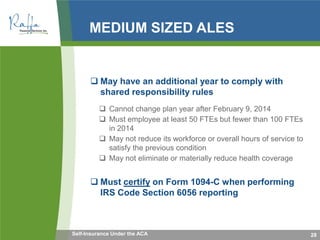
MEDIUM SIZED ALES
 May have an additional year to comply with
shared responsibility rules
 Cannot change plan year after February 9, 2014
 Must employee at least 50 FTEs but fewer than 100 FTEs
in 2014
 May not reduce its workforce or overall hours of service to
satisfy the previous condition
 May not eliminate or materially reduce health coverage
 Must certify on Form 1094-C when performing
IRS Code Section 6056 reporting
28Self-Insurance Under the ACA
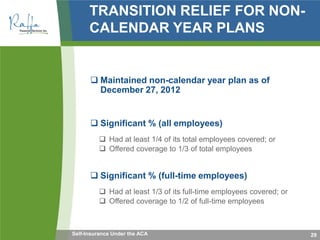
TRANSITION RELIEF FOR NON-
CALENDAR YEAR PLANS
 Maintained non-calendar year plan as of
December 27, 2012
 Significant % (all employees)
 Had at least 1/4 of its total employees covered; or
 Offered coverage to 1/3 of total employees
 Significant % (full-time employees)
 Had at least 1/3 of its full-time employees covered; or
 Offered coverage to 1/2 of full-time employees
29Self-Insurance Under the ACA
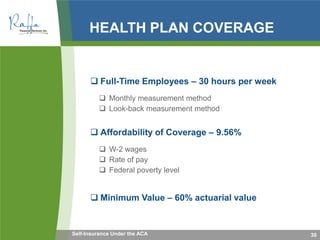
HEALTH PLAN COVERAGE
 Full-Time Employees – 30 hours per week
 Monthly measurement method
 Look-back measurement method
 Affordability of Coverage – 9.56%
 W-2 wages
 Rate of pay
 Federal poverty level
 Minimum Value – 60% actuarial value
30Self-Insurance Under the ACA
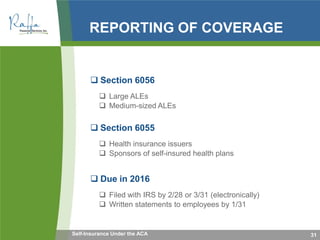
REPORTING OF COVERAGE
 Section 6056
 Large ALEs
 Medium-sized ALEs
 Section 6055
 Health insurance issuers
 Sponsors of self-insured health plans
 Due in 2016
 Filed with IRS by 2/28 or 3/31 (electronically)
 Written statements to employees by 1/31
31Self-Insurance Under the ACA
32
Questions?
Self-Insurance Under the ACA
THANK YOU!
Matthew Roberts – Senior Account Executive
Matthew@raffafinancial.com
240-403-2574
Jeyalene Baron – Sr. Account Manager/Broker
jeyalene@raffafinancial.com
240-403-2556
33

2015-02-03 Self-Insurance Under the ACA

  • 1.
    Thrive. Grow. Achieve. Self-Insurance Underthe ACA Matthew Roberts – Senior Account Executive February 3, 2015
  • 2.
    AGENDA  Overview  StopLoss Insurance  ACA Impact on Self-Insured Plans  Advantages and Disadvantages  ACA Update Self-Insurance Under the ACA 2
  • 3.
    ABOUT THE PRESENTER 3 MatthewRoberts, Senior Account Executive  Worked throughout the country – Chicago, Upstate NY and Albuquerque.  Educates companies on Health Care Reform and other compliance obligations.  Empowers organizations to find knowledge-based solutions to problems ingrained in their employee benefits programs by maximizing human potential.  Improves the overall health of an organization through strategic planning and reducing both direct and indirect costs. Self-Insurance Under the ACA
  • 4.
    FULLY-INSURED VS. SELF-INSURED 4 Fully-Insured Plan Insurance Company State Regulation Premium Self-InsuredPlan Employer Federal Regulation Unbundled Fees Risk Governance Funding Self-Insurance Under the ACA
  • 5.
    SELF-INSURANCE  Employer assumesall or a portion of this risk  3 Components  Administration  Claims  Stop loss  Individual  Aggregate 5 Costs Stop Loss Administration Claims Self-Insurance Under the ACA
  • 6.
    WHO SELF FUNDS?ALL FIRMS 6 61% 61% 60% 60% 59% 57% 55% 55% 0% 20% 40% 60% 80% 100% 2014 2013 2012 2011 2010 2009 2008 2007 % of covered workers in partially or completely self-funded plans The Kaiser Family Foundation and Health Research & Educational Trust Employer Health Benefits 2014 Annual Survey. Self-Insurance Under the ACA
  • 7.
    WHO SELF FUNDS?SMALLER FIRMS 7 15% 16% 15% 13% 16% 15% 12% 12% 0% 20% 40% 60% 80% 100% 2014 2013 2012 2011 2010 2009 2008 2007 % of covered workers in partially or completely self-funded plans – 3 – 199 workers The Kaiser Family Foundation and Health Research & Educational Trust Employer Health Benefits 2014 Annual Survey. Self-Insurance Under the ACA
  • 8.
    TYPES OF SELF-INSURANCE 8 CompletePartial HRAs Level Funding Self-Insurance Under the ACA
  • 9.
    TERMINOLOGY  Administration -claims adjudication, billing, eligibility, customer service, plan document maintenance, network access, etc.  Expected claims – actuarial calculation based on past claims experience, demographics and risk profile (known ongoing claims).  Stop loss insurance – reduces the risk associated with large individual claims or high claims from the entire plan.  Maximum claims liability – worst case scenario – most employer will pay out in a plan year. 9Self-Insurance Under the ACA
  • 10.
  • 11.
    STOP LOSS –WHY?  Limits risk/exposure  Reduces claims fluctuation  Peace of mind 11Self-Insurance Under the ACA
  • 12.
    TYPES OF STOPLOSS Specific/Individual – driven by underwriting guidelines oPaid Contract – covers all claims paid during the policy year, regardless of incurred date oRolling Contract – limits coverage to a defined number of paid and incurred months each year Aggregate – usually 10% - 25% above expected claims; determines maximum claims liability 12Self-Insurance Under the ACA
  • 13.
    12/12 PAID CONTRACT 13 Jan2015 Jan 2016 12 months Paid Claims 12 months Paid Claims Self-Insurance Under the ACA
  • 14.
    12/12 INCURRED CONTRACT 14 Jan2015 Jan 2016 12 months Incurred Claims 12 months Paid Claims Self-Insurance Under the ACA
  • 15.
    12/15 INCURRED CONTRACT 15 Jan2015 Jan 2016 Apr 2016 12 months Incurred Claims 15 months Paid Claims Self-Insurance Under the ACA
  • 16.
    12/18 INCURRED CONTRACT 16 Jan2015 Jan 2016 Apr 2016 12 months Incurred Claims 18 months Paid Claims Jul 2016 Self-Insurance Under the ACA
  • 17.
    17 ACA Impact onSelf- Insured Plans Self-Insurance Under the ACA
  • 18.
    ACA REFORMS THATAPPLY  Dependent coverage for children to age 26  Preventive health services without cost-sharing  No rescissions of coverage  No lifetime or annual dollar limits on essential health benefits  No waiting periods exceeding 90 days  No pre-existing condition exclusions  No discrimination against participants who participate in clinical trials 18Self-Insurance Under the ACA
  • 19.
    ACA REFORMS THATAPPLY  Distribution of Summaries of Benefits and Coverage (SBCs)  Patient-Centered Outcomes Research Institute (PCORI) fee  Reinsurance fees  Cost-sharing limits ($6600/$13,200 out-of-pocket maximums for 2015) 19Self-Insurance Under the ACA
  • 20.
    ACA REFORMS THAT DONOT APPLY  Essential health benefits package  Medical loss ratio rules  Review of premium increases  Health insurance industry fee  Insurance market reforms o Guaranteed issue and renewability o Insurance premium restrictions 20Self-Insurance Under the ACA
  • 21.
    DC STOP LOSSBILL – B20-0797  City council passed legislation that would ban stop loss in the small group market (2-50).  Would set an individual attachment point at $40K and an aggregate attachment point at 120% for larger groups.  This new law would not impact any 2015 renewals, however, if signed by the mayor would take effect sometime in 2015.  The Insurance Department (DISB) Commissioner McPherson and Exchange Director Kofman were most prominent in support of this bill.  Advocacy efforts around the negative impacts of this law on employers are ongoing with the new Mayor and administration. 21Self-Insurance Under the ACA
  • 22.
    ADVANTAGES/ DISADVANTAGES 22 Advantages Disadvantages Flexibility inplan design – not bound by state mandates and carrier filings Increased risk Transparency – renewal workup Additional reporting requirements Reduced state taxes – 2% Reduced federal taxes – approximately 3% Reporting – data is king Improved cash flow – pay as you go; run-in Increased competition Self-Insurance Under the ACA
  • 23.
  • 24.
    GRANDFATHERED PLANS  Ifyou have one, determine whether it will maintain status for next plan year  If your plan will lose its status, confirm required patient rights and benefits are in order  If keeping its status, continue to provide Notice of Grandfathered Status 24Self-Insurance Under the ACA
  • 25.
    COST-SHARING LIMITS For 2015plan years, out-of-pocket maximum limits for non-HSA plans:  Employee only - $6600  Family - $13,200 For 2015 plan years, out-of-pocket maximum limits for HSA plans:  Employee only - $6450  Family - $12,900 25Self-Insurance Under the ACA
  • 26.
    REINSURANCE FEES  For2014, $5.25 per member per month (PMPM) or $63 annually  For 2015, $3.67 PMPM or $44 annually  If fully-insured, these fees are built into your premium rates. 26Self-Insurance Under the ACA
  • 27.
    EMPLOYER PENALTY RULES Applies only to Applicable Large Employers (ALEs)  Fifty (50) or more full-time employees (including full-time equivalents) on business days during the preceding calendar year  Special rule allows employers to select a period of at least 6 calendar months in 2014 to determine 2015 ALE status 27Self-Insurance Under the ACA
  • 28.
    MEDIUM SIZED ALES May have an additional year to comply with shared responsibility rules  Cannot change plan year after February 9, 2014  Must employee at least 50 FTEs but fewer than 100 FTEs in 2014  May not reduce its workforce or overall hours of service to satisfy the previous condition  May not eliminate or materially reduce health coverage  Must certify on Form 1094-C when performing IRS Code Section 6056 reporting 28Self-Insurance Under the ACA
  • 29.
    TRANSITION RELIEF FORNON- CALENDAR YEAR PLANS  Maintained non-calendar year plan as of December 27, 2012  Significant % (all employees)  Had at least 1/4 of its total employees covered; or  Offered coverage to 1/3 of total employees  Significant % (full-time employees)  Had at least 1/3 of its full-time employees covered; or  Offered coverage to 1/2 of full-time employees 29Self-Insurance Under the ACA
  • 30.
    HEALTH PLAN COVERAGE Full-Time Employees – 30 hours per week  Monthly measurement method  Look-back measurement method  Affordability of Coverage – 9.56%  W-2 wages  Rate of pay  Federal poverty level  Minimum Value – 60% actuarial value 30Self-Insurance Under the ACA
  • 31.
    REPORTING OF COVERAGE Section 6056  Large ALEs  Medium-sized ALEs  Section 6055  Health insurance issuers  Sponsors of self-insured health plans  Due in 2016  Filed with IRS by 2/28 or 3/31 (electronically)  Written statements to employees by 1/31 31Self-Insurance Under the ACA
  • 32.
  • 33.
    THANK YOU! Matthew Roberts– Senior Account Executive Matthew@raffafinancial.com 240-403-2574 Jeyalene Baron – Sr. Account Manager/Broker jeyalene@raffafinancial.com 240-403-2556 33