
THE WILLIS BENEFITS
BENCHMARKING SURVEY
SURVEY REPORT | 2015
32015 Willis Benefits Benchmarking Survey
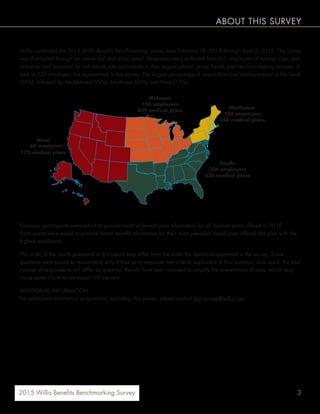
Willis conducted the 2015 Willis Benefits Benchmarking Survey from February 18, 2015 through April 3, 2015. The survey
was distributed through an online tool and direct email. Responses were collected from U.S. employers of various sizes and
industries and provided by individuals who participate in their organizations’ group health plan decision-making process. A
total of 532 employers are represented in this survey. The largest percentage of respondents are headquartered in the South
(38%), followed by the Midwest (29%), Northeast (20%) and West (13%).
Employer participants were asked to provide medical benefit plan information for all medical plans offered in 2015.
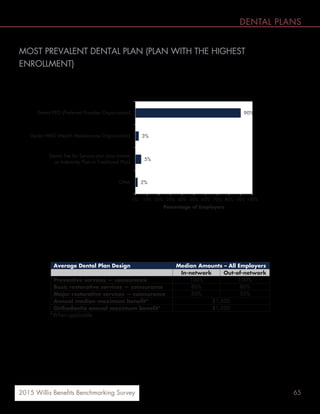
Participants were asked to provide dental benefit information for their most prevalent dental plan offered (the plan with the
highest enrollment).
The order of the results presented in this report may differ from the order the questions appeared in the survey. Some
questions were posed to respondents only if their prior response met criteria applicable to that question; as a result, the total
number of respondents will differ by question. Results have been rounded to simplify the presentation of data, which may
cause some charts to not equal 100 percent.
ADDITIONAL INFORMATION
For additional information or questions regarding this survey, please contact hcp.survey@willis.com.
West:
68 employers
172 medical plans
Midwest:
156 employers
339 medical plans
South:
204 employers
434 medical plans
Northeast:
104 employers
248 medical plans
ABOUT THIS SURVEY
TABLE OF CONTENTS
Executive Summary........................................................................................... 6
Employer Demographics.................................................................................... 7
Medical Plan Eligibility..................................................................................... 10
Medical Plan Offerings and Enrollment............................................................. 13
Medical Plan Costs........................................................................................... 19
PPO/POS Plans..........................................................................................................19
HMO/EPO Plans........................................................................................................21
HSA-Eligible CDHPs....................................................................................................23
CDHPs with HRAs.......................................................................................................25
Medical Plan Design Details............................................................................. 27
PPO/POS Plan Design Details.....................................................................................27
Deductibles............................................................................................................................ 28
Out-of-Pocket Maximums.......................................................................................................... 29
Physician Office Visit Coverage................................................................................................ 30
Inpatient Hospitalization.......................................................................................................... 31
Outpatient Surgery/Hospital Services........................................................................................ 31
Emergency Room Services....................................................................................................... 32
Urgent Care Services.............................................................................................................. 32
Prescription Drug Coverage..................................................................................................... 33
HMO/EPO Plan Design Details...................................................................................36
Deductibles............................................................................................................................ 37
Out-of-Pocket Maximums.......................................................................................................... 38
Physician Office Visit Coverage................................................................................................ 39
Inpatient Hospitalization.......................................................................................................... 40
Outpatient Surgery/Hospital Services........................................................................................ 40
Emergency Room Services....................................................................................................... 41
Urgent Care Services.............................................................................................................. 41
Prescription Drug Coverage..................................................................................................... 42
HSA-Eligible CDHP Plan Design Details.......................................................................44
Deductibles............................................................................................................................ 45
Out-of-Pocket Maximums.......................................................................................................... 46
Physician Office Visit Coverage................................................................................................ 47
Inpatient Hospitalization.......................................................................................................... 48
Outpatient Surgery/Hospital Services........................................................................................ 48
Emergency Room Services....................................................................................................... 49
Urgent Care Services.............................................................................................................. 49
Employer Contribution to Health Savings Accounts...................................................................... 50
Prescription Drug Coverage..................................................................................................... 52
CDHP with HRA Plan Design Details...........................................................................54
Deductibles............................................................................................................................ 55
Out-of-Pocket Maximums.......................................................................................................... 55
Physician Office Visit Coverage................................................................................................ 56
Inpatient Hospitalization.......................................................................................................... 57
Outpatient Surgery/Hospital Services........................................................................................ 57
Emergency Room Services....................................................................................................... 58
Urgent Care Services.............................................................................................................. 58
HRA Fund Contributions........................................................................................................... 59
Prescription Drug Coverage..................................................................................................... 60
Dental Plans.................................................................................................... 62
Benefits Strategy.............................................................................................. 67
Global Benefits Strategy.................................................................................. 71
6 2015 Willis Benefits Benchmarking Survey
Willis’ inaugural Benefits Benchmarking Survey gathered information related to employer medical and dental plan
design and costs, as well as benefits strategies. Within this survey, 532 employers provided responses for 1,193
medical plans, which allowed us to view benchmark data across all benefit plan offerings.
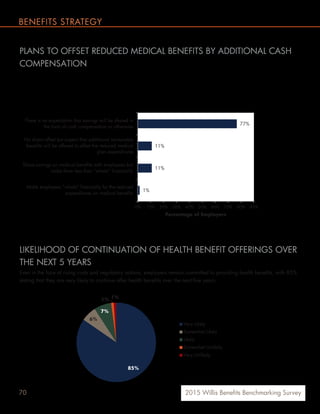
Continuing the trend evidenced in the Willis 2014 Health Care Reform Survey, employers remain committed to offering
health benefits to their employees; only 2% of respondents stated they were unlikely to continue to offer health benefits over
the next five years.
PPO/POS plans continue to be the most prevalent medical plan type, offered by 87% of employers. Health Savings Account
eligible Consumer Driven Health Plans (HSA-eligible CDHPs) have emerged as the second most prevalent medical plan
offering at 47%, a position that, in the past, had been occupied by HMO/EPO plans, which are now offered by only 22%
of employers. CDHP plans with Health Reimbursement Accounts (HRA) are only offered by 12% of respondents.
When HMO/EPO plans are offered, employees are taking the opportunity to enroll in these plans; for the 22% of employers
that offer HMO/EPO plans, almost half (46%) of enrolled employees chose the HMO/EPO plan over all other offerings.
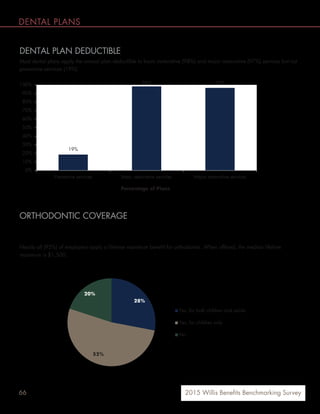
Dental plans are offered by the vast majority of employers. Most employers offer one to two dental plan options, and Dental
PPO plans are the most popular offering by far.
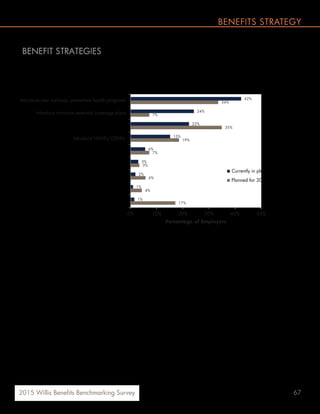
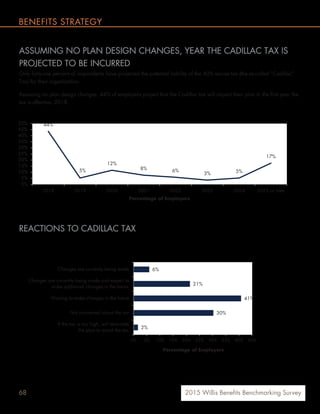
As the 2018 effective date for the Cadillac Tax draws closer, many employers are taking steps to quantify the impact of this
tax on their organizations (41%). Of those employers who have projected the liability, 44% anticipate the tax will hit in
2018 (assuming no plan design changes).
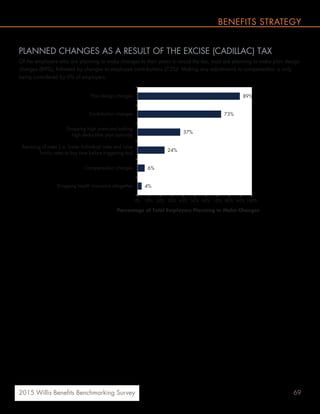
Although some employers (27%) are already making changes in response to the Cadillac Tax, many (41%) are still in “wait-
and-see” mode and have not made any changes. Modification of plan designs is the most common strategy to avoid/lessen
the tax followed by contribution changes. Few employers are planning to terminate their health plan to avoid the tax (2%).
While PPACA was drafted on the assumption that employers would offset reduced medical benefit spending with increased
cash compensation for their employees, the majority (77%) of respondents do not believe there is any expectation that
savings will be shared in the form of cash compensation or otherwise.
EXECUTIVE SUMMARY
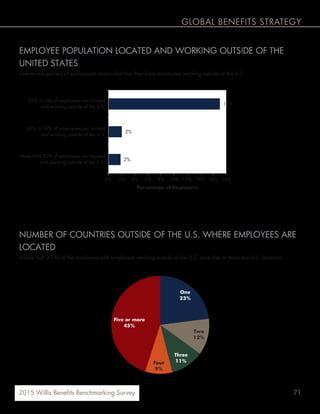
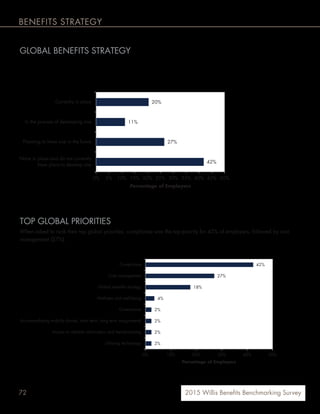
Approximately one-fifth of employers have employees that work outside the U.S. and almost half (45%) have five or more
non-U.S. locations. Forty-two percent stated that they do not have a global strategy in place and do not have plans to
develop one. Top global priorities are compliance (42%) and cost management (27%).
72015 Willis Benefits Benchmarking Survey
EMPLOYER DEMOGRAPHICS
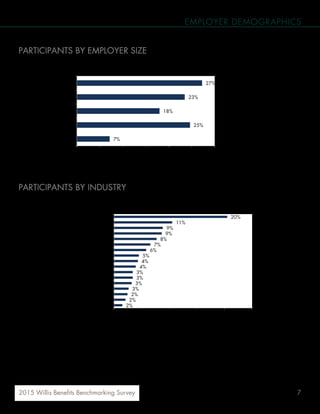
PARTICIPANTS BY EMPLOYER SIZE
Participation was evenly split between small
1
employers (50%) and large
2
employers (50%).
PARTICIPANTS BY INDUSTRY
Participants were from a wide range of industries, with manufacturing accounting for one-fifth of overall participation.
1
Employers with fewer than 500 employees
2
Employers with more than 500 employees
2%
2%
2%
3%
3%
3%
3%
4%
4%
5%
6%
7%
8%
9%
9%
11%
20%
0% 5% 10% 15% 20% 25%
Other
Media/Entertainment/Telecom
Hospitality/Food Service
Other Professional Services
Legal Services
Government
Oil/Gas/Mining/Energy
Automotive/Aerospace/Transportation
Business Services/Consulting
Construction
Education
Technology (computers, software, ISP, etc.)
Financial Services
Retail/Wholesale
Nonprofit
Health Services/Hospitals
Manufacturing
Percentage of Employers
50% under 500
employees
50% over 500
employees
27%
23%
18%
25%
7%
0% 5% 10% 15% 20% 25% 30%
Under 250 employees
250–499 employees
500–999 employees
1,000–4,999 employees
5,000+ employees
Percentage of Employers
PARTICIPANTS BY EMPLOYER SIZE
Participation was evenly split between small
1
employers (50%) and large
2
employers (50%).
PARTICIPANTS BY INDUSTRY
Participants were from a wide range of industries, with manufacturing accounting for one-fifth of overall participation.
1
Employers with fewer than 500 employees
2
Employers with more than 500 employees
2%
2%
2%
3%
3%
3%
3%
4%
4%
5%
6%
7%
8%
9%
9%
11%
20%
0% 5% 10% 15% 20% 25%
Other
Media/Entertainment/Telecom
Hospitality/Food Service
Other Professional Services
Legal Services
Government
Oil/Gas/Mining/Energy
Automotive/Aerospace/Transportation
Business Services/Consulting
Construction
Education
Technology (computers, software, ISP, etc.)
Financial Services
Retail/Wholesale
Nonprofit
Health Services/Hospitals
Manufacturing
Percentage of Employers
50% under 500
employees
50% over 500
employees
27%
23%
18%
25%
7%
0% 5% 10% 15% 20% 25% 30%
Under 250 employees
250-499 employees
500-999 employees
1,000-4,999 employees
5,000+ employees
Percentage of Employers
8 2015 Willis Benefits Benchmarking Survey
EMPLOYER DEMOGRAPHICS
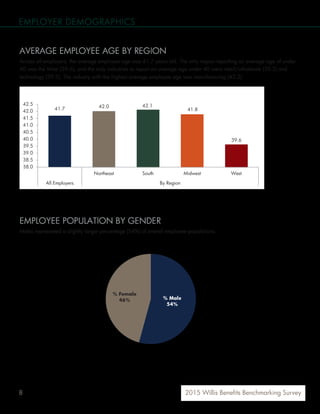
AVERAGE EMPLOYEE AGE BY REGION
Across all employers, the average employee age was 41.7 years old. The only region reporting an average age of under
40 was the West (39.6), and the only industries to report an average age under 40 were retail/wholesale (39.2) and
technology (39.5). The industry with the highest average employee age was manufacturing (43.2).
EMPLOYEE POPULATION BY GENDER
Males represented a slightly larger percentage (54%) of overall employee populations.
41.7 42.0 42.1
41.8
39.6
38.0
38.5
39.0
39.5
40.0
40.5
41.0
41.5
42.0
42.5
Northeast South Midwest West
All Employers By Region
% Male
54%
% Female
46%
92015 Willis Benefits Benchmarking Survey
EMPLOYER DEMOGRAPHICS
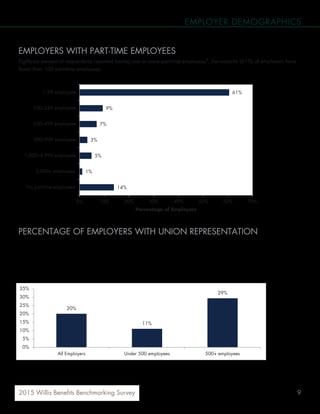
EMPLOYERS WITH PART-TIME EMPLOYEES
Eighty-six percent of respondents reported having one or more part-time employees
3
; the majority (61%) of employers have
fewer than 100 part-time employees.
PERCENTAGE OF EMPLOYERS WITH UNION REPRESENTATION
Twenty percent of employers reported having union representation within their workforce. Union representation was greater
among large employers (29%) than small employers (11%). Of those employers with union membership, the average union
population was 30% of the total employee population.
3
Part-time is defined as working less than 30 hours per week
61%
9%
7%
3%
5%
1%
14%
0% 10% 20% 30% 40% 50% 60% 70%
1–99 employees
100–249 employees
250–499 employees
500–999 employees
1,000–4,999 employees
5,000+ employees
No part-time employees
Percentage of Employers
20%
11%
29%
0%
5%
10%
15%
20%
25%
30%
35%
All Employers Under 500 employees 500+ employees
3
Part-time is defined as working less than 30 hours per week
10 2015 Willis Benefits Benchmarking Survey
MEDICAL PLAN ELIGIBILITY
31%
1%
2%
0% 5% 10% 15% 20% 25% 30% 35%
Part-time employees
Seasonal employees
Interns
Percentage of Employers Offering
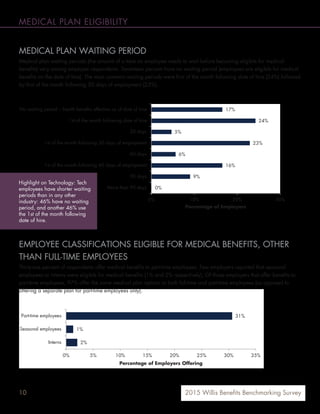
MEDICAL PLAN WAITING PERIOD
Medical plan waiting periods (the amount of a time an employee needs to wait before becoming eligible for medical
benefits) vary among employer respondents. Seventeen percent have no waiting period (employees are eligible for medical
benefits on the date of hire). The most common waiting periods were first of the month following date of hire (24%) followed
by first of the month following 30 days of employment (23%).
EMPLOYEE CLASSIFICATIONS ELIGIBLE FOR MEDICAL BENEFITS, OTHER
THAN FULL-TIME EMPLOYEES
Thirty-one percent of respondents offer medical benefits to part-time employees. Few employers reported that seasonal
employees or interns were eligible for medical benefits (1% and 2% respectively). Of those employers that offer benefits to
part-time employees, 97% offer the same medical plan options to both full-time and part-time employees (as opposed to
offering a separate plan for part-time employees only).
17%
24%
5%
23%
6%
16%
9%
0%
0% 10% 20% 30%
No waiting period – health benefits effective as of date of hire
1st of the month following date of hire
30 days
1st of the month following 30 days of employment
60 days
1st of the month following 60 days of employment
90 days
More than 90 days
Percentage of Employers
Highlight on Technology: Tech
employees have shorter waiting
periods than in any other
industry: 46% have no waiting
period, and another 46% use
the 1st of the month following
date of hire.
112015 Willis Benefits Benchmarking Survey
MEDICAL PLAN ELIGIBILITY
46%
50%
44% 45% 46% 47% 48% 49% 50% 51%
A surcharge is applied for all spouses
A surcharge is applied only for those spouses who
have access to medical coverage elsewhere
Prevalence of Spousal Surcharge Method
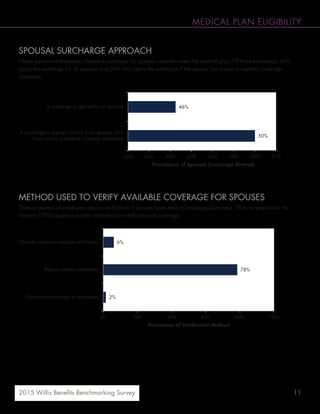
SPOUSAL SURCHARGE APPROACH
Fifteen percent of employers impose a surcharge for spouses covered under the medical plan. Of those employers, 46%
apply the surcharge for all spouses and 50% only apply the surcharge if the spouse has access to medical coverage
elsewhere.
METHOD USED TO VERIFY AVAILABLE COVERAGE FOR SPOUSES
Thirteen percent of employers require verification if spouses have medical coverage elsewhere. Of those employers, the
majority (78%) require a written attestation for verification of coverage.
6%
78%
2%
0% 20% 40% 60% 80% 100%
Outside company conducts verification
Require written attestations
Outbound phone calls to employees
Prevalence of Verification Method
12 2015 Willis Benefits Benchmarking Survey
MEDICAL PLAN ELIGIBILITY
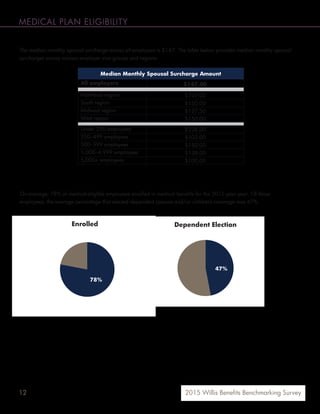
The median monthly spousal surcharge across all employers is $147. The table below provides median monthly spousal
surcharges across various employer size groups and regions.
Median Monthly Spousal Surcharge Amount
All employers $147.00
Northeast region $147.00
South region $150.00
Midwest region $127.50
West region $150.00
Under 250 employees $228.00
250–499 employees $103.00
500–999 employees $150.00
1,000–4,999 employees $138.00
5,000+ employees $100.00
On average, 78% of medical-eligible employees enrolled in medical benefits for the 2015 plan year. Of those
employees, the average percentage that elected dependent (spouse and/or children) coverage was 47%.
78%
Enrolled
47%
Dependent Election
132015 Willis Benefits Benchmarking Survey
MEDICAL PLAN OFFERINGS AND ENROLLMENT
	
  
88%
34%
43%
16%
5%
1%
88%
19%
42%
13%
2%
1%
86%
8%
60%
8%
2%
2%
82%
51%
40%
13%
1%
1%
0% 10% 20% 30% 40% 50% 60% 70% 80% 90% 100%
PPO/POS
HMO/EPO
HSA-eligible CDHP
CDHP with HRA
Indemnity Plan
Limited Medical Plan
Percentage of Employers
Northeast Region
South Region
Midwest Region
West Region
TYPES OF MEDICAL PLANS OFFERED
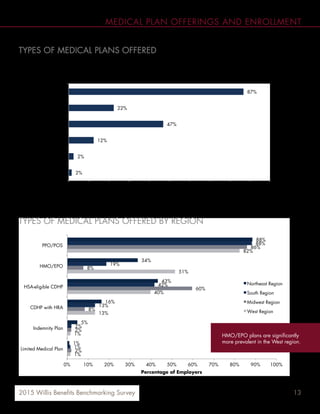
Most respondents (87%) offer a PPO/POS plan. HSA-eligible CDHPs are the second most prevalent medical plans
offered (47%).
TYPES OF MEDICAL PLANS OFFERED BY REGION
87%
22%
47%
12%
2%
2%
0% 10% 20% 30% 40% 50% 60% 70% 80% 90% 100%
PPO/POS
HMO/EPO
HSA-eligible CDHP
CDHP with HRA
Indemnity Plan
Limited Medical Plan
Percentage of Employers
HMO/EPO plans are significantly
more prevalent in the West region.
14 2015 Willis Benefits Benchmarking Survey
MEDICAL PLAN OFFERINGS AND ENROLLMENT
NUMBER OF MEDICAL PLANS OFFERED
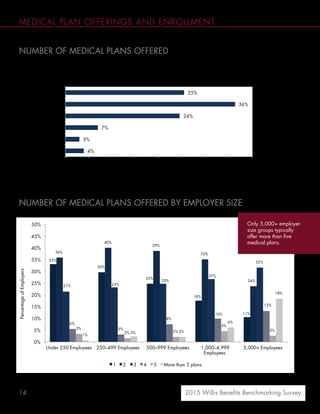
Most employers (85%) offer three medical plans or fewer. More than one-third (36%) of employers offer two medical benefit
plan options.
NUMBER OF MEDICAL PLANS OFFERED BY EMPLOYER SIZE
25%
36%
24%
7%
3%
4%
0% 5% 10% 15% 20% 25% 30% 35% 40%
1
2
3
4
5
More than 5 plans
Percentage of Employers
30%
25%
18%
11%
36%
40%
39%
35%
24%
21% 23%
25%
27%
32%
6%
3%
8%
13%
3%
2% 2%
5%
3%
1%
2% 2%
6%
18%
0%
5%
10%
15%
20%
25%
30%
35%
40%
45%
50%
Under 250 Employees 250–499 Employees 500–999 Employees 1,000–4,999
Employees
5,000+ Employees
PercentageofEmployers
1 2 3 4 5 More than 5 plans
Only 5,000+ employer
size groups typically
offer more than five
medical plans.
33%
10%
152015 Willis Benefits Benchmarking Survey
Fully insured
48%
Self insured
47% Minimum
premium
arrangement
3%
Other
2%
67%
46%
33%
48%
12%
16%
0% 10% 20% 30% 40% 50% 60% 70% 80%
PPO/POS
HMO/EPO
HSA-eligible CDHP
CDHP with HRA
Indemnity Plan
Limited Medical Plan
Percentage of Total Enrolled Employees
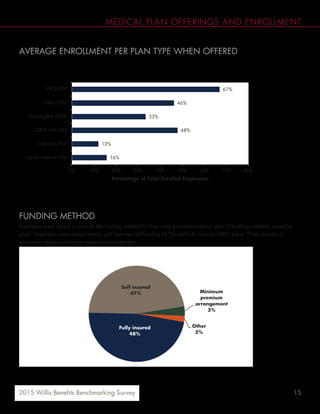
AVERAGE ENROLLMENT PER PLAN TYPE WHEN OFFERED
When offered, average enrollment for PPO/POS plans is 67% of total medical enrollment. While only 22% of
employers offer HMOs, those that do report 46% HMO/EPO enrollment of total medical enrollment.
FUNDING METHOD
Employers were asked to provide the funding method for their most prevalent medical plan (if funding methods varied by
plan). Employers were almost evenly split between self-funding (47%) and fully insured (48%) plans. Three percent of
employers utilize a minimum premium arrangement.
MEDICAL PLAN OFFERINGS AND ENROLLMENT
16 2015 Willis Benefits Benchmarking Survey
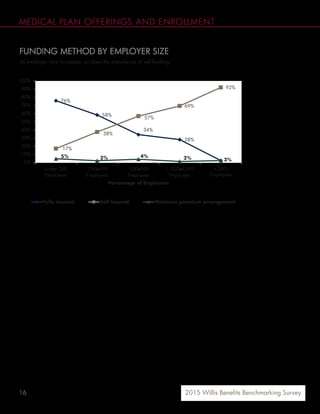
76%
58%
34%
28%
17%
38%
57%
69%
92%
5% 2% 4% 2% 3%
0%
10%
20%
30%
40%
50%
60%
70%
80%
90%
100%
Under 250
Employees
250–499
Employees
500–999
Employees
1,000–4,999
Employees
5,000+
Employees
Percentage of Employers
Fully insured Self insured Minimum premium arrangement
FUNDING METHOD BY EMPLOYER SIZE
As employer size increases, so does the prevalence of self-funding.
MEDICAL PLAN OFFERINGS AND ENROLLMENT
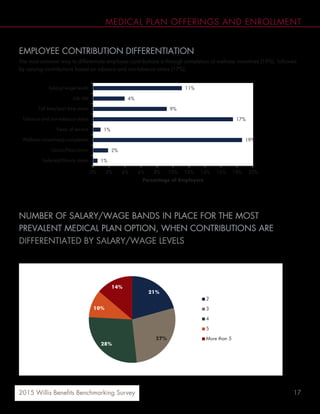
4%
2%
Tobacco and non-tobacco status
Percentage of Employers
The most common way to differentiate employee contributions is through completion of wellness incentives
by varying contributions based on tobacco and non-
S ST
SA
those employers that differentiate employee contributions by sa le the most common number of wage
levels is four (28%) or three (27%).
21%
27%
28%
10%
14%
2
4
5
18 2015 Willis Benefits Benchmarking Survey
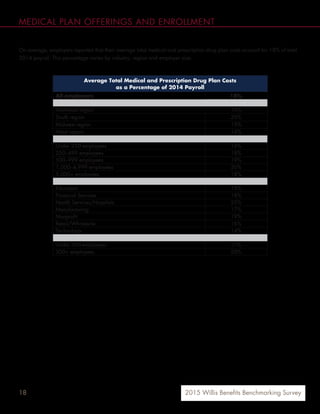
On average, employers reported that their average total medical and prescription drug plan costs account for 18% of total
2014 payroll. This percentage varies by industry, region and employer size.
Average Total Medical and Prescription Drug Plan Costs
as a Percentage of 2014 Payroll
All employers 18%
Northeast region 18%
South region 20%
Midwest region 19%
West region 14%
Under 250 employees 16%
250–499 employees 18%
500–999 employees 19%
1,000–4,999 employees 20%
5,000+ employees 18%
Education 18%
Financial Services 18%
Health Services/Hospitals 25%
Manufacturing 17%
Nonprofit 19%
Retail/Wholesale 16%
Technology 14%
Under 500 employees 17%
500+ employees 20%
MEDICAL PLAN OFFERINGS AND ENROLLMENT
192015 Willis Benefits Benchmarking Survey
$635
$1,874
$503
$1,461
$517
$1,524
$583
$1,720
$153
$575
$129
$549
$123
$433
$157
$641
24%
31%
26%
38%
24%
28%
27%
37%
0%
5%
10%
15%
20%
25%
30%
35%
40%
45%
50%
$0
$200
$400
$600
$800
$1,000
$1,200
$1,400
$1,600
$1,800
$2,000
Individual Family Individual Family Individual Family Individual Family
Northeast Region South Region Midwest Region West Region
Average Monthly Premium Average Monthly Employee Contribution Contribution as a % of Premium
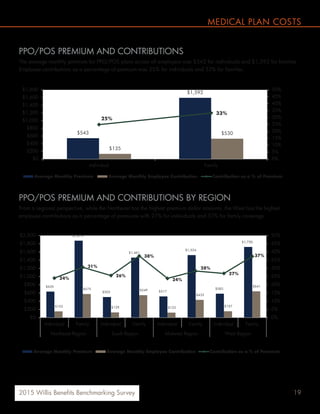
PPO/POS PREMIUM AND CONTRIBUTIONS
The average monthly premium for PPO/POS plans across all employers was $543 for individuals and $1,592 for families.
Employee contributions as a percentage of premium was 25% for individuals and 33% for families.
PPO/POS PREMIUM AND CONTRIBUTIONS BY REGION
From a regional perspective, while the Northeast has the highest premium dollar amounts, the West has the highest
employee contributions as a percentage of premiums with 27% for individuals and 37% for family coverage.
$543
$1,592
$135
$530
25%
33%
0%
5%
10%
15%
20%
25%
30%
35%
40%
45%
50%
$0
$200
$400
$600
$800
$1,000
$1,200
$1,400
$1,600
$1,800
Individual Family
Average Monthly Premium Average Monthly Employee Contribution Contribution as a % of Premium
MEDICAL PLAN COSTS
20 2015 Willis Benefits Benchmarking Survey
$546
$1,584
$539
$1,601
$130
$559
$139
$502
24%
35%
26%
31%
0%
5%
10%
15%
20%
25%
30%
35%
40%
45%
50%
$0
$200
$400
$600
$800
$1,000
$1,200
$1,400
$1,600
$1,800
Individual Family Individual Family
Under 500 employees 500+ employees
Average Monthly Premium Average Monthly Employee Contribution Contribution as a % of Premium
PPO/POS PREMIUM AND CONTRIBUTIONS BY EMPLOYER SIZE
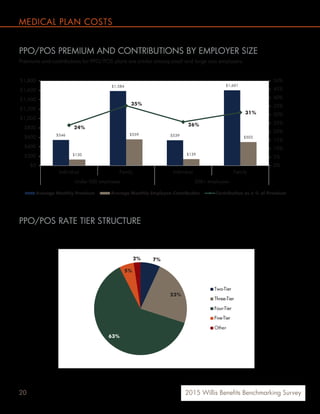
Premiums and contributions for PPO/POS plans are similar among small and large size employers.
PPO/POS RATE TIER STRUCTURE
Nearly two-thirds (63%) of PPO/POS plans have a 4-tier rate structure for their premiums and contributions (Employee only,
Employee + Spouse, Employee + Child(ren), Family).
7%
23%
63%
5%
2%
Two-Tier
Three-Tier
Four-Tier
Five-Tier
Other
MEDICAL PLAN COSTS
212015 Willis Benefits Benchmarking Survey
HMO/EPO PREMIUM AND CONTRIBUTIONS
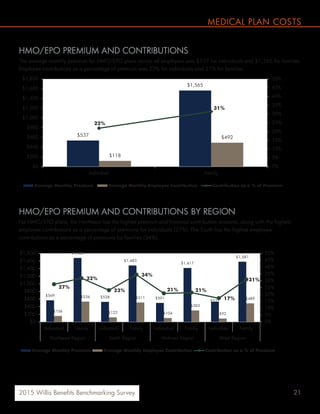
The average monthly premium for HMO/EPO plans across all employers was $537 for individuals and $1,565 for families.
Employee contributions as a percentage of premium was 22% for individuals and 31% for families.
HMO/EPO PREMIUM AND CONTRIBUTIONS BY REGION
For HMO/EPO plans, the Northeast has the highest premium and financial contribution amounts, along with the highest
employee contributions as a percentage of premiums for individuals (27%). The South has the highest employee
contributions as a percentage of premiums for families (34%).
$537
$1,565
$118
$492
22%
31%
0%
5%
10%
15%
20%
25%
30%
35%
40%
45%
50%
$0
$200
$400
$600
$800
$1,000
$1,200
$1,400
$1,600
$1,800
Individual Family
Average Monthly Premium Average Monthly Employee Contribution Contribution as a % of Premium
$569
$1,680
$528
$1,483
$501
$1,417
$531
$1,581
$156
$536
$122
$511
$104
$303
$92
$489
27%
32%
23%
34%
21% 21%
17%
31%
0%
5%
10%
15%
20%
25%
30%
35%
40%
45%
50%
$0
$200
$400
$600
$800
$1,000
$1,200
$1,400
$1,600
$1,800
Individual Family Individual Family Individual Family Individual Family
Northeast Region South Region Midwest Region West Region
Average Monthly Premium Average Monthly Employee Contribution Contribution as a % of Premium
MEDICAL PLAN COSTS
22 2015 Willis Benefits Benchmarking Survey
$562
$1,639
$516
$1,502
$115
$515
$120
$472
20%
31%
23%
31%
0%
5%
10%
15%
20%
25%
30%
35%
40%
45%
50%
$0
$200
$400
$600
$800
$1,000
$1,200
$1,400
$1,600
$1,800
Individual Family Individual Family
Under 500 employees 500+ employees
Average Monthly Premium Average Monthly Employee Contribution Contribution as a % of Premium
8%
25%
61%
4%
1%
Two-Tier
Three-Tier
Four-Tier
Five-Tier
Other
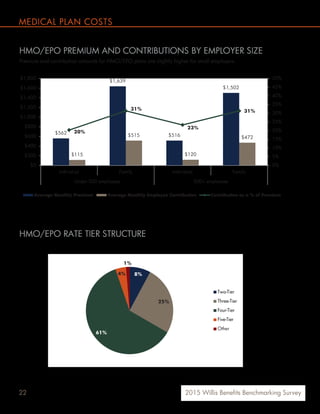
HMO/EPO PREMIUM AND CONTRIBUTIONS BY EMPLOYER SIZE
Premium and contribution amounts for HMO/EPO plans are slightly higher for small employers.
HMO/EPO RATE TIER STRUCTURE
The majority (61%) of HMO/EPO plans have a 4-tier rate structure for their premiums and contributions.
MEDICAL PLAN COSTS
232015 Willis Benefits Benchmarking Survey
$545
$1,514
$431
$1,222
$447
$1,291
$479
$1,394
$93
$378
$82
$345
$90
$323
$97
$41417%
25%
19%
28%
20%
25%
20%
30%
0%
5%
10%
15%
20%
25%
30%
35%
40%
45%
50%
$0
$200
$400
$600
$800
$1,000
$1,200
$1,400
$1,600
Individual Family Individual Family Individual Family Individual Family
Northeast Region South Region Midwest Region West Region
Average Monthly Premium Average Monthly Employee Contribution Contribution as a % of Premium
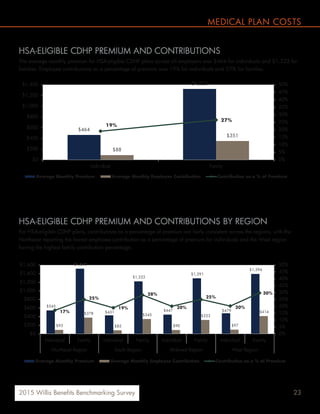
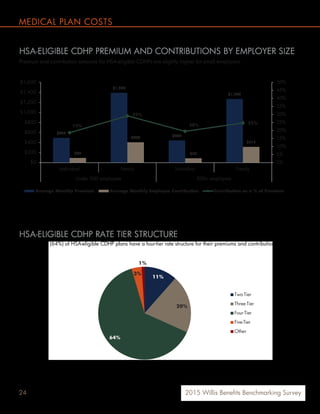
HSA-ELIGIBLE CDHP PREMIUM AND CONTRIBUTIONS
The average monthly premium for HSA-eligible CDHP plans across all employers was $464 for individuals and $1,323 for
families. Employee contributions as a percentage of premium was 19% for individuals and 27% for families.
HSA-ELIGIBLE CDHP PREMIUM AND CONTRIBUTIONS BY REGION
For HSA-eligible CDHP plans, contributions as a percentage of premium are fairly consistent across the regions, with the
Northeast reporting the lowest employee contribution as a percentage of premium for individuals and the West region
having the highest family contribution percentage.
$464
$1,323
$88
$351
19%
27%
0%
5%
10%
15%
20%
25%
30%
35%
40%
45%
50%
$0
$200
$400
$600
$800
$1,000
$1,200
$1,400
Individual Family
Average Monthly Premium Average Monthly Employee Contribution Contribution as a % of Premium
MEDICAL PLAN COSTS
24 2015 Willis Benefits Benchmarking Survey
$493
$1,390
$440
$1,268
$92
$404
$86
$313
19%
29%
20% 25%
0%
5%
10%
15%
20%
25%
30%
35%
40%
45%
50%
$0
$200
$400
$600
$800
$1,000
$1,200
$1,400
$1,600
Individual Family Individual Family
Under 500 employees 500+ employees
Average Monthly Premium Average Monthly Employee Contribution Contribution as a % of Premium
11%
20%
64%
3%
1%
Two-Tier
Three-Tier
Four-Tier
Five-Tier
Other
HSA-ELIGIBLE CDHP PREMIUM AND CONTRIBUTIONS BY EMPLOYER SIZE
Premium and contribution amounts for HSA-eligible CDHPs are slightly higher for small employers.
HSA-ELIGIBLE CDHP RATE TIER STRUCTURE
MEDICAL PLAN COSTS
The majority (64%) of HSA-eligible CDHP plans have a four-tier rate structure for their premiums and contributions.
252015 Willis Benefits Benchmarking Survey
MEDICAL PLAN COSTS
$511
$1,453
$106
$416
21%
29%
0%
5%
10%
15%
20%
25%
30%
35%
40%
45%
50%
$0
$200
$400
$600
$800
$1,000
$1,200
$1,400
$1,600
Individual Family
Average Monthly Premium Average Monthly Employee Contribution Contribution as a % of Premium
$518
$1,447
$508
$1,456
$101
$500
$108
$379
20%
35%
21% 26%
0%
5%
10%
15%
20%
25%
30%
35%
40%
45%
50%
$0
$200
$400
$600
$800
$1,000
$1,200
$1,400
$1,600
Individual Family Individual Family
Under 500 employees 500+ employees
Average Monthly Premium Average Monthly Employee Contribution Contribution as a % of Premium
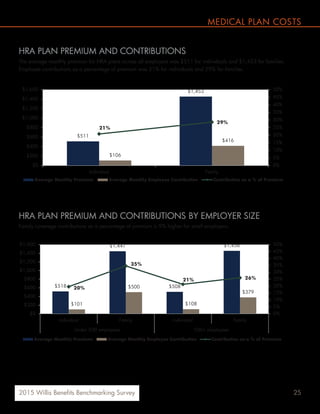
HRA PLAN PREMIUM AND CONTRIBUTIONS
The average monthly premium for HRA plans across all employers was $511 for individuals and $1,453 for families.
Employee contributions as a percentage of premium was 21% for individuals and 29% for families.
HRA PLAN PREMIUM AND CONTRIBUTIONS BY EMPLOYER SIZE
Family coverage contributions as a percentage of premium is 9% higher for small employers.
26
10%
18%
67%
4%
1%
Two-Tier
Three-Tier
-Tier
-Tier
H
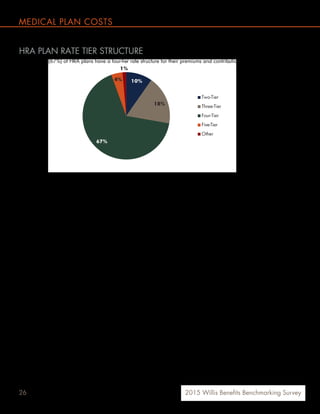
The majority (67%) of HRA plans have a four-tier rate structure for their premiums and contributions.
272015 Willis Benefits Benchmarking Survey
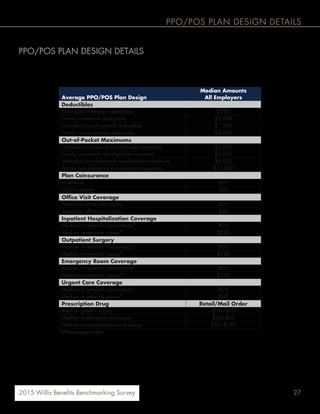
PPO/POS PLAN DESIGN DETAILS
PPO/POS plans remain the most prevalent medical plan type offering: 466 employers provided information for
673 PPO/POS plans.
Average PPO/POS Plan Design
Median Amounts
All Employers
Deductibles
Individual in-network deductible $750
Family in-network deductible $2,000
Individual out-of-network deductible $1,500
Family out-of-network deductible $4,000
Out-of-Pocket Maximums
Individual in-network out-of-pocket maximum $3,000
Family in-network out-of-pocket maximum $6,000
Individual out-of-network out-of-pocket maximum $6,000
Family out-of-network out-of-pocket maximum $12,000
Plan Coinsurance
In-network 80%
Out-of-network 60%
Office Visit Coverage
Physician office visit copay $25
Specialist office visit copay $40
Inpatient Hospitalization Coverage
Median in-network coinsurance* 80%
Median in-network copay* $250
Outpatient Surgery
Median in-network coinsurance* 80%
Median in-network copay* $150
Emergency Room Coverage
Median in-network coinsurance* 80%
Median in-network copay* $150
Urgent Care Coverage
Median in-network coinsurance* 80%
Median in-network copay* $40
Prescription Drug Retail/Mail Order
Median generic copay $10/$20
Median preferred brand copay $30/$60
Median non-preferred brand copay $50/$120
*Where applicable
28 2015 Willis Benefits Benchmarking Survey
PPO/POS PLAN DESIGN DETAILS
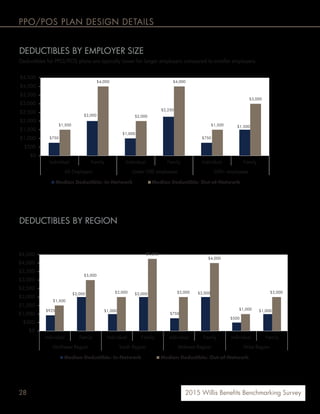
DEDUCTIBLES BY EMPLOYER SIZE
Deductibles for PPO/POS plans are typically lower for larger employers compared to smaller employers.
DEDUCTIBLES BY REGION
The South region reported the highest deductibles both in- and out-of-network for PPO/POS plans, with amounts twice
as high as those being reported for the West region.
$925
$2,000
$1,000
$2,000
$750
$2,000
$500
$1,000
$1,500
$3,000
$2,000
$4,250
$2,000
$4,000
$1,000
$2,000
$0
$500
$1,000
$1,500
$2,000
$2,500
$3,000
$3,500
$4,000
$4,500
Individual Family Individual Family Individual Family Individual Family
Northeast Region South Region Midwest Region West Region
Median Deductible: In-Network Median Deductible: Out-of-Network
$750
$2,000
$1,000
$2,250
$750
$1,500$1,500
$4,000
$2,000
$4,000
$1,500
$3,000
$0
$500
$1,000
$1,500
$2,000
$2,500
$3,000
$3,500
$4,000
$4,500
Individual Family Individual Family Individual Family
All Employers Under 500 employees 500+ employees
Median Deductible: In-Network Median Deductible: Out-of-Network
292015 Willis Benefits Benchmarking Survey
PPO/POS PLAN DESIGN DETAILS
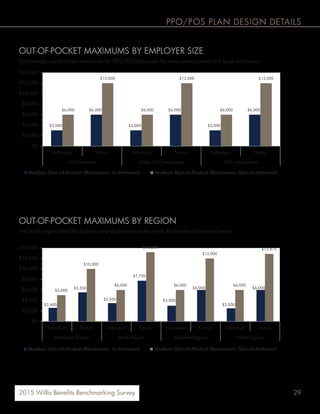
OUT-OF-POCKET MAXIMUMS BY EMPLOYER SIZE
On average, out-of-pocket maximums for PPO/POS plans are the same among small and large employers.
OUT-OF-POCKET MAXIMUMS BY REGION
The South region cited the highest out-of-pocket maximums while the Northeast had the lowest.
$2,600
$5,550
$3,500
$7,750
$3,000
$6,000
$2,500
$6,000
$5,000
$10,000
$6,000
$13,200
$6,000
$12,000
$6,000
$12,875
$0
$2,000
$4,000
$6,000
$8,000
$10,000
$12,000
$14,000
Individual Family Individual Family Individual Family Individual Family
Northeast Region South Region Midwest Region West Region
Median Out-of-Pocket Maximum: In-Network Median Out-of-Pocket Maximum: Out-of-Network
$3,000
$6,000
$3,000
$6,000
$3,000
$6,000$6,000
$12,000
$6,000
$12,000
$6,000
$12,000
$0
$2,000
$4,000
$6,000
$8,000
$10,000
$12,000
$14,000
Individual Family Individual Family Individual Family
All Employers Under 500 employees 500+ employees
Median Out-of-Pocket Maximum: In-Network Median Out-of-Pocket Maximum: Out-of-Network
30
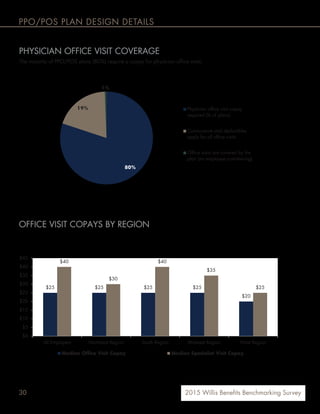
oss p o visit is s visit is
so th sp visit
80%
19%
1%
Median Office Visit Copay Median Specialist Visit Copay
312015 Willis Benefits Benchmarking Survey
PPO/POS PLAN DESIGN DETAILS
68%
9%
4%
2%
9%
2%
4%
1%
71%
8%
10%
4%
3%
0%
1%
4%
0% 20% 40% 60% 80%
Coinsurance applies at the same level
as the overall plan coinsurance
The plan charges a dollar amount per stay and coinsurance
applies at the same level as the overall plan coinsurance
Coinsurance applies at a different level
than the overall plan coinsurance
The plan charges a dollar amount per stay and coinsurance
applies at a different level as the overall plan coinsurance
The plan charges a dollar amount per stay
The plan charges a dollar amount per
stay up to a maximum number of days
There is no employee cost-sharing for this coverage
Not covered
Percentage of Plans
In-Network
Out-of-Network
71%
5%
3%
1%
11%
6%
1%
75%
5%
10%
3%
2%
1%
4%
0% 20% 40% 60% 80%
Coinsurance applies at the same level
as the overall plan coinsurance
The plan charges a dollar amount per visit and coinsurance
applies at the same level as the overall plan coinsurance
Coinsurance applies at a different level
than the overall plan coinsurance
The plan charges a dollar amount per visit
There is no employee cost-sharing for this coverage
Not covered
Percentage of Plans
In-Network
Out-of-Network
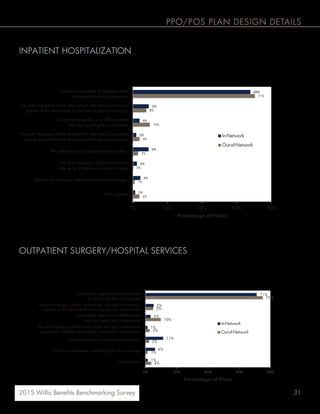
INPATIENT HOSPITALIZATION
Most PPO/POS plans apply coinsurance for inpatient hospitalization coverage at the same level as the overall plan
coinsurance for both in-network (68%) and out-of-network (71%). When copays are required, the median in-network amount
is $250.
OUTPATIENT SURGERY/HOSPITAL SERVICES
The majority of PPO/POS plans apply coinsurance for outpatient surgery/hospital services at the same level as the overall
plan coinsurance, both in-network (71%) and out-of-network (75%). When copays are required, the median in-network
amount is $150.
The plan charges a dollar amount per visit and coinsurance
applies at a different level as the overall plan coinsurance
32 2015 Willis Benefits Benchmarking Survey
PPO/POS PLAN DESIGN DETAILS
60%
34%
4%
2%
1%
22%
60%
13%
1%
4%
0% 20% 40% 60% 80%
The plan charges a dollar amount per visit
Coinsurance applies at the same level
as the overall plan coinsurance
Coinsurance applies at a different level
than the overall plan coinsurance
There is no employee cost-sharing for this coverage
Not covered
Percentage of Plans
In-Network
Out-of-Network
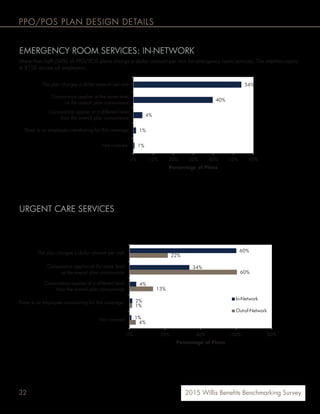
EMERGENCY ROOM SERVICES: IN-NETWORK
More than half (54%) of PPO/POS plans charge a dollar amount per visit for emergency room services. The median copay
is $150 across all employers.
URGENT CARE SERVICES
Sixty percent of PPO/POS plans charge a dollar amount for in-network urgent care services with a median copay of $40.
For out-of-network coverage, 60% of plans apply coinsurance at the same level as the overall plan coinsurance.
54%
40%
4%
1%
1%
0% 10% 20% 30% 40% 50% 60%
The plan charges a dollar amount per visit
Coinsurance applies at the same level
as the overall plan coinsurance
Coinsurance applies at a different level
than the overall plan coinsurance
There is no employee cost-sharing for this coverage
Not covered
Percentage of Plans
33
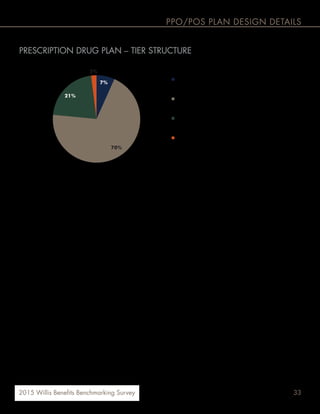
7%
70%
21%
2%
r
t s h th p d pl
34 2015 Willis Benefits Benchmarking Survey
PPO/POS PLAN DESIGN DETAILS
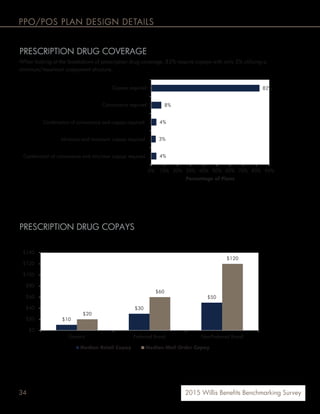
PRESCRIPTION DRUG COVERAGE
When looking at the breakdown of prescription drug coverage, 82% require copays with only 3% utilizing a
minimum/maximum copayment structure.
PRESCRIPTION DRUG COPAYS
Where copays are required (in any combination), the median copays for 3-tier plans are as follows:
82%
8%
4%
3%
4%
0% 10% 20% 30% 40% 50% 60% 70% 80% 90%
Copays required
Coinsurance required
Combination of coinsurance and copays required
Minimum and maximum copays required
Combination of coinsurance and min/max copays required
Percentage of Plans
$10
$30
$50
$20
$60
$120
$0
$20
$40
$60
$80
$100
$120
$140
Generic Preferred Brand Non-Preferred Brand
Median Retail Copay Median Mail Order Copay
352015 Willis Benefits Benchmarking Survey
PPO/POS PLAN DESIGN DETAILS
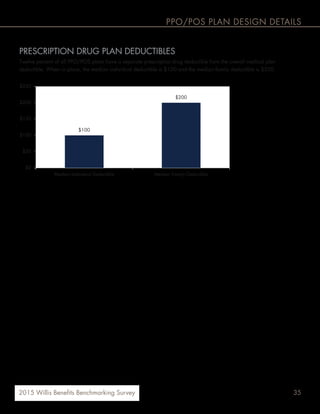
PRESCRIPTION DRUG PLAN DEDUCTIBLES
Twelve percent of all PPO/POS plans have a separate prescription drug deductible from the overall medical plan
deductible. When in place, the median individual deductible is $100 and the median family deductible is $200.
$100
$200
$0
$50
$100
$150
$200
$250
Median Individual Deductible Median Family Deductible
36 2015 Willis Benefits Benchmarking Survey
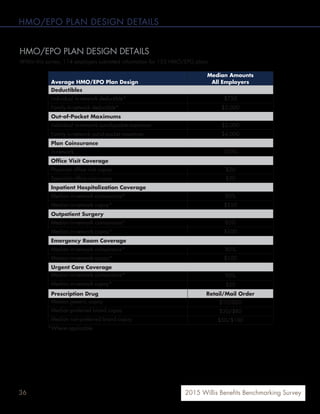
HMO/EPO PLAN DESIGN DETAILS
Within this survey, 114 employers submitted information for 153 HMO/EPO plans.
Average HMO/EPO Plan Design
Median Amounts
All Employers
Deductibles
Individual in-network deductible* $750
Family in-network deductible* $2,000
Out-of-Pocket Maximums
Individual in-network out-of-pocket maximum $2,000
Family in-network out-of-pocket maximum $4,000
Plan Coinsurance
In-network 100%
Office Visit Coverage
Physician office visit copay $20
Specialist office visit copay $30
Inpatient Hospitalization Coverage
Median in-network coinsurance* 80%
Median in-network copay* $250
Outpatient Surgery
Median in-network coinsurance* 85%
Median in-network copay* $100
Emergency Room Coverage
Median in-network coinsurance* 80%
Median in-network copay* $100
Urgent Care Coverage
Median in-network coinsurance* 90%
Median in-network copay* $30
Prescription Drug Retail/Mail Order
Median generic copay $10/$20
Median preferred brand copay $30/$80
Median non-preferred brand copay $50/$100
*Where applicable
372015 Willis Benefits Benchmarking Survey
HMO/EPO PLAN DESIGN DETAILS
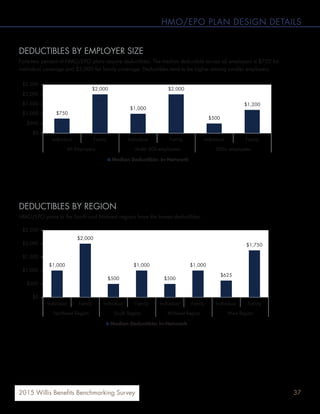
DEDUCTIBLES BY EMPLOYER SIZE
Forty-two percent of HMO/EPO plans require deductibles. The median deductible across all employers is $750 for
individual coverage and $2,000 for family coverage. Deductibles tend to be higher among smaller employers.
DEDUCTIBLES BY REGION
HMO/EPO plans in the South and Midwest regions have the lowest deductibles.
$750
$2,000
$1,000
$2,000
$500
$1,200
$0
$500
$1,000
$1,500
$2,000
$2,500
Individual Family Individual Family Individual Family
All Employers Under 500 employees 500+ employees
Median Deductible: In-Network
$1,000
$2,000
$500
$1,000
$500
$1,000
$625
$1,750
$0
$500
$1,000
$1,500
$2,000
$2,500
Individual Family Individual Family Individual Family Individual Family
Northeast Region South Region Midwest Region West Region
Median Deductible: In-Network
38 2015 Willis Benefits Benchmarking Survey
HMO/EPO PLAN DESIGN DETAILS
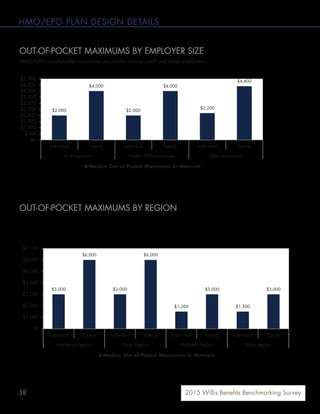
OUT-OF-POCKET MAXIMUMS BY EMPLOYER SIZE
HMO/EPO out-of-pocket maximums are similar among small and large employers.
OUT-OF-POCKET MAXIMUMS BY REGION
HMO/EPO plans in the West and Midwest regions have the lowest out-of-pocket maximums.
$3,000
$6,000
$3,000
$6,000
$1,500
$3,000
$1,500
$3,000
$0
$1,000
$2,000
$3,000
$4,000
$5,000
$6,000
$7,000
Individual Family Individual Family Individual Family Individual Family
Northeast Region South Region Midwest Region West Region
Median Out-of-Pocket Maximum: In-Network
$2,000
$4,000
$2,000
$4,000
$2,200
$4,400
$0
$500
$1,000
$1,500
$2,000
$2,500
$3,000
$3,500
$4,000
$4,500
$5,000
Individual Family Individual Family Individual Family
All Employers Under 500 employees 500+ employees
Median Out-of-Pocket Maximum: In-Network
392015 Willis Benefits Benchmarking Survey
HMO/EPO PLAN DESIGN DETAILS
PHYSICIAN OFFICE VISIT COVERAGE
OFFICE VISIT COPAY
Across all employers, the median physician office visit copay is $20, and the median specialist visit is $30. The West
region has the lowest copays for both physician and specialist office visits.
95%
3%2%
Physician visit copay required (% of plans)
Coinsurance and deductibles apply for all
office visits
Office visits are covered by the plan (there
is no employee cost-sharing for this
coverage)
$20
$25
$20 $20
$40
$35
$25
$20
$0
$5
$10
$15
$20
$25
$30
$35
$40
$45
$50
Northeast Region South Region Midwest Region West Region
Median Office Visit Copay Median Specialist Visit Copay
PHYSICIAN OFFICE VISIT COVERAGE
OFFICE VISIT COPAYS BY REGION
Across all employers, the median physician office visit copay is $20, and the median specialist visit is $30. The West
region has the lowest copays for both physician and specialist office visits.
[VALUE]
3%2%
Physician Visit Copay Required (% of plans)
Coinsurance and deductibles apply for all
office visits
Office visits are covered by the plan (there is
no employee cost-sharing for this coverage)
$20 $20
$25
$20 20
$30
$40
$35
$25
$20
$0
$5
$10
$15
$20
$25
$30
$35
$40
$45
$50
All Employers Northeast Region South Region Midwest Region West Region
Median Office Visit Copay Median Specialist Visit Copay
The majority of HMO/EPO plans (95%) require a copay for physician office visits.
40 2015 Willis Benefits Benchmarking Survey
HMO/EPO PLAN DESIGN DETAILS
23%
9%
3%
1%
46%
4%
14%
0%
0% 10% 20% 30% 40% 50%
Coinsurance applies at the same level as the overall plan coinsurance
The plan charges a dollar amount per stay and coinsurance
applies at the same level as the overall plan coinsurance
Coinsurance applies at a different level than the overall plan coinsurance
The plan charges a dollar amount per stay and coinsurance
applies at a different level as the overall plan coinsurance
The plan charges a dollar amount per stay
The plan charges a dollar amount per stay up to a maximum number of days
There is no employee cost-sharing for this coverage
Not covered
Percentage of Plans
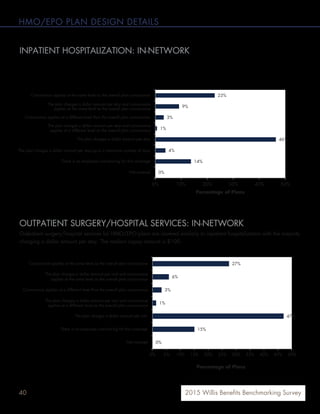
INPATIENT HOSPITALIZATION: IN-NETWORK
Nearly half (46%) of HMO/EPO plans charge a dollar amount per stay only for inpatient hospitalization, and an additional
9% charge a copay along with coinsurance. Four percent charge a dollar amount per stay up to a maximum number of
days. The median copay amount is $250.
OUTPATIENT SURGERY/HOSPITAL SERVICES: IN-NETWORK
Outpatient surgery/hospital services for HMO/EPO plans are covered similarly to inpatient hospitalization with the majority
charging a dollar amount per stay. The median copay amount is $100.
27%
6%
3%
1%
47%
15%
0%
0% 5% 10% 15% 20% 25% 30% 35% 40% 45% 50%
Coinsurance applies at the same level as the overall plan coinsurance
The plan charges a dollar amount per visit and coinsurance
applies at the same level as the overall plan coinsurance
Coinsurance applies at a different level than the overall plan coinsurance
The plan charges a dollar amount per visit
There is no employee cost-sharing for this coverage
Not covered
Percentage of Plans
The plan charges a dollar amount per visit and coinsurance
applies at a different level as the overall plan coinsurance
412015 Willis Benefits Benchmarking Survey
HMO/EPO PLAN DESIGN DETAILS
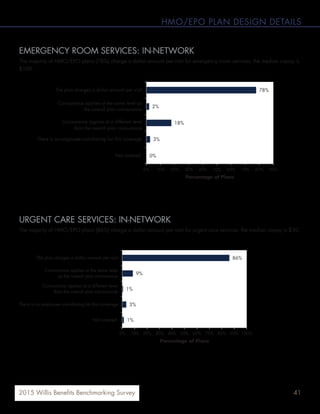
EMERGENCY ROOM SERVICES: IN-NETWORK
The majority of HMO/EPO plans (78%) charge a dollar amount per visit for emergency room services; the median copay is
$100.
URGENT CARE SERVICES: IN-NETWORK
The majority of HMO/EPO plans (86%) charge a dollar amount per visit for urgent care services; the median copay is $30.
86%
9%
1%
3%
1%
0% 10% 20% 30% 40% 50% 60% 70% 80% 90% 100%
The plan charges a dollar amount per visit
Coinsurance applies at the same level
as the overall plan coinsurance
Coinsurance applies at a different level
than the overall plan coinsurance
There is no employee cost-sharing for this coverage
Not covered
Percentage of Plans
78%
2%
18%
3%
0%
0% 10% 20% 30% 40% 50% 60% 70% 80% 90%
The plan charges a dollar amount per visit
Coinsurance applies at the same level as
the overall plan coinsurance
Coinsurance applies at a different level
than the overall plan coinsurance
There is no employee cost-sharing for this coverage
Not covered
Percentage of Plans
42 2015 Willis Benefits Benchmarking Survey
HMO/EPO PLAN DESIGN DETAILS
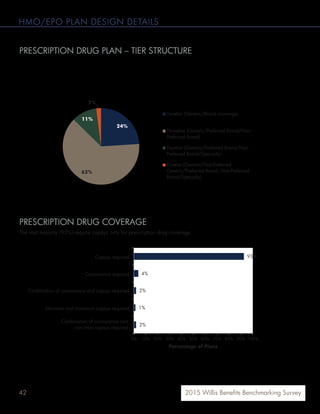
PRESCRIPTION DRUG PLAN – TIER STRUCTURE
The majority (63%) of HMO/EPO plans have a three-tier structure, though nearly a quarter (24%) have a two tier structure
with just generic and brand coverage.
PRESCRIPTION DRUG COVERAGE
The vast majority (93%) require copays only for prescription drug coverage.
24%
63%
11%
2%
Two-tier (Generic/Brand coverage)
Three-tier (Generic/Preferred Brand/Non-
Preferred Brand)
Four-tier (Generic/Preferred Brand/Non-
Preferred Brand/Specialty)
Five-tier (Generic/Non-Preferred
Generic/Preferred Brand, Non-Preferred
Brand/Specialty)
93%
4%
2%
1%
2%
0% 10% 20% 30% 40% 50% 60% 70% 80% 90% 100%
Copays required
Coinsurance required
Combination of coinsurance and copays required
Minimum and maximum copays required
Combination of coinsurance and
min/max copays required
Percentage of Plans
432015 Willis Benefits Benchmarking Survey
HMO/EPO PLAN DESIGN DETAILS
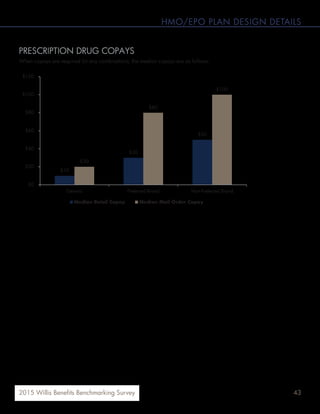
PRESCRIPTION DRUG COPAYS
When copays are required (in any combination), the median copays are as follows:
$10
$30
$50
$20
$80
$100
$0
$20
$40
$60
$80
$100
$120
Generic Preferred Brand Non-Preferred Brand
Median Retail Copay Median Mail Order Copay
44 2015 Willis Benefits Benchmarking Survey
HSA-ELIGIBLE CDHP PLAN DESIGN DETAILS
HSA-eligible CDHPs are the most prevalent plan type offering after PPO/POS plans. Within this survey, 245 employers
submitted information for 294 HSA-eligible plans.
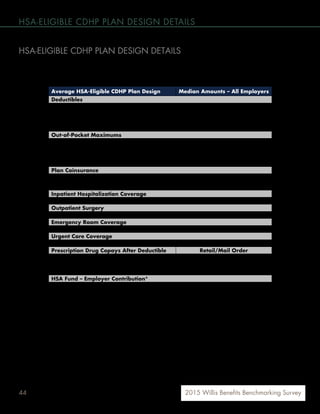
Average HSA-Eligible CDHP Plan Design Median Amounts – All Employers
Deductibles
Individual in-network deductible $2,100
Family in-network deductible $4,500
Individual out-of-network deductible $4,000
Family out-of-network deductible $8,000
Out-of-Pocket Maximums
Individual in-network out-of-pocket maximum $3,900
Family in-network out-of-pocket maximum $8,000
Individual out-of-network out-of-pocket maximum $8,000
Family out-of-network out-of-pocket maximum $16,000
Plan Coinsurance
In-network 90%
Out-of-network 60%
Inpatient Hospitalization Coverage
Median in-network coinsurance* 90%
Outpatient Surgery
Median in-network coinsurance* 90%
Emergency Room Coverage
Median in-network coinsurance* 90%
Urgent Care Coverage
Median in-network coinsurance* 90%
Prescription Drug Copays After Deductible Retail/Mail Order
Median generic copay $10/$24
Median preferred brand copay $30/$60
Median non-preferred brand copay $50/$110
HSA Fund – Employer Contribution*
Individual $600
Family $1,000
*Where applicable
452015 Willis Benefits Benchmarking Survey
HSA-ELIGIBLE CDHP PLAN DESIGN DETAILS
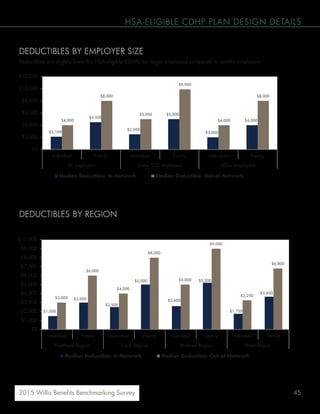
DEDUCTIBLES BY EMPLOYER SIZE
Deductibles are slightly lower for HSA-eligible CDHPs for larger employers compared to smaller employers.
DEDUCTIBLES BY REGION
The Midwest region reported the highest deductibles both in- and out-of-network for HSA-eligible CDHPs.
$1,500
$3,000
$2,500
$5,000
$2,600
$5,200
$1,750
$3,650
$3,000
$6,000
$4,000
$8,000
$5,000
$9,000
$3,250
$6,800
$0
$1,000
$2,000
$3,000
$4,000
$5,000
$6,000
$7,000
$8,000
$9,000
$10,000
Individual Family Individual Family Individual Family Individual Family
Northeast Region South Region Midwest Region West Region
Median Deductible: In-Network Median Deductible: Out-of-Network
$2,100
$4,500
$2,500
$5,000
$2,000
$4,000$4,000
$8,000
$5,000
$9,900
$4,000
$8,000
$0
$2,000
$4,000
$6,000
$8,000
$10,000
$12,000
Individual Family Individual Family Individual Family
All Employers Under 500 employees 500+ employees
Median Deductible: In-Network Median Deductible: Out-of-Network
46 2015 Willis Benefits Benchmarking Survey
HSA-ELIGIBLE CDHP PLAN DESIGN DETAILS
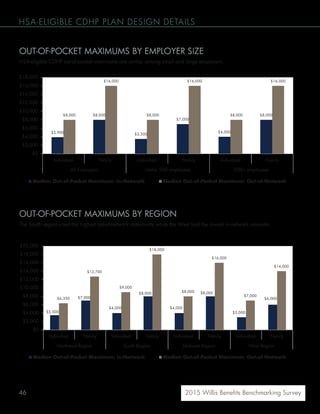
OUT-OF-POCKET MAXIMUMS BY EMPLOYER SIZE
HSA-eligible CDHP out-of-pocket maximums are similar among small and large employers.
OUT-OF-POCKET MAXIMUMS BY REGION
The South region cited the highest out-of-network maximums while the West had the lowest in-network amounts.
$3,500
$7,000
$4,000
$8,000
$4,000
$8,000
$3,000
$6,000$6,350
$12,700
$9,000
$18,000
$8,000
$16,000
$7,000
$14,000
$0
$2,000
$4,000
$6,000
$8,000
$10,000
$12,000
$14,000
$16,000
$18,000
$20,000
Individual Family Individual Family Individual Family Individual Family
Northeast Region South Region Midwest Region West Region
Median Out-of-Pocket Maximum: In-Network Median Out-of-Pocket Maximum: Out-of-Network
$3,900
$8,000
$3,500
$7,000
$4,000
$8,000$8,000
$16,000
$8,000
$16,000
$8,000
$16,000
$0
$2,000
$4,000
$6,000
$8,000
$10,000
$12,000
$14,000
$16,000
$18,000
Individual Family Individual Family Individual Family
All Employers Under 500 employees 500+ employees
Median Out-of-Pocket Maximum: In-Network Median Out-of-Pocket Maximum: Out-of-Network
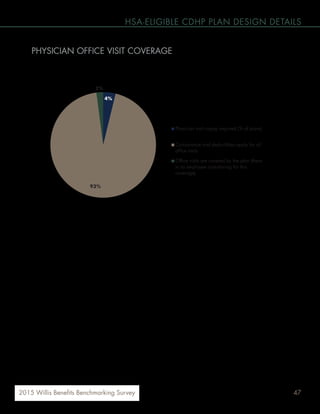
The majority of H -eli plans ( %) require a and d for physician
office visits.
4%
93%
2%
Physician visit copay required (% of plans)
office visits
48 2015 Willis Benefits Benchmarking Survey
HSA-ELIGIBLE CDHP PLAN DESIGN DETAILS
88%
2%
2%
1%
2%
0%
5%
1%
84%
2%
7%
0%
1%
0%
3%
2%
0% 10% 20% 30% 40% 50% 60% 70% 80% 90% 100%
Coinsurance applies at the same level
as the overall plan coinsurance
The plan charges a dollar amount per stay and coinsurance
applies at the same level as the overall plan coinsurance
Coinsurance applies at a different level than
the overall plan coinsurance
The plan charges a dollar amount per stay and coinsurance
applies at a different level as the overall plan coinsurance
The plan charges a dollar amount per stay
The plan charges a dollar amount per stay up to a
maximum number of days
There is no employee cost-sharing for this coverage
Not covered
Percentage of Plans
In-Network
Out-of-Network
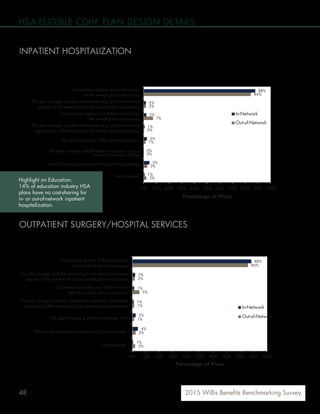
INPATIENT HOSPITALIZATION
Most HSA-eligible CDHPs plans apply coinsurance for inpatient hospitalization coverage at the same level as the overall
plan coinsurance, both in-network (88%) and out-of-network (84%).
OUTPATIENT SURGERY/HOSPITAL SERVICES
The majority of HSA-eligible CDHP plans apply coinsurance for outpatient surgery/hospital services at the same level as
the overall plan coinsurance, both in-network (88%) and out-of-network (86%).
88%
2%
1%
1%
2%
4%
1%
86%
2%
5%
1%
1%
2%
2%
0% 10% 20% 30% 40% 50% 60% 70% 80% 90% 100%
Coinsurance applies at the same level
as the overall plan coinsurance
The plan charges a dollar amount per visit and coinsurance
applies at the same level as the overall plan coinsurance
Coinsurance applies at a different level
than the overall plan coinsurance
The plan charges a dollar amount per visit and coinsurance
applies at a different level as the overall plan coinsurance
The plan charges a dollar amount per visit
There is no employee cost-sharing for this coverage
Percentage of Plans
In-Network
Out-of-Network
Highlight on Education:
14% of education industry HSA
plans have no cost-sharing for
in- or out-of-network inpatient
hospitalization.
Not covered
492015 Willis Benefits Benchmarking Survey
HSA-ELIGIBLE CDHP PLAN DESIGN DETAILS
6%
84%
5%
4%
1%
0% 10% 20% 30% 40% 50% 60% 70% 80% 90%
The plan charges a dollar amount per visit
Coinsurance applies at the same level
as the overall plan coinsurance
There is no employee cost-sharing for this coverage
Not covered
Percentage of Plans
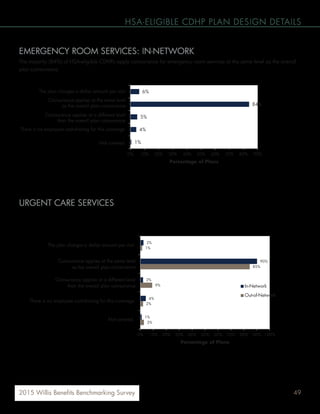
EMERGENCY ROOM SERVICES: IN-NETWORK
The majority (84%) of HSA-eligible CDHPs apply coinsurance for emergency room services at the same level as the overall
plan coinsurance.
URGENT CARE SERVICES
Most HSA-eligible CDHP plans apply coinsurance for urgent care services at the same level as the overall plan
coinsurance, both in-network (90%) and out-of-network (85%).
2%
90%
2%
4%
1%
1%
85%
9%
2%
3%
0% 10% 20% 30% 40% 50% 60% 70% 80% 90% 100%
The plan charges a dollar amount per visit
Coinsurance applies at the same level
as the overall plan coinsurance
Coinsurance applies at a different level
than the overall plan coinsurance
There is no employee cost-sharing for this coverage
Not covered
Percentage of Plans
In-Network
Out-of-Network
Coinsurance applies at a different level
than the overall plan coinsurance
50 2015 Willis Benefits Benchmarking Survey
HSA-ELIGIBLE CDHP PLAN DESIGN DETAILS
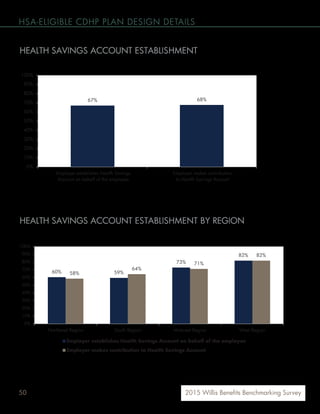
HEALTH SAVINGS ACCOUNT ESTABLISHMENT
Just over two-thirds of employers make contributions to employees’ Health Savings Accounts.
HEALTH SAVINGS ACCOUNT ESTABLISHMENT BY REGION
More employers in the West region make contributions to employees’ Health Savings Accounts than any other region.
60% 59%
73%
82%
58%
64%
71%
82%
0%
10%
20%
30%
40%
50%
60%
70%
80%
90%
100%
Northeast Region South Region Midwest Region West Region
Employer establishes Health Savings Account on behalf of the employee
Employer makes contribution to Health Savings Account
67% 68%
0%
10%
20%
30%
40%
50%
60%
70%
80%
90%
100%
Employer establishes Health Savings
Account on behalf of the employee
Employer makes contribution
to Health Savings Account
512015 Willis Benefits Benchmarking Survey
HSA-ELIGIBLE CDHP PLAN DESIGN DETAILS
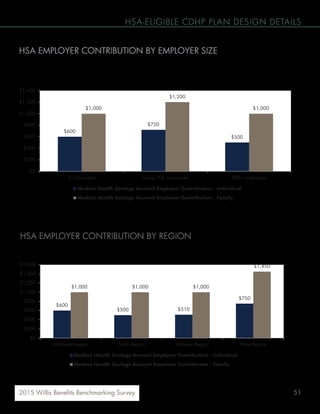
HSA EMPLOYER CONTRIBUTION BY EMPLOYER SIZE
The median contribution to health savings accounts by employers is $600 for individuals and $1,000 for family coverage.
Smaller employers make slightly higher account contributions than large employers.
$600
$720
$500
$1,000
$1,200
$1,000
$0
$200
$400
$600
$800
$1,000
$1,200
$1,400
All Employers Under 500 employees 500+ employees
Median Health Savings Account Employer Contribution - Individual
Median Health Savings Account Employer Contribution - Family
$600
$500 $510
$750
$1,000 $1,000 $1,000
$1,450
$0
$200
$400
$600
$800
$1,000
$1,200
$1,400
$1,600
Northeast Region South Region Midwest Region West Region
HSA EMPLOYER CONTRIBUTION BY REGION
Median Health Savings Account Employer Contribution - Individual
Median Health Savings Account Employer Contribution - Family
The West region reported the highest employer contribution amounts.
52
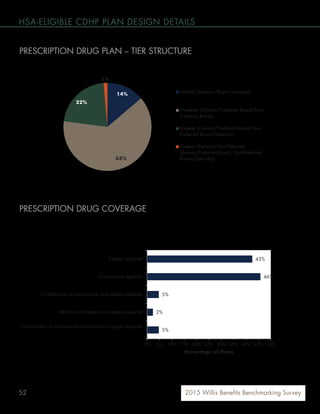
st SA-eligible %) have a three-tier prescription drug plan.
arly half (4 of prescription drug plans for -eligible e coinsurance only after the deductible while
ire copays only the remaining r a combination of c a minimum and
maximum copays.
5%
2%
5%
of coinsurance an copays
Percentage of Plans
14%
63%
22%
1%
Two-tier coverage)
Three-tier
ferred rand)
Four-
)
Five-tier (
n
532015 Willis Benefits Benchmarking Survey
HSA-ELIGIBLE CDHP PLAN DESIGN DETAILS
PRESCRIPTION DRUG COPAYS
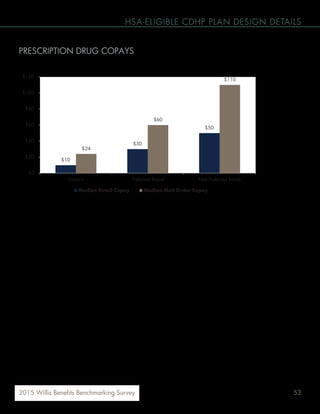
When copays are required (in any combination), the median copays for three-tier plans are as follows:
$10
$30
$50
$24
$60
$110
$0
$20
$40
$60
$80
$100
$120
Generic Preferred Brand Non-Preferred Brand
Median Retail Copay Median Mail Order Copay
54 2015 Willis Benefits Benchmarking Survey
CDHP with HRA PLAN DESIGN DETAILS
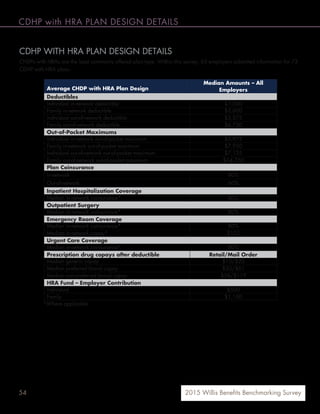
CDHP WITH HRA PLAN DESIGN DETAILS
CHDPs with HRAs are the least commonly offered plan type. Within this survey, 63 employers submitted information for 73
CDHP with HRA plans.
Average CHDP with HRA Plan Design
Median Amounts – All
Employers
Deductibles
Individual in-network deductible $1,500
Family in-network deductible $3,600
Individual out-of-network deductible $3,375
Family out-of-network deductible $6,750
Out-of-Pocket Maximums
Individual in-network out-of-pocket maximum $3,975
Family in-network out-of-pocket maximum $7,950
Individual out-of-network out-of-pocket maximum $7,125
Family out-of-network out-of-pocket maximum $14,750
Plan Coinsurance
In-network 80%
Out-of-network 60%
Inpatient Hospitalization Coverage
Median in-network coinsurance* 80%
Outpatient Surgery
Median in-network coinsurance* 80%
Emergency Room Coverage
Median in-network coinsurance* 80%
Median in-network copay* $125
Urgent Care Coverage
Median in-network coinsurance* 80%
Prescription drug copays after deductible Retail/Mail Order
Median generic copay $10/$20
Median preferred brand copay $30/$61
Median non-preferred brand copay $58/$119
HRA Fund – Employer Contribution
Individual $500
Family $1,100
*Where applicable
552015 Willis Benefits Benchmarking Survey
CDHP with HRA PLAN DESIGN DETAILS
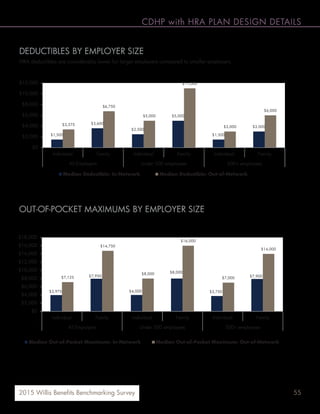
DEDUCTIBLES BY EMPLOYER SIZE
HRA deductibles are considerably lower for larger employers compared to smaller employers.
OUT-OF-POCKET MAXIMUMS BY EMPLOYER SIZE
HRA plan out-of-pocket maximums are lower for larger employers compared to smaller employers.
$1,500
$3,600
$2,500
$5,000
$1,500
$3,000
$3,375
$6,750
$5,000
$11,000
$3,000
$6,000
$0
$2,000
$4,000
$6,000
$8,000
$10,000
$12,000
Individual Family Individual Family Individual Family
All Employers Under 500 employees 500+ employees
Median Deductible: In-Network Median Deductible: Out-of-Network
$3,975
$7,950
$4,000
$8,000
$3,750
$7,900$7,125
$14,750
$8,000
$16,000
$7,000
$14,000
$0
$2,000
$4,000
$6,000
$8,000
$10,000
$12,000
$14,000
$16,000
$18,000
Individual Family Individual Family Individual Family
All Employers Under 500 employees 500+ employees
Median Out-of-Pocket Maximum: In-Network Median Out-of-Pocket Maximum: Out-of-Network
56 2015 Willis Benefits Benchmarking Survey
CDHP with HRA PLAN DESIGN DETAILS
PHYSICIAN OFFICE VISIT COVERAGE
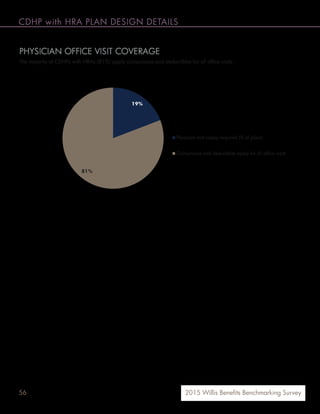
The majority of CDHPs with HRAs (81%) apply coinsurance and deductibles for all office visits.
19%
81%
Physician visit copay required (% of plans)
Coinsurance and deductibles apply for all office visits
572015 Willis Benefits Benchmarking Survey
CDHP with HRA PLAN DESIGN DETAILS
INPATIENT HOSPITALIZATION
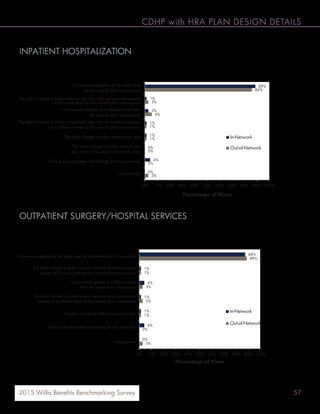
Most HRA plans apply coinsurance for inpatient hospitalization coverage at the same level as the overall plan coinsurance,
both in-network (89%) and out-of-network (86%).
OUTPATIENT SURGERY/HOSPITAL SERVICES
The majority of CDHPs with HRAs apply coinsurance for outpatient surgery/hospital services at the same level as the
overall plan coinsurance, both in-network (88%) and out-of-network (89%).
89%
1%
3%
1%
1%
0%
4%
0%
86%
3%
6%
1%
1%
0%
0%
3%
0% 10% 20% 30% 40% 50% 60% 70% 80% 90% 100%
Coinsurance applies at the same level
as the overall plan coinsurance
The plan charges a dollar amount per stay and coinsurance applies
at the same level as the overall plan coinsurance
Coinsurance applies at a different level than
the overall plan coinsurance
The plan charges a dollar amount per stay and coinsurance applies
at a different level as the overall plan coinsurance
The plan charges a dollar amount per stay
The plan charges a dollar amount per
stay up to a maximum number of days
There is no employee cost-sharing for this coverage
Not covered
Percentage of Plans
In-Network
Out-of-Network
88%
1%
4%
1%
1%
4%
0%
89%
1%
3%
3%
1%
0%
3%
0% 10% 20% 30% 40% 50% 60% 70% 80% 90% 100%
Coinsurance applies at the same level as the overall plan coinsurance
The plan charges a dollar amount per visit and coinsurance
applies at the same level as the overall plan coinsurance
Coinsurance applies at a different level
than the overall plan coinsurance
The plan charges a dollar amount per visit and coinsurance
applies at a different level as the overall plan coinsurance
The plan charges a dollar amount per visit
There is no employee cost-sharing for this coverage
Not covered
Percentage of Plans
In-Network
Out-of-Network
with
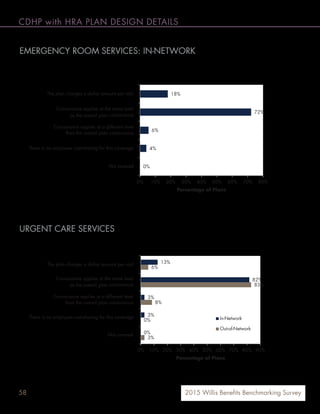
arly three quarters (72%) of with HRAs apply coinsurance for emergency room services at the same level as the
overall plan coinsurance.
with HRAs apply coinsurance for urgent care services at the same level as overall coinsurance, both in-network
(82%) and out-of-network (83%).
13%
82%
3%
3%
6%
83%
8%
3%
The plan charges a dollar amount per visit
applies at the same level
as the overall plan coinsurance
applies at a different level
than the overall plan coinsurance
There is no employee cost-sharing for this coverage
covered
Percentage of Plans
18%
72%
6%
The plan charges a dollar amount per visit
applies at the same level
as the overall plan coinsurance
applies at a different level
than the overall plan coinsurance
There is no employee cost-sharing for this coverage
covered
Percentage of Plans
592015 Willis Benefits Benchmarking Survey
CDHP with HRA PLAN DESIGN DETAILS
HRA EMPLOYER CONTRIBUTION BY EMPLOYER SIZE
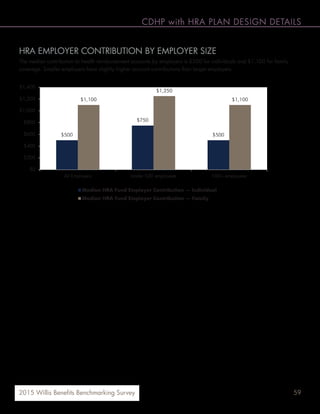
The median contribution to health reimbursement accounts by employers is $500 for individuals and $1,100 for family
coverage. Smaller employers have slightly higher account contributions than larger employers.
$500
$750
$500
$1,100
$1,250
$1,100
$0
$200
$400
$600
$800
$1,000
$1,200
$1,400
All Employers Under 500 employees 500+ employees
Median HRA Fund Employer Contribution — Individual
Median HRA Fund Employer Contribution — Family
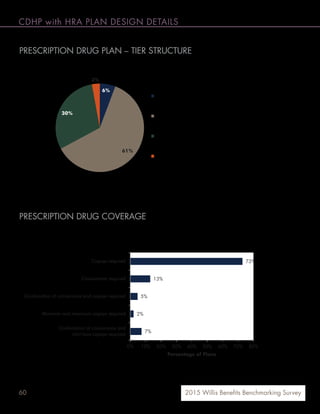
with
T
t with HRAs (61%) have a three-tier prescription drug plan.
The majority of prescription drug plans for HRA plans require copays, with 73% requiring copays only, 13% requiring
coinsurance only, and 1 requiring some combination of coinsurance, copays a minimum and ma
6%
61%
30%
3%
Two-tier coverage)
Three-tier
r )
(
73%
13%
2%
7%
of coinsurance and
copays required
Percentage of Plans
612015 Willis Benefits Benchmarking Survey
CDHP with HRA PLAN DESIGN DETAILS
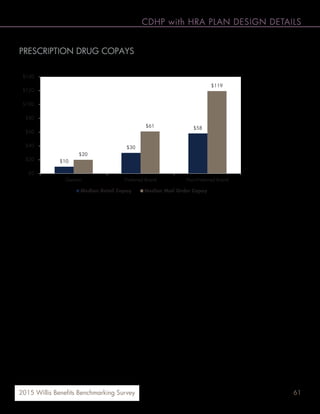
PRESCRIPTION DRUG COPAYS
Where copays are required (in any combination), the median copays for three-tier plans are as follows:
$10
$30
$58
$20
$61
$119
$0
$20
$40
$60
$80
$100
$120
$140
Generic Preferred Brand Non-Preferred Brand
Median Retail Copay Median Mail Order Copay
62 2015 Willis Benefits Benchmarking Survey
DENTAL PLANS
PREMIUMS AND CONTRIBUTIONS
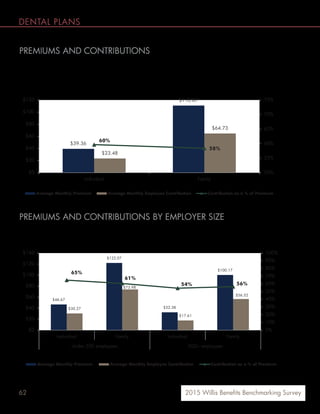
The average monthly premium for dental plans across all employers was $39.36 for individuals and $110.87 for families.
Ninety-one percent of employers require employees to contribute to the costs of dental coverage; of these employers, 21%
require employees to cover the full cost of dental coverage. Employee contributions as a percentage of premium was 60%
for individuals and 58% for families
PREMIUMS AND CONTRIBUTIONS BY EMPLOYER SIZE
Smaller employers have higher premiums than larger employers, and employee contributions, both from a dollar amount
standpoint and percentage of premium, are higher than larger employers.
$39.36
$110.87
$23.48
$64.73
60%
58%
50%
55%
60%
65%
70%
75%
$0
$20
$40
$60
$80
$100
$120
Individual Family
Average Monthly Premium Average Monthly Employee Contribution Contribution as a % of Premium
$46.67
$122.07
$32.38
$100.17
$30.27
$73.98
$17.61
$56.52
65%
61%
54% 56%
0%
10%
20%
30%
40%
50%
60%
70%
80%
90%
100%
$0
$20
$40
$60
$80
$100
$120
$140
Individual Family Individual Family
Under 500 employees 500+ employees
Average Monthly Premium Average Monthly Employee Contribution Contribution as a % of Premium
632015 Willis Benefits Benchmarking Survey
DENTAL PLANS
DENTAL PLAN RATE TIER STRUCTURE
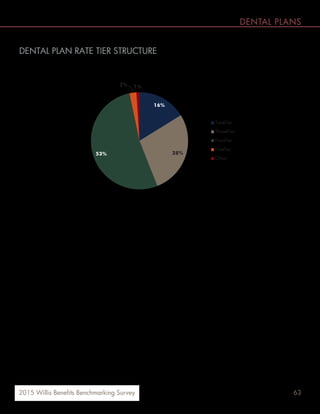
More than half (53%) of employers have a four-tier structure for their dental plan, followed by 28% with three tier structure
plans.
16%
28%53%
2% 1%
Two-Tier
Three-Tier
Four-Tier
Five-Tier
Other
64 2015 Willis Benefits Benchmarking Survey
DENTAL PLANS
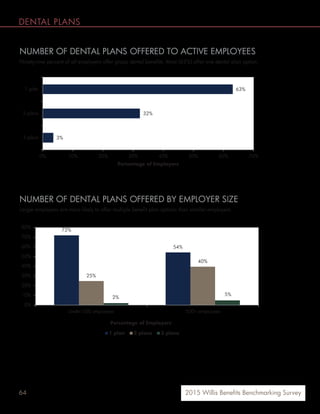
NUMBER OF DENTAL PLANS OFFERED TO ACTIVE EMPLOYEES
Ninety-nine percent of all employers offer group dental benefits. Most (63%) offer one dental plan option.
NUMBER OF DENTAL PLANS OFFERED BY EMPLOYER SIZE
Larger employers are more likely to offer multiple benefit plan options than smaller employers.
63%
32%
3%
0% 10% 20% 30% 40% 50% 60% 70%
1 plan
2 plans
3 plans
Percentage of Employers
72%
54%
25%
40%
0%
10%
20%
30%
40%
50%
60%
70%
80%
Under 500 employees 500+ employees
1 plan 2 plans 3 plans
2%
5%
Percentage of Employers
652015 Willis Benefits Benchmarking Survey
DENTAL PLANS
MOST PREVALENT DENTAL PLAN (PLAN WITH THE HIGHEST
ENROLLMENT)
The vast majority (90%) of employers who offer group dental coverage report that their most prevalent plan is a
Dental PPO plan.
Average Dental Plan Design Median Amounts – All Employers
In-network Out-of-network
Preventive services — coinsurance 100% 100%
Basic restorative services — coinsurance 80% 80%
Major restorative services — coinsurance 50% 50%
Annual median maximum benefit* $1,500
Orthodontia annual maximum benefit* $1,500
*When applicable
90%
3%
5%
2%
0% 10% 20% 30% 40% 50% 60% 70% 80% 90% 100%
Dental PPO (Preferred Provider Organization)
Dental HMO (Health Maintenance Organization)
Dental Fee for Service plan (also known
as Indemnity Plan or Traditional Plan)
Other
Percentage of Employers
28%
52%
20%
Most dental not
preventive services
percent of dental plans include orthodontic covera e. More than half of employers (5 %) provide this
for children (under 9) only.
0%
50%
90%
Preventive services Major restorative services
Percentage of Plans
672015 Willis Benefits Benchmarking Survey
BENEFITS STRATEGY
42%
24%
22%
15%
6%
3%
2%
1%
1%
34%
7%
35%
19%
7%
3%
6%
4%
17%
0% 10% 20% 30% 40% 50%
Introduce new wellness, preventive health programs
Introduce minimum essential coverage plans
Increase employee cost-sharing
Introduce HDHPs/CDHPs
Narrow network of hospitals/physicians
Eliminate spousal coverage
Referenced-based pricing approach
Encourage employee use of public exchanges
Shift from fully-insured to self-insured plans
Percentage of Employers
Currently in place
Planned for 2016
BENEFIT STRATEGIES
When asked what benefit strategies employers currently maintain or plan for 2016 implementation, 42% responded
that they already have wellness/preventive health programs in place. Thirty-five percent of employers responded that
they plan to increase employee cost-sharing for 2016.
68 2015 Willis Benefits Benchmarking Survey
BENEFITS STRATEGY
44%
5%
12%
8% 6%
3% 5%
17%
0%
5%
10%
15%
20%
25%
30%
35%
40%
45%
50%
2018 2019 2020 2021 2022 2023 2024 2025 or later
Percentage of Employers
ASSUMING NO PLAN DESIGN CHANGES, YEAR THE CADILLAC TAX IS
PROJECTED TO BE INCURRED
Only forty-one percent of respondents have projected the potential liability of the 40% excise tax (the so-called “Cadillac”
Tax) for their organization.
Assuming no plan design changes, 44% of employers project that the Cadillac tax will impact their plan in the first year the
tax is effective, 2018.
REACTIONS TO CADILLAC TAX
Even as the effective date of the Cadillac Tax draws closer, many employers are still in a ”wait and see” mode, with 41%
waiting to make any changes in the future. Thirty percent are not concerned about the tax.
6%
21%
41%
30%
2%
0% 5% 10% 15% 20% 25% 30% 35% 40% 45%
Changes are currently being made
Changes are currently being made and expect to
make additional changes in the future
Waiting to make changes in the future
Not concerned about the tax
If the tax is too high, will terminate
the plan to avoid the tax
Percentage of Employers
692015 Willis Benefits Benchmarking Survey
BENEFITS STRATEGY
PLANNED CHANGES AS A RESULT OF THE EXCISE (CADILLAC) TAX
Of the employers who are planning to make changes to their plans to avoid the tax, most are planning to make plan design
changes (89%), followed by changes to employee contributions (73%). Making any adjustments to compensation is only
being considered by 6% of employers.
89%
73%
37%
24%
6%
4%
0% 10% 20% 30% 40% 50% 60% 70% 80% 90% 100%
Plan design changes
Contribution changes
Dropping high premium/adding
high deductible plan option(s)
Remixing of rates (i.e. lower Individual rates and raise
family rates to buy time before triggering tax)
Compensation changes
Dropping health insurance altogether
Percentage of Total Employers Planning to Make Changes
70 2015 Willis Benefits Benchmarking Survey
BENEFITS STRATEGY
PLANS TO OFFSET REDUCED MEDICAL BENEFITS BY ADDITIONAL CASH
COMPENSATION
While PPACA was drafted assuming employers would offset reduced spending on medical benefits because of the excise
tax with increased levels of cash compensation, few employers (1%) are planning on making employees "whole"
financially for the reduced expenditures on medical benefits. The majority (77%) of respondents stated that there is no
expectation that any savings from reduced medical benefits in response to the Cadillac Tax will be shared in the form of
cash compensation.
LIKELIHOOD OF CONTINUATION OF HEALTH BENEFIT OFFERINGS OVER
THE NEXT 5 YEARS
Even in the face of rising costs and regulatory actions, employers remain committed to providing health benefits, with 85%
stating that they are very likely to continue offer health benefits over the next five years.
1%
11%
11%
77%
0% 10% 20% 30% 40% 50% 60% 70% 80% 90%
Make employees “whole” financially for the reduced
expenditures on medical benefits
Share savings on medical benefits with employees but
make them less than "whole" financially
No direct offset but expect that additional nontaxable
benefits will be offered to offset the reduced medical
plan expenditures
There is no expectation that savings will be shared in
the form of cash compensation or otherwise
Percentage of Employers
85%
6%
7%
1%
1%
Very Likely
Somewhat Likely
Likely
Somewhat Unlikely
Very Unlikely
712015 Willis Benefits Benchmarking Survey
GLOBAL BENEFITS STRATEGY
EMPLOYEE POPULATION LOCATED AND WORKING OUTSIDE OF THE
UNITED STATES
Twenty-one percent of participants responded that they have employees working outside of the U.S.
NUMBER OF COUNTRIES OUTSIDE OF THE U.S. WHERE EMPLOYEES ARE
LOCATED
Almost half (45%) of the employers with employees working outside of the U.S. have five or more non-U.S. locations.
17%
2%
2%
0% 2% 4% 6% 8% 10% 12% 14% 16% 18%
25% or less of employees are located
and working outside of the U.S.
26% to 50% of employees are located
and working outside of the U.S.
More than 50% of employees are located
and working outside of the U.S.
Percentage of Employers
One
23%
Two
12%
Three
11%Four
9%
Five or more
45%
72 2015 Willis Benefits Benchmarking Survey
42%
27%
18%
4%
2%
2%
2%
2%
0% 10% 20% 30% 40% 50%
Compliance
Cost management
Global benefits strategy
Wellness and well-being
Governance
Accommodating mobility (travel, short term, long term assignments)
Access to reliable information and benchmarking
Utilizing technology
Percentage of Employers
GLOBAL BENEFITS STRATEGY
Only 20% of employers with operations outside of the U.S. currently have a global benefits strategy in place. Forty-two
percent of employers stated that they don’t have a global benefits strategy in place currently and have no plans to
develop one.
TOP GLOBAL PRIORITIES
When asked to rank their top global priorities, compliance was the top priority for 42% of employers, followed by cost
management (27%).
20%
11%
27%
42%
0% 5% 10% 15% 20% 25% 30% 35% 40% 45% 50%
Currently in place
In the process of developing one
Planning to have one in the future
None in place and do not currently
have plans to develop one
Percentage of Employers
BENEFITS STRATEGY
Willis North America Inc.
Brookfield Place
200 Liberty Street
7th Floor, New York
New York 10281-1003
United States
Tel: +1 212 915 8888
www.willis.com
copyright ©2015

2015 Willis Benefits Benchmarking Survey Report

  • 1.
    THE WILLIS BENEFITS BENCHMARKINGSURVEY SURVEY REPORT | 2015
  • 3.
    32015 Willis BenefitsBenchmarking Survey Willis conducted the 2015 Willis Benefits Benchmarking Survey from February 18, 2015 through April 3, 2015. The survey was distributed through an online tool and direct email. Responses were collected from U.S. employers of various sizes and industries and provided by individuals who participate in their organizations’ group health plan decision-making process. A total of 532 employers are represented in this survey. The largest percentage of respondents are headquartered in the South (38%), followed by the Midwest (29%), Northeast (20%) and West (13%). Employer participants were asked to provide medical benefit plan information for all medical plans offered in 2015. Participants were asked to provide dental benefit information for their most prevalent dental plan offered (the plan with the highest enrollment). The order of the results presented in this report may differ from the order the questions appeared in the survey. Some questions were posed to respondents only if their prior response met criteria applicable to that question; as a result, the total number of respondents will differ by question. Results have been rounded to simplify the presentation of data, which may cause some charts to not equal 100 percent. ADDITIONAL INFORMATION For additional information or questions regarding this survey, please contact hcp.survey@willis.com. West: 68 employers 172 medical plans Midwest: 156 employers 339 medical plans South: 204 employers 434 medical plans Northeast: 104 employers 248 medical plans ABOUT THIS SURVEY
  • 4.
    TABLE OF CONTENTS ExecutiveSummary........................................................................................... 6 Employer Demographics.................................................................................... 7 Medical Plan Eligibility..................................................................................... 10 Medical Plan Offerings and Enrollment............................................................. 13 Medical Plan Costs........................................................................................... 19 PPO/POS Plans..........................................................................................................19 HMO/EPO Plans........................................................................................................21 HSA-Eligible CDHPs....................................................................................................23 CDHPs with HRAs.......................................................................................................25 Medical Plan Design Details............................................................................. 27 PPO/POS Plan Design Details.....................................................................................27 Deductibles............................................................................................................................ 28 Out-of-Pocket Maximums.......................................................................................................... 29 Physician Office Visit Coverage................................................................................................ 30 Inpatient Hospitalization.......................................................................................................... 31 Outpatient Surgery/Hospital Services........................................................................................ 31 Emergency Room Services....................................................................................................... 32 Urgent Care Services.............................................................................................................. 32 Prescription Drug Coverage..................................................................................................... 33 HMO/EPO Plan Design Details...................................................................................36 Deductibles............................................................................................................................ 37 Out-of-Pocket Maximums.......................................................................................................... 38 Physician Office Visit Coverage................................................................................................ 39 Inpatient Hospitalization.......................................................................................................... 40 Outpatient Surgery/Hospital Services........................................................................................ 40 Emergency Room Services....................................................................................................... 41 Urgent Care Services.............................................................................................................. 41 Prescription Drug Coverage..................................................................................................... 42
  • 5.
    HSA-Eligible CDHP PlanDesign Details.......................................................................44 Deductibles............................................................................................................................ 45 Out-of-Pocket Maximums.......................................................................................................... 46 Physician Office Visit Coverage................................................................................................ 47 Inpatient Hospitalization.......................................................................................................... 48 Outpatient Surgery/Hospital Services........................................................................................ 48 Emergency Room Services....................................................................................................... 49 Urgent Care Services.............................................................................................................. 49 Employer Contribution to Health Savings Accounts...................................................................... 50 Prescription Drug Coverage..................................................................................................... 52 CDHP with HRA Plan Design Details...........................................................................54 Deductibles............................................................................................................................ 55 Out-of-Pocket Maximums.......................................................................................................... 55 Physician Office Visit Coverage................................................................................................ 56 Inpatient Hospitalization.......................................................................................................... 57 Outpatient Surgery/Hospital Services........................................................................................ 57 Emergency Room Services....................................................................................................... 58 Urgent Care Services.............................................................................................................. 58 HRA Fund Contributions........................................................................................................... 59 Prescription Drug Coverage..................................................................................................... 60 Dental Plans.................................................................................................... 62 Benefits Strategy.............................................................................................. 67 Global Benefits Strategy.................................................................................. 71
  • 6.
    6 2015 WillisBenefits Benchmarking Survey Willis’ inaugural Benefits Benchmarking Survey gathered information related to employer medical and dental plan design and costs, as well as benefits strategies. Within this survey, 532 employers provided responses for 1,193 medical plans, which allowed us to view benchmark data across all benefit plan offerings. Continuing the trend evidenced in the Willis 2014 Health Care Reform Survey, employers remain committed to offering health benefits to their employees; only 2% of respondents stated they were unlikely to continue to offer health benefits over the next five years. PPO/POS plans continue to be the most prevalent medical plan type, offered by 87% of employers. Health Savings Account eligible Consumer Driven Health Plans (HSA-eligible CDHPs) have emerged as the second most prevalent medical plan offering at 47%, a position that, in the past, had been occupied by HMO/EPO plans, which are now offered by only 22% of employers. CDHP plans with Health Reimbursement Accounts (HRA) are only offered by 12% of respondents. When HMO/EPO plans are offered, employees are taking the opportunity to enroll in these plans; for the 22% of employers that offer HMO/EPO plans, almost half (46%) of enrolled employees chose the HMO/EPO plan over all other offerings. Dental plans are offered by the vast majority of employers. Most employers offer one to two dental plan options, and Dental PPO plans are the most popular offering by far. As the 2018 effective date for the Cadillac Tax draws closer, many employers are taking steps to quantify the impact of this tax on their organizations (41%). Of those employers who have projected the liability, 44% anticipate the tax will hit in 2018 (assuming no plan design changes). Although some employers (27%) are already making changes in response to the Cadillac Tax, many (41%) are still in “wait- and-see” mode and have not made any changes. Modification of plan designs is the most common strategy to avoid/lessen the tax followed by contribution changes. Few employers are planning to terminate their health plan to avoid the tax (2%). While PPACA was drafted on the assumption that employers would offset reduced medical benefit spending with increased cash compensation for their employees, the majority (77%) of respondents do not believe there is any expectation that savings will be shared in the form of cash compensation or otherwise. EXECUTIVE SUMMARY Approximately one-fifth of employers have employees that work outside the U.S. and almost half (45%) have five or more non-U.S. locations. Forty-two percent stated that they do not have a global strategy in place and do not have plans to develop one. Top global priorities are compliance (42%) and cost management (27%).
  • 7.
    72015 Willis BenefitsBenchmarking Survey EMPLOYER DEMOGRAPHICS PARTICIPANTS BY EMPLOYER SIZE Participation was evenly split between small 1 employers (50%) and large 2 employers (50%). PARTICIPANTS BY INDUSTRY Participants were from a wide range of industries, with manufacturing accounting for one-fifth of overall participation. 1 Employers with fewer than 500 employees 2 Employers with more than 500 employees 2% 2% 2% 3% 3% 3% 3% 4% 4% 5% 6% 7% 8% 9% 9% 11% 20% 0% 5% 10% 15% 20% 25% Other Media/Entertainment/Telecom Hospitality/Food Service Other Professional Services Legal Services Government Oil/Gas/Mining/Energy Automotive/Aerospace/Transportation Business Services/Consulting Construction Education Technology (computers, software, ISP, etc.) Financial Services Retail/Wholesale Nonprofit Health Services/Hospitals Manufacturing Percentage of Employers 50% under 500 employees 50% over 500 employees 27% 23% 18% 25% 7% 0% 5% 10% 15% 20% 25% 30% Under 250 employees 250–499 employees 500–999 employees 1,000–4,999 employees 5,000+ employees Percentage of Employers PARTICIPANTS BY EMPLOYER SIZE Participation was evenly split between small 1 employers (50%) and large 2 employers (50%). PARTICIPANTS BY INDUSTRY Participants were from a wide range of industries, with manufacturing accounting for one-fifth of overall participation. 1 Employers with fewer than 500 employees 2 Employers with more than 500 employees 2% 2% 2% 3% 3% 3% 3% 4% 4% 5% 6% 7% 8% 9% 9% 11% 20% 0% 5% 10% 15% 20% 25% Other Media/Entertainment/Telecom Hospitality/Food Service Other Professional Services Legal Services Government Oil/Gas/Mining/Energy Automotive/Aerospace/Transportation Business Services/Consulting Construction Education Technology (computers, software, ISP, etc.) Financial Services Retail/Wholesale Nonprofit Health Services/Hospitals Manufacturing Percentage of Employers 50% under 500 employees 50% over 500 employees 27% 23% 18% 25% 7% 0% 5% 10% 15% 20% 25% 30% Under 250 employees 250-499 employees 500-999 employees 1,000-4,999 employees 5,000+ employees Percentage of Employers
  • 8.
    8 2015 WillisBenefits Benchmarking Survey EMPLOYER DEMOGRAPHICS AVERAGE EMPLOYEE AGE BY REGION Across all employers, the average employee age was 41.7 years old. The only region reporting an average age of under 40 was the West (39.6), and the only industries to report an average age under 40 were retail/wholesale (39.2) and technology (39.5). The industry with the highest average employee age was manufacturing (43.2). EMPLOYEE POPULATION BY GENDER Males represented a slightly larger percentage (54%) of overall employee populations. 41.7 42.0 42.1 41.8 39.6 38.0 38.5 39.0 39.5 40.0 40.5 41.0 41.5 42.0 42.5 Northeast South Midwest West All Employers By Region % Male 54% % Female 46%
  • 9.
    92015 Willis BenefitsBenchmarking Survey EMPLOYER DEMOGRAPHICS EMPLOYERS WITH PART-TIME EMPLOYEES Eighty-six percent of respondents reported having one or more part-time employees 3 ; the majority (61%) of employers have fewer than 100 part-time employees. PERCENTAGE OF EMPLOYERS WITH UNION REPRESENTATION Twenty percent of employers reported having union representation within their workforce. Union representation was greater among large employers (29%) than small employers (11%). Of those employers with union membership, the average union population was 30% of the total employee population. 3 Part-time is defined as working less than 30 hours per week 61% 9% 7% 3% 5% 1% 14% 0% 10% 20% 30% 40% 50% 60% 70% 1–99 employees 100–249 employees 250–499 employees 500–999 employees 1,000–4,999 employees 5,000+ employees No part-time employees Percentage of Employers 20% 11% 29% 0% 5% 10% 15% 20% 25% 30% 35% All Employers Under 500 employees 500+ employees 3 Part-time is defined as working less than 30 hours per week
  • 10.
    10 2015 WillisBenefits Benchmarking Survey MEDICAL PLAN ELIGIBILITY 31% 1% 2% 0% 5% 10% 15% 20% 25% 30% 35% Part-time employees Seasonal employees Interns Percentage of Employers Offering MEDICAL PLAN WAITING PERIOD Medical plan waiting periods (the amount of a time an employee needs to wait before becoming eligible for medical benefits) vary among employer respondents. Seventeen percent have no waiting period (employees are eligible for medical benefits on the date of hire). The most common waiting periods were first of the month following date of hire (24%) followed by first of the month following 30 days of employment (23%). EMPLOYEE CLASSIFICATIONS ELIGIBLE FOR MEDICAL BENEFITS, OTHER THAN FULL-TIME EMPLOYEES Thirty-one percent of respondents offer medical benefits to part-time employees. Few employers reported that seasonal employees or interns were eligible for medical benefits (1% and 2% respectively). Of those employers that offer benefits to part-time employees, 97% offer the same medical plan options to both full-time and part-time employees (as opposed to offering a separate plan for part-time employees only). 17% 24% 5% 23% 6% 16% 9% 0% 0% 10% 20% 30% No waiting period – health benefits effective as of date of hire 1st of the month following date of hire 30 days 1st of the month following 30 days of employment 60 days 1st of the month following 60 days of employment 90 days More than 90 days Percentage of Employers Highlight on Technology: Tech employees have shorter waiting periods than in any other industry: 46% have no waiting period, and another 46% use the 1st of the month following date of hire.
  • 11.
    112015 Willis BenefitsBenchmarking Survey MEDICAL PLAN ELIGIBILITY 46% 50% 44% 45% 46% 47% 48% 49% 50% 51% A surcharge is applied for all spouses A surcharge is applied only for those spouses who have access to medical coverage elsewhere Prevalence of Spousal Surcharge Method SPOUSAL SURCHARGE APPROACH Fifteen percent of employers impose a surcharge for spouses covered under the medical plan. Of those employers, 46% apply the surcharge for all spouses and 50% only apply the surcharge if the spouse has access to medical coverage elsewhere. METHOD USED TO VERIFY AVAILABLE COVERAGE FOR SPOUSES Thirteen percent of employers require verification if spouses have medical coverage elsewhere. Of those employers, the majority (78%) require a written attestation for verification of coverage. 6% 78% 2% 0% 20% 40% 60% 80% 100% Outside company conducts verification Require written attestations Outbound phone calls to employees Prevalence of Verification Method
  • 12.
    12 2015 WillisBenefits Benchmarking Survey MEDICAL PLAN ELIGIBILITY The median monthly spousal surcharge across all employers is $147. The table below provides median monthly spousal surcharges across various employer size groups and regions. Median Monthly Spousal Surcharge Amount All employers $147.00 Northeast region $147.00 South region $150.00 Midwest region $127.50 West region $150.00 Under 250 employees $228.00 250–499 employees $103.00 500–999 employees $150.00 1,000–4,999 employees $138.00 5,000+ employees $100.00 On average, 78% of medical-eligible employees enrolled in medical benefits for the 2015 plan year. Of those employees, the average percentage that elected dependent (spouse and/or children) coverage was 47%. 78% Enrolled 47% Dependent Election
  • 13.
    132015 Willis BenefitsBenchmarking Survey MEDICAL PLAN OFFERINGS AND ENROLLMENT   88% 34% 43% 16% 5% 1% 88% 19% 42% 13% 2% 1% 86% 8% 60% 8% 2% 2% 82% 51% 40% 13% 1% 1% 0% 10% 20% 30% 40% 50% 60% 70% 80% 90% 100% PPO/POS HMO/EPO HSA-eligible CDHP CDHP with HRA Indemnity Plan Limited Medical Plan Percentage of Employers Northeast Region South Region Midwest Region West Region TYPES OF MEDICAL PLANS OFFERED Most respondents (87%) offer a PPO/POS plan. HSA-eligible CDHPs are the second most prevalent medical plans offered (47%). TYPES OF MEDICAL PLANS OFFERED BY REGION 87% 22% 47% 12% 2% 2% 0% 10% 20% 30% 40% 50% 60% 70% 80% 90% 100% PPO/POS HMO/EPO HSA-eligible CDHP CDHP with HRA Indemnity Plan Limited Medical Plan Percentage of Employers HMO/EPO plans are significantly more prevalent in the West region.
  • 14.
    14 2015 WillisBenefits Benchmarking Survey MEDICAL PLAN OFFERINGS AND ENROLLMENT NUMBER OF MEDICAL PLANS OFFERED Most employers (85%) offer three medical plans or fewer. More than one-third (36%) of employers offer two medical benefit plan options. NUMBER OF MEDICAL PLANS OFFERED BY EMPLOYER SIZE 25% 36% 24% 7% 3% 4% 0% 5% 10% 15% 20% 25% 30% 35% 40% 1 2 3 4 5 More than 5 plans Percentage of Employers 30% 25% 18% 11% 36% 40% 39% 35% 24% 21% 23% 25% 27% 32% 6% 3% 8% 13% 3% 2% 2% 5% 3% 1% 2% 2% 6% 18% 0% 5% 10% 15% 20% 25% 30% 35% 40% 45% 50% Under 250 Employees 250–499 Employees 500–999 Employees 1,000–4,999 Employees 5,000+ Employees PercentageofEmployers 1 2 3 4 5 More than 5 plans Only 5,000+ employer size groups typically offer more than five medical plans. 33% 10%
  • 15.
    152015 Willis BenefitsBenchmarking Survey Fully insured 48% Self insured 47% Minimum premium arrangement 3% Other 2% 67% 46% 33% 48% 12% 16% 0% 10% 20% 30% 40% 50% 60% 70% 80% PPO/POS HMO/EPO HSA-eligible CDHP CDHP with HRA Indemnity Plan Limited Medical Plan Percentage of Total Enrolled Employees AVERAGE ENROLLMENT PER PLAN TYPE WHEN OFFERED When offered, average enrollment for PPO/POS plans is 67% of total medical enrollment. While only 22% of employers offer HMOs, those that do report 46% HMO/EPO enrollment of total medical enrollment. FUNDING METHOD Employers were asked to provide the funding method for their most prevalent medical plan (if funding methods varied by plan). Employers were almost evenly split between self-funding (47%) and fully insured (48%) plans. Three percent of employers utilize a minimum premium arrangement. MEDICAL PLAN OFFERINGS AND ENROLLMENT
  • 16.
    16 2015 WillisBenefits Benchmarking Survey 76% 58% 34% 28% 17% 38% 57% 69% 92% 5% 2% 4% 2% 3% 0% 10% 20% 30% 40% 50% 60% 70% 80% 90% 100% Under 250 Employees 250–499 Employees 500–999 Employees 1,000–4,999 Employees 5,000+ Employees Percentage of Employers Fully insured Self insured Minimum premium arrangement FUNDING METHOD BY EMPLOYER SIZE As employer size increases, so does the prevalence of self-funding. MEDICAL PLAN OFFERINGS AND ENROLLMENT
  • 17.
    4% 2% Tobacco and non-tobaccostatus Percentage of Employers The most common way to differentiate employee contributions is through completion of wellness incentives by varying contributions based on tobacco and non- S ST SA those employers that differentiate employee contributions by sa le the most common number of wage levels is four (28%) or three (27%). 21% 27% 28% 10% 14% 2 4 5
  • 18.
    18 2015 WillisBenefits Benchmarking Survey On average, employers reported that their average total medical and prescription drug plan costs account for 18% of total 2014 payroll. This percentage varies by industry, region and employer size. Average Total Medical and Prescription Drug Plan Costs as a Percentage of 2014 Payroll All employers 18% Northeast region 18% South region 20% Midwest region 19% West region 14% Under 250 employees 16% 250–499 employees 18% 500–999 employees 19% 1,000–4,999 employees 20% 5,000+ employees 18% Education 18% Financial Services 18% Health Services/Hospitals 25% Manufacturing 17% Nonprofit 19% Retail/Wholesale 16% Technology 14% Under 500 employees 17% 500+ employees 20% MEDICAL PLAN OFFERINGS AND ENROLLMENT
  • 19.
    192015 Willis BenefitsBenchmarking Survey $635 $1,874 $503 $1,461 $517 $1,524 $583 $1,720 $153 $575 $129 $549 $123 $433 $157 $641 24% 31% 26% 38% 24% 28% 27% 37% 0% 5% 10% 15% 20% 25% 30% 35% 40% 45% 50% $0 $200 $400 $600 $800 $1,000 $1,200 $1,400 $1,600 $1,800 $2,000 Individual Family Individual Family Individual Family Individual Family Northeast Region South Region Midwest Region West Region Average Monthly Premium Average Monthly Employee Contribution Contribution as a % of Premium PPO/POS PREMIUM AND CONTRIBUTIONS The average monthly premium for PPO/POS plans across all employers was $543 for individuals and $1,592 for families. Employee contributions as a percentage of premium was 25% for individuals and 33% for families. PPO/POS PREMIUM AND CONTRIBUTIONS BY REGION From a regional perspective, while the Northeast has the highest premium dollar amounts, the West has the highest employee contributions as a percentage of premiums with 27% for individuals and 37% for family coverage. $543 $1,592 $135 $530 25% 33% 0% 5% 10% 15% 20% 25% 30% 35% 40% 45% 50% $0 $200 $400 $600 $800 $1,000 $1,200 $1,400 $1,600 $1,800 Individual Family Average Monthly Premium Average Monthly Employee Contribution Contribution as a % of Premium MEDICAL PLAN COSTS
  • 20.
    20 2015 WillisBenefits Benchmarking Survey $546 $1,584 $539 $1,601 $130 $559 $139 $502 24% 35% 26% 31% 0% 5% 10% 15% 20% 25% 30% 35% 40% 45% 50% $0 $200 $400 $600 $800 $1,000 $1,200 $1,400 $1,600 $1,800 Individual Family Individual Family Under 500 employees 500+ employees Average Monthly Premium Average Monthly Employee Contribution Contribution as a % of Premium PPO/POS PREMIUM AND CONTRIBUTIONS BY EMPLOYER SIZE Premiums and contributions for PPO/POS plans are similar among small and large size employers. PPO/POS RATE TIER STRUCTURE Nearly two-thirds (63%) of PPO/POS plans have a 4-tier rate structure for their premiums and contributions (Employee only, Employee + Spouse, Employee + Child(ren), Family). 7% 23% 63% 5% 2% Two-Tier Three-Tier Four-Tier Five-Tier Other MEDICAL PLAN COSTS
  • 21.
    212015 Willis BenefitsBenchmarking Survey HMO/EPO PREMIUM AND CONTRIBUTIONS The average monthly premium for HMO/EPO plans across all employers was $537 for individuals and $1,565 for families. Employee contributions as a percentage of premium was 22% for individuals and 31% for families. HMO/EPO PREMIUM AND CONTRIBUTIONS BY REGION For HMO/EPO plans, the Northeast has the highest premium and financial contribution amounts, along with the highest employee contributions as a percentage of premiums for individuals (27%). The South has the highest employee contributions as a percentage of premiums for families (34%). $537 $1,565 $118 $492 22% 31% 0% 5% 10% 15% 20% 25% 30% 35% 40% 45% 50% $0 $200 $400 $600 $800 $1,000 $1,200 $1,400 $1,600 $1,800 Individual Family Average Monthly Premium Average Monthly Employee Contribution Contribution as a % of Premium $569 $1,680 $528 $1,483 $501 $1,417 $531 $1,581 $156 $536 $122 $511 $104 $303 $92 $489 27% 32% 23% 34% 21% 21% 17% 31% 0% 5% 10% 15% 20% 25% 30% 35% 40% 45% 50% $0 $200 $400 $600 $800 $1,000 $1,200 $1,400 $1,600 $1,800 Individual Family Individual Family Individual Family Individual Family Northeast Region South Region Midwest Region West Region Average Monthly Premium Average Monthly Employee Contribution Contribution as a % of Premium MEDICAL PLAN COSTS
  • 22.
    22 2015 WillisBenefits Benchmarking Survey $562 $1,639 $516 $1,502 $115 $515 $120 $472 20% 31% 23% 31% 0% 5% 10% 15% 20% 25% 30% 35% 40% 45% 50% $0 $200 $400 $600 $800 $1,000 $1,200 $1,400 $1,600 $1,800 Individual Family Individual Family Under 500 employees 500+ employees Average Monthly Premium Average Monthly Employee Contribution Contribution as a % of Premium 8% 25% 61% 4% 1% Two-Tier Three-Tier Four-Tier Five-Tier Other HMO/EPO PREMIUM AND CONTRIBUTIONS BY EMPLOYER SIZE Premium and contribution amounts for HMO/EPO plans are slightly higher for small employers. HMO/EPO RATE TIER STRUCTURE The majority (61%) of HMO/EPO plans have a 4-tier rate structure for their premiums and contributions. MEDICAL PLAN COSTS
  • 23.
    232015 Willis BenefitsBenchmarking Survey $545 $1,514 $431 $1,222 $447 $1,291 $479 $1,394 $93 $378 $82 $345 $90 $323 $97 $41417% 25% 19% 28% 20% 25% 20% 30% 0% 5% 10% 15% 20% 25% 30% 35% 40% 45% 50% $0 $200 $400 $600 $800 $1,000 $1,200 $1,400 $1,600 Individual Family Individual Family Individual Family Individual Family Northeast Region South Region Midwest Region West Region Average Monthly Premium Average Monthly Employee Contribution Contribution as a % of Premium HSA-ELIGIBLE CDHP PREMIUM AND CONTRIBUTIONS The average monthly premium for HSA-eligible CDHP plans across all employers was $464 for individuals and $1,323 for families. Employee contributions as a percentage of premium was 19% for individuals and 27% for families. HSA-ELIGIBLE CDHP PREMIUM AND CONTRIBUTIONS BY REGION For HSA-eligible CDHP plans, contributions as a percentage of premium are fairly consistent across the regions, with the Northeast reporting the lowest employee contribution as a percentage of premium for individuals and the West region having the highest family contribution percentage. $464 $1,323 $88 $351 19% 27% 0% 5% 10% 15% 20% 25% 30% 35% 40% 45% 50% $0 $200 $400 $600 $800 $1,000 $1,200 $1,400 Individual Family Average Monthly Premium Average Monthly Employee Contribution Contribution as a % of Premium MEDICAL PLAN COSTS
  • 24.
    24 2015 WillisBenefits Benchmarking Survey $493 $1,390 $440 $1,268 $92 $404 $86 $313 19% 29% 20% 25% 0% 5% 10% 15% 20% 25% 30% 35% 40% 45% 50% $0 $200 $400 $600 $800 $1,000 $1,200 $1,400 $1,600 Individual Family Individual Family Under 500 employees 500+ employees Average Monthly Premium Average Monthly Employee Contribution Contribution as a % of Premium 11% 20% 64% 3% 1% Two-Tier Three-Tier Four-Tier Five-Tier Other HSA-ELIGIBLE CDHP PREMIUM AND CONTRIBUTIONS BY EMPLOYER SIZE Premium and contribution amounts for HSA-eligible CDHPs are slightly higher for small employers. HSA-ELIGIBLE CDHP RATE TIER STRUCTURE MEDICAL PLAN COSTS The majority (64%) of HSA-eligible CDHP plans have a four-tier rate structure for their premiums and contributions.
  • 25.
    252015 Willis BenefitsBenchmarking Survey MEDICAL PLAN COSTS $511 $1,453 $106 $416 21% 29% 0% 5% 10% 15% 20% 25% 30% 35% 40% 45% 50% $0 $200 $400 $600 $800 $1,000 $1,200 $1,400 $1,600 Individual Family Average Monthly Premium Average Monthly Employee Contribution Contribution as a % of Premium $518 $1,447 $508 $1,456 $101 $500 $108 $379 20% 35% 21% 26% 0% 5% 10% 15% 20% 25% 30% 35% 40% 45% 50% $0 $200 $400 $600 $800 $1,000 $1,200 $1,400 $1,600 Individual Family Individual Family Under 500 employees 500+ employees Average Monthly Premium Average Monthly Employee Contribution Contribution as a % of Premium HRA PLAN PREMIUM AND CONTRIBUTIONS The average monthly premium for HRA plans across all employers was $511 for individuals and $1,453 for families. Employee contributions as a percentage of premium was 21% for individuals and 29% for families. HRA PLAN PREMIUM AND CONTRIBUTIONS BY EMPLOYER SIZE Family coverage contributions as a percentage of premium is 9% higher for small employers.
  • 26.
    26 10% 18% 67% 4% 1% Two-Tier Three-Tier -Tier -Tier H The majority (67%)of HRA plans have a four-tier rate structure for their premiums and contributions.
  • 27.
    272015 Willis BenefitsBenchmarking Survey PPO/POS PLAN DESIGN DETAILS PPO/POS PLAN DESIGN DETAILS PPO/POS plans remain the most prevalent medical plan type offering: 466 employers provided information for 673 PPO/POS plans. Average PPO/POS Plan Design Median Amounts All Employers Deductibles Individual in-network deductible $750 Family in-network deductible $2,000 Individual out-of-network deductible $1,500 Family out-of-network deductible $4,000 Out-of-Pocket Maximums Individual in-network out-of-pocket maximum $3,000 Family in-network out-of-pocket maximum $6,000 Individual out-of-network out-of-pocket maximum $6,000 Family out-of-network out-of-pocket maximum $12,000 Plan Coinsurance In-network 80% Out-of-network 60% Office Visit Coverage Physician office visit copay $25 Specialist office visit copay $40 Inpatient Hospitalization Coverage Median in-network coinsurance* 80% Median in-network copay* $250 Outpatient Surgery Median in-network coinsurance* 80% Median in-network copay* $150 Emergency Room Coverage Median in-network coinsurance* 80% Median in-network copay* $150 Urgent Care Coverage Median in-network coinsurance* 80% Median in-network copay* $40 Prescription Drug Retail/Mail Order Median generic copay $10/$20 Median preferred brand copay $30/$60 Median non-preferred brand copay $50/$120 *Where applicable
  • 28.
    28 2015 WillisBenefits Benchmarking Survey PPO/POS PLAN DESIGN DETAILS DEDUCTIBLES BY EMPLOYER SIZE Deductibles for PPO/POS plans are typically lower for larger employers compared to smaller employers. DEDUCTIBLES BY REGION The South region reported the highest deductibles both in- and out-of-network for PPO/POS plans, with amounts twice as high as those being reported for the West region. $925 $2,000 $1,000 $2,000 $750 $2,000 $500 $1,000 $1,500 $3,000 $2,000 $4,250 $2,000 $4,000 $1,000 $2,000 $0 $500 $1,000 $1,500 $2,000 $2,500 $3,000 $3,500 $4,000 $4,500 Individual Family Individual Family Individual Family Individual Family Northeast Region South Region Midwest Region West Region Median Deductible: In-Network Median Deductible: Out-of-Network $750 $2,000 $1,000 $2,250 $750 $1,500$1,500 $4,000 $2,000 $4,000 $1,500 $3,000 $0 $500 $1,000 $1,500 $2,000 $2,500 $3,000 $3,500 $4,000 $4,500 Individual Family Individual Family Individual Family All Employers Under 500 employees 500+ employees Median Deductible: In-Network Median Deductible: Out-of-Network
  • 29.
    292015 Willis BenefitsBenchmarking Survey PPO/POS PLAN DESIGN DETAILS OUT-OF-POCKET MAXIMUMS BY EMPLOYER SIZE On average, out-of-pocket maximums for PPO/POS plans are the same among small and large employers. OUT-OF-POCKET MAXIMUMS BY REGION The South region cited the highest out-of-pocket maximums while the Northeast had the lowest. $2,600 $5,550 $3,500 $7,750 $3,000 $6,000 $2,500 $6,000 $5,000 $10,000 $6,000 $13,200 $6,000 $12,000 $6,000 $12,875 $0 $2,000 $4,000 $6,000 $8,000 $10,000 $12,000 $14,000 Individual Family Individual Family Individual Family Individual Family Northeast Region South Region Midwest Region West Region Median Out-of-Pocket Maximum: In-Network Median Out-of-Pocket Maximum: Out-of-Network $3,000 $6,000 $3,000 $6,000 $3,000 $6,000$6,000 $12,000 $6,000 $12,000 $6,000 $12,000 $0 $2,000 $4,000 $6,000 $8,000 $10,000 $12,000 $14,000 Individual Family Individual Family Individual Family All Employers Under 500 employees 500+ employees Median Out-of-Pocket Maximum: In-Network Median Out-of-Pocket Maximum: Out-of-Network
  • 30.
    30 oss p ovisit is s visit is so th sp visit 80% 19% 1% Median Office Visit Copay Median Specialist Visit Copay
  • 31.
    312015 Willis BenefitsBenchmarking Survey PPO/POS PLAN DESIGN DETAILS 68% 9% 4% 2% 9% 2% 4% 1% 71% 8% 10% 4% 3% 0% 1% 4% 0% 20% 40% 60% 80% Coinsurance applies at the same level as the overall plan coinsurance The plan charges a dollar amount per stay and coinsurance applies at the same level as the overall plan coinsurance Coinsurance applies at a different level than the overall plan coinsurance The plan charges a dollar amount per stay and coinsurance applies at a different level as the overall plan coinsurance The plan charges a dollar amount per stay The plan charges a dollar amount per stay up to a maximum number of days There is no employee cost-sharing for this coverage Not covered Percentage of Plans In-Network Out-of-Network 71% 5% 3% 1% 11% 6% 1% 75% 5% 10% 3% 2% 1% 4% 0% 20% 40% 60% 80% Coinsurance applies at the same level as the overall plan coinsurance The plan charges a dollar amount per visit and coinsurance applies at the same level as the overall plan coinsurance Coinsurance applies at a different level than the overall plan coinsurance The plan charges a dollar amount per visit There is no employee cost-sharing for this coverage Not covered Percentage of Plans In-Network Out-of-Network INPATIENT HOSPITALIZATION Most PPO/POS plans apply coinsurance for inpatient hospitalization coverage at the same level as the overall plan coinsurance for both in-network (68%) and out-of-network (71%). When copays are required, the median in-network amount is $250. OUTPATIENT SURGERY/HOSPITAL SERVICES The majority of PPO/POS plans apply coinsurance for outpatient surgery/hospital services at the same level as the overall plan coinsurance, both in-network (71%) and out-of-network (75%). When copays are required, the median in-network amount is $150. The plan charges a dollar amount per visit and coinsurance applies at a different level as the overall plan coinsurance
  • 32.
    32 2015 WillisBenefits Benchmarking Survey PPO/POS PLAN DESIGN DETAILS 60% 34% 4% 2% 1% 22% 60% 13% 1% 4% 0% 20% 40% 60% 80% The plan charges a dollar amount per visit Coinsurance applies at the same level as the overall plan coinsurance Coinsurance applies at a different level than the overall plan coinsurance There is no employee cost-sharing for this coverage Not covered Percentage of Plans In-Network Out-of-Network EMERGENCY ROOM SERVICES: IN-NETWORK More than half (54%) of PPO/POS plans charge a dollar amount per visit for emergency room services. The median copay is $150 across all employers. URGENT CARE SERVICES Sixty percent of PPO/POS plans charge a dollar amount for in-network urgent care services with a median copay of $40. For out-of-network coverage, 60% of plans apply coinsurance at the same level as the overall plan coinsurance. 54% 40% 4% 1% 1% 0% 10% 20% 30% 40% 50% 60% The plan charges a dollar amount per visit Coinsurance applies at the same level as the overall plan coinsurance Coinsurance applies at a different level than the overall plan coinsurance There is no employee cost-sharing for this coverage Not covered Percentage of Plans
  • 33.
  • 34.
    34 2015 WillisBenefits Benchmarking Survey PPO/POS PLAN DESIGN DETAILS PRESCRIPTION DRUG COVERAGE When looking at the breakdown of prescription drug coverage, 82% require copays with only 3% utilizing a minimum/maximum copayment structure. PRESCRIPTION DRUG COPAYS Where copays are required (in any combination), the median copays for 3-tier plans are as follows: 82% 8% 4% 3% 4% 0% 10% 20% 30% 40% 50% 60% 70% 80% 90% Copays required Coinsurance required Combination of coinsurance and copays required Minimum and maximum copays required Combination of coinsurance and min/max copays required Percentage of Plans $10 $30 $50 $20 $60 $120 $0 $20 $40 $60 $80 $100 $120 $140 Generic Preferred Brand Non-Preferred Brand Median Retail Copay Median Mail Order Copay
  • 35.
    352015 Willis BenefitsBenchmarking Survey PPO/POS PLAN DESIGN DETAILS PRESCRIPTION DRUG PLAN DEDUCTIBLES Twelve percent of all PPO/POS plans have a separate prescription drug deductible from the overall medical plan deductible. When in place, the median individual deductible is $100 and the median family deductible is $200. $100 $200 $0 $50 $100 $150 $200 $250 Median Individual Deductible Median Family Deductible
  • 36.
    36 2015 WillisBenefits Benchmarking Survey HMO/EPO PLAN DESIGN DETAILS HMO/EPO PLAN DESIGN DETAILS Within this survey, 114 employers submitted information for 153 HMO/EPO plans. Average HMO/EPO Plan Design Median Amounts All Employers Deductibles Individual in-network deductible* $750 Family in-network deductible* $2,000 Out-of-Pocket Maximums Individual in-network out-of-pocket maximum $2,000 Family in-network out-of-pocket maximum $4,000 Plan Coinsurance In-network 100% Office Visit Coverage Physician office visit copay $20 Specialist office visit copay $30 Inpatient Hospitalization Coverage Median in-network coinsurance* 80% Median in-network copay* $250 Outpatient Surgery Median in-network coinsurance* 85% Median in-network copay* $100 Emergency Room Coverage Median in-network coinsurance* 80% Median in-network copay* $100 Urgent Care Coverage Median in-network coinsurance* 90% Median in-network copay* $30 Prescription Drug Retail/Mail Order Median generic copay $10/$20 Median preferred brand copay $30/$80 Median non-preferred brand copay $50/$100 *Where applicable
  • 37.
    372015 Willis BenefitsBenchmarking Survey HMO/EPO PLAN DESIGN DETAILS DEDUCTIBLES BY EMPLOYER SIZE Forty-two percent of HMO/EPO plans require deductibles. The median deductible across all employers is $750 for individual coverage and $2,000 for family coverage. Deductibles tend to be higher among smaller employers. DEDUCTIBLES BY REGION HMO/EPO plans in the South and Midwest regions have the lowest deductibles. $750 $2,000 $1,000 $2,000 $500 $1,200 $0 $500 $1,000 $1,500 $2,000 $2,500 Individual Family Individual Family Individual Family All Employers Under 500 employees 500+ employees Median Deductible: In-Network $1,000 $2,000 $500 $1,000 $500 $1,000 $625 $1,750 $0 $500 $1,000 $1,500 $2,000 $2,500 Individual Family Individual Family Individual Family Individual Family Northeast Region South Region Midwest Region West Region Median Deductible: In-Network
  • 38.
    38 2015 WillisBenefits Benchmarking Survey HMO/EPO PLAN DESIGN DETAILS OUT-OF-POCKET MAXIMUMS BY EMPLOYER SIZE HMO/EPO out-of-pocket maximums are similar among small and large employers. OUT-OF-POCKET MAXIMUMS BY REGION HMO/EPO plans in the West and Midwest regions have the lowest out-of-pocket maximums. $3,000 $6,000 $3,000 $6,000 $1,500 $3,000 $1,500 $3,000 $0 $1,000 $2,000 $3,000 $4,000 $5,000 $6,000 $7,000 Individual Family Individual Family Individual Family Individual Family Northeast Region South Region Midwest Region West Region Median Out-of-Pocket Maximum: In-Network $2,000 $4,000 $2,000 $4,000 $2,200 $4,400 $0 $500 $1,000 $1,500 $2,000 $2,500 $3,000 $3,500 $4,000 $4,500 $5,000 Individual Family Individual Family Individual Family All Employers Under 500 employees 500+ employees Median Out-of-Pocket Maximum: In-Network
  • 39.
    392015 Willis BenefitsBenchmarking Survey HMO/EPO PLAN DESIGN DETAILS PHYSICIAN OFFICE VISIT COVERAGE OFFICE VISIT COPAY Across all employers, the median physician office visit copay is $20, and the median specialist visit is $30. The West region has the lowest copays for both physician and specialist office visits. 95% 3%2% Physician visit copay required (% of plans) Coinsurance and deductibles apply for all office visits Office visits are covered by the plan (there is no employee cost-sharing for this coverage) $20 $25 $20 $20 $40 $35 $25 $20 $0 $5 $10 $15 $20 $25 $30 $35 $40 $45 $50 Northeast Region South Region Midwest Region West Region Median Office Visit Copay Median Specialist Visit Copay PHYSICIAN OFFICE VISIT COVERAGE OFFICE VISIT COPAYS BY REGION Across all employers, the median physician office visit copay is $20, and the median specialist visit is $30. The West region has the lowest copays for both physician and specialist office visits. [VALUE] 3%2% Physician Visit Copay Required (% of plans) Coinsurance and deductibles apply for all office visits Office visits are covered by the plan (there is no employee cost-sharing for this coverage) $20 $20 $25 $20 20 $30 $40 $35 $25 $20 $0 $5 $10 $15 $20 $25 $30 $35 $40 $45 $50 All Employers Northeast Region South Region Midwest Region West Region Median Office Visit Copay Median Specialist Visit Copay The majority of HMO/EPO plans (95%) require a copay for physician office visits.
  • 40.
    40 2015 WillisBenefits Benchmarking Survey HMO/EPO PLAN DESIGN DETAILS 23% 9% 3% 1% 46% 4% 14% 0% 0% 10% 20% 30% 40% 50% Coinsurance applies at the same level as the overall plan coinsurance The plan charges a dollar amount per stay and coinsurance applies at the same level as the overall plan coinsurance Coinsurance applies at a different level than the overall plan coinsurance The plan charges a dollar amount per stay and coinsurance applies at a different level as the overall plan coinsurance The plan charges a dollar amount per stay The plan charges a dollar amount per stay up to a maximum number of days There is no employee cost-sharing for this coverage Not covered Percentage of Plans INPATIENT HOSPITALIZATION: IN-NETWORK Nearly half (46%) of HMO/EPO plans charge a dollar amount per stay only for inpatient hospitalization, and an additional 9% charge a copay along with coinsurance. Four percent charge a dollar amount per stay up to a maximum number of days. The median copay amount is $250. OUTPATIENT SURGERY/HOSPITAL SERVICES: IN-NETWORK Outpatient surgery/hospital services for HMO/EPO plans are covered similarly to inpatient hospitalization with the majority charging a dollar amount per stay. The median copay amount is $100. 27% 6% 3% 1% 47% 15% 0% 0% 5% 10% 15% 20% 25% 30% 35% 40% 45% 50% Coinsurance applies at the same level as the overall plan coinsurance The plan charges a dollar amount per visit and coinsurance applies at the same level as the overall plan coinsurance Coinsurance applies at a different level than the overall plan coinsurance The plan charges a dollar amount per visit There is no employee cost-sharing for this coverage Not covered Percentage of Plans The plan charges a dollar amount per visit and coinsurance applies at a different level as the overall plan coinsurance
  • 41.
    412015 Willis BenefitsBenchmarking Survey HMO/EPO PLAN DESIGN DETAILS EMERGENCY ROOM SERVICES: IN-NETWORK The majority of HMO/EPO plans (78%) charge a dollar amount per visit for emergency room services; the median copay is $100. URGENT CARE SERVICES: IN-NETWORK The majority of HMO/EPO plans (86%) charge a dollar amount per visit for urgent care services; the median copay is $30. 86% 9% 1% 3% 1% 0% 10% 20% 30% 40% 50% 60% 70% 80% 90% 100% The plan charges a dollar amount per visit Coinsurance applies at the same level as the overall plan coinsurance Coinsurance applies at a different level than the overall plan coinsurance There is no employee cost-sharing for this coverage Not covered Percentage of Plans 78% 2% 18% 3% 0% 0% 10% 20% 30% 40% 50% 60% 70% 80% 90% The plan charges a dollar amount per visit Coinsurance applies at the same level as the overall plan coinsurance Coinsurance applies at a different level than the overall plan coinsurance There is no employee cost-sharing for this coverage Not covered Percentage of Plans
  • 42.
    42 2015 WillisBenefits Benchmarking Survey HMO/EPO PLAN DESIGN DETAILS PRESCRIPTION DRUG PLAN – TIER STRUCTURE The majority (63%) of HMO/EPO plans have a three-tier structure, though nearly a quarter (24%) have a two tier structure with just generic and brand coverage. PRESCRIPTION DRUG COVERAGE The vast majority (93%) require copays only for prescription drug coverage. 24% 63% 11% 2% Two-tier (Generic/Brand coverage) Three-tier (Generic/Preferred Brand/Non- Preferred Brand) Four-tier (Generic/Preferred Brand/Non- Preferred Brand/Specialty) Five-tier (Generic/Non-Preferred Generic/Preferred Brand, Non-Preferred Brand/Specialty) 93% 4% 2% 1% 2% 0% 10% 20% 30% 40% 50% 60% 70% 80% 90% 100% Copays required Coinsurance required Combination of coinsurance and copays required Minimum and maximum copays required Combination of coinsurance and min/max copays required Percentage of Plans
  • 43.
    432015 Willis BenefitsBenchmarking Survey HMO/EPO PLAN DESIGN DETAILS PRESCRIPTION DRUG COPAYS When copays are required (in any combination), the median copays are as follows: $10 $30 $50 $20 $80 $100 $0 $20 $40 $60 $80 $100 $120 Generic Preferred Brand Non-Preferred Brand Median Retail Copay Median Mail Order Copay
  • 44.
    44 2015 WillisBenefits Benchmarking Survey HSA-ELIGIBLE CDHP PLAN DESIGN DETAILS HSA-ELIGIBLE CDHP PLAN DESIGN DETAILS HSA-eligible CDHPs are the most prevalent plan type offering after PPO/POS plans. Within this survey, 245 employers submitted information for 294 HSA-eligible plans. Average HSA-Eligible CDHP Plan Design Median Amounts – All Employers Deductibles Individual in-network deductible $2,100 Family in-network deductible $4,500 Individual out-of-network deductible $4,000 Family out-of-network deductible $8,000 Out-of-Pocket Maximums Individual in-network out-of-pocket maximum $3,900 Family in-network out-of-pocket maximum $8,000 Individual out-of-network out-of-pocket maximum $8,000 Family out-of-network out-of-pocket maximum $16,000 Plan Coinsurance In-network 90% Out-of-network 60% Inpatient Hospitalization Coverage Median in-network coinsurance* 90% Outpatient Surgery Median in-network coinsurance* 90% Emergency Room Coverage Median in-network coinsurance* 90% Urgent Care Coverage Median in-network coinsurance* 90% Prescription Drug Copays After Deductible Retail/Mail Order Median generic copay $10/$24 Median preferred brand copay $30/$60 Median non-preferred brand copay $50/$110 HSA Fund – Employer Contribution* Individual $600 Family $1,000 *Where applicable
  • 45.
    452015 Willis BenefitsBenchmarking Survey HSA-ELIGIBLE CDHP PLAN DESIGN DETAILS DEDUCTIBLES BY EMPLOYER SIZE Deductibles are slightly lower for HSA-eligible CDHPs for larger employers compared to smaller employers. DEDUCTIBLES BY REGION The Midwest region reported the highest deductibles both in- and out-of-network for HSA-eligible CDHPs. $1,500 $3,000 $2,500 $5,000 $2,600 $5,200 $1,750 $3,650 $3,000 $6,000 $4,000 $8,000 $5,000 $9,000 $3,250 $6,800 $0 $1,000 $2,000 $3,000 $4,000 $5,000 $6,000 $7,000 $8,000 $9,000 $10,000 Individual Family Individual Family Individual Family Individual Family Northeast Region South Region Midwest Region West Region Median Deductible: In-Network Median Deductible: Out-of-Network $2,100 $4,500 $2,500 $5,000 $2,000 $4,000$4,000 $8,000 $5,000 $9,900 $4,000 $8,000 $0 $2,000 $4,000 $6,000 $8,000 $10,000 $12,000 Individual Family Individual Family Individual Family All Employers Under 500 employees 500+ employees Median Deductible: In-Network Median Deductible: Out-of-Network
  • 46.
    46 2015 WillisBenefits Benchmarking Survey HSA-ELIGIBLE CDHP PLAN DESIGN DETAILS OUT-OF-POCKET MAXIMUMS BY EMPLOYER SIZE HSA-eligible CDHP out-of-pocket maximums are similar among small and large employers. OUT-OF-POCKET MAXIMUMS BY REGION The South region cited the highest out-of-network maximums while the West had the lowest in-network amounts. $3,500 $7,000 $4,000 $8,000 $4,000 $8,000 $3,000 $6,000$6,350 $12,700 $9,000 $18,000 $8,000 $16,000 $7,000 $14,000 $0 $2,000 $4,000 $6,000 $8,000 $10,000 $12,000 $14,000 $16,000 $18,000 $20,000 Individual Family Individual Family Individual Family Individual Family Northeast Region South Region Midwest Region West Region Median Out-of-Pocket Maximum: In-Network Median Out-of-Pocket Maximum: Out-of-Network $3,900 $8,000 $3,500 $7,000 $4,000 $8,000$8,000 $16,000 $8,000 $16,000 $8,000 $16,000 $0 $2,000 $4,000 $6,000 $8,000 $10,000 $12,000 $14,000 $16,000 $18,000 Individual Family Individual Family Individual Family All Employers Under 500 employees 500+ employees Median Out-of-Pocket Maximum: In-Network Median Out-of-Pocket Maximum: Out-of-Network
  • 47.
    The majority ofH -eli plans ( %) require a and d for physician office visits. 4% 93% 2% Physician visit copay required (% of plans) office visits
  • 48.
    48 2015 WillisBenefits Benchmarking Survey HSA-ELIGIBLE CDHP PLAN DESIGN DETAILS 88% 2% 2% 1% 2% 0% 5% 1% 84% 2% 7% 0% 1% 0% 3% 2% 0% 10% 20% 30% 40% 50% 60% 70% 80% 90% 100% Coinsurance applies at the same level as the overall plan coinsurance The plan charges a dollar amount per stay and coinsurance applies at the same level as the overall plan coinsurance Coinsurance applies at a different level than the overall plan coinsurance The plan charges a dollar amount per stay and coinsurance applies at a different level as the overall plan coinsurance The plan charges a dollar amount per stay The plan charges a dollar amount per stay up to a maximum number of days There is no employee cost-sharing for this coverage Not covered Percentage of Plans In-Network Out-of-Network INPATIENT HOSPITALIZATION Most HSA-eligible CDHPs plans apply coinsurance for inpatient hospitalization coverage at the same level as the overall plan coinsurance, both in-network (88%) and out-of-network (84%). OUTPATIENT SURGERY/HOSPITAL SERVICES The majority of HSA-eligible CDHP plans apply coinsurance for outpatient surgery/hospital services at the same level as the overall plan coinsurance, both in-network (88%) and out-of-network (86%). 88% 2% 1% 1% 2% 4% 1% 86% 2% 5% 1% 1% 2% 2% 0% 10% 20% 30% 40% 50% 60% 70% 80% 90% 100% Coinsurance applies at the same level as the overall plan coinsurance The plan charges a dollar amount per visit and coinsurance applies at the same level as the overall plan coinsurance Coinsurance applies at a different level than the overall plan coinsurance The plan charges a dollar amount per visit and coinsurance applies at a different level as the overall plan coinsurance The plan charges a dollar amount per visit There is no employee cost-sharing for this coverage Percentage of Plans In-Network Out-of-Network Highlight on Education: 14% of education industry HSA plans have no cost-sharing for in- or out-of-network inpatient hospitalization. Not covered
  • 49.
    492015 Willis BenefitsBenchmarking Survey HSA-ELIGIBLE CDHP PLAN DESIGN DETAILS 6% 84% 5% 4% 1% 0% 10% 20% 30% 40% 50% 60% 70% 80% 90% The plan charges a dollar amount per visit Coinsurance applies at the same level as the overall plan coinsurance There is no employee cost-sharing for this coverage Not covered Percentage of Plans EMERGENCY ROOM SERVICES: IN-NETWORK The majority (84%) of HSA-eligible CDHPs apply coinsurance for emergency room services at the same level as the overall plan coinsurance. URGENT CARE SERVICES Most HSA-eligible CDHP plans apply coinsurance for urgent care services at the same level as the overall plan coinsurance, both in-network (90%) and out-of-network (85%). 2% 90% 2% 4% 1% 1% 85% 9% 2% 3% 0% 10% 20% 30% 40% 50% 60% 70% 80% 90% 100% The plan charges a dollar amount per visit Coinsurance applies at the same level as the overall plan coinsurance Coinsurance applies at a different level than the overall plan coinsurance There is no employee cost-sharing for this coverage Not covered Percentage of Plans In-Network Out-of-Network Coinsurance applies at a different level than the overall plan coinsurance
  • 50.
    50 2015 WillisBenefits Benchmarking Survey HSA-ELIGIBLE CDHP PLAN DESIGN DETAILS HEALTH SAVINGS ACCOUNT ESTABLISHMENT Just over two-thirds of employers make contributions to employees’ Health Savings Accounts. HEALTH SAVINGS ACCOUNT ESTABLISHMENT BY REGION More employers in the West region make contributions to employees’ Health Savings Accounts than any other region. 60% 59% 73% 82% 58% 64% 71% 82% 0% 10% 20% 30% 40% 50% 60% 70% 80% 90% 100% Northeast Region South Region Midwest Region West Region Employer establishes Health Savings Account on behalf of the employee Employer makes contribution to Health Savings Account 67% 68% 0% 10% 20% 30% 40% 50% 60% 70% 80% 90% 100% Employer establishes Health Savings Account on behalf of the employee Employer makes contribution to Health Savings Account
  • 51.
    512015 Willis BenefitsBenchmarking Survey HSA-ELIGIBLE CDHP PLAN DESIGN DETAILS HSA EMPLOYER CONTRIBUTION BY EMPLOYER SIZE The median contribution to health savings accounts by employers is $600 for individuals and $1,000 for family coverage. Smaller employers make slightly higher account contributions than large employers. $600 $720 $500 $1,000 $1,200 $1,000 $0 $200 $400 $600 $800 $1,000 $1,200 $1,400 All Employers Under 500 employees 500+ employees Median Health Savings Account Employer Contribution - Individual Median Health Savings Account Employer Contribution - Family $600 $500 $510 $750 $1,000 $1,000 $1,000 $1,450 $0 $200 $400 $600 $800 $1,000 $1,200 $1,400 $1,600 Northeast Region South Region Midwest Region West Region HSA EMPLOYER CONTRIBUTION BY REGION Median Health Savings Account Employer Contribution - Individual Median Health Savings Account Employer Contribution - Family The West region reported the highest employer contribution amounts.
  • 52.
    52 st SA-eligible %)have a three-tier prescription drug plan. arly half (4 of prescription drug plans for -eligible e coinsurance only after the deductible while ire copays only the remaining r a combination of c a minimum and maximum copays. 5% 2% 5% of coinsurance an copays Percentage of Plans 14% 63% 22% 1% Two-tier coverage) Three-tier ferred rand) Four- ) Five-tier ( n
  • 53.
    532015 Willis BenefitsBenchmarking Survey HSA-ELIGIBLE CDHP PLAN DESIGN DETAILS PRESCRIPTION DRUG COPAYS When copays are required (in any combination), the median copays for three-tier plans are as follows: $10 $30 $50 $24 $60 $110 $0 $20 $40 $60 $80 $100 $120 Generic Preferred Brand Non-Preferred Brand Median Retail Copay Median Mail Order Copay
  • 54.
    54 2015 WillisBenefits Benchmarking Survey CDHP with HRA PLAN DESIGN DETAILS CDHP WITH HRA PLAN DESIGN DETAILS CHDPs with HRAs are the least commonly offered plan type. Within this survey, 63 employers submitted information for 73 CDHP with HRA plans. Average CHDP with HRA Plan Design Median Amounts – All Employers Deductibles Individual in-network deductible $1,500 Family in-network deductible $3,600 Individual out-of-network deductible $3,375 Family out-of-network deductible $6,750 Out-of-Pocket Maximums Individual in-network out-of-pocket maximum $3,975 Family in-network out-of-pocket maximum $7,950 Individual out-of-network out-of-pocket maximum $7,125 Family out-of-network out-of-pocket maximum $14,750 Plan Coinsurance In-network 80% Out-of-network 60% Inpatient Hospitalization Coverage Median in-network coinsurance* 80% Outpatient Surgery Median in-network coinsurance* 80% Emergency Room Coverage Median in-network coinsurance* 80% Median in-network copay* $125 Urgent Care Coverage Median in-network coinsurance* 80% Prescription drug copays after deductible Retail/Mail Order Median generic copay $10/$20 Median preferred brand copay $30/$61 Median non-preferred brand copay $58/$119 HRA Fund – Employer Contribution Individual $500 Family $1,100 *Where applicable
  • 55.
    552015 Willis BenefitsBenchmarking Survey CDHP with HRA PLAN DESIGN DETAILS DEDUCTIBLES BY EMPLOYER SIZE HRA deductibles are considerably lower for larger employers compared to smaller employers. OUT-OF-POCKET MAXIMUMS BY EMPLOYER SIZE HRA plan out-of-pocket maximums are lower for larger employers compared to smaller employers. $1,500 $3,600 $2,500 $5,000 $1,500 $3,000 $3,375 $6,750 $5,000 $11,000 $3,000 $6,000 $0 $2,000 $4,000 $6,000 $8,000 $10,000 $12,000 Individual Family Individual Family Individual Family All Employers Under 500 employees 500+ employees Median Deductible: In-Network Median Deductible: Out-of-Network $3,975 $7,950 $4,000 $8,000 $3,750 $7,900$7,125 $14,750 $8,000 $16,000 $7,000 $14,000 $0 $2,000 $4,000 $6,000 $8,000 $10,000 $12,000 $14,000 $16,000 $18,000 Individual Family Individual Family Individual Family All Employers Under 500 employees 500+ employees Median Out-of-Pocket Maximum: In-Network Median Out-of-Pocket Maximum: Out-of-Network
  • 56.
    56 2015 WillisBenefits Benchmarking Survey CDHP with HRA PLAN DESIGN DETAILS PHYSICIAN OFFICE VISIT COVERAGE The majority of CDHPs with HRAs (81%) apply coinsurance and deductibles for all office visits. 19% 81% Physician visit copay required (% of plans) Coinsurance and deductibles apply for all office visits
  • 57.
    572015 Willis BenefitsBenchmarking Survey CDHP with HRA PLAN DESIGN DETAILS INPATIENT HOSPITALIZATION Most HRA plans apply coinsurance for inpatient hospitalization coverage at the same level as the overall plan coinsurance, both in-network (89%) and out-of-network (86%). OUTPATIENT SURGERY/HOSPITAL SERVICES The majority of CDHPs with HRAs apply coinsurance for outpatient surgery/hospital services at the same level as the overall plan coinsurance, both in-network (88%) and out-of-network (89%). 89% 1% 3% 1% 1% 0% 4% 0% 86% 3% 6% 1% 1% 0% 0% 3% 0% 10% 20% 30% 40% 50% 60% 70% 80% 90% 100% Coinsurance applies at the same level as the overall plan coinsurance The plan charges a dollar amount per stay and coinsurance applies at the same level as the overall plan coinsurance Coinsurance applies at a different level than the overall plan coinsurance The plan charges a dollar amount per stay and coinsurance applies at a different level as the overall plan coinsurance The plan charges a dollar amount per stay The plan charges a dollar amount per stay up to a maximum number of days There is no employee cost-sharing for this coverage Not covered Percentage of Plans In-Network Out-of-Network 88% 1% 4% 1% 1% 4% 0% 89% 1% 3% 3% 1% 0% 3% 0% 10% 20% 30% 40% 50% 60% 70% 80% 90% 100% Coinsurance applies at the same level as the overall plan coinsurance The plan charges a dollar amount per visit and coinsurance applies at the same level as the overall plan coinsurance Coinsurance applies at a different level than the overall plan coinsurance The plan charges a dollar amount per visit and coinsurance applies at a different level as the overall plan coinsurance The plan charges a dollar amount per visit There is no employee cost-sharing for this coverage Not covered Percentage of Plans In-Network Out-of-Network
  • 58.
    with arly three quarters(72%) of with HRAs apply coinsurance for emergency room services at the same level as the overall plan coinsurance. with HRAs apply coinsurance for urgent care services at the same level as overall coinsurance, both in-network (82%) and out-of-network (83%). 13% 82% 3% 3% 6% 83% 8% 3% The plan charges a dollar amount per visit applies at the same level as the overall plan coinsurance applies at a different level than the overall plan coinsurance There is no employee cost-sharing for this coverage covered Percentage of Plans 18% 72% 6% The plan charges a dollar amount per visit applies at the same level as the overall plan coinsurance applies at a different level than the overall plan coinsurance There is no employee cost-sharing for this coverage covered Percentage of Plans
  • 59.
    592015 Willis BenefitsBenchmarking Survey CDHP with HRA PLAN DESIGN DETAILS HRA EMPLOYER CONTRIBUTION BY EMPLOYER SIZE The median contribution to health reimbursement accounts by employers is $500 for individuals and $1,100 for family coverage. Smaller employers have slightly higher account contributions than larger employers. $500 $750 $500 $1,100 $1,250 $1,100 $0 $200 $400 $600 $800 $1,000 $1,200 $1,400 All Employers Under 500 employees 500+ employees Median HRA Fund Employer Contribution — Individual Median HRA Fund Employer Contribution — Family
  • 60.
    with T t with HRAs(61%) have a three-tier prescription drug plan. The majority of prescription drug plans for HRA plans require copays, with 73% requiring copays only, 13% requiring coinsurance only, and 1 requiring some combination of coinsurance, copays a minimum and ma 6% 61% 30% 3% Two-tier coverage) Three-tier r ) ( 73% 13% 2% 7% of coinsurance and copays required Percentage of Plans
  • 61.
    612015 Willis BenefitsBenchmarking Survey CDHP with HRA PLAN DESIGN DETAILS PRESCRIPTION DRUG COPAYS Where copays are required (in any combination), the median copays for three-tier plans are as follows: $10 $30 $58 $20 $61 $119 $0 $20 $40 $60 $80 $100 $120 $140 Generic Preferred Brand Non-Preferred Brand Median Retail Copay Median Mail Order Copay
  • 62.
    62 2015 WillisBenefits Benchmarking Survey DENTAL PLANS PREMIUMS AND CONTRIBUTIONS The average monthly premium for dental plans across all employers was $39.36 for individuals and $110.87 for families. Ninety-one percent of employers require employees to contribute to the costs of dental coverage; of these employers, 21% require employees to cover the full cost of dental coverage. Employee contributions as a percentage of premium was 60% for individuals and 58% for families PREMIUMS AND CONTRIBUTIONS BY EMPLOYER SIZE Smaller employers have higher premiums than larger employers, and employee contributions, both from a dollar amount standpoint and percentage of premium, are higher than larger employers. $39.36 $110.87 $23.48 $64.73 60% 58% 50% 55% 60% 65% 70% 75% $0 $20 $40 $60 $80 $100 $120 Individual Family Average Monthly Premium Average Monthly Employee Contribution Contribution as a % of Premium $46.67 $122.07 $32.38 $100.17 $30.27 $73.98 $17.61 $56.52 65% 61% 54% 56% 0% 10% 20% 30% 40% 50% 60% 70% 80% 90% 100% $0 $20 $40 $60 $80 $100 $120 $140 Individual Family Individual Family Under 500 employees 500+ employees Average Monthly Premium Average Monthly Employee Contribution Contribution as a % of Premium
  • 63.
    632015 Willis BenefitsBenchmarking Survey DENTAL PLANS DENTAL PLAN RATE TIER STRUCTURE More than half (53%) of employers have a four-tier structure for their dental plan, followed by 28% with three tier structure plans. 16% 28%53% 2% 1% Two-Tier Three-Tier Four-Tier Five-Tier Other
  • 64.
    64 2015 WillisBenefits Benchmarking Survey DENTAL PLANS NUMBER OF DENTAL PLANS OFFERED TO ACTIVE EMPLOYEES Ninety-nine percent of all employers offer group dental benefits. Most (63%) offer one dental plan option. NUMBER OF DENTAL PLANS OFFERED BY EMPLOYER SIZE Larger employers are more likely to offer multiple benefit plan options than smaller employers. 63% 32% 3% 0% 10% 20% 30% 40% 50% 60% 70% 1 plan 2 plans 3 plans Percentage of Employers 72% 54% 25% 40% 0% 10% 20% 30% 40% 50% 60% 70% 80% Under 500 employees 500+ employees 1 plan 2 plans 3 plans 2% 5% Percentage of Employers
  • 65.
    652015 Willis BenefitsBenchmarking Survey DENTAL PLANS MOST PREVALENT DENTAL PLAN (PLAN WITH THE HIGHEST ENROLLMENT) The vast majority (90%) of employers who offer group dental coverage report that their most prevalent plan is a Dental PPO plan. Average Dental Plan Design Median Amounts – All Employers In-network Out-of-network Preventive services — coinsurance 100% 100% Basic restorative services — coinsurance 80% 80% Major restorative services — coinsurance 50% 50% Annual median maximum benefit* $1,500 Orthodontia annual maximum benefit* $1,500 *When applicable 90% 3% 5% 2% 0% 10% 20% 30% 40% 50% 60% 70% 80% 90% 100% Dental PPO (Preferred Provider Organization) Dental HMO (Health Maintenance Organization) Dental Fee for Service plan (also known as Indemnity Plan or Traditional Plan) Other Percentage of Employers
  • 66.
    28% 52% 20% Most dental not preventiveservices percent of dental plans include orthodontic covera e. More than half of employers (5 %) provide this for children (under 9) only. 0% 50% 90% Preventive services Major restorative services Percentage of Plans
  • 67.
    672015 Willis BenefitsBenchmarking Survey BENEFITS STRATEGY 42% 24% 22% 15% 6% 3% 2% 1% 1% 34% 7% 35% 19% 7% 3% 6% 4% 17% 0% 10% 20% 30% 40% 50% Introduce new wellness, preventive health programs Introduce minimum essential coverage plans Increase employee cost-sharing Introduce HDHPs/CDHPs Narrow network of hospitals/physicians Eliminate spousal coverage Referenced-based pricing approach Encourage employee use of public exchanges Shift from fully-insured to self-insured plans Percentage of Employers Currently in place Planned for 2016 BENEFIT STRATEGIES When asked what benefit strategies employers currently maintain or plan for 2016 implementation, 42% responded that they already have wellness/preventive health programs in place. Thirty-five percent of employers responded that they plan to increase employee cost-sharing for 2016.
  • 68.
    68 2015 WillisBenefits Benchmarking Survey BENEFITS STRATEGY 44% 5% 12% 8% 6% 3% 5% 17% 0% 5% 10% 15% 20% 25% 30% 35% 40% 45% 50% 2018 2019 2020 2021 2022 2023 2024 2025 or later Percentage of Employers ASSUMING NO PLAN DESIGN CHANGES, YEAR THE CADILLAC TAX IS PROJECTED TO BE INCURRED Only forty-one percent of respondents have projected the potential liability of the 40% excise tax (the so-called “Cadillac” Tax) for their organization. Assuming no plan design changes, 44% of employers project that the Cadillac tax will impact their plan in the first year the tax is effective, 2018. REACTIONS TO CADILLAC TAX Even as the effective date of the Cadillac Tax draws closer, many employers are still in a ”wait and see” mode, with 41% waiting to make any changes in the future. Thirty percent are not concerned about the tax. 6% 21% 41% 30% 2% 0% 5% 10% 15% 20% 25% 30% 35% 40% 45% Changes are currently being made Changes are currently being made and expect to make additional changes in the future Waiting to make changes in the future Not concerned about the tax If the tax is too high, will terminate the plan to avoid the tax Percentage of Employers
  • 69.
    692015 Willis BenefitsBenchmarking Survey BENEFITS STRATEGY PLANNED CHANGES AS A RESULT OF THE EXCISE (CADILLAC) TAX Of the employers who are planning to make changes to their plans to avoid the tax, most are planning to make plan design changes (89%), followed by changes to employee contributions (73%). Making any adjustments to compensation is only being considered by 6% of employers. 89% 73% 37% 24% 6% 4% 0% 10% 20% 30% 40% 50% 60% 70% 80% 90% 100% Plan design changes Contribution changes Dropping high premium/adding high deductible plan option(s) Remixing of rates (i.e. lower Individual rates and raise family rates to buy time before triggering tax) Compensation changes Dropping health insurance altogether Percentage of Total Employers Planning to Make Changes
  • 70.
    70 2015 WillisBenefits Benchmarking Survey BENEFITS STRATEGY PLANS TO OFFSET REDUCED MEDICAL BENEFITS BY ADDITIONAL CASH COMPENSATION While PPACA was drafted assuming employers would offset reduced spending on medical benefits because of the excise tax with increased levels of cash compensation, few employers (1%) are planning on making employees "whole" financially for the reduced expenditures on medical benefits. The majority (77%) of respondents stated that there is no expectation that any savings from reduced medical benefits in response to the Cadillac Tax will be shared in the form of cash compensation. LIKELIHOOD OF CONTINUATION OF HEALTH BENEFIT OFFERINGS OVER THE NEXT 5 YEARS Even in the face of rising costs and regulatory actions, employers remain committed to providing health benefits, with 85% stating that they are very likely to continue offer health benefits over the next five years. 1% 11% 11% 77% 0% 10% 20% 30% 40% 50% 60% 70% 80% 90% Make employees “whole” financially for the reduced expenditures on medical benefits Share savings on medical benefits with employees but make them less than "whole" financially No direct offset but expect that additional nontaxable benefits will be offered to offset the reduced medical plan expenditures There is no expectation that savings will be shared in the form of cash compensation or otherwise Percentage of Employers 85% 6% 7% 1% 1% Very Likely Somewhat Likely Likely Somewhat Unlikely Very Unlikely
  • 71.
    712015 Willis BenefitsBenchmarking Survey GLOBAL BENEFITS STRATEGY EMPLOYEE POPULATION LOCATED AND WORKING OUTSIDE OF THE UNITED STATES Twenty-one percent of participants responded that they have employees working outside of the U.S. NUMBER OF COUNTRIES OUTSIDE OF THE U.S. WHERE EMPLOYEES ARE LOCATED Almost half (45%) of the employers with employees working outside of the U.S. have five or more non-U.S. locations. 17% 2% 2% 0% 2% 4% 6% 8% 10% 12% 14% 16% 18% 25% or less of employees are located and working outside of the U.S. 26% to 50% of employees are located and working outside of the U.S. More than 50% of employees are located and working outside of the U.S. Percentage of Employers One 23% Two 12% Three 11%Four 9% Five or more 45%
  • 72.
    72 2015 WillisBenefits Benchmarking Survey 42% 27% 18% 4% 2% 2% 2% 2% 0% 10% 20% 30% 40% 50% Compliance Cost management Global benefits strategy Wellness and well-being Governance Accommodating mobility (travel, short term, long term assignments) Access to reliable information and benchmarking Utilizing technology Percentage of Employers GLOBAL BENEFITS STRATEGY Only 20% of employers with operations outside of the U.S. currently have a global benefits strategy in place. Forty-two percent of employers stated that they don’t have a global benefits strategy in place currently and have no plans to develop one. TOP GLOBAL PRIORITIES When asked to rank their top global priorities, compliance was the top priority for 42% of employers, followed by cost management (27%). 20% 11% 27% 42% 0% 5% 10% 15% 20% 25% 30% 35% 40% 45% 50% Currently in place In the process of developing one Planning to have one in the future None in place and do not currently have plans to develop one Percentage of Employers BENEFITS STRATEGY
  • 74.
    Willis North AmericaInc. Brookfield Place 200 Liberty Street 7th Floor, New York New York 10281-1003 United States Tel: +1 212 915 8888 www.willis.com copyright ©2015