


2015 life sciences
outlook
United States
Despite their considerable size and resources, U.S. life
sciences companies — like their peers in Europe and
elsewhere — operate in a dynamic environment that
presents numerous challenges to revenue and market share
growth. Among the set of intertwined, critical issues that
companies face in 2015, six rise to the top:
1. Market reconfiguration and consolidation
Expiring patents, shorter product life cycles,
formulary coverage challenges, changing
commercial practices, growth in new markets,
and value-based reimbursements are all driving the need for
organizations to reassess strategies, reconfigure business
models, and explore potential mergers and acquisitions
(M&A) opportunities.
Increasingly, life sciences companies are searching for the
right scale in today’s competitive environment. Some are
focusing on pure plays in a given segment or therapeutic
area; others are building out capabilities by acquiring
and managing a large portfolio of businesses across a
range of areas. Each of these approaches is resulting in an
unprecedented level of deal-making in the form of mergers,
acquisitions, joint ventures, divestitures, and licensing
1	
IBISWorld Industry Report32541a, Brand Name Pharmaceutical Manufacturing in the US, August 2014
2
	IBISWorld Industry Report 32541b, Generic Pharmaceutical Manufacturing in the US, July 2014
3
	IBISWorld Industry Report NN001, Biotechnology in the US, November 2014
4
	 IBISWorld Industry Report 33451b, Medical Device Manufacturing in the US, October 2014
5
	 IBISWorld Industry Report 33911a, Medical Instrument  Supply Manufacturing in the US, September 2014
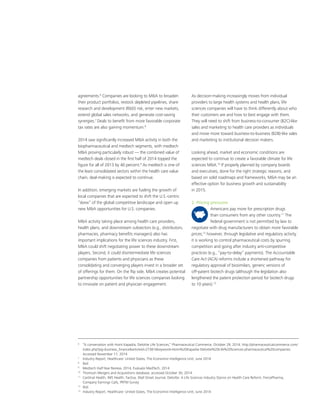
U.S. life sciences market
Brand name pharmaceuticals
2013 revenue= $163.5 billion1
Annual growth, 2014 — 2019 = 2.0%....to
$180.7 billion
Generic pharmaceuticals
2013 revenue=$42.7 billion2
Annual growth, 2014 — 2019= 4.8%...to $53.9 billion
Biotechnology
2013 revenue= $98.4 billion3
Annual growth, 2014 — 2019=9.1%...to $152.4 billion
Medical devices
2013 revenue= $37.6 billion4
Annual growth, 2014 — 2019=7.1%...to $52.9 billion
Medical instruments  supplies
2013 revenue= $96.4 billion5
Annual growth, 2014 — 2019=3.6%...to $114.9 billion
Disruptive
technologies
Research and
development
productivity
Risk,
regulations,
and compliance
Health reform
and the shift
to value
Pricing
pressures
Market
reconfiguration
and consolidation
Key issues in
2015
As decision-making increasingly moves from individual
providers to large health systems and health plans, life
sciences companies will have to think differently about who
their customers are and how to best engage with them.
They will need to shift from business-to-consumer (B2C)-like
sales and marketing to health care providers as individuals
and move more toward business-to-business (B2B)-like sales
and marketing to institutional decision makers.
Looking ahead, market and economic conditions are
expected to continue to create a favorable climate for life
sciences MA.10
If properly planned by company boards
and executives, done for the right strategic reasons, and
based on solid roadmaps and frameworks, MA may be an
effective option for business growth and sustainability
in 2015.
2. Pricing pressures
Americans pay more for prescription drugs
than consumers from any other country.11
The
federal government is not permitted by law to
negotiate with drug manufacturers to obtain more favorable
prices;12
however, through legislative and regulatory activity,
it is working to control pharmaceutical costs by spurring
competition and going after industry anti-competitive
practices (e.g., “pay-to-delay” payments). The Accountable
Care Act (ACA) reforms include a shortened pathway for
regulatory approval of biosimilars, generic versions of
off-patent biotech drugs (although the legislation also
lengthened the patent protection period for biotech drugs
to 10 years).13
agreements.6
Companies are looking to MA to broaden
their product portfolios, restock depleted pipelines, share
research and development (RD) risk, enter new markets,
extend global sales networks, and generate cost-saving
synergies.7
Deals to benefit from more favorable corporate
tax rates are also gaining momentum.8
2014 saw significantly increased MA activity in both the
biopharmaceutical and medtech segments, with medtech
MA proving particularly robust — the combined value of
medtech deals closed in the first half of 2014 topped the
figure for all of 2013 by 40 percent.9
As medtech is one of
the least consolidated sectors within the health care value
chain, deal-making is expected to continue.
In addition, emerging markets are fueling the growth of
local companies that are expected to shift the U.S.-centric
“skew” of the global competitive landscape and open up
new MA opportunities for U.S. companies.
MA activity taking place among health care providers,
health plans, and downstream subsectors (e.g., distributors,
pharmacies, pharmacy benefits managers) also has
important implications for the life sciences industry. First,
MA could shift negotiating power to these downstream
players. Second, it could disintermediate life sciences
companies from patients and physicians as these
consolidating and converging players invest in a broader set
of offerings for them. On the flip side, MA creates potential
partnership opportunities for life sciences companies looking
to innovate on patient and physician engagement.
6
	 “A conversation with Homi Kapadia, Deloitte Life Sciences,” Pharmaceutical Commerce, October 29, 2014. http://pharmaceuticalcommerce.com/
index.php?pg=business_financearticleid=27381keyword=Homi%20Kapadia-Deloitte%20Life%20Sciences-pharmaceutical%20companies.
Accessed November 17, 2014
7	
Industry Report, Healthcare: United States, The Economist Intelligence Unit, June 2014
8
	Ibid
9
	 Medtech Half-Year Review, 2014, Evaluate MedTech, 2014
10
	 Thomson Mergers and Acquisitions database, accessed October 30, 2014.
11
	 Cardinal Health, IMS Health, Factiva, Wall Street Journal, Deloitte: A Life Sciences Industry Stance on Health Care Reform, FiercePharma,
Company Earnings Calls, PRTM Survey
12
	Ibid
13
	 Industry Report, Healthcare: United States, The Economist Intelligence Unit, June 2014
14
	 IBISWorld Industry Report 33451b: Medical Device Manufacturing in the US, IBISWorld, August 2014
15
	“What does the election mean for providers, health plans, and life sciences companies?,” A View from the Center, Deloitte Center for Health Care
Solutions, November 10, 2014. http://blogs.deloitte.com/centerforhealthsolutions/2014/11/what-does-the-election-mean-for-providers-health-plans-
and-life-sciences-companies.html#.VGpO0Gd0yUk. Accessed November 17, 2014.
16	
The three rules in medical technology: The transformation of an industry, Deloitte University Press, 2013. The three rules in medical technology: The
transformation of an industry, Deloitte University Press, 2013. http://dupress.com/articles/three-rules-medical-technology/
17
	 The three rules in medical technology: The transformation of an industry, Deloitte University Press, 2013. http://dupress.com/articles/three-rules-
medical-technology/
18
	 Measuring the return from pharmaceutical innovation 2013: Weathering the storm? Deloitte and Thomson Reuters, 2013, http://www.deloitte.com/
view/en_GB/uk/research-and-intelligence/deloitte-research-uk/deloitte-uk-centre-for-health-solutions/pharmaceutical-innovation-2013/index.htm
19	
Jonathan Norris, Strong momentum in healthcare: Trends in mergers and acquisitions, Silicon Valley Bank, August 2013, http://www.svb.com/
healthcare-report. Cited in The three rules in medical technology: The transformation of an industry, Deloitte University Press, 2013. http://
dupress.com/articles/three-rules-medical-technology/
The ACA also includes a 2.3 percent medical device excise
tax, which is likely to put pressure on device prices.14
Given the mid-term election results, however, we could
see Congress try to appeal this tax, even though cutting
provisions that raise revenue would probably need to be
paired with an offset to keep the effect on the budget
deficit neutral. Finding such an offset might be politically
challenging.15
U.S. health plans are increasing their efforts to contain
pharmaceutical costs, using a variety of methods including
formularies (lists of medicines included or excluded for
insurance coverage) and tiered co-payment schemes that
require consumers to pay more out-of-pocket (OOP) for
brand-name drugs than for generics. Health plans have
become more stringent in their criteria for awarding
coverage and reimbursement benefits for medtech products,
as well.16
Hospitals are also coming to the negotiating table more
prepared than ever to secure favorable pricing — hiring
specialists such as chief procurement officers and MBAs to
manage the process and using value analysis committees
or teams of clinical experts and administrative staff to
make purchasing decisions. Pharmaceutical and medtech
companies will need to be equally prepared.
3. Health reform and the shift to value
U.S. health reform is shining a spotlight on
the shift from volume- to value-based care.
In response, the life sciences industry will
increasingly need to use real-world evidence and emphasize
a product’s clinical, safety, and economic impact (e.g.,
comparative effectiveness) to better demonstrate and
communicate drug and device prices with respect to their
true value. That value should be compared to the next-
best alternative inclusive of effectiveness rates, side effects,
tolerability, and adjunct services such as programs to support
better adherence. So while the price of a new treatment
may appear high, if it is curative and replaces a treatment
that is taken over a longer period with many doses and
modest effectiveness, then the value is seen in a new light.
Companies will have to revisit the types of data they
are generating from their clinical trials and competitive
comparisons to ensure they are providing the evidence
needed to demonstrate the types of value that align with
each stakeholder’s expectations. For example, collecting
and analyzing data that show how a medical technology
outperforms its competitors in increasing hospital revenue,
improving quality of care, or reducing overall health care
system costs can be extremely valuable. These are the
factors health plans and providers consider when evaluating
the price of a product — the inputs that go into a more
value-based pricing approach.17
4. RD productivity
A recent Deloitte and Thomson Reuters study
of 12 large global life sciences companies found
that their expected return on late-stage pipeline
projects has declined across four years, to 4.8 percent in
2013 from 10.5 percent in 2010. Along with that, the cost
to develop and launch a new medicine has increased 18
percent, to $1.3 billion.18
In another sobering development, medtech manufacturing
received steadily increasing venture capital investments
from 2001 to 2009; however, investment peaked in 2009
at 13 percent of total health care venture capital dollars
and has steadily declined since.19
The reduction in venture
capital support for these innovations poses a risk to medtech
companies’ ability to address future unmet clinical needs and
to create substantial future demand for their products.
To combat declining RD productivity, life sciences
companies will need to increase efficiency, reduce costs,
and maximize the commercial value of their investments.
A few companies already are improving productivity
within their drug pipelines — the line-up of diabetes and
cancer drugs in late-stage development is extensive, and
suggests that treatment breakthroughs may be imminent20
— by employing a variety of approaches, many of them
complementary. In addition, innovating in specialty (versus
primary care) therapeutic areas (TAs) may drive considerable
pharmaceutical revenue growth in coming years. Specialty TA
markets have lower patient volumes but greater unmet need,
which supports high drug prices.
In medtech, some companies are shifting to more cross-
functional development teams that integrate RD,
marketing, engineering, and other disciplines. Such teams
more effectively connect customer insights with the
biodesign process for product development. Medtech
companies also are looking for ways to wrap health care
services (e.g., cellular therapy) around their products.
Some biopharmaceutical companies are moving to MA
and open innovation models as a way to help overcome
their organic productivity challenges. In “open innovation”
models, multiple parties pool their risks, intellectual property,
resources, and costs in pursuit of developing novel products
and services. The resulting rewards are shared with the
network.
5. Disruptive technologies
Life sciences companies should look to other
industries and non-traditional players for disruptive
technologies that could be applied to health
care and foster product innovation, market expansion, and
revenue growth. The proliferation of digital technology
has dramatically increased the amount of information
available to patients, putting more power in their hands. This
makes patient engagement and patient experience a more
important lever for life sciences companies, especially in light
of downstream consolidation in the ecosystem.
For example, mobile health (mHealth) is expected to be
a valuable partner in health care’s shift toward a patient-
centered, value-based delivery model. mHealth has the
potential to improve workplace efficiencies, increase patient
safety, better coordinate care, facilitate payments, and
engage patients.21
Additive manufacturing (AM), often referred to as “3D
printing,” also has disruptive potential in health care. The
prospective benefits of AM are numerous — it can spur
additional innovation, improve patient access to life-saving
devices, simplify and accelerate the supply chain and
production process, and achieve considerable savings. The
medtech industry already stands at the forefront of this
transformative change — medical applications account for
about one-sixth of AM market revenues.22
Finally, Artificial Intelligence, through exponential increases
in data, computing power, connectivity, miniaturization of
hardware, and advanced software capabilities at lower costs
will rapidly accelerate the development of next-generation
“smart” medtech devices and could cause profound
disruption in the way health care is delivered in the future.
6. Risk, regulations, and compliance
U.S. life sciences companies operating in today’s
global marketplace are at increasing risk of
product safety issues, security and privacy
breaches, intellectual property (IP) disputes, whistleblower
complaints, and corruption incidents, each of which may
result in financial and reputational damage. Concurrently,
the U.S. and other governments are tightening regulations
to address these risks and working more collaboratively to
enforce them. Among important developments are calls for
greater transparency in life sciences companies’ business and
clinical operations — executive pay, financial information
accuracy, manufacturing processes, transfers of value to
health care practitioners and institutions as well as clinical
trial quality. Under the ACA, for instance, pharmaceutical
companies have to declare all payments to physicians.23
20
	 Industry Report, Healthcare: United States, The Economist Intelligence Unit, June 2014
21
	 “The four dimensions of effective mobile health: people, places, payment, and purpose,” A View from the Center, Deloitte Center for Health
Solutions, January 13, 2014, http://blogs.deloitte.com/centerforhealthsolutions/2014/01/the-four-dimensions-of-effective-mobile-health-people-
places-payment-and-purpose.html#.VEgE_Gd0yUk/. Accessed October 22, 2014
22
	Wohlers Associates, Additive manufacturing and 3D printing: State of the industry, 2013, p. 14. 2Espicom Business Intelligence Ltd., The
WorldMedical Markets Fact Book 2012, 2012.
23	
Industry Report, Healthcare: United States, The Economist Intelligence Unit, June 2014
In 2015 patient safety and data transparency will continue
as focus areas for regulatory scrutiny and enforcement. For
example, oversight has increased dramatically in the form
of stringent demands for product data. The FDA recently
instituted the Global Unique Device Identification Database
(GUDID) to collect substantial volumes of manufacturing
and registration information.24
Lengthy product approvals
also remain an issue. The FDA review process for medtech
companies is almost twice as long as that of its European
counterpart, the European Medicines Agency. It takes
companies six months on average to get 510(k) approval in
the U.S. compared to three months in Europe.25
However,
with generic pharmaceutical products, the FDA is making
strides in the form of new guidance documents to improve
the submission and approval process.
U.S. regulators also appear to be doing some
“housekeeping” — making an effort to revisit old issues
and bring them to closure (e.g., old guidance, draft rules,
proposed rules). Meanwhile, agencies in other countries are
increasing their regulatory rigor, and in emerging markets
especially, their sophistication is increasing. The FDA used to
be the gold standard, but now other agencies are matching
or even surpassing the FDA. Life sciences companies can
no longer assume that if they pass the FDA’s requirements,
that they will have no problem passing other agencies’
requirements. Moving forward, organizations will need to
cost-effectively address regulatory requirements that impact
their strategic objectives at home and abroad.
Moving forward
As the health care industry shifts and transforms so, too,
must the life sciences sector. In 2015, this may require
companies to recalibrate business models and research
priorities, and retool commercial practices to better articulate
their value proposition. In addition, companies increasingly
will need to use real-world evidence to demonstrate a
product’s clinical, safety, and economic impact (e.g.,
comparative effectiveness), and robust data analytics to
improve marketing strategies and effectiveness. They should
consider MA transactions to scale up within particular
areas of specialization and exit others, and expand into
new markets. Organizations also should engage in more
proactive risk management and regulatory compliance.
In another key focus area, life sciences companies could
improve RD efficiency, diversify risks and costs, and use
their human capital better by employing open innovation
and other novel development approaches — for example,
hosting companies on site or establishing innovation
centers that incubate 30-40 companies to broaden future
possibilities. In pursuit of innovative new products, they
should look to develop patient-centric suites/portfolios
of products and services to improve the overall health of
their customers. For example, there is growing interest
in wearable technologies and sensors to monitor vital
signs; digital medicines such as ingestible smart pills with
microchips; and novel drug delivery systems.
In essence, U.S. life sciences companies in 2015 should
focus on areas in which they excel, improve areas that are
important to achieving their goals, and let go of elements
that might be holding them back.
Follow @DeloitteHealth
24
	 2015 global life sciences outlook: Adapting in an era of transformation, Deloitte Touche Tohmatsu Limited, 2014
25
	 Yair Holtzman, The US medical tech industry in 2012: Challenges at home and abroad, MDDI, July 2012, http://www.mddionline.com/article/
medtech-2012-SWOT; Kevin Bottomley, Medical technologies: What’s hot and key trends in medtech in 2013, Results Healthcare, April 2013,
http://www.resultshealthcare.com/media/105652/medtech 2013.pdf. Cited in The three rules in medical technology: The transformation of an
industry, Deloitte University Press, 2013. The three rules in medical technology: The transformation of an industry, Deloitte University Press, 2013.
http://dupress.com/articles/three-rules-medical-technology/
Many U.S. life sciences companies are
rethinking their business models and
go-to-market approaches, given the
challenges of an evolving, consolidating,
and converging health care landscape.
Disclaimer
This publication contains general information only, and none of Deloitte Touche Tohmatsu Limited, its member firms, or their related entities
(collectively the “Deloitte Network”) is, by means of this publication, rendering professional advice or services. Before making any decision or taking
any action that may affect your finances or your business, you should consult a qualified professional adviser. No entity in the Deloitte Network shall
be responsible for any loss whatsoever sustained by any person who relies on this publication.
About Deloitte
Deloitte refers to one or more of Deloitte Touche Tohmatsu Limited, a UK private company limited by guarantee, and its network of member firms,
each of which is a legally separate and independent entity. Please see www.deloitte.com/about for a detailed description of the legal structure of
Deloitte Touche Tohmatsu Limited and its member firms.
Deloitte provides audit, tax, consulting, and financial advisory services to public and private clients spanning multiple industries. With a globally
connected network of member firms in more than 150 countries, Deloitte brings world-class capabilities and high-quality service to clients, delivering
the insights they need to address their most complex business challenges. Deloitte has in the region of 200,000 professionals, all committed to
becoming the standard of excellence.
©2014 For more information, contact Deloitte Touche Tohmatsu Limited.
Homi Kapadia
Life Sciences Sector Leader
Deloitte LLP
+1 215 246 2450
hkapadia@deloitte.com
To learn more about the global trends and issues impacting the life sciences sector, please visit our 2015 global life sciences sector outlook at
www.deloitte.com/2015lifesciencesoutlook.

2015 Medical Device Outlook - Deloitte

  • 1.
    2015 life sciences outlook UnitedStates Despite their considerable size and resources, U.S. life sciences companies — like their peers in Europe and elsewhere — operate in a dynamic environment that presents numerous challenges to revenue and market share growth. Among the set of intertwined, critical issues that companies face in 2015, six rise to the top: 1. Market reconfiguration and consolidation Expiring patents, shorter product life cycles, formulary coverage challenges, changing commercial practices, growth in new markets, and value-based reimbursements are all driving the need for organizations to reassess strategies, reconfigure business models, and explore potential mergers and acquisitions (M&A) opportunities. Increasingly, life sciences companies are searching for the right scale in today’s competitive environment. Some are focusing on pure plays in a given segment or therapeutic area; others are building out capabilities by acquiring and managing a large portfolio of businesses across a range of areas. Each of these approaches is resulting in an unprecedented level of deal-making in the form of mergers, acquisitions, joint ventures, divestitures, and licensing 1 IBISWorld Industry Report32541a, Brand Name Pharmaceutical Manufacturing in the US, August 2014 2 IBISWorld Industry Report 32541b, Generic Pharmaceutical Manufacturing in the US, July 2014 3 IBISWorld Industry Report NN001, Biotechnology in the US, November 2014 4 IBISWorld Industry Report 33451b, Medical Device Manufacturing in the US, October 2014 5 IBISWorld Industry Report 33911a, Medical Instrument Supply Manufacturing in the US, September 2014 U.S. life sciences market Brand name pharmaceuticals 2013 revenue= $163.5 billion1 Annual growth, 2014 — 2019 = 2.0%....to $180.7 billion Generic pharmaceuticals 2013 revenue=$42.7 billion2 Annual growth, 2014 — 2019= 4.8%...to $53.9 billion Biotechnology 2013 revenue= $98.4 billion3 Annual growth, 2014 — 2019=9.1%...to $152.4 billion Medical devices 2013 revenue= $37.6 billion4 Annual growth, 2014 — 2019=7.1%...to $52.9 billion Medical instruments supplies 2013 revenue= $96.4 billion5 Annual growth, 2014 — 2019=3.6%...to $114.9 billion Disruptive technologies Research and development productivity Risk, regulations, and compliance Health reform and the shift to value Pricing pressures Market reconfiguration and consolidation Key issues in 2015
  • 2.
    As decision-making increasinglymoves from individual providers to large health systems and health plans, life sciences companies will have to think differently about who their customers are and how to best engage with them. They will need to shift from business-to-consumer (B2C)-like sales and marketing to health care providers as individuals and move more toward business-to-business (B2B)-like sales and marketing to institutional decision makers. Looking ahead, market and economic conditions are expected to continue to create a favorable climate for life sciences MA.10 If properly planned by company boards and executives, done for the right strategic reasons, and based on solid roadmaps and frameworks, MA may be an effective option for business growth and sustainability in 2015. 2. Pricing pressures Americans pay more for prescription drugs than consumers from any other country.11 The federal government is not permitted by law to negotiate with drug manufacturers to obtain more favorable prices;12 however, through legislative and regulatory activity, it is working to control pharmaceutical costs by spurring competition and going after industry anti-competitive practices (e.g., “pay-to-delay” payments). The Accountable Care Act (ACA) reforms include a shortened pathway for regulatory approval of biosimilars, generic versions of off-patent biotech drugs (although the legislation also lengthened the patent protection period for biotech drugs to 10 years).13 agreements.6 Companies are looking to MA to broaden their product portfolios, restock depleted pipelines, share research and development (RD) risk, enter new markets, extend global sales networks, and generate cost-saving synergies.7 Deals to benefit from more favorable corporate tax rates are also gaining momentum.8 2014 saw significantly increased MA activity in both the biopharmaceutical and medtech segments, with medtech MA proving particularly robust — the combined value of medtech deals closed in the first half of 2014 topped the figure for all of 2013 by 40 percent.9 As medtech is one of the least consolidated sectors within the health care value chain, deal-making is expected to continue. In addition, emerging markets are fueling the growth of local companies that are expected to shift the U.S.-centric “skew” of the global competitive landscape and open up new MA opportunities for U.S. companies. MA activity taking place among health care providers, health plans, and downstream subsectors (e.g., distributors, pharmacies, pharmacy benefits managers) also has important implications for the life sciences industry. First, MA could shift negotiating power to these downstream players. Second, it could disintermediate life sciences companies from patients and physicians as these consolidating and converging players invest in a broader set of offerings for them. On the flip side, MA creates potential partnership opportunities for life sciences companies looking to innovate on patient and physician engagement. 6 “A conversation with Homi Kapadia, Deloitte Life Sciences,” Pharmaceutical Commerce, October 29, 2014. http://pharmaceuticalcommerce.com/ index.php?pg=business_financearticleid=27381keyword=Homi%20Kapadia-Deloitte%20Life%20Sciences-pharmaceutical%20companies. Accessed November 17, 2014 7 Industry Report, Healthcare: United States, The Economist Intelligence Unit, June 2014 8 Ibid 9 Medtech Half-Year Review, 2014, Evaluate MedTech, 2014 10 Thomson Mergers and Acquisitions database, accessed October 30, 2014. 11 Cardinal Health, IMS Health, Factiva, Wall Street Journal, Deloitte: A Life Sciences Industry Stance on Health Care Reform, FiercePharma, Company Earnings Calls, PRTM Survey 12 Ibid 13 Industry Report, Healthcare: United States, The Economist Intelligence Unit, June 2014
  • 3.
    14 IBISWorld IndustryReport 33451b: Medical Device Manufacturing in the US, IBISWorld, August 2014 15 “What does the election mean for providers, health plans, and life sciences companies?,” A View from the Center, Deloitte Center for Health Care Solutions, November 10, 2014. http://blogs.deloitte.com/centerforhealthsolutions/2014/11/what-does-the-election-mean-for-providers-health-plans- and-life-sciences-companies.html#.VGpO0Gd0yUk. Accessed November 17, 2014. 16 The three rules in medical technology: The transformation of an industry, Deloitte University Press, 2013. The three rules in medical technology: The transformation of an industry, Deloitte University Press, 2013. http://dupress.com/articles/three-rules-medical-technology/ 17 The three rules in medical technology: The transformation of an industry, Deloitte University Press, 2013. http://dupress.com/articles/three-rules- medical-technology/ 18 Measuring the return from pharmaceutical innovation 2013: Weathering the storm? Deloitte and Thomson Reuters, 2013, http://www.deloitte.com/ view/en_GB/uk/research-and-intelligence/deloitte-research-uk/deloitte-uk-centre-for-health-solutions/pharmaceutical-innovation-2013/index.htm 19 Jonathan Norris, Strong momentum in healthcare: Trends in mergers and acquisitions, Silicon Valley Bank, August 2013, http://www.svb.com/ healthcare-report. Cited in The three rules in medical technology: The transformation of an industry, Deloitte University Press, 2013. http:// dupress.com/articles/three-rules-medical-technology/ The ACA also includes a 2.3 percent medical device excise tax, which is likely to put pressure on device prices.14 Given the mid-term election results, however, we could see Congress try to appeal this tax, even though cutting provisions that raise revenue would probably need to be paired with an offset to keep the effect on the budget deficit neutral. Finding such an offset might be politically challenging.15 U.S. health plans are increasing their efforts to contain pharmaceutical costs, using a variety of methods including formularies (lists of medicines included or excluded for insurance coverage) and tiered co-payment schemes that require consumers to pay more out-of-pocket (OOP) for brand-name drugs than for generics. Health plans have become more stringent in their criteria for awarding coverage and reimbursement benefits for medtech products, as well.16 Hospitals are also coming to the negotiating table more prepared than ever to secure favorable pricing — hiring specialists such as chief procurement officers and MBAs to manage the process and using value analysis committees or teams of clinical experts and administrative staff to make purchasing decisions. Pharmaceutical and medtech companies will need to be equally prepared. 3. Health reform and the shift to value U.S. health reform is shining a spotlight on the shift from volume- to value-based care. In response, the life sciences industry will increasingly need to use real-world evidence and emphasize a product’s clinical, safety, and economic impact (e.g., comparative effectiveness) to better demonstrate and communicate drug and device prices with respect to their true value. That value should be compared to the next- best alternative inclusive of effectiveness rates, side effects, tolerability, and adjunct services such as programs to support better adherence. So while the price of a new treatment may appear high, if it is curative and replaces a treatment that is taken over a longer period with many doses and modest effectiveness, then the value is seen in a new light. Companies will have to revisit the types of data they are generating from their clinical trials and competitive comparisons to ensure they are providing the evidence needed to demonstrate the types of value that align with each stakeholder’s expectations. For example, collecting and analyzing data that show how a medical technology outperforms its competitors in increasing hospital revenue, improving quality of care, or reducing overall health care system costs can be extremely valuable. These are the factors health plans and providers consider when evaluating the price of a product — the inputs that go into a more value-based pricing approach.17 4. RD productivity A recent Deloitte and Thomson Reuters study of 12 large global life sciences companies found that their expected return on late-stage pipeline projects has declined across four years, to 4.8 percent in 2013 from 10.5 percent in 2010. Along with that, the cost to develop and launch a new medicine has increased 18 percent, to $1.3 billion.18 In another sobering development, medtech manufacturing received steadily increasing venture capital investments from 2001 to 2009; however, investment peaked in 2009 at 13 percent of total health care venture capital dollars and has steadily declined since.19 The reduction in venture capital support for these innovations poses a risk to medtech companies’ ability to address future unmet clinical needs and to create substantial future demand for their products.
  • 4.
    To combat decliningRD productivity, life sciences companies will need to increase efficiency, reduce costs, and maximize the commercial value of their investments. A few companies already are improving productivity within their drug pipelines — the line-up of diabetes and cancer drugs in late-stage development is extensive, and suggests that treatment breakthroughs may be imminent20 — by employing a variety of approaches, many of them complementary. In addition, innovating in specialty (versus primary care) therapeutic areas (TAs) may drive considerable pharmaceutical revenue growth in coming years. Specialty TA markets have lower patient volumes but greater unmet need, which supports high drug prices. In medtech, some companies are shifting to more cross- functional development teams that integrate RD, marketing, engineering, and other disciplines. Such teams more effectively connect customer insights with the biodesign process for product development. Medtech companies also are looking for ways to wrap health care services (e.g., cellular therapy) around their products. Some biopharmaceutical companies are moving to MA and open innovation models as a way to help overcome their organic productivity challenges. In “open innovation” models, multiple parties pool their risks, intellectual property, resources, and costs in pursuit of developing novel products and services. The resulting rewards are shared with the network. 5. Disruptive technologies Life sciences companies should look to other industries and non-traditional players for disruptive technologies that could be applied to health care and foster product innovation, market expansion, and revenue growth. The proliferation of digital technology has dramatically increased the amount of information available to patients, putting more power in their hands. This makes patient engagement and patient experience a more important lever for life sciences companies, especially in light of downstream consolidation in the ecosystem. For example, mobile health (mHealth) is expected to be a valuable partner in health care’s shift toward a patient- centered, value-based delivery model. mHealth has the potential to improve workplace efficiencies, increase patient safety, better coordinate care, facilitate payments, and engage patients.21 Additive manufacturing (AM), often referred to as “3D printing,” also has disruptive potential in health care. The prospective benefits of AM are numerous — it can spur additional innovation, improve patient access to life-saving devices, simplify and accelerate the supply chain and production process, and achieve considerable savings. The medtech industry already stands at the forefront of this transformative change — medical applications account for about one-sixth of AM market revenues.22 Finally, Artificial Intelligence, through exponential increases in data, computing power, connectivity, miniaturization of hardware, and advanced software capabilities at lower costs will rapidly accelerate the development of next-generation “smart” medtech devices and could cause profound disruption in the way health care is delivered in the future. 6. Risk, regulations, and compliance U.S. life sciences companies operating in today’s global marketplace are at increasing risk of product safety issues, security and privacy breaches, intellectual property (IP) disputes, whistleblower complaints, and corruption incidents, each of which may result in financial and reputational damage. Concurrently, the U.S. and other governments are tightening regulations to address these risks and working more collaboratively to enforce them. Among important developments are calls for greater transparency in life sciences companies’ business and clinical operations — executive pay, financial information accuracy, manufacturing processes, transfers of value to health care practitioners and institutions as well as clinical trial quality. Under the ACA, for instance, pharmaceutical companies have to declare all payments to physicians.23 20 Industry Report, Healthcare: United States, The Economist Intelligence Unit, June 2014 21 “The four dimensions of effective mobile health: people, places, payment, and purpose,” A View from the Center, Deloitte Center for Health Solutions, January 13, 2014, http://blogs.deloitte.com/centerforhealthsolutions/2014/01/the-four-dimensions-of-effective-mobile-health-people- places-payment-and-purpose.html#.VEgE_Gd0yUk/. Accessed October 22, 2014 22 Wohlers Associates, Additive manufacturing and 3D printing: State of the industry, 2013, p. 14. 2Espicom Business Intelligence Ltd., The WorldMedical Markets Fact Book 2012, 2012. 23 Industry Report, Healthcare: United States, The Economist Intelligence Unit, June 2014
  • 5.
    In 2015 patientsafety and data transparency will continue as focus areas for regulatory scrutiny and enforcement. For example, oversight has increased dramatically in the form of stringent demands for product data. The FDA recently instituted the Global Unique Device Identification Database (GUDID) to collect substantial volumes of manufacturing and registration information.24 Lengthy product approvals also remain an issue. The FDA review process for medtech companies is almost twice as long as that of its European counterpart, the European Medicines Agency. It takes companies six months on average to get 510(k) approval in the U.S. compared to three months in Europe.25 However, with generic pharmaceutical products, the FDA is making strides in the form of new guidance documents to improve the submission and approval process. U.S. regulators also appear to be doing some “housekeeping” — making an effort to revisit old issues and bring them to closure (e.g., old guidance, draft rules, proposed rules). Meanwhile, agencies in other countries are increasing their regulatory rigor, and in emerging markets especially, their sophistication is increasing. The FDA used to be the gold standard, but now other agencies are matching or even surpassing the FDA. Life sciences companies can no longer assume that if they pass the FDA’s requirements, that they will have no problem passing other agencies’ requirements. Moving forward, organizations will need to cost-effectively address regulatory requirements that impact their strategic objectives at home and abroad. Moving forward As the health care industry shifts and transforms so, too, must the life sciences sector. In 2015, this may require companies to recalibrate business models and research priorities, and retool commercial practices to better articulate their value proposition. In addition, companies increasingly will need to use real-world evidence to demonstrate a product’s clinical, safety, and economic impact (e.g., comparative effectiveness), and robust data analytics to improve marketing strategies and effectiveness. They should consider MA transactions to scale up within particular areas of specialization and exit others, and expand into new markets. Organizations also should engage in more proactive risk management and regulatory compliance. In another key focus area, life sciences companies could improve RD efficiency, diversify risks and costs, and use their human capital better by employing open innovation and other novel development approaches — for example, hosting companies on site or establishing innovation centers that incubate 30-40 companies to broaden future possibilities. In pursuit of innovative new products, they should look to develop patient-centric suites/portfolios of products and services to improve the overall health of their customers. For example, there is growing interest in wearable technologies and sensors to monitor vital signs; digital medicines such as ingestible smart pills with microchips; and novel drug delivery systems. In essence, U.S. life sciences companies in 2015 should focus on areas in which they excel, improve areas that are important to achieving their goals, and let go of elements that might be holding them back. Follow @DeloitteHealth 24 2015 global life sciences outlook: Adapting in an era of transformation, Deloitte Touche Tohmatsu Limited, 2014 25 Yair Holtzman, The US medical tech industry in 2012: Challenges at home and abroad, MDDI, July 2012, http://www.mddionline.com/article/ medtech-2012-SWOT; Kevin Bottomley, Medical technologies: What’s hot and key trends in medtech in 2013, Results Healthcare, April 2013, http://www.resultshealthcare.com/media/105652/medtech 2013.pdf. Cited in The three rules in medical technology: The transformation of an industry, Deloitte University Press, 2013. The three rules in medical technology: The transformation of an industry, Deloitte University Press, 2013. http://dupress.com/articles/three-rules-medical-technology/ Many U.S. life sciences companies are rethinking their business models and go-to-market approaches, given the challenges of an evolving, consolidating, and converging health care landscape.
  • 6.
    Disclaimer This publication containsgeneral information only, and none of Deloitte Touche Tohmatsu Limited, its member firms, or their related entities (collectively the “Deloitte Network”) is, by means of this publication, rendering professional advice or services. Before making any decision or taking any action that may affect your finances or your business, you should consult a qualified professional adviser. No entity in the Deloitte Network shall be responsible for any loss whatsoever sustained by any person who relies on this publication. About Deloitte Deloitte refers to one or more of Deloitte Touche Tohmatsu Limited, a UK private company limited by guarantee, and its network of member firms, each of which is a legally separate and independent entity. Please see www.deloitte.com/about for a detailed description of the legal structure of Deloitte Touche Tohmatsu Limited and its member firms. Deloitte provides audit, tax, consulting, and financial advisory services to public and private clients spanning multiple industries. With a globally connected network of member firms in more than 150 countries, Deloitte brings world-class capabilities and high-quality service to clients, delivering the insights they need to address their most complex business challenges. Deloitte has in the region of 200,000 professionals, all committed to becoming the standard of excellence. ©2014 For more information, contact Deloitte Touche Tohmatsu Limited. Homi Kapadia Life Sciences Sector Leader Deloitte LLP +1 215 246 2450 hkapadia@deloitte.com To learn more about the global trends and issues impacting the life sciences sector, please visit our 2015 global life sciences sector outlook at www.deloitte.com/2015lifesciencesoutlook.