
















Fault-ToleranceOnTheCheapMaking systems that probably won’t fall over.
Hi, folks!
I do things
to/with
computers.
I’m a real-time,
networked
systems engineer.
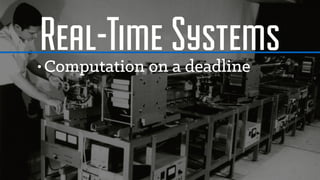
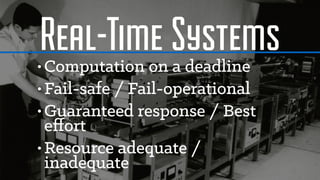
Real-Time Systems
Real-Time Systems• Computation on a deadline
• Fail-safe / Fail-operational
Real-Time Systems• Computation on a deadline
• Fail-safe / Fail-operational
• Guaranteed response / Best
effort
Real-Time Systems• Computation on a deadline
• Fail-safe / Fail-operational
• Guaranteed response / Best
effort
• Resource adequate /
inadequate
Networked Systems
Networked Systems• Out-of-order messages
• No legitimate concept of “now”
Networked Systems• Out-of-order messages
• No legitimate concept of “now”
• High-latency transmission
Networked Systems• Out-of-order messages
• No legitimate concept of “now”
• High-latency transmission
• Lossy transmission
Punk Rock
Version
Here’s a
socket.
Here’s an
interrupt.
Go program
a computer!
AdRoll
real-time
bidding
Erlang
Fault
Tolerance
Sub-components
fail. The system
does not.
Well, not right
away…
What’s it take?
Option 1: Perfection
• Total control over the whole
mechanism.
Option 1: Perfection
• Total control over the whole
mechanism.
• Total understanding of the
problem domain.
Option 1: Perfection
• Total control over the whole
mechanism.
• Total understanding of the
problem domain.
• Specific, explicit system goals.
Option 1: Perfection
• Total control over the whole
mechanism.
• Total understanding of the
problem domain.
• Specific, explicit system goals.
• Well-known service lifetime.
Option 1: Perfection
“They Write the Right Stuff”
Fast Company, 2005
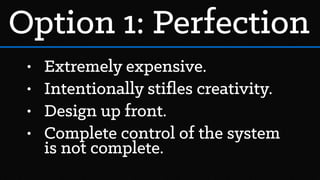
• Extremely expensive.
Option 1: Perfection
• Extremely expensive.
• Intentionally stifles creativity.
Option 1: Perfection
• Extremely expensive.
• Intentionally stifles creativity.
• Design up front.
Option 1: Perfection
• Extremely expensive.
• Intentionally stifles creativity.
• Design up front.
• Complete control of the system
is not complete.
Option 1: Perfection
Option 2:
Hope for the Best
• Little up-front knowledge of the
problem domain.
Option 2: Hope for the Best
• Little up-front knowledge of the
problem domain.
• Implicit or short-term system
goals.
Option 2: Hope for the Best
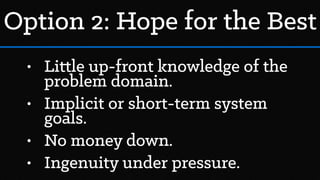
• Little up-front knowledge of the
problem domain.
• Implicit or short-term system
goals.
• No money down.
Option 2: Hope for the Best
• Little up-front knowledge of the
problem domain.
• Implicit or short-term system
goals.
• No money down.
• Ingenuity under pressure.
Option 2: Hope for the Best
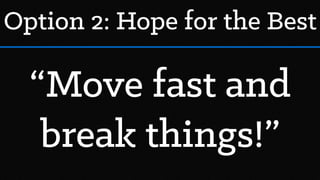
“Move fast and
break things!”
• Ignorance of problem domain
leads to long-term system issues.
Option 2: Hope for the Best
• Ignorance of problem domain
leads to long-term system issues.
• Failures do propagate out
toward users.
Option 2: Hope for the Best
• Ignorance of problem domain
leads to long-term system issues.
• Failures do propagate out
toward users.
• No, money down!
Option 2: Hope for the Best
• Ignorance of problem domain
leads to long-term system issues.
• Failures do propagate out
toward users.
• No, money down!
• Hard to change cultural values.
Option 2: Hope for the Best
Option 3:
Embrace Faults
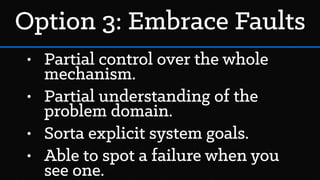
Option 3: Embrace Faults
• Partial control over the whole
mechanism.
Option 3: Embrace Faults
• Partial control over the whole
mechanism.
• Partial understanding of the
problem domain.
Option 3: Embrace Faults
• Partial control over the whole
mechanism.
• Partial understanding of the
problem domain.
• Sorta explicit system goals.
Option 3: Embrace Faults
• Partial control over the whole
mechanism.
• Partial understanding of the
problem domain.
• Sorta explicit system goals.
• Able to spot a failure when you
see one.
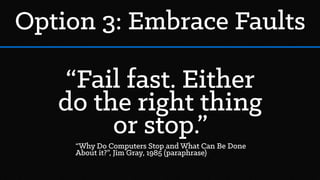
Option 3: Embrace Faults
“Fail fast. Either
do the right thing
or stop.”
“Why Do Computers Stop and What Can Be Done
About it?”, Jim Gray, 1985 (paraphrase)
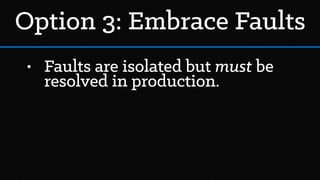
Option 3: Embrace Faults
• Faults are isolated but must be
resolved in production.
Option 3: Embrace Faults
• Faults are isolated but must be
resolved in production.
• Must carefully design for
introspection.
Option 3: Embrace Faults
• Faults are isolated but must be
resolved in production.
• Must carefully design for
introspection.
• Moderate design up-front.
Option 3: Embrace Faults
• Faults are isolated but must be
resolved in production.
• Must carefully design for
introspection.
• Moderate design up-front.
• Pay a little now, pay a little later.
Let’s talk
embracing
faults.
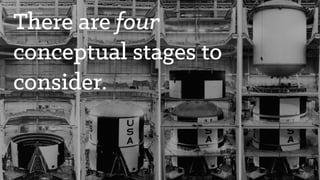
There are four
conceptual stages to
consider.
Component
The most
atomic level
of the system.
Progress here
has an outsized
impact.
Immutable
Data
Structures
Isolate
Side-Effects
Compile-Time
Guarantees
Why test, when
you can prove?
This is
Functional
Programming
Machine
Faults in
components are
exercised here.
Faults in
interactions are
exercised here.
Supervise,
and restart.
Use only
addressable
names.
Distinguish
your critical
components.
Cluster
Redundant
Components
No Single
Points of
Failure
Mean Time
to Failure
Estimates
Instrument
and Monitor
Organization
A finely built machine
without a supporting
organization is a disaster
waiting to happen.
A finely built machine
without
organization is a disaster
waiting to happen.
Chernobyl
STS-51-L
Deepwater Horizon
Magnitogorsk
Damascus Incident
Chevron Refinery
BART ATC
Asiana #214
Therac-25
New Orleans Levee
Correct the conditions
that allowed mistakes,
as well as the mistake.
Process is
Priceless
Build flexible
tools for experts.
Separate
Your
Concerns
Build with
Failure in mind.
Have
resources
you’re
willing to
sacrifice.
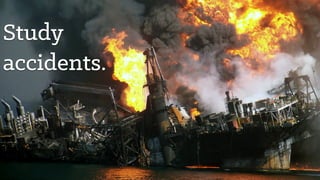
Study
accidents.
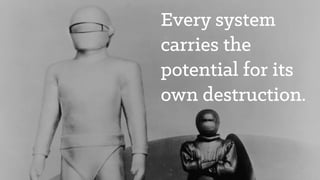
Every system
carries the
potential for its
own destruction.
Some things aren’t
worth building.
Understand
Networks.
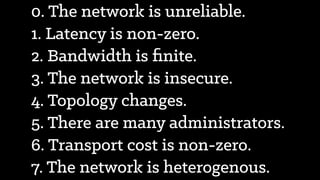
0. The network is unreliable.
1. Latency is non-zero.
2. Bandwidth is finite.
3. The network is insecure.
4. Topology changes.
5. There are many administrators.
6. Transport cost is non-zero.
7. The network is heterogenous.
Thanks
so
much!
@bltroutwine
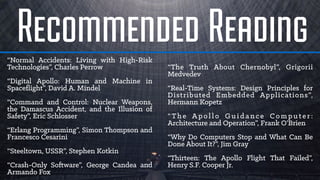
Recommended Reading“Normal Accidents: Living with High-Risk
Technologies”, Charles Perrow
“Digital Apollo: Human and Machine in
Spaceflight”, David A. Mindel
“Command and Control: Nuclear Weapons,
the Damascus Accident, and the Illusion of
Safety”, Eric Schlosser
“Erlang Programming”, Simon Thompson and
Francesco Cesarini
“Steeltown, USSR”, Stephen Kotkin
“Crash-Only Software”, George Candea and
Armando Fox
“The Truth About Chernobyl”, Grigorii
Medvedev
“Real-Time Systems: Design Principles for
Distributed Embedded Applications”,
Hermann Kopetz
“ Th e Ap o l l o G u i d a n c e C o m p u t e r :
Architecture and Operation”, Frank O’Brien
“Why Do Computers Stop and What Can Be
Done About It?”, Jim Gray
“Thirteen: The Apollo Flight That Failed”,
Henry S.F. Cooper Jr.

Fault-tolerance on the Cheap: Making Systems That (Probably) Won't Fall Over