7/9/2014
1
Copyright © FraudResourceNet LLC
Think Like a Fraudster
To Catch a Fraudster
July 9, 2014
Copyright © FraudResourceNet LLC
President and Founder of White Collar Crime 101
• Publisher of White-Collar Crime Fighter
• Developer of FraudAware® Anti-Fraud Training
• Monthly Columnist, The Fraud Examiner, ACFE Newsletter
Member of Editorial Advisory Board, ACFE
Author of “Fraud in the Markets”
• Explains how fraud fueled the financial crisis.
About Peter Goldmann, MSc., CFE
7/9/2014
2
Copyright © FraudResourceNet LLC
About Jim Kaplan, MSc, CIA, CFE
• President and Founder of
AuditNet®, the global resource for
auditors (now available on Apple
and Android devices)
• Auditor, Web Site Guru,
• Internet for Auditors Pioneer
• Recipient of the IIA’s 2007
Bradford Cadmus Memorial
Award.
• Author of “The Auditor’s Guide to
Internet Resources” 2nd Edition
Copyright © FraudResourceNet LLC
Background
Michael is a Director in KPMG’s Forensic practice with more than 10 years of accounting
and investigative experience. Michael is a Certified Public Accountant, Certified Fraud
Examiner, and Certified in Financial Forensics. Prior to joining KPMG, Michael worked in
public accounting providing tax and financial services to clients.
Professional Experience
Michael has substantial experience managing and coordinating investigation and data analytical 
engagements across several industries. Michael specializes in investigations of suspected fraud, 
accounting irregularities, and misconduct, including fraudulent financial reporting, 
misappropriation of assets, and violations of laws and regulations. Michael incorporates KPMG’s 
data analytical methodology into investigations which include the use of many rules‐based and 
behavioral based algorithms to uncover potential fraud indicators, hidden or masked relationships, 
and control weaknesses across disparate data sets.
Managed the investigation at a major utility company where company employees were
accused of receiving kickbacks from contractors. Led the investigation of payments to
contractors to determine overcharges, assisted the company file insurance claims for the
overcharges, and provided expert testimony in Federal Court as a witness for the
prosecution. All 14 company employees pleaded guilty.
Michael managed the investigation into the potential regulatory violation of an international bank. 
Due to filing deadlines he managed a team of 25 investigators over the course of two weeks, which 
include the review of over 50,000 electronic documents and 20 interviews. Due to the investigation 
the institution was able to meet its filing deadline which avoided fines and sanctions from 
regulators.
Michael P. Doyle
Director
KPMG LLP
345 Park Avenue
New York, NY 10154-0102
Tel 212-954-2237
Fax 646-924-3357
email michaeldoyle@kpmg.com
EDUCATION AND PROFESSIONAL AFFILIATIONS:
B.S. Accounting, Queens College
Member, American Institute of Certified Public
Accountants
Member, Association of Certified Fraud Examiners
LICENSE/CERTIFICATIONS:
Certified Public Accountant - New York
Certified Fraud Examiner
Certified in Financial Forensics
Technical Skills:
SQL,
Microsoft Office
Idea
Microsoft Access
7/9/2014
3
Copyright © FraudResourceNet LLC
Professional and Industry Experience
Andrew J. Curtin is a Managing Director in the New York office of KPMG LLP’s 
Forensic Advisory Service practice. He has more than 20 years of experience 
conducting internal fraud, money laundering, financial reporting and 
corruption investigations for financial institutions and corporations, and 
developing and reviewing compliance and business ethics programs for 
corporations, banks, insurance companies and broker‐dealers. 
Prior to joining KPMG, he served in the law department of Citigroup and 
Travelers Insurance as Chief Compliance and Privacy Officer, Claim Services and 
Chief Anti‐Money Laundering and Sanctions (OFAC) Officer for Citigroup’s 
insurance operations. He was also responsible for implementing anti‐fraud 
programs and conducting internal investigations on behalf of Senior 
Management and the Board of Directors. 
As a prosecutor, Andrew supervised and conducted the investigation and 
prosecution of complex financial services and insurance fraud, money 
laundering, asset forfeiture and organized crime cases in both state and federal 
court in the Offices of the New York State Attorney General and the New York 
County District Attorney. 
Education and Professional Affiliations
• Mr. Curtin received his A.B. from Cornell University, College of Arts and Sciences and his J.D. 
from St. John’s University, School of Law.
• He is a member of the State Bar in New York and Connecticut.
ANDREW J. CURTIN
Managing Director
KPMG LLP
345 Park Avenue
New York, NY  10154‐0102
Tel   212 872 7742
Fax  212 409 8792
Cell  914 980 6959
email  acurtin@kpmg.com
Function and Specialization
Mr. Curtin specializes in integrity 
advisory services, including, anti‐
money laundering and sanctions 
compliance and regulatory and 
fraud and misconduct 
investigations.
Copyright © FraudResourceNet LLC
This webinar and its material are the property of FraudResourceNet LLC.
Unauthorized usage or recording of this webinar or any of its material is strictly
forbidden. We are recording the webinar and you will be provided with a link
access to that recording as detailed below. Downloading or otherwise
duplicating the webinar recording is expressly prohibited.
Webinar recording link will be sent via email within 5-7 business days.
NASBA rules require us to ask polling questions during the Webinar and CPE
certificates will be sent via email to those who answer ALL the polling questions
The CPE certificates and link to the recording will be sent to the email address
you registered with in GTW. We are not responsible for delivery problems due to
spam filters, attachment restrictions or other controls in place for your email
client.
Submit questions via the chat box on your screen and we will answer them
either during or at the conclusion.
After the Webinar is over you will have an opportunity to provide feedback.
Please complete the feedback questionnaire to help us continuously improve
our Webinars
If GTW stops working you may need to close and restart. You can always dial in
and listen and follow along with the handout.
Webinar Housekeeping
7/9/2014
4
Copyright © FraudResourceNet LLC
The views expressed by the presenters do not necessarily represent the views, 
positions, or opinions of FraudResourceNet LLC (FRN) or the presenters’ 
respective organizations. These materials, and the oral presentation 
accompanying them, are for educational purposes only and do not constitute 
accounting or legal advice or create an accountant‐client relationship. 
While FRN makes every effort to ensure information is accurate and complete, 
FRN makes no representations, guarantees, or warranties as to the accuracy or 
completeness of the information provided via this presentation. FRN 
specifically disclaims all liability for any claims or damages that may result from 
the information contained in this presentation, including any websites 
maintained by third parties and linked to the FRN website
Any mention of commercial products is for information only; it does not imply 
recommendation or endorsement by FraudResourceNet LLC
7
Disclaimers
Copyright © FraudResourceNet LLC
 Introduction
 What is Profiling?
 Global Profile of a Fraudster
 Drivers of Fraud
 Where is Fraud Committed?
 Your Questions
 Conclusion
Today’s Agenda
7/9/2014
5
Copyright © FraudResourceNet LLC
Profile of the Fraudster
© 2014 KPMG LLP, a USA LLP and a member firm of the KPMG network of independent member firms affiliated with KPMG International Cooperative ("KPMG 
International"), a Swiss entity. All rights reserved.
Copyright © FraudResourceNet LLC
What is Profiling?
The recording and analysis of a person's psychological 
and behavioral characteristics, so as to assess or predict 
their capabilities in a certain sphere or to assist in 
identifying a particular subgroup of people.
© 2014 KPMG LLP, a USA LLP and a member firm of the KPMG network of independent member firms affiliated with KPMG International Cooperative ("KPMG 
International"), a Swiss entity. All rights reserved.
7/9/2014
6
Copyright © FraudResourceNet LLC
Who is the typical fraudster? Are there 
any defining features, traits, or behaviors 
that could help you identify  those 
individuals with your organization more 
likely to perpetrate fraud.
© 2014 KPMG LLP, a USA LLP and a member firm of the KPMG network of independent member firms affiliated with KPMG International Cooperative ("KPMG 
International"), a Swiss entity. All rights reserved.
Copyright © FraudResourceNet LLC
Some Thoughts on the Profile 
of the Fraudster…
The ever changing face of the fraudster
 There is no fixed face of a fraudster.  The fraudster’s appearance changes 
to respond to rapid flux in the modern business world.
Complexity of changing factors
 Factors affecting the fraudster profile include the opportunity of the 
day, relationships on an organizational and global scale, the latest 
technologies, and socio‐political and economic issues.
Collusion
 The collusion trend suggests that organizations may need to reach 
beyond the organization itself, perhaps in collaboration with other 
similar organizations and law enforcement/regulatory bodies, to 
combat fraudsters.
Technology
 The fraudster of the future will be shaped by factors such as 
technology, the inter‐connectedness of the business world, as well 
as the traditional fraud drivers of opportunity, rationalizing and 
motivations of greed and financial gain.
v
© 2014 KPMG LLP, a USA LLP and a member firm of the KPMG network of independent member firms affiliated with KPMG International Cooperative ("KPMG 
International"), a Swiss entity. All rights reserved.
7/9/2014
7
Copyright © FraudResourceNet LLC
Global Profile of the Fraudster
 KPMG examined ‘white collar’ crime investigations
conducted by KPMG Member Firms across three regions
where we were able to identify the perpetrator and could
provide detailed contextual information on the crime.
 The analysis identifies:
–fraudster profiles and details of the more common types of
fraud
–environmental conditions that tend to enable fraud
–the impact of fraudsters’ capabilities
–The context in which fraudsters ply their trade across the
countries in which KPMG operates
 The findings in this study are contrasted, where possible,
with our 2007 and 2011 analysis to highlight shifts in patterns
and to provide a perspective on emerging trends.© 2014 KPMG LLP, a USA LLP and a member firm of the KPMG network of independent member firms affiliated with KPMG International Cooperative ("KPMG 
International"), a Swiss entity. All rights reserved.
Copyright © FraudResourceNet LLC
Methodology
 KPMG gathered data from fraud
investigations conducted by our
member firms’ forensic specialists
in Europe, Middle East and Africa
(EMA), the Americas, and Asia-
Pacific regions between August
2011 and February 2013.
 KPMG analyzed a total of 596
fraudsters who were involved in
acts committed in 78 countries.
 KPMG Investigations leaders
provided insight into the difficult
question of profiling a fraudster.
v
© 2014 KPMG LLP, a USA LLP and a member firm of the KPMG network of independent member firms affiliated with KPMG International Cooperative ("KPMG 
International"), a Swiss entity. All rights reserved.
7/9/2014
8
Copyright © FraudResourceNet LLC
Which Gender Commits
More Fraud?
© 2014 KPMG LLP, a USA LLP and a member firm of the KPMG network of independent member firms affiliated with KPMG International Cooperative ("KPMG 
International"), a Swiss entity. All rights reserved.
Copyright © FraudResourceNet LLC
Who in the Organization
Commits Fraud?
© 2014 KPMG LLP, a USA LLP and a member firm of the KPMG network of independent member firms affiliated with KPMG International Cooperative ("KPMG 
International"), a Swiss entity. All rights reserved.
7/9/2014
9
Copyright © FraudResourceNet LLC
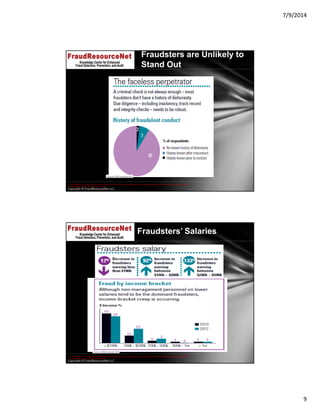
Fraudsters are Unlikely to
Stand Out
© 2014 KPMG LLP, a USA LLP and a member firm of the KPMG network of independent member firms affiliated with KPMG International Cooperative ("KPMG 
International"), a Swiss entity. All rights reserved.
Copyright © FraudResourceNet LLC
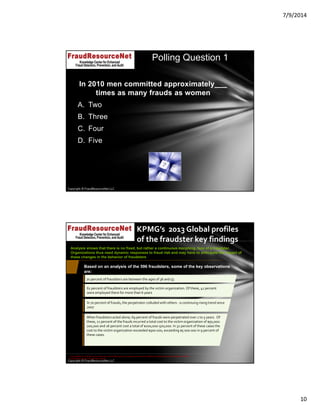
Fraudsters’ Salaries
© 2014 KPMG LLP, a USA LLP and a member firm of the KPMG network of independent member firms affiliated with KPMG International Cooperative ("KPMG 
International"), a Swiss entity. All rights reserved.
7/9/2014
10
Copyright © FraudResourceNet LLC
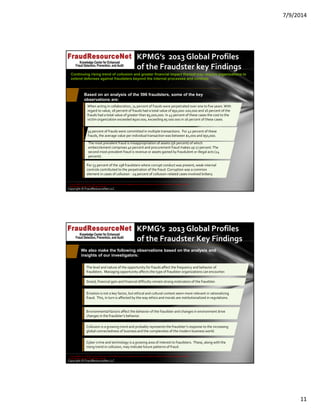
In 2010 men committed approximately___
times as many frauds as women
A. Two
B. Three
C. Four
D. Five
Polling Question 1
Copyright © FraudResourceNet LLC
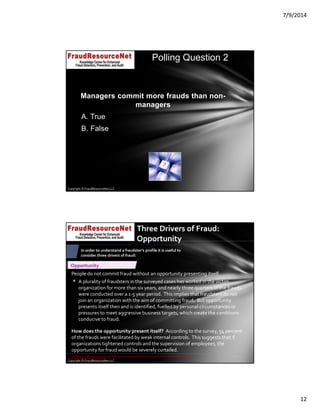
KPMG’s  2013 Global profiles 
of the fraudster key findings
70 percent of fraudsters are between the ages of 36 and 55 
61 percent of fraudsters are employed by the victim organization. Of these, 41 percent 
were employed there for more than 6 years
When fraudsters acted alone, 69 percent of frauds were perpetrated over 1 to 5 years.  Of 
these, 21 percent of the frauds incurred a total cost to the victim organization of $50,000‐
200,000 and 16 percent cost a total of $200,000‐500,000. In 32 percent of these cases the 
cost to the victim organization exceeded $500 000, exceeding $5 000 000 in 9 percent of 
these cases.
Analysis shows that there is no fixed, but rather a continuous morphing, face of a fraudster.
Organizations thus need dynamic responses to fraud risk and may have to anticipate the impact of
these changes in the behavior of fraudsters
Based on an analysis of the 596 fraudsters, some of the key observations
are:
In 70 percent of frauds, the perpetrator colluded with others ‐ a continuing rising trend since 
2007 
© 2014 KPMG LLP, a USA LLP and a member firm of the KPMG network of independent member firms affiliated with KPMG International Cooperative ("KPMG 
International"), a Swiss entity. All rights reserved.
7/9/2014
11
Copyright © FraudResourceNet LLC
KPMG’s  2013 Global Profiles 
of the Fraudster key Findings
Based on an analysis of the 596 fraudsters, some of the key
observations are:
93 percent of frauds were committed in multiple transactions.  For 42 percent of these 
frauds, the average value per individual transaction was between $1,000 and $50,000. 
The most prevalent fraud is misappropriation of assets (56 percent) of which 
embezzlement comprises 40 percent and procurement fraud makes up 27 percent. The 
second most prevalent fraud is revenue or assets gained by fraudulent or illegal acts (24 
percent).
When acting in collaboration, 74 percent of frauds were perpetrated over one to five years. With 
regard to value, 18 percent of frauds had a total value of $50,000‐200,000 and 16 percent of the 
frauds had a total value of greater than $5,000,000. In 43 percent of these cases the cost to the 
victim organization exceeded $500 000, exceeding $5 000 000 in 16 percent of these cases.
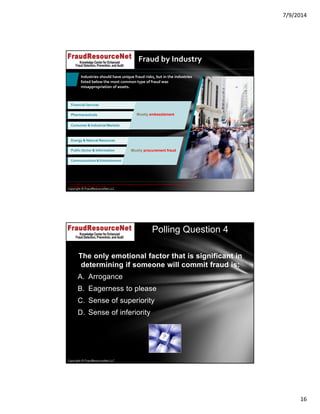
For 53 percent of the 198 fraudsters where corrupt conduct was present, weak internal 
controls contributed to the perpetration of the fraud. Corruption was a common 
element in cases of collusion ‐ 29 percent of collusion‐related cases involved bribery.
Continuing rising trend of collusion and greater financial impact thereof may require organizations to
extend defenses against fraudsters beyond the internal processes and controls
© 2014 KPMG LLP, a USA LLP and a member firm of the KPMG network of independent member firms affiliated with KPMG International Cooperative ("KPMG 
International"), a Swiss entity. All rights reserved.
Copyright © FraudResourceNet LLC
KPMG’s  2013 Global Profiles 
of the Fraudster Key Findings
The level and nature of the opportunity for frauds affect the frequency and behavior of 
fraudsters.  Managing opportunity affects the type of fraudster organizations can encounter.
Greed, financial gain and financial difficulty remain strong motivators of the fraudster.
Emotion is not a key factor, but ethical and cultural context seem more relevant in rationalizing 
fraud.  This, in turn is affected by the way ethics and morals are institutionalized in regulations.
Collusion is a growing trend and probably represents the fraudster’s response to the increasing 
global connectedness of business and the complexities of the modern business world.
We also make the following observations based on the analysis and
insights of our investigators:
Environmental factors affect the behavior of the fraudster and changes in environment drive 
changes in the fraudster’s behavior.
Cyber crime and technology is a growing area of interest to fraudsters.  These, along with the 
rising trend in collusion, may indicate future patterns of fraud.
© 2014 KPMG LLP, a USA LLP and a member firm of the KPMG network of independent member firms affiliated with KPMG International Cooperative ("KPMG 
International"), a Swiss entity. All rights reserved.
7/9/2014
12
Copyright © FraudResourceNet LLC
Managers commit more frauds than non-
managers
A. True
B. False
Polling Question 2
Copyright © FraudResourceNet LLC
Three Drivers of Fraud: 
Opportunity
In order to understand a fraudster’s profile it is useful to 
consider three drivers of fraud:
Opportunity
People do not commit fraud without an opportunity presenting itself.  
 A plurality of fraudsters in the surveyed cases has worked in the victim 
organization for more than six years, and nearly three quarters of the frauds 
were conducted over a 1‐5 year period.  This implies that fraudsters do not 
join an organization with the aim of committing fraud.  But opportunity 
presents itself then and is identified, fuelled by personal circumstances or 
pressures to meet aggressive business targets, which create the conditions 
conducive to fraud.
How does the opportunity present itself?  According to the survey, 54 percent 
of the frauds were facilitated by weak internal controls.  This suggests that if 
organizations tightened controls and the supervision of employees, the 
opportunity for fraud would be severely curtailed.
© 2014 KPMG LLP, a USA LLP and a member firm of the KPMG network of independent member firms affiliated with KPMG International Cooperative ("KPMG 
International"), a Swiss entity. All rights reserved.
7/9/2014
13
Copyright © FraudResourceNet LLC
Three Drivers of Fraud: 
Motivation
Motivation
Fraud, as with most crimes, requires a motivation, and for the 596 
fraudsters, the overwhelming reason for committing fraud is financial.
 Survey respondents were offered 14 possible motivations and could 
select as many as they believed appropriate.  Out of a total of 1,082 
motivations listed, 614 were motives of greed, financial gain and 
financial difficulty, and a further 114 were related to business targets.
 Greed infrequently seems to spill over into observable patterns of 
behavior.  Only 18 percent of the fraudsters had expensive hobbies and 
17 percent drove expensive vehicles, hardly distinguishing features when 
the fraudster is a senior executive.
To understand a fraudster’s profile it is useful to consider three 
drivers of fraud:
© 2014 KPMG LLP, a USA LLP and a member firm of the KPMG network of independent member firms affiliated with KPMG International Cooperative ("KPMG 
International"), a Swiss entity. All rights reserved.
Copyright © FraudResourceNet LLC
v
Three Drivers of Fraud: 
Rationale
Rationale
Fraudsters, as with other types of criminal, will 
frequently provide a rationale for their deeds.  
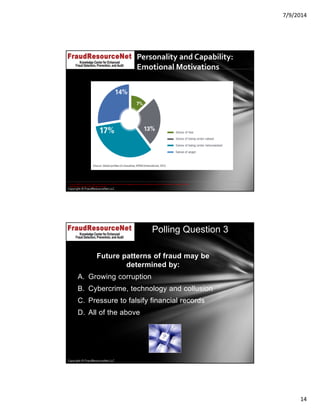
 Anger and fear were important factors in 10 percent 
or less of the 596 fraudsters.
 16 percent of the responses mentioned being under‐
remunerated as being important.
 The only emotion that appears significant is a sense 
of superiority, which is important for 36 percent of 
the fraudsters. May be linked to the fact that 29 
percent of the frauds were committed by executive 
directors, the largest single job title.
To understand a fraudster’s profile it is useful to consider three 
drivers of fraud:
© 2014 KPMG LLP, a USA LLP and a member firm of the KPMG network of independent member firms affiliated with KPMG International Cooperative ("KPMG 
International"), a Swiss entity. All rights reserved.
7/9/2014
14
Copyright © FraudResourceNet LLC
© 2014 KPMG LLP, a USA LLP and a member firm of the KPMG network of independent member firms affiliated with KPMG International Cooperative ("KPMG 
International"), a Swiss entity. All rights reserved.
Personality and Capability: 
Emotional Motivations
Copyright © FraudResourceNet LLC
Future patterns of fraud may be
determined by:
A. Growing corruption
B. Cybercrime, technology and collusion
C. Pressure to falsify financial records
D. All of the above
Polling Question 3
7/9/2014
15
Copyright © FraudResourceNet LLC
© 2014 KPMG LLP, a USA LLP and a member firm of the KPMG network of independent member firms affiliated with KPMG International Cooperative ("KPMG 
International"), a Swiss entity. All rights reserved.
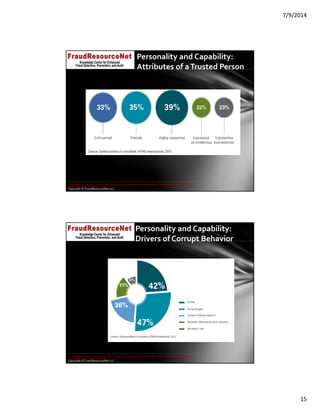
Personality and Capability: 
Attributes of a Trusted Person
Copyright © FraudResourceNet LLC
© 2014 KPMG LLP, a USA LLP and a member firm of the KPMG network of independent member firms affiliated with KPMG International Cooperative ("KPMG 
International"), a Swiss entity. All rights reserved.
Personality and Capability: 
Drivers of Corrupt Behavior
7/9/2014
16
Copyright © FraudResourceNet LLC
Fraud by Industry
Industries should have unique fraud risks, but in the industries 
listed below the most common type of fraud was 
misappropriation of assets.
Financial Services
Pharmaceuticals
Consumer & Industrial Markets
Mostly embezzlement
Energy & Natural Resources
Public Sector & Information
Communications & Entertainment
Mostly procurement fraud
v
© 2014 KPMG LLP, a USA LLP and a member firm of the KPMG network of independent member firms affiliated with KPMG International Cooperative ("KPMG 
International"), a Swiss entity. All rights reserved.
Copyright © FraudResourceNet LLC
The only emotional factor that is significant in
determining if someone will commit fraud is:
A. Arrogance
B. Eagerness to please
C. Sense of superiority
D. Sense of inferiority
Polling Question 4
7/9/2014
17
Copyright © FraudResourceNet LLC
v
New Technology and the 
Fraudster
New technology has created novel types of fraud behavior 
and brought new capabilities to the face of a fraudster:
 Cyber‐related crimes occurred by virtue of infections of 
computer systems with malware, attacks on computer 
networks, etc.
 Cyber fraudsters were employed by the victim 
organization, mainly in IT, but also in finance and 
operations.
 67% of the fraudsters in cyber‐enabled frauds acted in 
collusion with others, who were also mostly employed 
by the victim organization.
© 2014 KPMG LLP, a USA LLP and a member firm of the KPMG network of independent member firms affiliated with KPMG International Cooperative ("KPMG 
International"), a Swiss entity. All rights reserved.
Organizations are struggling to keep pace with the growing
technological sophistication of hackers. A few years ago,
hackers were motivated by political objectives and disrupted
computer networks to make an ideological point; but it is only
a matter of time until fraudsters harness the full power of
technology for financial gain.
Copyright © FraudResourceNet LLC
Conclusions
v
© 2014 KPMG LLP, a USA LLP and a member firm of the KPMG network of independent member firms affiliated with KPMG International Cooperative ("KPMG 
International"), a Swiss entity. All rights reserved.
Changes in the environment spawn new 
capabilities that drive different behavior. 
Organizations must constantly adapt their 
strategies for managing fraud risk to the 
changing relationship between the drivers 
(motivation, opportunity and rationale) and 
behaviors and capabilities.
The dynamic opportunity of the day, relationships 
on an organizational and global scale, the latest 
technologies, and socio‐political and economic 
issues will shape the fraudster’s profile timelessly.
One must also not forget the typical fraudster 
may likely remain the tenured, trusted employee.  
The one you may never have suspected…because 
we do not look.
7/9/2014
18
Copyright © FraudResourceNet LLC
More often than not, people join an
organization with the intention of
committing fraud
A. True
B. False
Polling Question 5
Copyright © FraudResourceNet LLC
Questions?
7/9/2014
19
Copyright © FraudResourceNet LLC
Coming Up…
1.How to Detect Fraudulent 
Documentation, Wed., July 16, 1:00 
PM EDT
2.Building Data Analytics into Your 
Audit and Risk Assessment, Wed., 
July 23, 11:oo AM EDT
Copyright © FraudResourceNet LLC
Peter Goldmann
FraudResourceNet LLC
800-440-2261
www.fraudresourcenet.com
pgoldmann@fraudresourcenet.com
Jim Kaplan
FraudResourceNet LLC
800-385-1625
www.fraudresourcenet.com
jkaplan@fraudresourcenet.com
Michael Doyle
KPMG LLP
Andrew Curtin
KPMG LLP
Thank You!

Think Like a Fraudster to Catch a Fraudster