Stu Van Dusen
Lexbe
March 16th, 2016
A Lawyer's Guide to Faster Document Review &
Production
Best Practices for Leveraging Attorney & Staff time with
Computer-Assisted Search, Document Clustering and Predictive Coding
○ Webinars take place monthly covers a variety of relevant eDiscovery
topics.
○ If you have technical issues or questions, please email
webinars@lexbe.com.
What attendees are saying:
○ "Excellent presentation! One of the best webinars I have attended!"
○ “Time well spent.”
○ "Great in terms of content and presentation. Thanks!"
○ "Excellent and informative piece!"
Info & Future
A Lawyer’s Guide to Faster Document Review & Production | March 16, 2016
eDiscovery Webinar Series
○ eDiscovery Solutions Consultant of Lexbe LC, a
provider of cloud-based litigation processing,
review and document management software &
eDiscovery services
○ Specializes in working with firms without a full in-
house department handling eDiscovery which are
involved in the type of complex litigation that
requires a high level of precision and eDiscovery
expertise to gain the advantage in the discovery
phase of trial.
Stu Van Dusen
800-401-7809 x55
svandusen@lexbe.com
Stu Van Dusen Bio
eDiscovery Webinar Series
A Lawyer’s Guide to Faster Document Review & Production | March 16, 2016
● Increasingly Document-Intensive Cases & Linear Reviews
● What are Technology Enhanced Reviews?
● When Should Technology Enhanced Reviews be Considered?
● Modern High-Speed Keyword Search
● Grouping Similar Documents for Grouped Review
● Uses and Applications of Predictive Coding
● Summary
Agenda
Faster Document Review & Production
A Lawyer’s Guide to Faster Document Review & Production | March 16, 2016
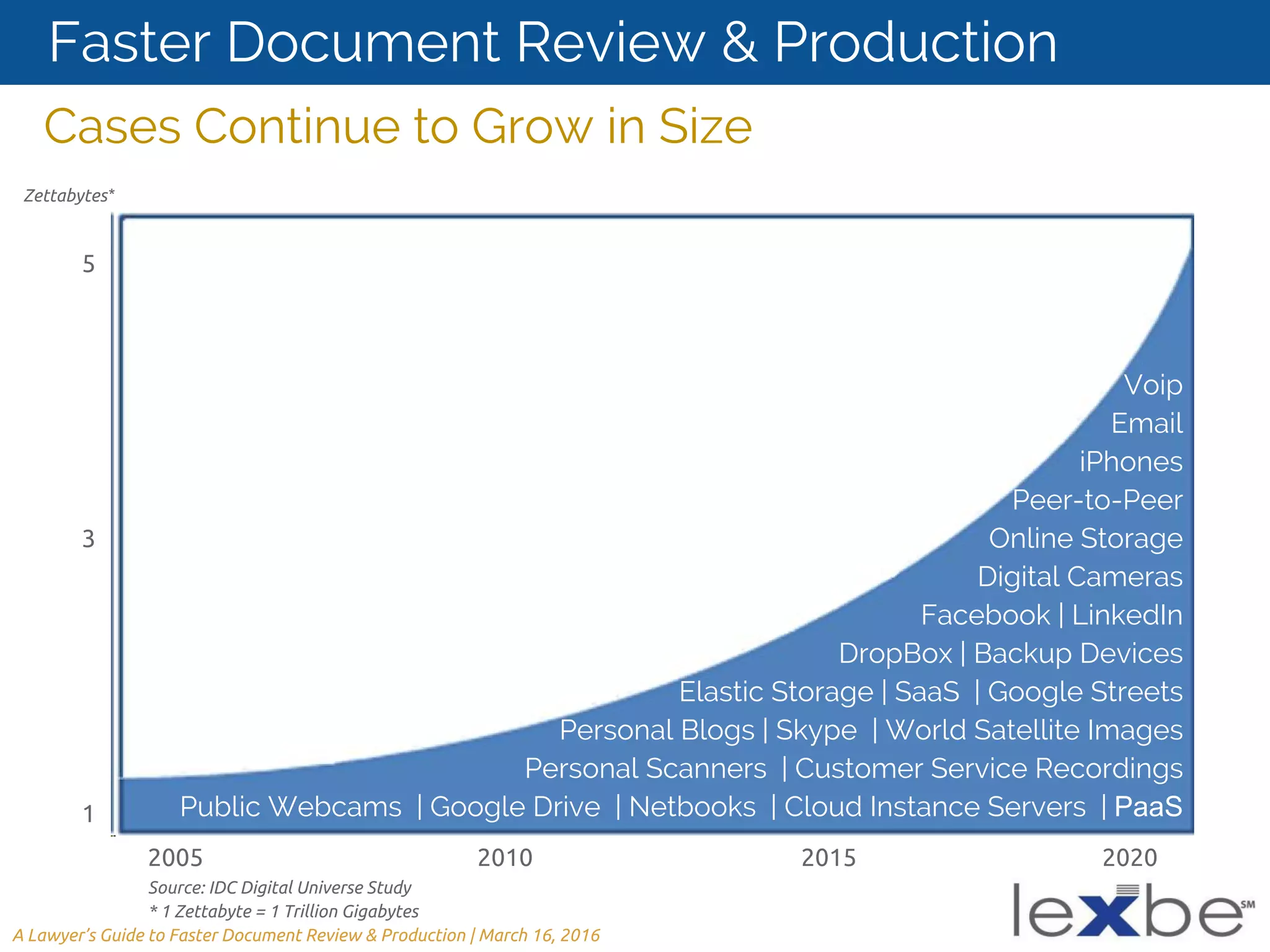
Cases Continue to Grow in Size
5
3
1
2005 2010 2015 2020
Source: IDC Digital Universe Study
* 1 Zettabyte = 1 Trillion Gigabytes
Zettabytes*
Voip
Email
iPhones
Peer-to-Peer
Online Storage
Digital Cameras
Facebook | LinkedIn
DropBox | Backup Devices
Elastic Storage | SaaS | Google Streets
Personal Blogs | Skype | World Satellite Images
Personal Scanners | Customer Service Recordings
Public Webcams | Google Drive | Netbooks | Cloud Instance Servers | PaaS
A Lawyer’s Guide to Faster Document Review & Production | March 16, 2016
Faster Document Review & Production
The Challenge of Document-Intensive Cases
Decreasing Document Volume
Increasing Document Relevance
A Lawyer’s Guide to Faster Document Review & Production | March 16, 2016
Faster Document Review & Production
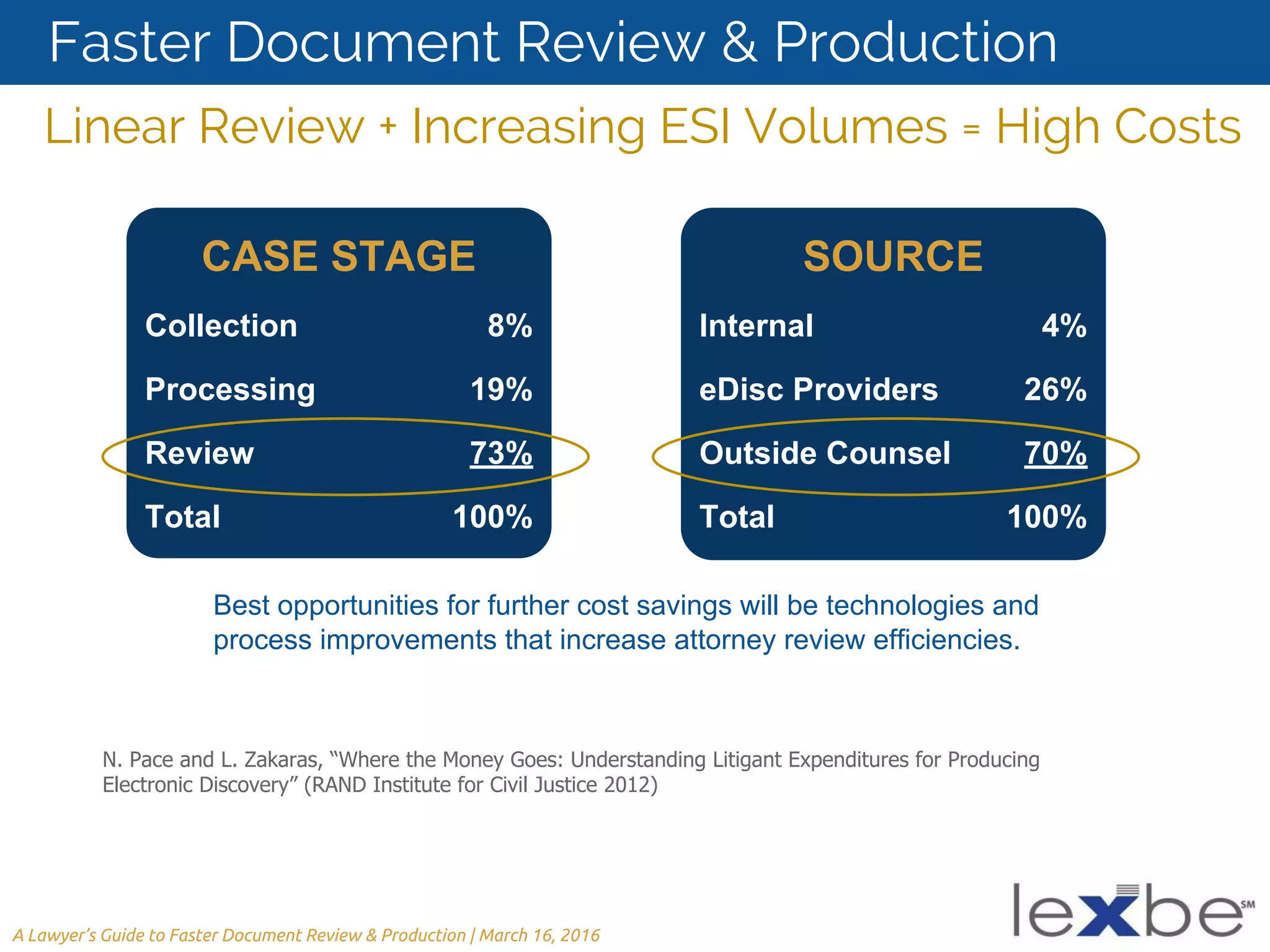
Linear Review + Increasing ESI Volumes = High Costs
N. Pace and L. Zakaras, “Where the Money Goes: Understanding Litigant Expenditures for Producing
Electronic Discovery” (RAND Institute for Civil Justice 2012)
CASE STAGE
Collection 8%
Processing 19%
Review 73%
Total 100%
SOURCE
Internal 4%
eDisc Providers 26%
Outside Counsel 70%
Total 100%
Best opportunities for further cost savings will be technologies and
process improvements that increase attorney review efficiencies.
A Lawyer’s Guide to Faster Document Review & Production | March 16, 2016
Faster Document Review & Production
What is a Technology Enhanced Review?
● Technology enhanced reviews are those in which additional
applications, algorithms, or indexes are applied to a document set in
order to support the logical grouping of documents or automatic
coding of documents based on some degree of human input.
● Litigators should consider applying these technologies to their review
workflows and methodologies when some resource (time, money, or
people) is critically constrained on a case.
A Lawyer’s Guide to Faster Document Review & Production | March 16, 2016
Faster Document Review & Production
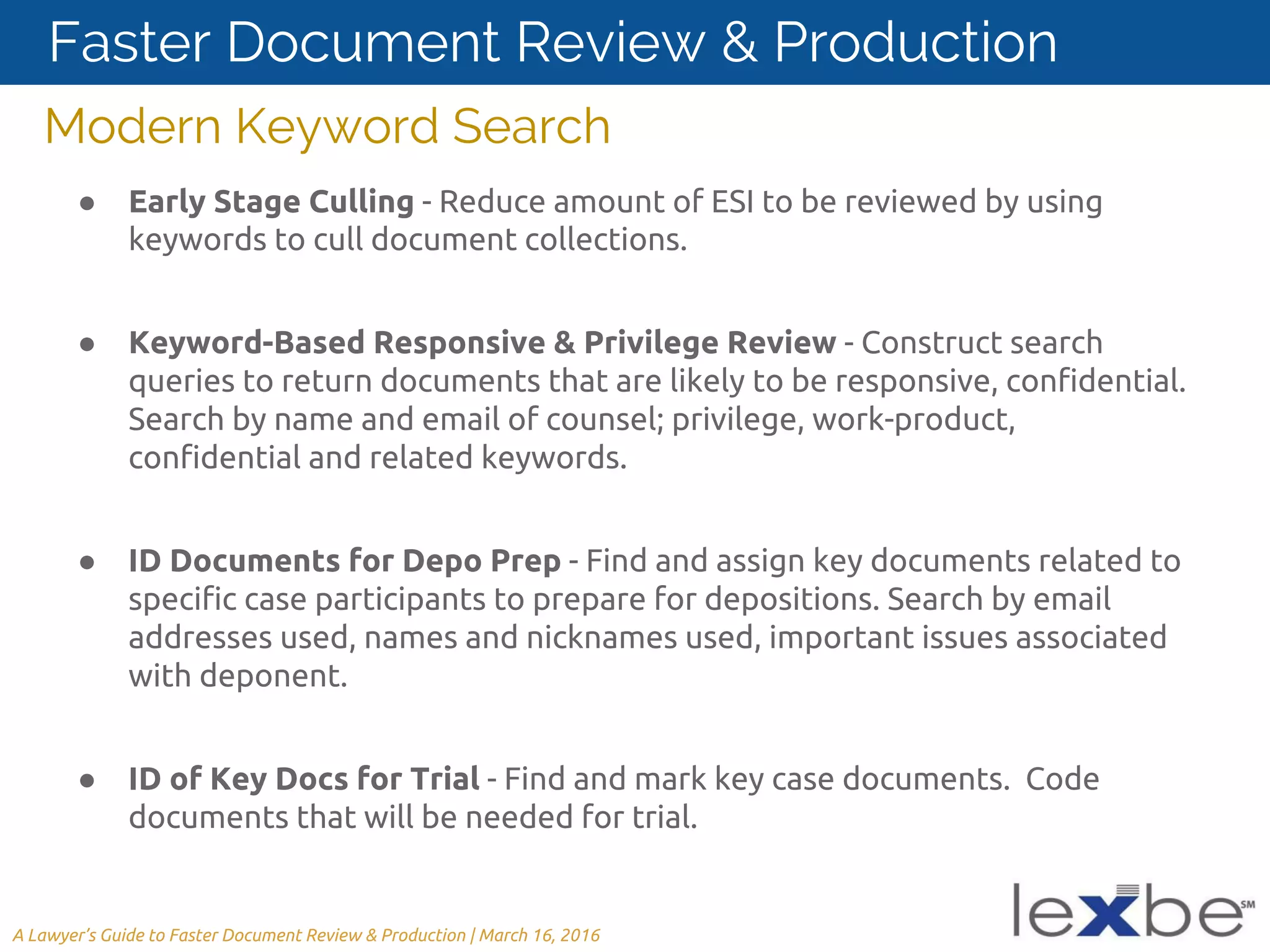
Modern Keyword Search
● Early Stage Culling - Reduce amount of ESI to be reviewed by using
keywords to cull document collections.
● Keyword-Based Responsive & Privilege Review - Construct search
queries to return documents that are likely to be responsive, confidential.
Search by name and email of counsel; privilege, work-product,
confidential and related keywords.
● ID Documents for Depo Prep - Find and assign key documents related to
specific case participants to prepare for depositions. Search by email
addresses used, names and nicknames used, important issues associated
with deponent.
● ID of Key Docs for Trial - Find and mark key case documents. Code
documents that will be needed for trial.
A Lawyer’s Guide to Faster Document Review & Production | March 16, 2016
Faster Document Review & Production
Modern Keyword Search Benefits
● Fast - Keyword search is very fast compared with other document search
methodologies.
● Inexpensive - Good results can be obtained at little cost compared with
manual review or other computer assisted methodologies.
● Quality - Search can deliver high quality results, particularly if keyword
terms are carefully developed and tested.
● Avoids Manual Review Errors/Inconsistencies - Search results are
computer generated, and so avoid known human review errors that can
result from fatigue, inadequate training, lack of focus, etc.
A Lawyer’s Guide to Faster Document Review & Production | March 16, 2016
Faster Document Review & Production
Multi-Index Based Keyword Search
Benefits of Multi-Index Approach
● Keyword search is supported best by indexes created from text
extracted from Native files (email, attachments, spreadsheets, etc.) and
a paginated file converted from Native files into PDF or TIFF and OCRed.
● Most comprehensive approach and minimizes potential of lost data.
Index Method
Captures
Embedded Text
Captures Text
Excluded From
Print
Captures
Hidden Text
Imaged/OCR Yes No No
Native Extraction No Yes Yes
Lexbe Multi-Index Yes Yes Yes
A Lawyer’s Guide to Faster Document Review & Production | March 16, 2016
Faster Document Review & Production
Multi-Index Based Keyword Search
● Native extraction will not index embedded body content
A Lawyer’s Guide to Faster Document Review & Production | March 16, 2016
Faster Document Review & Production
Multi-Index Based Keyword Search
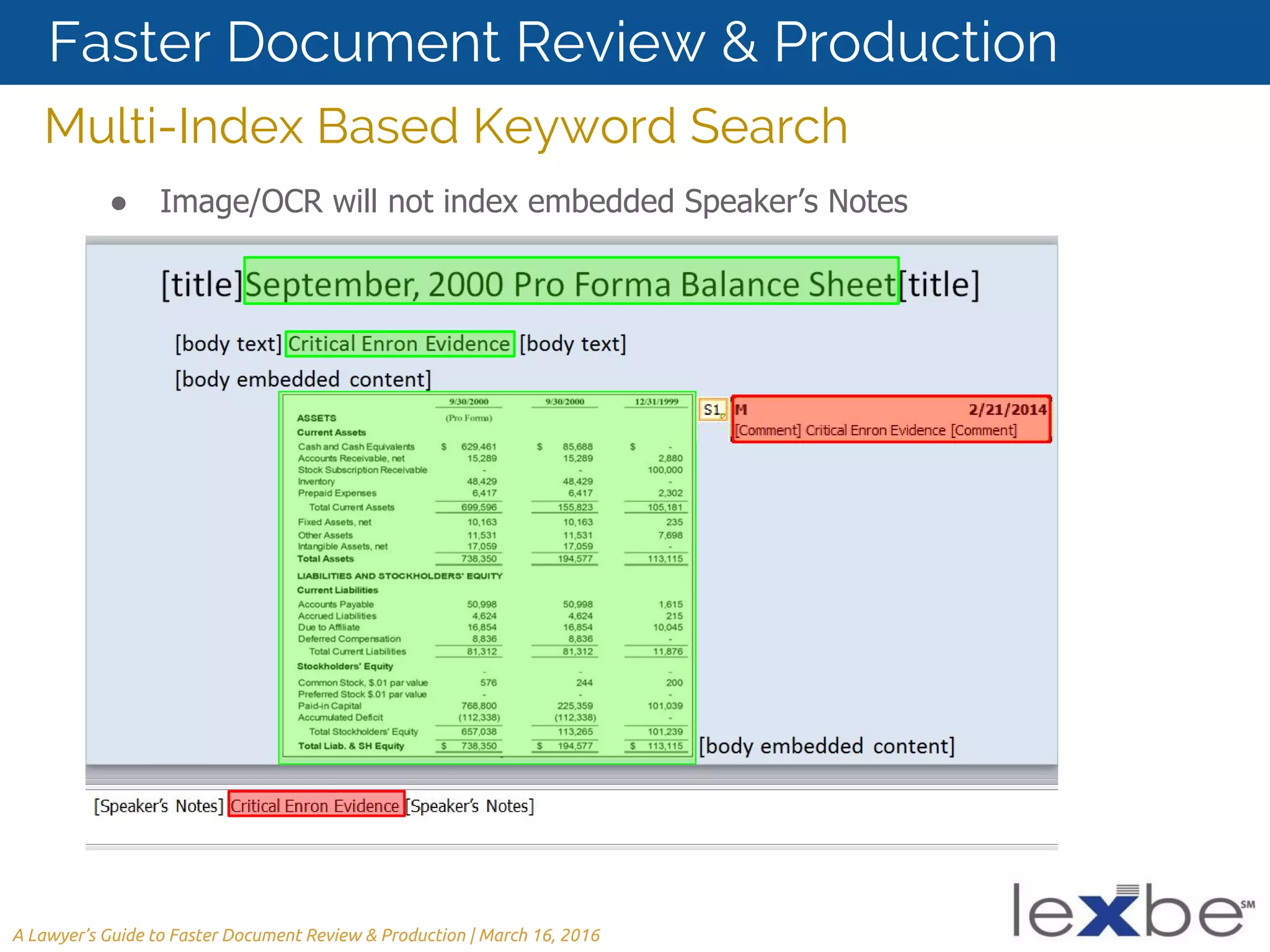
● Image/OCR will not index embedded Speaker’s Notes
A Lawyer’s Guide to Faster Document Review & Production | March 16, 2016
Faster Document Review & Production
Multi-Index Based Keyword Search
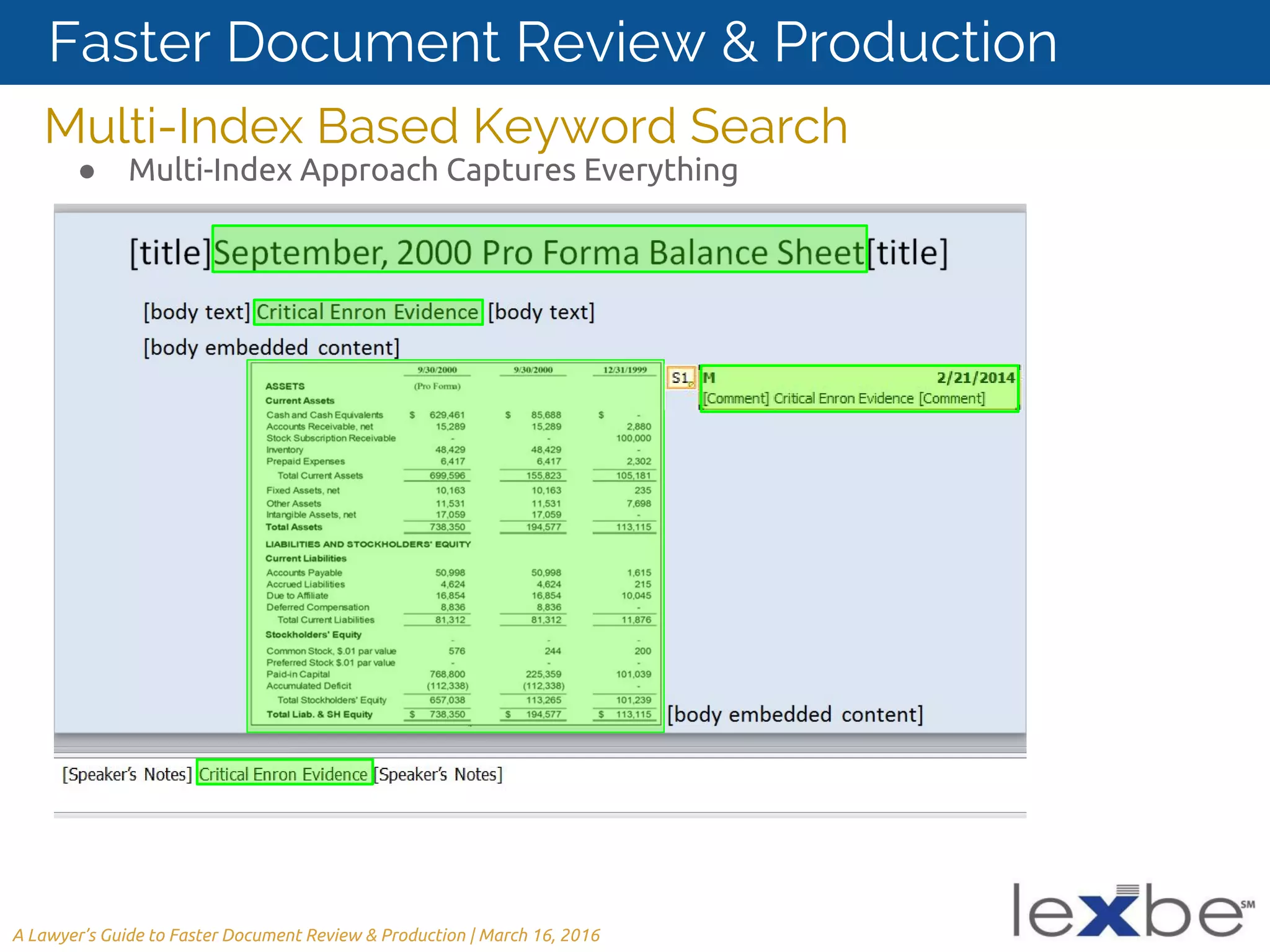
● Multi-Index Approach Captures Everything
A Lawyer’s Guide to Faster Document Review & Production | March 16, 2016
Faster Document Review & Production
Near Duplicate Detection
● NearDup technology automatically recognizes similar documents
within an e-discovery document collection
● Algorithm analyzes, evaluates and compares the actual text
content of the documents to each other
Unstructured Documents NearDup Groupings
A Lawyer’s Guide to Faster Document Review & Production | March 16, 2016
Faster Document Review & Production
Near Duplicate Detection
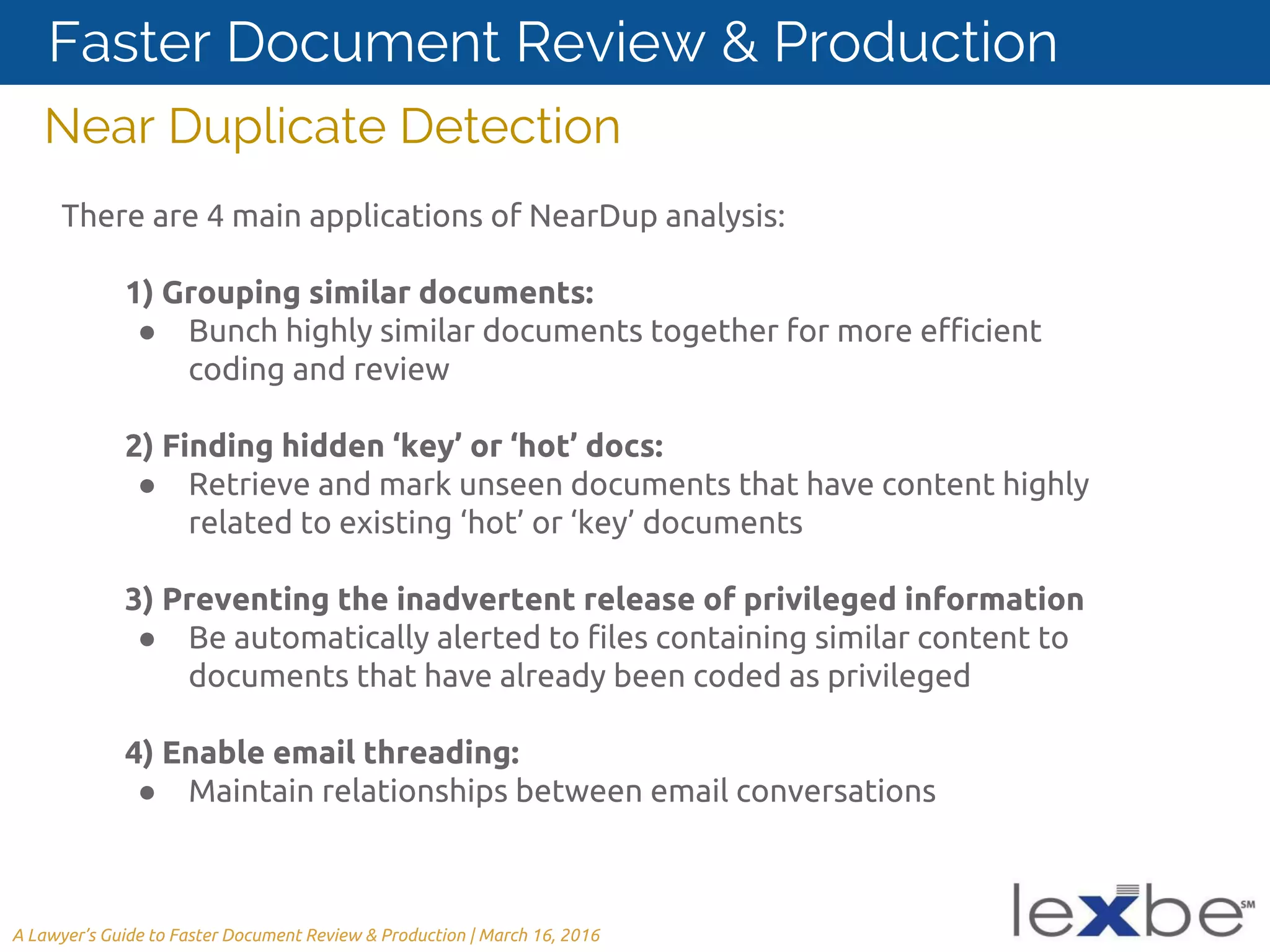
There are 4 main applications of NearDup analysis:
1) Grouping similar documents:
● Bunch highly similar documents together for more efficient
coding and review
2) Finding hidden ‘key’ or ‘hot’ docs:
● Retrieve and mark unseen documents that have content highly
related to existing ‘hot’ or ‘key’ documents
3) Preventing the inadvertent release of privileged information
● Be automatically alerted to files containing similar content to
documents that have already been coded as privileged
4) Enable email threading:
● Maintain relationships between email conversations
A Lawyer’s Guide to Faster Document Review & Production | March 16, 2016
Faster Document Review & Production
NearDup Groupings - Faster Responsive Review
Benefits
Accelerate document
review by batch coding
(using multidoc edit) larger
groups
Increase coding consistency
of batched documents
Reduce privilege errors
A Lawyer’s Guide to Faster Document Review & Production | March 16, 2016
Faster Document Review & Production
NearDup Groupings - Email Threading
Benefits
View email chains with similar
text in date & time order
Avoid confusion of emails only
tangentially related (<50% text
overlap)
Consistently code email chains
for responsiveness, privilege,
attorney-eyes only, etc.
A Lawyer’s Guide to Faster Document Review & Production | March 16, 2016
Faster Document Review & Production
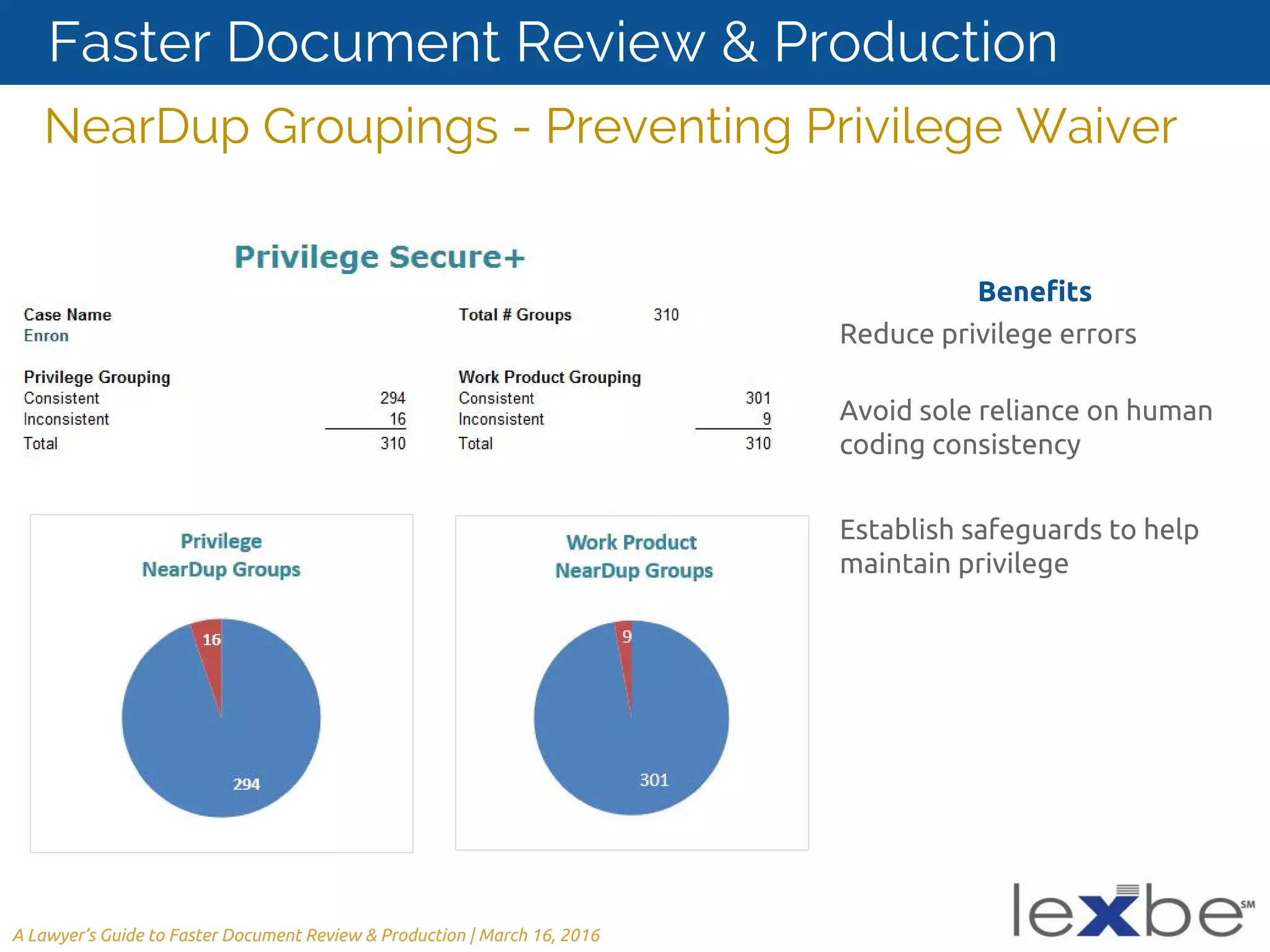
NearDup Groupings - Preventing Privilege Waiver
Benefits
Reduce privilege errors
Avoid sole reliance on human
coding consistency
Establish safeguards to help
maintain privilege
A Lawyer’s Guide to Faster Document Review & Production | March 16, 2016
Faster Document Review & Production
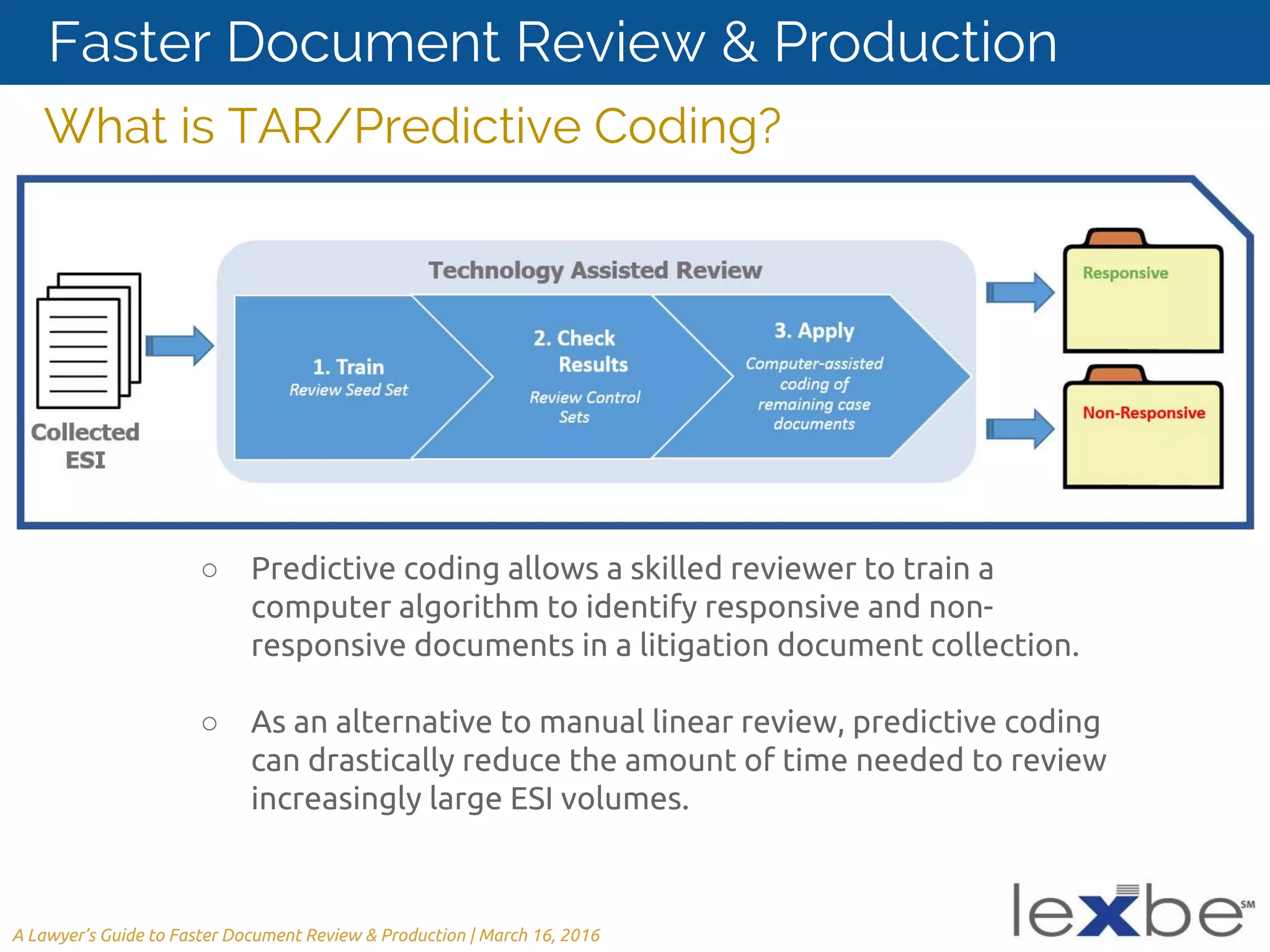
○ Predictive coding allows a skilled reviewer to train a
computer algorithm to identify responsive and non-
responsive documents in a litigation document collection.
○ As an alternative to manual linear review, predictive coding
can drastically reduce the amount of time needed to review
increasingly large ESI volumes.
What is TAR/Predictive Coding?
A Lawyer’s Guide to Faster Document Review & Production | March 16, 2016
Faster Document Review & Production
CASE STAGE
Collection 8%
Processing 19%
Review 73%
Total 100%
○ Best opportunities for further cost savings will be reducing
review costs.
○ Technologies and process improvements, like TAR, reduce costs
by increasing attorney review efficiencies
Why Use TAR/Predictive
Coding?
A Lawyer’s Guide to Faster Document Review & Production | March 16, 2016
Faster Document Review & Production
Increase Review Speed: TAR is designed to complete review of large
ESI collections faster than human reviewers. Applying TAR in a scalable
environment maximizes the speed advantage of predictive coding.
Decrease Review Costs: Whether paying per document or per hour,
TAR is significantly less expensive than exhaustive manual review.
Increase Review Quality: Many studies conclude that the presumed
quality advantage of ‘gold-standard’ manual review is not accurate.
TAR can support defensible, high-quality review outcomes.
Why Use TAR/Predictive
Coding?
A Lawyer’s Guide to Faster Document Review & Production | March 16, 2016
Faster Document Review & Production
○ A randomized sample of ~ 2,400 documents, a seed set,
is selected from the collection.
○ A skilled document review professional reviews and
codes the seed set.
○ The coding decisions made in reviewing the seed set
train the predictive coding algorithm to identify
responsive content in the remaining documents.
How Does TAR/Predictive Coding Work?
A Lawyer’s Guide to Faster Document Review & Production | March 16, 2016
Faster Document Review & Production
○ Iterative samples of 25 computer-reviewed documents,
control sets, are inspected for coding algorithm
accuracy.
○ The responsiveness designation assigned to the
document by the computer is either confirmed or
overturned.
○ An F-score - derived from precision and recall measures
- indicates the stability of the TAR results.
How Does TAR/Predictive Coding
Work?
A Lawyer’s Guide to Faster Document Review & Production | March 16, 2016
Faster Document Review & Production
○ The TAR algorithm reviews the document collection based on
how it was trained during seed set coding and control set
review.
○ Remaining Documents are tagged as responsive/non-responsive.
○ The speed at which the document collection is reviewed by the
TAR algorithm is largely based on the computing resources
applied to the task.
How Does TAR/Predictive Coding
Work?
A Lawyer’s Guide to Faster Document Review & Production | March 16, 2016
Faster Document Review & Production
TAR/Predictive Coding results (F-scores) indicate:
○ What proportion of the responsive documents were found by
the algorithm within a particular margin of error (recall)
○ What percentage of documents marked responsive are
actually responsive within a particular margin of error
(precision)
Understanding TAR/Predictive Coding Results
A Lawyer’s Guide to Faster Document Review & Production | March 16, 2016
Faster Document Review & Production
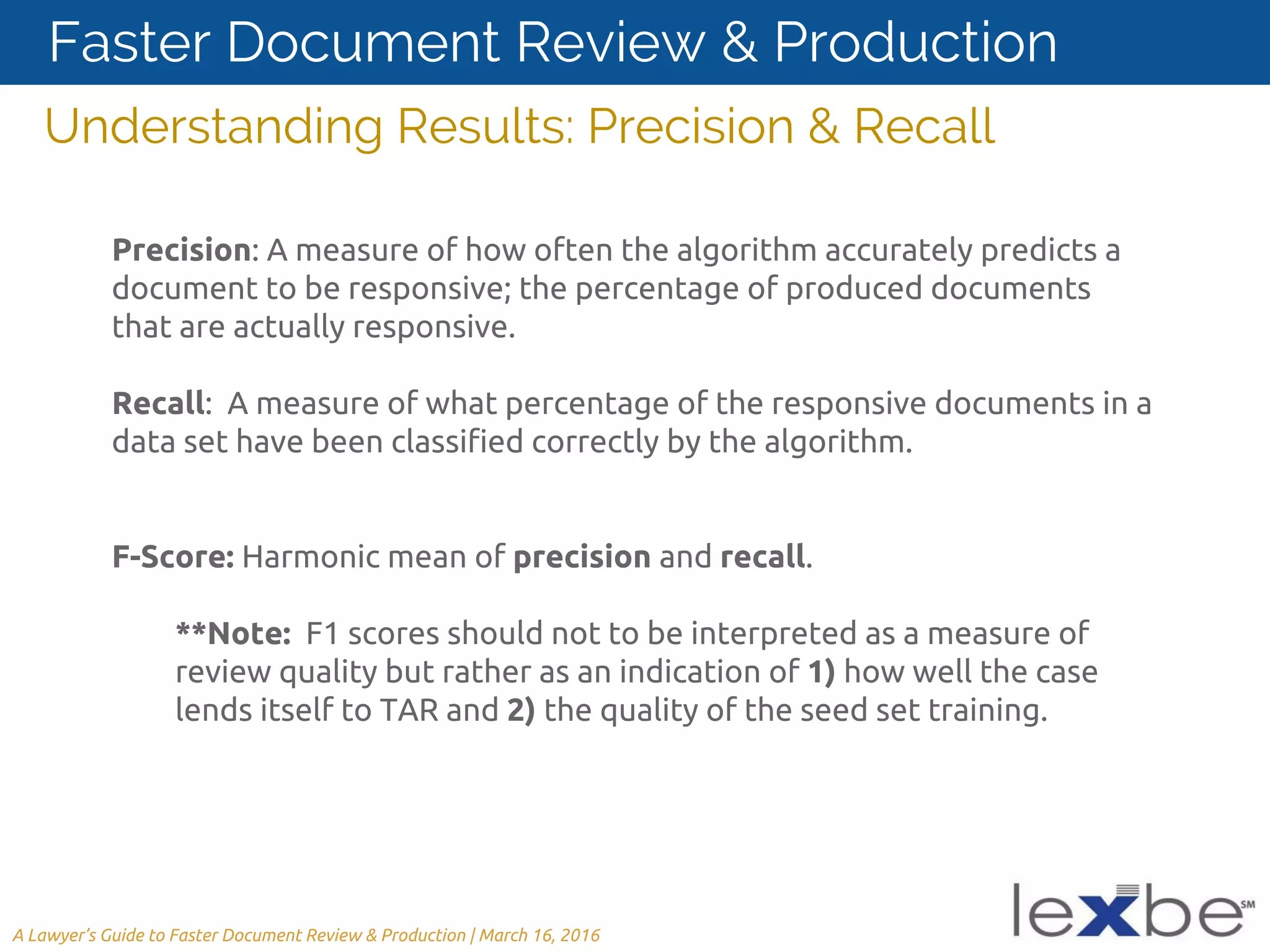
Precision: A measure of how often the algorithm accurately predicts a
document to be responsive; the percentage of produced documents
that are actually responsive.
Recall: A measure of what percentage of the responsive documents in a
data set have been classified correctly by the algorithm.
F-Score: Harmonic mean of precision and recall.
**Note: F1 scores should not to be interpreted as a measure of
review quality but rather as an indication of 1) how well the case
lends itself to TAR and 2) the quality of the seed set training.
Understanding Results: Precision & Recall
A Lawyer’s Guide to Faster Document Review & Production | March 16, 2016
Faster Document Review & Production
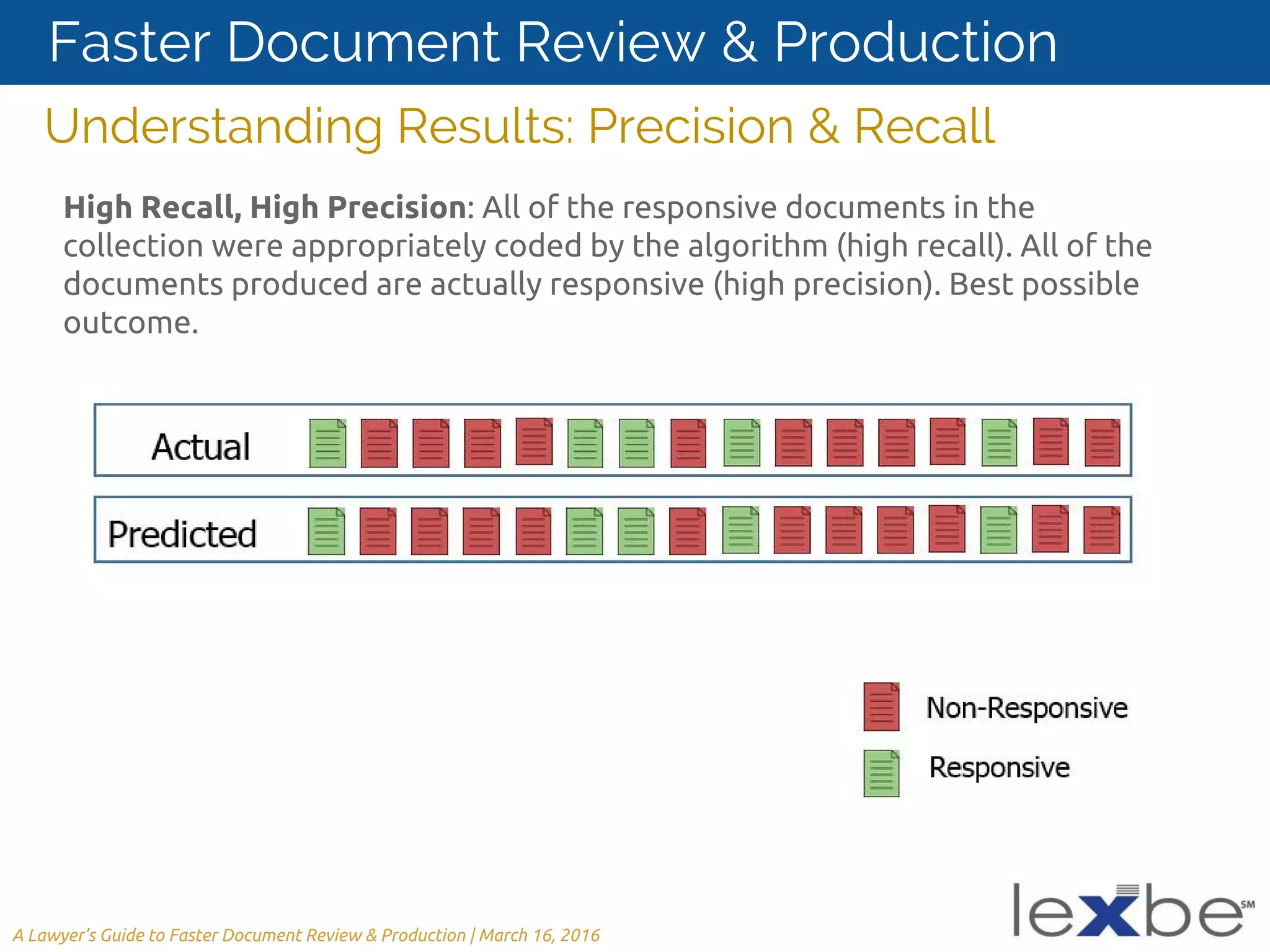
High Recall, High Precision: All of the responsive documents in the
collection were appropriately coded by the algorithm (high recall). All of the
documents produced are actually responsive (high precision). Best possible
outcome.
Understanding Results: Precision & Recall
A Lawyer’s Guide to Faster Document Review & Production | March 16, 2016
Faster Document Review & Production
Low Recall, High Precision: Many of the responsive documents in the
collection were not appropriately coded by the algorithm (low recall).
However, a high percentage of the documents produced are responsive (high
precision). Increased risk of under-producing.
Understanding Results: Precision & Recall
A Lawyer’s Guide to Faster Document Review & Production | March 16, 2016
Faster Document Review & Production
High Recall, Low Precision: All of the responsive documents in the
collection have been appropriately tagged by the algorithm (high recall).
However, many erroneous documents were incorrectly marked responsive
(low precision).
Understanding Results: Precision & Recall
A Lawyer’s Guide to Faster Document Review & Production | March 16, 2016
Faster Document Review & Production
From the Sedona Conference Best Practices Commentary on the Use of
Search and Information Retrieval Methods in E-Discovery:
“[T]here appears to be a myth that manual review by humans of large amounts
of information is as accurate and complete as possible … Even assuming that
the profession had the time and resources to continue to conduct manual
review of massive sets of electronic data sets (which it does not), the relative
efficacy of that approach versus utilizing newly developed automated methods
of review remains very much open to debate.” (2007)
From the TREC (Text Retrieval Conference) Legal Track:
“Overall, the myth that exhaustive manual review is the most effective – and
therefore, the most defensible – approach to document review is strongly
refuted. Technology-assisted review can (and does) yield more accurate results
than exhaustive manual review, with much lower effort...Future work may
address which technology-assisted review process(es) will improve most on
manual review, not whether technology assisted review can improve on manual
review.” (2009)
Comparing Outcomes: TAR v. Manual Review
A Lawyer’s Guide to Faster Document Review & Production | March 16, 2016
Faster Document Review & Production
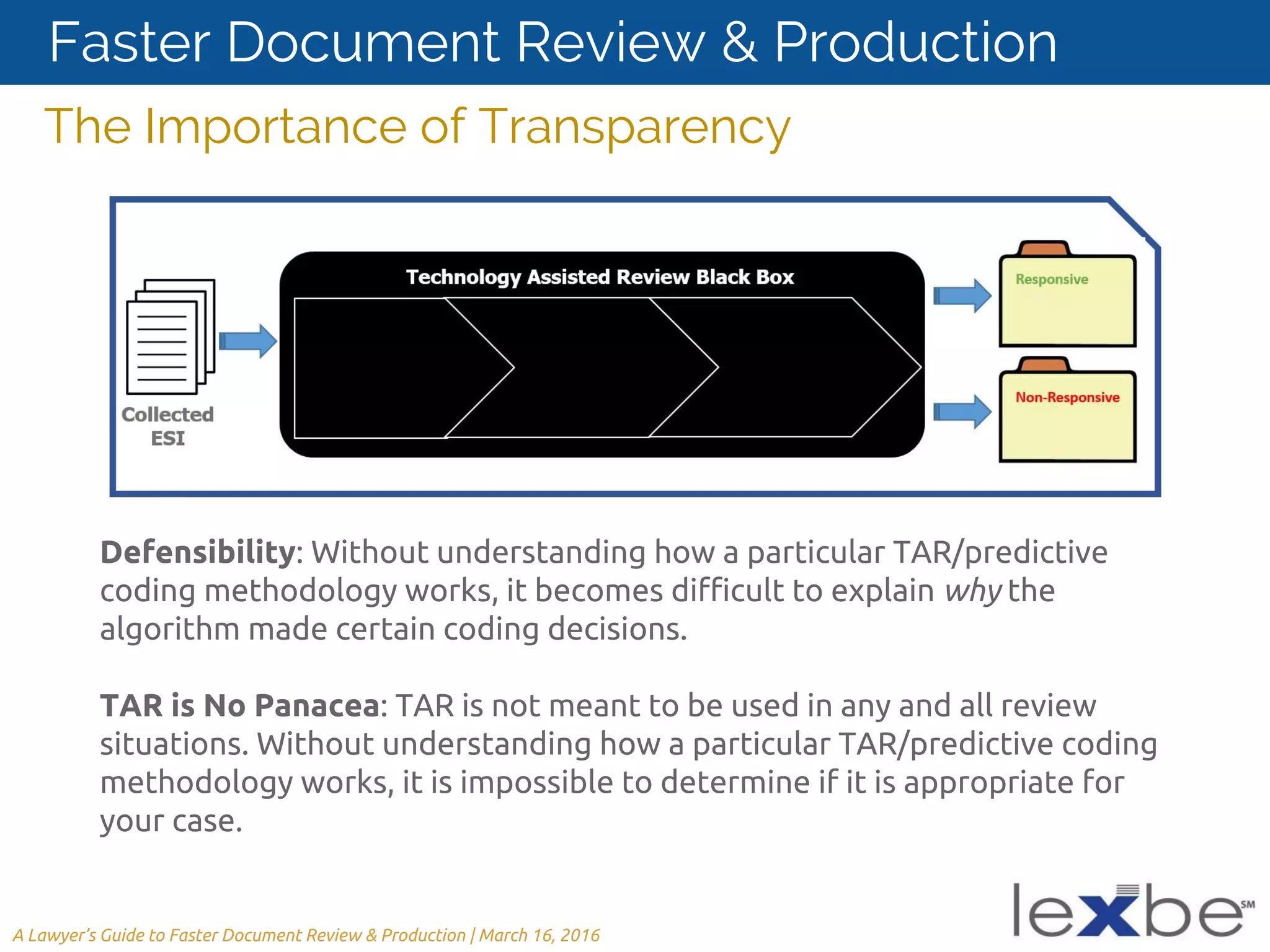
Defensibility: Without understanding how a particular TAR/predictive
coding methodology works, it becomes difficult to explain why the
algorithm made certain coding decisions.
TAR is No Panacea: TAR is not meant to be used in any and all review
situations. Without understanding how a particular TAR/predictive coding
methodology works, it is impossible to determine if it is appropriate for
your case.
The Importance of Transparency
A Lawyer’s Guide to Faster Document Review & Production | March 16, 2016
Faster Document Review & Production
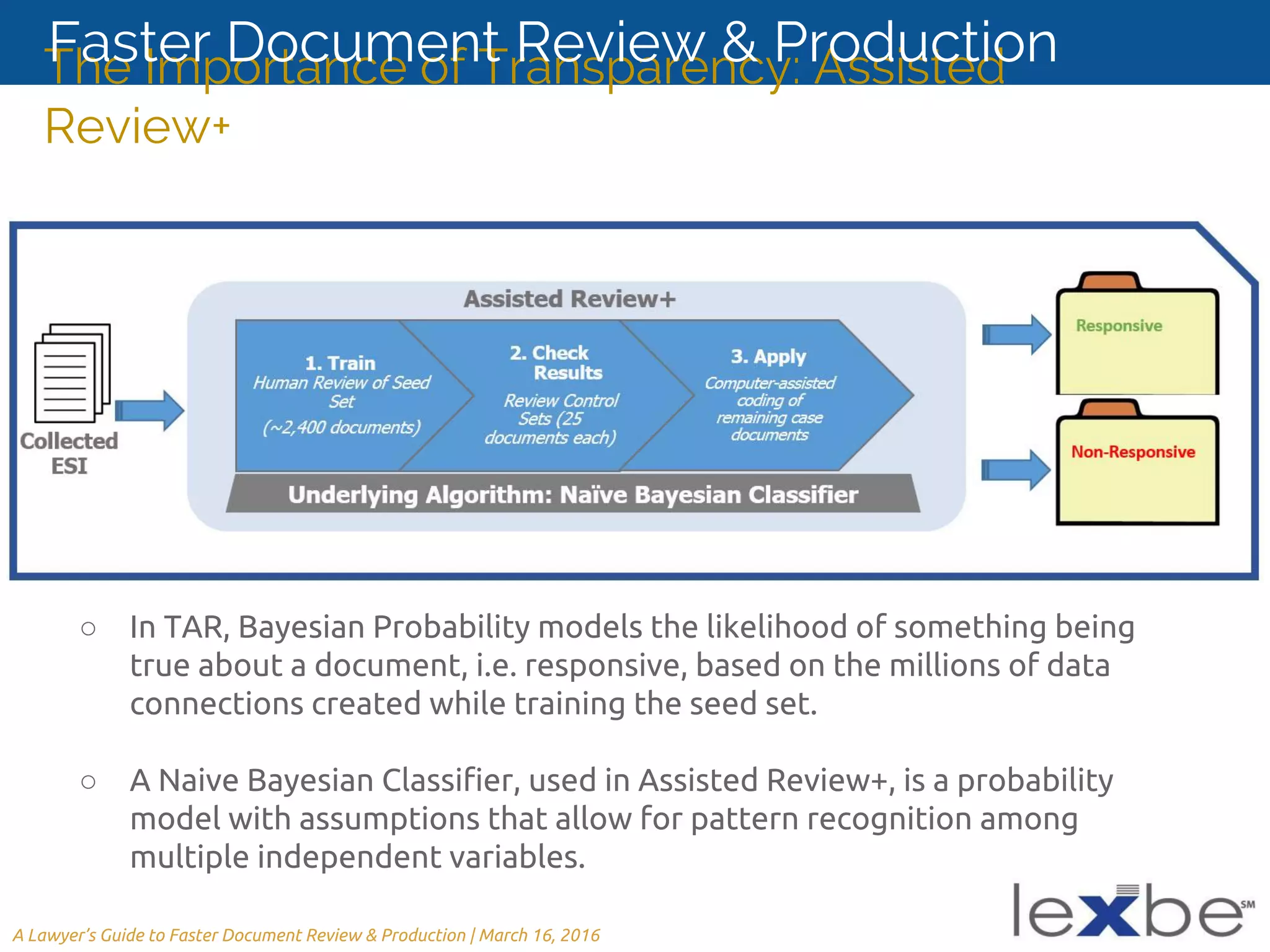
○ In TAR, Bayesian Probability models the likelihood of something being
true about a document, i.e. responsive, based on the millions of data
connections created while training the seed set.
○ A Naive Bayesian Classifier, used in Assisted Review+, is a probability
model with assumptions that allow for pattern recognition among
multiple independent variables.
The Importance of Transparency: Assisted
Review+
A Lawyer’s Guide to Faster Document Review & Production | March 16, 2016
Faster Document Review & Production
Incoming TAR Project
Reviewed Documents
○ Applying more server
resources to a TAR/predictive
coding task will increase
throughput.
○ TAR offers an exponentially
faster workflow compared to
manual review. Leveraging
scalable architectures
maximizes the value of this
benefit.
The Importance of Scalability
A Lawyer’s Guide to Faster Document Review & Production | March 16, 2016
Faster Document Review & Production
○ TAR/Predictive Coding allows a skilled reviewer to train a computer
algorithm to identify responsive and non-responsive documents .
○ You can use TAR/Predictive Coding to increase review speed,
decrease review costs, and improve the quality of review results
○ TAR works by teaching a seed set, testing the algorithm against
control sets, and applying the improved algorithm to the remainder of
the collection
○ Predictive coding performance results are communicated in the form
of precision and recall scores
○ It is important to know the underlying logic of the TAR algorithm to
interpret, explain, and defend your results.
○ Scalable, transparent predictive coding workflows maximize the
intended benefits of technology assisted review.
Summary
Review
A Lawyer’s Guide to Faster Document Review & Production | March 16, 2016
We’ll be making the following available to webinar attendees:
● A recorded streaming version
● MP3 podcast
● Webinar slide-deck
Please let us know if you have any questions or comments about this webinar or
suggestions for future topics. This webinar is part of the Lexbe eDiscovery
Webinar Series. For notices of future live and on-Demand webinars as part of this
series please email us at webinars@lexbe.com or Follow us on LinkedIN.
Please contact us with any questions:
Thank You For Attending
Thank You
Speaker
Stu VanDusen
800-401-7809 x55
svandusen@lexbe.com
Moderator
Gene Albert
512-686-3460
gene@lexbe.com
A Lawyer’s Guide to Faster Document Review & Production | March 16, 2016
Lexbe Sales
sales@lexbe.com
(800) 401-7809 x22
‘Cost-effective eDiscovery’ “A powerful litigation document
management service”
“Because of the Lexbe software,
the entire playing field has been
leveled for my firm.”
‘Lexbe cost advantages, SaaS
convenience and search capabilities
appeal to many small firms
“Lexbe is the easiest eDiscovery
software I have ever used’
‘Secure, easy-to-use and a great
review tool for consideration’
Lexbe eDiscovery Platform
Ask Us More About
● The Lexbe eDiscovery Platform, our cloud based processing, review and production
tool. Attorney/staff DIY, no users fees or case fees.
● Our high-speed/high-capacity eDiscovery services, and expert professional services.
● Consultations, price quotes, demos and free trials available.
A Lawyer’s Guide to Faster Document Review & Production | March 16, 2016

Faster document review and production

  • 1.
    Stu Van Dusen Lexbe March16th, 2016 A Lawyer's Guide to Faster Document Review & Production Best Practices for Leveraging Attorney & Staff time with Computer-Assisted Search, Document Clustering and Predictive Coding
  • 2.
    ○ Webinars takeplace monthly covers a variety of relevant eDiscovery topics. ○ If you have technical issues or questions, please email webinars@lexbe.com. What attendees are saying: ○ "Excellent presentation! One of the best webinars I have attended!" ○ “Time well spent.” ○ "Great in terms of content and presentation. Thanks!" ○ "Excellent and informative piece!" Info & Future A Lawyer’s Guide to Faster Document Review & Production | March 16, 2016 eDiscovery Webinar Series
  • 3.
    ○ eDiscovery SolutionsConsultant of Lexbe LC, a provider of cloud-based litigation processing, review and document management software & eDiscovery services ○ Specializes in working with firms without a full in- house department handling eDiscovery which are involved in the type of complex litigation that requires a high level of precision and eDiscovery expertise to gain the advantage in the discovery phase of trial. Stu Van Dusen 800-401-7809 x55 svandusen@lexbe.com Stu Van Dusen Bio eDiscovery Webinar Series A Lawyer’s Guide to Faster Document Review & Production | March 16, 2016
  • 4.
    ● Increasingly Document-IntensiveCases & Linear Reviews ● What are Technology Enhanced Reviews? ● When Should Technology Enhanced Reviews be Considered? ● Modern High-Speed Keyword Search ● Grouping Similar Documents for Grouped Review ● Uses and Applications of Predictive Coding ● Summary Agenda Faster Document Review & Production A Lawyer’s Guide to Faster Document Review & Production | March 16, 2016
  • 5.
    Cases Continue toGrow in Size 5 3 1 2005 2010 2015 2020 Source: IDC Digital Universe Study * 1 Zettabyte = 1 Trillion Gigabytes Zettabytes* Voip Email iPhones Peer-to-Peer Online Storage Digital Cameras Facebook | LinkedIn DropBox | Backup Devices Elastic Storage | SaaS | Google Streets Personal Blogs | Skype | World Satellite Images Personal Scanners | Customer Service Recordings Public Webcams | Google Drive | Netbooks | Cloud Instance Servers | PaaS A Lawyer’s Guide to Faster Document Review & Production | March 16, 2016 Faster Document Review & Production
  • 6.
    The Challenge ofDocument-Intensive Cases Decreasing Document Volume Increasing Document Relevance A Lawyer’s Guide to Faster Document Review & Production | March 16, 2016 Faster Document Review & Production
  • 7.
    Linear Review +Increasing ESI Volumes = High Costs N. Pace and L. Zakaras, “Where the Money Goes: Understanding Litigant Expenditures for Producing Electronic Discovery” (RAND Institute for Civil Justice 2012) CASE STAGE Collection 8% Processing 19% Review 73% Total 100% SOURCE Internal 4% eDisc Providers 26% Outside Counsel 70% Total 100% Best opportunities for further cost savings will be technologies and process improvements that increase attorney review efficiencies. A Lawyer’s Guide to Faster Document Review & Production | March 16, 2016 Faster Document Review & Production
  • 8.
    What is aTechnology Enhanced Review? ● Technology enhanced reviews are those in which additional applications, algorithms, or indexes are applied to a document set in order to support the logical grouping of documents or automatic coding of documents based on some degree of human input. ● Litigators should consider applying these technologies to their review workflows and methodologies when some resource (time, money, or people) is critically constrained on a case. A Lawyer’s Guide to Faster Document Review & Production | March 16, 2016 Faster Document Review & Production
  • 9.
    Modern Keyword Search ●Early Stage Culling - Reduce amount of ESI to be reviewed by using keywords to cull document collections. ● Keyword-Based Responsive & Privilege Review - Construct search queries to return documents that are likely to be responsive, confidential. Search by name and email of counsel; privilege, work-product, confidential and related keywords. ● ID Documents for Depo Prep - Find and assign key documents related to specific case participants to prepare for depositions. Search by email addresses used, names and nicknames used, important issues associated with deponent. ● ID of Key Docs for Trial - Find and mark key case documents. Code documents that will be needed for trial. A Lawyer’s Guide to Faster Document Review & Production | March 16, 2016 Faster Document Review & Production
  • 10.
    Modern Keyword SearchBenefits ● Fast - Keyword search is very fast compared with other document search methodologies. ● Inexpensive - Good results can be obtained at little cost compared with manual review or other computer assisted methodologies. ● Quality - Search can deliver high quality results, particularly if keyword terms are carefully developed and tested. ● Avoids Manual Review Errors/Inconsistencies - Search results are computer generated, and so avoid known human review errors that can result from fatigue, inadequate training, lack of focus, etc. A Lawyer’s Guide to Faster Document Review & Production | March 16, 2016 Faster Document Review & Production
  • 11.
    Multi-Index Based KeywordSearch Benefits of Multi-Index Approach ● Keyword search is supported best by indexes created from text extracted from Native files (email, attachments, spreadsheets, etc.) and a paginated file converted from Native files into PDF or TIFF and OCRed. ● Most comprehensive approach and minimizes potential of lost data. Index Method Captures Embedded Text Captures Text Excluded From Print Captures Hidden Text Imaged/OCR Yes No No Native Extraction No Yes Yes Lexbe Multi-Index Yes Yes Yes A Lawyer’s Guide to Faster Document Review & Production | March 16, 2016 Faster Document Review & Production
  • 12.
    Multi-Index Based KeywordSearch ● Native extraction will not index embedded body content A Lawyer’s Guide to Faster Document Review & Production | March 16, 2016 Faster Document Review & Production
  • 13.
    Multi-Index Based KeywordSearch ● Image/OCR will not index embedded Speaker’s Notes A Lawyer’s Guide to Faster Document Review & Production | March 16, 2016 Faster Document Review & Production
  • 14.
    Multi-Index Based KeywordSearch ● Multi-Index Approach Captures Everything A Lawyer’s Guide to Faster Document Review & Production | March 16, 2016 Faster Document Review & Production
  • 15.
    Near Duplicate Detection ●NearDup technology automatically recognizes similar documents within an e-discovery document collection ● Algorithm analyzes, evaluates and compares the actual text content of the documents to each other Unstructured Documents NearDup Groupings A Lawyer’s Guide to Faster Document Review & Production | March 16, 2016 Faster Document Review & Production
  • 16.
    Near Duplicate Detection Thereare 4 main applications of NearDup analysis: 1) Grouping similar documents: ● Bunch highly similar documents together for more efficient coding and review 2) Finding hidden ‘key’ or ‘hot’ docs: ● Retrieve and mark unseen documents that have content highly related to existing ‘hot’ or ‘key’ documents 3) Preventing the inadvertent release of privileged information ● Be automatically alerted to files containing similar content to documents that have already been coded as privileged 4) Enable email threading: ● Maintain relationships between email conversations A Lawyer’s Guide to Faster Document Review & Production | March 16, 2016 Faster Document Review & Production
  • 17.
    NearDup Groupings -Faster Responsive Review Benefits Accelerate document review by batch coding (using multidoc edit) larger groups Increase coding consistency of batched documents Reduce privilege errors A Lawyer’s Guide to Faster Document Review & Production | March 16, 2016 Faster Document Review & Production
  • 18.
    NearDup Groupings -Email Threading Benefits View email chains with similar text in date & time order Avoid confusion of emails only tangentially related (<50% text overlap) Consistently code email chains for responsiveness, privilege, attorney-eyes only, etc. A Lawyer’s Guide to Faster Document Review & Production | March 16, 2016 Faster Document Review & Production
  • 19.
    NearDup Groupings -Preventing Privilege Waiver Benefits Reduce privilege errors Avoid sole reliance on human coding consistency Establish safeguards to help maintain privilege A Lawyer’s Guide to Faster Document Review & Production | March 16, 2016 Faster Document Review & Production
  • 20.
    ○ Predictive codingallows a skilled reviewer to train a computer algorithm to identify responsive and non- responsive documents in a litigation document collection. ○ As an alternative to manual linear review, predictive coding can drastically reduce the amount of time needed to review increasingly large ESI volumes. What is TAR/Predictive Coding? A Lawyer’s Guide to Faster Document Review & Production | March 16, 2016 Faster Document Review & Production
  • 21.
    CASE STAGE Collection 8% Processing19% Review 73% Total 100% ○ Best opportunities for further cost savings will be reducing review costs. ○ Technologies and process improvements, like TAR, reduce costs by increasing attorney review efficiencies Why Use TAR/Predictive Coding? A Lawyer’s Guide to Faster Document Review & Production | March 16, 2016 Faster Document Review & Production
  • 22.
    Increase Review Speed:TAR is designed to complete review of large ESI collections faster than human reviewers. Applying TAR in a scalable environment maximizes the speed advantage of predictive coding. Decrease Review Costs: Whether paying per document or per hour, TAR is significantly less expensive than exhaustive manual review. Increase Review Quality: Many studies conclude that the presumed quality advantage of ‘gold-standard’ manual review is not accurate. TAR can support defensible, high-quality review outcomes. Why Use TAR/Predictive Coding? A Lawyer’s Guide to Faster Document Review & Production | March 16, 2016 Faster Document Review & Production
  • 23.
    ○ A randomizedsample of ~ 2,400 documents, a seed set, is selected from the collection. ○ A skilled document review professional reviews and codes the seed set. ○ The coding decisions made in reviewing the seed set train the predictive coding algorithm to identify responsive content in the remaining documents. How Does TAR/Predictive Coding Work? A Lawyer’s Guide to Faster Document Review & Production | March 16, 2016 Faster Document Review & Production
  • 24.
    ○ Iterative samplesof 25 computer-reviewed documents, control sets, are inspected for coding algorithm accuracy. ○ The responsiveness designation assigned to the document by the computer is either confirmed or overturned. ○ An F-score - derived from precision and recall measures - indicates the stability of the TAR results. How Does TAR/Predictive Coding Work? A Lawyer’s Guide to Faster Document Review & Production | March 16, 2016 Faster Document Review & Production
  • 25.
    ○ The TARalgorithm reviews the document collection based on how it was trained during seed set coding and control set review. ○ Remaining Documents are tagged as responsive/non-responsive. ○ The speed at which the document collection is reviewed by the TAR algorithm is largely based on the computing resources applied to the task. How Does TAR/Predictive Coding Work? A Lawyer’s Guide to Faster Document Review & Production | March 16, 2016 Faster Document Review & Production
  • 26.
    TAR/Predictive Coding results(F-scores) indicate: ○ What proportion of the responsive documents were found by the algorithm within a particular margin of error (recall) ○ What percentage of documents marked responsive are actually responsive within a particular margin of error (precision) Understanding TAR/Predictive Coding Results A Lawyer’s Guide to Faster Document Review & Production | March 16, 2016 Faster Document Review & Production
  • 27.
    Precision: A measureof how often the algorithm accurately predicts a document to be responsive; the percentage of produced documents that are actually responsive. Recall: A measure of what percentage of the responsive documents in a data set have been classified correctly by the algorithm. F-Score: Harmonic mean of precision and recall. **Note: F1 scores should not to be interpreted as a measure of review quality but rather as an indication of 1) how well the case lends itself to TAR and 2) the quality of the seed set training. Understanding Results: Precision & Recall A Lawyer’s Guide to Faster Document Review & Production | March 16, 2016 Faster Document Review & Production
  • 28.
    High Recall, HighPrecision: All of the responsive documents in the collection were appropriately coded by the algorithm (high recall). All of the documents produced are actually responsive (high precision). Best possible outcome. Understanding Results: Precision & Recall A Lawyer’s Guide to Faster Document Review & Production | March 16, 2016 Faster Document Review & Production
  • 29.
    Low Recall, HighPrecision: Many of the responsive documents in the collection were not appropriately coded by the algorithm (low recall). However, a high percentage of the documents produced are responsive (high precision). Increased risk of under-producing. Understanding Results: Precision & Recall A Lawyer’s Guide to Faster Document Review & Production | March 16, 2016 Faster Document Review & Production
  • 30.
    High Recall, LowPrecision: All of the responsive documents in the collection have been appropriately tagged by the algorithm (high recall). However, many erroneous documents were incorrectly marked responsive (low precision). Understanding Results: Precision & Recall A Lawyer’s Guide to Faster Document Review & Production | March 16, 2016 Faster Document Review & Production
  • 31.
    From the SedonaConference Best Practices Commentary on the Use of Search and Information Retrieval Methods in E-Discovery: “[T]here appears to be a myth that manual review by humans of large amounts of information is as accurate and complete as possible … Even assuming that the profession had the time and resources to continue to conduct manual review of massive sets of electronic data sets (which it does not), the relative efficacy of that approach versus utilizing newly developed automated methods of review remains very much open to debate.” (2007) From the TREC (Text Retrieval Conference) Legal Track: “Overall, the myth that exhaustive manual review is the most effective – and therefore, the most defensible – approach to document review is strongly refuted. Technology-assisted review can (and does) yield more accurate results than exhaustive manual review, with much lower effort...Future work may address which technology-assisted review process(es) will improve most on manual review, not whether technology assisted review can improve on manual review.” (2009) Comparing Outcomes: TAR v. Manual Review A Lawyer’s Guide to Faster Document Review & Production | March 16, 2016 Faster Document Review & Production
  • 32.
    Defensibility: Without understandinghow a particular TAR/predictive coding methodology works, it becomes difficult to explain why the algorithm made certain coding decisions. TAR is No Panacea: TAR is not meant to be used in any and all review situations. Without understanding how a particular TAR/predictive coding methodology works, it is impossible to determine if it is appropriate for your case. The Importance of Transparency A Lawyer’s Guide to Faster Document Review & Production | March 16, 2016 Faster Document Review & Production
  • 33.
    ○ In TAR,Bayesian Probability models the likelihood of something being true about a document, i.e. responsive, based on the millions of data connections created while training the seed set. ○ A Naive Bayesian Classifier, used in Assisted Review+, is a probability model with assumptions that allow for pattern recognition among multiple independent variables. The Importance of Transparency: Assisted Review+ A Lawyer’s Guide to Faster Document Review & Production | March 16, 2016 Faster Document Review & Production
  • 34.
    Incoming TAR Project ReviewedDocuments ○ Applying more server resources to a TAR/predictive coding task will increase throughput. ○ TAR offers an exponentially faster workflow compared to manual review. Leveraging scalable architectures maximizes the value of this benefit. The Importance of Scalability A Lawyer’s Guide to Faster Document Review & Production | March 16, 2016 Faster Document Review & Production
  • 35.
    ○ TAR/Predictive Codingallows a skilled reviewer to train a computer algorithm to identify responsive and non-responsive documents . ○ You can use TAR/Predictive Coding to increase review speed, decrease review costs, and improve the quality of review results ○ TAR works by teaching a seed set, testing the algorithm against control sets, and applying the improved algorithm to the remainder of the collection ○ Predictive coding performance results are communicated in the form of precision and recall scores ○ It is important to know the underlying logic of the TAR algorithm to interpret, explain, and defend your results. ○ Scalable, transparent predictive coding workflows maximize the intended benefits of technology assisted review. Summary Review A Lawyer’s Guide to Faster Document Review & Production | March 16, 2016
  • 36.
    We’ll be makingthe following available to webinar attendees: ● A recorded streaming version ● MP3 podcast ● Webinar slide-deck Please let us know if you have any questions or comments about this webinar or suggestions for future topics. This webinar is part of the Lexbe eDiscovery Webinar Series. For notices of future live and on-Demand webinars as part of this series please email us at webinars@lexbe.com or Follow us on LinkedIN. Please contact us with any questions: Thank You For Attending Thank You Speaker Stu VanDusen 800-401-7809 x55 svandusen@lexbe.com Moderator Gene Albert 512-686-3460 gene@lexbe.com A Lawyer’s Guide to Faster Document Review & Production | March 16, 2016
  • 37.
    Lexbe Sales sales@lexbe.com (800) 401-7809x22 ‘Cost-effective eDiscovery’ “A powerful litigation document management service” “Because of the Lexbe software, the entire playing field has been leveled for my firm.” ‘Lexbe cost advantages, SaaS convenience and search capabilities appeal to many small firms “Lexbe is the easiest eDiscovery software I have ever used’ ‘Secure, easy-to-use and a great review tool for consideration’ Lexbe eDiscovery Platform Ask Us More About ● The Lexbe eDiscovery Platform, our cloud based processing, review and production tool. Attorney/staff DIY, no users fees or case fees. ● Our high-speed/high-capacity eDiscovery services, and expert professional services. ● Consultations, price quotes, demos and free trials available. A Lawyer’s Guide to Faster Document Review & Production | March 16, 2016