9/18/2017
1
Data Analytics
September 19, 2017
About Jim Kaplan, CIA, CFE
 President and Founder of AuditNet®,
the global resource for auditors (now
available on iOS, Android and
Windows devices)
 Auditor, Web Site Guru,
 Internet for Auditors Pioneer
 Recipient of the IIA’s 2007 Bradford
Cadmus Memorial Award.
 Author of “The Auditor’s Guide to
Internet Resources” 2nd Edition
Page 2
9/18/2017
2
About Richard Cascarino, MBA,
CIA, CISM, CFE, CRMA
• Principal of Richard Cascarino &
Associates based in Colorado USA
• Over 28 years experience in IT audit
training and consultancy
• Past President of the Institute of
Internal Auditors in South Africa
• Member of ISACA
• Member of Association of Certified
Fraud Examiners
• Author of Data Analytics for Internal
Auditors
3
About AuditNet® LLC
• AuditNet®, the global resource for auditors, is available on the
Web, iPad, iPhone, Windows and Android devices and features:
• Over 2,700 Reusable Templates, Audit Programs,
Questionnaires, and Control Matrices
• Training without Travel Webinars focusing on fraud, data
analytics, IT audit, and internal audit
• Audit guides, manuals, and books on audit basics and using
audit technology
• LinkedIn Networking Groups
• Monthly Newsletters with Expert Guest Columnists
• Surveys on timely topics for internal auditors
• NASBA Approved CPE Sponsor
Introductions
Page 4
9/18/2017
3
Housekeeping
This webinar and its material are the property of AuditNet® and its Webinar partners. Unauthorized
usage or recording of this webinar or any of its material is strictly forbidden.
 If you logged in with another individual’s confirmation email you will not receive CPE as the
confirmation login is linked to a specific individual
 This Webinar is not eligible for viewing in a group setting. You must be logged in with your unique
join link.
 We are recording the webinar and you will be provided access to that recording after the webinar.
Downloading or otherwise duplicating the webinar recording is expressly prohibited.
 If you have indicated you would like CPE you must answer the polling questions (all or minimum
required) to receive CPE per NASBA.
 If you meet the NASBA criteria for earning CPE you will receive a link via email to download your
certificate. The official email for CPE will be issued via NoReply@gensend.io and it is important to
white list this address. It is from this email that your CPE credit will be sent. There is a processing
fee to have your CPE credit regenerated post event.
 Submit questions via the chat box on your screen and we will answer them either during or at the
conclusion.
 Please complete the evaluation questionnaire to help us continuously improve our Webinars.
IMPORTANT INFORMATION
REGARDING CPE!
 SUBSCRIBERS/SITE LICENSE USERS - If you attend the Webinar and answer the polling
questions (all or minimum required) you will receive an email with the link to download your CPE
certificate. The official email for CPE will be issued via NoReply@gensend.io and it is important
to white list this address. It is from this email that your CPE credit will be sent. There is a
processing fee to have your CPE credit regenerated post event.
 NON-SUBSCRIBERS/NON-SITE LICENSE USERS - If you attend the Webinar and answer the
polling questions (all or minimum required) and requested CPE you must pay a fee to receive
your CPE. No exceptions!
 We cannot manually generate a CPE certificate as these are handled by our 3rd party provider.
We highly recommend that you work with your IT department to identify and correct any email
delivery issues prior to attending the Webinar. Issues would include blocks or spam filters in your
email system or a firewall that will redirect or not allow delivery of this email from Gensend.io
 Anyone may register, attend and view the Webinar without fees if they opted out of receiving
CPE.
 We are not responsible for any connection, audio or other computer related issues. You must
have pop-ups enabled on you computer otherwise you will not be able to answer the polling
questions which occur approximately every 20 minutes. We suggest that if you have any
pressing issues to see to that you do so immediately after a polling question.
9/18/2017
4
The views expressed by the presenters do not necessarily represent
the views, positions, or opinions of AuditNet® LLC. These materials,
and the oral presentation accompanying them, are for educational
purposes only and do not constitute accounting or legal advice or
create an accountant-client relationship.
While AuditNet® makes every effort to ensure information is
accurate and complete, AuditNet® makes no representations,
guarantees, or warranties as to the accuracy or completeness of the
information provided via this presentation. AuditNet® specifically
disclaims all liability for any claims or damages that may result from
the information contained in this presentation, including any
websites maintained by third parties and linked to the AuditNet®
website.
Any mention of commercial products is for information only; it does
not imply recommendation or endorsement by AuditNet® LLC
Today’s Agenda
 Probability theory in Data Analysis
 Types of Evidence
 Population Analysis
 Correlations and Regressions
 Fraud Detection using Data Analysis
 Data Analysis and Continuous Monitoring
 Continuous Monitoring
 Financial Analysis
Page 8
9/18/2017
5
Today’s Agenda
 Data preprocessing techniques for detection, validation,
error correction, and filling up of missing or incorrect data
 Calculating various statistical parameters such as
averages, quantities, performance metrics and probability
distributions risk measurement, reporting and control
 Computing user profiles
 Expert systems to encode expertise for detecting fraud in
the form of rules
 Time-series analysis of time-dependent data
 Machine learning techniques to automatically detect
characteristics of fraud
Page 9
Data Mining Techniques
Copyright Richard Cascarino & Associates 10
Data mining is the exploration and analysis of large quantities of data in order to
discover valid, novel, potentially useful, and ultimately understandable patterns
in data.
Valid: The patterns hold in general.
Novel: We did not know the pattern beforehand.
Useful: We can devise actions from the patterns.
Understandable: We can interpret and comprehend the
patterns.
9/18/2017
6
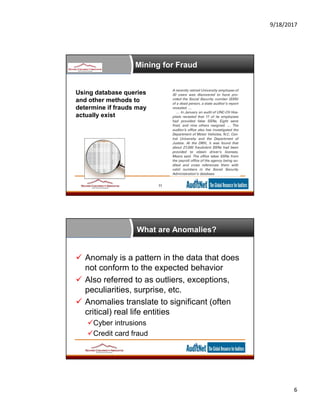
Mining for Fraud
11
Using database queries
and other methods to
determine if frauds may
actually exist
What are Anomalies?
 Anomaly is a pattern in the data that does
not conform to the expected behavior
 Also referred to as outliers, exceptions,
peculiarities, surprise, etc.
 Anomalies translate to significant (often
critical) real life entities
Cyber intrusions
Credit card fraud
9/18/2017
7
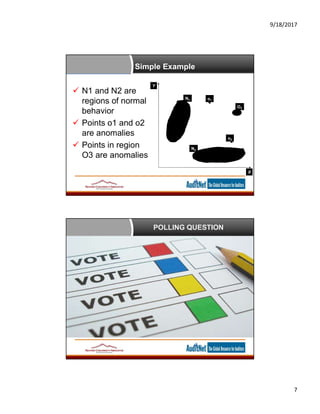
Simple Example
 N1 and N2 are
regions of normal
behavior
 Points o1 and o2
are anomalies
 Points in region
O3 are anomalies
X
Y
N1
N2
o1
o2
O3
POLLING QUESTION
9/18/2017
8
Copyright © 2017 AuditNet® and Richard Cascarino & Associates
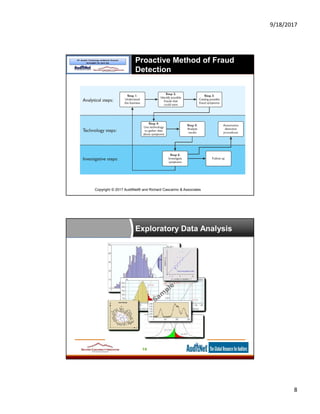
Proactive Method of Fraud
Detection
Exploratory Data Analysis
16
9/18/2017
9
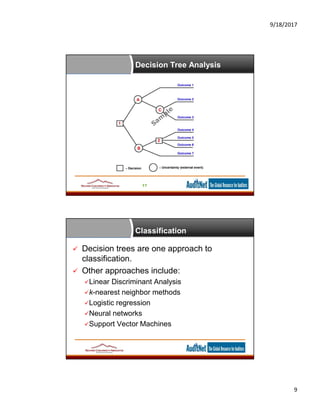
Decision Tree Analysis
17
Classification
 Decision trees are one approach to
classification.
 Other approaches include:
Linear Discriminant Analysis
k-nearest neighbor methods
Logistic regression
Neural networks
Support Vector Machines
9/18/2017
10
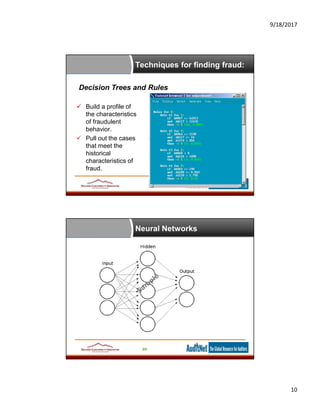
Techniques for finding fraud:
 Build a profile of
the characteristics
of fraudulent
behavior.
 Pull out the cases
that meet the
historical
characteristics of
fraud.
Decision Trees and Rules
Neural Networks
20
9/18/2017
11
In Data Mining terms…
 Classification?
Classify into fraudulent and non-fraudulent
behavior
What do we need to do this?
 Outlier Detection
Assume non-fraudulent behavior is normal
Find the exceptions
Data mining is not
 “Blind”application of analysis/modeling
algorithms
 Brute-force crunching of bulk data
 Black box technology
 Magic
9/18/2017
12
POLLING QUESTION
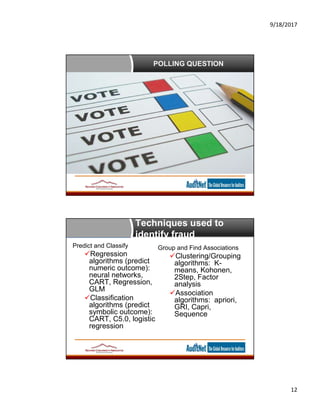
Techniques used to
identify fraud
Predict and Classify
Regression
algorithms (predict
numeric outcome):
neural networks,
CART, Regression,
GLM
Classification
algorithms (predict
symbolic outcome):
CART, C5.0, logistic
regression
Group and Find Associations
Clustering/Grouping
algorithms: K-
means, Kohonen,
2Step, Factor
analysis
Association
algorithms: apriori,
GRI, Capri,
Sequence
9/18/2017
13
Techniques for finding fraud:
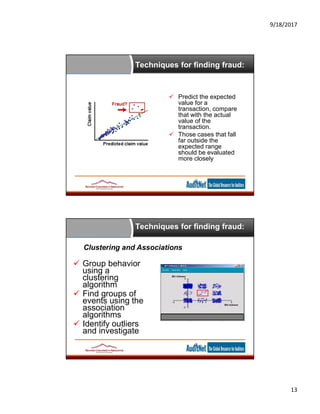
 Predict the expected
value for a
transaction, compare
that with the actual
value of the
transaction.
 Those cases that fall
far outside the
expected range
should be evaluated
more closely
Techniques for finding fraud:
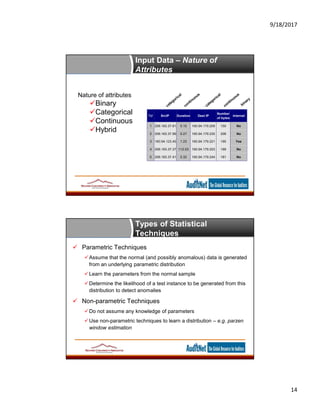
 Group behavior
using a
clustering
algorithm
 Find groups of
events using the
association
algorithms
 Identify outliers
and investigate
Clustering and Associations
9/18/2017
14
Input Data – Nature of
Attributes
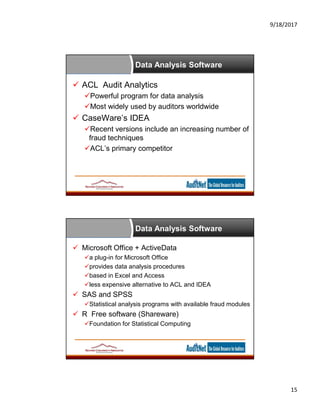
Nature of attributes
Binary
Categorical
Continuous
Hybrid
Tid SrcIP Duration Dest IP
Number
of bytes
Internal
1 206.163.37.81 0.10 160.94.179.208 150 No
2 206.163.37.99 0.27 160.94.179.235 208 No
3 160.94.123.45 1.23 160.94.179.221 195 Yes
4 206.163.37.37 112.03 160.94.179.253 199 No
5 206.163.37.41 0.32 160.94.179.244 181 No
Types of Statistical
Techniques
 Parametric Techniques
Assume that the normal (and possibly anomalous) data is generated
from an underlying parametric distribution
Learn the parameters from the normal sample
Determine the likelihood of a test instance to be generated from this
distribution to detect anomalies
 Non-parametric Techniques
Do not assume any knowledge of parameters
Use non-parametric techniques to learn a distribution – e.g. parzen
window estimation
9/18/2017
15
Data Analysis Software
 ACL Audit Analytics
Powerful program for data analysis
Most widely used by auditors worldwide
 CaseWare’s IDEA
Recent versions include an increasing number of
fraud techniques
ACL’s primary competitor
Data Analysis Software
 Microsoft Office + ActiveData
a plug-in for Microsoft Office
provides data analysis procedures
based in Excel and Access
less expensive alternative to ACL and IDEA
 SAS and SPSS
Statistical analysis programs with available fraud modules
 R Free software (Shareware)
Foundation for Statistical Computing
9/18/2017
16
Obstacles to Data Analysis
 Obtaining access privileges to data
 Getting physical access to the data
 Reliability and integrity of data received
 Understanding data storage and format
 Downloading the data
 Transferring the data to the auditor
 Importing the data into the data analysis
software
31
Planning for Data Analysis
Why You Need to Know How to Use CAATs
 Today, if you can’t follow a computerized audit trail, you can’t audit!
 Specialized Audit Software
SMF Analyzer
Languard
Clementine
Netmap
 Generalized Audit Software
IDEA (Caseware)
ACL
Access
Excel
SAS
Monarch
32
9/18/2017
17
Acquiring the Data
Ensuring the Data is Clean
• Use of control totals and Hash
totals
• Use of Data Verification
• Cleaning up data for
interrogation
• Recording all clean-ups
• Using IT to help Keep it Clean
33
POLLING QUESTION
9/18/2017
18
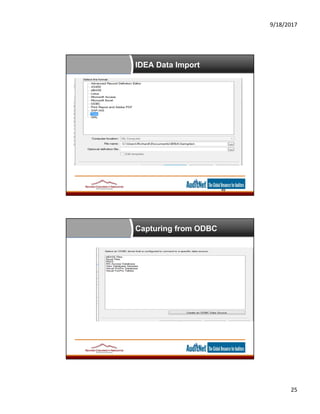
Acquiring and Importing Data
IDEA Importation Example
35
Benford’s Law History
 Simon Newcomb – 1881
 Frank Benford – 1938
 Roger Pinkham – 1961
 Theodore Hill – 1995
9/18/2017
19
History – Accounting Data
 Benford’s Law was first used by accountants
in late 1980
 Nigrini
What Is Benford’s Law
 BENFORD’S LAW FORMULA
The probability of any number “d” from
1 through 9 being the first digit is….
Log10 (1 + 1/d)
9/18/2017
20
What Is Benford’s Law?
 Benford’s law gives the probability of
obtaining digits 1 through 9 in each position
of a number.
 For example, 3879
3 - first digit
8 - second digit
7 - third digit
9 – fourth digit
What Is Benford’s Law
 Most people assume the probability is 1/9
that the first digit will be 1 - 9
 This would mean digits are equally likely to
occur, but this is not the case
 According to Benford’s Law the probability of
obtaining a 1 in the first digit position is
30.1%
9/18/2017
21
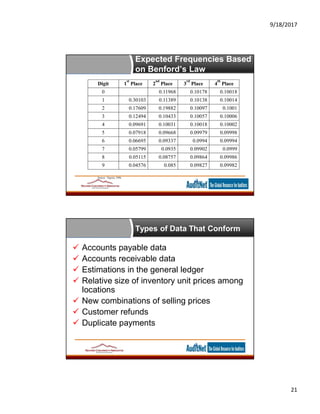
Expected Frequencies Based
on Benford’s Law
Digit 1
st
Place 2
nd
Place 3
rd
Place 4
th
Place
0 0.11968 0.10178 0.10018
1 0.30103 0.11389 0.10138 0.10014
2 0.17609 0.19882 0.10097 0.1001
3 0.12494 0.10433 0.10057 0.10006
4 0.09691 0.10031 0.10018 0.10002
5 0.07918 0.09668 0.09979 0.09998
6 0.06695 0.09337 0.0994 0.09994
7 0.05799 0.0935 0.09902 0.0999
8 0.05115 0.08757 0.09864 0.09986
9 0.04576 0.085 0.09827 0.09982
Source: Nigrini, 1996.
Types of Data That Conform
 Accounts payable data
 Accounts receivable data
 Estimations in the general ledger
 Relative size of inventory unit prices among
locations
 New combinations of selling prices
 Customer refunds
 Duplicate payments
9/18/2017
22
Uses in Fraud Investigations
 Invented or altered numbers are not likely to
follow Benford’s Law
Human choices are not random
 1993, State of Arizona v.Wayne James
Nelson
POLLING QUESTION
9/18/2017
23
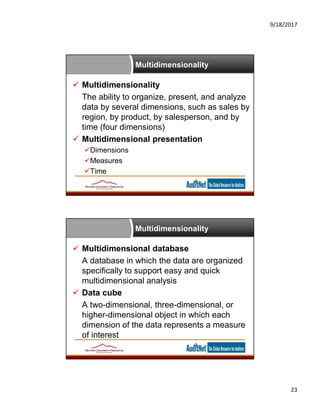
Multidimensionality
 Multidimensionality
The ability to organize, present, and analyze
data by several dimensions, such as sales by
region, by product, by salesperson, and by
time (four dimensions)
 Multidimensional presentation
Dimensions
Measures
Time
Multidimensionality
 Multidimensional database
A database in which the data are organized
specifically to support easy and quick
multidimensional analysis
 Data cube
A two-dimensional, three-dimensional, or
higher-dimensional object in which each
dimension of the data represents a measure
of interest
9/18/2017
24
Multidimensionality
 Cube
A subset of highly interrelated data that is
organized to allow users to combine any
attributes in a cube (e.g., stores, products,
customers, suppliers) with any metrics in the
cube (e.g., sales, profit, units, age) to create
various two-dimensional views, or slices, that
can be displayed on a computer screen
POLLING QUESTION
9/18/2017
25
IDEA Data Import
49
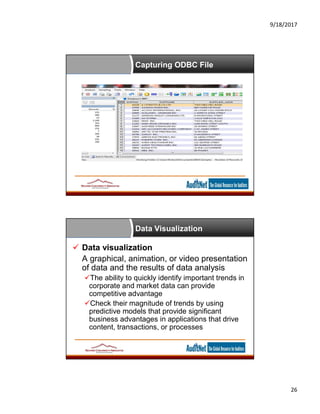
Capturing from ODBC
9/18/2017
26
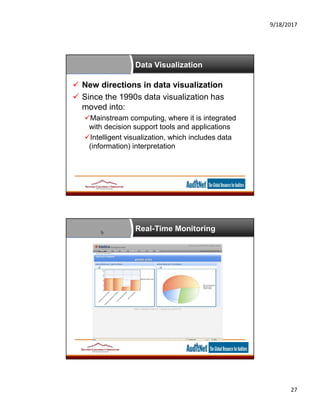
Capturing ODBC File
Data Visualization
 Data visualization
A graphical, animation, or video presentation
of data and the results of data analysis
The ability to quickly identify important trends in
corporate and market data can provide
competitive advantage
Check their magnitude of trends by using
predictive models that provide significant
business advantages in applications that drive
content, transactions, or processes
9/18/2017
27
Data Visualization
 New directions in data visualization
 Since the 1990s data visualization has
moved into:
Mainstream computing, where it is integrated
with decision support tools and applications
Intelligent visualization, which includes data
(information) interpretation
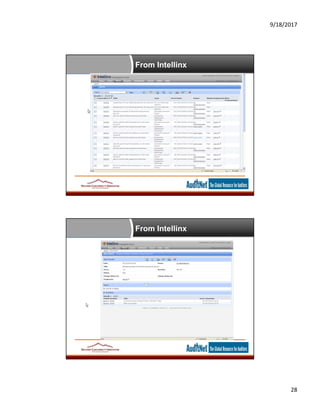
Real-Time Monitoring
9/18/2017
28
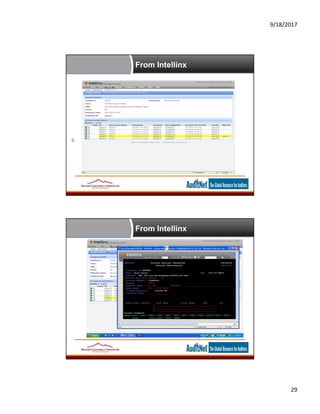
From Intellinx
From Intellinx
9/18/2017
29
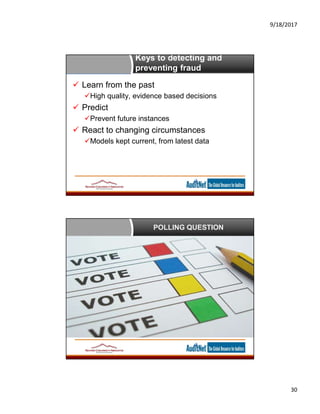
From Intellinx
From Intellinx
9/18/2017
30
Keys to detecting and
preventing fraud
 Learn from the past
High quality, evidence based decisions
 Predict
Prevent future instances
 React to changing circumstances
Models kept current, from latest data
POLLING QUESTION
9/18/2017
31
Questions?
Any Questions?
Don’t be Shy!
AuditNet® and cRisk Academy
If you would like
forever access to this
webinar recording
If you are watching
the recording, and
would like to obtain
CPE credit for this
webinar
Previous AuditNet®
webinars are also
available on-demand
for CPE credit
http://criskacademy.com
http://ondemand.criskacade
my.com
Use coupon code: 50OFF
for a discount on this
webinar for one week
9/18/2017
32
Thank You!
Jim Kaplan
AuditNet® LLC
1-800-385-1625
Email:info@auditnet.org
www.auditnet.org
Richard Cascarino & Associates
Cell: +1 970 819 7963 - South Africa +27 (0)78 980 7685
Tel +1 303 747 6087 (Skype Worldwide)
Tel: +1 970 367 5429
eMail: rcasc@rcascarino.com
Web: http://www.rcascarino.com
Skype: Richard.Cascarino
Page 63

IT Fraud Series: Data Analytics

  • 1.
    9/18/2017 1 Data Analytics September 19,2017 About Jim Kaplan, CIA, CFE  President and Founder of AuditNet®, the global resource for auditors (now available on iOS, Android and Windows devices)  Auditor, Web Site Guru,  Internet for Auditors Pioneer  Recipient of the IIA’s 2007 Bradford Cadmus Memorial Award.  Author of “The Auditor’s Guide to Internet Resources” 2nd Edition Page 2
  • 2.
    9/18/2017 2 About Richard Cascarino,MBA, CIA, CISM, CFE, CRMA • Principal of Richard Cascarino & Associates based in Colorado USA • Over 28 years experience in IT audit training and consultancy • Past President of the Institute of Internal Auditors in South Africa • Member of ISACA • Member of Association of Certified Fraud Examiners • Author of Data Analytics for Internal Auditors 3 About AuditNet® LLC • AuditNet®, the global resource for auditors, is available on the Web, iPad, iPhone, Windows and Android devices and features: • Over 2,700 Reusable Templates, Audit Programs, Questionnaires, and Control Matrices • Training without Travel Webinars focusing on fraud, data analytics, IT audit, and internal audit • Audit guides, manuals, and books on audit basics and using audit technology • LinkedIn Networking Groups • Monthly Newsletters with Expert Guest Columnists • Surveys on timely topics for internal auditors • NASBA Approved CPE Sponsor Introductions Page 4
  • 3.
    9/18/2017 3 Housekeeping This webinar andits material are the property of AuditNet® and its Webinar partners. Unauthorized usage or recording of this webinar or any of its material is strictly forbidden.  If you logged in with another individual’s confirmation email you will not receive CPE as the confirmation login is linked to a specific individual  This Webinar is not eligible for viewing in a group setting. You must be logged in with your unique join link.  We are recording the webinar and you will be provided access to that recording after the webinar. Downloading or otherwise duplicating the webinar recording is expressly prohibited.  If you have indicated you would like CPE you must answer the polling questions (all or minimum required) to receive CPE per NASBA.  If you meet the NASBA criteria for earning CPE you will receive a link via email to download your certificate. The official email for CPE will be issued via NoReply@gensend.io and it is important to white list this address. It is from this email that your CPE credit will be sent. There is a processing fee to have your CPE credit regenerated post event.  Submit questions via the chat box on your screen and we will answer them either during or at the conclusion.  Please complete the evaluation questionnaire to help us continuously improve our Webinars. IMPORTANT INFORMATION REGARDING CPE!  SUBSCRIBERS/SITE LICENSE USERS - If you attend the Webinar and answer the polling questions (all or minimum required) you will receive an email with the link to download your CPE certificate. The official email for CPE will be issued via NoReply@gensend.io and it is important to white list this address. It is from this email that your CPE credit will be sent. There is a processing fee to have your CPE credit regenerated post event.  NON-SUBSCRIBERS/NON-SITE LICENSE USERS - If you attend the Webinar and answer the polling questions (all or minimum required) and requested CPE you must pay a fee to receive your CPE. No exceptions!  We cannot manually generate a CPE certificate as these are handled by our 3rd party provider. We highly recommend that you work with your IT department to identify and correct any email delivery issues prior to attending the Webinar. Issues would include blocks or spam filters in your email system or a firewall that will redirect or not allow delivery of this email from Gensend.io  Anyone may register, attend and view the Webinar without fees if they opted out of receiving CPE.  We are not responsible for any connection, audio or other computer related issues. You must have pop-ups enabled on you computer otherwise you will not be able to answer the polling questions which occur approximately every 20 minutes. We suggest that if you have any pressing issues to see to that you do so immediately after a polling question.
  • 4.
    9/18/2017 4 The views expressedby the presenters do not necessarily represent the views, positions, or opinions of AuditNet® LLC. These materials, and the oral presentation accompanying them, are for educational purposes only and do not constitute accounting or legal advice or create an accountant-client relationship. While AuditNet® makes every effort to ensure information is accurate and complete, AuditNet® makes no representations, guarantees, or warranties as to the accuracy or completeness of the information provided via this presentation. AuditNet® specifically disclaims all liability for any claims or damages that may result from the information contained in this presentation, including any websites maintained by third parties and linked to the AuditNet® website. Any mention of commercial products is for information only; it does not imply recommendation or endorsement by AuditNet® LLC Today’s Agenda  Probability theory in Data Analysis  Types of Evidence  Population Analysis  Correlations and Regressions  Fraud Detection using Data Analysis  Data Analysis and Continuous Monitoring  Continuous Monitoring  Financial Analysis Page 8
  • 5.
    9/18/2017 5 Today’s Agenda  Datapreprocessing techniques for detection, validation, error correction, and filling up of missing or incorrect data  Calculating various statistical parameters such as averages, quantities, performance metrics and probability distributions risk measurement, reporting and control  Computing user profiles  Expert systems to encode expertise for detecting fraud in the form of rules  Time-series analysis of time-dependent data  Machine learning techniques to automatically detect characteristics of fraud Page 9 Data Mining Techniques Copyright Richard Cascarino & Associates 10 Data mining is the exploration and analysis of large quantities of data in order to discover valid, novel, potentially useful, and ultimately understandable patterns in data. Valid: The patterns hold in general. Novel: We did not know the pattern beforehand. Useful: We can devise actions from the patterns. Understandable: We can interpret and comprehend the patterns.
  • 6.
    9/18/2017 6 Mining for Fraud 11 Usingdatabase queries and other methods to determine if frauds may actually exist What are Anomalies?  Anomaly is a pattern in the data that does not conform to the expected behavior  Also referred to as outliers, exceptions, peculiarities, surprise, etc.  Anomalies translate to significant (often critical) real life entities Cyber intrusions Credit card fraud
  • 7.
    9/18/2017 7 Simple Example  N1and N2 are regions of normal behavior  Points o1 and o2 are anomalies  Points in region O3 are anomalies X Y N1 N2 o1 o2 O3 POLLING QUESTION
  • 8.
    9/18/2017 8 Copyright © 2017AuditNet® and Richard Cascarino & Associates Proactive Method of Fraud Detection Exploratory Data Analysis 16
  • 9.
    9/18/2017 9 Decision Tree Analysis 17 Classification Decision trees are one approach to classification.  Other approaches include: Linear Discriminant Analysis k-nearest neighbor methods Logistic regression Neural networks Support Vector Machines
  • 10.
    9/18/2017 10 Techniques for findingfraud:  Build a profile of the characteristics of fraudulent behavior.  Pull out the cases that meet the historical characteristics of fraud. Decision Trees and Rules Neural Networks 20
  • 11.
    9/18/2017 11 In Data Miningterms…  Classification? Classify into fraudulent and non-fraudulent behavior What do we need to do this?  Outlier Detection Assume non-fraudulent behavior is normal Find the exceptions Data mining is not  “Blind”application of analysis/modeling algorithms  Brute-force crunching of bulk data  Black box technology  Magic
  • 12.
    9/18/2017 12 POLLING QUESTION Techniques usedto identify fraud Predict and Classify Regression algorithms (predict numeric outcome): neural networks, CART, Regression, GLM Classification algorithms (predict symbolic outcome): CART, C5.0, logistic regression Group and Find Associations Clustering/Grouping algorithms: K- means, Kohonen, 2Step, Factor analysis Association algorithms: apriori, GRI, Capri, Sequence
  • 13.
    9/18/2017 13 Techniques for findingfraud:  Predict the expected value for a transaction, compare that with the actual value of the transaction.  Those cases that fall far outside the expected range should be evaluated more closely Techniques for finding fraud:  Group behavior using a clustering algorithm  Find groups of events using the association algorithms  Identify outliers and investigate Clustering and Associations
  • 14.
    9/18/2017 14 Input Data –Nature of Attributes Nature of attributes Binary Categorical Continuous Hybrid Tid SrcIP Duration Dest IP Number of bytes Internal 1 206.163.37.81 0.10 160.94.179.208 150 No 2 206.163.37.99 0.27 160.94.179.235 208 No 3 160.94.123.45 1.23 160.94.179.221 195 Yes 4 206.163.37.37 112.03 160.94.179.253 199 No 5 206.163.37.41 0.32 160.94.179.244 181 No Types of Statistical Techniques  Parametric Techniques Assume that the normal (and possibly anomalous) data is generated from an underlying parametric distribution Learn the parameters from the normal sample Determine the likelihood of a test instance to be generated from this distribution to detect anomalies  Non-parametric Techniques Do not assume any knowledge of parameters Use non-parametric techniques to learn a distribution – e.g. parzen window estimation
  • 15.
    9/18/2017 15 Data Analysis Software ACL Audit Analytics Powerful program for data analysis Most widely used by auditors worldwide  CaseWare’s IDEA Recent versions include an increasing number of fraud techniques ACL’s primary competitor Data Analysis Software  Microsoft Office + ActiveData a plug-in for Microsoft Office provides data analysis procedures based in Excel and Access less expensive alternative to ACL and IDEA  SAS and SPSS Statistical analysis programs with available fraud modules  R Free software (Shareware) Foundation for Statistical Computing
  • 16.
    9/18/2017 16 Obstacles to DataAnalysis  Obtaining access privileges to data  Getting physical access to the data  Reliability and integrity of data received  Understanding data storage and format  Downloading the data  Transferring the data to the auditor  Importing the data into the data analysis software 31 Planning for Data Analysis Why You Need to Know How to Use CAATs  Today, if you can’t follow a computerized audit trail, you can’t audit!  Specialized Audit Software SMF Analyzer Languard Clementine Netmap  Generalized Audit Software IDEA (Caseware) ACL Access Excel SAS Monarch 32
  • 17.
    9/18/2017 17 Acquiring the Data Ensuringthe Data is Clean • Use of control totals and Hash totals • Use of Data Verification • Cleaning up data for interrogation • Recording all clean-ups • Using IT to help Keep it Clean 33 POLLING QUESTION
  • 18.
    9/18/2017 18 Acquiring and ImportingData IDEA Importation Example 35 Benford’s Law History  Simon Newcomb – 1881  Frank Benford – 1938  Roger Pinkham – 1961  Theodore Hill – 1995
  • 19.
    9/18/2017 19 History – AccountingData  Benford’s Law was first used by accountants in late 1980  Nigrini What Is Benford’s Law  BENFORD’S LAW FORMULA The probability of any number “d” from 1 through 9 being the first digit is…. Log10 (1 + 1/d)
  • 20.
    9/18/2017 20 What Is Benford’sLaw?  Benford’s law gives the probability of obtaining digits 1 through 9 in each position of a number.  For example, 3879 3 - first digit 8 - second digit 7 - third digit 9 – fourth digit What Is Benford’s Law  Most people assume the probability is 1/9 that the first digit will be 1 - 9  This would mean digits are equally likely to occur, but this is not the case  According to Benford’s Law the probability of obtaining a 1 in the first digit position is 30.1%
  • 21.
    9/18/2017 21 Expected Frequencies Based onBenford’s Law Digit 1 st Place 2 nd Place 3 rd Place 4 th Place 0 0.11968 0.10178 0.10018 1 0.30103 0.11389 0.10138 0.10014 2 0.17609 0.19882 0.10097 0.1001 3 0.12494 0.10433 0.10057 0.10006 4 0.09691 0.10031 0.10018 0.10002 5 0.07918 0.09668 0.09979 0.09998 6 0.06695 0.09337 0.0994 0.09994 7 0.05799 0.0935 0.09902 0.0999 8 0.05115 0.08757 0.09864 0.09986 9 0.04576 0.085 0.09827 0.09982 Source: Nigrini, 1996. Types of Data That Conform  Accounts payable data  Accounts receivable data  Estimations in the general ledger  Relative size of inventory unit prices among locations  New combinations of selling prices  Customer refunds  Duplicate payments
  • 22.
    9/18/2017 22 Uses in FraudInvestigations  Invented or altered numbers are not likely to follow Benford’s Law Human choices are not random  1993, State of Arizona v.Wayne James Nelson POLLING QUESTION
  • 23.
    9/18/2017 23 Multidimensionality  Multidimensionality The abilityto organize, present, and analyze data by several dimensions, such as sales by region, by product, by salesperson, and by time (four dimensions)  Multidimensional presentation Dimensions Measures Time Multidimensionality  Multidimensional database A database in which the data are organized specifically to support easy and quick multidimensional analysis  Data cube A two-dimensional, three-dimensional, or higher-dimensional object in which each dimension of the data represents a measure of interest
  • 24.
    9/18/2017 24 Multidimensionality  Cube A subsetof highly interrelated data that is organized to allow users to combine any attributes in a cube (e.g., stores, products, customers, suppliers) with any metrics in the cube (e.g., sales, profit, units, age) to create various two-dimensional views, or slices, that can be displayed on a computer screen POLLING QUESTION
  • 25.
  • 26.
    9/18/2017 26 Capturing ODBC File DataVisualization  Data visualization A graphical, animation, or video presentation of data and the results of data analysis The ability to quickly identify important trends in corporate and market data can provide competitive advantage Check their magnitude of trends by using predictive models that provide significant business advantages in applications that drive content, transactions, or processes
  • 27.
    9/18/2017 27 Data Visualization  Newdirections in data visualization  Since the 1990s data visualization has moved into: Mainstream computing, where it is integrated with decision support tools and applications Intelligent visualization, which includes data (information) interpretation Real-Time Monitoring
  • 28.
  • 29.
  • 30.
    9/18/2017 30 Keys to detectingand preventing fraud  Learn from the past High quality, evidence based decisions  Predict Prevent future instances  React to changing circumstances Models kept current, from latest data POLLING QUESTION
  • 31.
    9/18/2017 31 Questions? Any Questions? Don’t beShy! AuditNet® and cRisk Academy If you would like forever access to this webinar recording If you are watching the recording, and would like to obtain CPE credit for this webinar Previous AuditNet® webinars are also available on-demand for CPE credit http://criskacademy.com http://ondemand.criskacade my.com Use coupon code: 50OFF for a discount on this webinar for one week
  • 32.
    9/18/2017 32 Thank You! Jim Kaplan AuditNet®LLC 1-800-385-1625 Email:info@auditnet.org www.auditnet.org Richard Cascarino & Associates Cell: +1 970 819 7963 - South Africa +27 (0)78 980 7685 Tel +1 303 747 6087 (Skype Worldwide) Tel: +1 970 367 5429 eMail: rcasc@rcascarino.com Web: http://www.rcascarino.com Skype: Richard.Cascarino Page 63