



Residential Water Heating
Energy Design Conference, Duluth

Ben Schoenbauer, CEE
February, 25th, 2014
In accordance with the Department of Labor and
Industry’s statute 326.0981, Subd. 11,
“This educational offering is recognized by the Minnesota
Department of Labor and Industry as satisfying 1.5
hours of credit toward Building Officials, Residential
Contractors and Plumbing continuing education
requirements.”

For additional continuing education approvals, please
see your credit tracking card.

Pg. 2
About CEE
The Center for Energy and Environment (CEE) is a
nonprofit organization that promotes energy efficiency to
strengthen the economy while improving the
environment.
CEE conducts research and develops programs so that:
• Businesses operate more efficiently and profitably;
• Government agencies and nonprofits spend less on
facilities and functions;
• Utilities achieve their energy-efficiency goals at leastcost; and
• Households save money and improve comfort.
Pg. 3
Support for Water Heating Projects
• Minnesota CARD Grants
• MN Department of Commerce
• To identify new technologies or strategies to maximize energy
savings, improve the effectiveness of energy conservation
programs in order to help utilities to achieve the annual state
energy conservation goal of 1.5 percent

• Building America
• Department of Energy
• Conducts research to continually develop innovative, costeffective energy saving solutions—better products, better new
homes, better ways to improve older homes, and better
buildings in which we work, shop, and lead our everyday lives.

Pg. 4
Agenda
• Natural Gas Water Heating
• Electric Water Heating
• New Developments in Water Heating

Pg. 5
Water Heating Technologies
• Natural Gas
• Storage Water Heaters
• Tankless Water Heaters
• Hybrid Water Heaters

• Electric
•
•
•
•

Storage Water Heaters
Tankless Water Heaters
Heat Pump Water Heaters
ETS Water Heaters

Pg. 6
Gas Water Heating
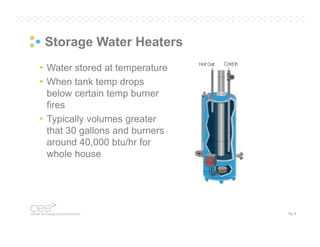
Storage Water Heaters
• Water stored at temperature
• When tank temp drops
below certain temp burner
fires
• Typically volumes greater
that 30 gallons and burners
around 40,000 btu/hr for
whole house

Pg. 8
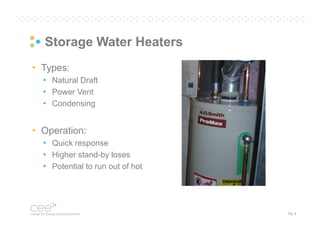
Storage Water Heaters
• Types:
• Natural Draft
• Power Vent
• Condensing

• Operation:
• Quick response
• Higher stand-by loses
• Potential to run out of hot

Pg. 9
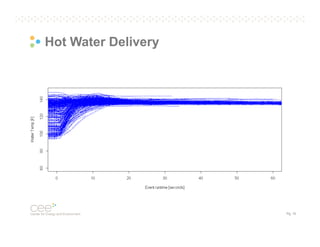
Hot Water Delivery

Pg. 10
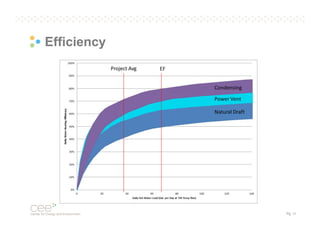
Efficiency

Pg. 11
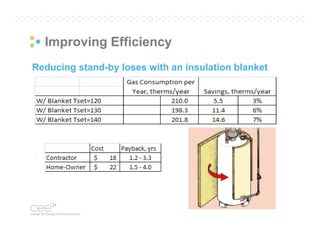
Improving Efficiency
Reducing stand-by loses with an insulation blanket
Improving Efficiency
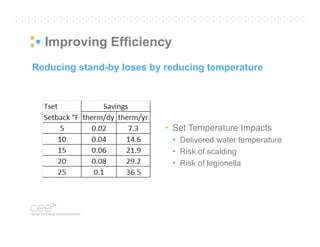
Reducing stand-by loses by reducing temperature

• Set Temperature Impacts
• Delivered water temperature
• Risk of scalding
• Risk of legionella
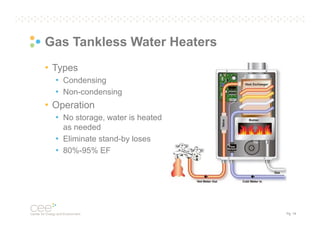
Gas Tankless Water Heaters
• Types
• Condensing
• Non-condensing

• Operation
• No storage, water is heated
as needed
• Eliminate stand-by loses
• 80%-95% EF

Pg. 14
Issues Facing Tankless Water Heaters
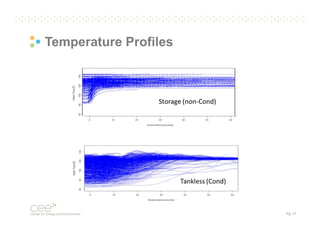
• Hot water quality
• Delayed delivery time
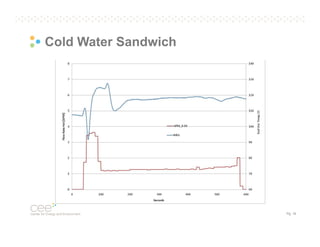
• Cold water sandwich
• Consistent Supply temperature
• Minimum flow rate for firing
• Performance for multiple simultaneous uses
• Higher installation costs
• Maintenance costs

Pg. 15
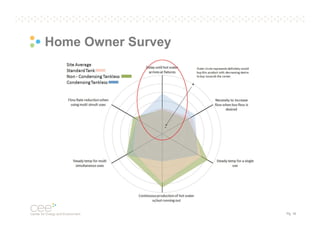
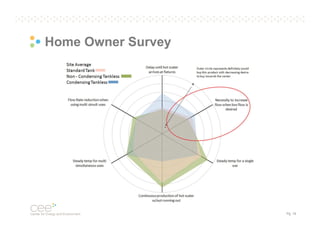
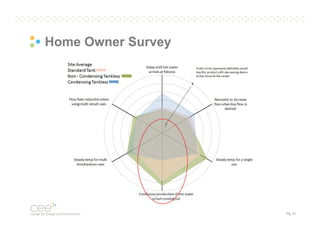
Home Owner Survey

Pg. 16
Temperature Profiles

Pg. 17
Cold Water Sandwich

Pg. 18
Home Owner Survey

Pg. 19
Minimum flow rate to fire
•
•
•
•

Minimum flow rate to start is 0.2 GPM
Maximum is 0.66 GPM
Minimum flow rates have improved over time
Some models have “buffer” tanks to reduce minimum
rates to 0
• Stand-by loses are increased for these units

Pg. 20
Home Owner Survey

Pg. 21
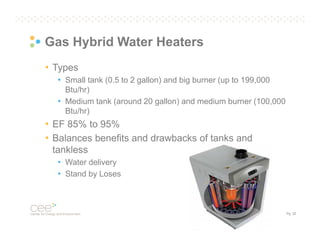
Gas Hybrid Water Heaters
• Types
• Small tank (0.5 to 2 gallon) and big burner (up to 199,000
Btu/hr)
• Medium tank (around 20 gallon) and medium burner (100,000
Btu/hr)

• EF 85% to 95%
• Balances benefits and drawbacks of tanks and
tankless
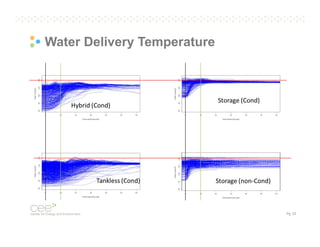
• Water delivery
• Stand by Loses

Pg. 22
Water Delivery Temperature

Pg. 23
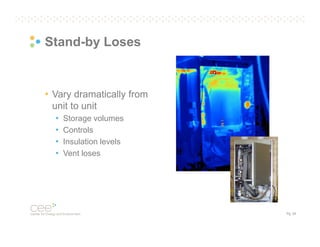
Stand-by Loses

• Vary dramatically from
unit to unit
•
•
•
•

Storage volumes
Controls
Insulation levels
Vent loses

Pg. 24
Gas Water Heater Comparison
•
•
•
•

Efficiency
Installation
Safety
Economics

Pg. 25
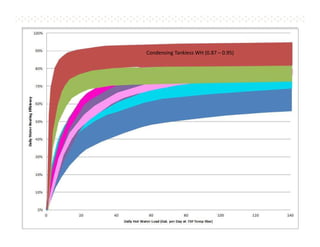
Condensing Tankless WH (0.87 – 0.95)
Condensing Storage WHs (0.86 – 0.95)
Non-condensing Tankless WH (0.80 – 0.86)
Power Vent Water Heaters (0.60-0.71)

Natural Draft Storage Water Heaters (0.50 – 0.60)

Efficiency

Pg. 26
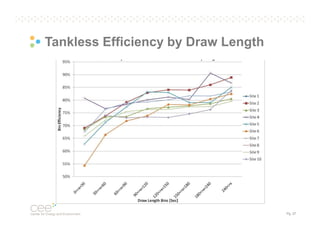
Tankless Efficiency by Draw Length

Pg. 27
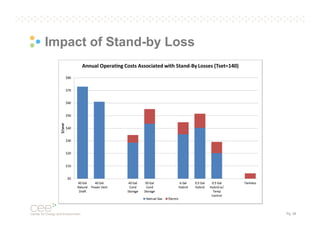
Impact of Stand-by Loss

Pg. 28
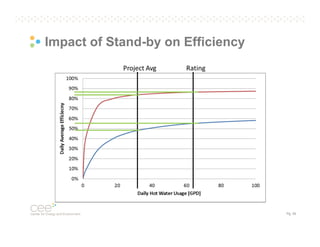
Impact of Stand-by on Efficiency

Pg. 29
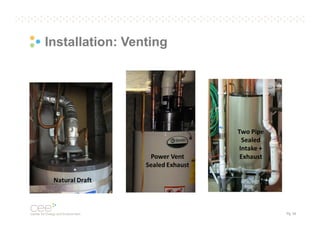
Installation: Venting

Pg. 30
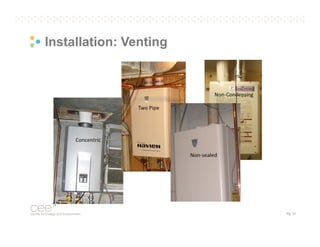
Installation: Venting

Pg. 31
Larger Burners = Gas Line Upgrades
• Water heaters with burners greater than 100,000 Btu/hr
• Most tankless
• Some condensing storage
• Some hybrid

• Occasionally require a meter upgrade (more common in
older homes and/or homes with lots of gas uses)
• 0 of 25 in our studies

• Sites commonly required a increased size gas line from
the water heater to the gas meter
• 14 of 25 in our studies

Pg. 32
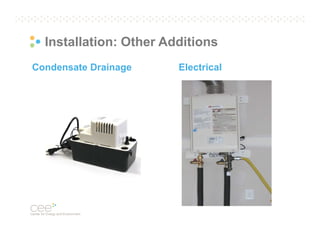
Installation: Other Additions
Condensate Drainage

Electrical
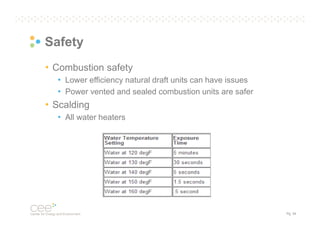
Safety
• Combustion safety
• Lower efficiency natural draft units can have issues
• Power vented and sealed combustion units are safer

• Scalding
• All water heaters

Pg. 34
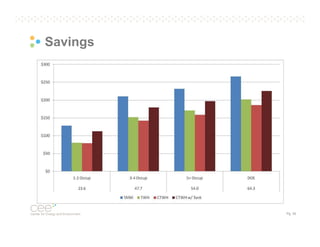
Savings

Pg. 35
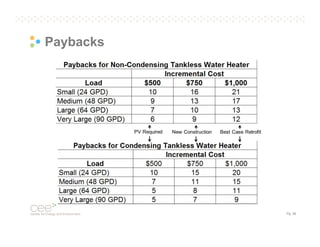
Paybacks

Pg. 36
Electrical Water Heating
Electric Storage
• Water stored at temperature
• When tank temp drops below certain point elements
turn on
• Rated EF from 0.89 to 0.95
• Insulation levels main difference

• Typical input: 4 to 6 kW
• Typically 40 to 60 gallons of storage
• No burner venting results in lower storage loses than
similar gas units
• Hot water delivery similar to gas storage WHs
Pg. 38
Electric tankless
• Major market as point of use heaters
• 3.5 kW on regular electric service – 1 sink
• 5 kW on 240 volt – 1 bathroom
• Reduce distribution loses compared to central system

• Whole house units available for small homes
• Require larger electric hook ups

• Rated EF of 0.90 to 0.95

Pg. 39
Distribution efficiency
• 5% to 27% of hot water is from draws where fixture is
never gets hot (by volume)
• Draws lost 2-8 ºF, 3% to 12% loss
• Depending on usage patterns, hot water left in pipes
can reduce total system efficiencies to less than 25%
• If draws are well grouped these loses are very small

• Point of use heaters can reduces these loses to almost
zero

Pg. 40
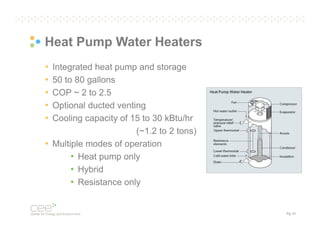
Heat Pump Water Heaters
•
•
•
•
•

Integrated heat pump and storage
50 to 80 gallons
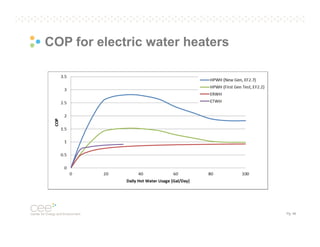
COP ~ 2 to 2.5
Optional ducted venting
Cooling capacity of 15 to 30 kBtu/hr
(~1.2 to 2 tons)
• Multiple modes of operation
• Heat pump only
• Hybrid
• Resistance only

Pg. 41
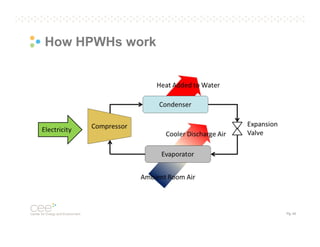
How HPWHs work

Pg. 42
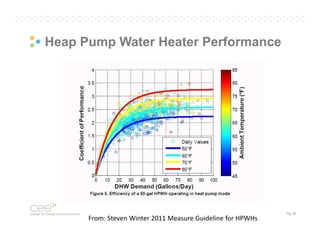
Heap Pump Water Heater Performance

Pg. 43

From: Steven Winter 2011 Measure Guideline for HPWHs
HPWH Space Conditioning Impact
• Lots of modeling around the country still need DATA!!
• Lots of variables:
• Installation location
• In conditioned space – Max effect
• In garage – No effect
• In semi-conditioned (basement/craw space) – secondary effect

• Conditioning load of house and heating equipment
• Efficiency, set points, use, etc

• Limited lab data shows HPWHs deliver ~1 ton of
cooling at 50 gallons per day
Pg. 44
Electric Thermal Storage
• Increases the temperature WH at low electricity use
periods (overnight)
• Not an energy savings measure, but reduces peak
load

• Units typically have larger storage capacity's, 60
gallons plus
• Some units have increased insulation to prevent
increasing stand by loses

Pg. 45
COP for electric water heaters

Pg. 46
Paybacks
• HPWHs on average save $250 per year
• Simple paybacks in typical homes of about 3 years
• CEE developing savings and payback tools for MN CARD
• Watch mncee.org for developments
• Tool will include impacts of
• Installation location
• Impact on space heating load
• Ambient temperatures
• And more…
• Typical Annual Electric Bill 90% = $650
• Typical Annual Gas Bill 60% = $250
Pg. 47
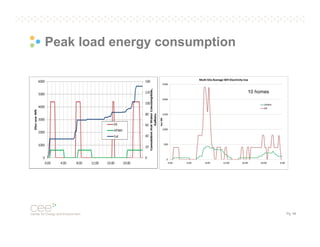
Peak load energy consumption

10 homes

Pg. 48
What to look for in the future
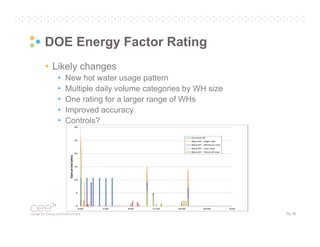
DOE Energy Factor Rating
• Likely changes
•
•
•
•
•

New hot water usage pattern
Multiple daily volume categories by WH size
One rating for a larger range of WHs
Improved accuracy
Controls?

Pg. 50
New Products
• Thermal storage HPWH
• Retrofit high efficiency gas tankless and hybrid
• Gas fired heat pump technology

Pg. 51
Potential Plumbing Code Changes
•
•
•
•

Allowing smaller pipe diameter
Requiring low water volume between WH and fixtures
Pipe insulation guideline/requirements
Recirculation controls

• International Energy Conservation Code (IECC-R and
IECC-C)
• International Association of Plumbing and Mechanical
Officials (IAPMO) Uniform Plumbing Code (UPC)

Pg. 54
New Regulations April 2015
• Units greater than 55 gallons will be required to be
HPWHs or condensing gas water heaters
• Impacts
• 30 year costumer savings for $8.7 billion
• Are high efficiency units cost effective? Does it matter?
• Some electric utilities rely on large electric storage water
heaters for thermal storage?
• Potential for a waiver for these programs

Pg. 55
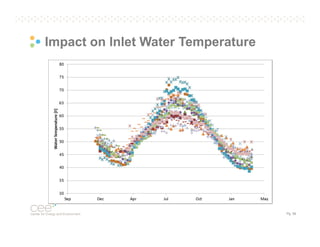
Impact on Inlet Water Temperature

Pg. 56
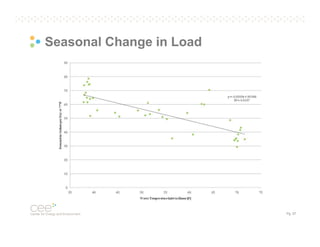
Seasonal Change in Load

Pg. 57

Residential Water Heating

  • 1.
    Residential Water Heating EnergyDesign Conference, Duluth Ben Schoenbauer, CEE February, 25th, 2014
  • 2.
    In accordance withthe Department of Labor and Industry’s statute 326.0981, Subd. 11, “This educational offering is recognized by the Minnesota Department of Labor and Industry as satisfying 1.5 hours of credit toward Building Officials, Residential Contractors and Plumbing continuing education requirements.” For additional continuing education approvals, please see your credit tracking card. Pg. 2
  • 3.
    About CEE The Centerfor Energy and Environment (CEE) is a nonprofit organization that promotes energy efficiency to strengthen the economy while improving the environment. CEE conducts research and develops programs so that: • Businesses operate more efficiently and profitably; • Government agencies and nonprofits spend less on facilities and functions; • Utilities achieve their energy-efficiency goals at leastcost; and • Households save money and improve comfort. Pg. 3
  • 4.
    Support for WaterHeating Projects • Minnesota CARD Grants • MN Department of Commerce • To identify new technologies or strategies to maximize energy savings, improve the effectiveness of energy conservation programs in order to help utilities to achieve the annual state energy conservation goal of 1.5 percent • Building America • Department of Energy • Conducts research to continually develop innovative, costeffective energy saving solutions—better products, better new homes, better ways to improve older homes, and better buildings in which we work, shop, and lead our everyday lives. Pg. 4
  • 5.
    Agenda • Natural GasWater Heating • Electric Water Heating • New Developments in Water Heating Pg. 5
  • 6.
    Water Heating Technologies •Natural Gas • Storage Water Heaters • Tankless Water Heaters • Hybrid Water Heaters • Electric • • • • Storage Water Heaters Tankless Water Heaters Heat Pump Water Heaters ETS Water Heaters Pg. 6
  • 7.
  • 8.
    Storage Water Heaters •Water stored at temperature • When tank temp drops below certain temp burner fires • Typically volumes greater that 30 gallons and burners around 40,000 btu/hr for whole house Pg. 8
  • 9.
    Storage Water Heaters •Types: • Natural Draft • Power Vent • Condensing • Operation: • Quick response • Higher stand-by loses • Potential to run out of hot Pg. 9
  • 10.
  • 11.
  • 12.
    Improving Efficiency Reducing stand-byloses with an insulation blanket
  • 13.
    Improving Efficiency Reducing stand-byloses by reducing temperature • Set Temperature Impacts • Delivered water temperature • Risk of scalding • Risk of legionella
  • 14.
    Gas Tankless WaterHeaters • Types • Condensing • Non-condensing • Operation • No storage, water is heated as needed • Eliminate stand-by loses • 80%-95% EF Pg. 14
  • 15.
    Issues Facing TanklessWater Heaters • Hot water quality • Delayed delivery time • Cold water sandwich • Consistent Supply temperature • Minimum flow rate for firing • Performance for multiple simultaneous uses • Higher installation costs • Maintenance costs Pg. 15
  • 16.
  • 17.
  • 18.
  • 19.
  • 20.
    Minimum flow rateto fire • • • • Minimum flow rate to start is 0.2 GPM Maximum is 0.66 GPM Minimum flow rates have improved over time Some models have “buffer” tanks to reduce minimum rates to 0 • Stand-by loses are increased for these units Pg. 20
  • 21.
  • 22.
    Gas Hybrid WaterHeaters • Types • Small tank (0.5 to 2 gallon) and big burner (up to 199,000 Btu/hr) • Medium tank (around 20 gallon) and medium burner (100,000 Btu/hr) • EF 85% to 95% • Balances benefits and drawbacks of tanks and tankless • Water delivery • Stand by Loses Pg. 22
  • 23.
  • 24.
    Stand-by Loses • Varydramatically from unit to unit • • • • Storage volumes Controls Insulation levels Vent loses Pg. 24
  • 25.
    Gas Water HeaterComparison • • • • Efficiency Installation Safety Economics Pg. 25
  • 26.
    Condensing Tankless WH(0.87 – 0.95) Condensing Storage WHs (0.86 – 0.95) Non-condensing Tankless WH (0.80 – 0.86) Power Vent Water Heaters (0.60-0.71) Natural Draft Storage Water Heaters (0.50 – 0.60) Efficiency Pg. 26
  • 27.
    Tankless Efficiency byDraw Length Pg. 27
  • 28.
    Impact of Stand-byLoss Pg. 28
  • 29.
    Impact of Stand-byon Efficiency Pg. 29
  • 30.
  • 31.
  • 32.
    Larger Burners =Gas Line Upgrades • Water heaters with burners greater than 100,000 Btu/hr • Most tankless • Some condensing storage • Some hybrid • Occasionally require a meter upgrade (more common in older homes and/or homes with lots of gas uses) • 0 of 25 in our studies • Sites commonly required a increased size gas line from the water heater to the gas meter • 14 of 25 in our studies Pg. 32
  • 33.
  • 34.
    Safety • Combustion safety •Lower efficiency natural draft units can have issues • Power vented and sealed combustion units are safer • Scalding • All water heaters Pg. 34
  • 35.
  • 36.
  • 37.
  • 38.
    Electric Storage • Waterstored at temperature • When tank temp drops below certain point elements turn on • Rated EF from 0.89 to 0.95 • Insulation levels main difference • Typical input: 4 to 6 kW • Typically 40 to 60 gallons of storage • No burner venting results in lower storage loses than similar gas units • Hot water delivery similar to gas storage WHs Pg. 38
  • 39.
    Electric tankless • Majormarket as point of use heaters • 3.5 kW on regular electric service – 1 sink • 5 kW on 240 volt – 1 bathroom • Reduce distribution loses compared to central system • Whole house units available for small homes • Require larger electric hook ups • Rated EF of 0.90 to 0.95 Pg. 39
  • 40.
    Distribution efficiency • 5%to 27% of hot water is from draws where fixture is never gets hot (by volume) • Draws lost 2-8 ºF, 3% to 12% loss • Depending on usage patterns, hot water left in pipes can reduce total system efficiencies to less than 25% • If draws are well grouped these loses are very small • Point of use heaters can reduces these loses to almost zero Pg. 40
  • 41.
    Heat Pump WaterHeaters • • • • • Integrated heat pump and storage 50 to 80 gallons COP ~ 2 to 2.5 Optional ducted venting Cooling capacity of 15 to 30 kBtu/hr (~1.2 to 2 tons) • Multiple modes of operation • Heat pump only • Hybrid • Resistance only Pg. 41
  • 42.
  • 43.
    Heap Pump WaterHeater Performance Pg. 43 From: Steven Winter 2011 Measure Guideline for HPWHs
  • 44.
    HPWH Space ConditioningImpact • Lots of modeling around the country still need DATA!! • Lots of variables: • Installation location • In conditioned space – Max effect • In garage – No effect • In semi-conditioned (basement/craw space) – secondary effect • Conditioning load of house and heating equipment • Efficiency, set points, use, etc • Limited lab data shows HPWHs deliver ~1 ton of cooling at 50 gallons per day Pg. 44
  • 45.
    Electric Thermal Storage •Increases the temperature WH at low electricity use periods (overnight) • Not an energy savings measure, but reduces peak load • Units typically have larger storage capacity's, 60 gallons plus • Some units have increased insulation to prevent increasing stand by loses Pg. 45
  • 46.
    COP for electricwater heaters Pg. 46
  • 47.
    Paybacks • HPWHs onaverage save $250 per year • Simple paybacks in typical homes of about 3 years • CEE developing savings and payback tools for MN CARD • Watch mncee.org for developments • Tool will include impacts of • Installation location • Impact on space heating load • Ambient temperatures • And more… • Typical Annual Electric Bill 90% = $650 • Typical Annual Gas Bill 60% = $250 Pg. 47
  • 48.
    Peak load energyconsumption 10 homes Pg. 48
  • 49.
    What to lookfor in the future
  • 50.
    DOE Energy FactorRating • Likely changes • • • • • New hot water usage pattern Multiple daily volume categories by WH size One rating for a larger range of WHs Improved accuracy Controls? Pg. 50
  • 51.
    New Products • Thermalstorage HPWH • Retrofit high efficiency gas tankless and hybrid • Gas fired heat pump technology Pg. 51
  • 54.
    Potential Plumbing CodeChanges • • • • Allowing smaller pipe diameter Requiring low water volume between WH and fixtures Pipe insulation guideline/requirements Recirculation controls • International Energy Conservation Code (IECC-R and IECC-C) • International Association of Plumbing and Mechanical Officials (IAPMO) Uniform Plumbing Code (UPC) Pg. 54
  • 55.
    New Regulations April2015 • Units greater than 55 gallons will be required to be HPWHs or condensing gas water heaters • Impacts • 30 year costumer savings for $8.7 billion • Are high efficiency units cost effective? Does it matter? • Some electric utilities rely on large electric storage water heaters for thermal storage? • Potential for a waiver for these programs Pg. 55
  • 56.
    Impact on InletWater Temperature Pg. 56
  • 57.
    Seasonal Change inLoad Pg. 57