CRICOS No.00213J
Random Acts of Gatewatching:
Everyday Newssharing Practices
Prof. Axel Bruns
Guest Professor, IKMZ, University of Zürich
a.bruns@qut.edu.au — a.bruns@ikmz.uzh.ch
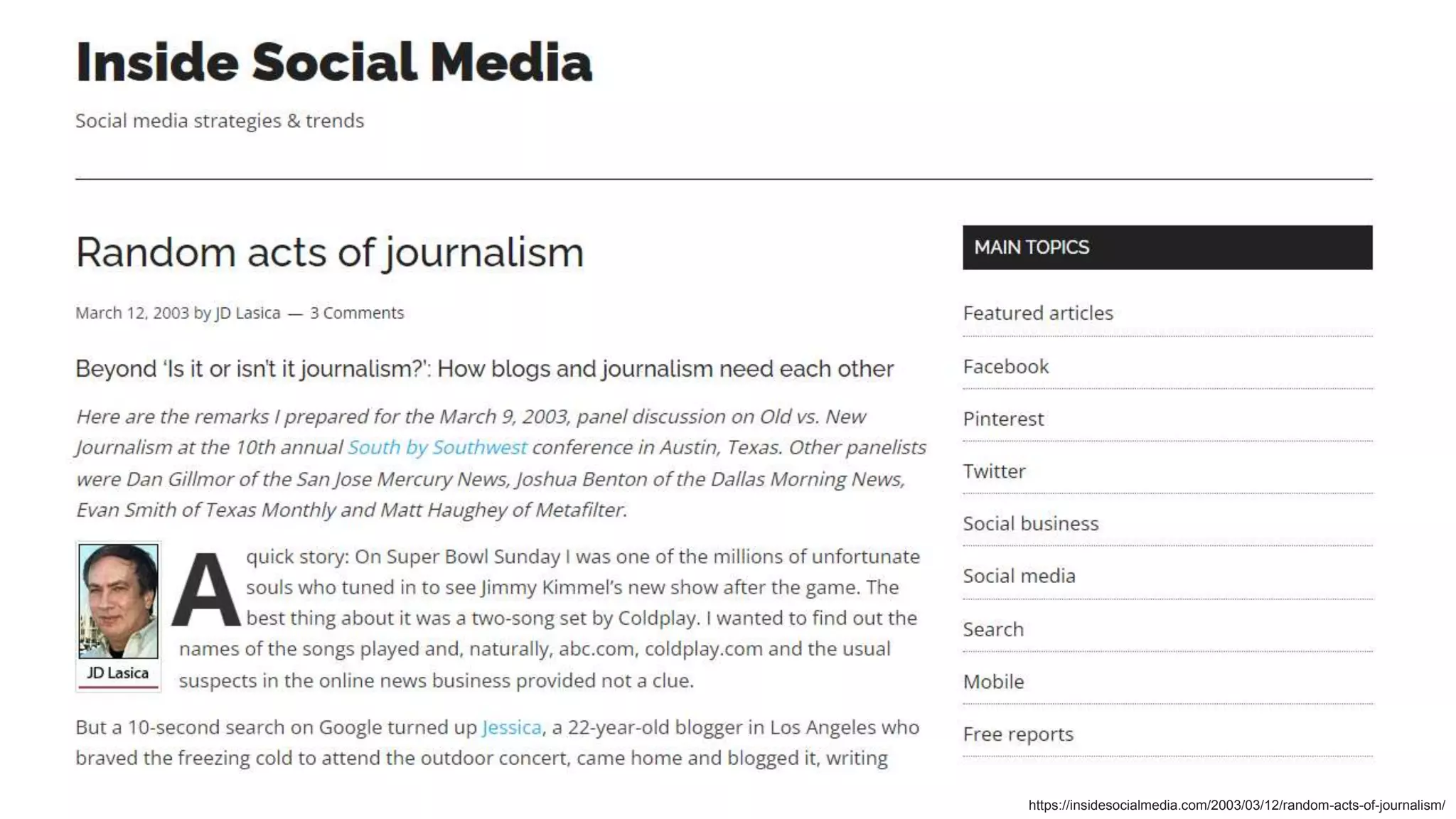
https://insidesocialmedia.com/2003/03/12/random-acts-of-journalism/
CRICOS No.00213J
From Trending Topics
to Everyday News
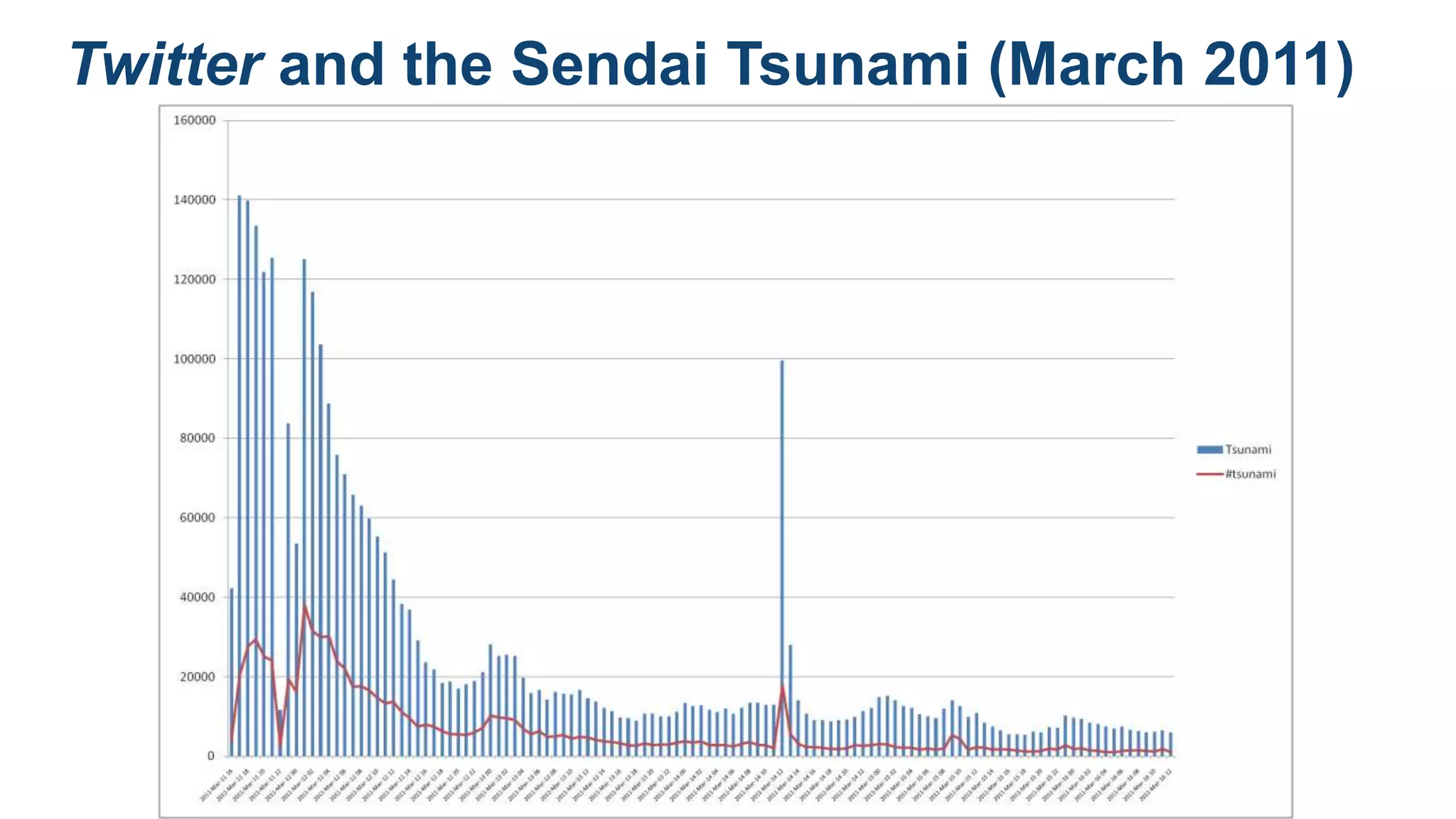
Twitter and the Sendai Tsunami (March 2011)
CRICOS No.00213J
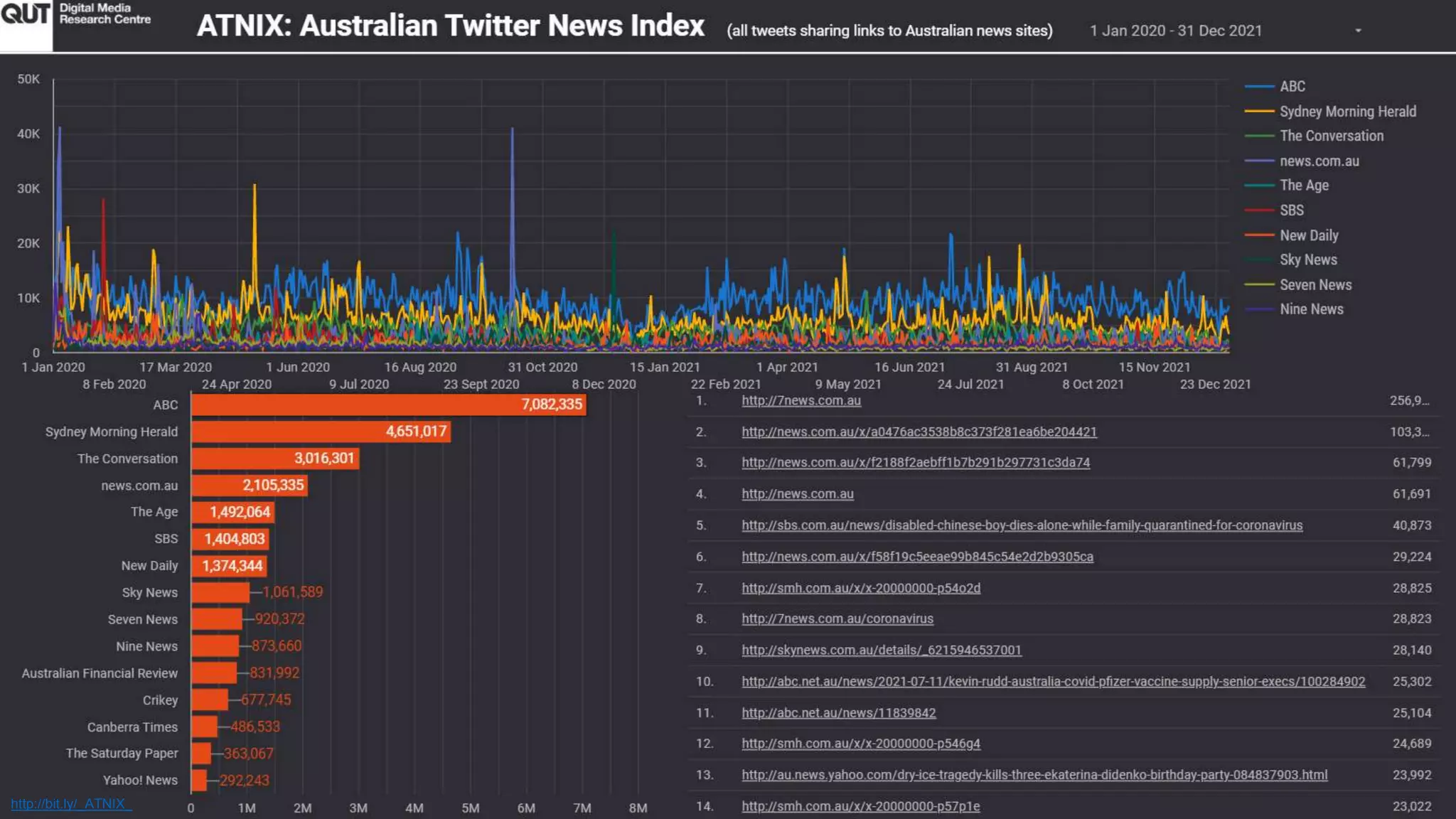
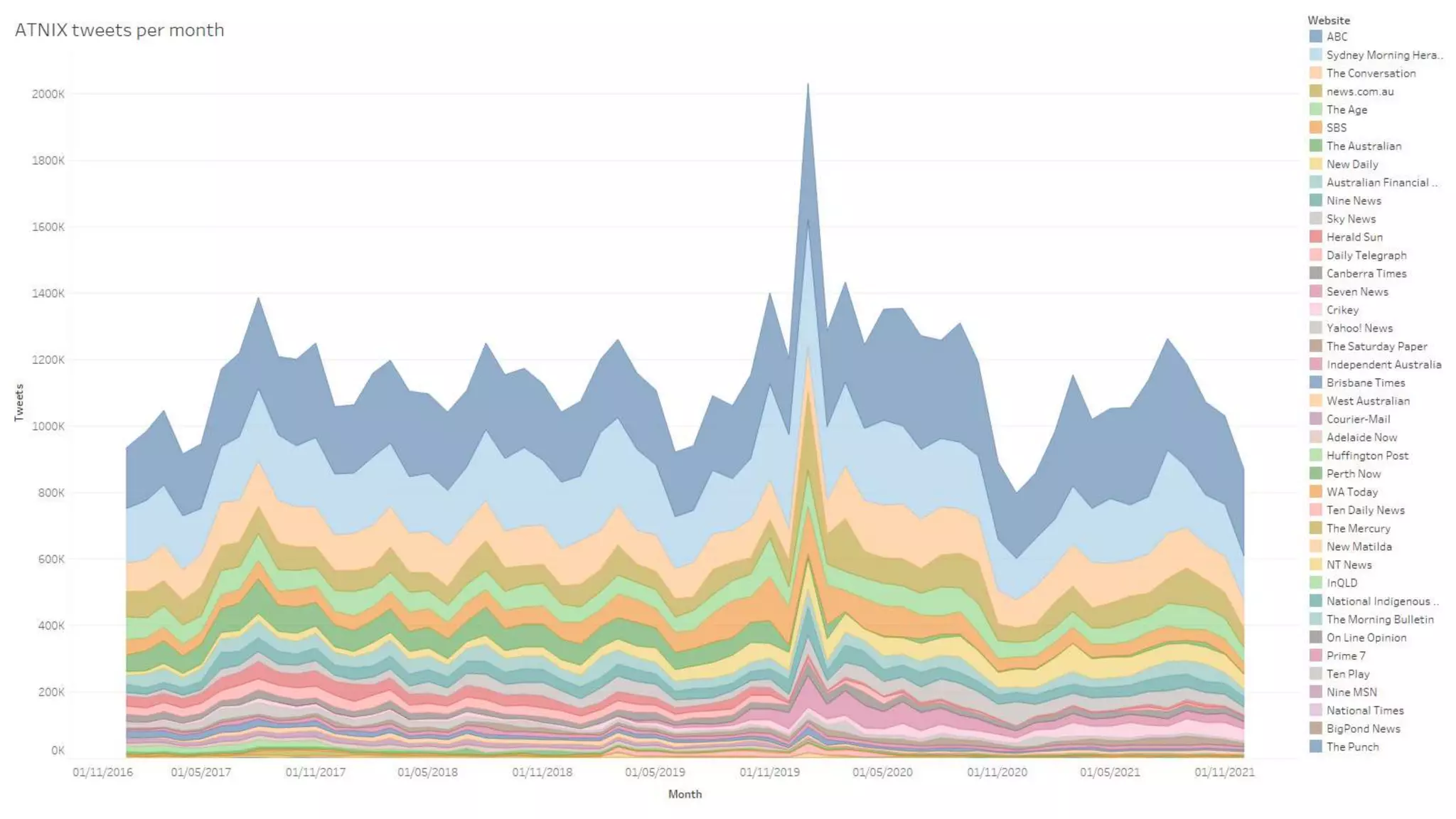
http://bit.ly/_ATNIX_
CRICOS No.00213J
CRICOS No.00213J
(It’s complicated.)
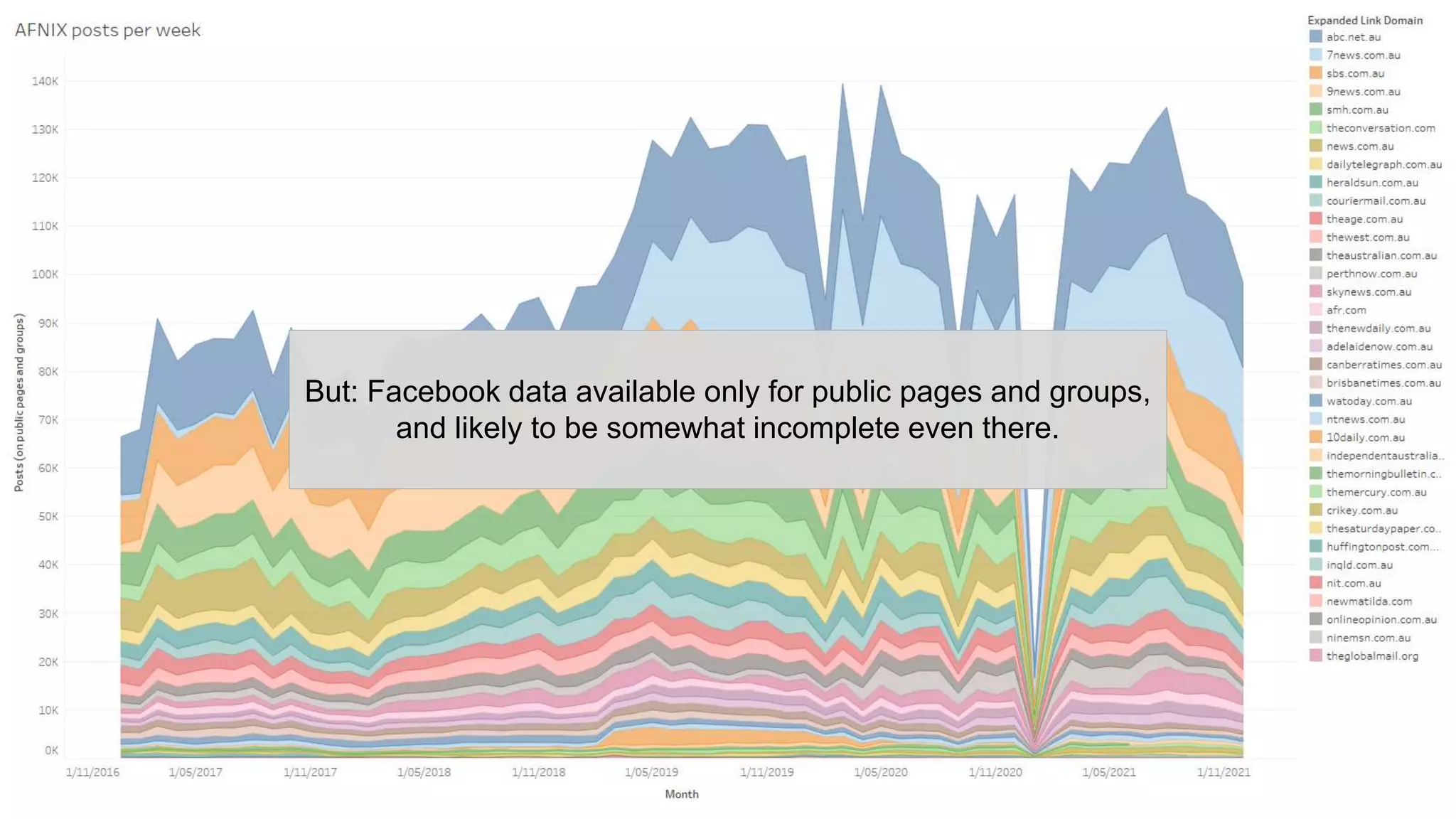
And Facebook?
CRICOS No.00213J
But: Facebook data available only for public pages and groups,
and likely to be somewhat incomplete even there.
CRICOS No.00213J
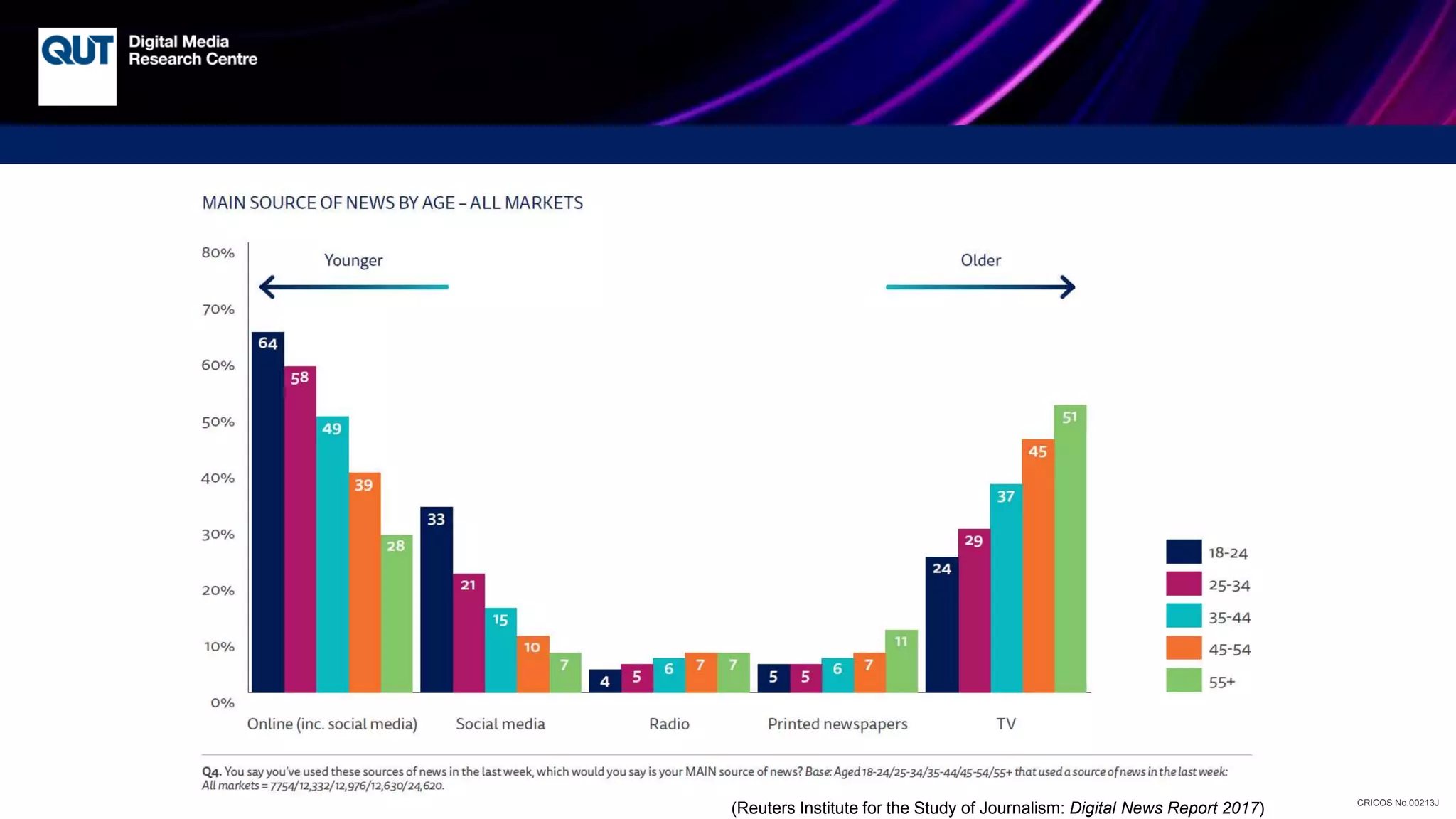
Serendipity
CRICOS No.00213J
(Reuters Institute for the Study of Journalism: Digital News Report 2017)
CRICOS No.00213J
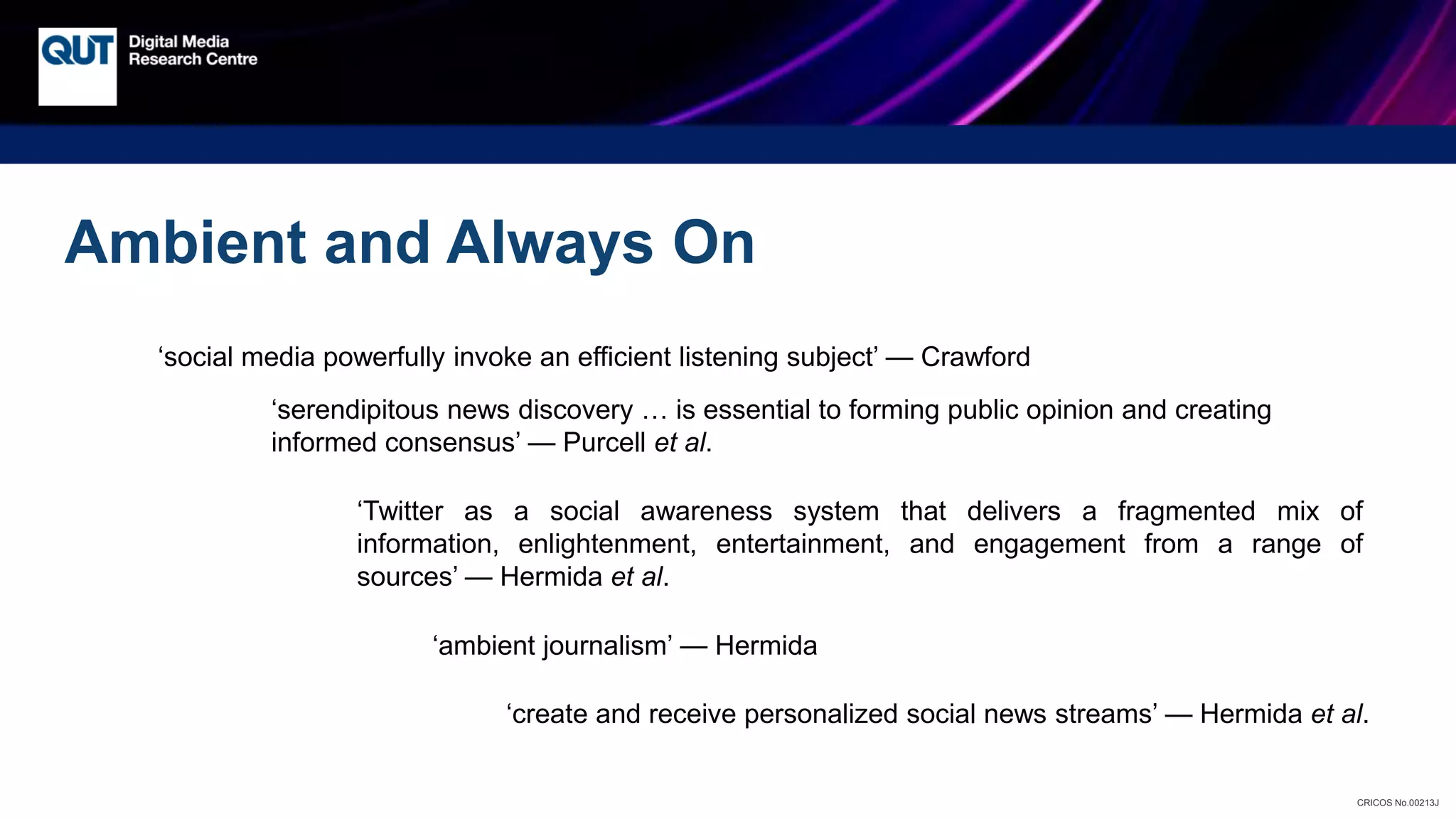
‘social media powerfully invoke an efficient listening subject’ — Crawford
‘serendipitous news discovery … is essential to forming public opinion and creating
informed consensus’ — Purcell et al.
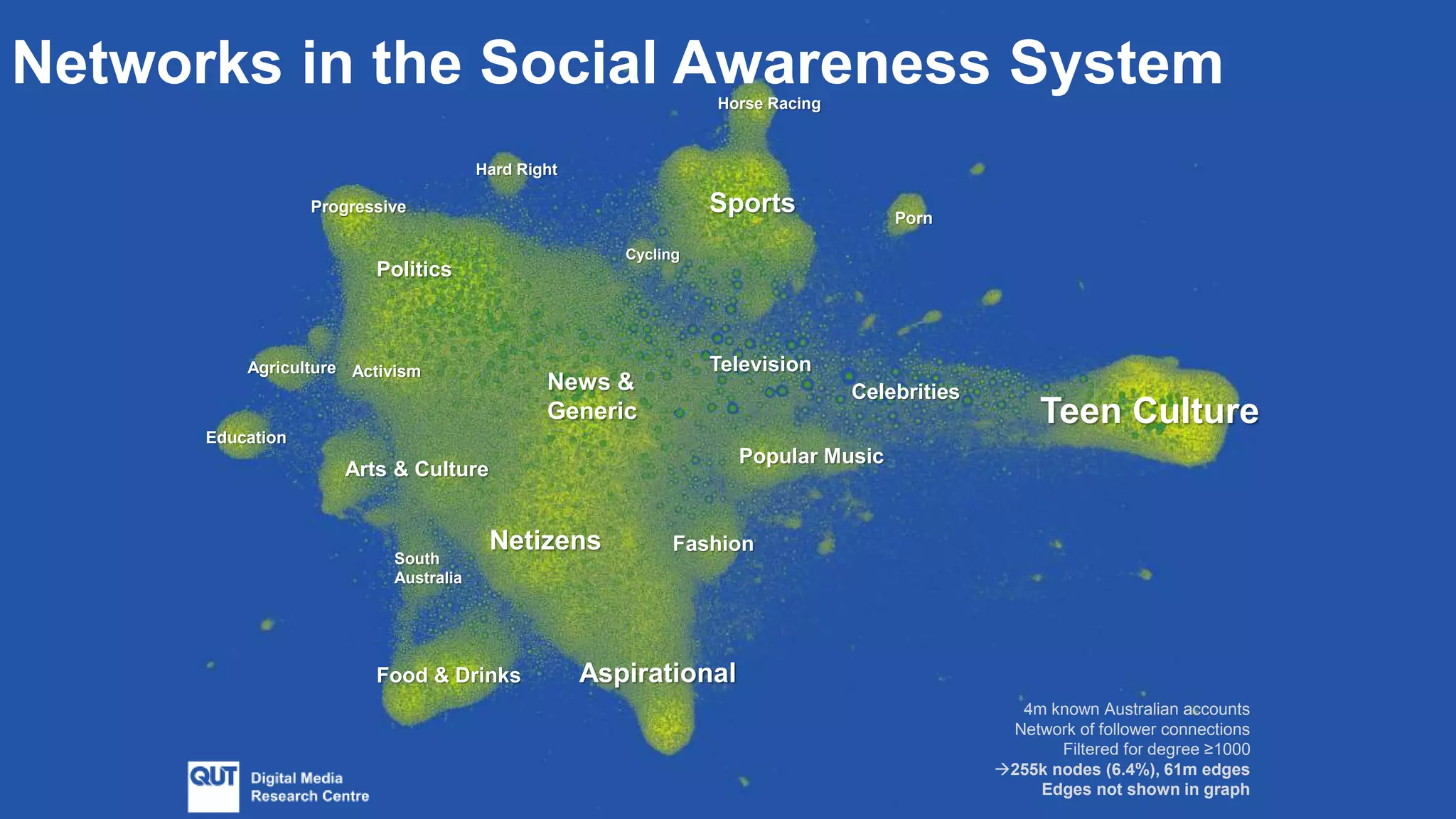
‘Twitter as a social awareness system that delivers a fragmented mix of
information, enlightenment, entertainment, and engagement from a range of
sources’ — Hermida et al.
‘ambient journalism’ — Hermida
Ambient and Always On
‘create and receive personalized social news streams’ — Hermida et al.
4m known Australian accounts
Network of follower connections
Filtered for degree ≥1000
255k nodes (6.4%), 61m edges
Edges not shown in graph
Networks in the Social Awareness System
Teen Culture
Aspirational
Sports
Netizens
Arts & Culture
Politics
Television
Fashion
Popular Music
Food & Drinks
Agriculture Activism
Porn
Education
Cycling
News &
Generic
Hard Right
Progressive
South
Australia
Celebrities
Horse Racing
CRICOS No.00213J
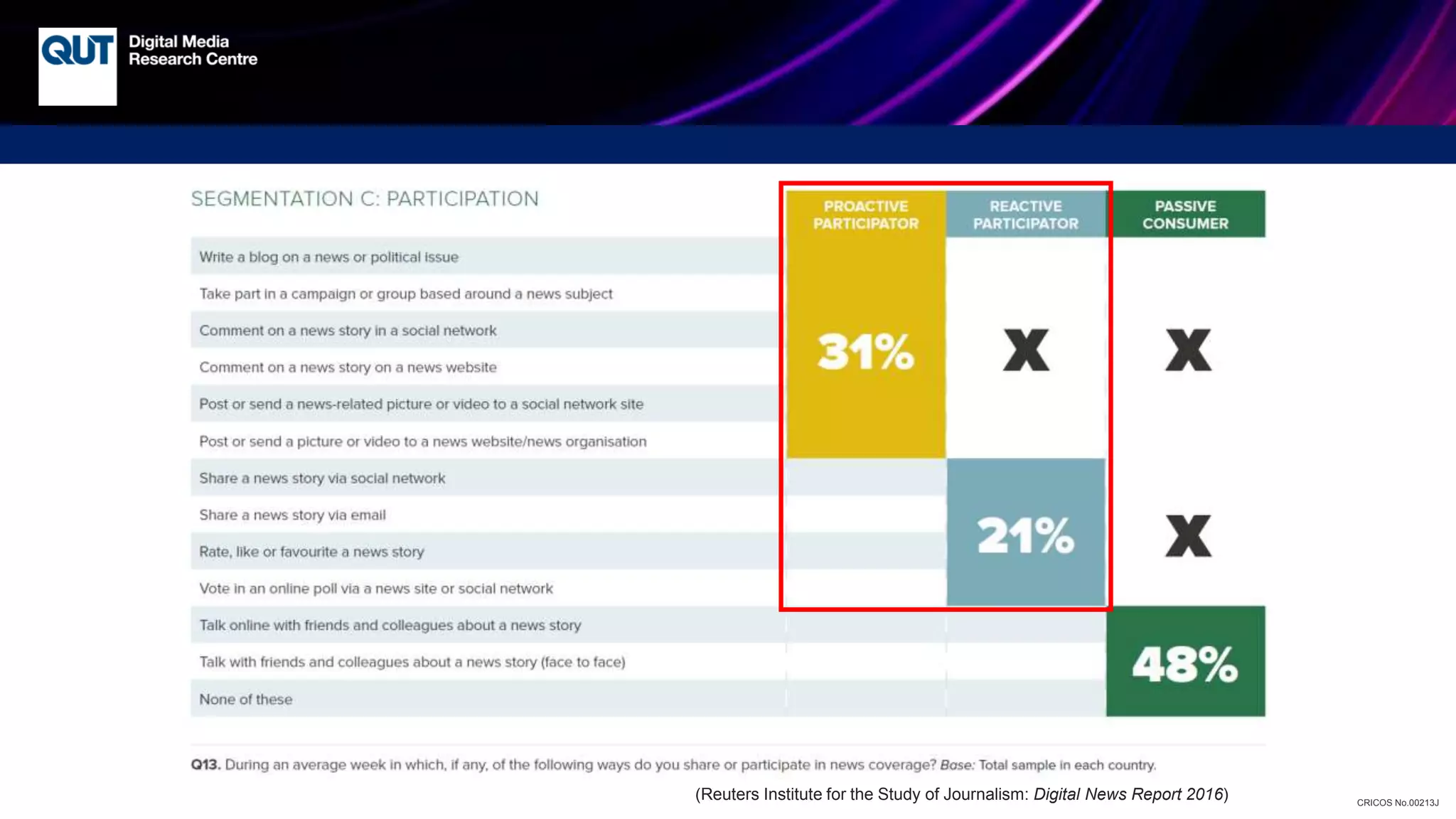
(Reuters Institute for the Study of Journalism: Digital News Report 2016)
CRICOS No.00213J
Random Acts of
Gatewatching
CRICOS No.00213J
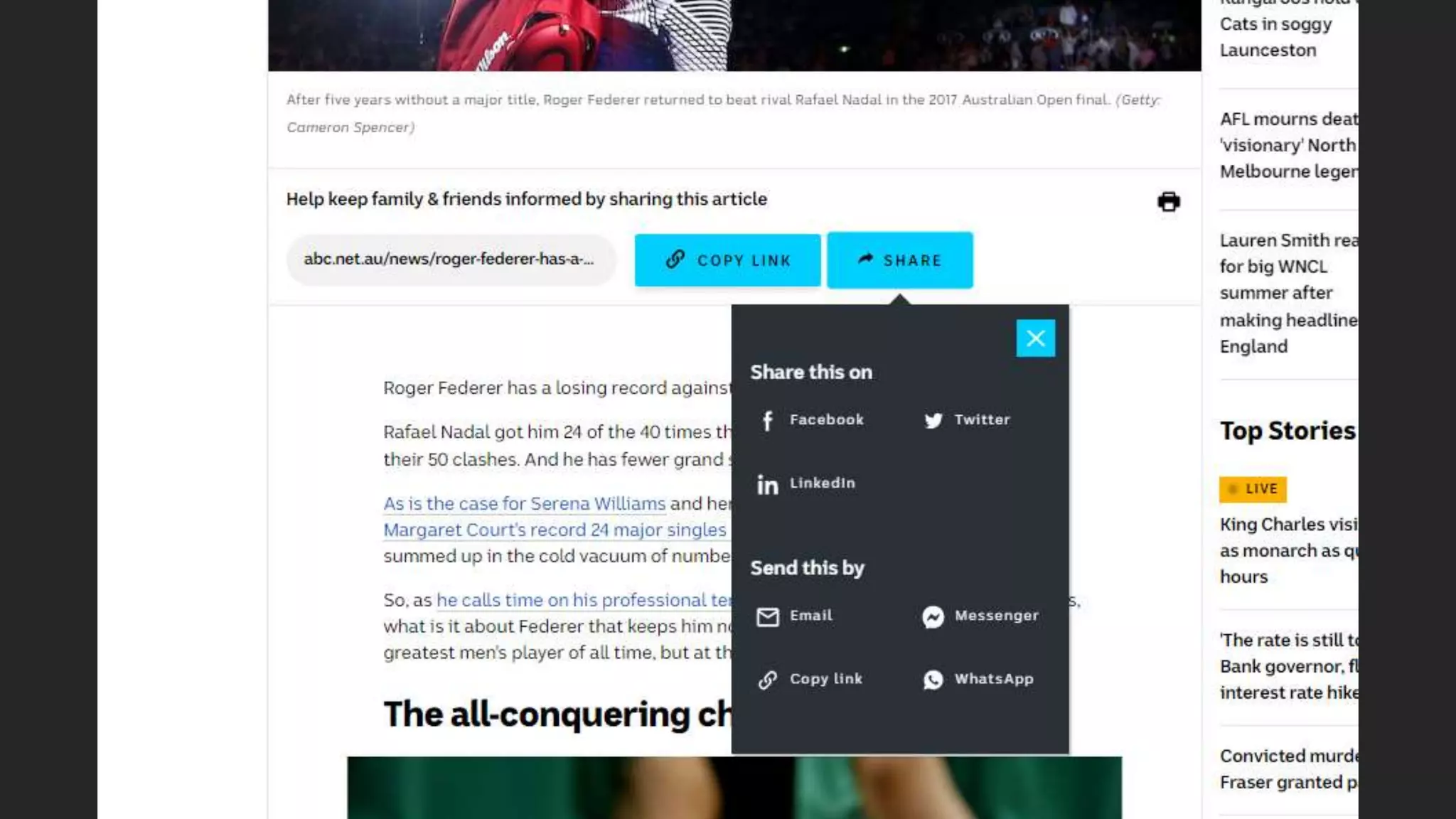
Habitual Acts of
Gatewatching
CRICOS No.00213J
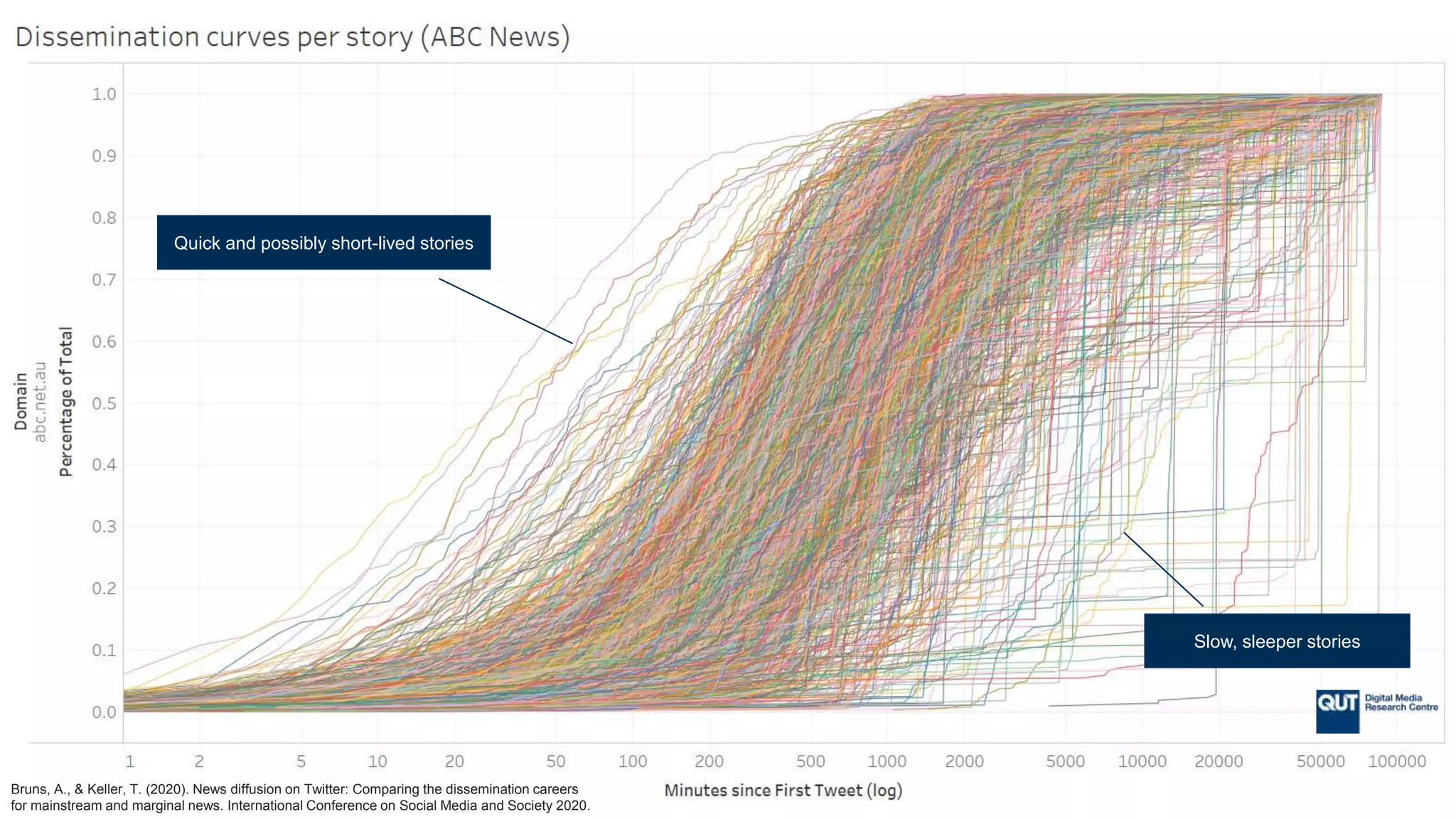
Quick and possibly short-lived stories
Slow, sleeper stories
Bruns, A., & Keller, T. (2020). News diffusion on Twitter: Comparing the dissemination careers
for mainstream and marginal news. International Conference on Social Media and Society 2020.
CRICOS No.00213J
Habitual Newssharing
‘[on Facebook], news … is just something that happens’ — Pew Research Center respondent
‘personal network as a way to filter the news, rather than solely relying on the
professional judgment of a news organization or journalist’ — Hermida et al.
‘users [who] devote a substantial amount of effort and care to this activity…
are news curators’ — Lehmann et al.
‘personal publics are one of the most important characteristics of the social Web’
— Schmidt
 Intrinsic and altruistic motivations for newssharing and news curation
‘users may be both sharing and seeking information at the same time, facilitating a gathering
and sorting of information’ — Holton et al.
CRICOS No.00213J
CRICOS No.00213J
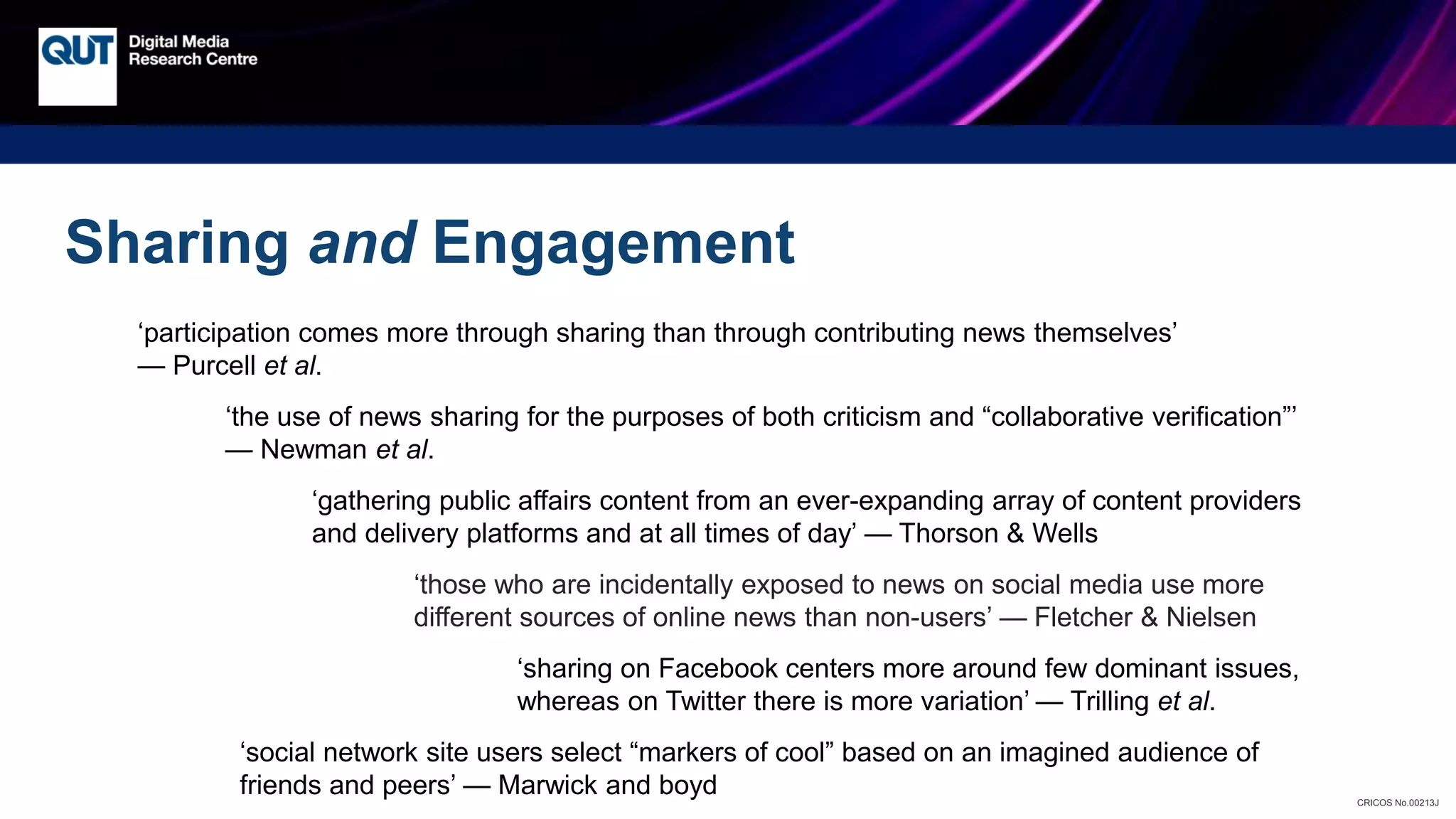
Sharing and Engagement
‘participation comes more through sharing than through contributing news themselves’
— Purcell et al.
‘the use of news sharing for the purposes of both criticism and “collaborative verification”’
— Newman et al.
‘gathering public affairs content from an ever-expanding array of content providers
and delivery platforms and at all times of day’ — Thorson & Wells
‘those who are incidentally exposed to news on social media use more
different sources of online news than non-users’ — Fletcher & Nielsen
‘sharing on Facebook centers more around few dominant issues,
whereas on Twitter there is more variation’ — Trilling et al.
‘social network site users select “markers of cool” based on an imagined audience of
friends and peers’ — Marwick and boyd
CRICOS No.00213J
CRICOS No.00213J
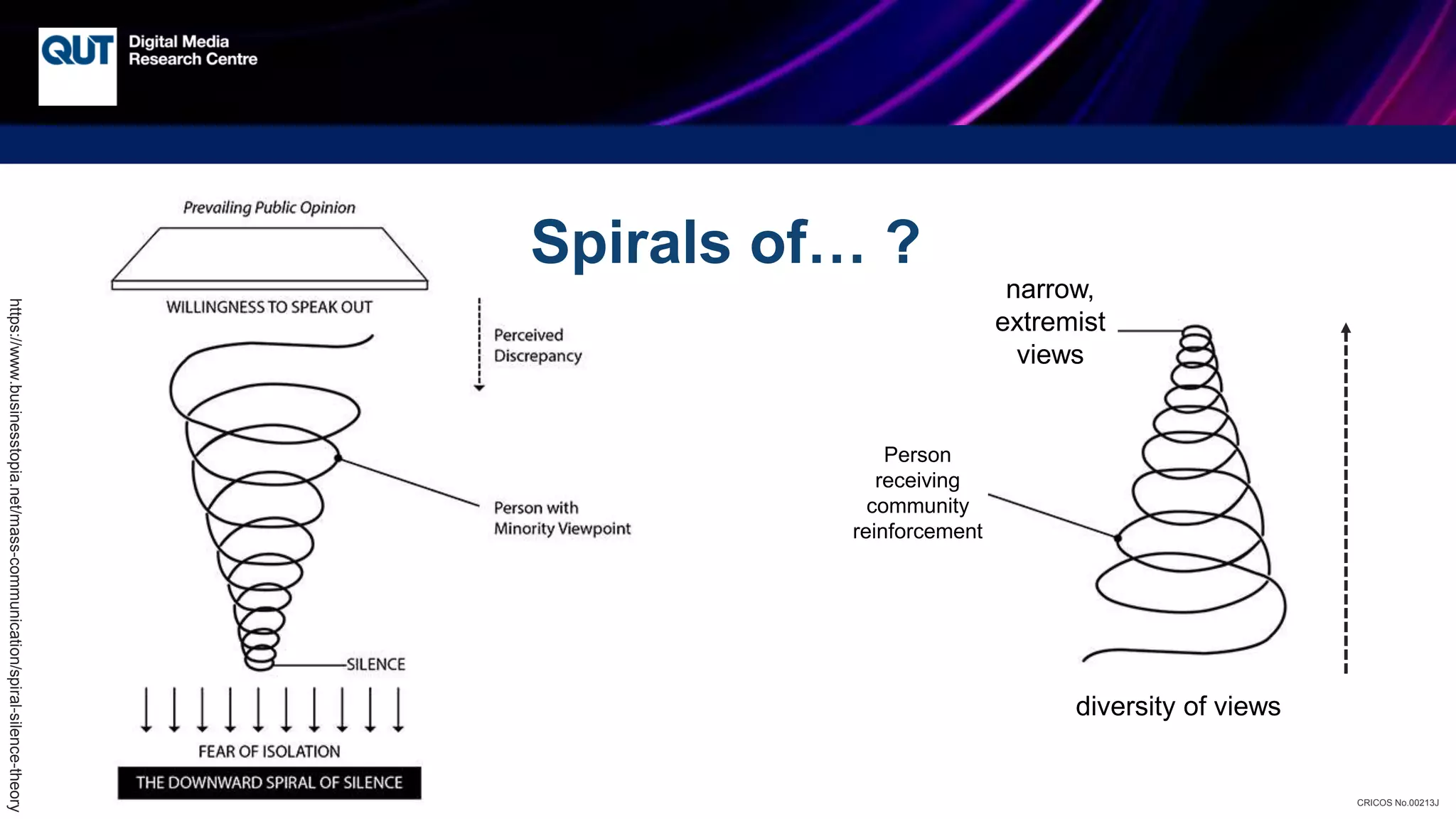
https://www.businesstopia.net/mass-communication/spiral-silence-theory
diversity of views
Person
receiving
community
reinforcement
narrow,
extremist
views
Spirals of… ?
CRICOS No.00213J
Demotic, Not
Democratic
CRICOS No.00213J
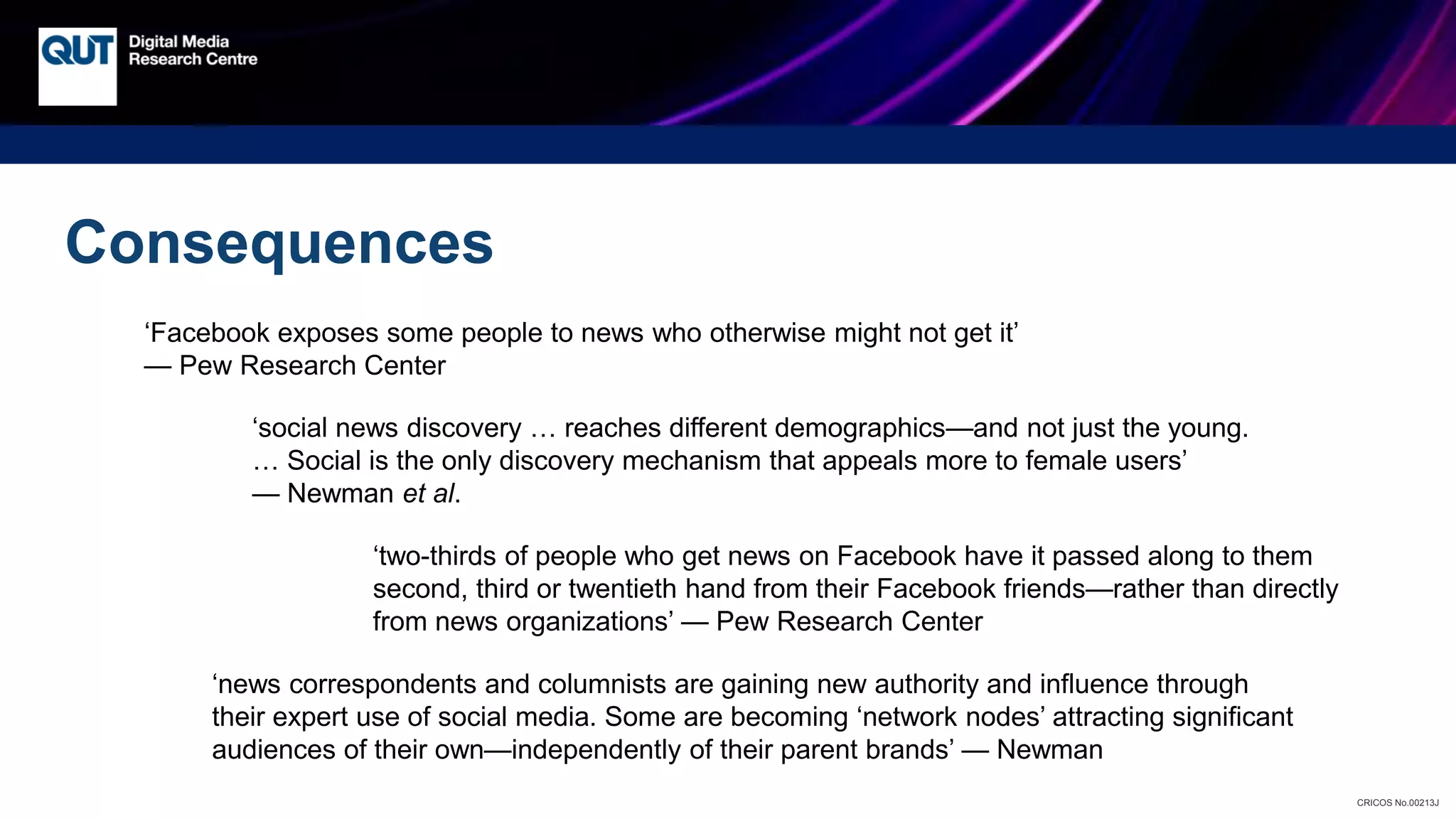
Consequences
‘Facebook exposes some people to news who otherwise might not get it’
— Pew Research Center
‘social news discovery … reaches different demographics—and not just the young.
… Social is the only discovery mechanism that appeals more to female users’
— Newman et al.
‘two-thirds of people who get news on Facebook have it passed along to them
second, third or twentieth hand from their Facebook friends—rather than directly
from news organizations’ — Pew Research Center
‘news correspondents and columnists are gaining new authority and influence through
their expert use of social media. Some are becoming ‘network nodes’ attracting significant
audiences of their own—independently of their parent brands’ — Newman
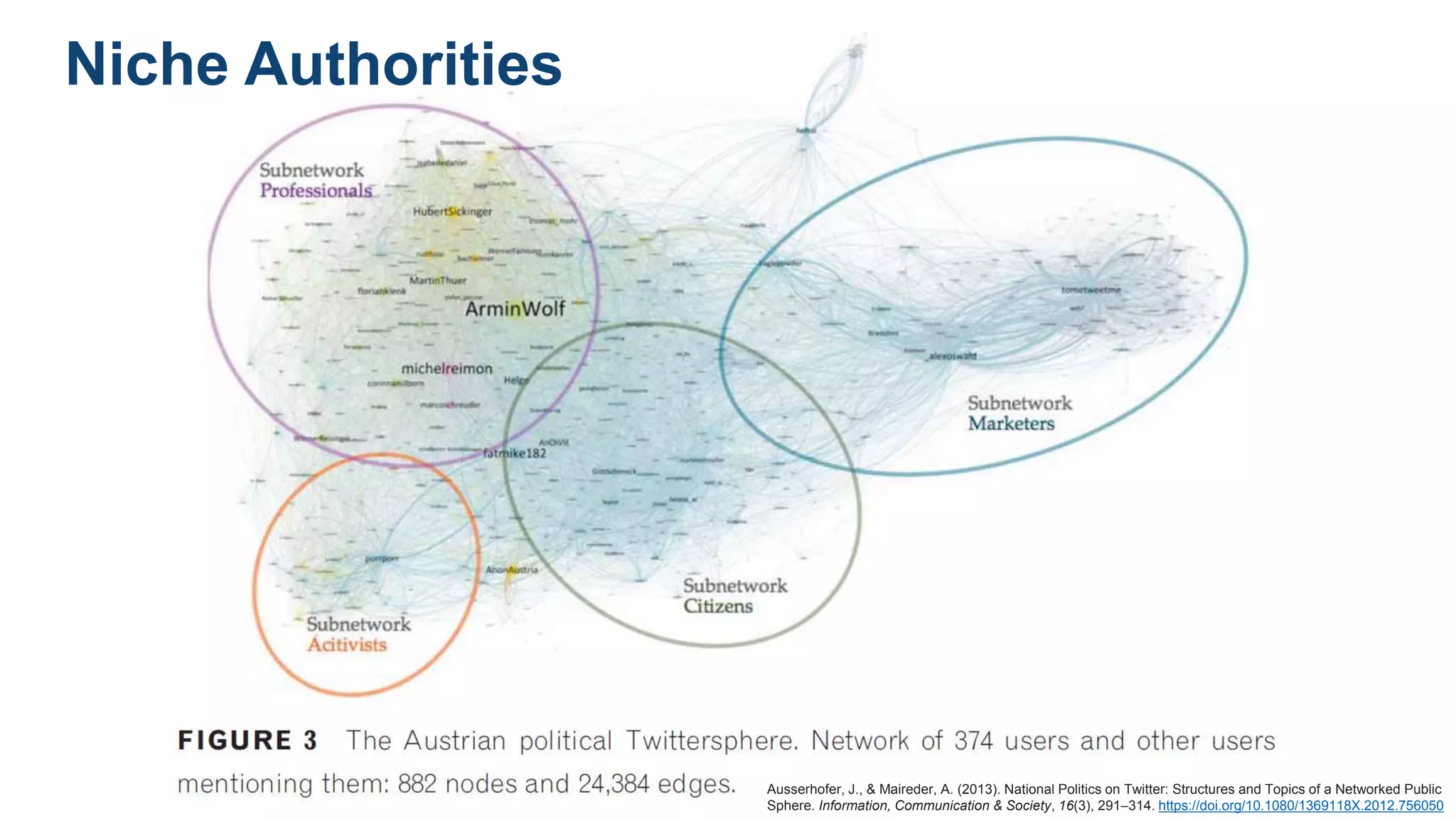
Niche Authorities
Ausserhofer, J., & Maireder, A. (2013). National Politics on Twitter: Structures and Topics of a Networked Public
Sphere. Information, Communication & Society, 16(3), 291–314. https://doi.org/10.1080/1369118X.2012.756050
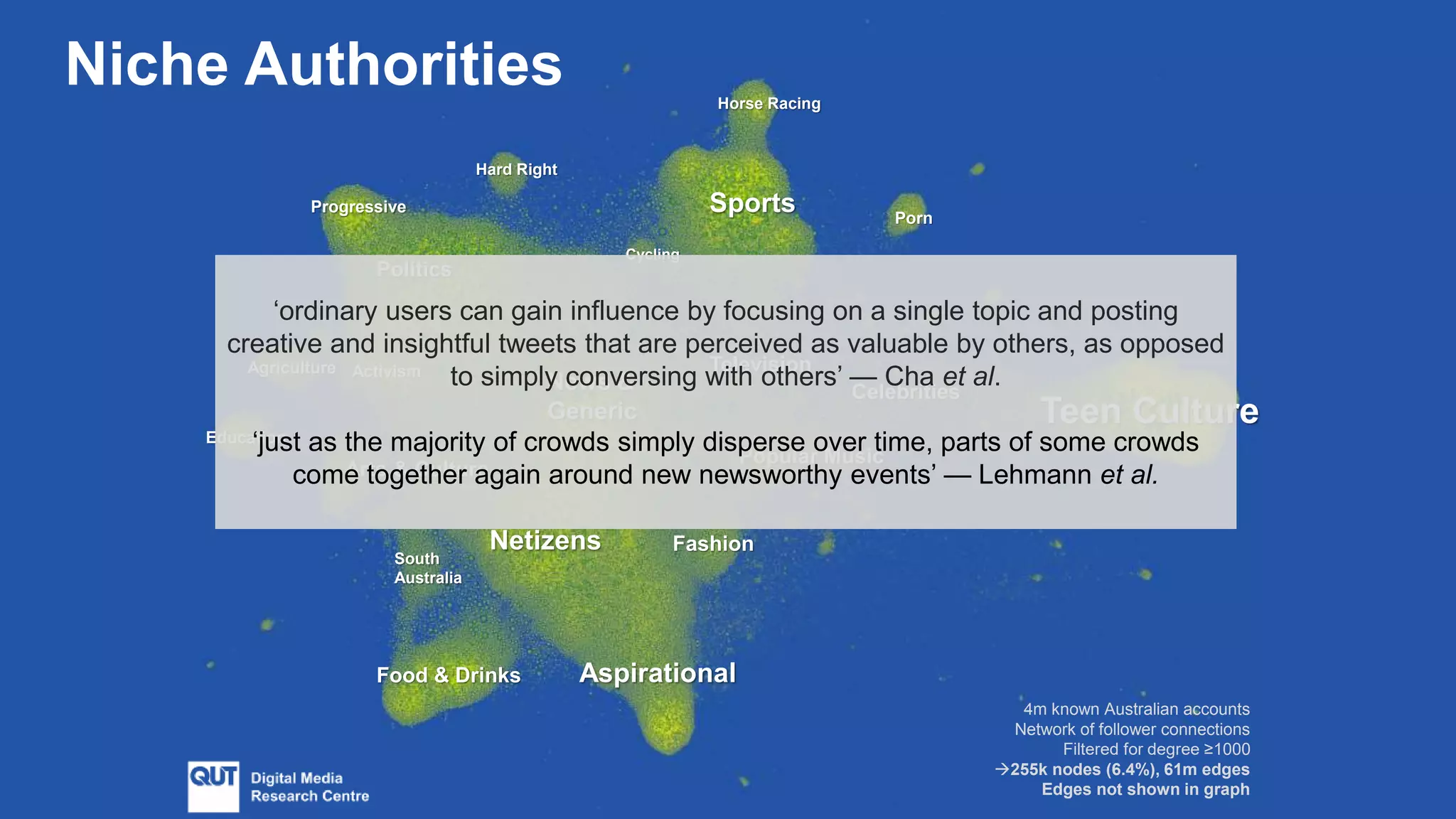
4m known Australian accounts
Network of follower connections
Filtered for degree ≥1000
255k nodes (6.4%), 61m edges
Edges not shown in graph
Teen Culture
Aspirational
Sports
Netizens
Arts & Culture
Politics
Television
Fashion
Popular Music
Food & Drinks
Agriculture Activism
Porn
Education
Cycling
News &
Generic
Hard Right
Progressive
South
Australia
Celebrities
Horse Racing
Niche Authorities
‘ordinary users can gain influence by focusing on a single topic and posting
creative and insightful tweets that are perceived as valuable by others, as opposed
to simply conversing with others’ — Cha et al.
‘just as the majority of crowds simply disperse over time, parts of some crowds
come together again around new newsworthy events’ — Lehmann et al.
CRICOS No.00213J
Mass Participation ≠ Democratic Negotiation
‘the ideal of the news sharing user as an altruistic democratizer is to some extent
also backed up by empirical studies’ — Kümpel et al.
and
‘many active internet users now see themselves as editors—balancing and comparing
multiple sources, multiple editorial judgements, and even multiple algorithms’ — Newman et al.
vs.
‘this potential does not lead to meaningful cross-ideological interaction’ — Himelboim et al.
 ‘the social negotiation of the meaning of news’ (Maireder and Ausserhofer)
is not a democratic process, even if it is demotic
CRICOS No.00213J
Demowhatnow?
• Demotic = ‘in the language of ordinary people’:
• In radio and TV, the exploitative use of vox populi, talk radio call-ins, reality TV
• Cheap content to fill airtime and generate engagement (even outrage)
• ‘among the casualties of the demotic turn is the professional production of journalism’ — Turner
• In social media, the active participation of ordinary users in discussing and curating the news
• If anything, more labour-intensive for journalists and news organisations to engage with
• ‘citizens involved in the flow, framing and interpretation of news’ — Hermida
 ‘a more expansive notion of political talk: one that embraces the vernacular, expressive, and porous
characteristics of everyday public speech’ — Wright et al.
CRICOS No.00213J
Journalism and / on Social Media
‘hybrid system’ of ‘“older” and “newer” media’ — Andrew Chadwick et al.
‘with social media, journalism and audiences meet on uncommon ground’
— Wiebke Loosen and Jan Schmidt
‘spontaneously emerging encounter publics’ — Christoph Neuberger et al.
‘networks for the wild flows of messages’ — Jürgen Habermas
 from random acts of journalism to habitual acts of gatewatching and newssharing
 not democratic (equal voices), but demotic (widespread participation)
 collective news curation by social media users, including journalists
CRICOS No.00213J
Next Time
CRICOS No.00213J
Readings
4. 14.10.: Random Acts of Gatewatching: Everyday Newssharing Practices
Bruns, A. (2018). Random Acts of Gatewatching: Everyday Newssharing Practices. Gatewatching
and News Curation: Journalism, Social Media, and the Public Sphere. Ch. 4. Peter Lang.
5. 21.10.: Weaponising Newssharing: ‘Fake News’ and Other Malinformation
Bruns, A., Harrington, S., & Hurcombe, E. (2021). Coronavirus Conspiracy Theories: Tracing
Misinformation Trajectories from the Fringes to the Mainstream. In M. Lewis, E. Govender, & K.
Holland (Eds.), Communicating COVID-19: Interdisciplinary Perspectives (pp. 229–249). Springer.
https://doi.org/10.1007/978-3-030-79735-5_12
CRICOS No.00213J
Lecture
• NOTE:
• Week 5 lecture will be pre-recorded and made available through the OLAT site.

Gatewatching 4: Random Acts of Gatewatching: Everyday Newssharing Practices

  • 1.
    CRICOS No.00213J Random Actsof Gatewatching: Everyday Newssharing Practices Prof. Axel Bruns Guest Professor, IKMZ, University of Zürich a.bruns@qut.edu.au — a.bruns@ikmz.uzh.ch
  • 2.
  • 3.
    CRICOS No.00213J From TrendingTopics to Everyday News
  • 4.
    Twitter and theSendai Tsunami (March 2011)
  • 5.
  • 6.
  • 7.
  • 8.
    CRICOS No.00213J But: Facebookdata available only for public pages and groups, and likely to be somewhat incomplete even there.
  • 9.
  • 10.
    CRICOS No.00213J (Reuters Institutefor the Study of Journalism: Digital News Report 2017)
  • 11.
    CRICOS No.00213J ‘social mediapowerfully invoke an efficient listening subject’ — Crawford ‘serendipitous news discovery … is essential to forming public opinion and creating informed consensus’ — Purcell et al. ‘Twitter as a social awareness system that delivers a fragmented mix of information, enlightenment, entertainment, and engagement from a range of sources’ — Hermida et al. ‘ambient journalism’ — Hermida Ambient and Always On ‘create and receive personalized social news streams’ — Hermida et al.
  • 12.
    4m known Australianaccounts Network of follower connections Filtered for degree ≥1000 255k nodes (6.4%), 61m edges Edges not shown in graph Networks in the Social Awareness System Teen Culture Aspirational Sports Netizens Arts & Culture Politics Television Fashion Popular Music Food & Drinks Agriculture Activism Porn Education Cycling News & Generic Hard Right Progressive South Australia Celebrities Horse Racing
  • 13.
    CRICOS No.00213J (Reuters Institutefor the Study of Journalism: Digital News Report 2016)
  • 14.
  • 15.
  • 16.
    CRICOS No.00213J Quick andpossibly short-lived stories Slow, sleeper stories Bruns, A., & Keller, T. (2020). News diffusion on Twitter: Comparing the dissemination careers for mainstream and marginal news. International Conference on Social Media and Society 2020.
  • 17.
    CRICOS No.00213J Habitual Newssharing ‘[onFacebook], news … is just something that happens’ — Pew Research Center respondent ‘personal network as a way to filter the news, rather than solely relying on the professional judgment of a news organization or journalist’ — Hermida et al. ‘users [who] devote a substantial amount of effort and care to this activity… are news curators’ — Lehmann et al. ‘personal publics are one of the most important characteristics of the social Web’ — Schmidt  Intrinsic and altruistic motivations for newssharing and news curation ‘users may be both sharing and seeking information at the same time, facilitating a gathering and sorting of information’ — Holton et al.
  • 19.
  • 20.
    CRICOS No.00213J Sharing andEngagement ‘participation comes more through sharing than through contributing news themselves’ — Purcell et al. ‘the use of news sharing for the purposes of both criticism and “collaborative verification”’ — Newman et al. ‘gathering public affairs content from an ever-expanding array of content providers and delivery platforms and at all times of day’ — Thorson & Wells ‘those who are incidentally exposed to news on social media use more different sources of online news than non-users’ — Fletcher & Nielsen ‘sharing on Facebook centers more around few dominant issues, whereas on Twitter there is more variation’ — Trilling et al. ‘social network site users select “markers of cool” based on an imagined audience of friends and peers’ — Marwick and boyd
  • 21.
  • 22.
    CRICOS No.00213J https://www.businesstopia.net/mass-communication/spiral-silence-theory diversity ofviews Person receiving community reinforcement narrow, extremist views Spirals of… ?
  • 23.
  • 24.
    CRICOS No.00213J Consequences ‘Facebook exposessome people to news who otherwise might not get it’ — Pew Research Center ‘social news discovery … reaches different demographics—and not just the young. … Social is the only discovery mechanism that appeals more to female users’ — Newman et al. ‘two-thirds of people who get news on Facebook have it passed along to them second, third or twentieth hand from their Facebook friends—rather than directly from news organizations’ — Pew Research Center ‘news correspondents and columnists are gaining new authority and influence through their expert use of social media. Some are becoming ‘network nodes’ attracting significant audiences of their own—independently of their parent brands’ — Newman
  • 25.
    Niche Authorities Ausserhofer, J.,& Maireder, A. (2013). National Politics on Twitter: Structures and Topics of a Networked Public Sphere. Information, Communication & Society, 16(3), 291–314. https://doi.org/10.1080/1369118X.2012.756050
  • 26.
    4m known Australianaccounts Network of follower connections Filtered for degree ≥1000 255k nodes (6.4%), 61m edges Edges not shown in graph Teen Culture Aspirational Sports Netizens Arts & Culture Politics Television Fashion Popular Music Food & Drinks Agriculture Activism Porn Education Cycling News & Generic Hard Right Progressive South Australia Celebrities Horse Racing Niche Authorities ‘ordinary users can gain influence by focusing on a single topic and posting creative and insightful tweets that are perceived as valuable by others, as opposed to simply conversing with others’ — Cha et al. ‘just as the majority of crowds simply disperse over time, parts of some crowds come together again around new newsworthy events’ — Lehmann et al.
  • 27.
    CRICOS No.00213J Mass Participation≠ Democratic Negotiation ‘the ideal of the news sharing user as an altruistic democratizer is to some extent also backed up by empirical studies’ — Kümpel et al. and ‘many active internet users now see themselves as editors—balancing and comparing multiple sources, multiple editorial judgements, and even multiple algorithms’ — Newman et al. vs. ‘this potential does not lead to meaningful cross-ideological interaction’ — Himelboim et al.  ‘the social negotiation of the meaning of news’ (Maireder and Ausserhofer) is not a democratic process, even if it is demotic
  • 28.
    CRICOS No.00213J Demowhatnow? • Demotic= ‘in the language of ordinary people’: • In radio and TV, the exploitative use of vox populi, talk radio call-ins, reality TV • Cheap content to fill airtime and generate engagement (even outrage) • ‘among the casualties of the demotic turn is the professional production of journalism’ — Turner • In social media, the active participation of ordinary users in discussing and curating the news • If anything, more labour-intensive for journalists and news organisations to engage with • ‘citizens involved in the flow, framing and interpretation of news’ — Hermida  ‘a more expansive notion of political talk: one that embraces the vernacular, expressive, and porous characteristics of everyday public speech’ — Wright et al.
  • 29.
    CRICOS No.00213J Journalism and/ on Social Media ‘hybrid system’ of ‘“older” and “newer” media’ — Andrew Chadwick et al. ‘with social media, journalism and audiences meet on uncommon ground’ — Wiebke Loosen and Jan Schmidt ‘spontaneously emerging encounter publics’ — Christoph Neuberger et al. ‘networks for the wild flows of messages’ — Jürgen Habermas  from random acts of journalism to habitual acts of gatewatching and newssharing  not democratic (equal voices), but demotic (widespread participation)  collective news curation by social media users, including journalists
  • 30.
  • 31.
    CRICOS No.00213J Readings 4. 14.10.:Random Acts of Gatewatching: Everyday Newssharing Practices Bruns, A. (2018). Random Acts of Gatewatching: Everyday Newssharing Practices. Gatewatching and News Curation: Journalism, Social Media, and the Public Sphere. Ch. 4. Peter Lang. 5. 21.10.: Weaponising Newssharing: ‘Fake News’ and Other Malinformation Bruns, A., Harrington, S., & Hurcombe, E. (2021). Coronavirus Conspiracy Theories: Tracing Misinformation Trajectories from the Fringes to the Mainstream. In M. Lewis, E. Govender, & K. Holland (Eds.), Communicating COVID-19: Interdisciplinary Perspectives (pp. 229–249). Springer. https://doi.org/10.1007/978-3-030-79735-5_12
  • 32.
    CRICOS No.00213J Lecture • NOTE: •Week 5 lecture will be pre-recorded and made available through the OLAT site.