Journal of Education Policy
Vol. 22, No. 2, March 2007, pp. 147–171
ISSN 0268–0939 (print)/ISSN 1464–5106 (online)/07/020147–25
© 2007 Taylor & Francis
DOI: 10.1080/02680930601158919
Education policies for raising student
learning: the Finnish approach
Pasi Sahlberg*
World Bank, Washington, DC, USA
Taylor and Francis LtdTEDP_A_215821.sgm10.1080/02680930601158919Journal of Education Policy0268-0939 (print)/1464-5106 (online)Original Article2007Taylor & Francis222000000March 2007PasiSahlbergpasi.sahlberg@helsinki.fi
This article argues that system-wide excellence in student learning is attainable at reasonable cost,
using education policies differing from conventional market-oriented reform strategies prevalent in
many other countries. In this respect, Finland is an example of a nation that has developed from a
remote agrarian/industrial state in the 1950s to a model knowledge economy, using education as the
key to economic and social development. Relying on data from international student assessments
and earlier policy analysis, this article describes how steady improvement in student learning has
been attained through Finnish education policies based on equity, flexibility, creativity, teacher
professionalism and trust. Unlike many other education systems, consequential accountability
accompanied by high-stakes testing and externally determined learning standards has not been part
of Finnish education policies. The insight is that Finnish education policies intended to raise
student achievement have been built upon ideas of sustainable leadership that place strong emphasis
on teaching and learning, intelligent accountability, encouraging schools to craft optimal learning
environments and implement educational content that best helps their students reach the general
goals of schooling.
Competitive market economy in non-market welfare society
Two major change forces relevant to this topic have influenced educational develop-
ment in Finland since the 1980s: (a) Finnish society has passed through an economic
and cultural transition from a mono-cultural, agrarian/industrial, and peripheral soci-
ety to a multi-cultural, high-tech knowledge economy accepting an active role in
shaping the present-day European economic and political environment; and (b) the
Finnish education system has become an attractive and internationally examined
example of a well-performing system that successfully combines quality with wide-
spread equity and social cohesion through reasonable public financing. To better
understand interrelationships between the education system and the other Finnish
political and economic structures, we must begin with a brief description of key
characteristics and recent change forces in Finland.
*Senior Education Specialist, Human Development Network, World Bank, 1818 H Street, NW,
Washington, DC 20433, USA. Email: pasi.sahlberg@helsinki.fi
148 P. Sahlberg
Finland has traversed a long way from a poor agrarian state in the early twentieth
century to a modern welfare democracy at the start of the third millennium. For
example, according to Routti and Ylä-Anttila (2006), the Finnish economic structure
in 1950 corresponded quite closely to that of Sweden’s structure in 1910. Social
policy decisions in the 1940s and 1950s underscored the economic importance of
family farms; the general image of Finland remained quite agrarian despite rapid
industrialization and agriculture’s shrinking contribution to the gross domestic
product (GDP) over the second half of the twentieth century. Traditional values have
endured: according to Lewis (2005), these include such cultural hallmarks as a law-
abiding citizenry, trust in authority, commitment to one’s social group, awareness of
one’s social status and position, and a patriotic spirit.
Finland in the early 1990s suffered a severe economic decline characterized by a
major banking crisis. The unemployment rate exploded from 4% to 18% and public
debt soared to over 60% of GDP, placing Finland close to international lending
limits. For the Finnish economy to recover, the nation had to diversify its export
structures and encourage business innovation. What drove these economic reforms
was the emergence of new knowledge-based industries and adoption of knowledge-
economy concepts throughout the entire Finnish society.
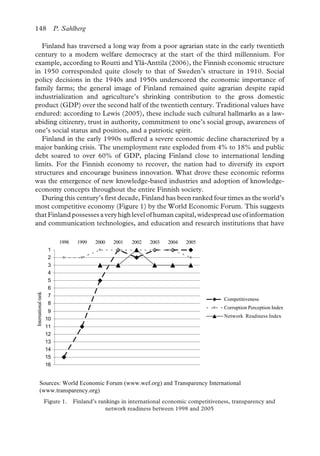
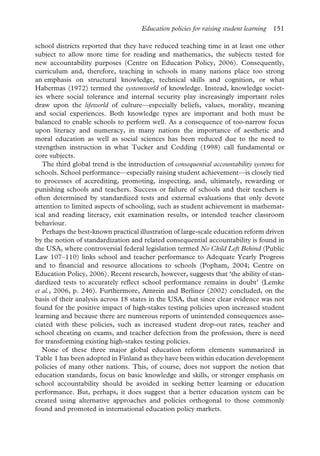
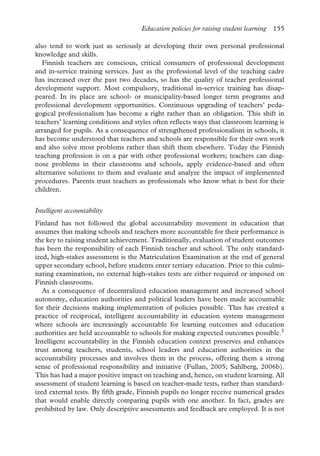
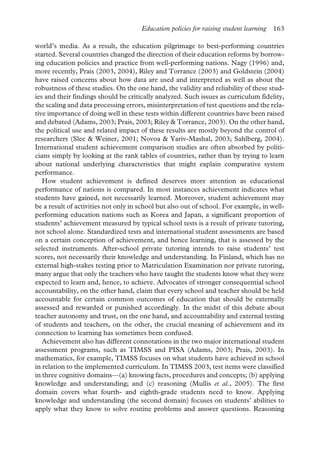
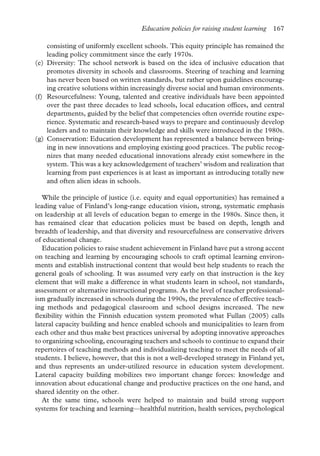
During this century’s first decade, Finland has been ranked four times as the world’s
most competitive economy (Figure 1) by the World Economic Forum. This suggests
thatFinlandpossessesaveryhighlevelofhumancapital,widespreaduseofinformation
and communication technologies, and education and research institutions that have
1
2
3
4
5
6
7
8
9
10
11
12
13
14
15
16
1998 1999 2000 2001 2002 2003 2004 2005
Internationalrank
Competitiveness
Corruption Perception Index
Network Readiness Index
Sources: World Economic Forum (www.wef.org) and Transparency International
(www.transparency.org)
Figure 1. Finland’s rankings in international economic competitiveness, transparency and
network readiness between 1998 and 2005
Education policies for raising student learning 149
been redesigned to foster innovation and cutting-edge research and development.
Indeed, Finland also ranks high in advancement of global information and commu-
nication technologies as well as in implementation of environmental policies. Finland
also ranks at the top on Transparency International’s list of least corrupt nations; this
plays a crucial role in maintaining a well-functioning democracy, trust-based public
sector management and basic functions of the welfare state. Interestingly, as an
advanced high-tech society and knowledge economy, Finland prepares today more
musicians (and symphonic conductors) per capita than any other nation.
Figure 1. Finland’s rankings in international economic competitiveness, transparency and network readiness between 1998 and 2005
In their analysis of Finland as a knowledge economy, Routti and Ylä-Anttila (2006)
warn that economic competitiveness indices should not be used to predict the future
economic performance of any nation. Instead, international measures may provide
useful insights into national factors that have been influential in developing cutting-
edge economies and promoted social well-being. Based on these commonly employed
determinants of economic competitiveness and various indicators of knowledge econ-
omies, three core domains have been used to account for economic growth: (a) educa-
tion and training (human capital); (b) use of information and communication
technologies; and (c) innovations and technological adaptation (Porter et al., 2004;
Sahlberg, 2006a). In today’s complex and unpredictably changing economic environ-
ments, characteristics such as equal opportunities for all individuals, creativity and
research, network readiness, and environmental sustainability are also becoming
increasingly important factors.
The recent success of Finland as a nation has often been explained by its lack of
ethnic minorities and a relatively homogeneous society. Although ethnicity in Finland
among a population of 5.3 million is not as diverse and apparent as it is in some other
European nations, migration trends since the early 1990s indicate that Finland is
rapidly transforming into a multi-cultural society. As described by Tanner (2004),
three statistics indicate the relatively strong impact of today’s immigration levels:
(a) total number of foreigners legally living in Finland without citizenship increased
four-fold between 1990 and 2003, from 26,300 to 107,100; (b) total number of
foreign-born Finnish citizens and residents doubled between 1991 and 2003, from
77,000 to 159,000, representing 3% of the entire Finnish population, and (c) total
number of residents whose first language is not Finnish tripled between 1992 and
2004, from 43,000 to 128,000. Up to 1990, the rate of forced and voluntary immi-
gration to Finland was considerably lower. Thus, over the past 15 years Finnish
people as well as institutions have had to adjust to new policies and practices. In
education, the emergence of new cultural and linguistic minorities has created chal-
lenges to basic values of education, curricula, and also to teachers in Finnish schools,
having increased social and ethnic diversities. In some urban schools, total immigrant
children or those whose mother tongue is not Finnish approach close to 50%.
Global education reform trends
In their analysis of Finnish education development policies and reform principles
since 1968, Aho et al. (2006) conclude that rather than introducing sequential
150 P. Sahlberg
reforms and innovations, Finnish education policy has been built upon sustainable
leadership led by commonly accepted values and shared vision. The main features of
developing a competitive, well-performing education system are similar to those
underlying the social and economic transformation of Finland to a knowledge society
(Castells & Himanen, 2002; Sahlberg, 2006a). It is therefore difficult to identify
particular reforms or innovations that have per se been driving forces in raising the
level and quality of student learning in Finnish schools. Thus, it becomes necessary
to identify broader policies and reform principles playing a significant role in shaping
the education system. It is helpful to realize that the Finnish education system has
remained quite unreceptive to the influence of what is often categorized as the global
education reform movement (Hargreaves et al., 2001; Rinne et al., 2002; Sahlberg,
2004; Aho et al., 2006) that has emerged since the 1980s and has increasingly become
adopted as an official agenda in many parts of the world.
Since the 1980s, at least three common features in education development policies
and reform strategies globally have intended to improve the quality of education,
especially raising student achievement. First is the standardization of education.
Outcomes-based education reform became popular in the 1980s followed by stan-
dards-based education policies in the 1990s, initially in Anglo-Saxon countries.
These reforms quite correctly shifted the focus of attention to educational
outcomes—that is, to student learning and school performance. Consequently, a
widely accepted—and unquestioned—belief among policy-makers and education
reformers is that setting clear and sufficiently high performance standards for schools,
teachers and students will necessarily improve the quality of outcomes. Enforcement
of external testing and evaluation systems to assess how well these standards have
been attained has emerged from original standards-oriented education policies. Since
the late 1980s, centrally prescribed curricula, with detailed and often ambitious
performance targets, frequent testing of students and teachers, and high-stakes
accountability have defined a homogenization of education policies worldwide,
promising standardized solutions at increasingly lower cost for those desiring to
improve school quality and effectiveness.
The second common feature in global education development policies and
reform strategies is increased focus on literacy and numeracy. Basic student knowl-
edge and skills in reading, writing, mathematics and natural sciences have been
elevated to serve as prime targets and indices of education reforms. As a conse-
quence of accepting international student assessment results such as Programme
for International Student Assessment (PISA) and International Association for the
Evaluation of Educational Achievement (IEA) studies as a criterion of good educa-
tional performance, literacy and numeracy have now become the main determi-
nants of the perceived success or failure of pupils, teachers, schools and entire
education systems. Although only a slight shift in relative time allocation away
from other school subjects to literacy and numeracy has been noted within differ-
ent school systems, the importance given to these school subjects in curriculum,
teacher policies, or other resources has been obvious, for example, in international
development aid programs. A nationwide study in the USA confirms that 71% of
Education policies for raising student learning 151
school districts reported that they have reduced teaching time in at least one other
subject to allow more time for reading and mathematics, the subjects tested for
new accountability purposes (Centre on Education Policy, 2006). Consequently,
curriculum and, therefore, teaching in schools in many nations place too strong
an emphasis on structural knowledge, technical skills and cognition, or what
Habermas (1972) termed the systemworld of knowledge. Instead, knowledge societ-
ies where social tolerance and internal security play increasingly important roles
draw upon the lifeworld of culture—especially beliefs, values, morality, meaning
and social experiences. Both knowledge types are important and both must be
balanced to enable schools to perform well. As a consequence of too-narrow focus
upon literacy and numeracy, in many nations the importance of aesthetic and
moral education as well as social sciences has been reduced due to the need to
strengthen instruction in what Tucker and Codding (1998) call fundamental or
core subjects.
The third global trend is the introduction of consequential accountability systems for
schools. School performance—especially raising student achievement—is closely tied
to processes of accrediting, promoting, inspecting, and, ultimately, rewarding or
punishing schools and teachers. Success or failure of schools and their teachers is
often determined by standardized tests and external evaluations that only devote
attention to limited aspects of schooling, such as student achievement in mathemat-
ical and reading literacy, exit examination results, or intended teacher classroom
behaviour.
Perhaps the best-known practical illustration of large-scale education reform driven
by the notion of standardization and related consequential accountability is found in
the USA, where controversial federal legislation termed No Child Left Behind (Public
Law 107–110) links school and teacher performance to Adequate Yearly Progress
and to financial and resource allocations to schools (Popham, 2004; Centre on
Education Policy, 2006). Recent research, however, suggests that ‘the ability of stan-
dardized tests to accurately reflect school performance remains in doubt’ (Lemke
et al., 2006, p. 246). Furthermore, Amrein and Berliner (2002) concluded, on the
basis of their analysis across 18 states in the USA, that since clear evidence was not
found for the positive impact of high-stakes testing policies upon increased student
learning and because there are numerous reports of unintended consequences asso-
ciated with these policies, such as increased student drop-out rates, teacher and
school cheating on exams, and teacher defection from the profession, there is need
for transforming existing high-stakes testing policies.
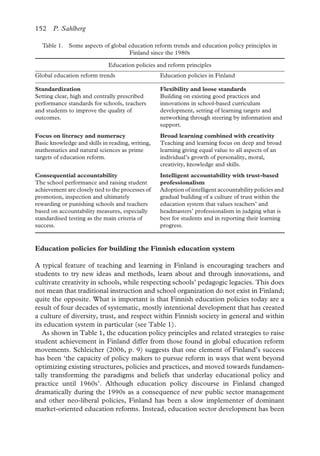
None of these three major global education reform elements summarized in
Table 1 has been adopted in Finland as they have been within education development
policies of many other nations. This, of course, does not support the notion that
education standards, focus on basic knowledge and skills, or stronger emphasis on
school accountability should be avoided in seeking better learning or education
performance. But, perhaps, it does suggest that a better education system can be
created using alternative approaches and policies orthogonal to those commonly
found and promoted in international education policy markets.
152 P. Sahlberg
Education policies for building the Finnish education system
A typical feature of teaching and learning in Finland is encouraging teachers and
students to try new ideas and methods, learn about and through innovations, and
cultivate creativity in schools, while respecting schools’ pedagogic legacies. This does
not mean that traditional instruction and school organization do not exist in Finland;
quite the opposite. What is important is that Finnish education policies today are a
result of four decades of systematic, mostly intentional development that has created
a culture of diversity, trust, and respect within Finnish society in general and within
its education system in particular (see Table 1).
As shown in Table 1, the education policy principles and related strategies to raise
student achievement in Finland differ from those found in global education reform
movements. Schleicher (2006, p. 9) suggests that one element of Finland’s success
has been ‘the capacity of policy makers to pursue reform in ways that went beyond
optimizing existing structures, policies and practices, and moved towards fundamen-
tally transforming the paradigms and beliefs that underlay educational policy and
practice until 1960s’. Although education policy discourse in Finland changed
dramatically during the 1990s as a consequence of new public sector management
and other neo-liberal policies, Finland has been a slow implementer of dominant
market-oriented education reforms. Instead, education sector development has been
Table 1. Some aspects of global education reform trends and education policy principles in
Finland since the 1980s
Education policies and reform principles
Global education reform trends Education policies in Finland
Standardization
Setting clear, high and centrally prescribed
performance standards for schools, teachers
and students to improve the quality of
outcomes.
Flexibility and loose standards
Building on existing good practices and
innovations in school-based curriculum
development, setting of learning targets and
networking through steering by information and
support.
Focus on literacy and numeracy
Basic knowledge and skills in reading, writing,
mathematics and natural sciences as prime
targets of education reform.
Broad learning combined with creativity
Teaching and learning focus on deep and broad
learning giving equal value to all aspects of an
individual’s growth of personality, moral,
creativity, knowledge and skills.
Consequential accountability
The school performance and raising student
achievement are closely tied to the processes of
promotion, inspection and ultimately
rewarding or punishing schools and teachers
based on accountability measures, especially
standardised testing as the main criteria of
success.
Intelligent accountability with trust-based
professionalism
Adoption of intelligent accountability policies and
gradual building of a culture of trust within the
education system that values teachers’ and
headmasters’ professionalism in judging what is
best for students and in reporting their learning
progress.
Education policies for raising student learning 153
based on sustainable leadership and built upon values grounded in equity, equitable
distribution of resources rather than competition, intensive early interventions for
prevention and building gradual trust among education practitioners, especially
teachers. Moreover, Finland has been characterized as a consensus society where
major political decisions have been agreed by all key players in society (Aho et al.,
2006; Routti & Ylä-Anttila, 2006). Importantly, the Teachers’ Trade Union as a
main negotiating partner in education has consistently resisted adopting market-
oriented management models in the education sector.
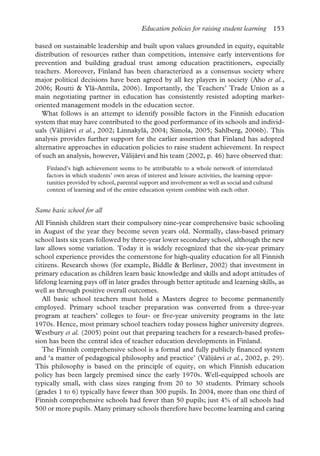
What follows is an attempt to identify possible factors in the Finnish education
system that may have contributed to the good performance of its schools and individ-
uals (Välijärvi et al., 2002; Linnakylä, 2004; Simola, 2005; Sahlberg, 2006b). This
analysis provides further support for the earlier assertion that Finland has adopted
alternative approaches in education policies to raise student achievement. In respect
of such an analysis, however, Välijärvi and his team (2002, p. 46) have observed that:
Finland’s high achievement seems to be attributable to a whole network of interrelated
factors in which students’ own areas of interest and leisure activities, the learning oppor-
tunities provided by school, parental support and involvement as well as social and cultural
context of learning and of the entire education system combine with each other.
Same basic school for all
All Finnish children start their compulsory nine-year comprehensive basic schooling
in August of the year they become seven years old. Normally, class-based primary
school lasts six years followed by three-year lower secondary school, although the new
law allows some variation. Today it is widely recognized that the six-year primary
school experience provides the cornerstone for high-quality education for all Finnish
citizens. Research shows (for example, Biddle & Berliner, 2002) that investment in
primary education as children learn basic knowledge and skills and adopt attitudes of
lifelong learning pays off in later grades through better aptitude and learning skills, as
well as through positive overall outcomes.
All basic school teachers must hold a Masters degree to become permanently
employed. Primary school teacher preparation was converted from a three-year
program at teachers’ colleges to four- or five-year university programs in the late
1970s. Hence, most primary school teachers today possess higher university degrees.
Westbury et al. (2005) point out that preparing teachers for a research-based profes-
sion has been the central idea of teacher education developments in Finland.
The Finnish comprehensive school is a formal and fully publicly financed system
and ‘a matter of pedagogical philosophy and practice’ (Välijärvi et al., 2002, p. 29).
This philosophy is based on the principle of equity, on which Finnish education
policy has been largely premised since the early 1970s. Well-equipped schools are
typically small, with class sizes ranging from 20 to 30 students. Primary schools
(grades 1 to 6) typically have fewer than 300 pupils. In 2004, more than one third of
Finnish comprehensive schools had fewer than 50 pupils; just 4% of all schools had
500 or more pupils. Many primary schools therefore have become learning and caring
154 P. Sahlberg
communities rather than merely instructional institutions that prepare pupils for the
next level of schooling.
The fact that all children enrol in identical comprehensive schools regardless of
their socioeconomic background or personal abilities and characteristics has resulted
in a system where schools and classrooms are heterogeneous in terms of pupil
profiles and diverse in terms of educational needs and expectations (Välijärvi &
Malin, 2003). Comprehensiveness, the leading idea in implementing the basic values
of equity in education, also means that all students receive a free two-course warm
meal daily, free health care, transportation, learning materials, and counselling in
their own schools.
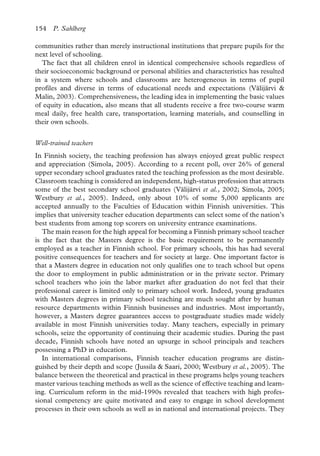
Well-trained teachers
In Finnish society, the teaching profession has always enjoyed great public respect
and appreciation (Simola, 2005). According to a recent poll, over 26% of general
upper secondary school graduates rated the teaching profession as the most desirable.
Classroom teaching is considered an independent, high-status profession that attracts
some of the best secondary school graduates (Välijärvi et al., 2002; Simola, 2005;
Westbury et al., 2005). Indeed, only about 10% of some 5,000 applicants are
accepted annually to the Faculties of Education within Finnish universities. This
implies that university teacher education departments can select some of the nation’s
best students from among top scorers on university entrance examinations.
The main reason for the high appeal for becoming a Finnish primary school teacher
is the fact that the Masters degree is the basic requirement to be permanently
employed as a teacher in Finnish school. For primary schools, this has had several
positive consequences for teachers and for society at large. One important factor is
that a Masters degree in education not only qualifies one to teach school but opens
the door to employment in public administration or in the private sector. Primary
school teachers who join the labor market after graduation do not feel that their
professional career is limited only to primary school work. Indeed, young graduates
with Masters degrees in primary school teaching are much sought after by human
resource departments within Finnish businesses and industries. Most importantly,
however, a Masters degree guarantees access to postgraduate studies made widely
available in most Finnish universities today. Many teachers, especially in primary
schools, seize the opportunity of continuing their academic studies. During the past
decade, Finnish schools have noted an upsurge in school principals and teachers
possessing a PhD in education.
In international comparisons, Finnish teacher education programs are distin-
guished by their depth and scope (Jussila & Saari, 2000; Westbury et al., 2005). The
balance between the theoretical and practical in these programs helps young teachers
master various teaching methods as well as the science of effective teaching and learn-
ing. Curriculum reform in the mid-1990s revealed that teachers with high profes-
sional competency are quite motivated and easy to engage in school development
processes in their own schools as well as in national and international projects. They
Education policies for raising student learning 155
also tend to work just as seriously at developing their own personal professional
knowledge and skills.
Finnish teachers are conscious, critical consumers of professional development
and in-service training services. Just as the professional level of the teaching cadre
has increased over the past two decades, so has the quality of teacher professional
development support. Most compulsory, traditional in-service training has disap-
peared. In its place are school- or municipality-based longer term programs and
professional development opportunities. Continuous upgrading of teachers’ peda-
gogical professionalism has become a right rather than an obligation. This shift in
teachers’ learning conditions and styles often reflects ways that classroom learning is
arranged for pupils. As a consequence of strengthened professionalism in schools, it
has become understood that teachers and schools are responsible for their own work
and also solve most problems rather than shift them elsewhere. Today the Finnish
teaching profession is on a par with other professional workers; teachers can diag-
nose problems in their classrooms and schools, apply evidence-based and often
alternative solutions to them and evaluate and analyze the impact of implemented
procedures. Parents trust teachers as professionals who know what is best for their
children.
Intelligent accountability
Finland has not followed the global accountability movement in education that
assumes that making schools and teachers more accountable for their performance is
the key to raising student achievement. Traditionally, evaluation of student outcomes
has been the responsibility of each Finnish teacher and school. The only standard-
ized, high-stakes assessment is the Matriculation Examination at the end of general
upper secondary school, before students enter tertiary education. Prior to this culmi-
nating examination, no external high-stakes tests are either required or imposed on
Finnish classrooms.
As a consequence of decentralized education management and increased school
autonomy, education authorities and political leaders have been made accountable
for their decisions making implementation of policies possible. This has created a
practice of reciprocal, intelligent accountability in education system management
where schools are increasingly accountable for learning outcomes and education
authorities are held accountable to schools for making expected outcomes possible.1
Intelligent accountability in the Finnish education context preserves and enhances
trust among teachers, students, school leaders and education authorities in the
accountability processes and involves them in the process, offering them a strong
sense of professional responsibility and initiative (Fullan, 2005; Sahlberg, 2006b).
This has had a major positive impact on teaching and, hence, on student learning. All
assessment of student learning is based on teacher-made tests, rather than standard-
ized external tests. By fifth grade, Finnish pupils no longer receive numerical grades
that would enable directly comparing pupils with one another. In fact, grades are
prohibited by law. Only descriptive assessments and feedback are employed. It is not
156 P. Sahlberg
unusual for teachers to view regularly scheduled teacher-made classroom tests as
opportunities for learning as much as for assessing student achievement.
Primary school is, to a large extent, a ‘testing-free zone’ reserved for learning to
know, to do, and to sustain natural curiosity. Teachers also experience more genuine
freedom in curriculum planning; they do not need to focus on annual tests or exams.
Increased teacher and school autonomy in the 1990s has led to a situation where
schools can not only arrange teaching according to their optimal resources, but allo-
cate teaching time within the national curriculum framework differently from school
to school. This is rarely possible in more rigid and test-heavy education systems.
Because the focus of teaching in Finland is typically on learning, rather than on
preparing students for tests (Berry & Sahlberg, 2006), different teaching methods
are employed without fear of failure throughout the school system. New innovations
are fairly readily accepted by teachers if they are regarded as appropriate for promot-
ing student learning. Evidence from the most recent studies indicates that Finnish
students experience less anxiety and stress than many of their peers in other coun-
tries (OECD, 2004). In the national PISA report, Kupari and Välijärvi (2005)
conclude that only 7% of Finnish students said they feel anxiety when working on
mathematics tasks at home compared with 52% and 53% in Japan and France,
respectively.
Naturally, reliance on the teachers’ and schools’ abilities to judge and report on
their pupils’ achievement does not arise without shortcomings. Some think that
students who leave the ninth grade and enrol in upper secondary education are not
so much treated equally as they are selected based on teacher-made assessments and
grades. Indeed, there are sometimes large differences among criteria that teachers use
to evaluate their students, even within the same school. A related problem arises when
students move to a new school and carry grades they may have earned under differing
expectations than those held by their new schools. Regardless of these and other
issues, Finnish parents, students and teachers seem to prefer intelligent accountability
that enables schools to keep the focus on learning and permit more degrees of free-
dom in curriculum planning, compared with an external standardized testing culture
prevailing in some other nations.
Culture of trust
Much of what has been previously noted is only possible when parents, students and
authorities genuinely trust teachers and schools. It is necessary to realize that the
Finnish education system was highly centralized before the great reforms in the 1970s
were introduced and implemented nationwide and remained centrally controlled
until 1985. Schools were previously strictly regulated by the central agencies; a dense
network of rules and orders regulated the daily work of teachers. The gradual shift
toward trusting schools and teachers began in the 1980s, when major phases of the
initial reform agenda were completely implemented and consolidated within the
education system. In the early 1990s, the era of a trust-based school culture formally
started in Finland.
Education policies for raising student learning 157
The culture of trust simply means that education authorities and political leaders
believe that teachers, together with principals, parents and their communities, know
how to provide the best possible education for their children and youth. In Finland,
this transition from bureaucratic central administration to a decentralized culture of
trust happened during deep economic crisis and public budget cuts in the 1990s
(Aho et al., 2006). It was argued that this happened because state authorities did
not want to make difficult financial decisions that would cut local education
budgets and thus have negative effects on schools. Fortunately, local wisdom in
deciding what is best for people seemed to work well also for more difficult issues,
such as reducing expenditures and realigning existing operations with new budget-
ing realities.
The culture of trust can only flourish in an environment that is built upon good
governance and close-to-zero corruption. Tellingly, Finland also performs well in
international good-governance rankings (see Figure 1). Public institutions generally
enjoy high public trust and regard in Finland. Trusting schools and teachers is there-
fore a natural consequence of a generally well-functioning civil society and high social
capital. Honesty and trust, as Lewis (2005) observes, are often seen as among the
most basic values and the building blocks of Finnish society.
Inviting teachers and principals to participate in school development had an enor-
mously positive impact on the Finnish education sector in the 1990s. Teachers could
see that the system believed that schools and communities are the places where deci-
sions concerning the curriculum and overall arrangement of schooling should be
made. Teachers, with their high professional and moral qualifications, mostly
welcomed this new responsibility. Also, schools very quickly embraced their new roles
in leading change within the culture of trust. School improvement not only emerged
in Finland as a consequence of this new trust, but also became much more diverse
than earlier. Each school, at least in theory, could design its own change strategy with
mission statements, vision and implementation methodologies, and schedules. This
dimension of trust has played the most significant role in propelling Finland’s educa-
tion system past those of many other nations.
Sustainable leadership
The success of Finnish education is not the result of any major national education
reform per se. Instead, education development in Finland has been based on the
continual adjustment of schooling to the changing needs of individuals and society.
Rinne et al. (2002) claim that although the emergence of the new public sector
management meant revolutionary changes in Finnish educational discourse, this new
rhetoric and practices have not been able to take root in education as easily as in other
parts of society. As a consequence, as Aho et al. (2006) claim, the basic values and
the main vision of education as public service have remained unchanged since 1968.
Governments from the political left and right have respected education as the key
public service for all citizens and maintained their belief that only a highly and widely
educated nation will be successful in world markets.
158 P. Sahlberg
In education systems that undergo wave after wave of reforms, frequent emphasis
is often on implementation and consolidation of externally designed changes. The
main result is frustration and resistance to change rather than desire to improve
schools. Sustainable political and educational leadership has enabled Finnish schools
and teachers to concentrate on developing teaching and learning as they best see it to
be needed. Rather than allocating financial resources and time to implement new
reforms repeatedly, teachers in Finland have been given professional freedom to
develop pedagogical knowledge and skills related to their individual needs. After a
decade of centralized in-service teacher education, following the launch of compre-
hensive school reform in the 1970s, the focus of professional development programs
has shifted to meet authentic demands and expectations of schools and individuals.
High participation, wide equity and good learning at reasonable cost
Education has always been highly valued in Finland. It has been viewed as a key to
accessing the international community and to personal success, as well as serving as
the major means for building a democratic and peaceful welfare nation. Nevertheless,
from a global perspective, the Finnish education system was until recently viewed as
average in terms of how the system performed or what Finnish pupils learned
compared with their peers in other nations, except that Finnish ten-year-olds had
been found to be the best readers in the world by IEA’s literacy studies in the 1970s
and 1980s (Thorndike, 1973; Elley, 1992). Good reading and literacy skills among
young Finns are often explained by an adult population of active readers. The library
network is among the densest per capita in the world; Finnish people borrow more
books from libraries than does anyone else.
Today Finland performs well in three international education comparisons. First,
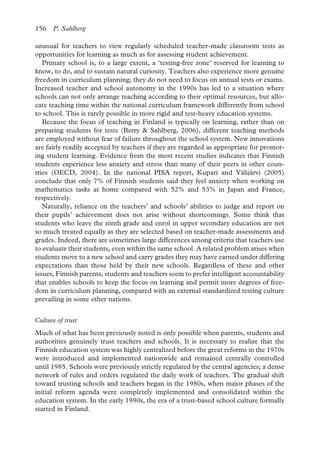
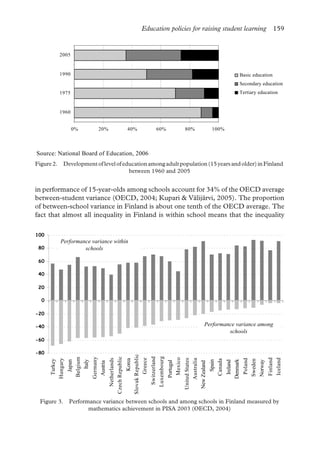
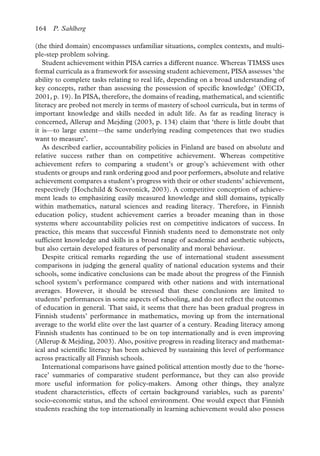
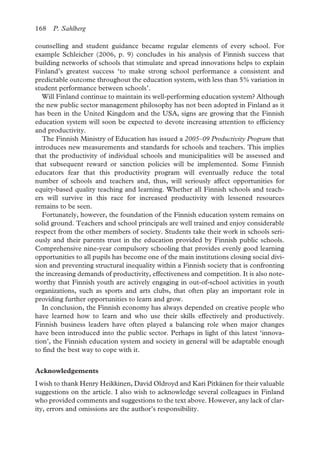
participation rates at all levels of education are relatively high. Figure 2 shows the
rapid progress of education level of population since 1975. For instance, in 1960
nearly 88% of the adult population (15 years or older) had only completed basic
education, 8% had some kind of secondary education diploma and only 4% a higher
education degree. By 1990 the proportion of the adult population with only basic
education was reduced to 50%. In 2005 one in every four adults had a tertiary educa-
tion degree and nearly half of adults had completed secondary education.
Figure 2. Development of level of education among adult population (15 years and older) in Finland between 1960 and 2005
Second, Finland appears to have very small variance in student performance across
schools. In other words, the Finnish school system is quite homogeneous in terms of
educational outcomes (OECD, 2001; Malin, 2005; Schleicher, 2006). This is signif-
icant, when it is realized that until the late 1970s the education system in Finland was
based on parallel streams where pupils were selected to academic and vocational or
civic streams at the age of 10 in elementary school. By the end of the compulsory
school when pupils were typically 15 or 16 years old, differences in educational
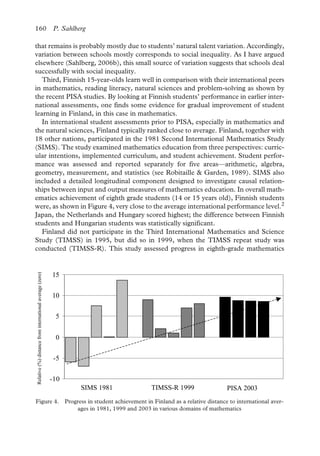
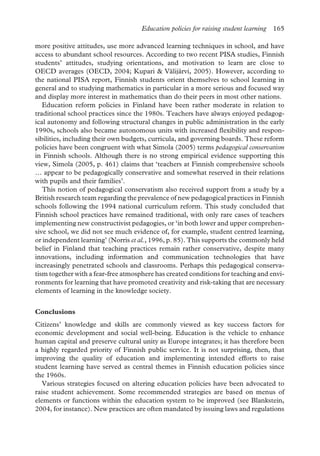
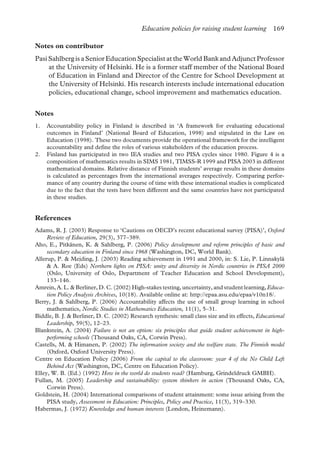
achievement by pupils in these two types of schools were easily discernible. As shown
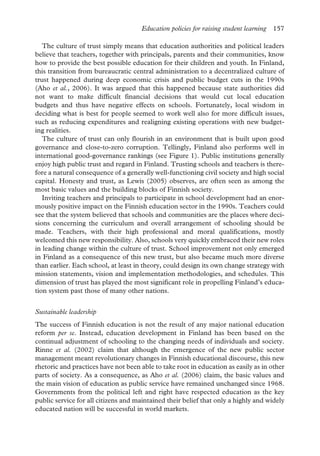
by the most recent PISA results in Figure 3, while all nations display considerable
within-school variance, variance of student performance in most nations across
schools is also considerable. For example in OECD nations, on average, differences
Education policies for raising student learning 159
in performance of 15-year-olds among schools account for 34% of the OECD average
between-student variance (OECD, 2004; Kupari & Välijärvi, 2005). The proportion
of between-school variance in Finland is about one tenth of the OECD average. The
fact that almost all inequality in Finland is within school means that the inequality
0% 20% 40% 60% 80% 100%
1960
1975
1990
2005
Basic education
Secondary education
Tertiary education
Source: National Board of Education, 2006
Figure2. Developmentoflevelofeducationamongadultpopulation(15yearsandolder)inFinland
between 1960 and 2005
-80
-60
-40
-20
0
20
40
60
80
100
Turkey
Hungary
Japan
Belgium
Italy
Germany
Austria
Netherlands
CzechRepublic
Korea
SlovakRepublic
Greece
Switzerland
Luxembourg
Portugal
Mexico
UnitedStates
Australia
NewZealand
Spain
Canada
Ireland
Denmark
Poland
Sweden
Norway
Finland
Iceland
Performance variance within
schools
Performance variance among
schools
Figure 3. Performance variance between schools and among schools in Finland measured by
mathematics achievement in PISA 2003 (OECD, 2004)
160 P. Sahlberg
that remains is probably mostly due to students’ natural talent variation. Accordingly,
variation between schools mostly corresponds to social inequality. As I have argued
elsewhere (Sahlberg, 2006b), this small source of variation suggests that schools deal
successfully with social inequality.
Figure 3. Performance variance between schools and among schools in Finland measured by mathematics achievement in PISA 2003 (OECD, 2004)
Third, Finnish 15-year-olds learn well in comparison with their international peers
in mathematics, reading literacy, natural sciences and problem-solving as shown by
the recent PISA studies. By looking at Finnish students’ performance in earlier inter-
national assessments, one finds some evidence for gradual improvement of student
learning in Finland, in this case in mathematics.
In international student assessments prior to PISA, especially in mathematics and
the natural sciences, Finland typically ranked close to average. Finland, together with
18 other nations, participated in the 1981 Second International Mathematics Study
(SIMS). The study examined mathematics education from three perspectives: curric-
ular intentions, implemented curriculum, and student achievement. Student perfor-
mance was assessed and reported separately for five areas—arithmetic, algebra,
geometry, measurement, and statistics (see Robitaille & Garden, 1989). SIMS also
included a detailed longitudinal component designed to investigate causal relation-
ships between input and output measures of mathematics education. In overall math-
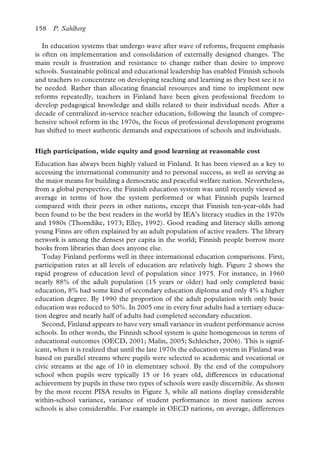
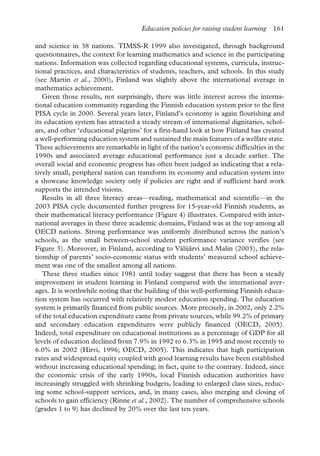
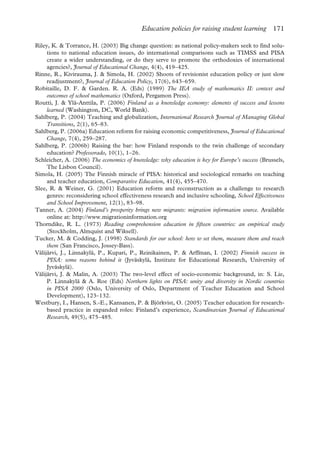
ematics achievement of eighth grade students (14 or 15 years old), Finnish students
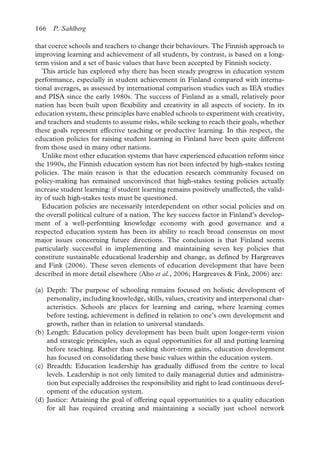
were, as shown in Figure 4, very close to the average international performance level.2
Japan, the Netherlands and Hungary scored highest; the difference between Finnish
students and Hungarian students was statistically significant.
Figure 4. Progress in student achievement in Finland as a relative distance to international averages in 1981, 1999 and 2003 in various domains of mathematics
Finland did not participate in the Third International Mathematics and Science
Study (TIMSS) in 1995, but did so in 1999, when the TIMSS repeat study was
conducted (TIMSS-R). This study assessed progress in eighth-grade mathematics
-10
-5
0
5
10
15
Relative(%)distancefrominternationalaverage(zero)
TIMSS-R 1999 PISA 2003SIMS 1981
Figure 4. Progress in student achievement in Finland as a relative distance to international aver-
ages in 1981, 1999 and 2003 in various domains of mathematics
Education policies for raising student learning 161
and science in 38 nations. TIMSS-R 1999 also investigated, through background
questionnaires, the context for learning mathematics and science in the participating
nations. Information was collected regarding educational systems, curricula, instruc-
tional practices, and characteristics of students, teachers, and schools. In this study
(see Martin et al., 2000), Finland was slightly above the international average in
mathematics achievement.
Given those results, not surprisingly, there was little interest across the interna-
tional education community regarding the Finnish education system prior to the first
PISA cycle in 2000. Several years later, Finland’s economy is again flourishing and
its education system has attracted a steady stream of international dignitaries, schol-
ars, and other ‘educational pilgrims’ for a first-hand look at how Finland has created
a well-performing education system and sustained the main features of a welfare state.
These achievements are remarkable in light of the nation’s economic difficulties in the
1990s and associated average educational performance just a decade earlier. The
overall social and economic progress has often been judged as indicating that a rela-
tively small, peripheral nation can transform its economy and education system into
a showcase knowledge society only if policies are right and if sufficient hard work
supports the intended visions.
Results in all three literacy areas—reading, mathematical and scientific—in the
2003 PISA cycle documented further progress for 15-year-old Finnish students, as
their mathematical literacy performance (Figure 4) illustrates. Compared with inter-
national averages in these three academic domains, Finland was at the top among all
OECD nations. Strong performance was uniformly distributed across the nation’s
schools, as the small between-school student performance variance verifies (see
Figure 3). Moreover, in Finland, according to Välijärvi and Malin (2003), the rela-
tionship of parents’ socio-economic status with students’ measured school achieve-
ment was one of the smallest among all nations.
These three studies since 1981 until today suggest that there has been a steady
improvement in student learning in Finland compared with the international aver-
ages. It is worthwhile noting that the building of this well-performing Finnish educa-
tion system has occurred with relatively modest education spending. The education
system is primarily financed from public sources. More precisely, in 2002, only 2.2%
of the total education expenditure came from private sources, while 99.2% of primary
and secondary education expenditures were publicly financed (OECD, 2005).
Indeed, total expenditure on educational institutions as a percentage of GDP for all
levels of education declined from 7.9% in 1992 to 6.3% in 1995 and most recently to
6.0% in 2002 (Hirvi, 1996; OECD, 2005). This indicates that high participation
rates and widespread equity coupled with good learning results have been established
without increasing educational spending; in fact, quite to the contrary. Indeed, since
the economic crisis of the early 1990s, local Finnish education authorities have
increasingly struggled with shrinking budgets, leading to enlarged class sizes, reduc-
ing some school-support services, and, in many cases, also merging and closing of
schools to gain efficiency (Rinne et al., 2002). The number of comprehensive schools
(grades 1 to 9) has declined by 20% over the last ten years.
162 P. Sahlberg
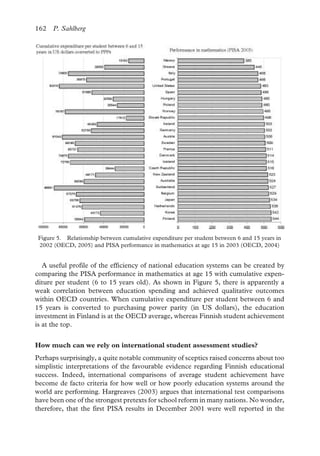
A useful profile of the efficiency of national education systems can be created by
comparing the PISA performance in mathematics at age 15 with cumulative expen-
diture per student (6 to 15 years old). As shown in Figure 5, there is apparently a
weak correlation between education spending and achieved qualitative outcomes
within OECD countries. When cumulative expenditure per student between 6 and
15 years is converted to purchasing power parity (in US dollars), the education
investment in Finland is at the OECD average, whereas Finnish student achievement
is at the top.
Figure 5. Relationship between cumulative expenditure per student between 6 and 15 years in 2002 (OECD, 2005) and PISA performance in mathematics at age 15 in 2003 (OECD, 2004)
How much can we rely on international student assessment studies?
Perhaps surprisingly, a quite notable community of sceptics raised concerns about too
simplistic interpretations of the favourable evidence regarding Finnish educational
success. Indeed, international comparisons of average student achievement have
become de facto criteria for how well or how poorly education systems around the
world are performing. Hargreaves (2003) argues that international test comparisons
have been one of the strongest pretexts for school reform in many nations. No wonder,
therefore, that the first PISA results in December 2001 were well reported in the
Figure 5. Relationship between cumulative expenditure per student between 6 and 15 years in
2002 (OECD, 2005) and PISA performance in mathematics at age 15 in 2003 (OECD, 2004)
Education policies for raising student learning 163
world’s media. As a result, the education pilgrimage to best-performing countries
started. Several countries changed the direction of their education reforms by borrow-
ing education policies and practice from well-performing nations. Nagy (1996) and,
more recently, Prais (2003, 2004), Riley and Torrance (2003) and Goldstein (2004)
have raised concerns about how data are used and interpreted as well as about the
robustness of these studies. On the one hand, the validity and reliability of these stud-
ies and their findings should be critically analyzed. Such issues as curriculum fidelity,
the scaling and data processing errors, misinterpretation of test questions and the rela-
tive importance of doing well in these tests within different countries have been raised
and debated (Adams, 2003; Prais, 2003; Riley & Torrance, 2003). On the other hand,
the political use and related impact of these results are mostly beyond the control of
researchers (Slee & Weiner, 2001; Novoa & Yariv-Mashal, 2003; Sahlberg, 2004).
International student achievement comparison studies are often absorbed by politi-
cians simply by looking at the rank tables of countries, rather than by trying to learn
about national underlying characteristics that might explain comparative system
performance.
How student achievement is defined deserves more attention as educational
performance of nations is compared. In most instances achievement indicates what
students have gained, not necessarily learned. Moreover, student achievement may
be a result of activities not only in school but also out of school. For example, in well-
performing education nations such as Korea and Japan, a significant proportion of
students’ achievement measured by typical school tests is a result of private tutoring,
not school alone. Standardized tests and international student assessments are based
on a certain conception of achievement, and hence learning, that is assessed by the
selected instruments. After-school private tutoring intends to raise students’ test
scores, not necessarily their knowledge and understanding. In Finland, which has no
external high-stakes testing prior to Matriculation Examination nor private tutoring,
many argue that only the teachers who have taught the students know what they were
expected to learn and, hence, to achieve. Advocates of stronger consequential school
accountability, on the other hand, claim that every school and teacher should be held
accountable for certain common outcomes of education that should be externally
assessed and rewarded or punished accordingly. In the midst of this debate about
teacher autonomy and trust, on the one hand, and accountability and external testing
of students and teachers, on the other, the crucial meaning of achievement and its
connection to learning has sometimes been confused.
Achievement also has different connotations in the two major international student
assessment programs, such as TIMSS and PISA (Adams, 2003; Prais, 2003). In
mathematics, for example, TIMSS focuses on what students have achieved in school
in relation to the implemented curriculum. In TIMSS 2003, test items were classified
in three cognitive domains—(a) knowing facts, procedures and concepts; (b) applying
knowledge and understanding; and (c) reasoning (Mullis et al., 2005). The first
domain covers what fourth- and eighth-grade students need to know. Applying
knowledge and understanding (the second domain) focuses on students’ abilities to
apply what they know to solve routine problems and answer questions. Reasoning
164 P. Sahlberg
(the third domain) encompasses unfamiliar situations, complex contexts, and multi-
ple-step problem solving.
Student achievement within PISA carries a different nuance. Whereas TIMSS uses
formal curricula as a framework for assessing student achievement, PISA assesses ‘the
ability to complete tasks relating to real life, depending on a broad understanding of
key concepts, rather than assessing the possession of specific knowledge’ (OECD,
2001, p. 19). In PISA, therefore, the domains of reading, mathematical, and scientific
literacy are probed not merely in terms of mastery of school curricula, but in terms of
important knowledge and skills needed in adult life. As far as reading literacy is
concerned, Allerup and Mejding (2003, p. 134) claim that ‘there is little doubt that
it is—to large extent—the same underlying reading competences that two studies
want to measure’.
As described earlier, accountability policies in Finland are based on absolute and
relative success rather than on competitive achievement. Whereas competitive
achievement refers to comparing a student’s or group’s achievement with other
students or groups and rank ordering good and poor performers, absolute and relative
achievement compares a student’s progress with their or other students’ achievement,
respectively (Hochchild & Scovronick, 2003). A competitive conception of achieve-
ment leads to emphasizing easily measured knowledge and skill domains, typically
within mathematics, natural sciences and reading literacy. Therefore, in Finnish
education policy, student achievement carries a broader meaning than in those
systems where accountability policies rest on competitive indicators of success. In
practice, this means that successful Finnish students need to demonstrate not only
sufficient knowledge and skills in a broad range of academic and aesthetic subjects,
but also certain developed features of personality and moral behaviour.
Despite critical remarks regarding the use of international student assessment
comparisons in judging the general quality of national education systems and their
schools, some indicative conclusions can be made about the progress of the Finnish
school system’s performance compared with other nations and with international
averages. However, it should be stressed that these conclusions are limited to
students’ performances in some aspects of schooling, and do not reflect the outcomes
of education in general. That said, it seems that there has been gradual progress in
Finnish students’ performance in mathematics, moving up from the international
average to the world elite over the last quarter of a century. Reading literacy among
Finnish students has continued to be on top internationally and is even improving
(Allerup & Mejding, 2003). Also, positive progress in reading literacy and mathemat-
ical and scientific literacy has been achieved by sustaining this level of performance
across practically all Finnish schools.
International comparisons have gained political attention mostly due to the ‘horse-
race’ summaries of comparative student performance, but they can also provide
more useful information for policy-makers. Among other things, they analyze
student characteristics, effects of certain background variables, such as parents’
socio-economic status, and the school environment. One would expect that Finnish
students reaching the top internationally in learning achievement would also possess
Education policies for raising student learning 165
more positive attitudes, use more advanced learning techniques in school, and have
access to abundant school resources. According to two recent PISA studies, Finnish
students’ attitudes, studying orientations, and motivation to learn are close to
OECD averages (OECD, 2004; Kupari & Välijärvi, 2005). However, according to
the national PISA report, Finnish students orient themselves to school learning in
general and to studying mathematics in particular in a more serious and focused way
and display more interest in mathematics than do their peers in most other nations.
Education reform policies in Finland have been rather moderate in relation to
traditional school practices since the 1980s. Teachers have always enjoyed pedagog-
ical autonomy and following structural changes in public administration in the early
1990s, schools also became autonomous units with increased flexibility and respon-
sibilities, including their own budgets, curricula, and governing boards. These reform
policies have been congruent with what Simola (2005) terms pedagogical conservatism
in Finnish schools. Although there is no strong empirical evidence supporting this
view, Simola (2005, p. 461) claims that ‘teachers at Finnish comprehensive schools
… appear to be pedagogically conservative and somewhat reserved in their relations
with pupils and their families’.
This notion of pedagogical conservatism also received support from a study by a
British research team regarding the prevalence of new pedagogical practices in Finnish
schools following the 1994 national curriculum reform. This study concluded that
Finnish school practices have remained traditional, with only rare cases of teachers
implementing new constructivist pedagogies, or ‘in both lower and upper comprehen-
sive school, we did not see much evidence of, for example, student centred learning,
or independent learning’ (Norris et al., 1996, p. 85). This supports the commonly held
belief in Finland that teaching practices remain rather conservative, despite many
innovations, including information and communication technologies that have
increasingly penetrated schools and classrooms. Perhaps this pedagogical conserva-
tism together with a fear-free atmosphere has created conditions for teaching and envi-
ronments for learning that have promoted creativity and risk-taking that are necessary
elements of learning in the knowledge society.
Conclusions
Citizens’ knowledge and skills are commonly viewed as key success factors for
economic development and social well-being. Education is the vehicle to enhance
human capital and preserve cultural unity as Europe integrates; it has therefore been
a highly regarded priority of Finnish public service. It is not surprising, then, that
improving the quality of education and implementing intended efforts to raise
student learning have served as central themes in Finnish education policies since
the 1960s.
Various strategies focused on altering education policies have been advocated to
raise student achievement. Some recommended strategies are based on menus of
elements or functions within the education system to be improved (see Blankstein,
2004, for instance). New practices are often mandated by issuing laws and regulations
166 P. Sahlberg
that coerce schools and teachers to change their behaviours. The Finnish approach to
improving learning and achievement of all students, by contrast, is based on a long-
term vision and a set of basic values that have been accepted by Finnish society.
This article has explored why there has been steady progress in education system
performance, especially in student achievement in Finland compared with interna-
tional averages, as assessed by international comparison studies such as IEA studies
and PISA since the early 1980s. The success of Finland as a small, relatively poor
nation has been built upon flexibility and creativity in all aspects of society. In its
education system, these principles have enabled schools to experiment with creativity,
and teachers and students to assume risks, while seeking to reach their goals, whether
these goals represent effective teaching or productive learning. In this respect, the
education policies for raising student learning in Finland have been quite different
from those used in many other nations.
Unlike most other education systems that have experienced education reform since
the 1990s, the Finnish education system has not been infected by high-stakes testing
policies. The main reason is that the education research community focused on
policy-making has remained unconvinced that high-stakes testing policies actually
increase student learning: if student learning remains positively unaffected, the valid-
ity of such high-stakes tests must be questioned.
Education policies are necessarily interdependent on other social policies and on
the overall political culture of a nation. The key success factor in Finland’s develop-
ment of a well-performing knowledge economy with good governance and a
respected education system has been its ability to reach broad consensus on most
major issues concerning future directions. The conclusion is that Finland seems
particularly successful in implementing and maintaining seven key policies that
constitute sustainable educational leadership and change, as defined by Hargreaves
and Fink (2006). These seven elements of education development that have been
described in more detail elsewhere (Aho et al., 2006; Hargreaves & Fink, 2006) are:
(a) Depth: The purpose of schooling remains focused on holistic development of
personality, including knowledge, skills, values, creativity and interpersonal char-
acteristics. Schools are places for learning and caring, where learning comes
before testing, achievement is defined in relation to one’s own development and
growth, rather than in relation to universal standards.
(b) Length: Education policy development has been built upon longer-term vision
and strategic principles, such as equal opportunities for all and putting learning
before teaching. Rather than seeking short-term gains, education development
has focused on consolidating these basic values within the education system.
(c) Breadth: Education leadership has gradually diffused from the centre to local
levels. Leadership is not only limited to daily managerial duties and administra-
tion but especially addresses the responsibility and right to lead continuous devel-
opment of the education system.
(d) Justice: Attaining the goal of offering equal opportunities to a quality education
for all has required creating and maintaining a socially just school network
Education policies for raising student learning 167
consisting of uniformly excellent schools. This equity principle has remained the
leading policy commitment since the early 1970s.
(e) Diversity: The school network is based on the idea of inclusive education that
promotes diversity in schools and classrooms. Steering of teaching and learning
has never been based on written standards, but rather upon guidelines encourag-
ing creative solutions within increasingly diverse social and human environments.
(f) Resourcefulness: Young, talented and creative individuals have been appointed
over the past three decades to lead schools, local education offices, and central
departments, guided by the belief that competencies often override routine expe-
rience. Systematic and research-based ways to prepare and continuously develop
leaders and to maintain their knowledge and skills were introduced in the 1980s.
(g) Conservation: Education development has represented a balance between bring-
ing in new innovations and employing existing good practices. The public recog-
nizes that many needed educational innovations already exist somewhere in the
system. This was a key acknowledgement of teachers’ wisdom and realization that
learning from past experiences is at least as important as introducing totally new
and often alien ideas in schools.
While the principle of justice (i.e. equity and equal opportunities) has remained a
leading value of Finland’s long-range education vision, strong, systematic emphasis
on leadership at all levels of education began to emerge in the 1980s. Since then, it
has remained clear that education policies must be based on depth, length and
breadth of leadership, and that diversity and resourcefulness are conservative drivers
of educational change.
Education policies to raise student achievement in Finland have put a strong accent
on teaching and learning by encouraging schools to craft optimal learning environ-
ments and establish instructional content that would best help students to reach the
general goals of schooling. It was assumed very early on that instruction is the key
element that will make a difference in what students learn in school, not standards,
assessment or alternative instructional programs. As the level of teacher professional-
ism gradually increased in schools during the 1990s, the prevalence of effective teach-
ing methods and pedagogical classroom and school designs increased. The new
flexibility within the Finnish education system promoted what Fullan (2005) calls
lateral capacity building and hence enabled schools and municipalities to learn from
each other and thus make best practices universal by adopting innovative approaches
to organizing schooling, encouraging teachers and schools to continue to expand their
repertoires of teaching methods and individualizing teaching to meet the needs of all
students. I believe, however, that this is not a well-developed strategy in Finland yet,
and thus represents an under-utilized resource in education system development.
Lateral capacity building mobilizes two important change forces: knowledge and
innovation about educational change and productive practices on the one hand, and
shared identity on the other.
At the same time, schools were helped to maintain and build strong support
systems for teaching and learning—healthful nutrition, health services, psychological
168 P. Sahlberg
counselling and student guidance became regular elements of every school. For
example Schleicher (2006, p. 9) concludes in his analysis of Finnish success that
building networks of schools that stimulate and spread innovations helps to explain
Finland’s greatest success ‘to make strong school performance a consistent and
predictable outcome throughout the education system, with less than 5% variation in
student performance between schools’.
Will Finland continue to maintain its well-performing education system? Although
the new public sector management philosophy has not been adopted in Finland as it
has been in the United Kingdom and the USA, signs are growing that the Finnish
education system will soon be expected to devote increasing attention to efficiency
and productivity.
The Finnish Ministry of Education has issued a 2005–09 Productivity Program that
introduces new measurements and standards for schools and teachers. This implies
that the productivity of individual schools and municipalities will be assessed and
that subsequent reward or sanction policies will be implemented. Some Finnish
educators fear that this productivity program will eventually reduce the total
number of schools and teachers and, thus, will seriously affect opportunities for
equity-based quality teaching and learning. Whether all Finnish schools and teach-
ers will survive in this race for increased productivity with lessened resources
remains to be seen.
Fortunately, however, the foundation of the Finnish education system remains on
solid ground. Teachers and school principals are well trained and enjoy considerable
respect from the other members of society. Students take their work in schools seri-
ously and their parents trust in the education provided by Finnish public schools.
Comprehensive nine-year compulsory schooling that provides evenly good learning
opportunities to all pupils has become one of the main institutions closing social divi-
sion and preventing structural inequality within a Finnish society that is confronting
the increasing demands of productivity, effectiveness and competition. It is also note-
worthy that Finnish youth are actively engaging in out-of-school activities in youth
organizations, such as sports and arts clubs, that often play an important role in
providing further opportunities to learn and grow.
In conclusion, the Finnish economy has always depended on creative people who
have learned how to learn and who use their skills effectively and productively.
Finnish business leaders have often played a balancing role when major changes
have been introduced into the public sector. Perhaps in light of this latest ‘innova-
tion’, the Finnish education system and society in general will be adaptable enough
to find the best way to cope with it.
Acknowledgements
I wish to thank Henry Heikkinen, David Oldroyd and Kari Pitkänen for their valuable
suggestions on the article. I also wish to acknowledge several colleagues in Finland
who provided comments and suggestions to the text above. However, any lack of clar-
ity, errors and omissions are the author’s responsibility.
Education policies for raising student learning 169
Notes on contributor
Pasi Sahlberg is a Senior Education Specialist at the World Bank and Adjunct Professor
at the University of Helsinki. He is a former staff member of the National Board
of Education in Finland and Director of the Centre for School Development at
the University of Helsinki. His research interests include international education
policies, educational change, school improvement and mathematics education.
Notes
1. Accountability policy in Finland is described in ‘A framework for evaluating educational
outcomes in Finland’ (National Board of Education, 1998) and stipulated in the Law on
Education (1998). These two documents provide the operational framework for the intelligent
accountability and define the roles of various stakeholders of the education process.
2. Finland has participated in two IEA studies and two PISA cycles since 1980. Figure 4 is a
composition of mathematics results in SIMS 1981, TIMSS-R 1999 and PISA 2003 in different
mathematical domains. Relative distance of Finnish students’ average results in these domains
is calculated as percentages from the international averages respectively. Comparing perfor-
mance of any country during the course of time with these international studies is complicated
due to the fact that the tests have been different and the same countries have not participated
in these studies.
References
Adams, R. J. (2003) Response to ‘Cautions on OECD’s recent educational survey (PISA)’, Oxford
Review of Education, 29(3), 377–389.
Aho, E., Pitkänen, K. & Sahlberg, P. (2006) Policy development and reform principles of basic and
secondary education in Finland since 1968 (Washington, DC, World Bank).
Allerup, P. & Mejding, J. (2003) Reading achievement in 1991 and 2000, in: S. Lie, P. Linnakylä
& A. Roe (Eds) Northern lights on PISA: unity and diversity in Nordic countries in PISA 2000
(Oslo, University of Oslo, Department of Teacher Education and School Development),
133–146.
Amrein, A. L. & Berliner, D. C. (2002) High-stakes testing, uncertainty, and student learning, Educa-
tion Policy Analysis Archives, 10(18). Available online at: http://epaa.asu.edu/epaa/v10n18/.
Berry, J. & Sahlberg, P. (2006) Accountability affects the use of small group learning in school
mathematics, Nordic Studies in Mathematics Education, 11(1), 5–31.
Biddle, B. J. & Berliner, D. C. (2002) Research synthesis: small class size and its effects, Educational
Leadership, 59(5), 12–23.
Blankstein, A. (2004) Failure is not an option: six principles that guide student achievement in high-
performing schools (Thousand Oaks, CA, Corwin Press).
Castells, M. & Himanen, P. (2002) The information society and the welfare state. The Finnish model
(Oxford, Oxford University Press).
Centre on Education Policy (2006) From the capital to the classroom: year 4 of the No Child Left
Behind Act (Washington, DC, Centre on Education Policy).
Elley, W. B. (Ed.) (1992) How in the world do students read? (Hamburg, Grindeldruck GMBH).
Fullan, M. (2005) Leadership and sustainability: system thinkers in action (Thousand Oaks, CA,
Corwin Press).
Goldstein, H. (2004) International comparisons of student attainment: some issue arising from the
PISA study, Assessment in Education: Principles, Policy and Practice, 11(3), 319–330.
Habermas, J. (1972) Knowledge and human interests (London, Heinemann).
170 P. Sahlberg
Hargreaves, A. (2003) Teaching in the knowledge society: education in the age of insecurity (New York,
Teachers College Press).
Hargreaves, A., Earl, L., Shawn, M. & Manning, S. (2001) Learning to change: teaching beyond
subjects and standards (San Francisco, Jossey-Bass).
Hargreaves, A. & Fink, D. (2006) Sustainable leadership (San Francisco, Jossey-Bass).
Hirvi, V. (1996) Koulutuksen rytminvaihdos. 1990-luvun koulutuspolitiikka Suomessa [The change of
rhythm in education. Education policies of the 1990s in Finland] (Helsinki, Otava).
Hochchild, J. & Scovronick, N. (2003) The American dream and the public schools (Oxford, Oxford
University Press).
Jussila, J. & Saari, S. (Eds) (2000) Teacher education as a future-molding factor: international evalu-
ation of teacher education in Finnish universities (Helsinki, Higher Education Evaluation
Council).
Kupari, P. & Välijärvi, J. (Eds) (2005) Osaaminen kestävällä pohjalla. PISA 2003 Suomessa
[Competences on solid ground. PISA 2003 in Finland] (Jyväskylä, Institute for Educational
Research, University of Jyväskylä).
Lemke, R., Hoerander, C. & McMahon, R. (2006) Student assessment, non-test-takers, and
school accountability, Education Economics, 14(2), 235–250.
Lewis, R. (2005) Finland, cultural lone wolf (Yarmouth, Intercultural Press).
Linnakylä, P. (2004) Finland, in: H. Döbert, E. Klieme, & W. Stroka (Eds) Conditions of school
performance in seven countries: a quest for understanding the international variation of PISA results
(Munster, Waxmann), 150–218.
Malin, A. (2005) School differences and inequities in educational outcomes. PISA 2000 results of reading
literacy in Finland (Jyväskylä, Institute for Educational Research).
Martin, M. O., Mullis, I. V. S., Gonzales, E. J., Gregory, K. D., Smith, T. A., Chrostowski, S. J.,
Garden, R. A. & O’Connor, K. M. (2000) TIMSS 1999 International Science Report: findings
from IEA’s repeat of the Third International Mathematics and Science Study at the eighth grade
(Chestnut Hill, Boston College).
Mullis, I., Martin, M. & Foy, P. (2005) IEA’s TIMSS 2003 International Report: achievement in the
mathematics cognitive domains (Boston, Boston College, Lynch School of Education, TIMSS
and PIRLS International Study Center).
Nagy, P. (1996) International comparisons of student achievement in mathematics and science: a
Canadian perspective, Canadian Journal of Education, 21(4), 396–413.
National Board of Education (1998) A framework for evaluating educational outcomes in Finland
(Helsinki, National Board of Education).
Norris, N., Aspland, R., MacDonald, B., Schostak, J. & Zamorski, B. (1996) An independent eval-
uation of comprehensive curriculum reform in Finland (Helsinki, National Board of Education).
Novoa, A. & Yariv-Mashal, T. (2003) Comparative research in education: a mode of governance
or a historical journey? Comparative Education, 39(4), 423–439.
Organisation for Economic Cooperation and Development (OECD) (2001) Knowledge and skills
for life: first results from PISA 2000 (Paris, OECD).
Organisation for Economic Cooperation and Development (OECD) (2004) Learning for tomor-
row’s world: first results from PISA 2003 (Paris, OECD).
Organisation for Economic Cooperation and Development (OECD) (2005) Education at a glance:
OECD indicators 2005 (Paris, OECD).
Popham, J. W. (2004) America’s failing schools: how parents and teachers can cope with No Child Left
Behind (New York, RoutledgeFalmer).
Porter, M., Schwab, K., Sala-i-Martin, X. & Lopez-Claros, A. (Eds) (2004) The global competitive-
ness report (New York, Oxford University Press).
Prais, S. J. (2003) Cautions on OECD’s recent educational survey (PISA), Oxford Review of
Education, 29(2), 139–163.
Prais, S. J. (2004) Cautions on OECD’s recent educational survey (PISA): rejoinder to OECD’s
response, Oxford Review of Education, 30(4), 569–573.
Education policies for raising student learning 171
Riley, K. & Torrance, H. (2003) Big change question: as national policy-makers seek to find solu-
tions to national education issues, do international comparisons such as TIMSS and PISA
create a wider understanding, or do they serve to promote the orthodoxies of international
agencies?, Journal of Educational Change, 4(4), 419–425.
Rinne, R., Kivirauma, J. & Simola, H. (2002) Shoots of revisionist education policy or just slow
readjustment?, Journal of Education Policy, 17(6), 643–659.
Robitaille, D. F. & Garden. R. A. (Eds) (1989) The IEA study of mathematics II: context and
outcomes of school mathematics (Oxford, Pergamon Press).
Routti, J. & Ylä-Anttila, P. (2006) Finland as a knowledge economy: elements of success and lessons
learned (Washington, DC, World Bank).
Sahlberg, P. (2004) Teaching and globalization, International Research Journal of Managing Global
Transitions, 2(1), 65–83.
Sahlberg, P. (2006a) Education reform for raising economic competitiveness, Journal of Educational
Change, 7(4), 259–287.
Sahlberg, P. (2006b) Raising the bar: how Finland responds to the twin challenge of secondary
education? Professorado, 10(1), 1–26.
Schleicher, A. (2006) The economics of knowledge: why education is key for Europe’s success (Brussels,
The Lisbon Council).
Simola, H. (2005) The Finnish miracle of PISA: historical and sociological remarks on teaching
and teacher education, Comparative Education, 41(4), 455–470.
Slee, R. & Weiner, G. (2001) Education reform and reconstruction as a challenge to research
genres: reconsidering school effectiveness research and inclusive schooling, School Effectiveness
and School Improvement, 12(1), 83–98.
Tanner, A. (2004) Finland’s prosperity brings new migrants: migration information source. Available
online at: http://www.migrationinformation.org
Thorndike, R. L. (1973) Reading comprehension education in fifteen countries: an empirical study
(Stockholm, Almquist and Wiksell).
Tucker, M. & Codding, J. (1998) Standards for our school: how to set them, measure them and reach
them (San Francisco, Jossey-Bass).
Välijärvi, J., Linnakylä, P., Kupari, P., Reinikainen, P. & Arffman, I. (2002) Finnish success in
PISA: some reasons behind it (Jyväskylä, Institute for Educational Research, University of
Jyväskylä).
Välijärvi, J. & Malin, A. (2003) The two-level effect of socio-economic background, in: S. Lie,
P. Linnakylä & A. Roe (Eds) Northern lights on PISA: unity and diversity in Nordic countries
in PISA 2000 (Oslo, University of Oslo, Department of Teacher Education and School
Development), 123–132.
Westbury, I., Hansen, S.-E., Kansanen, P. & Björkvist, O. (2005) Teacher education for research-
based practice in expanded roles: Finland’s experience, Scandinavian Journal of Educational
Research, 49(5), 475–485.

2013110466716017

  • 1.
    Journal of EducationPolicy Vol. 22, No. 2, March 2007, pp. 147–171 ISSN 0268–0939 (print)/ISSN 1464–5106 (online)/07/020147–25 © 2007 Taylor & Francis DOI: 10.1080/02680930601158919 Education policies for raising student learning: the Finnish approach Pasi Sahlberg* World Bank, Washington, DC, USA Taylor and Francis LtdTEDP_A_215821.sgm10.1080/02680930601158919Journal of Education Policy0268-0939 (print)/1464-5106 (online)Original Article2007Taylor & Francis222000000March 2007PasiSahlbergpasi.sahlberg@helsinki.fi This article argues that system-wide excellence in student learning is attainable at reasonable cost, using education policies differing from conventional market-oriented reform strategies prevalent in many other countries. In this respect, Finland is an example of a nation that has developed from a remote agrarian/industrial state in the 1950s to a model knowledge economy, using education as the key to economic and social development. Relying on data from international student assessments and earlier policy analysis, this article describes how steady improvement in student learning has been attained through Finnish education policies based on equity, flexibility, creativity, teacher professionalism and trust. Unlike many other education systems, consequential accountability accompanied by high-stakes testing and externally determined learning standards has not been part of Finnish education policies. The insight is that Finnish education policies intended to raise student achievement have been built upon ideas of sustainable leadership that place strong emphasis on teaching and learning, intelligent accountability, encouraging schools to craft optimal learning environments and implement educational content that best helps their students reach the general goals of schooling. Competitive market economy in non-market welfare society Two major change forces relevant to this topic have influenced educational develop- ment in Finland since the 1980s: (a) Finnish society has passed through an economic and cultural transition from a mono-cultural, agrarian/industrial, and peripheral soci- ety to a multi-cultural, high-tech knowledge economy accepting an active role in shaping the present-day European economic and political environment; and (b) the Finnish education system has become an attractive and internationally examined example of a well-performing system that successfully combines quality with wide- spread equity and social cohesion through reasonable public financing. To better understand interrelationships between the education system and the other Finnish political and economic structures, we must begin with a brief description of key characteristics and recent change forces in Finland. *Senior Education Specialist, Human Development Network, World Bank, 1818 H Street, NW, Washington, DC 20433, USA. Email: pasi.sahlberg@helsinki.fi
  • 2.
    148 P. Sahlberg Finlandhas traversed a long way from a poor agrarian state in the early twentieth century to a modern welfare democracy at the start of the third millennium. For example, according to Routti and Ylä-Anttila (2006), the Finnish economic structure in 1950 corresponded quite closely to that of Sweden’s structure in 1910. Social policy decisions in the 1940s and 1950s underscored the economic importance of family farms; the general image of Finland remained quite agrarian despite rapid industrialization and agriculture’s shrinking contribution to the gross domestic product (GDP) over the second half of the twentieth century. Traditional values have endured: according to Lewis (2005), these include such cultural hallmarks as a law- abiding citizenry, trust in authority, commitment to one’s social group, awareness of one’s social status and position, and a patriotic spirit. Finland in the early 1990s suffered a severe economic decline characterized by a major banking crisis. The unemployment rate exploded from 4% to 18% and public debt soared to over 60% of GDP, placing Finland close to international lending limits. For the Finnish economy to recover, the nation had to diversify its export structures and encourage business innovation. What drove these economic reforms was the emergence of new knowledge-based industries and adoption of knowledge- economy concepts throughout the entire Finnish society. During this century’s first decade, Finland has been ranked four times as the world’s most competitive economy (Figure 1) by the World Economic Forum. This suggests thatFinlandpossessesaveryhighlevelofhumancapital,widespreaduseofinformation and communication technologies, and education and research institutions that have 1 2 3 4 5 6 7 8 9 10 11 12 13 14 15 16 1998 1999 2000 2001 2002 2003 2004 2005 Internationalrank Competitiveness Corruption Perception Index Network Readiness Index Sources: World Economic Forum (www.wef.org) and Transparency International (www.transparency.org) Figure 1. Finland’s rankings in international economic competitiveness, transparency and network readiness between 1998 and 2005
  • 3.
    Education policies forraising student learning 149 been redesigned to foster innovation and cutting-edge research and development. Indeed, Finland also ranks high in advancement of global information and commu- nication technologies as well as in implementation of environmental policies. Finland also ranks at the top on Transparency International’s list of least corrupt nations; this plays a crucial role in maintaining a well-functioning democracy, trust-based public sector management and basic functions of the welfare state. Interestingly, as an advanced high-tech society and knowledge economy, Finland prepares today more musicians (and symphonic conductors) per capita than any other nation. Figure 1. Finland’s rankings in international economic competitiveness, transparency and network readiness between 1998 and 2005 In their analysis of Finland as a knowledge economy, Routti and Ylä-Anttila (2006) warn that economic competitiveness indices should not be used to predict the future economic performance of any nation. Instead, international measures may provide useful insights into national factors that have been influential in developing cutting- edge economies and promoted social well-being. Based on these commonly employed determinants of economic competitiveness and various indicators of knowledge econ- omies, three core domains have been used to account for economic growth: (a) educa- tion and training (human capital); (b) use of information and communication technologies; and (c) innovations and technological adaptation (Porter et al., 2004; Sahlberg, 2006a). In today’s complex and unpredictably changing economic environ- ments, characteristics such as equal opportunities for all individuals, creativity and research, network readiness, and environmental sustainability are also becoming increasingly important factors. The recent success of Finland as a nation has often been explained by its lack of ethnic minorities and a relatively homogeneous society. Although ethnicity in Finland among a population of 5.3 million is not as diverse and apparent as it is in some other European nations, migration trends since the early 1990s indicate that Finland is rapidly transforming into a multi-cultural society. As described by Tanner (2004), three statistics indicate the relatively strong impact of today’s immigration levels: (a) total number of foreigners legally living in Finland without citizenship increased four-fold between 1990 and 2003, from 26,300 to 107,100; (b) total number of foreign-born Finnish citizens and residents doubled between 1991 and 2003, from 77,000 to 159,000, representing 3% of the entire Finnish population, and (c) total number of residents whose first language is not Finnish tripled between 1992 and 2004, from 43,000 to 128,000. Up to 1990, the rate of forced and voluntary immi- gration to Finland was considerably lower. Thus, over the past 15 years Finnish people as well as institutions have had to adjust to new policies and practices. In education, the emergence of new cultural and linguistic minorities has created chal- lenges to basic values of education, curricula, and also to teachers in Finnish schools, having increased social and ethnic diversities. In some urban schools, total immigrant children or those whose mother tongue is not Finnish approach close to 50%. Global education reform trends In their analysis of Finnish education development policies and reform principles since 1968, Aho et al. (2006) conclude that rather than introducing sequential
  • 4.
    150 P. Sahlberg reformsand innovations, Finnish education policy has been built upon sustainable leadership led by commonly accepted values and shared vision. The main features of developing a competitive, well-performing education system are similar to those underlying the social and economic transformation of Finland to a knowledge society (Castells & Himanen, 2002; Sahlberg, 2006a). It is therefore difficult to identify particular reforms or innovations that have per se been driving forces in raising the level and quality of student learning in Finnish schools. Thus, it becomes necessary to identify broader policies and reform principles playing a significant role in shaping the education system. It is helpful to realize that the Finnish education system has remained quite unreceptive to the influence of what is often categorized as the global education reform movement (Hargreaves et al., 2001; Rinne et al., 2002; Sahlberg, 2004; Aho et al., 2006) that has emerged since the 1980s and has increasingly become adopted as an official agenda in many parts of the world. Since the 1980s, at least three common features in education development policies and reform strategies globally have intended to improve the quality of education, especially raising student achievement. First is the standardization of education. Outcomes-based education reform became popular in the 1980s followed by stan- dards-based education policies in the 1990s, initially in Anglo-Saxon countries. These reforms quite correctly shifted the focus of attention to educational outcomes—that is, to student learning and school performance. Consequently, a widely accepted—and unquestioned—belief among policy-makers and education reformers is that setting clear and sufficiently high performance standards for schools, teachers and students will necessarily improve the quality of outcomes. Enforcement of external testing and evaluation systems to assess how well these standards have been attained has emerged from original standards-oriented education policies. Since the late 1980s, centrally prescribed curricula, with detailed and often ambitious performance targets, frequent testing of students and teachers, and high-stakes accountability have defined a homogenization of education policies worldwide, promising standardized solutions at increasingly lower cost for those desiring to improve school quality and effectiveness. The second common feature in global education development policies and reform strategies is increased focus on literacy and numeracy. Basic student knowl- edge and skills in reading, writing, mathematics and natural sciences have been elevated to serve as prime targets and indices of education reforms. As a conse- quence of accepting international student assessment results such as Programme for International Student Assessment (PISA) and International Association for the Evaluation of Educational Achievement (IEA) studies as a criterion of good educa- tional performance, literacy and numeracy have now become the main determi- nants of the perceived success or failure of pupils, teachers, schools and entire education systems. Although only a slight shift in relative time allocation away from other school subjects to literacy and numeracy has been noted within differ- ent school systems, the importance given to these school subjects in curriculum, teacher policies, or other resources has been obvious, for example, in international development aid programs. A nationwide study in the USA confirms that 71% of
  • 5.
    Education policies forraising student learning 151 school districts reported that they have reduced teaching time in at least one other subject to allow more time for reading and mathematics, the subjects tested for new accountability purposes (Centre on Education Policy, 2006). Consequently, curriculum and, therefore, teaching in schools in many nations place too strong an emphasis on structural knowledge, technical skills and cognition, or what Habermas (1972) termed the systemworld of knowledge. Instead, knowledge societ- ies where social tolerance and internal security play increasingly important roles draw upon the lifeworld of culture—especially beliefs, values, morality, meaning and social experiences. Both knowledge types are important and both must be balanced to enable schools to perform well. As a consequence of too-narrow focus upon literacy and numeracy, in many nations the importance of aesthetic and moral education as well as social sciences has been reduced due to the need to strengthen instruction in what Tucker and Codding (1998) call fundamental or core subjects. The third global trend is the introduction of consequential accountability systems for schools. School performance—especially raising student achievement—is closely tied to processes of accrediting, promoting, inspecting, and, ultimately, rewarding or punishing schools and teachers. Success or failure of schools and their teachers is often determined by standardized tests and external evaluations that only devote attention to limited aspects of schooling, such as student achievement in mathemat- ical and reading literacy, exit examination results, or intended teacher classroom behaviour. Perhaps the best-known practical illustration of large-scale education reform driven by the notion of standardization and related consequential accountability is found in the USA, where controversial federal legislation termed No Child Left Behind (Public Law 107–110) links school and teacher performance to Adequate Yearly Progress and to financial and resource allocations to schools (Popham, 2004; Centre on Education Policy, 2006). Recent research, however, suggests that ‘the ability of stan- dardized tests to accurately reflect school performance remains in doubt’ (Lemke et al., 2006, p. 246). Furthermore, Amrein and Berliner (2002) concluded, on the basis of their analysis across 18 states in the USA, that since clear evidence was not found for the positive impact of high-stakes testing policies upon increased student learning and because there are numerous reports of unintended consequences asso- ciated with these policies, such as increased student drop-out rates, teacher and school cheating on exams, and teacher defection from the profession, there is need for transforming existing high-stakes testing policies. None of these three major global education reform elements summarized in Table 1 has been adopted in Finland as they have been within education development policies of many other nations. This, of course, does not support the notion that education standards, focus on basic knowledge and skills, or stronger emphasis on school accountability should be avoided in seeking better learning or education performance. But, perhaps, it does suggest that a better education system can be created using alternative approaches and policies orthogonal to those commonly found and promoted in international education policy markets.
  • 6.
    152 P. Sahlberg Educationpolicies for building the Finnish education system A typical feature of teaching and learning in Finland is encouraging teachers and students to try new ideas and methods, learn about and through innovations, and cultivate creativity in schools, while respecting schools’ pedagogic legacies. This does not mean that traditional instruction and school organization do not exist in Finland; quite the opposite. What is important is that Finnish education policies today are a result of four decades of systematic, mostly intentional development that has created a culture of diversity, trust, and respect within Finnish society in general and within its education system in particular (see Table 1). As shown in Table 1, the education policy principles and related strategies to raise student achievement in Finland differ from those found in global education reform movements. Schleicher (2006, p. 9) suggests that one element of Finland’s success has been ‘the capacity of policy makers to pursue reform in ways that went beyond optimizing existing structures, policies and practices, and moved towards fundamen- tally transforming the paradigms and beliefs that underlay educational policy and practice until 1960s’. Although education policy discourse in Finland changed dramatically during the 1990s as a consequence of new public sector management and other neo-liberal policies, Finland has been a slow implementer of dominant market-oriented education reforms. Instead, education sector development has been Table 1. Some aspects of global education reform trends and education policy principles in Finland since the 1980s Education policies and reform principles Global education reform trends Education policies in Finland Standardization Setting clear, high and centrally prescribed performance standards for schools, teachers and students to improve the quality of outcomes. Flexibility and loose standards Building on existing good practices and innovations in school-based curriculum development, setting of learning targets and networking through steering by information and support. Focus on literacy and numeracy Basic knowledge and skills in reading, writing, mathematics and natural sciences as prime targets of education reform. Broad learning combined with creativity Teaching and learning focus on deep and broad learning giving equal value to all aspects of an individual’s growth of personality, moral, creativity, knowledge and skills. Consequential accountability The school performance and raising student achievement are closely tied to the processes of promotion, inspection and ultimately rewarding or punishing schools and teachers based on accountability measures, especially standardised testing as the main criteria of success. Intelligent accountability with trust-based professionalism Adoption of intelligent accountability policies and gradual building of a culture of trust within the education system that values teachers’ and headmasters’ professionalism in judging what is best for students and in reporting their learning progress.
  • 7.
    Education policies forraising student learning 153 based on sustainable leadership and built upon values grounded in equity, equitable distribution of resources rather than competition, intensive early interventions for prevention and building gradual trust among education practitioners, especially teachers. Moreover, Finland has been characterized as a consensus society where major political decisions have been agreed by all key players in society (Aho et al., 2006; Routti & Ylä-Anttila, 2006). Importantly, the Teachers’ Trade Union as a main negotiating partner in education has consistently resisted adopting market- oriented management models in the education sector. What follows is an attempt to identify possible factors in the Finnish education system that may have contributed to the good performance of its schools and individ- uals (Välijärvi et al., 2002; Linnakylä, 2004; Simola, 2005; Sahlberg, 2006b). This analysis provides further support for the earlier assertion that Finland has adopted alternative approaches in education policies to raise student achievement. In respect of such an analysis, however, Välijärvi and his team (2002, p. 46) have observed that: Finland’s high achievement seems to be attributable to a whole network of interrelated factors in which students’ own areas of interest and leisure activities, the learning oppor- tunities provided by school, parental support and involvement as well as social and cultural context of learning and of the entire education system combine with each other. Same basic school for all All Finnish children start their compulsory nine-year comprehensive basic schooling in August of the year they become seven years old. Normally, class-based primary school lasts six years followed by three-year lower secondary school, although the new law allows some variation. Today it is widely recognized that the six-year primary school experience provides the cornerstone for high-quality education for all Finnish citizens. Research shows (for example, Biddle & Berliner, 2002) that investment in primary education as children learn basic knowledge and skills and adopt attitudes of lifelong learning pays off in later grades through better aptitude and learning skills, as well as through positive overall outcomes. All basic school teachers must hold a Masters degree to become permanently employed. Primary school teacher preparation was converted from a three-year program at teachers’ colleges to four- or five-year university programs in the late 1970s. Hence, most primary school teachers today possess higher university degrees. Westbury et al. (2005) point out that preparing teachers for a research-based profes- sion has been the central idea of teacher education developments in Finland. The Finnish comprehensive school is a formal and fully publicly financed system and ‘a matter of pedagogical philosophy and practice’ (Välijärvi et al., 2002, p. 29). This philosophy is based on the principle of equity, on which Finnish education policy has been largely premised since the early 1970s. Well-equipped schools are typically small, with class sizes ranging from 20 to 30 students. Primary schools (grades 1 to 6) typically have fewer than 300 pupils. In 2004, more than one third of Finnish comprehensive schools had fewer than 50 pupils; just 4% of all schools had 500 or more pupils. Many primary schools therefore have become learning and caring
  • 8.
    154 P. Sahlberg communitiesrather than merely instructional institutions that prepare pupils for the next level of schooling. The fact that all children enrol in identical comprehensive schools regardless of their socioeconomic background or personal abilities and characteristics has resulted in a system where schools and classrooms are heterogeneous in terms of pupil profiles and diverse in terms of educational needs and expectations (Välijärvi & Malin, 2003). Comprehensiveness, the leading idea in implementing the basic values of equity in education, also means that all students receive a free two-course warm meal daily, free health care, transportation, learning materials, and counselling in their own schools. Well-trained teachers In Finnish society, the teaching profession has always enjoyed great public respect and appreciation (Simola, 2005). According to a recent poll, over 26% of general upper secondary school graduates rated the teaching profession as the most desirable. Classroom teaching is considered an independent, high-status profession that attracts some of the best secondary school graduates (Välijärvi et al., 2002; Simola, 2005; Westbury et al., 2005). Indeed, only about 10% of some 5,000 applicants are accepted annually to the Faculties of Education within Finnish universities. This implies that university teacher education departments can select some of the nation’s best students from among top scorers on university entrance examinations. The main reason for the high appeal for becoming a Finnish primary school teacher is the fact that the Masters degree is the basic requirement to be permanently employed as a teacher in Finnish school. For primary schools, this has had several positive consequences for teachers and for society at large. One important factor is that a Masters degree in education not only qualifies one to teach school but opens the door to employment in public administration or in the private sector. Primary school teachers who join the labor market after graduation do not feel that their professional career is limited only to primary school work. Indeed, young graduates with Masters degrees in primary school teaching are much sought after by human resource departments within Finnish businesses and industries. Most importantly, however, a Masters degree guarantees access to postgraduate studies made widely available in most Finnish universities today. Many teachers, especially in primary schools, seize the opportunity of continuing their academic studies. During the past decade, Finnish schools have noted an upsurge in school principals and teachers possessing a PhD in education. In international comparisons, Finnish teacher education programs are distin- guished by their depth and scope (Jussila & Saari, 2000; Westbury et al., 2005). The balance between the theoretical and practical in these programs helps young teachers master various teaching methods as well as the science of effective teaching and learn- ing. Curriculum reform in the mid-1990s revealed that teachers with high profes- sional competency are quite motivated and easy to engage in school development processes in their own schools as well as in national and international projects. They
  • 9.
    Education policies forraising student learning 155 also tend to work just as seriously at developing their own personal professional knowledge and skills. Finnish teachers are conscious, critical consumers of professional development and in-service training services. Just as the professional level of the teaching cadre has increased over the past two decades, so has the quality of teacher professional development support. Most compulsory, traditional in-service training has disap- peared. In its place are school- or municipality-based longer term programs and professional development opportunities. Continuous upgrading of teachers’ peda- gogical professionalism has become a right rather than an obligation. This shift in teachers’ learning conditions and styles often reflects ways that classroom learning is arranged for pupils. As a consequence of strengthened professionalism in schools, it has become understood that teachers and schools are responsible for their own work and also solve most problems rather than shift them elsewhere. Today the Finnish teaching profession is on a par with other professional workers; teachers can diag- nose problems in their classrooms and schools, apply evidence-based and often alternative solutions to them and evaluate and analyze the impact of implemented procedures. Parents trust teachers as professionals who know what is best for their children. Intelligent accountability Finland has not followed the global accountability movement in education that assumes that making schools and teachers more accountable for their performance is the key to raising student achievement. Traditionally, evaluation of student outcomes has been the responsibility of each Finnish teacher and school. The only standard- ized, high-stakes assessment is the Matriculation Examination at the end of general upper secondary school, before students enter tertiary education. Prior to this culmi- nating examination, no external high-stakes tests are either required or imposed on Finnish classrooms. As a consequence of decentralized education management and increased school autonomy, education authorities and political leaders have been made accountable for their decisions making implementation of policies possible. This has created a practice of reciprocal, intelligent accountability in education system management where schools are increasingly accountable for learning outcomes and education authorities are held accountable to schools for making expected outcomes possible.1 Intelligent accountability in the Finnish education context preserves and enhances trust among teachers, students, school leaders and education authorities in the accountability processes and involves them in the process, offering them a strong sense of professional responsibility and initiative (Fullan, 2005; Sahlberg, 2006b). This has had a major positive impact on teaching and, hence, on student learning. All assessment of student learning is based on teacher-made tests, rather than standard- ized external tests. By fifth grade, Finnish pupils no longer receive numerical grades that would enable directly comparing pupils with one another. In fact, grades are prohibited by law. Only descriptive assessments and feedback are employed. It is not
  • 10.
    156 P. Sahlberg unusualfor teachers to view regularly scheduled teacher-made classroom tests as opportunities for learning as much as for assessing student achievement. Primary school is, to a large extent, a ‘testing-free zone’ reserved for learning to know, to do, and to sustain natural curiosity. Teachers also experience more genuine freedom in curriculum planning; they do not need to focus on annual tests or exams. Increased teacher and school autonomy in the 1990s has led to a situation where schools can not only arrange teaching according to their optimal resources, but allo- cate teaching time within the national curriculum framework differently from school to school. This is rarely possible in more rigid and test-heavy education systems. Because the focus of teaching in Finland is typically on learning, rather than on preparing students for tests (Berry & Sahlberg, 2006), different teaching methods are employed without fear of failure throughout the school system. New innovations are fairly readily accepted by teachers if they are regarded as appropriate for promot- ing student learning. Evidence from the most recent studies indicates that Finnish students experience less anxiety and stress than many of their peers in other coun- tries (OECD, 2004). In the national PISA report, Kupari and Välijärvi (2005) conclude that only 7% of Finnish students said they feel anxiety when working on mathematics tasks at home compared with 52% and 53% in Japan and France, respectively. Naturally, reliance on the teachers’ and schools’ abilities to judge and report on their pupils’ achievement does not arise without shortcomings. Some think that students who leave the ninth grade and enrol in upper secondary education are not so much treated equally as they are selected based on teacher-made assessments and grades. Indeed, there are sometimes large differences among criteria that teachers use to evaluate their students, even within the same school. A related problem arises when students move to a new school and carry grades they may have earned under differing expectations than those held by their new schools. Regardless of these and other issues, Finnish parents, students and teachers seem to prefer intelligent accountability that enables schools to keep the focus on learning and permit more degrees of free- dom in curriculum planning, compared with an external standardized testing culture prevailing in some other nations. Culture of trust Much of what has been previously noted is only possible when parents, students and authorities genuinely trust teachers and schools. It is necessary to realize that the Finnish education system was highly centralized before the great reforms in the 1970s were introduced and implemented nationwide and remained centrally controlled until 1985. Schools were previously strictly regulated by the central agencies; a dense network of rules and orders regulated the daily work of teachers. The gradual shift toward trusting schools and teachers began in the 1980s, when major phases of the initial reform agenda were completely implemented and consolidated within the education system. In the early 1990s, the era of a trust-based school culture formally started in Finland.
  • 11.
    Education policies forraising student learning 157 The culture of trust simply means that education authorities and political leaders believe that teachers, together with principals, parents and their communities, know how to provide the best possible education for their children and youth. In Finland, this transition from bureaucratic central administration to a decentralized culture of trust happened during deep economic crisis and public budget cuts in the 1990s (Aho et al., 2006). It was argued that this happened because state authorities did not want to make difficult financial decisions that would cut local education budgets and thus have negative effects on schools. Fortunately, local wisdom in deciding what is best for people seemed to work well also for more difficult issues, such as reducing expenditures and realigning existing operations with new budget- ing realities. The culture of trust can only flourish in an environment that is built upon good governance and close-to-zero corruption. Tellingly, Finland also performs well in international good-governance rankings (see Figure 1). Public institutions generally enjoy high public trust and regard in Finland. Trusting schools and teachers is there- fore a natural consequence of a generally well-functioning civil society and high social capital. Honesty and trust, as Lewis (2005) observes, are often seen as among the most basic values and the building blocks of Finnish society. Inviting teachers and principals to participate in school development had an enor- mously positive impact on the Finnish education sector in the 1990s. Teachers could see that the system believed that schools and communities are the places where deci- sions concerning the curriculum and overall arrangement of schooling should be made. Teachers, with their high professional and moral qualifications, mostly welcomed this new responsibility. Also, schools very quickly embraced their new roles in leading change within the culture of trust. School improvement not only emerged in Finland as a consequence of this new trust, but also became much more diverse than earlier. Each school, at least in theory, could design its own change strategy with mission statements, vision and implementation methodologies, and schedules. This dimension of trust has played the most significant role in propelling Finland’s educa- tion system past those of many other nations. Sustainable leadership The success of Finnish education is not the result of any major national education reform per se. Instead, education development in Finland has been based on the continual adjustment of schooling to the changing needs of individuals and society. Rinne et al. (2002) claim that although the emergence of the new public sector management meant revolutionary changes in Finnish educational discourse, this new rhetoric and practices have not been able to take root in education as easily as in other parts of society. As a consequence, as Aho et al. (2006) claim, the basic values and the main vision of education as public service have remained unchanged since 1968. Governments from the political left and right have respected education as the key public service for all citizens and maintained their belief that only a highly and widely educated nation will be successful in world markets.
  • 12.
    158 P. Sahlberg Ineducation systems that undergo wave after wave of reforms, frequent emphasis is often on implementation and consolidation of externally designed changes. The main result is frustration and resistance to change rather than desire to improve schools. Sustainable political and educational leadership has enabled Finnish schools and teachers to concentrate on developing teaching and learning as they best see it to be needed. Rather than allocating financial resources and time to implement new reforms repeatedly, teachers in Finland have been given professional freedom to develop pedagogical knowledge and skills related to their individual needs. After a decade of centralized in-service teacher education, following the launch of compre- hensive school reform in the 1970s, the focus of professional development programs has shifted to meet authentic demands and expectations of schools and individuals. High participation, wide equity and good learning at reasonable cost Education has always been highly valued in Finland. It has been viewed as a key to accessing the international community and to personal success, as well as serving as the major means for building a democratic and peaceful welfare nation. Nevertheless, from a global perspective, the Finnish education system was until recently viewed as average in terms of how the system performed or what Finnish pupils learned compared with their peers in other nations, except that Finnish ten-year-olds had been found to be the best readers in the world by IEA’s literacy studies in the 1970s and 1980s (Thorndike, 1973; Elley, 1992). Good reading and literacy skills among young Finns are often explained by an adult population of active readers. The library network is among the densest per capita in the world; Finnish people borrow more books from libraries than does anyone else. Today Finland performs well in three international education comparisons. First, participation rates at all levels of education are relatively high. Figure 2 shows the rapid progress of education level of population since 1975. For instance, in 1960 nearly 88% of the adult population (15 years or older) had only completed basic education, 8% had some kind of secondary education diploma and only 4% a higher education degree. By 1990 the proportion of the adult population with only basic education was reduced to 50%. In 2005 one in every four adults had a tertiary educa- tion degree and nearly half of adults had completed secondary education. Figure 2. Development of level of education among adult population (15 years and older) in Finland between 1960 and 2005 Second, Finland appears to have very small variance in student performance across schools. In other words, the Finnish school system is quite homogeneous in terms of educational outcomes (OECD, 2001; Malin, 2005; Schleicher, 2006). This is signif- icant, when it is realized that until the late 1970s the education system in Finland was based on parallel streams where pupils were selected to academic and vocational or civic streams at the age of 10 in elementary school. By the end of the compulsory school when pupils were typically 15 or 16 years old, differences in educational achievement by pupils in these two types of schools were easily discernible. As shown by the most recent PISA results in Figure 3, while all nations display considerable within-school variance, variance of student performance in most nations across schools is also considerable. For example in OECD nations, on average, differences
  • 13.
    Education policies forraising student learning 159 in performance of 15-year-olds among schools account for 34% of the OECD average between-student variance (OECD, 2004; Kupari & Välijärvi, 2005). The proportion of between-school variance in Finland is about one tenth of the OECD average. The fact that almost all inequality in Finland is within school means that the inequality 0% 20% 40% 60% 80% 100% 1960 1975 1990 2005 Basic education Secondary education Tertiary education Source: National Board of Education, 2006 Figure2. Developmentoflevelofeducationamongadultpopulation(15yearsandolder)inFinland between 1960 and 2005 -80 -60 -40 -20 0 20 40 60 80 100 Turkey Hungary Japan Belgium Italy Germany Austria Netherlands CzechRepublic Korea SlovakRepublic Greece Switzerland Luxembourg Portugal Mexico UnitedStates Australia NewZealand Spain Canada Ireland Denmark Poland Sweden Norway Finland Iceland Performance variance within schools Performance variance among schools Figure 3. Performance variance between schools and among schools in Finland measured by mathematics achievement in PISA 2003 (OECD, 2004)
  • 14.
    160 P. Sahlberg thatremains is probably mostly due to students’ natural talent variation. Accordingly, variation between schools mostly corresponds to social inequality. As I have argued elsewhere (Sahlberg, 2006b), this small source of variation suggests that schools deal successfully with social inequality. Figure 3. Performance variance between schools and among schools in Finland measured by mathematics achievement in PISA 2003 (OECD, 2004) Third, Finnish 15-year-olds learn well in comparison with their international peers in mathematics, reading literacy, natural sciences and problem-solving as shown by the recent PISA studies. By looking at Finnish students’ performance in earlier inter- national assessments, one finds some evidence for gradual improvement of student learning in Finland, in this case in mathematics. In international student assessments prior to PISA, especially in mathematics and the natural sciences, Finland typically ranked close to average. Finland, together with 18 other nations, participated in the 1981 Second International Mathematics Study (SIMS). The study examined mathematics education from three perspectives: curric- ular intentions, implemented curriculum, and student achievement. Student perfor- mance was assessed and reported separately for five areas—arithmetic, algebra, geometry, measurement, and statistics (see Robitaille & Garden, 1989). SIMS also included a detailed longitudinal component designed to investigate causal relation- ships between input and output measures of mathematics education. In overall math- ematics achievement of eighth grade students (14 or 15 years old), Finnish students were, as shown in Figure 4, very close to the average international performance level.2 Japan, the Netherlands and Hungary scored highest; the difference between Finnish students and Hungarian students was statistically significant. Figure 4. Progress in student achievement in Finland as a relative distance to international averages in 1981, 1999 and 2003 in various domains of mathematics Finland did not participate in the Third International Mathematics and Science Study (TIMSS) in 1995, but did so in 1999, when the TIMSS repeat study was conducted (TIMSS-R). This study assessed progress in eighth-grade mathematics -10 -5 0 5 10 15 Relative(%)distancefrominternationalaverage(zero) TIMSS-R 1999 PISA 2003SIMS 1981 Figure 4. Progress in student achievement in Finland as a relative distance to international aver- ages in 1981, 1999 and 2003 in various domains of mathematics
  • 15.
    Education policies forraising student learning 161 and science in 38 nations. TIMSS-R 1999 also investigated, through background questionnaires, the context for learning mathematics and science in the participating nations. Information was collected regarding educational systems, curricula, instruc- tional practices, and characteristics of students, teachers, and schools. In this study (see Martin et al., 2000), Finland was slightly above the international average in mathematics achievement. Given those results, not surprisingly, there was little interest across the interna- tional education community regarding the Finnish education system prior to the first PISA cycle in 2000. Several years later, Finland’s economy is again flourishing and its education system has attracted a steady stream of international dignitaries, schol- ars, and other ‘educational pilgrims’ for a first-hand look at how Finland has created a well-performing education system and sustained the main features of a welfare state. These achievements are remarkable in light of the nation’s economic difficulties in the 1990s and associated average educational performance just a decade earlier. The overall social and economic progress has often been judged as indicating that a rela- tively small, peripheral nation can transform its economy and education system into a showcase knowledge society only if policies are right and if sufficient hard work supports the intended visions. Results in all three literacy areas—reading, mathematical and scientific—in the 2003 PISA cycle documented further progress for 15-year-old Finnish students, as their mathematical literacy performance (Figure 4) illustrates. Compared with inter- national averages in these three academic domains, Finland was at the top among all OECD nations. Strong performance was uniformly distributed across the nation’s schools, as the small between-school student performance variance verifies (see Figure 3). Moreover, in Finland, according to Välijärvi and Malin (2003), the rela- tionship of parents’ socio-economic status with students’ measured school achieve- ment was one of the smallest among all nations. These three studies since 1981 until today suggest that there has been a steady improvement in student learning in Finland compared with the international aver- ages. It is worthwhile noting that the building of this well-performing Finnish educa- tion system has occurred with relatively modest education spending. The education system is primarily financed from public sources. More precisely, in 2002, only 2.2% of the total education expenditure came from private sources, while 99.2% of primary and secondary education expenditures were publicly financed (OECD, 2005). Indeed, total expenditure on educational institutions as a percentage of GDP for all levels of education declined from 7.9% in 1992 to 6.3% in 1995 and most recently to 6.0% in 2002 (Hirvi, 1996; OECD, 2005). This indicates that high participation rates and widespread equity coupled with good learning results have been established without increasing educational spending; in fact, quite to the contrary. Indeed, since the economic crisis of the early 1990s, local Finnish education authorities have increasingly struggled with shrinking budgets, leading to enlarged class sizes, reduc- ing some school-support services, and, in many cases, also merging and closing of schools to gain efficiency (Rinne et al., 2002). The number of comprehensive schools (grades 1 to 9) has declined by 20% over the last ten years.
  • 16.
    162 P. Sahlberg Auseful profile of the efficiency of national education systems can be created by comparing the PISA performance in mathematics at age 15 with cumulative expen- diture per student (6 to 15 years old). As shown in Figure 5, there is apparently a weak correlation between education spending and achieved qualitative outcomes within OECD countries. When cumulative expenditure per student between 6 and 15 years is converted to purchasing power parity (in US dollars), the education investment in Finland is at the OECD average, whereas Finnish student achievement is at the top. Figure 5. Relationship between cumulative expenditure per student between 6 and 15 years in 2002 (OECD, 2005) and PISA performance in mathematics at age 15 in 2003 (OECD, 2004) How much can we rely on international student assessment studies? Perhaps surprisingly, a quite notable community of sceptics raised concerns about too simplistic interpretations of the favourable evidence regarding Finnish educational success. Indeed, international comparisons of average student achievement have become de facto criteria for how well or how poorly education systems around the world are performing. Hargreaves (2003) argues that international test comparisons have been one of the strongest pretexts for school reform in many nations. No wonder, therefore, that the first PISA results in December 2001 were well reported in the Figure 5. Relationship between cumulative expenditure per student between 6 and 15 years in 2002 (OECD, 2005) and PISA performance in mathematics at age 15 in 2003 (OECD, 2004)
  • 17.
    Education policies forraising student learning 163 world’s media. As a result, the education pilgrimage to best-performing countries started. Several countries changed the direction of their education reforms by borrow- ing education policies and practice from well-performing nations. Nagy (1996) and, more recently, Prais (2003, 2004), Riley and Torrance (2003) and Goldstein (2004) have raised concerns about how data are used and interpreted as well as about the robustness of these studies. On the one hand, the validity and reliability of these stud- ies and their findings should be critically analyzed. Such issues as curriculum fidelity, the scaling and data processing errors, misinterpretation of test questions and the rela- tive importance of doing well in these tests within different countries have been raised and debated (Adams, 2003; Prais, 2003; Riley & Torrance, 2003). On the other hand, the political use and related impact of these results are mostly beyond the control of researchers (Slee & Weiner, 2001; Novoa & Yariv-Mashal, 2003; Sahlberg, 2004). International student achievement comparison studies are often absorbed by politi- cians simply by looking at the rank tables of countries, rather than by trying to learn about national underlying characteristics that might explain comparative system performance. How student achievement is defined deserves more attention as educational performance of nations is compared. In most instances achievement indicates what students have gained, not necessarily learned. Moreover, student achievement may be a result of activities not only in school but also out of school. For example, in well- performing education nations such as Korea and Japan, a significant proportion of students’ achievement measured by typical school tests is a result of private tutoring, not school alone. Standardized tests and international student assessments are based on a certain conception of achievement, and hence learning, that is assessed by the selected instruments. After-school private tutoring intends to raise students’ test scores, not necessarily their knowledge and understanding. In Finland, which has no external high-stakes testing prior to Matriculation Examination nor private tutoring, many argue that only the teachers who have taught the students know what they were expected to learn and, hence, to achieve. Advocates of stronger consequential school accountability, on the other hand, claim that every school and teacher should be held accountable for certain common outcomes of education that should be externally assessed and rewarded or punished accordingly. In the midst of this debate about teacher autonomy and trust, on the one hand, and accountability and external testing of students and teachers, on the other, the crucial meaning of achievement and its connection to learning has sometimes been confused. Achievement also has different connotations in the two major international student assessment programs, such as TIMSS and PISA (Adams, 2003; Prais, 2003). In mathematics, for example, TIMSS focuses on what students have achieved in school in relation to the implemented curriculum. In TIMSS 2003, test items were classified in three cognitive domains—(a) knowing facts, procedures and concepts; (b) applying knowledge and understanding; and (c) reasoning (Mullis et al., 2005). The first domain covers what fourth- and eighth-grade students need to know. Applying knowledge and understanding (the second domain) focuses on students’ abilities to apply what they know to solve routine problems and answer questions. Reasoning
  • 18.
    164 P. Sahlberg (thethird domain) encompasses unfamiliar situations, complex contexts, and multi- ple-step problem solving. Student achievement within PISA carries a different nuance. Whereas TIMSS uses formal curricula as a framework for assessing student achievement, PISA assesses ‘the ability to complete tasks relating to real life, depending on a broad understanding of key concepts, rather than assessing the possession of specific knowledge’ (OECD, 2001, p. 19). In PISA, therefore, the domains of reading, mathematical, and scientific literacy are probed not merely in terms of mastery of school curricula, but in terms of important knowledge and skills needed in adult life. As far as reading literacy is concerned, Allerup and Mejding (2003, p. 134) claim that ‘there is little doubt that it is—to large extent—the same underlying reading competences that two studies want to measure’. As described earlier, accountability policies in Finland are based on absolute and relative success rather than on competitive achievement. Whereas competitive achievement refers to comparing a student’s or group’s achievement with other students or groups and rank ordering good and poor performers, absolute and relative achievement compares a student’s progress with their or other students’ achievement, respectively (Hochchild & Scovronick, 2003). A competitive conception of achieve- ment leads to emphasizing easily measured knowledge and skill domains, typically within mathematics, natural sciences and reading literacy. Therefore, in Finnish education policy, student achievement carries a broader meaning than in those systems where accountability policies rest on competitive indicators of success. In practice, this means that successful Finnish students need to demonstrate not only sufficient knowledge and skills in a broad range of academic and aesthetic subjects, but also certain developed features of personality and moral behaviour. Despite critical remarks regarding the use of international student assessment comparisons in judging the general quality of national education systems and their schools, some indicative conclusions can be made about the progress of the Finnish school system’s performance compared with other nations and with international averages. However, it should be stressed that these conclusions are limited to students’ performances in some aspects of schooling, and do not reflect the outcomes of education in general. That said, it seems that there has been gradual progress in Finnish students’ performance in mathematics, moving up from the international average to the world elite over the last quarter of a century. Reading literacy among Finnish students has continued to be on top internationally and is even improving (Allerup & Mejding, 2003). Also, positive progress in reading literacy and mathemat- ical and scientific literacy has been achieved by sustaining this level of performance across practically all Finnish schools. International comparisons have gained political attention mostly due to the ‘horse- race’ summaries of comparative student performance, but they can also provide more useful information for policy-makers. Among other things, they analyze student characteristics, effects of certain background variables, such as parents’ socio-economic status, and the school environment. One would expect that Finnish students reaching the top internationally in learning achievement would also possess
  • 19.
    Education policies forraising student learning 165 more positive attitudes, use more advanced learning techniques in school, and have access to abundant school resources. According to two recent PISA studies, Finnish students’ attitudes, studying orientations, and motivation to learn are close to OECD averages (OECD, 2004; Kupari & Välijärvi, 2005). However, according to the national PISA report, Finnish students orient themselves to school learning in general and to studying mathematics in particular in a more serious and focused way and display more interest in mathematics than do their peers in most other nations. Education reform policies in Finland have been rather moderate in relation to traditional school practices since the 1980s. Teachers have always enjoyed pedagog- ical autonomy and following structural changes in public administration in the early 1990s, schools also became autonomous units with increased flexibility and respon- sibilities, including their own budgets, curricula, and governing boards. These reform policies have been congruent with what Simola (2005) terms pedagogical conservatism in Finnish schools. Although there is no strong empirical evidence supporting this view, Simola (2005, p. 461) claims that ‘teachers at Finnish comprehensive schools … appear to be pedagogically conservative and somewhat reserved in their relations with pupils and their families’. This notion of pedagogical conservatism also received support from a study by a British research team regarding the prevalence of new pedagogical practices in Finnish schools following the 1994 national curriculum reform. This study concluded that Finnish school practices have remained traditional, with only rare cases of teachers implementing new constructivist pedagogies, or ‘in both lower and upper comprehen- sive school, we did not see much evidence of, for example, student centred learning, or independent learning’ (Norris et al., 1996, p. 85). This supports the commonly held belief in Finland that teaching practices remain rather conservative, despite many innovations, including information and communication technologies that have increasingly penetrated schools and classrooms. Perhaps this pedagogical conserva- tism together with a fear-free atmosphere has created conditions for teaching and envi- ronments for learning that have promoted creativity and risk-taking that are necessary elements of learning in the knowledge society. Conclusions Citizens’ knowledge and skills are commonly viewed as key success factors for economic development and social well-being. Education is the vehicle to enhance human capital and preserve cultural unity as Europe integrates; it has therefore been a highly regarded priority of Finnish public service. It is not surprising, then, that improving the quality of education and implementing intended efforts to raise student learning have served as central themes in Finnish education policies since the 1960s. Various strategies focused on altering education policies have been advocated to raise student achievement. Some recommended strategies are based on menus of elements or functions within the education system to be improved (see Blankstein, 2004, for instance). New practices are often mandated by issuing laws and regulations
  • 20.
    166 P. Sahlberg thatcoerce schools and teachers to change their behaviours. The Finnish approach to improving learning and achievement of all students, by contrast, is based on a long- term vision and a set of basic values that have been accepted by Finnish society. This article has explored why there has been steady progress in education system performance, especially in student achievement in Finland compared with interna- tional averages, as assessed by international comparison studies such as IEA studies and PISA since the early 1980s. The success of Finland as a small, relatively poor nation has been built upon flexibility and creativity in all aspects of society. In its education system, these principles have enabled schools to experiment with creativity, and teachers and students to assume risks, while seeking to reach their goals, whether these goals represent effective teaching or productive learning. In this respect, the education policies for raising student learning in Finland have been quite different from those used in many other nations. Unlike most other education systems that have experienced education reform since the 1990s, the Finnish education system has not been infected by high-stakes testing policies. The main reason is that the education research community focused on policy-making has remained unconvinced that high-stakes testing policies actually increase student learning: if student learning remains positively unaffected, the valid- ity of such high-stakes tests must be questioned. Education policies are necessarily interdependent on other social policies and on the overall political culture of a nation. The key success factor in Finland’s develop- ment of a well-performing knowledge economy with good governance and a respected education system has been its ability to reach broad consensus on most major issues concerning future directions. The conclusion is that Finland seems particularly successful in implementing and maintaining seven key policies that constitute sustainable educational leadership and change, as defined by Hargreaves and Fink (2006). These seven elements of education development that have been described in more detail elsewhere (Aho et al., 2006; Hargreaves & Fink, 2006) are: (a) Depth: The purpose of schooling remains focused on holistic development of personality, including knowledge, skills, values, creativity and interpersonal char- acteristics. Schools are places for learning and caring, where learning comes before testing, achievement is defined in relation to one’s own development and growth, rather than in relation to universal standards. (b) Length: Education policy development has been built upon longer-term vision and strategic principles, such as equal opportunities for all and putting learning before teaching. Rather than seeking short-term gains, education development has focused on consolidating these basic values within the education system. (c) Breadth: Education leadership has gradually diffused from the centre to local levels. Leadership is not only limited to daily managerial duties and administra- tion but especially addresses the responsibility and right to lead continuous devel- opment of the education system. (d) Justice: Attaining the goal of offering equal opportunities to a quality education for all has required creating and maintaining a socially just school network
  • 21.
    Education policies forraising student learning 167 consisting of uniformly excellent schools. This equity principle has remained the leading policy commitment since the early 1970s. (e) Diversity: The school network is based on the idea of inclusive education that promotes diversity in schools and classrooms. Steering of teaching and learning has never been based on written standards, but rather upon guidelines encourag- ing creative solutions within increasingly diverse social and human environments. (f) Resourcefulness: Young, talented and creative individuals have been appointed over the past three decades to lead schools, local education offices, and central departments, guided by the belief that competencies often override routine expe- rience. Systematic and research-based ways to prepare and continuously develop leaders and to maintain their knowledge and skills were introduced in the 1980s. (g) Conservation: Education development has represented a balance between bring- ing in new innovations and employing existing good practices. The public recog- nizes that many needed educational innovations already exist somewhere in the system. This was a key acknowledgement of teachers’ wisdom and realization that learning from past experiences is at least as important as introducing totally new and often alien ideas in schools. While the principle of justice (i.e. equity and equal opportunities) has remained a leading value of Finland’s long-range education vision, strong, systematic emphasis on leadership at all levels of education began to emerge in the 1980s. Since then, it has remained clear that education policies must be based on depth, length and breadth of leadership, and that diversity and resourcefulness are conservative drivers of educational change. Education policies to raise student achievement in Finland have put a strong accent on teaching and learning by encouraging schools to craft optimal learning environ- ments and establish instructional content that would best help students to reach the general goals of schooling. It was assumed very early on that instruction is the key element that will make a difference in what students learn in school, not standards, assessment or alternative instructional programs. As the level of teacher professional- ism gradually increased in schools during the 1990s, the prevalence of effective teach- ing methods and pedagogical classroom and school designs increased. The new flexibility within the Finnish education system promoted what Fullan (2005) calls lateral capacity building and hence enabled schools and municipalities to learn from each other and thus make best practices universal by adopting innovative approaches to organizing schooling, encouraging teachers and schools to continue to expand their repertoires of teaching methods and individualizing teaching to meet the needs of all students. I believe, however, that this is not a well-developed strategy in Finland yet, and thus represents an under-utilized resource in education system development. Lateral capacity building mobilizes two important change forces: knowledge and innovation about educational change and productive practices on the one hand, and shared identity on the other. At the same time, schools were helped to maintain and build strong support systems for teaching and learning—healthful nutrition, health services, psychological
  • 22.
    168 P. Sahlberg counsellingand student guidance became regular elements of every school. For example Schleicher (2006, p. 9) concludes in his analysis of Finnish success that building networks of schools that stimulate and spread innovations helps to explain Finland’s greatest success ‘to make strong school performance a consistent and predictable outcome throughout the education system, with less than 5% variation in student performance between schools’. Will Finland continue to maintain its well-performing education system? Although the new public sector management philosophy has not been adopted in Finland as it has been in the United Kingdom and the USA, signs are growing that the Finnish education system will soon be expected to devote increasing attention to efficiency and productivity. The Finnish Ministry of Education has issued a 2005–09 Productivity Program that introduces new measurements and standards for schools and teachers. This implies that the productivity of individual schools and municipalities will be assessed and that subsequent reward or sanction policies will be implemented. Some Finnish educators fear that this productivity program will eventually reduce the total number of schools and teachers and, thus, will seriously affect opportunities for equity-based quality teaching and learning. Whether all Finnish schools and teach- ers will survive in this race for increased productivity with lessened resources remains to be seen. Fortunately, however, the foundation of the Finnish education system remains on solid ground. Teachers and school principals are well trained and enjoy considerable respect from the other members of society. Students take their work in schools seri- ously and their parents trust in the education provided by Finnish public schools. Comprehensive nine-year compulsory schooling that provides evenly good learning opportunities to all pupils has become one of the main institutions closing social divi- sion and preventing structural inequality within a Finnish society that is confronting the increasing demands of productivity, effectiveness and competition. It is also note- worthy that Finnish youth are actively engaging in out-of-school activities in youth organizations, such as sports and arts clubs, that often play an important role in providing further opportunities to learn and grow. In conclusion, the Finnish economy has always depended on creative people who have learned how to learn and who use their skills effectively and productively. Finnish business leaders have often played a balancing role when major changes have been introduced into the public sector. Perhaps in light of this latest ‘innova- tion’, the Finnish education system and society in general will be adaptable enough to find the best way to cope with it. Acknowledgements I wish to thank Henry Heikkinen, David Oldroyd and Kari Pitkänen for their valuable suggestions on the article. I also wish to acknowledge several colleagues in Finland who provided comments and suggestions to the text above. However, any lack of clar- ity, errors and omissions are the author’s responsibility.
  • 23.
    Education policies forraising student learning 169 Notes on contributor Pasi Sahlberg is a Senior Education Specialist at the World Bank and Adjunct Professor at the University of Helsinki. He is a former staff member of the National Board of Education in Finland and Director of the Centre for School Development at the University of Helsinki. His research interests include international education policies, educational change, school improvement and mathematics education. Notes 1. Accountability policy in Finland is described in ‘A framework for evaluating educational outcomes in Finland’ (National Board of Education, 1998) and stipulated in the Law on Education (1998). These two documents provide the operational framework for the intelligent accountability and define the roles of various stakeholders of the education process. 2. Finland has participated in two IEA studies and two PISA cycles since 1980. Figure 4 is a composition of mathematics results in SIMS 1981, TIMSS-R 1999 and PISA 2003 in different mathematical domains. Relative distance of Finnish students’ average results in these domains is calculated as percentages from the international averages respectively. Comparing perfor- mance of any country during the course of time with these international studies is complicated due to the fact that the tests have been different and the same countries have not participated in these studies. References Adams, R. J. (2003) Response to ‘Cautions on OECD’s recent educational survey (PISA)’, Oxford Review of Education, 29(3), 377–389. Aho, E., Pitkänen, K. & Sahlberg, P. (2006) Policy development and reform principles of basic and secondary education in Finland since 1968 (Washington, DC, World Bank). Allerup, P. & Mejding, J. (2003) Reading achievement in 1991 and 2000, in: S. Lie, P. Linnakylä & A. Roe (Eds) Northern lights on PISA: unity and diversity in Nordic countries in PISA 2000 (Oslo, University of Oslo, Department of Teacher Education and School Development), 133–146. Amrein, A. L. & Berliner, D. C. (2002) High-stakes testing, uncertainty, and student learning, Educa- tion Policy Analysis Archives, 10(18). Available online at: http://epaa.asu.edu/epaa/v10n18/. Berry, J. & Sahlberg, P. (2006) Accountability affects the use of small group learning in school mathematics, Nordic Studies in Mathematics Education, 11(1), 5–31. Biddle, B. J. & Berliner, D. C. (2002) Research synthesis: small class size and its effects, Educational Leadership, 59(5), 12–23. Blankstein, A. (2004) Failure is not an option: six principles that guide student achievement in high- performing schools (Thousand Oaks, CA, Corwin Press). Castells, M. & Himanen, P. (2002) The information society and the welfare state. The Finnish model (Oxford, Oxford University Press). Centre on Education Policy (2006) From the capital to the classroom: year 4 of the No Child Left Behind Act (Washington, DC, Centre on Education Policy). Elley, W. B. (Ed.) (1992) How in the world do students read? (Hamburg, Grindeldruck GMBH). Fullan, M. (2005) Leadership and sustainability: system thinkers in action (Thousand Oaks, CA, Corwin Press). Goldstein, H. (2004) International comparisons of student attainment: some issue arising from the PISA study, Assessment in Education: Principles, Policy and Practice, 11(3), 319–330. Habermas, J. (1972) Knowledge and human interests (London, Heinemann).
  • 24.
    170 P. Sahlberg Hargreaves,A. (2003) Teaching in the knowledge society: education in the age of insecurity (New York, Teachers College Press). Hargreaves, A., Earl, L., Shawn, M. & Manning, S. (2001) Learning to change: teaching beyond subjects and standards (San Francisco, Jossey-Bass). Hargreaves, A. & Fink, D. (2006) Sustainable leadership (San Francisco, Jossey-Bass). Hirvi, V. (1996) Koulutuksen rytminvaihdos. 1990-luvun koulutuspolitiikka Suomessa [The change of rhythm in education. Education policies of the 1990s in Finland] (Helsinki, Otava). Hochchild, J. & Scovronick, N. (2003) The American dream and the public schools (Oxford, Oxford University Press). Jussila, J. & Saari, S. (Eds) (2000) Teacher education as a future-molding factor: international evalu- ation of teacher education in Finnish universities (Helsinki, Higher Education Evaluation Council). Kupari, P. & Välijärvi, J. (Eds) (2005) Osaaminen kestävällä pohjalla. PISA 2003 Suomessa [Competences on solid ground. PISA 2003 in Finland] (Jyväskylä, Institute for Educational Research, University of Jyväskylä). Lemke, R., Hoerander, C. & McMahon, R. (2006) Student assessment, non-test-takers, and school accountability, Education Economics, 14(2), 235–250. Lewis, R. (2005) Finland, cultural lone wolf (Yarmouth, Intercultural Press). Linnakylä, P. (2004) Finland, in: H. Döbert, E. Klieme, & W. Stroka (Eds) Conditions of school performance in seven countries: a quest for understanding the international variation of PISA results (Munster, Waxmann), 150–218. Malin, A. (2005) School differences and inequities in educational outcomes. PISA 2000 results of reading literacy in Finland (Jyväskylä, Institute for Educational Research). Martin, M. O., Mullis, I. V. S., Gonzales, E. J., Gregory, K. D., Smith, T. A., Chrostowski, S. J., Garden, R. A. & O’Connor, K. M. (2000) TIMSS 1999 International Science Report: findings from IEA’s repeat of the Third International Mathematics and Science Study at the eighth grade (Chestnut Hill, Boston College). Mullis, I., Martin, M. & Foy, P. (2005) IEA’s TIMSS 2003 International Report: achievement in the mathematics cognitive domains (Boston, Boston College, Lynch School of Education, TIMSS and PIRLS International Study Center). Nagy, P. (1996) International comparisons of student achievement in mathematics and science: a Canadian perspective, Canadian Journal of Education, 21(4), 396–413. National Board of Education (1998) A framework for evaluating educational outcomes in Finland (Helsinki, National Board of Education). Norris, N., Aspland, R., MacDonald, B., Schostak, J. & Zamorski, B. (1996) An independent eval- uation of comprehensive curriculum reform in Finland (Helsinki, National Board of Education). Novoa, A. & Yariv-Mashal, T. (2003) Comparative research in education: a mode of governance or a historical journey? Comparative Education, 39(4), 423–439. Organisation for Economic Cooperation and Development (OECD) (2001) Knowledge and skills for life: first results from PISA 2000 (Paris, OECD). Organisation for Economic Cooperation and Development (OECD) (2004) Learning for tomor- row’s world: first results from PISA 2003 (Paris, OECD). Organisation for Economic Cooperation and Development (OECD) (2005) Education at a glance: OECD indicators 2005 (Paris, OECD). Popham, J. W. (2004) America’s failing schools: how parents and teachers can cope with No Child Left Behind (New York, RoutledgeFalmer). Porter, M., Schwab, K., Sala-i-Martin, X. & Lopez-Claros, A. (Eds) (2004) The global competitive- ness report (New York, Oxford University Press). Prais, S. J. (2003) Cautions on OECD’s recent educational survey (PISA), Oxford Review of Education, 29(2), 139–163. Prais, S. J. (2004) Cautions on OECD’s recent educational survey (PISA): rejoinder to OECD’s response, Oxford Review of Education, 30(4), 569–573.
  • 25.
    Education policies forraising student learning 171 Riley, K. & Torrance, H. (2003) Big change question: as national policy-makers seek to find solu- tions to national education issues, do international comparisons such as TIMSS and PISA create a wider understanding, or do they serve to promote the orthodoxies of international agencies?, Journal of Educational Change, 4(4), 419–425. Rinne, R., Kivirauma, J. & Simola, H. (2002) Shoots of revisionist education policy or just slow readjustment?, Journal of Education Policy, 17(6), 643–659. Robitaille, D. F. & Garden. R. A. (Eds) (1989) The IEA study of mathematics II: context and outcomes of school mathematics (Oxford, Pergamon Press). Routti, J. & Ylä-Anttila, P. (2006) Finland as a knowledge economy: elements of success and lessons learned (Washington, DC, World Bank). Sahlberg, P. (2004) Teaching and globalization, International Research Journal of Managing Global Transitions, 2(1), 65–83. Sahlberg, P. (2006a) Education reform for raising economic competitiveness, Journal of Educational Change, 7(4), 259–287. Sahlberg, P. (2006b) Raising the bar: how Finland responds to the twin challenge of secondary education? Professorado, 10(1), 1–26. Schleicher, A. (2006) The economics of knowledge: why education is key for Europe’s success (Brussels, The Lisbon Council). Simola, H. (2005) The Finnish miracle of PISA: historical and sociological remarks on teaching and teacher education, Comparative Education, 41(4), 455–470. Slee, R. & Weiner, G. (2001) Education reform and reconstruction as a challenge to research genres: reconsidering school effectiveness research and inclusive schooling, School Effectiveness and School Improvement, 12(1), 83–98. Tanner, A. (2004) Finland’s prosperity brings new migrants: migration information source. Available online at: http://www.migrationinformation.org Thorndike, R. L. (1973) Reading comprehension education in fifteen countries: an empirical study (Stockholm, Almquist and Wiksell). Tucker, M. & Codding, J. (1998) Standards for our school: how to set them, measure them and reach them (San Francisco, Jossey-Bass). Välijärvi, J., Linnakylä, P., Kupari, P., Reinikainen, P. & Arffman, I. (2002) Finnish success in PISA: some reasons behind it (Jyväskylä, Institute for Educational Research, University of Jyväskylä). Välijärvi, J. & Malin, A. (2003) The two-level effect of socio-economic background, in: S. Lie, P. Linnakylä & A. Roe (Eds) Northern lights on PISA: unity and diversity in Nordic countries in PISA 2000 (Oslo, University of Oslo, Department of Teacher Education and School Development), 123–132. Westbury, I., Hansen, S.-E., Kansanen, P. & Björkvist, O. (2005) Teacher education for research- based practice in expanded roles: Finland’s experience, Scandinavian Journal of Educational Research, 49(5), 475–485.