Dr. Dorothea KleineDr. Dorothea Kleine
Technologies of Choice?Technologies of Choice?
ICTs, development and the capabilities approachICTs, development and the capabilities approach
Dr. Dorothea KleineDr. Dorothea Kleine
at the UNESCO Chair/Centre in ICT4Dat the UNESCO Chair/Centre in ICT4D
RoyalRoyal HollowayHolloway
University ofUniversity of LondonLondon
ICT4 …. What kind of development?ICT4 …. What kind of development?
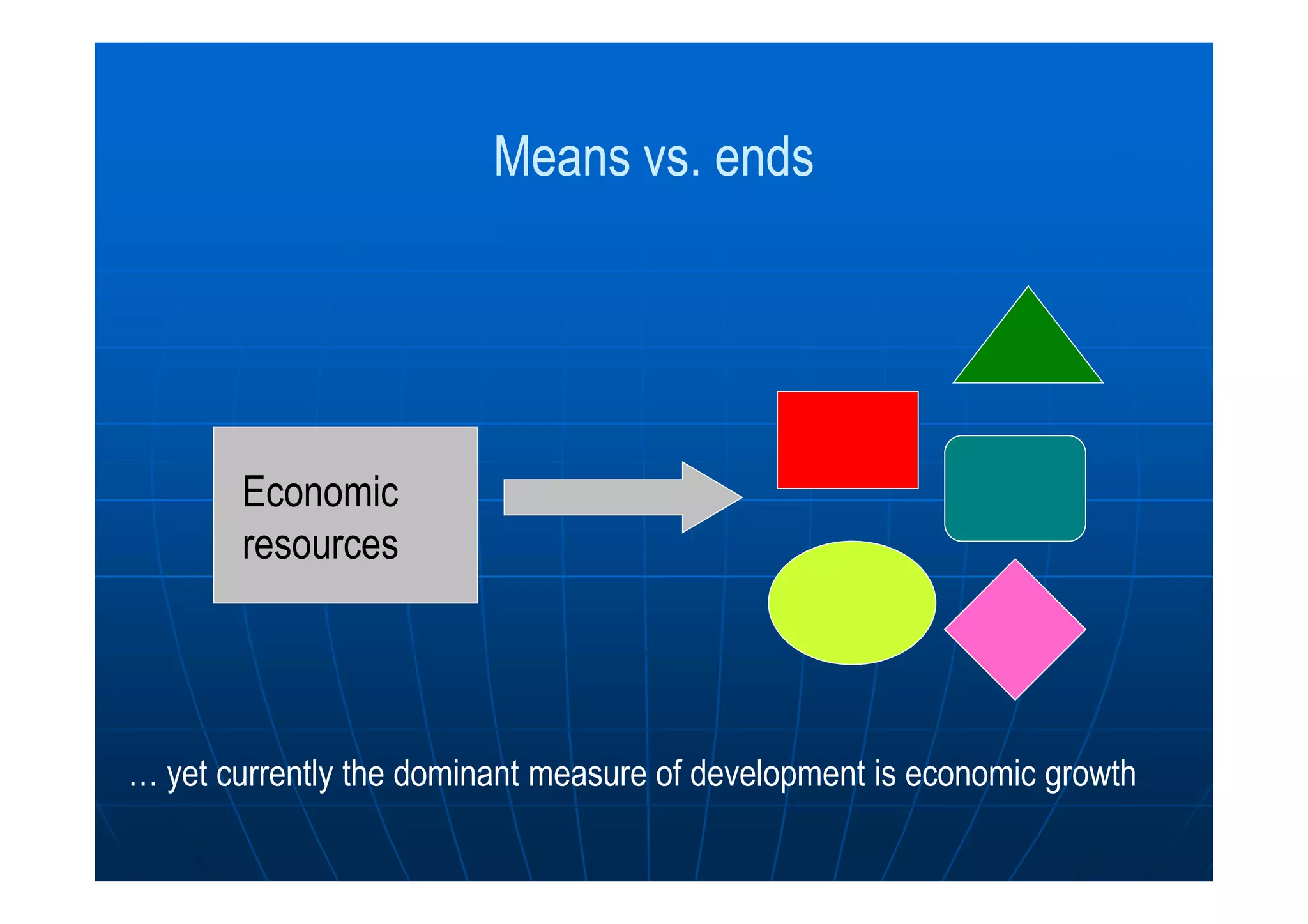
Means vs. endsMeans vs. ends
Economic
resources
… yet currently the dominant measure of development is economic growth
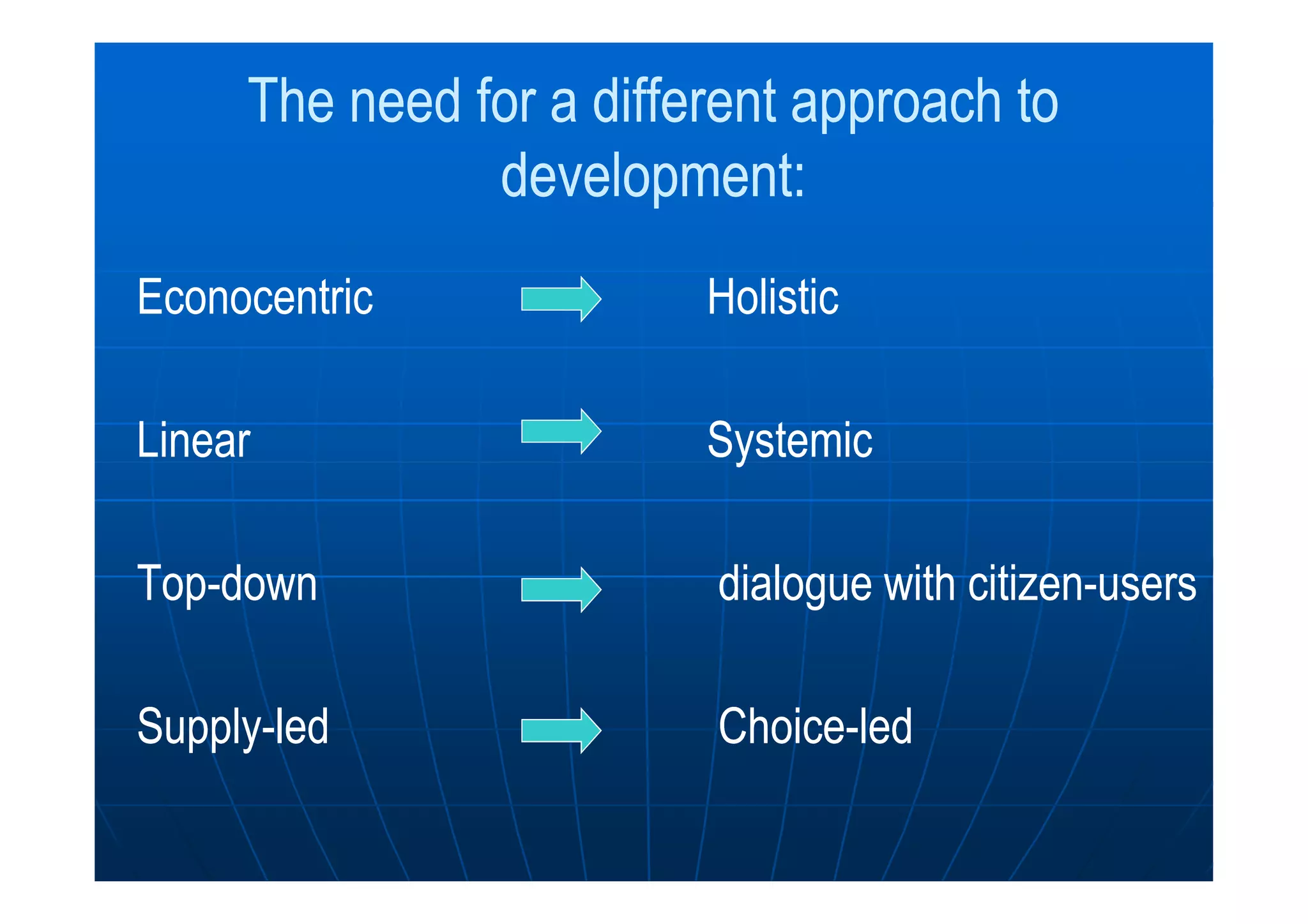
The need for a different approach toThe need for a different approach to
development:development:
EconocentricEconocentric HolisticHolistic
LinearLinear SystemicSystemicLinearLinear SystemicSystemic
TopTop--downdown dialogue with citizendialogue with citizen--usersusers
SupplySupply--ledled ChoiceChoice--ledled
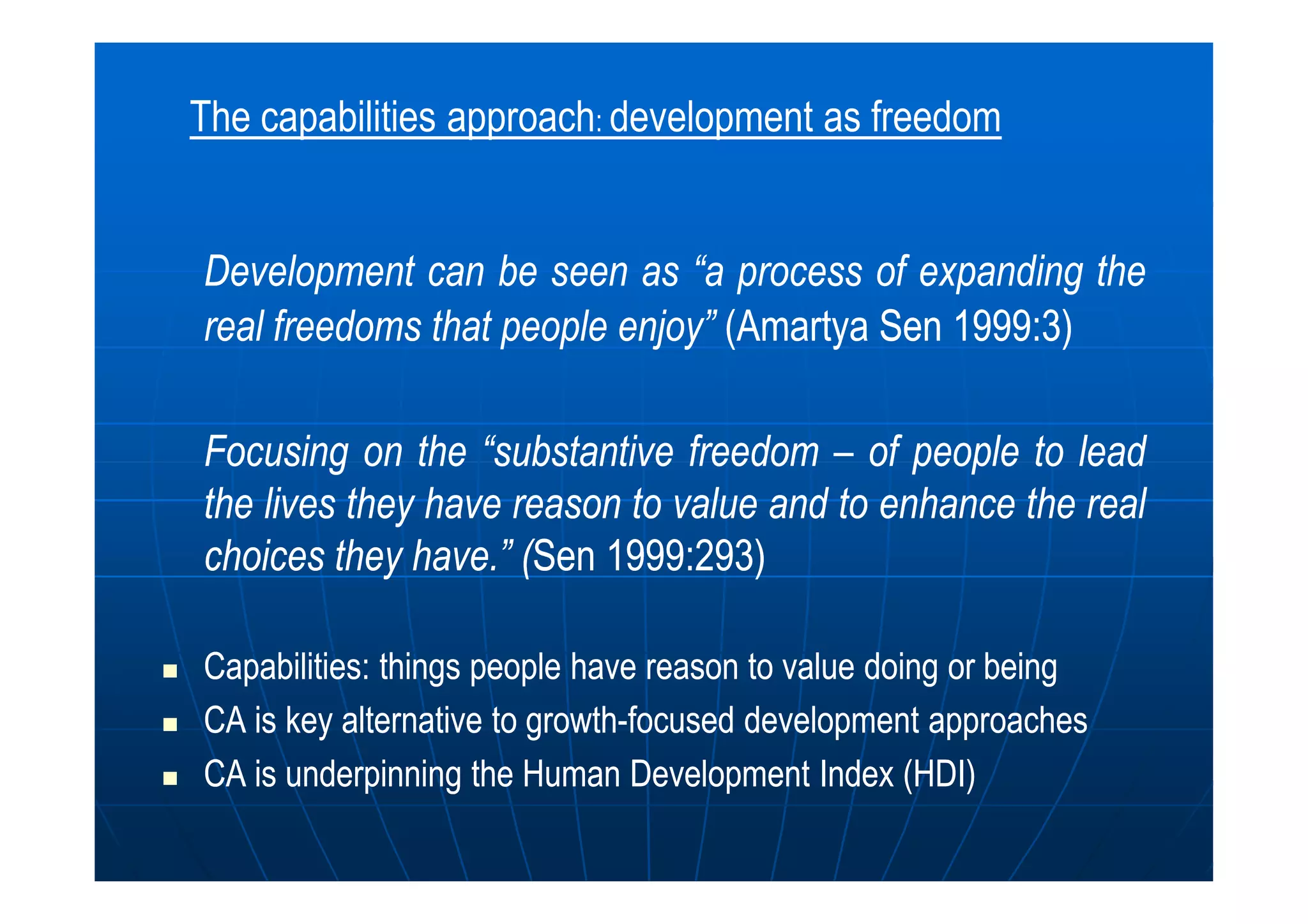
DevelopmentDevelopment cancan bebe seenseen asas “a“a processprocess ofof expandingexpanding thethe
realreal freedomsfreedoms thatthat peoplepeople enjoy”enjoy” ((AmartyaAmartya SenSen 19991999::33))
FocusingFocusing onon thethe “substantive“substantive freedomfreedom –– ofof peoplepeople toto leadlead
The capabilities approach: development as freedom
FocusingFocusing onon thethe “substantive“substantive freedomfreedom –– ofof peoplepeople toto leadlead
thethe liveslives theythey havehave reasonreason toto valuevalue andand toto enhanceenhance thethe realreal
choiceschoices theythey havehave..”” ((SenSen 19991999::293293))
Capabilities: things people have reason to value doing or beingCapabilities: things people have reason to value doing or being
CA is key alternative to growthCA is key alternative to growth--focused development approachesfocused development approaches
CA is underpinning the Human Development Index (HDI)CA is underpinning the Human Development Index (HDI)
OperationalisingOperationalising
the Capabilities Approachthe Capabilities Approachthe Capabilities Approachthe Capabilities Approach
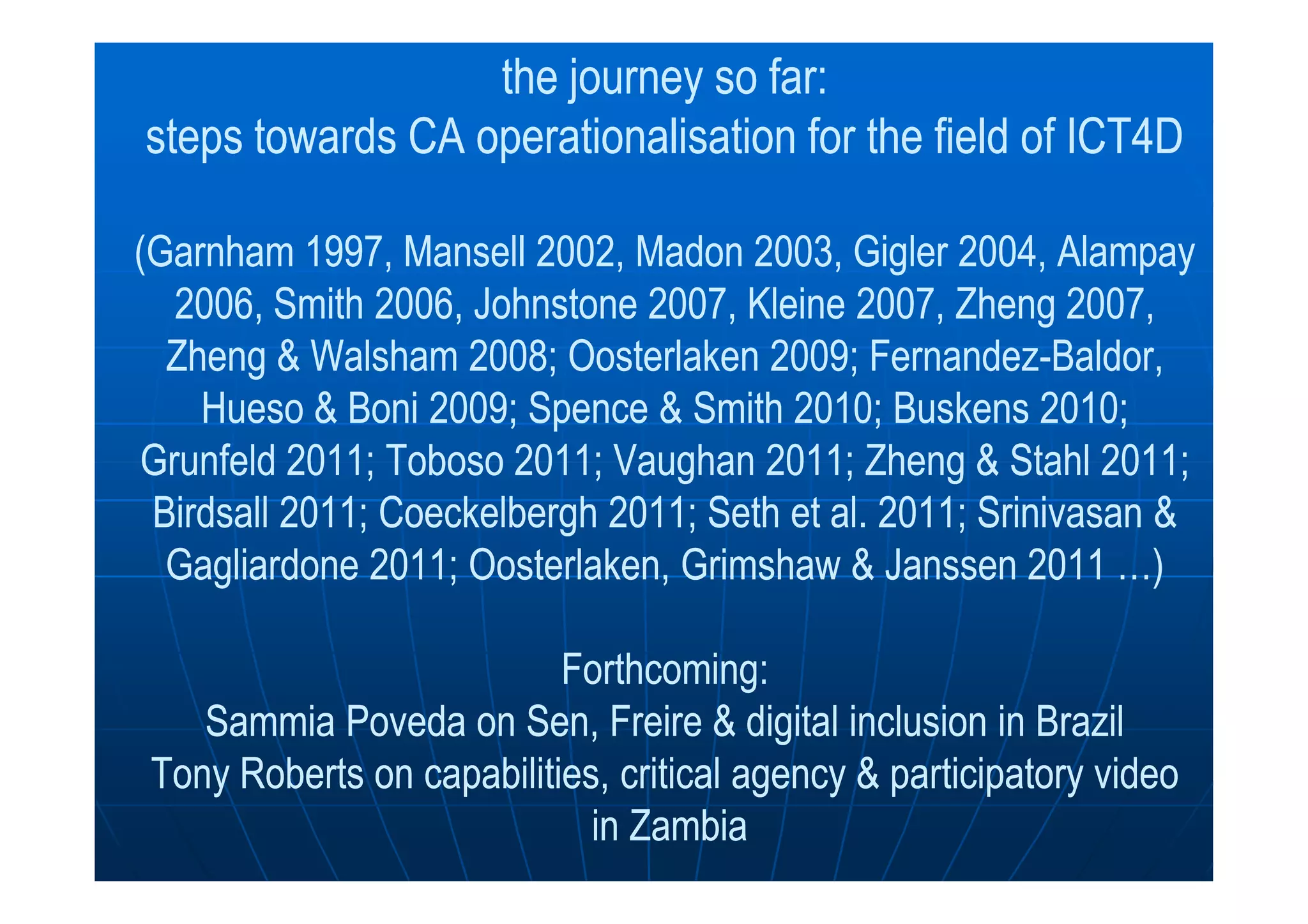
the journey so far:the journey so far:
steps towards CAsteps towards CA operationalisationoperationalisation for the field of ICT4Dfor the field of ICT4D
((GarnhamGarnham 1997,1997, MansellMansell 2002,2002, MadonMadon 2003,2003, GiglerGigler 2004,2004, AlampayAlampay
2006, Smith2006, Smith 2006,2006, JohnstoneJohnstone 2007, Kleine 2007,2007, Kleine 2007, ZhengZheng 2007,2007,
ZhengZheng && WalshamWalsham 2008;2008; OosterlakenOosterlaken 2009; Fernandez2009; Fernandez--BaldorBaldor,,
HuesoHueso && BoniBoni 2009; Spence2009; Spence & Smith 2010;& Smith 2010; BuskensBuskens 2010;2010;
GrunfeldGrunfeld 2011;2011; TobosoToboso 2011; Vaughan 2011;2011; Vaughan 2011; ZhengZheng && SStahl 2011;tahl 2011;GrunfeldGrunfeld 2011;2011; TobosoToboso 2011; Vaughan 2011;2011; Vaughan 2011; ZhengZheng && SStahl 2011;tahl 2011;
BirdsallBirdsall 2011;2011; CoeckelberghCoeckelbergh 2011; Seth2011; Seth et al. 2011;et al. 2011; SrinivasanSrinivasan &&
GagliardoneGagliardone 2011;2011; OosterlakenOosterlaken,, GrimshawGrimshaw & Janssen 2011& Janssen 2011 …)…)
Forthcoming:Forthcoming:
SammiaSammia PovedaPoveda onon SenSen,, FreireFreire & digital inclusion in Brazil& digital inclusion in Brazil
Tony Roberts on capabilities, critical agency & participatory videoTony Roberts on capabilities, critical agency & participatory video
in Zambiain Zambia
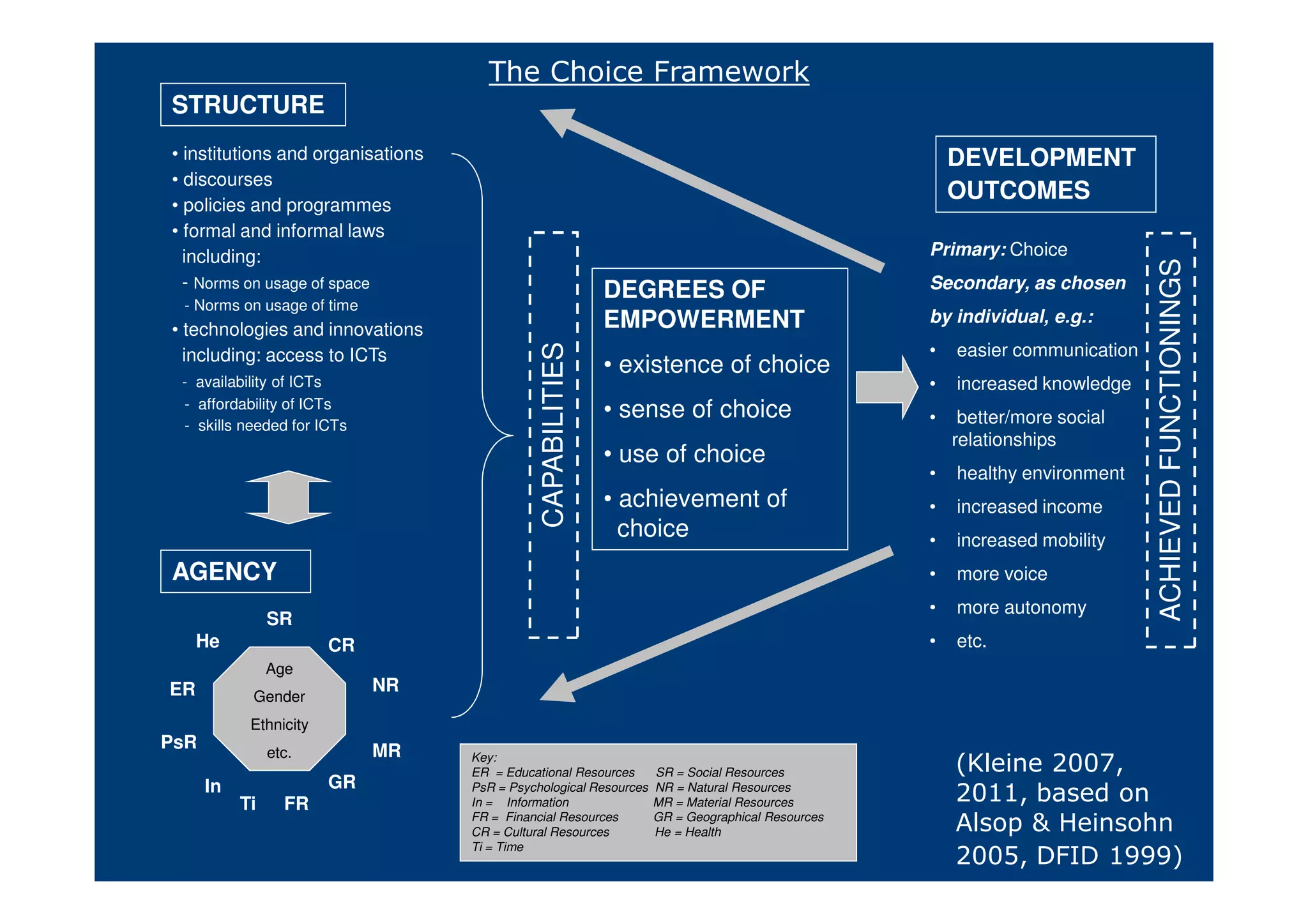
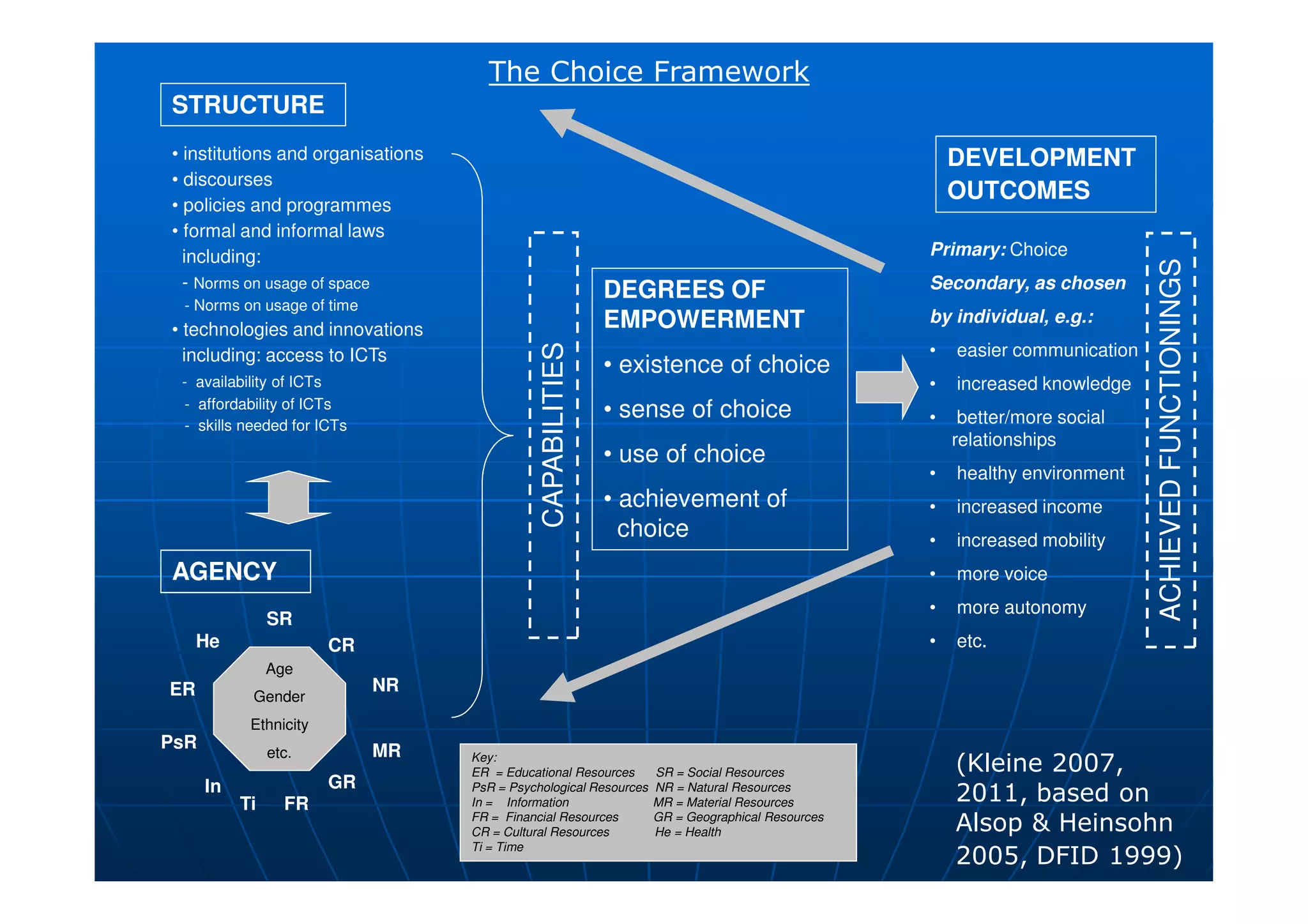
STRUCTURE
DEVELOPMENT
OUTCOMES
• institutions and organisations
• discourses
• policies and programmes
• formal and informal laws
including:
- Norms on usage of space
- Norms on usage of time
• technologies and innovations
including: access to ICTs
- availability of ICTs
- affordability of ICTs
- skills needed for ICTs
DEGREES OF
EMPOWERMENT
• existence of choice
• sense of choice
• use of choice
Primary: Choice
Secondary, as chosen
by individual, e.g.:
• easier communication
• increased knowledge
• better/more social
relationships
CAPABILITIES
ACHIEVEDFUNCTIONINGS
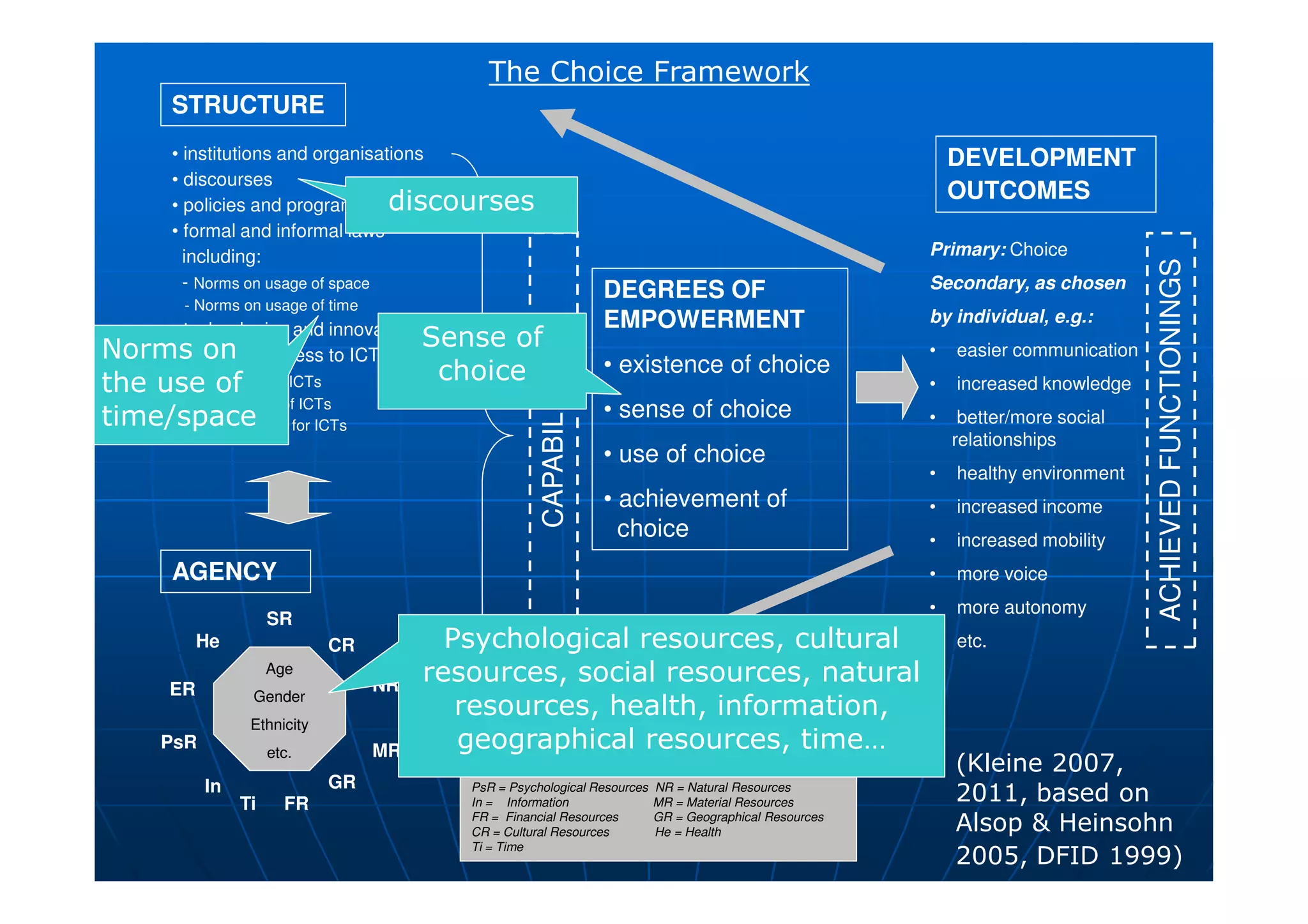
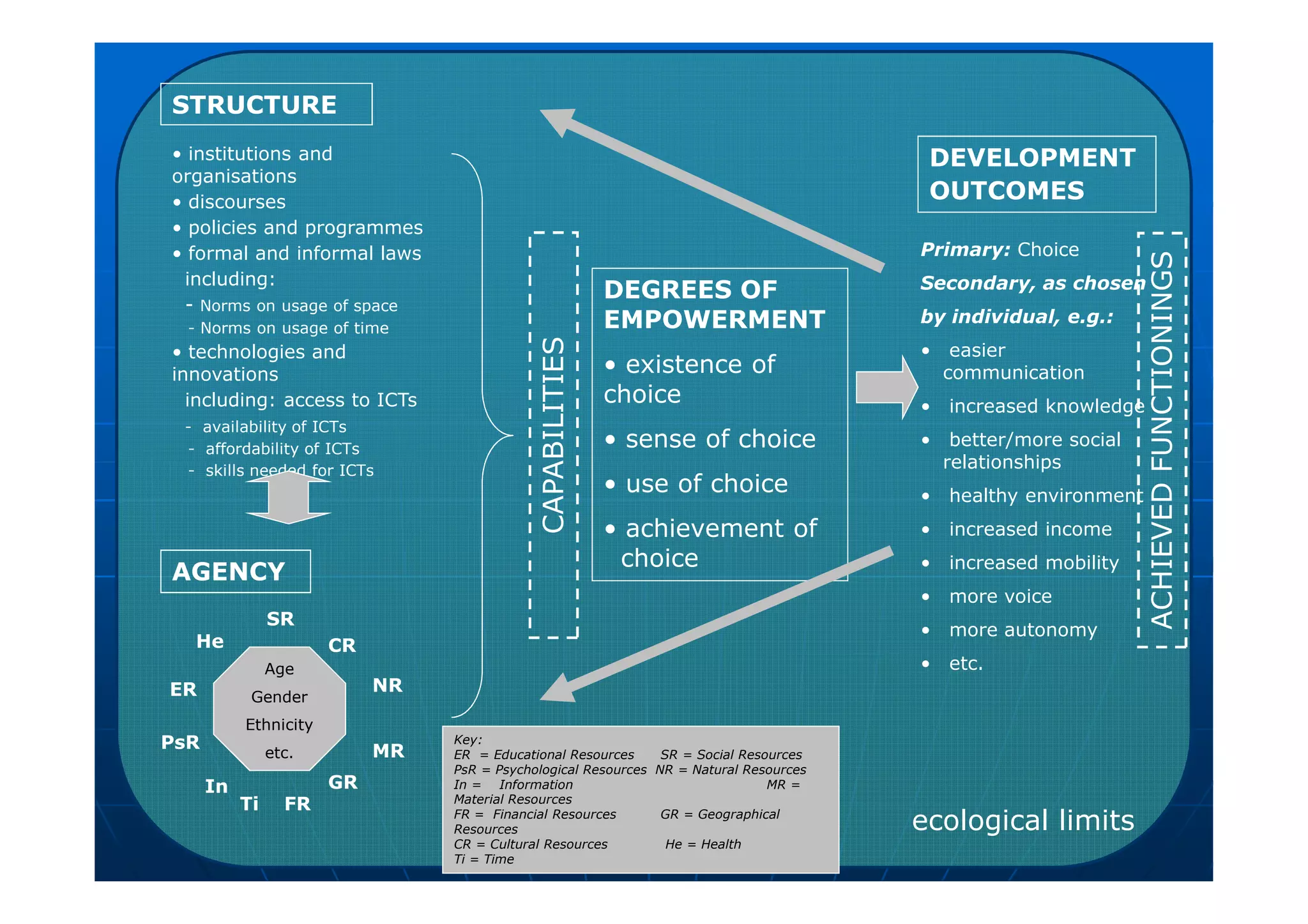
The Choice Framework
AGENCY
SR
PsR MR
ER
FR
In
NR
CR
GR
Key:
ER = Educational Resources SR = Social Resources
PsR = Psychological Resources NR = Natural Resources
In = Information MR = Material Resources
FR = Financial Resources GR = Geographical Resources
CR = Cultural Resources He = Health
Ti = Time
He
• use of choice
• achievement of
choice
Age
Gender
Ethnicity
etc.
• healthy environment
• increased income
• increased mobility
• more voice
• more autonomy
• etc.
CAPABILITIES
Ti
ACHIEVEDFUNCTIONINGS
(Kleine 2007,
2011, based on
Alsop & Heinsohn
2005, DFID 1999)
STRUCTURE
DEVELOPMENT
OUTCOMES
• institutions and organisations
• discourses
• policies and programmes
• formal and informal laws
including:
- Norms on usage of space
- Norms on usage of time
• technologies and innovations
including: access to ICTs
- availability of ICTs
- affordability of ICTs
- skills needed for ICTs
DEGREES OF
EMPOWERMENT
• existence of choice
• sense of choice
• use of choice
Primary: Choice
Secondary, as chosen
by individual, e.g.:
• easier communication
• increased knowledge
• better/more social
relationships
CAPABILITIES
ACHIEVEDFUNCTIONINGS
The Choice Framework
Sense of
choice
discourses
Norms on
the use of
time/space
AGENCY
SR
PsR MR
ER
FR
In
NR
CR
GR
Key:
ER = Educational Resources SR = Social Resources
PsR = Psychological Resources NR = Natural Resources
In = Information MR = Material Resources
FR = Financial Resources GR = Geographical Resources
CR = Cultural Resources He = Health
Ti = Time
He
• use of choice
• achievement of
choice
Age
Gender
Ethnicity
etc.
• healthy environment
• increased income
• increased mobility
• more voice
• more autonomy
• etc.
CAPABILITIES
Ti
ACHIEVEDFUNCTIONINGS
(Kleine 2007,
2011, based on
Alsop & Heinsohn
2005, DFID 1999)
Psychological resources, cultural
resources, social resources, natural
resources, health, information,
geographical resources, time…
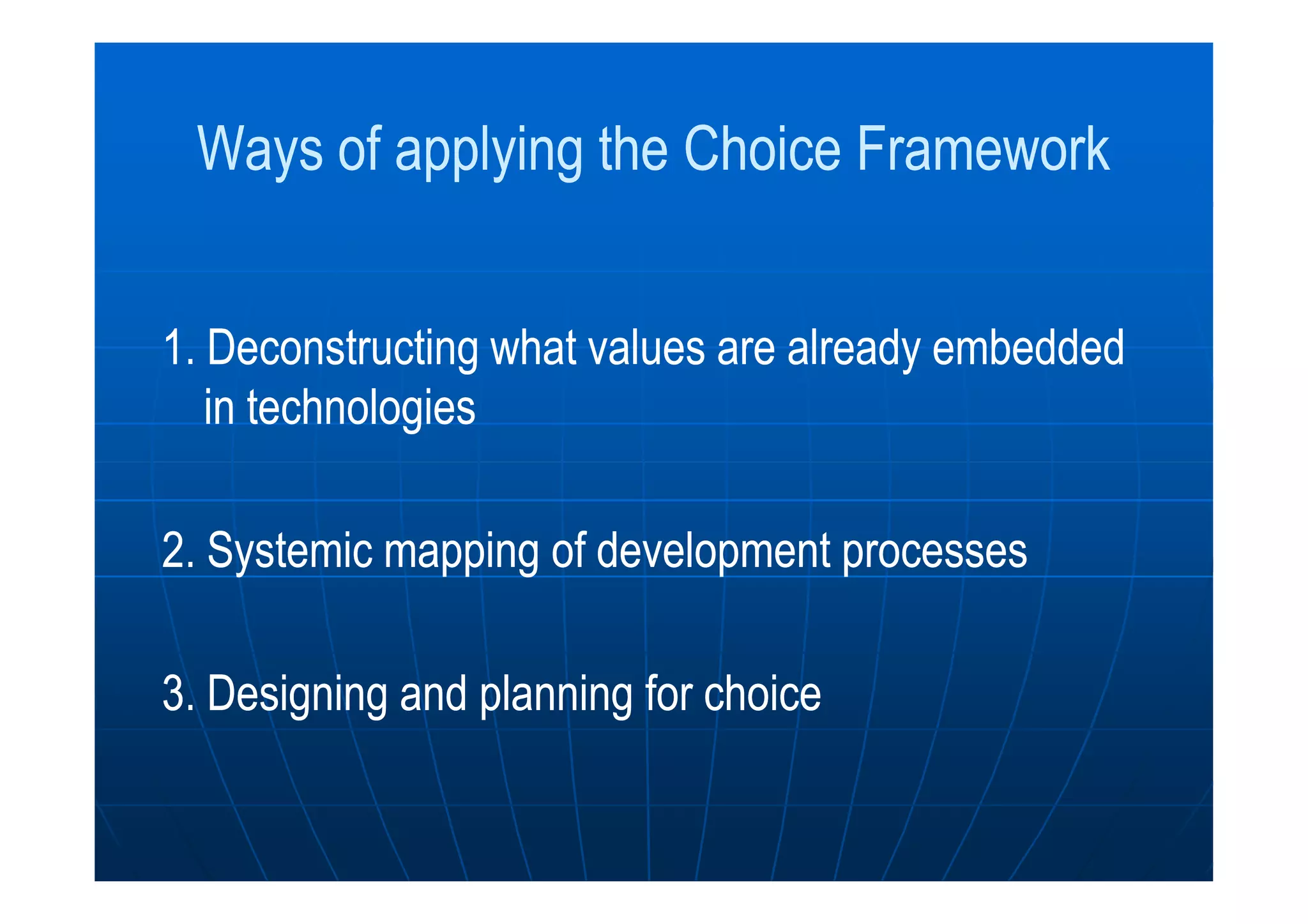
Ways of applying the Choice FrameworkWays of applying the Choice Framework
1.1. Deconstructing what values are already embeddedDeconstructing what values are already embedded
in technologiesin technologies
2. Systemic2. Systemic mapping of development processesmapping of development processes
33.. Designing and planningDesigning and planning forfor choicechoice
ICT policies in ChileICT policies in ChileICT policies in ChileICT policies in Chile
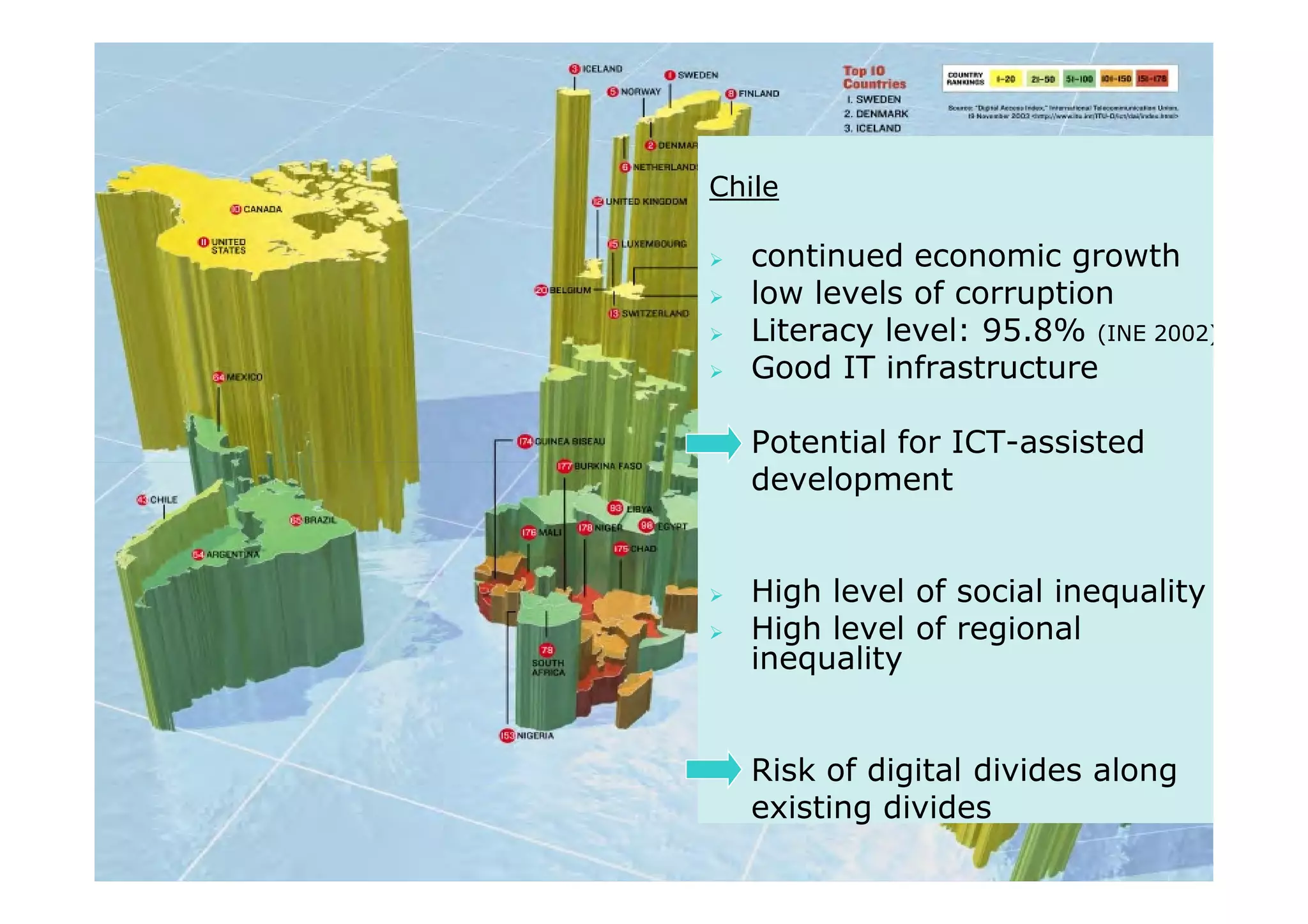
Chile
continued economic growth
low levels of corruption
Literacy level: 95.8% (INE 2002)
Good IT infrastructure
Potential for ICT-assisted
developmentdevelopment
High level of social inequality
High level of regional
inequality
Risk of digital divides along
existing divides
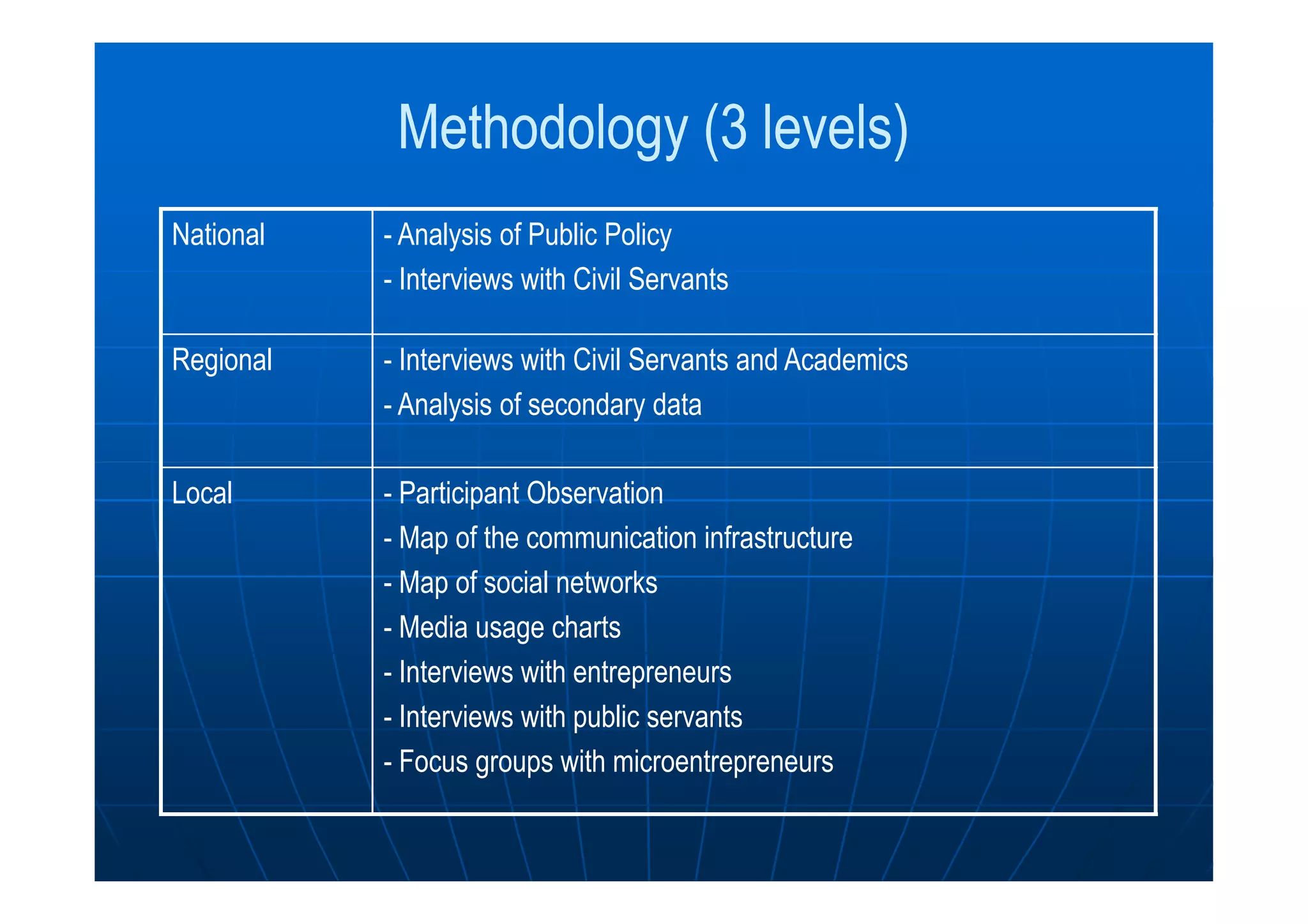
Methodology (3 levels)Methodology (3 levels)
National - Analysis of Public Policy
- Interviews with Civil Servants
Regional - Interviews with Civil Servants and Academics
- Analysis of secondary data
Local - Participant Observation
- Map of the communication infrastructure
- Map of social networks
- Media usage charts
- Interviews with entrepreneurs
- Interviews with public servants
- Focus groups with microentrepreneurs
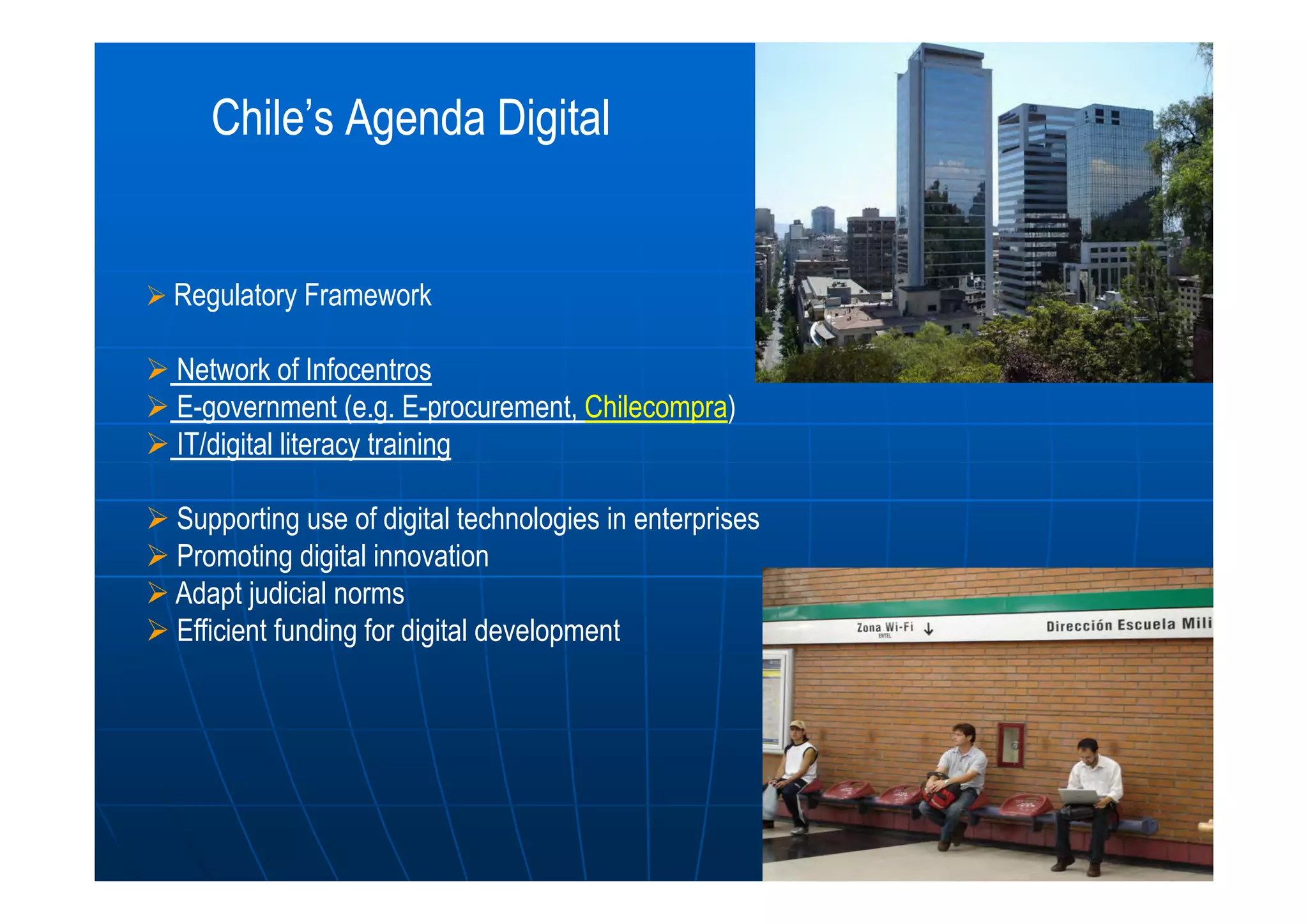
Chile’s Agenda DigitalChile’s Agenda Digital
Regulatory Framework
Network of Infocentros
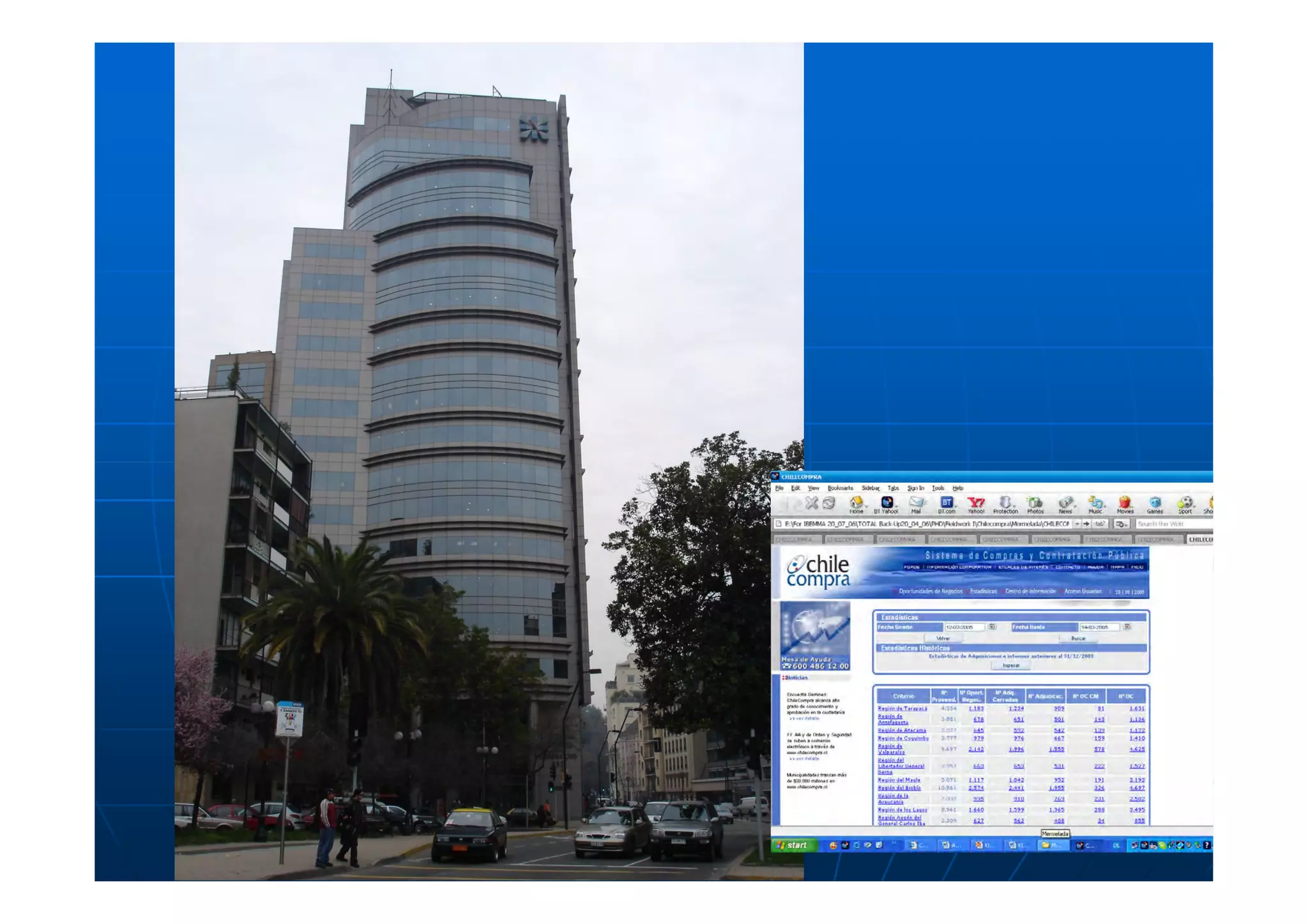
E-government (e.g. E-procurement, Chilecompra)
IT/digital literacy training
Supporting use of digital technologies in enterprises
Promoting digital innovation
Adapt judicial norms
Efficient funding for digital development
Deputy Director of theDeputy Director of the ChilecompraChilecompra ee--procurement system,procurement system,
Santiago de Chile, August 2005:Santiago de Chile, August 2005:
The important thing is that people are proactive and areThe important thing is that people are proactive and are
interested in doing better than others.interested in doing better than others. We have to create theWe have to create theinterested in doing better than others.interested in doing better than others. We have to create theWe have to create the
conditions and the tools in which they can do that […]conditions and the tools in which they can do that […] This allThis all
has to do with the economic model in which Chile ishas to do with the economic model in which Chile is
developing itself.developing itself. Yes, in the end this is a neoliberal marketYes, in the end this is a neoliberal market
economy in which the lances all point in one direction so thateconomy in which the lances all point in one direction so that
the most efficient will win.the most efficient will win. [...][...]
I believe that essentially one has to invest much in educationI believe that essentially one has to invest much in education
in the regions as well. Especially the rural spherein the regions as well. Especially the rural sphere –– how tohow to
include it in the wagon of productivity, in the engine ofinclude it in the wagon of productivity, in the engine of
development. But at the same time this is difficult becausedevelopment. But at the same time this is difficult because
there are also, obviously, the values of those communitiesthere are also, obviously, the values of those communities --
values that can be from another planet, even other spiritualvalues that can be from another planet, even other spiritual
beliefs!beliefs!
Deputy Director of theDeputy Director of the ChilecompraChilecompra ee--procurement system,procurement system,
Santiago de Chile, AugustSantiago de Chile, August 20052005
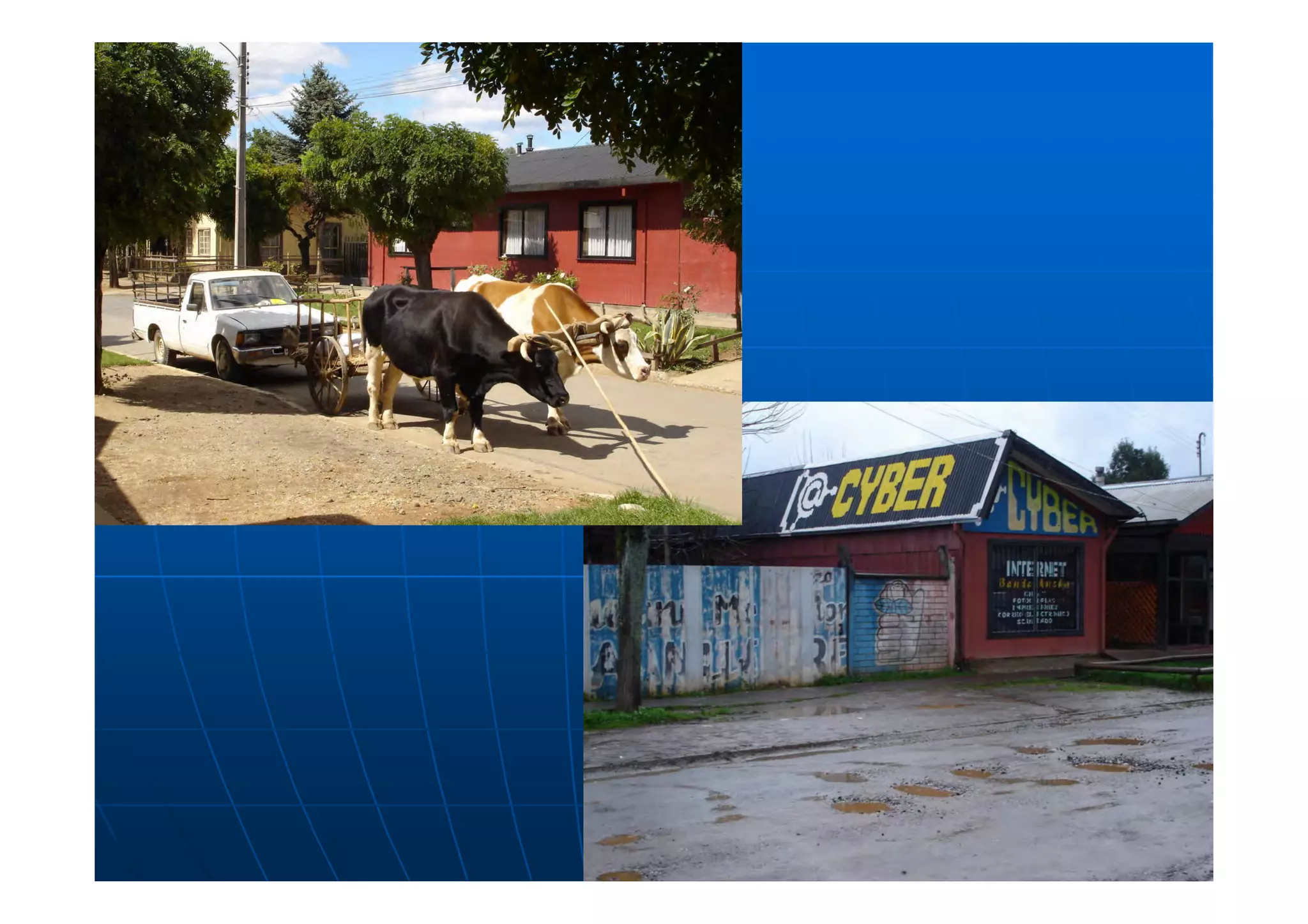
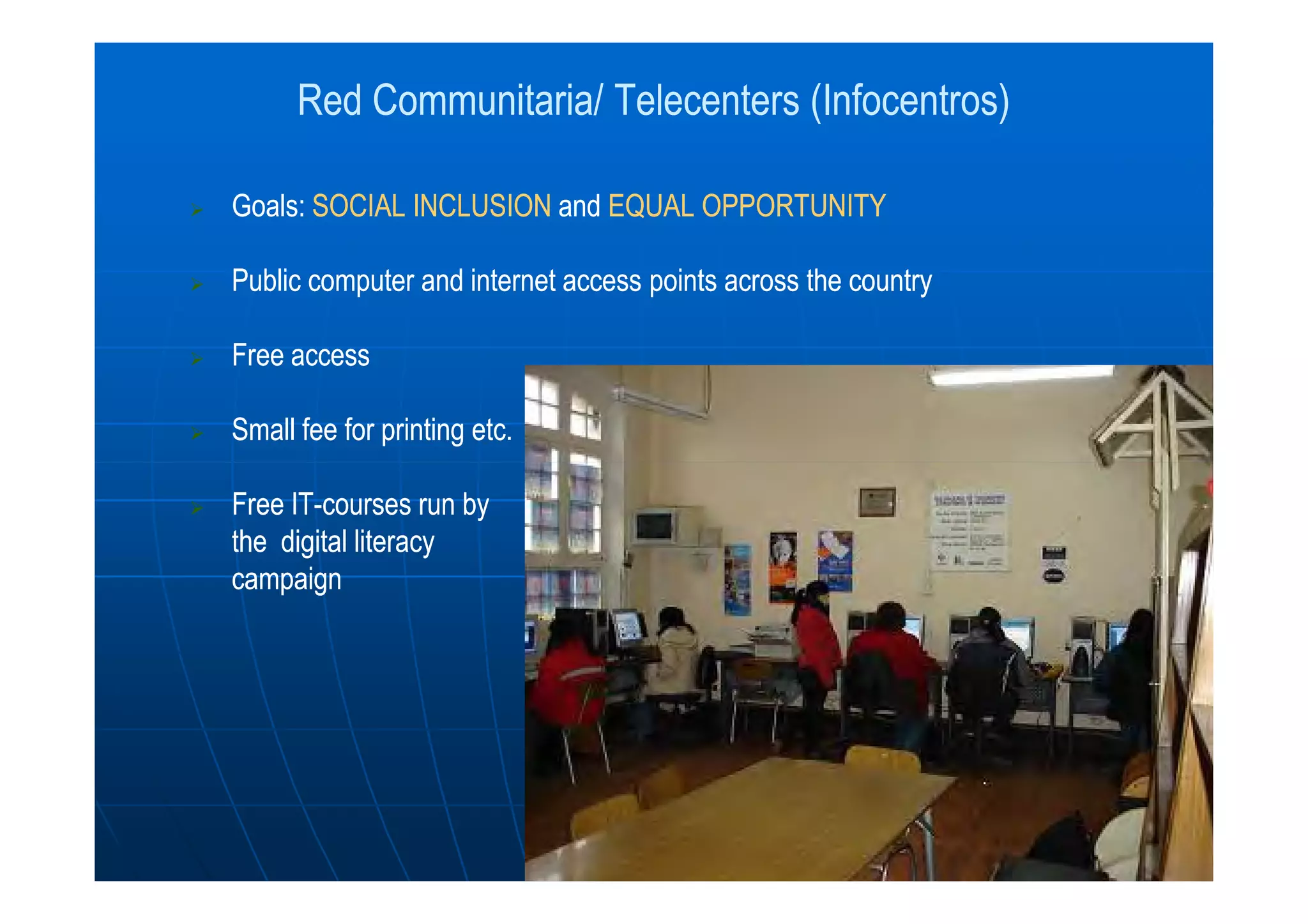
Red Communitaria/ Telecenters (Infocentros)Red Communitaria/ Telecenters (Infocentros)
Goals:Goals: SOCIAL INCLUSIONSOCIAL INCLUSION andand EQUAL OPPORTUNITYEQUAL OPPORTUNITY
Public computer and internet access points across the countryPublic computer and internet access points across the country
Free accessFree access
Small fee for printing etc.Small fee for printing etc.
Free ITFree IT--courses run bycourses run by
the digital literacythe digital literacy
campaigncampaign
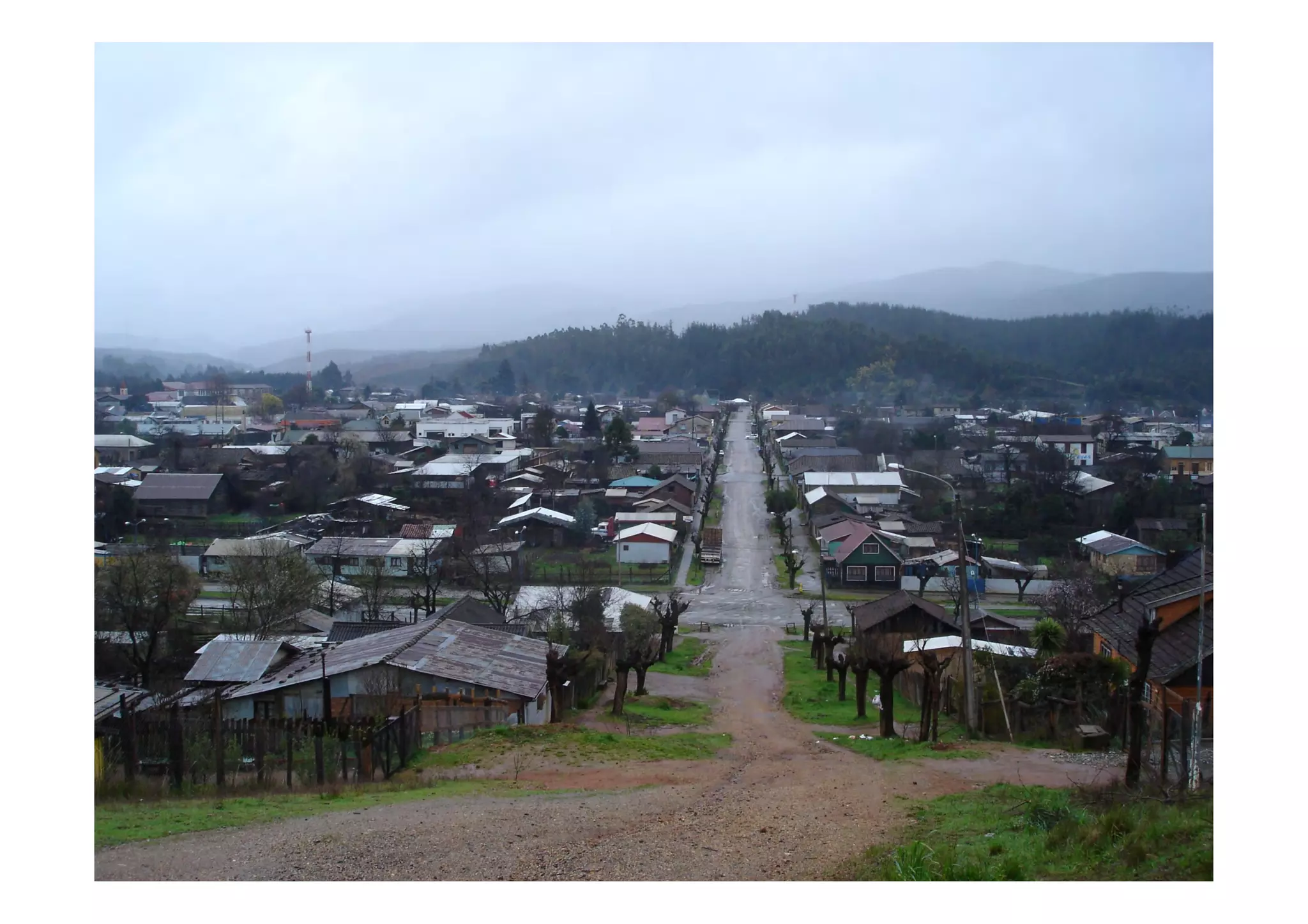
Meeting people: Marta CastilloMeeting people: Marta Castillo
Marta Castillo, microentrepreneur
• single mother, head of household (3 children, 1 grandmother)
• low income
• basic education
• used to be a „nana“ (cook/maid) in Santiago, excellent cooking skills
• Took free IT-course at the Infocentro
• Uses the Internet in the Infocentro to research recipes to diversify
her production (diabetics etc.)
• hopes to organize women so they can provide jam etc. for local
schools and hospitals
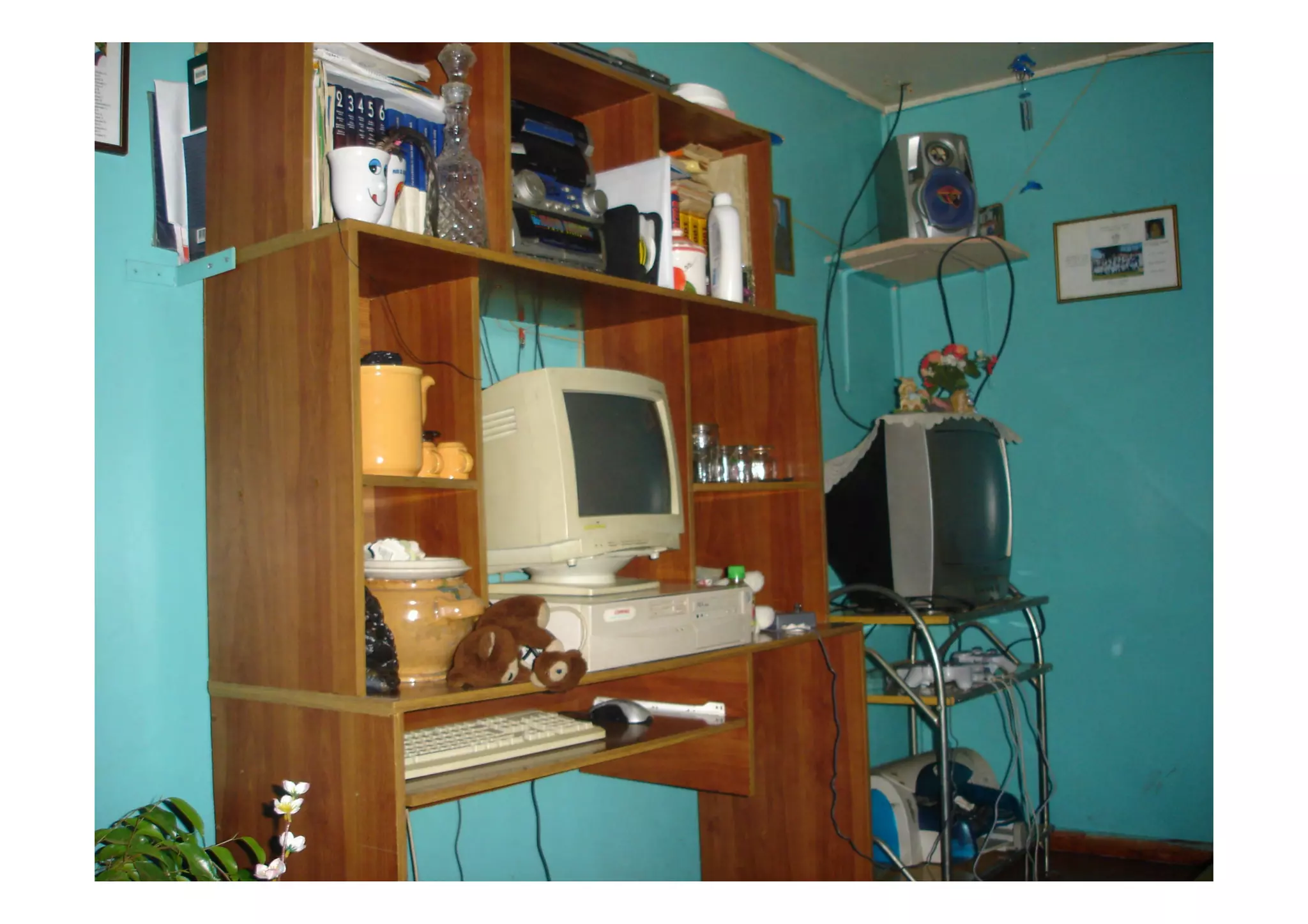
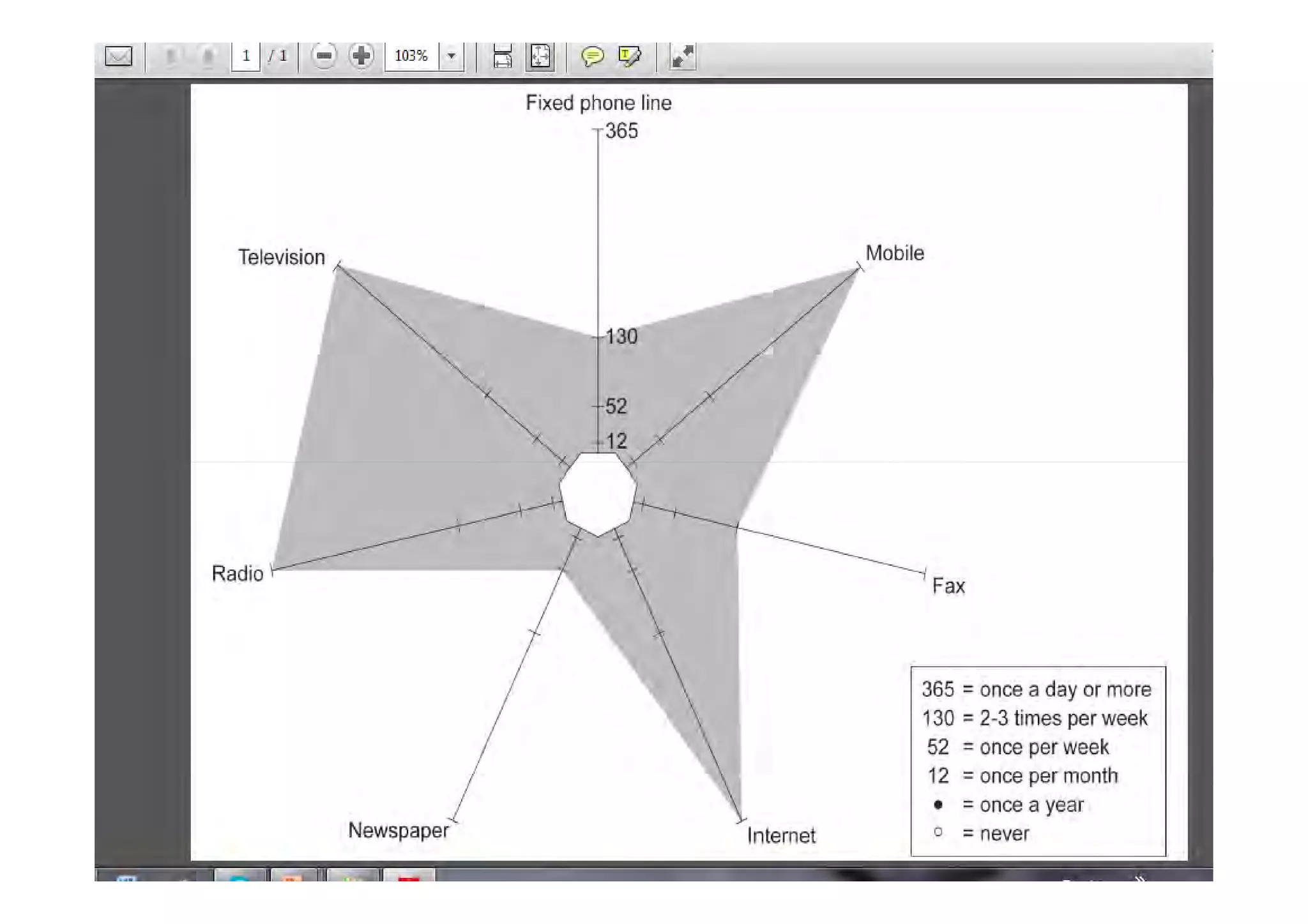
Marta Castillo’s media usage (Kleine 2007)
Marta Castillo,Marta Castillo, microentrepreneurmicroentrepreneur
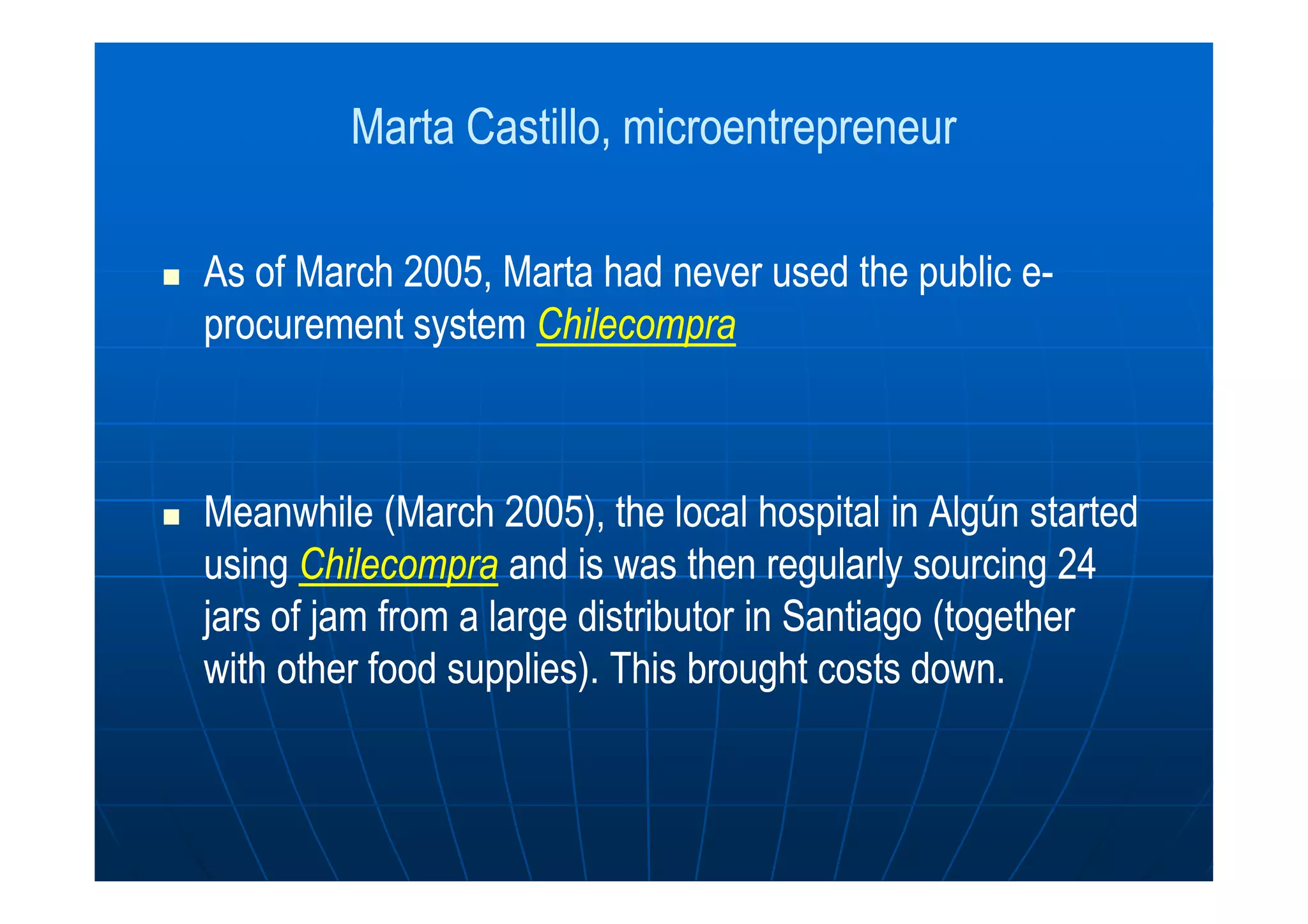
As of March 2005, Marta had never used the public eAs of March 2005, Marta had never used the public e--
procurement systemprocurement system ChilecompraChilecompra
Meanwhile (March 2005), the local hospital in Algún startedMeanwhile (March 2005), the local hospital in Algún started
usingusing ChilecompraChilecompra and is was then regularly sourcing 24and is was then regularly sourcing 24
jars of jam from a large distributor in Santiago (togetherjars of jam from a large distributor in Santiago (together
with other food supplies). This brought costs down.with other food supplies). This brought costs down.
STRUCTURE
DEVELOPMENT
OUTCOMES
• institutions and organisations
• discourses
• policies and programmes
• formal and informal laws
including:
- Norms on usage of space
- Norms on usage of time
• technologies and innovations
including: access to ICTs
- availability of ICTs
- affordability of ICTs
- skills needed for ICTs
DEGREES OF
EMPOWERMENT
• existence of choice
• sense of choice
• use of choice
Primary: Choice
Secondary, as chosen
by individual, e.g.:
• easier communication
• increased knowledge
• better/more social
relationships
CAPABILITIES
ACHIEVEDFUNCTIONINGS
The Choice Framework
AGENCY
SR
PsR MR
ER
FR
In
NR
CR
GR
Key:
ER = Educational Resources SR = Social Resources
PsR = Psychological Resources NR = Natural Resources
In = Information MR = Material Resources
FR = Financial Resources GR = Geographical Resources
CR = Cultural Resources He = Health
Ti = Time
He
• use of choice
• achievement of
choice
Age
Gender
Ethnicity
etc.
• healthy environment
• increased income
• increased mobility
• more voice
• more autonomy
• etc.
CAPABILITIES
Ti
ACHIEVEDFUNCTIONINGS
(Kleine 2007,
2011, based on
Alsop & Heinsohn
2005, DFID 1999)
ConclusionConclusion
ConclusionsConclusions
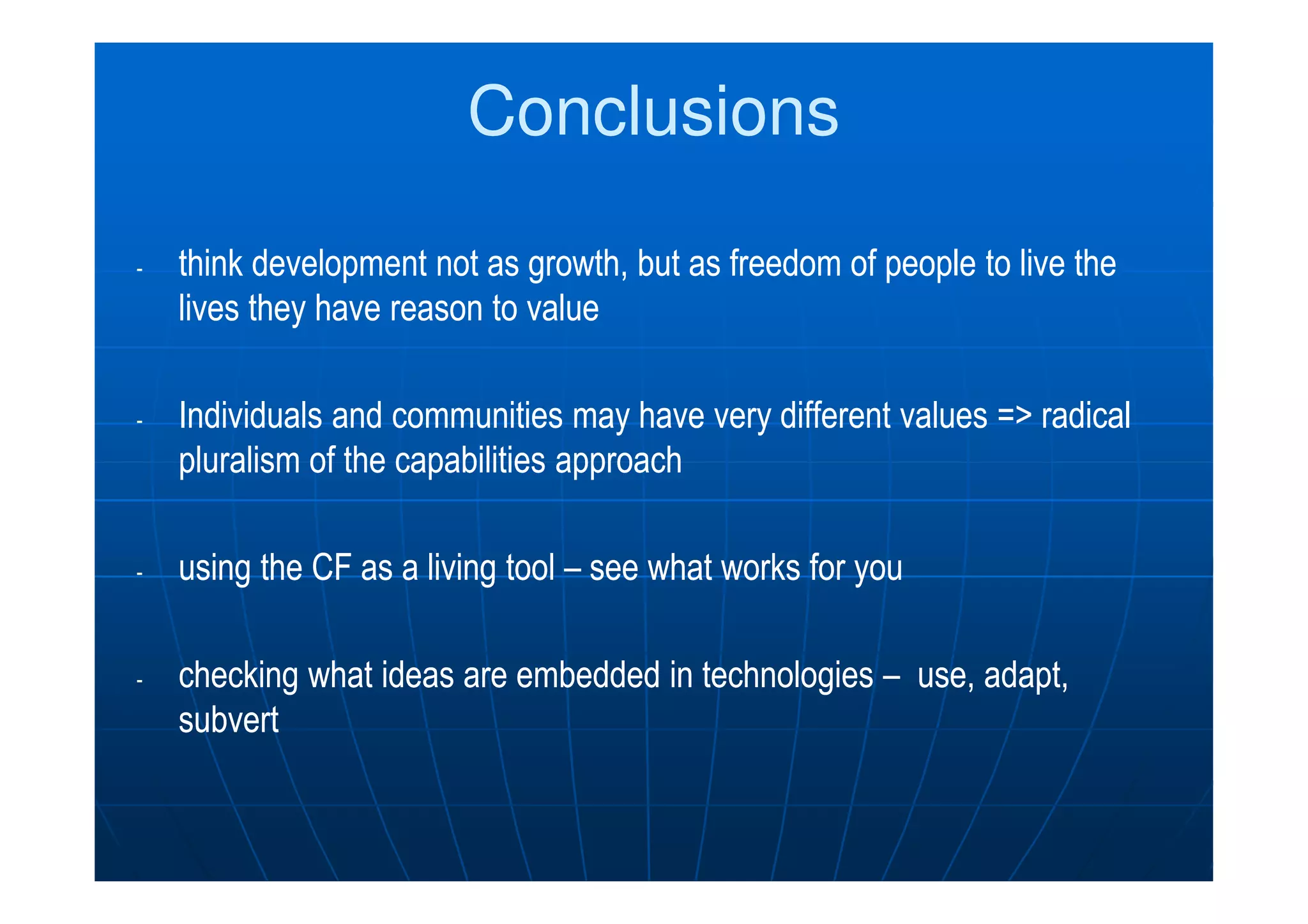
-- thinkthink development not as growth, but asdevelopment not as growth, but as freedom of people to live thefreedom of people to live the
lives they have reason to valuelives they have reason to value
-- Individuals and communities may have very different values => radicalIndividuals and communities may have very different values => radical
pluralism of the capabilities approachpluralism of the capabilities approachpluralism of the capabilities approachpluralism of the capabilities approach
-- usingusing the CF as a living toolthe CF as a living tool –– see what works forsee what works for youyou
-- checkingchecking what ideas are embedded in technologieswhat ideas are embedded in technologies –– useuse, adapt,, adapt,
subvertsubvert
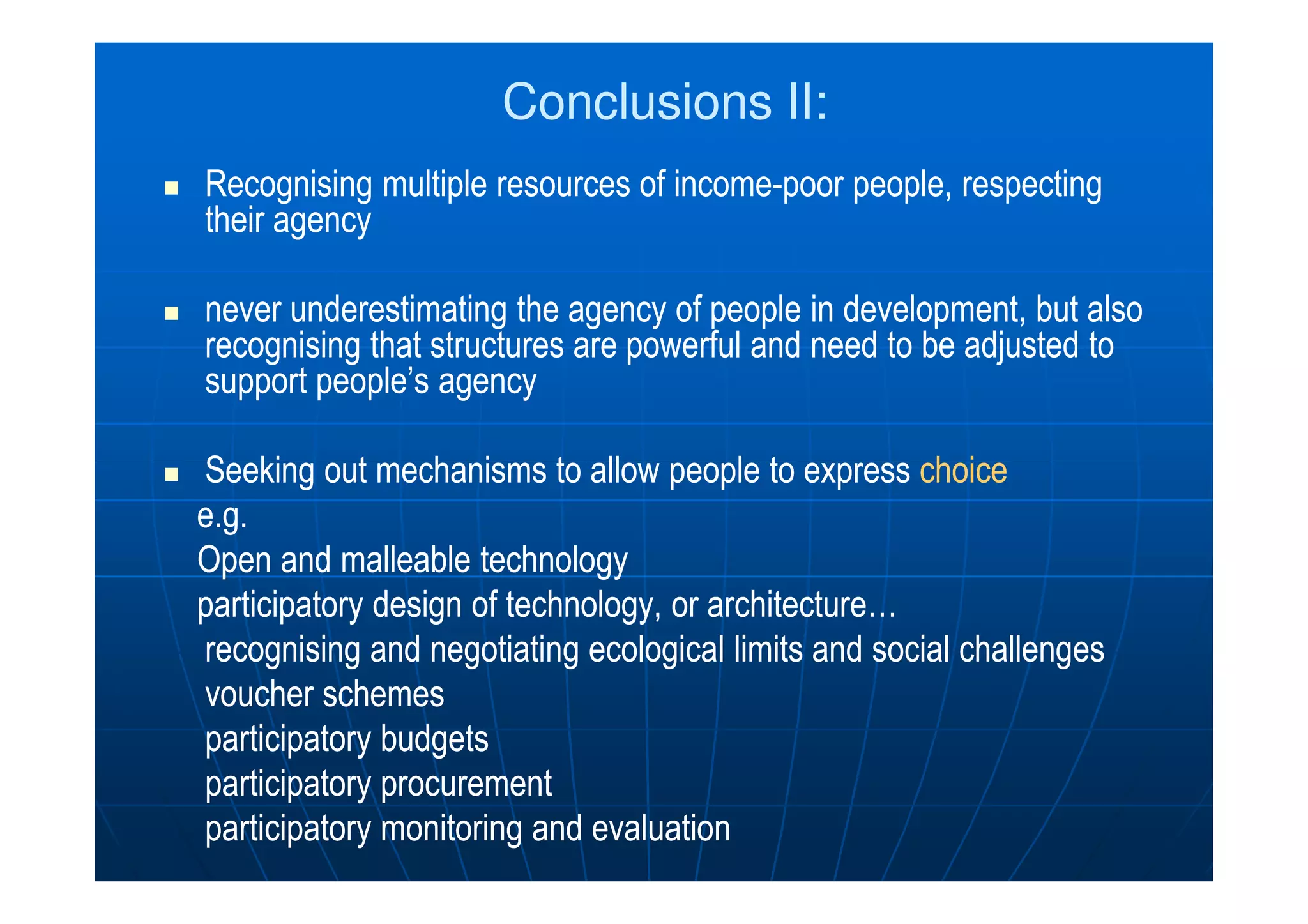
Conclusions II:Conclusions II:
Recognising multiple resources of incomeRecognising multiple resources of income--poor people, respectingpoor people, respecting
their agencytheir agency
never underestimatingnever underestimating the agency of people in development, butthe agency of people in development, but alsoalso
recognisingrecognising that structures are powerful and need to be adjusted tothat structures are powerful and need to be adjusted to
support people’s agencysupport people’s agency
SeekingSeeking out mechanisms to allow people to expressout mechanisms to allow people to express choicechoiceSeekingSeeking out mechanisms to allow people to expressout mechanisms to allow people to express choicechoice
e.ge.g..
Open and malleableOpen and malleable technologytechnology
participatory design of technology, or architecture…participatory design of technology, or architecture…
recognising and negotiating ecological limits and social challengesrecognising and negotiating ecological limits and social challenges
voucher schemesvoucher schemes
participatory budgetsparticipatory budgets
participatoryparticipatory procurementprocurement
participatoryparticipatory monitoring and evaluationmonitoring and evaluation
THINKING DEVELOPMENTTHINKING DEVELOPMENT
BEYOND THE GROWTH PARADIGMBEYOND THE GROWTH PARADIGM
PLANNING AND DESIGNING FOR CHOICEPLANNING AND DESIGNING FOR CHOICE
Thank you!Thank you!
CommentsComments & feedback welcome:& feedback welcome:
dorothea.kleine@rhul.ac.ukdorothea.kleine@rhul.ac.uk
@@dorotheakleinedorotheakleine
Reviews:
Masters in Practising Sustainable Development (ICT4D specialism)
at Royal Holloway, University of London
www.rhul.ac.uk/msc_psd
“landmark volume”
“intellectually exciting, ethnographically rich,
compelling, compassionate”
“a most welcome new approach to ICT4D
studies”
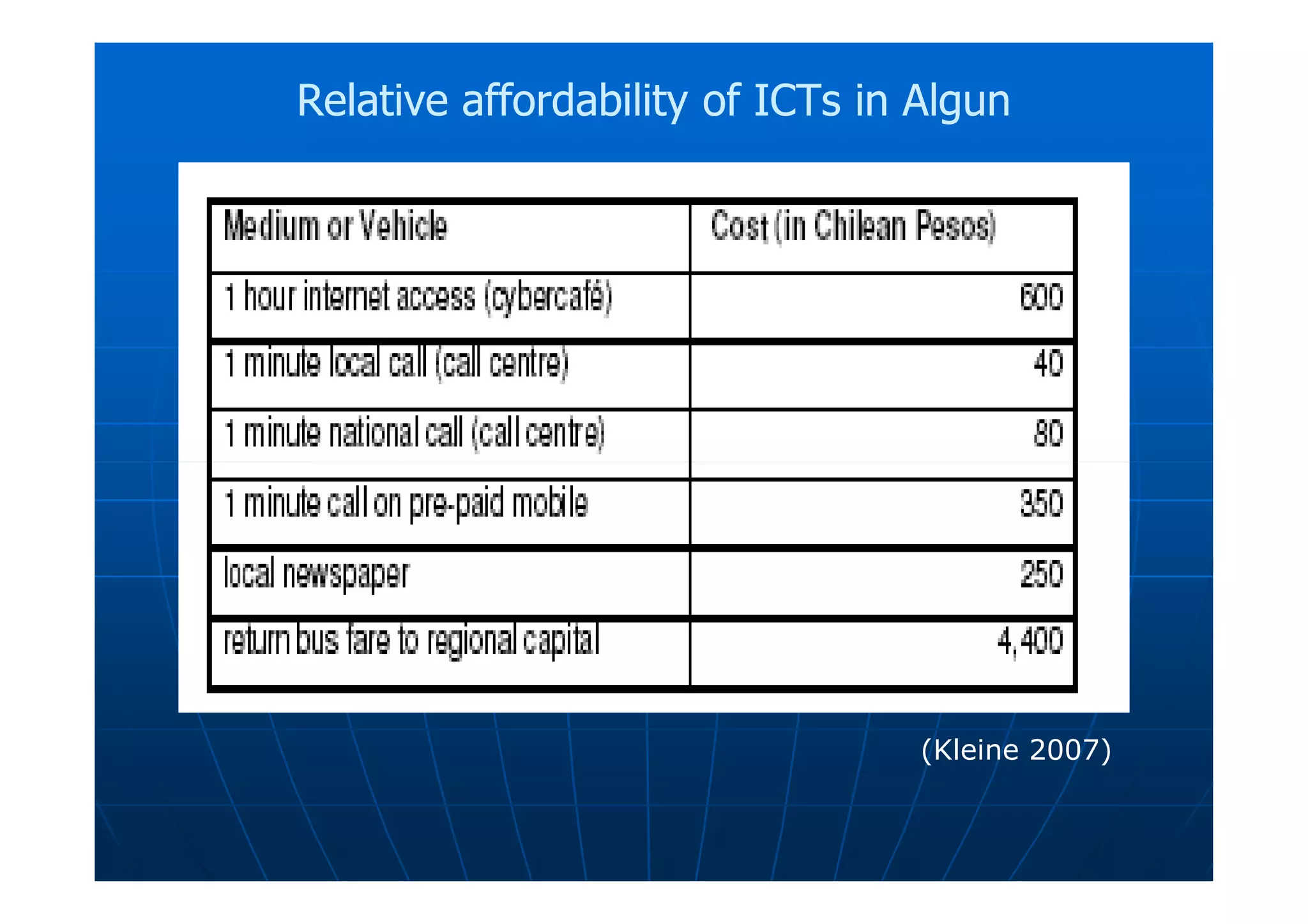
Relative affordability of ICTs in AlgunRelative affordability of ICTs in Algun
(Kleine 2007)
STRUCTURE
DEVELOPMENT
OUTCOMES
• institutions and
organisations
• discourses
• policies and programmes
• formal and informal laws
including:
- Norms on usage of space
- Norms on usage of time
• technologies and
innovations
including: access to ICTs
- availability of ICTs
- affordability of ICTs
- skills needed for ICTs
DEGREES OF
EMPOWERMENT
• existence of
choice
• sense of choice
Primary: Choice
Secondary, as chosen
by individual, e.g.:
• easier
communication
• increased knowledge
• better/more social
relationships
CAPABILITIES
ACHIEVEDFUNCTIONINGS
- skills needed for ICTs
AGENCY
SR
PsR MR
ER
FR
In
NR
CR
GR
Key:
ER = Educational Resources SR = Social Resources
PsR = Psychological Resources NR = Natural Resources
In = Information MR =
Material Resources
FR = Financial Resources GR = Geographical
Resources
CR = Cultural Resources He = Health
Ti = Time
He
• use of choice
• achievement of
choice
Age
Gender
Ethnicity
etc.
relationships
• healthy environment
• increased income
• increased mobility
• more voice
• more autonomy
• etc.
CAPABILITIES
Ti
ACHIEVEDFUNCTIONINGS
ecological limits

2013 techofchoicebooklaunch

  • 1.
    Dr. Dorothea KleineDr.Dorothea Kleine Technologies of Choice?Technologies of Choice? ICTs, development and the capabilities approachICTs, development and the capabilities approach Dr. Dorothea KleineDr. Dorothea Kleine at the UNESCO Chair/Centre in ICT4Dat the UNESCO Chair/Centre in ICT4D RoyalRoyal HollowayHolloway University ofUniversity of LondonLondon
  • 2.
    ICT4 …. Whatkind of development?ICT4 …. What kind of development?
  • 3.
    Means vs. endsMeansvs. ends Economic resources … yet currently the dominant measure of development is economic growth
  • 4.
    The need fora different approach toThe need for a different approach to development:development: EconocentricEconocentric HolisticHolistic LinearLinear SystemicSystemicLinearLinear SystemicSystemic TopTop--downdown dialogue with citizendialogue with citizen--usersusers SupplySupply--ledled ChoiceChoice--ledled
  • 5.
    DevelopmentDevelopment cancan bebeseenseen asas “a“a processprocess ofof expandingexpanding thethe realreal freedomsfreedoms thatthat peoplepeople enjoy”enjoy” ((AmartyaAmartya SenSen 19991999::33)) FocusingFocusing onon thethe “substantive“substantive freedomfreedom –– ofof peoplepeople toto leadlead The capabilities approach: development as freedom FocusingFocusing onon thethe “substantive“substantive freedomfreedom –– ofof peoplepeople toto leadlead thethe liveslives theythey havehave reasonreason toto valuevalue andand toto enhanceenhance thethe realreal choiceschoices theythey havehave..”” ((SenSen 19991999::293293)) Capabilities: things people have reason to value doing or beingCapabilities: things people have reason to value doing or being CA is key alternative to growthCA is key alternative to growth--focused development approachesfocused development approaches CA is underpinning the Human Development Index (HDI)CA is underpinning the Human Development Index (HDI)
  • 6.
    OperationalisingOperationalising the Capabilities ApproachtheCapabilities Approachthe Capabilities Approachthe Capabilities Approach
  • 7.
    the journey sofar:the journey so far: steps towards CAsteps towards CA operationalisationoperationalisation for the field of ICT4Dfor the field of ICT4D ((GarnhamGarnham 1997,1997, MansellMansell 2002,2002, MadonMadon 2003,2003, GiglerGigler 2004,2004, AlampayAlampay 2006, Smith2006, Smith 2006,2006, JohnstoneJohnstone 2007, Kleine 2007,2007, Kleine 2007, ZhengZheng 2007,2007, ZhengZheng && WalshamWalsham 2008;2008; OosterlakenOosterlaken 2009; Fernandez2009; Fernandez--BaldorBaldor,, HuesoHueso && BoniBoni 2009; Spence2009; Spence & Smith 2010;& Smith 2010; BuskensBuskens 2010;2010; GrunfeldGrunfeld 2011;2011; TobosoToboso 2011; Vaughan 2011;2011; Vaughan 2011; ZhengZheng && SStahl 2011;tahl 2011;GrunfeldGrunfeld 2011;2011; TobosoToboso 2011; Vaughan 2011;2011; Vaughan 2011; ZhengZheng && SStahl 2011;tahl 2011; BirdsallBirdsall 2011;2011; CoeckelberghCoeckelbergh 2011; Seth2011; Seth et al. 2011;et al. 2011; SrinivasanSrinivasan && GagliardoneGagliardone 2011;2011; OosterlakenOosterlaken,, GrimshawGrimshaw & Janssen 2011& Janssen 2011 …)…) Forthcoming:Forthcoming: SammiaSammia PovedaPoveda onon SenSen,, FreireFreire & digital inclusion in Brazil& digital inclusion in Brazil Tony Roberts on capabilities, critical agency & participatory videoTony Roberts on capabilities, critical agency & participatory video in Zambiain Zambia
  • 8.
    STRUCTURE DEVELOPMENT OUTCOMES • institutions andorganisations • discourses • policies and programmes • formal and informal laws including: - Norms on usage of space - Norms on usage of time • technologies and innovations including: access to ICTs - availability of ICTs - affordability of ICTs - skills needed for ICTs DEGREES OF EMPOWERMENT • existence of choice • sense of choice • use of choice Primary: Choice Secondary, as chosen by individual, e.g.: • easier communication • increased knowledge • better/more social relationships CAPABILITIES ACHIEVEDFUNCTIONINGS The Choice Framework AGENCY SR PsR MR ER FR In NR CR GR Key: ER = Educational Resources SR = Social Resources PsR = Psychological Resources NR = Natural Resources In = Information MR = Material Resources FR = Financial Resources GR = Geographical Resources CR = Cultural Resources He = Health Ti = Time He • use of choice • achievement of choice Age Gender Ethnicity etc. • healthy environment • increased income • increased mobility • more voice • more autonomy • etc. CAPABILITIES Ti ACHIEVEDFUNCTIONINGS (Kleine 2007, 2011, based on Alsop & Heinsohn 2005, DFID 1999)
  • 9.
    STRUCTURE DEVELOPMENT OUTCOMES • institutions andorganisations • discourses • policies and programmes • formal and informal laws including: - Norms on usage of space - Norms on usage of time • technologies and innovations including: access to ICTs - availability of ICTs - affordability of ICTs - skills needed for ICTs DEGREES OF EMPOWERMENT • existence of choice • sense of choice • use of choice Primary: Choice Secondary, as chosen by individual, e.g.: • easier communication • increased knowledge • better/more social relationships CAPABILITIES ACHIEVEDFUNCTIONINGS The Choice Framework Sense of choice discourses Norms on the use of time/space AGENCY SR PsR MR ER FR In NR CR GR Key: ER = Educational Resources SR = Social Resources PsR = Psychological Resources NR = Natural Resources In = Information MR = Material Resources FR = Financial Resources GR = Geographical Resources CR = Cultural Resources He = Health Ti = Time He • use of choice • achievement of choice Age Gender Ethnicity etc. • healthy environment • increased income • increased mobility • more voice • more autonomy • etc. CAPABILITIES Ti ACHIEVEDFUNCTIONINGS (Kleine 2007, 2011, based on Alsop & Heinsohn 2005, DFID 1999) Psychological resources, cultural resources, social resources, natural resources, health, information, geographical resources, time…
  • 10.
    Ways of applyingthe Choice FrameworkWays of applying the Choice Framework 1.1. Deconstructing what values are already embeddedDeconstructing what values are already embedded in technologiesin technologies 2. Systemic2. Systemic mapping of development processesmapping of development processes 33.. Designing and planningDesigning and planning forfor choicechoice
  • 11.
    ICT policies inChileICT policies in ChileICT policies in ChileICT policies in Chile
  • 12.
    Chile continued economic growth lowlevels of corruption Literacy level: 95.8% (INE 2002) Good IT infrastructure Potential for ICT-assisted developmentdevelopment High level of social inequality High level of regional inequality Risk of digital divides along existing divides
  • 13.
    Methodology (3 levels)Methodology(3 levels) National - Analysis of Public Policy - Interviews with Civil Servants Regional - Interviews with Civil Servants and Academics - Analysis of secondary data Local - Participant Observation - Map of the communication infrastructure - Map of social networks - Media usage charts - Interviews with entrepreneurs - Interviews with public servants - Focus groups with microentrepreneurs
  • 14.
    Chile’s Agenda DigitalChile’sAgenda Digital Regulatory Framework Network of Infocentros E-government (e.g. E-procurement, Chilecompra) IT/digital literacy training Supporting use of digital technologies in enterprises Promoting digital innovation Adapt judicial norms Efficient funding for digital development
  • 19.
    Deputy Director oftheDeputy Director of the ChilecompraChilecompra ee--procurement system,procurement system, Santiago de Chile, August 2005:Santiago de Chile, August 2005: The important thing is that people are proactive and areThe important thing is that people are proactive and are interested in doing better than others.interested in doing better than others. We have to create theWe have to create theinterested in doing better than others.interested in doing better than others. We have to create theWe have to create the conditions and the tools in which they can do that […]conditions and the tools in which they can do that […] This allThis all has to do with the economic model in which Chile ishas to do with the economic model in which Chile is developing itself.developing itself. Yes, in the end this is a neoliberal marketYes, in the end this is a neoliberal market economy in which the lances all point in one direction so thateconomy in which the lances all point in one direction so that the most efficient will win.the most efficient will win. [...][...]
  • 20.
    I believe thatessentially one has to invest much in educationI believe that essentially one has to invest much in education in the regions as well. Especially the rural spherein the regions as well. Especially the rural sphere –– how tohow to include it in the wagon of productivity, in the engine ofinclude it in the wagon of productivity, in the engine of development. But at the same time this is difficult becausedevelopment. But at the same time this is difficult because there are also, obviously, the values of those communitiesthere are also, obviously, the values of those communities -- values that can be from another planet, even other spiritualvalues that can be from another planet, even other spiritual beliefs!beliefs! Deputy Director of theDeputy Director of the ChilecompraChilecompra ee--procurement system,procurement system, Santiago de Chile, AugustSantiago de Chile, August 20052005
  • 24.
    Red Communitaria/ Telecenters(Infocentros)Red Communitaria/ Telecenters (Infocentros) Goals:Goals: SOCIAL INCLUSIONSOCIAL INCLUSION andand EQUAL OPPORTUNITYEQUAL OPPORTUNITY Public computer and internet access points across the countryPublic computer and internet access points across the country Free accessFree access Small fee for printing etc.Small fee for printing etc. Free ITFree IT--courses run bycourses run by the digital literacythe digital literacy campaigncampaign
  • 25.
    Meeting people: MartaCastilloMeeting people: Marta Castillo
  • 26.
    Marta Castillo, microentrepreneur •single mother, head of household (3 children, 1 grandmother) • low income • basic education • used to be a „nana“ (cook/maid) in Santiago, excellent cooking skills • Took free IT-course at the Infocentro • Uses the Internet in the Infocentro to research recipes to diversify her production (diabetics etc.) • hopes to organize women so they can provide jam etc. for local schools and hospitals
  • 27.
    Marta Castillo’s mediausage (Kleine 2007)
  • 28.
    Marta Castillo,Marta Castillo,microentrepreneurmicroentrepreneur As of March 2005, Marta had never used the public eAs of March 2005, Marta had never used the public e-- procurement systemprocurement system ChilecompraChilecompra Meanwhile (March 2005), the local hospital in Algún startedMeanwhile (March 2005), the local hospital in Algún started usingusing ChilecompraChilecompra and is was then regularly sourcing 24and is was then regularly sourcing 24 jars of jam from a large distributor in Santiago (togetherjars of jam from a large distributor in Santiago (together with other food supplies). This brought costs down.with other food supplies). This brought costs down.
  • 29.
    STRUCTURE DEVELOPMENT OUTCOMES • institutions andorganisations • discourses • policies and programmes • formal and informal laws including: - Norms on usage of space - Norms on usage of time • technologies and innovations including: access to ICTs - availability of ICTs - affordability of ICTs - skills needed for ICTs DEGREES OF EMPOWERMENT • existence of choice • sense of choice • use of choice Primary: Choice Secondary, as chosen by individual, e.g.: • easier communication • increased knowledge • better/more social relationships CAPABILITIES ACHIEVEDFUNCTIONINGS The Choice Framework AGENCY SR PsR MR ER FR In NR CR GR Key: ER = Educational Resources SR = Social Resources PsR = Psychological Resources NR = Natural Resources In = Information MR = Material Resources FR = Financial Resources GR = Geographical Resources CR = Cultural Resources He = Health Ti = Time He • use of choice • achievement of choice Age Gender Ethnicity etc. • healthy environment • increased income • increased mobility • more voice • more autonomy • etc. CAPABILITIES Ti ACHIEVEDFUNCTIONINGS (Kleine 2007, 2011, based on Alsop & Heinsohn 2005, DFID 1999)
  • 30.
  • 31.
    ConclusionsConclusions -- thinkthink developmentnot as growth, but asdevelopment not as growth, but as freedom of people to live thefreedom of people to live the lives they have reason to valuelives they have reason to value -- Individuals and communities may have very different values => radicalIndividuals and communities may have very different values => radical pluralism of the capabilities approachpluralism of the capabilities approachpluralism of the capabilities approachpluralism of the capabilities approach -- usingusing the CF as a living toolthe CF as a living tool –– see what works forsee what works for youyou -- checkingchecking what ideas are embedded in technologieswhat ideas are embedded in technologies –– useuse, adapt,, adapt, subvertsubvert
  • 32.
    Conclusions II:Conclusions II: Recognisingmultiple resources of incomeRecognising multiple resources of income--poor people, respectingpoor people, respecting their agencytheir agency never underestimatingnever underestimating the agency of people in development, butthe agency of people in development, but alsoalso recognisingrecognising that structures are powerful and need to be adjusted tothat structures are powerful and need to be adjusted to support people’s agencysupport people’s agency SeekingSeeking out mechanisms to allow people to expressout mechanisms to allow people to express choicechoiceSeekingSeeking out mechanisms to allow people to expressout mechanisms to allow people to express choicechoice e.ge.g.. Open and malleableOpen and malleable technologytechnology participatory design of technology, or architecture…participatory design of technology, or architecture… recognising and negotiating ecological limits and social challengesrecognising and negotiating ecological limits and social challenges voucher schemesvoucher schemes participatory budgetsparticipatory budgets participatoryparticipatory procurementprocurement participatoryparticipatory monitoring and evaluationmonitoring and evaluation
  • 33.
    THINKING DEVELOPMENTTHINKING DEVELOPMENT BEYONDTHE GROWTH PARADIGMBEYOND THE GROWTH PARADIGM PLANNING AND DESIGNING FOR CHOICEPLANNING AND DESIGNING FOR CHOICE
  • 34.
    Thank you!Thank you! CommentsComments& feedback welcome:& feedback welcome: dorothea.kleine@rhul.ac.ukdorothea.kleine@rhul.ac.uk @@dorotheakleinedorotheakleine Reviews: Masters in Practising Sustainable Development (ICT4D specialism) at Royal Holloway, University of London www.rhul.ac.uk/msc_psd “landmark volume” “intellectually exciting, ethnographically rich, compelling, compassionate” “a most welcome new approach to ICT4D studies”
  • 35.
    Relative affordability ofICTs in AlgunRelative affordability of ICTs in Algun (Kleine 2007)
  • 36.
    STRUCTURE DEVELOPMENT OUTCOMES • institutions and organisations •discourses • policies and programmes • formal and informal laws including: - Norms on usage of space - Norms on usage of time • technologies and innovations including: access to ICTs - availability of ICTs - affordability of ICTs - skills needed for ICTs DEGREES OF EMPOWERMENT • existence of choice • sense of choice Primary: Choice Secondary, as chosen by individual, e.g.: • easier communication • increased knowledge • better/more social relationships CAPABILITIES ACHIEVEDFUNCTIONINGS - skills needed for ICTs AGENCY SR PsR MR ER FR In NR CR GR Key: ER = Educational Resources SR = Social Resources PsR = Psychological Resources NR = Natural Resources In = Information MR = Material Resources FR = Financial Resources GR = Geographical Resources CR = Cultural Resources He = Health Ti = Time He • use of choice • achievement of choice Age Gender Ethnicity etc. relationships • healthy environment • increased income • increased mobility • more voice • more autonomy • etc. CAPABILITIES Ti ACHIEVEDFUNCTIONINGS ecological limits