Information Memorandum
Licensing of Spectrum for Telecommunications Service
in the Frequency Band of 1800 MHz
Office of the National Broadcasting and Telecommunications
Commission (Office of the NBTC)
The English version of this Information Memorandum is prepared for the sole purpose of providing
foreign participants with a greater understanding of the telecommunication rules and regulations in
Thailand and shall not under any circumstances be construed or interpreted as being a substitute for
or supplementary to the Thai version thereof.
Legal Note
This Information Memorandum (the “Memorandum”) has been prepared on behalf of
the National Broadcasting and Telecommunications Commission of Thailand (NBTC) in respect of
criteria and procedures for the licensing of spectrum for Telecommunications Service in the
frequency band of 1800 MHz. Licensing is to take place by way of an Auction in accordance with the
powers conferred by Section 27 (1), (2), (4), (6), (8), (11), (13) and (24), Section 29, Section 40,
Section 45 and Section 81 of the Act on the Organization to Assign Radio Frequency and to Regulate
the Broadcasting and Telecommunications Services B.E. 2553 (2010), in conjunction with Section 7,
Section 8, Section 9, Section 10, Section 24, Section 64, Section 65 and Section 66 of the
Telecommunications Business Act B.E. 2544 (2001) and its amendments.
This Memorandum is for information purposes only and has no binding force. This
Memorandum is not intended to form any part of the basis of any investment decision or other
evaluation or any decision to participate in the Auction, and should not be considered as a
recommendation by the NBTC. Readers must make their own assessment of the potential value of an
assignment of the 1800 MHz spectrum for telecommunications service in order to determine
whether to participate in the Auction. The NBTC and the Office of the National Broadcasting and
Telecommunications Commission of Thailand (Office of the NBTC) reserve the right to update, modify,
or amend as deemed fit the information contained in this Memorandum. Neither the NBTC nor the
Office of the NBTC make any representation or warranty or accept or will accept any responsibility or
liability in relation to the accuracy or completeness of the information contained in this
Memorandum or any other written or oral information made available to any interested party or its
advisor. In particular, but without prejudice to the generality of the foregoing, no representation or
warranty is given as to the achievement or reasonableness of any future projections, estimates,
prospects, or returns contained in this Memorandum.
This Memorandum does not constitute the basis of any contract that may be concluded
in relation to the Auction or the spectrum licensing. Readers should not construe the content of this
Memorandum, or any other communications by the NBTC, as financial, legal, tax, or other advice.
Accordingly, each reader of this Memorandum should consult their own professional advisors as to
financial, legal, tax, and other matters concerning any potential participation in the application for
the spectrum license for the provision of telecommunications services.
The NBTC reserves the right to modify the spectrum licensing process and will neither
make any representation or warranty nor accept or will accept any responsibility or liability
whatsoever as to, or in relation to, any errors or damages relating to the bidding procedure or any
related hardware or software.
Content
Page
Section 1 Introduction 1
1.1 Policy Objectives of the Spectrum Auction 2
1.2 Spectrum to be auctioned 3
Section 2 Background Information 5
2.1 Thai Economy 5
2.2 Thai Telecommunications Market 6
2.3 Mobile Market 9
2.4 Fixed Telephone Market 15
2.5 Fixed Broadband Market 17
2.6 Mobile Broadband Market 19
Section 3 Legal and Policy Background and Regulatory Regime 22
3.1 Act on the Organisation to Assign Radio Frequency and to Regulate the
Broadcasting and Telecommunications Services B.E. 2553 (2010)
22
3.2 Telecommunications Business Act, B.E. 2544 (2001) and its Amendment 23
3.3 The Telecommunications Master Plan No. 1, B.E. 2555-2559 (2012-2016) 24
3.4 The Spectrum Management Master Plan, B.E. 2555 (2012) 25
3.5 Important Regulatory Issues 27
Section 4 The License 33
4.1 Spectrum to be licensed 33
4.2 Number of Licenses 33
4.3 License and Its Scope 34
4.4 License Duration 35
4.5 Annual License Fee 35
4.6 Licensing Terms and Conditions 36
Section 5 Licensing Procedure 38
5.1 Licensing Phases 38
5.2 Timetable for Spectrum Licensing 39
5.3 Pre-Qualification Process 40
5.4 Spectrum Auction Fee 42
5.5 Granting of Licenses 43
5.6 Measures for Restricting Collusive Behaviour 43
Page
Section 6 Auction Methodology and Rules 45
6.1 Auction Methodology 45
6.2 Spectrum to be Auctioned and the First Round Price 45
6.3 Auction Round 46
6.4 Auction Process 46
6.5 Waivers 48
6.6 Information Disclosure 48
6.7 Termination of a Bidder Status 49
6.8 Conclusion of the Auction 49
6.9 Reserved Rights 49
Section 7 Annexes
Annex A Application Forms
Annex B License Conditions for Type Three Telecommunications Business Operation;
General Conditions and Specific Conditions for Telecommunications Business
with Its Own Network
page | 1
Section 1
Introduction
The National Broadcasting and Telecommunications Commission (NBTC) is responsible
for managing the spectrum for telecommunications service and regulating the telecommunications
business in Thailand. The Master Plan for Telecommunications Services B.E. 2555-2559 (2012–2016)
outlines a vision to “develop the telecommunications business, minimize the gap in access to
information technology, enhance the country’s competitiveness and upgrade Thai people’s quality of
life.” In implementing the Master Plan, the NBTC has devised the regime for spectrum licensing,
telecommunications service licensing and the regulation of telecommunications businesses in
Thailand.
The NBTC has established a policy on spectrum management and use of spectrum which
are national communications resources, considering the utmost public benefits at national and local
levels in education, culture, State security and other public interests including fair and free
competition, as well as the procedures that will ensure thorough and appropriate distribution of
benefits to various services and in line with State policy for the development of digital economy. The
NBTC also considers that the mobile telecommunications service is a key factor of industrial,
economic and social development which will elevate Thailand’s telecommunication development in
line with the global evolution and will promote the public right to communicate and the
advancement in receiving information, as well as in compliance with the fundamental
telecommunications business policy of the country
The NBTC intends to grant 1800 MHz spectrum licenses by way of auction according to the
licensing criteria and procedures prescribed in the NBTC’s Notification regarding Criteria and Procedure for
Spectrum Licensing for Telecommunications Service in the Frequency Band of 1800 MHz. Where the details
contained in this Memorandum are contradictory to or inconsistent with the provisions of the NBTC’s
Notification regarding Criteria and Procedure for Spectrum Licensing for Telecommunications Service in the
Frequency Band of 1800 MHz, the said NBTC’s Notificationor any other regulations of the NBTC shall apply.
This Memorandum contains important information that potential bidders should study
and understand, encompassing:
 Overview of the policy objectives for spectrum auction;
 Overview of the Thai macro economy;
 Overview of the Thai telecommunications industry;
 Overview of the Thai wireless communications market;
 Overview of mobile phone communications services;
 Policy background and regulatory issues for mobile telecommunictions service;
 Overview of the 1800 MHz Spectrum Licenseing;
 Description of the application process and participation in the Auction;
 Overview and description of the auction.
page | 2
1.1 Policy Objectives of the Spectrum Auction
The NBTC has duties, by law, in spectrum management. The objectives of spectrum
assignment must be conformed with policy objectives stipulated in relevant laws, particularly the Act
on the Organization to Assign Radio Frequency and to Regulate the Broadcasting and
Telecommunications Services, B.E. 2553 (2010), the Master Plan on Spectrum Management, B.E.
2555 (2012) as well as international theories and principles.
The Act on the Organization to Assign Radio Frequency and to Regulate the Broadcasting
and Telecommunications Services, B.E. 2553 (2010), Section 41, Paragraph Four and Section 45
Paragraph One prescribe that the permission to use radio frequency for telecommunications service
shall be carried out with due regard to maximum public interests at the national, regional and local
levels in education, culture, State security and other public interests, including free and fair
competition, and shall be carried out in the manner that extensively and appropriately distributing
the utilities as the national communications resource to all segments of enterprises for public
interest.
Therefore, it is very clear that the policy objectives of spetrum assignment are based on
the principle of public interest together with free and fair competition. The NBTC thus set policy
objectives for the spectrum auction for telecommunications service in Thailand with the priority as
follows:
1) Efficiency of spectrum assignment thereby creating the utmost benefits to the
public;
2) Promoting competition in the market with the aim to improve quality of service
and reduce costs of services thereby benefiting people at large;
3) Transparency in the spectrum auction which include the auction design and the
auction implementation thereby creating common understanding among all stakeholders and the
mutual acceptance of the auction results;
4) Development of telecommunications industry in Thailand including the
development of infrastructure and services thereby improving capability in supporting the increasing
demands in the future;
5) Revenue to State, the revenue arising from the auction should be appropriated
for the State benefit.
In granting the spectrum license for telecommunications service, the NBTC strives to
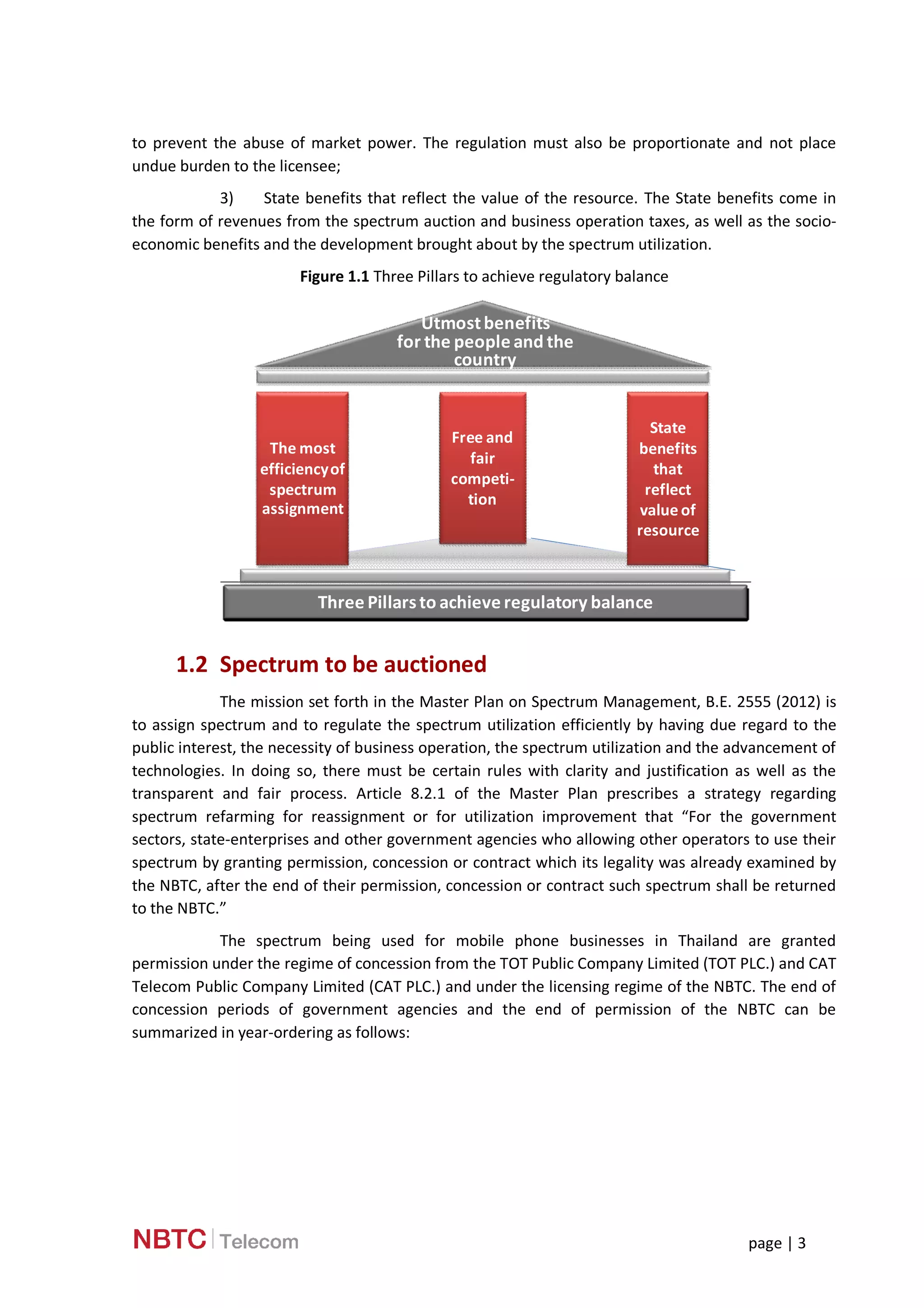
achieve the regulatory balance composing of three equally important principles in order to bring
about the greatest benefits to the people and the country. These principles are:
1) The most efficiency of spectrum assignment. Since the spectrum is a national
communications resource, the assignment process must ensure that the spectrum will be assigned to
the person who can best utilize it, whereby the most efficient spectrum assignment method is the
auction. Furthermore, the spectrum assignment must also be able to catch up with the usage
demand from both operators and end users;
2) Free and fair competition. The regulation must help creating the regulatory
environment that is conducive for market entry and have appropriate competition measures in place
page | 3
to prevent the abuse of market power. The regulation must also be proportionate and not place
undue burden to the licensee;
3) State benefits that reflect the value of the resource. The State benefits come in
the form of revenues from the spectrum auction and business operation taxes, as well as the socio-
economic benefits and the development brought about by the spectrum utilization.
Figure 1.1 Three Pillars to achieve regulatory balance
1.2 Spectrum to be auctioned
The mission set forth in the Master Plan on Spectrum Management, B.E. 2555 (2012) is
to assign spectrum and to regulate the spectrum utilization efficiently by having due regard to the
public interest, the necessity of business operation, the spectrum utilization and the advancement of
technologies. In doing so, there must be certain rules with clarity and justification as well as the
transparent and fair process. Article 8.2.1 of the Master Plan prescribes a strategy regarding
spectrum refarming for reassignment or for utilization improvement that “For the government
sectors, state-enterprises and other government agencies who allowing other operators to use their
spectrum by granting permission, concession or contract which its legality was already examined by
the NBTC, after the end of their permission, concession or contract such spectrum shall be returned
to the NBTC.”
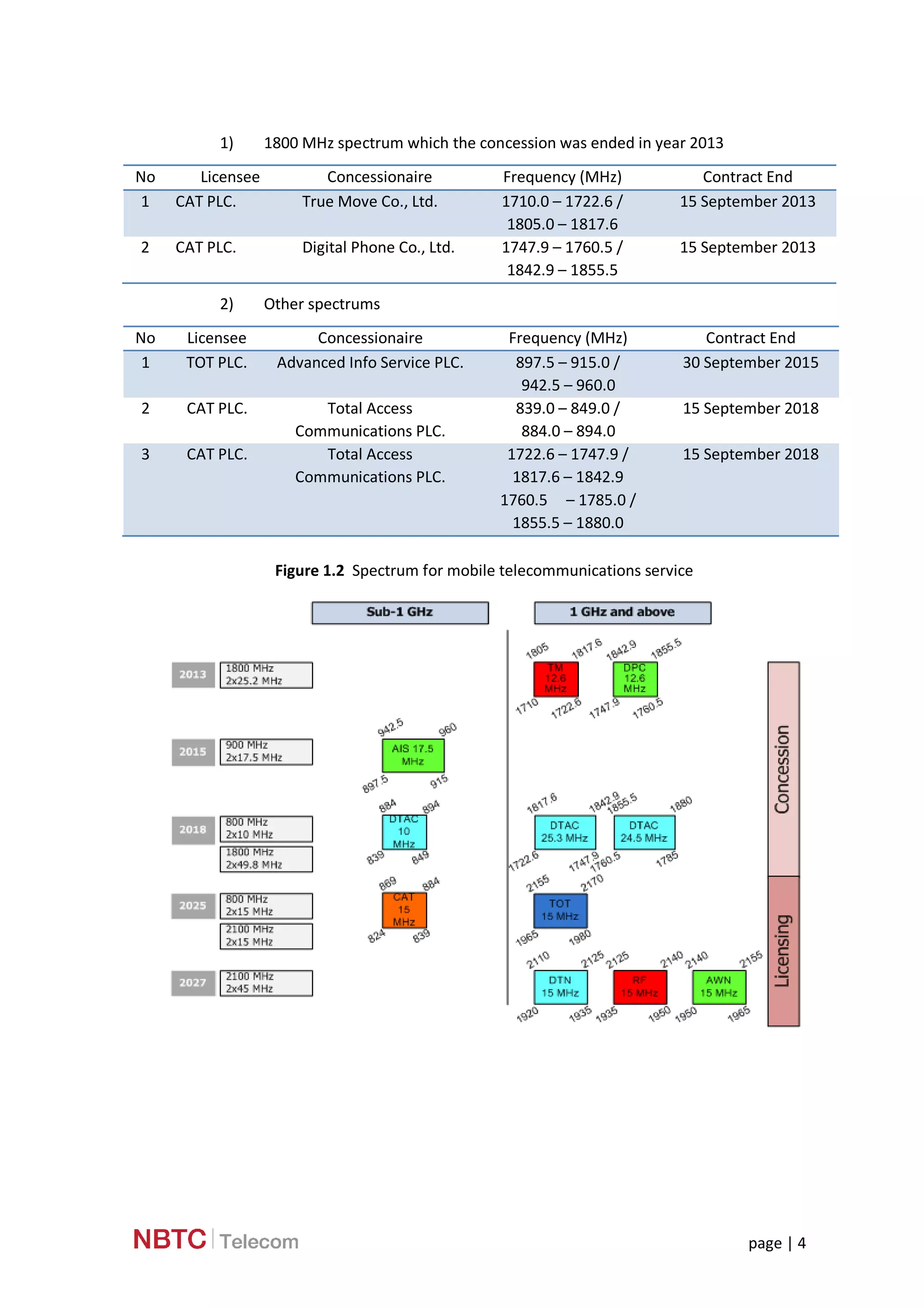
The spectrum being used for mobile phone businesses in Thailand are granted
permission under the regime of concession from the TOT Public Company Limited (TOT PLC.) and CAT
Telecom Public Company Limited (CAT PLC.) and under the licensing regime of the NBTC. The end of
concession periods of government agencies and the end of permission of the NBTC can be
summarized in year-ordering as follows:
Three Pillarsto achieve regulatory balance
The most
efficiencyof
spectrum
assignment
Free and
fair
competi-
tion
State
benefits
that
reflect
value of
resource
Utmostbenefits
for the people and the
country
page | 4
1) 1800 MHz spectrum which the concession was ended in year 2013
No Licensee Concessionaire Frequency (MHz) Contract End
1 CAT PLC. True Move Co., Ltd. 1710.0 – 1722.6 /
1805.0 – 1817.6
15 September 2013
2 CAT PLC. Digital Phone Co., Ltd. 1747.9 – 1760.5 /
1842.9 – 1855.5
15 September 2013
2) Other spectrums
No Licensee Concessionaire Frequency (MHz) Contract End
1 TOT PLC. Advanced Info Service PLC. 897.5 – 915.0 /
942.5 – 960.0
30 September 2015
2 CAT PLC. Total Access
Communications PLC.
839.0 – 849.0 /
884.0 – 894.0
15 September 2018
3 CAT PLC. Total Access
Communications PLC.
1722.6 – 1747.9 /
1817.6 – 1842.9
1760.5 – 1785.0 /
1855.5 – 1880.0
15 September 2018
Figure 1.2 Spectrum for mobile telecommunications service
page | 5
Section 2
Background Information
2.1 Thai Economy
In 2014 the Thai economy grew by an estimated 0.9%, which was slower than 2013’s
2.8% growth rate.1
In the first half of 2014, there was little growth due to domestic factors,
namely the political situation affecting government activities, househould and business
confidence, as well as tourism. Furthermore, high levels of household debts combined with the
slow recovery of the export sector aggravated the situation. The economy started to rebound
gradually in the second half of the year, as government resumed normal operations and
investments expanded. However, growth was still slow as exports were slow to recover, following
the downturn in many trade partner economies such as China, Japan and the European countries.
Additionally, tourism confidence and private investments had been stagnant as well.
ICT and telecommunications are generally seen as facilitators of growth, especially in
terms of labor and multifactor productivity, increased competitiveness and cost reduction across
the whole economy.2
The development of ICT services has also had a dramatic effect on consumer
behavior in Thailand, as well as delivering important social benefits. Table 2.1 below provides a
summary of key economic data for Thailand for 2012 to 2014.
Table 2.1 Key economic indicators
Indicator 2012 2013 2014
GDP current prices (THB billion) 12,355 12,910 13,149
GDP per capita (THB) - 193,395 196,240
GDP growth (%) 6.5 2.8 0.9
Headline inflation (%) 3.02 2.18 1.89
Core inflation (%) 2.09 1.00 1.59
Unemployment rate (%) 0.7 0.7 0.8
Total government debt (% of GDP) 44.5 43.9 45.8
Current account balance (USD billion) -1.5 -3.9 13.4
Budget cash balance (% of GDP) -317.7 -239.0 -384.3
Treasury cash balance (% of GDP) 561.3 605.1 495.7
Exports (USD billion) 225.9 225.4 224.8
Imports (USD billion) 219.9 218.7 200.2
Net interational reserves (USD billion) 181.6 167.2 157.1
Source: Bank of Thailand, Ministry of Finance, National Economic and Social Development
Board
1
Source: Bank of Thailand
2
See for example Nicholas Bloom, et al., The Distinct Effects of Information Technology and Communication
Technology on Firm Organization, Centre for Economic Performance, 2009, 2013; and Rakesh Basant, et al.,
ICT Adoption and Productivity in Developing Countries: New Firm Level Evidence from Brazil and India, IZA,
September 2006.
page | 6
2.2 Thai Telecommunications Market
2.2.1 Sector Development
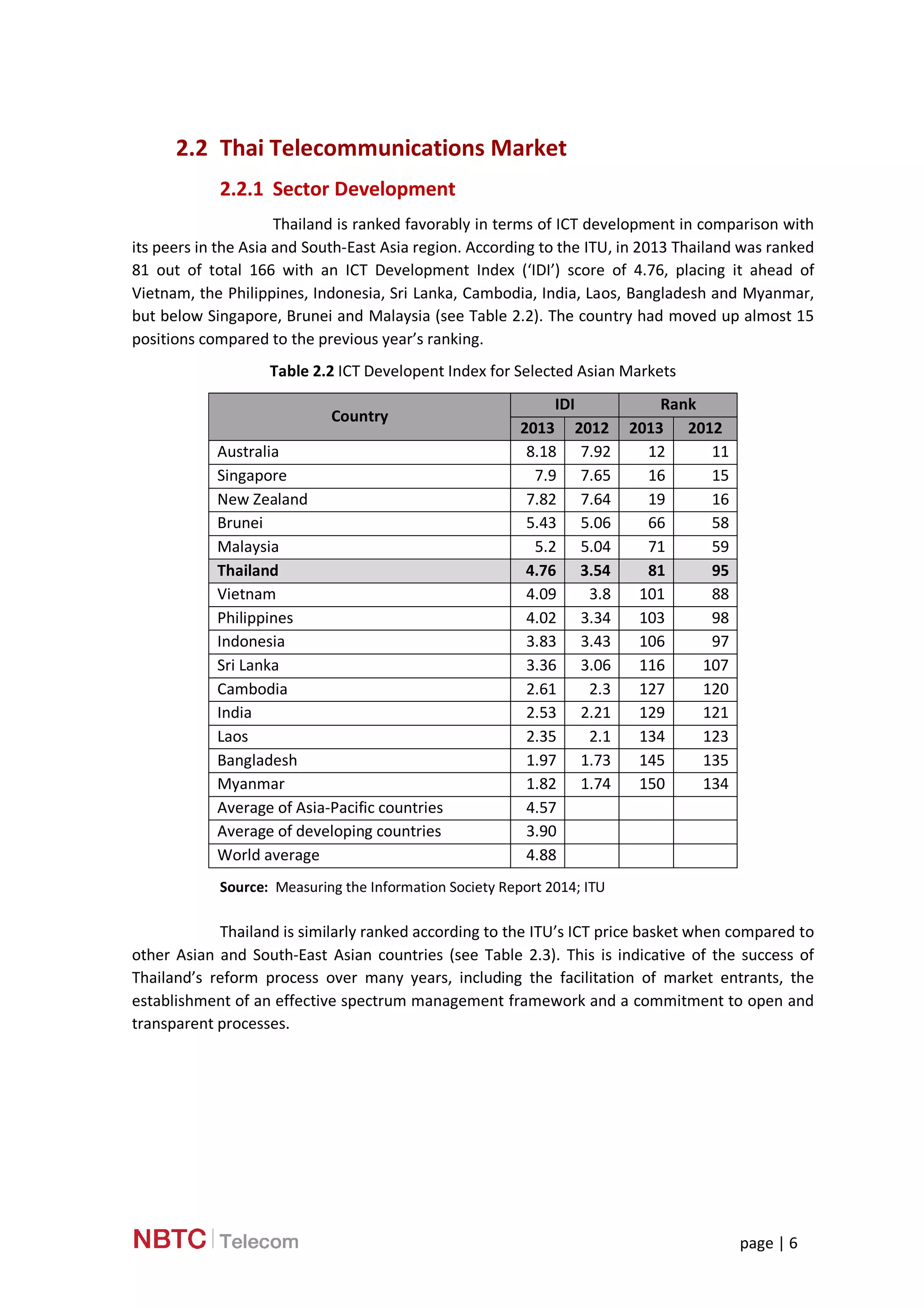
Thailand is ranked favorably in terms of ICT development in comparison with
its peers in the Asia and South-East Asia region. According to the ITU, in 2013 Thailand was ranked
81 out of total 166 with an ICT Development Index (‘IDI’) score of 4.76, placing it ahead of
Vietnam, the Philippines, Indonesia, Sri Lanka, Cambodia, India, Laos, Bangladesh and Myanmar,
but below Singapore, Brunei and Malaysia (see Table 2.2). The country had moved up almost 15
positions compared to the previous year’s ranking.
Table 2.2 ICT Developent Index for Selected Asian Markets
Country
IDI Rank
2013 2012 2013 2012
Australia 8.18 7.92 12 11
Singapore 7.9 7.65 16 15
New Zealand 7.82 7.64 19 16
Brunei 5.43 5.06 66 58
Malaysia 5.2 5.04 71 59
Thailand 4.76 3.54 81 95
Vietnam 4.09 3.8 101 88
Philippines 4.02 3.34 103 98
Indonesia 3.83 3.43 106 97
Sri Lanka 3.36 3.06 116 107
Cambodia 2.61 2.3 127 120
India 2.53 2.21 129 121
Laos 2.35 2.1 134 123
Bangladesh 1.97 1.73 145 135
Myanmar 1.82 1.74 150 134
Average of Asia-Pacific countries 4.57
Average of developing countries 3.90
World average 4.88
Source: Measuring the Information Society Report 2014; ITU
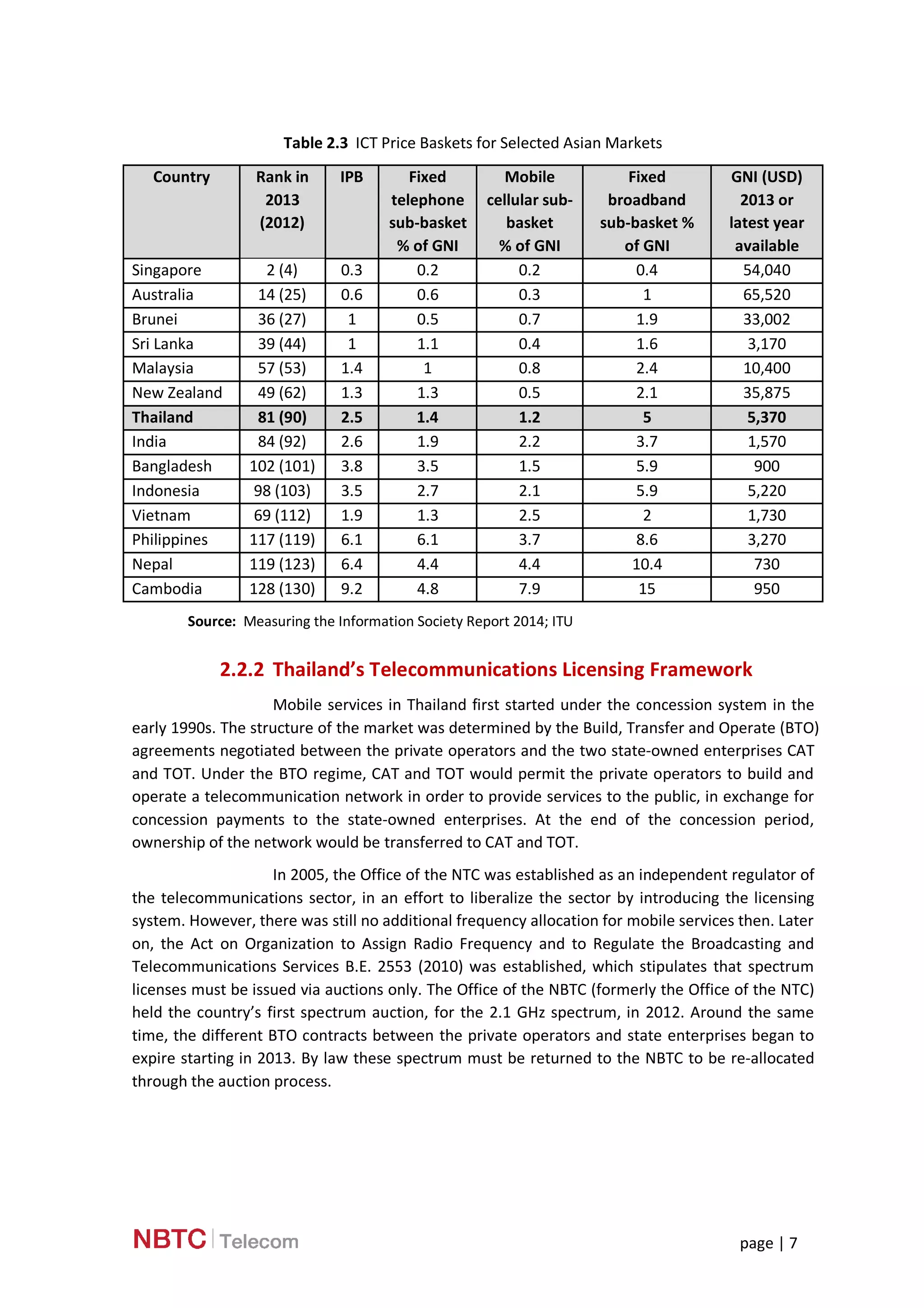
Thailand is similarly ranked according to the ITU’s ICT price basket when compared to
other Asian and South-East Asian countries (see Table 2.3). This is indicative of the success of
Thailand’s reform process over many years, including the facilitation of market entrants, the
establishment of an effective spectrum management framework and a commitment to open and
transparent processes.
page | 7
Table 2.3 ICT Price Baskets for Selected Asian Markets
Country Rank in
2013
(2012)
IPB Fixed
telephone
sub-basket
% of GNI
Mobile
cellular sub-
basket
% of GNI
Fixed
broadband
sub-basket %
of GNI
GNI (USD)
2013 or
latest year
available
Singapore 2 (4) 0.3 0.2 0.2 0.4 54,040
Australia 14 (25) 0.6 0.6 0.3 1 65,520
Brunei 36 (27) 1 0.5 0.7 1.9 33,002
Sri Lanka 39 (44) 1 1.1 0.4 1.6 3,170
Malaysia 57 (53) 1.4 1 0.8 2.4 10,400
New Zealand 49 (62) 1.3 1.3 0.5 2.1 35,875
Thailand 81 (90) 2.5 1.4 1.2 5 5,370
India 84 (92) 2.6 1.9 2.2 3.7 1,570
Bangladesh 102 (101) 3.8 3.5 1.5 5.9 900
Indonesia 98 (103) 3.5 2.7 2.1 5.9 5,220
Vietnam 69 (112) 1.9 1.3 2.5 2 1,730
Philippines 117 (119) 6.1 6.1 3.7 8.6 3,270
Nepal 119 (123) 6.4 4.4 4.4 10.4 730
Cambodia 128 (130) 9.2 4.8 7.9 15 950
Source: Measuring the Information Society Report 2014; ITU
2.2.2 Thailand’s Telecommunications Licensing Framework
Mobile services in Thailand first started under the concession system in the
early 1990s. The structure of the market was determined by the Build, Transfer and Operate (BTO)
agreements negotiated between the private operators and the two state-owned enterprises CAT
and TOT. Under the BTO regime, CAT and TOT would permit the private operators to build and
operate a telecommunication network in order to provide services to the public, in exchange for
concession payments to the state-owned enterprises. At the end of the concession period,
ownership of the network would be transferred to CAT and TOT.
In 2005, the Office of the NTC was established as an independent regulator of
the telecommunications sector, in an effort to liberalize the sector by introducing the licensing
system. However, there was still no additional frequency allocation for mobile services then. Later
on, the Act on Organization to Assign Radio Frequency and to Regulate the Broadcasting and
Telecommunications Services B.E. 2553 (2010) was established, which stipulates that spectrum
licenses must be issued via auctions only. The Office of the NBTC (formerly the Office of the NTC)
held the country’s first spectrum auction, for the 2.1 GHz spectrum, in 2012. Around the same
time, the different BTO contracts between the private operators and state enterprises began to
expire starting in 2013. By law these spectrum must be returned to the NBTC to be re-allocated
through the auction process.
page | 8
2.2.3 Key Market Trends
Mobile services are the dominant form of telecommunications in Thailand,
with mobile subscriber numbers and penetration rates continuing to rise. Fixed telephone
services, while still prevalent in metropolitan and urban areas, are in decline, indicating that many
households are moving away from fixed services in favor of mobile, particularly in rural and
regional areas.
Since 2008, the number of mobile subscribers in Thailand has grown from
61.8 million to 97.1 million at the end of 2014 (a compound annual growth rate (CAGR) of
approximately 7.8% per annum). Broadband services have experienced a similarly rapid rise.
Broadband subscribers have increased from 2.4 million in 2008 to 5.7 million in 2014 (a CAGR of
15.3% per annum). On the other hand, fixed telephone subscriptions have fallen from 7.4 million
in 2008 to 5.7 million in 2014 (a CAGR of -4.3% per annum) (see Figure 2.1).
Figure 2.1 Mobile, Fixed, and Broadband Subscribers, 2008-2014
Source: NBTC
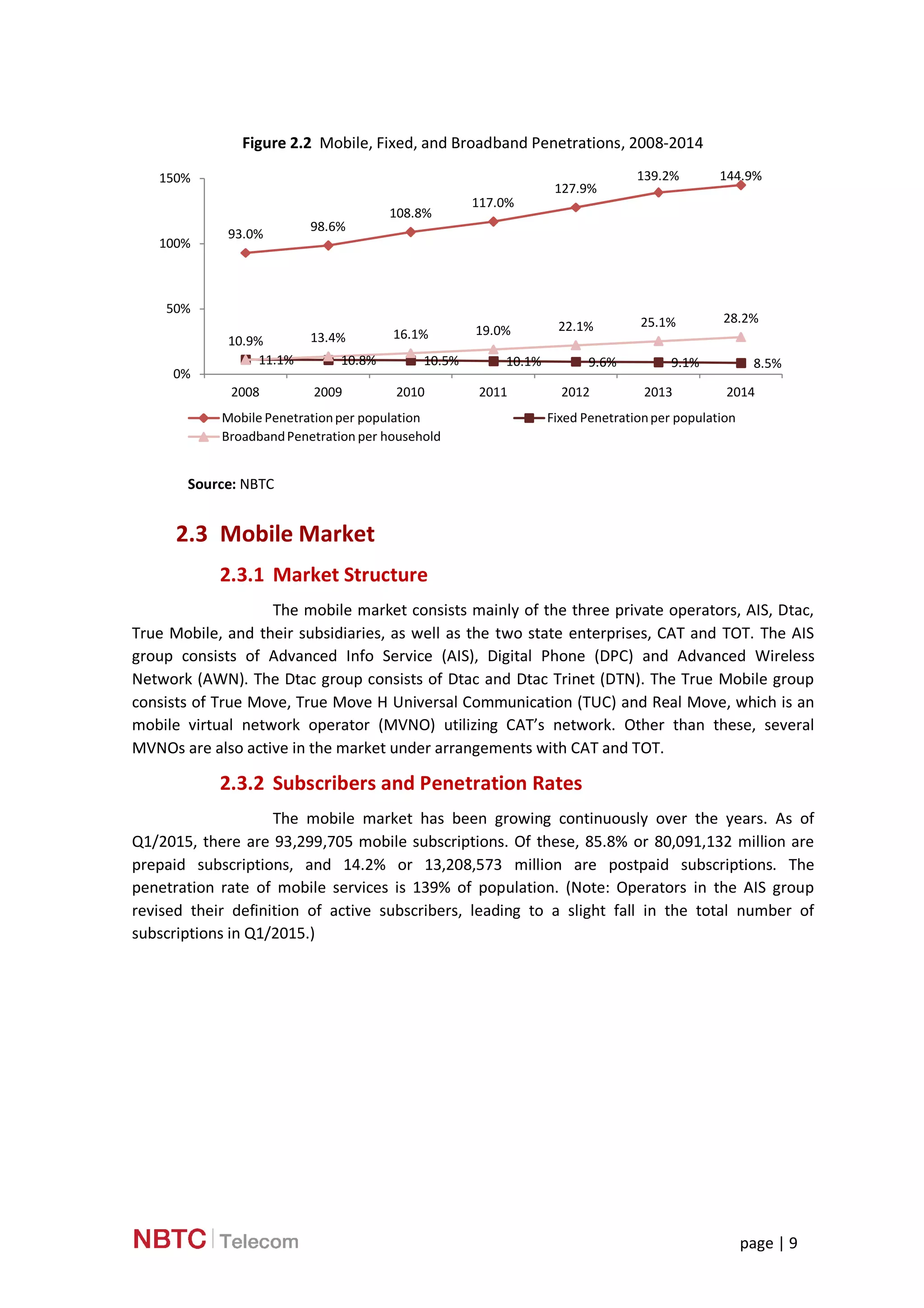
The dominance of mobile services is further evidenced by comparing
penetration for mobile, fixed and broadband services as shown in Figure 2.2 below.
61.8
66.0
71.7
77.4
85.0
92.9 97.1
7.4 7.2 6.9 6.7 6.4 6.0 5.7
2.4 3.0 3.9 4.0 4.5 5.1 5.7
0
20
40
60
80
100
2008 2009 2010 2011 2012 2013 2014
Million
Mobile subscribers Fixed Line Subscribers Broadband subscribers
page | 9
Figure 2.2 Mobile, Fixed, and Broadband Penetrations, 2008-2014
Source: NBTC
2.3 Mobile Market
2.3.1 Market Structure
The mobile market consists mainly of the three private operators, AIS, Dtac,
True Mobile, and their subsidiaries, as well as the two state enterprises, CAT and TOT. The AIS
group consists of Advanced Info Service (AIS), Digital Phone (DPC) and Advanced Wireless
Network (AWN). The Dtac group consists of Dtac and Dtac Trinet (DTN). The True Mobile group
consists of True Move, True Move H Universal Communication (TUC) and Real Move, which is an
mobile virtual network operator (MVNO) utilizing CAT’s network. Other than these, several
MVNOs are also active in the market under arrangements with CAT and TOT.
2.3.2 Subscribers and Penetration Rates
The mobile market has been growing continuously over the years. As of
Q1/2015, there are 93,299,705 mobile subscriptions. Of these, 85.8% or 80,091,132 million are
prepaid subscriptions, and 14.2% or 13,208,573 million are postpaid subscriptions. The
penetration rate of mobile services is 139% of population. (Note: Operators in the AIS group
revised their definition of active subscribers, leading to a slight fall in the total number of
subscriptions in Q1/2015.)
93.0%
98.6%
108.8%
117.0%
127.9%
139.2% 144.9%
11.1% 10.8% 10.5% 10.1% 9.6% 9.1% 8.5%
10.9% 13.4% 16.1% 19.0% 22.1% 25.1% 28.2%
0%
50%
100%
150%
2008 2009 2010 2011 2012 2013 2014
Mobile Penetrationper population Fixed Penetrationper population
BroadbandPenetration per household
page | 10
Figure 2.3 Mobile Subscriptions (million) and Penetration Rate (% of population)
Source: NBTC
2.3.3 Market Share and Market Competition
The mobile market is led by three main players which together have a
combined market share of 98.4% based on subscribers. As of Q1/2015, the AIS group, which
consists of AIS, DPC and AWN, is the clear market leader with a market share of 45.0%, followed
by DTAC group, which consists of DTAC and DTN, with a share of 30.5%, and True Mobile Group
(True, Real Move and True Move H), with a share of 23.1%. CAT and TOT have market shares of
0.9% and 0.7% respectively.
Figure 2.4 Market Shares of the Mobile Market (based on subscribers)
Source: NBTC
71.4
71.7
73.0
75.2
77.1
78.5
80.1
81.7
82.9
82.9
83.5
84.2
80.1
8.5
8.8
9.2
9.8
10.2
10.7
11.0
11.3
11.6
12.0
12.4
12.9
13.2
79.8 80.5 82.2 85.0 87.3 89.1 91.1 92.9 94.4 94.8 95.9 97.1 93.3
120%
121%
124%
128%
131%
134%
136%
139%
141%
142%
143%
145%
139%
0.00%
40.00%
80.00%
120.00%
160.00%
0
40
80
120
160
Q1/12
Q2/12
Q3/12
Q4/12
Q1/13
Q2/13
Q3/13
Q4/13
Q1/14
Q2/14
Q3/14
Q4/14
Q1/15
millions
PREPAID POSTPAID
TOTAL PenetrationRate
AIS, 45.0%
DTAC, 30.5%
TRUE, 23.1%
CAT, 0.9%
TOT, 0.7%
page | 11
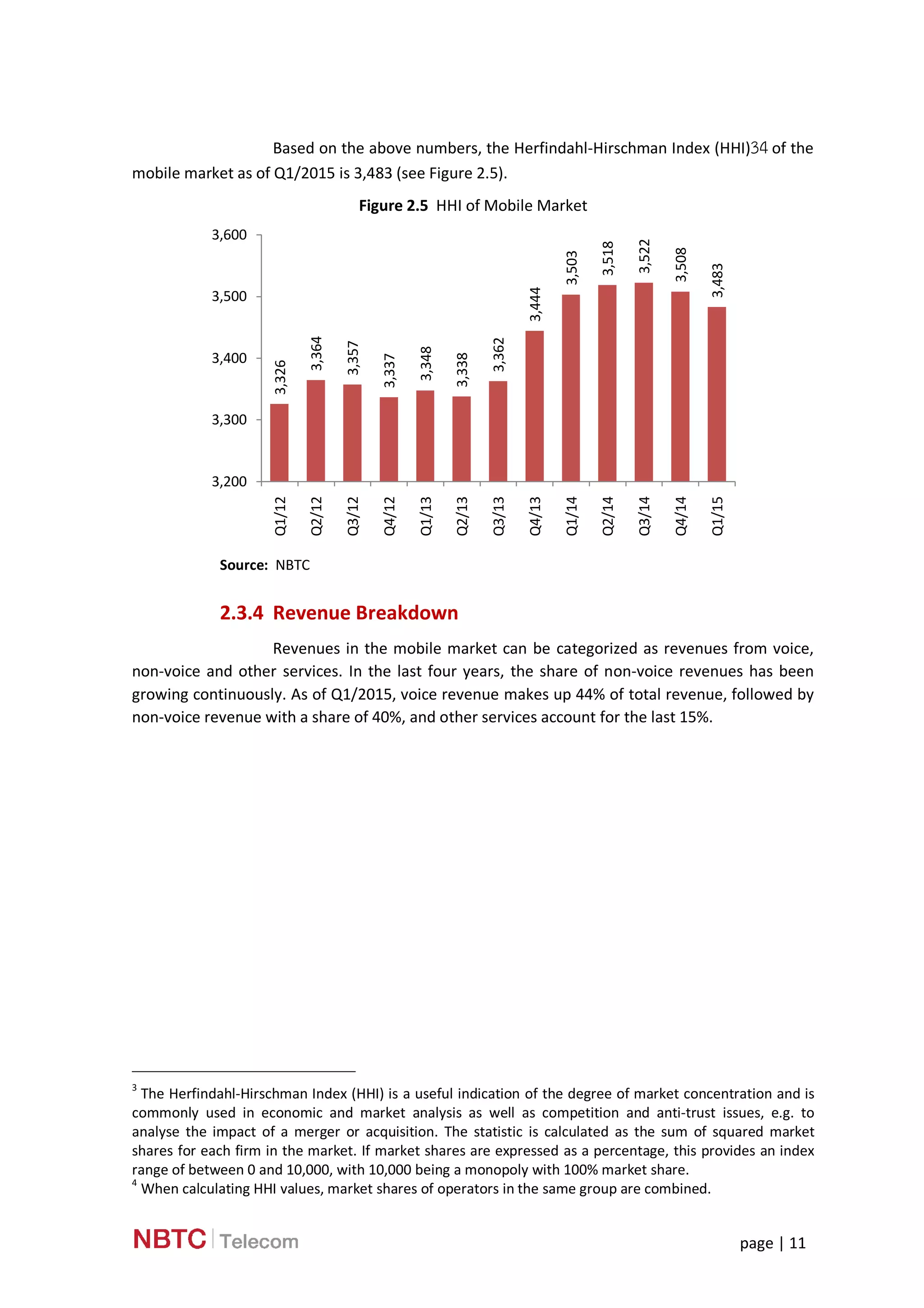
Based on the above numbers, the Herfindahl-Hirschman Index (HHI)34of the
mobile market as of Q1/2015 is 3,483 (see Figure 2.5).
Figure 2.5 HHI of Mobile Market
Source: NBTC
2.3.4 Revenue Breakdown
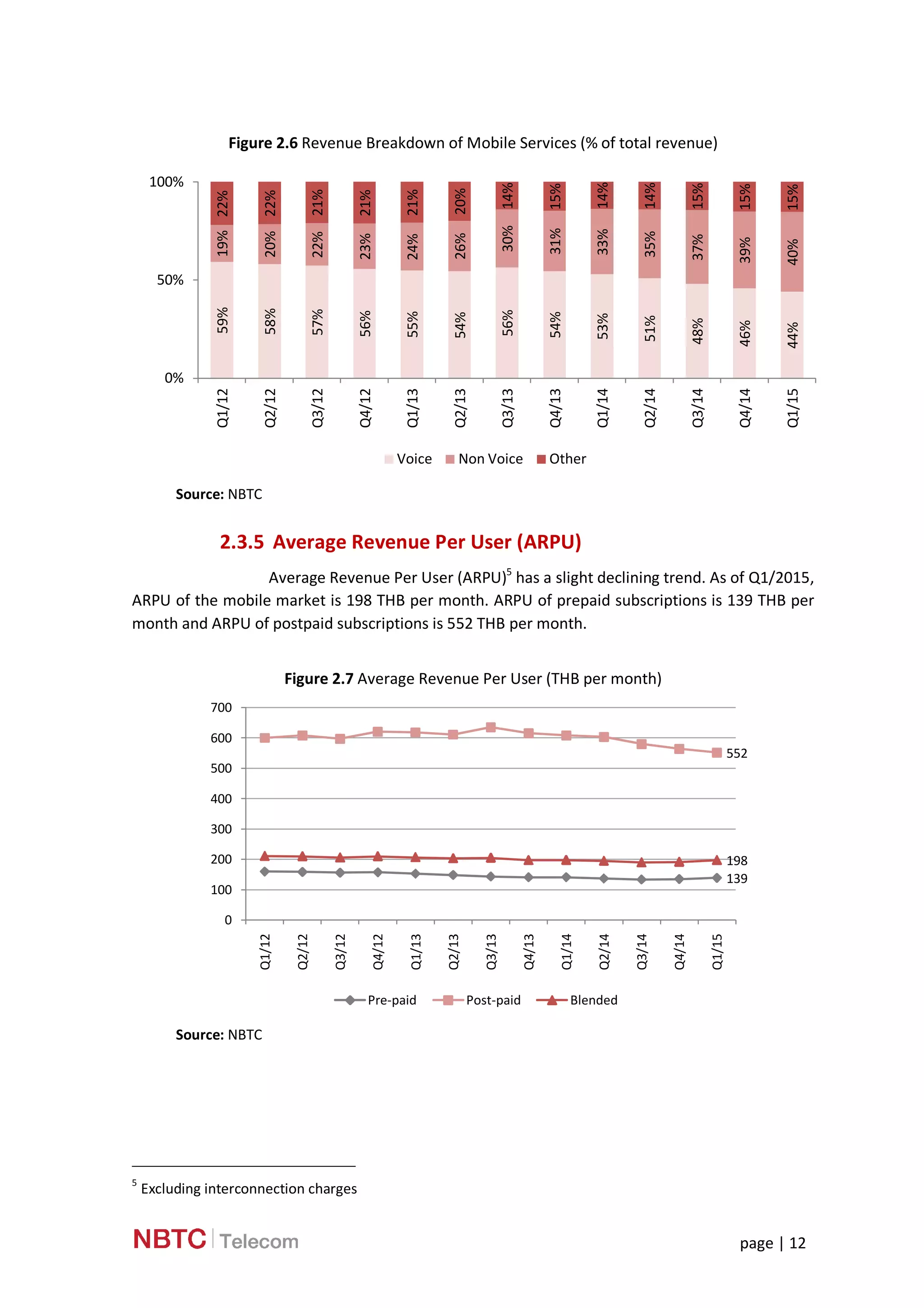
Revenues in the mobile market can be categorized as revenues from voice,
non-voice and other services. In the last four years, the share of non-voice revenues has been
growing continuously. As of Q1/2015, voice revenue makes up 44% of total revenue, followed by
non-voice revenue with a share of 40%, and other services account for the last 15%.
3
The Herfindahl-Hirschman Index (HHI) is a useful indication of the degree of market concentration and is
commonly used in economic and market analysis as well as competition and anti-trust issues, e.g. to
analyse the impact of a merger or acquisition. The statistic is calculated as the sum of squared market
shares for each firm in the market. If market shares are expressed as a percentage, this provides an index
range of between 0 and 10,000, with 10,000 being a monopoly with 100% market share.
4
When calculating HHI values, market shares of operators in the same group are combined.
3,326
3,364
3,357
3,337
3,348
3,338
3,362
3,444
3,503
3,518
3,522
3,508
3,483
3,200
3,300
3,400
3,500
3,600
Q1/12
Q2/12
Q3/12
Q4/12
Q1/13
Q2/13
Q3/13
Q4/13
Q1/14
Q2/14
Q3/14
Q4/14
Q1/15
page | 12
Figure 2.6 Revenue Breakdown of Mobile Services (% of total revenue)
Source: NBTC
2.3.5 Average Revenue Per User (ARPU)
Average Revenue Per User (ARPU)5
has a slight declining trend. As of Q1/2015,
ARPU of the mobile market is 198 THB per month. ARPU of prepaid subscriptions is 139 THB per
month and ARPU of postpaid subscriptions is 552 THB per month.
Figure 2.7 Average Revenue Per User (THB per month)
Source: NBTC
5
Excluding interconnection charges
59%
58%
57%
56%
55%
54%
56%
54%
53%
51%
48%
46%
44%
19%
20%
22%
23%
24%
26%
30%
31%
33%
35%
37%
39%
40%
22%
22%
21%
21%
21%
20%
14%
15%
14%
14%
15%
15%
15%
0%
50%
100%
Q1/12
Q2/12
Q3/12
Q4/12
Q1/13
Q2/13
Q3/13
Q4/13
Q1/14
Q2/14
Q3/14
Q4/14
Q1/15
Voice Non Voice Other
139
552
198
0
100
200
300
400
500
600
700
Q1/12
Q2/12
Q3/12
Q4/12
Q1/13
Q2/13
Q3/13
Q4/13
Q1/14
Q2/14
Q3/14
Q4/14
Q1/15
Pre-paid Post-paid Blended
page | 13
2.3.6 Market Performance
The mobile market as a whole has seen strong growth in revenue since 2011,
although margins have generally fallen in line with a downturn in economic activity. Expectations
for sector growth are generally positive, underpinned by an improvement in the Thai economy
and lower regulatory costs associated with the 3G licensing regime and the broader regulatory
environment. Earnings momentum is expected to continue as operators continue to migrate
customers from the concession networks to their own licensed networks, which leads to
significant cost savings.
Table 2.4 Key Financial Results of the Three Operators, 2013 - 2014 (million THB)
Results AIS group DTAC group True Mobile group
2013 2014 2013 2014 2013 2014
Total Revenue 142,783 148,729 94,617 90,415 96,214 74,158
Voice Revenue 71,941 65,382 41,743 35,215 21,700 19,104
Non-Voice Revenue 32,376 43,495 22,583 27,820 13,500 16,691
Other Revenue N.A. 9,112 N.A. 5,241 29,664 2,611
Gross Profit 61,642 65,781 30,023 29,028 18,844 (1,740)
EBITDA 63,691 66,428 30,047 31,069 16,385 7,769
EBIT 46,765 46,920 16,011 14,612 (3,343) (982)
Net Profit 36,274 36,033 10,567 10,724 (9,063) (5,550)
Source: Operators’ financial reports
However, competition is expected to remain strong due to factors such as
latent demand in broadband services and recent cuts in termination rates. Furthermore, the
expiries of concession contracts mean that operators will have to migrate customers to their new
networks under the license system, so competition is expected to remain strong. Table 2.5 shows
recent operational figures of the three main operators.
Table 2.5 Selected operational figures, Q1/2015
Items AIS group DTAC
group
True Mobile group
Total subscribers (million) 41.95 28.43 21.51
Postpaid subscribers (million) 5.06 4.00 4.01
Prepaid subscribers (million) 36.896
24.42 17.50
Blended ARPU (baht) 222 215 143
Postpaid ARPU (baht) 592 582 503
Prepaid ARPU (baht) 175 159 70
Minutes of use (MOU) (monthly) 271 216 N.A.
Postpaid MOU (monthly) 355 349 N.A.
Prepaid MOU (monthly) 260 195 N.A.
Source: Operators’ reports
Note: N.A. = no data available
6
Definition of active subscribers was revised, taking out those who had been inactive for more than 90 days
page | 14
2.3.7 Bandwidth Demands
According to Analysys Mason, in most developed economies, the volume of
public Wi-Fi traffic has grown much faster than mobile data during the past two years. This has
been driven mainly by fixed and cable operators rather than operator offload strategies, but small
cells will have enabled operators to stabilise and begin to reverse the trend of handset offloading
to Wi-Fi by the end of the 2018 forecast period indicated below in Figure 2.8.
Analysys Mason’s analysis forecast suggests that public Wi-Fi will primarily
carry mid- and large-screen traffic (and handsets' share of public Wi-Fi traffic will decline), and
many fixed or cable provided public Wi-Fi services will evolve into hybrid MVNO, small-cell and
Wi-Fi networks. Also, from observing Figure 2.8, it is interesting to note that the highest annual
growth rate corresponds to the emerging APAC region, within which Thailand is expected to be
impacted also in terms of increased traffic demand.
Figure 2.8 Mobile data growth 2011-2012 and CAGR 2012-2018
Source: Analysys Mason
The above overall regional growth in data traffic represents a clear sign that
spectrum holdings assigned for the mobile service in Thailand will experience a dramatic shift in
terms of the efficiency demands (to be expected from a more intensive spectrum use for mobile
broadband). Today’s mobile broadband market in Thailand is beginning a transformation: moving
from a vast 2G GSM based market towards 4G and beyond.
As of Q1/2015, according to NBTC’s data, the number of 3G subscriptions
stands at approximate 85.6 million or about 91.7% of the total mobile subscriptions. Such
numbers indicate that there is plenty of room for operators to grow the 3G/4G and beyond
markets in the coming years. Such growth requires planning and assigning the available spectrum
holdings in the most efficient and future proof way possible.
page | 15
2.4 Fixed Telephone Market
2.4.1 Subscribers and Penetration Rates
The fixed telephone market has been declining over the recent years,
primarily as a result of migration to mobile and VoIP services, as well as the rise of smartphones
and 3G/4G services (See Figure 2.9). As of Q1/2015, there are 5,596,218 fixed telephone
subscriptions, 2,954,622 of which are in the Bangkok metropolitan areas, and 2,641,596 are in
provincial areas.
Figure 2.9 Fixed Telephone Subscribers (million)
Source: NBTC
The penetration rate of fixed telephone services is at 8.3% of total population,
and 27.7% of the total number of households (See Figure 2.10)
Figure 2.10 Penetration Rates of fixed telephones (%)
Source: NBTC
6.6
6.5
6.4
6.4
6.3
6.2
6.1
6.0
6.0
5.9
5.8
5.7
5.6
5.0
5.2
5.4
5.6
5.8
6.0
6.2
6.4
6.6
6.8
Q1/12
Q2/12
Q3/12
Q4/12
Q1/13
Q2/13
Q3/13
Q4/13
Q1/14
Q2/14
Q3/14
Q4/14
Q1/15
million
9.9% 9.8% 9.7% 9.6% 9.4% 9.3% 9.2% 9.1% 8.9% 8.8% 8.6% 8.5% 8.3%
32.9% 32.6% 32.2% 31.8% 31.2% 30.7% 30.4% 30.0% 29.6% 29.1% 28.6% 28.2% 27.7%
0%
10%
20%
30%
40%
Q1/12
Q2/12
Q3/12
Q4/12
Q1/13
Q2/13
Q3/13
Q4/13
Q1/14
Q2/14
Q3/14
Q4/14
Q1/15
PopulationPenetration HouseholdPenetration
page | 16
2.4.2 Market Structure and Market Shares
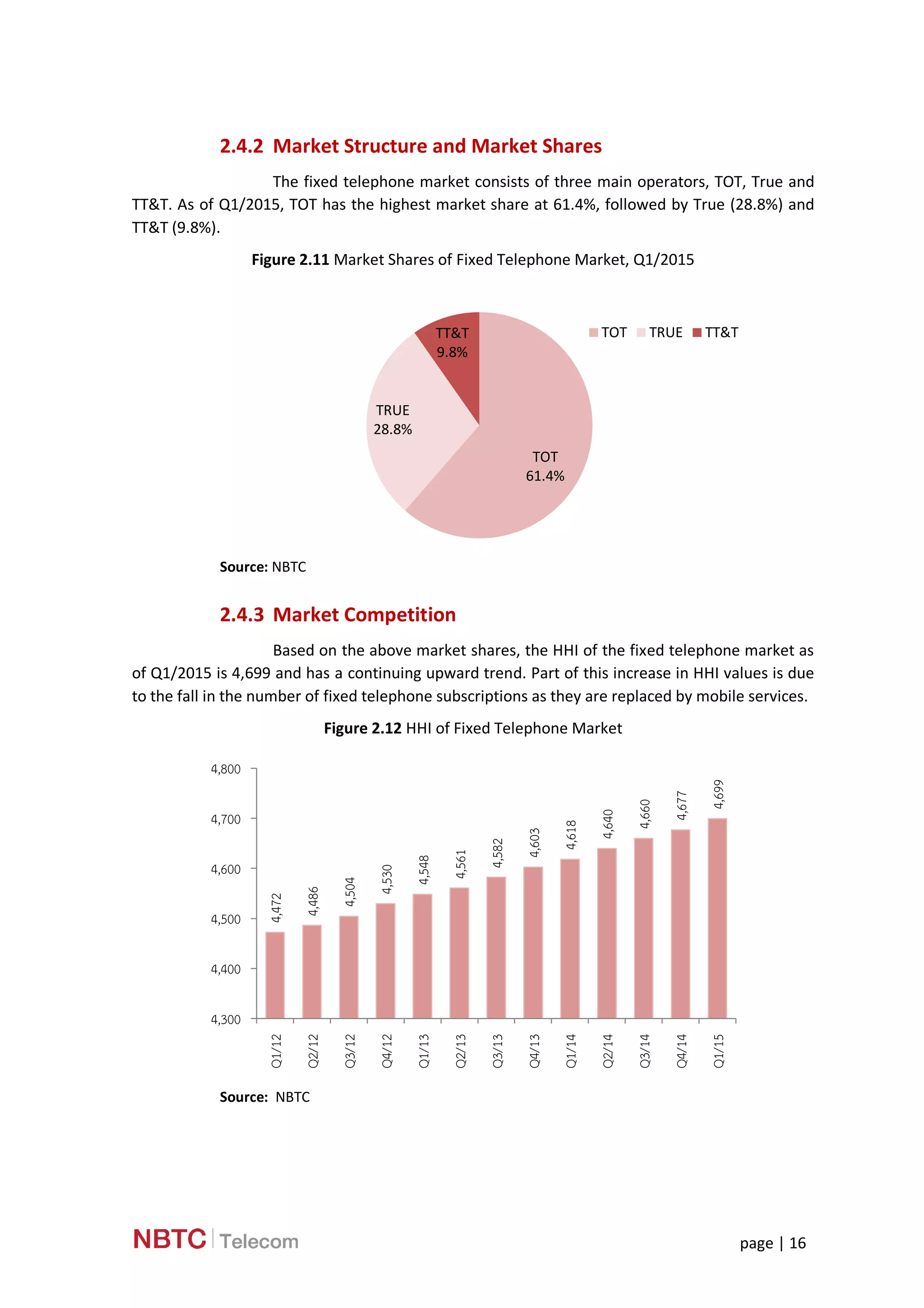
The fixed telephone market consists of three main operators, TOT, True and
TT&T. As of Q1/2015, TOT has the highest market share at 61.4%, followed by True (28.8%) and
TT&T (9.8%).
Figure 2.11 Market Shares of Fixed Telephone Market, Q1/2015
Source: NBTC
2.4.3 Market Competition
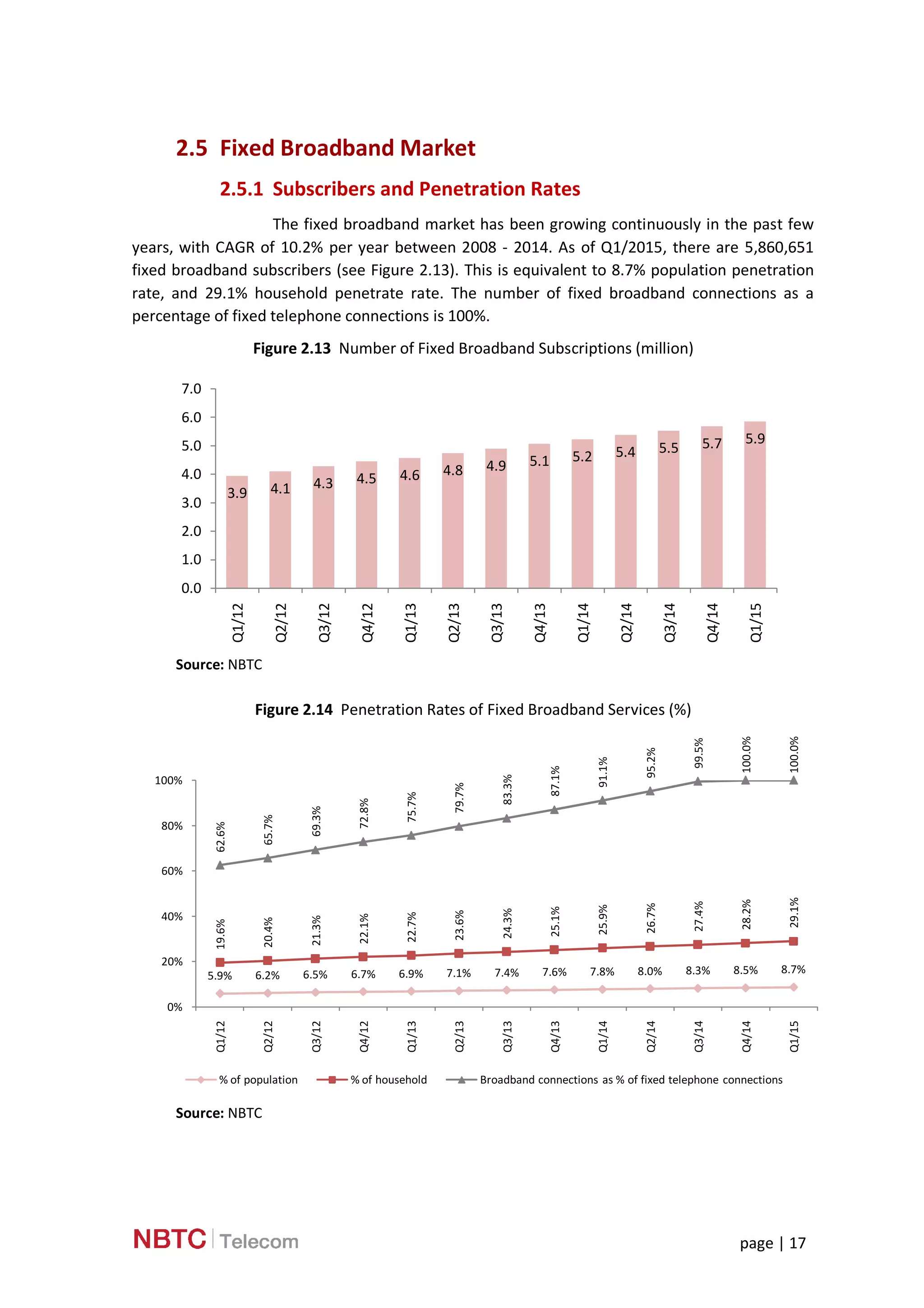
Based on the above market shares, the HHI of the fixed telephone market as
of Q1/2015 is 4,699 and has a continuing upward trend. Part of this increase in HHI values is due
to the fall in the number of fixed telephone subscriptions as they are replaced by mobile services.
Figure 2.12 HHI of Fixed Telephone Market
Source: NBTC
TOT
61.4%
TRUE
28.8%
TT&T
9.8%
TOT TRUE TT&T
4,472
4,486
4,504
4,530
4,548
4,561
4,582
4,603
4,618
4,640
4,660
4,677
4,699
4,300
4,400
4,500
4,600
4,700
4,800
Q1/12
Q2/12
Q3/12
Q4/12
Q1/13
Q2/13
Q3/13
Q4/13
Q1/14
Q2/14
Q3/14
Q4/14
Q1/15
page | 17
2.5 Fixed Broadband Market
2.5.1 Subscribers and Penetration Rates
The fixed broadband market has been growing continuously in the past few
years, with CAGR of 10.2% per year between 2008 - 2014. As of Q1/2015, there are 5,860,651
fixed broadband subscribers (see Figure 2.13). This is equivalent to 8.7% population penetration
rate, and 29.1% household penetrate rate. The number of fixed broadband connections as a
percentage of fixed telephone connections is 100%.
Figure 2.13 Number of Fixed Broadband Subscriptions (million)
Source: NBTC
Figure 2.14 Penetration Rates of Fixed Broadband Services (%)
Source: NBTC
3.9 4.1 4.3 4.5 4.6 4.8 4.9 5.1 5.2 5.4 5.5 5.7 5.9
0.0
1.0
2.0
3.0
4.0
5.0
6.0
7.0
Q1/12
Q2/12
Q3/12
Q4/12
Q1/13
Q2/13
Q3/13
Q4/13
Q1/14
Q2/14
Q3/14
Q4/14
Q1/15
5.9% 6.2% 6.5% 6.7% 6.9% 7.1% 7.4% 7.6% 7.8% 8.0% 8.3% 8.5% 8.7%
19.6%
20.4%
21.3%
22.1%
22.7%
23.6%
24.3%
25.1%
25.9%
26.7%
27.4%
28.2%
29.1%
62.6%
65.7%
69.3%
72.8%
75.7%
79.7%
83.3%
87.1%
91.1%
95.2%
99.5%
100.0%
100.0%
0%
20%
40%
60%
80%
100%
Q1/12
Q2/12
Q3/12
Q4/12
Q1/13
Q2/13
Q3/13
Q4/13
Q1/14
Q2/14
Q3/14
Q4/14
Q1/15
% of population % of household Broadband connections as % of fixed telephone connections
page | 18
2.5.2 Market Structure and Market Competition
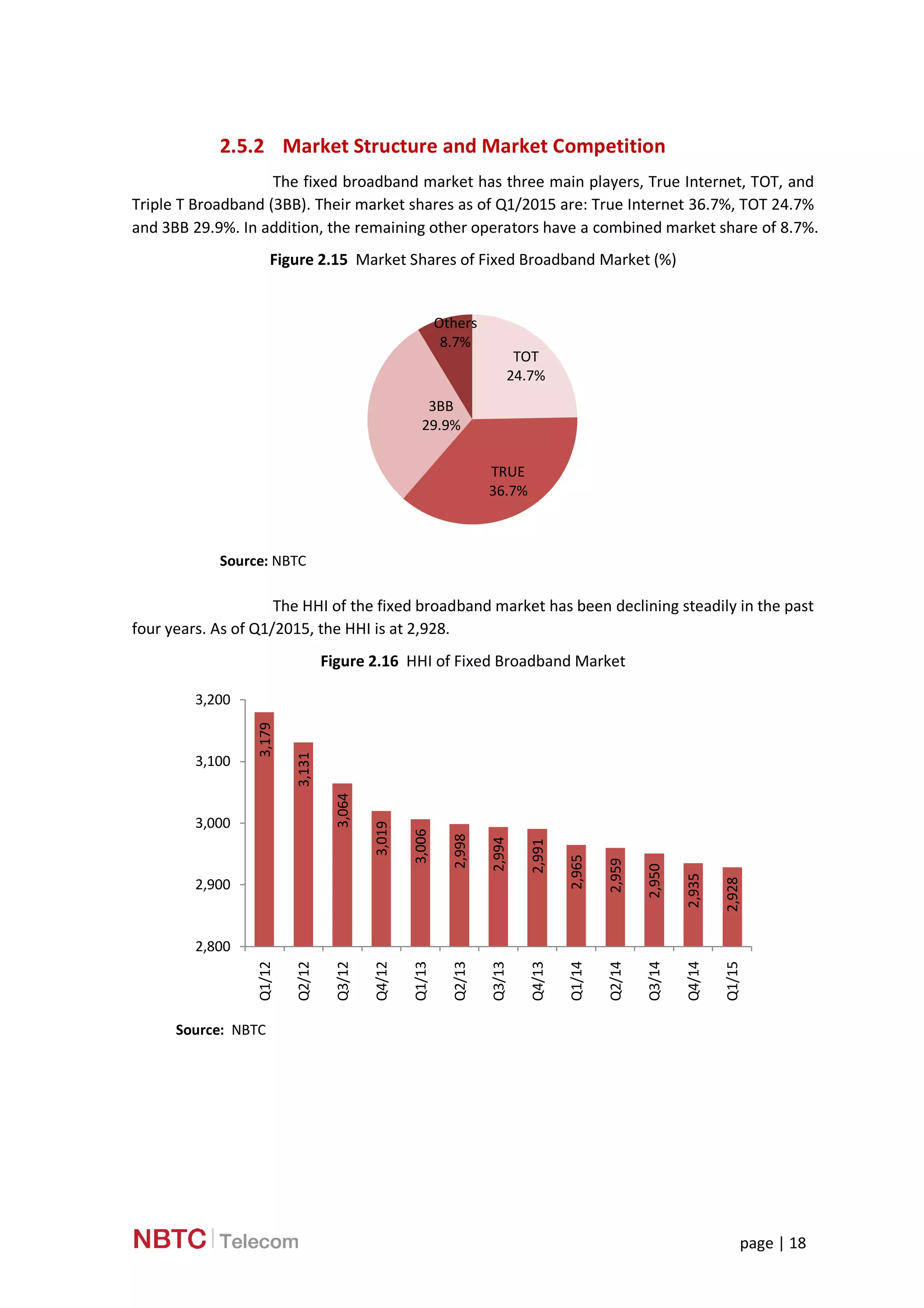
The fixed broadband market has three main players, True Internet, TOT, and
Triple T Broadband (3BB). Their market shares as of Q1/2015 are: True Internet 36.7%, TOT 24.7%
and 3BB 29.9%. In addition, the remaining other operators have a combined market share of 8.7%.
Figure 2.15 Market Shares of Fixed Broadband Market (%)
Source: NBTC
The HHI of the fixed broadband market has been declining steadily in the past
four years. As of Q1/2015, the HHI is at 2,928.
Figure 2.16 HHI of Fixed Broadband Market
Source: NBTC
TOT
24.7%
TRUE
36.7%
3BB
29.9%
Others
8.7%
3,179
3,131
3,064
3,019
3,006
2,998
2,994
2,991
2,965
2,959
2,950
2,935
2,928
2,800
2,900
3,000
3,100
3,200
Q1/12
Q2/12
Q3/12
Q4/12
Q1/13
Q2/13
Q3/13
Q4/13
Q1/14
Q2/14
Q3/14
Q4/14
Q1/15
page | 19
2.6 Mobile Broadband Market
2.6.1 Subscribers
As of Q1/2015, the AIS group has approximately 20 million mobile broadband
subscribers, which is equal to about 49.1% of the total number of AIS subscribers. DTAC has
approximately 14.8 million mobile broadband subscribers, or 52% of the group’s total subscribers.
These numbers have a continuously increasing trend (see Figure 2.17)
Figure 2.17 Mobile Broadband Subscribers (million)
Source: AIS and Dtac websites
2.6.2 Price Structures
Mobile broadband has grown rapidly following the auction of the 2.1 GHz spectrum
held by the NBTC. Most mobile broadband plans charge users according to actual usage in megabytes
rather than time-based usage.
In addition, it is common for providers to implement a Fair Usage Policy, where once
the purchased usage quota (for example 90 MB, 1 GB, 2 GB or 5GB) has been reached, usage speed will
be reduced. There are mainly two types of price plans.
 ‘Limited’ price plans, such as True’s iNet, which offers 2 GB of data for 499
baht per month, at a speed of 42 Mbps. If the user exceeds 2 GB, each additional MB at the same
speed costs 2 baht.
 ‘Unlimited’ price plans, such as True’s iNet, which offers 2 GB of data for
599 baht per month at a speed of 42 Mbps. When the 2 GB limit is reached, the user can continue to
use unlimited data at a reduced speed of 128 Kbps.
Competition is strong in the mobile broadband market. Usually when one provider
offers a new price plan, others will follow suit by offering similar or higher-value plans in an effort to
retain customers. In addition, discounts on smartphones are also offered as part of bundled services,
further contributing to the continued growth of mobile broadband.
0
5
10
15
20
25
1Q2014 2Q2014 3Q2014 4Q2014 1Q2015
Millions
AIS group DTAC group
page | 20
2.6.3 Data Consumption and Usage Types
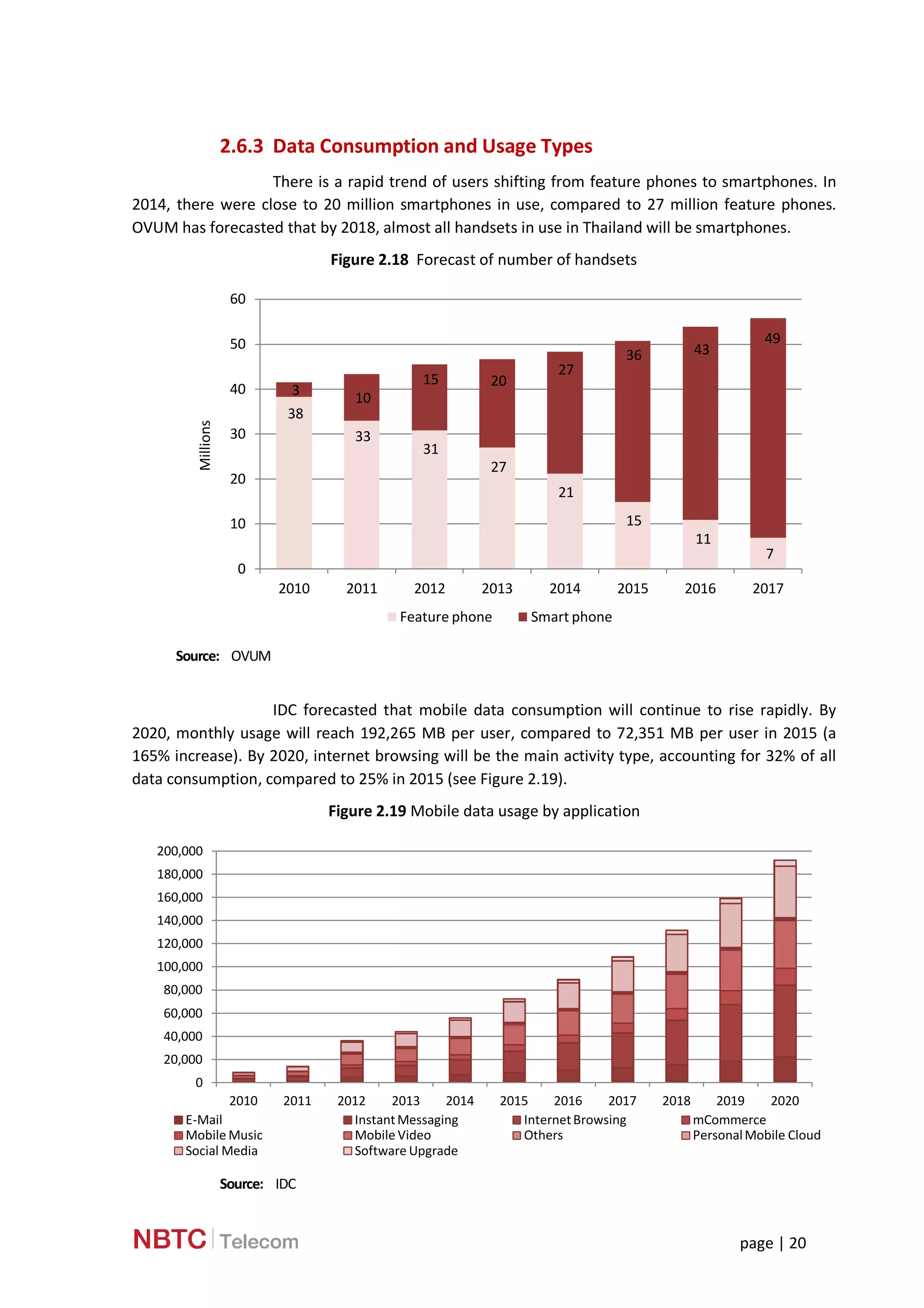
There is a rapid trend of users shifting from feature phones to smartphones. In
2014, there were close to 20 million smartphones in use, compared to 27 million feature phones.
OVUM has forecasted that by 2018, almost all handsets in use in Thailand will be smartphones.
Figure 2.18 Forecast of number of handsets
Source: OVUM
IDC forecasted that mobile data consumption will continue to rise rapidly. By
2020, monthly usage will reach 192,265 MB per user, compared to 72,351 MB per user in 2015 (a
165% increase). By 2020, internet browsing will be the main activity type, accounting for 32% of all
data consumption, compared to 25% in 2015 (see Figure 2.19).
Figure 2.19 Mobile data usage by application
Source: IDC
38
33
31
27
21
15
11
7
3 10
15 20
27
36 43
49
0
10
20
30
40
50
60
2010 2011 2012 2013 2014 2015 2016 2017
Millions
Feature phone Smart phone
0
20,000
40,000
60,000
80,000
100,000
120,000
140,000
160,000
180,000
200,000
2010 2011 2012 2013 2014 2015 2016 2017 2018 2019 2020
E-Mail InstantMessaging InternetBrowsing mCommerce
Mobile Music Mobile Video Others PersonalMobile Cloud
Social Media Software Upgrade
page | 21
Consumers have a tendency to use mobile broadband through handsets and tablets
more than they do through dongles. By 2020, it is estimated that the amount of data consumed through
handsets/tablets will be 102,450 MB per month per user, while usage through dongles will be 89,814 MB
per month per user.
Figure 2.20 Mobile data consumption by device type
Source: IDC
If we look at the amount of data consumption per user, we find that subscribers
in the Dtac group consume the most data per month, followed by True Mobile and AIS groups
respectively (See Figure 2.21)
Figure 2.21 Mobile broadband data consumption (Mb per month per user)
Source: IDC
0
50,000
100,000
150,000
200,000
250,000
2010 2011 2012 2013 2014 2015 2016 2017 2018 2019 2020
Dongle Handset/Tablet
0
50,000
100,000
150,000
200,000
250,000
2010 2011 2012 2013 2014 2015 2016 2017 2018 2019 2020
AIS Samart TOT 3G DTN TRUEMobile Grand Total
page | 22
Section 3
Legal and Policy Background and Regulatory Regime
3.1 Act on the Organisation to Assign Radio Frequency and to
Regulate the Broadcasting and Telecommunications Services B.E.
2553 (2010)
Section 27 precribed powers and duties of the NBTC regarding the spectrum licensing as
follows:
(1) To formulate a Spectrum Management Master Plan, Table of National Frequency
Allocations, Broadcasting Master Plan, Telecommunications Master Plan, Frequency Plan, and
Telecommunications Numbering Plan;
(2) To allocate radio frequencies for the undertaking of sound broadcasting,
television broadcasting, radiocommunications, and telecommunications services;
(4) To license and regulate the use of radio frequencies and radiocommunications
equipment in the undertaking of sound broadcasting, television broadcasting and
telecommunications services, or radiocommunications service; and prescribe licensing criteria and
procedures, conditions, or licensing fees;
(5) To prescribe criteria for efficient use of radio frequency without causing
interference to the same type of business and other type of business;
(6) To license and regulate the operations of sound broadcasting, television
broadcasting and telecommunications services to allow service users to have choices of services with
quality, efficiency, timeliness, reliability and fairness; and prescribe licensing criteria and
procedures, conditions, or licensing fees;
(11) To prescribe measure for the prevention of anti-competitive conduct or unfair
competition in sound broadcasting, television broadcasting and telecommunications services.
Section 40 The Telecommunications Commission shall have the power to act on behalf
of the NBTC under the provisions of Section 27 (4) (6) (7) (8) (9) (10) (11) (12) (13) and (16) pertaining
to the telecommunications and radiocommunications services, and other duties as assigned by the
NBTC.
Section 41 (paragraph 4) The permission to use radio frequency for the purpose of
sound broadcasting or television broadcasting services shall be carried out with due regard to
maximum public interests at the national, regional and local levels in education, culture, state
security and other public interests, including free and fair competition, and shall be carried out in the
manner of extensively and appropriately distributing the utilities as the national communications
resource to all segments of enterprises for public interest.
page | 23
Section 41 (paragraph 7) In specifying qualifications of persons who are eligible for
auctioning under paragraph six, due consideration shall be given to the benefit from efficient and
optimum allocation of spectrum resources, prevention of anti-competitive conduct, promotion of
free and fair competition, efficient supplying of services, burdens on the consumers, and right
protection for potential licensees to operate business at regional and local levels.
Section 45 Any person who wishes to use spectrum for the purpose of
telecommunications business operation shall obtain a license under this Act by means of spectrum
auctions in accordance with the criteria, procedures, duration, and conditions as prescribed by the
NBTC. The provision of Section 41 paragraph four and paragraph seven shall apply mutatis mutandis.
Income from spectrum auction after deducting expenditure shall be remitted to the state treasury.
3.2 Telecommunications Business Act, B.E. 2544 (2001) and its
Amendment
Section 7 Any person who intends to operate a telecommunications business in
accordance with the nature and categories prescribed in notification of the NBTC under the law on
the organisations to assign radio-frequency spectrum and to regulate the sound broadcasting,
television broadcasting and telecommunications services shall obtain a license from the NBTC.
There shall be three types of license as follows:
(1) Type One License: being a license granted to the telecommunications business
operator who operates without his or her own network for telecommunications services which are
deemed appropriate to be fully liberalized. The NBTC shall grant a license once notified by a person
who intends to operate such business;
(2) Type Two License: being a license granted to the telecommunications business
operator who operates with or without his or her own network for telecommunications services
intended for a limited group of people, or services with no significant impacts on free and fair
competition or on public interest and consumers. The NBTC shall grant a license once a person who
intends to operate such business has completely fulfilled the standard criteria prescribed in advance
in notification of the NBTC;
(3) Type Three License: being a license granted to the telecommunications business
operator who operates with his or her own network for telecommunications services intended for
general public, or services which may cause a significant impact on free and fair competition or on
public interest, or a service which requires special consumer protection. A person who intends to
operate such business can commence the operation only after he or she is approved and granted a
license by the NBTC.
The rights of Type One, Type Two or Type Three licensee to operate telecommunications
business in which nature, categories and scope of service shall be in accordance with notification
prescribed by the NBTC, which shall be in conformity with the nature of telecommunications
business for each type of license under paragraph two. In issuing such notification, the NBTC shall
also have regard to the development of diverse telecommunications services and fairness among the
operators.
page | 24
3.3 The Telecommunications Master Plan No. 1, B.E. 2555-2559
(2012-2016)
The Telecommunications Master Plan, B.E. 2555-2559 (2012-2016) highlights the
public’s equal, pervasive and reasonably priced access to diverse telecommunications services
through modernized networks on a fair competition basis and with efficient use of
telecommunications resources as the core network to support the national development into an
intellectual and creative society, with a view to narrowing the rural-urban disparities, continuingly
enhancing the country’s competitiveness in terms of telecommunications infrastructure, as well as
developing efficient consumer protection measures. The Master Plan has been outlined in six aspects
as follows:
(1) Development and Promotion of Free and Fair Competition
Monitoring and ensuring fair business operations in all markets where a monopoly
or a reduction or restriction of competition is prevalent, at both national and local levels; and
preventing the major operators or the operators with significant market power from abusing their
market powers or any single one or group of them from manipulating or distorting market
mechanism which could relatively lead to inefficient competition, so as to ensure fair competition
and people’s access to telecommunications services on a fair and reasonably-priced basis.
(2) Spectrum Licensing and Business Operation Licensing
Allowing the licensed operators to operate telecommunications services on a free
and fair competition basis; encouraging the deployment of modern technologies based on
technological neutrality; and coordinating with concerned authorities in the formulation of licensing
rules, guidelines and conditions for satellite communication services, in order to promote
competition and diversification of telecommunications and broadband services.
(3) Efficient Resources Utilization
Ensuring the management and approval of efficient telecommunications
resources utilization; encouraging infrastructure sharing for the utmost benefit at national and local
levels in education, public health, culture, State security and other public interests such as in the case
of emergency or disaster breaks out, with due regard to the proper, necessary and sufficient
utilization, the technological advancement, as well as the encouragement of an optimized utilization
of telecommunications, radiocommunications and communication satellite resources for the utmost
benefit and in conformity with international practices and obligations.
(4) Universal Basic Telecommunications Services
Implementing measures to promote operators to make available the universal
basic telecommunications services in the target areas; encouraging the provision of basic
telecommunications services to the underprivileged in accordance with the plan on universal basic
telecommunications services and social services to ensure the access to quality services at a
reasonable price; fostering the provision of telecommunications services for social development and
quality of life improvement; and promoting the capacity enhancement of telecommunications device
and service industry for the disabled and the underprivileged in the society.
page | 25
(5) Consumer Protection
Enhancing the awareness among consumers of their basic rights in
telecommunications service, benefits from consuming various types of telecommunications services,
needs to keep abreast of technological advancement to ensure their efficient use of services,
understanding of their right and freedom in consuming telecommunications services, and efficient
access to complaint channels; and devising measures to step up roles of the operators in providing
services in an ethical manner and with responsibility for consumers and the society.
(6) Preparedness for and Entry into the ASEAN Economic Community (AEC) and
Promotion of International Cooperation
Fostering the enhancement of Thailand’s potential and readiness for the
forthcoming AEC membership in 2015 by developing telecommunications cooperation and linking of
infrastructure, rules and regulations, industry sector, researchers and developers, regulating
agencies, and the public; and promoting international cooperation under various frameworks at
bilateral and multilateral levels with due regard to the national interests.
3.4 The Spectrum Management Master Plan, B.E. 2555 (2012)
The NBTC has prescribed the Spectrum Management Master Plan to be as the guideline
for spectrum management, spectrum licensing as well as broadcasting and telecommunications
businesses licensing and regulation. The Plan can be summarized as follows:
1) Vision
To manage the spectrum to achieve public interests at the national, regional and
local levels with due regard to free and fair competition as well as the extensive and appropriate
distribution of the spectrum utilization in various segments including education, culture, state
security and other public interests.
2) Mission
To efficiently allocate, assign and regulate the spectrum utilization with due
regard to public interests, business necessity, spectrum usage and technological advancement
through certain, clear and reasonable criteria as well as transparent and fair process
3) Goal
3.1) To build the international cooperation mechanism in spectrum
management among related parties including,international organizations, international frequency
coordination committee, regulators and related operators;
3.2) To develop criteria and timeframe for spectrum refarming for reassignment
or utilization improvement;
3.3) To develop spectrum management regulations and mechanism for national
security agencies;
3.4) To assign spectrum and prescribe spectrum usage regulations in Public
Protection and Disaster Relief (PPDR), case of emergency and other public services;
3.5) To set the transition plan for digital radio and television transmission;
page | 26
3.6) To assign spectrum for public service and non-profit community uses at
least twenty percent of the spectrum to be licensed for broadcasting business in each area.
4) Strategy
The Spectrum Management Master Plan has defined the strategy and guideline
regarding spectrum refarming as follows:
8.2 Refarming Strategy
The refarming guideline is described as follows:
8.2.1 In case of government, state enterprises, and other government
agencies who allowing other operators to use their spectrum by granting permission, concession or
contract which its legality was already examined by the NBTC, after the end of their permission,
concession or contract such spectrum shall be returned to the NBTC;
8.2.2 Those who have been legally licensed for the spectrum usage with
the expiry dates shall return the spectrum after the end of their license;
8.2.3 For those who have been legally licensed for the spectrum usage
without the expiry dates, the NBTC will set the expiry dates by considering public interest, business
necessity and spectrum utilization:
8.2.3.1 In case of radio broadcasting service, the maximum period
shall not exceed 5 years as from the date of the Spectrum Management Master Plan coming into
force;
8.2.3.2 In case of television broadcasting service, the maximum
period shall not exceed 10 years as from the date of the Spectrum Management Master Plan coming
into force;
8.2.3.3 In case of telecommunications service and other services, the
maximum period shall not exceed 15 years as from the date of the Spectrum Management Master
Plan coming into force. However the permitted period shall not exceed expiry date of their
telecommunications business license.
8.2.4 Spectrum refarming in any other cases will be as specified by the
NBTC.
Table 3.1 Criteria and timeline for the spectrum refarming according to the Master Plan
Details Spectrum return time line
1) In case of the legal permission, concession or
contract has definite expiry period
Spectrum shall be returned after the end of the
permission, concession or contract
2) In case of legally obtaining spectrum license
with no expiry period for spectrum usage
the maximum period shall not exceed 15 years as
from the date of the Spectrum Management
Master Plan coming into force. However the
permitted period shall not exceed the expiry date
of its telecommunications business license.
page | 27
3.5 Important Regulatory Issues
3.5.1 Telecommunications Numbers Management, and Mobile
Number Portability and Record of Prepaid Mobile Phone Service’s Users
The NBTC has a policy to allocate telecommunications numbers efficiently and
sufficiently for the operators’ service provision and network expansion. It recognizes the importance
of an allocation of numbers for public services, businesses and for national security, as well as for
supporting the emergency or disasters. It has therefore devised a telecommunications numbering
plan and the criteria for allocation of telecommunications numbers that is in line with the policy on
telecommunications resource management. This means that the allocation, supervision,
administration and use of telecommunications numbers, which are telecommunications resources,
are undertaken in an efficient and fair manner and sufficient for the supply of services on the basis of
free and fair competition including protection of service users.
The NBTC’s current telecommunications numbering plan is designed to cater for
the long-term number demand and support future service provision employing innovative
technologies. The plan provides various types of telecommunications numbers to support services
provided by operators which include fixed line number, mobile number, VoIP number, premium
service number, technical number as well as short code number. In addition, the NBTC has been
managing the telecommunications number allocation according to the NBTC’s Notification regarding
the Criteria for Allocation and Management of Telecommunications Numbers, which details the basic
principles of telecommunications number management and allocation with a clear and efficient
process, including inter alia: guidelines on telecommunications number planning; application
procedures for allocation of telecommunications numbers; procedures and criteria for allocation of
telecommunications numbers; rights and duties of holder of allocated numbers and regulating
guidelines. Besides, the holders of allocated numbers are duty-bound to pay fee for the
telecommunications numbers at the rate specified in the Notification.
The other important duty of the NBTC regarding mobile numbers management
that gain interest from the public is the regulation of mobile number portability. This operation is
under the NBTC’s Notification Regarding the Criteria for Mobile number Portability which outlines
rules and guidelines for porting mobile number to another network provider while retaining their
existing mobile numbers. Such number portability not only benefits the users, but also promotes
competition in telecommunications services, improves service quality in order to retain the
customers as well as supports the optimum utilization of numbers. The Notification also prescribes
an investment in a Clearing House for data collection through a consortium of the mobile service
providers, with the investment proportion to be specified.
The NBTC has set forth a rule regarding the record of prepaid mobile phone
service’s users (prepaid SIM card) under the NBTC’s Notification regarding the Criteria for Allocation
and Management of Telecommunications Numbers. The NBTC has also determines a guideline on the
registration of prepaid mobile phone service’s users (prepaid SIM card) to be complied by all mobile
operators in order to protect the right of mobile phone users as well as to protect the society and
national security. Moreover, there is a requirement that, for new numbers, the mobile operators
must register the users’ SIM card prior to SIM activation.
page | 28
3.5.2 Telecommunications Network Interconnection
In 2013 the NBTC issued the Notification Regarding Telecommunications
Network Access and Interconnection B.E. 2556 prescribing criteria and procedures for network
interconnection. The Notification requires that a licensee who owns network must allow other
licensees to interconnect with its network on a fair, reasonable and non-discriminatory basis.
The Notification also requires the licensee who owns network to develop and
submit the Reference Interconnection offer together with supporting document that prescribes
principle and method for calculating interconnection charge. Such interconnection charge must be
cost-oriented and calculate on long run incremental cost basis. The charge for necessary facilities for
interconnection must also be cost-oriented. The NBTC, however, may impose a certain calculation
method and appropriate reference interconnection charge for certain interconnection services.
In addition, this Notification also provides guidelines for contractual
arrangements as well as dispute resolution procedure in the case where there is any refusal of
network interconnection or access for which the petition should be submitted within one year as
from the date of the refusal or the date the dispute regarding network interconnection or access
arises. During the dispute settlement process, the NBTC may order temporary access or
interconnection following conditions in the existing contract, conditions in the same type of contract
or use the calculation method for interconnection charge that the NBTC sees appropriate. In this
regard, the NBTC has issued the Notification Regarding Standard Method for Calculating
Interconnection Charges B.E. 2556 (2013) to be the calculation standard for the transparency.
Furthermore, in year 2014 the NBTC has issued the Notification Regarding the
Reference Interconnection Charges B.E. 2557 (2014) which applies the calculation method according
to the Notification regarding the standard method for Calculating Interconnection Charges
mentioned-above. The purpose of this Notification is to set fair regulatory guideline and fair
interconnection charge for telecommunications service users where an agreement regarding the
charges cannot be reached among the licensees, where there is a dispute regarding the charge or
where temporary charge is required.
3.5.3 Telecommunications Network Access
The NBTC’s Notification Regarding Telecommunications Network Access and
Interconnection B.E. 2556 also prescribes criteria and procedures for network acess. The Notification
requires that a licensee who owns network must allow other licensees to access to its network on a
fair, reasonable and non-discriminatory basis.
The Notification also requires the licensee who owns network to develop and
submit the Reference Access offer together with supporting document that prescribes principle and
method for calculating access charge. Operators are permitted to determine the access rate among
themselves via commercial negotiations on a fair, reasonable and non-discriminatory basis. The
NBTC, however, may impose a certain calculation method and appropriate reference interconnection
charge for certain interconnection services.
page | 29
In addition, this Notification also provides guidelines for contractual
arrangements as well as dispute resolution procedure in the case where there is any refusal of
network interconnection or access for which the petition should be submitted within one year as
from the date of the refusal or the date the dispute regarding network interconnection or access
arises. During the dispute settlement process, the NBTC may order temporary access or
interconnection following conditions in the existing contract, conditions in the same type of contract
or as the NBTC sees appropriate.
3.5.4 Infrastructure Sharing for Mobile Network
In order to promote free and fair competition and to bring the quality and
efficient service to the consumers, the NBTC has prescribed the Notification Regarding Infrastructure
Sharing for Mobile Network B.E. 2556 (2013) which requires the licensee (Type III and the mobile
operators under concessions) to permit other licensees to share its own infrastructure for mobile
network. The Infrastructure sharing includes tower and mast, base station area, transmission
network between base station and base station controller. In sharing its own network, the licensees
must treat other licensees on a fair, reasonable and non-discriminatory basis and the infrastructure
sharing charge can be determined among licensees on a fair, reasonable and non-discriminatory
basis. In addition, this Notification has also prescribed criteria and procedures for contract
negotiation and dispute resolution where an agreement cannot be reached among the licensees.
3.5.5 Domestic Mobile Roaming Services
The NBTC has prescribed the Notification Regarding Domestic Mobile Roaming
Services to promote free and fair competition and to enable nationwide service to consumers. This
Notification requires the licensees (Type III mobile operators and mobile operators under
concessions) to allow other mobile operators to roam on its own network except the licensee
network is non-interoperable with the raomer’s network due to different standard and technology
employed. Furthermore, the licensee must treat other licensees on a fair, reasonable, and non-
discriminatory basis and the domestic mobile roaming charge can be determined among the
licensees on a fair, reasonable, and non discriminatory basis as well as must be reasonable
comparing with the retail rate paid by its customers. In addition, this Notification has also prescribed
criteria and procedures for contract negotiation and dispute resolution where an agreement cannot
be reached among the licensees.
3.5.6 Mobile Virtual Network Service
The NBTC has prescribed the Notification Regarding Mobile Virtual Networks
Service B.E. 2556 (2013) to promote free and fair competition as well as to promote market entry for
small entrant in order to escalate mobile service competition and provide service alternatives to
customers. The Notification requires the licensee (Type III mobile operators and mobile operators
under concessions) who is a wholseller to treat Mobile Network Operators (MVNOs) on a fair,
reasonable and non-discriminatory basis and charge can be determined by the agreement between
the wholseller and MVNOs on a fair, reasonable, and non discriminatory basis as well as must be
reasonable comparing with the retail rate paid by the wholseller’s customers. In addition, this
Notification has also prescribed criteria and procedures for contract negotiation and dispute
resolution where an agreement can not be reached among the licensees.
page | 30
3.5.7 Setting of Service Tariff
The NBTC regulates service fees in accordance with the “NBTC’s Notification
Regarding Maximum Rate of Service Tariff and Advance Collection of Service Tariff in
Telecommunications Business B.E. 2549 (2006).” The said notification aims at protecting service
users and promoting efficient competition in Thai telecommunications market on a free and fair basis.
The Notification specifies the methods for determining maximum rate of service tariff that is fair to
operators and users, as well as specifies the duty of operators to report the service tariff which
enables the NBTC to monitor whether the service tariff is in appropriate level or conducive to any
anti-competitive or discriminatory practices and affect the service users or not. In addition, the
Notification also specifies criteria and procedures to obtain the NBTC’s permission for advance
collection of service tariff.
Following the above-mentioned Notification, in 2012 the NBTC issued the
Notification Regarding Maximum Rate of Service Tariff for Domestic Mobile Voice Service B.E. 2555
(2012)” which determines the maximum rate of mobile voice service tariff at 99 Satang per minute,
applicable solely to the operators with significant market power (SMP) according to the NBTC’s order
in 2010. Later on, in granting the 2.1 GHz spectrum licenses in December 2012, one of the license
conditions mandates that the tariffs of voice and non-voice services must be reduced in average by at
least 15% of the average market price at the day the licenses are granted. Such condition is however
presumed as a specific measure for regulating service tariff for service on 3G network.
Currently, the NBTC is reviewing overall mobile service tariff regulation to be up
to date and suitable with the market environment. In doing so, the NTC has approved in principle for
the determination of the maximum rate of service tariff by using Price Cap methodology which is
expected to become effective within year 2015.
3.5.8 Measure for the Prevention of Monopoly and the
Identification of Market Power in Telecommunications Business
The NBTC implements two types of competition regulation – the ex-ante and ex-
post regulation. Ex-post regulation is governed by the NTC Notification on Measures to Prevent
Monopolistic and Unfair Competition Practices in Telecommunications Business B.E. 2549 (2006),
which aims to ensure free and fair competition among telecommunications service providers and to
promote and support competition in and development of the telecommunications industry in an
efficient and sustainable manner. The Notification prohibits operators who have been deemed to
have Significant Market Power (SMP) from carrying out certain anti-competitive practices such as
service subsidization and cross service subsidization for the service or the business under
competition in the market, acquisition of business of the same service type; and any conduct
deemed as abuse of market power in the manner of monopoly, or reduction or restriction of
competition. The Notification also institutes a process of inquiry dealing with the licensee who acts
or behaves in such manner, as a standard of practice for the NBTC.
For the ex-ante regulation, in 2014 the NBTC issued two key notifications. The
first is the NBTC Notification on Market Definition and Relevant Markets in Telecommunications B.E.
2557 (2014), and the second is the NBTC Notification on Criteria and Procedures for Identifying
Operators with Significant Market Power in Telecommunications Business B.E. 2557 (2014).
According to these Notifications, the Office of the NBTC must prepare a report on analysis of the
level of competition in the relevant markets and propose a list of operators with SMP in each
page | 31
relevant market for the NBTC’s consideration. This will be used as a basis for outlining measures for
the supervision of anti-competitive behaviors in telecommunications market in alignment with the
above-mentioned Notification, and also for formulating a guideline to prevent the operators with
SMP from abusing their market power to restrict or hinder free competition in the market.
The NBTC additionally issued the Notification Regarding Criteria and Procedure
for Accounting Separation in Telecommunications Buiness as a tool to support the implementation of
measures for the prevention of monopoly or unfair competition in telecommunications business.
Under the Notification, the operators with SMP are required to undertake accounting separation for
the NBTC’s analysis. This aims to:
 Identify the anti-competitive behaviors such as predatory pricing, margin
squeeze, etc.
 Identify the discriminatory behaviors such as cross subsidization, a case in
which the operators with SMP set an overly high price in a market where they have powers and use
the received profit for cross subsidization in another market where they are inferior to their rivals;
and
 Be a basis for determining the cost-based wholesaling and retailing rates
without excessive return/profit.
3.5.9 Universal Basic Telecommunications and Social Services
Telecommunications plays an important role in people communication and also
in promoting capability development in other sectors such as manufacturing sector, trade and
commerce sector as well as public and private service sectors. Therefore, the distribution of
Universal Basic Telecommunications and Social Services will minimize the gap in communication and
technology access which will improve the quality of life of the people in remote areas and bring
about the equality and fairness in standard of living for all citizens both in the city and the remote
areas. This will finally affects the national competitiveness level.
With all reasons mentioned above, the Telecommunications Master Plan B.E.
2555-2559 (2012-2016) aims to adopt measures to encourage operators in providing basic
telecommunications services universally, promote the provision of basic telecommunications
services to the underprivileged in accordance with the Universal Basic Telecommunications Services
and Social Services Plan to ensure the access to quality telecommunications service at a reasonable
tariff, to foster the provision of telecommunications service for social development and quality of life
improvement as well as to improve the capability of telecommunications device manufacturing and
telecommunications service for the disabled and the underprivileged.
In 2012, the NBTC has issued the NBTC’s Notification Regarding Plan on Universal
Basic Telecommunications Services and Social Services (B.E. 2555-2559) (2012-2016) aiming to
promote and encourage nationwide distribution of wireline and wireless telecommunications
network as well as to provide opportunity and develop capability in internet access for the
underprivileged, the disabled, children, and senior citizens which will improve quality of life and the
overall national competitiveness level. Subsequently, the NBTC has issued the NBTC’s Notification
Regarding the Criteria and Procedure for Revenue Collection to Fund the Provision of Universal Basic
Telecommunications Services and Social Services which prescribes the criteria and procedure for
revenue collection from telecommunications service licensees for contribution to the Broadcasting
and Telecommunications Research and Development Fund for the Public Interest. This is in order to
page | 32
secure funding for the implementation of the said Plan on Universal Basic Telecommunications
Services and Social Services. The basic telecommunications services selected to be offered are
telephone service and high speed internet service with no limitation of technology employed and the
applications which include terminal equipment, software or other necessary peripherals. The goal is
also include promotion and improvement of knowledge and skill which will benefit to the public for
the appropriated and efficient access to the basic telecommunications services. Moreover, the
licensees with their own network are required to annually contribute to the Fund at the amount of
3.75% per year of their net income from their telecommunications services as defined in the said
notification.
It is expected that, after the successful implementation according to the
Universal Basic Telecommunications and Social Services Plan (B.E.2012-2016), the personal
telephone penetration rate will be at least 95% of Thai population and the high speed internet
penetration rate will be at least 80% of Thai population. Also, there will be internet community
center, internet service in school, internet service in community hospital as well as internet service
center for target groups nationwide and telecommunications system for the disabled to access to
information as others.
3.5.10 Current Spectrum Assignment for Telecommunication
Services in Thailand
The utilization and the regulation of radio frequencies spectrum in
telecommunication businesses is mandated by the Act on the Organization to Assign Radio
Frequency and to Regulate the Broadcasting and Telecommunications Services B.E. 2553 (2010) (the
Organization Act) and the Telecommunications Business Act, B.E. 2544 (2001).
Section 46 of the Organization Act states that a spectrum license for
telecommunications business is the exclusive rights and is not transferable. The licensee who has
been authorized to use spectrum shall carry out the services by himself or herself. Also, business
management either in whole or in part shall not be rendered or permitted to other to act on his/her
behalf.
In addition, Section 47 of the Organization Act stipulates that for any licensee
who has been authorized to use spectrum for telecommunications services that has not carried out
the business by using such spectrum within period specified by the NBTC, or by using such spectrum
in other services not relating to its objectives, or fails to comply with the business operation
conditions, or conducts any prohibitive acts as specified in Section 27 (11) or fails to comply with the
provision of Section 46, the NBTC shall take action to rectify the situation or issue an order to revoke
the spectrum license in whole or in part.
page | 33
Section 4
The License
4.1 Spectrum to be licensed
The spectrum to be licensed is 2 x 30 MHz of 1800 MHz spectrum in the band of 1710 –
1740 MHz/1805 – 1835 MHz according to the International Mobile Telecommunications (IMT)
Spectrum Plan in the frequency band of 1710-1785/1805-1880 MHz, which consists of:
1) The spectrum in the 1800 MHz band which used for the provision of mobile phone
service by True Move Company Limited (2 x 12.6 MHz) and Digital Phone Company Limited (2 x 12.6
MHz) under the concession with CAT Telecom Public Company Limited which ended on September
15th
, 2013;
2) The 2 x 4.8 MHz spectrum in the 1800 MHz band, which Total Access
Communications Public Company Limited possess and use under the concession between CAT
Telecom Public Company Limited and Total Access Communication Public Company Limited, that the
Ministry of Information and Communication has officially confirmed to return to be combined with
the spectrum of 2 x 25.2 MHz in 1) for the auction. In this regard, the spectrum rearrangement must
be performed to obtain the contiguous 2 x 30 MHz band.
Figure 4.1 Spectrum to be auctioned
4.2 Number of Licenses
The NTC will grant two spectrum licenses, with a bandwidth of 2 x 15 MHz each as
shown in Table 4.1. Each bidder is entitled to bid only one spectrum lot or 2 x 15 MHz.
Table 4.1 Spectrum to be licensed
spectrum bandwidth Lower Frequency Upper Frequency
lot 1 2x15 MHz 1710-1725 MHz 1805-1820 MHz
lot 2 2x15MHz 1725-1740 MHz 1820-1835 MHz
page | 34
Figure 4.2 Spectrum to be licensed
In order to do so, the legal process of returning 2 x 4.8 MHz and the spectrum
rearrangement of the relevant entities to obtain contiguous 2 x 30 MHz in the 1800 MHz band must
be completed withing the specified time. In the case that the mentioned procedure cannot be
completed within the specified time, the NTC will proceed the auction with only two lots of 2 x 12.5
MHz that the concessions had ended: the first lot covers the range of 1710 – 1722.5 MHz paired with
the range of 1805 – 1817.5 MHz and the second lot covers the range of 1748 – 1760.5 MHz paired
with the range of 1843 – 1855.5 MHz. The relevant terms and conditions will also be adjusted in
accordance with the auction of 2 lots of 2 x 12.5 MHz.
Figure 4.3 Spectrum to be licensed in case of auctioning 2 lots of 2 x 12.5 MHz
In the case where there is any remaining spectrum after the auction, the NTC will begin
the process to grant the license for such remaining spectrum within one year as from the end of the
previous auction.
In the case where there is no Bidder, the NTC reserves the right to dismiss the auction
and will consider schedule of next auction as appropriate.
4.3 License and Its Scope
4.3.1 The Winning Bidders, after the conditions precedent have been duly fulfilled, will
be awarded the 1800 MHz Spectrum License and Type Three Telecommunication Business License in
accordance with Section 7 of the Telecommunications Business Act B.E. 2544 (2001) for the provision
of services in accordance with the scope of the license.
In the case that the Winning Bidder is already a spectrum licensee or is already a
Type Three Telecommunication Business Licensee, the NTC will, after the conditions precedent have
been duly fulfilled, consider licensing the 1800 MHz Spectrum for the additional provision of services
in accordance with the scope of license as specified by the NTC under the existing spectrum license
or Type Three Telecommunication Business License, as the case may be.
Furthermore, the Licensee shall be deemed as the person authorized to possess
and use radiocommunications equipment and install radiocommunications station under the
Radiocommunications Act with respect only to the radiocommunications equipment concerned with
the services in accordance with the scope of the license, whereby the Licensee must abide by the
related rules and notifications.
page | 35
4.3.2 In providing the service, the Licensee can employ any technology based on
neutral technology concept under ITU-R Recommendations relating to IMT. However, the Licensee
can use Global Systems for Mobile Communication (GSM) technology in the beginning period until
the complete transition to IMT, under terms and conditions prescribed by the NTC.
4.3.3 The Licensee will be able to provide telecommunications services as a network
provider and service provider as well as telecommunications facility which include the following
characteristics and types of service:
1) Wireless telecommunications network service;
2) Telecommunications Facility;
3) Telecommunication services, i.e.
3.1) Mobile phone service;
3.2) Public Broadband Multimedia Service;
3.3) Value-added Service for the licensed telecommunication services;
and
3.4) Wholesale service for services in 3.1) – 3.3)
In the case that the Licensee intends to provide broadcasting business, the
Licensee must conform to laws on the provision of broadcasting business and other relevant laws.
4.4 License Duration
The 1800 MHz Spectrum License and Type Three Telecommunication Business License
will be valid from the date of obtaining the License until 15 September 2033.
In the case where the Licensee is already a spectrum Licensee or a Type Three
Telecommunication Business Licensee, the License duration for only the telecommunications services
using 1800 MHz Spectrum in accordance with the scope of License will be valid from the date of
obtaining the rights until 15 September 2033.
The Licensee must comply with the conditions precedent to service dissolution as
specified by the NTC and must submit service users’ management plan at least 2 years in advance
before the end of the license period in order to avoid effects on service users. The Licensee must
return the granted spectrum to the NTC when the license period lapses.
4.5 Annual License Fee
The Licensee has the duty to pay the Type Three Telecommunication Business Annual
License fee, spectrum administrative fee, telecommunication numbering fee, revenue contribution to
the Broadcasting and Telecommunications Research and Development Fund for the public Interest,
and any other related fees under the criteria and procedures set forth by the NTC.
page | 36
4.6 Licensing Terms and Conditions
4.6.1 The Licensee must strictly comply with the terms and conditions on the use of
radio frequency and telecommunications business operation under the Act on the Organization to
Assign Radio Frequency and to Regulate the Broadcasting and Telecommunications Services B.E.
2553 (2010), the Telecommunications Business Act B.E. 2544 (2001) and its amendment, the NBTC’s
Notification regarding Spectrum Plan for the International Mobile Telecommunications (IMT)
Spectrum Plan in the Frequency Bands of 1710-1785/1805-1880 MHz, conditions for Type Three
Telecommunications Business License, as well as rules, regulations, notifications, orders and any
criteria prescribed by the NTC.
4.6.2 Coverage Obligation
1) The Licensee must provide telecommunications network for rendering
services covering at least 40 percent of the population within 4 years as from the date of obtaining
the License and at least 50 percent of the population within 8 years as from the date of obtaining the
License.
The provision of telecommunications network for rendering services will be
inclusive of the installation and the leasing of telecommunications network, but excluding the
national roaming of other operators’ mobile phone network.
2) The Licensee’s telecommunications network must be capable of supporting
a data transmission rate not less than the rate prescribed in the NBTC’ Notification Regarding the
Standard and Quality of Data Service. In the case that the Licensee has advertises its quality of
telecommunications service, it is the duty of such Licensee to comply with its advertisement.
3) The Licensee must report the network installation status as scheduled by
the NTC, and must provide supporting evidence demonstrating the average data transmission rate
upon request by the NTC. In this regard, the NTC will subsequently set forth the criteria, conditions
and method to measure the population coverage in the service areas and transmission speed.
4) In the case that the Licensee fails to comply with the conditions on network
provision for rendering service described above, the Licensee will be obliged to pay a daily penalty
charge at the rate of 0.05 percent of its highest bid price throughout the period of its failure to
comply with the conditions of the NTC within the specified timeframe.
4.6.3 Infrastructure Sharing
The licensee must comply with the NBTC’s Notification Regarding Infrastructure
Sharing for Mobile Network B.E. 2556 (2013).
4.6.4 Service of Mobile Virtual Network Operator (MVNO)
The licensee must provide telecommunications network service with the
minimum capacity of 10% of its networks to the MVNO who is not the connected person with any
licensee when receiving such service request, and must comply with the NBTC’s Notification
Regarding Mobile Virtual Network Operator Service B.E. 2556 (2013).
page | 37
4.6.5 National Roaming Service
The Licensee must comply with the NBTC’s Notification Regarding National
Roaming of Mobile Phone Network B.E. 2556 (2013).
4.6.6 Record of prepaid mobile phone service’s users
The licensee must comply with the NBTC’s Notification Regarding Criteria for
Telecommunications Numbers Assignment and Management as well as the guideline prescribed by
the Office of the NBTC which includes the prepaid user’s registration prior to service activation.
4.6.7 Social and Consumer Protection Measures
1) The Licensee must prepare its Corporate Social Responsibility (CSR) plan
covering the electronic waste management, users’ health, risk management plan for rapidly changing
technologies, and services for disabled which include at least special tariff and special invoice or
contract with large font or in Braille at no additional charge. In this regard, the Licensee must submit
such CSR plan to the NTC prior to launching its service and must implement according to its plan
within 1 year as from the date of launching its service.
2) The Licensee must prepare a consumer protection plan covering measures
to handle complaints free of charge, measures to handle unsatisfactory service, procedure to
develop understanding among the public regarding the establishment of radiocommunications
stations, as well as building the consumer recognition regarding rights to use telecommunications
service which include publication of consumer rights in consuming mobile phone service as specified
by the Office of the NBTC. In this regard, the Licensee must submit the consumer protection plan to
the NTC prior to launching its service and must implement according to its plan immediately after the
launch of its service.
3) The Licensee must support the mission of the NTC regarding
telecommunications service for social benefits as prescribed by the NTC, particularly in arranging
public telecommunications service and facilitating the access to public telecommunications services
universally for low-income earners, the disabled, children, the elderly, people in remote areas, and
the underprivileged.
4) The Licensee must heedfully prevent any person from using its network for
illegitimate activities or disseminating any information that may undermine peace or morality of the
people, and must support the state and private agencies in any act intending to protect rights of
consumers for the safety of society and the State security.
5) The Licensee must provide the service in a fair nature, which includes
setting of tariff that is clear, reasonable and not taking advantage of consumer, and shall provide
service with quality as prescribed by the NTC. For this purpose, the Licensee must set forth the tariff
for voice and data services which is, on average, lower than the average tariff of mobile phone
service using 2.1 GHz spectrum on the date of this Notification coming into force. In doing so to
promote and increase the opportunity for users in accessing the mobile telecommunications service
using 1800 MHz spectrum, the Licensee must provide at least one promotion which has tariff lower
than average tariff of mobile phone service using 2.1 GHz spectrum on the date of this Notification
coming into force, as well as charges based on actual usage and has the quality not lower than the
average quality of mobile phone service using 2.1 GHz spectrum. All this will apply until the NTC
prescribed criteria relating to the regulation of tariff and quality of service otherwise.
page | 38
Section 5
Licensing Procedure
5.1 Licensing Phases
The spectrum licensing process can be divided into 6 phases as summarised in table
below:
Table 5.1 Licensing Phases
1) Regulations Preparation  Formulation of spectrum licensing criteria
 Preparation of Information Memorandum (IM)
 Published the Notification regarding criteria and procedure for
spectrum licensing in the Government Gazette
2) Auction Invitation  Auction invitation and publication of Information
Memorandum
3) Pre-Qualification  Consideration of compliance with application method
 Consideration of Applicant’s qualification
4) Auction Training  Bidder information session and mock auction
5) Auction Phase  Bidding session
6) License Granting Phase  Fulfillment of conditions precedent
 License granting
5.1.1 Regulations Preparation
In this phase, rules and regulations are drawn up along with related
documentation which are the Notification regarding Criteria and Procedure for Spectrum Licensing
and the Information Memorandum for Spectrum Licensing.
5.1.2 Auction Invitation
In this phase, the auction invitation and the Information Memorandum will be
published to invite potential operators to participate in 1800 MHz spectrum auction. Interested
parties must process in accordance with the application method for pre-qualification screening. The
NTC may arrange a public information session for the interested parties to familiarize themselves
with the application form filling and the auction process.
5.1.3 Pre-Qualification
In this phase, the compliance with the application method and the
Applicants’qualification will be examined according to the prescribed regulation. The Applicants who
fully-met qualifications and requirements are entitled to be the Bidders.
page | 39
5.1.4 Auction Training
The NTC may arrange a bidder information session for all qualified Applicants
who are eligible to be the Bidders so that they could familiarize themselves with the auction method,
criteria and procedures.
1) Bidder Information Session
Bidders will be introduced to the auction and auction software prior to the
auction day.
2) Mock Auction
The NTC will invite all Bidders to participate in learning and practicing the
auction software. The Mock Auction will provide the Bidders with an opportunity to practice the
bidding procedure using the Auction Software. Also, it serves as a test of the Auction Software.
5.1.5 Auction Phase
The auction will be proceeded by openning the bid for all lots of 1800 MHz
Spectrum to be licensed simultaneously in multiple rounds. The bid price in each round will increase
correspondingly (Simultaneous Ascending Bid Auction) and the Bidder can place bid for a desired lot.
The Auction will be conducted through the Auction Software on an Internet or
Intranet system in the specified venue. The Office of the NBTC will provide computer system, PC and
necessary peripherals.
5.1.6 License Granting Phase
The NTC will issue the 1800 MHz Spectrum License and Type Three
Telecommunication Business License to each Winning Bidder after the Winning Bidder has correctly
and completely fulfilled the conditions precedent.
5.2 Timetable for Spectrum Licensing
The following table shows the spectrum licensing timetable to help those wishing to
apply for the license in preparing for filing the application forms and participating in the auction. The
NTC reserves the right to change the timetable and/or to extend or shorten the timetable. Any of
such changes will be informed in advance on the NBTC’s website (www.nbtc.go.th).
Table 5.2 Timetable for Spectrum Licensing
Task Date
Regulations Preparation
Publication of the Regulation regarding licensing
criteria in the Gevernment Gazette
24 August 2015
Auction Invitation
Auction invitation and publication of Information
Memorandum
During 28 August – 28 September 2015
Public Information Session During 28 August – 28 September 2015
page | 40
Task Date
Pre-Qualification
Application Day 30 September 2015
Pre-qualification screening During 30 September 2015 – 21 October 2015
Bidders announcement 21 October 2015
Auction Training
Information Session and Mock Auction for
Bidders
During 22 October – 10 November 2015
Auction Phase
Auction Day 11 November 2015
Announcement of winning bidders No later than 18 November 2015
License Granting Phase
Fulfillment of conditions precedent Within 90 days after the bidder is notified in
writing as the winning bidder
License Granting After the Winning Bidders completely and
correctly fulfill conditions precedent
5.3 Pre-Qualification Process
5.3.1 Process
The purpose of the pre-qualification process is to select appropriate applicants
to be the Bidders. The pre-qualification process encompasses the following 3 steps:
1) The interest entities submit the application forms together with relevant
information and document and pay the application fee in the amount of 500,000 Baht (excluding
VAT) and place the auction guarantee in the amount of 796,000,000 Baht in the case of 2 x 30 MHz
auction or 580,000,000 in the case of 2 x 25 MHz auction;
2) The NTC evaluates the completeness of license application and applicant’s
qualification including relavant documents as prescribed in the Notification;
3) The Applicants will be notified whether their application has been
successful. Only qualified Applicants will be allowed to be the Bidder.
5.3.2 Qualifications and Other Requirements
Each applicant must fully meet the qualifications and complete all requirements
as listed below:
1) Submission of Information and Documents
1.1) Submit the completely-filled application forms for obtaining the 1800
MHz Spectrum License and the accompanying documents and information as prescribed in Annex A
of the NBTC’s Notification regarding the Criteria and Procedure for Spectrum Licensing for
International Mobile Telecommunications in the frequency band of 1800 MHz with 2 sets of their
copies and the electronic documents to the Office of the NBTC.
page | 41
1.2) Submit the documents of the Applicant that documented compliance
with the Schedule of Prohibitions as prescribed in the NBTC’s Notification regarding the Prescription
of Prohibitions on Acts Constituting Foreign Dominance B.E. 2555 (2012), together with an
affirmation signed by an authorized signatory that the applicant will not conduct any act that is
contrary to any of the restrictions, the affirmation in accordance with the measures for restricting
collusive behavior and the affirmation that if obtaining a License, the Applicant agrees to prepare
and act in accordance with a Corporate Social Responsibility (CSR) plan as approved by the NTC, and
sign in the bidder’s consent letter, as prescribed in the application form for 1800 MHz Spectrum
License;
2) Application Fee and Auction Guarantee
2.1) The Applicant must pay the application fee of 500,000 Baht
(excluding VAT) by cash or bank cheque issued by a financial institution operating commercial
banking business under the Financial Institutions Business Act B.E. 2551 (2008), dated on or not more
than three business days prior to the date of payment to the Office of the NBTC. This fee will be
deemed as the application fee for the spectrum license and Type Three Telecommunications
Business License and will not be refunded by the Office of the NBTC in any cases;
2.2) The Applicant must place an auction guarantee by bank cheque
issued by a financial institution operating commercial banking business under the Financial
Institutions Business Act B.E. 2551 (2008), dated on or not more than three business days prior to the
date of payment to the Office of the NBTC, for an amount of 796,000,000 Baht in the case of 2 x 30
MHz auction or 663,000,000 Baht in the case of 2 x 25 MHz auction;
In the case the Applicant does not proceed in accordance with specified
methods in 1) and 2), the Office of the NBTC will not accept the License application.
3) Qualification Requirement
3.1) The Applicant must have the qualifications as stipulated in Section 8
of the Telecommunications Business Act B.E.2544 (2001) and its amendment, and must have the
qualifications and must not possess the prohibited characteristics as prescribed in Clause 3 of the
National Telecommunications Commission’s Notification Regarding Criteria and Procedure for
Granting Type Three Telecommunications Business License;
3.2) The applicant must be a juristic person in the type of a limited
company or public limited company established under Thai law and must not be a foreigner under
the law on foreign businesses.
The applicant must specify the prohibitions as prescribed in the
NBTC‘s Notification regarding the Prescription of Prohibitions on Acts Constituting Foreign
Dominance B.E. 2555 (2012) together with affirmation signed by authorized signatory that the
applicant will not conduct any act that is contrary to any of the prescribed restrictions. After the
auction, in the case where the licensee conducts any act that infringe the mentioned prohibitions,
the NBTC’s Notification regarding the Prescription of Prohibitions for the Act having Nature of
Foreign Dominance B.E. 2555 (2012) will be applied;
3.3) The Applicant must have no connection with other Applicant(s) by
means of being the major shareholder, subsidiary company, associated company or person in
authority or a controlled entity or related entity or have cross-shareholding with other Applicant(s).
page | 42
An exception will be made in the case of being related due to relationship as the entity who grants or
is granted authorization, concession or contract under Section 80 of the Telecommunications
Business Act B.E. 2544 (2001). Whereby the consideration shall be in accordance with the provisions
in Clause 2 of the NTC’s Notification regarding Criteria and Method of Merger & Acquisition and
Cross-Shareholding in Telecommunication Business B.E. 2553 (2010);
In the examination, if it is found that the Applicant does not have
qualifications as prescribed, or the fact subsequently show that the Applicant who is the Bidder or
the Winning Bidder does not have qualifications as prescribed, such Applicant will be removed from
the list of the Applicants, the Bidders or the Winning Bidders, as the case may be.
5.4 Spectrum Auction Fee
5.4.1 Minimum Price of the 1800 MHz Spectrum Licensing
The minimum price of the Spectrum Licensing for each spectrum lot is equal to
15,912,000,000 Baht in case of 2 x 30 MHz auction or 13,260,000,000 Baht in case of 2 x 25 MHz
auction.
In the case where the number of bidders is less than or equal to the number of
spectrum lots to be auctioned, the minimum price of the Spectrum Licensing for each spectrum lot is
equal to 19,890,000,000 Baht in case of 2 x 30 MHz auction or 16,575,000,000 Baht in case of 2 x 25
MHz auction.
5.4.2 Payment of the 1800 MHz Spectrum Auction Fee
The Winning Bidder must pay the 1800 MHz Spectrum auction fee according to
the highest bid price of each Winning Bidder in three installments as follows:
The first installment - the Winning Bidder must pay 50 percent of its highest bid
price and submit a letter of guarantee, issued by a financial institution operating commercial banking
business under the Financial Institutions Business Act B.E. 2551 (2008), for the remaining of spectrum
auction fee within 90 days as from the date it is notified in writing as being a Winning Bidder. The
Office of the NBTC will offset the deposit placed by the Winning Bidder from this installment, and
each Winning Bidder must completely pay the remaining amount within the specified period;
The second installment - the Winning Bidder must pay a further 25 percent of its
highest bid price and submit a letter of guarantee, issued by a financial institution operating
commercial banking business under the Financial Institutions Business Act B.E. 2551 (2008), for the
third installment within 15 days after the lapse of 2 years as from the date of the license award. The
Office of the NBTC will return the bank guarantee submitted with the first installment within 15 days
as from the date of the receipt of the second installment;
The third installment - the Winning Bidder must pay the remaining 25 percent of
its highest bid price within 15 days after the lapse of 3 years as from the date of license award. The
Office of the NBTC will return the letter of guarantee submitted with the second installment within
15 days as from the date of the receipt of the third installment.
The spectrum auction fee to be paid by each of the Winning Bidder is excluded
from tax, other fees and interest as prescribed by law.
page | 43
In the case that the Licensee fails to make a full payment of the second or third
installment within the specified period, the Licensee must pay additional fee equal to the amount of
the outstanding spectrum auction fee multiplied by the interest rate of 15 percent per year,
calculated daily. In the case that the Licensee fails to pay within the specified period, it will be
deemed that the Licensee fail to comply with conditions specified in this Notification and the NBTC
may consider suspending or revoking its License.
5.5 Granting of Licenses
5.5.1 Conditions Precedent
Before obtaining the license, the Winning Bidder must fulfill the following
requirements within 90 days as from the date it is notified in writing as the Winning Bidder:
1) Pay the first installment of the spectrum auction fee and submit a letter of
guarantee, issued by a financial institution operating commercial banking business under the
Financial Institutions Business Act B.E. 2551 (2008), to guarantee payment of the second and third
installments of spectrum auction fee;
2) If it is found that the necessary documents and information required for
granting the applicant of Type Three Telecommunication Business License, as submitted in
accordance with Clause 4 of Annex A to the NBTC’s Notification Regarding Criteria and Procedure for
the Licensing of Spectrum for Telecommunications Service in the Frequency Band of 1800 MHz are
inaccurate or inadequate, the Winning Bidder must rectify such documents as informed by the Office
of the NBTC for completeness and accuracy.
5.5.2 Granting of Licenses
The NTC will issue the 1800 MHz Spectrum License and Type Three
Telecommunication Business License to each Winning Bidder after such Winning Bidder has correctly
and completely fulfilled the conditions precedent.
5.6 Measures for Restricting Collusive Behaviour
5.6.1 The Applicants are prohibited from any kinds of communication among each
other in the nature of exposing or exchanging confidential information, or any information with
regard to spectrum licensing, from the date of the application submission until the time of auction
result announcement on the day the aution ends.
5.6.2 The Applicant must not conduct any act having the following natures:
1) Mutually agree on a bid with other applicant(s), with an objective to benefit
any person to be eligible for the License, thus avoiding a fair bid competition.
2) Give, ask to give or agree to give money or assets or any other benefit to
others for an advantage in the auction with an objective to persuade that person to cooperate with
any act that will benefit any person to be eligible for the License, or to persuade a person to bid at a
high or low price that is obviously an unconventional bid, or to persuade a person not submit a bid or
to withdraw a bid or to not become an Applicant or a Bidder in the auction.
page | 44
3) Coerce others to unwillingly cooperate with any act in a bid, or not to
submit a bid, or to withdraw a bid, or have to bid as specified, by violence or threat with any mean,
causing others to fear of physical harm to their life, physique, liberty, reputation, or property of the
threatened person or third party, until that coerced person does as told.
4) Use deception or any other act to cause others not to have a chance to bid
fairly, or to bid mistakenly.
5) Fraudulently submit a bid to the Office of the NBTC with the knowledge
that the bid is abnormally high or low and can be obviously perceived as an unconventional bid,
having an objective to deprive fair price competition, and the said conduct causes the spectrum
auction to derail.
The Applicant must comply with the criteria, period, procedure, and conditions
as prescribed in the NBTC’s Notification Regarding Criteria and Procedure for the Licensing of
Spectrum for Telecommunications Service in the Frequency Band of 1800 MHz, and must sign the
Bidder’s consent letter.
page | 45
Section 6
Auction Methodology and Rules
6.1 Auction Methodology
The NTC will open the bid for all lots of 1800 MHz Spectrum to be licensed
simultaneously and shall proceed in multiple rounds. The bid price in each round will increase
correspondingly (Simultaneous Ascending Bid Auction). A bidder can place bid for a desired lot. The
1800 MHz Spectrum to be auctioned consists of two lots of spectrum.
6.2 Spectrum to be Auctioned and the First Round Price
The spectrum to be auctioned and the first round price depend on the spectrum
available for auction as shown in the following table. The first round price will be the sum of the
minimum price of the spectrum licensing according to clause 8(2) and (3) of the NBTC’s Notification
Regarding the Criteria and Procedures for the Licensing of Spectrum for Telecommunications Service
in the Frequency Band of 1800 MHz and the bid in each round as specified in Section 6.4.1 of Auction
rules.
6.2.1 In case of auctioning 2x30 MHz of spectrum, the spectrum to be auctioned and
the first round price are as shown in table 6.1 and 6.2:
Table 6.1 In case there are more than two bidders:
Spectrum Lot Frequency Band Minimum Price
(Million Baht)
First Round Price
(Million Baht)
Lot 1 1710 – 1725 MHz /
1805 – 1820 MHz
15,912 16,708
Lot 2 1725 – 1740 MHz /
1820 – 1835 MHz
15,912 16,708
Table 6.2 In case there are two bidders or fewer:
Spectrum Lot Frequency Band Minimum Price
(Million Baht)
First Round Price
(Million Baht)
Lot 1 1710 – 1725 MHz /
1805 – 1820 MHz
19,890 20,288
Lot 2 1725 – 1740 MHz /
1820 – 1835 MHz
19,890 20,288
page | 46
6.2.2 In case of auctioning 2x25 MHz of spectrum, the spectrum to be auctioned and
the first round price are as shown in table 6.3 and 6.4:
Table 6.3 In case there are more than two bidders:
Spectrum Lot Frequency Band Minimum Price
(Million Baht)
First Round Price
(Million Baht)
Lot 1 1710 – 1725 MHz /
1805 – 1820 MHz
19,890 20,288
Lot 2 1725 – 1740 MHz /
1820 – 1835 MHz
19,890 20,288
Table 6.4 In case there are two bidders or fewer:
Spectrum Lot Frequency Band Minimum Price
(Million Baht)
First Round Price
(Million Baht)
Lot 1 1710 – 1722.5 MHz /
1805 – 1817.5 MHz
13,260 13,923
Lot 2 1748 – 1760.5 MHz /
1843 – 1855.5 MHz
13,260 13,923
In this regard, a bidder can place bid for only one lot in each round.
6.3 Auction Round
The timetable for auction rounds will be announced via auction software. Each round of
the auction consists of three stages as follows:
6.3.1 Bidding Stage
Each round of the auction begins with the bidding stage which lasts for 15
minutes. The bidders can place their bids within this 15 minutes period.
6.3.2 Processing Stage
The processing stage will begin after the end of the bidding stage.
6.3.3 Result Reporting Stage
For this result stage, the round result, the bid price of each spectrum lot for the
next round, and other information as specified in Section 6.6 will be announced five minutes prior to
the beginning of bidding stage in the next round.
6.4 Auction Process
6.4.1 Bid Price in Each Round
1) In the case of auctioning spectrum lots as specified in Section 6.2.1, the bid
increment is 796,000,000 Baht. When the bid price in the current bidding round is equal or greater
than 19,890,000,000 Baht, the bid increment is 398,000,000 Baht.
page | 47
In the case that there are two bidders or fewer, the bid increment is
398,000,000 Baht.
2) In the case of auctioning spectrum lots as specified in Section 6.2.2, the bid
increment is 663,000,000 Baht. When the bid price in the current bidding round is equal or greater
than 16,575,000,000 Baht, the bid increment is 332,000,000 Baht.
In the case that there are two bidders or fewer, the bid increment is
332,000,000 Baht.
If there is no bidder placing bid on a spectrum lot in the previous round, the bid
price for such spectrum lot will remain unchanged.
6.4.2 Auction in the First Round
1) All bidders must place bid for a spectrum lot at the price specified by the
NTC in Section 6.2.
2) Criteria for assigning a provisional winner for each spectrum lot are shown
in Table 6.5.
Table 6.5 Criteria for assigning a provisional winner for each spectrum lot in the first round
In Case of Criteria
1) Only one bidder places bid. That bidder will be assigned as the provisional winner.
2) Two or more bidders place bids. The provisional winner will be randomly assigned to
one of the bidders who place bids for the given
spectrum lot in that round.
3) There is no bid placed. No provisional winner will be assigned for the given
spectrum lot.
3) In the first round of the auction, the bidders cannot use the waiver. If the
bidder does not place bid for any spectrum lot, it will be considered that the bidder does not comply
with the auction requirements and its bidder status will be terminated, whereby the NTC reserves
the right to forfeit the auction guarantee of that bidder.
6.4.3 Auction in the Second and Subsequent Rounds
1) In each round bid, the bidders are obliged to do the following;
1.1) In the case that the bidder is a provisional winner of any spectrum lot,
the bidder can top-up its bid on the spectrum lot which the bidder is a provisional winner. If the
bidder does not place bid, it will be deemed that the bidder confirms its existing bid price.
1.2) In the case that the bidder is not a provisional winner of any
spectrum lot, the bidder must do either of the following:
(1) Place bid for a spectrum lot
(2) Use a waiver
Should the bidder fails to do either option above and has no waiver
left, it will be deemed that the bidder no longer has the right to place bid in the subsequent rounds.
page | 48
2) In the case that the bidder is not the provisional winner and still has waivers,
the bidder can choose not to use the waiver. Such bidder will no longer have right to place bid or use
the waiver in the subsequent rounds.
3) Criteria for assigning a provisional winner for each spectrum lot are shown
in Table 6.6.
Table 6.6 Criteria for assigning a provisional winner for each spectrum lot in the second and
subsequent rounds
In Case of Criteria
1) Only one bidder places bid. That bidder will be assigned as the provisional winner.
2) Two or more bidders place bids. The provisional winner will be randomly assigned to
one of the bidders who place bids for the given
spectrum lot in that round.
3) There is no bid placed but a
provisional winner is assigned for that
spectrum lot
The bidder having provisional winner status remains as
the provisional winner.
4) There is no bid placed for a spectrum
lot which has no provisional winner
No provisional winner will be assigned for the given
spectrum lot.
6.5 Waivers
6.5.1 Each bidder is allowed a maximum of three waivers during the auction. However,
in the first round of the auction the bidder cannot use the waiver and must place bid for a spectrum
lot. In the second and subsequent rounds, the bidder who is the provisional winner is not allowed to
use the waiver.
6.5.2 In the second and subsequent rounds, the bidder who is not the provisional
winner and still has waivers left can use a waiver by two means as follows:
1) The bidder requests to use a waiver; or
2) The bidder does not place any bid during the bidding stage, the waiver will
be used automatically.
In the case that the bidder is not the provisional winner and still has waivers, the
bidder can choose not to use the waiver. Such bidder will no longer have the right to place bid or use
the waiver in the subsequent rounds.
6.6 Information Disclosure
In the result reporting stage of each auction round, each bidder will be informed of such
information as:
6.6.1 Bid price of each spectrum lot in the next round;
6.6.2 The number of bids submitted for each spectrum lot in the previous round;
6.6.3 The spectrum for which the bidder is assigned as the provisional winner;
6.6.4 The number of remaining waivers.
page | 49
6.7 Termination of a Bidder Status
The bidder will no longer have the right to place bid in the following case:
6.7.1 In the case where a bidder fails to place a bid for any spectrum lot in the first
round, it will be considered that such bidder does not comply with the auction requirements and its
bidder status will be terminated, whereby the NTC reserves the right to forfeit the auction guarantee
of that bidder.
6.7.2 In the second and subsequent rounds, in the case where a bidder who is not a
provisional winner in any spectrum lot fails to comply with requirements as described in Section 6.4.3
1) while having no waiver left, it will be deemed that such bidder no longer has right to place bid in
the subsequent rounds.
6.7.3 In the second and subsequent rounds, in the case where a bidder who is not a
provisional winner and still has waivers choose not to use the waiver. Such bidder will no longer have
the right to place bid or use the waiver in the subsequent rounds.
6.8 Conclusion of the Auction
The spectrum auction will be concluded in the round where there is no bidder placed
the bid for any spectrum lot and no bidder used the waiver. The provisional winner of each spectrum
lot will be deemed as the winning bidder of the given spectrum lot.
The auction process will be concluded after the winning bidders have duly signed in
verification of their highest bid prices they have placed and the NBTC announces the auction result
on the date which the spectrum auction is concluded.
6.9 Reserved Rights
In the case where there is any force majeur or other necessities that prevents the
auction from proceeding normally under the auction rules, the NTC reserves the right to change the
format, procedure, methodology and rules of the auction, as well as to cease, suspend or cancel the
auction.
Annex A
Application Forms
Appendix A contains the application forms for the Appliant and the Winning
Bidder as follows:
1. Application Forms for the Applicants to be submitted at the application day
Application Forms for the Applicants
Form 1 Applicant Information and Documents Supporting License Application
Form 2 Affirmation of the Applicant
Form 3 Ownership and Control Report
Form 4 Persons Entitled to Possess and Access Information of the Applicant for
Spectrum License
Form 5 Bidder’s Consent Letter
2. Application form for the winning bidder to be submitted within 90 days after
receipt of a letter of bid winning confirmation
Application Form for the Winning Bidder
Form 6 Letter of Bank Guarantee
Application Form
Spectrum Licensing for Telecommunications Service
in the Frequency Band of 1800 MHz
Form 1: Applicant Information and Documents Supporting License Application
I hereby certify that all above information is true in all respects. Signature ……..............................………………….….…….
Office of the NBTC page 1 of 7
Section 1: Information on the Applicant (Please supply complete details)
1.1 Legal Name of Applicant
(Full Legal Name as it appears on supporting documents)
1.2 Legal Form of Applicant
(Check the appropriate items below and append certified copies)
1.2.1 Limited Private Company
1.2.2 Limited Public Company
1.3 Address of Applicant
1.3.1 Registered Address (As given in the supporting documentation)
Address
City/Province/Postal
Code
Telephone No.
Fax No.
Email Address
Website
1.3.2 Correspondence Address (If different from item 1.3.1 above. If identical, leave blank.)
Address
City/Province/Postal
Code
Telephone No.
Fax No.
Email Address
Application Form
Spectrum Licensing for Telecommunications Service
in the Frequency Band of 1800 MHz
Form 1: Applicant Information and Documents Supporting License Application
I hereby certify that all above information is true in all respects. Signature ……..............................………………….….…….
Office of the NBTC page 2 of 7
1.4 Authorized Person(s)
1.4.1 Authorized Person (1st
Person)
Name
Title within the
Applicant
Telephone No.
Fax No.
Email Address
1.4.2 Authorized Person (2nd
Person)
Name
Title within the
Applicant
Telephone No.
Fax No.
Email Address
1.4.3 Authorized Person (3rd
Person)
Name
Title within the
Applicant
Telephone No.
Fax No.
Email Address
1.5 Contact Person
1.5.1 Primary Contact Person (designated person for coordination)
Contact Name
Contact Title within the
Applicant
Telephone No.
Fax No.
Email Address
1.5.2 Secondary Contact Person (designated person for coordination if the Primary Contact Person is
unavailable)
Contact Name
Contact Title within the
Applicant
Telephone No.
Fax No.
Email Address
Application Form
Spectrum Licensing for Telecommunications Service
in the Frequency Band of 1800 MHz
Form 1: Applicant Information and Documents Supporting License Application
I hereby certify that all above information is true in all respects. Signature ……..............................………………….….…….
Office of the NBTC page 3 of 7
Section 2: Documents Supporting License Application
(Check the appropriate items below and append certified copies of the checked documents)
2.1 Documents for the consideration of the applicant’s qualifications as prescribed in Clause 5
2.1.1 Documents of the juristic entity
Copy of the corporate registration certificate and the memorandum of association
Copy of the certificate of corporate seal
The Articles of Association as registered with the Ministry of Commerce
Copy of the authorized signatories’ identification card and house registration certificate.
In the case the authorized signatory is a foreigner, the copy of his or her passport shall be
submitted instead
Document demonstrating or indicating the shareholding information of the Applicant that
the Applicant is not a foreigner under the law on foreign business, issued by the Ministry
of Commerce for not longer than three months from the issued date and the letter of Thai
juristic entity self-certification. The Applicant shall also certify that the Applicant still
maintains status of Thai juristic entity on the date of application submission in the case
there is changes in shareholding structure which is significantly different from the above-
mentioned document demonstrating or indicating the shareholding information
in case of authorization
Power of attorney
copies of the appointer’s and appointee’s identification cards and house registration
certificates
2.1.2 Information supporting the consideration of the qualifications according to the ownership
and control requirement (Application Form for Spectrum Licensing for
Telecommunications Service in the Frequency Band of 1800 MHz - Form 3: Ownership and
Control Report)
2.1.3 Information on persons entitled to possess and access information of the applicant for
1800 MHz Spectrum License (Application Form for Spectrum Licensing for
Telecommunications Service in the Frequency Band of 1800 MHz - Form 4: Persons
Entitled to Possess and Access Information of the Applicant for Spectrum License)
2.1.4 Overview of the business of the Applicant and juristic entities that are parent company,
subsidiary company, and associated company of the Applicant, which is currently in
operation or is going to be operated (in the case that the company has not yet launch the
business). In the case that there are many parent companies, subsidiary companies, and
associated companies, the Applicant shall demonstrate the shareholding and ownership
structure of the Applicant’s group of companies, by explaining in writing, table, diagram,
or chart.
2.1.5 Organization structure within the Applicant’s company; showing sets of the director
together with the responsibilities and name of director, and showing the overall
organization chart of the company which include information on important executive
Application Form
Spectrum Licensing for Telecommunications Service
in the Frequency Band of 1800 MHz
Form 1: Applicant Information and Documents Supporting License Application
I hereby certify that all above information is true in all respects. Signature ……..............................………………….….…….
Office of the NBTC page 4 of 7
positions by showing names with positions in the level of highest executives of the
organization, second highest executives in each business department, and executives of
finance and accounting department.
2.2 Necessary documents and information required in granting the applicant of Type Three
Telecommunication Business License
2.2.1 Information of past services and business performance
[…] In the case that the corporate established more than one year
[…] Report on the provision of services of the Applicant for the past 5 years or for the
years according to the Applicant’s juristic entity establishment for …. years which
include
[…] Nature and types of services
[…] Users and market shares
[…] Terms and service fees
[…] Service capacity and quality
[…] Scope of services
[…] Security measures for users
[…] Others, such as users’ complaints
[…] Revenue structure classified by service types
[…] Analysis or opinions considered beneficial to applicant’s financial assessment
[…] Applicant’s performance records for the past 5 years or for the years according to the
Applicant’s juristic entity establishment for …. years
[…] In the case that the corporate established less than one year
[…] Report on financial status and performance of the major shareholders of the juristic
entity applying for the License over the past three years (if any)
[…] Corporate financial potential information, e.g.,
[…]Credit details approved by financial institutions
[…] Saving bank statements issued by financial institutions
[…] Applicant must declare rights to benefits from assets relating to licensed
telecommunications business, concession or contract by CAT Telecom Company Limited
and TOT Company Limited or other government agencies
[…] Others include
2.2.2 Information on future service and investment plans
[…] Service plans which include
[…] Nature and categories of services applying for license
[…] Construction and system installation plans
[…] Service offering plan of services applying for license
[…] Marketing and competition policy and analysis
[…] Scope of services
[…] Service capacity and quality
[…] Applicant’s service development plan
[…] Plan to ensure uninterrupted services, for example, user complaints service
[…] Others includes
Application Form
Spectrum Licensing for Telecommunications Service
in the Frequency Band of 1800 MHz
Form 1: Applicant Information and Documents Supporting License Application
I hereby certify that all above information is true in all respects. Signature ……..............................………………….….…….
Office of the NBTC page 5 of 7
[…] Investment and capital mobilization plans which include
[…] Executives’ expertise
[…] Funding sources
[…] Financial projection parameters
[…] Financial projection
[…] Estimate of project’s net present value, Return On Investment (ROI) and
payback period
[…] Sensitivity analysis
[…] Possible operating risk factors
[…] Applicant’s business development plan
[…] Investment benefits on domestic industry and overall economy
[…] Others include
2.2.3 Information on applicant’s financial status
[…] In the case that the corporate established more than one year, the Applicant shall submit
documents for the consideration for the past 5 years or for the years according to the
Applicant’s juristic entity establishment, as the case may be, which include
[…] Audited Financial Report over the past 5 years or for the years according to the
Applicant’s juristic entity establishment for …. years, which include balance sheet,
income statement, and cash flow statement
[…] Analysis or opinion considered beneficial to applicant’s financial assessment that
indicating the following financial ratios
[…] Liquidity ratios
[…] Profitability ratios
[…] Efficiency ratios
[…] Financial policy ratios
[…] Others include
[…] In the case that the corporate established more than one year, the Applicant shall submit
documents for the consideration as follows
[…] Report on financial status and performance of the major shareholders of the juristic
entity applying for the License over the past three years (if any)
[…] Corporate financial potential information, e.g.,
[…] Credit details approved by financial institutions
[…] Saving bank statement issued by financial institutions
[…] Others include
2.2.4 Technical and technological information
[…] Specify service area
[…] Application for telecommunications number assignment
[…] Technical Specifications
[…] Network Architecture
[…] Network Configurations
[…] Network Elements
[…] Information on usage and status of telecommunications network indicating details on
Application Form
Spectrum Licensing for Telecommunications Service
in the Frequency Band of 1800 MHz
Form 1: Applicant Information and Documents Supporting License Application
I hereby certify that all above information is true in all respects. Signature ……..............................………………….….…….
Office of the NBTC page 6 of 7
frequencies, locations, routes for access and interconnections of the telecommunications
network
[…] Technological standards employment, system design and technical specifications of
radiocommunications stations
[…] Others include
2.2.5 Related service information
[…] Proposal on emergency or disaster measures
[…] Reference interconnection and access offer
[…] Others include
Applicant’s Affirmation in the Application Submission
1) We hereby certify that we have read and understood the criteria and procedure under the
Notification of the National Broadcasting and Telecommunications Commission regarding the
Criteria and Procedure for Spectrum Licensing for Telecommunications Service in the
Frequency Band of 1800 MHz, and agree to comply unconditionally with all provisions
prescribed therein.
2) We hereby certify that all information filled in this Application Form and accompanying
supporting documents are true and complete in all respects.
3) If it is subsequently found that we have failed to meet any of the qualifications or have forged
the document/s or given false statement/s in order to be approved by the Commission as
qualified Applicant, we agree to have our License revoked or terminated forthwith by the
Commission.
4) We agree that information shown in this document will be used in consideration of the 1800
MHz Spectrum Licensing only, and the Office shall reserve the right to submit the said
information to the third party who is assigned by the Office to assess the information in
accordance with the criteria and procedure for 1800 MHz Spectrum Licensing and other
relevant criteria.
Signature…..................…..…………………….. Authorized person acting for the corporate (1st
Person)
(………………………..…....................….)
Date/Month/Year …....................……………………
Signature ……..………………………….. Authorized person acting for the corporate (2nd
Person)
(……………………...…....................….)
Date/Month/Year …....................……………………
Application Form
Spectrum Licensing for Telecommunications Service
in the Frequency Band of 1800 MHz
Form 1: Applicant Information and Documents Supporting License Application
I hereby certify that all above information is true in all respects. Signature ……..............................………………….….…….
Office of the NBTC page 7 of 7
Signature ……..………………………….. Authorized person acting for the corporate (3rd
Person)
(…………………………..…..............….)
Date/Month/Year …....................……………………
Application Form
Spectrum Licensing for Telecommunications Service
in the Frequency Band of 1800 MHz
Form 2: Affirmation of the Licensee
I hereby certify that all above information is true in all respects. Signature ……..............................………………….….…….
Office of the NBTC page 1 of 4
1. Legal Name of Applicant
(Full Legal Name as it appears on supporting documents)
2. We, hereby, certify that we fully possess the Applicant's qualifications prescribed in Clause 5 of
the Commission’s Notification Regarding the Criteria and Procedure for Spectrum Licensing for
Telecommunications Service in the Frequency Band of 1800 MHz, as follows:
2.1 being a juristic person in the type of a limited company or public limited company
established under Thai law.
2.2 having the qualifications as stipulated in Section 8 of the Telecommunications Business act
B.E.2544 (2001) and its amendment as follows:
[ ] not being a foreigner under the law on foreign business.
[ ] The Applicant shall prescribe the prohibitions in accordance with the Commission’s
Notification regarding the Prescription of Prohibitions on Acts Constituting Foreign
Dominance B.E. 2012 (2555) together with affirmation sign by authorized signatory
that the Applicant shall not conduct any act that is contrary to any of the prescribed
prohibitions.
[ ] not being a bankrupt.
[ ] never have a telecommunications business license revoked.
[ ] the directors, managers or persons in authority of the applicant shall not be a person
sentenced by a final judgement for an offence committed under this Act, or under the
law on telegraph and telephone, the law on radiocommunication or the law on
consumer protection during two years period prior to the date of submitting the
application.
[ ] have an investment plan and efficient telecommunications service plan.
[ ] possess the qualifications and shall not be under any prohibition prescribed by the
Commission for the application of Type Three Telecommunications Business License
under Section 7 of the Telecommunications Business Act B.E. 2544 (2001) and its
amendments.
2.3 having the qualifications and shall not possess the prohibited characteristics as prescribed in
Clause 3 of the National Telecommunications Commission’s Notification Regarding Criteria
and Procedure for Granting Type Three Telecommunications Business License as follows:
[ ] Being a juristic person registered under the Thai law.
[ ] Not being placed under a receivership or reorganization order by a court under the
Application Form
Spectrum Licensing for Telecommunications Service
in the Frequency Band of 1800 MHz
Form 2: Affirmation of the Licensee
I hereby certify that all above information is true in all respects. Signature ……..............................………………….….…….
Office of the NBTC page 2 of 4
bankruptcy law, resulting in an appointment of creditor or third party to replace the
original board of directors; and not being a person undergoing insolvency process or
having been sentenced in a court of law.
[ ] Not having been sentenced and having his or her property confiscated by a court
order, whatsoever, for the execution of a judgment by provisions of the Civil
Procedure Law on the execution of judgments by a court verdict or court order.
[ ] The directors, managers or individuals responsible for the operation of the applicant
corporate shall not be a person on the Stock Exchange of Thailand’s list of unsuitable
administrators pursuant to its regulations.
[ ] The directors, managers or individuals responsible for the operation of the applicant
corporate shall not have been in charge of similar duties for any corporate whose
telecommunication business license had been revoked by the Commission.
[ ] License applicants, directors, managers or individuals with competent authority for
the management of applicants’ business shall never have been convicted by a court
judgment, during the two-year period prior to the application submission date, for
violation of the Competition Law, Information Law or Intellectual Property Law, and
shall not have committed basic offences under the Money Laundering Control law or
any offences related to the officials under the Criminal Code and offences relating to
the law on government project bidding or any other offences under the organic law on
corruption prevention and suppression.
2.4 have no connection with other Applicant(s) by means of being the major shareholder,
subsidiary company, associated company or person in authority or a controlled entity or
related entity or have cross-shareholding with other Applicant(s). An exception shall be
made in the case of being related due to relationship as the entity who grants or is granted
authorization, concession or contract under Section 80 of the Telecommunications Business
Act B.E. 2544 (2001), whereby the consideration shall be in accordance with the provisions in
Clause 2 of the National Telecommunications Commission’s Notification regarding Criteria
and Method of Merger & Acquisition and Cross-Shareholding in Telecommunication Business
B.E. 2553 (2010).
3. The affirmation of the prohibitions for the act having nature of foreign dominance
We have prescribed the prohibitions for the act having nature of foreign dominance and
certify that shall not conduct any act that that is contrary to any of the prescribed
prohibitions, as specified in the Commission’s Notification regarding the Prescription of
Prohibitions for Acts Constituting Foreign Dominance B.E. 2012 (2555). Herewith, we
append prohibitions for the act having nature of foreign dominance in which our juristic
entity has prescribed in accordance with all clauses of guidelines specified in the annex to
Application Form
Spectrum Licensing for Telecommunications Service
in the Frequency Band of 1800 MHz
Form 2: Affirmation of the Licensee
I hereby certify that all above information is true in all respects. Signature ……..............................………………….….…….
Office of the NBTC page 3 of 4
the Commission’s Notification regarding the Prescription of Prohibitions for the Act having
Nature of Foreign Dominance B.E. 2012 (2555) and signed by authorized signatory that we
shall not conduct any act that is contrary to any of the prescribed prohibitions.
4. The affirmation in accordance with measures for restricting the collusion behaviour
4.1 We hereby certify that we, our representatives and relating parties shall comply with the
following rules:
[ ] The Applicants shall be prohibited from any kinds of communication among each
other in the nature of exposing or exchanging confidential information, or any
information with regard to spectrum licensing, from the date of the application
submission until the time of auction result announcement on the day the auction
ends.
[ ] The Applicant shall not conduct any act having the following natures:
(1) Mutually agree on a bid with other applicant(s), with an objective to benefit any
person to be eligible for the License, thus avoiding a fair bid competition;
(2) Give, ask to give or agree to give money or assets or any other benefit to others
for an advantage in the auction with an objective to persuade that person to
cooperate with any act that shall benefit any person to be eligible for the
License, or to persuade a person to bid at a high or low price that is obviously an
unconventional bid, or to persuade a person not submit a bid or to withdraw a
bid or to not become an Applicant or a Bidder in the auction;
(3) Coerce others to unwillingly cooperate with any act in a bid, or not to submit a
bid, or to withdraw a bid, or have to bid as specified, by violence or threat with
any mean, causing others to fear of physical harm to their life, physique, liberty,
reputation, or property of the threatened person or third party, until that
coerced person does as told;
(4) Use deception or any other act to cause others not to have a chance to bid fairly,
or to bid mistakenly;
(5) Fraudulently submit a bid to the Office with the knowledge that the bid is
abnormally high or low and can be obviously perceived as an unconventional bid,
having an objective to deprive fair price competition, and the said conduct
causes the spectrum auction to derail.
5. The affirmation on the preparation of the Corporate Social Responsibility (CSR) plan
We hereby certify that when obtained a Spectrum License, we agree to prepare and act in
accordance with the Corporate Social Responsibility (CSR) plan as approved by the
Commission
Application Form
Spectrum Licensing for Telecommunications Service
in the Frequency Band of 1800 MHz
Form 2: Affirmation of the Licensee
I hereby certify that all above information is true in all respects. Signature ……..............................………………….….…….
Office of the NBTC page 4 of 4
Applicant’s Affirmation in the Application Submission
1) We hereby certify that we have read and understood the criteria and procedure under the
Notification of the National Broadcasting and Telecommunications Commission regarding the
Criteria and Procedure for Spectrum Licensing for Telecommunications Service in the Frequency
Band of 1800 MHz, and agree to comply unconditionally with all provisions prescribed therein.
2) We hereby certify that all information filled in this Application Form and accompanying
supporting documents are true and complete in all respects.
3) If it is subsequently found that we have failed to meet any of the qualifications or have forged
the document/s or given false statement/s in order to be approved by the Commission as
qualified Applicant, we agree to have our License revoked or terminated forthwith by the
Commission.
4) We agree that information shown in this document will be used in consideration of the 1800
MHz Spectrum Licensing only, and the Office shall reserve the right to submit the said
information to the third party who is assigned by the Office to assess the information in
accordance with the criteria and procedure for 1800 MHz Spectrum Licensing and other
relevant criteria.
Signature…..................…..…………………….. Authorized person acting for the corporate (1st
Person)
(………………………..…....................….)
Date/Month/Year …....................……………………
Signature ……..………………………….. Authorized person acting for the corporate (2nd
Person)
(……………………...…....................….)
Date/Month/Year …....................……………………
Signature ……..………………………….. Authorized person acting for the corporate (3rd
Person)
(…………………………..…..............….)
Date/Month/Year …....................……………………
Application Form
Spectrum Licensing for Telecommunications Service in the Frequency Band of 1800 MHz
Form 3 Ownership and Control Report
I hereby certify that all above information is true in all respects. Signature ……..............................………………….….…….
Office of the NBTC page 1 of 23
1. Legal Name of Applicant (Full Legal Name as it appears on supporting documents)
2. Proportion of Shareholding in the Applicant
2.1 First-Tier Shareholder (Shareholder of the Applicant)
1) Please specify names of the shareholders, their shareholding proportion and voting share proportion. Shareholdings each of less than 1% might
be aggregated as ‘others’ and are not to be individually specified. Note that the ownership percentages given below must add up to 100%. The
information given here must be consistent with the supporting documents filed. Where there are discrepancies thereof, please provide written
explanation and attach applicable documentation with your application.
2) The voting shares shall include the shares held by related parties by using the definition of ‘Related Parties of the Licensee’ under the Notification
of the NTC regarding Criteria and Procedure for Mergers and Cross-shareholdings in Telecommunications Business B.E. 2553 (2010), Clause 2 (12),
as the explanation for the term ‘Related Parties of the Applicant’.
“Related Parties of the Applicant” refer to the following persons or partnerships related to the shareholder of the Applicant:
(1) Spouse of the said shareholder; or
(2) Minor child of the said shareholder; or
(3) Ordinary partnership of which the said shareholder or person in (1) or (2) is a partner; or
(4) Limited partnership of which the said shareholder or person in (1) or (2) is a partner with unlimited liability or a partner with limited liability
altogether holding 30% or more of total shares of that limited partnership; or
(5) Limited company or limited public company in which the said shareholder or person in (1) or (2) or partnership in (3) or (4) altogether hold
30% or more of total paid-up shares of that company; or
(6) Limited company or limited public company in which the said shareholder or person in (1) or (2) or partnership in (3) or (4) or company in (5)
altogether hold 30% or more of total paid-up shares of that company; or
(7) Juristic entity in which the said shareholder has the management power in capacity as its representative.
3) The major shareholder of the Applicant means the shareholder of the Applicant in the amount of 10% or more of the Applicant’s total voting
shares, including the shares held by related parties of the Applicant.
Application Form
Spectrum Licensing for Telecommunications Service in the Frequency Band of 1800 MHz
Form 3 Ownership and Control Report
I hereby certify that all above information is true in all respects. Signature ……..............................………………….….…….
Office of the NBTC page 2 of 23
First-Tier Shareholder
[Full name as appearing in the supporting
documents]
Ownership
[% (2 decimal digits)]
Total Shares Voting Shares Including Shares Held by Related
Parties
2.1.1
2.1.2
2.1.3
2.1.4
2.1.5
2.1.6
2.1.7
2.1.8
Total 100% 100%
Application Form
Spectrum Licensing for Telecommunications Service in the Frequency Band of 1800 MHz
Form 3 Ownership and Control Report
I hereby certify that all above information is true in all respects. Signature ……..............................………………….….…….
Office of the NBTC page 3 of 23
2.2 Second-Tier Shareholder (Shareholder of the First-Tier Shareholder)
In case the first-tier shareholder is a juristic entity and holds shares or voting shares, including the shares held by related parties of the Applicant, in the
amount of 10% or more of total shares or total voting rights, please provide details of shareholders of the said first-tier shareholder, using the instruction
given in Table 2.1
First-Tier Shareholder
[as specified in 2.1]
Second-Tier Shareholder
(for total shares)
Ownership
[% (2 decimal digits)]
For Total Shares For Voting Shares Including
Shares Held by Related Parties
Total shares Voting Shares Including
Shares Held by Related
Parties
2.2.1
2.2.2
2.2.3
2.2.4
2.2.5
2.2.6
2.2.7
2.2.8
[Please add as many additional rows as required to fully fill the information.]
Application Form
Spectrum Licensing for Telecommunications Service in the Frequency Band of 1800 MHz
Form 3 Ownership and Control Report
I hereby certify that all above information is true in all respects. Signature ……..............................………………….….…….
Office of the NBTC page 4 of 23
2.3 First-Tier Shareholder (Shareholder of the Applicant)
Please specify names of the shareholders, their ownership proportion, which shall include shares held by the related parties of the shareholders, and
their voting share proportion. Shareholdings each of less than 1% might be aggregated as ‘others’ and are not to be individually specified. Note that the
ownership percentages given below must add up to 100%.
First-Tier Shareholder
[based on ownership proportion]
Type of
Business/Occupation
Ownership
[% (2 decimal digits)]
Total Shares Including
Shares Held by Related
Parties
Total Shares Including Shares
Held by Related Parties
2.3.1
2.3.2
2.3.3
2.3.4
2.3.5
2.3.6
2.3.7
2.3.8
2.3.9
2.3.10
[ Please add as many additional rows as required to fully state applicant’s current ownership.]
Total 100% 100%
Application Form
Spectrum Licensing for Telecommunications Service in the Frequency Band of 1800 MHz
Form 3 Ownership and Control Report
I hereby certify that all above information is true in all respects. Signature ……..............................………………….….…….
Office of the NBTC page 5 of 23
2.4 Second-Tier Shareholder (Shareholder of the First-Tier Shareholder)
In case the first-tier shareholder is a juristic entity and holds shares, including the shares held by related parties, in the amount of 50% or more of total
shares, including shares held by related parties, of the Applicant or holds voting shares in the amount of 50% or more of total voting rights in the Applicant,
please provide details of shareholders of the said first-tier shareholder, using the instruction given in Table 2.3.
First-Tier Shareholder
[As listed in 2.3]
Second-Tier Shareholder
(For total shares)
Ownership
[% (2 decimal digits)]
Based on
Ownership
Proportion
Based on Voting Right
Proportion
Based on
Ownership
Proportion
Based on
Ownership
Proportion
Based on Voting
Right Proportion
Based on
Ownership
Proportion
Based on Ownership
Proportion
2.4.1
2.4.2
2.4.3
2.4.4
2.4.5
2.4.6
2.4.7
[Please add as many additional rows as required to fully fill the information.]
Application Form
Spectrum Licensing for Telecommunications Service in the Frequency Band of 1800 MHz
Form 3 Ownership and Control Report
I hereby certify that all above information is true in all respects. Signature ……..............................………………….….…….
Office of the NBTC page 6 of 23
2.5 Third-Tier Shareholder (Shareholder of the Second-Tier Shareholder)
In case the second-tier shareholder is a juristic entity and holds shares, including the shares held by related parties, in the amount of 50% or more of total
shares, including shares held by related parties, of the first-tier shareholder or holds voting shares in the amount of 50% or more of total voting rights in the
first-tier shareholder, please provide details of shareholders of the said second-tier shareholder, using the instruction given in Table 2.3.
Second-Tier Shareholder
[As listed in 2.4]
Third-Tier Shareholder Ownership
[% (2 decimal digits)]
Based on Ownership
Proportion
Based on Voting Right
Proportion
Based on
Ownership
Proportion
Based on Voting
Right Proportion
Type of
Business/Occup
ation
Total Shares
Including Shares
Held by Related
Parties
% of Voting
Shares Owned to
Total Voting
Rights
2.5.1
2.5.2
2.5.3
2.5.4
2.5.5
2.5.6
[Please add as many additional rows as required to fully fill the information.]
Application Form
Spectrum Licensing for Telecommunications Service in the Frequency Band of 1800 MHz
Form 3 Ownership and Control Report
I hereby certify that all above information is true in all respects. Signature ……..............................………………….….…….
Office of the NBTC page 7 of 23
Note:
1. In case any third-tier shareholder is a juristic entity and holds shares, including the shares held by related parties, in the amount of 50% or more in
the third-tier shareholder, or holds voting shares in the amount of 50% or more in the third-tier shareholder, please provide details of shareholders of
the third-tier shareholder, adhering to Table 2.4 mutatis mutandis.
2. In case any shareholder of the shareholder in the subsequent tiers holds shares, including the shares held by related parties, in the amount of 50% or
more of total shares, or holds voting shares in the amount of 50% or more of total voting rights, the Applicant must provide details of shareholders,
adhering to Table 2.4, of all subsequent tiers of the shareholders with the shareholding, including the shares held by related parties, of 50% or more
of total shares, or voting shares in the amount of 50% or more of total voting rights.
3. The type of business or occupation shall be disclosed at least through to the third-tier shareholder. For individual persons, their occupation shall be
disclosed on a best efforts basis.
Application Form
Spectrum Licensing for Telecommunications Service in the Frequency Band of 1800 MHz
Form 3 Ownership and Control Report
I hereby certify that all above information is true in all respects. Signature ……..............................………………….….…….
Office of the NBTC page 8 of 23
3. Relationship with other juristic entities
3.1 Cross-shareholding with Other Entities
Cross-shareholding refers to the Applicant having cross-shareholding with other two entities or more for the purpose of creating a business alliance or a
corporate structure of such company, partnership or juristic entity, particularly by way of one company having a major ownership in another entities or by
way of a network of businesses with a company, partnership or entity controlling the financial management policy.
The cross-shareholding as in the first paragraph must be the shareholding that causes one entity to have control over the other company, irrespective of the
amount of the cross-shareholding, whereby such control may be acquired either directly or indirectly in an unbroken chain of shareholding or control of
other entities through to the entity that is a shareholder of the other entity that is controlled.
The control of the Applicant in another entity shall include:
1) The Applicant holding shares totaling 50% or more of total voting rights of, in case of direct control, the immediate controlled entity or, in case of
indirect control, the intermediate controlled entity acquired by an unbroken chain of ownership through to the entity that is a shareholder of the
immediate controlled entity; or
2) The Applicant nominating or likely to nominate a significant number of directors to control the management or operation of the controlled entity or
the entity acquired by an unbroken chain of ownership through to the entity that is a shareholder of the controlled entity.
*Pursuant to the NTC Notification regarding Criteria and Procedure for Merger and Cross-Shareholding in Telecommunications Business B.E. 2553
(2010), Clause 2 (8).
Declaration of Information The Applicant shall declare the cross-shareholding in other juristic entities in terms of the nature of cross-shareholding,
proportion of the cross-shareholding, and type of business of the entities with cross-shareholding. The Applicant must certify as to whether it acquires
control in any other entity/ies.
Application Form
Spectrum Licensing for Telecommunications Service in the Frequency Band of 1800 MHz
Form 3 Ownership and Control Report
I hereby certify that all above information is true in all respects. Signature ……..............................………………….….…….
Office of the NBTC page 9 of 23
Name of Entities in
Which the Applicant
Acquires Cross-
Shareholding Directly
and Indirectly
(A)
Details of Cross-Shareholding Control in Juristic Entity
[Based on definition of cross-
shareholding in Clause 2]
(Check () where applicable)
Nature of
Cross-
Shareholding
(Direct or
Indirect)
Ownership
[% (2 decimal digits)]
% of Voting Shares Owned to
Total Voting Rights
[% (2 decimal digits)]
Applicant’s
Ownership in
(A)
(A)’s
Ownership in
the Applicant
Applicant’s
Ownership in
(A)
(A)’s
Ownership in
the Applicant
Director
Nomination
Likelihood of
Director
Nomination
3.1.1
3.1.2
3.1.3
3.1.4
3.1.5
3.1.6
3.1.7
3.1.8
3.1.9
3.1.10
3.1.11
[Please add as many additional rows as required to fully state applicant’s current ownership.]
Application Form
Spectrum Licensing for Telecommunications Service in the Frequency Band of 1800 MHz
Form 3 Ownership and Control Report
I hereby certify that all above information is true in all respects. Signature ……..............................………………….….…….
Office of the NBTC page 10 of 23
3.2 Subsidiary Company of the Applicant
Subsidiary company of the Applicant refers to:
1) A juristic entity in which the Applicant holds 50% or more of total voting shares of that entity;
2) A juristic entity in which the entity in 1) holds 50% or more of total voting shares of that entity;
3) A juristic entity acquired in an unbroken chain of ownership, starting with the shareholding by juristic entity in (9.2) in another entity, whereby the
amount of shareholding in each tier is 50% or more of total voting shares of the acquired entity;
4) A juristic entity in which the Applicant or the entities in 1), 2) or 3) hold, directly or indirectly, an aggregate of 50% or more of total voting shares of
the acquired entity;
5) A juristic entity in which the Applicant or the entities in 1), 2), 3) or 4) have control over the financial and operational policy in order to reap benefits
from activities of that entity.
The ownership of the Applicant or the entities in 1), 2), 3) or 4) shall include the shares held by related parties.
* Pursuant to the NTC Notification regarding Criteria and Procedure for Merger and Cross-Shareholding in Telecommunications Business B.E. 2553
(2010), Clause 2 (9).
Declaration of Information The Applicant shall provide details of the subsidiary company in terms of the nature of business of the subsidiary company or the
proportion of the voting shareholding, or the nature of relationship defining it as a subsidiary company of the Applicant, or the level of control through
director nomination or likelihood of director nomination.
Application Form
Spectrum Licensing for Telecommunications Service in the Frequency Band of 1800 MHz
Form 3 Ownership and Control Report
I hereby certify that all above information is true in all respects. Signature ……..............................………………….….…….
Office of the NBTC page 11 of 23
Name
[Subsidiary company as
defined]
Type of Business
[Description of
business]
% of Voting Shares Held
[2 decimal digits]
or Relationship
Control in Juristic Entity
(Check () where applicable)
Director Nomination Likelihood of Director
Nomination
3.2.1
3.2.2
3.2.3
3.2.4
3.2.5
3.2.6
3.2.7
3.2.8
3.2.9
3.2.10
[Please add as many additional rows as required to fully fill the information.]
Application Form
Spectrum Licensing for Telecommunications Service in the Frequency Band of 1800 MHz
Form 3 Ownership and Control Report
I hereby certify that all above information is true in all respects. Signature ……..............................………………….….…….
Office of the NBTC page 12 of 23
3.3 Associated Company of the Applicant
Associated company of the Applicant refers to:
1) A juristic entity in which the Applicant or its subsidiary company holds an aggregate of 20% but not exceeding 50% of total voting shares of that
entity;
2) A juristic entity in which the Applicant or its subsidiary company has power to participate in decision-making on the financial and operational policy,
but not to the extent to control the said policy, and which is not deemed as a subsidiary company or a joint venture company.
The shareholding of the Applicant or the subsidiary company shall include the shares held by related parties.
* Pursuant to the NTC Notification regarding Criteria and Procedure for Merger and Cross-Shareholding in Telecommunications Business B.E. 2553
(2010), Clause 2 (10).
Declaration of Information The Applicant shall provide details of the associated company in terms of the nature of business of the associated company, or
the proportion of the shareholding, or the nature of relationship defining it as an associated company of the Applicant, or the level of control through
director nomination or likelihood of director nomination.
Name
[Full name as appearing in the
supporting documents]
Type of Business
[Description of business]
% of Voting Shares Held
[2 decimal digits]
or Relationship
Control in Juristic Entity
(Check () where applicable)
Director
Nomination
Likelihood of
Director
Nomination
3.2.1
3.2.2
3.2.3
[Please add as many additional rows as required to fully state applicant’s current ownership.]
Application Form
Spectrum Licensing for Telecommunications Service in the Frequency Band of 1800 MHz
Form 3 Ownership and Control Report
I hereby certify that all above information is true in all respects. Signature ……..............................………………….….…….
Office of the NBTC page 13 of 23
3.4 Connected Transaction
“Connected Transaction” refers to the definition of “Person with competent authority of the Applicant” Pursuant to the NTC Notification regarding
Criteria and Procedure for Merger and Cross-Shareholding in Telecommunications Business B.E. 2553 (2010), Clause 2 (13).
“Person with competent authority of the Applicant” refers to a shareholder or other person who, by his conduct, has material influence on the policy
making, management or operation of the Applicant, whether or not such influence arises from his shareholding or authority delegated to him under an
agreement or any other act, including particularly a person falling under any of the following characteristics:
1. Person having vote rights, either directly or indirectly, in an amount of 25% or more of total voting shares of the Applicant;
2. Person who, by his conduct, can control the appointment or removal of director/s of the Applicant;
3. Person who, by his conduct, can control the person in charge of the policy making, management or operation of the Applicant to act according to his
order in relation to the policy making, management or operation of the Applicant;
4. Person, who by his conduct, undertakes, or is responsible for, the operation of the Applicant similar to an executive, including person in a position
with power and duty similar to such person of the Applicant.
Application Form
Spectrum Licensing for Telecommunications Service in the Frequency Band of 1800 MHz
Form 3 Ownership and Control Report
I hereby certify that all above information is true in all respects. Signature ……..............................………………….….…….
Office of the NBTC page 14 of 23
3.4.1 Applicant directly owns shares in a juristic entity which is a limited public company and a limited company.
Name of Juristic Entities in Which the Applicant Directly Owns Shares
Name of Juristic Entities in Which the
Applicant Directly Owns Shares
% of Shares Owned to Total Shares
Including Shares Held by Related Parties
(Specify every level of shareholding by the Applicant)
% of Voting Shares Owned to Total Voting Rights
(Only in case of the Applicant holding shares and voting
rightsfor 50% or more of total voting rights)
[Please add as many additional rows as required to fully state applicant’s current ownership.]
Application Form
Spectrum Licensing for Telecommunications Service in the Frequency Band of 1800 MHz
Form 3 Ownership and Control Report
I hereby certify that all above information is true in all respects. Signature ……..............................………………….….…….
Office of the NBTC page 15 of 23
3.4.2 Applicant indirectly owns shares in a juristic entity which is a limited public company and a limited company.
Juristic Entities in Which the Applicant Owns 50%
or More of Total Shares (First Tier)
Juristic Entities in Which First-Tier Shareholder
Owns 50% or More of Total Shares (Second Tier)
Juristic Entities in Which Second-Tier Shareholder
Owns 50% or More of Total Shares (Third Tier)
Name % Ownership
(Including shares held
by related parties)
Name % Ownership
(Including shares held
by related parties)
Name % Ownership
(Including shares held
by related parties)
1. 1. 1.
2.
2. 1.
2.
2. 1. 1.
2.
2. 1.
2.
[Please add as many additional rows as required to fully state applicant’s current ownership.]
Note: Where the Applicant owns shares through intermediate entities in an unbroken chain beyond the third tier, please give details of all tiers through to
the tier that lastly reflects the ownership of 50% or more of the entity in the immediately preceding tier.
Application Form
Spectrum Licensing for Telecommunications Service in the Frequency Band of 1800 MHz
Form 3 Ownership and Control Report
I hereby certify that all above information is true in all respects. Signature ……..............................………………….….…….
Office of the NBTC page 16 of 23
3.4.3 Applicant indirectly owns shares and voting rights in a juristic entity which is a limited public company and a limited company.
Juristic Entities in Which the Applicant Owns
Shares and Voting Rights for 50% or More of Total
Voting Rights (First Tier)
Juristic Entities in Which First-Tier Shareholder
Owns Shares and Voting Rights for 50% or More
of Total Voting Rights (Second Tier)
Juristic Entities in Which Second-Tier Shareholder
Owns Shares and Voting Rights for 50% or More
of Total Voting Rights (Third Tier)
Name % Voting Rights Owned to
Total Voting Rights
Name % Voting Rights Owned to
Total Voting Rights
Name % Voting Rights Owned to
Total Voting Rights
1. 1. 1.
2.
2. 1.
2.
2. 1. 1.
2.
2. 1.
2.
[Please add as many additional rows as required to fully state applicant’s current ownership.]
Note: Where the Applicant owns shares and voting rights through intermediate entities in an unbroken chain beyond the third tier, please give details of all
tiers through to the tier that lastly reflects the ownership and voting rights of 50% or more of the entity in the immediately preceding tier.
Application Form
Spectrum Licensing for Telecommunications Service in the Frequency Band of 1800 MHz
Form 3 Ownership and Control Report
I hereby certify that all above information is true in all respects. Signature ……..............................………………….….…….
Office of the NBTC page 17 of 23
3.4.4 Applicant nominates or is likely to nominate a significant number of directors to control the management or operation of a juristic entity which
is a limited public company and a limited company.
Juristic entities which are a limited public company and a limited company and in which the Applicant nominates or is likely to nominate a significant
number of directors to control the management or operation
Name of Juristic Entity Name of Individual Person Nature of Management or Operational Control by Such Person
[Please add as many additional rows as required to fully fill the information.]
Application Form
Spectrum Licensing for Telecommunications Service in the Frequency Band of 1800 MHz
Form 3 Ownership and Control Report
I hereby certify that all above information is true in all respects. Signature ……..............................………………….….…….
Office of the NBTC page 18 of 23
3.4.5 Applicant nominates or is likely to nominate a significant number of directors to control the management or operation of a juristic entity which
is a limited public company and a limited company connected in an unbroken chain of ownership
Juristic entity in which the Applicant owns shares
and nominates or is likely to nominate a
significant number of directors to control the
management or operation
(First Tier)
Juristic entity in which the first-tier shareholder
owns shares and nominates or is likely to
nominate a significant number of directors to
control the management or operation
(Second Tier)
Juristic entity in which the second-tier
shareholder owns shares and nominates or is
likely to nominate a significant number of
directors to control the management or operation
(Third Tier)
Name of
Juristic Entity
Name of
Individual
Person
Position/Condu
ct
Name of
Juristic Entity
Name of
Individual
Person
Position/Cond
uct
Name of
Juristic Entity
Name of
Individual
Person
Position/Cond
uct
1. 1. 1.
2.
2. 1.
2.
[Please add as many additional rows as required to fully fill the information.]
Note: Where the Applicant owns shares through intermediate entities in an unbroken chain beyond the third tier, please give details of all tiers through to
the last tier.
Application Form
Spectrum Licensing for Telecommunications Service in the Frequency Band of 1800 MHz
Form 3 Ownership and Control Report
I hereby certify that all above information is true in all respects. Signature ……..............................………………….….…….
Office of the NBTC page 19 of 23
3.4.6 Person with competent authority of the Applicant owns shares directly in a juristic entity which is a limited public company and a limited
company.
Person with competent authority of the Applicant Description of person with competent authority of the Applicant
(As defined in the NTC Notification regarding Criteria and Procedure for
Merger and Cross-Shareholding in Telecommunications Business B.E. 2553
(2010), Clause 2 (13)
1)
2)
3)
4)
[Please add as many additional rows as required to fully fill the information.]
1. Person who has voting rights, directly or indirectly, in an amount of 25%
or more of total voting shares of the Applicant
1)
2)
3)
4)
[Please add as many additional rows as required to fully fill the information.]
2. Person who, by his conduct, can control the appointment or removal of
director/s of the Applicant
Application Form
Spectrum Licensing for Telecommunications Service in the Frequency Band of 1800 MHz
Form 3 Ownership and Control Report
I hereby certify that all above information is true in all respects. Signature ……..............................………………….….…….
Office of the NBTC page 20 of 23
Person with competent authority of the Applicant Description of person with competent authority of the Applicant
(As defined in the NTC Notification regarding Criteria and Procedure for
Merger and Cross-Shareholding in Telecommunications Business B.E. 2553
(2010), Clause 2 (13)
1)
2)
3)
4)
[Please add as many additional rows as required to fully fill the information.]
3. Person who, by his conduct, can control the person in charge of the
policy making, management or operation of the Applicant to act according
to his order in relation to the policy making, management or operation of
the Applicant
1)
2)
3)
4)
[Please add as many additional rows as required to fully fill the information.]
4. Person, who by his conduct, undertakes, or is responsible for, the
operation of the Applicant similar to an executive, including person in a
position with power and duty similar to such person of the Applicant
Application Form
Spectrum Licensing for Telecommunications Service in the Frequency Band of 1800 MHz
Form 3 Ownership and Control Report
I hereby certify that all above information is true in all respects. Signature ……..............................………………….….…….
Office of the NBTC page 21 of 23
3.4.7 Person with competent authority of the Applicant nominates or is likely to nominate a significant number of directors to control the
management or operation of a juristic entity which is a limited public company and a limited company.
Person with competent authority of the
Applicant
Juristic entity in which the person with competent authority of the Applicant nominates or is likely to
nominate a significant number of directors to control the management or operation
Name of juristic entity Name of individual person Likelihood of management or operational control
1. 1.
2.
2. 1.
2.
3. 1.
2.
4. 1.
2.
5. 1.
2.
6. 1.
2.
[Please add as many additional rows as required to fully fill the information.]
Application Form
Spectrum Licensing for Telecommunications Service in the Frequency Band of 1800 MHz
Form 3 Ownership and Control Report
I hereby certify that all above information is true in all respects. Signature ……..............................………………….….…….
Office of the NBTC page 22 of 23
3.4.8 Person with competent authority of the Applicant nominates or is likely to nominate a significant number of directors to control the
management or operation of a juristic entity which is a limited public company and a limited company connected in an unbroken chain of
ownership
Person with
competent authority
of the Applicant
Juristic entity in which person with
competent authority of the Applicant
owns shares and nominates or is likely
to nominate a significant number of
directors to control the management or
operation
(First Tier)
Juristic entity in which the first-tier
shareholder owns shares and nominates
or is likely to nominate a significant
number of directors to control the
management or operation
(Second Tier)
Juristic entity in which the second-tier
shareholder owns shares and nominates
or is likely to nominate a significant
number of directors to control the
management or operation
(Third Tier)
Name of Juristic
Entity
Name of
Individual
Person
Position/
Conduct
Name of Juristic
Entity
Name of
Individual
Person
Position/
Conduct
Name of Juristic
Entity
Name of
Individual
Person
Position/
Conduct
1. 1. 1. 1.
2.
2. 1.
2.
2. 1. 1.
2.
2. 1.
2.
[Please add as many additional rows as required to fully fill the information.]
Note: Where the Applicant owns shares through intermediate entities in an unbroken chain beyond the third tier, please give details of all tiers through to
the last tier.
Application Form
Spectrum Licensing for Telecommunications Service in the Frequency Band of 1800 MHz
Form 3 Ownership and Control Report
I hereby certify that all above information is true in all respects. Signature ……..............................………………….….…….
Office of the NBTC page 23 of 23
4. Applicant’s Affirmation in the Application Submission
1) We hereby certify that we have read and understood the criteria and procedure under the Notification of the National Broadcasting and
Telecommunications Commission regarding the Criteria and Procedure for Spectrum Licensing for Telecommunications Service in the Frequency
Band of 1800 MHz, and agree to comply unconditionally with all provisions prescribed therein.
2) We hereby certify that all information filled in this Application Form and accompanying supporting documents are true and complete in all respects.
3) If it is subsequently found that we have failed to meet any of the qualifications or have forged the document/s or given false statement/s in order to
be approved by the Commission as qualified Applicant, we agree to have our License revoked or terminated forthwith by the Commission.
4) We agree that information shown in this document will be used in consideration of the 1800 MHz Spectrum Licensing only, and the
Office shall reserve the right to submit the said information to the third party who is assigned by the Office to assess the information in
accordance with the criteria and procedure for 1800 MHz Spectrum Licensing and other relevant criteria.
Signature ……..………………………….. Authorized person acting for the corporate (2nd
Person)
(……………………...…....................….)
Date/Month/Year …....................……………………
Signature ……..………………………….. Authorized person acting for the corporate (3rd
Person)
(…………………………..…..............….)
Date/Month/Year …....................……………………
Signature ……..………………………….. Authorized person acting for the corporate (2nd Person)
(……………………...…....................….)
Date/Month/Year …....................……………………
Application Form
Spectrum Licensing for Telecommunications Service
in the Frequency Band of 1800 MHz
Form 4: Persons Entitled to Possess and Access Information of the Applicant for
Spectrum License
I hereby certify that all above information is true in all respects. Signature ……..............................………………….….…….
Office of the NBTC page 1 of 2
1. Legal Name of Applicant (Full Legal Name as it appears on supporting documents)
2. Authorized Persons
State here all persons whom the Applicant has authorized to have access to non-public
information about any aspect of the Applicant’s participation in the award process, including
but not limited to the auction process.
Note that this listing must include persons not employed by, or not holding formal positions
with the Applicant, such as accountants, auditors, financial advisors and the like, where such
persons are authorized recipients of non-public information on the Applicant’s participation in
the 1800 MHz Spectrum Licensing.
Name Occupation Role Organization
(full name of
individual)
(state primary
occupation)
(functional role in
bid)
(full organization or
entity name if not
Applicant)
1)
2)
3)
4)
5)
6)
7)
8)
9)
10)
Application Form
Spectrum Licensing for Telecommunications Service
in the Frequency Band of 1800 MHz
Form 4: Persons Entitled to Possess and Access Information of the Applicant for
Spectrum License
I hereby certify that all above information is true in all respects. Signature ……..............................………………….….…….
Office of the NBTC page 2 of 2
3. Documents Attached
3.1 Please append certified copies of the following documents of each authorized person
 Power of attorney
 copies of the appointer’s and appointee’s identification cards and house registration
certificates
4. Applicant’s Affirmation in the Application Submission
1) We hereby certify that we have read and understood the criteria and procedure under the
Notification of the National Broadcasting and Telecommunications Commission regarding the
Criteria and Procedure for Spectrum Licensing for Telecommunications Service in the Frequency
Band of 1800 MHz, and agree to comply unconditionally with all provisions prescribed therein.
2) We hereby certify that all information filled in this Application Form and accompanying
supporting documents are true and complete in all respects.
3) If it is subsequently found that we have failed to meet any of the qualifications or have forged
the document/s or given false statement/s in order to be approved by the Commission as
qualified Applicant, we agree to have our License revoked or terminated forthwith by the
Commission.
4) We agree that information shown in this document will be used in consideration of the 1800
MHz Spectrum Licensing only, and the Office shall reserve the right to submit the said
information to the third party who is assigned by the Office to assess the information in
accordance with the criteria and procedure for 1800 MHz Spectrum Licensing and other
relevant criteria.
Signature…..................…..……………Authorized person acting for the corporate (1st
Person)
(………………………..…....................….)
Date/Month/Year …....................……………………
Signature ……..………………………….. Authorized person acting for the corporate (2nd
Person)
(……………………...…....................….)
Date/Month/Year …....................……………………
Signature ……..………………………….. Authorized person acting for the corporate (3rd
Person)
(…………………………..…..............….)
Date/Month/Year …....................……………………
Application Form
Spectrum Licensing for Telecommunications Service
in the Frequency Band of 1800 MHz
Form 5: Consent Letter of Applicant
Office of the NBTC page 1 of 3
Consent Letter of Applicant
To be in accordance with Section 45 of the Act on Organization to Assign Radio Frequency
and to Regulate the Broadcasting and Telecommunications Services B.E. 2553 (2010) and the
Notification of the National Broadcasting and Telecommunications Commission Re: Criteria and
Procedure for Spectrum Licensing for Telecommunications Service in the Frequency Band of 1800 MHz
(“Notification”) which requires the National Broadcasting and Telecommunications Commission (“the
Commission”) to determine and define rules governing the granting of license by means of Auction
method, to conduct the Auction properly with transparent management of information, and to assign
the national telecommunications resource to meet the benefit of public interest and to ensure free and
fair competition, the Commission has therefore prepared a consent letter of Applicant to set out
appropriate practices for the Applicant as follows:
Clause 1 Persons obliged by the consent letter
Persons to be obliged by this consent letter are the Applicant which include representatives,
persons entitled to possess and access information, as well as the Applicant’s related persons
regardless of the nature of relationship between the Applicant and related persons. The said
relationship may be implicit or explicit, in written or unwritten form. The Applicant shall, subject to this
consent letter, be responsible for any act conducted by the said persons, e.g. staff, employees and
consultants of the Applicant.
Clause 2 Confidential Information
2.1 Confidential information according to this consent letter shall mean:
a) Information relating to Auction value;
b) Information relating to price;
c) Information relating to business operations plan, network deployment plan, policy,
information relating to financial status, marketing and cost, operating plan as well as cost of regulatory
assessment;
d) Technical information, e.g. type of networks, equipments, sources, manufacturing
location, distributors, transaction price, market price and information relating to intellectual property;
e) Information relating to personnel, personnel recruitment, personnel duties and list
of persons related to the Auction;
f) Any other information or behavior, whether tangible or intangible, that relates to a
proposal, setting of a bid price, production cost, assets list, budget, or any other information that
directly or indirectly relates to a bid price;
g) Any other information or behavior that, if revealed or taken, partially or wholly,
will or may affect the Applicant’s Auction valuation or well-functioning of Auction, e.g. information
relating to public order measures, personnel list or characteristics of the Applicant including persons
related to the Auction.
2.2 The information confidentiality set forth in this section shall be valid and effective from
the date of the application submission until the time of auction result announcement on the day of
auction ends.
- 2 -
Office of the NBTC page 2 of 3
Clause 3 Restrictions on anti-collusion behavior
3.1 All Bidders are prohibited from any contact, communicating, collaborating, consulting,
disclosing, exchanging or entering into contract or agreement in any form, including an attempted
conduct of such behaviors, whether it be in writing, signaling or by verbal communication both directly
and indirectly, one-way (unilateral) or multilateral way, between persons or related persons who are
not the same party of the Applicant which may restrict or reduce competition in the 1800 MHz
Spectrum License Auction.
3.2 Apart from requirements in this consent letter, the persons obliged by this consent
letter shall also be subject to the Act on Offences Relating to the Submission of Bids to State Agencies
B.E. 2542 (1999) in the event that any behavior prohibited under the said Act is found.
3.3 Restrictions on anti-collusion behavior in this section shall be valid and effective from
the date of the application submission until the time of auction result announcement on the day of
auction ends.
Clause 4 Compliance with the criteria, duration, method and conditions of the Notification
The Applicant shall strictly comply with the criteria, duration, method and conditions
prescribed in the Notification.
Clause 5 Liability
5.1 In the event that there is an act or omission of an act that breaches the requirements in
this consent letter, the Commission reserves the right to disqualify and forfeit the Auction guarantee or
require full indemnity of damages or expenses used in its operations to issue the 1800 MHz Spectrum
License by the Auction, including expenses occurring in case re-auction is required.
Persons according to Clause 1 shall grant consent to deduct damages or the said
expenses from the Auction guarantee to compensate expenses incurred or any other damages owed to
the Commission.
5.2 In the event that a Winning Bidder fails to comply with Clause 8 of the Notification, such
person shall be liable for compensatory damages or expenses occurring in the Auction, in full amount,
with the consent given to the Office to deduct from the Auction guarantee.
In the event that a Winning Bidder fails to comply with the conditions precedent
correctly and fully within the required period before License granting, such Winning Bidder shall be
considered waiving the right to obtain the 1800 MHz Spectrum License according to the Notification
and the Commission reserves the right to forfeit the Auction guarantee.
Clause 6 Report of breach of the consent letter
A person who reports the incidents, provides clues, facts, information or performs any
manner to deliver or bring about evidence which is useful to investigate the breach of consent letter,
the personal information of such person including the source of information shall be protected.
- 3 -
Office of the NBTC page 3 of 3
Clause 7 Manipulation of information
Any person who has access to information according to this consent letter and any other non-
public information obtaining through the participation of the 1800 MHz Spectrum License Auction shall
be prohibited from using such information or disclosing it to others directly or indirectly, regardless of
whether for his own interest or others’ interest.
Clause 8 Acknowledgement and acceptance of the consent letter
The Applicant for the 1800 MHz Spectrum License who sign in this consent letter shall be
deemed as having acknowledgement and acceptance in the requirements of this consent letter.
Signature…..................…..……………Authorized person acting for the corporate (1st
Person)
(………………………..…....................….)
Date/Month/Year …....................……………………
Signature ……..………………………….. Authorized person acting for the corporate (2nd
Person)
(……………………...…....................….)
Date/Month/Year …....................……………………
Signature ……..………………………….. Authorized person acting for the corporate (3rd
Person)
(…………………………..…..............….)
Date/Month/Year …....................……………………
Application Form
Spectrum Licensing for Telecommunications Service
in the Frequency Band of 1800 MHz
Form 6: Letter of Bank Guarantee
Letter of Guarantee
No .............................................................. Date ..............................................................
We, (name of issuing bank) , with office located at No. ............... Road
..................... Sub-district/Khwaeng .................................... District/Khet ..............................................
Province ...................................... by ..........................................................................., as an authorized
person acting for the Bank, hereby issue this Letter of Guarantee to the Office of the National
Broadcasting and Telecommunications Commission, hereinafter referred to as ‘the Office’, as follows:
1. Whereas [____name of the juristic entity wining the bid_________], hereinafter
referred to as “the Winning Bidder and/or the Licensee,” in accordance with the Notification of the
National Broadcasting and Telecommunications Commission regarding Criteria and Procedure for
Spectrum Licensing for Telecommunications Service in the Frequency Band of 1800 MHz;
We hereby undertake to unconditionally and irrevocably honor and guarantee, in the
same manner as a primary obligor, payment of the 1800 MHz spectrum auction fee to the Office up to
the amount of …………………. baht (…………………………………..) in the case where ……….(name of the juristic
entity wining the bid)……………… fails to perform its obligations under the conditions of payment of the
1800 MHz spectrum auction fee within the period of time specified in the Notification, whereby we
agree to pay the debt for and on behalf of (………name of the juristic entity wining the bid………………..)
pursuant to this Letter of Guarantee in full and forthwith upon first written demand by the Office and
whereby we shall not exercise any right to objection and it shall not be necessary for the Office to
proceed first against ……………..(name of the juristic entity wining the bid)………………… before proceeding
against the Bank for such payment.
2. In the event that the National Broadcasting and Telecommunications Commission
extends the time for payment of the 1800 MHz spectrum auction fee, it shall be deemed that we duly
agree thereto.
3. We shall not in any case whatsoever revoke the guarantee provided herein.
In witness whereof, we have hereunder affixed our seal and signature.
(Signature) ........................................................... Guarantor
(...........................................................)
Title .......................................................................
(Signature).............................................................. Witness
(...........................................................)
Title ........................................................................
(Signature) .............................................................. Witness
(...........................................................)
Title ........................................................................
Annex B
License Conditions for Type Three Telecommunications
Business Operation; General Conditions and Specific
Conditions for Telecommunications Business with Its Own
Network
-1-
Licensing Conditions
Type Three Telecommunications Business License
Issued For
Company ………………………………………………………
License No. ……………………………………………………
Date of Issue ………………………………………………………
Date of Expiry ……………………………………………………..
-2-
Licensing Conditions
Type Three Telecommunications Business License
Chapter 1 General Conditions
Clause 1 Definitions
Clause 2 Qualifications of Licensee
Clause 3 License Term and Renewal of License
Clause 4 Scope of Licensing
Clause 5 Addition, Expansion of Scope of Licensing, Suspension or Termination, Dissolution of
Business Operation, and Change of Business Plan
Clause 6 Expansion, Improvement, Modification or Addition to the Scope of Service Area
Clause 7 Fees and Payment of Fees in Telecommunications Business Operation
Clause 8 Fee and Tariff in Telecommunications Business
Clause 9 Accounting and Cost Accounting for Telecommunications Business
Clause 10 Telecommunications Resources
Clause 11 Competition Measures
Clause 12 Protection of Service User and the People
Clause 13 Right of Privacy, Personal Data and Freedom to Communicate by Means of
Telecommunications
Clause 14 Provision of Special Service
Clause 15 Emergency and Disaster
Clause 16 Compliance with International Regulations or Agreements
Clause 17 Announcement of Transaction or Disclosure of Information
Clause 18 Submission of Report or Presentation of Documents
Clause 19 Verification Power, Requirements on Provision of Information
Clause 20 Sending of Documents, Orders or Notices
Clause 21 Change of Licensing Conditions
Clause 22 Fine, Suspension and Revocation of License
Clause 23 Termination of Licensing
Clause 24 Post-Licensing Measure
Clause 25 Settlement of Dispute
-3-
Chapter 2 Specific Conditions for Operator Who Operates with His/Her Own Network
Clause 26 Universal Service Obligation for Basic Telecommunications Services
Clause 27 Use and Interconnection of Telecommunications Networks
Clause 28 Metering Accuracy
Clause 29 Standard of Telecommunications Equipment and Device
Clause 30 Information and Plan of Telecommunications Network
Clause 31 Network Location
Clause 32 Use of the Right to Set Up or Erect Poles, Lay Lines or Place Ducts or to Install
Associated Equipment
Clause 33 Management and Fund Mobilization under Business Plan
Chapter 2 Specific Conditions for Licensee
Clause 34 Provision of Wholesale and Resale Services
Clause 35 Telecommunications Network Modification Plan and Contingency Plan in Case of
Network Disruption
-4-
Appendices
Appendix A Nature and Category of Type-Three Telecommunications Business
Appendix B Service Period and Service Area
Appendix C Network Configuration
Appendix D Allocated/Licensed Telecommunications Resources
Appendix E Business Plan
Appendix F Service Standard and Quality (Network Security Plan and Reliability Plan and User
Protection)
Appendix G Emergency and Disaster
Appendix H Details of Equipments Used According to the Nature and Category of Licensed
Telecommunications Business
-5-
Licensing Conditions
Type Three Telecommunications Business License
To ensure compliance with the Telecommunications Business Act B.E. 2544 (2001), it is
deemed expedient to issue the Type Three Telecommunications Business License, License No.
on for Tax
ID No. , located at for
the operation of telecommunications business.
The licensing for the licensee as well as the conditions and criteria prescribed by the
National Broadcasting and Telecommunications Commission for the licensing according to the nature
and categories of a particular business shall be the rights and duties exclusively of the licensee.
Under the provisions of the Telecommunications Business Act B.E. 2544 (2001), and
the amendment to the Act on the Organization to Assign Radio Frequency and to Regulate the
Broadcasting and Telecommunications Services B.E. 2553 (2010), the Radio Communications Act B.E.
2498 (1955) and the amendments thereof, including any rules, regulations, notifications, orders,
requirements or criteria specified by the National Broadcasting and Telecommunications
Commission, and future additions and alterations thereof, the licensee shall comply with the
following conditions.
CHAPTER 1
General Conditions
Clause 1 Definitions
In these licensing conditions,
“Commission” means the National Broadcasting and Telecommunications Commission.
“Office” means the Office of the National Broadcasting and Telecommunications
Commission.
“Secretary-General” means the Secretary-General of the National Broadcasting and
Telecommunications Commission.
“Competent Officer” means a person appointed by the National Broadcasting and
Telecommunications Commission to ensure compliance with the conditions.
“License” means the license to operate telecommunications business according to the
licensing scope of the Commission.
“Licensee” means the operator of telecommunications business who is granted license
to operate telecommunications business according to the licensing scope of the Commission.
“Business Plan” means investment plan, service plan, fund raising plan or any other
action plans pertaining to the operation of the licensed telecommunications business, which are
approved by the Commission.
“Telecommunications resources” mean frequency, telecommunications number,
transponder or those specified by the Commission.
“User data” means the first name-last name, name of juristic person, address,
telecommunications number and other information which is not used for commercial purpose.
Clause 2 Qualifications of the Licensee
The licensee shall have the qualifications specified in the Telecommunications Business
Act B.E. 2544 (2001) and the amendment thereof, as well as the rules, regulations, notifications,
-6-
orders or measures prescribed by the National Broadcasting Telecommunications Commission
throughout the period of telecommunications service.
If the licensee is not qualified, or there is a significant change in the nature and
category of service of the licensee, the Commission may adjust the type of his/or license for
telecommunications service.
Clause 3 License Term and Renewal of License
This license is valid for year(s) commencing from _______________
onwards.
The licensee shall start providing the service within two years from the date on which
he/she is granted license according to the service and investment plans, and report the operational
performance on a monthly basis until the service is provided, except that it is necessary for the
licensee to request an extension of the service commencement period, in this regard, the licensee
shall inform the Commission of the reason of such necessity and set out the period of extension
prior to the expiration of the service commencement period.
The term of license for additional nature and category of telecommunications business
shall be in accordance with the term and conditions specified by the Commission.
The licensee who wishes to continue the operation shall apply for the renewal of
license no later than thirty days prior to the expiration date of the license and in accordance with the
rules, procedures, processes and period specified by the Commission.
Clause 4 Scope of Licensing
The licensee is allowed to provide telecommunications service for the general public by
using his/her own network according to the nature and category of telecommunications business
(Appendix A), service period and service area (Appendix B), network configuration (Appendix C),
telecommunications resources (Appendix D), and business plan (Appendix E) approved by the
Commission and stated herein.
In case the operation of telecommunications business has the nature or is of the type
that requires the use of telecommunications resources, the licensee shall be granted permission to
use the telecommunications resources by the Commission, and shall operate the business by
himself/herself, except for necessary and suitable case where the Commission may permit or require
the transfer of the rights, in whole or in part, or allow other parties to jointly use such
telecommunications resources. This, however, shall be in accordance with the rules, regulations and
procedures set out by the Commission.
Clause 5 Addition, Expansion of Scope of Licensing, Suspension or Termination, Dissolution of
Business, and Change of Business Plan
In case of any addition to the nature or type of service other than those licensed under
these conditions, the licensee shall inform the Commission for consideration, and submit all the
details requested by the Commission, as well as pay additional fee as specified by the Commission.
In the event that the licensee wishes to suspend or terminate the service provision,
either in whole or in part, the licensee shall be given permission by the Commission according to the
criteria and methods specified by the Commission before taking action.
To protect the public interest in receiving uninterrupted telecommunications service, if
the licensee intends to dissolve the business during the license term, he/she shall inform the
Commission in advance at least one year, and shall comply with the conditions prescribed by the
Commission prior to the dissolution of business.
-7-
Change of the business plan that leads to significant alterations of the
telecommunications business operation of the licensee from the investment plan and the service
plan approved by the Commission shall be proposed for consideration and approval of the
Commission before taking action.
Clause 6 Expansion, Improvement, Modification or Addition to the Scope of Service area
In the case where the licensee wishes to expand, adjust, change or add the scope of
service area, an application shall be submitted to the Commission for consideration and approval not
less than ninety days before taking action. In this regard, the licensee shall file with the Commission
supporting documents stating clearly the scope and area to be expanded, adjusted, changed or
added to support the consideration.
The Commission may allow the licensee to expand, adjust, change or add the scope of
service area, taking into account the reason and necessity, whether the expansion of the service area
will be of public interest, or does not pose the restrictions to fair competition, or is in accordance
with the criteria formulated by the Commission, and the licensee shall pay additional fees as
specified by the Commission.
Clause 7 Fees and Payment of Fees in Telecommunications Business Operation
The licensee shall manage to pay the business license fee, spectrum license fee (if any),
spectrum fee (if any), numbering fee (if any) and other fees at the rate, criteria and procedures
prescribed by the Commission. Upon the lapse of such period, the licensee fails to make payment or
the payment is not complete, he/she shall pay the deficit as well as the increment (if any) and
penalty within fifteen days from the date the notice is received, or from the end of the relaxation
period granted by the Commission in all regardless of any cases. In this regard, the Commission may
waive the fees or extend the payment period according to the necessity and the appropriateness,
and reserves the right to alter the rates of fees.
In the event that the licensee refuses to pay or is in default of fee payment within the
period in paragraph one, he/she shall be deemed in breach of the licensing conditions.
Clause 8 Fees and Tariff in Telecommunications Business
The licensee shall set the fee and tariff at the same rate for the same nature or type of
services. It is also required to treat the users, other licensees or telecommunications operators in a
manner that is fair and does not discriminate, differentiate, obstruct, or restrict free competition.
The setting and change of the fees or service fees shall be in accordance with the
notification of the National Telecommunications Commission regarding the maximum rate of tariff
and collection of advance payment in telecommunications business, and the related rules,
regulations, notifications, orders, requirements or any other criteria specified by the Commission.
Clause 9 Accounting and Cost Accounting for Telecommunications Business
The licensee shall have the duty to prepare the accounts presenting the actual
operational performance and financial position in accordance with the accounting standards of the
professional institute approved by concerned government agency, and additional requirements
determined by the Commission.
The licensee shall have the duty to present the information on the accounting methods
currently in use, which should contain detailed information on the accounting structure, accounting
system, accounting records, forms, procedure and accounts processing method of the licensee, or
any other details that the Commission may additionally require, within ninety days from the date of
receiving these conditions.
-8-
The licensee shall appoint the auditor to perform an audit and express his/her opinion
on the accounting of the licensee. Such auditor shall not be a director, staff or employee of the
licensee. However, the appointed auditor must be approved by the regulatory body under the law to
perform an audit, or be granted approval by the Commission.
The licensee shall submit the audited accounts for the year together with the opinion
of the auditor appointed by the Commission. The process shall be completed within one month
counting from the date of approval from the general meeting of shareholders, but not exceeding five
months from the end of such accounting period, unless otherwise notified by the Commission.
Clause 10 Telecommunications Resources
The licensee shall comply with the rules, regulations, announcements or orders
pertaining to telecommunications resources specified by the Commission.
For the use of telecommunications resources, the licensee shall be entitled to use and
comply with the criteria and licensing conditions solely of the Commission.
If the telecommunications business operation of the licensee requires the use of radio-
frequency spectrum, and such use of radio-frequency spectrum has caused interference to other
existing licensed communication networks, the licensee shall immediately fix the interference or
suspend the operation, and have the duty to give cooperation and provide the Commission with
related and necessary information for negotiation and coordination on the use of radio-frequency
spectrum between the licensee and other licensees, or other users of radio-frequency spectrum, or
users of overseas radio-frequency spectrum.
With regard to the examination and evaluation of the use of telecommunications
resources, the competent officer appointed by the Commission shall be empowered to examine the
use of telecommunications resources of the licensee. If it appears that any telecommunications
resources are unused or the use is inefficient, the Commission shall have the power to reclaim such
telecommunications resources. In this regard, the licensee shall not demand any damages from the
Commission.
The telecommunications resources allocated and licensed by the Commission shall be
exclusive for the licensee, unless otherwise specified by the Commission. The licensee shall also use
the allocated telecommunications resources to make them worthwhile for the best interest as
prescribed by the Commission.
Clause 11 Competition Measures
The licensee shall not commit any act that leads to monopoly, or reduction, or
restriction of competition in supplying the telecommunications service, either in the matters of
cross-subsidization, cross-holding in the same category of service, abuse of dominant power, anti-
competitive behavior, or protection of small-sized operators.
The licensee shall comply with the notification of the National Telecommunications
Commission regarding measures preventing any act that leads to monopoly or unfairness in the
competition of telecommunications business, and the related rules, regulations, notifications, orders,
requirements or any other criteria prescribed by the Commission.
Clause 12 Protection of User and the People
The licensee shall comply with the laws and rules, regulations, notifications, orders,
requirements or any criteria prescribed by the Commission in relation to the user and public
protection, service and quality standard (Appendix F) and those set up by other agencies concerning
with the user or consumer protection to the extent that is contradictory to or inconsistent with the
authority of the Commission and this specific condition.
-9-
Clause 13 Right of Privacy, Personal Data and Freedom to Communicate by Means of
Telecommunications
The licensee shall respect and protect the rights by providing the criteria and taking
necessary and appropriate measures to protect the user in term of personal data, privacy right and
freedom to communicate by means of telecommunications under the criteria provided by the law
and measures prescribed by the Commission.
Clause 14 Provision of Special Service
The licensee shall provide the emergency and disaster alert service to receive such
information and further inform the concerned agencies to ensure the safety of lives and properties of
people.
The licensee shall provide the user data service in order to provide the data of users of
telecommunications numbers or services for any public interest as specified by the Commission.
The service provision under paragraphs one and two of the licensee shall not lead to
collection of any fees or tariff from the user.
Clause 15 Emergency and Disaster
The licensee shall abide by the rules, regulations, notifications, orders, requirements or
any criteria notified by the Commission, and the conditions relating to emergency and disaster
(Appendix G) to remedy the emergency and disaster strictly and promptly.
When the situation has returned to normal, the licensee shall have the duty to
examine the service and system to ensure compliance with the standards, and to report the
Commission within fourteen days from the date on which the situation has returned to normal. In
this regard, the Commission may extend the period according to the necessity and appropriateness.
If there is any damage to the telecommunications network or device which, as proved
by the licensee, is caused by the compliance with the order of the Commission, the licensee shall file
a written motion and the cause of damage with the Commission for consideration of paying
compensation for such damage. The licensee shall file the motion and supporting evidences within
thirty days from the date on which such damage is discovered. However, the Commission may
extend the period according to the necessity and appropriateness.
Clause 16 Compliance with International Regulations or Agreements
The licensee shall have duty to follow up the change of international regulations or
agreements that take or may take effect in Thailand and may impact the operation of
telecommunications business in Thailand, and to adjust the operation of the telecommunications
business to ensure compliance with the criteria prescribed by the Commission.
The licensee shall comply with the related regulations of the International
Telecommunications Union (ITU) and necessary recommendations for the supply of service. The
licensee shall also agree to bear all the costs incurring from the compliance of such regulations,
unless otherwise specified by the Commission.
The Commission may give the opportunity for the licensee to express his/her opinion
on the negotiation regarding the international regulations or agreements that will take effect in
Thailand and may impact the operation of the local telecommunications business according to the
appropriateness.
The entering into any contract or agreement relating to telecommunications business
operation with foreign government, international organization, natural person or juristic person
residing in a foreign country shall be in accordance with the notification of the Commission regarding
the application for approval of the contract relating to the operation of telecommunications business
-10-
with foreign government, international organization, natural person or juristic person residing in a
foreign country, and the related rules, regulations, notifications, orders, requirements or any criteria
prescribed by the Commission.
Clause 17 Announcement of Transactions or Disclosure of Information
The licensee shall announce the transactions or disclose to the general public any
information relating to the service herein licensed, e.g. nature and category of service, service
details, rate of tariff, service contract and other conditions approved by the Commission.
The announcement of such transactions or information shall be displayed at a
conspicuous place in the office of the licensee or any other places that facilitate verification. A report
together with a copy of the announcement of such transaction or disclosed information shall be
submitted to the Office as prescribed by the Commission.
Clause 18 Submission of Report or Presentation of Documents
The Office may require that the licensee shall submit the report or present any
documents according to the period or from time to time, and prepare the statement to explain or
expand the contents thereof which, however, shall be in accordance with the criteria and period
specified by the Commission.
The licensee shall have the duty to prepare the business plan for submission to the
Commission within a period of not less than six months before the end of the existing period, as well
as to prepare report on evaluation of the previous business plan for consideration and permission by
the Commission before taking action.
In the event that there is any modification, change, addition or reduction of the
business plan that has significant effect on the targets of the service supply, the licensee shall have
the duty to inform the Commission for consideration and approval prior to taking action.
In case of any situations such as economic crisis, a severe change in the baht situation,
which may affect or affect the performance, the business operation, or the user, the licensee shall
report the information, problem solving guidelines and assessment of the impacts to the Office
immediately.
The licensee shall prepare the report and document submitted or presented, or the
statements for explanation or expansion of the contents under paragraph one completely and
truthfully.
In this regard, the document or any information of the licensee to be sent to the Office
shall be signed solely by the authorized signatory of the company or his/her authorized person.
Clause 19 Verification Power, Requirements on Provision of Information
The licensee shall provide convenience to the competent officer in conducting any act
relating to the monitoring of the operation of telecommunications business. In order to ensure
efficiency of the monitoring, the licensee shall prepare and report the information on the operation
of telecommunications business, the use of telecommunications resources, and other information
necessary for the monitoring of telecommunications business as requested by the Commission, and
shall comply with the criteria pertaining to the verification and reporting of the telecommunications
business operation as prescribed by the Commission.
In this regard, the document or any information of the licensee to be sent to the Office
shall be signed solely by the authorized signatory of the company or his/her authorized person.
-11-
Clause 20 Sending of Document, Order or Notice
The Commission or the Secretary-General will send the document, order or any notice
to the licensee by reply mail, or registered mail, or by hand, or by any other method, except for
emergency case where an electronic mail or facsimile may be sent, and the documents shall be sent
for confirmation within seven days from the date of such electronic mail or facsimile.
Clause 21 Change of Licensing Conditions
The Commission may change these licensing conditions according to the
appropriateness or necessity and in case there is a vital ground to protect public interest, or a change
in law or circumstance. In this regard, the licensee shall have no right to claim for any damages from
the Commission.
The licensee may apply for the change of these licensing conditions by proposing to the
Commission the condition to be changed together with the reason. Upon consideration and approval
of such change of condition by the Commission, the approved licensing condition shall be a part of
these licensing conditions. Nevertheless, all the duties and responsibilities arising from any damage
caused by the change of these licensing conditions shall be a burden of the licensee.
Clause 22 Fine, Suspension and Revocation of License
In the event that the licensee violates or fails to comply with the laws governing the
operation of telecommunications business, the rules, regulations, notifications, orders, or measures
relating thereto specified by the Commission, and the licensing conditions, the Secretary-General
shall have the power to order the licensee to terminate such violation, or to correct, or to act in
appropriate manner within a period specified in the order.
The licensee shall have the right to appeal against such order of the Commission within
fifteen days as from the date of receiving such order. In this regard, the appeal shall not lead to
relaxation of enforcement of the order of the Secretary-General, and the decision of the Commission
shall be final.
In case the licensee does not comply with the order or final decision under paragraphs
one and two, the Secretary-General will give notice and stipulate administrative fine under the law
on administration procedure. In the case where the licensee has taken no action in compliance with
the order within the specified period, or in the case of serious damage to the public interest as
viewed by the Commission, the Commission shall have the power to suspend or revoke the license
according to the criteria prescribed by the Commission. The licensee shall have no right to claim for
any damages from the Commission.
Clause 23 Termination of Licensing
The licensing shall be terminated in the following cases:
(1) termination as per Clause 3 and Clause 22;
(2) lack of qualifications of the licensee as per Clause 2;
(3) intention to terminate the service of the licensee;
(4) necessity for maintaining national security, public interest or protection of peace
and morality of people;
(5) dissolution of business or liquidation of the licensee;
(6) negligence of the licensee to comply with the order of the Commission and the
Secretary-General without reasonable ground; and
(7) any other cases deemed appropriate by the Commission.
Any damage incurred from the termination of the licensing under this Clause shall fall
on the licensee.
-12-
Clause 24 Post-Licensing Measure
The licensee shall have the duty to provide remedy measures for effects on the user
after termination of the licensing, including in the case of suspension or termination of service, either
in whole or in part, and dissolution of business operation.
Clause 25 Settlement of Dispute
In the case where the licensee is unable to reach the agreement with other licensees in
term of compliance with these conditions, a party may propose the issue of dispute to the
Commission to give the final judgment, which shall have binding effects on all parties.
-13-
CHAPTER 2
Specific Conditions for Operator Who Operates with His/Her Own Network
Clause 26 Universal Service Obligation for Basic Telecommunications Services
The licensee shall comply with the Commission’s Notification Regarding the Criteria
and Procedure for Revenue Collection to Fund the Provision of Universal Basic Telecommunications
Services and Social Services, and related rules, regulations, notifications, orders, requirements or any
criteria prescribed by the Commission.
Clause 27 Use and Interconnection of Telecommunications Networks
The licensee shall conform to the notification of the National Telecommunications
Commission regarding the use and interconnection of telecommunications networks and the rules,
regulations, notifications, orders, requirements or any criteria of the Commission pertaining to the
use and interconnection of telecommunications networks and disclosure of the agreement on the
use and interconnection of telecommunications services between the licensee and the user. The
licensee shall also interconnect with telecommunications network of other licensee in a manner that
is fair and does not discriminate, differentiate, obstruct, or restrict the use and interconnection of
telecommunications networks
Clause 28 Metering Accuracy
The licensee shall provide metering equipment for e.g. period, number of times, data
volume for the licensed telecommunications service, and guarantee of the accuracy and reliability of
the equipment on a regular basis.
Upon written request by the Commission or when the period specified by the
Commission is due, the licensee shall arrange the test and calibration of metering equipment to
ensure accuracy, reliability and conformity with international standard. The licensee shall send the
result of such test and calibration to the Commission within fourteen days from the date of receiving
the result thereof.
The licensee shall, upon written request from the Commission, immediately record in
writing details of the metering equipment used in the service according to the form prescribed and
given by the Commission.
Clause 29 Standard of Telecommunications Equipment and Device
The device used in telecommunications network, telecommunications equipment and
device used in telecommunications business (Appendix G) for the supply of service according to the
nature and category of licensed telecommunications business shall be in accordance with the
network configuration (Appendix C), technical standard, and may be tested and certified conformity
with the standard prior to application as required by the Commission.
The licensee shall maintain, repair and modify his/her telecommunications equipment
and device to ensure normal operating condition and supply of telecommunications service, and
shall provide spare equipment and device for use as substitute to prevent restrictions in supplying
the service. The licensee shall also comply with the related rules, regulations, notifications or orders
of the Commission.
The licensee shall allow the Commission or the person assigned by the Commission to
perform the test on conformity to the technical standard, or the application, or the operation of
telecommunications network, equipment and device used in the operation of telecommunications
business.
-14-
Clause 30 Information and Plan of Telecommunications Network
The licensee shall prepare the installation plan for telecommunications network,
telecommunications equipment and device used in the licensed telecommunications business
including operating systems, signal sending-receiving system and data related to telecommunications
network in accordance with the standard technology specified by the Commission.
The licensee, before receiving these conditions, shall report information on the existing
installation plan for telecommunications network to the Commission or the competent officer within
a period of thirty days counting from the date of receiving these conditions.
With regard to expansion of telecommunications network, the licensee shall expressly
prepare and propose the information and operational plan to the Commission for consideration and
approval prior to taking action. The Commission shall complete the consideration within sixty days
from the date on which the information and operational plan is fully received from the licensee.
The Commission may disclose the information under paragraph two, unless the
disclosure thereof may affect the competitiveness, business operation, and finance of the licensee,
the Commission shall inform the licensee in advance for raising objection against the Commission
within the period specified by the Commission.
In case of dispute over the disclosure of information under paragraph three, the
licensee shall hand over the issue for settlement by the Commission.
Clause 31 Network Location
To install telecommunications network over the ownership of land such as on the
surface, above the surface, atmosphere, outer space, surface of the ground, and surface of the
water, the licensee shall comply with the related rules, regulations, notifications, orders or measures
prescribed by the Commission.
The licensee, before receiving these conditions, shall report information on the
network location to the Commission or the competent officer within a period of thirty days counting
from the date of receiving these conditions.
To expand telecommunications network, the licensee shall prepare and propose the
information and the map of network location to the Commission for consideration and approval prior
to taking action. The Commission shall complete the consideration within sixty days from the date on
which the information and operational plan is fully received from the licensee.
For installation of additional networks, modification that may lead to a replacement
that causes significant disruption to the operation or the supply of telecommunications service, the
licensee shall provide other routes for parties that may be affected before modification of network.
In case of change to the telecommunications network which affects the use or
interconnection, the licensee shall for not less than six months in advance notify the Commission and
publicly announce the said change before taking action.
Clause 32 Use of the Right to Set Up or Erect Poles, Lay Lines or Place Ducts or to Install
Associated Equipment
The licensee shall be entitled to set up, or erect poles, lay lines, place ducts or install
device for the supply of telecommunications service, and comply with the laws, rules, regulations,
notifications, orders or measures prescribed by the Commission or relevant agencies.
The licensee shall prepare the summary of information and copy of the contract or
agreement relating to the operation under paragraph one that remains in effect on the date of
receiving this license and thereafter for sending as requested by the Commission or the competent
officer within the specified period.
-15-
Clause 33 Management and Fund Mobilization under Business Plan
The licensee shall operate to accomplish the objectives according to the business plan
approved by the Commission. In the event that the licensee is unable to operate in line with the
business plan, he/she shall explain the reason and solution guidelines as well as the evaluation of
effects according to the criteria prescribed by the Commission.
The licensee shall manage to procure or mobilize funds and make investment under
the conditions, time clause and amount to ensure compliance with the business plan approved by
the Commission.
The licensee shall report to the Commission the progress together with problems,
obstacles and guidelines of prevention and solution to fund mobilization problems for operations
under the business plan on a quarterly basis.
CHAPTER 3
Specific Conditions for Licensee
Clause 34 Provision of Wholesale and Resale Services
In the case where the Licensee provides any services, under its license scope, with the
nature of wholesale or resale service as prescribed in the National Telecommunications
Commission’s Notification Regarding the Telecommunications Service Provision in the Nature of
Wholesale Service and Retail Service, the Licensee shall strictly comply with criteria and conditions
set forth in the said Notification, and related rules, regulations, notifications, orders, requirements
or any criteria prescribed by the Commission.
Clause 35 Telecommunications Network Modification Plan and Contingency Plan in Case of
Network Disruption
The Licensee shall report telecommunications network modification plan which may
significantly affect service provision of the Licensee, as well as contingency plan in case of network
disruption and appropriate remedy measures for the users to the Commission’s consideration at
least 30 days prior to such operation. In the regard, the Commission may specify additional
conditions to be complied by the Licensee.
In proceeding with the operation in paragraph one, the Licensee shall have a duty to
notify his/her users that may be affected by such operation at least 3 days prior to such operation.
The Licensee is allowed to notify the users by mean of SMS or e-mail.
In the case there is any event that the Licensee cannot provide the service as usual
which is result from the above-mentioned operation, the Licensee shall immediately notify the
Commission in writing together with the submission of preliminary report regarding the operation
result within 3 days as from the date of such event. In the case that the disruption causes the
Licensee unable to provide the service more than 30 minutes, the Licensee shall publicly inform the
general public of such disruption.
The Licensee shall have a duty to submit a final report to the Commission within 30
days as from the date the service has returned to normal. The final report shall contain at least
information regarding cause of the problem, the users that were affected from the operation, period
of time that was affected from the operation and the implementation result of the remedy measure.
The person who has been granted authorization, concession or contract in accordance
with Section 80 of the Telecommunications Business Act, B.E. 2544 (2001) shall have the same duty
to comply with this condition as the Licensee

สรุปข้อสนเทศ (Information Memorandum)

  • 1.
    Information Memorandum Licensing ofSpectrum for Telecommunications Service in the Frequency Band of 1800 MHz Office of the National Broadcasting and Telecommunications Commission (Office of the NBTC)
  • 2.
    The English versionof this Information Memorandum is prepared for the sole purpose of providing foreign participants with a greater understanding of the telecommunication rules and regulations in Thailand and shall not under any circumstances be construed or interpreted as being a substitute for or supplementary to the Thai version thereof.
  • 3.
    Legal Note This InformationMemorandum (the “Memorandum”) has been prepared on behalf of the National Broadcasting and Telecommunications Commission of Thailand (NBTC) in respect of criteria and procedures for the licensing of spectrum for Telecommunications Service in the frequency band of 1800 MHz. Licensing is to take place by way of an Auction in accordance with the powers conferred by Section 27 (1), (2), (4), (6), (8), (11), (13) and (24), Section 29, Section 40, Section 45 and Section 81 of the Act on the Organization to Assign Radio Frequency and to Regulate the Broadcasting and Telecommunications Services B.E. 2553 (2010), in conjunction with Section 7, Section 8, Section 9, Section 10, Section 24, Section 64, Section 65 and Section 66 of the Telecommunications Business Act B.E. 2544 (2001) and its amendments. This Memorandum is for information purposes only and has no binding force. This Memorandum is not intended to form any part of the basis of any investment decision or other evaluation or any decision to participate in the Auction, and should not be considered as a recommendation by the NBTC. Readers must make their own assessment of the potential value of an assignment of the 1800 MHz spectrum for telecommunications service in order to determine whether to participate in the Auction. The NBTC and the Office of the National Broadcasting and Telecommunications Commission of Thailand (Office of the NBTC) reserve the right to update, modify, or amend as deemed fit the information contained in this Memorandum. Neither the NBTC nor the Office of the NBTC make any representation or warranty or accept or will accept any responsibility or liability in relation to the accuracy or completeness of the information contained in this Memorandum or any other written or oral information made available to any interested party or its advisor. In particular, but without prejudice to the generality of the foregoing, no representation or warranty is given as to the achievement or reasonableness of any future projections, estimates, prospects, or returns contained in this Memorandum. This Memorandum does not constitute the basis of any contract that may be concluded in relation to the Auction or the spectrum licensing. Readers should not construe the content of this Memorandum, or any other communications by the NBTC, as financial, legal, tax, or other advice. Accordingly, each reader of this Memorandum should consult their own professional advisors as to financial, legal, tax, and other matters concerning any potential participation in the application for the spectrum license for the provision of telecommunications services. The NBTC reserves the right to modify the spectrum licensing process and will neither make any representation or warranty nor accept or will accept any responsibility or liability whatsoever as to, or in relation to, any errors or damages relating to the bidding procedure or any related hardware or software.
  • 4.
    Content Page Section 1 Introduction1 1.1 Policy Objectives of the Spectrum Auction 2 1.2 Spectrum to be auctioned 3 Section 2 Background Information 5 2.1 Thai Economy 5 2.2 Thai Telecommunications Market 6 2.3 Mobile Market 9 2.4 Fixed Telephone Market 15 2.5 Fixed Broadband Market 17 2.6 Mobile Broadband Market 19 Section 3 Legal and Policy Background and Regulatory Regime 22 3.1 Act on the Organisation to Assign Radio Frequency and to Regulate the Broadcasting and Telecommunications Services B.E. 2553 (2010) 22 3.2 Telecommunications Business Act, B.E. 2544 (2001) and its Amendment 23 3.3 The Telecommunications Master Plan No. 1, B.E. 2555-2559 (2012-2016) 24 3.4 The Spectrum Management Master Plan, B.E. 2555 (2012) 25 3.5 Important Regulatory Issues 27 Section 4 The License 33 4.1 Spectrum to be licensed 33 4.2 Number of Licenses 33 4.3 License and Its Scope 34 4.4 License Duration 35 4.5 Annual License Fee 35 4.6 Licensing Terms and Conditions 36 Section 5 Licensing Procedure 38 5.1 Licensing Phases 38 5.2 Timetable for Spectrum Licensing 39 5.3 Pre-Qualification Process 40 5.4 Spectrum Auction Fee 42 5.5 Granting of Licenses 43 5.6 Measures for Restricting Collusive Behaviour 43
  • 5.
    Page Section 6 AuctionMethodology and Rules 45 6.1 Auction Methodology 45 6.2 Spectrum to be Auctioned and the First Round Price 45 6.3 Auction Round 46 6.4 Auction Process 46 6.5 Waivers 48 6.6 Information Disclosure 48 6.7 Termination of a Bidder Status 49 6.8 Conclusion of the Auction 49 6.9 Reserved Rights 49 Section 7 Annexes Annex A Application Forms Annex B License Conditions for Type Three Telecommunications Business Operation; General Conditions and Specific Conditions for Telecommunications Business with Its Own Network
  • 6.
    page | 1 Section1 Introduction The National Broadcasting and Telecommunications Commission (NBTC) is responsible for managing the spectrum for telecommunications service and regulating the telecommunications business in Thailand. The Master Plan for Telecommunications Services B.E. 2555-2559 (2012–2016) outlines a vision to “develop the telecommunications business, minimize the gap in access to information technology, enhance the country’s competitiveness and upgrade Thai people’s quality of life.” In implementing the Master Plan, the NBTC has devised the regime for spectrum licensing, telecommunications service licensing and the regulation of telecommunications businesses in Thailand. The NBTC has established a policy on spectrum management and use of spectrum which are national communications resources, considering the utmost public benefits at national and local levels in education, culture, State security and other public interests including fair and free competition, as well as the procedures that will ensure thorough and appropriate distribution of benefits to various services and in line with State policy for the development of digital economy. The NBTC also considers that the mobile telecommunications service is a key factor of industrial, economic and social development which will elevate Thailand’s telecommunication development in line with the global evolution and will promote the public right to communicate and the advancement in receiving information, as well as in compliance with the fundamental telecommunications business policy of the country The NBTC intends to grant 1800 MHz spectrum licenses by way of auction according to the licensing criteria and procedures prescribed in the NBTC’s Notification regarding Criteria and Procedure for Spectrum Licensing for Telecommunications Service in the Frequency Band of 1800 MHz. Where the details contained in this Memorandum are contradictory to or inconsistent with the provisions of the NBTC’s Notification regarding Criteria and Procedure for Spectrum Licensing for Telecommunications Service in the Frequency Band of 1800 MHz, the said NBTC’s Notificationor any other regulations of the NBTC shall apply. This Memorandum contains important information that potential bidders should study and understand, encompassing:  Overview of the policy objectives for spectrum auction;  Overview of the Thai macro economy;  Overview of the Thai telecommunications industry;  Overview of the Thai wireless communications market;  Overview of mobile phone communications services;  Policy background and regulatory issues for mobile telecommunictions service;  Overview of the 1800 MHz Spectrum Licenseing;  Description of the application process and participation in the Auction;  Overview and description of the auction.
  • 7.
    page | 2 1.1Policy Objectives of the Spectrum Auction The NBTC has duties, by law, in spectrum management. The objectives of spectrum assignment must be conformed with policy objectives stipulated in relevant laws, particularly the Act on the Organization to Assign Radio Frequency and to Regulate the Broadcasting and Telecommunications Services, B.E. 2553 (2010), the Master Plan on Spectrum Management, B.E. 2555 (2012) as well as international theories and principles. The Act on the Organization to Assign Radio Frequency and to Regulate the Broadcasting and Telecommunications Services, B.E. 2553 (2010), Section 41, Paragraph Four and Section 45 Paragraph One prescribe that the permission to use radio frequency for telecommunications service shall be carried out with due regard to maximum public interests at the national, regional and local levels in education, culture, State security and other public interests, including free and fair competition, and shall be carried out in the manner that extensively and appropriately distributing the utilities as the national communications resource to all segments of enterprises for public interest. Therefore, it is very clear that the policy objectives of spetrum assignment are based on the principle of public interest together with free and fair competition. The NBTC thus set policy objectives for the spectrum auction for telecommunications service in Thailand with the priority as follows: 1) Efficiency of spectrum assignment thereby creating the utmost benefits to the public; 2) Promoting competition in the market with the aim to improve quality of service and reduce costs of services thereby benefiting people at large; 3) Transparency in the spectrum auction which include the auction design and the auction implementation thereby creating common understanding among all stakeholders and the mutual acceptance of the auction results; 4) Development of telecommunications industry in Thailand including the development of infrastructure and services thereby improving capability in supporting the increasing demands in the future; 5) Revenue to State, the revenue arising from the auction should be appropriated for the State benefit. In granting the spectrum license for telecommunications service, the NBTC strives to achieve the regulatory balance composing of three equally important principles in order to bring about the greatest benefits to the people and the country. These principles are: 1) The most efficiency of spectrum assignment. Since the spectrum is a national communications resource, the assignment process must ensure that the spectrum will be assigned to the person who can best utilize it, whereby the most efficient spectrum assignment method is the auction. Furthermore, the spectrum assignment must also be able to catch up with the usage demand from both operators and end users; 2) Free and fair competition. The regulation must help creating the regulatory environment that is conducive for market entry and have appropriate competition measures in place
  • 8.
    page | 3 toprevent the abuse of market power. The regulation must also be proportionate and not place undue burden to the licensee; 3) State benefits that reflect the value of the resource. The State benefits come in the form of revenues from the spectrum auction and business operation taxes, as well as the socio- economic benefits and the development brought about by the spectrum utilization. Figure 1.1 Three Pillars to achieve regulatory balance 1.2 Spectrum to be auctioned The mission set forth in the Master Plan on Spectrum Management, B.E. 2555 (2012) is to assign spectrum and to regulate the spectrum utilization efficiently by having due regard to the public interest, the necessity of business operation, the spectrum utilization and the advancement of technologies. In doing so, there must be certain rules with clarity and justification as well as the transparent and fair process. Article 8.2.1 of the Master Plan prescribes a strategy regarding spectrum refarming for reassignment or for utilization improvement that “For the government sectors, state-enterprises and other government agencies who allowing other operators to use their spectrum by granting permission, concession or contract which its legality was already examined by the NBTC, after the end of their permission, concession or contract such spectrum shall be returned to the NBTC.” The spectrum being used for mobile phone businesses in Thailand are granted permission under the regime of concession from the TOT Public Company Limited (TOT PLC.) and CAT Telecom Public Company Limited (CAT PLC.) and under the licensing regime of the NBTC. The end of concession periods of government agencies and the end of permission of the NBTC can be summarized in year-ordering as follows: Three Pillarsto achieve regulatory balance The most efficiencyof spectrum assignment Free and fair competi- tion State benefits that reflect value of resource Utmostbenefits for the people and the country
  • 9.
    page | 4 1)1800 MHz spectrum which the concession was ended in year 2013 No Licensee Concessionaire Frequency (MHz) Contract End 1 CAT PLC. True Move Co., Ltd. 1710.0 – 1722.6 / 1805.0 – 1817.6 15 September 2013 2 CAT PLC. Digital Phone Co., Ltd. 1747.9 – 1760.5 / 1842.9 – 1855.5 15 September 2013 2) Other spectrums No Licensee Concessionaire Frequency (MHz) Contract End 1 TOT PLC. Advanced Info Service PLC. 897.5 – 915.0 / 942.5 – 960.0 30 September 2015 2 CAT PLC. Total Access Communications PLC. 839.0 – 849.0 / 884.0 – 894.0 15 September 2018 3 CAT PLC. Total Access Communications PLC. 1722.6 – 1747.9 / 1817.6 – 1842.9 1760.5 – 1785.0 / 1855.5 – 1880.0 15 September 2018 Figure 1.2 Spectrum for mobile telecommunications service
  • 10.
    page | 5 Section2 Background Information 2.1 Thai Economy In 2014 the Thai economy grew by an estimated 0.9%, which was slower than 2013’s 2.8% growth rate.1 In the first half of 2014, there was little growth due to domestic factors, namely the political situation affecting government activities, househould and business confidence, as well as tourism. Furthermore, high levels of household debts combined with the slow recovery of the export sector aggravated the situation. The economy started to rebound gradually in the second half of the year, as government resumed normal operations and investments expanded. However, growth was still slow as exports were slow to recover, following the downturn in many trade partner economies such as China, Japan and the European countries. Additionally, tourism confidence and private investments had been stagnant as well. ICT and telecommunications are generally seen as facilitators of growth, especially in terms of labor and multifactor productivity, increased competitiveness and cost reduction across the whole economy.2 The development of ICT services has also had a dramatic effect on consumer behavior in Thailand, as well as delivering important social benefits. Table 2.1 below provides a summary of key economic data for Thailand for 2012 to 2014. Table 2.1 Key economic indicators Indicator 2012 2013 2014 GDP current prices (THB billion) 12,355 12,910 13,149 GDP per capita (THB) - 193,395 196,240 GDP growth (%) 6.5 2.8 0.9 Headline inflation (%) 3.02 2.18 1.89 Core inflation (%) 2.09 1.00 1.59 Unemployment rate (%) 0.7 0.7 0.8 Total government debt (% of GDP) 44.5 43.9 45.8 Current account balance (USD billion) -1.5 -3.9 13.4 Budget cash balance (% of GDP) -317.7 -239.0 -384.3 Treasury cash balance (% of GDP) 561.3 605.1 495.7 Exports (USD billion) 225.9 225.4 224.8 Imports (USD billion) 219.9 218.7 200.2 Net interational reserves (USD billion) 181.6 167.2 157.1 Source: Bank of Thailand, Ministry of Finance, National Economic and Social Development Board 1 Source: Bank of Thailand 2 See for example Nicholas Bloom, et al., The Distinct Effects of Information Technology and Communication Technology on Firm Organization, Centre for Economic Performance, 2009, 2013; and Rakesh Basant, et al., ICT Adoption and Productivity in Developing Countries: New Firm Level Evidence from Brazil and India, IZA, September 2006.
  • 11.
    page | 6 2.2Thai Telecommunications Market 2.2.1 Sector Development Thailand is ranked favorably in terms of ICT development in comparison with its peers in the Asia and South-East Asia region. According to the ITU, in 2013 Thailand was ranked 81 out of total 166 with an ICT Development Index (‘IDI’) score of 4.76, placing it ahead of Vietnam, the Philippines, Indonesia, Sri Lanka, Cambodia, India, Laos, Bangladesh and Myanmar, but below Singapore, Brunei and Malaysia (see Table 2.2). The country had moved up almost 15 positions compared to the previous year’s ranking. Table 2.2 ICT Developent Index for Selected Asian Markets Country IDI Rank 2013 2012 2013 2012 Australia 8.18 7.92 12 11 Singapore 7.9 7.65 16 15 New Zealand 7.82 7.64 19 16 Brunei 5.43 5.06 66 58 Malaysia 5.2 5.04 71 59 Thailand 4.76 3.54 81 95 Vietnam 4.09 3.8 101 88 Philippines 4.02 3.34 103 98 Indonesia 3.83 3.43 106 97 Sri Lanka 3.36 3.06 116 107 Cambodia 2.61 2.3 127 120 India 2.53 2.21 129 121 Laos 2.35 2.1 134 123 Bangladesh 1.97 1.73 145 135 Myanmar 1.82 1.74 150 134 Average of Asia-Pacific countries 4.57 Average of developing countries 3.90 World average 4.88 Source: Measuring the Information Society Report 2014; ITU Thailand is similarly ranked according to the ITU’s ICT price basket when compared to other Asian and South-East Asian countries (see Table 2.3). This is indicative of the success of Thailand’s reform process over many years, including the facilitation of market entrants, the establishment of an effective spectrum management framework and a commitment to open and transparent processes.
  • 12.
    page | 7 Table2.3 ICT Price Baskets for Selected Asian Markets Country Rank in 2013 (2012) IPB Fixed telephone sub-basket % of GNI Mobile cellular sub- basket % of GNI Fixed broadband sub-basket % of GNI GNI (USD) 2013 or latest year available Singapore 2 (4) 0.3 0.2 0.2 0.4 54,040 Australia 14 (25) 0.6 0.6 0.3 1 65,520 Brunei 36 (27) 1 0.5 0.7 1.9 33,002 Sri Lanka 39 (44) 1 1.1 0.4 1.6 3,170 Malaysia 57 (53) 1.4 1 0.8 2.4 10,400 New Zealand 49 (62) 1.3 1.3 0.5 2.1 35,875 Thailand 81 (90) 2.5 1.4 1.2 5 5,370 India 84 (92) 2.6 1.9 2.2 3.7 1,570 Bangladesh 102 (101) 3.8 3.5 1.5 5.9 900 Indonesia 98 (103) 3.5 2.7 2.1 5.9 5,220 Vietnam 69 (112) 1.9 1.3 2.5 2 1,730 Philippines 117 (119) 6.1 6.1 3.7 8.6 3,270 Nepal 119 (123) 6.4 4.4 4.4 10.4 730 Cambodia 128 (130) 9.2 4.8 7.9 15 950 Source: Measuring the Information Society Report 2014; ITU 2.2.2 Thailand’s Telecommunications Licensing Framework Mobile services in Thailand first started under the concession system in the early 1990s. The structure of the market was determined by the Build, Transfer and Operate (BTO) agreements negotiated between the private operators and the two state-owned enterprises CAT and TOT. Under the BTO regime, CAT and TOT would permit the private operators to build and operate a telecommunication network in order to provide services to the public, in exchange for concession payments to the state-owned enterprises. At the end of the concession period, ownership of the network would be transferred to CAT and TOT. In 2005, the Office of the NTC was established as an independent regulator of the telecommunications sector, in an effort to liberalize the sector by introducing the licensing system. However, there was still no additional frequency allocation for mobile services then. Later on, the Act on Organization to Assign Radio Frequency and to Regulate the Broadcasting and Telecommunications Services B.E. 2553 (2010) was established, which stipulates that spectrum licenses must be issued via auctions only. The Office of the NBTC (formerly the Office of the NTC) held the country’s first spectrum auction, for the 2.1 GHz spectrum, in 2012. Around the same time, the different BTO contracts between the private operators and state enterprises began to expire starting in 2013. By law these spectrum must be returned to the NBTC to be re-allocated through the auction process.
  • 13.
    page | 8 2.2.3Key Market Trends Mobile services are the dominant form of telecommunications in Thailand, with mobile subscriber numbers and penetration rates continuing to rise. Fixed telephone services, while still prevalent in metropolitan and urban areas, are in decline, indicating that many households are moving away from fixed services in favor of mobile, particularly in rural and regional areas. Since 2008, the number of mobile subscribers in Thailand has grown from 61.8 million to 97.1 million at the end of 2014 (a compound annual growth rate (CAGR) of approximately 7.8% per annum). Broadband services have experienced a similarly rapid rise. Broadband subscribers have increased from 2.4 million in 2008 to 5.7 million in 2014 (a CAGR of 15.3% per annum). On the other hand, fixed telephone subscriptions have fallen from 7.4 million in 2008 to 5.7 million in 2014 (a CAGR of -4.3% per annum) (see Figure 2.1). Figure 2.1 Mobile, Fixed, and Broadband Subscribers, 2008-2014 Source: NBTC The dominance of mobile services is further evidenced by comparing penetration for mobile, fixed and broadband services as shown in Figure 2.2 below. 61.8 66.0 71.7 77.4 85.0 92.9 97.1 7.4 7.2 6.9 6.7 6.4 6.0 5.7 2.4 3.0 3.9 4.0 4.5 5.1 5.7 0 20 40 60 80 100 2008 2009 2010 2011 2012 2013 2014 Million Mobile subscribers Fixed Line Subscribers Broadband subscribers
  • 14.
    page | 9 Figure2.2 Mobile, Fixed, and Broadband Penetrations, 2008-2014 Source: NBTC 2.3 Mobile Market 2.3.1 Market Structure The mobile market consists mainly of the three private operators, AIS, Dtac, True Mobile, and their subsidiaries, as well as the two state enterprises, CAT and TOT. The AIS group consists of Advanced Info Service (AIS), Digital Phone (DPC) and Advanced Wireless Network (AWN). The Dtac group consists of Dtac and Dtac Trinet (DTN). The True Mobile group consists of True Move, True Move H Universal Communication (TUC) and Real Move, which is an mobile virtual network operator (MVNO) utilizing CAT’s network. Other than these, several MVNOs are also active in the market under arrangements with CAT and TOT. 2.3.2 Subscribers and Penetration Rates The mobile market has been growing continuously over the years. As of Q1/2015, there are 93,299,705 mobile subscriptions. Of these, 85.8% or 80,091,132 million are prepaid subscriptions, and 14.2% or 13,208,573 million are postpaid subscriptions. The penetration rate of mobile services is 139% of population. (Note: Operators in the AIS group revised their definition of active subscribers, leading to a slight fall in the total number of subscriptions in Q1/2015.) 93.0% 98.6% 108.8% 117.0% 127.9% 139.2% 144.9% 11.1% 10.8% 10.5% 10.1% 9.6% 9.1% 8.5% 10.9% 13.4% 16.1% 19.0% 22.1% 25.1% 28.2% 0% 50% 100% 150% 2008 2009 2010 2011 2012 2013 2014 Mobile Penetrationper population Fixed Penetrationper population BroadbandPenetration per household
  • 15.
    page | 10 Figure2.3 Mobile Subscriptions (million) and Penetration Rate (% of population) Source: NBTC 2.3.3 Market Share and Market Competition The mobile market is led by three main players which together have a combined market share of 98.4% based on subscribers. As of Q1/2015, the AIS group, which consists of AIS, DPC and AWN, is the clear market leader with a market share of 45.0%, followed by DTAC group, which consists of DTAC and DTN, with a share of 30.5%, and True Mobile Group (True, Real Move and True Move H), with a share of 23.1%. CAT and TOT have market shares of 0.9% and 0.7% respectively. Figure 2.4 Market Shares of the Mobile Market (based on subscribers) Source: NBTC 71.4 71.7 73.0 75.2 77.1 78.5 80.1 81.7 82.9 82.9 83.5 84.2 80.1 8.5 8.8 9.2 9.8 10.2 10.7 11.0 11.3 11.6 12.0 12.4 12.9 13.2 79.8 80.5 82.2 85.0 87.3 89.1 91.1 92.9 94.4 94.8 95.9 97.1 93.3 120% 121% 124% 128% 131% 134% 136% 139% 141% 142% 143% 145% 139% 0.00% 40.00% 80.00% 120.00% 160.00% 0 40 80 120 160 Q1/12 Q2/12 Q3/12 Q4/12 Q1/13 Q2/13 Q3/13 Q4/13 Q1/14 Q2/14 Q3/14 Q4/14 Q1/15 millions PREPAID POSTPAID TOTAL PenetrationRate AIS, 45.0% DTAC, 30.5% TRUE, 23.1% CAT, 0.9% TOT, 0.7%
  • 16.
    page | 11 Basedon the above numbers, the Herfindahl-Hirschman Index (HHI)34of the mobile market as of Q1/2015 is 3,483 (see Figure 2.5). Figure 2.5 HHI of Mobile Market Source: NBTC 2.3.4 Revenue Breakdown Revenues in the mobile market can be categorized as revenues from voice, non-voice and other services. In the last four years, the share of non-voice revenues has been growing continuously. As of Q1/2015, voice revenue makes up 44% of total revenue, followed by non-voice revenue with a share of 40%, and other services account for the last 15%. 3 The Herfindahl-Hirschman Index (HHI) is a useful indication of the degree of market concentration and is commonly used in economic and market analysis as well as competition and anti-trust issues, e.g. to analyse the impact of a merger or acquisition. The statistic is calculated as the sum of squared market shares for each firm in the market. If market shares are expressed as a percentage, this provides an index range of between 0 and 10,000, with 10,000 being a monopoly with 100% market share. 4 When calculating HHI values, market shares of operators in the same group are combined. 3,326 3,364 3,357 3,337 3,348 3,338 3,362 3,444 3,503 3,518 3,522 3,508 3,483 3,200 3,300 3,400 3,500 3,600 Q1/12 Q2/12 Q3/12 Q4/12 Q1/13 Q2/13 Q3/13 Q4/13 Q1/14 Q2/14 Q3/14 Q4/14 Q1/15
  • 17.
    page | 12 Figure2.6 Revenue Breakdown of Mobile Services (% of total revenue) Source: NBTC 2.3.5 Average Revenue Per User (ARPU) Average Revenue Per User (ARPU)5 has a slight declining trend. As of Q1/2015, ARPU of the mobile market is 198 THB per month. ARPU of prepaid subscriptions is 139 THB per month and ARPU of postpaid subscriptions is 552 THB per month. Figure 2.7 Average Revenue Per User (THB per month) Source: NBTC 5 Excluding interconnection charges 59% 58% 57% 56% 55% 54% 56% 54% 53% 51% 48% 46% 44% 19% 20% 22% 23% 24% 26% 30% 31% 33% 35% 37% 39% 40% 22% 22% 21% 21% 21% 20% 14% 15% 14% 14% 15% 15% 15% 0% 50% 100% Q1/12 Q2/12 Q3/12 Q4/12 Q1/13 Q2/13 Q3/13 Q4/13 Q1/14 Q2/14 Q3/14 Q4/14 Q1/15 Voice Non Voice Other 139 552 198 0 100 200 300 400 500 600 700 Q1/12 Q2/12 Q3/12 Q4/12 Q1/13 Q2/13 Q3/13 Q4/13 Q1/14 Q2/14 Q3/14 Q4/14 Q1/15 Pre-paid Post-paid Blended
  • 18.
    page | 13 2.3.6Market Performance The mobile market as a whole has seen strong growth in revenue since 2011, although margins have generally fallen in line with a downturn in economic activity. Expectations for sector growth are generally positive, underpinned by an improvement in the Thai economy and lower regulatory costs associated with the 3G licensing regime and the broader regulatory environment. Earnings momentum is expected to continue as operators continue to migrate customers from the concession networks to their own licensed networks, which leads to significant cost savings. Table 2.4 Key Financial Results of the Three Operators, 2013 - 2014 (million THB) Results AIS group DTAC group True Mobile group 2013 2014 2013 2014 2013 2014 Total Revenue 142,783 148,729 94,617 90,415 96,214 74,158 Voice Revenue 71,941 65,382 41,743 35,215 21,700 19,104 Non-Voice Revenue 32,376 43,495 22,583 27,820 13,500 16,691 Other Revenue N.A. 9,112 N.A. 5,241 29,664 2,611 Gross Profit 61,642 65,781 30,023 29,028 18,844 (1,740) EBITDA 63,691 66,428 30,047 31,069 16,385 7,769 EBIT 46,765 46,920 16,011 14,612 (3,343) (982) Net Profit 36,274 36,033 10,567 10,724 (9,063) (5,550) Source: Operators’ financial reports However, competition is expected to remain strong due to factors such as latent demand in broadband services and recent cuts in termination rates. Furthermore, the expiries of concession contracts mean that operators will have to migrate customers to their new networks under the license system, so competition is expected to remain strong. Table 2.5 shows recent operational figures of the three main operators. Table 2.5 Selected operational figures, Q1/2015 Items AIS group DTAC group True Mobile group Total subscribers (million) 41.95 28.43 21.51 Postpaid subscribers (million) 5.06 4.00 4.01 Prepaid subscribers (million) 36.896 24.42 17.50 Blended ARPU (baht) 222 215 143 Postpaid ARPU (baht) 592 582 503 Prepaid ARPU (baht) 175 159 70 Minutes of use (MOU) (monthly) 271 216 N.A. Postpaid MOU (monthly) 355 349 N.A. Prepaid MOU (monthly) 260 195 N.A. Source: Operators’ reports Note: N.A. = no data available 6 Definition of active subscribers was revised, taking out those who had been inactive for more than 90 days
  • 19.
    page | 14 2.3.7Bandwidth Demands According to Analysys Mason, in most developed economies, the volume of public Wi-Fi traffic has grown much faster than mobile data during the past two years. This has been driven mainly by fixed and cable operators rather than operator offload strategies, but small cells will have enabled operators to stabilise and begin to reverse the trend of handset offloading to Wi-Fi by the end of the 2018 forecast period indicated below in Figure 2.8. Analysys Mason’s analysis forecast suggests that public Wi-Fi will primarily carry mid- and large-screen traffic (and handsets' share of public Wi-Fi traffic will decline), and many fixed or cable provided public Wi-Fi services will evolve into hybrid MVNO, small-cell and Wi-Fi networks. Also, from observing Figure 2.8, it is interesting to note that the highest annual growth rate corresponds to the emerging APAC region, within which Thailand is expected to be impacted also in terms of increased traffic demand. Figure 2.8 Mobile data growth 2011-2012 and CAGR 2012-2018 Source: Analysys Mason The above overall regional growth in data traffic represents a clear sign that spectrum holdings assigned for the mobile service in Thailand will experience a dramatic shift in terms of the efficiency demands (to be expected from a more intensive spectrum use for mobile broadband). Today’s mobile broadband market in Thailand is beginning a transformation: moving from a vast 2G GSM based market towards 4G and beyond. As of Q1/2015, according to NBTC’s data, the number of 3G subscriptions stands at approximate 85.6 million or about 91.7% of the total mobile subscriptions. Such numbers indicate that there is plenty of room for operators to grow the 3G/4G and beyond markets in the coming years. Such growth requires planning and assigning the available spectrum holdings in the most efficient and future proof way possible.
  • 20.
    page | 15 2.4Fixed Telephone Market 2.4.1 Subscribers and Penetration Rates The fixed telephone market has been declining over the recent years, primarily as a result of migration to mobile and VoIP services, as well as the rise of smartphones and 3G/4G services (See Figure 2.9). As of Q1/2015, there are 5,596,218 fixed telephone subscriptions, 2,954,622 of which are in the Bangkok metropolitan areas, and 2,641,596 are in provincial areas. Figure 2.9 Fixed Telephone Subscribers (million) Source: NBTC The penetration rate of fixed telephone services is at 8.3% of total population, and 27.7% of the total number of households (See Figure 2.10) Figure 2.10 Penetration Rates of fixed telephones (%) Source: NBTC 6.6 6.5 6.4 6.4 6.3 6.2 6.1 6.0 6.0 5.9 5.8 5.7 5.6 5.0 5.2 5.4 5.6 5.8 6.0 6.2 6.4 6.6 6.8 Q1/12 Q2/12 Q3/12 Q4/12 Q1/13 Q2/13 Q3/13 Q4/13 Q1/14 Q2/14 Q3/14 Q4/14 Q1/15 million 9.9% 9.8% 9.7% 9.6% 9.4% 9.3% 9.2% 9.1% 8.9% 8.8% 8.6% 8.5% 8.3% 32.9% 32.6% 32.2% 31.8% 31.2% 30.7% 30.4% 30.0% 29.6% 29.1% 28.6% 28.2% 27.7% 0% 10% 20% 30% 40% Q1/12 Q2/12 Q3/12 Q4/12 Q1/13 Q2/13 Q3/13 Q4/13 Q1/14 Q2/14 Q3/14 Q4/14 Q1/15 PopulationPenetration HouseholdPenetration
  • 21.
    page | 16 2.4.2Market Structure and Market Shares The fixed telephone market consists of three main operators, TOT, True and TT&T. As of Q1/2015, TOT has the highest market share at 61.4%, followed by True (28.8%) and TT&T (9.8%). Figure 2.11 Market Shares of Fixed Telephone Market, Q1/2015 Source: NBTC 2.4.3 Market Competition Based on the above market shares, the HHI of the fixed telephone market as of Q1/2015 is 4,699 and has a continuing upward trend. Part of this increase in HHI values is due to the fall in the number of fixed telephone subscriptions as they are replaced by mobile services. Figure 2.12 HHI of Fixed Telephone Market Source: NBTC TOT 61.4% TRUE 28.8% TT&T 9.8% TOT TRUE TT&T 4,472 4,486 4,504 4,530 4,548 4,561 4,582 4,603 4,618 4,640 4,660 4,677 4,699 4,300 4,400 4,500 4,600 4,700 4,800 Q1/12 Q2/12 Q3/12 Q4/12 Q1/13 Q2/13 Q3/13 Q4/13 Q1/14 Q2/14 Q3/14 Q4/14 Q1/15
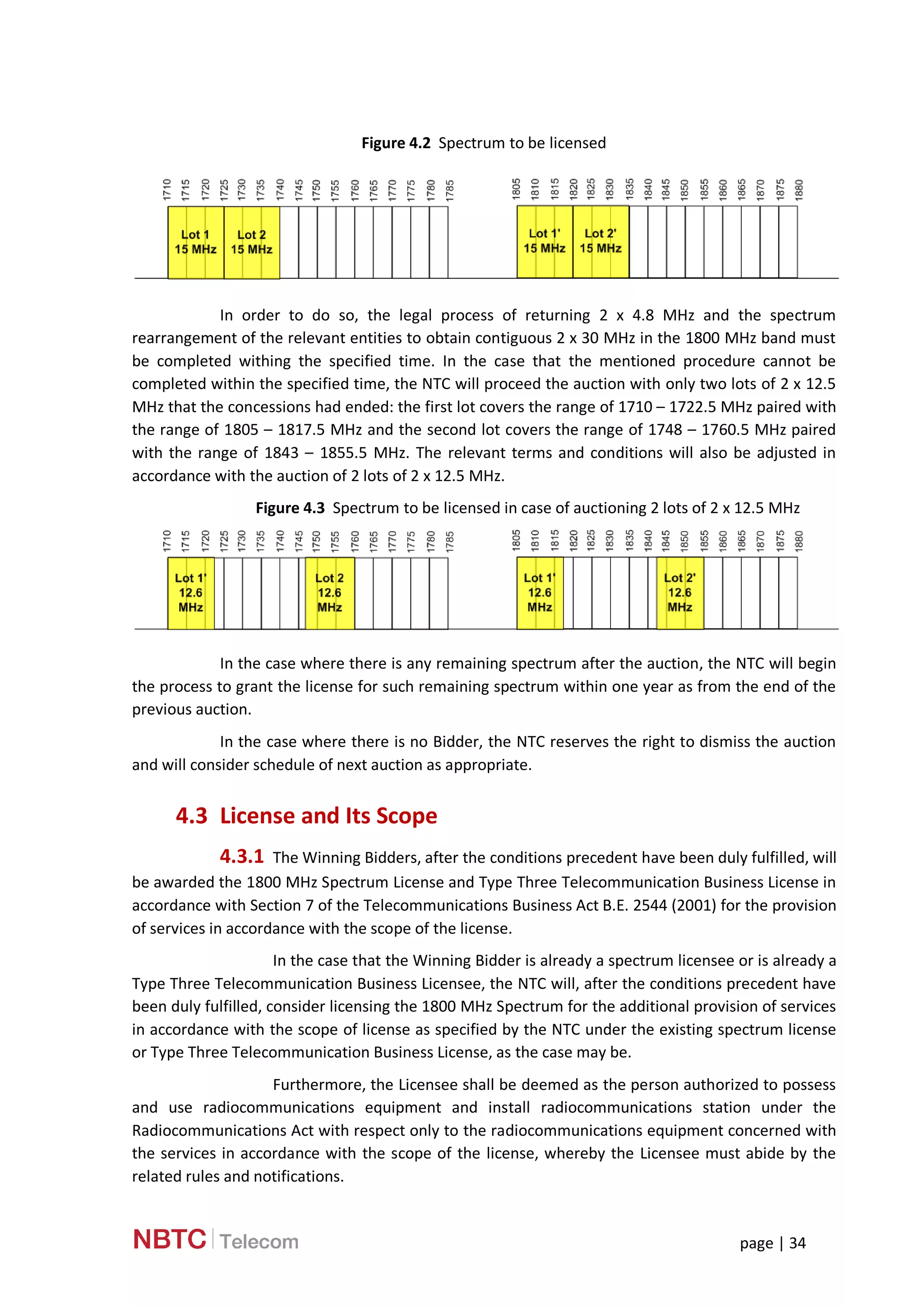
  • 22.
    page | 17 2.5Fixed Broadband Market 2.5.1 Subscribers and Penetration Rates The fixed broadband market has been growing continuously in the past few years, with CAGR of 10.2% per year between 2008 - 2014. As of Q1/2015, there are 5,860,651 fixed broadband subscribers (see Figure 2.13). This is equivalent to 8.7% population penetration rate, and 29.1% household penetrate rate. The number of fixed broadband connections as a percentage of fixed telephone connections is 100%. Figure 2.13 Number of Fixed Broadband Subscriptions (million) Source: NBTC Figure 2.14 Penetration Rates of Fixed Broadband Services (%) Source: NBTC 3.9 4.1 4.3 4.5 4.6 4.8 4.9 5.1 5.2 5.4 5.5 5.7 5.9 0.0 1.0 2.0 3.0 4.0 5.0 6.0 7.0 Q1/12 Q2/12 Q3/12 Q4/12 Q1/13 Q2/13 Q3/13 Q4/13 Q1/14 Q2/14 Q3/14 Q4/14 Q1/15 5.9% 6.2% 6.5% 6.7% 6.9% 7.1% 7.4% 7.6% 7.8% 8.0% 8.3% 8.5% 8.7% 19.6% 20.4% 21.3% 22.1% 22.7% 23.6% 24.3% 25.1% 25.9% 26.7% 27.4% 28.2% 29.1% 62.6% 65.7% 69.3% 72.8% 75.7% 79.7% 83.3% 87.1% 91.1% 95.2% 99.5% 100.0% 100.0% 0% 20% 40% 60% 80% 100% Q1/12 Q2/12 Q3/12 Q4/12 Q1/13 Q2/13 Q3/13 Q4/13 Q1/14 Q2/14 Q3/14 Q4/14 Q1/15 % of population % of household Broadband connections as % of fixed telephone connections
  • 23.
    page | 18 2.5.2Market Structure and Market Competition The fixed broadband market has three main players, True Internet, TOT, and Triple T Broadband (3BB). Their market shares as of Q1/2015 are: True Internet 36.7%, TOT 24.7% and 3BB 29.9%. In addition, the remaining other operators have a combined market share of 8.7%. Figure 2.15 Market Shares of Fixed Broadband Market (%) Source: NBTC The HHI of the fixed broadband market has been declining steadily in the past four years. As of Q1/2015, the HHI is at 2,928. Figure 2.16 HHI of Fixed Broadband Market Source: NBTC TOT 24.7% TRUE 36.7% 3BB 29.9% Others 8.7% 3,179 3,131 3,064 3,019 3,006 2,998 2,994 2,991 2,965 2,959 2,950 2,935 2,928 2,800 2,900 3,000 3,100 3,200 Q1/12 Q2/12 Q3/12 Q4/12 Q1/13 Q2/13 Q3/13 Q4/13 Q1/14 Q2/14 Q3/14 Q4/14 Q1/15
  • 24.
    page | 19 2.6Mobile Broadband Market 2.6.1 Subscribers As of Q1/2015, the AIS group has approximately 20 million mobile broadband subscribers, which is equal to about 49.1% of the total number of AIS subscribers. DTAC has approximately 14.8 million mobile broadband subscribers, or 52% of the group’s total subscribers. These numbers have a continuously increasing trend (see Figure 2.17) Figure 2.17 Mobile Broadband Subscribers (million) Source: AIS and Dtac websites 2.6.2 Price Structures Mobile broadband has grown rapidly following the auction of the 2.1 GHz spectrum held by the NBTC. Most mobile broadband plans charge users according to actual usage in megabytes rather than time-based usage. In addition, it is common for providers to implement a Fair Usage Policy, where once the purchased usage quota (for example 90 MB, 1 GB, 2 GB or 5GB) has been reached, usage speed will be reduced. There are mainly two types of price plans.  ‘Limited’ price plans, such as True’s iNet, which offers 2 GB of data for 499 baht per month, at a speed of 42 Mbps. If the user exceeds 2 GB, each additional MB at the same speed costs 2 baht.  ‘Unlimited’ price plans, such as True’s iNet, which offers 2 GB of data for 599 baht per month at a speed of 42 Mbps. When the 2 GB limit is reached, the user can continue to use unlimited data at a reduced speed of 128 Kbps. Competition is strong in the mobile broadband market. Usually when one provider offers a new price plan, others will follow suit by offering similar or higher-value plans in an effort to retain customers. In addition, discounts on smartphones are also offered as part of bundled services, further contributing to the continued growth of mobile broadband. 0 5 10 15 20 25 1Q2014 2Q2014 3Q2014 4Q2014 1Q2015 Millions AIS group DTAC group
  • 25.
    page | 20 2.6.3Data Consumption and Usage Types There is a rapid trend of users shifting from feature phones to smartphones. In 2014, there were close to 20 million smartphones in use, compared to 27 million feature phones. OVUM has forecasted that by 2018, almost all handsets in use in Thailand will be smartphones. Figure 2.18 Forecast of number of handsets Source: OVUM IDC forecasted that mobile data consumption will continue to rise rapidly. By 2020, monthly usage will reach 192,265 MB per user, compared to 72,351 MB per user in 2015 (a 165% increase). By 2020, internet browsing will be the main activity type, accounting for 32% of all data consumption, compared to 25% in 2015 (see Figure 2.19). Figure 2.19 Mobile data usage by application Source: IDC 38 33 31 27 21 15 11 7 3 10 15 20 27 36 43 49 0 10 20 30 40 50 60 2010 2011 2012 2013 2014 2015 2016 2017 Millions Feature phone Smart phone 0 20,000 40,000 60,000 80,000 100,000 120,000 140,000 160,000 180,000 200,000 2010 2011 2012 2013 2014 2015 2016 2017 2018 2019 2020 E-Mail InstantMessaging InternetBrowsing mCommerce Mobile Music Mobile Video Others PersonalMobile Cloud Social Media Software Upgrade
  • 26.
    page | 21 Consumershave a tendency to use mobile broadband through handsets and tablets more than they do through dongles. By 2020, it is estimated that the amount of data consumed through handsets/tablets will be 102,450 MB per month per user, while usage through dongles will be 89,814 MB per month per user. Figure 2.20 Mobile data consumption by device type Source: IDC If we look at the amount of data consumption per user, we find that subscribers in the Dtac group consume the most data per month, followed by True Mobile and AIS groups respectively (See Figure 2.21) Figure 2.21 Mobile broadband data consumption (Mb per month per user) Source: IDC 0 50,000 100,000 150,000 200,000 250,000 2010 2011 2012 2013 2014 2015 2016 2017 2018 2019 2020 Dongle Handset/Tablet 0 50,000 100,000 150,000 200,000 250,000 2010 2011 2012 2013 2014 2015 2016 2017 2018 2019 2020 AIS Samart TOT 3G DTN TRUEMobile Grand Total
  • 27.
    page | 22 Section3 Legal and Policy Background and Regulatory Regime 3.1 Act on the Organisation to Assign Radio Frequency and to Regulate the Broadcasting and Telecommunications Services B.E. 2553 (2010) Section 27 precribed powers and duties of the NBTC regarding the spectrum licensing as follows: (1) To formulate a Spectrum Management Master Plan, Table of National Frequency Allocations, Broadcasting Master Plan, Telecommunications Master Plan, Frequency Plan, and Telecommunications Numbering Plan; (2) To allocate radio frequencies for the undertaking of sound broadcasting, television broadcasting, radiocommunications, and telecommunications services; (4) To license and regulate the use of radio frequencies and radiocommunications equipment in the undertaking of sound broadcasting, television broadcasting and telecommunications services, or radiocommunications service; and prescribe licensing criteria and procedures, conditions, or licensing fees; (5) To prescribe criteria for efficient use of radio frequency without causing interference to the same type of business and other type of business; (6) To license and regulate the operations of sound broadcasting, television broadcasting and telecommunications services to allow service users to have choices of services with quality, efficiency, timeliness, reliability and fairness; and prescribe licensing criteria and procedures, conditions, or licensing fees; (11) To prescribe measure for the prevention of anti-competitive conduct or unfair competition in sound broadcasting, television broadcasting and telecommunications services. Section 40 The Telecommunications Commission shall have the power to act on behalf of the NBTC under the provisions of Section 27 (4) (6) (7) (8) (9) (10) (11) (12) (13) and (16) pertaining to the telecommunications and radiocommunications services, and other duties as assigned by the NBTC. Section 41 (paragraph 4) The permission to use radio frequency for the purpose of sound broadcasting or television broadcasting services shall be carried out with due regard to maximum public interests at the national, regional and local levels in education, culture, state security and other public interests, including free and fair competition, and shall be carried out in the manner of extensively and appropriately distributing the utilities as the national communications resource to all segments of enterprises for public interest.
  • 28.
    page | 23 Section41 (paragraph 7) In specifying qualifications of persons who are eligible for auctioning under paragraph six, due consideration shall be given to the benefit from efficient and optimum allocation of spectrum resources, prevention of anti-competitive conduct, promotion of free and fair competition, efficient supplying of services, burdens on the consumers, and right protection for potential licensees to operate business at regional and local levels. Section 45 Any person who wishes to use spectrum for the purpose of telecommunications business operation shall obtain a license under this Act by means of spectrum auctions in accordance with the criteria, procedures, duration, and conditions as prescribed by the NBTC. The provision of Section 41 paragraph four and paragraph seven shall apply mutatis mutandis. Income from spectrum auction after deducting expenditure shall be remitted to the state treasury. 3.2 Telecommunications Business Act, B.E. 2544 (2001) and its Amendment Section 7 Any person who intends to operate a telecommunications business in accordance with the nature and categories prescribed in notification of the NBTC under the law on the organisations to assign radio-frequency spectrum and to regulate the sound broadcasting, television broadcasting and telecommunications services shall obtain a license from the NBTC. There shall be three types of license as follows: (1) Type One License: being a license granted to the telecommunications business operator who operates without his or her own network for telecommunications services which are deemed appropriate to be fully liberalized. The NBTC shall grant a license once notified by a person who intends to operate such business; (2) Type Two License: being a license granted to the telecommunications business operator who operates with or without his or her own network for telecommunications services intended for a limited group of people, or services with no significant impacts on free and fair competition or on public interest and consumers. The NBTC shall grant a license once a person who intends to operate such business has completely fulfilled the standard criteria prescribed in advance in notification of the NBTC; (3) Type Three License: being a license granted to the telecommunications business operator who operates with his or her own network for telecommunications services intended for general public, or services which may cause a significant impact on free and fair competition or on public interest, or a service which requires special consumer protection. A person who intends to operate such business can commence the operation only after he or she is approved and granted a license by the NBTC. The rights of Type One, Type Two or Type Three licensee to operate telecommunications business in which nature, categories and scope of service shall be in accordance with notification prescribed by the NBTC, which shall be in conformity with the nature of telecommunications business for each type of license under paragraph two. In issuing such notification, the NBTC shall also have regard to the development of diverse telecommunications services and fairness among the operators.
  • 29.
    page | 24 3.3The Telecommunications Master Plan No. 1, B.E. 2555-2559 (2012-2016) The Telecommunications Master Plan, B.E. 2555-2559 (2012-2016) highlights the public’s equal, pervasive and reasonably priced access to diverse telecommunications services through modernized networks on a fair competition basis and with efficient use of telecommunications resources as the core network to support the national development into an intellectual and creative society, with a view to narrowing the rural-urban disparities, continuingly enhancing the country’s competitiveness in terms of telecommunications infrastructure, as well as developing efficient consumer protection measures. The Master Plan has been outlined in six aspects as follows: (1) Development and Promotion of Free and Fair Competition Monitoring and ensuring fair business operations in all markets where a monopoly or a reduction or restriction of competition is prevalent, at both national and local levels; and preventing the major operators or the operators with significant market power from abusing their market powers or any single one or group of them from manipulating or distorting market mechanism which could relatively lead to inefficient competition, so as to ensure fair competition and people’s access to telecommunications services on a fair and reasonably-priced basis. (2) Spectrum Licensing and Business Operation Licensing Allowing the licensed operators to operate telecommunications services on a free and fair competition basis; encouraging the deployment of modern technologies based on technological neutrality; and coordinating with concerned authorities in the formulation of licensing rules, guidelines and conditions for satellite communication services, in order to promote competition and diversification of telecommunications and broadband services. (3) Efficient Resources Utilization Ensuring the management and approval of efficient telecommunications resources utilization; encouraging infrastructure sharing for the utmost benefit at national and local levels in education, public health, culture, State security and other public interests such as in the case of emergency or disaster breaks out, with due regard to the proper, necessary and sufficient utilization, the technological advancement, as well as the encouragement of an optimized utilization of telecommunications, radiocommunications and communication satellite resources for the utmost benefit and in conformity with international practices and obligations. (4) Universal Basic Telecommunications Services Implementing measures to promote operators to make available the universal basic telecommunications services in the target areas; encouraging the provision of basic telecommunications services to the underprivileged in accordance with the plan on universal basic telecommunications services and social services to ensure the access to quality services at a reasonable price; fostering the provision of telecommunications services for social development and quality of life improvement; and promoting the capacity enhancement of telecommunications device and service industry for the disabled and the underprivileged in the society.
  • 30.
    page | 25 (5)Consumer Protection Enhancing the awareness among consumers of their basic rights in telecommunications service, benefits from consuming various types of telecommunications services, needs to keep abreast of technological advancement to ensure their efficient use of services, understanding of their right and freedom in consuming telecommunications services, and efficient access to complaint channels; and devising measures to step up roles of the operators in providing services in an ethical manner and with responsibility for consumers and the society. (6) Preparedness for and Entry into the ASEAN Economic Community (AEC) and Promotion of International Cooperation Fostering the enhancement of Thailand’s potential and readiness for the forthcoming AEC membership in 2015 by developing telecommunications cooperation and linking of infrastructure, rules and regulations, industry sector, researchers and developers, regulating agencies, and the public; and promoting international cooperation under various frameworks at bilateral and multilateral levels with due regard to the national interests. 3.4 The Spectrum Management Master Plan, B.E. 2555 (2012) The NBTC has prescribed the Spectrum Management Master Plan to be as the guideline for spectrum management, spectrum licensing as well as broadcasting and telecommunications businesses licensing and regulation. The Plan can be summarized as follows: 1) Vision To manage the spectrum to achieve public interests at the national, regional and local levels with due regard to free and fair competition as well as the extensive and appropriate distribution of the spectrum utilization in various segments including education, culture, state security and other public interests. 2) Mission To efficiently allocate, assign and regulate the spectrum utilization with due regard to public interests, business necessity, spectrum usage and technological advancement through certain, clear and reasonable criteria as well as transparent and fair process 3) Goal 3.1) To build the international cooperation mechanism in spectrum management among related parties including,international organizations, international frequency coordination committee, regulators and related operators; 3.2) To develop criteria and timeframe for spectrum refarming for reassignment or utilization improvement; 3.3) To develop spectrum management regulations and mechanism for national security agencies; 3.4) To assign spectrum and prescribe spectrum usage regulations in Public Protection and Disaster Relief (PPDR), case of emergency and other public services; 3.5) To set the transition plan for digital radio and television transmission;
  • 31.
    page | 26 3.6)To assign spectrum for public service and non-profit community uses at least twenty percent of the spectrum to be licensed for broadcasting business in each area. 4) Strategy The Spectrum Management Master Plan has defined the strategy and guideline regarding spectrum refarming as follows: 8.2 Refarming Strategy The refarming guideline is described as follows: 8.2.1 In case of government, state enterprises, and other government agencies who allowing other operators to use their spectrum by granting permission, concession or contract which its legality was already examined by the NBTC, after the end of their permission, concession or contract such spectrum shall be returned to the NBTC; 8.2.2 Those who have been legally licensed for the spectrum usage with the expiry dates shall return the spectrum after the end of their license; 8.2.3 For those who have been legally licensed for the spectrum usage without the expiry dates, the NBTC will set the expiry dates by considering public interest, business necessity and spectrum utilization: 8.2.3.1 In case of radio broadcasting service, the maximum period shall not exceed 5 years as from the date of the Spectrum Management Master Plan coming into force; 8.2.3.2 In case of television broadcasting service, the maximum period shall not exceed 10 years as from the date of the Spectrum Management Master Plan coming into force; 8.2.3.3 In case of telecommunications service and other services, the maximum period shall not exceed 15 years as from the date of the Spectrum Management Master Plan coming into force. However the permitted period shall not exceed expiry date of their telecommunications business license. 8.2.4 Spectrum refarming in any other cases will be as specified by the NBTC. Table 3.1 Criteria and timeline for the spectrum refarming according to the Master Plan Details Spectrum return time line 1) In case of the legal permission, concession or contract has definite expiry period Spectrum shall be returned after the end of the permission, concession or contract 2) In case of legally obtaining spectrum license with no expiry period for spectrum usage the maximum period shall not exceed 15 years as from the date of the Spectrum Management Master Plan coming into force. However the permitted period shall not exceed the expiry date of its telecommunications business license.
  • 32.
    page | 27 3.5Important Regulatory Issues 3.5.1 Telecommunications Numbers Management, and Mobile Number Portability and Record of Prepaid Mobile Phone Service’s Users The NBTC has a policy to allocate telecommunications numbers efficiently and sufficiently for the operators’ service provision and network expansion. It recognizes the importance of an allocation of numbers for public services, businesses and for national security, as well as for supporting the emergency or disasters. It has therefore devised a telecommunications numbering plan and the criteria for allocation of telecommunications numbers that is in line with the policy on telecommunications resource management. This means that the allocation, supervision, administration and use of telecommunications numbers, which are telecommunications resources, are undertaken in an efficient and fair manner and sufficient for the supply of services on the basis of free and fair competition including protection of service users. The NBTC’s current telecommunications numbering plan is designed to cater for the long-term number demand and support future service provision employing innovative technologies. The plan provides various types of telecommunications numbers to support services provided by operators which include fixed line number, mobile number, VoIP number, premium service number, technical number as well as short code number. In addition, the NBTC has been managing the telecommunications number allocation according to the NBTC’s Notification regarding the Criteria for Allocation and Management of Telecommunications Numbers, which details the basic principles of telecommunications number management and allocation with a clear and efficient process, including inter alia: guidelines on telecommunications number planning; application procedures for allocation of telecommunications numbers; procedures and criteria for allocation of telecommunications numbers; rights and duties of holder of allocated numbers and regulating guidelines. Besides, the holders of allocated numbers are duty-bound to pay fee for the telecommunications numbers at the rate specified in the Notification. The other important duty of the NBTC regarding mobile numbers management that gain interest from the public is the regulation of mobile number portability. This operation is under the NBTC’s Notification Regarding the Criteria for Mobile number Portability which outlines rules and guidelines for porting mobile number to another network provider while retaining their existing mobile numbers. Such number portability not only benefits the users, but also promotes competition in telecommunications services, improves service quality in order to retain the customers as well as supports the optimum utilization of numbers. The Notification also prescribes an investment in a Clearing House for data collection through a consortium of the mobile service providers, with the investment proportion to be specified. The NBTC has set forth a rule regarding the record of prepaid mobile phone service’s users (prepaid SIM card) under the NBTC’s Notification regarding the Criteria for Allocation and Management of Telecommunications Numbers. The NBTC has also determines a guideline on the registration of prepaid mobile phone service’s users (prepaid SIM card) to be complied by all mobile operators in order to protect the right of mobile phone users as well as to protect the society and national security. Moreover, there is a requirement that, for new numbers, the mobile operators must register the users’ SIM card prior to SIM activation.
  • 33.
    page | 28 3.5.2Telecommunications Network Interconnection In 2013 the NBTC issued the Notification Regarding Telecommunications Network Access and Interconnection B.E. 2556 prescribing criteria and procedures for network interconnection. The Notification requires that a licensee who owns network must allow other licensees to interconnect with its network on a fair, reasonable and non-discriminatory basis. The Notification also requires the licensee who owns network to develop and submit the Reference Interconnection offer together with supporting document that prescribes principle and method for calculating interconnection charge. Such interconnection charge must be cost-oriented and calculate on long run incremental cost basis. The charge for necessary facilities for interconnection must also be cost-oriented. The NBTC, however, may impose a certain calculation method and appropriate reference interconnection charge for certain interconnection services. In addition, this Notification also provides guidelines for contractual arrangements as well as dispute resolution procedure in the case where there is any refusal of network interconnection or access for which the petition should be submitted within one year as from the date of the refusal or the date the dispute regarding network interconnection or access arises. During the dispute settlement process, the NBTC may order temporary access or interconnection following conditions in the existing contract, conditions in the same type of contract or use the calculation method for interconnection charge that the NBTC sees appropriate. In this regard, the NBTC has issued the Notification Regarding Standard Method for Calculating Interconnection Charges B.E. 2556 (2013) to be the calculation standard for the transparency. Furthermore, in year 2014 the NBTC has issued the Notification Regarding the Reference Interconnection Charges B.E. 2557 (2014) which applies the calculation method according to the Notification regarding the standard method for Calculating Interconnection Charges mentioned-above. The purpose of this Notification is to set fair regulatory guideline and fair interconnection charge for telecommunications service users where an agreement regarding the charges cannot be reached among the licensees, where there is a dispute regarding the charge or where temporary charge is required. 3.5.3 Telecommunications Network Access The NBTC’s Notification Regarding Telecommunications Network Access and Interconnection B.E. 2556 also prescribes criteria and procedures for network acess. The Notification requires that a licensee who owns network must allow other licensees to access to its network on a fair, reasonable and non-discriminatory basis. The Notification also requires the licensee who owns network to develop and submit the Reference Access offer together with supporting document that prescribes principle and method for calculating access charge. Operators are permitted to determine the access rate among themselves via commercial negotiations on a fair, reasonable and non-discriminatory basis. The NBTC, however, may impose a certain calculation method and appropriate reference interconnection charge for certain interconnection services.
  • 34.
    page | 29 Inaddition, this Notification also provides guidelines for contractual arrangements as well as dispute resolution procedure in the case where there is any refusal of network interconnection or access for which the petition should be submitted within one year as from the date of the refusal or the date the dispute regarding network interconnection or access arises. During the dispute settlement process, the NBTC may order temporary access or interconnection following conditions in the existing contract, conditions in the same type of contract or as the NBTC sees appropriate. 3.5.4 Infrastructure Sharing for Mobile Network In order to promote free and fair competition and to bring the quality and efficient service to the consumers, the NBTC has prescribed the Notification Regarding Infrastructure Sharing for Mobile Network B.E. 2556 (2013) which requires the licensee (Type III and the mobile operators under concessions) to permit other licensees to share its own infrastructure for mobile network. The Infrastructure sharing includes tower and mast, base station area, transmission network between base station and base station controller. In sharing its own network, the licensees must treat other licensees on a fair, reasonable and non-discriminatory basis and the infrastructure sharing charge can be determined among licensees on a fair, reasonable and non-discriminatory basis. In addition, this Notification has also prescribed criteria and procedures for contract negotiation and dispute resolution where an agreement cannot be reached among the licensees. 3.5.5 Domestic Mobile Roaming Services The NBTC has prescribed the Notification Regarding Domestic Mobile Roaming Services to promote free and fair competition and to enable nationwide service to consumers. This Notification requires the licensees (Type III mobile operators and mobile operators under concessions) to allow other mobile operators to roam on its own network except the licensee network is non-interoperable with the raomer’s network due to different standard and technology employed. Furthermore, the licensee must treat other licensees on a fair, reasonable, and non- discriminatory basis and the domestic mobile roaming charge can be determined among the licensees on a fair, reasonable, and non discriminatory basis as well as must be reasonable comparing with the retail rate paid by its customers. In addition, this Notification has also prescribed criteria and procedures for contract negotiation and dispute resolution where an agreement cannot be reached among the licensees. 3.5.6 Mobile Virtual Network Service The NBTC has prescribed the Notification Regarding Mobile Virtual Networks Service B.E. 2556 (2013) to promote free and fair competition as well as to promote market entry for small entrant in order to escalate mobile service competition and provide service alternatives to customers. The Notification requires the licensee (Type III mobile operators and mobile operators under concessions) who is a wholseller to treat Mobile Network Operators (MVNOs) on a fair, reasonable and non-discriminatory basis and charge can be determined by the agreement between the wholseller and MVNOs on a fair, reasonable, and non discriminatory basis as well as must be reasonable comparing with the retail rate paid by the wholseller’s customers. In addition, this Notification has also prescribed criteria and procedures for contract negotiation and dispute resolution where an agreement can not be reached among the licensees.
  • 35.
    page | 30 3.5.7Setting of Service Tariff The NBTC regulates service fees in accordance with the “NBTC’s Notification Regarding Maximum Rate of Service Tariff and Advance Collection of Service Tariff in Telecommunications Business B.E. 2549 (2006).” The said notification aims at protecting service users and promoting efficient competition in Thai telecommunications market on a free and fair basis. The Notification specifies the methods for determining maximum rate of service tariff that is fair to operators and users, as well as specifies the duty of operators to report the service tariff which enables the NBTC to monitor whether the service tariff is in appropriate level or conducive to any anti-competitive or discriminatory practices and affect the service users or not. In addition, the Notification also specifies criteria and procedures to obtain the NBTC’s permission for advance collection of service tariff. Following the above-mentioned Notification, in 2012 the NBTC issued the Notification Regarding Maximum Rate of Service Tariff for Domestic Mobile Voice Service B.E. 2555 (2012)” which determines the maximum rate of mobile voice service tariff at 99 Satang per minute, applicable solely to the operators with significant market power (SMP) according to the NBTC’s order in 2010. Later on, in granting the 2.1 GHz spectrum licenses in December 2012, one of the license conditions mandates that the tariffs of voice and non-voice services must be reduced in average by at least 15% of the average market price at the day the licenses are granted. Such condition is however presumed as a specific measure for regulating service tariff for service on 3G network. Currently, the NBTC is reviewing overall mobile service tariff regulation to be up to date and suitable with the market environment. In doing so, the NTC has approved in principle for the determination of the maximum rate of service tariff by using Price Cap methodology which is expected to become effective within year 2015. 3.5.8 Measure for the Prevention of Monopoly and the Identification of Market Power in Telecommunications Business The NBTC implements two types of competition regulation – the ex-ante and ex- post regulation. Ex-post regulation is governed by the NTC Notification on Measures to Prevent Monopolistic and Unfair Competition Practices in Telecommunications Business B.E. 2549 (2006), which aims to ensure free and fair competition among telecommunications service providers and to promote and support competition in and development of the telecommunications industry in an efficient and sustainable manner. The Notification prohibits operators who have been deemed to have Significant Market Power (SMP) from carrying out certain anti-competitive practices such as service subsidization and cross service subsidization for the service or the business under competition in the market, acquisition of business of the same service type; and any conduct deemed as abuse of market power in the manner of monopoly, or reduction or restriction of competition. The Notification also institutes a process of inquiry dealing with the licensee who acts or behaves in such manner, as a standard of practice for the NBTC. For the ex-ante regulation, in 2014 the NBTC issued two key notifications. The first is the NBTC Notification on Market Definition and Relevant Markets in Telecommunications B.E. 2557 (2014), and the second is the NBTC Notification on Criteria and Procedures for Identifying Operators with Significant Market Power in Telecommunications Business B.E. 2557 (2014). According to these Notifications, the Office of the NBTC must prepare a report on analysis of the level of competition in the relevant markets and propose a list of operators with SMP in each
  • 36.
    page | 31 relevantmarket for the NBTC’s consideration. This will be used as a basis for outlining measures for the supervision of anti-competitive behaviors in telecommunications market in alignment with the above-mentioned Notification, and also for formulating a guideline to prevent the operators with SMP from abusing their market power to restrict or hinder free competition in the market. The NBTC additionally issued the Notification Regarding Criteria and Procedure for Accounting Separation in Telecommunications Buiness as a tool to support the implementation of measures for the prevention of monopoly or unfair competition in telecommunications business. Under the Notification, the operators with SMP are required to undertake accounting separation for the NBTC’s analysis. This aims to:  Identify the anti-competitive behaviors such as predatory pricing, margin squeeze, etc.  Identify the discriminatory behaviors such as cross subsidization, a case in which the operators with SMP set an overly high price in a market where they have powers and use the received profit for cross subsidization in another market where they are inferior to their rivals; and  Be a basis for determining the cost-based wholesaling and retailing rates without excessive return/profit. 3.5.9 Universal Basic Telecommunications and Social Services Telecommunications plays an important role in people communication and also in promoting capability development in other sectors such as manufacturing sector, trade and commerce sector as well as public and private service sectors. Therefore, the distribution of Universal Basic Telecommunications and Social Services will minimize the gap in communication and technology access which will improve the quality of life of the people in remote areas and bring about the equality and fairness in standard of living for all citizens both in the city and the remote areas. This will finally affects the national competitiveness level. With all reasons mentioned above, the Telecommunications Master Plan B.E. 2555-2559 (2012-2016) aims to adopt measures to encourage operators in providing basic telecommunications services universally, promote the provision of basic telecommunications services to the underprivileged in accordance with the Universal Basic Telecommunications Services and Social Services Plan to ensure the access to quality telecommunications service at a reasonable tariff, to foster the provision of telecommunications service for social development and quality of life improvement as well as to improve the capability of telecommunications device manufacturing and telecommunications service for the disabled and the underprivileged. In 2012, the NBTC has issued the NBTC’s Notification Regarding Plan on Universal Basic Telecommunications Services and Social Services (B.E. 2555-2559) (2012-2016) aiming to promote and encourage nationwide distribution of wireline and wireless telecommunications network as well as to provide opportunity and develop capability in internet access for the underprivileged, the disabled, children, and senior citizens which will improve quality of life and the overall national competitiveness level. Subsequently, the NBTC has issued the NBTC’s Notification Regarding the Criteria and Procedure for Revenue Collection to Fund the Provision of Universal Basic Telecommunications Services and Social Services which prescribes the criteria and procedure for revenue collection from telecommunications service licensees for contribution to the Broadcasting and Telecommunications Research and Development Fund for the Public Interest. This is in order to
  • 37.
    page | 32 securefunding for the implementation of the said Plan on Universal Basic Telecommunications Services and Social Services. The basic telecommunications services selected to be offered are telephone service and high speed internet service with no limitation of technology employed and the applications which include terminal equipment, software or other necessary peripherals. The goal is also include promotion and improvement of knowledge and skill which will benefit to the public for the appropriated and efficient access to the basic telecommunications services. Moreover, the licensees with their own network are required to annually contribute to the Fund at the amount of 3.75% per year of their net income from their telecommunications services as defined in the said notification. It is expected that, after the successful implementation according to the Universal Basic Telecommunications and Social Services Plan (B.E.2012-2016), the personal telephone penetration rate will be at least 95% of Thai population and the high speed internet penetration rate will be at least 80% of Thai population. Also, there will be internet community center, internet service in school, internet service in community hospital as well as internet service center for target groups nationwide and telecommunications system for the disabled to access to information as others. 3.5.10 Current Spectrum Assignment for Telecommunication Services in Thailand The utilization and the regulation of radio frequencies spectrum in telecommunication businesses is mandated by the Act on the Organization to Assign Radio Frequency and to Regulate the Broadcasting and Telecommunications Services B.E. 2553 (2010) (the Organization Act) and the Telecommunications Business Act, B.E. 2544 (2001). Section 46 of the Organization Act states that a spectrum license for telecommunications business is the exclusive rights and is not transferable. The licensee who has been authorized to use spectrum shall carry out the services by himself or herself. Also, business management either in whole or in part shall not be rendered or permitted to other to act on his/her behalf. In addition, Section 47 of the Organization Act stipulates that for any licensee who has been authorized to use spectrum for telecommunications services that has not carried out the business by using such spectrum within period specified by the NBTC, or by using such spectrum in other services not relating to its objectives, or fails to comply with the business operation conditions, or conducts any prohibitive acts as specified in Section 27 (11) or fails to comply with the provision of Section 46, the NBTC shall take action to rectify the situation or issue an order to revoke the spectrum license in whole or in part.
  • 38.
    page | 33 Section4 The License 4.1 Spectrum to be licensed The spectrum to be licensed is 2 x 30 MHz of 1800 MHz spectrum in the band of 1710 – 1740 MHz/1805 – 1835 MHz according to the International Mobile Telecommunications (IMT) Spectrum Plan in the frequency band of 1710-1785/1805-1880 MHz, which consists of: 1) The spectrum in the 1800 MHz band which used for the provision of mobile phone service by True Move Company Limited (2 x 12.6 MHz) and Digital Phone Company Limited (2 x 12.6 MHz) under the concession with CAT Telecom Public Company Limited which ended on September 15th , 2013; 2) The 2 x 4.8 MHz spectrum in the 1800 MHz band, which Total Access Communications Public Company Limited possess and use under the concession between CAT Telecom Public Company Limited and Total Access Communication Public Company Limited, that the Ministry of Information and Communication has officially confirmed to return to be combined with the spectrum of 2 x 25.2 MHz in 1) for the auction. In this regard, the spectrum rearrangement must be performed to obtain the contiguous 2 x 30 MHz band. Figure 4.1 Spectrum to be auctioned 4.2 Number of Licenses The NTC will grant two spectrum licenses, with a bandwidth of 2 x 15 MHz each as shown in Table 4.1. Each bidder is entitled to bid only one spectrum lot or 2 x 15 MHz. Table 4.1 Spectrum to be licensed spectrum bandwidth Lower Frequency Upper Frequency lot 1 2x15 MHz 1710-1725 MHz 1805-1820 MHz lot 2 2x15MHz 1725-1740 MHz 1820-1835 MHz
  • 39.
    page | 34 Figure4.2 Spectrum to be licensed In order to do so, the legal process of returning 2 x 4.8 MHz and the spectrum rearrangement of the relevant entities to obtain contiguous 2 x 30 MHz in the 1800 MHz band must be completed withing the specified time. In the case that the mentioned procedure cannot be completed within the specified time, the NTC will proceed the auction with only two lots of 2 x 12.5 MHz that the concessions had ended: the first lot covers the range of 1710 – 1722.5 MHz paired with the range of 1805 – 1817.5 MHz and the second lot covers the range of 1748 – 1760.5 MHz paired with the range of 1843 – 1855.5 MHz. The relevant terms and conditions will also be adjusted in accordance with the auction of 2 lots of 2 x 12.5 MHz. Figure 4.3 Spectrum to be licensed in case of auctioning 2 lots of 2 x 12.5 MHz In the case where there is any remaining spectrum after the auction, the NTC will begin the process to grant the license for such remaining spectrum within one year as from the end of the previous auction. In the case where there is no Bidder, the NTC reserves the right to dismiss the auction and will consider schedule of next auction as appropriate. 4.3 License and Its Scope 4.3.1 The Winning Bidders, after the conditions precedent have been duly fulfilled, will be awarded the 1800 MHz Spectrum License and Type Three Telecommunication Business License in accordance with Section 7 of the Telecommunications Business Act B.E. 2544 (2001) for the provision of services in accordance with the scope of the license. In the case that the Winning Bidder is already a spectrum licensee or is already a Type Three Telecommunication Business Licensee, the NTC will, after the conditions precedent have been duly fulfilled, consider licensing the 1800 MHz Spectrum for the additional provision of services in accordance with the scope of license as specified by the NTC under the existing spectrum license or Type Three Telecommunication Business License, as the case may be. Furthermore, the Licensee shall be deemed as the person authorized to possess and use radiocommunications equipment and install radiocommunications station under the Radiocommunications Act with respect only to the radiocommunications equipment concerned with the services in accordance with the scope of the license, whereby the Licensee must abide by the related rules and notifications.
  • 40.
    page | 35 4.3.2In providing the service, the Licensee can employ any technology based on neutral technology concept under ITU-R Recommendations relating to IMT. However, the Licensee can use Global Systems for Mobile Communication (GSM) technology in the beginning period until the complete transition to IMT, under terms and conditions prescribed by the NTC. 4.3.3 The Licensee will be able to provide telecommunications services as a network provider and service provider as well as telecommunications facility which include the following characteristics and types of service: 1) Wireless telecommunications network service; 2) Telecommunications Facility; 3) Telecommunication services, i.e. 3.1) Mobile phone service; 3.2) Public Broadband Multimedia Service; 3.3) Value-added Service for the licensed telecommunication services; and 3.4) Wholesale service for services in 3.1) – 3.3) In the case that the Licensee intends to provide broadcasting business, the Licensee must conform to laws on the provision of broadcasting business and other relevant laws. 4.4 License Duration The 1800 MHz Spectrum License and Type Three Telecommunication Business License will be valid from the date of obtaining the License until 15 September 2033. In the case where the Licensee is already a spectrum Licensee or a Type Three Telecommunication Business Licensee, the License duration for only the telecommunications services using 1800 MHz Spectrum in accordance with the scope of License will be valid from the date of obtaining the rights until 15 September 2033. The Licensee must comply with the conditions precedent to service dissolution as specified by the NTC and must submit service users’ management plan at least 2 years in advance before the end of the license period in order to avoid effects on service users. The Licensee must return the granted spectrum to the NTC when the license period lapses. 4.5 Annual License Fee The Licensee has the duty to pay the Type Three Telecommunication Business Annual License fee, spectrum administrative fee, telecommunication numbering fee, revenue contribution to the Broadcasting and Telecommunications Research and Development Fund for the public Interest, and any other related fees under the criteria and procedures set forth by the NTC.
  • 41.
    page | 36 4.6Licensing Terms and Conditions 4.6.1 The Licensee must strictly comply with the terms and conditions on the use of radio frequency and telecommunications business operation under the Act on the Organization to Assign Radio Frequency and to Regulate the Broadcasting and Telecommunications Services B.E. 2553 (2010), the Telecommunications Business Act B.E. 2544 (2001) and its amendment, the NBTC’s Notification regarding Spectrum Plan for the International Mobile Telecommunications (IMT) Spectrum Plan in the Frequency Bands of 1710-1785/1805-1880 MHz, conditions for Type Three Telecommunications Business License, as well as rules, regulations, notifications, orders and any criteria prescribed by the NTC. 4.6.2 Coverage Obligation 1) The Licensee must provide telecommunications network for rendering services covering at least 40 percent of the population within 4 years as from the date of obtaining the License and at least 50 percent of the population within 8 years as from the date of obtaining the License. The provision of telecommunications network for rendering services will be inclusive of the installation and the leasing of telecommunications network, but excluding the national roaming of other operators’ mobile phone network. 2) The Licensee’s telecommunications network must be capable of supporting a data transmission rate not less than the rate prescribed in the NBTC’ Notification Regarding the Standard and Quality of Data Service. In the case that the Licensee has advertises its quality of telecommunications service, it is the duty of such Licensee to comply with its advertisement. 3) The Licensee must report the network installation status as scheduled by the NTC, and must provide supporting evidence demonstrating the average data transmission rate upon request by the NTC. In this regard, the NTC will subsequently set forth the criteria, conditions and method to measure the population coverage in the service areas and transmission speed. 4) In the case that the Licensee fails to comply with the conditions on network provision for rendering service described above, the Licensee will be obliged to pay a daily penalty charge at the rate of 0.05 percent of its highest bid price throughout the period of its failure to comply with the conditions of the NTC within the specified timeframe. 4.6.3 Infrastructure Sharing The licensee must comply with the NBTC’s Notification Regarding Infrastructure Sharing for Mobile Network B.E. 2556 (2013). 4.6.4 Service of Mobile Virtual Network Operator (MVNO) The licensee must provide telecommunications network service with the minimum capacity of 10% of its networks to the MVNO who is not the connected person with any licensee when receiving such service request, and must comply with the NBTC’s Notification Regarding Mobile Virtual Network Operator Service B.E. 2556 (2013).
  • 42.
    page | 37 4.6.5National Roaming Service The Licensee must comply with the NBTC’s Notification Regarding National Roaming of Mobile Phone Network B.E. 2556 (2013). 4.6.6 Record of prepaid mobile phone service’s users The licensee must comply with the NBTC’s Notification Regarding Criteria for Telecommunications Numbers Assignment and Management as well as the guideline prescribed by the Office of the NBTC which includes the prepaid user’s registration prior to service activation. 4.6.7 Social and Consumer Protection Measures 1) The Licensee must prepare its Corporate Social Responsibility (CSR) plan covering the electronic waste management, users’ health, risk management plan for rapidly changing technologies, and services for disabled which include at least special tariff and special invoice or contract with large font or in Braille at no additional charge. In this regard, the Licensee must submit such CSR plan to the NTC prior to launching its service and must implement according to its plan within 1 year as from the date of launching its service. 2) The Licensee must prepare a consumer protection plan covering measures to handle complaints free of charge, measures to handle unsatisfactory service, procedure to develop understanding among the public regarding the establishment of radiocommunications stations, as well as building the consumer recognition regarding rights to use telecommunications service which include publication of consumer rights in consuming mobile phone service as specified by the Office of the NBTC. In this regard, the Licensee must submit the consumer protection plan to the NTC prior to launching its service and must implement according to its plan immediately after the launch of its service. 3) The Licensee must support the mission of the NTC regarding telecommunications service for social benefits as prescribed by the NTC, particularly in arranging public telecommunications service and facilitating the access to public telecommunications services universally for low-income earners, the disabled, children, the elderly, people in remote areas, and the underprivileged. 4) The Licensee must heedfully prevent any person from using its network for illegitimate activities or disseminating any information that may undermine peace or morality of the people, and must support the state and private agencies in any act intending to protect rights of consumers for the safety of society and the State security. 5) The Licensee must provide the service in a fair nature, which includes setting of tariff that is clear, reasonable and not taking advantage of consumer, and shall provide service with quality as prescribed by the NTC. For this purpose, the Licensee must set forth the tariff for voice and data services which is, on average, lower than the average tariff of mobile phone service using 2.1 GHz spectrum on the date of this Notification coming into force. In doing so to promote and increase the opportunity for users in accessing the mobile telecommunications service using 1800 MHz spectrum, the Licensee must provide at least one promotion which has tariff lower than average tariff of mobile phone service using 2.1 GHz spectrum on the date of this Notification coming into force, as well as charges based on actual usage and has the quality not lower than the average quality of mobile phone service using 2.1 GHz spectrum. All this will apply until the NTC prescribed criteria relating to the regulation of tariff and quality of service otherwise.
  • 43.
    page | 38 Section5 Licensing Procedure 5.1 Licensing Phases The spectrum licensing process can be divided into 6 phases as summarised in table below: Table 5.1 Licensing Phases 1) Regulations Preparation  Formulation of spectrum licensing criteria  Preparation of Information Memorandum (IM)  Published the Notification regarding criteria and procedure for spectrum licensing in the Government Gazette 2) Auction Invitation  Auction invitation and publication of Information Memorandum 3) Pre-Qualification  Consideration of compliance with application method  Consideration of Applicant’s qualification 4) Auction Training  Bidder information session and mock auction 5) Auction Phase  Bidding session 6) License Granting Phase  Fulfillment of conditions precedent  License granting 5.1.1 Regulations Preparation In this phase, rules and regulations are drawn up along with related documentation which are the Notification regarding Criteria and Procedure for Spectrum Licensing and the Information Memorandum for Spectrum Licensing. 5.1.2 Auction Invitation In this phase, the auction invitation and the Information Memorandum will be published to invite potential operators to participate in 1800 MHz spectrum auction. Interested parties must process in accordance with the application method for pre-qualification screening. The NTC may arrange a public information session for the interested parties to familiarize themselves with the application form filling and the auction process. 5.1.3 Pre-Qualification In this phase, the compliance with the application method and the Applicants’qualification will be examined according to the prescribed regulation. The Applicants who fully-met qualifications and requirements are entitled to be the Bidders.
  • 44.
    page | 39 5.1.4Auction Training The NTC may arrange a bidder information session for all qualified Applicants who are eligible to be the Bidders so that they could familiarize themselves with the auction method, criteria and procedures. 1) Bidder Information Session Bidders will be introduced to the auction and auction software prior to the auction day. 2) Mock Auction The NTC will invite all Bidders to participate in learning and practicing the auction software. The Mock Auction will provide the Bidders with an opportunity to practice the bidding procedure using the Auction Software. Also, it serves as a test of the Auction Software. 5.1.5 Auction Phase The auction will be proceeded by openning the bid for all lots of 1800 MHz Spectrum to be licensed simultaneously in multiple rounds. The bid price in each round will increase correspondingly (Simultaneous Ascending Bid Auction) and the Bidder can place bid for a desired lot. The Auction will be conducted through the Auction Software on an Internet or Intranet system in the specified venue. The Office of the NBTC will provide computer system, PC and necessary peripherals. 5.1.6 License Granting Phase The NTC will issue the 1800 MHz Spectrum License and Type Three Telecommunication Business License to each Winning Bidder after the Winning Bidder has correctly and completely fulfilled the conditions precedent. 5.2 Timetable for Spectrum Licensing The following table shows the spectrum licensing timetable to help those wishing to apply for the license in preparing for filing the application forms and participating in the auction. The NTC reserves the right to change the timetable and/or to extend or shorten the timetable. Any of such changes will be informed in advance on the NBTC’s website (www.nbtc.go.th). Table 5.2 Timetable for Spectrum Licensing Task Date Regulations Preparation Publication of the Regulation regarding licensing criteria in the Gevernment Gazette 24 August 2015 Auction Invitation Auction invitation and publication of Information Memorandum During 28 August – 28 September 2015 Public Information Session During 28 August – 28 September 2015
  • 45.
    page | 40 TaskDate Pre-Qualification Application Day 30 September 2015 Pre-qualification screening During 30 September 2015 – 21 October 2015 Bidders announcement 21 October 2015 Auction Training Information Session and Mock Auction for Bidders During 22 October – 10 November 2015 Auction Phase Auction Day 11 November 2015 Announcement of winning bidders No later than 18 November 2015 License Granting Phase Fulfillment of conditions precedent Within 90 days after the bidder is notified in writing as the winning bidder License Granting After the Winning Bidders completely and correctly fulfill conditions precedent 5.3 Pre-Qualification Process 5.3.1 Process The purpose of the pre-qualification process is to select appropriate applicants to be the Bidders. The pre-qualification process encompasses the following 3 steps: 1) The interest entities submit the application forms together with relevant information and document and pay the application fee in the amount of 500,000 Baht (excluding VAT) and place the auction guarantee in the amount of 796,000,000 Baht in the case of 2 x 30 MHz auction or 580,000,000 in the case of 2 x 25 MHz auction; 2) The NTC evaluates the completeness of license application and applicant’s qualification including relavant documents as prescribed in the Notification; 3) The Applicants will be notified whether their application has been successful. Only qualified Applicants will be allowed to be the Bidder. 5.3.2 Qualifications and Other Requirements Each applicant must fully meet the qualifications and complete all requirements as listed below: 1) Submission of Information and Documents 1.1) Submit the completely-filled application forms for obtaining the 1800 MHz Spectrum License and the accompanying documents and information as prescribed in Annex A of the NBTC’s Notification regarding the Criteria and Procedure for Spectrum Licensing for International Mobile Telecommunications in the frequency band of 1800 MHz with 2 sets of their copies and the electronic documents to the Office of the NBTC.
  • 46.
    page | 41 1.2)Submit the documents of the Applicant that documented compliance with the Schedule of Prohibitions as prescribed in the NBTC’s Notification regarding the Prescription of Prohibitions on Acts Constituting Foreign Dominance B.E. 2555 (2012), together with an affirmation signed by an authorized signatory that the applicant will not conduct any act that is contrary to any of the restrictions, the affirmation in accordance with the measures for restricting collusive behavior and the affirmation that if obtaining a License, the Applicant agrees to prepare and act in accordance with a Corporate Social Responsibility (CSR) plan as approved by the NTC, and sign in the bidder’s consent letter, as prescribed in the application form for 1800 MHz Spectrum License; 2) Application Fee and Auction Guarantee 2.1) The Applicant must pay the application fee of 500,000 Baht (excluding VAT) by cash or bank cheque issued by a financial institution operating commercial banking business under the Financial Institutions Business Act B.E. 2551 (2008), dated on or not more than three business days prior to the date of payment to the Office of the NBTC. This fee will be deemed as the application fee for the spectrum license and Type Three Telecommunications Business License and will not be refunded by the Office of the NBTC in any cases; 2.2) The Applicant must place an auction guarantee by bank cheque issued by a financial institution operating commercial banking business under the Financial Institutions Business Act B.E. 2551 (2008), dated on or not more than three business days prior to the date of payment to the Office of the NBTC, for an amount of 796,000,000 Baht in the case of 2 x 30 MHz auction or 663,000,000 Baht in the case of 2 x 25 MHz auction; In the case the Applicant does not proceed in accordance with specified methods in 1) and 2), the Office of the NBTC will not accept the License application. 3) Qualification Requirement 3.1) The Applicant must have the qualifications as stipulated in Section 8 of the Telecommunications Business Act B.E.2544 (2001) and its amendment, and must have the qualifications and must not possess the prohibited characteristics as prescribed in Clause 3 of the National Telecommunications Commission’s Notification Regarding Criteria and Procedure for Granting Type Three Telecommunications Business License; 3.2) The applicant must be a juristic person in the type of a limited company or public limited company established under Thai law and must not be a foreigner under the law on foreign businesses. The applicant must specify the prohibitions as prescribed in the NBTC‘s Notification regarding the Prescription of Prohibitions on Acts Constituting Foreign Dominance B.E. 2555 (2012) together with affirmation signed by authorized signatory that the applicant will not conduct any act that is contrary to any of the prescribed restrictions. After the auction, in the case where the licensee conducts any act that infringe the mentioned prohibitions, the NBTC’s Notification regarding the Prescription of Prohibitions for the Act having Nature of Foreign Dominance B.E. 2555 (2012) will be applied; 3.3) The Applicant must have no connection with other Applicant(s) by means of being the major shareholder, subsidiary company, associated company or person in authority or a controlled entity or related entity or have cross-shareholding with other Applicant(s).
  • 47.
    page | 42 Anexception will be made in the case of being related due to relationship as the entity who grants or is granted authorization, concession or contract under Section 80 of the Telecommunications Business Act B.E. 2544 (2001). Whereby the consideration shall be in accordance with the provisions in Clause 2 of the NTC’s Notification regarding Criteria and Method of Merger & Acquisition and Cross-Shareholding in Telecommunication Business B.E. 2553 (2010); In the examination, if it is found that the Applicant does not have qualifications as prescribed, or the fact subsequently show that the Applicant who is the Bidder or the Winning Bidder does not have qualifications as prescribed, such Applicant will be removed from the list of the Applicants, the Bidders or the Winning Bidders, as the case may be. 5.4 Spectrum Auction Fee 5.4.1 Minimum Price of the 1800 MHz Spectrum Licensing The minimum price of the Spectrum Licensing for each spectrum lot is equal to 15,912,000,000 Baht in case of 2 x 30 MHz auction or 13,260,000,000 Baht in case of 2 x 25 MHz auction. In the case where the number of bidders is less than or equal to the number of spectrum lots to be auctioned, the minimum price of the Spectrum Licensing for each spectrum lot is equal to 19,890,000,000 Baht in case of 2 x 30 MHz auction or 16,575,000,000 Baht in case of 2 x 25 MHz auction. 5.4.2 Payment of the 1800 MHz Spectrum Auction Fee The Winning Bidder must pay the 1800 MHz Spectrum auction fee according to the highest bid price of each Winning Bidder in three installments as follows: The first installment - the Winning Bidder must pay 50 percent of its highest bid price and submit a letter of guarantee, issued by a financial institution operating commercial banking business under the Financial Institutions Business Act B.E. 2551 (2008), for the remaining of spectrum auction fee within 90 days as from the date it is notified in writing as being a Winning Bidder. The Office of the NBTC will offset the deposit placed by the Winning Bidder from this installment, and each Winning Bidder must completely pay the remaining amount within the specified period; The second installment - the Winning Bidder must pay a further 25 percent of its highest bid price and submit a letter of guarantee, issued by a financial institution operating commercial banking business under the Financial Institutions Business Act B.E. 2551 (2008), for the third installment within 15 days after the lapse of 2 years as from the date of the license award. The Office of the NBTC will return the bank guarantee submitted with the first installment within 15 days as from the date of the receipt of the second installment; The third installment - the Winning Bidder must pay the remaining 25 percent of its highest bid price within 15 days after the lapse of 3 years as from the date of license award. The Office of the NBTC will return the letter of guarantee submitted with the second installment within 15 days as from the date of the receipt of the third installment. The spectrum auction fee to be paid by each of the Winning Bidder is excluded from tax, other fees and interest as prescribed by law.
  • 48.
    page | 43 Inthe case that the Licensee fails to make a full payment of the second or third installment within the specified period, the Licensee must pay additional fee equal to the amount of the outstanding spectrum auction fee multiplied by the interest rate of 15 percent per year, calculated daily. In the case that the Licensee fails to pay within the specified period, it will be deemed that the Licensee fail to comply with conditions specified in this Notification and the NBTC may consider suspending or revoking its License. 5.5 Granting of Licenses 5.5.1 Conditions Precedent Before obtaining the license, the Winning Bidder must fulfill the following requirements within 90 days as from the date it is notified in writing as the Winning Bidder: 1) Pay the first installment of the spectrum auction fee and submit a letter of guarantee, issued by a financial institution operating commercial banking business under the Financial Institutions Business Act B.E. 2551 (2008), to guarantee payment of the second and third installments of spectrum auction fee; 2) If it is found that the necessary documents and information required for granting the applicant of Type Three Telecommunication Business License, as submitted in accordance with Clause 4 of Annex A to the NBTC’s Notification Regarding Criteria and Procedure for the Licensing of Spectrum for Telecommunications Service in the Frequency Band of 1800 MHz are inaccurate or inadequate, the Winning Bidder must rectify such documents as informed by the Office of the NBTC for completeness and accuracy. 5.5.2 Granting of Licenses The NTC will issue the 1800 MHz Spectrum License and Type Three Telecommunication Business License to each Winning Bidder after such Winning Bidder has correctly and completely fulfilled the conditions precedent. 5.6 Measures for Restricting Collusive Behaviour 5.6.1 The Applicants are prohibited from any kinds of communication among each other in the nature of exposing or exchanging confidential information, or any information with regard to spectrum licensing, from the date of the application submission until the time of auction result announcement on the day the aution ends. 5.6.2 The Applicant must not conduct any act having the following natures: 1) Mutually agree on a bid with other applicant(s), with an objective to benefit any person to be eligible for the License, thus avoiding a fair bid competition. 2) Give, ask to give or agree to give money or assets or any other benefit to others for an advantage in the auction with an objective to persuade that person to cooperate with any act that will benefit any person to be eligible for the License, or to persuade a person to bid at a high or low price that is obviously an unconventional bid, or to persuade a person not submit a bid or to withdraw a bid or to not become an Applicant or a Bidder in the auction.
  • 49.
    page | 44 3)Coerce others to unwillingly cooperate with any act in a bid, or not to submit a bid, or to withdraw a bid, or have to bid as specified, by violence or threat with any mean, causing others to fear of physical harm to their life, physique, liberty, reputation, or property of the threatened person or third party, until that coerced person does as told. 4) Use deception or any other act to cause others not to have a chance to bid fairly, or to bid mistakenly. 5) Fraudulently submit a bid to the Office of the NBTC with the knowledge that the bid is abnormally high or low and can be obviously perceived as an unconventional bid, having an objective to deprive fair price competition, and the said conduct causes the spectrum auction to derail. The Applicant must comply with the criteria, period, procedure, and conditions as prescribed in the NBTC’s Notification Regarding Criteria and Procedure for the Licensing of Spectrum for Telecommunications Service in the Frequency Band of 1800 MHz, and must sign the Bidder’s consent letter.
  • 50.
    page | 45 Section6 Auction Methodology and Rules 6.1 Auction Methodology The NTC will open the bid for all lots of 1800 MHz Spectrum to be licensed simultaneously and shall proceed in multiple rounds. The bid price in each round will increase correspondingly (Simultaneous Ascending Bid Auction). A bidder can place bid for a desired lot. The 1800 MHz Spectrum to be auctioned consists of two lots of spectrum. 6.2 Spectrum to be Auctioned and the First Round Price The spectrum to be auctioned and the first round price depend on the spectrum available for auction as shown in the following table. The first round price will be the sum of the minimum price of the spectrum licensing according to clause 8(2) and (3) of the NBTC’s Notification Regarding the Criteria and Procedures for the Licensing of Spectrum for Telecommunications Service in the Frequency Band of 1800 MHz and the bid in each round as specified in Section 6.4.1 of Auction rules. 6.2.1 In case of auctioning 2x30 MHz of spectrum, the spectrum to be auctioned and the first round price are as shown in table 6.1 and 6.2: Table 6.1 In case there are more than two bidders: Spectrum Lot Frequency Band Minimum Price (Million Baht) First Round Price (Million Baht) Lot 1 1710 – 1725 MHz / 1805 – 1820 MHz 15,912 16,708 Lot 2 1725 – 1740 MHz / 1820 – 1835 MHz 15,912 16,708 Table 6.2 In case there are two bidders or fewer: Spectrum Lot Frequency Band Minimum Price (Million Baht) First Round Price (Million Baht) Lot 1 1710 – 1725 MHz / 1805 – 1820 MHz 19,890 20,288 Lot 2 1725 – 1740 MHz / 1820 – 1835 MHz 19,890 20,288
  • 51.
    page | 46 6.2.2In case of auctioning 2x25 MHz of spectrum, the spectrum to be auctioned and the first round price are as shown in table 6.3 and 6.4: Table 6.3 In case there are more than two bidders: Spectrum Lot Frequency Band Minimum Price (Million Baht) First Round Price (Million Baht) Lot 1 1710 – 1725 MHz / 1805 – 1820 MHz 19,890 20,288 Lot 2 1725 – 1740 MHz / 1820 – 1835 MHz 19,890 20,288 Table 6.4 In case there are two bidders or fewer: Spectrum Lot Frequency Band Minimum Price (Million Baht) First Round Price (Million Baht) Lot 1 1710 – 1722.5 MHz / 1805 – 1817.5 MHz 13,260 13,923 Lot 2 1748 – 1760.5 MHz / 1843 – 1855.5 MHz 13,260 13,923 In this regard, a bidder can place bid for only one lot in each round. 6.3 Auction Round The timetable for auction rounds will be announced via auction software. Each round of the auction consists of three stages as follows: 6.3.1 Bidding Stage Each round of the auction begins with the bidding stage which lasts for 15 minutes. The bidders can place their bids within this 15 minutes period. 6.3.2 Processing Stage The processing stage will begin after the end of the bidding stage. 6.3.3 Result Reporting Stage For this result stage, the round result, the bid price of each spectrum lot for the next round, and other information as specified in Section 6.6 will be announced five minutes prior to the beginning of bidding stage in the next round. 6.4 Auction Process 6.4.1 Bid Price in Each Round 1) In the case of auctioning spectrum lots as specified in Section 6.2.1, the bid increment is 796,000,000 Baht. When the bid price in the current bidding round is equal or greater than 19,890,000,000 Baht, the bid increment is 398,000,000 Baht.
  • 52.
    page | 47 Inthe case that there are two bidders or fewer, the bid increment is 398,000,000 Baht. 2) In the case of auctioning spectrum lots as specified in Section 6.2.2, the bid increment is 663,000,000 Baht. When the bid price in the current bidding round is equal or greater than 16,575,000,000 Baht, the bid increment is 332,000,000 Baht. In the case that there are two bidders or fewer, the bid increment is 332,000,000 Baht. If there is no bidder placing bid on a spectrum lot in the previous round, the bid price for such spectrum lot will remain unchanged. 6.4.2 Auction in the First Round 1) All bidders must place bid for a spectrum lot at the price specified by the NTC in Section 6.2. 2) Criteria for assigning a provisional winner for each spectrum lot are shown in Table 6.5. Table 6.5 Criteria for assigning a provisional winner for each spectrum lot in the first round In Case of Criteria 1) Only one bidder places bid. That bidder will be assigned as the provisional winner. 2) Two or more bidders place bids. The provisional winner will be randomly assigned to one of the bidders who place bids for the given spectrum lot in that round. 3) There is no bid placed. No provisional winner will be assigned for the given spectrum lot. 3) In the first round of the auction, the bidders cannot use the waiver. If the bidder does not place bid for any spectrum lot, it will be considered that the bidder does not comply with the auction requirements and its bidder status will be terminated, whereby the NTC reserves the right to forfeit the auction guarantee of that bidder. 6.4.3 Auction in the Second and Subsequent Rounds 1) In each round bid, the bidders are obliged to do the following; 1.1) In the case that the bidder is a provisional winner of any spectrum lot, the bidder can top-up its bid on the spectrum lot which the bidder is a provisional winner. If the bidder does not place bid, it will be deemed that the bidder confirms its existing bid price. 1.2) In the case that the bidder is not a provisional winner of any spectrum lot, the bidder must do either of the following: (1) Place bid for a spectrum lot (2) Use a waiver Should the bidder fails to do either option above and has no waiver left, it will be deemed that the bidder no longer has the right to place bid in the subsequent rounds.
  • 53.
    page | 48 2)In the case that the bidder is not the provisional winner and still has waivers, the bidder can choose not to use the waiver. Such bidder will no longer have right to place bid or use the waiver in the subsequent rounds. 3) Criteria for assigning a provisional winner for each spectrum lot are shown in Table 6.6. Table 6.6 Criteria for assigning a provisional winner for each spectrum lot in the second and subsequent rounds In Case of Criteria 1) Only one bidder places bid. That bidder will be assigned as the provisional winner. 2) Two or more bidders place bids. The provisional winner will be randomly assigned to one of the bidders who place bids for the given spectrum lot in that round. 3) There is no bid placed but a provisional winner is assigned for that spectrum lot The bidder having provisional winner status remains as the provisional winner. 4) There is no bid placed for a spectrum lot which has no provisional winner No provisional winner will be assigned for the given spectrum lot. 6.5 Waivers 6.5.1 Each bidder is allowed a maximum of three waivers during the auction. However, in the first round of the auction the bidder cannot use the waiver and must place bid for a spectrum lot. In the second and subsequent rounds, the bidder who is the provisional winner is not allowed to use the waiver. 6.5.2 In the second and subsequent rounds, the bidder who is not the provisional winner and still has waivers left can use a waiver by two means as follows: 1) The bidder requests to use a waiver; or 2) The bidder does not place any bid during the bidding stage, the waiver will be used automatically. In the case that the bidder is not the provisional winner and still has waivers, the bidder can choose not to use the waiver. Such bidder will no longer have the right to place bid or use the waiver in the subsequent rounds. 6.6 Information Disclosure In the result reporting stage of each auction round, each bidder will be informed of such information as: 6.6.1 Bid price of each spectrum lot in the next round; 6.6.2 The number of bids submitted for each spectrum lot in the previous round; 6.6.3 The spectrum for which the bidder is assigned as the provisional winner; 6.6.4 The number of remaining waivers.
  • 54.
    page | 49 6.7Termination of a Bidder Status The bidder will no longer have the right to place bid in the following case: 6.7.1 In the case where a bidder fails to place a bid for any spectrum lot in the first round, it will be considered that such bidder does not comply with the auction requirements and its bidder status will be terminated, whereby the NTC reserves the right to forfeit the auction guarantee of that bidder. 6.7.2 In the second and subsequent rounds, in the case where a bidder who is not a provisional winner in any spectrum lot fails to comply with requirements as described in Section 6.4.3 1) while having no waiver left, it will be deemed that such bidder no longer has right to place bid in the subsequent rounds. 6.7.3 In the second and subsequent rounds, in the case where a bidder who is not a provisional winner and still has waivers choose not to use the waiver. Such bidder will no longer have the right to place bid or use the waiver in the subsequent rounds. 6.8 Conclusion of the Auction The spectrum auction will be concluded in the round where there is no bidder placed the bid for any spectrum lot and no bidder used the waiver. The provisional winner of each spectrum lot will be deemed as the winning bidder of the given spectrum lot. The auction process will be concluded after the winning bidders have duly signed in verification of their highest bid prices they have placed and the NBTC announces the auction result on the date which the spectrum auction is concluded. 6.9 Reserved Rights In the case where there is any force majeur or other necessities that prevents the auction from proceeding normally under the auction rules, the NTC reserves the right to change the format, procedure, methodology and rules of the auction, as well as to cease, suspend or cancel the auction.
  • 55.
    Annex A Application Forms AppendixA contains the application forms for the Appliant and the Winning Bidder as follows: 1. Application Forms for the Applicants to be submitted at the application day Application Forms for the Applicants Form 1 Applicant Information and Documents Supporting License Application Form 2 Affirmation of the Applicant Form 3 Ownership and Control Report Form 4 Persons Entitled to Possess and Access Information of the Applicant for Spectrum License Form 5 Bidder’s Consent Letter 2. Application form for the winning bidder to be submitted within 90 days after receipt of a letter of bid winning confirmation Application Form for the Winning Bidder Form 6 Letter of Bank Guarantee
  • 56.
    Application Form Spectrum Licensingfor Telecommunications Service in the Frequency Band of 1800 MHz Form 1: Applicant Information and Documents Supporting License Application I hereby certify that all above information is true in all respects. Signature ……..............................………………….….……. Office of the NBTC page 1 of 7 Section 1: Information on the Applicant (Please supply complete details) 1.1 Legal Name of Applicant (Full Legal Name as it appears on supporting documents) 1.2 Legal Form of Applicant (Check the appropriate items below and append certified copies) 1.2.1 Limited Private Company 1.2.2 Limited Public Company 1.3 Address of Applicant 1.3.1 Registered Address (As given in the supporting documentation) Address City/Province/Postal Code Telephone No. Fax No. Email Address Website 1.3.2 Correspondence Address (If different from item 1.3.1 above. If identical, leave blank.) Address City/Province/Postal Code Telephone No. Fax No. Email Address
  • 57.
    Application Form Spectrum Licensingfor Telecommunications Service in the Frequency Band of 1800 MHz Form 1: Applicant Information and Documents Supporting License Application I hereby certify that all above information is true in all respects. Signature ……..............................………………….….……. Office of the NBTC page 2 of 7 1.4 Authorized Person(s) 1.4.1 Authorized Person (1st Person) Name Title within the Applicant Telephone No. Fax No. Email Address 1.4.2 Authorized Person (2nd Person) Name Title within the Applicant Telephone No. Fax No. Email Address 1.4.3 Authorized Person (3rd Person) Name Title within the Applicant Telephone No. Fax No. Email Address 1.5 Contact Person 1.5.1 Primary Contact Person (designated person for coordination) Contact Name Contact Title within the Applicant Telephone No. Fax No. Email Address 1.5.2 Secondary Contact Person (designated person for coordination if the Primary Contact Person is unavailable) Contact Name Contact Title within the Applicant Telephone No. Fax No. Email Address
  • 58.
    Application Form Spectrum Licensingfor Telecommunications Service in the Frequency Band of 1800 MHz Form 1: Applicant Information and Documents Supporting License Application I hereby certify that all above information is true in all respects. Signature ……..............................………………….….……. Office of the NBTC page 3 of 7 Section 2: Documents Supporting License Application (Check the appropriate items below and append certified copies of the checked documents) 2.1 Documents for the consideration of the applicant’s qualifications as prescribed in Clause 5 2.1.1 Documents of the juristic entity Copy of the corporate registration certificate and the memorandum of association Copy of the certificate of corporate seal The Articles of Association as registered with the Ministry of Commerce Copy of the authorized signatories’ identification card and house registration certificate. In the case the authorized signatory is a foreigner, the copy of his or her passport shall be submitted instead Document demonstrating or indicating the shareholding information of the Applicant that the Applicant is not a foreigner under the law on foreign business, issued by the Ministry of Commerce for not longer than three months from the issued date and the letter of Thai juristic entity self-certification. The Applicant shall also certify that the Applicant still maintains status of Thai juristic entity on the date of application submission in the case there is changes in shareholding structure which is significantly different from the above- mentioned document demonstrating or indicating the shareholding information in case of authorization Power of attorney copies of the appointer’s and appointee’s identification cards and house registration certificates 2.1.2 Information supporting the consideration of the qualifications according to the ownership and control requirement (Application Form for Spectrum Licensing for Telecommunications Service in the Frequency Band of 1800 MHz - Form 3: Ownership and Control Report) 2.1.3 Information on persons entitled to possess and access information of the applicant for 1800 MHz Spectrum License (Application Form for Spectrum Licensing for Telecommunications Service in the Frequency Band of 1800 MHz - Form 4: Persons Entitled to Possess and Access Information of the Applicant for Spectrum License) 2.1.4 Overview of the business of the Applicant and juristic entities that are parent company, subsidiary company, and associated company of the Applicant, which is currently in operation or is going to be operated (in the case that the company has not yet launch the business). In the case that there are many parent companies, subsidiary companies, and associated companies, the Applicant shall demonstrate the shareholding and ownership structure of the Applicant’s group of companies, by explaining in writing, table, diagram, or chart. 2.1.5 Organization structure within the Applicant’s company; showing sets of the director together with the responsibilities and name of director, and showing the overall organization chart of the company which include information on important executive
  • 59.
    Application Form Spectrum Licensingfor Telecommunications Service in the Frequency Band of 1800 MHz Form 1: Applicant Information and Documents Supporting License Application I hereby certify that all above information is true in all respects. Signature ……..............................………………….….……. Office of the NBTC page 4 of 7 positions by showing names with positions in the level of highest executives of the organization, second highest executives in each business department, and executives of finance and accounting department. 2.2 Necessary documents and information required in granting the applicant of Type Three Telecommunication Business License 2.2.1 Information of past services and business performance […] In the case that the corporate established more than one year […] Report on the provision of services of the Applicant for the past 5 years or for the years according to the Applicant’s juristic entity establishment for …. years which include […] Nature and types of services […] Users and market shares […] Terms and service fees […] Service capacity and quality […] Scope of services […] Security measures for users […] Others, such as users’ complaints […] Revenue structure classified by service types […] Analysis or opinions considered beneficial to applicant’s financial assessment […] Applicant’s performance records for the past 5 years or for the years according to the Applicant’s juristic entity establishment for …. years […] In the case that the corporate established less than one year […] Report on financial status and performance of the major shareholders of the juristic entity applying for the License over the past three years (if any) […] Corporate financial potential information, e.g., […]Credit details approved by financial institutions […] Saving bank statements issued by financial institutions […] Applicant must declare rights to benefits from assets relating to licensed telecommunications business, concession or contract by CAT Telecom Company Limited and TOT Company Limited or other government agencies […] Others include 2.2.2 Information on future service and investment plans […] Service plans which include […] Nature and categories of services applying for license […] Construction and system installation plans […] Service offering plan of services applying for license […] Marketing and competition policy and analysis […] Scope of services […] Service capacity and quality […] Applicant’s service development plan […] Plan to ensure uninterrupted services, for example, user complaints service […] Others includes
  • 60.
    Application Form Spectrum Licensingfor Telecommunications Service in the Frequency Band of 1800 MHz Form 1: Applicant Information and Documents Supporting License Application I hereby certify that all above information is true in all respects. Signature ……..............................………………….….……. Office of the NBTC page 5 of 7 […] Investment and capital mobilization plans which include […] Executives’ expertise […] Funding sources […] Financial projection parameters […] Financial projection […] Estimate of project’s net present value, Return On Investment (ROI) and payback period […] Sensitivity analysis […] Possible operating risk factors […] Applicant’s business development plan […] Investment benefits on domestic industry and overall economy […] Others include 2.2.3 Information on applicant’s financial status […] In the case that the corporate established more than one year, the Applicant shall submit documents for the consideration for the past 5 years or for the years according to the Applicant’s juristic entity establishment, as the case may be, which include […] Audited Financial Report over the past 5 years or for the years according to the Applicant’s juristic entity establishment for …. years, which include balance sheet, income statement, and cash flow statement […] Analysis or opinion considered beneficial to applicant’s financial assessment that indicating the following financial ratios […] Liquidity ratios […] Profitability ratios […] Efficiency ratios […] Financial policy ratios […] Others include […] In the case that the corporate established more than one year, the Applicant shall submit documents for the consideration as follows […] Report on financial status and performance of the major shareholders of the juristic entity applying for the License over the past three years (if any) […] Corporate financial potential information, e.g., […] Credit details approved by financial institutions […] Saving bank statement issued by financial institutions […] Others include 2.2.4 Technical and technological information […] Specify service area […] Application for telecommunications number assignment […] Technical Specifications […] Network Architecture […] Network Configurations […] Network Elements […] Information on usage and status of telecommunications network indicating details on
  • 61.
    Application Form Spectrum Licensingfor Telecommunications Service in the Frequency Band of 1800 MHz Form 1: Applicant Information and Documents Supporting License Application I hereby certify that all above information is true in all respects. Signature ……..............................………………….….……. Office of the NBTC page 6 of 7 frequencies, locations, routes for access and interconnections of the telecommunications network […] Technological standards employment, system design and technical specifications of radiocommunications stations […] Others include 2.2.5 Related service information […] Proposal on emergency or disaster measures […] Reference interconnection and access offer […] Others include Applicant’s Affirmation in the Application Submission 1) We hereby certify that we have read and understood the criteria and procedure under the Notification of the National Broadcasting and Telecommunications Commission regarding the Criteria and Procedure for Spectrum Licensing for Telecommunications Service in the Frequency Band of 1800 MHz, and agree to comply unconditionally with all provisions prescribed therein. 2) We hereby certify that all information filled in this Application Form and accompanying supporting documents are true and complete in all respects. 3) If it is subsequently found that we have failed to meet any of the qualifications or have forged the document/s or given false statement/s in order to be approved by the Commission as qualified Applicant, we agree to have our License revoked or terminated forthwith by the Commission. 4) We agree that information shown in this document will be used in consideration of the 1800 MHz Spectrum Licensing only, and the Office shall reserve the right to submit the said information to the third party who is assigned by the Office to assess the information in accordance with the criteria and procedure for 1800 MHz Spectrum Licensing and other relevant criteria. Signature…..................…..…………………….. Authorized person acting for the corporate (1st Person) (………………………..…....................….) Date/Month/Year …....................…………………… Signature ……..………………………….. Authorized person acting for the corporate (2nd Person) (……………………...…....................….) Date/Month/Year …....................……………………
  • 62.
    Application Form Spectrum Licensingfor Telecommunications Service in the Frequency Band of 1800 MHz Form 1: Applicant Information and Documents Supporting License Application I hereby certify that all above information is true in all respects. Signature ……..............................………………….….……. Office of the NBTC page 7 of 7 Signature ……..………………………….. Authorized person acting for the corporate (3rd Person) (…………………………..…..............….) Date/Month/Year …....................……………………
  • 63.
    Application Form Spectrum Licensingfor Telecommunications Service in the Frequency Band of 1800 MHz Form 2: Affirmation of the Licensee I hereby certify that all above information is true in all respects. Signature ……..............................………………….….……. Office of the NBTC page 1 of 4 1. Legal Name of Applicant (Full Legal Name as it appears on supporting documents) 2. We, hereby, certify that we fully possess the Applicant's qualifications prescribed in Clause 5 of the Commission’s Notification Regarding the Criteria and Procedure for Spectrum Licensing for Telecommunications Service in the Frequency Band of 1800 MHz, as follows: 2.1 being a juristic person in the type of a limited company or public limited company established under Thai law. 2.2 having the qualifications as stipulated in Section 8 of the Telecommunications Business act B.E.2544 (2001) and its amendment as follows: [ ] not being a foreigner under the law on foreign business. [ ] The Applicant shall prescribe the prohibitions in accordance with the Commission’s Notification regarding the Prescription of Prohibitions on Acts Constituting Foreign Dominance B.E. 2012 (2555) together with affirmation sign by authorized signatory that the Applicant shall not conduct any act that is contrary to any of the prescribed prohibitions. [ ] not being a bankrupt. [ ] never have a telecommunications business license revoked. [ ] the directors, managers or persons in authority of the applicant shall not be a person sentenced by a final judgement for an offence committed under this Act, or under the law on telegraph and telephone, the law on radiocommunication or the law on consumer protection during two years period prior to the date of submitting the application. [ ] have an investment plan and efficient telecommunications service plan. [ ] possess the qualifications and shall not be under any prohibition prescribed by the Commission for the application of Type Three Telecommunications Business License under Section 7 of the Telecommunications Business Act B.E. 2544 (2001) and its amendments. 2.3 having the qualifications and shall not possess the prohibited characteristics as prescribed in Clause 3 of the National Telecommunications Commission’s Notification Regarding Criteria and Procedure for Granting Type Three Telecommunications Business License as follows: [ ] Being a juristic person registered under the Thai law. [ ] Not being placed under a receivership or reorganization order by a court under the
  • 64.
    Application Form Spectrum Licensingfor Telecommunications Service in the Frequency Band of 1800 MHz Form 2: Affirmation of the Licensee I hereby certify that all above information is true in all respects. Signature ……..............................………………….….……. Office of the NBTC page 2 of 4 bankruptcy law, resulting in an appointment of creditor or third party to replace the original board of directors; and not being a person undergoing insolvency process or having been sentenced in a court of law. [ ] Not having been sentenced and having his or her property confiscated by a court order, whatsoever, for the execution of a judgment by provisions of the Civil Procedure Law on the execution of judgments by a court verdict or court order. [ ] The directors, managers or individuals responsible for the operation of the applicant corporate shall not be a person on the Stock Exchange of Thailand’s list of unsuitable administrators pursuant to its regulations. [ ] The directors, managers or individuals responsible for the operation of the applicant corporate shall not have been in charge of similar duties for any corporate whose telecommunication business license had been revoked by the Commission. [ ] License applicants, directors, managers or individuals with competent authority for the management of applicants’ business shall never have been convicted by a court judgment, during the two-year period prior to the application submission date, for violation of the Competition Law, Information Law or Intellectual Property Law, and shall not have committed basic offences under the Money Laundering Control law or any offences related to the officials under the Criminal Code and offences relating to the law on government project bidding or any other offences under the organic law on corruption prevention and suppression. 2.4 have no connection with other Applicant(s) by means of being the major shareholder, subsidiary company, associated company or person in authority or a controlled entity or related entity or have cross-shareholding with other Applicant(s). An exception shall be made in the case of being related due to relationship as the entity who grants or is granted authorization, concession or contract under Section 80 of the Telecommunications Business Act B.E. 2544 (2001), whereby the consideration shall be in accordance with the provisions in Clause 2 of the National Telecommunications Commission’s Notification regarding Criteria and Method of Merger & Acquisition and Cross-Shareholding in Telecommunication Business B.E. 2553 (2010). 3. The affirmation of the prohibitions for the act having nature of foreign dominance We have prescribed the prohibitions for the act having nature of foreign dominance and certify that shall not conduct any act that that is contrary to any of the prescribed prohibitions, as specified in the Commission’s Notification regarding the Prescription of Prohibitions for Acts Constituting Foreign Dominance B.E. 2012 (2555). Herewith, we append prohibitions for the act having nature of foreign dominance in which our juristic entity has prescribed in accordance with all clauses of guidelines specified in the annex to
  • 65.
    Application Form Spectrum Licensingfor Telecommunications Service in the Frequency Band of 1800 MHz Form 2: Affirmation of the Licensee I hereby certify that all above information is true in all respects. Signature ……..............................………………….….……. Office of the NBTC page 3 of 4 the Commission’s Notification regarding the Prescription of Prohibitions for the Act having Nature of Foreign Dominance B.E. 2012 (2555) and signed by authorized signatory that we shall not conduct any act that is contrary to any of the prescribed prohibitions. 4. The affirmation in accordance with measures for restricting the collusion behaviour 4.1 We hereby certify that we, our representatives and relating parties shall comply with the following rules: [ ] The Applicants shall be prohibited from any kinds of communication among each other in the nature of exposing or exchanging confidential information, or any information with regard to spectrum licensing, from the date of the application submission until the time of auction result announcement on the day the auction ends. [ ] The Applicant shall not conduct any act having the following natures: (1) Mutually agree on a bid with other applicant(s), with an objective to benefit any person to be eligible for the License, thus avoiding a fair bid competition; (2) Give, ask to give or agree to give money or assets or any other benefit to others for an advantage in the auction with an objective to persuade that person to cooperate with any act that shall benefit any person to be eligible for the License, or to persuade a person to bid at a high or low price that is obviously an unconventional bid, or to persuade a person not submit a bid or to withdraw a bid or to not become an Applicant or a Bidder in the auction; (3) Coerce others to unwillingly cooperate with any act in a bid, or not to submit a bid, or to withdraw a bid, or have to bid as specified, by violence or threat with any mean, causing others to fear of physical harm to their life, physique, liberty, reputation, or property of the threatened person or third party, until that coerced person does as told; (4) Use deception or any other act to cause others not to have a chance to bid fairly, or to bid mistakenly; (5) Fraudulently submit a bid to the Office with the knowledge that the bid is abnormally high or low and can be obviously perceived as an unconventional bid, having an objective to deprive fair price competition, and the said conduct causes the spectrum auction to derail. 5. The affirmation on the preparation of the Corporate Social Responsibility (CSR) plan We hereby certify that when obtained a Spectrum License, we agree to prepare and act in accordance with the Corporate Social Responsibility (CSR) plan as approved by the Commission
  • 66.
    Application Form Spectrum Licensingfor Telecommunications Service in the Frequency Band of 1800 MHz Form 2: Affirmation of the Licensee I hereby certify that all above information is true in all respects. Signature ……..............................………………….….……. Office of the NBTC page 4 of 4 Applicant’s Affirmation in the Application Submission 1) We hereby certify that we have read and understood the criteria and procedure under the Notification of the National Broadcasting and Telecommunications Commission regarding the Criteria and Procedure for Spectrum Licensing for Telecommunications Service in the Frequency Band of 1800 MHz, and agree to comply unconditionally with all provisions prescribed therein. 2) We hereby certify that all information filled in this Application Form and accompanying supporting documents are true and complete in all respects. 3) If it is subsequently found that we have failed to meet any of the qualifications or have forged the document/s or given false statement/s in order to be approved by the Commission as qualified Applicant, we agree to have our License revoked or terminated forthwith by the Commission. 4) We agree that information shown in this document will be used in consideration of the 1800 MHz Spectrum Licensing only, and the Office shall reserve the right to submit the said information to the third party who is assigned by the Office to assess the information in accordance with the criteria and procedure for 1800 MHz Spectrum Licensing and other relevant criteria. Signature…..................…..…………………….. Authorized person acting for the corporate (1st Person) (………………………..…....................….) Date/Month/Year …....................…………………… Signature ……..………………………….. Authorized person acting for the corporate (2nd Person) (……………………...…....................….) Date/Month/Year …....................…………………… Signature ……..………………………….. Authorized person acting for the corporate (3rd Person) (…………………………..…..............….) Date/Month/Year …....................……………………
  • 67.
    Application Form Spectrum Licensingfor Telecommunications Service in the Frequency Band of 1800 MHz Form 3 Ownership and Control Report I hereby certify that all above information is true in all respects. Signature ……..............................………………….….……. Office of the NBTC page 1 of 23 1. Legal Name of Applicant (Full Legal Name as it appears on supporting documents) 2. Proportion of Shareholding in the Applicant 2.1 First-Tier Shareholder (Shareholder of the Applicant) 1) Please specify names of the shareholders, their shareholding proportion and voting share proportion. Shareholdings each of less than 1% might be aggregated as ‘others’ and are not to be individually specified. Note that the ownership percentages given below must add up to 100%. The information given here must be consistent with the supporting documents filed. Where there are discrepancies thereof, please provide written explanation and attach applicable documentation with your application. 2) The voting shares shall include the shares held by related parties by using the definition of ‘Related Parties of the Licensee’ under the Notification of the NTC regarding Criteria and Procedure for Mergers and Cross-shareholdings in Telecommunications Business B.E. 2553 (2010), Clause 2 (12), as the explanation for the term ‘Related Parties of the Applicant’. “Related Parties of the Applicant” refer to the following persons or partnerships related to the shareholder of the Applicant: (1) Spouse of the said shareholder; or (2) Minor child of the said shareholder; or (3) Ordinary partnership of which the said shareholder or person in (1) or (2) is a partner; or (4) Limited partnership of which the said shareholder or person in (1) or (2) is a partner with unlimited liability or a partner with limited liability altogether holding 30% or more of total shares of that limited partnership; or (5) Limited company or limited public company in which the said shareholder or person in (1) or (2) or partnership in (3) or (4) altogether hold 30% or more of total paid-up shares of that company; or (6) Limited company or limited public company in which the said shareholder or person in (1) or (2) or partnership in (3) or (4) or company in (5) altogether hold 30% or more of total paid-up shares of that company; or (7) Juristic entity in which the said shareholder has the management power in capacity as its representative. 3) The major shareholder of the Applicant means the shareholder of the Applicant in the amount of 10% or more of the Applicant’s total voting shares, including the shares held by related parties of the Applicant.
  • 68.
    Application Form Spectrum Licensingfor Telecommunications Service in the Frequency Band of 1800 MHz Form 3 Ownership and Control Report I hereby certify that all above information is true in all respects. Signature ……..............................………………….….……. Office of the NBTC page 2 of 23 First-Tier Shareholder [Full name as appearing in the supporting documents] Ownership [% (2 decimal digits)] Total Shares Voting Shares Including Shares Held by Related Parties 2.1.1 2.1.2 2.1.3 2.1.4 2.1.5 2.1.6 2.1.7 2.1.8 Total 100% 100%
  • 69.
    Application Form Spectrum Licensingfor Telecommunications Service in the Frequency Band of 1800 MHz Form 3 Ownership and Control Report I hereby certify that all above information is true in all respects. Signature ……..............................………………….….……. Office of the NBTC page 3 of 23 2.2 Second-Tier Shareholder (Shareholder of the First-Tier Shareholder) In case the first-tier shareholder is a juristic entity and holds shares or voting shares, including the shares held by related parties of the Applicant, in the amount of 10% or more of total shares or total voting rights, please provide details of shareholders of the said first-tier shareholder, using the instruction given in Table 2.1 First-Tier Shareholder [as specified in 2.1] Second-Tier Shareholder (for total shares) Ownership [% (2 decimal digits)] For Total Shares For Voting Shares Including Shares Held by Related Parties Total shares Voting Shares Including Shares Held by Related Parties 2.2.1 2.2.2 2.2.3 2.2.4 2.2.5 2.2.6 2.2.7 2.2.8 [Please add as many additional rows as required to fully fill the information.]
  • 70.
    Application Form Spectrum Licensingfor Telecommunications Service in the Frequency Band of 1800 MHz Form 3 Ownership and Control Report I hereby certify that all above information is true in all respects. Signature ……..............................………………….….……. Office of the NBTC page 4 of 23 2.3 First-Tier Shareholder (Shareholder of the Applicant) Please specify names of the shareholders, their ownership proportion, which shall include shares held by the related parties of the shareholders, and their voting share proportion. Shareholdings each of less than 1% might be aggregated as ‘others’ and are not to be individually specified. Note that the ownership percentages given below must add up to 100%. First-Tier Shareholder [based on ownership proportion] Type of Business/Occupation Ownership [% (2 decimal digits)] Total Shares Including Shares Held by Related Parties Total Shares Including Shares Held by Related Parties 2.3.1 2.3.2 2.3.3 2.3.4 2.3.5 2.3.6 2.3.7 2.3.8 2.3.9 2.3.10 [ Please add as many additional rows as required to fully state applicant’s current ownership.] Total 100% 100%
  • 71.
    Application Form Spectrum Licensingfor Telecommunications Service in the Frequency Band of 1800 MHz Form 3 Ownership and Control Report I hereby certify that all above information is true in all respects. Signature ……..............................………………….….……. Office of the NBTC page 5 of 23 2.4 Second-Tier Shareholder (Shareholder of the First-Tier Shareholder) In case the first-tier shareholder is a juristic entity and holds shares, including the shares held by related parties, in the amount of 50% or more of total shares, including shares held by related parties, of the Applicant or holds voting shares in the amount of 50% or more of total voting rights in the Applicant, please provide details of shareholders of the said first-tier shareholder, using the instruction given in Table 2.3. First-Tier Shareholder [As listed in 2.3] Second-Tier Shareholder (For total shares) Ownership [% (2 decimal digits)] Based on Ownership Proportion Based on Voting Right Proportion Based on Ownership Proportion Based on Ownership Proportion Based on Voting Right Proportion Based on Ownership Proportion Based on Ownership Proportion 2.4.1 2.4.2 2.4.3 2.4.4 2.4.5 2.4.6 2.4.7 [Please add as many additional rows as required to fully fill the information.]
  • 72.
    Application Form Spectrum Licensingfor Telecommunications Service in the Frequency Band of 1800 MHz Form 3 Ownership and Control Report I hereby certify that all above information is true in all respects. Signature ……..............................………………….….……. Office of the NBTC page 6 of 23 2.5 Third-Tier Shareholder (Shareholder of the Second-Tier Shareholder) In case the second-tier shareholder is a juristic entity and holds shares, including the shares held by related parties, in the amount of 50% or more of total shares, including shares held by related parties, of the first-tier shareholder or holds voting shares in the amount of 50% or more of total voting rights in the first-tier shareholder, please provide details of shareholders of the said second-tier shareholder, using the instruction given in Table 2.3. Second-Tier Shareholder [As listed in 2.4] Third-Tier Shareholder Ownership [% (2 decimal digits)] Based on Ownership Proportion Based on Voting Right Proportion Based on Ownership Proportion Based on Voting Right Proportion Type of Business/Occup ation Total Shares Including Shares Held by Related Parties % of Voting Shares Owned to Total Voting Rights 2.5.1 2.5.2 2.5.3 2.5.4 2.5.5 2.5.6 [Please add as many additional rows as required to fully fill the information.]
  • 73.
    Application Form Spectrum Licensingfor Telecommunications Service in the Frequency Band of 1800 MHz Form 3 Ownership and Control Report I hereby certify that all above information is true in all respects. Signature ……..............................………………….….……. Office of the NBTC page 7 of 23 Note: 1. In case any third-tier shareholder is a juristic entity and holds shares, including the shares held by related parties, in the amount of 50% or more in the third-tier shareholder, or holds voting shares in the amount of 50% or more in the third-tier shareholder, please provide details of shareholders of the third-tier shareholder, adhering to Table 2.4 mutatis mutandis. 2. In case any shareholder of the shareholder in the subsequent tiers holds shares, including the shares held by related parties, in the amount of 50% or more of total shares, or holds voting shares in the amount of 50% or more of total voting rights, the Applicant must provide details of shareholders, adhering to Table 2.4, of all subsequent tiers of the shareholders with the shareholding, including the shares held by related parties, of 50% or more of total shares, or voting shares in the amount of 50% or more of total voting rights. 3. The type of business or occupation shall be disclosed at least through to the third-tier shareholder. For individual persons, their occupation shall be disclosed on a best efforts basis.
  • 74.
    Application Form Spectrum Licensingfor Telecommunications Service in the Frequency Band of 1800 MHz Form 3 Ownership and Control Report I hereby certify that all above information is true in all respects. Signature ……..............................………………….….……. Office of the NBTC page 8 of 23 3. Relationship with other juristic entities 3.1 Cross-shareholding with Other Entities Cross-shareholding refers to the Applicant having cross-shareholding with other two entities or more for the purpose of creating a business alliance or a corporate structure of such company, partnership or juristic entity, particularly by way of one company having a major ownership in another entities or by way of a network of businesses with a company, partnership or entity controlling the financial management policy. The cross-shareholding as in the first paragraph must be the shareholding that causes one entity to have control over the other company, irrespective of the amount of the cross-shareholding, whereby such control may be acquired either directly or indirectly in an unbroken chain of shareholding or control of other entities through to the entity that is a shareholder of the other entity that is controlled. The control of the Applicant in another entity shall include: 1) The Applicant holding shares totaling 50% or more of total voting rights of, in case of direct control, the immediate controlled entity or, in case of indirect control, the intermediate controlled entity acquired by an unbroken chain of ownership through to the entity that is a shareholder of the immediate controlled entity; or 2) The Applicant nominating or likely to nominate a significant number of directors to control the management or operation of the controlled entity or the entity acquired by an unbroken chain of ownership through to the entity that is a shareholder of the controlled entity. *Pursuant to the NTC Notification regarding Criteria and Procedure for Merger and Cross-Shareholding in Telecommunications Business B.E. 2553 (2010), Clause 2 (8). Declaration of Information The Applicant shall declare the cross-shareholding in other juristic entities in terms of the nature of cross-shareholding, proportion of the cross-shareholding, and type of business of the entities with cross-shareholding. The Applicant must certify as to whether it acquires control in any other entity/ies.
  • 75.
    Application Form Spectrum Licensingfor Telecommunications Service in the Frequency Band of 1800 MHz Form 3 Ownership and Control Report I hereby certify that all above information is true in all respects. Signature ……..............................………………….….……. Office of the NBTC page 9 of 23 Name of Entities in Which the Applicant Acquires Cross- Shareholding Directly and Indirectly (A) Details of Cross-Shareholding Control in Juristic Entity [Based on definition of cross- shareholding in Clause 2] (Check () where applicable) Nature of Cross- Shareholding (Direct or Indirect) Ownership [% (2 decimal digits)] % of Voting Shares Owned to Total Voting Rights [% (2 decimal digits)] Applicant’s Ownership in (A) (A)’s Ownership in the Applicant Applicant’s Ownership in (A) (A)’s Ownership in the Applicant Director Nomination Likelihood of Director Nomination 3.1.1 3.1.2 3.1.3 3.1.4 3.1.5 3.1.6 3.1.7 3.1.8 3.1.9 3.1.10 3.1.11 [Please add as many additional rows as required to fully state applicant’s current ownership.]
  • 76.
    Application Form Spectrum Licensingfor Telecommunications Service in the Frequency Band of 1800 MHz Form 3 Ownership and Control Report I hereby certify that all above information is true in all respects. Signature ……..............................………………….….……. Office of the NBTC page 10 of 23 3.2 Subsidiary Company of the Applicant Subsidiary company of the Applicant refers to: 1) A juristic entity in which the Applicant holds 50% or more of total voting shares of that entity; 2) A juristic entity in which the entity in 1) holds 50% or more of total voting shares of that entity; 3) A juristic entity acquired in an unbroken chain of ownership, starting with the shareholding by juristic entity in (9.2) in another entity, whereby the amount of shareholding in each tier is 50% or more of total voting shares of the acquired entity; 4) A juristic entity in which the Applicant or the entities in 1), 2) or 3) hold, directly or indirectly, an aggregate of 50% or more of total voting shares of the acquired entity; 5) A juristic entity in which the Applicant or the entities in 1), 2), 3) or 4) have control over the financial and operational policy in order to reap benefits from activities of that entity. The ownership of the Applicant or the entities in 1), 2), 3) or 4) shall include the shares held by related parties. * Pursuant to the NTC Notification regarding Criteria and Procedure for Merger and Cross-Shareholding in Telecommunications Business B.E. 2553 (2010), Clause 2 (9). Declaration of Information The Applicant shall provide details of the subsidiary company in terms of the nature of business of the subsidiary company or the proportion of the voting shareholding, or the nature of relationship defining it as a subsidiary company of the Applicant, or the level of control through director nomination or likelihood of director nomination.
  • 77.
    Application Form Spectrum Licensingfor Telecommunications Service in the Frequency Band of 1800 MHz Form 3 Ownership and Control Report I hereby certify that all above information is true in all respects. Signature ……..............................………………….….……. Office of the NBTC page 11 of 23 Name [Subsidiary company as defined] Type of Business [Description of business] % of Voting Shares Held [2 decimal digits] or Relationship Control in Juristic Entity (Check () where applicable) Director Nomination Likelihood of Director Nomination 3.2.1 3.2.2 3.2.3 3.2.4 3.2.5 3.2.6 3.2.7 3.2.8 3.2.9 3.2.10 [Please add as many additional rows as required to fully fill the information.]
  • 78.
    Application Form Spectrum Licensingfor Telecommunications Service in the Frequency Band of 1800 MHz Form 3 Ownership and Control Report I hereby certify that all above information is true in all respects. Signature ……..............................………………….….……. Office of the NBTC page 12 of 23 3.3 Associated Company of the Applicant Associated company of the Applicant refers to: 1) A juristic entity in which the Applicant or its subsidiary company holds an aggregate of 20% but not exceeding 50% of total voting shares of that entity; 2) A juristic entity in which the Applicant or its subsidiary company has power to participate in decision-making on the financial and operational policy, but not to the extent to control the said policy, and which is not deemed as a subsidiary company or a joint venture company. The shareholding of the Applicant or the subsidiary company shall include the shares held by related parties. * Pursuant to the NTC Notification regarding Criteria and Procedure for Merger and Cross-Shareholding in Telecommunications Business B.E. 2553 (2010), Clause 2 (10). Declaration of Information The Applicant shall provide details of the associated company in terms of the nature of business of the associated company, or the proportion of the shareholding, or the nature of relationship defining it as an associated company of the Applicant, or the level of control through director nomination or likelihood of director nomination. Name [Full name as appearing in the supporting documents] Type of Business [Description of business] % of Voting Shares Held [2 decimal digits] or Relationship Control in Juristic Entity (Check () where applicable) Director Nomination Likelihood of Director Nomination 3.2.1 3.2.2 3.2.3 [Please add as many additional rows as required to fully state applicant’s current ownership.]
  • 79.
    Application Form Spectrum Licensingfor Telecommunications Service in the Frequency Band of 1800 MHz Form 3 Ownership and Control Report I hereby certify that all above information is true in all respects. Signature ……..............................………………….….……. Office of the NBTC page 13 of 23 3.4 Connected Transaction “Connected Transaction” refers to the definition of “Person with competent authority of the Applicant” Pursuant to the NTC Notification regarding Criteria and Procedure for Merger and Cross-Shareholding in Telecommunications Business B.E. 2553 (2010), Clause 2 (13). “Person with competent authority of the Applicant” refers to a shareholder or other person who, by his conduct, has material influence on the policy making, management or operation of the Applicant, whether or not such influence arises from his shareholding or authority delegated to him under an agreement or any other act, including particularly a person falling under any of the following characteristics: 1. Person having vote rights, either directly or indirectly, in an amount of 25% or more of total voting shares of the Applicant; 2. Person who, by his conduct, can control the appointment or removal of director/s of the Applicant; 3. Person who, by his conduct, can control the person in charge of the policy making, management or operation of the Applicant to act according to his order in relation to the policy making, management or operation of the Applicant; 4. Person, who by his conduct, undertakes, or is responsible for, the operation of the Applicant similar to an executive, including person in a position with power and duty similar to such person of the Applicant.
  • 80.
    Application Form Spectrum Licensingfor Telecommunications Service in the Frequency Band of 1800 MHz Form 3 Ownership and Control Report I hereby certify that all above information is true in all respects. Signature ……..............................………………….….……. Office of the NBTC page 14 of 23 3.4.1 Applicant directly owns shares in a juristic entity which is a limited public company and a limited company. Name of Juristic Entities in Which the Applicant Directly Owns Shares Name of Juristic Entities in Which the Applicant Directly Owns Shares % of Shares Owned to Total Shares Including Shares Held by Related Parties (Specify every level of shareholding by the Applicant) % of Voting Shares Owned to Total Voting Rights (Only in case of the Applicant holding shares and voting rightsfor 50% or more of total voting rights) [Please add as many additional rows as required to fully state applicant’s current ownership.]
  • 81.
    Application Form Spectrum Licensingfor Telecommunications Service in the Frequency Band of 1800 MHz Form 3 Ownership and Control Report I hereby certify that all above information is true in all respects. Signature ……..............................………………….….……. Office of the NBTC page 15 of 23 3.4.2 Applicant indirectly owns shares in a juristic entity which is a limited public company and a limited company. Juristic Entities in Which the Applicant Owns 50% or More of Total Shares (First Tier) Juristic Entities in Which First-Tier Shareholder Owns 50% or More of Total Shares (Second Tier) Juristic Entities in Which Second-Tier Shareholder Owns 50% or More of Total Shares (Third Tier) Name % Ownership (Including shares held by related parties) Name % Ownership (Including shares held by related parties) Name % Ownership (Including shares held by related parties) 1. 1. 1. 2. 2. 1. 2. 2. 1. 1. 2. 2. 1. 2. [Please add as many additional rows as required to fully state applicant’s current ownership.] Note: Where the Applicant owns shares through intermediate entities in an unbroken chain beyond the third tier, please give details of all tiers through to the tier that lastly reflects the ownership of 50% or more of the entity in the immediately preceding tier.
  • 82.
    Application Form Spectrum Licensingfor Telecommunications Service in the Frequency Band of 1800 MHz Form 3 Ownership and Control Report I hereby certify that all above information is true in all respects. Signature ……..............................………………….….……. Office of the NBTC page 16 of 23 3.4.3 Applicant indirectly owns shares and voting rights in a juristic entity which is a limited public company and a limited company. Juristic Entities in Which the Applicant Owns Shares and Voting Rights for 50% or More of Total Voting Rights (First Tier) Juristic Entities in Which First-Tier Shareholder Owns Shares and Voting Rights for 50% or More of Total Voting Rights (Second Tier) Juristic Entities in Which Second-Tier Shareholder Owns Shares and Voting Rights for 50% or More of Total Voting Rights (Third Tier) Name % Voting Rights Owned to Total Voting Rights Name % Voting Rights Owned to Total Voting Rights Name % Voting Rights Owned to Total Voting Rights 1. 1. 1. 2. 2. 1. 2. 2. 1. 1. 2. 2. 1. 2. [Please add as many additional rows as required to fully state applicant’s current ownership.] Note: Where the Applicant owns shares and voting rights through intermediate entities in an unbroken chain beyond the third tier, please give details of all tiers through to the tier that lastly reflects the ownership and voting rights of 50% or more of the entity in the immediately preceding tier.
  • 83.
    Application Form Spectrum Licensingfor Telecommunications Service in the Frequency Band of 1800 MHz Form 3 Ownership and Control Report I hereby certify that all above information is true in all respects. Signature ……..............................………………….….……. Office of the NBTC page 17 of 23 3.4.4 Applicant nominates or is likely to nominate a significant number of directors to control the management or operation of a juristic entity which is a limited public company and a limited company. Juristic entities which are a limited public company and a limited company and in which the Applicant nominates or is likely to nominate a significant number of directors to control the management or operation Name of Juristic Entity Name of Individual Person Nature of Management or Operational Control by Such Person [Please add as many additional rows as required to fully fill the information.]
  • 84.
    Application Form Spectrum Licensingfor Telecommunications Service in the Frequency Band of 1800 MHz Form 3 Ownership and Control Report I hereby certify that all above information is true in all respects. Signature ……..............................………………….….……. Office of the NBTC page 18 of 23 3.4.5 Applicant nominates or is likely to nominate a significant number of directors to control the management or operation of a juristic entity which is a limited public company and a limited company connected in an unbroken chain of ownership Juristic entity in which the Applicant owns shares and nominates or is likely to nominate a significant number of directors to control the management or operation (First Tier) Juristic entity in which the first-tier shareholder owns shares and nominates or is likely to nominate a significant number of directors to control the management or operation (Second Tier) Juristic entity in which the second-tier shareholder owns shares and nominates or is likely to nominate a significant number of directors to control the management or operation (Third Tier) Name of Juristic Entity Name of Individual Person Position/Condu ct Name of Juristic Entity Name of Individual Person Position/Cond uct Name of Juristic Entity Name of Individual Person Position/Cond uct 1. 1. 1. 2. 2. 1. 2. [Please add as many additional rows as required to fully fill the information.] Note: Where the Applicant owns shares through intermediate entities in an unbroken chain beyond the third tier, please give details of all tiers through to the last tier.
  • 85.
    Application Form Spectrum Licensingfor Telecommunications Service in the Frequency Band of 1800 MHz Form 3 Ownership and Control Report I hereby certify that all above information is true in all respects. Signature ……..............................………………….….……. Office of the NBTC page 19 of 23 3.4.6 Person with competent authority of the Applicant owns shares directly in a juristic entity which is a limited public company and a limited company. Person with competent authority of the Applicant Description of person with competent authority of the Applicant (As defined in the NTC Notification regarding Criteria and Procedure for Merger and Cross-Shareholding in Telecommunications Business B.E. 2553 (2010), Clause 2 (13) 1) 2) 3) 4) [Please add as many additional rows as required to fully fill the information.] 1. Person who has voting rights, directly or indirectly, in an amount of 25% or more of total voting shares of the Applicant 1) 2) 3) 4) [Please add as many additional rows as required to fully fill the information.] 2. Person who, by his conduct, can control the appointment or removal of director/s of the Applicant
  • 86.
    Application Form Spectrum Licensingfor Telecommunications Service in the Frequency Band of 1800 MHz Form 3 Ownership and Control Report I hereby certify that all above information is true in all respects. Signature ……..............................………………….….……. Office of the NBTC page 20 of 23 Person with competent authority of the Applicant Description of person with competent authority of the Applicant (As defined in the NTC Notification regarding Criteria and Procedure for Merger and Cross-Shareholding in Telecommunications Business B.E. 2553 (2010), Clause 2 (13) 1) 2) 3) 4) [Please add as many additional rows as required to fully fill the information.] 3. Person who, by his conduct, can control the person in charge of the policy making, management or operation of the Applicant to act according to his order in relation to the policy making, management or operation of the Applicant 1) 2) 3) 4) [Please add as many additional rows as required to fully fill the information.] 4. Person, who by his conduct, undertakes, or is responsible for, the operation of the Applicant similar to an executive, including person in a position with power and duty similar to such person of the Applicant
  • 87.
    Application Form Spectrum Licensingfor Telecommunications Service in the Frequency Band of 1800 MHz Form 3 Ownership and Control Report I hereby certify that all above information is true in all respects. Signature ……..............................………………….….……. Office of the NBTC page 21 of 23 3.4.7 Person with competent authority of the Applicant nominates or is likely to nominate a significant number of directors to control the management or operation of a juristic entity which is a limited public company and a limited company. Person with competent authority of the Applicant Juristic entity in which the person with competent authority of the Applicant nominates or is likely to nominate a significant number of directors to control the management or operation Name of juristic entity Name of individual person Likelihood of management or operational control 1. 1. 2. 2. 1. 2. 3. 1. 2. 4. 1. 2. 5. 1. 2. 6. 1. 2. [Please add as many additional rows as required to fully fill the information.]
  • 88.
    Application Form Spectrum Licensingfor Telecommunications Service in the Frequency Band of 1800 MHz Form 3 Ownership and Control Report I hereby certify that all above information is true in all respects. Signature ……..............................………………….….……. Office of the NBTC page 22 of 23 3.4.8 Person with competent authority of the Applicant nominates or is likely to nominate a significant number of directors to control the management or operation of a juristic entity which is a limited public company and a limited company connected in an unbroken chain of ownership Person with competent authority of the Applicant Juristic entity in which person with competent authority of the Applicant owns shares and nominates or is likely to nominate a significant number of directors to control the management or operation (First Tier) Juristic entity in which the first-tier shareholder owns shares and nominates or is likely to nominate a significant number of directors to control the management or operation (Second Tier) Juristic entity in which the second-tier shareholder owns shares and nominates or is likely to nominate a significant number of directors to control the management or operation (Third Tier) Name of Juristic Entity Name of Individual Person Position/ Conduct Name of Juristic Entity Name of Individual Person Position/ Conduct Name of Juristic Entity Name of Individual Person Position/ Conduct 1. 1. 1. 1. 2. 2. 1. 2. 2. 1. 1. 2. 2. 1. 2. [Please add as many additional rows as required to fully fill the information.] Note: Where the Applicant owns shares through intermediate entities in an unbroken chain beyond the third tier, please give details of all tiers through to the last tier.
  • 89.
    Application Form Spectrum Licensingfor Telecommunications Service in the Frequency Band of 1800 MHz Form 3 Ownership and Control Report I hereby certify that all above information is true in all respects. Signature ……..............................………………….….……. Office of the NBTC page 23 of 23 4. Applicant’s Affirmation in the Application Submission 1) We hereby certify that we have read and understood the criteria and procedure under the Notification of the National Broadcasting and Telecommunications Commission regarding the Criteria and Procedure for Spectrum Licensing for Telecommunications Service in the Frequency Band of 1800 MHz, and agree to comply unconditionally with all provisions prescribed therein. 2) We hereby certify that all information filled in this Application Form and accompanying supporting documents are true and complete in all respects. 3) If it is subsequently found that we have failed to meet any of the qualifications or have forged the document/s or given false statement/s in order to be approved by the Commission as qualified Applicant, we agree to have our License revoked or terminated forthwith by the Commission. 4) We agree that information shown in this document will be used in consideration of the 1800 MHz Spectrum Licensing only, and the Office shall reserve the right to submit the said information to the third party who is assigned by the Office to assess the information in accordance with the criteria and procedure for 1800 MHz Spectrum Licensing and other relevant criteria. Signature ……..………………………….. Authorized person acting for the corporate (2nd Person) (……………………...…....................….) Date/Month/Year …....................…………………… Signature ……..………………………….. Authorized person acting for the corporate (3rd Person) (…………………………..…..............….) Date/Month/Year …....................…………………… Signature ……..………………………….. Authorized person acting for the corporate (2nd Person) (……………………...…....................….) Date/Month/Year …....................……………………
  • 90.
    Application Form Spectrum Licensingfor Telecommunications Service in the Frequency Band of 1800 MHz Form 4: Persons Entitled to Possess and Access Information of the Applicant for Spectrum License I hereby certify that all above information is true in all respects. Signature ……..............................………………….….……. Office of the NBTC page 1 of 2 1. Legal Name of Applicant (Full Legal Name as it appears on supporting documents) 2. Authorized Persons State here all persons whom the Applicant has authorized to have access to non-public information about any aspect of the Applicant’s participation in the award process, including but not limited to the auction process. Note that this listing must include persons not employed by, or not holding formal positions with the Applicant, such as accountants, auditors, financial advisors and the like, where such persons are authorized recipients of non-public information on the Applicant’s participation in the 1800 MHz Spectrum Licensing. Name Occupation Role Organization (full name of individual) (state primary occupation) (functional role in bid) (full organization or entity name if not Applicant) 1) 2) 3) 4) 5) 6) 7) 8) 9) 10)
  • 91.
    Application Form Spectrum Licensingfor Telecommunications Service in the Frequency Band of 1800 MHz Form 4: Persons Entitled to Possess and Access Information of the Applicant for Spectrum License I hereby certify that all above information is true in all respects. Signature ……..............................………………….….……. Office of the NBTC page 2 of 2 3. Documents Attached 3.1 Please append certified copies of the following documents of each authorized person  Power of attorney  copies of the appointer’s and appointee’s identification cards and house registration certificates 4. Applicant’s Affirmation in the Application Submission 1) We hereby certify that we have read and understood the criteria and procedure under the Notification of the National Broadcasting and Telecommunications Commission regarding the Criteria and Procedure for Spectrum Licensing for Telecommunications Service in the Frequency Band of 1800 MHz, and agree to comply unconditionally with all provisions prescribed therein. 2) We hereby certify that all information filled in this Application Form and accompanying supporting documents are true and complete in all respects. 3) If it is subsequently found that we have failed to meet any of the qualifications or have forged the document/s or given false statement/s in order to be approved by the Commission as qualified Applicant, we agree to have our License revoked or terminated forthwith by the Commission. 4) We agree that information shown in this document will be used in consideration of the 1800 MHz Spectrum Licensing only, and the Office shall reserve the right to submit the said information to the third party who is assigned by the Office to assess the information in accordance with the criteria and procedure for 1800 MHz Spectrum Licensing and other relevant criteria. Signature…..................…..……………Authorized person acting for the corporate (1st Person) (………………………..…....................….) Date/Month/Year …....................…………………… Signature ……..………………………….. Authorized person acting for the corporate (2nd Person) (……………………...…....................….) Date/Month/Year …....................…………………… Signature ……..………………………….. Authorized person acting for the corporate (3rd Person) (…………………………..…..............….) Date/Month/Year …....................……………………
  • 92.
    Application Form Spectrum Licensingfor Telecommunications Service in the Frequency Band of 1800 MHz Form 5: Consent Letter of Applicant
  • 93.
    Office of theNBTC page 1 of 3 Consent Letter of Applicant To be in accordance with Section 45 of the Act on Organization to Assign Radio Frequency and to Regulate the Broadcasting and Telecommunications Services B.E. 2553 (2010) and the Notification of the National Broadcasting and Telecommunications Commission Re: Criteria and Procedure for Spectrum Licensing for Telecommunications Service in the Frequency Band of 1800 MHz (“Notification”) which requires the National Broadcasting and Telecommunications Commission (“the Commission”) to determine and define rules governing the granting of license by means of Auction method, to conduct the Auction properly with transparent management of information, and to assign the national telecommunications resource to meet the benefit of public interest and to ensure free and fair competition, the Commission has therefore prepared a consent letter of Applicant to set out appropriate practices for the Applicant as follows: Clause 1 Persons obliged by the consent letter Persons to be obliged by this consent letter are the Applicant which include representatives, persons entitled to possess and access information, as well as the Applicant’s related persons regardless of the nature of relationship between the Applicant and related persons. The said relationship may be implicit or explicit, in written or unwritten form. The Applicant shall, subject to this consent letter, be responsible for any act conducted by the said persons, e.g. staff, employees and consultants of the Applicant. Clause 2 Confidential Information 2.1 Confidential information according to this consent letter shall mean: a) Information relating to Auction value; b) Information relating to price; c) Information relating to business operations plan, network deployment plan, policy, information relating to financial status, marketing and cost, operating plan as well as cost of regulatory assessment; d) Technical information, e.g. type of networks, equipments, sources, manufacturing location, distributors, transaction price, market price and information relating to intellectual property; e) Information relating to personnel, personnel recruitment, personnel duties and list of persons related to the Auction; f) Any other information or behavior, whether tangible or intangible, that relates to a proposal, setting of a bid price, production cost, assets list, budget, or any other information that directly or indirectly relates to a bid price; g) Any other information or behavior that, if revealed or taken, partially or wholly, will or may affect the Applicant’s Auction valuation or well-functioning of Auction, e.g. information relating to public order measures, personnel list or characteristics of the Applicant including persons related to the Auction. 2.2 The information confidentiality set forth in this section shall be valid and effective from the date of the application submission until the time of auction result announcement on the day of auction ends.
  • 94.
    - 2 - Officeof the NBTC page 2 of 3 Clause 3 Restrictions on anti-collusion behavior 3.1 All Bidders are prohibited from any contact, communicating, collaborating, consulting, disclosing, exchanging or entering into contract or agreement in any form, including an attempted conduct of such behaviors, whether it be in writing, signaling or by verbal communication both directly and indirectly, one-way (unilateral) or multilateral way, between persons or related persons who are not the same party of the Applicant which may restrict or reduce competition in the 1800 MHz Spectrum License Auction. 3.2 Apart from requirements in this consent letter, the persons obliged by this consent letter shall also be subject to the Act on Offences Relating to the Submission of Bids to State Agencies B.E. 2542 (1999) in the event that any behavior prohibited under the said Act is found. 3.3 Restrictions on anti-collusion behavior in this section shall be valid and effective from the date of the application submission until the time of auction result announcement on the day of auction ends. Clause 4 Compliance with the criteria, duration, method and conditions of the Notification The Applicant shall strictly comply with the criteria, duration, method and conditions prescribed in the Notification. Clause 5 Liability 5.1 In the event that there is an act or omission of an act that breaches the requirements in this consent letter, the Commission reserves the right to disqualify and forfeit the Auction guarantee or require full indemnity of damages or expenses used in its operations to issue the 1800 MHz Spectrum License by the Auction, including expenses occurring in case re-auction is required. Persons according to Clause 1 shall grant consent to deduct damages or the said expenses from the Auction guarantee to compensate expenses incurred or any other damages owed to the Commission. 5.2 In the event that a Winning Bidder fails to comply with Clause 8 of the Notification, such person shall be liable for compensatory damages or expenses occurring in the Auction, in full amount, with the consent given to the Office to deduct from the Auction guarantee. In the event that a Winning Bidder fails to comply with the conditions precedent correctly and fully within the required period before License granting, such Winning Bidder shall be considered waiving the right to obtain the 1800 MHz Spectrum License according to the Notification and the Commission reserves the right to forfeit the Auction guarantee. Clause 6 Report of breach of the consent letter A person who reports the incidents, provides clues, facts, information or performs any manner to deliver or bring about evidence which is useful to investigate the breach of consent letter, the personal information of such person including the source of information shall be protected.
  • 95.
    - 3 - Officeof the NBTC page 3 of 3 Clause 7 Manipulation of information Any person who has access to information according to this consent letter and any other non- public information obtaining through the participation of the 1800 MHz Spectrum License Auction shall be prohibited from using such information or disclosing it to others directly or indirectly, regardless of whether for his own interest or others’ interest. Clause 8 Acknowledgement and acceptance of the consent letter The Applicant for the 1800 MHz Spectrum License who sign in this consent letter shall be deemed as having acknowledgement and acceptance in the requirements of this consent letter. Signature…..................…..……………Authorized person acting for the corporate (1st Person) (………………………..…....................….) Date/Month/Year …....................…………………… Signature ……..………………………….. Authorized person acting for the corporate (2nd Person) (……………………...…....................….) Date/Month/Year …....................…………………… Signature ……..………………………….. Authorized person acting for the corporate (3rd Person) (…………………………..…..............….) Date/Month/Year …....................……………………
  • 96.
    Application Form Spectrum Licensingfor Telecommunications Service in the Frequency Band of 1800 MHz Form 6: Letter of Bank Guarantee
  • 97.
    Letter of Guarantee No.............................................................. Date .............................................................. We, (name of issuing bank) , with office located at No. ............... Road ..................... Sub-district/Khwaeng .................................... District/Khet .............................................. Province ...................................... by ..........................................................................., as an authorized person acting for the Bank, hereby issue this Letter of Guarantee to the Office of the National Broadcasting and Telecommunications Commission, hereinafter referred to as ‘the Office’, as follows: 1. Whereas [____name of the juristic entity wining the bid_________], hereinafter referred to as “the Winning Bidder and/or the Licensee,” in accordance with the Notification of the National Broadcasting and Telecommunications Commission regarding Criteria and Procedure for Spectrum Licensing for Telecommunications Service in the Frequency Band of 1800 MHz; We hereby undertake to unconditionally and irrevocably honor and guarantee, in the same manner as a primary obligor, payment of the 1800 MHz spectrum auction fee to the Office up to the amount of …………………. baht (…………………………………..) in the case where ……….(name of the juristic entity wining the bid)……………… fails to perform its obligations under the conditions of payment of the 1800 MHz spectrum auction fee within the period of time specified in the Notification, whereby we agree to pay the debt for and on behalf of (………name of the juristic entity wining the bid………………..) pursuant to this Letter of Guarantee in full and forthwith upon first written demand by the Office and whereby we shall not exercise any right to objection and it shall not be necessary for the Office to proceed first against ……………..(name of the juristic entity wining the bid)………………… before proceeding against the Bank for such payment. 2. In the event that the National Broadcasting and Telecommunications Commission extends the time for payment of the 1800 MHz spectrum auction fee, it shall be deemed that we duly agree thereto. 3. We shall not in any case whatsoever revoke the guarantee provided herein. In witness whereof, we have hereunder affixed our seal and signature. (Signature) ........................................................... Guarantor (...........................................................) Title ....................................................................... (Signature).............................................................. Witness (...........................................................) Title ........................................................................ (Signature) .............................................................. Witness (...........................................................) Title ........................................................................
  • 98.
    Annex B License Conditionsfor Type Three Telecommunications Business Operation; General Conditions and Specific Conditions for Telecommunications Business with Its Own Network
  • 99.
    -1- Licensing Conditions Type ThreeTelecommunications Business License Issued For Company ……………………………………………………… License No. …………………………………………………… Date of Issue ……………………………………………………… Date of Expiry ……………………………………………………..
  • 100.
    -2- Licensing Conditions Type ThreeTelecommunications Business License Chapter 1 General Conditions Clause 1 Definitions Clause 2 Qualifications of Licensee Clause 3 License Term and Renewal of License Clause 4 Scope of Licensing Clause 5 Addition, Expansion of Scope of Licensing, Suspension or Termination, Dissolution of Business Operation, and Change of Business Plan Clause 6 Expansion, Improvement, Modification or Addition to the Scope of Service Area Clause 7 Fees and Payment of Fees in Telecommunications Business Operation Clause 8 Fee and Tariff in Telecommunications Business Clause 9 Accounting and Cost Accounting for Telecommunications Business Clause 10 Telecommunications Resources Clause 11 Competition Measures Clause 12 Protection of Service User and the People Clause 13 Right of Privacy, Personal Data and Freedom to Communicate by Means of Telecommunications Clause 14 Provision of Special Service Clause 15 Emergency and Disaster Clause 16 Compliance with International Regulations or Agreements Clause 17 Announcement of Transaction or Disclosure of Information Clause 18 Submission of Report or Presentation of Documents Clause 19 Verification Power, Requirements on Provision of Information Clause 20 Sending of Documents, Orders or Notices Clause 21 Change of Licensing Conditions Clause 22 Fine, Suspension and Revocation of License Clause 23 Termination of Licensing Clause 24 Post-Licensing Measure Clause 25 Settlement of Dispute
  • 101.
    -3- Chapter 2 SpecificConditions for Operator Who Operates with His/Her Own Network Clause 26 Universal Service Obligation for Basic Telecommunications Services Clause 27 Use and Interconnection of Telecommunications Networks Clause 28 Metering Accuracy Clause 29 Standard of Telecommunications Equipment and Device Clause 30 Information and Plan of Telecommunications Network Clause 31 Network Location Clause 32 Use of the Right to Set Up or Erect Poles, Lay Lines or Place Ducts or to Install Associated Equipment Clause 33 Management and Fund Mobilization under Business Plan Chapter 2 Specific Conditions for Licensee Clause 34 Provision of Wholesale and Resale Services Clause 35 Telecommunications Network Modification Plan and Contingency Plan in Case of Network Disruption
  • 102.
    -4- Appendices Appendix A Natureand Category of Type-Three Telecommunications Business Appendix B Service Period and Service Area Appendix C Network Configuration Appendix D Allocated/Licensed Telecommunications Resources Appendix E Business Plan Appendix F Service Standard and Quality (Network Security Plan and Reliability Plan and User Protection) Appendix G Emergency and Disaster Appendix H Details of Equipments Used According to the Nature and Category of Licensed Telecommunications Business
  • 103.
    -5- Licensing Conditions Type ThreeTelecommunications Business License To ensure compliance with the Telecommunications Business Act B.E. 2544 (2001), it is deemed expedient to issue the Type Three Telecommunications Business License, License No. on for Tax ID No. , located at for the operation of telecommunications business. The licensing for the licensee as well as the conditions and criteria prescribed by the National Broadcasting and Telecommunications Commission for the licensing according to the nature and categories of a particular business shall be the rights and duties exclusively of the licensee. Under the provisions of the Telecommunications Business Act B.E. 2544 (2001), and the amendment to the Act on the Organization to Assign Radio Frequency and to Regulate the Broadcasting and Telecommunications Services B.E. 2553 (2010), the Radio Communications Act B.E. 2498 (1955) and the amendments thereof, including any rules, regulations, notifications, orders, requirements or criteria specified by the National Broadcasting and Telecommunications Commission, and future additions and alterations thereof, the licensee shall comply with the following conditions. CHAPTER 1 General Conditions Clause 1 Definitions In these licensing conditions, “Commission” means the National Broadcasting and Telecommunications Commission. “Office” means the Office of the National Broadcasting and Telecommunications Commission. “Secretary-General” means the Secretary-General of the National Broadcasting and Telecommunications Commission. “Competent Officer” means a person appointed by the National Broadcasting and Telecommunications Commission to ensure compliance with the conditions. “License” means the license to operate telecommunications business according to the licensing scope of the Commission. “Licensee” means the operator of telecommunications business who is granted license to operate telecommunications business according to the licensing scope of the Commission. “Business Plan” means investment plan, service plan, fund raising plan or any other action plans pertaining to the operation of the licensed telecommunications business, which are approved by the Commission. “Telecommunications resources” mean frequency, telecommunications number, transponder or those specified by the Commission. “User data” means the first name-last name, name of juristic person, address, telecommunications number and other information which is not used for commercial purpose. Clause 2 Qualifications of the Licensee The licensee shall have the qualifications specified in the Telecommunications Business Act B.E. 2544 (2001) and the amendment thereof, as well as the rules, regulations, notifications,
  • 104.
    -6- orders or measuresprescribed by the National Broadcasting Telecommunications Commission throughout the period of telecommunications service. If the licensee is not qualified, or there is a significant change in the nature and category of service of the licensee, the Commission may adjust the type of his/or license for telecommunications service. Clause 3 License Term and Renewal of License This license is valid for year(s) commencing from _______________ onwards. The licensee shall start providing the service within two years from the date on which he/she is granted license according to the service and investment plans, and report the operational performance on a monthly basis until the service is provided, except that it is necessary for the licensee to request an extension of the service commencement period, in this regard, the licensee shall inform the Commission of the reason of such necessity and set out the period of extension prior to the expiration of the service commencement period. The term of license for additional nature and category of telecommunications business shall be in accordance with the term and conditions specified by the Commission. The licensee who wishes to continue the operation shall apply for the renewal of license no later than thirty days prior to the expiration date of the license and in accordance with the rules, procedures, processes and period specified by the Commission. Clause 4 Scope of Licensing The licensee is allowed to provide telecommunications service for the general public by using his/her own network according to the nature and category of telecommunications business (Appendix A), service period and service area (Appendix B), network configuration (Appendix C), telecommunications resources (Appendix D), and business plan (Appendix E) approved by the Commission and stated herein. In case the operation of telecommunications business has the nature or is of the type that requires the use of telecommunications resources, the licensee shall be granted permission to use the telecommunications resources by the Commission, and shall operate the business by himself/herself, except for necessary and suitable case where the Commission may permit or require the transfer of the rights, in whole or in part, or allow other parties to jointly use such telecommunications resources. This, however, shall be in accordance with the rules, regulations and procedures set out by the Commission. Clause 5 Addition, Expansion of Scope of Licensing, Suspension or Termination, Dissolution of Business, and Change of Business Plan In case of any addition to the nature or type of service other than those licensed under these conditions, the licensee shall inform the Commission for consideration, and submit all the details requested by the Commission, as well as pay additional fee as specified by the Commission. In the event that the licensee wishes to suspend or terminate the service provision, either in whole or in part, the licensee shall be given permission by the Commission according to the criteria and methods specified by the Commission before taking action. To protect the public interest in receiving uninterrupted telecommunications service, if the licensee intends to dissolve the business during the license term, he/she shall inform the Commission in advance at least one year, and shall comply with the conditions prescribed by the Commission prior to the dissolution of business.
  • 105.
    -7- Change of thebusiness plan that leads to significant alterations of the telecommunications business operation of the licensee from the investment plan and the service plan approved by the Commission shall be proposed for consideration and approval of the Commission before taking action. Clause 6 Expansion, Improvement, Modification or Addition to the Scope of Service area In the case where the licensee wishes to expand, adjust, change or add the scope of service area, an application shall be submitted to the Commission for consideration and approval not less than ninety days before taking action. In this regard, the licensee shall file with the Commission supporting documents stating clearly the scope and area to be expanded, adjusted, changed or added to support the consideration. The Commission may allow the licensee to expand, adjust, change or add the scope of service area, taking into account the reason and necessity, whether the expansion of the service area will be of public interest, or does not pose the restrictions to fair competition, or is in accordance with the criteria formulated by the Commission, and the licensee shall pay additional fees as specified by the Commission. Clause 7 Fees and Payment of Fees in Telecommunications Business Operation The licensee shall manage to pay the business license fee, spectrum license fee (if any), spectrum fee (if any), numbering fee (if any) and other fees at the rate, criteria and procedures prescribed by the Commission. Upon the lapse of such period, the licensee fails to make payment or the payment is not complete, he/she shall pay the deficit as well as the increment (if any) and penalty within fifteen days from the date the notice is received, or from the end of the relaxation period granted by the Commission in all regardless of any cases. In this regard, the Commission may waive the fees or extend the payment period according to the necessity and the appropriateness, and reserves the right to alter the rates of fees. In the event that the licensee refuses to pay or is in default of fee payment within the period in paragraph one, he/she shall be deemed in breach of the licensing conditions. Clause 8 Fees and Tariff in Telecommunications Business The licensee shall set the fee and tariff at the same rate for the same nature or type of services. It is also required to treat the users, other licensees or telecommunications operators in a manner that is fair and does not discriminate, differentiate, obstruct, or restrict free competition. The setting and change of the fees or service fees shall be in accordance with the notification of the National Telecommunications Commission regarding the maximum rate of tariff and collection of advance payment in telecommunications business, and the related rules, regulations, notifications, orders, requirements or any other criteria specified by the Commission. Clause 9 Accounting and Cost Accounting for Telecommunications Business The licensee shall have the duty to prepare the accounts presenting the actual operational performance and financial position in accordance with the accounting standards of the professional institute approved by concerned government agency, and additional requirements determined by the Commission. The licensee shall have the duty to present the information on the accounting methods currently in use, which should contain detailed information on the accounting structure, accounting system, accounting records, forms, procedure and accounts processing method of the licensee, or any other details that the Commission may additionally require, within ninety days from the date of receiving these conditions.
  • 106.
    -8- The licensee shallappoint the auditor to perform an audit and express his/her opinion on the accounting of the licensee. Such auditor shall not be a director, staff or employee of the licensee. However, the appointed auditor must be approved by the regulatory body under the law to perform an audit, or be granted approval by the Commission. The licensee shall submit the audited accounts for the year together with the opinion of the auditor appointed by the Commission. The process shall be completed within one month counting from the date of approval from the general meeting of shareholders, but not exceeding five months from the end of such accounting period, unless otherwise notified by the Commission. Clause 10 Telecommunications Resources The licensee shall comply with the rules, regulations, announcements or orders pertaining to telecommunications resources specified by the Commission. For the use of telecommunications resources, the licensee shall be entitled to use and comply with the criteria and licensing conditions solely of the Commission. If the telecommunications business operation of the licensee requires the use of radio- frequency spectrum, and such use of radio-frequency spectrum has caused interference to other existing licensed communication networks, the licensee shall immediately fix the interference or suspend the operation, and have the duty to give cooperation and provide the Commission with related and necessary information for negotiation and coordination on the use of radio-frequency spectrum between the licensee and other licensees, or other users of radio-frequency spectrum, or users of overseas radio-frequency spectrum. With regard to the examination and evaluation of the use of telecommunications resources, the competent officer appointed by the Commission shall be empowered to examine the use of telecommunications resources of the licensee. If it appears that any telecommunications resources are unused or the use is inefficient, the Commission shall have the power to reclaim such telecommunications resources. In this regard, the licensee shall not demand any damages from the Commission. The telecommunications resources allocated and licensed by the Commission shall be exclusive for the licensee, unless otherwise specified by the Commission. The licensee shall also use the allocated telecommunications resources to make them worthwhile for the best interest as prescribed by the Commission. Clause 11 Competition Measures The licensee shall not commit any act that leads to monopoly, or reduction, or restriction of competition in supplying the telecommunications service, either in the matters of cross-subsidization, cross-holding in the same category of service, abuse of dominant power, anti- competitive behavior, or protection of small-sized operators. The licensee shall comply with the notification of the National Telecommunications Commission regarding measures preventing any act that leads to monopoly or unfairness in the competition of telecommunications business, and the related rules, regulations, notifications, orders, requirements or any other criteria prescribed by the Commission. Clause 12 Protection of User and the People The licensee shall comply with the laws and rules, regulations, notifications, orders, requirements or any criteria prescribed by the Commission in relation to the user and public protection, service and quality standard (Appendix F) and those set up by other agencies concerning with the user or consumer protection to the extent that is contradictory to or inconsistent with the authority of the Commission and this specific condition.
  • 107.
    -9- Clause 13 Rightof Privacy, Personal Data and Freedom to Communicate by Means of Telecommunications The licensee shall respect and protect the rights by providing the criteria and taking necessary and appropriate measures to protect the user in term of personal data, privacy right and freedom to communicate by means of telecommunications under the criteria provided by the law and measures prescribed by the Commission. Clause 14 Provision of Special Service The licensee shall provide the emergency and disaster alert service to receive such information and further inform the concerned agencies to ensure the safety of lives and properties of people. The licensee shall provide the user data service in order to provide the data of users of telecommunications numbers or services for any public interest as specified by the Commission. The service provision under paragraphs one and two of the licensee shall not lead to collection of any fees or tariff from the user. Clause 15 Emergency and Disaster The licensee shall abide by the rules, regulations, notifications, orders, requirements or any criteria notified by the Commission, and the conditions relating to emergency and disaster (Appendix G) to remedy the emergency and disaster strictly and promptly. When the situation has returned to normal, the licensee shall have the duty to examine the service and system to ensure compliance with the standards, and to report the Commission within fourteen days from the date on which the situation has returned to normal. In this regard, the Commission may extend the period according to the necessity and appropriateness. If there is any damage to the telecommunications network or device which, as proved by the licensee, is caused by the compliance with the order of the Commission, the licensee shall file a written motion and the cause of damage with the Commission for consideration of paying compensation for such damage. The licensee shall file the motion and supporting evidences within thirty days from the date on which such damage is discovered. However, the Commission may extend the period according to the necessity and appropriateness. Clause 16 Compliance with International Regulations or Agreements The licensee shall have duty to follow up the change of international regulations or agreements that take or may take effect in Thailand and may impact the operation of telecommunications business in Thailand, and to adjust the operation of the telecommunications business to ensure compliance with the criteria prescribed by the Commission. The licensee shall comply with the related regulations of the International Telecommunications Union (ITU) and necessary recommendations for the supply of service. The licensee shall also agree to bear all the costs incurring from the compliance of such regulations, unless otherwise specified by the Commission. The Commission may give the opportunity for the licensee to express his/her opinion on the negotiation regarding the international regulations or agreements that will take effect in Thailand and may impact the operation of the local telecommunications business according to the appropriateness. The entering into any contract or agreement relating to telecommunications business operation with foreign government, international organization, natural person or juristic person residing in a foreign country shall be in accordance with the notification of the Commission regarding the application for approval of the contract relating to the operation of telecommunications business
  • 108.
    -10- with foreign government,international organization, natural person or juristic person residing in a foreign country, and the related rules, regulations, notifications, orders, requirements or any criteria prescribed by the Commission. Clause 17 Announcement of Transactions or Disclosure of Information The licensee shall announce the transactions or disclose to the general public any information relating to the service herein licensed, e.g. nature and category of service, service details, rate of tariff, service contract and other conditions approved by the Commission. The announcement of such transactions or information shall be displayed at a conspicuous place in the office of the licensee or any other places that facilitate verification. A report together with a copy of the announcement of such transaction or disclosed information shall be submitted to the Office as prescribed by the Commission. Clause 18 Submission of Report or Presentation of Documents The Office may require that the licensee shall submit the report or present any documents according to the period or from time to time, and prepare the statement to explain or expand the contents thereof which, however, shall be in accordance with the criteria and period specified by the Commission. The licensee shall have the duty to prepare the business plan for submission to the Commission within a period of not less than six months before the end of the existing period, as well as to prepare report on evaluation of the previous business plan for consideration and permission by the Commission before taking action. In the event that there is any modification, change, addition or reduction of the business plan that has significant effect on the targets of the service supply, the licensee shall have the duty to inform the Commission for consideration and approval prior to taking action. In case of any situations such as economic crisis, a severe change in the baht situation, which may affect or affect the performance, the business operation, or the user, the licensee shall report the information, problem solving guidelines and assessment of the impacts to the Office immediately. The licensee shall prepare the report and document submitted or presented, or the statements for explanation or expansion of the contents under paragraph one completely and truthfully. In this regard, the document or any information of the licensee to be sent to the Office shall be signed solely by the authorized signatory of the company or his/her authorized person. Clause 19 Verification Power, Requirements on Provision of Information The licensee shall provide convenience to the competent officer in conducting any act relating to the monitoring of the operation of telecommunications business. In order to ensure efficiency of the monitoring, the licensee shall prepare and report the information on the operation of telecommunications business, the use of telecommunications resources, and other information necessary for the monitoring of telecommunications business as requested by the Commission, and shall comply with the criteria pertaining to the verification and reporting of the telecommunications business operation as prescribed by the Commission. In this regard, the document or any information of the licensee to be sent to the Office shall be signed solely by the authorized signatory of the company or his/her authorized person.
  • 109.
    -11- Clause 20 Sendingof Document, Order or Notice The Commission or the Secretary-General will send the document, order or any notice to the licensee by reply mail, or registered mail, or by hand, or by any other method, except for emergency case where an electronic mail or facsimile may be sent, and the documents shall be sent for confirmation within seven days from the date of such electronic mail or facsimile. Clause 21 Change of Licensing Conditions The Commission may change these licensing conditions according to the appropriateness or necessity and in case there is a vital ground to protect public interest, or a change in law or circumstance. In this regard, the licensee shall have no right to claim for any damages from the Commission. The licensee may apply for the change of these licensing conditions by proposing to the Commission the condition to be changed together with the reason. Upon consideration and approval of such change of condition by the Commission, the approved licensing condition shall be a part of these licensing conditions. Nevertheless, all the duties and responsibilities arising from any damage caused by the change of these licensing conditions shall be a burden of the licensee. Clause 22 Fine, Suspension and Revocation of License In the event that the licensee violates or fails to comply with the laws governing the operation of telecommunications business, the rules, regulations, notifications, orders, or measures relating thereto specified by the Commission, and the licensing conditions, the Secretary-General shall have the power to order the licensee to terminate such violation, or to correct, or to act in appropriate manner within a period specified in the order. The licensee shall have the right to appeal against such order of the Commission within fifteen days as from the date of receiving such order. In this regard, the appeal shall not lead to relaxation of enforcement of the order of the Secretary-General, and the decision of the Commission shall be final. In case the licensee does not comply with the order or final decision under paragraphs one and two, the Secretary-General will give notice and stipulate administrative fine under the law on administration procedure. In the case where the licensee has taken no action in compliance with the order within the specified period, or in the case of serious damage to the public interest as viewed by the Commission, the Commission shall have the power to suspend or revoke the license according to the criteria prescribed by the Commission. The licensee shall have no right to claim for any damages from the Commission. Clause 23 Termination of Licensing The licensing shall be terminated in the following cases: (1) termination as per Clause 3 and Clause 22; (2) lack of qualifications of the licensee as per Clause 2; (3) intention to terminate the service of the licensee; (4) necessity for maintaining national security, public interest or protection of peace and morality of people; (5) dissolution of business or liquidation of the licensee; (6) negligence of the licensee to comply with the order of the Commission and the Secretary-General without reasonable ground; and (7) any other cases deemed appropriate by the Commission. Any damage incurred from the termination of the licensing under this Clause shall fall on the licensee.
  • 110.
    -12- Clause 24 Post-LicensingMeasure The licensee shall have the duty to provide remedy measures for effects on the user after termination of the licensing, including in the case of suspension or termination of service, either in whole or in part, and dissolution of business operation. Clause 25 Settlement of Dispute In the case where the licensee is unable to reach the agreement with other licensees in term of compliance with these conditions, a party may propose the issue of dispute to the Commission to give the final judgment, which shall have binding effects on all parties.
  • 111.
    -13- CHAPTER 2 Specific Conditionsfor Operator Who Operates with His/Her Own Network Clause 26 Universal Service Obligation for Basic Telecommunications Services The licensee shall comply with the Commission’s Notification Regarding the Criteria and Procedure for Revenue Collection to Fund the Provision of Universal Basic Telecommunications Services and Social Services, and related rules, regulations, notifications, orders, requirements or any criteria prescribed by the Commission. Clause 27 Use and Interconnection of Telecommunications Networks The licensee shall conform to the notification of the National Telecommunications Commission regarding the use and interconnection of telecommunications networks and the rules, regulations, notifications, orders, requirements or any criteria of the Commission pertaining to the use and interconnection of telecommunications networks and disclosure of the agreement on the use and interconnection of telecommunications services between the licensee and the user. The licensee shall also interconnect with telecommunications network of other licensee in a manner that is fair and does not discriminate, differentiate, obstruct, or restrict the use and interconnection of telecommunications networks Clause 28 Metering Accuracy The licensee shall provide metering equipment for e.g. period, number of times, data volume for the licensed telecommunications service, and guarantee of the accuracy and reliability of the equipment on a regular basis. Upon written request by the Commission or when the period specified by the Commission is due, the licensee shall arrange the test and calibration of metering equipment to ensure accuracy, reliability and conformity with international standard. The licensee shall send the result of such test and calibration to the Commission within fourteen days from the date of receiving the result thereof. The licensee shall, upon written request from the Commission, immediately record in writing details of the metering equipment used in the service according to the form prescribed and given by the Commission. Clause 29 Standard of Telecommunications Equipment and Device The device used in telecommunications network, telecommunications equipment and device used in telecommunications business (Appendix G) for the supply of service according to the nature and category of licensed telecommunications business shall be in accordance with the network configuration (Appendix C), technical standard, and may be tested and certified conformity with the standard prior to application as required by the Commission. The licensee shall maintain, repair and modify his/her telecommunications equipment and device to ensure normal operating condition and supply of telecommunications service, and shall provide spare equipment and device for use as substitute to prevent restrictions in supplying the service. The licensee shall also comply with the related rules, regulations, notifications or orders of the Commission. The licensee shall allow the Commission or the person assigned by the Commission to perform the test on conformity to the technical standard, or the application, or the operation of telecommunications network, equipment and device used in the operation of telecommunications business.
  • 112.
    -14- Clause 30 Informationand Plan of Telecommunications Network The licensee shall prepare the installation plan for telecommunications network, telecommunications equipment and device used in the licensed telecommunications business including operating systems, signal sending-receiving system and data related to telecommunications network in accordance with the standard technology specified by the Commission. The licensee, before receiving these conditions, shall report information on the existing installation plan for telecommunications network to the Commission or the competent officer within a period of thirty days counting from the date of receiving these conditions. With regard to expansion of telecommunications network, the licensee shall expressly prepare and propose the information and operational plan to the Commission for consideration and approval prior to taking action. The Commission shall complete the consideration within sixty days from the date on which the information and operational plan is fully received from the licensee. The Commission may disclose the information under paragraph two, unless the disclosure thereof may affect the competitiveness, business operation, and finance of the licensee, the Commission shall inform the licensee in advance for raising objection against the Commission within the period specified by the Commission. In case of dispute over the disclosure of information under paragraph three, the licensee shall hand over the issue for settlement by the Commission. Clause 31 Network Location To install telecommunications network over the ownership of land such as on the surface, above the surface, atmosphere, outer space, surface of the ground, and surface of the water, the licensee shall comply with the related rules, regulations, notifications, orders or measures prescribed by the Commission. The licensee, before receiving these conditions, shall report information on the network location to the Commission or the competent officer within a period of thirty days counting from the date of receiving these conditions. To expand telecommunications network, the licensee shall prepare and propose the information and the map of network location to the Commission for consideration and approval prior to taking action. The Commission shall complete the consideration within sixty days from the date on which the information and operational plan is fully received from the licensee. For installation of additional networks, modification that may lead to a replacement that causes significant disruption to the operation or the supply of telecommunications service, the licensee shall provide other routes for parties that may be affected before modification of network. In case of change to the telecommunications network which affects the use or interconnection, the licensee shall for not less than six months in advance notify the Commission and publicly announce the said change before taking action. Clause 32 Use of the Right to Set Up or Erect Poles, Lay Lines or Place Ducts or to Install Associated Equipment The licensee shall be entitled to set up, or erect poles, lay lines, place ducts or install device for the supply of telecommunications service, and comply with the laws, rules, regulations, notifications, orders or measures prescribed by the Commission or relevant agencies. The licensee shall prepare the summary of information and copy of the contract or agreement relating to the operation under paragraph one that remains in effect on the date of receiving this license and thereafter for sending as requested by the Commission or the competent officer within the specified period.
  • 113.
    -15- Clause 33 Managementand Fund Mobilization under Business Plan The licensee shall operate to accomplish the objectives according to the business plan approved by the Commission. In the event that the licensee is unable to operate in line with the business plan, he/she shall explain the reason and solution guidelines as well as the evaluation of effects according to the criteria prescribed by the Commission. The licensee shall manage to procure or mobilize funds and make investment under the conditions, time clause and amount to ensure compliance with the business plan approved by the Commission. The licensee shall report to the Commission the progress together with problems, obstacles and guidelines of prevention and solution to fund mobilization problems for operations under the business plan on a quarterly basis. CHAPTER 3 Specific Conditions for Licensee Clause 34 Provision of Wholesale and Resale Services In the case where the Licensee provides any services, under its license scope, with the nature of wholesale or resale service as prescribed in the National Telecommunications Commission’s Notification Regarding the Telecommunications Service Provision in the Nature of Wholesale Service and Retail Service, the Licensee shall strictly comply with criteria and conditions set forth in the said Notification, and related rules, regulations, notifications, orders, requirements or any criteria prescribed by the Commission. Clause 35 Telecommunications Network Modification Plan and Contingency Plan in Case of Network Disruption The Licensee shall report telecommunications network modification plan which may significantly affect service provision of the Licensee, as well as contingency plan in case of network disruption and appropriate remedy measures for the users to the Commission’s consideration at least 30 days prior to such operation. In the regard, the Commission may specify additional conditions to be complied by the Licensee. In proceeding with the operation in paragraph one, the Licensee shall have a duty to notify his/her users that may be affected by such operation at least 3 days prior to such operation. The Licensee is allowed to notify the users by mean of SMS or e-mail. In the case there is any event that the Licensee cannot provide the service as usual which is result from the above-mentioned operation, the Licensee shall immediately notify the Commission in writing together with the submission of preliminary report regarding the operation result within 3 days as from the date of such event. In the case that the disruption causes the Licensee unable to provide the service more than 30 minutes, the Licensee shall publicly inform the general public of such disruption. The Licensee shall have a duty to submit a final report to the Commission within 30 days as from the date the service has returned to normal. The final report shall contain at least information regarding cause of the problem, the users that were affected from the operation, period of time that was affected from the operation and the implementation result of the remedy measure. The person who has been granted authorization, concession or contract in accordance with Section 80 of the Telecommunications Business Act, B.E. 2544 (2001) shall have the same duty to comply with this condition as the Licensee