ICT in schools - the Swedish
experience
ICT in schools - the Swedish
experience


Christina Szekely
ICT in schools - the Swedish
experience


Christina Szekely
christina.szekely@skolverket.se
ICT in schools - the Swedish
experience


Christina Szekely
christina.szekely@skolverket.se
Peter Karlberg
ICT in schools - the Swedish
experience


Christina Szekely
christina.szekely@skolverket.se
Peter Karlberg
peter.karlberg@skolverket.se
ICT in schools - the Swedish
experience


Christina Szekely
christina.szekely@skolverket.se
Peter Karlberg
peter.karlberg@skolverket.se
Director of Education
ICT in schools - the Swedish
experience


Christina Szekely
christina.szekely@skolverket.se
Peter Karlberg
peter.karlberg@skolverket.se
Director of Education
Swedish National Agency for
  Education
ICT in schools - the Swedish
experience


Christina Szekely
christina.szekely@skolverket.se
Peter Karlberg
peter.karlberg@skolverket.se
Director of Education
Swedish National Agency for
  Education
ICT in schools - the Swedish
experience


Currently
  – PIM
  – ICT for teachers
  – Check the source
  – Learning resources
  – Teacher/students/parent
    communication
ICT in schools - the Swedish
experience


Currently
  – New curricula for compulsary and
    upper secondary
    • new syllabi for all subjects/cources
  – Digital competence included
National curricula - fundamental
values and tasks


Pupils should be able to keep their
  bearings in a complex reality, where
  there is a vast flow of information
  and where the rate of change is
  rapid. This is the reason that study
  skills and methods of acquiring and
  using new knowledge are important.
  It is also necessary that pupils
  develop their ability to critically
  examine facts and relationships, and
  appreciate the consequences of
  different alternatives.
National curricula - overall goals
and guidelines


The school is responsible for ensuring that
each pupil on completing compulsory
school:

can use modern technology as a tool in the search
for knowledge, communication, creativity and
learning
ICT in schools - the Swedish
experience


    The use of ICT and ICT
    competence

Follow up studies every third year of the ICT-use and the ICT-competence in
     pre-school, compulsary school and adult education

    – results published 2009/2010
    – new surveys planned for late 2012, results will be published in april
      2013
ICT in schools - the Swedish
experience


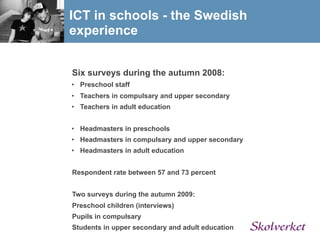
Six surveys during the autumn 2008:
• Preschool staff
• Teachers in compulsary and upper secondary
• Teachers in adult education


• Headmasters in preschools
• Headmasters in compulsary and upper secondary
• Headmasters in adult education


Respondent rate between 57 and 73 percent


Two surveys during the autumn 2009:
Preschool children (interviews)
Pupils in compulsary
Students in upper secondary and adult education
ICT in schools - the Swedish
 experience

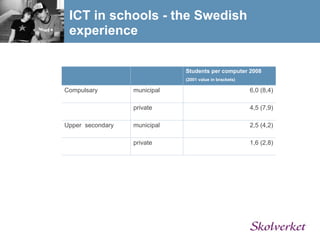
                              Students per computer 2008
                              (2001 value in brackets)

Compulsary        municipal                              6,0 (8,4)

                  private                                4,5 (7,9)

Upper secondary   municipal                              2,5 (4,2)

                  private                                1,6 (2,8)
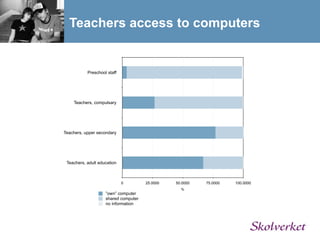
Teachers access to computers


           Preschool staff


    Teachers, compulsary


Teachers, upper secondary


 Teachers, adult education


                             0        25.0000   50.0000   75.0000   100.0000
                                                  %
                    ”own” computer
                    shared computer
                    no information
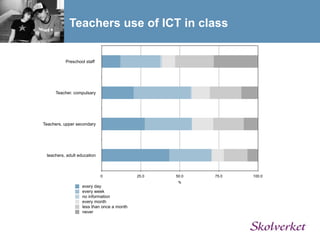
Teachers use of ICT in class


          Preschool staff


     Teacher. compulsary


Teachers, upper secondary


 teachers, adult education


                             0              25.0   50.0   75.0   100.0
                                                    %
                   every day
                   every week
                   no information
                   every month
                   less than once a month
                   never
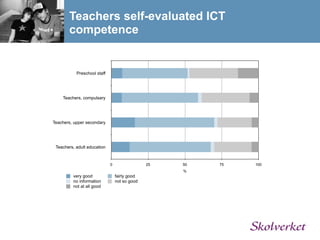
Teachers self-evaluated ICT
       competence


           Preschool staff


    Teachers, compulsary


Teachers, upper secondary


 Teachers, adult education


                             0                 25   50   75   100
                                                    %
         very good               fairly good
         no information          not so good
         not at all good
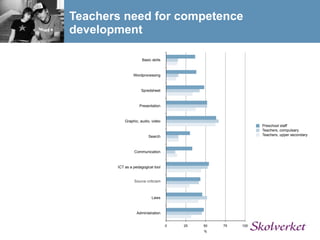
Teachers need for competence
development

                     Basic skills


                Wordprocessing


                    Spredsheet


                   Presentation


           Graphic, audio, video
                                                             Preschool staff
                                                             Teachers, compulsary
                         Search                              Teachers, upper secondary


                Communication


       ICT as a pedagogical tool


                Source criticism


                           Laws


                  Administration


                                    0   25   50   75   100
                                             %
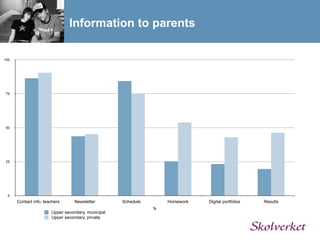
Information to parents

100


 75


 50


 25


  0
      Contact info, teachers      Newsletter        Schedule       Homework   Digital portfolios   Results
                                                               %
                       Upper secondary, municipal
                       Upper secondary, private
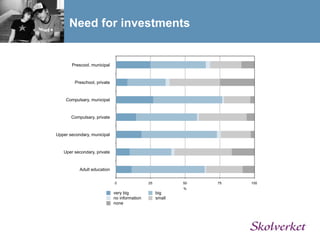
Need for investments


       Prescool, municipal


         Preschool, private


    Compulsary, municipal


       Compulsary, private


Upper secondary, municipal


   Uper secondary, private


           Adult education


                              0                25           50   75   100
                                                            %
                              very big              big
                              no information        small
                              none
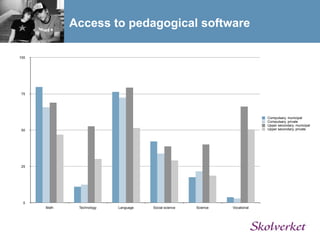
Access to pedagogical software

100


 75


                                                                              Compulsary, municipal
                                                                              Compulsary, private
                                                                              Upper secondary, municipal
 50                                                                           Upper secondary, private


 25


  0
      Math    Technology   Language   Social science   Science   Vocational
Source criticism when using
 Internet


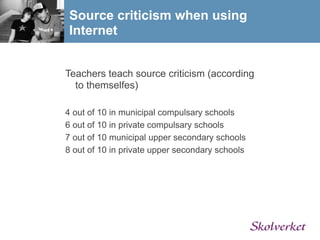
Teachers teach source criticism (according
  to themselfes)

4 out of 10 in municipal compulsary schools
6 out of 10 in private compulsary schools
7 out of 10 municipal upper secondary schools
8 out of 10 in private upper secondary schools
Source criticism when using
Internet


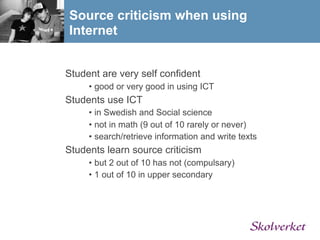
Student are very self confident
     • good or very good in using ICT
Students use ICT
     • in Swedish and Social science
     • not in math (9 out of 10 rarely or never)
     • search/retrieve information and write texts
Students learn source criticism
     • but 2 out of 10 has not (compulsary)
     • 1 out of 10 in upper secondary
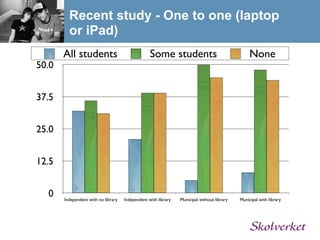
Recent study - One to one (laptop
         or iPad)
       All students                               Some students                                  None
50.0


37.5


25.0


12.5


  0    Independent with no library   Independent with library   Municipal without library   Municipal with library

20120614 Japanese study visit

  • 1.
    ICT in schools- the Swedish experience
  • 2.
    ICT in schools- the Swedish experience Christina Szekely
  • 3.
    ICT in schools- the Swedish experience Christina Szekely christina.szekely@skolverket.se
  • 4.
    ICT in schools- the Swedish experience Christina Szekely christina.szekely@skolverket.se Peter Karlberg
  • 5.
    ICT in schools- the Swedish experience Christina Szekely christina.szekely@skolverket.se Peter Karlberg peter.karlberg@skolverket.se
  • 6.
    ICT in schools- the Swedish experience Christina Szekely christina.szekely@skolverket.se Peter Karlberg peter.karlberg@skolverket.se Director of Education
  • 7.
    ICT in schools- the Swedish experience Christina Szekely christina.szekely@skolverket.se Peter Karlberg peter.karlberg@skolverket.se Director of Education Swedish National Agency for Education
  • 8.
    ICT in schools- the Swedish experience Christina Szekely christina.szekely@skolverket.se Peter Karlberg peter.karlberg@skolverket.se Director of Education Swedish National Agency for Education
  • 9.
    ICT in schools- the Swedish experience Currently – PIM – ICT for teachers – Check the source – Learning resources – Teacher/students/parent communication
  • 10.
    ICT in schools- the Swedish experience Currently – New curricula for compulsary and upper secondary • new syllabi for all subjects/cources – Digital competence included
  • 11.
    National curricula -fundamental values and tasks Pupils should be able to keep their bearings in a complex reality, where there is a vast flow of information and where the rate of change is rapid. This is the reason that study skills and methods of acquiring and using new knowledge are important. It is also necessary that pupils develop their ability to critically examine facts and relationships, and appreciate the consequences of different alternatives.
  • 12.
    National curricula -overall goals and guidelines The school is responsible for ensuring that each pupil on completing compulsory school: can use modern technology as a tool in the search for knowledge, communication, creativity and learning
  • 13.
    ICT in schools- the Swedish experience The use of ICT and ICT competence Follow up studies every third year of the ICT-use and the ICT-competence in pre-school, compulsary school and adult education – results published 2009/2010 – new surveys planned for late 2012, results will be published in april 2013
  • 14.
    ICT in schools- the Swedish experience Six surveys during the autumn 2008: • Preschool staff • Teachers in compulsary and upper secondary • Teachers in adult education • Headmasters in preschools • Headmasters in compulsary and upper secondary • Headmasters in adult education Respondent rate between 57 and 73 percent Two surveys during the autumn 2009: Preschool children (interviews) Pupils in compulsary Students in upper secondary and adult education
  • 15.
    ICT in schools- the Swedish experience Students per computer 2008 (2001 value in brackets) Compulsary municipal 6,0 (8,4) private 4,5 (7,9) Upper secondary municipal 2,5 (4,2) private 1,6 (2,8)
  • 16.
    Teachers access tocomputers Preschool staff Teachers, compulsary Teachers, upper secondary Teachers, adult education 0 25.0000 50.0000 75.0000 100.0000 % ”own” computer shared computer no information
  • 17.
    Teachers use ofICT in class Preschool staff Teacher. compulsary Teachers, upper secondary teachers, adult education 0 25.0 50.0 75.0 100.0 % every day every week no information every month less than once a month never
  • 18.
    Teachers self-evaluated ICT competence Preschool staff Teachers, compulsary Teachers, upper secondary Teachers, adult education 0 25 50 75 100 % very good fairly good no information not so good not at all good
  • 19.
    Teachers need forcompetence development Basic skills Wordprocessing Spredsheet Presentation Graphic, audio, video Preschool staff Teachers, compulsary Search Teachers, upper secondary Communication ICT as a pedagogical tool Source criticism Laws Administration 0 25 50 75 100 %
  • 20.
    Information to parents 100 75 50 25 0 Contact info, teachers Newsletter Schedule Homework Digital portfolios Results % Upper secondary, municipal Upper secondary, private
  • 21.
    Need for investments Prescool, municipal Preschool, private Compulsary, municipal Compulsary, private Upper secondary, municipal Uper secondary, private Adult education 0 25 50 75 100 % very big big no information small none
  • 22.
    Access to pedagogicalsoftware 100 75 Compulsary, municipal Compulsary, private Upper secondary, municipal 50 Upper secondary, private 25 0 Math Technology Language Social science Science Vocational
  • 23.
    Source criticism whenusing Internet Teachers teach source criticism (according to themselfes) 4 out of 10 in municipal compulsary schools 6 out of 10 in private compulsary schools 7 out of 10 municipal upper secondary schools 8 out of 10 in private upper secondary schools
  • 24.
    Source criticism whenusing Internet Student are very self confident • good or very good in using ICT Students use ICT • in Swedish and Social science • not in math (9 out of 10 rarely or never) • search/retrieve information and write texts Students learn source criticism • but 2 out of 10 has not (compulsary) • 1 out of 10 in upper secondary
  • 25.
    Recent study -One to one (laptop or iPad) All students Some students None 50.0 37.5 25.0 12.5 0 Independent with no library Independent with library Municipal without library Municipal with library

Editor's Notes

  • #2 \n
  • #3 \n
  • #4 \n
  • #5 \n
  • #6 \n
  • #7 \n
  • #8 \n
  • #9 \n
  • #10 \n
  • #11 \n
  • #12 \n
  • #13 Betona att det är en uppföljning, denna redovisning avser skolor och lärare. Barn och elever kommer att redovisas 15 april 2010. Här visas något om metod och resultat i diagramform.\n
  • #14 SCB genomförde undersökningarna. Likartade frågor i respektive grupp. Huvudmannaskap gäller för grund- och gymnasieskola. Svarsandelarna kan man betrakta som normala.\n
  • #15 2001 totalundersökning \n
  • #16 \n
  • #17 Betänk att alla sorters lärare är med ex idrott, slöjd mm\n
  • #18 \n
  • #19 Ganska eller mycket stort behov av kompetensutveckling för att kunna använda IT i sitt arbete.\n
  • #20 Ung 7 av 10 förskolor har hemsidor och de allra flesta grund- och gymnasieskolor har någon form av egna hemsidor. Notera att statiska uppgifter ung lika medan löpande arb uppg i större utsträckning förekommer i fristående skolor.\n
  • #21 \n
  • #22 \n
  • #23 Många har svarat ”vet ej” på denna fråga\n
  • #24 Många har svarat ”vet ej” på denna fråga\n
  • #25 \n