Learning in the 21st Century:
2011 Trends Update – Report Release

Students, Parents & Educators Speak Up
about Online Learning

ISTE 2011 - Philadelphia
Breakfast Meeting
June 28, 2011
                 © Project Tomorrow 2011
A big thank you to:


                © Project Tomorrow 2011
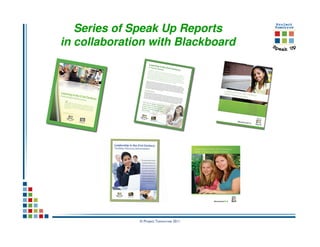
Series of Speak Up Reports
in collaboration with Blackboard


              © Project Tomorrow 2011
Today’s Agenda:


       Welcome remarks from John Canuel
       About Speak Up
       Highlights from the new report
       Panel discussion
       Conversation time
            Speak Up Research Project:
        Views of Students, Parents, Teachers,
           Librarians and Administrators

                    © Project Tomorrow 2011
Welcoming Remarks


            John Canuel

           Vice President
      K-12 Education Strategy

          Blackboard Inc.

              © Project Tomorrow 2011
Today’s Discussion: The Big Questions


 Who is learning online?
 What is propelling this new interest in online
 learning?
 Can online learning really transform the learning
 process?
 What is the standing in the way of greater
 adoption?
 What motivates teachers to teach online?


                     © Project Tomorrow 2011
Speak Up National Research Project
• Annual national research project
    Online surveys + focus groups
    Open for all K-12 schools and schools of education
    Institutions receive free report with their own data

• Collect ideas ↔ Stimulate conversations
     K-12 Students, Teachers, Librarians, Parents, Principals
     and District Administrators

• Inform policies & programs
     Analysis and reporting
     Services to help transform teaching and learning

                          © Project Tomorrow 2011
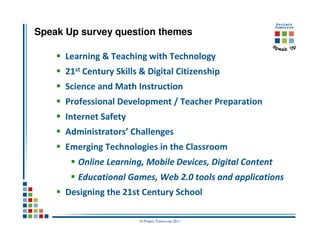
Speak Up survey question themes

      Learning & Teaching with Technology
      21st Century Skills & Digital Citizenship
      Science and Math Instruction
      Professional Development / Teacher Preparation
      Internet Safety
      Administrators’ Challenges
      Emerging Technologies in the Classroom
         Online Learning, Mobile Devices, Digital Content
         Educational Games, Web 2.0 tools and applications
      Designing the 21st Century School

                         © Project Tomorrow 2011
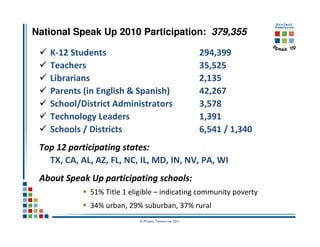
National Speak Up 2010 Participation: 379,355

   K-12 Students                                      294,399
   Teachers                                           35,525
   Librarians                                         2,135
   Parents (in English & Spanish)                     42,267
   School/District Administrators                     3,578
   Technology Leaders                                 1,391
   Schools / Districts                                6,541 / 1,340
 Top 12 participating states:
   TX, CA, AL, AZ, FL, NC, IL, MD, IN, NV, PA, WI
 About Speak Up participating schools:
             51% Title 1 eligible – indicating community poverty
             34% urban, 29% suburban, 37% rural
                            © Project Tomorrow 2011
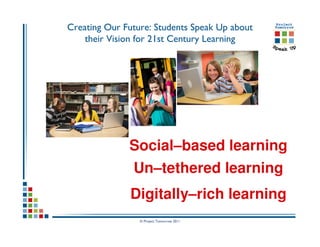
Creating Our Future: Students Speak Up about
    their Vision for 21st Century Learning


              Social–based learning
               Un–tethered learning
              Digitally–rich learning
                 © Project Tomorrow 2011
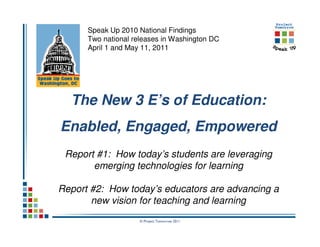
Speak Up 2010 National Findings
      Two national releases in Washington DC
      April 1 and May 11, 2011


  The New 3 E’s of Education:
Enabled, Engaged, Empowered
 Report #1: How today’s students are leveraging
       emerging technologies for learning

Report #2: How today’s educators are advancing a
       new vision for teaching and learning
                     © Project Tomorrow 2011
What can the Speak Up
findings tell us about the
   future of learning?


        © Project Tomorrow 2011
What can the Speak Up data tell us about the
future of learning?


 • Student vision for tech use mirrors desires for
   learning in general
 • Educators have potential to enable, engage and
   empower this new learning vision
 • By examining the synergies and the disconnects
   we can develop a shared vision for the future of
   learning


                       © Project Tomorrow 2011
The New 3 E’s of Education:
Enabled, Engaged, Empowered


  Key Trends to Watch:

    Mobile Learning

    Online Learning

    E-Textbooks and Digital Content


                   © Project Tomorrow 2011
Introducing . . .
Learning in the 21st Century:
2011 Trends Update

A special collaboration with Blackboard, Inc.


                   © Project Tomorrow 2011
Online learning enables a greater personalization
 of the learning process for both students and
   educators and facilitates opportunities to
    collaborate with peers and experts, thus
          empowering a new sense of
  personal ownership of the learning process.


                    © Project Tomorrow 2011
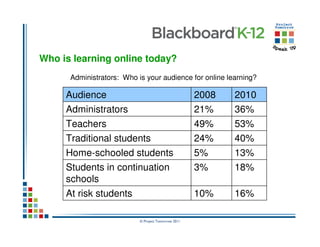
Who is learning online today?
      Administrators: Who is your audience for online learning?

     Audience                                        2008   2010
     Administrators                                  21%    36%
     Teachers                                        49%    53%
     Traditional students                            24%    40%
     Home-schooled students                          5%     13%
     Students in continuation                        3%     18%
     schools
     At risk students                                10%    16%

                           © Project Tomorrow 2011
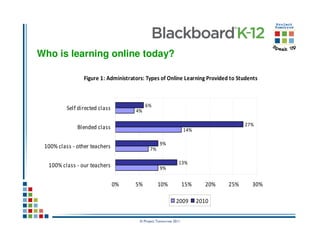
Who is learning online today?

                 Figure 1: Administrators: Types of Online Learning Provided to Students


                                           6%
          Self directed class         4%

                                                                                      27%
              Blended class                                      14%

                                                  9%
 100% class - other teachers                7%

                                                             13%
  100% class - our teachers                       9%


                                0%    5%         10%             15%      20%   25%     30%

                                                           2009        2010


                                       © Project Tomorrow 2011
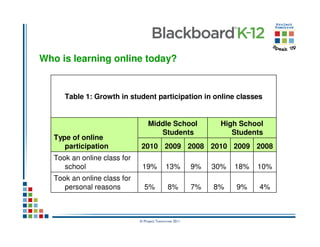
Who is learning online today?


      Table 1: Growth in student participation in online classes


                                  Middle School               High School
                                     Students                    Students
   Type of online
      participation           2010 2009 2008 2010 2009 2008
   Took an online class for
      school                   19%          13%         9%   30%   18%   10%
   Took an online class for
      personal reasons          5%           8%         7%   8%    9%    4%


                              © Project Tomorrow 2011
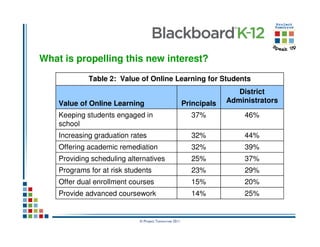
What is propelling this new interest?
             Table 2: Value of Online Learning for Students
                                                                       District
    Value of Online Learning                           Principals   Administrators

    Keeping students engaged in                          37%             46%
    school
    Increasing graduation rates                          32%             44%
    Offering academic remediation                        32%             39%
    Providing scheduling alternatives                    25%             37%
    Programs for at risk students                        23%             29%
    Offer dual enrollment courses                        15%             20%
    Provide advanced coursework                          14%             25%


                             © Project Tomorrow 2011
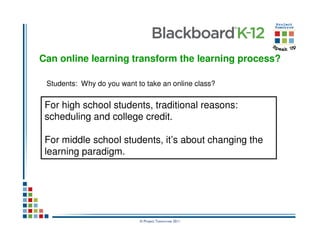
Can online learning transform the learning process?

 Students: Why do you want to take an online class?


 For high school students, traditional reasons:
 scheduling and college credit.

 For middle school students, it’s about changing the
 learning paradigm.


                            © Project Tomorrow 2011
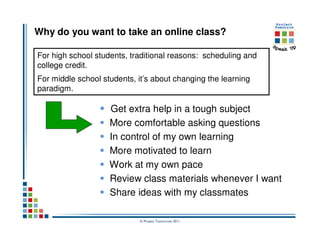
Why do you want to take an online class?

For high school students, traditional reasons: scheduling and
college credit.
For middle school students, it’s about changing the learning
paradigm.

                    Get extra help in a tough subject
                    More comfortable asking questions
                    In control of my own learning
                    More motivated to learn
                    Work at my own pace
                    Review class materials whenever I want
                    Share ideas with my classmates

                            © Project Tomorrow 2011
Given the demand and the interest, what is
standing in the way of greater adoption?


                     © Project Tomorrow 2011
Given the demand and the interest, what is
standing in the way of greater adoption?

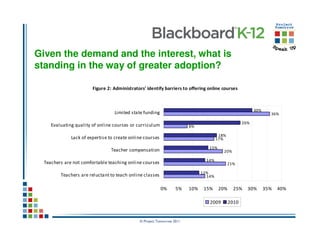
                        Figure 2: Administrators' identify barriers to offering online courses


                                                                                                          30%
                                  Limited state funding                                                           36%

                                                                                                    26%
     Evaluating quality of online courses or curriculum                 8%

                                                                                       18%
              Lack of expertise to create online courses                              17%

                                                                                 15%
                                 Teacher compensation                                    20%

                                                                                14%
  Teachers are not comfortable teaching online courses                                       21%

                                                                              12%
         Teachers are reluctant to teach online classes                         14%

                                                           0%     5%    10%    15%     20%     25%    30%       35%   40%

                                                                                 2009        2010


                                              © Project Tomorrow 2011
Given the demand and the interest, what is
standing in the way of greater adoption?

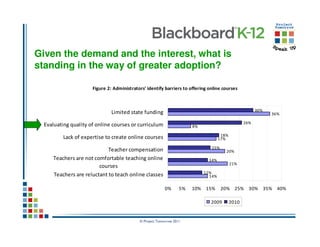
                      Figure 2: Administrators' identify barriers to offering online courses


                                                                                                        30%
                               Limited state funding                                                          36%

                                                                                                  26%
  Evaluating quality of online courses or curriculum                   8%

                                                                                     18%
          Lack of expertise to create online courses                                17%

                                                                               15%
                            Teacher compensation                                       20%
     Teachers are not comfortable teaching online                             14%
                                                                                           21%
                        courses
                                                                            12%
     Teachers are reluctant to teach online classes                           14%

                                                          0%      5%   10% 15%       20% 25% 30% 35% 40%

                                                                               2009        2010


                                            © Project Tomorrow 2011
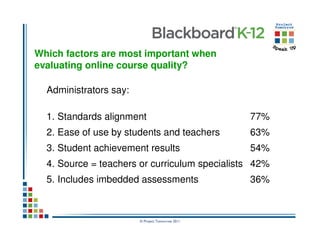
Which factors are most important when
evaluating online course quality?

  Administrators say:

  1. Standards alignment                          77%
  2. Ease of use by students and teachers         63%
  3. Student achievement results                  54%
  4. Source = teachers or curriculum specialists 42%
  5. Includes imbedded assessments                36%


                        © Project Tomorrow 2011
Given the demand and the interest, what is
standing in the way of greater adoption?

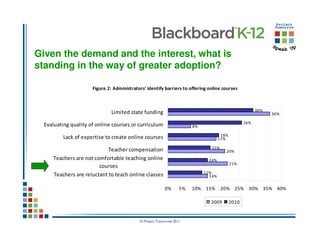
                      Figure 2: Administrators' identify barriers to offering online courses


                                                                                                        30%
                               Limited state funding                                                          36%

                                                                                                  26%
  Evaluating quality of online courses or curriculum                   8%

                                                                                     18%
          Lack of expertise to create online courses                                17%

                                                                               15%
                            Teacher compensation                                       20%
     Teachers are not comfortable teaching online                             14%
                                                                                           21%
                        courses
                                                                            12%
     Teachers are reluctant to teach online classes                           14%

                                                          0%      5%   10% 15%       20% 25% 30% 35% 40%

                                                                               2009        2010


                                            © Project Tomorrow 2011
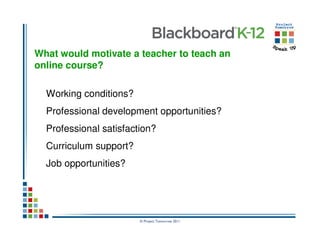
What would motivate a teacher to teach an
online course?

  Working conditions?
  Professional development opportunities?
  Professional satisfaction?
  Curriculum support?
  Job opportunities?


                        © Project Tomorrow 2011
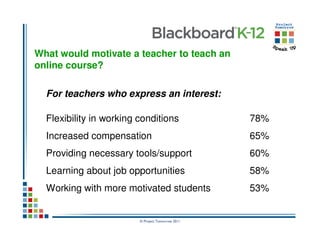
What would motivate a teacher to teach an
online course?

  For teachers who express an interest:

  Flexibility in working conditions                78%
  Increased compensation                           65%
  Providing necessary tools/support                60%
  Learning about job opportunities                 58%
  Working with more motivated students             53%


                         © Project Tomorrow 2011
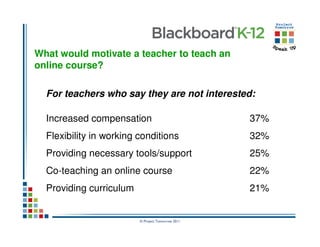
What would motivate a teacher to teach an
online course?

  For teachers who say they are not interested:

  Increased compensation                           37%
  Flexibility in working conditions                32%
  Providing necessary tools/support                25%
  Co-teaching an online course                     22%
  Providing curriculum                             21%


                         © Project Tomorrow 2011
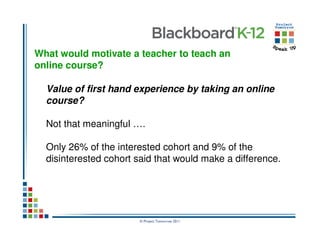
What would motivate a teacher to teach an
online course?

  Value of first hand experience by taking an online
  course?

  Not that meaningful ….

  Only 26% of the interested cohort and 9% of the
  disinterested cohort said that would make a difference.


                       © Project Tomorrow 2011
What would motivate a teacher to teach an
online course?

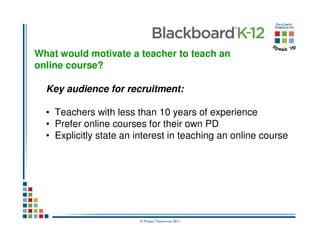
  Key audience for recruitment:

  • Teachers with less than 10 years of experience
  • Prefer online courses for their own PD
  • Explicitly state an interest in teaching an online course


                        © Project Tomorrow 2011
Learning in the 21st Century:
              2011 Trends Update
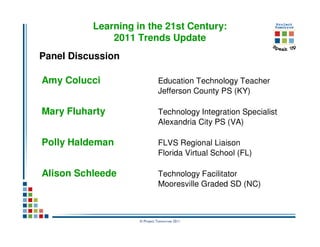
Panel Discussion

Amy Colucci                   Education Technology Teacher
                              Jefferson County PS (KY)

Mary Fluharty                 Technology Integration Specialist
                              Alexandria City PS (VA)

Polly Haldeman                FLVS Regional Liaison
                              Florida Virtual School (FL)

Alison Schleede               Technology Facilitator
                              Mooresville Graded SD (NC)


                    © Project Tomorrow 2011
A big thank you to:


                © Project Tomorrow 2011
Thank you.
        Let’s continue this conversation.

                       Julie Evans
                   Project Tomorrow
                 jevans@tomorrow.org
                    949-609-4660 x15

                     Copyright Project Tomorrow 2011.
This work is the intellectual property of the author. Permission is granted
for this material to be shared for non-commercial, educational purposes,
    provided that this copyright statement appears on the reproduced
  materials and notice is given that the copying is by permission of the
     author. To disseminate otherwise or to republish requires written
                        permission from the author.


                            © Project Tomorrow 2011

Learning in the 21st Century: 2011 Trends Update

  • 1.
    Learning in the21st Century: 2011 Trends Update – Report Release Students, Parents & Educators Speak Up about Online Learning ISTE 2011 - Philadelphia Breakfast Meeting June 28, 2011 © Project Tomorrow 2011
  • 2.
    A big thankyou to: © Project Tomorrow 2011
  • 3.
    Series of SpeakUp Reports in collaboration with Blackboard © Project Tomorrow 2011
  • 4.
    Today’s Agenda: Welcome remarks from John Canuel About Speak Up Highlights from the new report Panel discussion Conversation time Speak Up Research Project: Views of Students, Parents, Teachers, Librarians and Administrators © Project Tomorrow 2011
  • 5.
    Welcoming Remarks John Canuel Vice President K-12 Education Strategy Blackboard Inc. © Project Tomorrow 2011
  • 6.
    Today’s Discussion: TheBig Questions Who is learning online? What is propelling this new interest in online learning? Can online learning really transform the learning process? What is the standing in the way of greater adoption? What motivates teachers to teach online? © Project Tomorrow 2011
  • 7.
    Speak Up NationalResearch Project • Annual national research project Online surveys + focus groups Open for all K-12 schools and schools of education Institutions receive free report with their own data • Collect ideas ↔ Stimulate conversations K-12 Students, Teachers, Librarians, Parents, Principals and District Administrators • Inform policies & programs Analysis and reporting Services to help transform teaching and learning © Project Tomorrow 2011
  • 8.
    Speak Up surveyquestion themes Learning & Teaching with Technology 21st Century Skills & Digital Citizenship Science and Math Instruction Professional Development / Teacher Preparation Internet Safety Administrators’ Challenges Emerging Technologies in the Classroom Online Learning, Mobile Devices, Digital Content Educational Games, Web 2.0 tools and applications Designing the 21st Century School © Project Tomorrow 2011
  • 9.
    National Speak Up2010 Participation: 379,355 K-12 Students 294,399 Teachers 35,525 Librarians 2,135 Parents (in English & Spanish) 42,267 School/District Administrators 3,578 Technology Leaders 1,391 Schools / Districts 6,541 / 1,340 Top 12 participating states: TX, CA, AL, AZ, FL, NC, IL, MD, IN, NV, PA, WI About Speak Up participating schools: 51% Title 1 eligible – indicating community poverty 34% urban, 29% suburban, 37% rural © Project Tomorrow 2011
  • 10.
    Creating Our Future:Students Speak Up about their Vision for 21st Century Learning Social–based learning Un–tethered learning Digitally–rich learning © Project Tomorrow 2011
  • 11.
    Speak Up 2010National Findings Two national releases in Washington DC April 1 and May 11, 2011 The New 3 E’s of Education: Enabled, Engaged, Empowered Report #1: How today’s students are leveraging emerging technologies for learning Report #2: How today’s educators are advancing a new vision for teaching and learning © Project Tomorrow 2011
  • 12.
    What can theSpeak Up findings tell us about the future of learning? © Project Tomorrow 2011
  • 13.
    What can theSpeak Up data tell us about the future of learning? • Student vision for tech use mirrors desires for learning in general • Educators have potential to enable, engage and empower this new learning vision • By examining the synergies and the disconnects we can develop a shared vision for the future of learning © Project Tomorrow 2011
  • 14.
    The New 3E’s of Education: Enabled, Engaged, Empowered Key Trends to Watch: Mobile Learning Online Learning E-Textbooks and Digital Content © Project Tomorrow 2011
  • 15.
    Introducing . .. Learning in the 21st Century: 2011 Trends Update A special collaboration with Blackboard, Inc. © Project Tomorrow 2011
  • 16.
    Online learning enablesa greater personalization of the learning process for both students and educators and facilitates opportunities to collaborate with peers and experts, thus empowering a new sense of personal ownership of the learning process. © Project Tomorrow 2011
  • 17.
    Who is learningonline today? Administrators: Who is your audience for online learning? Audience 2008 2010 Administrators 21% 36% Teachers 49% 53% Traditional students 24% 40% Home-schooled students 5% 13% Students in continuation 3% 18% schools At risk students 10% 16% © Project Tomorrow 2011
  • 18.
    Who is learningonline today? Figure 1: Administrators: Types of Online Learning Provided to Students 6% Self directed class 4% 27% Blended class 14% 9% 100% class - other teachers 7% 13% 100% class - our teachers 9% 0% 5% 10% 15% 20% 25% 30% 2009 2010 © Project Tomorrow 2011
  • 19.
    Who is learningonline today? Table 1: Growth in student participation in online classes Middle School High School Students Students Type of online participation 2010 2009 2008 2010 2009 2008 Took an online class for school 19% 13% 9% 30% 18% 10% Took an online class for personal reasons 5% 8% 7% 8% 9% 4% © Project Tomorrow 2011
  • 20.
    What is propellingthis new interest? Table 2: Value of Online Learning for Students District Value of Online Learning Principals Administrators Keeping students engaged in 37% 46% school Increasing graduation rates 32% 44% Offering academic remediation 32% 39% Providing scheduling alternatives 25% 37% Programs for at risk students 23% 29% Offer dual enrollment courses 15% 20% Provide advanced coursework 14% 25% © Project Tomorrow 2011
  • 21.
    Can online learningtransform the learning process? Students: Why do you want to take an online class? For high school students, traditional reasons: scheduling and college credit. For middle school students, it’s about changing the learning paradigm. © Project Tomorrow 2011
  • 22.
    Why do youwant to take an online class? For high school students, traditional reasons: scheduling and college credit. For middle school students, it’s about changing the learning paradigm. Get extra help in a tough subject More comfortable asking questions In control of my own learning More motivated to learn Work at my own pace Review class materials whenever I want Share ideas with my classmates © Project Tomorrow 2011
  • 23.
    Given the demandand the interest, what is standing in the way of greater adoption? © Project Tomorrow 2011
  • 24.
    Given the demandand the interest, what is standing in the way of greater adoption? Figure 2: Administrators' identify barriers to offering online courses 30% Limited state funding 36% 26% Evaluating quality of online courses or curriculum 8% 18% Lack of expertise to create online courses 17% 15% Teacher compensation 20% 14% Teachers are not comfortable teaching online courses 21% 12% Teachers are reluctant to teach online classes 14% 0% 5% 10% 15% 20% 25% 30% 35% 40% 2009 2010 © Project Tomorrow 2011
  • 25.
    Given the demandand the interest, what is standing in the way of greater adoption? Figure 2: Administrators' identify barriers to offering online courses 30% Limited state funding 36% 26% Evaluating quality of online courses or curriculum 8% 18% Lack of expertise to create online courses 17% 15% Teacher compensation 20% Teachers are not comfortable teaching online 14% 21% courses 12% Teachers are reluctant to teach online classes 14% 0% 5% 10% 15% 20% 25% 30% 35% 40% 2009 2010 © Project Tomorrow 2011
  • 26.
    Which factors aremost important when evaluating online course quality? Administrators say: 1. Standards alignment 77% 2. Ease of use by students and teachers 63% 3. Student achievement results 54% 4. Source = teachers or curriculum specialists 42% 5. Includes imbedded assessments 36% © Project Tomorrow 2011
  • 27.
    Given the demandand the interest, what is standing in the way of greater adoption? Figure 2: Administrators' identify barriers to offering online courses 30% Limited state funding 36% 26% Evaluating quality of online courses or curriculum 8% 18% Lack of expertise to create online courses 17% 15% Teacher compensation 20% Teachers are not comfortable teaching online 14% 21% courses 12% Teachers are reluctant to teach online classes 14% 0% 5% 10% 15% 20% 25% 30% 35% 40% 2009 2010 © Project Tomorrow 2011
  • 28.
    What would motivatea teacher to teach an online course? Working conditions? Professional development opportunities? Professional satisfaction? Curriculum support? Job opportunities? © Project Tomorrow 2011
  • 29.
    What would motivatea teacher to teach an online course? For teachers who express an interest: Flexibility in working conditions 78% Increased compensation 65% Providing necessary tools/support 60% Learning about job opportunities 58% Working with more motivated students 53% © Project Tomorrow 2011
  • 30.
    What would motivatea teacher to teach an online course? For teachers who say they are not interested: Increased compensation 37% Flexibility in working conditions 32% Providing necessary tools/support 25% Co-teaching an online course 22% Providing curriculum 21% © Project Tomorrow 2011
  • 31.
    What would motivatea teacher to teach an online course? Value of first hand experience by taking an online course? Not that meaningful …. Only 26% of the interested cohort and 9% of the disinterested cohort said that would make a difference. © Project Tomorrow 2011
  • 32.
    What would motivatea teacher to teach an online course? Key audience for recruitment: • Teachers with less than 10 years of experience • Prefer online courses for their own PD • Explicitly state an interest in teaching an online course © Project Tomorrow 2011
  • 33.
    Learning in the21st Century: 2011 Trends Update Panel Discussion Amy Colucci Education Technology Teacher Jefferson County PS (KY) Mary Fluharty Technology Integration Specialist Alexandria City PS (VA) Polly Haldeman FLVS Regional Liaison Florida Virtual School (FL) Alison Schleede Technology Facilitator Mooresville Graded SD (NC) © Project Tomorrow 2011
  • 34.
    A big thankyou to: © Project Tomorrow 2011
  • 35.
    Thank you. Let’s continue this conversation. Julie Evans Project Tomorrow jevans@tomorrow.org 949-609-4660 x15 Copyright Project Tomorrow 2011. This work is the intellectual property of the author. Permission is granted for this material to be shared for non-commercial, educational purposes, provided that this copyright statement appears on the reproduced materials and notice is given that the copying is by permission of the author. To disseminate otherwise or to republish requires written permission from the author. © Project Tomorrow 2011