





Blogs in L2 Classroom:
Maximizing Meaning-Focused Output


                            Mari Yamauchi
                 Chiba University of Commerce
          HICOE 2012, January 07, 2012, Honolulu
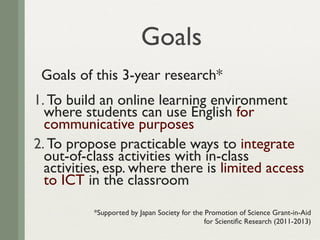
Goals
 Goals of this 3-year research*
1. To build an online learning environment
  where students can use English for
  communicative purposes
2. To propose practicable ways to integrate
  out-of-class activities with in-class
  activities, esp. where there is limited access
  to ICT in the classroom

          *Supported by Japan Society for the Promotion of Science Grant-in-Aid
                                              for Scientific Research (2011-2013)
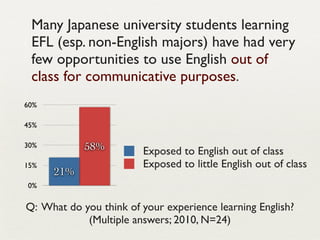
Many Japanese university students learning
 EFL (esp. non-English majors) have had very
 few opportunities to use English out of
 class for communicative purposes.
60%

45%

30%         58%         Exposed to English out of class
15%                     Exposed to little English out of class
      21%
0%

Q: What do you think of your experience learning English?
            (Multiple answers; 2010, N=24)
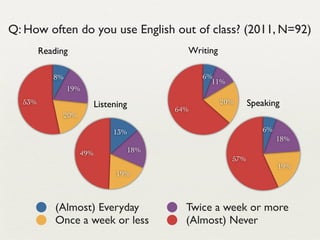
Q: How often do you use English out of class? (2011, N=92)
        Reading                              Writing

           8%                                    6%
                                                   11%
                19%
  53%                    Listening                     20%     Speaking
                                           64%
             20%

                              13%                                 6%
                                                                       18%
                   49%               18%
                                                         57%
                                                                       19%
                               19%


            (Almost) Everyday                Twice a week or more
            Once a week or less              (Almost) Never
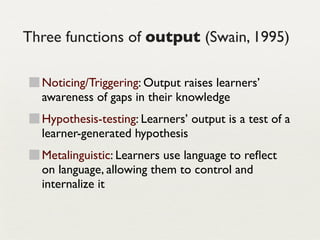
Three functions of output (Swain, 1995)

  Noticing/Triggering: Output raises learners’
  awareness of gaps in their knowledge
  Hypothesis-testing: Learners’ output is a test of a
  learner-generated hypothesis
  Metalinguistic: Learners use language to reflect
  on language, allowing them to control and
  internalize it
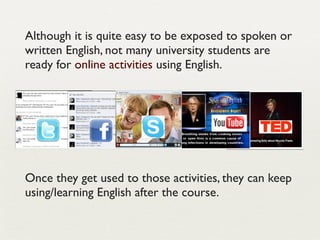
Although it is quite easy to be exposed to spoken or
written English, not many university students are
ready for online activities using English.


Once they get used to those activities, they can keep
using/learning English after the course.
It is still common to have a language class in a
 regular classroom with limited access to ICT
Platforms considered*
            Teacher’s Cellphone                        Organized Customi-   Closed    Open
                                    Grading Multimedia
            readiness compatibility                     activities zation community community

 Moodle

 Blogger

Posterous

 Twitter

Facebook

 Tumblr

  Mixi


                                                                       *As of September, 2010
Students may rely too much on (feature) phones
How user-friendly was Moodle for you?
           (2010, N = 24)

                                             I wish I could have used my
                8% 4%
                                                      cellphone!
                          25%
        25%                                 It would’ve been easier with a
                                                     smartphone!


                    38%                     How about using cellphones for
                                               such online discussions?
          Very easy       Easy
          Don’t know      Little difficult
          Very difficult                      Websites incompatible with
                                             cellphones are inconvenient.
Integrating student blogging

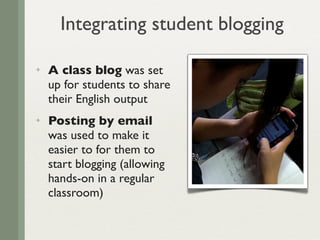
✦   A class blog was set
    up for students to share
    their English output
✦   Posting by email
    was used to make it
    easier to for them to
    start blogging (allowing
    hands-on in a regular
    classroom)
Integrating student blogging
✦   Topics were selected from what they wanted
    to say to make writing more meaning-focused
✦   Students’ posts were used in class to
    facilitate noticing and give feedback to the
    “hypotheses”
✦   Pair/Group work was related to their
    previous/next posts to facilitate noticing and
    hypothesis-testing through peer interaction
Topics (& language objectives)
• Daily life : School, Part-time job, Club, Friends,
  Family, Shopping, Eating, Pastimes, Hobbies
• Events : Travel, Parties, Festivals, Concerts,
  Vacation; Memories, Plans 
• Reviews : Books, Comics, Movies, Dramas,
  Songs, Music
• News : Environment, Technology, Society, Health,
  Science, Politics, Entertainment
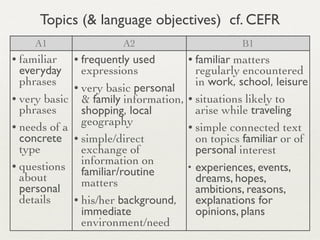
Topics (& language objectives) cf. CEFR
     A1                A2                         B1
• familiar   • frequently used       • familiarmatters
  everyday     expressions             regularly encountered
  phrases •                            in work, school, leisure
               very basic personal
• very basic & family information,   • situations likely to
  phrases      shopping, local         arise while traveling
• needs of a
               geography             • simple connected text
  concrete • simple/direct             on topics familiar or of
  type         exchange of             personal interest
• questions
               information on
                                     • experiences, events,
  about        familiar/routine
               matters                 dreams, hopes,
  personal                             ambitions, reasons,
  details    • his/her background,     explanations for
               immediate               opinions, plans
               environment/need
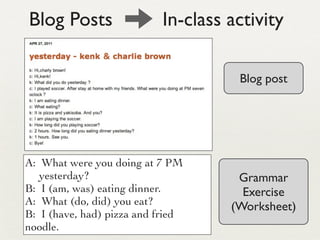
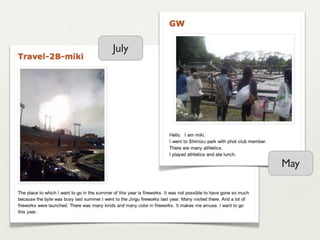
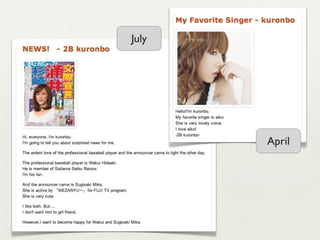
Blog Posts                 In-class activity

                                     Blog post


A: What were you doing at 7 PM
   yesterday?                        Grammar
B: I (am, was) eating dinner.         Exercise
A: What (do, did) you eat?          (Worksheet)
B: I (have, had) pizza and fried
noodle.
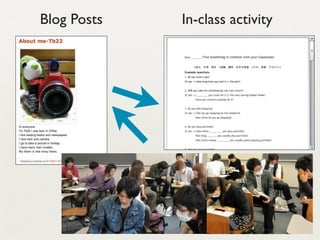
Blog Posts   In-class activity
Findings & Issues
 Increased accessibility and activity design
helped increase participation in online activities
 Students found productive use of English and
sharing their output beneficial (though
challenging)
They were satisfied with how “feedback” on
their output was given in class
They wanted feedback on language error
They wanted to edit their posts
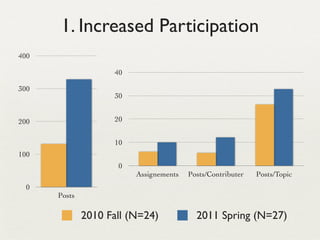
1. Increased Participation
400

                    40

300
                    30


200                 20


                    10
100
                     0
                         Assignements   Posts/Contributer   Posts/Topic
  0
      Posts

              2010 Fall (N=24)            2011 Spring (N=27)
Page views: April - July, 2011
4000
                                       3332

                 2846       2944
3000

                                                  2286

2000


1000                                                         729


       58
  0
  2011.3     2011.4     2011.5     2011.6     2011.7     2011.8
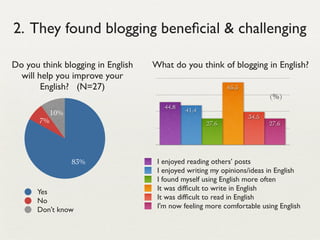
2. They found blogging beneficial & challenging

Do you think blogging in English   What do you think of blogging in English?
  will help you improve your
        English? (N=27)                                    65.5
                                                                         (%)
                                      44.8
            10%                              41.4
                                                                  34.5
       7%                                           27.6                 27.6


                  83%               I enjoyed reading others’ posts
                                    I enjoyed writing my opinions/ideas in English
                                    I found myself using English more often
      Yes                           It was difficult to write in English
      No                            It was difficult to read in English
      Don’t know                    I'm now feeling more comfortable using English
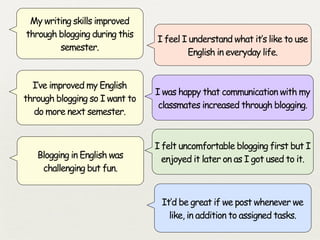
My writing skills improved
through blogging during this
                                I feel I understand what it’s like to use
        semester.
                                        English in everyday life.


  I’ve improved my English
                                I was happy that communication with my
through blogging so I want to
                                 classmates increased through blogging.
  do more next semester.


                                I felt uncomfortable blogging first but I
   Blogging in English was        enjoyed it later on as I got used to it.
    challenging but fun.


                                 It’d be great if we post whenever we
                                   like, in addition to assigned tasks.
July


       May
July


       April
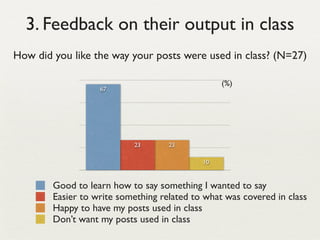
3. Feedback on their output in class
How did you like the way your posts were used in class? (N=27)

                                                 (%)
                   67


                           23       23

                                            10


        Good to learn how to say something I wanted to say
        Easier to write something related to what was covered in class
        Happy to have my posts used in class
        Don’t want my posts used in class
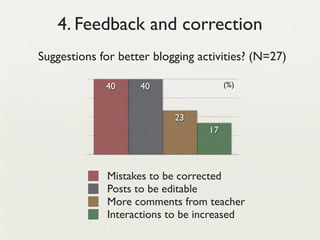
4. Feedback and correction
Suggestions for better blogging activities? (N=27)

             40     40                 (%)


                           23
                                  17


             Mistakes to be corrected
             Posts to be editable
             More comments from teacher
             Interactions to be increased
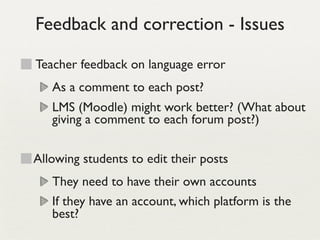
Feedback and correction - Issues

Teacher feedback on language error
   As a comment to each post?
   LMS (Moodle) might work better? (What about
   giving a comment to each forum post?)


Allowing students to edit their posts
   They need to have their own accounts
   If they have an account, which platform is the
   best?
iPads might help to give some hands-on

                          At least one iPad
                                 per
                             3 students
                              desirable
To conclude ...

1. Using posting by email helps get
students started easily in a classroom
with limited access to ICT, but this way
of using a class blog has its limitations.
A better solution will be looked for.
To conclude ...
2. Giving students opportunities to express
what they want to express, with appropriate
feedback to their output (as “hypotheses”),
can facilitate their learning. These productive
tasks also help them realize English is a tool
for communication, not just as another
subject to study.
To conclude ...

3. Students’ output should be
analyzed to see if their English is
improved through these
productive activities.
To conclude ...
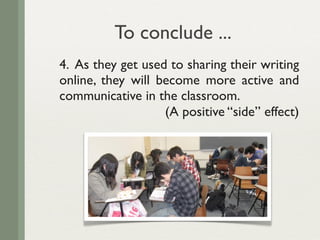
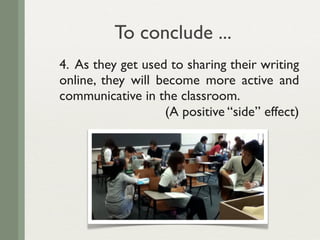
4. As they get used to sharing their writing
online, they will become more active and
communicative in the classroom.
                   (A positive “side” effect)
To conclude ...
4. As they get used to sharing their writing
online, they will become more active and
communicative in the classroom.
                   (A positive “side” effect)
To conclude ...
4. As they get used to sharing their writing
online, they will become more active and
communicative in the classroom.
                   (A positive “side” effect)
Thank you!


                  Mari Yamauchi
       Chiba University of Commerce
HICOE 2012, January 07, 2012, Honolulu

20120107 hicoe yamauchi

  • 1.
    Blogs in L2Classroom: Maximizing Meaning-Focused Output Mari Yamauchi Chiba University of Commerce HICOE 2012, January 07, 2012, Honolulu
  • 2.
    Goals Goals ofthis 3-year research* 1. To build an online learning environment where students can use English for communicative purposes 2. To propose practicable ways to integrate out-of-class activities with in-class activities, esp. where there is limited access to ICT in the classroom *Supported by Japan Society for the Promotion of Science Grant-in-Aid for Scientific Research (2011-2013)
  • 3.
    Many Japanese universitystudents learning EFL (esp. non-English majors) have had very few opportunities to use English out of class for communicative purposes. 60% 45% 30% 58% Exposed to English out of class 15% Exposed to little English out of class 21% 0% Q: What do you think of your experience learning English? (Multiple answers; 2010, N=24)
  • 4.
    Q: How oftendo you use English out of class? (2011, N=92) Reading Writing 8% 6% 11% 19% 53% Listening 20% Speaking 64% 20% 13% 6% 18% 49% 18% 57% 19% 19% (Almost) Everyday Twice a week or more Once a week or less (Almost) Never
  • 5.
    Three functions ofoutput (Swain, 1995) Noticing/Triggering: Output raises learners’ awareness of gaps in their knowledge Hypothesis-testing: Learners’ output is a test of a learner-generated hypothesis Metalinguistic: Learners use language to reflect on language, allowing them to control and internalize it
  • 6.
    Although it isquite easy to be exposed to spoken or written English, not many university students are ready for online activities using English. Once they get used to those activities, they can keep using/learning English after the course.
  • 7.
    It is stillcommon to have a language class in a regular classroom with limited access to ICT
  • 8.
    Platforms considered* Teacher’s Cellphone Organized Customi- Closed Open Grading Multimedia readiness compatibility activities zation community community Moodle Blogger Posterous Twitter Facebook Tumblr Mixi *As of September, 2010
  • 9.
    Students may relytoo much on (feature) phones How user-friendly was Moodle for you? (2010, N = 24) I wish I could have used my 8% 4% cellphone! 25% 25% It would’ve been easier with a smartphone! 38% How about using cellphones for such online discussions? Very easy Easy Don’t know Little difficult Very difficult Websites incompatible with cellphones are inconvenient.
  • 10.
    Integrating student blogging ✦ A class blog was set up for students to share their English output ✦ Posting by email was used to make it easier to for them to start blogging (allowing hands-on in a regular classroom)
  • 11.
    Integrating student blogging ✦ Topics were selected from what they wanted to say to make writing more meaning-focused ✦ Students’ posts were used in class to facilitate noticing and give feedback to the “hypotheses” ✦ Pair/Group work was related to their previous/next posts to facilitate noticing and hypothesis-testing through peer interaction
  • 12.
    Topics (& languageobjectives) • Daily life : School, Part-time job, Club, Friends, Family, Shopping, Eating, Pastimes, Hobbies • Events : Travel, Parties, Festivals, Concerts, Vacation; Memories, Plans  • Reviews : Books, Comics, Movies, Dramas, Songs, Music • News : Environment, Technology, Society, Health, Science, Politics, Entertainment
  • 13.
    Topics (& languageobjectives) cf. CEFR A1 A2 B1 • familiar • frequently used • familiarmatters everyday expressions regularly encountered phrases • in work, school, leisure very basic personal • very basic & family information, • situations likely to phrases shopping, local arise while traveling • needs of a geography • simple connected text concrete • simple/direct on topics familiar or of type exchange of personal interest • questions information on • experiences, events, about familiar/routine matters dreams, hopes, personal ambitions, reasons, details • his/her background, explanations for immediate opinions, plans environment/need
  • 14.
    Blog Posts In-class activity Blog post A: What were you doing at 7 PM yesterday? Grammar B: I (am, was) eating dinner. Exercise A: What (do, did) you eat? (Worksheet) B: I (have, had) pizza and fried noodle.
  • 15.
    Blog Posts In-class activity
  • 16.
    Findings & Issues Increased accessibility and activity design helped increase participation in online activities Students found productive use of English and sharing their output beneficial (though challenging) They were satisfied with how “feedback” on their output was given in class They wanted feedback on language error They wanted to edit their posts
  • 17.
    1. Increased Participation 400 40 300 30 200 20 10 100 0 Assignements Posts/Contributer Posts/Topic 0 Posts 2010 Fall (N=24) 2011 Spring (N=27)
  • 18.
    Page views: April- July, 2011 4000 3332 2846 2944 3000 2286 2000 1000 729 58 0 2011.3 2011.4 2011.5 2011.6 2011.7 2011.8
  • 19.
    2. They foundblogging beneficial & challenging Do you think blogging in English What do you think of blogging in English? will help you improve your English? (N=27) 65.5 (%) 44.8 10% 41.4 34.5 7% 27.6 27.6 83% I enjoyed reading others’ posts I enjoyed writing my opinions/ideas in English I found myself using English more often Yes It was difficult to write in English No It was difficult to read in English Don’t know I'm now feeling more comfortable using English
  • 20.
    My writing skillsimproved through blogging during this I feel I understand what it’s like to use semester. English in everyday life. I’ve improved my English I was happy that communication with my through blogging so I want to classmates increased through blogging. do more next semester. I felt uncomfortable blogging first but I Blogging in English was enjoyed it later on as I got used to it. challenging but fun. It’d be great if we post whenever we like, in addition to assigned tasks.
  • 21.
    July May
  • 22.
    July April
  • 23.
    3. Feedback ontheir output in class How did you like the way your posts were used in class? (N=27) (%) 67 23 23 10 Good to learn how to say something I wanted to say Easier to write something related to what was covered in class Happy to have my posts used in class Don’t want my posts used in class
  • 24.
    4. Feedback andcorrection Suggestions for better blogging activities? (N=27) 40 40 (%) 23 17 Mistakes to be corrected Posts to be editable More comments from teacher Interactions to be increased
  • 25.
    Feedback and correction- Issues Teacher feedback on language error As a comment to each post? LMS (Moodle) might work better? (What about giving a comment to each forum post?) Allowing students to edit their posts They need to have their own accounts If they have an account, which platform is the best?
  • 26.
    iPads might helpto give some hands-on At least one iPad per 3 students desirable
  • 27.
    To conclude ... 1.Using posting by email helps get students started easily in a classroom with limited access to ICT, but this way of using a class blog has its limitations. A better solution will be looked for.
  • 28.
    To conclude ... 2.Giving students opportunities to express what they want to express, with appropriate feedback to their output (as “hypotheses”), can facilitate their learning. These productive tasks also help them realize English is a tool for communication, not just as another subject to study.
  • 29.
    To conclude ... 3.Students’ output should be analyzed to see if their English is improved through these productive activities.
  • 30.
    To conclude ... 4.As they get used to sharing their writing online, they will become more active and communicative in the classroom. (A positive “side” effect)
  • 31.
    To conclude ... 4.As they get used to sharing their writing online, they will become more active and communicative in the classroom. (A positive “side” effect)
  • 32.
    To conclude ... 4.As they get used to sharing their writing online, they will become more active and communicative in the classroom. (A positive “side” effect)
  • 33.
    Thank you! Mari Yamauchi Chiba University of Commerce HICOE 2012, January 07, 2012, Honolulu