Indonesia Information Security Forum (IISF) 2011	
                        14 – 15 Dec. 2011	


    Global Information Security Threats Trend 2011


                                 Dr. Yoichi SHINODA

                            Advisor on Information Security
                            National Information Security Center (NISC)
                            Cabinet Secretariat, Government of Japan

                            Professor
                            Dependable Network Innovation Center
                            Japan Advanced Institute of Science and Technology
The Outline


1.  Followups & Updates


2.  Changes In The Long Term Threat Trend


3.  Change of Game


4. Concluding Remarks


 π	

            Copyright (c) 2011 National Information Security Center (NISC). All Rights Reserved.
                                                                                                   1
1. Updates


      Copyright (c) 2011 National Information Security Center (NISC). All Rights Reserved.
                                                                                             2
“Update 2010” summaries and followups (1)

l    Drive-by Download & Gumblar
      l    Introduced a new class of attack model: Web-PC integrated infection
            cycle.
      l    Requires integrated approach on both PCs and servers for measures.

l    Stuxnet and Its Impact
      l    It targets at FA systems, has potential to damage critical
            infrastructure.
      l    It penetrates and spreads into so called “closed, physically isolated,
            dedicated systems” ( --> False belief about secureness).
      l    New malware utilizing Stuxnet modules are now emerging.


                       Copyright (c) 2011 National Information Security Center (NISC). All Rights Reserved.
                                                                                                              3
“Update 2010” summaries and followups (2)

l    Route Hi-Jacking
      l    Large incidents are not reported for 2011; small incidents are daily.

l    Good Old DoS
      l    Still a very popular and handy tool for expressing an one’s or group’s
            intention.
      l    Mitigation technology is available in a limited manner.


                       Copyright (c) 2011 National Information Security Center (NISC). All Rights Reserved.
                                                                                                              4
2011 Updates (1)

l    Hactivists became conspicuous.
      l    Frequent activities by hactivists (loose community of hacker activists),
            e.g., “Anonymous” and “Lulzsec” were observed.
      l    The activities were triggered by impulsive events, often put large
            organizations such as national governments and global enterprises
            into jeopardy.

l    Cyber Space now widely (and officially for some counties)
      recognized as a field of confrontation, in many aspects.
l    Existence of APT (Advanced Persistent Threat) became clear.

l    Malwares targeting smart phones is showing rapid growth.
      l    Trend Micro Oct. 2011 report (+200% growth Sep. to Oct.)


                       Copyright (c) 2011 National Information Security Center (NISC). All Rights Reserved.
                                                                                                              5
2011 Updates (2)

l    More and more “previously believed-to-be-secure” things now
      became (potential) threat vectors:
      l    Security tokens:
            l    A security token vendor has disclosed that some of the internal
                  information was stolen.
      l    Certificate Authorities and certificates:
            l    A certificate authority was compromised, and was forced to issue
                  forged certificates, resulting in possible vulnerabilities in multiple
                  major global portal sites.
      l    E-mails from business partners (or look a likes)
            l    E-mails forged to look like they are legitimate, in terms of sender
                  address, subject, attachment names and body text, now may
                  contain fatal attack vectors.

                          Copyright (c) 2011 National Information Security Center (NISC). All Rights Reserved.
                                                                                                                 6
2. Changes in The Long Term Trend


      Copyright (c) 2011 National Information Security Center (NISC). All Rights Reserved.
                                                                                             7
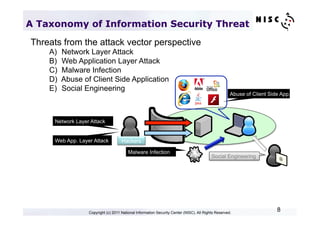
A Taxonomy of Information Security Threat
Threats from the attack vector perspective
    A)    Network Layer Attack
    B)    Web Application Layer Attack
    C)    Malware Infection
    D)    Abuse of Client Side Application
    E)    Social Engineering
                                                                                                     Abuse of Client Side App.


     Network Layer Attack


     Web App. Layer Attack           Hackers	
 

                                         Malware Infection
                                                                                          Social Engineering


                  Copyright (c) 2011 National Information Security Center (NISC). All Rights Reserved.
                                                                                                                        8
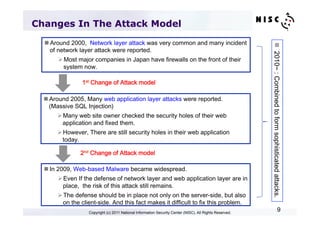
Changes In The Attack Model
  n Around 2000, Network layer attack was very common and many incident


                                                                                                          n  2010~ : Combined to form sophisticated attacks.	
     of network layer attack were reported.
       Ø Most major companies in Japan have firewalls on the front of their
          system now.

                1st Change of Attack model	

  n Around 2005, Many web application layer attacks were reported.
     (Massive SQL Injection)
      Ø Many web site owner checked the security holes of their web
         application and fixed them.
      Ø However, There are still security holes in their web application
         today.

                2nd Change of Attack model	

  n In 2009, Web-based Malware became widespread.
       Ø Even If the defense of network layer and web application layer are in
          place, the risk of this attack still remains.
       Ø The defense should be in place not only on the server-side, but also
          on the client-side. And this fact makes it difficult to fix this problem.
                   Copyright (c) 2011 National Information Security Center (NISC). All Rights Reserved.
                                                                                                                                     9
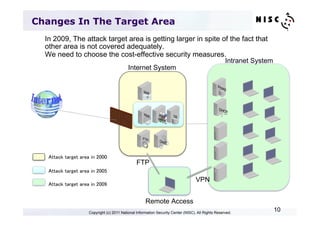
Changes In The Target Area
  In 2009, The attack target area is getting larger in spite of the fact that
  other area is not covered adequately.
  We need to choose the cost-effective security measures.	
                                                                                                     Intranet System	
                                            Internet System	


   Attack target area in 2000	
                                                 FTP	
   Attack target area in 2005	
                                                                                    VPN	
   Attack target area in 2009	


                                                      Remote Access	
                     Copyright (c) 2011 National Information Security Center (NISC). All Rights Reserved.
                                                                                                                     10
Did Network Attacks Become A History?

l    Question: With raise of Web-based attacks, common installation of
      firewalls, and users shifting to newer operating systems, did network
      attack become a history?
      
l    Answer: No.
      l  New vulnerabilities in wide range of software and systems are still
          reported everyday.
      l    Network attack is still very active according to network monitors (such as
            nicter by NICT).
      l    Presence of the comprehensive bot networks amplifies effect of newly
            found vulnerabilities (e.g.: Welch, Conficker, …)
      l    Vulnerabilities are utilized for intranet network attacks.
            

l    Likewise, Web-Application Layer attacks (e.g. SQL injections and XSS
      attacks) are still very common.

                        Copyright (c) 2010 National Information Security Center (NISC). All Rights Reserved.
                                                                                                               11
Web Applications are inherently vulnerable?

  Web applications are inherently vulnerable to attacks:
l    Distributed Nature
      l  Unlike the traditional applications, web applications inherently deals with
          distributed components and services; even secure components and services
          become unsecure when they depend on unsecure remote components and
          services.
      l  Web programming facilities are often introduced with functionality (aka
          “richer user experience”) as the first priority; security considerations are often
          very weak.
      l  The WASC (Web Application Security Consortium) has identified 34 different
          classes of web application attacks and 15 different classes of weaknesses of
          web applications that can be attacked.

l    Market Pressure
      l    Most web applications have severe TTM (Time to The Market) schedule.
      l    Most web applications are believed to be “lighter” than traditional hard
            coded applications, thus can be made “cheaper”.
      l    Most web applications are required to “be fancy”, not “be secure”.
                        Copyright (c) 2011 National Information Security Center (NISC). All Rights Reserved.
                                                                                                               12
Rise of the APTs

  Advanced Persistent Threat (APT) usually refers to a group with both the
  capability and intent to persistently and effectively target a specific entity. 
l    Advanced
      l    Operators of APTs have a full spectrum of intelligence-gathering capabilities,
            including computer intrusion technologies and conventional technologies such as
            wire-tapping.
      l    Often combine multiple targeting methods to produce more sophisticated
            methods to gain and maintain access to the target.

l    Persistent
      l    Operators give priority to a specific task, rather than the opportunistically seeking
            gains.
      l    Targets are constantly monitored, often by “low-and-slow” approach.
      l    Operator’s goal is to maintain long-term access to the target.

l    Threat
      l    APTs are a threat because they have both capability and intent.
      l    The operators have a specific objective and are skilled, organized, and often well
            funded.

                         Copyright (c) 2011 National Information Security Center (NISC). All Rights Reserved.
                                                                                                                13
3. Change of Game


      Copyright (c) 2011 National Information Security Center (NISC). All Rights Reserved.
                                                                                             14
Awareness Rising

Awareness rising plays one of the central role in possible measures.
l    Awareness rising in different sectors
      l    Government
      l    Private industries and enterprises, and supply chains
      l    General Public

l    Awareness rising has direct and indirect effects
      l    Prevent direct damages; large portion of sophisticated attacks are
            triggered by icareless or ignorant operations.
      l    Incubate a common sense among people and industries, in
            investments into security aspects of ICT systems.


                      Copyright (c) 2011 National Information Security Center (NISC). All Rights Reserved.
                                                                                                             15
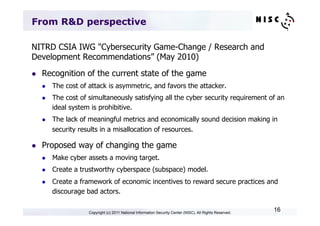
From R&D perspective

NITRD CSIA IWG "Cybersecurity Game-Change / Research and
Development Recommendations” (May 2010)
l    Recognition of the current state of the game
      l    The cost of attack is asymmetric, and favors the attacker.
      l    The cost of simultaneously satisfying all the cyber security requirement of an
            ideal system is prohibitive.
      l    The lack of meaningful metrics and economically sound decision making in
            security results in a misallocation of resources.

l    Proposed way of changing the game
      l    Make cyber assets a moving target.
      l    Create a trustworthy cyberspace (subspace) model.
      l    Create a framework of economic incentives to reward secure practices and
            discourage bad actors.

                        Copyright (c) 2011 National Information Security Center (NISC). All Rights Reserved.
                                                                                                               16
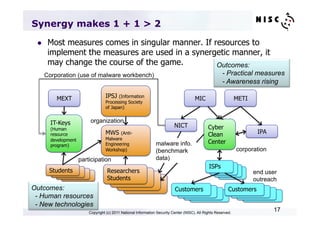
Synergy makes 1 + 1 > 2

 l     Most measures comes in singular manner. If resources to
        implement the measures are used in a synergetic manner, it
        may change the course of the game. 	
       Outcomes:
       Corporation (use of malware workbench)	
                                                          - Practical measures
                                                                                                         - Awareness rising

           MEXT	
                   IPSJ   (Information
                                                                                         MIC	
                    METI	
                                    Processing Society
                                    of Japan) 	


         IT-Keys            organization	
                                                                             NICT	
              Cyber
         (Human
         resource                   MWS    (Anti-                                                Clean                      IPA	
         development                Malware
                                    Engineering                   malware info.                  Center	
         program)	
                                    Workshop)                     (benchmark                                      corporation	
                       participation	
                            data)
                                                                                                 ISPs	
                                                                                                   ISPs	
        Students
          ISPs	
                     Researchers                                                     ISPs	
                                                                                                       ISPs	
              end user
            ISPs	
              ISPs	
                   ISPs	
                                         ISPs	
                                     Students                                                                              outreach	
                                            ISPs	
Outcomes:                                                                    Customers	
                                                                               ISPs	
                        Customers	
                                                                                                               ISPs	
 - Human resources                                                               ISPs	
                                                                                   ISPs	
                        ISPs	
                                                                                                                   ISPs	
 - New technologies	
                           Copyright (c) 2011 National Information Security Center (NISC). All Rights Reserved.
                                                                                                                                    17
Concluding Remarks


      Copyright (c) 2011 National Information Security Center (NISC). All Rights Reserved.
                                                                                             18
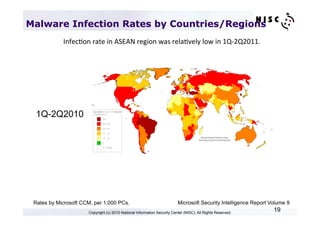
Malware Infection Rates by Countries/Regions
            Infec&on	
  rate	
  in	
  ASEAN	
  region	
  was	
  rela&vely	
  low	
  in	
  1Q-­‐2Q2011.


  1Q-2Q2010	


 Rates by Microsoft CCM, per 1,000 PCs.                                    Microsoft Security Intelligence Report Volume 9
                       Copyright (c) 2010 National Information Security Center (NISC). All Rights Reserved.
                                                                                                                   19
Malware Infection Rates by Countries/Regions
                        Infec&on	
  rate	
  in	
  ASEAN	
  region	
  is	
  increasing	
  
                         (despite	
  the	
  color	
  scale/scheme	
  change).


   1Q2011	


   2Q2011	


 Rates by Microsoft CCM, per 1,000 PCs.                    Source: Microsoft Security Intelligence Report Volume 11
                      Copyright (c) 2011 National Information Security Center (NISC). All Rights Reserved.
                                                                                                             20
We can change, we must change

l    Goals
      l    Prevent economic and other damages to people, companies, countries and the
            region.
      l    Provide safe and secure investment environment to promote further growth of
            individual countries and the region.

l    Current situation
      l    Attack model is evolving quickly.
      l    End users are becoming more connected to the rest of the world every day.
      l    Rise of the APTs and parties behind them.

l    Required actions
      l    Recognize the current state, identify problems.
      l    Establish measures in the government. Guide private sectors to do the same.
      l    Awareness raising in government and public sectors.
      l    Proper investments into proper programs.
      l    Don’t panic, but start your action, go on to the next step.

                        Copyright (c) 2011 National Information Security Center (NISC). All Rights Reserved.
                                                                                                               21
Copyright (c) 2010 National Information Security Center (NISC). All Rights Reserved.
                                                                                       22

20111214 iisf shinoda_

  • 1.
    Indonesia Information SecurityForum (IISF) 2011 14 – 15 Dec. 2011 Global Information Security Threats Trend 2011 Dr. Yoichi SHINODA Advisor on Information Security National Information Security Center (NISC) Cabinet Secretariat, Government of Japan Professor Dependable Network Innovation Center Japan Advanced Institute of Science and Technology
  • 2.
    The Outline 1.  Followups& Updates 2.  Changes In The Long Term Threat Trend 3.  Change of Game 4. Concluding Remarks π Copyright (c) 2011 National Information Security Center (NISC). All Rights Reserved. 1
  • 3.
    1. Updates Copyright (c) 2011 National Information Security Center (NISC). All Rights Reserved. 2
  • 4.
    “Update 2010” summariesand followups (1) l  Drive-by Download & Gumblar l  Introduced a new class of attack model: Web-PC integrated infection cycle. l  Requires integrated approach on both PCs and servers for measures. l  Stuxnet and Its Impact l  It targets at FA systems, has potential to damage critical infrastructure. l  It penetrates and spreads into so called “closed, physically isolated, dedicated systems” ( --> False belief about secureness). l  New malware utilizing Stuxnet modules are now emerging. Copyright (c) 2011 National Information Security Center (NISC). All Rights Reserved. 3
  • 5.
    “Update 2010” summariesand followups (2) l  Route Hi-Jacking l  Large incidents are not reported for 2011; small incidents are daily. l  Good Old DoS l  Still a very popular and handy tool for expressing an one’s or group’s intention. l  Mitigation technology is available in a limited manner. Copyright (c) 2011 National Information Security Center (NISC). All Rights Reserved. 4
  • 6.
    2011 Updates (1) l  Hactivists became conspicuous. l  Frequent activities by hactivists (loose community of hacker activists), e.g., “Anonymous” and “Lulzsec” were observed. l  The activities were triggered by impulsive events, often put large organizations such as national governments and global enterprises into jeopardy. l  Cyber Space now widely (and officially for some counties) recognized as a field of confrontation, in many aspects. l  Existence of APT (Advanced Persistent Threat) became clear. l  Malwares targeting smart phones is showing rapid growth. l  Trend Micro Oct. 2011 report (+200% growth Sep. to Oct.) Copyright (c) 2011 National Information Security Center (NISC). All Rights Reserved. 5
  • 7.
    2011 Updates (2) l  More and more “previously believed-to-be-secure” things now became (potential) threat vectors: l  Security tokens: l  A security token vendor has disclosed that some of the internal information was stolen. l  Certificate Authorities and certificates: l  A certificate authority was compromised, and was forced to issue forged certificates, resulting in possible vulnerabilities in multiple major global portal sites. l  E-mails from business partners (or look a likes) l  E-mails forged to look like they are legitimate, in terms of sender address, subject, attachment names and body text, now may contain fatal attack vectors. Copyright (c) 2011 National Information Security Center (NISC). All Rights Reserved. 6
  • 8.
    2. Changes inThe Long Term Trend Copyright (c) 2011 National Information Security Center (NISC). All Rights Reserved. 7
  • 9.
    A Taxonomy ofInformation Security Threat Threats from the attack vector perspective A)  Network Layer Attack B)  Web Application Layer Attack C)  Malware Infection D)  Abuse of Client Side Application E)  Social Engineering Abuse of Client Side App. Network Layer Attack Web App. Layer Attack Hackers Malware Infection Social Engineering Copyright (c) 2011 National Information Security Center (NISC). All Rights Reserved. 8
  • 10.
    Changes In TheAttack Model n Around 2000, Network layer attack was very common and many incident n  2010~ : Combined to form sophisticated attacks. of network layer attack were reported. Ø Most major companies in Japan have firewalls on the front of their system now. 1st Change of Attack model n Around 2005, Many web application layer attacks were reported. (Massive SQL Injection) Ø Many web site owner checked the security holes of their web application and fixed them. Ø However, There are still security holes in their web application today. 2nd Change of Attack model n In 2009, Web-based Malware became widespread. Ø Even If the defense of network layer and web application layer are in place, the risk of this attack still remains. Ø The defense should be in place not only on the server-side, but also on the client-side. And this fact makes it difficult to fix this problem. Copyright (c) 2011 National Information Security Center (NISC). All Rights Reserved. 9
  • 11.
    Changes In TheTarget Area In 2009, The attack target area is getting larger in spite of the fact that other area is not covered adequately. We need to choose the cost-effective security measures. Intranet System Internet System Attack target area in 2000 FTP Attack target area in 2005 VPN Attack target area in 2009 Remote Access Copyright (c) 2011 National Information Security Center (NISC). All Rights Reserved. 10
  • 12.
    Did Network AttacksBecome A History? l  Question: With raise of Web-based attacks, common installation of firewalls, and users shifting to newer operating systems, did network attack become a history? l  Answer: No. l  New vulnerabilities in wide range of software and systems are still reported everyday. l  Network attack is still very active according to network monitors (such as nicter by NICT). l  Presence of the comprehensive bot networks amplifies effect of newly found vulnerabilities (e.g.: Welch, Conficker, …) l  Vulnerabilities are utilized for intranet network attacks. l  Likewise, Web-Application Layer attacks (e.g. SQL injections and XSS attacks) are still very common. Copyright (c) 2010 National Information Security Center (NISC). All Rights Reserved. 11
  • 13.
    Web Applications areinherently vulnerable? Web applications are inherently vulnerable to attacks: l  Distributed Nature l  Unlike the traditional applications, web applications inherently deals with distributed components and services; even secure components and services become unsecure when they depend on unsecure remote components and services. l  Web programming facilities are often introduced with functionality (aka “richer user experience”) as the first priority; security considerations are often very weak. l  The WASC (Web Application Security Consortium) has identified 34 different classes of web application attacks and 15 different classes of weaknesses of web applications that can be attacked. l  Market Pressure l  Most web applications have severe TTM (Time to The Market) schedule. l  Most web applications are believed to be “lighter” than traditional hard coded applications, thus can be made “cheaper”. l  Most web applications are required to “be fancy”, not “be secure”. Copyright (c) 2011 National Information Security Center (NISC). All Rights Reserved. 12
  • 14.
    Rise of theAPTs Advanced Persistent Threat (APT) usually refers to a group with both the capability and intent to persistently and effectively target a specific entity. l  Advanced l  Operators of APTs have a full spectrum of intelligence-gathering capabilities, including computer intrusion technologies and conventional technologies such as wire-tapping. l  Often combine multiple targeting methods to produce more sophisticated methods to gain and maintain access to the target. l  Persistent l  Operators give priority to a specific task, rather than the opportunistically seeking gains. l  Targets are constantly monitored, often by “low-and-slow” approach. l  Operator’s goal is to maintain long-term access to the target. l  Threat l  APTs are a threat because they have both capability and intent. l  The operators have a specific objective and are skilled, organized, and often well funded. Copyright (c) 2011 National Information Security Center (NISC). All Rights Reserved. 13
  • 15.
    3. Change ofGame Copyright (c) 2011 National Information Security Center (NISC). All Rights Reserved. 14
  • 16.
    Awareness Rising Awareness risingplays one of the central role in possible measures. l  Awareness rising in different sectors l  Government l  Private industries and enterprises, and supply chains l  General Public l  Awareness rising has direct and indirect effects l  Prevent direct damages; large portion of sophisticated attacks are triggered by icareless or ignorant operations. l  Incubate a common sense among people and industries, in investments into security aspects of ICT systems. Copyright (c) 2011 National Information Security Center (NISC). All Rights Reserved. 15
  • 17.
    From R&D perspective NITRDCSIA IWG "Cybersecurity Game-Change / Research and Development Recommendations” (May 2010) l  Recognition of the current state of the game l  The cost of attack is asymmetric, and favors the attacker. l  The cost of simultaneously satisfying all the cyber security requirement of an ideal system is prohibitive. l  The lack of meaningful metrics and economically sound decision making in security results in a misallocation of resources. l  Proposed way of changing the game l  Make cyber assets a moving target. l  Create a trustworthy cyberspace (subspace) model. l  Create a framework of economic incentives to reward secure practices and discourage bad actors. Copyright (c) 2011 National Information Security Center (NISC). All Rights Reserved. 16
  • 18.
    Synergy makes 1+ 1 > 2 l  Most measures comes in singular manner. If resources to implement the measures are used in a synergetic manner, it may change the course of the game. Outcomes: Corporation (use of malware workbench) - Practical measures - Awareness rising MEXT IPSJ (Information MIC METI Processing Society of Japan) IT-Keys organization NICT Cyber (Human resource MWS (Anti- Clean IPA development Malware Engineering malware info. Center program) Workshop) (benchmark corporation participation data) ISPs ISPs Students ISPs Researchers ISPs ISPs end user ISPs ISPs ISPs ISPs Students outreach ISPs Outcomes: Customers ISPs Customers ISPs - Human resources ISPs ISPs ISPs ISPs - New technologies Copyright (c) 2011 National Information Security Center (NISC). All Rights Reserved. 17
  • 19.
    Concluding Remarks Copyright (c) 2011 National Information Security Center (NISC). All Rights Reserved. 18
  • 20.
    Malware Infection Ratesby Countries/Regions Infec&on  rate  in  ASEAN  region  was  rela&vely  low  in  1Q-­‐2Q2011. 1Q-2Q2010 Rates by Microsoft CCM, per 1,000 PCs. Microsoft Security Intelligence Report Volume 9 Copyright (c) 2010 National Information Security Center (NISC). All Rights Reserved. 19
  • 21.
    Malware Infection Ratesby Countries/Regions Infec&on  rate  in  ASEAN  region  is  increasing   (despite  the  color  scale/scheme  change). 1Q2011 2Q2011 Rates by Microsoft CCM, per 1,000 PCs. Source: Microsoft Security Intelligence Report Volume 11 Copyright (c) 2011 National Information Security Center (NISC). All Rights Reserved. 20
  • 22.
    We can change,we must change l  Goals l  Prevent economic and other damages to people, companies, countries and the region. l  Provide safe and secure investment environment to promote further growth of individual countries and the region. l  Current situation l  Attack model is evolving quickly. l  End users are becoming more connected to the rest of the world every day. l  Rise of the APTs and parties behind them. l  Required actions l  Recognize the current state, identify problems. l  Establish measures in the government. Guide private sectors to do the same. l  Awareness raising in government and public sectors. l  Proper investments into proper programs. l  Don’t panic, but start your action, go on to the next step. Copyright (c) 2011 National Information Security Center (NISC). All Rights Reserved. 21
  • 23.
    Copyright (c) 2010National Information Security Center (NISC). All Rights Reserved. 22