+	


                                                    Mobile	
  Learning:	
  Using	
  Mobile	
  Devices	
  	
  
                                           to	
  Deliver	
  Interac6ve	
  Mul6media	
  Instruc6on	


                                                                                      Dr.	
  Robert	
  Atkinson,	
  	
  
 M.	
  Andree	
  Denham,	
  M.	
  Javier	
  Gonzalez-­‐Sanchez,	
  M.	
  Robert	
  Christopherson	
  ,	
  M.	
  Maria-­‐Elena	
  Chavez-­‐Echeagaray	
  
+	
  
      Schedule	


      1.         About	
  us	
  

      2.         Introduc>on	
  

      3.         eLearning	
  vs	
  mLearning	
  

      4.         Our	
  Goal	
  

      5.         Proof-­‐of-­‐concept	
  using	
  an	
  iOS-­‐based	
  plaJorm	
  

      6.         Forecas>ng	
  the	
  future	
  trends	
  

      7.         Conclusions	


Javier	
  Gonzalez-­‐Sanchez	
  |	
  Maria-­‐Elena	
  Chavez-­‐Echeagaray	
                  2	
  
+	
  
      About	
  us	
                                                                                                           1
                                    Team	
  

                                        Learning	
  Science	
  Research	
  Lab	
  at	
  Arizona	
  State	
  University	
  
                                         leaded	
  by	
  Robert	
  Atkinson.	


                                        Data	
  and	
  Informa>on	
  and	
  Ar>ficial	
  Intelligence	
  group	
  at	
  
                                         Arizona	
  State	
  University	
  leaded	
  Kurt	
  VanLehn.	
  

                                        Mo>va>onal	
  Environment	
  (Human	
  Computer	
  Interac>on)	
  
                                         Group	
  at	
  Arizona	
  State	
  University	
  leaded	
  by	
  Winslow	
  
                                         Burleson	
  in	
  collabora>on	
  with	
  MIT	
  Media	
  Lab.	
  

                                    Project	
  

                                        Evalua>ng	
  the	
  Impact	
  of	
  Interac>ve	
  Tutoring	
  and	
  Game-­‐
                                         Based	
  Environments	
  on	
  Learning	
  and	
  Engagement.	
  Office	
  
                                         of	
  Naval	
  Research	
  –	
  Grant	
  #	
  N000141010143.	


Javier	
  Gonzalez-­‐Sanchez	
  |	
  Maria-­‐Elena	
  Chavez-­‐Echeagaray	
  
+	
  
      Introduc6on	
                                                                                                                  2
                                        Mobile	
  device	
  ownership	
  has	
  seen	
  an	
  exponen>al	
  
                                         growth	
  throughout	
  the	
  world	
  in	
  the	
  last	
  decade.	


                                        	
  Instruc>onal	
  designers,	
  both	
  in	
  private	
  and	
  public	
  
                                         industry,	
  are	
  looking	
  for	
  ways	
  to	
  create	
  and	
  deliver	
  
                                         instruc>on	
  for	
  mobile	
  devices.	
  They	
  are	
  mo>vated	
  by	
  
                                         the	
  ability	
  of	
  mobile	
  devices	
  to	
  deliver	
  complex,	
  high-­‐
                                         quality,	
  interac6ve,	
  efficient,	
  effec6ve,	
  and	
  engaging	
  
                                         instruc6on,	
  to	
  a	
  large	
  audience	
  of	
  users	
  and	
  the	
  social	
  
                                         implica>ons	
  of	
  this.	


Javier	
  Gonzalez-­‐Sanchez	
  |	
  Maria-­‐Elena	
  Chavez-­‐Echeagaray	
  
+	
  
      Concepts	
                                                                        2
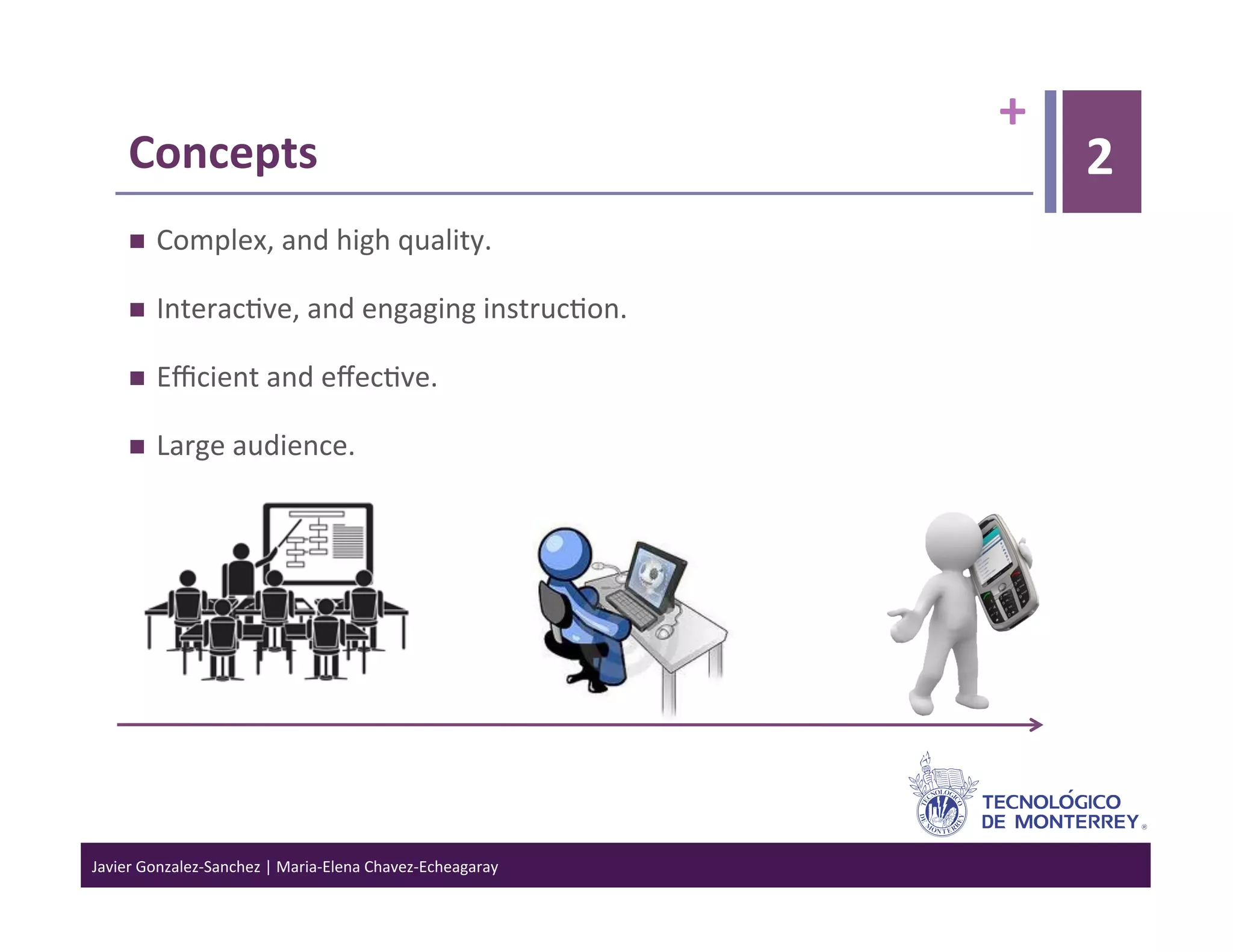
           Complex,	
  and	
  high	
  quality.	
  

           Interac>ve,	
  and	
  engaging	
  instruc>on.	
  

           Efficient	
  and	
  effec>ve.	
  

           Large	
  audience.	


Javier	
  Gonzalez-­‐Sanchez	
  |	
  Maria-­‐Elena	
  Chavez-­‐Echeagaray	
  
+	
  
      To	
  Consider	
  (Pros)	
                                                                                            2
                                  Delivering	
  Instruc>on	
  on	
  Mobile	
  Devices	
  implies:	
  

                                      Capable	
  of	
  delivering	
  mul>ple	
  forms	
  of	
  media.	
  
                                       Comparable	
  interac>vity	
  to	
  desktop	
  interface.	
  

                                      Mobile	
  Devices	
  are	
  always	
  with	
  you.	
  

                                      Instruc>on	
  is	
  provided	
  any>me,	
  anywhere.	
  Alterna>ve	
  to	
  
                                       the	
  Desktop.	
  

                                      Cost	
  effec>ve.	
  

                                      Greater	
  interac>vity	
  in	
  comparison	
  to	
  desktops	
  (GPS,	
  
                                       accelerometer,	
  camera,	
  virtual	
  reality).	


Javier	
  Gonzalez-­‐Sanchez	
  |	
  Maria-­‐Elena	
  Chavez-­‐Echeagaray	
  
+	
  
      To	
  Consider	
  (Pros)	
                                                                                                  2
                                  Delivering	
  Instruc>on	
  on	
  Mobile	
  Devices	
  implies:	
  

                                      Poten>al	
  for	
  ubiquitous	
  use.	
  

                                      Added	
  interac>vity	
  with	
  the	
  inclusion	
  of	
  input	
  sensors.	
  

                                      Support	
  Just-­‐in-­‐Time	
  and	
  Just-­‐In-­‐Case.	
  

                                      Games	
  and	
  Simula>ons	
  (Gamifica>on	
  concepts).	
  

                                      Engagement.	
  We	
  believe	
  that	
  Into	
  the	
  future	
  another	
  
                                       devices	
  will	
  integrate	
  the	
  same	
  technology	
  

                                      Not	
  a	
  computer	
  that	
  makes	
  phone	
  calls	
  

                                      Successful	
  gaming	
  &	
  simula>on	
  plaJorm	
  

                                      Intui>ve	
  User-­‐Interface	
  design	


Javier	
  Gonzalez-­‐Sanchez	
  |	
  Maria-­‐Elena	
  Chavez-­‐Echeagaray	
  
+	
  
      To	
  Consider	
  (Cons)	
                                                                        2
                                  But	
  also	
  implies:	
  

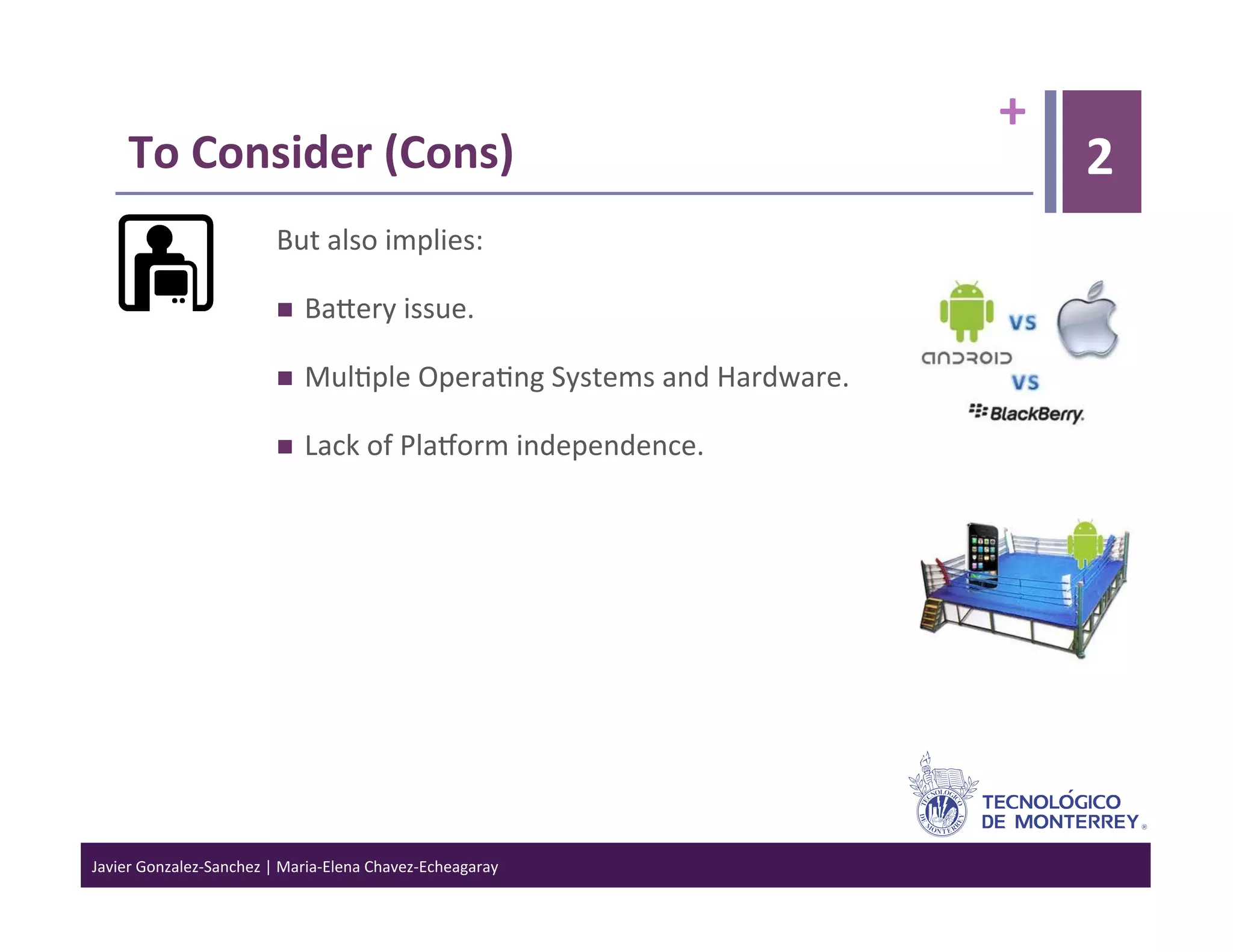
                                      Baiery	
  issue.	
  

                                      Mul>ple	
  Opera>ng	
  Systems	
  and	
  Hardware.	
  

                                      Lack	
  of	
  PlaJorm	
  independence.	


Javier	
  Gonzalez-­‐Sanchez	
  |	
  Maria-­‐Elena	
  Chavez-­‐Echeagaray	
  
+	
  
      eLearning	
  vs	
  mLearning	
                                                                                        3
                                      Unfortunately	
  research	
  to	
  empirically	
  define	
  the	
  best	
  use	
  
                                       prac>ces	
  for	
  developing	
  instruc6on	
  for	
  mobile	
  devices	
  
                                       has	
  not	
  kept	
  pace	
  with	
  the	
  hardware	
  and	
  sojware	
  
                                       improvements	
  of	
  mobile	
  devices.	


                                      Most	
  instruc>on	
  developed	
  for	
  mobile	
  devices	
  are	
  
                                       developed	
  using	
  the	
  guidelines	
  and	
  best	
  prac6ces	
  
                                       defined	
  through	
  research	
  on	
  e-­‐learning.	


Javier	
  Gonzalez-­‐Sanchez	
  |	
  Maria-­‐Elena	
  Chavez-­‐Echeagaray	
  
+	
  
      Ques6ons	
                                                                                                            3
                                     Is	
  mobile	
  learning	
  for	
  everyone?	
  

                                     What	
  are	
  the	
  guidelines/frameworks	
  for	
  developing	
  
                                      content	
  for	
  mobile	
  devices?	
  

                                     Engagement?	
  

                                     Behavior?	


                                 Reference	
  

                                     Towards	
  a	
  Theory	
  of	
  Mobile,	
  Proceedings	
  of	
  mLearn	
  2005	
  
                                      conference.	
  (2005).	
  Sharples,	
  Taylor,	
  &	
  Vavoula.	


Javier	
  Gonzalez-­‐Sanchez	
  |	
  Maria-­‐Elena	
  Chavez-­‐Echeagaray	
  
+	
  
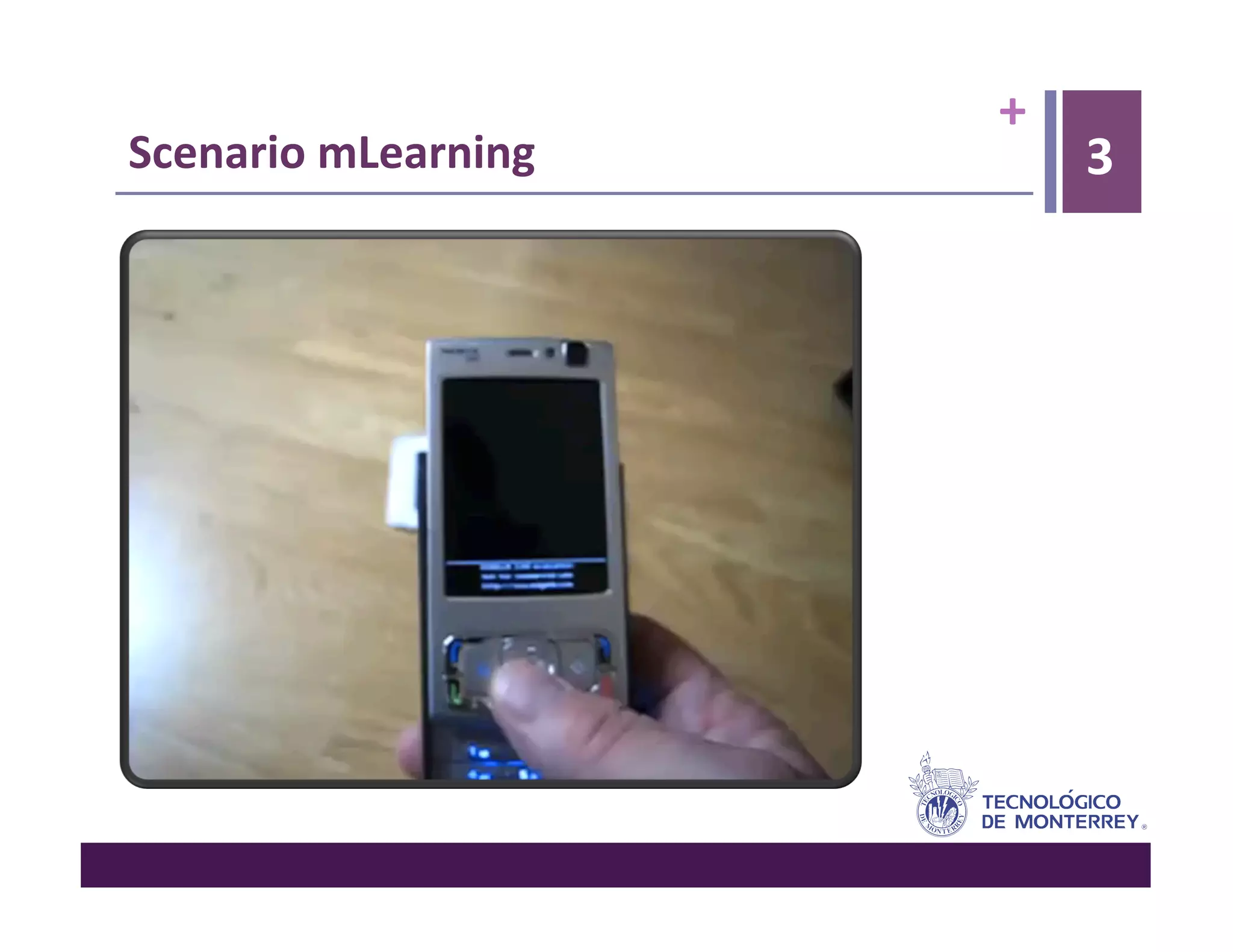
      Scenario	
  mLearning	
                                                                                                       3
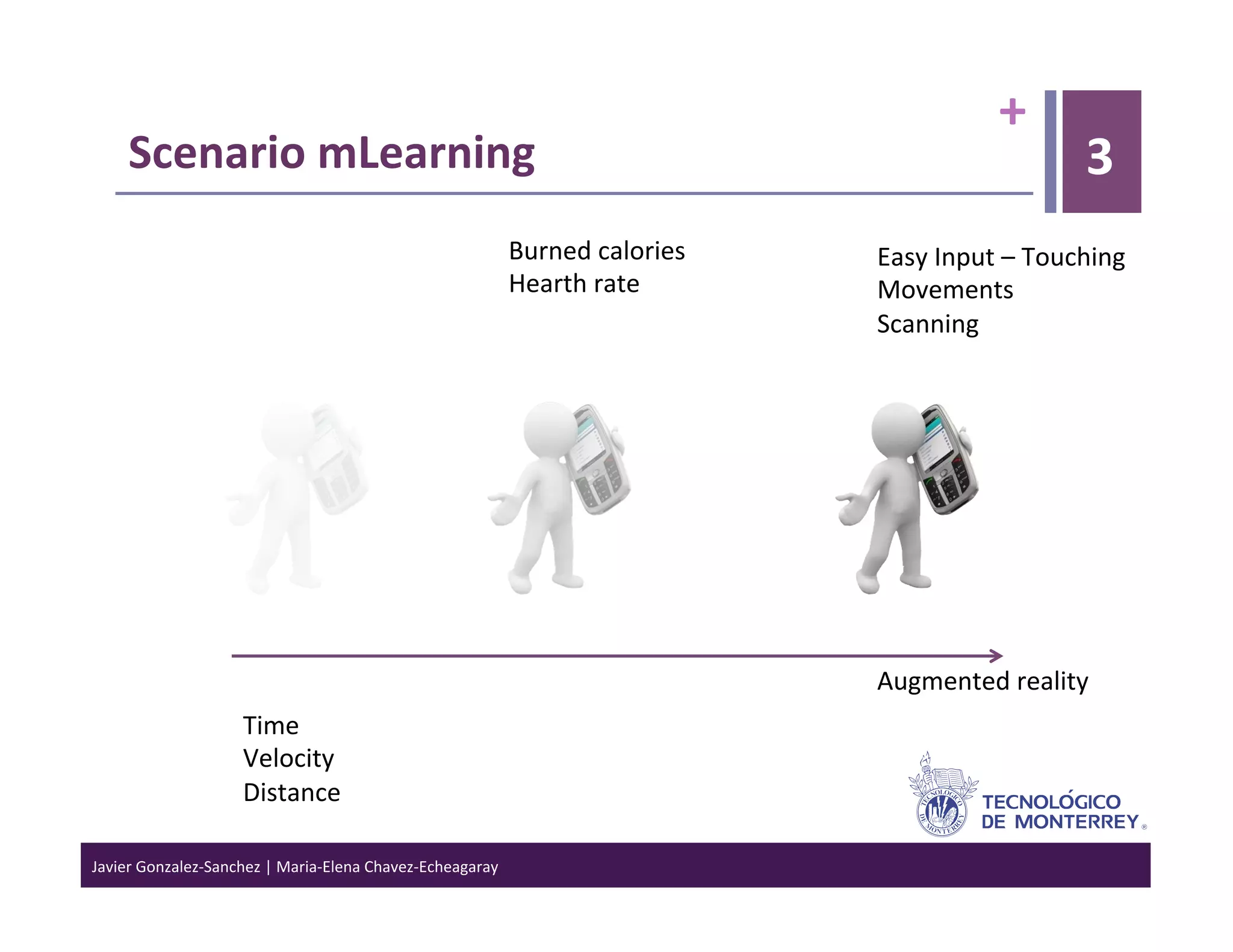
                                                                                Burned	
  calories	
     Easy	
  Input	
  –	
  Touching	
  
                                                                                Hearth	
  rate	
         Movements	
  
                                                                                	
                       Scanning	


                                                                                                         Augmented	
  reality	
  
                            Time	
                                                                       	
  
                            Velocity	
  
                            Distance	
  

Javier	
  Gonzalez-­‐Sanchez	
  |	
  Maria-­‐Elena	
  Chavez-­‐Echeagaray	
  
+	
  
      Scenario	
  mLearning	
                                                           3


Javier	
  Gonzalez-­‐Sanchez	
  |	
  Maria-­‐Elena	
  Chavez-­‐Echeagaray	
  
+	
  
Scenario	
  mLearning	
             3
+	
  
      Goal	
                                                                                                                         4
                                      As	
  we	
  move	
  ahead,	
  the	
  findings	
  from	
  this	
  project	
  will	
  
                                       have	
  implica>ons	
  for	
  higher	
  educa>on	
  and	
  K-­‐12	
  
                                       educators	
  as	
  well.	


                                      Both	
  are	
  looking	
  for	
  innova>ve	
  ways	
  to	
  efficiently	
  
                                       develop	
  instruc>on	
  that	
  mo6vates	
  and	
  engages	
  
                                       learners,	
  but	
  at	
  the	
  same	
  >me	
  encourages	
  the	
  learning	
  
                                       process	
  in	
  combina>on	
  with	
  the	
  enhancement	
  and	
  
                                       enrichment	
  of	
  learner’s	
  skills	
  and	
  meta-­‐skills.	


Javier	
  Gonzalez-­‐Sanchez	
  |	
  Maria-­‐Elena	
  Chavez-­‐Echeagaray	
  
+	
  
      Goal	
                                                                                                                            4
                                 Educa>onal	
  Technology	
  group	
  

                                     Outlining	
  guidelines	
  for	
  developing	
  mLearning	
  content	
  
                                      that	
  are	
  backed	
  by	
  research.	
  

                                     The	
  goal	
  should	
  be	
  to	
  not	
  just	
  replicate	
  elearning,	
  CBT,	
  
                                      WBT;	
  most	
  innova6ons	
  imitate	
  the	
  approaches	
  they	
  
                                      replace.	
  

                                     The	
  need	
  for	
  the	
  development	
  of	
  meaningful	
  metrics	
  in	
  
                                      the	
  domain	
  of	
  m-­‐learning.	


                                     Development	
  of	
  an	
  integrated	
  theory	
  of	
  mLearning	
  that	
  
                                      speaks	
  to	
  the	
  analysis	
  of	
  learning	
  in	
  a	
  mobile	
  world	
  and	
  
                                      the	
  design	
  of	
  new	
  technologies	
  and	
  environments	
  for	
  
                                      learning	
  

Javier	
  Gonzalez-­‐Sanchez	
  |	
  Maria-­‐Elena	
  Chavez-­‐Echeagaray	
  
+	
  
      Goal	
                                                                                                                        4
                                 Important	
  ques>ons	
  

                                      What	
  types	
  of	
  learning	
  tasks	
  are	
  best	
  suited	
  for	
  mobile	
  
                                       devices?	
  

                                      Verbal	
  Informa>on?	
  
                                           Intellectual	
  Skills?	
  
                                           Rules?	
  

                                      Problem	
  Solving?	
  
                                           Cogni>ve	
  Strategies?	
  
                                           Aotudes	
  Change?	
  

                                      Motor	
  Skills?	


Javier	
  Gonzalez-­‐Sanchez	
  |	
  Maria-­‐Elena	
  Chavez-­‐Echeagaray	
  
+	
  
      Goal	
                                                                                                                        4
                                   Intelligent	
  Tutor	
  Systems	
  group	
  

                                       Explore	
  the	
  learning	
  tasks	
  that	
  are	
  best	
  suited	
  for	
  mobile	
  
                                        devices	
  (Experien>al	
  Learning,	
  Instruc>onal	
  Games,	
  
                                        Simula>ons,	
  Coopera>ve	
  Learning,	
  Problem	
  Based	
  
                                        Learning,	
  etc.).	
  

                                       Explore	
  the	
  context	
  in	
  which	
  different	
  type	
  of	
  mobile	
  
                                        devices	
  are	
  effec>ve.	


Javier	
  Gonzalez-­‐Sanchez	
  |	
  Maria-­‐Elena	
  Chavez-­‐Echeagaray	
  
+	
  
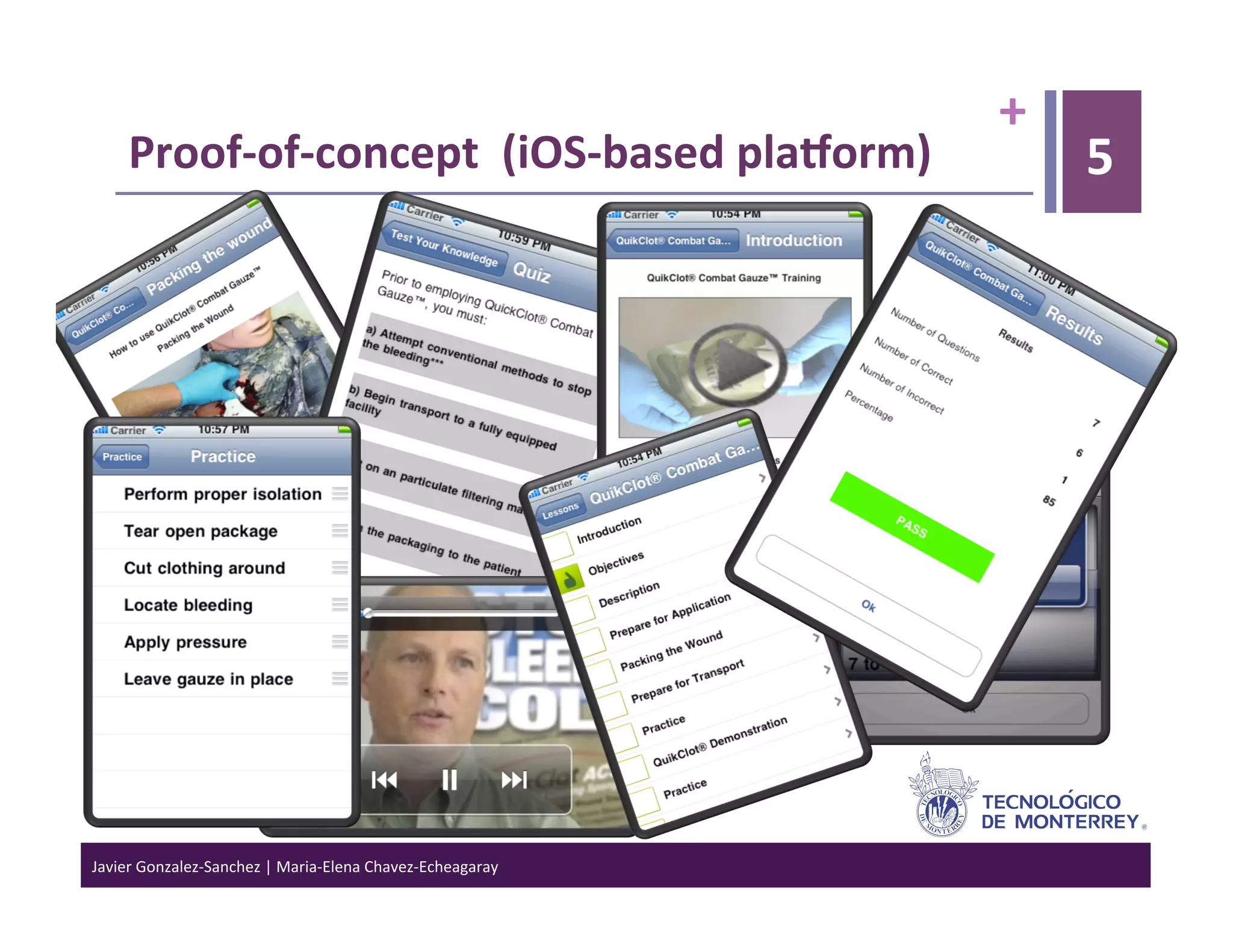
      Proof-­‐of-­‐concept	
  	
  (iOS-­‐based	
  plaVorm)	
                                                          5
                                      Begin	
  the	
  process	
  of	
  formulizing	
  a	
  framework	
  for	
  
                                       delivering	
  interac6ve	
  mul6-­‐media	
  instruc6on	
  through	
  
                                       mobile	
  devices.	


Javier	
  Gonzalez-­‐Sanchez	
  |	
  Maria-­‐Elena	
  Chavez-­‐Echeagaray	
  
+	
  
      Proof-­‐of-­‐concept	
  	
  (iOS-­‐based	
  plaVorm)	
                            5


Javier	
  Gonzalez-­‐Sanchez	
  |	
  Maria-­‐Elena	
  Chavez-­‐Echeagaray	
  
+	
  
      Forecas6ng	
  the	
  future	
  trends	
                                                                                                      6
                                      The	
  need	
  for	
  the	
  development	
  of	
  meaningful	
  metrics	
  in	
  the	
  domain	
  of	
  
                                       m-­‐learning.	


                                      Create	
  a	
  Proof	
  of	
  concept	
  including	
  augmented	
  reality.	
  

                                      Augmented	
  Reality/Video.	
  

                                      Including	
  adap>ve	
  Sensors.	
  

                                      Addi6onal	
  Input	
  Devices/Third	
  Party	
  Controls:	
  Hap>c	
  Devices,	
  Emo>v	
  
                                       Headsets,	
  Hand	
  Sensors.	
  

                                      Adap>ve/Intelligent	
  Learning	
  Systems.	
  

                                      Pushing	
  Updates.	
  

                                      Tracking	
  Progress.	
  

                                      Assigning	
  Instruc>on.	
  

                                      Loca>on	
  Based	
  Updates/Adapta>ons.	


Javier	
  Gonzalez-­‐Sanchez	
  |	
  Maria-­‐Elena	
  Chavez-­‐Echeagaray	
  
+	
  
      Conclusions	
                                                                                                                        7
      	
    The	
  challenge	
  for	
  the	
  educators	
  and	
  technology	
  developers	
  
                                  of	
  the	
  future	
  will	
  be	
  to	
  find	
  a	
  way	
  to	
  ensure	
  that	
  this	
  new	
  
                                  learning	
  is	
  highly	
  situated,	
  personal,	
  collabora>ve	
  and	
  long	
  
                                  term;	
  in	
  other	
  words,	
  truly	
  learner-­‐centered	
  learning.	


                                  Reference:	
  

                                        NESTA	
  Futurelab	
  Report	
  11:	
  Literature	
  Review	
  in	
  Mobile	
  
                                         Technologies	
  and	
  Learning.	
  Naismith,	
  Lonsdale,	
  Vavoula	
  
                                         &	
  Sharples	
  (2004).	


Javier	
  Gonzalez-­‐Sanchez	
  |	
  Maria-­‐Elena	
  Chavez-­‐Echeagaray	
  
+	
  
      Q+A	


Javier	
  Gonzalez-­‐Sanchez	
  |	
  Maria-­‐Elena	
  Chavez-­‐Echeagaray	
  

201101 mLearning

  • 1.
    +     Mobile  Learning:  Using  Mobile  Devices     to  Deliver  Interac6ve  Mul6media  Instruc6on     Dr.  Robert  Atkinson,     M.  Andree  Denham,  M.  Javier  Gonzalez-­‐Sanchez,  M.  Robert  Christopherson  ,  M.  Maria-­‐Elena  Chavez-­‐Echeagaray  
  • 2.
    +   Schedule   1.  About  us   2.  Introduc>on   3.  eLearning  vs  mLearning   4.  Our  Goal   5.  Proof-­‐of-­‐concept  using  an  iOS-­‐based  plaJorm   6.  Forecas>ng  the  future  trends   7.  Conclusions   Javier  Gonzalez-­‐Sanchez  |  Maria-­‐Elena  Chavez-­‐Echeagaray   2  
  • 3.
    +   About  us   1 Team     Learning  Science  Research  Lab  at  Arizona  State  University   leaded  by  Robert  Atkinson.       Data  and  Informa>on  and  Ar>ficial  Intelligence  group  at   Arizona  State  University  leaded  Kurt  VanLehn.     Mo>va>onal  Environment  (Human  Computer  Interac>on)   Group  at  Arizona  State  University  leaded  by  Winslow   Burleson  in  collabora>on  with  MIT  Media  Lab.   Project     Evalua>ng  the  Impact  of  Interac>ve  Tutoring  and  Game-­‐ Based  Environments  on  Learning  and  Engagement.  Office   of  Naval  Research  –  Grant  #  N000141010143.   Javier  Gonzalez-­‐Sanchez  |  Maria-­‐Elena  Chavez-­‐Echeagaray  
  • 4.
    +   Introduc6on   2   Mobile  device  ownership  has  seen  an  exponen>al   growth  throughout  the  world  in  the  last  decade.      Instruc>onal  designers,  both  in  private  and  public   industry,  are  looking  for  ways  to  create  and  deliver   instruc>on  for  mobile  devices.  They  are  mo>vated  by   the  ability  of  mobile  devices  to  deliver  complex,  high-­‐ quality,  interac6ve,  efficient,  effec6ve,  and  engaging   instruc6on,  to  a  large  audience  of  users  and  the  social   implica>ons  of  this.   Javier  Gonzalez-­‐Sanchez  |  Maria-­‐Elena  Chavez-­‐Echeagaray  
  • 5.
    +   Concepts   2   Complex,  and  high  quality.     Interac>ve,  and  engaging  instruc>on.     Efficient  and  effec>ve.     Large  audience.   Javier  Gonzalez-­‐Sanchez  |  Maria-­‐Elena  Chavez-­‐Echeagaray  
  • 6.
    +   To  Consider  (Pros)   2 Delivering  Instruc>on  on  Mobile  Devices  implies:     Capable  of  delivering  mul>ple  forms  of  media.   Comparable  interac>vity  to  desktop  interface.     Mobile  Devices  are  always  with  you.     Instruc>on  is  provided  any>me,  anywhere.  Alterna>ve  to   the  Desktop.     Cost  effec>ve.     Greater  interac>vity  in  comparison  to  desktops  (GPS,   accelerometer,  camera,  virtual  reality).   Javier  Gonzalez-­‐Sanchez  |  Maria-­‐Elena  Chavez-­‐Echeagaray  
  • 7.
    +   To  Consider  (Pros)   2 Delivering  Instruc>on  on  Mobile  Devices  implies:     Poten>al  for  ubiquitous  use.     Added  interac>vity  with  the  inclusion  of  input  sensors.     Support  Just-­‐in-­‐Time  and  Just-­‐In-­‐Case.     Games  and  Simula>ons  (Gamifica>on  concepts).     Engagement.  We  believe  that  Into  the  future  another   devices  will  integrate  the  same  technology     Not  a  computer  that  makes  phone  calls     Successful  gaming  &  simula>on  plaJorm     Intui>ve  User-­‐Interface  design   Javier  Gonzalez-­‐Sanchez  |  Maria-­‐Elena  Chavez-­‐Echeagaray  
  • 8.
    +   To  Consider  (Cons)   2 But  also  implies:     Baiery  issue.     Mul>ple  Opera>ng  Systems  and  Hardware.     Lack  of  PlaJorm  independence.   Javier  Gonzalez-­‐Sanchez  |  Maria-­‐Elena  Chavez-­‐Echeagaray  
  • 9.
    +   eLearning  vs  mLearning   3   Unfortunately  research  to  empirically  define  the  best  use   prac>ces  for  developing  instruc6on  for  mobile  devices   has  not  kept  pace  with  the  hardware  and  sojware   improvements  of  mobile  devices.       Most  instruc>on  developed  for  mobile  devices  are   developed  using  the  guidelines  and  best  prac6ces   defined  through  research  on  e-­‐learning.   Javier  Gonzalez-­‐Sanchez  |  Maria-­‐Elena  Chavez-­‐Echeagaray  
  • 10.
    +   Ques6ons   3   Is  mobile  learning  for  everyone?     What  are  the  guidelines/frameworks  for  developing   content  for  mobile  devices?     Engagement?     Behavior?   Reference     Towards  a  Theory  of  Mobile,  Proceedings  of  mLearn  2005   conference.  (2005).  Sharples,  Taylor,  &  Vavoula.     Javier  Gonzalez-­‐Sanchez  |  Maria-­‐Elena  Chavez-­‐Echeagaray  
  • 11.
    +   Scenario  mLearning   3 Burned  calories   Easy  Input  –  Touching   Hearth  rate   Movements     Scanning     Augmented  reality   Time     Velocity   Distance   Javier  Gonzalez-­‐Sanchez  |  Maria-­‐Elena  Chavez-­‐Echeagaray  
  • 12.
    +   Scenario  mLearning   3 Javier  Gonzalez-­‐Sanchez  |  Maria-­‐Elena  Chavez-­‐Echeagaray  
  • 13.
  • 14.
    +   Goal   4   As  we  move  ahead,  the  findings  from  this  project  will   have  implica>ons  for  higher  educa>on  and  K-­‐12   educators  as  well.       Both  are  looking  for  innova>ve  ways  to  efficiently   develop  instruc>on  that  mo6vates  and  engages   learners,  but  at  the  same  >me  encourages  the  learning   process  in  combina>on  with  the  enhancement  and   enrichment  of  learner’s  skills  and  meta-­‐skills.   Javier  Gonzalez-­‐Sanchez  |  Maria-­‐Elena  Chavez-­‐Echeagaray  
  • 15.
    +   Goal   4 Educa>onal  Technology  group     Outlining  guidelines  for  developing  mLearning  content   that  are  backed  by  research.     The  goal  should  be  to  not  just  replicate  elearning,  CBT,   WBT;  most  innova6ons  imitate  the  approaches  they   replace.     The  need  for  the  development  of  meaningful  metrics  in   the  domain  of  m-­‐learning.       Development  of  an  integrated  theory  of  mLearning  that   speaks  to  the  analysis  of  learning  in  a  mobile  world  and   the  design  of  new  technologies  and  environments  for   learning   Javier  Gonzalez-­‐Sanchez  |  Maria-­‐Elena  Chavez-­‐Echeagaray  
  • 16.
    +   Goal   4 Important  ques>ons     What  types  of  learning  tasks  are  best  suited  for  mobile   devices?     Verbal  Informa>on?     Intellectual  Skills?     Rules?     Problem  Solving?     Cogni>ve  Strategies?     Aotudes  Change?     Motor  Skills?   Javier  Gonzalez-­‐Sanchez  |  Maria-­‐Elena  Chavez-­‐Echeagaray  
  • 17.
    +   Goal   4 Intelligent  Tutor  Systems  group     Explore  the  learning  tasks  that  are  best  suited  for  mobile   devices  (Experien>al  Learning,  Instruc>onal  Games,   Simula>ons,  Coopera>ve  Learning,  Problem  Based   Learning,  etc.).     Explore  the  context  in  which  different  type  of  mobile   devices  are  effec>ve.   Javier  Gonzalez-­‐Sanchez  |  Maria-­‐Elena  Chavez-­‐Echeagaray  
  • 18.
    +   Proof-­‐of-­‐concept    (iOS-­‐based  plaVorm)   5   Begin  the  process  of  formulizing  a  framework  for   delivering  interac6ve  mul6-­‐media  instruc6on  through   mobile  devices.   Javier  Gonzalez-­‐Sanchez  |  Maria-­‐Elena  Chavez-­‐Echeagaray  
  • 19.
    +   Proof-­‐of-­‐concept    (iOS-­‐based  plaVorm)   5 Javier  Gonzalez-­‐Sanchez  |  Maria-­‐Elena  Chavez-­‐Echeagaray  
  • 20.
    +   Forecas6ng  the  future  trends   6   The  need  for  the  development  of  meaningful  metrics  in  the  domain  of   m-­‐learning.       Create  a  Proof  of  concept  including  augmented  reality.     Augmented  Reality/Video.     Including  adap>ve  Sensors.     Addi6onal  Input  Devices/Third  Party  Controls:  Hap>c  Devices,  Emo>v   Headsets,  Hand  Sensors.     Adap>ve/Intelligent  Learning  Systems.     Pushing  Updates.     Tracking  Progress.     Assigning  Instruc>on.     Loca>on  Based  Updates/Adapta>ons.   Javier  Gonzalez-­‐Sanchez  |  Maria-­‐Elena  Chavez-­‐Echeagaray  
  • 21.
    +   Conclusions   7   The  challenge  for  the  educators  and  technology  developers   of  the  future  will  be  to  find  a  way  to  ensure  that  this  new   learning  is  highly  situated,  personal,  collabora>ve  and  long   term;  in  other  words,  truly  learner-­‐centered  learning.       Reference:     NESTA  Futurelab  Report  11:  Literature  Review  in  Mobile   Technologies  and  Learning.  Naismith,  Lonsdale,  Vavoula   &  Sharples  (2004).   Javier  Gonzalez-­‐Sanchez  |  Maria-­‐Elena  Chavez-­‐Echeagaray  
  • 22.
    +   Q+A   Javier  Gonzalez-­‐Sanchez  |  Maria-­‐Elena  Chavez-­‐Echeagaray