CSE240 – Introduction to
Programming Languages
Lecture 14:
Programming with C++ | Inheritance
Javier Gonzalez-Sanchez
javiergs@asu.edu
javiergs.engineering.asu.edu
Office Hours: By appointment
Javier Gonzalez-Sanchez | CSE 240 | Fall 2017 | 2
Inheritance
• Can be used for defining new classes by extending existing classes
• Java: parent (super) class and child (sub) class
• C++: base class and derived class
• New class inherits existing members (variables and functions) and
may add members or redefine members
Javier Gonzalez-Sanchez | CSE 240 | Fall 2017 | 3
Example
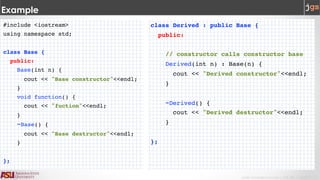
#include <iostream>
using namespace std;
class Base {
public:
Base(int n) {
cout << "Base constructor"<<endl;
}
void function() {
cout << "fuction"<<endl;
}
~Base() {
cout << "Base destructor"<<endl;
}
};
class Derived : public Base {
public:
// constructor calls constructor base
Derived(int n) : Base(n) {
cout << "Derived constructor"<<endl;
}
~Derived() {
cout << "Derived destructor"<<endl;
}
};
Javier Gonzalez-Sanchez | CSE 240 | Fall 2017 | 4
Example
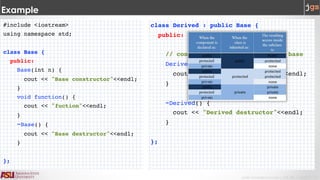
#include <iostream>
using namespace std;
class Base {
public:
Base(int n) {
cout << "Base constructor"<<endl;
}
void function() {
cout << "fuction"<<endl;
}
~Base() {
cout << "Base destructor"<<endl;
}
};
class Derived : public Base {
public:
// constructor calls constructor base
Derived(int n) : Base(n) {
cout << "Derived constructor"<<endl;
}
~Derived() {
cout << "Derived destructor"<<endl;
}
};
Javier Gonzalez-Sanchez | CSE 240 | Fall 2017 | 5
Example
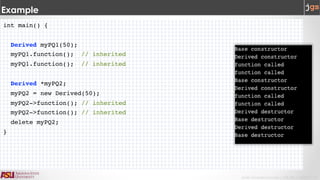
int main() {
Derived myPQ1(50);
myPQ1.function(); // inherited
Derived *myPQ2;
myPQ2 = new Derived(50);
myPQ2->function(); // inherited
delete myPQ2;
}
Javier Gonzalez-Sanchez | CSE 240 | Fall 2017 | 6
Multiple Inheritance
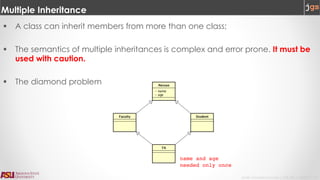
§ A class can inherit members from more than one class;
§ The semantics of multiple inheritances is complex and error prone. It must be
used with caution.
§ The diamond problem
name and age
needed only once
Javier Gonzalez-Sanchez | CSE 240 | Fall 2017 | 7
Example
#include <iostream>
using namespace std;
class A {
public:
A() { cout << "A's constructor called" << endl; }
};
class B {
public:
B() { cout << "B's constructor called" << endl; }
};
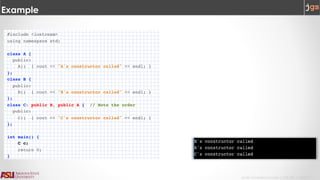
class C: public B, public A { // Note the order
public:
C() { cout << "C's constructor called" << endl; }
};
int main() {
C c;
return 0;
}
Javier Gonzalez-Sanchez | CSE 240 | Fall 2017 | 8
Polymorphism
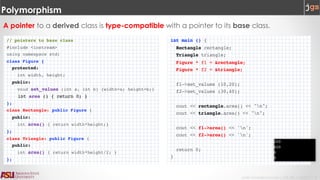
A pointer to a derived class is type-compatible with a pointer to its base class.
// pointers to base class
#include <iostream>
using namespace std;
class Figure {
protected:
int width, height;
public:
void set_values (int a, int b) {width=a; height=b;}
int area () { return 0; }
};
class Rectangle: public Figure {
public:
int area() { return width*height;}
};
class Triangle: public Figure {
public:
int area() { return width*height/2; }
};
int main () {
Rectangle rectangle;
Triangle triangle;
Figure * f1 = &rectangle;
Figure * f2 = &triangle;
f1->set_values (10,20);
f2->set_values (30,40);
cout << rectangle.area() << "n";
cout << triangle.area() << "n";
cout << f1->area() << 'n';
cout << f2->area() << 'n';
return 0;
}
Javier Gonzalez-Sanchez | CSE 240 | Fall 2017 | 9
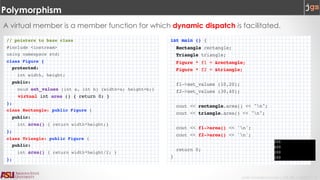
Polymorphism
A virtual member is a member function for which dynamic dispatch is facilitated.
// pointers to base class
#include <iostream>
using namespace std;
class Figure {
protected:
int width, height;
public:
void set_values (int a, int b) {width=a; height=b;}
virtual int area () { return 0; }
};
class Rectangle: public Figure {
public:
int area() { return width*height;}
};
class Triangle: public Figure {
public:
int area() { return width*height/2; }
};
int main () {
Rectangle rectangle;
Triangle triangle;
Figure * f1 = &rectangle;
Figure * f2 = &triangle;
f1->set_values (10,20);
f2->set_values (30,40);
cout << rectangle.area() << "n";
cout << triangle.area() << "n";
cout << f1->area() << 'n';
cout << f2->area() << 'n';
return 0;
}
CSE240 – Introduction to Programming Languages
Javier Gonzalez-Sanchez
javiergs@asu.edu
Fall 2017
Disclaimer. These slides can only be used as study material for the class CSE240 at ASU. They cannot be distributed or used for another purpose.

201801 CSE240 Lecture 14

  • 1.
    CSE240 – Introductionto Programming Languages Lecture 14: Programming with C++ | Inheritance Javier Gonzalez-Sanchez javiergs@asu.edu javiergs.engineering.asu.edu Office Hours: By appointment
  • 2.
    Javier Gonzalez-Sanchez |CSE 240 | Fall 2017 | 2 Inheritance • Can be used for defining new classes by extending existing classes • Java: parent (super) class and child (sub) class • C++: base class and derived class • New class inherits existing members (variables and functions) and may add members or redefine members
  • 3.
    Javier Gonzalez-Sanchez |CSE 240 | Fall 2017 | 3 Example #include <iostream> using namespace std; class Base { public: Base(int n) { cout << "Base constructor"<<endl; } void function() { cout << "fuction"<<endl; } ~Base() { cout << "Base destructor"<<endl; } }; class Derived : public Base { public: // constructor calls constructor base Derived(int n) : Base(n) { cout << "Derived constructor"<<endl; } ~Derived() { cout << "Derived destructor"<<endl; } };
  • 4.
    Javier Gonzalez-Sanchez |CSE 240 | Fall 2017 | 4 Example #include <iostream> using namespace std; class Base { public: Base(int n) { cout << "Base constructor"<<endl; } void function() { cout << "fuction"<<endl; } ~Base() { cout << "Base destructor"<<endl; } }; class Derived : public Base { public: // constructor calls constructor base Derived(int n) : Base(n) { cout << "Derived constructor"<<endl; } ~Derived() { cout << "Derived destructor"<<endl; } };
  • 5.
    Javier Gonzalez-Sanchez |CSE 240 | Fall 2017 | 5 Example int main() { Derived myPQ1(50); myPQ1.function(); // inherited myPQ1.function(); // inherited Derived *myPQ2; myPQ2 = new Derived(50); myPQ2->function(); // inherited myPQ2->function(); // inherited delete myPQ2; }
  • 6.
    Javier Gonzalez-Sanchez |CSE 240 | Fall 2017 | 6 Multiple Inheritance § A class can inherit members from more than one class; § The semantics of multiple inheritances is complex and error prone. It must be used with caution. § The diamond problem name and age needed only once
  • 7.
    Javier Gonzalez-Sanchez |CSE 240 | Fall 2017 | 7 Example #include <iostream> using namespace std; class A { public: A() { cout << "A's constructor called" << endl; } }; class B { public: B() { cout << "B's constructor called" << endl; } }; class C: public B, public A { // Note the order public: C() { cout << "C's constructor called" << endl; } }; int main() { C c; return 0; }
  • 8.
    Javier Gonzalez-Sanchez |CSE 240 | Fall 2017 | 8 Polymorphism A pointer to a derived class is type-compatible with a pointer to its base class. // pointers to base class #include <iostream> using namespace std; class Figure { protected: int width, height; public: void set_values (int a, int b) {width=a; height=b;} int area () { return 0; } }; class Rectangle: public Figure { public: int area() { return width*height;} }; class Triangle: public Figure { public: int area() { return width*height/2; } }; int main () { Rectangle rectangle; Triangle triangle; Figure * f1 = &rectangle; Figure * f2 = &triangle; f1->set_values (10,20); f2->set_values (30,40); cout << rectangle.area() << "n"; cout << triangle.area() << "n"; cout << f1->area() << 'n'; cout << f2->area() << 'n'; return 0; }
  • 9.
    Javier Gonzalez-Sanchez |CSE 240 | Fall 2017 | 9 Polymorphism A virtual member is a member function for which dynamic dispatch is facilitated. // pointers to base class #include <iostream> using namespace std; class Figure { protected: int width, height; public: void set_values (int a, int b) {width=a; height=b;} virtual int area () { return 0; } }; class Rectangle: public Figure { public: int area() { return width*height;} }; class Triangle: public Figure { public: int area() { return width*height/2; } }; int main () { Rectangle rectangle; Triangle triangle; Figure * f1 = &rectangle; Figure * f2 = &triangle; f1->set_values (10,20); f2->set_values (30,40); cout << rectangle.area() << "n"; cout << triangle.area() << "n"; cout << f1->area() << 'n'; cout << f2->area() << 'n'; return 0; }
  • 10.
    CSE240 – Introductionto Programming Languages Javier Gonzalez-Sanchez javiergs@asu.edu Fall 2017 Disclaimer. These slides can only be used as study material for the class CSE240 at ASU. They cannot be distributed or used for another purpose.