THE NEW POLICY LANDSCAPE FOR SUCCESSFUL
      ENERGY EFFICIENCY PROGRAMS:
       VIEWS FROM THE NORTHEAST
                    JIM O’REILLY
  NORTHEAST ENERGY EFFICIENCY PARTNERSHIPS (NEEP)
       ACEEE Market Transformation Symposium
                    April 2, 2012
NORTHEAST ENERGY EFFICIENCY PARTNERSHIPS
“Accelerating Energy Efficiency”


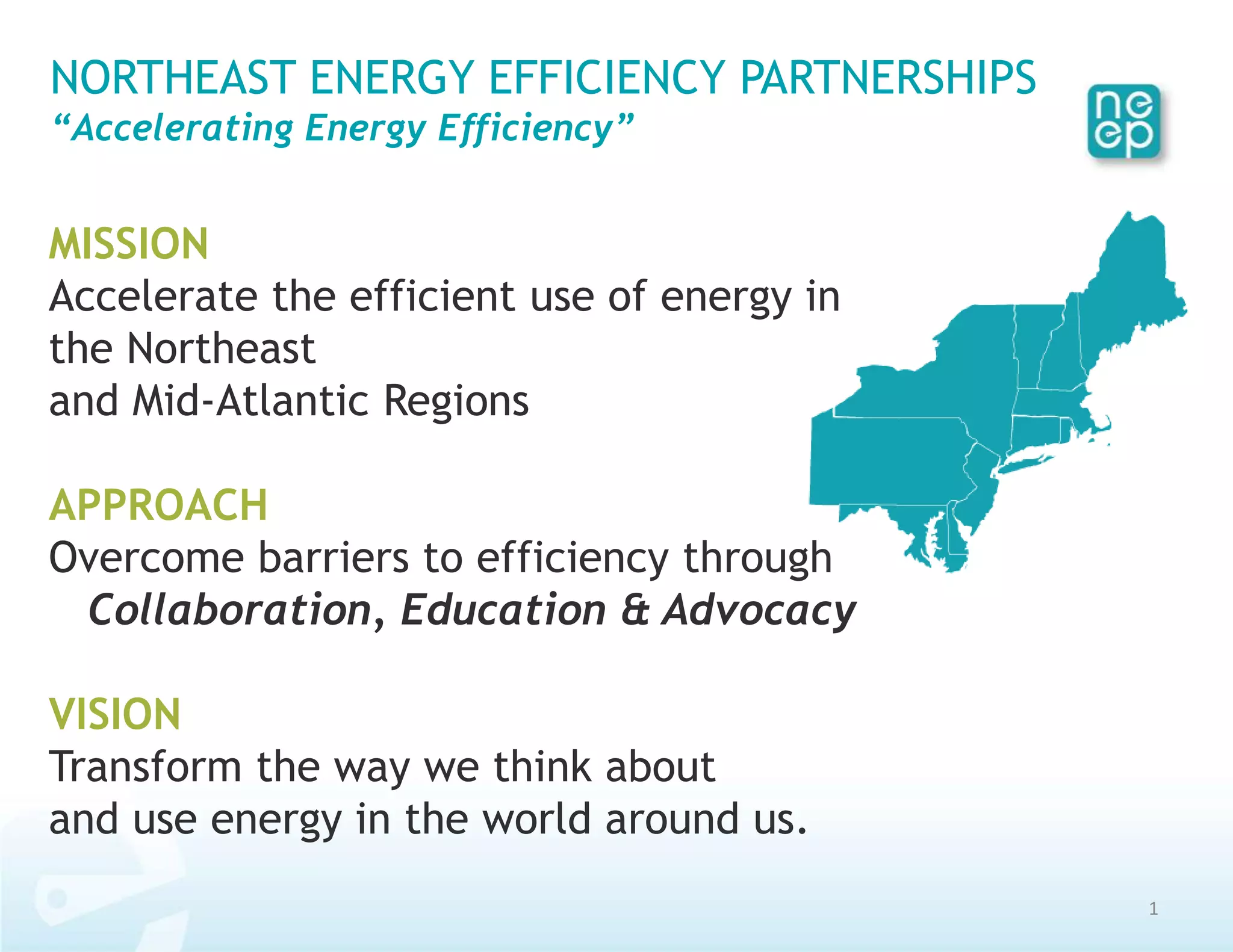
MISSION
Accelerate the efficient use of energy in
the Northeast
and Mid-Atlantic Regions

APPROACH
Overcome barriers to efficiency through
 Collaboration, Education & Advocacy

VISION
Transform the way we think about
and use energy in the world around us.
                                            1
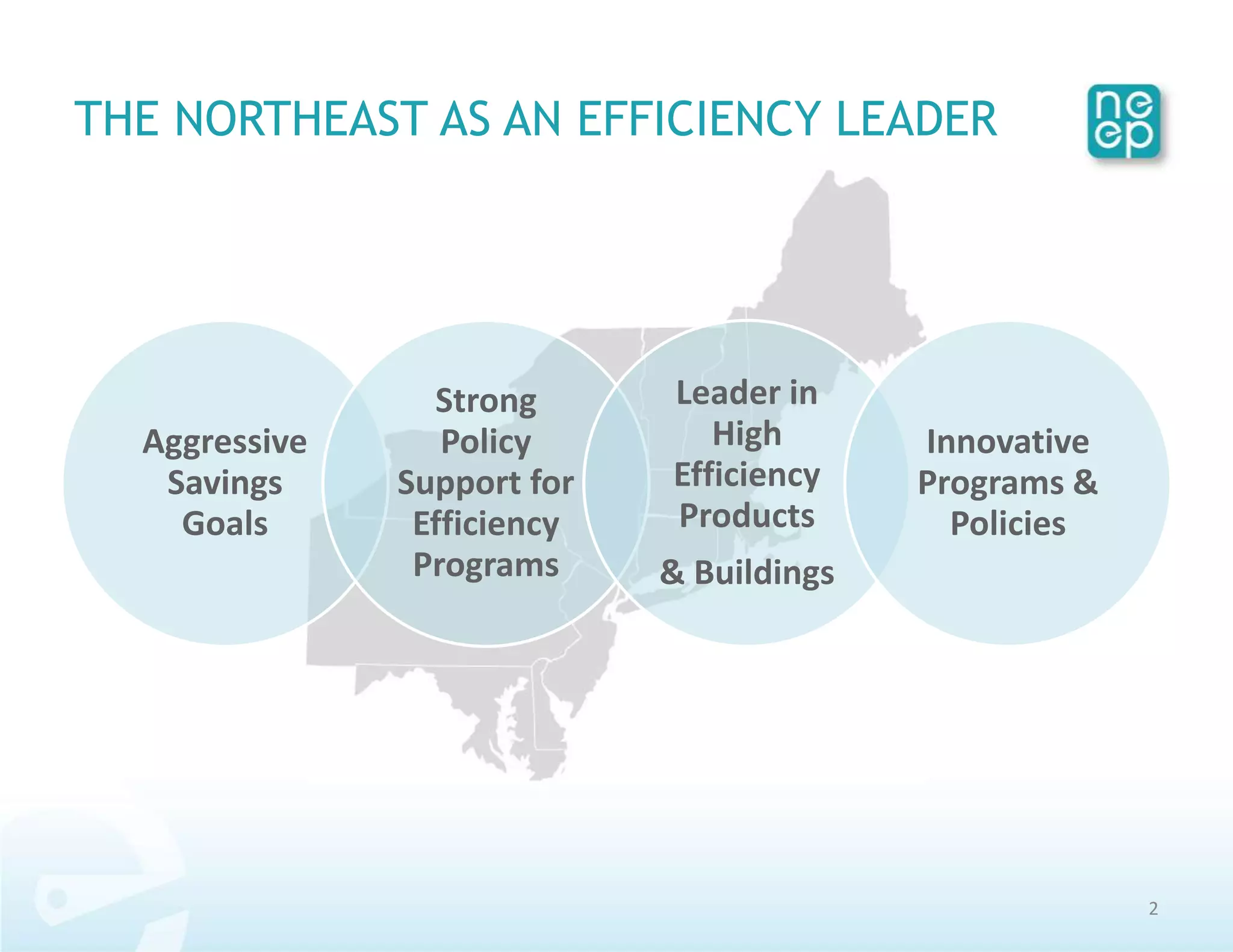
THE NORTHEAST AS AN EFFICIENCY LEADER


                 Strong      Leader in
  Aggressive      Policy        High       Innovative
   Savings     Support for   Efficiency    Programs &
    Goals       Efficiency   Products        Policies
                Programs     & Buildings


                                                        2
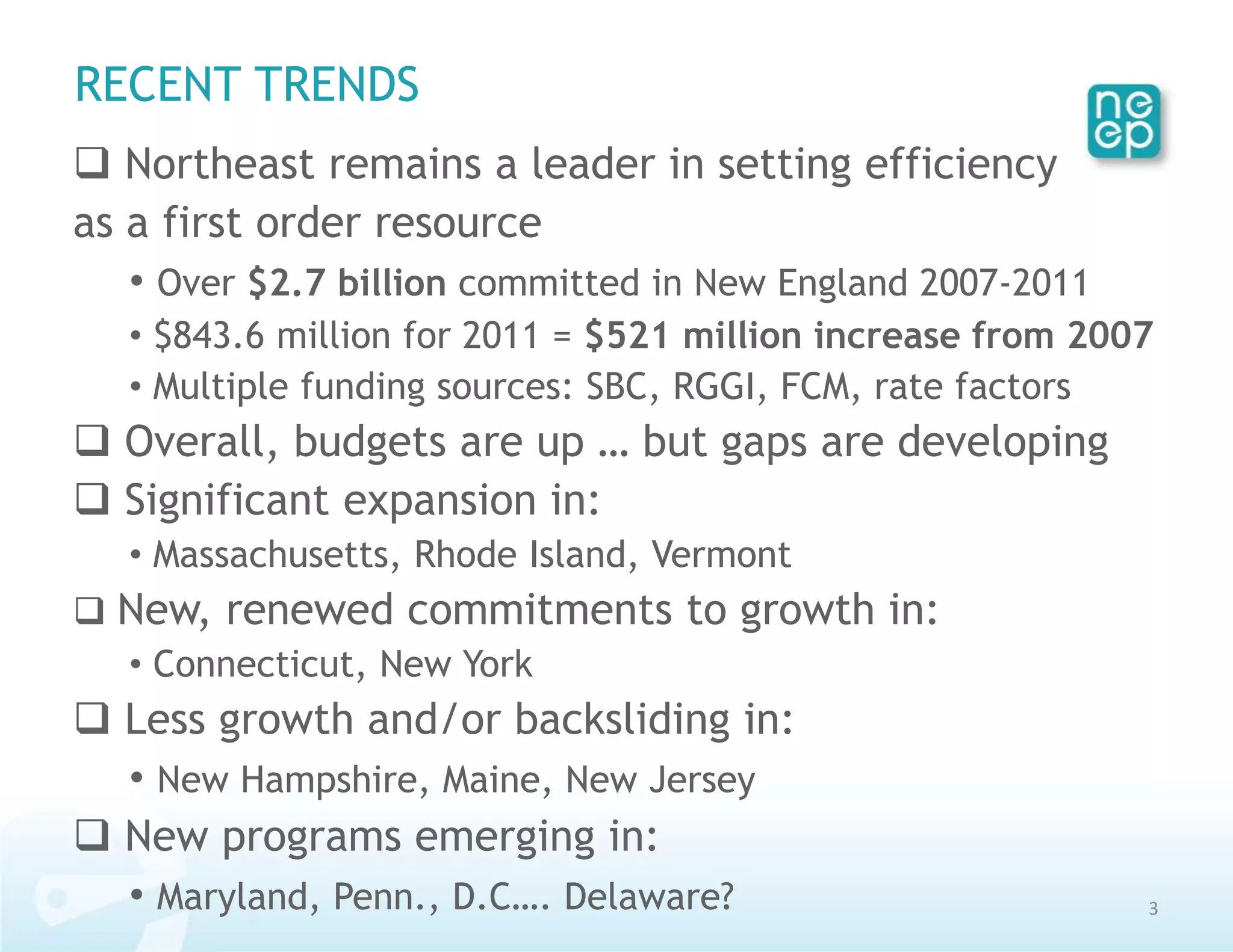
RECENT TRENDS
 Northeast remains a leader in setting efficiency
as a first order resource
   • Over $2.7 billion committed in New England 2007-2011
   • $843.6 million for 2011 = $521 million increase from 2007
   • Multiple funding sources: SBC, RGGI, FCM, rate factors
 Overall, budgets are up … but gaps are developing
 Significant expansion in:
   • Massachusetts, Rhode Island, Vermont
 New, renewed commitments to growth in:
  • Connecticut, New York
 Less growth and/or backsliding in:
  • New Hampshire, Maine, New Jersey
 New programs emerging in:
  • Maryland, Penn., D.C…. Delaware?                         3
THE GOOD…
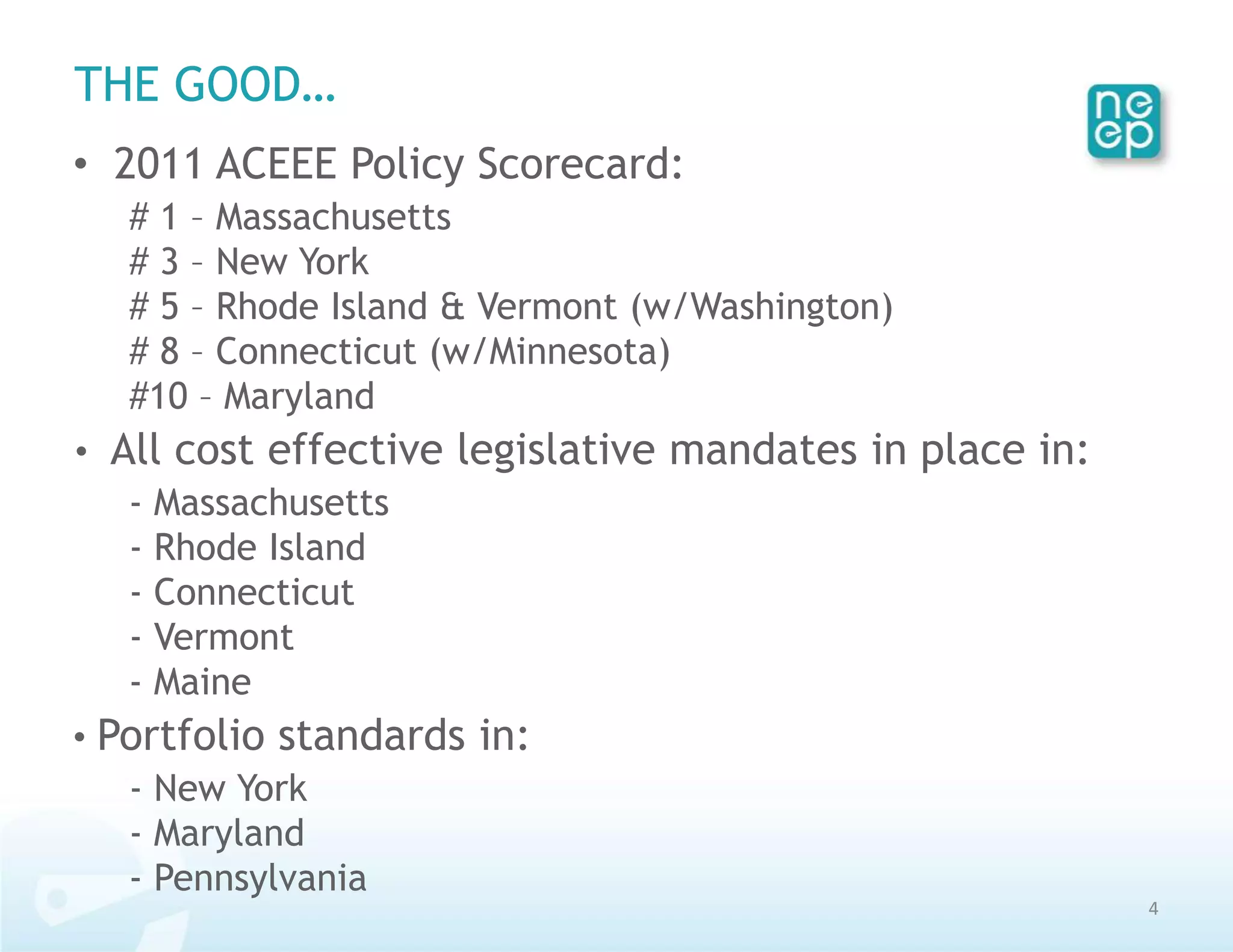
• 2011 ACEEE Policy Scorecard:
  # 1 – Massachusetts
  # 3 – New York
  # 5 – Rhode Island & Vermont (w/Washington)
  # 8 – Connecticut (w/Minnesota)
  #10 – Maryland
• All cost effective legislative mandates in place in:
   - Massachusetts
   - Rhode Island
   - Connecticut
   - Vermont
   - Maine
• Portfolio standards in:
   - New York
   - Maryland
   - Pennsylvania
                                                         4
THE NOT SO GOOD…
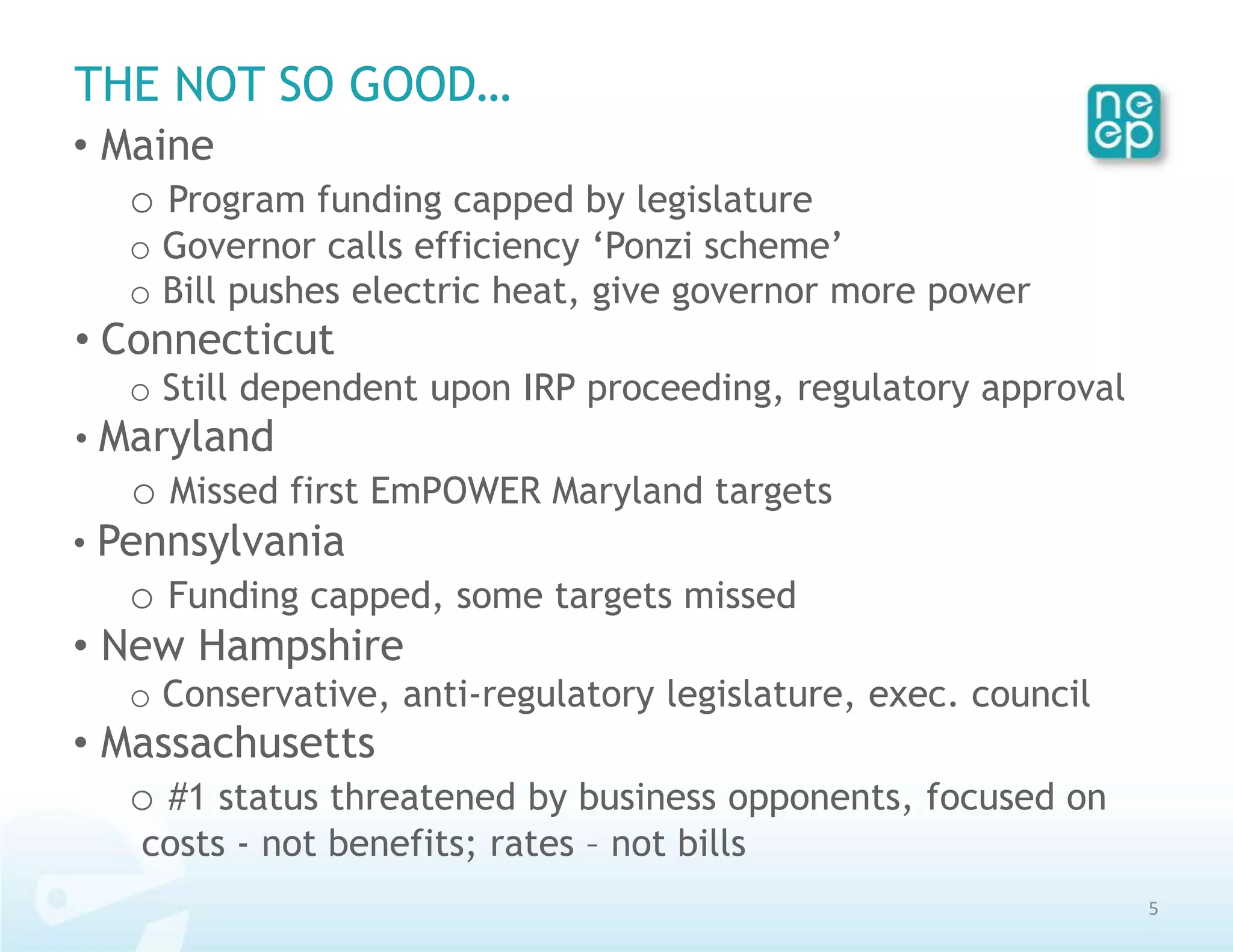
• Maine
   o Program funding capped by legislature
   o Governor calls efficiency ‘Ponzi scheme’
   o Bill pushes electric heat, give governor more power
• Connecticut
   o Still dependent upon IRP proceeding, regulatory approval
• Maryland
   o Missed first EmPOWER Maryland targets
• Pennsylvania
   o Funding capped, some targets missed
• New Hampshire
   o Conservative, anti-regulatory legislature, exec. council
• Massachusetts
   o #1 status threatened by business opponents, focused on
   costs - not benefits; rates – not bills
                                                                5
THE NOT SO GOOD (CONT.)…
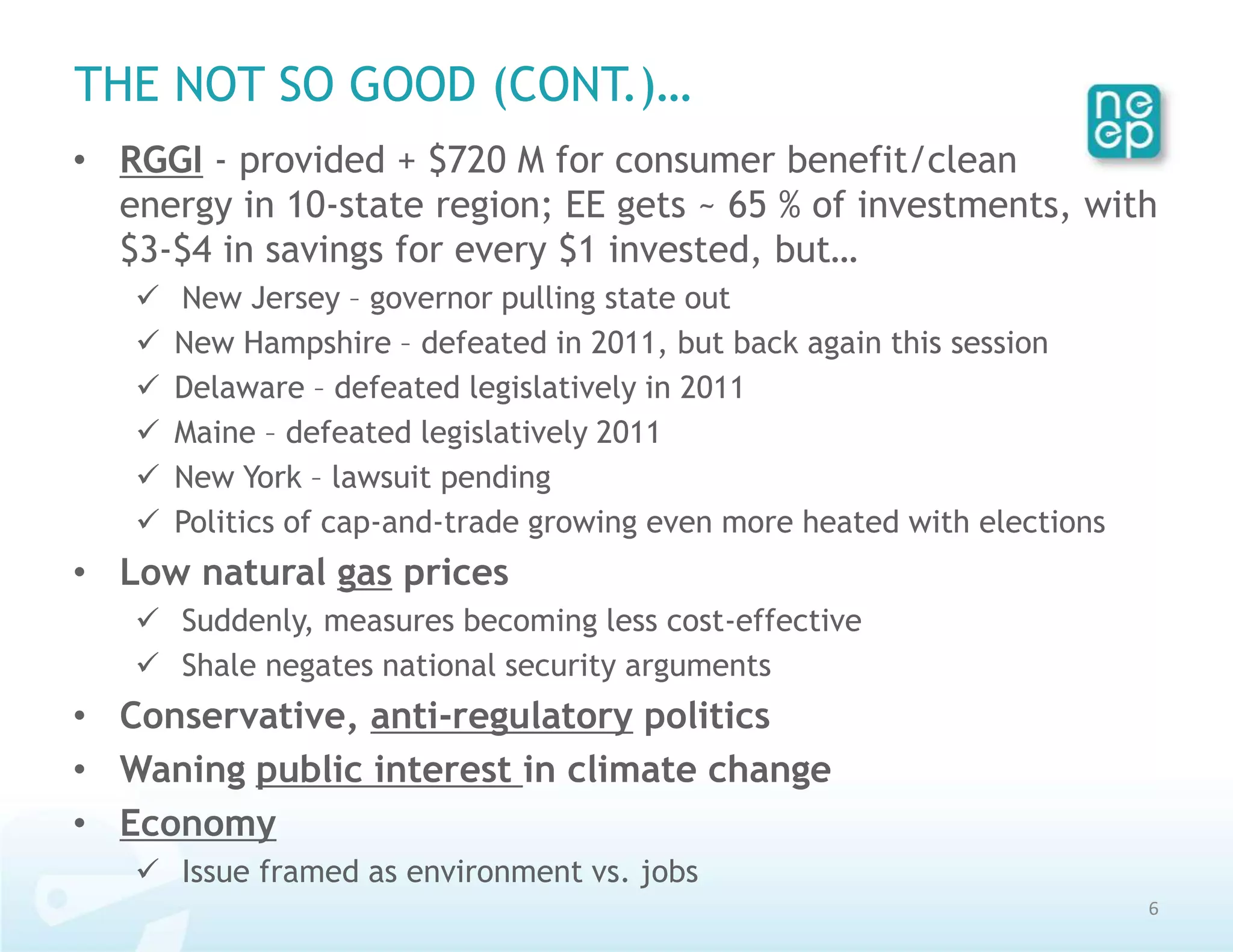
• RGGI - provided + $720 M for consumer benefit/clean
  energy in 10-state region; EE gets ~ 65 % of investments, with
  $3-$4 in savings for every $1 invested, but…
      New Jersey – governor pulling state out
      New Hampshire – defeated in 2011, but back again this session
      Delaware – defeated legislatively in 2011
      Maine – defeated legislatively 2011
      New York – lawsuit pending
      Politics of cap-and-trade growing even more heated with elections
• Low natural gas prices
    Suddenly, measures becoming less cost-effective
    Shale negates national security arguments
• Conservative, anti-regulatory politics
• Waning public interest in climate change
• Economy
    Issue framed as environment vs. jobs
                                                                           6
WHAT WILL DETERMINE EFFICIENCY’S FUTURE?
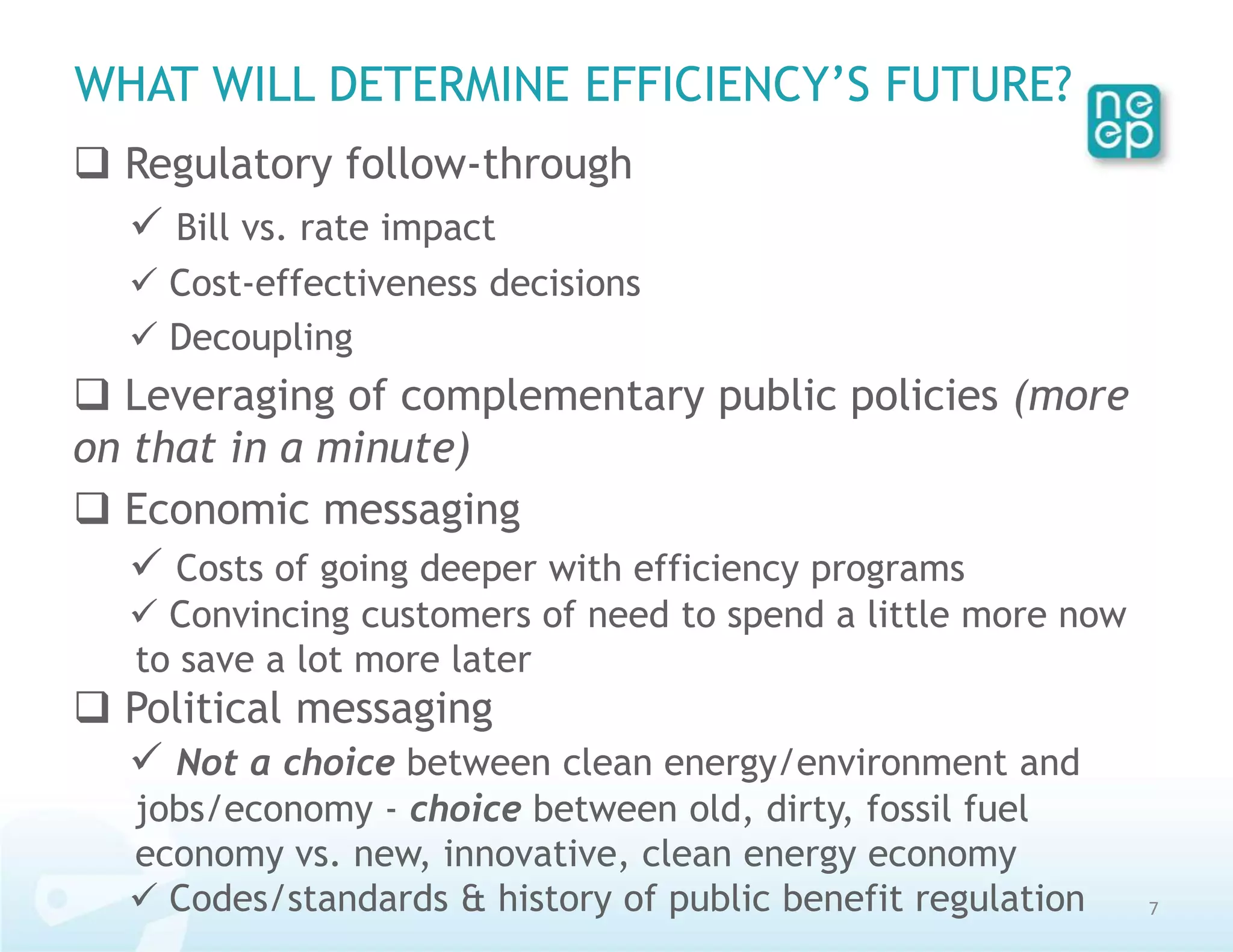
 Regulatory follow-through
   Bill vs. rate impact
   Cost-effectiveness decisions
   Decoupling
 Leveraging of complementary public policies (more
on that in a minute)
 Economic messaging
    Costs of going deeper with efficiency programs
   Convincing customers of need to spend a little more now
  to save a lot more later
 Political messaging
   Not a choice between clean energy/environment and
  jobs/economy - choice between old, dirty, fossil fuel
  economy vs. new, innovative, clean energy economy
   Codes/standards & history of public benefit regulation    7
THE ‘NO SILVER BULLET’ POLICY SOLUTIONS
 Better integration of EE into system planning
    ISO-NE predicting NO growth in annual net energy for
     load over next 10 years if EE investments continue
 Recognized need/benefit of program links to codes
  & standards development, adoption, enforcement
    Concepts being explored in MA, CT, NY, VT
    Need to allow programs to claim savings when those
     savings are hard to quantify
    Recognize relation of changing baselines, evolving goals
 Valuing building energy performance
      Need an MPG-like guide for properties
      More/better information drives informed decisions
      Markets value energy performance
      Financing should follow
                                                                8
THE ‘NO SILVER BULLET’ POLICY SOLUTIONS

 Support for common EM&V
    Consistent methods = greater validity of the resource
    Allow efficiency to compete in markets
 Links to environmental compliance - climate change,
  air regulation
 Taking on unregulated heating fuels
    Northeast particularly dependent on heating oil, propane
    Need funding mechanisms, seamless program delivery
 Financing
    New devices in development
    PACE holds great promise, link to building performance


                                                                9
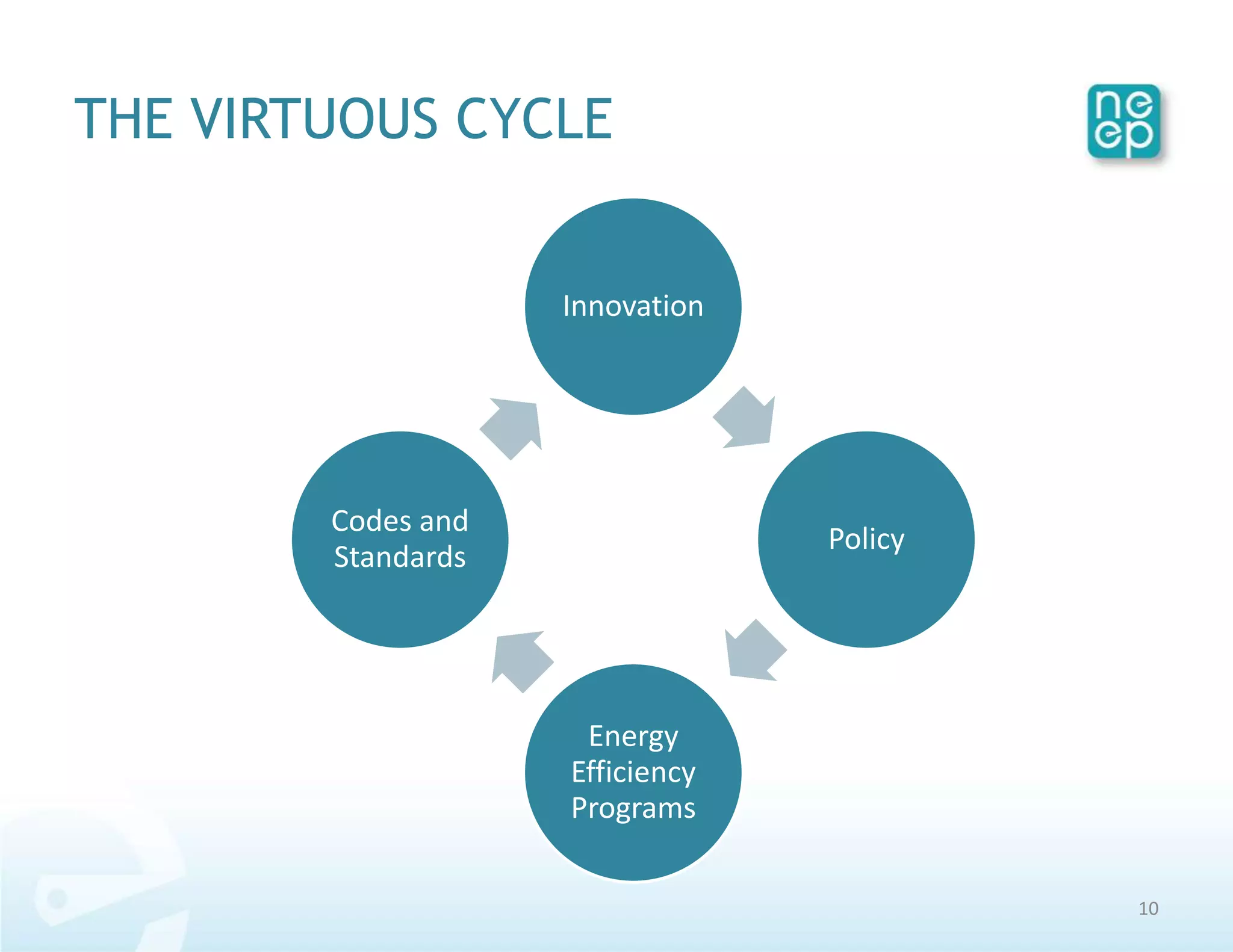
THE VIRTUOUS CYCLE


                    Innovation


        Codes and
                                 Policy
        Standards


                     Energy
                    Efficiency
                    Programs

                                          10
THE VIRTUOUS CYCLE
 To foster innovation, SBC programs and
codes/standards need to become more integrated

 Programs have expertise, market relationships and
funding

 However, savings from program involvement with
codes/standards are hard to measure

    Must address attribution/claimed savings for this to occur
    California, Arizona have methods in place

 NEEP EM&V Forum project (2012) to highlight best practices,
recommended pathways forward: stay tuned
                                                              11
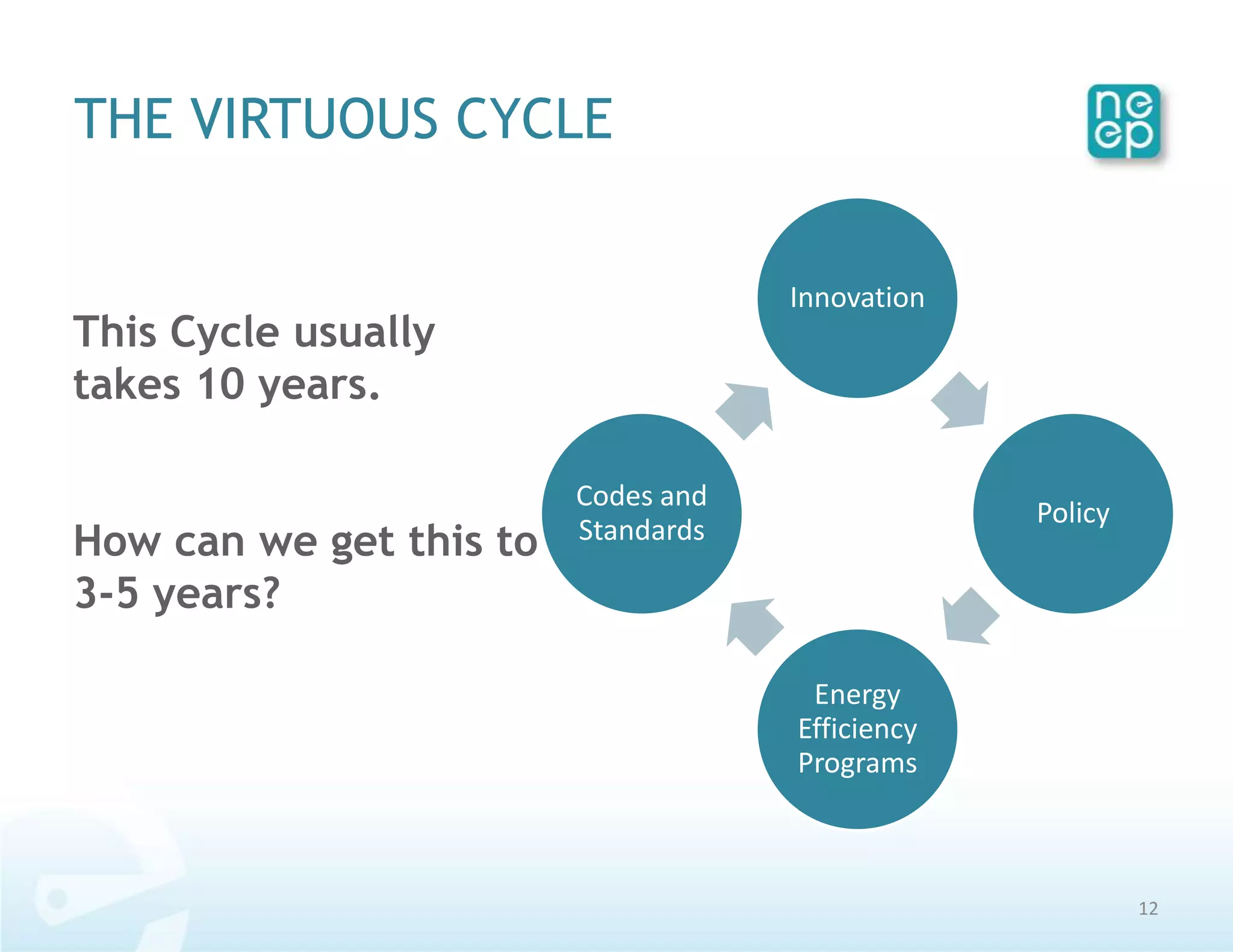
THE VIRTUOUS CYCLE


                                     Innovation
This Cycle usually
takes 10 years.

                         Codes and
                                                  Policy
How can we get this to   Standards

3-5 years?

                                      Energy
                                     Efficiency
                                     Programs


                                                           12
THANK YOU

           Jim O’Reilly
     Director of Public Policy
   joreilly@neep.org, ext. 118

Northeast Energy Efficiency Partnerships
91 Hartwell Avenue Lexington, MA 02421
           P: 781.860.9177
             www.neep.org

Aceee Mt Symposium O Reilly

  • 1.
    THE NEW POLICYLANDSCAPE FOR SUCCESSFUL ENERGY EFFICIENCY PROGRAMS: VIEWS FROM THE NORTHEAST JIM O’REILLY NORTHEAST ENERGY EFFICIENCY PARTNERSHIPS (NEEP) ACEEE Market Transformation Symposium April 2, 2012
  • 2.
    NORTHEAST ENERGY EFFICIENCYPARTNERSHIPS “Accelerating Energy Efficiency” MISSION Accelerate the efficient use of energy in the Northeast and Mid-Atlantic Regions APPROACH Overcome barriers to efficiency through Collaboration, Education & Advocacy VISION Transform the way we think about and use energy in the world around us. 1
  • 3.
    THE NORTHEAST ASAN EFFICIENCY LEADER Strong Leader in Aggressive Policy High Innovative Savings Support for Efficiency Programs & Goals Efficiency Products Policies Programs & Buildings 2
  • 4.
    RECENT TRENDS  Northeastremains a leader in setting efficiency as a first order resource • Over $2.7 billion committed in New England 2007-2011 • $843.6 million for 2011 = $521 million increase from 2007 • Multiple funding sources: SBC, RGGI, FCM, rate factors  Overall, budgets are up … but gaps are developing  Significant expansion in: • Massachusetts, Rhode Island, Vermont  New, renewed commitments to growth in: • Connecticut, New York  Less growth and/or backsliding in: • New Hampshire, Maine, New Jersey  New programs emerging in: • Maryland, Penn., D.C…. Delaware? 3
  • 5.
    THE GOOD… • 2011ACEEE Policy Scorecard: # 1 – Massachusetts # 3 – New York # 5 – Rhode Island & Vermont (w/Washington) # 8 – Connecticut (w/Minnesota) #10 – Maryland • All cost effective legislative mandates in place in: - Massachusetts - Rhode Island - Connecticut - Vermont - Maine • Portfolio standards in: - New York - Maryland - Pennsylvania 4
  • 6.
    THE NOT SOGOOD… • Maine o Program funding capped by legislature o Governor calls efficiency ‘Ponzi scheme’ o Bill pushes electric heat, give governor more power • Connecticut o Still dependent upon IRP proceeding, regulatory approval • Maryland o Missed first EmPOWER Maryland targets • Pennsylvania o Funding capped, some targets missed • New Hampshire o Conservative, anti-regulatory legislature, exec. council • Massachusetts o #1 status threatened by business opponents, focused on costs - not benefits; rates – not bills 5
  • 7.
    THE NOT SOGOOD (CONT.)… • RGGI - provided + $720 M for consumer benefit/clean energy in 10-state region; EE gets ~ 65 % of investments, with $3-$4 in savings for every $1 invested, but…  New Jersey – governor pulling state out  New Hampshire – defeated in 2011, but back again this session  Delaware – defeated legislatively in 2011  Maine – defeated legislatively 2011  New York – lawsuit pending  Politics of cap-and-trade growing even more heated with elections • Low natural gas prices  Suddenly, measures becoming less cost-effective  Shale negates national security arguments • Conservative, anti-regulatory politics • Waning public interest in climate change • Economy  Issue framed as environment vs. jobs 6
  • 8.
    WHAT WILL DETERMINEEFFICIENCY’S FUTURE?  Regulatory follow-through  Bill vs. rate impact  Cost-effectiveness decisions  Decoupling  Leveraging of complementary public policies (more on that in a minute)  Economic messaging  Costs of going deeper with efficiency programs  Convincing customers of need to spend a little more now to save a lot more later  Political messaging  Not a choice between clean energy/environment and jobs/economy - choice between old, dirty, fossil fuel economy vs. new, innovative, clean energy economy  Codes/standards & history of public benefit regulation 7
  • 9.
    THE ‘NO SILVERBULLET’ POLICY SOLUTIONS  Better integration of EE into system planning  ISO-NE predicting NO growth in annual net energy for load over next 10 years if EE investments continue  Recognized need/benefit of program links to codes & standards development, adoption, enforcement  Concepts being explored in MA, CT, NY, VT  Need to allow programs to claim savings when those savings are hard to quantify  Recognize relation of changing baselines, evolving goals  Valuing building energy performance  Need an MPG-like guide for properties  More/better information drives informed decisions  Markets value energy performance  Financing should follow 8
  • 10.
    THE ‘NO SILVERBULLET’ POLICY SOLUTIONS  Support for common EM&V  Consistent methods = greater validity of the resource  Allow efficiency to compete in markets  Links to environmental compliance - climate change, air regulation  Taking on unregulated heating fuels  Northeast particularly dependent on heating oil, propane  Need funding mechanisms, seamless program delivery  Financing  New devices in development  PACE holds great promise, link to building performance 9
  • 11.
    THE VIRTUOUS CYCLE Innovation Codes and Policy Standards Energy Efficiency Programs 10
  • 12.
    THE VIRTUOUS CYCLE To foster innovation, SBC programs and codes/standards need to become more integrated  Programs have expertise, market relationships and funding  However, savings from program involvement with codes/standards are hard to measure  Must address attribution/claimed savings for this to occur  California, Arizona have methods in place  NEEP EM&V Forum project (2012) to highlight best practices, recommended pathways forward: stay tuned 11
  • 13.
    THE VIRTUOUS CYCLE Innovation This Cycle usually takes 10 years. Codes and Policy How can we get this to Standards 3-5 years? Energy Efficiency Programs 12
  • 14.
    THANK YOU Jim O’Reilly Director of Public Policy joreilly@neep.org, ext. 118 Northeast Energy Efficiency Partnerships 91 Hartwell Avenue Lexington, MA 02421 P: 781.860.9177 www.neep.org