



WSO2 Roadmap and VisionbyPaul FremantleCTO and Co-FounderWSO2paul@wso2.com #pzfreo
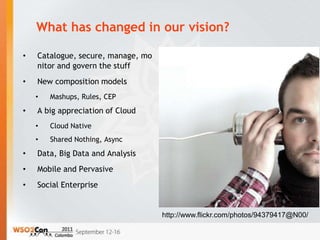
Some stuff I’d like to talk aboutHow our vision changes and has changed
What remains the same?
What’s been improved
Where we have come from:
what is new since WSO2Con2010
Themes for the future
Roadmap updates
What to look for beyond 2012In return I’d love to hear….What you need?
What you see coming in your roadmaps?
Where do you go to look for inspiration for the future?
Ongoing discussion and participation
In the corridors at WSO2Cons
On architecture@wso2.org
In regular discussions with me, Sanjiva and the product leadershttp://www.flickr.com/photos/wwworks/
Our original vision (in our very first slide deck)Lean
Encapsulated by “not J2EE / build from ground up”
Platform
Not just one product but three based on the same core runtime
Open Source and Open Standards
100% Apache License from Day One
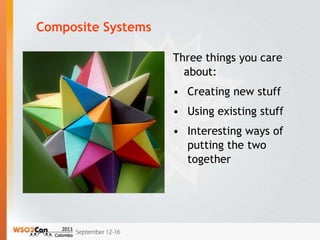
Based on wire level interoperabilityComposite SystemsThree things you care about:Creating new stuff
Using existing stuff
Interesting ways of putting the two togetherhttp://www.flickr.com/photos/wysz/Have you got any nice presents recently?
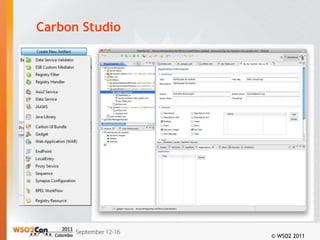
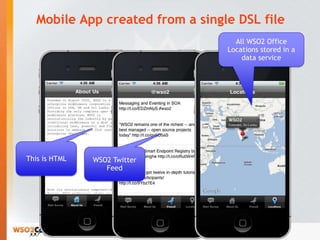
© WSO2 2011Carbon Studio
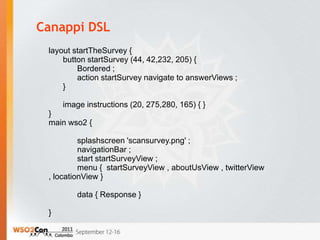
Message Broker and CEP Server
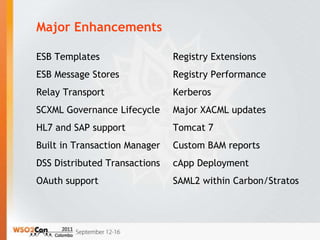
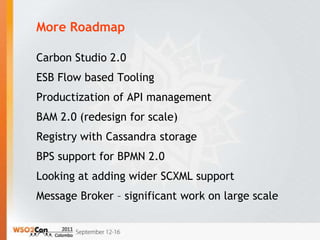
Major EnhancementsESB TemplatesESB Message StoresRelay TransportSCXML Governance LifecycleHL7 and SAP supportBuilt in Transaction ManagerDSS Distributed TransactionsOAuth supportRegistry ExtensionsRegistry Performance KerberosMajor XACML updatesTomcat 7Custom BAM reportscAppDeploymentSAML2 within Carbon/Stratos
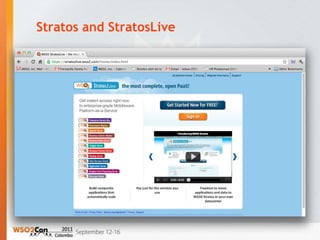
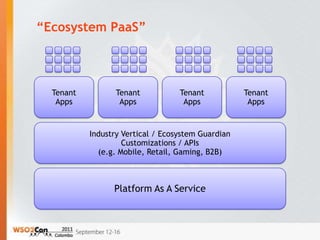
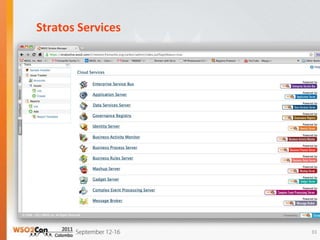
Stratos and StratosLive
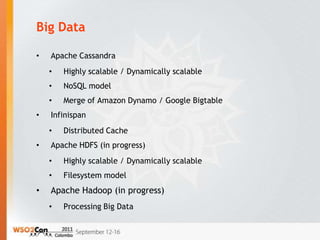
Stratos / StratosLive enhancementsApache Cassandra / Data-as-a-Service
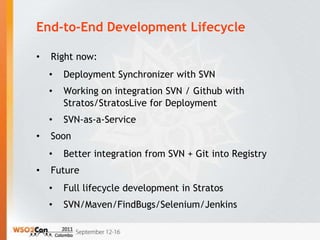
Deployment Synchronizer
Elastic Load Balancer
Billing / Metering / Throttling
Logging as a Service
Local Transport
Cache ServiceSoon: Ghost Deployer
cAppdeployer command-line and Eclipse tooling
How Stratos innovation is feeding back into CarbonDeployment Synchronizer (in Carbon 3.2)
Distributed Cache (in Carbon 3.2)

WSO2 Roadmap and Vision

Editor's Notes

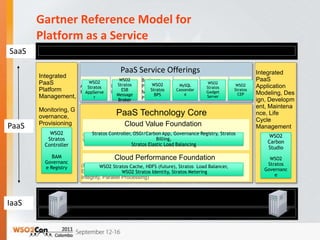
  • #3 Platform as a service is middleware "in the sky." Although offered as a service, its functional role remains the role of the middleware — platform, integration or other middleware type. Because there are different types of middleware offerings (application servers, integration brokers [ESBs], business process management suites [BPMSs], portal products, messaging products, etc.), each can also be delivered as a service. In some cases, these middleware services are delivered stand-alone as specialized PaaS services (StormMQ is a specialist messaging service). More often, the same cloud service provider offers multiple middleware services to meet the requirements of real-world projects (force.com includes services of a DBMS, an application server and an application development tool). Over time, most PaaS providers will aim to deliver a growing set of middleware functions. To be implemented as a cloud service, a PaaS service must not only deliver its middleware functionality, but also possess the features that make it cloud-worthy (the cloud performance foundation) and cloud-enabled (cloud behavior foundation). The cloud performance foundation is responsible for scalability and availability to match the potential demand of the global cloud user base. The cloud behavior foundation delivers resource sharing, multitenancy, elasticity, self-service and other characteristics expected of a cloud service. The common, shared development and management environments complete the picture of a well-designed PaaS platform, whether it offers only a few middleware services or is a comprehensive end-to-end PaaS.