REHVA Task Force “Nearly Zero Energy
           Buildings” nZEB

   Energy boundaries and scientific
definition of nZEB based on the results
         of REHVA Task Force

 Jarek Kurnitski, Francis Allard, Derrick Braham, Guillaume Goeders,
 Per Heiselberg, Lennart Jagemar, Risto Kosonen, Jean Lebrun, Livio
 Mazzarella, Jorma Railio, Olli Seppänen, Michael Schmidt, Maija Virta

   REHVA Annual Conference Tallinn, May 19-20, 2011


   Federation of European Heating, Ventilation and Air-conditioning Associations
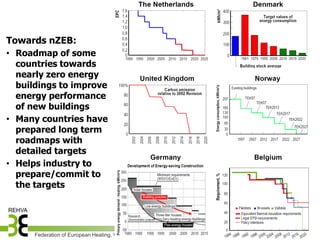
Towards nZEB:
• Roadmap of some
  countries towards
  nearly zero energy
  buildings to improve
  energy performance
  of new buildings
• Many countries have
  prepared long term
  roadmaps with
  detailed targets
• Helps industry to
  prepare/commit to
  the targets


      Federation of European Heating, Ventilation and Air-conditioning Associations
Why nZEB definition is needed?
• EPBD recast requires nearly zero energy buildings, but does not give
  minimum or maximum harmonized requirements – it will be up to the
  Member States to define what nZEB for them exactly constitute


REHVA nZEB Task Force:
• Intended to help the experts in the Member States in defining the
  nearly zero energy buildings in a uniform way – so that local
  conditions are taken into account, but the uniform methodology used
• Proposes a technical definition for nZEB buildings
• Provides energy calculation framework and system boundaries
  associated with the definition to specify which energy flows are taken
  into account


  Federation of European Heating, Ventilation and Air-conditioning Associations
EPBD recast – major changes
Article 9 Nearly zero energy buildings
  - By 31 Dec 2020, all new buildings are nearly zero energy buildings
  - After 31 Dec 2018, public authorities that occupy and own a new building
    shall ensure that the building is a nearly zero energy building

Articles 4 & 5 Setting of energy performance requirements
  - Setting of minimum energy performance requirements based on calculation
    of cost-optimal levels with the methodology referred to in Article 3.
  - The calculation of cost-optimal levels shall be performed in accordance with
    the methodology developed by the Commission (so called comparative
    methodology Annex III)
  - Primary energy target values have to be set in kWh/m2
  - The Commission shall establish by 30 June 2011 a comparative methodology framework

    http://eur-lex.europa.eu/JOHtml.do?uri=OJ%3AL%3A2010%3A153%3ASM%3AEN%3AHTML
    The laws and regulations shall be adopted and published in Member States by 9 July 2012.


     Federation of European Heating, Ventilation and Air-conditioning Associations
EPBD recast – Nearly zero energy
           buildings nZEB
• In the directive ‘nearly zero-energy building’ means a building that has
  a very high energy performance. The nearly zero or very low amount
  of energy required should be covered to a very significant extent by
  energy from renewable sources, including energy from renewable
  sources produced on-site or nearby.

 nZEB = very high energy performance + on-site renewables

• Definition of “a very high energy performance“ and “significant extent
  of renewables” let for Member States


    Federation of European Heating, Ventilation and Air-conditioning Associations
nZEB in practice
• Energy demand/delivered energy use is reduced as much as reasonable
  achievable (insulation, heat recovery, heat pumps etc.)
• On site renewables most commonly solar PV and thermal, district heat from
  renewables and renewable fuels
• Annual balance of delivered and exported primary
  energy nearly 0
• Typically a grid connected building exporting energy
  in summer and using delivered energy in winter

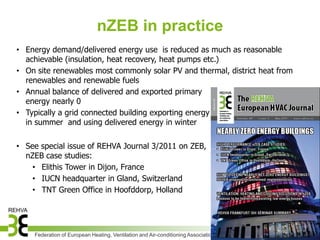
• See special issue of REHVA Journal 3/2011 on ZEB,
  nZEB case studies:
    • Elithis Tower in Dijon, France
    • IUCN headquarter in Gland, Switzerland
    • TNT Green Office in Hoofddorp, Holland


    Federation of European Heating, Ventilation and Air-conditioning Associations
To define nZEB it was needed

In order to propose a general definition, it was needed to clarify:
• which energy flows shall be included – ALL energy used in buildings
• the use of primary energy factors for primary energy indicator
• system boundary definition with inclusion of active solar and wind
• the technical meaning of “nearby” in EPBD recast – district heating or cooling
  networks or any other technical system serving a group of buildings

• Energy performance definition of EPBD recast was followed so that
  appliances (households and outlets) were included, i.e. all energy used in
  buildings would be accounted
• For the system boundary definition, a general form modified from the one of
  EN 15603:2008 is proposed


  Federation of European Heating, Ventilation and Air-conditioning Associations
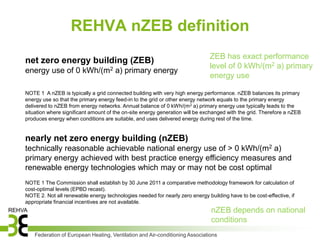
REHVA nZEB definition
                                                                              ZEB has exact performance
net zero energy building (ZEB)
                                                                              level of 0 kWh/(m2 a) primary
energy use of 0 kWh/(m2 a) primary energy
                                                                              energy use

NOTE 1 A nZEB is typically a grid connected building with very high energy performance. nZEB balances its primary
energy use so that the primary energy feed-in to the grid or other energy network equals to the primary energy
delivered to nZEB from energy networks. Annual balance of 0 kWh/(m 2 a) primary energy use typically leads to the
situation where significant amount of the on-site energy generation will be exchanged with the grid. Therefore a nZEB
produces energy when conditions are suitable, and uses delivered energy during rest of the time.


nearly net zero energy building (nZEB)
technically reasonable achievable national energy use of > 0 kWh/(m2 a)
primary energy achieved with best practice energy efficiency measures and
renewable energy technologies which may or may not be cost optimal
NOTE 1 The Commission shall establish by 30 June 2011 a comparative methodology framework for calculation of
cost-optimal levels (EPBD recast).
NOTE 2. Not all renewable energy technologies needed for nearly zero energy building have to be cost-effective, if
appropriate financial incentives are not available.
                                                                              nZEB depends on national
                                                                              conditions
    Federation of European Heating, Ventilation and Air-conditioning Associations
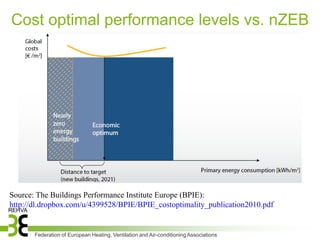
Cost optimal performance levels vs. nZEB


Source: The Buildings Performance Institute Europe (BPIE):
http://dl.dropbox.com/u/4399528/BPIE/BPIE_costoptimality_publication2010.pdf


       Federation of European Heating, Ventilation and Air-conditioning Associations
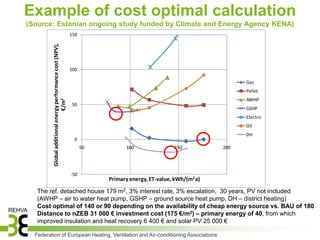
Example of cost optimal calculation
(Source: Estonian ongoing study funded by Climate and Energy Agency KENA)
                                                            150


         Global additional energy performance cost (NPV),

                                                            100

                                                                                                                    Gas
                                                                                                                    Pellet
                                                                                                                    AWHP
                               €/m2


                                                             50
                                                                                                                    GSHP
                                                                                                                    Electric
                                                                                                                    Oil
                                                                                                                    DH
                                                              0
                                                                  50         100                150           200


                                                            -50
                                                                       Primary energy, ET-value, kWh/(m2 a)

   The ref. detached house 179 m2, 3% interest rate, 3% escalation, 30 years, PV not included
   (AWHP – air to water heat pump, GSHP – ground source heat pump, DH – district heating)
   Cost optimal of 140 or 90 depending on the availability of cheap energy source vs. BAU of 180
   Distance to nZEB 31 000 € investment cost (175 €/m2) – primary energy of 40, from which
   improved insulation and heat recovery 6 400 € and solar PV 25 000 €

  Federation of European Heating, Ventilation and Air-conditioning Associations
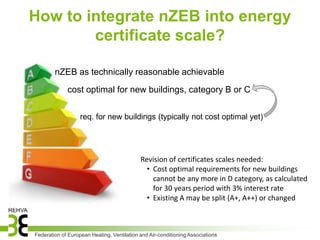
How to integrate nZEB into energy
        certificate scale?

        nZEB as technically reasonable achievable
             cost optimal for new buildings, category B or C


                   req. for new buildings (typically not cost optimal yet)


                                            Revision of certificates scales needed:
                                              • Cost optimal requirements for new buildings
                                                cannot be any more in D category, as calculated
                                                for 30 years period with 3% interest rate
                                              • Existing A may be split (A+, A++) or changed


Federation of European Heating, Ventilation and Air-conditioning Associations
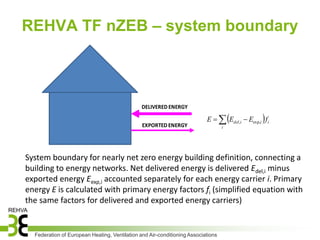
REHVA TF nZEB – system boundary


                                               DELIVERED ENERGY

                                                                          E   Edel,i  Eexp,i  fi
                                               EXPORTED ENERGY                    i


System boundary for nearly net zero energy building definition, connecting a
building to energy networks. Net delivered energy is delivered Edel,i minus
exported energy Eexp,i accounted separately for each energy carrier i. Primary
energy E is calculated with primary energy factors fi (simplified equation with
the same factors for delivered and exported energy carriers)


  Federation of European Heating, Ventilation and Air-conditioning Associations
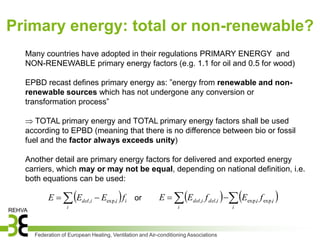
Primary energy: total or non-renewable?
  Many countries have adopted in their regulations PRIMARY ENERGY and
  NON-RENEWABLE primary energy factors (e.g. 1.1 for oil and 0.5 for wood)

  EPBD recast defines primary energy as: ”energy from renewable and non-
  renewable sources which has not undergone any conversion or
  transformation process”

   TOTAL primary energy and TOTAL primary energy factors shall be used
  according to EPBD (meaning that there is no difference between bio or fossil
  fuel and the factor always exceeds unity)

  Another detail are primary energy factors for delivered and exported energy
  carriers, which may or may not be equal, depending on national definition, i.e.
  both equations can be used:

         E   Edel,i  Eexp,i  fi or                 E   Edel,i f del,i   Eexp,i f exp,i 
                 i                                              i                   i


    Federation of European Heating, Ventilation and Air-conditioning Associations
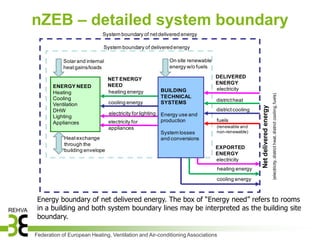
nZEB – detailed system boundary
                             System boundary of net delivered energy

                             System boundary of delivered energy

            Solar and internal                             On site renewable
            heat gains/loads                               energy w/o fuels

                                 NET ENERGY                                    DELIVERED
                                 NEED                                          ENERGY
       ENERGY NEED
                                                        BUILDING               electricity
       Heating                   heating energy


                                                                                                                         (electricity, district heat, district cooling, fuels)
       Cooling                                          TECHNICAL
                                 cooling energy         SYSTEMS                district heat
       Ventilation


                                                                                                  Net delivered energy
       DHW                                                                     district cooling
                                 electricity for lighting Energy use and
       Lighting
       Appliances                electricity for          production           fuels
                                 appliances                                    (renewable and
                                                          System losses        non-renewable)
            Heat exchange                                 and conversions
            through the
                                                                               EXPORTED
            building envelope
                                                                               ENERGY
                                                                               electricity
                                                                                heating energy

                                                                               cooling energy


 Energy boundary of net delivered energy. The box of “Energy need” refers to rooms
 in a building and both system boundary lines may be interpreted as the building site
 boundary.

Federation of European Heating, Ventilation and Air-conditioning Associations
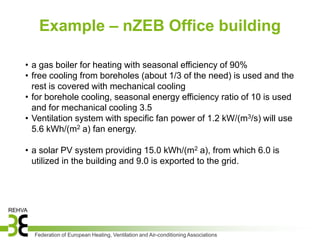
Example – nZEB Office building

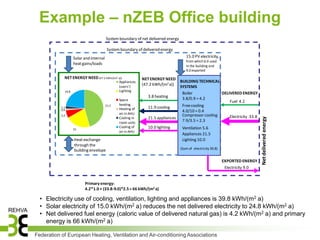
• a gas boiler for heating with seasonal efficiency of 90%
• free cooling from boreholes (about 1/3 of the need) is used and the
  rest is covered with mechanical cooling
• for borehole cooling, seasonal energy efficiency ratio of 10 is used
  and for mechanical cooling 3.5
• Ventilation system with specific fan power of 1.2 kW/(m3/s) will use
  5.6 kWh/(m2 a) fan energy.

• a solar PV system providing 15.0 kWh/(m2 a), from which 6.0 is
  utilized in the building and 9.0 is exported to the grid.


  Federation of European Heating, Ventilation and Air-conditioning Associations
Example – nZEB Office building
                                         System boundary of net delivered energy

                                          System boundary of delivered energy
                    Solar and internal                                                15.0 PV electricity,
                                                                                      from which 6.0 used
                    heat gains/loads                                                  in the building and
                                                                                      9.0 exported
             NET ENERGY NEED (47.2 kWh/(m2 a))               NET ENERGY NEED
                                                Appliances                      BUILDING TECHNICAL
                                                             (47.2 kWh/(m2 a))
                                                (users')                        SYSTEMS
             10,8                               Lighting
                                                                                 Boiler             DELIVERED ENERGY
                                                                3.8 heating      3.8/0.9 = 4.2
                                                Space                                                   Fuel 4.2
                                         21,5   heating                          Free cooling
           1,1
                                                Heating of      11.9 cooling
           0,6                                                                   4.0/10 = 0.4
           3,2
                                                air in AHU                       Compressor cooling
                                                Cooling in      21.5 appliances                         Electricity 33.8


                                                                                                                                  Net delivered energy
                                                room units
                                                                                 7.9/3.5 = 2.3
                                                Cooling of      10.0 lighting       Ventilation 5.6
                    10
                                                air in AHU
                                                                                    Appliances 21.5
                    Heat exchange                                                   Lighting 10.0
                    through the
                                                                                   (Sum of electricity 39.8)
                    building envelope

                                                                                                               EXPORTED ENERGY
                                                                                                                Electricity 9.0


                          Primary energy:
                          4.2*1.0 + (33.8-9.0)*2.5 = 66 kWh/(m2 a)

  • Electricity use of cooling, ventilation, lighting and appliances is 39.8 kWh/(m2 a)
  • Solar electricity of 15.0 kWh/(m2 a) reduces the net delivered electricity to 24.8 kWh/(m2 a)
  • Net delivered fuel energy (caloric value of delivered natural gas) is 4.2 kWh/(m2 a) and primary
    energy is 66 kWh/(m2 a)

Federation of European Heating, Ventilation and Air-conditioning Associations
Conclusions
General definition format is proposed to clarify the exact technical meaning of
EPBD recast requirements in order to support national implementation

It is proposed to the Member States to use the system boundary shown in
Figure 3 and primary energy definition given by Equation 1 in defining the
performance levels of nZEB buildings (REHVA J 3/2011)

The definition through the net zero energy building proposed:
• net nZEB has exact performance level of 0 kWh/(m2 a) primary energy use
• nearly net zero energy use depends on national conditions

The proposed definition allows MS to take local conditions into account, but to
use the uniform methodology

Published in REHVA Journal 3/2011 and a full version as REHVA report


  Federation of European Heating, Ventilation and Air-conditioning Associations

2011 05-19 kurnitski-n_zeb_rehva-am

  • 1.
    REHVA Task Force“Nearly Zero Energy Buildings” nZEB Energy boundaries and scientific definition of nZEB based on the results of REHVA Task Force Jarek Kurnitski, Francis Allard, Derrick Braham, Guillaume Goeders, Per Heiselberg, Lennart Jagemar, Risto Kosonen, Jean Lebrun, Livio Mazzarella, Jorma Railio, Olli Seppänen, Michael Schmidt, Maija Virta REHVA Annual Conference Tallinn, May 19-20, 2011 Federation of European Heating, Ventilation and Air-conditioning Associations
  • 2.
    Towards nZEB: • Roadmapof some countries towards nearly zero energy buildings to improve energy performance of new buildings • Many countries have prepared long term roadmaps with detailed targets • Helps industry to prepare/commit to the targets Federation of European Heating, Ventilation and Air-conditioning Associations
  • 3.
    Why nZEB definitionis needed? • EPBD recast requires nearly zero energy buildings, but does not give minimum or maximum harmonized requirements – it will be up to the Member States to define what nZEB for them exactly constitute REHVA nZEB Task Force: • Intended to help the experts in the Member States in defining the nearly zero energy buildings in a uniform way – so that local conditions are taken into account, but the uniform methodology used • Proposes a technical definition for nZEB buildings • Provides energy calculation framework and system boundaries associated with the definition to specify which energy flows are taken into account Federation of European Heating, Ventilation and Air-conditioning Associations
  • 4.
    EPBD recast –major changes Article 9 Nearly zero energy buildings - By 31 Dec 2020, all new buildings are nearly zero energy buildings - After 31 Dec 2018, public authorities that occupy and own a new building shall ensure that the building is a nearly zero energy building Articles 4 & 5 Setting of energy performance requirements - Setting of minimum energy performance requirements based on calculation of cost-optimal levels with the methodology referred to in Article 3. - The calculation of cost-optimal levels shall be performed in accordance with the methodology developed by the Commission (so called comparative methodology Annex III) - Primary energy target values have to be set in kWh/m2 - The Commission shall establish by 30 June 2011 a comparative methodology framework http://eur-lex.europa.eu/JOHtml.do?uri=OJ%3AL%3A2010%3A153%3ASM%3AEN%3AHTML The laws and regulations shall be adopted and published in Member States by 9 July 2012. Federation of European Heating, Ventilation and Air-conditioning Associations
  • 5.
    EPBD recast –Nearly zero energy buildings nZEB • In the directive ‘nearly zero-energy building’ means a building that has a very high energy performance. The nearly zero or very low amount of energy required should be covered to a very significant extent by energy from renewable sources, including energy from renewable sources produced on-site or nearby.  nZEB = very high energy performance + on-site renewables • Definition of “a very high energy performance“ and “significant extent of renewables” let for Member States Federation of European Heating, Ventilation and Air-conditioning Associations
  • 6.
    nZEB in practice •Energy demand/delivered energy use is reduced as much as reasonable achievable (insulation, heat recovery, heat pumps etc.) • On site renewables most commonly solar PV and thermal, district heat from renewables and renewable fuels • Annual balance of delivered and exported primary energy nearly 0 • Typically a grid connected building exporting energy in summer and using delivered energy in winter • See special issue of REHVA Journal 3/2011 on ZEB, nZEB case studies: • Elithis Tower in Dijon, France • IUCN headquarter in Gland, Switzerland • TNT Green Office in Hoofddorp, Holland Federation of European Heating, Ventilation and Air-conditioning Associations
  • 7.
    To define nZEBit was needed In order to propose a general definition, it was needed to clarify: • which energy flows shall be included – ALL energy used in buildings • the use of primary energy factors for primary energy indicator • system boundary definition with inclusion of active solar and wind • the technical meaning of “nearby” in EPBD recast – district heating or cooling networks or any other technical system serving a group of buildings • Energy performance definition of EPBD recast was followed so that appliances (households and outlets) were included, i.e. all energy used in buildings would be accounted • For the system boundary definition, a general form modified from the one of EN 15603:2008 is proposed Federation of European Heating, Ventilation and Air-conditioning Associations
  • 8.
    REHVA nZEB definition ZEB has exact performance net zero energy building (ZEB) level of 0 kWh/(m2 a) primary energy use of 0 kWh/(m2 a) primary energy energy use NOTE 1 A nZEB is typically a grid connected building with very high energy performance. nZEB balances its primary energy use so that the primary energy feed-in to the grid or other energy network equals to the primary energy delivered to nZEB from energy networks. Annual balance of 0 kWh/(m 2 a) primary energy use typically leads to the situation where significant amount of the on-site energy generation will be exchanged with the grid. Therefore a nZEB produces energy when conditions are suitable, and uses delivered energy during rest of the time. nearly net zero energy building (nZEB) technically reasonable achievable national energy use of > 0 kWh/(m2 a) primary energy achieved with best practice energy efficiency measures and renewable energy technologies which may or may not be cost optimal NOTE 1 The Commission shall establish by 30 June 2011 a comparative methodology framework for calculation of cost-optimal levels (EPBD recast). NOTE 2. Not all renewable energy technologies needed for nearly zero energy building have to be cost-effective, if appropriate financial incentives are not available. nZEB depends on national conditions Federation of European Heating, Ventilation and Air-conditioning Associations
  • 9.
    Cost optimal performancelevels vs. nZEB Source: The Buildings Performance Institute Europe (BPIE): http://dl.dropbox.com/u/4399528/BPIE/BPIE_costoptimality_publication2010.pdf Federation of European Heating, Ventilation and Air-conditioning Associations
  • 10.
    Example of costoptimal calculation (Source: Estonian ongoing study funded by Climate and Energy Agency KENA) 150 Global additional energy performance cost (NPV), 100 Gas Pellet AWHP €/m2 50 GSHP Electric Oil DH 0 50 100 150 200 -50 Primary energy, ET-value, kWh/(m2 a) The ref. detached house 179 m2, 3% interest rate, 3% escalation, 30 years, PV not included (AWHP – air to water heat pump, GSHP – ground source heat pump, DH – district heating) Cost optimal of 140 or 90 depending on the availability of cheap energy source vs. BAU of 180 Distance to nZEB 31 000 € investment cost (175 €/m2) – primary energy of 40, from which improved insulation and heat recovery 6 400 € and solar PV 25 000 € Federation of European Heating, Ventilation and Air-conditioning Associations
  • 11.
    How to integratenZEB into energy certificate scale? nZEB as technically reasonable achievable cost optimal for new buildings, category B or C req. for new buildings (typically not cost optimal yet) Revision of certificates scales needed: • Cost optimal requirements for new buildings cannot be any more in D category, as calculated for 30 years period with 3% interest rate • Existing A may be split (A+, A++) or changed Federation of European Heating, Ventilation and Air-conditioning Associations
  • 12.
    REHVA TF nZEB– system boundary DELIVERED ENERGY E   Edel,i  Eexp,i  fi EXPORTED ENERGY i System boundary for nearly net zero energy building definition, connecting a building to energy networks. Net delivered energy is delivered Edel,i minus exported energy Eexp,i accounted separately for each energy carrier i. Primary energy E is calculated with primary energy factors fi (simplified equation with the same factors for delivered and exported energy carriers) Federation of European Heating, Ventilation and Air-conditioning Associations
  • 13.
    Primary energy: totalor non-renewable? Many countries have adopted in their regulations PRIMARY ENERGY and NON-RENEWABLE primary energy factors (e.g. 1.1 for oil and 0.5 for wood) EPBD recast defines primary energy as: ”energy from renewable and non- renewable sources which has not undergone any conversion or transformation process”  TOTAL primary energy and TOTAL primary energy factors shall be used according to EPBD (meaning that there is no difference between bio or fossil fuel and the factor always exceeds unity) Another detail are primary energy factors for delivered and exported energy carriers, which may or may not be equal, depending on national definition, i.e. both equations can be used: E   Edel,i  Eexp,i  fi or E   Edel,i f del,i   Eexp,i f exp,i  i i i Federation of European Heating, Ventilation and Air-conditioning Associations
  • 14.
    nZEB – detailedsystem boundary System boundary of net delivered energy System boundary of delivered energy Solar and internal On site renewable heat gains/loads energy w/o fuels NET ENERGY DELIVERED NEED ENERGY ENERGY NEED BUILDING electricity Heating heating energy (electricity, district heat, district cooling, fuels) Cooling TECHNICAL cooling energy SYSTEMS district heat Ventilation Net delivered energy DHW district cooling electricity for lighting Energy use and Lighting Appliances electricity for production fuels appliances (renewable and System losses non-renewable) Heat exchange and conversions through the EXPORTED building envelope ENERGY electricity heating energy cooling energy Energy boundary of net delivered energy. The box of “Energy need” refers to rooms in a building and both system boundary lines may be interpreted as the building site boundary. Federation of European Heating, Ventilation and Air-conditioning Associations
  • 15.
    Example – nZEBOffice building • a gas boiler for heating with seasonal efficiency of 90% • free cooling from boreholes (about 1/3 of the need) is used and the rest is covered with mechanical cooling • for borehole cooling, seasonal energy efficiency ratio of 10 is used and for mechanical cooling 3.5 • Ventilation system with specific fan power of 1.2 kW/(m3/s) will use 5.6 kWh/(m2 a) fan energy. • a solar PV system providing 15.0 kWh/(m2 a), from which 6.0 is utilized in the building and 9.0 is exported to the grid. Federation of European Heating, Ventilation and Air-conditioning Associations
  • 16.
    Example – nZEBOffice building System boundary of net delivered energy System boundary of delivered energy Solar and internal 15.0 PV electricity, from which 6.0 used heat gains/loads in the building and 9.0 exported NET ENERGY NEED (47.2 kWh/(m2 a)) NET ENERGY NEED Appliances BUILDING TECHNICAL (47.2 kWh/(m2 a)) (users') SYSTEMS 10,8 Lighting Boiler DELIVERED ENERGY 3.8 heating 3.8/0.9 = 4.2 Space Fuel 4.2 21,5 heating Free cooling 1,1 Heating of 11.9 cooling 0,6 4.0/10 = 0.4 3,2 air in AHU Compressor cooling Cooling in 21.5 appliances Electricity 33.8 Net delivered energy room units 7.9/3.5 = 2.3 Cooling of 10.0 lighting Ventilation 5.6 10 air in AHU Appliances 21.5 Heat exchange Lighting 10.0 through the (Sum of electricity 39.8) building envelope EXPORTED ENERGY Electricity 9.0 Primary energy: 4.2*1.0 + (33.8-9.0)*2.5 = 66 kWh/(m2 a) • Electricity use of cooling, ventilation, lighting and appliances is 39.8 kWh/(m2 a) • Solar electricity of 15.0 kWh/(m2 a) reduces the net delivered electricity to 24.8 kWh/(m2 a) • Net delivered fuel energy (caloric value of delivered natural gas) is 4.2 kWh/(m2 a) and primary energy is 66 kWh/(m2 a) Federation of European Heating, Ventilation and Air-conditioning Associations
  • 17.
    Conclusions General definition formatis proposed to clarify the exact technical meaning of EPBD recast requirements in order to support national implementation It is proposed to the Member States to use the system boundary shown in Figure 3 and primary energy definition given by Equation 1 in defining the performance levels of nZEB buildings (REHVA J 3/2011) The definition through the net zero energy building proposed: • net nZEB has exact performance level of 0 kWh/(m2 a) primary energy use • nearly net zero energy use depends on national conditions The proposed definition allows MS to take local conditions into account, but to use the uniform methodology Published in REHVA Journal 3/2011 and a full version as REHVA report Federation of European Heating, Ventilation and Air-conditioning Associations