Cambridgeshire Renewables Infrastructure Framework
 Presentation to Senior Public Sector Event 12/10/11


 Duncan Price, Director


Cambridgeshire Renewables Infrastructure Framework
Cambridgeshire’s challenging carbon objectives


         What is Cambridgeshire's potential?


Cambridgeshire Renewables Infrastructure Framework   1
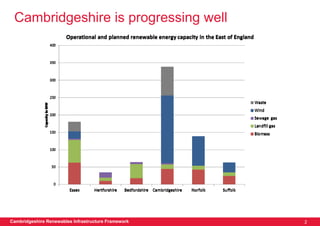
Cambridgeshire is progressing well


Cambridgeshire Renewables Infrastructure Framework   2
Modelling renewable energy deployment potential
                                                                                            Scenario 4
                                           Scenario 1       Scenario 2      Scenario 3      (high without
                           Inputs          (low)            (medium)        (high)          wind)
                           Discount rate   9%               7%              6%              6%
                                                                            DECC - 'high    DECC - 'high
                           Energy price    DECC - 'low'     DECC - 'high'   high' energy    high' energy
                           [1]
                                           energy prices    energy prices   prices          prices
                                                                            current rates   current rates
                                                                            (FIT/ RHI       (FIT/ RHI
                                                                            designed to     designed to
                                                                            give fixed      give fixed
                                                                            return & will   return & will
                           Financial       lower than                       adjust to       adjust to
                           incentives      current tariff                   energy          energy
                           (FIT/RHI)       rates            current rates   prices)         prices)
                           Project
                           deployment
                           rate
                           (wind/biomas                                                     30% (0% for
                           s/EfW)          8%               15%             30%             wind)

                           Green policy
                           support (for
                           building
                           integrated
                           technologies)   Low              Medium          High            High


Cambridgeshire Renewables Infrastructure Framework                                                          3
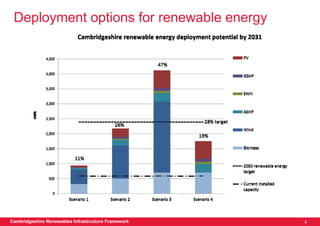
Deployment options for renewable energy


Cambridgeshire Renewables Infrastructure Framework   4
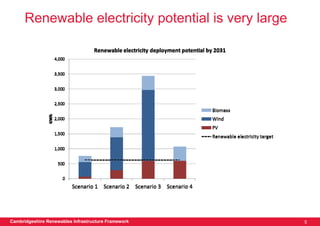
Renewable electricity potential is very large


Cambridgeshire Renewables Infrastructure Framework    5
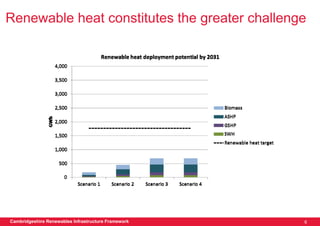
Renewable heat constitutes the greater challenge


Cambridgeshire Renewables Infrastructure Framework   6
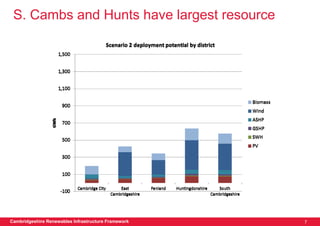
S. Cambs and Hunts have largest resource


Cambridgeshire Renewables Infrastructure Framework   7
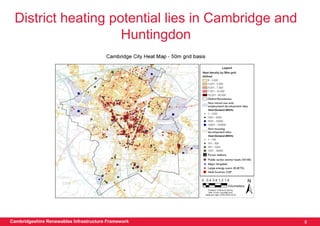
District heating potential lies in Cambridge and
                    Huntingdon


Cambridgeshire Renewables Infrastructure Framework   8
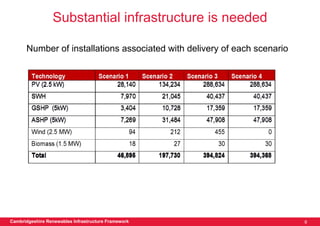
Substantial infrastructure is needed

      Number of installations associated with delivery of each scenario


Cambridgeshire Renewables Infrastructure Framework                        9
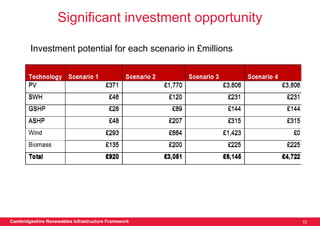
Significant investment opportunity

        Investment potential for each scenario in £millions


Cambridgeshire Renewables Infrastructure Framework            10
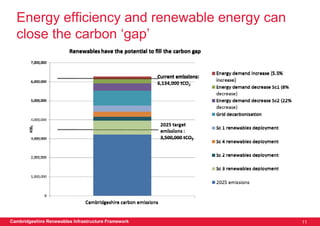
Energy efficiency and renewable energy can
  close the carbon ‘gap’


Cambridgeshire Renewables Infrastructure Framework   11
Conclusions

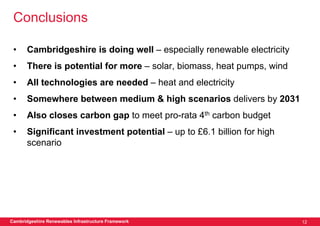
 •     Cambridgeshire is doing well – especially renewable electricity
 •     There is potential for more – solar, biomass, heat pumps, wind
 •     All technologies are needed – heat and electricity
 •     Somewhere between medium & high scenarios delivers by 2031
 •     Also closes carbon gap to meet pro-rata 4th carbon budget
 •     Significant investment potential – up to £6.1 billion for high
       scenario


Cambridgeshire Renewables Infrastructure Framework                       12
Thanks

    Duncan Price

       Renewable energy delivery pathways
    Director
    Camco

     t: +44 (0)20 7121 6150
    m: +44 (0)7769 692 610
    e: duncan.price@camcoglobal.com


    172 Tottenham Court Road London
    W1T 7NS United Kingdom

    www.camcoglobal.com

Cambridgeshire Renewables Infrastructure Framework            13
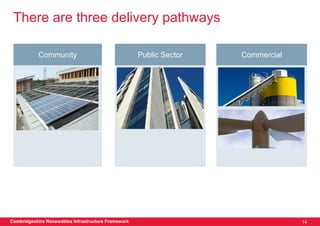
There are three delivery pathways

           Community                                 Public Sector   Commercial


Cambridgeshire Renewables Infrastructure Framework                                14
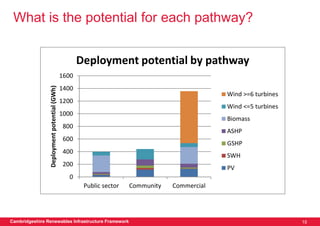
What is the potential for each pathway?


                                                    Deployment potential by pathway
                                             1600
                                             1400
                Deployment potential (GWh)


                                                                                              Wind >=6 turbines
                                             1200
                                                                                              Wind <=5 turbines
                                             1000
                                                                                              Biomass
                                             800
                                                                                              ASHP
                                             600
                                                                                              GSHP
                                             400
                                                                                              SWH
                                             200
                                                                                              PV
                                               0
                                                     Public sector   Community   Commercial


Cambridgeshire Renewables Infrastructure Framework                                                                15
Community deployment potential

 •       PV
     •    145MWp, 1,150,000m² of panels
     •    460 non-residential buildings and 30,400 houses (14%)
     •    £640m capex, £150m NPV

 •       Solar water heating
     •    42,600m² of panels on 8,500 houses (4%)
     •    £50m capex, £20m NPV

 •       Heat pumps
     •    43,000 or 15% of houses
     •    £140m capex, £75m NPV

 •       Wind
     •    75MW or 30 turbines
     •    £120m capex, £8m NPV
Cambridgeshire Renewables Infrastructure Framework                16
Vision for community delivery pathway

 •       Communities have strong incentive to invest in renewable energy
     •    Effective hard and soft incentive mechanisms
     •    Minimisation of risks and barriers to implementation

 •       Communities have access to a range of funding sources
     •    Availability of applicable finance options for a range of project types
     •    Gaining access to existing and new funding sources

 •       Communities are maximising learning from leading practice
     •    Demonstration case studies of successful community energy schemes
     •    Access to quality impartial ‘self-help’ guidance and information


Cambridgeshire Renewables Infrastructure Framework                                  17
Vision for community delivery pathway

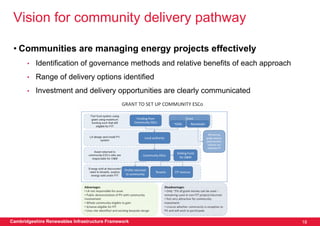
 • Communities are managing energy projects effectively
       •   Identification of governance methods and relative benefits of each approach
       •   Range of delivery options identified
       •   Investment and delivery opportunities are clearly communicated


Cambridgeshire Renewables Infrastructure Framework                                       18
Public sector deployment potential

 •       PV                                          •       Wind
     •    39MWp, 300,00m² of panels                      •   27MW or 11 turbines
     •    180 non-residential buildings and 7,500        •   £44m capex, £3m NPV
          houses (18%)
                                                         •   Biomass
     •    £170m capex, £40m NPV
                                                         •   14 installations of 1.5MW
 •       Solar water heating
     •    8,400m² of panels on 1,700 houses (4%)
     •    £10m capex, £4m NPV

 •       Heat pumps
     •    8,100 or 20% of houses
     •    £40m capex, £23m NPV


Cambridgeshire Renewables Infrastructure Framework                                       19
Vision for public sector pathway

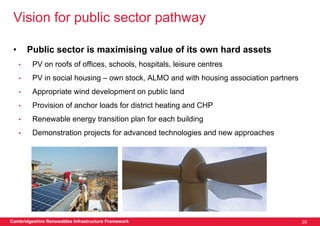
 •       Public sector is maximising value of its own hard assets
     •    PV on roofs of offices, schools, hospitals, leisure centres
     •    PV in social housing – own stock, ALMO and with housing association partners
     •    Appropriate wind development on public land
     •    Provision of anchor loads for district heating and CHP
     •    Renewable energy transition plan for each building
     •    Demonstration projects for advanced technologies and new approaches


Cambridgeshire Renewables Infrastructure Framework                                       20
Vision for public sector pathway

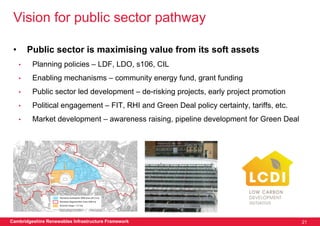
 •       Public sector is maximising value from its soft assets
     •    Planning policies – LDF, LDO, s106, CIL
     •    Enabling mechanisms – community energy fund, grant funding
     •    Public sector led development – de-risking projects, early project promotion
     •    Political engagement – FIT, RHI and Green Deal policy certainty, tariffs, etc.
     •    Market development – awareness raising, pipeline development for Green Deal


Cambridgeshire Renewables Infrastructure Framework                                         21
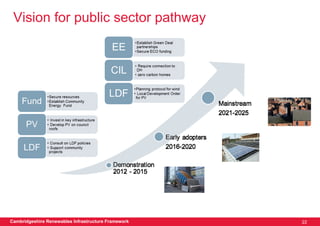
Vision for public sector pathway


Cambridgeshire Renewables Infrastructure Framework   22
Commercial deployment potential

 •       PV                                          •       Wind
     •    160MWp, 1,300,000m² of panels                  •   For wind parks ≤5 turbines, 28MW or
                                                             11 turbines
     •    3,200 non-residential buildings
                                                         •   For wind parks ≥6 turbines, 375MW
     •    £720m capex, £165m NPV
                                                             or 150 turbines
 •       Solar water heating                             •   Total capex £660m, £45m NPV
     •    8,300m² of panels on 1,700 or 20% of
                                                         •   Biomass
          buildings
                                                         •   14 installations of 1.5MW
     •    £9m capex, £4m NPV

 •       Heat pumps
     •    200 or 3% of buildings
     •    £75m capex, £43m NPV


Cambridgeshire Renewables Infrastructure Framework                                         23
Vision for commercial delivery pathway

 •       Investment opportunities are clearly identified
     •    Technical, economic and deployment potential based on WP1
     •    Benefits of growth agenda are articulated
     •    Preconditions are clearly understood by public and private sector + community


 •       Public sector is facilitating investment
     •    Establishing clear public policies and protocols to provide market certainty
     •    Engaging in constructive dialogue with community
     •    Using its own assets to lever wider opportunities


Cambridgeshire Renewables Infrastructure Framework                                        24
Vision for commercial delivery pathway

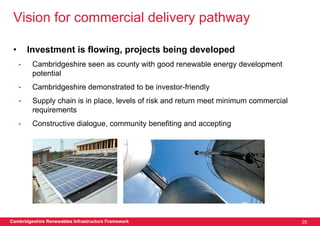
 •       Investment is flowing, projects being developed
     •    Cambridgeshire seen as county with good renewable energy development
          potential
     •    Cambridgeshire demonstrated to be investor-friendly
     •    Supply chain is in place, levels of risk and return meet minimum commercial
          requirements
     •    Constructive dialogue, community benefiting and accepting


Cambridgeshire Renewables Infrastructure Framework                                      25
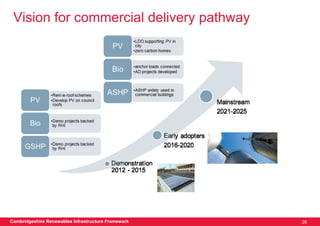
Vision for commercial delivery pathway


Cambridgeshire Renewables Infrastructure Framework   26
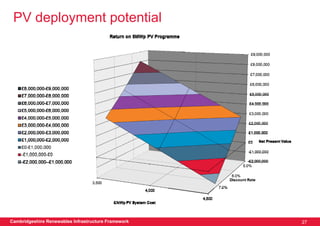
PV deployment potential


Cambridgeshire Renewables Infrastructure Framework   27
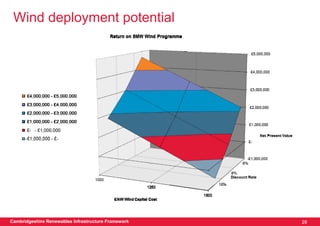
Wind deployment potential


Cambridgeshire Renewables Infrastructure Framework   28
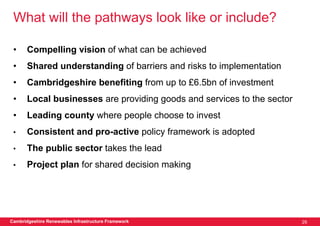
What will the pathways look like or include?

 •     Compelling vision of what can be achieved
 •     Shared understanding of barriers and risks to implementation
 •     Cambridgeshire benefiting from up to £6.5bn of investment
 •     Local businesses are providing goods and services to the sector
 •     Leading county where people choose to invest
 •     Consistent and pro-active policy framework is adopted
 •     The public sector takes the lead
 •     Project plan for shared decision making


Cambridgeshire Renewables Infrastructure Framework                       29
Cambridgeshire’s challenging carbon objectives


                                    Discussion Points


Cambridgeshire Renewables Infrastructure Framework      30
What will the public sector pathways look like?

 • How can the public sector facilitate and support the delivery of more
   renewable energy delivery in Cambridgeshire?
 • What is the role of the Public Sector?
 • How can the public sector create the conditions to attract business and
   community buy-in and investment in Cambridgeshire?


Cambridgeshire Renewables Infrastructure Framework                         31
Thanks

    Duncan Price
    Director
    Camco

     t: +44 (0)20 7121 6150
    m: +44 (0)7769 692 610
    e: duncan.price@camcoglobal.com


    172 Tottenham Court Road London
    W1T 7NS United Kingdom

    www.camcoglobal.com

Cambridgeshire Renewables Infrastructure Framework            32

Camco CRIF presentation public sector 12 oct 2011

  • 1.
    Cambridgeshire Renewables InfrastructureFramework Presentation to Senior Public Sector Event 12/10/11 Duncan Price, Director Cambridgeshire Renewables Infrastructure Framework
  • 2.
    Cambridgeshire’s challenging carbonobjectives What is Cambridgeshire's potential? Cambridgeshire Renewables Infrastructure Framework 1
  • 3.
    Cambridgeshire is progressingwell Cambridgeshire Renewables Infrastructure Framework 2
  • 4.
    Modelling renewable energydeployment potential Scenario 4 Scenario 1 Scenario 2 Scenario 3 (high without Inputs (low) (medium) (high) wind) Discount rate 9% 7% 6% 6% DECC - 'high DECC - 'high Energy price DECC - 'low' DECC - 'high' high' energy high' energy [1] energy prices energy prices prices prices current rates current rates (FIT/ RHI (FIT/ RHI designed to designed to give fixed give fixed return & will return & will Financial lower than adjust to adjust to incentives current tariff energy energy (FIT/RHI) rates current rates prices) prices) Project deployment rate (wind/biomas 30% (0% for s/EfW) 8% 15% 30% wind) Green policy support (for building integrated technologies) Low Medium High High Cambridgeshire Renewables Infrastructure Framework 3
  • 5.
    Deployment options forrenewable energy Cambridgeshire Renewables Infrastructure Framework 4
  • 6.
    Renewable electricity potentialis very large Cambridgeshire Renewables Infrastructure Framework 5
  • 7.
    Renewable heat constitutesthe greater challenge Cambridgeshire Renewables Infrastructure Framework 6
  • 8.
    S. Cambs andHunts have largest resource Cambridgeshire Renewables Infrastructure Framework 7
  • 9.
    District heating potentiallies in Cambridge and Huntingdon Cambridgeshire Renewables Infrastructure Framework 8
  • 10.
    Substantial infrastructure isneeded Number of installations associated with delivery of each scenario Cambridgeshire Renewables Infrastructure Framework 9
  • 11.
    Significant investment opportunity Investment potential for each scenario in £millions Cambridgeshire Renewables Infrastructure Framework 10
  • 12.
    Energy efficiency andrenewable energy can close the carbon ‘gap’ Cambridgeshire Renewables Infrastructure Framework 11
  • 13.
    Conclusions • Cambridgeshire is doing well – especially renewable electricity • There is potential for more – solar, biomass, heat pumps, wind • All technologies are needed – heat and electricity • Somewhere between medium & high scenarios delivers by 2031 • Also closes carbon gap to meet pro-rata 4th carbon budget • Significant investment potential – up to £6.1 billion for high scenario Cambridgeshire Renewables Infrastructure Framework 12
  • 14.
    Thanks Duncan Price Renewable energy delivery pathways Director Camco t: +44 (0)20 7121 6150 m: +44 (0)7769 692 610 e: duncan.price@camcoglobal.com 172 Tottenham Court Road London W1T 7NS United Kingdom www.camcoglobal.com Cambridgeshire Renewables Infrastructure Framework 13
  • 15.
    There are threedelivery pathways Community Public Sector Commercial Cambridgeshire Renewables Infrastructure Framework 14
  • 16.
    What is thepotential for each pathway? Deployment potential by pathway 1600 1400 Deployment potential (GWh) Wind >=6 turbines 1200 Wind <=5 turbines 1000 Biomass 800 ASHP 600 GSHP 400 SWH 200 PV 0 Public sector Community Commercial Cambridgeshire Renewables Infrastructure Framework 15
  • 17.
    Community deployment potential • PV • 145MWp, 1,150,000m² of panels • 460 non-residential buildings and 30,400 houses (14%) • £640m capex, £150m NPV • Solar water heating • 42,600m² of panels on 8,500 houses (4%) • £50m capex, £20m NPV • Heat pumps • 43,000 or 15% of houses • £140m capex, £75m NPV • Wind • 75MW or 30 turbines • £120m capex, £8m NPV Cambridgeshire Renewables Infrastructure Framework 16
  • 18.
    Vision for communitydelivery pathway • Communities have strong incentive to invest in renewable energy • Effective hard and soft incentive mechanisms • Minimisation of risks and barriers to implementation • Communities have access to a range of funding sources • Availability of applicable finance options for a range of project types • Gaining access to existing and new funding sources • Communities are maximising learning from leading practice • Demonstration case studies of successful community energy schemes • Access to quality impartial ‘self-help’ guidance and information Cambridgeshire Renewables Infrastructure Framework 17
  • 19.
    Vision for communitydelivery pathway • Communities are managing energy projects effectively • Identification of governance methods and relative benefits of each approach • Range of delivery options identified • Investment and delivery opportunities are clearly communicated Cambridgeshire Renewables Infrastructure Framework 18
  • 20.
    Public sector deploymentpotential • PV • Wind • 39MWp, 300,00m² of panels • 27MW or 11 turbines • 180 non-residential buildings and 7,500 • £44m capex, £3m NPV houses (18%) • Biomass • £170m capex, £40m NPV • 14 installations of 1.5MW • Solar water heating • 8,400m² of panels on 1,700 houses (4%) • £10m capex, £4m NPV • Heat pumps • 8,100 or 20% of houses • £40m capex, £23m NPV Cambridgeshire Renewables Infrastructure Framework 19
  • 21.
    Vision for publicsector pathway • Public sector is maximising value of its own hard assets • PV on roofs of offices, schools, hospitals, leisure centres • PV in social housing – own stock, ALMO and with housing association partners • Appropriate wind development on public land • Provision of anchor loads for district heating and CHP • Renewable energy transition plan for each building • Demonstration projects for advanced technologies and new approaches Cambridgeshire Renewables Infrastructure Framework 20
  • 22.
    Vision for publicsector pathway • Public sector is maximising value from its soft assets • Planning policies – LDF, LDO, s106, CIL • Enabling mechanisms – community energy fund, grant funding • Public sector led development – de-risking projects, early project promotion • Political engagement – FIT, RHI and Green Deal policy certainty, tariffs, etc. • Market development – awareness raising, pipeline development for Green Deal Cambridgeshire Renewables Infrastructure Framework 21
  • 23.
    Vision for publicsector pathway Cambridgeshire Renewables Infrastructure Framework 22
  • 24.
    Commercial deployment potential • PV • Wind • 160MWp, 1,300,000m² of panels • For wind parks ≤5 turbines, 28MW or 11 turbines • 3,200 non-residential buildings • For wind parks ≥6 turbines, 375MW • £720m capex, £165m NPV or 150 turbines • Solar water heating • Total capex £660m, £45m NPV • 8,300m² of panels on 1,700 or 20% of • Biomass buildings • 14 installations of 1.5MW • £9m capex, £4m NPV • Heat pumps • 200 or 3% of buildings • £75m capex, £43m NPV Cambridgeshire Renewables Infrastructure Framework 23
  • 25.
    Vision for commercialdelivery pathway • Investment opportunities are clearly identified • Technical, economic and deployment potential based on WP1 • Benefits of growth agenda are articulated • Preconditions are clearly understood by public and private sector + community • Public sector is facilitating investment • Establishing clear public policies and protocols to provide market certainty • Engaging in constructive dialogue with community • Using its own assets to lever wider opportunities Cambridgeshire Renewables Infrastructure Framework 24
  • 26.
    Vision for commercialdelivery pathway • Investment is flowing, projects being developed • Cambridgeshire seen as county with good renewable energy development potential • Cambridgeshire demonstrated to be investor-friendly • Supply chain is in place, levels of risk and return meet minimum commercial requirements • Constructive dialogue, community benefiting and accepting Cambridgeshire Renewables Infrastructure Framework 25
  • 27.
    Vision for commercialdelivery pathway Cambridgeshire Renewables Infrastructure Framework 26
  • 28.
    PV deployment potential CambridgeshireRenewables Infrastructure Framework 27
  • 29.
    Wind deployment potential CambridgeshireRenewables Infrastructure Framework 28
  • 30.
    What will thepathways look like or include? • Compelling vision of what can be achieved • Shared understanding of barriers and risks to implementation • Cambridgeshire benefiting from up to £6.5bn of investment • Local businesses are providing goods and services to the sector • Leading county where people choose to invest • Consistent and pro-active policy framework is adopted • The public sector takes the lead • Project plan for shared decision making Cambridgeshire Renewables Infrastructure Framework 29
  • 31.
    Cambridgeshire’s challenging carbonobjectives Discussion Points Cambridgeshire Renewables Infrastructure Framework 30
  • 32.
    What will thepublic sector pathways look like? • How can the public sector facilitate and support the delivery of more renewable energy delivery in Cambridgeshire? • What is the role of the Public Sector? • How can the public sector create the conditions to attract business and community buy-in and investment in Cambridgeshire? Cambridgeshire Renewables Infrastructure Framework 31
  • 33.
    Thanks Duncan Price Director Camco t: +44 (0)20 7121 6150 m: +44 (0)7769 692 610 e: duncan.price@camcoglobal.com 172 Tottenham Court Road London W1T 7NS United Kingdom www.camcoglobal.com Cambridgeshire Renewables Infrastructure Framework 32