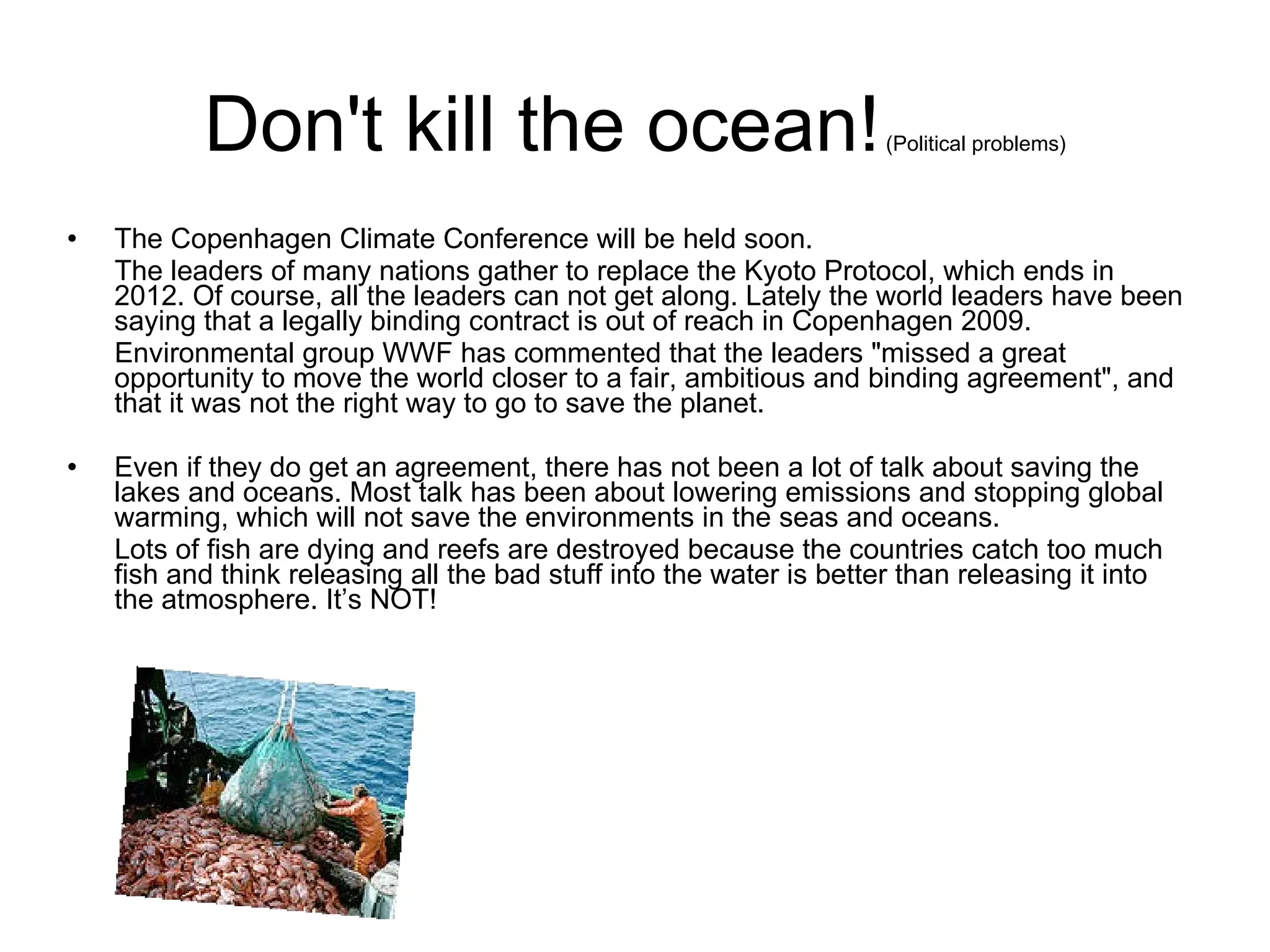
Don't kill the ocean!  (Political problems) The Copenhagen Climate Conference will be held soon. The leaders of many nations gather to replace the Kyoto Protocol, which ends in 2012. Of course, all the leaders can not get along. Lately the world leaders have been saying that a legally binding contract is out of reach in Copenhagen 2009. Environmental group WWF has commented that the leaders "missed a great opportunity to move the world closer to a fair, ambitious and binding agreement", and that it was not the right way to go to save the planet.  Even if they do get an agreement, there has not been a lot of talk about saving the lakes and oceans. Most talk has been about lowering emissions and stopping global warming, which will not save the environments in the seas and oceans. Lots of fish are dying and reefs are destroyed because the countries catch too much fish and think releasing all the bad stuff into the water is better than releasing it into the atmosphere. It’s NOT!
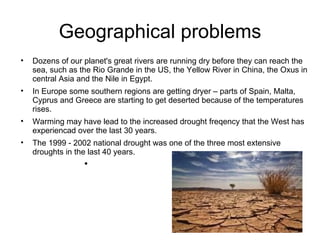
Geographical problems Dozens of our planet's great rivers are running dry before they can reach the sea, such as the Rio Grande in the US, the Yellow River in China, the Oxus in central Asia and the Nile in Egypt. In Europe some southern regions are getting dryer – parts of Spain, Malta, Cyprus and Greece are starting to get deserted because of the temperatures rises.  Warming may have lead to the increased drought freqency that the West has experiencad over the last 30 years. The 1999 - 2002 national drought was one of the three most extensive droughts in the last 40 years.
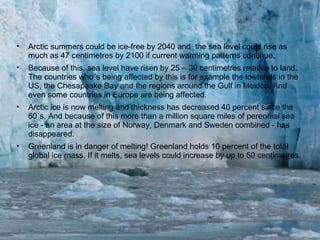
Arctic summers could be ice-free by 2040 and  the sea level could rise as much as 47 centimetres by 2100 if current warming patterns continue. Because of this, sea level have risen by 25 – 30 centimetres relative to land. The countries who´s being affected by this is for example the lowlands in the US, the Chesapeake Bay and the regions around the Gulf in Mexico. And even some countries in Europe are being affected. Arctic ice is now melting and thickness has decreased 40 percent since the 60`s. And because of this more than a million square miles of perennial sea ice - an area at the size of Norway, Denmark and Sweden combined - has disappeared. Greenland is in danger of melting! Greenland holds 10 percent of the total global ice mass. If it melts, sea levels could increase by up to 50 centimetres.
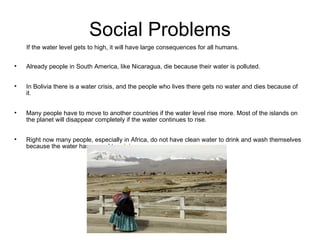
Social Problems If the water level gets to high, it will have large consequences for all humans. Already people in South America, like Nicaragua, die because their water is polluted.  In Bolivia there is a water crisis, and the people who lives there gets no water and dies because of it. Many people have to move to another countries if the water level rise more. Most of the islands on the planet will disappear completely if the water continues to rise. Right now many people, especially in Africa, do not have clean water to drink and wash themselves because the water has moved to rainier areas.

20091121 Globalwarming Sw Group02

  • 1.
    Don't kill theocean! (Political problems) The Copenhagen Climate Conference will be held soon. The leaders of many nations gather to replace the Kyoto Protocol, which ends in 2012. Of course, all the leaders can not get along. Lately the world leaders have been saying that a legally binding contract is out of reach in Copenhagen 2009. Environmental group WWF has commented that the leaders "missed a great opportunity to move the world closer to a fair, ambitious and binding agreement", and that it was not the right way to go to save the planet. Even if they do get an agreement, there has not been a lot of talk about saving the lakes and oceans. Most talk has been about lowering emissions and stopping global warming, which will not save the environments in the seas and oceans. Lots of fish are dying and reefs are destroyed because the countries catch too much fish and think releasing all the bad stuff into the water is better than releasing it into the atmosphere. It’s NOT!
  • 2.
    Geographical problems Dozensof our planet's great rivers are running dry before they can reach the sea, such as the Rio Grande in the US, the Yellow River in China, the Oxus in central Asia and the Nile in Egypt. In Europe some southern regions are getting dryer – parts of Spain, Malta, Cyprus and Greece are starting to get deserted because of the temperatures rises. Warming may have lead to the increased drought freqency that the West has experiencad over the last 30 years. The 1999 - 2002 national drought was one of the three most extensive droughts in the last 40 years.
  • 3.
    Arctic summers couldbe ice-free by 2040 and the sea level could rise as much as 47 centimetres by 2100 if current warming patterns continue. Because of this, sea level have risen by 25 – 30 centimetres relative to land. The countries who´s being affected by this is for example the lowlands in the US, the Chesapeake Bay and the regions around the Gulf in Mexico. And even some countries in Europe are being affected. Arctic ice is now melting and thickness has decreased 40 percent since the 60`s. And because of this more than a million square miles of perennial sea ice - an area at the size of Norway, Denmark and Sweden combined - has disappeared. Greenland is in danger of melting! Greenland holds 10 percent of the total global ice mass. If it melts, sea levels could increase by up to 50 centimetres.
  • 4.
    Social Problems Ifthe water level gets to high, it will have large consequences for all humans. Already people in South America, like Nicaragua, die because their water is polluted. In Bolivia there is a water crisis, and the people who lives there gets no water and dies because of it. Many people have to move to another countries if the water level rise more. Most of the islands on the planet will disappear completely if the water continues to rise. Right now many people, especially in Africa, do not have clean water to drink and wash themselves because the water has moved to rainier areas.