M. Tariq Badsha Member (IT) Ministry of Information Technology Government of Pakistan Dec 19, 2009
Outline Background Start-up Phase Consolidation Phase Sustainability and Scalability Challenges and the Future
Background IT Division Formed in 2000 - consolidating IT & Telecom functions under M/o Science & Technology IT Policy Approved by the Cabinet in August 2000 Mandate of the IT Division: IT Sector Development and use of IT for better government services Telecom Sector Development IT Ministry formed in 2002
Start-up Phase (Inception to 2002) Recruitment of IT and Telecom Professionals Setting up Organizations: Electronic Government Directorate (2002) Higher Education Commission (2002) Strengthening of Pakistan Software Export Board Virtual University Creating an Enabling Environment Pilot projects of a wide variety Major thrust on HR and Infrastructure Development
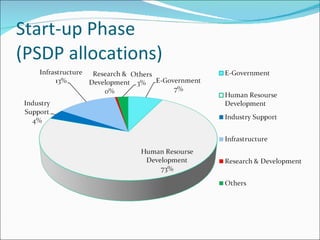
Start-up Phase (PSDP allocations)
Achievements and Lessons Achievements: Breaking the inertia Building the team Creating Basic Organizations Developing the Telecom Infrastructure Testing the waters in various sectors Long lead activities (HR) put in motion Key policies and Legislation Lessons: Bring Focus Strengthen Implementation
Consolidation Phase (2003-2007) With the formation of HEC a significant part of the HR program was shifted to HEC Program was focused on: Citizen Services IT for improving efficiency as a means to support Services IT industry Development - increasing exports and/or creating local employment Infrastructure to meet specific needs Targeted HR Development Telecom Sector Deregulation and Privatization Legislation and Enabling Environment
IT Industry Development Advisory and Information services Infrastructure Support (STPs) Exhibitions and Events Industrial Automation Quality Certifications Corporate Training Programs IT Industry Internship Programs Open Source Resource Center ( www.osrc.org.pk ) Facilitate resolution of Industry’s Operational Issues Activities/Major Functions
E-Government Strategy Basic Infrastructure Hardware, LAN at Ministries, Centralized Data Centre  Common Applications E-Office comprises of Common processes (IC, HR, PM, Budget, Inventory) Agency Specific Applications Example: Hajj Applications. Online registration of companies with SECP, Online recruitment at FPSC, Online Access to case laws, Court Automation, etc E-Services Domicile, Driving Licenses, International Driving Permits, Arms License Issuance, Food, Agriculture & Livestock Information Repository (FALIR), Land Record Revenue MIS etc Replication and Reuse Replication of E-Office applications to 45 Divisions
HR Development National ICT Scholarship Program  (R&D Company) Opportunities for students from remote areas to study in  ten top universities of the country Internships  (PSEB) Match making between fresh IT graduates and IT companies by placing IT graduates in IT companies IT Apprenticeship Program  (R&D Company) Rs. 15,000 per student per month to groom young professionals Corporate Training Program  (PSEB) A program that brings in trainers from abroad to train and subsequently certify individuals nominated by their companies Capacity Building Programs  (PSEB) “ Specialized Training” for local IT companies in  and  “General Training” in the field of project management, network/security systems and business process modeling Federal Govt. Employees Training Program  (Computer Bureau) Training in basic IT to Federal Govt employees working in various Ministries/Divisions Virtual University with enrollment of over 50,000
Telecom Sector Governing Legislation Pakistan Telecommunication (Re-Organization) Act 1996 (Amended 2006) Sector Policies De-Regulation Policy for the Telecommunication Sector – 2003 Mobile Cellular Policy – 2004 Broadband Policy – 2004 Universal Service Fund Policy – 2006 Formation of Companies to manage USF and R&D Funds
National ICT R&D Fund Company Independent Company .  Activities funded by mandatory contribution from Telecom Operators  Goals: Cultivate industry-academia partnership Enhance the national ICT related human resource development capacity Make Pakistan an attractive destination for high tech jobs Use ICT as a tool for wealth creation  Spread the ICT activities at the National level.
National ICT R&D Fund Company Major Programs National ICT Scholarship Program IT Apprenticeship Program Technical R&D Projects International Publications
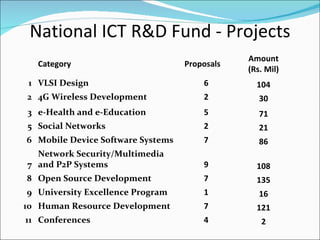
National ICT R&D Fund - Projects Category Proposals Amount (Rs. Mil) 1 VLSI Design 6 104 2 4G Wireless Development 2 30 3 e-Health and e-Education 5 71 5 Social Networks 2 21 6 Mobile Device Software Systems 7 86 7 Network Security/Multimedia and P2P Systems 9 108 8 Open Source Development 7 135 9 University Excellence Program 1 16 10 Human Resource Development 7 121 11 Conferences 4 2
Universal Service Fund Company Independent Company  Contributions by Licensed Telecom Service Providers  No Government Funding Spent by Telecom Service Providers to provide services in un-served and under-served areas Ministry acts like a “Trustee” of the Fund Disbursed through open competitive bidding by USF Company (bidder requiring least subsidy wins)
Universal Service Fund Currently has three programs: Rural Telecom and e-Services Fiber backbone Broadband
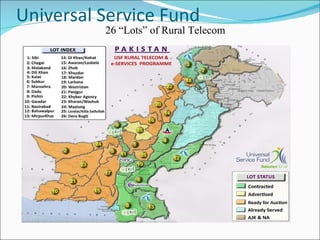
Universal Service Fund 26 “Lots” of Rural Telecom
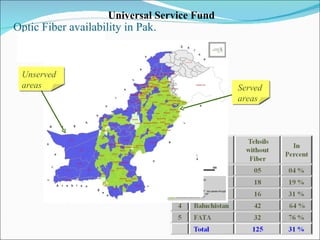
Optic Fiber availability in Pak.  Universal Service Fund Served areas Unserved areas
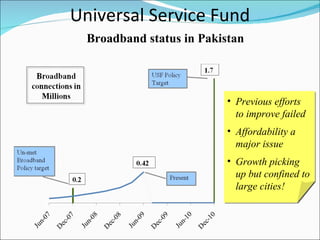
Universal Service Fund Broadband status in Pakistan Previous efforts to improve failed Affordability a major issue Growth picking up but confined to large cities!
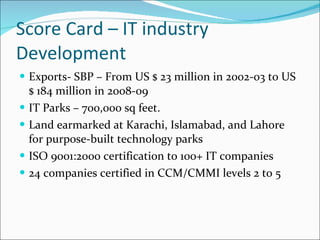
Score Card – IT industry Development Exports- SBP – From US $ 23 million in 2002-03 to US $ 184 million in 2008-09 IT Parks – 700,000 sq feet.  Land earmarked at Karachi, Islamabad, and Lahore for purpose-built technology parks ISO 9001:2000 certification to 100+ IT companies 24 companies certified in CCM/CMMI levels 2 to 5
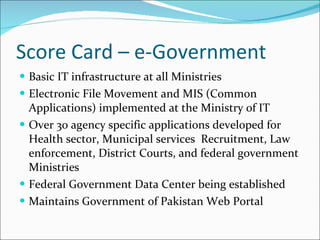
Score Card – e-Government Basic IT infrastructure at all Ministries Electronic File Movement and MIS (Common Applications) implemented at the Ministry of IT  Over 30 agency specific applications developed for Health sector, Municipal services  Recruitment, Law enforcement, District Courts, and federal government Ministries Federal Government Data Center being established Maintains Government of Pakistan Web Portal
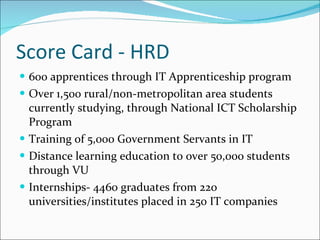
Score Card - HRD 600 apprentices through IT Apprenticeship program Over 1,500 rural/non-metropolitan area students currently studying, through National ICT Scholarship Program Training of 5,000 Government Servants in IT Distance learning education to over 50,000 students through VU Internships- 4460 graduates from 220 universities/institutes placed in 250 IT companies
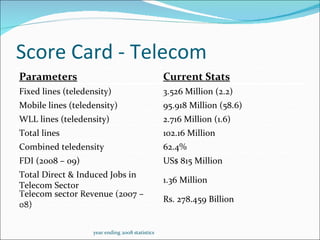
Score Card - Telecom year ending 2008 statistics Parameters Current Stats Fixed lines (teledensity) 3.526 Million (2.2) Mobile lines (teledensity) 95.918 Million (58.6) WLL lines (teledensity) 2.716 Million (1.6) Total lines 102.16 Million Combined teledensity  62.4% FDI (2008 – 09) US$ 815 Million Total Direct & Induced Jobs in Telecom Sector 1.36 Million Telecom sector Revenue (2007 – 08) Rs. 278.459 Billion
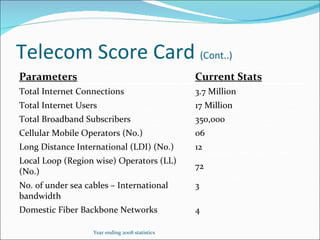
Telecom Score Card  (Cont..) Year ending 2008 statistics Parameters Current Stats Total Internet Connections  3.7 Million Total Internet Users 17 Million Total Broadband Subscribers 350,000 Cellular Mobile Operators (No.) 06 Long Distance International (LDI) (No.) 12 Local Loop (Region wise) Operators (LL) (No.) 72 No. of under sea cables – International  bandwidth 3 Domestic Fiber Backbone Networks 4
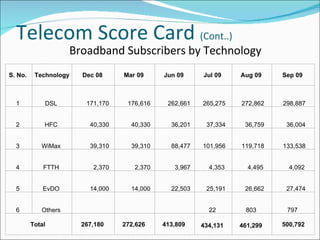
Telecom Score Card  (Cont..) Broadband Subscribers by Technology S. No.  Technology  Dec 08  Mar 09  Jun 09  Jul 09  Aug 09  Sep 09  1  DSL         171,170         176,616         262,661     265,275     272,862     298,887  2  HFC           40,330           40,330           36,201       37,334       36,759       36,004  3  WiMax           39,310           39,310           88,477     101,956     119,718     133,538  4  FTTH             2,370             2,370             3,967        4,353        4,495        4,092  5  EvDO           14,000           14,000           22,503       25,191       26,662       27,474  6  Others           22  803  797  Total  267,180  272,626  413,809  434,131   461,299   500,792
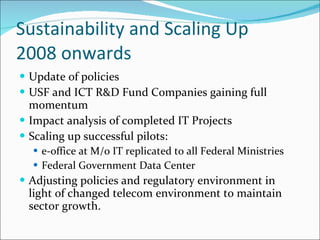
Sustainability and Scaling Up 2008 onwards Update of policies USF and ICT R&D Fund Companies gaining full momentum Impact analysis of completed IT Projects Scaling up successful pilots:  e-office at M/o IT replicated to all Federal Ministries Federal Government Data Center Adjusting policies and regulatory environment in light of changed telecom environment to maintain sector growth.
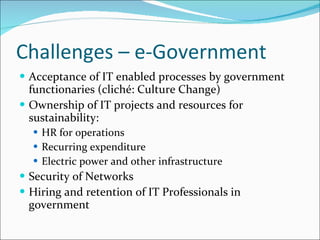
Challenges – e-Government Acceptance of IT enabled processes by government functionaries (cliché: Culture Change) Ownership of IT projects and resources for sustainability: HR for operations Recurring expenditure Electric power and other infrastructure Security of Networks Hiring and retention of IT Professionals in government
Challenges – IT Industry High Quality HR to feed the industry – technical as well as middle management Affordable IT-enabled space Country Perception Increased global competition Attrition of HR to lucrative markets Venture Capital and Financing Exploiting niche markets
Challenges – Telecom Sector Sector health in light of  higher saturation levels lower ARPU due to price wars Shrinking margins Introducing value-added services Optimal Frequency management Management versus speed of processing Flexibility in terms and conditions of licenses distribution (Defence, Public Sector, and Commercial)
Challenges – Telecom Sector Maintaining Investors’ Interest Legislation and Policies to deal with possible mergers and acquisitions – to maintain a fair competitive regime Using ICT infrastructure for Socio-economic development Increasing Broadband penetration – Supply side as well as demand (consumer appetite) Convergence of media, telecom, and VAS
Challenges – ICT for Development Cost of Access devices Broadband service charges have come down significantly but still above the price point for mass acceptance Content for Broadband services Mindset of service providers Literacy and Capacity for absorbing technology Basic services (electrification, roads, drinking water, etc.)
Future Telecom Policies are being revised in consultation with all the stakeholders to address the challenges of the current market dynamics. Similarly, the IT Policy of 2000, is being updated.  Targets would have to be set for government ministries New legislation in the areas of Data Protection, Privacy, Consumer Protection, IPR IT must be introduced in our SME sector more aggressively if they are to remain competitive IT companies would have to scale up – partly through organic growth but mostly through mergers
Future Work on affordable solutions  Using FOSS technologies where applicable Lightweight software for extending the life of hardware Localization Public access points – like telecenters Generate viable business models for small entrepreneurs around ICT
 

Dr Tariq Badsha It Ministry

  • 1.
    M. Tariq BadshaMember (IT) Ministry of Information Technology Government of Pakistan Dec 19, 2009
  • 2.
    Outline Background Start-upPhase Consolidation Phase Sustainability and Scalability Challenges and the Future
  • 3.
    Background IT DivisionFormed in 2000 - consolidating IT & Telecom functions under M/o Science & Technology IT Policy Approved by the Cabinet in August 2000 Mandate of the IT Division: IT Sector Development and use of IT for better government services Telecom Sector Development IT Ministry formed in 2002
  • 4.
    Start-up Phase (Inceptionto 2002) Recruitment of IT and Telecom Professionals Setting up Organizations: Electronic Government Directorate (2002) Higher Education Commission (2002) Strengthening of Pakistan Software Export Board Virtual University Creating an Enabling Environment Pilot projects of a wide variety Major thrust on HR and Infrastructure Development
  • 5.
  • 6.
    Achievements and LessonsAchievements: Breaking the inertia Building the team Creating Basic Organizations Developing the Telecom Infrastructure Testing the waters in various sectors Long lead activities (HR) put in motion Key policies and Legislation Lessons: Bring Focus Strengthen Implementation
  • 7.
    Consolidation Phase (2003-2007)With the formation of HEC a significant part of the HR program was shifted to HEC Program was focused on: Citizen Services IT for improving efficiency as a means to support Services IT industry Development - increasing exports and/or creating local employment Infrastructure to meet specific needs Targeted HR Development Telecom Sector Deregulation and Privatization Legislation and Enabling Environment
  • 8.
    IT Industry DevelopmentAdvisory and Information services Infrastructure Support (STPs) Exhibitions and Events Industrial Automation Quality Certifications Corporate Training Programs IT Industry Internship Programs Open Source Resource Center ( www.osrc.org.pk ) Facilitate resolution of Industry’s Operational Issues Activities/Major Functions
  • 9.
    E-Government Strategy BasicInfrastructure Hardware, LAN at Ministries, Centralized Data Centre Common Applications E-Office comprises of Common processes (IC, HR, PM, Budget, Inventory) Agency Specific Applications Example: Hajj Applications. Online registration of companies with SECP, Online recruitment at FPSC, Online Access to case laws, Court Automation, etc E-Services Domicile, Driving Licenses, International Driving Permits, Arms License Issuance, Food, Agriculture & Livestock Information Repository (FALIR), Land Record Revenue MIS etc Replication and Reuse Replication of E-Office applications to 45 Divisions
  • 10.
    HR Development NationalICT Scholarship Program (R&D Company) Opportunities for students from remote areas to study in ten top universities of the country Internships (PSEB) Match making between fresh IT graduates and IT companies by placing IT graduates in IT companies IT Apprenticeship Program (R&D Company) Rs. 15,000 per student per month to groom young professionals Corporate Training Program (PSEB) A program that brings in trainers from abroad to train and subsequently certify individuals nominated by their companies Capacity Building Programs (PSEB) “ Specialized Training” for local IT companies in and  “General Training” in the field of project management, network/security systems and business process modeling Federal Govt. Employees Training Program (Computer Bureau) Training in basic IT to Federal Govt employees working in various Ministries/Divisions Virtual University with enrollment of over 50,000
  • 11.
    Telecom Sector GoverningLegislation Pakistan Telecommunication (Re-Organization) Act 1996 (Amended 2006) Sector Policies De-Regulation Policy for the Telecommunication Sector – 2003 Mobile Cellular Policy – 2004 Broadband Policy – 2004 Universal Service Fund Policy – 2006 Formation of Companies to manage USF and R&D Funds
  • 12.
    National ICT R&DFund Company Independent Company . Activities funded by mandatory contribution from Telecom Operators Goals: Cultivate industry-academia partnership Enhance the national ICT related human resource development capacity Make Pakistan an attractive destination for high tech jobs Use ICT as a tool for wealth creation  Spread the ICT activities at the National level.
  • 13.
    National ICT R&DFund Company Major Programs National ICT Scholarship Program IT Apprenticeship Program Technical R&D Projects International Publications
  • 14.
    National ICT R&DFund - Projects Category Proposals Amount (Rs. Mil) 1 VLSI Design 6 104 2 4G Wireless Development 2 30 3 e-Health and e-Education 5 71 5 Social Networks 2 21 6 Mobile Device Software Systems 7 86 7 Network Security/Multimedia and P2P Systems 9 108 8 Open Source Development 7 135 9 University Excellence Program 1 16 10 Human Resource Development 7 121 11 Conferences 4 2
  • 15.
    Universal Service FundCompany Independent Company Contributions by Licensed Telecom Service Providers No Government Funding Spent by Telecom Service Providers to provide services in un-served and under-served areas Ministry acts like a “Trustee” of the Fund Disbursed through open competitive bidding by USF Company (bidder requiring least subsidy wins)
  • 16.
    Universal Service FundCurrently has three programs: Rural Telecom and e-Services Fiber backbone Broadband
  • 17.
    Universal Service Fund26 “Lots” of Rural Telecom
  • 18.
    Optic Fiber availabilityin Pak. Universal Service Fund Served areas Unserved areas
  • 19.
    Universal Service FundBroadband status in Pakistan Previous efforts to improve failed Affordability a major issue Growth picking up but confined to large cities!
  • 20.
    Score Card –IT industry Development Exports- SBP – From US $ 23 million in 2002-03 to US $ 184 million in 2008-09 IT Parks – 700,000 sq feet. Land earmarked at Karachi, Islamabad, and Lahore for purpose-built technology parks ISO 9001:2000 certification to 100+ IT companies 24 companies certified in CCM/CMMI levels 2 to 5
  • 21.
    Score Card –e-Government Basic IT infrastructure at all Ministries Electronic File Movement and MIS (Common Applications) implemented at the Ministry of IT Over 30 agency specific applications developed for Health sector, Municipal services Recruitment, Law enforcement, District Courts, and federal government Ministries Federal Government Data Center being established Maintains Government of Pakistan Web Portal
  • 22.
    Score Card -HRD 600 apprentices through IT Apprenticeship program Over 1,500 rural/non-metropolitan area students currently studying, through National ICT Scholarship Program Training of 5,000 Government Servants in IT Distance learning education to over 50,000 students through VU Internships- 4460 graduates from 220 universities/institutes placed in 250 IT companies
  • 23.
    Score Card -Telecom year ending 2008 statistics Parameters Current Stats Fixed lines (teledensity) 3.526 Million (2.2) Mobile lines (teledensity) 95.918 Million (58.6) WLL lines (teledensity) 2.716 Million (1.6) Total lines 102.16 Million Combined teledensity 62.4% FDI (2008 – 09) US$ 815 Million Total Direct & Induced Jobs in Telecom Sector 1.36 Million Telecom sector Revenue (2007 – 08) Rs. 278.459 Billion
  • 24.
    Telecom Score Card (Cont..) Year ending 2008 statistics Parameters Current Stats Total Internet Connections 3.7 Million Total Internet Users 17 Million Total Broadband Subscribers 350,000 Cellular Mobile Operators (No.) 06 Long Distance International (LDI) (No.) 12 Local Loop (Region wise) Operators (LL) (No.) 72 No. of under sea cables – International bandwidth 3 Domestic Fiber Backbone Networks 4
  • 25.
    Telecom Score Card (Cont..) Broadband Subscribers by Technology S. No. Technology Dec 08 Mar 09 Jun 09 Jul 09 Aug 09 Sep 09 1 DSL       171,170       176,616       262,661   265,275   272,862   298,887 2 HFC         40,330         40,330         36,201     37,334     36,759     36,004 3 WiMax         39,310         39,310         88,477   101,956   119,718   133,538 4 FTTH           2,370            2,370           3,967      4,353      4,495      4,092 5 EvDO         14,000         14,000         22,503     25,191     26,662     27,474 6 Others       22 803 797 Total 267,180 272,626 413,809 434,131 461,299 500,792
  • 26.
    Sustainability and ScalingUp 2008 onwards Update of policies USF and ICT R&D Fund Companies gaining full momentum Impact analysis of completed IT Projects Scaling up successful pilots: e-office at M/o IT replicated to all Federal Ministries Federal Government Data Center Adjusting policies and regulatory environment in light of changed telecom environment to maintain sector growth.
  • 27.
    Challenges – e-GovernmentAcceptance of IT enabled processes by government functionaries (cliché: Culture Change) Ownership of IT projects and resources for sustainability: HR for operations Recurring expenditure Electric power and other infrastructure Security of Networks Hiring and retention of IT Professionals in government
  • 28.
    Challenges – ITIndustry High Quality HR to feed the industry – technical as well as middle management Affordable IT-enabled space Country Perception Increased global competition Attrition of HR to lucrative markets Venture Capital and Financing Exploiting niche markets
  • 29.
    Challenges – TelecomSector Sector health in light of higher saturation levels lower ARPU due to price wars Shrinking margins Introducing value-added services Optimal Frequency management Management versus speed of processing Flexibility in terms and conditions of licenses distribution (Defence, Public Sector, and Commercial)
  • 30.
    Challenges – TelecomSector Maintaining Investors’ Interest Legislation and Policies to deal with possible mergers and acquisitions – to maintain a fair competitive regime Using ICT infrastructure for Socio-economic development Increasing Broadband penetration – Supply side as well as demand (consumer appetite) Convergence of media, telecom, and VAS
  • 31.
    Challenges – ICTfor Development Cost of Access devices Broadband service charges have come down significantly but still above the price point for mass acceptance Content for Broadband services Mindset of service providers Literacy and Capacity for absorbing technology Basic services (electrification, roads, drinking water, etc.)
  • 32.
    Future Telecom Policiesare being revised in consultation with all the stakeholders to address the challenges of the current market dynamics. Similarly, the IT Policy of 2000, is being updated. Targets would have to be set for government ministries New legislation in the areas of Data Protection, Privacy, Consumer Protection, IPR IT must be introduced in our SME sector more aggressively if they are to remain competitive IT companies would have to scale up – partly through organic growth but mostly through mergers
  • 33.
    Future Work onaffordable solutions Using FOSS technologies where applicable Lightweight software for extending the life of hardware Localization Public access points – like telecenters Generate viable business models for small entrepreneurs around ICT
  • 34.