© 2009 IBM Corporation
Standards für die Cloud
Über die Arbeit der ETSI Cloud
Standards Coordination
Dr. Jochen Friedrich – Technical Relations Executive
14. Mai 2013
2 © 2013 IBM Corporation
Perspectives on Cloud and
standardisation
Cloud standardisation – paradigm shift in
standards development
EU Policy making in the area of Cloud
ETSI Cloud Standards Coordination
Overview
3 © 2013 IBM Corporation3
3
Perspectives on the Context of Cloud and Standardisation
IBM Presentation Template Full Version
Customers
Efficiency and Flexibility
Certainty, Openness
Trust and Security
Private / Public
Customers
Efficiency and Flexibility
Certainty, Openness
Trust and Security
Private / Public
Business Opportunity
Private / Public Clouds
Flexibility
Fair competition, Global scope
Vendors
Business Opportunity
Private / Public Clouds
Flexibility
Fair competition, Global scope
Vendors
Policy
Wide adoption of Cloud
Innovation
Growth
Efficiency
Policy
Wide adoption of Cloud
Innovation
Growth
Efficiency
Business Opportunity
Promote technologies
Adoption of standards
Standards Bodies
Business Opportunity
Promote technologies
Adoption of standards
Standards Bodies
Standardisation
Interoperability
Portability
Promote competition
Prevent vendor lock-in
Ensure trust
4 © 2013 IBM Corporation4
4
Partnering and Collaboration
VENDORS
CUSTOMERS
PUBLIC
COMMUNITIES
Requirements
Platform
Business success
Trust
Policy objectives
5 © 2013 IBM Corporation
Cloud standardisation – paradigm shift in
standards development
How Cloud standardisation shows that a re-
thinking of the approach towards
standardisation takes place and is important
for business success.
6 © 2013 IBM Corporation6
6
The Global Standards Environment for Cloud
DMTF CIMI, Cloud Audit, OVF
Cloud Infrastructure Management Interface
Open Virtualization Format
IETF OAuth Web authorization protocol
ISO/IEC JTC 1 CCRA Cloud Computing Reference Architecture
OASIS TOSCA, IDCloud
Topology & Orchestration Specification for Cloud Applications
Identity in the Cloud
The Open Group Reference Architecture
SNIA CDMI Cloud Data Management Interface
W3C Linked Data Data format standard
➔ Cloud is not a new technology but a combination of technologies
➔ Cloud does not require massive development of new standards
➔ Many standards are already available for integration in the context of
Cloud architectures, e.g. general internet/web standards
➔ Cloud is not a new technology but a combination of technologies
➔ Cloud does not require massive development of new standards
➔ Many standards are already available for integration in the context of
Cloud architectures, e.g. general internet/web standards
Examples of global organisations involved in global Cloud standardisation:
7 © 2013 IBM Corporation7
7
Rethinking the Approach towards Standards for the Cloud
Innovative
Open standards for cloud:
Invention? Reinvention?
Cloud computing is
changing the economics of
IT and requires a
rethinking of how we all
engage in standards
development
Practical
Business success is not
theoretical. Practical
cloud computing is grass
roots plain and simple: it
involves leveraging real
world implementations of
standards & open source
User-driven
The members of the
Cloud Standards
Customer Council create
a cross-industry view into
market-leading Cloud
use cases and best
practices
Architectural
Standards allow
enterprises to manage
change across market
evolution cycles
extending the value of
customers’ services
based architectures and
investments
8 © 2013 IBM Corporation8
8
Putting Customer Needs in Focus
 End user advocacy group
 Accelerate cloud's successful adoption
 Standards, security and interoperability issues relevant
for transition to the cloud
 Drive client requirements into standards development
organizations
 Deliver materials such as best practices and use cases
 Global collaboration of developers and cloud computing
technologists – Cloud platform development
 Ubiquitous Infrastructure as a Service (IaaS) open
source cloud computing platform for public and private
clouds
 Cloud operating system that controls large pools of
compute, storage, and networking resources throughout
a datacenter, all managed through a dashboard
 Available under the Apache 2.0 license.
9 © 2013 IBM Corporation9
9
FP 7 project
Mission:
– Provide core platform for Future
Internet applications in multiple
industries
– Based on OpenStack
– First release available to partners of
FI-PPP (will be avaiable to public in
spring 2013)
Contribute to development of
– Open Architecture Specifications
– Open API Specifications
– Reference implementation
FI-WARE: OpenStack-Based Cloud Hosting Infrastructure
The FI-WARE project will introduce
a generic and extendible ICT
platform for Future Internet
services. The platform – also
referred to as the “Future Internet
Core Platform” or “FI-WARE” – aims
to meet the demands of key market
stakeholders across many different
sectors, strengthen the
innovation-enabling capabilities
in Europe and overall ensure the
long-term success of European
companies in a highly dynamic
market environment
The FI-WARE project will introduce
a generic and extendible ICT
platform for Future Internet
services. The platform – also
referred to as the “Future Internet
Core Platform” or “FI-WARE” – aims
to meet the demands of key market
stakeholders across many different
sectors, strengthen the
innovation-enabling capabilities
in Europe and overall ensure the
long-term success of European
companies in a highly dynamic
market environment
10 © 2013 IBM Corporation
EU Policy making in the area of Cloud
In September 2012 the European
Commission issued a Communication on the
European Cloud Strategy titled “Unleashnig
the Potential of Cloud Computing in Europe”
(COM(2012) 529).
11 © 2013 IBM Corporation
“The Commission therefore aims at enabling and facilitating faster
adoption of cloud computing throughout all sectors of the economy
which can cut ICT costs, and when combined with new digital
business practices, can boost productivity, growth and jobs” (p. 2)
“A jungle of standards generates confusion by, on one hand, a
proliferation of standards and on the other hand a lack of certainty as
to which standards provide adequate levels of interoperability of data
formats to permit portability; the extent to which safeguards are in
place for the protection of personal data; or the problem of the data
breaches and the protection against cyberattacks.” (pp. 5-6)
Key action 1: Cutting through the jungle of standards
EU Commission Communication on Cloud
12 © 2013 IBM Corporation
Key action 1: Cutting through the jungle of standards
■ Promote trusted and reliable cloud offerings by tasking ETSI to
coordinate with stakeholders in a transparent and open way to identify
by 2013 a detailed map of the necessary standards (inter alia for
security, interoperability, data portability and reversibility).
■ Enhance trust in cloud computing services by recognising at EU-level
technical specifications in the field of information and communication
technologies for the protection of personal information in accordance with
the new Regulation on European Standardisation.
■ Work with the support of ENISA and other relevant bodies to assist the
development of EU-wide voluntary certification schemes in the area of
cloud computing (including as regards data protection) and establish a
list of such schemes by 2014.
■ Address the environmental challenges of increased cloud use by
agreeing, with industry, harmonised metrics for the energy
consumption, water consumption and carbon emissions of cloud
services by 2014.
(pp. 10 – 11; highlighting added)
13 © 2013 IBM Corporation
ETSI Cloud Standards Coordination
The task ETSI has been given is about
coordination between stakeholders.
It is not about developing standards but about
identifying relevant standards necessary in
the context of Cloud.
7 March 201314 © 2011 IBM Corporation
ETSI with the Global Information and Communication Technologies
(ICT) Standardisation Ecosystem
➔ETSI is one of three formally recognised European Standardisation
Organisations
➔High expertise and broad membership in ETSI
CENELEC
National
Committees
(e.g. DKE, UTE,
BSI, CEI)
ISOISO
CEN
ITUIEC
Ecma
OASIS
W3C
IETF
Others...
OMG
National
Bodies
(e.g. DIN, AFNOR,
BSI, UNI)
National
Organisations
(e.g. TB ETSI, CF
ETSI, GIETSI,DTI)
ETSI
JTC 1
CEN/Cenelec Forum
FORMAL STANDARDISATION
NATIONAL DELEGATION DIRECT PARTICIPATION
GLOBAL INDUSTRY ORGS.
7 March 201315 © 2011 IBM Corporation
Cloud Standards Coordiation: Set up
 ETSI acts as Coordinator
–Secretariat
–Web site
–Other support
 Very open and transparent set up
–Anybody may participate, simple registration
–Public web site with documents:
http://csc.etsi.org/website/home.aspx
 Rapporteurs and Co-Rapporteurs for different tasks
16 © 2013 IBM Corporation
Organisation and time line of Cloud Standards Coordination
Task Group 2
Use Cases
Task Group 1
Stakeholders
Task Group 3
Identification of
Standards
Sub-Task Group 1
SLAs
Sub-Task Group 2
Interoperability
Sub-Task Group 3
Security
Reference Group (Coordination level)
Jan 2013
WORK FINISHED
Today June 2013
Intermediate
Report
Work will continue throughout 2h2013 for final report by year end.
© 2013 IBM Corporation
17
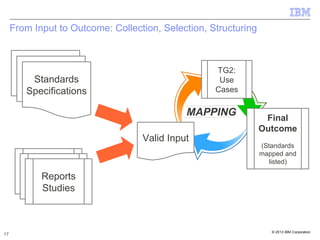
Reports
Studies
FINAL
TG2:
Use
Cases
Valid Input
Standards
Specifications
Final
Outcome
(Standards
mapped and
listed)Reports
Studies
FINAL
Reports
Studies
From Input to Outcome: Collection, Selection, Structuring
MAPPING
© 2013 IBM Corporation
18
Use Cases: Example
HLUC4:_Operate Service: Here is sconsidered everything has to be done for
providing the service to whatever customer, from the startup of the service to its
termination. It seemed suitable to decompose it into the following lower level Use
Cases:
HLUC4.1:_Actrivate Service : all the activities necessary to start the service
for whatever customer. The main actor here is the Service Provider or a Partner
who have to enable the customer to operate on the service according to agreed
Service Level.
HLUC4.2: Migrate Service : Customer may want to migrate some existing
application and data and/or integrate the cloud service with existing services
systems and applications. This can either be for moving the service to another
provisioning mode or to a more suitably sized environment.
HLUC4.2: Maintain Service: The activities associated to normal operation with
the service. This may also include administartive activities either delegated to
the customer or provided by e Service Provider or by a Partner.
HLUC4.2: Terminate Service : Customer wants to exit the contract, and
possibly migrate its application or data to another provider.
19 © 2013 IBM Corporation
Output of Cloud Standards Coordination
■ Intermediate report:
– Proposal for the outline of the final report
– 3 sample Use Cases selected for including in intermediate report – including
• Methodology
• Presentation of output
■ Key part: Cloud Standards Mapping:
General introduction
Presentation of the context, relevance in the context of Cloud computing, scope, etc...
High level Use Cases selected (one by one, or grouped as appropriate)
Per high level use case in 1/2 page (or per group of high level use cases) describe
when standards come into play (for the customer), and which standards are
particularly relevant.
Selected Use Cases
Per use case or family of use case describe the relevant standards in this use case.
Mapping of standards to selected use case #n
Possibly a look-up table linking Use Cases to Standards
Concluding remarks (bullets of issues, remarks, ideas for future work)
General introduction
Presentation of the context, relevance in the context of Cloud computing, scope, etc...
High level Use Cases selected (one by one, or grouped as appropriate)
Per high level use case in 1/2 page (or per group of high level use cases) describe
when standards come into play (for the customer), and which standards are
particularly relevant.
Selected Use Cases
Per use case or family of use case describe the relevant standards in this use case.
Mapping of standards to selected use case #n
Possibly a look-up table linking Use Cases to Standards
Concluding remarks (bullets of issues, remarks, ideas for future work)
20 © 2013 IBM Corporation
Cloud is primarily about integrating technologies
and combining different standards.
Global standards are key for Cloud technologies
and global market success.
Most of the required standards have been
available for a while
The ETSI Cloud Standards Coordination will
provide a map of the standards available,
relating them to concrete Use Cases.
The ETSI mapping will provide added value to all
who wish to implement Cloud technologies and
leverage their potential for business success and
optimisation.
21 © 2013 IBM Corporation
Many thanks for your attention...
… happy to answer your questions,
take up ideas and discuss further.
jochen@de.ibm.com

1305 eurocloud jfriedrich

  • 1.
    © 2009 IBMCorporation Standards für die Cloud Über die Arbeit der ETSI Cloud Standards Coordination Dr. Jochen Friedrich – Technical Relations Executive 14. Mai 2013
  • 2.
    2 © 2013IBM Corporation Perspectives on Cloud and standardisation Cloud standardisation – paradigm shift in standards development EU Policy making in the area of Cloud ETSI Cloud Standards Coordination Overview
  • 3.
    3 © 2013IBM Corporation3 3 Perspectives on the Context of Cloud and Standardisation IBM Presentation Template Full Version Customers Efficiency and Flexibility Certainty, Openness Trust and Security Private / Public Customers Efficiency and Flexibility Certainty, Openness Trust and Security Private / Public Business Opportunity Private / Public Clouds Flexibility Fair competition, Global scope Vendors Business Opportunity Private / Public Clouds Flexibility Fair competition, Global scope Vendors Policy Wide adoption of Cloud Innovation Growth Efficiency Policy Wide adoption of Cloud Innovation Growth Efficiency Business Opportunity Promote technologies Adoption of standards Standards Bodies Business Opportunity Promote technologies Adoption of standards Standards Bodies Standardisation Interoperability Portability Promote competition Prevent vendor lock-in Ensure trust
  • 4.
    4 © 2013IBM Corporation4 4 Partnering and Collaboration VENDORS CUSTOMERS PUBLIC COMMUNITIES Requirements Platform Business success Trust Policy objectives
  • 5.
    5 © 2013IBM Corporation Cloud standardisation – paradigm shift in standards development How Cloud standardisation shows that a re- thinking of the approach towards standardisation takes place and is important for business success.
  • 6.
    6 © 2013IBM Corporation6 6 The Global Standards Environment for Cloud DMTF CIMI, Cloud Audit, OVF Cloud Infrastructure Management Interface Open Virtualization Format IETF OAuth Web authorization protocol ISO/IEC JTC 1 CCRA Cloud Computing Reference Architecture OASIS TOSCA, IDCloud Topology & Orchestration Specification for Cloud Applications Identity in the Cloud The Open Group Reference Architecture SNIA CDMI Cloud Data Management Interface W3C Linked Data Data format standard ➔ Cloud is not a new technology but a combination of technologies ➔ Cloud does not require massive development of new standards ➔ Many standards are already available for integration in the context of Cloud architectures, e.g. general internet/web standards ➔ Cloud is not a new technology but a combination of technologies ➔ Cloud does not require massive development of new standards ➔ Many standards are already available for integration in the context of Cloud architectures, e.g. general internet/web standards Examples of global organisations involved in global Cloud standardisation:
  • 7.
    7 © 2013IBM Corporation7 7 Rethinking the Approach towards Standards for the Cloud Innovative Open standards for cloud: Invention? Reinvention? Cloud computing is changing the economics of IT and requires a rethinking of how we all engage in standards development Practical Business success is not theoretical. Practical cloud computing is grass roots plain and simple: it involves leveraging real world implementations of standards & open source User-driven The members of the Cloud Standards Customer Council create a cross-industry view into market-leading Cloud use cases and best practices Architectural Standards allow enterprises to manage change across market evolution cycles extending the value of customers’ services based architectures and investments
  • 8.
    8 © 2013IBM Corporation8 8 Putting Customer Needs in Focus  End user advocacy group  Accelerate cloud's successful adoption  Standards, security and interoperability issues relevant for transition to the cloud  Drive client requirements into standards development organizations  Deliver materials such as best practices and use cases  Global collaboration of developers and cloud computing technologists – Cloud platform development  Ubiquitous Infrastructure as a Service (IaaS) open source cloud computing platform for public and private clouds  Cloud operating system that controls large pools of compute, storage, and networking resources throughout a datacenter, all managed through a dashboard  Available under the Apache 2.0 license.
  • 9.
    9 © 2013IBM Corporation9 9 FP 7 project Mission: – Provide core platform for Future Internet applications in multiple industries – Based on OpenStack – First release available to partners of FI-PPP (will be avaiable to public in spring 2013) Contribute to development of – Open Architecture Specifications – Open API Specifications – Reference implementation FI-WARE: OpenStack-Based Cloud Hosting Infrastructure The FI-WARE project will introduce a generic and extendible ICT platform for Future Internet services. The platform – also referred to as the “Future Internet Core Platform” or “FI-WARE” – aims to meet the demands of key market stakeholders across many different sectors, strengthen the innovation-enabling capabilities in Europe and overall ensure the long-term success of European companies in a highly dynamic market environment The FI-WARE project will introduce a generic and extendible ICT platform for Future Internet services. The platform – also referred to as the “Future Internet Core Platform” or “FI-WARE” – aims to meet the demands of key market stakeholders across many different sectors, strengthen the innovation-enabling capabilities in Europe and overall ensure the long-term success of European companies in a highly dynamic market environment
  • 10.
    10 © 2013IBM Corporation EU Policy making in the area of Cloud In September 2012 the European Commission issued a Communication on the European Cloud Strategy titled “Unleashnig the Potential of Cloud Computing in Europe” (COM(2012) 529).
  • 11.
    11 © 2013IBM Corporation “The Commission therefore aims at enabling and facilitating faster adoption of cloud computing throughout all sectors of the economy which can cut ICT costs, and when combined with new digital business practices, can boost productivity, growth and jobs” (p. 2) “A jungle of standards generates confusion by, on one hand, a proliferation of standards and on the other hand a lack of certainty as to which standards provide adequate levels of interoperability of data formats to permit portability; the extent to which safeguards are in place for the protection of personal data; or the problem of the data breaches and the protection against cyberattacks.” (pp. 5-6) Key action 1: Cutting through the jungle of standards EU Commission Communication on Cloud
  • 12.
    12 © 2013IBM Corporation Key action 1: Cutting through the jungle of standards ■ Promote trusted and reliable cloud offerings by tasking ETSI to coordinate with stakeholders in a transparent and open way to identify by 2013 a detailed map of the necessary standards (inter alia for security, interoperability, data portability and reversibility). ■ Enhance trust in cloud computing services by recognising at EU-level technical specifications in the field of information and communication technologies for the protection of personal information in accordance with the new Regulation on European Standardisation. ■ Work with the support of ENISA and other relevant bodies to assist the development of EU-wide voluntary certification schemes in the area of cloud computing (including as regards data protection) and establish a list of such schemes by 2014. ■ Address the environmental challenges of increased cloud use by agreeing, with industry, harmonised metrics for the energy consumption, water consumption and carbon emissions of cloud services by 2014. (pp. 10 – 11; highlighting added)
  • 13.
    13 © 2013IBM Corporation ETSI Cloud Standards Coordination The task ETSI has been given is about coordination between stakeholders. It is not about developing standards but about identifying relevant standards necessary in the context of Cloud.
  • 14.
    7 March 201314© 2011 IBM Corporation ETSI with the Global Information and Communication Technologies (ICT) Standardisation Ecosystem ➔ETSI is one of three formally recognised European Standardisation Organisations ➔High expertise and broad membership in ETSI CENELEC National Committees (e.g. DKE, UTE, BSI, CEI) ISOISO CEN ITUIEC Ecma OASIS W3C IETF Others... OMG National Bodies (e.g. DIN, AFNOR, BSI, UNI) National Organisations (e.g. TB ETSI, CF ETSI, GIETSI,DTI) ETSI JTC 1 CEN/Cenelec Forum FORMAL STANDARDISATION NATIONAL DELEGATION DIRECT PARTICIPATION GLOBAL INDUSTRY ORGS.
  • 15.
    7 March 201315© 2011 IBM Corporation Cloud Standards Coordiation: Set up  ETSI acts as Coordinator –Secretariat –Web site –Other support  Very open and transparent set up –Anybody may participate, simple registration –Public web site with documents: http://csc.etsi.org/website/home.aspx  Rapporteurs and Co-Rapporteurs for different tasks
  • 16.
    16 © 2013IBM Corporation Organisation and time line of Cloud Standards Coordination Task Group 2 Use Cases Task Group 1 Stakeholders Task Group 3 Identification of Standards Sub-Task Group 1 SLAs Sub-Task Group 2 Interoperability Sub-Task Group 3 Security Reference Group (Coordination level) Jan 2013 WORK FINISHED Today June 2013 Intermediate Report Work will continue throughout 2h2013 for final report by year end.
  • 17.
    © 2013 IBMCorporation 17 Reports Studies FINAL TG2: Use Cases Valid Input Standards Specifications Final Outcome (Standards mapped and listed)Reports Studies FINAL Reports Studies From Input to Outcome: Collection, Selection, Structuring MAPPING
  • 18.
    © 2013 IBMCorporation 18 Use Cases: Example HLUC4:_Operate Service: Here is sconsidered everything has to be done for providing the service to whatever customer, from the startup of the service to its termination. It seemed suitable to decompose it into the following lower level Use Cases: HLUC4.1:_Actrivate Service : all the activities necessary to start the service for whatever customer. The main actor here is the Service Provider or a Partner who have to enable the customer to operate on the service according to agreed Service Level. HLUC4.2: Migrate Service : Customer may want to migrate some existing application and data and/or integrate the cloud service with existing services systems and applications. This can either be for moving the service to another provisioning mode or to a more suitably sized environment. HLUC4.2: Maintain Service: The activities associated to normal operation with the service. This may also include administartive activities either delegated to the customer or provided by e Service Provider or by a Partner. HLUC4.2: Terminate Service : Customer wants to exit the contract, and possibly migrate its application or data to another provider.
  • 19.
    19 © 2013IBM Corporation Output of Cloud Standards Coordination ■ Intermediate report: – Proposal for the outline of the final report – 3 sample Use Cases selected for including in intermediate report – including • Methodology • Presentation of output ■ Key part: Cloud Standards Mapping: General introduction Presentation of the context, relevance in the context of Cloud computing, scope, etc... High level Use Cases selected (one by one, or grouped as appropriate) Per high level use case in 1/2 page (or per group of high level use cases) describe when standards come into play (for the customer), and which standards are particularly relevant. Selected Use Cases Per use case or family of use case describe the relevant standards in this use case. Mapping of standards to selected use case #n Possibly a look-up table linking Use Cases to Standards Concluding remarks (bullets of issues, remarks, ideas for future work) General introduction Presentation of the context, relevance in the context of Cloud computing, scope, etc... High level Use Cases selected (one by one, or grouped as appropriate) Per high level use case in 1/2 page (or per group of high level use cases) describe when standards come into play (for the customer), and which standards are particularly relevant. Selected Use Cases Per use case or family of use case describe the relevant standards in this use case. Mapping of standards to selected use case #n Possibly a look-up table linking Use Cases to Standards Concluding remarks (bullets of issues, remarks, ideas for future work)
  • 20.
    20 © 2013IBM Corporation Cloud is primarily about integrating technologies and combining different standards. Global standards are key for Cloud technologies and global market success. Most of the required standards have been available for a while The ETSI Cloud Standards Coordination will provide a map of the standards available, relating them to concrete Use Cases. The ETSI mapping will provide added value to all who wish to implement Cloud technologies and leverage their potential for business success and optimisation.
  • 21.
    21 © 2013IBM Corporation Many thanks for your attention... … happy to answer your questions, take up ideas and discuss further. jochen@de.ibm.com