All content in this presentation is protected – © 2008 American Power Conversion Corporation
Eduard Bodor
System Engineer APC
Romania & Bulgaria
The Efficient Enterprise
APC by Schneider Electric – Eduard Bodor – 02. Dec. 2009
AGENDA
●Introduction and some new regulations
●Some basics
●DCiE
●Optimizing
● Hardware
● UPS
● Cooling
●Summary
APC by Schneider Electric – Eduard Bodor – 02. Dec. 2009
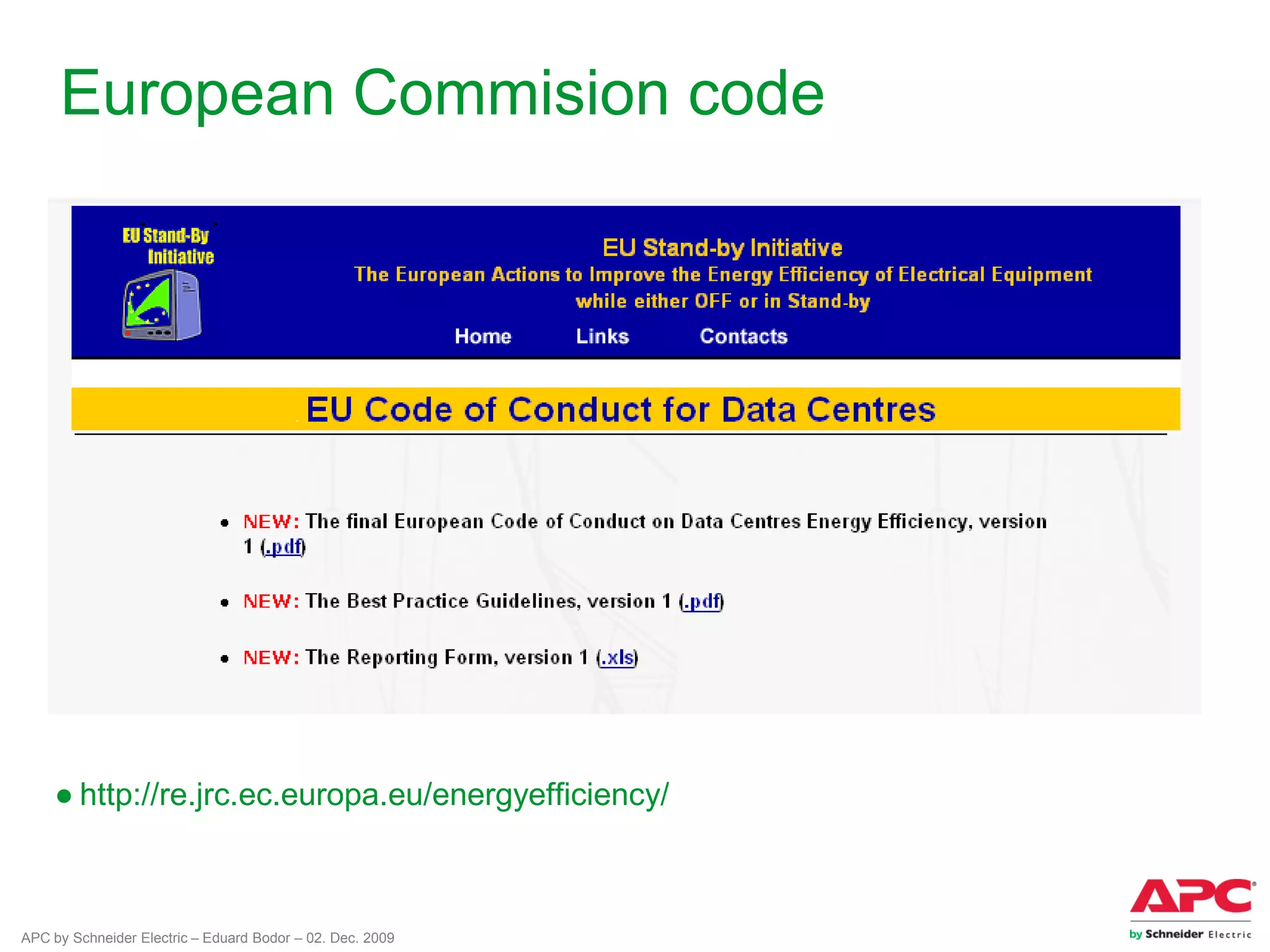
European Commision code
● http://re.jrc.ec.europa.eu/energyefficiency/
APC by Schneider Electric – Eduard Bodor – 02. Dec. 2009
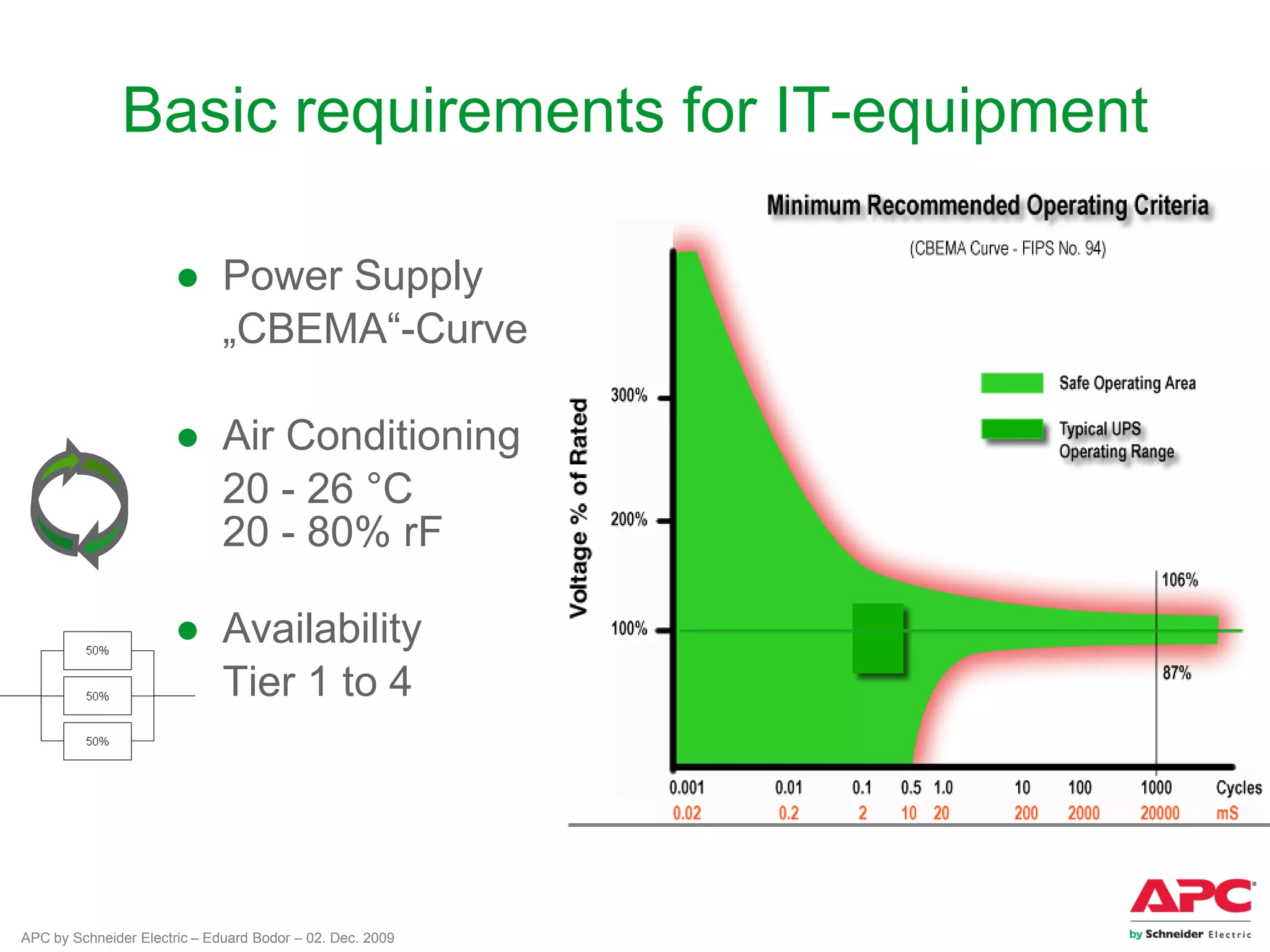
Basic requirements for IT-equipment
● Power Supply
„CBEMA“-Curve
● Air Conditioning
20 - 26 °C
20 - 80% rF
● Availability
Tier 1 to 4
APC by Schneider Electric – Eduard Bodor – 02. Dec. 2009
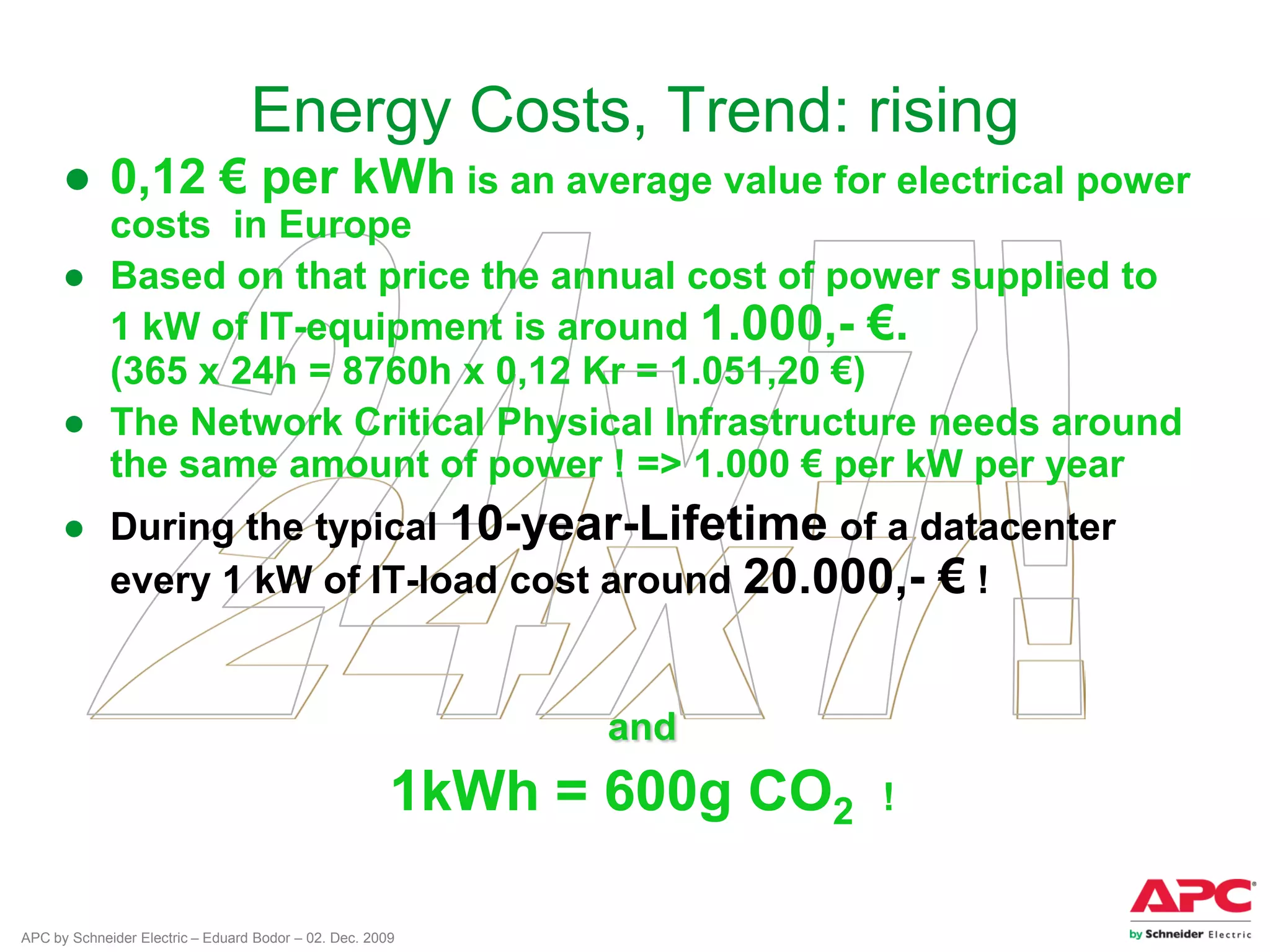
Energy Costs, Trend: rising
● 0,12 € per kWh is an average value for electrical power
costs in Europe
● Based on that price the annual cost of power supplied to
1 kW of IT-equipment is around 1.000,- €.
(365 x 24h = 8760h x 0,12 Kr = 1.051,20 €)
● The Network Critical Physical Infrastructure needs around
the same amount of power ! => 1.000 € per kW per year
● During the typical 10-year-Lifetime of a datacenter
every 1 kW of IT-load cost around 20.000,- € !
and
1kWh = 600g CO2 !
APC by Schneider Electric – Eduard Bodor – 02. Dec. 2009
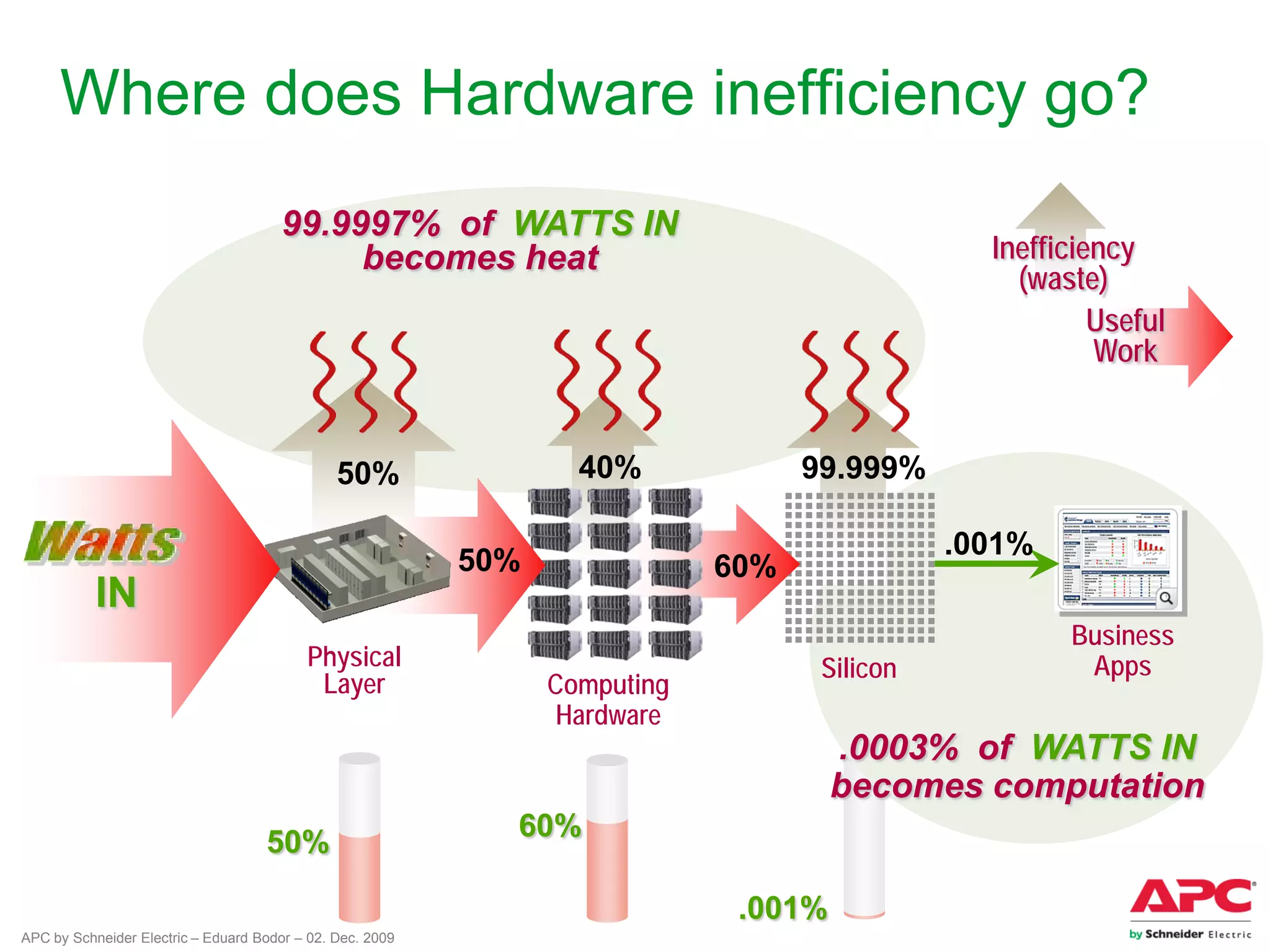
Where does Hardware inefficiency go?
.001%
99.9997% of WATTS IN
becomes heat
.0003% of WATTS IN
becomes computation
Silicon
Business
Apps
99.999%
.001%
Inefficiency
(waste)
Useful
Work
Computing
Hardware
60%
40%
60%
50%
Physical
Layer
50%
50%
IN
APC by Schneider Electric – Eduard Bodor – 02. Dec. 2009
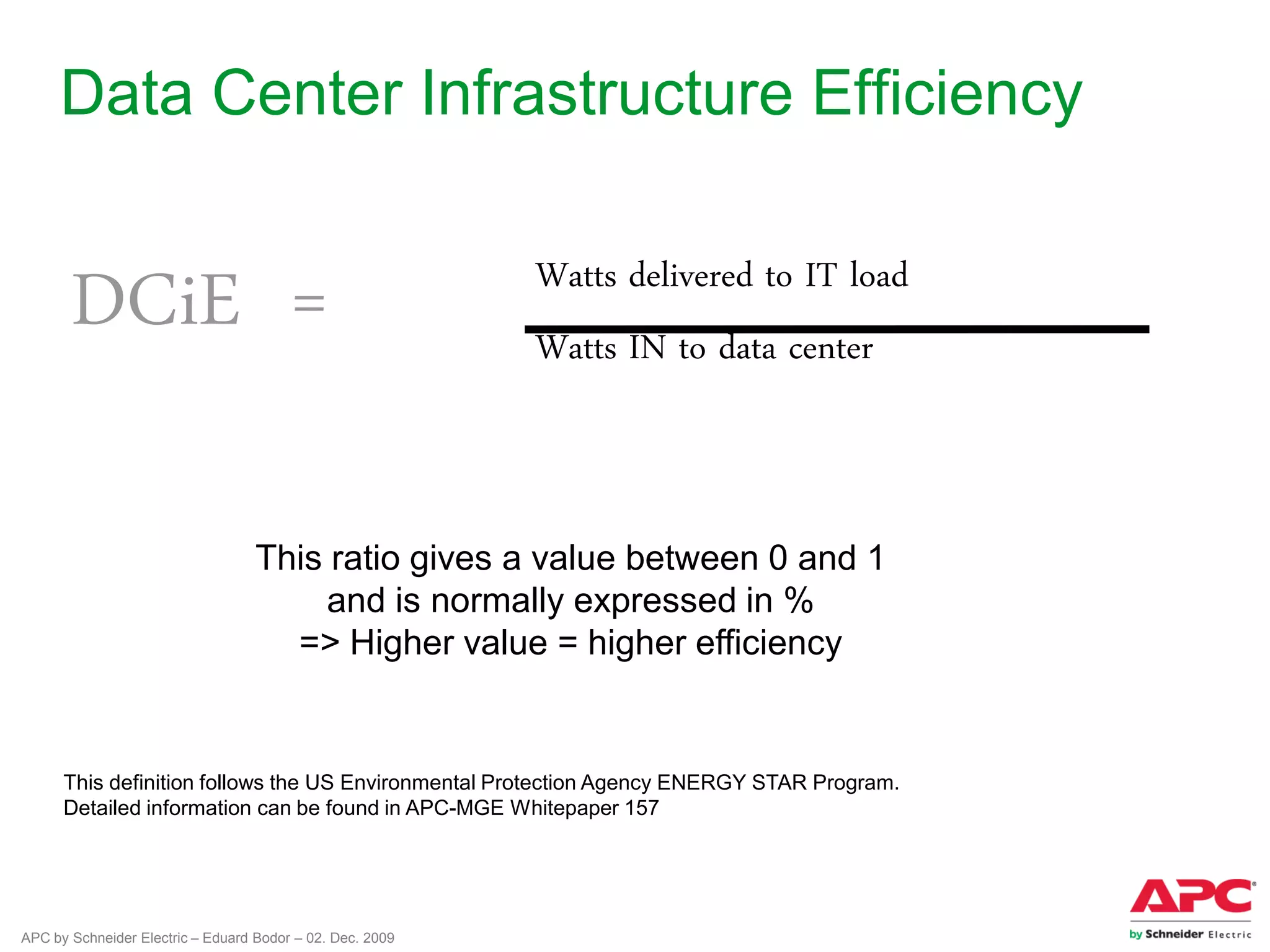
Data Center Infrastructure Efficiency
DCiE = Watts delivered to IT load
Watts IN to data center
This definition follows the US Environmental Protection Agency ENERGY STAR Program.
Detailed information can be found in APC-MGE Whitepaper 157
This ratio gives a value between 0 and 1
and is normally expressed in %
=> Higher value = higher efficiency
APC by Schneider Electric – Eduard Bodor – 02. Dec. 2009
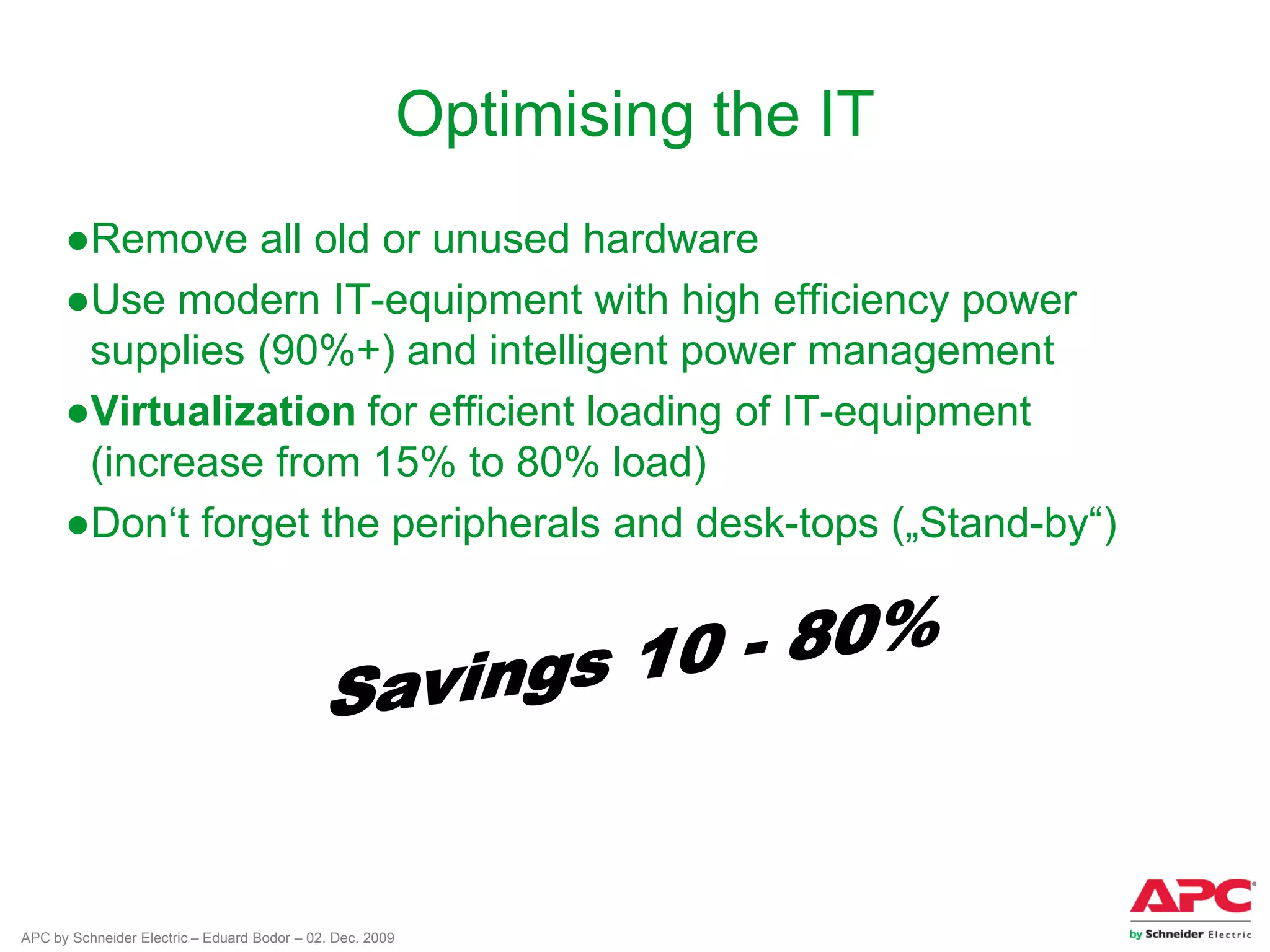
Optimising the IT
●Remove all old or unused hardware
●Use modern IT-equipment with high efficiency power
supplies (90%+) and intelligent power management
●Virtualization for efficient loading of IT-equipment
(increase from 15% to 80% load)
●Don‘t forget the peripherals and desk-tops („Stand-by“)
APC by Schneider Electric – Eduard Bodor – 02. Dec. 2009
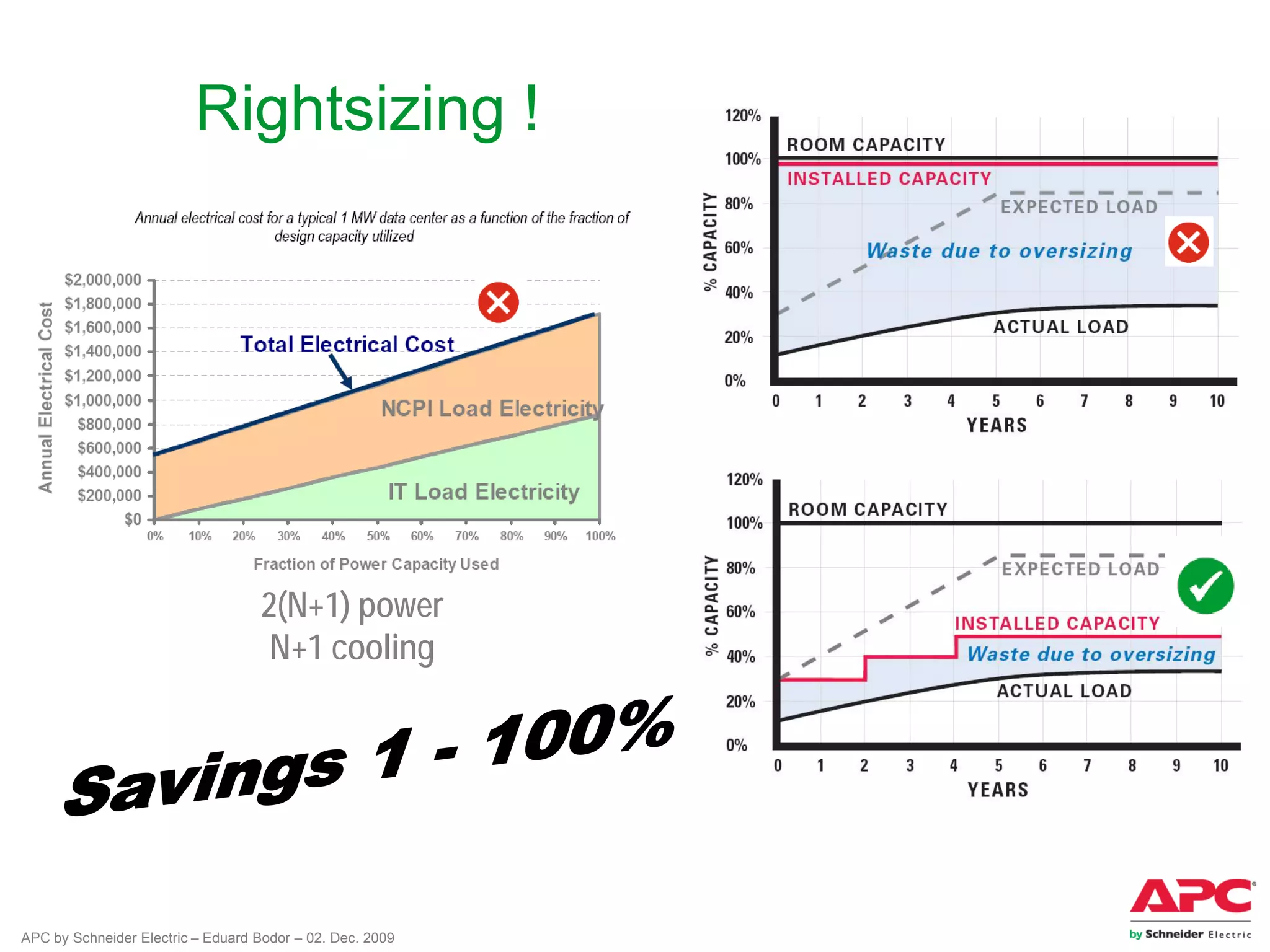
Rightsizing !
2(N+1) power
N+1 cooling
APC by Schneider Electric – Eduard Bodor – 02. Dec. 2009
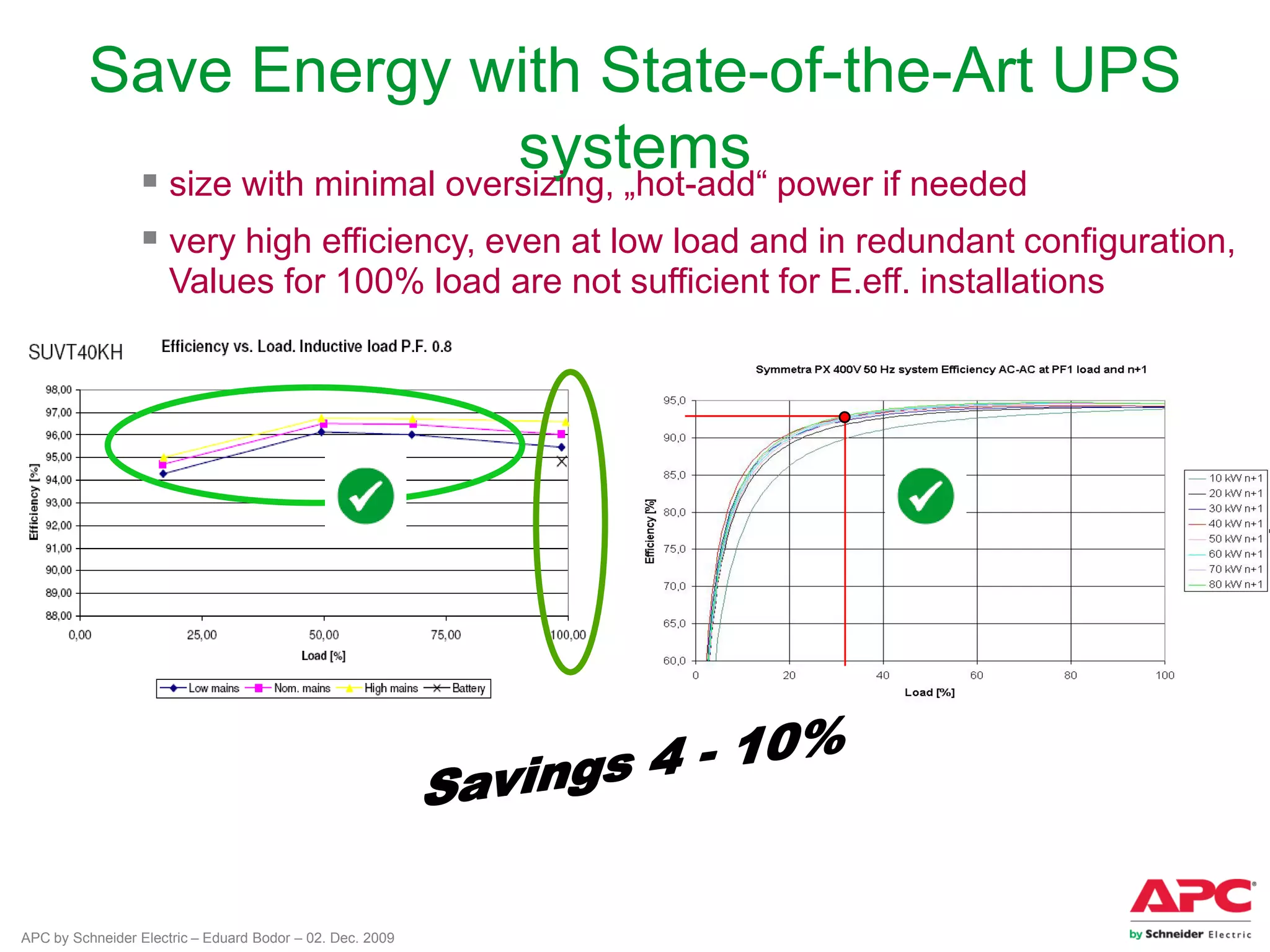
Save Energy with State-of-the-Art UPS
systems size with minimal oversizing, „hot-add“ power if needed
 very high efficiency, even at low load and in redundant configuration,
Values for 100% load are not sufficient for E.eff. installations
APC by Schneider Electric – Eduard Bodor – 02. Dec. 2009
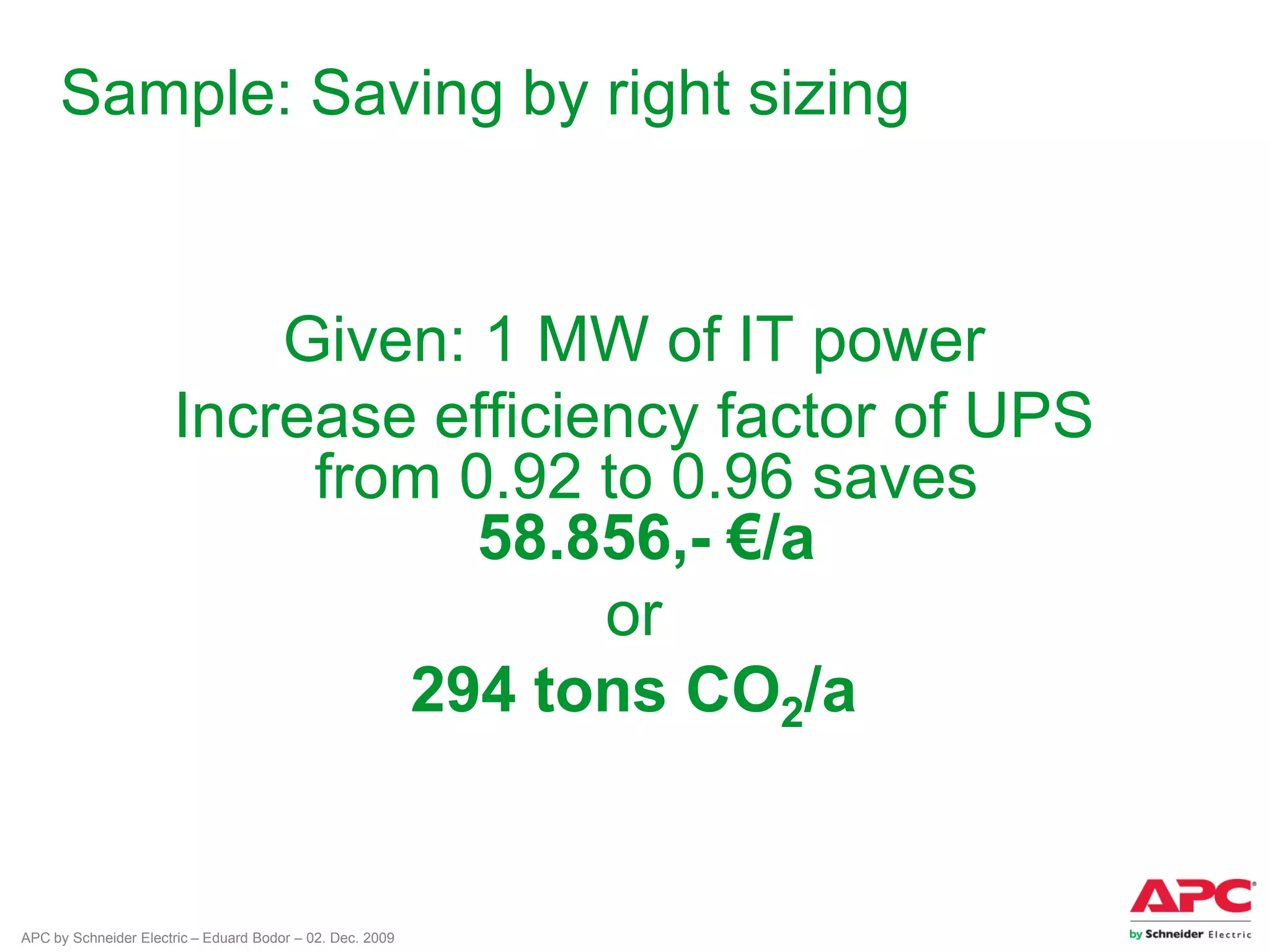
Sample: Saving by right sizing
Given: 1 MW of IT power
Increase efficiency factor of UPS
from 0.92 to 0.96 saves
58.856,- €/a
or
294 tons CO2/a
APC by Schneider Electric – Eduard Bodor – 02. Dec. 2009
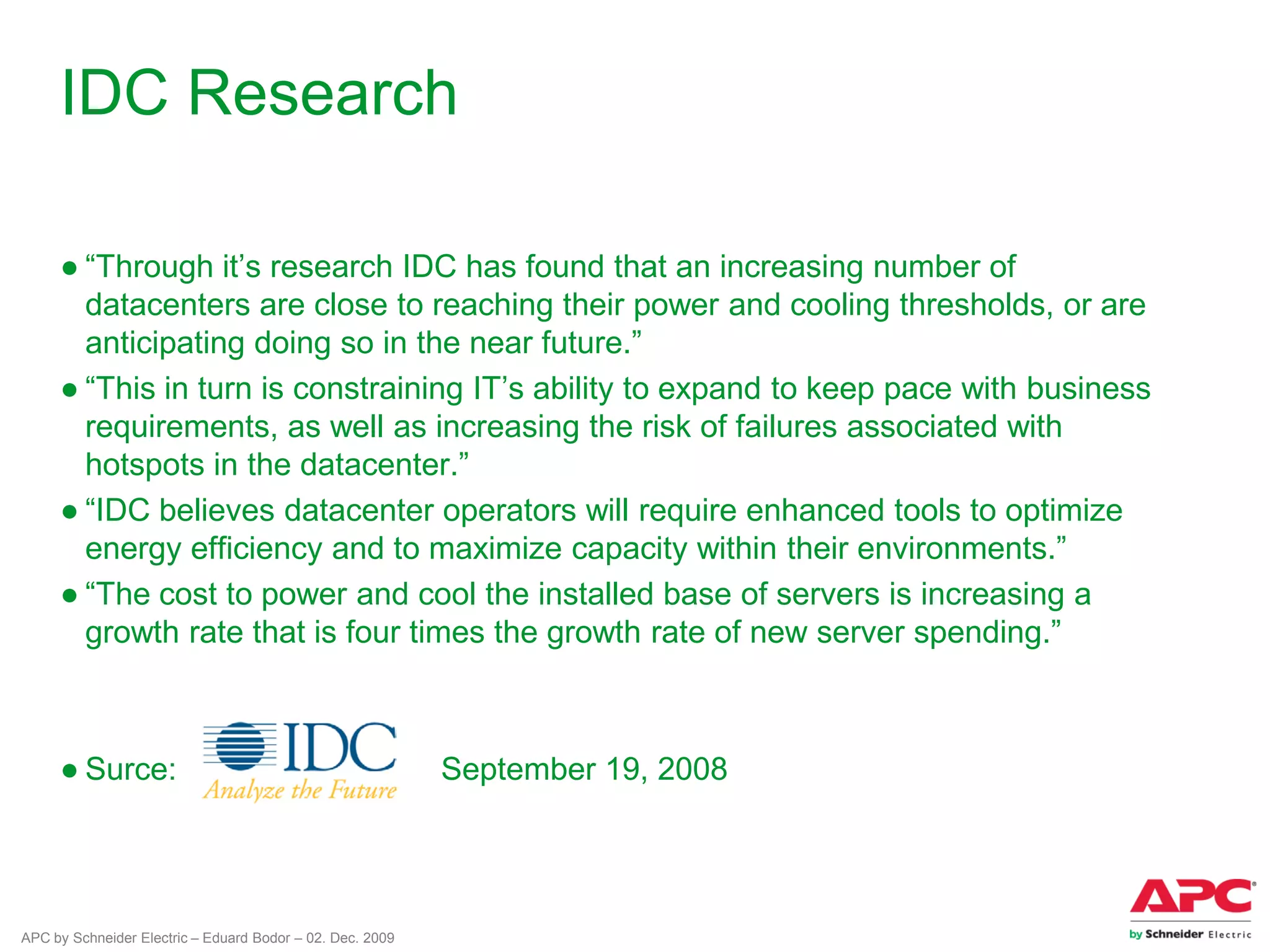
IDC Research
● “Through it’s research IDC has found that an increasing number of
datacenters are close to reaching their power and cooling thresholds, or are
anticipating doing so in the near future.”
● “This in turn is constraining IT’s ability to expand to keep pace with business
requirements, as well as increasing the risk of failures associated with
hotspots in the datacenter.”
● “IDC believes datacenter operators will require enhanced tools to optimize
energy efficiency and to maximize capacity within their environments.”
● “The cost to power and cool the installed base of servers is increasing a
growth rate that is four times the growth rate of new server spending.”
● Surce: September 19, 2008
APC by Schneider Electric – Eduard Bodor – 02. Dec. 2009
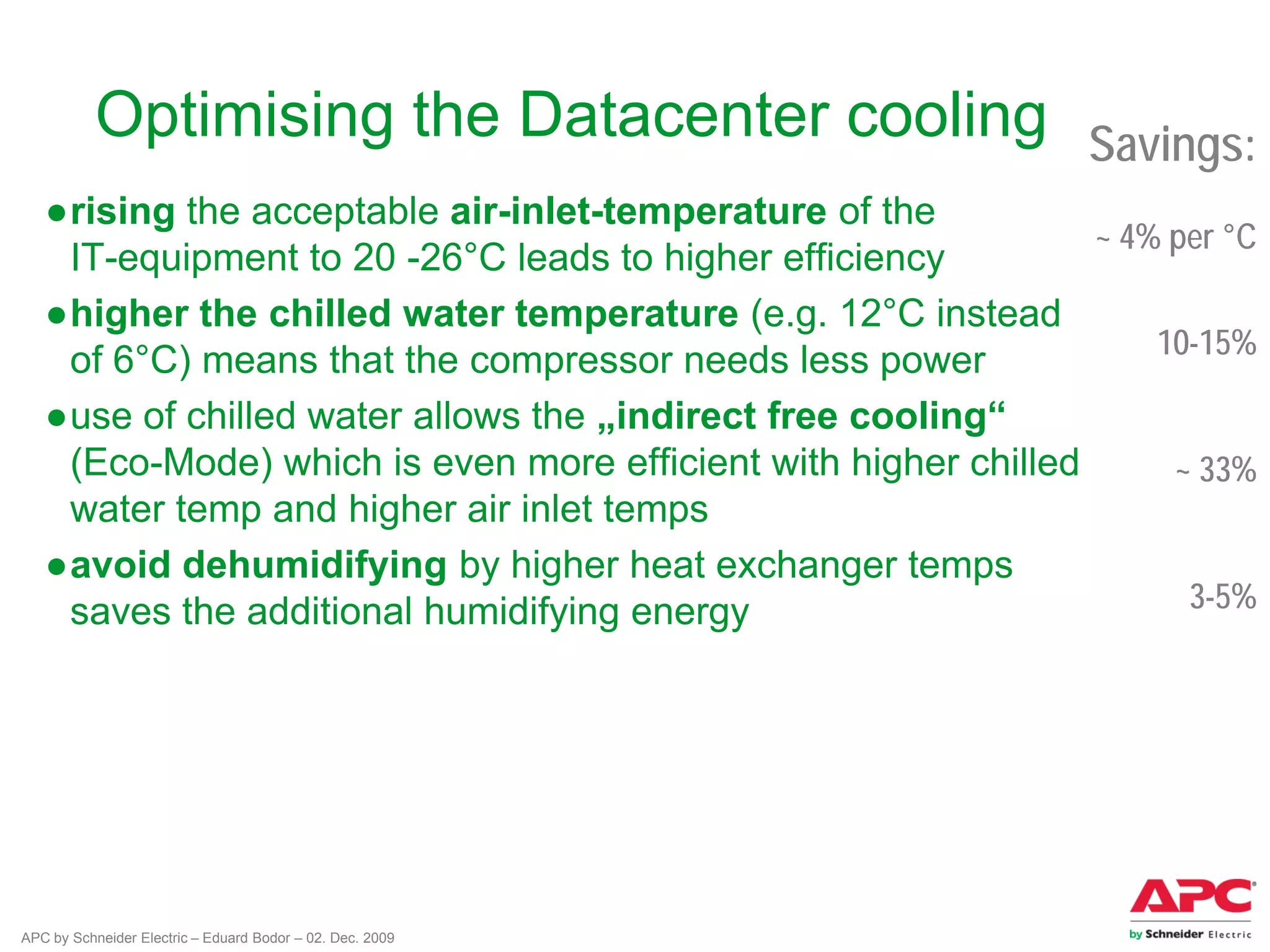
Optimising the Datacenter cooling
●rising the acceptable air-inlet-temperature of the
IT-equipment to 20 -26°C leads to higher efficiency
●higher the chilled water temperature (e.g. 12°C instead
of 6°C) means that the compressor needs less power
●use of chilled water allows the „indirect free cooling“
(Eco-Mode) which is even more efficient with higher chilled
water temp and higher air inlet temps
●avoid dehumidifying by higher heat exchanger temps
saves the additional humidifying energy
Savings:
~ 4% per °C
10-15%
~ 33%
3-5%
APC by Schneider Electric – Eduard Bodor – 02. Dec. 2009
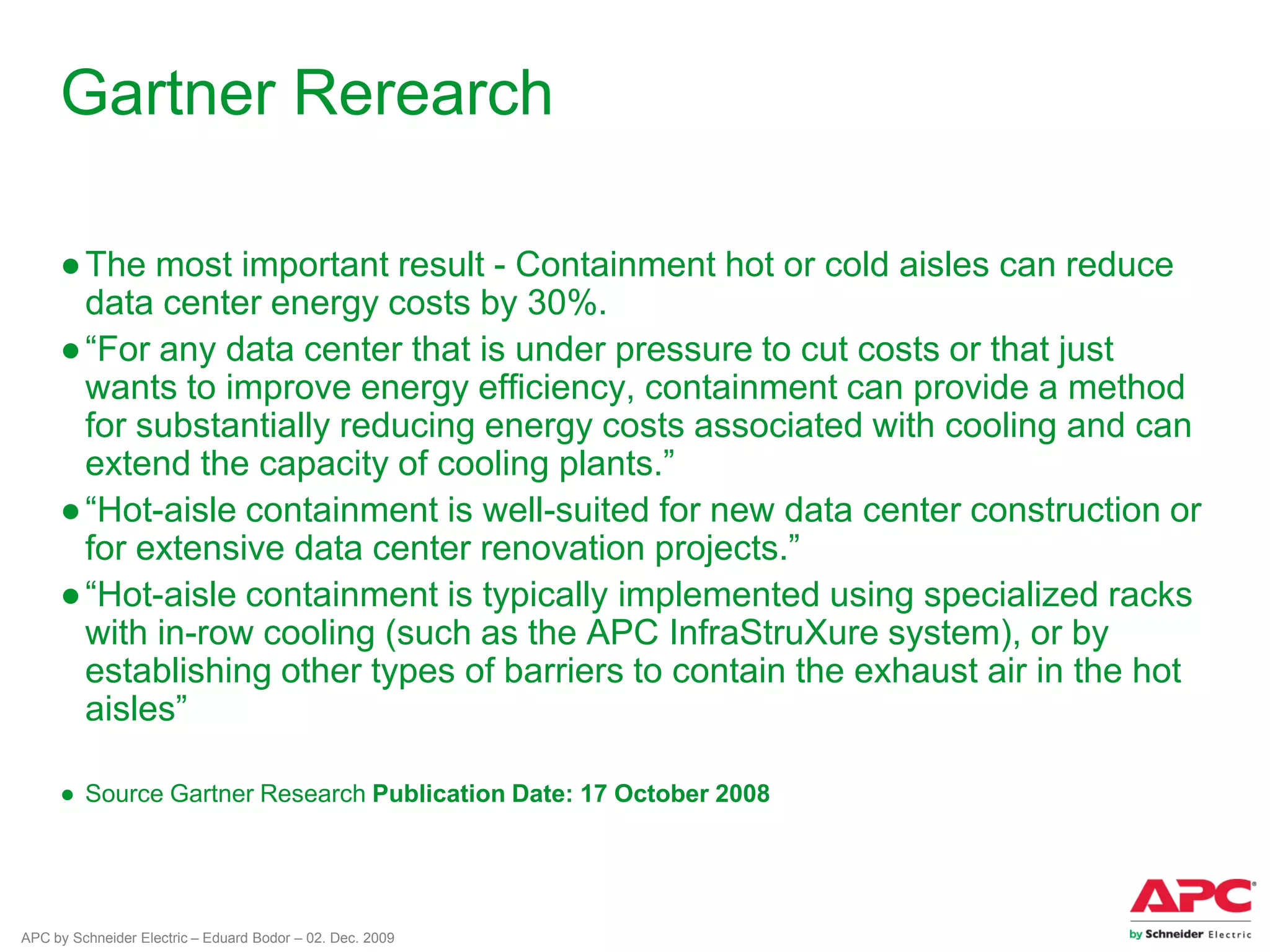
Gartner Rerearch
●The most important result - Containment hot or cold aisles can reduce
data center energy costs by 30%.
●“For any data center that is under pressure to cut costs or that just
wants to improve energy efficiency, containment can provide a method
for substantially reducing energy costs associated with cooling and can
extend the capacity of cooling plants.”
●“Hot-aisle containment is well-suited for new data center construction or
for extensive data center renovation projects.”
●“Hot-aisle containment is typically implemented using specialized racks
with in-row cooling (such as the APC InfraStruXure system), or by
establishing other types of barriers to contain the exhaust air in the hot
aisles”
● Source Gartner Research Publication Date: 17 October 2008
APC by Schneider Electric – Eduard Bodor – 02. Dec. 2009
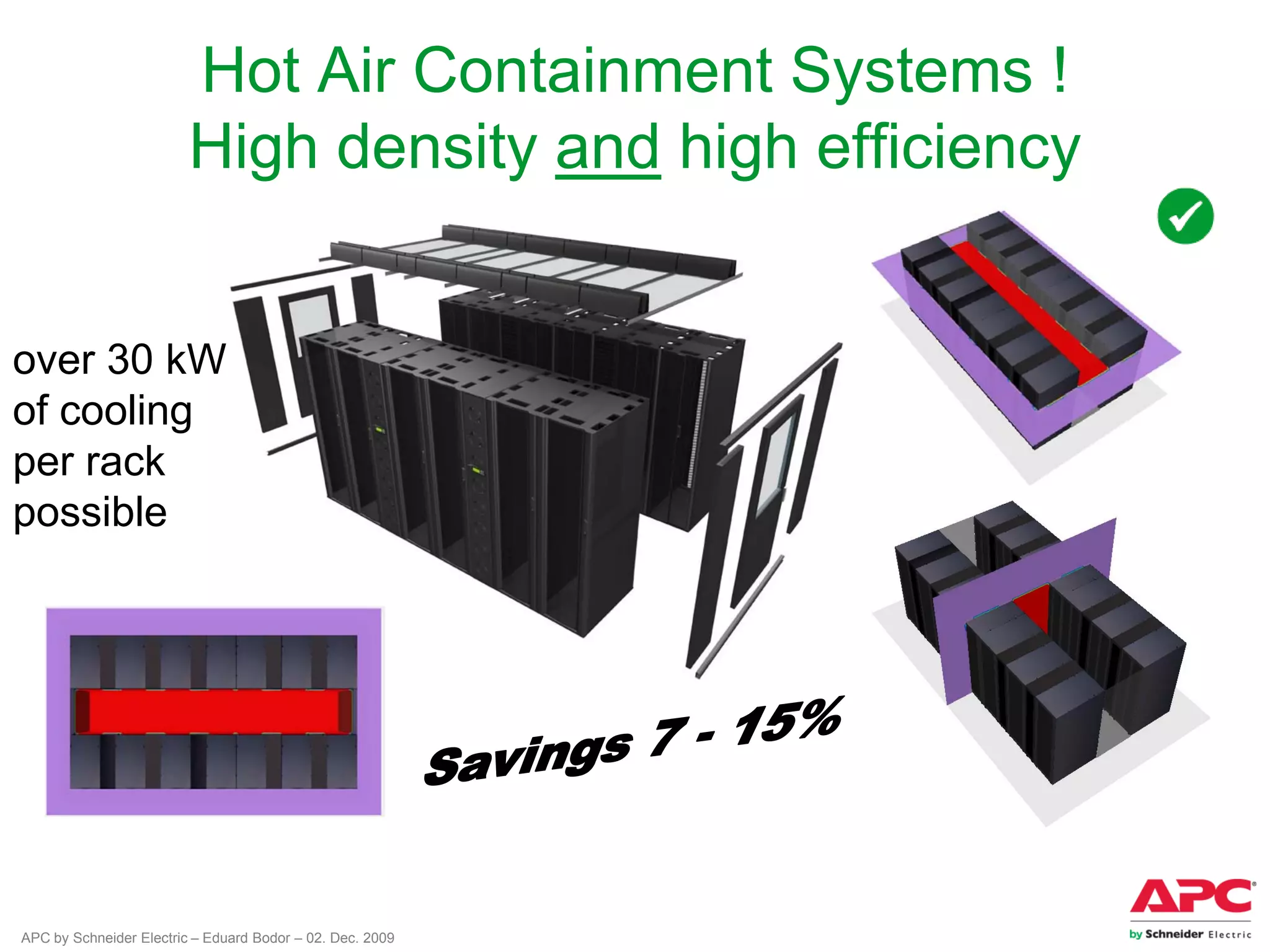
Hot Air Containment Systems !
High density and high efficiency
over 30 kW
of cooling
per rack
possible
APC by Schneider Electric – Eduard Bodor – 02. Dec. 2009
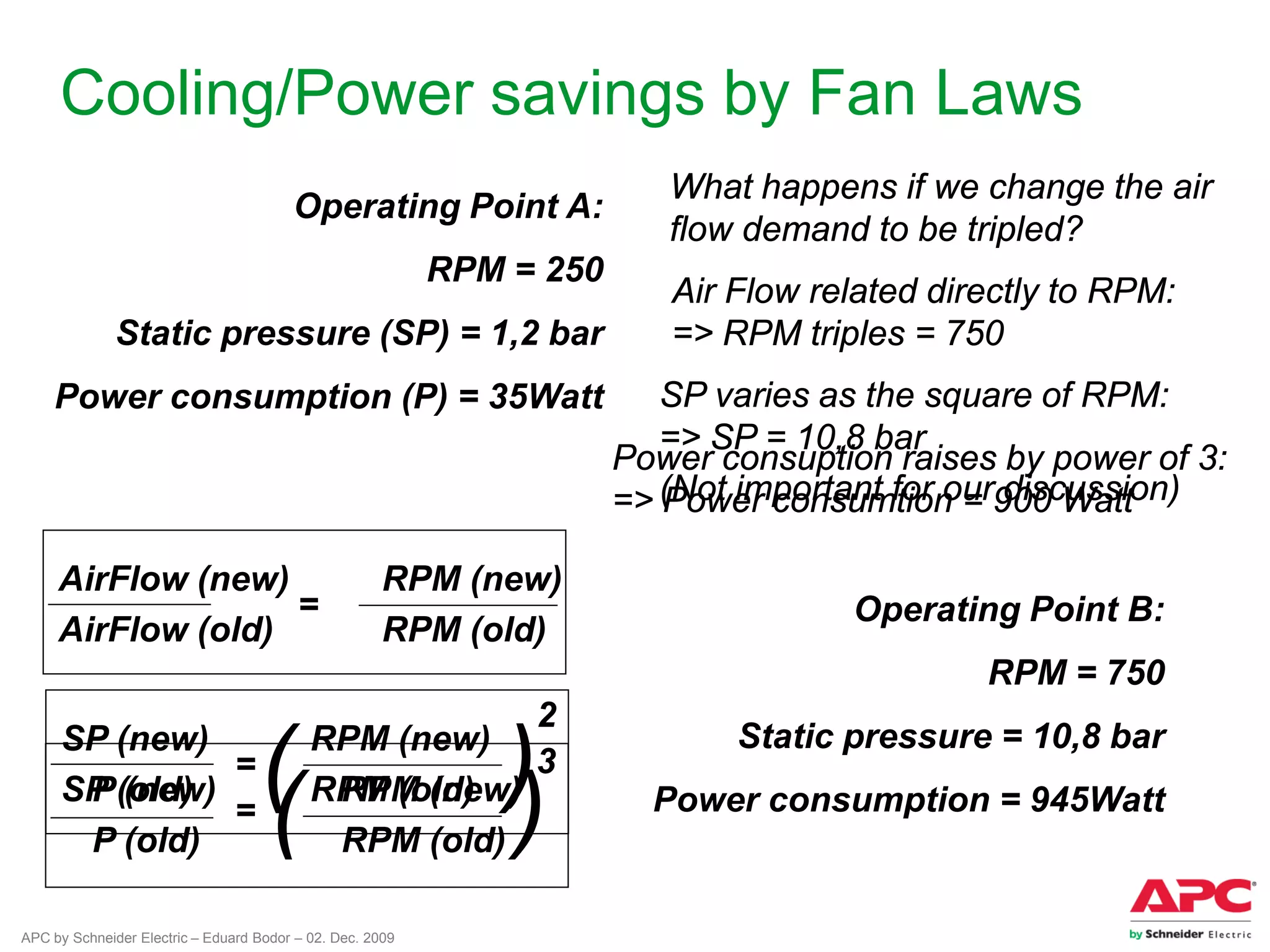
Cooling/Power savings by Fan Laws
Operating Point A:
RPM = 250
Static pressure (SP) = 1,2 bar
Power consumption (P) = 35Watt
What happens if we change the air
flow demand to be tripled?
Air Flow related directly to RPM:
=> RPM triples = 750
SP varies as the square of RPM:
=> SP = 10,8 bar
(Not important for our discussion)
Power consuption raises by power of 3:
=> Power consumtion = 900 Watt
Operating Point B:
RPM = 750
Static pressure = 10,8 bar
Power consumption = 945Watt
SP (new) RPM (new)
SP (old) RPM (old)
=( )
2
P (new) RPM (new)
P (old) RPM (old)
= ( )
3
AirFlow (new) RPM (new)
AirFlow (old) RPM (old)
=
APC by Schneider Electric – Eduard Bodor – 02. Dec. 2009
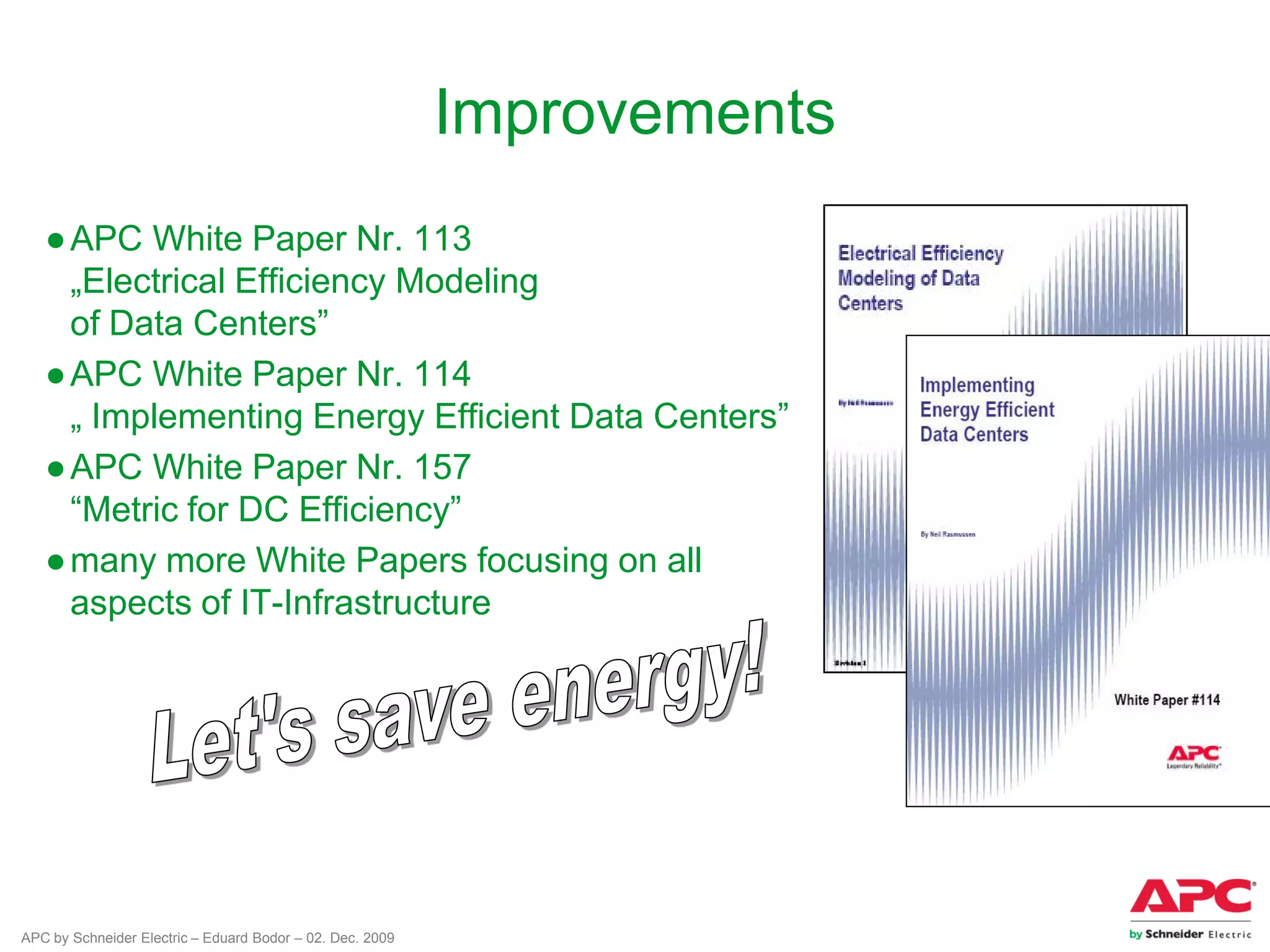
●APC White Paper Nr. 113
„Electrical Efficiency Modeling
of Data Centers”
●APC White Paper Nr. 114
„ Implementing Energy Efficient Data Centers”
●APC White Paper Nr. 157
“Metric for DC Efficiency”
●many more White Papers focusing on all
aspects of IT-Infrastructure
Improvements
APC by Schneider Electric – Eduard Bodor – 02. Dec. 2009
0
5
10
15
20
25
30
35
40
45
IT Power Cooling
Legacy
State-of-the Art
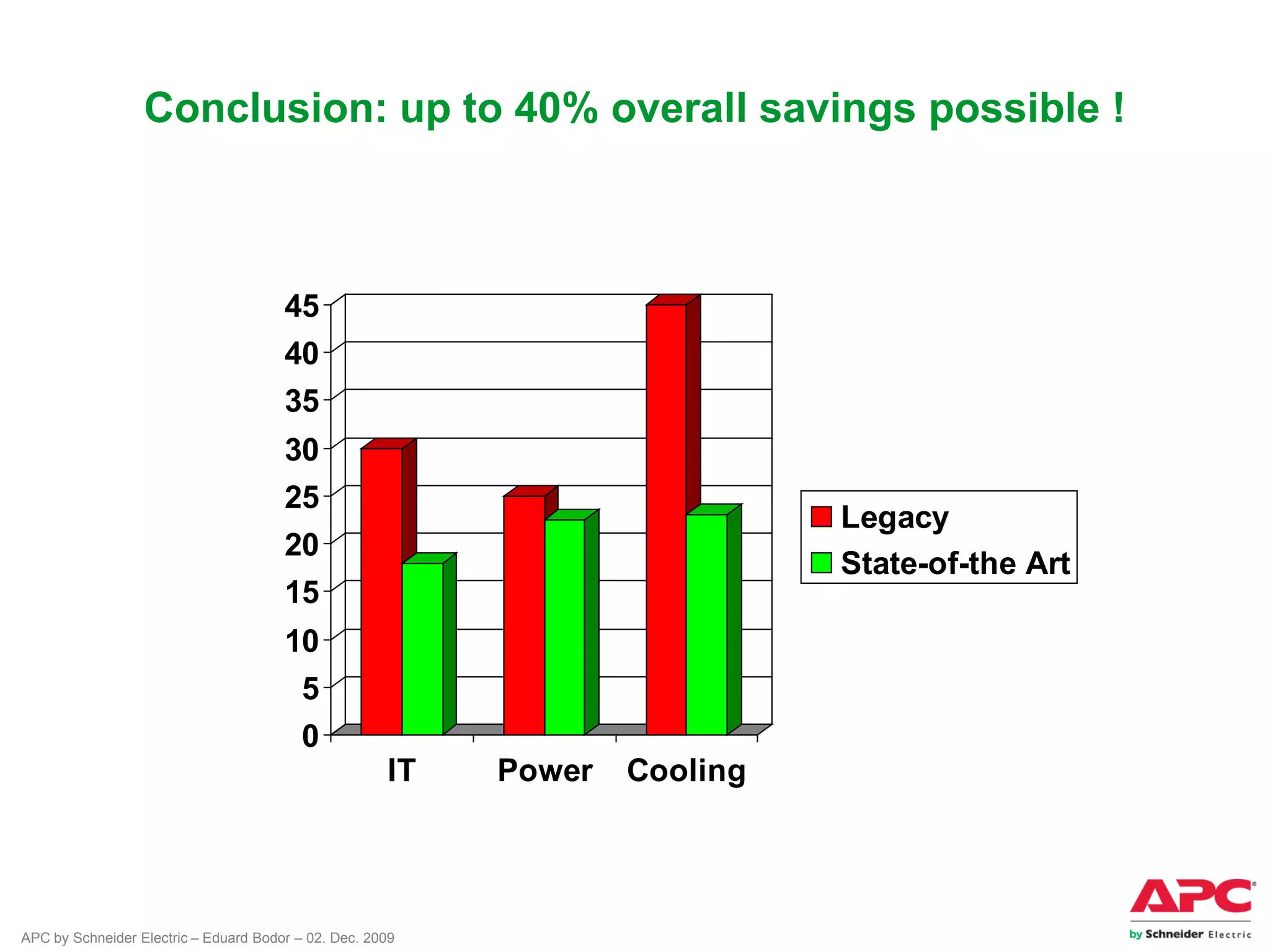
Conclusion: up to 40% overall savings possible !
All content in this presentation is protected – © 2008 American Power Conversion Corporation
Thank you very much
for your interest and attention !
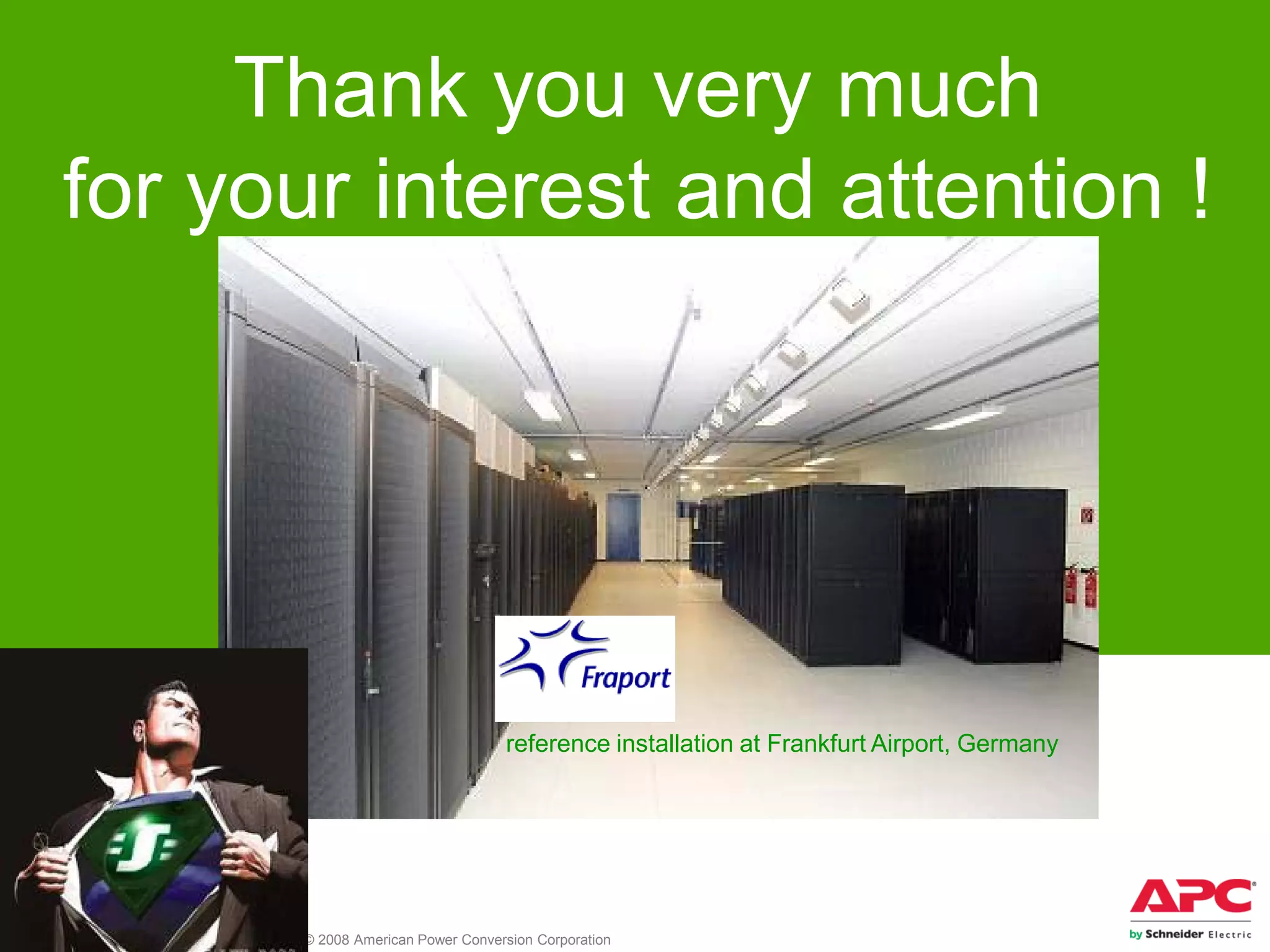
reference installation at Frankfurt Airport, Germany

2009-dec02_APC

  • 1.
    All content inthis presentation is protected – © 2008 American Power Conversion Corporation Eduard Bodor System Engineer APC Romania & Bulgaria The Efficient Enterprise
  • 2.
    APC by SchneiderElectric – Eduard Bodor – 02. Dec. 2009 AGENDA ●Introduction and some new regulations ●Some basics ●DCiE ●Optimizing ● Hardware ● UPS ● Cooling ●Summary
  • 3.
    APC by SchneiderElectric – Eduard Bodor – 02. Dec. 2009 European Commision code ● http://re.jrc.ec.europa.eu/energyefficiency/
  • 4.
    APC by SchneiderElectric – Eduard Bodor – 02. Dec. 2009 Basic requirements for IT-equipment ● Power Supply „CBEMA“-Curve ● Air Conditioning 20 - 26 °C 20 - 80% rF ● Availability Tier 1 to 4
  • 5.
    APC by SchneiderElectric – Eduard Bodor – 02. Dec. 2009 Energy Costs, Trend: rising ● 0,12 € per kWh is an average value for electrical power costs in Europe ● Based on that price the annual cost of power supplied to 1 kW of IT-equipment is around 1.000,- €. (365 x 24h = 8760h x 0,12 Kr = 1.051,20 €) ● The Network Critical Physical Infrastructure needs around the same amount of power ! => 1.000 € per kW per year ● During the typical 10-year-Lifetime of a datacenter every 1 kW of IT-load cost around 20.000,- € ! and 1kWh = 600g CO2 !
  • 6.
    APC by SchneiderElectric – Eduard Bodor – 02. Dec. 2009 Where does Hardware inefficiency go? .001% 99.9997% of WATTS IN becomes heat .0003% of WATTS IN becomes computation Silicon Business Apps 99.999% .001% Inefficiency (waste) Useful Work Computing Hardware 60% 40% 60% 50% Physical Layer 50% 50% IN
  • 7.
    APC by SchneiderElectric – Eduard Bodor – 02. Dec. 2009 Data Center Infrastructure Efficiency DCiE = Watts delivered to IT load Watts IN to data center This definition follows the US Environmental Protection Agency ENERGY STAR Program. Detailed information can be found in APC-MGE Whitepaper 157 This ratio gives a value between 0 and 1 and is normally expressed in % => Higher value = higher efficiency
  • 8.
    APC by SchneiderElectric – Eduard Bodor – 02. Dec. 2009 Optimising the IT ●Remove all old or unused hardware ●Use modern IT-equipment with high efficiency power supplies (90%+) and intelligent power management ●Virtualization for efficient loading of IT-equipment (increase from 15% to 80% load) ●Don‘t forget the peripherals and desk-tops („Stand-by“)
  • 9.
    APC by SchneiderElectric – Eduard Bodor – 02. Dec. 2009 Rightsizing ! 2(N+1) power N+1 cooling
  • 10.
    APC by SchneiderElectric – Eduard Bodor – 02. Dec. 2009 Save Energy with State-of-the-Art UPS systems size with minimal oversizing, „hot-add“ power if needed  very high efficiency, even at low load and in redundant configuration, Values for 100% load are not sufficient for E.eff. installations
  • 11.
    APC by SchneiderElectric – Eduard Bodor – 02. Dec. 2009 Sample: Saving by right sizing Given: 1 MW of IT power Increase efficiency factor of UPS from 0.92 to 0.96 saves 58.856,- €/a or 294 tons CO2/a
  • 12.
    APC by SchneiderElectric – Eduard Bodor – 02. Dec. 2009 IDC Research ● “Through it’s research IDC has found that an increasing number of datacenters are close to reaching their power and cooling thresholds, or are anticipating doing so in the near future.” ● “This in turn is constraining IT’s ability to expand to keep pace with business requirements, as well as increasing the risk of failures associated with hotspots in the datacenter.” ● “IDC believes datacenter operators will require enhanced tools to optimize energy efficiency and to maximize capacity within their environments.” ● “The cost to power and cool the installed base of servers is increasing a growth rate that is four times the growth rate of new server spending.” ● Surce: September 19, 2008
  • 13.
    APC by SchneiderElectric – Eduard Bodor – 02. Dec. 2009 Optimising the Datacenter cooling ●rising the acceptable air-inlet-temperature of the IT-equipment to 20 -26°C leads to higher efficiency ●higher the chilled water temperature (e.g. 12°C instead of 6°C) means that the compressor needs less power ●use of chilled water allows the „indirect free cooling“ (Eco-Mode) which is even more efficient with higher chilled water temp and higher air inlet temps ●avoid dehumidifying by higher heat exchanger temps saves the additional humidifying energy Savings: ~ 4% per °C 10-15% ~ 33% 3-5%
  • 14.
    APC by SchneiderElectric – Eduard Bodor – 02. Dec. 2009 Gartner Rerearch ●The most important result - Containment hot or cold aisles can reduce data center energy costs by 30%. ●“For any data center that is under pressure to cut costs or that just wants to improve energy efficiency, containment can provide a method for substantially reducing energy costs associated with cooling and can extend the capacity of cooling plants.” ●“Hot-aisle containment is well-suited for new data center construction or for extensive data center renovation projects.” ●“Hot-aisle containment is typically implemented using specialized racks with in-row cooling (such as the APC InfraStruXure system), or by establishing other types of barriers to contain the exhaust air in the hot aisles” ● Source Gartner Research Publication Date: 17 October 2008
  • 15.
    APC by SchneiderElectric – Eduard Bodor – 02. Dec. 2009 Hot Air Containment Systems ! High density and high efficiency over 30 kW of cooling per rack possible
  • 16.
    APC by SchneiderElectric – Eduard Bodor – 02. Dec. 2009 Cooling/Power savings by Fan Laws Operating Point A: RPM = 250 Static pressure (SP) = 1,2 bar Power consumption (P) = 35Watt What happens if we change the air flow demand to be tripled? Air Flow related directly to RPM: => RPM triples = 750 SP varies as the square of RPM: => SP = 10,8 bar (Not important for our discussion) Power consuption raises by power of 3: => Power consumtion = 900 Watt Operating Point B: RPM = 750 Static pressure = 10,8 bar Power consumption = 945Watt SP (new) RPM (new) SP (old) RPM (old) =( ) 2 P (new) RPM (new) P (old) RPM (old) = ( ) 3 AirFlow (new) RPM (new) AirFlow (old) RPM (old) =
  • 17.
    APC by SchneiderElectric – Eduard Bodor – 02. Dec. 2009 ●APC White Paper Nr. 113 „Electrical Efficiency Modeling of Data Centers” ●APC White Paper Nr. 114 „ Implementing Energy Efficient Data Centers” ●APC White Paper Nr. 157 “Metric for DC Efficiency” ●many more White Papers focusing on all aspects of IT-Infrastructure Improvements
  • 18.
    APC by SchneiderElectric – Eduard Bodor – 02. Dec. 2009 0 5 10 15 20 25 30 35 40 45 IT Power Cooling Legacy State-of-the Art Conclusion: up to 40% overall savings possible !
  • 19.
    All content inthis presentation is protected – © 2008 American Power Conversion Corporation Thank you very much for your interest and attention ! reference installation at Frankfurt Airport, Germany