The Top 3 North America Data
Center Trends for Cooling
• Graybar PowerSmart® is the best choice for facility
managers and building owners seeking lower costs and
increased productivity
• Our experience and vast resources enable us to provide
energy efficient and intelligent strategies and products
designed to deliver value for each of our customers.
Speaker

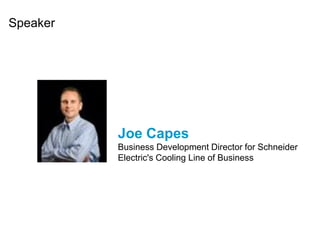
Joe Capes
Business Development Director for Schneider
Electric's Cooling Line of Business
Trending the North American
Application of Data Center Cooling

January 16, 2014

Joe Capes
Director – Cooling Business Development, Americas
joe.capes@schneider-electric.com
Agenda
 Top 3 NAM trends for Data Center Cooling today
 Economizers – types & options
 High Performance Cooling – Where is the industry heading?
 Selecting the right Cooling solution for your Data Center
 Summary

Schneider Electric

5
Agenda
 Top 3 NAM trends for Data Center Cooling today
 Economizers – types & options
 High Performance Cooling – Where is the industry heading?
 Selecting the right Cooling solution for your Data Center
 Summary

Schneider Electric

6
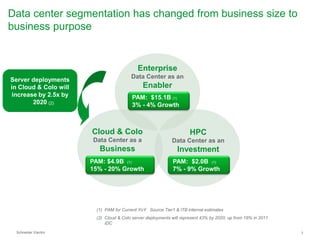
Data center segmentation has changed from business size to
business purpose

Enterprise
Server deployments
in Cloud & Colo will
increase by 2.5x by
2020 (2)

Data Center as an

Enabler
PAM: $15.1B (1)
3% - 4% Growth

Cloud & Colo

HPC

Data Center as a

Data Center as an

Business

Investment

PAM: $4.9B (1)
15% - 20% Growth

PAM: $2.0B (1)
7% - 9% Growth

(1) PAM for Current YoY. Source Tier1 & ITB internal estimates
(2) Cloud & Colo server deployments will represent 43% by 2020; up from 18% in 2011
IDC
Schneider Electric

7
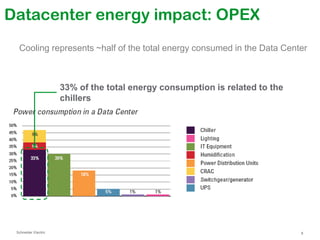
Datacenter energy impact: OPEX
Cooling represents ~half of the total energy consumed in the Data Center

33% of the total energy consumption is related to the
chillers

Schneider Electric

8
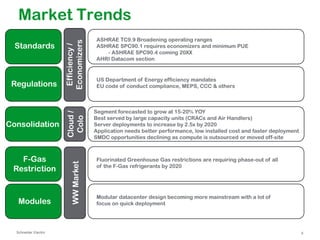
Consolidation

F-Gas
Restriction

Modules

Schneider Electric

WW Market

Regulations

Cloud /
Colo

Standards

Efficiency /
Economizers

Market Trends
ASHRAE TC9.9 Broadening operating ranges
ASHRAE SPC90.1 requires economizers and minimum PUE
- ASHRAE SPC90.4 coming 20XX
AHRI Datacom section

US Department of Energy efficiency mandates
EU code of conduct compliance, MEPS, CCC & others

Segment forecasted to grow at 15-20% YOY
Best served by large capacity units (CRACs and Air Handlers)
Server deployments to increase by 2.5x by 2020
Application needs better performance, low installed cost and faster deployment
SMDC opportunities declining as compute is outsourced or moved off-site

Fluorinated Greenhouse Gas restrictions are requiring phase-out of all
of the F-Gas refrigerants by 2020

Modular datacenter design becoming more mainstream with a lot of
focus on quick deployment

9
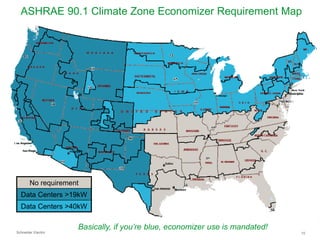
ASHRAE 90.1 Climate Zone Economizer Requirement Map

No requirement
Data Centers >19kW
Data Centers >40kW

Schneider Electric

Basically, if you’re blue, economizer use is mandated!
10
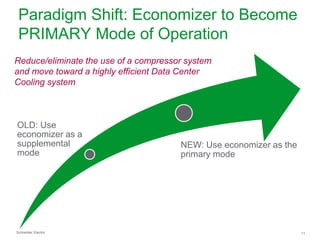
Paradigm Shift: Economizer to Become
PRIMARY Mode of Operation
Reduce/eliminate the use of a compressor system
and move toward a highly efficient Data Center
Cooling system

OLD: Use
economizer as a
supplemental
mode

Schneider Electric

NEW: Use economizer as the
primary mode

11
Agenda
 Top 3 NAM trends for Data Center Cooling today
 Economizers – types & options
 High Performance Cooling – Where is the industry heading?
 Selecting the right Cooling solution for your Data Center
 Summary

Schneider Electric

12
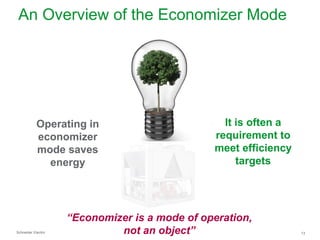
An Overview of the Economizer Mode

Operating in
economizer
mode saves
energy

Schneider Electric

It is often a
requirement to
meet efficiency
targets

“Economizer is a mode of operation,
not an object”

13
Purpose and Function of Economizer
Modes
The system must do less work to cool the data center

• Cooling
systems’
efficiency have
improved
For greater
efficiency gains

Schneider Electric

Bypass
compressor
• The
development
of economizer
modes

14
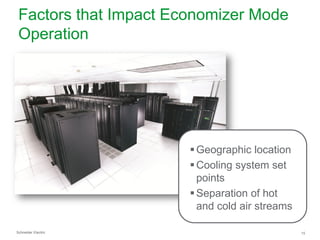
Factors that Impact Economizer Mode
Operation

 Geographic location
 Cooling system set
points
 Separation of hot
and cold air streams
Schneider Electric

15
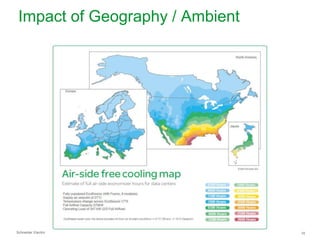
Impact of Geography / Ambient

Schneider Electric

16
Impact of Cooling Set Points
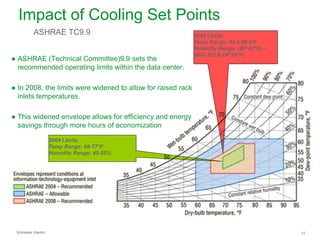
ASHRAE TC9.9
● ASHRAE (Technical Committee)9.9 sets the
recommended operating limits within the data center.

2008 Limits
Temp Range: 64.4-80.6°F
Humidity Range: (DP 42°F) –
(60% RH & DP 59°F)

● In 2008, the limits were widened to allow for raised rack
inlets temperatures.
● This widened envelope allows for efficiency and energy
savings through more hours of economization
2004 Limits
Temp Range: 68-77°F
Humidity Range: 40-55%

Schneider Electric

17
Impact of Containment
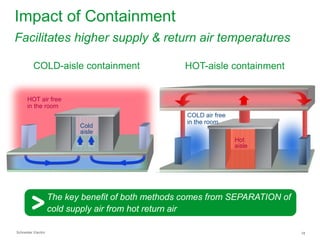
Facilitates higher supply & return air temperatures
COLD-aisle containment

HOT-aisle containment

HOT air free
in the room
Cold
aisle

COLD air free
in the room
Hot
aisle

The key benefit of both methods comes from SEPARATION of
cold supply air from hot return air
Schneider Electric

18
Comparison of Economizer Modes

15 Economizer Types or Modes!!

Let’s focus in on ‘the top 3’

Schneider Electric

19
Good - A/C bypass using Direct Fresh Air
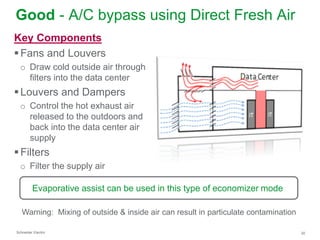
Key Components
 Fans and Louvers
o Draw cold outside air through
filters into the data center

 Louvers and Dampers
o Control the hot exhaust air
released to the outdoors and
back into the data center air
supply

 Filters
o Filter the supply air
Evaporative assist can be used in this type of economizer mode
Warning: Mixing of outside & inside air can result in particulate contamination
Schneider Electric

20
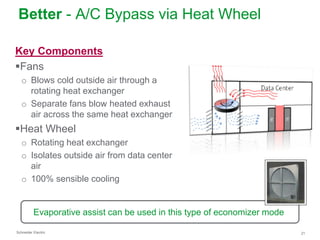
Better - A/C Bypass via Heat Wheel
Key Components
Fans
o Blows cold outside air through a
rotating heat exchanger
o Separate fans blow heated exhaust
air across the same heat exchanger

Heat Wheel
o Rotating heat exchanger
o Isolates outside air from data center
air
o 100% sensible cooling

Evaporative assist can be used in this type of economizer mode
Schneider Electric

21
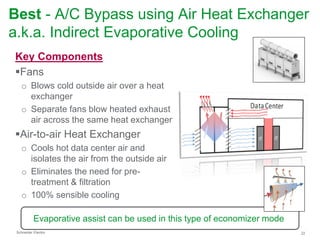
Best - A/C Bypass using Air Heat Exchanger
a.k.a. Indirect Evaporative Cooling
Key Components
Fans
o Blows cold outside air over a heat
exchanger
o Separate fans blow heated exhaust
air across the same heat exchanger

Air-to-air Heat Exchanger
o Cools hot data center air and
isolates the air from the outside air
o Eliminates the need for pretreatment & filtration
o 100% sensible cooling
Evaporative assist can be used in this type of economizer mode
Schneider Electric

22
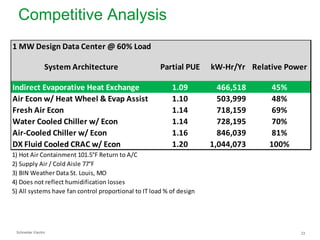
Competitive Analysis
1 MW Design Data Center @ 60% Load
System Architecture

Partial PUE

Indirect Evaporative Heat Exchange
Air Econ w/ Heat Wheel & Evap Assist
Fresh Air Econ
Water Cooled Chiller w/ Econ
Air-Cooled Chiller w/ Econ
DX Fluid Cooled CRAC w/ Econ

1.09
1.10
1.14
1.14
1.16
1.20

kW-Hr/Yr Relative Power
466,518
503,999
718,159
728,195
846,039
1,044,073

45%
48%
69%
70%
81%
100%

1) Hot Air Containment 101.5°F Return to A/C
2) Supply Air / Cold Aisle 77°F
3) BIN Weather Data St. Louis, MO
4) Does not reflect humidification losses
5) All systems have fan control proportional to IT load % of design

Schneider Electric

23
Conclusion

In the past, cooling system
economizer modes have not been
seriously considered in most data
centers.
Many economizer options exist with
indirect air heat exchange (w/
evaporative assist) showing best
overall performance and return on
investment.

Schneider Electric

24
Agenda
 Top 3 NAM trends for Data Center Cooling today
 Economizers – types & options
 High Performance Cooling – Where is the industry heading?
 Selecting the right Cooling solution for your Data Center
 Summary

Schneider Electric

25
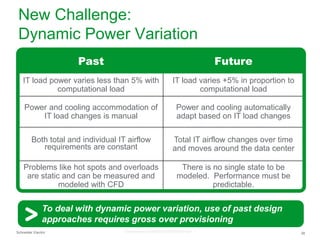
New Challenge:
Dynamic Power Variation
Past

Future

IT load power varies less than 5% with
computational load

IT load varies +5% in proportion to
computational load

Power and cooling accommodation of
IT load changes is manual

Power and cooling automatically
adapt based on IT load changes

Both total and individual IT airflow
requirements are constant

Total IT airflow changes over time
and moves around the data center

Problems like hot spots and overloads
are static and can be measured and
modeled with CFD

There is no single state to be
modeled. Performance must be
predictable.

To deal with dynamic power variation, use of past design
approaches requires gross over provisioning
Schneider Electric

Foundational BUSINESS OVERVIEW Rev 1

26
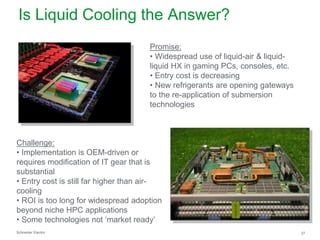
Is Liquid Cooling the Answer?
Promise:
• Widespread use of liquid-air & liquidliquid HX in gaming PCs, consoles, etc.
• Entry cost is decreasing
• New refrigerants are opening gateways
to the re-application of submersion
technologies

Challenge:
• Implementation is OEM-driven or
requires modification of IT gear that is
substantial
• Entry cost is still far higher than aircooling
• ROI is too long for widespread adoption
beyond niche HPC applications
• Some technologies not ‘market ready’
Schneider Electric

27
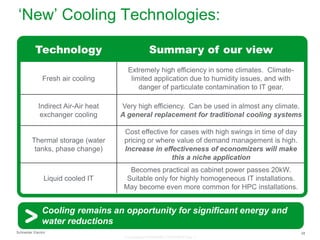
‘New’ Cooling Technologies:
Technology

Summary of our view

Fresh air cooling

Extremely high efficiency in some climates. Climatelimited application due to humidity issues, and with
danger of particulate contamination to IT gear.

Indirect Air-Air heat
exchanger cooling

Very high efficiency. Can be used in almost any climate.
A general replacement for traditional cooling systems

Thermal storage (water
tanks, phase change)

Cost effective for cases with high swings in time of day
pricing or where value of demand management is high.
Increase in effectiveness of economizers will make
this a niche application

Liquid cooled IT

Becomes practical as cabinet power passes 20kW.
Suitable only for highly homogeneous IT installations.
May become even more common for HPC installations.

Cooling remains an opportunity for significant energy and
water reductions
Schneider Electric

28

Foundational BUSINESS OVERVIEW Rev 1
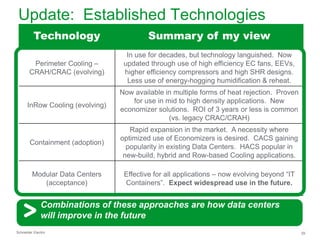
Update: Established Technologies
Technology

Summary of my view

Perimeter Cooling –
CRAH/CRAC (evolving)

In use for decades, but technology languished. Now
updated through use of high efficiency EC fans, EEVs,
higher efficiency compressors and high SHR designs.
Less use of energy-hogging humidification & reheat.

InRow Cooling (evolving)

Now available in multiple forms of heat rejection. Proven
for use in mid to high density applications. New
economizer solutions. ROI of 3 years or less is common
(vs. legacy CRAC/CRAH)

Containment (adoption)

Rapid expansion in the market. A necessity where
optimized use of Economizers is desired. CACS gaining
popularity in existing Data Centers. HACS popular in
new-build, hybrid and Row-based Cooling applications.

Modular Data Centers
(acceptance)

Effective for all applications – now evolving beyond “IT
Containers”. Expect widespread use in the future.

Combinations of these approaches are how data centers
will improve in the future
Schneider Electric

29
Agenda
 Top 3 NAM trends for Data Center Cooling today
 Economizers – types & options
 High Performance Cooling – Where is the industry heading?
 Selecting the right Cooling solution for your Data Center
 Summary

Schneider Electric

30
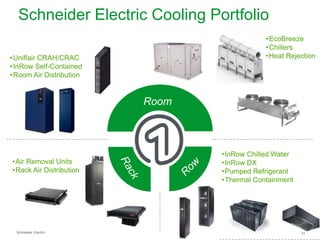
Schneider Electric Cooling Portfolio
•EcoBreeze
•Chillers
•Heat Rejection

•Uniflair CRAH/CRAC
•InRow Self-Contained
•Room Air Distribution

Room

•Air Removal Units
•Rack Air Distribution

Schneider Electric

•InRow Chilled Water
•InRow DX
•Pumped Refrigerant
•Thermal Containment

31
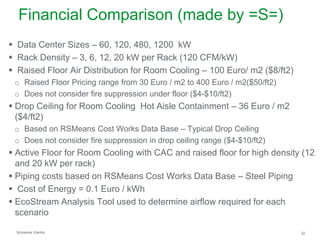
Financial Comparison (made by =S=)
 Data Center Sizes – 60, 120, 480, 1200 kW
 Rack Density – 3, 6, 12, 20 kW per Rack (120 CFM/kW)
 Raised Floor Air Distribution for Room Cooling – 100 Euro/ m2 ($8/ft2)
o Raised Floor Pricing range from 30 Euro / m2 to 400 Euro / m2($50/ft2)
o Does not consider fire suppression under floor ($4-$10/ft2)

 Drop Ceiling for Room Cooling Hot Aisle Containment – 36 Euro / m2
($4/ft2)
o Based on RSMeans Cost Works Data Base – Typical Drop Ceiling
o Does not consider fire suppression in drop ceiling range ($4-$10/ft2)

 Active Floor for Room Cooling with CAC and raised floor for high density (12
and 20 kW per rack)
 Piping costs based on RSMeans Cost Works Data Base – Steel Piping
 Cost of Energy = 0.1 Euro / kWh
 EcoStream Analysis Tool used to determine airflow required for each
scenario
Schneider Electric

32
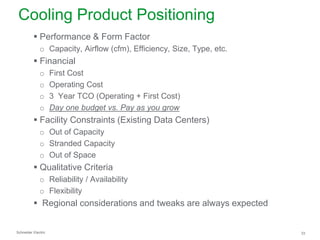
Cooling Product Positioning
 Performance & Form Factor
o Capacity, Airflow (cfm), Efficiency, Size, Type, etc.

 Financial
o
o
o
o

First Cost
Operating Cost
3 Year TCO (Operating + First Cost)
Day one budget vs. Pay as you grow

 Facility Constraints (Existing Data Centers)
o Out of Capacity
o Stranded Capacity
o Out of Space

 Qualitative Criteria
o Reliability / Availability
o Flexibility

 Regional considerations and tweaks are always expected

Schneider Electric

33
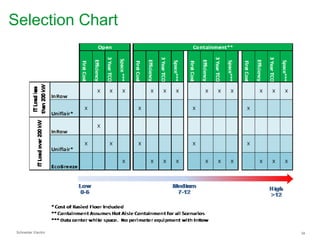
Selection Chart

Schneider Electric

34
Agenda
 Top 3 NAM trends for Data Center Cooling today
 Economizers – types & options
 High Performance Cooling – Where is the industry heading?
 Selecting the right Cooling solution for your Data Center
 Summary

Schneider Electric

35
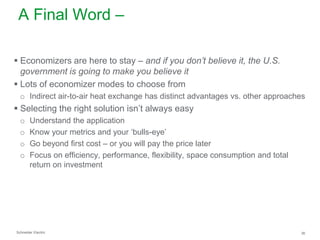
A Final Word –
 Economizers are here to stay – and if you don’t believe it, the U.S.
government is going to make you believe it
 Lots of economizer modes to choose from
o Indirect air-to-air heat exchange has distinct advantages vs. other approaches

 Selecting the right solution isn’t always easy
o
o
o
o

Understand the application
Know your metrics and your ‘bulls-eye’
Go beyond first cost – or you will pay the price later
Focus on efficiency, performance, flexibility, space consumption and total
return on investment

Schneider Electric

36
Resources List

The Different Types of Air Conditioning Equipment for IT Environments
Data Center Science Center White Paper 59

Hot-Aisle vs. Cold-Aisle Containment for Data Centers
Data Center Science Center White Paper 135

Ultra High-Efficiency Cooling Modules for Large Data Centers
Data Center Science Center White Paper 136

Schneider Electric

37
Questions?
To watch this presentation again and
view more G2 talks on-demand visit
graybar.com/G2archive

Slides: The Top 3 North America Data Center Trends for Cooling

  • 1.
    The Top 3North America Data Center Trends for Cooling
  • 2.
    • Graybar PowerSmart®is the best choice for facility managers and building owners seeking lower costs and increased productivity • Our experience and vast resources enable us to provide energy efficient and intelligent strategies and products designed to deliver value for each of our customers.
  • 3.
    Speaker Joe Capes Business DevelopmentDirector for Schneider Electric's Cooling Line of Business
  • 4.
    Trending the NorthAmerican Application of Data Center Cooling January 16, 2014 Joe Capes Director – Cooling Business Development, Americas joe.capes@schneider-electric.com
  • 5.
    Agenda  Top 3NAM trends for Data Center Cooling today  Economizers – types & options  High Performance Cooling – Where is the industry heading?  Selecting the right Cooling solution for your Data Center  Summary Schneider Electric 5
  • 6.
    Agenda  Top 3NAM trends for Data Center Cooling today  Economizers – types & options  High Performance Cooling – Where is the industry heading?  Selecting the right Cooling solution for your Data Center  Summary Schneider Electric 6
  • 7.
    Data center segmentationhas changed from business size to business purpose Enterprise Server deployments in Cloud & Colo will increase by 2.5x by 2020 (2) Data Center as an Enabler PAM: $15.1B (1) 3% - 4% Growth Cloud & Colo HPC Data Center as a Data Center as an Business Investment PAM: $4.9B (1) 15% - 20% Growth PAM: $2.0B (1) 7% - 9% Growth (1) PAM for Current YoY. Source Tier1 & ITB internal estimates (2) Cloud & Colo server deployments will represent 43% by 2020; up from 18% in 2011 IDC Schneider Electric 7
  • 8.
    Datacenter energy impact:OPEX Cooling represents ~half of the total energy consumed in the Data Center 33% of the total energy consumption is related to the chillers Schneider Electric 8
  • 9.
    Consolidation F-Gas Restriction Modules Schneider Electric WW Market Regulations Cloud/ Colo Standards Efficiency / Economizers Market Trends ASHRAE TC9.9 Broadening operating ranges ASHRAE SPC90.1 requires economizers and minimum PUE - ASHRAE SPC90.4 coming 20XX AHRI Datacom section US Department of Energy efficiency mandates EU code of conduct compliance, MEPS, CCC & others Segment forecasted to grow at 15-20% YOY Best served by large capacity units (CRACs and Air Handlers) Server deployments to increase by 2.5x by 2020 Application needs better performance, low installed cost and faster deployment SMDC opportunities declining as compute is outsourced or moved off-site Fluorinated Greenhouse Gas restrictions are requiring phase-out of all of the F-Gas refrigerants by 2020 Modular datacenter design becoming more mainstream with a lot of focus on quick deployment 9
  • 10.
    ASHRAE 90.1 ClimateZone Economizer Requirement Map No requirement Data Centers >19kW Data Centers >40kW Schneider Electric Basically, if you’re blue, economizer use is mandated! 10
  • 11.
    Paradigm Shift: Economizerto Become PRIMARY Mode of Operation Reduce/eliminate the use of a compressor system and move toward a highly efficient Data Center Cooling system OLD: Use economizer as a supplemental mode Schneider Electric NEW: Use economizer as the primary mode 11
  • 12.
    Agenda  Top 3NAM trends for Data Center Cooling today  Economizers – types & options  High Performance Cooling – Where is the industry heading?  Selecting the right Cooling solution for your Data Center  Summary Schneider Electric 12
  • 13.
    An Overview ofthe Economizer Mode Operating in economizer mode saves energy Schneider Electric It is often a requirement to meet efficiency targets “Economizer is a mode of operation, not an object” 13
  • 14.
    Purpose and Functionof Economizer Modes The system must do less work to cool the data center • Cooling systems’ efficiency have improved For greater efficiency gains Schneider Electric Bypass compressor • The development of economizer modes 14
  • 15.
    Factors that ImpactEconomizer Mode Operation  Geographic location  Cooling system set points  Separation of hot and cold air streams Schneider Electric 15
  • 16.
    Impact of Geography/ Ambient Schneider Electric 16
  • 17.
    Impact of CoolingSet Points ASHRAE TC9.9 ● ASHRAE (Technical Committee)9.9 sets the recommended operating limits within the data center. 2008 Limits Temp Range: 64.4-80.6°F Humidity Range: (DP 42°F) – (60% RH & DP 59°F) ● In 2008, the limits were widened to allow for raised rack inlets temperatures. ● This widened envelope allows for efficiency and energy savings through more hours of economization 2004 Limits Temp Range: 68-77°F Humidity Range: 40-55% Schneider Electric 17
  • 18.
    Impact of Containment Facilitateshigher supply & return air temperatures COLD-aisle containment HOT-aisle containment HOT air free in the room Cold aisle COLD air free in the room Hot aisle The key benefit of both methods comes from SEPARATION of cold supply air from hot return air Schneider Electric 18
  • 19.
    Comparison of EconomizerModes 15 Economizer Types or Modes!! Let’s focus in on ‘the top 3’ Schneider Electric 19
  • 20.
    Good - A/Cbypass using Direct Fresh Air Key Components  Fans and Louvers o Draw cold outside air through filters into the data center  Louvers and Dampers o Control the hot exhaust air released to the outdoors and back into the data center air supply  Filters o Filter the supply air Evaporative assist can be used in this type of economizer mode Warning: Mixing of outside & inside air can result in particulate contamination Schneider Electric 20
  • 21.
    Better - A/CBypass via Heat Wheel Key Components Fans o Blows cold outside air through a rotating heat exchanger o Separate fans blow heated exhaust air across the same heat exchanger Heat Wheel o Rotating heat exchanger o Isolates outside air from data center air o 100% sensible cooling Evaporative assist can be used in this type of economizer mode Schneider Electric 21
  • 22.
    Best - A/CBypass using Air Heat Exchanger a.k.a. Indirect Evaporative Cooling Key Components Fans o Blows cold outside air over a heat exchanger o Separate fans blow heated exhaust air across the same heat exchanger Air-to-air Heat Exchanger o Cools hot data center air and isolates the air from the outside air o Eliminates the need for pretreatment & filtration o 100% sensible cooling Evaporative assist can be used in this type of economizer mode Schneider Electric 22
  • 23.
    Competitive Analysis 1 MWDesign Data Center @ 60% Load System Architecture Partial PUE Indirect Evaporative Heat Exchange Air Econ w/ Heat Wheel & Evap Assist Fresh Air Econ Water Cooled Chiller w/ Econ Air-Cooled Chiller w/ Econ DX Fluid Cooled CRAC w/ Econ 1.09 1.10 1.14 1.14 1.16 1.20 kW-Hr/Yr Relative Power 466,518 503,999 718,159 728,195 846,039 1,044,073 45% 48% 69% 70% 81% 100% 1) Hot Air Containment 101.5°F Return to A/C 2) Supply Air / Cold Aisle 77°F 3) BIN Weather Data St. Louis, MO 4) Does not reflect humidification losses 5) All systems have fan control proportional to IT load % of design Schneider Electric 23
  • 24.
    Conclusion In the past,cooling system economizer modes have not been seriously considered in most data centers. Many economizer options exist with indirect air heat exchange (w/ evaporative assist) showing best overall performance and return on investment. Schneider Electric 24
  • 25.
    Agenda  Top 3NAM trends for Data Center Cooling today  Economizers – types & options  High Performance Cooling – Where is the industry heading?  Selecting the right Cooling solution for your Data Center  Summary Schneider Electric 25
  • 26.
    New Challenge: Dynamic PowerVariation Past Future IT load power varies less than 5% with computational load IT load varies +5% in proportion to computational load Power and cooling accommodation of IT load changes is manual Power and cooling automatically adapt based on IT load changes Both total and individual IT airflow requirements are constant Total IT airflow changes over time and moves around the data center Problems like hot spots and overloads are static and can be measured and modeled with CFD There is no single state to be modeled. Performance must be predictable. To deal with dynamic power variation, use of past design approaches requires gross over provisioning Schneider Electric Foundational BUSINESS OVERVIEW Rev 1 26
  • 27.
    Is Liquid Coolingthe Answer? Promise: • Widespread use of liquid-air & liquidliquid HX in gaming PCs, consoles, etc. • Entry cost is decreasing • New refrigerants are opening gateways to the re-application of submersion technologies Challenge: • Implementation is OEM-driven or requires modification of IT gear that is substantial • Entry cost is still far higher than aircooling • ROI is too long for widespread adoption beyond niche HPC applications • Some technologies not ‘market ready’ Schneider Electric 27
  • 28.
    ‘New’ Cooling Technologies: Technology Summaryof our view Fresh air cooling Extremely high efficiency in some climates. Climatelimited application due to humidity issues, and with danger of particulate contamination to IT gear. Indirect Air-Air heat exchanger cooling Very high efficiency. Can be used in almost any climate. A general replacement for traditional cooling systems Thermal storage (water tanks, phase change) Cost effective for cases with high swings in time of day pricing or where value of demand management is high. Increase in effectiveness of economizers will make this a niche application Liquid cooled IT Becomes practical as cabinet power passes 20kW. Suitable only for highly homogeneous IT installations. May become even more common for HPC installations. Cooling remains an opportunity for significant energy and water reductions Schneider Electric 28 Foundational BUSINESS OVERVIEW Rev 1
  • 29.
    Update: Established Technologies Technology Summaryof my view Perimeter Cooling – CRAH/CRAC (evolving) In use for decades, but technology languished. Now updated through use of high efficiency EC fans, EEVs, higher efficiency compressors and high SHR designs. Less use of energy-hogging humidification & reheat. InRow Cooling (evolving) Now available in multiple forms of heat rejection. Proven for use in mid to high density applications. New economizer solutions. ROI of 3 years or less is common (vs. legacy CRAC/CRAH) Containment (adoption) Rapid expansion in the market. A necessity where optimized use of Economizers is desired. CACS gaining popularity in existing Data Centers. HACS popular in new-build, hybrid and Row-based Cooling applications. Modular Data Centers (acceptance) Effective for all applications – now evolving beyond “IT Containers”. Expect widespread use in the future. Combinations of these approaches are how data centers will improve in the future Schneider Electric 29
  • 30.
    Agenda  Top 3NAM trends for Data Center Cooling today  Economizers – types & options  High Performance Cooling – Where is the industry heading?  Selecting the right Cooling solution for your Data Center  Summary Schneider Electric 30
  • 31.
    Schneider Electric CoolingPortfolio •EcoBreeze •Chillers •Heat Rejection •Uniflair CRAH/CRAC •InRow Self-Contained •Room Air Distribution Room •Air Removal Units •Rack Air Distribution Schneider Electric •InRow Chilled Water •InRow DX •Pumped Refrigerant •Thermal Containment 31
  • 32.
    Financial Comparison (madeby =S=)  Data Center Sizes – 60, 120, 480, 1200 kW  Rack Density – 3, 6, 12, 20 kW per Rack (120 CFM/kW)  Raised Floor Air Distribution for Room Cooling – 100 Euro/ m2 ($8/ft2) o Raised Floor Pricing range from 30 Euro / m2 to 400 Euro / m2($50/ft2) o Does not consider fire suppression under floor ($4-$10/ft2)  Drop Ceiling for Room Cooling Hot Aisle Containment – 36 Euro / m2 ($4/ft2) o Based on RSMeans Cost Works Data Base – Typical Drop Ceiling o Does not consider fire suppression in drop ceiling range ($4-$10/ft2)  Active Floor for Room Cooling with CAC and raised floor for high density (12 and 20 kW per rack)  Piping costs based on RSMeans Cost Works Data Base – Steel Piping  Cost of Energy = 0.1 Euro / kWh  EcoStream Analysis Tool used to determine airflow required for each scenario Schneider Electric 32
  • 33.
    Cooling Product Positioning Performance & Form Factor o Capacity, Airflow (cfm), Efficiency, Size, Type, etc.  Financial o o o o First Cost Operating Cost 3 Year TCO (Operating + First Cost) Day one budget vs. Pay as you grow  Facility Constraints (Existing Data Centers) o Out of Capacity o Stranded Capacity o Out of Space  Qualitative Criteria o Reliability / Availability o Flexibility  Regional considerations and tweaks are always expected Schneider Electric 33
  • 34.
  • 35.
    Agenda  Top 3NAM trends for Data Center Cooling today  Economizers – types & options  High Performance Cooling – Where is the industry heading?  Selecting the right Cooling solution for your Data Center  Summary Schneider Electric 35
  • 36.
    A Final Word–  Economizers are here to stay – and if you don’t believe it, the U.S. government is going to make you believe it  Lots of economizer modes to choose from o Indirect air-to-air heat exchange has distinct advantages vs. other approaches  Selecting the right solution isn’t always easy o o o o Understand the application Know your metrics and your ‘bulls-eye’ Go beyond first cost – or you will pay the price later Focus on efficiency, performance, flexibility, space consumption and total return on investment Schneider Electric 36
  • 37.
    Resources List The DifferentTypes of Air Conditioning Equipment for IT Environments Data Center Science Center White Paper 59 Hot-Aisle vs. Cold-Aisle Containment for Data Centers Data Center Science Center White Paper 135 Ultra High-Efficiency Cooling Modules for Large Data Centers Data Center Science Center White Paper 136 Schneider Electric 37
  • 38.
  • 39.
    To watch thispresentation again and view more G2 talks on-demand visit graybar.com/G2archive