Red Hat Security Seminar
Shawn D. Wells (swells@redhat.com)
Solutions Architect, Federal
2
Agenda
 Start: 10:30 am
 End: 1:00 pm, ish
 Red Hat Emerging Technologies
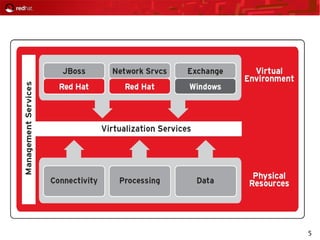
 Virtualization
 Security/MLS/Common Criteria
 High Availability
 Red Hat Security
 Future Direction (Emerging Technologies)
 Summary & Close
3
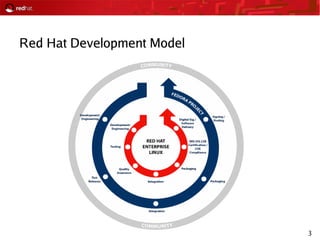
Red Hat Development Model
Red Hat Emerging Technologies
5
6
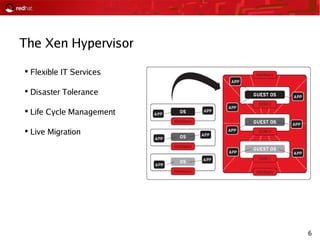
The Xen Hypervisor
●
Flexible IT Services
●
Disaster Tolerance
●
Life Cycle Management
●
Live Migration
7
Introduction to libvirt API
 Hypervisor agnostic
 Stable API for tool/app development
 CIM providers; Python, C bindings, scriptable
 Allows authenticated/encrypted
sessions to remote hypervisors
 Current support for
 Xen Hypervisor
 KVM Hypervisor
 QEMU Hypervisor
8
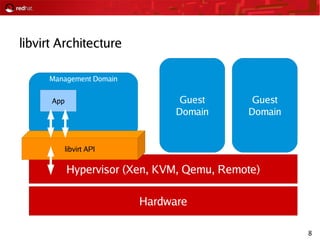
libvirt Architecture
Hardware
Hypervisor (Xen, KVM, Qemu, Remote)
Guest
Domain
Guest
Domain
Management Domain
libvirt API
App
9
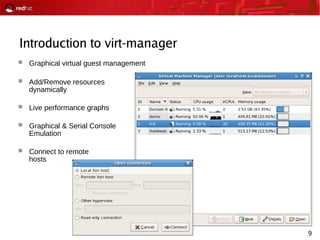
Introduction to virt-manager
 Graphical virtual guest management
 Add/Remove resources
dynamically
 Live performance graphs
 Graphical & Serial Console
Emulation
 Connect to remote
hosts
10
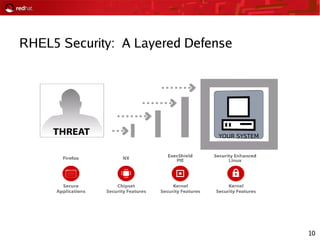
RHEL5 Security: A Layered Defense
YOUR SYSTEM
11
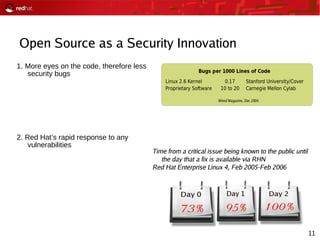
Open Source as a Security Innovation
1. More eyes on the code, therefore less
security bugs
2. Red Hat’s rapid response to any
vulnerabilities
Time from a critical issue being known to the public until
the day that a fix is available via RHN
Red Hat Enterprise Linux 4, Feb 2005-Feb 2006
12
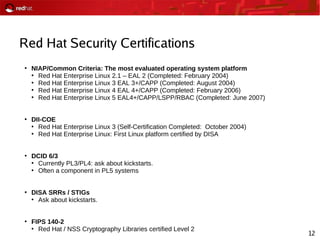
Red Hat Security Certifications
●
NIAP/Common Criteria: The most evaluated operating system platform
●
Red Hat Enterprise Linux 2.1 – EAL 2 (Completed: February 2004)
●
Red Hat Enterprise Linux 3 EAL 3+/CAPP (Completed: August 2004)
●
Red Hat Enterprise Linux 4 EAL 4+/CAPP (Completed: February 2006)
●
Red Hat Enterprise Linux 5 EAL4+/CAPP/LSPP/RBAC (Completed: June 2007)
●
DII-COE
●
Red Hat Enterprise Linux 3 (Self-Certification Completed: October 2004)
●
Red Hat Enterprise Linux: First Linux platform certified by DISA
●
DCID 6/3
●
Currently PL3/PL4: ask about kickstarts.
●
Often a component in PL5 systems
●
DISA SRRs / STIGs
●
Ask about kickstarts.
●
FIPS 140-2
●
Red Hat / NSS Cryptography Libraries certified Level 2
13
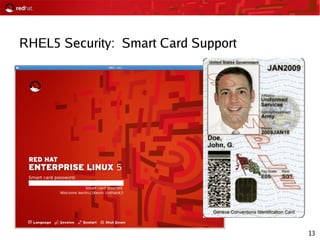
RHEL5 Security: Smart Card Support
14
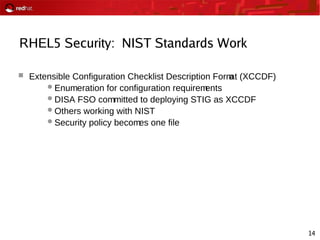
RHEL5 Security: NIST Standards Work
 Extensible Configuration Checklist Description Format (XCCDF)
Enumeration for configuration requirements
DISA FSO committed to deploying STIG as XCCDF
Others working with NIST
Security policy becomes one file
15
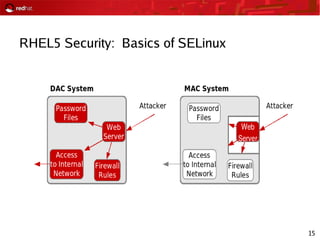
RHEL5 Security: Basics of SELinux
16
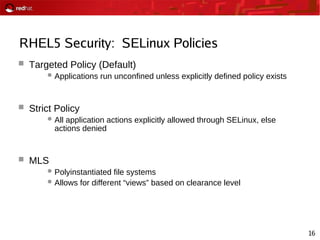
RHEL5 Security: SELinux Policies
 Targeted Policy (Default)
Applications run unconfined unless explicitly defined policy exists
 Strict Policy
All application actions explicitly allowed through SELinux, else
actions denied
 MLS
Polyinstantiated file systems
Allows for different “views” based on clearance level
17
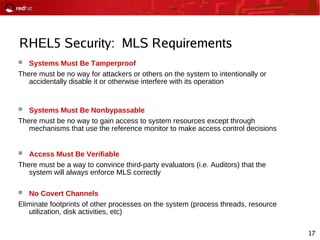
RHEL5 Security: MLS Requirements
 Systems Must Be Tamperproof
There must be no way for attackers or others on the system to intentionally or
accidentally disable it or otherwise interfere with its operation
 Systems Must Be Nonbypassable
There must be no way to gain access to system resources except through
mechanisms that use the reference monitor to make access control decisions
 Access Must Be Verifiable
There must be a way to convince third-party evaluators (i.e. Auditors) that the
system will always enforce MLS correctly
 No Covert Channels
Eliminate footprints of other processes on the system (process threads, resource
utilization, disk activities, etc)
18
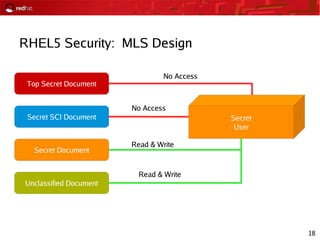
RHEL5 Security: MLS Design
Top Secret Document
Secret SCI Document
Unclassified Document
Secret
User
No Access
No Access
Secret Document
Read & Write
Read & Write
19
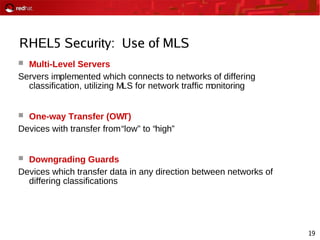
RHEL5 Security: Use of MLS
 Multi-Level Servers
Servers implemented which connects to networks of differing
classification, utilizing MLS for network traffic monitoring
 One-way Transfer (OWT)
Devices with transfer from“low” to “high”
 Downgrading Guards
Devices which transfer data in any direction between networks of
differing classifications
20
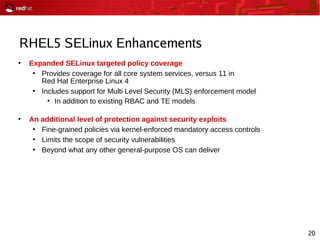
RHEL5 SELinux Enhancements
●
Expanded SELinux targeted policy coverage
●
Provides coverage for all core system services, versus 11 in
Red Hat Enterprise Linux 4
●
Includes support for Multi Level Security (MLS) enforcement model
●
In addition to existing RBAC and TE models
●
An additional level of protection against security exploits
●
Fine-grained policies via kernel-enforced mandatory access controls
●
Limits the scope of security vulnerabilities
●
Beyond what any other general-purpose OS can deliver
21
RHEL5 SELinux Enhancements
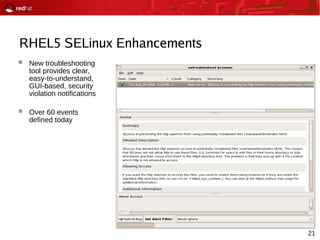
 New troubleshooting
tool provides clear,
easy-to-understand,
GUI-based, security
violation notifications
 Over 60 events
defined today
22
RHEL5 SELinux Enhancements
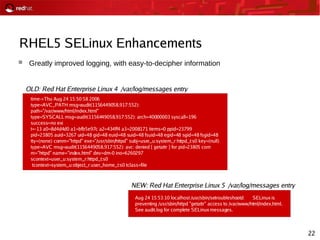
 Greatly improved logging, with easy-to-decipher information
time->Thu Aug 24 15:50:58 2006
type=AVC_PATH msg=audit(1156449058.917:552):
path="/var/www/html/index.html"
type=SYSCALL msg=audit(1156449058.917:552): arch=40000003 syscall=196
success=no exi
t=-13 a0=8d4d4d0 a1=bfb5e97c a2=434ff4 a3=2008171 items=0 ppid=23799
pid=23805 auid=3267 uid=48 gid=48 euid=48 suid=48 fsuid=48 egid=48 sgid=48 fsgid=48
tty=(none) comm="httpd" exe="/usr/sbin/httpd" subj=user_u:system_r:httpd_t:s0 key=(null)
type=AVC msg=audit(1156449058.917:552): avc: denied { getattr } for pid=23805 com
m="httpd" name="index.html" dev=dm-0 ino=6260297
scontext=user_u:system_r:httpd_t:s0
tcontext=system_u:object_r:user_home_t:s0 tclass=file
Aug 24 15:53:10 localhost /usr/sbin/setroubleshootd: SELinux is
preventing /usr/sbin/httpd "getattr" access to /var/www/html/index.html.
See audit.log for complete SELinux messages.
OLD: Red Hat Enterprise Linux 4 /var/log/messages entry
NEW: Red Hat Enterprise Linux 5 /var/log/messages entry
23
RHEL5 SELinux Enhancements
 ExecShield
This enhancement can prevent any memory that was writable from becoming
executable. This prevents an attacker from writing his code into memory and then
executing it
 Stack Smashing protection (Canary values)
The system will place a canary value at a randomized point above the stack. This
canary value is verified during normal operation. If the stack has been smashed,
the canary value will have been overwritten, indicating that the stack has been
smashed. This is a method to detect buffer overflows early.
 FORTIFY_SOURCE GCC option
When the compiler knows the size of a buffer, functions operate on the buffer to
make sure it will not overflow at runtime. This works to help catch format string
flaws as well as buffer overflows.
24
RHEL5 SELinux Enhancements
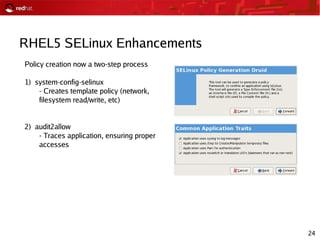
Policy creation now a two-step process
1) system-config-selinux
- Creates template policy (network,
filesystem read/write, etc)
2) audit2allow
- Traces application, ensuring proper
accesses
25
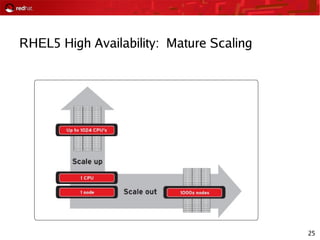
RHEL5 High Availability: Mature Scaling
26
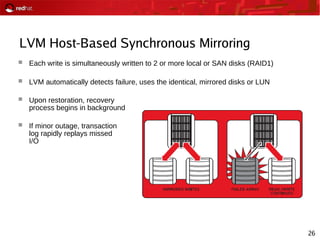
LVM Host-Based Synchronous Mirroring
 Each write is simultaneously written to 2 or more local or SAN disks (RAID1)
 LVM automatically detects failure, uses the identical, mirrored disks or LUN
 Upon restoration, recovery
process begins in background
 If minor outage, transaction
log rapidly replays missed
I/O
27
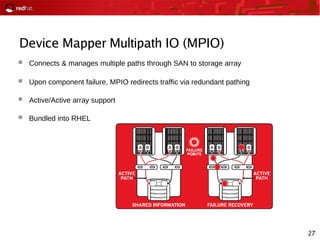
Device Mapper Multipath IO (MPIO)
 Connects & manages multiple paths through SAN to storage array
 Upon component failure, MPIO redirects traffic via redundant pathing
 Active/Active array support
 Bundled into RHEL
28
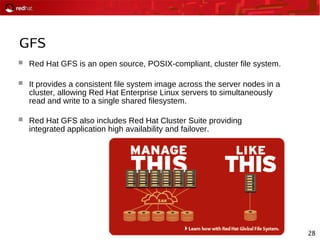
GFS
 Red Hat GFS is an open source, POSIX-compliant, cluster file system.
 It provides a consistent file system image across the server nodes in a
cluster, allowing Red Hat Enterprise Linux servers to simultaneously
read and write to a single shared filesystem.
 Red Hat GFS also includes Red Hat Cluster Suite providing
integrated application high availability and failover.
Red Hat SOA Direction
- JBoss
- MetaMatrix
30
31
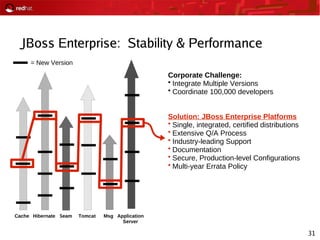
JBoss Enterprise: Stability & Performance
= New Version
MsgSeam TomcatHibernateCache Application
Server
Corporate Challenge:
• Integrate Multiple Versions
• Coordinate 100,000 developers
Solution: JBoss Enterprise Platforms
• Single, integrated, certified distributions
• Extensive Q/A Process
• Industry-leading Support
• Documentation
• Secure, Production-level Configurations
• Multi-year Errata Policy
32
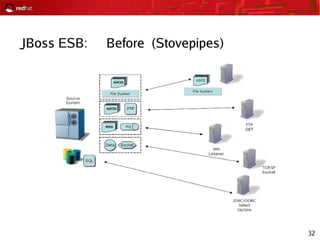
JBoss ESB: Before (Stovepipes)
33
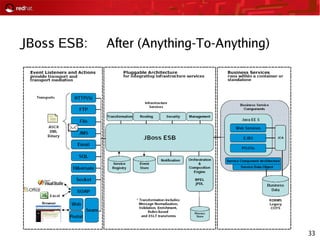
JBoss ESB: After (Anything-To-Anything)
34
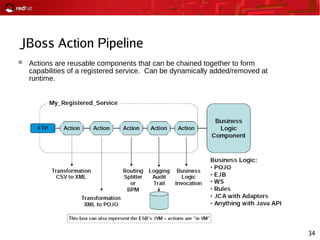
JBoss Action Pipeline
 Actions are reusable components that can be chained together to form
capabilities of a registered service. Can be dynamically added/removed at
runtime.
35
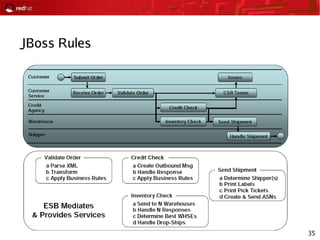
JBoss Rules
36
JBoss Conclusion
 Open Source makes JBoss SOA happen
 ESB
 Hibernate
 SEAM
 ESB is a solution for application/process integration
 ESB is about service intermediation
 Ask about getting evaluation copies!
37
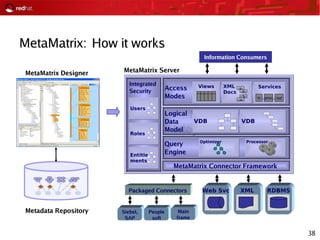
MetaMatrix Background
 On-demand access to distributed information
 Real time integration of diverse data
 Avoid unnecessary data replication
 Metadata-Driven
 Integration in days, not weeks
 Reduce “long tail” of application maintenance
 Improved data agility
 Abstracts data into a “single view” without need to move data between databases
 Single view of Customer – CRM
 Single view of Supplier – Supply Chain
 Single view of Employee – HR Consolidation
 SOA Enabler
 Consume/Produce Web Services
 ....... and still provide support for ODBC, JDBC, and legacy!
38
MetaMatrix: How it works
Metadata Repository
MetaMatrix Designer MetaMatrix Server
MetaMatrix
Integration Server
Web Svc XML RDBMSPackaged Connectors
Siebel,
SAP
People
soft
Main
frame
Query
Engine
ProcessorOptimizer
Integration ServerLogical
Data
Model
VDBVDB
Integrated
Security
Users
Roles
Entitle
ments
Access
Modes
Views XML
Docs
<a>
</a>
<b>
</b>
…
Services
in outproc
MetaMatrix Connector Framework
Information Consumers
39
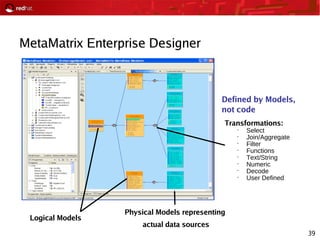
MetaMatrix Enterprise Designer
Transformations:
•
Select
•
Join/Aggregate
•
Filter
•
Functions
•
Text/String
•
Numeric
•
Decode
•
User Defined
Logical Models
Physical Models representing
actual data sources
Defined by Models,
not code
Red Hat Identity Management
- Directory Server
- Certificate Server
41
Red Hat Authentication History
 On December 8, 2004, Red Hat acquired assets from AOL's Netscape Security
Solutions business unit, including currently shipping products:
 Netscape Certificate Management System (Red Hat Certificate System)
 Netscape Directory Server (Red Hat Directory Server)
 Acquisition of JBoss in June 2006 now provides an extension for the identity
management technologies into the Application and Web Services space.
42
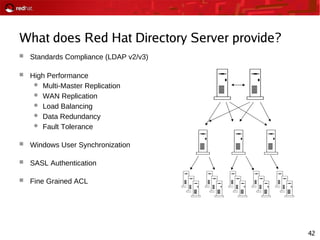
What does Red Hat Directory Server provide?
 Standards Compliance (LDAP v2/v3)
 High Performance
 Multi-Master Replication
 WAN Replication
 Load Balancing
 Data Redundancy
 Fault Tolerance
 Windows User Synchronization
 SASL Authentication
 Fine Grained ACL
43
What does Red Hat Certificate System provide?
 Standards Based PKI
 Unmatched Scalability
 14,000 certificate issuances/hour
 12M certificates issued < 35 days
 Largest public CRL: 1.2M
 Government Support
 FIPS-140 Certified
 EAL4/CIMC Protection Profile
 Replaces Passwords, Single Sign-On
 Smart Card Support
 Integrated with RHEL & Windows
44
Certificate Server Scalability
 25M+ Certificates issued from the DoD PKI CAs, 1999-Present
 3.5M – 4M “active” smart cards, most with 3 certificates
 Issuing lifetime of individual CAs governed by the size of the database managed
by the CA
 As number of certificates issued increased, number of revocations increased,
resulting in large CRLs
 CMS 4.2 and CMS 6.1 on Solaris – approximately 1.5M issued certificates
per CA
 Red Hat CS 7.1 on Linux [deployed in 2006] – DT&E Testing prior to fielding
demonstrated 3M issued certificates per CA with large CRL
45
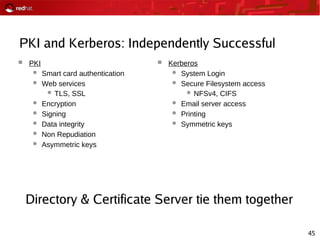
PKI and Kerberos: Independently Successful
 PKI
 Smart card authentication
 Web services
 TLS, SSL
 Encryption
 Signing
 Data integrity
 Non Repudiation
 Asymmetric keys
 Kerberos
 System Login
 Secure Filesystem access
 NFSv4, CIFS
 Email server access
 Printing
 Symmetric keys
Directory & Certificate Server tie them together
Red Hat Emerging Technologies
- Virtualization Updates
- MRG/Realtime
- freeIPA
47
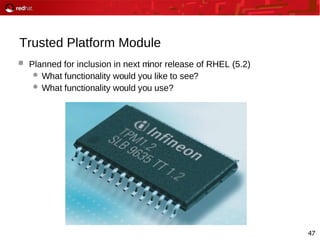
Trusted Platform Module
 Planned for inclusion in next minor release of RHEL (5.2)
 What functionality would you like to see?
 What functionality would you use?
48
49
MRG Realtime
 Determinism
Ability to schedule high priority tasks predictably and
consistently
 Priority
Ensure that highest priority applications are not blocked by
low priority
 Quality Of Service (QoS)
Trustworthy, consistent response times
 Proven results
 Average of 38% improvement over stock RHEL5
 Timer event precision enhanced to μ s level, rather than
ms
50
MRG: Messaging
 Provides messaging that is up to 100-fold faster than before
 Spans fast messaging, reliable messaging, large-file messaging
 Implements AMQP, the industry's first open messaging standard, for
unprecedented interoperability that is cross-language, cross-platform, multi-
vendor, spans hardware and software, and extends down to the wire level
 Uses Linux-specific optimizations to achieve optimal performance on Red Hat
Enterprise Linux and MRG Realtime
● Takes advantage of RHEL clustering, IO, kernel, and more
● Includes new high-performance AIO Journal for durable messaging
● Provides native infiniband support for transient messaging
51
About AMQP
 AMQP is an open specification for messaging
● It is a complete specification
● Anyone may use the AMQP specification to create useful implementations
without being charged for the IP rights to do so
 AMQP aims to be technology and language-neutral
● Available in C, C++, Java, JMS, .NET, C#, Ruby, Python, etc.
● Requires IP, and can be used with TCP, UDP, SCTP, Infiniband, etc.
 Products complying with AMQP are inter-operable
● AMQP is a Wire-Level protocol based on the ubiquitous IP
● Wire-level compatibility means it can be embedded in the network
● Applications written to Product X will plug into servers running Product Y
 Red Hat is a founding member of the AMQP Working Group
52
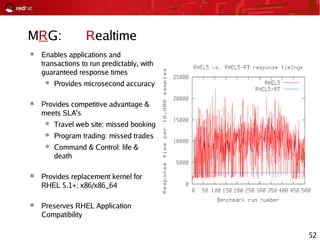
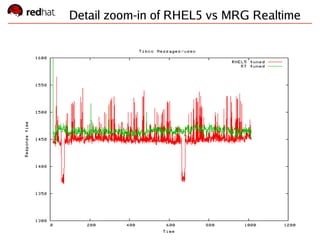
MRG: Realtime
 Enables applications and
transactions to run predictably, with
guaranteed response times
● Provides microsecond accuracy
 Provides competitive advantage &
meets SLA's
● Travel web site: missed booking
● Program trading: missed trades
● Command & Control: life &
death
 Provides replacement kernel for
RHEL 5.1+; x86/x86_64
 Preserves RHEL Application
Compatibility
Red Hat Confidential
Detail zoom-in of RHEL5 vs MRG Realtime
54
MRG: Realtime Tools
 MRG includes a new MRG Realtime Latency Tracer
● Runtime trace capture of longest latency codepaths – both kernel
and application. Peak detector
● Selectable triggers for threshold tracing
● Detailed kernel profiles based on latency triggers
 Existing standard RHEL5 based performance monitoring tools
remain relevant
● Gdb, OProfile Frysk – source level debuggers & profiler
● SystemTap, kprobe – kernel event tracing and dynamic data
collection
● kexec/kdump standard kernel dump/save core capabilities
55
MRG: Realtime Breakthroughs
 Red Hat engineers succeed at mainstream acceptance
● Methodical multi-year implementation
● Incrementally added features beneficial to all use cases
● Iteratively worked to cooperatively build an inclusive realtime community
 MRG Realtime is COTS (Commercial Off The Shelf) operating
system
● Standard RHEL5.1 OS
● Replacement kernel
 Integrated with distributed high speed messaging & grid scheduler
● MRG Messaging, MRG Grid
56
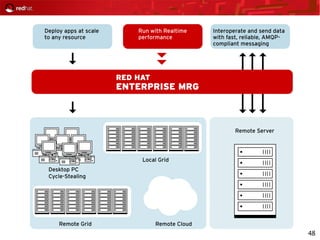
MRG: Grid
 Brings advantages of scale-out and flexible deployment to any application
 Delivers better asset utilization, allowing applications to to take advantage of all
available computing resources
 Dynamically provisions additional peak capacity for “Christmas Rush”-like
situations
 Executes across multiple platforms and in virtual machines
 Provides seamless and flexible High Throughput Computing (HTC) and High
Performance Computing (HPC) across
 Local grids
 Remote grids
 Remote clouds (Amazon EC2)
 Cycle-stealing from desktop PCs
57
MRG: Grid based off Condor

MRG Grid is based on the Condor Project created and hosted by the University of
Wisconsin, Madison

Red Hat and the University of Wisconsin have signed a strategic partnership
around Condor:

University of Wisconsin makes Condor source code available under OSI-
approved open source license

Red Hat & University of Wisconsin jointly fund and staff Condor development
on-campus at the University of Wisconsin

Red Hat and the University of Wisconsin's partnership will:

Add enhanced enterprise features, management, and supportability to
Condor and MRG Grid

Add High Throughput Computing capabilities to Linux
58
Red Hat Enterprise MRG Availability

MRG Announcement & Beta Launch: December 2007

Public beta

MRG v1.0: Early 2008

RHEL-only support for MRG Messaging broker

MRG Grid Technology Preview

MRG v1.1: Late 2008

Multi-platform support for MRG Messaging Java-based broker

AMQP support updated to newly available AMQP version (1.0)

MRG Grid support available
59
Additional Information:
http://www.redhat.com/mrg/
60
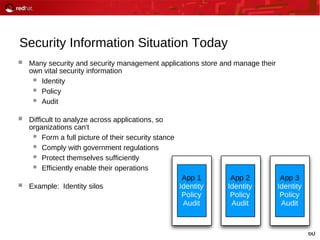
Security Information Situation Today
 Many security and security management applications store and manage their
own vital security information
 Identity
 Policy
 Audit
 Difficult to analyze across applications, so
organizations can't
 Form a full picture of their security stance
 Comply with government regulations
 Protect themselves sufficiently
 Efficiently enable their operations
 Example: Identity silos
61
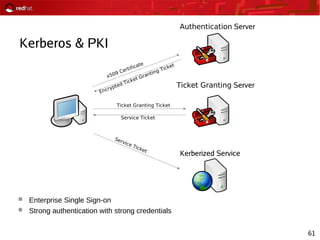
Kerberos & PKI
 Enterprise Single Sign-on
 Strong authentication with strong credentials
Authentication Server
Ticket Granting Server
Kerberized Service
x509 Certificate
Encrypted Ticket Granting Ticket
Ticket Granting Ticket
Service Ticket
Service Ticket
62
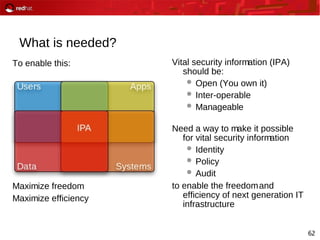
What is needed?
Vital security information (IPA)
should be:
 Open (You own it)
 Inter-operable
 Manageable
Need a way to make it possible
for vital security information
 Identity
 Policy
 Audit
to enable the freedomand
efficiency of next generation IT
infrastructure
To enable this:
Maximize freedom
Maximize efficiency
63
 Project
 Open Source
 www.freeipa.org
 Started and contributed to by
Red Hat
 Open to all
 IPA = Identity, Policy, Audit
 Big vision
 Start with centralized user
identity management for
UNIX/Linux
 Add robust, shared sense of
machine, service and data
identity
 Provide centrally managed
admin access control for
UNIX/Linux
 Give ability to externalize
policy and add to it easily
 Add centralized audit
 With this you can enable
flexible cross-enterprise policy
and rational audit
64
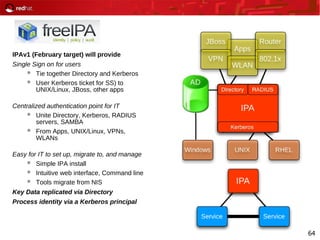
IPAv1 (February target) will provide
Single Sign on for users
 Tie together Directory and Kerberos
 User Kerberos ticket for SS) to
UNIX/Linux, JBoss, other apps
Centralized authentication point for IT
 Unite Directory, Kerberos, RADIUS
servers, SAMBA
 From Apps, UNIX/Linux, VPNs,
WLANs
Easy for IT to set up, migrate to, and manage
 Simple IPA install
 Intuitive web interface, Command line
 Tools migrate from NIS
Key Data replicated via Directory
Process identity via a Kerberos principal
65
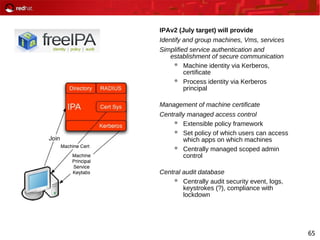
IPAv2 (July target) will provide
Identify and group machines, Vms, services
Simplified service authentication and
establishment of secure communication
 Machine identity via Kerberos,
certificate
 Process identity via Kerberos
principal
Management of machine certificate
Centrally managed access control
 Extensible policy framework
 Set policy of which users can access
which apps on which machines
 Centrally managed scoped admin
control
Central audit database
 Centrally audit security event, logs,
keystrokes (?), compliance with
lockdown
Open Discussion

2008-01-22 Red Hat (Security) Roadmap Presentation

  • 1.
    Red Hat SecuritySeminar Shawn D. Wells (swells@redhat.com) Solutions Architect, Federal
  • 2.
    2 Agenda  Start: 10:30 am End: 1:00 pm, ish  Red Hat Emerging Technologies  Virtualization  Security/MLS/Common Criteria  High Availability  Red Hat Security  Future Direction (Emerging Technologies)  Summary & Close
  • 3.
  • 4.
    Red Hat EmergingTechnologies
  • 5.
  • 6.
    6 The Xen Hypervisor ● FlexibleIT Services ● Disaster Tolerance ● Life Cycle Management ● Live Migration
  • 7.
    7 Introduction to libvirtAPI  Hypervisor agnostic  Stable API for tool/app development  CIM providers; Python, C bindings, scriptable  Allows authenticated/encrypted sessions to remote hypervisors  Current support for  Xen Hypervisor  KVM Hypervisor  QEMU Hypervisor
  • 8.
    8 libvirt Architecture Hardware Hypervisor (Xen,KVM, Qemu, Remote) Guest Domain Guest Domain Management Domain libvirt API App
  • 9.
    9 Introduction to virt-manager Graphical virtual guest management  Add/Remove resources dynamically  Live performance graphs  Graphical & Serial Console Emulation  Connect to remote hosts
  • 10.
    10 RHEL5 Security: ALayered Defense YOUR SYSTEM
  • 11.
    11 Open Source asa Security Innovation 1. More eyes on the code, therefore less security bugs 2. Red Hat’s rapid response to any vulnerabilities Time from a critical issue being known to the public until the day that a fix is available via RHN Red Hat Enterprise Linux 4, Feb 2005-Feb 2006
  • 12.
    12 Red Hat SecurityCertifications ● NIAP/Common Criteria: The most evaluated operating system platform ● Red Hat Enterprise Linux 2.1 – EAL 2 (Completed: February 2004) ● Red Hat Enterprise Linux 3 EAL 3+/CAPP (Completed: August 2004) ● Red Hat Enterprise Linux 4 EAL 4+/CAPP (Completed: February 2006) ● Red Hat Enterprise Linux 5 EAL4+/CAPP/LSPP/RBAC (Completed: June 2007) ● DII-COE ● Red Hat Enterprise Linux 3 (Self-Certification Completed: October 2004) ● Red Hat Enterprise Linux: First Linux platform certified by DISA ● DCID 6/3 ● Currently PL3/PL4: ask about kickstarts. ● Often a component in PL5 systems ● DISA SRRs / STIGs ● Ask about kickstarts. ● FIPS 140-2 ● Red Hat / NSS Cryptography Libraries certified Level 2
  • 13.
  • 14.
    14 RHEL5 Security: NISTStandards Work  Extensible Configuration Checklist Description Format (XCCDF) Enumeration for configuration requirements DISA FSO committed to deploying STIG as XCCDF Others working with NIST Security policy becomes one file
  • 15.
  • 16.
    16 RHEL5 Security: SELinuxPolicies  Targeted Policy (Default) Applications run unconfined unless explicitly defined policy exists  Strict Policy All application actions explicitly allowed through SELinux, else actions denied  MLS Polyinstantiated file systems Allows for different “views” based on clearance level
  • 17.
    17 RHEL5 Security: MLSRequirements  Systems Must Be Tamperproof There must be no way for attackers or others on the system to intentionally or accidentally disable it or otherwise interfere with its operation  Systems Must Be Nonbypassable There must be no way to gain access to system resources except through mechanisms that use the reference monitor to make access control decisions  Access Must Be Verifiable There must be a way to convince third-party evaluators (i.e. Auditors) that the system will always enforce MLS correctly  No Covert Channels Eliminate footprints of other processes on the system (process threads, resource utilization, disk activities, etc)
  • 18.
    18 RHEL5 Security: MLSDesign Top Secret Document Secret SCI Document Unclassified Document Secret User No Access No Access Secret Document Read & Write Read & Write
  • 19.
    19 RHEL5 Security: Useof MLS  Multi-Level Servers Servers implemented which connects to networks of differing classification, utilizing MLS for network traffic monitoring  One-way Transfer (OWT) Devices with transfer from“low” to “high”  Downgrading Guards Devices which transfer data in any direction between networks of differing classifications
  • 20.
    20 RHEL5 SELinux Enhancements ● ExpandedSELinux targeted policy coverage ● Provides coverage for all core system services, versus 11 in Red Hat Enterprise Linux 4 ● Includes support for Multi Level Security (MLS) enforcement model ● In addition to existing RBAC and TE models ● An additional level of protection against security exploits ● Fine-grained policies via kernel-enforced mandatory access controls ● Limits the scope of security vulnerabilities ● Beyond what any other general-purpose OS can deliver
  • 21.
    21 RHEL5 SELinux Enhancements New troubleshooting tool provides clear, easy-to-understand, GUI-based, security violation notifications  Over 60 events defined today
  • 22.
    22 RHEL5 SELinux Enhancements Greatly improved logging, with easy-to-decipher information time->Thu Aug 24 15:50:58 2006 type=AVC_PATH msg=audit(1156449058.917:552): path="/var/www/html/index.html" type=SYSCALL msg=audit(1156449058.917:552): arch=40000003 syscall=196 success=no exi t=-13 a0=8d4d4d0 a1=bfb5e97c a2=434ff4 a3=2008171 items=0 ppid=23799 pid=23805 auid=3267 uid=48 gid=48 euid=48 suid=48 fsuid=48 egid=48 sgid=48 fsgid=48 tty=(none) comm="httpd" exe="/usr/sbin/httpd" subj=user_u:system_r:httpd_t:s0 key=(null) type=AVC msg=audit(1156449058.917:552): avc: denied { getattr } for pid=23805 com m="httpd" name="index.html" dev=dm-0 ino=6260297 scontext=user_u:system_r:httpd_t:s0 tcontext=system_u:object_r:user_home_t:s0 tclass=file Aug 24 15:53:10 localhost /usr/sbin/setroubleshootd: SELinux is preventing /usr/sbin/httpd "getattr" access to /var/www/html/index.html. See audit.log for complete SELinux messages. OLD: Red Hat Enterprise Linux 4 /var/log/messages entry NEW: Red Hat Enterprise Linux 5 /var/log/messages entry
  • 23.
    23 RHEL5 SELinux Enhancements ExecShield This enhancement can prevent any memory that was writable from becoming executable. This prevents an attacker from writing his code into memory and then executing it  Stack Smashing protection (Canary values) The system will place a canary value at a randomized point above the stack. This canary value is verified during normal operation. If the stack has been smashed, the canary value will have been overwritten, indicating that the stack has been smashed. This is a method to detect buffer overflows early.  FORTIFY_SOURCE GCC option When the compiler knows the size of a buffer, functions operate on the buffer to make sure it will not overflow at runtime. This works to help catch format string flaws as well as buffer overflows.
  • 24.
    24 RHEL5 SELinux Enhancements Policycreation now a two-step process 1) system-config-selinux - Creates template policy (network, filesystem read/write, etc) 2) audit2allow - Traces application, ensuring proper accesses
  • 25.
  • 26.
    26 LVM Host-Based SynchronousMirroring  Each write is simultaneously written to 2 or more local or SAN disks (RAID1)  LVM automatically detects failure, uses the identical, mirrored disks or LUN  Upon restoration, recovery process begins in background  If minor outage, transaction log rapidly replays missed I/O
  • 27.
    27 Device Mapper MultipathIO (MPIO)  Connects & manages multiple paths through SAN to storage array  Upon component failure, MPIO redirects traffic via redundant pathing  Active/Active array support  Bundled into RHEL
  • 28.
    28 GFS  Red HatGFS is an open source, POSIX-compliant, cluster file system.  It provides a consistent file system image across the server nodes in a cluster, allowing Red Hat Enterprise Linux servers to simultaneously read and write to a single shared filesystem.  Red Hat GFS also includes Red Hat Cluster Suite providing integrated application high availability and failover.
  • 29.
    Red Hat SOADirection - JBoss - MetaMatrix
  • 30.
  • 31.
    31 JBoss Enterprise: Stability& Performance = New Version MsgSeam TomcatHibernateCache Application Server Corporate Challenge: • Integrate Multiple Versions • Coordinate 100,000 developers Solution: JBoss Enterprise Platforms • Single, integrated, certified distributions • Extensive Q/A Process • Industry-leading Support • Documentation • Secure, Production-level Configurations • Multi-year Errata Policy
  • 32.
  • 33.
    33 JBoss ESB: After(Anything-To-Anything)
  • 34.
    34 JBoss Action Pipeline Actions are reusable components that can be chained together to form capabilities of a registered service. Can be dynamically added/removed at runtime.
  • 35.
  • 36.
    36 JBoss Conclusion  OpenSource makes JBoss SOA happen  ESB  Hibernate  SEAM  ESB is a solution for application/process integration  ESB is about service intermediation  Ask about getting evaluation copies!
  • 37.
    37 MetaMatrix Background  On-demandaccess to distributed information  Real time integration of diverse data  Avoid unnecessary data replication  Metadata-Driven  Integration in days, not weeks  Reduce “long tail” of application maintenance  Improved data agility  Abstracts data into a “single view” without need to move data between databases  Single view of Customer – CRM  Single view of Supplier – Supply Chain  Single view of Employee – HR Consolidation  SOA Enabler  Consume/Produce Web Services  ....... and still provide support for ODBC, JDBC, and legacy!
  • 38.
    38 MetaMatrix: How itworks Metadata Repository MetaMatrix Designer MetaMatrix Server MetaMatrix Integration Server Web Svc XML RDBMSPackaged Connectors Siebel, SAP People soft Main frame Query Engine ProcessorOptimizer Integration ServerLogical Data Model VDBVDB Integrated Security Users Roles Entitle ments Access Modes Views XML Docs <a> </a> <b> </b> … Services in outproc MetaMatrix Connector Framework Information Consumers
  • 39.
  • 40.
    Red Hat IdentityManagement - Directory Server - Certificate Server
  • 41.
    41 Red Hat AuthenticationHistory  On December 8, 2004, Red Hat acquired assets from AOL's Netscape Security Solutions business unit, including currently shipping products:  Netscape Certificate Management System (Red Hat Certificate System)  Netscape Directory Server (Red Hat Directory Server)  Acquisition of JBoss in June 2006 now provides an extension for the identity management technologies into the Application and Web Services space.
  • 42.
    42 What does RedHat Directory Server provide?  Standards Compliance (LDAP v2/v3)  High Performance  Multi-Master Replication  WAN Replication  Load Balancing  Data Redundancy  Fault Tolerance  Windows User Synchronization  SASL Authentication  Fine Grained ACL
  • 43.
    43 What does RedHat Certificate System provide?  Standards Based PKI  Unmatched Scalability  14,000 certificate issuances/hour  12M certificates issued < 35 days  Largest public CRL: 1.2M  Government Support  FIPS-140 Certified  EAL4/CIMC Protection Profile  Replaces Passwords, Single Sign-On  Smart Card Support  Integrated with RHEL & Windows
  • 44.
    44 Certificate Server Scalability 25M+ Certificates issued from the DoD PKI CAs, 1999-Present  3.5M – 4M “active” smart cards, most with 3 certificates  Issuing lifetime of individual CAs governed by the size of the database managed by the CA  As number of certificates issued increased, number of revocations increased, resulting in large CRLs  CMS 4.2 and CMS 6.1 on Solaris – approximately 1.5M issued certificates per CA  Red Hat CS 7.1 on Linux [deployed in 2006] – DT&E Testing prior to fielding demonstrated 3M issued certificates per CA with large CRL
  • 45.
    45 PKI and Kerberos:Independently Successful  PKI  Smart card authentication  Web services  TLS, SSL  Encryption  Signing  Data integrity  Non Repudiation  Asymmetric keys  Kerberos  System Login  Secure Filesystem access  NFSv4, CIFS  Email server access  Printing  Symmetric keys Directory & Certificate Server tie them together
  • 46.
    Red Hat EmergingTechnologies - Virtualization Updates - MRG/Realtime - freeIPA
  • 47.
    47 Trusted Platform Module Planned for inclusion in next minor release of RHEL (5.2)  What functionality would you like to see?  What functionality would you use?
  • 48.
  • 49.
    49 MRG Realtime  Determinism Abilityto schedule high priority tasks predictably and consistently  Priority Ensure that highest priority applications are not blocked by low priority  Quality Of Service (QoS) Trustworthy, consistent response times  Proven results  Average of 38% improvement over stock RHEL5  Timer event precision enhanced to μ s level, rather than ms
  • 50.
    50 MRG: Messaging  Providesmessaging that is up to 100-fold faster than before  Spans fast messaging, reliable messaging, large-file messaging  Implements AMQP, the industry's first open messaging standard, for unprecedented interoperability that is cross-language, cross-platform, multi- vendor, spans hardware and software, and extends down to the wire level  Uses Linux-specific optimizations to achieve optimal performance on Red Hat Enterprise Linux and MRG Realtime ● Takes advantage of RHEL clustering, IO, kernel, and more ● Includes new high-performance AIO Journal for durable messaging ● Provides native infiniband support for transient messaging
  • 51.
    51 About AMQP  AMQPis an open specification for messaging ● It is a complete specification ● Anyone may use the AMQP specification to create useful implementations without being charged for the IP rights to do so  AMQP aims to be technology and language-neutral ● Available in C, C++, Java, JMS, .NET, C#, Ruby, Python, etc. ● Requires IP, and can be used with TCP, UDP, SCTP, Infiniband, etc.  Products complying with AMQP are inter-operable ● AMQP is a Wire-Level protocol based on the ubiquitous IP ● Wire-level compatibility means it can be embedded in the network ● Applications written to Product X will plug into servers running Product Y  Red Hat is a founding member of the AMQP Working Group
  • 52.
    52 MRG: Realtime  Enablesapplications and transactions to run predictably, with guaranteed response times ● Provides microsecond accuracy  Provides competitive advantage & meets SLA's ● Travel web site: missed booking ● Program trading: missed trades ● Command & Control: life & death  Provides replacement kernel for RHEL 5.1+; x86/x86_64  Preserves RHEL Application Compatibility
  • 53.
    Red Hat Confidential Detailzoom-in of RHEL5 vs MRG Realtime
  • 54.
    54 MRG: Realtime Tools MRG includes a new MRG Realtime Latency Tracer ● Runtime trace capture of longest latency codepaths – both kernel and application. Peak detector ● Selectable triggers for threshold tracing ● Detailed kernel profiles based on latency triggers  Existing standard RHEL5 based performance monitoring tools remain relevant ● Gdb, OProfile Frysk – source level debuggers & profiler ● SystemTap, kprobe – kernel event tracing and dynamic data collection ● kexec/kdump standard kernel dump/save core capabilities
  • 55.
    55 MRG: Realtime Breakthroughs Red Hat engineers succeed at mainstream acceptance ● Methodical multi-year implementation ● Incrementally added features beneficial to all use cases ● Iteratively worked to cooperatively build an inclusive realtime community  MRG Realtime is COTS (Commercial Off The Shelf) operating system ● Standard RHEL5.1 OS ● Replacement kernel  Integrated with distributed high speed messaging & grid scheduler ● MRG Messaging, MRG Grid
  • 56.
    56 MRG: Grid  Bringsadvantages of scale-out and flexible deployment to any application  Delivers better asset utilization, allowing applications to to take advantage of all available computing resources  Dynamically provisions additional peak capacity for “Christmas Rush”-like situations  Executes across multiple platforms and in virtual machines  Provides seamless and flexible High Throughput Computing (HTC) and High Performance Computing (HPC) across  Local grids  Remote grids  Remote clouds (Amazon EC2)  Cycle-stealing from desktop PCs
  • 57.
    57 MRG: Grid basedoff Condor  MRG Grid is based on the Condor Project created and hosted by the University of Wisconsin, Madison  Red Hat and the University of Wisconsin have signed a strategic partnership around Condor:  University of Wisconsin makes Condor source code available under OSI- approved open source license  Red Hat & University of Wisconsin jointly fund and staff Condor development on-campus at the University of Wisconsin  Red Hat and the University of Wisconsin's partnership will:  Add enhanced enterprise features, management, and supportability to Condor and MRG Grid  Add High Throughput Computing capabilities to Linux
  • 58.
    58 Red Hat EnterpriseMRG Availability  MRG Announcement & Beta Launch: December 2007  Public beta  MRG v1.0: Early 2008  RHEL-only support for MRG Messaging broker  MRG Grid Technology Preview  MRG v1.1: Late 2008  Multi-platform support for MRG Messaging Java-based broker  AMQP support updated to newly available AMQP version (1.0)  MRG Grid support available
  • 59.
  • 60.
    60 Security Information SituationToday  Many security and security management applications store and manage their own vital security information  Identity  Policy  Audit  Difficult to analyze across applications, so organizations can't  Form a full picture of their security stance  Comply with government regulations  Protect themselves sufficiently  Efficiently enable their operations  Example: Identity silos
  • 61.
    61 Kerberos & PKI Enterprise Single Sign-on  Strong authentication with strong credentials Authentication Server Ticket Granting Server Kerberized Service x509 Certificate Encrypted Ticket Granting Ticket Ticket Granting Ticket Service Ticket Service Ticket
  • 62.
    62 What is needed? Vitalsecurity information (IPA) should be:  Open (You own it)  Inter-operable  Manageable Need a way to make it possible for vital security information  Identity  Policy  Audit to enable the freedomand efficiency of next generation IT infrastructure To enable this: Maximize freedom Maximize efficiency
  • 63.
    63  Project  OpenSource  www.freeipa.org  Started and contributed to by Red Hat  Open to all  IPA = Identity, Policy, Audit  Big vision  Start with centralized user identity management for UNIX/Linux  Add robust, shared sense of machine, service and data identity  Provide centrally managed admin access control for UNIX/Linux  Give ability to externalize policy and add to it easily  Add centralized audit  With this you can enable flexible cross-enterprise policy and rational audit
  • 64.
    64 IPAv1 (February target)will provide Single Sign on for users  Tie together Directory and Kerberos  User Kerberos ticket for SS) to UNIX/Linux, JBoss, other apps Centralized authentication point for IT  Unite Directory, Kerberos, RADIUS servers, SAMBA  From Apps, UNIX/Linux, VPNs, WLANs Easy for IT to set up, migrate to, and manage  Simple IPA install  Intuitive web interface, Command line  Tools migrate from NIS Key Data replicated via Directory Process identity via a Kerberos principal
  • 65.
    65 IPAv2 (July target)will provide Identify and group machines, Vms, services Simplified service authentication and establishment of secure communication  Machine identity via Kerberos, certificate  Process identity via Kerberos principal Management of machine certificate Centrally managed access control  Extensible policy framework  Set policy of which users can access which apps on which machines  Centrally managed scoped admin control Central audit database  Centrally audit security event, logs, keystrokes (?), compliance with lockdown
  • 66.