SLTS Kernel and Base-Layer
Development in the
Civil Infrastructure Platform
Yoshitake Kobayashi
Embedded Linux Conference, Portland, February 21-23, 2017
1
2
Our Civilization is Run by Linux
https://www.airpano.com/360Degree-VirtualTour.php?3D=San-Francisco-USA
3
https://www.airpano.com/360Degree-VirtualTour.php?3D=San-Francisco-USA
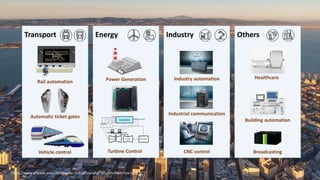
Transport Energy Industry Others
Rail automation
Automatic ticket gates
Vehicle control
Power Generation
Turbine Control
Industry automation
Industrial communication
CNC control
Building automation
Healthcare
Broadcasting
4
But there are issues to be
solved…
https://www.airpano.com/360Degree-VirtualTour.php?3D=San-Francisco-USA
5
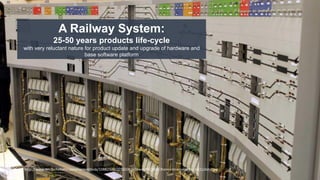
A Railway System:
25-50 years products life-cycle
with very reluctant nature for product update and upgrade of hardware and
base software platform
Image: http://www.deutschebahn.com/contentblob/10862328/20160301+Stw+M%C3%BClheim+Innenansicht+1+(1)/data.jpg
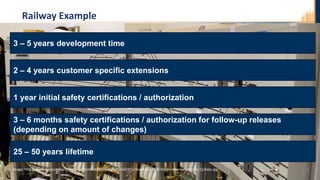
Railway Example
6
3 – 5 years development time
2 – 4 years customer specific extensions
1 year initial safety certifications / authorization
3 – 6 months safety certifications / authorization for follow-up releases
(depending on amount of changes)
25 – 50 years lifetime
Image: http://www.deutschebahn.com/contentblob/10862328/20160301+Stw+M%C3%BClheim+Innenansicht+1+(1)/data.jpg
What we have done on Linux for civil infrastructure systems
• Improve real-time performance and test
• Improve reliability and test
• Improve security and test
• Improve stability and test
• Create a lot of documents and review
• Open source software licenses compliance
• Export control classification
• Then, support for long-time such as 20-60 years
• ...
7
8
We have a problem…
The Problems we face …
• The systems that support our modern civilization need to survive for a VERY
LONG TIME. Until now the corresponding industrial grade super long term
maintenance has been done by each individual companies.
• These systems not only have to survive for a long time, they must be
“INDUSTRIAL GRADE” (robust, secure and reliable). And at the same time
the industry will also need to catch up with the latest technology trends
9
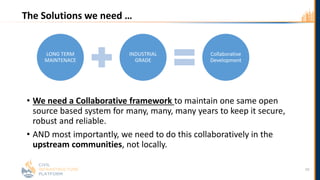
The Solutions we need …
• We need a Collaborative framework to maintain one same open
source based system for many, many, many years to keep it secure,
robust and reliable.
• AND most importantly, we need to do this collaboratively in the
upstream communities, not locally.
10
LONG TERM
MAINTENACE
INDUSTRIAL
GRADE
Collaborative
Development
Establishing an Open Source Base Layer of
industrial-grade software to enable the use
and implementation of software building
blocks for Civil Infrastructure Systems
11
CIP is our solution…
https://www.cip-project.org/
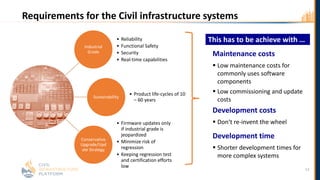
Requirements for the Civil infrastructure systems
13
Industrial
Grade
• Reliability
• Functional Safety
• Security
• Real-time capabilities
Sustainability
• Product life-cycles of 10
– 60 years
Conservative
Upgrade/Upd
ate Strategy
• Firmware updates only
if industrial grade is
jeopardized
• Minimize risk of
regression
• Keeping regression test
and certification efforts
low
This has to be achieve with …
Development time
 Shorter development times for
more complex systems
Maintenance costs
 Low maintenance costs for
commonly uses software
components
 Low commissioning and update
costs
Development costs
 Don‘t re-invent the wheel
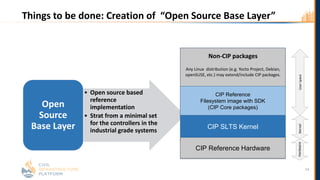
Things to be done: Creation of “Open Source Base Layer”
14
UserspaceHardwareKernel
• Open source based
reference
implementation
• Strat from a minimal set
for the controllers in the
industrial grade systems
Open
Source
Base Layer
CIP Reference Hardware
CIP Reference
Filesystem image with SDK
(CIP Core packages)
CIP SLTS Kernel
Non-CIP packages
Any Linux distribution (e.g. Yocto Project, Debian,
openSUSE, etc.) may extend/include CIP packages.
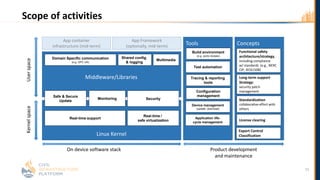
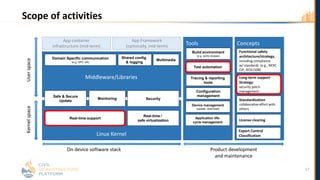
Scope of activities
UserspaceKernelspace
Linux Kernel
App container
infrastructure (mid-term)
App Framework
(optionally, mid-term)
Middleware/Libraries
Safe & Secure
Update
Monitoring
Domain Specific communication
(e.g. OPC UA)
Shared config.
& logging
Real-time support
Real-time /
safe virtualization
Tools Concepts
Build environment
(e.g. yocto recipes)
Test automation
Tracing & reporting
tools
Configuration
management
Device management
(update, download)
Functional safety
architecture/strategy,
including compliance
w/ standards (e.g., NERC
CIP, IEC61508)
Long-term support
Strategy:
security patch
management
Standardization
collaborative effort with
others
License clearing
Export Control
Classification
On device software stack Product development
and maintenance
Application life-
cycle management
Security
15
Multimedia
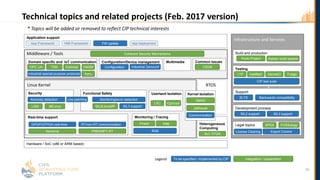
Technical topics and related projects (Feb. 2017 version)
w
Linux Kernel
Userland Isolation
LXC Cgroups
Heterogeneous
Computing
SoC FPGA
Middleware / Tools
Application support
App Framework HMI Framework FW update App deployment
Configuration/Device management
Configuration Industrial Zeroconf
Domain specific and IoT communication
OPC UA
Avnu
Echonet
Industrial special-purpose protocols
Functional Safety
SIL3 supportSIL2LinuxMP
Monitoring/error detection
RTOS
OM2M
Security
LSM
Anomaly detection
SELinux
Kernel Isolation
Communication
Jailhouse
SafeG
Real-time support
PREEMPT-RT
GPGPU/FPGA real-time
Xenomai
RT/non-RT communication
Live patching
Monitoring / Tracing
RAS
Ftrace ktap
Coherent Security Mechanisms
Hardware / SoC (x86 or ARM based)
To be specified / implemented by CIP Integration / cooperationLegend
16
`I
Testing
kselftest
CIP test suite
FuegoLTP
Infrastructure and Services
Support
SLTS
Development process
SIL3 supportSIL2 support
Legal topics SPDX
Export ControlLicense Clearing
FOSSology
Backwards compatibility
Build and production
Yocto Project
TSN
Multimedia Common issues
Y2038
KernelCI
Debian build system
* Topics will be added or removed to reflect CIP technical interests
Scope of activities
UserspaceKernelspace
Linux Kernel
App container
infrastructure (mid-term)
App Framework
(optionally, mid-term)
Middleware/Libraries
Safe & Secure
Update
Monitoring
Domain Specific communication
(e.g. OPC UA)
Shared config.
& logging
Real-time support
Real-time /
safe virtualization
Tools Concepts
Build environment
(e.g. yocto recipes)
Test automation
Tracing & reporting
tools
Configuration
management
Device management
(update, download)
Functional safety
architecture/strategy,
including compliance
w/ standards (e.g., NERC
CIP, IEC61508)
Long-term support
Strategy:
security patch
management
Standardization
collaborative effort with
others
License clearing
Export Control
Classification
On device software stack Product development
and maintenance
Application life-
cycle management
Security
17
Multimedia
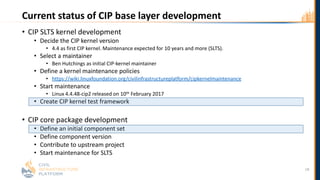
Current status of CIP base layer development
• CIP SLTS kernel development
• Decide the CIP kernel version
• 4.4 as first CIP kernel. Maintenance expected for 10 years and more (SLTS).
• Select a maintainer
• Ben Hutchings as initial CIP-kernel maintainer
• Define a kernel maintenance policies
• https://wiki.linuxfoundation.org/civilinfrastructureplatform/cipkernelmaintenance
• Start maintenance
• Linux 4.4.48-cip2 released on 10th February 2017
• Create CIP kernel test framework
• CIP core package development
• Define an initial component set
• Define component version
• Contribute to upstream project
• Start maintenance for SLTS
18
19
CIP SLTS Kernel Development
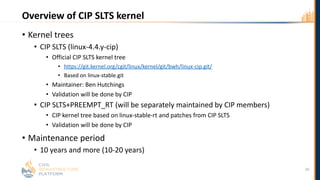
Overview of CIP SLTS kernel
• Kernel trees
• CIP SLTS (linux-4.4.y-cip)
• Official CIP SLTS kernel tree
• https://git.kernel.org/cgit/linux/kernel/git/bwh/linux-cip.git/
• Based on linux-stable.git
• Maintainer: Ben Hutchings
• Validation will be done by CIP
• CIP SLTS+PREEMPT_RT (will be separately maintained by CIP members)
• CIP kernel tree based on linux-stable-rt and patches from CIP SLTS
• Validation will be done by CIP
• Maintenance period
• 10 years and more (10-20 years)
20
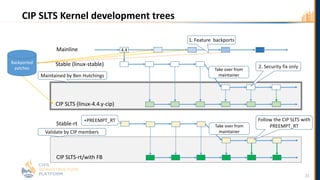
CIP SLTS Kernel development trees
21
Mainline
Stable (linux-stable)
4.4
CIP SLTS (linux-4.4.y-cip)
Stable-rt
CIP SLTS-rt/with FB
1. Feature backports
2. Security fix only
+PREEMPT_RT Follow the CIP SLTS with
PREEMPT_RT
Validate by CIP members
Backported
patches
Maintained by Ben Hutchings
Take over from
maintainer
Take over from
maintainer
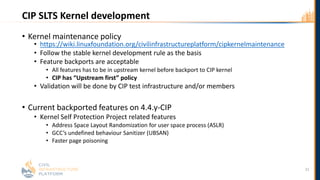
CIP SLTS Kernel development
• Kernel maintenance policy
• https://wiki.linuxfoundation.org/civilinfrastructureplatform/cipkernelmaintenance
• Follow the stable kernel development rule as the basis
• Feature backports are acceptable
• All features has to be in upstream kernel before backport to CIP kernel
• CIP has “Upstream first” policy
• Validation will be done by CIP test infrastructure and/or members
• Current backported features on 4.4.y-CIP
• Kernel Self Protection Project related features
• Address Space Layout Randomization for user space process (ASLR)
• GCC’s undefined behaviour Sanitizer (UBSAN)
• Faster page poisoning
22
Out-of-tree drivers
• In general, all out-of-tree drivers are unsupported by CIP
• Users can use CIP kernel with out-of-tree drivers
• If a bug is found in such a modified kernel, users will first demonstrate that it
exists in the CIP kernel source release in order for the CIP maintainers to act
on it.
23
Major version release cycle (Next CIP SLTS kernel version)
• CIP will take a LTS kernel every 2-4 years
• Planning to synchronize with LTSI for next CIP SLTS kernel
• LTSI: http://ltsi.linuxfoundation.org/
24
25
CIP testing
Purpose of CIP testing
• Detecting bugs
• Detecting regressions
• Provide test results in a timely manner
26
Milestones of CIP testing and current status
1. Board at desk - single dev
• A setup that allows a developer to test the CIP kernel on the CIP selected hardware platform
connected locally to her development machine using kernelCI tools.
2. CIP kernel testing
• Test the CIP kernel on a regular basis and share the results with other CIP community members.
3. Define kernel testing as a service within CIP
• Define the testing environment within CIP assuming that, in some cases, some members may
share the tests, test results or laboratories while others may not.
4. From kernel testing to system testing
• Once the testing environment has been ready and works for the kernel, explore how to extend
it to the entire CIP platform.
https://wiki.linuxfoundation.org/civilinfrastructureplatform/ciptesting
27
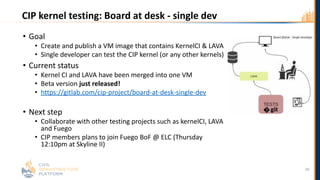
CIP kernel testing: Board at desk - single dev
28
• Goal
• Create and publish a VM image that contains KernelCI & LAVA
• Single developer can test the CIP kernel (or any other kernels)
• Current status
• Kernel CI and LAVA have been merged into one VM
• Beta version just released!
• https://gitlab.com/cip-project/board-at-desk-single-dev
• Next step
• Collaborate with other testing projects such as kernelCI, LAVA
and Fuego
• CIP members plans to join Fuego BoF @ ELC (Thursday
12:10pm at Skyline II)
29
CIP Core package Development
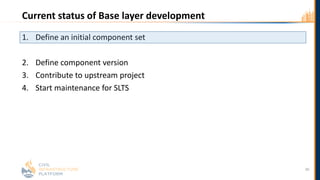
Current status of Base layer development
1. Define an initial component set
2. Define component version
3. Contribute to upstream project
4. Start maintenance for SLTS
30
Current status of Base layer development
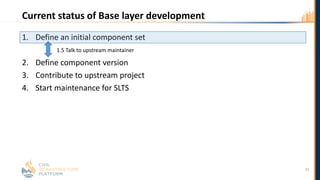
1. Define an initial component set
2. Define component version
3. Contribute to upstream project
4. Start maintenance for SLTS
31
1.5 Talk to upstream maintainer
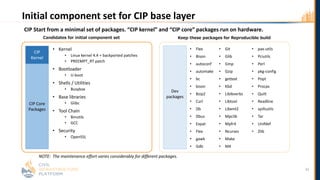
Initial component set for CIP base layer
• Flex
• Bison
• autoconf
• automake
• bc
• bison
• Bzip2
• Curl
• Db
• Dbus
• Expat
• Flex
• gawk
• Gdb
32
CIP Start from a minimal set of packages. “CIP kernel” and “CIP core” packages run on hardware.
NOTE: The maintenance effort varies considerably for different packages.
CIP Core
Packages
CIP
Kernel
Dev
packages
• Kernel
• Linux kernel 4.4 + backported patches
• PREEMPT_RT patch
• Bootloader
• U-boot
• Shells / Utilities
• Busybox
• Base libraries
• Glibc
• Tool Chain
• Binutils
• GCC
• Security
• OpenSSL
• Git
• Glib
• Gmp
• Gzip
• gettext
• Kbd
• Libibverbs
• Libtool
• Libxml2
• Mpclib
• Mpfr4
• Ncurses
• Make
• M4
• pax-utils
• Pciutils
• Perl
• pkg-config
• Popt
• Procps
• Quilt
• Readline
• sysfsutils
• Tar
• Unifdef
• Zlib
Keep these packages for Reproducible buildCandidates for initial component set
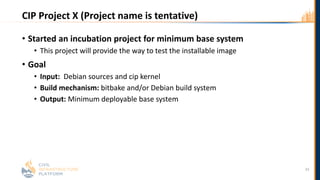
CIP Project X (Project name is tentative)
• Started an incubation project for minimum base system
• This project will provide the way to test the installable image
• Goal
• Input: Debian sources and cip kernel
• Build mechanism: bitbake and/or Debian build system
• Output: Minimum deployable base system
33
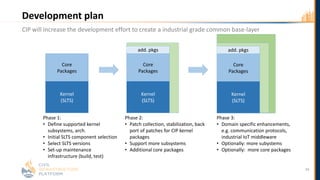
Development plan
34
CIP will increase the development effort to create a industrial grade common base-layer
Phase 1:
• Define supported kernel
subsystems, arch.
• Initial SLTS component selection
• Select SLTS versions
• Set-up maintenance
infrastructure (build, test)
Phase 2:
• Patch collection, stabilization, back
port of patches for CIP kernel
packages
• Support more subsystems
• Additional core packages
Core
Packages
Kernel
(SLTS)
Phase 3:
• Domain specific enhancements,
e.g. communication protocols,
industrial IoT middleware
• Optionally: more subystems
• Optionally: more core packages
add. pkgs
Core
Packages
Kernel
(SLTS)
add. pkgs
Core
Packages
Kernel
(SLTS)
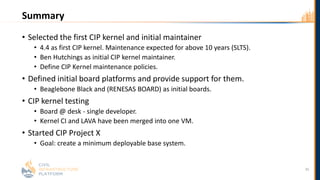
Summary
• Selected the first CIP kernel and initial maintainer
• 4.4 as first CIP kernel. Maintenance expected for above 10 years (SLTS).
• Ben Hutchings as initial CIP kernel maintainer.
• Define CIP Kernel maintenance policies.
• Defined initial board platforms and provide support for them.
• Beaglebone Black and (RENESAS BOARD) as initial boards.
• CIP kernel testing
• Board @ desk - single developer.
• Kernel CI and LAVA have been merged into one VM.
• Started CIP Project X
• Goal: create a minimum deployable base system.
35
36
Next steps
Next step by CIP
• Board @desk - Single dev
• Release kernelci VM and test CIP kernel in the open within CIP group.
• Increase test coverage.
• Define milestone 2.
• Improve integration with Fuego and LAVA.
• Kernel maintenance: define next steps.
• Analysis: select additional software as part of CIP base layer.
• Collaboration: kernelci.org, Fuego, y2038, KSPP, Real-Time Linux
37
38
Please Join us!
Why join CIP?
• Steer
participate in project decisions and technical direction.
• Participate
bring your use cases and ideas to the right forum.
• Learn
by working on daily basis in the open with others with common interest.
• Collaborate
share effort and knowledge. Stand on the shoulders of giants.
39
Contact Information and Resources
To get the latest information, please contact:
• Noriaki Fukuyasu: fukuyasu@linuxfoundation.org
Other resources
• CIP Web site: https://www.cip-project.org
• CIP Mailing list: cip-dev@lists.cip-project.org
• CIP Wiki: https://wiki.linuxfoundation.org/civilinfrastructureplatform/
• Collaboration at CIP: http://www.gitlab.com/cip-project
• CIP kernel: git://git.kernel.org/pub/scm/linux/kernel/git/bwh/linux-cip.git
40
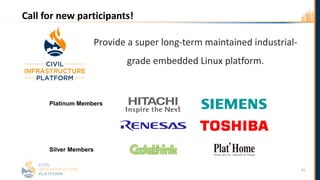
Call for new participants!
41
Provide a super long-term maintained industrial-
grade embedded Linux platform.
Platinum Members
Silver Members
42
Questions?
43
Thank you!
44

SLTS kernel and base-layer development in the Civil Infrastructure Platform

  • 1.
    SLTS Kernel andBase-Layer Development in the Civil Infrastructure Platform Yoshitake Kobayashi Embedded Linux Conference, Portland, February 21-23, 2017 1
  • 2.
    2 Our Civilization isRun by Linux https://www.airpano.com/360Degree-VirtualTour.php?3D=San-Francisco-USA
  • 3.
    3 https://www.airpano.com/360Degree-VirtualTour.php?3D=San-Francisco-USA Transport Energy IndustryOthers Rail automation Automatic ticket gates Vehicle control Power Generation Turbine Control Industry automation Industrial communication CNC control Building automation Healthcare Broadcasting
  • 4.
    4 But there areissues to be solved… https://www.airpano.com/360Degree-VirtualTour.php?3D=San-Francisco-USA
  • 5.
    5 A Railway System: 25-50years products life-cycle with very reluctant nature for product update and upgrade of hardware and base software platform Image: http://www.deutschebahn.com/contentblob/10862328/20160301+Stw+M%C3%BClheim+Innenansicht+1+(1)/data.jpg
  • 6.
    Railway Example 6 3 –5 years development time 2 – 4 years customer specific extensions 1 year initial safety certifications / authorization 3 – 6 months safety certifications / authorization for follow-up releases (depending on amount of changes) 25 – 50 years lifetime Image: http://www.deutschebahn.com/contentblob/10862328/20160301+Stw+M%C3%BClheim+Innenansicht+1+(1)/data.jpg
  • 7.
    What we havedone on Linux for civil infrastructure systems • Improve real-time performance and test • Improve reliability and test • Improve security and test • Improve stability and test • Create a lot of documents and review • Open source software licenses compliance • Export control classification • Then, support for long-time such as 20-60 years • ... 7
  • 8.
    8 We have aproblem…
  • 9.
    The Problems weface … • The systems that support our modern civilization need to survive for a VERY LONG TIME. Until now the corresponding industrial grade super long term maintenance has been done by each individual companies. • These systems not only have to survive for a long time, they must be “INDUSTRIAL GRADE” (robust, secure and reliable). And at the same time the industry will also need to catch up with the latest technology trends 9
  • 10.
    The Solutions weneed … • We need a Collaborative framework to maintain one same open source based system for many, many, many years to keep it secure, robust and reliable. • AND most importantly, we need to do this collaboratively in the upstream communities, not locally. 10 LONG TERM MAINTENACE INDUSTRIAL GRADE Collaborative Development
  • 11.
    Establishing an OpenSource Base Layer of industrial-grade software to enable the use and implementation of software building blocks for Civil Infrastructure Systems 11 CIP is our solution… https://www.cip-project.org/
  • 12.
    Requirements for theCivil infrastructure systems 13 Industrial Grade • Reliability • Functional Safety • Security • Real-time capabilities Sustainability • Product life-cycles of 10 – 60 years Conservative Upgrade/Upd ate Strategy • Firmware updates only if industrial grade is jeopardized • Minimize risk of regression • Keeping regression test and certification efforts low This has to be achieve with … Development time  Shorter development times for more complex systems Maintenance costs  Low maintenance costs for commonly uses software components  Low commissioning and update costs Development costs  Don‘t re-invent the wheel
  • 13.
    Things to bedone: Creation of “Open Source Base Layer” 14 UserspaceHardwareKernel • Open source based reference implementation • Strat from a minimal set for the controllers in the industrial grade systems Open Source Base Layer CIP Reference Hardware CIP Reference Filesystem image with SDK (CIP Core packages) CIP SLTS Kernel Non-CIP packages Any Linux distribution (e.g. Yocto Project, Debian, openSUSE, etc.) may extend/include CIP packages.
  • 14.
    Scope of activities UserspaceKernelspace LinuxKernel App container infrastructure (mid-term) App Framework (optionally, mid-term) Middleware/Libraries Safe & Secure Update Monitoring Domain Specific communication (e.g. OPC UA) Shared config. & logging Real-time support Real-time / safe virtualization Tools Concepts Build environment (e.g. yocto recipes) Test automation Tracing & reporting tools Configuration management Device management (update, download) Functional safety architecture/strategy, including compliance w/ standards (e.g., NERC CIP, IEC61508) Long-term support Strategy: security patch management Standardization collaborative effort with others License clearing Export Control Classification On device software stack Product development and maintenance Application life- cycle management Security 15 Multimedia
  • 15.
    Technical topics andrelated projects (Feb. 2017 version) w Linux Kernel Userland Isolation LXC Cgroups Heterogeneous Computing SoC FPGA Middleware / Tools Application support App Framework HMI Framework FW update App deployment Configuration/Device management Configuration Industrial Zeroconf Domain specific and IoT communication OPC UA Avnu Echonet Industrial special-purpose protocols Functional Safety SIL3 supportSIL2LinuxMP Monitoring/error detection RTOS OM2M Security LSM Anomaly detection SELinux Kernel Isolation Communication Jailhouse SafeG Real-time support PREEMPT-RT GPGPU/FPGA real-time Xenomai RT/non-RT communication Live patching Monitoring / Tracing RAS Ftrace ktap Coherent Security Mechanisms Hardware / SoC (x86 or ARM based) To be specified / implemented by CIP Integration / cooperationLegend 16 `I Testing kselftest CIP test suite FuegoLTP Infrastructure and Services Support SLTS Development process SIL3 supportSIL2 support Legal topics SPDX Export ControlLicense Clearing FOSSology Backwards compatibility Build and production Yocto Project TSN Multimedia Common issues Y2038 KernelCI Debian build system * Topics will be added or removed to reflect CIP technical interests
  • 16.
    Scope of activities UserspaceKernelspace LinuxKernel App container infrastructure (mid-term) App Framework (optionally, mid-term) Middleware/Libraries Safe & Secure Update Monitoring Domain Specific communication (e.g. OPC UA) Shared config. & logging Real-time support Real-time / safe virtualization Tools Concepts Build environment (e.g. yocto recipes) Test automation Tracing & reporting tools Configuration management Device management (update, download) Functional safety architecture/strategy, including compliance w/ standards (e.g., NERC CIP, IEC61508) Long-term support Strategy: security patch management Standardization collaborative effort with others License clearing Export Control Classification On device software stack Product development and maintenance Application life- cycle management Security 17 Multimedia
  • 17.
    Current status ofCIP base layer development • CIP SLTS kernel development • Decide the CIP kernel version • 4.4 as first CIP kernel. Maintenance expected for 10 years and more (SLTS). • Select a maintainer • Ben Hutchings as initial CIP-kernel maintainer • Define a kernel maintenance policies • https://wiki.linuxfoundation.org/civilinfrastructureplatform/cipkernelmaintenance • Start maintenance • Linux 4.4.48-cip2 released on 10th February 2017 • Create CIP kernel test framework • CIP core package development • Define an initial component set • Define component version • Contribute to upstream project • Start maintenance for SLTS 18
  • 18.
    19 CIP SLTS KernelDevelopment
  • 19.
    Overview of CIPSLTS kernel • Kernel trees • CIP SLTS (linux-4.4.y-cip) • Official CIP SLTS kernel tree • https://git.kernel.org/cgit/linux/kernel/git/bwh/linux-cip.git/ • Based on linux-stable.git • Maintainer: Ben Hutchings • Validation will be done by CIP • CIP SLTS+PREEMPT_RT (will be separately maintained by CIP members) • CIP kernel tree based on linux-stable-rt and patches from CIP SLTS • Validation will be done by CIP • Maintenance period • 10 years and more (10-20 years) 20
  • 20.
    CIP SLTS Kerneldevelopment trees 21 Mainline Stable (linux-stable) 4.4 CIP SLTS (linux-4.4.y-cip) Stable-rt CIP SLTS-rt/with FB 1. Feature backports 2. Security fix only +PREEMPT_RT Follow the CIP SLTS with PREEMPT_RT Validate by CIP members Backported patches Maintained by Ben Hutchings Take over from maintainer Take over from maintainer
  • 21.
    CIP SLTS Kerneldevelopment • Kernel maintenance policy • https://wiki.linuxfoundation.org/civilinfrastructureplatform/cipkernelmaintenance • Follow the stable kernel development rule as the basis • Feature backports are acceptable • All features has to be in upstream kernel before backport to CIP kernel • CIP has “Upstream first” policy • Validation will be done by CIP test infrastructure and/or members • Current backported features on 4.4.y-CIP • Kernel Self Protection Project related features • Address Space Layout Randomization for user space process (ASLR) • GCC’s undefined behaviour Sanitizer (UBSAN) • Faster page poisoning 22
  • 22.
    Out-of-tree drivers • Ingeneral, all out-of-tree drivers are unsupported by CIP • Users can use CIP kernel with out-of-tree drivers • If a bug is found in such a modified kernel, users will first demonstrate that it exists in the CIP kernel source release in order for the CIP maintainers to act on it. 23
  • 23.
    Major version releasecycle (Next CIP SLTS kernel version) • CIP will take a LTS kernel every 2-4 years • Planning to synchronize with LTSI for next CIP SLTS kernel • LTSI: http://ltsi.linuxfoundation.org/ 24
  • 24.
  • 25.
    Purpose of CIPtesting • Detecting bugs • Detecting regressions • Provide test results in a timely manner 26
  • 26.
    Milestones of CIPtesting and current status 1. Board at desk - single dev • A setup that allows a developer to test the CIP kernel on the CIP selected hardware platform connected locally to her development machine using kernelCI tools. 2. CIP kernel testing • Test the CIP kernel on a regular basis and share the results with other CIP community members. 3. Define kernel testing as a service within CIP • Define the testing environment within CIP assuming that, in some cases, some members may share the tests, test results or laboratories while others may not. 4. From kernel testing to system testing • Once the testing environment has been ready and works for the kernel, explore how to extend it to the entire CIP platform. https://wiki.linuxfoundation.org/civilinfrastructureplatform/ciptesting 27
  • 27.
    CIP kernel testing:Board at desk - single dev 28 • Goal • Create and publish a VM image that contains KernelCI & LAVA • Single developer can test the CIP kernel (or any other kernels) • Current status • Kernel CI and LAVA have been merged into one VM • Beta version just released! • https://gitlab.com/cip-project/board-at-desk-single-dev • Next step • Collaborate with other testing projects such as kernelCI, LAVA and Fuego • CIP members plans to join Fuego BoF @ ELC (Thursday 12:10pm at Skyline II)
  • 28.
  • 29.
    Current status ofBase layer development 1. Define an initial component set 2. Define component version 3. Contribute to upstream project 4. Start maintenance for SLTS 30
  • 30.
    Current status ofBase layer development 1. Define an initial component set 2. Define component version 3. Contribute to upstream project 4. Start maintenance for SLTS 31 1.5 Talk to upstream maintainer
  • 31.
    Initial component setfor CIP base layer • Flex • Bison • autoconf • automake • bc • bison • Bzip2 • Curl • Db • Dbus • Expat • Flex • gawk • Gdb 32 CIP Start from a minimal set of packages. “CIP kernel” and “CIP core” packages run on hardware. NOTE: The maintenance effort varies considerably for different packages. CIP Core Packages CIP Kernel Dev packages • Kernel • Linux kernel 4.4 + backported patches • PREEMPT_RT patch • Bootloader • U-boot • Shells / Utilities • Busybox • Base libraries • Glibc • Tool Chain • Binutils • GCC • Security • OpenSSL • Git • Glib • Gmp • Gzip • gettext • Kbd • Libibverbs • Libtool • Libxml2 • Mpclib • Mpfr4 • Ncurses • Make • M4 • pax-utils • Pciutils • Perl • pkg-config • Popt • Procps • Quilt • Readline • sysfsutils • Tar • Unifdef • Zlib Keep these packages for Reproducible buildCandidates for initial component set
  • 32.
    CIP Project X(Project name is tentative) • Started an incubation project for minimum base system • This project will provide the way to test the installable image • Goal • Input: Debian sources and cip kernel • Build mechanism: bitbake and/or Debian build system • Output: Minimum deployable base system 33
  • 33.
    Development plan 34 CIP willincrease the development effort to create a industrial grade common base-layer Phase 1: • Define supported kernel subsystems, arch. • Initial SLTS component selection • Select SLTS versions • Set-up maintenance infrastructure (build, test) Phase 2: • Patch collection, stabilization, back port of patches for CIP kernel packages • Support more subsystems • Additional core packages Core Packages Kernel (SLTS) Phase 3: • Domain specific enhancements, e.g. communication protocols, industrial IoT middleware • Optionally: more subystems • Optionally: more core packages add. pkgs Core Packages Kernel (SLTS) add. pkgs Core Packages Kernel (SLTS)
  • 34.
    Summary • Selected thefirst CIP kernel and initial maintainer • 4.4 as first CIP kernel. Maintenance expected for above 10 years (SLTS). • Ben Hutchings as initial CIP kernel maintainer. • Define CIP Kernel maintenance policies. • Defined initial board platforms and provide support for them. • Beaglebone Black and (RENESAS BOARD) as initial boards. • CIP kernel testing • Board @ desk - single developer. • Kernel CI and LAVA have been merged into one VM. • Started CIP Project X • Goal: create a minimum deployable base system. 35
  • 35.
  • 36.
    Next step byCIP • Board @desk - Single dev • Release kernelci VM and test CIP kernel in the open within CIP group. • Increase test coverage. • Define milestone 2. • Improve integration with Fuego and LAVA. • Kernel maintenance: define next steps. • Analysis: select additional software as part of CIP base layer. • Collaboration: kernelci.org, Fuego, y2038, KSPP, Real-Time Linux 37
  • 37.
  • 38.
    Why join CIP? •Steer participate in project decisions and technical direction. • Participate bring your use cases and ideas to the right forum. • Learn by working on daily basis in the open with others with common interest. • Collaborate share effort and knowledge. Stand on the shoulders of giants. 39
  • 39.
    Contact Information andResources To get the latest information, please contact: • Noriaki Fukuyasu: fukuyasu@linuxfoundation.org Other resources • CIP Web site: https://www.cip-project.org • CIP Mailing list: cip-dev@lists.cip-project.org • CIP Wiki: https://wiki.linuxfoundation.org/civilinfrastructureplatform/ • Collaboration at CIP: http://www.gitlab.com/cip-project • CIP kernel: git://git.kernel.org/pub/scm/linux/kernel/git/bwh/linux-cip.git 40
  • 40.
    Call for newparticipants! 41 Provide a super long-term maintained industrial- grade embedded Linux platform. Platinum Members Silver Members
  • 41.
  • 42.
  • 43.