SEMINAR
ON
“LINUX SYSTEM
ADMINISTRATION
(RHCSA/RHCE)”
Presented By
G RAVEENA NAIR
Bachelor of Technology
(Computer Science
Engineering)
Final year (2012-2016)
Govt. Engineering
College
Jhalawar
Under Guidance of
MR. SACHIN PAL YADAV
Head of Department & Asst.
Professor
Computer Science Engineering
Govt.Engineering College
Jhalawar
1
CONTENTS
• INTRODUCTION
• WHAT IS LINUX
• FEATURES OF RHEL 6.4
• USER MANAGEMENT
• FILE SYSTEM SECURITY
• LVM
• CONFIGURATION OF SERVERS
• SHELL SCRIPTING
• TUI
• CONCLUSION
2
INTRODUCTION
• RHCSA/RHCE focuses on actual
competencies at system administration,
including installation and configuration of a
Red Hat Enterprise Linux system and
attaching it to a live network running network
services.
• The certification demonstrates the knowledge,
skill and ability required for senior system
administrator responsible for Red Hat
Enterprise Linux systems. 3
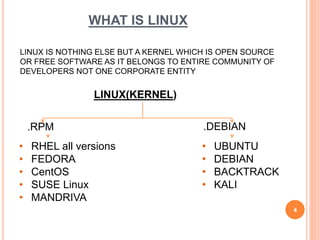
WHAT IS LINUX
LINUX(KERNEL)
.RPM .DEBIAN
• RHEL all versions
• FEDORA
• CentOS
• SUSE Linux
• MANDRIVA
• UBUNTU
• DEBIAN
• BACKTRACK
• KALI
LINUX IS NOTHING ELSE BUT A KERNEL WHICH IS OPEN SOURCE
OR FREE SOFTWARE AS IT BELONGS TO ENTIRE COMMUNITY OF
DEVELOPERS NOT ONE CORPORATE ENTITY
4
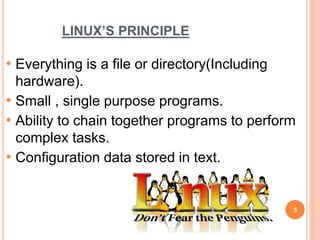
LINUX’S PRINCIPLE
• Everything is a file or directory(Including
hardware).
• Small , single purpose programs.
• Ability to chain together programs to perform
complex tasks.
• Configuration data stored in text.
5
FEATURES OF RHEL 6.4
• A New level of virtualization.
• Ext4 is made the default filesystem.
• Level of Security.
• SELinux(Security Enhanced Linux).
• New Networking Features .
• Use of Drivers.
• Support period provided by Red Hat.
6
USER MANAGEMENT
There are three types of accounts in RHEL :
• Root
• Users
• Group Users
Operations performed are:
• Adding/Deleting users
• Adding/Deleting groups
• Assigning passwords to above
• Adding Members to group.
• Login into accounts.
7
FILE SYSTEM SECURITY
• ALLOTING/REMOVING
PERMISSIONS ON FILE OR
DIRECTORY FOR OWNER,GROUP &
OTHERS.
• THREE TYPES OF PERMISSIONS:
• READ(r--)
• WRITE(-w-)
• EXECUTE(--x)
• CHANGING OWNER,GROUP OF
FILE/DIRECTORY.
• ACCESS CONTROL LIST.
8
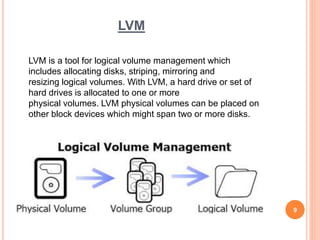
LVM
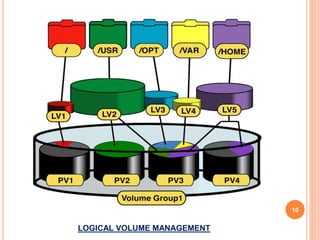
LVM is a tool for logical volume management which
includes allocating disks, striping, mirroring and
resizing logical volumes. With LVM, a hard drive or set of
hard drives is allocated to one or more
physical volumes. LVM physical volumes can be placed on
other block devices which might span two or more disks.
9
LOGICAL VOLUME MANAGEMENT
10
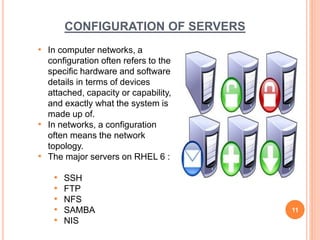
CONFIGURATION OF SERVERS
• In computer networks, a
configuration often refers to the
specific hardware and software
details in terms of devices
attached, capacity or capability,
and exactly what the system is
made up of.
• In networks, a configuration
often means the network
topology.
• The major servers on RHEL 6 :
• SSH
• FTP
• NFS
• SAMBA
• NIS
11
SHELL SCRIPTING
• Puts LINUX commands in a file.
• Almost always special-purpose code.
• Often one-time code.
• Seldom used where speed is important.
• Often used to manipulate files.
• Shell program text is wriitenin a file using an
editor starting with:
#! /bin/sh
• A Sample program:
#!/bin/sh
# himike
name=Mike
echo "Hello, $name!"
exit 0
12
TEXT USER INTERFACE(TUI)
13
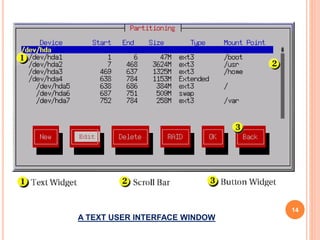
• A Text-user Interface processes events
from command-line interfaces that operate
sequentially.
• An advanced TUI may, like GUIs, use the
entire screen area and accept mouse input. A
TUI does not necessarily provide line-by-line
output.
• Although TUIs only use text,
symbols and colors available on a given text
environment.
A TEXT USER INTERFACE WINDOW
14
CONCLUSIONS
15
• A Growing technology.
• No threat of virus attacks.
• It comes with most of the soft wares pre-installed.
• Linux never gets slow.
• With this, we get a highest possible degree of
customizability.
• It is portable.
• Highly stable.
• Minimal hardware configuration.
THANK YOU..!!!!
ANY QUERIES…???
16

Presentation on rhce

  • 1.
    SEMINAR ON “LINUX SYSTEM ADMINISTRATION (RHCSA/RHCE)” Presented By GRAVEENA NAIR Bachelor of Technology (Computer Science Engineering) Final year (2012-2016) Govt. Engineering College Jhalawar Under Guidance of MR. SACHIN PAL YADAV Head of Department & Asst. Professor Computer Science Engineering Govt.Engineering College Jhalawar 1
  • 2.
    CONTENTS • INTRODUCTION • WHATIS LINUX • FEATURES OF RHEL 6.4 • USER MANAGEMENT • FILE SYSTEM SECURITY • LVM • CONFIGURATION OF SERVERS • SHELL SCRIPTING • TUI • CONCLUSION 2
  • 3.
    INTRODUCTION • RHCSA/RHCE focuseson actual competencies at system administration, including installation and configuration of a Red Hat Enterprise Linux system and attaching it to a live network running network services. • The certification demonstrates the knowledge, skill and ability required for senior system administrator responsible for Red Hat Enterprise Linux systems. 3
  • 4.
    WHAT IS LINUX LINUX(KERNEL) .RPM.DEBIAN • RHEL all versions • FEDORA • CentOS • SUSE Linux • MANDRIVA • UBUNTU • DEBIAN • BACKTRACK • KALI LINUX IS NOTHING ELSE BUT A KERNEL WHICH IS OPEN SOURCE OR FREE SOFTWARE AS IT BELONGS TO ENTIRE COMMUNITY OF DEVELOPERS NOT ONE CORPORATE ENTITY 4
  • 5.
    LINUX’S PRINCIPLE • Everythingis a file or directory(Including hardware). • Small , single purpose programs. • Ability to chain together programs to perform complex tasks. • Configuration data stored in text. 5
  • 6.
    FEATURES OF RHEL6.4 • A New level of virtualization. • Ext4 is made the default filesystem. • Level of Security. • SELinux(Security Enhanced Linux). • New Networking Features . • Use of Drivers. • Support period provided by Red Hat. 6
  • 7.
    USER MANAGEMENT There arethree types of accounts in RHEL : • Root • Users • Group Users Operations performed are: • Adding/Deleting users • Adding/Deleting groups • Assigning passwords to above • Adding Members to group. • Login into accounts. 7
  • 8.
    FILE SYSTEM SECURITY •ALLOTING/REMOVING PERMISSIONS ON FILE OR DIRECTORY FOR OWNER,GROUP & OTHERS. • THREE TYPES OF PERMISSIONS: • READ(r--) • WRITE(-w-) • EXECUTE(--x) • CHANGING OWNER,GROUP OF FILE/DIRECTORY. • ACCESS CONTROL LIST. 8
  • 9.
    LVM LVM is atool for logical volume management which includes allocating disks, striping, mirroring and resizing logical volumes. With LVM, a hard drive or set of hard drives is allocated to one or more physical volumes. LVM physical volumes can be placed on other block devices which might span two or more disks. 9
  • 10.
  • 11.
    CONFIGURATION OF SERVERS •In computer networks, a configuration often refers to the specific hardware and software details in terms of devices attached, capacity or capability, and exactly what the system is made up of. • In networks, a configuration often means the network topology. • The major servers on RHEL 6 : • SSH • FTP • NFS • SAMBA • NIS 11
  • 12.
    SHELL SCRIPTING • PutsLINUX commands in a file. • Almost always special-purpose code. • Often one-time code. • Seldom used where speed is important. • Often used to manipulate files. • Shell program text is wriitenin a file using an editor starting with: #! /bin/sh • A Sample program: #!/bin/sh # himike name=Mike echo "Hello, $name!" exit 0 12
  • 13.
    TEXT USER INTERFACE(TUI) 13 •A Text-user Interface processes events from command-line interfaces that operate sequentially. • An advanced TUI may, like GUIs, use the entire screen area and accept mouse input. A TUI does not necessarily provide line-by-line output. • Although TUIs only use text, symbols and colors available on a given text environment.
  • 14.
    A TEXT USERINTERFACE WINDOW 14
  • 15.
    CONCLUSIONS 15 • A Growingtechnology. • No threat of virus attacks. • It comes with most of the soft wares pre-installed. • Linux never gets slow. • With this, we get a highest possible degree of customizability. • It is portable. • Highly stable. • Minimal hardware configuration.
  • 16.