MapWorld 2007

      Insurance Trends, Drivers and Issues
                        Presented by:


                     Steve Callahan
                    Senior Consultant
                Robert E. Nolan Company

              Helping Insurers Solve Business
                    Challenges Through
              People, Process, and Technology
                     For Over 30 Years
Discussion Overview
 Introduction

 Framework

 Industry Financials

 Key Product Line Issues

 Operational Considerations: An Industry Survey

 Strategic Issues Facing The Industry
About the Robert E. Nolan Company
 Since 1973, have helped over 540 companies worldwide achieve results.
 We specialize in the insurance industry.
 Our core competencies are
   –   assisting clients to improve operational effectiveness,
   –   business process redesign,
   –   strategic alignment and
   –   business and technology integration.
 Our consultants average 20 years of industry specific experience.
 We use a participative approach and actively involve clients in every step.
 We are results-focused and strive to exceed client expectations.
 Client loyalty is among the very highest in the consulting industry.
 We are a member of the Association of Management Consulting Firms
   – conforms with regulatory and legislative initiatives
   – publicly committed to providing the highest quality of work.
P & C Clients - Partial List
           Personal Lines                       Commercial Insurance
            • Nationwide Insurance                 • CNA
            • State Farm Insurance                 • Zurich
            • Farmers Insurance                    • Citizens Insurance
            • American Family                      • Liberty / Peerless
            • American Express (P&C)               • Liberty Insurance
            • West Bend                            • Liberty / Wausau


Farm Insurance                         Specialty Lines
 • Colorado Farm Bureau                 • Swiss-Re
 • Kentucky Farm Bureau                 • Norcal
 • Indiana Farm Bureau                  • Washington Casualty
 • Michigan Farm Bureau                 • LAMMICO
 • Country Companies                    • FM Global
 • Sequoia Insurance
 • Millers Insurance
Presentation

Framework
Things to Keep In Mind
 The industry is complex and very dynamic, constantly changing
   –   Financials, product mixes, consumer demographics and even geography
   –   Globalization of markets, competition and distribution shifts
   –   State and Federal regulatory influence, including taxation changes
   –   Capital availability and deployment
   –   Reinsurance, securitizations, captives and retention
 There are a vast assortment of tools available to aid success
   –   Risk based pricing
   –   Investment management
   –   Automated underwriting and rating engines
   –   Claims adjudication systems
   –   Risk Aggregation and book of business analysis
   –   Loss forecasting and response formulation
   –   Operational service speed and resource deployment techniques
   –   Catastrophe modeling and management
   –   Market assessment and segmentation
 What are your company’s strengths, and where would it benefit
  from supplementing its toolset?
P/C Industry

 Financials
Growth in Net Written Premiums 1970-2007F
25%
           1975-78            1984-87                            2001-04

20%


15%


10%


 5%


 0%


-5%


-10%


       2006F
       2007F
        1970
        1971
        1972
        1973
        1974
        1975
        1976
        1977
        1978
        1979
        1980
        1981
        1982
        1983
        1984
        1985
        1986
        1987
        1988
        1989
        1990
        1991
        1992
        1993
        1994
        1995
        1996
        1997
        1998
        1999
        2000
        2001
        2002
        2003
        2004
        2005
            Note: Shaded areas denote hard market periods.
            Source: A.M. Best, Insurance Information Institute
P/C Industry Profitability 1975 – 2008F
25%
              10 years                     10 years                    9 years         Down?
20%    19%
                                   17%
                             15%                                                            ?
15%                                                                                   14%
                    12%                            11%           12%
                                          11%                                9%
10%                    9%
       10%                                                       9%                    10%
                                          9%
5%                                                       6%
                                                                      6%
      2%                      2%                5%                               2%
0%

                                                                           -1%
-5%


      07F
      08F
       75
       76
       77
       78
       79
       80
       81
       82
       83
       84
       85
       86
       87
       88
       89
       90
       91
       92
       93
       94
       95
       96
       97
       98
       99
       00
       01
       02
       03
       04
       05
       06
      *2007-08 P/C insurer ROEs are I.I.I. estimates.
      Source: Insurance Information Institute; ISO, A.M. Best.
Underwriting Gain (Loss) 1975-2006
              35
              30
              25
              20
              15
              10
               5
$ Billions


               0
              -5
             -10
             -15
             -20
             -25
             -30
             -35
             -40              Despite the 2006 underwriting profit,
             -45               the cumulative underwriting deficit
             -50                    since 1975 is $419 billion.
             -55
                   75
                   76
                   77
                   78
                   79
                   80
                   81
                   82
                   83
                   84
                   85
                   86
                   87
                   88
                   89
                   90
                   91
                   92
                   93
                   94
                   95
                   96
                   97
                   98
                   99
                   00
                   01
                   02
                   03
                   04
                   05
                   06
                   Source: A.M. Best, Insurance Information Institute
Comparison of Total Returns by Line
                                          2006           YTD
                                                        4/2007
 S/P 500                                13.62%          4.66%
 Life Insurers                          16.24%          8.16%
 Reinsurers                             19.95%          -1.44%
 P/C                                    16.57%           .08%
 All Insurers                           10.33%          2.84%

 Multiline                               9.53%           .97%

 Brokers                                  .61%          8.23%


Source: SNL Securities, Standard & Poor’s, Insurance Information Institute
Ultimate Risk: Insurer Impairment
                                                1969 to     2003 to
Reason for Impairment                             2005        2005
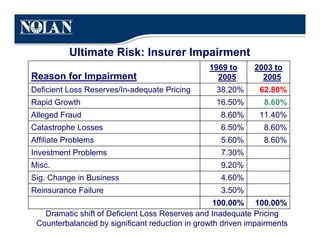
Deficient Loss Reserves/In-adequate Pricing       38.20%      62.80%
Rapid Growth                                      16.50%       8.60%
Alleged Fraud                                      8.60%      11.40%
Catastrophe Losses                                 6.50%       8.60%
Affiliate Problems                                 5.60%       8.60%
Investment Problems                                7.30%
Misc.                                              9.20%
Sig. Change in Business                            4.60%
Reinsurance Failure                                3.50%
                                                  100.00% 100.00%
   Dramatic shift of Deficient Loss Reserves and Inadequate Pricing
 Counterbalanced by significant reduction in growth driven impairments
P/C Industry: The Cycle Repeats
 P/C Insurance Industry is strongly cyclical, characterized by
   – periods of soft market conditions
      •   rates are stable or falling and insurance is readily available
      •   companies compete vigorously to increase market share
      •   profits diminish or vanish completely
      •   the capital needed to underwrite new business is depleted
   – periods of hard market conditions
      •   competition is less intense
      •   underwriting standards become more stringent
      •   the supply of insurance is limited due to the depletion of capital
      •   rates rise, coverage more difficult to find and profits increase
   – higher profits draws more capital into the marketplace
      • leads to more competition and the inevitable down phase of the cycle
 Three decades, three hard markets, overall net premiums growth
      • 7.7% (1975-1978), 10.0% (1984 to 1987) and 6.3% (2001 to 2004)
Financial Trend Implications
 Growth in Net Written Premiums may be marginal and on a down trend
   – Forecast at under 2% for 2007 and 2008, slowing to rates prevalent in the 90’s
   – Premium Growth: Approaching a Standstill

 Net Income After Taxes at an all time high in 2006 for P/C insurers
   – 2006 shows a 145% improvement over 2005, continuing 4 year trend up
   – Profit levels appear to be unsustainably high at this point, likely to turn
   – Net Income: On the Cusp of a Down Cycle?

 Combined ratios at all time low in 2006, forecast increasing 2007 and 2008
   – Even the 2008 forecast is below 100%, far below the 2001 peak of 116%
   – Combined Ratios: Passing 100% as Premium Growth Flattens?

 Underwriting gain in 2006 was over $30 billion
   – Still, the cumulative underwriting loss since 1975 is over $400 Billion
   – Result of lack of CATs, tort system improvements and favorable loss levels
   – Underwriting Profits: Infrequent and Unsustainable?

 P/C Financial Performance Synopsis - 2006, A Cyclical Peak
P/C Industry

Key Product Line Issues
Private Passenger Auto – The Cash Cow
Private Passenger Auto Combined Ratio
110                                                    109.5
                                                               107.9


105                                                                    104.2
                                               103.5
      101.7 101.3 101.3
                        101.0          101.1

100                             99.5
                                                                               98.4


                                                                                             95.1
 95                                                                                   94.3
                                                                                                    93.0


 90
       93    94    95      96    97     98      99      00      01      02     03     04     05     06F
                        Source: A.M. Best; Insurance Information Institute
Private Passenger Auto is
   Enormous Part of Industry – Driving Profits
                                                         PPA Liability
                                                           20.5%
                                                                         = 34.7%
                                                 $95.8B                  Of Market

                                                                          PPA Coll/Comp
                                                            $66.4B           14.2%
                           $251.6B
All Commercial
     Lines
     53.9%                                             $53.2B

                                                                     Homeowners
                                                                       11.4%


                 Source: A.M. Best; Insurance Information Institute, 2004 values
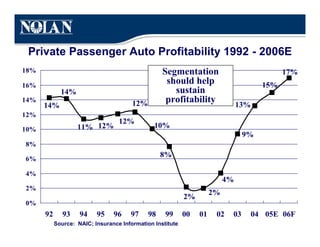
Private Passenger Auto Profitability 1992 - 2006E
18%                                               Segmentation                               17%
16%
                                                   should help                         15%
             14%                                     sustain
14%
                                       12%         profitability
      14%                                                                      13%
12%
                                  12%
10%                11% 12%                     10%
                                                                                9%
8%
                                                  8%
6%

4%
                                                                          4%
2%
                                                                     2%
                                                           2%
0%
      92      93    94    95    96    97     98    99      00   01    02   03        04 05E 06F
           Source: NAIC; Insurance Information Institute
Private Passenger Auto Market
 Competitive marketplaces, safer cars, aggressive fraud-fighting and
  innovative underwriting driving down the price of auto insurance.
   – Savings vary by state based on degree of regulations impact on market
   – Urban population, traffic density and cost of living also effect rate changes
   – Other factors include tort liability, labor costs, theft rates and coverage limits
 Claims frequency decreased 3% to 5% 2006 vs 2005, impacting rates
   – Modest increase in claims severity of only 2% to 4%
 Other key factors influencing decreases in premium include
   –   Fraud fighting successes decreasing false bodily injury claims
   –   Safer vehicles and roads
   –   Graduated licensing programs for teens
   –   Changing demographics with baby boomers in safest driving years
 Underwriting acumen is ultimate determinant of success
   – Utilize a life-cycle approach to underwriting modeling all possible variables
   – Incorporate credit scores, driving habits, demographics into rating models
   Source: Insurance Information Institute.
   Auto insurance premium expected to drop in 2007 for first time since 1999. December 2006.
Private Passenger Auto Market
      Segmenting the Market and Modeling Risk
 Increase rating factors creating sophisticated underwriting models
   – Expand number of price points used in risk assessment and modeling
   – Integrate with new auto safety features tracking actual travel events
      • Teen monitoring program in Wisconsin
      • “Black box” accessories monitoring where, when, speed, braking, etc
   – Integrating with geographic attributes to consumer utilization patterns
      • Where they travel, areas crossed
      • Parking locations for work and home and likely recreational choices

 Profit Focus: “Predictive Modeling” & “Segmentation”
   – Create a rating system more accurate and therefore equitable to all
   – Risk reliably mapped to price across a broad range of circumstances
   – Optimize profits by effective risk profiling and rating
Product Liability – The Black Box of Unknowns
Product Liability – Uncertainty and Risk
Excess liability insurance:
 Most effective way to protect against potentially catastrophic financial
  impact of product liability lawsuits
 Line of insurance has inherent and potentially extreme uncertainties.
According to one trade publication:
 “Few insurers have the expertise and financial strength to underwrite
  complex liability exposure long term. Some fall victim to financial
  insolvency; others retreat after realizing the complexity and
  magnitude of the losses.”
Takeaway:
  There are immeasurable unexpected sources of product liability
  exposures facing companies today that may or may not be within
  pricing considerations.

Source: U.S. Chamber of Commerce. Products Liability: Emerging Exposures, Best Practices.
                                     April 2006.
Product Liability – Some Emerging Issues
Lead paint
 resurfacing on a large scale and highly publicized
 state & city gov’ts have advanced a public nuisance cause of action
 could require manufacturers to pay billions abating existing lead paint conditions
Benzene
 wide array of products containing trace levels makes potential everywhere
 large awards already granted on gas refinery exposure and aircraft painter
Pharmaceuticals
 large single claimant cases and class actions like Vioxx continue
 damages typically for actual or anticipated injury and loss
 cost of defense alone can severely damage a firms balance sheet
Welding rods
 developing area of litigation with over 10,000 claims nationwide
 based on exposure to manganese fumes, causes neurological damage
Diacetyl
 workers who package butter flavored popcorn suffer alleged exposure
 four lawsuits with verdicts totaling 53 million, over 60 more filed
  Source: U.S. Chamber of Commerce. Products Liability: Emerging Exposures, Best Practices.
                                       April 2006.
Inflation Adjusted Tort Costs
                            Per Capita, 1950-2005
$1,000      Tort costs per
              capita have                                     $878 $897 $914 $880
  $900     increased 817%                   $780
  $800     since 1950 even                           $722
  $700    after adjusting for
  $600         inflation
  $500                             $444
  $400                    $340
  $300
                 $199
  $200
         $96
  $100
    $0
         50        60       70       80       90       00       02       03       04   05
              Source: Tillinghast-Towers Perrin, 2006 Update on US Tort Cost Trends.
Market Impacts of Litigation on Insurable Risk
 Creates Another Layer of Uncertainty in a Very Difficulty Market
   – Goal is to Compel Insurers to pay losses for risks not priced for
 Courts’ retroactively rewrite of long-standing contract terms &
  conditions creates an unpredictable and unpriceable risk
   – Juries awarding of massive punitive damages exacerbates risk

 Coverage will become more expensive, less available, more risky and
  losses increasingly volatile
   – What role can risk aggregation and concentration analysis play
   – Can patterns depict fraud or probability
 BOTTOM LINE: Unknown and unidentified risks along with courts and
  juries create nearly impossible environment
Catastrophes – The Pendulum of Risk
U.S. Insured Catastrophe Losses*
                                                    $ Billions


                                                                                                                                             $100.0
$120                                                                             $100B CAT Year is coming
                                                                                 Question is not if, but when
$100


                                                                                                                              $61.9
$80

$60


                                                                                                                      $27.5
                                                                                               $26.5
                             $22.9


$40
                                            $16.9


                                                                                                              $12.9
                                                                         $10.1


                                                                                                                                      $9.2
                                                    $8.3


                                                                                 $8.3
       $7.5


                                                           $7.4


                                                                                                       $5.9
                                     $5.5
                      $4.7


                                                                                        $4.6
$20
               $2.7


                                                                  $2.6


  $0
       89
               90
                      91
                             92
                                     93
                                            94
                                                    95
                                                           96
                                                                  97
                                                                         98
                                                                                 99
                                                                                        00
                                                                                               01
                                                                                                       02
                                                                                                              03
                                                                                                                      04
                                                                                                                                05
                                                                                                                                      06
                                                                                                                                             20??
              Source: Property Claims Service/ISO; Insurance Information Institute
Inflation-Adjusted U.S. Insured Catastrophe
           Losses By Cause of Loss, 1986-2005¹

       Wind/Hail/Flood         Civil Disorders     Water Damage
            2.8%                    0.4%                 0.1%
                              Fire                              Tornadoes
 Earthquakes
                              2.3%           Utility Disruption  24.5%
    6.7%
                                                    0.1%

Winter Storms
    7.8%                                                              Tropical Cyclones,
                                                                    Wind/Hail/Flood, and
    Terrorism                                                      Earthquakes accounted
      7.7%                                                         for 81.5% of CAT losses
                                                                        from 1986-2005
                                                               Pattern analysis and risk
                                                                   profiling helps in
    All Tropical
                                                                 managing exposure
     Cyclones
       47.5%
                         Source: Insurance Services Office (ISO)
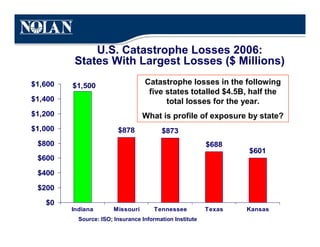
U.S. Catastrophe Losses 2006:
          States With Largest Losses ($ Millions)
$1,600   $1,500                    Catastrophe losses in the following
                                    five states totalled $4.5B, half the
$1,400                                   total losses for the year.
$1,200                             What is profile of exposure by state?
$1,000                   $878            $873
 $800                                                     $688
                                                                  $601
 $600

 $400

 $200

   $0
         Indiana        Missouri       Tennessee          Texas   Kansas
           Source: ISO; Insurance Information Institute
Total Value of Insured
                           Coastal Exposure (2004, $ Billions)
        Florida                                                  $1,937.3
     New York                                                   $1,901.6
         Texas                           $740.0
 Massachusetts                        $662.4
    New Jersey                    $505.8
   Connecticut                 $404.9
      Louisiana           $209.3               Florida & New York lead the
    S. Carolina         $148.8              way for insured coastal property
       Virginia         $129.7                at more than $1.9 trillion each.
         Maine         $117.2
 North Carolina        $105.3
      Alabama         $75.9                   Northeast state insured coastal
       Georgia        $73.0
      Delaware       $46.4
                                                exposure totals $3.73 trillion.
New Hampshire        $45.6
     Mississippi     $44.7
  Rhode Island       $43.8
      Maryland      $12.1

                   $0        $500       $1,000        $1,500   $2,000       $2,500
                                      Source: AIR Worldwide
Nightmare Scenario: Insured Property
            Losses for NJ/NY CAT 3/4 Storm
Insured Losses: $110B
Economic Losses: $200B+
                                       Distribution of Insured Property
                                          Losses by State ($ Billions)


                                 $80      $70           Profiling of Risks
                                                          helps identify
                                 $60                       cumulative
                                                       exposures and risk
                                 $40            $30          clusters

                                 $20
                                                        $5      $4        $1
                                  $0
                                          NY     NJ     PA      CT    Other
                  Source: AIR Worldwide
Outlook for 2007 Hurricane Season:
                       85% Worse Than Average
                                 Average       2005      2007F    2007F              4 Month
                                    *                   Dec 2006 Apr 2007              Chg
Named Storms                        9.6         28          14            17           +21%
Named Storm Days                   49.1       115.5         70            85           +21%

Hurricanes                          5.9         14           7             9           +29%
Hurricane Days                     24.5        47.5         35            40           +14%
Intense Hurricanes                  2.3          7           3             5           +66%

Intense Hurricane Days               5           7           8            11           +38%

Net Tropical Cyclone               100%       275%        140%          185%           +29%
Activity


 Source: Philip Klotzbach and Dr. William Gray, Colorado State University, April 3, 2007.
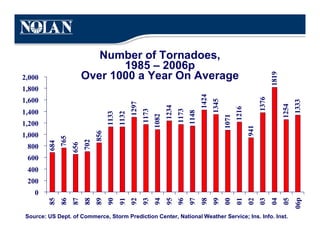
Number of Tornadoes,
                                 1985 – 2006p
                          Over 1000 a Year On Average


                                                                                                                                       1819
2,000
1,800


                                                                                              1424


                                                                                                                                1376
1,600


                                                                                                     1345


                                                                                                                                                     1333
                                                    1297


                                                                                                                                              1254
                                                                         1234


                                                                                                                   1216
                                                           1173


                                                                                1173
1,400


                                                                                       1148
                                      1133
                                             1132


                                                                  1082


                                                                                                            1071
1,200


                                                                                                                          941
                                856


1,000
              765


                          702
        684


                    656


 800
 600
 400
 200
   0


                                                                                                                                                     06p
        85
              86
                    87
                          88
                                89
                                      90
                                             91
                                                    92
                                                           93
                                                                  94
                                                                         95
                                                                                96
                                                                                       97
                                                                                              98
                                                                                                     99
                                                                                                            00
                                                                                                                   01
                                                                                                                          02
                                                                                                                                03
                                                                                                                                       04
                                                                                                                                              05
Source: US Dept. of Commerce, Storm Prediction Center, National Weather Service; Ins. Info. Inst.
Risk of Earthquakes
  The potential cost of earthquakes has been growing due to
     – Increasing urban development in seismically active areas
     – Vulnerability of older buildings, not upgraded to current building codes
  Earthquake insurance showed a 5.5% increase in 2005 vs. 2004
     – Premiums rose to $1.67 billion in 2005 from $1.6 billion in 2004
     – Wood structures benefit from lower rates than brick buildings
     – Regions are graded on a scale of 1 to 5 for likelihood of quakes
  There are over 3 million earthquakes worldwide each year
     – The vast majority of those are a magnitude 3.9 or lower
     – More than 900 earthquakes measure 5.0 or higher each year
  Study of U.S. earthquake risk released by FEMA September 2000
     – The study estimated losses could average $4.4 billion dollars a year
  Earthquakes were responsible for more fatalities in 2006 than any
   other catastrophe with total insured damages $80 million


Source: Insurance Information Institute. Earthquakes: Risk and Insurance Issues. April 2007.
Modeling Earthquake Risks
 Science and engineering provides tools used to reduce their damage
  – identify where likely to occur and what forces they will generate
 FEMA uses earthquake loss estimation tool called Hazards U.S. (HAZUS)
  – Uses information about building stock, local geology, location and size of
    potential earthquakes, economic data, and other information to estimate losses
 HAZUS is capable of using two separate geographic information systems
  (MapInfo® and ArcView®)
  – to map and display ground shaking, the pattern of building damage and
  – demographic information about a community.
 HAZUS estimates, based on location and size of hypothetical earthquake
  –   the violence of ground shaking, the number of buildings damaged,
  –   the number of casualties, the amount of damage to transportation systems,
  –   disruption to the electrical and water utilities,
  –   the number of people displaced from their homes, and
  –   the estimated cost of repairing projected damage and other effects.

 Source: Insurance Information Institute. Earthquakes: Risk and Insurance Issues. April 2007.
Terrorism – Our Debate with Uncle Sam
Terrorism Coverage Take-Up Rate
                       Continues to Rise
                                                                                     64%
                                                                            59%
                                                                   54%
                       44% 46% 44% 48% 47%

               33%
      26%
24%


03Q2 03Q3 03Q4 04Q1 04Q2 04Q3 04Q4 05Q1 05Q2 05Q3 05Q4
 Source: Marketwatch: Terrorism Insurance 2006, Marsh, Inc.; Insurance Information Institute
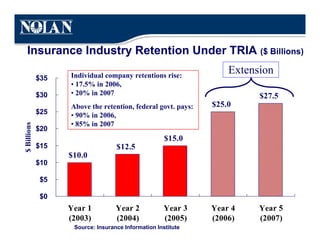
Insurance Industry Retention Under TRIA ($ Billions)

                   Individual company retentions rise:
                                                                  Extension
             $35
                   • 17.5% in 2006,
             $30   • 20% in 2007                                        $27.5
                   Above the retention, federal govt. pays:   $25.0
             $25   • 90% in 2006,
                   • 85% in 2007
$ Billions


             $20
                                                     $15.0
             $15                   $12.5
                   $10.0
             $10

             $5

             $0
                   Year 1          Year 2            Year 3   Year 4    Year 5
                   (2003)          (2004)            (2005)   (2006)    (2007)
                    Source: Insurance Information Institute
Robert E. Nolan Company

      P/C Industry

    Survey Findings
Top UW Priorities – Survey Findings
 Overriding priority is stick to the basics and avoid distractions
   - Conventional underwriting levers are being used to drive improvements
   - Improved practices through improved data, processes and skills
 Top operational priorities in rank order
   1. Organic growth
   2. Underwriting and general expense management
   3. Customer service
   4. New tool introduction
 Other findings of interest include
   –   Surprising lack of emphasis on acquisition of new tools
   –   Focus was on squeezing more out of existing IT investments
   –   Outsourcing not seen as a high priority to achieving expense savings
   –   Relatively low priority was placed on acquisitions by respondents
UW Near Term Focus – Survey Findings
 Better rate pursuit
 Maintaining accurate customer data
 Better risk evaluation tools
 Improved use of claims data in underwriting process
 Upgrading front-line underwriting skills
 Better use of existing automation
 Acquisition of new tools
Top Claims Priorities – Survey Findings
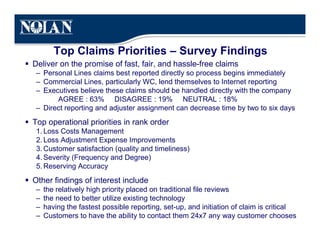
 Deliver on the promise of fast, fair, and hassle-free claims
   – Personal Lines claims best reported directly so process begins immediately
   – Commercial Lines, particularly WC, lend themselves to Internet reporting
   – Executives believe these claims should be handled directly with the company
         AGREE : 63% DISAGREE : 19% NEUTRAL : 18%
   – Direct reporting and adjuster assignment can decrease time by two to six days
 Top operational priorities in rank order
   1. Loss Costs Management
   2. Loss Adjustment Expense Improvements
   3. Customer satisfaction (quality and timeliness)
   4. Severity (Frequency and Degree)
   5. Reserving Accuracy
 Other findings of interest include
   –   the relatively high priority placed on traditional file reviews
   –   the need to better utilize existing technology
   –   having the fastest possible reporting, set-up, and initiation of claim is critical
   –   Customers to have the ability to contact them 24x7 any way customer chooses
Claims Near Term Focus – Survey Findings
 Tie for top 3 Areas of Improvements
  1.Improved processes
  2.Better hiring and training practices
  3.Deployment of new technologies
 Better file reviews
 Full utilization of existing technology
 HR changes and processes for finding the right people
 Increased use of contact centers
 Centralizing / decentralizing personnel
 Increased use of outsourcing vendors
Other Survey Findings
 Capture the synergy of investments in people, process and technology
   – Business process management is a high priority for achieving improvements
   – Leveraging greater value from existing systems and technology investments
   – Continued deployment of paperless processing
 Offshoring and outsourcing lower priorities
   – 80% surveyed disagreed that contact centers will move offshore
   – 92% surveyed disagreed with use of offshore processing for UW or issue
   – General sense is both sourcing options have a way to go before being viable
     for UW, insurance contact centers, or Claims
 Achieving full results from image-enabled processing realizable with
   – Invest additional time and resources in redesigning processes first
   – Increased dependence on rules engines and workflow systems require new
     skills and a higher degree of collaboration between business units and IT
   – Consistent rules, changes in staff roles, and new management processes
Strategic Issues

Facing The Industry
What are the “Big Issues”?
 Cat loss pricing, preparation and management (including Terrorism)
   – Cat modeling and risk based pricing models
   – Risk concentrations and risk portfolio management
   – Retention and reinsurance
 Successfully Navigating a Soft Market
   –   Underwriting and Claims Discipline (consistency and quality)
   –   Expense management during low growth (continuous improvements)
   –   Investment selection and returns optimization
   –   Leveraging technology and operational efficiency (esp. with low growth)
 Shifting Demographics
   – Customer segmentation and profitability targeting
   – Differentiation and niche solutions
   – Streamlined product development / rapid time to market
 Changing Distribution Dynamics
   – Increased competition from alternatives (banks, brokers) and internationally
   – Attrition rates of proven channels / sustaining channel strength
Questions?


Steve Callahan, ChFC, CLU, FLHC, FLMI/M
            Senior Consultant
       Robert E. Nolan Company
        Management Consultants
      Steve_Callahan@renolan.com
             877-RENOLAN
            www.renolan.com

200705 MapWorld - PC Industry Update

  • 1.
    MapWorld 2007 Insurance Trends, Drivers and Issues Presented by: Steve Callahan Senior Consultant Robert E. Nolan Company Helping Insurers Solve Business Challenges Through People, Process, and Technology For Over 30 Years
  • 2.
    Discussion Overview  Introduction Framework  Industry Financials  Key Product Line Issues  Operational Considerations: An Industry Survey  Strategic Issues Facing The Industry
  • 3.
    About the RobertE. Nolan Company  Since 1973, have helped over 540 companies worldwide achieve results.  We specialize in the insurance industry.  Our core competencies are – assisting clients to improve operational effectiveness, – business process redesign, – strategic alignment and – business and technology integration.  Our consultants average 20 years of industry specific experience.  We use a participative approach and actively involve clients in every step.  We are results-focused and strive to exceed client expectations.  Client loyalty is among the very highest in the consulting industry.  We are a member of the Association of Management Consulting Firms – conforms with regulatory and legislative initiatives – publicly committed to providing the highest quality of work.
  • 4.
    P & CClients - Partial List Personal Lines Commercial Insurance • Nationwide Insurance • CNA • State Farm Insurance • Zurich • Farmers Insurance • Citizens Insurance • American Family • Liberty / Peerless • American Express (P&C) • Liberty Insurance • West Bend • Liberty / Wausau Farm Insurance Specialty Lines • Colorado Farm Bureau • Swiss-Re • Kentucky Farm Bureau • Norcal • Indiana Farm Bureau • Washington Casualty • Michigan Farm Bureau • LAMMICO • Country Companies • FM Global • Sequoia Insurance • Millers Insurance
  • 5.
  • 6.
    Things to KeepIn Mind  The industry is complex and very dynamic, constantly changing – Financials, product mixes, consumer demographics and even geography – Globalization of markets, competition and distribution shifts – State and Federal regulatory influence, including taxation changes – Capital availability and deployment – Reinsurance, securitizations, captives and retention  There are a vast assortment of tools available to aid success – Risk based pricing – Investment management – Automated underwriting and rating engines – Claims adjudication systems – Risk Aggregation and book of business analysis – Loss forecasting and response formulation – Operational service speed and resource deployment techniques – Catastrophe modeling and management – Market assessment and segmentation  What are your company’s strengths, and where would it benefit from supplementing its toolset?
  • 7.
  • 8.
    Growth in NetWritten Premiums 1970-2007F 25% 1975-78 1984-87 2001-04 20% 15% 10% 5% 0% -5% -10% 2006F 2007F 1970 1971 1972 1973 1974 1975 1976 1977 1978 1979 1980 1981 1982 1983 1984 1985 1986 1987 1988 1989 1990 1991 1992 1993 1994 1995 1996 1997 1998 1999 2000 2001 2002 2003 2004 2005 Note: Shaded areas denote hard market periods. Source: A.M. Best, Insurance Information Institute
  • 9.
    P/C Industry Profitability1975 – 2008F 25% 10 years 10 years 9 years Down? 20% 19% 17% 15% ? 15% 14% 12% 11% 12% 11% 9% 10% 9% 10% 9% 10% 9% 5% 6% 6% 2% 2% 5% 2% 0% -1% -5% 07F 08F 75 76 77 78 79 80 81 82 83 84 85 86 87 88 89 90 91 92 93 94 95 96 97 98 99 00 01 02 03 04 05 06 *2007-08 P/C insurer ROEs are I.I.I. estimates. Source: Insurance Information Institute; ISO, A.M. Best.
  • 10.
    Underwriting Gain (Loss)1975-2006 35 30 25 20 15 10 5 $ Billions 0 -5 -10 -15 -20 -25 -30 -35 -40 Despite the 2006 underwriting profit, -45 the cumulative underwriting deficit -50 since 1975 is $419 billion. -55 75 76 77 78 79 80 81 82 83 84 85 86 87 88 89 90 91 92 93 94 95 96 97 98 99 00 01 02 03 04 05 06 Source: A.M. Best, Insurance Information Institute
  • 11.
    Comparison of TotalReturns by Line 2006 YTD 4/2007 S/P 500 13.62% 4.66% Life Insurers 16.24% 8.16% Reinsurers 19.95% -1.44% P/C 16.57% .08% All Insurers 10.33% 2.84% Multiline 9.53% .97% Brokers .61% 8.23% Source: SNL Securities, Standard & Poor’s, Insurance Information Institute
  • 12.
    Ultimate Risk: InsurerImpairment 1969 to 2003 to Reason for Impairment 2005 2005 Deficient Loss Reserves/In-adequate Pricing 38.20% 62.80% Rapid Growth 16.50% 8.60% Alleged Fraud 8.60% 11.40% Catastrophe Losses 6.50% 8.60% Affiliate Problems 5.60% 8.60% Investment Problems 7.30% Misc. 9.20% Sig. Change in Business 4.60% Reinsurance Failure 3.50% 100.00% 100.00% Dramatic shift of Deficient Loss Reserves and Inadequate Pricing Counterbalanced by significant reduction in growth driven impairments
  • 13.
    P/C Industry: TheCycle Repeats  P/C Insurance Industry is strongly cyclical, characterized by – periods of soft market conditions • rates are stable or falling and insurance is readily available • companies compete vigorously to increase market share • profits diminish or vanish completely • the capital needed to underwrite new business is depleted – periods of hard market conditions • competition is less intense • underwriting standards become more stringent • the supply of insurance is limited due to the depletion of capital • rates rise, coverage more difficult to find and profits increase – higher profits draws more capital into the marketplace • leads to more competition and the inevitable down phase of the cycle  Three decades, three hard markets, overall net premiums growth • 7.7% (1975-1978), 10.0% (1984 to 1987) and 6.3% (2001 to 2004)
  • 14.
    Financial Trend Implications Growth in Net Written Premiums may be marginal and on a down trend – Forecast at under 2% for 2007 and 2008, slowing to rates prevalent in the 90’s – Premium Growth: Approaching a Standstill  Net Income After Taxes at an all time high in 2006 for P/C insurers – 2006 shows a 145% improvement over 2005, continuing 4 year trend up – Profit levels appear to be unsustainably high at this point, likely to turn – Net Income: On the Cusp of a Down Cycle?  Combined ratios at all time low in 2006, forecast increasing 2007 and 2008 – Even the 2008 forecast is below 100%, far below the 2001 peak of 116% – Combined Ratios: Passing 100% as Premium Growth Flattens?  Underwriting gain in 2006 was over $30 billion – Still, the cumulative underwriting loss since 1975 is over $400 Billion – Result of lack of CATs, tort system improvements and favorable loss levels – Underwriting Profits: Infrequent and Unsustainable?  P/C Financial Performance Synopsis - 2006, A Cyclical Peak
  • 15.
  • 16.
    Private Passenger Auto– The Cash Cow
  • 17.
    Private Passenger AutoCombined Ratio 110 109.5 107.9 105 104.2 103.5 101.7 101.3 101.3 101.0 101.1 100 99.5 98.4 95.1 95 94.3 93.0 90 93 94 95 96 97 98 99 00 01 02 03 04 05 06F Source: A.M. Best; Insurance Information Institute
  • 18.
    Private Passenger Autois Enormous Part of Industry – Driving Profits PPA Liability 20.5% = 34.7% $95.8B Of Market PPA Coll/Comp $66.4B 14.2% $251.6B All Commercial Lines 53.9% $53.2B Homeowners 11.4% Source: A.M. Best; Insurance Information Institute, 2004 values
  • 19.
    Private Passenger AutoProfitability 1992 - 2006E 18% Segmentation 17% 16% should help 15% 14% sustain 14% 12% profitability 14% 13% 12% 12% 10% 11% 12% 10% 9% 8% 8% 6% 4% 4% 2% 2% 2% 0% 92 93 94 95 96 97 98 99 00 01 02 03 04 05E 06F Source: NAIC; Insurance Information Institute
  • 20.
    Private Passenger AutoMarket  Competitive marketplaces, safer cars, aggressive fraud-fighting and innovative underwriting driving down the price of auto insurance. – Savings vary by state based on degree of regulations impact on market – Urban population, traffic density and cost of living also effect rate changes – Other factors include tort liability, labor costs, theft rates and coverage limits  Claims frequency decreased 3% to 5% 2006 vs 2005, impacting rates – Modest increase in claims severity of only 2% to 4%  Other key factors influencing decreases in premium include – Fraud fighting successes decreasing false bodily injury claims – Safer vehicles and roads – Graduated licensing programs for teens – Changing demographics with baby boomers in safest driving years  Underwriting acumen is ultimate determinant of success – Utilize a life-cycle approach to underwriting modeling all possible variables – Incorporate credit scores, driving habits, demographics into rating models Source: Insurance Information Institute. Auto insurance premium expected to drop in 2007 for first time since 1999. December 2006.
  • 21.
    Private Passenger AutoMarket Segmenting the Market and Modeling Risk  Increase rating factors creating sophisticated underwriting models – Expand number of price points used in risk assessment and modeling – Integrate with new auto safety features tracking actual travel events • Teen monitoring program in Wisconsin • “Black box” accessories monitoring where, when, speed, braking, etc – Integrating with geographic attributes to consumer utilization patterns • Where they travel, areas crossed • Parking locations for work and home and likely recreational choices  Profit Focus: “Predictive Modeling” & “Segmentation” – Create a rating system more accurate and therefore equitable to all – Risk reliably mapped to price across a broad range of circumstances – Optimize profits by effective risk profiling and rating
  • 22.
    Product Liability –The Black Box of Unknowns
  • 23.
    Product Liability –Uncertainty and Risk Excess liability insurance:  Most effective way to protect against potentially catastrophic financial impact of product liability lawsuits  Line of insurance has inherent and potentially extreme uncertainties. According to one trade publication: “Few insurers have the expertise and financial strength to underwrite complex liability exposure long term. Some fall victim to financial insolvency; others retreat after realizing the complexity and magnitude of the losses.” Takeaway: There are immeasurable unexpected sources of product liability exposures facing companies today that may or may not be within pricing considerations. Source: U.S. Chamber of Commerce. Products Liability: Emerging Exposures, Best Practices. April 2006.
  • 24.
    Product Liability –Some Emerging Issues Lead paint  resurfacing on a large scale and highly publicized  state & city gov’ts have advanced a public nuisance cause of action  could require manufacturers to pay billions abating existing lead paint conditions Benzene  wide array of products containing trace levels makes potential everywhere  large awards already granted on gas refinery exposure and aircraft painter Pharmaceuticals  large single claimant cases and class actions like Vioxx continue  damages typically for actual or anticipated injury and loss  cost of defense alone can severely damage a firms balance sheet Welding rods  developing area of litigation with over 10,000 claims nationwide  based on exposure to manganese fumes, causes neurological damage Diacetyl  workers who package butter flavored popcorn suffer alleged exposure  four lawsuits with verdicts totaling 53 million, over 60 more filed Source: U.S. Chamber of Commerce. Products Liability: Emerging Exposures, Best Practices. April 2006.
  • 25.
    Inflation Adjusted TortCosts Per Capita, 1950-2005 $1,000 Tort costs per capita have $878 $897 $914 $880 $900 increased 817% $780 $800 since 1950 even $722 $700 after adjusting for $600 inflation $500 $444 $400 $340 $300 $199 $200 $96 $100 $0 50 60 70 80 90 00 02 03 04 05 Source: Tillinghast-Towers Perrin, 2006 Update on US Tort Cost Trends.
  • 26.
    Market Impacts ofLitigation on Insurable Risk  Creates Another Layer of Uncertainty in a Very Difficulty Market – Goal is to Compel Insurers to pay losses for risks not priced for  Courts’ retroactively rewrite of long-standing contract terms & conditions creates an unpredictable and unpriceable risk – Juries awarding of massive punitive damages exacerbates risk  Coverage will become more expensive, less available, more risky and losses increasingly volatile – What role can risk aggregation and concentration analysis play – Can patterns depict fraud or probability  BOTTOM LINE: Unknown and unidentified risks along with courts and juries create nearly impossible environment
  • 27.
    Catastrophes – ThePendulum of Risk
  • 28.
    U.S. Insured CatastropheLosses* $ Billions $100.0 $120 $100B CAT Year is coming Question is not if, but when $100 $61.9 $80 $60 $27.5 $26.5 $22.9 $40 $16.9 $12.9 $10.1 $9.2 $8.3 $8.3 $7.5 $7.4 $5.9 $5.5 $4.7 $4.6 $20 $2.7 $2.6 $0 89 90 91 92 93 94 95 96 97 98 99 00 01 02 03 04 05 06 20?? Source: Property Claims Service/ISO; Insurance Information Institute
  • 29.
    Inflation-Adjusted U.S. InsuredCatastrophe Losses By Cause of Loss, 1986-2005¹ Wind/Hail/Flood Civil Disorders Water Damage 2.8% 0.4% 0.1% Fire Tornadoes Earthquakes 2.3% Utility Disruption 24.5% 6.7% 0.1% Winter Storms 7.8% Tropical Cyclones, Wind/Hail/Flood, and Terrorism Earthquakes accounted 7.7% for 81.5% of CAT losses from 1986-2005 Pattern analysis and risk profiling helps in All Tropical managing exposure Cyclones 47.5% Source: Insurance Services Office (ISO)
  • 30.
    U.S. Catastrophe Losses2006: States With Largest Losses ($ Millions) $1,600 $1,500 Catastrophe losses in the following five states totalled $4.5B, half the $1,400 total losses for the year. $1,200 What is profile of exposure by state? $1,000 $878 $873 $800 $688 $601 $600 $400 $200 $0 Indiana Missouri Tennessee Texas Kansas Source: ISO; Insurance Information Institute
  • 31.
    Total Value ofInsured Coastal Exposure (2004, $ Billions) Florida $1,937.3 New York $1,901.6 Texas $740.0 Massachusetts $662.4 New Jersey $505.8 Connecticut $404.9 Louisiana $209.3 Florida & New York lead the S. Carolina $148.8 way for insured coastal property Virginia $129.7 at more than $1.9 trillion each. Maine $117.2 North Carolina $105.3 Alabama $75.9 Northeast state insured coastal Georgia $73.0 Delaware $46.4 exposure totals $3.73 trillion. New Hampshire $45.6 Mississippi $44.7 Rhode Island $43.8 Maryland $12.1 $0 $500 $1,000 $1,500 $2,000 $2,500 Source: AIR Worldwide
  • 32.
    Nightmare Scenario: InsuredProperty Losses for NJ/NY CAT 3/4 Storm Insured Losses: $110B Economic Losses: $200B+ Distribution of Insured Property Losses by State ($ Billions) $80 $70 Profiling of Risks helps identify $60 cumulative exposures and risk $40 $30 clusters $20 $5 $4 $1 $0 NY NJ PA CT Other Source: AIR Worldwide
  • 33.
    Outlook for 2007Hurricane Season: 85% Worse Than Average Average 2005 2007F 2007F 4 Month * Dec 2006 Apr 2007 Chg Named Storms 9.6 28 14 17 +21% Named Storm Days 49.1 115.5 70 85 +21% Hurricanes 5.9 14 7 9 +29% Hurricane Days 24.5 47.5 35 40 +14% Intense Hurricanes 2.3 7 3 5 +66% Intense Hurricane Days 5 7 8 11 +38% Net Tropical Cyclone 100% 275% 140% 185% +29% Activity Source: Philip Klotzbach and Dr. William Gray, Colorado State University, April 3, 2007.
  • 34.
    Number of Tornadoes, 1985 – 2006p Over 1000 a Year On Average 1819 2,000 1,800 1424 1376 1,600 1345 1333 1297 1254 1234 1216 1173 1173 1,400 1148 1133 1132 1082 1071 1,200 941 856 1,000 765 702 684 656 800 600 400 200 0 06p 85 86 87 88 89 90 91 92 93 94 95 96 97 98 99 00 01 02 03 04 05 Source: US Dept. of Commerce, Storm Prediction Center, National Weather Service; Ins. Info. Inst.
  • 35.
    Risk of Earthquakes  The potential cost of earthquakes has been growing due to – Increasing urban development in seismically active areas – Vulnerability of older buildings, not upgraded to current building codes  Earthquake insurance showed a 5.5% increase in 2005 vs. 2004 – Premiums rose to $1.67 billion in 2005 from $1.6 billion in 2004 – Wood structures benefit from lower rates than brick buildings – Regions are graded on a scale of 1 to 5 for likelihood of quakes  There are over 3 million earthquakes worldwide each year – The vast majority of those are a magnitude 3.9 or lower – More than 900 earthquakes measure 5.0 or higher each year  Study of U.S. earthquake risk released by FEMA September 2000 – The study estimated losses could average $4.4 billion dollars a year  Earthquakes were responsible for more fatalities in 2006 than any other catastrophe with total insured damages $80 million Source: Insurance Information Institute. Earthquakes: Risk and Insurance Issues. April 2007.
  • 36.
    Modeling Earthquake Risks Science and engineering provides tools used to reduce their damage – identify where likely to occur and what forces they will generate  FEMA uses earthquake loss estimation tool called Hazards U.S. (HAZUS) – Uses information about building stock, local geology, location and size of potential earthquakes, economic data, and other information to estimate losses  HAZUS is capable of using two separate geographic information systems (MapInfo® and ArcView®) – to map and display ground shaking, the pattern of building damage and – demographic information about a community.  HAZUS estimates, based on location and size of hypothetical earthquake – the violence of ground shaking, the number of buildings damaged, – the number of casualties, the amount of damage to transportation systems, – disruption to the electrical and water utilities, – the number of people displaced from their homes, and – the estimated cost of repairing projected damage and other effects. Source: Insurance Information Institute. Earthquakes: Risk and Insurance Issues. April 2007.
  • 37.
    Terrorism – OurDebate with Uncle Sam
  • 38.
    Terrorism Coverage Take-UpRate Continues to Rise 64% 59% 54% 44% 46% 44% 48% 47% 33% 26% 24% 03Q2 03Q3 03Q4 04Q1 04Q2 04Q3 04Q4 05Q1 05Q2 05Q3 05Q4 Source: Marketwatch: Terrorism Insurance 2006, Marsh, Inc.; Insurance Information Institute
  • 39.
    Insurance Industry RetentionUnder TRIA ($ Billions) Individual company retentions rise: Extension $35 • 17.5% in 2006, $30 • 20% in 2007 $27.5 Above the retention, federal govt. pays: $25.0 $25 • 90% in 2006, • 85% in 2007 $ Billions $20 $15.0 $15 $12.5 $10.0 $10 $5 $0 Year 1 Year 2 Year 3 Year 4 Year 5 (2003) (2004) (2005) (2006) (2007) Source: Insurance Information Institute
  • 40.
    Robert E. NolanCompany P/C Industry Survey Findings
  • 41.
    Top UW Priorities– Survey Findings  Overriding priority is stick to the basics and avoid distractions - Conventional underwriting levers are being used to drive improvements - Improved practices through improved data, processes and skills  Top operational priorities in rank order 1. Organic growth 2. Underwriting and general expense management 3. Customer service 4. New tool introduction  Other findings of interest include – Surprising lack of emphasis on acquisition of new tools – Focus was on squeezing more out of existing IT investments – Outsourcing not seen as a high priority to achieving expense savings – Relatively low priority was placed on acquisitions by respondents
  • 42.
    UW Near TermFocus – Survey Findings  Better rate pursuit  Maintaining accurate customer data  Better risk evaluation tools  Improved use of claims data in underwriting process  Upgrading front-line underwriting skills  Better use of existing automation  Acquisition of new tools
  • 43.
    Top Claims Priorities– Survey Findings  Deliver on the promise of fast, fair, and hassle-free claims – Personal Lines claims best reported directly so process begins immediately – Commercial Lines, particularly WC, lend themselves to Internet reporting – Executives believe these claims should be handled directly with the company AGREE : 63% DISAGREE : 19% NEUTRAL : 18% – Direct reporting and adjuster assignment can decrease time by two to six days  Top operational priorities in rank order 1. Loss Costs Management 2. Loss Adjustment Expense Improvements 3. Customer satisfaction (quality and timeliness) 4. Severity (Frequency and Degree) 5. Reserving Accuracy  Other findings of interest include – the relatively high priority placed on traditional file reviews – the need to better utilize existing technology – having the fastest possible reporting, set-up, and initiation of claim is critical – Customers to have the ability to contact them 24x7 any way customer chooses
  • 44.
    Claims Near TermFocus – Survey Findings  Tie for top 3 Areas of Improvements 1.Improved processes 2.Better hiring and training practices 3.Deployment of new technologies  Better file reviews  Full utilization of existing technology  HR changes and processes for finding the right people  Increased use of contact centers  Centralizing / decentralizing personnel  Increased use of outsourcing vendors
  • 45.
    Other Survey Findings Capture the synergy of investments in people, process and technology – Business process management is a high priority for achieving improvements – Leveraging greater value from existing systems and technology investments – Continued deployment of paperless processing  Offshoring and outsourcing lower priorities – 80% surveyed disagreed that contact centers will move offshore – 92% surveyed disagreed with use of offshore processing for UW or issue – General sense is both sourcing options have a way to go before being viable for UW, insurance contact centers, or Claims  Achieving full results from image-enabled processing realizable with – Invest additional time and resources in redesigning processes first – Increased dependence on rules engines and workflow systems require new skills and a higher degree of collaboration between business units and IT – Consistent rules, changes in staff roles, and new management processes
  • 46.
  • 47.
    What are the“Big Issues”?  Cat loss pricing, preparation and management (including Terrorism) – Cat modeling and risk based pricing models – Risk concentrations and risk portfolio management – Retention and reinsurance  Successfully Navigating a Soft Market – Underwriting and Claims Discipline (consistency and quality) – Expense management during low growth (continuous improvements) – Investment selection and returns optimization – Leveraging technology and operational efficiency (esp. with low growth)  Shifting Demographics – Customer segmentation and profitability targeting – Differentiation and niche solutions – Streamlined product development / rapid time to market  Changing Distribution Dynamics – Increased competition from alternatives (banks, brokers) and internationally – Attrition rates of proven channels / sustaining channel strength
  • 48.
    Questions? Steve Callahan, ChFC,CLU, FLHC, FLMI/M Senior Consultant Robert E. Nolan Company Management Consultants Steve_Callahan@renolan.com 877-RENOLAN www.renolan.com