§Modernizing Claims Will Result
§in Better Customer Service
By: Steven M. Callahan, CMC®, FFSI
Practice Director
The Nolan Company
Management Consultants
www.renolan.com
40 Years Serving Insurance Carriers
1
Overview and Objectives
§ Context:
– Customers are more impatient and demanding than ever before.
– Being a market leader means making claims a priority.
– Not possible without a modern claims system.
– Claims technology needs often ignored in favor of other systems.
– Insurers are now seeing the benefits of how claims can positively
impact the bottom line and improve customer satisfaction.
§ Outline:
1. Review of the environmental pressures on claims.
2. Overview of claims Best Practices.
3. Quick dive into value of analytics in claims.
4. Brief comments on remote capabilities
5. Sneak preview of recent industry survey results specific to claims.
2
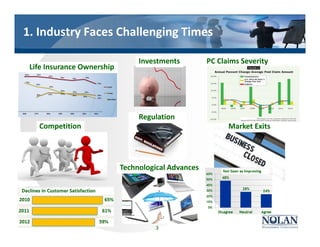
PC Claims Severity
1. Industry Faces Challenging Times
3
Investments
Regulation
Market Exits
Technological Advances
Competition
Life Insurance Ownership
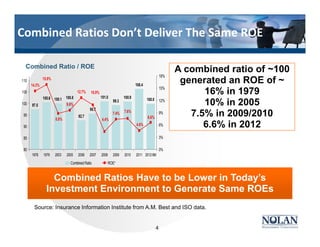
Combined Ratios Don’t Deliver The Same ROE
Combined Ratio / ROE
Source: Insurance Information Institute from A.M. Best and ISO data.
97.5
100.6 100.1 100.8
92.7
101.0
99.3
100.9 100.0
106.4
95.7
6.6%
4.6%
7.6%7.4%
4.4%
9.6%
15.9%
14.3%
12.7% 10.9%
8.8%
80
85
90
95
100
105
110
1978 1979 2003 2005 2006 2007 2008 2009 2010 2011 2012:9M
0%
3%
6%
9%
12%
15%
18%
Combined Ratio ROE*
Combined Ratios Have to be Lower in Today’s
Investment Environment to Generate Same ROEs
A combined ratio of ~100
generated an ROE of ~
16% in 1979
10% in 2005
7.5% in 2009/2010
6.6% in 2012
4
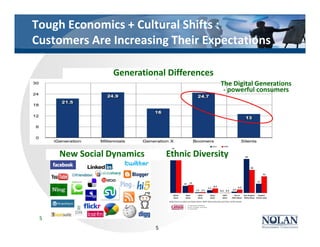
Tough Economics + Cultural Shifts :
Customers Are Increasing Their Expectations
Generational Differences
New Social Dynamics
Five Generations of Consumers, Large New Wave Coming
(% of Total Population)
Ethnic Diversity
The Digital Generations
- powerful consumers
5
5
6
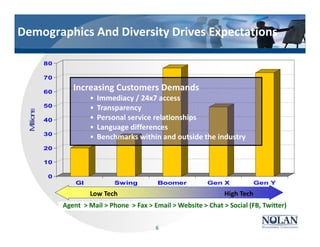
Demographics And Diversity Drives Expectations
0
10
20
30
40
50
60
70
80
Millions
GI Swing Boomer Gen X Gen Y
High TechLow Tech
Increasing Customers Demands
• Immediacy / 24x7 access
• Transparency
• Personal service relationships
• Language differences
• Benchmarks within and outside the industry
Agent > Mail > Phone > Fax > Email > Website > Chat > Social (FB, Twitter)
7
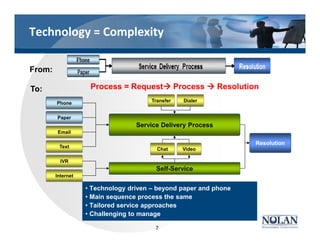
Technology = Complexity
From:
To:
Phone
Paper
Email
Text
IVR
Internet
Service Delivery Process
Self-Service
Resolution
Chat Video
Transfer Dialer
• Technology driven – beyond paper and phone
• Main sequence process the same
• Tailored service approaches
• Challenging to manage
Process = Requestà Process à Resolution
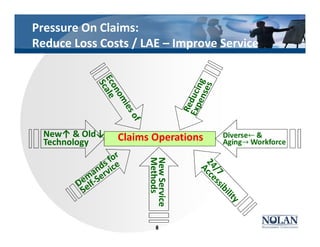
Claims OperationsNew↑ & Old↓
Technology
NewService
Methods
Pressure On Claims:
Reduce Loss Costs / LAE – Improve Service
88
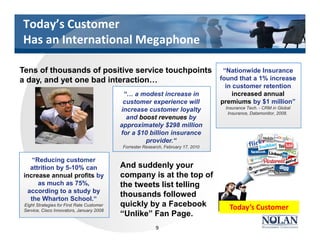
“… a modest increase in
customer experience will
increase customer loyalty
and boost revenues by
approximately $298 million
for a $10 billion insurance
provider.“
Forrester Research, February 17, 2010
“Nationwide Insurance
found that a 1% increase
in customer retention
increased annual
premiums by $1 million”
Insurance Tech. - CRM in Global
Insurance, Datamonitor, 2008.
“Reducing customer
attrition by 5-10% can
increase annual profits by
as much as 75%,
according to a study by
the Wharton School.“
Eight Strategies for First Rate Customer
Service, Cisco Innovators, January 2008
Today’s Customer
Has an International Megaphone
Tens of thousands of positive service touchpoints
a day, and yet one bad interaction…
And suddenly your
company is at the top of
the tweets list telling
thousands followed
quickly by a Facebook
“Unlike” Fan Page.
9
Today’s Customer
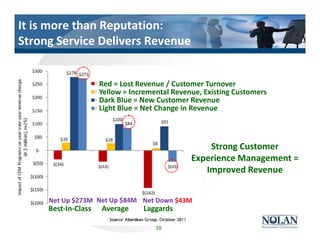
It is more than Reputation:
Strong Service Delivers Revenue
10
Strong Customer
Experience Management =
Improved Revenue
Red = Lost Revenue / Customer Turnover
Yellow = Incremental Revenue, Existing Customers
Dark Blue = New Customer Revenue
Light Blue = Net Change in Revenue
AverageBest-In-Class Laggards
Net Up $273M Net Up $84M Net Down $43M
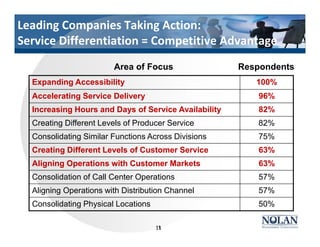
Leading Companies Taking Action:
Service Differentiation = Competitive Advantage
Expanding Accessibility 100%
Accelerating Service Delivery 96%
Increasing Hours and Days of Service Availability 82%
Creating Different Levels of Producer Service 82%
Consolidating Similar Functions Across Divisions 75%
Creating Different Levels of Customer Service 63%
Aligning Operations with Customer Markets 63%
Consolidation of Call Center Operations 57%
Aligning Operations with Distribution Channel 57%
Consolidating Physical Locations 50%
RespondentsArea of Focus
1111
12
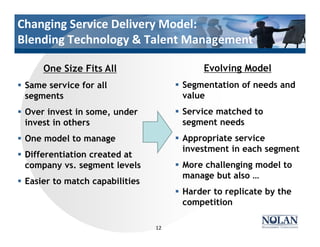
Changing Service Delivery Model:
Blending Technology & Talent Management
One Size Fits All
§ Same service for all
segments
§ Over invest in some, under
invest in others
§ One model to manage
§ Differentiation created at
company vs. segment levels
§ Easier to match capabilities
Evolving Model
§ Segmentation of needs and
value
§ Service matched to
segment needs
§ Appropriate service
investment in each segment
§ More challenging model to
manage but also …
§ Harder to replicate by the
competition
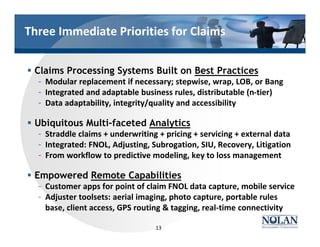
§ Claims Processing Systems Built on Best Practices
– Modular replacement if necessary; stepwise, wrap, LOB, or Bang
– Integrated and adaptable business rules, distributable (n-tier)
– Data adaptability, integrity/quality and accessibility
§ Ubiquitous Multi-faceted Analytics
– Straddle claims + underwriting + pricing + servicing + external data
– Integrated: FNOL, Adjusting, Subrogation, SIU, Recovery, Litigation
– From workflow to predictive modeling, key to loss management
§ Empowered Remote Capabilities
– Customer apps for point of claim FNOL data capture, mobile service
– Adjuster toolsets: aerial imaging, photo capture, portable rules
base, client access, GPS routing & tagging, real-time connectivity
13
Three Immediate Priorities for Claims
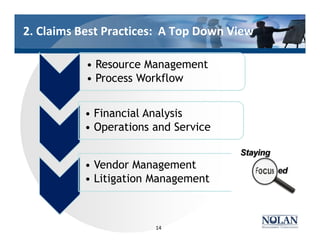
2. Claims Best Practices: A Top Down View
• Resource Management
• Process Workflow
• Financial Analysis
• Operations and Service
• Vendor Management
• Litigation Management
14
§ Staffing Models
§ Claim / SIU Staffing analysis
§ Claim Productivity Reporting
§ Workforce Utilization Management
§ Management & Supervisory Analysis
§ Personnel Turnover Analysis
§ Business Unit Silo Elimination
§ Structured Change Management Methodology
§ Formalized Communication Plans
Resource Management
15
Claims Operations Best Practices
§ Claim service model design
§ Optimized organizational structure
§ Process workflow analysis / automation tools
§ Claim Unit process interdependence/Interaction maps
§ Process alignment strategy between units
§ Claim cycle time minimization
§ Documented & standardized technology work-arounds
§ Inspection to-repairs-to-settlement cycle time
§ Substitute rental vehicle cycle time & control
Process Workflow
16
Claims Operations Best Practices
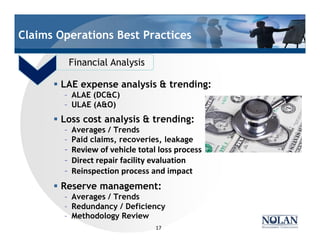
§ LAE expense analysis & trending:
– ALAE (DC&C)
– ULAE (A&O)
§ Loss cost analysis & trending:
– Averages / Trends
– Paid claims, recoveries, leakage
– Review of vehicle total loss process
– Direct repair facility evaluation
– Reinspection process and impact
§ Reserve management:
– Averages / Trends
– Redundancy / Deficiency
– Methodology Review
Financial Analysis
17
Claims Operations Best Practices
§ Litigation management view
§ Recovery management view
§ Auto liability claim view
§ Physical damage and property damage claim view
§ Liability, Property, Workers Comp claim views
§ Internal quality control process
§ Claim manuals / guidelines
§ Fraud impact / SIU effectiveness tracking
Operations and Service
18
Claims Operations Best Practices
§ Legal Cost Management Process & Tools
§ Independent Adjusters & Appraisers
§ Medical Cost Containment Providers
§ Medical Bill Review Vendors
§ Damage Appraisal Software Vendors
§ Glass Vendors
§ Direct Repair Facilities
Vendor Management
19
Claims Operations Best Practices
§ Litigation claim file review (sampling)
§ Litigation management program review and analysis
§ Litigation unit staffing / productivity analysis
§ Legal cost containment process review
§ Suit Log process and effectiveness
§ Review of House Counsel operations
§ Analysis of suit volume vs. results
§ Pre-suit avoidance techniques
§ Utilization of Alternative Dispute Resolution (ADR)
Litigation Management
20
Claims Operations Best Practices
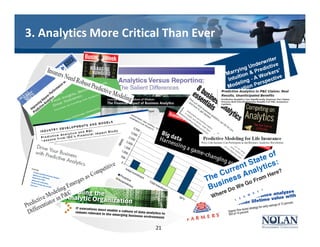
3. Analytics More Critical Than Ever
21
Analytics Starts With Workflow:
Identification, Segmentation, Prioritization
Optimized Claims Adjudication process.
§ Using data mining to cluster and group claims by loss characteristics
(such as loss type, location and time of loss, etc.).
§ Claims scored, prioritized and assigned per experience and loss type.
§ Higher quality, more consistent, and faster claims handling.
Adjuster Effectiveness Measurement.
§ Adjusters typically evaluated based on an open/closed claims ratio.
§ Analytics for key performance indicator (KPI) reports of customer
satisfaction, overridden settlements and other relevant metrics.
Claims involving attorneys = 2X settlement and expenses.
§ Analytics to determine which claims are likely to result in litigation.
§ Assign to senior adjusters to settle sooner and for lower amounts.
22
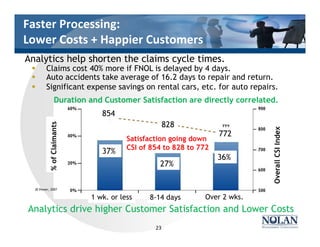
Analytics help shorten the claims cycle times.
§ Claims cost 40% more if FNOL is delayed by 4 days.
§ Auto accidents take average of 16.2 days to repair and return.
§ Significant expense savings on rental cars, etc. for auto repairs.
Duration and Customer Satisfaction are directly correlated.
Analytics drive higher Customer Satisfaction and Lower Costs
Faster Processing:
Lower Costs + Happier Customers
JD Power, 2007
27%
36%
37%
772
854
828
Over 2 wks.8-14 days1 wk. or less
%ofClaimants
OverallCSIIndex
JD Power, 2007
Satisfaction going down
CSI of 854 to 828 to 772
23
Identifying Claims Fraud:
A Tremendous Opportunity for Analytics
SAS Institute
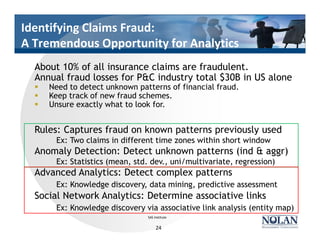
About 10% of all insurance claims are fraudulent.
Annual fraud losses for P&C industry total $30B in US alone
§ Need to detect unknown patterns of financial fraud.
§ Keep track of new fraud schemes.
§ Unsure exactly what to look for.
Rules: Captures fraud on known patterns previously used
Ex: Two claims in different time zones within short window
Anomaly Detection: Detect unknown patterns (ind & aggr)
Ex: Statistics (mean, std. dev., uni/multivariate, regression)
Advanced Analytics: Detect complex patterns
Ex: Knowledge discovery, data mining, predictive assessment
Social Network Analytics: Determine associative links
Ex: Knowledge discovery via associative link analysis (entity map)
24
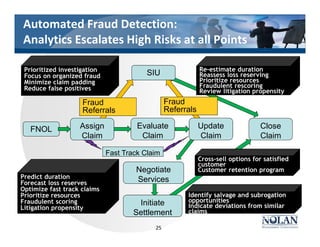
Automated Fraud Detection:
Analytics Escalates High Risks at all Points
FNOL Evaluate
Claim
Close
Claim
Negotiate
ServicesPredict duration
Forecast loss reserves
Optimize fast track claims
Prioritize resources
Fraudulent scoring
Litigation propensity
Prioritized investigation
Focus on organized fraud
Minimize claim padding
Reduce false positives
Identify salvage and subrogation
opportunities
Indicate deviations from similar
claims
Reports on claims overrides
Initiate
Settlement
SIU
Update
Claim
Fraud
Referrals
Re-estimate duration
Reassess loss reserving
Prioritize resources
Fraudulent rescoring
Review litigation propensity
Cross-sell options for satisfied
customer
Customer retention program
Assign
Claim
Fast Track Claim
Fraud
Referrals
25
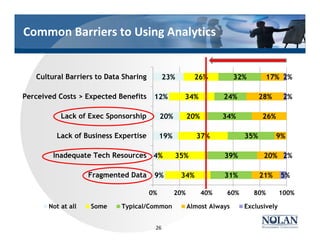
Common Barriers to Using Analytics
9%
4%
19%
20%
12%
23%
34%
35%
37%
20%
34%
26%
31%
39%
35%
34%
24%
32%
21%
20%
9%
26%
28%
17%
5%
2%
2%
2%
0% 20% 40% 60% 80% 100%
Fragmented Data
Inadequate Tech Resources
Lack of Business Expertise
Lack of Exec Sponsorship
Perceived Costs > Expected Benefits
Cultural Barriers to Data Sharing
Not at all Some Typical/Common Almost Always Exclusively
26
Guidelines to Implementing Analytics
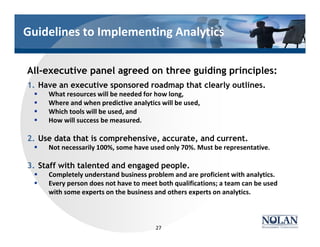
All-executive panel agreed on three guiding principles:
1. Have an executive sponsored roadmap that clearly outlines.
§ What resources will be needed for how long,
§ Where and when predictive analytics will be used,
§ Which tools will be used, and
§ How will success be measured.
2. Use data that is comprehensive, accurate, and current.
§ Not necessarily 100%, some have used only 70%. Must be representative.
3. Staff with talented and engaged people.
§ Completely understand business problem and are proficient with analytics.
§ Every person does not have to meet both qualifications; a team can be used
with some experts on the business and others experts on analytics.
27
4. Enhanced Remote Capabilities
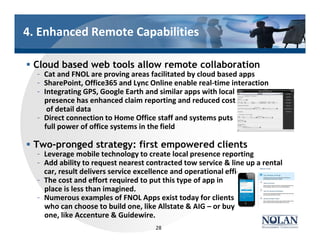
§ Cloud based web tools allow remote collaboration
– Cat and FNOL are proving areas facilitated by cloud based apps
– SharePoint, Office365 and Lync Online enable real-time interaction
– Integrating GPS, Google Earth and similar apps with local
presence has enhanced claim reporting and reduced cost
of detail data
– Direct connection to Home Office staff and systems puts
full power of office systems in the field
§ Two-pronged strategy: first empowered clients
– Leverage mobile technology to create local presence reporting
– Add ability to request nearest contracted tow service & line up a rental
car, result delivers service excellence and operational efficiency
– The cost and effort required to put this type of app in
place is less than imagined.
– Numerous examples of FNOL Apps exist today for clients
who can choose to build one, like Allstate & AIG – or buy
one, like Accenture & Guidewire.
28
Adjuster Toolkits: Accelerating Critical Service
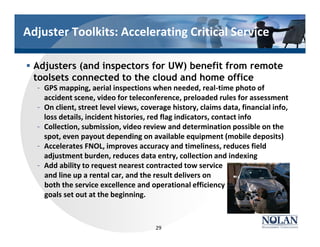
§ Adjusters (and inspectors for UW) benefit from remote
toolsets connected to the cloud and home office
– GPS mapping, aerial inspections when needed, real-time photo of
accident scene, video for teleconference, preloaded rules for assessment
– On client, street level views, coverage history, claims data, financial info,
loss details, incident histories, red flag indicators, contact info
– Collection, submission, video review and determination possible on the
spot, even payout depending on available equipment (mobile deposits)
– Accelerates FNOL, improves accuracy and timeliness, reduces field
adjustment burden, reduces data entry, collection and indexing
– Add ability to request nearest contracted tow service
and line up a rental car, and the result delivers on
both the service excellence and operational efficiency
goals set out at the beginning.
29
A Day in the Life of an Adjuster
§ Adjuster receives claim notification via email and an alert
including contact information.
– Direct to field process enables impressive, quick response to claims.
§ A call is made, appointment set, maps accessed and the
GPS navigator engaged.
– Upon arrival, accident scene and damage photos are taken, key
party info all fed directly back to the home office claims system.
– One of several estimating tools is accessed
» Diagramming automated using laser measurements and square foot calculators
» Depreciation allowances, location mapping and statements of loss created.
– Aerial imaging incorporates birds eye view into the claim data
» Same aerial images available from home or regional claims centers to confirm
collected information or determine any need for manual refinements.
» Historical pre-damage views might also be available for comparative purpose
§ These services are available today on bulkier laptops; pad
or phone apps moves to more convenient level.
30
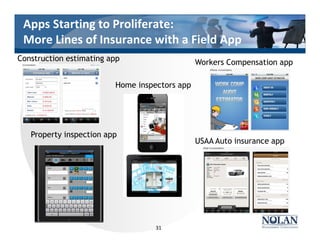
Apps Starting to Proliferate:
More Lines of Insurance with a Field App
31
Construction estimating app Workers Compensation app
USAA Auto insurance app
Home inspectors app
Property inspection app
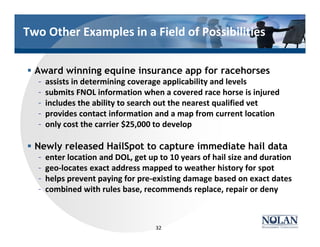
Two Other Examples in a Field of Possibilities
§ Award winning equine insurance app for racehorses
– assists in determining coverage applicability and levels
– submits FNOL information when a covered race horse is injured
– includes the ability to search out the nearest qualified vet
– provides contact information and a map from current location
– only cost the carrier $25,000 to develop
§ Newly released HailSpot to capture immediate hail data
– enter location and DOL, get up to 10 years of hail size and duration
– geo-locates exact address mapped to weather history for spot
– helps prevent paying for pre-existing damage based on exact dates
– combined with rules base, recommends replace, repair or deny
32
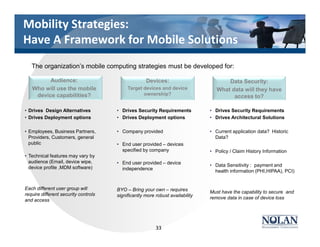
Mobility Strategies:
Have A Framework for Mobile Solutions
Audience:
Who will use the mobile
device capabilities?
Devices:
Target devices and device
ownership?
Data Security:
What data will they have
access to?
• Drives Design Alternatives
• Drives Deployment options
• Employees, Business Partners,
Providers, Customers, general
public
• Technical features may vary by
audience (Email, device wipe,
device profile ,MDM software)
Each different user group will
require different security controls
and access
• Drives Security Requirements
• Drives Deployment options
• Company provided
• End user provided – devices
specified by company
• End user provided – device
independence
BYO – Bring your own – requires
significantly more robust availability
• Drives Security Requirements
• Drives Architectural Solutions
• Current application data? Historic
Data?
• Policy / Claim History Information
• Data Sensitivity : payment and
health information (PHI,HIPAA), PCI)
Must have the capability to secure and
remove data in case of device loss
The organization’s mobile computing strategies must be developed for:
33
Deliverable
Framework
tailored to opportunity
Deliverable
High Level Architectural
Framework
Deliverable
Vision & Scope
STEP III
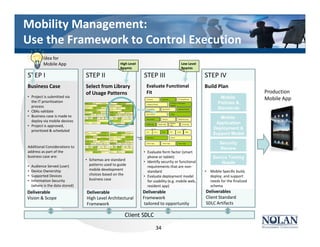
Evaluate Functional
Fit
• Evaluate form factor (smart
phone or tablet)
• Identify security or functional
requirements that are non-
standard
• Evaluate deployment model
for usability (e.g. mobile web,
resident app)
STEP IV
Build Plan
Mobile
Policies &
Standards
Mobile
Application
Deployment &
Support Model
Device Testing
Needs
Security
Review
• Mobile Specific build,
deploy, and support
needs for the finalized
schema
STEP IISTEP I
Business Case
Additional Considerations to
address as part of the
business case are:
• Audience Served (user)
• Device Ownership
• Supported Devices
• Information Security
(where is the data stored)
• Project is submitted via
the IT prioritization
process
• CBAs validate
• Business case is made to
deploy via mobile devices
• Project is approved,
prioritized & scheduled
Select from Library
of Usage Patterns
• Schemas are standard
patterns used to guide
mobile development
choices based on the
business case
Consumer 3rd Party/PartnerAssociate
Support
Level
Company-Owned
3rd Party or Personally -
Owned
1 OS/ 1 App2 OS/ 2 App2 OS/ 3 App
Smart Phone Tablet
iPhone/iPad Mobile BrowserAndroid
Push PullAndroidiStore WebCitrix*
No PCI/PHI Multiple PCI/PHIMy PCI/PHI
Application Device
Mobile App Mobile Web
Desktop
Web
Virtual App
Public Store Internal Store Non-Resident
Idea for
Mobile App
Client SDLC
Deliverables
Client Standard
SDLC Artifacts
Production
Mobile App
Low Level
Reqmts
High Level
Reqmts
Mobility Management:
Use the Framework to Control Execution
34
5. Property Casualty Industry Survey Results
Nolan Recently Concluded A Survey of Over 100
Property Casualty Insurance Senior Executives
Findings Are Being Reviewed and Compiled
The Following Claims Specific Findings Extracted
35
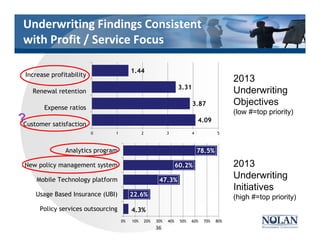
Underwriting Findings Consistent
with Profit / Service Focus
36
4.09
3.87
3.31
1.44
0 1 2 3 4 5
Customer satisfaction
Expense ratios
Renewal retention
Increase profitability
4.3%
22.6%
47.3%
60.2%
78.5%
0% 10% 20% 30% 40% 50% 60% 70% 80%
Policy services outsourcing
Usage Based Insurance (UBI)
Mobile Technology platform
New policy management system
Analytics program
2013
Underwriting
Objectives
(low #=top priority)
2013
Underwriting
Initiatives
(high #=top priority)
?
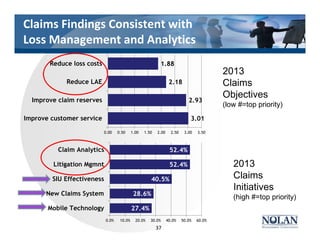
Claims Findings Consistent with
Loss Management and Analytics
37
3.01
2.93
2.18
1.88
0.00 0.50 1.00 1.50 2.00 2.50 3.00 3.50
Improve customer service
Improve claim reserves
Reduce LAE
Reduce loss costs
27.4%
28.6%
40.5%
52.4%
52.4%
0.0% 10.0% 20.0% 30.0% 40.0% 50.0% 60.0%
Mobile Technology
New Claims System
SIU Effectiveness
Litigation Mgmnt
Claim Analytics
2013
Claims
Objectives
(low #=top priority)
2013
Claims
Initiatives
(high #=top priority)
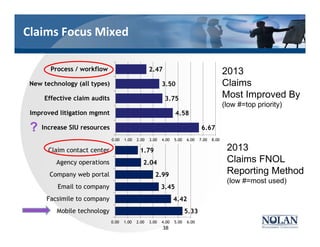
Claims Focus Mixed
38
6.67
4.58
3.75
3.50
2.47
0.00 1.00 2.00 3.00 4.00 5.00 6.00 7.00 8.00
Increase SIU resources
Improved litigation mgmnt
Effective claim audits
New technology (all types)
Process / workflow 2013
Claims
Most Improved By
(low #=top priority)
5.33
4.42
3.45
2.99
2.04
1.79
0.00 1.00 2.00 3.00 4.00 5.00 6.00
Mobile technology
Facsimile to company
Email to company
Company web portal
Agency operations
Claim contact center 2013
Claims FNOL
Reporting Method
(low #=most used)
?
39
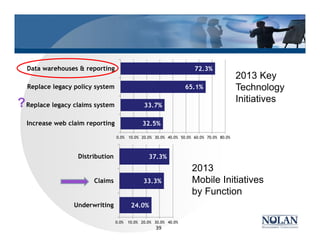
32.5%
33.7%
65.1%
72.3%
0.0% 10.0% 20.0% 30.0% 40.0% 50.0% 60.0% 70.0% 80.0%
Increase web claim reporting
Replace legacy claims system
Replace legacy policy system
Data warehouses & reporting
24.0%
33.3%
37.3%
0.0% 10.0% 20.0% 30.0% 40.0%
Underwriting
Claims
Distribution
2013 Key
Technology
Initiatives
2013
Mobile Initiatives
by Function
?
THANK YOU
The Nolan Company
Management Consultants
www.renolan.com
Steven M. Callahan, CMC®, FFSI
Practice Director
steve_callahan@renolan.com
www.linkedin.com/in/stevenmcallahan
@stevencallahan
40

201306 Tech Decisions Webinar: Modernizing Claims for Better Customer Service

  • 1.
    §Modernizing Claims WillResult §in Better Customer Service By: Steven M. Callahan, CMC®, FFSI Practice Director The Nolan Company Management Consultants www.renolan.com 40 Years Serving Insurance Carriers 1
  • 2.
    Overview and Objectives §Context: – Customers are more impatient and demanding than ever before. – Being a market leader means making claims a priority. – Not possible without a modern claims system. – Claims technology needs often ignored in favor of other systems. – Insurers are now seeing the benefits of how claims can positively impact the bottom line and improve customer satisfaction. § Outline: 1. Review of the environmental pressures on claims. 2. Overview of claims Best Practices. 3. Quick dive into value of analytics in claims. 4. Brief comments on remote capabilities 5. Sneak preview of recent industry survey results specific to claims. 2
  • 3.
    PC Claims Severity 1.Industry Faces Challenging Times 3 Investments Regulation Market Exits Technological Advances Competition Life Insurance Ownership
  • 4.
    Combined Ratios Don’tDeliver The Same ROE Combined Ratio / ROE Source: Insurance Information Institute from A.M. Best and ISO data. 97.5 100.6 100.1 100.8 92.7 101.0 99.3 100.9 100.0 106.4 95.7 6.6% 4.6% 7.6%7.4% 4.4% 9.6% 15.9% 14.3% 12.7% 10.9% 8.8% 80 85 90 95 100 105 110 1978 1979 2003 2005 2006 2007 2008 2009 2010 2011 2012:9M 0% 3% 6% 9% 12% 15% 18% Combined Ratio ROE* Combined Ratios Have to be Lower in Today’s Investment Environment to Generate Same ROEs A combined ratio of ~100 generated an ROE of ~ 16% in 1979 10% in 2005 7.5% in 2009/2010 6.6% in 2012 4
  • 5.
    Tough Economics +Cultural Shifts : Customers Are Increasing Their Expectations Generational Differences New Social Dynamics Five Generations of Consumers, Large New Wave Coming (% of Total Population) Ethnic Diversity The Digital Generations - powerful consumers 5 5
  • 6.
    6 Demographics And DiversityDrives Expectations 0 10 20 30 40 50 60 70 80 Millions GI Swing Boomer Gen X Gen Y High TechLow Tech Increasing Customers Demands • Immediacy / 24x7 access • Transparency • Personal service relationships • Language differences • Benchmarks within and outside the industry Agent > Mail > Phone > Fax > Email > Website > Chat > Social (FB, Twitter)
  • 7.
    7 Technology = Complexity From: To: Phone Paper Email Text IVR Internet ServiceDelivery Process Self-Service Resolution Chat Video Transfer Dialer • Technology driven – beyond paper and phone • Main sequence process the same • Tailored service approaches • Challenging to manage Process = Requestà Process à Resolution
  • 8.
    Claims OperationsNew↑ &Old↓ Technology NewService Methods Pressure On Claims: Reduce Loss Costs / LAE – Improve Service 88
  • 9.
    “… a modestincrease in customer experience will increase customer loyalty and boost revenues by approximately $298 million for a $10 billion insurance provider.“ Forrester Research, February 17, 2010 “Nationwide Insurance found that a 1% increase in customer retention increased annual premiums by $1 million” Insurance Tech. - CRM in Global Insurance, Datamonitor, 2008. “Reducing customer attrition by 5-10% can increase annual profits by as much as 75%, according to a study by the Wharton School.“ Eight Strategies for First Rate Customer Service, Cisco Innovators, January 2008 Today’s Customer Has an International Megaphone Tens of thousands of positive service touchpoints a day, and yet one bad interaction… And suddenly your company is at the top of the tweets list telling thousands followed quickly by a Facebook “Unlike” Fan Page. 9 Today’s Customer
  • 10.
    It is morethan Reputation: Strong Service Delivers Revenue 10 Strong Customer Experience Management = Improved Revenue Red = Lost Revenue / Customer Turnover Yellow = Incremental Revenue, Existing Customers Dark Blue = New Customer Revenue Light Blue = Net Change in Revenue AverageBest-In-Class Laggards Net Up $273M Net Up $84M Net Down $43M
  • 11.
    Leading Companies TakingAction: Service Differentiation = Competitive Advantage Expanding Accessibility 100% Accelerating Service Delivery 96% Increasing Hours and Days of Service Availability 82% Creating Different Levels of Producer Service 82% Consolidating Similar Functions Across Divisions 75% Creating Different Levels of Customer Service 63% Aligning Operations with Customer Markets 63% Consolidation of Call Center Operations 57% Aligning Operations with Distribution Channel 57% Consolidating Physical Locations 50% RespondentsArea of Focus 1111
  • 12.
    12 Changing Service DeliveryModel: Blending Technology & Talent Management One Size Fits All § Same service for all segments § Over invest in some, under invest in others § One model to manage § Differentiation created at company vs. segment levels § Easier to match capabilities Evolving Model § Segmentation of needs and value § Service matched to segment needs § Appropriate service investment in each segment § More challenging model to manage but also … § Harder to replicate by the competition
  • 13.
    § Claims ProcessingSystems Built on Best Practices – Modular replacement if necessary; stepwise, wrap, LOB, or Bang – Integrated and adaptable business rules, distributable (n-tier) – Data adaptability, integrity/quality and accessibility § Ubiquitous Multi-faceted Analytics – Straddle claims + underwriting + pricing + servicing + external data – Integrated: FNOL, Adjusting, Subrogation, SIU, Recovery, Litigation – From workflow to predictive modeling, key to loss management § Empowered Remote Capabilities – Customer apps for point of claim FNOL data capture, mobile service – Adjuster toolsets: aerial imaging, photo capture, portable rules base, client access, GPS routing & tagging, real-time connectivity 13 Three Immediate Priorities for Claims
  • 14.
    2. Claims BestPractices: A Top Down View • Resource Management • Process Workflow • Financial Analysis • Operations and Service • Vendor Management • Litigation Management 14
  • 15.
    § Staffing Models §Claim / SIU Staffing analysis § Claim Productivity Reporting § Workforce Utilization Management § Management & Supervisory Analysis § Personnel Turnover Analysis § Business Unit Silo Elimination § Structured Change Management Methodology § Formalized Communication Plans Resource Management 15 Claims Operations Best Practices
  • 16.
    § Claim servicemodel design § Optimized organizational structure § Process workflow analysis / automation tools § Claim Unit process interdependence/Interaction maps § Process alignment strategy between units § Claim cycle time minimization § Documented & standardized technology work-arounds § Inspection to-repairs-to-settlement cycle time § Substitute rental vehicle cycle time & control Process Workflow 16 Claims Operations Best Practices
  • 17.
    § LAE expenseanalysis & trending: – ALAE (DC&C) – ULAE (A&O) § Loss cost analysis & trending: – Averages / Trends – Paid claims, recoveries, leakage – Review of vehicle total loss process – Direct repair facility evaluation – Reinspection process and impact § Reserve management: – Averages / Trends – Redundancy / Deficiency – Methodology Review Financial Analysis 17 Claims Operations Best Practices
  • 18.
    § Litigation managementview § Recovery management view § Auto liability claim view § Physical damage and property damage claim view § Liability, Property, Workers Comp claim views § Internal quality control process § Claim manuals / guidelines § Fraud impact / SIU effectiveness tracking Operations and Service 18 Claims Operations Best Practices
  • 19.
    § Legal CostManagement Process & Tools § Independent Adjusters & Appraisers § Medical Cost Containment Providers § Medical Bill Review Vendors § Damage Appraisal Software Vendors § Glass Vendors § Direct Repair Facilities Vendor Management 19 Claims Operations Best Practices
  • 20.
    § Litigation claimfile review (sampling) § Litigation management program review and analysis § Litigation unit staffing / productivity analysis § Legal cost containment process review § Suit Log process and effectiveness § Review of House Counsel operations § Analysis of suit volume vs. results § Pre-suit avoidance techniques § Utilization of Alternative Dispute Resolution (ADR) Litigation Management 20 Claims Operations Best Practices
  • 21.
    3. Analytics MoreCritical Than Ever 21
  • 22.
    Analytics Starts WithWorkflow: Identification, Segmentation, Prioritization Optimized Claims Adjudication process. § Using data mining to cluster and group claims by loss characteristics (such as loss type, location and time of loss, etc.). § Claims scored, prioritized and assigned per experience and loss type. § Higher quality, more consistent, and faster claims handling. Adjuster Effectiveness Measurement. § Adjusters typically evaluated based on an open/closed claims ratio. § Analytics for key performance indicator (KPI) reports of customer satisfaction, overridden settlements and other relevant metrics. Claims involving attorneys = 2X settlement and expenses. § Analytics to determine which claims are likely to result in litigation. § Assign to senior adjusters to settle sooner and for lower amounts. 22
  • 23.
    Analytics help shortenthe claims cycle times. § Claims cost 40% more if FNOL is delayed by 4 days. § Auto accidents take average of 16.2 days to repair and return. § Significant expense savings on rental cars, etc. for auto repairs. Duration and Customer Satisfaction are directly correlated. Analytics drive higher Customer Satisfaction and Lower Costs Faster Processing: Lower Costs + Happier Customers JD Power, 2007 27% 36% 37% 772 854 828 Over 2 wks.8-14 days1 wk. or less %ofClaimants OverallCSIIndex JD Power, 2007 Satisfaction going down CSI of 854 to 828 to 772 23
  • 24.
    Identifying Claims Fraud: ATremendous Opportunity for Analytics SAS Institute About 10% of all insurance claims are fraudulent. Annual fraud losses for P&C industry total $30B in US alone § Need to detect unknown patterns of financial fraud. § Keep track of new fraud schemes. § Unsure exactly what to look for. Rules: Captures fraud on known patterns previously used Ex: Two claims in different time zones within short window Anomaly Detection: Detect unknown patterns (ind & aggr) Ex: Statistics (mean, std. dev., uni/multivariate, regression) Advanced Analytics: Detect complex patterns Ex: Knowledge discovery, data mining, predictive assessment Social Network Analytics: Determine associative links Ex: Knowledge discovery via associative link analysis (entity map) 24
  • 25.
    Automated Fraud Detection: AnalyticsEscalates High Risks at all Points FNOL Evaluate Claim Close Claim Negotiate ServicesPredict duration Forecast loss reserves Optimize fast track claims Prioritize resources Fraudulent scoring Litigation propensity Prioritized investigation Focus on organized fraud Minimize claim padding Reduce false positives Identify salvage and subrogation opportunities Indicate deviations from similar claims Reports on claims overrides Initiate Settlement SIU Update Claim Fraud Referrals Re-estimate duration Reassess loss reserving Prioritize resources Fraudulent rescoring Review litigation propensity Cross-sell options for satisfied customer Customer retention program Assign Claim Fast Track Claim Fraud Referrals 25
  • 26.
    Common Barriers toUsing Analytics 9% 4% 19% 20% 12% 23% 34% 35% 37% 20% 34% 26% 31% 39% 35% 34% 24% 32% 21% 20% 9% 26% 28% 17% 5% 2% 2% 2% 0% 20% 40% 60% 80% 100% Fragmented Data Inadequate Tech Resources Lack of Business Expertise Lack of Exec Sponsorship Perceived Costs > Expected Benefits Cultural Barriers to Data Sharing Not at all Some Typical/Common Almost Always Exclusively 26
  • 27.
    Guidelines to ImplementingAnalytics All-executive panel agreed on three guiding principles: 1. Have an executive sponsored roadmap that clearly outlines. § What resources will be needed for how long, § Where and when predictive analytics will be used, § Which tools will be used, and § How will success be measured. 2. Use data that is comprehensive, accurate, and current. § Not necessarily 100%, some have used only 70%. Must be representative. 3. Staff with talented and engaged people. § Completely understand business problem and are proficient with analytics. § Every person does not have to meet both qualifications; a team can be used with some experts on the business and others experts on analytics. 27
  • 28.
    4. Enhanced RemoteCapabilities § Cloud based web tools allow remote collaboration – Cat and FNOL are proving areas facilitated by cloud based apps – SharePoint, Office365 and Lync Online enable real-time interaction – Integrating GPS, Google Earth and similar apps with local presence has enhanced claim reporting and reduced cost of detail data – Direct connection to Home Office staff and systems puts full power of office systems in the field § Two-pronged strategy: first empowered clients – Leverage mobile technology to create local presence reporting – Add ability to request nearest contracted tow service & line up a rental car, result delivers service excellence and operational efficiency – The cost and effort required to put this type of app in place is less than imagined. – Numerous examples of FNOL Apps exist today for clients who can choose to build one, like Allstate & AIG – or buy one, like Accenture & Guidewire. 28
  • 29.
    Adjuster Toolkits: AcceleratingCritical Service § Adjusters (and inspectors for UW) benefit from remote toolsets connected to the cloud and home office – GPS mapping, aerial inspections when needed, real-time photo of accident scene, video for teleconference, preloaded rules for assessment – On client, street level views, coverage history, claims data, financial info, loss details, incident histories, red flag indicators, contact info – Collection, submission, video review and determination possible on the spot, even payout depending on available equipment (mobile deposits) – Accelerates FNOL, improves accuracy and timeliness, reduces field adjustment burden, reduces data entry, collection and indexing – Add ability to request nearest contracted tow service and line up a rental car, and the result delivers on both the service excellence and operational efficiency goals set out at the beginning. 29
  • 30.
    A Day inthe Life of an Adjuster § Adjuster receives claim notification via email and an alert including contact information. – Direct to field process enables impressive, quick response to claims. § A call is made, appointment set, maps accessed and the GPS navigator engaged. – Upon arrival, accident scene and damage photos are taken, key party info all fed directly back to the home office claims system. – One of several estimating tools is accessed » Diagramming automated using laser measurements and square foot calculators » Depreciation allowances, location mapping and statements of loss created. – Aerial imaging incorporates birds eye view into the claim data » Same aerial images available from home or regional claims centers to confirm collected information or determine any need for manual refinements. » Historical pre-damage views might also be available for comparative purpose § These services are available today on bulkier laptops; pad or phone apps moves to more convenient level. 30
  • 31.
    Apps Starting toProliferate: More Lines of Insurance with a Field App 31 Construction estimating app Workers Compensation app USAA Auto insurance app Home inspectors app Property inspection app
  • 32.
    Two Other Examplesin a Field of Possibilities § Award winning equine insurance app for racehorses – assists in determining coverage applicability and levels – submits FNOL information when a covered race horse is injured – includes the ability to search out the nearest qualified vet – provides contact information and a map from current location – only cost the carrier $25,000 to develop § Newly released HailSpot to capture immediate hail data – enter location and DOL, get up to 10 years of hail size and duration – geo-locates exact address mapped to weather history for spot – helps prevent paying for pre-existing damage based on exact dates – combined with rules base, recommends replace, repair or deny 32
  • 33.
    Mobility Strategies: Have AFramework for Mobile Solutions Audience: Who will use the mobile device capabilities? Devices: Target devices and device ownership? Data Security: What data will they have access to? • Drives Design Alternatives • Drives Deployment options • Employees, Business Partners, Providers, Customers, general public • Technical features may vary by audience (Email, device wipe, device profile ,MDM software) Each different user group will require different security controls and access • Drives Security Requirements • Drives Deployment options • Company provided • End user provided – devices specified by company • End user provided – device independence BYO – Bring your own – requires significantly more robust availability • Drives Security Requirements • Drives Architectural Solutions • Current application data? Historic Data? • Policy / Claim History Information • Data Sensitivity : payment and health information (PHI,HIPAA), PCI) Must have the capability to secure and remove data in case of device loss The organization’s mobile computing strategies must be developed for: 33
  • 34.
    Deliverable Framework tailored to opportunity Deliverable HighLevel Architectural Framework Deliverable Vision & Scope STEP III Evaluate Functional Fit • Evaluate form factor (smart phone or tablet) • Identify security or functional requirements that are non- standard • Evaluate deployment model for usability (e.g. mobile web, resident app) STEP IV Build Plan Mobile Policies & Standards Mobile Application Deployment & Support Model Device Testing Needs Security Review • Mobile Specific build, deploy, and support needs for the finalized schema STEP IISTEP I Business Case Additional Considerations to address as part of the business case are: • Audience Served (user) • Device Ownership • Supported Devices • Information Security (where is the data stored) • Project is submitted via the IT prioritization process • CBAs validate • Business case is made to deploy via mobile devices • Project is approved, prioritized & scheduled Select from Library of Usage Patterns • Schemas are standard patterns used to guide mobile development choices based on the business case Consumer 3rd Party/PartnerAssociate Support Level Company-Owned 3rd Party or Personally - Owned 1 OS/ 1 App2 OS/ 2 App2 OS/ 3 App Smart Phone Tablet iPhone/iPad Mobile BrowserAndroid Push PullAndroidiStore WebCitrix* No PCI/PHI Multiple PCI/PHIMy PCI/PHI Application Device Mobile App Mobile Web Desktop Web Virtual App Public Store Internal Store Non-Resident Idea for Mobile App Client SDLC Deliverables Client Standard SDLC Artifacts Production Mobile App Low Level Reqmts High Level Reqmts Mobility Management: Use the Framework to Control Execution 34
  • 35.
    5. Property CasualtyIndustry Survey Results Nolan Recently Concluded A Survey of Over 100 Property Casualty Insurance Senior Executives Findings Are Being Reviewed and Compiled The Following Claims Specific Findings Extracted 35
  • 36.
    Underwriting Findings Consistent withProfit / Service Focus 36 4.09 3.87 3.31 1.44 0 1 2 3 4 5 Customer satisfaction Expense ratios Renewal retention Increase profitability 4.3% 22.6% 47.3% 60.2% 78.5% 0% 10% 20% 30% 40% 50% 60% 70% 80% Policy services outsourcing Usage Based Insurance (UBI) Mobile Technology platform New policy management system Analytics program 2013 Underwriting Objectives (low #=top priority) 2013 Underwriting Initiatives (high #=top priority) ?
  • 37.
    Claims Findings Consistentwith Loss Management and Analytics 37 3.01 2.93 2.18 1.88 0.00 0.50 1.00 1.50 2.00 2.50 3.00 3.50 Improve customer service Improve claim reserves Reduce LAE Reduce loss costs 27.4% 28.6% 40.5% 52.4% 52.4% 0.0% 10.0% 20.0% 30.0% 40.0% 50.0% 60.0% Mobile Technology New Claims System SIU Effectiveness Litigation Mgmnt Claim Analytics 2013 Claims Objectives (low #=top priority) 2013 Claims Initiatives (high #=top priority)
  • 38.
    Claims Focus Mixed 38 6.67 4.58 3.75 3.50 2.47 0.001.00 2.00 3.00 4.00 5.00 6.00 7.00 8.00 Increase SIU resources Improved litigation mgmnt Effective claim audits New technology (all types) Process / workflow 2013 Claims Most Improved By (low #=top priority) 5.33 4.42 3.45 2.99 2.04 1.79 0.00 1.00 2.00 3.00 4.00 5.00 6.00 Mobile technology Facsimile to company Email to company Company web portal Agency operations Claim contact center 2013 Claims FNOL Reporting Method (low #=most used) ?
  • 39.
    39 32.5% 33.7% 65.1% 72.3% 0.0% 10.0% 20.0%30.0% 40.0% 50.0% 60.0% 70.0% 80.0% Increase web claim reporting Replace legacy claims system Replace legacy policy system Data warehouses & reporting 24.0% 33.3% 37.3% 0.0% 10.0% 20.0% 30.0% 40.0% Underwriting Claims Distribution 2013 Key Technology Initiatives 2013 Mobile Initiatives by Function ?
  • 40.
    THANK YOU The NolanCompany Management Consultants www.renolan.com Steven M. Callahan, CMC®, FFSI Practice Director steve_callahan@renolan.com www.linkedin.com/in/stevenmcallahan @stevencallahan 40