www.CodeEngn.com
July 21, 2007
Sammuel koo
dual5651@hotmail.com
Null @ Root
Hook the Planet
www.CodeEngn.com
1) What is a kernel hook used for?
2) Get into the Ring0!
3) Review
4) Hook the planet!
5) Hook me, If you can!
6) ?
www.CodeEngn.com
1) Kernel hooks are global (relatively speaking).
2) Rootkit / Protection / Detection software are both in Ring Zero.
3) By using kernel hook, We can study the behavior of the system.
4) By using kernel hook, we can get performance data for specific
tasks and generating statics.
www.CodeEngn.com
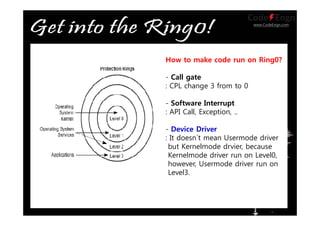
How to make code run on Ring0?
- Call gate
: CPL change 3 from to 0
- Software Interrupt
: API Call, Exception, ..
- Device Driver
: It doesn`t mean Usermode driver
but Kernelmode drvier, because
Kernelmode driver run on Level0,
however, Usermode driver run on
Level3.
www.CodeEngn.com
□ Code of exe file is located into Paged Memory,
In contrast, Code of sys file is located into NonPaged Memory.
□ Both exe file and sys file has PE(Portable Executable) file format.
□ DPL of CS in sys file has value 0, however, DPL of CS in exe file
has value 3. It means CS of sys file can access all of instructions
and memorys, In contrast, CS of exe file has limited access right.
Header of 1stDriver.sys : Header of cmd.exe :
www.CodeEngn.com
1. Compile C code by DDK 2. Assemble Asm code by KmdKit
www.CodeEngn.com
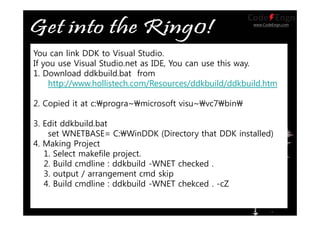
You can link DDK to Visual Studio.
If you use Visual Studio.net as IDE, You can use this way.
1. Download ddkbuild.bat from
http://www.hollistech.com/Resources/ddkbuild/ddkbuild.htm
2. Copied it at c:progra~microsoft visu~vc7bin
3. Edit ddkbuild.bat
set WNETBASE= C:WinDDK (Directory that DDK installed)
4. Making Project
1. Select makefile project.
2. Build cmdline : ddkbuild -WNET checked .
3. output / arrangement cmd skip
4. Build cmdline : ddkbuild -WNET chekced . -cZ
www.CodeEngn.com
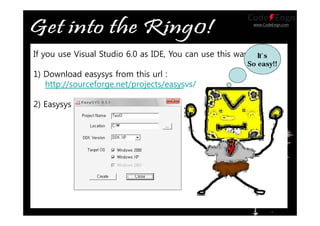
If you use Visual Studio 6.0 as IDE, You can use this way.
1) Download easysys from this url :
http://sourceforge.net/projects/easysys/
2) Easysys :
It`s
So easy!!
www.CodeEngn.com
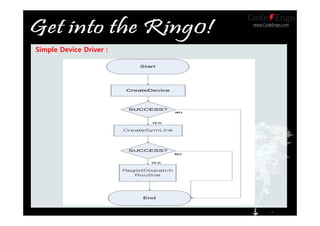
Simple Device Driver :
www.CodeEngn.com
1. Using SCM API 2. Using Undocumented API
Pro :
By using this way, you can load a
Driver into the kernel without
having to create registry key.
Con :
1) The problem with this approach is
That the driver will be pageable.
Sometimes when memory is
paged out, it cannot be accessed;
It will occur BSOD(Blue Screen Of
Death) with system crash.
2) Once it is loaded, it cannot be
Unloaded until reboot.
1) When a driver is loaded using
the SCM, it is non-pageable.
This means your callback functions,
IRP-handling functions, and other
Important code will not vanish from
Memory.
2) You can select start mode of Driver.
SERVICE_BOOT_START(0x0)
: Driver will be loaded by system
loader.
SERVICE_SYSTEM_START(0x1)
: Load Driver when IoInitSystem is
called.
SERVICE_AUTO_START(0x2)
: Load by SCM
SERVICE_DEMAND_START(0x3)
: Load by calling StartService() API.
SERVICE_DISABLED(0x4)
: Makes driver can not be loaded.
www.CodeEngn.com
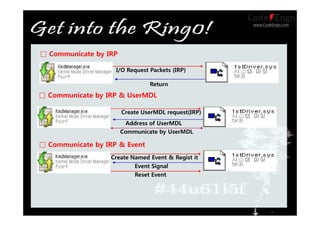
I/O Request Packets (IRP)
Return
Create UserMDL request(IRP)
Address of UserMDL
Communicate by UserMDL
Create Named Event & Regist it
Event Signal
□ Communicate by IRP
□ Communicate by IRP & UserMDL
□ Communicate by IRP & Event
Reset Event
www.CodeEngn.com
www.CodeEngn.com
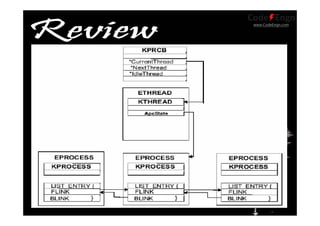
1) KPCR (Kernel`s Processor Control Region)
2) EPROCESS (Executable Process)
3) TEB (Thread Environment Block)
4) ETHREAD (Executable Thread)
www.CodeEngn.com
ETHREAD
KTHREAD
ETHREAD
KTHREADKPROCESS
(PCB)
ETHREAD
KTHREAD
ETHREAD
KTHREAD
ETHREAD
KTHREAD
ETHREAD
KTHREAD
ETHREAD
KTHREAD
ETHREAD
KTHREAD
ETHREAD
KTHREAD
ETHREAD
KTHREAD
ETHREAD
KTHREAD
ETHREAD
KTHREAD
ETHREAD
KTHREAD
ETHREAD
KTHREAD
ThreadListHead
Handle Table
ObjectTable Vad
Vad Vad
VadRoot
Vad SDT
ServiceTable
KERNEL ADDRESS SPACE 2G (0x80000000 ~ 0xFFFFFFFF)
ActiveProcessLink
EPROCESS of Another Process
KPCR
KPCRB
www.CodeEngn.com
In Kernel Level, FS:0 = KPCR = 0xFFDFF000KPCR ( Kernel`s Processor Control Region )
www.CodeEngn.com
www.CodeEngn.com
□ In Windows Kernel, Each process is
represented as an EPROCESS into
Kernel Memory.
□ List of active processes is obtained
by traversing a doubly linked list
referenced in the EPROCESS
Structure of each process.
□ We can access EPROCESS by
CurrentThread of KPRCB structure.
□ The Windows scheduling algorithm
is not executed at process.
www.CodeEngn.com
ETHREAD: KTHREAD:
www.CodeEngn.com
USER ADDRESS SPACE 2G (0x00000000 ~ 0x7FFFFFFF)
TEB(0x7FFDEOOO)
TIB
TEB(0x7FFDEOOO)
TIB
DLL
DLL
DLL
DLL
LDR_MODULE
LDR_MODULE
LDR_MODULE
LDR_MODULE
PEB_LDR_DATA
Process Image
Stack Heap
0x40000000 ~ 0x7FFFFFFF
0x00000000 ~ 0x3FFFFFFF
www.CodeEngn.com
TEB ( Thread Environment Block )
In UserLevel, FS:0 = TEB = 0x7ffde000 (1st
Process)
□ UserMode Application can access
this structure directly.
□ GetCurrentProcessId() function
use this structure for getting PID.
□ We can get PEB address from this
structure.
www.CodeEngn.com
PEB ( Process Environment Block )
□ UserMode Application can access
this structure directly.
□ This structure have loaded
modules list.
□ This structure have
ProcessParameters information.
□ IsDebuggerPresent() function use
this structure.
www.CodeEngn.com
www.CodeEngn.com
1) Win32 UserLevel API Global Hooking
2) SSDT(System Service Distpach Table) hooking
3) IDT(Interrupt Descriptor Table) hooking
4) 0ne byte hooking
5) Blind hooking by using DRx
www.CodeEngn.com
Win32 UserLevel API Global Hooking Motivation
□ Is there no way to Dll Injection without read/write process memory,
and CreateRemoteThread() API?
□ Is there no way to hook Win32 API globaly?
www.CodeEngn.com
Concept
□ In Windows, DLL memory and mapped memory are shared.
□ If we can modify memory of DLL without PageFault(Copy-On-Write),
It will be applied to all processes.
□ If we have chance to execute our code by victim process self,
We don`t need CreateRemoteThread() anymore.
□ In Windows, There is a region that will get mapped into every process
address space, The name of this area is KUSER_SHARED_DATA.
www.CodeEngn.com
1. Get the EPROCESS of explorer.exe
2. Attach to explorer.exe
3. Get the PEB from EPROCESS
4. Find Kernel32.dll address from Ldr in PEB.
5. Find IsDebuggerPresent() address from
IMAGE_EXPORT_DIRECTORY
of kernel32.dll
6. Modify IsDebuggerPresent() code to jmp
KUSER_SHARED_DATA+0x8
with CR0 trick.
7. Now just waiting for victim process call IsDebuggerPresent()
Process
www.CodeEngn.com
MOV EAX,DWORD PTR FS:[18]
MOV EAX,DWORD PTR DS:[EAX+30]
MOVZX EAX,BYTE PTR DS:[EAX+2]
Original IsDebuggerPresent() code:
Modifed IsDebuggerPresent() code:
MOV EAX , KUSER_SHARED_DATA+0x8
JMP EAX
www.CodeEngn.com
PAYLOAD:
DLL loading code :
pushad
pushfd
push KSD + 0x8 + sizeof(DLL load
code)
call [KUSER_SHARED_DATA]
popfd
popad
jmp [KUSER_SHARED_DATA+0x4]
www.CodeEngn.com
Demonstration
www.CodeEngn.com
SSDT(System Service Distpach Table) hooking Motivation
□ Is there no way to hook Native API as easier as IAT hook?
□ Is there no way to hook Native API globaly?
www.CodeEngn.com
Concept
□ Native system services`s addresses are listed in SSDT.
□ KeServiceDescriptorTable is exported by the ntoskrnl.exe
□ Windows XP later versions of the OS make the SSDT
read-only, but we can bypass this protection with
CR0 trick or MDL.
□ We can get index number of Native API that we want to hook
from ntdll.dll
www.CodeEngn.com
1. Build the function that has same prototype with Native API to
hook.
2. Get the index number of Native API.
3. Get address of SSDT by referencing KeServiceDescriptorTable.
4. Make SSDT memory area writeable.
5. KeServiceDescriptorTable->ServiceTableBase[index] =
HookFunction;
Process
www.CodeEngn.com
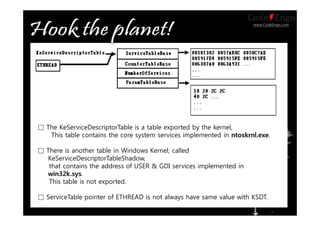
□ The KeServiceDescriptorTable is a table exported by the kernel,
This table contains the core system services implemented in ntoskrnl.exe.
□ There is another table in Windows Kernel, called
KeServiceDescriptorTableShadow,
that contains the address of USER & GDI services implemented in
win32k.sys.
This table is not exported.
□ ServiceTable pointer of ETHREAD is not always have same value with KSDT.
www.CodeEngn.com
www.CodeEngn.com
□ A system service dispatch is triggered when an INT 2E or SYSENTER
instruction is called.
□ Lower version than Windows 2000, Windows use INT 2E for service dispatch,
Higher than Windows XP, Windows use SYSENTER for service dispatch.
□ Normally, System call from UserLevel through ntdll.dll, but direct system
call is possible.
□ In Windows XP, we can use INT 2E instruction.
□ System call number is contained in the EAX register.
www.CodeEngn.com
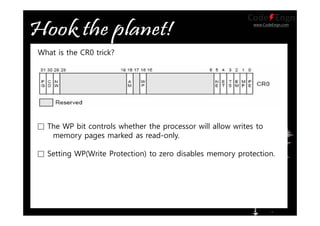
What is the CR0 trick?
□ The WP bit controls whether the processor will allow writes to
memory pages marked as read-only.
□ Setting WP(Write Protection) to zero disables memory protection.
www.CodeEngn.com
What is the MDL?
MDL (Memory Descriptor List):
1) Create the memory into our domain.
- MmCreateMdl()
2) MDL build for NonPage
- MmBuildMdlForNonPagedPool()
3) Change the flags of the MDL
- MdlFlags |=
MDL_MAPPED_TO_SYSTEM_VA
4) Lock that page
- MmMapLockedPages()
www.CodeEngn.com
How to get index number?
ZwWriteFile in Ntdll.dll :
InvalidateRect in user32.dll :
www.CodeEngn.com
Demonstration
www.CodeEngn.com
IDT(Interrupt Descriptor Table) hooking Motivation
□ IDT is used to handle interrupts, so there are many tasty things.
□ IDT hooking is more powerful than SDT hooking.
www.CodeEngn.com
Concept
□ We can use sidt,lidt instruction for getting and saving IDT
information.
www.CodeEngn.com
□ Handler Address =
MAKELONG(LowOffset,HiOffset);
□ If DPL value of gate is 3, It can be called
from both User and Kernel level.
□ There are 3 types of gate.
- Interrupt Gate (X 1 1 0)
- Trap Gate (X 1 1 1)
- Task Gate (0 1 0 1)
www.CodeEngn.com
□ The SIDT instruction is used to find the IDT in memory,
It returns the address of the IDTINFO structure.
The LIDT instruction is used for saving information into IDT.
□ The IDT specifies how to process interrupts such as those fired
when a key pressed, when a page fault occurs.
□ The Total number of IDT gates is 256.
www.CodeEngn.com
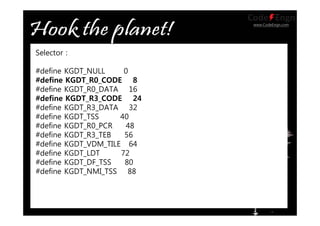
Selector :
#define KGDT_NULL 0
#define KGDT_R0_CODE 8
#define KGDT_R0_DATA 16
#define KGDT_R3_CODE 24
#define KGDT_R3_DATA 32
#define KGDT_TSS 40
#define KGDT_R0_PCR 48
#define KGDT_R3_TEB 56
#define KGDT_VDM_TILE 64
#define KGDT_LDT 72
#define KGDT_DF_TSS 80
#define KGDT_NMI_TSS 88
www.CodeEngn.com
There are so many interrupts :
www.CodeEngn.com
Demonstration
www.CodeEngn.com
0ne byte hooking Motivation
□ I`m so lazy person to restore original codes of hooked function J
□ Inline hooking is so static.
www.CodeEngn.com
Concept
□ Some functions in Windows XP later versions of the
OS have MOV EDI, EDI instruction.
□ MOV EDI,EDI doesn`t take the effect to code flow.
□ MOV EDI,EDI (=0x8B,0xFF) -> INT 0xFF (=0xCD,0xFF)
□ We can set handler at INT 0xFF manually.
www.CodeEngn.com
1. Get address of function.
2. Hook IDT (INT 0xFF) for all processors.
3. Make memory region of function to hook writeable.
4. Overwrite MOV EDI,EDI with 0xCD, the 'int' opcode
making INT 0xFF.
Process
www.CodeEngn.com
Demonstration
www.CodeEngn.com
Blind hooking by using DRx Motivation
□ I want to hook function without memory or table patching.
□ Are there no way to hook dinamically?
www.CodeEngn.com
Concept
□ We can use DR0 ~ DR3 for set addresses to hook.
□ We can set handler at INT 0x01 (Debug Exception).
www.CodeEngn.com
1. Get address of function.
2. Hook IDT (INT 0x01) for all processors.
3. Set addresses at DR0 ~ DR3.
4. Set hook type(E/W/RW) at DR7.
Process
www.CodeEngn.com
typedef struct tagDebugReg7
{
unsigned L0 :1; //
unsigned G0 :1; //
unsigned L1 :1; //
unsigned G1 :1; //
unsigned L2 :1; //
unsigned G2 :1; //
unsigned L3 :1; //
unsigned G3 :1; //
unsigned GL :1; //
unsigned GE :1; //
unsigned undefined1 :3; // 001
unsigned GD :1; //
unsigned undefined2 :2; // 00
unsigned RW0 :2;
unsigned LEN0 :2;
unsigned RW1 :2;
unsigned LEN1 :2;
unsigned RW2 :2;
unsigned LEN2 :2;
unsigned RW3 :2;
unsigned LEN3 :2;
} DebugReg7;
ADDRESS 1
DR0:
ADDRESS 2
DR1:
ADDRESS 3
DR2:
ADDRESS 4
DR3:
www.CodeEngn.com
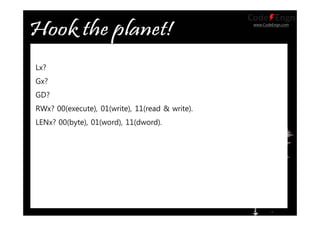
Lx?
Gx?
GD?
RWx? 00(execute), 01(write), 11(read & write).
LENx? 00(byte), 01(word), 11(dword).
www.CodeEngn.com
typedef struct
DebugReg6
{
unsigned B0 :1;
unsigned B1 :1;
unsigned B2 :1;
unsigned B3 :1;
unsigned undefined1 :9;
unsigned BD :1;
unsigned BS :1;
unsigned BT :1;
unsigned undefined2 :16;
} DebugReg6;
When Interrupt1 was occurred
by DR0 ~ DR3.
When Interrupt1 was occurred
by Gd bit.
When Interrupt1 was occurred
by TF bit.
www.CodeEngn.com
Demonstration
www.CodeEngn.com
www.CodeEngn.com
1) SDT Restore
2) SDT Relocation
3) KiFastCallEntry imitation
4) Bypassing Sysenter hook
www.CodeEngn.com
SDT Restore Motivation
□ I want to be free from SDT hooking!
□ Is there no way to restore SDT?
www.CodeEngn.com
Concept
□ We can write to Kernel memory from User space by
writing directly to devicephysicalmemory
□ We can get original copy of the ServiceTable by loading
ntoskrnl.exe into memory.
www.CodeEngn.com
1. Use NtOpenSection to get a handle devicePhysicalmemory
with SECTION_MAP_READ | SECTION_MAP_WRITE access.
2. Load ntoskrnl.exe into memory.
3. Use NtMapViewOfSection to map in the physical memory page.
4. Get the address of ServiceTable from the page.
5. Use the address of ServiceTable to offset into the loaded
ntoskrnl.exe
6. comparing the copy in the kernel memory with the copy in the
loaded ntoskrnl.exe
Process
www.CodeEngn.com
Demonstration
www.CodeEngn.com
SDT Relocation Motivation
□ How about change SDT as new thing?
□ Is there no way to make SDT hook localy?
www.CodeEngn.com
Concept
□ Windows doesn`t use KeServiceDescriptorTable for getting
address of ServiceTable. Actually, Windows use
ETHREAD->ServiceTable to get address of ServiceTable.
□ When new thread is created, we can know this by using
PsSetCreateThreadNotifyRoutine()
www.CodeEngn.com
1. Copy the SerivceTable from ntoskrnl.exe
2. Tracing threads of seleted process, and make NewSDT at each
thread.
3. Regist PsSetCreateThreadNotifyRoutine()
Process
www.CodeEngn.com
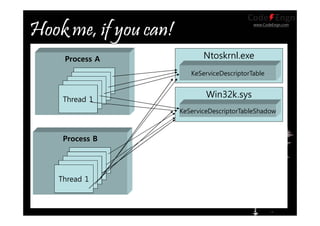
Process A
Thread 1
Thread 1
Thread 1
Thread 1
Ntoskrnl.exe
KeServiceDescriptorTable
Win32k.sys
KeServiceDescriptorTableShadow
Process B
Thread 1
Thread 1
Thread 1
Thread 1
www.CodeEngn.com
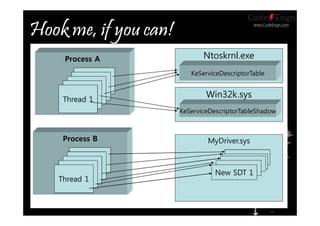
Process A
Thread 1
Thread 1
Thread 1
Thread 1
Ntoskrnl.exe
KeServiceDescriptorTable
Win32k.sys
KeServiceDescriptorTableShadow
Process B
Thread 1
Thread 1
Thread 1
Thread 1
MyDriver.sys
New SDT 1
New SDT 1New SDT 1
New SDT 1
New SDT 1
www.CodeEngn.com
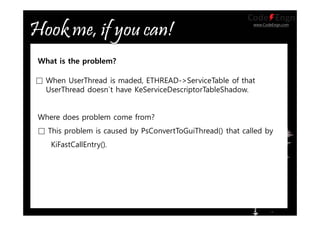
□ When UserThread is maded, ETHREAD->ServiceTable of that
UserThread doesn`t have KeServiceDescriptorTableShadow.
What is the problem?
Where does problem come from?
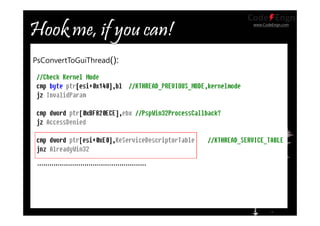
□ This problem is caused by PsConvertToGuiThread() that called by
KiFastCallEntry().
www.CodeEngn.com
PsConvertToGuiThread():
www.CodeEngn.com
Demonstration
www.CodeEngn.com
KiFastCallEntry Imitation Motivation
□ Is there no way to bypass SDT hooking by hooking?
□ Is there no way to handle syscall by myself?
www.CodeEngn.com
Concept
□ The SYSENTER instruction passes control to the address
specified in one of the Model-Specific Registers(MSRs).
The Name of this register is IA32_SYSENTER_EIP,
We can read and write to this register, By using
RDMSR , WRMSR instruction.
www.CodeEngn.com
1. Copy the KeServiceDescriptorTable from ntoskrnl.exe,
Copy the KeServiceDescriptorTableShadow from Win32k.sys
2. Change IA32_SYSENTER_EIP for all processors.
3. Hadling system call J
Process
www.CodeEngn.com
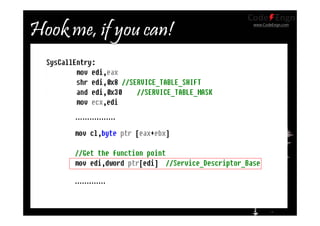
How we can do it?
www.CodeEngn.com
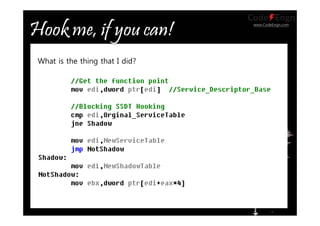
What is the thing that I did?
www.CodeEngn.com
Demonstration
www.CodeEngn.com
Bypassing sysenter hook Motivation
□ Is there no way to bypass sysenter hook?
□ Is there more way to bypass SDT hook?
www.CodeEngn.com
Concept
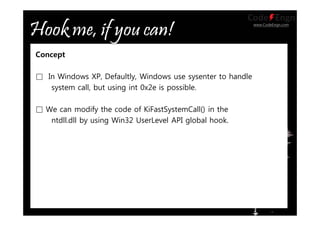
□ In Windows XP, Defaultly, Windows use sysenter to handle
system call, but using int 0x2e is possible.
□ We can modify the code of KiFastSystemCall() in the
ntdll.dll by using Win32 UserLevel API global hook.
www.CodeEngn.com
1. Hook IDT (INT 0x2E) for all processors.
2. Modify the code of KiFastSystemCall()
3. Hadling system call J
Process
www.CodeEngn.com
Before:
After:
www.CodeEngn.com
How we can do it?
www.CodeEngn.com
www.CodeEngn.com
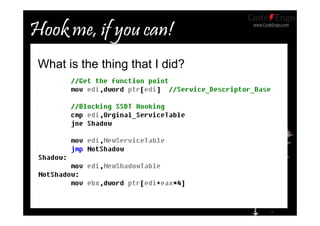
What is the thing that I did?
www.CodeEngn.com
?
http://dualpage.muz.ro

[2007 CodeEngn Conference 01] dual5651 - Windows 커널단의 후킹

  • 1.
    www.CodeEngn.com July 21, 2007 Sammuelkoo dual5651@hotmail.com Null @ Root Hook the Planet
  • 2.
    www.CodeEngn.com 1) What isa kernel hook used for? 2) Get into the Ring0! 3) Review 4) Hook the planet! 5) Hook me, If you can! 6) ?
  • 3.
    www.CodeEngn.com 1) Kernel hooksare global (relatively speaking). 2) Rootkit / Protection / Detection software are both in Ring Zero. 3) By using kernel hook, We can study the behavior of the system. 4) By using kernel hook, we can get performance data for specific tasks and generating statics.
  • 4.
    www.CodeEngn.com How to makecode run on Ring0? - Call gate : CPL change 3 from to 0 - Software Interrupt : API Call, Exception, .. - Device Driver : It doesn`t mean Usermode driver but Kernelmode drvier, because Kernelmode driver run on Level0, however, Usermode driver run on Level3.
  • 5.
    www.CodeEngn.com □ Code ofexe file is located into Paged Memory, In contrast, Code of sys file is located into NonPaged Memory. □ Both exe file and sys file has PE(Portable Executable) file format. □ DPL of CS in sys file has value 0, however, DPL of CS in exe file has value 3. It means CS of sys file can access all of instructions and memorys, In contrast, CS of exe file has limited access right. Header of 1stDriver.sys : Header of cmd.exe :
  • 6.
    www.CodeEngn.com 1. Compile Ccode by DDK 2. Assemble Asm code by KmdKit
  • 7.
    www.CodeEngn.com You can linkDDK to Visual Studio. If you use Visual Studio.net as IDE, You can use this way. 1. Download ddkbuild.bat from http://www.hollistech.com/Resources/ddkbuild/ddkbuild.htm 2. Copied it at c:progra~microsoft visu~vc7bin 3. Edit ddkbuild.bat set WNETBASE= C:WinDDK (Directory that DDK installed) 4. Making Project 1. Select makefile project. 2. Build cmdline : ddkbuild -WNET checked . 3. output / arrangement cmd skip 4. Build cmdline : ddkbuild -WNET chekced . -cZ
  • 8.
    www.CodeEngn.com If you useVisual Studio 6.0 as IDE, You can use this way. 1) Download easysys from this url : http://sourceforge.net/projects/easysys/ 2) Easysys : It`s So easy!!
  • 9.
  • 10.
    www.CodeEngn.com 1. Using SCMAPI 2. Using Undocumented API Pro : By using this way, you can load a Driver into the kernel without having to create registry key. Con : 1) The problem with this approach is That the driver will be pageable. Sometimes when memory is paged out, it cannot be accessed; It will occur BSOD(Blue Screen Of Death) with system crash. 2) Once it is loaded, it cannot be Unloaded until reboot. 1) When a driver is loaded using the SCM, it is non-pageable. This means your callback functions, IRP-handling functions, and other Important code will not vanish from Memory. 2) You can select start mode of Driver. SERVICE_BOOT_START(0x0) : Driver will be loaded by system loader. SERVICE_SYSTEM_START(0x1) : Load Driver when IoInitSystem is called. SERVICE_AUTO_START(0x2) : Load by SCM SERVICE_DEMAND_START(0x3) : Load by calling StartService() API. SERVICE_DISABLED(0x4) : Makes driver can not be loaded.
  • 11.
    www.CodeEngn.com I/O Request Packets(IRP) Return Create UserMDL request(IRP) Address of UserMDL Communicate by UserMDL Create Named Event & Regist it Event Signal □ Communicate by IRP □ Communicate by IRP & UserMDL □ Communicate by IRP & Event Reset Event
  • 12.
  • 13.
    www.CodeEngn.com 1) KPCR (Kernel`sProcessor Control Region) 2) EPROCESS (Executable Process) 3) TEB (Thread Environment Block) 4) ETHREAD (Executable Thread)
  • 14.
  • 15.
    www.CodeEngn.com In Kernel Level,FS:0 = KPCR = 0xFFDFF000KPCR ( Kernel`s Processor Control Region )
  • 16.
  • 17.
    www.CodeEngn.com □ In WindowsKernel, Each process is represented as an EPROCESS into Kernel Memory. □ List of active processes is obtained by traversing a doubly linked list referenced in the EPROCESS Structure of each process. □ We can access EPROCESS by CurrentThread of KPRCB structure. □ The Windows scheduling algorithm is not executed at process.
  • 18.
  • 19.
    www.CodeEngn.com USER ADDRESS SPACE2G (0x00000000 ~ 0x7FFFFFFF) TEB(0x7FFDEOOO) TIB TEB(0x7FFDEOOO) TIB DLL DLL DLL DLL LDR_MODULE LDR_MODULE LDR_MODULE LDR_MODULE PEB_LDR_DATA Process Image Stack Heap 0x40000000 ~ 0x7FFFFFFF 0x00000000 ~ 0x3FFFFFFF
  • 20.
    www.CodeEngn.com TEB ( ThreadEnvironment Block ) In UserLevel, FS:0 = TEB = 0x7ffde000 (1st Process) □ UserMode Application can access this structure directly. □ GetCurrentProcessId() function use this structure for getting PID. □ We can get PEB address from this structure.
  • 21.
    www.CodeEngn.com PEB ( ProcessEnvironment Block ) □ UserMode Application can access this structure directly. □ This structure have loaded modules list. □ This structure have ProcessParameters information. □ IsDebuggerPresent() function use this structure.
  • 22.
  • 23.
    www.CodeEngn.com 1) Win32 UserLevelAPI Global Hooking 2) SSDT(System Service Distpach Table) hooking 3) IDT(Interrupt Descriptor Table) hooking 4) 0ne byte hooking 5) Blind hooking by using DRx
  • 24.
    www.CodeEngn.com Win32 UserLevel APIGlobal Hooking Motivation □ Is there no way to Dll Injection without read/write process memory, and CreateRemoteThread() API? □ Is there no way to hook Win32 API globaly?
  • 25.
    www.CodeEngn.com Concept □ In Windows,DLL memory and mapped memory are shared. □ If we can modify memory of DLL without PageFault(Copy-On-Write), It will be applied to all processes. □ If we have chance to execute our code by victim process self, We don`t need CreateRemoteThread() anymore. □ In Windows, There is a region that will get mapped into every process address space, The name of this area is KUSER_SHARED_DATA.
  • 26.
    www.CodeEngn.com 1. Get theEPROCESS of explorer.exe 2. Attach to explorer.exe 3. Get the PEB from EPROCESS 4. Find Kernel32.dll address from Ldr in PEB. 5. Find IsDebuggerPresent() address from IMAGE_EXPORT_DIRECTORY of kernel32.dll 6. Modify IsDebuggerPresent() code to jmp KUSER_SHARED_DATA+0x8 with CR0 trick. 7. Now just waiting for victim process call IsDebuggerPresent() Process
  • 27.
    www.CodeEngn.com MOV EAX,DWORD PTRFS:[18] MOV EAX,DWORD PTR DS:[EAX+30] MOVZX EAX,BYTE PTR DS:[EAX+2] Original IsDebuggerPresent() code: Modifed IsDebuggerPresent() code: MOV EAX , KUSER_SHARED_DATA+0x8 JMP EAX
  • 28.
    www.CodeEngn.com PAYLOAD: DLL loading code: pushad pushfd push KSD + 0x8 + sizeof(DLL load code) call [KUSER_SHARED_DATA] popfd popad jmp [KUSER_SHARED_DATA+0x4]
  • 29.
  • 30.
    www.CodeEngn.com SSDT(System Service DistpachTable) hooking Motivation □ Is there no way to hook Native API as easier as IAT hook? □ Is there no way to hook Native API globaly?
  • 31.
    www.CodeEngn.com Concept □ Native systemservices`s addresses are listed in SSDT. □ KeServiceDescriptorTable is exported by the ntoskrnl.exe □ Windows XP later versions of the OS make the SSDT read-only, but we can bypass this protection with CR0 trick or MDL. □ We can get index number of Native API that we want to hook from ntdll.dll
  • 32.
    www.CodeEngn.com 1. Build thefunction that has same prototype with Native API to hook. 2. Get the index number of Native API. 3. Get address of SSDT by referencing KeServiceDescriptorTable. 4. Make SSDT memory area writeable. 5. KeServiceDescriptorTable->ServiceTableBase[index] = HookFunction; Process
  • 33.
    www.CodeEngn.com □ The KeServiceDescriptorTableis a table exported by the kernel, This table contains the core system services implemented in ntoskrnl.exe. □ There is another table in Windows Kernel, called KeServiceDescriptorTableShadow, that contains the address of USER & GDI services implemented in win32k.sys. This table is not exported. □ ServiceTable pointer of ETHREAD is not always have same value with KSDT.
  • 34.
  • 35.
    www.CodeEngn.com □ A systemservice dispatch is triggered when an INT 2E or SYSENTER instruction is called. □ Lower version than Windows 2000, Windows use INT 2E for service dispatch, Higher than Windows XP, Windows use SYSENTER for service dispatch. □ Normally, System call from UserLevel through ntdll.dll, but direct system call is possible. □ In Windows XP, we can use INT 2E instruction. □ System call number is contained in the EAX register.
  • 36.
    www.CodeEngn.com What is theCR0 trick? □ The WP bit controls whether the processor will allow writes to memory pages marked as read-only. □ Setting WP(Write Protection) to zero disables memory protection.
  • 37.
    www.CodeEngn.com What is theMDL? MDL (Memory Descriptor List): 1) Create the memory into our domain. - MmCreateMdl() 2) MDL build for NonPage - MmBuildMdlForNonPagedPool() 3) Change the flags of the MDL - MdlFlags |= MDL_MAPPED_TO_SYSTEM_VA 4) Lock that page - MmMapLockedPages()
  • 38.
    www.CodeEngn.com How to getindex number? ZwWriteFile in Ntdll.dll : InvalidateRect in user32.dll :
  • 39.
  • 40.
    www.CodeEngn.com IDT(Interrupt Descriptor Table)hooking Motivation □ IDT is used to handle interrupts, so there are many tasty things. □ IDT hooking is more powerful than SDT hooking.
  • 41.
    www.CodeEngn.com Concept □ We canuse sidt,lidt instruction for getting and saving IDT information.
  • 42.
    www.CodeEngn.com □ Handler Address= MAKELONG(LowOffset,HiOffset); □ If DPL value of gate is 3, It can be called from both User and Kernel level. □ There are 3 types of gate. - Interrupt Gate (X 1 1 0) - Trap Gate (X 1 1 1) - Task Gate (0 1 0 1)
  • 43.
    www.CodeEngn.com □ The SIDTinstruction is used to find the IDT in memory, It returns the address of the IDTINFO structure. The LIDT instruction is used for saving information into IDT. □ The IDT specifies how to process interrupts such as those fired when a key pressed, when a page fault occurs. □ The Total number of IDT gates is 256.
  • 44.
    www.CodeEngn.com Selector : #define KGDT_NULL0 #define KGDT_R0_CODE 8 #define KGDT_R0_DATA 16 #define KGDT_R3_CODE 24 #define KGDT_R3_DATA 32 #define KGDT_TSS 40 #define KGDT_R0_PCR 48 #define KGDT_R3_TEB 56 #define KGDT_VDM_TILE 64 #define KGDT_LDT 72 #define KGDT_DF_TSS 80 #define KGDT_NMI_TSS 88
  • 45.
  • 46.
  • 47.
    www.CodeEngn.com 0ne byte hookingMotivation □ I`m so lazy person to restore original codes of hooked function J □ Inline hooking is so static.
  • 48.
    www.CodeEngn.com Concept □ Some functionsin Windows XP later versions of the OS have MOV EDI, EDI instruction. □ MOV EDI,EDI doesn`t take the effect to code flow. □ MOV EDI,EDI (=0x8B,0xFF) -> INT 0xFF (=0xCD,0xFF) □ We can set handler at INT 0xFF manually.
  • 49.
    www.CodeEngn.com 1. Get addressof function. 2. Hook IDT (INT 0xFF) for all processors. 3. Make memory region of function to hook writeable. 4. Overwrite MOV EDI,EDI with 0xCD, the 'int' opcode making INT 0xFF. Process
  • 50.
  • 51.
    www.CodeEngn.com Blind hooking byusing DRx Motivation □ I want to hook function without memory or table patching. □ Are there no way to hook dinamically?
  • 52.
    www.CodeEngn.com Concept □ We canuse DR0 ~ DR3 for set addresses to hook. □ We can set handler at INT 0x01 (Debug Exception).
  • 53.
    www.CodeEngn.com 1. Get addressof function. 2. Hook IDT (INT 0x01) for all processors. 3. Set addresses at DR0 ~ DR3. 4. Set hook type(E/W/RW) at DR7. Process
  • 54.
    www.CodeEngn.com typedef struct tagDebugReg7 { unsignedL0 :1; // unsigned G0 :1; // unsigned L1 :1; // unsigned G1 :1; // unsigned L2 :1; // unsigned G2 :1; // unsigned L3 :1; // unsigned G3 :1; // unsigned GL :1; // unsigned GE :1; // unsigned undefined1 :3; // 001 unsigned GD :1; // unsigned undefined2 :2; // 00 unsigned RW0 :2; unsigned LEN0 :2; unsigned RW1 :2; unsigned LEN1 :2; unsigned RW2 :2; unsigned LEN2 :2; unsigned RW3 :2; unsigned LEN3 :2; } DebugReg7; ADDRESS 1 DR0: ADDRESS 2 DR1: ADDRESS 3 DR2: ADDRESS 4 DR3:
  • 55.
    www.CodeEngn.com Lx? Gx? GD? RWx? 00(execute), 01(write),11(read & write). LENx? 00(byte), 01(word), 11(dword).
  • 56.
    www.CodeEngn.com typedef struct DebugReg6 { unsigned B0:1; unsigned B1 :1; unsigned B2 :1; unsigned B3 :1; unsigned undefined1 :9; unsigned BD :1; unsigned BS :1; unsigned BT :1; unsigned undefined2 :16; } DebugReg6; When Interrupt1 was occurred by DR0 ~ DR3. When Interrupt1 was occurred by Gd bit. When Interrupt1 was occurred by TF bit.
  • 57.
  • 58.
  • 59.
    www.CodeEngn.com 1) SDT Restore 2)SDT Relocation 3) KiFastCallEntry imitation 4) Bypassing Sysenter hook
  • 60.
    www.CodeEngn.com SDT Restore Motivation □I want to be free from SDT hooking! □ Is there no way to restore SDT?
  • 61.
    www.CodeEngn.com Concept □ We canwrite to Kernel memory from User space by writing directly to devicephysicalmemory □ We can get original copy of the ServiceTable by loading ntoskrnl.exe into memory.
  • 62.
    www.CodeEngn.com 1. Use NtOpenSectionto get a handle devicePhysicalmemory with SECTION_MAP_READ | SECTION_MAP_WRITE access. 2. Load ntoskrnl.exe into memory. 3. Use NtMapViewOfSection to map in the physical memory page. 4. Get the address of ServiceTable from the page. 5. Use the address of ServiceTable to offset into the loaded ntoskrnl.exe 6. comparing the copy in the kernel memory with the copy in the loaded ntoskrnl.exe Process
  • 63.
  • 64.
    www.CodeEngn.com SDT Relocation Motivation □How about change SDT as new thing? □ Is there no way to make SDT hook localy?
  • 65.
    www.CodeEngn.com Concept □ Windows doesn`tuse KeServiceDescriptorTable for getting address of ServiceTable. Actually, Windows use ETHREAD->ServiceTable to get address of ServiceTable. □ When new thread is created, we can know this by using PsSetCreateThreadNotifyRoutine()
  • 66.
    www.CodeEngn.com 1. Copy theSerivceTable from ntoskrnl.exe 2. Tracing threads of seleted process, and make NewSDT at each thread. 3. Regist PsSetCreateThreadNotifyRoutine() Process
  • 67.
    www.CodeEngn.com Process A Thread 1 Thread1 Thread 1 Thread 1 Ntoskrnl.exe KeServiceDescriptorTable Win32k.sys KeServiceDescriptorTableShadow Process B Thread 1 Thread 1 Thread 1 Thread 1
  • 68.
    www.CodeEngn.com Process A Thread 1 Thread1 Thread 1 Thread 1 Ntoskrnl.exe KeServiceDescriptorTable Win32k.sys KeServiceDescriptorTableShadow Process B Thread 1 Thread 1 Thread 1 Thread 1 MyDriver.sys New SDT 1 New SDT 1New SDT 1 New SDT 1 New SDT 1
  • 69.
    www.CodeEngn.com □ When UserThreadis maded, ETHREAD->ServiceTable of that UserThread doesn`t have KeServiceDescriptorTableShadow. What is the problem? Where does problem come from? □ This problem is caused by PsConvertToGuiThread() that called by KiFastCallEntry().
  • 70.
  • 71.
  • 72.
    www.CodeEngn.com KiFastCallEntry Imitation Motivation □Is there no way to bypass SDT hooking by hooking? □ Is there no way to handle syscall by myself?
  • 73.
    www.CodeEngn.com Concept □ The SYSENTERinstruction passes control to the address specified in one of the Model-Specific Registers(MSRs). The Name of this register is IA32_SYSENTER_EIP, We can read and write to this register, By using RDMSR , WRMSR instruction.
  • 74.
    www.CodeEngn.com 1. Copy theKeServiceDescriptorTable from ntoskrnl.exe, Copy the KeServiceDescriptorTableShadow from Win32k.sys 2. Change IA32_SYSENTER_EIP for all processors. 3. Hadling system call J Process
  • 75.
  • 76.
  • 77.
  • 78.
    www.CodeEngn.com Bypassing sysenter hookMotivation □ Is there no way to bypass sysenter hook? □ Is there more way to bypass SDT hook?
  • 79.
    www.CodeEngn.com Concept □ In WindowsXP, Defaultly, Windows use sysenter to handle system call, but using int 0x2e is possible. □ We can modify the code of KiFastSystemCall() in the ntdll.dll by using Win32 UserLevel API global hook.
  • 80.
    www.CodeEngn.com 1. Hook IDT(INT 0x2E) for all processors. 2. Modify the code of KiFastSystemCall() 3. Hadling system call J Process
  • 81.
  • 82.
  • 83.
  • 84.
  • 85.