2.2 Linear Equations
Identifying a Linear Equation
Ax + By = C
● The exponent of each variable is 1.
● The variables are added or subtracted.
● A or B can equal zero.
● A > 0
● Besides x and y, other commonly used variables
are m and n, a and b, and r and s.
● There are no radicals in the equation.
● Every linear equation graphs as a line.
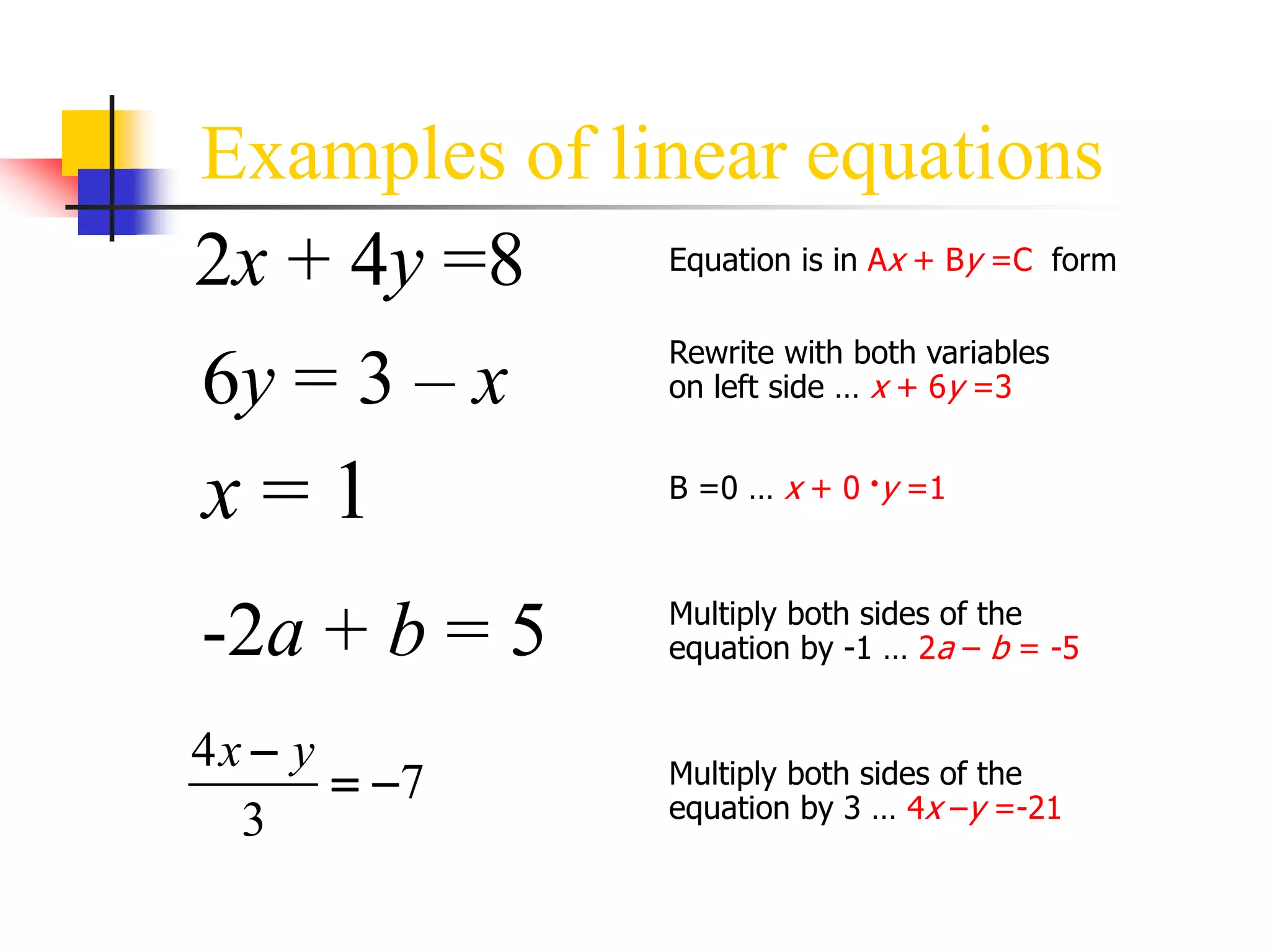
Examples of linear equations
2x + 4y =8
6y = 3 – x
x = 1
-2a + b = 5
4
7
3
x y

 
Equation is in Ax + By =C form
Rewrite with both variables
on left side … x + 6y =3
B =0 … x + 0 y =1
Multiply both sides of the
equation by -1 … 2a – b = -5
Multiply both sides of the
equation by 3 … 4x –y =-21

Examples of Nonlinear Equations
4x2 + y = 5
xy + x = 5
s/r + r = 3
The exponent is 2
There is a radical in the equation
Variables are multiplied
Variables are divided
4
x 
The following equations are NOT in the
standard form of Ax + By =C:
x and y -intercepts
● The x-intercept is the point where a line crosses
the x-axis.
The general form of the x-intercept is (x, 0).
The y-coordinate will always be zero.
● The y-intercept is the point where a line crosses
the y-axis.
The general form of the y-intercept is (0, y).
The x-coordinate will always be zero.
Finding the x-intercept
● For the equation 2x + y = 6, we know that
y must equal 0. What must x equal?
● Plug in 0 for y and simplify.
2x + 0 = 6
2x = 6
x = 3
● So (3, 0) is the x-intercept of the line.
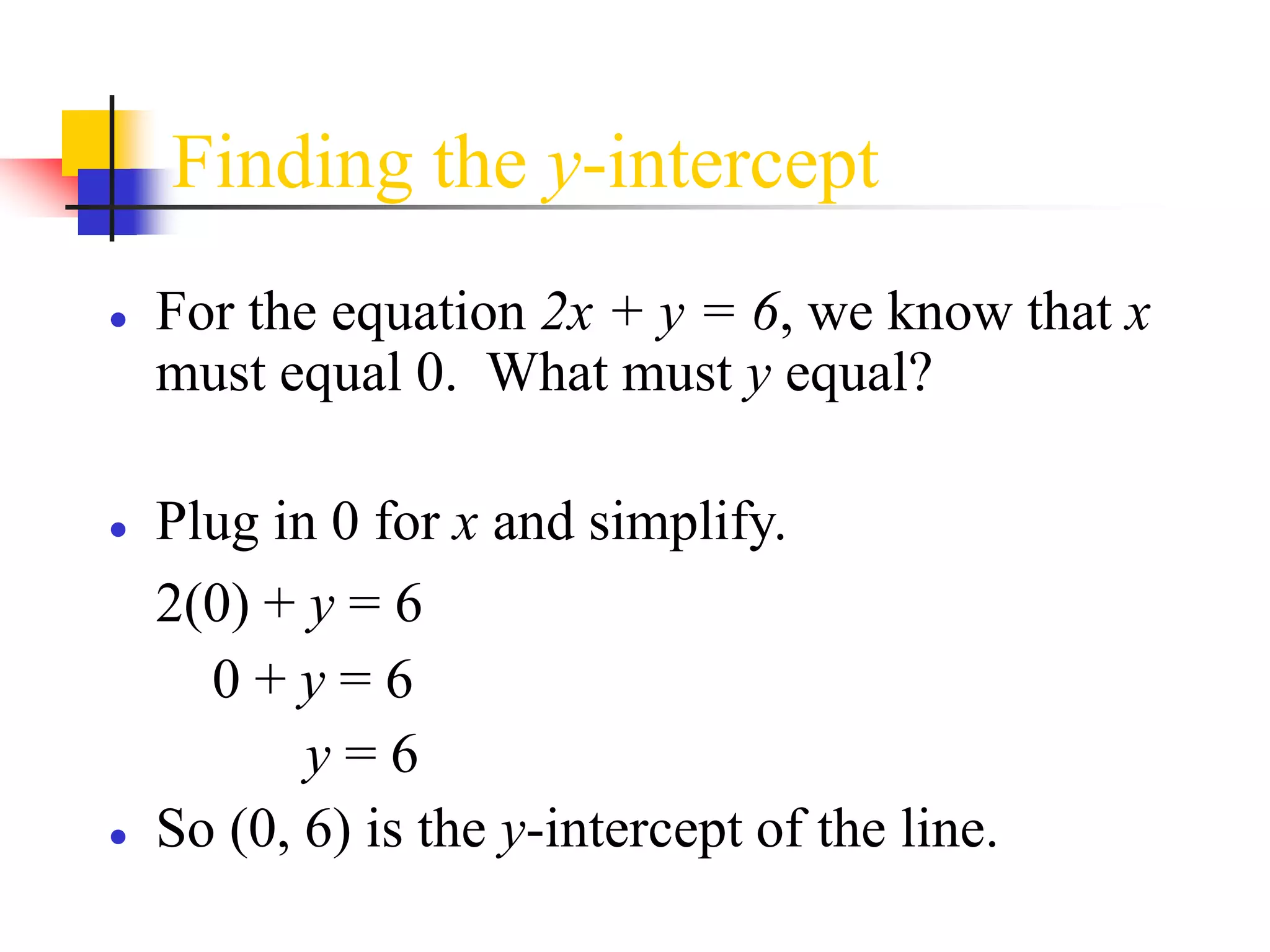
Finding the y-intercept
● For the equation 2x + y = 6, we know that x
must equal 0. What must y equal?
● Plug in 0 for x and simplify.
2(0) + y = 6
0 + y = 6
y = 6
● So (0, 6) is the y-intercept of the line.
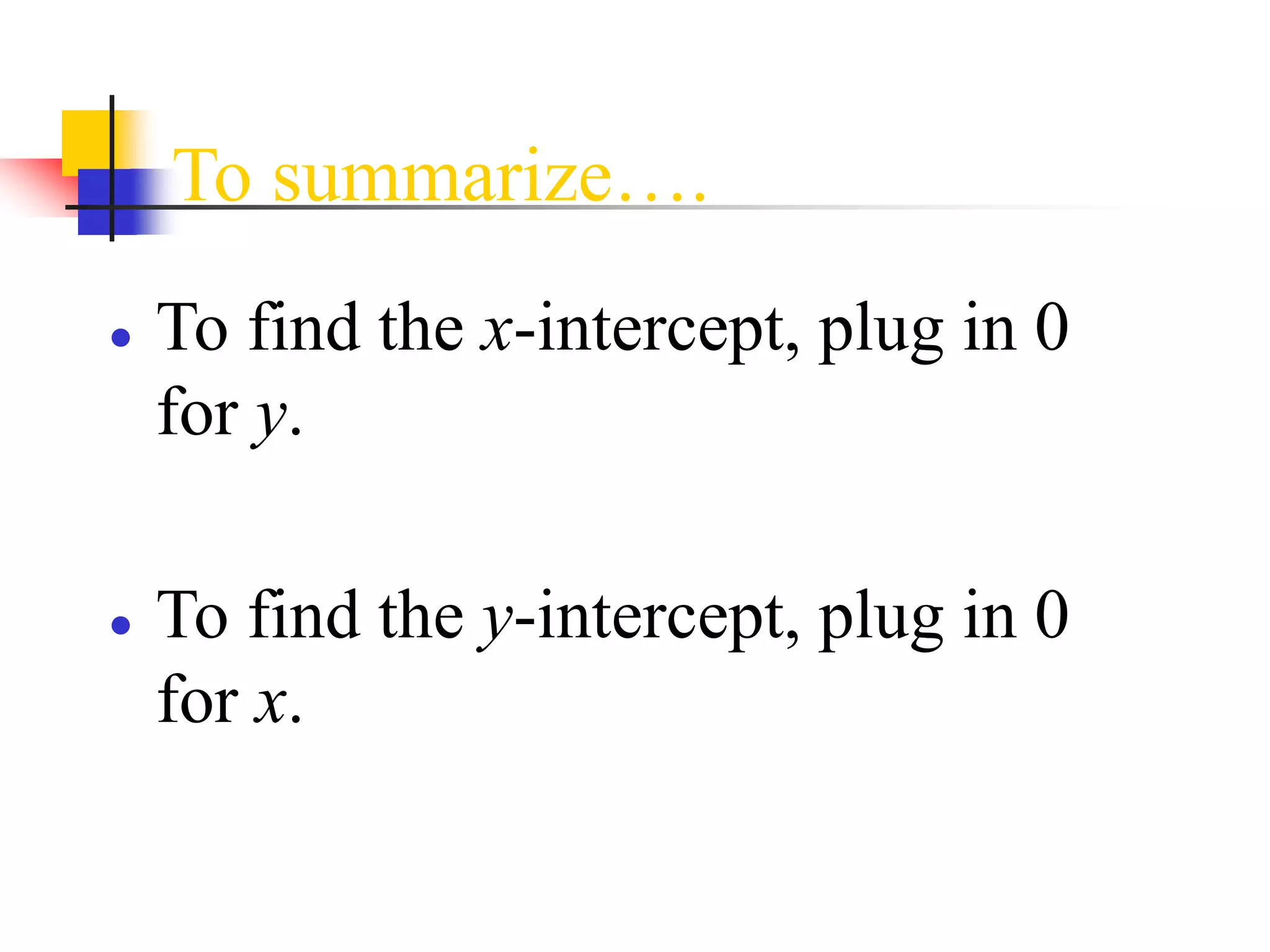
To summarize….
● To find the x-intercept, plug in 0
for y.
● To find the y-intercept, plug in 0
for x.
Find the x and y- intercepts
of x = 4y – 5
● x-intercept:
● Plug in y = 0
x = 4y - 5
x = 4(0) - 5
x = 0 - 5
x = -5
● (-5, 0) is the
x-intercept
● y-intercept:
● Plug in x = 0
x = 4y - 5
0 = 4y - 5
5 = 4y
= y
● (0, ) is the
y-intercept
5
4
5
4
Find the x and y-intercepts
of g(x) = -3x – 1*
● x-intercept
● Plug in y = 0
g(x) = -3x - 1
0 = -3x - 1
1 = -3x
= x
● ( , 0) is the
x-intercept
● y-intercept
● Plug in x = 0
g(x) = -3(0) - 1
g(x) = 0 - 1
g(x) = -1
● (0, -1) is the
y-intercept
*g(x) is the same as y
1
3

1
3

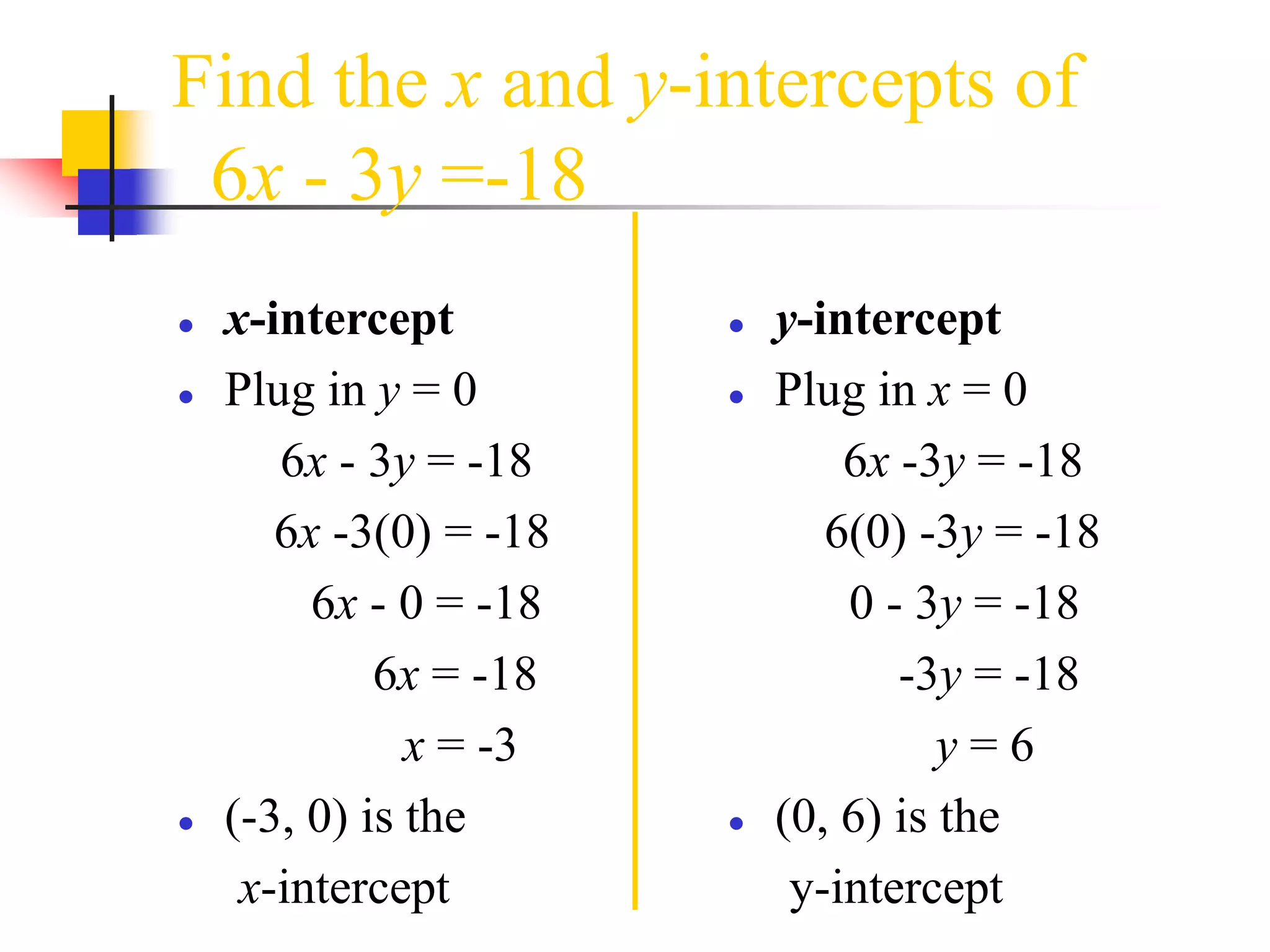
Find the x and y-intercepts of
6x - 3y =-18
● x-intercept
● Plug in y = 0
6x - 3y = -18
6x -3(0) = -18
6x - 0 = -18
6x = -18
x = -3
● (-3, 0) is the
x-intercept
● y-intercept
● Plug in x = 0
6x -3y = -18
6(0) -3y = -18
0 - 3y = -18
-3y = -18
y = 6
● (0, 6) is the
y-intercept
Find the x and y-intercepts
of x = 3
● y-intercept
● A vertical line never
crosses the y-axis.
● There is no y-intercept.
● x-intercept
● Plug in y = 0.
There is no y. Why?
● x = 3 is a vertical line
so x always equals 3.
● (3, 0) is the x-intercept.
x
Find the x and y-intercepts
of y = -2
● x-intercept
● Plug in y = 0.
y cannot = 0 because
y = -2.
● y = -2 is a horizontal
line so it never crosses
the x-axis.
●There is no x-intercept.
● y-intercept
● y = -2 is a horizontal line
so y always equals -2.
● (0,-2) is the y-intercept.
x
y
Graphing Equations
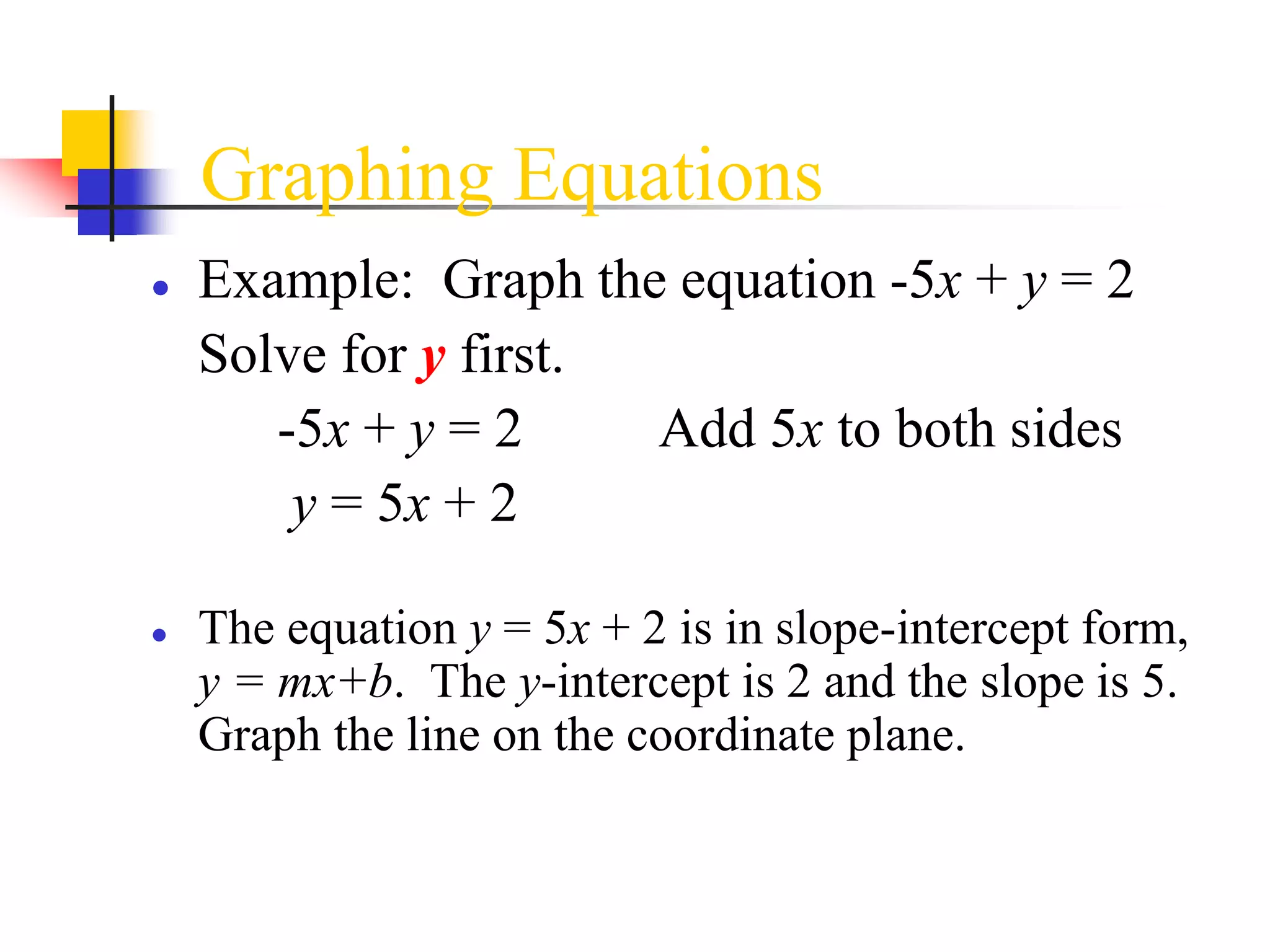
● Example: Graph the equation -5x + y = 2
Solve for y first.
-5x + y = 2 Add 5x to both sides
y = 5x + 2
● The equation y = 5x + 2 is in slope-intercept form,
y = mx+b. The y-intercept is 2 and the slope is 5.
Graph the line on the coordinate plane.
x
y
Graph y = 5x + 2
Graphing Equations
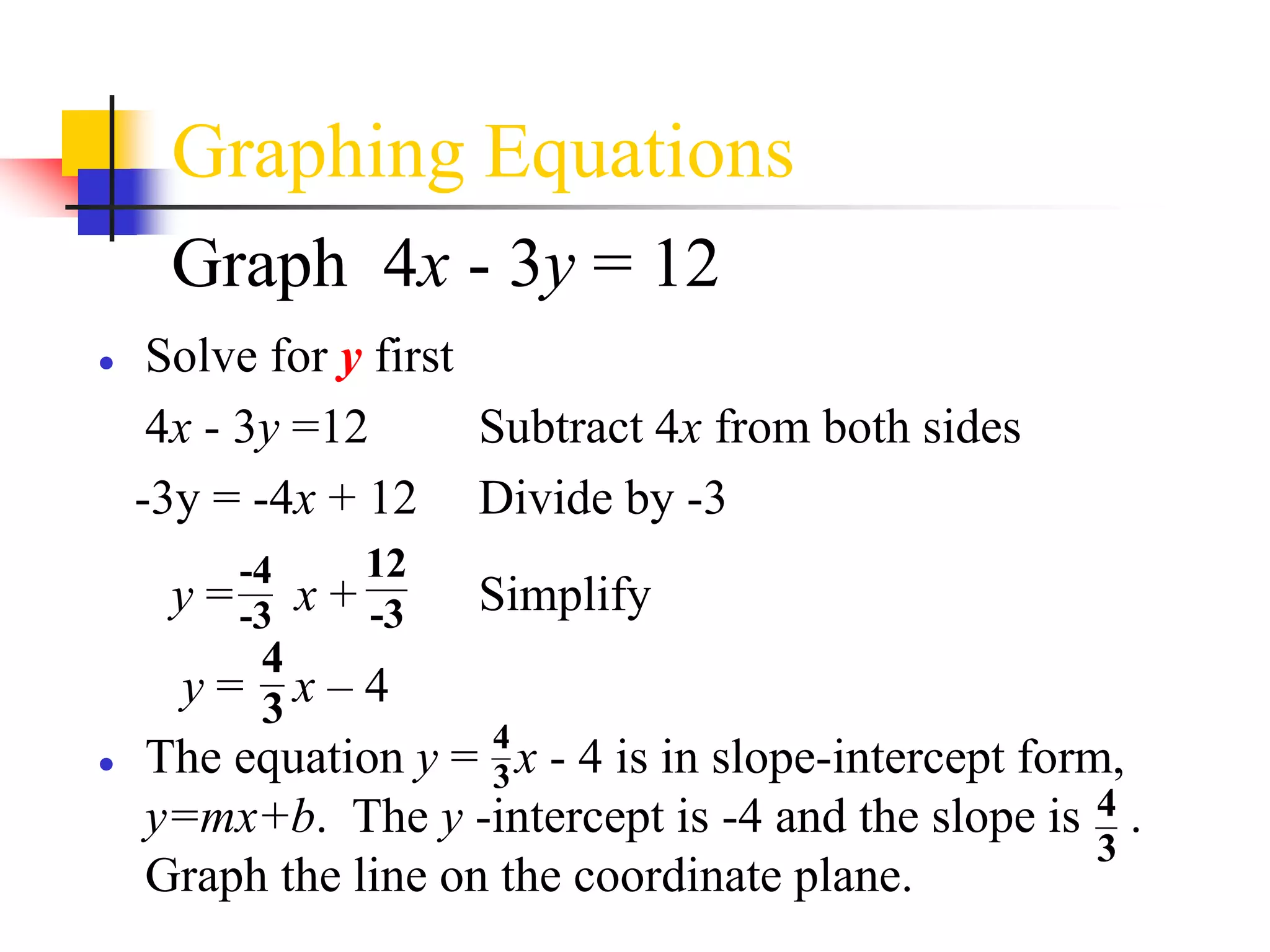
Graph 4x - 3y = 12
● Solve for y first
4x - 3y =12 Subtract 4x from both sides
-3y = -4x + 12 Divide by -3
y = x + Simplify
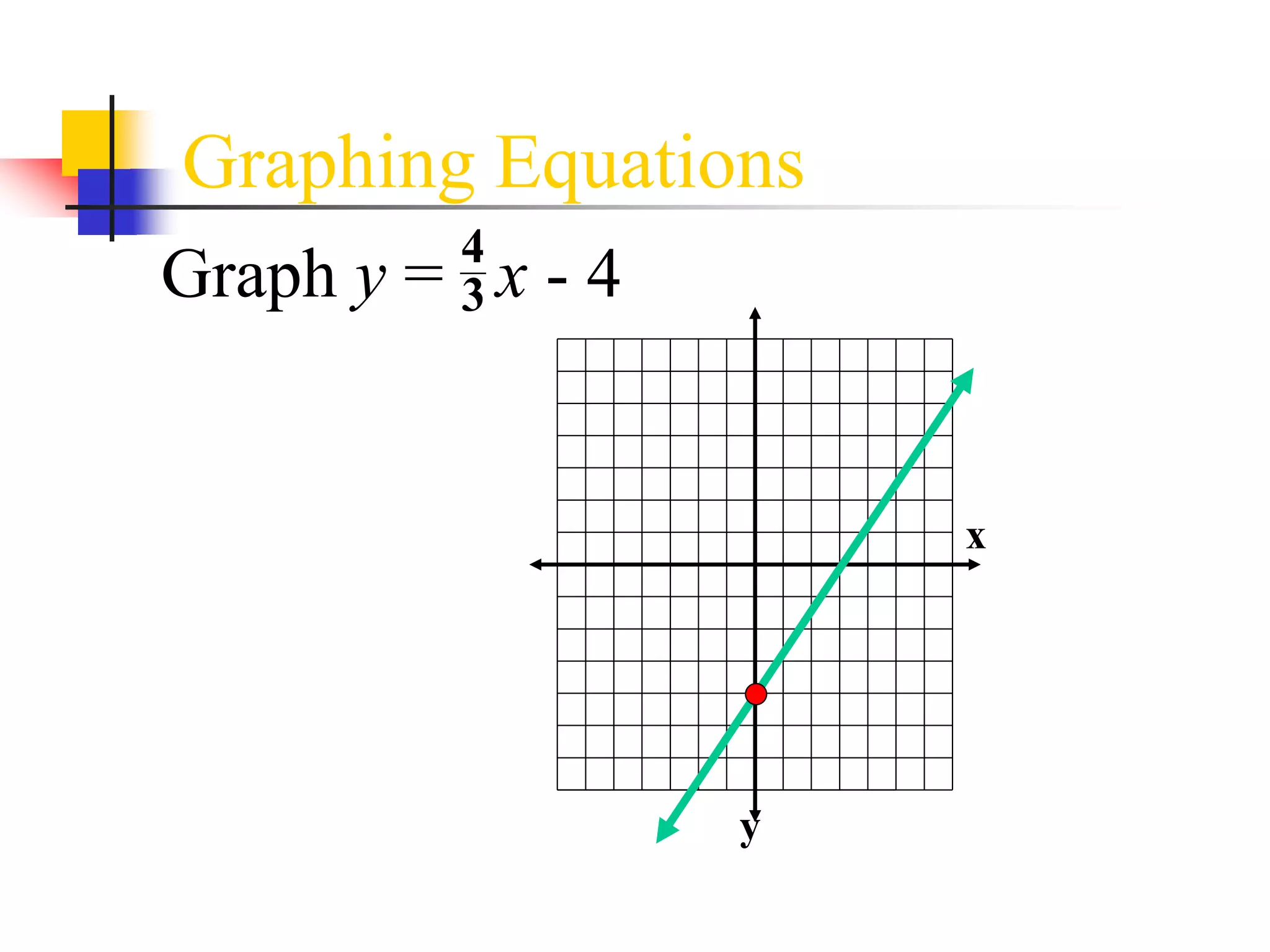
y = x – 4
● The equation y = x - 4 is in slope-intercept form,
y=mx+b. The y -intercept is -4 and the slope is .
Graph the line on the coordinate plane.
Graphing Equations
12
-3
4
3
4
3
4
3
-4
-3
Graph y = x - 4
x
y
4
3
Graphing Equations

2006_2_2 (2).ppt

  • 1.
  • 2.
    Identifying a LinearEquation Ax + By = C ● The exponent of each variable is 1. ● The variables are added or subtracted. ● A or B can equal zero. ● A > 0 ● Besides x and y, other commonly used variables are m and n, a and b, and r and s. ● There are no radicals in the equation. ● Every linear equation graphs as a line.
  • 3.
    Examples of linearequations 2x + 4y =8 6y = 3 – x x = 1 -2a + b = 5 4 7 3 x y    Equation is in Ax + By =C form Rewrite with both variables on left side … x + 6y =3 B =0 … x + 0 y =1 Multiply both sides of the equation by -1 … 2a – b = -5 Multiply both sides of the equation by 3 … 4x –y =-21 
  • 4.
    Examples of NonlinearEquations 4x2 + y = 5 xy + x = 5 s/r + r = 3 The exponent is 2 There is a radical in the equation Variables are multiplied Variables are divided 4 x  The following equations are NOT in the standard form of Ax + By =C:
  • 5.
    x and y-intercepts ● The x-intercept is the point where a line crosses the x-axis. The general form of the x-intercept is (x, 0). The y-coordinate will always be zero. ● The y-intercept is the point where a line crosses the y-axis. The general form of the y-intercept is (0, y). The x-coordinate will always be zero.
  • 6.
    Finding the x-intercept ●For the equation 2x + y = 6, we know that y must equal 0. What must x equal? ● Plug in 0 for y and simplify. 2x + 0 = 6 2x = 6 x = 3 ● So (3, 0) is the x-intercept of the line.
  • 7.
    Finding the y-intercept ●For the equation 2x + y = 6, we know that x must equal 0. What must y equal? ● Plug in 0 for x and simplify. 2(0) + y = 6 0 + y = 6 y = 6 ● So (0, 6) is the y-intercept of the line.
  • 8.
    To summarize…. ● Tofind the x-intercept, plug in 0 for y. ● To find the y-intercept, plug in 0 for x.
  • 9.
    Find the xand y- intercepts of x = 4y – 5 ● x-intercept: ● Plug in y = 0 x = 4y - 5 x = 4(0) - 5 x = 0 - 5 x = -5 ● (-5, 0) is the x-intercept ● y-intercept: ● Plug in x = 0 x = 4y - 5 0 = 4y - 5 5 = 4y = y ● (0, ) is the y-intercept 5 4 5 4
  • 10.
    Find the xand y-intercepts of g(x) = -3x – 1* ● x-intercept ● Plug in y = 0 g(x) = -3x - 1 0 = -3x - 1 1 = -3x = x ● ( , 0) is the x-intercept ● y-intercept ● Plug in x = 0 g(x) = -3(0) - 1 g(x) = 0 - 1 g(x) = -1 ● (0, -1) is the y-intercept *g(x) is the same as y 1 3  1 3 
  • 11.
    Find the xand y-intercepts of 6x - 3y =-18 ● x-intercept ● Plug in y = 0 6x - 3y = -18 6x -3(0) = -18 6x - 0 = -18 6x = -18 x = -3 ● (-3, 0) is the x-intercept ● y-intercept ● Plug in x = 0 6x -3y = -18 6(0) -3y = -18 0 - 3y = -18 -3y = -18 y = 6 ● (0, 6) is the y-intercept
  • 12.
    Find the xand y-intercepts of x = 3 ● y-intercept ● A vertical line never crosses the y-axis. ● There is no y-intercept. ● x-intercept ● Plug in y = 0. There is no y. Why? ● x = 3 is a vertical line so x always equals 3. ● (3, 0) is the x-intercept. x
  • 13.
    Find the xand y-intercepts of y = -2 ● x-intercept ● Plug in y = 0. y cannot = 0 because y = -2. ● y = -2 is a horizontal line so it never crosses the x-axis. ●There is no x-intercept. ● y-intercept ● y = -2 is a horizontal line so y always equals -2. ● (0,-2) is the y-intercept. x y
  • 14.
    Graphing Equations ● Example:Graph the equation -5x + y = 2 Solve for y first. -5x + y = 2 Add 5x to both sides y = 5x + 2 ● The equation y = 5x + 2 is in slope-intercept form, y = mx+b. The y-intercept is 2 and the slope is 5. Graph the line on the coordinate plane.
  • 15.
    x y Graph y =5x + 2 Graphing Equations
  • 16.
    Graph 4x -3y = 12 ● Solve for y first 4x - 3y =12 Subtract 4x from both sides -3y = -4x + 12 Divide by -3 y = x + Simplify y = x – 4 ● The equation y = x - 4 is in slope-intercept form, y=mx+b. The y -intercept is -4 and the slope is . Graph the line on the coordinate plane. Graphing Equations 12 -3 4 3 4 3 4 3 -4 -3
  • 17.
    Graph y =x - 4 x y 4 3 Graphing Equations