Artificial Intelligence: A Modern Approach 4th Edition Stuart Russell
Artificial Intelligence: A Modern Approach 4th Edition Stuart Russell
Artificial Intelligence: A Modern Approach 4th Edition Stuart Russell
Artificial Intelligence: A Modern Approach 4th Edition Stuart Russell
Artificial Intelligence: A Modern Approach 4th Edition Stuart Russell
1.
Artificial Intelligence: AModern Approach 4th
Edition Stuart Russell install download
https://textbookfull.com/product/artificial-intelligence-a-
modern-approach-4th-edition-stuart-russell/
Download more ebook instantly today - get yours now at textbookfull.com
2.
We believe theseproducts will be a great fit for you. Click
the link to download now, or visit textbookfull.com
to discover even more!
College physics : a strategic approach 4th Edition
Stuart Field
https://textbookfull.com/product/college-physics-a-strategic-
approach-4th-edition-stuart-field/
Judgement-Proof Robots and Artificial Intelligence: A
Comparative Law and Economics Approach Mitja Kova■
https://textbookfull.com/product/judgement-proof-robots-and-
artificial-intelligence-a-comparative-law-and-economics-approach-
mitja-kovac/
Pro Deep Learning with TensorFlow: A Mathematical
Approach to Advanced Artificial Intelligence in Python
1st Edition Santanu Pattanayak
https://textbookfull.com/product/pro-deep-learning-with-
tensorflow-a-mathematical-approach-to-advanced-artificial-
intelligence-in-python-1st-edition-santanu-pattanayak/
Artificial Intelligence for the Internet of Everything
1st Edition William Lawless Ranjeev Mittu Donald Sofge
Ira S Moskowitz Stephen Russell
https://textbookfull.com/product/artificial-intelligence-for-the-
internet-of-everything-1st-edition-william-lawless-ranjeev-mittu-
donald-sofge-ira-s-moskowitz-stephen-russell/
3.
Biology The DynamicScience 4th Edition Russell
https://textbookfull.com/product/biology-the-dynamic-science-4th-
edition-russell/
Building Java Programs: A Back to Basics Approach
Stuart Reges
https://textbookfull.com/product/building-java-programs-a-back-
to-basics-approach-stuart-reges/
Building Java Programs - A Back to Basics Approach
Stuart Reges
https://textbookfull.com/product/building-java-programs-a-back-
to-basics-approach-stuart-reges-2/
From Inquiry to Academic Writing A Practical Guide 4th
Edition Stuart Greene
https://textbookfull.com/product/from-inquiry-to-academic-
writing-a-practical-guide-4th-edition-stuart-greene/
Artificial Intelligence By Example Develop machine
intelligence from scratch using real artificial
intelligence use cases Denis Rothman
https://textbookfull.com/product/artificial-intelligence-by-
example-develop-machine-intelligence-from-scratch-using-real-
artificial-intelligence-use-cases-denis-rothman/
Artificial Intelligence
A ModernApproach
Fourth Edition
Stuart J. Russell and Peter Norvig
Contributing writers:
Ming-Wei Chang
Jacob Devlin
Anca Dragan
David Forsyth
Ian Goodfellow
Jitendra M. Malik
Vikash Mansinghka
Judea Pearl
Michael Wooldridge
PEARSON, ALWAYS LEARNINGis an exclusive trademark owned by Pearson Education,
Inc. or its affiliates in the U.S. and/or other countries.
Unless otherwise indicated herein, any third-party trademarks, logos, or icons that may
appear in this work are the property of their respective owners, and any references to third-
party trademarks, logos, icons, or other trade dress are for demonstrative or descriptive
purposes only. Such references are not intended to imply any sponsorship, endorsement,
authorization, or promotion of Pearson’s products by the owners of such marks, or any
relationship between the owner and Pearson Education, Inc., or its affiliates, authors,
licensees, or distributors.
Library of Congress Cataloging-in-Publication Data
Names: Russell, Stuart J. (Stuart Jonathan), author. | Norvig, Peter, author.
Title: Artificial intelligence : a modern approach / Stuart J. Russell and Peter Norvig.
Description: Fourth edition. | Hoboken : Pearson, [2021] | Series: Pearson series in artificial
intelligence | Includes bibliographical references and index. | Summary: “Updated edition
of popular textbook on Artificial Intelligence.”— Provided by publisher.
Identifiers: LCCN 2019047498 | ISBN 9780134610993 (hardcover)
Subjects: LCSH: Artificial intelligence.
Classification: LCC Q335 .R86 2021 | DDC 006.3–dc23
LC record available at https://lccn.loc.gov/2019047498
ScoutAutomatedPrintCode
ISBN-10: 0-13-461099-7
ISBN-13: 978-0-13-461099-3
12.
For Loy, Gordon,Lucy, George, and Isaac — S.J.R.
For Kris, Isabella, and Juliet — P.N.
13.
Preface
Artificial Intelligence (AI)is a big field, and this is a big book. We have tried to explore the
full breadth of the field, which encompasses logic, probability, and continuous mathematics;
perception, reasoning, learning, and action; fairness, trust, social good, and safety; and
applications that range from microelectronic devices to robotic planetary explorers to online
services with billions of users.
The subtitle of this book is “A Modern Approach.” That means we have chosen to tell the
story from a current perspective. We synthesize what is now known into a common
framework, recasting early work using the ideas and terminology that are prevalent today.
We apologize to those whose subfields are, as a result, less recognizable.
New to this edition
This edition reflects the changes in AI since the last edition in 2010:
We focus more on machine learning rather than hand-crafted knowledge engineering,
due to the increased availability of data, computing resources, and new algorithms.
Deep learning, probabilistic programming, and multiagent systems receive expanded
coverage, each with their own chapter.
The coverage of natural language understanding, robotics, and computer vision has
been revised to reflect the impact of deep learning.
The robotics chapter now includes robots that interact with humans and the application
of reinforcement learning to robotics.
Previously we defined the goal of AI as creating systems that try to maximize expected
utility, where the specific utility information—the objective—is supplied by the human
designers of the system. Now we no longer assume that the objective is fixed and
known by the AI system; instead, the system may be uncertain about the true objectives
of the humans on whose behalf it operates. It must learn what to maximize and must
function appropriately even while uncertain about the objective.
14.
We increase coverageof the impact of AI on society, including the vital issues of ethics,
fairness, trust, and safety.
We have moved the exercises from the end of each chapter to an online site. This allows
us to continuously add to, update, and improve the exercises, to meet the needs of
instructors and to reflect advances in the field and in AI-related software tools.
Overall, about 25% of the material in the book is brand new. The remaining 75% has
been largely rewritten to present a more unified picture of the field. 22% of the citations
in this edition are to works published after 2010.
Overview of the book
The main unifying theme is the idea of an intelligent agent. We define AI as the study of
agents that receive percepts from the environment and perform actions. Each such agent
implements a function that maps percept sequences to actions, and we cover different ways
to represent these functions, such as reactive agents, real-time planners, decision-theoretic
systems, and deep learning systems. We emphasize learning both as a construction method
for competent systems and as a way of extending the reach of the designer into unknown
environments. We treat robotics and vision not as independently defined problems, but as
occurring in the service of achieving goals. We stress the importance of the task
environment in determining the appropriate agent design.
Our primary aim is to convey the ideas that have emerged over the past seventy years of AI
research and the past two millennia of related work. We have tried to avoid excessive
formality in the presentation of these ideas, while retaining precision. We have included
mathematical formulas and pseudocode algorithms to make the key ideas concrete;
mathematical concepts and notation are described in Appendix A and our pseudocode is
described in Appendix B .
This book is primarily intended for use in an undergraduate course or course sequence. The
book has 28 chapters, each requiring about a week’s worth of lectures, so working through
the whole book requires a two-semester sequence. A one-semester course can use selected
chapters to suit the interests of the instructor and students. The book can also be used in a
graduate-level course (perhaps with the addition of some of the primary sources suggested
in the bibliographical notes), or for self-study or as a reference.
15.
Throughout the book,important points are marked with a triangle icon in the margin.
Wherever a new term is defined, it is also noted in the margin. Subsequent significant uses
of the term are in bold, but not in the margin. We have included a comprehensive index and
an extensive bibliography.
Term
The only prerequisite is familiarity with basic concepts of computer science (algorithms,
data structures, complexity) at a sophomore level. Freshman calculus and linear algebra are
useful for some of the topics.
Online resources
Online resources are available through pearsonhighered.com/cs-resources or at the
book’s Web site, aima.cs.berkeley.edu. There you will find:
Exercises, programming projects, and research projects. These are no longer at the end
of each chapter; they are online only. Within the book, we refer to an online exercise
with a name like “Exercise 6.NARY.” Instructions on the Web site allow you to find
exercises by name or by topic.
Implementations of the algorithms in the book in Python, Java, and other programming
languages (currently hosted at github.com/aimacode).
A list of over 1400 schools that have used the book, many with links to online course
materials and syllabi.
Supplementary material and links for students and instructors.
Instructions on how to report errors in the book, in the likely event that some exist.
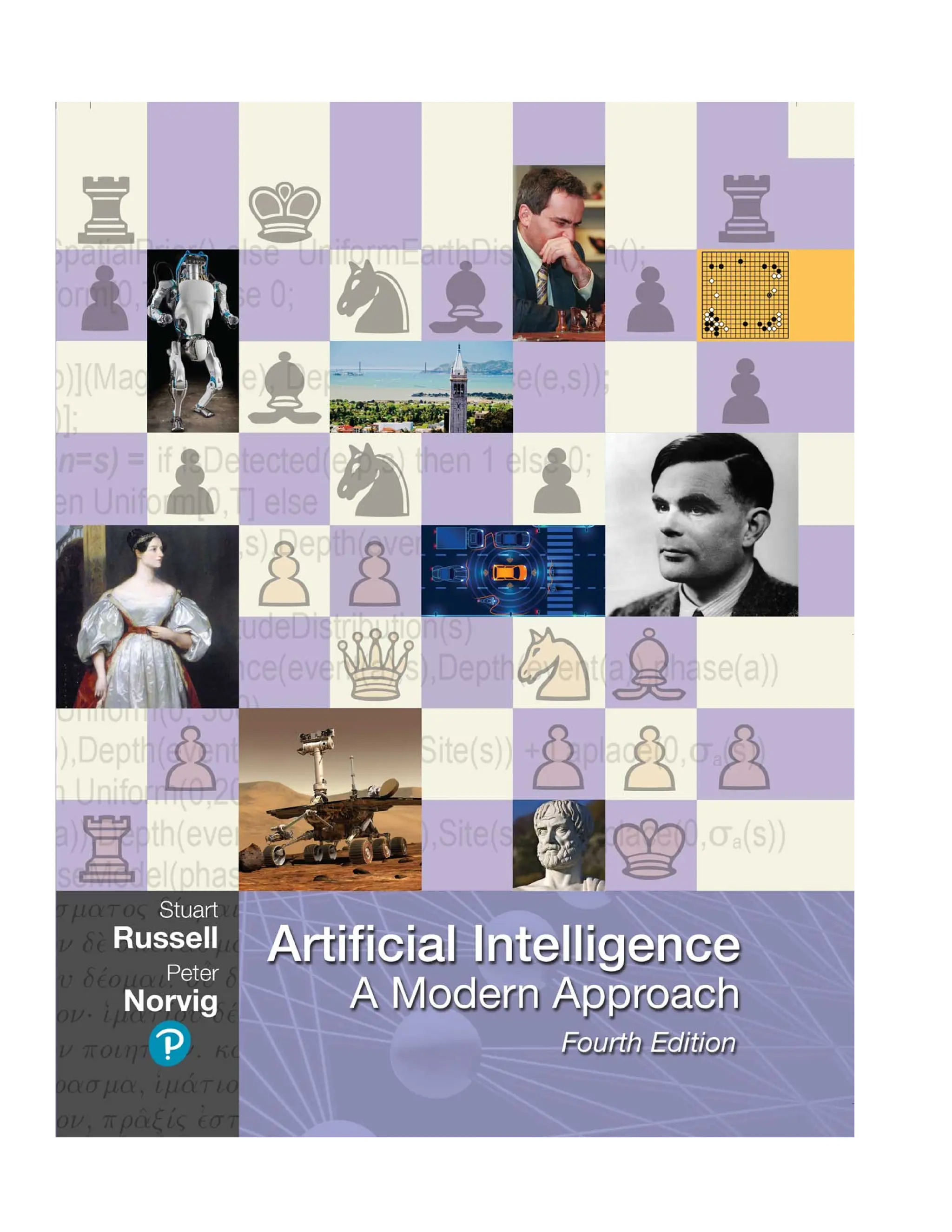
Book cover
The cover depicts the final position from the decisive game 6 of the 1997 chess match in
which the program Deep Blue defeated Garry Kasparov (playing Black), making this the first
16.
time a computerhad beaten a world champion in a chess match. Kasparov is shown at the
top. To his right is a pivotal position from the second game of the historic Go match
between former world champion Lee Sedol and DeepMind’s ALPHAGO program. Move 37 by
ALPHAGO violated centuries of Go orthodoxy and was immediately seen by human experts as
an embarrassing mistake, but it turned out to be a winning move. At top left is an Atlas
humanoid robot built by Boston Dynamics. A depiction of a self-driving car sensing its
environment appears between Ada Lovelace, the world’s first computer programmer, and
Alan Turing, whose fundamental work defined artificial intelligence. At the bottom of the
chess board are a Mars Exploration Rover robot and a statue of Aristotle, who pioneered the
study of logic; his planning algorithm from De Motu Animalium appears behind the authors’
names. Behind the chess board is a probabilistic programming model used by the UN
Comprehensive Nuclear-Test-Ban Treaty Organization for detecting nuclear explosions
from seismic signals.
Acknowledgments
It takes a global village to make a book. Over 600 people read parts of the book and made
suggestions for improvement. The complete list is at aima.cs.berkeley.edu/ack.html;
we are grateful to all of them. We have space here to mention only a few especially
important contributors. First the contributing writers:
Judea Pearl (Section 13.5 , Causal Networks);
Vikash Mansinghka (Section 15.3 , Programs as Probability Models);
Michael Wooldridge (Chapter 18 , Multiagent Decision Making);
Ian Goodfellow (Chapter 21 , Deep Learning);
Jacob Devlin and Mei-Wing Chang (Chapter 24 , Deep Learning for Natural
Language);
Jitendra Malik and David Forsyth (Chapter 25 , Computer Vision);
Anca Dragan (Chapter 26 , Robotics).
Then some key roles:
Cynthia Yeung and Malika Cantor (project management);
Julie Sussman and Tom Galloway (copyediting and writing suggestions);
17.
Omari Stephens (illustrations);
TracyJohnson (editor);
Erin Ault and Rose Kernan (cover and color conversion);
Nalin Chhibber, Sam Goto, Raymond de Lacaze, Ravi Mohan, Ciaran O’Reilly, Amit
Patel, Dragomir Radiv, and Samagra Sharma (online code development and mentoring);
Google Summer of Code students (online code development).
Stuart would like to thank his wife, Loy Sheflott, for her endless patience and boundless
wisdom. He hopes that Gordon, Lucy, George, and Isaac will soon be reading this book after
they have forgiven him for working so long on it. RUGS (Russell’s Unusual Group of
Students) have been unusually helpful, as always.
Peter would like to thank his parents (Torsten and Gerda) for getting him started, and his
wife (Kris), children (Bella and Juliet), colleagues, boss, and friends for encouraging and
tolerating him through the long hours of writing and rewriting.
18.
About the Authors
STUARTRUSSELL was born in 1962 in Portsmouth, England. He received his B.A. with
first-class honours in physics from Oxford University in 1982, and his Ph.D. in computer
science from Stanford in 1986. He then joined the faculty of the University of California at
Berkeley, where he is a professor and former chair of computer science, director of the
Center for Human-Compatible AI, and holder of the Smith–Zadeh Chair in Engineering. In
1990, he received the Presidential Young Investigator Award of the National Science
Foundation, and in 1995 he was cowinner of the Computers and Thought Award. He is a
Fellow of the American Association for Artificial Intelligence, the Association for Computing
Machinery, and the American Association for the Advancement of Science, an Honorary
Fellow of Wadham College, Oxford, and an Andrew Carnegie Fellow. He held the Chaire
Blaise Pascal in Paris from 2012 to 2014. He has published over 300 papers on a wide range
of topics in artificial intelligence. His other books include The Use of Knowledge in Analogy and
Induction, Do the Right Thing: Studies in Limited Rationality (with Eric Wefald), and Human
Compatible: Artificial Intelligence and the Problem of Control.
PETER NORVIG is currently a Director of Research at Google, Inc., and was previously the
director responsible for the core Web search algorithms. He co-taught an online AI class
that signed up 160,000 students, helping to kick off the current round of massive open
online classes. He was head of the Computational Sciences Division at NASA Ames
Research Center, overseeing research and development in artificial intelligence and
robotics. He received a B.S. in applied mathematics from Brown University and a Ph.D. in
computer science from Berkeley. He has been a professor at the University of Southern
California and a faculty member at Berkeley and Stanford. He is a Fellow of the American
Association for Artificial Intelligence, the Association for Computing Machinery, the
American Academy of Arts and Sciences, and the California Academy of Science. His other
books are Paradigms of AI Programming: Case Studies in Common Lisp, Verbmobil: A Translation
System for Face-to-Face Dialog, and Intelligent Help Systems for UNIX.
The two authors shared the inaugural AAAI/EAAI Outstanding Educator award in 2016.
20.
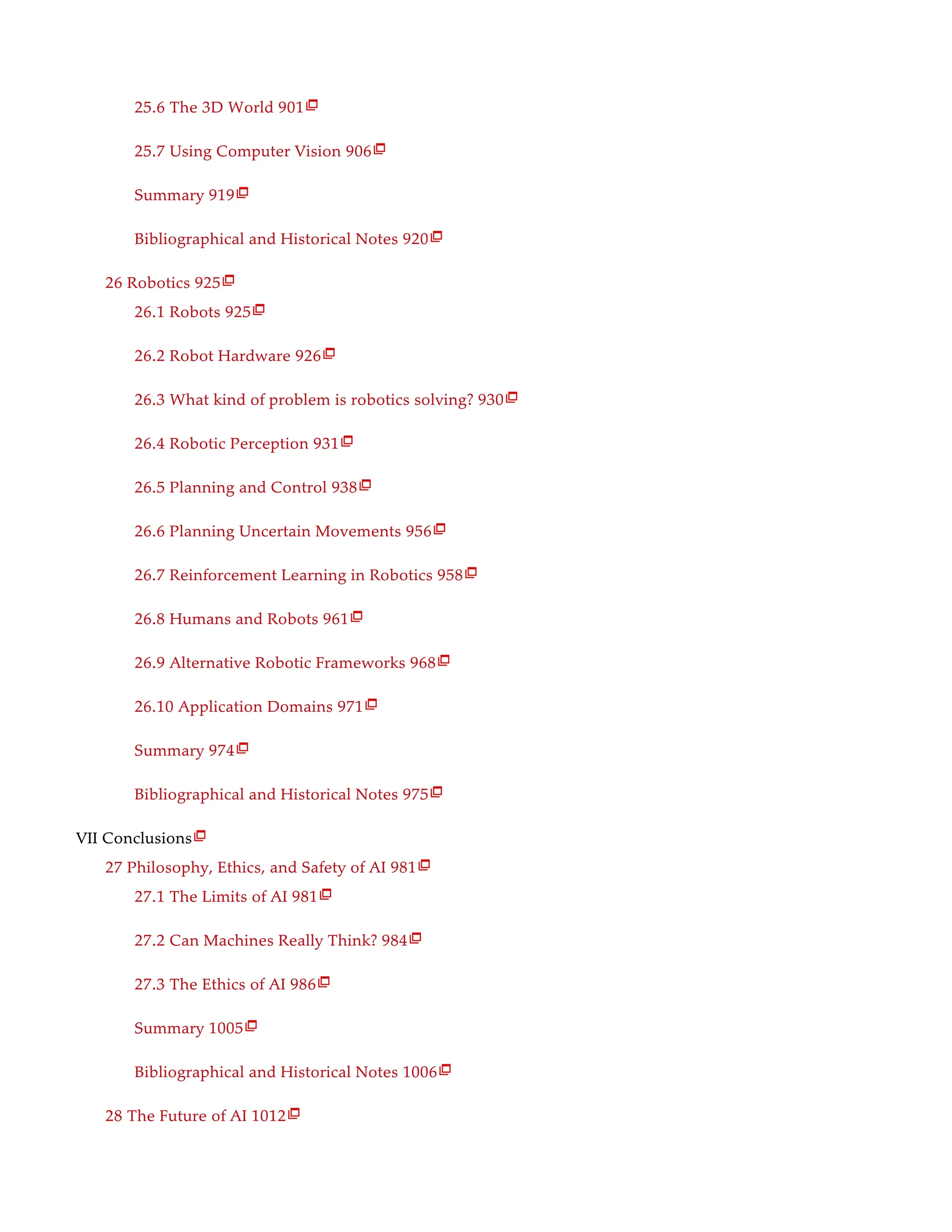
Contents
I Artificial Intelligence
1Introduction 1
1.1 What Is AI? 1
1.2 The Foundations of Artificial Intelligence 5
1.3 The History of Artificial Intelligence 17
1.4 The State of the Art 27
1.5 Risks and Benefits of AI 31
Summary 34
Bibliographical and Historical Notes 35
2 Intelligent Agents 36
2.1 Agents and Environments 36
2.2 Good Behavior: The Concept of Rationality 39
2.3 The Nature of Environments 42
2.4 The Structure of Agents 47
Summary 60
Bibliographical and Historical Notes 60
II Problem-solving
3 Solving Problems by Searching 63
3.1 Problem-Solving Agents 63
3.2 Example Problems 66
3.3 Search Algorithms 71
3.4 Uninformed Search Strategies 76
3.5 Informed (Heuristic) Search Strategies 84
21.
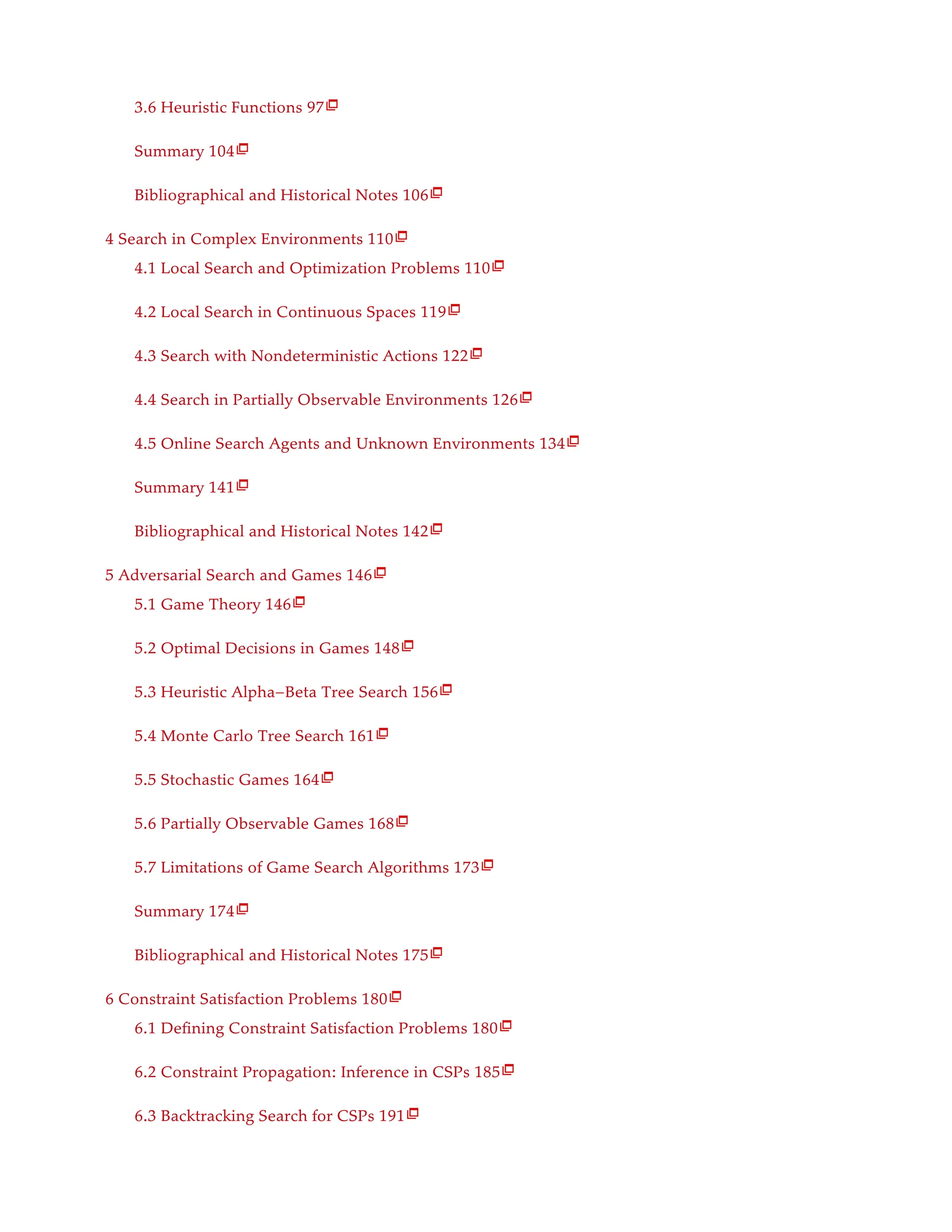
3.6 Heuristic Functions97
Summary 104
Bibliographical and Historical Notes 106
4 Search in Complex Environments 110
4.1 Local Search and Optimization Problems 110
4.2 Local Search in Continuous Spaces 119
4.3 Search with Nondeterministic Actions 122
4.4 Search in Partially Observable Environments 126
4.5 Online Search Agents and Unknown Environments 134
Summary 141
Bibliographical and Historical Notes 142
5 Adversarial Search and Games 146
5.1 Game Theory 146
5.2 Optimal Decisions in Games 148
5.3 Heuristic Alpha–Beta Tree Search 156
5.4 Monte Carlo Tree Search 161
5.5 Stochastic Games 164
5.6 Partially Observable Games 168
5.7 Limitations of Game Search Algorithms 173
Summary 174
Bibliographical and Historical Notes 175
6 Constraint Satisfaction Problems 180
6.1 Defining Constraint Satisfaction Problems 180
6.2 Constraint Propagation: Inference in CSPs 185
6.3 Backtracking Search for CSPs 191
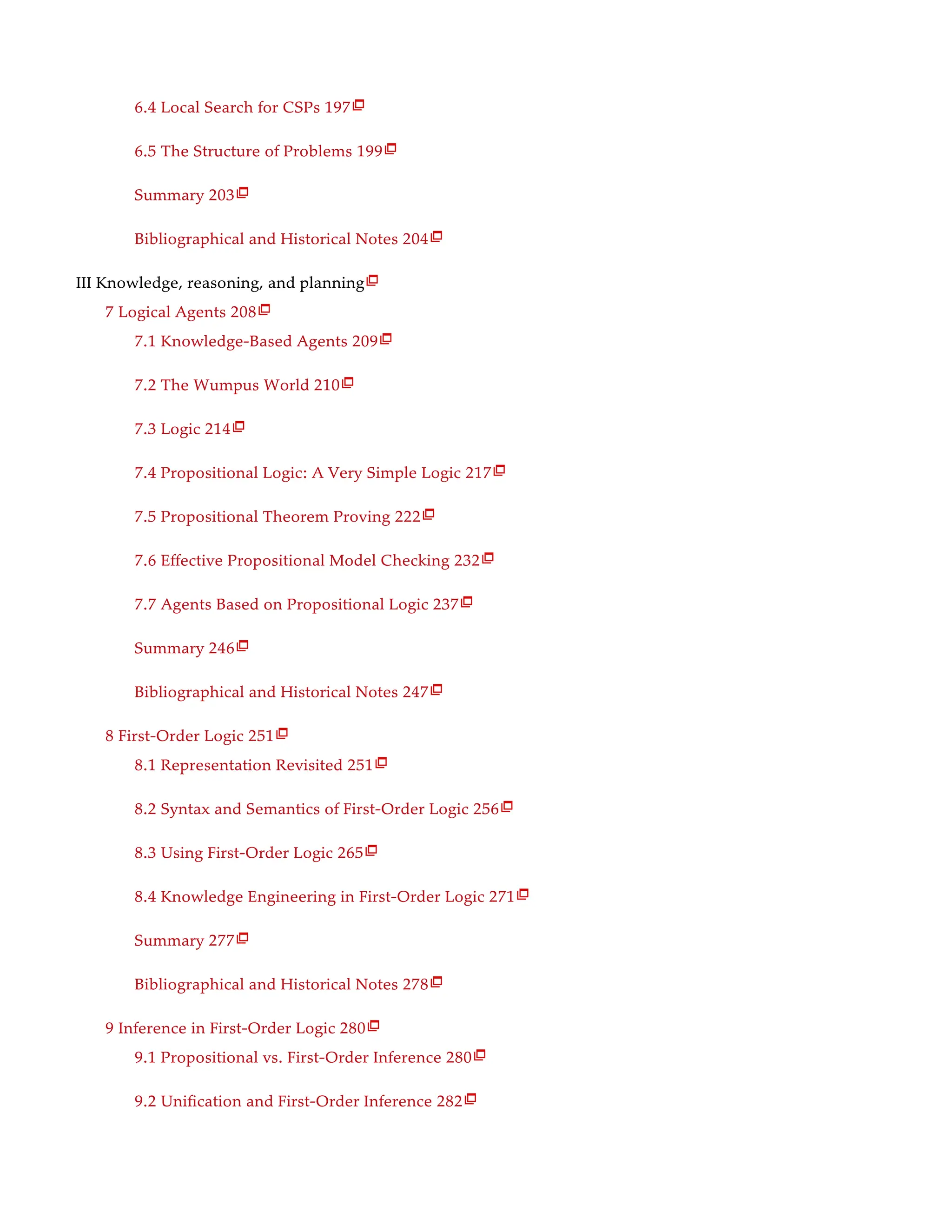
22.
6.4 Local Searchfor CSPs 197
6.5 The Structure of Problems 199
Summary 203
Bibliographical and Historical Notes 204
III Knowledge, reasoning, and planning
7 Logical Agents 208
7.1 Knowledge-Based Agents 209
7.2 The Wumpus World 210
7.3 Logic 214
7.4 Propositional Logic: A Very Simple Logic 217
7.5 Propositional Theorem Proving 222
7.6 Effective Propositional Model Checking 232
7.7 Agents Based on Propositional Logic 237
Summary 246
Bibliographical and Historical Notes 247
8 First-Order Logic 251
8.1 Representation Revisited 251
8.2 Syntax and Semantics of First-Order Logic 256
8.3 Using First-Order Logic 265
8.4 Knowledge Engineering in First-Order Logic 271
Summary 277
Bibliographical and Historical Notes 278
9 Inference in First-Order Logic 280
9.1 Propositional vs. First-Order Inference 280
9.2 Unification and First-Order Inference 282
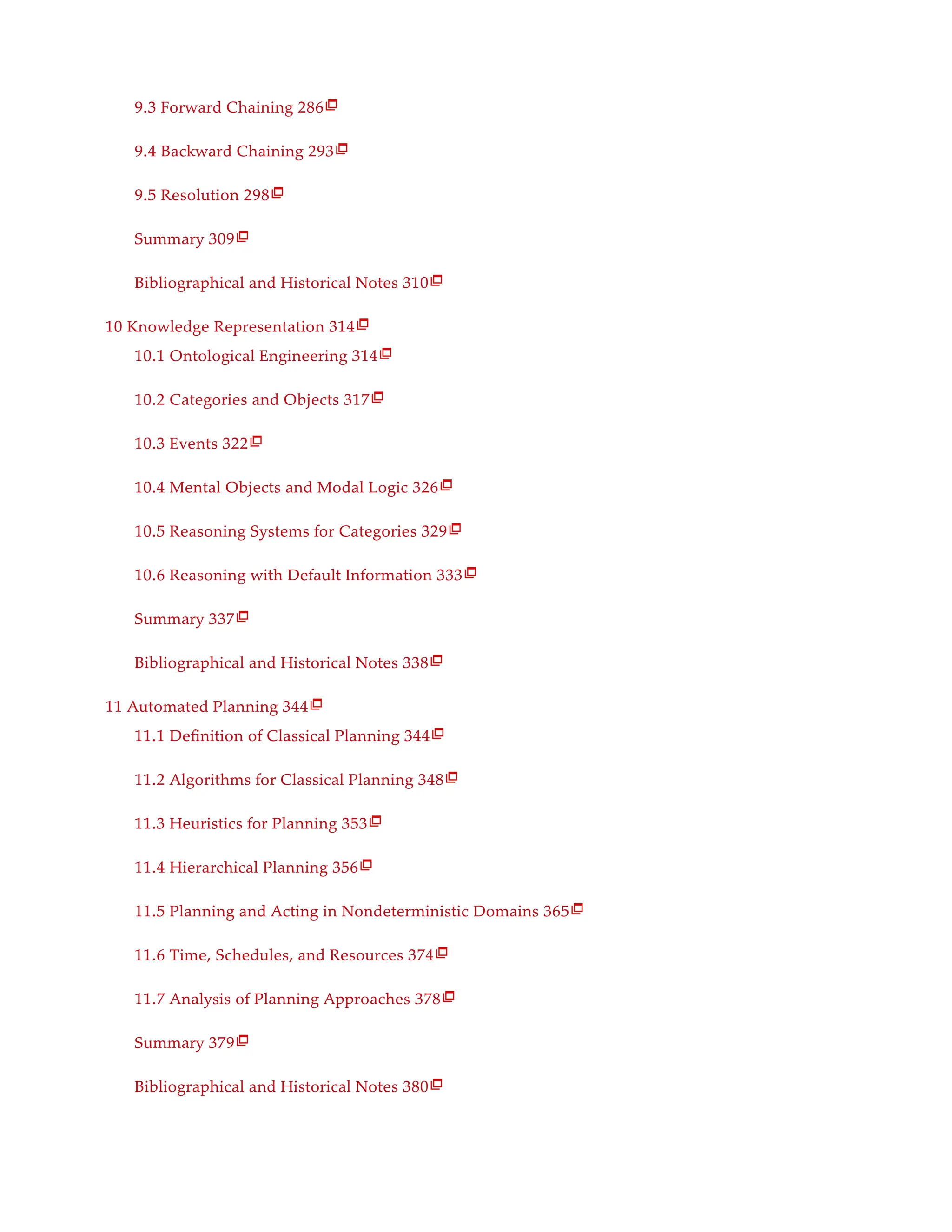
23.
9.3 Forward Chaining286
9.4 Backward Chaining 293
9.5 Resolution 298
Summary 309
Bibliographical and Historical Notes 310
10 Knowledge Representation 314
10.1 Ontological Engineering 314
10.2 Categories and Objects 317
10.3 Events 322
10.4 Mental Objects and Modal Logic 326
10.5 Reasoning Systems for Categories 329
10.6 Reasoning with Default Information 333
Summary 337
Bibliographical and Historical Notes 338
11 Automated Planning 344
11.1 Definition of Classical Planning 344
11.2 Algorithms for Classical Planning 348
11.3 Heuristics for Planning 353
11.4 Hierarchical Planning 356
11.5 Planning and Acting in Nondeterministic Domains 365
11.6 Time, Schedules, and Resources 374
11.7 Analysis of Planning Approaches 378
Summary 379
Bibliographical and Historical Notes 380
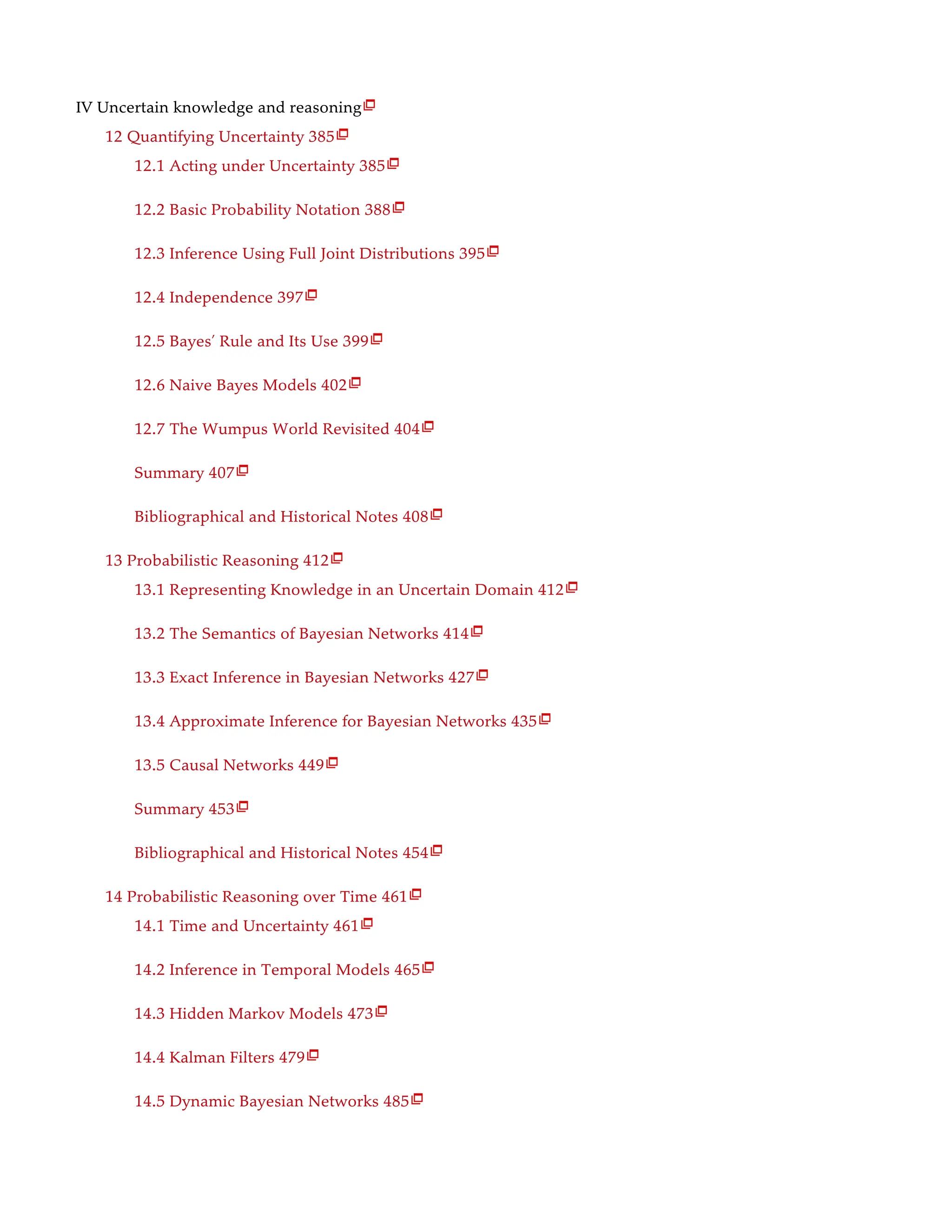
24.
IV Uncertain knowledgeand reasoning
12 Quantifying Uncertainty 385
12.1 Acting under Uncertainty 385
12.2 Basic Probability Notation 388
12.3 Inference Using Full Joint Distributions 395
12.4 Independence 397
12.5 Bayes’ Rule and Its Use 399
12.6 Naive Bayes Models 402
12.7 The Wumpus World Revisited 404
Summary 407
Bibliographical and Historical Notes 408
13 Probabilistic Reasoning 412
13.1 Representing Knowledge in an Uncertain Domain 412
13.2 The Semantics of Bayesian Networks 414
13.3 Exact Inference in Bayesian Networks 427
13.4 Approximate Inference for Bayesian Networks 435
13.5 Causal Networks 449
Summary 453
Bibliographical and Historical Notes 454
14 Probabilistic Reasoning over Time 461
14.1 Time and Uncertainty 461
14.2 Inference in Temporal Models 465
14.3 Hidden Markov Models 473
14.4 Kalman Filters 479
14.5 Dynamic Bayesian Networks 485
25.
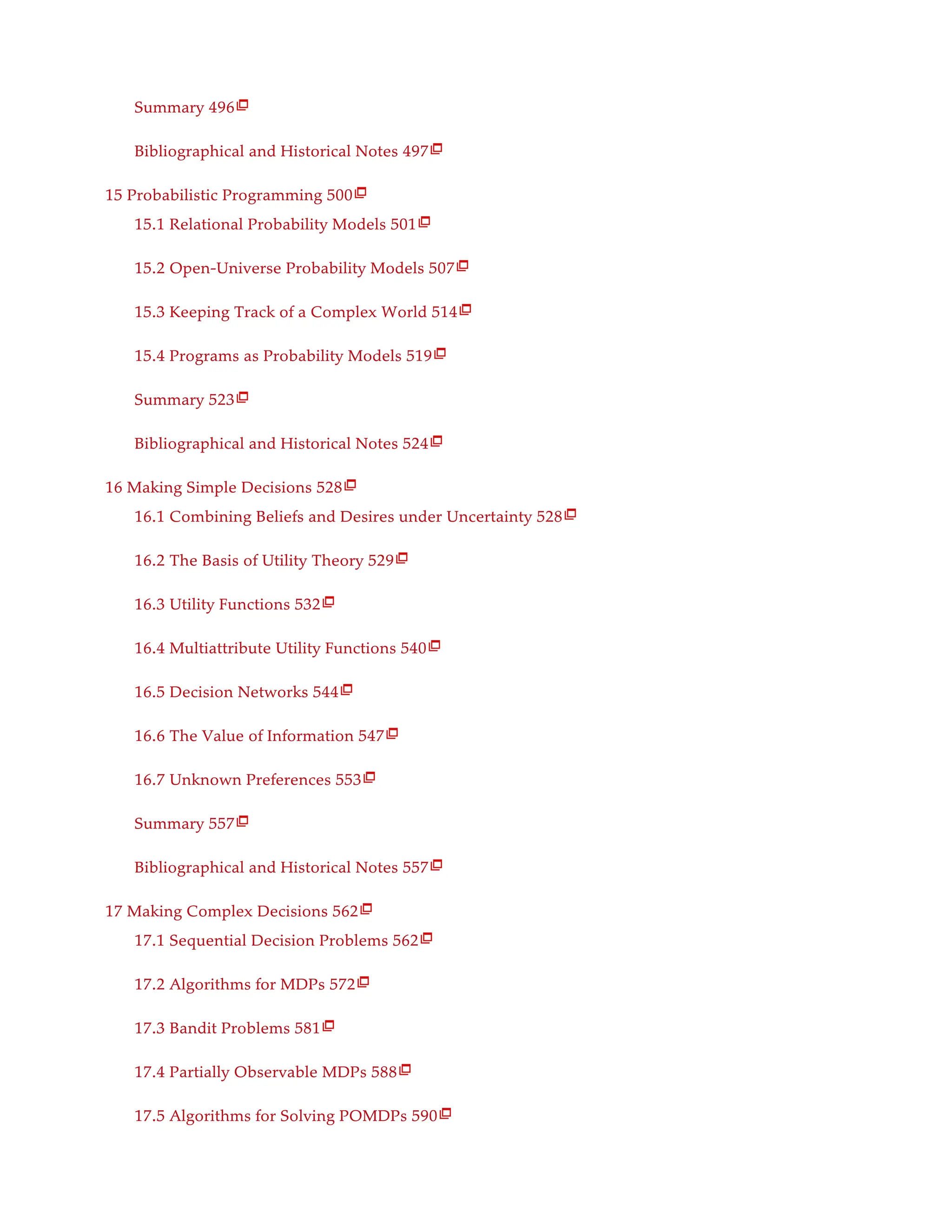
Summary 496
Bibliographical andHistorical Notes 497
15 Probabilistic Programming 500
15.1 Relational Probability Models 501
15.2 Open-Universe Probability Models 507
15.3 Keeping Track of a Complex World 514
15.4 Programs as Probability Models 519
Summary 523
Bibliographical and Historical Notes 524
16 Making Simple Decisions 528
16.1 Combining Beliefs and Desires under Uncertainty 528
16.2 The Basis of Utility Theory 529
16.3 Utility Functions 532
16.4 Multiattribute Utility Functions 540
16.5 Decision Networks 544
16.6 The Value of Information 547
16.7 Unknown Preferences 553
Summary 557
Bibliographical and Historical Notes 557
17 Making Complex Decisions 562
17.1 Sequential Decision Problems 562
17.2 Algorithms for MDPs 572
17.3 Bandit Problems 581
17.4 Partially Observable MDPs 588
17.5 Algorithms for Solving POMDPs 590
26.
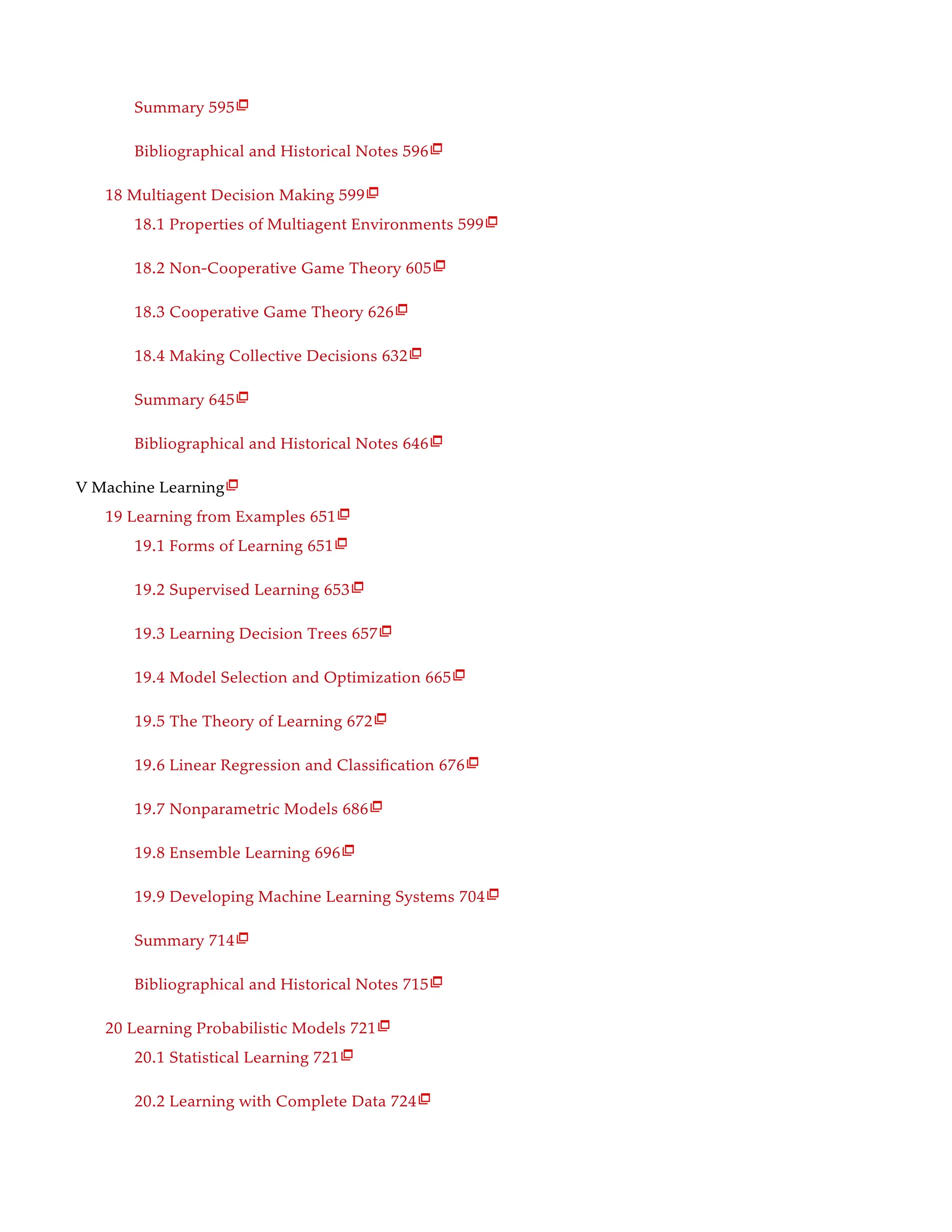
Summary 595
Bibliographical andHistorical Notes 596
18 Multiagent Decision Making 599
18.1 Properties of Multiagent Environments 599
18.2 Non-Cooperative Game Theory 605
18.3 Cooperative Game Theory 626
18.4 Making Collective Decisions 632
Summary 645
Bibliographical and Historical Notes 646
V Machine Learning
19 Learning from Examples 651
19.1 Forms of Learning 651
19.2 Supervised Learning 653
19.3 Learning Decision Trees 657
19.4 Model Selection and Optimization 665
19.5 The Theory of Learning 672
19.6 Linear Regression and Classification 676
19.7 Nonparametric Models 686
19.8 Ensemble Learning 696
19.9 Developing Machine Learning Systems 704
Summary 714
Bibliographical and Historical Notes 715
20 Learning Probabilistic Models 721
20.1 Statistical Learning 721
20.2 Learning with Complete Data 724
27.
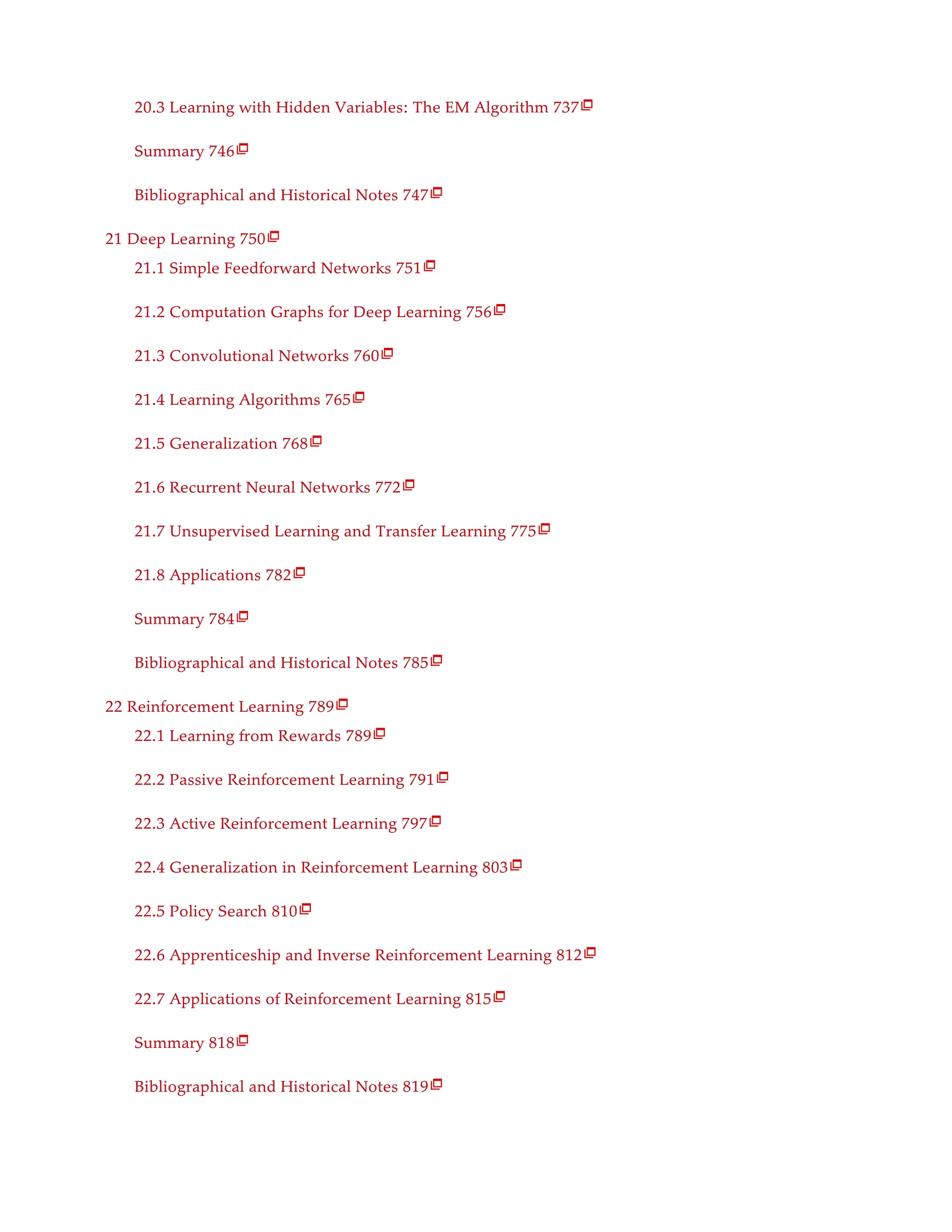
20.3 Learning withHidden Variables: The EM Algorithm 737
Summary 746
Bibliographical and Historical Notes 747
21 Deep Learning 750
21.1 Simple Feedforward Networks 751
21.2 Computation Graphs for Deep Learning 756
21.3 Convolutional Networks 760
21.4 Learning Algorithms 765
21.5 Generalization 768
21.6 Recurrent Neural Networks 772
21.7 Unsupervised Learning and Transfer Learning 775
21.8 Applications 782
Summary 784
Bibliographical and Historical Notes 785
22 Reinforcement Learning 789
22.1 Learning from Rewards 789
22.2 Passive Reinforcement Learning 791
22.3 Active Reinforcement Learning 797
22.4 Generalization in Reinforcement Learning 803
22.5 Policy Search 810
22.6 Apprenticeship and Inverse Reinforcement Learning 812
22.7 Applications of Reinforcement Learning 815
Summary 818
Bibliographical and Historical Notes 819
28.
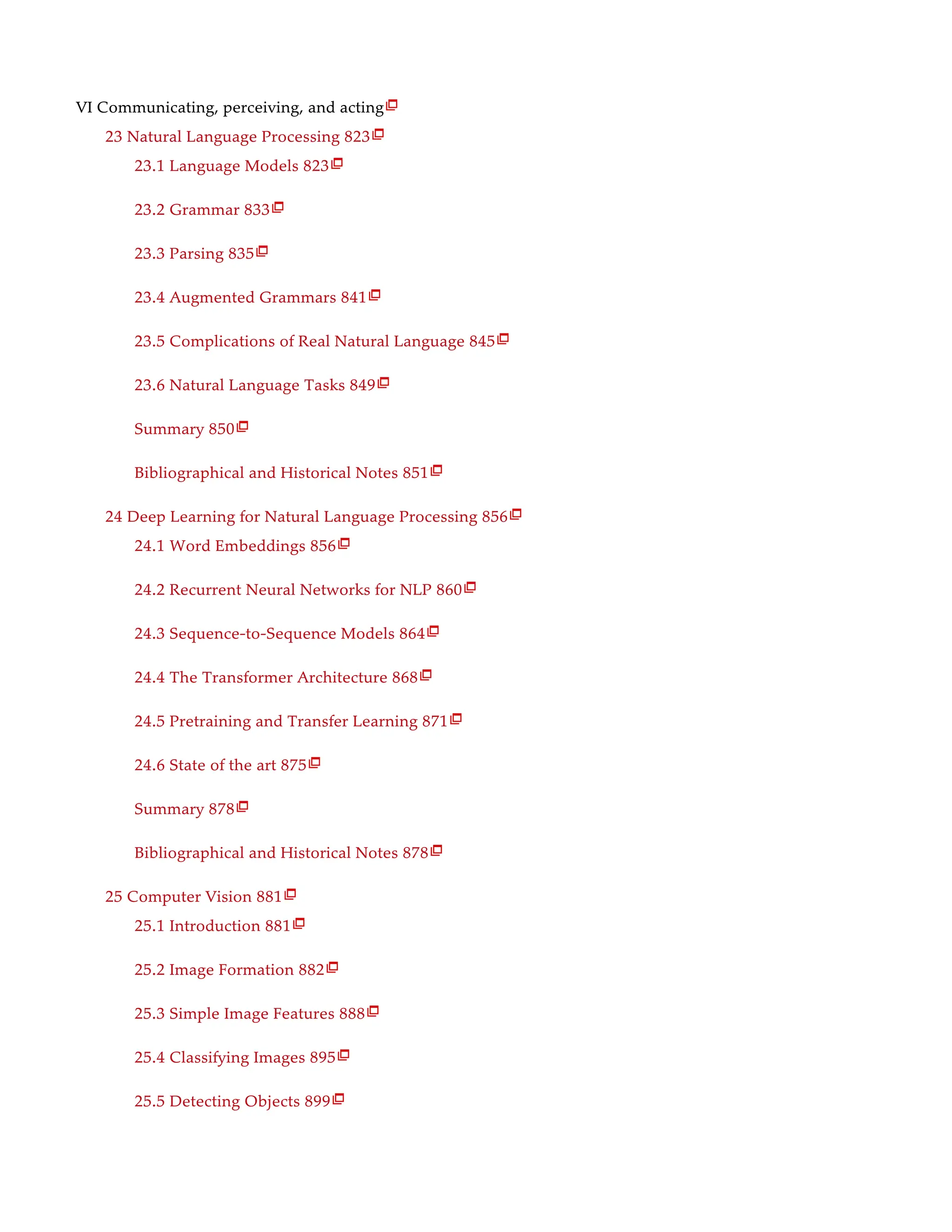
VI Communicating, perceiving,and acting
23 Natural Language Processing 823
23.1 Language Models 823
23.2 Grammar 833
23.3 Parsing 835
23.4 Augmented Grammars 841
23.5 Complications of Real Natural Language 845
23.6 Natural Language Tasks 849
Summary 850
Bibliographical and Historical Notes 851
24 Deep Learning for Natural Language Processing 856
24.1 Word Embeddings 856
24.2 Recurrent Neural Networks for NLP 860
24.3 Sequence-to-Sequence Models 864
24.4 The Transformer Architecture 868
24.5 Pretraining and Transfer Learning 871
24.6 State of the art 875
Summary 878
Bibliographical and Historical Notes 878
25 Computer Vision 881
25.1 Introduction 881
25.2 Image Formation 882
25.3 Simple Image Features 888
25.4 Classifying Images 895
25.5 Detecting Objects 899
29.
25.6 The 3DWorld 901
25.7 Using Computer Vision 906
Summary 919
Bibliographical and Historical Notes 920
26 Robotics 925
26.1 Robots 925
26.2 Robot Hardware 926
26.3 What kind of problem is robotics solving? 930
26.4 Robotic Perception 931
26.5 Planning and Control 938
26.6 Planning Uncertain Movements 956
26.7 Reinforcement Learning in Robotics 958
26.8 Humans and Robots 961
26.9 Alternative Robotic Frameworks 968
26.10 Application Domains 971
Summary 974
Bibliographical and Historical Notes 975
VII Conclusions
27 Philosophy, Ethics, and Safety of AI 981
27.1 The Limits of AI 981
27.2 Can Machines Really Think? 984
27.3 The Ethics of AI 986
Summary 1005
Bibliographical and Historical Notes 1006
28 The Future of AI 1012
have noticed 85places in which it is quoted in St. Mark, and in every
one, except ii. 22, it agrees with B. In St. Matthew H is noticed as
agreeing with B 70 times, while it differs from H 5 times. These few
variations are not difficult ot explanation. h It is to be hoped that
scholars may combine to accom plish complete collations of the
MSS. given in these lists. One or two summer vacations, with proper
co-operation niign: accomplish the work. Undid. Coral re. Duplicates
mlre«dy deducted. 34 10 14 4 68 7 601 229 283 102 183 05 32 12
14 *8 Act. Oath. Epp. . . Paul Evangeligtarla . . . ToUl .... 127 1463
64
32.
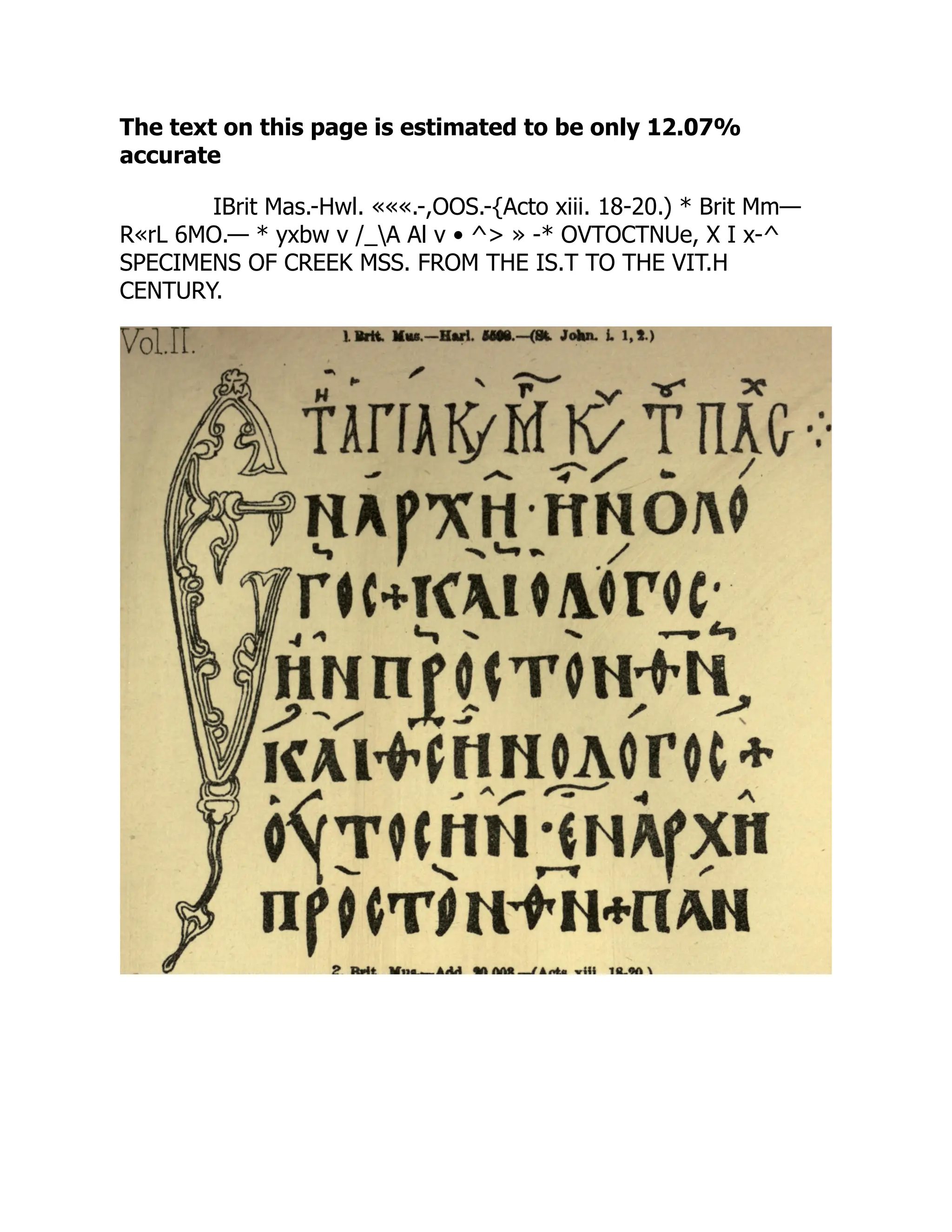
The text onthis page is estimated to be only 12.07%
accurate
IBrit Mas.-Hwl. «««.-,OOS.-{Acto xiii. 18-20.) * Brit Mm—
R«rL 6MO.— * yxbw v /_A Al v • ^> » -* OVTOCTNUe, X I x-^
SPECIMENS OF CREEK MSS. FROM THE IS.T TO THE VIT.H
CENTURY.
33.
The text onthis page is estimated to be only 25.24%
accurate
NEW TESTAMENT Harl. 5537, 5620). Cf. Griesbach, Symb.
Grit, a. 184, 185. 29 (Paul. 35, Genev. 20) Saec. xi. xii 36 (Coll. Nov.
Oxon). 40 (Paul. 46, Apoc. 12. Alex. Vatican. 179). Saec. xi. Coll. by
Zacagni. 66 (Paul. 67). 68 (Paul. 73, Upsal). Saec. xii. xi. 69 (Paul.
74, Apoc. 30, Guelph. xvi. 7). Saec. Xiv. xiii. 81 (Barberini, 377).
Saec. xi. 137 (Milan, Ambros. 97). Saec. xi. Coll. by Schdz. 142
(Mutinensis, 243). Saec. xii.1 C. Primary Cursives in the Pauline
Epistles. 17 = Gosp. 33. 37 = Gosp. 69 (Cod. Lcicestrensis). 57 =
Gosp. 218. 108, 109 = Act, 95, 96. 115, 116 (Act. 100, 101, Mosqu.
Matt. d. f.). 137 (Gosp. 263, Act. 117, Paris, Bibl. Imp. 61). The
following are valuable, but require more careful collation. 5 = Act. 5.
23 (Paris, Coislin. 28). Saec. xi. Descr. by Montfaucon. 31 (Brit. Mus.
ffarl. 5537) = I1". Apoc. Saec. xiii. 33 (Act. 33. Oxford, Coll. Lincoln.
2). 46 = Act. 40. 47 (Oxford, Bodleian. Roe 16). Saec. xi. 55 (Act.
46. Monacensis). 67 (Act. 66. Vindob. Lambec. 34). The cor rections
are especially valuable. 70 (Act. 67. Vindob. Lambec. 37). 71
(Vindob. Forlos. 19). Saec. xii. NEW TESTAMENT 517 » Three other
MSS., containing the Catholic Epistles, require notice, not from their
intrinsic worth, but from their connexion with the controversy on 1
John v. 1, 8. 34 (Gosp. 61, ColL SS. Trin. Dublin, Codex
Montfortianui). Saec. xv. xvi. There is no doubt that this was the
Codex Sritannicus, on the authority of which Erasmus, according to
his promise, inserted the inter polated words, iv T ovpacc}!, franjp,
Ao^cs icai. irvev^a ayiov KOJ. olroi oi r. «. «. KOJ. T. e. 01 p. tv T. y.
; but did not omit, on the same authority (which exactly follows the
late Latin MSS.), the last clause of ver. 8, xal ot rp. — eio-iV. The
page on which the verse stands is the only glazed page in the
volume. A collation of the MS. has been published by Dr. Dobbin,
London, 1854. 162 (Paul. 200. Vat. Ottob. 298.) Saec. xv. A
GraecoLatin MS. It reads, awb TOU ovpavov, Tranjp, Aoyos *cal
irccvfua iyiov KOJ. oi rpets ets TO £v fltri (Tregelles, Horw. p. 217).
Scholz says that the MS. contains " innu merable transpositions," but
gives no clear account of its character. 173 (Paul. 211. Naples, Bibl.
34.
Borbon.) Saec. xi.The Interpolated words, with the articles, and the
last clause of ver. 8, are given by a second hand (Saec. xvi.). Codete
Ravianus (no Gosp.) is a mere transcript of the N. T. of the
Complutensian Polyglott, with variations from Erasmus and
Stephens. Comp. Griesbach, ftynib. Crit. i. clxxxi.-clxxxxii. k The
accompanying plates will give a good idea of the different forms of
biblical Gk. MSS. For permission to take the tracings, from which the
engravings have been admirably made by Mr. Netherclift, my sincere
thanks are due to Sir F. Madden, K.H. ; and 1 am also much
indebted to the other officers of the MSS. department of the British
Museum, for the help which they gave me in making them. Fl. i. fig.
1. A few lines from the Aoyo? e7n.Taios of Hyperidea (col. 9, 1. 4, of
the edition of Rev. C. Babington), a papyrus of the first century, or
not much later. In Mr. Bitbicgton's facsimile the e adscript after
i/o/uw fs 73 (Act. 68). 80 (Act. 73. Vatican. 367). 177-8-9 (Mutin.).
D. Primary Cursives of the Apocalyps". 7 = I** (Act. 25. Brit. Mus.
Harl. 5537). Saec. xi. Coll. by Scrivener. 14 = Gosp. 69 (Cod.
Leicestrensis). 31 = c*" (Brit. Mus. Harl. 5678). Saec. xv, Coll. by
Scrivener. 38 (Vatican. 579). Saec. xiii. Coll. by B. 11. Alford. 47
(Cod. Dresdensis). Saec. xi. Coll. by Matthaei. 51 (Paris, Bibl. Imp.}.
Coll. by Reiche. gier. (Parham, 17). Saec. xi. xii. Coll. by Scrivener.
m«cr. (Middlehill) = 87. Saec. xi. xii. Coll. by Scrivener. The following
are valuable, but require more careful collation. 2 (Act. 10. Paul. 12.
Paris. Bibl. Imp. 237). 6 (Act. 23. Paul. 28. Bodleian. Barooc. 3).
Saec. xii. xiii. 11 (Act. 39. Paul. 45). 12 = Act. 40. 17, 19 (Ev. 35.
Act. 14. Paul. 18 ; Act. 17, Paul. 21. Paris. Coislin. 199, 205). 28
(Bodleian. Barocc. 48',,. 36 (Vindob. Forlos. 29). Saec. xiv. 41 (Alex-
Vatican. 68). Saec. xiv. 46 = Gosp. 209. 82 (Act. 179. Paul. 128.
Monac. 211). 30. Having surveyed in outline the history of the
transmission of the written text, and the chief characteristics of the
MSS.k in which it is preserved, omitted wrongly. It is in fact partly
bidden under a fibre of the papyrus, but easily seen from the side.
Two cha racteristic transcriptural errors occur in the passage : Tta
rov-rif Tpoirta for T TOVTOV rpoirta, and (by itacism, }31)
avvi^ovrai for o-vveovTi. Fig. 2. The opening verses of St. John's
Gospel from the Cod. Ale*. The two first lines are rubricated. The
35.
spe cimen exhibitsthe common contractions, 0C, A.NfJN, and an
example of itacism, xP«'s- The stop at the end of the fifth line, ovSe
tv , is only visible in a strong light, but certainly exists there, as in C
D L, &c. Fig. 3. A very legible specimen of the Nitrian pa limpsest of
St. Luke. The Greek letters in the original are less defined, and very
variable in tint: the Syriac somewhat heavier than in the engraving,
which is on the whole very faithful. The dark lines shew where the
vellum was folded to form the new book for the writings of Severus
of Antioch. The same MS. contained fragments of the 1 Had, edited
by Dr. Cureton, and a piece of Enclld. PI. ii. fig. 1. Part of the first
column of the famous Harleian Evcmgelistarium, collated by
Scrivener. It is dated A.D. 995 (Scrivener, Cod. Aug. p. xlviii.). The
letters on this page are all in gold. The initial letter is illu minated
with red and blue. The MS. is a magnificent example of a service-
book. Fig. 2. From Tischendorf 's valuable MS. of the Acts (61
Tregelles). It was written A.D. 1044 (Scrivener, Cod. Aug. Ixix.). The
specimen contains the itacisms xpoviav (jtpovov) and jrei/Tucoi>Ta.
Fig. 3. The beginning of St. John, from Cod. 114 of tl:e Gospels
(Griesbach, Symb. Crit. i. cxciii.), a MS. of the 13th cent. Fig. 4. Part
of the beginning of St. John, from UM very valuable Evangelistarium
ysc*. (Scrivener, ColLittu>r &c., pp. Ixi. ff.). The initial letter of the
Gospel is a rude illumination. The MS. bears a date 1319; but Mr.
Scri vener justly doubts whether this iu in the haud of tb< original
scribe.
36.
The text onthis page is estimated to be only 22.92%
accurate
518 NEW TESTAMENT we ar« ;n a oosition to consider the
e.vent anc not'jre of the variations which exist in litferen oopies. It is
impossible to estimate the r. amber o these exactly, but they cannot
be less than 120,000 in all (Scrivener, Introduction, 3), though of
these » very large proportion consist of differences o spelling and
isolated aberrations of scribes,1 and o the remainder comparatively
few alterations are sufficiently well supported to create reasonable
doubt as to the final judgment. Probably there are not more than
1600-2000 places in which the true reading is a matter of
uncertainty, even i we include in this questions of order, inflexion am
orthography : the doubtful readings by which th souse is in any way
affected are very much fewer and those of dogmatic importance can
be easily numbered. 31. Various readings are due to different causes
some arose from accidental, others from intentiona alterations of the
original text, (i) Accidental va riations or errata, are by far the most
numerous class, and admit of being referred to several obvious
sources, (o) Some are errors of sound. The most frequent form of
this error is called Itacism, a con fusion of different varieties of the I-
sound, by which (01, v) i, i, ««, «, &c., are constantly inter
changed. ' Other vowel-changes, as of o and to, ov and a, &c., occur,
but less frequently. Very few MSS. are wholly free from mistakes of
this kind, but some abound in them. As an illustration the following
variants occur in Fs in Rom. vi. 1-16: 1 tpevufv. 2 Znves, efrei («T»)'
3 ayvotirai (-TS). • 5 fffu^aiOa. 8 airo6d.vofi.ev. 9 airoOv-flffKt, (rd.
1 1 V/MS, oyi£(ff6cu. 13 irapao ffarat. 14 &rra( (-re). 15 '6r(t. 16
otoarai, OTd, Trapfiffrdi'(Tat (irupia. Matt. i. 18 ; Luke i. 14,
y(vvriffis, ytv«ris. Matt, xxvii. 35, 0dovrfs, &a6vret. 1
Pet. ii. 1, 7, C€ATTON, tATTOtf (cf. Tischdf. ad £om. xiii. 9).
Luke vii. 21, EXAPI2ATO BAEHEIN, EXAPI2ATO TO BAETIEIN. Mark
viii. 17, 2TNIETE, 2TNIETE ETI. Luke ii. 38, (ATTH) ATTH T.
flPA. Matt. xi. 23, KA*APNAOTM MH, KA*APNAOTM H. 1 Thess. ii.
7, EFENH0HMEN NHHIOI, ErENH0HMEN HHIOI. Luke ix. 49, EKBAAAONTA
37.
AAIMONIA, EKBAAAONTA TAAA1M. Mark xiv. 35, riPOCEA0nN,
HPOEAenN. 2Cor. iii. 10, OT AEAOZA2TAI, OTAE AEAOZA2TAI. I Pet.
iii. 20, AIIAE EAEXETO, ATIEEEAEXETO. Acts x. 36, TON AOFON
AIIE2TEIAE, TON AOFON ON ADE2TE1AE. Sometimes this cause of
error leads to further change: 2 Cor. iii. 15, HNIKA AN
ANAFINX12KHTAI, HNIKA ANAriNn2KETAI. » Examples of omission
from Homoioteleuton occur John vii. 7 (in T) ; 1 John ii. 23,
iv. 3 ; Apoc. ix. 1, 2, xiv. 1 ; Matt. v. 20 (D). Cf. 1 Cor.
xv. 25-27, 54 (F2, G3) ; xv. 15 (Origen). And some have sought
to explain on this principle the absence from the best
authorities of the disputed clause in Matt. x. 23, and the
entire verses, Luke xvii. 36, Matt, xxiii. 14. Instances of
false division are found, Mark xv. 6. '6vit(p PTOVVTO, Si
irapjjT00»TO. Fhii. i. i,
38.
The text onthis page is estimated to be only 11.22%
accurate
Vol. II. i. Brit. MW.-P* n. PL II. nO TO YTHHQiKQYJUi&X
HnYrkHKO o 7 2. Brit. MM.— Ood. A^x.-(gt. John L 1-4.) MA e M
ApK Mil J»OCTO M 0N Ore ro M € C KOTi . Brit. Mm— Add. 17, 211.
— (81 Lute xx. », 10.) ^uJNv JJVOTo •S jr»«?^ }&Jl;
39.
The text onthis page is estimated to be only 24.30%
accurate
NEW TESTAMENT roj. rft )f5»a rov ffu^aros.0 Horn. xii. 13,
xp«'«»*> ;-j>tlais. Hebr. ii. 9, x'fy"*. X)- And the remarkable
substitution of /cuipy for icvpitp in Rom. zii. 1 1 seems to have been
caused by a false render ing of an unusual contraction The same
expla nation may also apply to the variants in 1 Cor. ii. 1, fiaprvpiov,
ff.vtrr-f)piov. 1 Tim. i. 4, oiKoyo/j.tav, oiKoSo/j.lav, oiKoSofMrji/. 33.
Other variations may be described as errors of impression or
memory. The copyist after read ing a sentence from the text before
him often failed to reproduce it exactly. He transposed the words, or
substituted a synonym for some very common term, or gave a direct
personal turn to what was objective before. Variations of order are
the most frequent, and very commonly the most puzzling questions
of textual criticism. Examples occur in every page, almost in every
verse of the N. T. The exchange of synonyms is chiefly confined to a
few words of consUoit use, to variations between simple and
compound words, or to changes of tense or number: eyfiv, dire^v,
tpdvai, attv Matt. xii. 48, xv. 12, xix. 21 ; Mark xiv. 31 ; John xiv.
10, &c. tyflpw, Sifyttpov Matt. i. 24. iyepOrivcu, avamrivai Matt. xvii.
9 ; Luke ix. 22. tQfiv, a.ire8e'iv, £|cA.06?ir Matt. xiv. 25 ; Luke xxiii.
33 ; Acts xvi. 39. 'I. X., 'Iijvtv ; Mark vii. 5, ivlirrots for Koivais ;
Matt. v. 11, ^ev8(fyi«'oi: comp. John v. 4 (Luke xxii. 43, 44). 36. (7)
Many of the glosses which were intro duced into the text spring from
the ecclesiastical use of the N. T., just as in the Gospels of our own
Prayer-Book introductory clauses have been inserted here and there
(e. g. 3rd and 4th Sundays after Easter: " Jesus said to His
disciples"). These ad ditions are commonly notes of person or place :
Matt. iv. 12, xii. 25, &c., 6 'itjffovs inserted ; John xiv 1, Kal flirty rols
/uad^rais avrov ; Acts iii. 11, xxriii. 1 (cf. Mill, Prolegg. 1055-6).
Sometimes an emphatic clause is added : Matt. xiii. 23, xxv. 29;
Mark vii. 16; Luke viii. 15, xii. 21, 6 exspel and in the collections of
ecclesiastical hymns. Home, 227) that, in the A. V. of Hebr. x. 23, "
the pro fession of our faith " stands for " the profession of uut tope."
The former i« found in no document whatever
40.
The text onthis page is estimated to be only 25.11%
accurate
620 NEW TESTAMENT 87. (8) Sometimes, though rarely,
various read ings noted on the margin are incorporated in the text,
though this may be reckoned as the effect of ignorance rather than
design. Signal examples of this confusion occur: Matt. xvii. 26, xxvi.
59, 60 (D) ; Rom. vi. 12. Other instances are found, Matt. v. 19 ;
Rom. xiv. 9 ; 2 Cor. i. 10 ; 1 Pet. iii. 8. 38. («) The number of
readings which seem to have been altered for distinctly dogmatic
reasons is extremely small. In spite of the great revolutions in
thought, feeling, and practice through which the Christian Church
passed in fifteen centuries, the copyists of the N. T. faithfully
preserved, according to their ability, the sacred trust committed to
them. There is not any trace of intentional re vision designed to give
support to current opinions 'Matt. xvii. 21 ; Mark ix. 29 ; 1 Cor. vii. 5,
need scarcely be noticed). The utmost that can be urged is that
internal considerations may have decided the choice of readings:
Acts xvi. 7, xx. 28 ; Rom. v. 14 ; 1 Cor. xv. 51 ; 2 Cor. v. 7 ; 1 Tim. jii.
16 ; 1 John v. 7, in Latin copies; (Rom. viii. 1 1). And in some cases
a feeling of reverence may have led to a change in expression, or to
the intro duction of a modifying clause: Lukeii. 33, 'la> for 6 WOT);P
avrov ; ii. 43, 'Iwffty xal fi ^rrip avrov for oi yoveis avrov ; John vii.
39, ovvw yap $v irvev/j.a SfSofjLfvov ; Acts xix. 2 (D) ; Gal. ii. 5 ;
Mark xiii. 32, om. ovSe 6 vt6s (cf. Matt. xxiv. 36) ; Matt. v. 22, add.
elufi ; 1 Cor. xi. 29, add. ava^ius (Luke xxii. 43, 44, om.). But the
general effect of these variations is scarcely appreciable ; nor are the
corrections of assumed historical and geographical errors much more
numerous: Matt. i. 11, viii. 28, Ttpyea-nviiv ; xxiii. 35, om. vlov
Bapaxiov ; xxvii. 9, om. 'lepimiov, or Za^api'ou ; Mark i. 2, iv TO""
vpcxp-firais for tv 'Hff. rtf irp. ; ii. 28, om. eirl 'A£. ap%iepfus ; John
i. 28, B7j0aj8ap£ ; v. 2, $v tie for tffri St ; vii. 8, oviru for OVK (?) ;
viii. 57, reffffepdKovra for irevr-fiKovra ; xix. 14, 8>pa ?v aiy Tpirrf
for e/fTTj ; Acts xiii. 33, Tip Sevreptf for r$ icpcorip. 39. It will be
obvious from an examination of the instances quoted that the great
mass of various readings are simply variations in form. The.re are,
41.
however, one ortwo greater variations of a different character. The
most important of these are John vii. 53-viii. 12 ; Mark xvi. 9-end ;
Rom. xvi. 25-27. The first stands quite by itself; and there seems to
be little doubt that it contains an authentic narra tive, but not by the
hand of St. John. The two others, taken in connexion with the last
chapter of St. John's Gospel, suggest the possibility that the
apostolic writings may have undergone in some cases authoritative
revision : a supposition which does not in any way affect their
canonical claims: but it would be impossible to enter upon the
details of such a question here. 40. Manuscripts, it must be
remembered, are but q The history and characteristics of the
Versions are discussed elsewhere. It may be useful to add a short
table Ephraem Syrus, 1 378. BASILIUS MAGMUS, 329379. fUlariut, f
449. Theodoretus, 393-458. Euthallus, c. 450. of the Fathers whose
works are of the greatest importance HIERONYMVS, 340-420.
Caisiodarus, c. 468-566. for the history of the text. Those of the first
rank are Ambrosius, 34(1-397. Victor Antiochenus. marked by
capitals ; the Latin Fathers by italics. AM BSOS1ASTES, c. 360.
Theophylactus, f c. 62?. Justinus M., c. 103-163. Dionysius Alex., f
265. Victorinut, c. 360. ANDREAS (Apoc.), c. 636 IRENAEUS, c. 120-
190. Petrus Alex., 1 313. CHRTSOSTOMUS, 347-407. 700. Irenaei
Interpret, c. 180. Methodius, fc. 311. DIDYMUS, 1 396. Primasius
(Apoc.) TF.nTVl.Ll ANUS (MarKUSEBICS CAESAR, 264EPIPHANIUS, 1
402. Johannes Damascene*, cion). o. 100-240. 340. Rufmus, c. 345-
410. t c. 756. CLEMENS ALKX., t ~ 220. ATHANASIUB, 296-373.
AVGUSTINUS, 364-430. Oecumonius, c. 960. ORir.ENtS, 1X6-253.
Cyrillus Hiero»c., 315Theodoras Mops, f 429. Evthymlua, c. 1100.
Hippolytus. 386. CTKII.LUS ALKX., f 444. CVPR1AXVS, f25? LVCltER,
f370 . NEW TESTAMENT one of tne three sources of textual
crit'^Jsm. The versions and patristic quotations are scarcely less
important in doubtful cases.* But the texts ol the versions aad the
Fathers were themselves liable t>> corruption, and careful revision
is necessary befDre they can be used with confidence. These
consider at ions will sufficiently show, how intricate a problem it is to
determine the text of the N. T., where " there is a mystery in the
very order of the words," and what a vast amount of materials the
42.
critic must haveat his command before he can offer a satisfactory
solution. It remains to inquire next whether the first editors of the
printed text had such materials, or were competent to make use of
them. II. THE HISTORY OF THE PRINTED TEXT. 1. The history of
the printed text of the N. T. may be divided into three periods. The
first of these extends from the labours of the Complutensian editors
to those of Mill : the second from Mill to Scholz : the third from
Lachmann to the present time. The criticism of the first period was
neces sarily tentative and partial : the materials available for the
construction of the text were few, and im perfectly known : the
relative value of various wit nesses was as yet undetermined ; and
however highly we may rate the scholarship of Erasmus or Beza. this
could not supersede the teaching of long expe rience in the sacred
writings any more than in the writings of classical authors. The
second period marks a great progress: the evidence of MSS., of
versions, of Fathers, was collected with the greatest diligence and
success : authorities were compared and classified : principles of
observation and judgment were laid down. But the influence of the
former period still lingered. The old i: received" text was supposed to
have some prescriptive right in virtue of its prior publication, and not
on the ground of its merits : this was assumed as the copy which
was to be corrected only so far as was absolutely necessary. The
third period was introduced by the declaration of a new and sounder
law. It was laid down that no right of possession could be pleaded
against evidence. The "received" text, as such, was allowed no
weight whatever. Its authority, on this view, must depend solely on
its critical worth. From first to last, in minute details of order and
ortho graphy, as well as- in graver questions of substantial
alteration, the text must be formed by a free and unfettered
judgment. Variety of opinions may exist as to the true method and
range of inquiry, as to the relative importance of different forms of
testi mony : all that is claimed is to rest the letter of the N. T.
completely and avowedly on a critical and not on a conventional
basis. This principle, which seems, indeed, to be an axiom, can only
b« called iu. question by supposing that in the first instance the
printed text of the N. T. was guarded
43.
The text onthis page is estimated to be only 26.30%
accurate
NEW TK3TAMENT from the errors and imperfections which
attended the early editions of every classical text ; and next that the
laws of evidence which hold good every where else fail in the veiy
case where they might be expected to find their noblest and most
fruitful application — suppositions which are refuted by the whole
history of the Bible. Each of these periods will now require to be
noticed more in detail. (i) From the Complutensian Polyglott to Mill.
2. The Complutensian Polyqlott. — The Latin Vulgate and the
Hebrew text of the 0. T. had been published some time before any
part of the original Greek of the N. T. The Hebrew text was called for
by numerous and wealthy Jewish congrega tions (Soncino, 1482-88),
the Vulgate satisfied ecclesiastical wants; and the few Greek scholars
who lived at the close of the 15th century were hardly likely to
hasten the printing of the Greek Testament. Yet the critical study of
the Greek text hadnotbeen wholly neglected. Laurentius Valla, who
was second to none of the scholars of nis age (comp. Russell's Life
of Bp. Andrewes, pp. 282-310, quoted by Scrivener), quotes in one
place (Matt, xxvii. 12) three, and in anothei (John vii. 29), seven
Greek MSS. in his commentaries on the N. T., which were published
in 1505, nearly half a century after his death (Michaelis, Introd. ed.
Marsh, ii. 339, 340). J. Faber (1512) made use of five Greek MSS. of
St. Paul's Epistles (Michaelis, p. 420). Meanwhile the Greek Psalter
had been published several times (first at Milan, 1481 ?),and the
Hymns of Zacharias and the Virgin (Luke i. 42-56, 68-80) were ap
pended to a Venetian edition of 1486, as frequently happens in MS.
Psalters. This was the first part of the N. T. which was printed in
Greek. Eighteen years afterwards (1504), the first six chapters of St.
John's Gospel were added to an edition of the poems of Gregory of
Nazianzus, published by Aldus (Guericke, EM. §41). But the glory of
printing the first Greek Testament is due to the princely Cardinal
XIMENES. This great prelate as early as 1502 engaged the services
of a number of scholars to superintend an edition of the whole Bible
in the original Hebrew and Greek, with the addition of the Chaldee
44.
Targum of Onkelos,the LXX. version, and the Vulgate. The work was
executed at Alcala (Complutum), where he had founded a university.
The volume containing the N. T. was printed first, and was
completed on Jan. 10, 1514. The whole work was not finished till
July 10, 1517, about four months before the death of the Cardinal.
Va rious obstacles still delayed its publication, and it was not
generally circulated till 1522, though Leo X. (to whom it was
dedicated) authorized the publication March 22, 1520 (Tregelles,
Hist, of Printed Text of N. T. ; Mill, Prolegg.*). NEW TESTAMENT 521
The most celebrated men who were engaged on the N. T.. which
forms the fifth volume of the entire work, were Lebrixa
(Nebrissensis) and Stumca, Considerable discussion has been raised
as to tht MSS. which they used. The editors describe these generally
as " copies of the greatest accuracy and antiquity," sent from the
Papal Library at Home ; and in the dedication to Leo
acknowledgment is made of his generosity in sending MSS. of both
"the Old and N. T."r Very little time, how ever, could have been given
to the examination cf the Roman MSS. of the N. T., as somewhat less
than eleven months elapsed between the election of Leo and the
completion of the Complutensian Tes tament ; and it is remarkable
that while an entry is preserved in the Vatican of the loan and return
of two MSS. of parts of the LXX. there is no trace of the transmission
of any N. T. MS. to Alcala (Tischdf. N. T. 1859, p. Ixxxii. n.). The
whole question, however, is now rather of bibliographical than of
critical interest. There can be no doubt that the copies, from
whatever source they came, were of late date, and of the common
type." The preference which the editors avow for the Vulgate,
placing it in the centre column in the 0. T. " between the Synagogue
and the Eastern Church, tanquam duos hinc et inde latrones," to
quote the well-known and startling words of the Preface " me dium
autem Jesum, hoc est, Romanam sive Latinam ecclesiam " (vol. i. p.
iii. b.), has subjected them to the charge of altering the Greek text
to suit the Vulgate. But except in the famous interpolation and
omission in 1 John v. 7, 8, and some points of orthography
(BeeXfe/Sov/S, BeAfoA, 'tischdf. p. Ixxxiii.) the charge is unfounded
(Alarsh, on Mi chaelis ii. p. 851, gives the literature of the contro
45.
versy). The impressionwas limited to six hundred copies, and as,
owing to the delays which occurred between the printing and
publication of the book, its appearance was forestalled by that of the
edition of Erasmus, the Complutensian N. T. exercised comparatively
small influence on later texts, except in the Apocalypse (comp. §3).
The chief editions which follow it in the main, are those of (Pfantin ,
Antwerp, 1564-1612; Geneva, 1609-1632; Mainz 1753 (Keuss,
Gesch. d. N. T. §401 ; Le Long, Biblioth. Sacra, ed. Masch, i. 191-
195); Mill re gretted that it was not accepted as the standard text
(Proleg. 1115); and has given a long list of passages in which it
otf'ers, in his opinion, better readings than the Stephanie or
Elzevirian texts (Proleg. 1098-1114). 3. The editions of Erasmus, —
The history of the edition of ERASMUS, which was the first published
edition of the N. T., is happily free from all obscurity. Erasmus had
paid consider' " Testari possumus, Pater sanctissime [f. e. Leo X.],
maximum laboris nostri partem in eo praecipue versatam fuisse ut
castlgatissima omni ex parte vetustisaimaque exemplaria pro
archetypis habcremus, quotum ^uidem tarn Hebraeorum quam
Graecorum ac Latinorum multiplicem copiam variis ex locis uon sine
summo labore conquisivimus. Atque ex ipsis quidem Graeca
Sanctitati tuae detemus : qui ex ista Apostolica Bibliotheca
antiquissimos turn Veteris turn Novl Testamenti codices pcrquam
humane ad nos misisti ; qui nobis In hoc negocio maxime fuerunt
adjumento" (Prol. iii. a). And again, torn. v. Praef. : " Illud lectoreiu
non lateat, non quaevis exemplaria impressioni huic archetypa
fuisse, sed antiquissima emendatissimaque ac t?.utae praeterea
vetuslatis ut fidem eis abrogare nefas videatur (n-pbs SuoxoAoc ttwn
TDiro^aTTaf KCU fttftt)ui', iic) quae sanctissimus In Christo pater
Leo X. pontifex maximua Luic institute favere cupiens ex Apostolica
Bibliotheca educta mlsit." " One MS. is specially appealed to by
Stunica in his controversy with Erasmus, the Cod. Rhodiensis, but
nothing is known of It which can lead to its identification. The
famous story of the destruction of MSS. by the fire work maker, as
useless parchments, has been fully and clearly refuted. All the MSS.
of Ximenes which were used for the Polyglott are now at Madrid, but
there Is no MS. of any part of the Gk. Test, among them (Tregelles,
46.
Hist of PrintedText, pp. 12-18). The edition has many readings in
common with the Laudlan MS. numbered 51 Gosp., 32 Acts, 38 Paul
(Mill, Proleg. 1090, 1436-38) Many of the peculiar readings are
collected by 1*111! (Prolog. 10&2-1095).
47.
The text onthis page is estimated to be only 25.28%
accurate
5?,2 NEW TESTAMENT tble attention to the study of the N.
T when te received an application from Frobcn, a printer >f Basic
with whom he was acquainted, to pre pare a Greek text for the
press. Froben was anxious to anticipate the publication of the
Complutensian edition, and the haste with which the work of
Erasmus was completed, shows that little consideration was paid to
the exigences of textual criticism. The request was made on April 17,
1515, while Erasmus was in England. The details of the printing
were not settled in September in the same year, and the whole work
was finished in February 1516 Tregelles, Hist, of Printed Text, 19,
20). The work, as Erasmus afterwards confessed, was done in
reckless haste (" praecipitatuin verius quam editum. Comp. Epp. .
"26 ; xii. 19), and that too in the midst of other heavy literary
labours (Ep. i. 7. Comp. Wetstein, Prolegg. p. 166-7).* The MSS.
which formed the basis of his edition are still, with one exception,
preserved at Basle ; and two which he used for the press contain the
corrections of Erasmus and the printer's marks (Michaelis, ii. 220,
221). The one is a MS. of the Gospels of the 1 6th century of the
ordinary late type (marked 2 Gosp. in the cata logues of MSS. since
Wetstein) ; the other a MS. of the Acts and the Epistles (2 Acts.
Epp.), somewhat older but of the same general character." Erasmus
also made some use of two other Basle MSS. (1 Gosp. ; 4 Acts. Epp.)
; the former of these is of great value, but the important variations
from the common text which it offers, made him suspect that it had
been altered from the Latin." For the Apo calypse he had only an
imperfect MS. which be longed to Keuchlin. The last six verses were
wanting, and these he translated from the Latin,* a process which
he adopted in other places where it was less excusable. The received
text contains two memorable instances of this bold interpolation.
The one is Acts viii. 37, which Erasmus, as he says, found written in
the margin of a Greek MS., though it was wanting in that which he
used : the other is Acts ix. 5, 6, ffKKitpov r)Tu>i', in place of ws el; -
n>n irpo6<. f="" to.="" yap="" eiri="" ttflfl="" trpo="" rauto.=""
48.
ai=""/>aipo /3t'/3Aov, airo|3i'£Aov T. 4. Some of these tire obvious
blunders in rendering from thu Latin, and yet they are consecrated
by uj-e. J Luther's German version was made from this text (Keuss,
(Sack. d. H. S. $400). One conjecture of Erasmus.. 1 Pet iii. 20,
a*ro£ tfeie^ero, supported by no MS., pasted from this edition into
the received text. 1 In the course of the controversy on this passage
tb* Cod. Vatic. B was appealed to (1521). Some v«ars later (1534)
Sepulveda describes the MS. in a letter to Erasmus, giving a general
description of its agreement with the Vulgate, and a selection of
various readings. In reply to this Erasmus appeals to a supposed
foedut cum (fraecit, made at the Council of Florence, 1439, in
accordance with which Greek copies were to be altered to agree with
the Latin ; and argues that B may have been so altered. When
Sepulveda answers that no such compact was made, Erasmus
replies that he had heard from Culhbert [Tonstall] of Durham that it
was agreed that the Greek MSS. should be corrected to harmonize
with the Latin, and took the >tatement for granted. Yet on this
simple misunderstanding the credit of the oldest MSS. has been
impugned. The in fluence of the idea in "/oediw cum Graecis" has all
belief in the fact (Trebles, Uorne, iv. pp. xv.
49.
The text onthis page is estimated to be only 25.66%
accurate
NEW TESTAMENT ribt/Jned a copy of the Complutensian
text, and in Ins fourth edition in 1527, gave some various read ings
from it iu addition to those which he had already noted, and used it
to correct his own text In the Apocalypse in 90 places, while
elsewhere he introduced only 16 changes (Mill, §1141). His fifth and
last edition (1535) differs only in 4 places from the fourth, and the
fourth edition after wards became the basis of the received text.
This, it will be seen, rested on scanty and late Greek evidance,
without the help of any versions except the Latin, which was itself so
deformed in common copies, as not to show its true character and
weight. 4. The editions of Stephens. — The scene of our history now
changes from Basle to Paris. In 1543, Simon de Colines (
COLINAEUS) published a Greek text of the N. T.. corrected in about
150 places on fresh MS. authority. He was charged by Beza with
making changes by conjecture ; but of the ten examples quoted by
Mill, all but one (Matt. viii. 33, &irai>Ta for irdvra) are supported by
MSS., and four by the Parisian MS. Reg. 85 (119 Gospp.).» The
edition of Colinaeus does not appear to naveobtained any wide
influence. Not long after it ap peared, K. Estienne (STEPHANUS)
published his first edition (1546), which was based on a collation of
MSS. in the Royal Library with the Compluten sian text.b He gives no
detailed description of the MSS. which he used, and their character
can only be discovered by the quotation of their readings, which is
given in the third edition. According to Mill, the text differs from the
Complutensian in 581 places, and in 198 of these it follows the last
edition of Erasmus. The former printed texts are abandoned in only
37 places in favour of the MSS., and the Erasmian reading is often
preferred to that supported by all the other Greek authorities with
which Stephens is known to have been acquainted : e. g. Matt. vi.
18, viii. 5, ix. 5. &c.e A second edition veiy closely resembling the
first both in form and text, having the same preface and the same
number of pages and lines, was published in 1549; but the great
edition of Stephens is that known as the Regia, published in 1550.*
50.
In this asystematic collection of various readings, amounting, it is
said, to 2194 (Mill, §1227), is given for the first time; but still no
consistent critical use was made of them. Of the authorities which he
quoted most have been since identified. They were the
Complutensian text, 10 MSS. of the Gospels, 8 of the Acts, 7 of the
Catholic Epistles, 8 of the Pauline Epistles, 2 of the Apocalypse, in all
15 distinct MSS. One of these was the Codex Bezae a An
examination of the readings quoted from Colinaeus by Mill shows
conclusively that he used Cod. 119 of the Gospels, 10 of the Pauline
Epistles (8 of the Acts, the MS. marked ta by Stephens), and
probably 33 of the Gospels arid 5 of the Catholic Kpistles. The
readings in 1 Cor. xiv. 2, 1 Pet. v. 2, 2 Pet. iii. 17, seem to be mere
errors, and are apparently supported by no authority. •> This edition
and its counterpart (1549) are known as the " (j mirificam" edition,
from the opening words of the preface : " 0 mirificam regis nostri
optlmi et praestantissimi principis liberalitatem," in allusion to the
new fount of small Greek type which the king had ordered to be cut,
and which was now used for the first time. " The Complutensian
influence on these editions has boen over-estimated. In the last
versos of the Apc>c:ilypse ($3) they follow what Erasmus supplied,
and not any Ureek authority" (Tregelles). c Stephens' own
description of his edi'.ion cannot be recoived literally. " Codices nacti
aliquot ip*a vetustatis ?P»<: pene="" adorandos="" quorum=""
copium="" nobis="" bibliothtta="" new="" testament="" two=""
have="" not="" yet="" been="" recognised="" griesbach="" n.=""
t.="" ft="" xxiv.-xxxvi.="" the="" collation="" were="" made=""
by="" his="" son="" henry="" stephens="" but="" they="" fail=""
entirely="" to="" satisfy="" requirements="" of="" exact=""
criticism.="" various="" readings="" d="" alone="" in="" tin=""
gospels="" and="" acts="" are="" more="" thai="" whole=""
number="" given="" or="" take="" another.="" example=""
while="" only="" variants="" complutensian="" mill="" calculates=""
that="" omitted="" nor="" was="" use="" materials=""
satisfactory="" than="" their="" quality.="" less="" thirty=""
changes="" on="" ms.="" authority="" except="" apocalypse=""
which="" follows="" text="" most="" closely="" it="" hardly=""
The text onthis page is estimated to be only 25.00%
accurate
NEW TESTAMENT into me text of the A. V. The Greek text
of Beta j Medicated to Queen Elizabeth) was printed by H. Stephens
in 1565, and again in 1576; but his | chief edition was the third,
printed in 1582, which contained readings from the Codices Bezae
and t Claromontanus. The reading followed by the text of A. V. in
Rom. vii. 6 (biro6a.vovra.s tor laroflewoWes), which is supported by
no Greek MS. or 'ersiuu whatever, is due to this edition. Other
editions oj .tieza appeared in 1588-9, 1598, and His (third) text
found a wide currency.6 Among other editions which were wholly or
in part based upon it, those of the ELZEVIRS alone require to be
noticed. The first of these editions, famous for the beauty of their
execution, was published at Leyden in 1624. It is not known who
acted as editor, but the text is mainly that of the third edition of
Stephens. Including every minute variation in orthography, it differs
from this in 278 places (Scrivener, N. T. Cambr. 1860, p. vi.). In
these cases it generally agrees with Beza, more rarely it differs from
both, either by typographical errors (Matt. vi. 34, xv. 27 ; Luke x. 6
add. 6, xi. 12, liii. 19; John iii. 6) or perhaps by manuscript authority
(Matt. xxiv. 9, cm. ruv. Luke vii. 12, viii. 29; John xii. 17, OTI). In the
second edition (Leyden, 1633) it was announced that the text was
that which was universally received (textum ergo habes nunc ab
omnibus receptum), and the declaration thus boldly made was
practically ful filled. From this time the Elzevirian text was generally
reprinted on the continent, and that of the third edition of Stephens
in England, till quite recent times. Yet it has been shown that these
texts were substantially formed on late MS. au thority, without the
help of any complete colla tions or of any readings (except of D) of a
first class MS., without a good text of the Vulgate, and without the
assistance of oriental versions. No thing short of a miracle could
have produced a critically pure text from such materials and those
treated without any definite system. Yet, to 'use Bentley's words,
which are not too strong, " the • The edition of Beza of 1589 and
the third of Stephens may be regarded as giving th fundamental
54.
Greek text sfthe A. V. In the following passages in the Gospels the
A.. V. differs from Stephens, and agrees with Beza:— Matt. ix. 33,
om. on. Yet this particle might be omitted in translation. „ xxi. 1,
frreKa0tcrai< for eirfKa0t. „ Viii. 24, w? SdvSpa for OTI (!>f SevSpa.
„ ix. 40, r)iuav for i'fuav, " against most MSS." as Beza remarks. Luke
1. 35, add « (not in 1" ed.). „ ii. 22, airrijs for avTiav. „ X. 22, am. v.
In others it agrees with Stephens against Beza :— Matt. i. 23.
KoAeVouo-i for hn iv. 6, NEW TESTAMENT text stood as if an npostle
were R. Stephens' oompositor." Habit hallowed what w;is commonly
used, and the course of textual polemics contriuiited not a little to
preserve without change tht common Held on which controversialists
were pre pared to engage. ii. From Mill to Scholz. — 6. The second
period of the history of the printed text may be treated with less
detail. It was influenced, more or less, throughout by the textus
receptus, though the authority of this provisional text was gradually
shaken by the increase of critical materials and the bold enunciation
of principles of revision. The first important collection of various
readings — for that of Stephens was too imperfect to deserve the
name — was given by WALTON in the 6th volume of his Polyglott.
The Syriac, Arabic, Aetbiopic, and Persian versions of the N. T.,
together with the readings of Cod. Alex., were printed in the 5th
volume together with the text of Stephens. To these were added in
the 6th the readings col lected by Stephens, others from an edition
by Wechel at Frankfort (1597), the readings of the Codices Bezae
and Claromont., and of fourteen other MSS. which had been collated
under the care of Archbp. Ussher. Some of these collations were
extremely imperfect (Scrivener, Cod. Aug. p. Ixvii. ; Introduction, p.
148), as appears from later ex amination, yet it is not easy to
overrate the im portance of the exhibition of the testimony of the
oriental versions side by side with the current Greek text. A few
more MS. readings were given by CURCELLAEUS (de Courcelles) in
an edition pub lished at Amsterdam, 1658, &c., but the great names
of this period continue to be those of Eng lishmen. The readings of
the Coptic and Gothic versions were first given in the edition of (Bp.
Fell) Oxford, 1675; ed. Gregory, 1703 ; but the greatest service
which Fell rendered to the criticism of th« N.T. was the liberal,
55.
encouragement which hegave to Mill. The work of MILL (cf. Oxon.
1707 ; Amstelod. ed. Kuster, 1710; other copies have on the title-
page 1723, 1746, &c.j marks an epoch in the history John xviii. 20,
navrore for wavrodev. " So in the old MSS." (Beza). In other parts of
the N. T. 1 have noticed the following passages In which the A. V.
agrees with the text of Beza's edition of 1589 against Stephens (Acts
xvii. 25, xxi. 8 xxii. 25, xxiv. 13, 18 ; Rom. vii. 6 (note), vili. 11
(note), xii. 11, xvi. 20; 1 Cor. v. 11, xv. 31 ; 2 Cor. iii. 1, vi. 15, vii.
12, 16, xi. 10; Col. 1. 1, 24, ii. 10; 1 Thess. il. 15; 2 Thess. ii. 4 ; Tit.
11. 10 ; Hebr. Ix. 2 (note) ; James ii. 13 (note), iv. 13, 15, v. 12; 1
Pet. i. 4 (note); 2 Pet. iii. 7; 1 John i. 4, ii. 23 (in italics), 111. 16 ; 2
John 3 ; 3 John 7 ; Jude 24 ; Apoc. iii. 1, v. 11, vii. 2, 10, 14, viii. 11,
xi. 1, 2, xiii. 3, xiv. 18, xvi. 14, xvii. 4. On the other hand the A. V.
agrees with Stephens against Beza, Acts iv. 27 xvi. 17, xxv. 6 (note),
xxvl. 8 ; Horn. v. 17 ; 1 COT. iii. 3. vii, 29, xi. 22, x. 38 (error of
press?); 2 Cor. ill. 14 ; Gal iv. 17 (note); PhiL i. 23; Tit, ii. 7; Hebr. x.
2; 1 Pet ii. 21, iii. 21; 2 Pet. ii. 12; Apoc. iv. 10, ix. f xii. 14, xiv. 2,
xviii. 6, xix. 1. The enumeration given by Scri vener (A Supplement
to the Authorized Version, pp. 7, 8) differs slightly from this, which
includes a few more passages ; other passages are doubtful : Acts
vii. 26, xv. 32, xix. 27 ; 2 Cor. xi. 1, xiii. 4 ; Apoc. iv. 8, xviii. 16. In
other places, Matt ii. 11, x. 10; John xviii. 1 ; Acts xxvii. 29 ; 2 Pet. i.
1. they follow neither. In James iv. 15, fi)
56.
Welcome to ourwebsite – the ideal destination for book lovers and
knowledge seekers. With a mission to inspire endlessly, we offer a
vast collection of books, ranging from classic literary works to
specialized publications, self-development books, and children's
literature. Each book is a new journey of discovery, expanding
knowledge and enriching the soul of the reade
Our website is not just a platform for buying books, but a bridge
connecting readers to the timeless values of culture and wisdom. With
an elegant, user-friendly interface and an intelligent search system,
we are committed to providing a quick and convenient shopping
experience. Additionally, our special promotions and home delivery
services ensure that you save time and fully enjoy the joy of reading.
Let us accompany you on the journey of exploring knowledge and
personal growth!
textbookfull.com


![PEARSON, ALWAYS LEARNING is an exclusive trademark owned by Pearson Education,
Inc. or its affiliates in the U.S. and/or other countries.
Unless otherwise indicated herein, any third-party trademarks, logos, or icons that may
appear in this work are the property of their respective owners, and any references to third-
party trademarks, logos, icons, or other trade dress are for demonstrative or descriptive
purposes only. Such references are not intended to imply any sponsorship, endorsement,
authorization, or promotion of Pearson’s products by the owners of such marks, or any
relationship between the owner and Pearson Education, Inc., or its affiliates, authors,
licensees, or distributors.
Library of Congress Cataloging-in-Publication Data
Names: Russell, Stuart J. (Stuart Jonathan), author. | Norvig, Peter, author.
Title: Artificial intelligence : a modern approach / Stuart J. Russell and Peter Norvig.
Description: Fourth edition. | Hoboken : Pearson, [2021] | Series: Pearson series in artificial
intelligence | Includes bibliographical references and index. | Summary: “Updated edition
of popular textbook on Artificial Intelligence.”— Provided by publisher.
Identifiers: LCCN 2019047498 | ISBN 9780134610993 (hardcover)
Subjects: LCSH: Artificial intelligence.
Classification: LCC Q335 .R86 2021 | DDC 006.3–dc23
LC record available at https://lccn.loc.gov/2019047498
ScoutAutomatedPrintCode
ISBN-10: 0-13-461099-7
ISBN-13: 978-0-13-461099-3](https://image.slidesharecdn.com/92605-250726220327-863e021e/75/Artificial-Intelligence-A-Modern-Approach-4th-Edition-Stuart-Russell-10-2048.jpg)



![versy). The impression was limited to six hundred copies, and as,
owing to the delays which occurred between the printing and
publication of the book, its appearance was forestalled by that of the
edition of Erasmus, the Complutensian N. T. exercised comparatively
small influence on later texts, except in the Apocalypse (comp. §3).
The chief editions which follow it in the main, are those of (Pfantin ,
Antwerp, 1564-1612; Geneva, 1609-1632; Mainz 1753 (Keuss,
Gesch. d. N. T. §401 ; Le Long, Biblioth. Sacra, ed. Masch, i. 191-
195); Mill re gretted that it was not accepted as the standard text
(Proleg. 1115); and has given a long list of passages in which it
otf'ers, in his opinion, better readings than the Stephanie or
Elzevirian texts (Proleg. 1098-1114). 3. The editions of Erasmus, —
The history of the edition of ERASMUS, which was the first published
edition of the N. T., is happily free from all obscurity. Erasmus had
paid consider' " Testari possumus, Pater sanctissime [f. e. Leo X.],
maximum laboris nostri partem in eo praecipue versatam fuisse ut
castlgatissima omni ex parte vetustisaimaque exemplaria pro
archetypis habcremus, quotum ^uidem tarn Hebraeorum quam
Graecorum ac Latinorum multiplicem copiam variis ex locis uon sine
summo labore conquisivimus. Atque ex ipsis quidem Graeca
Sanctitati tuae detemus : qui ex ista Apostolica Bibliotheca
antiquissimos turn Veteris turn Novl Testamenti codices pcrquam
humane ad nos misisti ; qui nobis In hoc negocio maxime fuerunt
adjumento" (Prol. iii. a). And again, torn. v. Praef. : " Illud lectoreiu
non lateat, non quaevis exemplaria impressioni huic archetypa
fuisse, sed antiquissima emendatissimaque ac t?.utae praeterea
vetuslatis ut fidem eis abrogare nefas videatur (n-pbs SuoxoAoc ttwn
TDiro^aTTaf KCU fttftt)ui', iic) quae sanctissimus In Christo pater
Leo X. pontifex maximua Luic institute favere cupiens ex Apostolica
Bibliotheca educta mlsit." " One MS. is specially appealed to by
Stunica in his controversy with Erasmus, the Cod. Rhodiensis, but
nothing is known of It which can lead to its identification. The
famous story of the destruction of MSS. by the fire work maker, as
useless parchments, has been fully and clearly refuted. All the MSS.
of Ximenes which were used for the Polyglott are now at Madrid, but
there Is no MS. of any part of the Gk. Test, among them (Tregelles,](https://image.slidesharecdn.com/92605-250726220327-863e021e/75/Artificial-Intelligence-A-Modern-Approach-4th-Edition-Stuart-Russell-45-2048.jpg)
![ai=""/>aipo /3t'/3Aov, airo |3i'£Aov T. 4. Some of these tire obvious
blunders in rendering from thu Latin, and yet they are consecrated
by uj-e. J Luther's German version was made from this text (Keuss,
(Sack. d. H. S. $400). One conjecture of Erasmus.. 1 Pet iii. 20,
a*ro£ tfeie^ero, supported by no MS., pasted from this edition into
the received text. 1 In the course of the controversy on this passage
tb* Cod. Vatic. B was appealed to (1521). Some v«ars later (1534)
Sepulveda describes the MS. in a letter to Erasmus, giving a general
description of its agreement with the Vulgate, and a selection of
various readings. In reply to this Erasmus appeals to a supposed
foedut cum (fraecit, made at the Council of Florence, 1439, in
accordance with which Greek copies were to be altered to agree with
the Latin ; and argues that B may have been so altered. When
Sepulveda answers that no such compact was made, Erasmus
replies that he had heard from Culhbert [Tonstall] of Durham that it
was agreed that the Greek MSS. should be corrected to harmonize
with the Latin, and took the >tatement for granted. Yet on this
simple misunderstanding the credit of the oldest MSS. has been
impugned. The in fluence of the idea in "/oediw cum Graecis" has all
belief in the fact (Trebles, Uorne, iv. pp. xv.](https://image.slidesharecdn.com/92605-250726220327-863e021e/75/Artificial-Intelligence-A-Modern-Approach-4th-Edition-Stuart-Russell-48-2048.jpg)