The Case for Change –
People are suffering
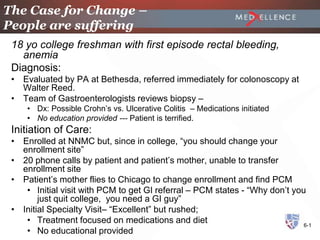
 18 yo college freshman with first episode rectal bleeding,
   anemia
 Diagnosis:
 • Evaluated by PA at Bethesda, referred immediately for colonoscopy at
   Walter Reed.
 • Team of Gastroenterologists reviews biopsy –
     • Dx: Possible Crohn’s vs. Ulcerative Colitis – Medications initiated
     • No education provided --- Patient is terrified.
 Initiation of Care:
 • Enrolled at NNMC but, since in college, “you should change your
   enrollment site”
 • 20 phone calls by patient and patient’s mother, unable to transfer
   enrollment site
 • Patient’s mother flies to Chicago to change enrollment and find PCM
    • Initial visit with PCM to get GI referral – PCM states - “Why don’t you
        just quit college, you need a GI guy”
 • Initial Specialty Visit– “Excellent” but rushed;
    • Treatment focused on medications and diet                              6-1
    • No educational provided
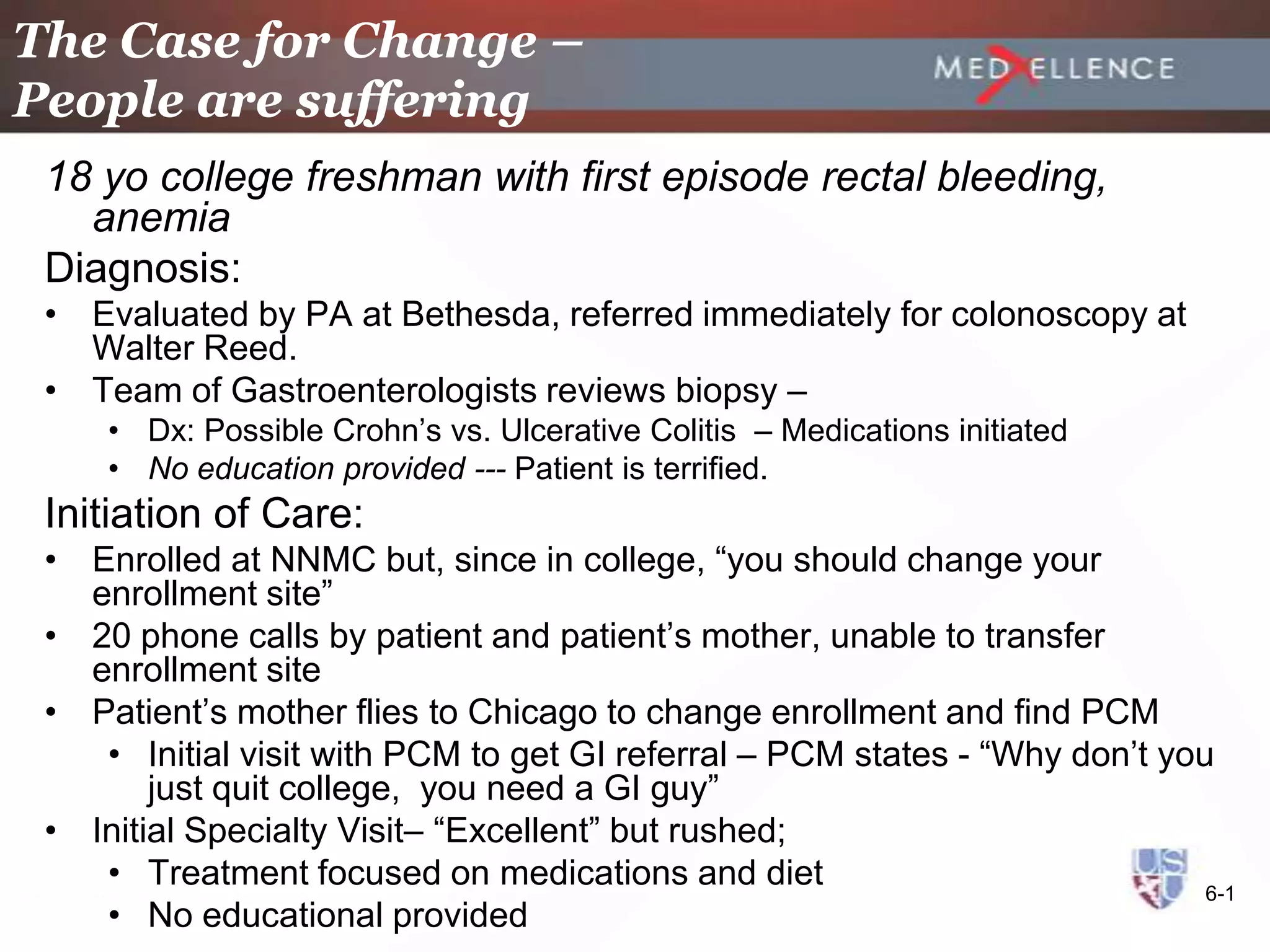
The Case for Change – Care is
Fragmented
Chronic Illness Care
• Hospitalization one - flu symptoms – GI specialist defers to PCM;
  PCM not available;
   • ER Visit – Hospitalized for “Crohn’s Flare”
   • Put on prednisone – “I got really crazy, I didn't know who to call”
• Hospitalization two –bleeding, (Hct 28), abdominal pain for 3 days,
   • PCM not available, ER visit - repeated all labs and two more CTs
   • After 3 days, released to dorm, falling behind in school
• Hospitalization three –abdominal pain, vomiting and HA, (PCM /GI
  not available)
   • ER Visit – Lumbar Puncture and Admitted – after two days, HA
      worse, “when I stand up” but discharged anyway --“I lost the
      chance to take my finals”
   • Readmitted for 3 days, received blood patch after caffeine
      unsuccessful
• Patient initiates talk with PCM – about availability and self care,
  obtains e mail, direct phone number – no more hospitalizations
  for 18 months.                                                           6-2

• Communication is a GAME CHANGER !!
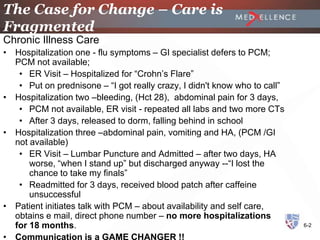
The Case for Change:
Processes are Not Patient Centered
  July 2009 – Happy Birthday – “You are no longer eligible
  for TRICARE and have been dropped from PRIME”
  Several hours to reestablish PRIME but, needed new
  referral for gastroenterologist. Had to be there in person.
     • Waited 2 hours in PCM office, seen for 3
       minutes, to get referral, no exam.
     • Referral lost by TRICARE or PCM?
  Pain returns, PCM not available, referral not done so could
  not see gastroenterologist.
     • ER, Hospitalized, returned home but, no F/U,
       ER again one week later. (10.23 then 10/31)

                                                                6-3
Let’s Evaluate the Outcomes
  Experience of Care:
  Patient Centered – no helplessness
      •   “Most of the time, I just need someone to answer my questions
          or tell me I don’t need to worry, I hate going to doctors and I
          don’t want to be in the hospital.”
      •   ” If they had explained what this illness is all about, I would have
          learned sooner. I could have figured out how to live my life with
          Crohn’s”
      •   “And why can’t they keep my records? I feel like they don’t
          believe anything that comes out of my mouth. But, its my body.
          Now, I have my own personal health record – its self defense. I
          am not going to get screwed again.”
  Timely – no unwanted waits
  Effective - evidence based interventions
      •   Who is following outcomes for all Crohn’s patients?
      •   Were the hospitalizations consistent with evidence based care?
          How would we know?
  Equitable – care for everyone
  Safe – no needless death or injury
      •   Was the LP a harm event?
  Efficient – No Waste
      •   Four hospitalizations and five ER visits – 2007
      •   One hospitalization and two ER visits - 2009
      •   Could any of these have been avoided?

                                                                                 6-4
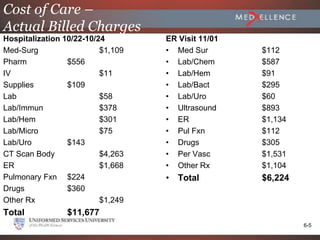
Cost of Care –
Actual Billed Charges
Hospitalization 10/22-10/24        ER Visit 11/01
Med-Surg                  $1,109   • Med Sur        $112
Pharm            $556              • Lab/Chem       $587
IV                        $11      • Lab/Hem        $91
Supplies         $109              • Lab/Bact       $295
Lab                       $58      • Lab/Uro        $60
Lab/Immun                 $378     • Ultrasound     $893
Lab/Hem                   $301     • ER             $1,134
Lab/Micro                 $75      • Pul Fxn        $112
Lab/Uro          $143              • Drugs          $305
CT Scan Body              $4,263   • Per Vasc       $1,531
ER                        $1,668   • Other Rx       $1,104
Pulmonary Fxn $224                 • Total          $6,224
Drugs            $360
Other Rx                  $1,249
Total            $11,677
                                                             6-5
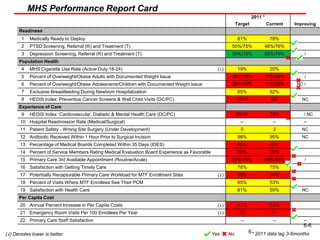
MHS Performance Report Card
                                                                                                                    2011 *
                                                                                                           Target            Current   Improving
      Readiness
       1   Medically Ready to Deploy                                                                        81%               78%
       2   PTSD Screening, Referral (R) and Treatment (T)                                              50%/75%           46%/76%
       3   Depression Screening, Referral (R) and Treatment (T)                                        50%/75%           65%/79%           /
      Population Health
       4   MHS Cigarette Use Rate (Active Duty 18-24)                                           ($)         19%               20%
       5   Percent of Overweight/Obese Adults with Documented Weight Issue                             30%/75%           17%/54%           /
       6   Percent of Overweight/Obese Adolescents/Children with Documented Weight Issue               30%/50%           11%/33%       NC /
       7   Exclusive Breastfeeding During Newborn Hospitalization                                           65%               62%
       8   HEDIS Index: Preventive Cancer Screens & Well Child Visits (DC/PC)                              10/10               8/6        NC
      Experience of Care
       9   HEDIS Index: Cardiovascular, Diabetic & Mental Health Care (DC/PC)                              29/18              23/5         / NC
      10 Hospital Readmission Rate (Medical/Surgical)                                                        --                --         --
      11 Patient Safety - Wrong Site Surgery (Under Development)                                             0                 2          NC
      12 Antibiotic Received Within 1 Hour Prior to Surgical Incision                                       98%               95%         NC
      13 Percentage of Medical Boards Completed Within 35 Days (IDES)                                       60%               43%
      14 Percent of Service Members Rating Medical Evaluation Board Experience as Favorable                 65%               50%
      15 Primary Care 3rd Available Appointment (Routine/Acute)                                        92%/70%           69%/48%           /
      16 Satisfaction with Getting Timely Care                                                              78%               75%
      17 Potentially Recapturable Primary Care Workload for MTF Enrollment Sites                ($)         26%               34%
      18 Percent of Visits Where MTF Enrollees See Their PCM                                                65%               53%
      19 Satisfaction with Health Care                                                                      61%               59%         NC
      Per Capita Cost
      20 Annual Percent Increase in Per Capita Costs                                            ($)        3.1%               5.5%
      21 Emergency Room Visits Per 100 Enrollees Per Year                                       ($)         35                 47
      22 Primary Care Staff Satisfaction                                                                     --                --         --
                                                                                                                                          6-6
($) Denotes lower is better                                                                   Yes     No           6* 2011 data lag 3-6months
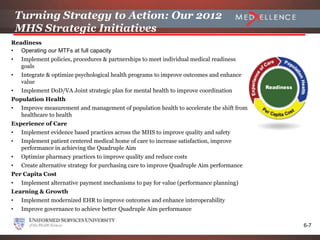
Turning Strategy to Action: Our 2012
    MHS Strategic Initiatives
Readiness
• Operating our MTFs at full capacity
•    Implement policies, procedures & partnerships to meet individual medical readiness
     goals
•    Integrate & optimize psychological health programs to improve outcomes and enhance
     value
•    Implement DoD/VA Joint strategic plan for mental health to improve coordination
Population Health
•    Improve measurement and management of population health to accelerate the shift from
     healthcare to health
Experience of Care
•    Implement evidence based practices across the MHS to improve quality and safety
•    Implement patient centered medical home of care to increase satisfaction, improve
     performance in achieving the Quadruple Aim
•    Optimize pharmacy practices to improve quality and reduce costs
•    Create alternative strategy for purchasing care to improve Quadruple Aim performance
Per Capita Cost
•    Implement alternative payment mechanisms to pay for value (performance planning)
Learning & Growth
•    Implement modernized EHR to improve outcomes and enhance interoperability
•    Improve governance to achieve better Quadruple Aim performance

                                                                                            6-7
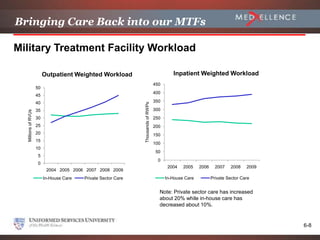
Bringing Care Back into our MTFs

Military Treatment Facility Workload

                          Outpatient Weighted Workload                                       Inpatient Weighted Workload
                                                                                    450
                     50
                                                                                    400
                     45
                     40                                                             350


                                                                Thousands of RWPs
                     35                                                             300
  Millions of RVUs


                     30                                                             250
                     25                                                             200
                     20                                                             150
                     15
                                                                                    100
                     10
                                                                                     50
                      5
                                                                                      0
                      0
                                                                                           2004   2005    2006     2007   2008    2009
                           2004 2005 2006 2007 2008 2009
                          In-House Care   Private Sector Care                             In-House Care          Private Sector Care


                                                                                      Note: Private sector care has increased
                                                                                      about 20% while in-house care has
                                                                                      decreased about 10%.


                                                                                                                                         6-8
The Partnerships for Patients –
Background and Focus
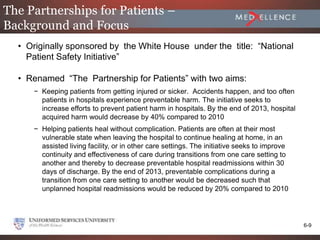
  • Originally sponsored by the White House under the title: “National
    Patient Safety Initiative”

  • Renamed “The Partnership for Patients” with two aims:
     − Keeping patients from getting injured or sicker. Accidents happen, and too often
       patients in hospitals experience preventable harm. The initiative seeks to
       increase efforts to prevent patient harm in hospitals. By the end of 2013, hospital
       acquired harm would decrease by 40% compared to 2010
     − Helping patients heal without complication. Patients are often at their most
       vulnerable state when leaving the hospital to continue healing at home, in an
       assisted living facility, or in other care settings. The initiative seeks to improve
       continuity and effectiveness of care during transitions from one care setting to
       another and thereby to decrease preventable hospital readmissions within 30
       days of discharge. By the end of 2013, preventable complications during a
       transition from one care setting to another would be decreased such that
       unplanned hospital readmissions would be reduced by 20% compared to 2010


                                                                                              6-9
What is our Aim? To work collaboratively across the entire
MHS to reduce hospital acquired conditions, improve
quality and reduce costs


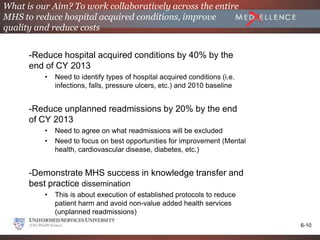
      -Reduce hospital acquired conditions by 40% by the
      end of CY 2013
          •   Need to identify types of hospital acquired conditions (i.e.
              infections, falls, pressure ulcers, etc.) and 2010 baseline


      -Reduce unplanned readmissions by 20% by the end
      of CY 2013
          •   Need to agree on what readmissions will be excluded
          •   Need to focus on best opportunities for improvement (Mental
              health, cardiovascular disease, diabetes, etc.)


      -Demonstrate MHS success in knowledge transfer and
      best practice dissemination
          •   This is about execution of established protocols to reduce
              patient harm and avoid non-value added health services
              (unplanned readmissions)
                                                                             6-10
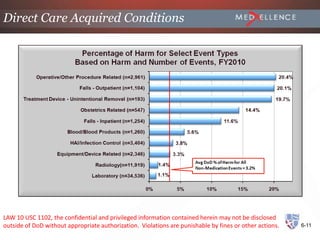
Direct Care Acquired Conditions


LAW 10 USC 1102, the confidential and privileged information contained herein may not be disclosed
outside of DoD without appropriate authorization. Violations are punishable by fines or other actions.   6-11
Why are we doing this now?

   • It is a strategic imperative for the MHS
       •   Need to prove our assertion that we can improve quality while reducing costs
       •   MHS readmission rates are comparable to national benchmarks
       •   Need to demonstrate excellence in management of mental illness
       •   We do not measure hospital acquired harm in a standard and transparent
           manner so it is difficult to systematically improve
   • We have committed to the National Partnership for Patients
       •   ASD(HA) formally joined partnership with HHS in May


       •   Over 3000 hospitals and health systems have joined to reach the goals of the
           partnership for patients


                                                                                          6-12

Session 6C - MHS Vision

  • 1.
    The Case forChange – People are suffering 18 yo college freshman with first episode rectal bleeding, anemia Diagnosis: • Evaluated by PA at Bethesda, referred immediately for colonoscopy at Walter Reed. • Team of Gastroenterologists reviews biopsy – • Dx: Possible Crohn’s vs. Ulcerative Colitis – Medications initiated • No education provided --- Patient is terrified. Initiation of Care: • Enrolled at NNMC but, since in college, “you should change your enrollment site” • 20 phone calls by patient and patient’s mother, unable to transfer enrollment site • Patient’s mother flies to Chicago to change enrollment and find PCM • Initial visit with PCM to get GI referral – PCM states - “Why don’t you just quit college, you need a GI guy” • Initial Specialty Visit– “Excellent” but rushed; • Treatment focused on medications and diet 6-1 • No educational provided
  • 2.
    The Case forChange – Care is Fragmented Chronic Illness Care • Hospitalization one - flu symptoms – GI specialist defers to PCM; PCM not available; • ER Visit – Hospitalized for “Crohn’s Flare” • Put on prednisone – “I got really crazy, I didn't know who to call” • Hospitalization two –bleeding, (Hct 28), abdominal pain for 3 days, • PCM not available, ER visit - repeated all labs and two more CTs • After 3 days, released to dorm, falling behind in school • Hospitalization three –abdominal pain, vomiting and HA, (PCM /GI not available) • ER Visit – Lumbar Puncture and Admitted – after two days, HA worse, “when I stand up” but discharged anyway --“I lost the chance to take my finals” • Readmitted for 3 days, received blood patch after caffeine unsuccessful • Patient initiates talk with PCM – about availability and self care, obtains e mail, direct phone number – no more hospitalizations for 18 months. 6-2 • Communication is a GAME CHANGER !!
  • 3.
    The Case forChange: Processes are Not Patient Centered July 2009 – Happy Birthday – “You are no longer eligible for TRICARE and have been dropped from PRIME” Several hours to reestablish PRIME but, needed new referral for gastroenterologist. Had to be there in person. • Waited 2 hours in PCM office, seen for 3 minutes, to get referral, no exam. • Referral lost by TRICARE or PCM? Pain returns, PCM not available, referral not done so could not see gastroenterologist. • ER, Hospitalized, returned home but, no F/U, ER again one week later. (10.23 then 10/31) 6-3
  • 4.
    Let’s Evaluate theOutcomes Experience of Care: Patient Centered – no helplessness • “Most of the time, I just need someone to answer my questions or tell me I don’t need to worry, I hate going to doctors and I don’t want to be in the hospital.” • ” If they had explained what this illness is all about, I would have learned sooner. I could have figured out how to live my life with Crohn’s” • “And why can’t they keep my records? I feel like they don’t believe anything that comes out of my mouth. But, its my body. Now, I have my own personal health record – its self defense. I am not going to get screwed again.” Timely – no unwanted waits Effective - evidence based interventions • Who is following outcomes for all Crohn’s patients? • Were the hospitalizations consistent with evidence based care? How would we know? Equitable – care for everyone Safe – no needless death or injury • Was the LP a harm event? Efficient – No Waste • Four hospitalizations and five ER visits – 2007 • One hospitalization and two ER visits - 2009 • Could any of these have been avoided? 6-4
  • 5.
    Cost of Care– Actual Billed Charges Hospitalization 10/22-10/24 ER Visit 11/01 Med-Surg $1,109 • Med Sur $112 Pharm $556 • Lab/Chem $587 IV $11 • Lab/Hem $91 Supplies $109 • Lab/Bact $295 Lab $58 • Lab/Uro $60 Lab/Immun $378 • Ultrasound $893 Lab/Hem $301 • ER $1,134 Lab/Micro $75 • Pul Fxn $112 Lab/Uro $143 • Drugs $305 CT Scan Body $4,263 • Per Vasc $1,531 ER $1,668 • Other Rx $1,104 Pulmonary Fxn $224 • Total $6,224 Drugs $360 Other Rx $1,249 Total $11,677 6-5
  • 6.
    MHS Performance ReportCard 2011 * Target Current Improving Readiness 1 Medically Ready to Deploy 81% 78% 2 PTSD Screening, Referral (R) and Treatment (T) 50%/75% 46%/76% 3 Depression Screening, Referral (R) and Treatment (T) 50%/75% 65%/79% / Population Health 4 MHS Cigarette Use Rate (Active Duty 18-24) ($) 19% 20% 5 Percent of Overweight/Obese Adults with Documented Weight Issue 30%/75% 17%/54% / 6 Percent of Overweight/Obese Adolescents/Children with Documented Weight Issue 30%/50% 11%/33% NC / 7 Exclusive Breastfeeding During Newborn Hospitalization 65% 62% 8 HEDIS Index: Preventive Cancer Screens & Well Child Visits (DC/PC) 10/10 8/6 NC Experience of Care 9 HEDIS Index: Cardiovascular, Diabetic & Mental Health Care (DC/PC) 29/18 23/5 / NC 10 Hospital Readmission Rate (Medical/Surgical) -- -- -- 11 Patient Safety - Wrong Site Surgery (Under Development) 0 2 NC 12 Antibiotic Received Within 1 Hour Prior to Surgical Incision 98% 95% NC 13 Percentage of Medical Boards Completed Within 35 Days (IDES) 60% 43% 14 Percent of Service Members Rating Medical Evaluation Board Experience as Favorable 65% 50% 15 Primary Care 3rd Available Appointment (Routine/Acute) 92%/70% 69%/48% / 16 Satisfaction with Getting Timely Care 78% 75% 17 Potentially Recapturable Primary Care Workload for MTF Enrollment Sites ($) 26% 34% 18 Percent of Visits Where MTF Enrollees See Their PCM 65% 53% 19 Satisfaction with Health Care 61% 59% NC Per Capita Cost 20 Annual Percent Increase in Per Capita Costs ($) 3.1% 5.5% 21 Emergency Room Visits Per 100 Enrollees Per Year ($) 35 47 22 Primary Care Staff Satisfaction -- -- -- 6-6 ($) Denotes lower is better Yes No 6* 2011 data lag 3-6months
  • 7.
    Turning Strategy toAction: Our 2012 MHS Strategic Initiatives Readiness • Operating our MTFs at full capacity • Implement policies, procedures & partnerships to meet individual medical readiness goals • Integrate & optimize psychological health programs to improve outcomes and enhance value • Implement DoD/VA Joint strategic plan for mental health to improve coordination Population Health • Improve measurement and management of population health to accelerate the shift from healthcare to health Experience of Care • Implement evidence based practices across the MHS to improve quality and safety • Implement patient centered medical home of care to increase satisfaction, improve performance in achieving the Quadruple Aim • Optimize pharmacy practices to improve quality and reduce costs • Create alternative strategy for purchasing care to improve Quadruple Aim performance Per Capita Cost • Implement alternative payment mechanisms to pay for value (performance planning) Learning & Growth • Implement modernized EHR to improve outcomes and enhance interoperability • Improve governance to achieve better Quadruple Aim performance 6-7
  • 8.
    Bringing Care Backinto our MTFs Military Treatment Facility Workload Outpatient Weighted Workload Inpatient Weighted Workload 450 50 400 45 40 350 Thousands of RWPs 35 300 Millions of RVUs 30 250 25 200 20 150 15 100 10 50 5 0 0 2004 2005 2006 2007 2008 2009 2004 2005 2006 2007 2008 2009 In-House Care Private Sector Care In-House Care Private Sector Care Note: Private sector care has increased about 20% while in-house care has decreased about 10%. 6-8
  • 9.
    The Partnerships forPatients – Background and Focus • Originally sponsored by the White House under the title: “National Patient Safety Initiative” • Renamed “The Partnership for Patients” with two aims: − Keeping patients from getting injured or sicker. Accidents happen, and too often patients in hospitals experience preventable harm. The initiative seeks to increase efforts to prevent patient harm in hospitals. By the end of 2013, hospital acquired harm would decrease by 40% compared to 2010 − Helping patients heal without complication. Patients are often at their most vulnerable state when leaving the hospital to continue healing at home, in an assisted living facility, or in other care settings. The initiative seeks to improve continuity and effectiveness of care during transitions from one care setting to another and thereby to decrease preventable hospital readmissions within 30 days of discharge. By the end of 2013, preventable complications during a transition from one care setting to another would be decreased such that unplanned hospital readmissions would be reduced by 20% compared to 2010 6-9
  • 10.
    What is ourAim? To work collaboratively across the entire MHS to reduce hospital acquired conditions, improve quality and reduce costs -Reduce hospital acquired conditions by 40% by the end of CY 2013 • Need to identify types of hospital acquired conditions (i.e. infections, falls, pressure ulcers, etc.) and 2010 baseline -Reduce unplanned readmissions by 20% by the end of CY 2013 • Need to agree on what readmissions will be excluded • Need to focus on best opportunities for improvement (Mental health, cardiovascular disease, diabetes, etc.) -Demonstrate MHS success in knowledge transfer and best practice dissemination • This is about execution of established protocols to reduce patient harm and avoid non-value added health services (unplanned readmissions) 6-10
  • 11.
    Direct Care AcquiredConditions LAW 10 USC 1102, the confidential and privileged information contained herein may not be disclosed outside of DoD without appropriate authorization. Violations are punishable by fines or other actions. 6-11
  • 12.
    Why are wedoing this now? • It is a strategic imperative for the MHS • Need to prove our assertion that we can improve quality while reducing costs • MHS readmission rates are comparable to national benchmarks • Need to demonstrate excellence in management of mental illness • We do not measure hospital acquired harm in a standard and transparent manner so it is difficult to systematically improve • We have committed to the National Partnership for Patients • ASD(HA) formally joined partnership with HHS in May • Over 3000 hospitals and health systems have joined to reach the goals of the partnership for patients 6-12

Editor's Notes

  • #12 For this slide, we looked at all the different event types. This graph shows relative to the number of reported events, which practices and policies for certain event types could improve based on harm events. Just like medical services where some are more complicated and riskier, the same applies here where some event types have a higher percentage of harm because they are more complicated and riskier.We are looking at the specific event type and how many events were reported to the PSAC (denominator), and the number of events that resulted in harm to the patient (numerator). This proportion is calculated and shown.The red line indicates the average DoD harm percentage for all event types (it is 3.2%) for FY2010. What is not shown prominently are the high frequency events (laboratory, EMR, radiology) with low harm percentages. (Near Miss events accounted for 63% of all reported events.3.2% of reported events classified as harm events. Only 0.16% of the total resulted in permanent harm or death.)Treatment Device – Unintentional Removal example: Inadvertantly removing a pcc- or IV- line.