The teleophthalmology consultation cost
per patient, at current efficiency level, is
$279.96 including fixed cost. A cost neutral
analysis estimated, at optimal efficiency of
352 patients per annum, cost per patient
would decrease to $107.72. In the remote
area, without teleophthalmology, the cost to
the service provider for a face to face
consultation with an ophthalmologist is as
high as $665.44 per patient. The minimum
number of patients needed to make a cost
effective teleophthalmology consultation is
126 per annum.
The majority of patients (98%) expressed
satisfaction with the internet based consulta-
tion and observed it as convenient. Lack of
physical contact with ophthalmologist was
not a major concern to many patients (74%).
CRH practitioners spoke favourably of using
teleophthalmology, in that they were able to
get advice from colleagues and discuss alter-
native management strategies. Practitioners
at LEI found the experience informative and
challenging.
Comment
While acknowledging that face to face con-
sultations with ophthalmologists are unique,
its costs are enormous in remote health
centres.3–5
The project is a technical and
clinical success and one that led to direct
potential benefits for patients in terms of
improved outcomes, as well as considerable
educational experience for the participating
medical practitioners. However, current
assessment brought to light the importance
of redefining utilisation criteria in order to
achieve efficiency. For example, 126 patients
per annum are required for a cost effective
teleophthalmology service while the current
efficiency rate is 118 per annum (2.2 patients
per week). Better coordination between the
local healthcare workforce and CRH may
increase the number of teleophthalmology
consultations, which in turn will help to
achieve breakeven or even establish net
savings. Overall, this assessment indicates
that the success of teleophthalmology will be
based upon identifying the requirements of
the service and using appropriate technology.
Acknowledgements
Supported by an IPRS Scholarship and UPA(IS)
Award from University of Western Australia. The
authors thank the Department of Health, Western
Australia, Mr Francisco Chaves (health economist),
and Ms Beth Hudson for her support and assistance
especially in data collection. The authors also thank
the patients, clinical staff, and administrative
officers in CRH, Carnarvon and at LEI, City of
Perth for their assistance.
S Kumar, M-L Tay-Kearney, I J Constable,
K Yogesan
Lions Eye Institute, University of Western Australia,
Nedlands, WA 6009, Australia
Correspondence to: Sajeesh Kumar, Lions Eye
Institute, University of Western Australia, 2 Verdun
Street, Nedlands, WA 6009, Australia; sajeesh@
cyllene.uwa.edu.au
References
1 Yogesan K, Constable IJ, et al. International
transmission of tele-ophthalmology images.
J Telemed Telecare 2000;5:41–4.
2 Yogesan K, Cuypers M, et al. Tele-ophthalmology
screening for retinal and anterior segment
diseases. J Telemed Telecare 2000;5:96–8.
3 Keeffe JE, Weih LM, et al. Utilisation of eye care
services by urban and rural Australians.
Br J Ophthalmol 2002;86:24–7.
4 Whitten PS, Mair FS, et al. Systematic review of
cost effectiveness studies of telemedicine
interventions. BMJ 2002;324:1434–7.
5 Sajeesh KR, Mei-Ling TK, Chaves F, et al. Remote
ophthalmology services: cost comparison of
telemedicine and alternate scenarios. J Telemed
Telecare (in press).
Temperature sensitive
oculocutaneous albinism
associated with missense
changes in the tyrosinase gene
Oculocutaneous albinism (OCA) describes a
group of autosomal recessive disorders char-
acterised by reduced or absent pigmentation
of the eye, skin, and hair as a result of a
congenital reduction in melanin synthesis.
Additional findings in the eye include
decreased visual acuity, nystagmus, iris trans-
illumination, hypopigmentation of the uveal
tract and retinal pigment epithelium, foveal
hypoplasia, and abnormal decussation of the
optic nerve fibres at the optic chiasm leading to
a lack of binocular vision.1 2
Type I OCA results
from mutations in the tyrosinase gene and
leads to either total absence of tyrosinase
activity (OCA Ia) associated with absence of
pigmentation (‘‘tyrosinase negative’’), or a
marked reduction in tyrosine activity (OCA
Ib) associated with reduced pigmentation
(‘‘tyrosinase positive’’ or ‘‘yellow albinism’’).
We report a new case of the rare variant
temperature sensitive albinism and our identi-
fication of missense mutations in the tyrosi-
nase gene, not previously found in this form of
albinism.
Case report
The patient, a 31 year old woman, was
referred to us for genetic advice. She had
originally presented at 6 weeks old with
nystagmus and white hair; her parents both
have dark hair and olive skin. The diagnosis
of oculocutaneous albinism was made at
9 months. As she grew older the hair of her
head darkened and, particularly in her teens,
the hair on her lower legs and forearms
darkened. As an adult she has light blonde
hair, darker eye lashes and eyebrows, white
axillary and pubic hair, but strongly pigmen-
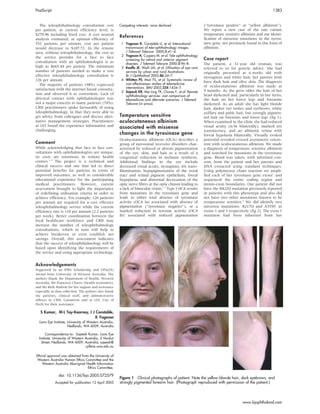
ted hair on forearms and lower legs (fig 1).
When examined in the clinic she had reduced
visual acuity (6/36 bilaterally), marked iris
translucency, and an albinotic retina with
foveal hypolasia bilaterally. Visually evoked
potential revealed crossed asymmetry consis-
tent with oculocutaneous albinism. We made
a diagnosis of temperature sensitive albinism
and searched for mutations in the tyrosinase
gene. Blood was taken, with informed con-
sent, from the patient and her parents and
DNA extracted using standard techniques.
Using polymerase chain reaction we ampli-
fied each of her tyrosinase gene exons3
and
sequenced the entire coding region and
intron-exon boundaries. Our patient did not
have the R422Q mutation previously reported
in patients with this phenotype and also did
not have two other mutations known to be
temperature sensitive.4
We did identify two
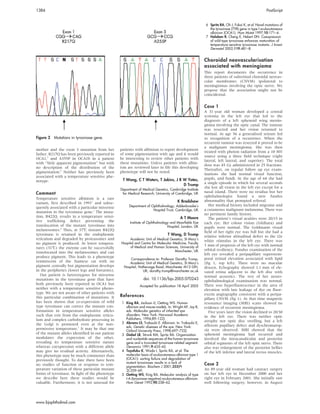
missense mutations: R217Q and A355P, in
exons 1 and 3 respectively (fig 2). The exon 1
mutation had been inherited from her
Competing interests: none declared
Ethical approval was obtained from the University of
Western Australia Human Ethics Committee and the
Western Australia Aboriginal Health Information
Ethics Committee.
doi: 10.1136/bjo.2005.072579
Accepted for publication 12 April 2005
Figure 1 Clinical photographs of patient. Note the yellow blonde hair, dark eyebrows, and
strongly pigmented forearm hair. (Photograph reproduced with permission of the patient.)
PostScript 1383
www.bjophthalmol.com
mother and the exon 3 mutation from her
father. R217Q has been previously reported in
OCA1,5
and A355P in OCA1b in a patient
with ‘‘little apparent pigmentation’’ but with
no description of the distribution of the
pigmentation.6
Neither has previously been
associated with a temperature sensitive phe-
notype.
Comment
Temperature sensitive albinism is a rare
variant, first described in 19911
and subse-
quently associated with a particular missense
mutation in the tyrosinase gene.1
The muta-
tion, R422Q, results in a temperature sensi-
tive trafficking defect preventing the
translocation of the mutant tyrosinase into
melanosomes.4
Thus, at 37˚C mutant R422Q
tyrosinase is retained in the endoplasmic
reticulum and degraded by proteasomes and
no pigment is produced. At lower tempera-
tures (31˚C) the enzyme can be successfully
translocated into the melanosomes and can
produce pigment. This leads to a phenotype
reminiscent of the Siamese cat with no
pigment centrally but pigmentation develops
in the peripheries (lower legs and forearms).
Our patient is heterozygous for missense
mutations in the tyrosinase gene that have
both previously been reported in OCA1 but
neither with a temperature sensitive pheno-
type. We are not aware of other patients with
this particular combination of mutations. It
has been shown that co-expression of wild
type tyrosinase can correct the mutant con-
formation in temperature sensitive alleles
such that exit from the endoplasmic reticu-
lum and complex carbohydrate processing in
the Golgi is promoted even at the non-
permissive temperature.7
It may be that one
of the mutant alleles identified in our patient
modulates the expression of the other,
revealing its temperature sensitive nature
whereas coexpression with a different allele
may give no residual activity. Alternatively,
this phenotype may be much commoner than
previously thought. To date there have been
no studies of function or response to tem-
perature variation of these particular mutant
forms of tyrosinase. In light of the phenotype
we describe here these studies would be
valuable. Furthermore, it is not unusual for
patients with albinism to report development
of some pigmentation with age and it would
be interesting to review other patients with
these mutations. Unless patients with albin-
ism are reviewed later in life this developing
phenotype will not be noted.
T Wang, C T Waters, T Jakins, J R W Yates,
D Trump
Department of Medical Genetics, Cambridge Institute
for Medical Research, University of Cambridge, UK
K Bradshaw
Department of Ophthalmology, Addenbrooke’s
Hospital Trust, Cambridge, UK
A T Moore
Institute of Ophthalmology and Moorfields Eye
Hospital, London, UK
T Wang, D Trump
Academic Unit of Medical Genetics, St Mary’s
Hospital and Centre for Molecular Medicine, Faculty
of Medical and Human Sciences, University of
Manchester, UK
Correspondence to: Professor Dorothy Trump,
Academic Unit of Medical Genetics, St Mary’s
Hospital, Hathersage Road, Manchester M13 0JH,
UK; dorothy.trump@manchester.ac.uk
doi: 10.1136/bjo.2005.070243
References
1 King RA, Jackson IJ, Oetting WS. Human
albinism and mouse models. In: Wright AF, Jay B,
eds. Molecular genetics of inherited eye
disorders. New York: Harwood Academic
Publishers, 1994;89–122).
2 Abrams LS, Traboulsi E. Albinism. In: Traboulsi E,
eds. Genetic diseases of the eye. New York:
Oxford University Press, 1998;697–722).
3 Giebel LB, Strunk KM, Spritz RA. Organization
and nucleotide sequences of the human tyrosinase
gene and a truncated tyrosinase-related segment.
Genomics 1991;9:435–45.
4 Toyofuku K, Wada I, Spritz RA, et al. The
molecular basis of oculocutaneous albinism type 1
(OCA1): sorting failure and degradation of
mutant tyrosinases results in a lack of
pigmentation. Biochem J 2001;355(Pt
2):259–69.
5 Oetting WS, King RA. Molecular analysis of type
I-A (tyrosinase negative) oculocutaneous albinism.
Hum Genet 1992;90:258–62.
6 Spritz RA, Oh J, Fukai K, et al. Novel mutations of
the tyrosinase (TYR) gene in type I oculocutaneous
albinism (OCA1). Hum Mutat 1997;10:171–4.
7 Halaban R, Cheng E, Hebert DN. Coexpression
of wild-type tyrosinase enhances maturation of
temperature-sensitive tyrosinase mutants. J Invest
Dermatol 2002;119:481–8.
Choroidal neovascularisation
associated with meningioma
This report documents the occurrence in
three patients of subretinal choroidal neovas-
cular membranes (CNVM) ipsilateral to
meningiomas involving the optic nerve. We
propose that the association might not be
coincidental.
Case 1
A 31 year old woman developed a central
scotoma in the left eye that led to the
diagnosis of a left sphenoid wing menin-
gioma involving the optic canal. The tumour
was resected and her vision returned to
normal. At age 56 a generalised seizure led
to recognition of a recurrence. When the
recurrent tumour was resected it proved to be
a malignant meningioma. She was then
treated with photon radiation from a 10 MV
source using a three field technique (right
lateral, left lateral, and superior). The total
dose was 45 Gy administered in 25 fractions.
Thereafter, on regular follow up eye exam-
inations she had normal visual function,
pupils, and fundi. At the age of 64 she had
a single episode in which for several seconds
she lost all vision in the left eye except for a
nasal island. There were no residua but her
ophthalmologist found a new fundus
abnormality that prompted referral.
Her medical history included migraine and
a cutaneous malignant melanoma. There was
no pertinent family history.
The patient’s visual acuities were 20/15 in
each eye. Her colour vision (Ishihara) and
pupils were normal. The Goldmann visual
field of her right eye was full but she had a
relative inferior altitudinal defect to the I2e
white stimulus in the left eye. There was
3 mm of proptosis of the left eye with normal
orbital resiliency. Fundus examination of the
left eye revealed a peripapillary superotem-
poral retinal elevation associated with lipid
(fig 1, top left). There were no macular
drusen. Echography showed 1.1 mm of ele-
vated retina adjacent to the left disc with
normal acoustics. The rest of her neuro-
ophthalmological examination was normal.
There was hyperfluorescence in the area of
elevation with late leakage of dye on fluor-
escein angiography consistent with a peripa-
pillary CNVM (fig 1). At that time magnetic
resonance imaging (MRI) scans showed no
evidence of recurrent meningioma.
Five years later the vision declined to 20/30
in the left eye. There was neither optic
atrophy nor optic disc swelling, but a left
afferent pupillary defect and dyschromatop-
sia were observed. MRI showed that the
sphenoid meningioma had recurred and
involved the intracanalicular and posterior
orbital segments of the left optic nerve. There
also was enlargement of the posterior bellies
of the left inferior and lateral rectus muscles.
Case 2
An 89 year old woman had cataract surgery
on her left eye in December 2000 and her
right eye in February 2001. She initially saw
well following surgery; however, in August
Figure 2 Mutations in tyrosinase gene.
Accepted for publication 18 April 2005
1384 PostScript
www.bjophthalmol.com

Caso clinico Albinismo

  • 1.
    The teleophthalmology consultationcost per patient, at current efficiency level, is $279.96 including fixed cost. A cost neutral analysis estimated, at optimal efficiency of 352 patients per annum, cost per patient would decrease to $107.72. In the remote area, without teleophthalmology, the cost to the service provider for a face to face consultation with an ophthalmologist is as high as $665.44 per patient. The minimum number of patients needed to make a cost effective teleophthalmology consultation is 126 per annum. The majority of patients (98%) expressed satisfaction with the internet based consulta- tion and observed it as convenient. Lack of physical contact with ophthalmologist was not a major concern to many patients (74%). CRH practitioners spoke favourably of using teleophthalmology, in that they were able to get advice from colleagues and discuss alter- native management strategies. Practitioners at LEI found the experience informative and challenging. Comment While acknowledging that face to face con- sultations with ophthalmologists are unique, its costs are enormous in remote health centres.3–5 The project is a technical and clinical success and one that led to direct potential benefits for patients in terms of improved outcomes, as well as considerable educational experience for the participating medical practitioners. However, current assessment brought to light the importance of redefining utilisation criteria in order to achieve efficiency. For example, 126 patients per annum are required for a cost effective teleophthalmology service while the current efficiency rate is 118 per annum (2.2 patients per week). Better coordination between the local healthcare workforce and CRH may increase the number of teleophthalmology consultations, which in turn will help to achieve breakeven or even establish net savings. Overall, this assessment indicates that the success of teleophthalmology will be based upon identifying the requirements of the service and using appropriate technology. Acknowledgements Supported by an IPRS Scholarship and UPA(IS) Award from University of Western Australia. The authors thank the Department of Health, Western Australia, Mr Francisco Chaves (health economist), and Ms Beth Hudson for her support and assistance especially in data collection. The authors also thank the patients, clinical staff, and administrative officers in CRH, Carnarvon and at LEI, City of Perth for their assistance. S Kumar, M-L Tay-Kearney, I J Constable, K Yogesan Lions Eye Institute, University of Western Australia, Nedlands, WA 6009, Australia Correspondence to: Sajeesh Kumar, Lions Eye Institute, University of Western Australia, 2 Verdun Street, Nedlands, WA 6009, Australia; sajeesh@ cyllene.uwa.edu.au References 1 Yogesan K, Constable IJ, et al. International transmission of tele-ophthalmology images. J Telemed Telecare 2000;5:41–4. 2 Yogesan K, Cuypers M, et al. Tele-ophthalmology screening for retinal and anterior segment diseases. J Telemed Telecare 2000;5:96–8. 3 Keeffe JE, Weih LM, et al. Utilisation of eye care services by urban and rural Australians. Br J Ophthalmol 2002;86:24–7. 4 Whitten PS, Mair FS, et al. Systematic review of cost effectiveness studies of telemedicine interventions. BMJ 2002;324:1434–7. 5 Sajeesh KR, Mei-Ling TK, Chaves F, et al. Remote ophthalmology services: cost comparison of telemedicine and alternate scenarios. J Telemed Telecare (in press). Temperature sensitive oculocutaneous albinism associated with missense changes in the tyrosinase gene Oculocutaneous albinism (OCA) describes a group of autosomal recessive disorders char- acterised by reduced or absent pigmentation of the eye, skin, and hair as a result of a congenital reduction in melanin synthesis. Additional findings in the eye include decreased visual acuity, nystagmus, iris trans- illumination, hypopigmentation of the uveal tract and retinal pigment epithelium, foveal hypoplasia, and abnormal decussation of the optic nerve fibres at the optic chiasm leading to a lack of binocular vision.1 2 Type I OCA results from mutations in the tyrosinase gene and leads to either total absence of tyrosinase activity (OCA Ia) associated with absence of pigmentation (‘‘tyrosinase negative’’), or a marked reduction in tyrosine activity (OCA Ib) associated with reduced pigmentation (‘‘tyrosinase positive’’ or ‘‘yellow albinism’’). We report a new case of the rare variant temperature sensitive albinism and our identi- fication of missense mutations in the tyrosi- nase gene, not previously found in this form of albinism. Case report The patient, a 31 year old woman, was referred to us for genetic advice. She had originally presented at 6 weeks old with nystagmus and white hair; her parents both have dark hair and olive skin. The diagnosis of oculocutaneous albinism was made at 9 months. As she grew older the hair of her head darkened and, particularly in her teens, the hair on her lower legs and forearms darkened. As an adult she has light blonde hair, darker eye lashes and eyebrows, white axillary and pubic hair, but strongly pigmen- ted hair on forearms and lower legs (fig 1). When examined in the clinic she had reduced visual acuity (6/36 bilaterally), marked iris translucency, and an albinotic retina with foveal hypolasia bilaterally. Visually evoked potential revealed crossed asymmetry consis- tent with oculocutaneous albinism. We made a diagnosis of temperature sensitive albinism and searched for mutations in the tyrosinase gene. Blood was taken, with informed con- sent, from the patient and her parents and DNA extracted using standard techniques. Using polymerase chain reaction we ampli- fied each of her tyrosinase gene exons3 and sequenced the entire coding region and intron-exon boundaries. Our patient did not have the R422Q mutation previously reported in patients with this phenotype and also did not have two other mutations known to be temperature sensitive.4 We did identify two missense mutations: R217Q and A355P, in exons 1 and 3 respectively (fig 2). The exon 1 mutation had been inherited from her Competing interests: none declared Ethical approval was obtained from the University of Western Australia Human Ethics Committee and the Western Australia Aboriginal Health Information Ethics Committee. doi: 10.1136/bjo.2005.072579 Accepted for publication 12 April 2005 Figure 1 Clinical photographs of patient. Note the yellow blonde hair, dark eyebrows, and strongly pigmented forearm hair. (Photograph reproduced with permission of the patient.) PostScript 1383 www.bjophthalmol.com
  • 2.
    mother and theexon 3 mutation from her father. R217Q has been previously reported in OCA1,5 and A355P in OCA1b in a patient with ‘‘little apparent pigmentation’’ but with no description of the distribution of the pigmentation.6 Neither has previously been associated with a temperature sensitive phe- notype. Comment Temperature sensitive albinism is a rare variant, first described in 19911 and subse- quently associated with a particular missense mutation in the tyrosinase gene.1 The muta- tion, R422Q, results in a temperature sensi- tive trafficking defect preventing the translocation of the mutant tyrosinase into melanosomes.4 Thus, at 37˚C mutant R422Q tyrosinase is retained in the endoplasmic reticulum and degraded by proteasomes and no pigment is produced. At lower tempera- tures (31˚C) the enzyme can be successfully translocated into the melanosomes and can produce pigment. This leads to a phenotype reminiscent of the Siamese cat with no pigment centrally but pigmentation develops in the peripheries (lower legs and forearms). Our patient is heterozygous for missense mutations in the tyrosinase gene that have both previously been reported in OCA1 but neither with a temperature sensitive pheno- type. We are not aware of other patients with this particular combination of mutations. It has been shown that co-expression of wild type tyrosinase can correct the mutant con- formation in temperature sensitive alleles such that exit from the endoplasmic reticu- lum and complex carbohydrate processing in the Golgi is promoted even at the non- permissive temperature.7 It may be that one of the mutant alleles identified in our patient modulates the expression of the other, revealing its temperature sensitive nature whereas coexpression with a different allele may give no residual activity. Alternatively, this phenotype may be much commoner than previously thought. To date there have been no studies of function or response to tem- perature variation of these particular mutant forms of tyrosinase. In light of the phenotype we describe here these studies would be valuable. Furthermore, it is not unusual for patients with albinism to report development of some pigmentation with age and it would be interesting to review other patients with these mutations. Unless patients with albin- ism are reviewed later in life this developing phenotype will not be noted. T Wang, C T Waters, T Jakins, J R W Yates, D Trump Department of Medical Genetics, Cambridge Institute for Medical Research, University of Cambridge, UK K Bradshaw Department of Ophthalmology, Addenbrooke’s Hospital Trust, Cambridge, UK A T Moore Institute of Ophthalmology and Moorfields Eye Hospital, London, UK T Wang, D Trump Academic Unit of Medical Genetics, St Mary’s Hospital and Centre for Molecular Medicine, Faculty of Medical and Human Sciences, University of Manchester, UK Correspondence to: Professor Dorothy Trump, Academic Unit of Medical Genetics, St Mary’s Hospital, Hathersage Road, Manchester M13 0JH, UK; dorothy.trump@manchester.ac.uk doi: 10.1136/bjo.2005.070243 References 1 King RA, Jackson IJ, Oetting WS. Human albinism and mouse models. In: Wright AF, Jay B, eds. Molecular genetics of inherited eye disorders. New York: Harwood Academic Publishers, 1994;89–122). 2 Abrams LS, Traboulsi E. Albinism. In: Traboulsi E, eds. Genetic diseases of the eye. New York: Oxford University Press, 1998;697–722). 3 Giebel LB, Strunk KM, Spritz RA. Organization and nucleotide sequences of the human tyrosinase gene and a truncated tyrosinase-related segment. Genomics 1991;9:435–45. 4 Toyofuku K, Wada I, Spritz RA, et al. The molecular basis of oculocutaneous albinism type 1 (OCA1): sorting failure and degradation of mutant tyrosinases results in a lack of pigmentation. Biochem J 2001;355(Pt 2):259–69. 5 Oetting WS, King RA. Molecular analysis of type I-A (tyrosinase negative) oculocutaneous albinism. Hum Genet 1992;90:258–62. 6 Spritz RA, Oh J, Fukai K, et al. Novel mutations of the tyrosinase (TYR) gene in type I oculocutaneous albinism (OCA1). Hum Mutat 1997;10:171–4. 7 Halaban R, Cheng E, Hebert DN. Coexpression of wild-type tyrosinase enhances maturation of temperature-sensitive tyrosinase mutants. J Invest Dermatol 2002;119:481–8. Choroidal neovascularisation associated with meningioma This report documents the occurrence in three patients of subretinal choroidal neovas- cular membranes (CNVM) ipsilateral to meningiomas involving the optic nerve. We propose that the association might not be coincidental. Case 1 A 31 year old woman developed a central scotoma in the left eye that led to the diagnosis of a left sphenoid wing menin- gioma involving the optic canal. The tumour was resected and her vision returned to normal. At age 56 a generalised seizure led to recognition of a recurrence. When the recurrent tumour was resected it proved to be a malignant meningioma. She was then treated with photon radiation from a 10 MV source using a three field technique (right lateral, left lateral, and superior). The total dose was 45 Gy administered in 25 fractions. Thereafter, on regular follow up eye exam- inations she had normal visual function, pupils, and fundi. At the age of 64 she had a single episode in which for several seconds she lost all vision in the left eye except for a nasal island. There were no residua but her ophthalmologist found a new fundus abnormality that prompted referral. Her medical history included migraine and a cutaneous malignant melanoma. There was no pertinent family history. The patient’s visual acuities were 20/15 in each eye. Her colour vision (Ishihara) and pupils were normal. The Goldmann visual field of her right eye was full but she had a relative inferior altitudinal defect to the I2e white stimulus in the left eye. There was 3 mm of proptosis of the left eye with normal orbital resiliency. Fundus examination of the left eye revealed a peripapillary superotem- poral retinal elevation associated with lipid (fig 1, top left). There were no macular drusen. Echography showed 1.1 mm of ele- vated retina adjacent to the left disc with normal acoustics. The rest of her neuro- ophthalmological examination was normal. There was hyperfluorescence in the area of elevation with late leakage of dye on fluor- escein angiography consistent with a peripa- pillary CNVM (fig 1). At that time magnetic resonance imaging (MRI) scans showed no evidence of recurrent meningioma. Five years later the vision declined to 20/30 in the left eye. There was neither optic atrophy nor optic disc swelling, but a left afferent pupillary defect and dyschromatop- sia were observed. MRI showed that the sphenoid meningioma had recurred and involved the intracanalicular and posterior orbital segments of the left optic nerve. There also was enlargement of the posterior bellies of the left inferior and lateral rectus muscles. Case 2 An 89 year old woman had cataract surgery on her left eye in December 2000 and her right eye in February 2001. She initially saw well following surgery; however, in August Figure 2 Mutations in tyrosinase gene. Accepted for publication 18 April 2005 1384 PostScript www.bjophthalmol.com