Rebuilding Trust in the
User-Centered Design Process
Samantha Bailey, Vice President, Information Architecture

COPYRIGHT Wachovia CONFIDENTIAL
For the Record
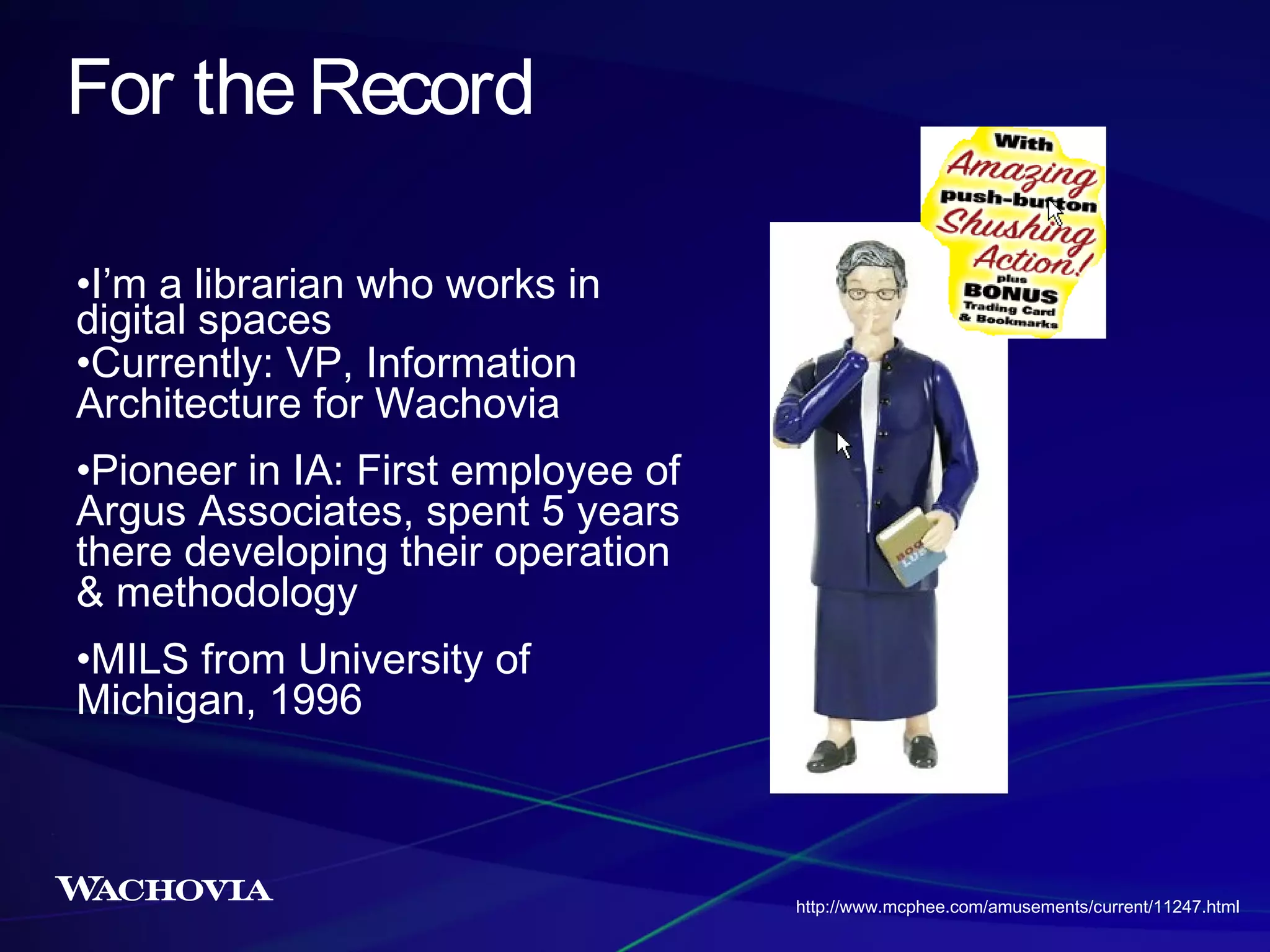
•I’m a librarian who works in
digital spaces
•Currently: VP, Information
Architecture for Wachovia
•Pioneer in IA: First employee of
Argus Associates, spent 5 years
there developing their operation
& methodology
•MILS from University of
Michigan, 1996

http://www.mcphee.com/amusements/current/11247.html
Overview
What went wrong
How we addressed it
How do we keep from doing it (wrong) again?
What can you learn from our mistakes?
Background
Team structure & how we work with our internal
partners
Relationship between Bank & Brokerage
(Wachovia.com and Wachoviasecurities.com)
Internal Competition (“full service” vs. “self-directed”)
Audience: mix of novice & expert, variety of investing
needs
We used a user-centered design
methodology, how come we got a
site no one was happy with?
Initial Design Process
When user-centered design…isn’t
Weaknesses:
• Investing center as subset of much larger project
• Internal politics and corporate flux (merger)
• Working relationship
• Shared understanding of goals & methodology
• Our level of subject matter expertise

“You didn’t include us enough in the process.”
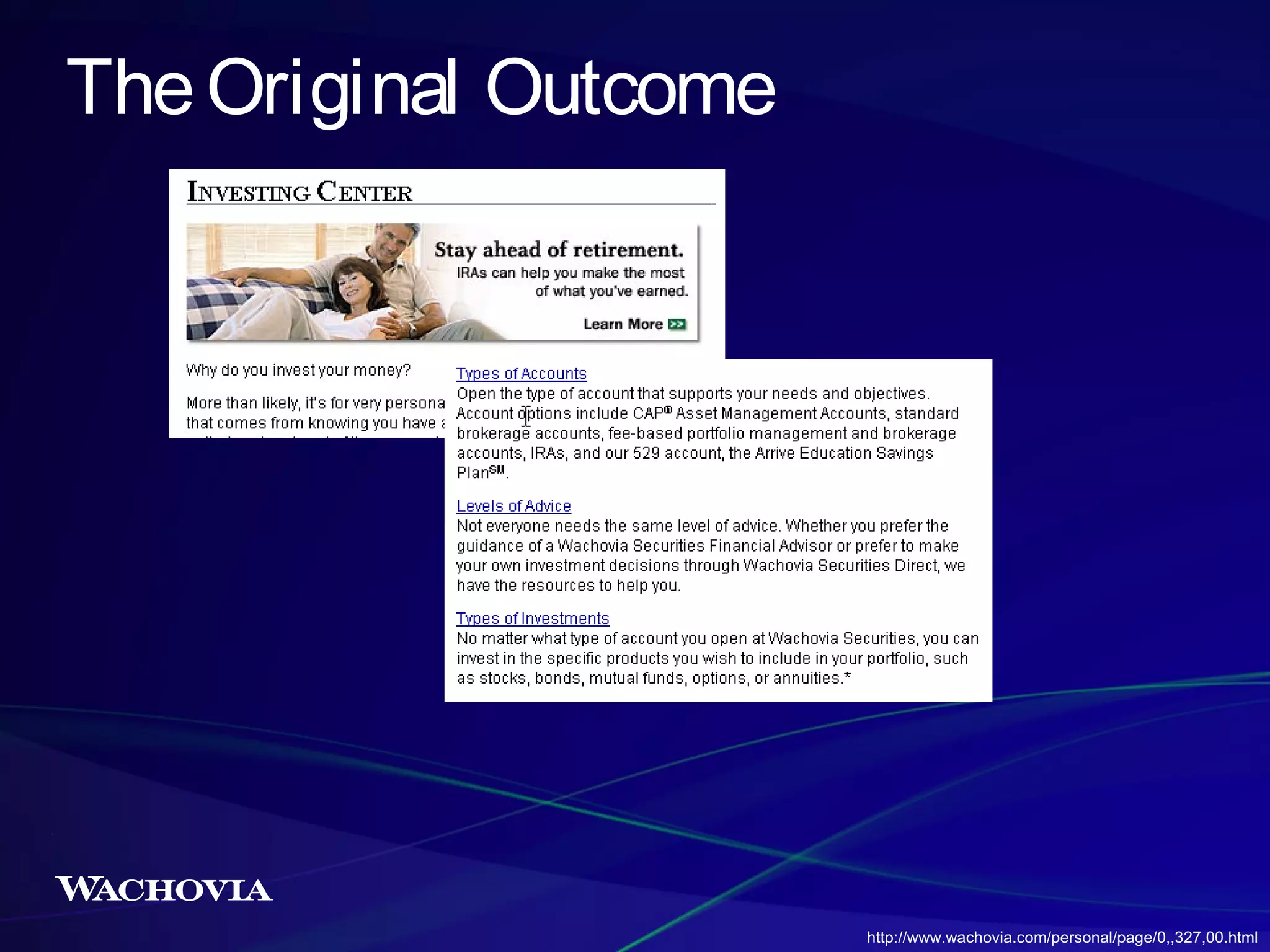
The Original Outcome

http://www.wachovia.com/personal/page/0,,327,00.html
Usability Test Results
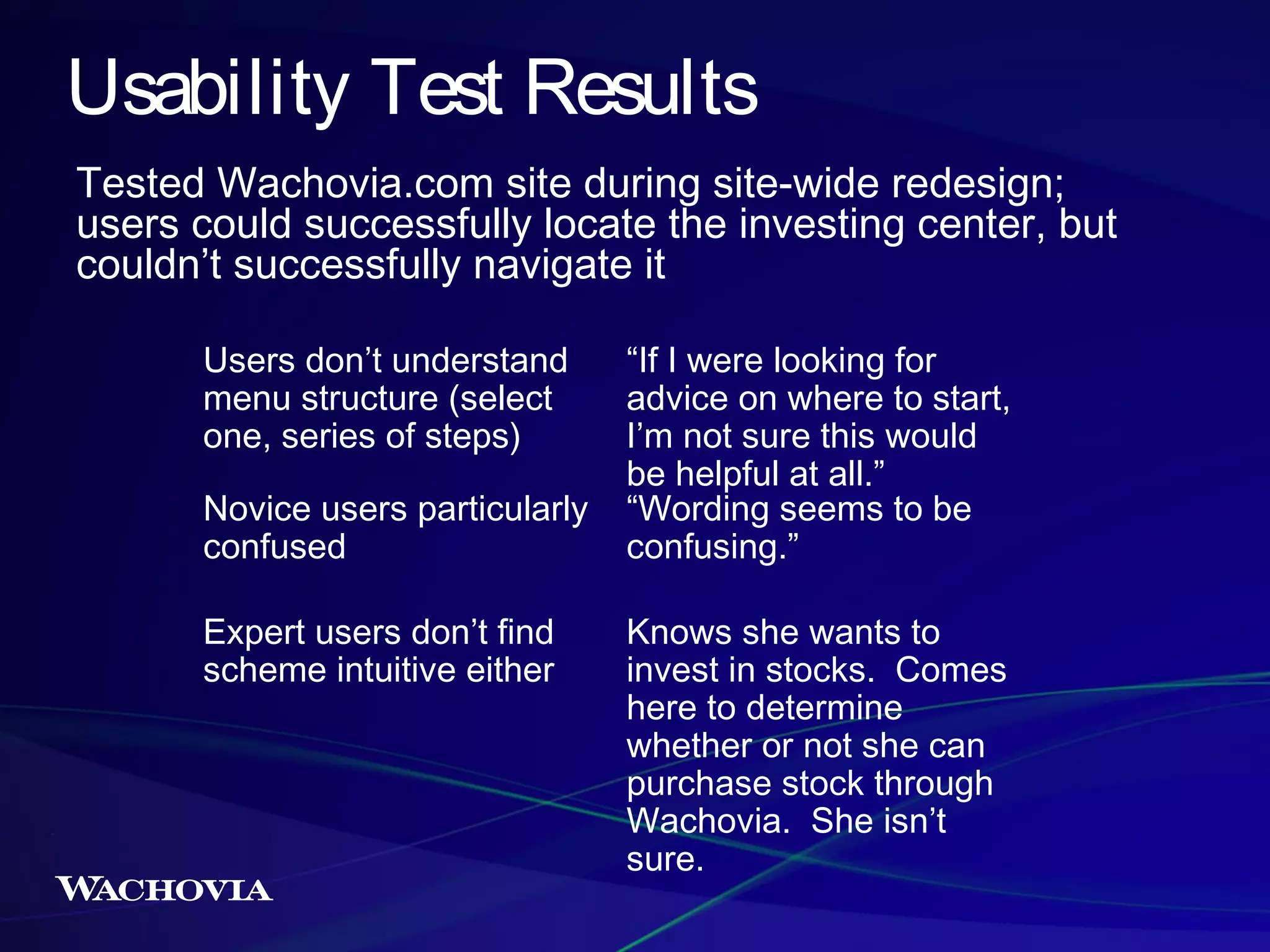
Tested Wachovia.com site during site-wide redesign;
users could successfully locate the investing center, but
couldn’t successfully navigate it
Users don’t understand
menu structure (select
one, series of steps)
Novice users particularly
confused
Expert users don’t find
scheme intuitive either

“If I were looking for
advice on where to start,
I’m not sure this would
be helpful at all.”
“Wording seems to be
confusing.”
Knows she wants to
invest in stocks. Comes
here to determine
whether or not she can
purchase stock through
Wachovia. She isn’t
sure.
It’ s humbling to plan the
redesign of a redesign before
the redesign launches.
Laying the Groundwork
Pre-Discovery
• Understanding why the first attempt failed (humble pie
issues)
• Time delays worked to our advantage
• Relationship building
• Establishing new working agreement
- Increased BU involvement
- More sign-off points
Redesigning the Investing Center
Phases: Standard UE Process
• (pre Discovery)
• Discovery
• Design
• Usability Testing
• Iteration
• Development & Implementation
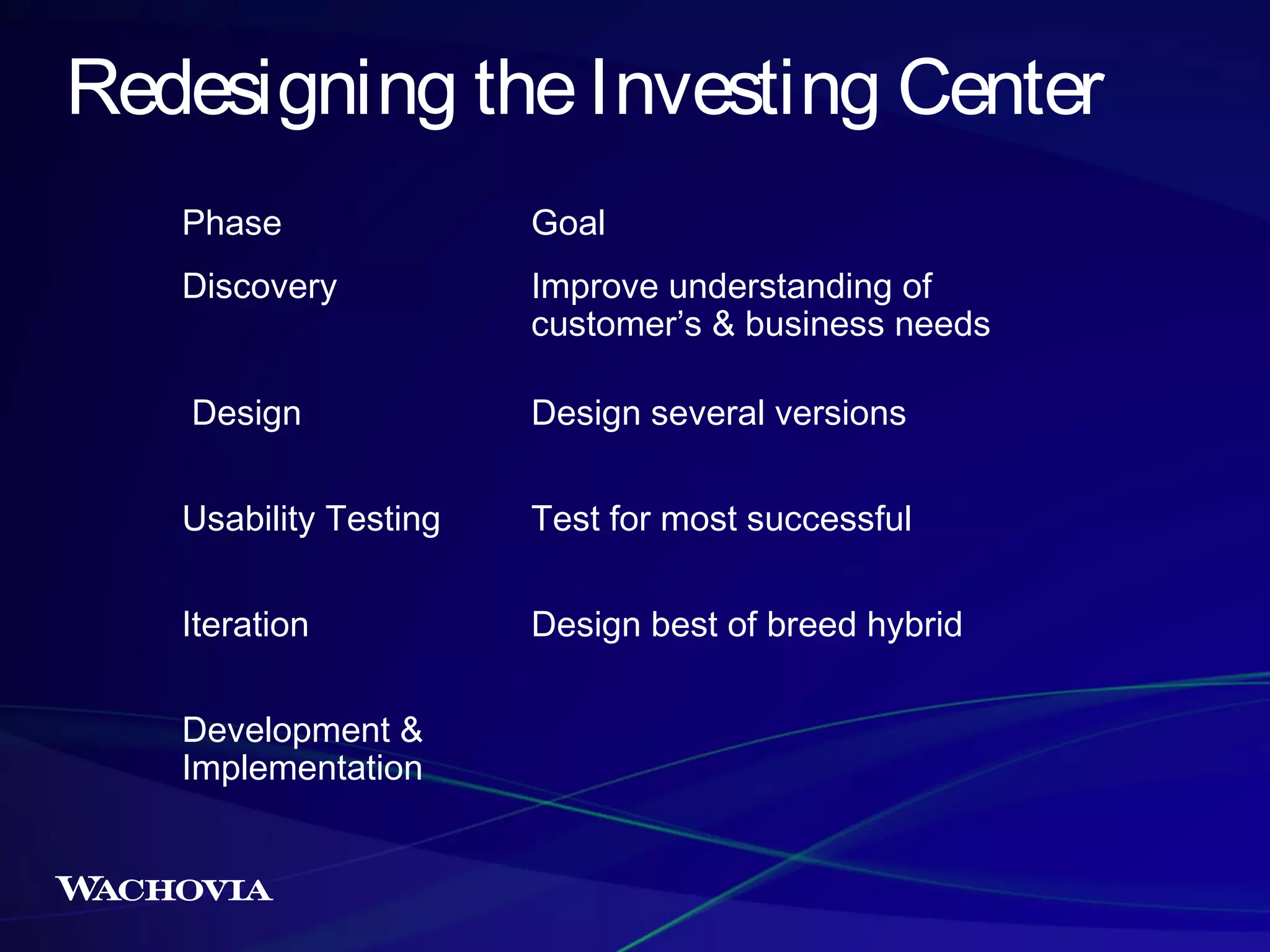
Redesigning the Investing Center
Phase

Goal

Discovery

Improve understanding of
customer’s & business needs

Design

Design several versions

Usability Testing

Test for most successful

Iteration

Design best of breed hybrid

Development &
Implementation
Trust Factor
If this was to be a pretty typical methodology, how was
trust increased (and why did we expect a different
outcome)?
• Communication—it’s cliché, but can’t be stressed
enough
• Repetition—didn’t rely on trickle down (luxury of time)
• Pushed back on requests to compress discovery
Redesigning the Investing Center
Discovery
• Clarifying the business needs
• Clarifying user expectations (conducted interviews with
Financial Advisors and customers)
• Involving the business in the process—asking for
specific kinds of engagement
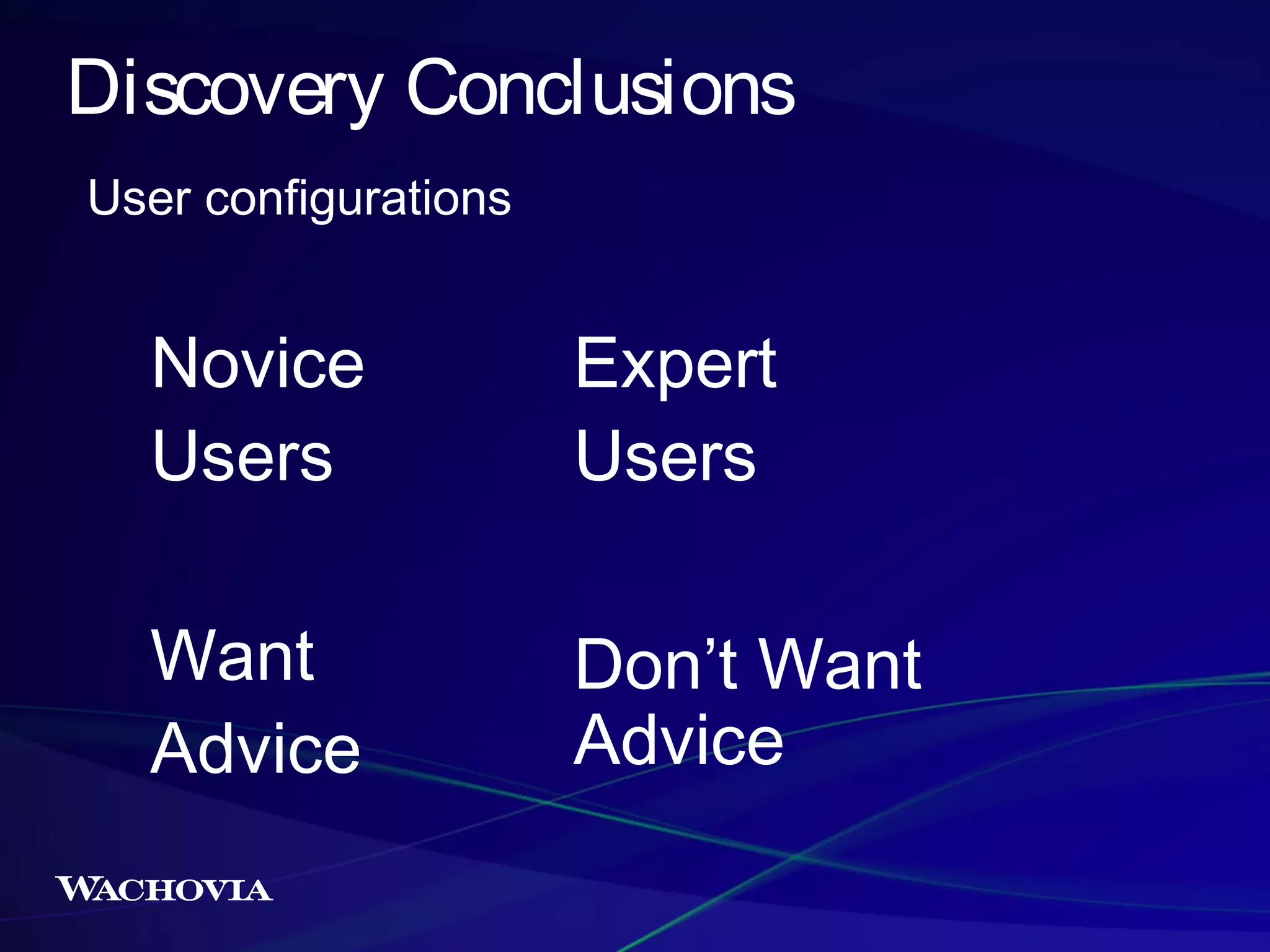
Discovery Conclusions
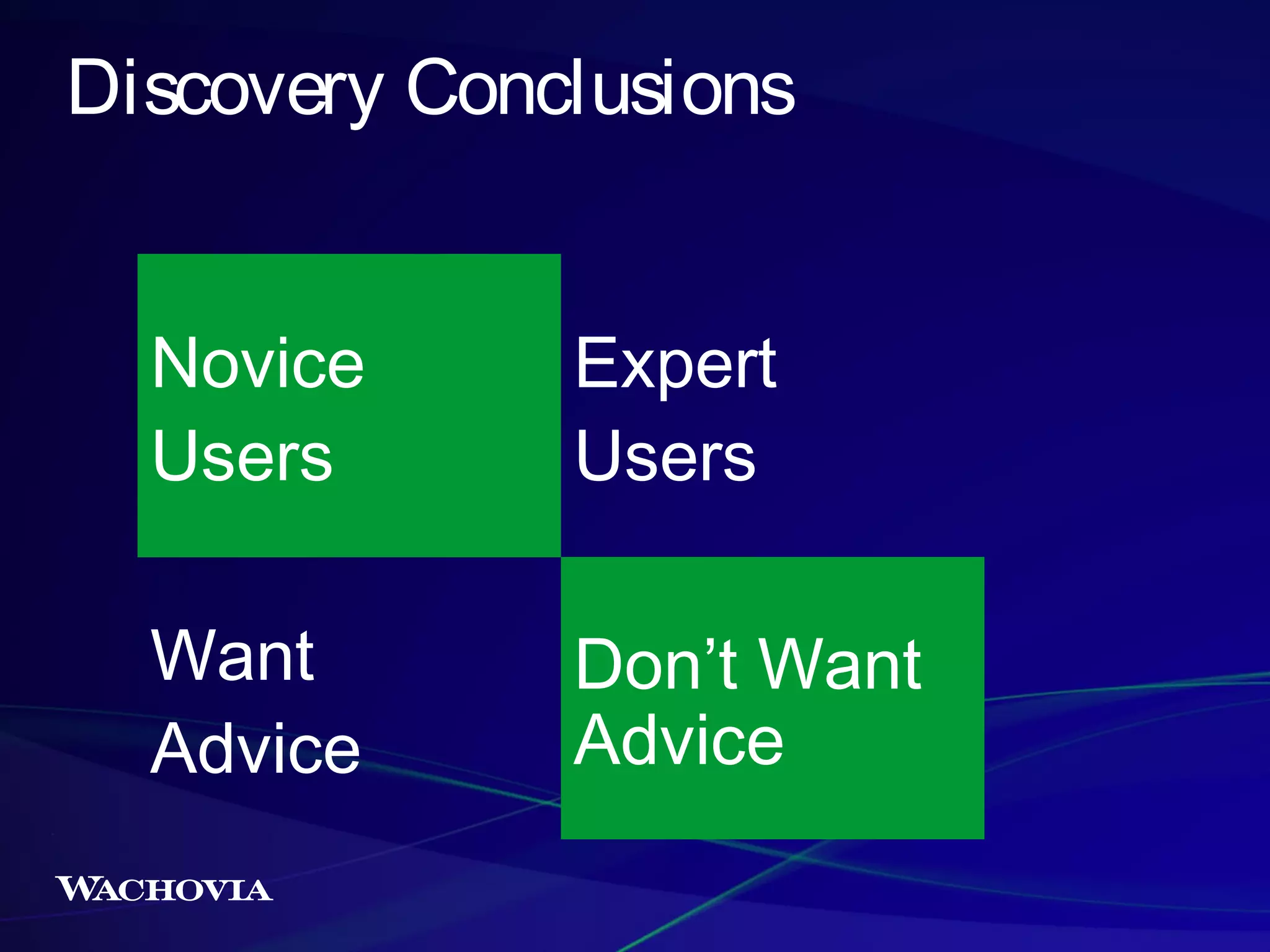
User configurations

Novice
Users

Expert
Users

Want
Advice

Don’t Want
Advice
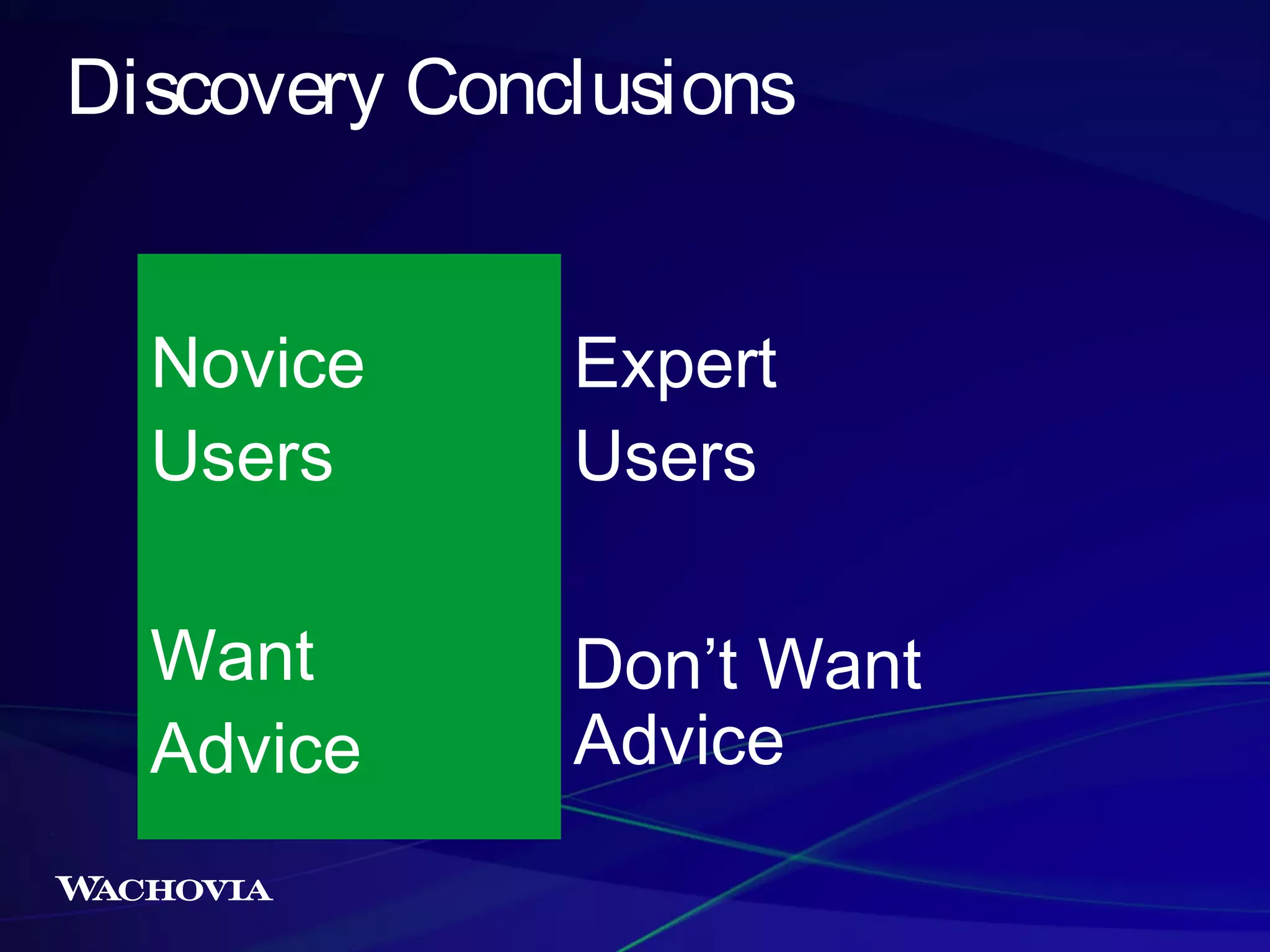
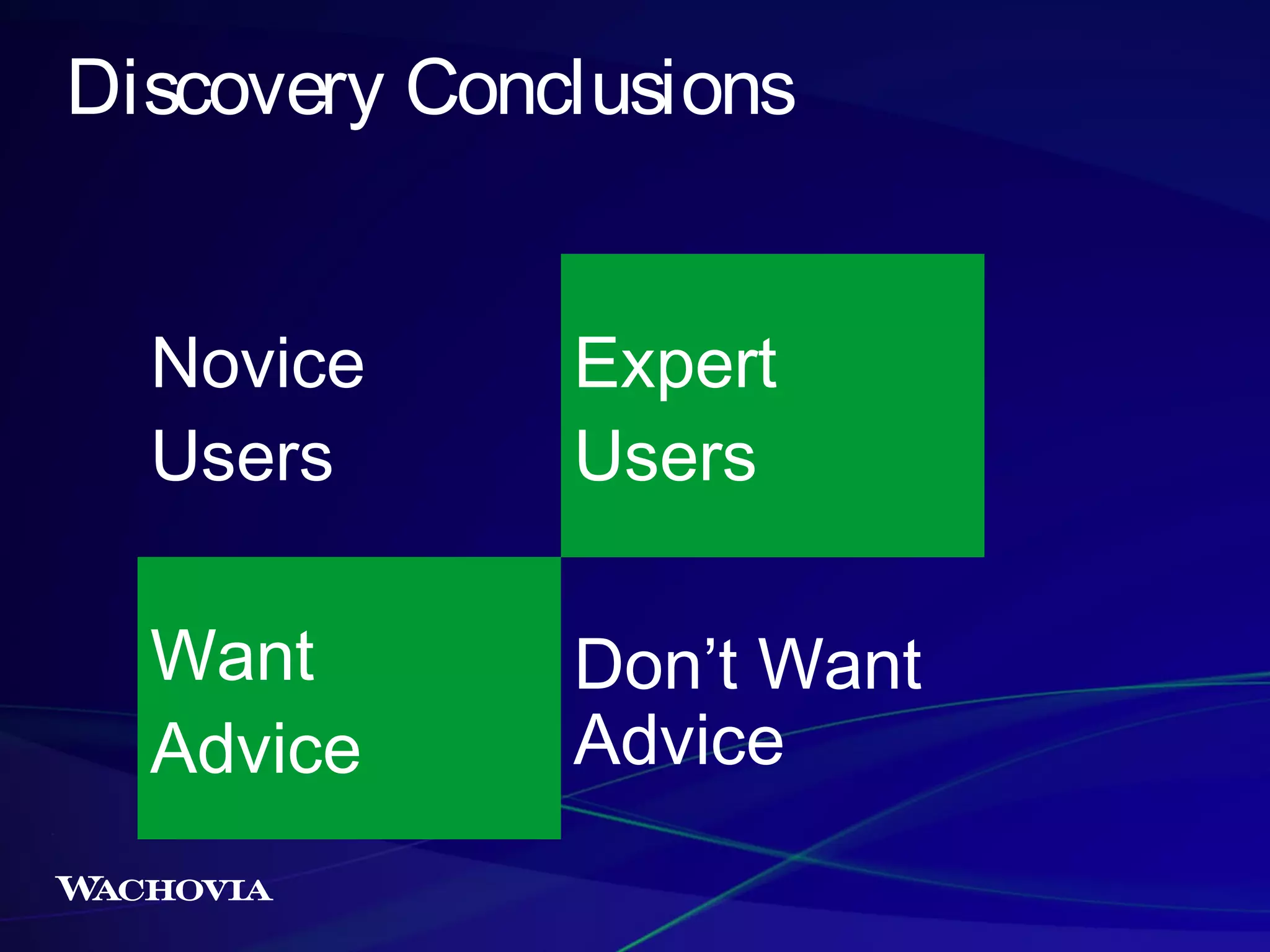
Discovery Conclusions
Novice
Users

Expert
Users

Want
Advice

Don’t Want
Advice
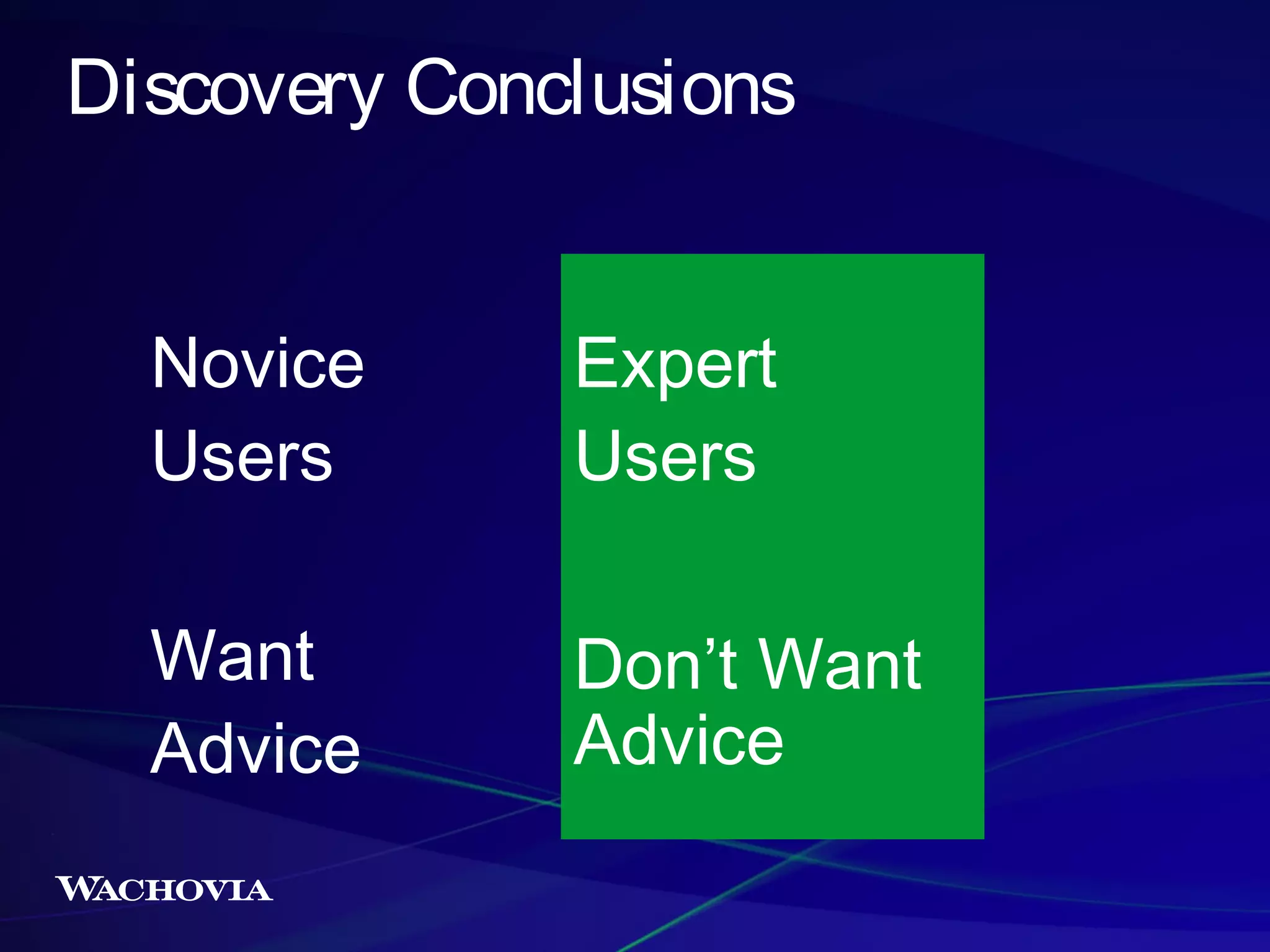
Discovery Conclusions
Novice
Users

Expert
Users

Want
Advice

Don’t Want
Advice
Discovery Conclusions
Novice
Users

Expert
Users

Want
Advice

Don’t Want
Advice
Discovery Conclusions
Novice
Users

Expert
Users

Want
Advice

Don’t Want
Advice
Discovery Conclusions
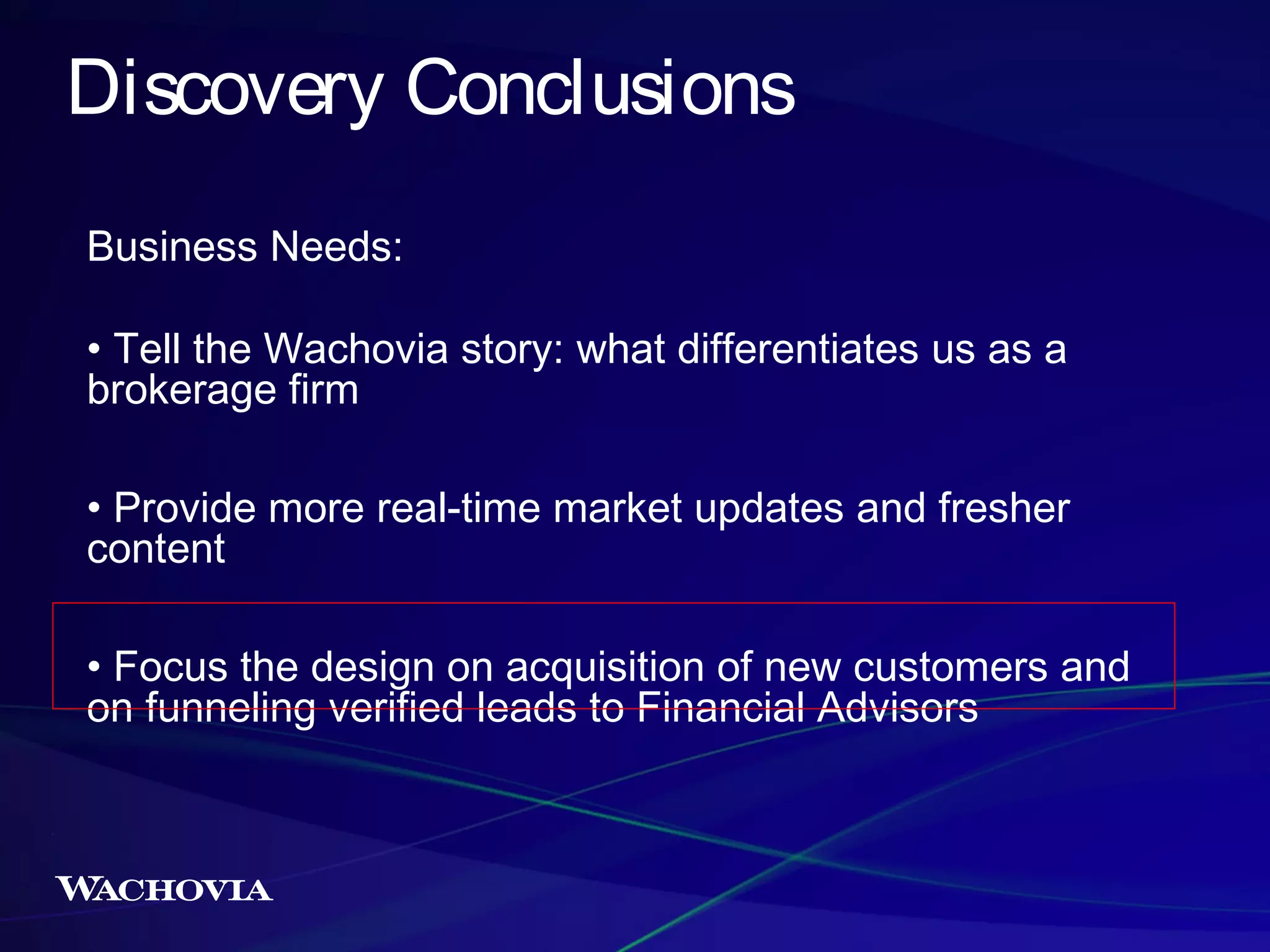
Business Needs:
• Tell the Wachovia story: what differentiates us as a
brokerage firm
• Provide more real-time market updates and fresher
content
• Focus the design on acquisition of new customers and
on funneling verified leads to Financial Advisors
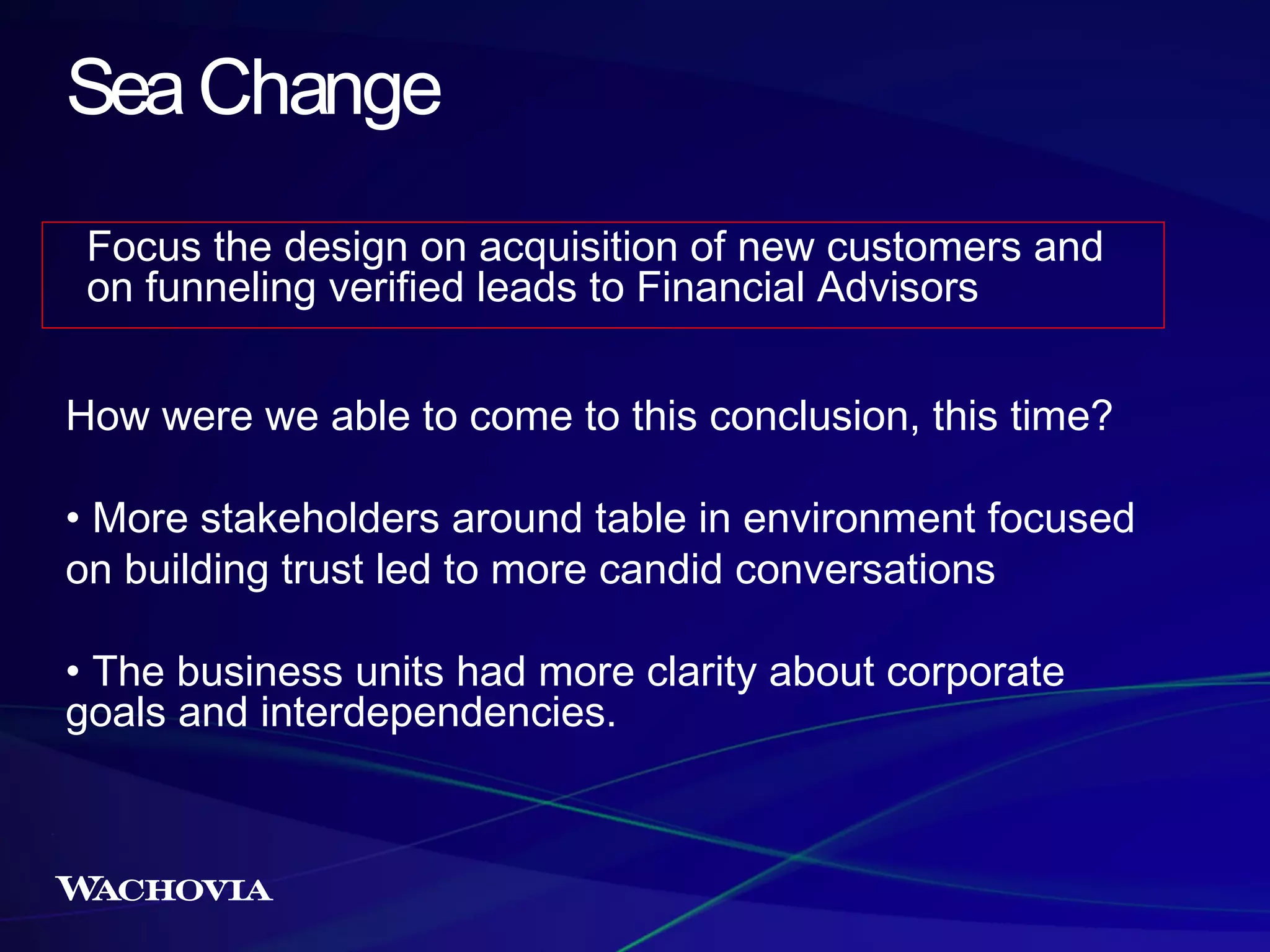
Sea Change
Focus the design on acquisition of new customers and
on funneling verified leads to Financial Advisors
How were we able to come to this conclusion, this time?
• More stakeholders around table in environment focused
on building trust led to more candid conversations
• The business units had more clarity about corporate
goals and interdependencies.
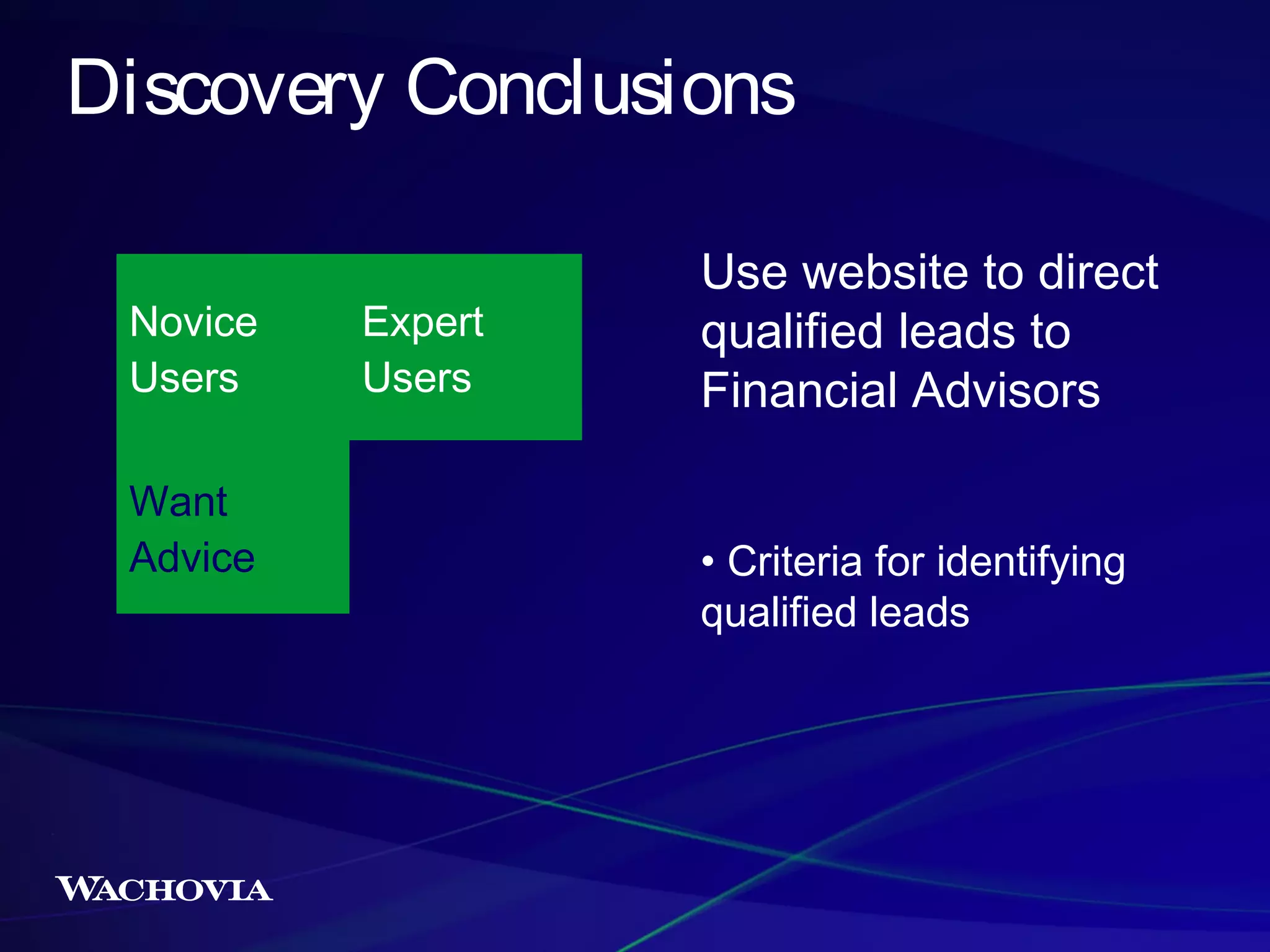
Discovery Conclusions
Novice
Users
Want
Advice

Expert
Users

Use website to direct
qualified leads to
Financial Advisors
• Criteria for identifying
qualified leads
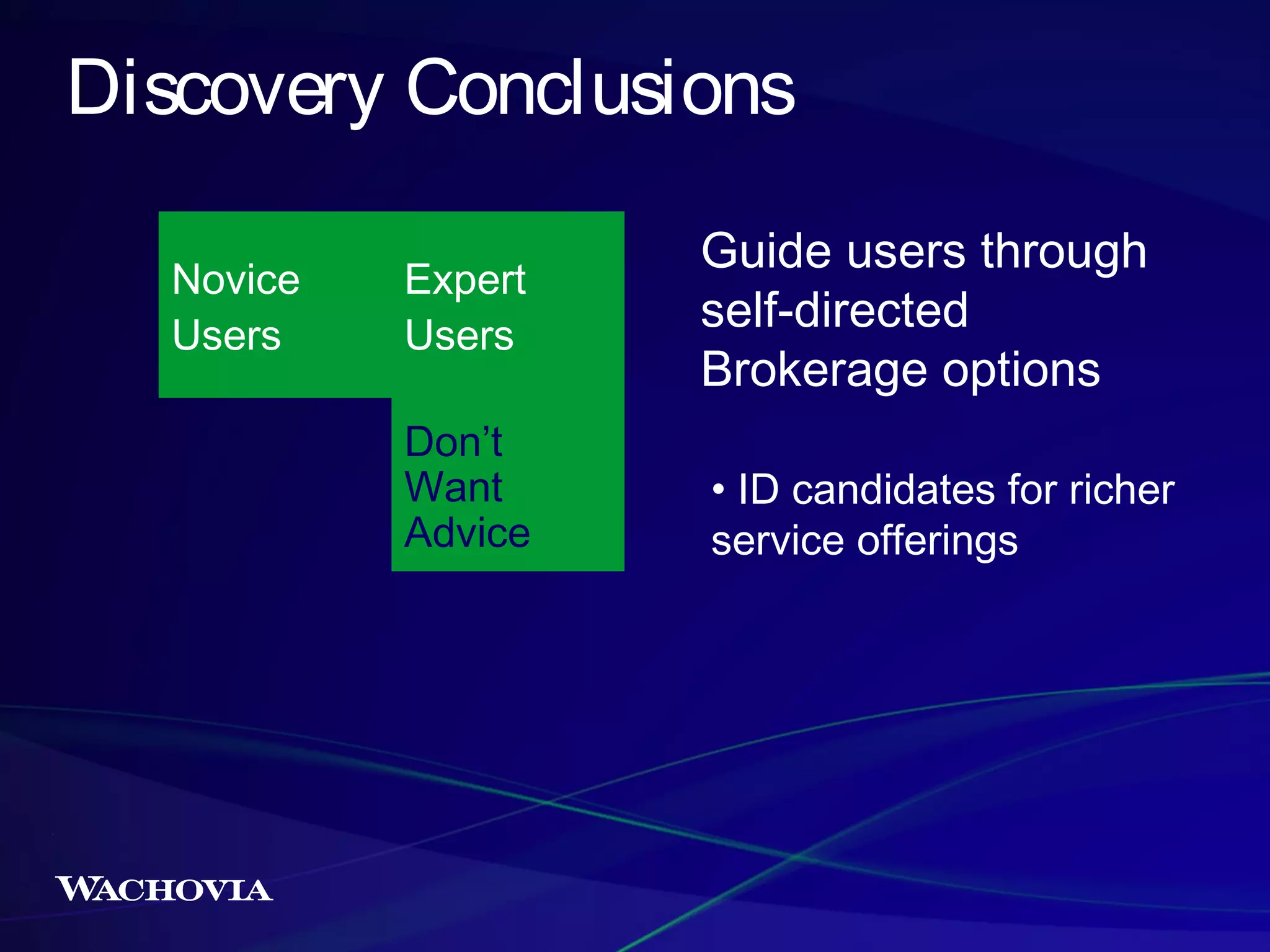
Discovery Conclusions
Novice
Users

Expert
Users
Don’t
Want
Advice

Guide users through
self-directed
Brokerage options
• ID candidates for richer
service offerings
Design
Three Approaches:
• Needs & Tasks (wizard)
• Filter
• Portal
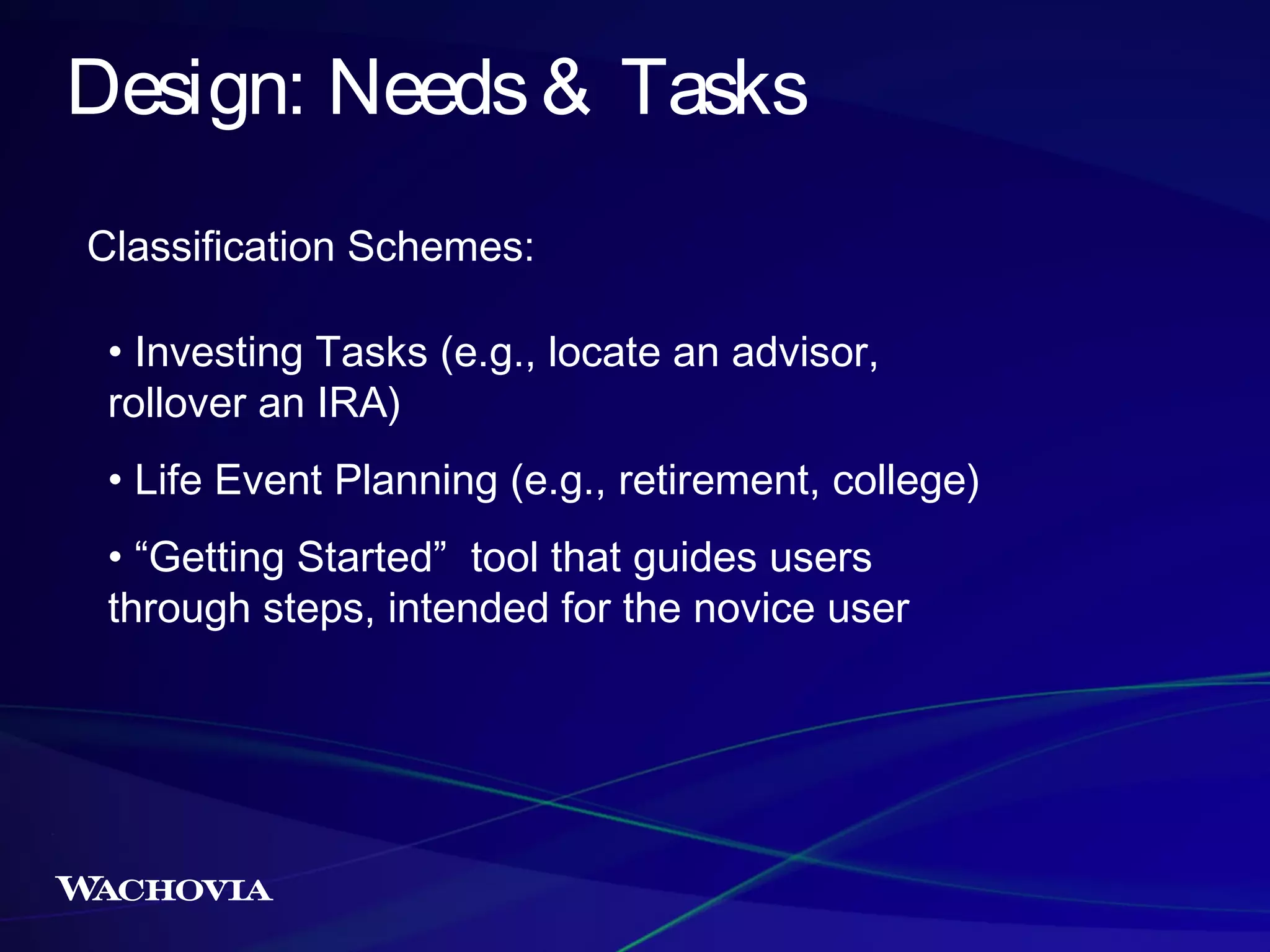
Design: Needs & Tasks
Classification Schemes:
• Investing Tasks (e.g., locate an advisor,
rollover an IRA)
• Life Event Planning (e.g., retirement, college)
• “Getting Started” tool that guides users
through steps, intended for the novice user
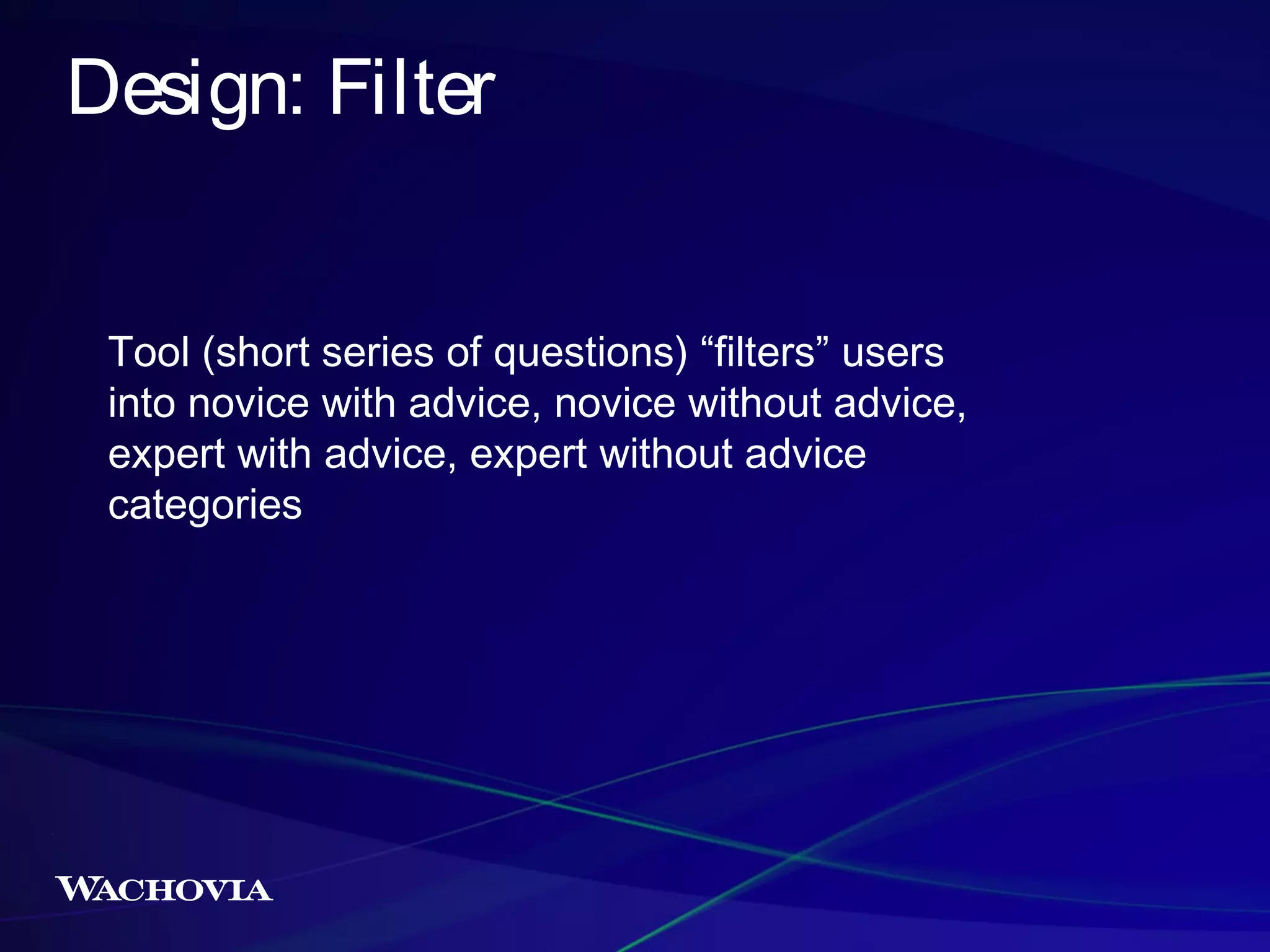
Design: Filter
Tool (short series of questions) “filters” users
into novice with advice, novice without advice,
expert with advice, expert without advice
categories
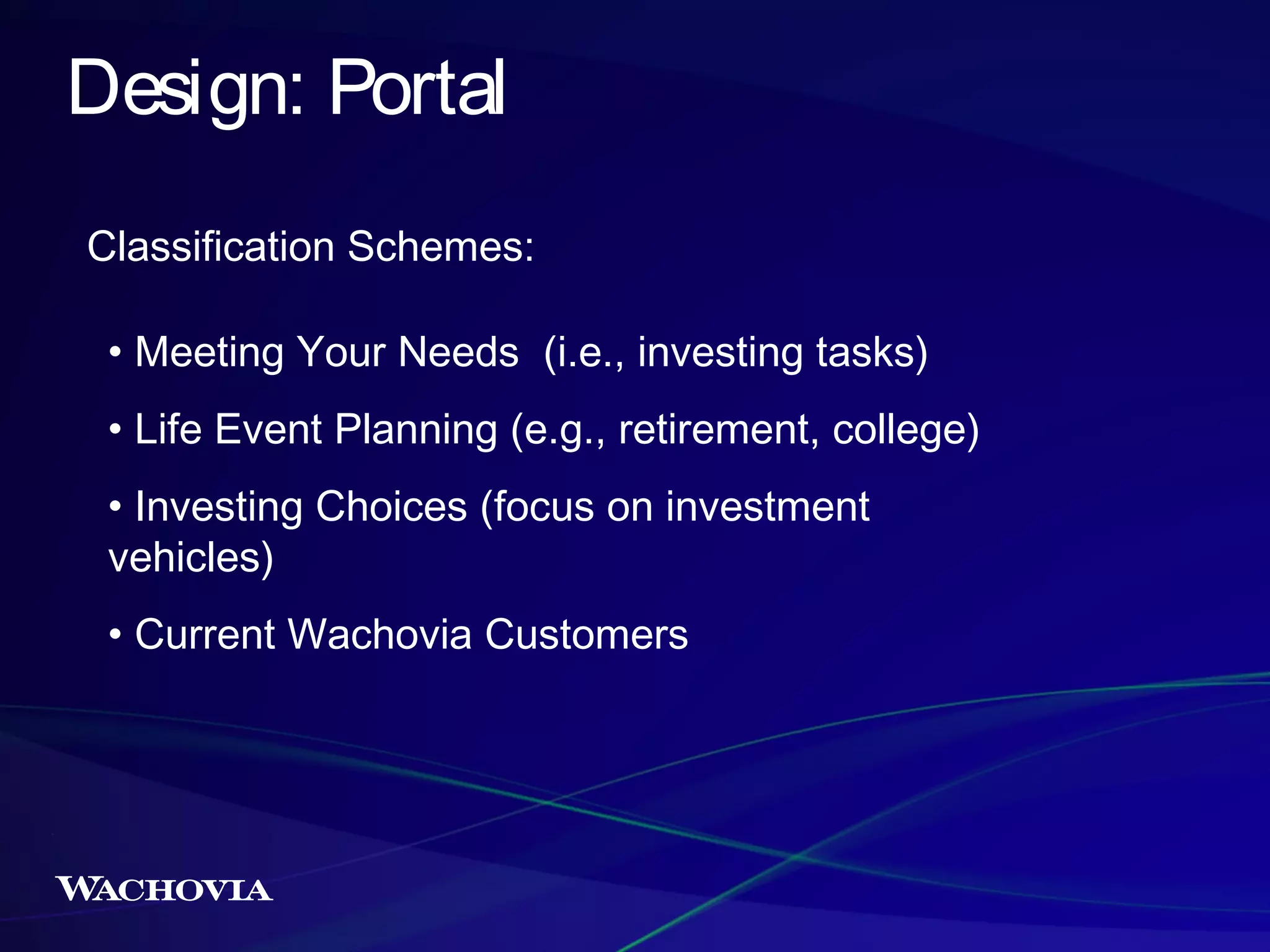
Design: Portal
Classification Schemes:
• Meeting Your Needs (i.e., investing tasks)
• Life Event Planning (e.g., retirement, college)
• Investing Choices (focus on investment
vehicles)
• Current Wachovia Customers
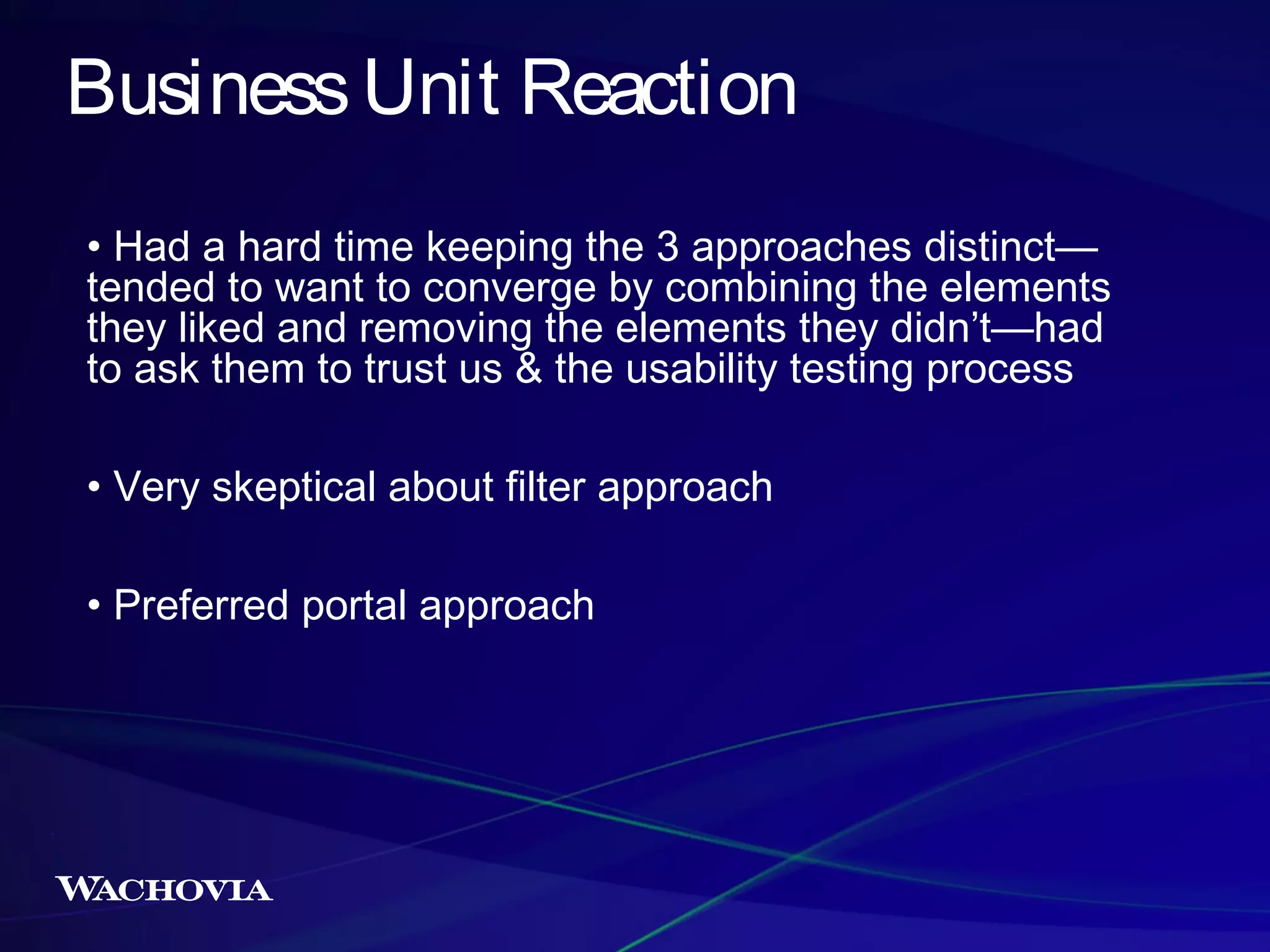
Business Unit Reaction
• Had a hard time keeping the 3 approaches distinct—
tended to want to converge by combining the elements
they liked and removing the elements they didn’t—had
to ask them to trust us & the usability testing process
• Very skeptical about filter approach
• Preferred portal approach
Trust Factors
• Looked for opportunities to demonstrate increased
SME
• Relied on our business partners for SME guidance
•Demonstrated points where our expertise was brought
to bear in unique ways
Usability Testing Results
Needs & Tasks
• Novice users responded extremely positively
to wizard (wanted to be sure it would be useful
to them and not just a tool to gather marketing
info)
• Expert users generally successful (skeptical
about wizard)
•Life Event Planning: generated high level of
appeal across board
Usability Testing Results
Filter
• Users rejected the filter—they felt confident
self-identifying the categories and either didn’t
like the idea of answering questions or only
wanted to do so if the result would be more
tangible (e.g., advice)
• Novice users were less clear about whether
or not they wanted advice
• Expert users readily self-identified
Usability Testing Results
Portal
• Those who didn’t like it felt there were too
many choices; others not bothered by this
• No one understood the Current Customer
category, didn’t like duplication in options
• Expert users liked the Investing Choices
category
Usability Testing Results
General Findings
• Users thought the Wachovia Story was
marketing and tended to ignore it
• Most expert users looking to other sources
(e.g., Motley Fool) for market data
• Looking for Fees & Commissions info.
• Novice users intimidated by market chart
• Novice users open to tools
Design Iteration
Hybrid:
• Provide Wizard front & center for novice
users
• I Want To… (task based)
• Accounts & Services
• Life Events Planning
• Investment Choices
Business Unit Reaction
• Confident about mix of options for novice
and expert users
• Liked portal aspect
• Appreciated Wachovia Story, Market
Research
• Fought for inclusion of Investment Choices
• Conceded to greater inclusion of Fees &
Commissions info
Project Debrief
“You included us in the process too much.”
Conclusion—for us
• Rebuilding trust required focusing as much effort on
nurturing the relationship as on our design efforts
• The final product is a user-centered design that we
expect to be popular with our users
• The relationship with the business unit is such that we
look forward to working with them in the future (and
hope they feel the same way)
Conclusion—for you
• Examine situation from every angle; decide what
you’re willing to “own”
• Balance eating humble pie with reputation
management
• Anticipate the effort required in relationship
management as part of the project planning process
• Don’t underestimate the importance of SME
• Use usability testing to validate recommendations
Contact Information
Samantha Bailey
VP, Information Architecture
samantha.bailey@wachovia.com
COPYRIGHT Wachovia CONFIDENTIAL

Rebuilding Trust in the User Centered Design Process, IA Summit 2-28-04

  • 1.
    Rebuilding Trust inthe User-Centered Design Process Samantha Bailey, Vice President, Information Architecture COPYRIGHT Wachovia CONFIDENTIAL
  • 2.
    For the Record •I’ma librarian who works in digital spaces •Currently: VP, Information Architecture for Wachovia •Pioneer in IA: First employee of Argus Associates, spent 5 years there developing their operation & methodology •MILS from University of Michigan, 1996 http://www.mcphee.com/amusements/current/11247.html
  • 3.
    Overview What went wrong Howwe addressed it How do we keep from doing it (wrong) again? What can you learn from our mistakes?
  • 4.
    Background Team structure &how we work with our internal partners Relationship between Bank & Brokerage (Wachovia.com and Wachoviasecurities.com) Internal Competition (“full service” vs. “self-directed”) Audience: mix of novice & expert, variety of investing needs
  • 5.
    We used auser-centered design methodology, how come we got a site no one was happy with?
  • 6.
    Initial Design Process Whenuser-centered design…isn’t Weaknesses: • Investing center as subset of much larger project • Internal politics and corporate flux (merger) • Working relationship • Shared understanding of goals & methodology • Our level of subject matter expertise “You didn’t include us enough in the process.”
  • 7.
  • 8.
    Usability Test Results TestedWachovia.com site during site-wide redesign; users could successfully locate the investing center, but couldn’t successfully navigate it Users don’t understand menu structure (select one, series of steps) Novice users particularly confused Expert users don’t find scheme intuitive either “If I were looking for advice on where to start, I’m not sure this would be helpful at all.” “Wording seems to be confusing.” Knows she wants to invest in stocks. Comes here to determine whether or not she can purchase stock through Wachovia. She isn’t sure.
  • 9.
    It’ s humblingto plan the redesign of a redesign before the redesign launches.
  • 10.
    Laying the Groundwork Pre-Discovery •Understanding why the first attempt failed (humble pie issues) • Time delays worked to our advantage • Relationship building • Establishing new working agreement - Increased BU involvement - More sign-off points
  • 11.
    Redesigning the InvestingCenter Phases: Standard UE Process • (pre Discovery) • Discovery • Design • Usability Testing • Iteration • Development & Implementation
  • 12.
    Redesigning the InvestingCenter Phase Goal Discovery Improve understanding of customer’s & business needs Design Design several versions Usability Testing Test for most successful Iteration Design best of breed hybrid Development & Implementation
  • 13.
    Trust Factor If thiswas to be a pretty typical methodology, how was trust increased (and why did we expect a different outcome)? • Communication—it’s cliché, but can’t be stressed enough • Repetition—didn’t rely on trickle down (luxury of time) • Pushed back on requests to compress discovery
  • 14.
    Redesigning the InvestingCenter Discovery • Clarifying the business needs • Clarifying user expectations (conducted interviews with Financial Advisors and customers) • Involving the business in the process—asking for specific kinds of engagement
  • 15.
  • 16.
  • 17.
  • 18.
  • 19.
  • 20.
    Discovery Conclusions Business Needs: •Tell the Wachovia story: what differentiates us as a brokerage firm • Provide more real-time market updates and fresher content • Focus the design on acquisition of new customers and on funneling verified leads to Financial Advisors
  • 21.
    Sea Change Focus thedesign on acquisition of new customers and on funneling verified leads to Financial Advisors How were we able to come to this conclusion, this time? • More stakeholders around table in environment focused on building trust led to more candid conversations • The business units had more clarity about corporate goals and interdependencies.
  • 22.
    Discovery Conclusions Novice Users Want Advice Expert Users Use websiteto direct qualified leads to Financial Advisors • Criteria for identifying qualified leads
  • 23.
    Discovery Conclusions Novice Users Expert Users Don’t Want Advice Guide usersthrough self-directed Brokerage options • ID candidates for richer service offerings
  • 24.
    Design Three Approaches: • Needs& Tasks (wizard) • Filter • Portal
  • 25.
    Design: Needs &Tasks Classification Schemes: • Investing Tasks (e.g., locate an advisor, rollover an IRA) • Life Event Planning (e.g., retirement, college) • “Getting Started” tool that guides users through steps, intended for the novice user
  • 26.
    Design: Filter Tool (shortseries of questions) “filters” users into novice with advice, novice without advice, expert with advice, expert without advice categories
  • 27.
    Design: Portal Classification Schemes: •Meeting Your Needs (i.e., investing tasks) • Life Event Planning (e.g., retirement, college) • Investing Choices (focus on investment vehicles) • Current Wachovia Customers
  • 28.
    Business Unit Reaction •Had a hard time keeping the 3 approaches distinct— tended to want to converge by combining the elements they liked and removing the elements they didn’t—had to ask them to trust us & the usability testing process • Very skeptical about filter approach • Preferred portal approach
  • 29.
    Trust Factors • Lookedfor opportunities to demonstrate increased SME • Relied on our business partners for SME guidance •Demonstrated points where our expertise was brought to bear in unique ways
  • 30.
    Usability Testing Results Needs& Tasks • Novice users responded extremely positively to wizard (wanted to be sure it would be useful to them and not just a tool to gather marketing info) • Expert users generally successful (skeptical about wizard) •Life Event Planning: generated high level of appeal across board
  • 31.
    Usability Testing Results Filter •Users rejected the filter—they felt confident self-identifying the categories and either didn’t like the idea of answering questions or only wanted to do so if the result would be more tangible (e.g., advice) • Novice users were less clear about whether or not they wanted advice • Expert users readily self-identified
  • 32.
    Usability Testing Results Portal •Those who didn’t like it felt there were too many choices; others not bothered by this • No one understood the Current Customer category, didn’t like duplication in options • Expert users liked the Investing Choices category
  • 33.
    Usability Testing Results GeneralFindings • Users thought the Wachovia Story was marketing and tended to ignore it • Most expert users looking to other sources (e.g., Motley Fool) for market data • Looking for Fees & Commissions info. • Novice users intimidated by market chart • Novice users open to tools
  • 34.
    Design Iteration Hybrid: • ProvideWizard front & center for novice users • I Want To… (task based) • Accounts & Services • Life Events Planning • Investment Choices
  • 35.
    Business Unit Reaction •Confident about mix of options for novice and expert users • Liked portal aspect • Appreciated Wachovia Story, Market Research • Fought for inclusion of Investment Choices • Conceded to greater inclusion of Fees & Commissions info
  • 36.
    Project Debrief “You includedus in the process too much.”
  • 37.
    Conclusion—for us • Rebuildingtrust required focusing as much effort on nurturing the relationship as on our design efforts • The final product is a user-centered design that we expect to be popular with our users • The relationship with the business unit is such that we look forward to working with them in the future (and hope they feel the same way)
  • 38.
    Conclusion—for you • Examinesituation from every angle; decide what you’re willing to “own” • Balance eating humble pie with reputation management • Anticipate the effort required in relationship management as part of the project planning process • Don’t underestimate the importance of SME • Use usability testing to validate recommendations
  • 39.
    Contact Information Samantha Bailey VP,Information Architecture samantha.bailey@wachovia.com
  • 40.