TYPE OF COOKING EQUIPMENTS
TYPE OF OVENS
TYPE OF PROCESSING EQUIPMENT
TYPE OF HOLDING AND STORAGE EQUIPMENT
TYPE OF POTS, PANS AND CONTAINERS
TYPE OF MEASURING DEVICES.
TYPE OF KNIVES, HAND TOOLS AND SMALL
EQUIPMENTS.
1.1. Cooking Equipment
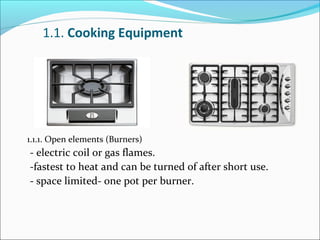
1.1.1. Open elements (Burners)
- electric coil or gas flames.
-fastest to heat and can be turned of after short use.
- space limited- one pot per burner.
1.1.2. Flattop Or Hot Top (lightweight)
-Burner covered with steel plate.
-more cook space is available.
-will support moderately heavy weights.
1.1.3. Heavy Duty Flattop
-Burner covered with cast plate.
-top support many heavy pots.
-set burners for different level and adjust cooking heat
by moving pot to different spots on the top.
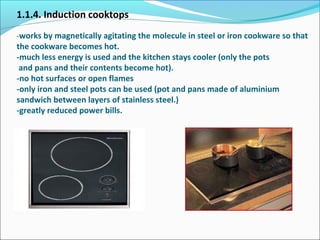
1.1.4. Induction cooktops
-works by magnetically agitating the molecule in steel or iron cookware so that
the cookware becomes hot.
-much less energy is used and the kitchen stays cooler (only the pots
and pans and their contents become hot).
-no hot surfaces or open flames
-only iron and steel pots can be used (pot and pans made of aluminium
sandwich between layers of stainless steel.)
-greatly reduced power bills.
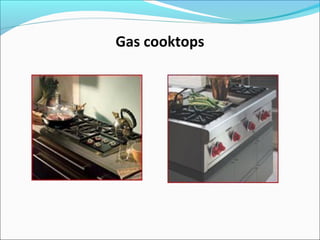
Gas cooktops
Electric cooktops
1.2. Oven
 Conventional Ovens
 Operate simply by heating air in an
enclosed space.
 Convection Ovens
 Contain fans that circulate the air and
distribute the heat rapidly throughout
the interior.
 Revolving Ovens
 Slow-cook-and- hold ovens
 Combination steamer ovens
 Barbecue ovens or smoke ovens
 Infrared or reconstituting ovens
 Microwave ovens
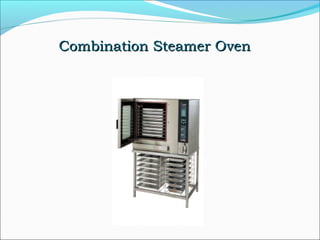
Combination Steamer OvenCombination Steamer Oven
Offers the health benefits of steam cooking to foods that are
roasted, grilled and even baked.
It helps reduce the fat in many kinds of meat and poultry—
without compromising on flavor, or appearance.
A unique combination of conventional heat with superheated
steam makes this healthy way of cooking possible.
It surrounds the food, transferring heat as the steam condenses
and melts fat away.
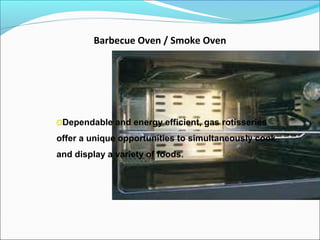
Barbecue Oven / Smoke Oven
oDependable and energy efficient, gas rotisseries
offer a unique opportunities to simultaneously cook
and display a variety of foods.
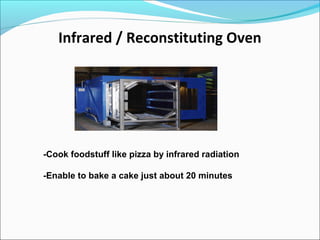
Infrared / Reconstituting Oven
-Cook foodstuff like pizza by infrared radiation
-Enable to bake a cake just about 20 minutes
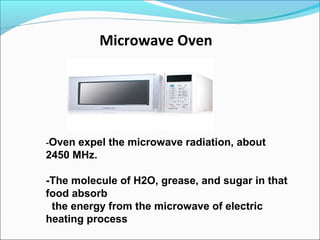
Microwave Oven
--Oven expel the microwave radiation, about
2450 MHz.
-The molecule of H2O, grease, and sugar in that
food absorb
the energy from the microwave of electric
heating process
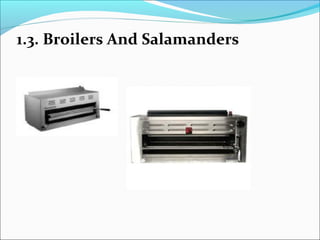
1.3. Broilers And Salamanders
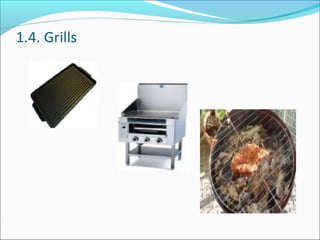
1.4. Grills
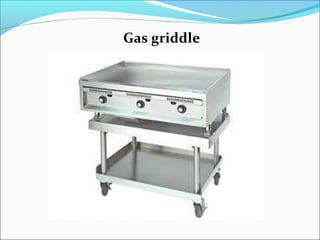
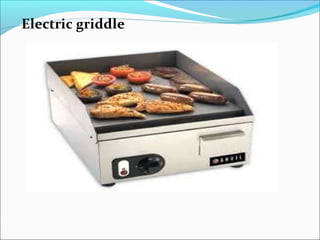
1.5. Griddles
Foodservices use either gas or electric griddles.
Stand alone on a platform or as part of a ranges.
Available in a heavy round or rectangular surface.
There are groove or indentation around the edge which allow
grease to drain away.
Splash guards contain grease on the griddle surface.
Food are usually cooked directly on the griddle surface.
Function
prepare large quantity of fried products
quickly and with a minimum of labor.
e.g french toast, pancake, hamburgers, meats and others
Gas griddle
Electric griddle
1.6. Deep Fryers
- A deep fryers are used to fry food in hot fat.
- Commonly used in fast food establishment and chips shops also for
home use.
- The fryers may be either gas or electric.
 Types of fryers.
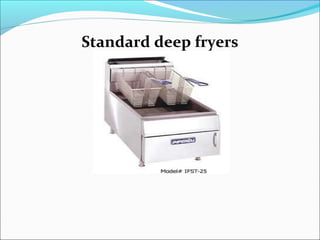
i). standard deep fryers
powered by either gas or electricity and have thermostatic
controls that maintain fat at preset temperatures.
ii). Automatic fryers
food from the fat are automatically removed after a preset
time.
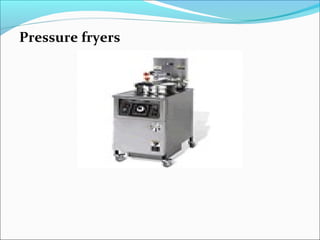
iii). Pressure fryers
covered fry kettles that fry foods under pressure.
foods cook faster, even at lower fat temperature.
Standard deep fryers
Pressure fryers
1.7 Steam Cookers
Types of steam cookers.
1. Pressure steamers.
Cook food under a pressure.
Low-compression – compartmented units operating at 5 to 7
psi (pounds per square inch).
- high volume production.
- hold up to six 12” x 20” pans in each
compartment .
- one to three compartment models
are available
High-compression - compartment units operating at 15 to 17
psi.
- use smaller pans but cook much more
rapidly.
- one compartment models are available.
Pressureless or convection steamer.
Food do not cooked under pressure.
Closed system – allow the steam to build pressure inside the
cooking compartment.
Since pressure does not build up, the door of the
compartment can be opened at anytime.
1.8. Processing Equipment
 Mixers
 Food Cutter
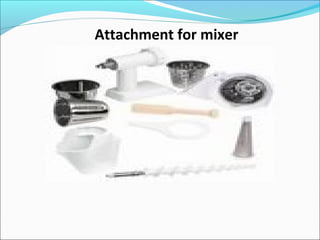
 Attachments For Mixers And Food Choppers
 Slicer
 Food Processor
Food cutter
Attachment for mixer
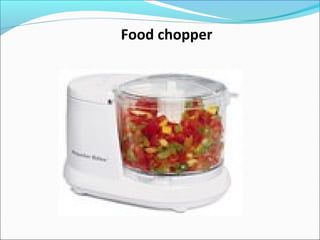
Food chopper
Slicer
Slicer is use to cut meat ,bread cheese or raw
vegetables into uniform slices.
there are 2 types of slicer.
Electric slicer and manual slicer.
Slice thickness is determined by the distance
between the blade and the carrier
Slicer is convenient for preparing moderate to large
quantities of food
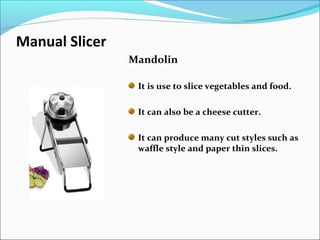
Manual Slicer
Mandolin
It is use to slice vegetables and food.
It can also be a cheese cutter.
It can produce many cut styles such as
waffle style and paper thin slices.
Tomato Slicer Ham Slicer
Cheese Slicer
Avocado Slicer
Egg Slicer
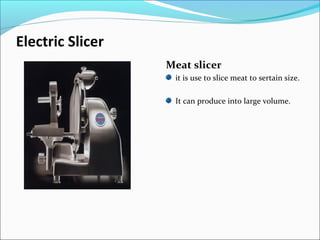
Electric Slicer
Meat slicer
it is use to slice meat to sertain size.
It can produce into large volume.
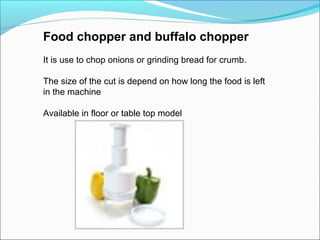
Food chopper and buffalo chopper
It is use to chop onions or grinding bread for crumb.
The size of the cut is depend on how long the food is left
in the machine
Available in floor or table top model
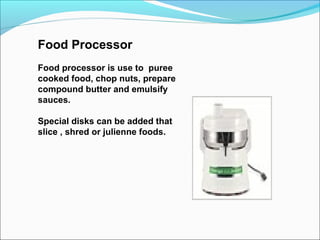
Food Processor
Food processor is use to puree
cooked food, chop nuts, prepare
compound butter and emulsify
sauces.
Special disks can be added that
slice , shred or julienne foods.
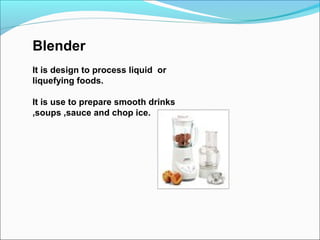
Blender
It is design to process liquid or
liquefying foods.
It is use to prepare smooth drinks
,soups ,sauce and chop ice.
Mixer
There are 3 common types of mixer.
The whip (use for whipping egg or
cream)
The paddle (use for general mixing)
The dough hook (use for kneading
bread)
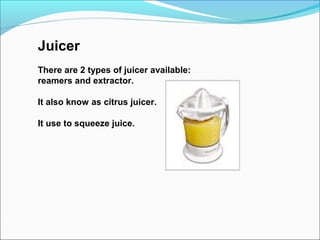
Juicer
There are 2 types of juicer available:
reamers and extractor.
It also know as citrus juicer.
It use to squeeze juice.
1.9. Holding And Storage Equipment
Hot Food Holding Equipment
Cold Food Storage Equipment
1.10. Pots, Pans And Containers
Metal And Conductivity
Pot And Pans And Their Uses
 Stockpot
 Saucepot
 Brazier
 Saucepan
 Sautepan
 Bake pan
 Roasting pan
 Bain-marie insert
 Stainless bowl
Roasting Pan
The Use Of Roasting Pan
Roast meats, poultry and even fish.
Make great gravy or pan sauces.
Braise meats, poultry and vegetables.
Roast potatoes and other vegetables
Bake big batches of lasagne,enchiladas,shepher’s pie
or cobbler.
Use the pan as a water both for baking custard or
soufflés.
Sauce Pan
 Sauce pan or just “pot” are vessels with vertical
sides about the same height as their diameter.
 Measured by volume.
 Sauce pots often resemble Dutch oven in shape.
 Ironically, sauce pan is not the ideal vessel to use
for making sauces.
 More efficient to use saucepan with sloping sides,
called windsor pans or sauce pan with rounded
sides, called sauciers.
 These provide quicker evaporation than straight
sided pans and make it easier to stir a sauce while
reducing.
 Most of the sauce pan used for simmering or
boiling.
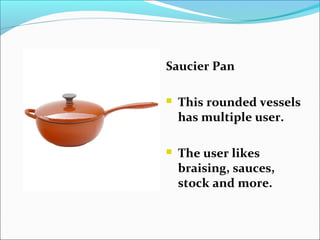
Saucier Pan
 This rounded vessels
has multiple user.
 The user likes
braising, sauces,
stock and more.
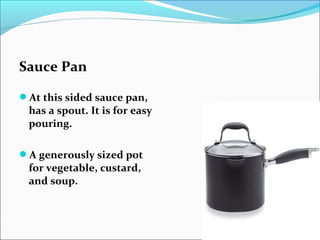
Sauce Pan
At this sided sauce pan,
has a spout. It is for easy
pouring.
A generously sized pot
for vegetable, custard,
and soup.
This sauce pan is
suitable for soup and
stews.
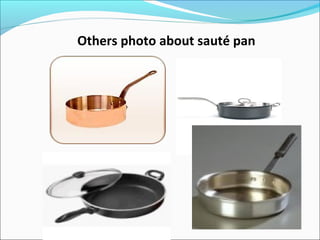
Sauté Pan
The saute pan always use for sautéing.
It have a large surface area, like a fry pan, but with
vertical sided.
It is to prevent food from escaping during cooking.
Others photo about sauté pan
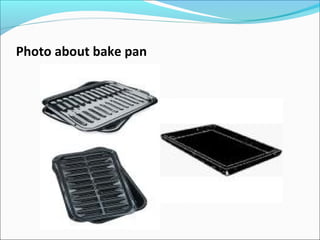
Bake Pan
Baking pan are designed for use in the oven (for
baking) and encompass a variety of different style of
bake ware such as cake pans, pie pans, and loaf pans.
These are often made from light or medium gauge
metal.
The longest lasting baking sheets and pans are made
with heavy-gauged steel aluminium. They are heavier
in weight which helps in heat distribution and
prevents the metal from warping.
Photo about bake pan
1.11. Measuring Devices-
scales, volume measure, measuring spoons,ladles,scoops
and thermometers measure temperatures.
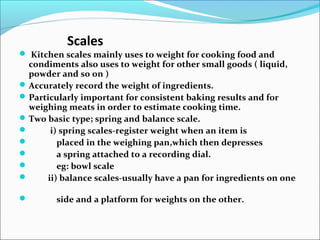
Scales
 Kitchen scales mainly uses to weight for cooking food and
condiments also uses to weight for other small goods ( liquid,
powder and so on )
Accurately record the weight of ingredients.
Particularly important for consistent baking results and for
weighing meats in order to estimate cooking time.
Two basic type; spring and balance scale.
 i) spring scales-register weight when an item is
 placed in the weighing pan,which then depresses
 a spring attached to a recording dial.
 eg: bowl scale
 ii) balance scales-usually have a pan for ingredients on one
 side and a platform for weights on the other.
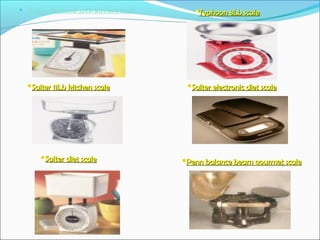
 Salter chromed 22Lb kitchen scale
Salter 11Lb kitchen scaleSalter 11Lb kitchen scale
Typhoon 8Lb scaleTyphoon 8Lb scale
Salter electronic diet scaleSalter electronic diet scale
Salter diet scaleSalter diet scale Penn balance beam gourmet scalePenn balance beam gourmet scale
Measuring Spoons
A measuring spoon is a spoon used to measure an amount of a
substance, either liquid or dry when cooking.
Measuring spoons may be made of plastic, metal, and other
material.
They are available in many size ,including teaspoon and table
spoon.
Type of measuring spoons :
 Dash pinch smidgen Narrow stainlessNarrow stainless Round stainlessRound stainless
Splash stainlessSplash stainless HeartsHearts Odd size stainlessOdd size stainless
Nigella lawsonNigella lawson Sleekstor swivelSleekstor swivel
1.12. Knives
Types of Knives and their uses
-French knife, salad knife, paring knife, boning knife,
slicer,serrated slicer, butcher knife, steak knife,cleaver,
oysters knife and etc.
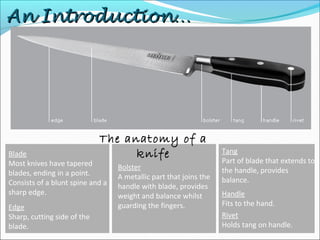
An Introduction…An Introduction…
The anatomy of a
knifeBlade
Most knives have tapered
blades, ending in a point.
Consists of a blunt spine and a
sharp edge.
Edge
Sharp, cutting side of the
blade.
Bolster
A metallic part that joins the
handle with blade, provides
weight and balance whilst
guarding the fingers.
Tang
Part of blade that extends to
the handle, provides
balance.
Handle
Fits to the hand.
Rivet
Holds tang on handle.
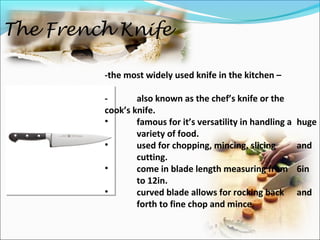
The French Knife
-the most widely used knife in the kitchen –
- also known as the chef’s knife or the
cook’s knife.
• famous for it’s versatility in handling a huge
variety of food.
• used for chopping, mincing, slicing and
cutting.
• come in blade length measuring from 6in
to 12in.
• curved blade allows for rocking back and
forth to fine chop and mince.
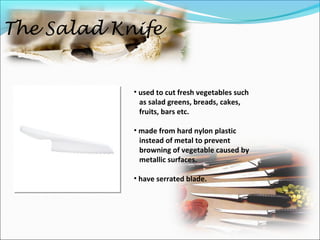
The Salad Knife
• used to cut fresh vegetables such
as salad greens, breads, cakes,
fruits, bars etc.
• made from hard nylon plastic
instead of metal to prevent
browning of vegetable caused by
metallic surfaces.
• have serrated blade.
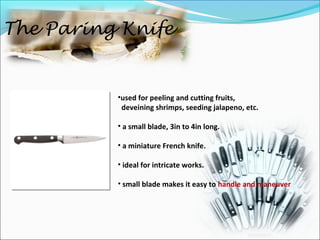
The Paring Knife
•used for peeling and cutting fruits,
deveining shrimps, seeding jalapeno, etc.
• a small blade, 3in to 4in long.
• a miniature French knife.
• ideal for intricate works.
• small blade makes it easy to handle and maneuver
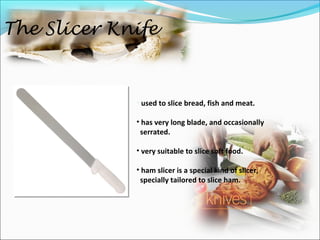
The Slicer Knife
• used to slice bread, fish and meat.
• has very long blade, and occasionally
serrated.
• very suitable to slice soft food.
• ham slicer is a special kind of slicer,
specially tailored to slice ham.
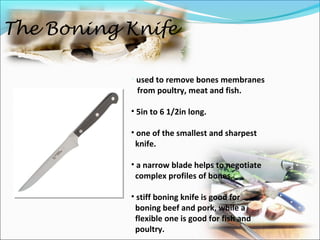
The Boning Knife
• used to remove bones membranes
from poultry, meat and fish.
• 5in to 6 1/2in long.
• one of the smallest and sharpest
knife.
• a narrow blade helps to negotiate
complex profiles of bones.
• stiff boning knife is good for
boning beef and pork, while a
flexible one is good for fish and
poultry.
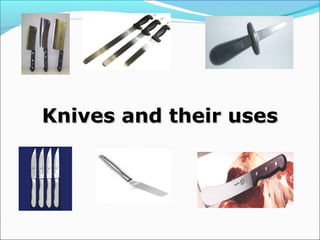
Knives and their usesKnives and their uses
 A kitchen knife is a knife that is intended to beA kitchen knife is a knife that is intended to be
used in food preparation.used in food preparation.
 There are also many specialized knives that areThere are also many specialized knives that are
designed for special task.designed for special task.
Kitchen KnifeKitchen Knife
 A kitchen knife is a knife that is intended to be usedA kitchen knife is a knife that is intended to be used
in food preparation.in food preparation.
 There are also many specialized knives that areThere are also many specialized knives that are
design for specific task.design for specific task.
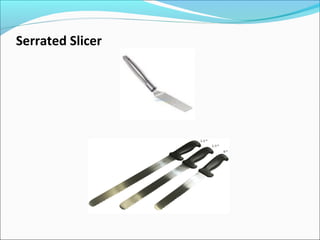
Serrated Slicer
As know as ‘bread knife’
Usually between 6 & 10 inches.
The serration on the blade make it ideal for cutting
bread and other thing that hard on the outside and
soft on the inside.
Used for slicing breads, cakes and pastries.
Great for thick-skinned fruits like pineapple and
watermelon.
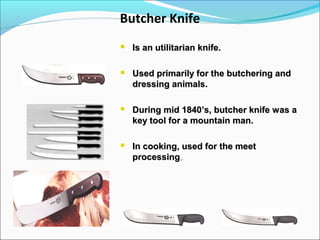
Butcher Knife
 Is an utilitarian knife.Is an utilitarian knife.
 Used primarily for the butchering andUsed primarily for the butchering and
dressing animals.dressing animals.
 During mid 1840’s, butcher knife was aDuring mid 1840’s, butcher knife was a
key tool for a mountain man.key tool for a mountain man.
 In cooking, used for the meetIn cooking, used for the meet
processingprocessing..
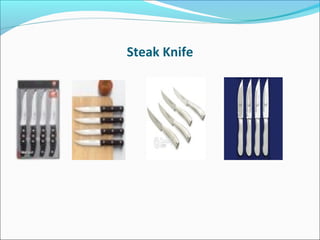
Steak Knife
Used at the table as opposed to the kitchen to cut through
especially tough food such as meet.
The blade usually about 4 to 6 inches long and can be wide or
thin, serrated or smooth.
Used for cutting steak, chicken and other main courses.
Cleaver
 Is a large knifeIs a large knife
 The blade usually 10-14 inches long.The blade usually 10-14 inches long.
 Chinese cleaver more thinner, usedChinese cleaver more thinner, used
for cutting and chopping, not hackingfor cutting and chopping, not hacking
with force.with force.
 Light cleaver used to slice meat,Light cleaver used to slice meat,
chop vegetable, flatten garlic bulbschop vegetable, flatten garlic bulbs
and carrying the ingredients.and carrying the ingredients.
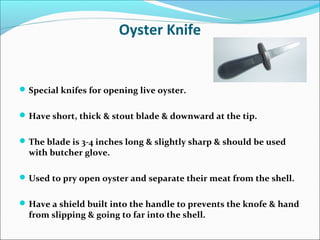
Oyster Knife
Special knifes for opening live oyster.
Have short, thick & stout blade & downward at the tip.
The blade is 3-4 inches long & slightly sharp & should be used
with butcher glove.
Used to pry open oyster and separate their meat from the shell.
Have a shield built into the handle to prevents the knofe & hand
from slipping & going to far into the shell.
1.13. Hand Tools And Small Equipment
Ball cutter,melon ball scoop, parisienne
knife, cook’s fork, straight spatula, offset
spatula, scraper, sandwich spreader and
etc.
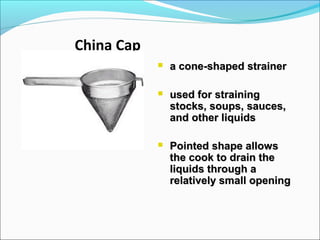
China Cap
 a cone-shaped strainera cone-shaped strainer
 used for strainingused for straining
stocks, soups, sauces,stocks, soups, sauces,
and other liquidsand other liquids
 Pointed shape allowsPointed shape allows
the cook to drain thethe cook to drain the
liquids through aliquids through a
relatively small openingrelatively small opening
Strainer
 a round-bottomed, cup-a round-bottomed, cup-
shaped strainer madeshaped strainer made
of screen-type mesh orof screen-type mesh or
of perforated metalof perforated metal
 used for strainingused for straining
pasta, vegetables, andpasta, vegetables, and
so onso on
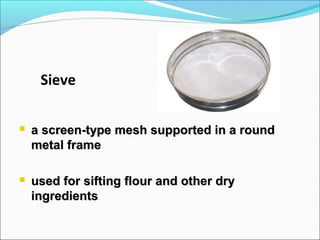
Sieve
 a screen-type mesh supported in a rounda screen-type mesh supported in a round
metal framemetal frame
 used for sifting flour and other dryused for sifting flour and other dry
ingredientsingredients
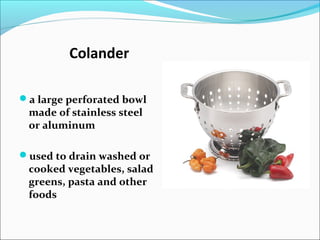
Colander
a large perforated bowl
made of stainless steel
or aluminum
used to drain washed or
cooked vegetables, salad
greens, pasta and other
foods
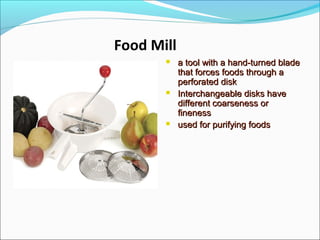
Food Mill
 a tool with a hand-turned bladea tool with a hand-turned blade
that forces foods through athat forces foods through a
perforated diskperforated disk
 Interchangeable disks haveInterchangeable disks have
different coarseness ordifferent coarseness or
finenessfineness
 used for purifying foodsused for purifying foods
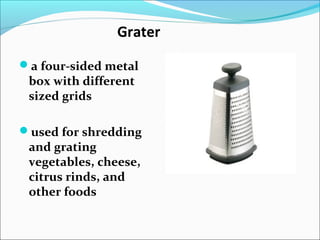
Grater
a four-sided metal
box with different
sized grids
used for shredding
and grating
vegetables, cheese,
citrus rinds, and
other foods
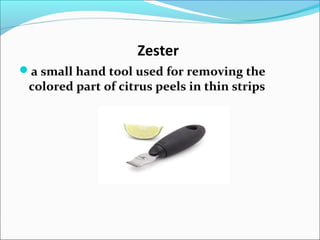
Zester
a small hand tool used for removing the
colored part of citrus peels in thin strips
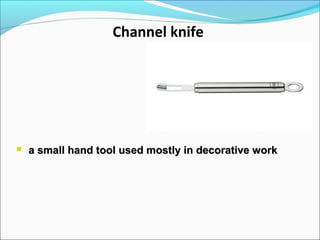
Channel knife
 a small hand tool used mostly in decorative worka small hand tool used mostly in decorative work
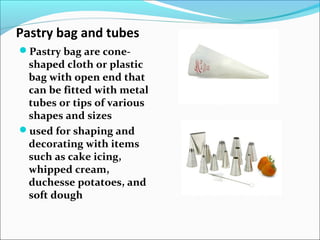
Pastry bag and tubes
Pastry bag are cone-
shaped cloth or plastic
bag with open end that
can be fitted with metal
tubes or tips of various
shapes and sizes
used for shaping and
decorating with items
such as cake icing,
whipped cream,
duchesse potatoes, and
soft dough
Pastry BagPastry Bag
Pastry TubesPastry Tubes
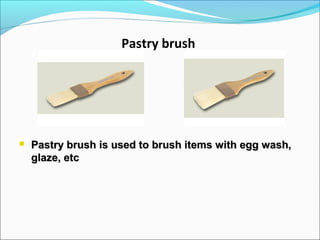
Pastry brush
 Pastry brush is used to brush items with egg wash,Pastry brush is used to brush items with egg wash,
glaze, etcglaze, etc
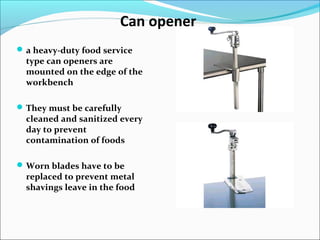
Can opener
a heavy-duty food service
type can openers are
mounted on the edge of the
workbench
They must be carefully
cleaned and sanitized every
day to prevent
contamination of foods
Worn blades have to be
replaced to prevent metal
shavings leave in the food
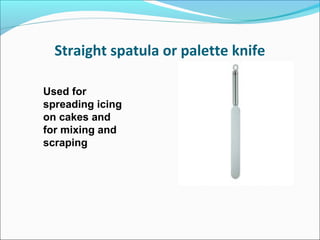
Straight spatula or palette knife
Used for
spreading icing
on cakes and
for mixing and
scraping
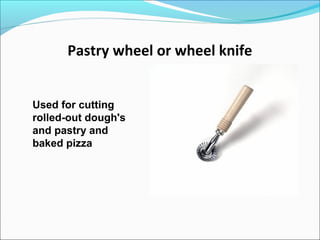
Pastry wheel or wheel knife
Used for cutting
rolled-out dough's
and pastry and
baked pizza
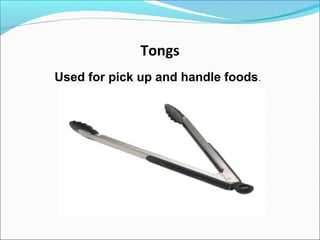
Tongs
Used for pick up and handle foods.
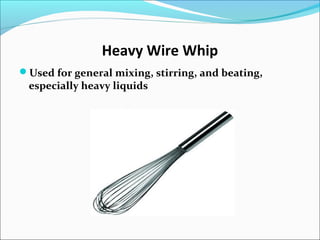
Heavy Wire Whip
Used for general mixing, stirring, and beating,
especially heavy liquids
Ladle
Plastic punch ladle steel ladle soup ladle
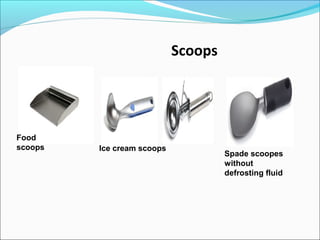
Scoops
Food
scoops Ice cream scoops
Spade scoopes
without
defrosting fluid
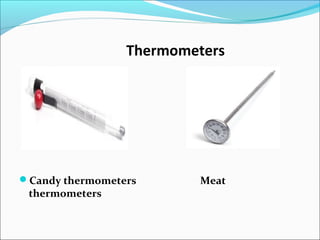
Thermometers
Candy thermometers Meat
thermometers
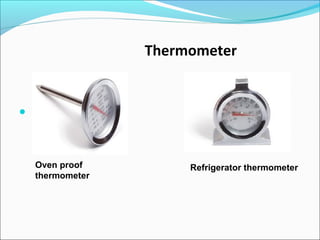
Thermometer

Oven proof
thermometer
Refrigerator thermometer

2.0 kitchen apparatus and equipment identification

  • 1.
    TYPE OF COOKINGEQUIPMENTS TYPE OF OVENS TYPE OF PROCESSING EQUIPMENT TYPE OF HOLDING AND STORAGE EQUIPMENT TYPE OF POTS, PANS AND CONTAINERS TYPE OF MEASURING DEVICES. TYPE OF KNIVES, HAND TOOLS AND SMALL EQUIPMENTS.
  • 2.
    1.1. Cooking Equipment 1.1.1.Open elements (Burners) - electric coil or gas flames. -fastest to heat and can be turned of after short use. - space limited- one pot per burner.
  • 3.
    1.1.2. Flattop OrHot Top (lightweight) -Burner covered with steel plate. -more cook space is available. -will support moderately heavy weights. 1.1.3. Heavy Duty Flattop -Burner covered with cast plate. -top support many heavy pots. -set burners for different level and adjust cooking heat by moving pot to different spots on the top.
  • 4.
    1.1.4. Induction cooktops -worksby magnetically agitating the molecule in steel or iron cookware so that the cookware becomes hot. -much less energy is used and the kitchen stays cooler (only the pots and pans and their contents become hot). -no hot surfaces or open flames -only iron and steel pots can be used (pot and pans made of aluminium sandwich between layers of stainless steel.) -greatly reduced power bills.
  • 5.
  • 6.
  • 7.
    1.2. Oven  ConventionalOvens  Operate simply by heating air in an enclosed space.  Convection Ovens  Contain fans that circulate the air and distribute the heat rapidly throughout the interior.  Revolving Ovens  Slow-cook-and- hold ovens  Combination steamer ovens  Barbecue ovens or smoke ovens  Infrared or reconstituting ovens  Microwave ovens
  • 8.
  • 9.
    Offers the healthbenefits of steam cooking to foods that are roasted, grilled and even baked. It helps reduce the fat in many kinds of meat and poultry— without compromising on flavor, or appearance. A unique combination of conventional heat with superheated steam makes this healthy way of cooking possible. It surrounds the food, transferring heat as the steam condenses and melts fat away.
  • 10.
    Barbecue Oven /Smoke Oven oDependable and energy efficient, gas rotisseries offer a unique opportunities to simultaneously cook and display a variety of foods.
  • 11.
    Infrared / ReconstitutingOven -Cook foodstuff like pizza by infrared radiation -Enable to bake a cake just about 20 minutes
  • 12.
    Microwave Oven --Oven expelthe microwave radiation, about 2450 MHz. -The molecule of H2O, grease, and sugar in that food absorb the energy from the microwave of electric heating process
  • 13.
    1.3. Broilers AndSalamanders
  • 14.
  • 15.
    1.5. Griddles Foodservices useeither gas or electric griddles. Stand alone on a platform or as part of a ranges. Available in a heavy round or rectangular surface. There are groove or indentation around the edge which allow grease to drain away. Splash guards contain grease on the griddle surface. Food are usually cooked directly on the griddle surface. Function prepare large quantity of fried products quickly and with a minimum of labor. e.g french toast, pancake, hamburgers, meats and others
  • 16.
  • 17.
  • 18.
    1.6. Deep Fryers -A deep fryers are used to fry food in hot fat. - Commonly used in fast food establishment and chips shops also for home use. - The fryers may be either gas or electric.  Types of fryers. i). standard deep fryers powered by either gas or electricity and have thermostatic controls that maintain fat at preset temperatures. ii). Automatic fryers food from the fat are automatically removed after a preset time. iii). Pressure fryers covered fry kettles that fry foods under pressure. foods cook faster, even at lower fat temperature.
  • 19.
  • 20.
  • 21.
    1.7 Steam Cookers Typesof steam cookers. 1. Pressure steamers. Cook food under a pressure. Low-compression – compartmented units operating at 5 to 7 psi (pounds per square inch). - high volume production. - hold up to six 12” x 20” pans in each compartment . - one to three compartment models are available
  • 22.
    High-compression - compartmentunits operating at 15 to 17 psi. - use smaller pans but cook much more rapidly. - one compartment models are available. Pressureless or convection steamer. Food do not cooked under pressure. Closed system – allow the steam to build pressure inside the cooking compartment. Since pressure does not build up, the door of the compartment can be opened at anytime.
  • 23.
    1.8. Processing Equipment Mixers  Food Cutter  Attachments For Mixers And Food Choppers  Slicer  Food Processor
  • 24.
  • 25.
  • 26.
  • 27.
    Slicer Slicer is useto cut meat ,bread cheese or raw vegetables into uniform slices. there are 2 types of slicer. Electric slicer and manual slicer. Slice thickness is determined by the distance between the blade and the carrier Slicer is convenient for preparing moderate to large quantities of food
  • 28.
    Manual Slicer Mandolin It isuse to slice vegetables and food. It can also be a cheese cutter. It can produce many cut styles such as waffle style and paper thin slices.
  • 29.
    Tomato Slicer HamSlicer Cheese Slicer Avocado Slicer Egg Slicer
  • 30.
    Electric Slicer Meat slicer itis use to slice meat to sertain size. It can produce into large volume.
  • 31.
    Food chopper andbuffalo chopper It is use to chop onions or grinding bread for crumb. The size of the cut is depend on how long the food is left in the machine Available in floor or table top model
  • 32.
    Food Processor Food processoris use to puree cooked food, chop nuts, prepare compound butter and emulsify sauces. Special disks can be added that slice , shred or julienne foods.
  • 33.
    Blender It is designto process liquid or liquefying foods. It is use to prepare smooth drinks ,soups ,sauce and chop ice.
  • 34.
    Mixer There are 3common types of mixer. The whip (use for whipping egg or cream) The paddle (use for general mixing) The dough hook (use for kneading bread)
  • 35.
    Juicer There are 2types of juicer available: reamers and extractor. It also know as citrus juicer. It use to squeeze juice.
  • 36.
    1.9. Holding AndStorage Equipment Hot Food Holding Equipment Cold Food Storage Equipment
  • 37.
    1.10. Pots, PansAnd Containers Metal And Conductivity Pot And Pans And Their Uses  Stockpot  Saucepot  Brazier  Saucepan  Sautepan  Bake pan  Roasting pan  Bain-marie insert  Stainless bowl
  • 38.
  • 39.
    The Use OfRoasting Pan Roast meats, poultry and even fish. Make great gravy or pan sauces. Braise meats, poultry and vegetables. Roast potatoes and other vegetables Bake big batches of lasagne,enchiladas,shepher’s pie or cobbler. Use the pan as a water both for baking custard or soufflés.
  • 40.
    Sauce Pan  Saucepan or just “pot” are vessels with vertical sides about the same height as their diameter.  Measured by volume.  Sauce pots often resemble Dutch oven in shape.  Ironically, sauce pan is not the ideal vessel to use for making sauces.  More efficient to use saucepan with sloping sides, called windsor pans or sauce pan with rounded sides, called sauciers.  These provide quicker evaporation than straight sided pans and make it easier to stir a sauce while reducing.  Most of the sauce pan used for simmering or boiling.
  • 41.
    Saucier Pan  Thisrounded vessels has multiple user.  The user likes braising, sauces, stock and more.
  • 42.
    Sauce Pan At thissided sauce pan, has a spout. It is for easy pouring. A generously sized pot for vegetable, custard, and soup.
  • 43.
    This sauce panis suitable for soup and stews.
  • 44.
    Sauté Pan The sautepan always use for sautéing. It have a large surface area, like a fry pan, but with vertical sided. It is to prevent food from escaping during cooking.
  • 45.
  • 46.
    Bake Pan Baking panare designed for use in the oven (for baking) and encompass a variety of different style of bake ware such as cake pans, pie pans, and loaf pans. These are often made from light or medium gauge metal. The longest lasting baking sheets and pans are made with heavy-gauged steel aluminium. They are heavier in weight which helps in heat distribution and prevents the metal from warping.
  • 47.
  • 48.
    1.11. Measuring Devices- scales,volume measure, measuring spoons,ladles,scoops and thermometers measure temperatures.
  • 49.
    Scales  Kitchen scalesmainly uses to weight for cooking food and condiments also uses to weight for other small goods ( liquid, powder and so on ) Accurately record the weight of ingredients. Particularly important for consistent baking results and for weighing meats in order to estimate cooking time. Two basic type; spring and balance scale.  i) spring scales-register weight when an item is  placed in the weighing pan,which then depresses  a spring attached to a recording dial.  eg: bowl scale  ii) balance scales-usually have a pan for ingredients on one  side and a platform for weights on the other.
  • 50.
     Salter chromed22Lb kitchen scale Salter 11Lb kitchen scaleSalter 11Lb kitchen scale Typhoon 8Lb scaleTyphoon 8Lb scale Salter electronic diet scaleSalter electronic diet scale Salter diet scaleSalter diet scale Penn balance beam gourmet scalePenn balance beam gourmet scale
  • 51.
    Measuring Spoons A measuringspoon is a spoon used to measure an amount of a substance, either liquid or dry when cooking. Measuring spoons may be made of plastic, metal, and other material. They are available in many size ,including teaspoon and table spoon.
  • 52.
    Type of measuringspoons :  Dash pinch smidgen Narrow stainlessNarrow stainless Round stainlessRound stainless Splash stainlessSplash stainless HeartsHearts Odd size stainlessOdd size stainless Nigella lawsonNigella lawson Sleekstor swivelSleekstor swivel
  • 53.
    1.12. Knives Types ofKnives and their uses -French knife, salad knife, paring knife, boning knife, slicer,serrated slicer, butcher knife, steak knife,cleaver, oysters knife and etc.
  • 54.
    An Introduction…An Introduction… Theanatomy of a knifeBlade Most knives have tapered blades, ending in a point. Consists of a blunt spine and a sharp edge. Edge Sharp, cutting side of the blade. Bolster A metallic part that joins the handle with blade, provides weight and balance whilst guarding the fingers. Tang Part of blade that extends to the handle, provides balance. Handle Fits to the hand. Rivet Holds tang on handle.
  • 55.
    The French Knife -themost widely used knife in the kitchen – - also known as the chef’s knife or the cook’s knife. • famous for it’s versatility in handling a huge variety of food. • used for chopping, mincing, slicing and cutting. • come in blade length measuring from 6in to 12in. • curved blade allows for rocking back and forth to fine chop and mince.
  • 56.
    The Salad Knife •used to cut fresh vegetables such as salad greens, breads, cakes, fruits, bars etc. • made from hard nylon plastic instead of metal to prevent browning of vegetable caused by metallic surfaces. • have serrated blade.
  • 57.
    The Paring Knife •usedfor peeling and cutting fruits, deveining shrimps, seeding jalapeno, etc. • a small blade, 3in to 4in long. • a miniature French knife. • ideal for intricate works. • small blade makes it easy to handle and maneuver
  • 58.
    The Slicer Knife •used to slice bread, fish and meat. • has very long blade, and occasionally serrated. • very suitable to slice soft food. • ham slicer is a special kind of slicer, specially tailored to slice ham.
  • 59.
    The Boning Knife •used to remove bones membranes from poultry, meat and fish. • 5in to 6 1/2in long. • one of the smallest and sharpest knife. • a narrow blade helps to negotiate complex profiles of bones. • stiff boning knife is good for boning beef and pork, while a flexible one is good for fish and poultry.
  • 60.
    Knives and theirusesKnives and their uses
  • 61.
     A kitchenknife is a knife that is intended to beA kitchen knife is a knife that is intended to be used in food preparation.used in food preparation.  There are also many specialized knives that areThere are also many specialized knives that are designed for special task.designed for special task.
  • 62.
    Kitchen KnifeKitchen Knife A kitchen knife is a knife that is intended to be usedA kitchen knife is a knife that is intended to be used in food preparation.in food preparation.  There are also many specialized knives that areThere are also many specialized knives that are design for specific task.design for specific task.
  • 63.
  • 64.
    As know as‘bread knife’ Usually between 6 & 10 inches. The serration on the blade make it ideal for cutting bread and other thing that hard on the outside and soft on the inside. Used for slicing breads, cakes and pastries. Great for thick-skinned fruits like pineapple and watermelon.
  • 65.
    Butcher Knife  Isan utilitarian knife.Is an utilitarian knife.  Used primarily for the butchering andUsed primarily for the butchering and dressing animals.dressing animals.  During mid 1840’s, butcher knife was aDuring mid 1840’s, butcher knife was a key tool for a mountain man.key tool for a mountain man.  In cooking, used for the meetIn cooking, used for the meet processingprocessing..
  • 66.
  • 67.
    Used at thetable as opposed to the kitchen to cut through especially tough food such as meet. The blade usually about 4 to 6 inches long and can be wide or thin, serrated or smooth. Used for cutting steak, chicken and other main courses.
  • 68.
    Cleaver  Is alarge knifeIs a large knife  The blade usually 10-14 inches long.The blade usually 10-14 inches long.  Chinese cleaver more thinner, usedChinese cleaver more thinner, used for cutting and chopping, not hackingfor cutting and chopping, not hacking with force.with force.  Light cleaver used to slice meat,Light cleaver used to slice meat, chop vegetable, flatten garlic bulbschop vegetable, flatten garlic bulbs and carrying the ingredients.and carrying the ingredients.
  • 69.
    Oyster Knife Special knifesfor opening live oyster. Have short, thick & stout blade & downward at the tip. The blade is 3-4 inches long & slightly sharp & should be used with butcher glove. Used to pry open oyster and separate their meat from the shell. Have a shield built into the handle to prevents the knofe & hand from slipping & going to far into the shell.
  • 70.
    1.13. Hand ToolsAnd Small Equipment Ball cutter,melon ball scoop, parisienne knife, cook’s fork, straight spatula, offset spatula, scraper, sandwich spreader and etc.
  • 71.
    China Cap  acone-shaped strainera cone-shaped strainer  used for strainingused for straining stocks, soups, sauces,stocks, soups, sauces, and other liquidsand other liquids  Pointed shape allowsPointed shape allows the cook to drain thethe cook to drain the liquids through aliquids through a relatively small openingrelatively small opening
  • 72.
    Strainer  a round-bottomed,cup-a round-bottomed, cup- shaped strainer madeshaped strainer made of screen-type mesh orof screen-type mesh or of perforated metalof perforated metal  used for strainingused for straining pasta, vegetables, andpasta, vegetables, and so onso on
  • 73.
    Sieve  a screen-typemesh supported in a rounda screen-type mesh supported in a round metal framemetal frame  used for sifting flour and other dryused for sifting flour and other dry ingredientsingredients
  • 74.
    Colander a large perforatedbowl made of stainless steel or aluminum used to drain washed or cooked vegetables, salad greens, pasta and other foods
  • 75.
    Food Mill  atool with a hand-turned bladea tool with a hand-turned blade that forces foods through athat forces foods through a perforated diskperforated disk  Interchangeable disks haveInterchangeable disks have different coarseness ordifferent coarseness or finenessfineness  used for purifying foodsused for purifying foods
  • 76.
    Grater a four-sided metal boxwith different sized grids used for shredding and grating vegetables, cheese, citrus rinds, and other foods
  • 77.
    Zester a small handtool used for removing the colored part of citrus peels in thin strips
  • 78.
    Channel knife  asmall hand tool used mostly in decorative worka small hand tool used mostly in decorative work
  • 79.
    Pastry bag andtubes Pastry bag are cone- shaped cloth or plastic bag with open end that can be fitted with metal tubes or tips of various shapes and sizes used for shaping and decorating with items such as cake icing, whipped cream, duchesse potatoes, and soft dough Pastry BagPastry Bag Pastry TubesPastry Tubes
  • 80.
    Pastry brush  Pastrybrush is used to brush items with egg wash,Pastry brush is used to brush items with egg wash, glaze, etcglaze, etc
  • 81.
    Can opener a heavy-dutyfood service type can openers are mounted on the edge of the workbench They must be carefully cleaned and sanitized every day to prevent contamination of foods Worn blades have to be replaced to prevent metal shavings leave in the food
  • 82.
    Straight spatula orpalette knife Used for spreading icing on cakes and for mixing and scraping
  • 83.
    Pastry wheel orwheel knife Used for cutting rolled-out dough's and pastry and baked pizza
  • 84.
    Tongs Used for pickup and handle foods.
  • 85.
    Heavy Wire Whip Usedfor general mixing, stirring, and beating, especially heavy liquids
  • 86.
    Ladle Plastic punch ladlesteel ladle soup ladle
  • 87.
    Scoops Food scoops Ice creamscoops Spade scoopes without defrosting fluid
  • 88.
  • 89.