Mohamed Ibrahim
Medical physicist
AHC Radiology Department
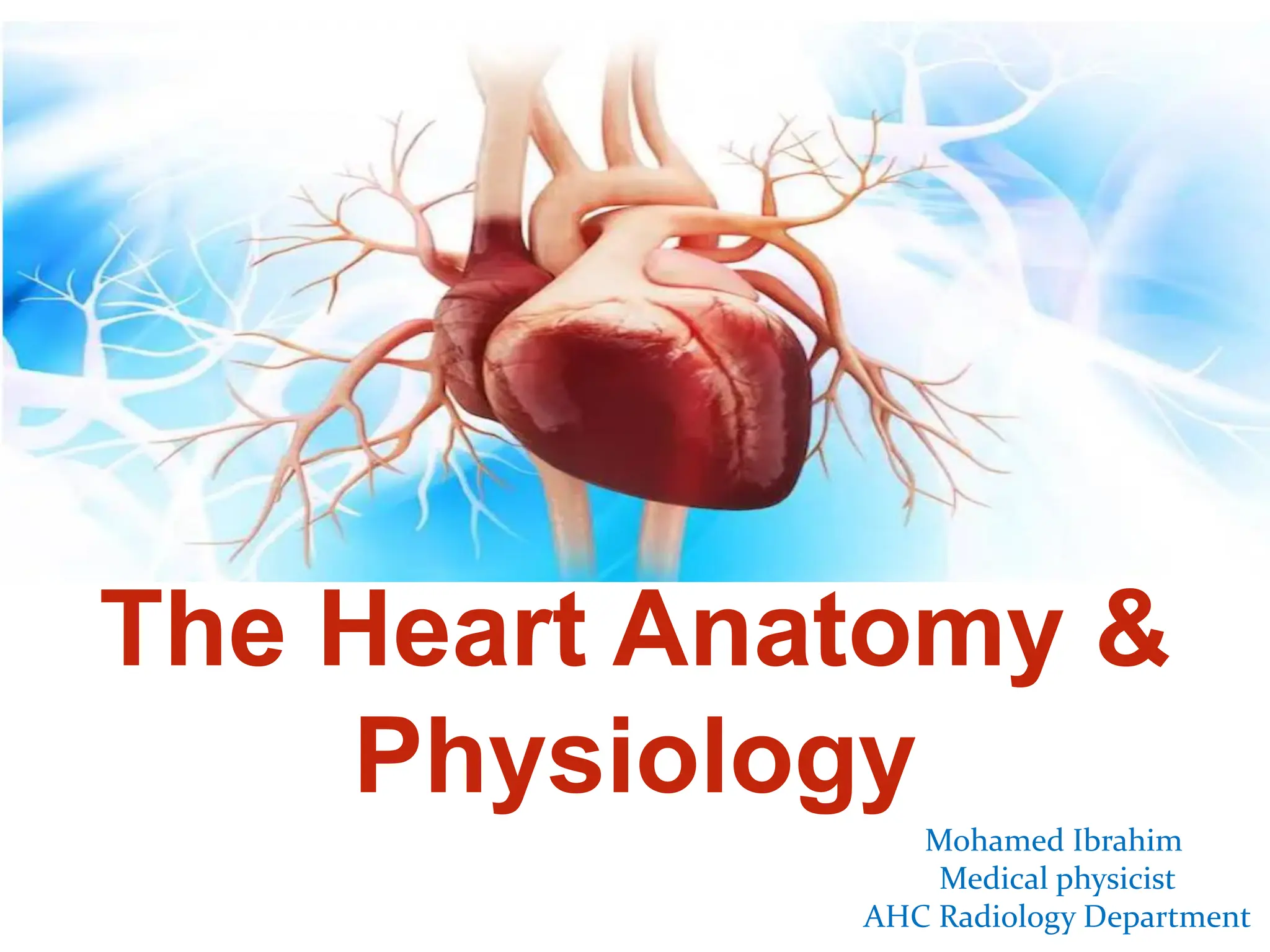
The Heart Anatomy &
Physiology
Heart Anatomy
Approximately the size of your fist
Location
 Thorax between the lungs.
 Superior surface of diaphragm.
 Left of the midline.
 Anterior to the vertebral column, posterior to the sternum.
 Thorax between the lungs.
 Superior surface of diaphragm.
 Left of the midline.
 Anterior to the vertebral column, posterior to the sternum.
Coverings of the Heart: Anatomy.
Pericardium –a double-walled sac around the heart
composed of:
They are separated by the fluid-filled pericardial cavity.
1.A superficial fibrous pericardium.
2.A deep two-layer serous pericardium.
 The parietal layer lines the internal surface of
the fibrous pericardium.
 The visceral layer or epicardium lines the
surface of the heart.
Coverings of the Heart: Physiology
The Function of the Pericardium:
 Protects the heart.
 Anchors the heart to surrounding structures such as
the diaphragm and the great vessels.
 Prevents over filling of the heart with blood.
 Allows for the heart to work in a relatively friction-free
environment
Pericardial Layers of the Heart
Heart Wall
Epicardium – visceral layer of the serous pericardium.
Myocardium – cardiac muscle layer forming the bulk of the
heart.
Fibrous skeleton of the heart – crisscrossing, interlacing
layer of connective tissue.
Endocardium – endothelial layer of the inner myocardial
surface.
Major Vessels of the Heart
Vessels returning blood to the heart include:
Vessels conveying blood away from the heart include:
1.Superior and inferior venae cava.
2.Right and left pulmonary veins.
3.Coronary sinus.
1.Pulmonary trunk, which splits into right and left pulmonary
arteries.
2.Ascending aorta(three branches) –
a. Brachiocephalic.
b. Left common carotid.
c. Subclavian arteries.
External Heart Anatomy: Anterior View
External Heart Anatomy: Posterior View
Gross Anatomy of Heart: Frontal Section
The Heart: Chambers
Right and left side act as separate pumps.
Four chambers
 Atria
Receiving chambers
 Ventricles
Discharging chambers
1. Right atrium
2. Left atrium
1. Right ventricle
2. Left ventricle
Atria of the Heart
Atria are the receiving chambers of the heart.
Pectinate muscles mark atrial walls.
Blood enters right atria from superior and inferior venae
cavae and coronary sinus.
Blood enters left atria from pulmonary veins.
Ventricles of the Heart
Ventricles are the discharging chambers of the heart
Papillary muscles and trabeculae carinae muscles mark
ventricular walls.
Right ventricle pumps blood into the pulmonary trunk
Left ventricle pumps blood into the aorta
Myocardial Thickness and Function
Thickness of myocardium varies according to the function
of the chamber
Atria are thin walled, deliver blood to adjacent ventricles.
Ventricle walls are much thicker and stronger.
 right ventricle supplies blood to the lungs (little flow
resistance).
 left ventricle wall is the thickest to supply systemic circulation
Thickness of Cardiac Walls
Myocardium of left ventricle is much thicker than the right
Pathway of Blood Through the Heart and
Lungs
Right atrium tricuspid valve
right ventricle pulmonary
semilunar valve pulmonary arteries
lungs pulmonary veins left
atrium bicuspid valve left
ventricle aortic semilunar
valveAorta systemic circulation
Coronary Circulation
Coronary circulation is the functional blood supply to the heart
muscle itself.
Blood in the heart chambers does not nourish the myocardium.
The heart has its own nourishing circulatory system.
Coronary arteries.
Cardiac veins.
Blood empties into the right atrium via the coronary sinus.
Coronary Circulation: Arterial Supply
Coronary Circulation: Venous Supply
Heart Valves
Heart valves ensure unidirectional blood flow through the heart
 Atrioventricular (AV) valves lie between the atria and the
ventricles
 AV valves prevent backflow into the atria when ventricles contract
Chorda tendineae attached AV valves to papillary muscles
Semilunar valves prevent backflow of blood into the ventricles
Aortic semilunar valve lies between the left ventricle and the
aorta
Pulmonary semilunar valve lies between the right ventricle and
pulmonary trunk
Heart Valves
Heart Valves
Atrioventricular Valve Function
Semilunar Valve Function
Cardiac Muscle Contraction
Heart muscle:
Cardiac muscle contraction is similar to skeletal muscle
contraction.
 Is stimulated by nerves and is self excitable(automaticity).
 Contracts as a unit.
Heart Physiology: Sequence of Excitation
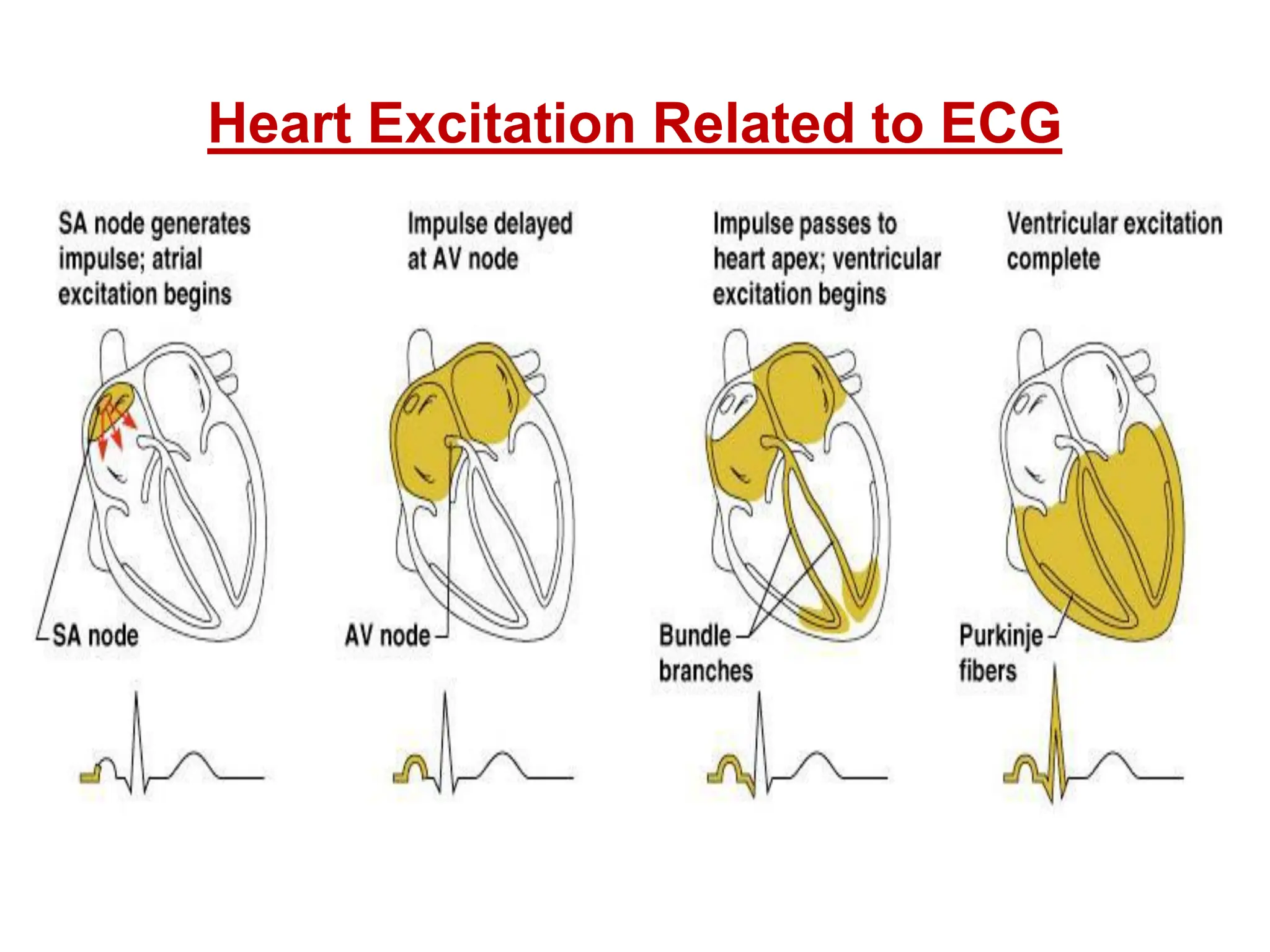
Sinoatrial (SA) node generates impulses about 75 times/minute.
Atrioventricular (AV) node delays the impulse approximately 0.1
second.
 Impulse passes from atria to ventricles via the atrioventricular
bundle (bundle of His).
 AV bundle splits into two pathways in the interventricular
septum (bundle branches).
1. Bundle branches carry the impulse toward the apex of the
heart.
2. Purkinje fibers carry the impulse to the heart apex and
ventricular walls.
Heart Physiology: Sequence of Excitation
Heart Excitation Related to ECG
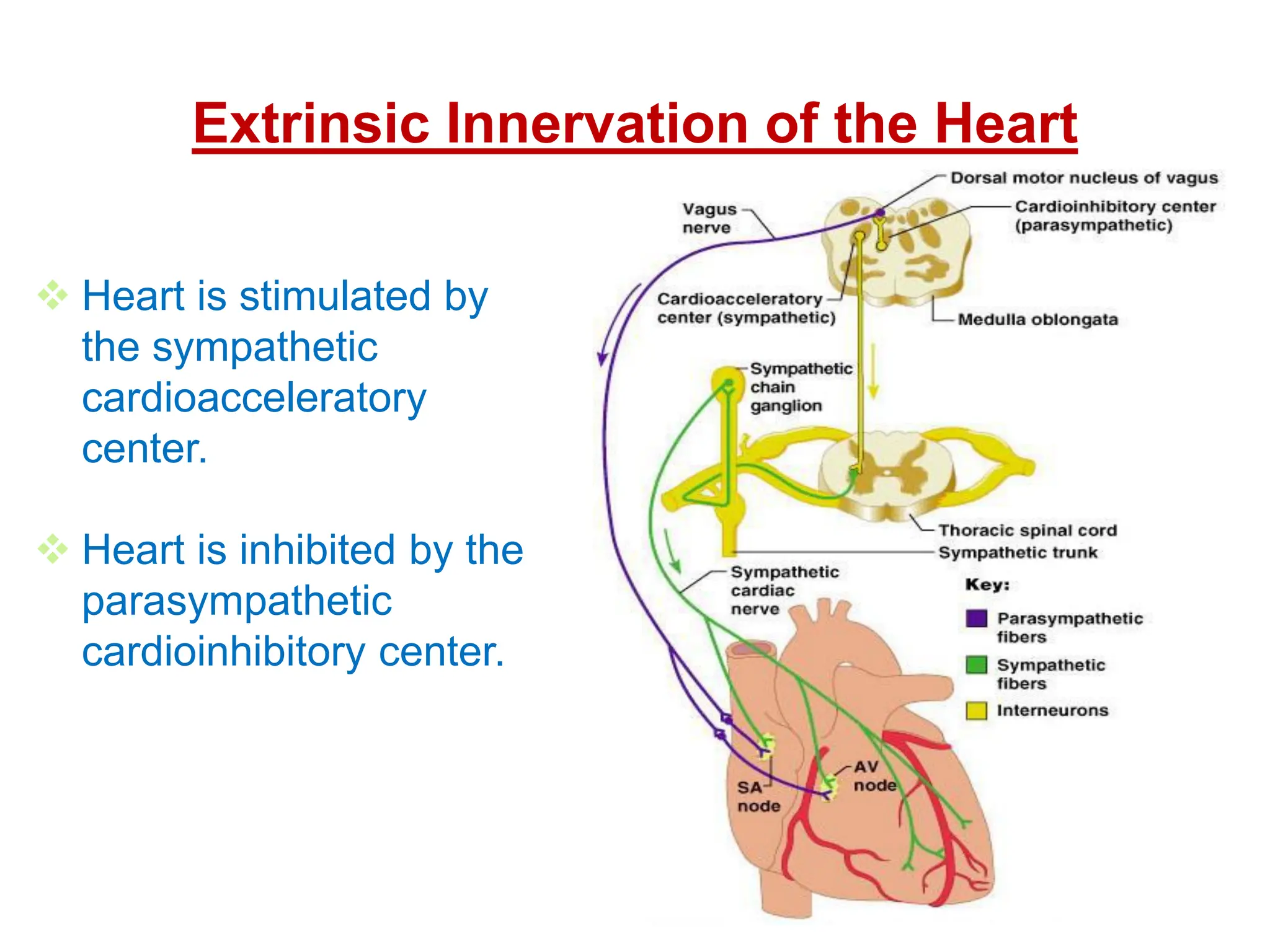
Extrinsic Innervation of the Heart
 Heart is stimulated by
the sympathetic
cardioacceleratory
center.
 Heart is inhibited by the
parasympathetic
cardioinhibitory center.
Electrocardiography
Electrical activity is recorded
by electrocardiogram (ECG).
P wave corresponds to
depolarization of SA node.
QRS complex corresponds
to ventricular depolarization.
T wave corresponds to
ventricular repolarization.
Atrial repolarization record is
masked by the larger QRS
complex.
Heart Sounds
 Heart sounds (lub-dup) are associated with closing of heart
valves
 First sound occurs as AV valves close and signifies
beginning of systole (contraction).
 Second sound occurs when SL valves close at the
beginning of ventricular diastole (relaxation).
Cardiac Output (CO) and Reserve
 Cardiac Output is the amount of blood pumped by each
ventricle in one minute.
 CO = (heart rate [HR]) x (stroke volume [SV]).
 HR is the number of heart beats per minute.
 SV is the amount of blood pumped out by a ventricle with
each beat.
Regulation of Heart Rate
 Positive chronotropic factors increase heart rate.
 Negative chronotropic factors decrease heart rate.
 Caffeine.
 Sedatives.
Regulation of Heart Rate
Increased heart rate
 Sympathetic nervous
system.
 Crisis.
 Low blood pressure.
 Hormones.
 Epinephrine.
 Thyroxine.
 Exercise.
 Decreased blood volume
Decreased heart rate
 Parasympathetic nervous
system.
 High blood pressure or blood
volume.
 Decreased venous return.
 In Congestive Heart Failure
the heart is worn out and
pumps weakly. Digitalis
works to provide a slow,
steady, but stronger beat.
Regulation of Heart Rate: Autonomic Nervous
System
 Sympathetic nervous system (SNS) stimulation is activated
by stress, anxiety, excitement, or exercise.
 Parasympathetic nervous system (PNS) stimulation is
mediated by acetylcholine and opposes the SNS.
 PNS dominates the autonomic stimulation, slowing heart
rate and causing vagal tone
 If the Vagus Nerve was cut, the heart would lose its tone.
Thus, increasing the heart rate by 25 beats per minute.
Atrial (Bainbridge) Reflex
 Atrial (Bainbridge) reflex –a sympathetic reflex initiated by
increased blood in the atria
 Causes stimulation of the SA node.
 Stimulates baroreceptors in the atria, causing increased
SNS stimulation.
Chemical Regulation of the Heart
 The hormones epinephrine and thyroxine increase heart rate.
 Intra-and extracellular ion concentrations must be maintained
for normal heart function
Blood Pressure
 Measurements by health professionals are made on the
pressure in large arteries.
 Pressure in blood vessels decreases as the distance away from
the heart increases.
 Systolic pressure at the peak of ventricular Contraction.
 Diastolic pressure when ventricles relax.
Measuring Arterial Blood Pressure
Blood Pressure: Effects of Factors
 Neural factors
 Renal factors
 Autonomic nervous system adjustments (sympathetic division)
 Regulation by altering blood volume
 Renin – hormonal control
 Temperature
 Chemicals
 Diet
 Heat has a vasodilation effect
 Cold has a vasoconstricting effect
 Various substances can cause increases or decreases
Variations in Blood Pressure
Human normal range is variable
 Normal
 Hypotension
 Hypertension
 140–110 mm Hg systolic
 80–75 mm Hg diastolic
 Low systolic (below 110 mm HG)
 Often associated with illness
 High systolic (above 140 mm HG)
 Can be dangerous if it is chronic
Thank You

The_Heart__anatomy and physiology AHscience

  • 1.
    Mohamed Ibrahim Medical physicist AHCRadiology Department The Heart Anatomy & Physiology
  • 3.
    Heart Anatomy Approximately thesize of your fist Location  Thorax between the lungs.  Superior surface of diaphragm.  Left of the midline.  Anterior to the vertebral column, posterior to the sternum.
  • 4.
     Thorax betweenthe lungs.  Superior surface of diaphragm.  Left of the midline.  Anterior to the vertebral column, posterior to the sternum.
  • 5.
    Coverings of theHeart: Anatomy. Pericardium –a double-walled sac around the heart composed of: They are separated by the fluid-filled pericardial cavity. 1.A superficial fibrous pericardium. 2.A deep two-layer serous pericardium.  The parietal layer lines the internal surface of the fibrous pericardium.  The visceral layer or epicardium lines the surface of the heart.
  • 6.
    Coverings of theHeart: Physiology The Function of the Pericardium:  Protects the heart.  Anchors the heart to surrounding structures such as the diaphragm and the great vessels.  Prevents over filling of the heart with blood.  Allows for the heart to work in a relatively friction-free environment
  • 7.
  • 8.
    Heart Wall Epicardium –visceral layer of the serous pericardium. Myocardium – cardiac muscle layer forming the bulk of the heart. Fibrous skeleton of the heart – crisscrossing, interlacing layer of connective tissue. Endocardium – endothelial layer of the inner myocardial surface.
  • 9.
    Major Vessels ofthe Heart Vessels returning blood to the heart include: Vessels conveying blood away from the heart include: 1.Superior and inferior venae cava. 2.Right and left pulmonary veins. 3.Coronary sinus. 1.Pulmonary trunk, which splits into right and left pulmonary arteries. 2.Ascending aorta(three branches) – a. Brachiocephalic. b. Left common carotid. c. Subclavian arteries.
  • 10.
  • 11.
  • 12.
    Gross Anatomy ofHeart: Frontal Section
  • 13.
    The Heart: Chambers Rightand left side act as separate pumps. Four chambers  Atria Receiving chambers  Ventricles Discharging chambers 1. Right atrium 2. Left atrium 1. Right ventricle 2. Left ventricle
  • 14.
    Atria of theHeart Atria are the receiving chambers of the heart. Pectinate muscles mark atrial walls. Blood enters right atria from superior and inferior venae cavae and coronary sinus. Blood enters left atria from pulmonary veins. Ventricles of the Heart Ventricles are the discharging chambers of the heart Papillary muscles and trabeculae carinae muscles mark ventricular walls. Right ventricle pumps blood into the pulmonary trunk Left ventricle pumps blood into the aorta
  • 15.
    Myocardial Thickness andFunction Thickness of myocardium varies according to the function of the chamber Atria are thin walled, deliver blood to adjacent ventricles. Ventricle walls are much thicker and stronger.  right ventricle supplies blood to the lungs (little flow resistance).  left ventricle wall is the thickest to supply systemic circulation
  • 16.
    Thickness of CardiacWalls Myocardium of left ventricle is much thicker than the right
  • 17.
    Pathway of BloodThrough the Heart and Lungs Right atrium tricuspid valve right ventricle pulmonary semilunar valve pulmonary arteries lungs pulmonary veins left atrium bicuspid valve left ventricle aortic semilunar valveAorta systemic circulation
  • 18.
    Coronary Circulation Coronary circulationis the functional blood supply to the heart muscle itself. Blood in the heart chambers does not nourish the myocardium. The heart has its own nourishing circulatory system. Coronary arteries. Cardiac veins. Blood empties into the right atrium via the coronary sinus.
  • 19.
  • 20.
  • 21.
    Heart Valves Heart valvesensure unidirectional blood flow through the heart  Atrioventricular (AV) valves lie between the atria and the ventricles  AV valves prevent backflow into the atria when ventricles contract Chorda tendineae attached AV valves to papillary muscles Semilunar valves prevent backflow of blood into the ventricles Aortic semilunar valve lies between the left ventricle and the aorta Pulmonary semilunar valve lies between the right ventricle and pulmonary trunk
  • 22.
  • 23.
  • 24.
  • 25.
  • 26.
    Cardiac Muscle Contraction Heartmuscle: Cardiac muscle contraction is similar to skeletal muscle contraction.  Is stimulated by nerves and is self excitable(automaticity).  Contracts as a unit.
  • 27.
    Heart Physiology: Sequenceof Excitation Sinoatrial (SA) node generates impulses about 75 times/minute. Atrioventricular (AV) node delays the impulse approximately 0.1 second.  Impulse passes from atria to ventricles via the atrioventricular bundle (bundle of His).  AV bundle splits into two pathways in the interventricular septum (bundle branches). 1. Bundle branches carry the impulse toward the apex of the heart. 2. Purkinje fibers carry the impulse to the heart apex and ventricular walls.
  • 28.
  • 29.
  • 30.
    Extrinsic Innervation ofthe Heart  Heart is stimulated by the sympathetic cardioacceleratory center.  Heart is inhibited by the parasympathetic cardioinhibitory center.
  • 31.
    Electrocardiography Electrical activity isrecorded by electrocardiogram (ECG). P wave corresponds to depolarization of SA node. QRS complex corresponds to ventricular depolarization. T wave corresponds to ventricular repolarization. Atrial repolarization record is masked by the larger QRS complex.
  • 32.
    Heart Sounds  Heartsounds (lub-dup) are associated with closing of heart valves  First sound occurs as AV valves close and signifies beginning of systole (contraction).  Second sound occurs when SL valves close at the beginning of ventricular diastole (relaxation).
  • 33.
    Cardiac Output (CO)and Reserve  Cardiac Output is the amount of blood pumped by each ventricle in one minute.  CO = (heart rate [HR]) x (stroke volume [SV]).  HR is the number of heart beats per minute.  SV is the amount of blood pumped out by a ventricle with each beat.
  • 34.
    Regulation of HeartRate  Positive chronotropic factors increase heart rate.  Negative chronotropic factors decrease heart rate.  Caffeine.  Sedatives.
  • 35.
    Regulation of HeartRate Increased heart rate  Sympathetic nervous system.  Crisis.  Low blood pressure.  Hormones.  Epinephrine.  Thyroxine.  Exercise.  Decreased blood volume Decreased heart rate  Parasympathetic nervous system.  High blood pressure or blood volume.  Decreased venous return.  In Congestive Heart Failure the heart is worn out and pumps weakly. Digitalis works to provide a slow, steady, but stronger beat.
  • 36.
    Regulation of HeartRate: Autonomic Nervous System  Sympathetic nervous system (SNS) stimulation is activated by stress, anxiety, excitement, or exercise.  Parasympathetic nervous system (PNS) stimulation is mediated by acetylcholine and opposes the SNS.  PNS dominates the autonomic stimulation, slowing heart rate and causing vagal tone  If the Vagus Nerve was cut, the heart would lose its tone. Thus, increasing the heart rate by 25 beats per minute.
  • 37.
    Atrial (Bainbridge) Reflex Atrial (Bainbridge) reflex –a sympathetic reflex initiated by increased blood in the atria  Causes stimulation of the SA node.  Stimulates baroreceptors in the atria, causing increased SNS stimulation.
  • 38.
    Chemical Regulation ofthe Heart  The hormones epinephrine and thyroxine increase heart rate.  Intra-and extracellular ion concentrations must be maintained for normal heart function
  • 39.
    Blood Pressure  Measurementsby health professionals are made on the pressure in large arteries.  Pressure in blood vessels decreases as the distance away from the heart increases.  Systolic pressure at the peak of ventricular Contraction.  Diastolic pressure when ventricles relax.
  • 40.
  • 41.
    Blood Pressure: Effectsof Factors  Neural factors  Renal factors  Autonomic nervous system adjustments (sympathetic division)  Regulation by altering blood volume  Renin – hormonal control  Temperature  Chemicals  Diet  Heat has a vasodilation effect  Cold has a vasoconstricting effect  Various substances can cause increases or decreases
  • 42.
    Variations in BloodPressure Human normal range is variable  Normal  Hypotension  Hypertension  140–110 mm Hg systolic  80–75 mm Hg diastolic  Low systolic (below 110 mm HG)  Often associated with illness  High systolic (above 140 mm HG)  Can be dangerous if it is chronic
  • 44.