Watering Habits                                                                                                                                       Soil
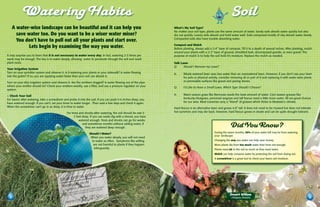
   A water-wise landscape can be beautiful and it can help you                                                     What’s My Soil Type?
                                                                                                                   No matter your soil type, plants use the same amount of water. Sandy soils absorb water quickly but also
     save water too. Do you want to be a wiser water miser?                                                        dry out quickly. Loamy soils absorb and hold water well. Soils composed mostly of clay absorb water slowly.
                                                                                                                   Compacted soils also have trouble absorbing water.
     You don’t have to pull out all your plants and start over.
                                                                                                                   Compost and Mulch
           Lets begin by examining the way you water.                                                              Before planting, always add a 3-4” layer of compost. Till it to a depth of several inches. After planting, mulch
                                                                                                                   around your plants with a 2-3” layer of ground, shredded bark, decomposed granite, or even gravel. The
It may surprise you to learn that it is not necessary to water every day. In fact, watering 2-3 times per          purpose of mulch is to help the soil hold it’s moisture. Replace the mulch as needed.
week may be enough. The key is to water deeply, allowing water to penetrate through the soil and reach
plant roots.                                                                                                       Talk Lawn
                                                                                                                   Q:     Should I Remove my Lawn?
Your Irrigation System
Turn on your sprinkler system and observe it. Is it watering your plants or your sidewalk? Is water flowing        A:     Wisely watered lawn uses less water than an overwatered lawn. However, if you don’t use your lawn
into the gutter? If so, you are applying water faster than your soil can absorb it.                                       for pets or physical activity, consider removing all or part of it and replacing it with water-wise plants
Turn on your drip irrigation system and observe it. Are the emitters clogged? Is water flowing out of the pipe            or permeable surfaces like gravel and paving stones.
where your emitter should be? Check your emitters weekly, use a filter, and use a pressure regulator on your       Q:     I’d Like to Have a Small Lawn, Which Type Should I Choose?
system.

4 Check Your Soil                                                                                                  A:     Warm season grass like Bermuda needs the least amount of water. Cool season grasses like
For lawns–after watering, take a screwdriver and probe it into the soil. If you can push it 6 inches deep, you            Kentucky bluegrass, perennial ryegrass and tall fescue need a little more water. All are good choices
have watered enough. If you can’t, set your timer to water longer . Then wait a few days and check it again.              for our area. Most nurseries carry a “blend” of grasses which thrive in Modesto’s climate.
When the screwdriver can’t go in as deep, it is time to water.                                                     Hard fescue is an alternative lawn and grows 4-6” tall. It does not need to be mowed but does not tolerate
                                                For trees and shrubs-after watering, the soil should be wet 2-     hot summers and may die back. However, hard fescue grows in shade and can be quite drought tolerant.
                                                      3 feet deep. If you can easily dig with a shovel, you have
                                                          watered enough. Trees and shrubs can go for weeks
                                                             and sometimes months without adding water, if
                                                               they are watered deep enough.                                                                     Did You Know?
                                                                                                                                                   During the warm months, 50% of your water bill may be from watering
                                                                  Should I Water?
                                                                                                                                                   your landscape
                                                                   When you water deeply, you will not need
                                                                    to water as often. Symptoms like wilting                                       Changing the way you water can help save money.
                                                                     are not harmful to plants if they happen                                      More plants die from too much water than from not enough.
                                                                     infrequently.                                                                 Plants need air in the soil as much as they need water.
                                                                                                                                                   Mulch can help conserve water by protecting the soil from drying out.
                                                                                                                                                   A screwdriver is a great tool to check your lawns soil moisture.


                                                                                                                                                                Desert Willow
                                                                                                                                                                 chilopsis linearis
Teucrium
                                                                                                teucrium fruticans
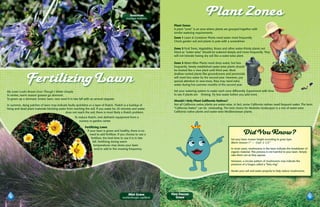
                                                                                                                                                 Plant Zones
                                                                                                                        Plant Zones
                                                                                                                        A plant “zone” is an area where plants are grouped together with
                                                                                                                        similar watering requirements.
                                                                                                                        Zone 1 Lawn & Container Plants need water most frequently.
                                                                                                                        Check garden soil and plants in pots with a screwdriver.

                                                                                                                        Zone 2 Fruit Trees, Vegetables, Roses and other water-thirsty plants not
                                                                                                                        listed as “water-wise” should be watered deeply and more frequently. They
                                                                                                                        will not tolerate having dry soil like a water-wise plant.

                                                                                                                        Zone 3 Water-Wise Plants need deep water, but less
                                                                                                                        frequently. Newly established water-wise plants should
                                                                                                                        be treated like a new plant until third year. Most
                                                                                                                        shallow rooted plants like groundcovers and perennials

               Fertilizing Lawn                                                                                         will need less water by the second year. However, pay
                                                                                                                        special attention to new trees, they may need extra
                                                                                                                        water during hot summer months of the second year.

My Lawn Looks Brown Even Though I Water Deeply                                                                          Set your watering system to water each zone differently. Experiment with time
In winter, warm season grasses go dormant.                                                                              to see if plants are thriving. Try less water before you add more.
To green up a dormant, brown lawn, over seed it in late fall with an annual ryegrass
                                                                                                                        Should I Only Plant California Natives?
In summer, dying patches of lawn may indicate faulty sprinklers or a layer of thatch. Thatch is a buildup of            Not all California native plants are water-wise, in fact, some California natives need frequent water. The term
living and dead plant materials blocking water from reaching the soil. If you water for 20 minutes and water            “California Native” can be misleading. The best choice for Modesto landscapes is a mix of water-wise
                                             does not reach the soil, there is most likely a thatch problem.            California native plants and water-wise Mediterranean plants.
                                                     To reduce thatch, rent dethatch equipment from a
                                                         nursery or garden center

                                                             Fertilizing Lawn
                                                               If your lawn is green and healthy, there is no
                                                                 need to add fertilizer. If you choose to use a                                                                Did You Know?
                                                                   fertilizer, the best time to use it is in late                                                    Set your lawn mower height according to grass type.
                                                                    fall. Fertilizing during warm                                                                    Warm Season-1” ~ Cool -2 1/2”
                                                                     temperatures may stress your lawn
                                                                      and/or add to the mowing frequency.                                                            In most cases, mushrooms in the lawn indicate the breakdown of
                                                                                                                                                                     organic material. This process is not harmful to your lawn. Simply
                                                                                                                                                                     rake them out as they appear.

                                                                                                                                                                     However, a circular pattern of mushrooms may indicate the
                                                                                                                                                                     presence of a fungus called a “fairy ring.”

                                                                                                                                                                     Aerate your soil and water properly to help reduce mushrooms.


                                                                                                  Mist Grass           Fine Fescue
                                                                                             muhlenbergia capillaris      Grass
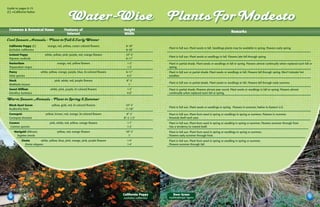
Guide to pages 6-15
(C) =California Native

                                                  Water-Wise                                                 Plants For Modesto
 Common & Botanical Name                      Features of                            Height
                                                                                                                                                                   Remarks
                                                Interest                             Width
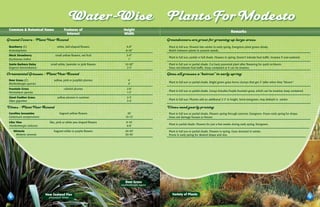
Cool Season Annuals - Plant in Fall & Early Winter
 California Poppy (C)           orange, red, yellow, cream colored flowers            8-18”
                                                                                                             Plant in full sun. Plant seeds in fall. Seedlings plants may be available in spring. Flowers early spring.
 Escholzia californica                                                                8-18”
 Iceland Poppy                white, yellow, pink, purple, red, orange flowers        10”-3’
                                                                                                             Plant in full sun. Plant seeds or seedlings in fall. Flowers late fall through spring.
 Papaver nudicale                                                                     6-11”
 Nasturtium                             orange, red, yellow flowers                    1-2’                  Plant in partial shade. Plant seeds or seedlings in fall or spring. Flowers almost continually when replaced each fall or
 Tropaoelum majus                                                                      1-2’                  spring.
 Pansy                     white, yellow, orange, purple, blue, bi-colored flowers    6-11”                  Plant in full sun or partial shade. Plant seeds or seedlings in fall. Flowers fall through spring. Won’t tolerate hot
 Viola species                                                                        4-5”                   weather.
 Stock                                pink, white, red, purple flowers                 8”-3’
                                                                                                             Plant in full sun or partial shade. Plant seeds or seedlings in fall. Flowers fall through early summer.
 Matthiola incana                                                                       1’
 Sweet William                     white, pink, purple, bi-colored flowers             1-2’                  Plant in partial shade. Flowers almost year round. Plant seeds or seedlings in fall or spring. Flowers almost
 Dianthus barbatus                                                                     4-6”                  continually when replaced each fall or spring.

Warm Season Annuals - Plant in Spring & Summer
 Black-Eyed Susan                   yellow, gold, red, bi-colored flowers             10”-3’
                                                                                                             Plant in full sun. Plant seeds or seedlings in spring. Flowers in summer. Native to Eastern U.S.
 Rudbeckia hirta                                                                      11-18”
 Coreopsis                     yellow, brown, red, orange, bi-colored flowers          8”-2’                 Plant in full sun. Plant from seed in spring or seedlings in spring or summer. Flowers in summer.
 Coreopsis tinctoria                                                                 8”-2 1/2’               Reseeds itself each year.
 Cosmos                           pink, white, red, yellow, orange flowers             1-7’                  Plant in full sun. Plant from seed in spring or seedling in spring or summer. Flowers summer through frost.
  Cosmos species                                                                       1-2’                  Has a tendency to reseed itself.
     Marigold (African)                 yellow, red, orange flowers                   18”-3’                 Plant in full sun. Plant from seed in spring or seedlings in spring or summer.
      Tagetes erecta                                                                    1’                   Flowers early summer through frost.
           Zinnia         white, yellow, blue, pink, orange, pink, purple flowers      1-4’                  Plant in full sun. Plant from seed in spring or seedling in spring or summer.
              Zinnia elegans                                                           1-4’                  Flowers summer through fall.


                                                                                     California Poppy           Deer Grass
                                                                                     escholzia californica   muhlenbergia rigens
Water-Wise                                       Plants For Modesto
 Common & Botanical Name               Features of                     Height
                                                                                                                                                    Remarks
                                         Interest                      Width
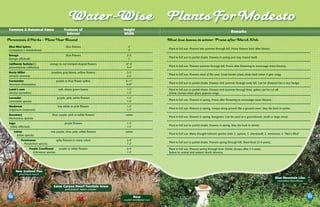
Ground Covers - Plant Year Round                                                            Groundcovers are great for greening up large areas
 Bearberry (C)                    white, bell-shaped flowers             6-8”                Plant in full sun. Flowers late winter to early spring. Evergreen plant grows slowly.
 Arctostaphylos                                                          8-18”               Mulch between plants to prevent weeds.
 Mock Strawberry                small yellow flowers, red fruit           3-4”
                                                                                             Plant in full sun, partial or full shade. Flowers in spring. Doesn’t tolerate foot traffic. Invasive if over-watered.
 Duchesnea indica                                                          1’
 Santa Barbara Daisy         small white, lavender or pink flowers      10-20”               Plant in full sun or partial shade. Cut back perennial plant after flowering for quick re-bloom.
 Erigeron karvinskianus                                                  2-3’                Does not tolerate foot traffic. Keep contained or it can be invasive.

Ornamental Grasses - Plant Year Round                                                       Gives all grasses a “haircut” in early spring
 Deer Grass (C)                yellow, pink or purplish plumes             4’
                                                                                             Plant in full sun or partial shade. Bright green grass forms clumps that get 2’ taller when they “bloom.”
 Muhlenbergia species                                                      4’
 Fountain Grass                        colorful plumes                    2-6’
                                                                                             Plant in full sun or partial shade. Group includes Purple fountain grass, which can be invasive, keep contained.
 Pennisetum species                                                       1-5’
 Giant Feather Grass              yellow plumes in summer                 2-3’
                                                                                             Plant in full sun. Plumes add an additional 2-3’ in height. Semi-evergreen, may dieback in winter.
 Stipa gigantea                                                           3-4’

Vines - Plant Year Round                                                                    Vines need yearly pruning
 Carolina Jessamine                 fragrant yellow flowers               20’                Plant in full sun or partial shade. Flowers spring through summer. Evergreen. Prune early spring for shape.
 Gelsemum sempervirens                                                   10-15’              Does not damage houses or fences.
 Lilac Vine                 lilac, pink or white pea shaped flowers      9-10’
                                                                                             Plant in partial shade. Flowers for just a few weeks during early spring. Evergreen.
 Hardenbergia violacea                                                   6-8’
    Wisteria                   fragrant white or purple flowers          20-30’              Plant in full sun or partial shade. Flowers in spring. Goes dormant in winter.
     Wisteria sinensis                                                   20-30’              Prune in early spring for desired shape and size.


                                                                         Deer Grass
                                                                      muhlenbergia rigens


                          New Zealand Flax                                                     Variety of Plants
                            phormium tenax
Water-Wise                                        Plants For Modesto
 Common & Botanical Name                       Features of                  Height
                                                                                                                                                            Remarks
                                                 Interest                   Width
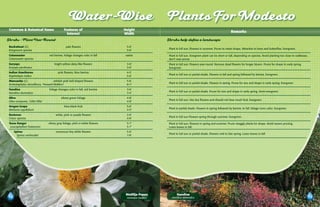
Perennials & Herbs - Plant Year Round                                                                Most lose leaves in winter. Prune after March 30th.
 Blue Mist Spirea                                blue flowers                  2’
                                                                                                      Plant in full sun. Flowers late summer through fall. Prune flowers back after bloom.
 Caryopteris x clandodensis                                                    2’
 Borage                                          blue flowers                 2-3’
                                                                                                      Plant in full sun to partial shade. Flowers in spring and may reseed itself.
 Borago officinalis                                                            1’
 California fuchsia(C)            orange to red trumpet-shaped flowers        6”-4’
                                                                                                      Plant in full sun. Flowers summer through fall. Prune after flowering to encourage more blooms.
 Zauschenaria californica                                                     3-4’
 Dusty Miller                      powdery gray leaves, yellow flowers        2-3’
                                                                                                      Plant in full sun. Flowers most of the year. Great border plant, shear back when it gets rangy.
 Senecio cineraria                                                            2-3’
 Germander                               purple or blue flower spikes        6-11”
                                                                                                      Plant in full sun to partial shade. Flowers mid summer through early fall. Can be sheared into a nice hedge.
 Teucrium chamaedrys                                                         6-9”
 Lamb’s ears                               soft, silvery green leaves         1-2’                    Plant in full sun or partial shade. Flowers mid-summer through frost, spikes can be cut off.
 Stachys byzantina                                                            1-3’                    Divide clumps when plant appears rangy.
 Lavender                                purple, pink, white flowers          1-2’
                                                                                                      Plant in full sun. Flowers in spring. Prune after flowering to encourage more blooms.
 Lavandula species                                                            1-3’
 Marjorum                                 tiny white or pink flowers          1-2’
                                                                                                      Plant in full sun. Flowers in spring. Creeps along ground like a ground cover. May die back in winter.
 Origanum marjorana                                                           1-2’
 Rosemary                          blue, purple, pink or white flowers       varies
                                                                                                      Plant in full sun. Flowers in spring. Evergreen. Can be used as a groundcover, small or large shrub.
 Rosmarinus species
 Sage                                           purple flowers                1-3’
                                                                                                      Plant in full sun to partial shade. Flowers in spring. May die back in winter.
  Salvia officinalis                                                          1-2’
     Salvia                       red, purple, blue, pink, white flowers     varies
                                                                                                      Plant in full sun. Many drought tolerant species exist. S. apiana, S. clevelandii, S. nemorosa, S. “Bee’s Bliss”
       Salvia species
           Penstemon                     spiky flowers in many colors         2-4’
                                                                                                      Plant in full sun to partial shade. Flowers spring through fall. Short-lived (3-4 years).
             Penstemon species                                                1-2’
                   Purple Coneflower       purple or white flowers            2-4’                    Plant in full sun. Flowers spring through frost. Divide clumps after 3-4 years.
                     Echinacea species                                        1-3’                    Native to central and eastern North America.


       New Zealand Flax
          phormium tenax
                                                                                                                                                                                                  Blue Mountain Lilac
                                                                                                                                                                                                   ceanothus thyrsiflorus

                                    Eaton Canyon Dwarf Fountain Grass
                                                pennisetum ‘eaton canyon’

                                                                                      Rosa
                                                                            scarlet meidiland rose
Water-Wise                                        Plants For Modesto
 Common & Botanical Name                      Features of                      Height
                                                                                                                                                           Remarks
                                                Interest                       Width
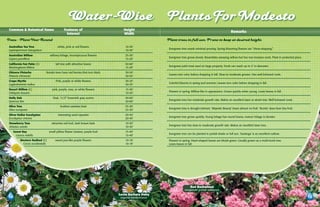
Shrubs - Plant Year Round                                                                           Shrubs help define a landscape
 Buckwheat (C)                                  pale flowers                    5-6’
                                                                                                     Plant in full sun. Flowers in summer. Prune to retain shape. Attractive to bees and butterflies. Evergreen.
 Eriogonum species                                                              5-6’
 Cotoneaster                     red berries, foliage changes color in fall     varies               Plant in full sun. Evergreen plant can be short or tall, depending on species. Avoid planting too close to walkways.
 Cotoneaster species                                                                                 don’t over-prune.
 Euryops                              bright yellow daisy-like flowers          3-6’                 Plant in full sun. Flowers year-round. Remove dead flowers for longer bloom. Prune for shape in early spring.
 Euryops pectinatus                                                             3-6’                 Evergreen
 Indian Hawthorne                        pink flowers, blue berries             4-5’
                                                                                                     Plant in full sun or partial shade. Flowers in fall and spring followed by berries. Evergreen.
 Raphiolepis indica                                                             5-6’
 Manzanita (C)                       whitish pink bell-shaped flowers           5-6’
                                                                                                     Plant in full sun or partial shade. Flowers in spring. Prune for size and shape in early spring. Evergreen.
 Arctostaphylos densiflorus, ‘Howard McMinn’                                    6-7’
 Nandina                         foliage changes color in fall, red berries     3-6’
                                                                                                     Plant in full sun or partial shade. Prune for size and shape in early spring. Semi-evergreen.
 Nandina domestica                                                              3-4’
 Olive                                      silvery green foliage               4-8’
                                                                                                     Plant in full sun. Has tiny flowers and should not bear much fruit. Evergreen.
 Olea europaea, ‘Little Ollie’                                                  4-8’
 Oregon Grape                                 blue-black fruit                  5-6’
                                                                                                     Plant in partial shade. Flowers in spring followed by berries. In fall, foliage turns color. Evergreen.
 Mahonia aquifolium                                                             4-5’
 Rockrose                              white, pink or purple flowers            2-6’
                                                                                                     Plant in full sun Flowers spring through summer. Evergreen.
 Cistus species                                                                 4-8’
 Texas Ranger                    silvery gray foliage, pink or white flowers    5-7’                 Plant in full sun. Flowers in spring and summer. Prune straggly plants for shape. Avoid severe pruning.
  Leucophyllum frutescens                                                       5-7’                 Loses leaves in fall.
     Spirea                            numerous tiny white flowers              5-6’
                                                                                                     Plant in full sun or partial shade. Flowers mid to late spring. Loses leaves in fall.
       Spirea vanhouttei                                                        7-8’


                                                                                Matilija Poppy             Nandina
                                                                                 romneya coulteri      nandina domestica
Water-Wise                                             Plants For Modesto
 Common & Botanical Name                     Features of                        Height
                                                                                                                                                             Remarks
                                               Interest                         Width
Trees - Plant Year Round                                                                               Plant trees in full sun. Prune to keep at desired height.
 Australian Tea Tree                   white, pink or red flowers                10-30’
                                                                                                        Evergreen tree needs minimal pruning. Spring blooming flowers are “show-stopping.”
 Leptospermum laevigatum                                                         10-30’
 Australian Willow              willowy foliage, inconspicuous flowers           25-30’
                                                                                                        Evergreen tree grows slowly. Resembles weeping willow but has non-invasive roots. Plant in protected place.
 Gejera parviflora                                                               15-20’
 California Fan Palm (C)             tall tree with attractive leaves            50-60’
                                                                                                        Evergreen palm best used on large property. Trunk can reach up to 2’ in diameter.
 Washingtonia filifera                                                           15-20’
 Chinese Pistache           female trees have red berries that turn black        30-50’
                                                                                                        Leaves turn color before dropping in fall. Slow to moderate grower. Has well-behaved roots.
 Pistacia chinensis                                                              30-50’
 Crape Myrtle                        Pink, purple or white flowers               20-25’
                                                                                                        Colorful blooms in spring and summer. Leaves turn color before dropping in fall.
 Lagerstroemia indica                                                            20-25’
 Desert Willow (C)                pink, purple, rose, or white flowers           15-30’
                                                                                                        Flowers in spring. Willow-like in appearance. Grows quickly when young. Loses leaves in fall.
 Chilopsis linearis                                                              10-20’
 Holly Oak                         Oval, 11/2” brownish gray acorns              30-60’
                                                                                                        Evergreen tree has moderate growth rate. Makes an excellent lawn or street tree. Well-behaved roots.
 Quercus ilex                                                                    30-60’
 Olive Tree                              fruitless varieties best                25-30’
                                                                                                        Evergreen tree is drought tolerant. ‘Majestic Beauty’ bears almost no fruit. ‘Bonita’ does bear tiny fruit.
 Olea europaea                                                                   25-30’
 Silver Dollar Eucalyptus              interesting seed capsules                 20-50’
                                                                                                        Evergreen tree grows quickly. Young foliage has round leaves, mature foliage is slender.
 Eucalyptus cinerea                                                              20-40’
 Strawberry Tree                  attractive red fruit, dark brown bark          10-30’
                                                                                                        Evergreen tree has slow to moderate growth rate. Makes an excellent lawn tree.
 Arbutus unedo                                                                   10-30’
    Sweet Bay                   small yellow flower clusters, purple fruit       15-40’
                                                                                                        Evergreen tree can be planted in partial shade or full sun. ‘Saratoga’ is an excellent cultivar.
      Laurus nobilis                                                             15-40’
         Western Redbud (C)          sweet pea-like purple flowers               10-18’                 Flowers in spring. Heart-shaped leaves are bluish-green. Usually grown as a multi-trunk tree.
          Cercis occidentalis                                                    10-18’                 Loses leaves in fall.


                                                                                                                          Red Buckwheat
                                                                                                                     eriogonum grande rubescens
                                                                             Santa Barbara Daisy
                                                                              erigeron karvinskianus
Project Staff

Juan Tejeda
Water Conservation Specialist
City of Modesto-Water Division

Anne Schellman
Horticulture Consultant (Author)
anniepoppyseed@gmail.com

Modesto Garden Club
Photography Consultant

                                                 References

Bennett, J. (1998). Dry-land gardening: a xeriscaping guide for dry-summer, cold winter climates. Kingston,
Ontario:Bookmakers Press, Inc.

Christopher, T. (1994). Water-wise gardening, America’s backyard revolution. New York: Simon & Schuster.

Hartin, J., Geisel, P. & Unruh, C. (2001). Lawn watering guide for California. University of California
Cooperative Extension Leaflet 8044.

Perry, E. (1991). Drought tolerant landscape plants for Stanislaus County.
Local publication available at UCCE Stanislaus Office.

Proctor, R. (Ed.) (1998). Xeriscape plant guide. Golden, CO: Fulcrum Publishing.

Robinson, P. (1999). Water-wise gardening. New York: DK Publishing.

Sterman, N. (2007). California Gardener’s Guide Volume II. Cool Springs Press, Franklin: Tennessee.

Sunset. (2009). Easy water-wise gardening. Sunset Publishing Corporation.

For more information on water-wise plants, contact the City of Modesto Water Conservation Program at:
(209) 342-2246 or visit us online at:
http://www.modestogov.com/pwd/utilities/water/conservation


A City of Modesto
Public Works Publication
                                                                                                              Design by Alphagraphics of Modesto

Waterwise Gardening Guide - Modesto, California

  • 2.
    Watering Habits Soil A water-wise landscape can be beautiful and it can help you What’s My Soil Type? No matter your soil type, plants use the same amount of water. Sandy soils absorb water quickly but also save water too. Do you want to be a wiser water miser? dry out quickly. Loamy soils absorb and hold water well. Soils composed mostly of clay absorb water slowly. Compacted soils also have trouble absorbing water. You don’t have to pull out all your plants and start over. Compost and Mulch Lets begin by examining the way you water. Before planting, always add a 3-4” layer of compost. Till it to a depth of several inches. After planting, mulch around your plants with a 2-3” layer of ground, shredded bark, decomposed granite, or even gravel. The It may surprise you to learn that it is not necessary to water every day. In fact, watering 2-3 times per purpose of mulch is to help the soil hold it’s moisture. Replace the mulch as needed. week may be enough. The key is to water deeply, allowing water to penetrate through the soil and reach plant roots. Talk Lawn Q: Should I Remove my Lawn? Your Irrigation System Turn on your sprinkler system and observe it. Is it watering your plants or your sidewalk? Is water flowing A: Wisely watered lawn uses less water than an overwatered lawn. However, if you don’t use your lawn into the gutter? If so, you are applying water faster than your soil can absorb it. for pets or physical activity, consider removing all or part of it and replacing it with water-wise plants Turn on your drip irrigation system and observe it. Are the emitters clogged? Is water flowing out of the pipe or permeable surfaces like gravel and paving stones. where your emitter should be? Check your emitters weekly, use a filter, and use a pressure regulator on your Q: I’d Like to Have a Small Lawn, Which Type Should I Choose? system. 4 Check Your Soil A: Warm season grass like Bermuda needs the least amount of water. Cool season grasses like For lawns–after watering, take a screwdriver and probe it into the soil. If you can push it 6 inches deep, you Kentucky bluegrass, perennial ryegrass and tall fescue need a little more water. All are good choices have watered enough. If you can’t, set your timer to water longer . Then wait a few days and check it again. for our area. Most nurseries carry a “blend” of grasses which thrive in Modesto’s climate. When the screwdriver can’t go in as deep, it is time to water. Hard fescue is an alternative lawn and grows 4-6” tall. It does not need to be mowed but does not tolerate For trees and shrubs-after watering, the soil should be wet 2- hot summers and may die back. However, hard fescue grows in shade and can be quite drought tolerant. 3 feet deep. If you can easily dig with a shovel, you have watered enough. Trees and shrubs can go for weeks and sometimes months without adding water, if they are watered deep enough. Did You Know? During the warm months, 50% of your water bill may be from watering Should I Water? your landscape When you water deeply, you will not need to water as often. Symptoms like wilting Changing the way you water can help save money. are not harmful to plants if they happen More plants die from too much water than from not enough. infrequently. Plants need air in the soil as much as they need water. Mulch can help conserve water by protecting the soil from drying out. A screwdriver is a great tool to check your lawns soil moisture. Desert Willow chilopsis linearis
  • 3.
    Teucrium teucrium fruticans Plant Zones Plant Zones A plant “zone” is an area where plants are grouped together with similar watering requirements. Zone 1 Lawn & Container Plants need water most frequently. Check garden soil and plants in pots with a screwdriver. Zone 2 Fruit Trees, Vegetables, Roses and other water-thirsty plants not listed as “water-wise” should be watered deeply and more frequently. They will not tolerate having dry soil like a water-wise plant. Zone 3 Water-Wise Plants need deep water, but less frequently. Newly established water-wise plants should be treated like a new plant until third year. Most shallow rooted plants like groundcovers and perennials Fertilizing Lawn will need less water by the second year. However, pay special attention to new trees, they may need extra water during hot summer months of the second year. My Lawn Looks Brown Even Though I Water Deeply Set your watering system to water each zone differently. Experiment with time In winter, warm season grasses go dormant. to see if plants are thriving. Try less water before you add more. To green up a dormant, brown lawn, over seed it in late fall with an annual ryegrass Should I Only Plant California Natives? In summer, dying patches of lawn may indicate faulty sprinklers or a layer of thatch. Thatch is a buildup of Not all California native plants are water-wise, in fact, some California natives need frequent water. The term living and dead plant materials blocking water from reaching the soil. If you water for 20 minutes and water “California Native” can be misleading. The best choice for Modesto landscapes is a mix of water-wise does not reach the soil, there is most likely a thatch problem. California native plants and water-wise Mediterranean plants. To reduce thatch, rent dethatch equipment from a nursery or garden center Fertilizing Lawn If your lawn is green and healthy, there is no need to add fertilizer. If you choose to use a Did You Know? fertilizer, the best time to use it is in late Set your lawn mower height according to grass type. fall. Fertilizing during warm Warm Season-1” ~ Cool -2 1/2” temperatures may stress your lawn and/or add to the mowing frequency. In most cases, mushrooms in the lawn indicate the breakdown of organic material. This process is not harmful to your lawn. Simply rake them out as they appear. However, a circular pattern of mushrooms may indicate the presence of a fungus called a “fairy ring.” Aerate your soil and water properly to help reduce mushrooms. Mist Grass Fine Fescue muhlenbergia capillaris Grass
  • 4.
    Guide to pages6-15 (C) =California Native Water-Wise Plants For Modesto Common & Botanical Name Features of Height Remarks Interest Width Cool Season Annuals - Plant in Fall & Early Winter California Poppy (C) orange, red, yellow, cream colored flowers 8-18” Plant in full sun. Plant seeds in fall. Seedlings plants may be available in spring. Flowers early spring. Escholzia californica 8-18” Iceland Poppy white, yellow, pink, purple, red, orange flowers 10”-3’ Plant in full sun. Plant seeds or seedlings in fall. Flowers late fall through spring. Papaver nudicale 6-11” Nasturtium orange, red, yellow flowers 1-2’ Plant in partial shade. Plant seeds or seedlings in fall or spring. Flowers almost continually when replaced each fall or Tropaoelum majus 1-2’ spring. Pansy white, yellow, orange, purple, blue, bi-colored flowers 6-11” Plant in full sun or partial shade. Plant seeds or seedlings in fall. Flowers fall through spring. Won’t tolerate hot Viola species 4-5” weather. Stock pink, white, red, purple flowers 8”-3’ Plant in full sun or partial shade. Plant seeds or seedlings in fall. Flowers fall through early summer. Matthiola incana 1’ Sweet William white, pink, purple, bi-colored flowers 1-2’ Plant in partial shade. Flowers almost year round. Plant seeds or seedlings in fall or spring. Flowers almost Dianthus barbatus 4-6” continually when replaced each fall or spring. Warm Season Annuals - Plant in Spring & Summer Black-Eyed Susan yellow, gold, red, bi-colored flowers 10”-3’ Plant in full sun. Plant seeds or seedlings in spring. Flowers in summer. Native to Eastern U.S. Rudbeckia hirta 11-18” Coreopsis yellow, brown, red, orange, bi-colored flowers 8”-2’ Plant in full sun. Plant from seed in spring or seedlings in spring or summer. Flowers in summer. Coreopsis tinctoria 8”-2 1/2’ Reseeds itself each year. Cosmos pink, white, red, yellow, orange flowers 1-7’ Plant in full sun. Plant from seed in spring or seedling in spring or summer. Flowers summer through frost. Cosmos species 1-2’ Has a tendency to reseed itself. Marigold (African) yellow, red, orange flowers 18”-3’ Plant in full sun. Plant from seed in spring or seedlings in spring or summer. Tagetes erecta 1’ Flowers early summer through frost. Zinnia white, yellow, blue, pink, orange, pink, purple flowers 1-4’ Plant in full sun. Plant from seed in spring or seedling in spring or summer. Zinnia elegans 1-4’ Flowers summer through fall. California Poppy Deer Grass escholzia californica muhlenbergia rigens
  • 5.
    Water-Wise Plants For Modesto Common & Botanical Name Features of Height Remarks Interest Width Ground Covers - Plant Year Round Groundcovers are great for greening up large areas Bearberry (C) white, bell-shaped flowers 6-8” Plant in full sun. Flowers late winter to early spring. Evergreen plant grows slowly. Arctostaphylos 8-18” Mulch between plants to prevent weeds. Mock Strawberry small yellow flowers, red fruit 3-4” Plant in full sun, partial or full shade. Flowers in spring. Doesn’t tolerate foot traffic. Invasive if over-watered. Duchesnea indica 1’ Santa Barbara Daisy small white, lavender or pink flowers 10-20” Plant in full sun or partial shade. Cut back perennial plant after flowering for quick re-bloom. Erigeron karvinskianus 2-3’ Does not tolerate foot traffic. Keep contained or it can be invasive. Ornamental Grasses - Plant Year Round Gives all grasses a “haircut” in early spring Deer Grass (C) yellow, pink or purplish plumes 4’ Plant in full sun or partial shade. Bright green grass forms clumps that get 2’ taller when they “bloom.” Muhlenbergia species 4’ Fountain Grass colorful plumes 2-6’ Plant in full sun or partial shade. Group includes Purple fountain grass, which can be invasive, keep contained. Pennisetum species 1-5’ Giant Feather Grass yellow plumes in summer 2-3’ Plant in full sun. Plumes add an additional 2-3’ in height. Semi-evergreen, may dieback in winter. Stipa gigantea 3-4’ Vines - Plant Year Round Vines need yearly pruning Carolina Jessamine fragrant yellow flowers 20’ Plant in full sun or partial shade. Flowers spring through summer. Evergreen. Prune early spring for shape. Gelsemum sempervirens 10-15’ Does not damage houses or fences. Lilac Vine lilac, pink or white pea shaped flowers 9-10’ Plant in partial shade. Flowers for just a few weeks during early spring. Evergreen. Hardenbergia violacea 6-8’ Wisteria fragrant white or purple flowers 20-30’ Plant in full sun or partial shade. Flowers in spring. Goes dormant in winter. Wisteria sinensis 20-30’ Prune in early spring for desired shape and size. Deer Grass muhlenbergia rigens New Zealand Flax Variety of Plants phormium tenax
  • 6.
    Water-Wise Plants For Modesto Common & Botanical Name Features of Height Remarks Interest Width Perennials & Herbs - Plant Year Round Most lose leaves in winter. Prune after March 30th. Blue Mist Spirea blue flowers 2’ Plant in full sun. Flowers late summer through fall. Prune flowers back after bloom. Caryopteris x clandodensis 2’ Borage blue flowers 2-3’ Plant in full sun to partial shade. Flowers in spring and may reseed itself. Borago officinalis 1’ California fuchsia(C) orange to red trumpet-shaped flowers 6”-4’ Plant in full sun. Flowers summer through fall. Prune after flowering to encourage more blooms. Zauschenaria californica 3-4’ Dusty Miller powdery gray leaves, yellow flowers 2-3’ Plant in full sun. Flowers most of the year. Great border plant, shear back when it gets rangy. Senecio cineraria 2-3’ Germander purple or blue flower spikes 6-11” Plant in full sun to partial shade. Flowers mid summer through early fall. Can be sheared into a nice hedge. Teucrium chamaedrys 6-9” Lamb’s ears soft, silvery green leaves 1-2’ Plant in full sun or partial shade. Flowers mid-summer through frost, spikes can be cut off. Stachys byzantina 1-3’ Divide clumps when plant appears rangy. Lavender purple, pink, white flowers 1-2’ Plant in full sun. Flowers in spring. Prune after flowering to encourage more blooms. Lavandula species 1-3’ Marjorum tiny white or pink flowers 1-2’ Plant in full sun. Flowers in spring. Creeps along ground like a ground cover. May die back in winter. Origanum marjorana 1-2’ Rosemary blue, purple, pink or white flowers varies Plant in full sun. Flowers in spring. Evergreen. Can be used as a groundcover, small or large shrub. Rosmarinus species Sage purple flowers 1-3’ Plant in full sun to partial shade. Flowers in spring. May die back in winter. Salvia officinalis 1-2’ Salvia red, purple, blue, pink, white flowers varies Plant in full sun. Many drought tolerant species exist. S. apiana, S. clevelandii, S. nemorosa, S. “Bee’s Bliss” Salvia species Penstemon spiky flowers in many colors 2-4’ Plant in full sun to partial shade. Flowers spring through fall. Short-lived (3-4 years). Penstemon species 1-2’ Purple Coneflower purple or white flowers 2-4’ Plant in full sun. Flowers spring through frost. Divide clumps after 3-4 years. Echinacea species 1-3’ Native to central and eastern North America. New Zealand Flax phormium tenax Blue Mountain Lilac ceanothus thyrsiflorus Eaton Canyon Dwarf Fountain Grass pennisetum ‘eaton canyon’ Rosa scarlet meidiland rose
  • 7.
    Water-Wise Plants For Modesto Common & Botanical Name Features of Height Remarks Interest Width Shrubs - Plant Year Round Shrubs help define a landscape Buckwheat (C) pale flowers 5-6’ Plant in full sun. Flowers in summer. Prune to retain shape. Attractive to bees and butterflies. Evergreen. Eriogonum species 5-6’ Cotoneaster red berries, foliage changes color in fall varies Plant in full sun. Evergreen plant can be short or tall, depending on species. Avoid planting too close to walkways. Cotoneaster species don’t over-prune. Euryops bright yellow daisy-like flowers 3-6’ Plant in full sun. Flowers year-round. Remove dead flowers for longer bloom. Prune for shape in early spring. Euryops pectinatus 3-6’ Evergreen Indian Hawthorne pink flowers, blue berries 4-5’ Plant in full sun or partial shade. Flowers in fall and spring followed by berries. Evergreen. Raphiolepis indica 5-6’ Manzanita (C) whitish pink bell-shaped flowers 5-6’ Plant in full sun or partial shade. Flowers in spring. Prune for size and shape in early spring. Evergreen. Arctostaphylos densiflorus, ‘Howard McMinn’ 6-7’ Nandina foliage changes color in fall, red berries 3-6’ Plant in full sun or partial shade. Prune for size and shape in early spring. Semi-evergreen. Nandina domestica 3-4’ Olive silvery green foliage 4-8’ Plant in full sun. Has tiny flowers and should not bear much fruit. Evergreen. Olea europaea, ‘Little Ollie’ 4-8’ Oregon Grape blue-black fruit 5-6’ Plant in partial shade. Flowers in spring followed by berries. In fall, foliage turns color. Evergreen. Mahonia aquifolium 4-5’ Rockrose white, pink or purple flowers 2-6’ Plant in full sun Flowers spring through summer. Evergreen. Cistus species 4-8’ Texas Ranger silvery gray foliage, pink or white flowers 5-7’ Plant in full sun. Flowers in spring and summer. Prune straggly plants for shape. Avoid severe pruning. Leucophyllum frutescens 5-7’ Loses leaves in fall. Spirea numerous tiny white flowers 5-6’ Plant in full sun or partial shade. Flowers mid to late spring. Loses leaves in fall. Spirea vanhouttei 7-8’ Matilija Poppy Nandina romneya coulteri nandina domestica
  • 8.
    Water-Wise Plants For Modesto Common & Botanical Name Features of Height Remarks Interest Width Trees - Plant Year Round Plant trees in full sun. Prune to keep at desired height. Australian Tea Tree white, pink or red flowers 10-30’ Evergreen tree needs minimal pruning. Spring blooming flowers are “show-stopping.” Leptospermum laevigatum 10-30’ Australian Willow willowy foliage, inconspicuous flowers 25-30’ Evergreen tree grows slowly. Resembles weeping willow but has non-invasive roots. Plant in protected place. Gejera parviflora 15-20’ California Fan Palm (C) tall tree with attractive leaves 50-60’ Evergreen palm best used on large property. Trunk can reach up to 2’ in diameter. Washingtonia filifera 15-20’ Chinese Pistache female trees have red berries that turn black 30-50’ Leaves turn color before dropping in fall. Slow to moderate grower. Has well-behaved roots. Pistacia chinensis 30-50’ Crape Myrtle Pink, purple or white flowers 20-25’ Colorful blooms in spring and summer. Leaves turn color before dropping in fall. Lagerstroemia indica 20-25’ Desert Willow (C) pink, purple, rose, or white flowers 15-30’ Flowers in spring. Willow-like in appearance. Grows quickly when young. Loses leaves in fall. Chilopsis linearis 10-20’ Holly Oak Oval, 11/2” brownish gray acorns 30-60’ Evergreen tree has moderate growth rate. Makes an excellent lawn or street tree. Well-behaved roots. Quercus ilex 30-60’ Olive Tree fruitless varieties best 25-30’ Evergreen tree is drought tolerant. ‘Majestic Beauty’ bears almost no fruit. ‘Bonita’ does bear tiny fruit. Olea europaea 25-30’ Silver Dollar Eucalyptus interesting seed capsules 20-50’ Evergreen tree grows quickly. Young foliage has round leaves, mature foliage is slender. Eucalyptus cinerea 20-40’ Strawberry Tree attractive red fruit, dark brown bark 10-30’ Evergreen tree has slow to moderate growth rate. Makes an excellent lawn tree. Arbutus unedo 10-30’ Sweet Bay small yellow flower clusters, purple fruit 15-40’ Evergreen tree can be planted in partial shade or full sun. ‘Saratoga’ is an excellent cultivar. Laurus nobilis 15-40’ Western Redbud (C) sweet pea-like purple flowers 10-18’ Flowers in spring. Heart-shaped leaves are bluish-green. Usually grown as a multi-trunk tree. Cercis occidentalis 10-18’ Loses leaves in fall. Red Buckwheat eriogonum grande rubescens Santa Barbara Daisy erigeron karvinskianus
  • 9.
    Project Staff Juan Tejeda WaterConservation Specialist City of Modesto-Water Division Anne Schellman Horticulture Consultant (Author) anniepoppyseed@gmail.com Modesto Garden Club Photography Consultant References Bennett, J. (1998). Dry-land gardening: a xeriscaping guide for dry-summer, cold winter climates. Kingston, Ontario:Bookmakers Press, Inc. Christopher, T. (1994). Water-wise gardening, America’s backyard revolution. New York: Simon & Schuster. Hartin, J., Geisel, P. & Unruh, C. (2001). Lawn watering guide for California. University of California Cooperative Extension Leaflet 8044. Perry, E. (1991). Drought tolerant landscape plants for Stanislaus County. Local publication available at UCCE Stanislaus Office. Proctor, R. (Ed.) (1998). Xeriscape plant guide. Golden, CO: Fulcrum Publishing. Robinson, P. (1999). Water-wise gardening. New York: DK Publishing. Sterman, N. (2007). California Gardener’s Guide Volume II. Cool Springs Press, Franklin: Tennessee. Sunset. (2009). Easy water-wise gardening. Sunset Publishing Corporation. For more information on water-wise plants, contact the City of Modesto Water Conservation Program at: (209) 342-2246 or visit us online at: http://www.modestogov.com/pwd/utilities/water/conservation A City of Modesto Public Works Publication Design by Alphagraphics of Modesto